Last week, Canada’s Prime Minister Mark Carney visited Brussels, kicking off negotiations that could eventually lead to Canada becoming the European Union’s first associate member. Carney’s mission is of course the result of the ongoing trade war between Canada and the United States. Faced with ever-changing US tariffs and growing uncertainty over the reliability of his country’s most important trading partner, the Prime Minister had to look elsewhere to sell Canadian products.
A Warm Welcome Afforded To Canada
Brussels welcomed him with open arms and much greater warmth than is on offer in Washington these days. This latest development says much about a volatile world order where nothing seems to be where it was a few years ago. But at a time when moving fast and breaking things seems du jour, it also tells us much about the enduring appeal of the European Union – still the world’s largest trading bloc with 452 million people, a combined GDP of more than £16 trillion, and responsible for roughly 16% of global trade in goods and services.
The EU Is Very Much Alive
Despite being assaulted, criticised, and vilified from afar and from within, the EU is alive and kicking. The UK should take note. Ten years ago, in June 2016, British voters decided it was time for the UK to end its EU membership, walking away from a community Britain had helped shape for the better part of the previous 40 years. The EU referendum, marred by disinformation campaigns and foreign meddling not fully appreciated at the time, prompted what is arguably the most consequential political process in modern British history.
Less charitable observers have characterised it as an unprecedented act of economic and political self-harm. I agree: Brexit has been an unmitigated disaster, costing the UK up to 8% of its GDP, with significant losses in trade, productivity, and employment. It’s a hole the UK cannot dig itself out of. Certainly not on its own.
This article originally appeared on LinkedIn via Founder at Virgin Group
Without a change in course, slow growth and rising spending will leave Canadians with stagnant living standards while shifting more of today’s burden onto younger and future generations, according to a new C.D. Howe Institute Verbatim.
In “The Endgame: Time to Act on Canada’s Economic and Fiscal Challenges,” author Don Drummond warns that Canada’s weak productivity and income underperformance, overreliance on US markets, and overall domestic vulnerabilities are not being taken seriously enough. He recommends a comprehensive economic plan to re-establish fiscal stability and help create a stronger, more resilient and diverse economy.
“With weak productivity growth, an ageing population and lower immigration, Canada’s economy could grow by just 0.5 percent this year and next,” says Drummond, Fellow-in-Residence at the C.D. Howe Institute. “That means rising deficits and debt, leaving governments with less fiscal room to respond to future challenges and improve living standards.”
The report states that Canada should expect continued tensions with the United States, making it more important to address its longstanding economic and fiscal weaknesses. Canada ranked last in the G7 for growth in gross national income per person over the decade to 2023 and has experienced persistently weak productivity growth. Combined with reduced access to US markets, these challenges make it harder for Canadian firms to compete and scale internationally. Drummond finds that these pressures will be harder to address as Canada’s population ages and the economy struggles to adapt to the costs of climate change.
His recommendations include eliminating internal trade barriers and streamlining regulatory processes, while reshaping taxes and spending to reduce deficits and support growth. This could include shifting some of the tax burden from corporate and personal income toward consumption, lowering marginal tax rates, and reviewing government spending to ensure better value for money. He also calls for maintaining environmental objectives and allowing post-secondary institutions greater flexibility on tuition. As frictions with the US persist and Canada’s federal deficits climb, Drummond calls for governments to act quickly but also asks that Canadians recognize that meaningful improvements will take time.
“While many cite Canada’s lower net debt-to-GDP ratio than other G7 countries, being the least indebted country in a heavily indebted group is not a fiscal strategy. The endgame should be a stronger, more resilient, and diverse economy with stable finances,” concludes Drummond. “Now’s the time to act.”
Introduction
A year ago, I spoke to the incoming 2025/26 Master of Public Administration (MPA) class about the economic and fiscal challenges facing Canada and the need for bold action (Drummond 2025). Conditions have not improved. You may think the latest trade friction with the United States suggests they have worsened, but a deterioration in the relationship was highly predictable, and tensions should be expected to continue. While some positive action has been taken, Canada is still not taking the challenges seriously enough. The bold action called for can be postponed no longer.
The Economic and Fiscal Challenges
Over the decade to 2023, gross national income per person grew a meagre 0.5 percent annually in Canada, ranking last in the G7 and 32nd out of 35 Organisation for Economic Co-operation and Development (OECD) countries (Drummond, Laurin and Robson 2026). This weak income growth reflects longstanding productivity underperformance relative to both Canada’s own history and other countries.
Canadian economic outcomes fall well short of US standards, and gaps are widening. Some take comfort in the argument that higher US averages are heavily influenced by the disproportionate number of extremely wealthy Americans. Yet the shortfall in Canadian inflation-adjusted median employment income was already substantial at CA$6,126 in 2010 and widened to $8,663 by 2024. From 1999 to 2025, Canadian productivity increased 26.7 percent, while US productivity rose 67.9 percent (Munro, Fuss and Emes 2026).
A severe blow to Canada’s most important trading relationship piles on top of the productivity challenge. The two interact in pernicious ways. Weak productivity makes it difficult to trade with other nations. Losing relatively free access to the US market makes it difficult for Canadian firms to build the scale needed to improve productivity.
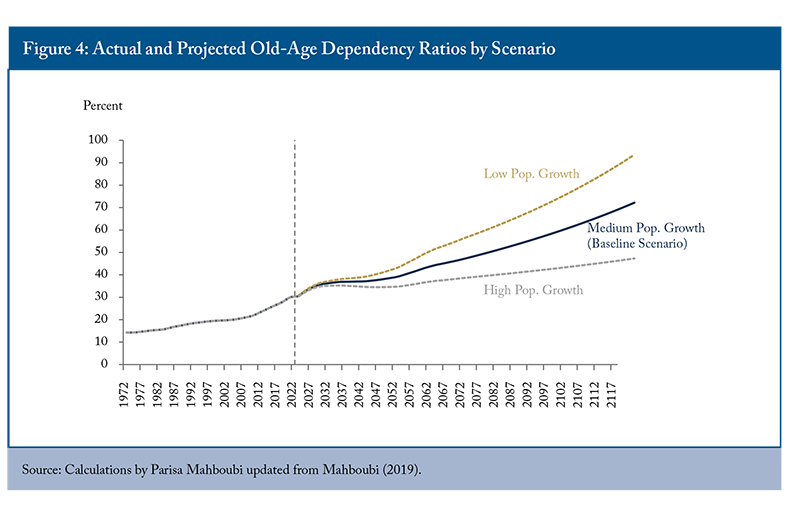
Population ageing and climate change make the productivity and trade challenges even more difficult to address. An ageing population reduces the workforce and draws resources into healthcare and pensions. Climate change is exacting billions of dollars a year through infrastructure repairs, health costs, and rising insurance premiums resulting from flooding, wildfires, and extreme weather. The Canadian Climate Institute estimates that climate change will reduce Canada’s long-term annual economic growth rate by almost half, compounding into losses of hundreds of billions of dollars or more by the end of the century (Drummond, Philips and Harland 2026).
Canada’s fiscal situation acts as a drag on growth and limits our ability to address these challenges. The federal government alone projects deficits exceeding $50 billion a year as far as the eye can see, a net debt-to-GDP ratio staying above 40 percent, and tax and spending parameters that dull incentives to grow. And such dire outcomes do not fully reflect the commitment to massively increase defence spending. At least Canada’s fiscal situation and prospects are not as dire as those of the United States and many other countries.
Re-establishing fiscal stability is especially important now to mitigate the contagion from rising global bond yields, driven in good part by growing public debt burdens and a surge in long-term financing needs for artificial intelligence (AI). Canadian bond yields are creeping up but remain about 1 percentage point below US rates. That borrowing advantage is not guaranteed.
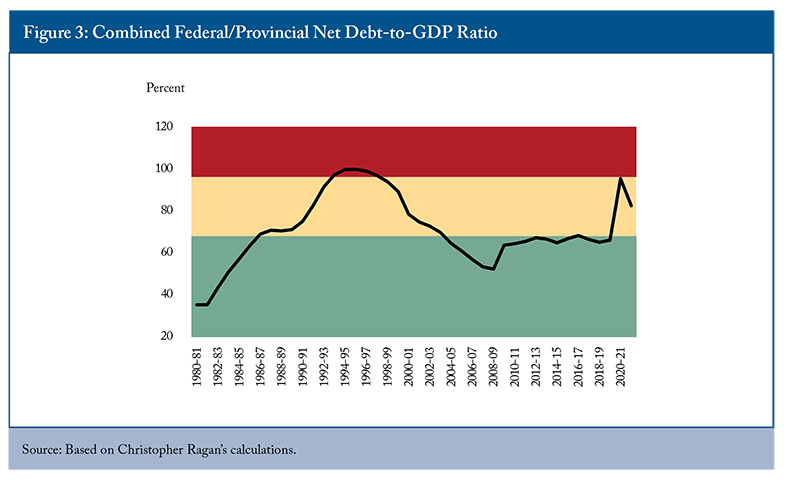
Inaction on stabilizing public finances is often justified by the Canadian federal government’s lower debt burden compared to other major countries and our own history. But the Canadian debt advantage is much less pronounced when considering all levels of government and using gross debt – which removes the current surpluses from the Canada and Quebec Pension Plans, which are not available to fund public services other than pensions. The current federal net debt burden of just over 40 percent of GDP, with about 13 cents of every revenue dollar going to debt charges, compares favourably with the 66.6 percent net debt-to-GDP ratio of 1995/96, when debt charges absorbed 35.2 cents of every revenue dollar. But it makes no sense to risk following the path of more indebted countries, which face even higher bond yields, or to repeat the worst of our own fiscal history, when Canada struggled to find buyers for its debt.
The only good thing that came out of Canada’s dire fiscal situation in the mid-1990s was the acceptance of a crisis and the will to act boldly. Surely, we can have the foresight to act boldly now before again hitting a fiscal wall.
The Status Quo is Unpromising
Drummond and Mahboubi (2026) projected Canada’s future economic growth rate assuming productivity continues to grow at its meagre average rate since 2000. Applying this assumption to the demographics resulting from population ageing and the new, lower immigration targets, this “supply-side” perspective on growth yields just 0.5 percent real GDP growth this year and next, and an average of 1.4 percent from 2026 to 2060 if the downward trend in average hours worked is arrested, or 1.2 percent if it is not.
The federal deficit would rise from the $50-billion-plus annual range projected in the 2026 Spring Economic Update, and the debt burden would continue rising as a share of GDP.
The bottom line would be stagnant economic well-being for individuals and a massive transfer of burdens to younger and future generations.
The Challenges Are Not Being Taken Seriously Enough
Undoubtedly, part of the reason bolder action has not been forthcoming is that many economists, especially forecasters, have put a rather rosy spin on prospects. Typical forecast assumptions include no further increase in the average tariff rate on Canadian exports and diminishing trade uncertainty. In other words, they attach no credibility to the rhetoric of President Donald Trump or the many trade agreements the US has been signing around the world that feature significant base levels of tariffs, with higher rates and quotas on selected products. We continue to see such a spin, with many rushing to predict that the latest round of US tariffs against Canada will only reduce real GDP by 0.4 or 0.5 percent, while assuring us that at least we still have the Canada-United States-Mexico Agreement (CUSMA).
Such analyses of what is taking place at the margins miss the point that the fundamental premise of all free trade agreements struck with the United States over the past few decades – that companies, whether Canadian or foreign, can freely access the US market from a base in Canada – has been broken. It will take a long time, if ever, to restore confidence in that premise. We must ask: if companies were not investing much when they thought they had access to the US market, why would they when such access is threatened?
It is difficult to comprehend the steadfast assurance that average tariff rates will not rise or CUSMA protections will remain. The US has rejected automatic renewal of CUSMA, is breaking its commitments daily, and has made it clear that it expects to extract a fee from all those American firms that buy from outside the United States. The sort of fee it appears to have in mind, and has been extracting from other countries, can make it unprofitable for Canadian exporters and US importers to do business.
Output per hour worked – productivity – has averaged 0.8 percent growth since 2000 and only 0.5 percent over the past four years. Yet most forecasters assume much stronger rates going forward. The Bank of Canada, for example, assumes 1.4 percent average annual growth in productivity through 2028, a pace not seen in decades. It adds 0.2 percentage points per year for the growing application of AI and assumes employers will squeeze more output per worker from the dwindling labour force. These are unproven assumptions and still do not fully explain the optimism. Such forecasts feature much stronger growth than the “supply-side” projections of Drummond and Mahboubi (2026). The latter are not a forecast per se. Productivity could grow more strongly. Demand growth could outstrip supply. But outcomes could just as easily be even weaker. Given global uncertainty and trade tensions with the United States, it would be wise to take such downside risks more seriously.
The Bank of Canada should be given credit for at least thinking about the macroeconomic implications of AI applications. But much more work needs to be done on these issues. And in the meantime, some healthy scepticism about AI’s potential benefits for productivity is in order. First, there have been many technological breakthroughs during the period of Canada’s declining productivity growth. Second, work by the Future Skills Centre (2024) found that while firms applying AI have higher productivity than those that do not, AI itself did not raise productivity.
If the challenges were being taken seriously enough, the federal government would not have abandoned its promise from five years ago to establish an independent commission on productivity. It also would have followed through on its election promise to establish a group to examine corporate taxation. Clearly, the government understands the problems but has decided not to call upon expert advice or encourage national discussion at this time.
If the challenges were taken more seriously, we would not see federal and provincial politicians uniting in the quest for international free trade while maintaining internal trade barriers. The International Monetary Fund has said these barriers are equivalent to a 9 percent external tariff on all Canadian goods and services, and that removing them could raise real GDP by 7 percent in the long run (Diez and Yang 2026). Some barriers have been reduced since the IMF made these estimates, but they remain substantial.
If the challenges were taken seriously, we would see a concerted national – federal, provincial, territorial, and municipal – effort to streamline regulatory processes. Federal approval alone of projects can easily take more than five years. Add often separate and sequential approval processes at the provincial, territorial, municipal, and Indigenous levels, and the projects being bandied around amid renewed interest in infrastructure may not even start for a long time.
Canada’s potential advantage in critical minerals is being cited often of late. But development, if it proves to be economically beneficial, could take decades. The federal government is taking action, including setting up a Major Projects Office and enacting the Building Canada Act. It has been noted, however, that the underlying obstacles – “political decision-making over individual projects and open-ended criteria that require regulators to consider broad public policy objectives” remain largely unaffected (Vegh and Koplovich 2026).
If the challenges were taken seriously enough, we would have a comprehensive federal economic plan that realistically lays out the challenges, presents options for national consultation, and sets out a plan for bold action. Instead, we get speeches, webinars, and budget documents that cover the territory only partially and reach relatively few Canadians. The prime minister has said Canadians will be required to make sacrifices. But time after time, the government softens those sacrifices by borrowing more money: to increase the Old Age Security payments for those 75 and over, a cohort with one of the lowest poverty rates; to rename the GST low-income credit the Canada Groceries and Essentials Benefit (CGEB) and increase it; to offer more incentives to first-time home buyers and purchasers of new homes; to suspend the federal gasoline excise tax for six months – and then extend the suspension as gasoline prices failed to decline; and to put still more money into subsidies for childcare.
In all these cases, the federal government addresses affordability issues by borrowing more. That simply transfers the burden forward. Where there is a demand-supply balance, demand is stoked further with much less effort applied to supply enhancement. Affordability challenges would be better met by greater efforts to raise Canadian productivity and incomes. Some of the government’s actions, such as more infrastructure spending, will certainly help productivity, but a cohesive plan is not being applied across all spending.
If the challenges were taken seriously enough, we would not see the federal government take the more than $5 billion fiscal windfall from higher oil prices and spend every cent of it in the 2025 budget, mostly to bolster consumption. We would not have seen an 80 percent increase in government operating costs over 10 years, with a 90,000 expansion in the number of federal civil servants – a one-third increase – together with a doubling of contracting costs. Average compensation for full-time equivalent bureaucrats also reached $143,271 (Terrazzano 2026). That is far higher than what is made by the majority of Canadians funding such pay through their taxes. Despite this growth, services do not appear to have improved. The government has cited new programs such as pharmacare and the Canadian Dental Plan, but much of the administrative burden is carried by the provinces and the private sector. Efforts to cut federal spending have been half-hearted, often going little beyond incentivizing civil servants to leave. Even after these so-called cuts, the ratio of program spending to GDP, is projected to reach its highest level since 1994/95 by 2030, outside of the pandemic years.
What Would a Strategy Look Like?
The starting point for a more serious course of action would be to put a comprehensive economic plan to Canadians, realistically depicting the challenges and options for action. If Canadians understand the gravity of the situation, they will give political licence to act, as they did with the initial Free Trade Agreement and the assault on the deficit in 1995.
Governments and private sector agents would cut the wishful thinking from their projections and depict the probable problems under the status quo.
Governments at all levels and in all jurisdictions would unite to finally end internal trade barriers. They would work together to streamline regulatory processes without compromising environmental standards or Indigenous rights. And they would do it soon and quickly.
Governments would radically alter the fiscal landscape with lower deficits and debt burdens and taxation and spending parameters targeted at promoting growth. The focus would be on much lower spending. Restoring the ratio of program spending to GDP that prevailed from 2003/04 to 2019/20 would reduce spending by $66 billion by 2030 and, on its own, bring the budget back close to balance.
The federal government would proceed with the promised review of taxation. The recommendation would inevitably be to shift the composition of Canadian taxation away from the overuse of corporate and personal income taxes, which are the most damaging to economic growth, and toward consumption taxes. The government would cut corporate and personal income tax marginal rates (see Mintz, Laurin, and Dahir 2026). It would also end the steep marginal corporate income tax rate corporations face if they try to grow beyond the definition of a small business.
A federal government plan would feature a comprehensive review of spending with a value-for-money perspective. Programs that could not be reformed to deliver intended outcomes efficiently would be scrapped. The results of the review would be made public to Canadians. The resulting action would need to be sweeping, such as gradually raising the age of entitlement for Old Age Security (OAS) and lowering the income threshold at which OAS payments are clawed back. Programs like $10-a-day childcare would be reformed to recognize that a crisis of affordability has become a crisis of accessibility. Business subsidies should be cut back drastically, as many simply transfer income rather than address market failure. Only about 20 percent of subsidies boost real income (Lester 2026). Supply management in agriculture should be reformed, not to appease the United States, but to raise productivity and lower prices in Canada. Supply management need not be scrapped. The focus should be on greater flexibility in quotas and caps on subsidized prices.
A serious approach would also recommit to environmental objectives, including lower greenhouse gas emissions that contribute to climate change. It is not fashionable of late to speak of environmental objectives, as many countries emphasize economic growth. But the future of the planet and its people depends upon reducing emissions. And this need not come at the expense of economic growth. Putting more emphasis on clean growth would be a start. The focus lately seems to be all on the development of fossil fuels and getting them to markets. But the combined global market value of clean energy technologies has grown about 20 percent per year over the past decade. Ironically, two of the world’s largest emitters lead in several dimensions of clean growth. China tops the world in clean energy infrastructure, and the United States invested over US$278 billion in clean energy and transportation in 2025 alone. Canada does not have to match their scale to capture a portion of the prize; it just has to identify and focus on existing competitive advantages (Drummond, Philips and Harland 2026). We now have a National Electricity Strategy. But it does not have nearly the buzz of the attention being given to fossil fuel development.
Government plans would recognize that Canada’s post-secondary education system can be a bedrock for people’s prosperity and well-being gains. Ontario has finally lifted the freeze on tuition. But by 2025, the initial cut and subsequent freeze had brought real (after-inflation) tuition in Ontario 26.6 percent below the 2018 level. That loss in real value is locked in for the foreseeable future. The February 2026 Ontario announcement raises grants by about $1 billion per year, but by 2027/28, they will still be more than 10 percent below 2015/16 in real terms per eligible student (Drummond 2026).
Institutions should be allowed greater flexibility on tuition. The after-inflation value of Ontario and federal grants for research should be restored and be better aligned with the economic transformation the province and Canada must accomplish. Governments should provide incentives to commercialize university-based research. Universities should be allowed to enrol more foreign students with proper accountability and objectives in place. The recent increase in the income requirements for foreign students is a good first step to curtail abuse, which was never widespread in universities, and should be complemented by ending foreign students’ ability to work off campus.
The Endgame and How to Get There
Canada has allowed itself to become too dependent on the United States and has ignored our domestic vulnerabilities for far too long. We are now paying the price. But by addressing the challenges, we can get to an endgame of a new economic and fiscal model that has a stronger, more resilient, and diverse economy with stable finances. The goal should be nothing less than being better off than we have ever been.
What will it take to get to this endgame?
An honest recognition of the economic and fiscal challenges.
A comprehensive plan.
Transparency with Canadians about the problems and the plan, sparking national discussion, debate, and hopefully, consensus on action.
A willingness to act.
Speed in acting, but patience with the inevitable lags in realizing improvements.
Conclusion: Let’s Act Now
Actions such as those recommended above always meet resistance as too controversial to be supported by the Canadian public and, hence, politicians, or too difficult to pull off within our system of federalism. But that may only be true if Canadians are not fully apprised of the seriousness of Canada’s economic and fiscal challenges. With such unfiltered information and a plan to ensure Canada’s prosperity, Canadians would likely offer widespread support, as they have in response to previous national challenges.
We must get serious and act now.
Edited remarks delivered to the School of Policy Studies, Queen’s University, on September 4, 2026. By Don Drummond
The author extends gratitude to Alexandre Laurin and Daniel Schwanen for valuable comments and suggestions. The author retains responsibility for any errors and the views expressed.
Don Drummond is a Fellow-in-Residence at the C.D. Howe Institute and a Stauffer-Dunning Fellow, School of Policy Studies, at Queen’s University.
Drummond, Don, Peter Philips, and Kate Harland. 2026. “Canada Doesn’t Need to Abandon Climate Efforts in the Name of Growth or Unity.” The Hill Times. September 7.
Future Skills Centre. 2024. Waiting for Takeoff: The Short-Term Impact of AI Adoption on Firm Productivity. December.
16 septembre 2026 – Sans changement de cap, la faible croissance et l’augmentation des dépenses entraîneront une stagnation du niveau de vie des Canadiens, tout en transférant la majeure partie de la dette actuelle aux jeunes générations et aux générations futures, selon un nouveau Verbatim de l’Institut C.D. Howe.
Dans « The Endgame: Time to Act on Canada’s Economic and Fiscal Challenges », l’auteur Don Drummond avertit que la faible productivité du Canada, la contre-performance de ses revenus, sa dépendance excessive à l’égard des marchés américains et ses vulnérabilités intérieures ne sont pas suffisamment prises au sérieux. Il recommande un plan économique qui vise à rétablir la stabilité budgétaire et à créer une économie plus forte, plus résiliente et plus diversifiée.
Inaugural World Economic Forum survey of CSOs (Chief Sustainability Officers) finds the global sustainability transition advancing with a clear economic case despite geopolitical fragmentation; 63% expect progress to hold steady or accelerate over the next 12 months.73% expect AI to meaningfully accelerate sustainability progress, but 77% flag AI infrastructure’s energy and resource intensity as its most significant negative impact.
85% expect adaptation to become a bigger global priority over the next three years, though 62% cite uncertain cost-benefit assessments as the main barrier to investment. Read the report here.
Geneva, Switzerland, September 2026 – The World Economic Forum’s Chief Sustainability Officers Outlook, published today, finds a global transition showing clear signs of progress backed by commercial and technological momentum despite significant drag from geopolitical fragmentation and marked scrutiny on short-term performance.
The inaugural survey, conducted as escalating conflict in the Middle East disrupted the Strait of Hormuz and rattled global markets, sees CSOs navigating the geoeconomic volatility with more conviction than caution. Some 63% expect global sustainability progress to hold steady or accelerate over the next 12 months, and three in four expect companies’ transition-related investment to do the same driven by a clear economic argument (64%) and increasingly applicable technologies (56%). The result, according to the report, is a “green divergence”, a transition splitting into different sectors and regions moving at very different speeds, even as the global green economy, now worth more than $5 trillion annually, is on track to top $7 trillion by 2030 and remains among the fastest-growing segments of the world economy.
“Chief sustainability officers are telling us the transition is no longer a question of ambition, it’s a question of execution,” said Sebastian Buckup, Managing Director, World Economic Forum. “As companies deliberately anchor sustainability strategies in growth, security and resilience needs, execution speed and priorities increasingly diverge across regions and sectors.”
A widening green divergence Despite geopolitical volatility, momentum has not stalled but has fragmented. Some 78% of CSOs expect geopolitical and macroeconomic headwinds, from conflict to inconsistent policy and weakening multilateralism, to weigh on progress over the coming year. Rather than a uniform slowdown, CSOs describe a green divergence – some sectors and markets pulling ahead on the strength of clear economics, while others stall under policy uncertainty or unconvinced boards.
AI’s double-edged impact Some 73% of CSOs expect artificial intelligence to meaningfully accelerate sustainability progress over the next year, particularly in measurement, reporting, efficiency and risk modelling. Yet 77% of CSOs flag the energy and resource intensity of AI infrastructure itself as its most significant negative impact, as data centres already account for roughly 1.5% of global electricity demand, a green divergence playing out inside a single technology.
Adaptation is becoming the next clear priority Some 85% of CSOs expect adaptation to become a bigger global priority over the next three years and 77% say private-sector investment will be decisive to scaling it. Companies already managing resilience proactively are seeing adaptation bets paying off. CDP estimates that businesses actively managing supply-chain risk have generated $13.6 billion in savings to date, with a further $165 billion in potential financial benefits still on the table.
“The conversation is shifting from whether to act on sustainability to how fast we can prove it pays off. CSOs today are expected to deliver a business case as rigorous as any other investment decision, on resilience, on AI, on the transition as a whole. The organizations that treat this as a growth opportunity, not a compliance exercise, are the ones that will be ahead when the numbers are finally called in,” said Katharina Beumelburg, Chief Sustainability and New Technologies Officer, Heidelberg Materials.
As the report highlights, “the challenge is no longer recognizing physical risks but demonstrating the value of investing in resilience” – a shift laid bare this year as extreme heat and wildfires forced companies and insurers alike to confront the cost of being unprepared. The clearest signal comes from California. Insurers had paid $22.4 billion in claims from the 2025 Los Angeles wildfires by early 2026, while new analysis suggests that rebuilding affected communities to wildfire-resilience standards could cut projected future losses by around one-third.
About the Chief Sustainability Officers Outlook The World Economic Forum’s Chief Sustainability Officers Outlook tracks how the CSO role is evolving and what is driving, or blocking, progress on global sustainability. The inaugural report draws on the Chief Sustainability Officers Outlook Survey, conducted between 10 February and 18 March 2026, gathering responses from 103 sustainability leaders across five continents, members of the Forum’s CSO community, convened by the Forum’s Centre for Nature and Climate. For more information, visit the Centre for Nature and Climate.
About the Sustainable Development Impact Meetings 2026 The Sustainable Development Impact Meetings 2026 (SDIM26) will take place in New York, USA, on 21-24 September and bring together senior leaders from across sectors and regions to advance solutions to shared opportunities and challenges, with a particular focus on long-term impact and building momentum before the World Economic Forum Annual Meeting 2027.
Cheese has once again become a hot topic in the Canada-U.S. trade dispute.
While officials work to lower sectoral tariffs on Canadian steel and aluminum, the U.S. wants Canada to change its strict rules on importing cheese, which a Canadian agricultural economist warns heavily against.
“It’s not in the Canadian interest,” explains Al Mussell, a prominent Canadian agricultural economist and policy analyst.
Last month, U.S. President Donald Trump signed an executive order threatening a 50 per cent tariff on Canada’s dairy sector, which is now in a three day suspension period as negotiations continue.
Raphael Kaiser stores some of the artisinal cheeses at the production facility of Fromagerie Fritz Kaiser in Noyan, Que., Thursday, Oct. 11, 2018.THE CANADIAN PRESS/Ryan Remiorz
Mussell explains that the U.S. wants more control over who can access Canadian retailers directly, so they can export some of their premium products to Canada.
“Of course, that’s not how our system works,” he says, adding that allowing it would threaten Canadian processors and complicate the domestic raw milk allocation system.
Canada currently gives dairy import quota access mainly to processors, while retailers are excluded under CUSMA. The U.S. argues that this restriction creates an unfair playing field because retailers are granted access under Canada’s trade agreement with the European Union.
The U.S. administration says “Canada is discriminating against the commerce of the United States through Canada’s tariff-rate quota allocation measures imposed on U.S. cheeses of all types.”
Canada and the U.S. have fought over this before
The dispute over who gets access to Canada’s dairy quotas is not new.
The U.S. first launched a formal dispute under CUSMA, arguing that Canada’s dairy import system shut out U.S. producers because it gave almost all its import permits to domestic dairy factories.
After a trade panel ruled that this was unfair, Canada changed the rules to let other dairy businesses, like distributors, get the permits too. However, retailers remain excluded.
A cow in a dairy farm, Tuesday, January 23, 2024 in Saguenay Que. THE CANADIAN PRESS/Jacques Boissinot
When the U.S. challenged Canada again, arguing retailers should also be allowed direct access, the panel sided with Canada, saying it was in compliance with CUSMA.
Mussell says the U.S. continuing to press the issue despite that ruling is not a good sign.
“I think it goes far beyond cheese or dairy products,” he says.
“When the President can come in and make threats that contravene a decision that the dispute panel under the CUSMA agreement rendered… that’s really troubling.”
What happens if retailers get more access?
Mussell says giving grocery retailers direct access would not increase the total amount of U.S. cheese entering Canada, since the quota is already essentially filled, but it could shift sales away from Canadian manufacturers.
He says it could also complicate Canada’s supply management system because raw milk is allocated to processing plants on a regulated basis.
Cows are milked at a dairy farm in Granby, Que., on Wednesday, Feb. 5, 2025. THE CANADIAN PRESS/Christinne Muschi
“That could be costly to the Canadian dairy industry,” he says.
Mussell also warns that giving grocery retailers more direct access to imports could strengthen their negotiating position with Canadian dairy suppliers.
“Your’re kind of arming them in terms of the sorts of relations that they can have with their dairy suppliers,” he says.
‘Our national food sovereignty is not up for negotiation’
“Our national food sovereignty is not up for negotiation,” said David Wiens, president of DFC.
“It is also clear that Canadians believe in the importance of having control over our food supply and ensuring that Canada’s strong domestic dairy sector is not compromised.”
The trade relationship in dairy already “massively favours the U.S.” said Mathieu Frigon, president of the DPAC.
“U.S. dairy exports to Canada far exceed Canadian dairy exports to the U.S. by more than $600 million annually and have increased by more than 150% since CUSMA came into effect,” said Frigon.
What about the quality of U.S. dairy?
Mussell says even if more U.S. milk entered Canada, there is a major difference between Canadian and U.S. dairy quality standards.
“You could have milk that shipped under the U.S. Grade A that would not be saleable in any province in Canada,” he says.
Canadian milk is seen at grocery store in Ottawa, on Wednesday, April 2, 2025. THE CANADIAN PRESS/Justin Tang
Moreover, he says a significant amount of American milk doesn’t even meet its own Grade A standard.
“Is that product being exported to Canada, made from that milk? We don’t know. They don’t label. We have no way of knowing that,” says Mussell.
He says federal funding for labs that monitor the U.S. milk testing system stopped last year.
“What’s the nature of the safety and quality of product that we’re getting from the United States? I don’t know that we have an answer for that, and it’s concerning,” says Mussell.
The U.N. wants every nation to build its own AI stack. It is the surest way to stay a generation behind.
Many countries have looked to the United Nations to be the great evangelist of that idea. Through its Global Digital Compact and the funds and machinery that some are trying to assemble around it, the organization presses toward a world in which every country commands what the Secretary-General’s own reports call an “irreducible minimum” of artificial intelligence—its own computers, its own data, its own models, raised at home and owned at home. A secretariat-proposed multibillion-dollar fund would help pay for the building. And a growing number of governments, persuaded that independence requires duplication, are drafting national AI strategies to match—each resolved to rebuild, inside its own borders, a stack that already exists somewhere else.
It is a seductive vision. It is also backward and counterproductive.
Silicon Valley leaders have built fortunes on a heresy that traditional industry leaders still resist: that competition for existing products and methods, far from being the engine of prosperity, is more often the graveyard of growth and the path to stagnation. The company that copies an existing product and follows traditional methods walks into a crowded market and watches its margins bleed toward zero because a hundred rivals are selling the same thing. The company that builds something genuinely new—something that did not exist the day before—faces no competition at all and keeps the profits to show for it. The second company sees its profits go from zero to one, as it is has created a new market. The first reduces both the profits of the first and its own. Only the innovators create new wealth for societies.
Now apply the heresy to nations. Picture the conference—there is always a conference—where forty governments rise in turn to pledge a sovereign cloud, a sovereign model, a national champion of their very own. They will applaud one another’s independence. Then they will go home and pour billions into companies built to do precisely what thirty-nine others are doing, in markets too small to sustain even one of them, chasing margins that thin asymptotically toward nothing the moment the next champion is announced. They will have achieved not so-called “digital sovereignty” but a kind of synchronized mediocrity—a planet of subscale clones, each heroically reconstructing last year’s breakthrough while the breakthrough itself moves on without them.
While others rebuild the present, American firms will be inventing the future. They will not be defending yesterday’s platform; they will be shipping tomorrow’s—the products that do not yet exist, that no committee in Geneva has thought to subsidize, that will define the coming decade before the clones have finished cloning the last one. And because they will stand alone at the frontier, they will keep what the frontier pays: the fat margins, the soaring valuations, the commanding heights of the global economy. That is not an accident of American luck. It is the iron arithmetic of zero to one.
This is the distinction the sovereignty evangelists miss, and it is the whole game. A nation is not digitally sovereign because it can reproduce yesterday’s breakthroughs—half the world can do that. It is digitally sovereign because it can contribute to tomorrow’s. Call it innovation sovereignty: the power not to copy what exists, but to create what does not. The autarkist measures his strength by how much he can wall off and rebuild. The innovator measures his by how much he can invent that which no one else can. One ends the decade with a museum. The other ends it owning the future.
America learned the lesson the easy way. When the world moved to 5G, the United States had no national champion to build the radios and base stations at the network’s core. It could have declared a digital sovereignty emergency and burned a fortune standing up a domestic equipment maker from scratch. It did nothing of the kind. Instead, American companies bought the gear from trusted allies and turned their genius loose on the layer above: the cloud, the software, the artificial intelligence that now runs the world. America did not win the future by manufacturing the antenna. It won by building everything that travels through it.
This is the logic behind Pax Silica.
We did not build it as a fortress. We built it as a coalition of capabilities—a way for nations that trust one another to find the best technology wherever it lives among them and to braid those strengths together. The premise is simple and old: trusted partners trading on their advantages accomplish what no walled-off nation can manage alone. One partner’s compute meets another’s minerals, a third’s talent, a fourth’s capital, and the result is not a sum but a multiplication.
Microsoft CEO Satya Nadella has lately pressed a point the digital sovereignty evangelists would do well to absorb: the prize was never a frontier model but a frontier ecosystem—one built so that value flows outward, to every company and industry and country it touches, instead of pooling in the hands of whoever happens to own the silicon. The great platforms have always given away more than they kept; they create more wealth above them than they capture within. And what each nation keeps for itself, atop that shared foundation, is the one asset no rival can copy and no committee can subsidize into being: its own learning loop—the accumulated knowledge of its firms and its institutions, compounding with every problem it solves, its human capital and its machine capital gaining on each other turn by turn. A country does not become digitally sovereign by hoarding a model that will be obsolete within the year. It becomes digitally sovereign by owning the loop that turns its own experience into advantage. Ecosystems, in the end, do not merely add; they empower the builders—the people who will actually invent what comes next, and who need partners and markets and momentum, not borders drawn around a problem already solved.
The champions of digital sovereignty believe they are arming their nations for the future. In truth they are marching them, in perfect and well-funded formation, into the past. Digital sovereignty was never a wall, and it was never a copy. It was always a frontier—and the only nations that will be digitally sovereign in the age of intelligence are the ones bold enough to keep pushing it outward, into the territory no one has built yet.
Jacob Helberg is U.S. Under Secretary of State for Economic Affairs and the architect of the Pax Silica initiative.
The World Economic Forum’s Top 10 Emerging Technologies Report 2026 identifies breakthrough innovations in energy, medicine and infrastructure.
The report highlights 10 emerging technologies expected to achieve real-world impact within the next three to five years.
These technologies could help broaden access to energy, healthcare and critical resources, making access to them less dependent on geography or existing resource availability.
Learn more about the Annual Meeting of the New Champions 2026 here. Follow on social media using #amnc26, #2026夏季达沃斯# and #InnovateScaleImpact. Read the report here.
Dalian, People’s Republic of China, 23 June 2026 – Our friends at The World Economic Forum released its annual Top 10 Emerging Technologies Report 2026 today, identifying breakthroughs poised to reshape economies and societies within the next three to five years.
Produced in collaboration with Frontiers, a leading scientific publisher, the report examines technologies approaching a critical inflection point where advances in research are beginning to translate into large-scale, real-world applications.
The report identifies 10 emerging technologies approaching commercial and societal scale:
1. Everything-to-grid energy: Buildings, vehicles, factories and data centres can increasingly act as both energy consumers and suppliers, sending stored electricity back to electricity grids when needed. This could improve energy resilience while making better use of local renewable power.
2. Direct lithium extraction: Removes lithium from brine in hours rather than months, while using less land and water than conventional methods. It could unlock new sources of a critical battery material and strengthen supply chains.
3. Passive radiative cooling materials: These materials cool buildings and equipment without electricity by reflecting sunlight and releasing heat into the atmosphere. They could reduce energy demand and improve resilience in hotter climates.
4. PFAS destruction: New technologies can break down per- and polyfluoroalkyl substances (PFAS), known as “forever chemicals”, that have long resisted conventional treatment. This could help remove persistent pollutants from water supplies and the environment.
5. Precision fermentation: Uses microorganisms to produce specific ingredients and materials more efficiently. It could enable new ways to manufacture food, chemicals and pharmaceuticals with fewer resources.
6. Exosome drug delivery: Exosomes are natural particles produced by cells that can be engineered to deliver therapies precisely within the body. They may enable treatments to reach previously inaccessible targets, including the brain.
7. Personalized mRNA cancer vaccines: Trains a patient’s immune system to recognize the unique mutations in their tumour. They could improve the ability to prevent cancer recurrence following treatment.
8. Quantum simulation for drug discovery: Models molecular interactions with unprecedented accuracy, helping researchers identify promising drug candidates faster and more efficiently.
9. World models: Enable AI systems to build a shared understanding of physical environments using multiple forms of data. They could improve how machines predict, plan and interact with the real world.
10. Lattice-based cryptography: Designed to protect data from decryption by both today’s computers and future quantum machines. It could help secure digital infrastructure as quantum computing advances.
Many of the technologies highlighted in the report point towards systems that may become more distributed, personalized and resource-efficient over time.
“While each of these technologies has the potential to make a meaningful impact on its own, together they tell a broader story about where innovation is heading,” said Stephan Mergenthaler, Managing Director, World Economic Forum. “They reveal new patterns across energy, medicine and manufacturing that could challenge long-held assumptions about how we use technology to address some of the world’s most pressing challenges, such as food insecurity, climate change and untreatable diseases.”
Technologies such as everything-to-grid energy systems, direct lithium extraction and precision fermentation suggest how production systems could become less dependent on centralized infrastructure and traditional geographic constraints. Passive radiative cooling materials similarly point to new ways of managing energy demand and environmental pressures in regions where cooling has traditionally relied on energy-intensive systems.
Several of the technologies also suggest that value creation could increasingly depend on the ability to produce, adapt or optimize systems closer to the point of use. Personalized mRNA cancer vaccines, exosome drug delivery and quantum simulation for drug discovery all point to more individualized approaches to treatment and molecular design, enabled by advances in computation, modelling and targeted delivery systems.
Infrastructure, technical capability and deployment capacity could become increasingly important alongside traditional resource endowments, particularly in sectors where production, energy systems and advanced manufacturing are becoming more distributed and adaptive.
The report also highlights how technologies such as PFAS destruction, passive radiative cooling materials and lattice-based cryptography could reshape how industries and governments address long-standing environmental, infrastructure and security challenges. Several of these technologies raise the possibility of overcoming constraints previously viewed as difficult, persistent, or economically impractical to solve. Whether these patterns translate into real-world success, however, will depend on factors such as infrastructure readiness, regulatory adaptation, manufacturing capacity, public trust and long-term investment.
“Understanding which technologies are approaching a true inflection point requires access to the best available evidence and expertise,” said Frederick Fenter, Chief Executive Editor, Frontiers. “Open science enables researchers around the world to build on one another’s work, accelerating discovery while improving transparency and trust. That shared foundation is critical for identifying and developing innovations that can deliver lasting societal benefit.”
Developed with the Dubai Future Foundation, the report also explores the conditions that will shape how these technologies evolve and scale through 2031, including infrastructure readiness, governance, investment and public adoption. Together, these factors will play a critical role in determining whether today’s emerging technologies deliver broad societal impact tomorrow.
About the Top 10 Emerging Technologies Report Now in its 14th edition, the Top 10 Emerging Technologies report provides trusted foresight to help leaders navigate scientific and technological change. Drawing on the expertise of scientists, researchers and futurists, the report identifies ten innovations expected to scale within five years and deliver wide societal benefits. Technologies are selected through a rigorous process combining AI-enabled analysis of scientific literature, investment and ecosystem trends, and expert evaluation.
About the Annual Meeting of the New Champions 2026 The 17th Annual Meeting of the New Champions will take place from 23 to 25 June 2026 in Dalian, People’s Republic of China, under the theme “Innovating at Scale”. The meeting will bring together over 1,700 participants cross-sector leaders to explore how innovation and emerging technologies can unlock new growth models and drive positive economic momentum in a fast-shifting global landscape.
Millennials are abandoning SUVs for the one vehicle they swore they’d never drive: the minivan.
For years, North Americans were told bigger was better. Three-row SUVs became the default family vehicle, and automakers poured billions into the category. Consumers followed in droves. But now a surprising reversal is underway. The same generation that spent decades mocking minivans is increasingly choosing them over SUVs, and experts say the shift reveals something much larger about the state of the North American consumer in 2026.
Faced with persistent affordability pressures, elevated borrowing costs, expensive insurance premiums, and rising household debt, many families are abandoning image-driven vehicle purchases in favor of practicality, value, and long-term cost savings. The result? The minivan is making an unexpected comeback!
Why Minivans Are Growing Again
The growth comes after decades of decline and signals a notable shift in consumer priorities. Industry analysts cite several major factors:
Better cargo space than most three-row SUVs.
Easier third-row access.
Sliding doors favored by parents.
Better fuel economy versus large SUVs.
Lower purchase prices compared to similarly equipped SUVs.
Strong hybrid offerings from Toyota and Kia.
Rising affordability concerns among younger families.
What makes this trend especially compelling is who is driving it. Millennials, many of whom grew up riding in minivans and spent years rejecting them as uncool, are now among the key buyers fueling the segment’s resurgence. As the oldest members of Generation Alpha enter their school-age years and family transportation needs evolve, functionality is increasingly outweighing perception.
Costly SUVs Are Pricing Out Families SUV prices have steadily climbed since 2021, with three-row options outpacing overall car price inflation. As once-mainstream options like the Suburban and Expedition become more associated with luxury pricing, families looking to pack into a single vehicle have turned to minivans like the Chrysler Pacifica, Toyota Sienna, and Kia Carnival.
Kia Carnival with impressive seating capacity.
The rise of hybrid minivans has also changed the minivan’s reputation from gas guzzler to economical, Earth-friendly choice. Toyota’s hybrid Sienna is also available with all-wheel drive, a combination northern families would have once only dreamed of. For 2026, the hybrid Toyota Sienna gets up to 36 miles per gallon. Ten years ago, the Sienna was good for just 21 miles per gallon. Times are changing! Anyone want to talk about advanced style and design- look back over 30 years ago to the Previa.
The economics are difficult to ignore. Many popular minivans offer significantly more usable passenger and cargo space than comparably priced SUVs, often while delivering better fuel economy and a lower purchase price. For families already grappling with inflation and high monthly expenses, the savings can add up to thousands of dollars annually.
Automotive retail analysts and consumer advocates Zach and Ray Shefska at http://www.caredge.com/ emphasize the following factors:
Millennials Are Suddenly Embracing Minivans
This Trend Reveals About America’s Financial Reality in 2026
SUVs Are Becoming the New Status Symbol Consumers Can No Longer Afford
Minivans Deliver the Best Value for Families Today
Cargo Space, Insurance Costs, and Fuel Economy Matter More Than Ever
Is This a Temporary Shift or the Beginning of a Long-Term Consumer Reset?
Rising Household Costs Are Changing Vehicle Buying Decisions
The Minivan IS the Family Vehicle North Americans Are Reconsidering in Record Numbers
The minivan story is not really about minivans. It is about a generation confronting economic reality and making purchasing decisions based on value instead of image. The comeback of the vehicle many Millennials once swore they would never own may be one of the clearest indicators yet of how dramatically the North American consumer is changing.
Canadian retail gasoline prices have soared since the start of the Iran war – even though Canada ranks fourth globally in annual crude oil production, behind only the United States, Russia and Saudi Arabia.
If we have so much oil, why are our gas prices high?
Start with retail markets. In most of Canada, gasoline retailers are free to set prices. In doing so, they think of their costs, their competitors’ prices and how consumers will react. They’re less concerned about what they paid for the fuel they’re selling than what it will cost to replace it next time they order a gasoline shipment. So, when the wholesale price rises, they adjust their own prices quite quickly.
Rockets and Feathers
Conversely, when prices fall, they end up in a game of chicken with their competitors. The station that cuts prices first does sell more fuel but it makes less profit on each litre. Retailers balance the profit they make from more volume against their reduced margin. This leads to a phenomenon some economists call “rockets and feathers.” Prices rise fast and fall slowly.
As consumers it’s tempting to think we’re getting ripped off. But, over time, gas stations really aren’t big profit engines. They make a bit of money when wholesale prices fall, less when wholesale prices rise. Overall, they make enough to pay for their staff and inputs while getting a fair return on their investment.
Working backwards through the story, gas stations buy gas from a wholesaler. Sometimes they buy from the same brand (i.e., a Shell station buys its fuel from a Shell wholesaler) but often there’s no connection: Retailers buy the cheapest gas available. There are fewer wholesalers than retailers but the wholesale market is competitive, too. Gasoline is pretty much the same no matter who you buy it from so it’s hard for any single wholesaler to charge a higher price than its competitors. Wholesalers, like retailers, set prices based on their competition and the replacement cost of their inventory. More rockets and feathers.
To summarize: Retail prices spike with wholesale prices, and wholesale prices spike with crude oil prices.
And why are Canadian crude oil prices rising when we are half a world away from Iran? Because global oil markets are linked and Canadian producers prefer more profit to less. When a Canadian producer markets its crude, it looks for the highest bidder. If it can sell to an export partner for a higher price, it will. Canadian refineries therefore need to match that price to buy oil for domestic use.
This is a feature, not a bug.
Canada and the United States are the only two major oil-producing nations with competitive crude oil markets. All other producing nations co-ordinate production through state-owned enterprises. Canadian oil companies, though large in absolute terms, are small relative to their international rivals. This makes them price-takers.
A Canadian firm can’t simply decide to charge more, the way OPEC producers can. They’re too small to influence global markets. They’re also prohibited by law from colluding with each other to drive up prices. As a result, though Canadian producers may well benefit from rising global crude oil prices, they can’t cause them.
Canadian producers could offer lower prices to domestic refineries, but that’s against their own interests and would reduce their profits. Preferencing the domestic market with lower crude oil prices would also risk damaging our trade relationships.
A fundamental rule of economics is that prices and quantities are linked. As the quantity of globally available crude oil falls, prices rise for crude and gasoline alike. As gas prices go up, we consume less gasoline and by extension less crude oil. That’s how global market systems balance supply and demand.
If we artificially suppress prices for Canadian consumers (and only Canadian consumers) we end up consuming more gasoline domestically and exporting less oil. Drivers would benefit but the reduction in exports would lower our incomes, damage our terms of trade and hurt our reputation as a reliable trade partner.
Yes, when world oil prices rise Canadian oil producers make higher profits. But they aren’t “gouging” consumers and this isn’t a federal or provincial policy failure. It’s the global market doing what it’s supposed to do. [A point to consider: last year the highest octane fuel available, 94 was selling for on average $2.00/L in Southern Ontario. Today that fuel sells for on average $2.12/L meaning an increase of 6% in cost. Yet the most common octane fuel: 87 has seen an increase of (avg. of $1.40/L vs today’s rate of $1.83/L) of 25%. Shouldn’t the % increases in fuel be the same? CP]
Kent Fellows is assistant professor (Economics) and Associate Program Director of the Canadian Northern Corridor research program at The School of Public Policy, University of Calgary and fellow-in-residence at the C.D. Howe Institute.
Life for Relief and Development calls for increased global support as rising living costs and food insecurity intensify humanitarian needs worldwide
World’s Most Vulnerable Is An Increasing Demographic
As the costs of food, fuel, housing, healthcare, and necessities continue to climb across the globe. Humanitarian organizations are warning that the world’s most vulnerable populations are facing increasingly devastating consequences. In 2024, more than 295 million people across 53 countries experienced acute hunger, marking the sixth consecutive year global food insecurity has worsened. That number has since risen to 343 million. Families already living in poverty are now being pushed further into crisis, forced to make impossible decisions between food, medicine, education, and shelter.
Surging Inflation
According to international economic and humanitarian reports, surging inflation, supply chain disruptions, ongoing conflicts, climate-related disasters, and economic instability have significantly increased the cost of living worldwide. While these rising pressures are affecting households everywhere, the burden falls disproportionately on low-income communities and developing nations, where millions are already struggling to meet basic daily needs.
Life for Relief and Development (LIFE), a global humanitarian organization dedicated to providing aid regardless of race, gender, religion, or cultural background, is witnessing firsthand the growing impact economic pressures have on crisis-affected communities across the Middle East, Africa, Asia, Eastern Europe, and beyond.
Limited Resources
“In many of the communities we serve, families were already surviving on very limited resources,” said Dr. Hany Saqr, CEO of LIFE. “Now, with food prices soaring and essential goods becoming increasingly unaffordable, many parents are struggling simply to feed their children. What may feel like inflation in one part of the world can become a matter of survival in another.”
LIFE’s humanitarian teams continue to respond through emergency food assistance, orphan support programs, healthcare initiatives, clean water projects, seasonal aid distributions, and long-term development efforts aimed at helping families regain stability and self-sufficiency. Working in more than 60 countries, LIFE has helped deliver $667 million usd/ $922.4 million cad in humanitarian assistance over the past three decades, supporting vulnerable communities affected by conflict, hunger, displacement, poverty, and disaster.
“Humanitarian aid is no longer just about responding to emergencies after they happen,” Dr. Saqr added. “For millions of families, assistance is what prevents a difficult situation from becoming a catastrophe.”
In addition to its ongoing humanitarian initiatives, LIFE will perform Udhiyah/Qurbani distributions this year in 32 countries. Through the annual program, fresh meat will be distributed to families experiencing difficulty during Eid al-Adha. Last year, the initiative helped combat food insecurity for nearly 200,000 people worldwide, including families in Gaza who received canned meat distributions due to ongoing access restrictions. LIFE says the program not only helps provide nutritious meals but also allows vulnerable families to participate in Eid with dignity.
Growing Challenges
As the world continues to face growing economic and humanitarian challenges, compassion, shared responsibility, and collective action can play a significant role in shaping a more just and hopeful future. Life for Relief and Development believes that meaningful change begins when people choose not to turn away from suffering but instead work together to help create a more humane, equitable, and sustainable world while opening pathways toward greater stability and opportunity for future generations.
Building Blocks of the Global Economy Are Changing
The architecture of the global economy is undergoing a profound structural redefinition. What once existed as parallel and independent industries—diplomacy, luxury, artificial intelligence, and space exploration—has begun to converge into a single, interdependent system of influence. This transformation represents more than technological progress; it signals the emergence of a new civilizational framework: the Global Innovation Era.
At its foundation, this era is defined by integration over isolation, ecosystems over sectors, and strategic alignment over fragmented competition. Power is no longer concentrated solely within governments or multinational corporations. Instead, it is distributed across highly interconnected global networks that span continents, disciplines, and spheres of influence.
A New Global Lattice
From Russia’s engineering depth to the United States’ leadership in technological innovation, from Australia’s research capabilities to Dubai’s infrastructural ambition, from Monaco’s concentration of capital and luxury to the Caribbean’s strategic positioning in global lifestyle and investment markets—a new global lattice is taking shape. This system is not accidental. It is being deliberately constructed by a new generation of leaders who understand that the future belongs to those capable of connecting what was never designed to be connected.
Redefining Diplomacy: From Statecraft to System Leadership
Diplomacy in the 21st century has evolved beyond traditional political negotiation into a multidimensional instrument of global coordination. It has become a form of system leadership—the deliberate construction of trust frameworks that enable cooperation across governments, industries, and cultures.
Today, diplomacy operates across multiple strategic layers:
Economic diplomacy shaping cross-border capital and investment flows
Technological diplomacy governing artificial intelligence, data ecosystems, and cybersecurity
Cultural diplomacy influencing global perception, identity, and soft power
Environmental diplomacy aligning international sustainability strategies
Educational diplomacy building intellectual capital and global talent pipelines
In this expanded capacity, diplomacy is no longer reactive—it is generative. It establishes the conditions necessary for innovation ecosystems to emerge, scale, and sustain. Without it, global integration fragments into inefficiency and instability.
Luxury as a Strategic Engine of Influence
Luxury is no longer simply a sector of consumption—it is a strategic engine of global influence. It operates as a high-level signaling system that defines aspiration, sets standards, and increasingly prototypes the future of human experience.
Across haute couture, fine jewelry, ultra-prime real estate, private aviation, yachting, and bespoke services, luxury functions as a controlled environment for innovation. Emerging technologies—particularly artificial intelligence—are first deployed in these high-value ecosystems, where personalization, precision, and exclusivity are paramount.
Luxury now serves as:
A driver of experiential and design innovation
A curator of global cultural capital
A bridge between heritage and technological advancement
A platform for integrating advanced technologies into human-centered environments
Its influence extends far beyond its economic footprint. By shaping perception, it indirectly shapes global demand, behavior, and market direction.
Artificial Intelligence: The Cognitive Infrastructure of the Global Economy
Artificial intelligence has become the defining infrastructure of modern civilization. It is not a supplementary tool—it is the cognitive layer upon which global systems are increasingly built.
AI is transforming:
Decision-making, shifting from reactive processes to predictive intelligence
Operations, transitioning from manual systems to autonomous networks
Value creation, moving from resource-based models to data-driven economies
Its applications are systemic:
Global supply chains that optimize themselves in real time
Financial ecosystems that anticipate volatility and opportunity
Creative industries enhanced by generative intelligence
Communication systems that eliminate linguistic and geographic barriers
Security frameworks capable of responding to complex, evolving threats
In this context, AI becomes the invisible architecture of the global innovation ecosystem—quietly orchestrating complexity at scale.
Space: The Expansion of Economic and Strategic Territory
Space is no longer a symbolic frontier—it is an active extension of the global economy. Its commercialization introduces a new dimension of infrastructure, connectivity, and geopolitical relevance.
This expansion includes:
Satellite networks enabling global communication and digital infrastructure
Earth observation technologies transforming environmental and resource management
The rise of space tourism as a new frontier in ultra-luxury markets
Advanced research in microgravity environments
Navigation, defense, and security systems with global strategic implications
Space represents the vertical expansion of economic activity—where technological ambition, geopolitical influence, and commercial opportunity intersect at the highest level.
The End of Silos: The Emergence of Integrated Global Ecosystems
The defining characteristic of the Global Innovation Era is not isolated advancement, but systemic integration.
A single initiative today may require:
Diplomatic coordination across multiple jurisdictions
AI-driven operational intelligence
Luxury-level experience design
Space-based infrastructure support
This convergence marks the نهاية (arabic: nihayat english: the end) of siloed thinking. The most significant breakthroughs no longer occur within industries—they occur at their intersections.
The result is a new paradigm: the ecosystem as the primary unit of value creation.
Within these ecosystems:
Investors, engineers, diplomats, and creatives operate within unified networks
Knowledge flows seamlessly across domains
Innovation accelerates through collaboration rather than competition
This is not incremental evolution. It is a fundamental reconfiguration of how the global economy functions.
The Rise of the Multidisciplinary Global Leader
At the center of this transformation is a new leadership archetype—one defined not by specialization alone, but by synthesis.
These leaders:
Build influence through global networks rather than hierarchical structures
Navigate fluidly between public and private sectors
Combine technological expertise with geopolitical awareness
Design ventures with immediate international scalability
Leverage digital infrastructure to operate without geographic limitation
They understand a critical reality: in a connected world, proximity is no longer physical—it is strategic.
Their advantage lies not in isolated knowledge, but in their ability to connect knowledge across systems.
Global Nodes of Influence
The emerging global ecosystem is anchored in interconnected regions, each contributing unique strategic value:
Russia contributes engineering excellence and scientific depth
The United States leads in technological innovation and capital markets
Australia connects research and sustainability with Asia-Pacific growth
Dubai exemplifies large-scale infrastructure and global business integration
Monaco represents concentrated financial power and luxury influence
The Caribbean offers strategic positioning in tourism, investment, and maritime economies
Together, these regions form a distributed but unified network. Their collaboration defines the speed, direction, and scale of global innovation.
Merit in the Age of Global Connectivity
One of the defining shifts of this era is the redefinition of opportunity. While structural barriers remain, access to global platforms, knowledge, and networks has expanded significantly.
However, access alone is no longer a differentiator. Execution is.
Success now requires:
Intellectual rigor
Strategic clarity
Adaptability in complex environments
Long-term discipline and resilience
Potential may be universal—but meaningful achievement remains highly selective.
Founder Spotlight: Aleksandra Sokolova and the First Royal Global Ecosystem
At the forefront of this transformation stands Aleksandra Sokolova, founder of the Royal Global Ecosystem—the first integrated global platform of its kind.
This ecosystem represents a pioneering model that unites diplomacy, global luxury, artificial intelligence, space innovation, and international collaboration within a single strategic framework. It is not a conceptual alignment, but a structured, operational system designed to function across sectors and borders simultaneously.
Within this ecosystem:
Diplomacy enables trust, access, and international partnerships
Artificial intelligence drives efficiency, scalability, and intelligent systems
Luxury defines experience, positioning, and global influence
Space innovation expands infrastructure, connectivity, and future opportunity
The Royal Global Ecosystem establishes a new category of global architecture—one in which industries no longer operate independently, but as interconnected components of a larger system.
Aleksandra Sokolova’s role reflects the emergence of a new class of leadership: system architects. These are individuals who do not simply operate within existing frameworks, but design entirely new ones.
Her work demonstrates a defining principle of the modern era: the future is not inherited—it is engineered.
Conclusion: The Age of Global System Architects
The world is entering an era defined by complexity, interdependence, and accelerated transformation. Linear strategies and isolated thinking are no longer sufficient.
What defines success now is the ability to:
Think systemically across industries
Operate globally across borders
Build integrated structures that connect people, technologies, and markets
The next chapter of global development will not be led by those who react to change—but by those who design the systems through which change occurs.
In the Global Innovation Era, the ultimate advantage belongs to the architects—those who see the entire system and possess the vision, discipline, and capability to build it.
The intersection of logistics, data-driven retail, and social equity offers a unique opportunity for #ValueTransformation. By leveraging the existing infrastructure of modern commerce—specifically barcodes, dynamic pricing, and automated inventory management—we can pivot from bureaucratic stagnation to a lean, responsive governance model. This is not theoretical.
These systems already operate at scale, in real time, with measurable outcomes. The question is not whether the capability exists, but whether the will to repurpose it does.
The Geometry of Taxation: Moving Beyond “Flat”
In Tennessee, the conversation around fair taxation often stalls at the state’s reliance on sales tax. From a value-stream perspective, the current tax system is a “dumb” system; it applies a blunt force to every transaction regardless of the consumer’s economic position or purchasing context.
However, Tennessee already possesses the technology for Granular Fiscal Scaling. Retailers use advanced POS systems that can instantly differentiate between taxable and non-taxable goods, apply promotions, and even personalize pricing models. The infrastructure exists to move beyond a one-size-fits-all tax approach.
To achieve a system where “those with the most pay the most,” we do not necessarily need new forms, agencies, or bureaucratic layers. We need better algorithms at the Point of Sale—rules-based systems that can dynamically adjust tax burden based on product type, purchasing patterns, or other proxies for economic capacity.
In short, taxation can evolve from a static policy to an adaptive system.
Grocery Operations & the Barcode Revolution
Grocery stores are among the most operationally sophisticated environments in everyday life. They are masterpieces of inventory management, demand forecasting, and waste reduction. When a rotisserie chicken nears its “best-by” hour, a clerk applies a “Reduced” sticker. This is not just a discount—it is a real-time adjustment of value to prevent loss.
In Tennessee, grocery receipts already reveal the complexity of the tax code. Consumers routinely see different rates applied within a single transaction, such as a lower state rate on groceries versus higher combined rates on prepared foods or general merchandise. The system is already segmented; it is simply not optimized for equity.
The Proposed Policy Shift- The Bean Protocol:
To incentivize home-cooked nutrition and support economically constrained households, a deliberate tax gap can be introduced. Uncooked, shelf-stable staples like dried beans would carry a 0% sales tax, reinforcing low-cost, high-nutrition choices.
In contrast, prepared or convenience versions—“heat-and-eat” beans—would carry a significantly higher tax rate, such as 12%, reflecting their added convenience and positioning them as a discretionary purchase.
This is less about beans and more about behavioral economics. The tax code becomes a nudge engine.
The Store-within-a-Store (SwaS) Model: Every participating retailer would aggregate all “Reduced” or near-expiration items into a clearly defined, centralized zone. This “Value Zone” would be tax-free and highly visible. The goal is to create a frictionless experience for consumers who are maximizing every dollar, while simultaneously reducing food waste at scale.
This is lean thinking applied to hunger: eliminate waste, increase flow, and deliver value where it is most needed.
The Immigration & Infrastructure Myth The rhetoric surrounding “free benefits” for immigrants often overlooks the mechanical reality of how Tennessee collects revenue. Most taxation in the state is fundamentally location-based, not identity-based.
Sales Tax: The POS system does not check citizenship or residency status. It does not distinguish between a lifelong resident and a first-time visitor. If a purchase is made in Tennessee, tax is collected. Participation in the economy equals participation in funding the state.
Property Tax: Property taxes are tied to ownership and location. The obligation is attached to the asset, not the individual’s background or identity. By recognizing that economic participation drives tax contribution, the conversation can shift away from entitlement debates and toward optimization.
The more relevant question becomes: how do we best allocate and reinvest the value already being generated by everyone within the system?
Feeding the Foodless: The “Wimpy” Integration The gap between political promises and lived reality is often most visible in food insecurity. The challenge is not just supply, but access, dignity, and system design. The “Wimpy” philosophy—“I’ll gladly pay you Tuesday for a hamburger today”—can be modernized through digital infrastructure. For individuals who are food-insecure or temporarily without means, the self-checkout kiosk can become an access point rather than a barrier.
Identity-Linked Accounts: Using a state-issued ID or secure digital wallet, individuals in immediate need can scan essential items, particularly within the SwaS Value Zone. The “Tuesday” Account: Instead of declining the transaction, the system logs it to a state-managed account. Repayment can occur later through direct payment, payroll deduction, community service credits, or other structured mechanisms. The emphasis is on continuity of access, not denial. Risk Management: What retailers currently classify as “shrinkage” (loss through theft or spoilage) can be reframed as a measurable, trackable social investment. With proper data, the state can quantify outcomes, adjust thresholds, and continuously improve the model. This approach treats people not as liabilities, but as participants in a system designed to stabilize and eventually strengthen their position.
Conclusion: The Green For Governor Vision
The Jerri Green campaign and soon-to-be administration challenge citizens to stop treating governance like a paper-ledger business in a fiber-optic world. The tools of transformation already exist in grocery aisles, retail systems, and supply chains across Tennessee. By adopting #ValueTransformation, the state can convert everyday commercial infrastructure into a distributed network for social equity. Every barcode becomes a data point. Every transaction becomes an opportunity to align economic efficiency with human need. The result is a system where “Common Sense, Compassion, and Courage” are not just campaign language, but embedded logic—executed in real time, at the point where policy meets daily life.
April, 2026 – Capital spending on AI has surged into the hundreds of billions, yet the economic payoff remains elusive. Despite rapid investment and widespread experimentation with generative AI tools, measurable productivity gains have yet to show up clearly in aggregate data across advanced economies – raising an important question: who will be first to turn this momentum into measurable gains?
In “From Hype to Output: How AI Investment Translates to Real Productivity Gains,” I discovered that while AI offers a path to stronger economic performance and could help address Canada’s long-standing productivity challenges, realizing these gains will require policies that accelerate business adoption and diffusion, which remain uneven across most industries and regions. This includes removing barriers, ensuring access to data resources and encouraging integration across firms and sectors.
Artificial intelligence has renewed optimism about improving Canada’s long-standing productivity problem, but history shows that general-purpose technologies often take decades to produce measurable economy-wide gains. Early adoption typically produces modest improvements as firms experiment and invest in complementary assets such as data, skills, and organizational changes.
Canada performs reasonably well in international AI rankings and produces strong research output, but it lags leading countries in computing capacity and commercialization. Canadians are among the most frequent users of generative AI tools globally, yet business adoption remains uneven and relatively limited.
Canadian data show that about 12 percent of businesses currently use AI, and most report little change in employment following adoption. Many firms say AI is not relevant to their operations or lack the knowledge needed to implement it effectively, suggesting adoption barriers remain significant.
Policy should therefore prioritize accelerating AI adoption and diffusion across sectors while maintaining Canada’s research and infrastructure capacity. Governments can support this by improving regulatory clarity, expanding data access, strengthening AI literacy, and encouraging firms to experiment and integrate AI into their operations.
Introduction
Canada faces a persistent productivity challenge.
Growth in output per work-hour has stagnated for decades, and the gap with the United States continues to widen.1 Policymakers have long sought levers to reverse this trend, and the rapid emergence of artificial intelligence (AI) – particularly generative AI since late 2022 – has prompted renewed optimism that a transformative technology might finally deliver the productivity gains that have proved elusive.
This Commentary discusses the impacts of AI technologies, with a focus on more recent generative AI. In particular, these technologies are unique in their low barriers to adoption and use in terms of both skill and cost as generalized tools. With such low barriers to entry, there is potential for rapid adoption and scaling of AI technologies across many sectors of the economy. Yet enthusiasm must be tempered by evidence: general-purpose technologies (such as AI) historically take decades to reshape economies, and the path from adoption to measurable productivity growth is neither linear nor guaranteed.
This Commentary examines AI’s potential contribution to Canadian productivity growth through an evidence-based policy lens. It begins by establishing what AI technologies are and how technological change translates into economic output, drawing on the concept of the “productivity J-curve” to explain why early-stage adoption often fails to register in macroeconomic statistics. The paper then situates the current AI investment boom in a historical and international context and summarizes research quantifying both the infrastructure-driven and adoption-driven channels through which AI may affect GDP. A comparative analysis positions Canada among its international peers, revealing a paradox: world-class research output coexists with middling commercial translation and infrastructure capacity. Detailed examination of Canadian business adoption data shows significant variation across industries and provinces, with early signs that initial experimentation may be giving way to more selective, sustained implementation.
The central argument is that maximizing the likelihood that AI technologies will boost Canada’s productivity growth requires policy focused on accelerating AI adoption and diffusion across sectors. While government investment in computing capacity supports the domestic development of AI technologies (and democratizes access to computing power), government resource constraints, significant uncertainty about AI development trajectories, and the relatively smaller size of the Canadian AI economy suggest that AI infrastructure policies should focus on maintaining and improving Canada’s relative international competitiveness. Policies that encourage firms to experiment, learn, and eventually reimagine their operations around AI capabilities can position Canada to capture productivity gains as the technology matures. AI, as a generalized technology, can be deployed across many industries and is linked to other economic development and industrial policy priorities, including small- and medium-sized business growth and international trade diversification. This paper concludes with policy recommendations that balance the uncertain timeline of AI’s macroeconomic impact against the risk of falling further behind more aggressive international competitors.
The Current AI Boom in Context
The emergence of generative AI since late 2022 has triggered an unprecedented wave of capital investment and rapid enterprise adoption. This technological shift is reshaping economic growth dynamics through two channels: the direct contribution of infrastructure investment to GDP and longer-term productivity gains from AI adoption across industries. Understanding the magnitude, timing, and distribution of these effects is essential for policymakers seeking to position their economies to benefit from AI’s transformative potential. Much of this section refers to the US economy, where more data on AI investment and GDP effects are available.
Capital expenditure on AI infrastructure has reached historic proportions. Hyperscaler companies – Amazon, Google, Meta, Microsoft, and Oracle – allocated about $342 billion to capital expenditures in 2025, a 62 percent increase from the previous year (Aliaga 2025). Estimates suggest AI-related capital expenditures could reach US$527 billion in 2026 (Goldman Sachs 2025). This spending encompasses semiconductors, data centres, networking equipment, and the power infrastructure required to support “compute”-intensive AI workloads.
In Canada, the federal government announced $2 billion over five years starting in 2024-25 for the Canadian Sovereign AI Strategy, including $705 million for “compute” infrastructure. Microsoft has also announced it is spending $19 billion on AI infrastructure investment in Canada between 2023 and 2027, with $7.5 billion of that over the next two years (Smith 2025). Industry categories related to AI2 accounted for $195 billion in 2021 and grew to $229 billion in 2024, representing 9.3 to 10 percent of Canada’s GDP, respectively.
The impact of AI investment on the US economy is significant, though estimates vary widely. In the first nine months of 2025, GDP product categories related to AI investment (such as computing and communications equipment, data centre structures, software, and research and development) represented 37 percent of real GDP growth and 8 percent of real GDP (Levine 2025).3 Other estimates suggest AI contributed roughly 1 percentage point to US GDP growth in 2025 (Boussour 2025; Goldman Sachs 2025; Aliaga 2025), making it the second-largest contributor to growth after consumption (Singh 2026).4 The scale of investment in AI infrastructure in the US has led to debate about whether it is fueling an equity market bubble (BNP Paribas 2025; Barnette and Peterson 2025). There have been multiple “AI winters” in the past – periods of significant decline in enthusiasm, funding, and progress in the field of AI.5
However, much of the spending on AI infrastructure does not translate directly into domestic GDP because many inputs are imported – for example, semiconductors manufactured in Taiwan. This is particularly important for Canada, since both infrastructure inputs and the outputs of dominant AI companies (AI products and software) are predominantly located abroad. Secondary economic effects and labour dynamics associated with the expansion of infrastructure investment are also important to consider. Data centre construction has had significant impacts on the construction industry in the United States. The top 50 contractors by size have doubled revenues within a year, and salaries for trades workers are 32 percent higher for data centre projects compared to other construction (Paoli 2025). Once built, however, data centres require relatively few permanent workers.
There are also counter-balancing factors to consider. Corrado et al. (2025) show that while investment in data as an intangible asset can improve efficiency, the growing importance of proprietary datasets slows the diffusion of innovation. So far, the negative impact on diffusion outweighs the efficiency gains from intangible data capital.
Currently, the main channel through which AI is measurably increasing US GDP is capital expenditures. Over the longer term, however, these investments must translate to products and services that meaningfully increase productivity to have a sustained effect on growth. So far, the acceleration of AI development and diffusion has not been associated with higher productivity growth at the macroeconomic level across G7 countries (Filippucci et al. 2024; Andre and Gal 2024; Goldin et al. 2024). As with earlier general-purpose technologies, widespread productivity gains may take years to materialize.
Estimates of AI’s long-term productivity impact for the US vary widely – from 1.5 percent labour-productivity growth annually (Goldman Sachs 2025) to less than 1 percent cumulatively over a decade (Acemoglu 2024), as shown in Figure 1. Some researchers argue that the long-run impact may instead arise from persistently faster growth rather than a one-time productivity shift (Baily, Brynjolfsson, and Korinek 2023). The timeline and magnitude of significant macroeconomic growth related to AI adoption depend on continued improvements in AI capabilities, widespread adoption, and complementarities with human skills and other technologies (Filippucci et al. 2024).
AI Already Affecting Labour Market
There is some evidence that AI is already having labour market effects: Brynjolfsson, Chander, and Chen (2025) estimate that early career workers in AI-exposed occupations experience a 16 percent relative employment decline while employment remained stable for more experienced workers. Across occupational categories in the US, 2.6-75.5 percent of occupations could have at least 50 percent of their tasks affected by GenAI (Arnon 2025). Research on the UK labour market finds that 11 percent of occupational tasks are exposed to generative AI automation/augmentation as part of “low-hanging fruit” implementation cases, and up to 59 percent of tasks will be exposed to Gen-AI as it develops into more integrated systems (Jung and Desikan, 2024). Heneseke et al. (2025) find that the price premium for AI-exposed tasks declined by 12 percent from 2017 to 2023/24 and that job postings were 5.5 percent lower in 2025-Q2 than if pre-GPT hiring patterns had persisted.
As AI technology is adopted, some labour market disruption is inevitable, but that does not mean that AI necessarily leads to widespread unemployment. Job losses can occur only if innovation outstrips growth in demand for new products and services. Further, the potential for automation does not necessarily translate into actual automation: the decision to automate depends on factors such as firm size, competitive pressure, and the cost of a machine versus the cost of human labour. As technology diffuses and improves productivity, GDP and wages increase, which increases demand for goods and services, creating new employment. Rapid technological progress is regularly accompanied by fears of widespread unemployment. In reality, however, markets adjust dynamically to technology adoption over time, and widespread unemployment is unlikely (Oschinski and Wyonch 2017).6
At the firm level, growing evidence suggests AI can improve labour productivity in many contexts (Figure 2, Table A1). Meta-analysis of research measuring the productivity effects of generative AI shows mixed results across studies and applications. But on average, the use of GenAI tools increased labour productivity (in particular, tasks or departments) by 17 percent (Coupe and Wu 2025).
Despite these gains, there is a notable divide in the wide adoption of tools like ChatGPT and enterprise-grade AI systems (Challapally et al. 2025). Nearly 80 percent of organizations report exploring or piloting large language model (LLM) products, and 40 percent report deployment. These tools primarily enhance individual worker productivity but are not deployed for core business functions.7 By contrast, 60 percent of companies have evaluated enterprise or custom systems, yet only 5 percent reach production.
Tools that succeeded had low configuration barriers and immediately noticeable value, while those that require extensive upfront customization often stalled in the pilot stage. The core barrier to scaling is not infrastructure, regulation, or talent. It is GenAI’s lack of capacity to learn or remember over time (particularly static enterprise tools relative to rapidly evolving consumer-facing tools).8 Aside from enterprise-level adoption and development, there is significant adoption of AI technologies by individual workers to enhance personal productivity. In 2024, 40 percent of the working-age population in the US was using GenAI, 23 percent used it for work, and 9 percent used it every workday (Bick, Blandin, and Deming 2025). The high failure rate of AI pilots can be explained by the productivity J-curve and the current stage of development and adoption (intangible capital accumulation that leads to future productivity improvement). A high failure rate of pilots shows experimentation and contributes to ongoing development on the one hand. On the other, companies that experiment with AI and abandon it might be less likely to adopt it in the future, despite rapid evolution.
Uneven Gains
Productivity gains from new technologies are uneven across sectors and difficult to predict because they depend on where technological change occurs.9 Adoption is also shaped by market competition, regulation, and the current distribution of technology within industries (Howitt 2015). Given the uncertainty around AI’s trajectory and the sectors where it may generate the largest gains, productivity improvements are possible, but expectations may also exceed outcomes. Bridging from the initial development and experimentation phase to widespread adoption, eventual integration and process changes can be accelerated by addressing technical, institutional, and bureaucratic barriers (Ouimetter, Teather, and Allison 2024). Empirical modelling suggests that people, process, and data readiness are required in addition to technology/capital investment to achieve long term operational success (Uren and Edwards 2023). Government policy should be economically broad-based and not narrowly focused on particular industries or applications. It should also be cautious and balance uncertain long-run productivity gains with maintaining competitiveness in a rapidly developing global technology market.
How Canada Compares Internationally
Canada performs reasonably well in international AI rankings, placing eighth overall across five different international AI rankings (Figure 3).10 Rankings vary widely depending on their focus and data sources (Table A3). For example, China’s rank ranges from second in the Global AI Index ranking but 32nd in the Global Index on Responsible AI (GCG 2024). Canada ranks highest in the Global AI Index (eighth) and lowest on the IMF’s AI Preparedness Index (18th). Canada has also fallen in the rankings over time – from fourth in 2021 to eighth in 2025 on the Global AI Index (White and Cesareo 2025) and from fifth in 2022 to 12th in 2025 on the Government AI Readiness ranking (Rogerson et al. 2023; Iida et al. 2026). Notably, Canada’s score improved across categories measured in the Oxford AI Readiness Index, suggesting that advancements in AI adoption, development, and public policy have been made, but they have not kept pace with some international peers.
In terms of development and infrastructure, Canada is a high performer, but not a clear leader among the metrics tracked by the OECD’s AI Policy Observatory. More AI research is produced in Canada than in the US or UK (relative to population size). Canada has higher venture capital investment (as a share of GDP) in AI startups than many peer countries, but falls far behind the US and Israel, the clear leaders in the category (OECD.AI 2026a,b). Canada also maintains a respectable presence in computing infrastructure, with 19 of the world’s top 500 supercomputers (Top500 2025) and public cloud regions (Lehdonvirta et al. 2025). Unfortunately, the processing power of those computers ranks only 18th out of 20 comparator countries (Top500 2025).
Strong Research But Weak Commercialization For Canada
Taken together, these indicators reflect a familiar pattern in Canada’s innovation system: strong research output but weaker commercialization. Continued investment in data and processing infrastructure will help maintain competitiveness, but public policy should also encourage private investment.11 Given the scale of investment in countries such as the United States and China, Canada is unlikely to match their computing capacity regardless of policy choices.
Evaluating the usage of major LLMs by country shows that the US and India account for the largest proportions of total users and interactions. After accounting for population size, however, Canada, Australia, and France show the highest usage rates among individuals (Figure 4).12 While individual use does not directly translate to higher productivity in the production of goods and services, familiarity and comfort with AI tools among the general labour force will improve enterprise adoption prospects. A labour force with AI skills reduces enterprise training costs related to adoption and improves the likelihood of employees generating ideas for reorganizing business processes. Conversely, differences between consumer and enterprise applications can create barriers to workplace adoption (Challapally et al. 2025). Even so, if individual workers are using AI tools to increase their personal productivity, there will be marginal productivity effects from using publicly available tools for work tasks.
High individual adoption in Canada contrasts with lower rates of business adoption.
Based on the most recent comparable data, Canada falls below the OECD average overall and for the proportion of medium and large businesses adopting AI (Figure 5). In Korea, Denmark, and Finland, more than half of large companies are using AI.
International data on the businesses’ adoption of AI is highly variable. The OECD estimates 20.2 percent of businesses (with more than 10 employees) use AI,13 while the McKinsey Global Survey finds that 88 percent of businesses experiment with AI in at least one function (McKinsey 2025; OECD 2025). However, only 10 percent of businesses in G7 countries were using AI for core business functions in 2024. Only 2 to 6 percent of firms across G7 countries have high intensity adoption related to core business functions (Fillipucci et al. 2025). High-intensity adoption is highest in the US, followed by Canada, the UK, and Germany.
There are common features of AI adoption across countries:
Firm size: larger businesses are using AI at higher rates than medium or small businesses.14 This could be related to factors including fixed costs of adoption, larger data resources, lower financing constraints, and complementary intangible assets such as information and communication technology (ICT) skills and research capacity (Calvino and Fontanelli 2023).
Industry concentration: adoption is highest in ICT, followed by professional, scientific and technical services, and communications and marketing (OECD 2025).15
Firm characteristics: higher productivity and younger enterprises are more likely to adopt AI (Calvino and Fontanelli 2023; Calvino, Costa, and Haerie, forthcoming).16
Modelled projections suggest that high-intensity AI adoption among enterprises could reach 13 to 63 percent across G7 countries over the next decade, depending on adoption rates and technological progress (Fillipucci et al. 2025). The US is projected to have the highest adoption rates and the largest annual productivity growth related to AI, while Japan is projected to see the lowest. Canada ranks second in projected adoption across scenarios, but third or fourth in projected labour productivity growth, meaning that productivity gains will likely be relatively modest compared to international peers with similar (and slightly lower) adoption rates (Figure 6).17 Estimates suggest that Canada will reach 32-62 percent enterprise adoption in the next 10 years, contributing 0.35 to 1.13 percentage points to annual labour productivity growth.
Overall, available data show that Canada is about average in terms of adoption and development capacity, and the US is a clear leader. Canada has a lower capacity for development related to AI infrastructure than some peer countries, but remains above average. Canadian individuals have higher adoption rates than those in most other countries. Business adoption is less clear-cut. Some indicators place Canada below the international average, while others rank Canada second in the G7 for high-intensity AI adoption in core business functions. For Canada to close the productivity gap, it will need sufficient AI infrastructure to remain competitive, broad adoption, but most importantly, more rapid or effective AI-enabled innovation to develop adaptations of business processes and new products and services.
Canada’s AI Adoption Landscape
Having compared Canada with international peers, this section examines business adoption within Canada.
In the third quarter of 2025, 14.5 percent of businesses were planning to use AI within the next 12 months, a 3.9 percentage point increase from the previous year. As of the second quarter of 2025, 12.2 percent were already using AI. But two-thirds of businesses report no plans to adopt AI, and 18.9 percent were uncertain (Bryan, Sood, and Johnston 2025a). About six in 10 businesses think that AI investment is not important or not relevant to their business.
Planned adoption is highest in Ontario, British Columbia, Nova Scotia, and New Brunswick, with New Brunswick seeing the largest growth in the proportion of businesses planning to use AI compared to the previous year (Figure 7). Adoption is highest in information and cultural industries; finance and insurance; professional, scientific, and technical services; and healthcare and social services. It is lowest in mining and resources extraction, transportation and warehousing, and construction (Table A1).
Comparing previous and planned AI use shows that the share of businesses planning to adopt AI over the next 12 months is only 2.3 percentage points higher, compared with a 6.1 percentage-point increase from 2024 to 2025. In several sectors – including manufacturing, resource extraction, wholesale and retail trade, and professional services – planned adoption is lower than current usage levels in Q2 2025 (Table 1). Adoption is most likely to increase in accommodation, food services, and real estate over the next year.
Provincial patterns are also uneven. Planned AI use in the information and cultural industries declines in five provinces (including a 39.7-percentage-point drop in New Brunswick) but rises in Ontario, Alberta, and Saskatchewan. In Q2 2025, businesses in Ontario, Quebec, and Manitoba were using AI at higher rates than the national average. By Q3 2026, however, only businesses in Ontario intend to use AI at higher rates than the national average. Businesses in Quebec and Alberta show little appetite for further AI adoption, while those in Prince Edward Island report plans to reduce AI use in 2026 compared with 2025.
Businesses engaging in some international activities are adopting AI at higher rates. Across all provinces, businesses that export services were using AI at higher rates than average. The same is true for importing services in all provinces except Nova Scotia. Businesses that relocated activities outside Canada or made investments outside Canada are also more likely to be using AI at the national level (though these same businesses show the largest declines in intended use over the coming year). Importing and exporting goods has no clear association with AI adoption across provinces.
Overall, businesses involved in international services trade or cross-border investment show higher rates of AI use. This gap will likely close slightly over the year: firms without international activities report higher intentions to adopt AI than the overall business average (3.6 percent compared with 2.3 percent). Meanwhile, firms relocating employees or operations abroad, or investing internationally, report declining intentions to expand AI use.
Canada’s AI adoption landscape (as of Q2 2025) generally mirrors international trends. Younger businesses (10 years or less) adopt AI more frequently than older firms, and large firms adopt more than small ones. The highest adoption rates are concentrated in ICT, finance, and professional, scientific, and technical services. Private enterprises had significantly higher adoption than government agencies and non-profits.
Planned adoption over the next year (reported in Q3 2025) suggests both continuation of these trends and broader diffusion. Government agencies and non-profits serving businesses plan to increase the use of AI at higher proportions than private enterprises. Only 0.1 percent of government agencies reported using AI in early 2025, but 24.3 percent plan on using it within the next year. Younger firms plan to continue to adopt AI at higher rates than older firms.
Planned adoption by firm size varies across provinces. In New Brunswick and Saskatchewan, small (5-19 employees) and medium-sized (20-99 employees) companies report adoption intentions above the national average, while larger firms show declining adoption. In Quebec, by contrast, larger firms continue to adopt AI more rapidly than smaller firms, widening the adoption gap.
Turning to employment effects, most businesses using AI report little change in staffing levels. Among firms that adopted AI in the previous 12 months (12.2 percent of businesses in Q2 2025), 89.4 percent reported no related change in employment (Bryan Sood and Johnston 2025b). Similarly, about 70 percent of firms planning to adopt AI expected no employment change, while another 10 percent are uncertain (Bryan Sood and Johnston 2025a). These results suggest firms may overestimate potential labour savings before implementation. After adoption, 15.1 percent of firms reported no reduction in employee tasks, while 47.2 percent reported only small impacts.
For businesses that do not plan to use AI in the next year, the most common reason is that the technology is not relevant to their products or services (78.1 percent). Only 1.5 percent of businesses said that previous use of AI did not meet expectations. Other common barriers include limited knowledge of AI, privacy, or security concerns, and the technology’s perceived immaturity. Industries with fewer firms reporting AI as irrelevant tend to report lack of knowledge as the primary barrier to adoption.18
Government agencies report the highest rates of disappointment with AI performance (14.8 percent citing unmet expectations as the reason for non-use).19 Regionally, businesses in British Columbia, Alberta, and Ontario report the lowest rates of saying AI is irrelevant to their activities (74.1-76.7 percent), while New Brunswick reports the highest share (88.3 percent). Notably, laws and regulations preventing or restricting the use of AI are one of the least commonly reported reasons for not using AI. This shows that existing industry regulations are not playing a strong role in prohibiting adoption in most industries.
Overall, Canadian data suggest that AI adoption continues to grow but at a slower pace than in 2024. In some sectors, AI use is likely to decline, suggesting that some businesses piloted or implemented AI and did not realize sufficient benefits to continue using the technology. While individuals in Canada use generative AI tools more frequently than those in many peer countries, business adoption remains comparatively limited, and most firms report little measurable labour savings from AI use so far.
Although these trends could indicate declining enthusiasm or unmet expectations, they are also consistent with the early stages of adoption for past general-purpose technologies, where experimentation precedes widespread productivity gains.20
Policy Discussion
Policymakers must recognize that maintaining Canada’s competitive standing requires deliberate, differentiated strategies for AI infrastructure, development, and adoption – objectives that demand distinct policy approaches, skill sets, and resources. While the country currently performs respectably in international rankings, declining relative performance across multiple indices signals cause for concern.
There is significant uncertainty in the trend observations within Canada and across countries – from the beginning of 2024 to the present, we have only two observations of business AI adoption and intended use (from the Canadian Survey of Business Conditions). The OECD international comparisons also depend on this singular survey, and the most recent publicly available Canadian data is for 2023. Given the rapid changes to AI adoption and development, and its potential to have significant growth and productivity effects, we have shockingly little information about how AI is being deployed over time. Statistics Canada is ending the Canadian Survey on Business Conditions (CSBC), with the last scheduled release in August 2026. Budget 2025 allocated $25 million over six years and $4.5 million ongoing for Statistics Canada to implement the AI and Technology Measurement Program (TechStat) to support data and insights to measure how AI is used by organizations and understand its impact on Canadians, the labour force, and the economy. There is significant value and need for national statistics agencies to develop a standardized approach to measuring AI adoption to compare rates across countries, sectors, and over time. This expansion in data monitoring of technology adoption will enable social and economic policy research and inform evidence-based policymaking.21
Temporal considerations must also inform policy design. The substantial productivity gains that AI promises remain, by most credible estimates, a decade or more away. Current measurable benefits, while real, derive primarily from infrastructure buildouts and the “replace” phase of technology adoption, wherein AI-enabled tools substitute for existing technologies within established workflows and processes. These incremental improvements, averaging around 17 percent in labour productivity across various studies, represent meaningful but modest gains. The transformative potential of AI will materialize only when industries advance to the “reimagine” phase, restructuring business models, production processes, and organizational architectures around AI capabilities. History suggests this transition requires substantial complementary investments in training, organizational restructuring, and supporting infrastructure – investments whose returns may not register in productivity statistics for years.
Infrastructure and Data
Data centres have near-immediate positive impacts on GDP and employment while they are being built, but then become an input to production themselves, while requiring significant energy inputs and minimal labour.22 This means that government expenditure directed toward AI development and infrastructure faces inherent limitations as an ongoing economic stimulus. This reality does not argue against infrastructure investment, but rather for calibrated expectations about its short and long term macroeconomic impact and for complementary policies that maximize domestic value creation where possible. Infrastructure represents an investment in the foundational inputs that enable AI and future AI development, with direct GDP impacts occurring in the near term. Data centres themselves do not directly contribute to ongoing productivity growth; they increase the total raw computing capacity. How that capacity is used and deployed determines the longer-term growth and productivity impacts.
The government has a significant role to play in developing its own internal capacity for AI development and adoption, as well as ensuring reasonable access to computing and data resources across economic sectors and business sizes (in particular, for non-profit social enterprises and academic research). The latter objective will be achieved through a combination of policies, including direct spending on infrastructure, funding for low-cost and/or targeted borrowing programs to encourage business investment, and accessibility for small, social and non-profit enterprises. In addition, complementary development of open data assets and investment in initiatives that aggregate high-value administrative and public sector data assets while maintaining appropriate privacy and quality controls would enable AI development activities and improve accessibility for smaller- and lower-resource enterprises.23
Since large companies are already making significant investments in AI infrastructure around the globe, government policy should target improving Canada’s attractiveness for that investment and development. For example, in November 2025, the government tabled Bill C-15. It includes accelerated capital cost allowance and expensing measures. The proposed measures are time-limited and include immediate capital cost deductions for certain productivity-enhancing assets.24 In addition to investment, data centres require land, building/permit approvals, and potentially environmental, energy, and Indigenous impact assessments (and the skilled labour to construct them after approvals). Once they are built, they require significant energy resources for ongoing operations.
A comprehensive strategy will require all levels of government to streamline regulatory approvals and, where possible, implement parallel instead of sequential regulatory steps to speed development timelines. Reducing administrative development costs and shortening approval timelines would benefit general economic development, but could take significant time to implement. In the short term, a targeted strategy could involve identifying suitable development sites at the local or regional level and pre-screening them for energy capacity, required environmental impact assessments, and other considerations.
Adoption and Diffusion
Adoption-focused policy, by contrast, may offer marginal immediate benefits but has higher potential to generate productivity growth in the long term.25 The analysis of business intentions to use AI in the future shows that the majority do not think it is currently relevant to their products or services. Further, the limited data available shows AI adoption across industries is slowing and could possibly decline in five industries over the year.
For companies that do think AI could be relevant to their business but do not plan to use AI, the most commonly cited reasons are a lack of knowledge about the technology, concerns about privacy and security, and that the technology is not yet mature enough. Manufacturing and wholesale trade, in particular, show a lower proportion of firms thinking that AI is not relevant to their products/services, and over 10 percent of firms are not planning to use AI due to a lack of skilled labour.
Given the relatively early stage of adoption and development, these barriers provide a target for government policy intervention. In particular, the government has signalled that it plans to update Canada’s privacy legislation for AI, and it should do so sooner rather than later. An updated privacy policy could have the dual benefit of reducing the uncertainty of potential adopters and providing clarity for companies planning to develop AI technologies using Canadian data.26 Similarly, governments have a role to play in increasing AI literacy and knowledge about the technology (see C.D. Howe Institute, forthcoming). Accelerating the adoption and development of AI in Canadian businesses is also supported by various general and specific tax subsidies, including the Scientific Research and Experimental Development (SR&ED) credit and capital cost allowances discussed above. While employee-training costs are generally tax-deductible, there is a need for a more comprehensive skills investment strategy, particularly in content development and availability for mid-career professionals, with a focus on practical applications. Increasing the labour force capable of implementing AI solutions across different industries is a critical complement to infrastructure investment and to encourage broad adoption and process innovation.
The evidence presented in this analysis shows that adoption in Canada generally follows international patterns – larger and younger firms tend to adopt AI at higher rates. This highlights that targeted policies encouraging technology uptake and growth in small and medium-sized enterprises could speed diffusion across sectors. In addition, it appears that engaging in international trade is associated with higher use of AI, though the intended future use is increasing for companies with no international business activities. In November of 2025, Canada, Australia, and India agreed to enter into a trilateral technology and innovation partnership that includes green energy, resilient supply chains for critical minerals, and the development and mass adoption of AI to improve welfare. Canada should continue to collaboratively secure critical input supply chains and enhance international cooperation on AI development and adoption.
The findings in this Commentary suggest that policies promoting trade diversification and encouraging a broader base of Canadian businesses to engage internationally are interrelated with AI adoption goals. Rather than viewing AI policy in isolation, governments should recognize how existing priorities around business growth, trade promotion, and export development can reinforce technology adoption objectives.
Conclusion
The uncertainty about AI’s development trajectory must be balanced with its potential to be revolutionary and a significant source of ever-elusive productivity growth. The country cannot afford to miss an opportunity that may substantially improve living standards and economic competitiveness over time. On the other hand, the uncertainty surrounding AI’s ultimate productivity impact – credible estimates range from less than 1 percent to 15 percent cumulative GDP gains over the next decade – counsels against excessive concentration of public resources. This suggests a multi-pronged strategic approach that includes investment in infrastructure, enhancing research and development policy,27 and updating privacy legislation. In addition, the government needs to rapidly implement the TechStat initiative to improve monitoring of the diffusion of AI and the associated economic effects. Many policies supporting AI infrastructure, development, and adoption are in the works, while data to monitor their effects is highly limited. The evidence base needs to expand to inform comprehensive and coordinated policy.
Policy should continue to pursue a balanced approach: support for infrastructure development and research capacity to maintain Canada’s standing as a credible AI nation, combined with robust efforts to accelerate adoption across sectors and firm sizes. However, governments should resist the temptation to overemphasize AI at the expense of broader economic priorities.28 Government policy can support AI development and diffusion without direct spending by focusing on a supportive regulatory environment based on principles to manage risk and potential harms, and some stimulus in the form of demand-side policies focusing on potential adopters.29 AI represents one important element of Canada’s productivity agenda, but not its entirety. Maintaining perspective on AI’s current limitations and its uncertain trajectory will help ensure that policy balances risks and limited government resources while remaining responsive to emerging evidence.
The author extends gratitude to Peter MacKenzie, Anindya Sen, Daniel Schwanen, Andrew Sharpe, Tingting Zhang, and several anonymous referees for valuable comments and suggestions. The author retains responsibility for any errors and the views expressed.
Acemoglu, D., and P. Restrepo. 2019. “Automation and New Tasks: How Technology Displaces and Reinstates Labor.” Journal of Economic Perspectives 33(2): 3–30.
Agrawal, A., J. Gans, and A. Goldfarb. 2023. “Similarities and Differences in the Adoption of General Purpose Technologies.” NBER Working Paper 30976.
Blit, J. 2025. Replace, Reimagine, Recombine: Building an AI Nation to Fix Canada’s Productivity Crisis. https://www.uwaterloo.ca/scholar/sites/ca.scholar/files/jblit/files/blit_ai_3rs.pdf
Boussour, L. 2025. “AI-Powered Growth: GenAI as a New Engine of U.S. Economic Performance.” EY Parthenon. November 17. https://www.ey.com/en_us/insights/ai/ai-powered-growth
Brynjolfsson, Erik, Daniel Rock, and Chad Syverson. 2021. “The Productivity J-Curve: How Intangibles Complement General Purpose Technologies.” American Economic Journal: Macroeconomics 13(1): 333–372.
Chatterji, Aaron, Thomas Cunningham, David Deming, Zoe Hitzig, Christopher Ong, Carl Yan Shan, and Kevin Wadman. 2025. “How People Use ChatGPT.” NBER Working Paper 34255. September. https://www.nber.org/papers/w34255
Coupé, Tom, and Weilun Wu. 2025. “The Impact of Generative AI on Productivity: Results of an Early Meta-Analysis.” Working Papers in Economics 25/09. University of Canterbury, Department of Economics and Finance. https://ideas.repec.org/p/cbt/econwp/25-09.html
Eloundou, Tyna, Sam Manning, Pamela Mishkin, and Daniel Rock. 2023. “GPTs are GPTs: An Early Look at the Labor Market Impact Potential of Large Language Models.” arXiv.
Filippucci, Francesco et al. 2024. “The Impact of Artificial Intelligence on Productivity, Distribution and Growth: Key Mechanisms, Initial Evidence and Policy Challenges.” OECD Artificial Intelligence Papers No. 15. Paris: OECD.
Filippucci, F., P. Gal, K. Laengle, M. Schief, and F. Unsal. 2025. “Opportunities and Risks of Artificial Intelligence for Productivity.” International Productivity Monitor 48. https://www.csls.ca/ipm/48/OECD_Final.pdf
Harberger, A.C. 1998. “A Vision of the Growth Process.” American Economic Review 88(1): 1–32.
Heneseke, G., R. Davies, A. Felstead, D. Gallie, F. Green, and Y. Zhou. 2025. “How Exposed Are UK Jobs to Generative AI? Developing and Applying a Novel Task-Based Index.” https://arxiv.org/pdf/2507.22748
Maslej, Nestor, Loredana Fattorini, Raymond Perrault, Yolanda Gil, Vanessa Parli, Njenga Kariuki, Emily Capstick, Anka Reuel, Erik Brynjolfsson, John Etchemendy, Katrina Ligett, Terah Lyons, James Manyika, Juan Carlos Niebles, Yoav Shoham, Russell Wald, Tobi Walsh, Armin Hamrah, Lapo Santarlasci, Julia Betts Lotufo, Alexandra Rome, Andrew Shi, and Sukrut Oak. 2025. The AI Index 2025 Annual Report. Stanford, CA: Institute for Human-Centered AI, Stanford University. April.
McElheran, K. et al. 2023. “AI Adoption in America: Who, What, and Where.” NBER Working Paper 31788.
OECD.AI. 2026a. Data from Preqin, last updated January 5, 2026. https://oecd.ai/
————. 2026b. Data from OpenAlex, last updated September 30, 2025. https://oecd.ai/
OECD/BCG/INSEAD. 2025. The Adoption of Artificial Intelligence in Firms: New Evidence for Policymaking. Paris: OECD Publishing. https://doi.org/10.1787/f9ef33c3-en
OECD. 2026. ICT Access and Usage Database. January.
Yotzov, Ivan, Jose Maria Barrero, Nicholas Bloom, Philip Bunn, Steven J. Davis, Kevin M. Foster, Aaron Jalca, Brent H. Meyer, Paul Mizen, Michael A. Navarrete, Pawel Smietanka, Gregory Thwaites, and Ben Zhe Wang. 2026. “Firm Data on AI.” NBER Working Paper 34836. https://www.nber.org/papers/w34836
Avril 2026 – Les investissements en IA ont atteint plusieurs centaines de milliards, mais les retombées économiques se font encore attendre. Malgré des investissements rapides et une expérimentation répandue des outils d’IA générative, les gains de productivité mesurables ne se reflètent pas encore clairement dans les données agrégées des économies avancées, ce qui soulève une question importante : qui sera le premier à transformer cette dynamique en gains tangibles?
Dans « From Hype to Output: How AI Investment Translates to Real Productivity Gains » (De l’engouement à la production : comment les investissements dans l’IA se traduisent par de réels gains de productivité), l’auteure Rosalie Wyonch constate que si l’IA offre une voie vers de meilleures performances économiques et pourrait contribuer à relever les défis de productivité auxquels le Canada est confronté depuis longtemps, la concrétisation de ces gains nécessitera des politiques favorisant son adoption et sa diffusion par les entreprises, lesquelles restent inégales dans la plupart des secteurs et des régions. Cela implique notamment de supprimer les obstacles, de garantir l’accès aux données et d’encourager l’intégration de l’IA au sein des entreprises et par tous les secteurs.
Chief Economists Perceive Relative Resilience but Remain Concerned about Asset Prices, Debt and Geoeconomic Tensions
Acknowledging the relative resilience of the global economy amid turbulence, 53% of chief economists surveyed expect global economic conditions to weaken in the year ahead, down from 72% in September 2025.Uncertainty around technology remains high, with 52% expecting AI-related stocks to decline and 40% expecting gains. On growth, expectations diverge by region, with economists expecting strong momentum in South Asia and East Asia and weak to moderate growth in Europe.
On macroeconomics, nearly a third of respondents are concerned about sovereign debt crises in advanced economies and nearly half in emerging economies; over 60% expect governments to rely on higher inflation and tax revenues to manage elevated debt.Learn more about the Chief Economists’ Outlook here.
Follow the Annual Meeting 2026 here and on social media using #WEF26.
Geneva, Switzerland, January 2026 – The global economic outlook has improved modestly but remains uncertain, with asset valuations, mounting debt, geoeconomic realignment and rapid artificial intelligence deployment creating both opportunities and risks, according to the World Economic Forum’s latest Chief Economists’ Outlook, published today. Although 53% of chief economists expect global economic conditions to weaken in the year ahead, this marks a significant improvement from the 72% who held this view in September 2025.
“The Chief Economists survey reveals three defining trends for 2026: surging AI investment and its implications for the global economy; debt approaching critical thresholds with unprecedented shifts in fiscal and monetary policies; and trade realignments,” said Saadia Zahidi, Managing Director, World Economic Forum. “Governments and companies will have to navigate an uncertain near-term environment with agility while continuing to build resilience and invest in the long-term fundamentals of growth.”
AI and other asset valuations are under scrutiny Concentrated AI stock gains are splitting the views of the chief economists. A narrow majority (52%) are expecting AI-related US stocks to decline over the next year, but 40% foresee further increases. Should values fall sharply, 74% believe impacts would spread across the global economy. Cryptocurrencies face bleaker prospects, with 62% anticipating further declines following market turbulence, while 54% believe gold has peaked after recent rallies.
When it comes to the potential expected returns from AI, there is wide variation across regions and sectors. Roughly four in five chief economists expect productivity gains within two years in the US and China. Chief economists expect the information technology sector to adopt AI fastest, with nearly three-quarters anticipating imminent productivity gains. Financial services, supply chain, healthcare, engineering and retail follow as “fast-movers”, with one to two-year timelines. By firm size, the chief economists expect companies with 1,000+ employees to see gains earlier than others: 77% of chief economists expect meaningful productivity gains within two years.
The employment picture in relation to AI is expected to evolve over time: two thirds expect modest job losses over the next two years, but views diverge sharply over the longer term: 57% anticipate net losses over 10 years, while 32% foresee gains as new occupations emerge.
Debt may drive difficult trade-offs Managing elevated debt levels has become a central challenge for policy-makers, particularly as spending pressures rise. Defence spending is almost unanimously expected to increase, with 97% of chief economists anticipating rises in advanced economies and 74% in emerging markets. Digital infrastructure and energy spending are also expected to rise. Most other sectors are expected to see stable levels of spending, while a majority of surveyed economists anticipate spending on environmental protection to decline in both advanced (59%) and emerging economies (61%).
Views are split equally on the likelihood of sovereign debt crises in advanced economies, while nearly half (47%) see them as likely in the year ahead in emerging economies. A large majority of chief economists expect governments to rely on higher inflation to reduce burdens (67% in advanced economies, 61% in emerging markets). Tax increases are also viewed as likely by 62% for advanced economies and 53% for emerging markets. Some 53% of chief economists anticipate seeing debt restructuring or default as a debt management strategy in emerging markets over five years, compared to just 6% for advanced economies.
Trade flows and regional growth outlooks are realigning Global trade and investment are adjusting to a new, competitive reality. Chief economists expect import tariffs between the US and China to remain mostly stable, though competition could intensify in other domains. Some 91% expect US tech export restrictions to China to remain or increase; 84% anticipate the same for Chinese critical mineral restrictions.
In this new context, 94% of chief economists expect more bilateral trade deals and 69% anticipate growth in regional trade agreements. Some 89% expect Chinese exports into non-US markets to further increase, while surveyed economists are split on the future of global trade volumes. Meanwhile, almost half of them foresee the continued rise of international investment flows, and 57% expect FDI into the US to increase compared to 9% who expect increased inflows to China.
When it comes to growth expectation among the chief economists surveyed, South Asia leads with 66% anticipating strong or very strong performance, driven by robust growth in India. Some 45% expect strong growth and 55% moderate growth in East Asia and the Pacific. Some 36% expect strong growth and 64% moderate growth in the MENA region. The US outlook improved notably, with 69% expecting moderate growth versus 49% in September 2025, but only 11% expecting strong growth. China faces mixed prospects, with 47% expecting moderate growth and 24% strong growth and nearly an equal number – 29% – expecting weak growth. Europe confronts the weakest outlook, with 53% expecting weak growth, 44% moderate growth, and only 3% anticipating strong growth.
About the Chief Economists’ Outlook The report builds on extensive consultations and surveys with chief economists from the public and private sectors, organized by the World Economic Forum’s Centre for the New Economy and Society. The report supports the Forum’s Future of Growth Initiative, aiming to foster dialogue and actionable pathways to sustainable and inclusive economic growth. The Chief Economists’ Outlook is complemented by other recent publications with economic foresight. Four Futures for the New Economy and Four Futures for Jobs in the New Economy explore strategic implications for businesses navigating geopolitical shifts, technology disruption and workforce transformation through 2030, offering indicators to track and strategies to prepare for multiple scenarios.
About the Annual Meeting 2026 The World Economic Forum’s 56th Annual Meeting, taking place today the 19th and running until 23 January 2026 in Davos-Klosters, Switzerland, will convene leaders from business, government, international organizations, civil society and academia under the theme, A Spirit of Dialogue. Click here to learn more.
A Spirit of Dialogue Brings Record Numbers of World Leaders to Davos for World Economic Forum Annual Meeting 2026
A record 400 top political leaders, including close to 65 heads of state and government – with six G7 leaders expected – nearly 850 of the world’s top CEOs and chairs, and almost 100 leading unicorns and technology pioneers will convene in Davos-Klosters for one of the highest-level gatherings in the Annual Meeting’s history. Held under the theme of A Spirit of Dialogue, the 56th Annual Meeting will provide an impartial platform for close to 3,000 participants from over 130 countries to navigate the major economic, geopolitical and technological forces reshaping the global landscape.
A major focus will be on the unprecedented speed of innovation and technological advancement with key voices from industry and academia present.– At a pivotal moment for global cooperation, the World Economic Forum will convene its 56th Annual Meeting today in Davos-Klosters, Switzerland, bringing together close to 3,000 cross-sector leaders from over 130 countries under the theme A Spirit of Dialogue. Marking record levels of governmental participation, 400 top political leaders – including close to 65 heads of state and government and six of the G7’s leaders – are expected to take part, alongside nearly 850 of the world’s top CEOs and chairpersons, and almost 100 leading unicorns and technology pioneers.
Amid the most complex geopolitical backdrop in decades – marked by rising fragmentation and rapid technological change – the need for an impartial platform that brings together diverse and sometimes diverging voices across industries, regions, and generations is urgent. Building on the Forum’s long-standing tradition of providing a trusted space for dialogue and public-private collaboration, the Annual Meeting 2026 will enable an open exchange of ideas and perspectives on the issues that matter most to people, economies and the planet, turning shared understanding into action.
“Dialogue is not a luxury in times of uncertainty; it is an urgent necessity,” said Børge Brende, President and CEO, World Economic Forum. “At a critical juncture for international cooperation – marked by profound geoeconomic and technological transformation – this year’s Annual Meeting will be one of our most consequential. With historic levels of participation, it will provide a space for an unparalleled mix of global leaders and innovators to work through and look beyond divisions, gain insight into a fast-shifting global landscape, and advance solutions to today’s and tomorrow’s biggest and most pressing challenges.”
“As the World Economic Forum enters its next chapter, this year’s Annual Meeting is bringing together a record number of global leaders from government, business, and non-governmental organizations at a moment when dialogue matters more than ever,” said Larry Fink, Interim Co-Chair, World Economic Forum. “Understanding different perspectives is essential to driving economic progress and ensuring prosperity is more broadly shared.”
“At a moment when cooperation matters more than ever, the Annual Meeting provides a unique space to turn dialogue into meaningful progress,” said André Hoffmann, Interim Co-Chair, World Economic Forum. “By bringing together leaders across regions and sectors, it creates the conditions to rebuild trust, align priorities and advance solutions that support long-term, sustainable growth for all, within planetary boundaries.”
Switzerland is the host country for the meeting. 400 government leaders are expected to attend this year, representing the highest level of government participation in the Annual Meeting’s history, including close to 65 heads of state and government, 55 ministers for economy and finance, 33 ministers for foreign affairs, 34 ministers for trade, commerce and industry, and 11 Governors of Central Banks. High-level government representation is expected from all key regions, including six G7 leaders and heads of state from countries central to dialogue on critical global situations – from Ukraine to Gaza and the broader Middle East, and beyond.
Top political leaders taking part include:
Top political leaders taking part include: Donald Trump, President of the United States of America; Mark Carney, Prime Minister of Canada; Friedrich Merz, Federal Chancellor of Germany; Ursula von der Leyen, President of the European Commission; He Lifeng, Vice-Premier of the People’s Republic of China; Javier Milei, President of Argentina; Prabowo Subianto, President of Indonesia; Pedro Sánchez, Prime Minister of Spain; Guy Parmelin, President of the Swiss Confederation 2026; Vahagn Khachaturyan, President of the Republic of Armenia; Ilham Aliyev, President of the Republic of Azerbaijan; Bart De Wever, Prime Minister of Belgium; Gustavo Petro, President of Colombia; Félix-Antoine Tshisekedi Tshilombo, President of the Democratic Republic of the Congo; Daniel Noboa Azín, President of Ecuador; Alexander Stubb, President of Finland; Kyriakos Mitsotakis, Prime Minister of Greece; Micheál Martin, Taoiseach, Ireland; Aziz Akhannouch, Head of Government, Kingdom of Morocco; Daniel Francisco Chapo, President of Mozambique; Dick Schoof, Prime Minister of the Netherlands; Mian Muhammad Shehbaz Sharif, Prime Minister of Pakistan; Mohammed Mustafa, Prime Minister of the Palestinian National Authority; Karol Nawrocki, President of Poland; Mohammed Bin Abdulrahman Al Thani, Prime Minister and Minister of Foreign Affairs of the State of Qatar; Aleksandar Vučić, President of Serbia; Tharman Shanmugaratnam, President of Singapore; Isaac Herzog, President of the State of Israel; Ahmad Al Sharaa, President of Syria; Volodymyr Zelenskyy, President of Ukraine.
Heads of international organizations taking part include:
António Guterres, Secretary-General of the United Nations; Ngozi Okonjo-Iweala, Director-General of the World Trade Organization; Ajay S. Banga, President of the World Bank Group; Kristalina Georgieva, Managing Director of the International Monetary Fund; Mark Rutte, Secretary-General of the North Atlantic Treaty Organization; Tedros Adhanom Ghebreyesus, Director-General of the World Health Organization; Alexander De Croo, Administrator of the United Nations Development Programme; Mathias Cormann, Secretary-General of the Organisation for Economic Co-operation and Development; Doreen Bogdan-Martin, Secretary-General of the International Telecommunication Union; Barham Salih, UN High Commissioner for Refugees; Jasem Al Budaiwi, Secretary-General of the Gulf Cooperation Council.
Around 1,700 business leaders, including close 850 of the world’s top CEOs and chairpersons from the World Economic Forum’s Members and Partners, will also participate, alongside almost 100 CEOs and chairpersons of Unicorn companies and Tech Pioneers who are transforming industries and shaping the future or technology worldwide.
Some of the top voices in technology and innovation taking part include:
JensenHuang, NVIDIA; Satya Nadella, Microsoft; Dario Amodei, Anthropic; Dina Powell McCormick, Meta; Demis Hassabis, Google DeepMind; YoshuaBengio, Université de Montréal; Alex Karp, Palantir Technologies; SarahFriar, OpenAI; YuvalHarari, Centre for the Study of Existential Risk; Khaldoon Khalifa Al Mubarak, Mubadala; PeggyJohnson, Agility Robotics; Arthur Mensch, Mistral AI; BretTaylor, Sierra; PengXiao, G42; EricXing, Mohamed bin Zayed University of Artificial Intelligence.
“In an era where exponential technological innovation and geopolitical disruption are deeply intertwined, the need for constructive dialogue between policy-makers and industry is clear,” said Mirek Dušek, Managing Director, World Economic Forum. “Leaders will share views from across sectors to help build the understanding needed to balance short-term priorities and immediate challenges with long-term value creation.”
Close to 200 leaders from civil society and the social sector – including labour unions, non-governmental and faith-based organizations, as well as experts and heads of the world’s leading universities, research institutions and think tanks – will also participate in the meeting. Heads of civil society organizations participating include:
David Miliband, President and CEO, International Rescue Committee; Sania Nishtar, CEO, Gavi, The Vaccine Alliance; Luc Triangle, General Secretary, International Trade Union Confederation; Kirsten Schuijt, Secretary General, WWF International; Mohammad Al-Issa, Secretary General, Muslim World League; Comfort Ero, President and CEO, International Crisis Group; Pinchas Goldschmidt, Chief Rabbi and President, Conference of European Rabbis; Oleksandra Matviichuk, Nobel Peace Laureate and Chair, Ukraine Center for Civil Liberties; Peter Sands, Executive Director, The Global Fund; Amitabh Behar, Executive Director, Oxfam International; Aulani Wilhelm, President and Executive Director, Nia Tero.
The 2026 programme is centred around five pressing global challenges where public-private dialogue and cooperation, involving all stakeholders, are critical for collective progress:How can we cooperate in a more contested world?How can we unlock new sources of growth?How can we better invest in people?How can we deploy innovation at scale and responsibly?How can we build prosperity within planetary boundaries? “In a global economy shaped by technology, geoeconomics, and demographics, the defining challenge will be whether opportunity is broadly shared or if growth remains sluggish and uneven,” said Saadia Zahidi, Managing Director, World Economic Forum. “The meeting will connect leaders to discuss how to unlock growth, jobs and economic transformation that translate into progress for communities everywhere. “The meeting’s Arts and Culture Programme will further amplify the diversity of voices and perspectives needed to advance impact, while showcasing the power of art, influence, and culture to drive change and create unique space for dialogue. Renowned artistic and cultural leaders in attendance include:
Marina Abramović, Jon Batiste, Thijs Biersteker, Sabrina Elba, Renaud Capuçon, Hiro Iwamoto, Suleika Jaouad, Sir David Beckham, Ahmad Joudeh, Yo-Yo Ma, Emi Kusano, Harvey Mason Jr, Hans Ulrich Obrist, Katie Piper, Ronen Tanchum, JR and will.i.am.
The Open Forum, now in its 23rd year, will host public panel discussions for the local community and participants from around the world, encouraging wider participation and open dialogue on key global issues.
New report reveals that green revenues are growing twice as fast as conventional revenues on average, while companies involved in green markets often secure cheaper capital and typically enjoy valuation premiums.
Yet green markets are moving at different speeds, with mature solutions such as solar, wind, batteries and electric vehicles achieving cost competitiveness at the global level, while costly technologies such as low-carbon hydrogen and carbon capture, utilization and storage (CCUS) require substantial support to bend the cost curve.
Learn more about the report here. Follow the Annual Meeting 2026 here and on social media using #WEF26.
Geneva, Switzerland, December 2025 – Businesses across industries are already benefiting from the strong growth of the green economy, the second-fastest growing sector over the past decade. A new report, Already a Multi-Trillion-Dollar Market: A CEO Guide to Growth in the Green Economy, finds that the green economy has already reached $5 trillion a year and is on track to exceed $7 trillion within the decade.
Developed in collaboration with the Boston Consulting Group, the research indicates that despite economic uncertainty and diverging environments, investment in green technologies continues to reach record highs. The report identifies the green economy as one of the world’s fastest growing sectors, outpaced only by tech, and highlights the advantages enjoyed by many companies embracing green solutions.
“Two years ago, in the World Economic Forum’s Winning in Green Markets: Scaling Products for a Net Zero World, we argued that pioneering in green markets is a bet that would pay off and that large-scale green markets would become a reality proving the business case. Despite the current headwinds for global climate action, this report shows that the green economy is not a distant opportunity but already a major growth engine of this decade,” said Pim Valdre, Head of Climate and Nature Economy, World Economic Forum.
The research shows that companies with green revenues often outperform across multiple financial metrics. On average, green revenues grow two times faster than conventional business lines across the market, while the cost of capital for companies with green revenues is typically lower. Firms generating more than 50% of their revenues from green markets often enjoy valuation premiums of 12%-15% on capital markets, reflecting investor confidence in their long-term resilience and profitability.
Technological cost declines have accelerated this trend, although solutions are moving at different speeds across markets. Since 2010, the cost of solar photovoltaics and lithium batteries has fallen by around 90% and offshore wind by 50%, making low-carbon solutions increasingly cost competitive. The report estimates that 55% of global emissions reductions needed to decarbonize can now be achieved with solutions that are already cost competitive, with another 20% addressable at minor cost premiums and 5% requiring a behavioural change. However, an additional 20% of critical deep decarbonization technologies currently face major cost disadvantages and will require dedicated policy and industry support to achieve cost competitiveness.
These cost declines follow massive investment in clean energy, increasingly led by China. The report finds that in 2024 China invested $659 billion in clean energy and is responsible for over 60% of new global renewable capacity additions through 2030. It leads the world in patents for solar, electrical vehicles and battery technologies, reshaping global supply chains and shifting the centre of green innovation to the East.
Lessons from the Leaders
The report features 14 case studies from members of the World Economic Forum’s Alliance of CEO Climate Leaders, showcasing how pioneering companies have turned participation in green markets into a competitive advantage. The report concludes with a CEO playbook, which shows how leading companies leverage growth accelerators – scaling technologies to cost maturity, shaping regulatory ecosystems and unlocking diversified finance – to win in the green economy.
“Three things are striking: the resilience of the green economy, with investments in green technologies jumping from record to record against a change in public headlines and sentiments; China’s leadership in manufacturing, innovation and deployment of green technologies; and the opportunity for companies operating in green markets to outperform and earn a premium in capital markets,” said Patrick Herhold, Managing Director and Senior Partner, Boston Consulting Group. “With projections to become a $7 trillion market, there will be many more opportunities for companies that act boldly today.”
About the Annual Meeting 2026
The World Economic Forum’s 56th Annual Meeting, taking place 19-23 January 2026 in Davos-Klosters, Switzerland, will convene leaders from business, government, international organizations, civil society and academia under the theme, A Spirit of Dialogue. Click here to learn more.
Next year, the United States will host the world’s 20 largest economies for the first time since 2009. Coinciding with America’s 250th anniversary, the 2026 G20 will be a chance to recognize the values of innovation, entrepreneurship, and perseverance that made America great, and which provide a roadmap to prosperity for the entire world. We’ll showcase these values and more when we host the G20 Leaders’ Summit in December 2026 in one of America’s greatest cities, Miami, Florida.
Under President Trump’s leadership, the G20 will use four working groups to achieve progress on three key themes: removing regulatory burdens, unlocking affordable and secure energy supply chains, and pioneering new technologies and innovation. The first Sherpa and Finance Track meetings will be held in Washington, DC, on December 15-16, followed by a series of meetings throughout 2026. As the global economy confronts the changes driven by technologies such as Artificial Intelligence, and shakes off ideological preoccupations around green energy, the President is prepared to lead the way.
We will be inviting friends, neighbors, and partners to the American G20. We will welcome the world’s largest economies, as well as burgeoning partners and allies, to America’s table. In particular, Poland, a nation that was once trapped behind the Iron Curtain but now ranks among the world’s 20 largest economies, will be joining us to assume its rightful place in the G20. Poland’s success is proof that a focus on the future is a better path than one on grievances. It shows how partnership with the United States and American companies can promote mutual prosperity and growth.
The contrast with South Africa, host of this year’s G20, is stark.
South Africa entered the post-Cold War era with strong institutions, excellent infrastructure, and global goodwill. It possessed many of the world’s most valuable resources, some of the best agricultural land on the planet, and was located around one of the world’s key trading routes. And in Nelson Mandela, South Africa had a leader who understood that reconciliation and private sector driven economic growth were the only path to a nation where every citizen could prosper.
Sadly, Mandela’s successors have replaced reconciliation with redistributionist policies that discouraged investment and drove South Africa’s most talented citizens abroad. Racial quotas have crippled the private sector, while corruption bankrupts the state.
The numbers speak for themselves. As South Africa’s economy has stagnated under its burdensome regulatory regime driven by racial grievance, and it falls firmly outside the group of the 20 largest industrialized economies.
Rather than take responsibility for its failings, the radical ANC-led South African government has sought to scapegoat its own citizens and the United States. As President Trump has rightly highlighted, the South African government’s appetite for racism and tolerance for violence against its Afrikaner citizens have become embedded as core domestic policies. It seems intent on enriching itself while the country’s economy limps along, all while South Africans are subject to violence, discrimination, and land confiscation without compensation. Its former Ambassador to the United States was openly hostile to America. Its relationships with Iran, its entertainment of Hamas sympathizers, and cozying to America’s greatest adversaries move it from the family of nations we once called close.
The politics of grievance carried over to South Africa’s Presidency of the G20 this month, which was an exercise in spite, division, and radical agendas that have nothing to do with economic growth. South Africa focused on climate change, diversity and inclusion, and aid dependency as central tenets of its working groups. It routinely ignored U.S. objections to consensus communiques and statements. It blocked the U.S. and other countries’ inputs into negotiations. It actively ignored our reasonable faith efforts to negotiate. It doxed U.S. officials working on these negotiations. It fundamentally tarnished the G20’s reputation.
For these reasons, President Trump and the United States will not be extending an invitation to the South African government to participate in the G20 during our presidency. There is a place for good faith disagreement, but not dishonesty or sabotage.
The United States supports the people of South Africa, but not its radical ANC-led government, and will not tolerate its continued behavior. When South Africa decides it has made the tough decisions needed to fix its broken system and is ready to rejoin the family of prosperous and free nations, the United States will have a seat for it at our table. Until then, America will be forging ahead with a new G20.
Marco Rubio was sworn in as the 72nd secretary of state on January 21, 2025. The secretary is creating a Department of State that puts America First.
Our friends at The InvestorsObserver research team have looked into how gold affordability has changed over years when compared to American wages. Parallels can be drawn between Canada wages and gold affordability.
They found that despite steady rises in US dollar salaries, the average American’s purchasing power, when measured in ounces of gold, has plummeted by 77% since 1998.
Gold-adjusted income shows the real purchasing power.
Interestingly, by 2012, even the most prosperous states had wage levels equal to poverty thresholds from just 15 years earlier, revealing the erosion of real wealth, and a plummet to what used to be perceived as poverty level.
From Black Friday electronics deals and top appliance discounts to the best savings on furniture, sporting goods, and smartphones, North America’s biggest shopping event is fueled by one major factor: the use of credit cards for Black Friday purchases.
To understand how spending patterns have evolved, and how credit cards shape the Black Friday season, researchers from our friends at InvestorsObserver analyzed Black Friday shopping trends over the past three decades.
Though the focus was USA based (looking at trends on state-by-state and national sales data for durable goods, credit card transaction volumes, and shifts in consumer spending across key product categories like electronics, appliances, furniture, sporting goods, and jewelry), some parallels can be drawn between Canada and Mexico shopping habits.
The report reveals what was really driving Black Friday sales from 1997 till 2024. It shows which states and product categories had the biggest surge in spending, how much of that growth was fueled by increased credit card use, and which items have fallen out of favor with today’s shoppers.
Essentially, North Americans are using credit to buy smarter, invest in technology and fitness, and adapt their Black Friday shopping to reflect quickly changing priorities and lifestyles.
Key findings
Nationwide, US inflation-adjusted spending on durable goods during the Black Friday season increased by over 90% between 1997 and 2024, with states like Florida and Texas more than doubling their totals. Inflation is also a factor in Canada and Mexico.
Spending on telephone and related communication equipment surged over 600% in the top states.
Average credit card balances at major issuers (Amex, Discover, Capital One) have grown at an average monthly rate of 0.5% (approximately 6% per year) since 2020, with bold spikes during the Black Friday season.
Spending on traditional Black Friday luxury items, such as jewelry and new vehicles, dropped in several states.
Spending on sporting equipment, guns, and related goods soared, making these some of the fastest-growing Black Friday categories nationwide.
The 10 states where Black Friday spending on durable goods has skyrocketed
Over the past 30 years, Black Friday has exploded into a huge shopping event, totally changing how and where North Americans splurge on big-ticket items.
A few states are crushing it, with locals ramping up real spending on durable goods at huge rates during Black Friday season. The top 10 show not just wild shopper hype, but big shifts in what people actually purchase when those deals drop.
These states have seen their Black Friday durable goods spending, especially in technology, surge ahead of the national average. When Black Friday advertising kicks in, shoppers increasingly target the best deals on electronics, particularly smartphones, tablets, and communication devices.
Retailers have responded to it, making Black Friday the primary opportunity to upgrade devices and connect households at a fraction of the regular price.
North Carolina and North Dakota lead with over 600% growth, showing how the appetite for electronics has exploded since the late ‘90s, as more homes gained internet connectivity and mobile devices.
The Pacific Northwest and Sun Belt, including Washington, Nevada, and Texas, have also surged, which aligns with fast-growing populations and tech-forward consumer culture.
Hawaii and Maine’s high growth rates highlight how even small, geographically unique states have embraced Black Friday to shop for technology that bridges distances – both literal and social.
The overwhelming increase in spending on communication technology during the Black Friday season shows how the event has become less about traditional holiday shopping and more about allowing households to seize the latest digital opportunities. For millions of North Americans, Black Friday is now the time to connect and upgrade their devices.
Where Black Friday spending fell: Top 10 states with the biggest drops in durable goods purchases
While most states saw Black Friday spending on durable goods soar over the past 25 years, not every category or region had gains. In fact, several states experienced notable declines, particularly in traditional big-ticket Black Friday items like jewelry, watches, and new cars.
This change reveals new consumer values, the impact of modern technology, and a growing focus on more practical or tech-driven purchases.
Jewelry and watches in retreat
The sharpest drop comes from jewelry and watches. Vermont, Maine, Connecticut, Iowa, and Michigan all had double-digit declines. This suggests that big-ticket jewelry has lost its luster as a Black Friday buy. Americans may be choosing technology upgrades and home improvements over luxury items that were once holiday staples.
New motor vehicles lose their spot
For decades, Black Friday was also the season of auto deals and year-end vehicle promotions. However, states like Illinois, Connecticut, Michigan, and Ohio had a significant real decline (–10 to –15%) in Black Friday spending on new cars. Today’s shoppers may be holding onto cars longer, buying used, or shifting their big December purchases toward electronics and appliances.
The fall of traditional electronics
West Virginia stands out as one of the few states where spending on video, audio, photographic, and information processing equipment has actually declined since 1997, dropping by 16% when adjusted for inflation. West Virginians are moving away from traditional Black Friday electronics, like older TVs, cameras, and stereo systems, and are investing less in these categories than they did a generation ago.
What’s behind these Black Friday drops?
Priorities are changing. North Americans are investing in what makes daily life more comfortable and modern, leaving behind items seen as old-fashioned luxuries.
The tech has taken over. Gadgets, home entertainment, and fitness equipment now win out over jewelry and autos for Black Friday deals.
Economic reality has shifted. The increasing role of credit cards and shifting family budgets means shoppers are looking for purchases that deliver daily utility rather than show status.
In other words, today’s Black Friday is less about “once-in-a-lifetime” traditional purchases and more about value, technology, and practical upgrades. The states with the biggest declines in jewelry and car sales are signals of this broader cultural and economic change.
America’s top 10 states for Black Friday durable goods spending (2024)
Black Friday remains the biggest shopping event of the year, and nowhere is this more apparent than in the nation’s leading states for durable goods purchases. Some states outpace the rest of the U.S. in total spending on high-value items, like appliances, electronics, home furnishings, and more, during the Black Friday season. Their money and excitement drive shopping trends across the country.
Massive market size
California, Texas, and Florida are not just the largest states by population. They’re also the biggest spenders. Together, they account for nearly a quarter of all U.S. durable goods bought during Black Friday. This shows the influence of large, diverse, and economically dynamic populations.
Urban economies and consumer power
States such as New York, Illinois, and Pennsylvania maintain their spots in the top ten thanks to their large metropolitan areas and strong traditions of holiday shopping, where residents spend big on household upgrades and electronics.
Quick growth in the Sun Belt
North Carolina and Georgia have shot up the rankings in recent years. Their booming real estate, ongoing migration trends, and family-driven consumption translate into strong demand for appliances, furniture, and home technology each Black Friday.
Consistent Midwest and Northeast strength
Ohio and New Jersey round out the list, proving that established economies with significant suburban populations continue to drive major Black Friday spending, particularly for goods that make life more comfortable and connected.
In essence, these top 10 states are the engine rooms of North American Black Friday shopping. Their combined impact shapes national retail sales and spotlights where the most dollars flow when the country’s biggest holiday deals are up for grabs.
Top 10 increases in durable goods spending 2020–2024
The years since 2020 have been some of the most dynamic for Black Friday shopping in North American history. Faced with a global pandemic, shifting work habits, and new priorities at home, North Americans unleashed a wave of spending on major purchases, especially during the Black Friday season when deals were too good to pass up.
Some American states stand out for their extraordinary growth in durable goods spending, which reveals where the economic recovery and post-pandemic demand have hit hardest and fastest.
Pandemic-era investment in the home
From 2020 to 2024, North Americans spent more time at home than ever before, fueling a rush on Black Friday for home electronics, appliances, workout gear, and home office upgrades. For example, this is reflected in the double-digit growth seen in states like North Carolina, Nevada, and Texas.
Southern and Mountain West States are leading
The Sun Belt and fast-growing Western states dominate the top of the list. With population inflows, a hot housing market, and greater focus on quality-of-life purchases, places like Florida, Nevada, and Idaho led the way in increased spending.
Credit card power and Black Friday strategy
More consumers used credit cards to access historic Black Friday discounts, and they didn’t hold back. Their willingness to borrow, upgrade, and outfit homes helped power this unprecedented jump in durable goods purchases.
The return of consumer confidence
After the initial shock of the pandemic, these states came roaring back with strong job markets and economic growth. This confidence spilled over into Black Friday shopping, with many households finally making upgrades or purchases they had delayed.
Not just the big states – smaller markets shine
States like Idaho, Utah, and New Hampshire emerged as “growth champions,” showing that the Black Friday boom was not limited to the biggest economies, but spread across America’s most dynamic regions.
In essence, between 2020 and 2024, Black Friday’s power as an engine for big purchases was on full display in these top 10 states. The post-pandemic years became a transformation period for millions of households, with Americans seizing the moment – and Black Friday deals – to upgrade, renovate, and invest in what matters most.
Methodology and sources
The Personal Consumption Expenditure (PCE) data is collected from the U.S. Bureau of Economic Analysis.
The data is provided for every U.S. state.
For each state, we collected data on consumption expenditures in the following categories:
Durable goods: New motor vehicles; Furniture and furnishings; Household appliances; Tools and equipment for house and garden; Video, audio, photographic, and information processing equipment and media; Sporting equipment, supplies, guns, and ammunition.
Other durable goods: Jewelry and watches; Telephone and related communication equipment.
Expenditures are expressed in millions of dollars. The data covers the years 1997 through 2024. Each year’s data is adjusted for inflation using the Consumer Price Index for All Urban Consumers: All Items in the U.S. City Average (CPIAUCSL)
We calculated how expenditures have changed over time (1997–2024). All calculations are inflation-adjusted.
We pulled monthly credit loan issuance data (2018–2025) for American Express, Discover, and Capital One straight from Bloomberg.
Budget 2025 with Bill Robson: What Canadians Need to Know
November, 2025 – Canada does not have a credible fiscal plan. After Ottawa revealed the details of its “sea change” budget, the C.D. Howe Institute’s President and CEO Bill Robson explains why Mark Carney’s first budget in the age of Trump fails to get a passing grade.
Canada is facing significant budgetary challenges, with projected deficits and increased government spending raising concerns about fiscal sustainability and economic health.
If you are like me- someone who has drunk much more than one coffee in your life, you might be interested in pondering this question: Why do you think the multi-billion-dollar global coffee industry can be a losing business for the growers, whose hands till the land from where coffee starts?
In fact, if you drink 2 cups of coffee a day for one year, you’ll be spending more than the annual income of the coffee farmer in a developing country. To help present to fellow North American coffee drinkers this huge disparity between the farmer and the other key players across the coffee value chain, take a look at the infographic below.
Considering that North America is the biggest coffee consumer in the world, we can make a big dent by supporting the fair trade advocacy that ensures farmers get paid properly. Take a look at the infographic again. It describes how coffee is made from the farm to the mill, to the roasting plant and all the way to the consumer. Here are some of its highlights that show the bigness of this industry:
– 100 M people depend on coffee for livelihood; 25 M of which are farmers
– The U.S. spent 18 B for coffee yearly, equivalent to Bosnia’s GDP
– Coffee is the second most globally traded commodity after petroleum
For the Silo, Alex Hillsberg Web Journalist
Supplemental- How North Americans can help the #fairtrade program
Being an entrepreneur is a calling for those who not only cope well with risk, but thrive on the challenges it presents. Those who are satisfied by the comfort of a secure job and a steady paycheque need not apply.
It’s an idea that has crossed the minds of virtually everyone who has worked for somebody else, regardless of the job.
As you put in time and labour that ultimately benefits someone else’s business, it dawns on you: Why can’t I just set up shop and do this myself? Why can’t I be the one taking home the big money after all the bills are paid and enjoying the independence of running my own show?
They’re great questions, but the answers aren’t for everybody.
Actually making the decision to give up the security of a steady job, and the regular paycheque and benefits that come along with it, takes a lot of guts and perseverance — especially in today’s highly competitive economy.
Unless you are among the fortunate ones backed by deep resources, the bottom line is this: when you first set out to become an entrepreneur, you are truly on your own. It’s just you and your idea. And it will be the marketplace — relentlessly detached and unemotional — that determines whether you make it or not.
Budding entrepreneurs who do take the risk to start up their own business generally face two key barriers — capital and human resources.
Many entrepreneurs owe their initial success to the trust of friends and family members, who invest funds in their start-up idea. These types of loans can be troublesome if the proper precautions aren’t taken. Make certain the terms of all loans from friends or relatives are spelled out clearly in a promissory note prepared by a lawyer. You may not be dealing with a bank or a financial institution, but you have to treat repayment in the same manner to avoid conflict with your lenders, who also may happen to be your best friend or your sister.
It’s also important to keep your credit record as clean as possible and establish a line of credit, which you can access for instant cash flow at certain times.
Start-ups are limited to hire only the personnel who they can afford, which often means running on a skeleton staff who may not necessarily be those with the greatest skills and experience. This is why most of us who have conceived what we think is a great idea for a business usually choose too much of the work ourselves and wear many hats in the early days.
It can take a long time to find the right employees when you’re just starting out. Some of the top talent may be reticent to work for a small start-up because they are worried about how it will look on their resume, job security or getting a bigger paycheque.
You need to find candidates who share your entrepreneurial spirit and aren’t averse to taking risks. Look for people who want get in on the ground floor and grow with the business.
As you build your company and expand your market, it’s tremendously important to have a network of mentors whose advice and counsel you trust. No matter how much thought and preparation you put into your business plan, you won’t be able to anticipate everything ahead of you. The marketplace is constantly moving and evolving, causing you and your business to adapt. This is where mentors can help, offering guidance drawn from experiences they had during similar changes in their own journeys.
My own mentors have changed as my career progressed, but they all had a common trait that served me and my businesses well — perspective. They have been able to see things clearly from a distance when my own vision may have been clouded by emotion, allowing me to make more-effective decisions. Entrepreneurship is about taking chances, but not blind ones.
Being an entrepreneur is a calling for those who not only cope well with risk, but thrive on the challenges it presents. Those who are satisfied by the comfort of a secure job and a steady paycheque need not apply. For the Silo, Paola Abate.
The Fiscal Update the Government Should Have Produced and the Budget Canada Needs
by William B.P. Robson, Don Drummond and Alexandre Laurin
Introduction: No Budget, No Plan
The federal government has said it will not release a budget until the fall. Delaying a budget until the fiscal year is more than half over is never good, but Canada’s current high spending trajectory makes this delay especially bad. The government is making costly commitments without showing us the key numbers: how much more tax it expects to collect; how far its new spending will exceed its revenues; and what the resulting higher deficits imply for interest costs and our debt burden.
To fill in at least some of the information the government should be providing, we present our own fiscal update: the outlook that provides a context for the next federal budget. We then discuss possible measures the next budget could contain to address runaway spending, perpetually high deficits and debt, and vulnerabilities Canada should avoid at a time of severe economic challenge.
A Deteriorating Fiscal Outlook
To calculate the federal government’s bottom line in the current fiscal year, 2025/26, and the three following years, we followed the steps summarized in Table 1 (on page 3):
We started with the Liberal Party’s costing document for its election platform (Liberal Party of Canada 2025). Based on a March 2025 economic scenario from the Parliamentary Budget Office (PBO), it did not reflect the impact of US tariffs or Canada’s countermeasures (PBO 2025).
We updated the economic assumptions based on the Bank of Canada’s April 2025 Monetary Policy Report, using the more optimistic of the two scenarios examined by the Bank, both regarding the severity of tariffs and resulting economic damage (Bank of Canada 2025).
We calculated a revised baseline fiscal projection by including policy initiatives that appear firm – either because of definitive statements, such as the cancellation of the proposed changes to capital gains taxation and the June 2025 plans to first accelerate defence spending to 2 percent of GDP and then gradually increase it to 5 percent by 2035, or because legislation is currently before Parliament, as is the case for cuts to the bottom personal income tax rate, the GST break for first-time homebuyers under Bill C-4,1 and the government’s announcement that it will not proceed with the digital services tax (DST).
We added the spending measures from the Liberal platform’s costing document that were not included in the previous step.
We added platform proposals for increasing revenue from higher fines and penalties and, more significantly, for reducing spending through a review of public sector operations to boost productivity. We show these as a memo item, since the lack of concern about the bottom line evident in the platform and subsequent announcements, and the lack of urgency evident in the government’s decision to delay the budget, makes it reasonable to doubt that these savings will materialize.
The resulting bottom line represents a marked deterioration, as Table 1 shows. As recently as the April 2024 budget, the government projected the deficit to decline to $20 billion by 2028/29.2 With this baseline, and even if the imagined fines and savings were realized in full, the deficit that year would be more than three times that level. Even in this optimistic scenario, the deficit would average $78 billion annually over the four years, and the net debt-to-GDP ratio would remain stable around the elevated level of 2025/26. Excluding the speculative savings, the cumulative deficit would be almost $350 billion over four years – or an annual average of $86 billion – and the net debt-to-GDP ratio would increase to 44 percent. Further, the baseline deficit without any of the non-implemented initiatives in the electoral platform is still elevated at $66 billion per year on average.
These projections include our estimates of the potential impact of the new defence spending commitments made at the recent NATO summit. At that summit in The Hague, Canada joined a pledge to raise defence and security-related spending to 5 percent of GDP by 2035 (3.5 percent for direct military needs and 1.5 percent for security-related investments).
No details on the year-to-year increases have been announced, but countries are expected to submit multi-year roadmaps by mid-2026. Prime Minister Mark Carney also indicated that some of the 1.5 percent for security-related investments – such as critical mineral infrastructure, ports, telecommunications, and cyber – could be counted from existing budget envelopes.
In Table 2, we present a hypothetical scenario where annual defence spending rises gradually from 2 percent of GDP to 5 percent of GDP over 10 years, with half of the spending allocated to depreciable capital assets. Under this scenario, we estimate the increase would add $2.3 billion to the deficit this fiscal year, rising to $11.8 billion in four years. Assuming half of the new spending on security-related investments comes from existing envelopes, the deficit would be $17.8 billion higher in four years. These amounts continue to grow over the 10-year period as the 5 percent target approaches and the stock of amortized capital outlays increases. By year 10, new defence commitments could add a staggering $68.4 billion to the deficit under this scenario.
Separating Operating and Capital Spending is Unhelpful
The large deficits projected in this update cannot be downplayed or disguised by dividing the budget into two new categories – operating and capital – and targeting a balanced operating budget only, as proposed in the election platform. No firm details have been released about what each category will include, but logically, the operating budget will consist of whatever does not fall under the new capital category.
The rationale for introducing a capital budget is unclear. Under Public Sector Accounting Standards, the federal government, like all Canadian governments, uses accrual accounting. So its capital costs are amortized over the useful life of the assets. As a result, the government’s Statement of Operations already shows costs related to capital investments: depreciation (about $7 billion per year) and interest on debt incurred when the outlays occur. As more capital assets are added – such as ports or defence equipment – amortization expenses will rise. But amortization reflects the current consumption of capital assets and should remain part of the bottom line. Excluding it would disconnect the federal budget presentation from the audited financial statements – a serious blow to transparency and accountability.
More troubling is the pledge to recharacterize as capital spending “new incentives that support the formation of private sector capital (e.g., patents, plants, and technology) or which meaningfully raise private sector productivity” (Liberal Party of Canada 2025). Governments like to call many categories of spending “investment.” Would the new classification mean the government would exclude subsidies for housing construction or incentives for first-time homebuyers from the bottom-line target? Would it reclassify other subsidies – for clean technology, artificial intelligence, or training programs, for example – as capital? What qualifies as capital under this framework appears open to subjective interpretation, undermining accountability. Without clear standards audited by independent sources, this approach is ripe for abuse.
And for what purpose? The government appears intent on showcasing how much it is doing for growth. But this does not require a new accounting convention. Their efforts could be highlighted through words and dedicated tables – not by altering the definition of the bottom line.
What Canada Needs in the Next Federal Budget
Notwithstanding rhetoric about transforming Canada’s economy in the face of US trade threats and prioritizing growth, federal fiscal policy and promises do not support the transformation of Canada’s trade relations or promote investment over consumption. Adding $300 billion in federal debt while doing nothing to raise investment and productivity will make Canada more vulnerable, not less. The new 5-percent defence commitment, even if its fiscal impact will be felt mostly in the later years, further highlights the need for difficult tax and spending trade-offs. Given the scale of the new defence commitment, on top of the fiscal challenges created by the old one, it is all the more important for the government to ensure proper accountability.
For that reason, the next federal budget – which should come as soon as possible – should have the following features:
Dropping more costly platform initiatives. Recent developments, including diminished US support for environmental action and related impacts on Canada, suggest that some potential spending items may cost less or be delayed. Still, it seems surreal to contemplate introducing another $28.3 billion in deficit-increasing platform measures this fiscal year, when the projected deficit would already be close to $60 billion. One of the more straightforward options for the government in the 2025 budget is to forgo implementing some of its platform commitments or fund them through existing envelopes. The list is extensive. For example, the platform proposes to allocate over $10 billion to various infrastructure transfer funds, including nation-building initiatives, trade corridors, digital infrastructure, rural transit, critical healthcare, and community development. In addition, more than 64 small-scale platform measures, each costing under $200 million, collectively amount to over $3.1 billion. These areas clearly present opportunities for reallocation or funding within existing envelopes.
Finding deeper savings from existing operating spending. The C.D. Howe Institute’s 2025 Shadow Budget contemplates $97 billion in non-defence direct program expense savings over the budget horizon (Robson, Drummond, and Laurin 2025). Such savings are possible, but not achievable without strong leadership from the very top.
Rely more on less damaging taxes. Canada’s personal income tax rates are already high – the top rate is over 50 percent in most provinces – and our corporate income taxes are uncompetitive, undermining the investment we need to become more productive and raise workers’ wages. Those rates should come down: if the federal government is determined to fund spending that requires higher revenues, the least damaging option is to raise the GST rate, as proposed in the Institute’s Shadow Budget.
Cut federal transfers to provinces and territories. The Institute’s latest Shadow Budget also proposed cuts to transfers that fund programs that are not in the federal government’s jurisdiction (Robson, Drummond, and Laurin 2025). Provinces and territories would not welcome such a move – indeed, many might raise their own consumption taxes in response – but deficit-financed federal transfers are less consistent with fiscal sustainability and accountability than tax-financed ones, and the Canadian federation will be healthier if provinces and territories become more fiscally self-sufficient.
The Need for Clarity and Serious Choices
It is widely accepted that Canada’s economy is at a critical crossroads. So are Canada’s public finances. Beyond the economic drag of high deficits and rising debt, it is unfair to pass these burdens onto the current young and future generations.
The fact that the 2025/26 Main Estimates are before Parliament does not mean that the government has made itself accountable to the legislature for its fiscal plans.3 The Estimates support the appropriation bills through which Parliament authorizes funding for program spending not already provided for in existing legislation. They exclude any forward-looking policy initiatives typically included in a budget. They omit revenues and only account for a subset of expenses. They are prepared on a different basis of accounting than regular budgets and financial statements, making direct comparisons difficult. And they cover only a single fiscal year, making it impossible to assess the medium-term outlook.
The federal government itself should release full economic and fiscal projections to enable a proper national debate. But in their absence, this informal update will have to suffice.
Canada is on a troubling path. We need Parliament and the public to discuss the best way forward – economically and fiscally. The next federal budget should launch us on that path.
The authors extend gratitude to Colin Busby, Jamie Golombek, John Lester, Daniel Schwanen, and several anonymous referees for valuable comments and suggestions. The authors retain responsibility for any errors and the views expressed.
This article courtesy of our friends at www.cdhowe.org The Fiscal Update the Government Should Have Produced and the Budget Canada Needs for The Silo by William B.P. Robson, Don Drummond and Alexandre Laurin.
Canada is great at AI development, but what should the country’s first Minister for Artificial Intelligence make his key priorities? University of Waterloo’s Anindya Sen and the C.D Howe Institute’s Rosalie Wyonch offer strong insight — and geek out a bit about the economics-oriented nature of machine learning algorithms.
In 2024, Canada’s labour market showed modest growth, with job creation continuing but lagging rapid population growth. This led to an increase in the unemployment rate, reflecting a mismatch between labour force expansion and job creation rather than a decline in sector-specific labour shortages.
Ongoing challenges persist, such as declining labour productivity, sector-specific labour shortages, underemployment, demographic shifts and disparities, and regional imbalances.
Our international comparisons show that Canada typically ranks at or below the Organisation for Economic Co-operation and Development (OECD) average in terms of labour force participation and employment rates for certain population segments. This is largely due to weaker performance in specific regions, such as the Atlantic provinces, and pension policies that incentivize early retirement.
This labour market review emphasizes the need for tailored policies to improve labour market outcomes for seniors and immigrants. Recommendations include gradually increasing the retirement age, offering high-quality training support, and easing labour mobility barriers.
Introduction
The labour market is where economic changes most directly affect working-age Canadians, influencing their job opportunities and income. The supply of labour also determines the availability of Canadians’ skills and knowledge to employers who combine them with capital to produce goods and services that drive our national income and its distribution among income classes. Therefore, the labour market is one of the most important components of Canada’s – or any – economy.
In 2024, Canada’s labour market saw moderate growth, with employment rising to 20.7 million jobs. However, the employment rate declined to 61.3 percent, down from 62.2 percent in 2023, and remains below the pre-pandemic level of 62.3 percent in 2019. While over 1.7 million employed persons have been added since 2019, employment growth has lagged behind population growth, partly due to an aging population, despite high levels of immigration.1 The unemployment rate also increased, reflecting a gap between job creation and labour force expansion, partly due to limited absorptive capacity to keep pace with population growth.
Job vacancies have decreased since mid-2022, but over half a million positions remained unfilled during the third quarter of 2024 (12 percent higher than the pre-pandemic level). Of these vacancies, the majority were full-time (432,810 positions), with more than 31 percent remaining vacant for the long term – persisting for over 90 days. Despite high full-time vacancies, more than half a million workers were underemployed in 2024, seeking full-time work while employed part-time, indicating mismatches between the skills needed by employers and the skills offered by job seekers. Among sectors facing labour shortages, factors such as better relative wages and working conditions appear to be helping, particularly in industries like construction. Healthcare, on the other hand, may benefit from raising wages and reducing training costs to better attract and retain workers.
Further, Canada faces declining labour productivity, which can be attributed to factors such as stagnant capital investment and automation, high reliance on temporary foreign workers to fill low-paying positions, underemployment (including immigrants’ overqualification), a growing public sector with lower productivity, and shifts in industry composition.
This inaugural C.D. Howe Institute labour market review highlights major differences in the labour market across provinces and sectors and among socio-economic groups. It shows that labour force participation and employment of older workers and recent immigrants still have room for improvement.
Canada needs targeted workforce development policies to improve labour market participation and outcomes for diverse population groups and encourage a longer working life (Holland 2018 and 2019). Our recommendations are to:
Gradually raise the normal retirement age from 65 to 67 and delay pension access.
Support older workers with flexible work, part-time options, and self-employment, especially in the Atlantic provinces.
Invest in high-quality training programs for underrepresented groups, focusing on digital skills and job search strategies.
Streamline credential recognition and licensure for skilled immigrants and ease labour mobility in regulated occupations while maintaining the quality of professional services.
Enhance settlement strategies for immigrants, including workplace-focused language training.
Businesses should integrate automation and artificial intelligence (AI) to boost productivity while improving retention and encouraging later retirement by offering training2 and flexible scheduling (Mahboubi and Zhang 2023).Finally, better informing Canadians about learning and training opportunities and addressing financial and non-financial barriers would improve their training participation rates and empower them to acquire the skills needed in a changing labour market.
Overview of Canada’s Labour Market
Canada’s labour market has undergone major changes over time, influenced by factors such as the COVID-19 pandemic, globalization, technological progress, and demographic shifts. These forces have affected the functioning of the labour market, with demographic changes playing a particularly important role. This section reviews key indicators (i.e., labour-force participation, employment and unemployment) and highlights the major trends and disparities in provincial and national labour markets.
The labour force has grown steadily since 1976 but experienced a decline in 2020 due to the pandemic. The lockdowns and public health measures significantly reduced worker participation, especially among women, in the labour market. However, once the restrictions were lifted, workers returned, and the labour force fully recovered. By 2024, Canada had 22.1 million people in the labour force, an increase of about 1.9 million from 2019, mainly driven by the expansionary immigration policy that the country has followed until recently.3 Immigrants accounted for 56 percent of this increase in the labour force, while non-permanent residents made up 32 percent.4
Although the labour force has grown over time, the labour force participation rate (LFPR) has trended downward over the last two decades. This trend is largely driven by an aging population, as participation rates drop sharply after age 54 and continue to decline with age. While the LFPR among prime-aged workers (25-54) reached a record high in 2023, the overall rate remained below pre-pandemic levels and declined further in 2024, reaching 65.5 percent despite high levels of immigration.5 Three factors contributed to this decline compared to pre-pandemic levels: a lower participation rate among youth, a substantial increase in the older population (aged 55 and over) and a decline in the latter group’s participation rate. This decline in older workers’ participation is primarily due to aging, as the proportion of seniors aged 65 and over within the 55-and-over age group increased from 54.8 percent in 2019 to 60 percent in 2024.
The employment rate is more sensitive to economic conditions and fluctuates with cyclical changes in the unemployment rate. It is also influenced by factors such as government policies on education, training, and income support, as well as employers’ investments in skill development and their effectiveness in matching people to jobs. Despite some volatility during economic booms and recessions, the employment rate trended upward until 2008 but has declined since then, mirroring the impact of an aging population on the participation rate (Figure 1). The pandemic caused a sharp decline in the employment rate, followed by a modest recovery. In 2024, the rate, however, declined again by approximately one percentage point to 61.3 percent, as employment growth (1.9 percent) failed to keep pace with the population growth (3 percent).
Regional disparities in employment persist across Canada. Alberta consistently maintains the highest employment rate, while Newfoundland and Labrador lags. Despite significant improvements since 1976, the Atlantic provinces continue to face challenges with employment. For its part, Ontario’s employment rate – historically the second highest in the country – has been below the national average since 2008. Regional differences in economic development, sectoral specialization patterns, educational attainment, family policy, and demographic characteristics are factors behind these employment disparities. For example, Newfoundland and Labrador and New Brunswick had the highest old-age dependency ratios (OADs) in 2024 at 39 and 37 percent, respectively, while Alberta remains the youngest province with an OAD ratio of less than 23 percent.6
The unemployment rate, a key short-term indicator, tends to rise during economic downturns and fall back during recovery, affecting employment outcomes in the opposite direction (Figure 1). The onset of the pandemic in 2020 led to a temporary surge in the unemployment rate to 9.7 percent – a four-percentage point hike from the previous year. As the economy recovered, the unemployment rate plummeted to a record low of 5.3 percent in 2022. However, by 2024, it had risen to 6.3 percent, a figure that remains relatively low by historical standards but higher than the pre-pandemic rate in 2019.
While employment grew by 1.7 million people between 2019 and 2024, the labour force expanded even faster, increasing by 1.9 million people. This imbalance – where the labour force grew more quickly than employment – pushed the unemployment rate higher, reflecting a loosening labour market and making it more challenging for job seekers to secure employment.
Overall, the labour force and employment in Canada have been expanding due to a surge in immigration. Despite unemployment rates remaining higher than the pre-pandemic level, this primarily reflects the exceptional growth in the labour force rather than a lack of job creation. The labour market continues to adjust to the increase in labour supply through strong job creation.
Looking ahead, several uncertainties and factors could influence unemployment rates. For example, the imposition of trade tariffs by the United States poses a direct risk to export-related jobs. In 2024, 8.8 percent of workers – equivalent to 1.8 million people – were employed in industries dependent on US demand for Canadian exports.7 Sectors most vulnerable to these risks include oil and gas extraction, pipeline transportation, and primary metal manufacturing.
On the other hand, stricter immigration policies that limit the inflow of permanent and non-permanent residents may reduce the growth of the labour force, which could, in turn, place downward pressure on the unemployment rate. However, the ongoing arrival of refugees, which contributes to the growing population of non-permanent residents, could lead to higher unemployment rates, particularly if newcomers face significant challenges integrating into the labour market.
To mitigate the negative impacts of aging on the labour market and address labour needs, it is important to encourage greater participation of underrepresented groups and seniors, ensure new entrants and young workers are equipped with the relevant skills to meet the labour market needs and enhance the productivity of the existing workforce. However, declining labour productivity poses an additional challenge that requires urgent attention.
Trends in Labour Productivity
Labour productivity8 in Canada has generally trended upward until the pandemic, but with a general downward trend in its growth rate. In 2020, average productivity surged to $68.5 per hour worked (in 2017 dollars), mainly driven by compositional changes in employment towards more productive jobs, particularly in the business sector, since most job losses were among low-wage workers. However, this gain proved short-lived; by 2023, productivity fell to $63.6, returning to nearly the same level as in 2019 (Figure 2).
Declining productivity has contributed to a reduction in real GDP per capita, which is a key indicator of Canadians’ living standards. Although Canada’s GDP rose by 6.9 percent (in 2017 dollars) between Q4 2019 and Q4 2023, GDP per capita decreased by 0.2 percent over that period. Since 2020, Canada’s GDP per capita growth has averaged an annual decline of 1.3 percent, compared to a growth rate of 1 percent per year between 2010 and 2019 (Wang 2022). Labour productivity continued to decline in 2024 as real GDP growth fell short of the growth of hours worked. This stands in stark contrast to the robust growth of labour productivity seen in the US during the same period.
Several factors, including human capital stock, skills utilization, overqualification, the concentration of immigrants in low-skilled jobs, limited capital investment, and slow adoption of technology, have likely contributed to recent poor labour productivity trends (Wang 2022; Robson and Bafale 2023, 2024). Notably, the combined influx of immigrants and non-permanent residents has driven the majority of employment growth between 2019 and 2024, accounting for 89 percent of the total increase in employment. Although immigrants and non-permanent residents are more likely than Canadian-born workers to have a university education, many are overqualified and work in jobs that require only a high-school diploma (Mahboubi and Zhang 2024). According to the 2021 census, the overqualification rate among immigrants9 and non-permanent residents was 21 percent and 32.4 percent, respectively, while only 8.8 percent of Canadian-born individuals with a bachelor’s degree or higher were overqualified (Schimmele and Hou 2024). With rising immigration, Canada’s productivity will increasingly depend on how effectively it leverages and develops the skills of new immigrants (Rogers 2024).
The recent influx of newcomers can help mitigate the impact of an aging population as they tend to be younger, typically being at their prime working age (Maestas, Mullen and Powell 2023). However, the concentration of immigrants and non-permanent residents in lower-skilled, low-paying sectors and occupations reduces productivity and, consequently, their contribution to GDP per capita. According to Lu and Hou (2023), between 2010 and 2019, non-permanent residents (work permit holders) were increasingly concentrated in several low-paying industries: accommodation and food services, retail trade, and administrative and support, waste management and remediation services.10 Collectively, these industries accounted for 45 percent of all temporary foreign workers in 2019. With the surge of non-permanent residents, one would expect the situation to have worsened in 2023 since the cap for hiring low-wage temporary foreign workers in 2022 increased from 10 percent to 30 percent in seven sectors, including accommodation and food services and to 20 percent for other industries.11 Similarly, Picot and Mehdi (2024) found that immigrants contribute approximately equal amounts of lower-skilled and higher-skilled labour, with 35 percent of those who landed in 2018 or 2019 working in lower-skilled jobs by 2021.
Relying on temporary foreign workers and immigrants to fill lower-skilled, low-paying jobs means that labour becomes a cheaper option than capital, which naturally disincentivizes businesses from investing in productivity-enhancing technology.12 Increases in the supply of labour also discourage business investment in skills upgrading for the existing workforce (Acemoglu and Pischke 1999).
Increases in labour supply without corresponding higher capital investment will also depress productivity. According to Robson and Bafale (2023), a larger labour force resulting from high immigration will not lead to higher living standards if workers are not equipped with better tools to produce and compete. Young and Lalonde (2024) also found that two-thirds of productivity declines since 2021 stem from this population shock.
Technological advancements, particularly digitalization and AI, offer opportunities to boost productivity. Mischke et al. (2024) find that digitalization and other technological advances could add up to 1.5 percentage points to annual productivity growth in advanced economies. Nevertheless, Canada has been slow in capital investment, automation and AI adoption.
The expansion of the public sector also poses challenges. Compared to 2019, public-sector employment increased by 19.6 percent in 2024, while private sector employment only saw an 8.5 percent increase. Consequently, public-sector jobs in 2024 accounted for 21.5 percent of all employment in Canada, up from 19.6 percent in 2019. However, public-sector productivity has lagged the business sector since 2019. In 2023, it was $58.20 per hour worked, 1.5 percent lower than its 2019 level and 1.5 percent below that of the business sector. With a higher share of public employment in the economy, this lower productivity in the public sector reduces overall labour productivity.
Lastly, significant variations in productivity across industries within the business sector shape Canada’s overall performance (Appendix Figure A1). Some industries, such as educational services, experienced notable productivity gains of 25 percent between 2019 and 2023. In contrast, some low-productivity industries faced substantial declines, with that of holding companies decreasing by 60 percent and construction and transportation dropping by 10 percent.13 Labour productivity in industries with the largest employment gains remained unchanged (professional, scientific, and technical services) or declined (public administration) during the same period (Appendix Figure A2). In contrast, agriculture and accommodation and food services witnessed productivity increases, likely due to investments in machinery and automation accompanying employment declines.
Therefore, the industrial distribution of jobs, shifts in industry composition, and demographic changes within industries can greatly affect Canada’s overall productivity. Tackling Canada’s productivity challenges will require substantial capital investment, targeted initiatives in skills development, technological advancements, and industry-specific strategies to promote sustainable economic growth.
Employment by Skill Level
Skill-biased technological changes – innovations that primarily benefit highly skilled workers, such as those proficient in technology, complex problem-solving, and critical thinking – have increased the demand for high-skilled labour in today’s job market. Despite the limitations of that approach, education has generally been used as a proxy for skills. In response to labour market needs, there has been a significant surge in higher education attainment among Canadians over time. The proportion of the population aged 25 and over having a postsecondary certificate, diploma or university degree rose from 37 percent in 1990 to 69 percent in 2024. According to OECD (2024), Canada has the highest postsecondary education attainment rate among core working-age individuals (25-64).
Despite these educational advancements, Canada faces productivity challenges and lags in technological adoption, particularly relative to the United States. One explanation is that although higher levels of education should translate into greater skills – leading to enhanced productivity, employability and adaptability to labour market changes – other factors such as education quality, experience, on-the-job training, capital investment, technological advancement, skill utilization, and age can substantially influence individuals’ skills levels (Mahboubi 2017b and 2019; Robson and Bafale 2023).
Skills and education levels heavily influence labour-market outcomes. For example, labour force participation, including among seniors, increases with educational attainment and those with higher education tend to remain in the labour market longer. This can mitigate some of the negative effects of an aging labour force, as significantly more seniors today possess a formal education above high school compared to decades ago and can take advantage of the ongoing shift from physical work to knowledge-based work.
In parallel with increases in the supply of highly educated labour, there has been a shift in skills requirements among employers.14 Figure 3 shows employment in high-skill-level occupations has seen remarkable growth over the past three decades, increasing by 299 percent from 1987 to 2024. Notably, during the pandemic, employment in high-skill-level roles continued to grow, even as jobs in other skill categories declined. By 2024, high-skill-level occupations accounted for 23 percent of total employment. Despite this growth, medium- and low-skill-level occupations remain predominant, employing approximately 8.1 million and 5.8 million workers, respectively, compared to 4.8 million in high-skill roles. In the last two decades, immigrants and non-permanent residents have increasingly taken both high-skilled and low-skilled jobs. Between 2001 and 2021, they accounted for half of the employment growth in professional and technical skill occupations (Picot and Hou 2024). Over the same period, employment in lower-skilled occupations decreased by half a million. However, more immigrants and non-permanent residents increasingly occupied low-skilled positions, while Canadian-born workers significantly transitioned away from these roles (Picot and Hou 2024). By 2021, immigrants were more concentrated in professional and lower-skilled occupations compared to their Canadian-born counterparts.
In general, the Canadian labour market has performed well since the pandemic, with particularly strong employment growth for high-skill level occupations. As demand for high-skilled labour continues to grow, improving education quality, promoting on-the-job training, and better utilizing the skills of the workforce are essential for maintaining this balance, maximizing the benefits of educational advancements, enhancing productivity and meeting the evolving demands of the labour market.
Imbalances of Labour Supply and Demand
Studying the relationship between unemployment and job vacancies provides insight into labour supply and demand imbalances. It allows us to examine two problems that hinder business growth and slow the economy down: the lack of sufficient employment opportunities for job seekers and the absence of people with the right skills to fill existing jobs.
This relationship is often described by the Beveridge curve, which illustrates how job vacancy rates and unemployment typically move in opposite directions. However, as noted by Blanchard, Domash, and Summers (2022), shifts in this relationship can occur due to factors such as increased labour demand or structural changes in the economy, leading to both higher vacancy rates and higher unemployment simultaneously.
From 2021 to mid-2022, Canada experienced a tight labour market, with an increase in job vacancies alongside declining unemployment. In response, the federal government relaxed several immigration policies to help address these shortages. However, Fortin (2024, 2025) found that a surge in immigration, particularly driven by temporary immigrants, may aggravate job vacancy rates in the overall economy, as observed in Canada between 2019 and 2023. While immigration can initially alleviate skilled labour shortages, it can also intensify shortages in the broader economy due to increased demand from newcomers for goods and services.
In 2024, the labour market transitioned from a state of tightness to a slackening one. In the third quarter of 2024, job vacancies in Canada totalled more than 572,000,15 marking a 12 percent increase compared to the pre-pandemic level in Q4 2019. With 1.5 million unemployed people in the labour market, there were more than two job seekers for every vacant position during that quarter. However, the provincial situations varied (Figure 4). For example, while British Columbia experienced a relatively tighter labour market, with fewer than two unemployed persons for each vacant position, there were more than four unemployed persons available per vacant position in Newfoundland and Labrador. However, the long-term vacancy rate – the share of openings that remained vacant for 90 days or more in total vacancies – in that province was 36.9 percent, which was four percentage points higher than the British Columbia rate in the third quarter of 2024. This indicates both limited employment opportunities for those unemployed and a mismatch between existing skills and those demanded by employers.
Imbalances between labour supply and demand in Canada also exist at the industry level (Figure 5). For example, while the healthcare sector faces severe labour shortages, the information, culture and recreation industry has the highest unemployment-to-vacancy ratio, indicating an excess labour supply. One interesting observation is that while both the construction and manufacturing sectors had similar levels of excess labour supply, the vacancy rate in construction was significantly higher at 3.6 percent, compared to 2.2 percent in manufacturing. This suggests that employers in the construction sector face more challenges in finding workers with the right skills.
The unemployment-to-job vacancy ratios across industries excluded some 612,000 unclassified unemployed persons: those who had never worked before or were employed more than a year earlier. According to Statistics Canada, about 43 percent of job vacancies in the third quarter of 2024 were for entry-level positions, which is helpful for those unclassified unemployed persons as these roles typically do not require prior experience. However, the specific skills and education requirements of these entry-level positions remain unclear.
An analysis of educational requirements for vacancies in the same quarter shows that 48 percent of all job vacancies required post-secondary training or education. Positions requiring post-secondary education below a bachelor’s degree had an unemployment-to-job vacancy ratio of 2.6, while those requiring a bachelor’s degree or higher faced a higher ratio of 4.1. In contrast, vacancies requiring only a high-school diploma or less had a lower unemployment-to-job vacancy ratio of 1.8. However, employers find it more challenging to secure suitable candidates for positions requiring higher educational levels and specialized skills, particularly at wage levels that candidates are willing to accept.
Wages play an important role in reducing labour market imbalances, as they affect both the supply and demand for labour and encourage labour mobility and reallocation. Between Q4 2019 and Q3 2024, the average offered hourly wage saw the largest increases in industries such as arts and entertainment, agriculture, and information and cultural industries (over 30 percent). These sectors also experienced the most significant reductions in job vacancies, suggesting that offering higher wages can help alleviate labour shortages. To address shortages more broadly, there may also need to be a restructuring of relative wages and working conditions between occupations with labour shortages and those with surplus labour.
Offered wage, or stated salary, rates for vacant positions should largely depend on the growth of job vacancies and the difficulties in finding candidates to fill them. However, Figure 6 shows that industries experiencing a surge in vacancies post-pandemic did not respond consistently. In fact, the average hourly offered wage in these industries fell short of the national average, which was 27 percent between Q4 2019 and Q3 2024. For example, despite substantial growth in vacancies and a shortage of candidates in healthcare, the average offered wage growth in this industry only increased by 23 percent. This is largely due to government control over wages, making them less responsive to market forces. Policies like Ontario’s Bill 124, which capped annual wage increases at one percent for civil servants from 2019 to 2022, have contributed to this restraint. Additionally, multi-year labour contracts and provincial efforts to reduce deficits and debt post-COVID have further limited wage growth in the sector.
In Q3 2024, the average hourly offered wage in the utilities sector only increased by 2 percent compared to the pre-pandemic level, despite a 48 percent increase in job vacancies. Employers in this sector need to raise wages to attract and retain workers with the necessary skills. Otherwise, they will rely on their current workforce to work longer hours to maintain operations, which can lead to lower productivity per additional hour of work and retention challenges.
The average offered wage rate by occupation follows a similar trend (Appendix Figure A3). For example, despite a 59 percent increase in job vacancies, the wage rate for occupations in education, law and social, community and government services only rose by 16 percent, which is below the national average. This further highlights the need for employers to raise wages and improve working conditions to attract and retain workers.
Outcomes by Demographic Characteristics
While labour market indicators point to a strong post-pandemic recovery characterized by high employment, not all working-age Canadians have equally participated in and benefited from this resurgence, highlighting untapped potential across different population groups. Notably, recent demographic trends highlight that the older population and immigrants experience distinct labour market outcomes. Seniors (aged 65 and over) have substantially lower labour force participation rates compared to other demographics, raising concerns about both their economic security and potential contributions to the workforce. Additionally, immigrants frequently face employment barriers that limit their ability to fully integrate into the labour market and contribute to addressing the challenges posed by an aging population. Understanding the labour market outcomes for these groups is important for identifying the obstacles they face and formulating targeted policy recommendations to enhance their participation and success in the workforce.16
Age
There are significant variations in labour force participation across age groups. As expected, seniors exhibit the lowest participation rates, with their engagement in the labour market declining substantially after age 65 (Figure 7). Seniors’ participation rate is low across all provinces, albeit with varying degrees. For instance, Saskatchewan has the highest participation rate for seniors at 18.5 percent, while Newfoundland and Labrador records a notably lower rate of 11.5 percent. The four provinces in the Atlantic region, where the aging problem is more severe, have the lowest participation rate. A lack of employment opportunities for seniors in this region seems to be a major driver, with their unemployment rate significantly higher than both the national average and their counterparts aged 25 to 64 (except for Nova Scotia) (Figure 8).
While seniors participate far less than other Canadians in the labour market, Figure 9 shows significant shifts in their average retirement age over time and notable differences across employment types. Self-employed workers consistently retire later than other workers, with their average retirement age exceeding 68 in recent years, while public sector workers tend to retire earlier. These trends likely reflect variations in pension structures, job security, and financial incentives across employment types. Between 1976 and 1998, the average retirement age of all workers declined by four years to 60.9, likely influenced by the introduction of early retirement pension schemes in order to free up jobs for younger workers (OECD 2017). However, this shift had no obvious impact on younger workers’ employment. Many economists also warned that these measures were shortsighted, as the aging of the baby boomer generation would eventually create new challenges. Meanwhile, concerns about the financial sustainability of pension systems grew due to the increasing life expectancy and subsequent rising costs of providing retirement income (Banks et al. 2010; Herbertsson and Orszag 2003; Jousten et al. 2008; Kalwij et al. 2010; OECD 2017).
In response, the federal government in 2012 increased financial penalties for early retirement to encourage longer working lives.17 Consequently, the average retirement age of all workers began to rise and reached 65.3 in 2024, slightly surpassing its 1976 level. However, the persistent gap between the public sector and self-employed workers suggests that policy adjustments – such as pension reform or incentives for longer careers in the public sector – could be considered to encourage more uniform retirement patterns across employment types. The recent influx of immigrants may also help to alleviate the impact of the retirement wave, as immigrants are more likely to keep working and retire later. According to Fan (2024), the average retirement age among immigrant workers is around 66 over the last decade, two years older than that for Canadian-born workers.
Accordingly, the LFPR of seniors has increased substantially from a historical low of 6 percent in 2001 to 15 percent in 2024. Termination of mandatory retirement, lack of sufficient savings, higher educational attainments, and better health conditions among seniors have contributed to these LFPR increases.18 Hicks (2012) predicts that social and economic pressures will lead to further delay in retirement in the future. For example, of all seniors aged 65 to 74, including both Canadian-born and immigrants, one in ten were employed in 2022 (Morissette and Hou 2024). Nine percent reported working by necessity, while immigrant seniors were more likely to do so than their Canadian-born counterparts.
In the long run, labour productivity growth is the primary driver of Canada’s GDP per capita growth, though the participation rate of seniors can also have a significant impact. Wang (2022) found that during the pandemic, declines in employment and participation rates driven by young people and seniors were major contributors to the sharp drop in GDP per capita. He estimated that if work intensity, the employment rate, and the participation rate had maintained their pre-pandemic momentum from 2010 onward, Canada’s GDP per capita could have been 4 percent higher in 2021 than it was.
As babyboomers are gradually retiring, their lower LFPR will continue to influence the overall participation rate. Vézina et al. (2024) found that the overall participation rate is expected to continue declining in the short term, regardless of the number of immigrants selected. Across various scenarios, the overall participation rate appears to be more sensitive to changes in the participation of seniors than to increases in immigration.19 As a result, keeping older workers, particularly those aged 55 and over, in the labour market could significantly impact the future overall participation rate. As more older workers remain employed, improvements in employment assistance, labour market flexibility, and skills upgrading will be essential (Vézina et al. 2024).
International Comparisons of Pension and Retirement Policies
An international comparison reveals that differences in pension and retirement policies play a crucial role in explaining disparities in employment and retirement decisions across countries (Figure 10). Factors such as the flexibility to choose between continuing to work or claiming a pension, legal provisions regarding age-based termination of employment, and employers’ retention strategies – such as offering on-the-job training and flexible work schedules – greatly influence retirement timing.
One of the most significant factors contributing to the variation in employment decisions across OECD countries is the normal age at which individuals can claim full pension benefits. For instance, in 2022, over 32 percent of Iceland’s population aged 65 and over was employed, although the normal retirement age is 67, with the earliest pension access at age 65. In contrast, only about 14 percent of Canada’s population in the same age group remained employed despite having a higher life expectancy. This discrepancy can be explained by Canada’s normal retirement age of 65, with pension benefits available as early as age 60.
Cross-country analyses show that policy reforms reducing financial incentives for early retirement were key drivers behind the increase in old-age employment (Coile et al. 2024). To address challenges related to aging populations, many countries such as Australia, Denmark, the UK, Japan and Italy have raised, or plan to gradually increase, the retirement age to encourage longer working lives. Denmark and Sweden have even indexed their mandatory retirement ages to life expectancy. Canada should consider similar approaches by raising the normal retirement age and delaying the earliest access age.
Immigrants
International immigration has significantly contributed to Canada’s population and labour force growth. Between 2019 and 2024, immigrants and non-permanent residents accounted for 68 percent of the population growth and over 88 percent of the increase in the labour force. However, immigrants often encounter various obstacles such as language barriers, a lack of Canadian work experience and varying recognition for foreign education and experience (Mahboubi and Zhang 2024). These challenges can limit their employment opportunities and earnings. Furthermore, as Canada faces an aging population, the challenge of integrating immigrants into the workforce becomes even more critical. While aging workers often possess valuable experience, they may struggle with the physical demands of certain jobs or require retraining. Newcomers, on the other hand, may not be immediately equipped to fill these gaps in employment. The productivity levels of immigrants can also be affected by their integration into the labour market, as they may require additional training and support to navigate workplace expectations and cultural nuances.
In 2024, immigrants aged 25 to 54 had a lower employment rate (by 4.3 percentage points) compared to non-immigrants (Figure 11). This gap has narrowed since 2006 and continued to decline even through the pandemic despite the latter’s greater impact on immigrants.20 The remaining gap is mainly due to the lower employment rate of female immigrants.
Employment outcomes of immigrants, particularly among women, depend predominantly on the number of years spent in Canada. For women aged 25-54, the employment gap between female non-immigrants and more recent immigrants (who landed less than 5 years) was 15.5 percentage points. This gap narrowed to 10.6 percentage points for immigrants who landed between 6 and 10 years and further to 6.2 percentage points for those who have been in Canada for more than 10 years.
Over the last decade, the improvements in immigrant employment rates are likely attributed to several factors. These include an increased selection of economic immigrants from non-permanent residents with Canadian work experience, the implementation of the Express Entry21 system for immigration selection, and favourable economic conditions where the demand and supply of immigrant labour are broadly aligned (Hou 2024). In addition, the growth in managerial, professional, and technical occupations accelerated in the late 2010s (Frenette 2023), which would benefit recent immigrants with a university education. Recent immigrants in the prime age group of 25 to 54 have seen faster employment rate growth since the early 2010s, with a notable increase of 13.1 percentage points from 2010 to 2024, compared to a 3.5 percentage point increase among non-immigrants.
However, it’s important to note that some of these conditions may change in the short term. For example, the employment rate for recent immigrants stalled from 2022 to 2023, a period when labour shortages eased, and levels of both permanent and non-permanent immigration rose rapidly (Hou 2024). As such, the dynamics of labour supply and demand have changed, particularly with the increases in the labour supply of new immigrants and non-permanent residents coupled with a cooling labour market and rising unemployment. This could negatively affect the employment outcomes of foreign-born residents in Canada more than those of Canadian-born individuals, as immigrants are often disproportionately affected during economic downturns. In 2024, there was a large increase in the unemployment rate of recent permanent immigrants, rising from 8 percent in 2023 to 9.9 percent. This is more than double the unemployment rate of non-immigrants, indicating the difficulties recent immigrants face in securing employment.
The employment rate of immigrants residing in some provinces is lower than the national rate, such as Ontario and PEI (Figure 12). The relatively poor employment outcomes among immigrants in these provinces may stem from specific employment barriers unique to immigrants, as the unemployment rate of non-immigrants in these provinces remains below the national rate. However, immigrants in Newfoundland and Labrador have a higher employment rate than non-immigrants. In contrast, the employment gap between immigrants and non-immigrants is most pronounced in Quebec, a province with the highest employment rate for non-immigrants in Canada. This gap can, to some extent, be due to a large gap in the unemployment rates of these two population groups. The unemployment rate of immigrants in Quebec is twice that of non-immigrants (or a gap of 3.5 percentage points). Grenier and Nadeau (2011) show that the lack of knowledge of French largely explains why the employment rate gap between immigrants and non-immigrants is larger in Montreal than in Toronto. Greater emphasis on official language training could enhance their ability to fully participate in the local labour market.
Policy Discussion
While the Canadian labour market has shown resilience post-pandemic and continued to perform relatively well in 2024, significant disparities across regions, industries, and demographic groups highlight opportunities to improve participation and employment outcomes. Further, Canada’s declining productivity poses a challenge to the labour market’s ability to drive sustained economic growth and competitiveness.
Demographic shifts, particularly an aging population, continue to affect participation rates and contribute to some shortages. Notably, the expansion of the health industry and the associated labour shortages are closely tied to Canada’s aging population. However, in some industries, average offered wages have not risen enough to attract a larger labour supply, and employers have not sufficiently adopted alternative strategies, such as capital investment and automation, to address their workforce needs.
Addressing these challenges requires a holistic approach. Beyond automation and higher wages, investing in existing workers and removing barriers to labour-market participation by underrepresented groups – such as women, youth, Indigenous Peoples, and seniors – can significantly improve labour market outcomes.
Regional differences in economic conditions contribute to provincial variations in the participation of seniors, while differences in pension and retirement policies play an important role in driving discrepancies in retirement timing across countries. Gradually increasing the normal retirement age is a strategy adopted by some countries to encourage later retirement among seniors. In Canada, the federal government in Budget 2019 offered a way to make later retirement financially more attractive by increasing the Guaranteed Income Supplement (GIS) earnings exemption, allowing seniors to retain more of their increased income if they choose to work. However, provincial measures aimed at boosting older workers’ labour force participation have had mixed results. For instance, Lacroix and Michaud (2024) found that a tax credit in Quebec designed to boost employment among older workers had no significant impact on transitions in or out of the labour force, with only modest effects on earnings for those aged 60 to 64. The study concluded that this measure was not a cost-effective way to increase public revenue or employment rates for older workers.
While the Conservative government in 2012 announced a plan to gradually raise the eligibility age for Canada’s Old Age Security benefits from 65 to 67 starting in 2023, the newly elected Liberal government cancelled the plan in 2016. However, with an aging population and increasing longevity, Canada should reconsider gradual adjustments to the normal retirement age and the earliest access age to help sustain public pension systems and ease demographic pressures. This approach aligns with successful international models, though it requires careful implementation to account for differences in job types and income levels.
Seniors today are healthier and living longer, and delaying retirement can offer both personal and economic benefits and ease demographic transitions (Robson and Mahboubi 2018). Longer working lives allow individuals to accumulate greater retirement savings, reducing the risk of financial insecurity in old age. Working longer has also been linked to better cognitive function, mental well-being, and social engagement.
That said, raising the retirement age would affect workers differently depending on their occupations and financial situations. While high-income, knowledge-based workers may benefit from extended careers through flexible work arrangements or hybrid options, many low-income workers in physically demanding jobs – such as those in construction, manufacturing, or caregiving – may find it challenging to work longer. Policies promoting flexible work options, lifelong learning initiatives, and encouraging and monitoring training program uptake22 can help older workers stay in the workforce longer and maintain their skills (Mahboubi and Mokaya 2021).23 Targeted support, such as enhanced workplace accommodations, phased retirement options, and retraining programs for workers in physically demanding jobs, could ensure that a later retirement age does not disproportionately burden lower-income individuals.
In response to population aging and existing labour shortages, Canada has increasingly relied on higher levels of immigration. However, the overqualification of immigrants’ skills and credentials, particularly among those from non-Western countries, remains a persistent issue. The successful integration of newcomers into the workforce is important to mitigate the short-term impact of an aging population on the labour market and enhance productivity. For example, recognizing the credentials of foreign-trained professionals in fields like healthcare could increase their productivity and earnings, helping to address the chronic shortage of healthcare workers. However, many skilled immigrants hold qualifications in regulated fields overseen by provincial regulatory bodies, which creates considerable barriers to entering the labour market. While these regulations aim to uphold public safety, they differ among provinces. Over the past few years, several provincial governments have taken steps to reduce barriers for foreign-trained immigrants. For instance, British Columbia and Nova Scotia have expedited credential assessments for foreign-trained healthcare professionals, which helped expand their healthcare workforce. Other provinces should consider adopting similar initiatives.
Licensed workers, either immigrants or non-immigrants, in these occupations also face barriers if they wish to change their province of residence. Easing provincial labour mobility in regulated professions could help reduce regional labour shortages in these sectors. Ensuring immigrants’ skills and qualifications are recognized and accepted by employers is also important.
Canada also needs to adopt more effective settlement strategies, with a strong emphasis on improving language proficiency for immigrants who struggle with communication skills. Language training tailored to workplace culture can also bridge language gaps and help newcomers obtain licences to integrate into the labour market. A notable example is the Health English Language Pro (HELP) program, which was launched by ACCES Employment to support internationally educated physicians. The program pairs Canadian physician volunteers with internationally trained medical graduates to help them acquire the necessary medical English skills. Furthermore, in recent years, the expansion of language training facilities has not kept pace with the explosive increase in the number of permanent and temporary immigrants. Governments need to systematically evaluate settlement service agencies to assess the returns on investment and enhance the effectiveness of these services in the labour market.
In addition to reducing regional disparities and improving labour market fluidity – making it easier for workers to transition between jobs – Canada should also focus on increasing GDP per capita by encouraging greater capital investment (Robson, Kronick and Kim 2019; Gu 2024; Robson and Bafale 2023 and 2024) and promoting the adoption of new technologies (e.g., AI, robotics, and automation), with a focus on increasing productivity and complementing the skills of the existing workforce.
Canada’s labour productivity has declined recently – a worrisome trend. Enhancing labour productivity involves addressing skill shortages, overqualification and mismatches. Policies that encourage training and promote automation, as well as higher wages in high-demand sectors, are essential. The potential of AI should also be explored to support labour productivity and mitigate skills and labour shortages (Mahboubi and Zhang 2023). However, it is equally important to provide support for the displacement of low-skilled workers who may be impacted by automation. Governments and employers should focus on training programs that align with the evolving demands of the labour market, including reskilling and upskilling initiatives for those at risk of displacement.
Conclusion
Addressing the challenges of an aging population, a lower senior participation rate, the overqualification of immigrants’ skills, and declining labour productivity requires comprehensive and targeted policy interventions. Canada’s labour market will benefit from proactive measures that support both its existing workforce and newcomers while addressing the demographic pressures ahead.
To ensure sustainable economic growth and greater labour market participation, the following policy actions should be considered:
The federal government should gradually raise the normal retirement age to 67 and assess the benefits of delaying the earliest access age for pension benefits, in line with successful international models.
Provincial governments should adopt targeted policies to support older workers, such as promoting flexible work arrangements, part-time career opportunities, and self-employment options, particularly in regions like the Atlantic provinces, where senior participation is notably low.
All levels of government should invest in high-quality training programs that equip individuals with the skills needed for the evolving labour market, such as digital skills and job search strategies, with a focus on underrepresented groups like seniors, Indigenous Peoples, and youth.
Provinces and regulatory bodies should collaborate to streamline the licensing process for skilled immigrants, enabling foreign-trained professionals to meet local regulatory requirements more efficiently. They should also work together to ease labour mobility in regulated occupations, ensuring that qualifications are recognized across regions without compromising service quality.
The federal government should invest in enhancing settlement strategies for immigrants, including providing language training tailored to workplace culture. It is also important to evaluate the effectiveness of existing programs to ensure they adequately support newcomers’ integration into the workforce.
Employers, in collaboration with governments, should integrate automation and advanced technologies such as AI to boost productivity while ensuring that workers’ skills align with the evolving demands of the economy.
By implementing these policies, Canada can better navigate labour market imbalances, enhance its labour force participation, and position itself for sustainable economic growth in the face of demographic and technological change.
The authors extend gratitude to Pierre Fortin, Mikal Skuterud, Steven Tobin, William B.P. Robson, Rosalie Wyonch, and several anonymous referees for valuable comments and suggestions. The authors retain responsibility for any errors and the views expressed.
References
Acemoglu, Daron, and Pischke, Jörn-Steffen. 1999. “The structure of wages and investment in general training.” Journal of Political Economy 107(3): 539-572.
Banks, James, et al. 2010. “Releasing Jobs for the Young? Early Retirement and Youth Unemployment in the United Kingdom.” In Social Security Programs and Retirement around the World: The Relationship to Youth Employment. University of Chicago Press, pp. 319-344.
Busby, Colin, and Ramya Muthukumaran. 2016. Precarious Positions: Policy Options to Mitigate Risks in Non-standard Employment. Commentary. Toronto: C.D. Howe Institute. December.
Casey, Bernard. 1998. “Incentives and Disincentives to Early and Late Retirement.” Working Paper AWP3.3. Paris: OECD.
Coile, Courtney, David Wise, Axel Börsch-Supan, Jonathan Gruber, Kevin Milligan, Richard Woodbury, Michael Baker, James Banks, Luc Behaghel, Melika Ben Salem, Paul Bingley, Didier Blanchet, Richard Blundell, Michele Boldrín, Antoine Bozio, Agar Brugiavini, Tabea Bucher-Koenen, Raluca Elena Buia, Eve Caroli, Naohiro Yashiro. 2025. “Social Security and Retirement around the World: Lessons from a Long-term Collaboration.” Journal of Pension Economics and Finance 24: 8-30.
Coile, Courtney, Kevin S. Milligan, and David A. Wise. 2018. “Social Security Programs and Retirement Around the World: Working Longer – Introduction and Summary.” National Bureau of Economic Research. Working Paper 24584. May.
Fortin, Pierre, 2024. “Does immigration help alleviate economy-wide labour shortages?” CLEF Working Paper Series 70, Canadian Labour Economics Forum (CLEF), University of Waterloo.
Fortin, Pierre, 2025. The Immigration Paradox: How an Influx of Newcomers Has Led to Labour Shortages. Commentary 677. Toronto: C.D. Howe Institute. February.
Gagnon, Morgan, Sithandazile Kuzviwanza. 2023. “Mapping Employment Supports for Québec’s Racialized and Immigrant English-speaking Communities.” Provincial Employment Roundtable (PERT). July.
Grenier, Gilles, and Serge Nadeau. 2011. “Immigrant access to work in Montreal and Toronto.” Canadian Journal of Regional Science 34(1): 19-32.
Gu, Wulong. 2024. “Investment Slowdown in Canada After the Mid-2000s: The Role of Competition and Intangibles.” Statistics Canada. DOI: https://doi.org/10.25318/11f0019m2024001-eng
Guillemette, Yvan. 2006. “Misplaced Talent: The Rising Dispersion of Unemployment Rates in Canada.” E-Brief 33. Toronto: C.D. Howe Institute.
Haun, Chris. 2023. “A Detailed Analysis of Canada’s Post-2000 Productivity Performance and Pandemic-Era Productivity Slowdown.” Center for the Study of Living Standards. Available at https://www.csls.ca/reports/csls2023-11.pdf
Herbertsson, Tryggvi Thor, and Mike Orszag. 2003. “The Early Retirement Burden: Assessing the Costs of the Continued Prevalence of Early Retirement in OECD Countries.” IZA Discussion Paper, No. 816, July.
Holland, Brian. 2018. “Defining and Measuring Workforce Development in a Post-Bipartisan Era.” GLO Discussion Paper Series # 234, Global Labour Organization (GLO).
___________. 2019. “The Design and Uses of an Employability Index to Evaluate the Vertical Workforce Development Process.” New Horizons in Adult Education and Human Resource Development 31(2): 41-59.
Jousten, Alain, Mathieu Lefèbvre, Sergio Perelman,and Pierre Pestieau. 2010. “The Effects of Early Retirement on Youth Unemployment: The Case of Belgium.” In Social Security Programs and Retirement Around the World: The Relationship to Youth Employment. University of Chicago Press, pp. 47-76.
Kalwij, Adriaan, Arie Kapteyn and Klass de Vos. 2010. “Retirement of Older Workers and Employment of the Young.” De Economist 158 (4): 341-359.
Lacroix, Guy, and Pierre-Carl Michaud. 2024. “Tax Incentives and Older Workers: Evidence from Canada.” HEC Montreal. Working Paper. September.
Lefebvre, Pierre, and Philip Merrigan. 2008. “Child-Care Policy and the Labour Supply of Mothers with Young Children: A Natural Experiment from Canada.” Journal of Labour Economics 26 (3): 519-48.
Mahboubi, Parisa. 2017a. The Power of Words: Improving Immigrants’ Literacy Skills. Commentary 486. Toronto: C.D. Howe Institute. May.
___________. 2017b. “Talkin’ ‘Bout My Generation: More Educated, But Less Skilled Canadians.” E-Brief. Toronto: C.D. Howe Institute.
___________. 2024. Quality Over Quantity: How Canada’s Immigration System Can Catch Up With Its Competitors. Commentary 654. Toronto: C.D. Howe Institute. February.
Mahboubi, Parisa, and Amira Higazy. 2022. Lives Put on Hold: The Impact of the COVID-19 Pandemic on Canada’s Youth. Commentary 624. Toronto: C.D. Howe Institute. July
Mahboubi, Parisa, and Momanyi Mokaya. 2021. The Skills Imperative: Workforce Development Strategies Post-COVID. Commentary 609. Toronto: C.D. Howe Institute.
Mahboubi, Parisa, and Tingting Zhang. 2023. Empty Seats: Why Labour Shortages Plague Small and Medium-Sized Businesses and What to Do About It. Commentary 648. Toronto: C.D. Howe Institute. November.
___________. 2024. Harnessing Immigrant Talent: Reducing Overqualification and Strengthening the Immigration System. Commentary 672. Toronto: C.D. Howe Institute.
______. 2022. What has been the impact of the COVID-19 pandemic on immigrants? An update on recent evidence. OECD Publishing. Paris. https://doi.org/10.1787/65cfc31c-en
Picot, Garnett, and Tahsin Mehdi. 2024. “The Provision of Higher- and Lower-skilled Immigrant Labour to the Canadian Economy.” Statistics Canada. DOI: https://doi.org/10.25318/36280001202400900005-eng
Robson, William B.P. 2019. Thin Capitalization: Weak Business Investment Undermines Canadian Workers. Commentary 550. Toronto: C.D. Howe Institute. August.
Robson, William B.P., and Mawakina Bafale. 2024. Underequipped: How Weak Capital Investment Hurts Canadian Prosperity and What to Do about It. Commentary 666. Toronto: C.D. Howe Institute. September.
Robson, William B.P, and Mawakina Bafale. 2023. Working Harder for Less: More People but Less Capital Is No Recipe for Prosperity. Commentary 647. Toronto: C.D. Howe Institute. June.
Robson, William B.P., and Parisa Mahboubi. 2018. “Inflated Expectations: More Immigrants Can’t Solve Canada’s Aging Problem on Their Own.” E-Brief. Toronto: C.D. Howe Institute. November.
Robson, William B.P., Jeremy Kronick and Jacob Kim. 2018. Tooling Up: Canada Needs More Robust Capital Investment. Commentary 520. Toronto: C.D. Howe Institute. September.
Schimmele, Christoph, and Feng Hou. 2024. “Trends in Education–Occupation Mismatch among Recent Immigrants with a Bachelor’s Degree or Higher, 2001 to 2021.” Statistics Canada. May 22. DOI: https://doi.org/10.25318/36280001202400500002-eng
Skuterud, Mikal. 2023. “Canada’s Missing Workers: Temporary Residents Working in Canada.” E-Brief 345. Toronto: C.D. Howe Institute. September.
Skuterud, Mikal. 2025. “The Growing Data Gap on Canada’s Temporary Resident Workforce.” E-Brief 367. Toronto: C.D. Howe Institute. February.
Newcomers increase consumption and spending, and are actually contributing to demand for labour in other sectors.
Study in Brief
This study investigates the effects of Canada’s expansive immigration policy, implemented between 2016 and 2024, on labour shortages. It explores how the influx of permanent and temporary immigrants has affected the balance between labour supply and demand, with attention to whether the policy has met one of its key objectives – alleviating shortages in labour markets.
It provides an analysis of labour market dynamics through the lens of the Beveridge curve, which tracks the joint path of unemployment and job vacancies over time. The study compares labour market tightness before, during, and after the pandemic and evaluates how rapidly rising immigration and the adoption of remote work have affected job vacancy rates in Canada.
The arrival of immigrant workers has expanded the supply of labour to employers, but has also generated additional income and spending, and hence greater demand for labour throughout the economy. The macroeconomic evidence from this study indicates that, on balance, the increase in demand generated by immigration has more than likely outpaced the additional supply, potentially making economy-wide labour shortages more widespread rather than alleviating them.
Introduction
Canada’s immigration levels began to accelerate in 2016, following a period of relative stability. From 2001 to 2015, the annual inflow of immigrants, including both permanent and temporary admissions, was reasonably stable at around 0.85 percent of the overall population. In the following years, despite a temporary contraction during the pandemic, this rate rose fourfold, reaching up to 3.2 percent of the population in 2023.
This post-2015 expansion was consistent with recommendations from the Advisory Council on Economic Growth, established by Minister of Finance Bill Morneau in 2016. The Council’s 2016 report suggested that the annual number of permanent economic immigrants should be increased from 300,000 in 2016 to 450,000 in 2021, and to nearly double this number later. Its stated objectives were to increase population growth, reduce the old age dependency ratio, generate a bigger GDP, and accelerate the rise in real GDP per capita by easing shortages of high-skilled workers and other means. Policymakers, encouraged by the perceived success of Canada’s immigration program, embraced the idea that higher immigration levels could deliver even greater economic and demographic benefits.1 The Council also urged the government to facilitate admissions of temporary workers and attract more international students. The government responded by increasing permanent immigration levels from 270,000 in 2015 to 480,000 in 2024, allowing uncapped increases in temporary immigration, and trying to address shortages of low- as well as high-skilled labour.
The C.D. Howe Institute’s research has shown that the benefits of immigration in mitigating population aging, and supporting the growth of GDP per capita, have been more limited than expected (Mahboubi and Robson 2018; Doyle, Skuterud and Worswick 2024). The present study is an attempt to assess whether the policy has succeeded in meeting the goal of easing the challenges employers face in finding suitable candidates for their job openings. The answer to this question has clearly been a big “yes” at the level of the individual employer. Many employers are benefiting from the contribution of their new immigrant workers, which is the basis for the unrelenting support for more immigration by representative national business organizations.
It is less clear whether immigration has helped alleviate labour shortages in the overall economy. Immigration not only expands the supply of labour, but also adds to the demand for labour. Putting more immigrants to work generates an expansionary multiplier effect on gross domestic product (GDP) and national income. As the additional income is spent on various consumption and investment goods by households, businesses and governments, the demand for labour increases. The net effect of immigration on the difference between supply and demand in the aggregate economy is, therefore, a priori uncertain. It could be negative or positive.
My goal in this study is to uncover what simple economic logic, and the statistical evidence from Canadian macrodata, reveal about the direction and quantitative importance of the net effect of rising immigration on the economy-wide balance between the demand for, and the supply of, labour. I find that the demand has likely matched or exceeded the supply and has therefore increased the overall job vacancy rate at any given level of unemployment.
Labour Shortages and Job Vacancies
What do “labour shortages” mean, and how have they evolved since Canada’s immigration rate began to increase eight years ago? Employers feel they are short of labour when the number of unfilled job openings significantly exceeds the number of available employees with the necessary skills and qualifications to meet their operational needs. Each month, Statistics Canada reports the extent of labour shortages in various sectors and regions from its Job Vacancy and Wage Survey. It is called the “job vacancy rate” and is an estimate of the number of job vacancies as a percentage of total labour demand, including all occupied and vacant salaried jobs.
Data on the job vacancy rate have been available since 2015 (Figure 1). After the oil-induced economic slowdown of 2014-2015, job vacancies increased from 2.3 percent of labour demand in mid-2016 to 3.3 percent in early 2020. No vacancy data were available from April to September 2020 due to a six-month pandemic-related pause in Statistics Canada’s survey. Moving through the spring 2020 recession, but with the unemployment rate still very high, job vacancies then increased swiftly, reaching a peak of 5.7 percent of all occupied and vacant jobs in the second quarter of 2022. But with the economic slowdown and slackened labour markets subsequently accompanying high interest rates, vacancies fell back to 3.0 percent of labour demand in the third quarter of 2024.
Immigration and Labour Supply and Demand
Since 2015, Canada’s job vacancy rate has fluctuated in response to three key macroeconomic factors: rising immigration, the pandemic, and fluctuations in aggregate economic activity.
Immigration has risen steadily in recent years, with both permanent and temporary entries increasing in each non-pandemic year (Figure 2). Permanent admissions rose from 272,000 in 2015 to 472,000 in 2023. This upward trend was guided by the multi-year immigration-level targets set each year since 2017 by the government in its Annual Report to Parliament on Immigration. For example, the target for permanent admissions in 2023 was set at 465,000 in the 2022 Report.
Temporary immigration includes holders of study or temporary work permits, asylum seekers, and their family members. They are collectively referred to as “non-permanent residents” by Statistics Canada. Prior to 2024, temporary immigration was excluded from the government’s annual targets. It was uncapped and followed demand from businesses and educational establishments. The net annual addition to temporary permits (new entries less exits to permanent residence and to abroad) rose from basically zero in 2015 to 190,000 in 2019, and 821,000 in 2023 (Figure 2).
Overall, total immigration – the sum of permanent and temporary immigration – increased fivefold from 263,000 in 2015, to 1,293,000 in 2023. Was this fivefold surge in immigration over eight years able to lower the job vacancy rate and reduce labour shortages in the aggregate Canadian economy? How could it not? Prima facie, the arrival of new immigrant workers increases the supply of labour, allowing recipient employers to ameliorate their personnel gap, at least in part. The addition of immigrant labour might suggest the “common sense” inference that labour scarcity has been effectively eased up throughout the economy.
However, it is erroneous to assume that simply because immigration solves the personnel shortage of individual employers, it will necessarily solve the problem of labour scarcity in the aggregate economy.
The error comes from focusing narrowly on increasing the supply of labour, while neglecting the simultaneous increase in the demand for labour that is generated by immigration. With more immigrants in the workforce, employers can produce more goods and services and generate more income for themselves, their employees, and their suppliers – a good thing. However, to assess the overall effect of immigration on labour scarcity, it is crucial to consider that this additional income will be spent on various consumer and investment goods. Immigrants allocate their new income, along with any savings brought from abroad, to essentials such as food, clothing, housing, transportation, personal care, and leisure. In turn, employers and their chains of suppliers invest more in construction, machinery and intellectual property. Furthermore, immigrants, employers and suppliers all contribute to taxes, which governments allocate to meet the increased demand for social services, including public housing, education, and healthcare. The growing demand for private and public goods and services will expand aggregate labour demand.
In other words, the hiring of immigrants initially adds to the supply of labour, but it also ends up adding to the demand for labour once the new income generated is spent throughout the economy and a multiplier effect is generated on GDP. On net, it is a priori uncertain whether the supply increases more than the demand, in which case labour would be made less scarce overall, or whether it is the demand that increases more than the supply, in which case labour would be made scarcer.
As a first attempt to clarify the picture, let us see how the excess of labour supply over labour demand evolved from 2016 to 2024 (Figure 3). I take labour supply to be the entire labour force (all workers who are employed or are looking for work), and labour demand to be the sum of employment and job vacancies (all jobs that are occupied or ready to be filled). Expressed as a percentage of the labour force, the difference between the two – excess supply – boils down to the difference between unemployment and job vacancies. Excess supply goes up or down depending on whether unemployment increases more or less than job vacancies.
Figure 3 shows that the excess supply of labour has fluctuated widely since 2016. In the pre-pandemic period 2016-2019, it declined from 5.4 percent to 2.9 percent of the labour force. Labour became scarcer. During the pandemic year 2020, it shot up to 6.1 percent of the labour force. But in the aftermath, labour demand outpaced supply again so that by mid-2022 excess supply had dropped to a low of 0.3 percent of the labour force. Since then, it has risen back to 4.1 percent.
The time path of the excess supply of labour cannot alone determine whether the rise in immigration since 2016 has increased labour supply more or less than labour demand. Excess supply results from the interplay of three simultaneous determinants: rising permanent immigration and accelerating temporary immigration, the disruptions caused by the pandemic and its potential after-effects, and fluctuations in aggregate activity. For example, the declining excess supply in the pre-pandemic period 2016-2019 was the combined outcome of rising immigration and aggregate economic expansion. But the impact of rising immigration cannot be separated out from that of aggregate economic expansion by just looking at the trend in excess supply. Correctly identifying the net effect of each of the two factors requires a more comprehensive economic and statistical analysis of the data.
The Shifting Beveridge Curve
To identify the net effect of immigration on labour shortages, I will use a well-established tool called the Beveridge curve. The Beveridge curve offers valuable insights by highlighting the observed inverse relation between vacancies and unemployment.
William Beveridge (Beveridge 1960) used the unemployment rate as a main marker of fluctuations in aggregate activity, a practice business cycle analysts still follow to this day (Romer and Romer 2019; Hazell et al. 2022). He observed that vacancies and unemployment typically move in opposite directions through business cycles. He attributed the negative relationship to the pressure exerted by aggregate activity on economic potential. When aggregate economic activity was moving up to its full potential (as in Canada in 2016-2019), there were fewer unemployed workers and more job vacancies. Conversely, when activity was moving away from potential (as in Canada in 2023-2024), there were more unemployed workers and fewer job vacancies. Since 1960, this inverse relation between the job vacancy rate and the unemployment rate – now called the Beveridge curve – has played a key role in macroeconomic analysis of labour markets. It has been abundantly studied by researchers and has been identified in job vacancy and unemployment data in many countries (e.g., Blanchard and Diamond 1989; Pissarides 2000; Archambault and Fortin 2001; Elsby, Michaels and Ratner 2018; Michaillat and Saez 2021).
It is instructive to examine the trajectory of the Canadian unemployment – job vacancy relation in two-dimensional space from 2015 to 2024 (Figure 4). First, following the 2015 economic slowdown, the economic expansion of 2016-2019 brought a decrease in the unemployment rate and an increase in the job vacancy rate along a path that was consistent with a negatively sloped Beveridge curve. The sudden outbreak of the pandemic in early 2020 shattered this trajectory. The unemployment – job vacancy pair was sent far outward toward the northeast corner of the chart. From then until the end of 2021, it followed a new Beveridge curve to the northwest. During the recovery following the pandemic recession in the spring quarter of 2020, the unemployment rate decreased and the job vacancy rate increased along a path that was about parallel to that of 2015-2019, but at a much higher level. For instance, whereas the unemployment rate was the same in the summer quarter of 2021 as in the winter quarter of 2016 (7.25 percent), the job vacancy rate was twice as large in the former (4.2 percent) as it was in the latter (1.9 percent). Finally, as the pandemic faded, the unemployment – job vacancy pair did a loop to the west. A new post-pandemic Beveridge curve emerged along a southeasterly trend that looked parallel to, but somewhat higher than, the old pre-pandemic path of 2015-2019.2
This visual check reveals that there have been three distinct periods in the inverse relationship between job vacancies and unemployment, known as the Beveridge curve: pre-pandemic, pandemic and post-pandemic. The start and end of the pandemic significantly affected the vertical position of the Beveridge curve in the unemployment – job vacancy space. Although the three branches are not perfectly aligned, they appear to be nearly parallel. According to the statistical results in Table 1 below, a one percent change in the unemployment rate corresponds to about a 1.5 percent change in the opposite direction in the vacancy rate – this is sometimes referred to as the Beveridge curve “elasticity.”
The shifts in the Canadian Beveridge curve during the pandemic are not an entirely unexpected development. Shifts have occurred from time to time in the past.3 As Figure 4 has shown, the Canadian Beveridge curve looked relatively stable before the pandemic in 2016-2019. Figure 5 is an idealized illustration of the position it occupied in the unemployment – job vacancy space in this period. However, starting in 2020, it shifted significantly. It first moved outward during the pandemic in 2020-2021 and then returned inward after the pandemic in 2022-2024.
As an initial assessment of the magnitude of these movements, I use the actual values of unemployment and job vacancies to calculate the implied monthly shifts in the Figure 5 Beveridge curve from January 2016 to October 2024. I then illustrate the implied vertical movements of the job vacancy rate corresponding to a given reference unemployment rate of 5.5 percent4 by averaging the results for each year from 2016 to 2024. The vertical height of the Beveridge curve calculated in this way increased from 2.8 percent in 2019 to nearly 6 percent in 2020-2021, and dropped back to 3.2 percent in 2024 (Figure 6).
The Beveridge curve’s elevation at around 3.2 or 3.3 percent in the post-pandemic period 2023-2024 is higher than its height of 2.8 or 2.9 percent in the pre-pandemic period 2018-2019. This can be attributed to shifts in the ratio of two background factors: the intensity of labour reallocation across occupations, industries and regions, and the efficiency of the matching process between job openings and job seekers (Blanchard, Domash and Summers 2022). At any given rate of unemployment, the job vacancy rate and the Beveridge curve will be higher in relation to the intensity of labour reallocation and the inefficiency of job matching.
The first factor, the intensity of labour reallocation, is captured by the monthly flow of hires as a percentage of the labour force. It is shown as an index with 2019 = 100 in Figure 7. It increased by some 10 percent during the pandemic of 2020-2021. Labour moved from transport industries and those requiring person-to-person contact toward electronic communications and home deliveries. There was a displacement from traditional businesses and occupations to those allowing work from home. However, in 2022-2024 labour reallocation calmed down and its intensity decreased by some 15 percent below its 2019 level. This pushed the Beveridge curve downward.
The second factor, the efficiency of job matching, reflects the capacity of labour markets to generate hires at the observed levels of unemployment and job vacancies. It is an index with 2019 = 100 in Figure 8. It experienced a sharp drop of nearly 20 percent during the pandemic (2020-2021). Factors contributing to this decline include the increasing physical distance between vacant positions and available candidates, as well as the widening gap between the demand for and supply of skills. Also, the rise in illnesses and the increased popularity of remote work during the pandemic likely may have contributed to a decline in job search intensity. As a result, employers found it more difficult to match job offers with suitable job seekers. Matching efficiency did not recover from 2022-2024. It remained some 20 percent below its pre-pandemic level of 2018-2019. This pushed the Beveridge curve upward.
Going from 2019 to 2024, movements in labour reallocation and matching efficiency had opposite effects on the height of the Beveridge curve. But the upward pressure on the curve from the 20 percent drop in matching efficiency was greater than the downward pressure from the 15 percent decline in labour reallocation. Therefore, as already pictured in Figures 4 and 6, the net outcome is that, going over the pandemic, the Beveridge curve wound up at a higher level in 2024 than in 2019, implying a higher job vacancy rate for any given unemployment rate.
So far, I have used the Beveridge relation between job vacancies and unemployment as a broad interpretive framework for macroeconomic developments in Canada over the 2015-2024 period. First, I have focused on the effect of fluctuations in aggregate economic activity (captured by changes in unemployment) on the job vacancy rate. Second, I have noted that the onset and ending of the pandemic have been big shifters of this unemployment – job vacancy trade off upward in 2020-2021 and downward in 2022-2024. Nevertheless, third, I have shown that, mainly due to a persistent 20 percent drop in job matching efficiency since 2019, the Canadian Beveridge curve was occupying a higher vertical position in 2023-2024 than before the pandemic.
In addition to the pandemic, Canada’s immigration policy, characterized by rising immigration levels, is another major development that has impacted labour markets in recent years. Like the pandemic, this policy may have affected the level of the unemployment rate along the Beveridge curve, as well as the vertical position of the curve, through its impacts on labour reallocation and matching efficiency. The following sections try to assess the existence and magnitude of these potential effects of immigration.
Economic Logic
The Beveridge framework can be used to explain how the expansion of immigration in Canada before and after the pandemic could have produced a lasting decrease or increase in labour shortages. Excluding the pandemic’s influence, rising immigration may affect aggregate labour shortages in two mechanical ways: by causing labour markets to slide up or down along the Beveridge curve, or by shifting the entire position of the Beveridge curve upward or downward, resulting in a larger or a smaller number of job vacancies for any given unemployment rate.
The first scenario involves a slide along the Beveridge curve. If rising immigration moves the economy up and to the northwest, unemployment decreases and vacancies increase; if the economy descends to the southeast, unemployment increases and vacancies decrease, as shown in Figure 5.
A permanent increase in unemployment along a given Beveridge curve is not what is generally hoped for by policymakers and the public. We want to achieve a permanent reduction in labour scarcity without being forced to suffer a permanent increase in unemployment. Nevertheless, it is important to understand how rising immigration could impact unemployment permanently, such that a higher or lower unemployment rate would be structurally needed to keep inflation low and stable over time.
A rough check on whether a higher immigration rate has raised or lowered the national unemployment rate consists of seeing if the excess of the national rate over the rate of the experienced group, formed by the Canadian-born plus the immigrants landed more than five years earlier, was higher or lower in 2023 than in 2015. Labour force data indicate that the excess of the national rate over the rate of this experienced group did increase in this period, but by just 0.1 percentage point, owing essentially to the rising labour force share of immigrants landed less than five years earlier. Seen in this light, rising immigration does not seem to have had a meaningful direct effect on structural unemployment. This result is consistent with research by Dion and Dodge (2023), who found no significant change in the national unemployment rate needed to keep inflation stable, known as the noninflationary rate of unemployment, that could be attributed to rising immigration.
It is a relief to see that rising immigration has not entailed a permanent reduction in the job vacancy rate by permanently pushing the national unemployment rate upward. There is evidence, though, that rising immigration has led to greater cyclical volatility of unemployment. First, the phenomenal expansion in the number of new residents since 2021 is known to have contributed to the strong demographic pressure on the demand for housing and, hence, to the significant increase in the cost of rented and owned accommodation. The Bank of Canada has acknowledged that the persistence of high shelter inflation consequently acts “as a material headwind against the return of inflation to the 2 percent target” (Bank of Canada 2024). In other words, through this channel, rising immigration is prolonging the current period of slower growth and higher unemployment. Second, the difference in cyclical sensitivity of the unemployment rate, between the above-defined experienced group and immigrants landed less than five years earlier, seems to have increased. In the economic slowdown during the spring quarter of 2024, the unemployment rate was 4.0 points higher than a year before for immigrants landed less than five years earlier, but only 0.7 point higher for the experienced group. The difference of 3.3 points between them was larger than in the 2009 and 2020 recessions. It could be due in part to the rising share of the low-skilled population of immigrant workers, which is more exposed to layoffs.
This study is primarily concerned with the permanent structural effects of rising immigration on unemployment, which look small, and not with the short-term economic and social costs associated with the greater cyclical volatility of unemployment around its steady state. Nevertheless, the possibility that these short-term costs are real should be kept in mind. Easing labour scarcity by tolerating more unemployment, whether of the short- or long-term variety, is an outcome our policies should try to avoid.
The other way rising immigration may have impacted aggregate labour shortages is by moving the vertical position of the entire Beveridge curve up or down in the unemployment-job vacancy space. Ultimately, we want to know whether rising immigration has increased the job vacancy rate and worsened labour shortages, or whether it has decreased the vacancy rate and alleviated the shortages, at every given level of unemployment.
The combined visual evidence presented by Figures 4 to 8 above implies that the Beveridge curve did shift upward somewhat from the pre-pandemic to the post-pandemic period, particularly due to a persistent 20 percent drop in job matching efficiency. Has rising immigration in Canada contributed to this evolution? Bowlus, Miyairi and Robinson (2016) conducted a longitudinal study of the job search behaviour of immigrants to Canada in 2002-2007. Results imply that heightened immigration may reduce matching efficiency in the short run, as new immigrants often face a lower rate of job offers than natives during their initial integration period. Based on US data, Barnichon and Figura (2015) focused on the two primary determinants of aggregate matching efficiency: worker heterogeneity and labour market segmentation. They pointed out that matching efficiency would decline if workers with a lower-than-average search efficiency became more represented among job seekers, or if the dispersion between tight labour submarkets and slack ones increased. These two conditions would seem to apply to the Canadian context with rising immigration. Lu and Hou (2023) have identified a major shift of immigration toward lower-skilled workers, and a significant relative tightening of labour markets such as construction, accommodation, food, business support services, education, healthcare, and social services. The statistical analysis below will provide a test of whether in recent years rising immigration has in fact shifted the Beveridge curve upward and intensified labour scarcity, or not.
Rising immigration is not the only macroeconomic development that may conceivably have affected aggregate labour shortages in the post-pandemic period. It is entirely conceivable that some of the changes triggered suddenly by the pandemic shock may have persisted into the post-pandemic era. Potentially, the most important of these is the widespread shift to work from home (Aksoy et al. 2023). The pandemic can be seen as a mass natural experiment that brought millions of workers in Canada, and other countries, to suddenly experience more work from home, to value its benefits, and to stick to it thereafter, often with a surprising upside in productivity.
The percentage of Canadian workers aged 15 to 69 who work most of their hours from home was 7 percent in early 2020. It sprang to 41 percent in the great confinement month of April 2020, and then declined as the pandemic evolved and faded out. But it was still holding up around 20 percent in the first half of 2024, which was three times as large as the 7 percent of early 2020.
The large increase in the percentage of Canadians working primarily from home has introduced an increase in worker heterogeneity compared to the pre-2020 period. With more workers satisfied with their work from home, fewer are incentivized to seek new jobs, particularly of the traditional variety. Following the Barnichon and Figura (2015) result, this could partly explain the reduction in job matching efficiency that has so far kept the Beveridge curve at a higher level than otherwise.
The economic logic developed in this section suggests that rising immigration and increased work from home may have contributed to the 20 percent loss of matching efficiency that has kept the post-pandemic height of the Canadian Beveridge curve at a level higher than before the pandemic. (However, fully confirming this hypothesis is beyond the scope of this study).
Statistical Analysis
This section summarizes an analysis of the factors influencing job vacancies in Canada, focusing on immigration and the rise of work-from-home arrangements. Introducing the rate of work from home as a factor is done to verify whether the shift to work from home that was initiated by the pandemic, but persisted in 2022-2024 (Schirle 2024), affected the position of the Beveridge curve.5
The analysis spans six Canadian regions – Atlantic Canada, Quebec, Ontario, the Prairies (Manitoba and Saskatchewan), Alberta, and British Columbia – across the periods from 2015 to 2019 (pre-pandemic) and 2022 to 2024 (post-pandemic).
Table 1 summarizes the key findings of the statistical results. Consistent with expectations, it shows that the Beveridge relationship between vacancies and unemployment is negative, with a precisely estimated elasticity of -1.42 in the two models. The results also show that immigration has been a significant contributor to the rise in job vacancies in Canada. Specifically, Model 1 estimates that a one percentage point increase in the immigration rate is associated with an 8.12 percent increase in the job vacancy rate after one year. It suggests that rising immigration has pushed the Beveridge curve upward, increasing the job vacancy rate at each unemployment rate over the period. However, when accounting for the rise in work-from-home arrangements in Model 2, the effect of immigration is smaller, at 3.21 percent,6 reflecting the additional impact of remote work.7 The positive effect of work-from-home arrangements is estimated at 0.85 percent.
These results suggest that both factors – immigration and remote work – have played a significant role in pushing the Beveridge curve upward, making it more difficult to match available workers with job openings.
While both factors contribute to the rise in job vacancies, their high correlation complicates the ability to isolate their individual effects. The correlation between immigration and remote work is particularly strong, which makes it challenging to assess their independent impacts.8 As a result, the evidence for immigration’s effect on job vacancies in Model 2 is less powerful than it would be if the data allowed sharper estimation.9 However, the findings from Model 2 indicate that the combined effects of both immigration and remote work have contributed to higher job vacancies, suggesting that increasing immigration alone is unlikely to solve labour shortages in the short term.
To be specific, statistical calculation of Model 2 indicates an 82 percent chance that rising immigration has left the job vacancy rate unchanged or raised it, and only an 18 percent chance that it has lowered it.10 In other words, increased immigration is more than four times as likely to have raised the aggregate demand for labour by as much as, or more than, the supply than to have increased it by less than the supply. In short, it is unlikely that rising immigration in Canada has helped the country solve its economy-wide problem of labour shortages by reducing the job vacancy rate at any given unemployment rate.
A natural question is whether the effect of immigration on job vacancies varies between permanent and temporary immigration. So far, an expanded version of Model 2, which distinguishes between these factors by analyzing the permanent and temporary immigration rates separately, has found no significant difference in their four-quarter total effects.11 Future analyses could benefit from disaggregating data by industry, as the impact of immigration and working from home may vary across sectors. For instance, remote work affects sectors like technology differently than it does retail or construction.
Discussion and Conclusion
This paper’s conclusion, drawn from statistical analysis of the macrodata runs, is contrary to the views of business organizations, which have campaigned relentlessly in favour of increases in permanent and temporary economic immigration in the past several years (e.g., Business Council of Canada 2022; Canadian Manufacturers & Exporters 2023; Canadian Federation of Independent Business 2021; Conseil du patronat du Québec 2022). Their position is understandable and grounded in a genuine concern to address labor shortages. By filling the vacancies, economic immigration enables firms to produce more and maintain or increase profitability.
The evidence presented here does not question the important role immigration can play for individual employers, whose need for additional employees is acute and urgent. However, in economics, everything depends on everything. The direction and importance of a phenomenon, confirmed at a microeconomic level with regard to a particular business, government organization, or sector, can be different or even reversed at the macroeconomic level, once all spillovers into the rest of the economy are accounted for. In his 1955 introductory textbook, the renowned American economist Paul Samuelson warned against the risk of the “fallacy of composition,” where it is assumed that what is true for individual parts is automatically true for the whole economy.
In the case of immigration, the fallacy of composition consists of believing that the advantages accruing to employers that hire immigrants can simply be added up and said to extend to the whole economy. What the present study has uncovered is that this belief is not corroborated by the macroeconomic evidence from the recent experience of Canadian regions. It is true that immigration eases up the dearth of personnel in firms that hire newcomers, which is clearly a good thing. But it is also true, conversely, that it worsens the shortage of labour in industries that must cater to the additional demand for goods and services generated by the addition to total GDP. The induced increase in the demand for labour in the aggregate economy can offset or even exceed the initial expansion of supply, so that it contributes to amplify economy-wide labour shortages on net. The insights I have extracted from Canadian regional data suggest that rising immigration has more likely redistributed or increased labour scarcity across the economy than reduced it overall. The political implication is that, if labour shortages persist or increase in the whole of the country despite fast-rising immigration, the insistent demand of business organizations for more immigration will not calm down; labour shortages will persist or intensify.
The vision of immigration as an economy-wide offset to labour scarcity is also reductionist. To take account solely of the hoped-for benefits accruing directly to employers of new immigrants overlooks the fact that immigration is a global and transformative phenomenon. The purpose of immigration is not only to serve the interests of a particular group. It is of concern to a whole society for reasons that are no doubt partly economic, but also demographic, cultural, social, and humanitarian. Society is morally obligated to welcome and integrate all immigrants in the most humane manner. This requires much time and money. Society must also make sure that the pace of immigration is not so fast that it leads ethnic groups to “hunker down” (as Putnam 2007 found) and provokes serious economic disequilibria in sectors that must absorb the induced increase in demand, such as construction, housing, health, education and social services. The overall pace and composition of immigration must balance individual interests against the challenges it brings to society.
Among these costs are the negative potential repercussions on productivity and wage growth stemming from the open-door immigration policy that Canada has followed until recently. Two key implications merit attention. First, investment in housing, business investment to equip newcomers with required physical and human capital, and government investment in public infrastructure to provide social services have not been able to keep pace with fast-rising immigration. Second, the open-door policy has made it easy for employers to rely on low-skilled foreign workers to meet high labour demand, which has been concentrated in low-wage industries (Lu and Hou 2023). While immigration alleviates immediate labour shortages, it may suppress wage increases that would otherwise occur as labour markets tighten and affect capital investments.
For example, in the 12 months leading to 2024Q3, overall wages increased by 4 percent, outpacing inflation at 2 percent, but sectoral differences were stark: wages grew by 3.2 percent in the business sector compared to 6.3 percent in the non-commercial sector. These dynamics suggest that wage growth patterns are influenced by a blend of short-term factors and structural shifts, including immigration trends.
Data also show that business sector labour productivity in Canada is on a slippery slope. From 2021Q3 to 2024Q3, output per hour went down cumulatively by 2.3 percent, whereas it would have gone up by 3.2 percent if it had increased at the same rate as in 1999-2019 (Statistics Canada, table 36-10-0206). While there are many factors behind this slowdown in productivity growth, the high immigration rate may have been a contributor.
In March 2024, the government suddenly announced a reversal of its immigration policy. Immigration Minister Marc Miller committed his department to cutting Canada’s non-permanent resident population from 6.5 percent of the overall population in early 2024 to 5 percent in early 2027. In November, details of the plan were set in the 2024 Annual Report to Parliament on Immigration (Government of Canada 2024, Annex 4). There would be 446,000 fewer entries of new non-permanent residents than exits in each of 2025 and 2026. Annual temporary immigration would be negative to this extent. The Annual Report also announced that the annual target for admissions to permanent immigration would be reduced from 485,000 in 2024 to 395,000 in 2025, 380,000 in 2026 and 365,000 in 2027.
If implemented as intended, scaling back the number of temporary and permanent immigrants will impact Canada’s aggregate labour supply significantly in 2025-2027. The working-age (15-64) population will stagnate instead of increasing by 800,000 or more, as it did in each of 2023 and 2024. An implication of the evidence reported above in Table 1 is that labour demand will likely decline alongside the reduction in labour supply because there will be 800,000 fewer consumers in the Canadian economy. While this policy reversal may not directly address the job vacancy rate, it could reduce vacancies by decreasing the overall demand for labour. As a result, while Canada’s aggregate GDP may contract, GDP per capita could increase, particularly if a smaller portion of national savings is directed toward demographic investments and the composition of immigration shifts toward fewer low-skilled immigrants.
The government’s policy reversal is a first step toward moderation. While it presents challenges, it also offers opportunities for improvement. When employers do not have the luxury of recruiting a rising stream of newcomers who are willing to accept low wages, it may push them to invest more in technology and work reorganization, and hence increase productivity. Furthermore, with a more moderate immigration level, the issue of the lack of absorptive capacity in the economy to provide enough skill-equivalent jobs to high-skilled immigrants will be less acute. Immigrants will see their skill utilization increase and their overqualification rate decrease. This shift could enhance Canada’s ability to attract global talent, aligning with the 2016 recommendation from the Advisory Council on Economic Growth that immigration should help address the shortage of high-skilled workers.
Appendix: Statistical Methodology and Data
This appendix provides a detailed description of the statistical analysis conducted to assess the factors influencing the job vacancy rate in Canada. The analysis spans 27 non-pandemic quarters, covering two periods: 2015Q2 to 2019Q4 (pre-pandemic) and 2022Q4 to 2024Q3 (post-pandemic). It includes data from six Canadian regions – Atlantic Canada, Quebec, Ontario, the Prairies (Manitoba and Saskatchewan), Alberta, and British Columbia. Each of these regions has a population of more than 2 million.
The dataset consists of 162 observations, representing the six regions across the 27 quarters. All labour market and population data are sourced from publicly available Statistics Canada tables. The job vacancy rate and unemployment rate are expressed as ratios of seasonally adjusted job vacancies and unemployment to the labour force. These variables are logarithmically transformed to account for the convexity of the Beveridge curve.
To estimate the relationship between job vacancies and its key determinants, two regression models are specified:
• Model 1 includes the unemployment rate, the immigration rate (measured as the total number of new permanent immigrants and net additional non-permanent residents relative to the population, annualized), and three unconstrained lagged values of the immigration rate.
• Model 2 builds upon Model 1 by including the rate of work from home as an additional explanatory variable. The work-from-home rate is the fraction of workers aged 15 to 69 who work most of their hours from home in their main jobs. This model tests whether the pandemic-induced shift to remote work, which persisted post-pandemic, has affected the Beveridge curve and the job vacancy rate.
Both models incorporate regional and seasonal fixed effects to account for regional disparities and seasonal fluctuations in the labour market.
The author is grateful to Mario Fortin, Gilles Grenier, Jeremy Kronick, Nicolas Marceau, Parisa Mahboubi, Pascal Michaillat, Mario Polèse, Statistics Canada data analysts, Mikal Skuterud, Daniel Schwanen, Christopher Worswick and several anonymous referees for valuable comments and suggestions. The author retains responsibility for any errors and the views expressed.
References
Advisory Council on Economic Growth. 2016. “The Path to Prosperity: Resetting Canada’s Growth Trajectory.” Report of the Advisory Council on Economic Growth to the Minister of Finance of Canada. October.
Ahn, Hie Joo, and Leland Crane. 2020. “Dynamic Beveridge curve accounting.” Finance and Economic Discussion Series 2020-27. Board of Governors of the Federal Reserve System, Washington. March.
Aksoy, Cevat Giray, Jose Maria Barrero, Nicholas Bloom, Steven Davis, Mathias Dolls and Pablo Zarate. 2023. “Working from home around the world.” Brookings Papers on Economic Activity, Fall 2022, 281-330.
Archambault, Richard, and Mario Fortin. 2001. “The Beveridge Curve and Unemployment Fluctuations in Canada.” Canadian Journal of Economics 34(1): 58-81.
Bank of Canada. 2024. Monetary Policy Report. Ottawa, January.
Barlevy, Gadi, Jason Faberman, Bart Hobijn and Ayşegül Şahin. 2024. “The Shifting Reasons for Beveridge Curve Shifts.” Journal of Economic Perspectives 38(2): 83-106.
Barnichon, Régis, and Andrew Figura. 2015. “Labor market Heterogeneity and the Aggregate Matching Function.” American Economic Journal: Macroeconomics 7(4): 222-249.
Beveridge, William. 1960. Full Employment in a Free Society. Second edition. London: Allen & Unwin.
Blanchard, Olivier, and Peter Diamond. 1989. “The Beveridge Curve.” Brookings Papers on Economic Activity (1)1-67.
Blanchard, Olivier, Alex Domash, and Lawrence Summers. 2022. “Bad news for the Fed from the Beveridge space.” Policy Brief. Peterson Institute for International Economics. July.
Bok, Brandyn, Nicolas Petrosky-Nadeau, Robert Valetta, and Mary Yilma. 2022. “Finding a soft landing along the Beveridge curve.” Economic Letter. Federal Reserve Bank of San Francisco. August.
Bowlus, Audra, Masashi Miyairi and Chris Robinson. 2016. “Immigrant job search assimilation in Canada.” Canadian Journal of Economics 49(1): 5-52.
Dion, Richard, and David Dodge. 2023. “Labour force growth and labour market gap in Canada: 2011 to 2032.” Working Paper. Ottawa: Bennett Jones, May.
Doyle, Matthew, Mikal Skuterud and Christopher Worswick. 2024. Optimizing Immigration for Economic Growth. Commentary No. 662. Toronto: C.D. Howe Institute.
Elsby, Michael, Ryan Michaels and David Ratner. 2015. “The Beveridge Curve: A Survey.” Journal of Economic Literature 53(3): 571-630.
Fortin, Pierre.2024. “Does immigration help alleviate economy-wide labour shortages?” Working Paper #70, Canadian Labour Economics Forum, University of Waterloo. May.
Government of Canada. 2024.2024 Annual Report to Parliament on Immigration. Immigration, Refugees and Citizenship Canada. October.
Hazell, Jonathon, Juan Herreño, Emi Nakamura, and Jón Steinsson. 2022. “The Slope of the Phillips Curve: Evidence from US states.” Quarterly Journal of Economics 137(3): 1299-1344.
Lam, Alexander. 2022. “Canada’s Beveridge curve and the outlook for the labour market.” Staff Analytical Note 2022-18, Bank of Canada, Ottawa. November.
Lu, Yuqian, and Feng Hou. 2023. “Foreign workers in Canada: distribution of paid employment by industry.” Economic and Social Reports. Catalogue No. 36-28-0001. Ottawa: Statistics Canada. December.
Mahboubi, Parisa, and William Robson. 2018. “Inflated Expectations: More Immigrants Can’t Solve Canada’s Aging Problem on Their Own.” E-Brief. Toronto: C.D. Howe Institute.
Michaillat, Pascal, and Emmanuel Saez. 2021. “Beveridgean unemployment gap.” Journal of Public Economics Plus 2. December.
Morissette, René, Vincent Hardy and Voltek Zolkiewski. 2023. “Working most hours from home: new estimates for January to April 2022.” Analytical Studies Branch Research Papers Series. Catalogue no. 11F0019M, No. 472. Ottawa: Statistics Canada. July.
Pissarides, Christopher. 2000. Equilibrium Unemployment Theory. Cambridge MA: MIT Press.
Putnam, Robert. 2007. “E Pluribus Unum: Diversity and community in the twenty-first century: The 2006 Johan Skytte Prize Lecture.” Scandinavian Political Studies 30(2): 137-174.
Romer, Christina, and David Romer. 2019. “NBER business cycle dating: Retrospect and prospect.” Paper prepared for the session “NBER and the Evolution of Economic Research, 1920–2020” at the ASSA Annual Meeting, San Diego, California, January 2020. Department of Economics, University of California, Berkeley.
Samuelson, Paul. 1955. Economics: An Introductory Analysis. New York: McGraw-Hill.
Schirle, Tammy. 2024. “Settling into a New Normal? Working from Home across Canada.” E-Brief. Toronto: C.D. Howe Institute.
Shimer, Robert. 2012. “Reassessing the Ins and Outs of Unemployment.” Review of Economic Dynamics 15(2): 127-148.
Presenters at last year’s C.D. Howe Institute’s conference on Canada’s debt problem had some pointed advice for our federal and provincial governments:
Canada’s public debt should be reduced about 10 percentage points of Canada’s GDP to ensure fiscal policy can be used to cushion the effects of future economic crises. Since major crises happen frequently, prudence suggests that the target should be achieved before the decade is out.
Tax increases harm economic performance, so elimination of public spending that does not provide enough benefits to offset this damage should be the first step in reducing deficits and debt. This will require undertaking comprehensive value-for-money assessments to identify wasteful spending.
Post-conference analysis found that achieving this prudent debt target would require increasing the combined federal-provincial primary balance by 1.4 percent of GDP, or $43 billion, starting in 2025/26. This amount includes a buffer – ensuring an 80 percent probability of meeting the debt target – to account for inevitable economic downturns, other crises that raise deficits and debt, and the uncertainty posed by fluctuating interest rates on financing costs.
The conference was one of four on deficits and debt held in Canada over the past 40 years. A clear and consistent message from these conferences – which politicians have yet to fully absorb – is that debt has economic costs and, therefore, imposes a burden on future generations. In this Commentary, the authors report on, and offer their analysis of, the findings of the latest conference.
Introduction
Does Canada have a debt problem? The answer from a recent C.D. Howe Institute conference is a resounding “yes.” Canada’s public debt should be about 10 percentage points of GDP lower to ensure sustainability. Given that major crises, which put upward pressure on deficits and debt, happen frequently, this target should be achieved before the decade is out.
The May 2024 conference was one of four on deficits and debt held in Canada over the past 40 years. Each aimed to provide guidance to policymakers on managing deficits and debt. While a common thread was concern about the economic cost of public debt, each conference provided context-specific policy advice.
The first conference, “Deficits: How Big and How Bad?” (Conklin and Courchene 1983), occurred when debt levels were rising rapidly but still relatively low. The key policy issue then was whether fiscal consolidation or expansion to support the economy was appropriate.
In the 1994 conference, “Deficit Reduction – What Pain, What Gain?” (Robson and Scarth 1994), and the 2002 conference, “Is the Debt War Over?” (Ragan and Watson 2004), there were clear recommendations to reduce debt levels. In 1994, this was motivated by concerns over economic damage caused by debt approaching 100 percent of GDP and questions about fiscal sustainability. By 2002, although the debt ratio had fallen substantially, further debt reduction was still advocated to reduce the burden on future generations who will not benefit from the spending.
A combination of discretionary measures and sustained economic growth led to a substantial reduction in the combined federal-provincial debt ratio from 2002 until the global financial crisis of 2007-2009. The debt ratio stabilized at a relatively high level after the crisis until the pandemic. The massive increase in debt during the pandemic and subsequent government spending raised the overall federal-provincial net debt ratio to about 75 percent of GDP, nearing levels from the time of the “Debt War” conference. This surge, combined with concerns about further increases, refocused attention on debt sustainability. This concern was reflected in the May conference, “Does Canada Have a Debt Problem?”, which recommended a debt target based on the need for fiscal prudence.
The latest conference included sessions on the economic costs of debt, the sustainability of federal debt, guidance for policymakers on a prudent and fair debt target, and reforming the federal fiscal framework. However, given the one-day format, not all issues could be thoroughly addressed. This report not only summarizes the proceedings but also fills some gaps by providing additional analysis to complement the presenters’ advice.
Economic Costs of Public Debt
Interest expenses were central to the analysis by University of Calgary economist Trevor Tombe of the economic costs of public debt. Interest paid on the public debt is often considered a transfer among individuals with no real impact on the economy. However, higher interest payments for a given level of program spending necessitate higher taxes, which harm economic performance by affecting incentives to work, save and invest. If not financed by tax increases, higher interest payments will crowd out valued program spending.
When discussing the opportunity cost of interest payments – the benefits of lower tax rates or higher program spending – Tombe cited work by Dahlby and Ferede (2022). They estimate the economic cost of raising an extra dollar of tax revenue, referred to as the “marginal cost of public funds” (MCPF). The MCPF includes both the dollar taken from the private sector and the loss in output per dollar of tax revenue raised due to reduced incentives to work, save and invest. Higher taxes shrink the tax base not only because of reduced economic activity but also due to efforts to reduce taxable income without changing economic behaviour.
Dahlby and Ferede (2022) find a very high cost from raising taxes. For the corporate income tax, the federal MCPF in 2021 was approximately two.1The MCPF from raising the top federal personal income tax rate has been higher than its corporate tax counterpart since 2012, when the corporate tax rate was reduced to 15 percent. The gap increased in 2016 when the top federal marginal personal income tax rate increased to 33 percent, pushing the MCPF to about 2.9.
The federal government expects to pay $54.1 billion in public debt charges in the current fiscal year. The economic cost of these payments is substantial. If the opportunity cost of these payments is lower corporate income taxes, their economic cost would also be about $54 billion. If their opportunity cost is a lower top personal income tax rate, their economic cost would exceed $100 billion. If the contribution from corporate income and top personal income tax were equal, the economic cost would be about $75 billion.
Other costs of public debt arise from a reduction in the national savings rate, which is the sum of public and private sector savings rates. Government deficits represent public sector dissaving, so with a constant private savings rate, national savings will decline when governments run deficits. Tombe highlighted the impact of lower national savings on investment, presenting data showing a negative correlation between debt ratios and investment ratios across countries (Figure 1). He stated there is “probably” a causal relationship between higher debt ratios and lower investment ratios.
Although Tombe did not elaborate, there are reasons to be circumspect about asserting causality. One reason is that the private savings rate may rise in response to budget deficits if economic agents anticipate higher future taxes to service the debt. Households might increase savings in anticipation, partially offsetting the decline in national savings. There is evidence that expansionary fiscal policy is partially offset by increased household savings. Johnson (2004) concluded that household savings would increase by 30-50 percent of the increase in government debt. In a recent study of fiscal expansions in the Euro area from 1999 to 2019, Checherita-Westphal and Stechert (2021) found that 19 percent of a fiscal stimulus is offset by higher household savings in the short-term, rising to 41 percent in the long-term.
Another reason for being cautious about inferring causality is that in an open economy, a decline in national savings does not necessarily lead to lower domestic investment, as any shortfall can be offset by borrowing from abroad. However, interest payments on borrowed funds and the return on foreign-owned capital reduce national income. An additional cost arises because the resulting current account deterioration must be offset by higher net exports, which requires a reduction in real wages in the export sector.
To complement Tombe’s analysis, we present an estimate of the economic cost of reduced national savings. In a closed economy with constant household savings, a budget deficit leads to a dollar-for-dollar crowding out of investment. Using historical returns on capital and assuming that national savings decline by 60 percent of the deficit due to offsetting increases in household savings, the $1,372 billion in federal net debt in the current fiscal year would have an economic cost of about $90 billion.2 This calculation does not capture the impact of lower capital intensity on productivity, so it underestimates the true cost.
If foreign savings offset the decline in national savings and foreigners invest directly in Canada, they receive the return on this capital, so the gross economic cost remains the same. However, the return is subject to corporate income tax, so the net economic cost would be about 25 percent lower. If Canadian firms borrow abroad to finance domestic investment, the economic cost is the interest paid to foreigners. While gross interest payments to foreigners will be less than the return on capital unless there is a large country-risk premium, interest payments are taxed more lightly.3 Therefore, the net economic cost may not differ substantially.
An additional cost of accessing foreign savings arises because higher capital servicing charges put downward pressure on the current account balance, which must be offset by an increase in net exports. In a small economy, export and import prices are determined in world markets, so the increase in net exports requires a decline in real wages in the export sector. However, if a country’s exports have unique features, increased supply can lower export prices, adding to the economic cost of borrowing from abroad (Burgess 1996).
Calculating the economic cost of investment crowding out when foreign borrowing is possible as the net-of-tax return on capital paid to foreigners establishes a minimum cost because it excludes the reductions in real wages required to increase net exports. The minimum cost would, therefore, be 0.75 x $90 billion = $68 billion, where the $90 billion reflects the economic cost of lower investment, adjusted by a factor of 0.75 to represent corporate income taxes on the returns paid to foreign investors. The $75 billion cost associated with raising taxes to finance higher federal interest expenses does not change with the availability of foreign financing, so the overall cost of the federal debt is approximately $142 billion, or 4.7 percent of GDP in 2024/25.
A similar calculation can be performed for overall provincial debt. In 2021/22, provincial net debt amounted to $784.7 billion, with debt service charges of $30.6 billion. Using the same weighted average economic cost of taxation as for the federal government, the economic cost of provincial debt service charges was $42 billion. The cost of investment crowding out adds another $39 billion, bringing the total cost of debt at the provincial level to $81 billion, or 3.2 percent of GDP in 2021/22. Assuming provincial debt remains at the same percentage of GDP from 2021/22 to 2024/25, the overall cost of Canada’s debt is about 8 percent of GDP.
Benefits of Debt and Its Optimal Level
Tombe also discussed the benefits of public debt, noting its role in financing long-lived assets, stabilizing the economy and smoothing tax rates over time. Governments should borrow to finance investments that will benefit future generations and should finance current expenditures out of current taxes. Spending on education, health and knowledge creation raises special concerns because it benefits both current and future generations. However, since each generation must make these investments, financing them through current revenues typically aligns with the benefit principle.
Counter-cyclical fiscal policy enhances social well-being by mitigating costly deviations from full employment. Additionally, governments can reduce the harmful effects of distortionary taxes by keeping them stable. Since the efficiency cost of taxes is higher when rates are above average than when rates are below average,4 governments should set tax rates at levels sufficient to support expected spending over the cycle and allow deficits to rise and fall in response to unexpected expenditures.5
An issue absent from discussions at the conference was the role of public debt in addressing market imperfections, which can improve efficiency. One such imperfection is the lack of adequate insurance markets against individual-specific wage income losses. As a result, individuals “self-insure” by increasing savings, which is more costly than paying the premiums in a well-functioning insurance market. Public debt puts upward pressure on interest rates and provides a safe savings instrument, allowing households to reduce their savings closer to the efficient level.
Unlike the efficiency gains from using public debt to stabilize the economy and smooth tax rates, mitigating the impact of inadequate insurance markets may justify a permanent increase in public debt. With a well-functioning insurance market, the optimal public debt ratio would be negative – governments should be net savers rather than net debtors. This would allow governments to finance expenditures from interest received on assets rather than from distortionary taxes.6
Empirical issues raised by the inadequate insurance-market approach include whether correcting the market failure is sufficient to make the optimal debt ratio positive and whether the penalty for deviating from the optimal ratio is significant enough to affect the choice of a debt target. Early analyses of incomplete markets found a positive optimal debt ratio. For instance, Aiyagari and McGrattan (1998) calculated an optimal debt ratio of 66 percent of GDP for the US economy. However, Peterman and Sager (2018), using a model with many of the same features as Aiyagari and McGrattan but incorporating multiple generations with standard life cycles instead of a single generation with an infinite life span, found that net government saving is optimal in the US economy. The main reason for the different result is that individuals in a life-cycle model spend a substantial fraction of their working lives accumulating enough savings to make self-insurance possible, so the benefit from self-insurance is smaller than if infinite life spans are assumed.
These results are less relevant for Canada for two reasons. First, employment insurance and other income support measures are more generous in Canada, so self-insurance leading to excess saving is less of an issue. Second, the US analysis assumes deficits are financed entirely by domestic savings, which is a much less realistic assumption for Canada. Foreign borrowing reduces the optimal debt ratio because it lessens the upward pressure on interest rates, which diminishes the impact of public debt on “self-insurance” savings and raises the cost of debt. James and Karam (2001) modified the Aiyagari and McGrattan model to allow borrowing from abroad, which changes the optimal debt ratio from 66 percent to about -80 percent. This qualitative result – that access to foreign savings reduces the optimal debt ratio – has been confirmed by other researchers (Nakajima and Takahashi 2017; Okamoto 2024; and Cozzi 2022).
This review suggests that the inadequate-markets approach does not reverse the conclusion from standard models that the optimal debt ratio is negative, implying that welfare gains can be realized when debt levels are reduced. However, the studies reviewed indicate that the penalty for deviating from the optimal debt ratio is small. In three of the six optimal debt studies reviewed, it is possible to compare the estimated economic costs. In the Peterman/Sager and Nakajima/Takahashi studies, a one-percentage-point increase in the debt ratio reduces consumption by .003 percent. The corresponding figure in the Cozzi study is much higher, approximately .02 percent. These estimates are very low relative to the estimates presented earlier, which imply a loss of .05 percent per percentage-point increase in the debt ratio.
It seems likely that these models are substantially understating the cost of debt. The benefits would have to be understated by an even larger percentage to overturn the conclusion that governments should be creditors not debtors. Since the argument for incurring debt to improve market efficiency is weak, the debt ratio should be chosen by considering only its impact on generational fairness. However, since debt is one of several factors affecting generational transfers, debt policy may have to deviate from the benefit principle to achieve a desired balance of the well-being of current and future generations.
Sustainability Analysis
High debt also raises concerns about its prudence or sustainability: can the interest expense be financed without requiring tax increases or cuts in program spending in the future? In his presentation, Alex Laurin, the Institute’s Vice President and Director of Research, challenged the federal budget’s claim that federal public finances are sustainable (Canada 2024, 382). The federal government’s sustainability claim is based on long-term projections showing a continuously declining debt-to-GDP ratio, reaching nine percent by 2055/56. Moreover, this trend holds even with less optimistic assumptions about interest rates and economic growth.
Laurin argued that this projection is not a convincing demonstration of sustainability for three reasons:
1) Interest Rate Assumptions: In the base case, the effective interest rate on federal debt (r) remains below the growth rate of the economy (g) for 32 years, which puts continuous downward pressure on the debt ratio. This assumption is inconsistent with the historical record. Over the past 35 and 45 years ending in 2022/23, averages of r-g are positive, at 0.8 and 0.4 percentage points, respectively. Only when the averaging period is extended back to include the high-inflation period starting in the 1970s does the multi-year average turn negative.7
2) Program Spending Assumptions: While revenues are assumed to grow in line with GDP, program spending decreases by about one percentage point of GDP over the projection period, causing the primary surplus to rise and putting downward pressure on the debt ratio. A more realistic “no policy change” assumption would keep the share of program spending roughly constant, allowing an assessment of the sustainability of current spending levels.
3) Exclusion of Economic Downturns: The projection fails to explicitly include economic downturns. Over the last 60 years, Canada has experienced five recessions, each prompting discretionary temporary stimulus measures that permanently increased debt. The policy response averaged 1.09 percentage points of potential GDP for each percentage point deviation from potential GDP (Table 1).
Laurin presented an alternative debt projection, assuming that overall program spending grows in line with GDP from 2029/30 to 2055/56 and that r equals g on average over the projection period.8 With these changes, the decline in the federal debt ratio is less pronounced, reaching 29 percent in 2055/56 compared to 9 percent in the budget projection.
Economic downturns were included in the projection by simulating 1,000 random probabilistic scenarios – assuming the frequency and magnitude of recessions over the past 60 years are representative of the future. Laurin assessed debt sustainability by calculating the probability that the debt ratio remains at or falls below its initial value over the projection period.9 The simulations showed an even chance that the debt ratio will exceed its 2028/29 value late in the projection period. Under the International Monetary Fund’s classification (IMF 2022), Canada’s federal debt would be considered unsustainable.
Some conference participants suggested that Laurin’s analysis might not fully capture the risks associated with the federal fiscal position because it assesses a single r-g profile. They also emphasized the importance of including provincial and territorial governments in any sustainability analysis, as these levels are most affected by demographic aging.
For this report, Laurin modified his approach to include provincial and territorial governments’ net debt and to capture the risks of r-g deviating from its assumed zero average over the long term. He introduced variability in the interest-rate growth-rate gap based on historical data, allowing for a more comprehensive risk assessment (methods and assumptions are provided in Appendix).
The modified analysis showed that, without any simulated shocks, the combined federal and provincial/territorial net debt-to-GDP ratio initially declines and then stabilizes until 2041/42, when rising healthcare costs due to demographic aging – and the associated interest on provincial debt – cause it to rise steadily (Figure 2, black dashed line). Introducing interest rate and recession shocks significantly alters the outlook, indicating a 50 percent chance that the debt ratio will begin its long-term rise in 2035/36, eventually surpassing 100 percent of GDP (black dotted line). There is a 20 percent chance (the 80th percentile) that the debt ratio will not decrease substantially from its current level and start a steady increase in 2033/34 (grey dotted line). Conversely, there is only a 20 percent chance (the 20th percentile) that the ratio will stay below its near-term value for the entire projection period (gold dotted line).
A Prudent and Fair Target
Prudence
According to McGill economist Christopher Ragan, the main concern about Canada’s high public debt is that it will reduce our ability to borrow to address the next economic crisis. He analysed this issue using three zones for the debt ratio: red (top), yellow (middle) and green (bottom) (Figure 3). The red (top) zone, which represents unsustainable debt, starts roughly five percentage points below the 1995 federal-provincial debt ratio’s peak of 100 percent, when Canada entered a period of “forced austerity.” This entry point to the red (top) zone is higher than the 90 percent threshold for negative effects on growth developed by Reinhart and Rogoff (2010). However, the threshold would be lower if the interest rate on public debt (r) were higher than the rate of economic growth (g).
Ragan argued that the current combined federal-provincial debt-to-GDP ratio is in the yellow (middle) “cautionary” zone. The height of this zone is determined by the buffer required to avoid being pushed into the red (top) zone by an economic crisis. Entering the red (top) zone would mean sharply higher interest rates and lower growth.
To avoid this, Ragan set the buffer at 28 percentage points of GDP, about a quarter more than the increase in the debt ratio during the COVID-19 pandemic. Given the frequency of economic crises, he advocated returning to the green (bottom) zone by 2029/30, nine years after the end of the pandemic-induced recession. This requires reducing the federal-provincial debt ratio by about 10 percentage points.
Laurin followed up by determining the fiscal effort required to return to the green (bottom) zone with high probability. His calculations show that, starting in the next fiscal year (2025/26), the combined federal-provincial primary balance would need to increase permanently by 1.38 percent of GDP – or $42.9 billion in 2025/26.10 If implemented through spending reductions, provincial spending would have to decline by about 7 percent, or federal spending would have to fall by almost 9 percent. Note that such spending reductions would still not fully return the combined federal-provincial program spending/GDP ratio to its pre-pandemic 2018/19 value. The federal government could achieve the same effect by raising the GST to 8.5 percent. However, since most spending pressures from an aging population are on provincial governments, it would be sound policy for the federal government to transfer tax points to provincial governments (Kim and Dougherty 2020). Even with near-term fiscal adjustment, additional consolidation may be necessary in the future to prevent a rise in the debt/GDP ratio.
Ragan favoured achieving the debt target through expenditure restraint rather than raising taxes, which he thinks may have reached their limit. Restraining expenditures will be particularly challenging given medium-term pressures from an aging society, rising military and security needs, and potentially increased public investments for the transition to a green economy. Canada, therefore, needs an ongoing and thorough program review to identify low-priority spending.
Fairness
Financing current government spending with debt is generally considered fair if the debt-to-GDP ratio is constant or declining over time, implying that future generations can receive the same level of government services without facing higher tax rates. However, stable tax rates alone are insufficient to prevent intergenerational transfers. Taxes must increase to finance the interest on the debt or remain higher than they would be otherwise. If the tax increase applies to both current and future generations, tax rates would be stable but higher than they would be without the increased debt. The higher tax rates required to finance debt interest and the deficit-induced reduction in national-savings transfer part of the cost of government spending to future generations who do not benefit from the spending.
Assessing generational fairness requires understanding the extent of intergenerational transfers resulting from fiscal policy. The presentation by Parisa Mahboubi, a Senior Policy Analyst at the Institute, offered insights into this issue using generational accounts. These accounts show lifetime net taxes imposed by federal and provincial governments for each birth cohort from 1923 to 2023 and for a composite future generation consisting of all persons born after 2023. The lifetime tax burdens of the 2023 birth cohort and future generations are comparable because a complete life cycle is captured in both cases. Her analysis shows that future generations are expected to face a slightly higher lifetime net tax burden than the youngest living generation.
Preparing generational accounts requires information on lifetime taxes and transfers for each birth cohort alive today and for future generations. Projected values of taxes paid by current birth cohorts are developed based on age-specific profiles of different types of taxes,11 assuming unchanged tax policies. Spending on health, education, elderly benefits, child benefits, social assistance and GST credits vary by age, while other government expenditures are evenly distributed per capita. Per capita taxes, transfers and expenditures are assumed to grow at the same rate as productivity.
The lifetime net tax burdens for currently alive birth cohorts are calculated as the present value of projected tax payments less the present value of projected government transfers the cohort will receive. Lifetime net tax burdens of future generations are calculated using the “no free lunch” constraint: someone, sometime, must pay for all that the government spends (US Congressional Budget Office 1995). The lifetime net tax burden of future generations equals the amount of future spending not paid by currently alive generations.12
In the baseline scenario, productivity grows 0.94 percent annually, the average GDP per capita growth from 2002 to 2022. The discount rate is the average return on real return bonds over the same period, 1.3 percent.13 Statistics Canada’s medium-growth scenario14 is used for demographic projections, with population growing at an average annual rate of 0.85 percent over the 100-year projection, driven entirely by net immigration. The ratio of those over 65 to those aged 18-65 – the old-age dependency ratio – more than doubles over the projection period, rising from 30 percent to 72 percent (Figure 4).
The increase in the old-age dependency ratio drives upward trends in elderly benefits and health-related expenditures as a share of GDP. Other categories of age-specific spending remain roughly constant.
In the baseline scenario, the lifetime net tax burden of future generations (“unborn”) exceeds that of the cohort born in 2023 (“newborn”) by $23,000 per person (Figure 5). Factors influencing this result include:15
Fiscal Position in the Base Year: In 2023, federal and provincial tax revenues exceeded program spending by over one percent of GDP. A smaller primary surplus would have decreased the lifetime net tax burden of the newly born, increasing the burden on the unborn.
Population Growth: Faster population growth reduces the relative tax burden on future generations by slowing the rise in the old-age dependency ratio and reducing the per-capita burden of existing debt.
Healthcare Costs: If real healthcare costs increase faster than productivity growth, the recently born will pay a smaller share, leaving more for future generations.
The baseline assumptions represent the midpoint of a range of plausible values. While results are sensitive to changes in assumptions, the baseline is considered the most likely outcome. The generational accounts, therefore, suggest that fiscal policy is generationally fair.
However, other factors must be considered when assessing fairness:
Population Stability: If there were no net population growth, the tax burden on future generations would be much higher, even if the old-age dependency ratio did not change, because the cost of existing debt would be spread over a smaller population. This observation draws attention to the fact that future generations will be paying for services they did not receive, even with stable lifetime net taxes.
Income Growth: Future generations will likely be richer due to productivity growth, which could justify asking them to bear some costs of current consumption. However, parents may not wish to pass on costs to their children, even if incomes are rising over time. Population growth through immigration substantially reduces intergenerational linkages, which could encourage the current generation to increase the target size of intergenerational transfers.
New Spending Pressures: The generational accounts do not capture new pressures like rising military and security commitments or higher spending to achieve a net-zero emissions economy. In both cases, underspending in the past has pushed costs into the future. Pre-funding some of this spending by increasing taxes in the near term would even out contributions across generations.
Comparisons with Near Term Future Generations: Generational accounts compare a representative future generation with the most recent birth cohort. Comparing the tax burden of living generations with the burden on near-term future generations is also relevant.
While the generational accounts indicate that the federal-provincial fiscal stance is fair to future generations under current assumptions, it is beneficial to supplement this analysis with assessments over shorter time horizons. For example, virtually all living generations benefited from the debt-financed income stabilization and health measures implemented during the pandemic-induced recession. There is a strong fairness argument for paying down pandemic-related debt before the next generation starts working and paying taxes, which would occur over the 2035-to-2045 period (Lester 2021).
Federal and provincial Covid-related spending amounted to approximately $430 billion from 2020/21 to 2022/23.16 Federal and provincial debt was $2,092 million in 2022/23. Reducing the level of debt to $1,660 million no later than 2045/46 would be fair to generations born in 2019 and later. However, in Laurin’s prudent scenario, in which debt is sustainable with 80 percent probability, the level of debt rises continuously over the projection period. The gap between the prudent and fair level of debt is $1,200 million in 2035/36. Achieving a fair level of debt would require more fiscal consolidation than is needed to achieve sustainability.
Reforming Expenditure Management
Ragan’s debt target and the recommendation to achieve it through expenditure restraint raise two issues:
1) Building Consensus: How to build a consensus on the proposed debt target and increase the likelihood of achieving it.
2) Identifying Savings: How to identify programs that don’t provide enough value to justify raising taxes to finance them.
Economist and C.D. Howe Institute Fellow-in-Residence John Lester emphasized that achieving a political consensus on a more prudent fiscal approach requires vigorous and sustained advocacy. Part of this advocacy involves convincing governments to surrender some policy flexibility to increase the odds of achieving the target reduction in debt and reduce the risk of relapse after the next crisis.
Lester and Laurin (2023) propose a principles-based fiscal governance framework intended to reduce the bias toward deficit financing in both good times and bad. Governments should adopt guiding principles for fiscal policy, set operational rules for achieving target outcomes and transparently assess consistency with these principles.
At the conference, Lester expanded upon one element of the governance framework: a binding multi-year ceiling on non-cyclical spending. A key motivation for this proposal is the failure to adhere to spending tracks set out in budgets and fiscal updates. For example, in the federal government’s 2019 Economic and Fiscal Update, program spending was projected to decline as a share of GDP, reaching 13.8 percent by 2024/25. The spending ratio projected for 2024/25 increased in successive budgets so that in 2024-25 it will be almost 2 percentage points higher than projected in 2019.18
Binding multi-year expenditure ceilings apply in 11 OECD member countries (Moretti, Keller, and Majercak 2023).19 In the Netherlands and Switzerland, the ceilings are set out in legislation that constrains expenditure growth. Alberta has recently adopted a similar approach.20 However, in most countries, expenditure ceilings are set by the government to ensure consistency with its self-defined fiscal objectives, which may or may not include expenditure restraint. This is the general approach recommended for Canada, although the hope is that the self-defined objective will be to achieve the debt target through expenditure restraint.
The expenditure ceiling would be binding for five years, ideally developed in the first year of a new electoral mandate after a campaign outlining spending plans in detail. The ceiling would cover all categories of spending directly affected by policy decisions. It would be updated annually to account for forecasting errors in program determinants (e.g., inflation, population growth). There would be escape clauses for major economic recessions, natural disasters and war. The ceiling could include a reserve for new policy initiatives, but in the context of expenditure restraint new initiatives may need to be funded by eliminating or modifying existing programs.
Identifying the programs that should be scaled back or eliminated because they don’t provide enough benefits to justify raising taxes to finance them requires, according to Lester, an overhaul of the way the government manages its spending, particularly the performance management framework that is key to establishing value for money. Yves Giroux set the stage for this discussion by describing the federal government’s current expenditure management system.
The requirement to evaluate programs was formalized following the creation of the Office of the Comptroller General in 1978. Despite several modifications, program evaluations have not been successful in affecting strategic spending decisions. The Ministerial Task Force on Program Review (the Nielsen Task Force) from 1984 to 1986 described evaluations as “generally useless and inadequate for the work of program review” (quoted in Grady and Phidd 1993). More recently, McDavid et al. (2018, 302) conclude that evaluations do not “address questions that would be asked as cabinet decision-makers choose among programs and policies.”
Under the current evaluation policy, federal government departments have considerable flexibility in conducting evaluations. They may focus on design and delivery, program beneficiary responses or a comparison of program costs and benefits. A review of 48 evaluations prepared since 2020 in eight departments21 found that only four went beyond assessing operational efficiency and impacts on beneficiaries to examine whether the program represented value for taxpayer money. Three of these applied formal benefit-cost analysis, which is the standard for assessing regulatory proposals.22
Evaluating programs in terms of operational efficiency and beneficiary impacts helps improve programs, but if evaluations are to inform strategic spending decisions, value-for-money assessments must be mandatory. These assessments should be based on the benefit-cost framework applied to regulatory proposals.
Benefit-cost analysis of regulatory proposals – and by extension, spending programs – assesses the overall social benefits and costs of policy initiatives. The quantitative analysis attempts to determine if the economic pie is larger or smaller after government intervention. For example, economic development programs (business subsidies) are implemented with the expectation that they will increase overall real income. To assess this, benefit-cost analysis considers not only the additional investment and employment resulting from the subsidy but also the opportunity cost of workers and capital – the amount that would have been earned otherwise. The net increase in the economic pie is the incremental earnings of workers and capital less efficiency losses from raising taxes or issuing debt to finance the subsidy and resources used to administer and apply for it.
The nature of the assessment should vary by program type. Business subsidies, labour market development programs and climate change mitigation/adaptation measures have benefits and costs measurable in monetary terms. These programs could be ranked by their net social benefits, allowing comparisons within and across program categories. Programs where benefits are less than costs would be candidates for elimination or modification.
A more nuanced approach is needed when assessing social programs and other measures with a fairness goal for several reasons. Their economic impact is ambiguous, and a negative economic impact is not a sufficient reason to eliminate a program. In addition, support for an income redistribution program depends on who benefits from it. As a result, evaluations of social programs should be more descriptive than prescriptive. They should present information on the economic impacts of measures, their fiscal cost, including administration expenses, and a discussion of who benefits from the program and how they benefit. Evaluations should also assess how the program fits into other measures providing support to the target population. This information will allow elected officials and, since all evaluations would be made public, Canadians, generally, to form an evidence-based opinion on the value for money of social programs.
A thorough assessment of government programs through a value-for-money lens may not identify enough wasteful spending to achieve deficit and debt targets. If so, tax increases should be used to achieve the objectives.
Adopting and achieving the debt target will require a political commitment that currently does not exist. The task for policy analysts is to help build a consensus on a more prudent approach to fiscal policy and a revamped expenditure management system. According to Lester, this consensus should be ratified by legislation setting out general principles for sound fiscal policy, supplemented with non-legislated operational rules to guide annual policy and monitor progress. This approach would impose discipline on fiscal policy while allowing flexibility to address unexpected developments. Legislation would strengthen the consensus on fiscal prudence and help prevent backsliding by future politicians.
Conclusion
The evidence presented at the conference confirmed that Canada has a debt problem. Existing debt levels are not prudent, and they raise concerns about generational fairness. Prudence requires that Canada’s public debt be reduced by about 10 percentage points of GDP before the decade’s end. This would require increasing the combined federal-provincial primary balance by 1.4 percent of GDP, or $43 billion, starting in 2025/26.
Tax increases harm economic performance, so elimination of public spending that does not provide enough benefits to offset this damage should be the first step in reducing deficits and debt. Identifying wasteful spending will require comprehensive value-for-money assessments. Governments must not take the easy way out by implementing across-the-board spending cuts. Successful expenditure restraint will also require setting binding multi-year expenditure ceilings to prevent governments from spending revenue windfalls or from increasing spending to improve chances of electoral success.
Canada’s public debt is imposing a burden on future generations. A comparison of the lifetime tax burden on the recently born with distant future generations reveals only a small generational transfer in favour of the recently born. However, burden shifting is much larger from currently living generations to persons born shortly after the pandemic-induced recession. The $430 billion in pandemic-related debt should be paid down by the people that benefited from the income stabilization measures. Achieving this fairness objective would require more fiscal consolidation than needed to ensure sustainability of the debt. For the Silo, Alexandre Laurin/John Lester via C.D. Howe Institute.
Appendix: Assumptions and Methods for the Sustainability Analysis
References
Aiyagari, S. Rao, and Ellen R. McGrattan. 1998. “The Optimum Quantity of Debt.” Journal of Monetary Economics 42 (3): 447–69.
Ambler, Steve, and Craig Alexander. 2015. “One Percent? For Real? Insights from Modern Growth Theory about Future Investment Returns.” E-Brief. Toronto: C.D. Howe Institute. October.
Burgess, David F. 1996. “Fiscal Deficits and Intergenerational Welfare in Almost Small Open Economies.” Canadian Journal of Economics, 885–909.
Canada. 2024. “Budget 2024.” Department of Finance Canada. April.
Checherita-Westphal, Cristina D., and Marcel Stechert. 2021. “Household Saving and Fiscal Policy: Evidence for the Euro Area from a Thick Modelling Perspective.” Available at: https://papers.ssrn.com/sol3/papers.cfm?abstract_id=3992188.
Conklin, David, and Thomas Courchene. 1983. “Deficits: How Big and How Bad?” Special Research Report. Toronto: Ontario Economic Council.
Grady, Patrick, and Richard W. Phidd. 1993. “Budget Envelopes, Policy Making and Accountability.” Government and Competitiveness Project, School of Policy Studies, Queen’s University. http://global-economics.ca/budgetenvelopes.pdf.
International Monetary Fund (IMF). 2022. “Staff Guidance Note on the Sovereign Risk and Debt Sustainability Framework for Market Access Countries.” 2022–039. IMF Policy Papers.
James, Steven, and Philippe Karam. 2001. “The Role of Government Debt in a World of Incomplete Financial Markets.” Department of Finance, Economic and Fiscal Policy Branch.
Jenkins, Glenn, and Chun-Yan Kuo. 2007. “The Economic Opportunity Cost of Capital for Canada-an Empirical Update.” Queen’s Economics Department Working Paper. Available at: https://www.econstor.eu/handle/10419/189409.
Kim, Junghum, and Sean Dougherty (eds.) 2020. “Adaptability, accountability and sustainability: Intergovernmental fiscal arrangements in Canada,” in Ageing and Fiscal Challenges across Levels of Government, OECD Publishing, Paris.
Mahboubi, Parisa. 2019. Intergenerational Fairness: Will Our Kids Live Better than We Do? Commentary 529. Toronto: C.D. Howe Institute. January.
McDavid, Jim, Astrid Brousselle, Robert P. Shepherd, and David Zussman. 2018. “Linking Evaluation and Spending Reviews: Challenges and Prospects.” Canadian Journal of Program Evaluation 32 (3): 297–304. https://doi.org/10.3138/cjpe.43176.
Modigliani, Franco. 1983. “Government Deficits, Inflation and Future Generations.” In Deficits: How Big and How Bad, pp. 55–71.
Nakajima, Tomoyuki, and Shuhei Takahashi. 2017. “The Optimum Quantity of Debt for Japan.” Journal of the Japanese and International Economies 46:17–26.
Okamoto, Akira. 2024. “The Optimum Quantity of Debt for an Aging Japan: Welfare and Demographic Dynamics.” The Japanese Economic Review. May. Available at: https://doi.org/10.1007/s42973-024-00156-7.
Panizza, Ugo, Richard Varghese, and Yi Huang. 2019. “Public debt and private investment.” Centre for Economic Policy Research. VOXEU Column. December 4.
Reinhart, Carmen M., and Kenneth S. Rogoff. 2010. “Growth in a Time of Debt.” American Economic Review 100 (2): 573–78. https://doi.org/10.1257/aer.100.2.573.
Robson, William, and Parisa Mahboubi. 2024. Another Day Older and Deeper in Debt: The Fiscal Implications of Demographic Change for Ottawa and the Provinces. Commentary 665. Toronto: C.D. Howe Institute. August.
Robson, William, and William Scarth. 1994. Deficit Reduction – What Pain, What Gain? (Policy Study 23). Toronto: C.D. Howe Institute.
January , 2025 – One of the most consequential policy changes in this year’s federal budget – an increase in the capital gains inclusion rate – would have far-reaching consequences for Canadians, many of which are underestimated by the government, according to a new study from the C.D. Howe Institute. Leading economist and former President and CEO of the C.D. Howe Institute, Jack Mintz, examines the extensive economic repercussions of this proposed change in his latest report available in full at the end of this article.
Fiscal and Tax Policy
With Parliament prorogued on January 6, the future of the proposed capital gains tax increase remains uncertain. Canadians face the possibility of the measure being passed, amended, or withdrawn entirely under a new government.
Meanwhile, tax planners and the affected individuals and corporations must await the outcome, even though the Canada Revenue Agency began administering the tax on June 25, 2024, after it was announced in the spring budget. At this time, taxpayers could be assessed interest and penalties if they do not comply with the proposed law. If the law is never passed, taxpayers will have to claim refunds. The provincial budgets reliant on the new revenues will be affected if the planned measure is ultimately withdrawn, adding to the confusion and disruption.
“The planned measure to increase the capital gains inclusion rate should never see the light of day when Parliament resumes after March 24, nor be revived thereafter by a new government,” says Mintz. “The hike would create a triple threat: harming Canadian businesses, discouraging investment, and penalizing middle-income Canadians.”
While the government estimated this change would only impact 40,000 individual tax filers and 307,000 corporations, Mintz’s analysis, using longitudinal data, reveals the true impact would be significantly broader. Over 1.26 million Canadians would be affected over their lifetimes – representing 4.3 percent of taxpayers or some 22,000 Canadians per year – with many middle-income earners among those hardest hit.
The report projects significant economic harm caused by the proposed increase – Canada’s capital stock would decline by $127 billion, GDP would fall by nearly $90 billion, and real per-capita GDP would drop by 3 percent. Further, employment would decline by 414,000 jobs, which would raise unemployment from 1.5 million to 1.9 million workers. Importantly, half of the affected individuals would be earning otherwise less than $117,000 annually, with 10 percent earning as little as $18,000, excluding capital gains income.
“This would not just be a tax on the wealthy,” says Mintz. “Many middle-income Canadians would bear the brunt of this increase, and the economic costs would ripple across the entire economy.”
Mintz also highlights the broader implications for Canadian businesses. The planned measure would likely deter equity financing, discourage investment, and exacerbate inefficiencies in financial and corporate structures. Contrary to government claims of “neutrality,” he argues the tax would disproportionately harm domestic companies. These companies will pay corporate capital gains taxes that will increase investment costs. Moreover, they are dependent on Canadian investors due to “home bias” in equity markets. The changes would risk weakening Canada’s productivity and competitiveness at a critical time.
The report further critiques the lack of mechanisms to mitigate the effects of “lumpy” capital gains. Significant asset disposals, such as selling real estate, farmland, business assets, secondary homes or during events like death or emigration, may occur only once or twice in a person’s lifetime. Without provisions to average or defer taxes, individuals would face disproportionately higher burdens. Additionally, the planned tax hike would exacerbate the “lock-in effect,” which discourages the efficient reallocation of capital.
“If the proposed law does not proceed, it would be worthwhile for a government to review capital gains taxation as part of a general tax review that would improve opportunities for economic growth rather than hurt it,” says Mintz.
Key Canadian trade laws do not refer to national security as a factor that allows Canada to counter threats from imports of goods or services. Given the tense geopolitical situation, I propose ways to close this “national security gap.”
The gap is particularly worrisome in two key import-governing legislation: (1) the Customs Tariff Act and (2) the Export and Import Permits Act.
I will show why the omission of the national security element in these and possibly other statutes needs to be remedied.
National Security & Chinese Exports
The Americans imposed surcharges on Chinese EVs, steel, aluminum, semiconductors and other products in May 2024 in response to heavily subsidized Chinese imports that were said to have breached international trade rules.
The EU started applying countervailing duties on Chinese EVs in July this year, using a more standard trade remedy process to counter the injurious impact of subsidized imports on the European automotive industry.
The danger posed by Chinese EVs, steel and aluminum imports, plus these actions by Canada’s major trading partners, led the Canadian government to apply comparable tariff surcharges. The strategic threat posed by China’s state-subsidized exports made for the right response by Canada.
While existing laws allowed the federal cabinet to take action in this case, it also brought home the fact that there is an absence of any reference to “national security” in some of Canada’s major trade law statutes.
Section 53 – Canada’s Rapid Response Mechanism
In the United States, Section 232 of the 1962 Trade Expansion Act, along with Section 301 of the 1974 Trade Act, authorize the president to increase tariffs on imports if the quantity or circumstances surrounding those imports are deemed to threaten national security.1
Section 232 was used by the Trump administration in 2018 to apply surcharges to a range of imports from numerous countries, including Canada. However, these tariffs were ultimately dropped in the face of threats by Canada to retaliate against American goods exported to Canada.
Unlike the US, Canada lacks the legislative means to impose import surcharges on the basis of national security. The closest we have is Section 53 of the Customs Tariff Act, which focuses on the enforcement of Canada’s rights under trade agreements and responses to practices that negatively affect Canadian trade. It was Section 53 that was used in the August decision on Chinese EVs, etc., referred to earlier.
Indeed, there are similarities between Section 301 of the US Trade Act of 1974 and Section 53 of the Customs Tariff Act.But while existing laws allowed the federal cabinet to act in this case, the case brought home the fact that there is an absence of any reference to “national security” in some of Canada’s major trade law statutes.
Governments have shied away from using Section 53 as a policy tool over the years. It was used only once before its present deployment, in response to the Trump administration’s surcharges on Canadian steel and aluminum in 2018 and 2020.2
The surcharges were ultimately withdrawn when the US tariffs were terminated.Section 53 comes under Division 4 of the Actentitled “Special Measures, Emergency Measures and Safeguards,” giving the government broad powers to apply unilateral tariff measures on the joint recommendation of the ministers of Finance and Global Affairs:
…for the purpose of enforcing Canada’s rights
under a trade agreement in relation to a country
or of responding to acts, policies or practices of
the government of a country that adversely affect,
or lead directly or indirectly to adverse effects on,
trade in goods or services of Canada…
There is no requirement for public consultations or input under this provision. Although the government held a round of stakeholder consultations before moving on Chinese imports in August, it was not legally obliged to do so. While the ministerial recommendations must be fact-based and supported by credible data, the law is effective in that nothing inhibits rapid action by the federal cabinet. In this respect, it is a superior tool to Section 232 of the American legislation.3
The critical shortcoming, on the other hand, is that while allowing the government to protect Canadian trade interests in a fairly rapid fashion, Section 53 does not allow action on imports found to be threatening national security, whether it be economic, military or other. There is clearly a need to repair this omission, not only here but in Canada’s other trade laws.
In my view, we need a national security component in Section 53 as the Canadian counterpart to Section 232 of the US Trade Expansion Act.
Import Controls and National Security
Together with tariff measures, Canada can control imports under the Export and Import Permits Act(EIPA) through the creation of import (and export) control lists designed to achieve particular strategic, security and economic objectives. These lists are established by orders-in-council,
requiring listed goods and technology to have a permit in order to be imported or exported. These permits are issued by the Trade Controls and Technical Barriers Bureau in Global Affairs Canada (GAC). Without a permit, imports of controlled items are illegal.
While Section 5(1) of EIPA provides for the creation of import control lists covering arms, ammunition and military items, it fails to provide for imports of goods or technology to be controlled for national security reasons. The Act could not have been used, for example, to deal with the effects on national security of imports of Chinese EVs, steel, aluminum or any other goods or technology. EIPA is thus deficient in this regard.
There is a related issue when it comes to export controls. Section 3(1) of EIPA authorizes the establishment of export control lists, among other reasons:
“(a)…to ensure that arms, ammunition,
implements or munitions of war, etc. … otherwise
having a strategic nature or value will not be made
available to any destination where their use might
be detrimental to the security of Canada.”
The reference to the “security of Canada” under paragraph (a) is the only such reference in the statute and is confined to the security aspects of imports of arms, ammunition, munitions of war, etc. While not as significant as the problems regarding import controls, it is nonetheless a serious omission.
The result is that as EIPA is currently drafted, the federal government lacks the legal authority to create import or export controls designed to protect or safeguard Canadian security. EIPA needs to be amended to add this authority on the part of the government.
Indeed, it may be desirable to re-consider much of the architecture of EIPA from the viewpoint of safeguarding Canada’s security interests on both the export and import side.
Controlling Imports Through Sanctions
Canada’s sanctions laws are found in the Justice for Victims of Corrupt Foreign Officials Act (JVCFOA), the United Nations Act, and, notably, the Special Economic Measures Act (SEMA). Each of these statutes allows the federal cabinet to issue sanctions through regulations
applicable to specific countries and/or jurisdictions and prohibiting transactions in specific items of goods or technology. None of these laws allow sanctions for matters related to Canadian security.
SEMA is Canada’s most widely used sanctions legislation. Section 4 is the only part of the Act that uses the term “security,” but only in instances when, among other matters:
(b) a grave breach of international peace and
security has occurred that has resulted in or is likely
to result in a serious international crisis.
Because of the restrictions on international peace and security, the government lacks the authority to issue sanctions dealing with national security interests.4
For example, Canada’s sanctions on Russia are directed at countering actions that “constitute a grave breach of international peace and security that has resulted or is likely to result in a serious international crisis,” with no reference to Canadian national security interests.
SEMA should be amended to allow prohibitions of any transaction or dealings of any kind where Canada’s national security is at risk.
Trade Remedies and National Security
In accordance with the GATT/WTO Agreement, antidumping and countervailing (AD/CV) duties can be applied to dumped or subsidized imports when a domestic industry is injured or threatened with injury from exactly the same imports as that industry produces. In Canada, these are provided for under the Special Import Measures Act (SIMA).
SIMA actions are driven by complaints filed by domestic producers who make exactly the same or directly competitive products as the imported items. It means, for example, that in the absence of a Canadian industry threatened with injury or actually injured by the same type of Chinese EVs, aluminum or steel imports as those producers make, AD/CV duty remedies would not be available. SIMA makes no reference to national security as a factor in the application of these duties.
In short, because the SIMA process is geared to provide protection to domestic producers and private sector industries, it is inappropriate as a vehicle for dealing with national economic security concerns that range well beyond those private interests.
The same is true in the case of safeguards, another kind of trade action allowed under the World Trade Organization (WTO) Agreement to counter floods of imports that are not dumped or subsidized but, because of their volume, cause or threaten serious injury to domestic producers of the same product.
In Canada, safeguard measures come under the Canadian International Trade Tribunal Act, where an inquiry takes place and, if recommended by the Tribunal, are applied under the Customs Tariff Act.
As in the case of dumped or subsidized imports, safeguard measures are designed to protect specific domestic industries and not to deal with overarching national security issues.
Again, because the objective of these remedial measures in international and Canadian trade law is to protect a domestic industry from financial harm due to imports and not to deal with broader questions of national security, the absence of reference to “security” in these various statutes does not seem to be a significant issue.
National Security under International Trade Law
Article XXI of the 1947 General Agreement on Tariffs & Trade (GATT) is the only provision in the entire WTO package that deals with national security. That article (entitled “Security Exceptions”) allows departures from normal trade rules to permit unilateral trade-restrictive measures that a contracting party “considers necessary for the protection of its essential security interests…taken in time of war or other emergency in international relations.”
The drafting of GATT Article XXI dates back to the post-World War II Bretton Woods era. What was considered an international emergency at that time was war, regional armed conflict or a global pandemic like the Asian flu of 1918-1920. The same broad view of international emergency conditions was applied when the Uruguay Round negotiations took place (1991-1994) leading to the conclusion of the WTO Agreement.
With recent cataclysmic changes in the world, whatever the WTO-administered multilateral system might prescribe, governments are moving to protect a range of national (and economic) security concerns by means of unilateral measures in ways that were not envisaged when the Bretton Woods architecture was devised in the late 1940s.
For decades, there was little recourse to Article XXI exceptions. However, their use emerged in the last number of years with the unilateral surcharges imposed by Trump.
The situation is different – and materially different – in the case of Chinese exports, not only EVs, steel or aluminum but also in technologically advanced or other critical items. These are goods that, by abundant evidence, are heavily subsidized, with massive overcapacity, exported to global markets as part of the Chinese government’s strategy to enhance its geopolitical position – facts uncovered in the EV situation through detailed investigations by the EU and the US.5
Thus, aggressive actions by China and possibly other countries in strategically sensitive areas take the issue beyond the WTO ruling in the US-Section 232 case and raise these to the level of an “emergency in international relations.”
In summary, the concept of an international emergency is much changed in today’s digitized, cyber-intensified world, including the aggressive and destabilizing policies of Chinese state capitalism and other bad actors. The application of GATT/WTO rules drafted in 1947 and updated in the 1990s must be adapted to deal with today’s realities if they are to provide governments with meaningful recourse.
Conclusions
In conclusion, Canada has a panoply of criminal, investment, intelligence gathering and other laws that address national security concerns. However, there is a notable absence of the term “national security” in Canada’s core trade law statutes.
This absence is of concern in the Customs Tariff Act and the Export and Import Permits Act, two important statutes that give the government authority to act to counter injurious imports threatening Canada’s national security.
Given the state of world affairs and the challenges Canada faces from aggressive players like China, Russia, Iran and others, the omissions in these statutes need to be remedied. This should be acted on immediately. There is also a lack of reference to national security in Canada’s sanctions legislation, notably the Special Economic Measures Act (SEMA), the main Canadian sanctions statute.
Amendments should be made to make security concerns a ground for imposing sanctions here as well. The findings of EU agencies on Chinese BEV after a detailed investigation support the view that Chinese state capitalism and its centrally planned industrial capacity are geared toward dominating world markets in critical goods, part of that country’s geopolitical strategy. These and other similar governmental actions can be said to meet the “emergency in international relations” threshold under the WTO Agreement.
Given the state of affairs at the WTO, including the paralysis of its dispute settlement system, amendments to or reinterpretation of the GATT rules are difficult, if not impossible. The result is that governments will be resorting to unilateral application of the Article XXI exclusion in their own national security measures. While the situation may evolve at the WTO, and without diminishing Canada’s support for the multilateral rules-based system, the federal government should bring forth measures to add reference to national security interests in the above statutes. For the Silo, Lawrence L. Herman/ C.D. Howe Institute.
International Economic Policy Council Members
Co-Chairs: Marta Morgan, Pierre S. Pettigrew Members: Ari Van Assche Stephen Beatty Stuart Bergman Dan Ciuriak Catherine Cobden John Curtis Robert Dimitrieff Rick Ekstein Carolina Gallo Victor Gomez Peter Hall Lawrence Herman Caroline Hughes Jim Keon Jean-Marc Leclerc Meredith Lilly Michael McAdoo Marcella Munro Jeanette Patell Representative, Amazon Canada Joanne Pitkin Rob Stewart Aaron Sydor Daniel Trefle
1 The Trade Expansion Act of 1962 (Pub. L. 87–794, 76 Stat. 872, enacted October 11, 1962, codified at 19 U.S.C. ch. 7); The Trade Act of 1974 (Pub. L. 93–618, 88 Stat. 1978, enacted January 3, 1975, codified at 19 U.S.C. ch. 12).
2 The government announced it was applying these “to encourage a prompt end to the U.S. tariffs, which negatively affect Canadian workers and businesses and threaten to undermine the integrity of the global trading system.” See: “United States Surtax Order (Steel and Aluminum),” Government of Canada, June 28, 2018, https://gazette.gc.ca/rp-pr/p2/2018/2018-07-11/html/sordors152-eng.html.
3 Section 232 of the Trade Expansion Act allows the president to impose import restrictions – but these must be based on an investigation and affirmative determination by the Department of Commerce that certain imports threaten to impair US national security.
4 The array of Canada’s sanctions can be found on the GAC website at: https://www.international.gc.ca/world-monde/international_relations-relations_internationales/sanctions/current-actuelles.aspx?lang=eng.
5 The EU measures followed a countervailing duty approach, as opposed to direct action in the case of Canada and the US. In its extremely detailed investigation, EU agencies found, on the basis of massive evidence, that: “ . . . the BEV [battery electric vehicle] industry is thus regarded as a key/strategic industry, whose development is actively pursued by the GOC as a policy objective. The BEV sector is shown to be of paramount importance for the GOC and receives political support for its accelerated development. Including from vital inputs to the end product. On the basis of the policy documents referred to in this section, the Commission concluded that the GOC intervenes in the BEV industry to implement the related policies and interferes with the free play of market forces in the BEV sector, notably by promoting and supporting the sector through various means and key steps in their production and sale.”See: “Commission Implementing Regulation (EU) 2024/1866,” European Union, July 3, 2024, at para. 253, https://eur-lex.europa.eu/eli/reg_impl/2024/1866/oj
From: Chris Christie To: Nervous Canadians Date: November 6, 2024 Re: Canada Should Embrace the Opportunities of a Second Trump Presidency
A second Donald Trump presidency, if approached strategically, offers Canada more opportunities than risks.
Donald Trump’s campaign rhetoric is often erratic, of that there is no doubt. And I, as you might have heard, am not a Donald Trump advocate.
But what happens in governance under Trump is a far cry from his provocative online posts or bombastic speeches, as I argued in the latest C.D. Howe Institute Regent Debate. His track record speaks for itself, and whether you choose to acknowledge it or not, Canada has already benefitted from Trump-era policies.
Let’s take the US-Mexico-Canada Agreement – CUSMA in the Canadian rendering – as a prime example. Trump’s renegotiation of NAFTA wasn’t just about putting “America first.” It was about reshaping trade relationships in North America to benefit all three countries. The agreement secured economic ties between the US, Canada, and Mexico in a way that ensures long-term growth for all parties involved.
Trump views that agreement as one of his crowning achievements, and rest assured, it’s not going anywhere. It is a durable platform for growth in North American trade.
Looking forward, the question isn’t whether Trump is unpredictable. It’s whether Canada can recognize and leverage the opportunities his policies present.
With Trump re-elected, his administration will continue to focus on policies that drive economic growth – lower taxes, reduced regulations, and energy independence. A booming US economy means a stronger Canada, as our two economies are deeply intertwined. When one prospers, the other stands to benefit through increased trade and investment.
Trump’s approach to trade – especially tariffs – has often been misunderstood. Yes, his speech-making is aggressive. But we need to separate rhetoric from reality. Trump’s actual policies were more measured than many anticipated. And they will be again.
The real adversary for Donald Trump is China, not Canada. If Trump tightens the screws on China’s unfair trade practices, it could create space for Canadian companies to flourish on a more level playing field, particularly in sectors like technology and intellectual property, where China has been a major violator.
Trump’s economic philosophy – focused on cutting taxes and regulations to unleash private-sector growth – should also serve as a wake-up call for Canada. Under Prime Minister Trudeau, Canada has taken a ruinous policy road, with higher taxes and more government intervention in business.
But what if Canada aligned itself more closely with the pro-growth policies Trump advocates?
Imagine the potential for Canadian businesses if they operated in an environment with fewer barriers to growth. A thriving private sector in Canada would strengthen the economy and create more opportunities for collaboration and trade with the US.
I won’t pretend that a second term comes without challenges. But instead of focusing on the personality occupying the Oval Office, Canada should focus on how to navigate the opportunities presented by our shared future as neighbours and trade partners.
It’s time to stop seeing Trump as an unpredictable threat and start recognizing the potential opportunities his policies can bring. Canada stands to benefit if it plays its cards right. For the Silo, Chris Christie.
Chris Christie was the 55th Governor of New Jersey and a participant in the C.D. Howe Institute’s recent Regent Debate. Send comments to Chris via this link.

 Richard Branson