
Tag Archives: Chief Economist

World Economic Forum- Global Economy Stabilization & Growth Threatened By These Uncertainties

The World Economic Forum provides a global, impartial, not-for-profit platform and insights to support meaningful connections between political, business, academic, civil society and other leaders. (www.weforum.org).

I 中文 I عربي I Español I Français I 日本語 I

  • 56% of surveyed economists expect a stable or improving outlook in the year ahead, a sharp improvement from May, when 89% expected conditions to weaken.
  • 69% say fiscal support drove the global economy’s resilience since 2020, but only 28% expect it to play the same role in the year ahead.
  • 97% expect AI adoption to rise, but 79% foresee data-centre expansion facing significant backlash, with 61% not expecting significant global job creation.
  • Household costs are set to rise, led by food (88%), electricity (83%) and transport (77%), while real incomes stagnate or fall in most regions.
  • Read the Chief Economists’ Outlook here. Follow the Sustainable Development Impact Meetings 2026 here and on social media using #SDIM26.

New York, United States, September 2026 – The global economy is stabilizing, but the fiscal support that cushioned successive shocks since 2020 is unlikely to play the same role in the year ahead, according to the World Economic Forum’s Chief Economists’ Outlook, published today.  

A majority (56%) of chief economists surveyed expect the global outlook to remain stable or improve, a sharp improvement from May, when 89% expected conditions to weaken. The improvement comes with limited confidence that the stabilization will hold. Nearly all respondents (97%) name geopolitical conflicts as a likely source of uncertainty over the next year, 58% expect asset-price corrections, and only one-quarter expect the global economy to become more resilient.

“Chief Economists expect the global economy to stabilize, but uncertainty remains high with geopolitical volatility, potential asset-price corrections, greater scrutiny of AI investment and persistent cost-of-living pressures,” said Attilio Di Battista, Head of Economic Growth and Transformation at the World Economic Forum. “Government support played a critical role in navigating successive crises, but fiscal capacity is likely to be more constrained going forward. The priority now is to strengthen the foundations of resilience before the next shock arrives.”

Past resilience rested on fiscal support that is unlikely to return
Since 2020, fiscal support has been the most significant source of resilience for the global economy, cited by 69% of surveyed economists. Only 28% expect it to play that role over the next 12 months. Instead, future resilience is expected to depend increasingly on flexible supply chains, technological innovation and energy-market adaptation, with the United States and China seen as best placed to withstand shocks.

AI optimism holds, but the data-centre build-out faces backlash
Over the next 12 months, 97% of respondents anticipate artificial intelligence (AI) adoption to increase and 69% expect the technology to unlock meaningful productivity gains. Around eight in 10 (78%) expect data-centre investment to drive a significant share of global growth, but 79% expect the expansion to face significant pushback from local communities.

At the same time, 61% do not expect data-centre investment to drive a significant share of global job creation, and majorities expect the expansion to raise electricity (78%) and water (58%) prices.

The AI race between China and the United States is expected to narrow, with 69% expecting Chinese large language models to catch up to their US counterparts in the next 12 months.

Fragmentation and divergence expected to increase
Seventy-seven percent of surveyed economists expect geoeconomic fragmentation to rise over the next year, with 55% anticipating tariff increases in the United States and 43% in Europe. Trade and investment will continue to adapt: two-thirds expect global trade volumes to rise, and 83% expect Chinese exports to markets outside the United States to increase.

The United States is expected to continue being the most favourable business environment for multinational companies, followed by South-East Asia and Europe, which both rose by one position. India has fallen to fourth place; China remains fifth.

Growth prospects have strengthened across most regions but remain uneven. India, South-East Asia, Central Asia and the United States receive the strongest assessments. China’s outlook has weakened, with about one in three economists expecting weak growth. Europe has improved modestly but remains the weakest region, with 61% expecting weak or very weak growth. Around one in three economists expect unemployment to increase in the United States, China and Europe, while monetary policy is expected to diverge. Tighter settings are expected in Japan (70% of surveyed economists), the euro area (53%) and the United States (42%), while 49% anticipate looser policies in China.

Cost of living expected to increase and erode real incomes in many regions
Respondents anticipate increases in costs of living, led by food (88% of respondents), electricity (83%) and transport (77%). Most surveyed economists expect real incomes to decrease or stagnate across most regions, apart from South-East Asia and India, where over 60% of respondents anticipate increases. Governments are expected to favour broad, visible responses: tax reductions on essential goods (60%), consumption subsidies (54%) and price caps (50%) are viewed as most likely, while only 36% expect tax reductions for low-income households and 26% expect targeted cash transfers.

About the Chief Economists’ Outlook
The report builds on extensive consultations and surveys with chief economists from the public and private sectors, organized by the World Economic Forum’s Centre for the New Economy and Society. The report supports the WEF’s Future of Growth Initiative, a space for exchange and collaboration to enable greater competitiveness and economic transformation. The survey featured in this edition was conducted from 4 to 20 August 2026.

About the Sustainable Development Impact Meetings 2026
The Sustainable Development Impact Meetings 2026 (SDIM26) have begun and will take place in New York until 24 September and bring together senior leaders from across sectors and regions to advance solutions to shared opportunities and challenges, with a particular focus on long-term impact and building momentum before the World Economic Forum Annual Meeting 2027.

For the Silo, Jarrod Barker.

World Economic Forum- Why Experts Expect Global Growth

82% of chief economists expect the global economy to remain stable or strengthen this year – almost twice as many as in late 2023
Over two-thirds predict a sustained rebound of global growth, driven by technological transformation, artificial intelligence and the green transition.
There is near-unanimity that geopolitics and domestic politics will drive economic volatility this year. Read the May 2024 Chief Economist Outlook here

Geneva, Switzerland,May 2024 – The latest Chief Economists Outlook released today presents a growing sense of cautious optimism about the global economy in 2024. More than eight in ten chief economists expect the global economy to either strengthen or remain stable this year – nearly double the proportion in the previous report. The share of those predicting a downturn in global conditions declined from 56% in January to 17%.
 
But geopolitical and domestic political tensions cloud the horizon. Some 97% of respondents anticipate that geopolitics will contribute to global economic volatility this year. A further 83% said domestic politics will be a source of volatility in 2024, a year when nearly half the world’s population is voting.
 
“The latest Chief Economists Outlook points to welcome but tentative signs of improvement in the global economic climate,” said Saadia Zahidi, Managing Director, World Economic Forum. “This underscores the increasingly complex landscape that leaders are navigating. There is an urgent need for policy-making that not only looks to revive the engines of the global economy but also seeks to put in place the foundations of more inclusive, sustainable and resilient growth.”
 
Regional variations
 
Growth expectations have improved, though unevenly, across the globe. The survey reveals a significant boost in the outlook for the United States, where nearly all chief economists (97%) now expect moderate to strong growth this year, up from 59% in January.
 
Asian economies also appear robust, with all respondents projecting at least moderate growth in the South Asia and East Asia and Pacific regions. Expectations for China are slightly less optimistic, with three-quarters expecting moderate growth and only 4% predicting strong growth this year.
 
By contrast, the outlook for Europe remains gloomy, with nearly 70% of economists predicting weak growth for the remainder of 2024. Other regions are expected to experience broadly moderate growth, with a slight improvement since the previous survey.


A challenging landscape for decision-makers
 
The latest survey highlights the escalating challenges confronting businesses and policy-makers. Tensions between political and economic dynamics will be a growing challenge for decision-makers this year, according to 86% of respondents, while 79% expect heightened complexity to weigh on decision-making.
 
Among the factors expected to affect corporate decision-making are the overall health of the global economy (cited by 100%), monetary policy (86%), financial markets (86%), labour market conditions (79%), geopolitics (86%) and domestic politics (71%). Notably, 73% of economists believe that companies’ growth objectives will drive decision-making, almost double the proportion that cited the role of companies’ environmental and social goals (37%).
 
Long-term prospects and priorities
 
Most chief economists are upbeat about the prospects for a sustained rebound in global growth, with nearly 70% expecting a return to 4% growth in the next five years (42% within three years). In high-income countries, they expect growth to be driven by technological transformation, artificial intelligence, and the green and energy transition. However, opinions are divided on the impact of these factors in low-income economies. There is greater consensus on the factors that will be a drag on growth, with geopolitics, domestic politics, debt levels, climate change and social polarization expected to dampen growth in both high- and low-income economies.


In terms of the policy levers most likely to foster growth in the next five years, the most important across the board are innovation, infrastructure development, monetary policy, and education and skills. Low-income economies are seen as having more to gain from interventions relating to institutions, social services and access to finance compared to high-income economies. There is a notable lack of consensus on the impact for growth of environmental and industrial policies.
 
About the Chief Economists Outlook Report
The Chief Economists Outlook builds on the latest policy development research as well as consultations and surveys with leading chief economists from both the public and private sectors, organized by the World Economic Forum’s Centre for the New Economy and Society. It aims to summarize the emerging contours of the current economic environment and identify priorities for further action by policy-makers and business leaders in response to the compounding shocks to the global economy. The survey featured in this briefing was conducted in April 2024.
 
The Chief Economists Outlook supports the World Economic Forum’s Future of Growth Initiative, a two-year campaign aimed at inspiring discussion and action on charting new pathways for economic growth and supporting policy-makers in balancing growth, innovation, inclusion, sustainability and resilience goals. Learn more about the Future of Growth Initiative here.
The World Economic Forum, committed to improving the state of the world, is the International Organization for Public-Private Cooperation. The Forum engages the foremost political, business and other leaders of society to shape global, regional and industry agendas. (www.weforum.org).

International Monetary Fund- World Economy Still Recovering

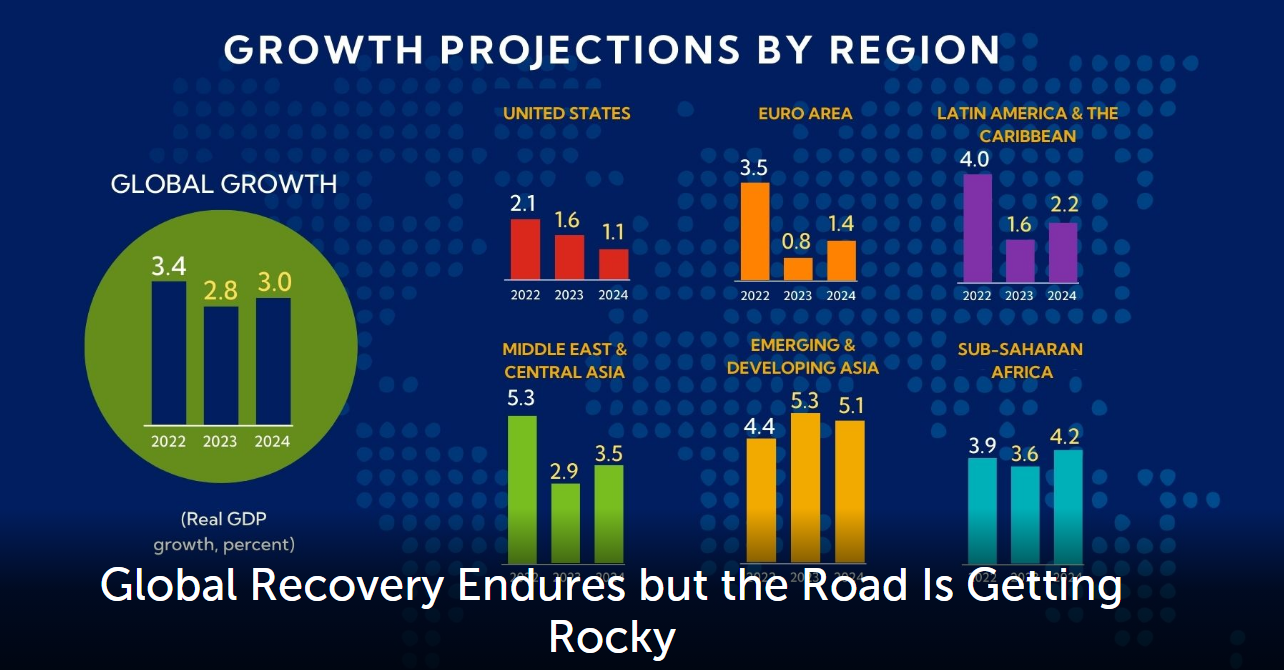
The IMF announced today (Tuesday, April 11, 2023) in the World Economic Outlook’s press briefing that the baseline forecast for global output growth is 0.1 percentage point lower than predicted in the January 2023 WEO Update, before rising to 3.0 percent in 2024.

“The world economy is still recovering from the unprecedented upheavals of the last three years, and the recent banking turmoil has increased uncertainties.”

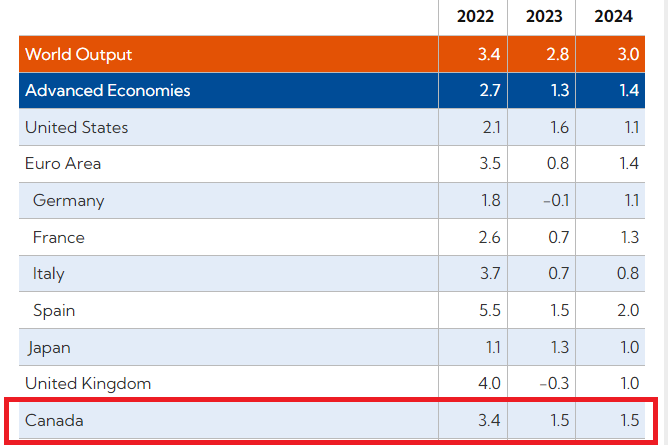
“We expect global output growth to fall from 3.4% last year to 2.8% in 2023, before rising to 3% in 2024, mostly unchanged from our January projections. Advanced economies are expected to see an especially pronounced growth slowdown from 2.7% in 2022 to 1.3% in 2023. Global headline inflation is set to fall from 8.7% in 2022 to 7% in 2023 on the back of lower commodity prices but underlying core inflation is proving to be stickier. Importantly, this outlook assumes that recent financial stresses remain contained,” said Pierre-Olivier Gourinchas, the IMF’s Chief Economist.

Much uncertainty clouds the short- and medium-term outlook as the global economy adjusts to the shocks of 2020–22 and the recent financial sector turmoil. Recession concerns have gained prominence, while worries about stubbornly high inflation persist.

Chart- world economic outlook projections including Canada.

“Once again, risks are heavily tilted to the downside, they have risen with the recent financial turmoil. Most prominently, recent banking system turbulence could result in a sharper and more persistent tightening of global financial conditions. The simultaneous rate hikes across countries could have more contractionary effects than expected, especially as debt levels are at historical highs. There might be a need for more monetary tightening if inflation remains stickier than expected. These risks and more could all materialize at a time when policymakers face much more limited policy space to offset negative shocks, especially in low-income countries,” added Gourinchas.

With the fog around current and prospective economic conditions thickening, policymakers have a narrow path to walk towards restoring price stability while avoiding a recession and maintaining financial stability. Achieving strong, sustainable, and inclusive growth will require policymakers to stay agile and be ready to adjust as information becomes available.

“First, as long as financial stress is not systemic as it is now, the fight against inflation should remain the priority for central banks. Second, to safeguard financial stability, central banks should use separate tools and communicate their objectives clearly to avoid unwarranted volatility. Financial policies should remain laser focused on preserving financial stability and watch for any buildup of risks in banks, non-banks, and the real estate sectors. Third, in many countries fiscal policy should tighten to ease inflation pressures, restore debt sustainability, and rebuild fiscal buffers. Finally, in the event of capital outflows that raise financial stability risks, emerging market and developing economies should use the integrated Policy framework, combining temporary targeted foreign exchange interventions and capital flow measures where appropriate,” said Gourinchas.