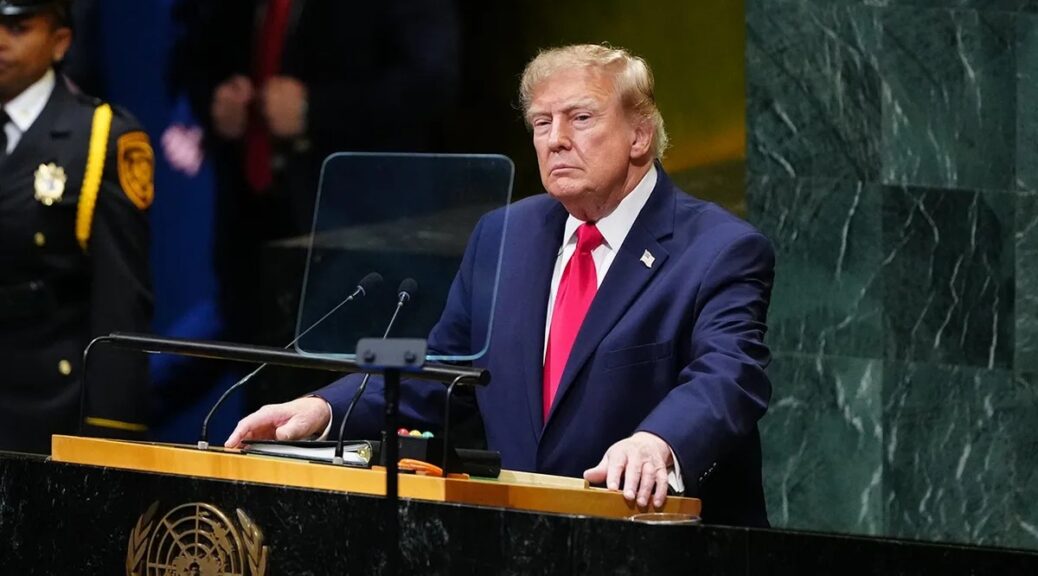
Heralding America’s “golden age” — as his administration has brought more jobs, lower poverty rates and less crime to the United States — President Trump encouraged world leaders to join him in building “a future for our people that is brighter, more hopeful and more magnificent than ever before.”
Speaking at the U.N. General Assembly yesterday September 22, Trump listed peace deals he has brokered. “While others have spoken of peace, I have made peace,” he said. He cited thank-you letters from leaders in Pakistan, Azerbaijan, Armenia, Cambodia and Rwanda.
Recalling the upcoming anniversary of the October 7 massacre in which Hamas killed 1,200 innocent civilians in Israel, Trump noted his administration’s work to free the hostages and called out Iran’s celebration of the massacre. To applause, Trump said that the Islamic Republic of Iran, “the bully of the Middle East … will never have a nuclear weapon.”
Shifting to the Western Hemisphere, the president said, “Our actions in Venezuela are proof that the United States will no longer permit threats to America to gain a foothold.” He commended the January 3 removal of Venezuela’s criminal leader, Nicolás Maduro, and subsequent release of political prisoners.
Today, he said, “we’re working closely with the leaders of Venezuela to forge a much better future for the Venezuelan people” and mentioned the recent U.S.-Venezuela deal to bring 65 billion barrels of oil to market.
After noting his administration’s designation of drug cartels as Foreign Terrorist Organizations, successful strikes on “drug boats” and successful mission with Venezuela to kill the leader of Tren de Aragua, Trump said the U.S. still faces threats from the hemisphere. He cited Cuban communist influence over U.S. groups and threats from Mexican drug cartels. “Communism will never be coming to America, but freedom will be coming to Cuba,” he said. “And safety and security will be coming to Mexico.”
‘A safer future’
While in New York, the president signed an agreement with Denmark and the people of Greenland to improve security in the Arctic for the United States, North America and Europe. The agreement enables the U.S. to review foreign military investments in Greenland for security risks. “This deal also protects Europe, in addition to America, and … very much enhances NATO,” Trump said, while commending NATO nations for increasing defense spending.
Noting the U.N.’s “great potential,” Trump said it must rein in globalist agendas that threaten the sovereignty of member nations.
He praised the defeat of the U.N.’s maritime agency proposal to charge shippers a carbon tax. “There is no global government, and while I’m president, there will be no global taxes.”
Trump vowed that the U.S. will remain at the forefront of artificial intelligence (AI) innovation and suggested that “super intelligence,” or SI, would be a better name for the promising technology. Cautioning against slowing the pace of SI development, he said, “I’m not going to stifle growth of something that will be bigger than the industrial revolution … or the internet itself.”
“We’re reasserting American power,” Trump said, “including American military power where necessary in our region and around the world to create a safer future for all of us.”
Next year, the United States will host the world’s 20 largest economies for the first time since 2009. Coinciding with America’s 250th anniversary, the 2026 G20 will be a chance to recognize the values of innovation, entrepreneurship, and perseverance that made America great, and which provide a roadmap to prosperity for the entire world. We’ll showcase these values and more when we host the G20 Leaders’ Summit in December 2026 in one of America’s greatest cities, Miami, Florida.
Under President Trump’s leadership, the G20 will use four working groups to achieve progress on three key themes: removing regulatory burdens, unlocking affordable and secure energy supply chains, and pioneering new technologies and innovation. The first Sherpa and Finance Track meetings will be held in Washington, DC, on December 15-16, followed by a series of meetings throughout 2026. As the global economy confronts the changes driven by technologies such as Artificial Intelligence, and shakes off ideological preoccupations around green energy, the President is prepared to lead the way.
We will be inviting friends, neighbors, and partners to the American G20. We will welcome the world’s largest economies, as well as burgeoning partners and allies, to America’s table. In particular, Poland, a nation that was once trapped behind the Iron Curtain but now ranks among the world’s 20 largest economies, will be joining us to assume its rightful place in the G20. Poland’s success is proof that a focus on the future is a better path than one on grievances. It shows how partnership with the United States and American companies can promote mutual prosperity and growth.
The contrast with South Africa, host of this year’s G20, is stark.
South Africa entered the post-Cold War era with strong institutions, excellent infrastructure, and global goodwill. It possessed many of the world’s most valuable resources, some of the best agricultural land on the planet, and was located around one of the world’s key trading routes. And in Nelson Mandela, South Africa had a leader who understood that reconciliation and private sector driven economic growth were the only path to a nation where every citizen could prosper.
Sadly, Mandela’s successors have replaced reconciliation with redistributionist policies that discouraged investment and drove South Africa’s most talented citizens abroad. Racial quotas have crippled the private sector, while corruption bankrupts the state.
The numbers speak for themselves. As South Africa’s economy has stagnated under its burdensome regulatory regime driven by racial grievance, and it falls firmly outside the group of the 20 largest industrialized economies.
Rather than take responsibility for its failings, the radical ANC-led South African government has sought to scapegoat its own citizens and the United States. As President Trump has rightly highlighted, the South African government’s appetite for racism and tolerance for violence against its Afrikaner citizens have become embedded as core domestic policies. It seems intent on enriching itself while the country’s economy limps along, all while South Africans are subject to violence, discrimination, and land confiscation without compensation. Its former Ambassador to the United States was openly hostile to America. Its relationships with Iran, its entertainment of Hamas sympathizers, and cozying to America’s greatest adversaries move it from the family of nations we once called close.
The politics of grievance carried over to South Africa’s Presidency of the G20 this month, which was an exercise in spite, division, and radical agendas that have nothing to do with economic growth. South Africa focused on climate change, diversity and inclusion, and aid dependency as central tenets of its working groups. It routinely ignored U.S. objections to consensus communiques and statements. It blocked the U.S. and other countries’ inputs into negotiations. It actively ignored our reasonable faith efforts to negotiate. It doxed U.S. officials working on these negotiations. It fundamentally tarnished the G20’s reputation.
For these reasons, President Trump and the United States will not be extending an invitation to the South African government to participate in the G20 during our presidency. There is a place for good faith disagreement, but not dishonesty or sabotage.
The United States supports the people of South Africa, but not its radical ANC-led government, and will not tolerate its continued behavior. When South Africa decides it has made the tough decisions needed to fix its broken system and is ready to rejoin the family of prosperous and free nations, the United States will have a seat for it at our table. Until then, America will be forging ahead with a new G20.
Marco Rubio was sworn in as the 72nd secretary of state on January 21, 2025. The secretary is creating a Department of State that puts America First.
Doha, January 2024 //The Arab Center for Research and Policy Studies announced the results of their public opinion poll regarding the Israeli war on Gaza on Wednesday 10 January 2024. The poll was carried out on a sample of 8000 respondents (men and women) from 16 Arab countries. The survey questions were selected to determine the opinions of citizens in the Arab region on important topics related to the Israeli war on Gaza.
The results of the survey demonstrate the locality of the war as felt by Arab public opinion, with 97% of respondents expressing psychological stress (to varying degrees) as a result of the war on Gaza. 84% expressed a sense of great psychological stress.
Extent of psychological stress felt during the war on Gaza
About 80% of respondents reported that they regularly follow news of the war, compared to 7% who said that they do not follow it, a further indication that the Arab public sees this war as a local event. To access the news 54% of respondents relied on television, compared to 43% who relied on the internet.
Extent of news followship about Israel’s war on Gaza
It is noteworthy that the results highlighted that Arab public opinion does not believe that the military operation carried out by Hamas on 7 October 2023 was in pursuit of a foreign agenda. 35% of respondents considered that the most important reason for the operation was the continued Israeli occupation of the Palestinian territories, while 24% attributed it mostly to defence against Israel’s targeting of Al-Aqsa Mosque, and 8% saw it as a result of the ongoing siege of the Gaza Strip.
The most important motivations for Hamas to carry out the military operation on 7 October 2023
Most important
Second most important
The ongoing Israeli occupation of Palestinian land
35
13
Defending al-Aqsa Mosque against attacks
24
21
The ongoing blockade of Gaza
8
12
Ongoing and expanding settlement on Palestinian land
6
8
Liberating Palestinian detainees and prisoners in Israeli prisons
6
13
Israel’s rejection of the establishment of a Palestinian state
4
5
The United States’ failure to achieve a just peace
2
3
The international community’s disregard for Palestinian rights and the ongoing occupation
4
5
Halting the normalization process between Arab governments and Israel
2
3
Carrying out the plan or agenda of a foreign power such as Iran
2
2
Other
2
1
Don’t know / Declined to answer
5
0
No second option
0
14
Total
100
100
While 67% of respondents reported that the military operation carried out by Hamas was a legitimate resistance operation, 19% reported that it was a somewhat flawed but legitimate resistance operation, and 3% said that it was a legitimate resistance operation that involved heinous or criminal acts, while 5% said it was an illegitimate operation.
Assessments of Hamas’ military operation on 7 October 2023
The results showed that there is an Arab consensus of 92% expressing solidarity with the citizens of the Arab region with the Palestinian people in Gaza. While 69% of respondents expressed their solidarity with Palestinians and support for Hamas, 23% expressed solidarity with Palestinians despite opposing Hamas, and 1% expressed a lack of solidarity with the Palestinians.
Solidarity with Palestinians and support for Hamas
The majority of respondents rejected comparisons between Hamas and ISIS made by predominately Israeli and Western politicians and media personalities.
Comparisons between Hamas and ISIS
When asked about the responses of regional and international powers to Israel’s war on Gaza, 94% considered the US position negatively, with 82% considering it very bad. In the same context, 79%, 78%, and 75% of respondents viewed positions of France, the UK, and Germany negatively. Opinion was split over the positions of Iran, Turkey, Russia, and China. While (48%, 47%, 41%, 40%, respectively) considered them positively (37%, 40%, 42%, 38%, respectively).
Evaluation of international and regional positions
In the same context, 76% of respondents reported that their position toward the United States following the Israeli war on Gaza had become more negative, indicating that the Arab public has lost confidence in the US. Furthermore, respondents demonstrated a near consensus (81%) in their belief that the US government is not serious about working to establish a Palestinian state in the 1967 occupied territories (The West Bank, Jerusalem, and Gaza).
About 77% of respondents named the United States and Israel as the biggest threat to the security and stability of the region. While 51% saw the United States as the most threatening, 26% considered the biggest threat to be Israel. While 82% of respondents reported that US media coverage of the war was biased towards Israel, only 7% saw it as neutral.
How opinion on US policy in the Arab region has changed since the war on Gaza
Evaluation of US seriousness in establishing a Palestinian state in the 1967 Occupied Palestinian lands
Biggest threats to the peace and stability of the region
Greatest Threat
Second Greatest Threat
Gaza war
2022
2020
2018
Gaza War
2022
2020
2018
United States
51
39
44
43
25
25
23
28
Israel
26
41
37
37
33
28
38
40
Iran
7
7
10
13
10
13
19
15
Russia
4
6
2
3
8
8
4
7
France
2
2
2
1
10
5
3
1
Turkey
2
2
2
1
3
2
5
2
China
1
2
1
0
2
2
2
0
Other
1
—
—
—
2
—
—
—
Don’t know / Declined to answer
6
1
2
2
0
—
—
—
No second option
0
—
—
—
7
17
6
7
Aggregate
100
100
100
100
100
100
100
100
Evaluation of US media coverage of the war on Gaza
Arab public opinion sees the Palestinian Cause as an Arab issue, and not exclusively a Palestinian issue. A consensus of 92% believe that the Palestinian question concerns all Arabs and not just the Palestinians. On the other hand, 6% said that it concerns the Palestinians alone and they alone must work to solve it. It is worth noting that this percentage is the highest recorded since polling began in 2011, rising from 76% at the end of 2022, to 92% this year. Some countries recorded significant increases. In Morocco, it rose from 59% in 2022 to 95%, in Egypt from 75% to 94%, in Sudan from 68% to 91%, and in Saudi Arabia from 69% to 95%, a statistically significant increase that represents a fundamental shift in the opinions of the citizens of these countries.
Consideration of the Palestinian Cause as an Arab issue over time
Arab public opinion is almost unanimous in rejecting recognition of Israel, at a rate of 89%, up from 84% in 2022, compared to only 4% who support its recognition. Of particular note is the increase in the percentage of those who rejected recognition of Israel in Saudi Arabia from 38% in the 2022 poll to 68% in this survey. Such a statistically significant increase also applies to other countries such as Morocco, where the percentage rose from 67% to 78%, and Sudan, where it increased from 72% to 81%.
Support/opposition for recognizing Israel over time
When asked about their opinions on what measures Arab governments should take in order to stop the war in Gaza, 36% of respondents stated that Arab governments should suspend all relations or normalization processes with Israel, while 14% of them stated that aid and support should be brought into Gaza without Israeli approval, and 11% said that the Arab governments should use oil as a weapon to assert pressure on Israel and its supporters.
Measures that should be taken by Arab governments to stop the war on Gaza
Most important measure
Second most important measure
Suspend relations or normalization with Israel
36
15
Deliver aid to Gaza without Israeli approval
14
16
Use the oil weapon to pressure Israel and its supporters
11
13
Establish a global alliance to boycott Israel
9
11
Provide military aid to Gaza
8
10
Announce military mobilization
5
6
Reconsider relations with the United States
4
6
Reconsider relations with states that support Israel’s war on Gaza
3
5
Build alliances with states that have taken practical steps against Israel
3
4
Other
3
2
Don’t know / Declined to answer
4
0
No second option
0
12
Total
100
100
There is a near consensus among Palestinian respondents from the West Bank (including Jerusalem), around 95%, that safety and freedom of movement between the governorates and cities of the West Bank and their sense of security and personal safety have been affected negatively since 7 October 2023.
Negative effects experienced in the West Bank since 7 October 2023
A further 60% of Palestinian respondents in the West Bank said that they had been subjected to or were witnesses to raids by the occupation army forces, while 44% said that they were subjected to arrest or interrogation by the Israeli army, and 22% reported that they were subjected to harassment by settlers.
Frequency of witnessing or happening upon incidences of raids, arrests, or settler harassment in the West Bank since 7 October 2023
This survey is the first of its kind to gauge public opinion on the topic across the Arab region. The field work was conducted from 12 December 2023 to 5 January 2024 in Mauritania, Morocco, Algeria, Tunisia, Libya, Egypt, Sudan, Yemen, Oman, Qatar, Kuwait, Saudi Arabia, Iraq, Jordan, Lebanon, and the West Bank, Palestine (including Jerusalem). The surveyed communities represent 95% of the population of the Arab region and its far-flung regions. The sample in each of the aforementioned communities was 500 men and women, drawn according to cluster and self-weighted sampling methods to ensure that every individual in each country had an equal probability of appearing in the sample.
For the Silo, Dr Ahmed Hussein, researcher at the Arab Center for Research and Policy Studies.