Tag Archives: University of Calgary

How The Fuel Price At Canada’s Gas Pumps Got So High

To: Canadian gasoline buyers  

From: G. Kent Fellows 

Canadian retail gasoline prices have soared since the start of the Iran war – even though Canada ranks fourth globally in annual crude oil production, behind only the United States, Russia and Saudi Arabia. 

If we have so much oil, why are our gas prices high? 

Start with retail markets. In most of Canada, gasoline retailers are free to set prices. In doing so, they think of their costs, their competitors’ prices and how consumers will react. They’re less concerned about what they paid for the fuel they’re selling than what it will cost to replace it next time they order a gasoline shipment. So, when the wholesale price rises, they adjust their own prices quite quickly. 

Rockets and Feathers

Conversely, when prices fall, they end up in a game of chicken with their competitors. The station that cuts prices first does sell more fuel but it makes less profit on each litre. Retailers balance the profit they make from more volume against their reduced margin. This leads to a phenomenon some economists call “rockets and feathers.” Prices rise fast and fall slowly. 

As consumers it’s tempting to think we’re getting ripped off. But, over time, gas stations really aren’t big profit engines. They make a bit of money when wholesale prices fall, less when wholesale prices rise. Overall, they make enough to pay for their staff and inputs while getting a fair return on their investment. 

Working backwards through the story, gas stations buy gas from a wholesaler. Sometimes they buy from the same brand (i.e., a Shell station buys its fuel from a Shell wholesaler) but often there’s no connection: Retailers buy the cheapest gas available. There are fewer wholesalers than retailers but the wholesale market is competitive, too. Gasoline is pretty much the same no matter who you buy it from so it’s hard for any single wholesaler to charge a higher price than its competitors. Wholesalers, like retailers, set prices based on their competition and the replacement cost of their inventory. More rockets and feathers. 

To summarize: Retail prices spike with wholesale prices, and wholesale prices spike with crude oil prices. 

And why are Canadian crude oil prices rising when we are half a world away from Iran? Because global oil markets are linked and Canadian producers prefer more profit to less. When a Canadian producer markets its crude, it looks for the highest bidder. If it can sell to an export partner for a higher price, it will. Canadian refineries therefore need to match that price to buy oil for domestic use. 

This is a feature, not a bug. 

Canada and the United States are the only two major oil-producing nations with competitive crude oil markets. All other producing nations co-ordinate production through state-owned enterprises. Canadian oil companies, though large in absolute terms, are small relative to their international rivals. This makes them price-takers. 

A Canadian firm can’t simply decide to charge more, the way OPEC producers can. They’re too small to influence global markets. They’re also prohibited by law from colluding with each other to drive up prices. As a result, though Canadian producers may well benefit from rising global crude oil prices, they can’t cause them. 

Canadian producers could offer lower prices to domestic refineries, but that’s against their own interests and would reduce their profits. Preferencing the domestic market with lower crude oil prices would also risk damaging our trade relationships. 

A fundamental rule of economics is that prices and quantities are linked. As the quantity of globally available crude oil falls, prices rise for crude and gasoline alike. As gas prices go up, we consume less gasoline and by extension less crude oil. That’s how global market systems balance supply and demand. 

If we artificially suppress prices for Canadian consumers (and only Canadian consumers) we end up consuming more gasoline domestically and exporting less oil. Drivers would benefit but the reduction in exports would lower our incomes, damage our terms of trade and hurt our reputation as a reliable trade partner. 

Yes, when world oil prices rise Canadian oil producers make higher profits. But they aren’t “gouging” consumers and this isn’t a federal or provincial policy failure. It’s the global market doing what it’s supposed to do.  [A point to consider: last year the highest octane fuel available, 94 was selling for on average $2.00/L in Southern Ontario. Today that fuel sells for on average $2.12/L meaning an increase of 6% in cost. Yet the most common octane fuel: 87 has seen an increase of (avg. of $1.40/L vs today’s rate of $1.83/L) of 25%. Shouldn’t the % increases in fuel be the same? CP]

For the Silo, Kent Fellows.

Kent Fellows is assistant professor (Economics) and Associate Program Director of the Canadian Northern Corridor research program at The School of Public Policy, University of Calgary and fellow-in-residence at the C.D. Howe Institute. 

Why Brampton Ontario Is Powerhouse In Health And Life Sciences Sector

Partnering with innovative businesses to attract talent and spur growth is making Brampton a powerhouse in the fast-growing health and life sciences sector.

Since 2005, the City of Brampton has seen a 50 per cent growth in health and life sciences and is now home to more than 250 companies in the sector.

Mayor Jeffrey
Mayor Jeffrey

“This is a priority growth area for Brampton. In order to bring the best businesses here, we’re committed to creating strong partnerships with innovative companies that will attract knowledge-based jobs to grow the city and the sector,” said Mayor Linda Jeffrey. “From our young, diverse, educated and highly skilled workforce to our ranking as one of the best places to do business, to the incredible lifestyle that employees can enjoy, Brampton is the best choice for innovative health and life sciences businesses looking to start up or re-locate.”

Leading health and life science companies have proven that Brampton is the best city to work with to grow their business, with the sector currently employing more than 11,700 highly skilled workers in the city. Brampton is a significant contributor in Ontario’s life sciences sector and is located within the province’s biotechnology cluster, currently the third largest in North America.

Innovative and successful health and life sciences companies and headquarters are quickly becoming the norm in Canada’s second-fastest growing city, such as:

  • Brampton’s William Osler Health System is an emerging leader in health care research and development and plays a critical role in the education of hundreds of future health professionals each year. Its strong clinician-based, formalized research program focuses on improving patient care; shifting to preventative, proactive care; and treating diverse populations – the goal of its Global Health Program. Osler offers world-class technology and innovative, cutting-edge surgical techniques, including hybrid vascular and endovascular surgery – a minimally invasive way to treat diseases of the blood vessels while minimizing the overall risks to patients and reducing hospital stays. Osler inspires a culture of innovation through its annual national student app competition, fusing health care and technology by challenging students to design and develop mobile digital health care applications for the benefit of patients and their families.

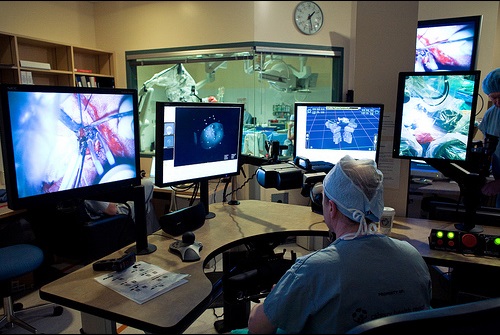
The NeuroArm's first surgical use: Brain Surgery
The NeuroArm’s first surgical use: Brain Surgery

  • MDA Space Missions developed the NeuroArm, a cutting-edge device for neurosurgery. The result of close collaboration between MDA space robotic engineers (of CanadArm fame), the University of Calgary and Alberta Health Services physicians, nurses and scientists, the group is creating an image-guided robotic arm for microsurgery. Controlled by the surgeon, the device allows for more precise surgery with a near real time view of the area being worked on and the location of the surgical tools – truly changing the way that life-saving surgery will be performed in the future.
  • Taro Pharmaceuticals Inc., a global leader in pharmaceutical manufacturing, refers to its Brampton operation as its worldwide centre of excellence for dermatology, liquid manufacturing and research. Ontario is helping Taro Pharmaceuticals Inc. invest in new manufacturing and R&D equipment to expand research and production at its Brampton facility, with a $7 million investment creating up to 140 new jobs and retaining 395 positions in the city.
  • Dynacare Medical Laboratories’ main testing facility in Brampton is one of the largest, most state-of-the-art laboratories in North America. Dynacare is at the forefront of researching, developing and validating innovative new screening and diagnostic tests for introduction into the Canadian marketplace. Dynacare has been instrumental in the early delivery of new tests in the areas of allergy, cancer, cardiovascular disease, diabetes, osteoporosis, paternity, ulcers, and other problems of the stomach and intestines and more.

Click to learn about ErinoakKids' innovative Music Therapy
Click to learn about ErinoakKids’ innovative Music Therapy

  • ErinoakKids Centre for Treatment and Development has broken ground on a new 122,000 square foot treatment facility in Brampton for children with disabilities and special needs. The facility, set to open in 2017, will house Ontario’s largest respite centre for children who are medically fragile/technology dependent, have complex care requirements, behavioural challenges, or autism. The centre will offer a range of services from day to overnight stays and, for the first time, 24/7 service. Specially trained staff will care for the children and youth,providing programmed activities and interactions while offering a period of respite for their parents and caregivers.

CEO Bridget Fewtrell

“We are most fortunate to be part of, and to serve, the growing Brampton community,” said ErinoakKids President and CEO Bridget Fewtrell. “When we open our new facility in 2017, children and youth with disabilities and special needs in Brampton will have more access to better coordinated services to help them reach their true potential. We are truly excited to continue expanding service to this thriving city and its growing population.”

About Brampton: The ninth-largest city in Canada, Brampton celebrates a diverse population that represents people from 209 distinct ethnic backgrounds who speak 89 different languages. Brampton residents and visitors have access to state-of- the-art recreation facilities and one of the fastest-growing transit systems in Canada. Opened in 2007, Brampton Civic Hospital is part of the William Osler Health System, which is one of the largest community hospitals in Canada. For more information, visit www.brampton.ca or follow @CityBrampton on Twitter.