From Black Friday electronics deals and top appliance discounts to the best savings on furniture, sporting goods, and smartphones, North America’s biggest shopping event is fueled by one major factor: the use of credit cards for Black Friday purchases.
To understand how spending patterns have evolved, and how credit cards shape the Black Friday season, researchers from our friends at InvestorsObserver analyzed Black Friday shopping trends over the past three decades.
Though the focus was USA based (looking at trends on state-by-state and national sales data for durable goods, credit card transaction volumes, and shifts in consumer spending across key product categories like electronics, appliances, furniture, sporting goods, and jewelry), some parallels can be drawn between Canada and Mexico shopping habits.
The report reveals what was really driving Black Friday sales from 1997 till 2024. It shows which states and product categories had the biggest surge in spending, how much of that growth was fueled by increased credit card use, and which items have fallen out of favor with today’s shoppers.
Essentially, North Americans are using credit to buy smarter, invest in technology and fitness, and adapt their Black Friday shopping to reflect quickly changing priorities and lifestyles.
Key findings
- Nationwide, US inflation-adjusted spending on durable goods during the Black Friday season increased by over 90% between 1997 and 2024, with states like Florida and Texas more than doubling their totals. Inflation is also a factor in Canada and Mexico.
- Spending on telephone and related communication equipment surged over 600% in the top states.
- Average credit card balances at major issuers (Amex, Discover, Capital One) have grown at an average monthly rate of 0.5% (approximately 6% per year) since 2020, with bold spikes during the Black Friday season.
- Spending on traditional Black Friday luxury items, such as jewelry and new vehicles, dropped in several states.
- Spending on sporting equipment, guns, and related goods soared, making these some of the fastest-growing Black Friday categories nationwide.
The 10 states where Black Friday spending on durable goods has skyrocketed
Over the past 30 years, Black Friday has exploded into a huge shopping event, totally changing how and where North Americans splurge on big-ticket items.
A few states are crushing it, with locals ramping up real spending on durable goods at huge rates during Black Friday season. The top 10 show not just wild shopper hype, but big shifts in what people actually purchase when those deals drop.
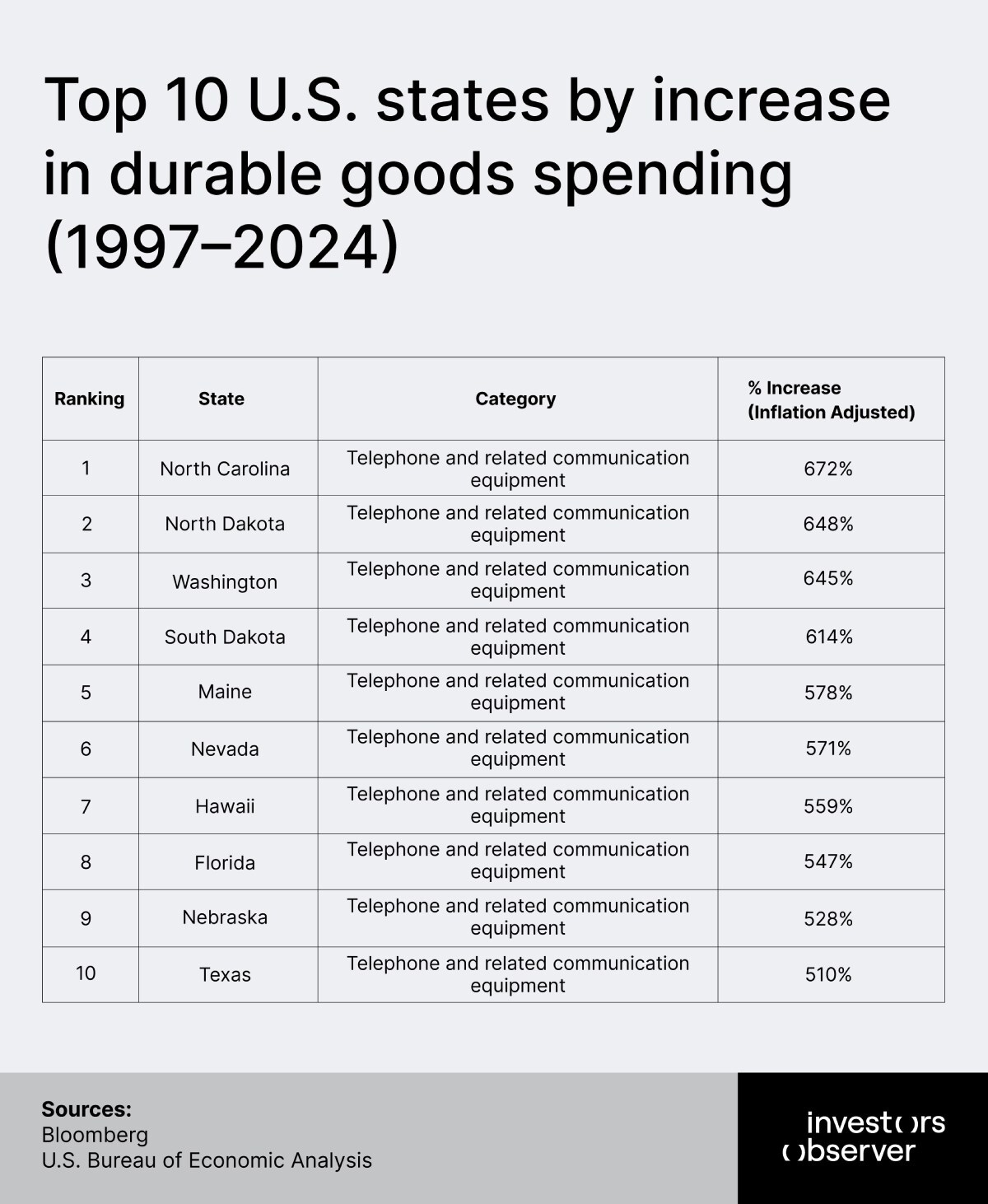
These states have seen their Black Friday durable goods spending, especially in technology, surge ahead of the national average. When Black Friday advertising kicks in, shoppers increasingly target the best deals on electronics, particularly smartphones, tablets, and communication devices.
Retailers have responded to it, making Black Friday the primary opportunity to upgrade devices and connect households at a fraction of the regular price.
- North Carolina and North Dakota lead with over 600% growth, showing how the appetite for electronics has exploded since the late ‘90s, as more homes gained internet connectivity and mobile devices.
- The Pacific Northwest and Sun Belt, including Washington, Nevada, and Texas, have also surged, which aligns with fast-growing populations and tech-forward consumer culture.
- Hawaii and Maine’s high growth rates highlight how even small, geographically unique states have embraced Black Friday to shop for technology that bridges distances – both literal and social.
The overwhelming increase in spending on communication technology during the Black Friday season shows how the event has become less about traditional holiday shopping and more about allowing households to seize the latest digital opportunities. For millions of North Americans, Black Friday is now the time to connect and upgrade their devices.
Where Black Friday spending fell: Top 10 states with the biggest drops in durable goods purchases
While most states saw Black Friday spending on durable goods soar over the past 25 years, not every category or region had gains. In fact, several states experienced notable declines, particularly in traditional big-ticket Black Friday items like jewelry, watches, and new cars.
This change reveals new consumer values, the impact of modern technology, and a growing focus on more practical or tech-driven purchases.

Jewelry and watches in retreat
The sharpest drop comes from jewelry and watches. Vermont, Maine, Connecticut, Iowa, and Michigan all had double-digit declines. This suggests that big-ticket jewelry has lost its luster as a Black Friday buy. Americans may be choosing technology upgrades and home improvements over luxury items that were once holiday staples.
New motor vehicles lose their spot
For decades, Black Friday was also the season of auto deals and year-end vehicle promotions. However, states like Illinois, Connecticut, Michigan, and Ohio had a significant real decline (–10 to –15%) in Black Friday spending on new cars. Today’s shoppers may be holding onto cars longer, buying used, or shifting their big December purchases toward electronics and appliances.
The fall of traditional electronics
West Virginia stands out as one of the few states where spending on video, audio, photographic, and information processing equipment has actually declined since 1997, dropping by 16% when adjusted for inflation. West Virginians are moving away from traditional Black Friday electronics, like older TVs, cameras, and stereo systems, and are investing less in these categories than they did a generation ago.
What’s behind these Black Friday drops?
- Priorities are changing. North Americans are investing in what makes daily life more comfortable and modern, leaving behind items seen as old-fashioned luxuries.
- The tech has taken over. Gadgets, home entertainment, and fitness equipment now win out over jewelry and autos for Black Friday deals.
- Economic reality has shifted. The increasing role of credit cards and shifting family budgets means shoppers are looking for purchases that deliver daily utility rather than show status.
In other words, today’s Black Friday is less about “once-in-a-lifetime” traditional purchases and more about value, technology, and practical upgrades. The states with the biggest declines in jewelry and car sales are signals of this broader cultural and economic change.
America’s top 10 states for Black Friday durable goods spending (2024)
Black Friday remains the biggest shopping event of the year, and nowhere is this more apparent than in the nation’s leading states for durable goods purchases. Some states outpace the rest of the U.S. in total spending on high-value items, like appliances, electronics, home furnishings, and more, during the Black Friday season. Their money and excitement drive shopping trends across the country.

Massive market size
California, Texas, and Florida are not just the largest states by population. They’re also the biggest spenders. Together, they account for nearly a quarter of all U.S. durable goods bought during Black Friday. This shows the influence of large, diverse, and economically dynamic populations.
Urban economies and consumer power
States such as New York, Illinois, and Pennsylvania maintain their spots in the top ten thanks to their large metropolitan areas and strong traditions of holiday shopping, where residents spend big on household upgrades and electronics.
Quick growth in the Sun Belt
North Carolina and Georgia have shot up the rankings in recent years. Their booming real estate, ongoing migration trends, and family-driven consumption translate into strong demand for appliances, furniture, and home technology each Black Friday.
Consistent Midwest and Northeast strength
Ohio and New Jersey round out the list, proving that established economies with significant suburban populations continue to drive major Black Friday spending, particularly for goods that make life more comfortable and connected.
In essence, these top 10 states are the engine rooms of North American Black Friday shopping. Their combined impact shapes national retail sales and spotlights where the most dollars flow when the country’s biggest holiday deals are up for grabs.
Top 10 increases in durable goods spending 2020–2024
The years since 2020 have been some of the most dynamic for Black Friday shopping in North American history. Faced with a global pandemic, shifting work habits, and new priorities at home, North Americans unleashed a wave of spending on major purchases, especially during the Black Friday season when deals were too good to pass up.
Some American states stand out for their extraordinary growth in durable goods spending, which reveals where the economic recovery and post-pandemic demand have hit hardest and fastest.

Pandemic-era investment in the home
From 2020 to 2024, North Americans spent more time at home than ever before, fueling a rush on Black Friday for home electronics, appliances, workout gear, and home office upgrades. For example, this is reflected in the double-digit growth seen in states like North Carolina, Nevada, and Texas.
Southern and Mountain West States are leading
The Sun Belt and fast-growing Western states dominate the top of the list. With population inflows, a hot housing market, and greater focus on quality-of-life purchases, places like Florida, Nevada, and Idaho led the way in increased spending.
Credit card power and Black Friday strategy
More consumers used credit cards to access historic Black Friday discounts, and they didn’t hold back. Their willingness to borrow, upgrade, and outfit homes helped power this unprecedented jump in durable goods purchases.
The return of consumer confidence
After the initial shock of the pandemic, these states came roaring back with strong job markets and economic growth. This confidence spilled over into Black Friday shopping, with many households finally making upgrades or purchases they had delayed.
Not just the big states – smaller markets shine
States like Idaho, Utah, and New Hampshire emerged as “growth champions,” showing that the Black Friday boom was not limited to the biggest economies, but spread across America’s most dynamic regions.
In essence, between 2020 and 2024, Black Friday’s power as an engine for big purchases was on full display in these top 10 states. The post-pandemic years became a transformation period for millions of households, with Americans seizing the moment – and Black Friday deals – to upgrade, renovate, and invest in what matters most.
Methodology and sources
The Personal Consumption Expenditure (PCE) data is collected from the U.S. Bureau of Economic Analysis.
The data is provided for every U.S. state.
For each state, we collected data on consumption expenditures in the following categories:
- Durable goods: New motor vehicles; Furniture and furnishings; Household appliances; Tools and equipment for house and garden; Video, audio, photographic, and information processing equipment and media; Sporting equipment, supplies, guns, and ammunition.
- Other durable goods: Jewelry and watches; Telephone and related communication equipment.
- Expenditures are expressed in millions of dollars. The data covers the years 1997 through 2024. Each year’s data is adjusted for inflation using the Consumer Price Index for All Urban Consumers: All Items in the U.S. City Average (CPIAUCSL)
We calculated how expenditures have changed over time (1997–2024). All calculations are inflation-adjusted.
We pulled monthly credit loan issuance data (2018–2025) for American Express, Discover, and Capital One straight from Bloomberg.
For the Silo, Živilė Kasparavičiūtė