Tag Archives: Brazil

New Technology Pioneers Are Building Infrastructure For Next Era of AI Including Canada

  • 100 start-ups from 23 countries selected to join the World Economic Forum’s Technology Pioneers community.
  • This year’s cohort stands out for building the software and physical infrastructure needed to power autonomous AI systems at scale.
  • Companies are advancing breakthrough technologies in AI, energy, quantum computing, biotechnology, climate innovation, space and advanced manufacturing.
  • Learn more about the Annual Meeting of the New Champions 2026 here. Follow on social media using #amnc26, #2026夏季达沃斯# and #InnovateScaleImpact.

Frontier Innovation

Geneva, Switzerland, June 2026 – The World Economic Forum has announced its 2026 Technology Pioneers cohort, recognizing 100 early-stage companies from 23 countries that are developing breakthrough technologies with the potential to transform industries and societies. The cohort reflects the growing geographic diversity of frontier innovation, with nine companies from India and record representation from the Republic of Korea.

What sets this year’s cohort apart is its focus on enabling the next era of artificial intelligence (AI). While recent advances have centered on models and consumer applications, many of the Tech Pioneers are building the software and physical infrastructure needed to AI at scale.

Two groups stand out: companies developing the foundations for autonomous AI agents, including identity verification, payments, security and enterprise integration; and those addressing AI growing energy, computing and storage demands.

Frontier Innovation

The cohort also reflects the expanding geographies of frontier innovation. India contributes nine companies, many focused on deep-tech and space innovation, while the Republic of Korea records its strongest representation to date across AI, robotics and quantum technologies. Companies from the Middle East, Latin America and South-East Asia are also strengthening their presence in emerging technology ecosystems.

“For 26 years, the Technology Pioneers community has been an early indicator of where technology is going,” said Verena Kuhn, Head of Innovator Communities, World Economic Forum. “What’s new is that early-stage companies are now tackling challenges that until recently required enormous budgets, infrastructure and large teams. AI is not just what these companies are building; it is also what is making it possible.”

Beyond AI infrastructure, the cohort highlights the breadth of early-stage innovation. Companies are developing cleaner energy sources, improving cancer detection, increasing industrial efficiency, protecting data from future quantum-computing threats, enabling in-orbit satellite servicing and creating lower-impact materials. Many of these ambitions once required the resources of large corporations or government programmes. Advances in AI, simulation and automation are allowing smaller teams to tackle complex scientific and industrial challenges, accelerating innovation across sectors.

The pioneers will contribute expertise to Forum initiatives through a two-year engagement programme and be invited to participate in the Annual Meeting of the New Champions 2026, taking place on 23-25 June in Dalian, People’s Republic of China.

More information about the Technology Pioneers community and past cohorts is available here.

The 2026 Technology Pioneers are:

Australia

  • Uluu – Developing seaweed-based biodegradable biomaterials as sustainable alternatives to traditional plastics.

Brazil

  • Comp – Providing compensation management, salary benchmarking and merit cycle tools for technology companies.

Canada

  • Intuitive AI – Delivering AI-powered food waste monitoring and recycling analytics for commercial kitchens.

China

  • Deep Wisdom – Developing an automated machine learning platform for e-commerce and manufacturing.
  • DeepCtrls Technologies – Building physics-informed AI for energy-efficient control of industrial systems.
  • Landing Med – Using AI-powered digital pathology for early cancer detection.
  • Ninetech – Enabling enterprise digital transformation through large language models and robotic process automation.
  • OneAIX Technology – Providing AI solutions for trade and intelligent systems.
  • PhaBuilder – Engineering halophilic microorganisms to produce biodegradable materials and chemicals.
  • Pheno Innovations – Advancing breakthroughs in critical materials across industries through AI-powered technologies.
  • Tripo AI – Generating AI-powered 3D models for gaming and mixed reality applications.
  • Xense Robotics – Developing multi-modal tactile sensing technology to enhance robotic dexterity.
  • Zephyr Intelligent Systems – Building closed-loop thermal safety systems for lithium-ion batteries.

Colombia

  • Quipu – Providing AI-driven credit solutions for informal workers without traditional credit histories.

Denmark

  • Sparrow Quantum – Developing deterministic single-photon sources for scalable optical quantum technologies.

France

  • Robeaute – Building modular microrobots for minimally invasive neurosurgical interventions.

Germany

  • Dunia – Combining AI and robotics to accelerate the discovery of electroactive materials.
  • SPARK Microgravity – Enabling microgravity research collaboration through integrated hardware and software platforms.

India

  • Airbound – Operating drone networks to deliver blood and critical medical supplies to rural healthcare systems.
  • Bellatrix Aerospace – Developing and manufacturing propulsion technologies for in-space mobility.
  • BorderPlus – Supporting healthcare professionals to access high-growth international opportunities.
  • Dhruva – Building small satellite platforms to advance India’s growing space ecosystem.
  • Ethereal Exploration Guild – Developing reusable medium-lift launch vehicles for cost-efficient orbital access.
  • Fermbox Bio – Producing alternative lipids, proteins and green chemicals through fermentation-based biomanufacturing.
  • OrbitAID – Developing technologies for on-orbit satellite servicing, including refuelling, repair and de-orbiting.
  • Sarla Aviation – Building electric vertical take-off and landing (eVTOL) aircraft for urban air mobility.
  • Varaha – Leveraging remote sensing and blockchain technologies for agriculture-based climate solutions in developing markets.

Israel

  • NeoLogic – Developing quasi-CMOS microprocessor technology to reduce chip power consumption and size.
  • Ray Security – Delivering AI-driven proactive cybersecurity to limit data access and prevent ransomware attacks.

Japan

  • 3DC – Developing graphene meso-sponge materials to address electrode expansion challenges in batteries.
  • Fermelanta – Producing rare plant-based ingredients for medicine and cosmetics through microbial fermentation.
  • Godot – Combining behavioural science and AI to advance human augmentation technologies.
  • NanoQT – Building quantum interconnects compatible with optical fibre for long-distance quantum communication.
  • OptQC – Developing photonic quantum computers that leverage light for practical applications.

Kenya

  • Pezesha – Connecting micro, small and medium-sized enterprises to credit and supply chain finance through embedded finance infrastructure.

Mexico

  • OTIF – Operating an online booking platform connecting shipping companies, logistics providers and customers.

Saudi Arabia

  • intella – Providing Arabic-first speech-to-text and analytics solutions for call centres and media.
  • Nommas Technologies – Developing AI-powered visual inspection systems for manufacturing quality control.

Singapore

  • Gero – Integrating physics and AI to accelerate drug development for age-related diseases.
  • Sentient Labs – Empowering the development of open-source AGI.
  • SixSense – Providing a no-code deep learning platform for computer vision applications in manufacturing.

Slovenia

  • Sunrise Robotics – Developing autonomous robotic cells with AI-powered perception for manufacturing.

Republic of Korea

  • A-Robot – Building humanoid and service robots designed for human-robot coexistence.
  • bitsensing – Developing radar solutions for vehicle safety, urban traffic management and healthcare monitoring.
  • RLWRLD – Building foundation models that enable robots to perceive and manipulate physical environments.
  • SDT – Providing edge computing and internet-of-things hardware for enterprise digital transformation.

Switzerland

  • Atinary Technologies – Offering a no-code AI platform for self-driving laboratories to accelerate molecule and materials research and development.
  • Metafuels – Converting green methanol into sustainable aviation fuel.

United Arab Emirates

  • Fasset – Delivering stablecoin-powered banking, international payments and investment access.

United Kingdom

  • Caristo Diagnostics – Building AI-driven imaging to detect and predict cardiovascular disease.
  • Epoch BioDesign – Engineering AI-designed enzymes for low-temperature biorecycling of nylon polymers.
  • IONATE – Developing hybrid intelligent transformers for smart grid power flow control.
  • MatNex – Accelerating materials discovery through AI-driven quantum calculations.
  • Opna – Building the coordination, verification and financing layer for critical power equipment.
  • Paid – Building business infrastructure for AI agents, including pricing, billing and renewals.
  • Sitehop – Delivering 200Gbps full duplex encryption for enterprise network infrastructure.
  • Uplift360 – Advancing chemical recycling technologies for carbon fibre and advanced composites.

United States

  • Adaption Labs – Developing adaptive AI systems that continuously learn and evolve across industries.
  • Albert – Providing an AI platform for materials science research and laboratory data management.
  • Alta Resource Technologies – Deploying novel refining technologies to produce high-purity minerals more efficiently and sustainably.
  • AOA Dx – Combining AI and biomarkers for early-stage cancer detection through liquid biopsy.
  • Autonomize – Using AI to contextualize unstructured clinical data and improve patient outcomes.
  • DeepLook Medical – Developing medical imaging AI for cancer visualization across ultrasound, CT and MRI.
  • Emerald AI – Enabling data centres to dynamically adjust power usage and stabilize electricity grids through AI.
  • Endolith – Using AI-guided microbes to recover copper from low-grade ore with lower energy consumption.
  • GridCARE – Forecasting electricity grid capacity with generative AI to support data centre development.
  • Hello Robot – Building open-source mobile manipulators for embodied AI research and education.
  • Helios – Predicting agricultural commodity prices and supply chains through AI-powered analytics.
  • Hertility – Offering at-home diagnostic testing and personalized care plans for hormonal health, fertility and menopause.
  • Inception Labs – Developing diffusion large language models that power applications such as coding assistance, voice interaction and search optimization.
  • Interlune – Building machinery to extract helium-3 from the lunar surface.
  • Istari Digital – Delivering digital twin and simulation technologies for aerospace and defence.
  • Kredete – Providing mobile banking and credit-building services for African immigrants in North America.
  • Laminar – Combining AI-driven precision automation with spectral sensors for industrial manufacturing.
  • Lunar Outpost – Developing space robotics and lunar surface mobility systems.
  • Mantel – Advancing molten-salt carbon capture for high-temperature industrial processes.
  • Mazama Energy – Harnessing superhot rock geothermal energy for renewable power generation.
  • Northwood – Building ground networks powered by phased array technology to support space operations.
  • Odyssey – Developing general-purpose world models capable of predicting and interacting with real-world environments over extended periods.
  • Overview Energy – Advancing manufacturing technologies for aerospace energy systems.
  • Parallel Bio – Combining human immune organoids and AI to improve drug safety prediction and discovery.
  • Pow.Bio – Building continuous fermentation platforms that reduce production costs by separating growth and production phases.
  • Power to Hydrogen – Producing hydrogen from renewable electricity using anion exchange membrane electrolyzers.
  • Pure Lithium – Developing lithium metal vanadium batteries for electric vehicles and grid storage.
  • QuSecure – Delivering post-quantum cryptography solutions to protect against future cybersecurity threats.
  • Rainmaker – Enhancing precipitation through cloud seeding, drones and weather modelling for agriculture.
  • Realta Fusion – Building compact modular fusion systems for zero-carbon industrial heat.
  • Reditus Space – Enabling microgravity manufacturing and hypersonic re-entry as a service.
  • Samaya AI – Developing AI agents for financial research, analysis and decision-making in asset management.
  • Savor – Producing real fats directly from carbon without relying on animals or farmland.
  • Skyfire – Enabling AI agents to conduct commerce through identity verification and payment infrastructure.
  • Stepful – Empowering communities with accessible pathways to healthcare careers through training and certification programmes.
  • Tern – Developing satellite-free navigation systems for vehicles and defence using real-time mapping data.
  • Tradeverifyd – Helping enterprises monitor and address supply chain risks in line with regulatory and financial requirements.
  • Vaulted Deep – Permanently removing carbon through geological sequestration of carbon-rich biomass waste.
  • Venus Aerospace – Developing reusable hypersonic flight systems powered by detonation ramjet engines.
  • VESSL AI – Providing an MLOps platform for training and deploying AI models at scale.
  • Voltai – Building AI models for next-generation semiconductor technologies.
  • WindBorne – Delivering AI weather forecasting through a global network of long-duration smart balloons.
  • Zartico – Using AI to deliver the clearest view of visitor behaviour for the tourism industry.

About the Technology Pioneers

Launched in 2000, the Technology Pioneers is a leading community for early-stage companies from around the world that are shaping the future through breakthrough technologies and innovations. These companies are selected for their potential to have a significant impact on business and society and are invited to engage with public and private sector leaders through the World Economic Forum’s global platform.

The Technology Pioneers community is part of the Innovator Communities at the World Economic Forum, which convene the world’s leading global start-ups across different growth stages from early-stage Technology Pioneers to growth-stage Global Innovators and unicorn companies valued at more than $1 billion.

About the Annual Meeting of the New Champions 2026

The 17th Annual Meeting of the New Champions will take place from 23 to 25 June 2026 in Dalian, People’s Republic of China, under the theme “Innovating at Scale”. The meeting will bring together 1,500 cross-sector leaders to explore how innovation and emerging technologies can unlock new growth models and drive positive economic momentum in a fast-shifting global landscape.

How We Set In Motion Coffee Global Business

If you are like me- someone who has drunk much more than one coffee in your life, you might be interested in pondering this question: Why do you think the multi-billion-dollar global coffee industry can be a losing business for the growers, whose hands till the land from where coffee starts?

In fact, if you drink 2 cups of coffee a day for one year, you’ll be spending more than the annual income of the coffee farmer in a developing country. To help present to fellow North American coffee drinkers this huge disparity between the farmer and the other key players across the coffee value chain, take a look at the infographic below.

Considering that North America is the biggest coffee consumer in the world, we can make a big dent by supporting the fair trade advocacy that ensures farmers get paid properly. Take a look at the infographic again. It describes how coffee is made from the farm to the mill, to the roasting plant and all the way to the consumer. Here are some of its highlights that show the bigness of this industry:

– 100 M people depend on coffee for livelihood; 25 M of which are farmers

– The U.S. spent 18 B for coffee yearly, equivalent to Bosnia’s GDP

– Coffee is the second most globally traded commodity after petroleum

For the Silo, Alex Hillsberg Web Journalist


Here's How You Make Coffee A Billion Dollar Business

Supplemental- How North Americans can help the #fairtrade program

http://financesonline.com/cherry-to-cup-the-economics-of-coffee/

http://financesonline.com/why-fairtrade-should-matter-to-you/

8 “Canadian” Companies Quietly Owned by Foreign Investors

Our friends at MSN have really stirred the maple syrup pot up with this story- which one of the following companies is the most surprising for you? Leave us a note in the comments section at the bottom of the article.

Many beloved Canadian brands that fill shopping carts and homes across the country have something surprising in common—they’re actually owned by foreign investors and companies. Behind familiar logos and proud Canadian histories stand international corporations that have quietly acquired these businesses, often maintaining their strong local identity while decisions are made overseas.

This eye-opening list reveals 8 well-known Canadian companies that now operate under foreign ownership.

While these businesses still employ thousands of Canadians and remain important parts of communities nationwide, their profits and major corporate choices flow to boardrooms in places like the United States, Europe, and Asia. Each example shows how Canada’s business landscape has evolved in today’s global economy.
Tim Hortons

©Image credit: “Tim Horton’s” by EazyIanish is licensed under CC BY 2.0. To view a copy of this license, visit https://creativecommons.org/licenses/by/2.0/?ref=openverse.

A Canadian fast-food icon, Tim Hortons has been owned by Restaurant Brands International since 2014, with its headquarters in Toronto but major control from Brazil-based 3G Capital. The beloved coffee chain started in Hamilton, Ontario in 1964 as a single donut shop. Today, it serves millions of customers daily across Canada and has expanded into 14 countries. The Brazilian investment firm maintains the Canadian feel of the brand while pushing for global growth.

Hudson’s Bay Company

©Image credit: “Hudson’s Bay Company store, Montréal, South view 20170410 1” by DXR is licensed under CC BY-SA 4.0. To view a copy of this license, visit https://creativecommons.org/licenses/by-sa/4.0/?ref=openverse.

Hudson’s Bay Company, founded in 1670, is now owned by American businessman Richard Baker’s NRDC Equity Partners. The historic retailer shifted from Canadian ownership in 2008 through a $1.1 billion deal. HBC continues to operate The Bay stores across Canada while managing an extensive real estate portfolio. The company maintains its Canadian identity despite being controlled from south of the border.

Cirque du Soleil

©Image credit: “Cirque du Soleil” by _nadya is licensed under CC BY-NC 2.0. To view a copy of this license, visit https://creativecommons.org/licenses/by-nc/2.0/?ref=openverse.

The Montreal-based entertainment company, famous for its artistic circus shows, was acquired by TPG Capital, a U.S. private equity firm, in 2015. Following financial difficulties during the pandemic, ownership changed again in 2020 to a group including Catalyst Capital Group. The company still creates its shows in Montreal. The creative spirit of Cirque remains distinctly Quebec-based despite foreign investment control.

Canada Goose

©Image credit: Tima Miroshnichenko/Pexels

The luxury winter coat maker, started in Toronto in 1957, sold a majority stake to U.S.-based Bain Capital in 2013. The company continues to manufacture its core products in Canada, maintaining its made-in-Canada promise. The brand has expanded globally under foreign ownership while keeping its Canadian headquarters. The international success of Canada Goose proves that Canadian craftsmanship can thrive under foreign ownership.
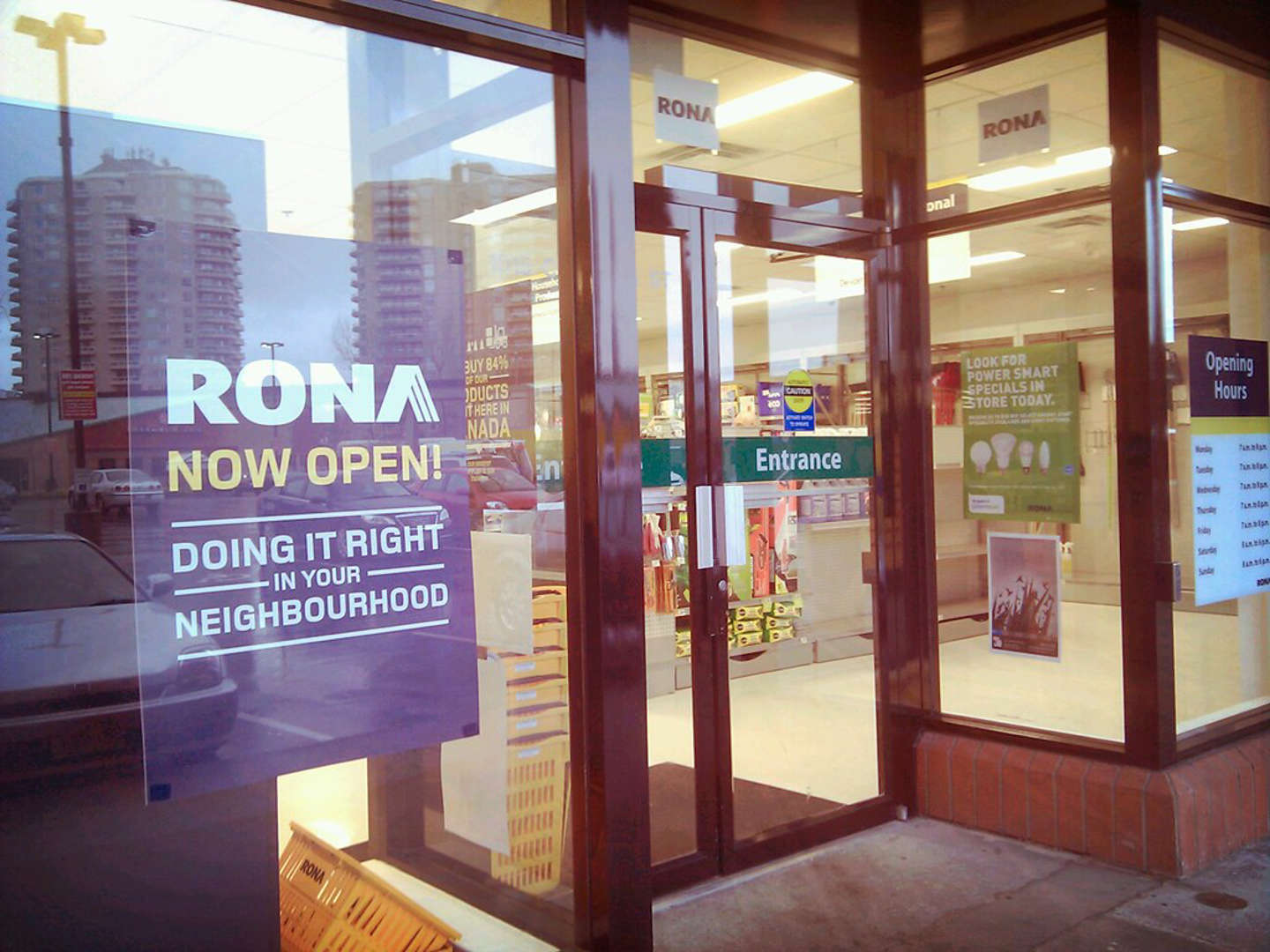
Rona

©Image credit: “2013_03_20” by Dennis S. Hurd is marked with CC0 1.0. To view the terms, visit https://creativecommons.org/publicdomain/zero/1.0/?ref=openverse.

The Canadian hardware retailer Rona underwent major ownership changes in recent years. After operating independently for decades, the Quebec-based chain was acquired by U.S. home improvement leader Lowe’s in a $3.2 billion deal completed in 2016. However, Lowe’s ownership proved relatively short-lived. In 2023, the American retailer divested Rona, selling it to Sycamore Partners, a private equity firm headquartered in New York, for $2.4 billion. Despite these corporate transitions, Rona maintained its distinct brand identity in the Canadian home improvement marketplace.
St-Hubert

©Image credit: Viridiana Rivera/Pexels

Ontario-based CARA Operations (now Recipe Unlimited) purchased Quebec’s St-Hubert restaurants for $537 million in 2016. The restaurant chain, founded in Montreal in 1951, maintains its distinct Quebec identity. Multiple foreign investment firms hold significant stakes in Recipe Unlimited through the parent company MTY Food Group. The company continues operating across Quebec while major business decisions are made outside the province.

Westjet

©image Credit: Justin Hu on Unsplash

In 2019, Toronto-based Onex Corporation acquired Westjet for $5 billion, with significant backing from international investors and foreign private equity firms. The airline maintains its headquarters in Calgary and continues operating as a Canadian carrier. Major foreign institutional investors hold substantial positions through Onex Corporation. While preserving its Canadian operations, the company’s ownership structure includes significant international investment.

Petro-Canada Stations

©Image credit: “Petro-Canada gas station, Eglinton Avenue West and Avenue Road (6035679276)” by Toronto History from Toronto, Canada is licensed under CC BY 2.0. To view a copy of this license, visit https://creativecommons.org/licenses/by/2.0/?ref=openverse.

Suncor Energy owns Petro-Canada stations, with significant foreign institutional investors holding major stakes. The company merged with Suncor in 2009 in a $19 billion deal. Petro-Canada remains a prominent Canadian retail fuel brand. International investment firms hold substantial voting shares in the parent company.

Shoppers Drug Mart

©Image credit: “Shoppers Drug Mart Store Canada” by bargainmoose is licensed under CC BY 2.0. To view a copy of this license, visit https://creativecommons.org/licenses/by/2.0/?ref=openverse.

Loblaw Companies Limited, a Canadian company, acquired Shoppers Drug Mart in 2014 for $12.4 billion. Despite its Canadian roots, the pharmacy chain has significant foreign institutional investment. Under this foreign ownership, Shoppers Drug Mart continues to expand its healthcare services across Canada.

Featured image/ ©Image credit: Erik Mclean/Pexels
Is Fighting Global Warming On The Downtrend?

Fighting against global warming is not popular with consumers today. But the consequences of a changing climate will not necessarily be kinder to the wallet.

If we take the case of three foodstuffs that are particularly consumed for breakfast, namely coffee, chocolate, and orange juice, a combination of unfavourable weather conditions have led to significant decreases in production and very sharp price increases: Lesechos.fr


Brazil, the world’s largest exporter of Arabica, is now increasingly plagued by drought (the latest one has almost dried up tributaries of the Amazon), which, not only affects harvests, but also results in hydroelectric production that has not increased for a decade.

It is again the drought that has penalized Vietnam, the leading exporter of Robusta, the other major variety of coffee grown in the world. In the end, the price of coffee has increased by 70% in one year.

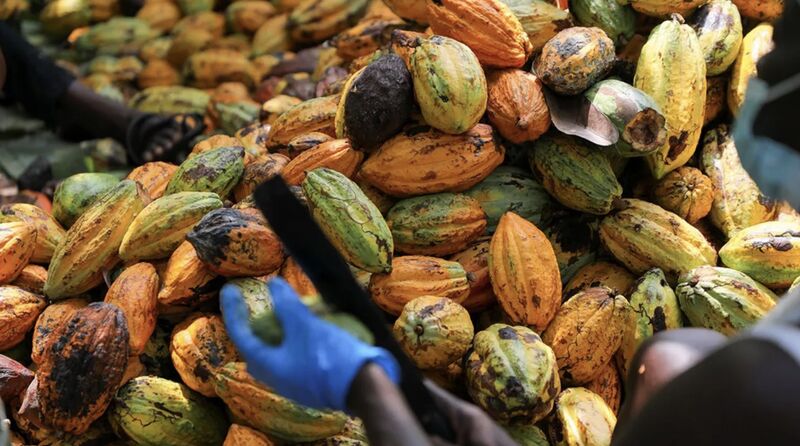
But this is nothing compared to cocoa, whose price tripled over the period, due to unfavorable conditions in Côte d’Ivoire and Ghana, which account for 60% of exported volumes.

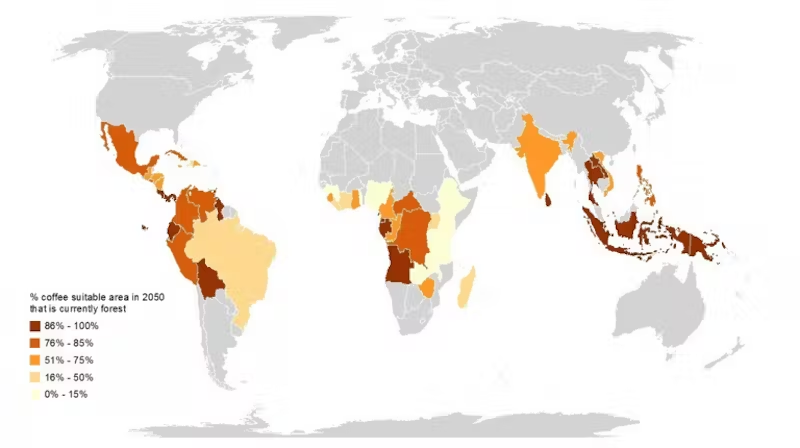
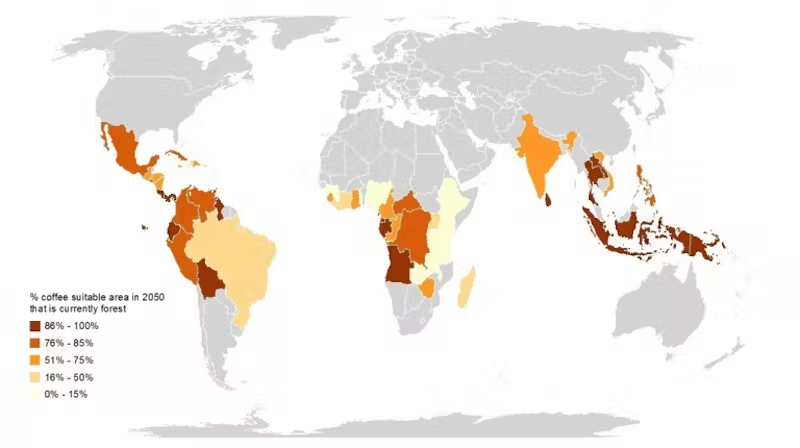
One of the margins for maneuver to lower prices is to increase production, but it is known that, for coffee and cocoa, the expansion of cultivation areas leads to deforestation… which will exacerbate global warming.

More coffee and chocolate?

Let’s drink orange juice! Unfortunately, the situation is not much more favorable for this citrus fruit. The table shows the drought in Brazil, the world’s largest exporter of oranges, but also a parasite that has led Florida’s production to be divided by 4.

Energy abundance, which started in a stable climate, has radically changed our consumption habits of exotic products in a few decades, allowing for long-range mass transport, and increasing crop yields.

Today, an orange, a chocolate bar or a cup of coffee have become commonplace products. But it doesn’t take a rocket scientist to understand that deglobalization (which will be a reality with a greatly reduced supply of hydrocarbons) and climate change will trigger an evolution that will go more or less far in the other direction.

Another not easy question in perspective! For the Silo, Jean-Marc Jancovic.

Image preview

Lutter contre le réchauffement climatique n’a pas la faveur du consommateur aujourd’hui. Mais les conséquences d’un climat changeant ne seront pas nécessairement plus clémentes pour le porte-monnaie.

Si l’on prend le cas de trois denrées particulièrement consommées au petit déjeuner, à savoir le café, le chocolat, et le jus d’orange, une conjonction de conditions météo défavorables ont conduit à des baisses significatives de production et des augmentations très fortes de prix : Lesechos.fr


Le Brésil, premier exportateur mondial d’Arabica, est désormais en proie de plus en plus souvent à la sécheresse (la dernière en date a quasiment mis à sec des affluents de l’Amazone), laquelle, non contente d’affecter les récoltes, a aussi pour conséquence une production hydroélectrique qui n’augmente plus depuis une grosse décennie.

C’est encore la sécheresse qui a pénalisé Le Vietnam, premier exportateur de Robusta, l’autre grande variété de café cultivée dans le monde. A l’arrivée, le prix du café a augmenté de 70% en un an.

Mais ce n’est rien à côté du cacao, dont le cours a triplé sur la période, à cause de conditions défavorables en Côte d’Ivoire et au Ghana, qui totalisent 60% des volumes exportés.

Une des marges de manoeuvre pour faire baisser les prix est d’augmenter la production, mais il est connu que, pour le café et le cacao, l’expansion des zones de culture engendre de la déforestation… qui va exacerber le réchauffement climatique.

Plus de café et de chocolat ? Buvons du jus d’orange ! Malheureusement, la situation n’est pas beaucoup plus favorable pour cet agrume. On retrouve dans la tableau la sécheresse au Brésil, premier exportateur mondial d’oranges, mais aussi un parasite qui a conduit la production de Floride à être divisée par 4.

L’abondance énergétique, qui a démarré dans un climat stable, a radicalement changé nos habitudes de consommation de produits exotiques en quelques décennies, en permettant les transports de masse à longue portée, et l’augmentation des rendements des cultures.

Aujourd’hui, une orange, une tablette de chocolat ou une tasse de café sont devenus des produits banals. Mais il ne faut pas être grand clerc pour comprendre que la démondialisation (qui sera une réalité avec un approvisionnement en hydrocarbures fortement diminué) et le changement climatique vont enclencher une évolution qui ira plus ou moins loin dans l’autre sens.

Encore une question pas simple en perspective ! Pour le Silo, Jean-Marc Jancovic.

Outdoor Luxury Brazilian Furniture For Spring

CaraivaInspired by Caraiva, a charming Bahian village by the Brazilian sea

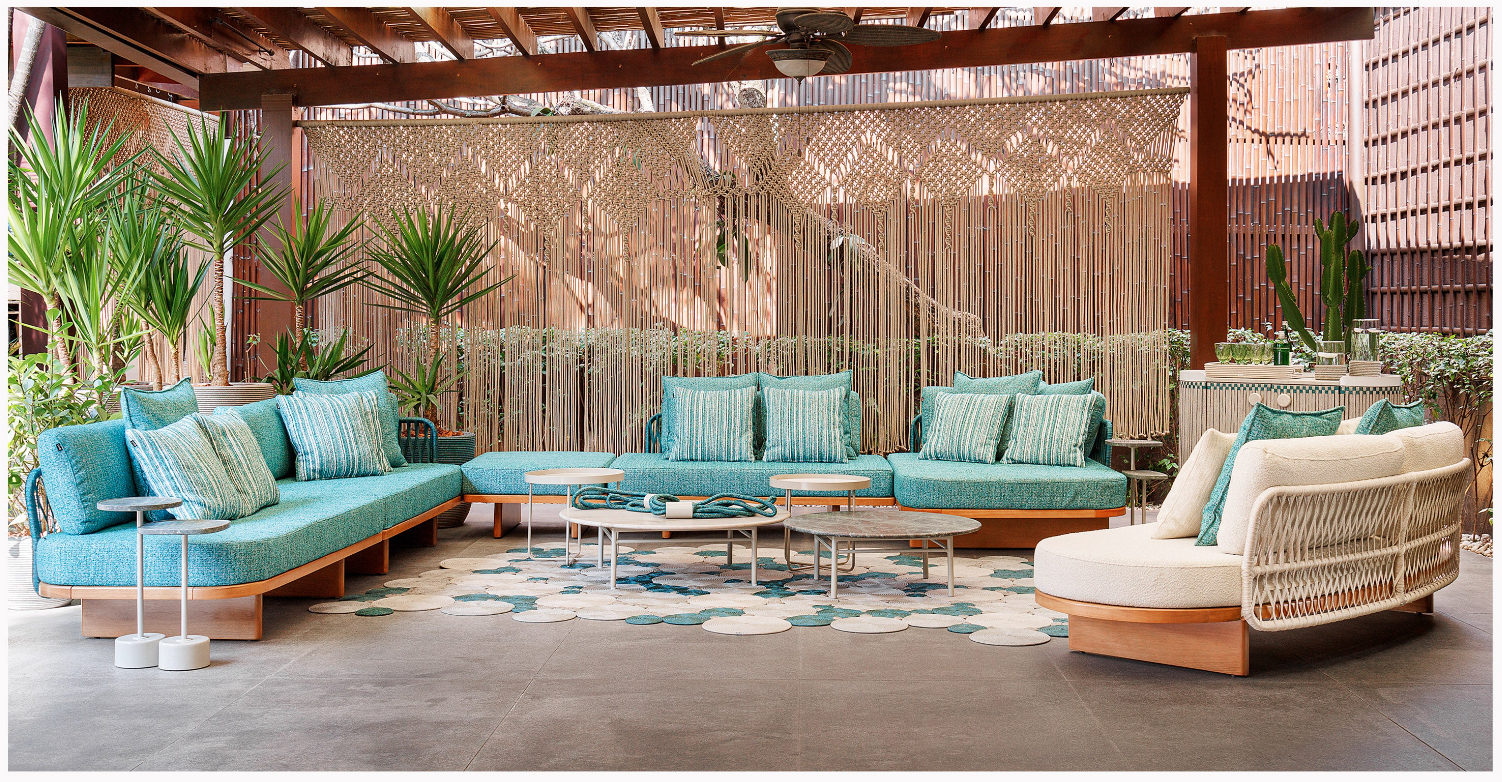
 Simplicity and rusticity converge at the Caraiva line. This line is composed of a recliner, a lounger, a bench, and an armchair. Simplicity and rusticity converge with the Caraiva line using variations of woven wood. The pieces have a wooden and aluminum structure with a rope finish and are meant to capture the feeling of ‘feet in the sand’ and the pleasure of enjoying the best of outdoor life. 

The Caraiva Line

DropInspired by the most important natural resource on the planet, water

 The Drop Line consists of a swing chair; and has rounded shapes complemented by modern patterns of nautical rope on the sides, base, and top. Different from the Caraiva line, the Drop line uses an aluminum structure along with an upholstered seat and back. The Drop line emphasizes comfort by utilizing upholstered cushions, while giving a sense of peace with inspiration from the sea.

The Drop Line

RoundProjects gain new possibilities with the Round line

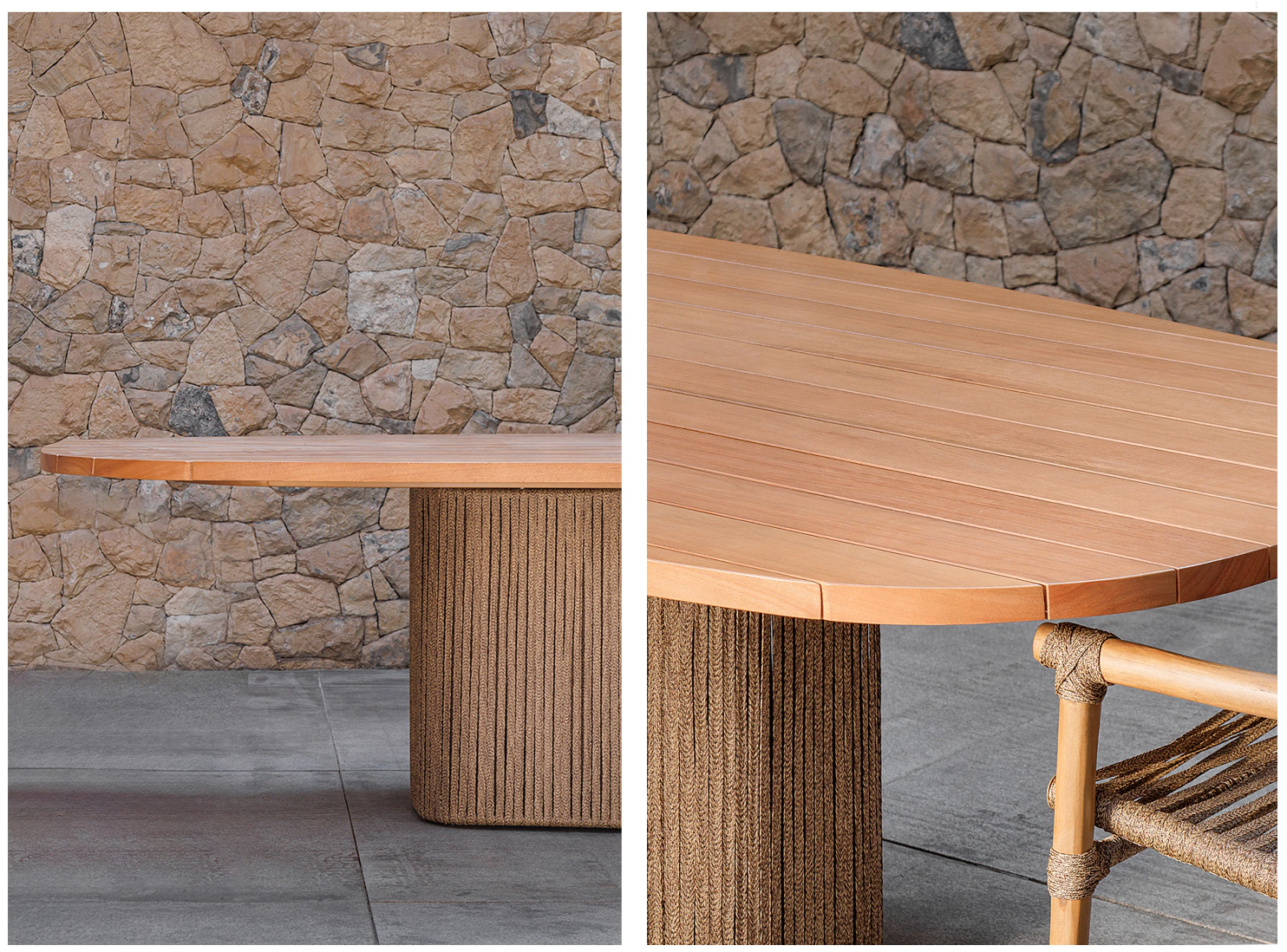
The Round line consists of two dining table models: square and rectangular in two sizes. The top is made out of stone or wood and the base is covered in nautical rope. 

The Round Line

SaharaInspired by the dunes’ movements in the Sahara desert.

The product pieces have an elegant design with rounded corners and a feature that adds lightness for both indoor and outdoor areas. The Sahara line includes a sofa, a chair with backrest and back support, four main modules, two side modules, and a corner module.

The Sahara Line

ShellInspired by the design of the seashells

 The delicate design of seashells was the starting point for creating the rounded chair designs in nautical rope for this line. The pieces include an armchair, a loveseat, and a chair – all have an upholstered seat, rope finish, wooden legs, and an aluminum structure.

The Shell Line

SplitVersatility is the strong point of the Split line

The Split line consists of seven sophisticated yet versatile modules that allow the building of different composition designs in multiple varieties of styles and sizes.

The Split 

For the Silo, Claudia Safavi.

UNESCO Seeks To Open Markets For Global South Cultural Goods

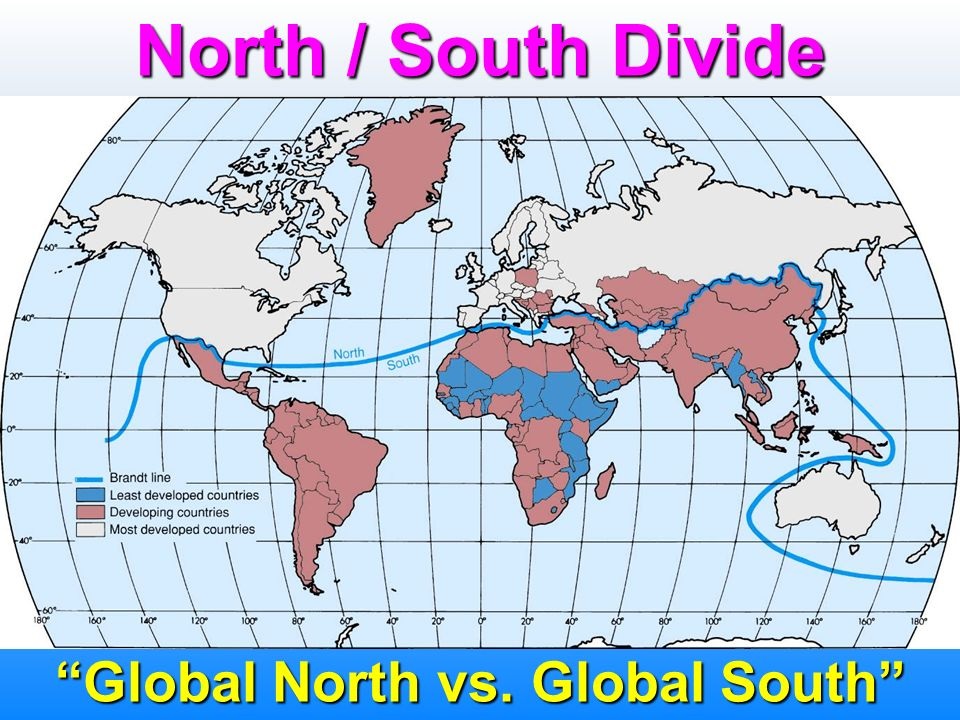
Paris, 30 May – Experts, stakeholders and government representatives will examine ways to improve exports of cultural products from the Global South, reinforce cultural entrepreneurship and improve the status of artists during the biennial meeting of the signatories to UNESCO’s Convention on the Protection and Promotion of the Diversity of Cultural Expressions, at the Organization’s Headquarters from 5 to 7 June.

Government officials and cultural professionals will address these and other issues at three Create|2030 debates during the session:

Rebalancing trade flows: making the case for preferential treatment in culture, will examine ways to open markets to cultural goods and services from the Global South, in line with the Convention’s binding provision to grant them preferential treatment in international trade.  Cultural goods and services from developing countries currently only account for 26.5% of the global trade in this rapidly growing sector. Panelists will also examine how the concentration of creative content on large online platforms is impacting the distribution of cultural products and expressions. (7 June, 10 am—1 pm, Room II)

Strengthening cultural entrepreneurship: The International Fund for Cultural Diversity (IFCD) will discuss investments in vocational training andbring together beneficiaries of UNESCO’s IFCD from Brazil, Cambodia, Colombia and Senegal. The Fund, which aims to address the gap between developed and developing countries in the creative economy, has provided more than 10,000 artists and cultural professionals with new skills in project management, business and career development to date. (6 June, 10 am—1 pm, Room II)

Rethinking the status of the artist will explore ways to enhance the professional, social and economic conditions of artists through policies concerning training, social security, employment, income, taxation, mobility and freedom of expression. (6 June, 2—5 pm, Room II)

During the meeting, participants will also examine an Open Roadmap designed to strengthen the Parties’ capacities to promote the diversity of cultural expressions in the digital age, as well as other innovative policy practices. Priorities in line with the UN’s 2030 Agenda for Sustainable Development will be set for the next two years, with particular attention to gender equality, fundamental freedoms, quality education, economic growth, decent jobs, and equality between countries.

The 2005 Convention on the Protection and Promotion of the Diversity of Cultural Expressions provides a framework for the design of policies and measures that support the emergence of dynamic cultural and creative industries around the world. The 146 Parties (145 States and the European Union) that have ratified the Convention meet at UNESCO every two years to examine its impact and determine future action. Twelve new Members will be elected to the Convention’s Intergovernmental Committee during the session.