Today 10 October, Vilnius’ leading contemporary MO Museum has opened How to Feel Real. Art, Technology and Us, exploring how technology is changing the way we experience reality. This opening also features an unusual guest: Poland’s viral humanoid robot influencer Edward Warchocki.
● Humanoid robot Edward will move through the museum and interact with visitors, respond to artworks, and take part in the opening program.
● The showcase is not a traveling exhibition, but developed through an intensive co-creative process in collaboration with Germany’s ZKM | Center for Art and Media Karlsruhe, one of Europe’s leading institutions for media art.
● It brings together more than 40 artists, from media art pioneers to contemporary artists working with AI, algorithms, and immersive technologies.
● Among them are Nam June Paik with his famous Internet Dream, Christa Sommerer, Laurent Mignonneau, and Anna Ridler.
Humanoid Influencer Edward Warchocki Is Heading to New Vilnius Exhibition, Asking What Does it Mean to Feel Real
October 2026 – Vilnius, Lithuania. Housed in a contemporary building designed by world-renowned architect Daniel Libeskind, MO Museum has become a leading force in the country’s modern cultural scene.
The new exhibition features landmark works from ZKM’s collection, which has a long-standing focus on Eastern Europe, and marks yet another collaboration with the MO Museum. How to Feel Real explores questions that are becoming increasingly urgent in a world shaped by technology: how do we feel real, and what does it mean to be alive?
One of its first visitors to see the artwork at MO Museum will be a humanoid robot from Poland.
Edward Warchocki, Poland’s first viral humanoid robot influencer, will join the MO Museum exhibition opening.
Built on a Unitree G1 humanoid platform and developed by Warsaw-based MERA Robotics, Warchocki has been given his own public persona, voice, and social media presence. In 2026, he moved from being a robotics project to an internet personality. Edward became a viral sensation after footage of him chasing wild boars through the streets of Warsaw spread online. He has since appeared in Poland’s Parliament, met senior politicians, and become a familiar figure on Polish television.
“Quite a few of the works in How to Feel Real explore artificial intelligence, automation, and the ways machines are increasingly taking on roles we once considered distinctly human. Bringing Edward into the museum is a playful extension of this idea, as his deliberately human-like and slightly absurd persona makes the questions raised by the exhibition tangible – inviting us to wonder why we are so eager to find the human in a machine,” said Milda Ivanauskienė, Director of MO Museum.
During the event, Edward will move through different spaces of the museum, interact with visitors, comment on artworks, and take part in the opening program in Lithuanian, English, and Polish languages.
“People keep asking me if I’m real, so when I heard about an exhibition asking what ‘real’ actually means, I thought: finally, someone is asking the right question. I’m coming to the beautiful Vilnius to see what the artists have to say – and, of course, to check whether they think I’m real,” said Edward Warchocki.
The exhibition moves beyond the familiar divide between techno-optimism and techno-pessimism. Alongside critical works about technology and power, visitors will encounter playful experiments, immersive environments and new aesthetic forms.
Organised around some of today’s most pressing themes – connection, automation, intelligence, body, and agency – the exhibition brings together works created predominantly from the 1990s to the present day. Together, they trace a conversation between artists’ early encounters with computers and the internet and contemporary responses to AI, and the growing digital mediation of everyday life.
“Our aim was to explore the latest technologies – including AI, quantum computing, robotics, and biotechnology – through the artists’ works. Art goes beyond the technology itself; it’s about broader questions regarding how we interact with technology and, thus, with the world,” said Philipp Ziegler, Head of Curatorial Department, ZKM | Center for Art and Media Karlsruhe.
More than 40 of the exhibition’s artists explore the shifting boundary between humans and technology. A definite highlight is the work Internet Dream from 1994 by media-art pioneer Nam June Paik. This massive media installation with 54 old CRT-monitors offers a glimpse into the era of the emerging global connectivity via the internet.
Another participant is the UK’s digital art studio Universal Everything, whose Infinity creates an endless stream of digital figures. Generated in real time by an algorithm, each figure combines different colours, textures, and body shapes, so no two are quite the same. The work has appeared in Germany’s ZKM, Italy’s Museo Nazionale della Scienza e della Tecnologia Leonardo da Vinci, and 180 Studios in London.
Christa Sommerer and Laurent Mignonneau are pioneers of interactive art, and their A-Volve is one of the works that established their international reputation. Visitors create virtual organisms through their own movements, then watch them interact, reproduce, and compete within a simulated ecosystem. The work won the Golden Nica for Interactive Art at Ars Electronica in 1994.
Anna Ridler from the UK similarly explores how machines learn from human-made material. In The Shell Record, she trained a generative AI system on images of shells she collected along the River Thames, turning the collection into moving-image works. The project connects the human act of collecting with the history of shells as stores of value and one of the earliest forms of currency.
How to Feel Real. Art, Technology and Us runs at MO Museum from 10 October 2026 to 29 August 2027.
There are great ruins all across the world. In many cases, they are places where history seems to have exhausted itself: remnants of distant cultures that have long passed beyond living memory.
But the Acropolis is different.
For thousands of years, the civilization that built what stands behind me has captivated the imagination of the Western world. Generations of our statesmen, artists, and philosophers have looked to it – they’ve looked to it with wonder and they’ve looked to it with awe.
Now time has a tendency to dull the senses: great victories and catastrophic defeats, they seem to shrink to becoming like a footnote in a textbook, another fact for our schoolchildren to memorize and forget. But the Greeks of antiquity, they seem to have an almost mystical hold on our memory. They call us back to them, again and again.
480 years before Christ, the armies of Xerxes arrived in this city and they put its sanctuaries to the torch. Most Athenians had by then evacuated by ship to a nearby island. But there was a handful of them that refused to leave their home. So instead, they barricaded themselves in the rocky fortress of the Acropolis to fight an extraordinary last stand, heaving massive stones down the cliffs onto the Persian invaders and holding the greatest empire of the age at bay for days. They were eventually overwhelmed. The Persians plundered the temples, burned the shrines, and razed the Acropolis to the ground but when the Athenians returned, they gathered the broken remains of the old Acropolis and buried them in the hill where it had stood. And decades later, under Pericles, they raised the Parthenon.
For 25 centuries since, the Parthenon has stood. Empires have risen and fallen beneath its shadow. And the progeny of the men who built it – the sons of Athens and Rome – have carried their civilization with them to the ends of the Earth.
Two and a half centuries after the founding of the American republic halfway across the world from where I stand now – I stand here today as the Secretary of State of that republic, and a great-grandson of settlers who arrived in the new world from Spain – I stand here to testify to a debt that no lapse of time, no distance of space can ever extinguish.
The history of America, the history of my country, is covered with the fingerprints of antiquity. Greece is literally carved into the architecture of our government: in the towering columns, in the domes and the monuments across our capital city. The city where our Constitution was born – Philadelphia – is itself a Greek name.
The men who founded my country were fascinated by the heritage we inherited from yours. They were exceptionally well-read in history – they were vividly aware of their unique place in it – but no other age of the past held their attention or their imagination quite like that of antiquity. Many, many people are surprised to learn that the most commonly cited author in the Federalist Papers was not an Enlightenment philosopher or political theorist. No, the most commonly cited author in the Federalist Papers was Plutarch, the Greek biographer of Greece and Rome’s great men.
Now, much has been written and said about the influence of ancient Greece on the ideas of the American Founders – and, for that matter, on all of the Western philosophers and statesmen that preceded them. Most of us are familiar with the basic history. Athens gave us democracy. Plato and Aristotle gave us Western philosophy. Our ideas of law, of virtue, of citizenship, and republican government were shaped in the Greek city-states. Even much of our political vocabulary – words like democracy, tyranny, the word “politics” itself – found its origins here.
Now, all of that is true. But the things we owe to this place – as Americans, and as Westerners – are actually far far deeper. These institutions and ideas – these institutions and ideas were the outward expression of more fundamental qualities we see in the ancient Greeks – qualities that can’t be reduced to any particular political system or theory.
Here, in Athens, we found the first full realization of all the essential traits that would come to define the West: fierce individuality and relentless ambition; daring exploration and invention; a yearning for discovery, for adventure, risk and glory. An insatiable curiosity about the world and the principles by which it operates, a hunger to know the mysteries of nature and grasp the secrets of the cosmos. An impatience with the notion of impossibility, chafing at all boundaries and limits, straining to peer into the depths of the unknown.
These were not just the formulas or precepts of a particular school of philosophy. They were the characteristic of a people – expressed in their traditions, their stories, their imagination; in the qualities they demanded of their citizens; in the things they lived and fought and died for.
To know them is to know ourselves.
What blossomed here in this place was the Western desire to uncover all that ignorance, darkness, and distance had kept hidden from the mind of man. The Greeks did not just shape history; the Greeks gave us history itself. Much about – much of what we know about many ancient civilizations comes almost entirely from the records of Greek explorers and historians, explorers and historians who didn’t just chronicle the histories of their own people, but ventured outwards to observe and record the sagas of foreign peoples and cultures all across the world.
Where others looked inward, the Greeks were the first to direct their focus outward, to chase the thrill and glory of seeing all that was strange and new. It was this trait – it was this trait that would push the West to create and build things that others could not, marking us out from so many other cultures and civilizations where stability and subsistence were the highest ends of life.
But it is not just the ambition to explore the unknown that we inherit from the Greeks; it is the conviction that the unknown canbe known. The confidence that the world can be charted and measured and mapped and understood – and that there is a rational order to the cosmos, governed by certain fundamental laws, laws that men can observe and the mind can come to understand.
This was the foundation of the Western mind: our math, our science, our medicine. Our philosophy, ethics, and religion. It paved the way for the gospel of Jesus Christ to find fertile soil in Europe and flourish into the empire of Christendom. It was the foundation of the riches of Christian theology – of Augustine and Aquinas and the whole tradition of natural law.
It gave birth to a civilization marked not just by a common culture, it was marked by a common anthropology – a common view of man and his place in the universe. Its descendants would share not just the idea of a natural order, but a distinctive understanding of virtue; of destiny and fate; of truth, goodness, and beauty; of a code that dictates how men ought to live; of objective standards and ideals to strive towards.
For the Greeks of antiquity, the pursuit of excellence was the very principle of man’s existence. They organized all of civic life around contest, ambition, competition: in philosophy and poetry, in sculpture and drama, in athletics and art, in war and statecraft. The classical Greek city was an arena for great men to test and prove themselves, to hone their potential through perpetual struggle – to be the best, the strongest, the most beautiful, straining to inch ever closer to perfection.
Now I know that to modern ears, what I just described, this way of life, may sound odd; it may even sound cruel. The ideal of many ideologies in our time has, frankly, become a world of perfect safety, devoid of risk or failure, with neither the glory of victory nor the shame of defeat. Too often these days, we build downwards. We design our standards to ensure no one will lose; we preoccupy ourselves more with the comfort of the worst than the potential of the best. We hold the most exceptional things among us hostage to the average, the ordinary, the mediocre.
The men who made the Parthenon, they built upwards.They held that the highest and most noble aspiration in life was to surpass all others, to strive to be the best in all things. The ancient Greek city-states were filled. They were filled with intense passion and rivalry and faction and conflict. But from that constant struggle for distinction – from that came the great flowering of art and philosophy and political and intellectual energy that would transform a collective of Mediterranean cities into the birthplace of the greatest civilization in the world.
The thumos, as the ancient Greeks called it – the fire of passion, strength, courage, pride – is the heart of great civilization. And without it? Without it, nations lose their will to fight, the will to strive, the will to survive.
Marco Rubio was sworn in as the 72nd Secretary of State on January 21, 2025. The Secretary is creating a Department of State that puts America First.
Today, too much of the West has forgotten this quality. Over time, we in the West came to feel ashamed of the very things that made us exceptional. We felt embarrassed that our achievements set us apart from the rest of the world. Our prosperity somehow became a source of guilt. We no longer believed we deserved and had earned our greatness.
The word “nationalism” became a dirty word. And so we tore down our monuments; we condemned our own history. And in too many places, we taught our children to be ashamed of the countries they would inherit. In the process, we opened our borders and outsourced our industry, and allowed our militaries to wither and to decay.
And with every passing year, we seemed to outsource more of our sovereignty, transferring our decisions to global bureaucracies far beyond the reach of our control.
But others were all too happy to fill the vacuum that we left – the vacuum left behind by our weakness. And as the West’s confidence faltered, its adversaries and its rivals only grew more assertive, building up their own wealth and their own power in our stead.
And now, today, we find ourselves at a crossroads. Because the next decade and the decisions we make will write the story of the next century. The course we take will determine whether the West maintains its place at the head of the world or resigns itself to a future of atrophy and servitude and decline. We will either choose to act now or lose the choice to act at all.
Under President Trump, the United States has made its choice. We choose the unapologetic pursuit of national power: to take back control of our critical supply chains, to reindustrialize our economy, to rebuild our defense, to fight for dominance of the technologies and industries of the future.
We choose to reach for new frontiers: in advanced manufacturing and super intelligence; in drones, weapons, and warfare; in chips, minerals, cyber, and every other domain of human possibility. To unleash our energy, to rebuild our factories, to return our astronauts to the moon and launch a new age of exploration in space.
Now for all their lofty ideals, the ancient Greeks were not naive. They understood that nations have interests. They understood that statecraft requires prudence and diplomacy, but they also understood that it requires the ability to wield force when prudence and diplomacy fail. They understood that power requires not only having the means to defend yourself, it requires the credibility that you are willing to use it.
This is the classical understanding of politics and of statecraft that the Trump Administration hopes to reclaim – reclaim not just for our country, but for the whole of our civilization.
We believe that Europe can awaken from its long slumber and rekindle the fire that was lit here millennia ago.
There are already signs.
Across this continent, we are witnessing what we hope will be the beginnings of a generational shift: skyrocketing defense spending, a flurry of new partnerships and programs, expanded manufacturing and production, following on the historic defense commitments made last year in The Hague.
Greece has been at the center of this shift. The people of this nation have proved themselves once again to be an indispensable friend to Europe and to the United States alike, on everything from energy to migration to defense, where Greece has been a model ally.
And it’s our sincerest hope that all of Europe will follow your example.
Though passions may, at times, have strained the bonds of affection between the United States and Europe, it must not be allowed to break them. Together, we must strengthen an alliance capable of confronting threats of our age.
And we can. Because we do not believe the transatlantic friendship should be zero sum. Quite the opposite: our vision is of an alliance whose strength is greater than the sum of its parts. It is a vision we saw in action just last month, in an unprecedented new agreement between the United States, Denmark, and Greenland – an agreement that will reshape the Arctic and bolster the security of all of NATO. All three partners in that deal emerged victorious. All of Europe – and NATO and the United States emerged safer, stronger, and more secure because of it.
We want to win together. We must win together.
Now it’s has become fashionable today to believe that enlightened foreign policy means prioritizing the global community over one’s own people. And I think here, too, we have much to learn from the men of ancient Greece because they knew that there was nothing selfish or wrong about loyalty to your nation, nor anything selfish or wrong about fighting to defend its interests above all else.
They believed – fiercely – in the ideal of the great man: the exceptional individual who obtains immortality through his own deeds. But they believed that glory and fame, those things were won through striving, sacrificing and achieving greatly for something larger than yourself. The recurring hero of the ancient Greek world was the man who was willing to pay any cost for a cause worthy of his loyalty.
We see this in Socrates, who refused to abandon the inquiry into truth even at the cost of his own life. We see it in the legendary stand of 300 Spartans – surrounded and hopelessly outnumbered by the vast armies of Persia – who refused the chance to save themselves, choosing to fight to the last man rather than abandon their post or abandon their duty. And we see it in the epic myth of Achilles, who is offered the choice to return home and live a long and peaceful life – but chooses instead to remain at Troy and perish in pursuit of eternal glory.
These – these are the qualities that would shape the Western moral imagination. From the Christian martyr who refused to betray his faith to the patriot who gave his life for his country; from Saint Thomas More to the Battle of the Alamo, running through the immortal closing words of the Declaration of Independence of the United States which says, “We mutually pledge to each other our Lives, our Fortunes and our sacred Honor.”
It is from the Greeks that the West inherited its sense of duty – an unbreakable loyalty to one’s code, one’s cause, one’s country. Our heroes, the heroes of the West are those who choose to remain faithful to their duty precisely when it is most difficult and painful to do so: the man who is bound by his word, the soldier who will not abandon his post, the captain, the proverbial captain, who goes down with his ship.
This is wholly different from what we see, even now, for example from fanatics like the radical mullahs of Iran, whose cult of death hails child suicide bombers as national heroes, and portrays martyrdom as an end to itself.
Our heroes – our heroes may be willing to die for their cause; but our heroes do not worship death. It is precisely because we value life that we come to recognize the heroism in those who would sooner sacrifice it than to betray their principles. Now, we take the West’s conception of these things – heroism, honor, duty – we take these things for granted. We assume that these somehow are universal to all people in all times and in all places. They are not. They are the product of a distinct character, a distinct character which arose here and shaped the whole story of the civilization that came after it. A civilization that we must fight to defend today with the same passion as our forefathers did.
The men who built the Parthenon were succeeded by the architects of European Christendom, who raised the cathedrals of Milan, Cologne, and Florence. The quest to perfect the human form that moved the ancient Greek sculptors found a new expression in Michelangelo. The Greek philosophers’ search for the structure of the universe was inherited by Copernicus, and then Galileo, then Kepler, and in Newton.
The hunger for new knowledge, that’s what gave birth to Magellan’s first expedition around the world, to Columbus’ discovery of the Americas, and ultimately to Apollo 11’s journey to the moon. And the qualities that led Alexander to conquer the entire known world reappeared in Caesar, then Charlemagne, and Cortes.
And in America, that same tradition rediscovered itself anew. An open and wild land became the site of a great revival of Western imagination and ambition. The Greek aspiration for new horizons became the American frontier spirit. The civilization of Athens and Rome transformed an infant seaboard republic into a continental empire.
The greatest Americans of every generation have carried the unmistakable features of their forefathers – born in Athens, formed by Rome, baptized in Christendom, hardened in the furnace of medieval Europe, endowed with the English genius for liberty, and then carried across the Atlantic to be reborn on the shores of a new world.
Together, we must now rediscover that spirit. We are at an inflection point – an inflection point not only in the history of my nation, but an inflection point in the whole of our civilization.
The threats we face today are every bit as real as they were on the dramatic stage of antiquity.
National interests did not vanish in the face of international institutions. War did not disappear simply because we preferred peace. Other states continued to arm, to seek influence, to compete for territory, and technology, and resources, and markets, and energy, and power.
And now, there is war again. There is new competition between great powers again. There is vulnerability, aggression, terrorism, a whole universe of new threats and attacks again.
And so we must rebuild our institutions and our alliances to face these threats together – understanding that the purpose of these things is not to abolish the sovereignty of the nations that constitute them; it is to defend them. And that nations need not abandon their distinct identities in order to recognize their common interests.
We have built a model of that with our partners here in Greece. In our defense partnerships, in energy and technology, in our shared ambition to secure Europe’s borders from the threats of mass migration.
Our friendship dates back to the earliest years of my nation. When Greece rose in 1821 to recover its independence after centuries of Ottoman rule, Americans recognized something familiar in that struggle. Three years later, the great American statesman Daniel Webster, he delivered a famous address to Congress, helping bring the cause of the Greek Revolution before the representatives of the young American republic.
And he began by calling their attention to everything around them. This is what he said in his speech; he said: “This free form of government, this popular assembly… this practice of free debate, and public discussion, the contest of mind with mind… even the edifice in which we assemble, these proportioned columns, this ornamented architecture, all remind us that Greece has existed, and that we, like the rest of mankind, are greatly her debtors.”
Those words are as true today as they were when he said them. And all of us – not just Americans, but Europeans and our friends across the West – must relearn the lessons our forefathers took from this place and from its history.
The history of Greece – the history of Greece does not just offer us a glimpse – it does not offer a glimpse of our institutions in their earliest forms. The history of Greece shows us an image of ourselves.
It shows us that ours is the inheritance of great heroes, and that we should be proud – that we should be intensely proud – of where we come from. We should marvel at what our forefathers carved out of this countryside. The story of our civilization is the greatest story ever known to man. And it began here, with the first men and women of the West. From them – from them – we can rediscover the virtues, the courage, and the strength to confront the dangers that we face in our time.
With its marble columns and towering dome, the U.S. Capitol is one of Washington’s most beautiful structures and a striking example of how classical architecture has influenced America’s civic buildings.
President George Washington, who laid the Capitol’s cornerstone in 1793, and Secretary of State Thomas Jefferson saw the architecture of ancient Greece and Rome as emblematic of their new nation’s democratic ideals. To Jefferson, classical architecture’s large entrances and symmetrical layouts symbolized openness and equality, values embodied in the U.S. Constitution. Washington commissioned French architect Pierre L’Enfant to create a classical design for the nation’s capital city.
“They sought to use classical architecture to visually connect our contemporary Republic with the antecedents of democracy in classical antiquity,” President Trump says in an August 28, 2025, executive order on restoring classical designs to American architecture.
The National Civic Art Society, which promotes meaningful public design, finds that 72% of Americans prefer traditional designs derived from classical architecture over modernist styles for federal buildings.
To David Gobel, a professor of architectural history at the Savannah College of Art and Design, those results aren’t surprising. “Classical architecture is a universal language,” Gobel says. “People don’t have to know their Doric, Ionic and Corinthian orders [of Greek architecture] to recognize that this is familiar, that it is the architecture of the ages.”
Classical architecture’s influence extends across America, most notably in state capitol buildings from coast to coast. American architects introduced stylistic variations, creating civic buildings that reflect both American culture and its natural landscape.
The U.S. Capitol wasn’t the first civic building in the United States to evoke Greek and Roman antiquity. That distinction belongs to the Virginia Capitol building designed by Jefferson in 1785.
Jefferson’s design recalls the Maison Carrée, an ancient Roman temple in Nîmes, France. Both buildings have a triangular pediment atop a wide, columned entryway. Yet Jefferson took a more streamlined approach, choosing simple Ionic columns, rather than the elaborate Corinthian columns seen on the Roman temple in France.
The Vermont State House in Montpelier, constructed in 1859, departs from classicism’s traditional use of white marble in favor of local gray granite, bringing a more rugged look tailored to its setting in the Green Mountain range.
The main lobby highlights national and local leaders with statues of Abraham Lincoln, the 16th U.S. president, and Revolutionary War hero Ethan Allen, who was one of Vermont’s founders.
The Capitol building in Michigan, built between 1872 and 1878, combines classical design with American practicality. Artisans in the iron-producing state painted the interior using trompe-l’oeil techniques to trick the eye and make iron and pine wood materials resemble more expensive marble and walnut.
Constructed between 1912 and 1916, the Utah Capitol combines granite building material with classical styles, including Corinthian columns and a dome. The building’s interior murals depict the state’s history and geography, with images of Mormon pioneers and covered wagons, as well as Utah’s famed Great Salt Lake and red-rock canyons.
American architects continue to add new flourishes to classical designs, says Gobel, the architectural history professor. Recent examples include the Federal Building and Courthouse in Tuscaloosa, Alabama, and the Charleston Gaillard Center, a performing-arts venue in Charleston, South Carolina. The Gaillard Center, completed in 2015, features interior columns crowned with palmettos, a nod to South Carolina’s state tree. Completed in 2011, the Federal Building in Tuscaloosa has a metal roof, a feature commonly used in southern architecture for durability and heat resistance.
“It’s a tradition dating back thousands of years, and it’s never stopped,” Gobel says of classical architecture. “Its purpose is not to represent a particular age or place, but something higher and greater to which we can aspire.”
Protecting Older People in Conflict and Disaster Zones is A Humanitarian Priority
Growing older can bring challenges that become particularly difficult in communities affected by poverty, displacement, conflict, or natural disasters. Health problems such as impaired vision, hearing difficulties, mobility limitations, hypertension, diabetes, and heart disease may become harder to manage when medical services are disrupted or unavailable.
Yet the challenges faced by older people extend far beyond physical health. The loss of a spouse, separation from relatives, displacement, financial insecurity, and prolonged isolation can leave many elderly people without the social and emotional support they need. In humanitarian crises, these vulnerabilities can become even more pronounced, especially when older adults are simultaneously responsible for children or grandchildren.
As the world marks the International Day of Older Persons, attention is increasingly turning to the need for humanitarian responses that do not overlook the elderly.
For Life for Relief and Development supporting older people is incorporated into a broader humanitarian approach that includes emergency assistance, healthcare, shelter, food security, water and sanitation, education, and community support.
We spoke with Sharon Leonard, Executive Administrator at “LIFE”, about the organization’s approach to elderly care and the experiences of older people living through conflict, displacement, poverty, and natural disasters. Against this backdrop, we spoke with her to discuss these issues.
Q: Why is support for older people an important part of humanitarian work, even during major emergencies?
Older people can sometimes become invisible during humanitarian emergencies because immediate attention naturally focuses on urgent injuries, displaced families, children, and other visible needs. But older adults are also directly affected by crises, and many have specific medical, financial, and social needs that cannot simply be postponed.
The demographic picture itself demonstrates why this issue deserves greater attention. UNFPA data indicate that people aged 60 and above already account for approximately 8% of the world’s population. The increase is particularly significant across Arab countries, where the elderly population is expected to grow from around 27 million in 2015 to approximately 50 million by 2030 and more than 80 million by 2045.
This demographic transition is taking place alongside wars, displacement, economic hardship, and other humanitarian challenges. Conflict can also weaken family structures and reduce the number of younger relatives available to care for aging parents and grandparents.
For these reasons, elderly care should not be considered an optional addition to humanitarian response. It needs to be incorporated into sustainable programs that recognize the rights, needs, and contributions of older people.
Q: LIFE operates in very different countries and communities. How can elderly care be adapted to such diverse environments?
There is no single model of elderly care that can be applied everywhere. The needs of an older person living independently in a community are different from those of someone displaced by conflict or living in a residential care facility.
Over the past 34 years, LIFE has worked across approximately 60 countries, and older people have been included in many areas of our humanitarian response. This may involve emergency assistance, support for refugees and internally displaced people, medical services, clean water projects, seasonal distributions, family assistance, education, and orphan sponsorship.
One particularly important situation involves grandparents who become the primary caregivers for orphaned grandchildren. They may already be struggling with age-related health problems and limited financial resources, yet suddenly have responsibility for an entire household.
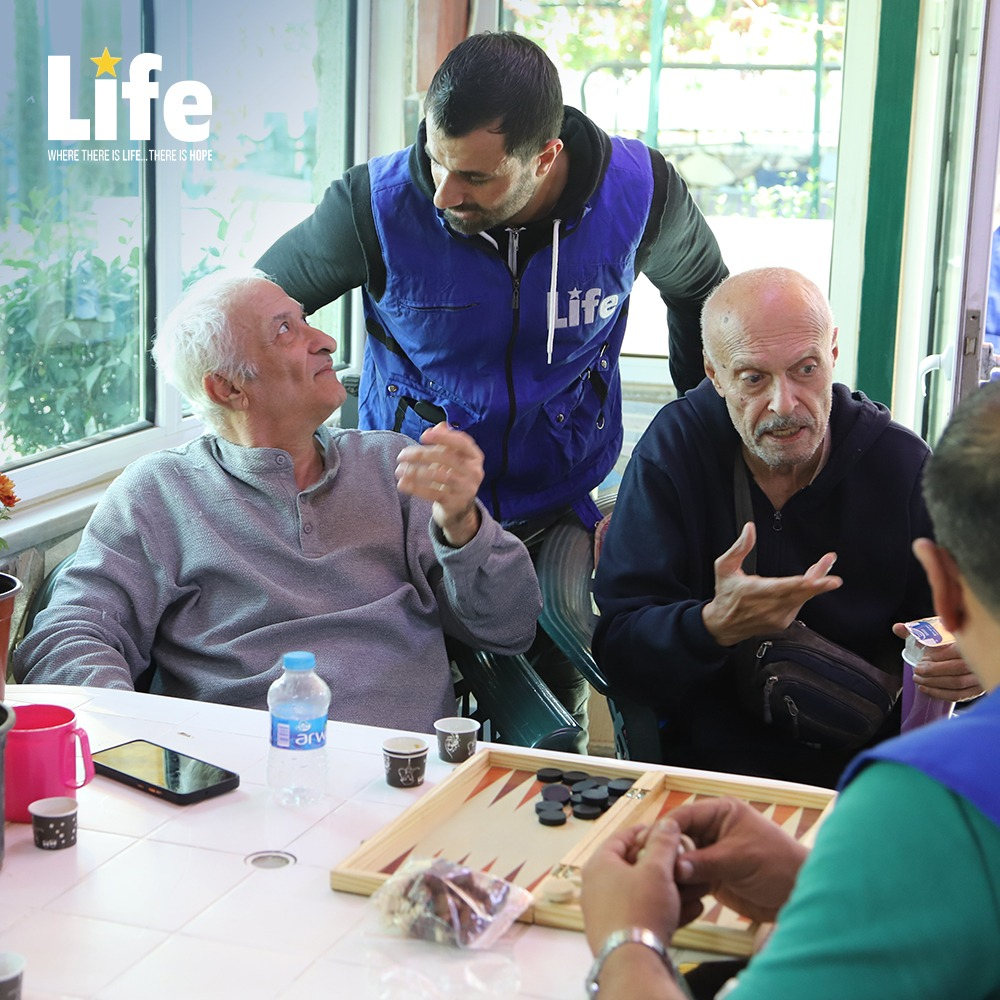
Where LIFE works directly with elderly residents in care facilities, we also try to address their social and emotional wellbeing. This can include nutritious meals, safe environments, opportunities to talk and share their experiences, recreational activities adapted to their abilities, and basic technology training that can help them remain connected with relatives.
Our objective is not simply to provide services. It is also to ensure that older people’s experience, knowledge, and dignity remain part of community life.
Q: Older people can be particularly vulnerable when they are forced to leave their homes. What assistance do they receive during displacement and emergencies?
Displacement can be extremely difficult for an elderly person, particularly when they have chronic illnesses, mobility limitations, or depend on regular medication.
LIFE teams have responded to emergencies in many different settings, including earthquakes in Morocco, Nepal, Indonesia, and Türkiye; floods in Bangladesh, Afghanistan, and Libya; and conflicts affecting communities in Myanmar, Sudan, Gaza, Syria, and Lebanon.
In these circumstances, our first concern is to help older people remain safe and maintain their dignity. Depending on the situation, assistance may include secure accommodation, medicines, medical examinations, continued treatment, nursing support, or mobile medical services for people who cannot easily reach healthcare facilities.
Food assistance is also important. We seek to provide balanced meals and, where appropriate, nutritional support. During colder months, blankets and warm clothing can make a significant difference, particularly for displaced families living in temporary accommodation.
Financial and household assistance may also be necessary when an older person is responsible for grandchildren or other dependents.
Every intervention is designed around the circumstances of the individual and the practical barriers they face.
Q: Physical assistance is visible, but how does LIFE respond to loneliness, grief, and other emotional challenges among older people?
The emotional consequences of displacement and loss can remain long after an immediate emergency has passed. Older people may lose spouses, children, homes, familiar communities, or their sense of independence. Some become isolated because they are unable to travel or communicate easily with relatives.
That is why humanitarian support should not stop with food, medicine, or shelter. Listening and human connection are also important.
Our programs can include opportunities for older people to speak with others, participate in group activities, and receive psychosocial support. These interactions can help reduce isolation and remind people that they have not been forgotten.
Recent work in the West Bank, for example, included assistance for older residents in Bethlehem, Beit Sahour, and Beit Jala. In Lebanon, LIFE has also supported older people with disabilities through specialized healthcare, recognizing that some elderly individuals may hesitate to ask for assistance even when their needs are significant.
In Gaza, the humanitarian situation is particularly severe. Older people living in displacement camps may be managing chronic medical conditions while simultaneously coping with bereavement, displacement, and the loss of family members. Emergency relief, medical assistance, and seasonal support therefore remain important components of our response.
Q: What do older people tell you about the meaning of this assistance?
For many elderly people, assistance is about much more than receiving supplies. It can restore a sense of security and independence at a time when so much of their lives has become uncertain.
I remember Abu Nasser, a 71-year-old man from Gaza, who became responsible for six grandchildren after losing his son and daughter-in-law. He described how the war had completely changed the responsibilities he carried in old age. Receiving food, personal-care items, and safe water reduced his fear that his grandchildren might have to put themselves in danger simply to meet the family’s basic needs.
Even basic facilities can have an important psychological effect. Having access to private bathrooms in a LIFE camp, for example, gave Abu Nasser and his wife a renewed feeling of privacy and dignity.
There was also Zahra, 75, from Mauritania, who explained that receiving food assistance meant she no longer had to face the humiliation of asking others for food.
In Afghanistan, Fatima, 73, survived devastating floods and was left deeply traumatized. Safe accommodation and medical assistance helped her begin recovering from the experience.
And in Türkiye, Aisha, 67, was displaced following the Kahramanmaraş earthquake. LIFE helped trace her family after displacement and provided shelter, medicine, clothing, and food while they worked toward rebuilding a more stable life.
These experiences demonstrate that dignity is often found in things that may appear very simple: safety, privacy, medicine, food, family connection, and the ability to live without constantly fearing what will happen next.
Q: Another challenge is that some elderly people become caregivers for children after conflict or disaster. How does LIFE respond when older people themselves are in need of care?
This is one of the most difficult situations we encounter. An older person may already need assistance yet suddenly become responsible for children because their parents have died, disappeared, or become unable to care for them.
In northern Syria, I remember Abu Amer, 78, who had spent years living in freezing tents with his grandchildren. When he received a home through a new LIFE housing project, he became emotional. His greatest concern had been protecting the children from the cold and providing them with a safe place to live.
Another example is Iman, 59, from Sudan, who fled the conflict with her pregnant daughter and grandchildren. After the family reached Egypt, LIFE provided shelter, food, medicines, and medical follow-up for her daughter during the pregnancy.
The same principle applies beyond conflict zones. In the Dominican Republic, Pedro, 71, watched his grandchildren return to school after LIFE rehabilitated their damaged school. His reaction reflected something important: humanitarian assistance can restore not only physical infrastructure, but also a family’s sense of stability and dignity.
These stories reinforce why elderly care should be incorporated into broader humanitarian and development planning. Older people are not simply recipients of assistance. In many communities, they are caregivers, decision-makers, sources of family stability, and custodians of experience and knowledge.
Q: What should humanitarian organizations do differently in the future when designing programs for older people?
The needs of older people should be considered from the beginning of humanitarian planning rather than added later as a separate issue.
That means identifying their medical needs, mobility limitations, living arrangements, financial circumstances, and family responsibilities when an emergency response is designed. It also means ensuring that shelters, distribution points, healthcare services, water facilities, and communication systems are accessible to elderly people.
Most importantly, we need to recognize their dignity and agency.
Humanitarian programs should help older people remain connected to their families and communities whenever possible. They should support those who are caring for grandchildren, provide access to appropriate healthcare, and create opportunities for older people to participate rather than treating them solely as vulnerable recipients.
As populations age around the world, elderly care will increasingly become part of sustainable humanitarian planning. Protecting older people means protecting families and communities as a whole.
After the signing of the Declaration of Independence in July 1776, Founding Father Benjamin Franklin sailed from Philadelphia to Paris to enlist France’s support for the American Revolution. The journey Franklin began that October — the first official U.S. diplomatic trip — would eventually lead to an alliance with France that helped the United States win its independence from Britain.
“From the beginning, diplomacy was central to securing American independence and would continue to shape the security and prosperity of the growing United States,” according to the National Museum of American Diplomacy , which reopened after renovations on October 1.
Located at the Department of State in Washington, the museum tells the story of how U.S. foreign policy helped shape America and the world. “It’s about helping our young people understand that their government works for you,” says Lauren Fischer, the museum’s acting director.
The National Museum of American Diplomacy features a section of the Berlin Wall and a display of the State Department’s map of the world divided into six geographic regions. (State Dept./Evan Eile)
250 years of diplomacy
The museum’s permanent collection includes flags of other nations and exhibits on past U.S. secretaries of state. A digital map shows the world through the eyes of a U.S. diplomat — divided into six geographic regions — a nod to the scope of American diplomacy.
The museum reopens with a new exhibition, Among the Powers of the Earth , which runs through summer 2027 and showcases 30 objects from U.S. diplomatic missions since the country’s founding. Featured items include a smallsword worn by U.S. diplomats in the 18th century, the original signature page of the 1783 Treaty of Paris, which is on loan from the National Archives and Records Administration until early January 2027, and a copy of the Declaration of Independence, commissioned in 1823 in advance of the 50th anniversary of America’s founding.
Negotiated by Franklin, John Adams and John Jay, the Treaty of Paris ended the American Revolution and “codified the intention stated in the 1776 Declaration to place the United States equally ‘among the powers of the Earth,’” says Alison Mann, the museum’s historian and head curator. The 1823 copy of the Declaration of Independence was among those created from a copperplate engraving that President John Quincy Adams, the sixth U.S. president and a former secretary of state, commissioned to preserve the Founders’ words for future generations.
From left: A copy of the Declaration of Independence made from an 1823 engraving, a diplomat’s sword and the signature page of the Treaty of Paris. (National Museum of American Diplomacy)
Bugged Brick from U.S. Embassy Moscow
Soviet Unionc. 1960
Throughout the Cold War, the United States and the Soviet Union engaged in espionage against one another in the hope of gathering information that could give them some sort of advantage in the relationship, or if a direct military confrontation ever occurred. Efforts to eavesdrop inside secure embassies, or on diplomatic personnel in general, were one such effort. This unusual looking device protruding from a brick is an electronic “bug”—essentially a microphone that could transmit conversations remotely. It was found in the U.S. Embassy in Moscow in the 1960s by Diplomatic Security personnel conducting a search for such devices. The narrow “stick” protruding from the electronics (the end with the wire) was a hollow tube that could covertly protrude through a very narrow hole drilled through a brick. The sound would travel through the hollow tube and into the electronics, which allowed them to be transmitted.
Source/Credit:Transfer from the Bureau of Diplomatic Security, Department of State
The exhibit’s online resources examine how the Founding Fathers’ carefully chosen words maximized the Declaration of Independence’s global influence, making it a model for the founding documents of other countries, including Ireland.
The museum’s interactive displays, public outreach and online resources offer insight into how diplomacy works. Online simulations featuring real-world scenarios, from nuclear nonproliferation to wildlife trafficking, allow students to see how, as Mann says, “Diplomacy makes the impossible seem possible.”
“No other museum brings diplomatic history to the forefront in its exhibits, and no other institution is solely dedicated to collecting items of American diplomacy and the stories of the men and women who practice diplomacy,” says Fischer.
The National Museum of American Diplomacy is open on Tuesdays and Thursdays. See here for details on the reopening and visitation.
Poutine. Mac n cheese. Cup cakes. Hot dogs. Grilled cheese. COMFORT.
Once upon a time when you thought of these foods you thought of the basic cup cake mix, a pack of Ball Park Frank’s or a box of KD. But now restauranteurs and chefs everywhere are adding their own unique gourmet touches – and it’s catching on.
Poutine originated in Quebec consisting of french fries, fresh cheese curds and brown gravy.
Today it is found all across Canada and has turned into an almost regional food. One of the most extreme I have found was on the east coast; lobster claw and a white seafood gravy. It’s no longer just “pub grub” either, high end restaurants have discovered adding more fat in the form of foie gras boosted flavor and their bottom line with an average price in the mid 20’s.
Same goes with grilled cheese.
When I was a kid it was Kraft Singles and two slices of Wonder bread. Now it’s full flavored brioche and smoked gruyere with options like fire roasted peppers and house cured back bacon.
Mac n cheese is definitely getting a lot of attention and, in my opinion, is one of the most customized dishes of this new gourmet classics trend. From the meat lover to the vegetarian you can add almost anything you like. And why stop with cheddar? Chefs are adding all kinds of new dairy delights including cheeses that are soft, hard, smoked, brined, imported and are made from more than just cow’s milk.
So why are we so bent on changing the classics?
Have these comfort foods lost their ability to please or are we just looking to liven things up a bit? Why not take some of these classics and add your own personal touch? It can be something as simple as adding a fried egg to your hamburger. Even a single ‘extra’ can turn your regular comfort food choice into something extra special.
Be your own comfort food connoisseur or perhaps you’ve whipped up something really outside-the-box recently. Perhaps you’ve just pulled out your slow cooker that was put away once Spring hit?
Let us know in the comments below. But first here are a few ‘hints’ to jog your memory and get you started.
International Comfort Foods
Some comfort foods bring global flavors while maintaining that cozy, satisfying quality:
French Tartiflette – Potatoes, cheese, and smoky bacon baked into a rich, bubbling dish .
Chicken Cacciatore – Italian-style braised chicken with tomatoes, peppers, and onions .
Upma – A South Indian semolina dish, soft and aromatic, often served with chutney or pickles.
Sweet Comfort Foods
Desserts are a key part of ultimate comfort food, offering warmth and indulgence:
Apple Crisp and Dutch Apple Pie – Sweet, spiced, and often served warm with ice cream .
Chocolate Chip Cookies and Brownies – Gooey, warm, and nostalgic treats that evoke childhood memories.
Bread Puddings and Pancakes – Custardy or fluffy, often enhanced with fruits, spices, or syrup for extra comfort.
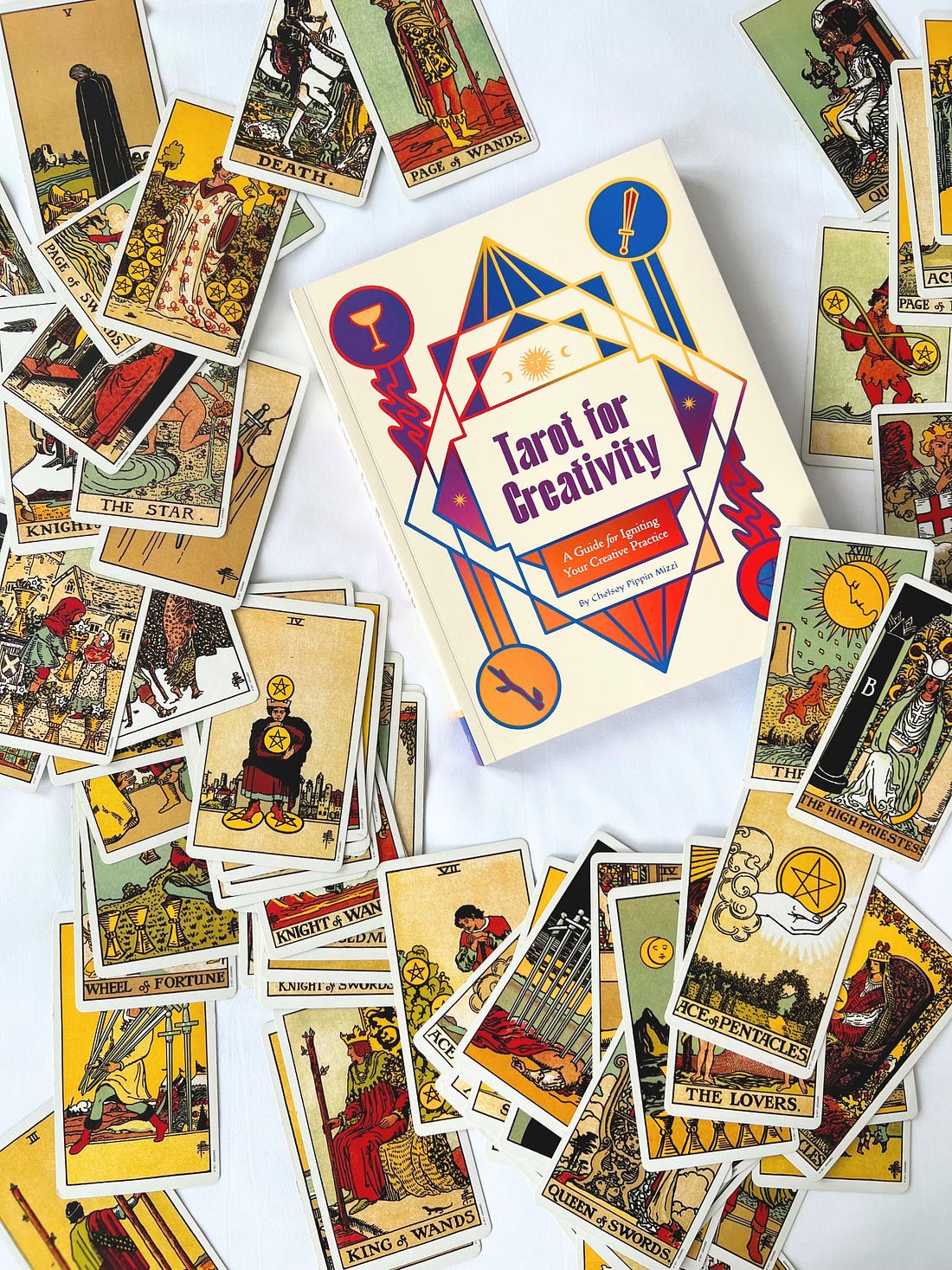
Conventional, creative, and centering uses of the cards to help you get inspired and come home to yourself.
Tarot imagery has inspired artists for centuries and continues to do so today. The iconography, the storytelling element, and, of course, the mystery of the unknown have a huge pull for any creative.
I personally came to this field later in life, or you could say that it found me.
As a kid, I wasn’t allowed to dabble in such tools. Growing up in the church, these kinds of practices were considered ungodly, and I ended up with a complicated relationship to magic, metaphysical, and occult items, even in a strictly artistic sense. On one hand,, they fascinated me and drew me in; on the other, they felt wrong and uncomfortable due to past programming. As I explored the cards more, they showed me a few interesting paths that surprised me, inspired me, and helped me see them in a whole new way.
I ordered a deck during COVID, when many of us were naturally drawn to healing tools and modalities. To be honest, the cards felt intimidating and even scary, especially when confronting some of the more intense ones like the Tower, Death, the Devil, and others. I set it aside, unsure of how to engage.
A few years later an amazing author and fellow Substacker, Chelsey 🔮 Tarot for Creativity, found me through our commn publisher Chronicle Books. I recorded an episode about her book Tarot for Creativity, and her framework for journaling and self-reflection rather than divination took me in a new direction that was gentle, curious, and non-condemning. I still use her brilliant book today, and it opened doors to even more resources and creatives that inspire me.
My friend Sarah Potter Sarah Potter , a celebrity tarot reader, changed my life. Her book Sober Magic uses the tarot journey combined with the 12 steps to help individuals (myself included) move away from drinking and into more presence, self-awareness, and healing. Thanks to Sarah and her tarot guidance, it has been 10 months since I had my last drink.
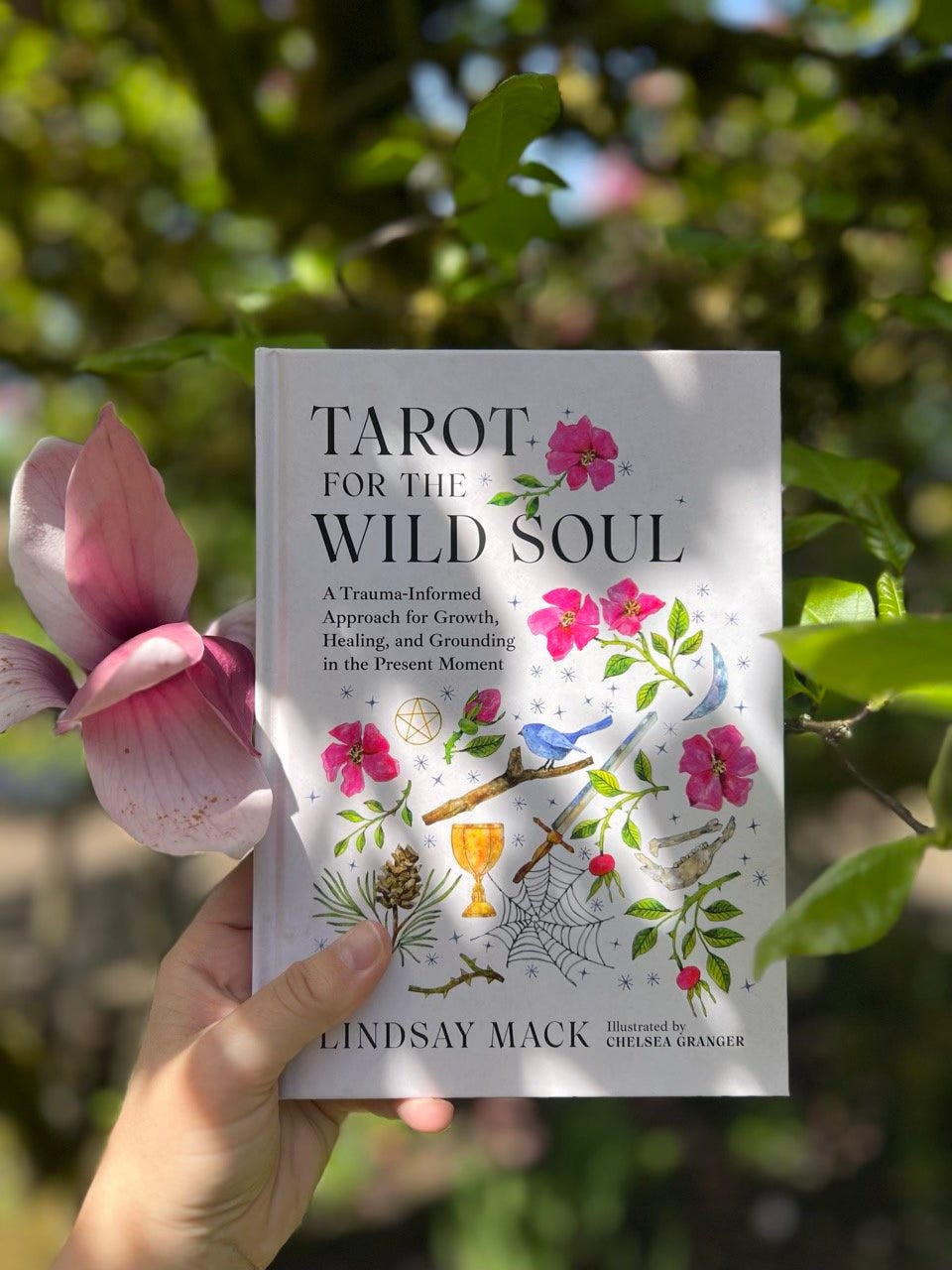
In terms of navigating the scary cards, I have to shout out Tarot for the Wild Soul Lindsay Mack. The “bad cards” no longer intimidate me, and I found compassion, curiosity, and a deeper, less obvious meaning when interacting with certain images and messages. There are no doubt millions of amazing creators, experts, and readers who can guide you on how to use this tool, but I appreciate pracitioners who bring a gentle, trauma-informed angle.
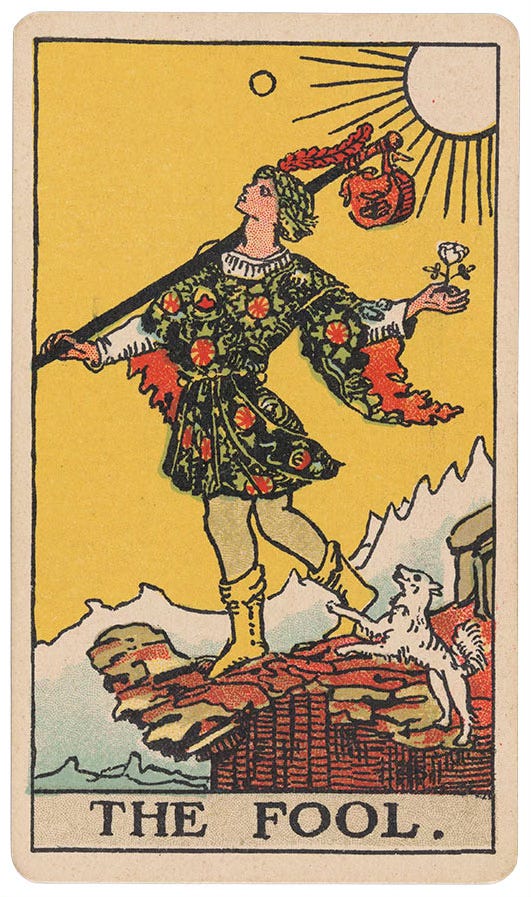
Pamela Colman Smith (1878–1951) and Arthur Edward Waite (1857–1942). The Fool, from the Rider-Waite-Smith Tarot (Deck “C”). London: William Rider & Son, ca. 1921–31 (first published in 1909). Chromolithograph. New York, The Morgan Library & Museum, PML 199373.
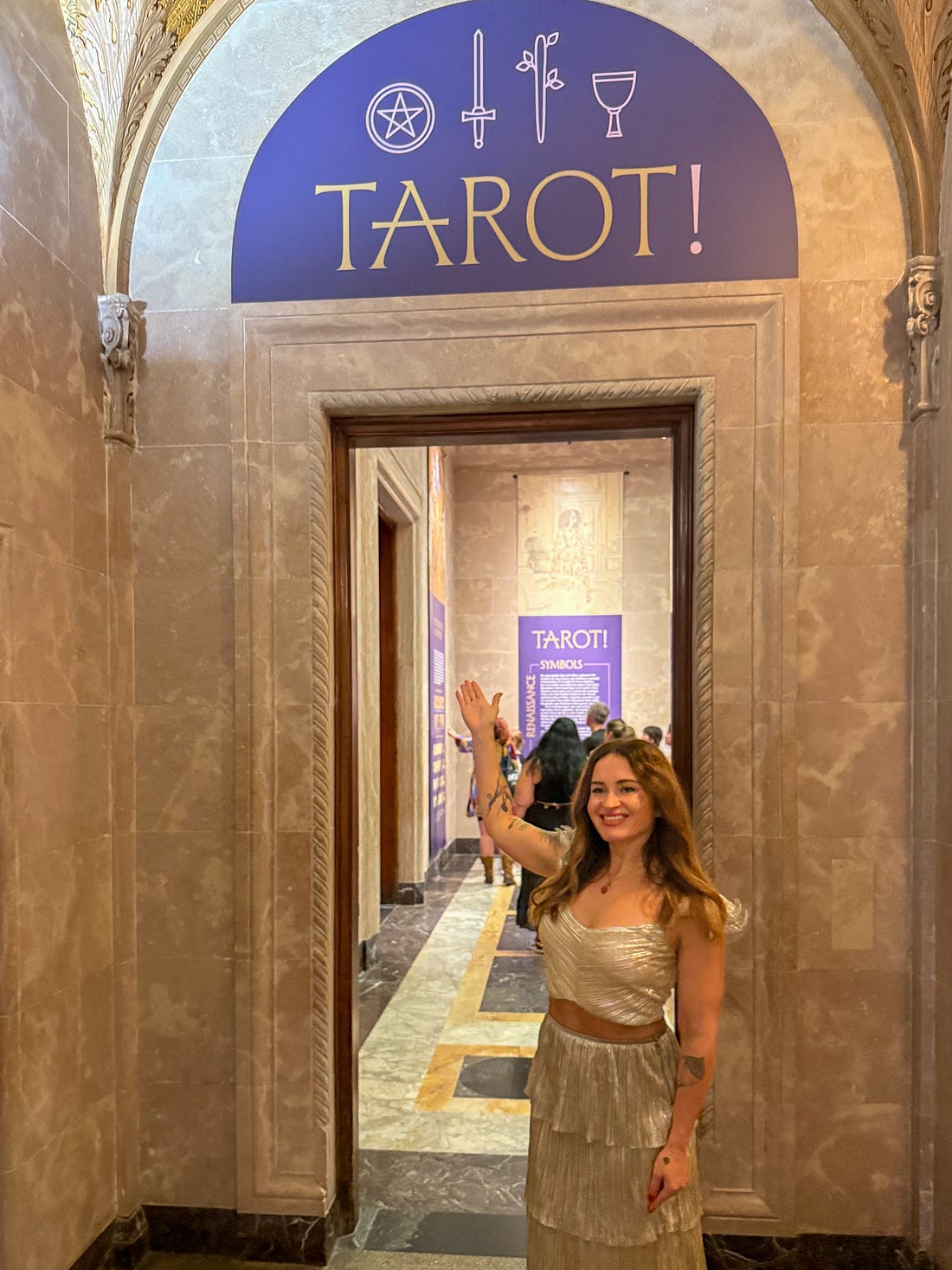
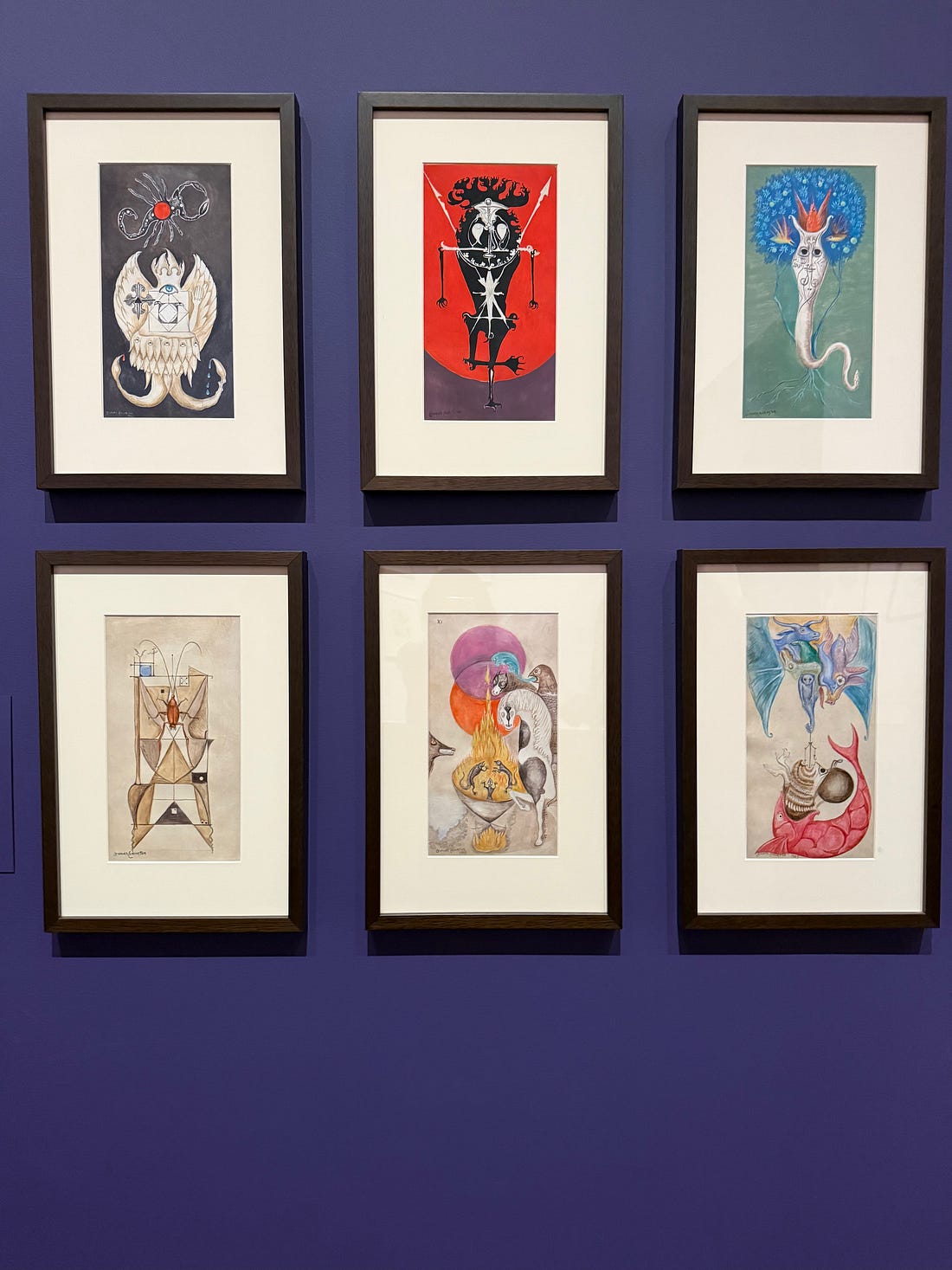
The show consists of two parts. The first explores the origins of tarot in Renaissance Italy, and the second its contemporary interpretations by artists of the twentieth and twenty-first centuries. Among these creators are familiar names like Pamela Colman Smith (1878 to 1951), Leonora Carrington, and Chris Ofili.
According to the museum, “Created as a courtly game of skill, tarot was not associated with occult secrets, divination, or the power of fate until centuries later. By the twentieth century, the cards came to serve as a source of inspiration for artists, offering an alternative to the strictures of modernist aesthetics and allowing them to explore other universes and imaginative possibilities.”
As I got more interested in the world of Tarot, I started to notice the influence of the cards on artists. At a surrealism exhibition at the Philadelphia Museum of Art, the gift shop featured a deck by Dalí. And it wasn’t until I visited a Leonora Carrington exhibition at L Space in NYC earlier this year that I realized the artist herself had made a stunning deck.
Remedios Varo, Leonora’s best friend, is featured at the Morgan Library as well.
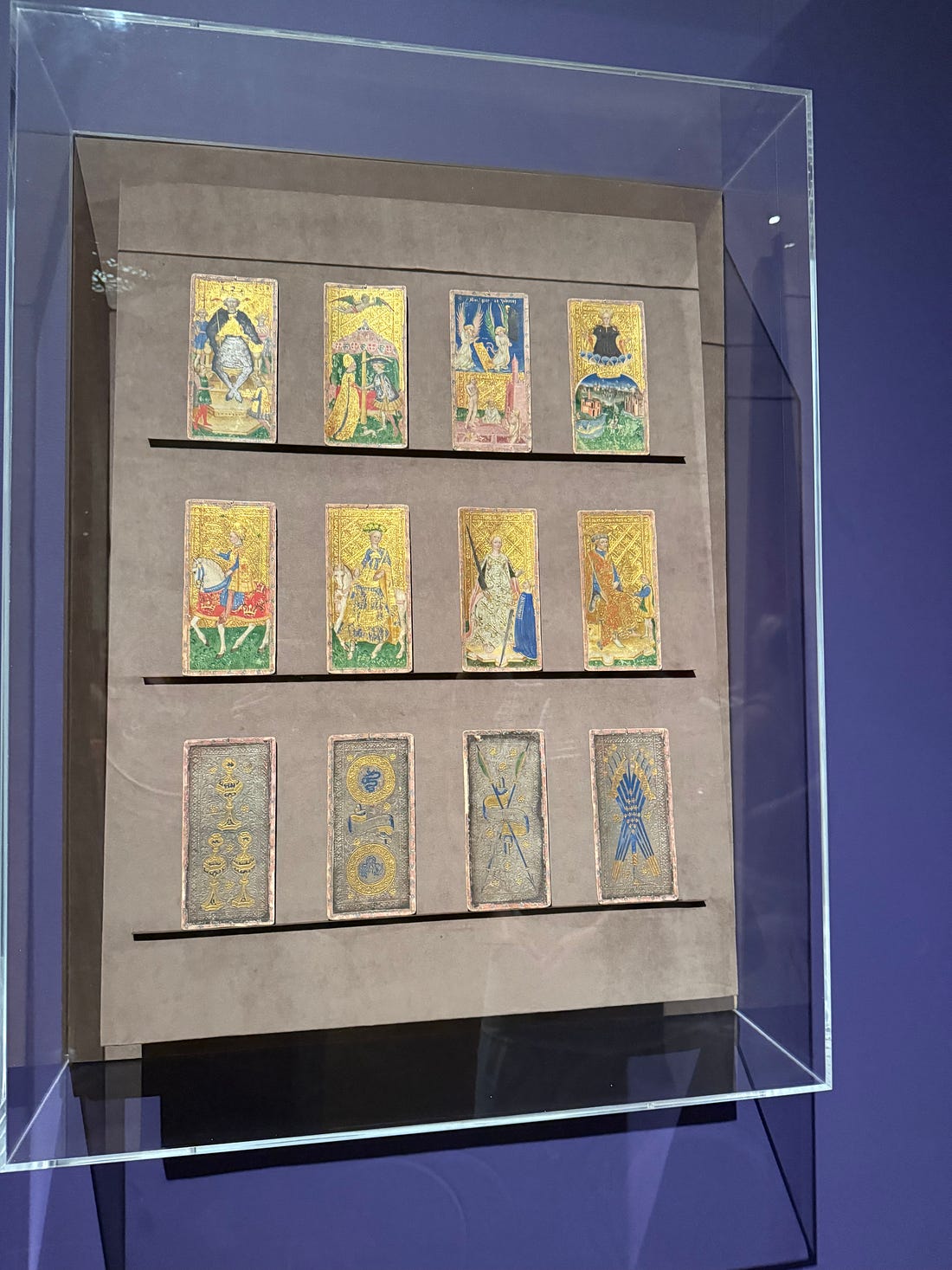
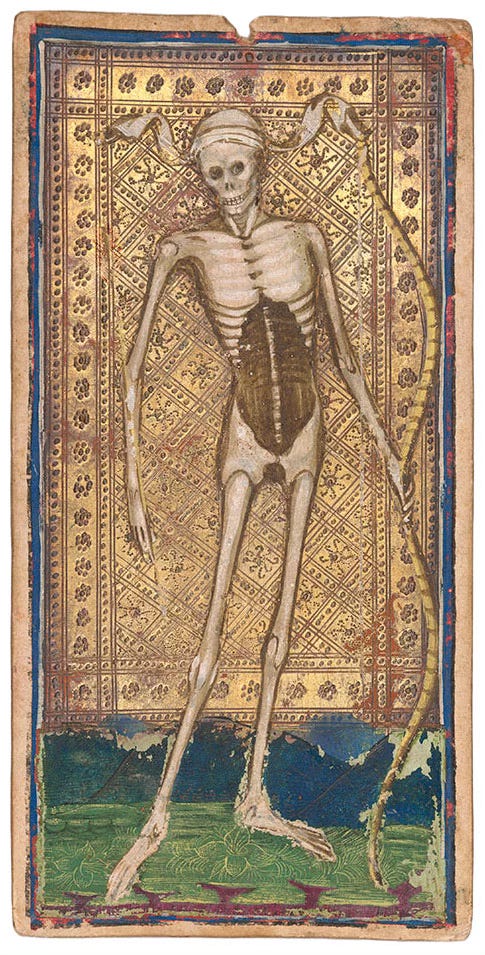
The inspiration for this exhibition was the Morgan’s Visconti-Sforza Tarot cards, the most famous deck to survive from the Renaissance.
Below, I am sharing a few of my favorites from the show.
I am curious. Do you use Tarot in your creative practice? If so, how?
Bonifacio Bembo, Death from the ViscontiSforza Tarot Cards. Italy, Milan or Cremona, ca. 1456-58. The Morgan Library & Museum
We are repositioning ourselves as a country open to investment. But we do so alongside headwinds. Trade uncertainty with our largest trading partner brings a changing geopolitical and economic reality that is forcing the country to rethink what and how we produce and trade, and now an internal conflict is testing the strength of our diverse federation of governments and its division of powers.
It is within this context that Albertans go to the polls on October 19, faced with 10 referendum questions. Five of these focus on immigration and citizenship; four on the Canadian constitution and provincial rights and jurisdiction; and the final question asks whether Alberta should remain a province of Canada, or commence the legal process required under the Constitution to hold a binding provincial referendum to separate from Canada.
This final question is not itself binding. (Premier Danielle Smith has said that a final question could be posed to Albertans in early 2027 if the October 19 results give her the mandate.)
No matter these details, at its heart is the question: Is Alberta better off in or outside of Canada?
The treatment of Alberta within Canada has been a matter of intense debate within the province for decades, even centuries.
The Northwest Territories was the loose historical term traders applied to land north and west of Lake Superior, and even when its boundaries were codified in in the North-West Territories Act of 1875, it had no representation in the House of Commons or the Senate. Only in 1897 was ‘responsible government’ created.
Calls for provincehood grew louder as the population expanded and its government advocated for more financial autonomy. Ultimately, negotiations split Alberta and Saskatchewan and they entered the confederation as separate provinces in 1905. Meanwhile, the Autonomy Bills of 1905 maintained federal management of Crown lands and natural resources so Ottawa could retain control of immigration, trade, and western settlement. Only in 1930 was management of natural resources transferred to each province.
More recent examples of Alberta demanding more autonomy include the 2001 Alberta Agenda, a letter to then-Premier Ralph Klein from a number of prominent Albertans including former Prime Minister Stephen Harper, outlining several proposals to create greater autonomy within Canada. Many of these proposals mirror the autonomy Quebec enjoys within Confederation.
Albertans Are Frustrated
The current situation is in some ways a continuation of this debate, focused on how Albertans can better realize their economic potential. A number of policies over the past 50 years have frustrated Albertans, such as the National Energy Program, various changes to Canada’s regulatory approval regime, the BC oil tanker moratorium, and the oil and gas emissions cap regulation.
The Advantages Of Alberta Being A Part Of Canada
Despite these challenges, it is important to remember the enormous benefits Alberta derives (or has derived) from being a province of Canada. Examples include, but are not limited to, global trade deals, military protection, disaster relief, a stable financial system, contribution to early research on oil sands separation processes and viable uses for the resource, direct financing of a portion of Syncrude’s Mildred Lake operation – a world class facility at the time, and the migration of people to Alberta from across Canada to help build its different industries.
In the lead up to October 19, the C.D. Howe Institute and its contributors seek to share a variety of evidence-based perspectives on the potential consequences of an Alberta departure from Confederation; to bring to light the incredible complexities of the act of separation. Ultimately, this work comes to two conclusions: 1) The downsides to separation outweigh any perceived upsides. And 2) There are opportunities to strengthen the federation and Alberta’s place in it.
This series of Intelligence Memos was published throughout last week and in the leadup to a special C.D. Howe Institute event that was held on September 22 in Calgary and focused on the Alberta referendum, included Memos exploring some of the most critical policy questions of separation. Examples: monetary policy challenges, considerations for Alberta’s international competitiveness and other economic implications of separation, labour market considerations, and fiscal redistribution complexities.
Our Hope?
Our hope is that readers will gain insights into the pertinent policy issues, as well as an appreciation for the complexity of the separation process, and the consequences on Albertans, businesses, and the rest of Canada.
For the Silo, Jeremy M. Kronick- President and CEO of the C.D. Howe Institute, and Kate Koplovich – Calgary-based senior policy analyst.
At first glance, Suiseki may seem deceptively simple: a single stone, uncarved and unpolished, presented for contemplation. Yet within Japan’s centuries‑old tradition of stone appreciation lies a surprisingly rich aesthetic philosophy—one that blends nature, imagination, and quiet reflection. Suiseki invites viewers to slow down, observe deeply, and discover entire landscapes within the smallest of objects.
What Is Suiseki?
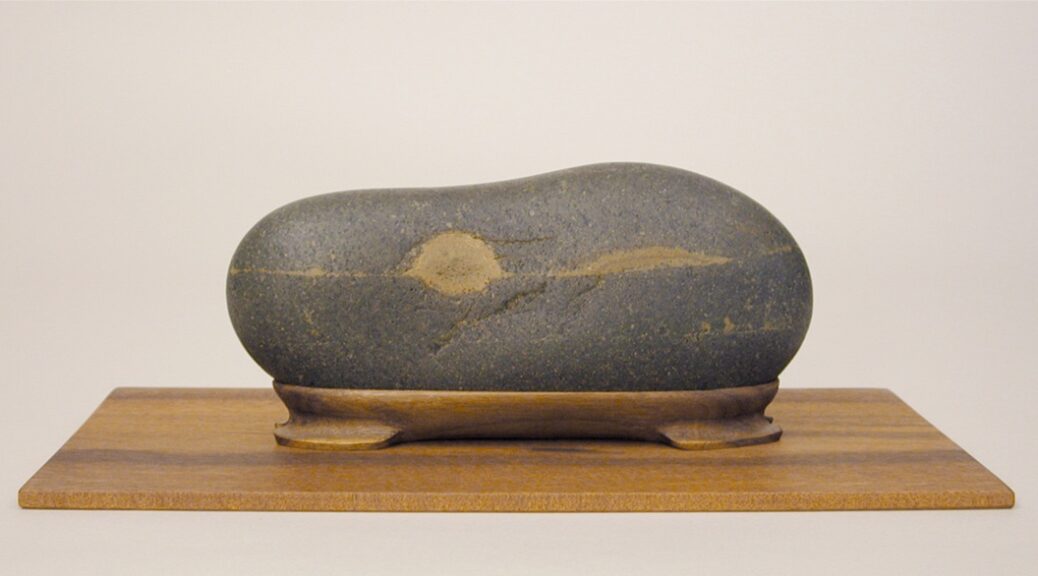
Suiseki (水石), literally “water stone,” refers to naturally formed stones admired for their beauty, shape, and ability to evoke scenes from nature. Unlike sculpture or carving, Suiseki is defined by non‑intervention. The stone must remain in its natural state—no cutting, sanding, or reshaping. Only minimal cleaning is allowed.
A Suiseki stone is typically displayed in one of two ways:
Daiza (台座): a hand‑carved wooden base made specifically for the stone
Suiban (水盤): a shallow tray filled with sand or water
These presentation methods elevate the stone, helping viewers perceive it as a miniature world.
A Brief History
Suiseki’s roots trace back to China’s scholar stones (Gongshi), which were collected by poets and intellectuals during the Tang dynasty. Japan adopted and refined the practice during the Kamakura period (1185–1333), when Zen Buddhism was flourishing. Samurai and monks embraced Suiseki as a meditative art form—one that encouraged stillness, introspection, and harmony with nature.
Over time, Suiseki became closely associated with bonsai culture. Many bonsai exhibitions include Suiseki displays, and the two arts share similar values: reverence for natural form, subtle beauty, and the passage of time.
What Makes a Stone a Suiseki?
Not every stone qualifies. A true Suiseki must possess several key qualities:
Suggestiveness: The stone should evoke something recognizable—mountains, islands, waterfalls, animals, or abstract emotional impressions.
Age and Patina: Weathering, mineral deposits, and surface texture contribute to the stone’s character.
Balance and Form: The stone should sit naturally and harmoniously in its daiza or suiban.
Color: Traditional Suiseki favors subdued, earthy tones—black, brown, grey, and muted greens.
The most prized stones come from riverbeds, mountainsides, and coastal areas where centuries of erosion have shaped them.
Types of Suiseki
Collectors often categorize stones by what they evoke:
Landscape Stones (Kei-seki): mountains, cliffs, plateaus, or distant horizons
Waterfall Stones (Taki-ishi): stones with vertical striations resembling falling water
Shoreline Stones (Iso-seki): stones that suggest beaches or rocky coasts
Object Stones (Sugata-ishi): stones that resemble animals, figures, or symbolic shapes
Pattern Stones (Mon-seki): stones with striking natural patterns or mineral lines
Each category reflects a different way of seeing the world within the stone.
Why Suiseki Matters Today
In an era of constant digital stimulation, Suiseki offers a counterbalance. It’s an art form rooted in patience, quiet observation, and the appreciation of natural imperfection. A single stone can become a focal point for meditation, a conversation piece, or a reminder of the landscapes that shaped it.
Collectors often describe Suiseki as a lifelong practice. Stones are not merely objects—they’re companions that reveal new details over time. Their meaning evolves with the viewer’s own experiences.
How to Begin Your Own Suiseki Journey
You don’t need specialized tools or training to start. Many enthusiasts begin by exploring local rivers, beaches, or hiking trails. The key is to look for stones that feel evocative—those that spark imagination.
Once you find a stone:
Clean it gently with water and a soft brush.
Study its natural orientation—the way it “wants” to sit.
Consider a daiza or suiban if you want a formal display.
Place it somewhere you’ll see it often and let the relationship develop.
Suiseki is less about collecting and more about noticing.
These galleries show the range of forms Suiseki can take—from towering mountain stones to delicate shoreline pieces.
The Quiet Power of Stones
Suiseki reminds us that beauty doesn’t need to be loud or elaborate. A stone shaped by wind, water, and time can hold more poetry than any human-made sculpture. It invites us to slow down, breathe, and rediscover the landscapes hidden in everyday materials.
In a world that often celebrates speed and novelty, Suiseki offers something different: a return to stillness, simplicity, and the quiet imagination of nature.
Stay up to speed with stories from our friends at Hagerty– written by drivers, for drivers.
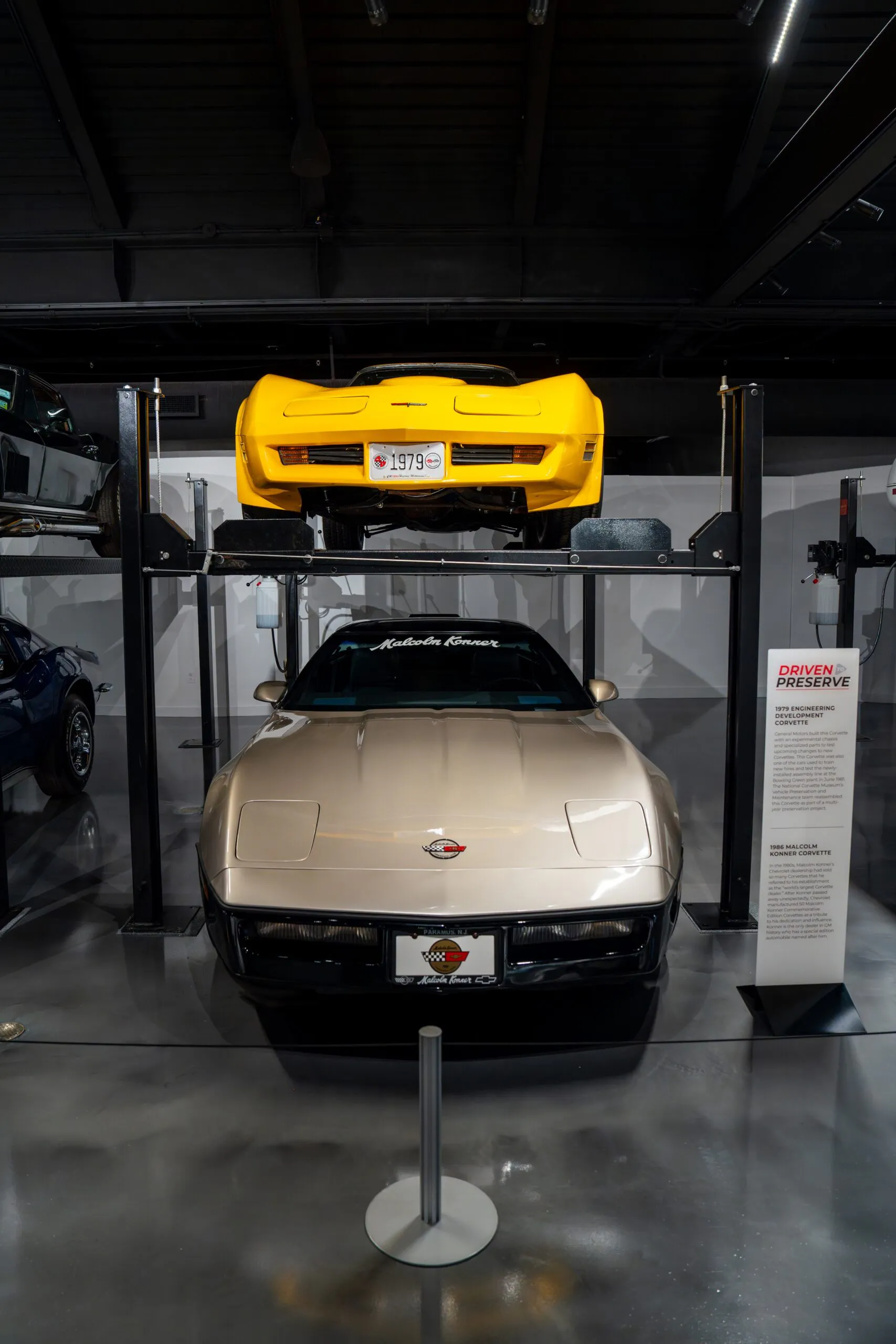
Glance at the photos from the National Corvette Museum’s current exhibit, called “Driven to Preserve,” and likely you won’t even notice the inconsequential yellow 1979 Corvette C3, presently perched on a lift above a Chevy C4, painted “Silver Beige,” that is one of the “Malcolm Konner Commemorative Edition Corvettes.” The model was a formal tribute to the man billed as “the world’s largest Corvette dealer,” whose store was in Paramus, New Jersey. Konner died from a heart attack in 1983, and Chevrolet built 50 special-edition Corvettes in his honor.
National Corvette Museum
As pedigrees go, the Konner Commemorative may be among the lesser known, but at least it has a pedigree, something that yellow ’79 Corvette does not. It spent its life as a feral lab rat, poked and prodded and then left for dead. It has a tale to tell, though, and a pretty good one, confirming that it belongs in this Driven to Preserve exhibit, located at the National Corvette Museum next to the Corvette plant in Bowling Green, Kentucky. The exhibit runs through January of 2027.
The yellow ’79’s story is recalled here by 76-year-old Ralph Montileone, who, at 18 and on summer break from classes at the University of Missouri took a temporary job at the legendarily large General Motors assembly plant in St. Louis. In its three million square feet, as many as 35,000 employees built everything from GMC pickups to Buick Roadmasters.
And, beginning with the 1954 model year, they built the Corvette. Be aware that the story Montileone tells does not turn out the way it should. But there’s some appropriate automotive redemption at the end.
Retired quality manager Ralph Montileone (R) and Johnny Griffin on the day of the unveiling of the restored yellow ’79 Corvette at NCM.Courtesy Ralph Montileone
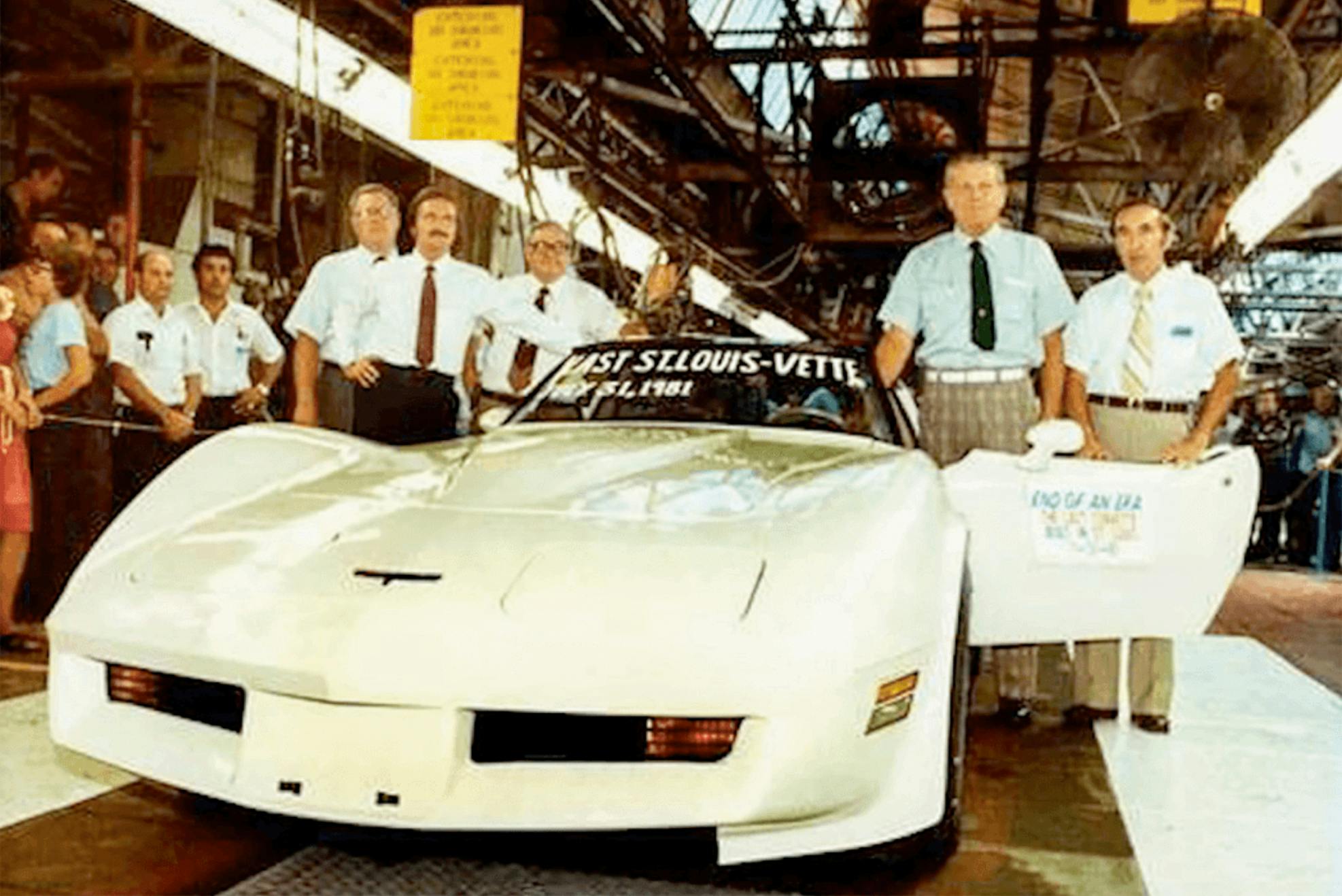
Montileone was initially pleased when he was assigned to Corvette assembly, where he was instructed to drive new Corvettes off the assembly line, perform several tests on them, then drop the cars at the next station. It seemed like a plum gig for a rookie, but the Corvette plant was ancient and cramped, originally used to make wooden parts for GM products—doors, floors, wheels, you name it. The building became a warehouse after that mission was complete, overhauled decades later to welcome the 1954 ‘Vette. The 1953 Corvette had been built in a makeshift factory in Flint, Michigan, which was dismantled after producing that first-year model of the car.
Montileone said the building was chilly in the winter, scorching in the summer: “It would get to be a hundred degrees in there.” Even cranking the partly-glass roof open was little help. There was a lot of fiberglass dust in there, and any breeze would blow it into the air.
Summer ended but Montileone stayed on, figuring he could return to school later if he wanted. He didn’t. He stuck with Chevrolet and Corvette for 52 years.
GM
Despite its history, General Motors eventually decided to close the St. Louis plant, which had sprouted from a Chevrolet factory built there in 1919. It would be gradual, taking six or seven years, until the last car rolled off the line in 1986. Corvette would leave St. Louis much sooner than that.
Corvette’s immediate future was complicated and had multiple moving parts.
Chevrolet wanted an entirely separate factory for Corvette, not something that piggybacked on other brands. And GM wanted to put some distance between the Corvette and St. Louis. Chevy was “trying to bring back the reputation of Corvette,” said Montileone. “In St. Louis, it was known that the quality of the car leaving the plant was not the best.”
GM
Also, the St. Louis GM workforce was mercurial, given to periodic strikes and perennial labor issues. The plan, Montileone said, was to “get away from the stereotypes that had been out there for decades about big car plants, be they Ford, Chrysler, GM,” and inevitable issues with the United Auto Workers union. “We were told to go in and build this state-of-the-art facility, because there were people, visionary guys up in Detroit, who could see a future for the Corvette.”
The strategy included dumping the St. Louis employees, then hiring locally for the workers they’d need for a clean-sheet Corvette plant. “There was no agreement then that the people who built Corvettes in Missouri would be able to transfer to Kentucky,” Montileone said. “We actually believed that we were going to have to hire the entire workforce. We’d need 400 to 600 people,” and they all needed to be trained on, well, everything.
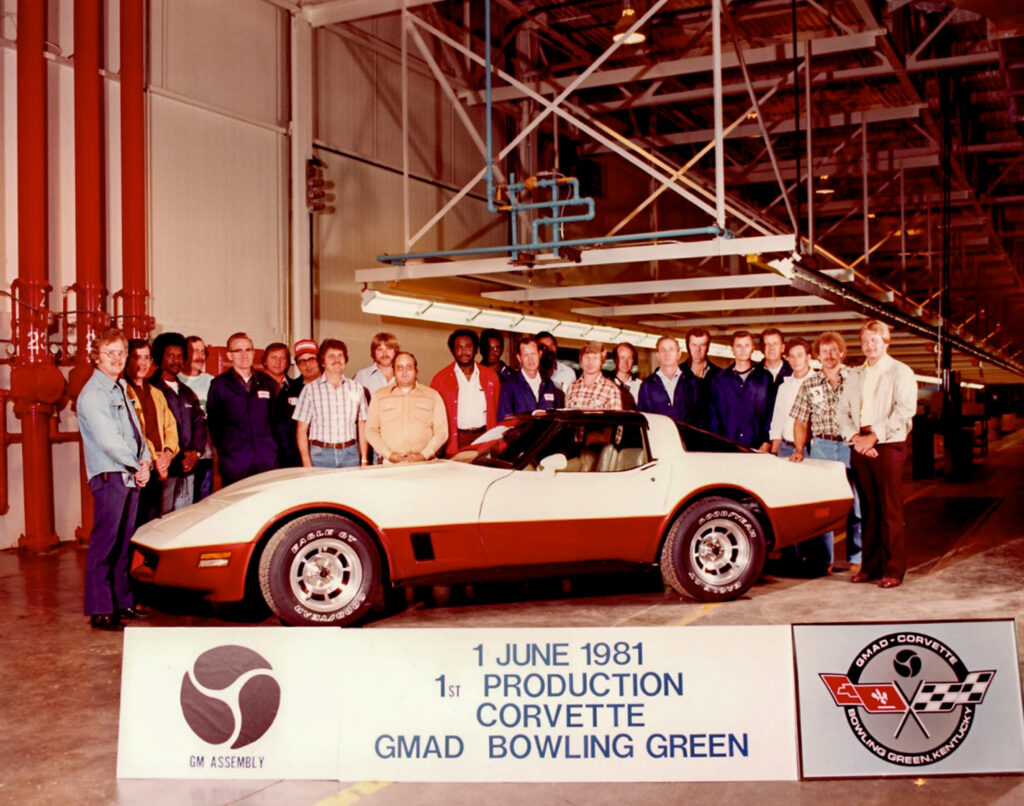
So Montileone was among the first to pack up and move 350 miles away to Bowling Green, Kentucky, which had been chosen over several other locations, including Mississippi, Kansas City, and Waco, Texas. “I was one of a very small group of people who actually got the keys to the building.”
That building, a former Chrysler Airtemp air conditioning plant, was the difference between Bowling Green and the other locations. Bowling Green, Montileone recalled, was a “brownfield” site, meaning it had a building that was zoned and ready to go. The other possible locations were “greenfield” sites, meaning GM would have to build a factory from the ground up.
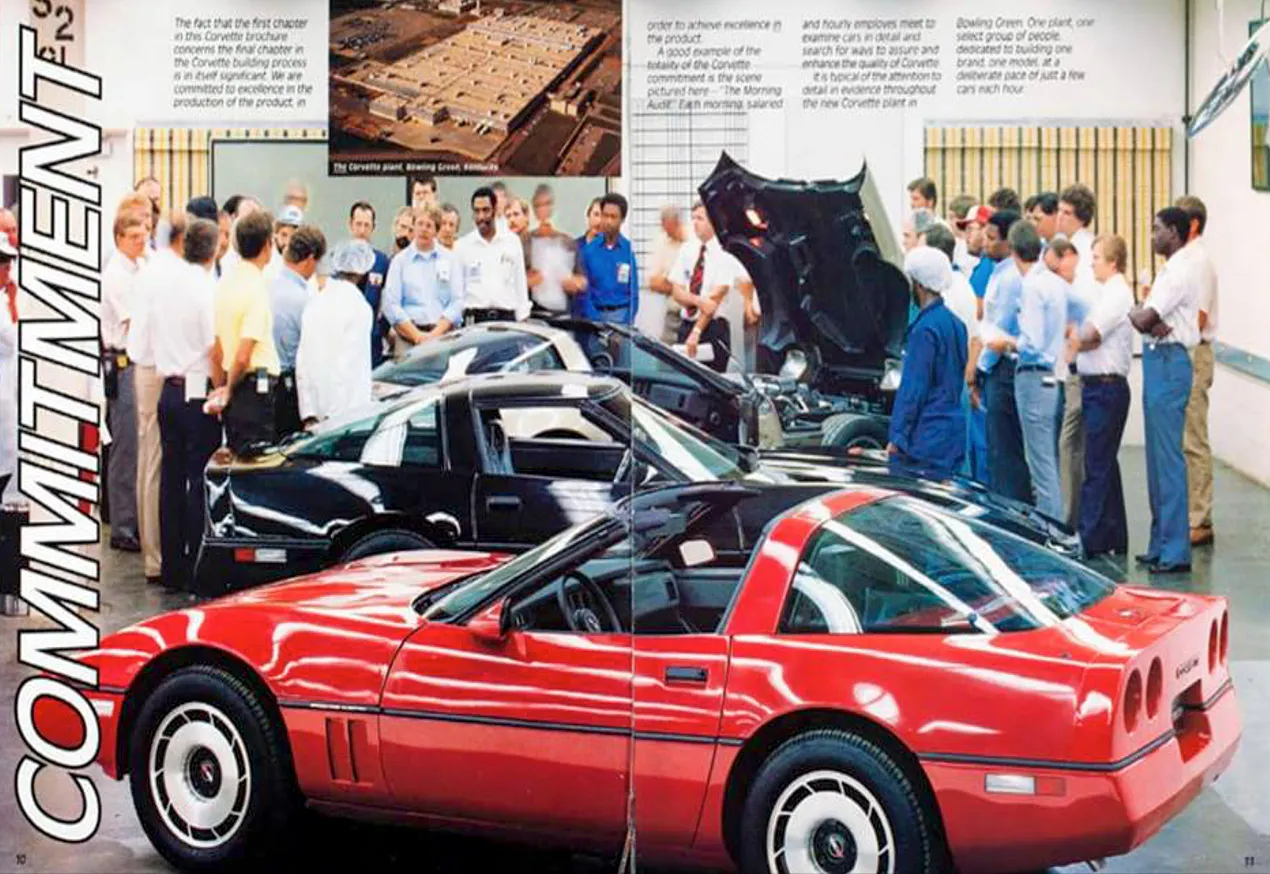
So the air conditioning factory, which was only seven years old when it closed, changed over to build Corvettes, starting with the 1981 model. Montileone’s job as head of quality control was to recruit talent and train them on what everything does and where everything goes.
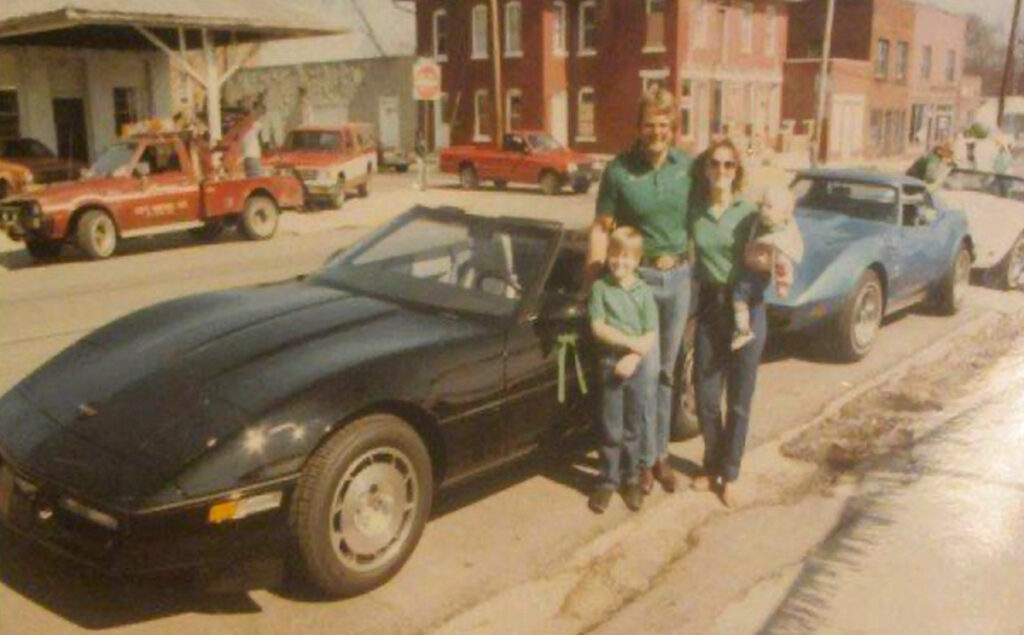
The Montileone family in Bowling Green, circa 1985. By then, Montileone’s company car was this black convertible, the first C4 Convertible produced and not yet available to the public. GM allowed him to drive it in a St. Patrick’s Day parade. His wife, Phyllis, drove her 1973 blue coupe.Courtesy Ralph Montileone
They scrounged frames and engines and seats and wheels, and had them delivered to a closed-down Chevrolet dealership in Bowling Green that was repurposed to handle training. But there was a problem: Montileone needed a complete working, driving Corvette to demonstrate how all those parts worked in concert.
Finding a proper Corvette that moved under its own power doesn’t sound like much of a problem, but apparently it was. There was no budget for ordering a new Corvette or buying one off the lot. He was told to find one within the company. “It was a popular belief at General Motors that somebody would have had some Corvettes just sitting around,” Montileone said, but nobody did.
National Corvette Museum
Finally, he heard about this yellow 1979 model, located up at the Milford Proving Grounds in Michigan. He called, and the person he talked to told him the car was “kind of a hybrid. It’s actually a ’79, but we started doing some development for 1980 on it, so there are some parts on that car that are a little bit different.” Montileone was told he could have it if he wanted it, “and I said, well, beggars can’t be choosers.”
The Bowling Green plant and the St. Louis Corvette plant would both be building 1981 models—it was a tossup as to whether a customer would be better off buying a brand-new factory’s first product, or the last car from a doomed factory, built by workers who were likely to lose their jobs.
National Corvette Museum
The yellow ’79 was retrofitted with all the proper parts. It was the only fully functioning Corvette that Montileone had. “I trained hundreds of people on that car,” he said. “We had to hire at a high level, people who were somewhat self-directed but who could still follow the rules and guidelines on how to assemble a car.” Bowling Green did not have a manufacturing economy, so few applicants—aside from farmers, who maybe knew how to work on tractors—brought the requisite experience. After all, the leading industry in town was the Union Underwear Company, a Bowling Green staple since 1941.
But Montileone and the others in charge of hiring and training got the job done. Bowling Green was ready.
And then came the news we warned you about.
“There is a sad part to this story,” Montileone said. “All the people we trained during that year and a half—we didn’t hire a single one of them. Between 400 and 600 people, and we didn’t hire a single one.
Montileone, hands crossed, front and center in the light blue shirt. At this stage of product development for the C4, he had to explain that the vehicle met all government and corporate quality benchmarks and was ready to sell to the public.Courtesy Ralph Montileone
“There were negotiations going on up in Detroit,” Montileone said, and it involved a backlash to the GM plan to lay off everybody in St. Louis. “But back then, that was the practice. It could have been at any of the 40-odd plants GM had across the country: You did not get to transfer with your job like you can today.” The thought, he said, was that “We’ve got to hire new people who don’t have bad habits.” Still, the UAW and GM came to an agreement that the Corvette plant would be staffed by St. Louis workers. Period.
“It was very emotional for both places—St. Louis was losing this big giant plant that had been there since the ‘20s, and Bowling Green was going to hire all these people we’d trained and pay them a good salary,” Montileone said.
Montileone (far right) with his entire quality team of reports, circa 1981, inside the Bowling Green facility. The yellow ’79 was outside at the time this was taken.Courtesy Ralph Montileone
And as for the yellow ’79?
Abandoned again, parked out back, unwanted. Eventually it was donated to a local vocational school’s automotive program, but before long even they didn’t want it any longer. GM told them to disassemble it, take the body off the frame, the engine out of the car, because that Corvette could never be titled and driven on the street for liability reasons, so it could only be sold for parts. “GM couldn’t guarantee the quality of the car, so it had to be taken apart,” Montileone said.
Those parts were sold at auction, and that was that for the yellow ’79.
National Corvette Museum
Or was it? A local Bowling Green man named Johnny Griffin, who loved Corvettes—“He probably knew as much about them as any of us,” Montileone said—trained to work at the Corvette plant, his dream job, but was never hired. His affection for Corvettes never wavered, though, and he remembered the yellow ’79, and for years, kept asking Montileone what happened to it.
When Griffin learned it was being auctioned off, part by part, he bought it and stored it all away. He tried to convince the Corvette Museum that it should be saved, that it was a legitimate part of the Bowling Green plant’s history, and they finally listened. The yellow ’79 ended up with the museum’s restoration team, which reassembled and restored it. And now, it lives in a pretty high-rent neighborhood.
National Corvette Museum
Appropriately so, said Ryan Eichler, director of the museum’s marketing and communications.
“People come to the Corvette Museum, and they see the cars on display and the artifacts we’ve saved, but they’re left wondering about the process we use to preserve and maintain it all. That’s what this exhibition is about. Because even in the case of that yellow ’79, the car came to the museum in parts, and our preservation team put it all together, which allowed us to put it on display.”
National Corvette Museum
Good, said Montileone. He moved away to Tennessee, but he’s a frequent visitor to the museum and a major supporter of the heritage it represents. “Corvette is better than ever. Just like we hoped it would be.”
Our friends at The John B. Aird Gallery are thrilled to announce Cinder McLeod‘s solo exhibition, “Draws the Line”, at the Arts & Letters Club.
McLeod’s images bring the contradictions of everyday life into sharp focus: love meets obstacles of its adult world.own making, domestic work becomes a question of economic power, and children reveal the strange logic of the work and its creation. Presented alongside McLeod’s solo exhibition at The Arts & Letters Club of Toronto, Draws the Line brings together works from different periods of her practice, including early performance and newspaper cartoons that provide context for images she has revisited in recent paintings.
The exhibition presents an analysis of McLeod’s work alongside images attributed to Banksy, drawing attention to visual similarities, questions of authorship, and the unequal recognition artists can receive. Through these comparisons, the show also examines the broader systems of power that shape the art world, including patriarchy, sexism, plagiarism, and the barriers women artists can face in having their work acknowledged and credited.
An accompanying catalogue expands on these themes and documents selected works and comparisons from the exhibition. Together, the exhibition and catalogue invite viewers to consider not only where images come from, but also who is recognized, believed, and remembered within cultural institutions.
This Aston Martin Virage Volante (available via our friends at ClassicDriver) is one of only 24 cars with both a works-engine upgrade from 5.3 to 6.3 liter and a wide body kit to handle the massive power increase to 465 PS. Furthermore, research suggests that it is also the only LHD-Virage 6.3 Wide Body equipped with a manual transmission.
When the Aston Martin Virage and its open-top Volante counterpart debuted at the close of the 1980s, they signaled a significant leap in performance over the outgoing V8 models. The secret ingredient was Tadek Marek’s robust 5.3-liter V8, which thanks to Callaway-designed cylinder heads and Weber-Marelli fuel injection pumped out 335 PS.
For customers who still demanded more, Aston Martin’s Works Service division offered an extraordinary factory-developed upgrade program.
On top of that was an enlarged 6.3-liter-V8, derived from the Group C racing car, that delivered 465 PS. To handle this monstrous power increase, Aston fitted the car with wider bodywork, a revised suspension, larger 18-inch wheels and ventilated AP Racing disc brakes.
Truly A One Off Car
This Virage Volante was originally built as a left-hand drive for its then German owner. It got its 6.3-liter-conversion in 1997, accompanied by the wide body installation and a re-spray in Porsche Midnight Blue. A package that elevates this only left-hand drive Virage with a manual transmission from an already exclusive Aston Martin to a truly one-off.
Christopher Alesich, founder and CEO of Sister Wives:
“Dating apps became very good at giving people access to more people, but access and compatibility are not the same thing. When someone is looking for a serious relationship, especially one with very specific values or relationship goals, thousands of profiles can create more work without necessarily creating better matches.”
“There is a big difference between finding someone who looks interesting on a screen and finding someone who actually fits the life you want to build. Matchmaking starts with understanding that difference.”
“AI can help identify patterns and narrow the search, but relationships are complicated. People sometimes say they want one thing and then respond very differently when they actually meet someone. That is where human judgment and real conversations still matter.”
“The future of dating probably is not about showing someone the largest number of people. It is about understanding what they actually want and helping them find the smaller number of people who genuinely fit that life.”
For more than a decade, online dating has been built around one central idea: give people more choices.
More profiles. More matches. More people to swipe through.
But in 2026, parts of the dating industry are beginning to move in the opposite direction.
New dating companies are experimenting with fewer introductions, deeper onboarding, and technology designed to understand users before suggesting a match. Established platforms are also rethinking long-standing features and looking for new ways to move people beyond traditional swipe-based dating.
The result looks increasingly familiar.
Dating apps are starting to look more like matchmakers.
From Endless Swiping to Curated Introductions
One of the clearest examples is Overtone, the new company founded by Hinge creator Justin McLeod.
In July 2026, Overtone announced that it had raised $18 million to build what it describes as a modern matchmaking company.
Rather than presenting users with an endless stream of profiles, Overtone says it is developing a voice- and audio-forward matchmaking service enabled by AI and built around highly curated introductions.
McLeod has also made an important distinction about the new venture: he does not consider Overtone a traditional dating app.
Instead of users juggling large numbers of likes, matches, and conversations, the idea is to learn more deeply about each person and make fewer introductions that may have a stronger reason to succeed.
That represents a significant change in philosophy from the dating-app model that has dominated much of the past decade.
The question is no longer simply: How many people can we show you?
Increasingly, it may be: Which people are actually worth introducing you to?
AI Is Learning More Before Making the Match
Known, another dating startup, is approaching the same problem from a different direction.
The company uses voice AI during onboarding, allowing users to talk about themselves rather than simply completing a traditional profile or questionnaire.
The technology can ask follow-up questions based on what the person says, giving the service more information before it recommends potential matches.
Once two people accept an introduction, Known is designed to move them toward an actual date instead of encouraging prolonged messaging.
That approach attempts to address several familiar frustrations with online dating: endless chatting, ghosting, decision fatigue, and matches that never turn into real-world meetings.
It also reflects a broader shift in how AI is being applied to dating.
Instead of using AI simply to write messages or improve profile prompts, some companies are trying to use it earlier in the process to understand who a person is and who may actually be compatible with them.
Major Dating Apps Are Rethinking the Experience Too
The shift is not limited to startups.
Tinder has been expanding in-person events in dozens of cities as part of an effort to give users more ways to meet beyond traditional swiping.
The company has also experimented with virtual speed dating and AI-powered features designed to improve discovery and matching.
Bumble is changing too.
In August 2026, the company announced that it would move away from the strict women-message-first rule that had been one of its defining features since launch, allowing either person in a heterosexual match to initiate contact.
The change comes as established dating companies look for ways to improve engagement and respond to frustration with conventional online dating experiences.
Each company is taking a different approach, but the direction raises the same larger question:
What if singles do not need more options? What if they need better ones?
More Choice Does Not Always Mean Better Compatibility
Christopher Alesich, founder and CEO of Sister Wives, says dating technology has become extremely efficient at helping people discover one another.
That does not necessarily mean it has become equally good at identifying compatible relationships.
“Dating apps became very good at giving people access to more people, but access and compatibility are not the same thing,” Alesich said. “When someone is looking for a serious relationship, especially one with very specific values or relationship goals, thousands of profiles can create more work without necessarily creating better matches.”
Founded in 2008, Sister Wives currently has 55,043 recently active members and serves people interested in polygamy, polyamory, and other forms of plural and nontraditional relationships.
The company also operates a private matchmaking service for clients seeking a more hands-on approach to finding a partner.
Working within niche relationships makes the limits of basic compatibility filters particularly visible.
For someone seeking a plural relationship, compatibility can involve far more than age, distance and physical attraction.
People may need to consider religion, family goals, relationship structure, expectations surrounding children, living arrangements, finances, intimacy, existing partners and long-term plans.
“There is a big difference between finding someone who looks interesting on a screen and finding someone who actually fits the life you want to build,” Alesich said. “Matchmaking starts with understanding that difference.”
Dating May Be Moving Toward Fewer, Better Matches
Traditional matchmaking has always operated on almost the opposite philosophy of swipe-based dating.
Instead of showing someone hundreds or thousands of possibilities and asking them to sort through the options themselves, a matchmaker tries to understand the person first.
The pool then becomes smaller, not larger.
Technology could make parts of that approach easier to deliver at scale.
AI can help identify preferences and patterns that may be difficult to capture in a standard dating profile. Conversational onboarding can uncover nuances that multiple-choice questions may miss. Algorithms can narrow large databases before users ever see another profile.
But Alesich believes technology still has limits.
“AI can help identify patterns and narrow the search, but relationships are complicated,” he said. “People sometimes say they want one thing and then respond very differently when they actually meet someone. That is where human judgment and real conversations still matter.”
The future may therefore be less about choosing between algorithms and matchmakers and more about combining the strengths of both.
Technology can help with discovery and filtering.
Human judgment can help with context, nuance, screening, and understanding the parts of compatibility that are difficult to reduce to data.
Niche Dating May Have Seen This Coming
For mainstream dating apps, more selective matching represents a change in direction.
For niche dating communities, narrowing the pool has always been part of the value.
Someone joining a dating platform specifically because they are interested in a particular relationship structure has already answered one of the largest compatibility questions before the first conversation begins.
That does not guarantee a successful relationship.
It does, however, make the search more intentional.
Sister Wives has operated within that model since 2008, long before swiping became synonymous with online dating.
Alesich believes the broader industry may now be rediscovering part of that principle.
“The future of dating probably is not about showing someone the largest number of people,” he said. “It is about understanding what they actually want and helping them find the smaller number of people who genuinely fit that life.”
After years of measuring online dating through swipes, likes, and matches, the next phase of the industry may be moving toward a much older idea.
Sometimes finding the right person starts by looking at fewer people.
Methodology
This article is based on a review of recent dating-industry announcements, company statements, and published reporting concerning changes in online dating, matchmaking, AI-assisted matching, and efforts to move users toward more intentional introductions and real-world connections.
Examples examined include Overtone’s July 2026 launch announcement and $18 million usd/ $24.81 million cad (at time of posting) funding round, Known’s voice AI-based approach to onboarding and curated introductions, Tinder’s expansion of in-person events and other alternatives to traditional swiping, and Bumble’s August 2026 changes to its messaging model.
These examples are used to examine an emerging industry direction and should not be interpreted to mean that swipe-based dating is disappearing across the entire dating industry.
Sister Wives’ commentary is informed by the company’s experience operating a niche online dating platform since 2008, its current base of 55,043 recently active members, and its experience providing private matchmaking alongside self-directed online dating.
The Sister Wives activity figure is based on a September 1, 2026 database snapshot of 55,043 email-verified U.S. profiles that had been active within the previous 30 days.
Sources
Overtone, July 14, 2026: Overtone announced an $18 million seed round and described itself as a modern matchmaking company developing a voice- and audio-forward service enabled by AI and focused on highly curated introductions.
TechCrunch, July 14, 2026: The founder of Hinge raised $18M to build a new AI dating service, Overtone.
TechCrunch, December 19, 2025: Known for using voice AI to help you go on more in-person dates.
TechCrunch, August 5, 2026: As Gen Z reconsiders dating apps, Tinder’s IRL events expand to dozens more cities.
Reuters, August 11, 2026: Bumble eases women-first messaging rule as dating apps seek engagement boost.
The four winners reflect the many ways international residents are shaping Vilnius today.
● Dutch social entrepreneur Tim van Wijk, who created a disability inclusive restaurant, was recognised for creating real employment opportunities for people with disabilities.
● Francesco di Marco, a Sicilian-born sommelier, was recognised for helping shape Vilnius’ gastronomic scene and connect its food community with Europe.
● SPEAK Lithuania was honoured for bringing locals and international residents together through free language lessons and community events.
● While Alessandro Sposato, who has called Vilnius home for more than 15 years, received the award for sharing Lithuanian life and culture with Italian audiences and building bridges between the two countries.
From Iron Curtain to International City – Lithuanian Capital Celebrates Foreign-Born Residents at Vilnius Is My City Awards
September, 2026 – Vilnius, Lithuania. This weekend, hundreds of people gathered around one table in Vilnius to celebrate foreign residents helping shape the city. The 100-meter table was part of the first-ever Vilnius Is My City Awards, where four peer-nominated individuals and organizations were recognized out of a 12-strong shortlist.
Plenary Insights?
This acknowledgement stands out at a time when international mobility is not universally welcomed. The latest European Parliament research found that nearly three in ten EU citizens have a negative feeling about immigration from other member states.
The evening brought thousands of people to the fifth annual Vilnius Is My City Festival in Bernardinai Garden. Over the course of the celebration, foreign residents and Lithuanians shared food and stories from around the world, with Uzbek plov, German pretzels, Turkish coffee and Italian gelato among the flavors on the table.
“Vilnius has always been shaped by people who chose to make it their home – from the merchants invited here by Grand Duke Gediminas in the 14th century to the international community building their lives here now,” says Indrė Laučienė, Head of Foreign Talent Department at Go Vilnius. “Today, more than one in ten Vilnius residents is foreign-born. For a city that spent much of the 20th century behind the Iron Curtain, when people could not freely travel in or out, this is a remarkable transformation.”
The occasion was organized by International House Vilnius, a free service centre that helps internationals relocate to and settle into life in Vilnius, run by Go Vilnius. Residents and organisations were honoured across business, culture, gastronomy and Vilnius’ international outreach, celebrating the people who help to make the capital more vibrant, connected and globally visible.
“Since moving to Vilnius in 2003, I’ve never felt like an outsider. Vilnius was born as a multicultural city, and that spirit is still alive – we are all Vilnians, even if we come from somewhere else,” says Francesco di Marco, a winner of the Vilnius Flavor award. “What I love is how much life fits into this small capital: forests and rivers are close, and on any evening you can go from black metal to classical or electronic music events with ease. Everything is within reach.”
Employment For Those With Disabilities
The four awards went to people and organisations making their mark on Vilnius in very different ways. Tim van Wijk, founder of disability inclusive social restaurant Pirmas Blynas (First Pancake in English), was recognised for creating real employment opportunities for people with disabilities. SPEAK Lithuania was honoured for bringing locals and international residents together through free language lessons and community events.
Francesco di Marco, a Sicilian-born sommelier, was recognised for helping shape Vilnius’ gastronomic scene and connect its food community with Europe. Alessandro Sposato, who has called Vilnius home for more than 15 years, received the Vilnius Ambassador award for sharing Lithuanian life and culture with Italian audiences and building bridges between the two countries.
Today, 78,000 foreign-born residents from 154 countries are building their careers and families in Vilnius, with the international community growing by 4.4% over the past year. The number of registered UK residents in Vilnius has grown by 11%, while the US community has increased by 6.5% to 1,107.
Moving To Study
“People come to Vilnius for different reasons, but they are rarely just looking for a change of scenery. Our 2025 research shows that 34% move here to study, 28% for work and almost one in five for family, and many see the city as a place where they can build a career and enjoy a good quality of life. Vilnius offers that combination at a cost that remains relatively affordable compared with many Western European capitals – living costs including rent in London, for example, are currently 110% higher than in Vilnius,” said Indrė Laučienė.
Jealousy doesn’t disappear in a committed multi-partner relationship. For our family, the difference is how quickly we address it, how intentionally we reassure one another, and how clearly, we communicate.
Caption: Robyn, Christopher and Amanda Alesich, the polyfidelity family behind Sister Wives. Photo courtesy of Sister Wives.
Jealousy is usually one of the first things people ask us about when they learn that we are a polyfidelity family.
The assumption is often that jealousy must mean someone is unhappy, that the relationship is unfair, or that a family involving more than two partners is eventually going to fall apart.
Our experience has been different.
We are Robyn, Christopher and Amanda Alesich. Christopher and Robyn have been married for 22 years, and Christopher is spiritually married to Amanda. Together, we describe our relationship as polyfidelity: a committed, closed relationship built around loyalty, communication and agreed-upon boundaries.
And yes, jealousy still happens.
What we have learned is that jealousy is not automatically evidence that something is wrong. It is an emotion, just like insecurity, fear, frustration or loneliness.
The more important question is what you do with it.
Jealousy feels more familiar than people think
One of the biggest misconceptions about poly relationships is that people who choose them somehow stop experiencing jealousy.
We have never found that realistic.
Jealousy in our family can come from many of the same places it comes from in monogamous relationships: fear of being replaced, concern about losing closeness, feeling overlooked, comparing yourself with another person, or wondering whether somebody else is receiving attention or reassurance that you need.
The relationship structure changes. Human emotions do not.
“Jealousy in a polyfidelity relationship feels exactly like jealousy in any other relationship,” Robyn Alesich, COO and Lead Matchmaker at Sister Wives says. “The emotional reaction is not magically different because the relationship structure is different. The difference is that in polyfidelity, you usually have to talk about it more directly because ignoring it can affect more than one relationship at once.”
That has been one of the most important lessons for our family.
Caption: Christopher and Robyn Alesich have been married for more than 20 years. Photo courtesy of Sister Wives.
Silence can be more damaging than jealousy
Christopher often says that jealousy itself is rarely the thing that damages a relationship most.
Avoidance is…..
“When people hear that I have two wives, they often immediately ask about jealousy,” Christopher Alesich, CEO and Founder of Sister Wives says. “But jealousy does not destroy relationships by itself. What damages relationships is silence, insecurity, comparison and people pretending they are fine when they are not.”
In a three-person family, unresolved tension rarely stays between only two people.
If one relationship feels disconnected, everyone can eventually feel the effects.
That means we try to address problems early instead of allowing someone to sit with resentment for days or weeks.
Sometimes that means a private conversation between two people. Other times it means all three of us sitting down together.
The goal is not to eliminate every uncomfortable emotion. It is to prevent those emotions from becoming something larger simply because nobody wanted to acknowledge them.
Fair does not always mean identical
Another lesson we have learned is that fairness and sameness are not always the same thing.
People sometimes imagine that every relationship inside a poly family has to receive exactly the same amount of time, affection, attention and interaction at every moment.
Real relationships are more complicated than that.
Each relationship has its own rhythm, and different people may need different forms of reassurance at different times.
“People often assume fairness means everything has to be exactly the same at all times,” Robyn says. “But relationships are more nuanced than that. What matters is that everyone feels respected, valued, heard and emotionally safe.”
That can mean recognizing when someone needs more reassurance. It can mean noticing when daily routines have unintentionally left one person feeling disconnected. It can also mean accepting that two relationships do not have to look identical to be equally meaningful.
We try to focus less on keeping score and more on whether everyone feels secure in their place within the family.
Caption: Robyn, Christopher and Amanda Alesich say communication, reassurance and clear expectations are central to their closed polyfidelity relationship. Photo courtesy of Sister Wives.
Reassurance has to be intentional
Amanda believes one of the easiest mistakes in any long-term relationship is assuming the people you love already know exactly how you feel.
“In a polyfidelity family, reassurance cannot be an afterthought,” Amanda Alesich, CCO at Sister Wives says. “It is not enough to assume everyone knows they are loved. You have to show it, say it and make sure each person feels secure in their place in the family.”
That reassurance does not always have to involve some grand gesture.
Sometimes it is affection. Sometimes it is intentionally spending time together. Sometimes it is saying directly, “You matter to me.”
And sometimes it is simply recognizing that somebody is having an insecure moment without making them feel embarrassed for having it.
Those small moments can make a major difference.
Caption: Christopher and Amanda Alesich are spiritually married in accordance with their family’s religious beliefs. Photo courtesy of Sister Wives.
We don’t shame each other for feeling jealous
There can sometimes be pressure within polyamorous communities to believe that feeling jealous means you are somehow “bad at poly.”
We disagree.
“There is a misconception that if you are truly built for polyamory or polyfidelity, you will never feel jealous,” Robyn says. “That is unrealistic. Jealousy can happen in any relationship. The healthier question is: can we talk about it honestly?”
Shaming someone for jealousy usually makes the problem more difficult to solve.
If a person already feels insecure and then believes they are also failing because they experienced the emotion, they may become less willing to talk about it.
We would rather someone say, “I’m struggling with this,” than pretend everything is fine.
Honesty gives us something we can actually work with.
Structure creates security
Our relationship also depends heavily on expectations and boundaries.
“Boundaries, check-ins and clear expectations make a huge difference,” Christopher says. “When people know where they stand, they feel more secure. A lot of jealousy grows in silence and uncertainty.”
Structure does not mean turning a relationship into a rulebook.
It means understanding what everybody has agreed to and making sure those agreements remain clear.
For us, polyfidelity means commitment to our family structure rather than an open relationship where everyone is independently dating other people.
Other families may structure their relationships very differently. There is no universal model that works for everyone.
What matters is that the people involved understand the structure and genuinely consent to it.
Uncertainty can allow room for jealousy to grow. Clear expectations can remove a great deal of that uncertainty.
Jealousy can be information
Perhaps the biggest change in the way we think about jealousy is that we no longer automatically treat it as an enemy that has to be defeated.
Sometimes jealousy is information.
It can mean someone needs reassurance. It can mean a boundary is unclear. It can mean two people need more time together. It can mean somebody is comparing themselves unfairly with another person.
Or it may simply be an emotional reaction that needs to be acknowledged before it passes.
“Jealousy is not proof that your relationship is broken,” Christopher says. “Sometimes it is just a sign that someone needs reassurance, clarity or more emotional attention. The healthiest thing you can do is face it honestly instead of pretending it should not exist.”
That idea has changed the way we approach difficult moments.
Instead of asking, “Why are you jealous?” we try to ask, “What is this feeling trying to tell us?”
That usually leads to a much more useful conversation.
Polyfidelity doesn’t remove difficult emotions
We do not believe polyfidelity makes relationships easy.
If anything, having more than two people in a committed relationship can require more communication, more emotional awareness and more willingness to address uncomfortable subjects.
“Polyfidelity is not casual,” Amanda says. “It takes commitment, maturity and a willingness to care about how your actions affect everyone in the family.”
Being committed to more than one person does not mean replacing one relationship with another.
“This is not about replacing one person with another,” Robyn says. “It is about building something where everyone feels chosen, included and respected.”
For us, the goal has never been to create a relationship where jealousy never happens.
The goal is to create a family where someone can admit they are jealous without fearing that the admission itself will threaten the relationship.
That requires honesty. It requires reassurance. It requires boundaries.
And it requires everyone involved to remember that difficult emotions are not necessarily evidence of failure.
Sometimes they are simply an invitation to communicate better.
About the Authors
Robyn, Christopher and Amanda Alesich are the family behind Sister Wives, a dating and matchmaking platform for people interested in polygamy, polyamory, polyfidelity and other forms of ethical non-monogamy.
Christopher and Robyn founded Sister Wives in 2008. Today, the platform serves singles, couples and groups seeking alternative relationship structures and also provides professional matchmaking services.
Website: SisterWives.com
For the Silo, Robyn, Christopher and Amanda Alesich.
If ever gold was precious, it’s now. “Gold has remained at or near record high prices , even while the value of other commodities falls,” notes art expert Terry Stanfill, author of Realms of Gold: Ritual to Romance , a book that blends factual ancient art and history with modern, fictional romance.
More than two-thirds of the world’s gold demand is for jewelry, she says, of which the United States is the third-largest consumer, behind India and China.
But Stanfill, who studies ancient gold artifacts and weaves them into her newest novel, says we are hardly the first to become enamored of the rare yellow metal.
“The first discoverers of gold were prehistoric, well before the civilizations of the Pharaohs of Egypt and the Sumerians,” she says. But gold soon attracted the admiration of the rich and royal, and since then, kings and emperors, explorers, pirates, and thieves.
“Gold figures prominently in the art and currency of the ancient European civilizations I research. It’s one of the most enduring metals, by every definition of the word,” Stanfill says. “Because of that, the gold jewelry, shoes, vessels and other artifacts unearthed by archaeologists continue to tell their stories centuries later.”
Stanfill shares some other precious golden nuggets:
• Jason and the Golden Fleece, myth or reality? Roman historian, Strabo(1st century B.C.) wrote about villages by the Kuban River in the Ukraine, where gold collectors used sheepskins to trap the fine gold particles in the rivers and streams flowing from the Caucasus Mountains. The skins could then be dried and beaten to shake out the gold dust. This practice continued well into the 20th century. It’s very possible Jason and the Argonauts sailed to Colchis, a kingdom on the Black Sea, searching for gold. They most likely heard about this wondrous process from other seafarers and traders.
• Why so popular for so long? One of the reasons gold has been valued since prehistoric times is, frankly, its beauty. The gleaming yellow metal has a color and brilliance unmatched in the mineral world. Another reason is that the world has precious little of it. In all of history, just less than 364 million pounds have been mined. Only 5.5 million pounds a year are mined now.
• The stuff of classic fashion. Evidence of ancient art in contemporary architecture, sculpture and other designs is all around us. But nowhere is it as surprising to see as in modern jewelry. Choker-style necklaces made of rigid metal, so popular today, date back to the 8th century B.C. They were a multi-cultural phenomenon, worn in some societies by men and in others by women. For the Celts, they were a symbol of strength and power, and ancient Celts were often identified by the torques they wore not only around their necks but around their waists and wrists (bracelets!)
Even as modern society hoards gold as a hedge against the volatile world economy and watches as the price per ounce rises and dips, Stanfill says the true value, for her, is in its history.
“Some of mankind’s most beautiful artwork – his very best efforts – were created from gold, and they endure today,” she says. “Without gold, we might not know the status of people found in ancient tombs, and we would not have the vast collection of centuries old artworks that we do today.
“The value of gold that never changes is in how it allows the ancients to communicate with us.”
Steamboat Springs, Colorado, has the unusual distinction of being both an old-fashioned ranching town and one of North America’s great ski destinations. The area was long used by the Yampatika Ute, who valued its mineral springs, before homesteader James Crawford established a permanent settlement in the 1870s. The town’s name is said to have been inspired by the chugging sound of a hot spring, which early trappers mistook for a steamboat.
Famously known as “Ski Town, U.S.A.,” Steamboat has a remarkable Olympic legacy, with hometown champions including Billy Kidd and Buddy Werner. The skiing tradition dates back to 1913, when Norwegian ski jumper and circus performer Carl Howelsen arrived and introduced the sport to the community. His influence helped establish Steamboat as a center for competitive skiing, and the town has since sent more Winter Olympians to the Games than any other in the U.S. Howelsen Hill, named for its pioneering founder, remains Colorado’s oldest continuously operating ski area.
The opportunity to own one of the legendary town’s most spectacular homes presents itself with the listing of Cowboy Lodge for $13.95 million.
Completed in 2009 after six years of construction, the 11,317-square-foot residence was conceived as a legacy estate rather than a typical luxury home, combining a rustic aesthetic with high-end finishes and meticulous attention to detail. Its exterior is built from locally sourced boulders that had naturally weathered for decades before being individually anchored into place. Inside, massive stone walls, reclaimed timber beams, handcrafted ironwork and soaring expanses of glass give the house the character of a grand mountain lodge with the scale and detailing of a European manor.
The craftsmanship continues in some decidedly unconventional details. Reclaimed chairlift cables are incorporated into interior stair railings, exterior deck railings and even the custom refrigerator handles, a nod to Steamboat’s long skiing history. In the chef’s kitchen, a custom range hood rises more than 20 feet through a skylit shaft, bringing natural light down into the room. The three-story home is served by an elevator and was designed with everyday living in mind. Both of the primary suites are located on the main floor, along with the principal living spaces. Elsewhere are four additional bedrooms, a private theater, game room, fitness center, three laundry rooms and a temperature-controlled wine cellar with room for more than 2,000 bottles. An indoor shooting range, hot tub and expansive entertaining deck add to the property’s epic list of amenities.
Walls of glass throughout the house keep the surrounding landscape front and center, with views extending across the Steamboat Ski Base, Emerald Mountain, the Yampa Valley and the Flat Tops. And beyond the views, the gondola itself is part of the experience: the residence sits directly beside the Steamboat Gondola, putting skiing, hiking, mountain biking, restaurants and the base area within easy reach. Celebrity neighbors include South Park creators Trey Parker and Matt Stone.
Steamboat Cowboy Lodge is listed by Icon Global in association with Slifer, Smith & Frampton. Bernard Uechtritz is the founder and owner of Icon Global and has an alliance with Amase (amasestays.com). Icon Global is responsible for marketing the Amasestays.com portfolio of luxury destinations globally, as well as acquisitions and occasional divestments (such as Steamboat Cowboy Lodge marketing and sale).
Movie remakes have been a staple of Hollywood for decades. They can reintroduce classic stories to new generations and update them with the latest technology, much like how online casino and online slots platforms reimagine traditional casino games for the digital age.
On the other hand, more cynical viewers might view movie remakes as easy “cash grab” attempts.
Whatever your view on movie remakes, they come in all shapes and sizes, spanning genres, eras, and styles. While many fail to live up to the originals they’re based on, they occasionally match or even exceed them.
Charleton Heston scoping out mutants with an infra-red scope rifle in The Omega Man. More on this film below.
So, which are the most (and least) successful movie remakes of all time? To find out, our friends at Spin Genie ranked some of the biggest movie remakes based on their critical reviews, box office revenue, and Google searches. We’ve then done the same (sorry some of the figures shown on the charts below are in US dollars but with today’s exchange rate you can multiple by 1.38 for CAD) for the original movies they were based on and worked out the difference in scores.
The most successful movie remakes
1. I Am Legend
Original movie score: 3.34
Remake movie score: 7.78
Score difference: 4.44
The 2007 adaptation of I Am Legend, starring Will Smith, stands out as a significant improvement over the 1971 version, The Omega Man that starred Charleton Heston. The remake received good reviews (particularly for Smith’s performance) and, at the time, was the highest-grossing non-Christmas film to ever release in December. On the other hand, The Omega Man received a much more mixed reception and grossed just $7.7 million USD (adjusted for inflation). A sequel to the remake is currently in the works, with Michael B. Jordan set to appear alongside Will Smith.
2. Ocean’s Eleven
Original movie score: 3.55
Remake movie score: 7.92
Score difference: 4.37
The 2001 remake of Ocean’s Eleven transformed the original 1960 Rat Pack classic into a modern heist film with an all-star cast including George Clooney, Brad Pitt, and Julia Roberts. It improved on the original in each factor, being praised for its stylish direction, witty script, and ensemble cast. The remake’s success led to two sequels and a spin-off with an all-female lead cast. It also influenced the wider movie industry, with numerous heist films produced in the following years.
3. Dune: Part One
Original movie score: 4.81
Remake movie score: 8.81
Score difference: 4.00
Canadian director Denis Villeneuve’s 2021 adaptation of Dune brought Frank Herbert’s epic science fiction novel to life with stunning visuals, a stellar cast, and a faithful yet innovative approach. The remake vastly improved (debatable to those that grew up loving the original version) upon David Lynch’s 1984 version, which had been criticized for its convoluted plot and lacklustre special effects. (Also debatable to original fans, especially when a new much longer cut of the film exists to tackle these complaints.)
The sequel, Dune: Part Two, came out earlier this year and improved even further on Part One in its critical reception and box office revenue.
The least successful movie remakes
1. Peter Pan
Original movie score: 8.37
Remake movie score: 5.04
Score difference: -3.33
The 2003 adaptation of Peter Pan failed to capture the magic of the original 1953 Disney classic, scoring significantly worse for reviews and revenue. The remake received ok reviews, but they were nowhere near the animated original, which is beloved for its timeless charm and classic story. Financially, the remake was a failure, grossing $207.9 million USD, which resulted in a financial loss compared to the film’s budget.
2. Carrie
Original movie score: 7.26
Remake movie score: 4.08
Score difference: -3.18
The 2013 remake of Carrie failed to live up to the 1976 original, which is considered a horror classic. The remake’s attempts to modernize Stephen King’s tale didn’t impress critics or audiences, with an average review score of 55.5 and inflation-adjusted revenue of $114.1 million USD. The original film, known for its intense atmosphere and Sissy Spacek’s iconic performance, set a high bar that the remake could not reach.
3. House of Wax
Original movie score: 4.59
Remake movie score: 1.78
Score difference: -2.81
While the original House of Wax didn’t score very highly, with 4.59, that’s still an improvement of 2.81 on the 2005 remake, putting it in third place. Despite its modern special effects and star-studded cast, the remake couldn’t match the original’s eerie atmosphere and Vincent Price’s memorable performance. The original has an average critic score of 69, and its reputation has improved over the years, unlike the remake.
Much maligned- The Remake of Planet of The Apes by Tim Burton. Not as bad as you remember.
Which remake has the best reviews?
A Star is Born – 82 out of 100
The movie remake that resonated with movie critics the most is the 2018 version of A Star is Born, with an average score of 82 out of 100. The musical romantic drama was Bradley Cooper’s directorial debut and is the third remake of the 1937 original. It was one of the biggest films of 2018, and critics raved about the performances of Cooper, Lady Gaga, Sam Elliott, and the soundtrack. It also won numerous awards, getting eight nominations at the 91st Academy Awards.
Which remake made the most money?
Beauty and the Beast – $1.6 billion USD / $2.2 billion CAD (inflation-adjusted)
Financially, Disney’s 2017 Beauty and the Beast is the most successful movie remake, with an inflation-adjusted box office total of $1.6 billion USD. It opened to a record-breaking debut, becoming the second-highest-grossing film of 2017 and the tenth-highest of all time. The enduring popularity of the original and the nostalgia of adults who grew up with no doubt helped the film’s incredible box office success.
Which remake is the most searched?
Dune: Part One – 52.3 million annual searches
The remake with the most online popularity is Dune, with over 52 million searches. This is undoubtedly helped by the fact that the series is currently extremely popular due to the release of Part Two earlier this year, but it shows just how successful the remakes have been. The series has been considered a tough one to adapt due to the intricate nature of the novel, but the films have proven hugely successful.
Dune Part 1 remake was released on 3D Blu-Ray for even more dramatic effects.
Methodology
We compiled a list of movie remakes and their originals using IMDb, looking at the most-reviewed remakes. We included the original version of each movie and compared it to the most recent adaptation. For movies remade multiple times with multiple popular remakes, we included each popular remake. We did not include spinoffs, prequels, or sequels. We did not include TV films, streaming releases, or rental earnings. We removed all movies for which the relevant data was unavailable.
We calculated each movie’s average review score using IMDb and Metacritic review scores on 03/06/24.
We sourced the number of Google searches for each movie using Google Ads Keyword Planner, looking at global Google searches from 1/05/23 to 30/04/24.
We gave each original movie and each movie remake a normalized score out of 10 for each factor before calculating the average score out of 10 for each movie. We compared the score out of 10 for each original film and its remake to reveal the most and least successful remakes. For the Silo, Charlotte Green.
The world’s top race car drivers are headed to Washington to blaze around the nation’s capital in honor of the 250th anniversary of America’s founding.
For IndyCar racer David Malukas, the Freedom 250 Grand Prix, August 23, is a “once-in-a-lifetime race” and a chance to grow the sport that helped define the course of his life.
IndyCar racing, especially its marquee event the Indianapolis 500, is an American tradition that has served as a proving ground for automotive innovations that have, in turn, modernized the U.S. auto industry. The race, held each May, draws 350,000 spectators to the Indianapolis Motor Speedway and millions more television viewers from around the world.
The storied history of the ‘Brickyard’
The Indianapolis Motor Speedway is a 2.5-mile (4-kilometer) oval track that was built in 1909, just months after the U.S. debuted the Model T, the world’s first mass-produced car. Now known as the “Brickyard” — it was paved with 3 million bricks — the track has showcased advances in engine performance, aerodynamics, tire design and driver safety.
An artist’s rendering of the Freedom 250 Grand Prix planned for August 23 in Washington. (Courtesy of IndyCar)
In 1911, Ray Harroun won the first running of the Indianapolis 500, averaging 75 miles per hour (120 kilometers per hour) in a car that featured the world’s first rearview mirror. Indy cars now reach speeds over 220 miles per hour (355 kilometers per hour). In addition to the rearview mirror, the race has debuted innovations such as four-wheel drive, alternative fuels and seat belts, according to ESPN.
A new generation
A Chicago native, Malukas fell in love with racing on a childhood trip to Indiana. He began racing go-karts at age 7 and was winning European go-kart championships at 14. Yet he dreamed of racing in the Indianapolis 500. He achieved that goal in 2022 at age 20. IndyCar racing’s trifecta of formats — oval tracks, road courses and street circuits — present a never-ending challenge for racecar drivers.
Now one of the top-ranked American IndyCar drivers, Malukas trains with conditioning coaches (he even exercises his neck) to endure the physical demands of two- to three-hour-long races. In May, Malukas’ Penske Team Chevrolet #12 race car, maintained by a 14-member crew, finished within a half second of the winner at the 2026 Indy500.
A White House pit stop
In July, Malukas rocketed a red, white and blue IndyCar into the White House driveway for a presidential demonstration during which his team changed four tires in six seconds. The visit to the Oval Office visit was “unforgettable,” Malukas says. “It truly felt like a movie.”
President Trump meets with IndyCar drivers (from left) David Malukas, Alex Palou and Felix Rosenqvist in the Oval Office July 13. (White House/Daniel Torok)
At the Freedom 250 Grand Prix , Malukas will compete in a race like no other. The 1.7-mile (2.7-kilometer) street circuit follows Pennsylvania Avenue and other Washington thoroughfares against a backdrop of the White House, the U.S. Capitol and the Washington Monument. Repaving is underway to ready the course and Malukas is practicing the circuit on a simulator.
Malukas will join about 25 other racers on August 22, a day before the race, for a round of qualifying to decide position at the start line. Among the field will be this year’s Indycar points leader, Alex Palou, and the reigning Indianapolis 500 champion, Felix Rosenqvist. President Trump, who is likely to wave a green flag to signal the start of the 250-mile (402 kilometer) race, has said it is the first time cars will travel 200 miles per hour (320 kilometers per hour) on the streets of Washington.
Before I started collecting art, I dipped my toe in the water by buying prints and art posters (the latter still has a soft spot in my heart). One thing that often gets overlooked when collecting works on paper in the pursuit of affordable art is just how expensive framing is. Now, when given a choice between a painting on canvas or paper, I’ll sometimes choose the former to avoid the cost of framing.
Polish Rocky Poster
Polish Back to the Future poster.
Years and years ago, on a trip to Cincinnati for the FotoFocus Biennial, I picked up this Polish theatre poster for a production of Who Killed Virginia Woolf. I love the history of Polish film posters, which have a distinct style that circumvented strict rules of the Stalinist regime around art making (you can read more about the history of that here). I love the weirdness and darkness of the posters, and with this particular poster, I love(d) the deeply pigmented pink.
Now I present my biggest art mistake:
The poster four years ago:
Hi, Raffi
And the poster now:
I’m sure being directly beside a window doesn’t help matters
All the pink pigment is gone. Remember when Kim Kardashian wore Marilyn Monroe’s dress to the Met Gala and everyone was furious that she ruined something archival? That’s basically how I feel.
Lesson Learned: Go for the more expensive glass or acrylic option!
I emailed Mitch Robertson at Superframe, a top-of-the-line frame shop in Toronto, to ask about how I could have prevented this. His first response was to express disbelief: Were they really the same poster? Yes, unfortunately, it is.
He followed up with an in-depth breakdown of why the glass, specifically the UV protection, is important to consider when framing:
For art or anything that is light sensitive, the type of glass or acrylic used is one of the most important decisions in framing. The sun and any source of UV light can bleach or shift the colours in a print or photograph in particular and warm colours like red are the most susceptible.
To prevent this, clients should choose a glass or acrylic with a high UV filter. Standard glass and acrylic typically block around 50% of UV light. Conservation options block 99% of UV light but look much like regular glass. Finally, low reflection glass and acrylics offer a much better viewing experience and offer 92 to 99% UV protection.
There is a price difference between the three levels so deciding which option is right for you can depend on budget as well as the location the art will hang as well as how vulnerable the art is to UV light. A reputable framer should have a range of options available and can explain the pros and cons for each.
While the glazing is a very important part of the decision for protecting your new art, other factors such as how the art is hinged and the quality of matboard and backing will also affect the art over time and can lead to discoloration if the materials and hinging methods are not to museum standards.
Mitch’s response demonstrated something I came to learn the hard way: it’s not the time to cut costs when choosing the type of UV glass. A sidenote is I’ve also had polaroids fade after framing in store-bought frames, so if there are family photos that are important, the same lesson applies.
I then started thinking about a conversation I had in 2021 with Monique Palma Whittaker, an art conservator who works between Toronto and Italy. We discussed the importance of collectors being stewards of artworks, propelling them into the future for the next generation. This conversation has always stuck with me because it answers a question I think about often: What is the purpose of art collecting? The answer might be as simple as taking care of art for our lifetime, so that it can exist into the future. It’s a question of maintaining history!
When collecting, it’s not just about the cost of the artwork, but the cost to properly take care of it for its lifespan. If that price is too high, whether it be framing or a properly temperature-controlled room, then it’s better to collect something you can holistically afford to take care of. For the Silo, Tatum Dooley.
Evidence of popped corn discovered in Peru shows people’s love affair with the light and fluffy snack dates back 6,700 years. But if you’ve enjoyed popcorn in more recent times, it likely came from the United States.
While estimates vary, U.S. popcorn production accounts for upward of 80% of popcorn seed sold worldwide. Much of it comes from the Midwest, the heartland region where the world’s first popcorn popper debuted at the World’s Columbian Exposition in Chicago in 1893.
Scientifically Adapted Popcorn
For decades, U.S. seed scientists have adapted popcorn to thrive in the agriculturally rich region, helping drive the snack’s evolution from a movie theater and TV-night favorite to a healthy snack enjoyed around the world.
Dan Quinn, corn program director at Purdue University in West Lafayette, Indiana, says years of localized breeding and fertilization techniques have increased farmers’ popcorn yields and developed traits for optimal popping.
Why Different Corn Hybrids Make Sense
Different hybrids have been developed for microwave popping versus large commercial kettles, Quinn says. Research considers everything from moisture levels to hull thickness (the part of the seed that explodes during cooking) and focuses on both major popcorn shapes: butterfly and mushroom.
Which State Is Producing The Most Popcorn?
Indiana now produces 40% of America’s popcorn, more than any other U.S. state. Indiana and Purdue’s rich popcorn legacy includes Orville Redenbacher, the bow-tie-clad pitchman who refined his kernels at Purdue before launching his business from the state. He later popularized his brand with TV commercials in the 1970s and 1980s.
A few states over, in Nebraska, researchers are enhancing popcorn’s inherent nutritional qualities. The University of Nebraska and private sector partners recently developed a popcorn variety rich in an amino acid essential for healthy diets, says David Holding , a professor and researcher at the school. “This is a product that lends itself to organic production and can be marketed as a novel popcorn variety,” he says.
Aaron Whalen, sales manager at Ag Alumni Seed, which partners with Purdue University and growers in 20 countries, says the popcorn market is trending toward healthier products, as well as those that allow for adding culturally specific flavors.
California’s most enduring export isn’t film or technology, but the promise of a better version of yourself.
For decades, the Golden State has cultivated an image of health, vitality, and self-improvement, where surfing, hiking, yoga, organic food, luxury spas, and holistic living have become part of a globally recognized lifestyle. From Malibu wellness retreats to Beverly Hills longevity clinics, the pursuit of physical and mental well-being has evolved from a trend into a defining element of California culture. That philosophy of healthy living has steadily reshaped luxury real estate, where buyers increasingly expect homes to function as private retreats rather than simply places to live. Magnum Opus, a newly completed estate in Hidden Hills, reflects that shift, combining resort-caliber wellness amenities with architecture designed to blur the boundary between home and nature. The stunning residence has been listed for $21 million usd/ $29.51 million cad.
Organic Aesthetic
Set behind the gates of Hidden Hills on nearly two acres, the newly built seven-bedroom estate spans 13,832 square feet, including 11,231 square feet of interior living space. Designed by architect Ron Heston with interiors by Alison Gordon, the residence embraces an organic contemporary aesthetic defined by soaring vaulted ceilings, walls of glass, white oak, natural stone, and warm hardwood floors. Mature trees and mountain views provide a tranquil backdrop, while sliding glass doors dissolve the distinction between indoors and outdoors. The formal living room centers on a sculptural stone fireplace framed by exposed oak beams and oversized picture windows, while the expansive great room flows seamlessly onto a covered veranda connecting the home’s theater, fitness studio, spa, and outdoor entertaining spaces.
The commitment to well-being continues throughout the residence. A dedicated wellness wing features an infrared sauna, steam room, and cold plunge worthy of a five-star spa. Upstairs, the primary suite offers a peaceful escape with a covered terrace overlooking the mountains. A marble fireplace, custom white oak cabinetry, and a luxurious natural stone bath complete with a steam shower, freestanding soaking tub, dual water closets, and a boutique-style dressing room transform the space into a sanctuary designed for both restoration and relaxation
The grounds are equally impressive.
Surrounded by lush landscaping, mature trees, and sweeping lawns, the estate features a resort-style pool with dual sun shelves, an infinity-edge spa cascading over a marble waterfall, and a covered pavilion equipped with an outdoor kitchen, dining area, full-service bar, and retractable entertainment screen. Every element has been thoughtfully positioned to frame the surrounding landscape, reinforcing the home’s seamless connection to nature. A showroom-quality four-car garage completes the property, providing refined accommodations for a prized automobile collection.
Located within the exclusive guard-gated enclave of Hidden Hills, the estate enjoys one of Southern California’s most coveted addresses. Celebrated for its equestrian trails, oversized lots, and peaceful, semi-rural setting just minutes from Los Angeles, the community has long attracted high-profile residents seeking privacy without sacrificing convenience. Some famous residents include Kim Kardashian, Drake, Jessica Simpson, The Weeknd, and Madonna.
Amy Sherald is a celebrated contemporary painter whose portraiture has redefined the visual language of North American realism by centering the everyday lives and experiences of Black Americans. Born in Columbus, Georgia, and now based in the New York area, Sherald is best known for her luminous, large scale paintings that combine grayscale skin tones with vibrant color to create striking, psychologically rich portraits.
Her groundbreaking practice has earned international recognition, including the 2016 Outwin Boochever Portrait Competition from the Smithsonian’s National Portrait Gallery and the commission to paint the official portrait of former First Lady Michelle Obama.
Sherald’s work explores identity, representation, and the complexity of Black life through carefully composed images that celebrate dignity, individuality, and imagination. Her paintings have been exhibited at leading museums around the world and are held in major public and private collections, solidifying her place as one of the most influential artists of her generation.
Through portraits that invite reflection and challenge conventional narratives, Sherald continues to expand conversations about race, history, and the power of seeing oneself represented in art.
Her acclaimed mid-career retrospective, Amy Sherald: American Sublime, is currently on view at the High Museum in Atlanta through September 27, 2026. The High is the fourth and final venue for this exhibition.
Featured image- Amy Sherald with her painting A God Blessed Land at her SFMOMA solo show “American Sublime.” Photo by Kelvin Bulluck, courtesy of SFMOMA.
Call & Response
I can’t believe a year has come and gone.
On July 1 of last year, I returned to Atlanta to lead the National Black Arts Festival. It was a significant homecoming, not only because I would be leading one of the nation’s iconic Black cultural institutions, but because NBAF is where my professional journey in Black arts and culture began. Like my first season directing the organization’s artistic programming in 2005-2006, this past year has been one of the most challenging, rewarding, and inspiring of my career.
When I accepted this role, I set three goals for the next decade: build a sustainable organization with a thoughtful succession plan, secure a permanent home for NBAF, and bring back the summer festival. Those goals remain, but over the past year they have evolved into something even greater.
Over the last twelve months, we’ve focused on strengthening the foundation of NBAF, and that work continues. We’ve reinforced our infrastructure, renewed relationships with funders, community leaders, longtime supporters, local and national artists, and colleagues across the cultural sector. We’ve reorganized our team and spent countless hours listening, learning, and imagining what this institution can and should become.
While we are very present in the realities of today, we are equally focused on building an institution that will outlive us all. One that preserves Black cultural memory, invests in artists, and creates opportunities for young people. One that convenes courageous conversations and interrogates culture. One that strengthens communities and ensures Black art and culture continue to shape the future rather than simply respond to it.
Quite frankly, this work has never been more important.
Let’s name what many of us already know. We are living through a moment in which Black history, Black institutions, and Black culture have become political. Federal support for the arts has been reduced. Organizations across the country are losing funding. For institutions like NBAF, even having the word Black in our name has become a barrier in rooms where it once represented an opportunity. That reality should concern all of us.
Culture has always been one of the first places where societies negotiate who belongs, whose stories matter, and who gets to author the future. We remain deeply grateful to the foundations, corporations, and individual donors who support us. Their investment in cultural continuity and in institutions that safeguard our collective memory are shaping the future.
The months between now and the end of the year will be pivotal. The support we receive will determine the pace in which we build the infrastructure our mission requires and how boldly we move toward the next chapter of NBAF. As we prepare for the return of our summer festival, every investment made today strengthens our ability to serve artists, audiences, and communities tomorrow.
If you’ve ever wondered how you can make a difference, this is your moment. Visit nbaf.org to make a gift, join the Collector’s Guild, purchase your ticket to Fall For Brunch, explore sponsorship opportunities for the return of the 2027 National Black Arts Festival or become a Volunteer.
Thank you for believing in this work. Thank you for showing up. Thank you for investing in an institution that exists to preserve our cultural memory, amplify Black creativity, and ensure that Black narratives continue to be authored by Black voices.
Sincerely,
Leatrice Ellzy, President & CEO National Black Arts Festival
It has held champagne, breakfast cereal and even babies. It has been hoisted, hugged and almost kidnapped. It travels all over and has a team of chaperones to assure its safety.
It’s the Stanley Cup, the trophy awarded to the National Hockey League championship team each year.
This year, the Carolina Hurricanes, based in Raleigh, North Carolina, have won the coveted Cup, and the team is beginning a summer of passing the trophy from player to player. Unlike other national professional sports trophies, which are newly made and awarded to a new championship team to keep, there’s just one Stanley Cup. The champions in ice hockey only borrow the Stanley Cup for awhile, before it heads back to a vault in the Hockey Hall of Fame in Toronto.
Each Champion Player Spends A Day With The Cup- Sometimes With WIld Results
The players revere their brief turns to hold the Stanley Cup — the oldest trophy awarded to North American pro athletes. After the Cup was donated to Canada in 1892 by Sir Frederick Arthur Stanley, a British earl serving in Canada whose children loved ice hockey, the National Hockey League acquired it in 1910 to establish it as the award for League champions.
Florida Panthers Matthew Tkachuk poses in front of the Gateway Arch in St. Louis, Missouri, during his time with the Stanley Cup in 2025. (Courtesy of the Florida Panthers)
A sterling tradition
Today, each winning player has his name stamped on one of the five rings that make up the barrel of the Cup. When there is no more room for players’ names, a ring is removed and sent to storage, and another one replaces it.
No matter what mishaps or age-related stresses befall the silver-and-nickel trophy year after year, “they don’t create a new one,” says Hockey Hall of Fame official Kevin Shea, author of 21 books about hockey, including Travels with Stanley.
“It’s got its dents and scratches. It’s a real living thing,” Shea says.
If you watched the final playoff game in the championship, just after the final buzzer sounds, you would have seen Hurricanes players skating jubilantly around the rink, some carrying the massive and heavy — it’s 35 pounds (16 kilograms)! — Stanley Cup over their heads.
Soon the real fun begins.
A decades long tradition, which became official in 1995, dictates that each player and team staff member will get one day to have the Cup all to himself, celebrating in whatever way is special to him (without damaging the iconic trophy, of course).
In earlier years, the winners have come up with some sterling ways to make the most of their day with the Cup.
(State Dept./B. Insley)
The ‘Keeper of the Cup’
From one tradition grew another. Today, there is a “Keeper of the Cup” who, along with some deputies, keeps an eye on the trophy through all of this. They move with the trophy during a roughly 100-day period when players and staff members each have their day with it.
That all got started, according to the New York Rangers’ Neil Smith, when “one person took it, and the top came off. … And for some reason, somebody thought it would be wise to have an auto body guy weld it back on.”
Since then, the keeper of the Cup — Phil Pritchard, vice president of the Hockey Hall of Fame — accompanies it wherever it goes.
Pritchard and his helpers clean and polish the Stanley Cup at the end of each day before awarding it to the next player.
Players get it from 6 a.m. to midnight, with veteran players getting first dibs on the schedule. It’s a special honor, notes Shea of the Hockey Hall of Fame, since ice hockey players, out of superstition, won’t touch the Cup unless and until they win the championship.
How the Cup will enter the daily lives of 47 Hurricanes players and staff is yet to be seen. But it will connect them to champions from teams decades ago. That is what makes the tradition so inspiring, Smith says.
“Ice hockey teaches you things you can’t get anywhere else. … Great values of sharing, of being in a group,” Smith says. And the Stanley Cup, every summer, joins the group.
Developer to the stars, Ramtin “Ray” Nosrati, was born in Iran and moved to the United States as a child. Attributing his talents for home building and design, he credits his parents’ Sunday drives exploring Los Angeles area open houses and his childhood LEGO collection for sparking his early interest in the business.
Ray began his career in the cell phone business, a success that he sold in 2002, using the profits to jump into real estate.
Beginning with some chicken ranches, he used the land to build tract homes for middle-class buyers. Following his dream, he then began buying tear-downs in the Los Angeles area to build more expensive custom homes. Ray parlayed that success to the top of the home-building business and became the go-to builder for celebrities and rich clients in LA’s most upscale neighborhoods.
Ray’s signature style blends traditional elegance with sleek contemporary lines, creating homes that feel both timeless and modern.
His projects emphasize seamless indoor-outdoor living, innovative amenities, and dramatic “wow” moments while remaining comfortable and family-oriented. His stunning homes command record prices, take home prestigious awards, and attract celebrity clients across the globe, frequently selling before completion. He has built and sold over 100 homes, including his trophy estate, Brentwood Oasis, which he sold to DBL Partners founder Jeffrey Feinberg for $44 million usd, while his latest home, a Beverly Hills mansion, sold to Fashion Nova CEO Richard Saghian for $32 million usd.
Ray’s newest showpiece home is Opal, a spectacular Beverly Hills chateau, listed for $53 million usd/ $74.8 million cad. Opal combines contemporary architecture with resort-style amenities across multiple levels. The palatial home spans 19,100 square feet and includes custom European furnishings.
Opal’s interiors feature expansive glass walls with gorgeous views of downtown LA and the Pacific Ocean, a double-height foyer, a two-story dining room with skylights, and a travertine-clad kitchen with custom appliances, an oversized island, and a separate catering kitchen with a commercial-grade walk-in refrigerator. A glass elevator connects all four floors.
The primary suite includes a private terrace, an espresso bar, a sauna, a spa-style bath, and one of the largest residential dressing rooms ever permitted in Los Angeles. Entertainment spaces occupy the lower level, where amenities include a temperature-controlled wine-tasting room, a theater with a snack bar and celestial ceiling, billiards and card areas, a wellness gym, reading lounges, and a media room with a nine-screen video wall.
Outdoor features include two infinity pools, one incorporating a glass-bottom design with Baja shelves, multiple terraces, and a rooftop deck with panoramic views of the city, mountains, and ocean. The rooftop also includes a pickleball court, outdoor dining areas, and fire tables. A barbecue pavilion on the main level is equipped with a pizza oven, wet bar, serving counter, and a 116-inch television. Set behind a gated entrance and surrounded by mature olive trees, palms, and ficus hedges, the property includes a motor court accommodating up to 12 vehicles and an eight-car garage.
Beverly Hills remains one of the world’s most recognizable luxury enclaves, known for its palm-lined streets, grand estates, and concentration of high-end shopping, dining, and entertainment. Located between West Hollywood and LA’s Westside, the city is home to iconic destinations including Rodeo Drive, the Beverly Hills Hotel, and numerous acclaimed restaurants and private clubs. Despite its international reputation, Beverly Hills maintains a largely residential character, with quiet neighborhoods tucked behind manicured hedges and winding streets. Its proximity to major studios, business centers, and the beaches of Santa Monica has long made it a preferred address for entertainers, executives, entrepreneurs, and public figures. The city has been associated with Hollywood glamour for decades and continues to attract prominent residents from film, music, television and sports. Notable Beverly Hills residents include Adele, Jennifer Aniston, Sylvester Stallone, and Justin Bieber.
For the Silo, Kimberly Ridley.
The listing is held by Sally Forster Jones of Compass, Tomer Fridman of Christie’s International Real Estate Southern California, and Jonathan Nash of Carolwood.
Photo Credit: Andrew Bramasco and Clutch Visuals MediaSource:www.compass.com
This post is a response to the comic book article found at popuniverse which begins like this:
“The comic book industry is the launchpad for one of the most unique and innovative storytelling mediums ever created. Powered by imaginative creators highly skilled in the written and visual arts. Forged by businesspersons who recognize the power of ideas to make an iconic impression on a global scale. Propelled by readers and fans who support the industry and the people who make the stories. The comic book industry is the source of multimedia interpretations of mythic and personal stories that inspire people, entertain the world, and ignite lifelong careers.
It is the adventure of a lifetime.
The comic book industry is a ruthless Darwinian landscape of cronyism, narcissism, and power moves. Its main fodder is the creators who are the engines of its continued existence. Full of flair and pomp, colors and characters both fictional and real-life. A road to hell paved with landmines, bear traps, and the opportunity to work on high-profile, profitable media while living on the precipice of poverty. The industry is fueled by organizations with finite funds and infinite hubris.“
“The comics industry is the illusory world of grenades disguised as dreams.“
The issue I see (and our comic illustrator household has personally experienced) in the comics and illustration / publishing industry is that the original contract terms were never set up fairly to compensate the artists and illustrators. While photographers and videographers retain the rights to their original images, and someone must pay them usage rights fees based on the size of the audience per usage, the artists are never granted that same fair compensation.
While actors get residuals when their TV shows play on in perpetuity, and musicians earn their royalty checks with every needle drop, the comics publishers can repurpose an illustrator’s iconic cover art in perpetuity and make millions from the image—on puzzles, lunch boxes, hoodies, sweatpants, and pajamas in my husband’s particular case—while the artist never sees a dime beyond the initial ANEMIC work-for-hire fee in these insanely unfair, one-sided deals. And if the artist DARES to complain? The smear merchants are only too happy to start their whisper campaigns, blackballing the artist as “too difficult to work with” and completely destroying their already financially challenged lives with nuisance law suits.
When I think back on how Ghost Rider co-creator Gary Friedrich was made the industry scarecrow in the last years of his life as greedy lawyers descended upon him like buzzards picking the last flecks of flesh from his bones, it sickens me.
This impoverished, unwell, elderly man was just trying to eke out the last days of his hard-scrabble life by selling sketches of his OWN co-creation at comic-cons. There’s nothing I despise more than anyone preying on the vulnerable. It’s appalling how Gary was treated.
And then we have AI “art” apps exploiting my husband’s already way underpaid art to create new, derivative works, but only GETTY Images can afford to lawyer up and go after these apps…because the photography world always negotiated image usage the CORRECT and fair way from the start.
The sobering truth is that if illustrators (and line artists, colorists, and letterers) were paid as well as photographers, every comic would sell for $100 per floppy and that would be the final nail in the #comics industry’s coffin.
…DAVE DORMAN… told me at dinner tonight that someone was selling AI art at SDCC last week and was summarily kicked out of Artists Alley. It gave me a brief glimmer of hope…I imagined a deafening crescendo of cheering as the non-talent skulked away, tail between his/her legs. That takes some gall to occupy the highly competitive table space of an ACTUAL hard-working artist (who’s paying off about $100k in art school student loans) with some Mid-Journey derivative crap. Wowzers. For the Silo, Denise Dorman.
Major Exhibition Dedicated to the Careers of Lee Krasner and Jackson Pollock Featuring over 120 works from more than 80 U.S. and international lenders, this exhibition marks the first major New York presentation of either artist’s work in over two decades—and their first at The Met.
Exhibition Dates: October 4, 2026–January 31, 2027 Exhibition Location: The Met Fifth Avenue
(New York, July , 2026)—Krasner and Pollock: Past Continuous at The Metropolitan Museum of Art is a major exhibition that charts the full arc of the careers of Lee Krasner (1908–1984) and Jackson Pollock (1912–1956) in parallel, examining the distinct yet connected practices of these artistic peers and life partners. On view October 4, 2026, through January 31, 2027, it marks the first major New York presentation devoted to either artist in more than 20 years, introducing their work to a new generation while reassessing their enduring impacts on modern and contemporary art.
Krasner and Pollock were emerging artists in New York when they met on the occasion of being included in a 1942 exhibition organized by the artist John Graham. They married in 1945 and moved to Springs, Long Island, where they remained entwined personally, artistically, and professionally until Pollock’s death in 1956. Pollock’s life’s work had secured his legacy, while the nearly three decades that Krasner survived him marked some of the most transformative years of her career. Drawing its subtitle, Past Continuous, from a 1976 painting by Krasner, the exhibition traces parallel lives and practices, first forged by lived experience and then shadowed by memory. It foregrounds the range and art historical significance of Krasner’s work while offering a sustained examination of Pollock’s rich and complex practice.
The exhibition is made possible by Kenneth C. Griffin and Griffin Catalyst, Marina Kellen French, and the Barrie A. and Deedee Wigmore Foundation.
Additional support is provided by Trevor and Alexis Traina, the Aaron I. Fleischman and Lin Lougheed Fund, The Huo Family Foundation, Joyce Kwok, Janice Lee and Joseph Bae, Dina Axelrad Perry, Alice and Tom Tisch, and the Horace W. Goldsmith Foundation.
“With its distinctive premise and scope, Krasner and Pollock: Past Continuous exemplifies The Met’s commitment to reexamining modern art through rigorous scholarship and fresh perspectives,” said Max Hollein, Marina Kellen French Director and Chief Executive Officer of The Metropolitan Museum of Art. “By considering each artist on their own terms while also foregrounding their consequential relationship, the exhibition situates Krasner’s and Pollock’s work within a broader cultural and artistic context—an approach central to the mission of The Met’s Department of Modern and Contemporary Art and to the vision of the forthcoming Oscar L. Tang and H.M. Agnes Hsu-Tang Wing, opening in 2030. This project affirms Krasner and Pollock not only as defining figures of their moment, but as artists whose work continues to shape and inspire future generations.”
“Krasner and Pollock: Past Continuous begins with the fundamental premise that these artists are equals, partners in life, giants in the history of art, and revolutionaries who defined what abstraction could be,” said David Breslin, Leonard A. Lauder Curator in Charge, Department of Modern and Contemporary Art, The Met. “Each found a partner who would insist on the primacy of art over life; and they both aspired to an art that was forged out of historical connections but that also promised freedom and radical possibility in a world forever changed by war. The exhibition concerns entwined lives but is also about how different artistic directions come from shared terrain.”
“Krasner and Pollock: Past Continuous approaches these artists not as a single story, but as two practices unfolding in proximity over time,” said Brinda Kumar, Associate Curator, Department of Modern and Contemporary Art, The Met. “The exhibition examines how Krasner and Pollock shared a commitment to testing the possibilities of abstraction—through shifts in scale, material, and form—and how those investigations continued to evolve along distinct trajectories.”
Krasner and Pollock: Past Continuous follows each artist’s life and work. The exhibition highlights their differences as much as their interrelation, with some galleries that place the artists together and others where they are presented independently. Krasner and Pollock were shaped by their distinct upbringings and formative trainings. Krasner adopted and negotiated the tenets of the European avant-garde, particularly Pablo Picasso, Henri Matisse, and Piet Mondrian. Her training under Hans Hofmann was key to her development. Pollock’s network of broad influences included Thomas Hart Benton and American Regionalism, Mexican mural traditions, Surrealism, and even his own family of artists. Their early paths unfold as complementary divergences, tracing distinct strands of American modernism that would ultimately converge in the rupture known as Abstract Expressionism. For Pollock, his breakthrough was the “drip” technique, a radical mode of painting that flourished in a condensed but prolific period from 1946 to 1951. Krasner’s varied practice was typified by ceaseless explorations of abstraction, often cued by her abiding interest in the possibilities of nature and color. This manifested in bold collages, gestural canvases and vividly hued hard-edge painting. Historically, Pollock’s reputation has eclipsed Krasner’s. Life Magazine asked in 1949 if Pollock was “the greatest living painter in the United States.” His early death and posthumous media attention further amplified his fame and eclipsed critical appraisal of Krasner’s contributions. Today, both artists’ practices are rightly recognized as key to the innovations of art from the mid-20th century onwards. This exhibition continues and amplifies this reevaluation.
The exhibition draws on The Met collection and rarely loaned works from more than 80 U.S. and international lenders, bringing together over 120 paintings, works on paper, and ephemera to reconsider Krasner’s and Pollock’s careers—both on their own terms and in dynamic relation to each another and their shared artistic context. Major institutional lenders include Peggy Guggenheim Collection, MoMA, the Whitney Museum of American Art, Tate, National Gallery of Art, National Gallery of Victoria, Centre Pompidou, Buffalo AKG Art Museum, Dallas Museum of Art, The Art Institute of Chicago, and SFMoMA. The exhibition will also include several rarely seen works from important private collections.
Organized into 12 chapters that span each artist’s career and are punctuated by defining moments, Krasner and Pollock: Past Continuous unfolds from the 1930s through the postwar years to the end of their respective lives, moving between moments of convergence and difference.
The exhibition’s design, informed in part by historic spaces and installations, enhances moments of exchange—across time and practices—while allowing for discrete encounters with works by each artist, from Krasner’s Little Images and Pollock’s drip paintings of the late 1940s to his monumental canvases in the 1950s and Krasner’s Umber and Earth Green series. The exhibition charts ongoing dialogues—Pollock’s late return to earlier motifs in the mid-1950s and Krasner’s extended engagement through the 1960s and 1970s with artists such as Klee, Picasso, Mondrian, and Matisse. This presentation will reveal two artists in constant negotiation with each other, themselves, and the cultural, political, and aesthetic stakes of their time.
A constellation of landmark works anchor the exhibition’s exploration of both artists’ practices, including Lee Krasner’s Composition (1949), The Seasons (1957), TheEye is the First Circle (1960), and Combat (1965), along with Jackson Pollock’s Stenographic Figure (1942), Guardians of the Secret (1943), Lavender Mist: Number 1, 1950 (1950), and The Deep (1953). Two earlier exhibitions, Krasner/Pollock: A Working Relationship (co-organized by Guild Hall and Grey Art Gallery, 1981) and Lee Krasner-Jackson Pollock: Kunstlerpaare Kunstlerfreunde (Kunstmuseum Bern, 1989–90), concentrated on the approximately 15-year overlap in the artists lives, from 1941, when they met, until Pollock’s death in 1956. Krasner and Pollock: Past Continuous is the first exhibition to consider both artists’ practices, in their full chronological sweep, together.
The Met has long been significant for both Krasner and Pollock. Pollock first exhibited a painting at The Met in 1943 in an exhibition in support of World War II. By the end of the decade, he would be among the artists—The Irascibles—who mounted a notable critique of the Museum’s then-prevailing attitude to contemporary art. However, a short while after Pollock’s death, The Met acquired the landmark painting Autumn Rhythm: Number 30, 1950 (1950). The Met’s collection of works by Lee Krasner were complemented by important gifts to the Museum by the artist during her lifetime. The Met was also the venue for Krasner’s memorial service in 1984. Krasner and Pollock: Past Continuous builds on this history, marking the Museum’s first major exhibition devoted to either artist. A focused survey, the exhibition traces the arcs of their artistic developments, offering fresh perspectives on two of the most influential figures of 20th-century art.
The exhibition also reflects The Met’s commitment to showcasing artists whose work continues to shape how art is made and understood today. Krasner’s and Pollock’s contributions to modernism and their serious engagement with the possibilities of painting continues to be significant for the work of contemporary artists. In advance of the opening of the Tang Wing for Modern and Contemporary Art, opening in 2030, Krasner and Pollock: Past Continuous models a curatorial approach that reexamines canonical narratives and connects 20th-century innovations to the concerns of today’s artists and audiences.
Exhibition Catalogue The exhibition’s accompanying catalogue, Krasner and Pollock: Past Continuous, expands the project’s central themes through newly commissioned texts. Featured essays by the exhibition’s curators as well as Johanna Fateman, Prudence Peiffer, and Matthew Holman consider a range of topics, including Krasner and Pollock’s intertwined creative lives as an artist couple, their strategies of abstraction in the 1950s, and the transatlantic reception of their work, while artist Amy Sillman offers a contemporary painter’s perspective on artistic breakthrough and legacy. The volume also includes an illustrated, interwoven chronology as well as reflections by leading contemporary artists, underscoring the enduring resonance of Krasner’s and Pollock’s work across generations.
The catalogue is made possible by the Pollock-Krasner Foundation.
Additional support is provided by Mattia de Luca, the Aaron I. Fleischman and Lin Lougheed Fund, The Robert David Lion Gardiner Foundation, Karen and Sam Seymour, the Wyeth Foundation for American Art, Suzanne Deal Booth, Ted Stebbins, and Kelly Williams and Andrew Forsyth.
Credits and Related Content Krasner and Pollock: Past Continuous is curated by David Breslin, Leonard A. Lauder Curator in Charge, and Brinda Kumar, Associate Curator, with the assistance of CJ Salapare, Research Associate, all of the Department of Modern and Contemporary Art, The Met,
The Met will host a variety of exhibition-related programs, to be announced at a later date.
Statistics Canada’s retirement-age data tell a remarkable story.
After declining steadily from about age 65 in the late 1970s to roughly 61 around 2000, the average retirement age has climbed back to historically high levels (see Figure).
In 2025, the average retirement age reached 65.4 years overall – 66.2 for men and 64.5 for women.
The reversal reflects the interaction of several long-term forces affecting both the supply and demand for older workers.
On the supply side, one of the most important structural changes has been the maturation of women’s participation in the labour market. Compared with earlier generations, today’s older women have much stronger lifetime attachment to paid work, higher pension entitlements, and retirement decisions that are increasingly coordinated with those of their spouses. This transformation has fundamentally reshaped aggregate retirement behaviour.
Demographic trends reinforce this shift. Slower labour force growth resulting from population aging, lower fertility, and recent reductions in immigration have tightened labour supply. As fewer younger workers enter the labour market, employers increasingly rely on experienced older workers to fill skill shortages.
Demand has evolved as well.
Canada’s economy has continued its transition toward service, professional and knowledge-based employment, where accumulated skills and experience often become more valuable with age and where many occupations are less physically demanding than in previous decades.
Longer and healthier lives have also changed retirement behaviour. Many Canadians reaching their mid-sixties today can expect another two or three decades of life, much of it in good health. Retirement has increasingly become a gradual transition rather than a single event, with combinations of continued career employment, part-time work, consulting, self-employment and phased retirement becoming more common.
Changes in social attitudes have contributed.
The elimination of mandatory retirement removed barriers for those wishing to remain employed, while employers and governments have become more attentive to age discrimination. Although the abolition of mandatory retirement appears to have had only a modest direct statistical effect on retirement ages, it expanded opportunities for those who wished to continue working.
These developments have now reached an important milestone. Among Canadians aged 65 and over – the traditional age of public pension eligibility – the proportion continuing to work has grown steadily and is likely to continue increasing.
This evolution suggests that Canada’s retirement income system deserves a fresh review. Much of its architecture was designed when retirement was relatively brief, labour force participation after age 65 was uncommon, and workplace pension coverage was both broader and more generous.
The increase in retirement ages is therefore more than a demographic curiosity. It signals that Canadians have already adapted their behaviour to longer lives, changing labour markets and evolving retirement patterns. Public policy should now consider whether the retirement income system has adapted as well.
Retirement is increasingly diverse. Some Canadians work longer because they choose to remain engaged; others because financial necessity leaves little alternative.
At the same time, important features of the current system discourage continued work among lower-income seniors through Guaranteed Income Supplement earnings rules, while public pension benefits increasingly flow to many higher-income Canadians who remain economically active well beyond traditional retirement ages.
Peter Hicks is a policy adviser and a former Assistant Deputy Minister with Social Development Canada and John Stapleton is the new Social Policy, Ageing and Well-being Policy Fellow at the National Institute on Ageing. He is principal at his consultancy: Open Policy.