President Trump, who founded the U.S. Space Force in 2019, has announced plans for a U.S. Space Academy to train future leaders of America’s pioneering space missions.
Trump signed an executive order establishing the Space Academy last month during an August 28 ceremony at NASA’s Johnson Space Center in Houston.
“Given the rapid growth of the U.S. Space Force and commercial space industry, and the expansion of our ambitions to the moon and far beyond … it’s clear we will need to educate and train an entire generation of skilled service members, engineers, and civil operators,” the president said.
Space Is Critical To US
The order describes space as critical “for U.S. national security, economic growth, scientific discovery and technological innovation.”
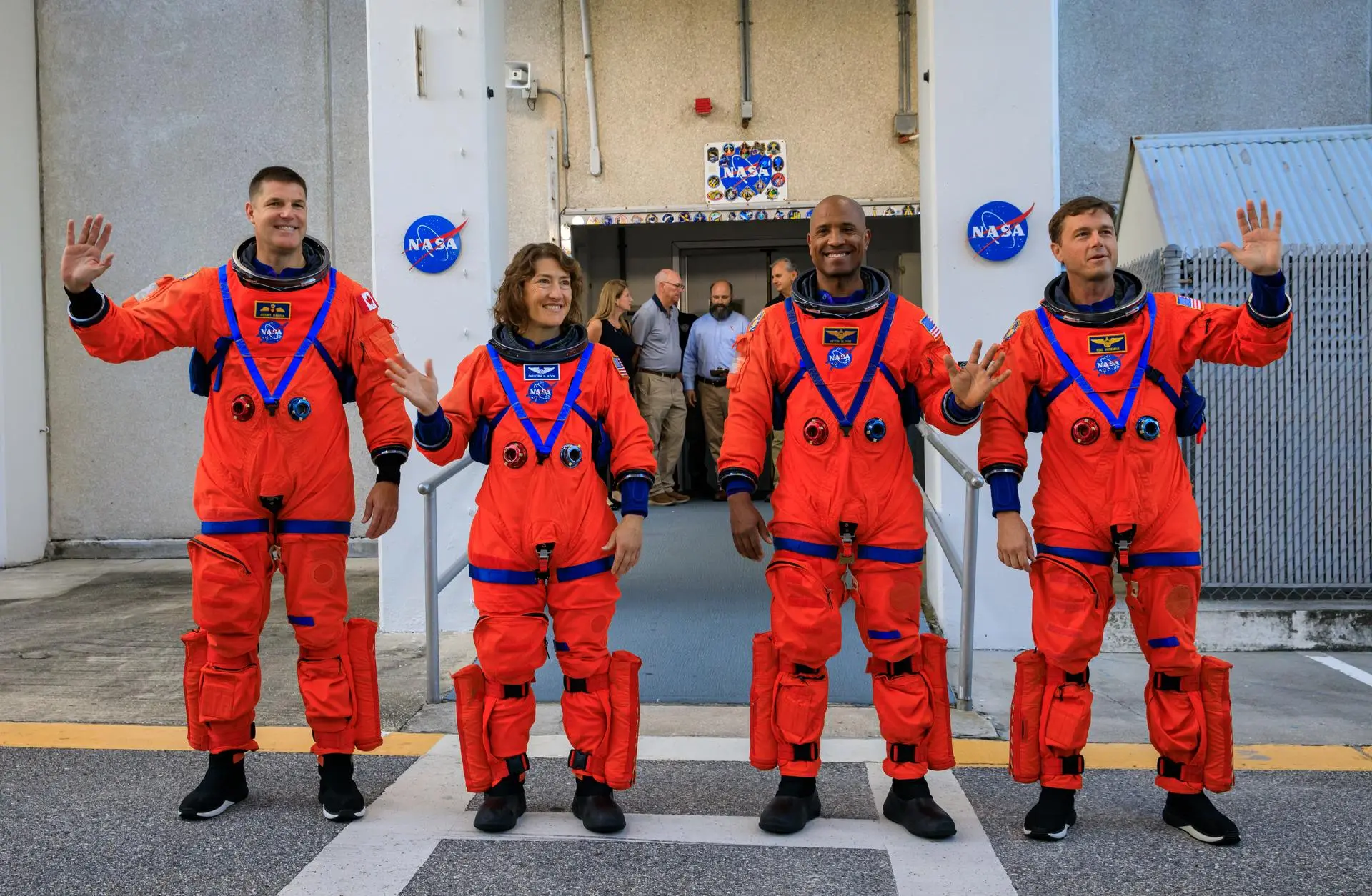
During the August 28 ceremony, Trump also awarded the Congressional Space Medal of Honor to the crew of the Artemis II mission — NASA’s Christina Koch, Victor Glover and Reid Wiseman, and the Canadian Space Agency’s Jeremy Hansen. Their April flight around the moon set a record for the farthest humans have traveled from Earth.
President Trump presents an executive order establishing the U.S. Space Academy August 28 at Johnson Space Center in Houston. (NASA/John Kraus)
The only nation to land a man on the moon, the United States remains at the forefront of human space exploration. Through the Artemis program, established in Trump’s first term, NASA will return astronauts to the moon and pave the way for a moon base that will serve as a jumping-off point for future human spaceflight to Mars.
The president has prioritized America’s leading role in space exploration. He launched the Artemis Accords, a nonbinding set of principles to guide civil space exploration. Over 70 nations have signed onto the accords.
In August, Trump issued a Presidential Memorandum to reinvigorate U.S. leadership in space transportation , calling on federal agencies to promote space transportation capabilities and facilitate commercial transportation to the moon and Mars.
U.S. Space Force Brigadier General Matthew Holston swears new officers into the U.S. Space Force at the Pentagon. (U.S. Air Force/Technical Sergeant Michael Campbell)
NASA Administrator Jared Isaacman will lead a commission that will advise the president on creating the Space Academy, including degree programs, experiential training and service obligations for graduates. The academy will combine “rigorous technical education with leadership development, discipline, and a durable commitment to public service,” the order says.
A Transitional Step
Isaacman called plans for the Space Academy “a transformational step” for future NASA missions to return astronauts to the lunar surface, build a moon base and advance science and discovery. “I have no doubt that so much of the future talent that will graduate and contribute to these exciting endeavors will be educated at the United States Space Academy,” he said.
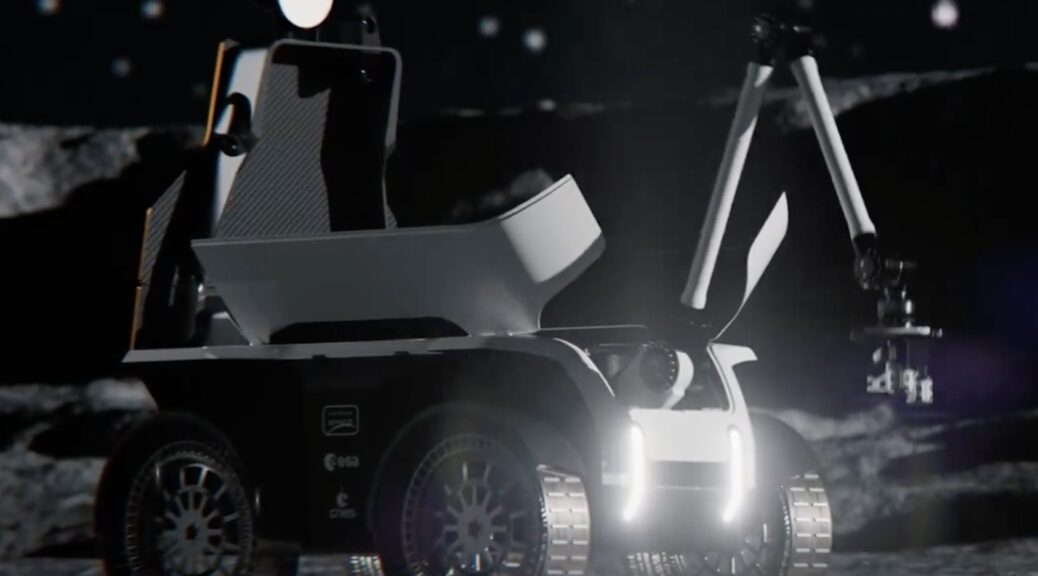
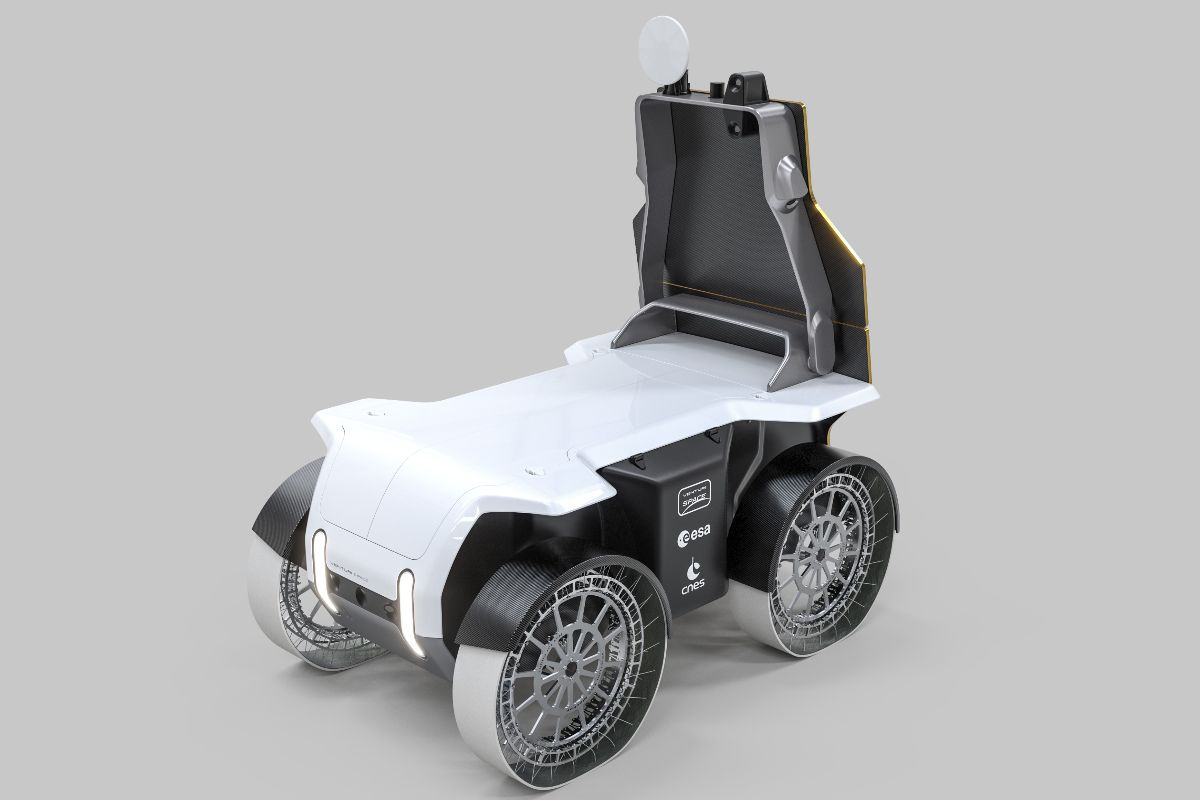
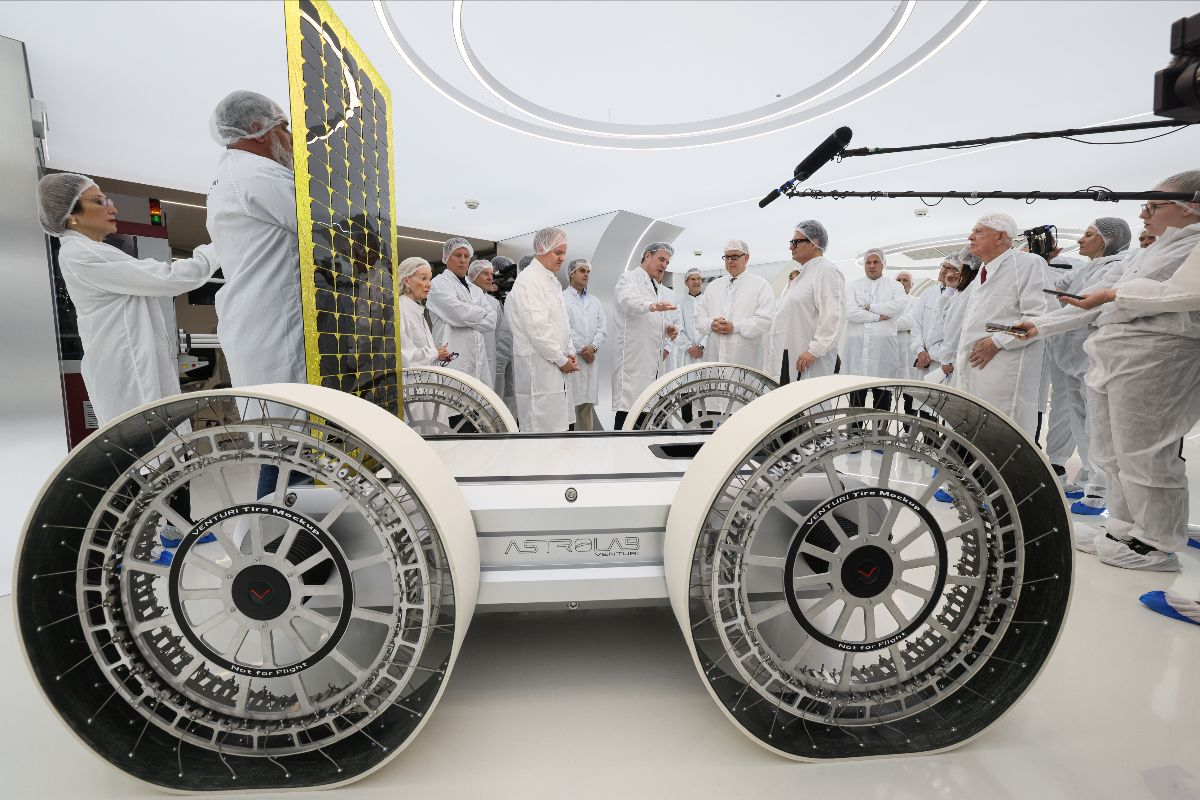
With a target mass of 300 kg, ALTA LUNA’s compact size gives it a high degree of manoeuvrability. The vehicle is also designed to offer particularly high obstacle-crossing capability.
ALTA LUNA is designed to operate in two modes: with an astronaut on board or autonomously. In autonomous mode, navigation will rely on a combination of LiDAR, stereo cameras and artificial intelligence. AI will also be able to assist the astronaut in driving the vehicle.
In autonomous mode, ALTA LUNA will be able to carry out operations including excavation, grading and terrain preparation, as well as site development and the creation of routes and basic infrastructure. It will also be able to transport payloads. Each vehicle will be able to operate alone or in coordination with other ALTA LUNA vehicles. For certain operations, several vehicles will therefore be able to work together on the same task, pooling their efforts.
With ALTA LUNA, Venturi Space is exploring a tracked mobility architecture for the first time as part of its lunar programmes. This choice has one specific objective: to allow the vehicle to climb steeper slopes than would be possible with a wheeled architecture.
ALTA LUNA will use the battery and battery management system (BMS) developed by Venturi Space. These two technologies are integrated into Venturi Astrolab’s CLV-1, which has been selected by NASA for the Artemis campaign.
Fifteen months after unveiling the MONA LUNA rover, and as the launch of FLIP to the lunar South Pole approaches (*), Venturi Space continues to strengthen its position in the space industry, just five years after its creation.
| Gildo Pastor, President of Venturi Space: “I enjoy designing vehicles for extreme environments, but above all I like to see them prove their value in real-world conditions. I will therefore devote all the necessary energy to ensuring that ALTA LUNA supports the first inhabitants of the Moon in their daily lives”
Dr. Antonio Delfino, Director of Venturi Space: “On the Moon, we will need to build, develop sites, transport, maintain and connect. We will face challenges similar to those of industrialisation on Earth: transport routes, habitats, infrastructure and logistics. This will require a range of specialised mobility solutions capable of operating as a fleet and carrying out a wide variety of missions. This is the new phase of lunar activity that we are preparing for”(*) Developed by the US company Venturi Astrolab, the FLIP rover is equipped with hyper-deformable wheels and high-performance batteries designed and manufactured by Venturi Space. Its launch aboard Astrobotic’s Griffin-1 lander is scheduled by the end of 2026, with the lunar South Pole as its destination. Venturi Space, a European company, is Venturi Astrolab’s strategic partner.
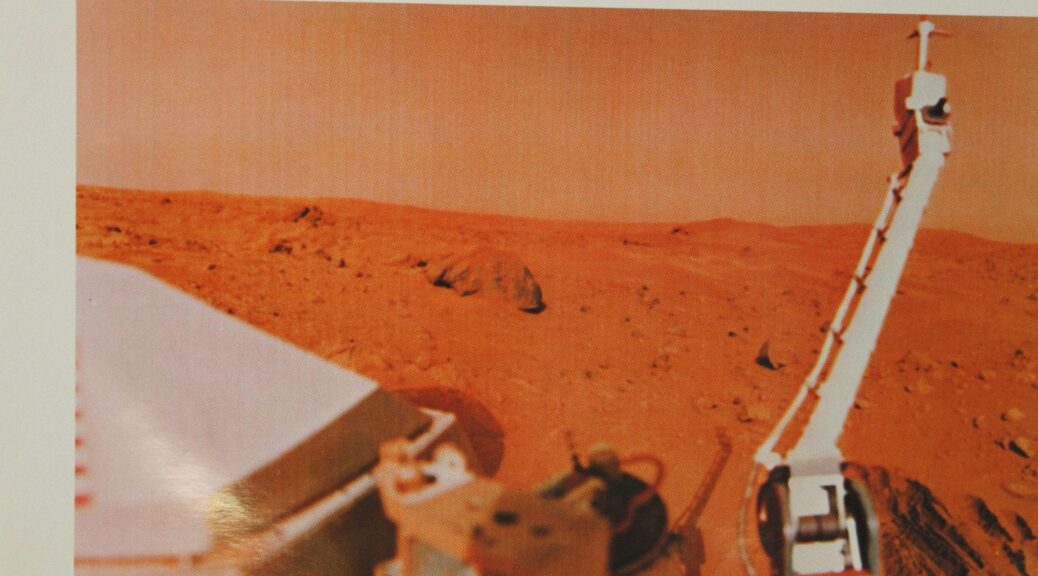
The Viking 1 lander’s photographs gave the world its first look at the surface of Mars, including this image taken before sunset August 21, 1976. (NASA/JPL)
On July 20, 1976, seven years after NASA landed a man on the moon, the U.S. space agency safely landed the first spacecraft on Mars.
Viking 1 operated for six years, far exceeding its planned 90-day mission. The lander tested soil and sent home the world’s first images of the Martian surface. While Viking 1 — consisting of an orbiter and a lander — did not find signs of life, its successful landing led to future exploration of Mars, including by the Perseverance rover launched in July 2020.
As the 50th anniversary of Viking 1 approaches, the United States is again reaching for Mars with missions that serve as a stepping stone toward sending astronauts to the red planet. NASA’s Artemis program aims to create a permanent moon base by 2032 to test human habitation on other planets and inform missions to Mars.
“We will pursue our manifest destiny into the stars, launching American astronauts to plant the Stars and Stripes on the planet Mars,” President Trump said in his January 2025 inaugural address.
Mars missions continue
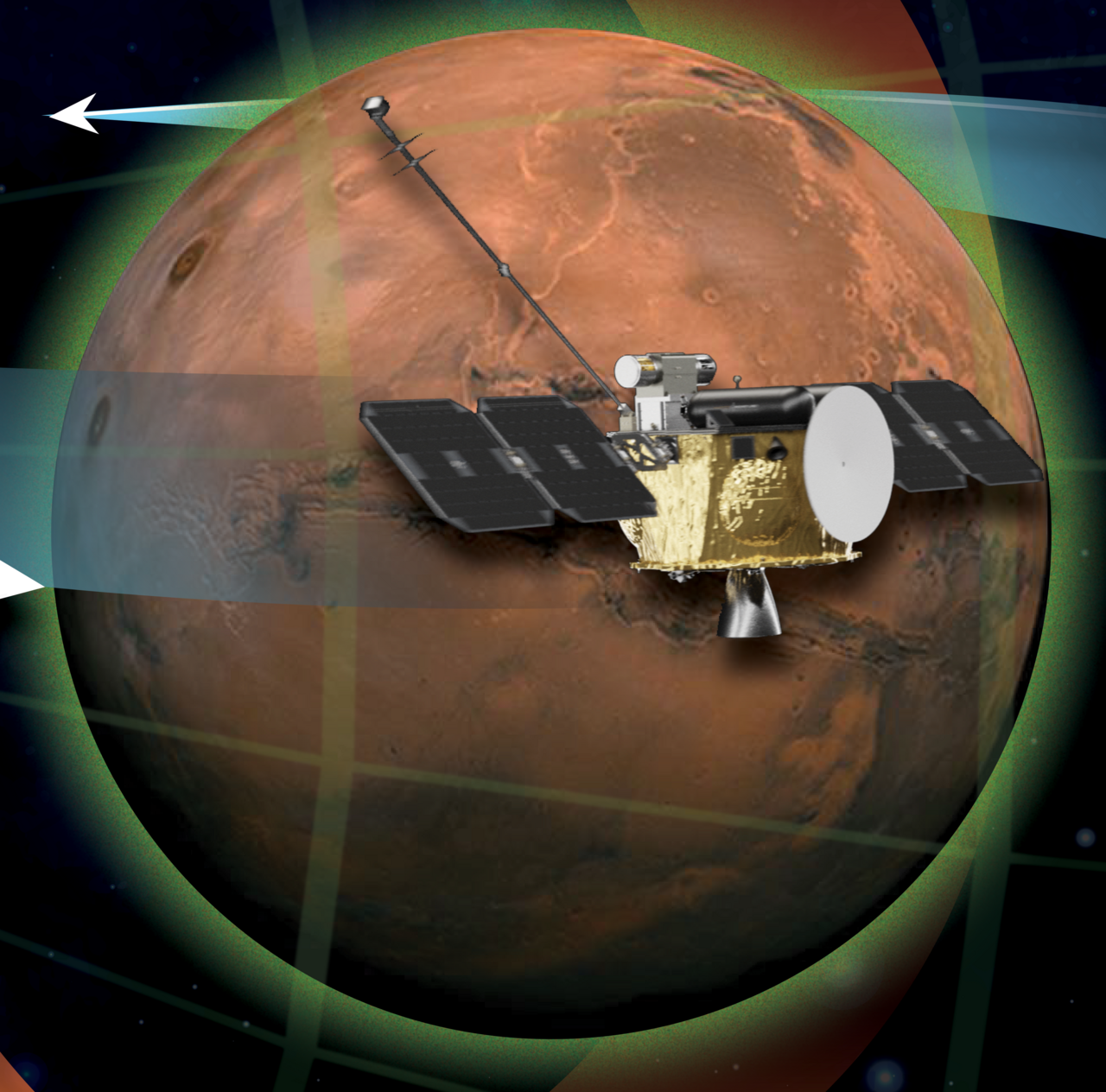
This digital rendering provides a conceptual image of the Space Reactor 1 Freedom that NASA will use to study Mars. (NASA)
Other NASA missions are carrying on Viking 1’s legacy , furthering scientific knowledge of the fourth planet from the sun. Launched in November, NASA’s Escapade and Plasma Acceleration and Dynamics Explorers mission will reach Mars in 2027. The twin spacecraft will orbit Mars, collecting data on space-weather conditions to inform future robot and human missions.
In 2028, NASA will launch the Space Reactor‑1 Freedom to Mars, an uncrewed mission designed to demonstrate whether nuclear electric propulsion can work in deep space, an essential element for human flight to Mars.
A pioneering legacy
A Viking 2 image of Mars’ Utopia Plain (NASA)
Successfully landing Viking 1 on Mars was an extraordinary achievement. While other nations had tried, communications were lost on touchdown. Yet NASA repeated the feat two months later with the safe landing of Viking 2 on September 3, 1976.
Project managers weren’t certain what to expect from either mission. The Viking 1 landing, originally scheduled for America’s bicentennial on July 4, 1976, was delayed when the planned landing site appeared too rocky. Yet the Viking missions’ legacy endures. Viking orbiters mapped 97% of Mars’ surface and sent home 52,663 images. The landers returned 4,500 photos before Viking 1 finally stopped operating in November 1982.
While neither mission discovered signs of life, the search continues as scientists revisit findings from Viking and later missions. In September, NASA announced that a soil sample Perseverance collected may contain evidence of ancient microbial life, calling it “the closest we have ever come to discovering life on Mars.”
NASA’s Artemis II mission brought back stunning images from space, including one of Earth setting beyond the moon’s surface. (NASA)
NASA’s Artemis program sent the Orion spacecraft around the moon, carrying astronauts farther from Earth than ever before, as millions back home watched. Now the space agency is planning missions that will land astronauts on the moon and build a permanent base on the lunar surface to serve as a jumping-off point for human space flight to Mars.
“The Moon Base will be America’s and humanity’s first outpost on another celestial world,” NASA Administrator Jared Isaacman says of the base , planned to open by 2032. “Every mission, crewed and uncrewed, will be a learning opportunity as we return to the lunar surface, build the infrastructure to stay, and master the skills required to live and operate in one of the most demanding and dangerous environments imaginable.”
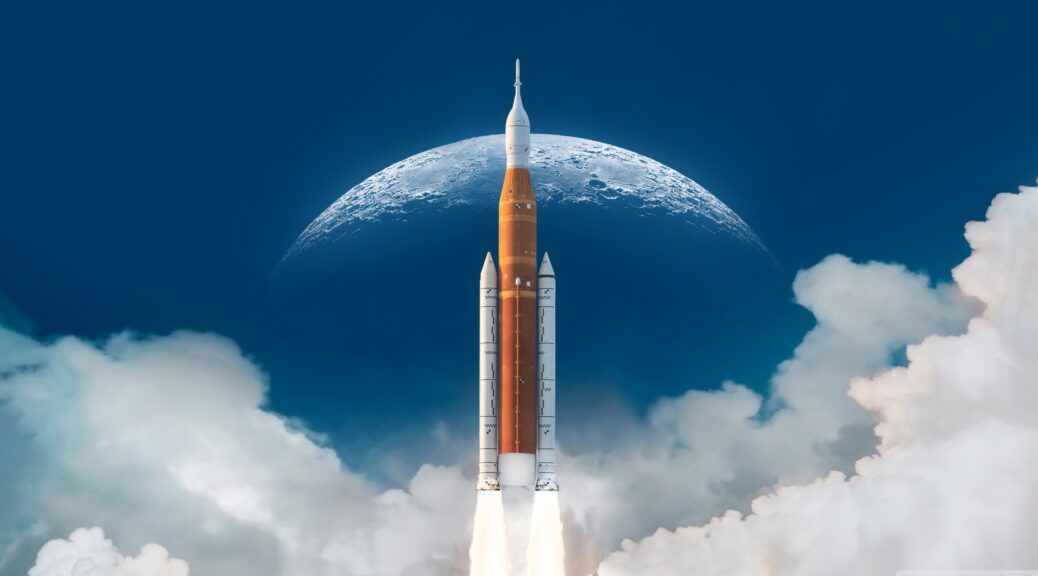
Artemis missions blend public and private-sector technology and enlist international partners. On crewed missions, the Space Launch System heavy lift rocket propels astronauts from Earth. The Orion spacecraft and a human landing system will work together to deliver the first humans to the moon’s surface since NASA’s last Apollo mission in 1972.
(State Dept.)
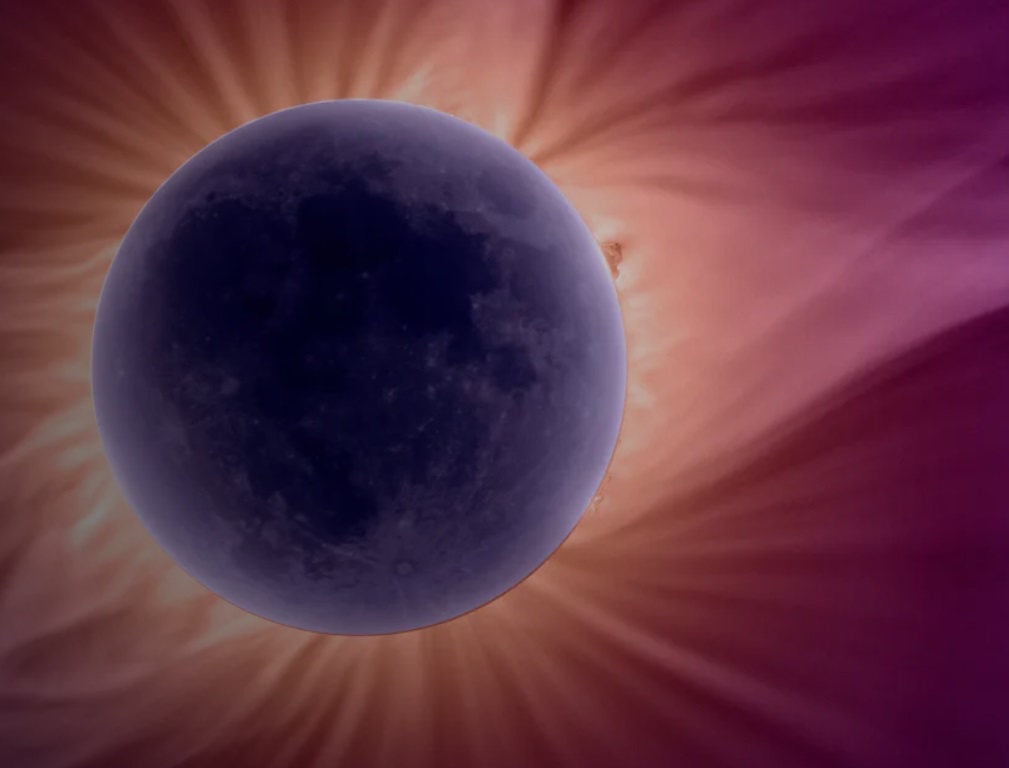
During Artemis II’s lunar flyby in April, astronauts (including Canadian Jeremy Hansen) aboard the Orion spacecraft they nicknamed “Integrity” sent back pictures of the far side of the moon and a solar eclipse, an image seldom seen from space.
Over the next several years, the Artemis program will launch dozens of uncrewed missions that will use robotic spacecraft to survey sites for the moon base and deposit supplies for astronauts’ future use, says Carlos García-Galán, NASA’s Moon Base program manager.
The agency next sends astronauts into space on Artemis III, set to launch in 2027. The crew of NASA astronauts Randy Bresnik, Andre Douglas and Frank Rubio, along with the European Space Agency’s Luca Parmitano, will test Orion’s interoperability with lunar landers in Earth orbit in preparation for a moon landing mission the following year.
Artemis IV, planned for 2028, will land two astronauts on the moon for a weeklong stay near the lunar South Pole. NASA expects to return to the moon with Artemis V later that year to begin building the moon base. Future crewed missions will continue at a pace of at least once per year, NASA says.
The Orion spacecraft seen alongside the moon, with Earth in the distance. (NASA)
Artemis missions are guided by the Artemis Accords , a set of nonbinding principles and norms for civil space exploration. Started in 2020, the accords now have the support of 67 signatory nations.
“We are reaching for the stars once again with the same ingenuity, courage, and indomitable spirit that have defined our national story for 250 years,” President Trump said in May, calling for “a new Golden Age of space exploration.”
The Artemis II crew of NASA’s Christina Koch, Victor Glover, Reid Wiseman and the Canadian Space Agency’s Jeremy Hansen (second from left), seen on their journey home. (NASA)
Raketa Premium Watch Manufacture is releasing a new version of its Russian Code — a watch that runs counter to the usual direction of time. The model was first introduced on June 3, 2026, at the St. Petersburg International Economic Forum. This event was central to the brand’s presence at the Forum business program.
The new version of the model offers a different vibe, a more natural and warmer colour palette, and some extra features including:
a stainless-steel case with a dual finish: polishing and satin finish;
a curved sapphire crystal creating a lens-like effect and a three-dimensional appearance;
a light beige dial, featuring convex markings and a 3D image of the Earth at the center, its surface divided into thin lines of meridians. This is what gave the model its full name, echoing the idea that time and space obey strict geometry. The Raketa logo is intentionally placed directly above Russia on the world map;
a brown genuine leather strap adorned with contrasting blue notches that echo the ocean colours on the dial, adding up to the model’s coherent look.
Irregular Rhythm And A Fun Movement
You can see the movement operating at an irregular rhythm through the transparent case back of the watch. As this Raketa watch has a backward-action movement, its hands also move in the opposite direction due to the mirrored design of the movement’s main components. Raketa’s engineers went beyond the simple modification of components: they designed and manufactured their mirrored counterparts. As a result, the entire system moves in the opposite direction in a coordinated way.
What we commonly refer to as ‘the correct course of time’ is simply an optical illusion that originated in the Northern Hemisphere several centuries ago. People observed the shadow of a sundial moving in a circle and decided that direction was the only correct one. The universe works differently, though, as the Earth orbits the Sun counterclockwise. The Russian Code brings the time back into this cosmic rhythm: the hour hand moves backward, and the seconds hand—shaped as the Moon—also orbits the Earth in the opposite direction. What you see on the dial is not a mere abstraction, but a precise astronomical model.
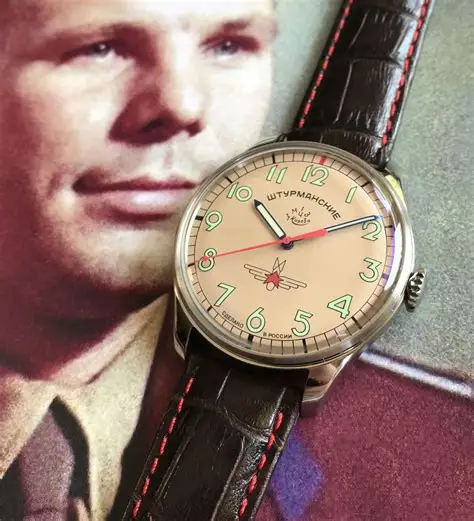
The Raketa brand was launched in 1961 to honour Yuri Gagarin’s space flight. Space is not a metaphor, but a part of the manufacture’s engineering legacy. The Russian Code is the very embodiment of this tradition, and the release of its new version marks the manufacturer’s anniversary. This watch is meant to break conventions, reminding you that true time is guided by the stars.
Self Winding Movement Is Very Russian
The heart of the watch is a Russian self-winding movement, manufactured from A to Z at the Raketa Watch Factory, one of the few manufacturers worldwide that still produce in-house movements. The open case back cover reveals the manufacture movement and its rotor decorated with Neva waves, a nanoceramic finishing, and a printing pattern.
Price
The price of this watch is 2 900 EUR (excluding VAT) $3,340 USD/ $5,360 CAD. For the comfort of customers, Raketa watches are delivered worldwide free of charge by DHL directly up to the front door.
Specifications:
Factory:
Raketa Watch Factory (Saint-Petersburg)
Movement:
Calibre:
2615CR
Functions:
Automatic with reverse direction of hands
Number of jewels:
24
Testing positions:
4
Average rate (s/d):
-10+20
Average running time (h):
40
Frequency/hour:
18.000 / 2.5 Hz
Bi-directional automatic winding:
Yes
Stopper of self-winding unit activated during manual winding:
Many have been humbled simply standing in a darkened field and looking to the stars. Indeed the great thinkers of the many generations that have come and gone are regarded as giants when in fact they were merely humans dropped to their knees by the wonder that is the universe all around us.
There is as much wonder in a blade of grass as there is in a cosmic nebula, as much mystery in a drop of water as in the dark matter we yet fail to comprehend.
James Hart Dyke is based in Brighton, England nestled between the water and the south downs. In his studio he works largely on commissions. About a decade ago, Hart Dyke traveled to Patagonia and was inspired to begin painting mountain landscapes from this trip for an exhibition in London. Landscapes are his life’s work and his love for the art form has infused his life and career with adventure and physicality as he climbs and hikes the places he later paints. “Enduring the landscape in some way, I find that combination of painting and physicality very exciting…it’s what my painting is about, really,” he says. Hart Dyke has been embedded with British forces in war zones on commission from the UK military. In Baghdad he painted while two soldiers stood guard. This tradition of bringing artists along to paint is long standing and important to the regiments of the UK. The work created is kept in the collections of the individual regiments and displayed in the mess hall, documenting the history of each for the soldiers to witness. The tradition dates back before photography when artists were the only window to a visual representation of the action of the battlefield.
Artists’ representations of war convey more than just the actual imagery of what is going on before them. The emotions of the situation are infused into the work, as well. Hart Dyke has had an unusual career. His work has led him to a position as artist in residence for the British Secret Intelligence Service as well as to work for the Royal Family.
For the British Secret Intelligence Service, Hart Dyke helped to commemorate the centenary by documenting things in paint. As an artist he was able to venture where photographers could not go due to the highly sensitive nature of the work done there. His paintings from this series are quite surreal, a nod to the rather unusual nature of the work the British Secret Intelligence Service does. Hart Dyke studied architecture which he is still passionate about despite eventually moving to painting. His entrance into the painting world began with commissioned paintings of buildings. In reality, Hart Dyke began painting at the age of eight and despite his foray into architecture he never truly gave it up. There was inevitability to his career as a painter. Because of the physical nature of his process, art has become in a very real sense James Hart Dyke’s sport. To hear more about this, James Hart Dyke’s unusual career, and about the tradition of artists on the battlefield, listen to the complete interview.
Kambui Olujimi ‘s exhibited work titled Red Shift refers to celestial bodies in space that cannot be seen because of shifts in the spectrum of light. Through this lens, Olujimi contemplated the mythology of whiteness as an unseen force. Olujimi describes how the mythological space of whiteness plays out in the physical world through policy, allocation of resources, and myriad other ways. He references descriptions of mass shooters as “lone shooters” in a way that removes them from the space of violence pervasive in the US. Presidential assassins are another example. These two groups of predominantly white men are somehow isolated, removed from the larger conversation about violence in the US creating a Red Shift that in a sense conceals them from the rest of the data.
For the exhibition, Olujimi created collages from news imagery of the alt-right coupled with drawings. Olujimi’s current project centers on fragmentation of identity. His love of films informs this work. In particular he references the accidental announcement of La La Land for Best Picture in 2017 when in fact the film Moonlight claimed that title. His concept deconstructs and reassembles that moment, elongating it and examining the feeling of elation followed by crushing deflation. “A lot of my work is around these things that I call inevitabilities…I’m interested in bringing those inevitabilities out of the space of the implicit. Once you give them shape and weight and gravity and start to manifest them in some way, the incongruities and absurdities, the surreal aspects all become very evident and we are able to become more critical of them in that space.” It is these gaps, these “moments of silence” that inform Olujimi’s work. To hear more about this powerful art, listen to the complete interview.For the Silo, Brainard Carey.
Featured image- Mercy Doesn’t Grow On Trees, 2016 Wood, glass, hair, gold leaf, ratchet straps 150 x 48 x 30 inches
Building Blocks of the Global Economy Are Changing
The architecture of the global economy is undergoing a profound structural redefinition. What once existed as parallel and independent industries—diplomacy, luxury, artificial intelligence, and space exploration—has begun to converge into a single, interdependent system of influence. This transformation represents more than technological progress; it signals the emergence of a new civilizational framework: the Global Innovation Era.
At its foundation, this era is defined by integration over isolation, ecosystems over sectors, and strategic alignment over fragmented competition. Power is no longer concentrated solely within governments or multinational corporations. Instead, it is distributed across highly interconnected global networks that span continents, disciplines, and spheres of influence.
A New Global Lattice
From Russia’s engineering depth to the United States’ leadership in technological innovation, from Australia’s research capabilities to Dubai’s infrastructural ambition, from Monaco’s concentration of capital and luxury to the Caribbean’s strategic positioning in global lifestyle and investment markets—a new global lattice is taking shape. This system is not accidental. It is being deliberately constructed by a new generation of leaders who understand that the future belongs to those capable of connecting what was never designed to be connected.
Redefining Diplomacy: From Statecraft to System Leadership
Diplomacy in the 21st century has evolved beyond traditional political negotiation into a multidimensional instrument of global coordination. It has become a form of system leadership—the deliberate construction of trust frameworks that enable cooperation across governments, industries, and cultures.
Today, diplomacy operates across multiple strategic layers:
Economic diplomacy shaping cross-border capital and investment flows
Technological diplomacy governing artificial intelligence, data ecosystems, and cybersecurity
Cultural diplomacy influencing global perception, identity, and soft power
Environmental diplomacy aligning international sustainability strategies
Educational diplomacy building intellectual capital and global talent pipelines
In this expanded capacity, diplomacy is no longer reactive—it is generative. It establishes the conditions necessary for innovation ecosystems to emerge, scale, and sustain. Without it, global integration fragments into inefficiency and instability.
Luxury as a Strategic Engine of Influence
Luxury is no longer simply a sector of consumption—it is a strategic engine of global influence. It operates as a high-level signaling system that defines aspiration, sets standards, and increasingly prototypes the future of human experience.
Across haute couture, fine jewelry, ultra-prime real estate, private aviation, yachting, and bespoke services, luxury functions as a controlled environment for innovation. Emerging technologies—particularly artificial intelligence—are first deployed in these high-value ecosystems, where personalization, precision, and exclusivity are paramount.
Luxury now serves as:
A driver of experiential and design innovation
A curator of global cultural capital
A bridge between heritage and technological advancement
A platform for integrating advanced technologies into human-centered environments
Its influence extends far beyond its economic footprint. By shaping perception, it indirectly shapes global demand, behavior, and market direction.
Artificial Intelligence: The Cognitive Infrastructure of the Global Economy
Artificial intelligence has become the defining infrastructure of modern civilization. It is not a supplementary tool—it is the cognitive layer upon which global systems are increasingly built.
AI is transforming:
Decision-making, shifting from reactive processes to predictive intelligence
Operations, transitioning from manual systems to autonomous networks
Value creation, moving from resource-based models to data-driven economies
Its applications are systemic:
Global supply chains that optimize themselves in real time
Financial ecosystems that anticipate volatility and opportunity
Creative industries enhanced by generative intelligence
Communication systems that eliminate linguistic and geographic barriers
Security frameworks capable of responding to complex, evolving threats
In this context, AI becomes the invisible architecture of the global innovation ecosystem—quietly orchestrating complexity at scale.
Space: The Expansion of Economic and Strategic Territory
Space is no longer a symbolic frontier—it is an active extension of the global economy. Its commercialization introduces a new dimension of infrastructure, connectivity, and geopolitical relevance.
This expansion includes:
Satellite networks enabling global communication and digital infrastructure
Earth observation technologies transforming environmental and resource management
The rise of space tourism as a new frontier in ultra-luxury markets
Advanced research in microgravity environments
Navigation, defense, and security systems with global strategic implications
Space represents the vertical expansion of economic activity—where technological ambition, geopolitical influence, and commercial opportunity intersect at the highest level.
The End of Silos: The Emergence of Integrated Global Ecosystems
The defining characteristic of the Global Innovation Era is not isolated advancement, but systemic integration.
A single initiative today may require:
Diplomatic coordination across multiple jurisdictions
AI-driven operational intelligence
Luxury-level experience design
Space-based infrastructure support
This convergence marks the نهاية (arabic: nihayat english: the end) of siloed thinking. The most significant breakthroughs no longer occur within industries—they occur at their intersections.
The result is a new paradigm: the ecosystem as the primary unit of value creation.
Within these ecosystems:
Investors, engineers, diplomats, and creatives operate within unified networks
Knowledge flows seamlessly across domains
Innovation accelerates through collaboration rather than competition
This is not incremental evolution. It is a fundamental reconfiguration of how the global economy functions.
The Rise of the Multidisciplinary Global Leader
At the center of this transformation is a new leadership archetype—one defined not by specialization alone, but by synthesis.
These leaders:
Build influence through global networks rather than hierarchical structures
Navigate fluidly between public and private sectors
Combine technological expertise with geopolitical awareness
Design ventures with immediate international scalability
Leverage digital infrastructure to operate without geographic limitation
They understand a critical reality: in a connected world, proximity is no longer physical—it is strategic.
Their advantage lies not in isolated knowledge, but in their ability to connect knowledge across systems.
Global Nodes of Influence
The emerging global ecosystem is anchored in interconnected regions, each contributing unique strategic value:
Russia contributes engineering excellence and scientific depth
The United States leads in technological innovation and capital markets
Australia connects research and sustainability with Asia-Pacific growth
Dubai exemplifies large-scale infrastructure and global business integration
Monaco represents concentrated financial power and luxury influence
The Caribbean offers strategic positioning in tourism, investment, and maritime economies
Together, these regions form a distributed but unified network. Their collaboration defines the speed, direction, and scale of global innovation.
Merit in the Age of Global Connectivity
One of the defining shifts of this era is the redefinition of opportunity. While structural barriers remain, access to global platforms, knowledge, and networks has expanded significantly.
However, access alone is no longer a differentiator. Execution is.
Success now requires:
Intellectual rigor
Strategic clarity
Adaptability in complex environments
Long-term discipline and resilience
Potential may be universal—but meaningful achievement remains highly selective.
Founder Spotlight: Aleksandra Sokolova and the First Royal Global Ecosystem
At the forefront of this transformation stands Aleksandra Sokolova, founder of the Royal Global Ecosystem—the first integrated global platform of its kind.
This ecosystem represents a pioneering model that unites diplomacy, global luxury, artificial intelligence, space innovation, and international collaboration within a single strategic framework. It is not a conceptual alignment, but a structured, operational system designed to function across sectors and borders simultaneously.
Within this ecosystem:
Diplomacy enables trust, access, and international partnerships
Artificial intelligence drives efficiency, scalability, and intelligent systems
Luxury defines experience, positioning, and global influence
Space innovation expands infrastructure, connectivity, and future opportunity
The Royal Global Ecosystem establishes a new category of global architecture—one in which industries no longer operate independently, but as interconnected components of a larger system.
Aleksandra Sokolova’s role reflects the emergence of a new class of leadership: system architects. These are individuals who do not simply operate within existing frameworks, but design entirely new ones.
Her work demonstrates a defining principle of the modern era: the future is not inherited—it is engineered.
Conclusion: The Age of Global System Architects
The world is entering an era defined by complexity, interdependence, and accelerated transformation. Linear strategies and isolated thinking are no longer sufficient.
What defines success now is the ability to:
Think systemically across industries
Operate globally across borders
Build integrated structures that connect people, technologies, and markets
The next chapter of global development will not be led by those who react to change—but by those who design the systems through which change occurs.
In the Global Innovation Era, the ultimate advantage belongs to the architects—those who see the entire system and possess the vision, discipline, and capability to build it.
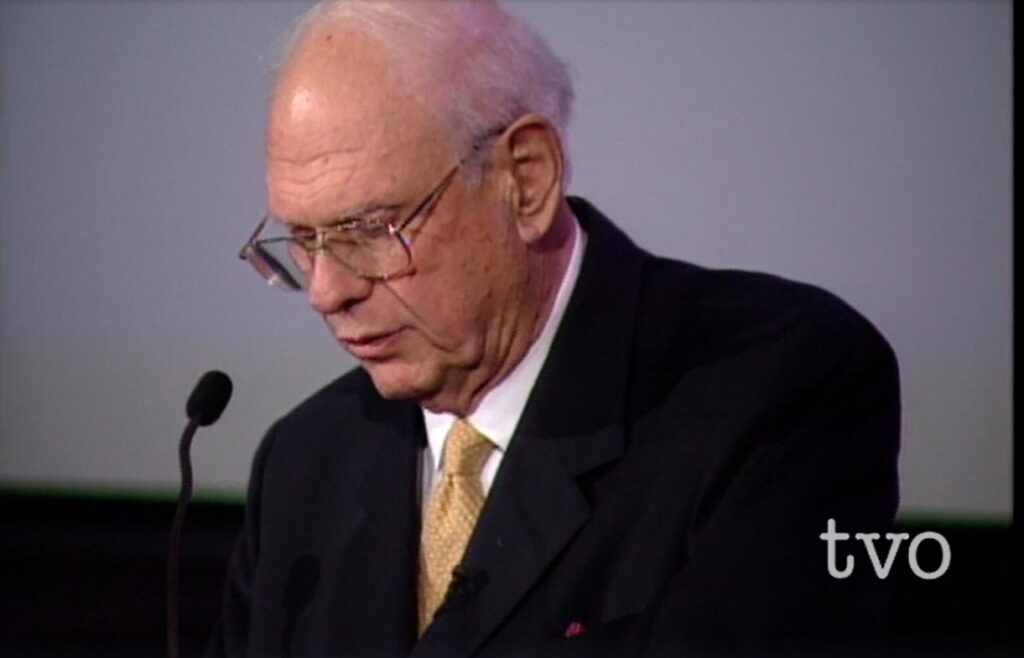
Some years ago, back in 2015, I spoke with Paul Hellyer the former Canadian minister of defense, who stated he believes UFOs are from another planet and that the U.S. Government has kept it covered up.
As Canadian Minister of National Defense in 1963, Hellyer was responsible for integrating and unifying the Royal Canadian army, navy and air force into a single organization, the Canadian Armed Forces.
He was outspoken about UFOs visiting Earth and the US Banking System that he felt was greatly responsible for economic hard times. He felt that we are naive and (take a breath) fail to understand we are being visited by alien life forms.
He told me he had spoken with key US government officials who confirmed aliens are visiting us and providing advanced technology.
His book, “Light at the End of the Tunnel: A Survival Plan for the Human Species” reveals that humans are hell bent for extinction unless we change our attitudes and actions with an urgency appropriate to an impending disaster. In the book, Paul Hellyer suggests that we have about ten years to wean ourselves from the oil economy and profoundly regrets that the Copenhagen Conference reflected little progress in that direction.
World Leaders Have to Do Better
The whole atmosphere was one that reminded him of Emperor Nero fiddling while Rome burned. World leaders simply have to do better! The book outlines the three monumental changes required to accommodate the miracle. First, the book claims that exotic energy sources already exist. They have been developed by the U.S. “shadow government” at the massive underground “black operation” installations in Nevada and Arizona using technology borrowed from visitors from other planets. Yet they remain secret for the alleged benefit of the privileged few. Second, the money has to be found to subsidize poor nations and facilitate major changes. This can be accomplished by a fundamental re-working of the monetary and banking system. Bank leverages must be dramatically reduced and the percentage of virtual money they create as debt strictly limited so that governments can gain the financial flexibility to finance the transition to sustainability. Finally, it will be necessary for all countries, races, faiths and colors to drop their antagonisms and work together in common purpose to save the heritage they have in common.
When Hellyer was Canada’s Minister of National Defense he stated, “I got periodic reports on sightings and I looked at them very casually, and it was decided that about 80 percent of them were natural phenomena of one sort or another, and the other 20 percent roughly were unexplained, and therefore unidentified. While spending one Thanksgiving holiday north of Toronto, Hellyer and his wife spotted an UFO. “The two of us stood there transfixed for 20 minutes, looking up at this thing moving first in one direction, and then another. By process of elimination, we determined it wasn’t a star or satellite and it wasn’t the space station, so there was really no explanation for it other than it was, in fact, a UFO.”
“It looked like a star, but it maneuvered in a way that stars do not. I must admit that when I saw this one, I wondered whether it was extraterrestrial or American. And I guess the thought that occurred to me was that if it is American, then they have learned some pretty big secrets about acceleration, because it accelerated at a pace that nothing I’ve ever known about that was built here is capable of.” For the Silo, George Filer. Join MUFON.
Pursuant to the desire of the Government of The United States of America and the Government of New Zealand, the countries held a bilateral Space Dialogue in Washington, D.C. on March 23 and on March 26 to strengthen bilateral space cooperation. The Space Dialogue demonstrates the robust and growing cooperation between the United States and New Zealand in outer space.
The U.S. delegation was led by Valda Vikmanis, Director of the Office of Space Affairs of the Bureau of Oceans and International Environmental and Scientific Affairs, and by Eric Desautels, Director of the Office of Critical Domains for the Bureau of Emerging Threats. The New Zealand delegation was led by Andrew Johnson, Deputy Head of the New Zealand Space Agency. Chris Seed, New Zealand’s Ambassador to the United States, delivered opening remarks that underscored priorities of strengthening commercial space ties, enhancing space security cooperation, and advancing scientific collaboration. Both delegations included whole-of-government participation.
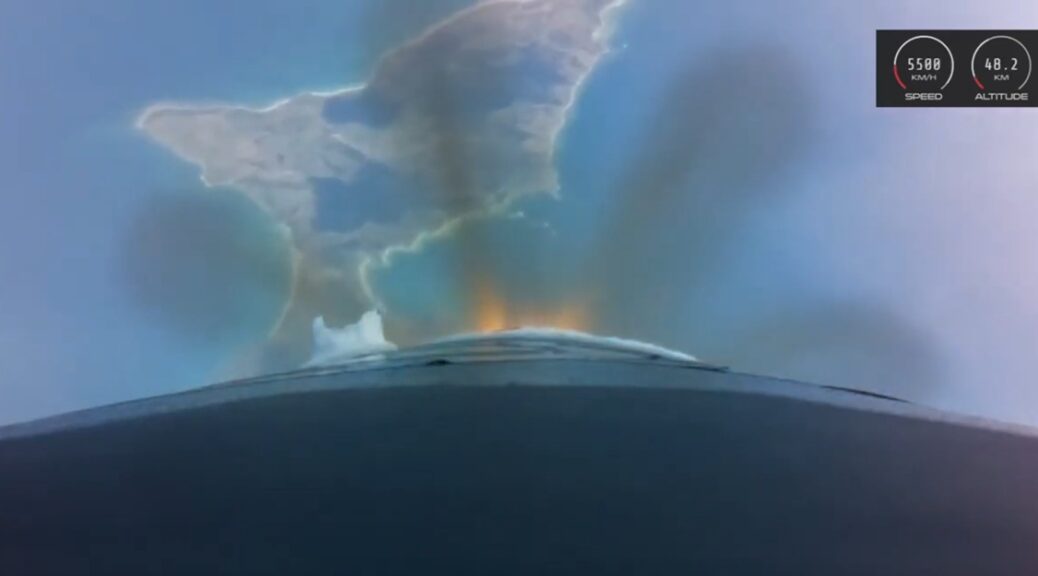
The participants welcomed the holding of the Dialogue during a period in which the United States and New Zealand share a close cooperation on space which has had mutual benefits for both countries. In October 2024, New Zealand became the third most frequent launcher of orbital rockets, with U.S. headquartered and New Zealand founded company Rocket Lab propelling New Zealand to these new heights.
A significant focus of the Dialogue was the evolving role of the commercial space sector in supporting both economic growth and shared security interests. Discussions covered the changing role of government in enabling commercial activity and the expanding range of applications, with both sides expressing their intent to continue cooperation on spaceflight safety, launch, payloads, science and innovation, and associated technology security measures. Both sides also discussed opportunities for further cooperation to address space-related threats to shared security interests, including military space cooperation and managing the risks to ground-based space infrastructure.
The delegations recognized the potential for expanded cooperation on policy and regulatory interoperability related to commercial space, including space situational awareness, launch and reentry, and commercial remote sensing. They decided to work closely together to address regulatory constraints that hinder effective cooperation, commercial engagement, and mutual benefits.
Participants welcomed the open and productive nature of the Dialogue, which included discussion on space cooperation grounded in the principles of the Artemis Accords, to which New Zealand was an early signatory. Both sides emphasized the importance of promoting peaceful and transparent behavior in outer space.
Participants acknowledged New Zealand’s geographic advantages have enabled frequent and responsive launches for U.S. industry and government agencies, adding strategic resilience to launch capacity. New Zealand’s location has enabled hosting of ground-based space infrastructure to enhance both space situational awareness and communications with spacecraft. The United States noted New Zealand’s recently passed, world‑first legislation on the operation of ground-based space infrastructure, which strengthens its ability to protect New Zealand’s national interests and values.
New Zealand’s growing focus on space security has opened new avenues for cooperation, strengthening the United States and New Zealand partnership and advancing practical efforts to promote stability, resilience, and the responsible use of space.
New Zealand’s Space Scholarships program, where New Zealand funds post graduate students to complete a three-month internship at the Jet Propulsion Laboratory in Southern California, where they contribute to cutting-edge space technology projects, was acknowledged as a way to create enduring space connections between New Zealand and the United States.
Participants also welcomed the announcement of the first round of joint research projects between New Zealand research institutes and NASA centers, focusing on Earth observation. These projects lay the foundation for future collaborations in other research areas, including potential contributions to the Artemis program following the March 24-25 Ignition events and announcements at NASA headquarters.
Both countries resolved to continue working together in these areas and to explore other opportunities for strengthening bilateral cooperation, including facilitating bilateral commercial connections.
Raketa watch manufacturer is releasing a new interpretation of its iconic Big Zero model. Time is a pivot theme in art, explored by many artists across various periods and artistic languages. Time is swift and relentless; some moments can feel like a quick instant, while others like a lifetime. For the Russian artist Masha Yankovskaya, time is a subjective inner experience. Time filters through people, social roles, cities, countries, lifestyles, fashion trends, and tastes as we live on.
Our own “Я” (Ya, translated as “I”), our identity and personality, remains with us throughout the years. This inner “Я” is stronger than the course of history. Our identities linger on for many generations in artwork, for example.
A Collaboration based on fusion
The collaboration between Masha Yankovskaya and Raketa watch brand is a fusion of artistic expression and engineering tradition. While Yankovskaya’s art has an explicit female identity, it may be equally resonant with both male and female experiences.
The watch design features Masha’s signature red colour which is also symbolic for Raketa. The center of the dial features a rotating star drawn from the artist’s vivid visual language and referring to her Star painting from the Tarot series.
As part of the Major Arcana, the Star is the 17th card that stands for hope, inspiration, and healing. In Raketa’s watch, this concept translates into the seconds hand, combining a symbolic artistic dimension with the rhythm of time. The star also echoes the topic of outer space, historically significant for the Raketa brand which emerged following Yuri Gagarin’s triumphant flight.
Masha Yankovskaya’s signature “Я” replaces the 6-hour marker, emphasizing individuality and personality. “Я” is not only the artist’s initial but a conceptual gesture that underscores the egocentricity of Yankovskaya’s art, dedicated to inner experiences and reflections. Here, “Я” becomes the reference point centering our perception of time.
Limited Edition
The model comes as a limited edition of just 100 individually numbered watches. A red genuine leather strap matches the overall colour scheme. The set also includes a classic red or black alligator leather strap.
The heart of the watch is a Russian self-winding movement, manufactured from A to Z at the Raketa Watch Factory, one of the few manufacturers worldwide that still produce in-house movements. The open case back cover reveals the movement and its rotor decorated with Neva waves.
What about the price?
The price of this watch is 2100 EUR (excluding VAT) / $3,355 CAD. For the comfort of customers, Raketa watches are delivered worldwide free of charge by DHL directly up to the front door.
Specifications
Factory: Raketa Watch Factory (Saint Petersburg)
Movement: Calibre:2615
Functions: Automatic
Number of jewels: 24
Testing positions: 4
Average rate (s/d): -10+20
Average running time (h): 40
Frequency/hour: 18.000 / 2.5 (Hz)
Bi-directional automatic winding? Yes
Stopper of self-winding unit activated during manual? Yes
Winding: Decoration: Hand-made Neva waves + Print
Case: Material: Stainless steel
Size: 40 mm
Front glass: Sapphire
Back glass: Mineral
Crown: Ruby stone inside the crown
Water resistance: 10 АТМ
Dial: Enamel coating. Superluminova
Hands: Mountain shape
Strap: Material: Two straps: red genuine leather and black genuine alligator leather
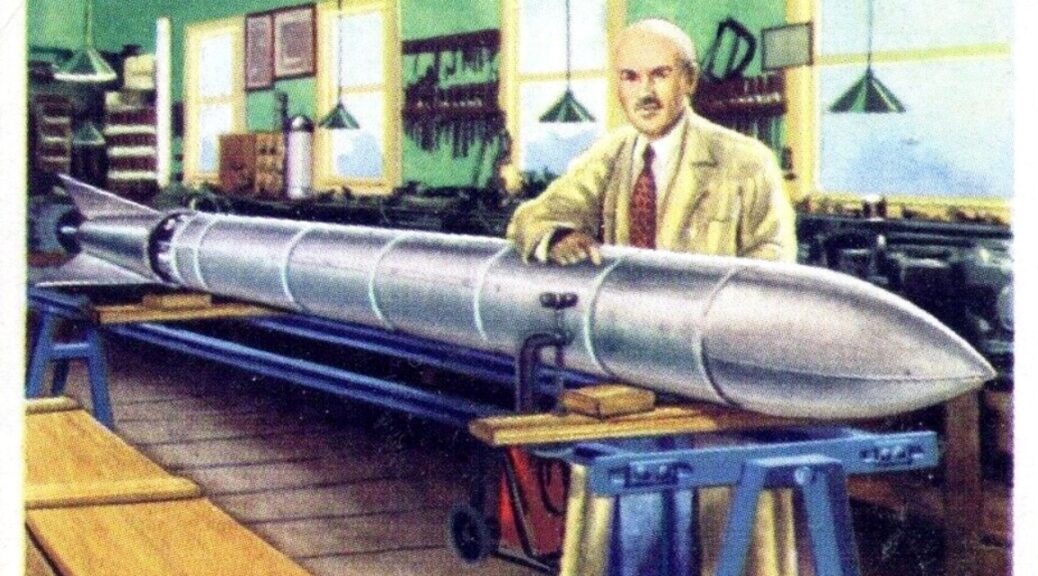
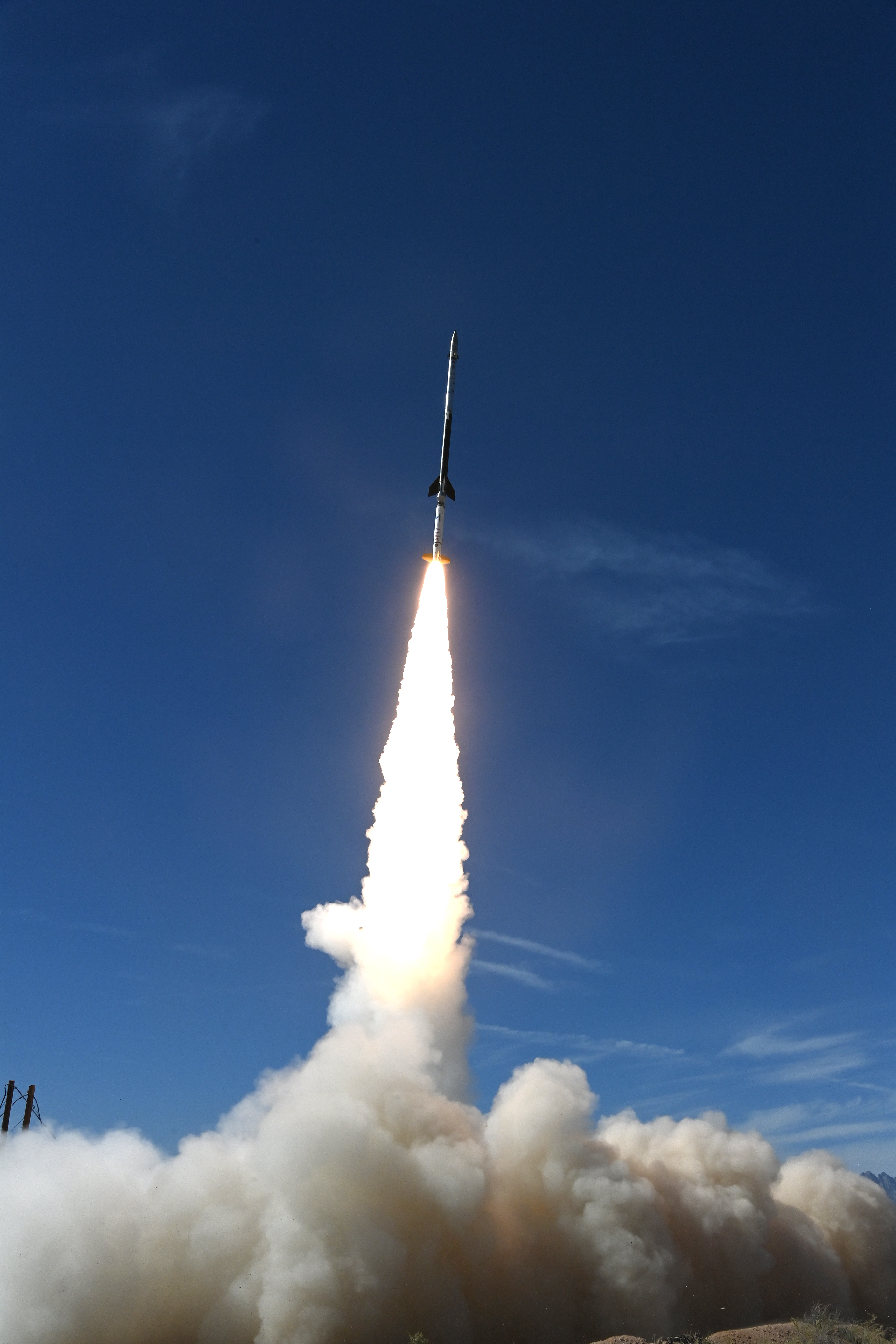
When Robert Goddard launched the first liquid-fueled rocket in a farm field in Auburn, Massachusetts, on March 16, 1926, it flew 2.5 seconds and reached only 12 meters (41 feet) in altitude.
The short flight 100 years ago would eventually earn Goddard (1882–1945) recognition as the father of American rocketry. But the significance of his work for space exploration was only fully recognized when the United States began sending astronauts into space in the 1960s and landed the first man on the moon on July 20, 1969.
Robert Goddard is seen in his workshop in Roswell, New Mexico, in October 1935. (NASA)
In the years before his famous launch, Goddard’s theories that liquid-fueled rockets could operate in space and even reach the moon had drawn ridicule, with some mockingly calling him the “moon man.” The Clark University physics professor was secretive about his research and hid the news of his first successful rocket test.
Goddard’s critics argued that rockets needed air for propulsion and so could not operate in the vacuum of space.
Goddard’s first rocket used gasoline and liquid oxygen for propulsion, according to NASA .
Goddard launched the first liquid-fueled rocket on March 16, 1926. (NASA)
While Goddard’s theories made him a controversial figure, they also inspired people to believe in the possibility of space travel, says Michael Neufeld, a retired senior curator at the Smithsonian’s National Air and Space Museum in Washington. The museum holds the largest collection of artifacts from Goddard’s work.
“He does inspire people to assume that space travel is real and the rocket is the way to go,” Neufeld says.
Why Liquid Fuel Was So Innovative
Goddard’s pioneering use of liquid fuel led to more efficient rockets that could lift larger payloads. Notably, the massive Saturn V rocket that took U.S. astronauts to the moon burned liquid fuel.
While the moon landing came years after Goddard’s death, NASA historian Brian Odom says Goddard’s work “proved what we had known in theory to be true in practice … And [that] it could be scalable.”
The launch of NASA’s Apollo 11 mission to the moon led the New York Times, on July 17, 1969, to issue what observers have called , “one of the most famous newspaper corrections in history.”
The paper that once called Goddard’s theories “a severe strain on credulity,” now acknowledged that rockets could operate in the vacuum of space and said, “the Times regrets the error.”
“I hid a sandwich in my spacesuit,” Astronaut John W. Young confessed in the April 2, 1965, issue of Life Magazine. The conversation about and the consumption of the sandwich, which lasted only about 30 seconds during the Gemini III flight, became a serious matter that drew the ire of Congress and NASA’s administrator after the crew returned home. Congress was particularly upset and brought the matter to leadership’s attention at hearings about NASA’s 1966 budget. Representative George E. Shipley was especially disgusted, knowing how much money and time NASA had spent to prepare the Gemini III spacecraft for launch. The fact that a crewmember brought something into the crew cabin, which Shipley likened to a “surgeon’s operating room,” put the techniques used to prevent a spaceflight mission from failing at risk; crumbs could have made their way behind instrument panels interfering with the operation of flight equipment and the loss of the mission and its crew. Shipley called Young’s antics “foolish” and asked NASA leaders to share their thoughts.
A Beef with Corned Beef
George Mueller, associate administrator for Manned Space Flight, stated unequivocally that the agency did not “approve [of] unauthorized objects such as sandwiches going on board the spacecraft.” And he promised Shipley that NASA has “taken steps, obviously, to prevent recurrence of corned beef sandwiches in future flights. There was no detriment to the experimental program that was carried on, nor was there any detriment to the actual carrying out of the mission because of the ingestion of the sandwich.” Manned Spacecraft Center Director Robert R. Gilruth was more forgiving of Young’s decision. These sort of antics, he told the committee, helped the crews to “break up the strain” of spaceflight, and he hesitated “to be too strict in the future by laying down a lot of rules for men who have this responsibility and who, in all the flights so far, have done such good jobs.” Webb disagreed and said, “this is the United States of America’s space program and, as a matter of policy, we are not going to permit individuals to superimpose their judgment as to what is going to be taken on these flights. I think it is fine for Dr. Gilruth to take a very strong position with respect to the individuality of these men, but from those of us who have to look at the totality of the matter, this was not an adequate performance by an astronaut.”
The loss of a Gemini mission, especially one so early in the program, would have been particularly challenging for an agency attempting to land humans on the Moon where each mission built on the previous flight. The United States was in a race with the Soviet Union, and for Congress at least, the purpose of Gemini and the cost of the space program was far too serious for these sorts of fun and games. For NASA Administrator James Webb, it was a sign that Gilruth was too lax when it came to managing his astronauts. Gemini III was just one example of the lack of control he noticed, and he pressed Gilruth for a report on the sandwich incident to determine if Young should be disciplined or at the very least reprimanded.
The In-Flight Meal
Young hatched the idea during training, when his commander, Virgil I. “Gus” Grissom grew “bored” with the food they practiced with for the mission. Grissom regularly complained about the dehydrated “delicacies” food scientists concocted.Bringing a sandwich onboard, an item that was freshly made and did not have to be rehydrated, “seemed like a fun idea at the time” to Young.
Astronauts Gus Grissom (foreground), command pilot; and John Young, pilot, are shown inside their Gemini III spacecraft as they prepared for their launch from Cape Kennedy, Florida, on March 23, 1965.
NASA
One of the goals of their flight was to evaluate NASA’s flight food packaging and whether the containers leaked when foods were reconstituted, as well as the procedures for disposing of the meal and its packaging after eating. Foods included rehydratable items such as chicken bites, applesauce, or drinks, and compressed foods such as brownie bites. The Gemini food system was not haute cuisine, however, and crews complained about its taste. Young described the chicken bites as “barely edible” in his post-flight debriefing. Don L. Lind, a scientist-astronaut selected in 1967, described the early Gemini food as “strange.” Their class took some to jungle survival training in Panama, and while no one wanted to eat it on the first two days, by the third day they were so hungry that they were willing to give it a try. Another problem was that all rehydrated meals for Gemini were mixed with cold water, which made them less appetizing than a hot meal.
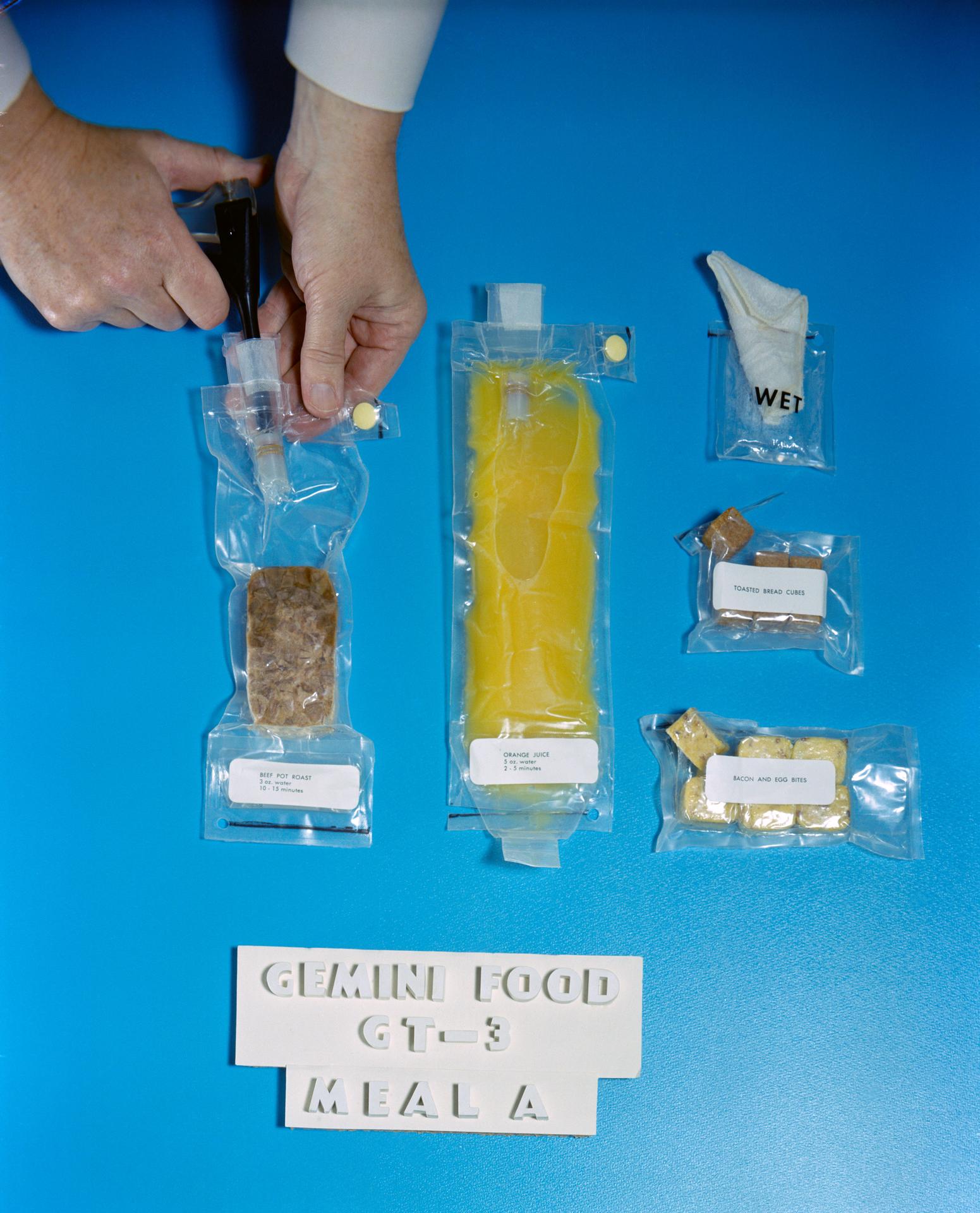
Food packets planned for the Gemini III flight, including dehydrated beef pot roast, bacon and egg bites, toasted bread cubes, orange juice and a wet wipe. The astronaut’s method for rehydrating a pouch of dehydrated food with water is shown in the top left.
Locally Made Corn Beef Sandwich
A freshly made corned beef sandwich made at a local restaurant sounded like a better option, so Young had fellow astronaut and backup command pilot Walter M. “Wally” Schirra pick one up. Schirra purchased the sandwich for Young, and as he headed out to the launchpad, Young put it in the pocket of his pressure suit.
Nearly two hours into the flight, as Young started his food and waste evaluation, he pulled out the sandwich from his suit and offered it to his commander. As captured on the air-to-ground recordings, Grissom asked what it was and where it came from. “I brought it with me,” Young responded, “Let’s see how it tastes.” He didn’t expect the sandwich to be so pungent, “Smells, doesn’t it?” Grissom took a bite but found the rye crumbled so he placed the sandwich in his suit pocket to prevent the crumbs from floating about the cabin.
Where did that come from?
Gus Grissom
Gemini III Commander
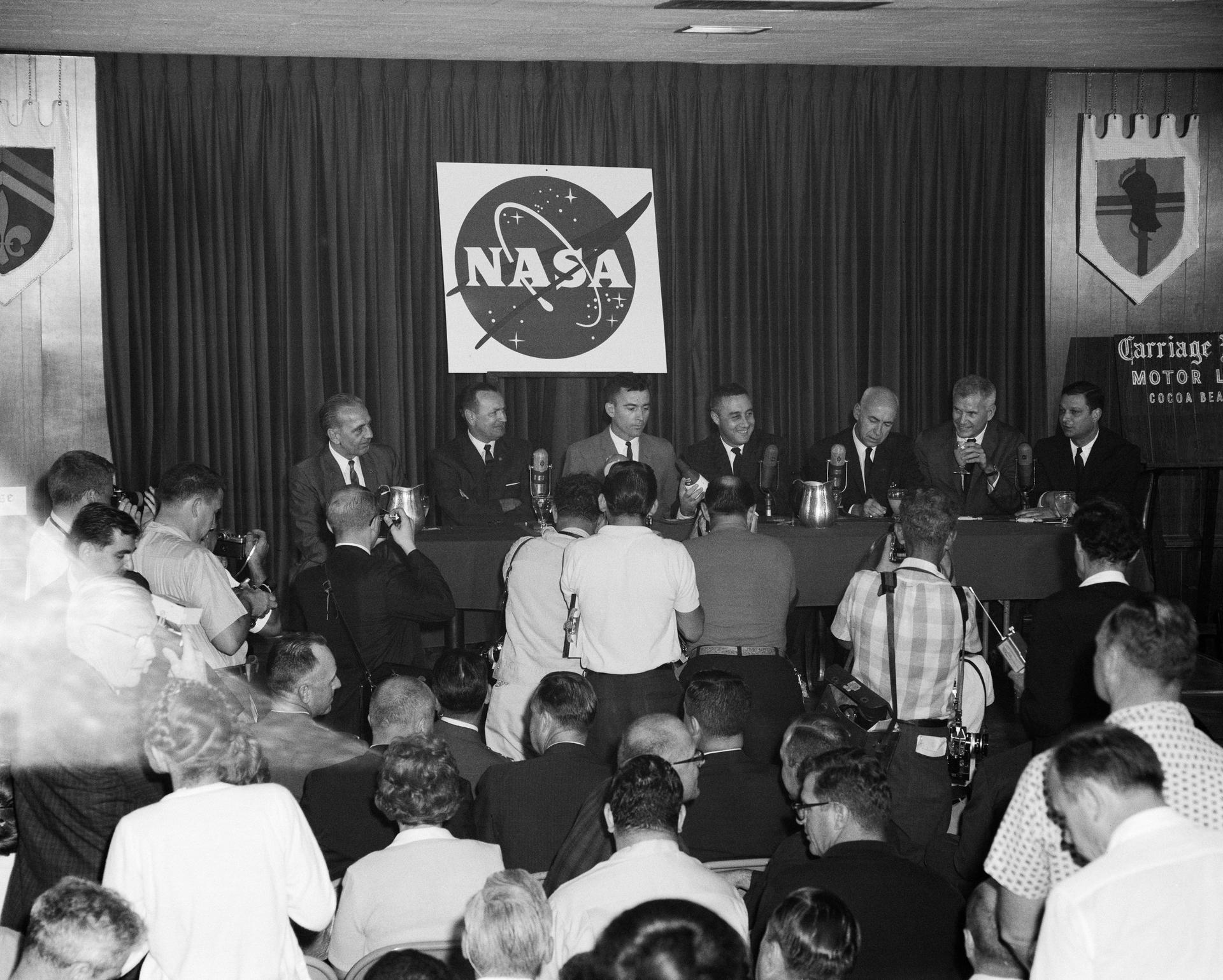
Two days later, nearly a thousand members of the media from the United States and around the world gathered to hear from the crew and NASA management at the postflight press conference at the Carriage House Motel in Cocoa Beach, Florida. Space reporter Bill Hines asked Young about the sandwich, erroneously referring to it as a “baloney sandwich,” and what happened when Gus was offered a taste. “And,” he asked, “what became of the sandwich?” Young seemed surprised, “How did you find out about that?” and then laughed adding Grissom “ate the sandwich.”
John Young and Gus Grissom speak with the press about the Gemini III mission during a news conference at the Carriage House Motel in Florida. Behind the table, left to right, are Dr. Kurt H. Debus, director of Kennedy Space Center, Christopher C. Kraft, Jr., MSC assistant director for Flight Operations, astronauts John Young and Gus Grissom, Dr. Robert R. Gilruth, MSC director, Dr. Robert C. Seamans, NASA associate administrator, and Julian Scheer, assistant administrator for NASA’s Office of Public Affairs.
Carry-on Restrictions for Spaceflights
Ironically the Gemini Program offered astronauts more control over their flights than during Project Mercury, including the ability to maneuver their spacecraft and to be more independent from Mission Control; but the uproar over this event led NASA to draft rules about what astronauts could and could not take onboard a spacecraft. Starting with Gemini IV, flight crews had to present a list of items they planned to take on their missions. Prohibited items naturally included sandwiches as well as bulky or heavy items or metal that could negatively impact the operation of spacecraft equipment. (NASA still allowed astronauts to take personal items such as wedding bands or coins for families and friends in their personal preference kit.)
Young never received a formal reprimand for the incident but was made aware of Congress’s frustration. Others in the corps were advised to avoid similar stunts and to focus on the mission. The decision to bring a sandwich onboard did not have a negative impact on Young’s career. He was the first astronaut to fly to space six times —two Gemini missions; two Apollo missions, including the dress rehearsal for the first lunar landing; and two space shuttle missions including STS-1, known as the bravest test flight in history. He also served as chief of the Astronaut Office for 13 years.
For the Silo,
Jennifer Ross-Nazzal. NASA Human Spaceflight Historian
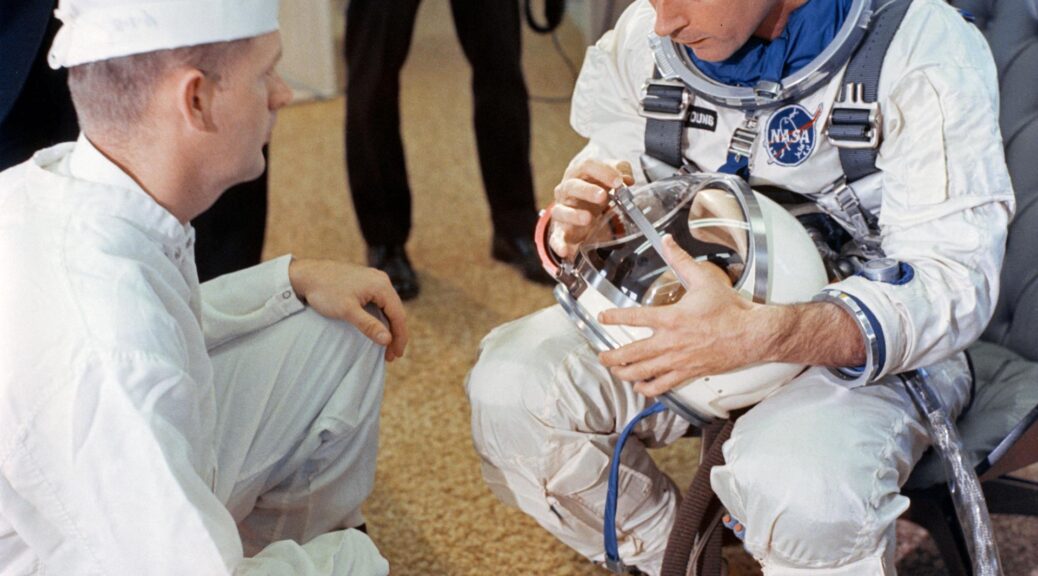
Featured image- Astronaut John W. Young, the pilot for Gemini III, checks over his helmet prior to flight. Credits: NASA
I spent most of yesterday afternoon watching and taking notes from the 86 minute documentary ELEKTRO MOSKVA. This film is so rich and interesting that I found myself sitting in reflection every time I jotted down another intriguing story element…..and believe me there were lots.
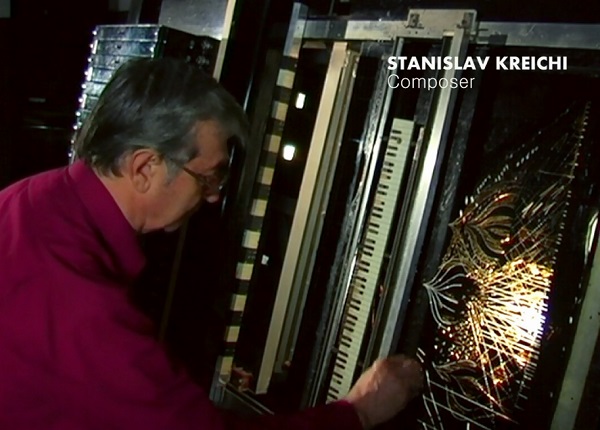
Stanislav Kreichi with ANS – world’s first ‘draw sound’ synthesizer.
The film’s official website describes itself like this: “ELEKTRO MOSKVA is an essayistic documentary about the beginnings of the Soviet electronic age and what remained of it- a huge pile of outdated, fascinating devices. Today they are being recycled and reinterpreted by musicians, inventors and traders, who carry that legacy on into an uncertain future. An electronic fairy tale about the inventive spirit of the free mind inside the iron curtain- and beyond.”
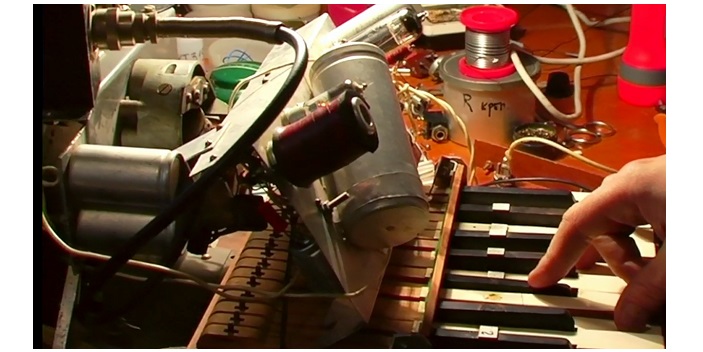
An example of everyday Soviet Russia DIY- In 1970 TV’s were readily available but not antennas.
Well all of that is certainly true but I discovered something deeper….. something partially hidden and really only stated at the end of the documentary: A metaphysical connection between electronic instruments, their circuitry and between immortality and rejuvenation. A sort of Frankenstein subplot. And that makes ELEKTRO MOSKVA much more interesting. It lingers and stays with you as all great films and documentaries tend to do.
Leon Theremin
Leon Theremin
Leon Theremin
If the inventor of the world’s first electronic instrument- The Theremin is to believed, his experimentation with electronic instrument designs led to techniques that allowed rejuvenation of human life and the bringing of the dead back to life. Kooky stuff to be sure but in our modern age of DNA manipulation and Stem Cell research shouldn’t we keep our minds open to all biological possibilities? Why is it so obtuse to think that electronic manipulation holds the key to immortality? The brain is after all- a sort of electronic computer. Why else would Russia have kept the body of Lenin whole and entombed for over a hundred years? Perhaps I’m getting ahead of myself- let’s move instead to the birth of Communist Synthesizers.
A Ghost of Communism: The backdrop for the film
It began with the Soviet electrification of the country. Then, as Russian homes and farms became wired, Science and Technical Progress became heralded by the state as ‘the new Gods’. In 1926 Léon Theremin ( Lev Sergeyevich Termen ) invented an early form of television which was adapted for border security use and classified. At the same time, the state decided that technological developments were only considered legit and legal if they strengthened communism.
Alexey Borisov
The long awaited electrical revolution expected by the masses and any notions of new, exciting products in Russian homes became instead a sort of electrified jail and super factory. Then, after Russia had successfully developed nuclear bombs and orbited the first man in space- things changed. A celebration of technical progress and Soviet achievement became politicized through the use of synthetic music and sound. Found out what happened next by watching ELEKTRO MOSKVA online in HD. Highly recommended. For the Silo, Jarrod Barker.
Click me! New Music created from early sci-fi soundtracks incl. Theremin cameos.
The “Russian Code”, one of Raketa’s most emblematic models with a counterclockwise movement, is now launched in a version that dedicated to the all cities and countries where Raketa is present in the world. The first exclusive edition of 50 numbered watches is dedicated to Qatar where Raketa is represented by the prestigious retail store “Blue Salon”.
The Raketa brand (meaning “space rocket” in Russian) was created in 1961 in honour of the first manned spaceflight by the Soviet cosmonaut Yuri Gagarin. For 65 years, the Raketa Watch Factory has been accompanying space exploration by engineering watches for cosmonauts and drawing continual inspiration from the space. In 2026, the brand will mark this anniversary date with a collection of exclusive space‑themed watch models and collaborations.
The beautiful three-layered dial of the Raketa “Russian Code – Qatar Edition” displays the night sky that was over Qatar on the day it received its independence — September 3, 1971. Depending on the lighting, the blue disk structure emits bright rays of light, bringing to life the constellations printed on the dial.
Behind the elegant design lies the revolutionary concept that time should move in harmony with the natural counterclockwise movement of the planets in our Solar System. Therefore, just like the planets around the Sun, the hands of this model rotate in a counterclockwise direction around the dial. To emphasize this idea, a red circle symbolizing a planet at the tip of the second hand, moves counterclockwise above the applied blue coated numerals.
This edition limited to 50 pieces is available:
▸ In Russia: exclusively in all of Raketa’s channels of sales (online and offline stores) in very limited quantities. ▸ Outside Russia: exclusively at Raketa’s partner and the leading luxury brand store in Qatar: Blue Salon.
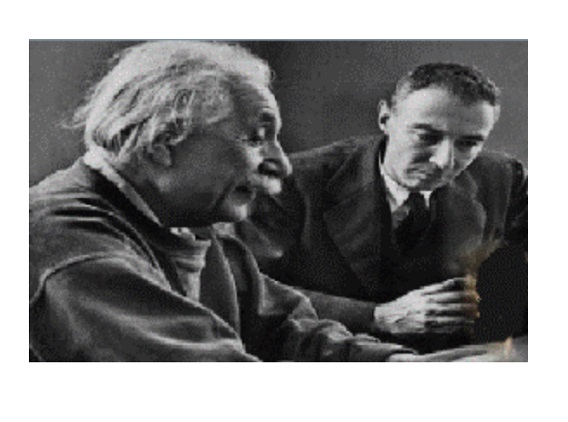
Albert Einstein (left) and Robert Oppenheimer (right) warned then-President Roosevelt about a number of security threats such as Nazi Germany’s work on an atomic bomb but what they sent along in 1947 was earth-shattering.
In June of 1947 Albert Einstein and J. Robert Oppenheimer together wrote a TOP SECRET six page document entitled “Relationships with Inhabitants of Celestial Bodies”. Aliens?
It was in 1947 and it said the presence of unidentified spacecraft is accepted as de facto by the military.
It also deals with where do they come from, what should we do in the event of colonization and/or integration of peoples, and why are they here? Finally, the document addresses the presence of celestial astroplanes in our atmosphere as a result of actions of military experiments with fission devices of warfare. Einstein and Oppenheimer encourage consideration of our potential future situation and safety due to our present and past actions in space. How can we avoid a perilous fate?
Extract majestic document:
Relationships with extraterrestrial men presents no basically new problem from the standpoint of international law; but the possibility of confronting intelligent beings that do not belong to the human race would bring up problems whose solution it is difficult to conceive. In principle, there is no difficulty in accepting the possibility of coming to an understanding with them, and of establishing all kinds of relationships.
If these intelligent beings were in possession of a more or less culture, and a more or less perfect political organization, they would have an absolute right to be recognized as independent and sovereign peoples. Another possibility may exist, that a species of Homo sapiens might have established themselves as an independent nation on another celestial body in our solar system and evolved culturally independently from ours. Living conditions on these bodies let’s say the moon,-or the planet Mars, would have to be such as to permit a stable, and to a certain extent, independent life, from an economic standpoint.
Hypothetically other planets may have life forms. Water has been found on our Moon and Mars that can be separated into hydrogen and oxygen, using an electric current or the short wave radiation of the sun. The oxygen could be used for breathing purposes; the hydrogen night be used as a fuel. There is indication that the inhabitants of celestial bodies, or extraterrestrial biological entitle (EBE) desire to settle here.
1.If they are politically organized and possess a certain culture similar to our own, they may be recognized as an independent people.
2.If they consider our culture to be devoid of political unity, they would have the right to colonize. Of course, this colonization cannot be conducted on classic lines. A superior form of colonizing will have to be conceived, that could be a kind of tutelage, possibly through the tacit approval of the United Nations. We cannot exclude the possibility that a race of extraterrestrial people more advanced technologically and economically may take upon itself the right to occupy another celestial body.
The division of a celestial body into zones and the distribution of them among other celestial states. A moral entity? The most feasible solution it seem would be this one, submit an agreement providing for the peaceful absorption of a celestial race(s) in such a manner that our culture would remain intact with guarantees that their presence not be revealed. It would merely be a matter of internationalizing celestial peoples, and creating an international treaty instrument.
The presence of unidentified space craft flying in our atmosphere (and possibly maintaining orbits about our planet) is now accepted by our military. Military strategists foresee the use of space craft with nuclear warheads as the ultimate weapon of war. Attack no longer comes from an exclusive direction, nor from a determined country, but from the sky, with the practical impossibility of determining who the aggressor is.
When artificial satellites and missiles find their place in space, we must consider the potential threat that unidentified space craft pose. One must consider the fact that miss-identification of these space craft for an intercontinental missile in a re-entry phase of flight could lead to accidental nuclear war.
This document was written in 1947 but extremely relevant what with the recent United States declassified UFO release.
Modern science lacks a unifying, interdisciplinary theory of life. In other words, current theories are unable to explain why life is the way it is and not any other way.
Dr. David Grinspoon writes about Charley Lineweaver’s review of “Scientists Debate Gaia,” a collection of essays gathered from an American Geophysical Union conference and by the published by MIT press. Charles H. Lineweaver is a Senior Fellow at Australia National University’s Planetary Science Institute.
Gaia author James Lovelock
He explained that James Lovelock (shown) proposed the Gaia hypothesis, in which Earth is an organism or system capable of self-regulation. He wondered: Can the existence of life be recognized from the chemical composition of a planet’s atmosphere? What would the Earth be like now, if life had never evolved on it? Would there be oxygen in the air? Would the surface temperature be hot like Venus or cold like Mars? In the mid-60’s, NASA consulted James Lovelock to assist in developing instruments for the Viking spacecraft to detect life on Mars.
He concluded that it wasn’t necessary to send a spacecraft to Mars. All you needed was to determine the composition of the Martian atmosphere –- if life was there, the atmosphere should be in chemical disequilibrium as it is on Earth. Recent observations, have detected methane on Mars indicating life.
Determining what life is and how to recognize it is the Holy Grail of astrobiology. To make progress, we need to explore the Martian subsurface and analyze the atmospheres of the nearest terrestrial planets. Lovelock’s Gaian chemical equilibrium test for the presence of life is fundamental to these efforts. Both NASA and ESA are putting their astrobiological money into interferometric infrared spectroscopy to look for the traces of chemical disequilibrium in planetary atmospheres as the primary biomarker.
Don’t be fooled by your perspective- we all live on a rotating ball traveling through space!
Lovelock thought that terrestrial life didn’t just passively produce chemical disequilibrium. There seemed to be some element of control or regulation. In 1978, he published a book called “Gaia” that described how the entire biosphere behaves like a living creature suggesting our Earth is alive.
Gaian science and astrobiology have very similar programs. Astrobiologists look at the stars and ask “What has life done to the planets out there and how can we recognize it?” Gaian scientists have been looking at the Earth for decades asking “What has terrestrial life done to our planet and how can we recognize it?” Astrobiology and Gaian science often remain separate fields of inquiry. Astrobiology attracts mainly astronomers and biologists, while Gaian science attracts atmospheric chemists, geologists and concerned ecologists.
The thin Martian atmosphere is mainly composed of carbon dioxide. Planetary scientists have studied the atmosphere of Mars for any signs of gases such as methane that could be generated by life. In this collection, Gaian scientists believe that over the past four and a half billion years, the Sun’s luminosity has increased by about 30 percent, but the temperature of the Earth’s surface doesn’t seem to have followed in step. Lovelock hypothesized that the biosphere regulates the Earth’s surface temperature. There are two obvious ways to do this: Regulate the albedo (light reflected by the planet) and/or regulate the abundances of greenhouse gases in the atmosphere.
Lovelock invented the parable of Daisyworld to demonstrate that the biosphere could regulate the albedo. A nice Gaian extension of this idea is J. Scott Turner’s analysis of the thermo-regulation of termite colonies. So if a termite ecosystem can evolve to do it, why can’t a big one like the Earth? Thus, Gaia does what good scientific ideas are supposed to do. It extends and extrapolates a fundamental theory, from individuals to groups to ecosystems, up to the entire biosphere.
The central debate of this book is: How can Gaia (Earth) be selfish? How can it do anything “for” itself? Will it protect itself from human destruction of the environment by causing earthquakes, earth lights, an ice age, or a great flood?
Tyler Volk’s book “Gaia’s Body” “Gaia is Life in a Wasteworld of By-products.” He proposed that the atmosphere is one giant waste dump. Life produces wastes, and these wastes build up and affect the environment. They become intolerable for some forms of life, but then along come new forms of life who take advantage of these waste products. Volk’s point is that poop just happens. Thus the effects of the biosphere’s wastes are certainly “by” but not necessarily “for” the biosphere..
Volk suggests using cycling ratios to measure “by and for the biosphere” and to determine how beneficial for life something may be. A cycling ratio is the amount of an element cycling through the Earth and biosphere, divided by the amount that would be cycling through the Earth in the absence of life. Volk estimates the cycling ratio of carbon to be about 200 times more carbon flowing through the veins of Gaia than would be cycling through an Earth without life from plate tectonics and volcanism.
A collection of observations by the Earth Observing System flagship Terra were stitched together into a seamless true-color mosaic of every square kilometer (.386 square mile) of our planet.
Dorion Sagan and Jessica Hope Whiteside’s “Gradient Reduction Theory: Thermodynamics and the Purpose of Life” discussed the second law of thermodynamics as the purpose of life. Agnostics looking for purpose in their lives would do well to digest this chapter with Lovelock’s suggestion that agnostics worship Gaia to fill their religious vacuum. There is grandeur and universality in this thermodynamic view of life that can be applied to life anywhere in the universe.
I’d like to see Gaian scientists recognize that Gaia is part of a larger whole – that the Earth is not a closed system and that Gaia has a mother. We begin to wonder whether our Galaxy is a life form called Galactea. For the Silo, Jarrod Barker.
“It is a must read for any life form that is even pretending to look for extraterrestrial life. /
– See more at: http://www.astrobio.net/ Note: It’s logical Mother Earth or Gaia feels totally threatened by environmental abuse from Earth’s humans and that those humans who are not loving to Mother Earth may be removed.
Part spaceship, part shop, the first Vollebak Spaceshop launched in Copenhagen in June. Before it heads off to service nearby galaxies, our friends at Vollebak are sending it on a world tour of Earth first.
Over the last year our friends at Volleback have partnered with sonic powerhouse Bang & Olufsen and Saga Space Architects to build their first prototype interstellar delivery vehicle …the Vollebak Spaceshop.
The craft itself is over 1,000kg of precision engineering that offers a glimpse into a future of interplanetary kit deliveries between Earth, the Moon and Mars. It was designed with SAGA Space Architects whose work includes lunar habitats for the European Space Agency, and lighting systems to help astronauts sleep on the International Space Station. And it’s fitted with Bang & Olufsen’s iconic Beolab 5 and Beosound 2 speakers.
If you missed launch night it involved space-based clothing, Earth-based alcohol, and the sound of the Spaceshop flexing its 120 decibels of muscle with ‘Intergalactic’ by the Beastie Boys. As soon as the next destination has been selected they’ll let you know. And while you’re waiting they have 4 pieces of space-ready cargo available for testing.
It includes their Martian Aerogel Jackets which are built from the Jet Propulsion Laboratory’s hypersonic deep space parachutes that landed the last Rover on Mars – and the same aerogel that stopped it freezing in the vacuum of space, and burning up on entry. They have their awesome Full Metal Jackets engineered from 11 kilometres of disease-resistant copper that were hailed by WIRED as “the virus-killing coat of the future,” and they’ve built to explore how humans could avoid taking diseases from Earth up into space.
You’ll also find electromagnetic Shielding Suits embedded with pure silver that block WiFi, Bluetooth, Ku-band satellites and radar systems, and deflect mid and long wave infrared radiation so they can’t be seen on infrared cameras. And last up they have the world’s first Anodised Jacket. Built with metallic insulation originally engineered by NASA to stop their spacecraft freezing in space, each jacket is fused with a near-invisible layer of metal from a galvanic bath that makes you appear cold or even invisible to infrared cameras.
Inaugural U.S.-Africa Technical and Regulatory Space Training Meeting
December, 2025. Senior Bureau Official (SBO) in the Bureau of African Affairs Ambassador Jonathan Pratt convened today’s U.S.-Africa Technical and Regulatory Space Training Meeting, the first in a series of technical and regulatory trainings in the leadup to the NewSpace Africa Conference April 20-23, 2026 in Libreville, Gabon.
SBO Pratt conveyed that the United States aims to empower African nations to create locally owned, financially sound, and internationally-aligned space programs – not dependent, opaque, or controlled by outside actors.
This meeting represented the first step in the United States deepening space diplomacy on the African continent, now with more than 60 satellites in orbit. Representatives agreed to work more closely together to advance responsible exploration in space and collaborate transparently and openly.
Participating in the meeting were representatives from the following African space agencies: Senegal, Angola, Mauritius, Djibouti, Nigeria, Kenya, Botswana, Gabon, Ethiopia, Namibia, Rwanda, and Egypt. The meeting also included representatives from the Department of War, Department of Commerce, and the Federal Communications Commission.
Supplemental
With a total of 13 satellites each, South Africa and Egypt have the largest number of satellites in orbit in Africa, while Nigeria also launched a total of seven satellites, according to a report by Statista.
Take a look at the list of African countries with the most satellites in orbit as of August 2024:
country
number of satellites
South Africa
13
Egypt
13
Nigeria
7
Algeria
6
Morocco
3
Since the statistics were published, Morocco launched two more nanosatellites, bringing the total number of satellites to five.
The report also noted that 12 other African countries had satellites in space, namely Kenya, Angola, Ethiopia, Rwanda, Djibouti, Ghana, Mauritius, Senegal, Tunisia, Sudan, Uganda, and Zimbabwe.
South Africa was the first country on the continent to build and launch a satellite, called SUNSAT-1, in 1998.
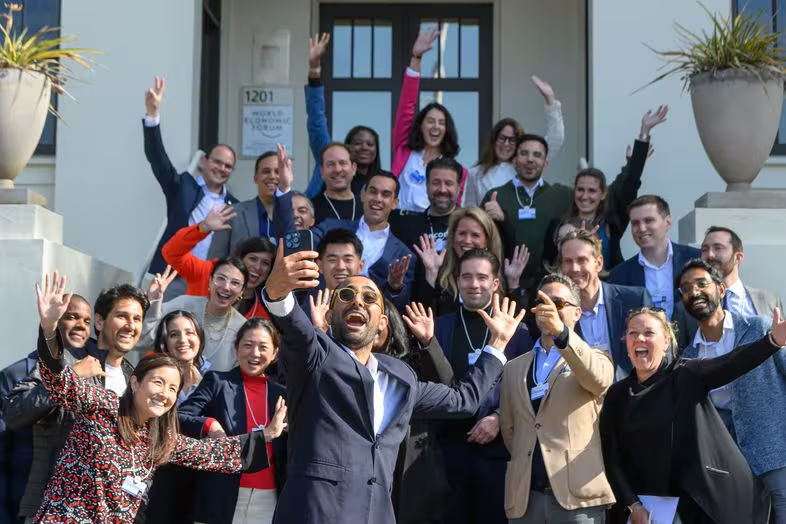
From electro-chromatic e-windows to using supernova explosions to explore the earth for mineral deposits: World Economic Forum 2025 Technology Pioneers Leading New Wave of Global Innovation
The World Economic Forum selects 100 start-ups from 28 countries to join its Technology Pioneers community.
The new cohort marks a global surge of emerging technologies, from smart robotics and spatial AI to flying taxis and scalable quantum solutions.
Now in its 25th year, the community has recognized over 1,200 start-ups that have gone on to transform industries and societies worldwide.
For more information on the Annual Meeting of the New Champions 2025, visit wef.ch/amnc25 and share on social media using the hashtag #amnc25, or #2025夏季达沃斯#. Read more about the 2025 Technology Pioneers here.
Geneva, Switzerland, 2025 – The World Economic Forum 2025 Technology Pioneers community is a group of 100 early-stage companies from 28 countries driving innovation across industries and borders. Now in its 25th year, the program celebrates its strongest cohort yet, marked by broader geographical representation, greater diversity beyond Silicon Valley and the rise of more ambitious frontier technologies.
Reflecting wider shifts in the innovation landscape, many of the companies spotlighted are using artificial intelligence (AI) to reach greater scale and sophistication with fewer resources. Several are venturing into less explored frontiers – from asteroid mining and flying electric taxis, to leveraging satellite imagery to transform agriculture and harnessing energy from supernova explosions to locate critical minerals beneath the Earth’s surface.
The geography of innovation is also evolving.
While the United States remains the top contributor to the community, Europe’s share has surged to 28% – up from 20% last year – reflecting the rise of strong tech ecosystems across the region. China and India are also emerging as major tech innovation hubs.
“There has never been a more exciting time to dive headfirst into tech innovation. But no one gets far alone – you need a community to move your mission forward,” said Verena Kuhn, Head of Innovator Communities, World Economic Forum. “As we mark 25 years of the Technology Pioneers programme, this global community continues to connect start-ups to the networks and ecosystems they need to scale.”
This year also marks the 25th Anniversary of the Technology Pioneers programme. Since its inception in 2000, the community has championed early-stage innovation and recognized more than 1,200 companies, many of which have gone on to reshape industries worldwide. Alumni include household names such as Google, PayPal, Dropbox and SoundCloud, underscoring the community’s role as a launchpad for ideas and impact.
The 2025 cohort stands out for its concentration of companies developing breakthrough technologies to address pressing global challenges. These include advanced robotics, customisable space launch services, micro nuclear reactors and more accessible quantum computing applications. These pioneers will contribute cutting-edge insights to Forum initiatives over a two-year engagement program and will also be invited to participate in the Annual Meeting of the New Champions 2025, taking place on 24-26 June in Tianjin, People’s Republic of China.
The 2025 Technology Pioneers include:
Australia • Cauldron – Commercializing advanced continuous fermentation technology to unlock price parity for mainstream bio-manufactured goods.
Brazil • Brain4care – Using AI-based technology to enable timely medical interventions for patients with neurological conditions.
Canada
• Ideon Technologies – Harnessing the energy from supernova explosions in space to image deep beneath the Earth’s surface, transforming how mining companies recover critical minerals. • Miru – Developing dynamic electrochromic windows that deliver high functionality, experience and energy efficiency for the automotive, transportation and architectural sectors.
Greater China • Deep Principle – Integrating advanced AI models and quantum chemistry to accelerate the discovery and development of chemical materials. • GS Biomats – Developing furan bio-based material, a renewable alternative to petroleum-based chemicals, for various uses including biomedical applications. • HiNa Battery – Producing more sustainable, high-performance, low-cost sodium-ion batteries. • KaiOS – Providing affordable internet and access to financial services to unserved populations, primarily in South Asia and Africa. • Lightstandard – Making large language model computing faster and more energy-efficient with photonic computing. • Noematrix – Focusing on researching and developing embodied intelligence systems and related tools and platforms, which are compatible with diverse hardware. • Novlead – Designing a molecular technology platform providing available, accessible and affordable nitric oxide solutions for major clinical needs. • Shengshu Technology – Building generative AI infrastructure that develops native multi-modal large models such as images, 3D and video. • TRANSTREAMS – Engineering chips and solutions to address the computing power shortages in China during the era of AI-generated content. • Turing – Providing cutting-edge computing infrastructure and comprehensive AI solutions to drive the future of intelligent computing.
Colombia • Plurall – Supporting early-stage entrepreneurs in emerging markets with fast, accessible working capital and digital payment solutions, leveraging AI models for risk assessment, collections and embedded lending.
Denmark • Arcadia eFuels – Developing and deploying technology to produce electro-sustainable aviation and diesel fuels using renewable electricity, seawater, and captured CO2.
Egypt • Thndr – Offering a digital investment platform with a range of flexible funding methods and educational resources to empower investors.
France • Ascendance Flight Technologies – Decarbonizing aviation with a hybrid electric propulsion system and hybrid vertical take-off and landing (VTOL) aircraft. • Beyond Aero – Building the first electric business aircraft powered by hydrogen propulsion, as a sustainable alternative to traditional business jets. • CO2 AI – Helping large and complex organizations measure their environmental impact, identify credible levers and decarbonize at scale through AI. • Jimmy – Developing a micro nuclear reactor to provide carbon-free, competitive heat for industrial processes. • Nabla – Reducing clinician burnout by automating clinical documentation with AI. • Orakl Oncology – Creating a biology and AI-powered simulation platform to revolutionize oncology drug development. • Phagos – Deploying a sustainable alternative to antibiotics using bacteriophages and AI • Quobly – Making scalable, cost-competitive, large-scale quantum computers. • Sweetch Energy – Enabling osmotic power generation by harnessing the salinity gradient between freshwater and seawater.
Germany • Accure – Providing predictive battery analytics software to enhance safety, optimize performance and extend the lifetime of battery systems. • Black Forest Labs – Building generative deep learning models for media, particularly images and videos • eleQtron – Developing quantum computers by leveraging trapped-ion technology. • Tozero – Pioneering the delivery of recycled lithium in Europe by sustainably recovering critical materials from battery waste.
India • Agnikul – Providing affordable and customizable space launch services. • CynLr – Building robots with intuitive vision and enabling manufacturers and logistics providers to build fully automated factories. • Dezy – Leveraging AI-powered diagnostic technology to build affordable and accessible dental care. • Digantara – Providing crucial operational support to commercial space operators and space surveillance intelligence to global space agencies. • Equal – Providing an integrated solution that combines identity verification with consent-driven financial data sharing. • Exponent Energy – Making 15-minute rapid charging for electric vehicles affordable and scalable through an innovative battery management system, charging algorithms, thermal management and a charging network. • Freight Tiger – Building India’s largest software-enabled freight network to help businesses move goods with full visibility, efficiency and lower costs. • GalaxEye – Creating a comprehensive, multi-sensor Earth observation system. • SolarSquare – Helping homes switch to solar in India with its full-stack solar panel systems. • The ePlane Co. – Developing flying electric taxis designed for intra-city transportation.
Israel • Fermata – Providing computer vision solutions for farmers to reduce crop losses and pesticide use. • Illumex – Empowering organizations to run governed and reliable AI agents through unified business data language and to democratize data access to every user. • LightSolver – Building a photonic supercomputer by harnessing the power of coupled lasers. • NanoSynex – Offering a rapid and accurate diagnostic platform for bacterial resistance. • ZutaCore – Developing waterless direct-to-chip liquid cooling for AI and high-performance computing (HPC) data centres.
Italy • Arsenale Bioyards – Building new lab-to-production infrastructure enabling fast, low-cost biomanufacturing at an industrial scale.
Japan • Sagri – Leveraging satellite data and AI to transform agriculture through land use optimization and sustainability.
Republic of Korea • Hylium Industries – Providing safe and innovative liquid hydrogen solutions for carbon-free mobility. • NARA Space – Building South Korea’s first microsatellite constellation for methane point source detection. • Robocon – Developing robotics and smart factory solutions for the construction and steel industries.
Luxembourg • Tokeny Solutions – Building the compliance infrastructure for digital assets in blockchain and fintech.
Mexico • Allie – Creating closed-loop optimization systems for manufacturing that autonomously adjust production parameters in real time.
Nigeria • Cybervergent – Providing a platform to automate cybersecurity compliance and risk governance. • Sabi – Powering the sourcing and distribution of physical goods and critical commodities in Africa. • ThriveAgric – Empowering smallholder farmers across Africa by linking them to finance, data-driven best practices, and access to local and global markets.
Saudi Arabia • Intelmatix – Making enterprise AI accessible through industry-specific, context-aware AI agents.
Singapore • Manus – Automating a wide range of practical tasks for personal and professional use with a general AI agent. • Rize – Decarbonizing rice cultivation in Asia through scalable agricultural innovations.
Spain • Crisalion Mobility – Offering sustainable air and ground mobility solutions. • INBRAIN Neuroelectronics – Developing brain-computer interfaces to treat neurological disorders.
Sweden • Graphmatech – Developing advanced materials infused with graphene to make large-scale industries more innovative and resource efficient. • Lovable – Using AI to help users create software and web apps without coding expertise.
Switzerland • HAYA Therapeutics – Developing RNA-based medicines to treat heart, lung and tissue diseases. • Neural Concept – Accelerating product design through 3D generative engineering and AI.
Uganda • Numida – Using credit models and digital underwriting to provide loans to micro businesses.
Ukraine • Respeecher – Enabling scalable voice cloning across languages and contexts.
United Kingdom • CuspAI – Using frontier AI to accelerate the discovery and development of materials with specific functionalities. • Obrizum – Offering personalized digital learning services at scale through an AI-powered platform. • Oxford Ionics – Building high-performance quantum computers using trapped-ion technology.
United States • Ammobia –Fuelling the world with cost-effective, lower-carbon ammonia production. • Archetype AI – Pioneering a new form of Physical AI capable of perceiving, understanding and reasoning about the world through analysing real-time, multimodal sensor data. • Arine – Integrating cutting-edge AI, clinical expertise and advanced data analytics to deliver medication-based care interventions at the population level. • AstroForge – Making critical minerals more accessible to humanity by mining asteroids. • BforeAI – Using behavioural AI to predict and automatically pre-empt malicious campaigns and stop cyberattacks before they occur. • Candidly – Developing an AI-powered platform to help borrowers manage and overcome educational loans. • Claryo – Helping warehouse operators maximize operational efficiency by leveraging spatial generative AI. • Distyl AI – Enabling enterprises to seamlessly integrate AI agents into operations. • Emvolon – Converting methane emissions into carbon-negative fuels for hard-to-abate sectors onsite. • Exowatt – Delivers solar power on demand by storing energy and converting it into electricity as needed, helping data centres and the grid run on clean energy 24/7. • Foundation Alloy – Commercializing solid-state metals technology to make higher performance metals using less energy. • HAIQU – Developing a new application execution stack for all modalities of near-term quantum computers. • Hertha Metals – Developing technology to decarbonize primary steel production. • Hyfe – “Turns food processing waste into chemicals that replace petroleum in everyday goods”. • Lumu Technologies – Providing cybersecurity operations capabilities to help businesses control the impact of cybercrime. • One Bio – Using biotechnology to add anti-inflammatory plant-based fibres to everyday foods. • Oberon Fuels – Developing innovative carbon-neutral fuels for maritime, propane, and hydrogen sectors. • Osmo – Combining frontier AI and olfactory science to digitize scent and enhance well-being. • Outtake – Securing digital identities by detecting and removing harmful AI-generated content. • Parallel Learning – Providing licensed therapy and instruction to students with learning differences through a digital platform. • Pavilion – Increasing efficiency in US public procurement with an AI-enabled government marketplace. • Reality Defender – Offering multimodal detection of AI-generated media to prevent fraud and disinformation. • RoboForce – Building AI-powered robotic systems designed for high-risk or repetitive work, to enhance efficiency, productivity and safety across industries. • Rubi Laboratories – Using biocatalysis to transform CO2 into essential materials like cellulose. • Shiru – Leveraging AI to identify and develop naturally occurring functional ingredients. • Starcloud – Constructing data centres in space to solve the AI energy challenge. • Waterplan – Delivering an AI-powered platform to measure, manage and mitigate water risk. • Workera – Providing AI-driven workforce skills intelligence and upskilling pathways. • Workhelix – Helping companies identify AI transformation opportunities and measure return on investment.
Uruguay • Prometeo – Creating a single, borderless banking application programming interface to connect companies with financial institutions across the Americas.
About the Annual Meeting of the New Champions 2025 The 16th Annual Meeting of the New Champions will take place from 24 to 26 June 2025 in Tianjin, People’s Republic of China, under the theme “Entrepreneurship for a New Era.” The meeting will convene over 1,700 leaders from business, government, civil society, academia, international organizations, innovation and media to explore entrepreneurial solutions to global challenges.
About the Technology Pioneers Launched in 2000, the Technology Pioneers community marks its 25th anniversary in 2025 as a leading platform for early-stage companies from around the world that are shaping the future through breakthrough technologies and innovations. These companies are selected for their potential to have a significant impact on business and society and are invited to engage with public and private sector leaders through the World Economic Forum’s global platform.
The Technology Pioneers community is part of the Innovator Communities within the Forum’s Centre for the Fourth Industrial Revolution. The Innovator Communities convene the world’s leading global start-ups across different growth stages from early-stage Technology Pioneers to growth-stage Global Innovators and unicorn companies valued at more than $1 billion usd/ $ 1.373 billion cad.
ALUULA Composites, super-strong, lightweight polyethylene material is now being used to develop expandable habitats for NASA’s astronauts to live safely and comfortably on the moon for the 2027 planned landing.
This small company on Canada’s west coast is playing a big role to help astronauts return and orbit the moon in 2026.
Artemis II crew members (from left) CSA (Canadian Space Agency) astronaut Jeremy Hansen, and NASA astronauts Christina Koch, Victor Glover, and Reid Wiseman walk out of Astronaut Crew Quarters inside the Neil Armstrong Operations and Checkout Building to the Artemis crew transportation vehicles prior to traveling to Launch Pad 39B as part of an integrated ground systems test at Kennedy Space Center in Florida photo: NASA
ALUULA Composites recently signed an agreement with Max Space, an American company, to use its innovative composite material to build space habitats on the moon. The company’s ultra-high-molecular-weight polyethylene (UHMWPE) laminate will be used to create a large living and working area for NASA’s astronauts when they return to the moon in September 2026.
The innovative material was selected because it has eight times the strength-to-weight ratio of steel and is extremely durable, which is ideal for space travel.
The Max Space team with their new expandable space habitat. photo: Max Space
The first Max Space inflatable space habitat is slated to launch with SpaceX in 2026. The Max Space inflatables can be delivered into space in very small packages and then unfolded and expanded to create a much larger work space. For the Silo, Paul Clarke.
I graduated from the University of California at Berkeley about a decade ago with a degree in Mechanical Engineering. I received two job offers, one from SETI to work on high performance signal processing and the other from industry.
One does not simply walk away from SETI, so I had the pleasure of joining the Berkeley SETI Research Center (BSRC). I received a warm welcome and was promptly sent to West Virginia to help install a new SETI system at the Green Bank Telescope.
There was a steep learning curve, but I was fascinated by BSRC’s work and couldn’t wait to actually understand what was going on.
As it turns out, our group is looking to expand its computing power, providing the ability to look at more star systems with habitable planets, expand the involvement of volunteers and acquire larger volumes of data; in short, broaden the search and increase our chances of intercepting a signal. Now I’m working on setting up new servers, network hardware, and signal-processing systems at Green Bank. We’re hoping to get data flowing and recording soon, and make it available for the interested public.
From the 19th-century idea of drawing a giant Pythagorean triangle in the Siberian tundra to signal extraterrestrials, to our current collection of servers storing and analyzing data, it is not hard to see how much progress has already been made.
Running SETI software on your home computer looks like this.
Funding from the Breakthrough Initiatives is spawning new projects that would not have been otherwise possible. SETI@home is planning to work with Breakthrough Listen to collect and distribute data from the Green Bank and Parkes telescopes. However, in order to sustain the whole SETI@home effort we could still use support from our devoted SETI@home contributors.
Recently, I spent a day at the Bay Area Science Festival talking to kids and their adults. I was fascinated by just how stoked kids are about SETI. Some came with prepared questions and showed incredible curiosity and intelligence. The BSRC team is hoping to inspire kids to pursue science careers and I think searching for life beyond Earth is a great way to get them interested and involved. I hope you continue your support for this fascinating endeavor, and keep your eyes on the stars. For the Berkeley SETI Research Center team, Zuhra Abdurashidova.
Supplemental- via nemesis maturity YouTube channel
Wow Signal – Scientists say that if the signal came from extraterrestrials, they are likely to be an extremely advanced civilization, as the signal would have required a 2.2-gigawatt transmitter, vastly more powerful than any on Earth.
The signal bore the expected hallmarks of non-terrestrial and non-Solar System origin.
One summer night in 1977, Jerry Ehman, a volunteer for SETI, or the Search for Extraterrestrial Intelligence, may have become the first man ever to receive an intentional message from an alien world. Ehman was scanning radio waves from deep space, hoping to randomly come across a signal that bore the hallmarks of one that might be sent by intelligent aliens, when he saw his measurements spike.
The signal lasted for 72 seconds, the longest period of time it could possibly be measured by the array that Ehman was using. It was loud and appeared to have been transmitted from a place no human has gone before: in the constellation Sagittarius near a star called Tau Sagittarii, 122 light-years away.
All attempts to locate the signal again have failed, leading to much controversy and mystery about its origins and its meaning.
Living in space has significant effects on the human body. As we prepare for journeys to more distant destinations like Mars, humankind must tackle these risks to ensure safe travel for our astronauts.
VENTURI SPACE PRESENTS MONA LUNA, THE EUROPEAN LUNAR ROVERMONA LUNA, designed by Sacha Lakic
Paris Air Show, Le Bourget, June 2025 – Venturi Space unveils MONA LUNA, its 100% European-built lunar rover. Designed to support the ambitions of the European Space Agency and the French CNES, the vehicle will be built at Venturi Space France’s facility in Toulouse. The ultimate aim is to provide Europe with a lunar-capable rover by 2030.
European autonomy in lunar mobility is a major strategic challenge. Venturi Space is helping to make that a reality with MONA LUNA, its upcoming lunar rover designed to meet the needs of ESA and national European space agencies. The vehicle will further Europe’s efforts to achieve technological independence in the field of lunar mobility, enabling it to get ahead of the industrial curve and achieve its space ambitions.
A project led by Venturi Space France Venturi Space France will oversee MONA LUNA’s development and space qualification from its base in Toulouse, coordinating every aspect of the process: onboard electronics, avionics, space-to-ground links, energy management systems, assembly, final integration, and acceptance testing in readiness for space flight. All with one clear objective: to deploy MONA LUNA at the Moon’s South Pole by 2030.
Backed by the ESA and CNES The European Space Agency is supporting Venturi Space’s efforts to design and develop the critical technologies required for a large lunar rover, capable of surviving multiple lunar nights. ESA’s support validates Venturi Space’s approach and highlights its expertise. The project will draw on the experience acquired from the programmes to develop the FLIP and FLEX rovers under a strategic partnership with US-based company Venturi Astrolab, Inc. Venturi Space is currently designing and building the hyper-deformable wheels that will be fitted to those vehicles, along with the associated electrical systems (in Switzerland) and high-performance batteries (in Monaco).
Using technology made in Europe MONA LUNA is designed to be carried into space by the Ariane 6.4 launch system and landed on the Moon’s surface by the European Argonaut lunar lander, while the rover itself will be equipped with a robotic arm to handle scientific instruments and payloads. It will be: – electrically powered, recharging via solar panels, – designed to move autonomously, – equipped with three high-performance batteries, – capable of carrying a wide range of payloads, – designed to survive multiple lunar nights, – capable of a top speed of 20 km/h, – designed to weigh a total of 750 kg.
The rover could also be used in an emergency to carry an astronaut in difficulty, as envisaged by the ESA and CNES in their feasibility studies. A clear commercial purpose MONA LUNA’s maiden mission will focus on purely scientific applications, but future deployments could be organized to meet demand from the European private sector for a variety of purposes, including carrying payloads to the South Pole, exploiting lunar resources (such as helium-3) in situ, or even public outreach campaigns. This approach will help establish a sustainable long-term economic model for the rover, in much the same way as the early development of terrestrial mobility.
Gildo Pastor, President of Venturi Space: “I’m still an explorer, first and foremost. Space is a new frontier, and MONA LUNA is how we are actually going to broach it. Alongside Europe, we aim to build an autonomous lunar exploration capability to meet the scientific, economic, and strategic challenges of tomorrow.”
Dr. Antonio Delfino, Director of Space Affairs at Venturi Space: “Our primary focus is to make ourselves fully available to the ESA and European national space agencies. With MONA LUNA, we aim to deliver major technological breakthroughs that will pave the way for extended lunar mobility.”
General Motors’ affinity for using entertainment to promote its products reached a fever pitch in 1955, as an estimated two million people attended Motorama in New York City, Boston, Miami, San Francisco, and Los Angeles. It was followed that same year by Poweramain Chicago, a show that highlighted GM’s non-automotive businesses and featured a musical dubbed “More Power to You.” It included French acrobats atop a 70-foot crane, 35-ton bulldozers dancing the mambo, and a battle of strength between a top-hatted elephant and a bulldozer in which the pachyderm is sent packing. The show ran for 26 days and attracted two million visitors.
But that wasn’t the end of it, as GM produced musicals—yes musicals—to help move the metal. The result would be Buick’s Spacerama (so many -ramas) and Oldsmobile’s The Merry Oh-h-h.
Oldsmobile in 1955
Flickr/Chad Horwedel
Having reached record sales of 583,179 units for the 1955 model year, Oldsmobile hoped to continue the sales boom for 1956, even though its lineup was mostly carryover. The biggest news was the Jetaway Hydra-matic automatic transmission, which was redesigned for the first time since its introduction in 1940. For the first time, it offered a Park position, like modern automatics, and featured two fluid couplings to enhance shifts between its four gears. The Jetaway was standard on the 98 and Super 88.
J.F. Wolfram, Oldsmobile general manager, confidently predicted Oldsmobile would sell 750,000 cars for the 1956 model year as Oldsmobile employment reached a record high of 19,170 employees.
To stoke enthusiasm, the company created a musical dubbed “The Merry Oh-h-h”, which debuted in New York City at the Ziegfeld Theatre. The show starred Chita Rivera, who had appeared in “Call Me Madam” and “Can Can.” Here she plays Miss Jetaway Drive alongside singer Mildred Hughes and Billy Skipper, who danced in “Annie Get Your Gun.” Other notable names include Joe Flynn, Frank Gorshin, Charles Cooper and Bern Hoffman. It was directed by Max Hodge, who would go on to work on the TV shows “Mission: Impossible” and “Mannix.”
GM
The musical, which at the time cost GM $150,000 usd / $210,000 cad to produce, espoused the glories of power steering, automatic transmissions and Rocket V8 engines. Songs included “Tops in Transmission,” “Advancing on Lansing” and “The Car is the Star.”
After its New York debut, the musical and its 34-member cast went on tour to San Francisco, Fort Worth and Chicago before arriving in Lansing, Michigan, Oldsmobile’s hometown, which included an appearance by pop star Patti Page.
But the show generated unintentional notoriety when its piano player, Robert Orpin, was found dead in his room at the Hilton Hotel in Fort Worth. Orpin, who hailed from Forest Hills, Long Island, was found in a filled bathtub with the hot water running. He was discovered by a maid who heard the running water running. His death was later ruled accidental.
“The Merry Oh-h-h” would play to 30,000 Oldsmobile employees and their families nationwide. But it did little for Oldsmobile sales, as demand fell to 485,492 units for the model year.
Buick heads for Spacerama
GM
No doubt using a stage show to promote new models was hardly an isolated idea at GM in 1955. In fact, Buick arrived at the idea before Oldsmobile, thanks to their ad agency at the time, the Kudner Agency and its vice president, Myron Kirk.
Kirk had attended GM’s 1954 Motorama during its nine-day stand in Boston, where he ran into Ivan Wiles, vice president and general manager of Buick, and Al Belfie, Buick’s general sales manager. While watching the theatrics, Kirk told the executives of the impressive dancing he had seen in the then-new movie, “Seven Brides for Seven Brothers.” Kirk arranged a private viewing of the film for them, and afterwards, Kirk received approval to bring in the movie’s choreographer, Michael Kidd, to produce a show to promote the 1956 Buick lineup.
GM
He tapped Alan Lipscott and Robert Fisher to write the show. The duo was well-known for writing scripts for such TV shows as “Make Room For Daddy,” “The Donna Reed Show” and “Bachelor Father” along with many others. The plot concerned mankind’s search for the obtaining transportation from the Stone Age to the current day, where a trip to Mars reveals a depressed population. They overcome their depression when they are brought to earth to see the 1956 Buick lineup. The show starred Mark Dawson and comedian Jack E. Leonard.
For the music, Kirk’s agency chose Bernie Wayne, who is best known for such songs as “Blue Velvet,” “The Magic Touch,” the Miss America theme, and the commercial jingle “Chock Full O’Nuts Is the Heavenly Coffee.” For Buick’s musical, Wayne composed such songs as “Just Like Coming Home Again,” “Switch the Pitch,” and ‘The Peak of Civilization.”
The show started in Flint, Michigan before heading to Los Angeles, Houston, Chicago, Atlanta, Detroit, and wrapping up in New York City. In all, 50,000 Buick dealers, employees and their families saw the show.
Still, you have to wonder why GM went to so much trouble. “We have about 12,000 dealers and their salesmen,” a Buick spokesman told the Detroit Free Press in September 1955. “Many of them will sell as much as $150,000 usd of our products next year. You surely can afford to spend $100 or more to entertain them.”
Of course, GM could afford such largesse; they were on their way to their first billion-dollar annual profit. Now that’s a lot of spacebucks. For the Silo, Larry Printz/ Hagerty.Featured image- GM’s Spacerama 2 promo.
PRINCE ALBERT II OF MONACO, APOLLO 15 COMMANDER DAVID SCOTT AND ASTRONAUT JEAN-FRANCOIS CLERVOY VISITING VENTURI SPACE
Monaco, November 2024 – Gildo Pastor, President of the Monegasque company Venturi Space, welcomed HSH Prince Albert II of Monaco, General David Scott – the first person to have driven a rover on the Moon and Commander of the Apollo 15 mission – and astronaut Jean-François Clervoy.
As a prelude to the lunar missions in which Venturi Space will participate in 2025 and 2026, its President, Gildo Pastor, invited Prince Albert II of Monaco and former astronauts David Scott and Jean-François Clervoy to learn more about the upcoming programme and the advanced technologies developed by Venturi Space’s European bases (Monaco, Switzerland, and France) as part of their collaboration with the North American strategic partner, Venturi Astrolab, Inc. This US-based entity is developing multi-purpose rovers optimised for the needs of the lunar South Pole: FLIP, which will become operational in 2025, and FLEX, scheduled for launch with SpaceX in 2026 at the earliest. FLEX is also one of three mobility solutions shortlisted by NASA for the Artemis V mission in 2030.
In the presence of Isabelle Berro-Amadeï, Minister for External Relations and Cooperation; Pierre-André Chiappori, Minister for Finance and the Economy; HE Maguy Maccario-Doyle, Monaco’s Ambassador to the United States of America; and Frédéric Genta, Interministerial Delegate for Attractiveness and Digital Transition, the visit consisted of five main stages:
-A presentation of the FLIP and FLEX rovers, -An overview of Venturi Space Monaco’s lunar battery manufacturing technologies and techniques, -A discussion of the upcoming missions of Venturi Astrolab and Venturi Space, featuring insights from David Scott and Jean-François Clervoy, -A presentation of Venturi Space Switzerland’s hyper-deformable lunar wheel technology, -An exhibition by Philippe Tondeur dedicated to the helmets and suits of aerospace history.‘ Venturi Space is taking on a very serious challenge! The FLEX rover is very different from the one I drove, it’s much bigger and will have an enormous operating life. It seems to me that the teams are doing a good job, and I wish them good luck.’ – General David Scott.
‘I’m passionate about space exploration and wheeled vehicles. Welcoming the first person to have driven a rover on the Moon, in the presence of the Sovereign and Jean-François Clervoy, brings me immense pleasure’ – Gildo Pastor, President of Venturi Space.
When the Earth, Moon, and Sun line up in space, we can see an eclipse. NASA studies eclipses from the ground, in our atmosphere, and in space, influencing solar, planetary, and Earth science.
Today on April 8, the Moon’s shadow will sweep across the United States and Canada, as millions will view a total solar eclipse. For many, preparing for this event brings memories of the magnificent total solar eclipse on Aug. 21, 2017.
The total solar eclipse on Aug. 21, 2017, was photographed from Madras, Oregon. The black circle in the middle is the Moon. Surrounding it are white streams of light belonging to the Sun’s outer atmosphere, called the corona.
NASA/Aubrey Gemignani
In 2017, an estimated 215 million U.S. and Canadian adults (88% of U.S. adults) viewed the solar eclipse, either directly or electronically. They experienced the Moon pass in front of the Sun, blocking part or all of our closest star’s bright face. The eclipse in 2024 could be even more exciting due to differences in the path, timing, and scientific research.
Wider, More Populated Path
The path of totality – where viewers can see the Moon totally block the Sun, revealing the star’s outer atmosphere, called the corona – is much wider during the upcoming total solar eclipse than it was during the eclipse in 2017 and is expected to occur for viewers along the Great Lakes at 3:33pm EDT. As the Moon orbits Earth, its distance from our planet varies. During the 2017 total solar eclipse, the Moon was a little bit farther away from Earth than it will be during the upcoming total solar eclipse, causing the path of that eclipse to be a little skinnier. In 2017, the path ranged from about 62 to 71 miles wide. During the April eclipse, the path over North America will range between 108 and 122 miles wide – meaning at any given moment, this eclipse covers more ground.
The 2024 eclipse path will also pass over more cities and densely populated areas than the 2017 path did. This will make it easier for more people to see totality. An estimated 31.6 million people live in the path of totality this year, compared to 12 million in 2017. An additional 150 million people live within 200 miles of the path of totality.
This map shows the path of the 2017 total solar eclipse, crossing from Oregon to South Carolina, and the 2024 total solar eclipse, crossing from Mexico into Texas, up to Maine, and exiting over Canada.To see a map showing which areas will experience the partial solar eclipse and which areas will experience the total solar eclipse today April 8, 2024, click the arrows.Ernest Wright/NASA’s Scientific Visualization StudioThis map illustrates the paths of the Moon’s shadow across the U.S. during the 2024 total solar eclipse. Today April 8, 2024, a total solar eclipse will cross North and Central America creating a path of totality. During a total solar eclipse, the Moon completely blocks the Sun while it passes between the Sun and Earth. The sky will darken as if it were dawn or dusk and those standing in the path of totality may see the Sun’s outer atmosphere (the corona) if weather permits.To see a map comparing the 2024 eclipse and the 2017 eclipse paths, click the arrows.NASA/Scientific Visualization Studio/Michala Garrison; Eclipse Calculations By Ernie Wright, NASA Goddard Space Flight Center
You don’t need to live within the path of totality to see the eclipse – in April, 99% of people who reside in the United States will be able to see the partial or total eclipse from where they live. Every contiguous U.S. state, plus parts of Alaska and Hawaii, will experience at least a partial solar eclipse.
Longer Time in Totality
Today, totality will last longer than it did in 2017. Seven years ago, the longest period of totality was experienced near Carbondale, Illinois, at 2 minutes, 42 seconds.
For the upcoming eclipse, totality will last up to 4 minutes, 28 seconds, in an area about 25 minutes northwest of Torreón, Mexico. As the eclipse enters Texas, totality will last about 4 minutes, 26 seconds at the center of the eclipse’s path. Durations longer than 4 minutes stretch as far north as Economy, Indiana. Even as the eclipse exits the U.S. and enters Canada, the eclipse will last up to 3 minutes, 21 seconds.
During any total solar eclipse, totality lasts the longest near the center of the path, widthwise, and decreases toward the edge. But those seeking totality shouldn’t worry that they need to be exactly at the center. The time in totality falls off pretty slowly until you get close to the edge.
Heightened Solar Activity
NASA/ESA’s Solar and Heliospheric Observatory (SOHO) captured this video of a coronal mass ejection on March 13, 2023.NASA/ESA/SOHOSome prominences are seen as the Moon begins to move off the Sun during the total solar eclipse on Monday, Aug. 21, 2017, above Madras, Oregon.NASA/Aubrey Gemignani
Every 11 years or so, the Sun’s magnetic field flips, causing a cycle of increasing then decreasing solar activity. During solar minimum, there are fewer giant eruptions from the Sun, such as solar flares and coronal mass ejections. But during solar maximum, the Sun becomes more active.
In 2017, the Sun was nearing solar minimum. Viewers of the total eclipse could see the breathtaking corona – but since the Sun was quiet, streamers flowing into the solar atmosphere were restricted to just the equatorial regions of the star. The Sun is more magnetically symmetrical during solar minimum, causing this simpler appearance. During today’s 2024 eclipse, the Sun will be in or near solar maximum, when the magnetic field is more like a tangled hairball. Streamers will likely be visible throughout the corona. In addition to that, viewers will have a better chance to see prominences – which appear as bright, pink curls or loops coming off the Sun.
With lucky timing, there could even be a chance to see a coronal mass ejection – a large eruption of solar material – during the eclipse.
Expanded Scientific Research
The third rocket launched on Oct. 14, 2023, during the annular solar eclipse leaves the launch pad.
WSMR Army Photo
During the total eclipse in 2024, NASA is funding several research initiatives that build on research done during the 2017 eclipse. The projects, which are led by researchers at different academic institutions, will study the Sun and its influence on Earth with a variety of instruments, including cameras aboard high-altitude research planes, ham radios, and more. In addition to those projects, instruments that were launched during the 2023 annular solar eclipse on three sounding rockets will again be launched during the upcoming total solar eclipse.
Two spacecraft designed to study the Sun’s corona – NASA’s Parker Solar Probe and ESA (European Space Agency) and NASA’s Solar Orbiter – have also launched since the 2017 solar eclipse. These missions will provide insights from the corona itself, while viewers on Earth see it with their own eyes, providing an exciting opportunity to combine and compare viewpoints.
To learn more about the 2024 total solar eclipse and how you can safely watch it, visit NASA’s eclipse website.
Marshmello the artic pup, also known on instagram as @cryptopup, made history last week, as the first pet digital collectible art project selected for the lunar museum (“Lunaprise”) on the moon. The project was conceived by Dallas Santana, a well-known film director, web 3.0 innovator and Founder of Space Blue, the company that oversees curation of the Lunaprise Museum. Santana first introduced Marshmello the artic pup, to the world as an digital collectable art project in 2018.
Marshmello To The Moon. NFT by Space Blue
The super rare digital collectible art of Marshmello To the Moon, selling for $950K usd / $1.3M cad each, took off from from Cape Canaveral on a ride on SpaceX Falcon 9 and landed on the moon February 22nd , becoming the first pet dog character to land on the moon since the legendary Snoopy, who traveled with Apollo 11 astronauts to the moon back in 1969. The artwork will be auctioned off with 100% of the proceeds donated towards impactful projects for humanity and animals.
Artwork of the popular adorable pet also made history as the first bitcoin art project to land on the moon and is inscribed as a very popular digital art form called bitcoin ordinals.
The Lunaprise Museum on the moon will house digital inscribed twin etched nickel and nanofiche system of the earth based digital collectibles, along with 222 other curated art projects which will last over 1 billion years on the moon. Marshmello the artic pup character has also already confirmed her official NASA boarding pass to be included in the NASA Mars missions, and other space programs coming up.
The twin images of Marshmello’s artwork will be engraved on metallic lunar plates and digital archives which will last over 1 billion years on the moon. Marshmello’s story and her mission set many space and art history records, including the first pet art project selected for this NASA-administered project, and became the first pet dog character to land on the moon since the legendary Snoopy, who traveled with Apollo 11 astronauts to the moon back in 1969. Conceived by a well-known film director and NFT Innovator (Dallas Santana), Marshmello was first introduced to the world as an NFT art project in 2018, long before the term NFT gained widespread recognition.
The Real-life Dog
Marshmello, the real-life dog, is known for many collaborations with top celebrities, movie stars, models from “America’s Top Models”, and “Deal or No Deal” models, all who babysat the adorable pet. Marshmello found fame without even trying, went viral “peeing” on an Oscar Event Red Carpet ( getting millions of views), got over 50 million views while dating Logan Paul’s Pomeranian “Kong”, and appeared in the NFT movie The 9th Raider and many music videos.
As this pioneering canine character prepares for its historic lunar landing, fans can soon explore the captivating Marshmello furry universe through an engaging book series, with an animation series also in development- also all sent to the moon for archiving as digital twin artwork preserved on the moon. This lovable pet dog character is on the brink of capturing hearts and minds across the globe as it embarks on its groundbreaking journey to the final frontier in art history. As mentioned above, Marshmello the character has also confirmed her official NASA boarding pass to be included in the NASA Mars missions, and other space programs coming up. For the Silo, Tiffannie Ramos.
The honorable Paul Hellyer (dec. August 2021), Canada’s former Minister of Defense, Aeronautical Engineer and Pilot appeared on Russian TV about a decade ago with Sophie Shevardnadze to discuss extraterrestrials and UFOs.
“We have a long history of UFOs and of course there has been a lot more activity in the last few decades since we invented the atomic bomb.” he said.
Hellyer has stated that “UFOs are as real as the airplanes that fly over your head.”
Former Minister of Defence for Canada Paul Hellyer
Shevardnadze asks Hellyer, “Why do you say that UFOs are as real as airplanes flying over our heads?” Hellyer responds, “Because I know that they are. As a matter of fact, they’ve been visiting our planet for thousands of years.”
Hellyer claims that UFOs have been downed by military action, and alien technology has been harnessed by Earthlings.
He stated that, as far as technology is concerned, they are light years ahead of us, and we have learned a lot of things from them. A lot of the things we use today we got from them, you know – led lights and microchips and Kevlar vests and all sorts things that we got from their technology and we could get a lot more too, especially in the fields of medicine and agriculture if we would go about it peacefully.
But, I think, maybe some of our people are more interested in getting the military technology, and I think that’s wrong-headed, and that’s one of the things that we are going to have to change, because we’re going to have to work together, all of us, everywhere on the planet.
Shevardnadze asks Hellyer if shooting down these UFOs is risking an interstellar war, and, if so, “should we be creating a Star Wars force (President Trump created the United States Space Force while in office) to defend ourselves from possible invasion or something like that?” Hellyer responds, “I think it’s a possibility, but it’s a possibility especially if we shoot down every UFO that comes into our airspace without asking who they are and what they want. Right from the beginning we started scrambling planes, trying to shoot them down, but their technology was superior enough that we weren’t able to get away with it, certainly not for a long while.
During that period of time they could have taken us over without any trouble if they wanted to, so I think, rather than developing our own Star Wars to protect ourselves against them, we should work with the benign species that are of a vast majority and work together, and rely largely on them, of course, and cooperate, so that we would be contributing something at the same time; I don’t think there’s any point in us developing a galactic force that would tempt us to ride on our own and get into mischief.”
Mr. Hellyer being interviewed on Russian Television.
“We spend too much money on military expenditures and not enough on feeding the poor and looking after the homeless and sick,’ he said.
‘They would like to work with us and teach us better ways but only, I think, with our consent. They don’t think we are good stewards of our planet.
‘We are clear-cutting forests and polluting our rivers and our lakes. We are dumping sewage in the oceans. We are doing all sorts of things which are not what good stewards should be doing and they don’t like that.’
‘Our future as a species, and here I mean all of the species in the world, is potentially at risk if we don’t figure what’s going on and work together to try and make life more amenable for all of us, and to work with our neighbors from other planets as well.’
Aliens are also responsible for some of our modern technology including the microchip, LED light and Kevlar vest, he said.
Hellyer said there has been a lot more activity with aliens in the last few decades since we invented the atomic bomb.
One of the technological advances that humans have aliens to thank for are Kevlar vests. Hellyer described one group as ‘Short Greys’ who have very slim arms and legs and are about five feet high with large heads.
While Hellyer said he has never met an alien, but has seen a UFO near his cabin on Ontario’s Lake Muskoka.
Hellyer described several types of aliens including ‘Tall Whites’ who are working with the U.S. air force in Nevada. ‘They’re able to get away with that; they had a couple of their ladies dressed as nuns go into Las Vegas to shop and they weren’t detected,’ he claimed.
Another group of aliens are called ‘Short Greys’ who have very slim arms and legs and are about five feet high with large heads. A third group are called ‘Nordic Blondes’ and Hellyer said that if you meet one you’d probably say, ‘I wonder if she’s from Denmark or somewhere.’ For the Silo, George Filer.