Tag Archives: G20 Leaders Summit

First Lady Melania Trump Brings U.S. Tech To Students Worldwide

Fostering the future together. A 7 MINUTE READ
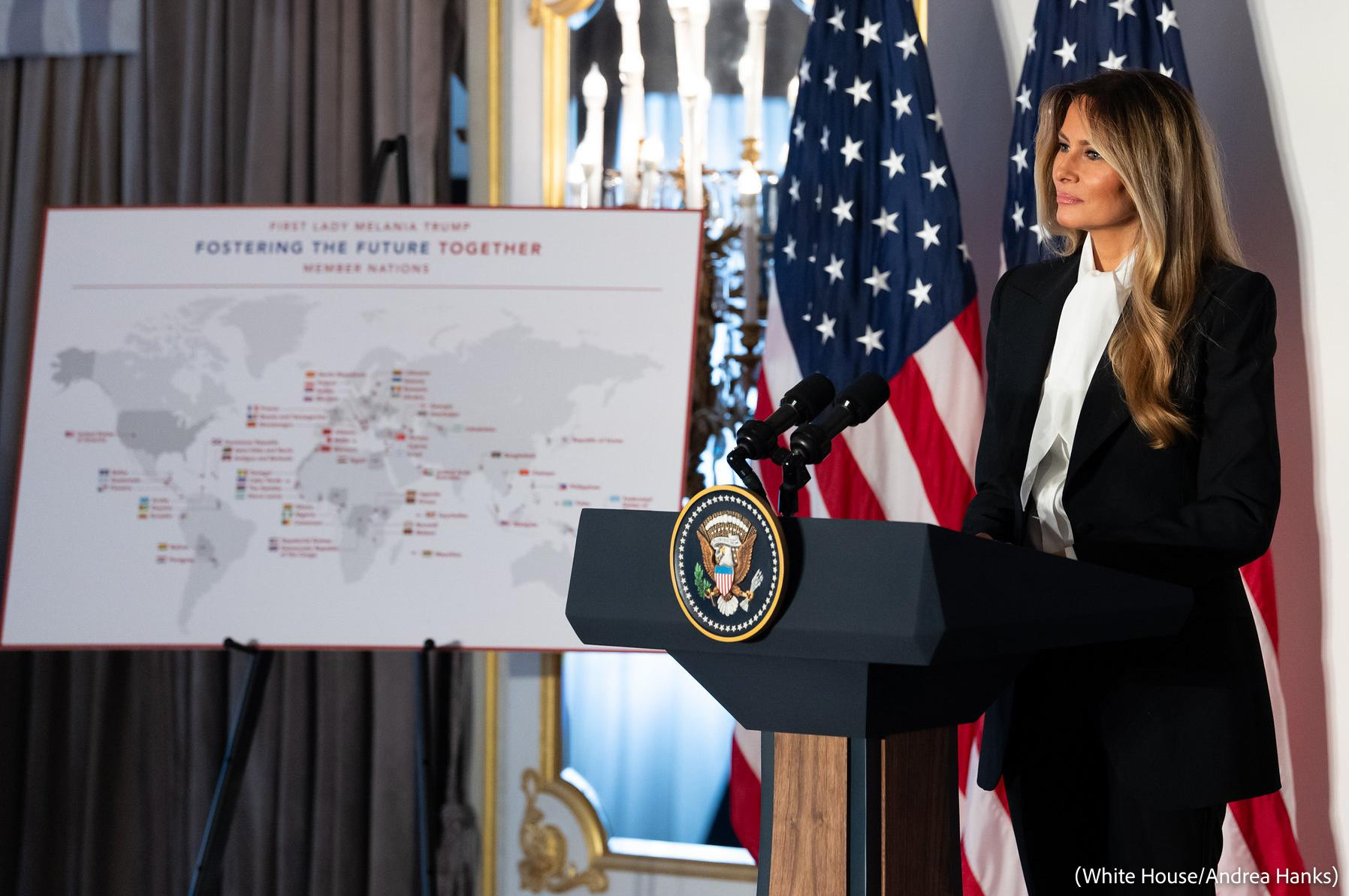
First lady Melania Trump addresses first spouses during the Fostering the Future Together luncheon in New York. (White House/Andrea Hanks)

In a room in New York, a few signatures carried a big promise.

One at a time, government ministers sat down beside tech leaders to put their commitments to children and youth in writing. Each signature brings students one step closer to the skills they need to succeed in a world shaped by technology.

Those signings were part of a larger effort.

First lady Melania Trump is partnering with major U.S. tech companies to bring super intelligence-powered digital learning tools safely and strategically to classrooms around the world.

Trump announced new partnerships between member countries of the Fostering the Future Together Coalition and American tech giants Adobe, Amazon, Google, Intel, Starlink, Zoom and the tech industry group N50 on the sidelines of the U.N. General Assembly back in September. The companies committed their resources and expertise to the effort to promote digital literacy and skills, super intelligence (SI) in education, other education technologies, and protect children online. Trump leads the coalition that has gained support from first spouses from every region around the globe.

Fostering the Future Together seeks “to empower children through technology and education to ensure that every child, regardless of where they are born, has the opportunity to imagine, learn, create and thrive,” Trump said in New York.

President Trump vowed that the United States will remain at the forefront of innovation in super intelligence, noting its promise for addressing modern challenges.

Paving a path for success

5 people standing with certificates (White House/Andrea Hanks)
U.S. Special Envoy for Best Future Generations Charity Wallace (left) joins representatives from Intel and the government of Kenya following their ceremonial signing in New York. (White House/Andrea Hanks)

U.S. Special Envoy for Best Future Generations Charity Wallace leads the Department of State’s efforts to expand the first lady’s coalition, which has grown to nearly 60 nations and more than 30 private sector partners.

The focus on online protection and tech education fits with U.S. private sector efforts to bring internet access to the 3.1 billion people worldwide who lack connectivity. Starlink, the satellite arm of Texas-based SpaceX, is bringing internet access to schools in El Salvador and Papua New Guinea.

During her remarks at the event on the sidelines of the U.N. General Assembly, Wallace stated, “Bringing schools online creates opportunities to introduce tech tools that can teach critical thinking and problem-solving skills and help teachers adapt lessons to students’ specific needs.”

Wallace noted one hour to 90 minutes of personalized tablet-based learning can reinforce teaching and help students stay on track. While tech tools can enhance education, they are not intended to reduce in-person instruction.

“The children who will succeed are those who know how to use the technology well, versus have the technology replace their ability to think and reason,” she said.

Tech companies’ new or expanded efforts include Adobe’s plan to offer learning and creative tools through its Student Spaces platform in multiple languages. Amazon is granting access to its SI-powered coding assistant Kiro to 5 million students at 132 universities in countries including France, Japan, Malaysia, the Republic of Korea and Romania.

Intel will deploy digital technologies in 10 countries, including Ghana, Kenya, Panama, Poland and the Republic of Korea. Google, which runs an SI lab in Ghana, will invest an additional $4 million usd in educator training. The N50 Project, which works to expand internet access, is launching an SI education device program that will reach 10,000 students and 200 teachers in Uganda.

The first ladies of the Philippines, Poland, and Saint Kitts and Nevis plan to host Fostering the Future Together regional meetings in November.

“We understand that the future our children will inherit will be shaped by technology,” Saint Kitts and Nevis first lady Diani Prince-Drew says.

Students observing robot putting out fire (Courtesy of Intel Corporation)
Intel is expanding technology training programs in 10 countries, including the Republic of Korea, where students experiment with a firefighting robot. (Courtesy of Intel Corporation)

The signatures in New York marked a strong beginning. With each new partner and each regional meeting, more children will gain the tools to imagine, learn, create and thrive. For Trump, the Department of State and the coalition’s partners around the world, the work is just getting started.

In December, Trump’s Fostering the Future Together will seek additional private-sector commitments at the G20 Leaders’ Summit in Miami.

For The Silo, Brandon Lambert/Share America.

America Welcomes a New G20


StateDept

Dec, 2025

Author: U.S. Secretary of State Marco Rubio

Next year, the United States will host the world’s 20 largest economies for the first time since 2009. Coinciding with America’s 250th anniversary, the 2026 G20 will be a chance to recognize the values of innovation, entrepreneurship, and perseverance that made America great, and which provide a roadmap to prosperity for the entire world. We’ll showcase these values and more when we host the G20 Leaders’ Summit in December 2026 in one of America’s greatest cities, Miami, Florida.

Under President Trump’s leadership, the G20 will use four working groups to achieve progress on three key themes: removing regulatory burdens, unlocking affordable and secure energy supply chains, and pioneering new technologies and innovation. The first Sherpa and Finance Track meetings will be held in Washington, DC, on December 15-16, followed by a series of meetings throughout 2026. As the global economy confronts the changes driven by technologies such as Artificial Intelligence, and shakes off ideological preoccupations around green energy, the President is prepared to lead the way.

We will be inviting friends, neighbors, and partners to the American G20. We will welcome the world’s largest economies, as well as burgeoning partners and allies, to America’s table. In particular, Poland, a nation that was once trapped behind the Iron Curtain but now ranks among the world’s 20 largest economies, will be joining us to assume its rightful place in the G20. Poland’s success is proof that a focus on the future is a better path than one on grievances. It shows how partnership with the United States and American companies can promote mutual prosperity and growth.

The contrast with South Africa, host of this year’s G20, is stark.

South Africa entered the post-Cold War era with strong institutions, excellent infrastructure, and global goodwill. It possessed many of the world’s most valuable resources, some of the best agricultural land on the planet, and was located around one of the world’s key trading routes. And in Nelson Mandela, South Africa had a leader who understood that reconciliation and private sector driven economic growth were the only path to a nation where every citizen could prosper.

Sadly, Mandela’s successors have replaced reconciliation with redistributionist policies that discouraged investment and drove South Africa’s most talented citizens abroad. Racial quotas have crippled the private sector, while corruption bankrupts the state.

The numbers speak for themselves. As South Africa’s economy has stagnated under its burdensome regulatory regime driven by racial grievance, and it falls firmly outside the group of the 20 largest industrialized economies.

Rather than take responsibility for its failings, the radical ANC-led South African government has sought to scapegoat its own citizens and the United States. As President Trump has rightly highlighted, the South African government’s appetite for racism and tolerance for violence against its Afrikaner citizens have become embedded as core domestic policies. It seems intent on enriching itself while the country’s economy limps along, all while South Africans are subject to violence, discrimination, and land confiscation without compensation. Its former Ambassador to the United States was openly hostile to America. Its relationships with Iran, its entertainment of Hamas sympathizers, and cozying to America’s greatest adversaries move it from the family of nations we once called close.

The politics of grievance carried over to South Africa’s Presidency of the G20 this month, which was an exercise in spite, division, and radical agendas that have nothing to do with economic growth. South Africa focused on climate change, diversity and inclusion, and aid dependency as central tenets of its working groups. It routinely ignored U.S. objections to consensus communiques and statements. It blocked the U.S. and other countries’ inputs into negotiations. It actively ignored our reasonable faith efforts to negotiate. It doxed U.S. officials working on these negotiations. It fundamentally tarnished the G20’s reputation.

For these reasons, President Trump and the United States will not be extending an invitation to the South African government to participate in the G20 during our presidency. There is a place for good faith disagreement, but not dishonesty or sabotage.

The United States supports the people of South Africa, but not its radical ANC-led government, and will not tolerate its continued behavior. When South Africa decides it has made the tough decisions needed to fix its broken system and is ready to rejoin the family of prosperous and free nations, the United States will have a seat for it at our table. Until then, America will be forging ahead with a new G20.

Marco Rubio was sworn in as the 72nd secretary of state on January 21, 2025. The secretary is creating a Department of State that puts America First.