Tag Archives: G7

Not Quite the USA, But Canada’s Fiscal Challenges Can’t Be Ignored

Without a change in course, slow growth and rising spending will leave Canadians with stagnant living standards while shifting more of today’s burden onto younger and future generations, according to a new C.D. Howe Institute Verbatim.

In “The Endgame: Time to Act on Canada’s Economic and Fiscal Challenges,” author Don Drummond warns that Canada’s weak productivity and income underperformance, overreliance on US markets, and overall domestic vulnerabilities are not being taken seriously enough. He recommends a comprehensive economic plan to re-establish fiscal stability and help create a stronger, more resilient and diverse economy.

“With weak productivity growth, an ageing population and lower immigration, Canada’s economy could grow by just 0.5 percent this year and next,” says Drummond, Fellow-in-Residence at the C.D. Howe Institute. “That means rising deficits and debt, leaving governments with less fiscal room to respond to future challenges and improve living standards.”

The report states that Canada should expect continued tensions with the United States, making it more important to address its longstanding economic and fiscal weaknesses. Canada ranked last in the G7 for growth in gross national income per person over the decade to 2023 and has experienced persistently weak productivity growth. Combined with reduced access to US markets, these challenges make it harder for Canadian firms to compete and scale internationally. Drummond finds that these pressures will be harder to address as Canada’s population ages and the economy struggles to adapt to the costs of climate change.

His recommendations include eliminating internal trade barriers and streamlining regulatory processes, while reshaping taxes and spending to reduce deficits and support growth. This could include shifting some of the tax burden from corporate and personal income toward consumption, lowering marginal tax rates, and reviewing government spending to ensure better value for money. He also calls for maintaining environmental objectives and allowing post-secondary institutions greater flexibility on tuition. As frictions with the US persist and Canada’s federal deficits climb, Drummond calls for governments to act quickly but also asks that Canadians recognize that meaningful improvements will take time.

“While many cite Canada’s lower net debt-to-GDP ratio than other G7 countries, being the least indebted country in a heavily indebted group is not a fiscal strategy. The endgame should be a stronger, more resilient, and diverse economy with stable finances,” concludes Drummond. “Now’s the time to act.”

Introduction

A year ago, I spoke to the incoming 2025/26 Master of Public Administration (MPA) class about the economic and fiscal challenges facing Canada and the need for bold action (Drummond 2025). Conditions have not improved. You may think the latest trade friction with the United States suggests they have worsened, but a deterioration in the relationship was highly predictable, and tensions should be expected to continue. While some positive action has been taken, Canada is still not taking the challenges seriously enough. The bold action called for can be postponed no longer.

The Economic and Fiscal Challenges

Over the decade to 2023, gross national income per person grew a meagre 0.5 percent annually in Canada, ranking last in the G7 and 32nd out of 35 Organisation for Economic Co-operation and Development (OECD) countries (Drummond, Laurin and Robson 2026). This weak income growth reflects longstanding productivity underperformance relative to both Canada’s own history and other countries.

Canadian economic outcomes fall well short of US standards, and gaps are widening. Some take comfort in the argument that higher US averages are heavily influenced by the disproportionate number of extremely wealthy Americans. Yet the shortfall in Canadian inflation-adjusted median employment income was already substantial at CA$6,126 in 2010 and widened to $8,663 by 2024. From 1999 to 2025, Canadian productivity increased 26.7 percent, while US productivity rose 67.9 percent (Munro, Fuss and Emes 2026).

A severe blow to Canada’s most important trading relationship piles on top of the productivity challenge. The two interact in pernicious ways. Weak productivity makes it difficult to trade with other nations. Losing relatively free access to the US market makes it difficult for Canadian firms to build the scale needed to improve productivity.

Population ageing and climate change make the productivity and trade challenges even more difficult to address. An ageing population reduces the workforce and draws resources into healthcare and pensions. Climate change is exacting billions of dollars a year through infrastructure repairs, health costs, and rising insurance premiums resulting from flooding, wildfires, and extreme weather. The Canadian Climate Institute estimates that climate change will reduce Canada’s long-term annual economic growth rate by almost half, compounding into losses of hundreds of billions of dollars or more by the end of the century (Drummond, Philips and Harland 2026).

Canada’s fiscal situation acts as a drag on growth and limits our ability to address these challenges. The federal government alone projects deficits exceeding $50 billion a year as far as the eye can see, a net debt-to-GDP ratio staying above 40 percent, and tax and spending parameters that dull incentives to grow. And such dire outcomes do not fully reflect the commitment to massively increase defence spending. At least Canada’s fiscal situation and prospects are not as dire as those of the United States and many other countries.

Re-establishing fiscal stability is especially important now to mitigate the contagion from rising global bond yields, driven in good part by growing public debt burdens and a surge in long-term financing needs for artificial intelligence (AI). Canadian bond yields are creeping up but remain about 1 percentage point below US rates. That borrowing advantage is not guaranteed.

Inaction on stabilizing public finances is often justified by the Canadian federal government’s lower debt burden compared to other major countries and our own history. But the Canadian debt advantage is much less pronounced when considering all levels of government and using gross debt – which removes the current surpluses from the Canada and Quebec Pension Plans, which are not available to fund public services other than pensions. The current federal net debt burden of just over 40 percent of GDP, with about 13 cents of every revenue dollar going to debt charges, compares favourably with the 66.6 percent net debt-to-GDP ratio of 1995/96, when debt charges absorbed 35.2 cents of every revenue dollar. But it makes no sense to risk following the path of more indebted countries, which face even higher bond yields, or to repeat the worst of our own fiscal history, when Canada struggled to find buyers for its debt.

The only good thing that came out of Canada’s dire fiscal situation in the mid-1990s was the acceptance of a crisis and the will to act boldly. Surely, we can have the foresight to act boldly now before again hitting a fiscal wall.

The Status Quo is Unpromising

Drummond and Mahboubi (2026) projected Canada’s future economic growth rate assuming productivity continues to grow at its meagre average rate since 2000. Applying this assumption to the demographics resulting from population ageing and the new, lower immigration targets, this “supply-side” perspective on growth yields just 0.5 percent real GDP growth this year and next, and an average of 1.4 percent from 2026 to 2060 if the downward trend in average hours worked is arrested, or 1.2 percent if it is not.

The federal deficit would rise from the $50-billion-plus annual range projected in the 2026 Spring Economic Update, and the debt burden would continue rising as a share of GDP.

The bottom line would be stagnant economic well-being for individuals and a massive transfer of burdens to younger and future generations.

The Challenges Are Not Being Taken Seriously Enough

Undoubtedly, part of the reason bolder action has not been forthcoming is that many economists, especially forecasters, have put a rather rosy spin on prospects. Typical forecast assumptions include no further increase in the average tariff rate on Canadian exports and diminishing trade uncertainty. In other words, they attach no credibility to the rhetoric of President Donald Trump or the many trade agreements the US has been signing around the world that feature significant base levels of tariffs, with higher rates and quotas on selected products. We continue to see such a spin, with many rushing to predict that the latest round of US tariffs against Canada will only reduce real GDP by 0.4 or 0.5 percent, while assuring us that at least we still have the Canada-United States-Mexico Agreement (CUSMA).

Such analyses of what is taking place at the margins miss the point that the fundamental premise of all free trade agreements struck with the United States over the past few decades – that companies, whether Canadian or foreign, can freely access the US market from a base in Canada – has been broken. It will take a long time, if ever, to restore confidence in that premise. We must ask: if companies were not investing much when they thought they had access to the US market, why would they when such access is threatened?

It is difficult to comprehend the steadfast assurance that average tariff rates will not rise or CUSMA protections will remain. The US has rejected automatic renewal of CUSMA, is breaking its commitments daily, and has made it clear that it expects to extract a fee from all those American firms that buy from outside the United States. The sort of fee it appears to have in mind, and has been extracting from other countries, can make it unprofitable for Canadian exporters and US importers to do business.

Output per hour worked – productivity – has averaged 0.8 percent growth since 2000 and only 0.5 percent over the past four years. Yet most forecasters assume much stronger rates going forward. The Bank of Canada, for example, assumes 1.4 percent average annual growth in productivity through 2028, a pace not seen in decades. It adds 0.2 percentage points per year for the growing application of AI and assumes employers will squeeze more output per worker from the dwindling labour force. These are unproven assumptions and still do not fully explain the optimism. Such forecasts feature much stronger growth than the “supply-side” projections of Drummond and Mahboubi (2026). The latter are not a forecast per se. Productivity could grow more strongly. Demand growth could outstrip supply. But outcomes could just as easily be even weaker. Given global uncertainty and trade tensions with the United States, it would be wise to take such downside risks more seriously.

The Bank of Canada should be given credit for at least thinking about the macroeconomic implications of AI applications. But much more work needs to be done on these issues. And in the meantime, some healthy scepticism about AI’s potential benefits for productivity is in order. First, there have been many technological breakthroughs during the period of Canada’s declining productivity growth. Second, work by the Future Skills Centre (2024) found that while firms applying AI have higher productivity than those that do not, AI itself did not raise productivity.

If the challenges were being taken seriously enough, the federal government would not have abandoned its promise from five years ago to establish an independent commission on productivity. It also would have followed through on its election promise to establish a group to examine corporate taxation. Clearly, the government understands the problems but has decided not to call upon expert advice or encourage national discussion at this time.

If the challenges were taken more seriously, we would not see federal and provincial politicians uniting in the quest for international free trade while maintaining internal trade barriers. The International Monetary Fund has said these barriers are equivalent to a 9 percent external tariff on all Canadian goods and services, and that removing them could raise real GDP by 7 percent in the long run (Diez and Yang 2026). Some barriers have been reduced since the IMF made these estimates, but they remain substantial.

If the challenges were taken seriously, we would see a concerted national – federal, provincial, territorial, and municipal – effort to streamline regulatory processes. Federal approval alone of projects can easily take more than five years. Add often separate and sequential approval processes at the provincial, territorial, municipal, and Indigenous levels, and the projects being bandied around amid renewed interest in infrastructure may not even start for a long time.

Canada’s potential advantage in critical minerals is being cited often of late. But development, if it proves to be economically beneficial, could take decades. The federal government is taking action, including setting up a Major Projects Office and enacting the Building Canada Act. It has been noted, however, that the underlying obstacles – “political decision-making over individual projects and open-ended criteria that require regulators to consider broad public policy objectives” remain largely unaffected (Vegh and Koplovich 2026).

If the challenges were taken seriously enough, we would have a comprehensive federal economic plan that realistically lays out the challenges, presents options for national consultation, and sets out a plan for bold action. Instead, we get speeches, webinars, and budget documents that cover the territory only partially and reach relatively few Canadians. The prime minister has said Canadians will be required to make sacrifices. But time after time, the government softens those sacrifices by borrowing more money: to increase the Old Age Security payments for those 75 and over, a cohort with one of the lowest poverty rates; to rename the GST low-income credit the Canada Groceries and Essentials Benefit (CGEB) and increase it; to offer more incentives to first-time home buyers and purchasers of new homes; to suspend the federal gasoline excise tax for six months – and then extend the suspension as gasoline prices failed to decline; and to put still more money into subsidies for childcare.

In all these cases, the federal government addresses affordability issues by borrowing more. That simply transfers the burden forward. Where there is a demand-supply balance, demand is stoked further with much less effort applied to supply enhancement. Affordability challenges would be better met by greater efforts to raise Canadian productivity and incomes. Some of the government’s actions, such as more infrastructure spending, will certainly help productivity, but a cohesive plan is not being applied across all spending.

If the challenges were taken seriously enough, we would not see the federal government take the more than $5 billion fiscal windfall from higher oil prices and spend every cent of it in the 2025 budget, mostly to bolster consumption. We would not have seen an 80 percent increase in government operating costs over 10 years, with a 90,000 expansion in the number of federal civil servants – a one-third increase – together with a doubling of contracting costs. Average compensation for full-time equivalent bureaucrats also reached $143,271 (Terrazzano 2026). That is far higher than what is made by the majority of Canadians funding such pay through their taxes. Despite this growth, services do not appear to have improved. The government has cited new programs such as pharmacare and the Canadian Dental Plan, but much of the administrative burden is carried by the provinces and the private sector. Efforts to cut federal spending have been half-hearted, often going little beyond incentivizing civil servants to leave. Even after these so-called cuts, the ratio of program spending to GDP, is projected to reach its highest level since 1994/95 by 2030, outside of the pandemic years.

What Would a Strategy Look Like?

The starting point for a more serious course of action would be to put a comprehensive economic plan to Canadians, realistically depicting the challenges and options for action. If Canadians understand the gravity of the situation, they will give political licence to act, as they did with the initial Free Trade Agreement and the assault on the deficit in 1995.

Governments and private sector agents would cut the wishful thinking from their projections and depict the probable problems under the status quo.

Governments at all levels and in all jurisdictions would unite to finally end internal trade barriers. They would work together to streamline regulatory processes without compromising environmental standards or Indigenous rights. And they would do it soon and quickly.

Governments would radically alter the fiscal landscape with lower deficits and debt burdens and taxation and spending parameters targeted at promoting growth. The focus would be on much lower spending. Restoring the ratio of program spending to GDP that prevailed from 2003/04 to 2019/20 would reduce spending by $66 billion by 2030 and, on its own, bring the budget back close to balance.

The federal government would proceed with the promised review of taxation. The recommendation would inevitably be to shift the composition of Canadian taxation away from the overuse of corporate and personal income taxes, which are the most damaging to economic growth, and toward consumption taxes. The government would cut corporate and personal income tax marginal rates (see Mintz, Laurin, and Dahir 2026). It would also end the steep marginal corporate income tax rate corporations face if they try to grow beyond the definition of a small business.

A federal government plan would feature a comprehensive review of spending with a value-for-money perspective. Programs that could not be reformed to deliver intended outcomes efficiently would be scrapped. The results of the review would be made public to Canadians. The resulting action would need to be sweeping, such as gradually raising the age of entitlement for Old Age Security (OAS) and lowering the income threshold at which OAS payments are clawed back. Programs like $10-a-day childcare would be reformed to recognize that a crisis of affordability has become a crisis of accessibility. Business subsidies should be cut back drastically, as many simply transfer income rather than address market failure. Only about 20 percent of subsidies boost real income (Lester 2026). Supply management in agriculture should be reformed, not to appease the United States, but to raise productivity and lower prices in Canada. Supply management need not be scrapped. The focus should be on greater flexibility in quotas and caps on subsidized prices.

A serious approach would also recommit to environmental objectives, including lower greenhouse gas emissions that contribute to climate change. It is not fashionable of late to speak of environmental objectives, as many countries emphasize economic growth. But the future of the planet and its people depends upon reducing emissions. And this need not come at the expense of economic growth. Putting more emphasis on clean growth would be a start. The focus lately seems to be all on the development of fossil fuels and getting them to markets. But the combined global market value of clean energy technologies has grown about 20 percent per year over the past decade. Ironically, two of the world’s largest emitters lead in several dimensions of clean growth. China tops the world in clean energy infrastructure, and the United States invested over US$278 billion in clean energy and transportation in 2025 alone. Canada does not have to match their scale to capture a portion of the prize; it just has to identify and focus on existing competitive advantages (Drummond, Philips and Harland 2026). We now have a National Electricity Strategy. But it does not have nearly the buzz of the attention being given to fossil fuel development.

Government plans would recognize that Canada’s post-secondary education system can be a bedrock for people’s prosperity and well-being gains. Ontario has finally lifted the freeze on tuition. But by 2025, the initial cut and subsequent freeze had brought real (after-inflation) tuition in Ontario 26.6 percent below the 2018 level. That loss in real value is locked in for the foreseeable future. The February 2026 Ontario announcement raises grants by about $1 billion per year, but by 2027/28, they will still be more than 10 percent below 2015/16 in real terms per eligible student (Drummond 2026).

Institutions should be allowed greater flexibility on tuition. The after-inflation value of Ontario and federal grants for research should be restored and be better aligned with the economic transformation the province and Canada must accomplish. Governments should provide incentives to commercialize university-based research. Universities should be allowed to enrol more foreign students with proper accountability and objectives in place. The recent increase in the income requirements for foreign students is a good first step to curtail abuse, which was never widespread in universities, and should be complemented by ending foreign students’ ability to work off campus.

The Endgame and How to Get There

Canada has allowed itself to become too dependent on the United States and has ignored our domestic vulnerabilities for far too long. We are now paying the price. But by addressing the challenges, we can get to an endgame of a new economic and fiscal model that has a stronger, more resilient, and diverse economy with stable finances. The goal should be nothing less than being better off than we have ever been.

What will it take to get to this endgame?

  • An honest recognition of the economic and fiscal challenges.
  • A comprehensive plan.
  • Transparency with Canadians about the problems and the plan, sparking national discussion, debate, and hopefully, consensus on action.
  • A willingness to act.
  • Speed in acting, but patience with the inevitable lags in realizing improvements.

Conclusion: Let’s Act Now

Actions such as those recommended above always meet resistance as too controversial to be supported by the Canadian public and, hence, politicians, or too difficult to pull off within our system of federalism. But that may only be true if Canadians are not fully apprised of the seriousness of Canada’s economic and fiscal challenges. With such unfiltered information and a plan to ensure Canada’s prosperity, Canadians would likely offer widespread support, as they have in response to previous national challenges.

We must get serious and act now.

Edited remarks delivered to the School of Policy Studies, Queen’s University, on September 4, 2026. By Don Drummond

The author extends gratitude to Alexandre Laurin and Daniel Schwanen for valuable comments and suggestions. The author retains responsibility for any errors and the views expressed.

Don Drummond is a Fellow-in-Residence at the C.D. Howe Institute and a Stauffer-Dunning Fellow, School of Policy Studies, at Queen’s University.

References

Diez, Federico J., and Yuanchen Yang. 2026. “Canada Can Grow Faster by Unlocking Its Own Market.” International Monetary Fund. January 27. https://www.imf.org/en/news/articles/2026/01/27/cf-canada-can-grow-faster-by-unlocking-its-own-market.

Drummond, Don. 2025. “Shaken by Tariffs, Still Weak from Within: Canada Needs a New Economic and Fiscal Model.” Verbatim. Toronto: C.D. Howe Institute. September 4. https://cdhowe.org/publication/shaken-by-tariffs-still-weak-from-within-canada-needs-a-new-economic-and-fiscal-model/.

_____________. 2026. “Ontario Stops Deepening its Universities’ Financial Pit.” Intelligence Memo. Toronto: C.D. Howe Institute. March 6. https://cdhowe.org/publication/ontario-stops-deepening-its-universities-financial-pit/.

Drummond, Don, Alexandre Laurin, and William B.P. Robson. 2026. 2026 Shadow Budget. Commentary. Toronto: C.D. Howe Institute. Forthcoming.

Drummond, Don, and Parisa Mahboubi. 2026. “Resetting Expectations: Canada’s Economy in a Lower-Immigration Era.” E-Brief 383. Toronto: C.D. Howe Institute. May. https://cdhowe.org/publication/resetting-expectations-canadas-economy-in-a-lower-immigration-era/.

Drummond, Don, Peter Philips, and Kate Harland. 2026. “Canada Doesn’t Need to Abandon Climate Efforts in the Name of Growth or Unity.” The Hill Times. September 7.

Future Skills Centre. 2024. Waiting for Takeoff: The Short-Term Impact of AI Adoption on Firm Productivity. December.

Mintz, Jack, Alexandre Laurin, and Nicholas Dahir. 2026. “Big Bang” Tax Reform: Unleashing Growth in the Canadian Economy. Commentary 707. Toronto: C.D. Howe Institute. https://cdhowe.org/publication/big-bang-tax-reform-unleashing-growth-in-the-canadian-economy/.

Munro, Grady, Jake Fuss, and Joel Emes. 2026. Squandering the Canadian Century Part 1: Comparing Economic Performance in Canada and the United States. Fraser Institute. September 1. https://www.fraserinstitute.org/studies/squandering-canadian-century-part-1-comparing-economic-performance-canada-and-united-states.

Terrazzano, Franco. 2026. “Cost of Federal Bureaucracy Up 80 Per Cent in 10 Years: PBO.” Canadian Taxpayers Federation. February 17.

Vegh, George, and Kate Koplovich. 2026. Clear the Way: Does the Building Canada Act Help Canada Build? Commentary 728. Toronto: C.D. Howe Institute. September. https://cdhowe.org/publication/clear-the-way-does-the-building-canada-act-help-canada-build/.

Pas tout à fait les États-Unis, mais les défis budgétaires du Canada ne peuvent être ignorés

16 septembre 2026 – Sans changement de cap, la faible croissance et l’augmentation des dépenses entraîneront une stagnation du niveau de vie des Canadiens, tout en transférant la majeure partie de la dette actuelle aux jeunes générations et aux générations futures, selon un nouveau Verbatim de l’Institut C.D. Howe.

Dans « The Endgame: Time to Act on Canada’s Economic and Fiscal Challenges », l’auteur Don Drummond avertit que la faible productivité du Canada, la contre-performance de ses revenus, sa dépendance excessive à l’égard des marchés américains et ses vulnérabilités intérieures ne sont pas suffisamment prises au sérieux. Il recommande un plan économique qui vise à rétablir la stabilité budgétaire et à créer une économie plus forte, plus résiliente et plus diversifiée.

Lire communiqué de presse complet »

Canada Debt Becoming Unmanageable Economists Warn

With the Canadian government’s high debt-to-GDP ratios, such as a ratio of debt to nominal GDP sitting at 68 percent in March 2023, economists warn that government debt could become unsustainably high if Ottawa fails to reduce spending, increase productivity, and re-establish business confidence.

“We’re not growing our income per capita, which means that we’re not going to get the tax revenues that we need, plus we’re getting a lot of people retiring. So the situation could end up becoming quite unmanageable if we keep our pace that we’re going,” said Jack Mintz, president’s fellow at the University of Calgary’s School of Public Policy.

The federal government has run back-to-back budget deficits since the 2008 financial recession, with government spending spiking during the COVID-19 pandemic. As a result, Canada’s debt as a percentage of nominal GDP rose from around 51 percent in 2009 to 74 percent by 2021, for example. Nominal refers to the current value for the particular year without taking inflation into account.

The two previous federal budgets have attempted to lower government spending, but the federal government will still post a $40 billion deficit in 2023–24, which they project will shrink to a $20 billion deficit by 2028–29.

The Liberal government’s response to criticism by the opposition that Canada’s debt could lead the country into a financial crisis has been that Canada has among the best debt-to-GDP ratios in the G7.

According to Mr. Mintz, while Canada’s debt situation is not as bad as it once was, it doesn’t mean that it may not impact Canada’s prosperity prospects.

Conrad Black: Budget 2024 Is an Assault on Canadian Investment

ANALYSIS: Higher Income Taxes Not Only for Wealthy in Budget 2024

Mr. Mintz points out that Canada’s debt situation is not nearly as bad as in 1996. The government’s ratio of debt to nominal GDP ratio reached 83 percent that year.

Mr. Mintz also noted that Canada continues to have a triple-A credit rating according to the world’s leading credit agencies, meaning the country’s debt is not yet seen as problematic.

“We’re still viewed as having a much better credit line compared to a number of other countries. … But at some point, the credit agencies might look at that gross debt number and start asking the question, ‘Is it starting to become unsustainable?’” he said.

Lower Productivity Hampering Debt Payments

The federal government’s ability to pay off its debt could be hampered by low productivity, according to Steve Ambler, professor emeritus of economics at Université du Québec à Montréal.

“The thing that worries me in terms of federal government debt is we are currently in a period of extremely low productivity growth and low overall growth,” he said.

In March, the Bank of Canada’s senior deputy governor Carolyn Rogers warned that Canada’s poor productivity had reached emergency levels.

Although Statistics Canada said the country’s labour productivity showed a small gain at the end of 2023, that came after six consecutive quarters of productivity decline.

The right honourable Jean Chrétien.

Mr. Ambler said an appropriate way to lower the debt-to-GDP ratio is to keep government spending from increasing while also raising productivity to increase tax revenues. He said this was the strategy of Prime Minister Jean Chrétien, whose Liberal government established a budget surplus in three years by growing the economy and keeping government spending stagnant.

To lower Canada’s debt-to-GDP ratio, Mr. Ambler said the government should focus on increasing worker productivity, allowing its resource sector to grow, and easing back on discretionary spending.

He also cited a November 2023 C.D. Howe paper showing that business investment per worker in Canada has shrunk relative to the United States since 2015. Investments such as better tools for workers would increase productivity, while productivity growth would in turn create opportunities and competitive threats that spur businesses to invest, the paper said.

“Re-establishing business confidence would be almost the number one priority, especially in the resource sector,” Mr. Ambler said, adding that a future government might also be wise to lower the feds’ “wildly extravagant subsidy programs” for the electric vehicle (EV) sector.

The Liberal government has given tens of billions of dollars in subsidies for EV manufacturing projects in Canada since 2020, saying the factories will eventually create thousands of new jobs.

‘No Cushion’ to Mitigate Debt Issue

Joseph Barbuto, director of research at the Economic Longwave Research Group, has a more pessimistic view of Canada’s debt. He says that while federal debt is at levels similar to the 1990s, the crisis will be “larger” because the government does not have the “fiscal room to mitigate the downturn.”

Mr. Barbuto said that while the Canadian government was able to help alleviate its debt issues in the 1930s and 1990s by lowering its interest rates, it does not have that same luxury in 2024. The Bank of Canada lowered its key policy rate from 1.25 percent to 0.25 percent in 2020, and was forced to raise it to 5 percent by 2023 in response to rising inflation.

“There’s no interest rate cushion on the other side. Interest rates can only fall back to zero,” Mr. Barbuto said, noting that higher interest rates make it more difficult for governments to service their debt.

“The problem with the monetary system is there’s no fiscal discipline that is pushed on governments, unlike [individuals] or corporations,” he said.

“There will be a point where because of the accumulated interest with rising interest rates, eventually it’s going to overwhelm the government and then people will not lend the government any kind of capital.”

Mr. Barbuto also expressed concern over Canada’s private debt-to-GDP ratio. Private debt refers to debt owed by private, non-financial entities such as businesses and households, as opposed to public debt owed by governments and banks. Canada’s ratio of private debt to nominal GDP sat at 217 percent in December 2023 compared to 124 percent in 1995.

Mr. Barbuto said Canada’s private debt-to-GDP ratio is higher than that of Japan’s in the 1990s, and pointed out that the Japanese economy had stagnated after the country’s asset price bubble burst in 1992.

The research director believes the Canadian economy will eventually see a debt crisis and collapse in real estate that will result in austerity measures, a shrinkage in the size of government, and the “creative destruction” of the old political and economic system. He said this would be the continuation of an economic cycle that has repeatedly happened throughout history.

“[It’s] inevitable and necessary. A debt detox or deleveraging is the same thing as a drug detox. Nobody likes it, … but it’s a necessary part of the cycle for it then to go back up,” he said.

For the Silo, Matthew Horwood/Epoch Times.

Open Letter To The West On The New World Order

Paul Jenkins – The West and a Workable New World Order?

From: Paul Jenkins

To: Global governance observers

Date: May 2, 2024

Re: The West and a Workable New World Order?

One can describe the so-called liberal world order as a set of ideas for organizing world democracies. While openness and trade, rules and institutions, and co-operative security have been the principles that have shaped the liberal order, it also required sovereign nation states to provide the foundation for the creation and development of a system of intergovernmental organizations, or system of global governance.

In the aftermath of the Second World War, the system was designed primarily for the advancement, economically and politically, of Europe and the United States. Yet since 1945 the liberal world order has evolved, giving impetus to the steady increase in global economic integration to the benefit of many nations and people. 

Advances in science and technology have been critical to the evolution of the liberal order, but there has also been a need for the structures of global governance to evolve and keep pace.

On the economic front, for example, the collapse of the Bretton Woods system of fixed exchange rates, following Richard Nixon’s 1971 decision to abandon the dollar’s link to gold, gave rise to the creation of the G7. And the Asian Crisis of 1999 led to the creation of the G20.

Throughout the entire postwar period, however, tensions inherent between the sovereign authority of the nation-state and the need for collective global governance increasingly challenged the liberal order.

Indeed, the advent of the Cold War led to the liberal world order becoming hegemonic, organized around the economic and political strength of the United States with its dominance of global governance through the various institutions making up the global governance system. 

But over the years, pushback took hold. As the benefits of global economic integration spread and the United States was no longer the singular engine of growth, both democratic and autocratic countries found voice and began to resist the principles that shaped the liberal order. Even core nations of the liberal order began to voice their concerns in the aftermath of the Global Financial Crisis as the market-based financial system failed to self-regulate (as had been advertised), and as the liberal order proved unable to provide social protection for those adversely affected by globalization.

Effectively, a new world order began to unfold, with the resulting slowing and even fragmentation [DS1] [PJ2] of global economic integration.

At the same time though, virtually all nations, regardless of regime or stage of development, are facing the same challenges: Financial instabilities, rising inequality, weak productivity growth, climate change, spread of infectious disease, AI, cyber security and on and on.

These vulnerabilities represent global risks that can only be tackled and minimized through collective action. This in turn requires a new world order that treats the world as it is, not how we wish it to be. 

What does this mean for the West, and in particular the United States and Canada?

The unique advantages of the United States are its open society, fair and law-based market economy, and allure for talent from around the world. To sustain these advantages, maintaining its wealth and its position as the centre of the free world, it cannot close its doors to further global economic integration.

Geopolitically, what might this look like?

John Ikenberry argues that the answer can be found in the principles of sovereignty, territorial integrity, and non-intervention of the Westphalian system, the 1648 treaties that ended the Thirty Years’ War and established the modern nation state. The key insight of the Westphalian system is that all countries are vulnerable to the same global risks. The leap forward in mindset that is required is the acceptance that states are the rightful political units of legitimate rule. 

For the West, and the United States in particular, this implies the need to accept these new realities, and in so doing, the need to work together to build a new world order that preserves their liberal democratic values, and those of its allies, while at the same time recognizing that the economic challenges they face are not unique to them.

The unfolding relationship between the United States and China will define whether we achieve a workable new world order.

The economic incentives are there for this to happen. 

For China, the incentive is further progress in closing both its internal income gap as well as the gap between itself and the developed world. The payoff would be setting in place the foundation for a sustained rise in living standards for all its citizens. 

For the United States, the incentive is in preserving its strength as an open society and its vision of the world that has considered the interests of others. In many respects, it remains uniquely capable of playing the central role in sustaining the global economic system.

The challenge in re-imagining such a new world order is geopolitical. The task is to renew global governance with today’s realities in sharp focus.

Paul Jenkins. Mister Jenkins is a former senior deputy governor of the Bank of Canada and a senior fellow at the C.D. Howe Institute.

Ontario Takes Historic Action To Raise Minimum Wage To $15 Hour By 2019

Fair Workplaces, Better Jobs- $15 Minimum Wage and Equal Pay for Part-Time and Full-Time Workers Part of Plan to Help People Get Ahead in a Changing Economy

May 30, 2017 10:20 A.M.

Ontario is taking historic action to create more opportunity and security for workers with a plan for Fair Workplaces and Better Jobs. This includes hiking the minimum wage, ensuring part-time workers are paid the same hourly wage as full-time workers, introducing paid sick days for every worker and stepping up enforcement of employment laws.

Over the past three years, Ontario’s economy has outperformed all G7 countries in terms of real GDP growth. While exports and business investments are increasing and the unemployment rate is at a 16-year low, the nature of work has changed. Many workers are struggling to support their families on part-time, contract or minimum-wage work. Government has a responsibility to address precarious employment and ensure Ontario workers are protected by updating the province’s labour and employment laws.

To help safeguard employees and create fairer and better workplaces, Premier Kathleen Wynne announced today that the government is moving forward with a landmark package of measures, including:

-Raising Ontario’s general minimum wage to $14 per hour on January 1, 2018, and then to $15 on January 1, 2019, followed by annual increases at the rate of inflation.
-Mandating equal pay for part-time, temporary, casual and seasonal employees doing the same job as full-time employees; and equal pay for temporary help agency employees doing the same job as permanent employees at the agencies’ client companies.
-Expanding personal emergency leave to include an across-the-board minimum of at least two paid days per year for all workers.
-Bringing Ontario’s vacation time into line with the national average by ensuring at least three weeks’ vacation after five years with a company.
-Making employee scheduling fairer, including requiring employees to be paid for three hours of work if their shift is cancelled within 48 hours of its scheduled start time.

The government will also propose measures to expand family leaves and make certain that employees are not mis-classified as independent contractors, ensuring they get the benefits they deserve. To enforce these changes, the province will hire up to 175 more employment standards officers and launch a program to educate both employees and small and medium-sized businesses about their rights and obligations under the Employment Standards Act.
QUOTES

” The economy has changed. Work has changed. It’s time our laws and protections for workers changed too. Too many families are struggling to get by on part-time or contract work and unstable employment. And no one working full time in Ontario should live in poverty. With these changes, every worker in Ontario will be treated fairly, paid a living wage and have the opportunities they deserve.”
– Kathleen Wynne
Premier of Ontario

” These changes will ensure every hard-working Ontarian has the chance to reach their full potential and share in Ontario’s prosperity. Fairness and decency must be the defining values of our workplaces.”
– Kevin Flynn
Minister of Labour
QUICK FACTS

Today’s announcement responds to the final report of the Changing Workplaces Review, conducted by Special Advisors C. Michael Mitchell and John C. Murray, over the course of two years. It is the first-ever independent review of the Employment Standards Act, 2000 and Labour Relations Act, 1995.
The report estimates that more than 30 per cent of Ontario workers were in precarious work in 2014. This type of employment makes it hard to earn a decent income and interferes with opportunities to enjoy decent working conditions and/or puts workers at risk.

In 2016, the median hourly wage was $13.00 for part-time workers and $24.73 for full-time workers. Over the past 30 years, part-time work has grown to represent nearly 20 per cent of total employment.
Currently, half of the workers in Ontario earning less than $15 per hour are between the ages of 25 and 64, and the majority are women.
More than a quarter of Ontario workers would receive a pay hike through the proposed increase to the minimum wage.
Studies show that a higher minimum wage results in less employee turnover, which increases business productivity.
Ontario is proposing a broad consultation process to gain feedback from a wide variety of stakeholders on the draft legislation it intends to introduce. To facilitate this consultation, it is proposing to send the legislation to committee after First Reading.
LEARN MORE

The Changing Workplaces Review — Final Report

Disponible en Français

Équité en milieu de travail, meilleurs emplois

Salaire minimum de 15 $ l’heure et parité salariale pour travail à temps partiel et à temps plein afin d’aider les gens à réussir au sein de l’économie en évolution

30 mai 2017 10h20

L’Ontario adopte des mesures historiques afin de créer plus de possibilités et de sécurité pour les travailleuses et travailleurs grâce à un plan pour l’équité en milieu de travail et de meilleurs emplois. Il s’agit notamment de hausser le salaire minimum, de veiller à ce que les travailleurs à temps partiel touchent le même taux horaire que les travailleurs à temps plein, de prévoir des congés de maladie payés pour tous les travailleurs et de renforcer la mise en application des lois régissant le travail.

Au cours des trois dernières années, le rendement de l’économie de l’Ontario a surpassé celui de tous les pays du G7 sur le plan de la croissance réelle du PIB. Certes, les exportations et les investissements des entreprises sont à la hausse et le taux de chômage est à son plus bas en 16 ans, mais nous constatons aussi que la nature du travail a changé. De nombreux travailleurs éprouvent de la difficulté à subvenir aux besoins de leur famille avec un emploi à temps partiel, contractuel ou au salaire minimum. Le gouvernement a la responsabilité d’agir face à la précarité de l’emploi et de veiller à ce que les travailleurs de l’Ontario soient protégés en actualisant les lois provinciales qui régissent le travail et l’emploi.

Pour contribuer à protéger les employés et créer des milieux de travail plus équitables et plus conviviaux, la première ministre Kathleen Wynne a annoncé aujourd’hui que le gouvernement va de l’avant avec un train de mesures inédites, dont les suivantes :

hausser le salaire minimum général en Ontario à 14 $ l’heure le 1er janvier 2018, puis à 15 $ le 1er janvier 2019, ce qui sera suivi par des hausses annuelles correspondant au taux d’inflation;
rendre obligatoire la parité salariale des employés à temps partiel, temporaires, occasionnels et saisonniers qui font le même travail que les employés à temps plein, et une paie égale pour les employés des agences de placement temporaire qui font le même travail que le personnel permanent de leurs entreprises clientes;
élargir le droit à des congés d’urgence personnelle pour inclure un minimum général d’au moins deux jours rémunérés par an pour tous les travailleurs;
faire correspondre la durée des vacances annuelles en Ontario à la durée moyenne nationale en accordant au moins trois semaines de vacances après 5 ans d’emploi avec le même employeur;
rendre plus équitable la planification des horaires de travail, ce qui comprend exiger que les employés soient payés pendant trois heures si leur quart de travail est annulé dans les 48 heures précédant l’heure de début planifiée.

Le gouvernement proposera aussi des mesures pour rendre plus équitable la planification des horaires du personnel, augmenter les congés familiaux et prévenir la classification erronée d’employés en tant qu’entrepreneurs indépendants, de manière à ce qu’ils obtiennent les avantages sociaux qu’ils méritent. Pour appliquer ces changements, la province embauchera jusqu’à 175 agentes et agents des normes d’emplois et lancera un programme de sensibilisation des employés et des petites et moyennes entreprises concernant leurs droits et obligations aux termes de la Loi de 2000 sur les normes d’emploi.

CITATIONS

« L’économie et le marché du travail d’emploi ont évolué. Il est temps d’adapter aussi nos lois et les mécanismes de protection de notre main-d’oeuvre. Trop de familles ont du mal à joindre les deux bouts avec du travail à temps partiel, contractuel ou instable. Aucun travailleur à temps plein en Ontario ne devrait vivre dans la pauvreté. Grâce à ces changements, les travailleuses et travailleurs de l’Ontario seront traités avec équité, toucheront un revenu décent et auront les possibilités qu’ils méritent.»
– Kathleen Wynne
première ministre de l’Ontario

« Ces changements feront en sorte que les Ontariennes et Ontariens qui ont du coeur à l’ouvrage puissent avoir la chance de réaliser tout leur potentiel et de partager la prospérité de l’Ontario. L’équité et la cordialité doivent être des valeurs définitoires de nos lieux de travail.»
– Kevin Flynn
ministre du Travail

FAITS EN BREF

L’annonce d’aujourd’hui va dans le sens du rapport final de l’Examen portant sur l’évolution des milieux de travail que les conseillers spéciaux C. Michael Mitchell et John C. Murray ont mené pendant une période de deux ans. Il s’agit du tout premier examen indépendant de la Loi de 2000 sur les normes d’emploi et de la Loi de 1995 sur les relations de travail.
Le rapport évalue que plus de 30 % des travailleurs ontariens avaient un emploi précaire en 2014. Ce genre d’emploi fait qu’il est difficile d’obtenir un revenu suffisant et compromet les chances de profiter de conditions de travail décentes, en plus de faire subir des risques aux travailleurs.
En 2016, le salaire horaire moyen était de 13 $ pour les travailleurs à temps partiel et de 24,73 $ pour les travailleurs à temps plein. Au cours des 30 dernières années, le travail à temps partiel a augmenté de sorte qu’il représente près de 20 % de tous les emplois.
À l’heure actuelle, la moitié des travailleurs en Ontario qui gagnent moins de 15 $ l’heure ont de 25 à 64 ans et la majorité de ces effectifs sont des femmes.
Plus du quart des travailleurs de l’Ontario recevraient une hausse salariale grâce à l’augmentation proposée du salaire minimum.
Des études démontrent qu’un salaire minimum plus élevé réduit le roulement du personnel, ce qui accroît la productivité des entreprises.
L’Ontario propose un vaste processus de consultation afin d’obtenir la rétroaction d’une grande variété d’intéressés concernant le projet de loi envisagé. Pour faciliter cette consultation, il est proposé de soumettre le projet de loi à un comité après la première lecture.

POUR EN SAVOIR DAVANTAGE

Examen portant sur l’évolution des milieux de travail — rapport final

Ontario Ministry Of Transportation Assure “Historic Amount Of Infrastructure Being Built”

Patrick Brown spoke to the Ontario Road Builders Association where he made a number of false statements about the province. Facts Still Matter in Ontario, especially when it comes to the historic amount of transportation infrastructure being built right now across the province.


He said: “I believe we’ve seen lip service to infrastructure over the last 10 years but we’re not seeing shovels in the ground”


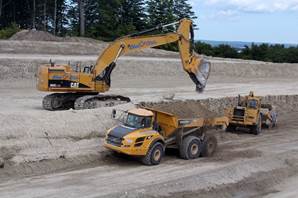
Fact: Here are some pictures of shovels in the ground

Eglinton LRT

eglington-lrt

Spadina Subway Extension

spadina-subway-extension

Waterloo LRT

waterloo-lrt


Highway 404 Extension

 highway404extension

(Source: http://m.thecrosstown.ca/Text-Summary-Eglinton-Crosstown-Update?device=mobile)

(Source: http://urbantoronto.ca/news/2012/07/work-progressing-stations-spadina-subway-extension)

(Source: http://www.therecord.com/news-story/6119872-video-drone-s-eye-view-of-lrt-construction-through-kitchener-and-waterloo/)

(Source: http://www.bluestarconstruction.ca/operations-services/projects/404-2/)


He said: “You go to Gujarat, you think you’re on Canadian roads. They’ve really invested in Infrastructure. No wonder they’ve seen their economy grow. No wonder Gujarat was leading India in job growth.”


Fact: The next time he wants to make this point he’s welcome to use Ontario as an example. It’s no coincidence that our government is making the largest infrastructure investment in Ontario’s history and leading the G7 in economic growth.

(Source: https://www.ontario.ca/page/building-ontario, http://www.fin.gov.on.ca/en/economy/ecaccts/)


He said: “We want to make sure that historic infrastructure 130 billion is actually spent on infrastructure not spent simply on, on promises, on press releases”


Fact: Cost of the new GO station in Richmond Hill: $22 million, cost of the press release announcing it was open: $0, cost of catching Patrick Brown making up facts: priceless

(Source: https://news.ontario.ca/mto/en/2016/11/ontario-making-daily-commute-easier-for-york-region-families.html)


He said: “We have become the capital of red tape in North America”


Fact: The CFIB nominated has nominated the Ontario government for its golden scissors award for cutting red tape 3 years in a row. This year the government received two nominations.

(Source: http://www.cfib-fcei.ca/english/article/4786-cfib-announces-golden-scissors-award-finalists.html)


He said: “Projects need to start within mandate… It’s an insincere commitment promising something for 2019 or 2031”


Fact: Meaningful projects take longer than 4 years to build. If Patrick Brown won’t build anything that takes longer than 4 years that means he wouldn’t build any new subways or LRT’s.

(Source: http://vivanext.com/blog/2009/12/01/the-spadina-subway-extension-moves-forward/)


He said: “The biggest announcement was for Hydro One, government said we’d get money for infrastructure. Of the first $4 billion sold, 0 went into infrastructure, money has been diverted to general revenue”


Fact: All of this money went into the Trillium Trust to be spent on projects like like GO Regional Express Rail, Mississauga and Hamilton LRT’s and the recently announced natural gas expansion.

(Source: https://news.ontario.ca/mof/en/2015/04/the-trillium-trust-and-moving-ontario-forward.html, https://news.ontario.ca/moi/en/2017/01/expanding-natural-gas-to-more-communities-across-ontario.html)

For the Silo, Alana Kiteley.