Tag Archives: science and technology

The Space Fence Safeguard

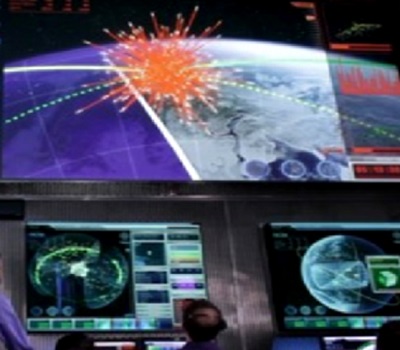
Space FenceLockheed Martin Space Fence Tracks Over 25,000 Orbiting Objects

Lockheed Martin continues refining its technology solution for Space Fence, a program that revamps the way the U.S. Air Force & U.S. Space Force identifies and tracks objects in space. The U.S. Air Force selected Lockheed Martin in 2015 to build a $USD 914 million / CAD $1.25 billion   Space Fence Radar to Safeguard Space Resources.

Lockheed Martin’s Space Fence solution, an advanced ground-based radar system, enhances the way the U.S. detects catalogs and measures more than 200,000 orbiting objects and tracks over 25,000 orbiting objects. With better timeliness and improved surveillance coverage, the system protects space assets against potential crashes that can intensify the debris problem in space.

“Space Fence locates and track space objects with more precision than ever before to help the Air Force transform space situational awareness from being reactive to predictive.”

Lockheed Martin delivered up to two advanced S-Band phased array radars for the Space Fence program. The Space Fence radar system greatly improves Space Situational Awareness of the existing Space Surveillance Network.

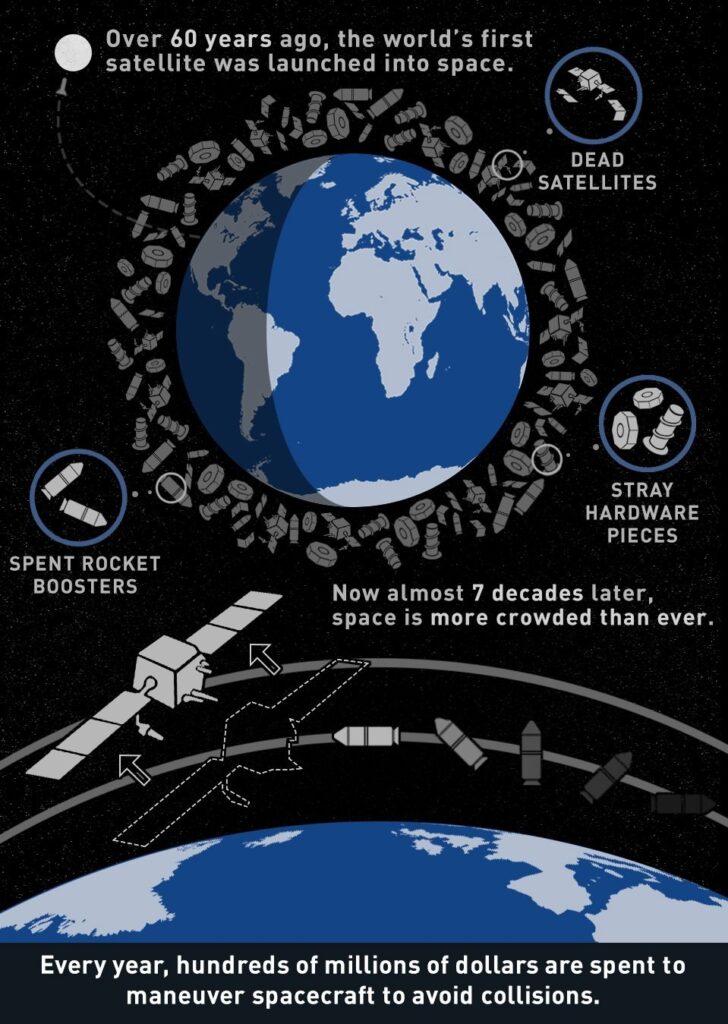
That's a LOT to track! [CP]
There is a lot to track and growing space debris every year.
Construction of the new Space Fence system on Kwajalein Atoll in the Marshall Islands began in February 2015 to meet the program’s 2018 initial operational capability goal. With more than 400 operational S-band arrays deployed worldwide, Lockheed Martin is a leader in S-band radar operation. The Lockheed Martin led team, which includes General Dynamics and AMEC, has decades of collective experience in space-related programs.

Headquartered in Bethesda, Maryland, Lockheed Martin is a global security and aerospace company that employs approximately 113,000 people worldwide and is principally engaged in the research, design, development, manufacture, integration and sustainment of advanced technology systems, products and services.

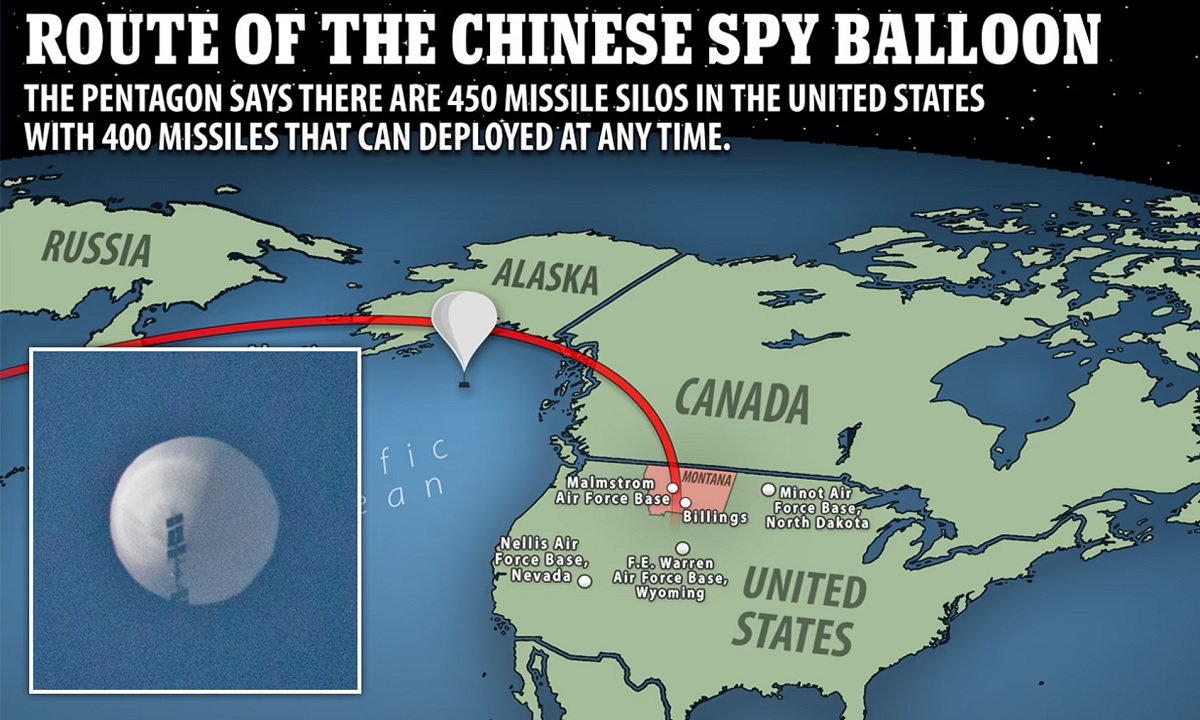
On 16 December 2002, US President George W. Bush signed National Security Presidential Directive which outlined a plan to begin deployment of operational ballistic missile defense systems by 2004.

The following day the US formally requested from the UK and Denmark use of facilities in RAF Fylingdales, England and Thule, Greenland respectively, as a part of the NMD Program.

The administration continued to push the program, despite highly publicized but not unexpected trial-and-error technical failures during development and over the objections of some scientists who opposed it. The projected cost of the program for the years 2004 to 2009 was 53 billion US dollars/ 72.2 billion CAD dollars, making it the largest single line in The Pentagon’s budget. For the Silo, George Filer.

ELEKTRO MOSKVA- Intriguing Documentary About Soviet Music Synthesizers

I spent most of yesterday afternoon watching and taking notes from the 86 minute documentary ELEKTRO MOSKVA. This film is so rich and interesting that I found myself sitting in reflection every time I jotted down another intriguing story element…..and believe me there were lots.

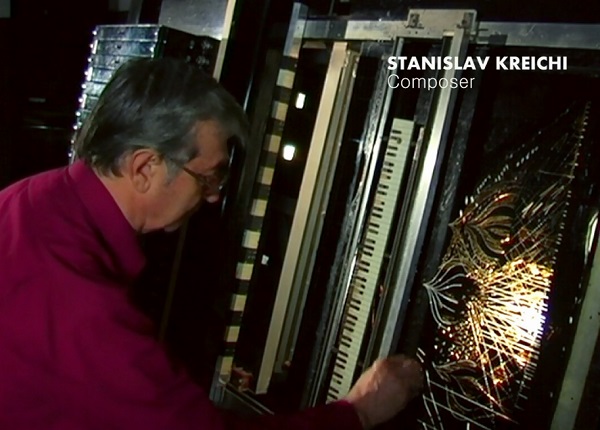
Stanislav Kreichi with ANS - world's first 'draw sound' synthesizer.
Stanislav Kreichi with ANS – world’s first ‘draw sound’ synthesizer.

The film’s official website describes itself like this: “ELEKTRO MOSKVA is an essayistic documentary about the beginnings of the Soviet electronic age and what remained of it- a huge pile of outdated, fascinating devices. Today they are being recycled and reinterpreted by musicians, inventors and traders, who carry that legacy on into an uncertain future. An electronic fairy tale about the inventive spirit of the free mind inside the iron curtain- and beyond.”

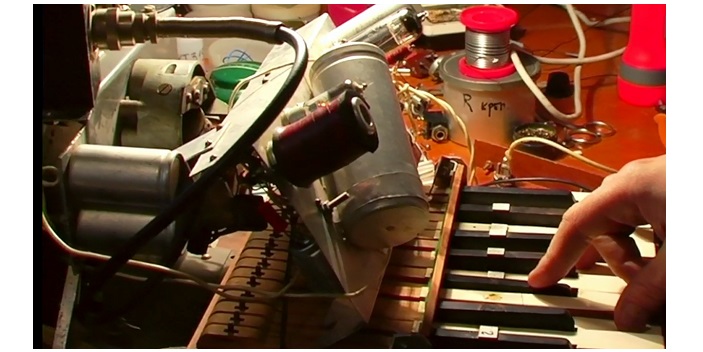
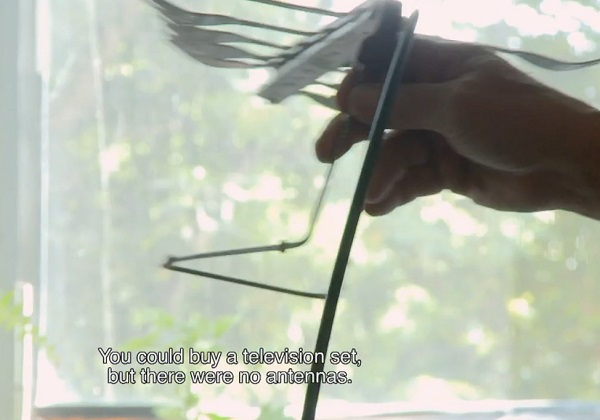
An example of everyday Soviet Russia DIY- In 1970 TV's were readily available but not antennas.
An example of everyday Soviet Russia DIY- In 1970 TV’s were readily available but not antennas.

Well all of that is certainly true but I discovered something deeper….. something partially hidden and really only stated at the end of the documentary: A metaphysical connection between electronic instruments, their circuitry and between immortality and rejuvenation. A sort of Frankenstein subplot. And that makes ELEKTRO MOSKVA much more interesting. It lingers and stays with you as all great films and documentaries tend to do.

Leon Theremin

Leon Theremin
Leon Theremin

Leon Theremin

If the inventor of the world’s first electronic instrument- The Theremin is to believed, his experimentation with electronic instrument designs led to techniques that allowed rejuvenation of human life and the bringing of the dead back to life. Kooky stuff to be sure but in our modern age of DNA manipulation and Stem Cell research shouldn’t we keep our minds open to all biological possibilities? Why is it so obtuse to think that electronic manipulation holds the key to immortality? The brain is after all- a sort of electronic computer. Why else would Russia have kept the body of Lenin whole and entombed for over a hundred years? Perhaps I’m getting ahead of myself- let’s move instead to the birth of Communist Synthesizers.

A Ghost of Communism: The backdrop for the film

It began with the Soviet electrification of the country.  Then, as Russian homes and farms became wired, Science and Technical Progress became heralded by the state as ‘the new Gods’. In 1926 Léon Theremin ( Lev Sergeyevich Termen ) invented an early form of television which was adapted for border security use and classified. At the same time, the state decided that technological developments were only considered legit and legal if they strengthened communism.

Alexey Borisov
Alexey Borisov

The long awaited electrical revolution expected by the masses and any notions of new, exciting products in Russian homes became instead a sort of electrified jail and super factory. Then, after Russia had successfully developed nuclear bombs and orbited the first man in space- things changed. A celebration of technical progress and Soviet achievement became politicized through the use of synthetic music and sound. Found out what happened next by watching ELEKTRO MOSKVA online in HD. Highly recommended. For the Silo, Jarrod Barker.

Click me! New Music created from early sci-fi soundtracks incl. Theramin cameos.
Click me! New Music created from early sci-fi soundtracks incl. Theremin cameos.

5 Free AI Identifying Tools That Are Free

Fake Photo? Manipulated Video? How to Spot Sham AI

This to preserve the credibility of digital media and safeguard users from falling victim to scams. As synthetic media becomes more sophisticated, identifying AI-generated manipulations presents a unique challenge, but numerous  free apps and tools are readily available allowing users to validate photo and video authenticity with ease—a major step forward in safeguarding trust in a world increasingly influenced by AI-generated visuals, ensuring transparency and security in the digital age. More below.

How AI Drives Misinformation

Amid the onslaught of highly concerning news headlines  spotlighting how deepfake AI-generated photo and video scams are driving rampant misinformation and wreaking havoc across digital, cultural, workplace, political and other societal frameworks, solutions are emerging combat AI-driven misinformation and fraud before people fall victim to scams.

One AI disruptor transforming the fight against AI fraud is BitMind—an AI deepfake detection authority that offers a suite of free  apps and tools that instantly identify and flag AI-generated images before you fall victim. 

Built by AI Engineers

Built by a team of AI engineers hailing from leading tech companies like Amazon, Poshmark, NEAR, and Ledgersafe, BitMind’s instant detection of deepfakes helps uphold the credibility of the media, guaranteeing the authenticity of the information we use. A strong deepfake detection enhances digital interactions, supports better decision making and strengthens the integrity of the modern digital world—serving to protect reputations, shield finances and maintain trust for celebrities, politicians, public figures … and everyone else.

x1 -1.pngtom.png

For both B2C and B2B use, these 5 BitMind tools are free and accessible to anyone: 

  • AI Detector App: A simple web page where users can drag-and-drop suspicious images for fast deepfake detection results;
  • Chrome Extension: Flags AI-created content in real-time, while browsing.
  • X Bot: Verifies if images on X/Twitter are real or AI-generated;
  • Discord Bot: Verifies if images are real or AI-generated via its Discord Integration;
  • AI or Not GameFun Telegram bot that tests your ability to distinguish between AI-generated and human-created images.

“Recognizing the need to integrate deepfake detection into everyday technology use, our applications fit seamlessly into users’ lives,” notes Ken Miyachi, BitMind CEO. “For example, the BitMind Detection App is a user-friendly application that allows individuals to upload images and quickly assess the likelihood of them being real or synthetic. Additionally, the Browser Extension enhances online security by analyzing images on web pages in real time and providing immediate feedback on their authenticity through our subnet validators. These tools are designed to empower users, enabling them to navigate digital spaces with confidence and security.”

As the world’s first decentralized Deepfake Detection System, BitMind is an open-source technology that enables developers to easily integrate the technology into their existing platforms to provide accurate real-time detection of deepfakes.

“Deepfake technology has emerged as both a marvel and a menace,” continued Miyachi.  “With the capacity to create synthetic media that closely mimics reality, deepfakes present unprecedented challenges in privacy, security, and information integrity. Responding to these challenges, we introduced the BitMind Subnet, a breakthrough on the Bittensor network, dedicated to the detection and mitigation of deepfakes.”

According to Miyachi, here are key reasons why BitMind technology is a game changer:

  • The BitMind Subnet, which represents a pivotal advancement in the fight against AI-generated misinformation. Operating on a decentralized AI platform, this deepfake detection system employs sophisticated AI models to accurately distinguish between real and manipulated content. This not only enhances the security of digital media but also preserves the essential trust in digital interactions.
  • The BitMind Subnet is equipped with advanced detection algorithms that utilize both generative and discriminative AI technologies to provide a robust mechanism for identifying deepfakes.
  • BitMind employs cutting-edge techniques, including Neighborhood Pixel Relationships, ensuring competitive accuracy in detection. The operation of the subnet is decentralized, with miners across the network running binary classifiers. This setup ensures that the detection processes are widespread and not confined to any centralized repository, enhancing both the reliability and integrity of the detection results.
  • Community collaboration is a cornerstone of the BitMind Subnet, actively encouraging the community to contribute to our evolving codebase, and by engaging with developers and researchers, the subnet is continuously improved and updated with the latest advancements in AI.
  • BitMind combines its extensive industry expertise, cutting-edge academic research, and a deep passion for technology. The team has a proven track record in AI, blockchain, and systems architecture, successfully leading tech projects and founding innovative companies.

What truly sets BitMind apart is their commitment to creating a safer, more transparent digital world where AI benefits humanity, driven by their passion for innovation, security and community engagement. Their technologies are expressly designed to safeguard the integrity of digital media and foster a trustworthy digital ecosystem.

In the modern world full of fake news and increasing cyber threats, BitMind’s innovations are paving the way for a future in which digital trust is not an option, but a necessity. As the threats increase, the global community must be equipped with the means to ingest digital information in a reliable and authentic in order to realize AI’s true potential safely and efficiently. For the Silo, Marsha Zorn.

Future Of Happiness Will Be Brain Stimulants

Happiness…..I popped the pink pill into my mouth and waited for the expected feelings of ecstasy.  No, the pill wasn’t the drug XTC, but rather a legal and safe “hacking” alternative. Then I put on my trans-cranial stimulation device, known as “The Thync,” and waited to see what happened. Wow! After five minutes, it felt like my brain was flooding me with endorphins. Finally, I placed the scalp stimulator known as the Tingler on my head. When I did this, an orgasmic wave of intense pleasure rippled through my entire body.

 
After a few minutes of this euphoria, I took off the devices and went about my day. Having just been catapulted into sweet ecstasy, my day became both incredibly productive and happy.
 

This is not a future scenario.

This is how I like to start my mornings. Nowadays, there are new and improved ways to feel good-even ecstatic-that most people don’t know anything about.  In an age when depression is rampant and dangerous drug use is epidemic, amazing new ways to feel peaceful, euphoric, and just plain happy are popping up all over the place. However, people miss out on these amazing methods because they simply don’t know about them. From safe drugs to “happy apps,” to high tech brain stimulation devices, a whole new world of ways to feel good is blossoming.
 
We live in an age where everything is shifting and accelerating.  Yet, most people still pursue an ancient path for finding happiness.  Their formula for being happy is to try to control all the external events and people in their lives to be exactly the way they want.  This is a tiresome activity at best, and there are always some events and people that we can’t control.  However, there is a new model for finding more joy and peace of mind: find it within your self.  Of course, this is a not a new idea.  Everyone from the Buddha to Jesus has said that heaven can be found within, but now there are cutting edge and more efficient ways to tap into this magical inner kingdom. 
 Buddha
As invited to talk to Google employees about “The Future of Happiness.”  I described new ways to control their minds and emotions that were more effective than trying to be happy by controlling all the events in their life.  The reaction was intense.  Everyone wanted to know what some of these innovative ways to “hack happiness” were, and how they could get them.  That led me to write a book on the subject.
 

In my research I learned that different things work for different people. 

For example, there are a lot of supplements known as “cognitive enhancers” that can dramatically increase your focus, energy, and mood. Yet, you have to try out many of them in order to find the one or two that really rock your world.   I also learned that people define happiness in unique ways.  Some people want a gadget that increases their pleasure, while other folks want a tool that improves their relationships or makes them feel totally peaceful.
Gary Numan “Complex” from The Pleasure Principle
 
As with all technologies, “inner” tech keeps getting better.  In fact, some of them are so good that it’s possible to get addicted to them. Ultimately, one has to discern whether a given gadget is truly a friend that helps them find the joy within–or is just another WMD-Widget of Mass Distraction.  Since there are many tools that do different things, there’s no simple answer as to whether  something is beneficial to you. 
 
For example, people become addicted and dependent on coffee.  Yet, on the other hand, caffeine can prevent many types of cancer, and helps people feel good and be productive. So, is coffee a “good” thing?  It’s up to you to decide…
 
In my own case, I decide if a specific technology is truly my friend by asking myself two questions.  First I ask myself,  “Does this tool lead me to being dependent on it?”   It’s always better when technology acts like “training wheels” on a bike-meaning that the tool exists so that you can eventually do without it.  If instead a gadget fosters a sense of dependence, then that’s a warning sign it may ultimately not be worth it.
 
The second question is, “Does this technology help teach me how to better connect with a sense of peace, love, or joy within?”  Even the Dalai Lama has reportedly said that if there were a pill that duplicated Buddha’s awakening, he would take it immediately and prescribe it for all living beings. If a tool helps me learn how to get to a more peaceful, loving place more efficiently, I think that’s a good thing.
 
WargamesIt’s hard to say exactly what the future holds, though Steve Jobs was seemingly pretty good at predicting it. In 1972 I had the unusual opportunity to be in a computer class with Steve Jobs.  Of course, at the time he was just a nerdy teen and I was four years his junior.  He and I would vie to play Tic-tac-toe on a 500 pound “computer” that our High School had recently purchased.  Steve was obsessed with this machine.  One day I asked Steve why he was so fixated on this refrigerator sized computer.  He turned to me and said in an intense manner, “Don’t you see?  This machine is going to change everything! It’s going to change the world!” 
 

It turns out Steve Jobs was right. 

Well, nowadays it may not seem like the latest brain supplement, neuro-stimulator, or mood enhancing app is going to change the world, but technology has a way of discreetly slipping into our lives. This “technology of joy” will only accelerate until the entire way we pursue happiness is transformed in the next few years.  I’ve seen that when people try out enough of these new gadgets, apps, and supplements, they inevitably find something that feels good–and is even good for them.  When that happens, their lives are never the same.  For the Silo, Jonathan Robinson.
 

Click me! Music for Scientists and their friends!

Clothes From The Future Available Now

Vollebak Logo
Part spaceship, part shop, the first Vollebak Spaceshop launched in Copenhagen in June. Before it heads off to service nearby galaxies, our friends at Vollebak are sending it on a world tour of Earth first.
Spaceshop World Tour | vollebak.com
Over the last year our friends at Volleback have partnered with sonic powerhouse Bang & Olufsen and Saga Space Architects to build their first prototype interstellar delivery vehicle …the Vollebak Spaceshop.

The craft itself is over 1,000kg of precision engineering that offers a glimpse into a future of interplanetary kit deliveries between Earth, the Moon and Mars. It was designed with SAGA Space Architects whose work includes lunar habitats for the European Space Agency, and lighting systems to help astronauts sleep on the International Space Station. And it’s fitted with Bang & Olufsen’s iconic Beolab 5 and Beosound 2 speakers.

If you missed launch night it involved space-based clothing, Earth-based alcohol, and the sound of the Spaceshop flexing its 120 decibels of muscle with ‘Intergalactic’ by the Beastie Boys. As soon as the next destination has been selected they’ll let you know. And while you’re waiting they have 4 pieces of space-ready cargo available for testing.

It includes their Martian Aerogel Jackets which are built from the Jet Propulsion Laboratory’s hypersonic deep space parachutes that landed the last Rover on Mars – and the same aerogel that stopped it freezing in the vacuum of space, and burning up on entry. They have their awesome Full Metal Jackets engineered from 11 kilometres of disease-resistant copper that were hailed by WIRED as “the virus-killing coat of the future,” and they’ve built to explore how humans could avoid taking diseases from Earth up into space.

You’ll also find electromagnetic Shielding Suits embedded with pure silver that block WiFi, Bluetooth, Ku-band satellites and radar systems, and deflect mid and long wave infrared radiation so they can’t be seen on infrared cameras. And last up they have the world’s first Anodised Jacket. Built with metallic insulation originally engineered by NASA to stop their spacecraft freezing in space, each jacket is fused with a near-invisible layer of metal from a galvanic bath that makes you appear cold or even invisible to infrared cameras.
Spaceshop World Tour | vollebak.com

Canada Is One Of World Economic Forum Top Technology Pioneers

From electro-chromatic e-windows to using supernova explosions to explore the earth for mineral deposits: World Economic Forum 2025 Technology Pioneers Leading New Wave of Global Innovation

  • The World Economic Forum selects 100 start-ups from 28 countries to join its Technology Pioneers community.
  • The new cohort marks a global surge of emerging technologies, from smart robotics and spatial AI to flying taxis and scalable quantum solutions.
  • Now in its 25th year, the community has recognized over 1,200 start-ups that have gone on to transform industries and societies worldwide.
  • For more information on the Annual Meeting of the New Champions 2025, visit wef.ch/amnc25 and share on social media using the hashtag #amnc25, or #2025夏季达沃斯#. Read more about the 2025 Technology Pioneers here.

Geneva, Switzerland, 2025 – The World Economic Forum 2025 Technology Pioneers community is a group of 100 early-stage companies from 28 countries driving innovation across industries and borders. Now in its 25th year, the program celebrates its strongest cohort yet, marked by broader geographical representation, greater diversity beyond Silicon Valley and the rise of more ambitious frontier technologies.

Reflecting wider shifts in the innovation landscape, many of the companies spotlighted are using artificial intelligence (AI) to reach greater scale and sophistication with fewer resources. Several are venturing into less explored frontiers – from asteroid mining and flying electric taxis, to leveraging satellite imagery to transform agriculture and harnessing energy from supernova explosions to locate critical minerals beneath the Earth’s surface.

The geography of innovation is also evolving.

While the United States remains the top contributor to the community, Europe’s share has surged to 28% – up from 20% last year – reflecting the rise of strong tech ecosystems across the region. China and India are also emerging as major tech innovation hubs.

“There has never been a more exciting time to dive headfirst into tech innovation. But no one gets far alone – you need a community to move your mission forward,” said Verena Kuhn, Head of Innovator Communities, World Economic Forum. “As we mark 25 years of the Technology Pioneers programme, this global community continues to connect start-ups to the networks and ecosystems they need to scale.”

This year also marks the 25th Anniversary of the Technology Pioneers programme. Since its inception in 2000, the community has championed early-stage innovation and recognized more than 1,200 companies, many of which have gone on to reshape industries worldwide. Alumni include household names such as Google, PayPal, Dropbox and SoundCloud, underscoring the community’s role as a launchpad for ideas and impact.

The 2025 cohort stands out for its concentration of companies developing breakthrough technologies to address pressing global challenges. These include advanced robotics, customisable space launch services, micro nuclear reactors and more accessible quantum computing applications. These pioneers will contribute cutting-edge insights to Forum initiatives over a two-year engagement program and will also be invited to participate in the Annual Meeting of the New Champions 2025, taking place on 24-26 June in Tianjin, People’s Republic of China.

The 2025 Technology Pioneers include:

Australia
•    Cauldron – Commercializing advanced continuous fermentation technology to unlock price parity for mainstream bio-manufactured goods.

Brazil
•    Brain4care – Using AI-based technology to enable timely medical interventions for patients with neurological conditions.

Canada


•    Ideon Technologies – Harnessing the energy from supernova explosions in space to image deep beneath the Earth’s surface, transforming how mining companies recover critical minerals.
•    Miru – Developing dynamic electrochromic windows that deliver high functionality, experience and energy efficiency for the automotive, transportation and architectural sectors.

Greater China
•    Deep Principle – Integrating advanced AI models and quantum chemistry to accelerate the discovery and development of chemical materials.
•    GS Biomats – Developing furan bio-based material, a renewable alternative to petroleum-based chemicals, for various uses including biomedical applications.
•    HiNa Battery – Producing more sustainable, high-performance, low-cost sodium-ion batteries.
•    KaiOS – Providing affordable internet and access to financial services to unserved populations, primarily in South Asia and Africa.
•    Lightstandard – Making large language model computing faster and more energy-efficient with photonic computing.
•    Noematrix – Focusing on researching and developing embodied intelligence systems and related tools and platforms, which are compatible with diverse hardware.
•    Novlead – Designing a molecular technology platform providing available, accessible and affordable nitric oxide solutions for major clinical needs.
•    Shengshu Technology – Building generative AI infrastructure that develops native multi-modal large models such as images, 3D and video. 
•    TRANSTREAMS – Engineering chips and solutions to address the computing power shortages in China during the era of AI-generated content.
•    Turing – Providing cutting-edge computing infrastructure and comprehensive AI solutions to drive the future of intelligent computing.

Colombia
•    Plurall – Supporting early-stage entrepreneurs in emerging markets with fast, accessible working capital and digital payment solutions, leveraging AI models for risk assessment, collections and embedded lending.

Denmark
•    Arcadia eFuels – Developing and deploying technology to produce electro-sustainable aviation and diesel fuels using renewable electricity, seawater, and captured CO2.

Egypt
•    Thndr – Offering a digital investment platform with a range of flexible funding methods and educational resources to empower investors.

France
•    Ascendance Flight Technologies – Decarbonizing aviation with a hybrid electric propulsion system and hybrid vertical take-off and landing (VTOL) aircraft.
•    Beyond Aero – Building the first electric business aircraft powered by hydrogen propulsion, as a sustainable alternative to traditional business jets.
•    CO2 AI – Helping large and complex organizations measure their environmental impact, identify credible levers and decarbonize at scale through AI.
•    Jimmy – Developing a micro nuclear reactor to provide carbon-free, competitive heat for industrial processes.
•    Nabla – Reducing clinician burnout by automating clinical documentation with AI.
•    Orakl Oncology – Creating a biology and AI-powered simulation platform to revolutionize oncology drug development.
•    Phagos – Deploying a sustainable alternative to antibiotics using bacteriophages and AI
•    Quobly – Making scalable, cost-competitive, large-scale quantum computers.
•    Sweetch Energy – Enabling osmotic power generation by harnessing the salinity gradient between freshwater and seawater.

Germany
•    Accure – Providing predictive battery analytics software to enhance safety, optimize performance and extend the lifetime of battery systems.
•    Black Forest Labs – Building generative deep learning models for media, particularly images and videos
•    eleQtron – Developing quantum computers by leveraging trapped-ion technology.
•    Tozero – Pioneering the delivery of recycled lithium in Europe by sustainably recovering critical materials from battery waste.

India
•    Agnikul – Providing affordable and customizable space launch services.
•    CynLr – Building robots with intuitive vision and enabling manufacturers and logistics providers to build fully automated factories.
•    Dezy – Leveraging AI-powered diagnostic technology to build affordable and accessible dental care. 
•    Digantara – Providing crucial operational support to commercial space operators and space surveillance intelligence to global space agencies.
•    Equal – Providing an integrated solution that combines identity verification with consent-driven financial data sharing.
•    Exponent Energy – Making 15-minute rapid charging for electric vehicles affordable and scalable through an innovative battery management system, charging algorithms, thermal management and a charging network.
•    Freight Tiger – Building India’s largest software-enabled freight network to help businesses move goods with full visibility, efficiency and lower costs.
•    GalaxEye – Creating a comprehensive, multi-sensor Earth observation system.
•    SolarSquare – Helping homes switch to solar in India with its full-stack solar panel systems.
•    The ePlane Co. – Developing flying electric taxis designed for intra-city transportation.

Ireland
•    Equal1 – Democratizing quantum computing by leveraging existing semiconductor technologies.

Israel
•    Fermata – Providing computer vision solutions for farmers to reduce crop losses and pesticide use.
•    Illumex – Empowering organizations to run governed and reliable AI agents through unified business data language and to democratize data access to every user.
•    LightSolver – Building a photonic supercomputer by harnessing the power of coupled lasers.
•    NanoSynex – Offering a rapid and accurate diagnostic platform for bacterial resistance.
•    ZutaCore – Developing waterless direct-to-chip liquid cooling for AI and high-performance computing (HPC) data centres.

Italy
•    Arsenale Bioyards – Building new lab-to-production infrastructure enabling fast, low-cost biomanufacturing at an industrial scale.

Japan
•    Sagri – Leveraging satellite data and AI to transform agriculture through land use optimization and sustainability.

Republic of Korea
•    Hylium Industries – Providing safe and innovative liquid hydrogen solutions for carbon-free mobility.
•    NARA Space – Building South Korea’s first microsatellite constellation for methane point source detection. 
•    Robocon – Developing robotics and smart factory solutions for the construction and steel industries.

Luxembourg
•    Tokeny Solutions – Building the compliance infrastructure for digital assets in blockchain and fintech.

Mexico
•    Allie – Creating closed-loop optimization systems for manufacturing that autonomously adjust production parameters in real time.

Nigeria
•    Cybervergent – Providing a platform to automate cybersecurity compliance and risk governance.
•    Sabi – Powering the sourcing and distribution of physical goods and critical commodities in Africa.
•    ThriveAgric – Empowering smallholder farmers across Africa by linking them to finance, data-driven best practices, and access to local and global markets.

Saudi Arabia
•    Intelmatix – Making enterprise AI accessible through industry-specific, context-aware AI agents.

Singapore
•   Manus – Automating a wide range of practical tasks for personal and professional use with a general AI agent.
•    Rize – Decarbonizing rice cultivation in Asia through scalable agricultural innovations.

Spain
•    Crisalion Mobility – Offering sustainable air and ground mobility solutions.
•    INBRAIN Neuroelectronics – Developing brain-computer interfaces to treat neurological disorders.

Sweden
•    Graphmatech – Developing advanced materials infused with graphene to make large-scale industries more innovative and resource efficient.
•    Lovable – Using AI to help users create software and web apps without coding expertise.

Switzerland
•    HAYA Therapeutics – Developing RNA-based medicines to treat heart, lung and tissue diseases.
•    Neural Concept – Accelerating product design through 3D generative engineering and AI.

Uganda
•    Numida – Using credit models and digital underwriting to provide loans to micro businesses.

Ukraine
•    Respeecher – Enabling scalable voice cloning across languages and contexts.

United Kingdom
•    CuspAI – Using frontier AI to accelerate the discovery and development of materials with specific functionalities.
•    Obrizum – Offering personalized digital learning services at scale through an AI-powered platform.
•    Oxford Ionics – Building high-performance quantum computers using trapped-ion technology.

United States
•    Ammobia –Fuelling the world with cost-effective, lower-carbon ammonia production.
•    Archetype AI – Pioneering a new form of Physical AI capable of perceiving, understanding and reasoning about the world through analysing real-time, multimodal sensor data.
•    Arine – Integrating cutting-edge AI, clinical expertise and advanced data analytics to deliver medication-based care interventions at the population level.
•    AstroForge – Making critical minerals more accessible to humanity by mining asteroids.
•    BforeAI – Using behavioural AI to predict and automatically pre-empt malicious campaigns and stop cyberattacks before they occur. 
•    Candidly – Developing an AI-powered platform to help borrowers manage and overcome educational loans.
•    Claryo – Helping warehouse operators maximize operational efficiency by leveraging spatial generative AI.
•    Distyl AI – Enabling enterprises to seamlessly integrate AI agents into operations.
•    Emvolon – Converting methane emissions into carbon-negative fuels for hard-to-abate sectors onsite.
•    Exowatt – Delivers solar power on demand by storing energy and converting it into electricity as needed, helping data centres and the grid run on clean energy 24/7.
•    Foundation Alloy – Commercializing solid-state metals technology to make higher performance metals using less energy.
•    HAIQU – Developing a new application execution stack for all modalities of near-term quantum computers.
•    Hertha Metals – Developing technology to decarbonize primary steel production.
•    Hyfe – “Turns food processing waste into chemicals that replace petroleum in everyday goods”.
•    Lumu Technologies – Providing cybersecurity operations capabilities to help businesses control the impact of cybercrime.
•    One Bio – Using biotechnology to add anti-inflammatory plant-based fibres to everyday foods.
•    Oberon Fuels – Developing innovative carbon-neutral fuels for maritime, propane, and hydrogen sectors.
•    Osmo – Combining frontier AI and olfactory science to digitize scent and enhance well-being.
•    Outtake – Securing digital identities by detecting and removing harmful AI-generated content.
•    Parallel Learning – Providing licensed therapy and instruction to students with learning differences through a digital platform.
•    Pavilion – Increasing efficiency in US public procurement with an AI-enabled government marketplace.
•    Reality Defender – Offering multimodal detection of AI-generated media to prevent fraud and disinformation.
•    RoboForce – Building AI-powered robotic systems designed for high-risk or repetitive work, to enhance efficiency, productivity and safety across industries.
•    Rubi Laboratories – Using biocatalysis to transform CO2 into essential materials like cellulose.
•    Shiru – Leveraging AI to identify and develop naturally occurring functional ingredients.
•    Starcloud – Constructing data centres in space to solve the AI energy challenge.
•    Waterplan – Delivering an AI-powered platform to measure, manage and mitigate water risk.
•    Workera – Providing AI-driven workforce skills intelligence and upskilling pathways.
•    Workhelix – Helping companies identify AI transformation opportunities and measure return on investment.

Uruguay
•    Prometeo – Creating a single, borderless banking application programming interface to connect companies with financial institutions across the Americas.

About the Annual Meeting of the New Champions 2025
The 16th Annual Meeting of the New Champions will take place from 24 to 26 June 2025 in Tianjin, People’s Republic of China, under the theme “Entrepreneurship for a New Era.” The meeting will convene over 1,700 leaders from business, government, civil society, academia, international organizations, innovation and media to explore entrepreneurial solutions to global challenges.

About the Technology Pioneers
Launched in 2000, the Technology Pioneers community marks its 25th anniversary in 2025 as a leading platform for early-stage companies from around the world that are shaping the future through breakthrough technologies and innovations. These companies are selected for their potential to have a significant impact on business and society and are invited to engage with public and private sector leaders through the World Economic Forum’s global platform.

The Technology Pioneers community is part of the Innovator Communities within the Forum’s Centre for the Fourth Industrial Revolution. The Innovator Communities convene the world’s leading global start-ups across different growth stages from early-stage Technology Pioneers to growth-stage Global Innovators and unicorn companies valued at more than $1 billion usd/ $ 1.373 billion cad.

Three and Half Decades Ago The Nighthawk Stealth Fighter Was Revealed

35 years ago, a mysterious and strikingly beautiful aircraft touched down on a dusty airfield in the Nevada desert. Can you imagine what kind of advanced aircrafts are being developed now?


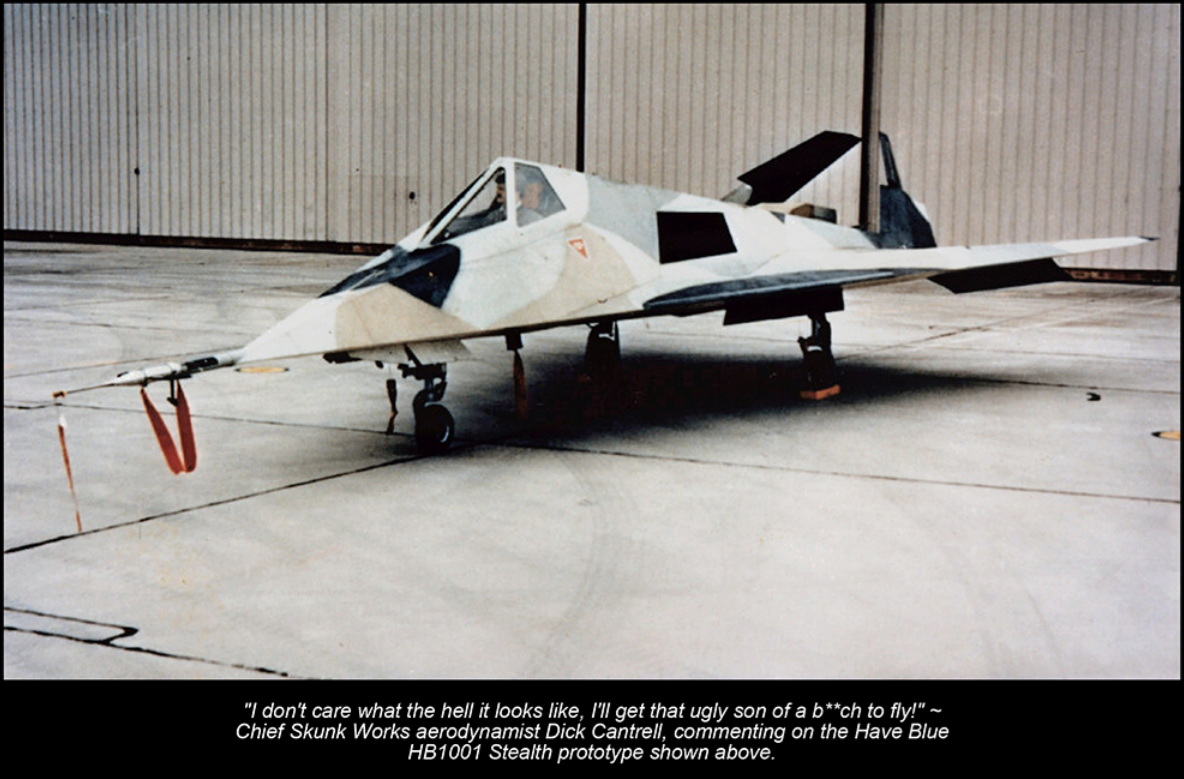
The F-117 Nighthawk


Since its public reveal decades ago (consider that development started in the 1970’s on this amazing machine), the Nighthawk served with quiet distinction through the latter half of the Cold War, the first Gulf War, a kerfuffle in Yugoslavia (bet you don’t remember that one) , and the invasion of Iraq in 2003.
Despite and official ‘retirement’ in 2008, the F-117 still gets spotted in the skies over Nevada where it is rumored to serve as an ‘aggressor aircraft’, helping to train pilots.


What’s the F-117 about?


With it’s cyberpunk like profile and stunning angles, the F-117 Nighthawk instantly captured the public’s imagination and birthed a lot of UFO /UAP stories, especially in the late 1980’s and early 1990’s when it’s unusual shape confused expectations of what an aircraft could and should look like.
A radical departure from the retro-aerodynamic curves of traditional aircraft design, the F-117’s odd shape serves a singular purpose.


Stealth.


The Nighthawk was conceived by Lockheed’s Skunk Works, a secretive development team responsible for some of the most capable aircraft of the 20th century.
Designed to slip through deep Soviet territory, the Nighthawk incorporated radical new technology to achieve an incredibly small radar and thermal signature. Hard edges, radar-absorbing coatings, a unique twin-tail, and special endinge cowlings reduced the aircraft to the size of a sparrow on Soviet radar.
The Nighthawk was deemed fully operational in the early 1980’s and nearly a decade her pilots and crew flight night sorties in complete secrecy.
Seven years later, the USAF and the Department of Defense decided the Nighthawk would work better as a deterrent if the world knew about it and it’s capabilities.


Plans were made to reveal the aircraft to the world at Nellis AFB on April 21, 1990. Those of us who saw this event live on television will always remember the shock and awe inspiring gasp it created- nothing like it had ever been seen before and it surely looked like something from a science fiction novel or movie.
On a hot spring day, a flight of two F-117s landed in front of thousands of cheering spectators, kicking off one of the most memorable air shows in US history. After opening the show, the F-117s sat quietly on the tarmac surrounded by an entourage of armed airmen and curious onlookers.
Although little was said about the new “stealth fighters”- blimps, fighter jets, and mock dog fights continued the day’s entertainment in style.


Even with talks of ‘spending prioritization’ and ‘doctrinal appropriateness’, the Nighthawk has endured, in it’s own special way, for nearly 40 years. Everything about the F-117 that made it great in the 1980’s still captivates us today. It’s razor-sharp edges, futuristic technology, and it’s family tree of stealthy cousins (foreign and domestic). Here is hoping many more years of this little black triangle up in the sky… via our friends at kommandostore.com

Canadian Company To Help Astronauts Return To Moon In 2026

ALUULA Composites, super-strong, lightweight polyethylene material is now being used to develop expandable habitats for NASA’s astronauts to live safely and comfortably on the moon for the 2027 planned landing. 

This small company on Canada’s west coast is playing a big role to help astronauts return and orbit the moon in 2026.

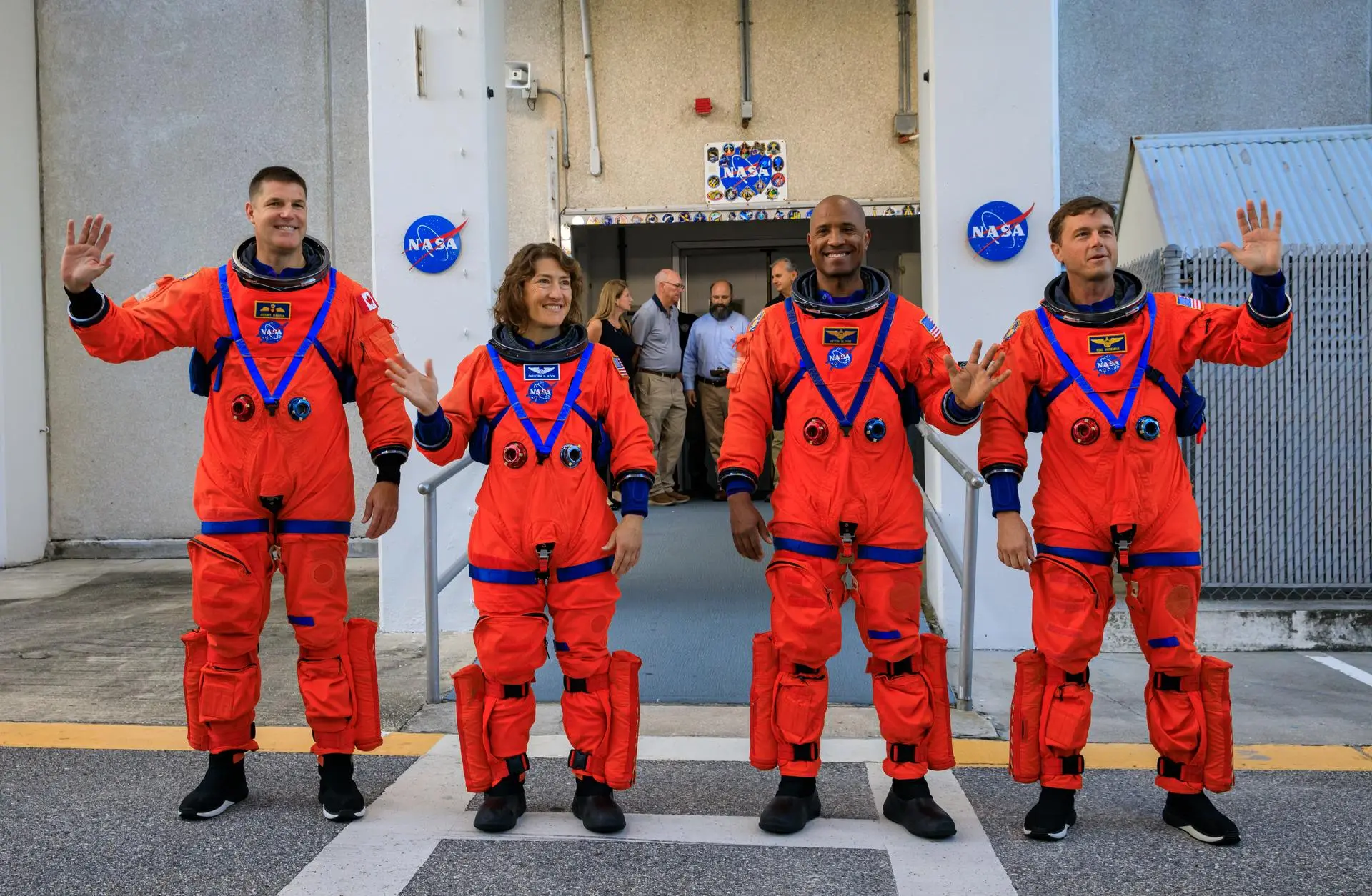
Artemis II crew members (from left) CSA (Canadian Space Agency) astronaut Jeremy Hansen, and NASA astronauts Christina Koch, Victor Glover, and Reid Wiseman walk out of Astronaut Crew Quarters inside the Neil Armstrong Operations and Checkout Building to the Artemis crew transportation vehicles prior to traveling to Launch Pad 39B as part of an integrated ground systems test at Kennedy Space Center in Florida photo: NASA

ALUULA Composites recently signed an agreement with Max Space, an American company, to use its innovative composite material to build space habitats on the moon. The company’s ultra-high-molecular-weight polyethylene (UHMWPE) laminate will be used to create a large living and working area for NASA’s astronauts when they return to the moon in September 2026. 

The innovative material was selected because it has eight times the strength-to-weight ratio of steel and is extremely durable, which is ideal for space travel.

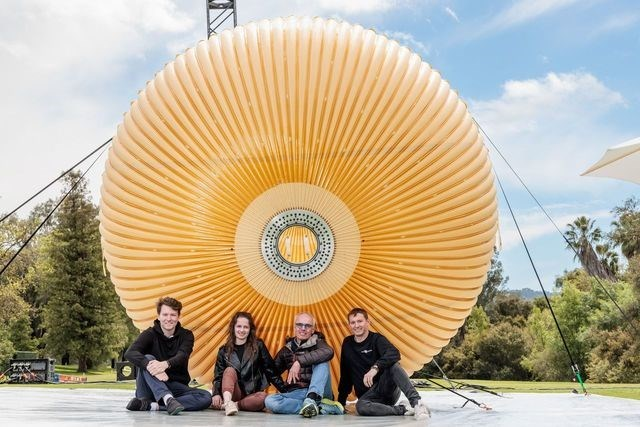
The Max Space team with their new expandable space habitat. photo: Max Space

The first Max Space inflatable space habitat is slated to launch with SpaceX in 2026. The Max Space inflatables can be delivered into space in very small packages and then unfolded and expanded to create a much larger work space. For the Silo, Paul Clarke.

Would You Use AI For Buying A Car? One In Four Buyers Already Do

A recent consumer survey backed by similar results from Elon University reveals that AI adoption for car shopping is skyrocketing, rapidly becoming a standard part of the automobile buying process. This as fully one in four buyers have already used AI tools this year to research, compare prices, negotiate and otherwise outsmart dealerships, and an overwhelming 88% found it helpful. Signaling a seismic shift in the way North Americans are now shopping for cars, nearly half of consumers indicated plans to use AI in their next purchase. Not just for buyer benefits, dealerships are gleaning critical business intelligence from AI to inform sales strategies, train staff and elevate customer engagement. The below  report from our friends at CarEdge, which offers its own AI Negotiator car buying tool saving shoppers thousands, details the first data-backed look at how AI tools are reshaping the car buying experience.

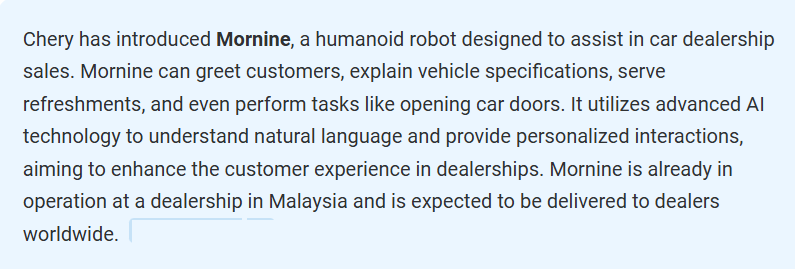
Mornine- AI powered car dealership robot.

Study: 1 in 4 Car Buyers Tap AI for Better Deals


Artificial intelligence is changing the way North Americans buy cars, and it’s a transition that is happening quickly. In the first-ever survey of its kind, CarEdge asked 500 car shoppers if they’re using AI tools like ChatGPT to research, compare, and negotiate during the car buying process. The results confirm a major shift is underway. One in four car buyers in 2025 are already using AI tools to gain an edge, and future buyers are even more likely to embrace these technologies.

Car buyers are finding AI to be a valuable tool. Among those who used tools like ChatGPT, Perplexity, Google Gemini, and others, 88% said it was helpful. AI is quickly becoming a trusted co-pilot for car buyers.

Key Findings: Car Buying Is Changing

The 2025 CarEdge AI & Car Buying Survey reveals a clear and growing trend: AI tools are quickly becoming part of the car buying process for a significant portion of consumers. Here are the standout findings:

1 in 4 Car Buyers Use AI 

25% of car buyers in 2025 say they used or plan to use AI tools like ChatGPT during the shopping or buying process. This contrasts with a recent survey by Elon University that found 52% of Americans now use AI large language models. While signs point towards increased adoption of AI tools, the CarEdge survey found that most car buyers are still in the early stages of integrating these tools into high-stakes decisions like vehicle purchases. This suggests there’s still significant room for growth in AI adoption amongst car buyers.

AI Use Is Accelerating

Among those who haven’t bought a car yet this year, 40% say they are using or plan to use AI tools during their search or deal-making. This is nearly 3x higher than the 14% seen among those who already bought a car earlier in the year.

AI Tools Deliver Results

Among those who used AI:

  • 88% say the tools were helpful
  • 32% found them very helpful
  • 60% used them “a lot” during the process

The AI Holdouts: Drivers Who Lease

Of the respondents who had already leased a car in 2025, none reported using any AI tools.

The AI-Adopting Buyer: Who’s Using It, and How?

AI adoption among car buyers is still in its early stages, but clear trends are beginning to emerge.

Among Buyers Who Already Purchased in 2025:

Just 14% of those who already bought a vehicle this year used AI tools during the process. Adoption rates were nearly identical across new and used buyers, with 14% in each group saying they used AI tools.

Among Future Car Buyers:

The numbers jump significantly when looking at those who haven’t yet bought in 2025. Among this group — who represent 39% of total respondents — 40% say they either already use or plan to use AI tools during their car search and buying process.

That’s more than triple the current usage rate among recent buyers, suggesting AI adoption is accelerating as awareness grows and tools become easier to use.

This group also appears to be more proactive: 60% of those who used AI tools during their buying journey said they used them “a lot,” while 40% used them only occasionally.

What Car Buyers Are Using AI Tools

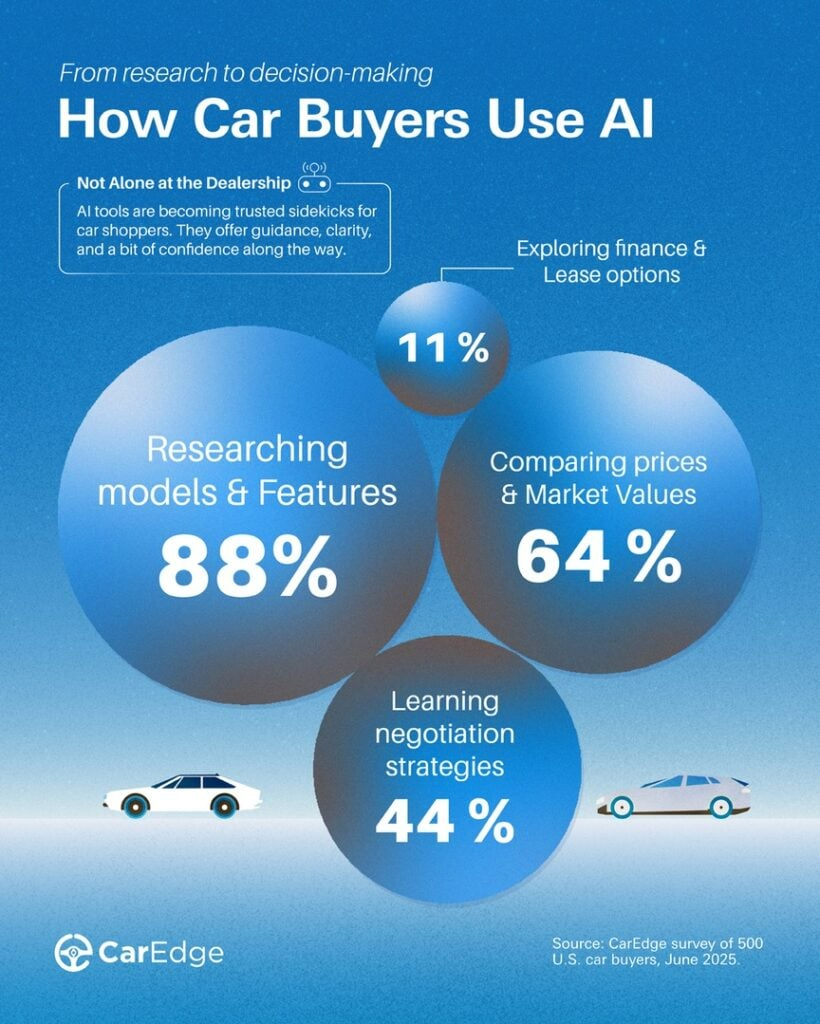
AI tools are quickly becoming essential research companions for car shoppers looking to make more informed, confident decisions. After all, why go it alone when a wealth of automotive knowledge powered by large language models (LLMs) is right in your pocket?

Among buyers who used AI tools during their car purchase or lease process, here’s how they put them to work:

88% — Researching Vehicles

The most common use by far, AI tools helped buyers learn about different models, trims, features, and reliability. For many, it was like having an always-available expert to explain the pros and cons of their options.

64% — Comparing Prices and Market Values

Buyers used AI to better understand fair pricing, from invoice pricing to out-the-door. 

44% — Learning Negotiation Strategies

Nearly half of AI users leaned on these tools to prepare for conversations with salespeople. Whether role-playing negotiation scenarios or asking how to spot add-on fees, this group used AI to level the playing field at the dealership.

11% — Exploring Finance and Lease Options

A much smaller portion of buyers used these tools to become familiar with leasing vs. financing, how to calculate payments, and similar queries.

Industry Implications

Car buying has always been tilted in favor of the dealership. Information asymmetry — what the dealer knows versus what the customer knows — has long been the source of consumer frustration, confusion, and overpayment.

That dynamic is beginning to shift.

This survey confirms what many in the industry are only starting to realize: AI is giving car buyers the upper hand. Tools like ChatGPT are helping consumers cut through the noise, ask smarter questions, and avoid common dealership traps. Instead of relying on guesswork or scattered advice, buyers are turning to AI for fast, personalized guidance at every step.

But one auto industry veteran has words of caution for buyers relying heavily on AI tools.

It’s both surprising and a little scary to see how quickly people are turning to AI to guide such a major financial decision,” said Ray Shefska, Co-Founder of CarEdge. “While tools like ChatGPT can be powerful, they’re only as good as the data behind them. AI should complement your research, not replace your own critical thinking.

That perspective underscores the real takeaway of this report: AI works best when it’s used thoughtfully as a tool, not as a crutch. In an age where automation raises fears of job loss or decision-making without human oversight, this survey offers a more optimistic view — one where technology helps everyday consumers make smarter choices. Used wisely, AI can help level the playing field and bring more transparency and fairness to the car buying experience.

Methodology

This survey was conducted by CarEdge between June 19 and June 24, 2025. A total of 500 U.S. respondents participated, recruited through the CarEdge email newsletter and social media channels. Questions were tailored based on buying status to better understand how and when AI tools were used in the car shopping process.

For the Silo, Karen Hayhurst.

About CarEdge
Founded in 2019 by father-and-son team Ray and Zach Shefska, CarEdge is a leading platform dedicated to empowering car shoppers with free expert advice, in-depth market insights, and tools to navigate every step of the car-buying journey. From researching vehicles to negotiating deals, CarEdge helps consumers save money, time, and hassle, hundreds of thousands of happy consumers have used CarEdge to buy their car with confidence. With trusted resources like the CarEdge AI Negotiator tool, Research Center, Vehicle Rankings and Reviews, and hundreds of guides on YouTube, CarEdge is redefining transparency and fairness in the automotive industry. Follow them on YouTubeTikTokX,  Facebook, and Instagram for actionable car-buying tips and market insights. Learn more at www.CarEdge.com.

Let’s Transform Canada’s AI Research Into Real World Adoption

October, 2025 – Canada has world-class strength in AI research but continues to fall short in widespread adoption, according to a new report from the C.D. Howe Institute. On the heels of the federal government’s announcement of a new AI Strategy Task Force, the report highlights the urgent need to bridge the gap between research excellence and real-world adoption.

In “AI Is Not Rocket Science: Ideas for Achieving Liftoff in Canadian AI Adoption,” Kevin Leyton-Brown, Cinda Heeren, Joanna McGrenere, Raymond Ng, Margo Seltzer, Leonid Sigal, and Michiel van de Panne note that while Canada ranks second globally in top-tier AI researchers and first in the G7 for per capita publications, it is only 20th in AI adoption among OECD countries. “This matters for the economy as a whole, because such knowledge translation is a key vehicle for productivity growth,” the authors say. “It is terrible news, then, that Canada experienced almost no productivity growth in the last decade, compared with a rate 15 times higher in the United States.”

The authors argue that new approaches to knowledge translation are needed because AI is not “rocket science”: instead of focusing on a single industry sector, the discipline develops general-purpose technology that can be applied to almost anything. This makes it harder for Canadian firms to find the right expertise and for academics to sustain ties with industry. Existing approaches – funding academic research, directly subsidizing industry efforts through measures such as SR&ED and superclusters, and promoting partnerships through programs like Mitacs and NSERC Alliance – have not solved the problem.

Four ideas to help firms leverage Canadian academic strength to fuel their AI adoption include: a concierge service to match companies with experts, consulting tied to graduate student scholarships, “research trios” that link AI specialists with domain experts and industry, and a major expansion of AI training from basic literacy to dedicated degrees and continuing education. Drawing on their experiences at the University of British Columbia, the authors show how local initiatives are already bridging gaps between academia and industry – and argue these models should be scaled nationally.

“Canada’s unusual strength in AI research is an enormous asset, but it’s not going to translate into real-world productivity gains unless we find better ways to connect AI researchers and industrial players,” says Kevin Leyton-Brown, professor of computer science at the University of British Columbia and report co-author. “The challenge is not that AI is too complicated – it’s that it touches everything. That means new models of partnership, new incentives, and new approaches to education.”

AI Is Not Rocket Science- 4 Ideas in Detail

Idea 1: A Concierge Service for Matchmaking

We have seen that it is hard for industry partners to know who to contact when they want to learn more about AI. Conversely, it is at least as hard for AI experts to develop a broad enough understanding of the industry landscape to identify applications that would most benefit from their expertise. Given the potential gains to be had from increasing AI adoption across Canadian industry, nobody should be satisfied with the status quo.

We argue that this issue is best addressed by a “concierge service” that industry could contact when seeking AI expertise. While matchmaking would still be challenging for the service itself, it could meet this challenge by employing staff who are trained in eliciting the AI needs of industry partners, who understand enough about AI research to navigate the jargon, and who proactively keep track of the specific expertise of AI researchers across a given jurisdiction. This is specialized work that not everyone could perform! However, many qualified candidates do exist (e.g., PhDs in the mathematical sciences or engineering). Such staff could be funded in a variety of different ways: for example, by an AI institute; a virtual national institute focused on a given application area; a university-level centre like UBC’s Centre for Artificial Intelligence Decision-making and Action (CAIDA); a nonprofit like Mitacs; a provincial ministry for jobs and economic growth; or the new federal ministry of Artificial Intelligence and Digital Innovation.

Having set up an organization that facilitates matchmaking, it could make sense for the same office to provide additional services that speed AI adoption, but that are not core strengths of academics. Some examples include project management, programming, AI-specific skills training and recruitment, and so on. Overall, such an organization could be funded by some combination of direct government support, direct cost recovery, and an overhead model that reinvests revenue from successful projects into new initiatives.

Idea 2: Consultancy in Exchange for Student Scholarships

Many businesses that would benefit from adopting AI do not need custom research projects and do not want to wait a year or more to solve their problems. The lowest-hanging fruit for Canadian AI adoption is ensuring that industry is well informed about potentially useful, off-the-shelf AI technologies. We thus propose a mechanism under which AI experts would provide limited, free consulting to local industry. AI experts would opt in to being on a list of available consultants. A few hours of advice would be free to each company, which would then have the option of co-paying for a limited amount of additional consulting, after which it would pay full freight if both parties wanted to continue. The company would own any intellectual property arising from these conversations, which would thus focus on ideas in the public domain. If the company wanted to access university-owned IP, it could shift to a different arrangement, such as a research contract. This system would work best given a concierge service like the one we just described. The value offered per consulting hour clearly depends on the quality of the academic–industry match, and some kind of vetting system would be needed to ensure the eligibility of industry participants.

Why would an AI expert sign up to give advice to industry? All but the best-funded Canadian faculty working in AI report that obtaining enough funding to support their graduate students is a major stressor. Attempting to establish connections with industry is hard work, and such efforts pay off only if the industry partner signs on the dotted line and matching funds are approved. There is thus space to appeal to faculty with a model in which they “earn” student scholarships for a fixed amount of consulting work. For example, faculty could be offered a one- semester scholarship for every eight hours set aside for meetings with industry, meaning that one weekly “industry office hour” would indefinitely fund two graduate students. Consulting opportunities could also be offered directly to postdoctoral fellows or senior (e.g., post-candidacy) PhD students in exchange for fellowships. In such cases, trainees should be required to pass an interview, certifying that they have both the technical and soft skills necessary to succeed in the consulting role. The concierge service could help decide which industry partners could be routed to PhD students and which need the scarcer consulting slots staffed by faculty members.

The system would offer many benefits. From the industry perspective, it would make it straightforward to get just an hour or two of advice. This might often be enough to allow the company to start taking action towards AI adoption: there is a rich ecosystem of high-performance, reliable, and open-source AI tools; often, the hard part is knowing what tool to use in what way. Beyond the value of the advice itself, consulting meetings offer a strong basis for building relationships between academics and industry representatives, in which the academic plays the role of a useful problem solver rather than of a cold-calling salesperson. These relationships could thus help to incubate Mitacs/Alliance-style projects when research problems of mutual interest emerge (though also see our idea below about how restructuring such projects could help further).

For academics, the system would constitute a new avenue for student funding that would reward each hour spent with a predictable amount of student support. Furthermore, it would offer scaffolded opportunities to deepen connections with industry. The system would come with no reporting requirements beyond logging the time spent on consulting. The faculty member would be free to use earned scholarships to support any student (regardless, for example, of the overlap between the student’s research and the topics of interest to companies), increasing flexibility over the Mitacs/Alliance system, in which specific students work with industry partners. Students who self-funded via consulting would learn valuable skills and would expand their professional networks, improving prospects for post-graduation employment.

Finally, the system would also offer multiple benefits from the government’s perspective. It would generate unusually high levels of industrial impact per dollar spent (consider the number of contact hours between academia and industry achieved per dollar under the funding models mentioned in Section 3). All money would furthermore go towards student training. The system would automatically allocate money where it is most useful, directing student funding to faculty who are both eager to take on students and relevant to industry, all without the overhead of a peer-review process. And it would generate detailed impact reports as a side effect of its operations, since each hour of industry–academia contact would need to be logged to count towards student funding.

Idea 3: Grants for Research Trios

Our third proposal is an approach for expanding the Mitacs/Alliance model to make it work better for AI. Industry–academia partnerships leverage two key kinds of expertise from the academic side: methodological know-how for solving problems and knowledge about the application domain used for formulating such problems in the first place. In fields for which the set of industry partners is relatively small and relatively stable, it makes sense to ask the same academics to develop both kinds of expertise. In very general-purpose domains like AI, it holds back progress to ask AI experts to become domain experts, too. Instead, it makes sense to seek domain knowledge from other academics who already have it. We thus propose a mechanism that would fund “research trios” rather than bilateral research pairings. Each trio would contain an AI expert, an academic domain expert, and an industry partner. This approach capitalizes on the fact that there is a huge pool of academic talent outside core AI with deep disciplinary knowledge and a passion for applying AI. While such researchers are typically not in a position to deeply understand cutting-edge AI methodologies, they are ideally suited to serve as a bridge between researchers focused on AI methodologies and Canadian industrial players seeking to achieve real-world productivity gains. In our experience at UBC, the pool of non-AI domain experts with an interest in applying AI is considerably larger than the pool of AI experts. One advantage of this model is that projects can be initiated by the larger population of domain experts, who are also more likely to have appropriate connections to industry. Beyond this, involving domain experts increases the likelihood that a project will succeed and gives industry partners more reason to trust the process while a solution is being developed. The model meets a growing need for funding researchers outside computer science for projects that involve AI, rather than concentrating AI funding within a group of specialists. At the same time, it avoids the pitfall of encouraging bandwagon-jumping “applied AI” projects that lack adequate grounding in modern AI practices. Finally, it not only transfers AI knowledge to industry, but also does the same to both the domain expert and their students.

Idea 4: Greatly Expanded AI Training

As AI permeates the economy, Canada will face an increasing need for AI expertise. Today, that training comes mostly in the form of computer science degrees. Just as computer science split off from mathematics in the 1960s, AI is emerging today as a discipline distinct from computer science. In part, this shift is taking the form of recognizing that not every AI graduate needs to learn topics that computer science rightly considers part of its core, such as software engineering, operating systems, computer architecture, user interface design, computer graphics, and so on. Conversely, the shift sees new topics as core to the discipline. Most fundamental is machine learning. Dedicated training in AI will require a deeper focus on the mathematical foundations of probability and statistics, building to advanced topics such as deep learning, reinforcement learning, machine learning theory, and so on. Various AI modalities also deserve separate study, such as computer vision, natural language processing, multiagent systems, robotics, and reasoning. Training in ethics, optional in most computer science programs, will become essential.

Beyond dedicated training in the core discipline, we anticipate huge demand for broad-audience AI literacy training; for AI minors to complement other disciplinary specializations; for continuing education and “micro-credential” programs; and for executive education in AI. There is also a growing need for “AI Adoption Facilitators”: bridge-builders who can help established workers in medium-to-large organizations understand how data-driven tools could offer value in solving the problems they face. Training for this role would emphasize business principles and domain expertise, but would also require firmer foundations in machine learning and data science than are currently typical in those disciplines.

Read the full report via our friends at C.D. Howe Institute here.

SETI Search For Space Aliens Increases Odds With Your Computer

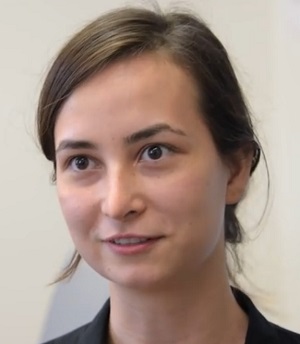
Zuhra Abdurashidova
Zuhra Abdurashidova

I graduated from the University of California at Berkeley about a decade ago with a degree in Mechanical Engineering. I received two job offers, one from SETI to work on high performance signal processing and the other from industry.

One does not simply walk away from SETI, so I had the pleasure of joining the Berkeley SETI Research Center (BSRC). I received a warm welcome and was promptly sent to West Virginia to help install a new SETI system at the Green Bank Telescope.

There was a steep learning curve, but I was fascinated by BSRC’s work and couldn’t wait to actually understand what was going on.

As it turns out, our group is looking to expand its computing power, providing the ability to look at more star systems with habitable planets, expand the involvement of volunteers and acquire larger volumes of data; in short, broaden the search and increase our chances of intercepting a signal. Now I’m working on setting up new servers, network hardware, and signal-processing systems at Green Bank. We’re hoping to get data flowing and recording soon, and make it available for the interested public.

From the 19th-century idea of drawing a giant Pythagorean triangle in the Siberian tundra to signal extraterrestrials, to our current collection of servers storing and analyzing data, it is not hard to see how much progress has already been made.

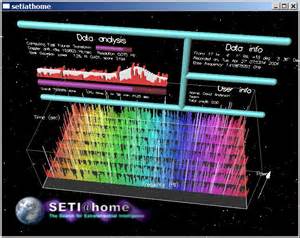
Running SETI software on your home computer looks like this.

Funding from the Breakthrough Initiatives is spawning new projects that would not have been otherwise possible. SETI@home is planning to work with Breakthrough Listen to collect and distribute data from the Green Bank and Parkes telescopes. However, in order to sustain the whole SETI@home effort we could still use support from our devoted SETI@home contributors.

Recently, I spent a day at the Bay Area Science Festival talking to kids and their adults. I was fascinated by just how stoked kids are about SETI. Some came with prepared questions and showed incredible curiosity and intelligence. The BSRC team is hoping to inspire kids to pursue science careers and I think searching for life beyond Earth is a great way to get them interested and involved. I hope you continue your support for this fascinating endeavor, and keep your eyes on the stars.  For the Berkeley SETI Research Center team, Zuhra Abdurashidova.

Berkeley SETI Research Center Logo

Supplemental- via nemesis maturity YouTube channel

Wow Signal – Scientists say that if the signal came from extraterrestrials, they are likely to be an extremely advanced civilization, as the signal would have required a 2.2-gigawatt transmitter, vastly more powerful than any on Earth.

The signal bore the expected hallmarks of non-terrestrial and non-Solar System origin.

One summer night in 1977, Jerry Ehman, a volunteer for SETI, or the Search for Extraterrestrial Intelligence, may have become the first man ever to receive an intentional message from an alien world. Ehman was scanning radio waves from deep space, hoping to randomly come across a signal that bore the hallmarks of one that might be sent by intelligent aliens, when he saw his measurements spike.

The signal lasted for 72 seconds, the longest period of time it could possibly be measured by the array that Ehman was using. It was loud and appeared to have been transmitted from a place no human has gone before: in the constellation Sagittarius near a star called Tau Sagittarii, 122 light-years away.

All attempts to locate the signal again have failed, leading to much controversy and mystery about its origins and its meaning.

http://en.wikipedia.org/wiki/Wow!_signal

http://en.wikipedia.org/wiki/Tau_Sagi…

http://www.bigear.org/wowmenu.htm

Canada Space Agency -How Space Affects Our Body

Living in space has significant effects on the human body. As we prepare for journeys to more distant destinations like Mars, humankind must tackle these risks to ensure safe travel for our astronauts.


Canada Space Agency PSA space info

Buckminster Fuller’s Fascinating Unbuilt Buildings

Buckminster was a genius and his geodesic dome buildings were not only revolutionary in their construction but were also incredibly unique and memorable. Perhaps your grandparents attended Expo67 in Montreal (you guessed it, waaay back in 1967) and visited the United States Pavilion- read this snippet for a time capsule account:

“The United States exhibit, entitled Creative America, is designed to illustrate technological and esthetic inventiveness in the U.S.A.A huge transparent geodesic “bubble” contains a multi-level system of exhibit platforms interconnected by escalators, and walkways. The platforms support a variety of exhibit components specially selected or designed for the new environment created by the structure. Situated on Ile Sainte-Hélène close to the Métro station from which there is Minirail connection with the Expo-Express, the bubble is 20 stories high and has a spherical diameter of 250 feet .By day, the bubble glistens as the sun highlights the structure and, by night, the bubble “glows” from interior lighting. The interior exhibits reflect different aspects of the United States and include folk art, cinema and fine arts displays, as well as a space exhibit which is reached by a 125 foot escalator and a simulated lunar landscape supporting full scale lunar vehicles. A 300-seat theatre features a 3-screen color film showing the games children play.”

Photo- National Archives of Canada

If you think that was pretty amazing check out some of Buckminster’s buildings that unfortunately didn’t make it past the planning stage.

Fascinating Unbuilt Buildings

New Moon Rover Readies For 2030 Launch

VENTURI SPACE PRESENTS MONA LUNA, 
THE EUROPEAN LUNAR ROVER
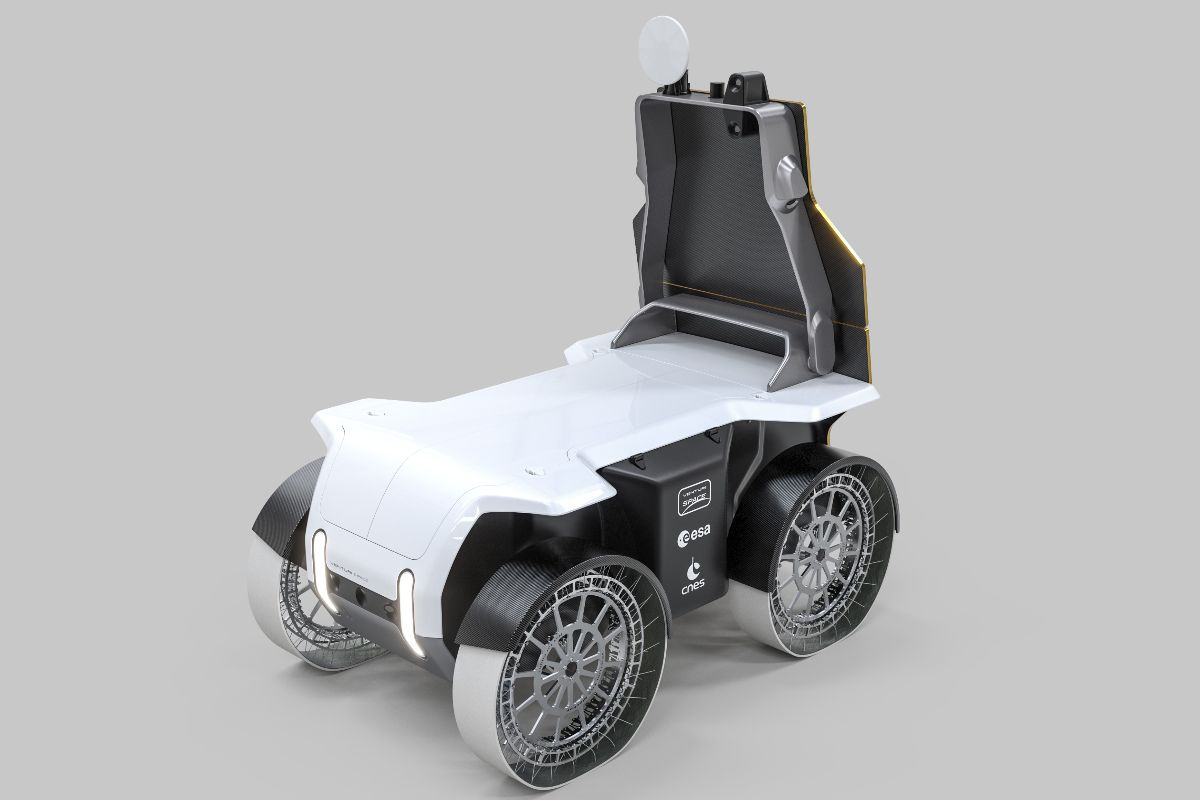
MONA LUNA, designed by Sacha Lakic

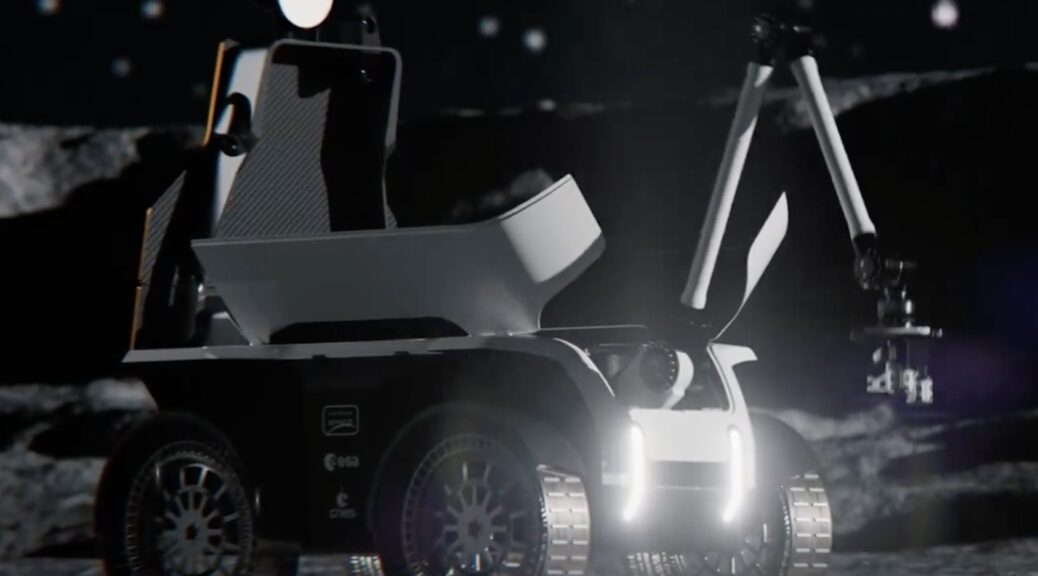
Paris Air Show, Le Bourget, June 2025 – Venturi Space unveils MONA LUNA, its 100% European-built lunar rover. Designed to support the ambitions of the European Space Agency and the French CNES, the vehicle will be built at Venturi Space France’s facility in Toulouse. The ultimate aim is to provide Europe with a lunar-capable rover by 2030.

European autonomy in lunar mobility is a major strategic challenge. Venturi Space is helping to make that a reality with MONA LUNA, its upcoming lunar rover designed to meet the needs of ESA and national European space agencies. The vehicle will further Europe’s efforts to achieve technological independence in the field of lunar mobility, enabling it to get ahead of the industrial curve and achieve its space ambitions.

A project led by Venturi Space France 
Venturi Space France will oversee MONA LUNA’s development and space qualification from its base in Toulouse, coordinating every aspect of the process: onboard electronics, avionics, space-to-ground links, energy management systems, assembly, final integration, and acceptance testing in readiness for space flight. All with one clear objective: to deploy MONA LUNA at the Moon’s South Pole by 2030.

Backed by the ESA and CNES
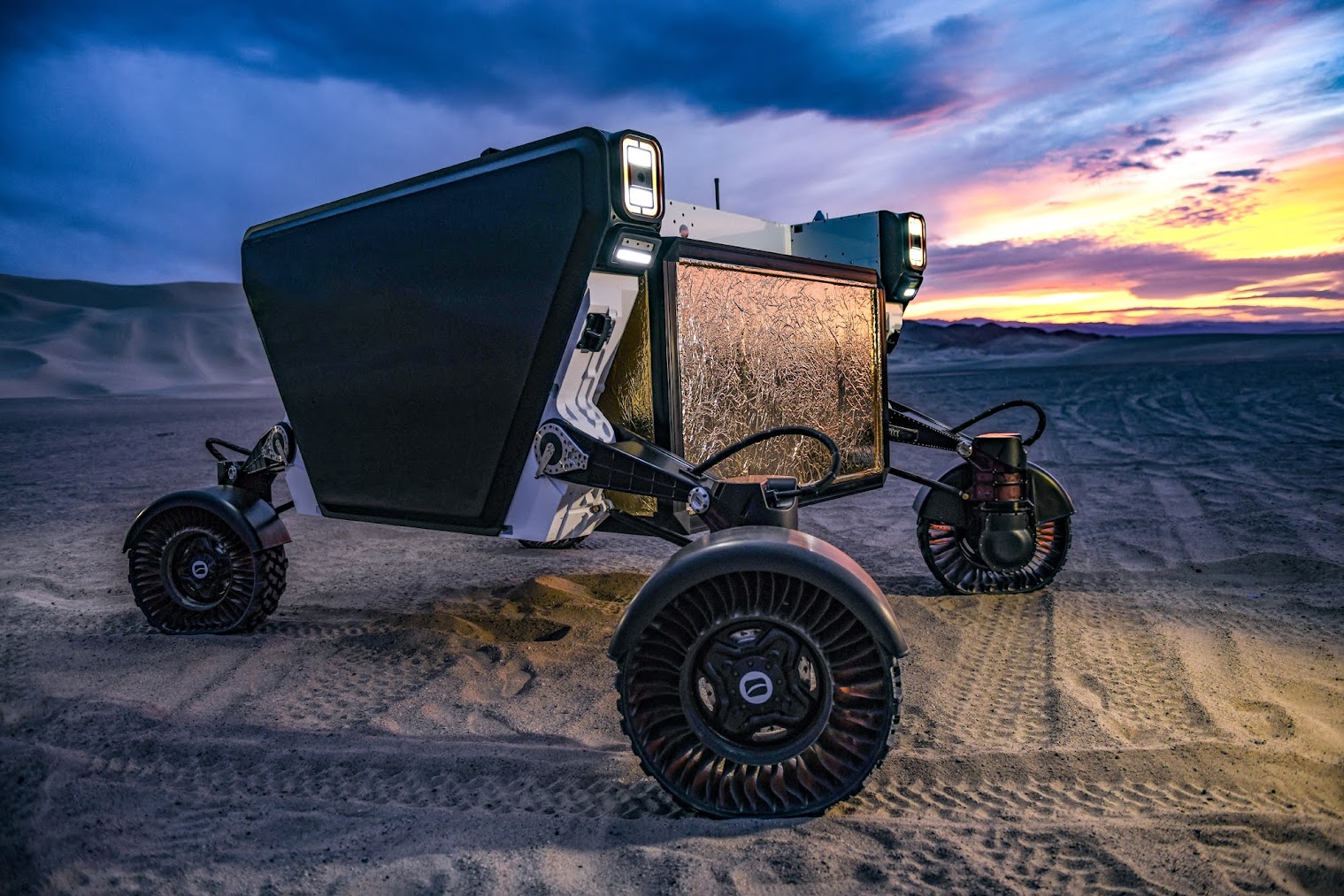
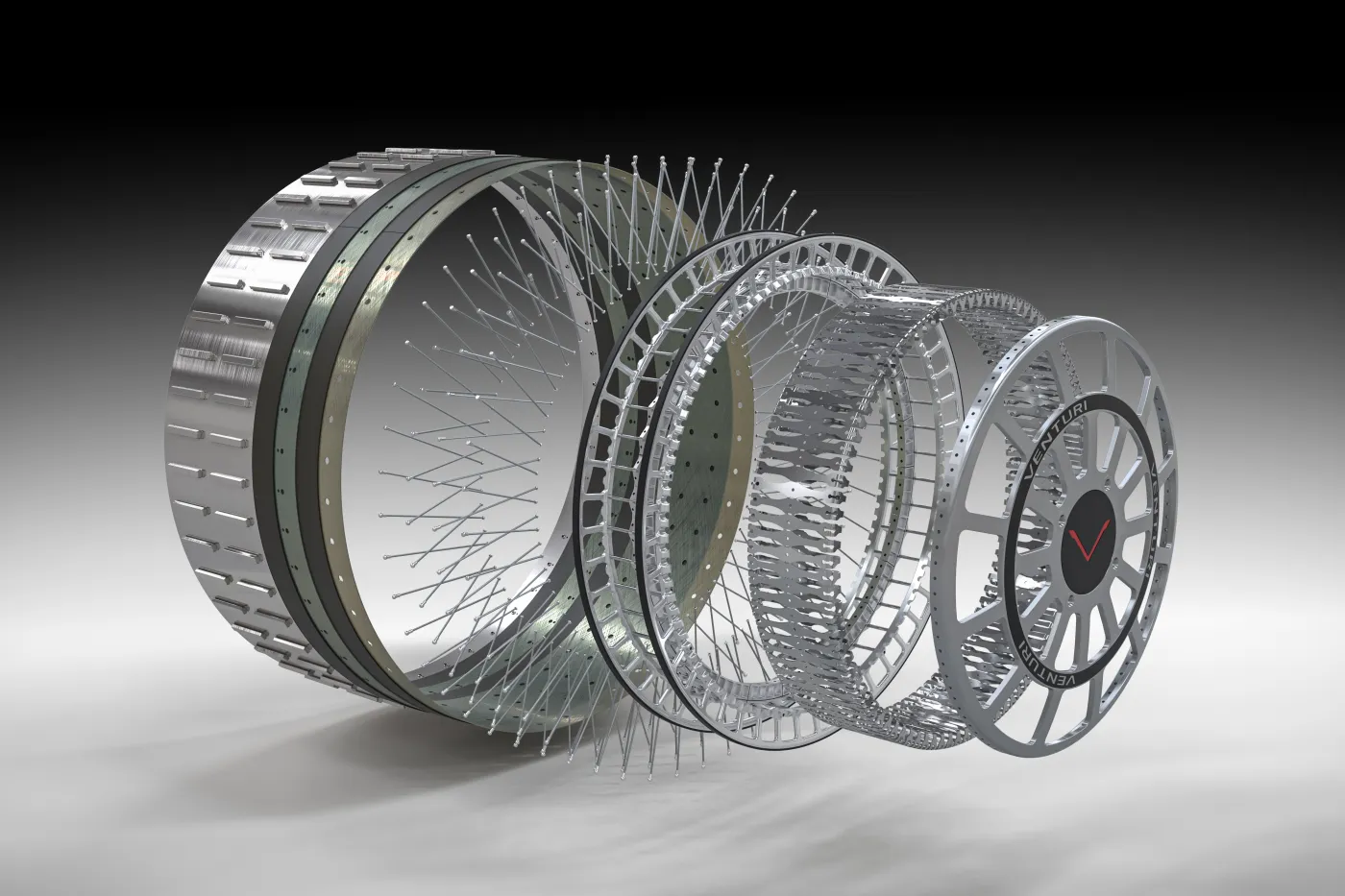
The European Space Agency is supporting Venturi Space’s efforts to design and develop the critical technologies required for a large lunar rover, capable of surviving multiple lunar nights. ESA’s support validates Venturi Space’s approach and highlights its expertise. The project will draw on the experience acquired from the programmes to develop the FLIP and FLEX rovers under a strategic partnership with US-based company Venturi Astrolab, Inc. Venturi Space is currently designing and building the hyper-deformable wheels that will be fitted to those vehicles, along with the associated electrical systems (in Switzerland) and high-performance batteries (in Monaco).

Using technology made in Europe
MONA LUNA is designed to be carried into space by the Ariane 6.4 launch system and landed on the Moon’s surface by the European Argonaut lunar lander, while the rover itself will be equipped with a robotic arm to handle scientific instruments and payloads. It will be:
– electrically powered, recharging via solar panels,
– designed to move autonomously,
– equipped with three high-performance batteries,
– capable of carrying a wide range of payloads,
– designed to survive multiple lunar nights,
– capable of a top speed of 20 km/h,
– designed to weigh a total of 750 kg.

The rover could also be used in an emergency to carry an astronaut in difficulty, as envisaged by the ESA and CNES in their feasibility studies.
A clear commercial purpose
MONA LUNA’s maiden mission will focus on purely scientific applications, but future deployments could be organized to meet demand from the European private sector for a variety of purposes, including carrying payloads to the South Pole, exploiting lunar resources (such as helium-3) in situ, or even public outreach campaigns. This approach will help establish a sustainable long-term economic model for the rover, in much the same way as the early development of terrestrial mobility.


Gildo Pastor, President of Venturi Space:
“I’m still an explorer, first and foremost. Space is a new frontier, and MONA LUNA is how we are actually going to broach it. Alongside Europe, we aim to build an autonomous lunar exploration capability to meet the scientific, economic, and strategic challenges of tomorrow.”

Dr. Antonio Delfino, Director of Space Affairs at Venturi Space:
“Our primary focus is to make ourselves fully available to the ESA and European national space agencies. With MONA LUNA, we aim to deliver major technological breakthroughs that will pave the way for extended lunar mobility.”

For The Silo, Jarrod Barker.

A Quest To Build My First Synthesizer

I started out creating sound experiments while in high school, circa 1980 with circuit bent hardware and a cheap Casio keyboard.

I then entered the working world and forgot all about making music. Fast forward 30+ years, and the itch to make experimental music overtook me again, but now technology had changed drastically. I no longer needed hardware. I discovered apps on my iPhone, and music platforms like SoundCloud and Bandcamp were all that I needed. I was immediately obsessed.

Within a couple years, I had filled over seven free SoundCloud accounts, and two Bandcamp albums  as well as an artist page  with experimental music, and having a great time doing it. But, I started to grow tired of using the same software.

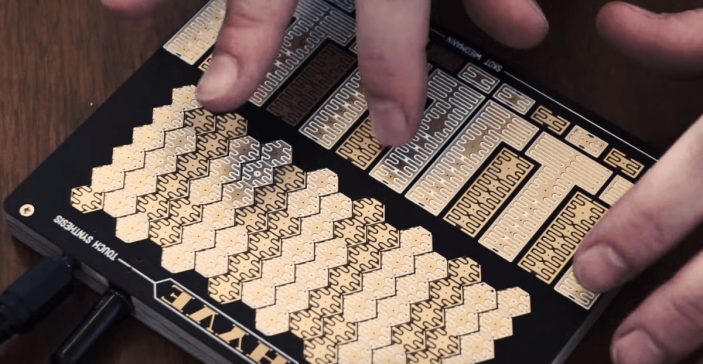
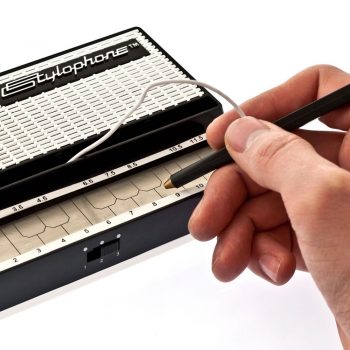
stylophone synthI yearned to use hardware/instruments again, but not being able to play an instrument is a definite hindrance 🙂 I searched for cheap keyboards on the net. I soon discovered the “Stylophone” and ordered one ‘sight unseen’. It was unique, inexpensive and fun, but quite limited in sound variety. I started mixing the Stylophone with app produced sounds/music, as well as other “found sounds”. (I really appreciate the functionality of software based mixing apps, which are almost essential to my creations these days). I then stumbled upon a couple of user videos of the Hyve synthesizer, and knew I had to have it. It was clearly non-musician friendly (and looked so different, cool and fun).

Then came the disappointment …

You can’t buy one! (BUT I HAD TO HAVE ONE!!!) Turns out, the engineer/designer guru behind this awesome device (Skot Wiedmann), had (Hard to believe but it’s been almost a decade since I made this trip!) work shops in the Chicago area, and you can go build your own, ( very inexpensively ). I knew what I had to do. I looked at a map, saw that Chicago was about 8 hours away from me here in Ontario, Canada and realized that I had to go build it. I started to plan the trip. I knew that a fellow SoundCloud musician and Facebook friend (Leslie Rollins) lived in Berrien Springs, Michigan, about 2 hours outside of Chicago.

This presented a twofold opportunity. I could hopefully, meet Leslie face to face, and hopefully have a place to spend the night. I contacted Les and everything was A-OK! I purchased a ticket to build my Hyve, and started to plan my road trip. The workshop was going to be from Noon to 3pm, on a Saturday in late September in a cool space called Lost Arts in Chicago.

I had the whole week off from work, because I was overseeing a contractor doing extensive yard work at my house all week, and I was hoping to leave Friday so as to arrive at Leslie’s place in the late afternoon or early evening, spend the night, and leave for the workshop Saturday morning. Alas, plans rarely work as hoped.

The contractor wasn’t finished until Friday afternoon, and Les wasn’t getting home from a business trip until late Friday night.
New plan! Early to bed Friday. Early to rise Saturday (2:30 am), and depart for Leslie’s place in Michigan. It was an easy drive, and I got to Berrien Springs (a beautiful sleepy little university village) around 8:30 am. Met Leslie, and got to trade stories over a great breakfast in a local cafe. Then, I quickly admired Leslie’s impressive modular synth racks at his home studio “Convolution Atelier” and then left for “Lost Arts” in Chicago.

Lost Arts is located in a cool old industrial complex.

The workshop provided everyone with a surface mount board with the touchpad on one side, and components layout on the back. A sheet listing components and placement was also handed out, along with tiny plastic tweezers. Everyone then had their component side “pasted” with a solder paste applied through a pierced template, in a process similar to silk screening. Everyone then started to receive their very tiny components from the parts list. Following the placement locations, the components (chips, capacitors, resistors, etc) were set into their pasted areas with the tweezers (magnification and extra lighting was a must). Once all the components were placed, they were carefully “soldered” into place by simply holding a heat gun over each component until the solder on the board had adhered it. Once this was done, everyone had their 9v battery and line-out jacks hand soldered into place by Skot , and then … the moment of truth, Skot tested each one for proper operation.

It was a fascinating process and great experience.

I met a lot of cool people at the workshop, both builders and staff/helpers! I can’t say enough what a fantastic experience this was, and what an awesome, diverse and versatile device the Hyve is. I doubted my sanity when planning this trip, but it turned out to be very rewarding!

Leslie and I then went back to Michigan, stopped at a local brewery in Berrien Springs (Cultivate) and sampled a few of their excellent brews, and then proceeded to Convolution Atelier to play with Leslie’s modular system. (I’m a newbie to all things modular, and I received a great crash course from Leslie on his very cool array!) Then it was out to dinner with Leslie and his wonderful wife Lisa, and finally back to their house where I stayed for the night, and finally hit the road towards home the next morning. It truly was a great adventure! For the Silo, Mike Fuchs.

What Priorities For First Canadian Minister of Artificial Intelligence?

Canada is great at AI development, but what should the country’s first Minister for Artificial Intelligence make his key priorities? University of Waterloo’s Anindya Sen and the C.D Howe Institute’s Rosalie Wyonch offer strong insight — and geek out a bit about the economics-oriented nature of machine learning algorithms.

An Intelligent AI Policy for Canada

Audio Only Version

AI Tinkerers Take Note -Effective Prompting Can Build Actual Products

Hello AI Tinkerers and welcome to the latest Sci-Tech article here at The Silo. Get ready, You will want to pay attention because the spotlight is on this Dude because he knows how to get around ‘bad ai prompting’. Just recently, he has helped spin out 40 startups using one core skill. Can you guess which one? Yep. Prompting.

In the One-Shot video below, Kevin Leneway breaks down his real workflow for shipping AI products fast — using markdown checklists, agent coding, rubric-based UI design, and zero Figma.

“I don’t need Figma. I just prompt my way to a working front end.” — Kevin Leneway

While most people are still asking ChatGPT to write code snippets, Kevin is building full-stack products using nothing but prompts. In this One-Shot episode, he reveals the exact system he’s used to launch over 40 startups at Pioneer Square Labs. We break down:

  • How he writes BRDs and PRDs that don’t suck
  • Why vibe coding fails and how to actually use AI agents
  • The markdown checklist that replaces a product team
  • How to go from idea to working app with zero context switching
  • His open-source starter kit that makes Cursor and Claude 3.5 feel like magic

“I’ve helped launch six startups including Singlefile (singlefile.io, $24M raised), Recurrent (recurrentauto.com, $24M raised), Joon (joon.com, $9.5M raised), Gradient (gradient.io, $3.5M raised), Genba (genba.ai, acquired May 2022) and Enzzo (enzzo.ai, $3M raised).”

If you’re a builder, this will change how you work. No gimmicks. Just a ruthless focus on speed, clarity, and shipping. Watch now. Learn the system. Steal it. For the Silo, Joe at aitinkerers.org

Featured image- DALL·E robot dressed like shakespeare – AllAboutLean.com.

Strengthening Canada’s Trade Laws to Address Emerging Global Threat

Key Canadian trade laws do not refer to national security as a factor that allows Canada to counter threats from imports of goods or services. Given the tense geopolitical situation, I propose ways to close this “national security gap.” 

The gap is particularly worrisome in two key import-governing legislation: (1) the Customs Tariff Act and (2) the Export and Import Permits Act.

I will show why the omission of the national security element in these and possibly other statutes needs to be remedied.

National Security & Chinese Exports

The Americans imposed surcharges on Chinese EVs, steel, aluminum, semiconductors and other products in May 2024 in response to heavily subsidized Chinese imports that were said to have breached international trade rules. 

The EU started applying countervailing duties on Chinese EVs in July this year, using a more standard trade remedy process to counter the injurious impact of subsidized imports on the European automotive industry. 

The danger posed by Chinese EVs, steel and aluminum imports, plus these actions by Canada’s major trading partners, led the Canadian government to apply comparable tariff surcharges. The strategic threat posed by China’s state-subsidized exports made for the right response by Canada. 

While existing laws allowed the federal cabinet to take action in this case, it also brought home the fact that there is an absence of any reference to “national security” in some of Canada’s major trade law statutes.

Section 53 – Canada’s Rapid  Response Mechanism

In the United States, Section 232 of the 1962 Trade Expansion Act, along with Section 301 of the 1974 Trade Act, authorize the president to increase tariffs on imports if the quantity or circumstances surrounding those imports are deemed to threaten national security.1

Section 232 was used by the Trump administration in 2018 to apply surcharges to a range of imports from numerous countries, including Canada. However, these tariffs were ultimately dropped in the face of threats by Canada to retaliate against American goods exported to Canada.

Unlike the US, Canada lacks the legislative means to impose import surcharges on the basis of national security. The closest we have is Section 53 of the Customs Tariff Act, which focuses on the enforcement of Canada’s rights under trade agreements and responses to practices that negatively affect Canadian trade. It was Section 53 that was used in the August decision on Chinese EVs, etc., referred to earlier.

Indeed, there are similarities between Section 301 of the US Trade Act of 1974 and Section 53 of the Customs Tariff Act.But while existing laws allowed the federal cabinet to act in this case, the case brought home the fact that there is an absence of any reference to “national security” in some of Canada’s major trade law statutes.

Governments have shied away from using Section 53 as a policy tool over the years. It was used only once before its present deployment, in response to the Trump administration’s surcharges on Canadian steel and aluminum in 2018 and 2020.2

 The surcharges were ultimately withdrawn when the US tariffs were terminated.Section 53 comes under Division 4 of the Actentitled “Special Measures, Emergency Measures and Safeguards,” giving the government broad powers to apply unilateral tariff measures on the joint recommendation of the ministers of Finance and Global Affairs:

…for the purpose of enforcing Canada’s rights 

under a trade agreement in relation to a country 

or of responding to acts, policies or practices of 

the government of a country that adversely affect, 

or lead directly or indirectly to adverse effects on, 

trade in goods or services of Canada…

There is no requirement for public consultations or input under this provision. Although the government held a round of stakeholder consultations before moving on Chinese imports in August, it was not legally obliged to do so. While the ministerial recommendations must be fact-based and supported by credible data, the law is effective in that nothing inhibits rapid action by the federal cabinet. In this respect, it is a superior tool to Section 232 of the American legislation.3

The critical shortcoming, on the other hand, is that while allowing the government to protect Canadian trade interests in a fairly rapid fashion, Section 53 does not allow action on imports found to be threatening national security, whether it be economic, military or other. There is clearly a need to repair this omission, not only here but in Canada’s other trade laws.

In my view, we need a national security component in Section 53 as the Canadian counterpart to Section 232 of the US Trade Expansion Act.

Import Controls and National Security

Together with tariff measures, Canada can control imports under the Export and Import Permits Act(EIPA) through the creation of import (and export) control lists designed to achieve particular strategic, security and economic objectives. These lists are established by orders-in-council, 

requiring listed goods and technology to have a permit in order to be imported or exported. These permits are issued by the Trade Controls and Technical Barriers Bureau in Global Affairs Canada (GAC). Without a permit, imports of controlled items are illegal.

While Section 5(1) of EIPA provides for the creation of import control lists covering arms, ammunition and military items, it fails to provide for imports of goods or technology to be controlled for national security reasons. The Act could not have been used, for example, to deal with the effects on national security of imports of Chinese EVs, steel, aluminum or any other goods or technology. EIPA is thus deficient in this regard.

There is a related issue when it comes to export controls. Section 3(1) of EIPA authorizes the establishment of export control lists, among other reasons:

“(a)…to ensure that arms, ammunition, 

implements or munitions of war, etc. … otherwise 

having a strategic nature or value will not be made 

available to any destination where their use might 

be detrimental to the security of Canada.”

The reference to the “security of Canada” under paragraph (a) is the only such reference in the statute and is confined to the security aspects of imports of arms, ammunition, munitions of war, etc. While not as significant as the problems regarding import controls, it is nonetheless a serious omission.

The result is that as EIPA is currently drafted, the federal government lacks the legal authority to create import or export controls designed to protect or safeguard Canadian security. EIPA needs to be amended to add this authority on the part of the government.

Indeed, it may be desirable to re-consider much of the architecture of EIPA from the viewpoint of safeguarding Canada’s security interests on both the export and import side.

Controlling Imports Through Sanctions

Canada’s sanctions laws are found in the Justice for Victims of Corrupt Foreign Officials Act (JVCFOA), the United Nations Act, and, notably, the Special Economic Measures Act (SEMA). Each of these statutes allows the federal cabinet to issue sanctions through regulations 

applicable to specific countries and/or jurisdictions and prohibiting transactions in specific items of goods or technology. None of these laws allow sanctions for matters related to Canadian security.

SEMA is Canada’s most widely used sanctions legislation. Section 4 is the only part of the Act that uses the term “security,” but only in instances when, among other matters:

(b) a grave breach of international peace and 

security has occurred that has resulted in or is likely 

to result in a serious international crisis.

Because of the restrictions on international peace and security, the government lacks the authority to issue sanctions dealing with national security interests.4

For example, Canada’s sanctions on Russia are directed at countering actions that “constitute a grave breach of international peace and security that has resulted or is likely to result in a serious international crisis,” with no reference to Canadian national security interests.

SEMA should be amended to allow prohibitions of any transaction or dealings of any kind where Canada’s national security is at risk.

Trade Remedies and National Security

In accordance with the GATT/WTO Agreement, antidumping and countervailing (AD/CV) duties can be applied to dumped or subsidized imports when a domestic industry is injured or threatened with injury from exactly the same imports as that industry produces. In Canada, these are provided for under the Special Import Measures Act (SIMA).

SIMA actions are driven by complaints filed by domestic producers who make exactly the same or directly competitive products as the imported items. It means, for example, that in the absence of a Canadian industry threatened with injury or actually injured by the same type of Chinese EVs, aluminum or steel imports as those producers make, AD/CV duty remedies would not be available. SIMA makes no reference to national security as a factor in the application of these duties.

In short, because the SIMA process is geared to provide protection to domestic producers and private sector industries, it is inappropriate as a vehicle for dealing with national economic security concerns that range well beyond those private interests.

The same is true in the case of safeguards, another kind of trade action allowed under the World Trade Organization (WTO) Agreement to counter floods of imports that are not dumped or subsidized but, because of their volume, cause or threaten serious injury to domestic producers of the same product.

In Canada, safeguard measures come under the Canadian International Trade Tribunal Act, where an inquiry takes place and, if recommended by the Tribunal, are applied under the Customs Tariff Act.

As in the case of dumped or subsidized imports, safeguard measures are designed to protect specific domestic industries and not to deal with overarching national security issues.

Again, because the objective of these remedial measures in international and Canadian trade law is to protect a domestic industry from financial harm due to imports and not to deal with broader questions of national security, the absence of reference to “security” in these various statutes does not seem to be a significant issue.

National Security under International Trade Law

Article XXI of the 1947 General Agreement on Tariffs & Trade (GATT) is the only provision in the entire WTO package that deals with national security. That article (entitled “Security Exceptions”) allows departures from normal trade rules to permit unilateral trade-restrictive measures that a contracting party “considers necessary for the protection of its essential security interests…taken in time of war or other emergency in international relations.”

The drafting of GATT Article XXI dates back to the post-World War II Bretton Woods era. What was considered an international emergency at that time was war, regional armed conflict or a global pandemic like the Asian flu of 1918-1920. The same broad view of international emergency conditions was applied when the Uruguay Round negotiations took place (1991-1994) leading to the conclusion of the WTO Agreement.

With recent cataclysmic changes in the world, whatever the WTO-administered multilateral system might prescribe, governments are moving to protect a range of national (and economic) security concerns by means of unilateral measures in ways that were not envisaged when the Bretton Woods architecture was devised in the late 1940s.

For decades, there was little recourse to Article XXI exceptions. However, their use emerged in the last number of years with the unilateral surcharges imposed by Trump. 

The situation is different – and materially different – in the case of Chinese exports, not only EVs, steel or aluminum but also in technologically advanced or other critical items. These are goods that, by abundant evidence, are heavily subsidized, with massive overcapacity, exported to global markets as part of the Chinese government’s strategy to enhance its geopolitical position – facts uncovered in the EV situation through detailed investigations by the EU and the US.5

Thus, aggressive actions by China and possibly other countries in strategically sensitive areas take the issue beyond the WTO ruling in the US-Section 232 case and raise these to the level of an “emergency in international relations.”

In summary, the concept of an international emergency is much changed in today’s digitized, cyber-intensified world, including the aggressive and destabilizing policies of Chinese state capitalism and other bad actors. The application of GATT/WTO rules drafted in 1947 and updated in the 1990s must be adapted to deal with today’s realities if they are to provide governments with meaningful recourse.

Conclusions

In conclusion, Canada has a panoply of criminal, investment, intelligence gathering and other laws that address national security concerns. However, there is a notable absence of the term “national security” in Canada’s core trade law statutes.

This absence is of concern in the Customs Tariff Act and the Export and Import Permits Act, two important statutes that give the government authority to act to counter injurious imports threatening Canada’s national security.

Given the state of world affairs and the challenges Canada faces from aggressive players like China, Russia, Iran and others, the omissions in these statutes need to be remedied. This should be acted on immediately. There is also a lack of reference to national security in Canada’s sanctions legislation, notably the Special Economic Measures Act (SEMA), the main Canadian sanctions statute. 

Amendments should be made to make security concerns a ground for imposing sanctions here as well. The findings of EU agencies on Chinese BEV after a detailed investigation support the view that Chinese state capitalism and its centrally planned industrial capacity are geared toward dominating world markets in critical goods, part of that country’s geopolitical strategy. These and other similar governmental actions can be said to meet the “emergency in international relations” threshold under the WTO Agreement. 

Given the state of affairs at the WTO, including the paralysis of its dispute settlement system, amendments to or reinterpretation of the GATT rules are difficult, if not impossible. The result is that governments will be resorting to unilateral application of the Article XXI exclusion in their own national security measures. While the situation may evolve at the WTO, and without diminishing Canada’s support for the multilateral rules-based system, the federal government should bring forth measures to add reference to national security interests in the above statutes.  For the Silo, Lawrence L. Herman/ C.D. Howe Institute.

International Economic Policy Council Members 

Co-Chairs: Marta Morgan, Pierre S. Pettigrew Members: Ari Van Assche Stephen Beatty Stuart Bergman Dan Ciuriak Catherine Cobden John Curtis Robert Dimitrieff Rick Ekstein Carolina Gallo Victor Gomez Peter Hall Lawrence Herman Caroline Hughes Jim Keon Jean-Marc Leclerc Meredith Lilly Michael McAdoo Marcella Munro Jeanette Patell Representative, Amazon Canada Joanne Pitkin Rob Stewart Aaron Sydor Daniel Trefle

1 The Trade Expansion Act of 1962 (Pub. L. 87–794, 76 Stat. 872, enacted October 11, 1962, codified at 19 U.S.C. ch. 7); The Trade Act of 1974 (Pub. L. 93–618, 88 Stat. 1978, enacted January 3, 1975, codified at 19 U.S.C. ch. 12).

2 The government announced it was applying these “to encourage a prompt end to the U.S. tariffs, which negatively affect Canadian workers and businesses and threaten to undermine the integrity of the global trading system.” See: “United States Surtax Order (Steel and Aluminum),” Government of Canada, June 28, 2018, https://gazette.gc.ca/rp-pr/p2/2018/2018-07-11/html/sordors152-eng.html. 

3 Section 232 of the Trade Expansion Act allows the president to impose import restrictions – but these must be based on an investigation and affirmative determination by the Department of Commerce that certain imports threaten to impair US national security.

4 The array of Canada’s sanctions can be found on the GAC website at: https://www.international.gc.ca/world-monde/international_relations-relations_internationales/sanctions/current-actuelles.aspx?lang=eng. 

5 The EU measures followed a countervailing duty approach, as opposed to direct action in the case of Canada and the US. In its extremely detailed investigation, EU agencies found, on the basis of massive evidence, that:
“ . . . the BEV [battery electric vehicle] industry is thus regarded as a key/strategic industry, whose development is actively pursued by the GOC as a policy objective. The BEV sector is shown to be of paramount importance for the GOC and receives political support for its accelerated development. Including from vital inputs to the end product. On the basis of the policy documents referred to in this section, the Commission concluded that the GOC intervenes in the BEV industry to implement the related policies and interferes with the free play of market forces in the BEV sector, notably by promoting and supporting the sector through various means and key steps in their production and sale.”See: “Commission Implementing Regulation (EU) 2024/1866,” European Union, July 3, 2024, at para. 253, https://eur-lex.europa.eu/eli/reg_impl/2024/1866/oj

Hundreds of New UFO Sightings Reported to Pentagon

The new findings bring the total number of UAP cases under review to more than 1,600 as of June 2024.

Hundreds of New UFO Sightings Reported to Pentagon
A photo from the Department of Defense shows an “unidentified aerial phenomenon.” Department of Defense

There were 757 reports of unidentified anomalous phenomena (UAP) between May 2023 and June 2024, according to an unclassified Department of Defense (DOD) report released on Nov. 14.

Congress mandated the annual report by the DOD’s All-Domain Anomaly Resolution Office (AARO), which is tasked with studying and cataloging reports of UAPs, formerly referred to as UFOs.

The report said that AARO received 757 UAP reports from May 1, 2023, to June 1, 2024, and “485 of these reports featured UAP incidents that occurred during the reporting period.”

“The remaining 272 reports featured UAP incidents that occurred between 2021 and 2022 but were not reported to AARO until this reporting period and consequently were not included in previous annual UAP reports,” the report reads.

The new findings bring the total number of UAP cases under AARO review to more than 1,600 as of June.

AARO Director Jon Kosloski said at a Nov. 14 media briefing that the findings have left investigators puzzled.

Related Stories

5 Takeaways From Congressional UFO Hearing

5 Takeaways From Congressional UFO Hearing

IN-DEPTH: ‘The American People Are Ready’; Lawmakers Advocate Government Disclosure of Records on the ‘UAP Enigma’

IN-DEPTH: ‘The American People Are Ready’; Lawmakers Advocate Government Disclosure of Records on the ‘UAP Enigma’

“There are interesting cases that I, with my physics and engineering background and time in the [intelligence community], I do not understand,“ Kosloski said. ”And I don’t know anybody else who understands them either.”

Some cases were later resolved, with 49 determined to be sightings of common objects such as balloons, birds, and unmanned aerial systems. Another 243, also found to be sightings of ordinary objects, were recommended for closure by June. However, 444 were deemed inexplicable and lacking sufficient data, so they were archived for future investigation.

Notably, 21 cases were considered to “merit further analysis” because of anomalous characteristics and behaviors.

Despite the unexplained incidents, the office noted that it “has discovered no evidence of extraterrestrial beings, activity, or technology.”

The report said UAP cases often had consistent patterns, described as having unidentified lights and as orb-shaped or otherwise round objects with distinct visual traits.

Of the new cases, 81 were reported in U.S. military operating areas, and three reports from military air crews described “pilots being trailed or shadowed by UAP.”

The Federal Aviation Administration reported 392 unexplained sightings among the 757 reports made since 2021.

In one such case, the AARO resolved a commercial pilot’s sighting of white flashing lights as a Starlink satellite launched from Cape Canaveral, Florida.

“AARO is investigating if other unresolved cases may be attributed to the expansion of the Starlink and other mega-constellations in low earth orbit,” the report states.

The AARO report maintains that none of the resolved cases has substantiated “advanced foreign adversarial capabilities or breakthrough aerospace technologies.” The document also states that the AARO will immediately notify Congress if any cases indicate such characteristics, which could suggest extraterrestrial involvement.

The report emphasized the AARO’s “rigorous scientific framework and a data-driven approach” and safety measures while investigating these phenomena.

UAP Hearing

The report was released a day after a House Oversight Committee hearing titled “Unidentified Anomalous Phenomena: Exposing the Truth,” during which witnesses alleged government secrecy surrounding the phenomena.

During the hearing, a former DOD official, Luis Elizondo, said, “Advanced technologies not made by our government or any other government are monitoring sensitive military installations around the globe.”

He testified that the government has operated secret programs to retrieve UAP crash materials to identify and reverse-engineer alien technology.

“Furthermore, the U.S. is in possession of UAP technologies, as are some of our adversaries. I believe we are in the midst of a multi-decade secretive arms race, one funded by misallocated taxpayer dollars and hidden from our elected representatives and oversight bodies,” Elizondo said.

“Although much of my government work on the UAP subject still remains classified, excessive secrecy has led to grave misdeeds against loyal civil servants, military personnel, and the public, all to hide the fact that we are not alone in the cosmos.

“A small cadre within our own government involved in the UAP topic has created a culture of suppression and intimidation that I have personally been victim to, along with many of my former colleagues.” For The Silo, Rudy Blalock/NTD.

Inside The High Flying & Spying World Of Hot Air Balloons

Remember early last year when we were besieged by strange, large balloons in our airspace- the kind of balloons that certain nations are using to spy on us or possibly manipulate the weather?

Okay let’s put those conspiracy theories aside for now. Hopefully everyone has seen a hot air balloon in flight at least once because they are majestic and otherworldly and quite calming to watch drifting around up in the blue sky above.

But have you ever wondered when the first one was invented? Or how much hot air is required to get them safely off the ground and ready for a flight around the skies? Or where they are stored when they aren’t being used? Our friends at SpareFoot were wondering the same thing, and the data they shared with us below is quite astonishing.

Hot Air Balloon InfoGraphic

SupplementalBaumgartner’s record setting Free Fall event utilized Hot Air Balloon to reach “edge of space”

OPED: Made by Human: The Threat of Artificial Intelligence on Human Labor

This Article is 95.6% Made by Human / 4.4% by Artificial Intelligence

One of the most concerning uncertainties surrounding the emergence of artificial intelligence is the impact on human jobs.

100% Satisfaction Guarantee

Let us start with a specific example – the customer support specialist. This is a human-facing role. The primary objective of a Customer Support Specialist is to ensure customer satisfaction.

The Gradual Extinction of Customer Support Roles

Within the past decade or so, several milestone transformations have influenced the decline of customer support specialists. Automated responses for customer support telephone lines. Globalization. And chat-bots. 

Chat-bots evolved with the human input of information to service clients. SaaS-based products soon engineered fancy pop-ups for everyone. Just look at Uber if you want a solid case-study – getting through to a person is like trying to contact the King of Thailand. 

The introduction of new artificial intelligence for customer support solutions will make chat-bots look like an AM/FM frequency radio at the antique market. 

The Raging Battle: A Salute to Those on the Front Lines

There are a handful of professions waging a battle against the ominous presence of artificial intelligence. This is a new frontier – not only for technology, but for legal precedent and our appetite for consumption. 

OpenAI is serving our appetite in two fundamental ways: text-based content (i.e. ChatGPT) and visual-based content (i.e. DALL·E). How we consume this content boils down to our own taste-buds, perceptions and individual needs. It is all very human-driven, and it is our degrees of palpable fulfillment that will ultimately dictate how far this penetrates the fate of other professions. 

Sarah Silverman, writer, comedian and actress sued the ChatGPT developer OpenAI and Mark Zuckerberg’s Meta for copyright infringement. 

We need a way to leave a human mark. Literally, a Made by Human insignia that traces origins of our labor, like certifying products as “organic”.

If we’re building the weapon that threatens our very livelihood, we can engineer the solution that safeguards it. 

The Ouroboros Effect

If we seek retribution for labor and the preservation of human work, we need to remain ahead of innovation. There are several action-items that may safeguard human interests:

  • Consolidation of Interest. Concentration of efforts within formal structures or establish new ones tailored to this subject;
  • Litigation. Swift legal action based on existing laws to remedy breaches and establish legal precedents for future litigation;
  • Technological Innovation. Cutting-edge technology that: (a) engineers firewalls for preventing AI scraping technologies; (b) analyzes human work products; and (c) permits tracking of intellectual property.
  • Regulatory Oversight. Formation of a robust framework for monitoring, enforcing and balancing critical issues arising from artificial intelligence. United Nations, but without the thick, glacial layers of bureaucracy.  

These front-line professionals are just the first wave – yet if this front falls, it will be a fatal blow to intellectual property rights. We will have denied ourselves the ideological shields and weapons needed to preserve and protect origins of human creativity

At present, the influence of artificial intelligence on labor markets is in our own hands. If you think this is circular reasoning, like some ouroboros, you would be correct. The very nature of artificial intelligence relies on humans.

Ouroboros expresses the unity of all things, material and spiritual, which never disappear but perpetually change form in an eternal cycle of destruction and re-creation.

Equitable Remuneration 

Human productivity will continue to blend with artificial intelligence. We need to account for what is of human origin versus what has been interwoven with artificial intelligence. Like royalties for streaming music, with the notes of your original melody plucked-out. Even if it’s mashed-up, Mixed by Berry and sold overseas. 

These are complex quantum-powered algorithms. The technology exists. It is along the same lines of code that is empowering artificial intelligence. Consider a brief example: 

A 16-year old boy named Olu decides to write a book about growing-up in a war torn nation. 

 Congratulations on your work, Olu! 

47.893% Human /  52.107% Artificial

Meanwhile, back in London, a 57-year old historian named Elizabeth receives an email:

 Congratulations Elizabeth, your work has been recycled! 

34.546% of your writing on the civil war torn nation has been used in an upcoming book publication. Click here to learn more.

We need a framework that preserves and protects sweat-of-the-brow labor. 

As those on the front-line know: Progress begets progress while flying under the banner of innovation. If we’re going to spill blood to save our income streams – from content writers and hand models to lawyers and software engineers – the fruit of our labor cannot be genetically modified without equitable remuneration. 

The Best Theater Sound System In Finland

— Kino Piispanristi integrates Genelec’s famous “The Ones” loudspeaker range along with the latest Dolby Surround technology to deliver premium audio quality — the best to be found (and heard) in Finland.

NATICK, MA, August, 2024 —Kino Piispanristi is a full-service 286-seat independent movie theater close to Turku, Finland. The venue is a long-time passion project of Henry Erkkilä, a movie lover who wanted to create a modern cinema that transcends tradition when it comes to audio-visual technology. Kino Piispanristi cinema strives to continually deliver a superior experience, so its luxury new premium screen features a Genelec sound system comprising the brand’s unmatched smart active studio loudspeakers and subwoofers.

Genelec “The Ones”

Erkkilä discovered his love for the film industry as a young boy. His father had a film projector that he travelled around Sweden with, bringing the latest screen favorites to audiences in his home country. Prior to the screening, Erkkilä would be tasked with dropping off advertisements in the local area, showcasing the movie on offer that evening and encouraging people to attend.

Inspired by his father, he set up his very own touring movie theater concept in 1998, but it wasn’t until 2017 that Erkkilä finally opened his first permanent space. Kino Piispanristi began with two theaters, but now the cinema boasts five screens, as well as additional venues in Turku, Salo and Laitila.

“We strive to offer all the perks of a modern cinema without being a faceless corporation,” begins Erkkilä.

A look at some of the Genelec’s installed in Kino Premium.

“We react to trends quickly and make moves boldly so that our customers can walk in and out feeling happy. Having the greatest theater sound system in Finland is an excellent way to help us light up people’s faces!”
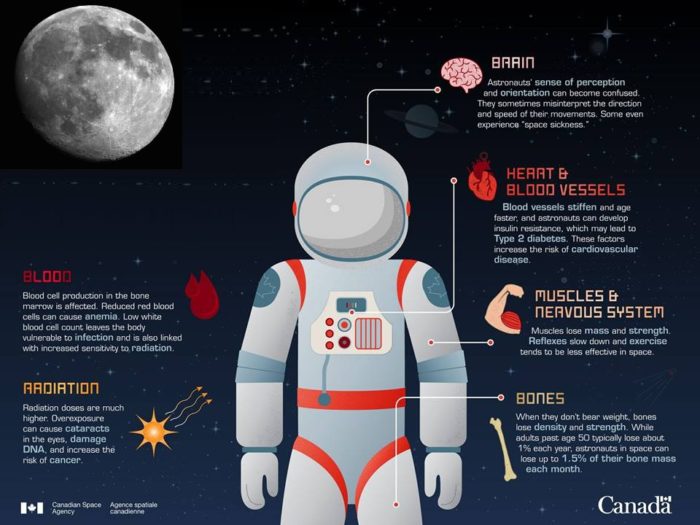
Kino Piispanristi’s newest screen is a premium, more intimate space with exceptional picture quality and a 7.1 audio system based around Genelec’s “The Ones” family of coaxial three-way studio loudspeakers – which deliver extended frequency response, controlled directivity and fatigue-free listening. Three 8361s – the flagship of The Ones range – are deployed for LCR, with six of the more compact 8341s in the surround positions, complemented by two 7380 subwoofers for clean, controlled LF performance.

“For our premium space theater, sound is everything.”

“Theater technology, be it projectors, screens, audio or seats, is constantly evolving and unless you’re among the frontrunners, you might get left behind,” Erkkilä explains. “Genelec is widely known and admired as a wonderful example of Finnish engineering and design. As a local business, we try to emphasize the importance of using locally sourced products, and Genelec’s quality is unmatched. This was a pilot project for us and we’re looking into expanding our other spaces – since it’s been such a hit. We charge a few Euros extra for the premium screen, but the movie experience is so good that our customers still see it as excellent value.”

GLM Space calibration software at work.

Usually found powering the world’s most notable music, broadcast and film studios, Genelec’s studio loudspeakers are now being specified for an increasing number of high-end residential and boutique commercial cinemas around the world – thereby allowing customers to experience the same kind of sonic detail and clarity as the movie creators themselves.

The Ones models provide optimized performance by intelligently adapting to the acoustics of the room, achieved by a combination of GLM space calibration software and internal DSP within each loudspeaker and subwoofer. “GLM calibration allowed us to achieve a better balance with the lower and higher voices on screen,” explains Erkkilä. “Without it, it’s likely that the room would’ve changed the natural feel of the audio. It gave us full control over the system.”

PDF brochure on how Genelec used this cinema for a product case study.

GLM offers precise calibration of each loudspeaker’s in-room frequency response, playback level and distance delay, minimizing unwanted room influences and ensuring the best possible audio quality. In addition to the Genelec system, Kino Piispanristi uses Dolby Cinema processors which bring a natural feel to film soundscapes – immersing the audience in the true excitement of cinema.

“Our expertise in cinema and Genelec’s legacy in sound was the perfect match, and the collaboration was even more meaningful because of the local connection,” concludes Erkkilä. “The Ones loudspeaker series has completely transformed the cinema, and now we can offer audiences everything that the big players can – and more. The cinema is a result of a lot of hard work and dedication, and the Genelec system feels like the icing on the cake. It’s reinvented what we show on the screen.”

This 1980s Tech Can Keep Gas Powered Cars Relevant In EV Age

Read enough automotive-related articles on the internet and you will be convinced the internal-combustion engine is being hunted with a fervor typically reserved for villains in Jason Statham movies.

Okay, that conclusion may be extreme—but it holds some truth. Regulations regarding emissions and engine efficiency grow stricter with each passing year and manufacturers are faced with an impossible task: Take a centuries-old design and make it endlessly better—faster, cleaner, stronger, ad infinitum. At some point, progress will plateau, and the cost of ICE experimentation will simply outweigh the incremental gains in efficiency and power. The good news? The internal-combustion engine might have one more trick up its cylinder sleeve.

Fuel, air, and spark—the three things an engine needs to run. Air is one ingredient that it makes sense to leave alone. Fuel type is essentially decided by contemporary infrastructure. (Synthetic fuels are in the works, but we’re thinking of large-scale changes in the ICE design that would extend far beyond the top echelons of motorsport to the everyman (and woman) on the street.) That leaves spark as the low-hanging fruit in this equation. If a different type of ignition could more completely burn the fuel and air mixture, it would not only reduce emissions but also increase efficiency.

Enter plasma ignition.

This is what plasma looks like compared to the sharp spark of a traditional ignition system. Transient Plasma Systems, Inc

Traditional spark ignition is very simple.

A coil transforms the 12 volts from the car’s charging system into thousands of volts that discharge quickly to jump between the electrode and the ground strap of a spark plug. This forms a sharp but small zap that lights off the chemical chain-reaction that expands the air and fuel mixture to push the piston down and thus rotate the crankshaft. In order for the fuel-and-air mixture to be lit by this type of ignition system, it needs to be fairly close to a stoichiometric mixture; right around 14.7 to 1. That ratio—14.7 grams of air to one gram of fuel—puts a ceiling on efficiency. But here’s where things get interesting.

If we were able to lean out the mixture by adding air but still getting the same in-chamber expansion, and the corresponding force exerted on the piston, efficiency would increase dramatically. A lean mixture is much harder to ignite, though. So hard that you’d need transient plasma to make it happen in any reliable fashion. Technically, the spark on a standard spark plug does create plasma when it ionizes the gasses between the electrode and ground strap; transient plasma takes that small arc and dials it up to 11. If a spark plug is a zap in the chamber, plasma ignition is a TIG welder mounted in a cylinder head.

difference between spark ignition and plasma
Ionfire Ignition

This much more violent mode of ignition can regularly and predictably ignite extremely lean air/fuel mixtures. One of transient plasma’s most obvious advantages, besides a higher-efficiency combustion cycle, is that relatively low amounts of energy are used to perform a lot of electronic “work.” (The difference between energy and power, for those of you who enjoy recalling high school chemistry class.) The spark itself is not lighting a fire to burn the fuel; rather, a rapid-fire sequence of low-range electronic pulses generates a highly potent electric arc, which then breaks the bonds holding the oxygen molecules together and allows the electrons to shoot out, essentially attacking the hydrocarbons (fuel) and creating combustion. This means we are not waiting on a flame to consume the fuel and, in the amount of time between combustion and exhaust strokes, we get a more complete burn.

The most fascinating part? This technology is not new.

We traced the basic concept to patents from the 1980s, but technology has obviously come a long way since then. Outfits like Transient Plasma Systems, Inc. and Ionfire Ignition are reviving the concept and the reintroduction is timed quite nicely. (If you’ll forgive the pun.) TPS ignition systems have been tested and show a 20 percent increase in efficiency while also decreasing harmful emissions like NOx by 50 percent. Numbers like that aren’t a silver bullet in the ICE gun, but plasma ignition could keep our beloved internal combustion engines on the road longer than we’d expected. TPS claims it is working with manufacturers to integrate its ignition tech into production engines, but we are still a few years away from seeing the fruit of that collaboration.

The internal-combustion engine has undergone constant evolution for centuries, and at this point we’re extracting incremental gains. Plasma ignition could be one of the last significant improvements to be found in the ICE story. Here’s hoping that this ’80s tech, refined for the 21st century’s needs, makes its way onto the streets. For the Silo, Kyle Smith /Hagerty.

The Most Common Keyboard Joke In Existence

As we get older we get wiser. It’s just part of the deal. We have all heard the expression that knowledge is power, but power can also be corrupting. Sometimes, it’s good to get a reminder that as smart or as knowledgeable as we think we might be there is always something new to learn.

I had one of those moments recently when I looked closely at a computer called the “Super Brain” that has been sitting out at a computer museum. I had never really spent much time with this machine but when I did I found out that it had a “Here Is” key. It’s enough to make you do a double-take. At first I thought it was a joke.

The most common keyboard joke in existence is the one about the “Any” key. Back in the days when computers ran text only operating environments (like DOS) it was common practice to put a message such as “Press Any Key To Continue” while waiting for the user to finish reading. The joke is that some people would literally spend time looking on their keyboard for a key marked “Any” rather than just literally pressing any key on the keyboard.

I had to do research on this key and discover what it is used for. It turns out that it is used for radio teletype identification. The key transmits a code 22 characters long that identifies to another teletype machine just which machine is sending a message. In other words, this old computer has a key that means only something in the context of a technology that is even older than itself.

Speaking of bizarre keyboards- what do you think of the layout on this vintage example of Orange Computers Inc keyboard? Makes me sort of hungry for starburst candy. A teletype (or more accurately a teleprinter) in case you don’t know or don’t remember is an electromechanical typewriter that can be used to send messages from point to point. They were used at the beginning of the twentieth century for many purposes ranging from spreading news to stock information and more. Variants were (and still are) used as telecommunications for the deaf and the aviation industry still have them around in small numbers.

The joy for me was that the day I discovered the “Here Is” key was a great reminder of how wonderful it is to learn something new. It’s almost self proclaiming (if only it were a “Here It Is!” key) and now, most likely, you too have learned something new today. For the Silo, Syd Bolton. 

Astrolab FLEX Moon Rover Nears South Pole Mission

Monaco, April 2024 The American company Venturi Astrolab, Inc. (Astrolab), a strategic partner of the Monegasque Venturi Group, has been awarded a NASA contract to support the development of Artemis campaign’s lunar terrain vehicle. Its rover, known as FLEX, is equipped with batteries and wheels developed by Gildo Pastor’s teams in Monaco and Switzerland.

Gildo Pastor is no stranger to specialized high-performance vehicles- here with Bugatti EB110 he drove to win the world record for fastest car on ice in 1995.

Astrolab is one of three teams to win contract awards. Astrolab’s contract is worth up to $1.9 billion usd / $2.56 billion cad. Collectively the three contract winners may be awarded task orders over the next 13 years with a total potential value of $4.6 billion usd/ $6.2 billion cad over the life of the program. The contracts allow for two additional years for the completion of services.
With this announcement, and after two decades dedicated to high-performance terrestrial electric vehicles, Venturi is taking another major step forward. Indeed, the industrial Group led by its President Gildo Pastor designs and manufactures the lunar vehicle’s wheels and batteries. The hyper-deformable wheels, developed and manufactured by the Venturi’s Swiss entity in collaboration with Astrolab, were presented at the Paris Air Show in June 2023. As for the batteries, these will be manufactured in Monaco in specifically designed facilities at the heart of the Venturi’s historic headquarters.

SpaceX’s Starship launch and landing system will deliver FLEX to the lunar surface in mid-2026.

Astrolab first revealed the full-scale working prototype for its Flexible Logistics and Exploration (FLEX) rover in March of 2022. In the years since, Astrolab, has conducted thousands of hours of laboratory and field testing that has led to numerous design improvements. The improvements to the wheels and batteries came as a result of tests Astrolab conducted together with Venturi’s engineers.

As required by NASA, FLEX can carry two suited astronauts, accommodate a robotic arm to support science exploration, perform robotic cargo logistics, and survive the extreme temperatures at the lunar South Pole, which is a technological challenge, particularly for the hyper-deformable wheels and batteries. FLEX can be operated remotely from Earth even when astronauts are not present, or it can be operated by suited astronauts.
Once FLEX arrives on the lunar surface, Astrolab expects that FLEX will become the largest and most capable rover to ever travel to the Moon. With a maximum combined rover and cargo mass of more than two tons, the FLEX rover is nearly three times the mass of its largest predecessor. This increased capacity provides significantly more opportunities to conduct scientific experiments and commercial endeavors on the lunar surface.
Through our strategic partnership with Astrolab, I am proud to see the Venturi Group’s know-how validated by NASA. After 20 years of innovation and world speed records in the field of terrestrial electric vehicles, we are now involved in an adventure that will go down in the history books: when Man returns to the Moon! When I see this rover, equipped with our wheels and batteries, operating up there I will have made my greatest dream come true“. – Gildo Pastor, President of the Venturi Group.

Astrolab is honored to have its FLEX rover selected by NASA to participate in the development of creating a Lunar Terrain Vehicle for the Artemis Campaign. Our entire team, together with our business partners, including our strategic partner Venturi Group, are committed to delivering to NASA an LTV that serves as a critical tool in the agency’s efforts to establish a long-term human presence on the Moon.” – Jaret Matthews, founder & CEO, Astrolab.

How AI Is Transforming Wine Selection and Curation

The meeting and event planning industry is experiencing a significant transformation amid an era where the vintage charm of wine meets the cutting-edge sharpness of Artificial Intelligence (AI). This renaissance, characterized by a blend of tradition with technology, is reshaping the essence of event-driven wine selection, moving away from the notion that tech seeks to replace tradition. Instead, it introduces a paradigm of harmonious enhancement, where data-driven precision and the sommelier’s artistry converge, creating a personalized wine journey for every guest’s palate as detailed in the narrative below.

To discuss AI’s impact on the meeting and events industry, I would love to connect you with Angel or Arsalan Vossough, CEO and CTO of BetterAI, develooper of the “VinoVoss” AI Sommelier — a wine search engine and recommendation system revolutionizing the $39B usd/ $53B cad wine sector.

Tech Meets Tannins:
A.I. Transforming Preference-Based Wine Curation for Event Clientele


4.png

The days when the sommelier’s intuition, refined through years of experience and sensory development, solely guided wine selection are evolving. AI, with its vast collection of data and analytical capabilities, steps into the domain as a digital sommelier, marking a critical shift from purely tradition-led approaches. This integration signifies a future where wine recommendations are enhanced by data analytics, achieving a level of personalization and precision once thought impossible.

This shift from traditional expertise to technological innovation in wine selection is reflective of a broader transformation within event planning. AI’s role extends beyond wine selection, revolutionizing aspects from operational logistics to enhancing guest experiences. By leveraging predictive analytics, AI provides planners with deep insights into guest preferences, optimizes inventory management, and significantly cuts waste. This ability to personalize wine lists to the individual tastes of attendees, a feature once reserved for high-end, exclusive gatherings, is now accessible on a larger scale. This transition not only ensures that each wine selection deeply resonates with attendees’ unique preferences but also illustrates the industry’s wider adoption of innovation, prioritizing customization and quality in every aspect of event planning.


The AI-Driven Transformation in Wine Selection

Crafting Personalized Wine Journeys

three-colleagues-using-digital-tablet-in-the-b.jpg

At the heart of Artificial Intelligence (AI)’s transformative influence within the event planning sphere is its unparalleled ability in providing wine recommendations to align perfectly with individual preferences. This capability is not just about selection but about creating a narrative for each event that is as unique as the guests themselves. By meticulously analyzing vast datasets that include a wide range of variables—from individual guest tastes profile and detailed consumption patterns to the dynamic ups and downs of emerging wine trends—AI crafts wine selections that resonate deeply with the event’s demographic profile. Each recommendation is more than a suggestion; it’s a reflection of the event’s ethos, designed to enhance the dining experience profoundly.

Predictive Analytics: Looking into the Wine Future

Positioned at the forefront of wine selection, AI leverages the power of predictive analytics to cast a visionary gaze into the future of guest expectations and wine trends. This innovative approach advances traditional selection methods by empowering event planners with the ability to not just respond to current tastes but to anticipate and shape them. By using sophisticated algorithms, AI scans through historical data and current market analyses to predict which wines will captivate and delight attendees, opening the way for the introduction of emerging varietals and regions. This strategic approach allows for a level of exploration and discovery that enhances the event experience, inviting guests on a wine journey that is both educational and experiential.

Furthermore, the scope of predictive analytics in wine selection extends beyond individual choices to provide a broader understanding of global shifts in the wine industry. From climate change impacts on vineyard yields to innovations in winemaking techniques, AI’s predictive capabilities offer event planners a curated window into the wine world’s future. This comprehensive approach ensures that wine lists are not just reflective of contemporary tastes but are also forward-thinking, positioning events at the cutting edge of culinary innovation and offering guests a taste of the future, today. In doing so, AI doesn’t simply predict preferences; it helps define them, crafting personalized wine journeys that are as visionary as they are satisfying.

Operational Efficiency Through AI

Streamlining Inventory, Embracing Sustainability


5.png

In the world of event planning, the development of Artificial Intelligence (AI) has catalyzed a revolution in operational efficiency, particularly in the domain of inventory management. By utilizing AI’s advanced predictive capabilities, event planners can now make sure that wine orders are carefully aligned with the anticipated demand of each unique event. This precision in forecasting addresses one of the industry’s major challenges—excess inventory and waste—head-on. AI’s ability to analyze past event data, current consumption trends, and even guests’ preferences means that every bottle ordered has a purpose, significantly reducing the likelihood of surplus stock that contributes to waste.

This strategic reduction in waste not only demonstrates a commitment to environmental sustainability but also translates directly into notable cost savings for event organizers. By purchasing only what is needed, events can operate more leanly and efficiently, passing on the benefits of reduced costs to clients while also contributing positively to the planet. This dual advantage spotlights the pivotal role AI plays in driving forward an event planning paradigm that is both economically viable and ecologically responsible.

Moreover, AI’s analytical insights extend beyond just numbers, offering event planners guidance on selecting wines from vineyards and producers committed to sustainable practices. This approach enables events to not only offer of a curated wine selection that is exceptional and environmentally friendly but also aligns with the growing societal demand for responsible consumption. By aligning wine selections with sustainable practices, AI allows event planners to contribute to a larger narrative of environmental responsibility, setting a new standard for the industry.

Synergy Between AI and Human Expertise

Elevating the Sommelier’s Craft


2.png

The integration of Artificial Intelligence (AI) into the process of wine selection marks not the end but a significant transformation in the role of the sommelier. This evolution is characterized by the seamless merging of AI’s analytical strengths with the sommelier’s deep understanding of wine, culture, and personal guest interactions. AI’s entry into this domain provides sommeliers with a suite of tools that enrich their ability to tailor wine selections to the precise preferences and tastes of attendees. By accessing AI-generated insights into guest preferences, historical consumption data, and predictive trends, sommeliers are empowered to provide wine experiences that are deeply personalized, enhancing the dining experience in a way that was previously unimaginable.

This synergy between AI and human expertise allows sommeliers to transcend traditional boundaries, enabling them to craft compelling narratives around each bottle. These stories, woven from the rich history of the wine’s heritage, its journey from grape to glass, and its unique flavor profile, transform each tasting into a memorable experience. The collaboration between AI and sommeliers ensures that the human element of wine selection—the personal touch that elevates a meal into an experience—remains intact, blending the precision of technology with the irreplaceable warmth and authenticity of human interaction.

Balancing the Algorithmic with the Authentic

In the delicate dance between leveraging AI and maintaining the authenticity of wine service, the art of sommeliership shines brighter than ever. While AI provides a powerful platform for enhancing operational efficiency and delivering exceptional personalization in wine selection, it is the sommelier who infuses these recommendations with life. The sommelier’s role shifts from mere selection to that of a storyteller, an educator, and a bridge between the guest and the intricate world of wines. This balance between the algorithmic accuracy of AI and the authentic, personal touch of the sommelier ensures that wine selection remains an art form—a deeply human endeavor that connects, enchants, and leaves a lasting impression on guests.

1.png

The collaborative relationship between AI and sommeliers doesn’t dilute the human aspect of wine service but rather enhances it, ensuring that each recommendation carries with it a story worth telling. This unique partnership introduces a new chapter in wine selection, one where technology and tradition combine to create experiences that are not only personalized but deeply resonant. The future of wine service, thus, lies in this harmonious blend, where AI opens the door to possibilities that were previously unexplored, and sommeliers guide guests through a journey that is as enriching as it is delightful, marking each event with the signature of unforgettable excellence.

Navigating the Challenges

The Ethical Aspects of Data Use

In the quest to utilize Artificial Intelligence (AI) for enhancing wine selection processes, the ethical handling of data stands as a crucial concern. As AI systems delve deep into personal preferences and consumption patterns to deliver personalized wine recommendations, the need to protect guest privacy increases. This requires not only the implementation of robust data protection measures but also the development of ethical frameworks that govern the use of such data. The goal is to develop a trust-based relationship with guests, reassuring them that their personal information is handled with the highest care and respect. This foundational commitment to privacy and ethical data usage is vital in maintaining the integrity of the digital transformation in wine selection. It’s about ensuring that the technological advancement enhances the guest experience without damaging the trust that is essential to the hospitality industry.

Overcoming Technological and Cultural Barriers

The integration of AI into the traditional art of wine selection introduces a complex set of technological and cultural hurdles. Technological challenges such as system compatibility, data integration, and the seamless operation of AI within existing event planning infrastructures present tangible obstacles. Concurrently, cultural challenges emerge, rooted in skepticism towards the role of technology in an area traditionally dominated by human expertise. Overcoming these barriers necessitates a multifaceted approach:

  • Education is key in demystifying AI and showcasing its value as a tool for enhancing rather than replacing the sommelier’s role.
  • Transparent communication plays a crucial role in addressing concerns and setting realistic expectations about what AI can and cannot do.
  • A focus on AI as an enhancer of human expertise rather than a competitor is essential in shifting perceptions and creating a culture of acceptance.

Together, these strategies form the foundation of a successful transition to AI-enhanced wine curation, bridging the gap between technological innovation and the timeless tradition of personalized wine selection. By addressing these challenges head-on, the event planning industry can fully embrace the benefits of AI, ensuring a future where technology and tradition coexist in harmony to create enriched, personalized wine experiences.

Envisioning the Future

The Next Frontier in Wine Recommendation


As machine learning algorithms become increasingly sophisticated, the future of wine recommendation looks promising. AI’s ability to analyze complex patterns and preferences suggests a horizon where every wine selection is not just personalized but also, anticipating guests’ desires before they even articulate them. This is not just about enhancing the event experience but about reimagining the possibilities of personalization.

The implications of AI in wine curation hint at a broader transformation in event planning. From menu customization to entertainment selection, AI’s potential to personalize every aspect of the event experience is vast. This future, where every detail is personalized to the guest’s tastes, brings a new era of event planning, characterized by a high level of customization and engagement.

The fusion of technology and tradition in wine selection represents more than a shift in methodology; it signifies a fundamental change in how we approach the planning of and execute event planning. As AI continues to weave its narrative through the tapestry of event planning, its promise extends beyond operational efficiency or personalized recommendations. It offers a glimpse into a future where every event is a reflection of the guests’ deepest preferences, a celebration not just of the occasion but of the individuality of each attendee. In this future, tech meets tannins, not as adversaries but as allies, crafting experiences that connect on a personal level, setting a new standard for what events can aspire to be. For the Silo, Arsalan Vossough.


Arsalan Vossough, CTO and Co-Founder of BetterAI, specializes in advanced AI technologies, including Machine Learning and NLP. Solutions include “VinoVoss” (www.VinoVoss.com ), a semantic search and recommendation system creating a virtual wine sommelier. The Silicon Valley-headquartered BetterAI excels in developing cutting-edge AI solutions, and is aptly leveraging leading edge technologies like AI, Machine Learning, Generative AI, Natural Language Processing, and Computer Vision to hone transformative solutions. It’s VinoVoss platform empowers users to make highly-informed decisions about their wine selections, explore new varietals, find new favorites and even rediscover old gems quicker and easier than ever before. With a background in quantitative finance and teaching, Arsalan has a Bachelor’s in Computer Engineering, an MBA from Corvinus University, and a Data Science Master’s from UC Berkeley, graduating with honors. Connect with Arsalan at www.BetterAI.io.

Window Cleaning Robot Cracks 400$ Price Mark

Cleaning is called a “chore” for a reason, it’s a pain to do and nobody likes doing it! Imagine if there were robots that could do ALL of the cleaning for you so that you can relax and spend more time living your life. Look no further than Ecovacs Robotics, an award-winning brand of home robotics.

When the DEEBOT D35 was brand new in 2015, it was the first robotic vacuum designed for kitchen and bare-floor cleaning that had “direct suction” vacuuming. Dual-sweeper side brushes allow cleaning along baseboards, which often collect the most dust and is hardly ever noticed. D35 also has smart technology that can detect obstacles such as furniture to keep from bumping into them, along with sensors to detect stairs, so it can remain safe from taking a tumble. Plus, it will automatically return to the charging station to re-energize after cleaning.

Also from Ecovacs Robotics is the WINBOT W730, the world’s first robotic window cleaner. WINBOT’s operation is very easy – users just power her on, securely place her on the window, and press start. WINBOT’s Pathfinder Technology automatically scans and calculates the size of windows and programs a custom path for speed and efficiency. Her internal vacuum pump and powerful suction motor create a double seal that is able to bear up to 26 pounds and a back-up battery and safety pod ensure that WINBOT will stay secure even if the power is disrupted.
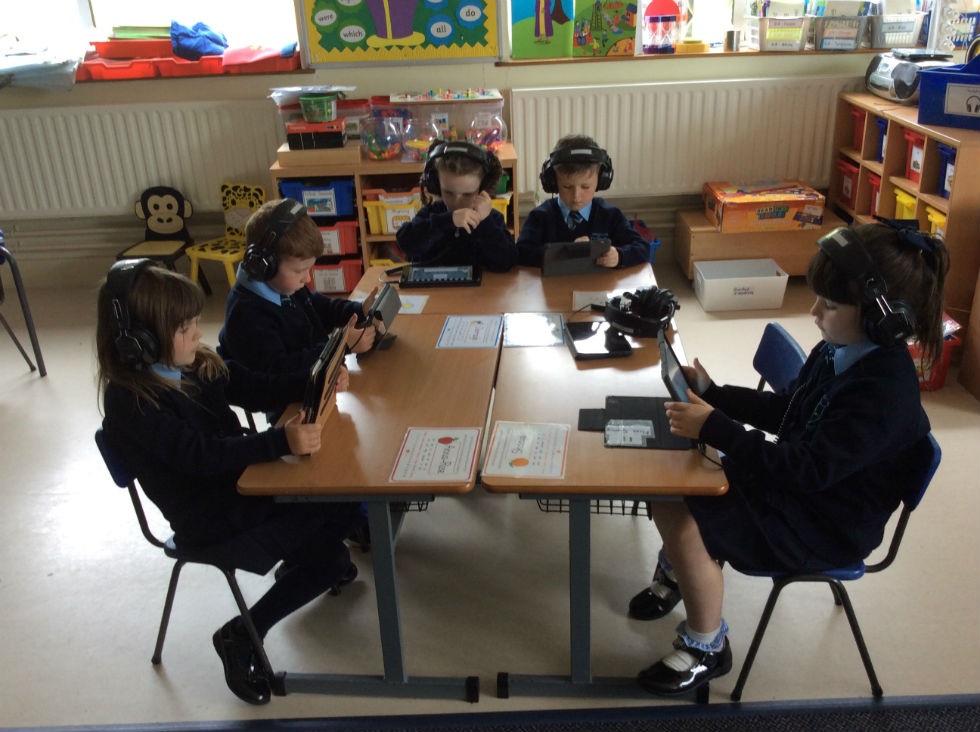

The DEEBOT D35 is available for an affordable $199.99, and the WINBOT is priced out at $399.99 [US dollars].  Learn more about home cleaning robots at www.ecovacsrobotics.com.

A Musical Journey for Robots and their masters~ CLICK ME

Seven Steps For Countries To Regulate Generative AI In Education

Generative artificial intelligence (GenAI) tools have far-reaching implications for education and research. 

Yet the education sector today is largely unprepared for the ethical and pedagogical integration of these powerful and rapidly evolving technologies.

A recent UNESCO global survey of over 450 schools and universities showed that less than 10% of them had policies or formal guidance on the use of GenAI applications, largely due to the absence of national regulations. And only seven countries have reported that they had developed or were developing training programmes on AI for teachers.

That is why UNESCO has developed and released the first-ever global Guidance for Generative AI in Education and Research to support countries amidst the rapid emergence of GenAI technologies.

The new guidance, recently launched during UNESCO’s flagship event Digital Learning Week in Paris, calls on countries to implement appropriate regulations, policies, and human capacity development, for ensuring a human-centred vision of GenAI for education and research. 

What the guidance is proposing

The guidance presents an assessment of potential risks GenAI could pose to core humanistic values. It offers concrete recommendations for policy-makers and institutions on how the uses of these tools can be designed to protect human agency and genuinely benefit students, teachers and researchers.

The guidance proposes seven key steps for governmental agencies to regulate the use of GenAI in education:

Step 1: Endorse international or regional General Data Protection Regulations or develop national ones. The training of GenAI models has involved collecting and processing online data from citizens across many countries. The use of data and content without consent is further challenging the issue of data protection.

Step 2: Adopt/revise and fund national strategies on AI. Regulating generative AI must be part and parcel of broader national AI strategies that can ensure safe and equitable use of AI across development sectors, including in education.

Step 3: Solidify and implement specific regulations on the ethics of AI. In order to address the ethical dimensions posed by the use of AI, specific regulations are required.

Step 4: Adjust or enforce existing copyright laws to regulate AI-generated content: The increasingly pervasive use of GenAI has introduced new challenges for copyright, both concerning the copyrighted content or work that models are trained on, as well as the status of the ‘non-human’ knowledge outputs they produce.

Step 5: Elaborate regulatory frameworks on generative AI: The rapid pace of development of AI technologies is forcing national and local governance agencies to speed up their renewal of regulations.

Step 6: Build capacity for proper use of GenAI in education and research: Schools and other educational institutions need to develop capacities to understand the potential benefits and risks of GenAI tools.

Step 7: Reflect on the long-term implications of GenAI for education and research: The impact and the implications of GenAI for knowledge creation, transmission and validation – for teaching and learning, for curriculum design and assessment, and for research and copyright.

A human-centered vision for digital learning and AI

The guidance is anchored in a humanistic approach to education that promotes human agency, inclusion, equity, gender equality, cultural and linguistic diversity, as well as plural opinions and expressions. In line with UNESCO’s Recommendation on the Ethics of Artificial Intelligence and the Beijing Consensus on Artificial Intelligence in Education, it also responds to the flagship report, Reimagining our futures together: A new social contract for education which calls to redefine the relationship between humans and technology.

UNESCO is committed to steering technology in education, guided by the principles of inclusion, equity, quality and accessibility. The latest Global Education Monitoring Report on technology in education highlighted the lack of appropriate governance and regulation. UNESCO is urging countries to set their own terms for the way technology is designed and used in education so that it never replaces in-person, teacher-led instruction, and supports the shared objective of quality education for all.