A feature about the evolution of AI written and composed by AI.
AI
Artificial Intelligence (AI) has become an integral part of our daily lives, influencing everything from how we interact with technology to how businesses operate. But where did it all begin? Let’s take a journey through the early days of AI, exploring the key milestones that have shaped this fascinating field.
Today, AI is a rapidly evolving field with applications in various domains, including healthcare, finance, transportation, and entertainment. From virtual assistants like me, Microsoft Copilot, to autonomous vehicles and systems, AI continues to transform our world in profound ways.
A Copilot self generated image when queried “Show me what you look like”. CP
Conclusion
The journey of AI from its early conceptual stages to its current state is a testament to human ingenuity and perseverance. While the field has faced numerous challenges and setbacks, the progress made over the past few decades has been remarkable. As we look to the future, the potential for AI to further revolutionize our lives remains immense.
Modern conveniences many take for granted — cell phones, laptops, GPS devices, even coffee makers — run on computer chips introduced by U.S. firms that established America’s leading role in technology. Trace the digital revolution, from its beginnings to the present day, with each groundbreaking advance.
How did these gains happen? Today’s technology emerged from U.S. support for research and development combined with America’s robust private sector, its scientific community, and its innovative spirit.
Bell Labs, a legendary research hub in New Jersey, began as a branch of the Western Electric Company, a subsidiary of the American Telephone and Telegraph Company (AT&T).
Founded in 1925 to meet a growing need for masscommunications, Bell Labs hired top engineers, physicists, chemists, and mathematicians to design and patent equipment (including a high-vacuum tube that transmitted telephone signals across North America).
Bell Labs encouraged interdisciplinary collaboration that produced groundbreaking discoveries. The labs were driven by scientific curiosity, flexible deadlines, and — thanks to AT&T’s budget — stable funding. Lab directors adopted a hands-off management style, and innovation flourished.
DID YOU KNOW?
In 1932, Bell Labs physicist Karl Jansky discovered radio waves coming from outer space. He’s known as the father of radio astronomy.
In the post-World War II period, Bell Labs’ Mervin Kelly assembled an all-star team of scientists to develop a replacement for the vacuum tube, which was bulky, fragile, and prone to burning out.
In 1947, John Bardeen and Walter Brattain — supervised by fellow physicist William Shockley — invented the point-contact transistor, a semiconductor device that amplifies sound and switches electrical currents on and off.
In 1948, Shockley designed the junction transistor, a more robust and reliable transistor. Its small size, low power consumption, and durability paved the way for computers, portable radios, cell phones, and other devices.
Eight years later, Bardeen, Brattain, and Shockley would be awarded the Nobel Prize in physics for this breakthrough.
DID YOU KNOW?
Bell Labs researchers have been awarded 10 Nobel Prizes in physics and chemistry, spanning from 1937 to 2023. While Bell Labs was at its most productive from the 1940s to the 1970s, important research continues today at its New Jersey headquarters.
Bell Labs continued to improve transistor technology during the 1950s, developing the silicon transistor and the metal-oxide-semiconductor field-effect transistor (MOSFET).
The MOSFET proved crucial for building high-density integrated circuits (ICs), or microchips, in the 1960s. Microchips — consisting of billions of tiny transistors crafted from semiconductor materials, commonly silicon — work together to power electronics.
Recognizing the potential for widespread impact and profits, Bell Labs created licensing agreements to share transistor technology with other companies.
In 1955, William Shockley left Bell Labs to establish Shockley Semiconductor Laboratory in Mountain View, California. Within a couple of years, some of his employees — engineers and scientists — formed their own company, Fairchild Semiconductor.
Fairchild is credited with the birth of Silicon Valley. The company became a major player in the growing semiconductor industry, and many Silicon Valley firms — including Intel (founded in 1968) and Apple (in 1976) — have ties to Fairchild alumni to this day.
As demand for semiconductors grew, so did the need for manufacturing capabilities.
Throughout the 1980s and 1990s, Japan, South Korea, and Taiwan became players in the industry, with Japanese companies like Toshiba and NEC influencing the data-storage market and South Korea’s Samsung and SK Hynix focusing on memory-chip production.
Meanwhile, the Taiwan Semiconductor Manufacturing Company (TSMC) upended a traditional business model of integrating chip design and manufacturing. It introduced the fabless-foundry model, encouraging firms to specialize in either design (fabless) or fabrication/manufacturing (foundry).
This increased efficiency. What’s more, it allowed many small firms — those lacking resources to open manufacturing plants — to design chips.
DID YOU KNOW?
The fabless-foundry business model democratized chip production, allowing startups to enter the market without the need for expensive manufacturing facilities.
Experts predict that quantum computing — with its ability to accelerate AI by overcoming limitations on data size, complexity, and processing speeds — will shape the future.
Quantum AI will develop algorithms that could advance pharmaceutical discoveries, predict financial outcomes, improve manufacturing, and bolster cybersecurity. Quantum/AI partnerships already comprise an active and developing market, with U.S. tech giants like IBM and Nvidia investing in both domains.
Industry leaders point to many factors that shape U.S. technological innovation. One such factor is the U.S. system of intellectual property protection, which fosters the spirit of risk-taking, says Walter Copan. (That system is enshrined in the U.S. Constitution, thanks to the foresight of America’s Founding Fathers.)
Sanjay Mehrotra cites the U.S. business culture of “openly, freely being able to debate ideas,” adding, “The best ideas win.”
Thomas Caulfield says, “This is where you can work hard, live your dream, become an entrepreneur, start a company.”
And Jon Gertner notes that key people at Bell Labs came from humble beginnings: “To me, that feels uniquely American — the idea that talent could rise from almost anywhere and shape the future of communications.”
It’s part of Silicon Valley lore that massive tech empires often sprouted from humble roots. As quantum computing and AI herald the next seismic shifts in technology, innovation hubs could emerge in unlikely places. Who knows? The next great U.S. tech companies might now be incubating in a town anywhere in America.
As we get older we get wiser. It’s just part of the deal. We have all heard the expression that knowledge is power, but power can also be corrupting. Sometimes, it’s good to get a reminder that as smart or as knowledgeable as we think we might be there is always something new to learn.
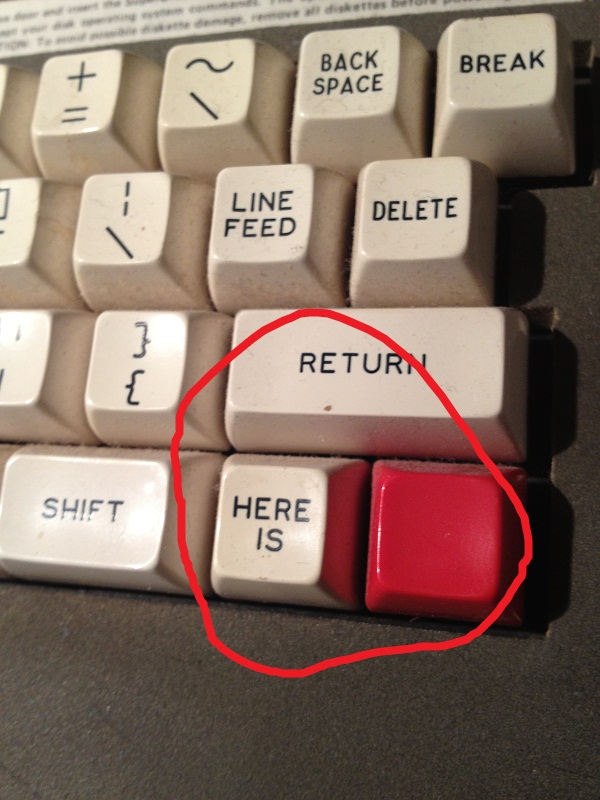
I had one of those moments recently when I looked closely at a computer called the “Super Brain” that has been sitting out at a computer museum. I had never really spent much time with this machine but when I did I found out that it had a “Here Is” key. It’s enough to make you do a double-take. At first I thought it was a joke.
The most common keyboard joke in existence is the one about the “Any” key. Back in the days when computers ran text only operating environments (like DOS) it was common practice to put a message such as “Press Any Key To Continue” while waiting for the user to finish reading. The joke is that some people would literally spend time looking on their keyboard for a key marked “Any” rather than just literally pressing any key on the keyboard.
I had to do research on this key and discover what it is used for. It turns out that it is used for radio teletype identification. The key transmits a code 22 characters long that identifies to another teletype machine just which machine is sending a message. In other words, this old computer has a key that means only something in the context of a technology that is even older than itself.
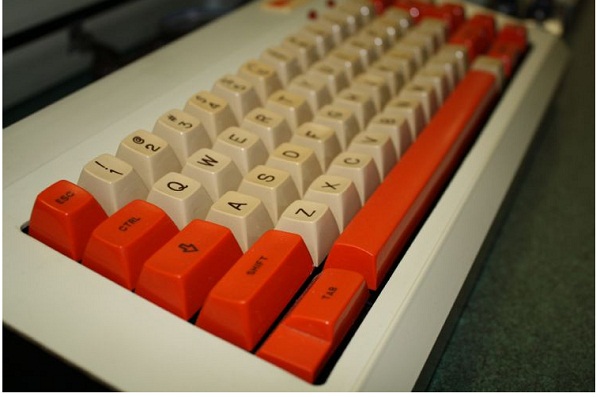
Speaking of bizarre keyboards- what do you think of the layout on this vintage example of Orange Computers Inc keyboard? Makes me sort of hungry for starburst candy. A teletype (or more accurately a teleprinter) in case you don’t know or don’t remember is an electromechanical typewriter that can be used to send messages from point to point. They were used at the beginning of the twentieth century for many purposes ranging from spreading news to stock information and more. Variants were (and still are) used as telecommunications for the deaf and the aviation industry still have them around in small numbers.
The joy for me was that the day I discovered the “Here Is” key was a great reminder of how wonderful it is to learn something new. It’s almost self proclaiming (if only it were a “Here It Is!” key) and now, most likely, you too have learned something new today. For the Silo, Syd Bolton.
Graphic Classics use a variety of styles and each work has a unique identity.
MOUNT HOREB, Wisconsin- Graphic Classics, the acclaimed series of comics adaptations of literary classics from publisher Eureka Productions, has had multiple titles included in the Diamond Distribution Core Curiculum List. Of the nearly 100 books on the list, 23 were from the Graphic Classics series, including VOLUME 2: ARTHUR CONAN DOYLE, VOLUME 4: H.P. LOVECRAFT, VOLUME 8: MARK TWAIN, VOLUME 18: LOUISA MAY ALCOTT, and VOLUME 22: AFRICAN-AMERICAN CLASSICS.
To help educators and librarians select materials to fit into their Common Core Standards curricula, Diamond Book Distributors have created the Diamond Graphic Novel Common Core List. Arranged by grade level, the Diamond Graphic Novel Common Core List offers 98 graphic novels from our publishers that will fit into a Common Core curriculum, along with resources including Library Classifications, Subject Headings, and Core Standards which apply to each book. The list is intended both as an aide to educators and librarians and to show that Diamond supports the Common Core Standards as an effective tool to prepare students for the challenges in college and the workforce.
Graphic Classics publisher Eureka Productions has also partnered with Overdrive and Comics Plus: Library Edition to make Graphic Classics digital editions available to libraries across North America and around the world. Among the library systems which have already started carrying digital editions of Graphic Classics are the Boston Public Library, Seattle Public Library, and the Dayton Metro Library.
Library users can borrow digital editions of Graphic Classics from their local library system for reading on smart phones, tablets, and computers. Digital editions are also available to consumers through the ComicsPlus and Ave Comics apps. Check with your local Library for Graphic Classics digital editions. CP
Many of us enjoy playing the lottery. Whether it’s regularly as a group at work or as part of a bunch of friends or perhaps as an occasional indulgence at the corner store- there is always the chance that you will win. And unlike most betting games, the lottery is simple to understand and simple to play. By choosing a series of numbers often ranging from between 1 and 80, players hope that they have correctly predicted the outcome of numbered ‘ping pong’ balls that are randomly drawn by a machine. This machine uses air pressure to float a large number of balls about until all the receiving baskets are filled up by the no longer floating balls. Beautiful randomness.
Keno takes this idea a step further.
The basic rules and playing instructions are the same but allow for more variety. Modern day casinos have offered keno for decades and it continues to be a highly popular choice for gamers. The casino is able to modify the general lotto rules in order to make their version more attractive and fun. For example, they may decide to increase or decrease the amount of balls used or design their own type of keno betting slips making your odds of winning higher than a state or provincial lottery.
The move towards random number generators.
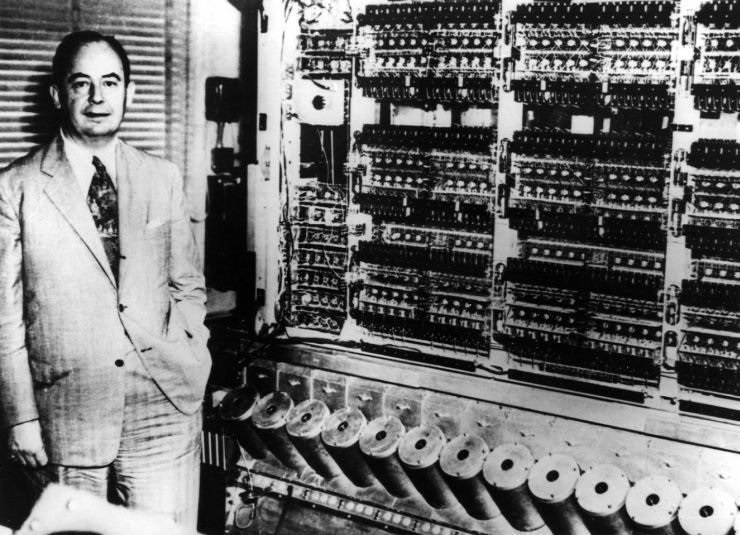
Not every casino or lottery uses a ball machine. Today, digital technology holds the lead in many areas and computers are able to quickly and efficiently generate a series of random numbers. In 1946 John von Neumann, an early computer programming pioneer, developed a mathematical way of generating random numbers using a computer.
After almost 75 years, the random number generator has proven to be reliable. That’s great news for gamers since this method is used by digital casinos ensuring keno draws are now available online 24/7.
It can now happen.
Even more exciting is the way that digital Keno is played. Instead of being restricted to your local lottery, you can now play lotteries all over the world from anywhere you are connected to the internet. Online sites offering keno payout by matching the official lottery rules and results.
This is an exciting change that leads to all kinds of fun and new ways of playing. For example, if you have family in another part of the world you can now join them and play together. Or perhaps you have always wanted to play the National lottery in England but live here in Canada- it can now happen.
“You pay your money, as the saying goes, and you take your chances.” says Falkowitz, CEO of Area 1 Security. “More and more these days, it seems like this ‘policy’ is the rule rather than the exception, in everything from health care insurance to the commuter parking lot. Even though you’ve paid for the product or service, no one’s really responsible for some reason when you suffer damages while consuming whatever it is you bought. Or worse yet, you somehow find that whatever you bought doesn’t really do what you bought it for. And there’s an asterisk somewhere in the fine print to explain why. Unfortunately, nowhere is this more prevalent than in today’s cybersecurity industry.”
Despite the billions spent on cybersecurity we continue to suffer the most debilitating and expensive breaches imaginable, and some that cannot be imagined under any circumstances. Yet experts predict the worst is still to come. Cybercrime has moved from data theft and website defacement to a trajectory that includes data manipulation, data loss and eventually, if something is not done to change the economics of being a bad guy on the internet, threats to the stability of society itself.
“Cybersecurity companies seem to be content to collect their millions with the caveat that they can’t really offer protection in exchange,” continues Falkowitz. “Their customers likewise collect mountains of data on their customers and are appropriately contrite when that data is stolen or misused but the apology is not accompanied by compensation. Even the government can’t protect itself, or its citizens even if they’re attacked by another nation-state.”
The excuses and the explanations are familiar: Cybersecurity is too complicated. Hackers are too clever. Attacks are unprecedented.
“Nonsense. Every bit of it.” says Falkowitz. “Cybersecurity is no more complicated than hundreds of other things we do routinely, from sending astronauts into space or open heart surgery. Hackers are human, just more persistent about how to fool the rest of us. And attacks are based on the same tried and true methods—phishing—they’ve been using for decades.”
Oren J. Falkowitz is the co-founder and CEO of Silicon Valley’s Area 1 Security. Oren held senior positions at the NSA and United States Cyber Command (USCYBERCOM) where he focused on Computer Network Operations & Big Data and is a predominant cybersecurity industry thought-leader committed to keeping high-level national security conversations relevant. For the Silo, by Jennifer Vickery.
Sonnet Technologies recently announced the eGFX Breakaway™ Box 650, the latest and most capable model in the company’s series of Thunderbolt™ 3 to PCI Express® (PCIe®) eGPU expansion chassis for professional graphics and gaming applications.
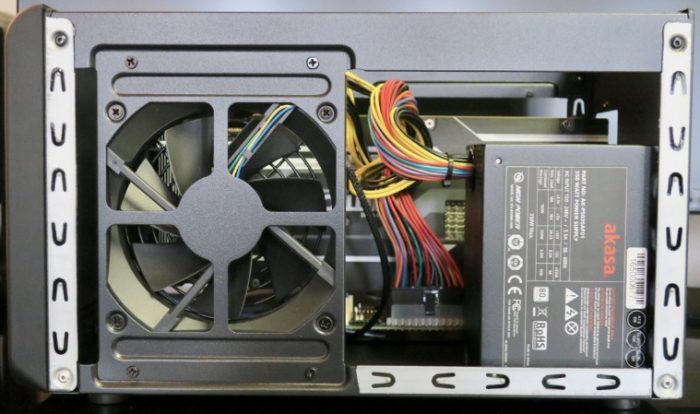
The Breakaway Box 650 is designed and qualified specifically for large, power-hungry video graphics processing unit (GPU) cards, including the AMD Radeon™ RX Vega 64 and overclocked NVIDIA® GeForce® GTX 10 series-based cards. The AMD-approved Breakaway Box 650 is equipped with a 650-watt power supply, which provides ample power for GPU cards with high transient peak power requirements.
“With the introduction of AMD’s Radeon Pro and RX Vega Series cards, we have experienced a high demand for an eGPU chassis capable of supporting the higher standards of these GPU cards,” said Robert Farnsworth, CEO of Sonnet Technologies. “The eGFX Breakaway Box 650 meets the demand, enabling users to tap the compute power of even the AMD Radeon RX Vega 64 and Radeon Pro WX 9100 cards while still providing up to 87 watts of upstream Power Delivery to support popular notebook computers.”
The eGFX Breakaway Box 650 provides a single slot for connecting any size Thunderbolt-compatible GPU card, and features enough room for many high-performance water-cooled cards — making it ideal for professionals and gamers who need to run bandwidth-intensive graphics applications on their eGFX-compatible notebook, all-in-one, or other small-form-factor computers. The unit is equipped with a 40Gbps Thunderbolt 3 port that enables data transfers up to 2750 MB/s, and supports all Thunderbolt-compatible GPU cards — such as AMD Radeon R9, RX, RX Vega, and Pro WX models; and NVIDIA GeForce GTX 9 and 10 series, Titan X and Xp, V, and Quadro® models. In addition, the Breakaway Box 650 includes two eight-pin auxiliary power connectors and provides 87 watts of upstream power (Power Delivery), useful for powering and charging a connected notebook computer that supports Thunderbolt 3 charging.
The eGFX Breakaway Box 650 (part number GPU-650W-TB3) is available now from Sonnet Technologies and its dealers at an MSRP of $449 usd. Featured image via egpu.io
About Sonnet Technologies
Sonnet Technologies Inc. is a leading provider of Thunderbolt™ 3 to PCIe® card expansion systems; external graphics (eGFX) solutions for pro users and gamers; pro media readers; docks and adapters; and network, storage, and other interface cards for pro users in the audio, video, and broadcast industries. Sonnet’s Thunderbolt expansion products enable the use of pro audio I/O and DSP cards, pro video capture and transcoding cards, GPU cards, network and storage interface cards, and other high-performance PCIe cards with Thunderbolt technology-enabled computers. For 30 years Sonnet has pioneered and brought to market innovative and award-winning products that enhance the performance and connectivity of Mac®, Windows®, and other industry-standard computers.
San Francisco, CA —School’s out for summer, but learning doesn’t have to stop at the classroom door. For parents and educators looking to keep their students exploring, tinkering, and creating, No Starch Press offers the latest addition to its lineup of STEM books. This time focusing on the Arduino microcontroller.
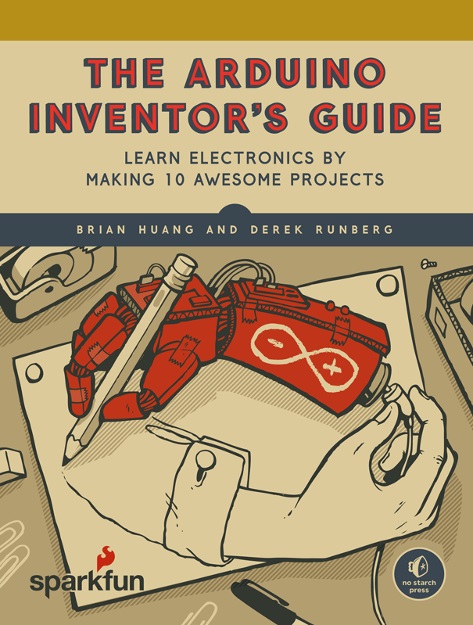
The Arduino Inventor’s Guide (No Starch Press, $29.95USD, 336 pp., June 2017) is a project-packed introduction to building and coding with the Arduino microcontroller. With each hands-on project, total beginners learn useful electronics and coding skills while building an interactive gadget.
This is No Starch Press’s second installment in its introductory-level educational series for aspiring makers. The series is a collaboration with SparkFun Electronics, the popular electronics parts retailer dedicated to making the world of electronics more accessible to the average person. Authors Brian Huang and Derek Runberg of SparkFun’s Department of Education use their teaching experience to make learning about electronics an adventure.
“We wanted to share the magic that happens when you build something interactive with electronics,” says Huang. “The goal is to teach real, valuable hardware skills, one project at a time,” adds Runberg.
Readers learn how to make their hardware move, buzz, flash, and interact with the world as they build 10 projects, including:
A miniature traffic light
A light-sensitive, color-changing night-light
A temperature-sensing mini greenhouse
A motorized, programmable robot
A tiny, playable electric piano
“We’ve teamed up with SparkFun to make electronics and coding skills achievable for anyone,” says No Starch Press founder Bill Pollock. “This book will take total beginners from blinking their first LED to programming their first robot.”
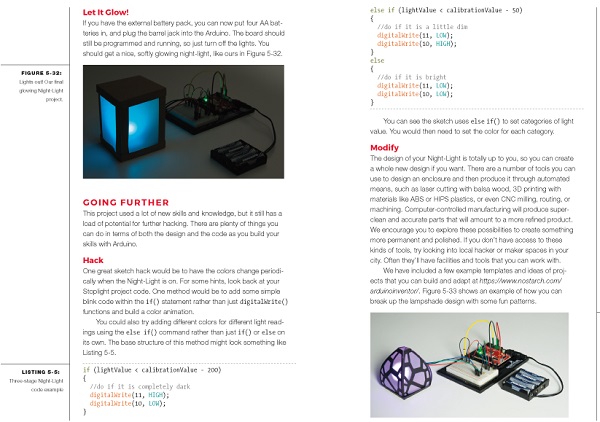
Sample pages from The Arduino Inventor’s Guide:
For the Silo, Amanda Hariri.
About the Authors
Brian Huang is the Education Engineer for SparkFun Electronics. He combines his knowledge of teaching and engineering to create professional development materials.
Derek Runberg works in the Department of Education at SparkFun Electronics, where he runs workshops about technology in classrooms and at conferences. He is the author of The SparkFun Guide to Processing.
SparkFun Electronics is an online retail store that sells electronic parts for DIY projects. It offers classes for the public as well as resources, tutorials, and professional development for educators through its Department of Education.
The Arduino Inventor’s Guide
Publisher: No Starch Press
Authors: Brian Huang and Derek Runberg
Print ISBN: 978-1-59327-652-2
Price: $29.95USD
Publication Date: June 2017
Specs: 336 pp., 4C Available in fine bookstores everywhere, contact marketingdirector@thesilo.ca for locations near you and online ordering information.About No Starch Press
From deep in the heart of San Francisco’s start-up gulch, No Starch Press carefully crafts the finest in geek entertainment. The growing list of award-winning No Starch Press bestsellers covers topics like LEGO, hacking, STEM, programming, science, and math. Our titles have personality, our authors are passionate, and our books tackle topics that people care about.
2013 will be remembered for many things, but in the world of consumer electronics it will be remembered as a year when techpreneurs proved that innovation lives and the spirit of enterprise still burns strong.
The technologies propping up the gadgets on display in this infographic are a product of incremental development, iterations of ideas that have been gestating for many years and are slowly being integrated into products that we use daily.
Take fingerprint authentication, for instance, on the new iPhone 5s. For close to ten years, the technology has been commercially viable but Apple made the bold move of finally putting an end to the forgotten password woes of its customers.
HTC finally incorporated the technology Full HD displays on a smartphone with amazing results. The images on HTC one remain unmatched for clarity and color accuracy.
Leap Motion made a leap of faith by investing in technology that changes the way users interact with their devices. Instead of the keyboard, mouse, or screen, we can now use gestures to make devices do our bidding. All for less than a hundred dollars with technology packed into a device no bigger than a bubble gum pack.
Google Glass is setting imaginations on fire with its unique first-person perspective for recording visual images. Is it ethical to photos and videos
of people without their permission and without them noticing that you’re actually doing it? Will the technology be abused? Will it change the way users live their lives?
For many, the questions won’t be as complex or thought-provoking. It might simply be, “Will I get an Xbox One for Christmas?”
IRVINE, California. BenQ America Corp. today announced that it has been named an International CES Innovations 2013 Design and Engineering Award Honoree for its all-white VW30 Series of vertical alignment (VA) LED monitors in the “Computer Peripherals” product category. Products entered in this prestigious program are judged by a preeminent panel of independent industrial designers, engineers, and members of the media to honor outstanding design and engineering in cutting-edge consumer electronics products across 29 product categories…….[and that’s why we’ve decided to post this in our Fashion category. ‘Cause this monitor is absolutely beautiful. CP ]
Thanks to a new Reading Mode, the new monitors adjust their settings automatically to simulate the warmth of reading paper. How frickin’ cool is that?
BenQ Named CES Innovations 2013 Design and Engineering Award Honoree for VW30 Series of White VA LED Monitors
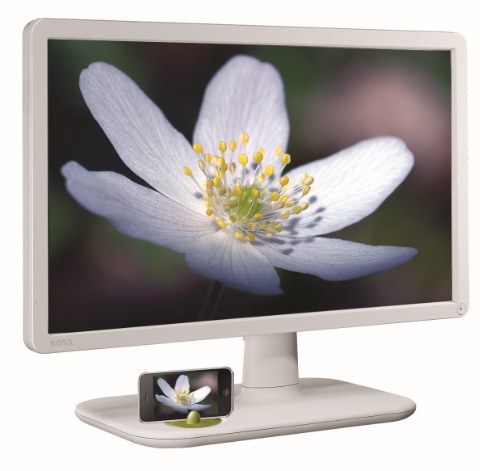
With no printing, coating, or adhesives on their surface, BenQ’s white, asymmetrical VW2230H and VW2430H monitors give off a pure, uncomplicated, and elegant look. Beyond their design, the VW30s connect to any MacBook through an M-book mode, recreating authentic MacBook picture quality on either the 21.5-inch or 24-inch displays. Additionally, thanks to a new Reading Mode, the monitors adjust their settings automatically to simulate the warmth of reading paper.
For space-savings, a device holder at the base of the monitor offers practicality. The accessory holds iPhones, iPods, and other close-at-hand devices. The monitors also morph into full entertainment hubs; HDMI high-speed multimedia interface, D-sub, and DVI-D connections allow users to hook up gaming consoles, Blu-ray players, and additional computers. The VW30 Series offers full 1080p HD, a contrast ratio of 3000:1, and a 178-degree viewing angle, bringing any on-screen content to life.
The VW30 Series’ LED backlighting technology cuts power consumption by up to half when compared to previous generations of monitors. The Eco Mode regulates backlight brightness automatically to ensure the highest quality and energy efficiency. Power consumption is reduced by more than 37 percent when performing daily tasks — such as document viewing, Internet browsing, and emailing — and lowered by 44 percent when gaming.
“With the VW30 Series, BenQ was thinking forward setting out to create the ultimate display with a sleek, minimalistic design perfect for today’s modern lifestyles,” said Lars Yoder, President at BenQ America Corp. “The units combine eco-friendly, high-efficiency operation for an incredible visual experience, and we are honored to receive this recognition as a validation of our efforts.”
The prestigious Innovations Design and Engineering Awards are sponsored by the Consumer Electronics Association (CEA(R)), the producer of the International CES, the world’s largest consumer technology tradeshow, and have been recognizing achievements in product design and engineering since 1976.
BenQ’s VW30 series will be displayed in The Venetian at the 2013 International CES, which runs Jan. 8-11 in Las Vegas. Honorees will also be displayed at CES Unveiled: The Official Press Event of the International CES from 4-7 p.m. on Jan. 6, in the South Seas Ballroom C at Mandalay Bay. For details on all Innovations 2013 Design and Engineering honoree products, please visit http://cesweb.org/Awards/CES-Innovations-Awards.aspx.
In addition, visitors to BenQ’s South Hall Booth MP25171 during the 2013 International CES will have an opportunity to experience the company’s powerful new lineup of gaming and computer monitors, interactive flat panel displays, and a variety of home entertainment and business projectors.
The VW2230H and VW2430H are available now at MSRPs of $179 and $249, respectively. Information on the full line of BenQ products is available at www.benq.us.
Machinarium is not a new videogame. But if, like many gamers, you overlooked it when it was released in late 2009, you owe it to yourself to go back and pay it some attention. Machinarium may look simple or perhaps even a touch primitive at first glance, but in reality the game is an inspirational fairy tale set in a wondrous, grimy world of living machines; a touching story of struggle, heroism and robot-love.
One of Machinarium’s most remarkable qualities is the way its tale is woven without a single word—there’s not one instance of speech or text in the entire game. Instead, everything is told visually. Dialog between characters unfolds as brief animations, while plot details are filled in through flashbacks.
Even the physical appearances of the game’s denizens, from the diminutive main character to his ruffian tormentors and the strutting, tin-pot police who, in theory at least, guard over the city, figure prominently in the storytelling process, as the pint-sized underdog struggles against bullies and thugs to be the hero his doe-eyed beloved has always believed him to be.
That may be a lot to read into a game that, bizarre setting aside, is a fairly straightforward point-and-click adventure. From a gameplay standpoint, Machinarium is solid if not particularly noteworthy. But the details of its world most definitely are. Each level and everything in it is entirely hand-drawn, providing a unique and whimsical visual style, while the soundtrack, both musical and ambient, is every bit as impressive—possibly more so. The combined effect is nothing short of extraordinary.
Gamers unfamiliar with the standards of “adventure logic,” in which odd, occasionally arbitrary sequences of actions are required to complete tasks and move things forward, may need a little time to get settled, but veterans of the genre will feel right at home. You will collect objects, you will combine objects, and you will use those objects on other objects to make things happen. But the game mechanics are actually quite simple, because everything is visual and its various regions are fairly tightly compartmentalized. Some of the problems you’ll face are real stumpers, however, and while one hint is available for each of the game’s screens, don’t expect it to do much more than give you a very gentle nudge in the right direction.
But that’s okay. Machinarium is a slow-burning experience that’s best savored rather than merely consumed. It crafts gripping beauty out of an ugly world in a way that elevates it from the merely good to the truly memorable. It’s not for everyone: twitchy Halo junkies probably won’t find too much to like in it. But for anyone in the mood for something a little more thoughtful, or who’d just like to see the videogame medium stretch its legs a little bit, Machinarium is a wonderful, magical game that simply should not be missed. For the Silo, Andy Chalk.