Tag Archives: smart consumer

Would You Use AI For Buying A Car? One In Four Buyers Already Do

A recent consumer survey backed by similar results from Elon University reveals that AI adoption for car shopping is skyrocketing, rapidly becoming a standard part of the automobile buying process. This as fully one in four buyers have already used AI tools this year to research, compare prices, negotiate and otherwise outsmart dealerships, and an overwhelming 88% found it helpful. Signaling a seismic shift in the way North Americans are now shopping for cars, nearly half of consumers indicated plans to use AI in their next purchase. Not just for buyer benefits, dealerships are gleaning critical business intelligence from AI to inform sales strategies, train staff and elevate customer engagement. The below  report from our friends at CarEdge, which offers its own AI Negotiator car buying tool saving shoppers thousands, details the first data-backed look at how AI tools are reshaping the car buying experience.

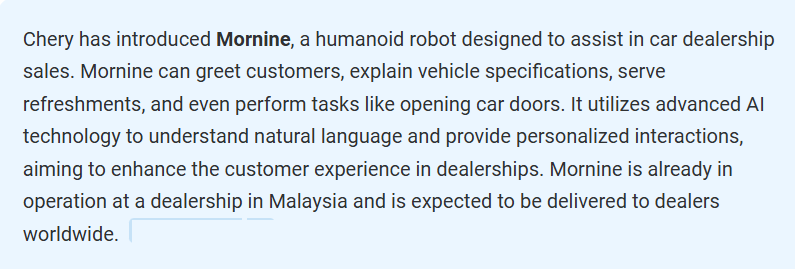
Mornine- AI powered car dealership robot.

Study: 1 in 4 Car Buyers Tap AI for Better Deals


Artificial intelligence is changing the way North Americans buy cars, and it’s a transition that is happening quickly. In the first-ever survey of its kind, CarEdge asked 500 car shoppers if they’re using AI tools like ChatGPT to research, compare, and negotiate during the car buying process. The results confirm a major shift is underway. One in four car buyers in 2025 are already using AI tools to gain an edge, and future buyers are even more likely to embrace these technologies.

Car buyers are finding AI to be a valuable tool. Among those who used tools like ChatGPT, Perplexity, Google Gemini, and others, 88% said it was helpful. AI is quickly becoming a trusted co-pilot for car buyers.

Key Findings: Car Buying Is Changing

The 2025 CarEdge AI & Car Buying Survey reveals a clear and growing trend: AI tools are quickly becoming part of the car buying process for a significant portion of consumers. Here are the standout findings:

1 in 4 Car Buyers Use AI 

25% of car buyers in 2025 say they used or plan to use AI tools like ChatGPT during the shopping or buying process. This contrasts with a recent survey by Elon University that found 52% of Americans now use AI large language models. While signs point towards increased adoption of AI tools, the CarEdge survey found that most car buyers are still in the early stages of integrating these tools into high-stakes decisions like vehicle purchases. This suggests there’s still significant room for growth in AI adoption amongst car buyers.

AI Use Is Accelerating

Among those who haven’t bought a car yet this year, 40% say they are using or plan to use AI tools during their search or deal-making. This is nearly 3x higher than the 14% seen among those who already bought a car earlier in the year.

AI Tools Deliver Results

Among those who used AI:

  • 88% say the tools were helpful
  • 32% found them very helpful
  • 60% used them “a lot” during the process

The AI Holdouts: Drivers Who Lease

Of the respondents who had already leased a car in 2025, none reported using any AI tools.

The AI-Adopting Buyer: Who’s Using It, and How?

AI adoption among car buyers is still in its early stages, but clear trends are beginning to emerge.

Among Buyers Who Already Purchased in 2025:

Just 14% of those who already bought a vehicle this year used AI tools during the process. Adoption rates were nearly identical across new and used buyers, with 14% in each group saying they used AI tools.

Among Future Car Buyers:

The numbers jump significantly when looking at those who haven’t yet bought in 2025. Among this group — who represent 39% of total respondents — 40% say they either already use or plan to use AI tools during their car search and buying process.

That’s more than triple the current usage rate among recent buyers, suggesting AI adoption is accelerating as awareness grows and tools become easier to use.

This group also appears to be more proactive: 60% of those who used AI tools during their buying journey said they used them “a lot,” while 40% used them only occasionally.

What Car Buyers Are Using AI Tools

AI tools are quickly becoming essential research companions for car shoppers looking to make more informed, confident decisions. After all, why go it alone when a wealth of automotive knowledge powered by large language models (LLMs) is right in your pocket?

Among buyers who used AI tools during their car purchase or lease process, here’s how they put them to work:

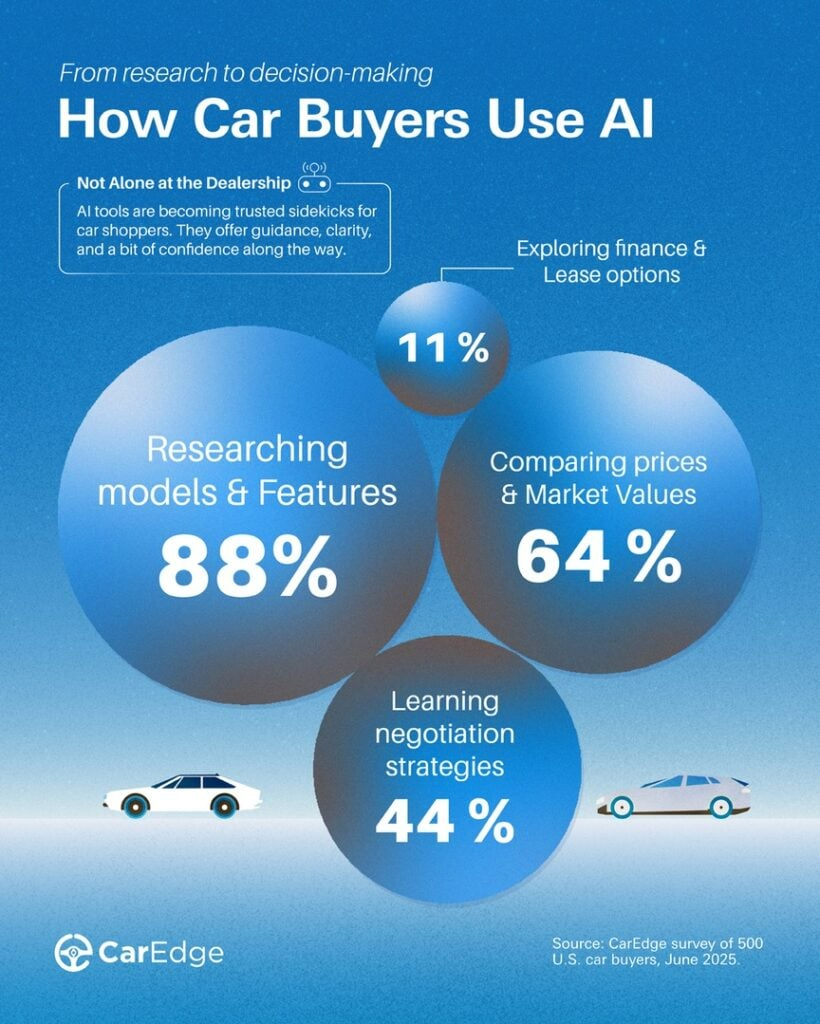
88% — Researching Vehicles

The most common use by far, AI tools helped buyers learn about different models, trims, features, and reliability. For many, it was like having an always-available expert to explain the pros and cons of their options.

64% — Comparing Prices and Market Values

Buyers used AI to better understand fair pricing, from invoice pricing to out-the-door. 

44% — Learning Negotiation Strategies

Nearly half of AI users leaned on these tools to prepare for conversations with salespeople. Whether role-playing negotiation scenarios or asking how to spot add-on fees, this group used AI to level the playing field at the dealership.

11% — Exploring Finance and Lease Options

A much smaller portion of buyers used these tools to become familiar with leasing vs. financing, how to calculate payments, and similar queries.

Industry Implications

Car buying has always been tilted in favor of the dealership. Information asymmetry — what the dealer knows versus what the customer knows — has long been the source of consumer frustration, confusion, and overpayment.

That dynamic is beginning to shift.

This survey confirms what many in the industry are only starting to realize: AI is giving car buyers the upper hand. Tools like ChatGPT are helping consumers cut through the noise, ask smarter questions, and avoid common dealership traps. Instead of relying on guesswork or scattered advice, buyers are turning to AI for fast, personalized guidance at every step.

But one auto industry veteran has words of caution for buyers relying heavily on AI tools.

It’s both surprising and a little scary to see how quickly people are turning to AI to guide such a major financial decision,” said Ray Shefska, Co-Founder of CarEdge. “While tools like ChatGPT can be powerful, they’re only as good as the data behind them. AI should complement your research, not replace your own critical thinking.

That perspective underscores the real takeaway of this report: AI works best when it’s used thoughtfully as a tool, not as a crutch. In an age where automation raises fears of job loss or decision-making without human oversight, this survey offers a more optimistic view — one where technology helps everyday consumers make smarter choices. Used wisely, AI can help level the playing field and bring more transparency and fairness to the car buying experience.

Methodology

This survey was conducted by CarEdge between June 19 and June 24, 2025. A total of 500 U.S. respondents participated, recruited through the CarEdge email newsletter and social media channels. Questions were tailored based on buying status to better understand how and when AI tools were used in the car shopping process.

For the Silo, Karen Hayhurst.

About CarEdge
Founded in 2019 by father-and-son team Ray and Zach Shefska, CarEdge is a leading platform dedicated to empowering car shoppers with free expert advice, in-depth market insights, and tools to navigate every step of the car-buying journey. From researching vehicles to negotiating deals, CarEdge helps consumers save money, time, and hassle, hundreds of thousands of happy consumers have used CarEdge to buy their car with confidence. With trusted resources like the CarEdge AI Negotiator tool, Research Center, Vehicle Rankings and Reviews, and hundreds of guides on YouTube, CarEdge is redefining transparency and fairness in the automotive industry. Follow them on YouTubeTikTokX,  Facebook, and Instagram for actionable car-buying tips and market insights. Learn more at www.CarEdge.com.
Auto Retail Finally Being Disrupted By AI

With AI reshaping everything from finance to fast food, the $1.5T auto retail industry is finally facing its overdue disruption. The typical car-buying experience—riddled with hidden fees, lead bloat, pricing games and low trust—has remained stubbornly analog. But now, with 90% of dealerships in America (and growing % in Canada and Mexico) experimenting with AI tools and 1 in 4 buyers already using AI to shop, the tide is turning. Agentic AI  technology is fundamentally reshaping one of the most significant purchases in a person’s life.

Zach Shefska, Co-Founder and CEO of CarEdge, asserts that agentic AI is the key to rebuilding trust, removing friction and leveling the playing field for both buyers and sellers. From AI-powered shopping assistants that negotiate on your behalf, to data tools that reveal deceptive dealership practices, Shefska is a pioneer in “agentic AI” — a new form of artificial intelligence bringing much-needed transparency to the industry.

  • The Broken Status Quo: Car buying is frustrating and inefficient for both consumers and dealerships—highlighting key stats like 72% sales staff turnover and 2% lead conversion from third-party platforms.
  • Lead Generation Platforms Are Failing: Legacy systems flood dealers with unqualified leads, drain resources, and deliver minimal value to consumers.
  • The Rise of Agentic AI in Auto Retail: Consumers are turning to tools like ChatGPT and CarEdge’s AI agent to navigate purchases with more confidence, speed, and clarity—25% are already doing it.
  • From Friction to Fluidity: Agentic AI replaces quantity with quality—streamlining the buyer’s journey, reducing information overload, and improving dealer efficiency.
  • The End of Pricing Games: AI tools now collect and publish out-the-door pricing from thousands of dealerships, exposing hidden fees and rewarding transparent sellers.
  • The Future of Negotiation: AI agents can negotiate on behalf of both buyers and sellers—minimizing stress, cutting transaction times from days to hours, and removing the adversarial edge.
  • Real-World Impact Stories:  One buyer saved $1,280 and hours of back-and-forth using CarEdge’s agentic AI—illustrating AI’s practical value in real-life scenarios.
  • AI Helps Honest Dealers Win: In a trust-starved industry, AI gives reputable dealers a new way to stand out by offering full transparency and faster deals.
  • What’s Next for AI in Auto Retail: The emerging frontier: AI agents dynamically collecting and updating real-time pricing and inventory data across markets to offer true market intelligence.

For the Silo, Zach Shefska. Zach is CEO of CarEdge, a leading platform—founded by father-and-son team Ray and Zach Shefska—dedicated to empowering car shoppers with free expert advice, in-depth market insights and tools to navigate every step of the car-buying journey. From researching vehicles to negotiating deals, CarEdge helps consumers save money, time and hassle. Alsop with trusted resources like the CarEdge Research Center, Vehicle Rankings and Reviews, and hundreds of guides on YouTube, CarEdge is redefining transparency and fairness in the automotive industry. Connect with Shefska at www.CarEdge.com or on social media on YouTubeTikTokX,  Facebook, and Instagram.
Ferry Travelling In Europe Is Very Popular For Summer- Here Are Costs

Far from the stress of crowded airports or stations, ferries allow you to travel in comfort while taking your time.

Our friends at Vivanoda, a web platform that enables all travelers to find ferry, bus, train and plane tickets, wanted to launch a major study into ferry prices in Europe in order to gain a better understanding of the variations in ferry ticket prices according to a number of criteria (destination country, distance, seasonality, etc.).

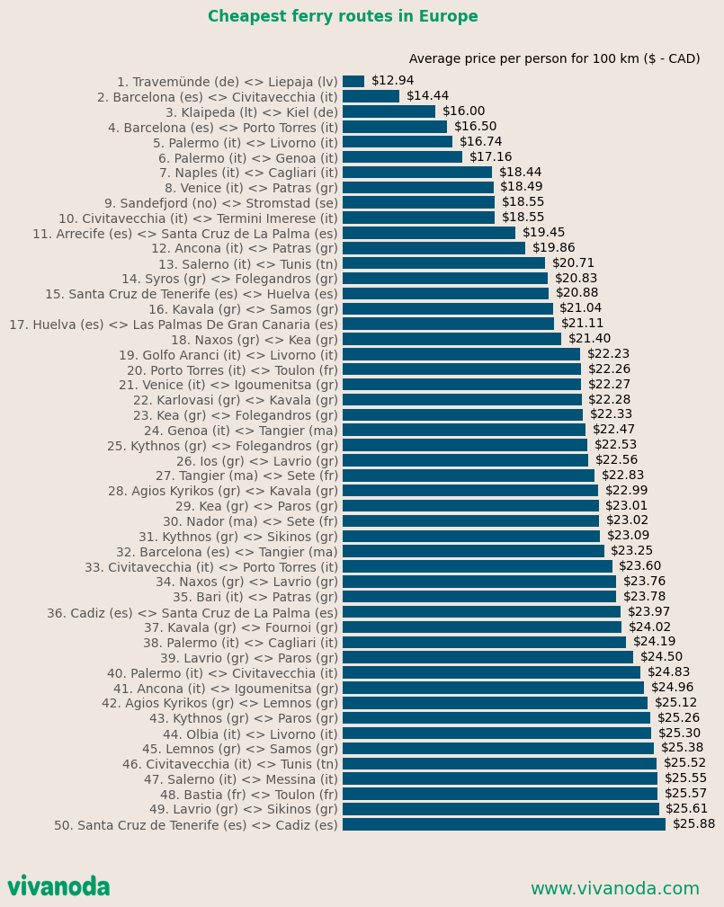
Fortunately for those of us interested in a Europe trip that includes ferrying, they have analyzed tens of thousands of ferry fares on hundreds of routes in Europe, as well as crossings to Turkey and the Maghreb countries (Morocco, Algeria, Tunisia), to get as exhaustive a picture as possible. If you enjoy comparing prices using graphs you are going to want to keep reading…

It’s not difficult to understand the appeal of Ferry travel- leisurely comfortable rides with great views.

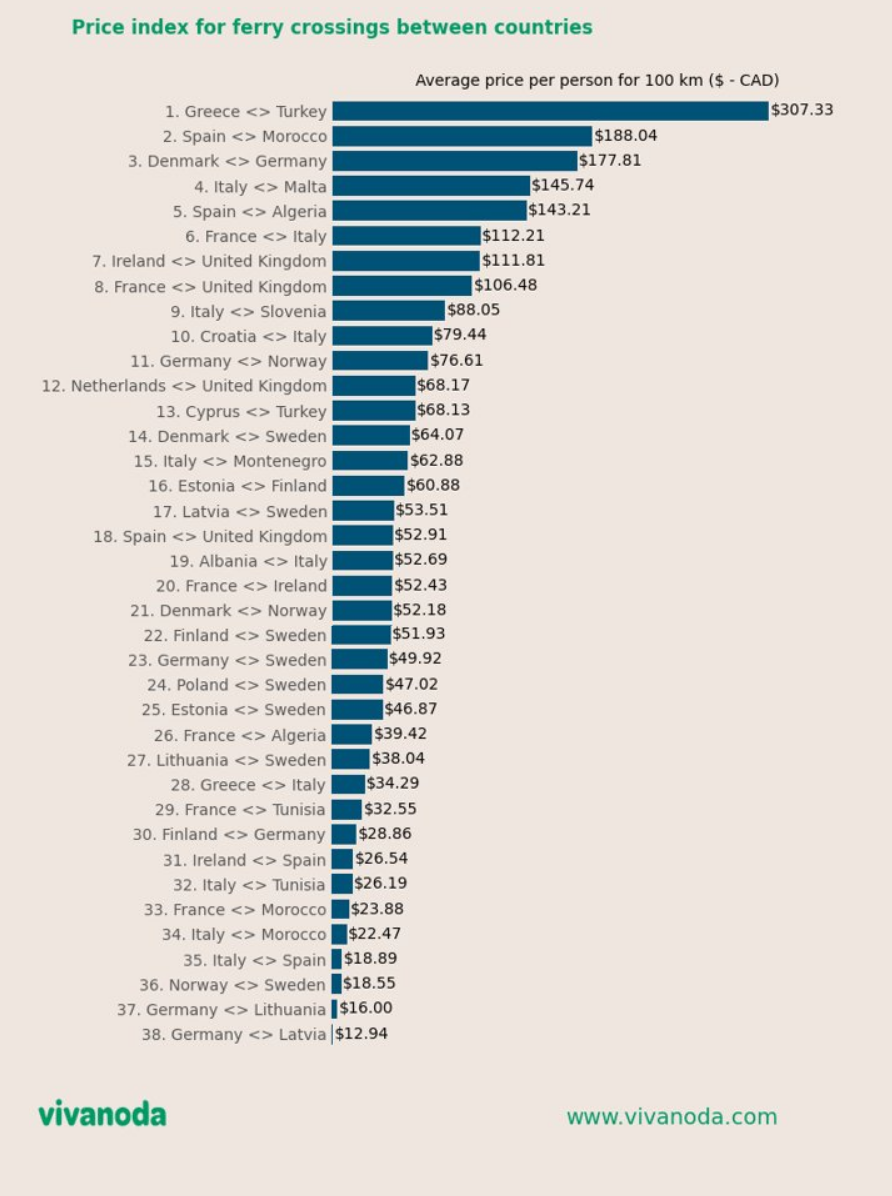
Here are the key points highlighted by this study at European level:

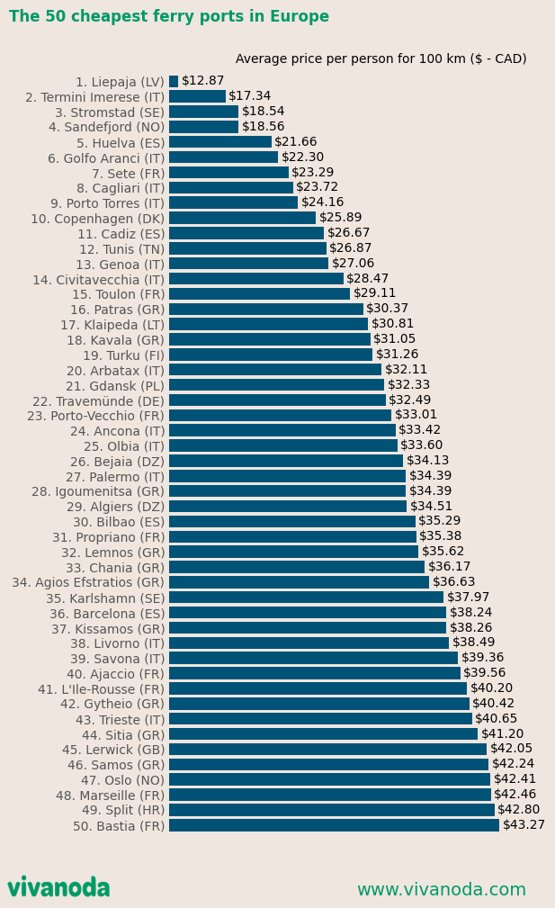
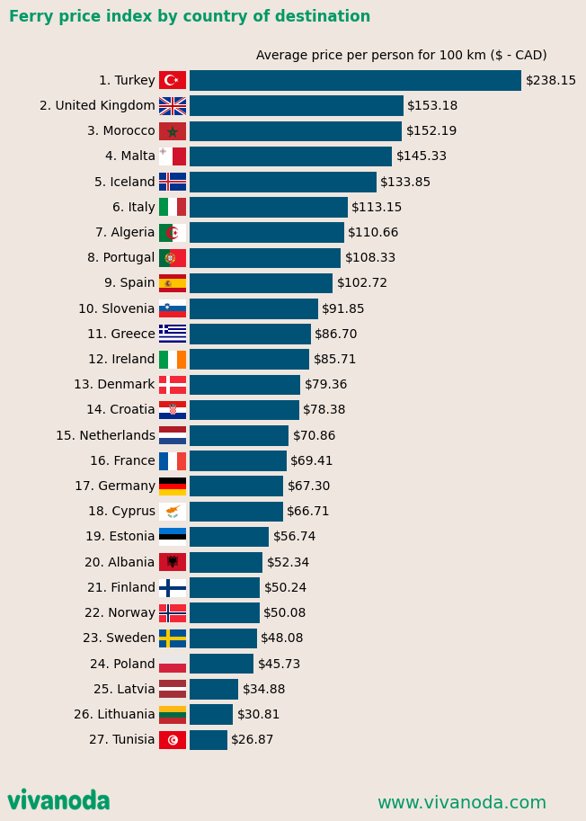
  • Ferry crossings to Tunisia, Lithuania, Latvia, Poland and Sweden have the lowest price index.
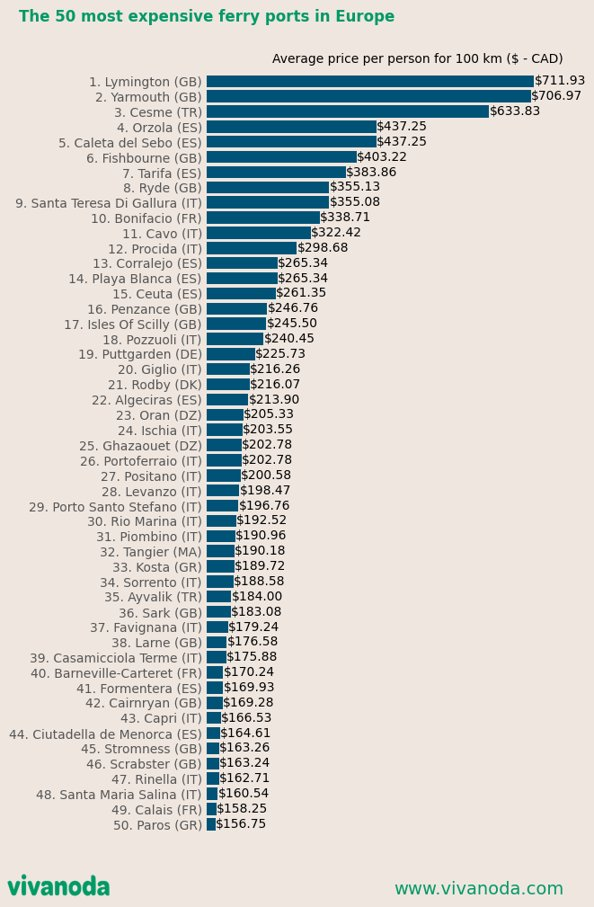
  • Conversely, ferry crossings to Turkey, the UK and Morocco have the highest price indexes.
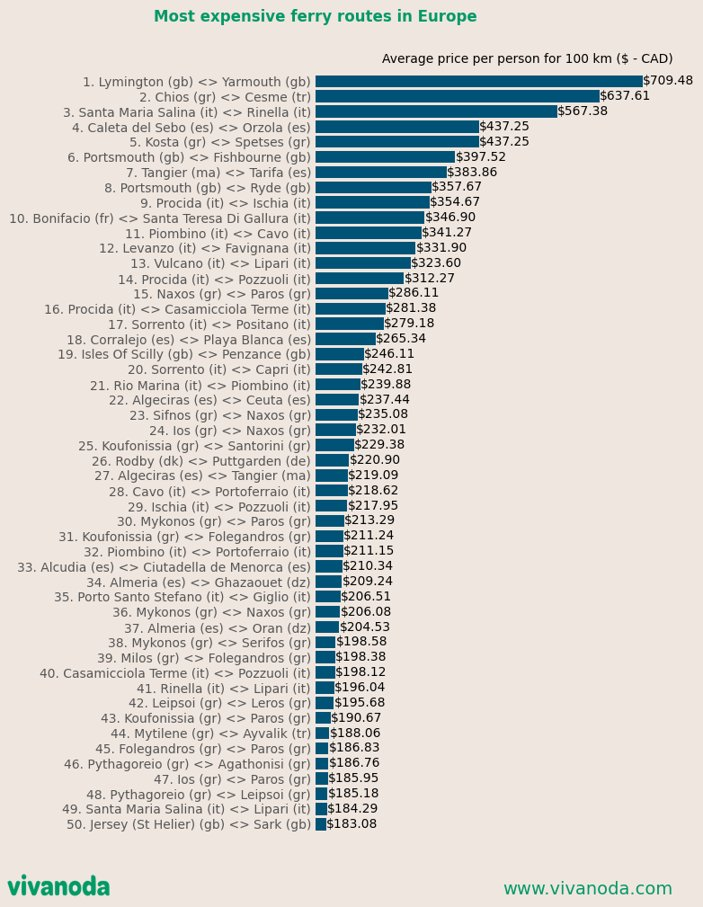
  • Connections between Greece and Turkey and those between Morocco and Spain are proportionally the most expensive in Europe.
  • Connections between Germany and Lithuania or Latvia are the least expensive in relation to the distance travelled.
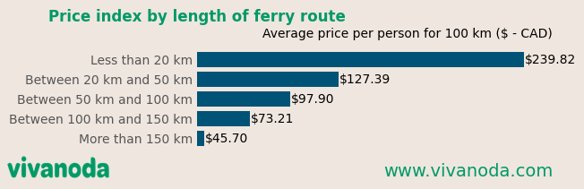
  • The shorter the crossing, the more expensive it is.
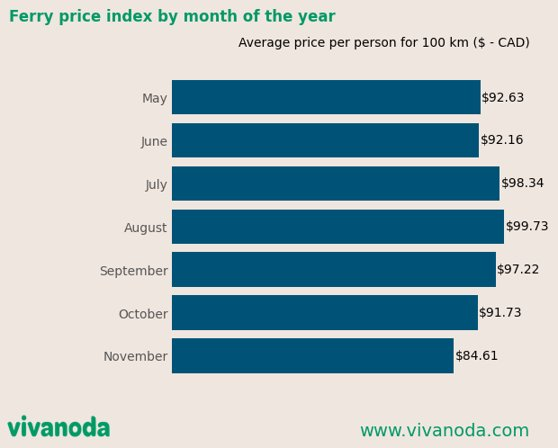
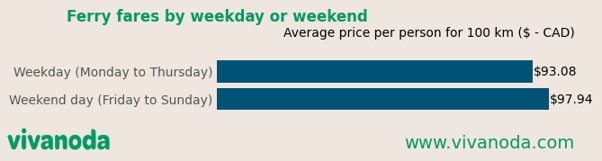
  • Across Europe, prices are higher on average from July to September. They are also slightly higher at weekends.
Ferry price index in Europe by country

For The Silo, Nicolas Pellier.

About Vivanoda
Vivanoda is a web platform that makes it easy to find ferry, train, bus and plane tickets for travel in Europe. Launched in 2013, the site has received awards from the European Commission, the International Union of Railways and the Groupama insurance group.

Canadian Holidaymakers Charged Up To 35% More Through Canadian Websites

Vacationers booking holidays through Canadian websites are being charged hundreds of dollars more than overseas customers for exactly the same deals, research commissioned by cybersecurity company NordVPN reveals.

From luxury breaks and hotel stays to car hire, consumers are frequently being presented with wildly different prices depending on where they log on.

Using the American website for Hotels.com resulted in a staggering $805.55 saving for a 7-night stay, while hiring a vehicle through the Italian server resulted in a quote 25% cheaper than the Canadian site.

NordVPN’s researchers used its Virtual Private Networks (VPNs) to make it look to websites like they were not in Canada. They discovered savings across a range of well-known travel sites like Hertz, Expedia, Booking.com and Sixt, for a variety of countries, including Italy, Mexico and the US.

What is a VPN? A VPN disguises your IP address, while improving privacy and security. You select a country and NordVPN ensures that’s where websites think you are. VPN users are then able to see the differing content — and prices — shown to overseas consumers. 

Using a VPN, a 7-night stay this August at The Gates Hotel South Beach in Miami, Florida, through Hotels.com revealed a $805 price difference for a family of four. The Canadian website quoted $3,086 and the American site $2,280 — less than a sixth as much. Visiting the website from Italy netted a 22% saving on a 7-night family stay at Venice’s Antony Palace Hotel in August — $376 off the Canadian price of $1,732.

For those visiting the French Riviera, an exclusive 7-night stay in Hotel Casarose in August would cost 16% less using the French version of Hotels.com website, lowering the price from $4,363 to $3,656.

Fans of the UK royal family planning to stay near Kensington Palace could save 13% by using the English Booking.com site, reducing a week’s stay in August at the Twenty Nevern Square Hotel from $4,260 to $3,715. 

Going to Booking.com from a French server led to a $1073 lower price on a 7-night vacation at the Hôtel Alfred Sommier in Paris in August — bringing the cost down to $8,922. Meanwhile, using an Italian server to search the Rentalcars.com website for car hire in Rome quarter (25%) cheaper than the same company’s offer to Canada-based consumers.   

Browsing for more summer hotel deals using the Mexico website of Expedia uncovered a 22% saving for a week break in Cancun at El Taj Oceanfront & Beachside Condo Hotel, leaving bookers $614 better off.

Looking at car hire deals from Hertz through the UK’s website, you could bag a 23% saving — $345 — on a 7-day hire of a Polestar at Edinburgh Airport in August, bringing the price down from $1,482 to $1,137. Using Sixt to book a rental from the Nice Airport in August, this time with Sixt brought up a 13% discount of $92 for hiring a Peugeot 208 for 7 days, making the French server price $650 versus $742.

Also, Sixt quoted a price that was 16% lower for a Jeep Grand Cherokee in Orlando, Florida via the US website for July — charging $867, a saving of $164. 

Visiting Sixt from France delivered the 11% discount, with a 7-day hire of a Tesla Model Y from Paris Charles de Gaulle Airport offered for $1038, $122 less than the Canadian website’s quote of $1160.

The research was commissioned by NordVPN and conducted by an external company between March 10th and 31st, 2023. Simultaneous searches were made for identical products being sold by the same vendor using numerous country servers.

When conducting the research, there were cases when prices offered to consumers in different countries were similar. However, for illustration purposes, this article and table present the biggest differences in price. 

Table: Cost of items booked through Canadian versus local websites

CompanyWhatWhenDate SpottedCanada price (CAD)VPN PricePrice DiffSaving (%)
Hotels.com7 night stay in The Gates Hotel South Beach – a DoubleTree by Hilton located in Miami, FloridaAugust 14-21March 10$3,086$2280.45$805.5526%
Rentalcars.comHiring a Fiat Tipo for 7 days and picking up from Rome Fiumicino AirportAugust 14-21March 28$1,353.92$1021.93$331.9925%
HertzHiring a ‘full size’ Polestar 2 for 7 days and picking up from Edinburgh Airport on a pre-pay priceAugust 14-21March 22$1481.75$1,136.92$344.8323%
Expedia7 night stay in El Taj Oceanfront & Beachside Condo Hotel in Cancun, MexicoJuly 3-10March 29$2,737$2,122.62$614.3822%
Hotels.com7 night stay in Antony Palace Hotel, Venice, Italy in a superior quadruple roomAugust 14-21March 28$1,732$1355.94$376.0622%
Hotels.com7 night stay in Hotel Casarose on the French Riviera, France in an Exclusive Suite roomAugust 14-21March 28$4,363$3656.93$706.0716%
SixtHiring a Jeep Grand Cherokee and picking up from Orlando International AirportJuly 10-17March 29$1,031.61$867.27$164.3416%
Expedia7 night stay in Antico Palazzo Rospigliosi in Rome, Italy in a quadruple roomAugust 14-21March 28$2,165$1,834.99$330.0115%
Booking.com7 night stay in Twenty Nevern Square Hotel, Kensington, London, UK. Based on two separate rooms to accomadate family of 4August 14-21March 28$4,260$3,715$54513%
SixtHiring a Peugeot 208 for 7 days and picking up from Nice AirportAugust 14-21March 28$742.07$649.59$92.4813%
Booking.com7 night stay in the (5 star) Hôtel Alfred Sommier, Paris, France in a two connecting double room.August 14-21March 30$9,996 (inclusive of additional taxes)$8,922.68$1,073.3211%

Source: NordVPN

Marijus Briedis, Chief Technology Officer at NordVPN, said: “In the internet age it’s never been easier to hunt for a vacation, and you can have all the elements — from car hire to hotel stays — arranged at the click of a mouse. 

“For the unsuspecting consumer there’s a price to be paid for these advances. Online tracking used by travel websites means that they can tell what holiday we’re looking for before we do, while algorithms can adjust holiday prices to the spending power of different countries.

“Never assume you’re getting the same deal as everyone else. Your location, the number of visits you pay to a website, and how your search fits in with the school holiday schedule, can all influence the price you’re offered.

“The best way to fight back is to shop around with the same provider using a VPN and see if you can find hidden savings offered to customers overseas. As our research shows, it could save you thousands of dollars a trip.”

How to save on holiday bookings with a VPN

There’s no need to overpay for a holiday abroad. Using a VPN can save you a lot of money – and it’s easy to get started.

Make sure you choose a reliable VPN provider that takes your privacy and security seriously. Though looking for a free option may be tempting, it’s best to stay clear of free VPNs. Here’s how to save on holiday bookings with a VPN:

  1. Get a VPN subscription. If you’re interested in NordVPN, you’ll find our subscription plans here.
  2. Download and install the VPN app on your device.
  3. Launch the app and enter your credentials to sign in.
  4. Pick a server in a country of your choice, and connect to it.
  5. Head to the provider websites and note down the prices.
  6. Repeat this process with several server locations to find the best price. We also recommend clearing your browser’s cache before returning to the site so it doesn’t identify you as a returning user and impact the price you’re shown.

Even though this process might take a little longer than you’re used to, you’re likely to find some great deals to make it worthwhile. This method will work for finding cheaper flights, hotels, car rentals, and even general online shopping.