This isn’t such a complex principle after all. Essentially, the idea is- if we can see strong similarities in design between say a Planet and between a structure or diagram that represents something else, then the inherent ‘sameness’ means an intelligence is at work, not some form of randomness. We’d love to hear your thoughts- agree or disagree? Comments are welcome at the bottom of this post CP
Nothing exists for nothing, the universe is not itself made, and nothing in it has nothing to do.
The moment Mankind has been waiting for over a millennium has finally arrived. A tangible proof of off-planet life has occurred. The higher powers have at long last shown their hand.
In nineteen ninety nine, a website called ‘The Revelatorium’ was launched. The website revealed many aspects of the higher dimensions not previously known. By the fall of two thousand and thirteen the Revelatorium had morphed into a full revelation of the Intelligent Design by which all of Creation has been blueprinted and expressed.
The verity of the Design has now been proven in real time.
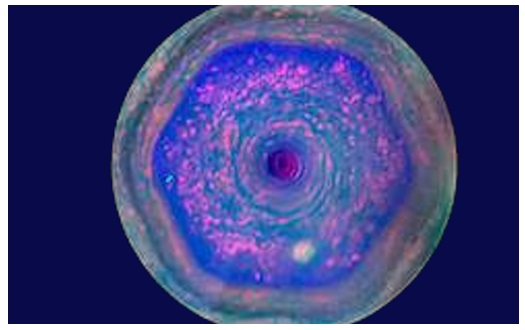
The drawing is Figure 77 in Chapter 8 of the Revelatorium. The figure depicts the cubistic blueprint of the first six dimensions of the Outer Creation according to the formats of the Intelligent design.This image is of Saturn’s North Pole and was taken recently by the Cassini probe.
If you carefully compare the Revelatorium and Cassini pictures you will see that they are structurally identical. The Revelatorium drawing was done in two thousand and two. The Cassini probe was launched in 2009.
Both have a clearly defined center hexagon area representing the first, second, and third dimensions collectively. Particularly confirmed is the red circle area in the middle.
A second greenish coloured hexagon ring with pink splotches around the first hexagon ring matches the ring of six different cubit designs around the center of Figure 77, representing the fourth dimension.
A third, blue colored hexagon shaped ring with uniform pink splotches around the second ring matches the ring of twelve identical cubit designs around the second ring of six cubits of Figure 77, representing the fifth dimension.
And finally a fourth hexagon shaped ring with faint pink splotches and completely different background color around the third ring matches the ring of eighteen identical cubit designs around the ring of twelve cubits of Figure 77, representing the six dimension.
A close up of the Cassini image in black and white shows the features more distinctly, in particular the first second and third dimensional hexagon and circle aspects in the middle
In short, the Saturn hexagon is a concrete lower dimensional proof of a higher dimensional factor.
The striking similarities in the respective pictures are not coincidental. The Saturn hexagon is home of the Solar System government. The hexagon is a magnetic resonance reflection in the third dimension of the domain’s six dimensional configuration. The population lives within its fifth dimensional band of materialization, represented by the thick ring in the hexagon, and ring of twelve similar designs in the same location in Figure 77.
As the cubistic matrix of Figure 77 would imply, the whole Intelligent Design is dirt simple and can be understood by anyone. The basic elements of the Intelligent Design consist solely of a sphere, a cube, and straight lines. The rules by which the elements work together hold the key. There is aught in existence not of the Design.
In figure 77, the red spheres represents Intelligence, the blue straight lines represent Energy, and the yellow cubes represents Substance. The attribute of the Father is Intelligence, the attribute of the Son is Energy, and the attribute of the Holy Ghost is Substance. Intelligence, Energy, and Substance is all there is.
The two most fundamental elements of the whole Design are The ‘Cube and Sphere of Alpha and Omega’ and the ‘Cubit’.
The Cube and Sphere comprises the entirety of the fourteenth dimension and acts as interface between the un-materialized inner form of the Creators in their fifteenth dimension as the Holy Trinity and above, and their materialized outer form in the thirteenth dimension and below as ‘Creation’.
The Cube and Sphere projected one dimension down to the thirteenth dimension comprises the ‘Cubit’, shown below. The ‘Cubit’ is the basic genome of Creation. By principle of the Cubit the whole of Creation has been blueprinted and expressed.
If you look again at Figure 77, you will see that it is composed entirely of variations upon the cubit. The variations reflect specifically different frequencies according to rule. By the rule the differing frequencies comprise the differing aspects of Creation. By this simple principle, the Intelligent Design is capable of blueprinting and depicting all of Creation in all of its aspects. The current Creation is over nine hundred trillion light years across and still within its infancy.
The Intelligent Design can be found in its totality at website http://www.revelatorium.com/. For details about every thing going on now inter-dimensionally, also see: http://www.revelatorium.com/. For the Silo, Delahnnovahh-Starr Livingstone.
As we get older we get wiser. It’s just part of the deal. We have all heard the expression that knowledge is power, but power can also be corrupting. Sometimes, it’s good to get a reminder that as smart or as knowledgeable as we think we might be there is always something new to learn.
I had one of those moments recently when I looked closely at a computer called the “Super Brain” that has been sitting out at a computer museum. I had never really spent much time with this machine but when I did I found out that it had a “Here Is” key. It’s enough to make you do a double-take. At first I thought it was a joke.
The most common keyboard joke in existence is the one about the “Any” key. Back in the days when computers ran text only operating environments (like DOS) it was common practice to put a message such as “Press Any Key To Continue” while waiting for the user to finish reading. The joke is that some people would literally spend time looking on their keyboard for a key marked “Any” rather than just literally pressing any key on the keyboard.
I had to do research on this key and discover what it is used for. It turns out that it is used for radio teletype identification. The key transmits a code 22 characters long that identifies to another teletype machine just which machine is sending a message. In other words, this old computer has a key that means only something in the context of a technology that is even older than itself.
Speaking of bizarre keyboards- what do you think of the layout on this vintage example of Orange Computers Inc keyboard? Makes me sort of hungry for starburst candy. A teletype (or more accurately a teleprinter) in case you don’t know or don’t remember is an electromechanical typewriter that can be used to send messages from point to point. They were used at the beginning of the twentieth century for many purposes ranging from spreading news to stock information and more. Variants were (and still are) used as telecommunications for the deaf and the aviation industry still have them around in small numbers.
The joy for me was that the day I discovered the “Here Is” key was a great reminder of how wonderful it is to learn something new. It’s almost self proclaiming (if only it were a “Here It Is!” key) and now, most likely, you too have learned something new today. For the Silo, Syd Bolton.
As Canada’s aging population continues to grow, there are concerns about the financial and physical capacity to meet its growing care needs.
Seniors’ need for housing and care is a complex issue involving many government policies and, therefore, government has many avenues for the exertion of control and adjustment over the issue. Much room for improvement is evident in the quality of, capacity for, and financial support for meeting these needs. This analysis provides a summary of the challenges and gaps in the current state of senior support policies and provides insights to inform future policy.
This Commentary examines the household spending patterns of seniors, the availability of different housing and care options, the costs of providing care in different settings, and government policies that subsidize support services in homes, retirement communities, and long-term care. The results show that the availability and costs of different services and types of care vary significantly across the country. In particular, seniors with below-median incomes face affordability challenges related to shelter costs, with these costs becoming a potential barrier to access to retirement homes and other support services if not publicly available. Further, there is unmet need for home care across Canada, which invests less in home and community care than other OECD countries.
To ensure there is adequate capacity to provide care for high-needs seniors, provinces should invest in expanding home and community care and prevention.
Previous research has shown that about 30 percent of entries to long-term care homes (LTC) could be delayed or prevented (CIHI 2017). Investing in expanded home and community support services and providing financial supports for low-income seniors to access the care they need where it is most appropriate, can reduce the demand for more intensive (and expensive) LTC or hospital care. There are waitlists for LTC, and “alternate level care” seniors occupying hospital beds, which contributes to higher costs, lower hospital capacity for other treatment, and lower quality of life and declining health for the affected seniors. In addition, a significant proportion of below-median-income seniors face housing affordability challenges. Ensuring housing needs are appropriately met can improve the quality of life of seniors and prevent premature entry into higher levels of care. Differences in the availability of services and how they are funded across the country can inform strategies to improve accessibility and capacity. Notably, Quebec has more seniors’ care spaces, lower vacancy rates and lower rent charges than other provinces, while providing comparatively more support to senior households through tax credits.
Overall, limited fiscal capacity, growing demand due to demographic aging, and the growing costs and complexity of care needs for aging seniors all present a significant conundrum for policymakers. There is a daunting challenge in determining the appropriate level of support, ensuring it is well targeted, and allowing for seniors to choose what is best for them. Government policies should encourage seniors to remain independent as long as possible, but also ensure they have adequate financial resources and access to support services if they are required.
There are multiple options for housing accommodations as seniors age, and the choice will depend on their preferences, families, level of need, and the affordability and accessibility of the various options. This section discusses the different care needs that seniors might have as they age. It also illustrates the continuum of care: seniors choosing assisted/supportive living accommodations or receiving home care will have a range of needs, and care must be flexible enough to suit an individual’s needs.
Activities of Daily Living (ADLs) are a set of essential everyday tasks and activities that individuals typically need to perform to live independently and maintain their overall well-being. These activities are often used in healthcare and long-term care settings to assess an individual’s functional abilities and to determine their level of independence. When someone experiences limitations in one or more of these areas, they may require varying degrees of assistance or care, ranging from minimal support to full-time care. Health professionals use ADL assessments to develop care plans and tailor assistance to meet an individual’s specific needs and promote their overall quality of life. The specific ADLs may vary slightly in different contexts, but the core activities are as follows.
Personal hygiene and grooming: including bathing/showering, caring for teeth, medication management, etc.
Dressing: choosing appropriate clothing and putting it on independently.
Eating: feeding oneself and preparing simple meals.
Mobility and transferring: being able to walk, get in and out of bed, or independent transferring from one surface to another (such as from a bed to a wheelchair).
Toileting and continence: The ability to get on and off the toilet, maintain personal hygiene, and manage incontinence, if necessary.
Medication management: the ability to follow medical care plans without the need for assistance or reminders to take necessary medications.
Instrumental Activities of Daily Living: activities that are not essential to basic self-care, but are crucial to independent living in a community such as managing finances, planning and preparing meals, doing laundry, going shopping for essential items, etc.
Notably, most of the ADLs have little to do with direct healthcare needs. Instead, they are a set of daily activities that could be provided by different types of support services including meal delivery, housekeeping, laundry services, and social activities. Seniors requiring support with some ADLs could benefit from one or more support services, even if they do not have advanced healthcare needs. Healthcare is an important component of supporting seniors to remain independent, however, many of the activities that are required for independence fall outside the traditional scope of healthcare.
The options for support available to seniors are directly related to their care needs. Those who are able to live independently can choose their accommodations based on lifestyle and preferences. Those requiring occasional or minimal assistance can remain in their homes and receive help from family, other informal caregivers, and possibly publicly funded home and personal care services, or they could choose to privately pay for some services such as regular housekeeping or food delivery services. They might also choose to move to a retirement home or community where meals and other services are provided, as well as ongoing opportunities for socialization. As care needs become more intensive, seniors may require ongoing or live-in support from a combination of public or private home and nursing care services, family, or an informal caregiver at home. In the retirement home setting, there are many options to address increasing care needs. However, as care needs become greater, affordability plays a factor in how long a senior might stay in a retirement home before moving to LTC where care needs are generally fully subsidized by government, and room and board charges are limited by regulations.1
At home, those requiring hands-on or total assistance require significant and ongoing care. At this stage, a caregiver must be available at all hours to assist with many basic ADLs, and the options for care become more limited. Those without an available caregiver in the home will likely be best served by residing in long-term care homes that have health providers on site at all times of day. Depending on their health conditions, hospice and palliative care might also be appropriate for end-of-life care. Increasing numbers of retirement homes are offering heavy care and dementia care services, and publicly funded home care can be accessed to supplement some of the costs. This still, however, presents a significant financial burden to seniors. Often, even though a retirement home can safely and appropriately meet the care needs of a senior, LTC becomes the preferred option. Most often, this is because of the cost differential between what the government will subsidize in a LTC setting versus the limited home-care services available to offset privately paid retirement home care costs.2
The options for care and assistance with ADLs reflect progressive levels of need. As care needs become more intense, the options become more limited (and/or costly). Those requiring ongoing care can choose to live in a long-term care home, or might be able to remain in a residential setting – home, retirement home, assisted living facility – if they and their families have the resources to supplement publicly provided services, and if the appropriate services are available privately. Of course, those that are independent have a full range of choices for where they might want to live, except those places reserved for people with higher care needs. More than three-quarters (78 percent to 91 percent) of Canadians would prefer to receive care while continuing to live in their homes as they age, but only one-quarter (26 percent) expect that they will be able to do so (Sinha 2020, March of Dimes 2021). The different types of seniors’ accommodations and short-term respite care programs are described in Box 1. It is important to note that there is overlap between many care options and levels of need – two seniors with similar care needs might use different combinations of services. This is particularly the case for people with minimal to moderate needs for support. Similarly, the options will vary in terms of availability and costs depending on the location, the ownership and operation models of the different residences, and the level of public coverage and involvement in different levels of care. The next section provides a summary of the availability and costs of various seniors’ living arrangements across the country, focusing on provinces with larger populations (BC, Alberta, Ontario and Quebec).
There are 2,076 long-term care homes in Canada. At first glance, LTC in Canada appears to have a comparable amount of beds and financial resources in comparison to international peer countries. Canada has close to the average number of LTC beds relative to the size of the senior population, but still fewer than countries such as New Zealand, Finland, Germany, and Switzerland. It also has a comparable proportion of the senior population receiving LTC care and homecare, relative to international peers (Wyonch 2021). It spends more per capita than the OECD average on funding LTC but spends less than other OECD countries as a proportion of GDP. The GDP proportion of health spending for inpatient LTC is above average (Wyonch 2021).
Despite higher-than-average spending, there are long waitlists for LTC in many Canadian provinces. In Ontario, there were, as of Oct. 2022, almost 40,000 seniors waiting for LTC, and 76,000 receiving care; this means the waitlist currently exceeds 50 percent of care capacity (OLTCA).3
The median wait time was 130 days in 2021/22 (213 days for entrants from the community, and 80 days for hospital entrants) (HQO). In Quebec, the waitlist is much smaller (4,235 as of June 2023). However, seniors might still wait up to two years for a placement (Bonjour Résidences).
The cost of long-term care varies across provinces, but charges payable by the resident to cover room and board are generally standardized by regulation within each province. For example, in Ontario the maximum monthly co-payment for LTC is $1,986.82 – $2,838.49 depending on whether the room is shared or private. In Quebec, room and board charges for public and contracted private long-term care homes (CHSLD or centre d’hébergement et de soins de longue durée) are $1,294.50 – $2,079.90, depending on the type of room. Quebec also has unsubsidized (uncontracted) private CHSLD, where the average monthly costs are between $5,000 and $8,000, depending on resident’s needs (Bonjour Résidences).4More than half of LTC homes (54.4 percent) and the majority of retirement homes are privately owned and operated. There is no consistent ownership pattern across the country: in five provinces, the majority of LTC homes are privately owned and operated, with the other provinces having majority public ownership. All LTC homes in the Territories are publicly owned. Both publicly and privately owned LTC homes provide ongoing care for some of the most vulnerable members of society. At both public and private LTC homes, healthcare is publicly funded and most support services will be included in room and board rents. Seniors must require significant care to qualify for LTC.5
Individuals requiring support who don’t have a caregiver in the home are much more likely to be admitted prematurely to LTC homes. Indeed, about one in nine new entrants could potentially have been cared for at home or in a retirement home setting. These new residents are more likely to have previously lived alone or in a rural area where formal and informal supports are less likely to be available (CIHI 2020b).
Retirement homes offer a wide variety of services and programs targeted at different client types. These include those who are fully independent and wish to live in a congregate setting for the lifestyle and social benefits, those with mild to moderate care needs, those with heavier care needs, and those who require specific dementia care programs and supports. In Ontario, for example,15 percent of homes provide dementia care, 34 percent provide assistance with feeding, and the majority provide services to assist with other ADLs (Roblin et al. 2019). Prices of retirement home care vary significantly by location, as well as by amenities and services offered as they are market driven (and are not generally directly government subsidized). Various provinces have senior rental accommodations that provide care needs: in Quebec the services are called “seniors’ residences”; in BC “assisted living”; in Ontario “retirement homes”; and in Alberta, “supportive living.”
Many retirement homes offer more extensive health and personal care services. These additional services increase costs for seniors since they are either charged as additional services or will be incorporated into higher room and board costs. In Ontario, if these additional services are provided by the retirement home, the additional services are not directly publicly subsidized. In some cases, residents in retirement homes might also receive home care or assisted living support that is provided by a separate agency, either publicly or privately. Most retirement homes are privately owned and operated. Their activities and levels of care provision are regulated by provinces, but prices will be determined by market factors and the amenities and services offered in each location.
In Ontario, retirement communities are regulated by the Retirement Homes Act, 2010 (RHA), and are licensed and inspected by the Retirement Homes Regulatory Authority (RHRA).6Each retirement community can offer up to 13 care designated services, for example, assistance with dressing and personal hygiene, medication management, and providing meals. Services might also be publicly provided through home care. About half of seniors currently living in retirement homes have care needs that would qualify them for publicly provided home and community care. Home care services supplement the care services in the retirement home at no cost to the resident and assist with affordability of the retirement living option for seniors with care needs.
In Quebec, private seniors’ residences are rental facilities that are mainly occupied by people over 65, and offer various services such as nursing care, meal services, housekeeping, and recreation. Private seniors’ residences must hold a certificate of compliance from the Government of Quebec ensuring they comply with health and safety rules. Similarly, in Alberta, the provincial government sets accommodation standards for supportive living facilities. Supportive living operators require a licence if they provide accommodation and support services to more than three people, provide meals or housekeeping services, and arrange for safety and security services. Alberta also has Designated Supportive Living where access is determined by an assessment by a health professional, room and board charges are determined by the Alberta government, and accommodations provide 24-hour publicly funded health and personal care services on site.
In British Columbia, retirement homes are divided into categories: independent living, and assisted living.7Assisted living is divided into three classes: i) seniors and persons with disabilities who have chronic or progressive conditions, ii) mental health care, and iii) substance use care. Assisted living residences provide housing, hospitality services and support services, and they may be privately paid, publicly subsidized, or a combination of both. Independent living seniors’ residences are essentially retirement homes targeted to seniors who need minimal assistance and are not generally publicly subsidized. For seniors requiring assistance, assisted living spaces are publicly subsidized based on income: a maximum of 70 percent of after-tax income goes to housing and support services in assisted living. However, there is a minimum fee of $1,093.50 per individual ($1,665.60 per couple) and maximum monthly rate for publicly subsidized assisted living is based on market rates for rent and hospitality services in the same geographic area.
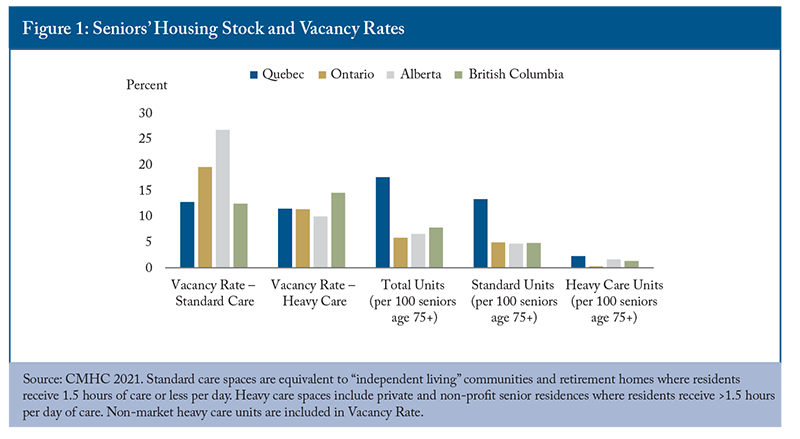
Though individual retirement homes and assisted living facilities might have waitlists, there are fewer concerns about overall capacity. Across provinces, both standard and heavy care spaces are at least 10 percent vacant (Figure 1).
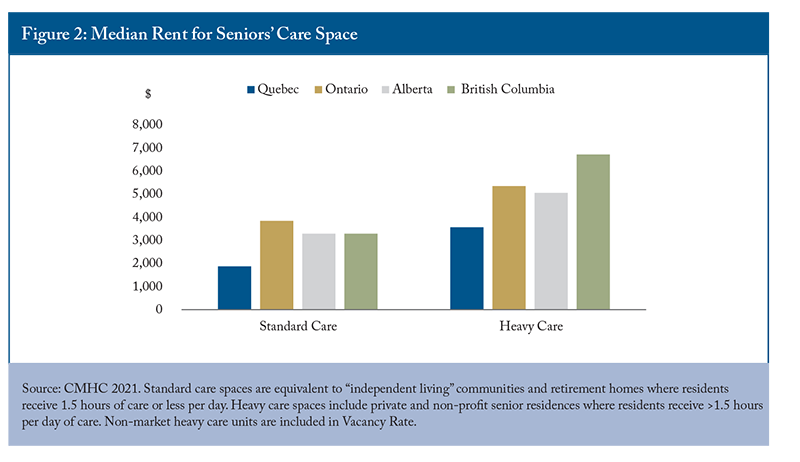
Alberta has the highest vacancy rate for standard care spaces (26.8 percent) and the lowest vacancy rate (10 percent) for heavy care spaces, suggesting a need to transition some standard spaces to heavy care spaces as the population continues to age and care needs intensify across the senior population. Ontario notably has the fewest seniors’ care spaces relative to the size of the senior population, particularly for heavy care units (3.0 spaces per 1,000 seniors over age 75). A long waitlist for LTC and few spaces for seniors with less intensive – but still significant – care needs suggest a need to expand the number of spaces available for seniors across the care continuum. Notably, British Columbia has the highest vacancy rate for heavy care spaces, despite having relatively few spaces (14.4 per 1,000 seniors over 75). It also has the highest rent among provinces for heavy care spaces ($6,726/month) and the largest increase in rent between standard care and heavy care spaces (Figure 2).
Quebec has more than three times the amount of seniors’ housing spaces in comparison to other provinces, relative to the size of the senior population. It also has the lowest median rent for both standard and heavy care spaces by a large margin. Median rent for a standard care space ($1,873/month) is about half the cost of other provinces, and a heavy care space in Quebec ($3,566/month) costs less than a standard care space in Ontario ($3,845/month).8Quebec having triple the supply but similar vacancy rates to other provinces suggests that lower prices are a result of a significantly higher supply of seniors’ care spaces.
Demand is also likely to be higher in Quebec due to policies that indirectly support private seniors’ residences and LTC through medical expense and home care tax credits.
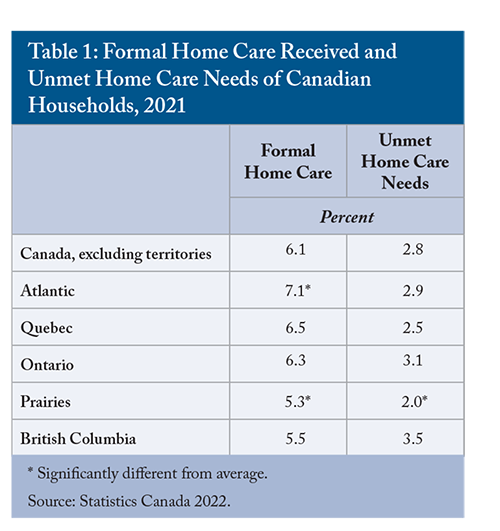
Home care covers a broad range of services, including personal support for ADLs, homemaking services such as housekeeping, laundry services and meal preparation, and can include professional services such as nursing, occupational therapy, or social work. Across Canada, about 6.1 percent of households receive home care services and 2.8 percent of households have unmet home care needs (Table 1). Unmet need is highest in British Columbia and Ontario, and lowest in Quebec and Atlantic Canada. Notably Quebec and Atlantic Canada also have the highest proportion of households receiving home care.
In Ontario, publicly covered services are generally tailored to an individual’s needs and delivered in their residence (a home in the community or retirement home), following an assessment by a case manager or health professional. Services are delivered by third-party agencies that can operate on a non-profit or for-profit basis. In Quebec, seniors can access discounted home help through the Financial Assistance Program for Domestic Health Services program. After approval, seniors receive a discounted hourly rate for various home care and support services provided by qualifying domestic help and social economy businesses.9 Many services provided by home care agencies and domestic help businesses can also be purchased directly through the private market. This option gives a completely free choice of services, without the need to qualify for government assistance, but must be paid for out-of-pocket. In BC, home support services can be purchased privately, or can be publicly subsidized, based on eligibility. If publicly subsidized, home care recipients are charged a daily rate for services, based on their income.1010 In Alberta, home care is narrowly defined as providing medical support for people so they can live in their homes. After an eligibility assessment, services are provided under Alberta Health Care Insurance meaning that if a service is not insured, it is not publicly funded.
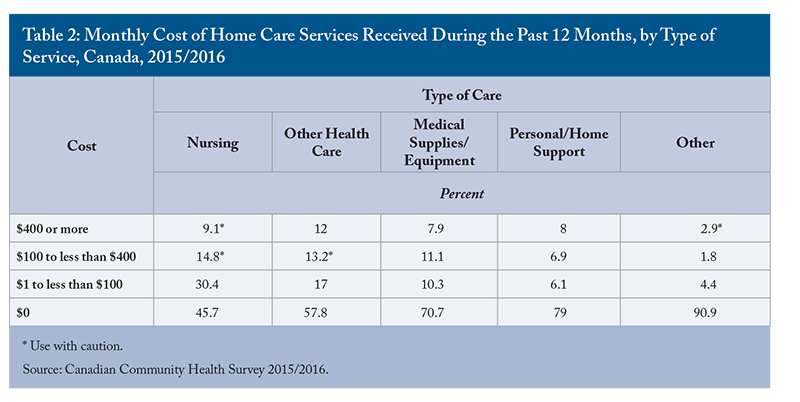
Over half of home care services are paid from government sources (52.2 percent), and 7.3 percent are covered by insurance. More than a quarter (27 percent) are paid for out of pocket (Gilmour 2018). Government sources are more likely to cover health home care services than support services. In 2015/2016, more than half of nursing care services (54.3 percent) and 42 percent of other healthcare services had a monthly cost (Table 2).
In many cases, seniors receiving home care will also receive help from informal caregivers (for example, family members, neighbors, and adult children). Informal care reduces the direct public costs of supporting a senior to maintain their independence in their home, but it can represent economic deadweight loss if informal caregivers reduce their hours of paid work.11In addition to formal in-home services, there are also seniors’ day-programs to provide care throughout the day, and respite care beds for when informal caregivers might need additional support or if the senior needs additional care for a short period of time.
Depending on the jurisdiction, “assisted living” services overlap somewhat with home care and retirement home services, but generally target those with higher care needs.
Assisted living programs are defined differently across the country. In Quebec, “Resources intermediaries” provide housing and access to support services for individuals with minor to moderate loss of autonomy. In British Columbia, Assisted Living provides housing, hospitality, and social and recreational services to adults requiring a supportive environment due to physical and functional health challenges. In Ontario, Assisted Living Services provide support for people with special needs who require services at a greater frequency or intensity than home care, but without the medical monitoring or 24/7 nursing supervision that is provided in long-term care. Services are provided by third-party agencies that operate on a not-for-profit basis. In Alberta, Designated Supportive Living is broken down by levels of service, ranging from 24/7 provision of health and personal care services for those living independently, to providing specialized residential dementia care (AGO 2021).
Assisted living services are generally publicly funded, with limited room and board co-payments when housing is included in services. They are targeted to cover gaps in the continuum of care between independent living options and long-term care, and the services provided can overlap with both to ensure appropriate levels of support are provided and seniors are not prematurely admitted to long-term care.
Alternate Level of Care patients are people occupying an inpatient bed, but whose needs no longer require acute level care. ALC patients occupy 12.7 to 27.5 percent of beds in acute-care centres across the provinces and represent 15.5 percent of all acute-care bed-days in Canada (excluding Quebec) in 2021-2022 (CIHI 2023). ALC patients are most often admitted to acute care as a result of an injury or illness, but subsequently cannot be discharged home as their clinical condition requires new additional support and/or care services such as home care, transfer to a long-term care facility, or another form of specialized care (rehabilitation, psychiatric or complex). In some cases, ALC patients might be admitted for predominantly social reasons: no acute or rapidly accelerating medical condition is present, but certain circumstances force patients and caregivers to turn to emergency departments (for example, real or perceived failing of social services or lack of adequate community supports) (Durante et al. 2023).
ALC patients represent a complex health system challenge with many contributing factors. Lack of access to preventative and primary care services, or to home care and other social services, can result in patients going to emergency rooms when an alternate level of care would be more appropriate. Similarly, a lack of capacity in home care or long-term care can result in ALC patients remaining in hospitals for extended periods of time. Both scenarios represent an inefficient use of limited (and expensive) hospital resources and constrain capacity to provide acute care. From a financial perspective, each ALC patients represent a cost of $730 to $1,200 per day to Canada’s healthcare systems (Whatley 2020).12
While inefficient spending is concerning, preserving limited acute care bed capacity is necessary to prevent bed shortages and ensure accessibility for Canadians. Canada has fewer hospital beds relative to the size of the population than most OECD countries, and high occupancy rates in acute care beds show that the system is strained. While there is no agreed upon “optimal” occupancy rate, 85 percent is often considered the maximum rate to reduce risks of bed shortages. The average across OECD countries was 69.8 percent in 2021. Canada was one of three countries to have a rate over 85 percent and had the fewest beds per capita in the high-occupancy group (OECD 2023).13If Canada reduced the number of ALC patients and the number of days an ALC patient spends in hospital, it could significantly reduce acute care capacity concerns. A 13 percent reduction in ALC days would be sufficient to bring acute care occupancy down to below the 85 percent occupancy threshold to prevent hospital bed shortages, since ALC patients currently occupy 15.5 percent of capacity.
There are opportunities to reduce ALC patient days, both from within the hospital setting and by improving and expanding community and support services. Increasing the number of seniors’ care spaces, increasing the scope and provision of home care, improving primary care access and ensuring that necessary support services are accessible and affordable for seniors would all alleviate the strain on hospitals by preventing admissions and allowing for more rapid discharge of ALC patients to alternate levels of care. Within hospitals, incentives for physicians, families, and the hospital generally encourage longer than optimal stays. Front-line clinical staff (especially physicians) have strong incentives to avoid conflict and risks resulting from acute-care discharges (Chidwick et al. 2017).14Hospitals in some provinces charge a daily fee to recoup the costs resulting from ALC hospitalizations. The fees are generally equivalent to the daily rates for room and board in LTC, not the full cost of an acute care bed. This means that there is little incentive for seniors or their families to prefer one care setting over the other if a patient is destined for long-term care. The hospital, however, cannot charge patients this fee unless they need continuing or chronic care – destined for more or less permanent institutional care.15Hospitals, therefore, have an incentive to designate ALC patients as chronic and in need of long-term care, so that they can recoup costs. In Quebec, hospitals do not charge fees related to ALC. In that case, seniors and their families have an incentive to prefer hospital care over home care, a retirement home or a long-term care home since these options do have financial costs. Provinces should examine their hospital fee policies related to alternate level care to ensure that clinicians, hospitals, and seniors are not incentivized to provide or receive more advanced healthcare services than are necessary to meet the needs of the patient. Hospitals should also evaluate policies and guidance for clinicians and front-line workers on making discharge decisions to reduce referral to long-term care when it can be avoided.
Addressing the unmet care and housing needs of seniors could significantly reduce the number of ALC patients and their lengths of stay in hospitals. Reducing ALC days and admissions would likely be sufficient to reduce the strain on acute care capacity to levels more comparable to international peers and reduce the risk of bed shortages.
Different settings and types of service provision, with different public programs and levels of subsidization, make comparison across provinces challenging. In this section, I compare public costs of seniors’ healthcare across the country and provide estimates of the public costs of care provision across different settings in Ontario and Quebec.16
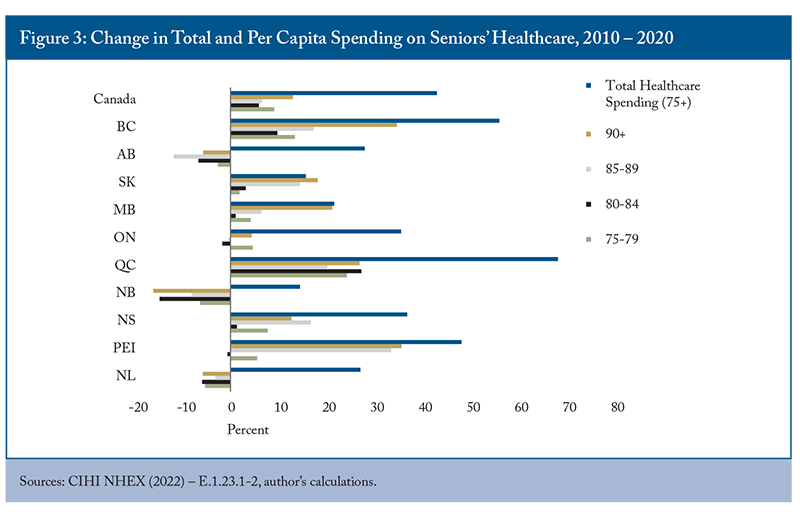
Rather unsurprisingly, per capita health expenditure increases with the age of the population, since older and frailer individuals have increasingly intensive healthcare needs. There is some variability between provinces, with New Brunswick and British Columbia having lower spending per capita on care for seniors. Across the country, more than $1 of every $4 of provincial government healthcare spending goes to caring for people over 75 years of age. From 2010-2020, total provincial and territorial government spending on healthcare for the population over 75 increased by 40.5 percent to $52.77 billion, while total government spending on healthcare increased by 56 percent. In some provinces, increases in seniors’ healthcare spending have been driven by growth of the senior population (ON, NS) (Figure 3). Some provinces have contained these increasing costs by reducing per capita spending on seniors’ healthcare (NB, AB, NFL). In others, both increasing senior populations and increased per capita spending contribute to spending growth (QC, PEI, MB, SK and BC). Only in PEI and BC has spending on seniors’ care kept pace with overall increases in healthcare spending.
Meanwhile, seniors are spending more on their own healthcare and living expenses. In 2019, the average senior household (75+) spent $14,440 on housing and $3,260 on healthcare (Table 2). Healthcare costs have stayed relatively constant in real terms from 2010 to 2019, and increased less than total consumption, though private insurance premiums have increased by 117 percent. Food and shelter costs, however, have become more expensive. Seniors who rent their homes are facing challenges in addition to affordability, with more than half of those in unsubsidized rental units having inadequate, unsuitable, or unaffordable housing (Table 3). As needs increase with age, the cost and availability of options will factor into the lifestyle choices seniors make about where they live.
In Ontario, a senior with high care needs would likely qualify for long-term care or assisted living. If those services aren’t readily available, they might require a stay in hospital as they wait for an assisted living or long-term care bed to become available. Regardless of the care setting, the personal costs are similar.17
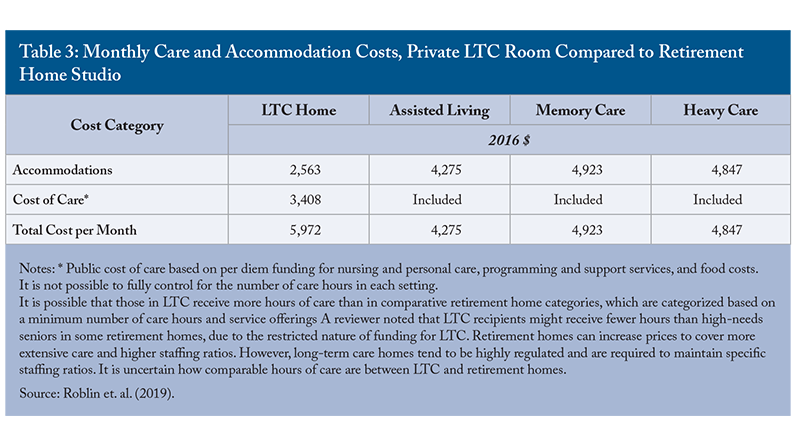
From a public finance perspective, however, there are different costs associated with different levels of care. A hospital stay for someone over 80 years of age ranges in cost from $4,306 to $11,361 per episode of care. Long-term care costs the province $5,870.70 per month per patient, and the average cost of assisted living is about $1,494 per month per patient.18Previous analysis has shown that the total cost of care is lower in heavy care retirement spaces than in LTC, and that public costs are significantly lower due to residents paying privately for services in retirement homes (Table 3). Public spending is lower if people receive advanced care services at home, or in retirement homes, than in long-term care. Hospitals are the worst option. They have the highest public cost and are also a limited resource. Every hospital bed occupied by an alternate level care patient (ALC) carries an opportunity cost and makes the bed unavailable for acute or critical care, or surgical rehabilitation and monitoring.
The picture for high needs patients in Quebec is similar to that in Ontario, but with notable distinctions. There are no private costs for a hospital stay in Quebec, and room and board charges for public LTC range from $1,294.50 per month to $2,079.90. Quebec has private LTC homes that cost residents $5,000 to $8,000 per month, depending on level of care need.19The public cost of a hospital stay for a patient over 80 years of age is higher in Quebec than in Ontario ($5,627-$14,488), as is the level of subsidization of public LTC ($5,837.73 – 9,379.60 per month per client, depending on type of room). There are similar public costs associated with a hospital stay or a month in LTC in Quebec, but the need to preserve scarce hospital resources remains, meaning that from a public cost perspective, the preference would be for high needs patients to be in LTC homes. If the senior can afford it, a heavy care bed in a private retirement home or private LTC home is most beneficial, from a public finance perspective. Research has shown that the government pays 79.7 percent of residential care costs and 81.7 percent of nursing home costs, or about $53,500 per user of a residential care facility and $82,400 per user of a long-term care facility. Comparatively, home care is estimated to cost $7,140 to $23,634 per client, depending on level of care need (Clavet et al. 2022).20
For mild to moderate needs, seniors can depend on informal caregivers, public or private homecare services, nursing services, or they can choose to live in retirement homes offering the services they need. In many cases, some combination of services is required. Home care services in Quebec can be heavily discounted depending on the level of assistance qualified for under the “Domestic Help” program. In Ontario, those qualifying for public homecare services don’t have out-of-pocket costs.21 In both provinces, homecare services can also be acquired privately, in which case there is no direct public cost.22 In both provinces, retirement homes are generally privately owned and operated and offer a variety of services across a spectrum of care needs. In Ontario, the average rent for a retirement home is $3,845 per month, representing a less affordable option when compared to average household costs.23 In Quebec, retirement homes represent a slight savings compared to the average senior household’s expenses.24Quebec has many more senior living spaces than Ontario, relative to the size of the population. It also has a much lower vacancy rate. As discussed in detail in the next section, different tax credits in each province provide different levels and types of support which likely affect both the accessibility of different types of support services and the distribution of seniors’ receiving care in each setting.
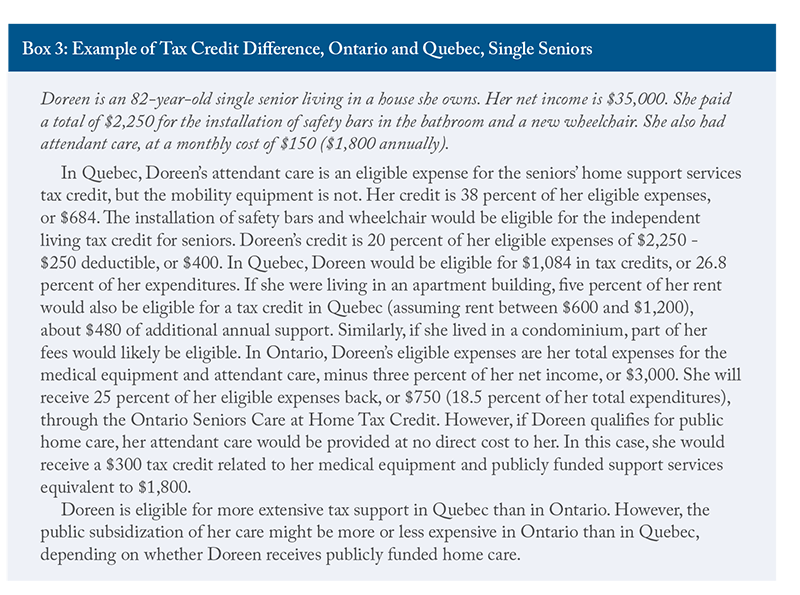
In addition to publicly provided services and subsidies on home and health care services, there are also tax credits that reduce the cost of support services and equipment for seniors. Quebec makes more expansive use of tax credits to support seniors remaining in their homes as they age than Ontario. People over 70 years of age in Quebec can claim up to 38 percent of eligible expenditures through the refundable tax credit for home support services.25 Services eligible for the tax credit include meal preparation or delivery services, nursing care services, home and personal care services (such as housekeepers, landscapers, or aides to assist with bathing, dressing, feeding etc.). For homeowners, only eligible services can be refunded. For tenants, however, a portion of rent can be considered if it includes eligible home support services. Similarly, retirement home residents can claim the portion of their rent that relates to meal preparation and home care services. The total amount that can be refunded takes into account total income, level of dependence, family structure, and the eligible expenses incurred throughout the year. An independent senior could qualify for a maximum of $7,020 in refundable credits based on the maximum service spending of $19,500. Dependent seniors can be eligible for up to $9,180 in refundable credits. The credit is reduced when family income exceeds $69,040.26
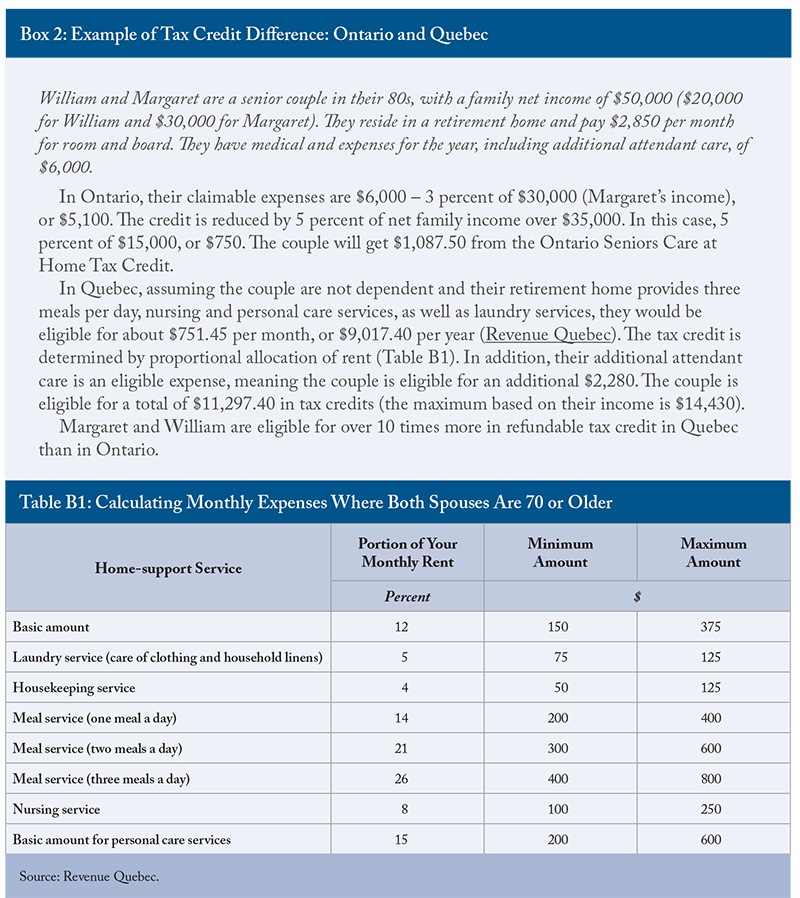
In Ontario, residents over 70 years of age can claim up to $1,500, or 25 percent of eligible expenses up to a maximum of $6,000, through the Ontario Seniors Home Care Tax Credit. Eligible expenses fall into several categories including walking aids, hearing devices, wheelchairs, hospital bed for home use, oxygen, vision, dental, or home nursing care. The maximum tax credit is reduced by five percent of family net income over $35,000, meaning about a quarter of households with a member over the age of 75 will qualify for the maximum credit. Claimable expenses are amounts over 3 percent of net income. The Ontario home care tax credit covers both services and equipment but does not allow for rent deductions, while the Quebec credit is for eligible service expenses only. Notably, the level of support provided by the Ontario tax credit is lower than that in Quebec. It covers a smaller proportion of the population and refunds a significantly lower amount. See Boxe 2 for examples of the difference in refundable tax credits for a senior couple in each province.
The federal government and Quebec also offer tax credits for improving home accessibility. The federal home accessibility tax credit is available to people 65 years of age or older, or those with a disability. Eligible recipients can claim up to $10,000 related to renovations or purchasing equipment that improves the accessibility and safety of the home. The renovations must be of an enduring nature and could include wheelchair ramps, walk-in bathing installations, and support bars. Quebec’s tax credit is similar to the federal credit. The Quebec Independent Living tax credit for seniors covers 20 percent of eligible expenses over $250.
There are also tax credits to support informal caregivers. At the federal level and in Ontario and Quebec, immediate family members can claim a tax credit for providing care for a disabled relative. Quebec also offers a refundable tax credit of 30 percent of total expenses for caregivers paying for respite services that provide a short-term replacement for care and supervision of a disabled relative.27
The tax credits available to help seniors stay in their homes are quite expansive, and generally consider age and household income levels. In some cases, the tax credits have restrictive criteria, such as requiring the person receiving care to have a disability, making them more targeted to the population requiring more intensive and ongoing care. In Quebec, the home support tax credits go a step further than in Ontario by including a portion of rent related to services, making retirement home care partially eligible, and by separating tax credits related to devices and services. The tax credits are also available to different age groups: tax credits for home equipment become available at age 65 under federal and Quebec subsidies and are available to those 70 and older in Ontario. Both Ontario and Quebec have reserved tax credit eligibility for home nursing care and other home care services to those age 70 and over. The timing of the availability of tax credits loosely follows the progression of care needs as people age and is targeted at the population in need of assistance – without requiring medical assessments and case managers to determine eligibility.28
However, there is a significant difference in the level of support provided between Ontario and Quebec. As the examples in Boxes 2 and 3 show, the question of whether a senior lives in an owned home or rented accommodations (including retirement homes) significantly changes the level of tax subsidization received in Quebec, but not Ontario. In either case, seniors are likely to qualify for more refundable tax credits to support independent living in Quebec than in Ontario.
Developing public policies to support seniors as they age should be informed by seniors’ preferences and levels of need. Some senior households requiring lifestyle or healthcare services have the financial resources to invest in adapting their homes, or to pay for services.
Many seniors are homeowners and have the ability to downsize or transition to a retirement home or other rented accommodations using the unlocked equity to pay for their accommodations or supplement publicly provided healthcare and lifestyle support services. A significant number of senior households, however, face affordability challenges and are in inadequate or unsuitable housing. This section provides a brief overview of the household spending patterns of seniors and their housing needs, with the aim of informing policies that best provide targeted support to seniors most in need.
The Household Spending Survey from Statistics Canada provides insights into the number, composition, and spending patterns of households across the country. According to the 2019 survey data, there were about 1,991,750 households with at least one person over the age of 75, representing 13.5 percent of the total.29 Nova Scotia has the highest proportion of households with seniors (15.24 percent) and Alberta has the lowest (10.77 percent). The data show that while the majority of households with seniors are living within their means, senior households with below-median incomes, and those who rent, are more likely to face affordability challenges or have difficulty accessing adequate and suitable housing.
Most seniors live alone or as a couple (42 percent and 35 percent, respectively). The distribution of seniors among housing types is similar to the rest of the population; a majority live in single detached houses (54 percent) and about 3 in 10 live in apartments or condos. The majority of senior households own their home without a mortgage, and seniors are more likely to own a second property than the population average. The majority of households with seniors depend on government transfers as their main source of income (52 percent), followed by other forms of income (27 percent) and employment earnings (17 percent).30In general, 75+ households have lower spending and consumption than the average household and spend a lower proportion of their income.31 Senior households spend less than the average in all categories except healthcare and custodial services (though they still spend less on household operations overall). Examining average income and consumption patterns across provinces shows that the average household with at least one person over the age of 75 can meet its needs and still reserve about 30 percent of income as savings, a similar rate to households overall.
Averages, however, can mask more worrisome spending and consumption patterns at the lower end of the income distribution. Households with below-median income have consumption expenditures that exceed their incomes.32 Shelter and food costs represent about 46 percent of consumption expenditures across lower-income households in general, and 53 percent for lower-income households with seniors. Shelter costs exceed the 30 percent affordability threshold for below-median-income households with seniors.33 It is difficult to determine the level of need from these data alone, since many seniors have significant savings to support their consumption. Lower-income seniors who do not have significant savings would be more likely to face affordability challenges. Ontario has the lowest spending on shelter for lower-income households with seniors ($8,862), and those households have significantly lower shelter costs than the average across lower-income households in the province.34 In Quebec and Alberta, shelter costs exceed 35 percent of consumption expenditure for senior households. In British Columbia, seniors who rent spend 46.1 percent of their income on shelter.
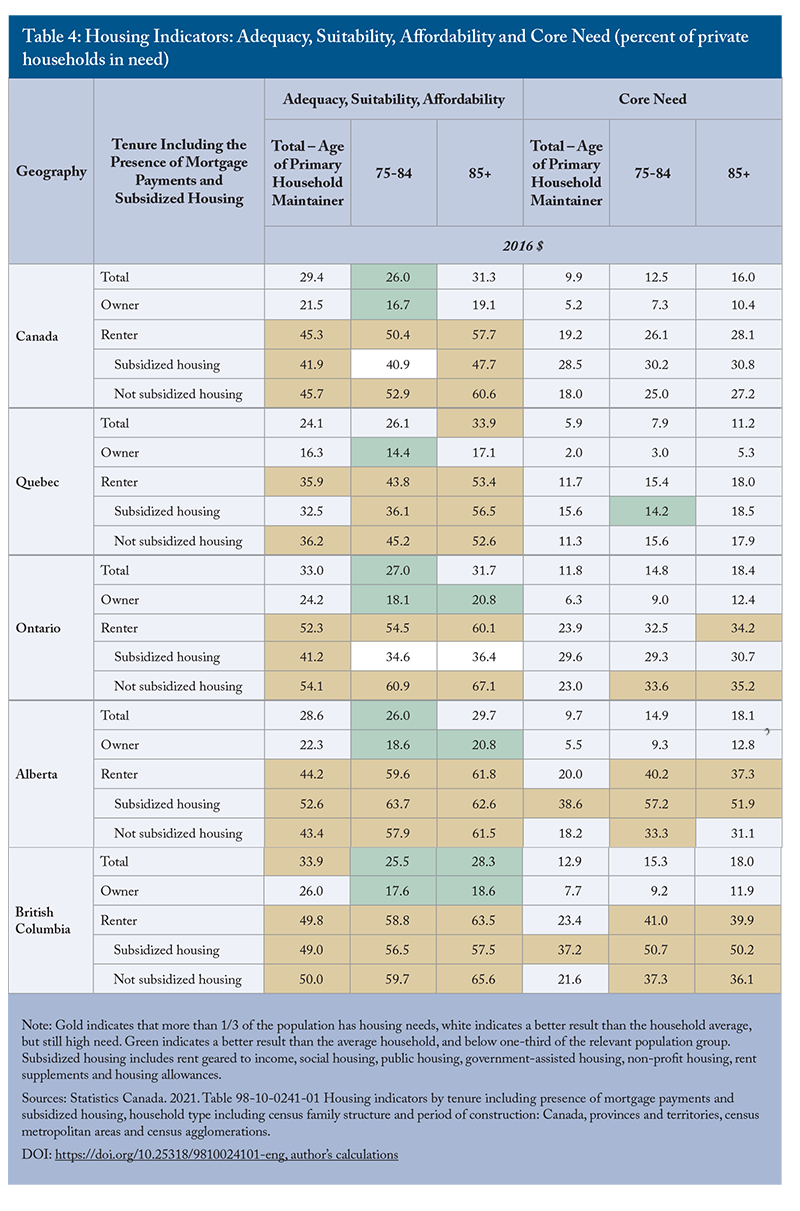
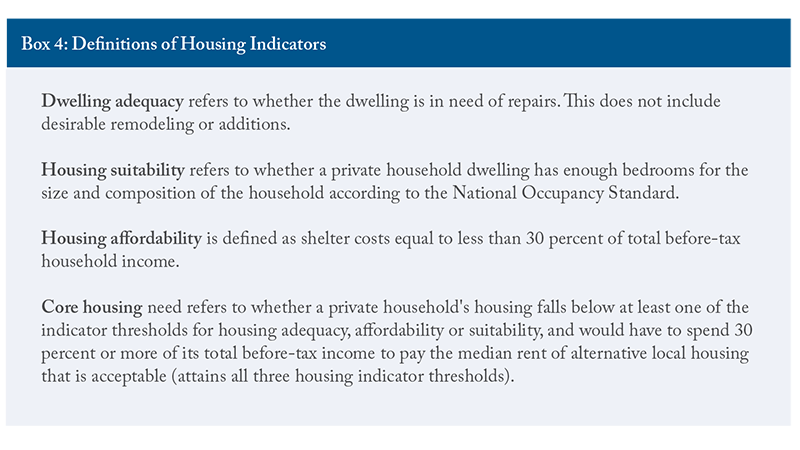
The importance of shelter costs to seniors’ expenditures, particularly below-median income households, warrants further investigation. Statistics Canada’s housing indicators provide further details. Households where the primary maintainer is over the age of 85 generally have higher rates of housing inadequacy, unaffordability, and unsuitability than the average across all households (Table 4). Seniors show higher rates of “core need” housing than the general population (see Box 4 for definitions of housing indicators).
In all major provinces, more than a third of renters are in housing that is inadequate, unsuitable, or unaffordable. There are some challenges related to housing indicators for homeowners. Rates of inadequacy, unsuitability, or unaffordability are generally lower for seniors 75+ than for the overall household average. Those who rent are more likely to face difficulties. Notably, more than a third of senior renters in ON, BC and AB cannot afford to move into more suitable housing.35 Quebec, comparatively, has lower rates of core housing need than the other provinces, suggesting that a higher proportion of households could afford to move to adequate or suitable housing. This implies that Quebec has fewer affordability challenges relative to the other provinces, particularly for renters and seniors, despite similar levels of inadequate, unsuitable, or unaffordable housing.
As seniors age, it becomes more likely that they will downsize housing to unlock equity and/or move to more appropriate housing. Similarly, they might choose to transition to renting accommodations in seniors’ care spaces. Between 2016 and 2021, 36 percent of over-75 households sold their homes (CMHC 2023).36This rate has declined over time, showing that more and more seniors are remaining independent for longer and choosing to remain in their homes as they age. Older seniors are more likely to transition to rented accommodations (including private market rental units, retirement homes and LTC) and are also more likely to require supportive services. Declining rental rates and a higher proportion of seniors owning their homes shows a preference for aging-in-place and shows that many seniors can maintain their independence for longer than seniors in previous cohorts. Most seniors would prefer to age in their homes, but many are concerned that they won’t be able to afford to do so. Some seniors are pooling their resources and investing in shared accommodation and care services (Sylvestre-Williams 2024).
There are also “naturally occurring retirement communities” when the majority of inhabitants of a multi-unit dwelling are seniors, or seniors choose to purchase housing in close proximity to each other. These naturally occurring communities could provide opportunities to improve the efficiency of home and community care services. They also reveal the preferences for housing and support services of seniors with adequate financial resources to be strategic and plan for their desired retirement. This could provide insights for new models of seniors’ care that reduce costs by supporting the independence of lower-wealth seniors and encouraging seniors with means to contribute to the costs of their support services.
Overall, the data on household spending and income show that the average household is able to afford its needs, although spending patterns change with age and require higher healthcare expenditures. In general, 75+ households have lower spending and consumption than the average household.37 Seniors that have below-median incomes, however, are facing affordability challenges similar to other households in the category, particularly with regard to shelter. These insights suggest two important factors to consider in developing seniors’ care and support policies. First, many senior households have sufficient resources to fund some lifestyle support and healthcare services, meaning there could be opportunities to develop markets for seniors’ support services to supplement the under-provision of publicly provided home care. Second, some seniors are facing affordability challenges, meaning targeted support policies that holistically consider housing, support, and healthcare needs could reduce the likelihood that these seniors will prematurely enter long-term care or become ALC patients in hospitals. For the Silo, Rosalie Wynoch /C.D. Howe Institute.
Clavet, Nicholas-James, Réjean Hébert, Pierre-Carl Michaud, and Julien Navaux. 2022. “The Future of Long-Term Care in Quebec: What Are the Cost Savings from a Realistic Shift toward More Home Care?” Canadian Public Policy 48: 35-50.
Chidwick, Paula, Jill Oliver, Daniel Ball, Christopher Parkes, Terri Lynn Hansen, Francesca Fiumara, Kiki Ferrari et. al. 2017. “Six Change Ideas that Significantly Minimize Alternate Level of Care (ALC) Days in Acute Care Hospitals.” Healthcare Quarterly 20(2): 37-43.
Durante, Stephanie, Ken Fyie, Jennifer Zwicker, and Travis Carpenter. 2023. “Confronting the Alternate Level Care (ALC) Crisis with a Multifaceted Policy Lens.” Briefing Paper. University of Calgary School of Public Policy 16(1). Available at https://journalhosting.ucalgary.ca/index.php/sppp/article/view/76748
Nuernberger, Kim, Steve Atkinson, and Georgina MacDonald. 2018. “Seniors in Transition: Exploring Pathways Across the Care Continuum”. Healthcare Quarterly 21(1): 10-12.
Roblin, Blair, Raisa Deber, Kerry Kuluski, and Michelle Pannor Silver. 2019. “Ontario’s Retirement Homes and Long-term Care Homes: A Comparison of Care Services and Funding Regimes.” Canadian Journal on Aging / La Revue canadienne du vieillissement 38(2): 155–167.
Photo shot in London, Ontario. Shot during a tornado warning for Middlesex county. photo: S. Sills
Did you know on average 12 tornadoes strike Ontario each year? That’s why David Chapman (@northof44pics) and I (@wxspencersills) commit our springs and summers to capturing severe thunderstorms on video and through photography.
My name is Spencer Sills and I am a chaser located in South Western Ontario. I have been chasing storms for about 20 years. I became obsessed with the weather and more specifically severe weather in 1996. On April 20, 1996 a tornado had hit Williamsford, Ontario. This was my first experience with a tornado and it has become a permanent fixture in my mind, partially due to the fact there was still snow on the ground the day it had hit.
Then in the summer of 2011, there were fourteen confirmed tornadoes including the Goderich F3 tornado as well as three tornadoes during the August 24th severe weather outbreak during the late afternoon and evening. I was unable to be out during either of these days but what I was able to do was keep the public informed of the current severe weather as well as help give warning for the tornadoes.
Photo shot in South West London, Ontario. A waterspout advisory was in effect for Lake Huron and Erie, while on the way to Lake Huron I came across this Cold Core Funnel off of a early morning thunder shower. image: S. Sills
A Summer from years ago was…interesting. I witnessed more than my fair share of active weather. I encountered five funnel clouds, several gust fronts or more commonly known as squall lines here in Ontario, and hail from pea size to golf ball sized in Seaforth. I’ve also encountered strong wind storms which included a storm in Birr, Ontario which uprooted several large trees.
My personal worst storm occurred on June 7, 2011 in Elora, Ontario. A large and intense cell came through late at night bringing with it 80-90 km/h winds, heavy downpours, frequent lightning and quarter-coin size hail. I was fortunate to not be injured during this storm because I was in a tent at the time and had no warning beforehand other than a loud lightning strike before it hit. There was a severe thunder storm warning with the cell but our campground chose not to relay that information to campers and I only found out about the warning once I put on my portable radio after the storm came. That same storm went on to produce a tornado warning over Hamilton but did not spawn a tornado that night. It did however cause extensive wind damage in the city.
Cloud to Ground Lightning: photographed by D. Chapman
My chase partner is David Chapman. David and I both grew up within minutes of each other but never met until recently due to the power of twitter. From twitter I was able to glean that we both have similar interests and goals which will allow us to mesh well together. [ Check the hashtage #WX on twitter for tweets related to extreme weather CP ]
Hello Silo readers. My name is David T. Chapmanand I am a professional photographer with a passion for storm photography. I developed an interest in weather when lightning hit my house in Guelph, Ontario, years ago. The thunder was terrifying and the rain was so heavy that even though I was only three years old at the time, I have clear, vivid memories of the storm. My interest in weather was rekindled in the late 1990’s when I spotted my first multi-vortex tornadoes with my dad and brother. Since then, I have followed the weather every day to determine the best time for photography in all kinds of conditions.
Waaaay back in 2011 , the Ontario storm season was an active one. It allowed me to get a personal record number of lightning photographs in one season with 105, not including sheet lightning shots. My first storm was in April, when a very weak storm pushed into the Niagara region. Something that you don’t see very often is a thunderstorm with snow on the ground, but that night I had both. But the storm chasing season really didn’t start seriously until the end of May when an evening storm rolled through Southwestern Ontario right into my area. The squall line formed directly to our west and there was no way around it. We had to puncture the core of the storm to try to find a dry slot. We were hit hard with heavy rains, strong winds and continuous lightning.
Anvil Crawler: photographed Southeast of Hamilton, Ontario image: D. Chapman
One of the hardest things to get is a lightning photograph when there is a downpour because it blurs the image. The first line of storms went through when we crossed an open field area and then we were hit by a strong second line of storms. Extremely strong straight lines came at us with winds easily in excess of 90 km/hr. We got into position, but unfortunately, with the rain still pounding our photography team, it made it impossible to get crisp, clear lightning shots. It wasn’t until after the storm had passed that the back end of it lit up and we were able to capture some very beautiful lightning.
The summer carried on with sporadic thunderstorm activity consisting of small thunderstorm cells with intense lightning and hail. Generally, with smaller storms, you only get 4 to 5 lightning shots. I’ve come back after chasing a storm perfectly with only 1 or 2 lightning shots to show for it. It wasn’t until the outbreak of thunderstorms that our team had a very successful night of shooting. On that night, Faith Beni and I ended up in St. Mary’s, Ontario. There were tornado watches all across Ontario, the most I had ever seen. The thunderstorm cell that we were interested in was towards Nairn, Ontario. We left the Niagara region at 5:30 p.m. and got to St. Mary’s around 7:45 p.m.
Without daylight left, the thoughts of getting a tornado quickly changed to an opportunity for lightning photographs instead. One of the most dangerous things to do is to chase a tornadic thunderstorm in the dark, which is why our team has a policy to not chase these types of storms at night. We tend to focus on weaker storm cells that don’t have the tornadic potential but still have lots of lightning. The night of the 24th, though, was different. It seemed that any storm cell had the potential to drop a tornado. We pulled back to St. Mary’s and then we started getting reports of rotation heading to St. Mary’s.
In just under 2 minutes, I saw 4 reports of rotation for St. Mary’s. We started to get pounded with large hail and the the hydro went out. We left St. Mary’s and pushed north towards what looked to be some late evening twilight. We got to the back of the storm and were able to photograph the lightning that was in it. We got some of the best anvil-crawlers that I have ever seen. Anvil-crawlers are a particular type of lightning that can either go for short distances or for distances over 100 km.
This year for the first time, Spencer Sills and I will be working together to get some very powerful images. Our biggest goal is to get a photograph of a tornado. Last year, I was close 3 times. The first was in Grimsby, where an EF0 hit and damaged a small gazebo. Eric Chapman and I were right on the storm but unfortunately we could not see the tornado because of heavy precipitation. The second was the Nairn tornado and the third was a rotating wall-cloud that I photographed towards Bryson, Quebec.
Spencer and I often hear about how tornadoes don’t happen here. We want to let the public know that they can and do occur here, in South Western Ontario so that watches and warnings should always be taken seriously. The Goderich tornado in 2011, in which one person died, is a grim reminder of just how intense tornadoes can be and that they do, in fact, affect Ontario residents.
Photo shot in Nairn, Ontario. Tornado damage in Shady Pines Campground in Nairn. A tornado touched down the previous night and bent these pine trees in half, the tornado also caused extensive tree damage in the area as well as damaged a house and destroyed a metal silo. image: S. Sills
David and I both have experience in chasing storms, and take safety very seriously. We will be travelling with a First Aid kit just as well as weather alert radios and radar to help us along our way, we hope that we don’t ever need the kit but it’s always a great idea especially if others are in need of help, we could very well be the first people on the scene of a possible tragedy so we must be prepared. We will be posting pictures and videos throughout the season but do not recommend that anyone attempt to recreate either of them and place themselves in danger.
I will be working with David Chapman in hopes to help warn others as well as capture these storms through video and photography to share with others who may not get to experience them. We are ready to combine our passion for storms to get the best results possible and share those results with others.
When the Earth, Moon, and Sun line up in space, we can see an eclipse. NASA studies eclipses from the ground, in our atmosphere, and in space, influencing solar, planetary, and Earth science.
Today on April 8, the Moon’s shadow will sweep across the United States and Canada, as millions will view a total solar eclipse. For many, preparing for this event brings memories of the magnificent total solar eclipse on Aug. 21, 2017.
The total solar eclipse on Aug. 21, 2017, was photographed from Madras, Oregon. The black circle in the middle is the Moon. Surrounding it are white streams of light belonging to the Sun’s outer atmosphere, called the corona.
NASA/Aubrey Gemignani
In 2017, an estimated 215 million U.S. and Canadian adults (88% of U.S. adults) viewed the solar eclipse, either directly or electronically. They experienced the Moon pass in front of the Sun, blocking part or all of our closest star’s bright face. The eclipse in 2024 could be even more exciting due to differences in the path, timing, and scientific research.
Wider, More Populated Path
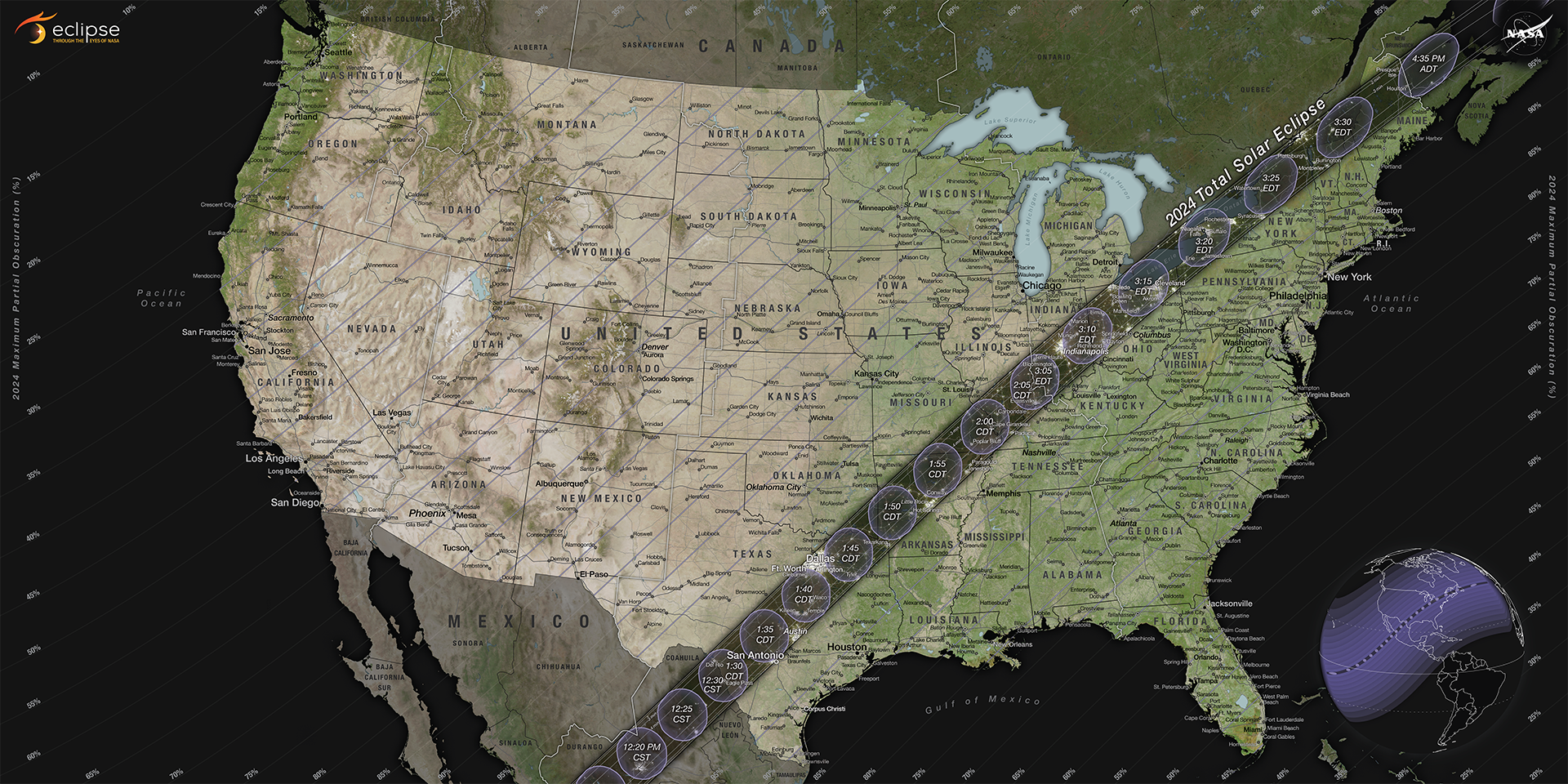
The path of totality – where viewers can see the Moon totally block the Sun, revealing the star’s outer atmosphere, called the corona – is much wider during the upcoming total solar eclipse than it was during the eclipse in 2017 and is expected to occur for viewers along the Great Lakes at 3:33pm EDT. As the Moon orbits Earth, its distance from our planet varies. During the 2017 total solar eclipse, the Moon was a little bit farther away from Earth than it will be during the upcoming total solar eclipse, causing the path of that eclipse to be a little skinnier. In 2017, the path ranged from about 62 to 71 miles wide. During the April eclipse, the path over North America will range between 108 and 122 miles wide – meaning at any given moment, this eclipse covers more ground.
The 2024 eclipse path will also pass over more cities and densely populated areas than the 2017 path did. This will make it easier for more people to see totality. An estimated 31.6 million people live in the path of totality this year, compared to 12 million in 2017. An additional 150 million people live within 200 miles of the path of totality.
This map shows the path of the 2017 total solar eclipse, crossing from Oregon to South Carolina, and the 2024 total solar eclipse, crossing from Mexico into Texas, up to Maine, and exiting over Canada.To see a map showing which areas will experience the partial solar eclipse and which areas will experience the total solar eclipse today April 8, 2024, click the arrows.Ernest Wright/NASA’s Scientific Visualization StudioThis map illustrates the paths of the Moon’s shadow across the U.S. during the 2024 total solar eclipse. Today April 8, 2024, a total solar eclipse will cross North and Central America creating a path of totality. During a total solar eclipse, the Moon completely blocks the Sun while it passes between the Sun and Earth. The sky will darken as if it were dawn or dusk and those standing in the path of totality may see the Sun’s outer atmosphere (the corona) if weather permits.To see a map comparing the 2024 eclipse and the 2017 eclipse paths, click the arrows.NASA/Scientific Visualization Studio/Michala Garrison; Eclipse Calculations By Ernie Wright, NASA Goddard Space Flight Center
You don’t need to live within the path of totality to see the eclipse – in April, 99% of people who reside in the United States will be able to see the partial or total eclipse from where they live. Every contiguous U.S. state, plus parts of Alaska and Hawaii, will experience at least a partial solar eclipse.
Longer Time in Totality
Today, totality will last longer than it did in 2017. Seven years ago, the longest period of totality was experienced near Carbondale, Illinois, at 2 minutes, 42 seconds.
For the upcoming eclipse, totality will last up to 4 minutes, 28 seconds, in an area about 25 minutes northwest of Torreón, Mexico. As the eclipse enters Texas, totality will last about 4 minutes, 26 seconds at the center of the eclipse’s path. Durations longer than 4 minutes stretch as far north as Economy, Indiana. Even as the eclipse exits the U.S. and enters Canada, the eclipse will last up to 3 minutes, 21 seconds.
During any total solar eclipse, totality lasts the longest near the center of the path, widthwise, and decreases toward the edge. But those seeking totality shouldn’t worry that they need to be exactly at the center. The time in totality falls off pretty slowly until you get close to the edge.
Heightened Solar Activity
NASA/ESA’s Solar and Heliospheric Observatory (SOHO) captured this video of a coronal mass ejection on March 13, 2023.NASA/ESA/SOHOSome prominences are seen as the Moon begins to move off the Sun during the total solar eclipse on Monday, Aug. 21, 2017, above Madras, Oregon.NASA/Aubrey Gemignani
Every 11 years or so, the Sun’s magnetic field flips, causing a cycle of increasing then decreasing solar activity. During solar minimum, there are fewer giant eruptions from the Sun, such as solar flares and coronal mass ejections. But during solar maximum, the Sun becomes more active.
In 2017, the Sun was nearing solar minimum. Viewers of the total eclipse could see the breathtaking corona – but since the Sun was quiet, streamers flowing into the solar atmosphere were restricted to just the equatorial regions of the star. The Sun is more magnetically symmetrical during solar minimum, causing this simpler appearance. During today’s 2024 eclipse, the Sun will be in or near solar maximum, when the magnetic field is more like a tangled hairball. Streamers will likely be visible throughout the corona. In addition to that, viewers will have a better chance to see prominences – which appear as bright, pink curls or loops coming off the Sun.
With lucky timing, there could even be a chance to see a coronal mass ejection – a large eruption of solar material – during the eclipse.
Expanded Scientific Research
The third rocket launched on Oct. 14, 2023, during the annular solar eclipse leaves the launch pad.
WSMR Army Photo
During the total eclipse in 2024, NASA is funding several research initiatives that build on research done during the 2017 eclipse. The projects, which are led by researchers at different academic institutions, will study the Sun and its influence on Earth with a variety of instruments, including cameras aboard high-altitude research planes, ham radios, and more. In addition to those projects, instruments that were launched during the 2023 annular solar eclipse on three sounding rockets will again be launched during the upcoming total solar eclipse.
Two spacecraft designed to study the Sun’s corona – NASA’s Parker Solar Probe and ESA (European Space Agency) and NASA’s Solar Orbiter – have also launched since the 2017 solar eclipse. These missions will provide insights from the corona itself, while viewers on Earth see it with their own eyes, providing an exciting opportunity to combine and compare viewpoints.
To learn more about the 2024 total solar eclipse and how you can safely watch it, visit NASA’s eclipse website.
The article below (Furthering the Benefits of Global Economic Integration through Institution Building: Canada as 2024 Chair of CPTPP) was first published by the C.D. Howe Institute by Paul Jenkins and Mark Kruger.
Introduction
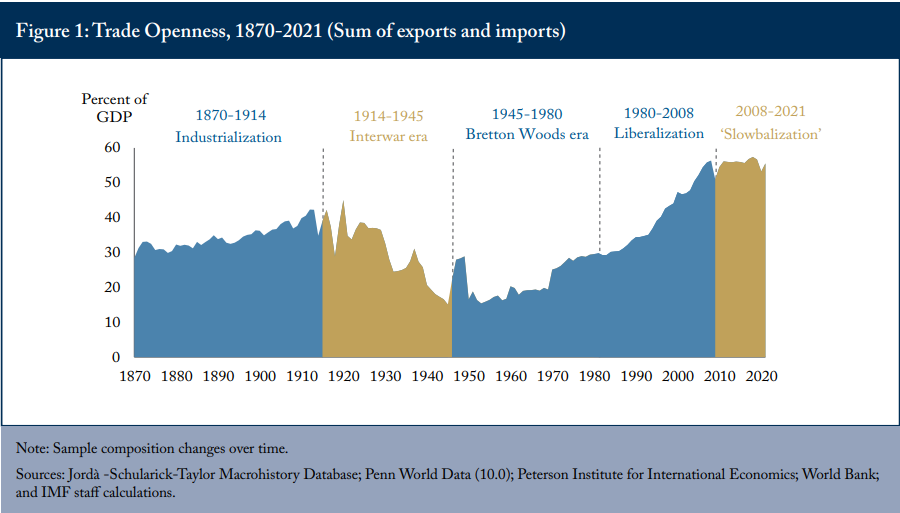
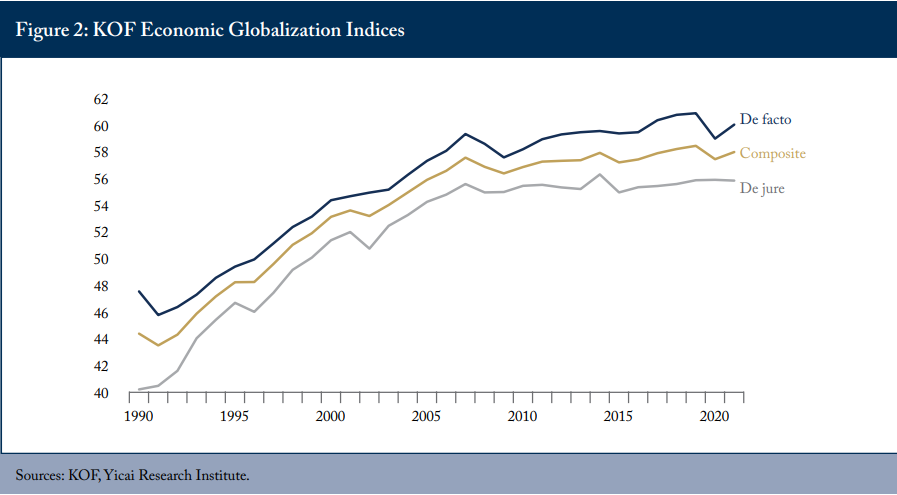
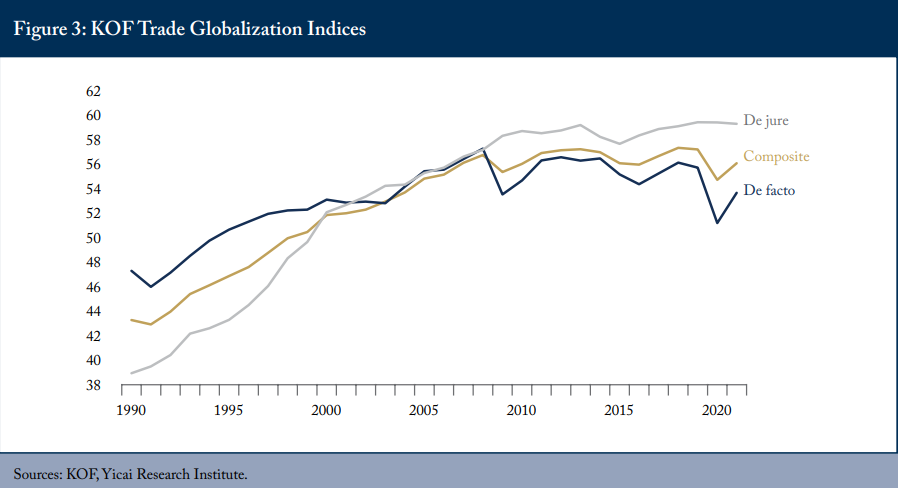
Over the last 10 to 15 years, the global economy has become fragmented. There are many reasons for this fragmentation – both economic and geopolitical. A particularly important factor has been the inability of the institutions that provide the governance framework for international trade and finance to adapt to the changing realities of the global economy.
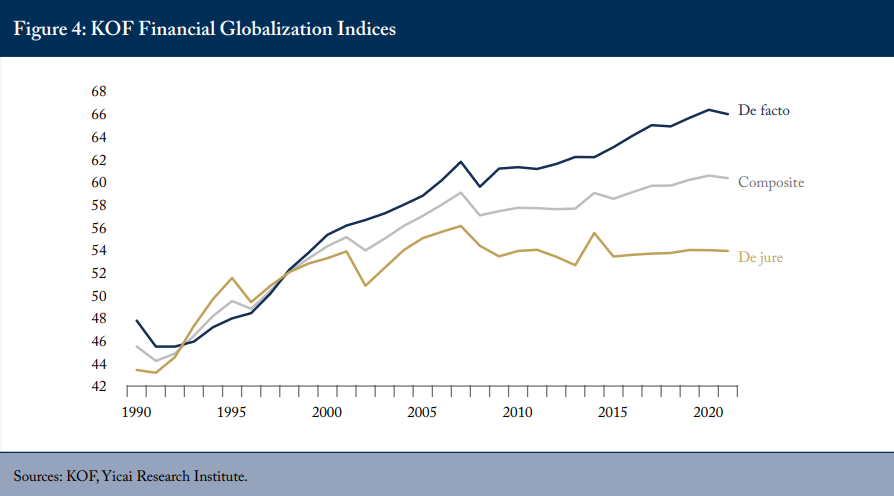
This erosion is reflected in the cycles of outcome-based measures of globalization, such as trade-to-GDP ratios. Research indicates that the development of institutions that promote global integration is highly correlated with more rapid economic growth. To secure the benefits of economic integration, the international community should re-commit to a set of common rules. This should involve the renewal of existing institutions in line with current economic realities.
But institutional renewal alone is not sufficient. Nurturing and growing new institutions are also critical, especially ones reflecting the realities of today’s global economy. Most promising in this regard is the Comprehensive and Progressive Agreement for Trans-Pacific Partnership (CPTPP).
The CPTPP is seen as a “next generation” trade agreement. It takes World Trade Organization (WTO) rules further in several key areas, such as electronic commerce, intellectual property, and state-owned enterprises. Expansion of CPTPP represents a unique opportunity to strengthen global trade rules, deepen global economic cooperation on trade and sustain an open global trading system. The benefits for Canada of an expanded CPTPP are further diversification of its export markets and deepened ties with countries in the Indo-Pacific region.
Trusted Policy Intelligence
The challenge to enabling broad-based accession to CPTPP is geopolitical, reflecting the rising aspirations of the developing world, the associated heightened contest between democracy and autocracy, and the prioritization of security. Indeed, for many, today’s security concerns are at the forefront, trumping economic issues. We argue that recognition of the economic benefits of global economic integration must also remain at the forefront, and that research presented in this paper shows that institutional building is at the core of securing such benefits.
As 2024 Chair of the CPTPP Commission, Canada has an opportunity to play a leadership role, as it did in the creation of the Bretton Woods institutions 80 years ago, by again promoting global institution building, this time through the successful accession of countries to the CPTPP, both this year and over the long run.
Cycles in Global Economic Integration Former US Fed Chair Bernanke points out that the process of global economic integration has been going on for centuries. New technologies have been a major force in linking economies and markets but the process has not been a smooth and steady one. Rather, there have been waves of integration, dis-integration, and re-integration. Before World War I, the global economy was connected by extensive international trade, investment, and financial flows. Improved transportation – steamships, railways and canals – and communication – international mail and the telegraph – facilitated this “first era of globalization.” The gold standard linked countries financially and promoted currency stability. Trade barriers were reduced by the adoption of standardized customs procedures and trade regulations. The movement of goods, capital, and people was relatively unrestricted. The outbreak of World War I frayed global economic ties and set the stage for a more fragmented interwar period. The Treaty of Versailles imposed punitive measures on Germany, exacerbating economic hardships. Protectionist policies, such as high tariffs and competitive devaluations, became widespread as countries prioritized domestic interests. The collapse of the gold standard further destabilized international finance. In contrast to the cooperation seen before the war, countries pursued economic nationalism and isolationism. Protectionism increased in the 1930s as a result of the dislocation caused by the Great Depression. In an attempt to shield domestic industries from foreign competition and address soaring unemployment, many countries imposed tariffs and trade barriers. The Smoot-Hawley Tariff Act in the United States exemplified this trend, triggering a series of beggar-thy-neighbour policies. These protectionist policies exacerbated the downturn and contributed to a contraction in international trade that worsened the severity and duration of the Great Depression. Mindful of the lessons of the 1930s, a more liberal economic order was established in the aftermath of World War II. The creation of the Bretton Woods Institutions – the International Monetary Fund (IMF), the World Bank and the General Agreement on Tariffs and Trade (GATT) – provided the principal mechanisms for managing and governing the global economy over the second half of the 20th century. Building on the GATT, the formation of the World Trade Organization in 1995 provided the institutional framework for overseeing international trade and settling disputes. China became the 143rd member of the WTO in 2001 and almost all global trade became subject to a common set of rules. The rise and fall of international economic governance are reflected in the cycles of outcome-based measures of globalization. Looking at trade openness, i.e., the sum of exports and imports as a percentage of GDP, the IMF divides the process of global integration into five periods: (i) the industrialization era, (ii) the interwar era, (iii) the Bretton Woods era, (iv) the liberalization era, and (v) “slowbalization” (Figure 1). Many factors have contributed to the plateauing of trade openness in the last 10 to 15 years. The fallout from the Global Financial Crisis was severe and the recovery was tepid. Brexit, with its inward-looking perspective, has disengaged the UK from Europe. Populist protectionism has led to “re-shoring” in an effort to address rising inequalities and labour’s falling share of national income. There has been far-reaching cyclical and structural fallout from COVID-19. And while the AI revolution portends significant opportunities, uncertainties over labour displacement abound. Geopolitics has also played a critical role. Security concerns have become more important, trumping economic issues in the eyes of many. This has led to multiple sanctions, along with export and investment controls, being imposed to protect national security interests. The IMF has carried out several modelling exercises that estimate the consequences of fragmentation if further trade and technology barriers were to be imposed. The studies employ a variety of assumptions regarding trade restrictions and technology de-coupling. In summary, the cost of further fragmentation ranges from 1.5 to 6.9 percent of global GDP. As with all modelling exercises, a degree of caution is warranted. At the same time, these studies should not be viewed as upper-bound estimates because they disregard many other transmission channels of global economic integration.
De Jure and De Facto Globalization In assessing the evolution of globalization, however, it would be misleading to focus too narrowly on outcome-based measures such as the trade-to-GDP ratio depicted in Figure 1. The data compiled by KOF, a Swiss research institute, provide a more nuanced view of global economic integration. KOF constructs globalization indices that measure integration across economic, social, and political dimensions. Its globalization indices are among the most widely used in academic literature. KOF’s data set covers 203 countries over the period 1970 to 2021. Our focus here is on KOF’s economic indices. In terms of economic globalization, KOF looks at the evolution of finance as well as trade. Moreover, one of the unique aspects of KOF’s work is that it examines globalization on both de facto and de jure bases. KOF’s de facto globalization indices measure actual international flows and activities. In terms of trade, it includes cross-border goods and services flows and trading partner diversity. For financial globalization, its indices measure stocks of international assets and liabilities as well as cross-border payments and receipts. KOF’s de jure globalization indices try to capture the policies and conditions that, in principle, foster these flows and activities. For trade globalization, these include income from taxes on trade, non-tariff barriers, tariffs, and trade agreements. De jure financial globalization is designed to measure the institutional openness of a country to international financial flows and investments. Variables to measure capital account openness, investment restrictions and international agreements and treaties with investment provisions are included in these indices. The trends in KOF’s de facto and de jure economic globalization indices are shown in Figure 2. Both globalization measures increased rapidly from 1990 until the Global Financial Crisis. Both measures subsequently plateaued. In 2020, as the global pandemic took hold, the de facto index plunged to its lowest level since 2011. In 2021, it recovered half of the distance it lost the previous year. The de jure index has essentially been flat for the last decade. There has been a sharp divergence between KOF’s de facto and de jure trade globalization measures in the last five years (Figure 3). By 2020, de facto trade globalization had dropped to a 25-year low. Although it recovered somewhat in 2021, it remains well below the average of the last decade. In contrast, de jure trade globalization levelled off after the Global Financial Crisis. It reached a modest new high in 2019 and has essentially remained there since then. The trends in financial globalization are almost the reverse of those of trade globalization. De facto financial globalization continued to increase through 2020 and dipped slightly in 2021. De jure financial globalization has been essentially flat over the last two decades (Figure 4). The KOF researchers provide convincing econometric evidence that economic globalization supports per capita GDP growth. Importantly, their analysis shows that institutions matter. They demonstrate that the positive impact on growth from trade and financial globalization comes from institutional liberalization rather than greater economic flows. Through a series of panel regressions, the researchers show that it is the de jure trade and financial globalization indices that are correlated with more rapid per capita GDP growth. In contrast, there is no significant relationship between growth and the de facto indices. KOF’s conclusions are consistent with the work of Rodrik, Subramanian and Trebbi who examine the contributions of institutions, geography, and trade in determining relative income levels around the world. They find that institutional quality “trumps everything else.” Once institutions are controlled for, conventional measures of geography have weak effects on incomes and the contribution of trade is generally not significant. Thus, to recapture the economic benefits of free trade and open markets, countries need to recommit to finding ways to further de jure globalization; that is, putting in place the institutional building blocks in support of enhanced trade and financial integration.
Geopolitical Realities Institutional reform, however, requires trust and mutual respect among partners. Many would argue that such trust and respect is in limited supply today, especially between the United States and China. The United States is willing to endure the costs of heightened protectionism to purportedly strengthen the resilience of its economy and secure greater political security. This has resulted in multiple sanctions, particularly in areas of digital technologies. In response, China, amongst other measures, has imposed export controls on critical minerals used in advanced technology in defence of its geopolitical goals. Yet, as discussed by Fareed Zakaria in a Foreign Affairs article, The Self-Doubting Superpower, China has become the second largest economy in the world richer and more powerful within an integrated global economic system; a system that if overturned would result in severely negative consequences for China. For the United States, its inherent strength has been its commitment to open markets and its vision of the world that has considered the interests of others. In many respects, it remains uniquely capable of playing the central role in sustaining the global economic system. Following a recent trip to China, Treasury Secretary Yellen stated that “the relationship between the United States and China is one of the most consequential of our time,” and that it “is possible to achieve an economic relationship that is mutually beneficial in the long-run – one that supports growth and innovation on both sides.” This means that the United States would need to accommodate China’s legitimate efforts to sustain a rising standard of living for its citizens, while deterring illegitimate ones. For China, it would mean a clear and abiding commitment to an open, rules-based global economic system. It appears that there is currently no clear path forward for this change in mindset, given what many see as insurmountable geopolitics in both the United States and China. Yet, history shows that achieving and sustaining long-term economic growth is in every country’s best interest, and that such growth is best secured through ongoing global economic integration.
A Way Forward Recent discussions at the IMF’s Annual Meeting in Marrakech about IMF quota reform, including quota increases and realignment in quota shares to better reflect members’ relative positions in the global economy, are important signals of possible renewal. Similarly, calls to revamp the World Bank’s mandate, operational model, and ability to finance global public goods, such as climate transition, reflect a growing consensus that the Bretton Woods Institutions must change in the face of today’s realities. But institutional renewal alone is insufficient. Broad-based accession to the CPTPP represents a unique opportunity to strengthen global governance overall, and to address common challenges in ways that benefit both countries as well as the global economy. The CPTPP sets a high bar, requiring countries to:
eliminate or substantially reduce tariffs and other trade barriers;
make strong commitments to opening their markets;
abide by strict rules on competition, government procurement, state-owned enterprises, and protection of foreign companies; and
operate within, as well as help promote, a predictable, comprehensive framework in the critical area of digital trade flows. The United Kingdom formally agreed to join the CPTPP in July 2023. Once its Parliament ratifies the Agreement, the UK will join Australia, Brunei Darussalam, Canada, Chile, Japan, Malaysia, Mexico, New Zealand, Peru, Singapore, and Vietnam in the trading block. Such a diverse membership clearly demonstrates that countries do not have to be geographically close to form an effective trading block. A half-dozen other countries have also applied to join the CPTPP, with China’s application having been the earliest received. Petri and Plummer estimate that joining the CPTPP would yield large economic benefits for China and the global economy. For the latter, the boost to global GDP would be in the order of $600 billion annually. The United States in joining would gain preferential access to rapidly growing Pacific Rim markets. Much of the additional market access would come from China’s opening of its service sector. Industrial policy and state-owned enterprises, however, will continue to play a much larger role in China than they do in Western economies. The key for China is to demonstrate that a socialist market economy (i.e., one that has a mixed capitalist market and government-controlled economy) can be consistent with fair trade. The process of China joining the CPTPP will undoubtedly be time-consuming. It took 15 years of negotiations before China joined the WTO in 2001. This was five more years, on average, than it took those countries that joined after 1995. The challenge for Canada, and subsequent chairs, is to ensure that China’s entry maintains the high standards CPTPP members have met so far. Broad based accession to the CPTPP, including the United States and China, however, is best viewed Page 8 Verbatim Trusted Policy Intelligence as a long-term goal. China would need to undertake unprecedented reforms, involving complex political challenges, including Taiwan’s potential accession. For its part, the United States would need to step well back from its current mercantilist mind set, which risks worsening.
Canada as Chair in 2024
While efforts to renew existing global institutions to better reflect current economic realities are important, we see promoting broad accession to the CPTPP as the best means to turn today’s global economic fragmentation around. At the heart of the global economic system is the open trading framework put in place at Bretton Woods in 1944. Many would see today’s fragmentation as becoming more acute, rather than getting better, due to geopolitical divisions. But further fragmentation is no way to save the open, rules-based global trading system that has served so many countries so well for so long.
While restrictions reflecting legitimate security concerns are inevitable, an open, competitive trading system remains in the best interests of all countries. As 2024 Chair of the CPTPP Commission, Canada has an opportunity to contribute to turning around the fragmentation of today’s global trading system and moving the global economy back along a path towards a more open, rules-based trading system.
An important goal for Canada’s chairmanship would be to clarify the rules of accession. This would be a big step forward in sustaining expansion of CPTPP. While today’s geopolitical realities surrounding the applications of both China and Taiwan represent a particularly challenging area to advance, significant progress in other areas must be made. It should accelerate inclusion of Costa Rica, Uruguay, Ecuador, and Ukraine, all of whom have applied. And it should help move forward discussions with South Korea, Indonesia, Philippines, and Thailand, who have expressed interest in joining.
Over and above all that, however, at a more strategic level, Canada should also champion discussion and understanding of why building towards the long-run goal of broad accession to CPTPP is important. Open and inclusive institutions are at the core of providing the benefits of global economic integration to all countries.
Canada will also be Chair of the G7 Summit in 2025. This, along with the various ministerial and officials’ meetings leading up to the Summit, offers another critical avenue for Canada to take a leadership role in sustaining and promoting an open, rules-based global trading system.
Paris, France. April, 2024– Leading esports club Team Vitality is thrilled to announce the contract renewal of star Counter Strike 2 player Mathieu ‘ZywOo’ Herbaut. Having been with the club since the beginning of his professional career in 2018, ZywOo has renewed his commitment to the organization until 2026, ready to take on new sporting challenges.
THE KING STAYS IN PARIS UNTIL 2026
ZywOo’s journey with Team Vitality has been nothing short of extraordinary. Even amidst an ever-evolving industry with a variety of opportunities to explore, ZywOo made the resolute decision to renew his contract with the club that nurtured his talent, built a team around his incredible skill set, and propelled him to new heights. This decision underscores his loyalty, commitment, and unwavering trust in Team Vitality and its vision.
“I have always seen Team Vitality as a family, where I can flourish and develop my full potential. I feel there’s a strong sense of unity, it’s my second home. I also wanted to stay because I believe strongly in our project, in my team. I think we have a brilliant lineup,” explains Mathieu ‘ZywOo’ Herbaut. “In 2023, I experienced an incredible moment and managed to win a Major with my teammates. I’m delighted to continue this adventure with the club, and I’m convinced that we can go even further.”
“One of the greatest responsibilities I’ve had to manage as the founder and President of Team Vitality was to ensure that this 18-year-old player who joined us in 2018 could one day be crowned the world’s best player and win a Major,” said Fabien ‘Neo’ Devide, co-founder and President of Team Vitality. “Thanks to his exceptional individual skills, he quickly became recognised as the best player in the world. For the Major, it was a longer, collective effort: it was a project that was held together thanks to loyalty, hard work, repetition, and an appetite for effort. In the years to come, we will continue to help him evolve into a leadership role. He will take even more space because he is not only the face of our future team but also that of Team Vitality.”
To celebrate this momentous occasion, Team Vitality hosted an exclusive event at the foot of the Eiffel Tower. Fans gathered to witness the unveiling of ZywOo’s renewal, which was broadcast live on Team Vitality’s social media accounts.
Mathieu Herbaut started playing Counterstrike when he was only seven years old. He began his career with Team Vitality in 2018, joining the CS:GO roster as the French club ventured into the title. Alongside French teammate Dan “apEX” Madesclaire, he negotiated the club’s turning point towards the international scene at the end of 2021. By the end of 2023, the CS2 roster was crowned the best team in the world by HLTV.
Since entering the professional scene, ZywOo’s exceptional skill has not only led Team Vitality to multiple championship titles, such as securing the final CS:GO Major on home soil in Paris, but has also garnered numerous individual awards, including being crowned HLTV’s Player of the Year award in 2019, 2020, and 2023 and his inclusion in the prestigious Forbes 30 under 30 list in 2021.
These accomplishments have earned him the affectionate nickname of ‘The Chosen One’ within the Counter-Strike community. A nickname all the more relevant as the young Frenchman was born in the same month as the release of the original Counter-Strike game.
ZYWOO, THE FACE AND FRANCHISE PLAYER OF TEAM VITALITY
Since its creation in 2013, Team Vitality has had the mission of identifying, developing, and nurturing talent in the esports scene. Among the young athletes who have particularly marked the history of the club is ZywOo.
Ten years later, Team Vitality and ZywOo have left an indelible mark on the esports landscape, winning numerous titles and consolidating their position as leaders in the Counter-Strike scene. As they look towards 2024, their goal is to build on these achievements and continue to lead the way in innovation and excellence in esports.
“This is the third time in his career that ZywOo has renewed with us since 2018,” continues Fabien Devide, co-founder and President of Team Vitality. “We are proud to have such a magical talent among our athletes. I even think he deserves even more recognition on a national scale – just like Mbappé in football, Karabatic in handball, or Wembanyama in basketball. ZywOo is part of this generation of great French champions.”
His Preferred Settings
ZywOo’s mouse settings
DPI: 400
Sensitivity: 2
eDPI: 800
Zoom Sensitivity: 1
Polling Rate: 1000 Hz
Windows Sensitivity: 6
ZywOo’s video settings
Resolution: 1280×960
Aspect Ratio: 4:3
Scaling Mode: Stretched
Brightness: 110%
Display Mode: Fullscreen
Boost Player Contrast: Enabled
Wait for Vertical Sync: Disabled
Multisampling Anti-Aliasing Mode: 4x MSAA
Global Shadow Quality: High
Model/Texture Detail: High
Texture Filtering Mode: Anisotropic 4x
Shader Detail: High
Particle Detail: Low
Ambient Occlusion: Medium
High Dynamic Range: Quality
FidelityFX Super Resolution: Disabled (Highest Quality)
NVIDIA Reflex Low Latency: Enabled
ZywOo’s HUD settings
HUD Scale: 0.9
HUD Color: Team Color
ZywOo’s Radar settings
Radar Centers the Player: Yes
Radar is Rotating: Yes
Toggle Shape With Scoreboard: Yes
Radar Hud Size: 1
Radar Map Zoom: 0.7
ZywOo’s crosshair settings
Copy and paste the following text into your console and press enter to activate ZywOo’s crosshair settings. Here’s how to open the console in CS2.
Settings
Value
Crosshair Code
CSGO-qiqNa-8FZmF-4mnTa-LSGNc-AioUE
Style
Classic Static
Thickness
One
Follow Recoil
No
Dot
No
Length
1.5
Gap
-2
Outline
No
Color
Custom
Red
255
Green
255
Blue
255
Alpha
Yes
Alpha Value
255
T Style
No
Deployed Weapon Gap
No
Sniper Width
No
That’s how French superstar plays CS2. Screenshot by Dot Esports
ZywOo uses a VAXEE AX OUTSET Wireless mouse, a Xtrfy K5 Compact keyboard, and a ZOWIE XL2546K monitor.
Here are ZywOo’s monitor settings:
DyAC: Premium
Black eQualizer: 12
Color Vibrance: 20
Low Blue Light: 0
Picture Mode: FPS 1
Brightness: 75
Contrast: 51
Sharpness: 10
Gamma: Gamma 3
Color Temperature: User Define
Red: 100
Green: 100
Blue: 100
AMA: Premium
ZywOo’s career so far
Courtesy of dotesports.com. When it comes to talented and renowned CS players, there are hardly more popular names than ZywOo. In January 2024 the French sniper earned HLTV’s Player of 2023 reward. He also boasted that title twice before, becoming the second player next to s1mple who achieved that three times.
It’s obviously not an accident. ZywOo led Vitality to their first Major on home soil in May 2023, where they hoisted the BLAST.tv Paris Major. The 23-year-old was awarded with the MVP award of the event. Besides claiming a Major trophy, ZywOo and Vitality have numerous other gold medals under their belt, being undoubtedly one of the greatest teams of the current era.
What about players here in North America?
Stewie2K’s settings, crosshair, and viewmodel for CS2
Photo by Joao Ferreira via PGL
Stewie2K is one of North America’s most well-known Counter Strike and VALORANT players.
The 25-year-old cemented himself as one of the five North American players to come back against FaZe Clan in the final of the ELEAGUE Boston CS:GO Major 2018. It’s the only CS:GO Major won by a North American squad.
After months of ups and downs, Stewie2K retired from Counter-Strike and transferred to VALORANT in July 2022 to become a full-time content creator. But when CS2 was announced on March 22, the American shared that he was “ready to grind” again. On March 29, he joined Legacy on loan, marking his official return to professional action.
Stewie2K’s crosshair settings in CS2
Copy and paste the following text into your console and press enter to activate Stewie2K’s crosshair settings. Here’s how to open the console in CS2.
Settings
Value
Crosshair Code
CSGO-Oi38Z-qyYYO-iv9Pn-GjwrN-eaiGH
Style
Classic Static
Thickness
Zero
Follow Recoil
No
Dot
No
Length
2.5
Gap
-2
Outline
No
Color
Green
Red
255
Green
255
Blue
255
Alpha
Yes
Alpha Value
255
T Style
No
Deployed Weapon Gap
No
Sniper Width
Zero
The North American player has a thick, green crosshair. Screenshot by Dot Esports
Monaco, April 2024 The American company Venturi Astrolab, Inc. (Astrolab), a strategic partner of the Monegasque Venturi Group, has been awarded a NASA contract to support the development of Artemis campaign’s lunar terrain vehicle. Its rover, known as FLEX, is equipped with batteries and wheels developed by Gildo Pastor’s teams in Monaco and Switzerland.
Gildo Pastor is no stranger to specialized high-performance vehicles- here with Bugatti EB110 he drove to win the world record for fastest car on ice in 1995.
Astrolab is one of three teams to win contract awards. Astrolab’s contract is worth up to $1.9 billion usd / $2.56 billion cad. Collectively the three contract winners may be awarded task orders over the next 13 years with a total potential value of $4.6 billion usd/ $6.2 billion cad over the life of the program. The contracts allow for two additional years for the completion of services.
With this announcement, and after two decades dedicated to high-performance terrestrial electric vehicles, Venturi is taking another major step forward. Indeed, the industrial Group led by its President Gildo Pastor designs and manufactures the lunar vehicle’s wheels and batteries.The hyper-deformable wheels, developed and manufactured by the Venturi’s Swiss entity in collaboration with Astrolab, were presented at the Paris Air Show in June 2023. As for the batteries, these will be manufactured in Monaco in specifically designed facilities at the heart of the Venturi’s historic headquarters.
SpaceX’s Starship launch and landing system will deliver FLEX to the lunar surface in mid-2026.
Astrolab first revealed the full-scale working prototypefor its Flexible Logistics and Exploration (FLEX) rover in March of 2022. In the years since, Astrolab, has conducted thousands of hours of laboratory and field testing that has led to numerous design improvements. The improvements to the wheels and batteries came as a result of tests Astrolab conducted together with Venturi’s engineers.
As required by NASA, FLEX can carry two suited astronauts, accommodate a robotic arm to support science exploration, perform robotic cargo logistics, and survive the extreme temperatures at the lunar South Pole, which is a technological challenge, particularly for the hyper-deformable wheels and batteries. FLEX can be operated remotely from Earth even when astronauts are not present, or it can be operated by suited astronauts.
Once FLEX arrives on the lunar surface, Astrolab expects that FLEX will become the largest and most capable rover to ever travel to the Moon. With a maximum combined rover and cargo mass of more than two tons, the FLEX rover is nearly three times the mass of its largest predecessor. This increased capacity provides significantly more opportunities to conduct scientific experiments and commercial endeavors on the lunar surface.
“Through our strategic partnership with Astrolab, I am proud to see the Venturi Group’s know-how validated by NASA. After 20 years of innovation and world speed records in the field of terrestrial electric vehicles, we are now involved in an adventure that will go down in the history books: when Man returns to the Moon! When I see this rover, equipped with our wheels and batteries, operating up there I will have made my greatest dream come true“. – Gildo Pastor, President of the Venturi Group.
“Astrolab is honored to have its FLEX rover selected by NASA to participate in the development of creating a Lunar Terrain Vehicle for the Artemis Campaign. Our entire team, together with our business partners, including our strategic partner Venturi Group, are committed to delivering to NASA an LTV that serves as a critical tool in the agency’s efforts to establish a long-term human presence on the Moon.” – Jaret Matthews, founder & CEO, Astrolab.
A whopping 1.3 billion international tourist arrivals were recorded in 2023.
Undoubtedly, travel has become an integral part of many people’s lives. And while it can bring many joys, it can also cause stress.
With travel season fast approaching, the experts and our friends at HAYPP wanted to help those struggling with travel anxiety by providing helpful tips on how to best overcome it.
Five healthy ways to overcome travel anxiety
1. Understand your anxiety
To be able to best cope with your travel anxiety, you need to have a good understanding of the things that actually cause it. Pinpoint specifically what is making you feel anxious about your trip – is it that you’ll be on the road for hours, that there would be things out of your control, that you would have to be surrounded by a lot of people at an airport? Once you understand what triggers your anxiety, you can ensure to plan ahead for the best ways to handle those triggers.
2. Create a detailed plan for your trip
One of the reasons for experiencing anxiety when travelling is that you’re being taken out of your comfort zone and won’t have full control over everything. To help ease that anxious feeling, try to plan out your trip in as much detail as possible. Write down an itinerary, either on paper, or you can make use of a trip planner app like TripIt, Wanderlog, or Sygic Travel, for every day that you can follow, which will give you a sense of control, but it’s equally as important to think of alternative plans of action for anything that could potentially not go as planned, so that you’re prepared.
3. Learn to use relaxation techniques
Deep breathing by taking long breaths through the nose and then exhaling slowly through the mouth is a technique proven to help reduce any feelings of stress. Another useful way to calm your mind is by meditating, which can take many different forms from listening to music to focusing on your breath. To make sure you find the mindfulness technique that works best for you, try out a few different ones before your trip, so when the time for travelling comes you can use the most efficient one to set your mind at ease.
4. Ensure you have things that bring you joy
Having things with you that generally bring you joy can be extremely useful in distracting you from your negative feelings. These can include physical items like a journal in which to write your thoughts, a book to read, or a game to occupy your attention. Alternatively, you can create a playlist of songs you love or make sure you have your favourite TV show (or movie) with you, as these will keep your mind occupied, decreasing your feelings of anxiety.
5. Take care of your physical health
Being physically active is a great way to reduce feelings of anxiety and stress. Even if it’s just a long walk, make sure to incorporate physical activity in your days, especially the days leading up to your trip and if possible, during the trip as well. Spending some time outside and connecting with nature, be it only by visiting a park, can have a positive effect on your physical and mental being, which in turn will help reduce your anxious thoughts.
How Climate Change Could Transform Cities into a Dune-Like Landscape
Dune’s cinematic and literary success reflects our fascination with desert landscapes. But the vast deserts of Arrakis, the movie’s fictional planet, hold a deeper meaning. They serve as a cautionary tale for our own planet threatened by desertification.
A new study by our friends at Top10Casinos.ca reveals how Canadian and other global cities threatened by climate change would look in the Dune Universe as TikTok searches around Dune: Part Two and climate change spike 7,700% in just 30 days.
Dune: Part Two, is already reaching massive box office milestones surpassing $150 million usd/ $204 million cad, and TikTok searches for the ‘new dune movie’ have soared 4,606% in just 30 days. In the past month, searches around the movie’s desert-like filming locations have increased 141%, while queries related to ‘climate crisis 2024’ have spiked 3,100% in the social media platform.
Known for its amazing cinematography and striking desert visuals, Dune’s landscape is something that makes it instantly recognisable. But the movie’s vast deserts are more than just a stunning backdrop. They serve as a stark warning of a potential future for our own world impacted by climate change.
Do Canada’s iconic outdoor skating rinks face a frosty future? While bundling up for harsh winters is a national pastime, a worrying trend is emerging. Since 1950, winter temperatures have soared by over 3°C, outpacing global warming by a factor of three.
Toronto, Ontario
Toronto, once known for its predictable seasons, is grappling with the impacts of climate change. The city is experiencing a rise in average temperatures, leading to more frequent and intense heat waves that strain infrastructure and threaten public health. Winters are becoming shorter and less severe, with unpredictable precipitation patterns bringing both heavier downpours that overwhelm storm drains and periods of drought that stress green spaces and water resources.
Vancouver. British Columbia
Like many coastal, seaport cities, Vancouver is feeling the brunt of climate change. Rising temperatures are a key concern, with projections for hotter, drier summers and wetter winters. Sea levels are also on the rise, threatening coastal areas with flooding. The City of Vancouver itself is planning for up to a 1.4 meter rise by 2100, which would inundate parts of the city during major storms.
Montreal, Quebec
Montreal’s climate is expected to experience significant changes due to climate change. Average temperatures are projected to rise by 1.5-2.3°C by mid-century, leading to more frequent and intense heat waves. This can strain infrastructure, harm public health, and disrupt outdoor activities. The city is also likely to see increased precipitation extremes, with heavier rainfall events and the potential for more flooding.
Niagara Falls, Ontario
Studies suggest Lakes Erie and Ontario, feeding the Niagara River, could see water levels drop a meter by 2050 due to increased evaporation and less snowfall. This decline could impact the Falls’ power and beauty. Additionally, more extreme weather events like flooding could damage surrounding areas. While milder winters might extend tourism, climate change poses significant ecological and aesthetic challenges.
Dusty book stall archeologist and writer Jonathan Guyer oversees the far reaching effects of visual culture in our modern ‘all about appearances’ world.
Jonathan Guyer on CBC -Canada Broadcasting Corporation
Through frequent excursions to the bookshops of downtown Cairo in Egypt, Guyer has unearthed a wealth of forgotten political narratives and overlooked illustrative histories. Book-ending his fascination with the alternative story lines of locally appropriated Western comics, Guyer’s faith in the ethical and ideological potential of cartoons and satirical imagery extends to the underground artistic movements of contemporary self-published zine-makers. In his eloquent interview, the prolific and level-headed writer remarks on welcome shifts in the Middle Eastern visual landscape, the necessary and terrifying obligations of artists, and the autonomy of art in an authoritative society.
Bascha Mon Prince Street Rag oil on canvas
Adaptive and indomitable painter Bascha Mon has traced each frame of light between the new and full moons. Bound to spontaneity and guided by intuition, Mon’s practice feels out a logic from the sanctuary and purgatory of a blank canvas. Impelled by the psychic pains of a laboring human family, Mon retrieves the fragments of her commiserating heart from the cold grasp of reality, like pulling her distorted reflection from the surface of the water. Expressed in her stirring and poignant interview, Mon’s necessary attachment to art conceals a deep solidarity with the misplaced souls of the Earth, who struggle to make sense of an existence where whimsy and intense meaning coexist. The sage observer and painter is never dissatisfied by an individual work, as no piece is anything less than perfect if it belongs to a whole.
Shipping Container is a book on Literary Theory by Craig Martin
Reading something interesting?
Tom Allen, is ensnared by the vehement poems of mid 19th century writer Jules Laforgue, the progenitor of free verse in the French tradition and treasure to the great modernist poets. Laforgue fashioned his fervent style of observation from the fiery idealism of the symbolists and the microcosmic subjectivity of impressionism. Another one of our users, Niels Van Tomme, is pleasantly amused by the playful and engaging Shipping Container, Craig Martin’s contribution to the Object Lessons series. Martin’s colorful prose enlivens the itinerant existence of this ubiquitous transport vessel, the unsung hero of our convenient and mobile world.
Urging the flow of time and water is the promise of change made by a fork in the stream.
Marshmello the artic pup, also known on instagram as @cryptopup, made history last week, as the first pet digital collectible art project selected for the lunar museum (“Lunaprise”) on the moon. The project was conceived by Dallas Santana, a well-known film director, web 3.0 innovator and Founder of Space Blue, the company that oversees curation of the Lunaprise Museum. Santana first introduced Marshmello the artic pup, to the world as an digital collectable art project in 2018.
Marshmello To The Moon. NFT by Space Blue
The super rare digital collectible art of Marshmello To the Moon, selling for $950K usd / $1.3M cad each, took off from from Cape Canaveral on a ride on SpaceX Falcon 9 and landed on the moon February 22nd , becoming the first pet dog character to land on the moon since the legendary Snoopy, who traveled with Apollo 11 astronauts to the moon back in 1969. The artwork will be auctioned off with 100% of the proceeds donated towards impactful projects for humanity and animals.
Artwork of the popular adorable pet also made history as the first bitcoin art project to land on the moon and is inscribed as a very popular digital art form called bitcoin ordinals.
The Lunaprise Museum on the moon will house digital inscribed twin etched nickel and nanofiche system of the earth based digital collectibles, along with 222 other curated art projects which will last over 1 billion years on the moon. Marshmello the artic pup character has also already confirmed her official NASA boarding pass to be included in the NASA Mars missions, and other space programs coming up.
The twin images of Marshmello’s artwork will be engraved on metallic lunar plates and digital archives which will last over 1 billion years on the moon. Marshmello’s story and her mission set many space and art history records, including the first pet art project selected for this NASA-administered project, and became the first pet dog character to land on the moon since the legendary Snoopy, who traveled with Apollo 11 astronauts to the moon back in 1969. Conceived by a well-known film director and NFT Innovator (Dallas Santana), Marshmello was first introduced to the world as an NFT art project in 2018, long before the term NFT gained widespread recognition.
The Real-life Dog
Marshmello, the real-life dog, is known for many collaborations with top celebrities, movie stars, models from “America’s Top Models”, and “Deal or No Deal” models, all who babysat the adorable pet. Marshmello found fame without even trying, went viral “peeing” on an Oscar Event Red Carpet ( getting millions of views), got over 50 million views while dating Logan Paul’s Pomeranian “Kong”, and appeared in the NFT movie The 9th Raider and many music videos.
As this pioneering canine character prepares for its historic lunar landing, fans can soon explore the captivating Marshmello furry universe through an engaging book series, with an animation series also in development- also all sent to the moon for archiving as digital twin artwork preserved on the moon. This lovable pet dog character is on the brink of capturing hearts and minds across the globe as it embarks on its groundbreaking journey to the final frontier in art history. As mentioned above, Marshmello the character has also confirmed her official NASA boarding pass to be included in the NASA Mars missions, and other space programs coming up. For the Silo, Tiffannie Ramos.
Did you know that Lithuania has a museum of amber that showcases the legends surrounding this compound’s mystical healing properties, inquires into its scientific characteristics, and preserves the cultural heritage of the Baltic region?
The new Mizgiris Amber Museum is strategically located in the resort town Nida on the Curonian Spit that has been inscribed on the UNESCO World Heritage List for its distinct flora, unique fauna, and ethnographic legacy.
Characterized by immense drifting sand dunes, tourist-favorite beaches, and unique cultural heritage, the UNESCO-listed Curonian Spit of Lithuania is one of the most visited parts of the Baltics. That is why the new Mizgiris Amber Museum has been situated in Nida—a resort town located at the heart of Curonian Spit, where amber collecting has been considered as the traditional craft of the region.
The museum seeks to preserve the unique history of this Baltic legacy, commonly referred to as “Lithuanian Gold”, and introduce it in a new interactive way.
“Amber has played a significant role in Lithuanian culture. Baltic tribes used solid amber as early as 2000-1800 BC to craft jewelery and weaving tools, treat diseases and shield people from evil spirits. Meanwhile, amber incense was used to protect children, newlyweds, and soldiers going to war. We seek to showcase these amber traditions through the expositions of our museum,” said Virginija and Kazimieras Mizgiris, museum’s founders and locally-renowned cultural activists.
Ancient stone age amber- Juodkrantė’s Treasure
Continuing the deeply-rooted amber traditions, amber is widely used in Lithuania to this day, for instance, in the Lithuanian wellness industry.
Since these agents are known to strengthen the immune system, some SPAs utilize amber oil to perform massages and other procedures. Also, the material has been found to exude extra health-boosting compounds when heated, therefore, a few wellness centers utilize amber as tiling material for sauna interior. Educating the public about the material’s medicinal properties remains part of the mission of the people who are active in the amber industry today.
Before the museum opened in June 2021, The Palanga Amber Museum was a major tourist attraction in Lithuania.
However, it has a pronounced focus on the way this material was used in decorating Lithuanian palaces in the late 18th to early 20th centuries. Meanwhile, the main concept of the new museum in Nida is an amber river which showcases the path amber travels from nature to culture. The exhibition features rare amber and works of art, complemented by a virtual story on the formation of amber with its various forms, colors, fossilized inclusions, and more.
The largest amber stone from Baltic sea in Lithuania, 3820 g.
“What we seek to achieve with this exposition is presenting amber in a modern and interactive way. We hope to make the history of amber, as well as the Baltic legacy, more accessible to a broader audience—both young and old, foreign visitors and locals as it shines light on the part of Lithuanian heritage that has not reached the mainstream culture,” said Mr. Mizgiris.
This is not the first cultural initiative, sponsored by Mrs. and Mr. Mizgiris. The couple has been immersed in the amber business for about three decades and has founded several other amber galleries in Lithuania’s capital Vilnius and the Curonian Spit. They organize educational programs, art exhibitions, and have published several photo collections internationally. The passion for amber of Kazimieras Mizgiris is also reflected in his personal life as he has a collection of amber from all over the world.
The Mizgiris Amber Museum is located in Nida at Nagliu st. 27 and greets visitors all-year-round.
Visiting both the famous resort town and the newly-opened museum allows visitors to experience Lithuania as a real nation of amber. In fact, Lithuania’s most recent tourism campaign makes the visit even more convenient as it promotes the opportunity to stay longer in the country by compensating visitors’ third-night stay in over 200 accommodation providers.
Featured image: The priest E.Atkočiūnas showcases Museum amber with ancient mosquito inclusions.
Social media is a big part of every young athletes’ lives. However, we are still figuring out how it fully affects their mental health and well being. This study examined 591 athletes aged 12 to 19 from 42 different sports. Here is what we found:
Spending too much time on social media can simply make athletes feel bad and give them unhealthy thoughts about food.
They feel this way because they compare themselves to others. They also have trouble sleeping due to too much screen time.
Being accomplished at sports made athletes compare themselves. However, it did not change how they slept, felt, or ate.
Athletes who play professionally or compete at a high level often felt the effects of too much social media on their sleep. This was truer for them than for those who only played sports for fun.
So, it is vital to consider how social media can harm the mental health of young and developing athletes.In the future, we can help them by focusing on the pressure of comparison and ensuring they get enough sleep. This way, they can perform their best in sports and remain healthy in mind, body and spirit. For those interested in exploring more about maintaining a balance between digital engagement and health, resources like this one from our friends at Hellspin casino review might offer extra insights into managing digital consumption.
Definition of Mental Health
You can feel happy and fulfilled in some parts of your life while also dealing with mental health issues. This idea tells us that taking care of our mental health is not about fixing or avoiding problems. It is also about improving our lives and the places that are so good inside. This means we should look at everything. We should look at where we live, the people around us, and how we care for ourselves. This will help everyone feel their best. So, it is not about getting rid of the bad stuff but also adding more good things to our lives. This way, we care for our mental health thoroughly and helpfully.
Social Media Stress & Recovery in Young Athletes
Young athletes have a lot on their plate. They have the usual stuff like school, friends, dating and hobbies outside of their sport. They also have to put lots of time and energy into their athletic development. At a minimum, this means training, competing, and taking off enough time to recover. Plus, they feel a high level of pressure to do well in their sport. This means they are dealing with stress from two significant areas of their life at the same time. They need to find ways to relax and recover. Getting the balance right is critical. They must work hard but rest. It keeps their mind and body healthy.
Media Influence Dynamics: The Differential Susceptibility Model
Few studies have examined how using social media and other digital media affects the mental health of young athletes. One study found that online spending might be linked to unhealthy eating habits. Since young athletes are both kids/teens/young adults and sports players, we looked at research on both groups to learn more. We have found a significant need to understand more about how being online a lot can affect young athletes. It can affect their minds and bodies. By combining what we know about kids and athletes, we find new ways to help them use digital media more healthily.
Decoding Media Usage: Methods and Measures
When measuring digital and social media usage, several dimensions might matter. This is according to Keles et al. (2020). A standard measurement is time spent using digital media (Verbeij et al., 2021). This is an economic measure. It has been shown to match media usage in diary studies (Valkenburg & Peter, 2013). However, recent studies have criticized self-reported digital media time. They say it is not accurate (Parry et al., 2021). Verbeij et al. (2021) report that in adolescents self-reported
Design and Procedure
Before the survey, we made sure everyone knew what the study was about. They knew joining was their choice, and their answers would be kept private. If the athletes were under 18, they and their parents had to sign a permission slip. Once we had their OK, we gave them a unique link to the survey that they could fill out when they had time. We wanted to hear from athletes in many sports and at all levels. This includes beginners and pros. We wanted to look at how digital media affects their mental health. We told them how important their thoughts were for our study and encouraged lots of them to take part. After they finished the survey, we gave them a chance to win something cool as a thank-you for helping us out.
Results
We found a medium link. It connects how well athletes sleep to how much they compare themselves to others. It also connects to their mood and lousy eating habits. We needed to show how these things are connected to make our study’s findings reliable, so we included steps in our research. They compare themselves to others regarding sleep quality and feeling down when eating.
Discussion
This study aimed to explore how adolescent athletes’ digital media usage is related to their mental health, focusing on outcomes verified by the author in previous research. Athletes can struggle with eating disorders and stress. This has led us to look into their body image and eating habits. We also discussed how comparing ourselves to others and lacking good sleep might play a role. Our study checked out how spending much time online and seeing perfect images can make young athletes think negatively about themselves and how tough they are mentally. We also explored how too much screen time before bed can disrupt their sleep. Sleep is crucial for feeling good.
Conclusion
Our study was one of the first to look into how using social media affects the mental health of young athletes. We talked to 591 athletes from all over Germany. They play 42 different sports, so we got a good look at what is happening with young sports stars in the country. We discovered something interesting: Being hooked on digital media is detrimental. It can impact how these young athletes feel. They spend much time on social media. For the Silo, Rina Wagner.
So if you are a relentless adventure junkie, which countries should be on your radar this year?
Our friends at BestCasinoSites.net evaluated factors including the number of roller coasters, casinos, rock climbing opportunities, mountain bike routes, hiking trails, and off-road trails in 61 countries, to compile a global index ranking the best countries to visit for thrill-seekers.
Canada among top 15 countries for adventure lovers
From biking the Gulf Islands to ziplining over Niagara Falls, Canada ranks 12th best country to get that adrenaline fix, earning a notable final score of 6.87/10. With 60,300 hiking trails and 5,980 mountain biking routes, Canada boasts a geographically diverse landscape and is home to North America’s second-highest peak, Mount Logan, topping out at 5,959 meters.
Mount Logan is a whopping 6KM in elevation and ranks sixth in the world for most prominent peak.
Adrenaline checklist in Canada: Experience Niagara Falls on a zipline, Rock or ice climb in the Rocky Mountains, Jump over the Cheakamus River with Whistler Bungee.
Whistler Bungee: offering a 160 foot jump over the glacially fed River below.
France reigns as the adventure capital of the world
According to the study, France is the world’s adventure capital, boasting an overall adrenaline score of 8.86/10. Prized for its stunning mountain ranges from the Pyrenees, Alps to Chamonix, the country offers over 720,000 hiking trails. Test your limits by conquering Europe’s highest peak, the Mont Blanc ranges, towering at 4,810 metres, or by jumping on one of France’s 227 thrilling roller coaster rides!
Adrenaline checklist in France:Cliff Jumping from the Calanques, Rock climbing overhanging limestone in Provence, Cycling on a glacier.
Trailing behind in second is Mexico, achieving a final score of 8.56/10. Your journey to this Latin American gem can be incredibly action-packed as you scale Mexico’s iconic snow-capped cone, Pico de Orizaba, with a peak of 5,636 metres above sea level; tackle one of the world’s biggest sport climbing areas at El Potrero Chico; or indulge in the thrill of games at any of the 364 casinos* Mexico boasts.
Adrenaline checklist in Mexico:Extreme urban downhill biking in Taxco; Bungee jumping at Los Cabos, Zip-lining in the Jungles of Yucatan.
The land of paella and sangria ranks as the third must-visit destination for adventurous souls, scoring 8.41/10. Spain offers an enticing array of outdoorsy pursuits, boasting the highest number of thrill-seeking trails – from rock climbing (10,600), mountain biking (6,430,000), to hiking (10,300,000) – among all cities studied. Spain’s pristine landscape appears tailor-made for adventure enthusiasts.
Adrenaline checklist in Spain:Rock climbing In Picos De Europa; Canyoning at Junta de los Rios; Andalucía, Walking the El Caminito del Rey.
Argentina takes fourth place, earning an impressive final score of 8.34/10. Home to the third highest peak (6,960 metres) in the study, The Aconcagua attracts over 3,000 mountaineers annually, despite being nicknamed the ‘Mountain of Death’. With a whopping 172 casinos*, including South America’s largest casino complex, the Trilenium, Argentina offers ample opportunities for both seasoned risk-takers and casual players alike.
Adrenaline checklist in Argentina: Mountain biking in Bariloche; Ice trek on top of Perito Moreno Glacier, Paragliding with Condors in Córdoba.
From kayaking down the Grand Canyon to cliff camping in Colorado, the United States rounds off the top five adrenaline hotspots, earning an impressive final score of 8.16/10. With the highest density of casinos in the study totalling 2,937 across the country, and over 900 roller coasters – including the world’s second-fastest roller coaster, Kingda Ka – America is a must-visit if you crave the rush of adrenaline.
Adrenaline checklist in the US: Rafting in the Grand Canyon, Mountain biking the Grand Staircase in Utah, Rock Climbing in Yosemite National Park.
For the Silo, Alasdair Lindsay.
Methodology
The experts at BestCasinoSites.net compiled a global index ranking the best countries for thrill-seekers by considering seven factors, including: (i) Number of casinos (ii) Number of roller coasters (iii) Number of rock climbing trails (iv) Number of mountain bike trails (v) Number of hiking trails (vi) Number of off road trails and (vii) Highest peak height in each country.
Note: Countries with more than two missing values were omitted, resulting in 61 countries in the final dataset.
The experts collected the data from the below sources:
Note: In countries where gambling is illegal, the average number of casinos of all countries was taken (excluding US because of being a huge outlier) to ensure fairness and avoid penalising any specific country.
During the 12-year span of The Naked Truth, many of the world’s most alluring and enchanting actresses passed through the costume fitting room doors of costume designer Jean-Pierre Dorléac atelier.
Among them were Maude Adams, Jonelle Allen, Eve Arden, Belinda Bauer, Marisa Berenson, Joan Blondell, Ahna Capri, Kim Cattrall, Rosemary Clooney, Arielle Dombasle, Barbara Eden, Britt Eklund, Anne Francis, Eva Gabor, Erin Grey, Pamela Hensley, Olivia Hussey, Anne Jeffries, Maren Jensen, Carole Lawrence, Kay Lenz, Sondra Locke, June Lockhart, Sarah Miles, Anita Morris, Patricia Neal, Sheree North, Andrea Marcovicci, Yvette Mimieux, Donna Pescow, Eleanor Parker, Daphne Maxwell-Reid, Barbara Rush, Cybill Shepherd, Brooke Shields, Jill St. John, Jean Simmons, Laurette Spang, Camila Sparv, Stella Stevens, Ann Southern, Gloria Swanson, Liz Torres, Sela Ward, Lesley Ann Warren, Nancy Walker, Alfre Woodard and “Mae West.”
Forget about a painted façade, towering elaborate hairdo, ostentatious and chunky borrowed jewelry, an overly pushed up décolletage and a see-through spangled gown—the true magnificence of a movie star is in her demeanor and sincerity, not in the all-too-plastic manifestation. As has been stated many times, “beauty is only skin deep.” With all the cosmetic surgery and filler injections available now, that is hardly true any longer.
Deep beneath the surface of what everyone sees is where the true splendor of a person lies. It’s not in the eyeliner or false eyelashes, bright lip gloss, rouged cheeks, stiletto pumps or wearing something someone else has borrowed from a designer you never heard of … although in the ongoing Hollywood parade where everyone tries to out “glam” one another, it appears to be de rigueur.
Few of the true beauties ever subscribe to such theories. What made each of them unique and magnificent were their skills, goodness, kindness and attitude, above all.
Life Looks Better When You Do 1985
Many of the greats never wore anything but casual clothes when they went about their daily lives, sans make-up and glitz. Few were pretentious and none thought of themselves as better than anyone else. The ones that professed to be “the best” usually had the shortest careers in the long run.
Since costume designers are always the first to encounter an actor or actress, usually hired unseen through casting, their experiences are the bar by which those who have yet to work with these performers is measured. Depending on the first encounter, many artists are never hired again because of their lack of professionalism and ability.
In The Naked Truth, award-winning costume designer Jean-Pierre Dorléac’s entertaining chronicle of 12 years, readers will revel in the highly explosive stories that are filled with entertaining confrontations of every nature and, heretofore, untold tales of the glitter and tinsel capital’s drastic change that began in the early ’70s.
This often funny and quite fortuitous success story is filled with splashy tales and entertaining confrontations involving glamour, politics, graft, sex, scandal, and candid accounts of the glitter and tinsel capital’s assets being sold off by the new capitalist.
About the Author
Jean-Pierre Dorléac is no stranger to the film industry. His award-winning costume designs can be seen in Somewhere in Time, The Blue Lagoon, Heart and Souls, Battlestar Galactica, Quantum Leap, Knightrider, Airwolf, The Lot and numerous other award winning productions.
The Naked Truth
by Jean-Pierre Dorléac
Publisher: Monad Books
ISBN: 0974551111
Book and e-book available nationwide at independent and major book stores, Amazon.com or contact [email protected]
With spring on the horizon, you may be scratching your head about where to vacation this year. Luckily, according to astrology, your star sign could be the key to whether you are destined for sun or slopes.
With this in mind, our friends at BonusFinder Canada sought to discover the ideal holiday destination for each zodiac sign based on their astrocartography lines (a form of locational astrology which allows people to decipher which physical locations are best suited to them based on their birth chart) with the help of celebrity psychic and astrologerInbaal Honigman. Do you agree or disagree with these suggestions? Leave us your thoughts at the bottom of the post.
Psychic and Wiccan Priestess Inbaal Honigman.
Your star sign’s dream destination according to astrocartography lines:
Aries (March 21-April 19): Alaska
Active and unusual Aries would be best adventuring through the idyllic landscapes of Alaska. Home to some of the world’s most beautiful views and the largest national park, Aries will always have somewhere to explore here.
Copyright: (Maridav) / Shutterstock.com
Taurus (April 20-May 20): Los Angeles
Great food and extensive views are a true joy to a Taurus, and it doesn’t get bigger and bolder than Los Angeles; with over 30,000 restaurants and stunning wide-open beaches, Taurus will love everything about LA.
Gemini (May 21-June 20): New York
Always awake and ready to party, Geminis will fall in love with the city that never sleeps, New York!From visiting the Metropolitan Museum of Art to watching an extravagant Broadway show, Geminis will never be bored day or night.
Cancer (June 21-July 22): Iceland
For a dreamy and easygoing Cancer, Iceland is the destination of choice. Between magical views of the northern lights and geothermal lagoons, Cancer will never tire of relaxing in one with nature.
The luxury fiendLeo must visit Bordeaux, the historic capital of Aquitaine,famous for its excellent wine culture. Between scenic beaches and exclusive vineyard tours, Leos will be able to find their true self.
Virgo (August 23-September 22): Rome
The ideal destination for the neat and traditional Virgo isRome, where they will undoubtedly relish an enlightening guided tour of the city’s ancient architecture and feel at home in the chic modern shopping areas.
Copyright: (AlexAnton) / Shutterstock.com
Libra (September 23-October 22): UAE
Classy and elegant Libras would adore the high rises in the desert of the United Arab Emirates; between luxury hotels and a mass of incredible culture, Libras will love discovering what this country has to offer.
Scorpio (October 23-November 21): Sri Lanka
Mysterious and original Scorpios can enjoy going off-grid in the temples of Sri Lanka. While exploring the rich heritage of the Gangaramaya Temple or coming up close to wildlife, Scorpios may find a little serendipity.
Copyright: (Sergii Figurnyi) / Shutterstock.com
Sagittarius (November 22-December 21): Tokyo
The adventurous and well-traveled Sagittarius will love the unique streets and incomparable cuisine of Tokyo. Between climbing the Tokyo tower and sightseeing Mt. Fuji, Sagittariuses will always have things to explore.
Capricorn (December 22-January 19): Melbourne
Mature and hardworking, a Capricorn likes diversity and friendliness, and the best place for this is Melbourne. Named the friendliest city in the world* and home to the exotic Royal Botanical gardens, a Capricorn will feel right at home here.
Aquarius (Jan 20-Feb 18): New Zealand
January is the month of Aquarians – unique and free-thinking, they will want to get truly lost in nature in New Zealand. With luscious open spaces and an abundance of beautiful scenery, Aquarians can do just that.
Romantic and shy Pisces‘ ideal travel destination is Hawaii, surrounded by water and an expanse of warm beaches. With volcanic national parks and surfing clear waters, Pisces will love getting back in touch with their aquatic roots.
Inbaal Honigman, celebrity psychic and astrologer, explains:
“Applying astrology to well-being, romance or shopping is increasingly popular, but astrocartography isn’t often consulted… yet.
“Astrocartography is an extension of each individual’s star chart so that you can find the best locations for yourself worldwide. For example, the ‘Sun Line’ would be where you feel most yourself. Your ‘Venus Line’ is the best place to build your home, and Jupiter is the best place for holidays.”
JOINT PRESS RELEASEIFAD and WFP work together to combat hunger in fragile contexts Rome, Italy, March 2024. The UN’s International Fund for Agricultural Development (IFAD) and the World Food Programme (WFP) have today launched an action plan to work together in fragile contexts — countries simultaneously affected by economic shocks, and extreme weather, in combination with little or no institutional and government capacity to help people cope.
The UN agencies seek to leverage the strengths and expertise of each organization to enhance resilience in fragile environments and improve food security for those who need it most.
IFAD and WFP will carry out joint assessments on fragility, integrate smallholder farmers into food assistance programmes, invest in rural communities’ climate resilience, and share logistical capacity, data, analysis and expertise, as well as provide technical and operational support. For instance, IFAD’s investments in sustainable agricultural practices, such as the use of climate-resilient crops and climate insurance, will be combined with WFP’s climate-resilient local infrastructure and services.
Ethiopia, Haiti, Mozambique, Pakistan, South Sudan, Sudan, Yemen and Zambia are the initial countries for collaboration to address fragility and food insecurity in addition to geographic areas across the Sahel and Pacific islands. The action plan aims at maximizing impact, being responsive to dynamic challenges, and focuses on tackling some of the main drivers of fragility. The partnership also builds upon the broader collaboration of the three Rome-based UN food and agriculture agencies, including the Food and Agriculture Organization of the United Nations (FAO), which was reinforced with a new five-year partnership agreement signed last August during a joint visit to South Sudan.
Being able to work in fragile contexts is a priority for IFAD’s next three-year cycle (2025-2027), as the UN Fund plans to reach 100 million rural people. FAO, IFAD and WFP cover a spectrum of work that spans from humanitarian responses to emergencies and shocks, to resilience and development activities, aligning with the 2030 Agenda.
The Rome-based agencies are working together on agri-food systems transformation, nutrition, gender equality and women’s empowerment, resilience-building, youth, and climate change to achieving maximized impact and delivering tangible value added to countries and populations. The United Nations World Food Programme is the world’s largest humanitarian organization saving lives in emergencies and using food assistance to build a pathway to peace, stability and prosperity for people recovering from conflict, disasters and the impact of climate change.Follow us on X, formerly Twitter, via @wfp_media
The world needs to cut carbon emissions and fight climate change. This need has caused a huge change in the car industry. Electric vehicles (EVs) are at the forefront. This shift toward electrification is a technological and economic revolution that is changing the way we think about transportation in addition to being an environmental need.
The head-turning Solo EV single seat electric vehicle. Fun and fast.
History of Electric Vehicles
Contrary to popular belief, the idea of electric automobiles is not very new. The origins of electric vehicles (EVs) may be traced to the early 1800s when European and American inventors started experimenting with battery-powered cars. The 1890s saw the introduction of the first useful electric vehicles.
1909 Babcock Electrics – Model 10 Coupé; Price, $ 2,200. – Babcock Electric Carriage Company, Buffalo, New York.
They were competitive with gasoline-powered cars up until the 1920s because of their silent operation and lack of harmful exhaust fumes. But, electric cars started to lose to gasoline cars. This was due to the mass production of gasoline cars, a movement ignited by Henry Ford’s Model T and the discovery of big oil deposits. Meanwhile, the conversation around modern advancements and regulatory changes in various sectors, including automotive and sports, continues to evolve.
A pertinent example of such evolution is the shift in the sports betting landscape, as detailed in insightful sources like this legal sports betting blog.
Henry Ford in 1921 with his Model T.
The Rise of Modern Electric Vehicles
Concerns over pollution, climate change, and the depletion of fossil fuels drove the late 20th and early 21st century interest in electric automobiles. Battery technology today has greatly improved. This is especially true for lithium-ion batteries. They have greatly increased the range of electric vehicles (EVs). It has also reduced the time required to charge them. This has positioned EVs as a viable alternative to traditional internal combustion engine (ICE) cars.
Benefits of Electric Vehicles
Environmental Impact
Reducing greenhouse gas emissions is the primary advantage of electric cars (EVs). Air pollution is significantly decreased by EVs because they produce no exhaust emissions, in contrast to ICE cars. Furthermore, when renewable energy sources are incorporated into the electrical grid, the overall environmental impact of electric vehicles will decrease, making the system greener overall.
Economic Advantages
Individuals and the overall economy can both profit financially from electric vehicles. For a given distance, the cost of charging an electric vehicle is typically less than that of gasoline. Additionally, EVs require less maintenance because they have fewer moving components than ICE cars. In macroeconomics, switching to electric cars can improve energy security. It does so by reducing reliance on imported oil.
Technological Innovation
With cutting-edge technologies like regenerative braking, which recovers energy lost during braking, electric vehicles are frequently at the forefront of automotive technology. The cars have sophisticated entertainment systems. They connect with smart gadgets. They are more connected than regular cars.
Challenges Facing Electric Vehicles
Charging Infrastructure
Infrastructure for charging EVs is convenient and readily available, which is one of the biggest obstacles to their adoption. Although there has been a lot of development, each location has a very different density of charging stations. Cities are better connected than rural areas. This can cause “range anxiety” in people considering electric vehicles.
Battery Technology and Range
Even with the tremendous advancements in battery technology, many consumers are still concerned about range. The best electric cars can go as far as gas cars. But, the average user may not afford the expensive long-range versions. Also, a vehicle’s range and resale value may drop. This may happen because the battery’s performance worsens over time.
Initial Cost
Even though EVs have reduced running expenses, they may cost more to buy initially than equivalent ICE cars. Although prices have been continuously declining, the high cost of batteries is the main cause of this pricing disparity.
The Integration of Electric Vehicles into Smart Grids
With the increasing number of electric vehicles on the road, integrating them into smart grids offers a revolutionary way to improve energy efficiency and lower transportation’s carbon footprint. Smart grids provide a dynamic framework for the integration of EVs into the larger energy ecosystem by using digital technology to monitor and control the transportation of power from all sources of generation to satisfy the various electrical demands of end-users.
Vehicle-to-Grid (V2G) Technology
V2G technology lets electric vehicles talk to the power grid. They use it to absorb and return electricity. V2G is crucial to this integration. This feature allows EV owners to sell extra energy from their car’s battery to the grid during peak hours. They can also charge their vehicles during off-peak hours. Power demand is lower then and rates are lower. This two-way energy exchange can help stabilize the grid. It is especially useful as the use of renewable energy grows. Renewable energy sources are often intermittent.
Enhanced Energy Storage
For grid operators, electric vehicles can serve as a useful resource by effectively serving as mobile energy storage units. Utilities can boost the use of renewable energy sources, decrease the need for peaking power plants, and better manage supply and demand by utilizing the combined storage capacity of thousands of electric vehicles. This increases the electrical grid’s efficiency and makes EVs more sustainable by tying their operation more tightly to renewable energy sources.
Smart Charging
The capacity to regulate how long an electric car takes to charge depends on a number of variables, including the owner’s needs, the condition of the grid at the time, and the availability of renewable energy sources. This process is known as smart charging. Smart charging can help by ensuring that vehicles charge at the best times for the grid and the consumer. It can reduce the impact of rising EV demand on the grid.
The Future of Electric Vehicles
There are a lot of exciting developments in store for electric cars shortly. Battery technology is advancing. This progress should make EVs cheaper and available to more people. In addition, electric vehicles will be more practical for daily usage. This is due to the growth of the charging infrastructure. It is being driven by both public and private investment.
Around the world, governments are putting in place policies to help the shift to electric vehicles. These policies include investments in infrastructure for charging, incentives for EV purchases, and tighter pollution standards for internal combustion engine (ICE) vehicles. The EV industry will grow fast. It will be fueled by these rules and by growing consumer knowledge and concern for the environment.
Also, nearly every big automaker has announced plans to increase the number of electric vehicles in their lineup. This shows how much the industry is embracing electrification. Customers will gain from this competition’s increased innovation and cost-cutting measures.
In summary, electric cars promise a cleaner, more sustainable transportation future, marking a significant turning point in the history of the automobile industry. Even though there are still obstacles, the future is clear. Electric vehicles (EVs) will be crucial. They are key to the global effort to fight climate change and reduce our reliance on fossil fuels. Electric vehicles will play an even bigger role in our lives as technology develops and the globe shifts more toward renewable energy sources, changing not only the way we drive but also the way we live.
Resonant Earth: Contemporary Perspectives on Land and Body features works from Kelly Akashi, Lisa Alvarado, Eddie Rodolfo Aparicio, Andrea Chung, Sky Hopinka, and Anna Mayer On view through August 17, 2024.
Kelly Akashi, Life Forms, 2022. Collection of Barbara and Michael Gamson. Courtesy of the artist. Photo by Paul Salveson.
March, 2024 [Houston, TX]— The Moody Center for the Arts at Rice University announces the exhibition Resonant Earth: Contemporary Perspectives on Land and Body opening May 31 and on view through August 17, 2024. Bringing together new and recent work by six contemporary artists based in the United States, the exhibition explores vital connections between the human body and the land. This focused presentation emphasizes how art and artists can build awareness toward integrated ecosystems in the face of intergenerational trauma, continued exploitation of the Earth’s resources, and climate change.
Featured artists include Kelly Akashi, Lisa Alvarado, Eddie Rodolfo Aparicio, Andrea Chung, Sky Hopinka, and Anna Mayer. Spanning a variety of media, including sculpture, painting, ceramics, collage, photography, video, and sound, the presentation also features two site-specific interventions commissioned by the Moody. Lisa Alvarado will create a monumental wall mural and Anna Mayer will mount an installation with locally sourced clay consisting of more than fifty new objects. The diverse practices presented in Resonant Earth demonstrate a critical engagement with histories of the land, primarily in the Western and Southern United States. Collectively, the exhibition addresses the local environment while considering the forced migration and displacement of people and plants across geographies.
Executive Director Alison Weaver notes, “This project foregrounds artworks that speak to our lived experience in the United States, highlighting how personal and social histories shape our natural surroundings and our individual bodies. This summer we look forward to welcoming visitors who bring their own experiences to the galleries.”
Sky Hopinka, Mnemonics of Shape and Reason,2022. Still. Courtesy of the artist.
About the Exhibition Resonant Earth: Contemporary Perspectives on Land and Body seeks to illuminate the intertwined social and material histories of specific ecologies, ranging from farms along the US-Mexico border, to former Japanese American internment camps in Arizona, to the extraction of land in and around Houston. With geographical references that privilege biological memory and somatically inherited knowledge over a dominant linear history, these artists highlight the intergenerational pain of displacement and the healing power of reconnection to our place on the planet. The artworks on view echo our fraught engagement with the environment, while implying webs of interdependence in which the natural and the cultural are inseparable. The six selected artists draw on Indigenous and diasporic forms of knowledge, culture, and materials to envision modes of transformation and regeneration in relation to ongoing struggles for environmental and social justice. A selection of new and recent work by Kelly Akashi underscores the artist’s interest in temporality and memory as contained in the land and the body. Her sculptural work incorporates a range of material processes and is installed spatially as a constellation of objects that reference her personal and family history as well as the passage of time, the ephemerality of the human body, and the impermanence of the natural world. For example, in Conjoined Tumbleweeds, Akashi cast entangled plants growing at the site of a Japanese American incarceration camp in Poston, AZ. The bronze sculpture refers to her father’s imprisonment there during World War II. A cast of the artist’s own body, fragmented, appears as a blue crystal hand in Inheritance. Adorned with Akashi’s grandmother’s ring, the fingers wrap around a stone from Poston, invoking the biological memory of the body as well as geological time. Through double-sided hanging paintings, and a major site-specific wall mural accompanied by a sound installation, artist and musician
Lisa Alvarado explores social histories of the land, including the Chicana/o Movement and her own family’s experience along the US-Mexico border. Her free-hanging abstract paintings allude to generations of migrant farmers in the region, while referencing textile traditions and muralism of the Americas.
Compositionally anchored at the corner of the gallery space and expanding outward along horizontal and vertical planes, Alvarado’s site-specific mural suggests “being in-between,” both spatially and conceptually. In the monumental painting that encompasses the viewer, Alvarado also considers meridians—both celestial, in relation to one’s position on Earth and the sky, and those used in traditional non-Western medicine to trace the pathways within one’s own body. Cast from the trunks of non-native trees in Los Angeles, large-scale sculptural works from Eddie Rodolfo Aparicio’sCaucho (Rubber) series reference intertwined histories of plants and people. The artist, whose family is from El Salvador, considers experiences of migration, solidarity, and civil war that resonate with some Central American communities in Los Angeles. Deeply invested in the social histories of materials, Aparicio’s artistic media suggests layers of meaning and the inseparability of the natural and the cultural. For instance, his use of rubber, which is made from the bloodlike sap of trees, recalls its importance as an Indigenous Mesoamerican technology and subsequent exploitation by colonialist extraction and trade. An immersive planetarium installation together with collages by Andrea Chung reflect the interconnected histories of materials, processes, and places of the island nations in the Caribbean Sea and Indian Ocean. In her research-based practice, Chung often subverts tools of European colonialism while considering the multiplicity of the relationships that enslaved people had with the Earth. Inspired by star charts, and seeking to invert colonial maps, The Westerlies: Prevailing the Winds is a dome structure shrouded in cyanotype canvas that invites the viewer to be surrounded by the night sky and ocean as both expanse and enclosure. In collages featuring late-nineteenth-century ethnographic photographs of African women, Chung adorns the images with intricate beadwork, gold ink, and reproductions of delicate flora atop traditional birthing cloth, exploring the relationship between the people depicted and the land. Videos by filmmaker, photographer, and poet Sky Hopinka portray landscapes traversed by the artist, interweaving personal and collective memory. A member of the Ho-Chunk Nation of Wisconsin and the Pechanga Band of Luiseño Indians, Hopinka explores Indigenous homeland and language through rhythmic and poetic accounts. In the selected videos, the artist layers visual and audio recordings, music, and text, to consider intergenerational connections to a place as well as the ongoing effects of colonialism while prompting the viewer to consider one’s own relationship to landscape and memory. Twenty-five pairs of newly created wall-mounted ceramic vessels and sculptures will be part of a site-specific installation by Houston-based artist Anna Mayer, who engages with the land locally. Known for her social and sculptural practice, Mayer’s process involves analog firing techniques while critically engaging pre- and post-petroculture. In her hand-built ceramics, the artist incorporates what she calls “gleaned clay” (available as a by-product of other processes such as flooding, drought, or construction), sourced from the Houston area. Described as “implements” by the artist, the shapes of the wall-mounted objects reference drill bits and hammers as well as body parts and geological sediment. The series will be installed over photographic wallpaper depicting damp cement, suggesting water seeping up from the ground into the gallery. Additionally, Mayer is making new large-scale ceramic vessels that will be positioned among existing furniture at the Moody, underscoring their corporeal presence and connection. This new body of work examines how tools function as an extension of the body, commonly used to excavate earth, while reflecting a polyvalent approach to the land. Resonant Earth is curated by Molly Everett, Assistant Curator, Moody Center for the Arts. The exhibition is made possible by the City of Houston through Houston Arts Alliance, the Brad and Leslie Bucher Artist Endowment, the Tamara de Kuffner Fund, the Kilgore Endowment Fund, and the Sewall Endowment.
Eddie Rodolfo Aparicio, Ruta de las flores, 2022. Courtesy of the artist and Commonwealth and Council, Los Angeles
About the Artists Kelly Akashi’s (b. 1983, Los Angeles, CA) major solo exhibition, Kelly Akashi: Formations, originated at the San José Museum of Art (2022–23), and traveled to the Frye Art Museum in Seattle (2023), and the Museum of Contemporary Art San Diego (2023–24). Her work is currently the subject of a solo presentation at the Henry Art Gallery, University of Washington, Seattle, WA (2023–24) and has been included in several group exhibitions internationally. Akashi is based in Los Angeles, CA.
Lisa Alvarado (b. 1982, San Antonio, TX)has exhibited and performed widely, with recent solo exhibitions at the Wadsworth Atheneum Museum of Art, Hartford, CT (2023) and at REDCAT, Los Angeles, CA (2023). Originally from San Antonio, TX, Alvarado now lives and works in Chicago, IL.
Eddie Rodolfo Aparicio’s (b. 1990, Los Angeles, CA) work is the subject of a solo exhibition at The Museum of Contemporary Art, Los Angeles, CA, on view until June 16, 2024. His work is featured in the 2024 Whitney Biennial in New York, NY, and Prospect.6 in New Orleans, LA. The artist lives and works in Los Angeles.
Andrea Chung (b. 1978, Newark, NJ) has received solo presentations at the John Michael Kohler Arts Center, Sheboygan, WI (2023), the Art Gallery of Ontario, Toronto (2022), and the Museum of Contemporary Art San Diego, CA (2017). Her work has been exhibited at the J. Paul Getty Center, Los Angeles, CA (2021), the Pérez Art Museum, Miami, FL (2019), and in Prospect.4, New Orleans, LA (2017). Chung grew up in Sugar Land, TX, and is now based in San Diego, CA.
Sky Hopinka’s (b. 1984, Ferndale, WA) work has been the subject of several solo exhibitions, including at the Museu de Arte de São Paulo, Brazil (2023), LUMA Arles, France (2022), Speed Art Museum, Louisville, KY (2022), and the Center for Curatorial Studies, Bard College, Annandale-on-Hudson, NY (2020). He is a 2022 MacArthur Fellow. Hopinka recently joined the faculty at Harvard University as an Assistant Professor in the Department of Art, Film, and Visual Studies, and is currently based in Cambridge, MA.
Anna Mayer’s (b. 1974, Macomb, IL) practice spans Los Angeles and Houston. Her recent solo presentation at the Houston Center for Contemporary Craft (2021) was preceded by exhibitions at Ballroom Marfa, Marfa, TX (2016–17), and the Hammer Museum, Los Angeles, CA (2012). She lives in Houston, TX, and is an Associate Professor of sculpture at the University of Houston.
Lisa Alvarado, Spinning Echo, 2023. Courtesy the artist and Bridget Donahue, New York.
Special EventsFriday, May 31, 6–8 p.m. Opening Reception for Resonant Earth: Contemporary Perspectives on Land and Body Celebrate the start of the exhibition with the artists.Saturday, June 1, 4–6 p.m. Dimensions Variable: National Information Society Together with her band National Information Society, featured artist Lisa Alvarado will activate the gallery space with a special musical performance.Fridays, June 7, 14, 21, and 28 at 12 p.m.
The Moody Wellness Series Join us on Fridays in June for meditation and yoga in the galleries, offered through a collaboration with the Barbara and David Gibbs Recreation and Wellness Center. Saturdays, June 8, 15, 22, 29, 2–4 p.m.
Moody ArtLab Guests of all ages are invited to create a hands-on craft inspired by artwork featured in the summer exhibition at our self-guided activity station on Saturdays in June. Materials and instructions provided. Saturday, July 20, 12–5 p.m.
Summer Jam Community Day Celebrate summer at this all-day, family-friendly event featuring an indoor farmer’s market, art activities, and local food vendors.
Featured image: Mnemonics. Sky Hopinka
About the Moody Center for the Arts Inaugurated in February 2017, the Moody Center for the Arts at Rice University is a state-of-the-art, non-collecting institution dedicated to transdisciplinary collaboration among the arts, sciences, and humanities. The 50,000-square-foot facility, designed by acclaimed Los Angeles-based architect Michael Maltzan, serves as an experimental platform for creating and presenting works in all disciplines, a flexible teaching space to encourage new modes of making, and a forum for creative partnerships with visiting national and international artists. The Moody is free and open to the public year-round.
Social Media:@theMoodyArtsPhone: +1 713.348.ARTSAddress: Moody Center for the Arts at Rice University6100 Main Street, MS-480, Houston, TX 77005(University Entrance 8, at University Boulevard and Stockton Street)
Hours & Admission Exhibition spaces are open to the public and free of charge Tuesday through Saturday from 10 a.m. to 5 p.m. and closed on Sundays, Mondays, and holidays. Events and programs are open to the public. For schedule, tickets, and prices as applicable, visit moody.rice.edu.
Directions & Parking The Moody Center for the Arts is located on the campus of Rice University and is best reached by using Campus Entrance 8 at the intersection of University Boulevard and Stockton Street. As you enter campus, the building is on the right, just past the Media Center. There is a dedicated parking lot adjacent to the building. Payment for the Moody Lot is by credit card only. For campus maps, visit www.rice.edu/maps.
About Rice University Located on a 300-acre forested campus in Houston, Rice University is consistently ranked among the nation’s top 20 universities by U.S. News & World Report. Rice has highly respected schools of Architecture, Business, Continuing Studies, Engineering, Humanities, Music, Natural Sciences and Social Sciences and is home to the Baker Institute for Public Policy. With 3,879 undergraduates and 2,861 graduate students, Rice’s undergraduate student-to-faculty ratio is 6-to-1. Its residential college system builds close-knit communities and lifelong friendships, just one reason why Rice is ranked No. 1 for quality of life and for lots of race/class interaction and No. 2 for happiest students by the Princeton Review. Rice is also rated as the best value among private universities by Kiplinger’s Personal Finance.
A press photographer works next to the logo of the World Economic Forum (WEF) at the opening of their annual meeting in Davos on Jan. 15, 2024. (Fabrice Coffrini/AFP via Getty Images)
Close interactions between Canadian cabinet ministers and the World Economic Forum are well-documented, but a newly revealed letter suggests forum staff may have been doing more work with the federal government than previously disclosed.
In an undated letter to a WEF official, former Finance Minister Bill Morneau praised the organization and its collaboration to achieve “common” objectives.
“I would also like to take this opportunity to express my sincere appreciation to the WEF staff, for the support provided to the Government of Canada,” wrote Mr. Morneau in the letter obtained through the access-to-information regime.
Neither the WEF nor the Canadian government typically advertise what support the forum provides. The finance department has not replied to a request for information about the date of the letter and details of how WEF staff helped the government.
The letter was addressed to Philipp Rösler, a former German politician who served as a WEF manager and head of its Centre for Regional Strategies.
The federal government is known to have been involved in at least two WEF policy initiatives: the Known Traveller Digital Identification (KTDI) project and the Agile Nations network.
KTDI was a pilot project between Canada, the Netherlands, and private sector interests to develop a system of digital credentials for airplane travel between countries. Agile Nations is a group of countries working to streamline regulations to usher in the WEF-promoted “Fourth Industrial Revolution” that includes gene editing and artificial intelligence.
KTDI began in 2018, and Canada signed onto Agile Nations in November 2020, a few months after Mr. Morneau resigned during the WeCharity scandal. Both projects were worked on while Mr. Morneau was finance minister from 2015 to 2020.
Since both these projects fell outside of Mr. Morneau’s portfolio as finance minister, it seems to suggest that his letter of appreciation to the WEF was referring to other joint collaborations.
Canada’s then-minister of Finance Bill Morneau speaks to the Canadian Club of Canada in Toronto, on March 6, 2020. (Cole Burston/The Canadian Press)
The WEF’s mission statement says it is dedicated to “improving the state of the world.” It gathers leaders in the fields of politics, business, and activism to promote progressive policies on issues like climate change and making capitalism more “inclusive.” As is routine with the organization, it did not respond to requests for comment.
Critics of the WEF, which gathers world elites to shape global policies, often disagree with its progressive agenda and warn about its influence on countries.
“No staff, no ministers, no MPs in my caucus will be involved whatsoever in that organization,” Conservative Party Leader Pierre Poilievre said in January.
He added that officials who attend the forum’s annual meeting in Davos are “high flying, high tax, high carbon hypocrites” who travel in private jets while telling average citizens not to “heat their homes or drive their pickup trucks.”
Alberta Premier Danielle Smith has also criticized the WEF, saying in 2022 she finds it “distasteful when billionaires brag about how much control they have over political leaders, as the head of that organization has.”
Ms. Smith was likely referring to comments made by WEF founder and chairman Klaus Schwab in 2017, when he said said he was “very proud” to “penetrate the cabinets” of world governments, including that of Prime Minister Justin Trudeau.
“I know that half of his cabinet or even more than half of his cabinet are actually Young Global Leaders of the World Economic Forum,” Mr. Schwab told an audience at Harvard University.
WEF founder Klaus Schwab delivers a speech during the “Crystal Award” ceremony at the World Economic Forum annual meeting in Davos, on Jan. 16, 2023. (Fabrice Coffrini/AFP via Getty Images)
Davos Links
Mr. Morneau’s letter to the WEF comes from internal Finance Department records and is the only document in the release package that pertains to Mr. Morneau. It consists mostly of praise for the organization.
“As a Steward of Economic Growth and Social Inclusion, I have had the privilege of observing first-hand and benefiting from the WEF’s important contributions to foster public and private collaboration towards developing concrete solutions for strong, broad-based economic growth,” he wrote, adding that WEF analysis of different topics such as “structural reform priorities” was “helpful to develop substantive policy measures.”
He wrote that “as we enter another ambitious year for the WEF, I look forward to a continued fruitful collaboration to pursue our common objective of achieving stronger, sustainable and more inclusive growth.”
Other department records relate to current Finance Minister Chrystia Freeland and her involvement with the WEF. She is a board member of the forum and also an alumnus of the Young Global Leaders program that Mr. Schwab referenced.
Mr. Morneau, who resigned as minister in 2020, is listed on the WEF website as an “agenda contributor“ and a ”digital member.” He was a regular participant at the group’s annual meetings in Davos, Switzerland, while he was in office.
During those years, the Finance Department’s media relations office wasn’t shy about advertising ministerial trips to Davos.
“Canada’s strong presence at the Forum underscores the importance of this meeting for shaping the international agenda and advancing economic opportunities for Canadians,” read a January 2020 press release from the department announcing Mr. Morneau’s trip.
The Finance Department has not returned inquiries in recent years pertaining to Ms. Freeland’s involvement with the WEF, nor has it issued press releases referencing her involvement.
Some have questioned whether Ms. Freeland’s role as deputy prime minister and finance minister as well as a forum board member constitutes a conflict of interest. The Office of the Conflict of Interest and Ethics Commissioner said in its 2022 annual report it received more than 1,000 requests in a two-month period from members of the public to investigate the participation of MPs and ministers in the WEF.
The office said the requests “did not provide sufficient information to warrant an investigation.” Ms. Freeland’s leadership position with the WEF has been declared to the office and has therefore been cleared.
To All Who Will Say, “It Has Nothing to Do with Me”
This book is a profound research work that exposes corruption, censorship, and corporate tyranny in the purported democratic system of the US. Hammond reveals the subversive role of the mainstream media in deceiving the public and manufacturing consent for perpetual wars, individual responsibility for institutional failures, and social injustice presented as a meritocracy. At the same time, argues Hammond, the incessant propaganda conditions the public to accept the denial of basic human rights such as healthcare, living wages, and higher education as undeserved luxuries.
According to the author, through sophisticated mechanisms, the People Relations industry constantly disseminates the illusion of freedom and democracy and inculcates the myth. Hammond offers a brief history of media corruption through consolidation of ownership, currently reduced to five giant corporations. The author opens the first chapter with a short analysis of the classic 5 filters of mass media detailed in Herman and Chomsky’s 1988 Manufacturing Consent. Although Chomsky’s revelation is widely popular as every dissident’s bible, less known is that the authors dedicated the book to an Australian writer, Alex Carey, whom they consider a pioneer in the field of propaganda.
According to Carey, people in the US have been subjected to an unparalleled, extensive, three-quarters century-long propaganda effort, designed to expand corporate rights by undermining democracy. Hammond traces the roots of propaganda back to the 1920s, when the founder of the People Relations field, Edward Bernays, initiated his mass psychological campaigns to win public opinion. Bernay’s successes include influencing women to smoke and promoting foreign intervention in Latin American countries at the behest of corporations, later known as Banana Republics.
During that time, leading intellectuals such as Bernays and Walter Lippmann freely used the term “propaganda” as an indoctrination tool and promulgated the idea of manipulating the public.
Bernay’s 1928 book titled Propaganda, was a literal manual for the ruling intelligentsia. According to Bernays, the masses should be unaware of the source of their influencers, while the audience is overwhelmed with carefully selected images and rhetoric by unknown agents. Another source used by Hammond is George Orwell’s unpublished preface titled “The Freedom of the Press” to his 1945 Animal Farm. A curious little-known fact is that Orwell had a hard time publishing the book in democratic Britain, and took him five years to find a publisher. Moreover, the preface, in which he explains the phenomenon of self-censorship and how in Western democracies it is done in a very subtle way in contrast with dictatorships where the censoring is open. Perhaps because of this analogy, the preface is still not published within the book, although could be found separately on the Internet.
Tamara Hammond’s book extensively analyzes the current media status with emphasis on alternative media in the context of the rising censorship practiced by the owners of social media networks. According to the author, from Google to Facebook to X (nee Twitter) tne giant networks are obedient purveyors of the ruling oligarchy that transcends national borders. Hammond warns that we are being conditioned to accept a neo-feudal technocratic dictatorship based on fearmongering and deception. Much of the book is dedicated to educating the audience about the real dissidents in media and academia who fight against wars and corruption, and to liberate imprisoned journalists like Julian Assange.
The epilogue features an allegorical tale about the slippery slope of corruption and the mechanisms of power that overwhelm even the most noble minds. Available for order on Amazon.
Bulletproof Founder Dave Asprey was a sickly person who had Lyme Disease and numerous food allergies. Tired of spending each day feeling ill, he went in search of a way to cure his body and live a better, healthier life. He calls this quest “biohacking” and through it he succeeded beyond his wildest imagination. Using what he learned, he created the Bulletproof brand to help others do the same.
Using his plan, he lost 100 pounds with little exercise, upgraded his IQ by more than 20 points, exponentially increased his health and energy, and enjoys a highly effective life with just five hours of sleep a night. The secret is simply being smarter about what you eat.
The plan calls for eating more organic food, including select fruits and vegetables; increasing daily intake of healthy fats by eating grass fed butter, 100% MCT [medium chain triglycerides- see below CP] oil, brain and octane meats; cutting sugar and processed foods, and drinking mycotoxin-free coffee such as Bulletproof coffee with upgraded coffee beans.
Dave Asprey- super smart guy. CEO of Bulletproof, Author of The Better Baby Book (Wiley, 2011)
Today, Dave along with hundreds of thousands of others, are tougher, stronger professionals who are sleeping better, performing better (mentally and physically), and have improved their ability to handle stress better or eliminated it completely.
Here are his top five ways to ‘Biohack’ your life and body:
1- Get sick less by eating more foods with vitamin D3 and magnesium
2- Upgrade your fuel – Eat the Bulletproof Diet (high healthy fat, moderate healthy proteins, and lots of vegetables).
3- Upgrade your hardware – Practice HIIT [High intensity, interval training CP] not endless cardio
4- Drink Bulletproof Coffee for the boost in brain function and energy while ending of food cravings.
5- Upgrade your software – use technology to train your nervous system to behave the way you want. The Bulletproof FoodSense app measures food sensitivities as an example.
By incorporating these five things, people tie in to a better life overall. They sleep better, perform better (mentally and physically), and improve their ability to handle stress, even to gradually eliminate stresses altogether.
All of Dave’s findings, advice, diet details, and research is available on his website free of in hopes of building a healthier, happier world. For more information on Bulletproof, please visit www.BulletproofExec.com
There’s nothing quite like the sleek side profile of a vehicle with a long hood, a fast roof, and a smooth decklid. But there is more to our shared love of cars, because, we should also consider the smooth, singular sideline of a minivan. While that isn’t an answer one would expect when asking about the most appealing vehicle silhouettes, a minivan is indeed one of the many candidates our friends at Hagerty received here in their latest installment of our According to You series.
So what other vehicles deserve a mention here? Have a look below and tell us what you think in the comments!
Porsche 928 GT
The original series 928 was clean and wonderfully well balanced and was striking from every angle but take a look at this silhouette and marvel that this design is almost fifty years old.
Shelby Daytona Coupe
1965 Shelby Daytona Coupe ReplicaMecum
@DUB6: Hard to beat an early 911 in my book, but really, I’m voting for the Shelby Daytona Coupe. It has some of the muscle of the Cobras built in, with the sloped down nose for aero, the long, sleek roofline, and then that striking rear spoiler and chopped-off tail.
It may not be the most beautiful, but to me, it’s the most striking silhouette out there.
Chevrolet Corvette
GM
@Bernard: The first few years of the C3 Corvette. I wasn’t around to see them new, but the C3 has always stood out in the school of cool, IMO, especially the silhouette. I think the crash bumpers and other stuff of the later years softened them up too much, but the silhouettes of the early ones could’ve been used as scalpels.
@Tony: I’d say any modern Corvette. They’re all designed in the wind tunnel these days so they’re all aero-efficient, but the later C4s with the rounded ends I think look great.
@Dave Massie: C3 Corvettes—especially the ’80–82 models.
@C: I agree. I am partial to my 1973 Corvette coupe. It’s a one-year-only design and looks great in silhouette.
@Paul: 1984–90 C4 Corvette. The concave rear bumper is just cool. On the other hand, the convex 1990 ZR-1 bumper and its use on the 1991–96 models are strong candidates. In my C4-centric world, the Corvettes nailed the Silhouette Sweepstakes.
Jaguar XKE
Mecum
@Ken_L: I am partial to my C3 Corvette, but I must say the Jaguar XKE coupe has been my favorite since I was very young.
@Howard: And its “top-down” sibling, the XKE droptop roadster … great road car.
@Doug: Hands down, Jaguar E -ype coupe (XKE)
@Jeff: Had a ’68 XKE roadster. I was about to cast my vote for it, but you astutely beat me to it!
@Lew: The first Jag E-Types with the worthless bumpers and glassed headlights.
Jaguar XK-120
Mecum
@Gayle: In ’56, my uncle bought a ’53 Jaguar XK-120 FHC and I have been enamored with that gorgeous profile ever since, especially with the disc wheels and the spats (skirts)!
1963 Riviera
Buick
@Snailish: ’63 Riviera … Not sure what got us there, but for decades after, so many vehicles owed it a debt. It would likely still be a cutting-edge design if evolved to today’s construction methods/rules. But it’s also amazing from several directions, not just the side.
Lamborghini Countach
Alpine Electronics, Inc.
@Shiven: Lamborghini Countach! It absolutely accentuates the ’70s and ’80s realm of excess!
Toyota Previa
Toyota
@ap41563: Toyota Previa! Turn the lights off and illuminate it from behind and the egg shape still looks fresh today, even at 30 years old.
Hyundai Genesis Coupe
Hyundai
@Colton: For the more modern, cheaper cars, I’d say the first generation of the Hyundai Genesis Coupe. The car itself was a mixed bag (I owned one for eight years), but the side profile, especially in low light, just highlighted how well that body was sculpted.
MG TF
Mecum
@T.J.: Without a doubt, my 1954 MG TF is a constant head turner with classic vehicle lines (running boards, smooth curvature in fenders, spoked wheel on the exterior of the gas tank, etc.). A timeless beauty.
@Espo70: Third-gen Firebird/Formula/Trans Am. One of the best designs to come out of GM. Still looks exotic today.
Aston Martin Project Vantage
Aston Martin
@George: I might be biased, but the Aston Martin Project Vantage Concept—which became the Vanquish—is the most cohesive and accomplished shape of all time.
1958 Chevrolet Impala
Mecum
@Don: How about the 1958 Chevy Impala 2-door hardtop? My wife’s uncle thought it looked like a water buffalo!
GMC Motorhome
Hemmings
@Chuck: For oversize vehicles, the 1973–78 GMC Motorhome. Ahead of its time when new, smooth and sleek (compared to other coaches), and has aged gracefully.
@Kent: Still a very sought-after vehicle after all these decades. Would love to have one!
Ferrari 250 GTO
Amalgam Models
@David: One of the most recognizable, and possibly the most desirable profiles of them all: The 1962 Ferrari 250 GTO by Scaglietti.
Fiat 500
Stellantis
@Alex: 2012–19 FIAT 500: Totally unique and unmistakable. You would never confuse it for any other car from any other marker.
1966 Oldsmobile Toronado
Oldsmobile
@John: Without question for me it is the 1966 (and only the 1966) Oldsmobile Toronado.
@Tom: So many Ferraris—the Dino, 250 GTO, 275 GTB, La Ferrari, etc., as well as the GT40, Miura, E-Type, and numerous British Roadsters of the ’50s and ’60s. But the granddaddy of all side silhouettes has to be the Bugatti Type 57SC Atlantic.
2003–08 Mazda Mazda6
Mazda
@Mike: From a basic sedan point of view I’ve always loved the 2007 Mazda 6 profile with the spoiler.
1956–57 Continental Mark II
Continental/Ford
@Jeff: The 1956 Continental Mark II is still the most elegant and beautiful production American car.
1984–86 Pontiac Fiero
GM
@Jack: 1984–86 Pontiac Fiero notchback. Best-looking shape of the 1970s and ’80s wedge cars.
Flintstones Car
Mecum
@Greg: The log car that Barney Rubble drove on The Flintstones … feet and all!
The honorable Paul Hellyer (dec. August 2021), Canada’s former Minister of Defense, Aeronautical Engineer and Pilot appeared on Russian TV about a decade ago with Sophie Shevardnadze to discuss extraterrestrials and UFOs.
“We have a long history of UFOs and of course there has been a lot more activity in the last few decades since we invented the atomic bomb.” he said.
Hellyer has stated that “UFOs are as real as the airplanes that fly over your head.”
Former Minister of Defence for Canada Paul Hellyer
Shevardnadze asks Hellyer, “Why do you say that UFOs are as real as airplanes flying over our heads?” Hellyer responds, “Because I know that they are. As a matter of fact, they’ve been visiting our planet for thousands of years.”
Hellyer claims that UFOs have been downed by military action, and alien technology has been harnessed by Earthlings.
He stated that, as far as technology is concerned, they are light years ahead of us, and we have learned a lot of things from them. A lot of the things we use today we got from them, you know – led lights and microchips and Kevlar vests and all sorts things that we got from their technology and we could get a lot more too, especially in the fields of medicine and agriculture if we would go about it peacefully.
But, I think, maybe some of our people are more interested in getting the military technology, and I think that’s wrong-headed, and that’s one of the things that we are going to have to change, because we’re going to have to work together, all of us, everywhere on the planet.
Shevardnadze asks Hellyer if shooting down these UFOs is risking an interstellar war, and, if so, “should we be creating a Star Wars force (President Trump created the United States Space Force while in office) to defend ourselves from possible invasion or something like that?” Hellyer responds, “I think it’s a possibility, but it’s a possibility especially if we shoot down every UFO that comes into our airspace without asking who they are and what they want. Right from the beginning we started scrambling planes, trying to shoot them down, but their technology was superior enough that we weren’t able to get away with it, certainly not for a long while.
During that period of time they could have taken us over without any trouble if they wanted to, so I think, rather than developing our own Star Wars to protect ourselves against them, we should work with the benign species that are of a vast majority and work together, and rely largely on them, of course, and cooperate, so that we would be contributing something at the same time; I don’t think there’s any point in us developing a galactic force that would tempt us to ride on our own and get into mischief.”
Mr. Hellyer being interviewed on Russian Television.
“We spend too much money on military expenditures and not enough on feeding the poor and looking after the homeless and sick,’ he said.
‘They would like to work with us and teach us better ways but only, I think, with our consent. They don’t think we are good stewards of our planet.
‘We are clear-cutting forests and polluting our rivers and our lakes. We are dumping sewage in the oceans. We are doing all sorts of things which are not what good stewards should be doing and they don’t like that.’
‘Our future as a species, and here I mean all of the species in the world, is potentially at risk if we don’t figure what’s going on and work together to try and make life more amenable for all of us, and to work with our neighbors from other planets as well.’
Aliens are also responsible for some of our modern technology including the microchip, LED light and Kevlar vest, he said.
Hellyer said there has been a lot more activity with aliens in the last few decades since we invented the atomic bomb.
One of the technological advances that humans have aliens to thank for are Kevlar vests. Hellyer described one group as ‘Short Greys’ who have very slim arms and legs and are about five feet high with large heads.
While Hellyer said he has never met an alien, but has seen a UFO near his cabin on Ontario’s Lake Muskoka.
Hellyer described several types of aliens including ‘Tall Whites’ who are working with the U.S. air force in Nevada. ‘They’re able to get away with that; they had a couple of their ladies dressed as nuns go into Las Vegas to shop and they weren’t detected,’ he claimed.
Another group of aliens are called ‘Short Greys’ who have very slim arms and legs and are about five feet high with large heads. A third group are called ‘Nordic Blondes’ and Hellyer said that if you meet one you’d probably say, ‘I wonder if she’s from Denmark or somewhere.’ For the Silo, George Filer.
STOW, OHIO,USA, March, 2024 — For more than 60 years, Audio-Technica has sought to expand the limits of audio technology. With the introduction of its NARUKAMI ultra-high-end audio products, Audio-Technica has taken the pursuit of analog sound reproduction to a remarkable new level of excellence.
Making their U.S. premiere at CanJam NYC 2024 (March 9 – 10 at the Marriott Marquis, New York), the NARUKAMI HPA-KG NARU Tube Headphone Amplifier and ATH-AWKG Closed-Back Dynamic Wooden Headphones are stunning, ultimate-quality works of audio art.
Narukami- the Japanese thunder god.
Taking their name from the Japanese god of thunder, NARUKAMI products are designed to ignite elemental passions, while embodying the meticulous Japanese craftsmanship that is an Audio-Technica hallmark.
The front and side panels of the HPA-KG NARU tube amplifier/preamplifier (SRP: US$108,000 / CAD$145,400) are crafted from precious kurogaki wood, Japanese black persimmon wood with striking wavy black figuring that can be found nowhere else. The metal mesh covering that protects the vacuum tubes is evocative of the pattern of the flat needles of the Ayasugi tree. The top of the HPA-KG NARU tube amplifier/preamplifier is styled to reflect the appearance of a KARESANSUI or dry landscape garden, representing water flows.
The HPA-KG NARU is as technologically refined as it is beautiful. The headphone amplifier/preamplifier employs four Takatsuki 300B power tubes, considered by connoisseurs to be among the finest of their type ever produced, and with ECC83S gold pin small-signal tubes. The HPA-KG NARU utilizes a dual-mono configuration and has a fully-balanced drive design, for richly detailed sound with remarkable depth and presence. It offers both balanced 4.4 mm and standard 1/4-inch headphone jacks.
The amplifier provides an impedance selector switch to perfectly match with the widest range of headphones. No effort was spared in the quality of the internal components, which include amorphous-core silver-wire Lundahl input and output transformers to deliver the highest level of sonic clarity. In addition to its unsurpassed capabilities as a headphone amplifier, the HPA-KG NARU serves as a preamplifier, and offers balanced and single-ended inputs and outputs. Companion AW-KG NARU headphones are included with the HPA-KG NARU amplifier.
“We spent 10 years creating the HPA-KG NARU amplifier in an arduous process, working our way through 11 prototypes before settling on a design that met our high expectations,” said R&D engineer Koichi Irii. “The lifelike sound of the HPA-KG NARU is a testament to the power of our human approach.”
The ATH-AWKG headphones (SRP: US$4,200 / CAD$5,650) are equally exceptional. Like the HPA-KG NARU, the headphones are handcrafted in Tokyo, Japan, from rare kurogaki wood. In addition to its distinctive appearance, the acoustic properties of the kurogaki housings contribute to the headphones’ extraordinary sound quality. The hand-applied lacquer finish brings out the wood’s natural beauty.
The ATH-AWKG features purpose-designed 53-mm drivers with Permendur magnetic circuitry. Each driver is equipped with a titanium flange and a 6N-OFC high-purity oxygen-free voice coil to ensure precise movement and optimum signal transfer. Audio-Technica’s exclusive D.A.D.S. Double Air Damping System provides smooth, accurate bass response.
The ATH-AWKG is designed for maximum long-wearing comfort, and is supplied with an additional set of ZMF Universe Hybrid earpads for a unique alternate listening experience. The headphones are equipped with Audio-Technica’s A2DC jacks and two 9.8-foot (3.0 mm) detachable cables with 4-pin balanced and standard 1/4-inch jacks. Adding to its elegance, the ATH-AWKG comes in a presentation box with kurogaki wood accents.
Audio-Technica was founded in 1962 with the mission of producing high-quality audio for everyone.
Though these latest releases are aimed at those with deep pockets and the means to buy the ultimate in design and offering, we have grown in other areas and just as importantly to design critically acclaimed headphones, turntables and microphones at all price points. We have retained the belief that great audio should not be enjoyed only by the select few, but accessible to all. Building upon our analog heritage, we work to expand the limits of audio technology, pursuing an ever-changing purity of sound that creates connections and enriches lives.
One of the greatest rock frontmen of all time, Queen’s Freddie Mercury was famous for his theatrical style and four octave vocal range.
Born Farrokh Bulsara in Zanzibar, he fled to England with his family in the wake of the Zanzibar Revolution, in which many Arabs and South Asians were massacred. Settling near London, he studied graphic art and design (which he would later use to design Queen’s logo) and sold second-hand clothes with future Queen drummer Roger Taylor at the Kensington Market.
Garden Lodge- Trees in bloom
He fronted a series of bands, but his career really took off in 1973, when he joined with Taylor, guitarist Brian May, and bassist John Deacon to produce Queen’s first self-titled album. He would perform over 700 shows with the band, thrilling sold-out stadiums with his unique style and strong connection to his audience. He died of AIDS in 1991, but his music lives on, with Queen’s Greatest Hits the best-selling album of all time in the UK, and two of his songs “We Are The Champions” and “Bohemian Rhapsody” voted best songs of all time in major polls, and his induction into the Grammy Hall of Fame.
Mercury left his Kensington home to his former partner and longtime friend Mary Austin.
Garden Lodge- Dining Room.
Though he would pursue romantic relationships with men, he considered Mary the love of his life and common-law wife. Garden Lodge is a stunning Neo-Georgian mansion which served as Mercury’s “country house in London”, a sanctuary from his high-intensity life on tour. Meticulously preserved for thirty years by Austin, this time capsule of music history is offered for sale for the first time since Mercury’s purchase in 1980, accepting offers in excess of £30m ($38m usd/ $51.7m cad).
Freddie’s grand piano which once lived at Garden Lodge sold via Sotheby’s Auction for $2.2m USD/ $2.96m CAD.
Garden Lodge’s centerpiece is a two-story drawing room, which once housed the grand piano on which Mercury composed his signature hit, “Bohemian Rhapsody.” French doors lead from the Japanese sitting room to the beautiful gardens. Every room of the house is infused with Mercury’s vibrant personality, with design choices made personally by the artist, including citrus-toned yellow walls in the intimate dining room, and floor-to-ceiling mirrors in the lavish dressing room that once housed his extensive collection of stage costumes. Surrounded by stone walls, the chance to own this unique cultural landmark is a once-in-a-lifetime opportunity.
Garden Lodge- A view from the hall looking towards the famous ‘Green Door’.
According to Austin, “This house has been the most glorious memory box, because it has such love and warmth in every room. Ever since Freddie and I stepped through the fabled green door, it has been a place of peace, a true artist’s house, and now is the time to entrust that sense of peace to the next person.”
Freddie- at home in Garden Lodge and in bed eating a meal that needed a peppermill close by.
Kensington is an upscale London neighborhood known for its stately Victorian homes. Nearby options for entertainment include the Natural History Museum, the Design Museum, Kensington Palace, and Kensington Gardens. The chic boutiques on Kensington High Street and star-studded concerts at Royal Albert Hall are both within walking distance. Popular with celebrities, the neighborhood’s notable residents include Eric Clapton, Stella McCartney, Rowan Atkinson, and Dido. For the Silo, Bob Walsh/toptenrealestatedeals
The listing is held by Knight Frank. Photos of Garden Lodge courtesy Knight Frank.
Inuk artist becomes the second person from the West Baffin Cooperative to receive prestigious award.
Kinngait (Cape Dorset), Nunavut – Inuk artist Shuvinai Ashoona has been named a recipient of the Governor General’s Awards in the Arts for her dedication to the expression and practice of Inuit art and her contribution to Canada’s larger contemporary art community.
ᓱᕕᓇᐃ ᐊᓱᓇ SHUVINAI ASHOONA
For more than two decades, Ashoona has been changing the face of Inuit art. Working from her home base in Kinngait, Nunavut, Ashoona’s ever-evolving drawing practice has resulted in a still growing body of work that stands as a unique contribution to the artistic expression of her time. Ashoona’s innovative drawings, many of which are ambitiously scaled, freely mix elements drawn from historic Inuit culture with contemporary references to more recent history and popular culture.
Untitled. 2010.
Her subjects include fantastical and otherworldly beings as well as self-reflexive images that comment directly on the process and practice of representation. Never content to follow rules and expectations, Ashoona’s unconventional artistic vision has successfully challenged and revolutionized how the public perceives Inuit art and contemporary Indigenous art more generally, helping to create a new space for expression and artistic freedom.
A longtime artist member of West Baffin Cooperative, Ashoona works frequently at the organization’s Kinngait Studios and has become a mentor to many next generation Inuit creators. “I don’t even think about getting awards for making my art,” said Shuvinai Ashoona. ‘I’m just happy when people can see my drawings in galleries and museums and books. I think this award means that many, many people are getting to see my artworks.”
Throughout her career, Ashoona has maintained a busy practice supported by an expansive program of exhibitions.
Her work has been featured in several important exhibitions at the National Gallery of Canada, including Sakahàn: International Indigenous Art, that institution’s landmark 2013 showcase of contemporary Indigenous expression from around the world. “Shuvinai Ashoona is one of Canada’s most influential visual artists and has fast become an internationally important creator,” said West Baffin Cooperative President Pauloosie Kowmageak. “Ashoona has achieved remarkable success and recognition for her art practice and for the community of Kinngait; I can’t imagine a more deserving recipient of this prestigious award.”
Handstand. 2010. Stonecut and stencil.
Ashoona has been active within the commercial gallery sphere as well. Her work has been featured in several solo and group commercial exhibitions, many of which have been presented by Vancouver’s Marion Scott Gallery, which nominated her for this award, and Toronto’s Feheley Fine Arts. Ashoona’s drawings have also been collected by many of Canada’s major art institutions, including the Art Gallery of Ontario, the National Gallery of Canada, the Winnipeg Art Gallery, Musée des beaux arts de Montréal and the Vancouver Art Gallery.
Ashoona has also collaborated with artists from beyond her Baffin Island community, including Shary Boyle (2015) and John Noesthedan (2008).
“Shuvinai Ashoona’s startling expression makes connections and bridges cultures,” said Robert Kardosh, third generation owner of Vancouver’s Marion Scott Gallery. “Her images tell us something important about ourselves and the world we all share. This award acknowledges and celebrates that deep resonance. It’s also a testament to her tenacious dedication to her vision and community.”
In 2022, she produced her first immersive installation, entitled Help Us. Commissioned by the Marion Scott Gallery, Ashoona’s floating constellation of drawn geometric forms was featured that same year at Art Toronto, where it earned critical and popular acclaim.
The last five years have been especially important ones for the artist, not just for her continuing creative growth but also in terms of her growing national and, increasingly, international profile. In 2019, The Power Plant Contemporary Art Gallery in Toronto presented Shuvinai Ashoona: Mapping Worlds, an exhibition that brought together a decade’s worth of Ashoona’s most ambitious works. Curated by Nancy Campbell, the high-profile exhibition toured to several venues across Canada, exposing the general public to Ashoona’s singular vision while confirming her status as one of Canada’s most exciting and talked about contemporary artists.
The exhibition’s catalogue is itself a monument to Ashoona’s practice and place in contemporary Canadian art. At the beginning of 2019, just as the Power Plant’s exhibition was being launched, it was announced that Ashoona had won the 2018 Gershon Iskowitz Prize at the AGO, making her the first Inuk in history to win this prestigious award. In 2021, as part of the terms of the prize, the artist’s work was profiled at the Art Gallery of Ontario in a major exhibition that was entitled Shuvinai Ashoona: Beyond the Visible, making her work even more visible to a wider audience.
Alongside these major breakthroughs within Canada’s borders has been a recent series of announcements, exhibitions and awards that reflect Ashoona’s steadily growing reputation abroad. In 2021, Ashoona’s work was featured in a solo exhibition at the Institute of Contemporary Art Miami, entitled Shuvinai Ashoona: Drawings. The exhibition in Miami wasn’t only Ashoona’s first show in a US museum, but it also marked the first time that a US contemporary art institution has presented a solo exhibition by a Canadian Inuk artist.
In 2022, Ashoona’s work was included in The Milk of Dreams, the 59th International Art Exhibition, also known as the Venice Biennale.
Ashoona’s inclusion in this major international showcase brought her distinctive expression to the attention of a global audience for the first time. The official jury’s decision to award Ashoona one of two special mentions brought even more attention to her installation, further attesting to her work’s unique power and appeal. Those same drawings are currently being featured at London’s The Perimeter, in a presentation entitled Shuvinai Ashoona: When I Draw, the artist’s second solo exhibition in the UK. For more biographical information about Shuvinai Ashoona click here. For the Silo, Paul Clarke.
Featured image: SHUVINAI+ASHOONA-2009 untitled graphite coloured pencil and pentel pen.