Tag Archives: Venice Biennale

Interview With Bruce Bailey: Bringing Canadian Artists to the Global Stage

Making Connections

For more than two decades, Bruce Bailey has played a crucial role in connecting Canadian contemporary artists with audiences beyond the country’s borders. Through exhibitions, institutional partnerships, artist residencies, philanthropy, and collecting, he has worked across Toronto, Montreal, Venice, Barcelona, New York, and London to expand international exposure for Canada’s most promising artists.

His involvement has taken many forms, including organizing exhibitions for emerging artists, sponsoring Canadian Pavilion presentations at the Venice Biennale, supporting museum acquisitions, and establishing Espacio Bruce Bailey in Barcelona as a residency and exhibition space for international exchange. Over the years, artists including Kent Monkman, Shary Boyle, David Altmejd, Geoffrey Farmer, Jeremy Shaw, and BGL have been connected to projects and institutions Bailey has supported.

Questions and Answers

Q: You founded Bruce Bailey Fine Art Projects in Toronto at a time when many younger artists struggled to gain institutional visibility. What were you trying to create?

Bruce Bailey: I wanted artists to have a serious presentation before the market fully formed around them. In many cases, commercial galleries were hesitant to take risks on younger artists whose work was still developing. I felt there needed to be a place where ambitious exhibitions could happen without immediate pressure from sales expectations. With Kent Monkman, for example, I organized Dance to the Berdashe in Toronto in 2008. Years earlier, I had already started collecting his paintings and introducing his work to museums and collectors. The same thing happened with artists like Ryan McGinley and Christian Jankowski. These were artists making very strong work before institutional recognition arrived. The idea was always to help build momentum for artists by placing their work in front of curators, collectors, museum directors, and critics who could continue supporting them afterward.

Q: Your work has often involved bringing Canadian artists into international conversations. Why has that mattered to you?

Bruce Bailey: Canadian artists have always deserved greater visibility internationally than they often receive. There is extraordinary work being produced here, although artists sometimes face structural limitations tied to geography and market size. I became involved with supporting Canadian Pavilion presentations at the Venice Biennale because Venice remains one of the few places where curators, museum directors, collectors, and critics from around the world gather in one concentrated setting. When David Altmejd represented Canada in 2007, or when Geoffrey Farmer, Shary Boyle, BGL, and Stan Douglas later participated, those presentations carried importance far beyond a single exhibition season. The exposure can influence museum acquisitions, future exhibitions, publications, and international representation. Supporting those projects was especially important, with the artists speaking to global audiences as representatives of Canada’s cultural life.

Q: In 2016, you established Espacio Bruce Bailey in Barcelona. What role does that space serve today?

Bruce Bailey: Barcelona offered something very specific. It has a strong cultural history, an international population, and proximity to major European institutions and collectors. I wanted to create a setting where artists from Canada could spend time working, exhibiting, and building relationships outside North America. The residency and gallery space are located in the Gothic Quarter, which brings people from many countries into contact with the program. Some artists arrive with established careers, while others are still developing. The conversations that happen there can be very productive, exposing artists to curators, writers, collectors, and other artists they may never encounter otherwise. I have always believed artists benefit from spending time outside familiar environments. It changes their view of the work and often changes the scale of their ambitions.

Q: Your collections have been shown in places such as the Montreal Museum of Fine Arts and in Venice. How do you approach collecting?

Bruce Bailey: I collect work that continues to hold intellectual and emotional weight over time. I am interested in artists who build complete visual languages rather than producing work that responds to short-term trends. The exhibitions drawn from my collection at the Montreal Museum of Fine Arts were important. They provided public access to works that would otherwise remain private. For Every Atom Belonging To Me As Good Belongs to You brought together many different artists and generations in a museum context. Earlier, Disasters of War connected works by Jake and Dinos Chapman with Goya’s print series, addressing violence, history, and political imagery across centuries. Museums matter because they allow the public to encounter work slowly and seriously. That experience carries enormous value.

Q: Your fundraising efforts have supported museums, opera, and ballet organizations across Canada. How do you view that role?
Bruce Bailey: Public institutions require long-term support if they are going to take risks artistically. Acquisitions, exhibitions, catalogues, educational programs, and performances all depend on philanthropy at some level. With Bruce Bailey’s Canadian Fête Champêtre, the intention was to create something ambitious enough to generate substantial support for institutions while also bringing together people from different parts of cultural life. The Montreal Museum of Fine Arts was central to those efforts, though support also extended to organizations like the Canadian Opera Company and Canada’s National Ballet School. I have always felt the arts ecosystem functions best when different disciplines interact with one another. Visual art, music, dance, opera, architecture, and literature constantly influence each other. Supporting one area strengthens the broader cultural environment around it, and ultimately benefits the arts scene as a whole.

For the Silo, Jarrod Barker.

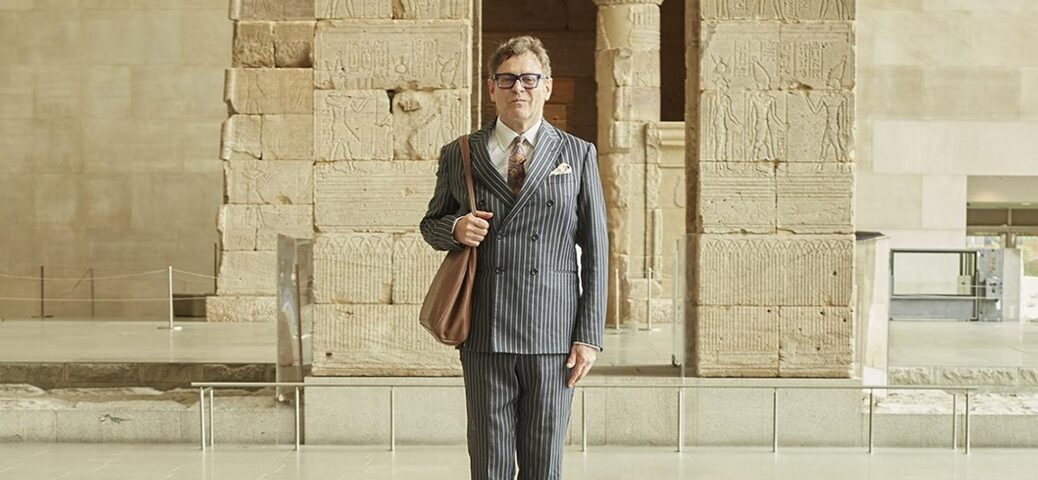
Featured image Photography by Arseny Jabieve.
Is Vilnius Lithuania The Next ‘Berlin Art Scene’?

The Lithuanian capital is quickly emerging as a vibrant cultural hub – mixing its Baroque architecture, Michelin-starred cuisine, and a fearless creative scene.

From Venice Biennale–level artists at ArtVilnius’25 to politically-charged performances at Sirenos Theatre Festival, and a massive city-wide celebration of Lithuania’s own artistic genius, M.K. Čiurlionis, Vilnius is redefining the autumn city break for culture seekers.

Vilnius: The New Berlin? Discover the Baltic Cultural Capital

This autumn, Vilnius transforms into a cultural hotspot, with the Baltics’ leading contemporary art fair, bold theatre, and world-class music inviting visitors to discover the city’s vibrant creative scene.

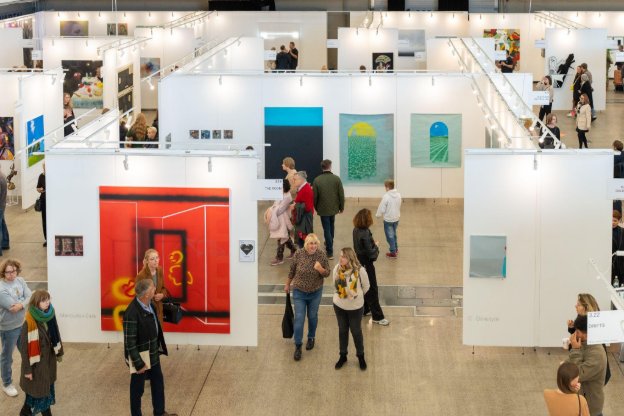
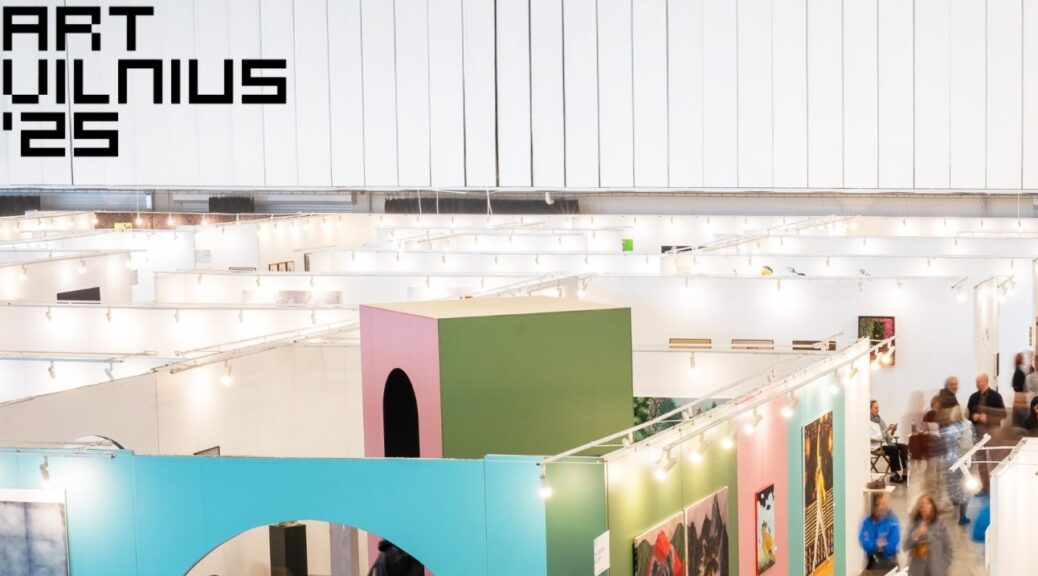
Art Fair ArtVilnius 2024. Photo by Andrej Vasilenko
Vilnius, Lithuania. Vilnius offers all the ingredients for a perfect autumn city break – cobblestone streets, Michelin-starred restaurants, and multiple art events happening this autumn. Intimate yet vibrant, the Lithuanian capital combines old-world elegance with a fresh creative energy that’s turning it into one of Europe’s most intriguing cultural destinations.

ArtVilnius’25 features Venice Biennale artists

Returning for its 16th edition, ArtVilnius’25 remains the largest contemporary art fair in the Baltics. From October 3 to 5, the Lithuanian Exhibition and Congress Centre Litexpo in Vilnius will host 80 galleries and institutions, presenting works by more than 320 artists from 16 countries.

Among the highlights is Tallinn–based Temnikova & Kasela Gallery, recipient of the prestigious FEAGA Award in 2016, which will showcase established Venice Biennale artists and Estonia’s forthcoming Biennale representative. Edith Karlson is one of Estonia’s most acclaimed contemporary voices and in her sculptural practice, animals and people are the main protagonists; Jaan Toomik, a senior figure in Baltic art, is presenting a few paintings never before exhibited, like Old Woman with a Wolf’s Scull, Calling the Fisherman, Self-portrait as a Bonfire with Sons.

“While new fairs have appeared in Latvia and Poland, ArtVilnius is still the only event of this size and quality. Our program goes far beyond gallery presentations. Visitors will discover the internationally curated Projects Zone, the annual “The Path” exhibition, and much more. The art on view will range from new talents fresh out of the academies to world-famous artists such as Marlene Dumas and Anselm Kiefer,” says Sonata Baliuckaitė Arlauskienė, Artistic Director of ArtVilnius.

Vilnius theatre festival turns the stage into a weapon

Until October 13, Vilnius hosts Sirenos, one of Northern Europe’s boldest international theatre festivals. Known for pushing creative and political boundaries, this year’s edition revolves around the theme “Theatre is a Weapon,” exploring how performance can confront modern-day realities. Headliners include Portuguese director Tiago Rodrigues with two acclaimed works: By Heart and Catarina and the Beauty of Killing Fascists. Also on the programme is the powerful film-performance hybrid Orlando, My Political Biography, which reimagines Virginia Woolf’s novel through the voices of 26 trans and non-binary performers.

Čiurlionis – the Baltic Da Vinci – celebrated with 150 events across Vilnius

This autumn, Vilnius celebrates the 150th anniversary of M.K. Čiurlionis, Lithuania’s most revered composer-painter, often called the Baltic Da Vinci for blending music and visual art into an entirely unique language. From October to December, the city will host nearly 150 events in his honour, including immersive exhibitions, orchestral tributes, and even virtual reality experiences that bring his dreamlike worlds to life. Program highlights include the premiere of the opera “Jūratė,” inspired by Baltic mythology, and the international concert “World Piano Stars Greeting Čiurlionis,” showcasing virtuoso performers interpreting his compositions.

European cinema spotlight

From 6 to 16 November, the Scanorama Film Festival brings over 100 thought-provoking European films to Vilnius, alongside talks with filmmakers and rising talent. It’s a key date for cinephiles seeking bold, artistic storytelling off the mainstream circuit.

Getting there

With direct, daily flights from Toronto and major European cities including Berlin, Frankfurt, London, Paris, and Warsaw, getting to the Lithuanian capital is quick and easy. The city’s well-connected airport is just 15 minutes from the Old Town, making it a seamless destination for a weekend getaway or a longer cultural escape.

Inuk Artist, Shuvinai Ashoona Wins Governor General’s Award in the Arts

Inuk artist becomes the second person from the West Baffin Cooperative to receive prestigious award.


Kinngait (Cape Dorset), Nunavut – Inuk artist Shuvinai Ashoona has been named a recipient of the Governor General’s Awards in the Arts for her dedication to the expression and practice of Inuit art and her contribution to Canada’s larger contemporary art community.

ᓱᕕᓇᐃ ᐊᓱᓇ
SHUVINAI ASHOONA


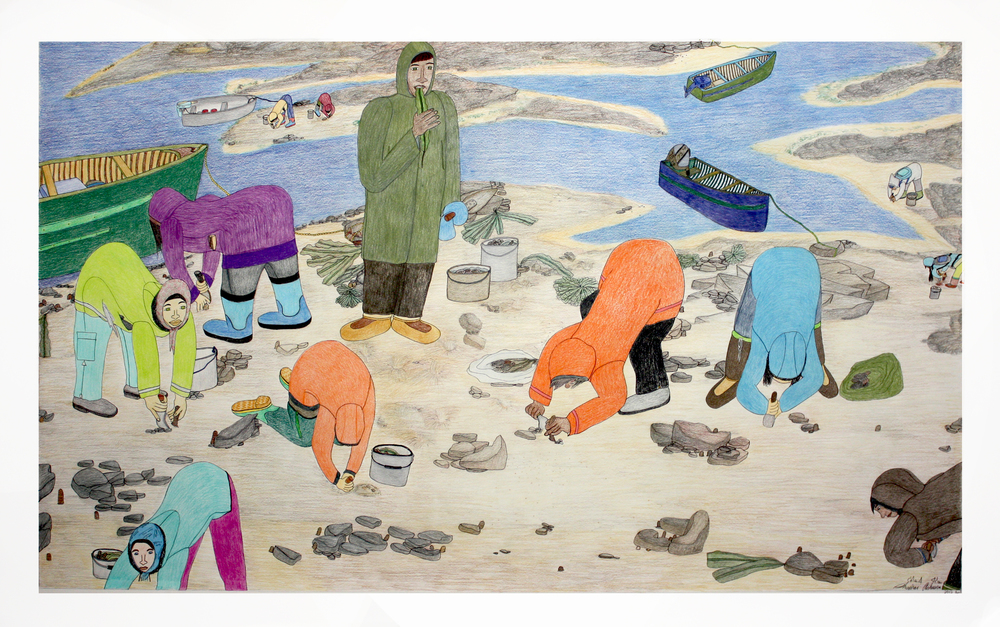
For more than two decades, Ashoona has been changing the face of Inuit art. Working from her home base in Kinngait, Nunavut, Ashoona’s ever-evolving drawing practice has resulted in a still growing body of work that stands as a unique contribution to the artistic expression of her time. Ashoona’s innovative drawings, many of which are ambitiously scaled, freely mix elements drawn from historic Inuit culture with contemporary references to more recent history and popular culture.

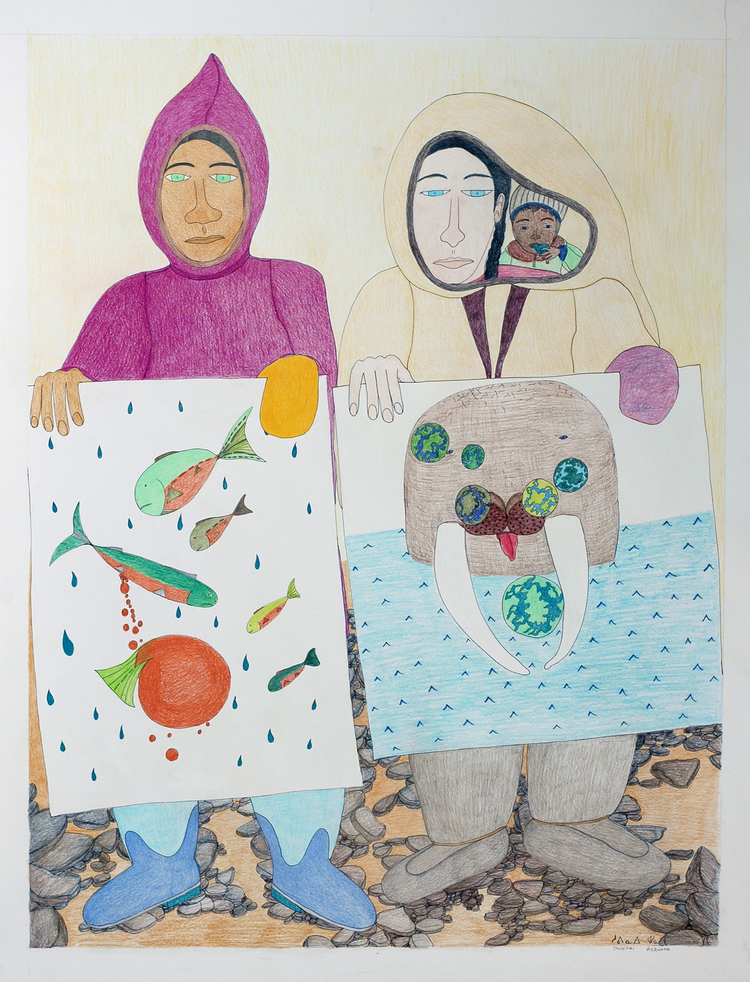
Untitled. 2010.

Her subjects include fantastical and otherworldly beings
as well as self-reflexive images that comment directly on the process and practice of representation. Never content to follow rules and expectations, Ashoona’s unconventional artistic vision has successfully challenged and revolutionized how the public perceives Inuit art and contemporary Indigenous art more generally, helping
to create a new space for expression and artistic freedom.

A longtime artist member of West Baffin Cooperative, Ashoona works frequently at the organization’s Kinngait Studios and has become a mentor to many next generation Inuit creators.
“I don’t even think about getting awards for making my art,” said Shuvinai Ashoona. ‘I’m just happy when people can see my drawings in galleries and museums and books. I think this award means that many, many people are getting to see my artworks.”


Throughout her career, Ashoona has maintained a busy practice supported by an expansive program of exhibitions.

Her work has been featured in several important exhibitions at the National Gallery of Canada, including Sakahàn: International Indigenous Art, that institution’s landmark 2013 showcase of contemporary Indigenous expression from around the world.
“Shuvinai Ashoona is one of Canada’s most influential visual artists and has fast become an internationally important creator,” said West Baffin Cooperative President Pauloosie Kowmageak. “Ashoona has achieved remarkable success and recognition for her art practice and for the community of Kinngait; I can’t imagine a more deserving recipient of this prestigious award.”

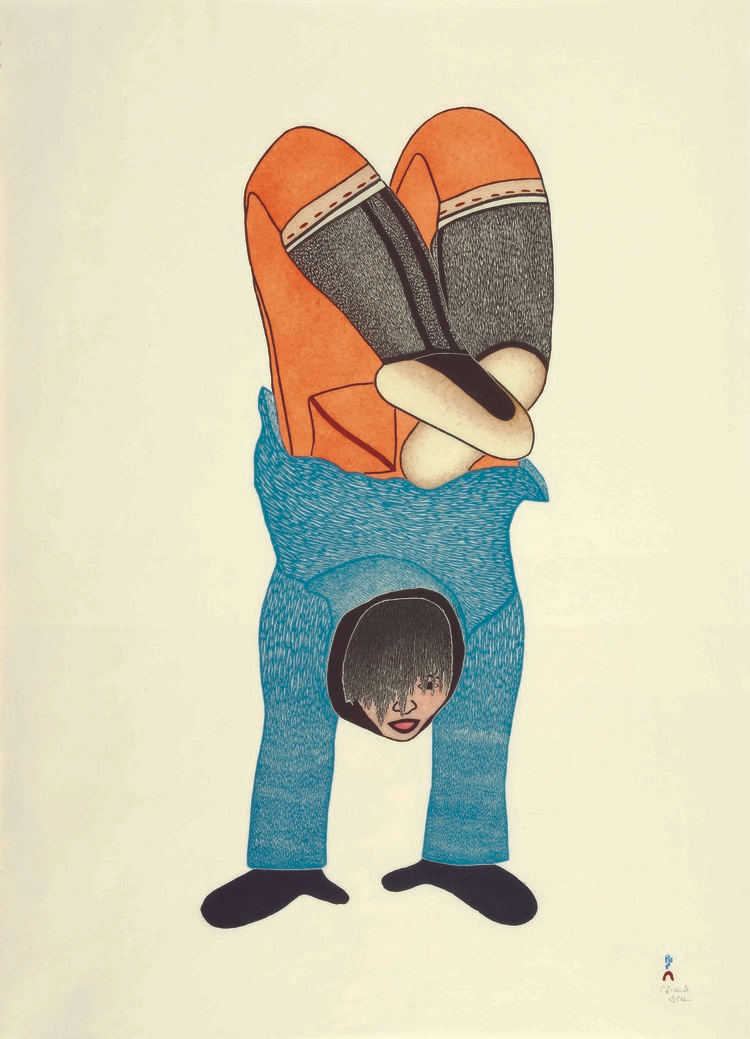
Handstand. 2010. Stonecut and stencil.


Ashoona has been active within the commercial gallery sphere as well. Her work has been featured in several solo and group commercial exhibitions, many of which have been presented by Vancouver’s Marion Scott Gallery, which nominated her for this award, and Toronto’s Feheley Fine Arts. Ashoona’s drawings have also been collected by many of Canada’s major art institutions, including the Art Gallery of Ontario, the National Gallery of Canada, the Winnipeg Art Gallery, Musée des beaux arts de Montréal and the Vancouver Art Gallery.

Ashoona has also collaborated with artists from beyond her Baffin Island community, including Shary Boyle (2015) and John Noesthedan (2008).

“Shuvinai Ashoona’s startling expression makes connections and bridges cultures,” said Robert Kardosh, third generation owner of Vancouver’s Marion Scott Gallery. “Her images tell us something important about ourselves and the world we all share. This award acknowledges and celebrates that deep resonance. It’s also a testament to her tenacious dedication to her vision and community.”


In 2022, she produced her first immersive installation, entitled Help Us. Commissioned by the Marion Scott Gallery, Ashoona’s floating constellation of drawn geometric forms was featured that same year at Art Toronto, where it earned critical and popular acclaim.


The last five years have been especially important ones for the artist, not just for her continuing creative growth but also in terms of her growing national and, increasingly, international profile. In 2019, The Power Plant Contemporary Art Gallery in Toronto presented Shuvinai Ashoona: Mapping Worlds, an exhibition that brought together a decade’s worth of Ashoona’s most ambitious works. Curated by Nancy Campbell, the high-profile exhibition toured to several venues across Canada, exposing the general public to Ashoona’s singular vision while confirming her status as one of Canada’s most exciting and talked about contemporary artists.

The exhibition’s catalogue is itself a monument to Ashoona’s practice and place in contemporary Canadian art. At the beginning of 2019, just as the Power Plant’s exhibition was being launched, it was announced that Ashoona had won the 2018 Gershon Iskowitz Prize at the AGO, making her the first Inuk in history to win this prestigious award. In 2021, as part of the terms of the prize, the artist’s work was profiled at the Art Gallery of Ontario in a major exhibition that was entitled Shuvinai Ashoona: Beyond the Visible, making her work even more visible to a wider audience.

Alongside these major breakthroughs within Canada’s borders has been a recent series of announcements, exhibitions and awards that reflect Ashoona’s steadily growing reputation abroad. In 2021, Ashoona’s work was featured in a solo exhibition at the Institute of Contemporary Art Miami, entitled Shuvinai Ashoona: Drawings. The exhibition in Miami wasn’t only Ashoona’s first show in a US museum, but it also marked the first time that a US contemporary art institution has presented a solo exhibition by a Canadian Inuk artist.

In 2022, Ashoona’s work was included in The Milk of Dreams, the 59th International Art Exhibition, also known as the Venice Biennale.

Ashoona’s inclusion in this major international showcase brought her distinctive expression to the attention of a global audience for the first time. The official jury’s decision to award Ashoona one of two special mentions brought even more attention to her installation, further attesting to her work’s unique power and appeal. Those same drawings are currently being featured at London’s The Perimeter, in a presentation entitled Shuvinai Ashoona: When I Draw, the artist’s second solo exhibition in the UK. For more biographical information about Shuvinai Ashoona click here. For the Silo, Paul Clarke.

Featured image: SHUVINAI+ASHOONA-2009 untitled graphite coloured pencil and pentel pen.