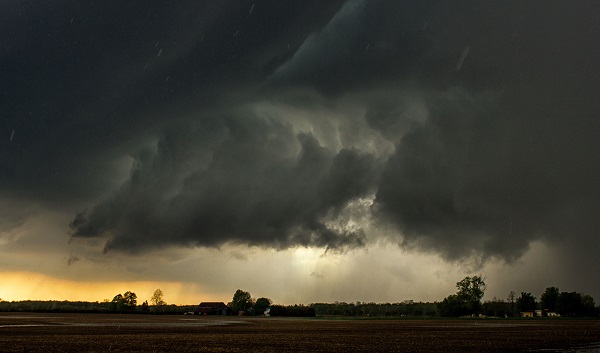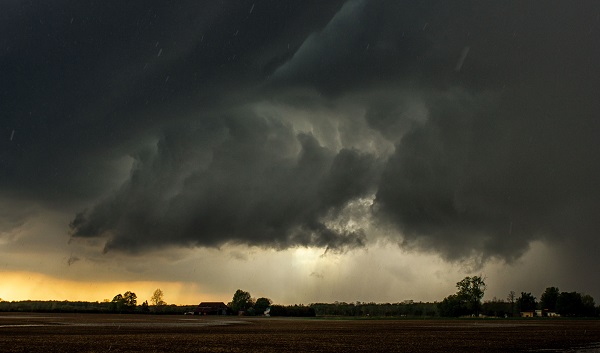
Tag Archives: extreme weather

Not Quite the USA, But Canada’s Fiscal Challenges Can’t Be Ignored

Without a change in course, slow growth and rising spending will leave Canadians with stagnant living standards while shifting more of today’s burden onto younger and future generations, according to a new C.D. Howe Institute Verbatim.

In “The Endgame: Time to Act on Canada’s Economic and Fiscal Challenges,” author Don Drummond warns that Canada’s weak productivity and income underperformance, overreliance on US markets, and overall domestic vulnerabilities are not being taken seriously enough. He recommends a comprehensive economic plan to re-establish fiscal stability and help create a stronger, more resilient and diverse economy.

“With weak productivity growth, an ageing population and lower immigration, Canada’s economy could grow by just 0.5 percent this year and next,” says Drummond, Fellow-in-Residence at the C.D. Howe Institute. “That means rising deficits and debt, leaving governments with less fiscal room to respond to future challenges and improve living standards.”

The report states that Canada should expect continued tensions with the United States, making it more important to address its longstanding economic and fiscal weaknesses. Canada ranked last in the G7 for growth in gross national income per person over the decade to 2023 and has experienced persistently weak productivity growth. Combined with reduced access to US markets, these challenges make it harder for Canadian firms to compete and scale internationally. Drummond finds that these pressures will be harder to address as Canada’s population ages and the economy struggles to adapt to the costs of climate change.

His recommendations include eliminating internal trade barriers and streamlining regulatory processes, while reshaping taxes and spending to reduce deficits and support growth. This could include shifting some of the tax burden from corporate and personal income toward consumption, lowering marginal tax rates, and reviewing government spending to ensure better value for money. He also calls for maintaining environmental objectives and allowing post-secondary institutions greater flexibility on tuition. As frictions with the US persist and Canada’s federal deficits climb, Drummond calls for governments to act quickly but also asks that Canadians recognize that meaningful improvements will take time.

“While many cite Canada’s lower net debt-to-GDP ratio than other G7 countries, being the least indebted country in a heavily indebted group is not a fiscal strategy. The endgame should be a stronger, more resilient, and diverse economy with stable finances,” concludes Drummond. “Now’s the time to act.”

Introduction

A year ago, I spoke to the incoming 2025/26 Master of Public Administration (MPA) class about the economic and fiscal challenges facing Canada and the need for bold action (Drummond 2025). Conditions have not improved. You may think the latest trade friction with the United States suggests they have worsened, but a deterioration in the relationship was highly predictable, and tensions should be expected to continue. While some positive action has been taken, Canada is still not taking the challenges seriously enough. The bold action called for can be postponed no longer.

The Economic and Fiscal Challenges

Over the decade to 2023, gross national income per person grew a meagre 0.5 percent annually in Canada, ranking last in the G7 and 32nd out of 35 Organisation for Economic Co-operation and Development (OECD) countries (Drummond, Laurin and Robson 2026). This weak income growth reflects longstanding productivity underperformance relative to both Canada’s own history and other countries.

Canadian economic outcomes fall well short of US standards, and gaps are widening. Some take comfort in the argument that higher US averages are heavily influenced by the disproportionate number of extremely wealthy Americans. Yet the shortfall in Canadian inflation-adjusted median employment income was already substantial at CA$6,126 in 2010 and widened to $8,663 by 2024. From 1999 to 2025, Canadian productivity increased 26.7 percent, while US productivity rose 67.9 percent (Munro, Fuss and Emes 2026).

A severe blow to Canada’s most important trading relationship piles on top of the productivity challenge. The two interact in pernicious ways. Weak productivity makes it difficult to trade with other nations. Losing relatively free access to the US market makes it difficult for Canadian firms to build the scale needed to improve productivity.

Population ageing and climate change make the productivity and trade challenges even more difficult to address. An ageing population reduces the workforce and draws resources into healthcare and pensions. Climate change is exacting billions of dollars a year through infrastructure repairs, health costs, and rising insurance premiums resulting from flooding, wildfires, and extreme weather. The Canadian Climate Institute estimates that climate change will reduce Canada’s long-term annual economic growth rate by almost half, compounding into losses of hundreds of billions of dollars or more by the end of the century (Drummond, Philips and Harland 2026).

Canada’s fiscal situation acts as a drag on growth and limits our ability to address these challenges. The federal government alone projects deficits exceeding $50 billion a year as far as the eye can see, a net debt-to-GDP ratio staying above 40 percent, and tax and spending parameters that dull incentives to grow. And such dire outcomes do not fully reflect the commitment to massively increase defence spending. At least Canada’s fiscal situation and prospects are not as dire as those of the United States and many other countries.

Re-establishing fiscal stability is especially important now to mitigate the contagion from rising global bond yields, driven in good part by growing public debt burdens and a surge in long-term financing needs for artificial intelligence (AI). Canadian bond yields are creeping up but remain about 1 percentage point below US rates. That borrowing advantage is not guaranteed.

Inaction on stabilizing public finances is often justified by the Canadian federal government’s lower debt burden compared to other major countries and our own history. But the Canadian debt advantage is much less pronounced when considering all levels of government and using gross debt – which removes the current surpluses from the Canada and Quebec Pension Plans, which are not available to fund public services other than pensions. The current federal net debt burden of just over 40 percent of GDP, with about 13 cents of every revenue dollar going to debt charges, compares favourably with the 66.6 percent net debt-to-GDP ratio of 1995/96, when debt charges absorbed 35.2 cents of every revenue dollar. But it makes no sense to risk following the path of more indebted countries, which face even higher bond yields, or to repeat the worst of our own fiscal history, when Canada struggled to find buyers for its debt.

The only good thing that came out of Canada’s dire fiscal situation in the mid-1990s was the acceptance of a crisis and the will to act boldly. Surely, we can have the foresight to act boldly now before again hitting a fiscal wall.

The Status Quo is Unpromising

Drummond and Mahboubi (2026) projected Canada’s future economic growth rate assuming productivity continues to grow at its meagre average rate since 2000. Applying this assumption to the demographics resulting from population ageing and the new, lower immigration targets, this “supply-side” perspective on growth yields just 0.5 percent real GDP growth this year and next, and an average of 1.4 percent from 2026 to 2060 if the downward trend in average hours worked is arrested, or 1.2 percent if it is not.

The federal deficit would rise from the $50-billion-plus annual range projected in the 2026 Spring Economic Update, and the debt burden would continue rising as a share of GDP.

The bottom line would be stagnant economic well-being for individuals and a massive transfer of burdens to younger and future generations.

The Challenges Are Not Being Taken Seriously Enough

Undoubtedly, part of the reason bolder action has not been forthcoming is that many economists, especially forecasters, have put a rather rosy spin on prospects. Typical forecast assumptions include no further increase in the average tariff rate on Canadian exports and diminishing trade uncertainty. In other words, they attach no credibility to the rhetoric of President Donald Trump or the many trade agreements the US has been signing around the world that feature significant base levels of tariffs, with higher rates and quotas on selected products. We continue to see such a spin, with many rushing to predict that the latest round of US tariffs against Canada will only reduce real GDP by 0.4 or 0.5 percent, while assuring us that at least we still have the Canada-United States-Mexico Agreement (CUSMA).

Such analyses of what is taking place at the margins miss the point that the fundamental premise of all free trade agreements struck with the United States over the past few decades – that companies, whether Canadian or foreign, can freely access the US market from a base in Canada – has been broken. It will take a long time, if ever, to restore confidence in that premise. We must ask: if companies were not investing much when they thought they had access to the US market, why would they when such access is threatened?

It is difficult to comprehend the steadfast assurance that average tariff rates will not rise or CUSMA protections will remain. The US has rejected automatic renewal of CUSMA, is breaking its commitments daily, and has made it clear that it expects to extract a fee from all those American firms that buy from outside the United States. The sort of fee it appears to have in mind, and has been extracting from other countries, can make it unprofitable for Canadian exporters and US importers to do business.

Output per hour worked – productivity – has averaged 0.8 percent growth since 2000 and only 0.5 percent over the past four years. Yet most forecasters assume much stronger rates going forward. The Bank of Canada, for example, assumes 1.4 percent average annual growth in productivity through 2028, a pace not seen in decades. It adds 0.2 percentage points per year for the growing application of AI and assumes employers will squeeze more output per worker from the dwindling labour force. These are unproven assumptions and still do not fully explain the optimism. Such forecasts feature much stronger growth than the “supply-side” projections of Drummond and Mahboubi (2026). The latter are not a forecast per se. Productivity could grow more strongly. Demand growth could outstrip supply. But outcomes could just as easily be even weaker. Given global uncertainty and trade tensions with the United States, it would be wise to take such downside risks more seriously.

The Bank of Canada should be given credit for at least thinking about the macroeconomic implications of AI applications. But much more work needs to be done on these issues. And in the meantime, some healthy scepticism about AI’s potential benefits for productivity is in order. First, there have been many technological breakthroughs during the period of Canada’s declining productivity growth. Second, work by the Future Skills Centre (2024) found that while firms applying AI have higher productivity than those that do not, AI itself did not raise productivity.

If the challenges were being taken seriously enough, the federal government would not have abandoned its promise from five years ago to establish an independent commission on productivity. It also would have followed through on its election promise to establish a group to examine corporate taxation. Clearly, the government understands the problems but has decided not to call upon expert advice or encourage national discussion at this time.

If the challenges were taken more seriously, we would not see federal and provincial politicians uniting in the quest for international free trade while maintaining internal trade barriers. The International Monetary Fund has said these barriers are equivalent to a 9 percent external tariff on all Canadian goods and services, and that removing them could raise real GDP by 7 percent in the long run (Diez and Yang 2026). Some barriers have been reduced since the IMF made these estimates, but they remain substantial.

If the challenges were taken seriously, we would see a concerted national – federal, provincial, territorial, and municipal – effort to streamline regulatory processes. Federal approval alone of projects can easily take more than five years. Add often separate and sequential approval processes at the provincial, territorial, municipal, and Indigenous levels, and the projects being bandied around amid renewed interest in infrastructure may not even start for a long time.

Canada’s potential advantage in critical minerals is being cited often of late. But development, if it proves to be economically beneficial, could take decades. The federal government is taking action, including setting up a Major Projects Office and enacting the Building Canada Act. It has been noted, however, that the underlying obstacles – “political decision-making over individual projects and open-ended criteria that require regulators to consider broad public policy objectives” remain largely unaffected (Vegh and Koplovich 2026).

If the challenges were taken seriously enough, we would have a comprehensive federal economic plan that realistically lays out the challenges, presents options for national consultation, and sets out a plan for bold action. Instead, we get speeches, webinars, and budget documents that cover the territory only partially and reach relatively few Canadians. The prime minister has said Canadians will be required to make sacrifices. But time after time, the government softens those sacrifices by borrowing more money: to increase the Old Age Security payments for those 75 and over, a cohort with one of the lowest poverty rates; to rename the GST low-income credit the Canada Groceries and Essentials Benefit (CGEB) and increase it; to offer more incentives to first-time home buyers and purchasers of new homes; to suspend the federal gasoline excise tax for six months – and then extend the suspension as gasoline prices failed to decline; and to put still more money into subsidies for childcare.

In all these cases, the federal government addresses affordability issues by borrowing more. That simply transfers the burden forward. Where there is a demand-supply balance, demand is stoked further with much less effort applied to supply enhancement. Affordability challenges would be better met by greater efforts to raise Canadian productivity and incomes. Some of the government’s actions, such as more infrastructure spending, will certainly help productivity, but a cohesive plan is not being applied across all spending.

If the challenges were taken seriously enough, we would not see the federal government take the more than $5 billion fiscal windfall from higher oil prices and spend every cent of it in the 2025 budget, mostly to bolster consumption. We would not have seen an 80 percent increase in government operating costs over 10 years, with a 90,000 expansion in the number of federal civil servants – a one-third increase – together with a doubling of contracting costs. Average compensation for full-time equivalent bureaucrats also reached $143,271 (Terrazzano 2026). That is far higher than what is made by the majority of Canadians funding such pay through their taxes. Despite this growth, services do not appear to have improved. The government has cited new programs such as pharmacare and the Canadian Dental Plan, but much of the administrative burden is carried by the provinces and the private sector. Efforts to cut federal spending have been half-hearted, often going little beyond incentivizing civil servants to leave. Even after these so-called cuts, the ratio of program spending to GDP, is projected to reach its highest level since 1994/95 by 2030, outside of the pandemic years.

What Would a Strategy Look Like?

The starting point for a more serious course of action would be to put a comprehensive economic plan to Canadians, realistically depicting the challenges and options for action. If Canadians understand the gravity of the situation, they will give political licence to act, as they did with the initial Free Trade Agreement and the assault on the deficit in 1995.

Governments and private sector agents would cut the wishful thinking from their projections and depict the probable problems under the status quo.

Governments at all levels and in all jurisdictions would unite to finally end internal trade barriers. They would work together to streamline regulatory processes without compromising environmental standards or Indigenous rights. And they would do it soon and quickly.

Governments would radically alter the fiscal landscape with lower deficits and debt burdens and taxation and spending parameters targeted at promoting growth. The focus would be on much lower spending. Restoring the ratio of program spending to GDP that prevailed from 2003/04 to 2019/20 would reduce spending by $66 billion by 2030 and, on its own, bring the budget back close to balance.

The federal government would proceed with the promised review of taxation. The recommendation would inevitably be to shift the composition of Canadian taxation away from the overuse of corporate and personal income taxes, which are the most damaging to economic growth, and toward consumption taxes. The government would cut corporate and personal income tax marginal rates (see Mintz, Laurin, and Dahir 2026). It would also end the steep marginal corporate income tax rate corporations face if they try to grow beyond the definition of a small business.

A federal government plan would feature a comprehensive review of spending with a value-for-money perspective. Programs that could not be reformed to deliver intended outcomes efficiently would be scrapped. The results of the review would be made public to Canadians. The resulting action would need to be sweeping, such as gradually raising the age of entitlement for Old Age Security (OAS) and lowering the income threshold at which OAS payments are clawed back. Programs like $10-a-day childcare would be reformed to recognize that a crisis of affordability has become a crisis of accessibility. Business subsidies should be cut back drastically, as many simply transfer income rather than address market failure. Only about 20 percent of subsidies boost real income (Lester 2026). Supply management in agriculture should be reformed, not to appease the United States, but to raise productivity and lower prices in Canada. Supply management need not be scrapped. The focus should be on greater flexibility in quotas and caps on subsidized prices.

A serious approach would also recommit to environmental objectives, including lower greenhouse gas emissions that contribute to climate change. It is not fashionable of late to speak of environmental objectives, as many countries emphasize economic growth. But the future of the planet and its people depends upon reducing emissions. And this need not come at the expense of economic growth. Putting more emphasis on clean growth would be a start. The focus lately seems to be all on the development of fossil fuels and getting them to markets. But the combined global market value of clean energy technologies has grown about 20 percent per year over the past decade. Ironically, two of the world’s largest emitters lead in several dimensions of clean growth. China tops the world in clean energy infrastructure, and the United States invested over US$278 billion in clean energy and transportation in 2025 alone. Canada does not have to match their scale to capture a portion of the prize; it just has to identify and focus on existing competitive advantages (Drummond, Philips and Harland 2026). We now have a National Electricity Strategy. But it does not have nearly the buzz of the attention being given to fossil fuel development.

Government plans would recognize that Canada’s post-secondary education system can be a bedrock for people’s prosperity and well-being gains. Ontario has finally lifted the freeze on tuition. But by 2025, the initial cut and subsequent freeze had brought real (after-inflation) tuition in Ontario 26.6 percent below the 2018 level. That loss in real value is locked in for the foreseeable future. The February 2026 Ontario announcement raises grants by about $1 billion per year, but by 2027/28, they will still be more than 10 percent below 2015/16 in real terms per eligible student (Drummond 2026).

Institutions should be allowed greater flexibility on tuition. The after-inflation value of Ontario and federal grants for research should be restored and be better aligned with the economic transformation the province and Canada must accomplish. Governments should provide incentives to commercialize university-based research. Universities should be allowed to enrol more foreign students with proper accountability and objectives in place. The recent increase in the income requirements for foreign students is a good first step to curtail abuse, which was never widespread in universities, and should be complemented by ending foreign students’ ability to work off campus.

The Endgame and How to Get There

Canada has allowed itself to become too dependent on the United States and has ignored our domestic vulnerabilities for far too long. We are now paying the price. But by addressing the challenges, we can get to an endgame of a new economic and fiscal model that has a stronger, more resilient, and diverse economy with stable finances. The goal should be nothing less than being better off than we have ever been.

What will it take to get to this endgame?

  • An honest recognition of the economic and fiscal challenges.
  • A comprehensive plan.
  • Transparency with Canadians about the problems and the plan, sparking national discussion, debate, and hopefully, consensus on action.
  • A willingness to act.
  • Speed in acting, but patience with the inevitable lags in realizing improvements.

Conclusion: Let’s Act Now

Actions such as those recommended above always meet resistance as too controversial to be supported by the Canadian public and, hence, politicians, or too difficult to pull off within our system of federalism. But that may only be true if Canadians are not fully apprised of the seriousness of Canada’s economic and fiscal challenges. With such unfiltered information and a plan to ensure Canada’s prosperity, Canadians would likely offer widespread support, as they have in response to previous national challenges.

We must get serious and act now.

Edited remarks delivered to the School of Policy Studies, Queen’s University, on September 4, 2026. By Don Drummond

The author extends gratitude to Alexandre Laurin and Daniel Schwanen for valuable comments and suggestions. The author retains responsibility for any errors and the views expressed.

Don Drummond is a Fellow-in-Residence at the C.D. Howe Institute and a Stauffer-Dunning Fellow, School of Policy Studies, at Queen’s University.

References

Diez, Federico J., and Yuanchen Yang. 2026. “Canada Can Grow Faster by Unlocking Its Own Market.” International Monetary Fund. January 27. https://www.imf.org/en/news/articles/2026/01/27/cf-canada-can-grow-faster-by-unlocking-its-own-market.

Drummond, Don. 2025. “Shaken by Tariffs, Still Weak from Within: Canada Needs a New Economic and Fiscal Model.” Verbatim. Toronto: C.D. Howe Institute. September 4. https://cdhowe.org/publication/shaken-by-tariffs-still-weak-from-within-canada-needs-a-new-economic-and-fiscal-model/.

_____________. 2026. “Ontario Stops Deepening its Universities’ Financial Pit.” Intelligence Memo. Toronto: C.D. Howe Institute. March 6. https://cdhowe.org/publication/ontario-stops-deepening-its-universities-financial-pit/.

Drummond, Don, Alexandre Laurin, and William B.P. Robson. 2026. 2026 Shadow Budget. Commentary. Toronto: C.D. Howe Institute. Forthcoming.

Drummond, Don, and Parisa Mahboubi. 2026. “Resetting Expectations: Canada’s Economy in a Lower-Immigration Era.” E-Brief 383. Toronto: C.D. Howe Institute. May. https://cdhowe.org/publication/resetting-expectations-canadas-economy-in-a-lower-immigration-era/.

Drummond, Don, Peter Philips, and Kate Harland. 2026. “Canada Doesn’t Need to Abandon Climate Efforts in the Name of Growth or Unity.” The Hill Times. September 7.

Future Skills Centre. 2024. Waiting for Takeoff: The Short-Term Impact of AI Adoption on Firm Productivity. December.

Mintz, Jack, Alexandre Laurin, and Nicholas Dahir. 2026. “Big Bang” Tax Reform: Unleashing Growth in the Canadian Economy. Commentary 707. Toronto: C.D. Howe Institute. https://cdhowe.org/publication/big-bang-tax-reform-unleashing-growth-in-the-canadian-economy/.

Munro, Grady, Jake Fuss, and Joel Emes. 2026. Squandering the Canadian Century Part 1: Comparing Economic Performance in Canada and the United States. Fraser Institute. September 1. https://www.fraserinstitute.org/studies/squandering-canadian-century-part-1-comparing-economic-performance-canada-and-united-states.

Terrazzano, Franco. 2026. “Cost of Federal Bureaucracy Up 80 Per Cent in 10 Years: PBO.” Canadian Taxpayers Federation. February 17.

Vegh, George, and Kate Koplovich. 2026. Clear the Way: Does the Building Canada Act Help Canada Build? Commentary 728. Toronto: C.D. Howe Institute. September. https://cdhowe.org/publication/clear-the-way-does-the-building-canada-act-help-canada-build/.

Pas tout à fait les États-Unis, mais les défis budgétaires du Canada ne peuvent être ignorés

16 septembre 2026 – Sans changement de cap, la faible croissance et l’augmentation des dépenses entraîneront une stagnation du niveau de vie des Canadiens, tout en transférant la majeure partie de la dette actuelle aux jeunes générations et aux générations futures, selon un nouveau Verbatim de l’Institut C.D. Howe.

Dans « The Endgame: Time to Act on Canada’s Economic and Fiscal Challenges », l’auteur Don Drummond avertit que la faible productivité du Canada, la contre-performance de ses revenus, sa dépendance excessive à l’égard des marchés américains et ses vulnérabilités intérieures ne sont pas suffisamment prises au sérieux. Il recommande un plan économique qui vise à rétablir la stabilité budgétaire et à créer une économie plus forte, plus résiliente et plus diversifiée.



Lire communiqué de presse complet »

Life for Relief & Development at 51st ICNA Convention: Leveraging the Conference to Improve Gaza Shelter Tents & Build New Partnerships

  • Connecting donors with the urgent humanitarian needs of displaced families living in tents across Gaza.

The city of Baltimore, Maryland, recently hosted the 51st annual convention of the Islamic Circle of North America (ICNA) in collaboration with the Muslim American Society (MAS), attracting nearly 25,000 attendees from around the world. This year’s convention expanded significantly, featuring a large exhibition hall that brought together hundreds of exhibitors, sponsors, community organizations, and charitable institutions.

Humanitarian and relief organizations, particularly those supporting displaced families living in Gaza’s tent camps, played a central role throughout the event. Beyond showcasing their projects, the convention serves as one of the largest annual platforms in North America for fundraising, partnership development, and direct engagement with Muslim communities.

A Platform Connecting Humanitarian Action with Community Engagement

Speaking about Life for Relief and Development’s participation in the convention, Vicki Roob, Director of International Programs, emphasized that the event is among the most significant annual Islamic gatherings in the United States and North America. It serves as a strategic platform that brings together humanitarian, charitable, and community-focused initiatives while providing valuable opportunities for direct engagement with diverse segments of American and Muslim communities.

Roob explained that the organization’s participation reflects its commitment to maintaining a strong presence at events that unite thousands of individuals passionate about humanitarian and charitable work. Each year, the convention attracts tens of thousands of attendees from across the United States and Canada, including community leaders, activists, volunteers, donors, charitable organizations, and humanitarian agencies. This environment offers a valuable opportunity to showcase Life’s mission, programs, and global humanitarian projects.

She added that visitors demonstrated significant interest in global humanitarian issues, particularly communities affected by conflict, disasters, and the ongoing displacement crisis in Gaza. This provided an important opportunity to highlight the growing needs of vulnerable populations and mobilize additional support for those most affected.

Life: A Trusted Bridge Between Donors and Those in Need

Omar Mamdouh, Director of Executive Projects, explained that the organization used the convention to spotlight a wide range of humanitarian programs and initiatives, including food security projects, assistance for vulnerable families, orphan sponsorship programs, and water, health, and education initiatives. Special attention was also given to Life’s emergency relief efforts in countries facing escalating humanitarian crises, particularly its support for displaced families living in Gaza’s tent camps and the delivery of humanitarian aid throughout the Gaza Strip.

Mamdouh noted that one of the convention’s most important benefits is the opportunity to connect directly with donors and demonstrate the impact of their contributions. The organization provided attendees with a comprehensive overview of living conditions inside Gaza’s displacement camps, including the severe shortages of essential supplies, the challenges faced by displaced children, the effects of extreme weather conditions, and the broader housing and shelter crisis affecting families throughout the region.

To help donors better understand these realities, Life displayed one of its newly developed shelter tents used in Gaza. Whereas previous tents measured 4 by 4 meters, the updated model measures 4 by 6 meters and includes a dedicated bathroom space to provide greater privacy, particularly for women. Visitors were also shown a model of daily life inside the tents, along with improvements and modifications made in response to feedback from displaced residents.

The exhibition further highlighted Life’s humanitarian projects around the world, its partnerships with universities to raise awareness about global humanitarian challenges, and samples of food assistance, including canned meat products distributed to beneficiaries.

Mamdouh emphasized that face-to-face engagement with donors provides an invaluable opportunity to share success stories and demonstrate tangible results made possible through their generosity, strengthening public confidence in sustainable and organized humanitarian work.

Engaging Youth and Channeling Their Efforts Toward Good

According to Khalil Meek, Director of Development, the convention also serves as an important platform for promoting a culture of giving and volunteerism. Life actively seeks to recruit new volunteers and involve them in its humanitarian mission while introducing young people and families to opportunities for community engagement and charitable service both within the United States and internationally.

He further noted that participation in the convention enables the organization to establish partnerships and collaborative relationships with other humanitarian and charitable organizations, facilitating the exchange of expertise and best practices that ultimately enhance the effectiveness and reach of humanitarian programs and joint initiatives.

Life’s Gaza Tents Featured in Al Jazeera Coverage

The organization’s activities during the convention received coverage from Al Jazeera, as Life’s exhibition booth attracted significant interest and engagement from participants. Many visitors took part in solidarity activities and wrote messages of support expressing compassion for communities affected by humanitarian crises.

Palestine maintained a strong presence throughout the convention. Participants were invited to write messages of solidarity on a tent that is scheduled to be sent to Gaza through Life for Relief and Development. This initiative builds upon the organization’s shelter support projects launched since the beginning of the war, including nine displacement camps established across northern, central, and southern Gaza.

These camps feature durable, standards-compliant tents that have provided shelter for approximately 46,000 displaced individuals. Designed for easy assembly and relocation to accommodate repeated displacement, the tents are also fire-resistant, helping protect civilian lives. Each tent is equipped with bedding and blankets, while every camp includes a medical clinic, sanitation facilities, solar energy systems, and insulation materials designed to protect residents from winter rains and extreme summer heat.

Life: Ranked Among the World’s Leading Humanitarian Organizations

Life for Relief and Development has been operating in more than 60 countries for over 33 years through a network of 16 international offices. The organization holds Special Consultative Status with the United Nations Economic and Social Council (ECOSOC).

According to Charity Navigator, Life ranks third globally among leading humanitarian organizations, fifth among organizations supporting displaced Palestinians, and fifth among organizations combating poverty worldwide. The organization also received a perfect 100% rating for 2026. In addition, it has been recognized by the United States Agency for International Development (USAID) and named by Impactful Ninja as one of the leading humanitarian organizations in the United States.

Life for Relief and Development was also awarded the Dubai Humanitarian Award for Best Partnership in recognition of its Gaza shelter camp initiative.

For the Silo, Tasneem Elridi.

For more information:
https://lifeusa.org/#social-media

Dangers Chasing Ontario’s Tornados and Waterspouts

Another winter has come and gone, although perhaps slower than a lot of us would like.  But happily, this means that the storm season is once again upon us in Ontario. As usual I will be back out on the roads looking for the best images of lightning and searching for Ontario’s tornadic super cells.

My name is Spencer Sills, and I am a storm chaser, some of you may remember a few years back reading about my storm chasing adventures here at The Silo  and about journeys on the road to capture Nature’s fury through lenses. Not much has changed since then, still on the hunt for the elusive supercell and what fury may come with it.

“I have seen many storms in my life. Most storms have caught me by surprise, so I had to learn very quickly to look further and understand that I am not capable of controlling the weather, to exercise the art of patience and to respect the fury of nature”

Years ago my overall goal to capture a tornado in Ontario was successful. On July 7th  of 2014 I teamed up with Scott Burlovich of Restless Skies photography and his chase partner Harry for the day and we set out to capture some pulse storms that were flaring up in the afternoon, most of these cells were just rain makers but on the way back to my home I had noticed a wall cloud that was lit up by the sun, we pulled off to the side of the road directly South of Norwich and briefly documented a EF0 tornado in a farmers field before it lifted causing no damage since it was in a dry field. This was my only tornado of the year, in a busy season. I did however get to document several gorgeous storm cells throughout the year, including several beautiful stacked shelf clouds and a great Wall cloud early in the season that brought golf ball sized hail to the area.

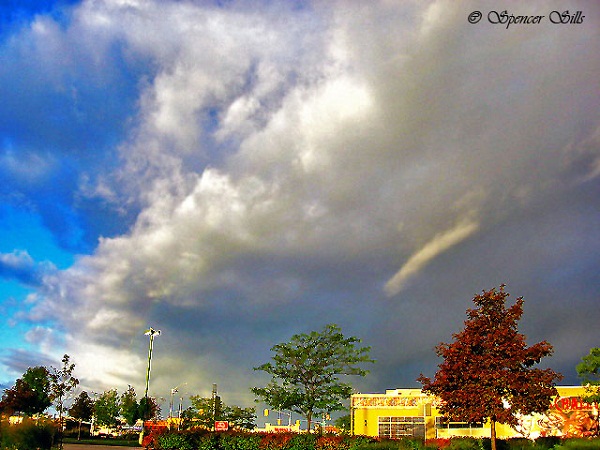
A Wall cloud in SW Ontario approaches my location as the RFD cuts around with hail starting to fall.

What now? Well I hope to achieve a few goals, one of which is to continue to capture tornados in this province, hopefully in an open field away from any properties. I also have set my sights on some goals with lightning and capturing it in a different perspective, I can’t go into much detail but it will be a stunning sight if I can achieve it. As far as how I believe the season will go, I do believe it will be a slow start, April and May will bring the return of storms, but I don’t expect anything too severe until June and July once the humidity and warmth really have a chance to build in. I do however once again stress to leave chasing to the pros, if you’re interested in storm spotting, please look into Canwarn, the more spotters in the province the quicker warnings can be issued thanks to verified ground reports.

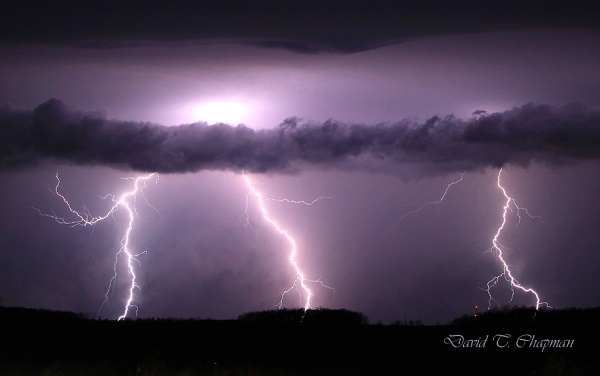
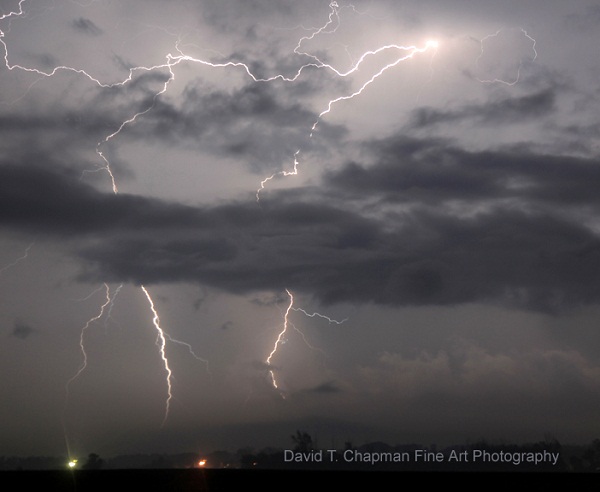
Lightning by Chapman

Part Two

I will be in close communication with good friends and fellow chasers, Spencer Sills and Scott Burlovich, as we tend to share a lot of information about the biggest potential storms before we go chasing. You’ll notice when you look through their photography collections that they are a couple of the best for chasing down the biggest storms in our province.

Chasing an actual storm

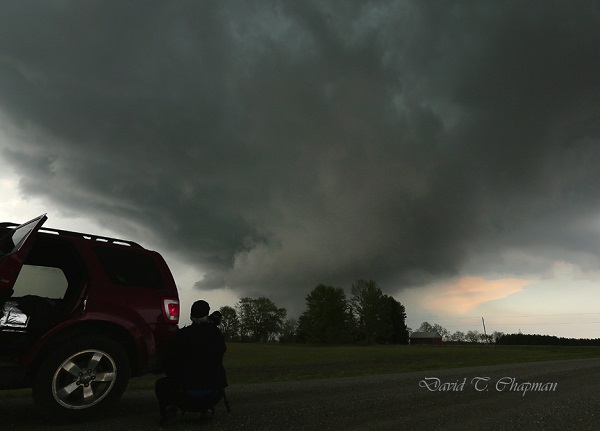
You might be curious on what we do when it comes to chasing the actual storm. Brian’s job is to be the driver. This is his first priority. Once we are parked and in a safe but photographic position for the storm, he is our main videographer. As for myself, I choose where I think the biggest storm will form from looking at weather models that meteorologists use as well as talking to fellow storm chasers in the area. I am also the main photographer. I do some video work and navigate us to the most photogenic side of the storm. This is usually right next to the most dangerous part of the storm but still in the safest position possible.

Rapidly Rotating wall-cloud photo being documented by Brian Chapman)

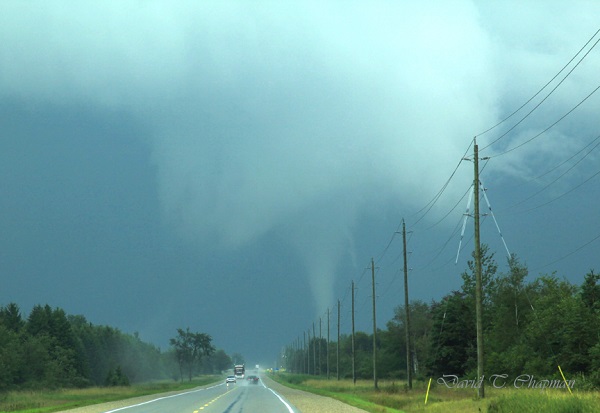
Over the years, our team has seen and recorded a number of funnel clouds, 2 confirmed tornadoes and 4 waterspouts. One of the tornadoes was near Arthur, Ontario and the landspout tornado was near Listowel, Ontario. The Arthur tornado was a really great one to document. It lasted for close to 15 minutes and we were able to see it from start to finish. The best part about it was the fact that  no one was injured and it caused very little damage. Those are the kinds of tornadoes we love to see because they allow you to enjoy the pure power and beauty that they possess but without injuries or major destruction.

Tornado by Chapman

A second storm tried to form!

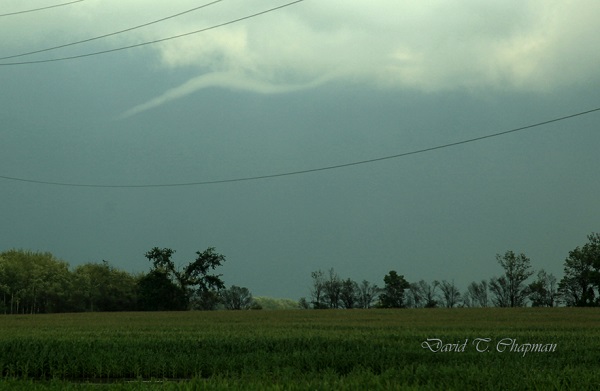
Another thing that was interesting with the tornado that hit near Arthur was the fact that it tried to form a second tornado at the same time the first one was on the ground. If that funnel had reached the ground, it would have been called a satellite tornado. They are typically smaller and weaker but not always. In Pilger, Nebraska in 2014, two EF-4’s were on the ground at the same time. Sadly they hit a town, killing 5 people and injuring 19. Those are the days I dread as a chaser and hope I never see first hand. As for the second funnel near Arthur, it didn’t quite have the energy to make it the rest of the way to the ground. This probably wasn’t such a bad thing with so many people focusing on the main, larger tornado just to its north.

A Funnel Cloud
A Funnel Cloud

Fortunately, a lot of Ontario’s tornadoes hit open areas that cause little to no damage.

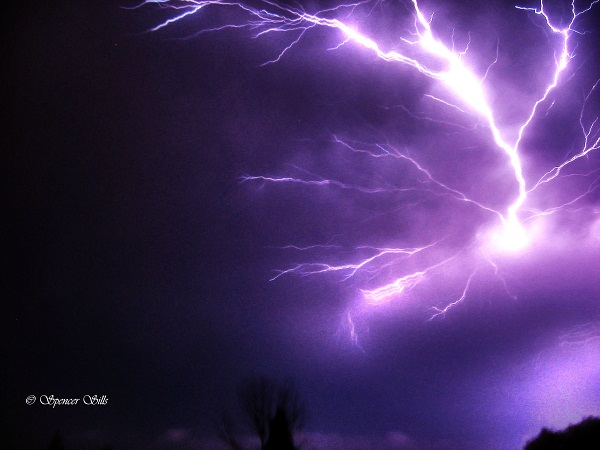
There have been some exceptions, as the tornadoes that hit both Durham, Ontario on August 20, 2009 and Goderich on August 21, 2011 showed, both killing one person in each of them. That is why many storm chasers as well as dedicated weather enthusiasts in our province have a direct line to Environment Canada that allows us to contact them when we see threatening weather approaching the area we are in. It can help Environment Canada confirm what they are seeing on radar so that they can issue the proper watches and warnings accordingly.  Lightning will also be a big focus for our team this year. We continue to work to get lightning photos as close as possible in order to capture the positive leaders that come up to meet the main negative current coming down from the cloud. The leaders can come from the ground, hydro poles, houses and even people.

Yes it is dangerous.

Although this may be risky and dangerous, we have worked out ways to minimize the risk to us. We stay in the car when lightning is close with the windows up. We also won’t park under a tree, not so much from the fear of a direct lightning strike but in case lightning hits and splits the tree causing it to fall on the vehicle. I remember seeing one like that when I was young and it has had an everlasting impression on me. One of the first big wind storms I chased along Lake Erie on November 1, 2013 knocked down a tree onto a woman‘s car and unfortunately she was in it and was killed. So debris is always a concern and something to be very aware of when it comes to storm chasing.


Ontario Storm Chasers Warn Public Through Photography

Photo shot in London, Ontario. Shot during a tornado warning for Middlesex county. photo: S. Sills

Did you know on average 12 tornadoes strike Ontario each year? That’s why David Chapman (@northof44pics) and I (@wxspencersills) commit our springs and summers to capturing severe thunderstorms on video and through photography.

My name is Spencer Sills and I am a chaser located in South Western Ontario. I have been chasing storms for about 20 years. I became obsessed with the weather and more specifically severe weather in 1996. On April 20, 1996 a tornado had hit Williamsford, Ontario. This was my first experience with a tornado and it has become a permanent fixture in my mind, partially due to the fact there was still snow on the ground the day it had hit.

Then in the summer of 2011, there were fourteen confirmed tornadoes including  the Goderich F3 tornado as well as three tornadoes during the August 24th severe weather outbreak during the late afternoon and evening. I was unable to be out during either of these days but what I was able to do was keep the public informed of the current severe weather as well as help give warning for the tornadoes.

Photo shot in South West London, Ontario. A waterspout advisory was in effect for Lake Huron and Erie, while on the way to Lake Huron I came across this Cold Core Funnel off of a early morning thunder shower. image: S. Sills

A Summer from years ago was…interesting.  I witnessed more than  my fair share of active weather. I encountered five funnel clouds, several gust fronts or more commonly known as squall lines here in Ontario, and hail from pea size to golf ball sized  in Seaforth. I’ve also encountered strong wind storms which included a storm in Birr, Ontario which uprooted several large trees.

My personal worst storm occurred on June 7, 2011 in Elora, Ontario. A large and intense cell came through late at night bringing with it 80-90 km/h winds, heavy downpours, frequent lightning and quarter-coin size hail. I was fortunate to not be injured during this storm because I was in a tent at the time and had no warning beforehand other than a loud lightning strike before it hit. There was a severe thunder storm warning with the cell but our campground chose not to relay that information to campers and I only found out about the warning once I put on my portable radio after the storm came.  That same storm went on to produce a tornado warning over Hamilton but did not spawn a tornado that night. It did however cause extensive wind damage in the city.

Cloud to Ground Lightning: photographed by D. Chapman

My chase partner is David Chapman.  David and I both grew up within minutes of each other but never met until recently due to the power of twitter.  From twitter I was able to glean that we both have similar interests and goals which will allow us to mesh well together. [ Check the hashtage #WX on twitter for tweets related to extreme weather CP ]

Hello Silo readers. My name is David T. Chapman and I am a professional photographer with a passion for storm photography. I developed an interest in weather when lightning hit my house in Guelph, Ontario, years ago. The thunder was terrifying and the rain was so heavy that even though I was only three years old at the time, I have clear, vivid memories of the storm. My interest in weather was rekindled in the late 1990’s when I spotted my first multi-vortex tornadoes with my dad and brother. Since then, I have followed the weather every day to determine the best time for photography in all kinds of conditions.

Waaaay back in 2011 , the Ontario storm season was an active one. It allowed me to get a personal record number of lightning photographs in one season with 105, not including sheet lightning shots. My first storm was in April, when a very weak storm pushed into the Niagara region. Something that you don’t see very often is a thunderstorm with snow on the ground, but that night I had both. But the storm chasing season  really didn’t start seriously until the end of May when an evening storm rolled through Southwestern Ontario right into my area. The squall line formed directly to our west and there was no way around it. We had to puncture the core of the storm to try to find a dry slot. We were hit hard with heavy rains, strong winds and continuous lightning.

Anvil Crawler: photographed  Southeast of Hamilton, Ontario image: D. Chapman

One of the hardest things to get is a lightning photograph when there is a downpour because it blurs the image. The first line of storms went through when we crossed an open field area and then we were hit by a strong second line of storms. Extremely strong straight lines came at us with winds easily in excess of 90 km/hr. We got into position, but unfortunately, with the rain still pounding our photography team, it made it impossible to get crisp, clear lightning shots. It wasn’t until after the storm had passed that the back end of it lit up and we were able to capture some very beautiful lightning.

The summer carried on with sporadic thunderstorm activity consisting of small thunderstorm cells with intense lightning and hail. Generally, with smaller storms, you only get 4 to 5 lightning shots. I’ve come back after chasing a storm perfectly with only 1 or 2 lightning shots to show for it. It wasn’t until the outbreak of thunderstorms that our team had a very successful night of shooting. On that night, Faith Beni and I ended up in St. Mary’s, Ontario. There were tornado watches all across Ontario, the most I had ever seen. The thunderstorm cell that we were interested in was towards Nairn, Ontario. We left the Niagara region at 5:30 p.m. and got to St. Mary’s around 7:45 p.m.

Without daylight left, the thoughts of getting a tornado quickly changed to an opportunity for lightning photographs instead. One of the most dangerous things to do is to chase a tornadic thunderstorm in the dark, which is why our team has a policy to not chase these types of storms at night. We tend to focus on weaker storm cells that don’t have the tornadic potential but still have lots of lightning. The night of the 24th, though, was different. It seemed that any storm cell had the potential to drop a tornado. We pulled back to St. Mary’s and then we started getting reports of rotation heading to St. Mary’s.

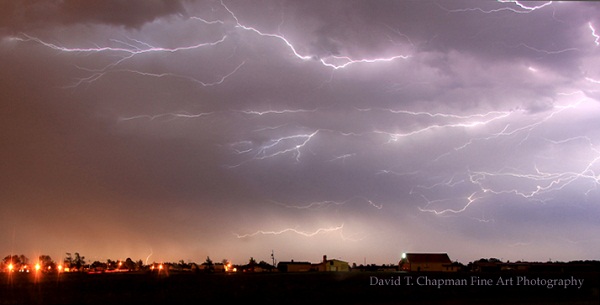
In just under 2 minutes, I saw 4 reports of rotation for St. Mary’s. We started to get pounded with large hail and the the hydro went out. We left St. Mary’s and pushed north towards what looked to be some late evening twilight. We got to the back of the storm and were able to photograph the lightning that was in it. We got some of the best anvil-crawlers that I have ever seen. Anvil-crawlers are a particular type of lightning that can either go for short distances or for distances over 100 km.

This year for the first time, Spencer Sills and I will be working together to get some very powerful images. Our biggest goal is to get a photograph of a tornado. Last year, I was close 3 times. The first was in Grimsby, where an EF0 hit and damaged a small gazebo. Eric Chapman and I were right on the storm but unfortunately we could not see the tornado because of heavy precipitation. The second was the Nairn tornado and the third was a rotating wall-cloud that I photographed towards Bryson, Quebec.

Spencer and I often hear about how tornadoes don’t happen here. We want to let the public know that they can and do occur here, in South Western Ontario so that watches and warnings should always be taken seriously. The Goderich tornado in 2011, in which one person died, is a grim reminder of just how intense tornadoes can be and that they do, in fact, affect Ontario residents.

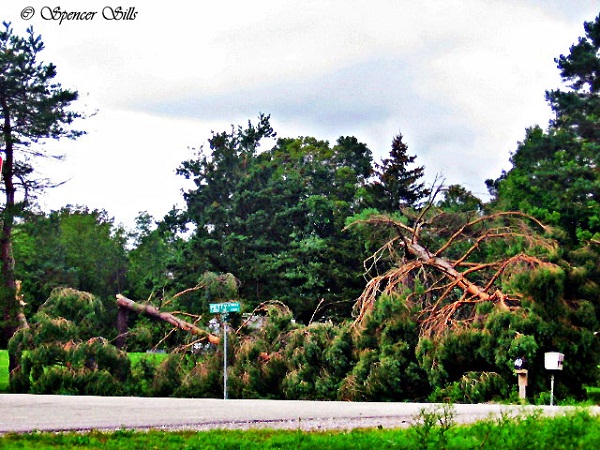
Photo shot in Nairn, Ontario. Tornado damage in Shady Pines Campground in Nairn. A tornado touched down the previous night and bent these pine trees in half, the tornado also caused extensive tree damage in the area as well as damaged a house and destroyed a metal silo. image: S. Sills

David and I both have experience in chasing storms, and take safety very seriously. We will be travelling with a First Aid kit just as well as weather alert radios and radar to help us along our way, we hope that we don’t ever need the kit but it’s always a great idea especially if others are in need of help, we could very well be the first people on the scene of a possible tragedy so we must be prepared. We will be posting pictures and videos throughout the season but do not recommend that anyone attempt to recreate either of them and place themselves in danger.

I will be working with David Chapman in hopes to help warn others as well as capture these storms through video and photography to share with others who may not get to experience them. We are ready to combine our passion for storms to get the best results possible and share those results with others.

Canada’s Changing Climate: What Key Cities Could Look Like With ‘Dune-Ification’

How Climate Change Could Transform Cities into a Dune-Like Landscape

Dune’s cinematic and literary success reflects our fascination with desert landscapes. But the vast deserts of Arrakis, the movie’s fictional planet, hold a deeper meaning. They serve as a cautionary tale for our own planet threatened by desertification.

A new study by our friends at Top10Casinos.ca reveals how Canadian and other global cities threatened by climate change would look in the Dune Universe as TikTok searches around Dune: Part Two and climate change spike 7,700% in just 30 days.

Dune: Part Two, is already reaching massive box office milestones surpassing $150 million usd/ $204 million cad, and TikTok searches for the ‘new dune movie’ have soared 4,606% in just 30 days. In the past month, searches around the movie’s desert-like filming locations have increased 141%, while queries related to ‘climate crisis 2024’ have spiked 3,100% in the social media platform.

Known for its amazing cinematography and striking desert visuals, Dune’s landscape is something that makes it instantly recognisable. But the movie’s vast deserts are more than just a stunning backdrop. They serve as a stark warning of a potential future for our own world impacted by climate change.

Do Canada’s iconic outdoor skating rinks face a frosty future? While bundling up for harsh winters is a national pastime, a worrying trend is emerging. Since 1950, winter temperatures have soared by over 3°C, outpacing global warming by a factor of three.

Toronto, Ontario

Toronto, once known for its predictable seasons, is grappling with the impacts of climate change. The city is experiencing a rise in average temperatures, leading to more frequent and intense heat waves that strain infrastructure and threaten public health. Winters are becoming shorter and less severe, with unpredictable precipitation patterns bringing both heavier downpours that overwhelm storm drains and periods of drought that stress green spaces and water resources.toronto desertified

Vancouver. British Columbia

Like many coastal, seaport cities, Vancouver is feeling the brunt of climate change. Rising temperatures are a key concern, with projections for hotter, drier summers and wetter winters. Sea levels are also on the rise, threatening coastal areas with flooding. The City of Vancouver itself is planning for up to a 1.4 meter rise by 2100, which would inundate parts of the city during major storms.vancouver desertified

Montreal, Quebec

Montreal’s climate is expected to experience significant changes due to climate change. Average temperatures are projected to rise by 1.5-2.3°C by mid-century, leading to more frequent and intense heat waves. This can strain infrastructure, harm public health, and disrupt outdoor activities. The city is also likely to see increased precipitation extremes, with heavier rainfall events and the potential for more flooding.montreal desertifiedmontreal desertified

Niagara Falls, Ontario

Studies suggest Lakes Erie and Ontario, feeding the Niagara River, could see water levels drop a meter by 2050 due to increased evaporation and less snowfall. This decline could impact the Falls’ power and beauty. Additionally, more extreme weather events like flooding could damage surrounding areas. While milder winters might extend tourism, climate change poses significant ecological and aesthetic challenges.niagara desertified

Methodology

Top 10 Casinos Logo

UN Specialized Fund & Program Combats Hunger In World’s Fragile Contexts

Storybook       JOINT PRESS RELEASE IFAD and WFP work together to combat hunger in fragile contexts 
Rome, Italy, March 2024. The UN’s International Fund for Agricultural Development (IFAD) and the World Food Programme (WFP) have today launched an action plan to work together in fragile contexts — countries simultaneously affected by economic shocks, and extreme weather, in combination with little or no institutional and government capacity to help people cope.

The UN agencies seek to leverage the strengths and expertise of each organization to enhance resilience in fragile environments and improve food security for those who need it most.

Fragility is a significant barrier to eradicating hunger and poverty. Moreover, frequent and severe extreme weather events are compounding these often-protracted crises worldwide. “We have decades of experience working in fragile contexts, because that is where so many of the rural poor live. But today, the rural environment is changing. It is becoming less predictable. Rapid changes in climate and demographics are making it harder than ever for rural populations to thrive on the land,” said Alvaro Lario, President of IFAD. “This new Action Plan is very exciting because together, we can be more than the sum of our parts,” added Lario.PR-20-2024©IFAD/Daniele Bianchi
Fragile situations are on the rise and could impact as much as 60 percent of the world’s extreme poor by 2030. Nearly 1 billion people are currently living in such contexts worldwide, according to the International Monetary Fund estimates. 
“WFP and IFAD teams work in many of the most fragile and challenging regions of the world, where millions of families who live on the frontlines of conflict, climate change and economic turmoil face a daily battle against hunger,” said WFP Executive Director Cindy McCain. “But it doesn’t have to be this way. Combining our expertise, resources and extensive global network, WFP and IFAD will step up our collaboration in key areas, such as food systems and climate resilience, to support sustainable development, peace and progress in the most vulnerable communities.”

IFAD and WFP will carry out joint assessments on fragility, integrate smallholder farmers into food assistance programmes, invest in rural communities’ climate resilience, and share logistical capacity, data, analysis and expertise, as well as provide technical and operational support.
For instance, IFAD’s investments in sustainable agricultural practices, such as the use of climate-resilient crops and climate insurance, will be combined with WFP’s climate-resilient local infrastructure and services.

Ethiopia, Haiti, Mozambique, Pakistan, South Sudan, Sudan, Yemen and Zambia are the initial countries for collaboration to address fragility and food insecurity in addition to geographic areas across the Sahel and Pacific islands. The action plan aims at maximizing impact, being responsive to dynamic challenges, and focuses on tackling some of the main drivers of fragility. The partnership also builds upon the broader collaboration of the three Rome-based UN food and agriculture agencies, including the Food and Agriculture Organization of the United Nations (FAO), which was reinforced with a new five-year partnership agreement signed last August during a joint visit to South Sudan.

Being able to work in fragile contexts is a priority for IFAD’s next three-year cycle (2025-2027), as the UN Fund plans to reach 100 million rural people. FAO, IFAD and WFP cover a spectrum of work that spans from humanitarian responses to emergencies and shocks, to resilience and development activities, aligning with the 2030 Agenda.

The Rome-based agencies are working together on agri-food systems transformation, nutrition, gender equality and women’s empowerment, resilience-building, youth, and climate change to achieving maximized impact and delivering tangible value added to countries and populations.
The United Nations World Food Programme is the world’s largest humanitarian organization saving lives in emergencies and using food assistance to build a pathway to peace, stability and prosperity for people recovering from conflict, disasters and the impact of climate change. Follow us on X, formerly Twitter, via @wfp_media

For the Silo, Julie Marshall.

AI Predicts Canada Tourist Spots After 100 Years Climate Change

Whilst climate change is at the forefront of most countries’ consciences, the issue is highly pressing here in Canada where we  experience climate change at twice the world’s average due to our northerly location. Do you believe in the stated extreme effects of climate change or do you believe in a milder alternative? We would love to hear your thoughts in the comment section at the bottom of this article.

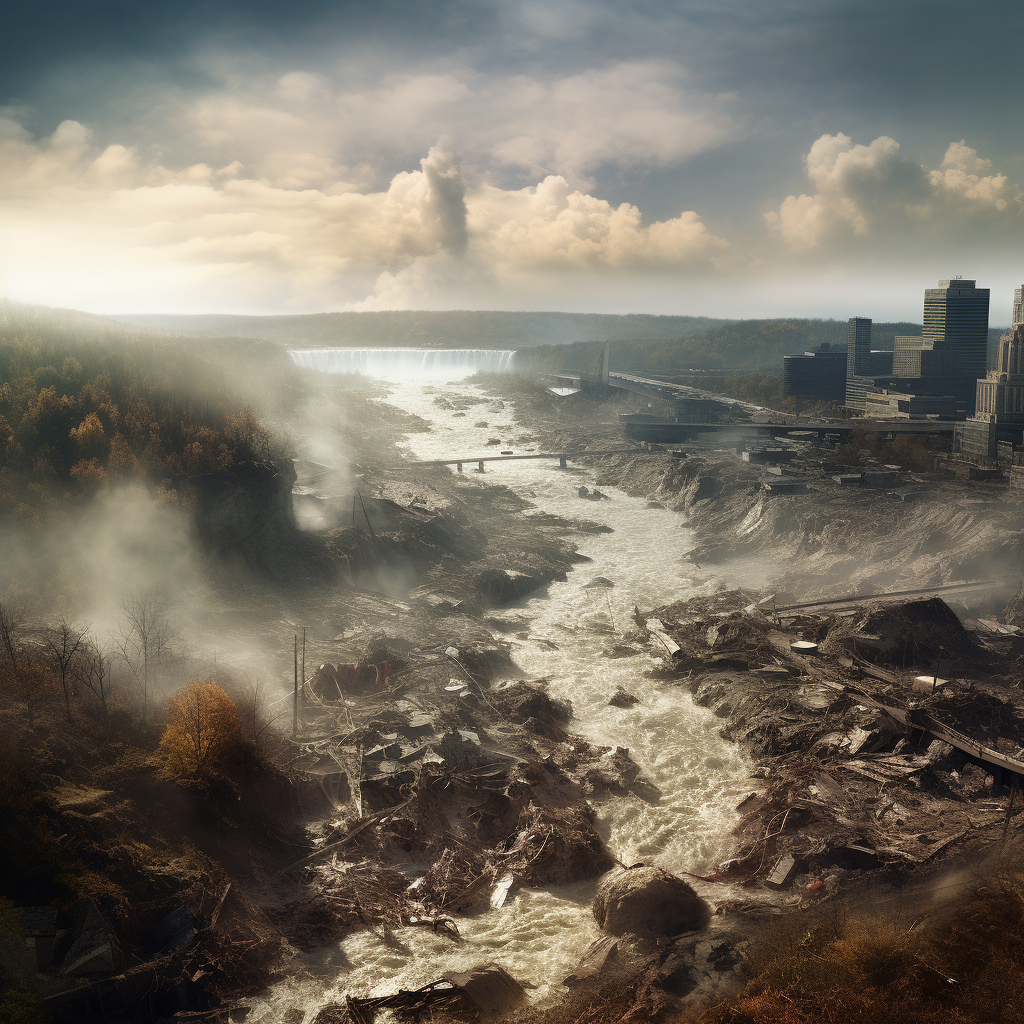
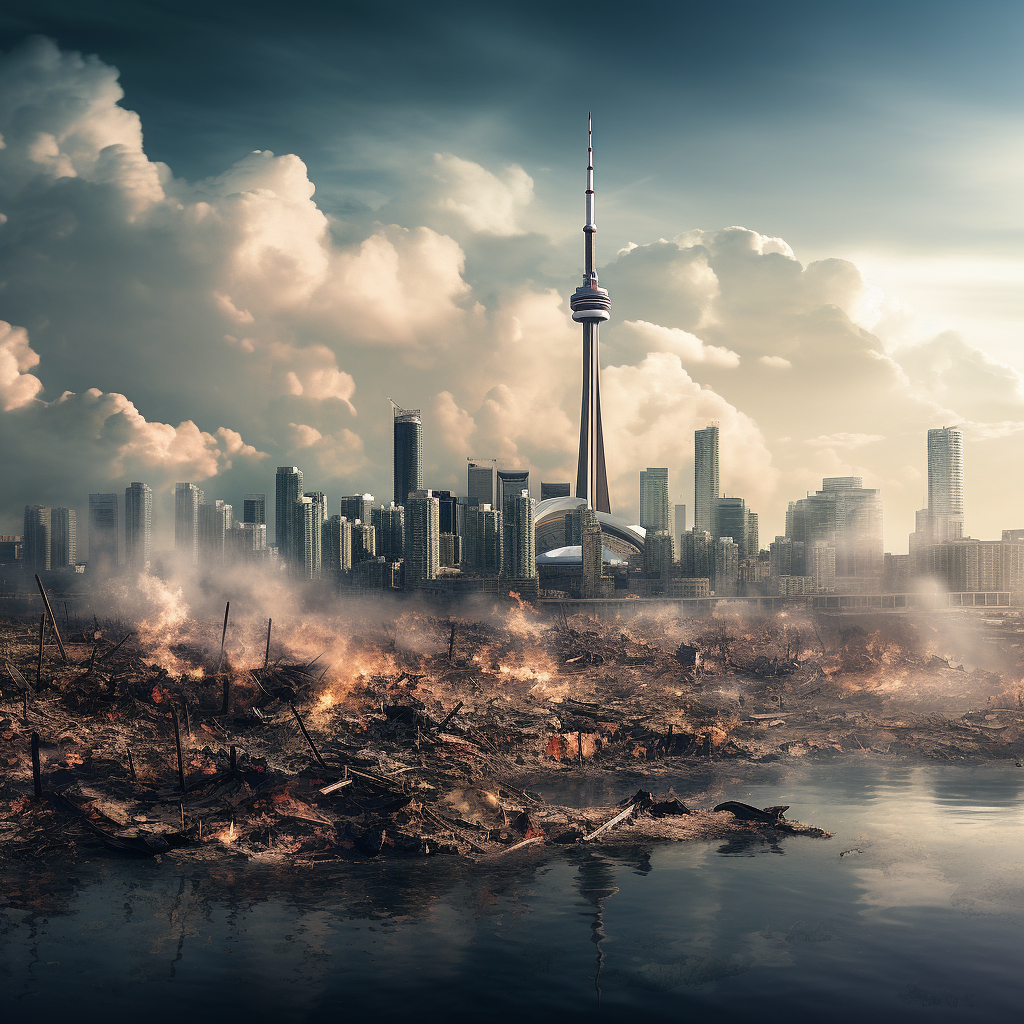
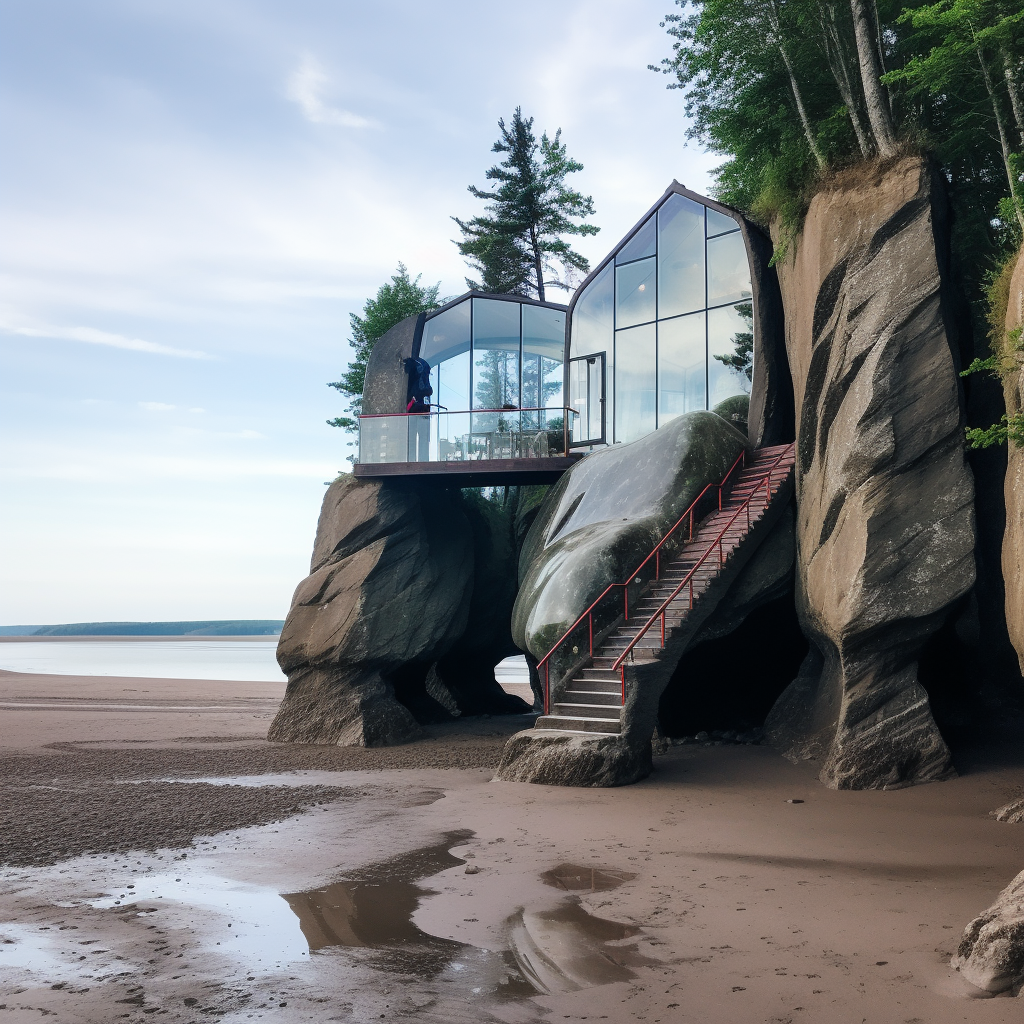
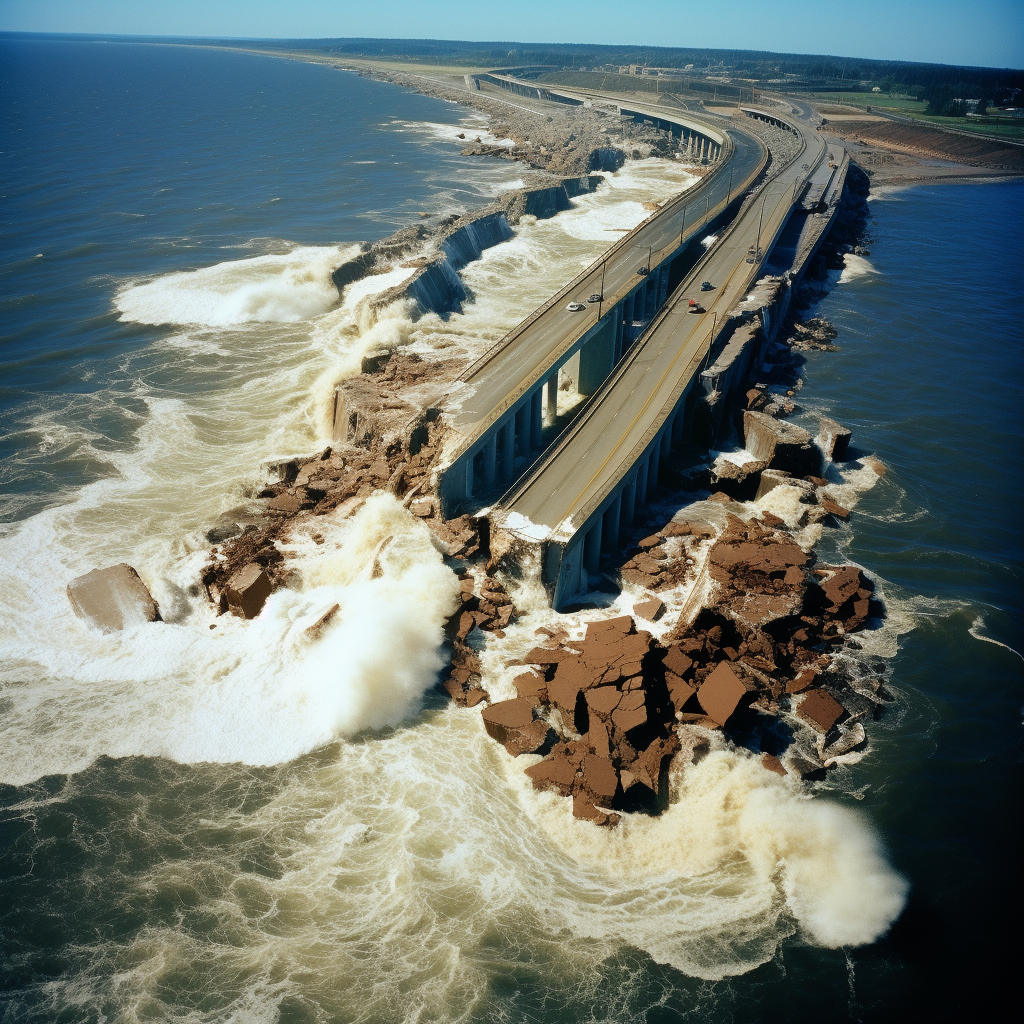
With this in mind, our friends at BonusFinder Canada utilized technology to predict exactly what Canada’s most popular tourist spots could look like in 100 years time if we do not intervene and try to combat climate change. To do so, they asked OpenAI to write predictions for five top tourist hotspots (Niagara Falls, CN Tower, Notre-Dame Basilica, Hopewell Rocks, Confederation Bridge) based on factors such as global warming, overpopulation and extreme weather, and used these descriptions to generate AI images.

Niagara Falls – no intervention  

 Niagara Falls – positive intervention

Key changes without intervention:

●      Significant reduction in water flow, affecting local ecosystems and the availability of freshwater resources.

●      The falls are no longer safe to get close to due to erosion.

●      The once lush surroundings have been replaced by concrete and pollution due to overpopulation.

CN Tower – no intervention    

CN Tower – positive intervention

Key changes without intervention:

●      Toronto is now largely inhospitable due to global warming and extreme weather events.

●      Fires are not uncommon due to global warming and an abundance of refuse.

●      Toronto faces major impacts of climate change, including higher temperatures, reduced air quality, and persistent heatwaves.

Notre-Dame Basilica – no intervention 

Notre-Dame Basilica – positive intervention

Key changes without intervention:

●      Extreme weather events, including severe heatwaves, have damaged the Basilica’s exterior and interior.

●      The area surrounding the Basilica is overpopulated and increasingly inhospitable.

●      The basilica remains heavily reliant on non-renewable energy sources, worsening the effects on the environment.

Hopewell Rocks – no intervention 

Hopewell Rocks – positive intervention

Key changes without intervention:

●      The main structure of the rocks has collapsed.

●      The surrounding area is heavily urbanized and polluted.

●      The beach is now dangerous, marshy and overgrown, but still attracts many tourists when the bay is uncovered, bringing further pollution and structural damage with each passing year.

Confederation Bridge – no intervention

Confederation Bridge – positive intervention

Key changes without intervention:

●      Confederation Bridge has collapsed in areas, rendering the huge structure unusable.

●      The water around the bridge is now full of concrete, industrial waste, pollution and urban runoff.

●      Small portions of the bridge still stand in the water, serving as a reminder of our failure to act and combat urbanization and overpopulation.

For the Silo, Clara Tan.

Disinformation Tops Global Risks 2024 

  • Misinformation and disinformation are biggest short-term risks, while extreme weather and critical change to Earth systems are greatest long-term concern, according to Global Risks Report 2024.
  • Two-thirds of global experts anticipate a multipolar or fragmented order to take shape over the next decade.
  • Report warns that cooperation on urgent global issues could be in short supply, requiring new approaches and solutions.
  • Read the Global Risks Report 2024 here, discover the Global Risks Initiative, watch the press conference here, and join the conversation using #risks24.

Geneva, Switzerland, January 2024 – Drawing on nearly two decades of original risks perception data, the World Economic Forum’s Global Risks Report 2024 warns of a global risks landscape in which progress in human development is being chipped away slowly, leaving states and individuals vulnerable to new and resurgent risks. Against a backdrop of systemic shifts in global power dynamics, climate, technology and demographics, global risks are stretching the world’s adaptative capacity to its limit.

These are the findings of the Global Risks Report 2024, released today, which argues that cooperation on urgent global issues could be in increasingly short supply, requiring new approaches to addressing risks. Two-thirds of global experts anticipate a multipolar or fragmented order to take shape over the next decade, in which middle and great powers contest and set – but also enforce – new rules and norms.

The report, produced in partnership with Zurich Insurance Group and Marsh McLennan, draws on the views of over 1,400 global risks experts, policy-makers and industry leaders surveyed in September 2023. Results highlight a predominantly negative outlook for the world in the short term that is expected to worsen over the long term. While 30% of global experts expect an elevated chance of global catastrophes in the next two years, nearly two thirds expect this in the next 10 years.

“An unstable global order characterized by polarizing narratives and insecurity, the worsening impacts of extreme weather and economic uncertainty are causing accelerating risks – including misinformation and disinformation – to propagate,” said Saadia Zahidi, Managing Director, World Economic Forum. “World leaders must come together to address short-term crises as well as lay the groundwork for a more resilient, sustainable, inclusive future.” 

Rise of disinformation and conflict

Concerns over a persistent cost-of-living crisis and the intertwined risks of AI-driven misinformation and disinformation, and societal polarization dominated the risks outlook for 2024. The nexus between falsified information and societal unrest will take centre stage amid elections in several major economies that are set to take place in the next two years. Interstate armed conflict is a top five concern over the next two years. With several live conflicts under way, underlying geopolitical tensions and corroding societal resilience risk are creating conflict contagion.

Economic uncertainty and development in decline
The coming years will be marked by persistent economic uncertainty and growing economic and technological divides. Lack of economic opportunity is ranked sixth in the next two years. Over the longer term, barriers to economic mobility could build, locking out large segments of the population from economic opportunities. Conflict-prone or climate-vulnerable countries may increasingly be isolated from investment, technologies and related job creation. In the absence of pathways to safe and secure livelihoods, individuals may be more prone to crime, militarization or radicalization.

Planet in peril


Environmental risks continue to dominate the risks landscape over all timeframes. Two-thirds of global experts are worried about extreme weather events in 2024. Extreme weather, critical change to Earth systems, biodiversity loss and ecosystem collapse, natural resource shortages and pollution represent five of the top 10 most severe risks perceived to be faced over the next decade. However, expert respondents disagreed on the urgency of risks posed – private sector respondents believe that most environmental risks will materialize over a longer timeframe than civil society or government, pointing to the growing risk of getting past a point of no return.

Responding to risks


The report calls on leaders to rethink action to address global risks. The report recommends focusing global cooperation on rapidly building guardrails for the most disruptive emerging risks, such as agreements addressing the integration of AI in conflict decision-making. However, the report also explores other types of action that need not be exclusively dependent on cross-border cooperation, such as shoring up individual and state resilience through digital literacy campaigns on misinformation and disinformation, or fostering greater research and development on climate modelling and technologies with the potential to speed up the energy transition, with both public and private sectors playing a role.

Carolina Klint, Chief Commercial Officer, Europe, Marsh McLennan, said: “Artificial intelligence breakthroughs will radically disrupt the risk outlook for organizations with many struggling to react to threats arising from misinformation, disintermediation and strategic miscalculation. At the same time, companies are having to negotiate supply chains made more complex by geopolitics and climate change and cyber threats from a growing number of malicious actors. It will take a relentless focus to build resilience at organizational, country and international levels – and greater cooperation between the public and private sectors – to navigate this rapidly evolving risk landscape.”

John Scott, Head of Sustainability Risk, Zurich Insurance Group, said: “The world is undergoing significant structural transformations with AI, climate change, geopolitical shifts and demographic transitions. Ninety-one per cent of risk experts surveyed express pessimism over the 10-year horizon. Known risks are intensifying and new risks are emerging – but they also provide opportunities. Collective and coordinated cross-border actions play their part, but localized strategies are critical for reducing the impact of global risks. The individual actions of citizens, countries and companies can move the needle on global risk reduction, contributing to a brighter, safer world.”

About the Global Risks Initiative


The Global Risks Report is a key pillar of the Forum’s Global Risks Initiative, which works to raise awareness and build consensus on the risks the world faces, to enable learning on risk preparedness and resilience. The Global Risks Consortium, a group of business, government and academic leaders, plays a critical role in translating risk foresight into ideas for proactive action and supporting leaders with the knowledge and tools to navigate emerging crises and shape a more stable, resilient world.

Winds Of Change Bring New Environmental Reality

The Ontario government is taking action to address issues of climate change.  Once in office, we have been acting as quickly as possible to fulfill our commitment to Ontario families and businesses.  For example, we revoked the cap-and-trade carbon tax and ended emissions trading and allowances. In addition, we have now released our Made-in-Ontario Environment Plan that takes concrete steps to protect our air, water, and land and fight climate change.

Climate change is here.  It is a reality and our environmental legacy will be predicated on our capacity to adapt, and to stop the worst consequences from materializing.

Fortunately, another reality is the fact the Ontario government is committed to protecting the environment using a sensible and balanced approach that creates jobs, respects taxpayers and grows the economy. But it is important to discuss what we’re fighting…the actual impact climate change can have on all of us.

Our government understands that climate change is a reality. It is a serious, worldwide problem.

More frequently, we hear media reports of severe weather that results in flooded basements, structural damages, and costly cleanups—sometimes in our own backyard. And the insured losses we’ve incurred in Ontario during 2018 give an unnerving snapshot of the consequences.

Earlier this year, a storm caused more than $46 million of insured damage in Brantford, Cambridge, London and the GTA. A spring storm in southern Ontario resulted in almost $80 million in costs. Soon after, winds and rains hit Hamilton and the GTA and caused over $500 million in damage. Last summer, a rainstorm in Toronto caused $80 million in damage. Further, we can’t forget the destruction left in the path of the Ottawa tornadoes this September.

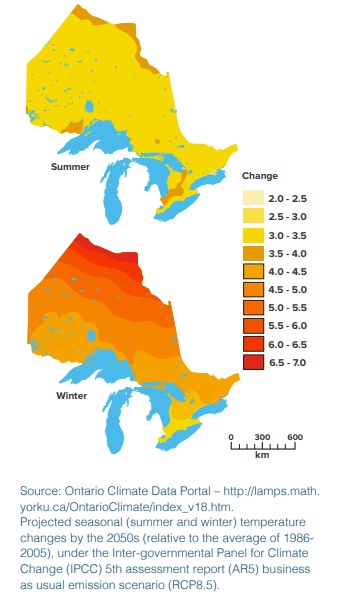
The people across Haldimand-Norfolk are close to the land and are among the first to notice changes in the weather and the attendant damage and costs extreme weather can inflict on crops and buildings.  Farmers and those that work outdoors have long been aware of fluctuating temperatures and are taking note when scientists predict that the average annual temperature in Ontario could be increasing significantly.

Prediction Ontario Rising TemperaturesMilder winters and hotter summers create a paradise for insect and plant diseases. Are you getting more tick and mosquito bites? Lyme disease and West Nile virus, and other mosquito and tick-borne diseases, have been moving northward as our part of the world warms.  And with increasing temperatures and phosphorus loads, many have taken notice of Lake Erie’s more frequent algal blooms and accelerated aquatic plant growth.
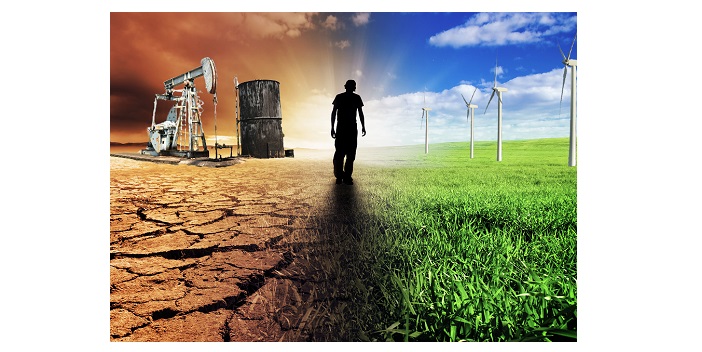
These aren’t news items from a far-off land.  These events effect our health, increase food costs, hurt our communities, and can mean large repair bills and higher insurance premiums.

In a subsequent column, I’ll discuss our Made-in-Ontario Environment Plan and how it’s constructed to meet the needs of Ontarians by protecting and conserving our air, land and water; fighting litter and waste; building resilience to the impacts of climate change—particularly extreme weather—and illustrating ways for all of us to do our part to decelerate climate change by reducing greenhouse gas emissions.

As one with a background in agriculture and the outdoors, I’m excited about our environment plan. It draws on the expertise of environmentalists, scientists, stakeholders, Indigenous people, and the general public—more than 8,000 ideas and recommendations were received through our online portal.   But more on that in a future column. For the Silo, Toby Barrett.

Ontario Passes Landmark Climate Change Legislation

Today, Ontario passed landmark climate change legislation that lays a foundation for the province to join the biggest carbon market in North America and ensures that the province is accountable for responsibly and transparently investing proceeds from the cap and trade program into actions that reduce greenhouse gas pollution, create jobs and help people and businesses shift to a low-carbon economy.

Under the Climate Change Mitigation and Low-Carbon Economy Act, money raised from Ontario’s cap and trade program will be deposited into a new Greenhouse Gas Reduction Account. The account will invest every dollar in green projects and initiatives that reduce emissions.

Following extensive consultation with industry and other groups, the legislation was strengthened by now requiring enhanced accountability and public reporting on the province’s upcoming Climate Change Action Plan and investment of cap and trade proceeds.

From J. Magnuson's Book on the approaching post-carbon economy. Link below.
           From J. Magnuson’s Book on the approaching post-carbon economy. Link below.

Ontario will post its final cap and trade regulation upon royal assent of the legislation. The regulation covers detailed rules and obligations for businesses participating in the program. The final design was also informed by extensive consultation https://www.ontario.ca/page/cap-and-trade-consultations-summary with businesses, industry, the public, environmental organizations and Indigenous communities.

Climate change is not a distant threat – it is already costing the people of Ontario. It has damaged our environment, caused extreme weather like floods and droughts, and hurt our ability to grow food in some regions. Over the near term, climate change will increase the cost of food and insurance rates, harm wildlife and nature, and eventually make the world inhospitable for our children and grandchildren.

Minister of Climate Change Glen Murray
         Minister of Climate Change Glen Murray

Fighting climate change while supporting growth, efficiency and productivity is part of the government’s economic plan to build Ontario up and deliver on its number-one priority to grow the economy and create jobs. The four-part plan includes investing in talent and skills, including helping more people get and create the jobs of the future by expanding access to high-quality college and university education. The plan is making the largest investment in public infrastructure in Ontario’s history and investing in a low-carbon economy driven by innovative, high-growth, export-oriented businesses. The plan is also helping working Ontarians achieve a more secure retirement.

QUOTES

“Passing the Climate Change Mitigation and Low-Carbon Economy Act marks the start of the next chapter in Ontario’s transformation to an innovative and prosperous low-carbon economy — one that will benefit households, businesses, industry and communities across the province. This legislation is about enshrining in law our resolve and action to protect and strengthen our environment for generations to come.”

— Glen Murray, Minister of the Environment and Climate Change

QUICK FACTS

§ Ontario’s Climate Change Action Plan is the next step in Ontario’s ongoing fight against climate change and is expected to be released in spring 2016. The plan will describe actions that will help more Ontario households and businesses to adopt low- and no-carbon energy in homes, vehicles and workplaces.

§ Ontario’s $325-million Green Investment Fund http://www.ontario.ca/greeninvestment , a down payment on the province’s cap and trade program, is already strengthening the economy, creating good jobs and driving innovation while fighting climate change — a strong signal of what Ontarians can expect from proceeds of the province’s cap and trade program. These investments will help secure a healthy, clean and prosperous low-carbon future and transform the way we live, move and work while ensuring strong, sustainable communities.

§ The Greenhouse Gas Reduction Account will receive proceeds from auctioning allowances under Ontario’s cap and trade program. The first auction will be held in March 2017.

§ Ontario intends to link its cap and trade program with Quebec and California.

LEARN MORE

Ontario’s Climate Change Strategy https://www.ontario.ca/page/climate-change-strategy

Learn How Cap and Trade Works https://www.ontario.ca/page/cap-and-trade

Green Investment Fund https://www.ontario.ca/page/green-investment-fund

Supplemental- Joel Magnuson’s Book- The Approaching Great Transformation: Toward a Livable Post-Carbon Economy