For years the ‘bad ones’ have poisoned rivers, devastated forests and displaced communities, and now massive companies are rushing to dig up the seabed for precious metals.
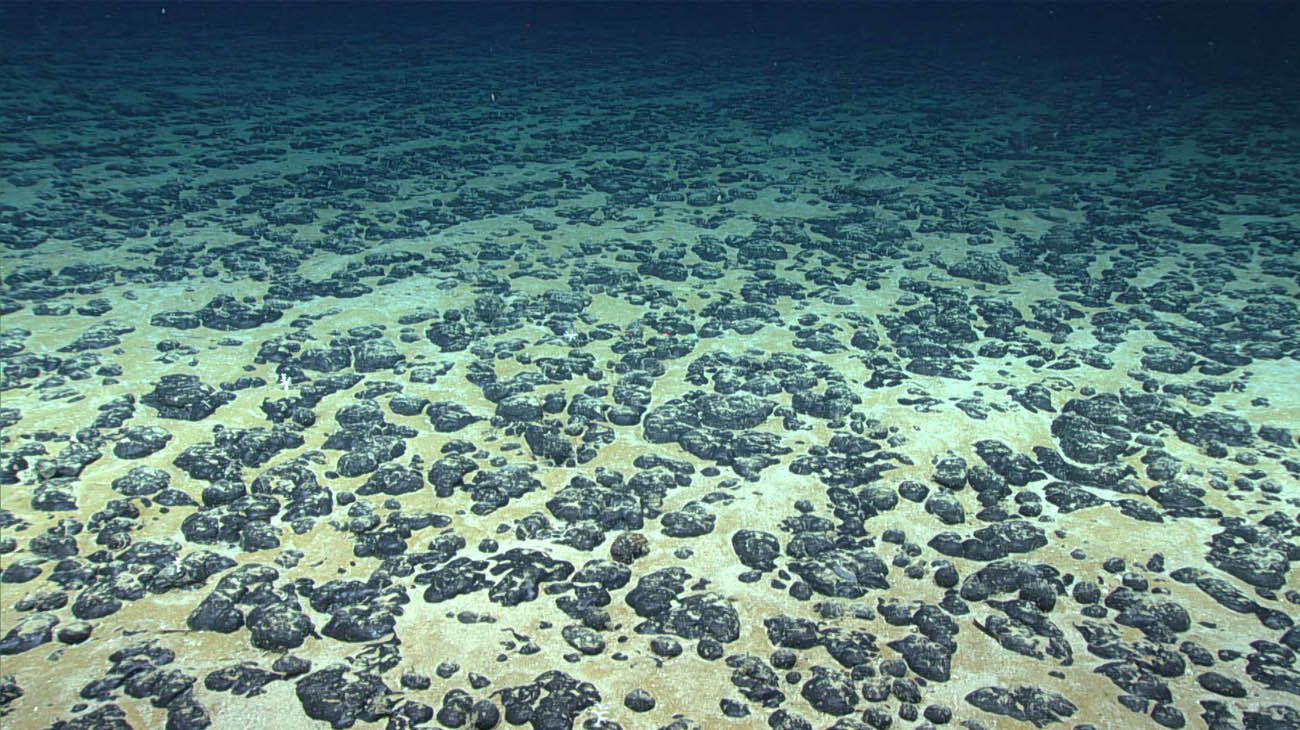
MIT: “The ocean’s deep-sea bed is scattered with ancient, potato-sized rocks called “polymetallic nodules” that contain nickel and cobalt — minerals that are in high demand for the manufacturing of batteries, such as for powering electric vehicles and storing renewable energy, and in response to factors such as increasing urbanization. The deep ocean contains vast quantities of mineral-laden nodules, but the impact of mining the ocean floor is both unknown and highly contested.”
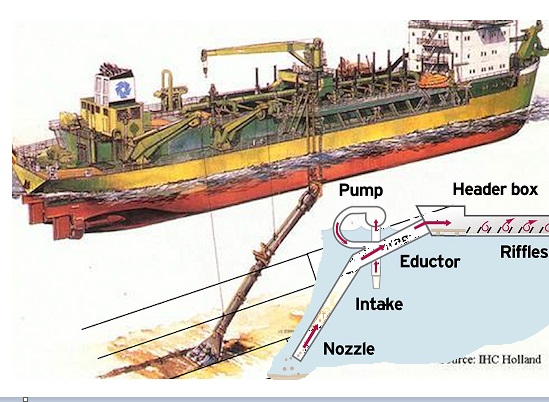
Sediment plumes following the wake of this deep sea mining ship.
And yet, only twenty-four people have the regulatory powers to stop this type of plunder in our planet’s most fragile places: The International Seabed Authority. You’ve likely never heard of them because this group attracts as little attention as an underwater mine miles offshore.
A few countries have agreed to full or partial bans, and leading scientists have appealed for a freeze on deep sea mining contracts.
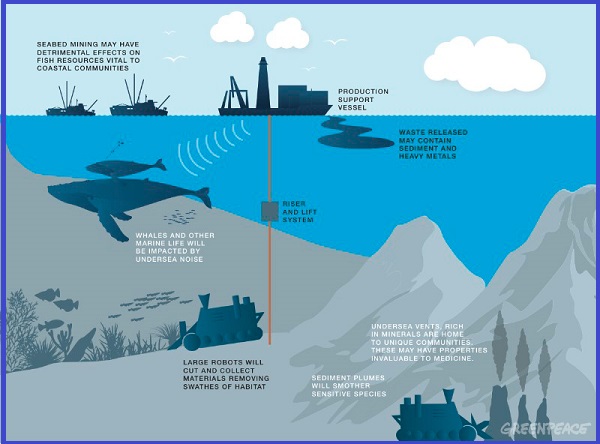
Mining companies claim they can mine the seabed safely, but authorities in Namibia, Australia and New Zealand have blocked seabed mining projects. Scientists point out that many deep water species are being discovered quite regularly, and that the ocean floor can take decades to recover from disturbances such as the creation of sediment plumes from deep sea floor bed mining.
There are technological limits to how deep Surface ships can reach- but is that enough to protect the deep of our Oceans? New technologies and techniques always lead to deeper mining.
New technology allowing for deeper mining and intensified mining: A massive seafloor EV rover.
The International Seabed Authority has already issued licenses for exploratory mining across 1.2 million square kilometers of ocean floor. As mentioned earlier, this regulatory body is almost unknown, and its 24-person Legal and Technical Committee is solely responsible for the detailed scrutiny of proposals and environmental safeguards.
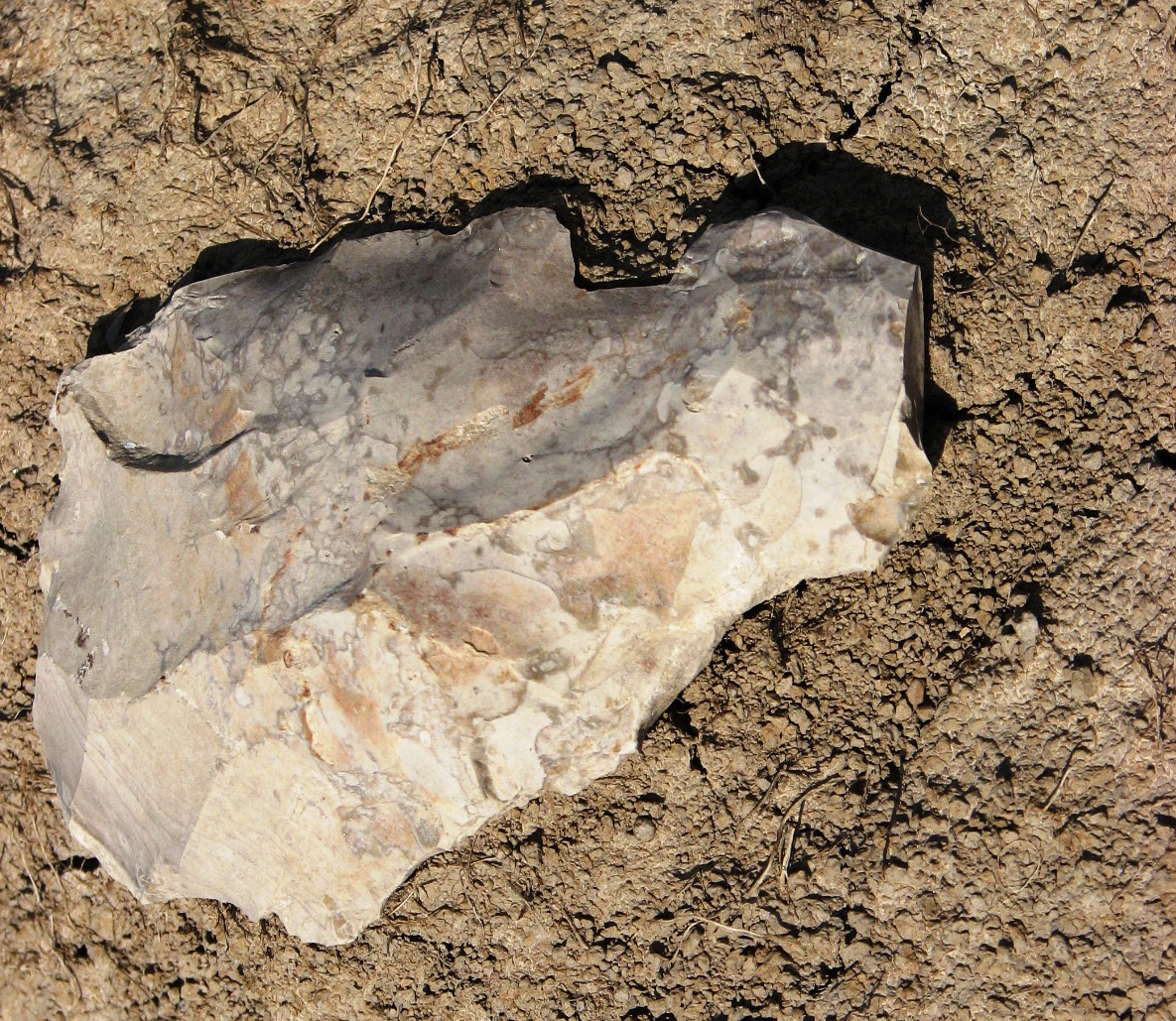
An artifact recovered near a stream in Port Dover, ON showing mineralization suggesting a very old date of manufacture.
In southern Ontario, Canada, generations of citizens have found and collected stone artifacts from their lands. Artifacts were kept out of intrigue and interest and often displayed prominently within homes. Some were valued as family heirlooms, others placed in boxes and kept packed away on a shelf. This is where I enter the story.
Hesitation Due to the Fear Of Confiscation
Not long ago a land owner in Norfolk County told me that artifacts had been collected from his family property over many, many years. I was invited to make an examination because the owner knew they might be important to my regional archaeological study. There was a little hesitation on their part, primarily out of concern that I might confiscate the artifacts. But that is not what I do. My interest in private collections from prehistoric times is based in public outreach and education not removal.
I was able to provide the owner with a time period of the artifacts, the type of rock used in their manufacture, and their origins. You see, I believe it is important to foster trust and to empower landowners with information, thereby ensuring their collections are valued, respected and hopefully made available for scientific study.
Bird stone effigy carving
Private collections reflect the richness of our homelands and confirm the reality of past human occupation. Trying to make sense of who primitive occupants were and how they lived is helped immensely by studying the ages and quantities of found artifacts. Artifacts date from within historic periods to as far back as when glaciers still existed in Southern Ontario. In fact, many land owners are surprised to learn that their collections are much older than a few hundred years.
At least 80% of human history is represented by stone artifacts.
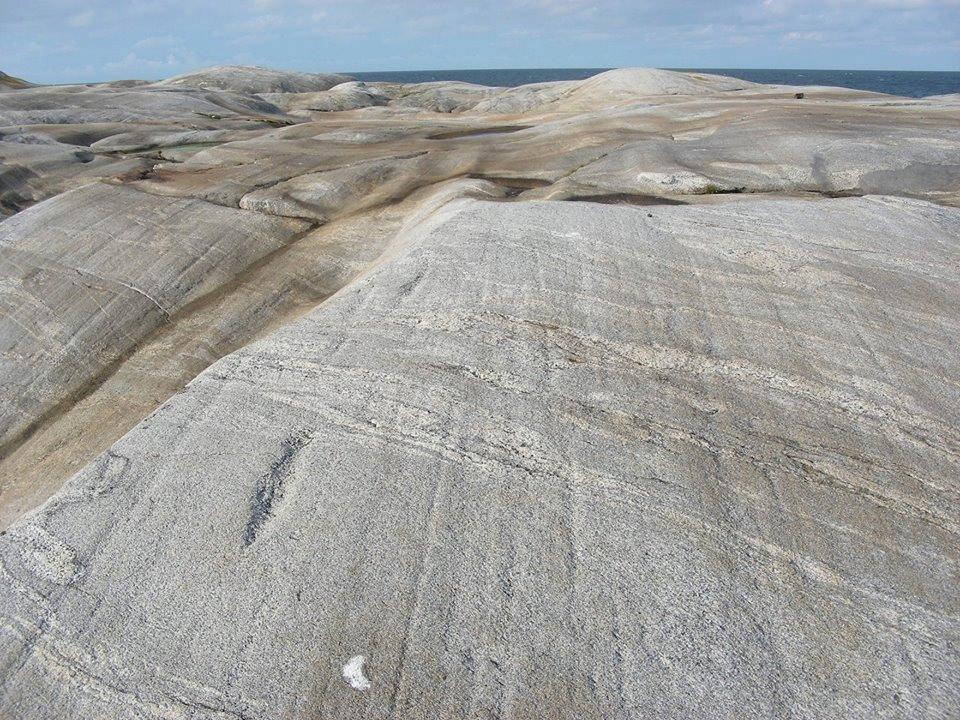
Glacial striations show the immense power and progress of ancient glaciar movement- a process that brought and deposited an incredibly large amount of materials and rocks over vast distances.
The rock used is generally a sedimentary variety containing silica. The more silica a rock has, the easier it is to break apart. The geological name for the type of stone used in most tool manufacture is chert or flint. Chert formations date as far back as the age of the dinosaurs. They were scoured and scraped by the movement of glaciers and carried along until the glacier melted. What this means is that an artifact found in Southern Ontario may have originated thousands of kilometers away!
A pottery shard (fragment) and a flint knapped spear point.
In Southern Ontario, stone tool artifacts have been recovered and dated within several different main time periods and as more discoveries are made these classifications are sure to go even further back in time. Each period shows variations thought to reflect climate changes that made an impact on animal and plant species. As species changed or disappeared, new types of stone tools were manufactured to keep up with these transitions. Dating artifacts, therefore, helps to identify migrations of different people groups across our counties’ deep past.
Most landowners truly enjoy having their artifacts interpreted. Their private collections remain intact and local people become, in a sense, guardians of local history. If a family is not interested in acting as stewards, I always encourage them to donate their pieces to a local museum, to ensure that the artifacts remain in the community.
The number of oil and gas projects in Ottawa’s major project inventory has fallen by 76 percent from its 2017 peak. This demonstrates a sustained erosion of investment confidence in Canada’s energy sector over the better part of a decade.
To spur investment in natural resources, mining and electricity, Parliament enacted the Building Canada Act (BCA) last June to “urgently advance projects throughout Canada.” Almost a year later, and without designating any projects under the BCA, Ottawa has now announced further reforms aimed at “Getting Major Projects Built in Canada.”
These reforms reflect the recognition that the current system isn’t working. Numerous reports, studies, and indices have concluded Canada’s reputation as a place to invest and build has deteriorated. Meanwhile, everyone agrees that when project approvals become politicized, and regulators are asked to weigh broad policy factors, it reduces confidence in the Canadian system.
Rather than creating a clearer and more predictable approvals framework, these changes expand federal discretion and further politicize the regulatory process.
The BCA doubles down on political decision making. First, cabinet, ministers, and – in reality – the Prime Minister’s Office, are granted virtually unconstrained discretion to control both the decision on ultimate approvals along with the process to which national interest projects should be subject. This includes the removal or amendment of current legislation or other rules that apply to national interest projects.
With this control, Ottawa can determine the outcome of the hearing prior to the consideration of evidence, and regulators will in essence go through the motions of conducting a review to produce a record that supports the government’s political determinations.
Moreover, it is not clear whether the BCA process replaces the existing process or actually adds to it. The BCA states that designation does not exempt a proponent from taking all measures it is required to make under enacting legislation, the Canadian Energy Regulator Act or Impact Assessment Act, to receive authorization. This suggests the CER and Impact Assessment Agency continue to conduct a regulatory review based on existing legislation. This raises new uncertainties and gives the minister ultimate discretion to consider a limited set of factors when issuing a green light.
Even in areas where regulatory review is required, such as safety and environmental impact, the BCA adds new considerations that do not precisely jibe with what needs to be considered under existing legislation. For example, the current CER Act requires consideration of how a pipeline may affect the protection of property and the environment. The BCA only requires consideration of safety and security of regulated facilities. While it is easy to say that the minister would in fact continue to consider the factors within the CER Act, the BCA doesn’t require it.
Indeed, the BCA does not solve the problem that current proceedings require assessments on a wide range of policy that bear little relation to direct project risks.
Hearings on policy issues like the intersection of sex and gender, and whether the effects of the project hinder or contribute to the government’s ability to meet its environmental and climate change obligations can dissolve into a time-consuming policy debate among proponents and intervenors.
Project reviews should instead focus on core risks, such as safety, environmental impact, and the adequacy of Indigenous consultation. Especially since the types of projects being referred, and other major projects, are often those with known adverse effects.
And what to make of the Major Projects Office’s role in these reforms? The BCA gives this office a limited coordinating function, while its website describes its role in broader terms, causing further confusion.
The project office states it is tasked with evaluating projects for submission and referral to the MPO itself. However, the BCA states projects require evaluation and recommendation by the minister prior to being referred.
Next the MPO states it will recommend whether projects should be designated as national interest projects. This contrasts the BCA, which requires this evaluation to be done by the minister following consultation with provinces and territories, and Indigenous peoples, on whether to order the formal designation.
Finally, the MPO states its mandate includes resolving policy or regulatory challenges and reduced risk, providing financial structure or investment support as well as Indigenous engagement and consultation guidance. The BCA does not empower it to conduct these activities and it is unclear how a proponent (likely an experienced and well-financed company) might benefit from MPO coordination rather than existing federal departments, and the various funding agencies, such as the new Canada Strong Fund, Canada Infrastructure Bank, or the Canada Growth Fund, all of which have already committed to better coordination.
Taken together, we argue the BCA and the MPO’s processes will not streamline project approvals nor improve predictability or good practice in Canada’s regulatory system.
George Vegh is a Senior Fellow at the Munk School of Global Affairs & Public Policy. Kate Koplovich is a Senior Policy Analyst for Energy with the C.D. Howe Institute.
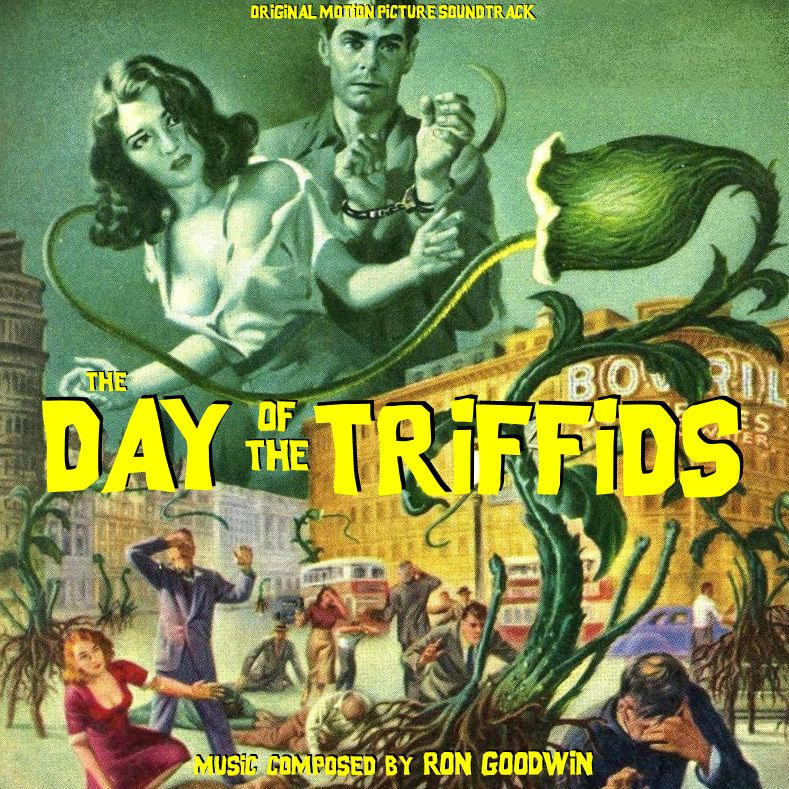
Kelp can grow 24 inches a day on nothing but sunlight and saltwater. That’s faster than a triffid, but with a much lower chance of getting eaten. And our friends at vollebak used it to make the Underwater Kelp Cardigan.
In John Wyndham’s classic The Day of the Triffids, much of the world has been blinded by a meteor shower. Eight-foot-tall walking plants – possibly bioengineered by the Soviet Union – sting and then slowly digest stumbling, unsighted humans.
Seaweed, a type of marine algae, is almost as weird and otherworldly. But it doesn’t walk, and it doesn’t eat people.
It might turn out to be one of the most useful organisms on the planet. Which is why they’ve used it to build the Underwater Kelp Cardigan.
What makes seaweed so exciting? Let’s start with how fast it grows. Kelp – the long, ribbon-like brown algae that forms forests on the seabed – can grow by up to 24 inches a day. That makes it one of the fastest-growing organisms on Earth. Faster than triffids. Considerably faster than bamboo.
And it does it on almost nothing. No soil. No freshwater. No fertilizer. No pesticides. Just seawater, sunlight, and dissolved nutrients. Farming on land needs fields, irrigation, and machinery. Cultivating seaweed just needs a rope and a stretch of coastline.
The forests it builds are among the most productive ecosystems anywhere. Underwater rainforests, dense with life, growing up through the water column rather than out across a field. More than 35 million tonnes are now produced globally each year. Most of it is farmed rather than torn from the wild.
What’s inside is more interesting still.
Seaweed’s cell walls are packed with biopolymers – alginate, agar, carrageenan, cellulose – industrial building blocks that are already in everything from ice cream to pharmaceuticals. Extracted and refined, they can be reassembled into films, gels, coatings, and fibers.
These polymers can be spun into yarns that look, feel, and behave like natural fibers, but at a fraction of the environmental cost. They need up to 70 times less water than cotton. They cause zero microplastic pollution. And rather than lingering for centuries, some seaweed-based materials are designed to disappear, biodegrading in a matter of weeks.
Brown and red seaweeds can also – and with much less intervention and engineering – be turned into thin, transparent films that are strong enough for packaging. It’s also compostable. Instead of outliving everyone who ever touched them, they just quietly disappear.
Then there’s everything seaweed does while it’s still growing. It absorbs carbon dioxide straight out of the water. It acts as a living filter, pulling excess nutrients from coastal seas and quietly restoring balance.
It’s not all upside.
Processing seaweed at scale is still energy intensive. But seaweed is more than a single miracle material. It’s the basis of a new material system, a blue biorefinery, where the entire plant gets used across food, feed, chemicals, and textiles with as little waste as possible.
For most of history, seaweed has been seen as an unsightly annoyance. That’s all about to change.
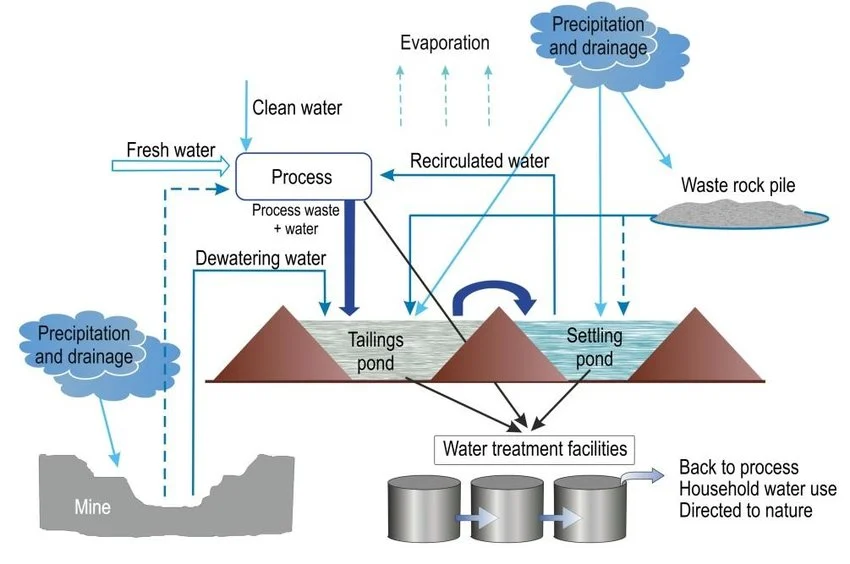
When it comes to mine water treatment, simple compliance is not an option, not anymore. Why? Because the operating environment has fundamentally changed. What used to be manageable within standard regulatory frameworks is now being reshaped by a convergence of high interest rates, increasingly aggressive ESG litigation, and the physical reality of water scarcity.
The industry is now running into hard limits that make traditional, linear approaches to water management untenable. You’re seeing the rise of zombie liabilities; long-term water obligations that persist well beyond mine closure, continuously drawing capital without any return. Alongside this sits the persistent handover gap, where the transition from active treatment systems to long-term closure solutions is under-designed, underfunded, or simply assumed to “hold.”
And then there’s the cost curve that doesn’t behave the way many expect. Removing the last fractions, those parts-per-billion levels of specific substances of concern, often requires disproportionate increases in energy, process complexity, and operational control. In certain contexts, that final level of treatment can rival, or even exceed, the cost intensity of earlier-stage operations.
Taken together, these pressures are forcing a shift. Mine water is no longer a compliance exercise, it’s a long-horizon technical and financial challenge that demands far more precision, foresight, and accountability than conventional models were built to handle.
Geochemical Source Control: Designing against the Problem
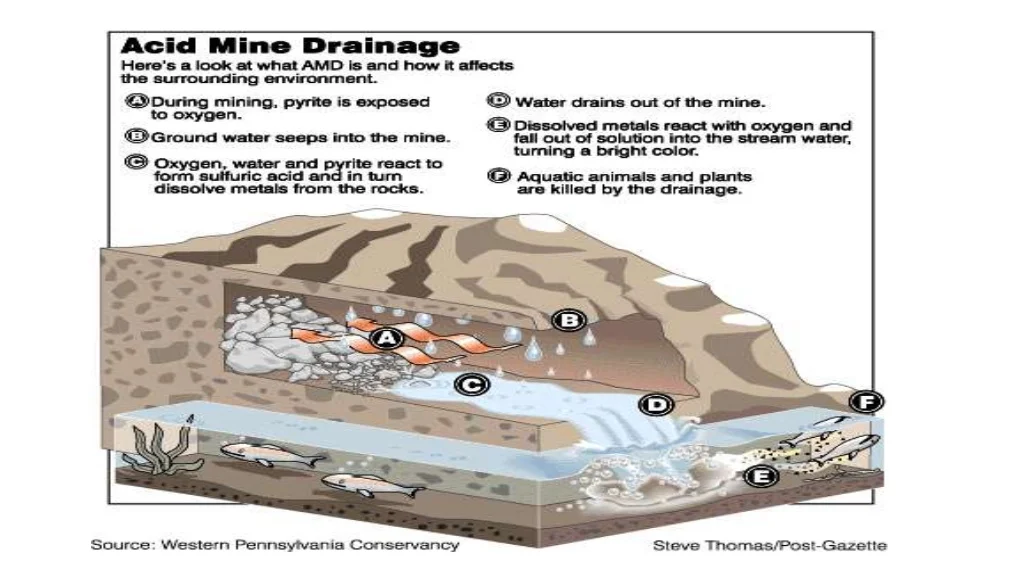
In the mine water treatment industry, experts in Mine Water Treatment Solutions understand the importance of source control, as it addresses the fundamental chemistry of mining before it becomes a liability. That is where aspects of Acid Mine Drainage (AMD) must be intercepted. Instead of treating the mine as a “source of dirty water,” experts treat the mine as a chemical reactor (prevention-based engineering) that can be controlled or deactivated by focusing on rock-air-water interface.
What this looks like in practice:
Oxygen limitation strategies: engineered covers or water saturation zones to suppress oxidation kinetics
Blended waste placement: pairing acid-generating material with neutralizing rock to stabilize pH evolution
Predictive modeling: tools like PHREEQC used not as academic exercises, but as decision frameworks for staging infrastructure
The value here isn’t just reduced treatment demand—it’s predictability. You’re not reacting to water quality spikes; you’re shaping them years in advance. That’s where disciplined engineering separates itself from reactive cost management.
Selective Removal & Resource Recovery: Turning Liabilities into Process Streams
Bulk treatment is expensive because it ignores nuance. When everything is treated equally, everything costs more. The shift toward selective removal is really about precision, targeting what matters and extracting value where possible.
Consider the opportunities:
Metal recovery loops: SART systems pulling copper or gold from solution streams (which can be sold to smelter) where ion exchange resins are tuned for specific ions rather than broad removal.
Salt valorization in brine systems: Fractional crystallization producing saleable sodium sulphate or gypsum. That reduces dependence on off-site hazardous disposal
This isn’t just clever chemistry—it’s strategic positioning. You’re moving from a cost center to a hybrid operation where treatment contributes to revenue. Investors notice that shift, because it fundamentally changes how water infrastructure is valued.
Hybrid Treatment Pathways: Planning for Operational Reality and Closure
The lifecycle of a water mine design has to outlive the mine. Most failures in mine water don’t happen during operations. They happen in transition; the mine closes, flows change, chemistry shifts. And suddenly the system that worked yesterday is structurally wrong for today. That’s the real design problem.
However, a resilient approach doesn’t rely on one technology, it layers capability across time:
During operations: high-density sludge systems and membrane plants absorb variability, peak loads, and production-driven fluctuations
During closure: passive systems like wetlands or biochemical reactors take over once flows stabilize and intensity drops
But the real challenge isn’t choosing technologies. It’s designing the handover between them. Because if that transition is wrong, you don’t get closure, you get long-term operational debt disguised as environmental management.
Water Quality Beyond Compliance: The Biological Dimension
Meeting discharge limits is no longer the finish line. Hitting regulatory numbers used to be the goal. It isn’t anymore. You can meet every limit on paper and still release water that quietly damages the ecosystem it enters.
That’s where things get more nuanced:
Whole Effluent Toxicity (WET) testing exposes what chemistry hides: It’s not about what’s in the water, it’s about what it does
Ionic balance matters more than concentration: Salinity, ionic ratios, small imbalances can ripple through entire ecosystems. Helps avoid high salinity or imbalances that disrupt aquatic life
Site-specific ecological alignment: One-size-fits-all discharge doesn’t work, water needs to fit where it’s going, not just pass a standard checklist. Tailoring treatment outputs to match receiving environments
For you as an operator, investor, or project decision-maker, this is bigger than compliance. It’s about avoiding legacy problems that don’t show up immediately, but hit hard when they do. In essence, in mine water, nothing really disappears, it just shows up later, usually more expensive, and far less forgiving. The difference isn’t technology. It’s mindset. The operations that endure are the ones that stop thinking in phases and start thinking in consequences, because every shortcut taken today has a way of resurfacing when the system is least prepared to absorb it.
It’s been nearly nine years since we published the article below and the water surrounding glyphosate use in Canada is still murky. Roundup is currently being used in an official capacity in certain situations by government agencies such as by the Ministry of the Environment to fight the invasive species Phragmites. Let’s review the earlier article:
Top Scientists Warnings
Dear friends across Canada, top scientists warn the most commonly used herbicide in the world probably causes cancer. Monsanto is demanding the World Health Organization retract their ground-breaking report. And experts say the only way to ensure the science is not silenced is if the public demands action, now. The regulatory system is renowned for being secretive and captured by the agro-chemical industry. But we have a unique moment right now — Canada is officially reassessing glyphosate, with similar processes underway in the US, Europe, and Brazil. And the Netherlands, Sri Lanka, and El Salvador are all looking at a ban. [However, it must be noted that as of today’s posting, Canada Health’s Food Safety Inspection statement is that glyphosate formulations ARE safe CP]The threat is clear — this poison is used on our food, our fields, our playgrounds, and our streets. Let’s get it suspended.
Monsanto is up in arms. Glyphosate brings in $6+ billion per year. It is the basis of RoundUp, the chemical cornerstone of Monsanto’s Genetically Modified empire. The company says the WHO report ignored studies showing glyphosate is safe. But these scientists are 17 of the world’s top oncology experts, not a bunch of crazies. They comprehensively reviewed independent studies, excluding those done by companies seeking product approval. Regulators rely mainly on tests done by the companies trying to sell the poisons!
Secret Information Makes Reporting Murky
Key results are kept from the public because they contain ‘commercially confidential information’, and 58% of the scientific panels in the EU Food and Safety Agency are linked to the sector. It’s nuts, but that is the system we have. And that’s why it’s going to take all of us to make sure this crucial independent report isn’t ignored. Some countries have already put bans on glyphosate. Now with the EU, the US, Canada, and Brazil all reviewing it, we have an incredible chance to turn the tide worldwide.
Sixty years ago Monsanto’s pesticide DDT was everywhere until the seminal book Silent Spring showed it could cause cancer — a decade later it was banned. If this could cause cancer, let’s not let it be sold for ten more years. Let’s demand emergency precautionary action now.
We’ve done it before — helped win a moratorium on bee-killing neonicotinoids in the EU and stop a Monsanto mega seed factory in Argentina. Now let’s protect our health and make sure we aren’t being used as lab rats. This could be a breakthrough moment in the fight for the safe, sustainable agriculture our world needs. With hope, Bert, Marigona, Antonia, Oliver, Alice, Emily, Danny, Nataliya, Ricken and the whole Avaaz team.
The Golden Eagle is one of the best known and largest birds of prey in North America. The adult birds are dark brown in color with golden-brown feathers on the back of their head, neck and upper wings.
Golden Eagles use their strength, agility and powerful talons to snatch up prey including mice, rabbits, squirrels and even fox and young deer.
They are very swift and can reach speeds over 240 km per hour while diving in on their target. <240 km/h is about 150 mp/h- the top cruising speed of the American Commuter Acela- 1 express train by the way. Watch the video below and note at the 1m 8s mark as the Acela passes the station at about the same speed that the Golden Eagle achieves in a dive. Wow!
Golden eagles usually mate for life.
They build huge nests in high places including cliffs, trees, or even telephone poles and may return to this same nest for several breeding years.
The Golden Eagle is listed under Ontario’s Endangered Species Act, 2007, which protects it from being killed, harmed, possessed, collected or sold, and protects the habitat from damage or destruction. For the Silo, Dixie Greenwood.
It’s hard to believe it’s been almost fifteen years since I did some work recording for Statistics Canada. The job required door-to-door visits to all the homes in a designated area, interesting because I had a chance to see what people do in their yards. One residence in particular left a strong impression on me and it continues to resonate now in 2025 all these years later.
It was a beautiful home, probably 40 years old, on a fairly large estate.
The lawns were nicely manicured and the architectural evergreens were tastefully placed. It looked like a photo in a 1970’s Better Homes and Gardens.
This architectural sketch of a late 1970’s “Dream Green Home” at least shows a bit of “greenery” and a tree. image: public domain
But as I walked to the front door, I realized that there was no movement.
Nothing swayed in the afternoon breeze. There were no herbaceous plants, no flowers, and worse, no bees, no butterflies, no birds. This place had as little movement as my imaginary magazine photo. It struck me as being uninteresting and unnatural. Land without life.
In my experience we show ourselves at our best when we interact and connect with nature and even find a kind of fulfillment in it. This completion has been lost for many of us, but paradise can be regained at any time.
There are all kinds of small ways to re-connect and to bring restoration, not just to the land, but to ourselves as well. I encourage everyone to put in a garden of some kind. A vegetable garden is of course the most practical and immediately useful. Start small and easy if you have never had a garden before.
If the practicality of a vegetable garden isn’t appealing, then plant something in to nourish your soul.
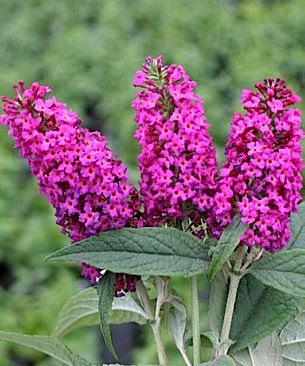
‘Miss Ruby’ Butterfly Bush-Buddleia image: www.green-living-made-easy.comRick’s home butterfly garden photo: M. Larmand
A couple of years ago I put in a no-maintenance garden specifically to attract hummingbirds. The thank-you’s come at dusk when increasing numbers of my little buddies do their end-of-day rounds. Scarlet runner beans, red monarda, salvia, tithonia, and crocosmia – they did the trick.
And copying the garden of a friend , I have also put in a small butterfly garden.
Milkweed, Echinacea, and butterfly bush (Buddleia) are good starter plants. I’m doing my small part to help save the monarch butterfly population. The nice thing about both these gardens is that they require almost no attention, just observation and enjoyment.
I’ve often thought about theme gardens. “There’s rosemary, that’s for remembrance…” Ophelia’s mad scene in Hamlet is a great starting point for a Shakespearean garden and a study of plant symbolism in literature. A biblical garden would also be an interesting exercise, though the plants themselves would be local approximations of Mediterranean species but the life lessons would be endless. Consider the lilies of the field. What about a cutting garden, a scented garden, a night garden?
Poets and painters have found inspiration in gardens. Like them, let nature take your breath away. Start small. To quote the American poet, Emily Dickinson:
To make a prairie it takes a clover and one bee. One clover, and a bee. And reverie. The reverie alone will do, If bees are few.
It doesn’t take much to make a prairie – or your own personal sanctuary.For the Silo, Rick Posavad.
The Canadian Wood Council has released new Environmental Product Declarations for 5 Canadian manufactured wood products.
“The release of these new EPDs reinforces our commitment to transparency and sustainability in the wood products sector.”
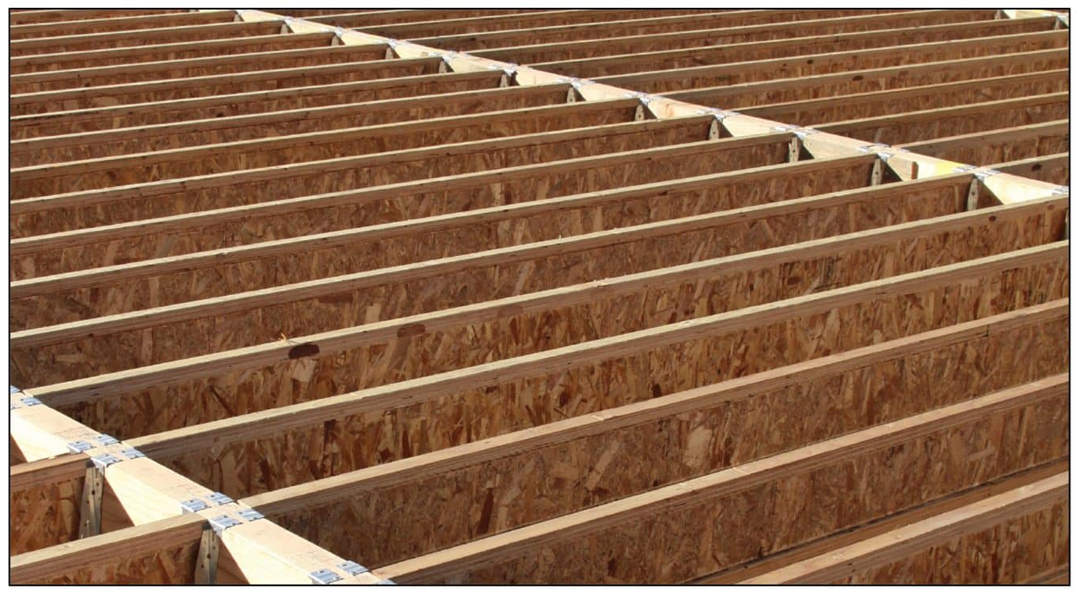
The Canadian Wood Council (CWC) is pleased to announce the release of five new Environmental Product Declarations (EPDs) for Canadian softwood lumber, oriented strand board (OSB), plywood, trusses, and prefabricated wood I-joists. These EPDs provide comprehensive, transparent environmental data on the potential impacts associated with the cradle-to-gate life cycle stages of these essential wood products.
“The release of these new EPDs reinforces our commitment to transparency and sustainability in the wood products sector,” said Peter Moonen, National Sustainability Manager at the Canadian Wood Council. “By providing robust, science-based environmental information, we’re equipping the industry with the tools needed to demonstrate the environmental benefits of wood and support low-carbon construction.“
Developed as Type III declarations by region for business-to-business use across the Canadian industry, they comply with the most stringent international standards, including ISO 21930, ISO 14025, ISO 14040, ISO 14044, applicable product category definition rules, and ASTM’s general program instructions for Type III EPDs. This ensures complete and credible information on the environmental impact that has been verified by an external source. The new EPDs will be able to help designers, construction companies and decision-makers make informed choices about sustainable materials.
“The publication of the new Environmental Product Declarations reinforces our commitment to transparency and environmental responsibility in the wood sector,” says Peter Moonen, National Director of Sustainability for the Canadian Wood Council. “By providing reliable, science-backed environmental data, we are giving industry the tools to demonstrate the environmental benefits of wood and to support low-carbon construction.”
For the Silo, Sarah Hicks.
Environmental Product Declarations can be downloaded from the Canadian Wood Council’s Digital Resource Centre:www.cwc.ca.
JG O’Donoghue imagines a ‘versus’ scenario to demonstrate the struggle of ‘languages at risk’
There is a mass decline in linguistic diversity happening all over the planet and in places geographically far apart and I think that if things don’t change, the loss of language diversity will be immense.
In the book, Irish in the globalcontext, Suzanne Romaine mentions that linguists believe 50 to 90 % of the world’s estimated 6,900 languages will simply vanish over next 100 years.
At this moment in time, 85% of the world’s languages have fewer than 100,000 speakers and over half of the world’s remaining languages are spoken by just .2 % of the world’s population. These facts have informed my work and have become the wider subject of my illustrations, specifically the linguistic decline of the Irish language.
In some ways the battle between the Irish and the English languages is one of the defining features in modern Irish culture, but it is Irish which defines this island more, and the Irish language tells the entire history of Ireland in its influences and in its form.
Ruairí Ó hUiginn said in his book The Irish language: you have influences of Latin from the Christianization of Ireland in ecclesiastical words, influences from Viking invasions in words for “seafaring, fishing and trade”, influences from the militaristic Normans [ French CP] in words for “architecture, administration and warfare”, and from English colonialism you get English in every day words.
“To create my intended mood, the english words are given a general typography while the Irish words are given a distinctive script reminiscent of Geoffrey Keating’s book Foras Feasa ar Eirinn”
Each influence shows an aspect of Irish culture. What people forget to realize is that a language is much more than something spoken to express oneself. Ancient peoples created language in an attempt to describe the world around them and the world within them, in other words their worldview.
An example in Irish is- you don’t say ‘I’m angry’, you say ‘tá fearg orm’, which means ‘I have an anger on me’.
Nevertheless, Irish is important internationally too, and Irish is the third oldest written language in Europe, after Latin and Greek, and as a spoken language it may even be older than both.
How should an artist illustrate a language? And more specifically the struggle of one language with another? I choose nature as my metaphor, from the ancient forests of Ireland, mostly gone now, to Islands which stand for thousands of years but are slowly worn away by the tide. The words that make up these landscapes are either ‘for’ or ‘against’.
My illustrations therefore visualize the real life drama of ancient language versus modern language.
I imagine a “versus” scenario. On the “against” side I chose English words plucked from peoples statements in online forums and in letters to newspapers. On the “for” side I chose Irish words, and they were chosen from recent investigations into the creation of the ancient Irish language. Irish words in my illustrations such as “dúchas (heritage), tír (country), litríocht(literature), and stair(history)” reflect the Irish language’s cultural importance, while “Todhchaí(future), féinmhuinín(self-confidence), beatha(life), and anam(soul)” reflect its importance in a metaphysical way to Ireland.
The Irish language forest- An Coill Teanga Gaeilge
The english ‘against’ words can range from the practical benefits of english within subjects such as “tourism, movies, business, and comics,” to words that reflect the interaction of English speakers with Irish. To illustrate the concept, I chose words like “conform, bend, harass, and adapt”.
To create my intended mood, the english words are given a general indistinctive typography reflecting uniform mono-linguilism, while the Irish words are given a distinctive Irish manuscript/Gaelic script reminiscent of Geoffrey Keating’s 17th century book- Foras Feasa ar Éirinn/History of Ireland.
The core message in my illustrations is a positive one, the sun is rising for a new day as the Irish language holds on, like a lot of minority languages. It is diminished but not beyond hope. I believe it can make a comeback, and this is exactly what is happening all over this country today, because of the work of people far more dedicated than myself. I hope my work can help reinforce linguistic diversity as well as all forms of heritage. I have the will to preserve these for future generations, so they too can live in a world full of diversity spending their lives discovering and exploring it in all its beautiful variety.
Coyotes are a canine species similar to wolves, found only in North and South America and like other wild animals, sometimes come into conflict with humans.
Since migrating to the province of Ontario from the western side of Canada more than 100 years ago, coyotes have adapted well to urban environments and can now be found in both rural and urban settings. Coyotes are most abundant in southern agricultural Ontario and urban areas and there are ways to prevent and manage conflicts.
Factors That Influence Possibility Of Sightings
Changes in land use, agricultural practices, weather, supplemental feeding and natural food shortages may contribute to more coyote sightings in your community.
Homeowners and renters in areas of potential encounters should take these steps to make sure coyotes aren’t attracted to their homes and to keep their pets safe.
To reduce the potential for coyote encounters, the Ministry of Natural Resources has the following tips for the public.
Do not approach or feed coyotes
Coyotes are usually wary of humans and avoid people whenever possible. However, they are wild animals and should not be approached.
People should NOT feed coyotes — either intentionally or unintentionally. It makes them less fearful of humans and makes them accustomed to food provided by humans.
Aggressive behavior towards people is unusual for coyotes, but people should always exercise caution around wildlife. Secure garbage, compost and other attractants
Do not provide food to coyotes and other wildlife. Properly store and maintain garbage containers to help prevent coyotes from becoming a problem.
In the fall, pick ripe fruit from fruit trees, remove fallen fruit from the ground and keep bird feeders from overflowing as coyotes eat fruit, nuts and seeds.
In the summer, protect vegetable gardens with heavy-duty garden fences or place vegetable plants in a greenhouse. Check with your local nursery to see what deterrent products are available.
Place trash bins inside an enclosed structure to discourage the presence of small rodents, which are an important food source for coyotes.
Put garbage at curb-side the morning of the scheduled pickup, rather than the night before.
Use enclosed composting bins rather than exposed piles. Coyotes are attracted to dog and cat waste as well as products containing meat, milk and eggs.
Consider eliminating artificial water sources such as koi ponds.
Keep pet food indoors. Use deterrents and fences to keep coyotes away from your home and gardens
Use motion-sensitive lighting and/or motion-activated sprinkler systems to make your property less attractive to coyotes and other nocturnal wildlife.
Fence your property or yard. It is recommended the fence be at least six-feet tall with the bottom extending at least six inches below the ground and/or a foot outward, so coyotes cannot dig under the fence. A roller system can be attached to the top of the fence, preventing animals from gaining the foothold they need to pull themselves up and over the top of a fence.
Electric fencing can also help deter coyotes from properties or gardens in some circumstances.
Clear away bushes and dense weeds near your home where coyotes may find cover and small animals to feed upon.
Close off crawl spaces under porches, decks, and sheds. Coyotes use these areas for denning and raising young.
Keep pets safe
Cats and small dogs may be seen as prey by coyotes, while larger dogs may be injured in a confrontation. To avoid these situations consider the following suggestions:
Install proper fencing.
As coyotes are primarily nocturnal, pets should be kept inside at night.
Keep all pets on leashes or confined to a yard.
Keep cats indoors and do not allow pets to roam from home.
Spay or neuter your dogs. Coyotes are attracted to, and can mate with, domestic dogs that have not been spayed or neutered.
If You Encounter A Coyote
Do not turn your back on or run. Back away while remaining calm.
Use whistles and personal alarm devices to frighten an approaching or threatening animal.
If a coyote poses an immediate threat or danger to public safety, call 911.
Never attempt to tame a coyote. Reduce risk of predation on livestock
Barns or sheds can provide effective protection from the threat of coyotes preying on livestock.
Guard animals, such as donkeys, llamas and dogs, can be a cost-effective way to protect livestock from coyotes. Guard animals will develop a bond with livestock if they are slowly integrated and will aggressively repel predators.
For more information on preventing livestock predation and claiming compensation from the government, please visit the Ministry of Agriculture and Food website.
Managing Problem Wildlife
Landowners are responsible for managing problem wildlife, including coyotes, on their own property.
The Ministry of Natural Resources helps landowners and municipalities deal with problem wildlife by providing fact sheets, appropriate agency referrals, and information on steps they can take to address problems with wildlife.
The Fish and Wildlife Conservation Act sets out the legal actions property owners can take to deal with problem wildlife. Generally, landowners or their agents may harass, capture or kill problem wildlife to prevent damage to their property.
Uranium pellets are shown during a tour of a Nuclear Waste Management Organization facility in Oakville, Ont., on Dec. 12, 2023. The Canadian Press/Frank Gunn
Ontario Town Votes to Become a Willing Host for a Nuclear Waste Repository
A northwestern Ontario town has formally decided it is willing to become the site of a deep geological repository for Canada’s nuclear waste.
The Nuclear Waste Management Organization plans to select a site this year where millions of bundles of used nuclear fuel will be placed in a network of underground rooms connected by cavernous tunnels.
The process for the $26-billion project had already been narrowed down to two sites, Ignace in northern Ontario and another in southern Ontario, and the NWMO says that both the local municipality and the First Nation in those areas will have to agree to be willing hosts.
Ignace, between Thunder Bay and Kenora, is now the first of those four communities to make its decision known, and town council voted in favour of it at a special meeting on July 10.
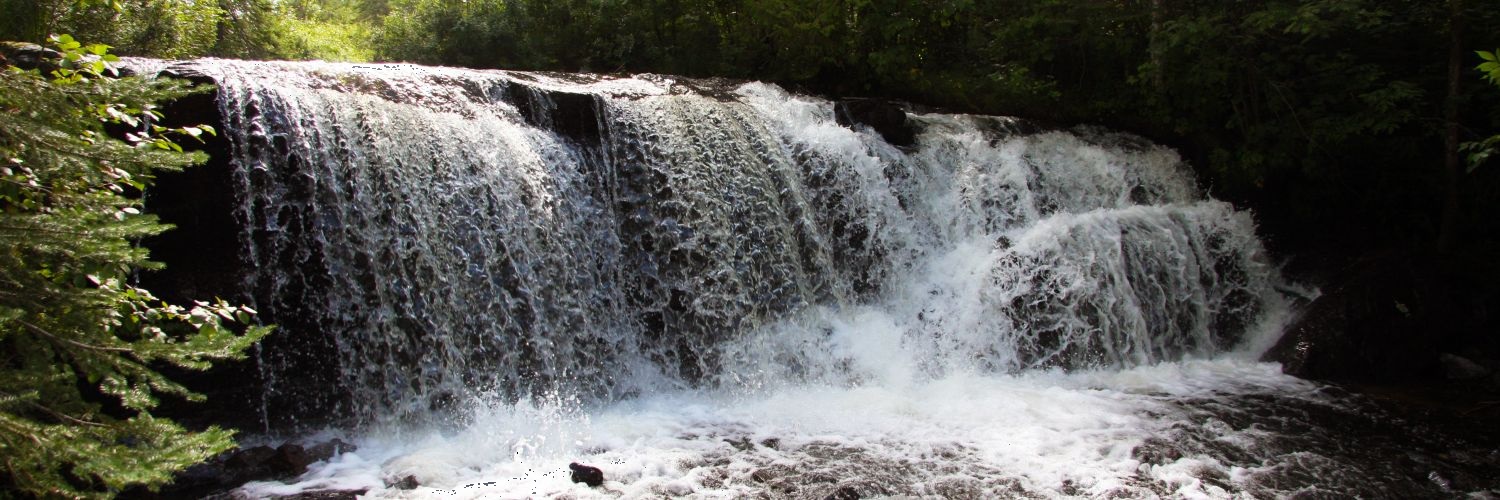
One of the many natural waterfalls found in Ignace, Ontario.
A committee of community members tasked with taking the pulse of the town’s willingness presented the results of a community vote and said that out of the 640 residents who voted, 495 or 77 percent voted in favor.
Neither of the First Nations has yet made their willingness decisions, and the municipality of South Bruce is set to hold a referendum in October.
The current fleet of nuclear reactors in Canada will produce about 5.5 million used fuel bundles, with around 3.2 million already in either wet or dry storage on site at nuclear plants.
But the NWMO says the current containers of thick concrete walls lined on the outside with a steel plate are designed to last 50 years, so they are not a long-term solution.
The organization, funded by the corporations that generate nuclear power and waste, such as Ontario Power Generation and Hydro-Quebec, is instead planning to build a deep geological repository, as far underground as the CN Tower is tall.
The used nuclear fuel pellets, baked into ceramic, are contained in fuel rods made of corrosion-resistant Zircaloy. Those rods will be in containers made of carbon steel and coated with copper, and those containers will be packed into bentonite clay.
Opponents in the affected communities worry about safety, while proponents see value in the jobs and economic development the project will bring.
Global Affairs Canada is seeking a contractor who can present an environmentally friendly way to recycle solar panels.
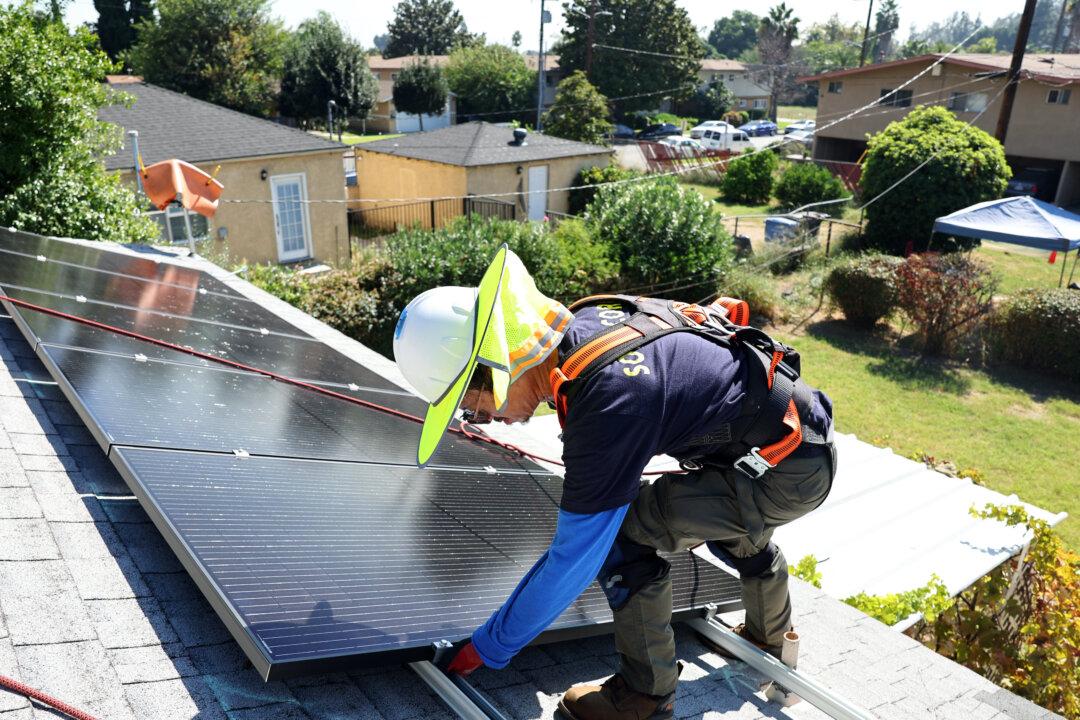
A worker installs solar panels on the rooftop of a house in Pomona, Calif., on Oct. 19, 2023. (Mario Tama/Getty Images)
Via friends at the epoch times. Landfilling of used solar panels poses a “significant” pollution risk due to toxic chemicals potentially leaching into groundwater, a government document says.To solve this issue, Global Affairs Canada is seeking a contractor who can present a cost-effective and environmentally friendly way to recycle solar panels, according to a July 23 notice on the government website.
“Solar panels have valuable materials, including critical materials such as aluminum, tellurium, and antimony as well as gallium and indium in some thin-film modules, which are currently not being recycled once the panels reach their end of life,” said the notice posted by Global Affairs Canada.
Solar panels and renewables are part of the federal plan to get to net-zero greenhouse gas emissions by 2050, the government says. As more and more panels are used, however, Ottawa needs a plan to recycle them in order to reduce the pollution risk.
The government has earmarked $1.15 million CAD for the contract.
“As the photovoltaic market grows, both for public and private use, the volume of end-of-life solar panels will also grow, which will result in significant pollution risks,” the website notice says.
“The overall environmental impact of solar panels is much higher if they are dumped in landfills, where hazardous chemicals and heavy metals can leach into groundwater.” For the Silo, Chandra Philip.
As part of the contract, proposals must ensure that all materials removed from the solar panels are free from contaminants like metals and radiation. Contractors are also required to manage the toxic chemicals from the panels, like lead and cadmium, ensuring they will not be released into the environment or cause health risks to humans.
Solar panels also contain some key elements that are worth recycling and reusing, the website says.
“These individual materials are often a part of the devices that Canadians use every day such as smartphones and computers,” Global Affairs says. “As such, recycling these materials should provide significant economic, environmental, and social benefits.”
Solar panel recycling can also reduce the need for critical mineral mining, an activity that has extensive negative environmental and social impacts, the government notice says.
The way solar panels are constructed, however, can make it difficult to separate and recycle these valuable materials, Global Affairs says.
“Separating those materials and uniquely recycling them is a complex and expensive process as opposed to the cheap method of discarding the entire panel into a landfill,” says the website.
Global Affairs says it wants a “scalable and cost-effective” recycling solution that can be used for solar panels at any time during their lifecycle: production, use period, and end-of-life stage. The agency says it may give out multiple contracts to help solve the problem.
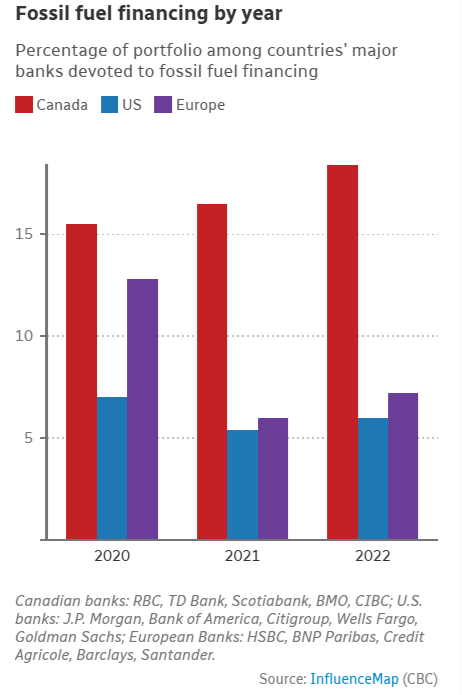
Did you know that Canada’s five biggest banks are among the 20 largest fossil fuel financiers in the world?
Since the Paris Agreement was signed in 2015, they have invested over$900 billion into the fossil fuel industry. This means that your hard-earned dollars are being invested in projects that make it impossible to meet Canada’s climate targets. While not well known, the financial sector is the missing piece in ensuring a climate-safe future.
Last week, the CEOs of Canada’s top 5 banks were in Ottawa testifying about their role in the climate crisis. Environmental Defence was on the front line of this critical moment. We were invited to testify in this important study and use our expertise to advise policy solutions to align our financial system with climate action.
Canada can only keep a safer climate if finance aligns with climate action, and new rules from the government would help make that happen. And, we are creating public awareness of the issue and mobilizing Canadians to speak up by writing letters and attending rallies- increasing the pressure on the federal government to take action.
At a time when climate-fueled disasters (such as wildfires, droughts and floods) are rising, it’s ludicrous that Canadian banks are allowed to fund oil and gas industries at a rate of over $100 billion per year. We will be watching future proceedings closely. And, we will continue to push the federal government to ensure that Canadian banks are helping, not hindering our climate goals. For The Silo, Alex Walker. Program Manager, Climate Finance for Environmental Defence.
Photo shot in London, Ontario. Shot during a tornado warning for Middlesex county. photo: S. Sills
Did you know on average 12 tornadoes strike Ontario each year? That’s why David Chapman (@northof44pics) and I (@wxspencersills) commit our springs and summers to capturing severe thunderstorms on video and through photography.
My name is Spencer Sills and I am a chaser located in South Western Ontario. I have been chasing storms for about 20 years. I became obsessed with the weather and more specifically severe weather in 1996. On April 20, 1996 a tornado had hit Williamsford, Ontario. This was my first experience with a tornado and it has become a permanent fixture in my mind, partially due to the fact there was still snow on the ground the day it had hit.
Then in the summer of 2011, there were fourteen confirmed tornadoes including the Goderich F3 tornado as well as three tornadoes during the August 24th severe weather outbreak during the late afternoon and evening. I was unable to be out during either of these days but what I was able to do was keep the public informed of the current severe weather as well as help give warning for the tornadoes.
Photo shot in South West London, Ontario. A waterspout advisory was in effect for Lake Huron and Erie, while on the way to Lake Huron I came across this Cold Core Funnel off of a early morning thunder shower. image: S. Sills
A Summer from years ago was…interesting. I witnessed more than my fair share of active weather. I encountered five funnel clouds, several gust fronts or more commonly known as squall lines here in Ontario, and hail from pea size to golf ball sized in Seaforth. I’ve also encountered strong wind storms which included a storm in Birr, Ontario which uprooted several large trees.
My personal worst storm occurred on June 7, 2011 in Elora, Ontario. A large and intense cell came through late at night bringing with it 80-90 km/h winds, heavy downpours, frequent lightning and quarter-coin size hail. I was fortunate to not be injured during this storm because I was in a tent at the time and had no warning beforehand other than a loud lightning strike before it hit. There was a severe thunder storm warning with the cell but our campground chose not to relay that information to campers and I only found out about the warning once I put on my portable radio after the storm came. That same storm went on to produce a tornado warning over Hamilton but did not spawn a tornado that night. It did however cause extensive wind damage in the city.
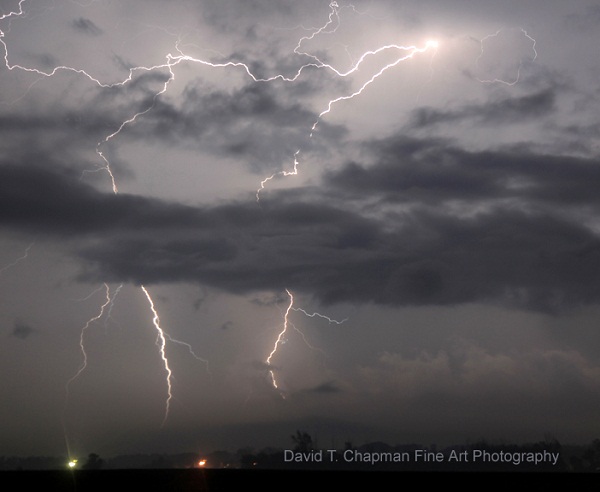
Cloud to Ground Lightning: photographed by D. Chapman
My chase partner is David Chapman. David and I both grew up within minutes of each other but never met until recently due to the power of twitter. From twitter I was able to glean that we both have similar interests and goals which will allow us to mesh well together. [ Check the hashtage #WX on twitter for tweets related to extreme weather CP ]
Hello Silo readers. My name is David T. Chapmanand I am a professional photographer with a passion for storm photography. I developed an interest in weather when lightning hit my house in Guelph, Ontario, years ago. The thunder was terrifying and the rain was so heavy that even though I was only three years old at the time, I have clear, vivid memories of the storm. My interest in weather was rekindled in the late 1990’s when I spotted my first multi-vortex tornadoes with my dad and brother. Since then, I have followed the weather every day to determine the best time for photography in all kinds of conditions.
Waaaay back in 2011 , the Ontario storm season was an active one. It allowed me to get a personal record number of lightning photographs in one season with 105, not including sheet lightning shots. My first storm was in April, when a very weak storm pushed into the Niagara region. Something that you don’t see very often is a thunderstorm with snow on the ground, but that night I had both. But the storm chasing season really didn’t start seriously until the end of May when an evening storm rolled through Southwestern Ontario right into my area. The squall line formed directly to our west and there was no way around it. We had to puncture the core of the storm to try to find a dry slot. We were hit hard with heavy rains, strong winds and continuous lightning.
Anvil Crawler: photographed Southeast of Hamilton, Ontario image: D. Chapman
One of the hardest things to get is a lightning photograph when there is a downpour because it blurs the image. The first line of storms went through when we crossed an open field area and then we were hit by a strong second line of storms. Extremely strong straight lines came at us with winds easily in excess of 90 km/hr. We got into position, but unfortunately, with the rain still pounding our photography team, it made it impossible to get crisp, clear lightning shots. It wasn’t until after the storm had passed that the back end of it lit up and we were able to capture some very beautiful lightning.
The summer carried on with sporadic thunderstorm activity consisting of small thunderstorm cells with intense lightning and hail. Generally, with smaller storms, you only get 4 to 5 lightning shots. I’ve come back after chasing a storm perfectly with only 1 or 2 lightning shots to show for it. It wasn’t until the outbreak of thunderstorms that our team had a very successful night of shooting. On that night, Faith Beni and I ended up in St. Mary’s, Ontario. There were tornado watches all across Ontario, the most I had ever seen. The thunderstorm cell that we were interested in was towards Nairn, Ontario. We left the Niagara region at 5:30 p.m. and got to St. Mary’s around 7:45 p.m.
Without daylight left, the thoughts of getting a tornado quickly changed to an opportunity for lightning photographs instead. One of the most dangerous things to do is to chase a tornadic thunderstorm in the dark, which is why our team has a policy to not chase these types of storms at night. We tend to focus on weaker storm cells that don’t have the tornadic potential but still have lots of lightning. The night of the 24th, though, was different. It seemed that any storm cell had the potential to drop a tornado. We pulled back to St. Mary’s and then we started getting reports of rotation heading to St. Mary’s.
In just under 2 minutes, I saw 4 reports of rotation for St. Mary’s. We started to get pounded with large hail and the the hydro went out. We left St. Mary’s and pushed north towards what looked to be some late evening twilight. We got to the back of the storm and were able to photograph the lightning that was in it. We got some of the best anvil-crawlers that I have ever seen. Anvil-crawlers are a particular type of lightning that can either go for short distances or for distances over 100 km.
This year for the first time, Spencer Sills and I will be working together to get some very powerful images. Our biggest goal is to get a photograph of a tornado. Last year, I was close 3 times. The first was in Grimsby, where an EF0 hit and damaged a small gazebo. Eric Chapman and I were right on the storm but unfortunately we could not see the tornado because of heavy precipitation. The second was the Nairn tornado and the third was a rotating wall-cloud that I photographed towards Bryson, Quebec.
Spencer and I often hear about how tornadoes don’t happen here. We want to let the public know that they can and do occur here, in South Western Ontario so that watches and warnings should always be taken seriously. The Goderich tornado in 2011, in which one person died, is a grim reminder of just how intense tornadoes can be and that they do, in fact, affect Ontario residents.
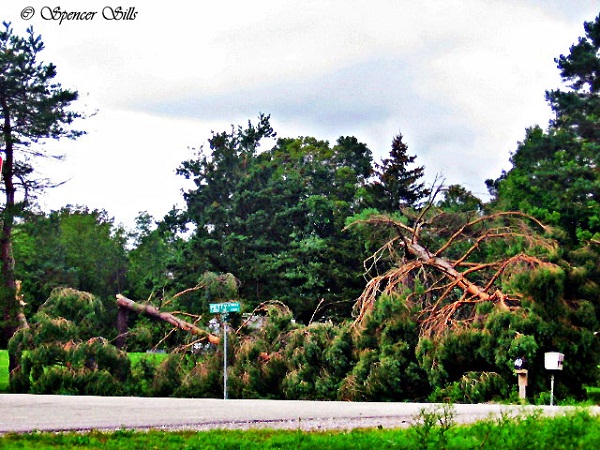
Photo shot in Nairn, Ontario. Tornado damage in Shady Pines Campground in Nairn. A tornado touched down the previous night and bent these pine trees in half, the tornado also caused extensive tree damage in the area as well as damaged a house and destroyed a metal silo. image: S. Sills
David and I both have experience in chasing storms, and take safety very seriously. We will be travelling with a First Aid kit just as well as weather alert radios and radar to help us along our way, we hope that we don’t ever need the kit but it’s always a great idea especially if others are in need of help, we could very well be the first people on the scene of a possible tragedy so we must be prepared. We will be posting pictures and videos throughout the season but do not recommend that anyone attempt to recreate either of them and place themselves in danger.
I will be working with David Chapman in hopes to help warn others as well as capture these storms through video and photography to share with others who may not get to experience them. We are ready to combine our passion for storms to get the best results possible and share those results with others.
Attract attention to your feet with these two new VENUS additions to the 2568’s collection.
Are you a shoe junky? If you are, you might take a special interest in 2568’s men’s and women’s new footwear line.
These shoes are comfortable classics with a twist: moccasins, loafers and boots, ballet and pointy flats, in unexpected materials and pattern featuring distinctive fabrics and leathers. Unique details also include colorful laces and decorative tassel bows. 2568 Shoes http://2568shoes.com are inspired by Guatemalan creativity found in garments, handbags and small leather goods.
Fun,bold and funky colour patterns. The Venus line from 2568 Shoes.
The Venus loafers and Vanessa flats come in five different patterns with colors ranging from dark blues and blacks to reds and oranges. The colorful fabrics can make any outfit and can easily transition throughout the seasons.
The Vanessa line from 2568
Sizes range from 8.5 to 12. Price points range from $79 [USD] and up, and for every shoe purchase, 2568 will send a free Guatemalan friendship bracelet. About the owners: Lorenzo Castellon is the Manufacturing/Business Manager and Jamie Lawenda is the Creative Director. The couple met on a job interview and thirty years later are married, have a child and own a sourcing and shoe Design Company.
Another Vanessa example
At first they created shoes and boots for other brands, including Sendra, a Goodyear welted high-end line of leather boots made in Spain. The couple continues to design and sell Sendra in the US.
The SAMOSA boot has a decidely Guatemalan influence. #goodlooking #boot
Cross-border shopper alert! The Venus loafers and Vanessa flats can be purchased at PiperLime, ThomShoes, ShoeInn and FreePeople. The Newman is available in four other colors: patent leather black and red, silver snakeskin embossed leather, and white leather.
Every year the landowners of Ontario’s watershed areas collectively plant tens of thousands of trees. These trees help to restore the natural environment by protecting water quality in streams and rivers, providing wildlife corridors and purifying the air we breathe.
Unpredictable weather patterns mean it is even more important to keep planting trees. A number of crucial steps before and after planting will improve survival.
Right tree, right place
Factors such as soil texture, drainage and surrounding vegetation determine which tree species will thrive or die. Fine clay soils can hold trees like white cedar and Norway spruce. On the other hand, loose sandy soils are well suited to white pine and sugar maple. Silver maple and tamarack like wet sites, while larch and red oak will thrive in drier locations.
Road salt can contaminate the soil, but trees such as white spruce, larch and poplar have a higher tolerance for salt and these species are best for roadsides.
Site preparation
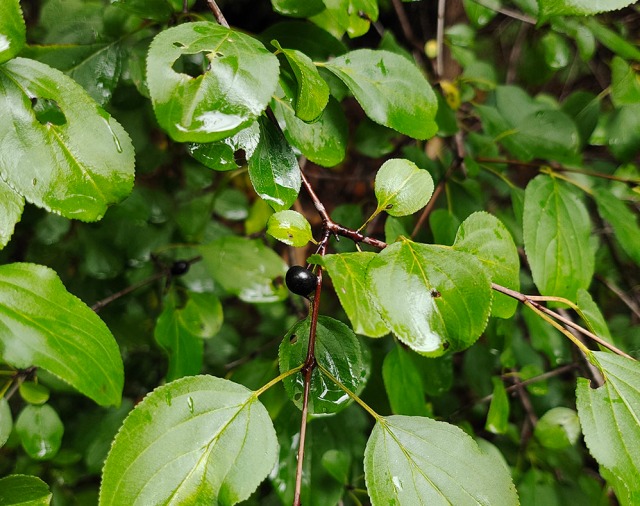
European buckthorn – Rhamnus carthartica
Preparing the land before planting will provide the best growth conditions for your trees. Clear areas of brush and invasive plants, such as European buckthorn. On larger sites, this can be done with a brush saw or a tractor and rotary mower to remove obstacles and provide growing space. Installing plastic mulch before tree planting is a great way to reduce weed competition and hold moisture in the soil. If planting into bare soil, seeding a cover crop of Dutch white clover is a great way to prevent excessive weed growth.
For the first years, control vegetation around the trees to make sure they have room to grow. This will give the trees the best chance of survival.
Click me to learn about Tree Planting incentives 🙂
Get trees into the soil quickly
The roots of bare-root stock (without soil around the roots) will dry out very fast when exposed to sun and wind and need to be planted very quickly. Keep these trees in their planting bag until they are directly planted into the ground. Potted trees can be kept in a shaded area and watered until they are planted.
Mulch madness
Mulching is one of the best ways to keep your trees growing well. Organic matter applied to the base of the tree acts as a blanket to hold moisture, protect against extreme soil temperatures and reduce grass competition. Make sure to place mulch in a donut shape around the tree, so that absolutely no mulch is touching the base of the tree. This can cause decay of vital root-collar tissue. A two to four inch layer of mulch at an inch or two away from the trunk is enough.
Water, water, water
For the first few years of growth, a tree expends a lot of energy trying to establish roots in the soil. Watering can be very important during this time if rainfall is sparse. Water the tree right after planting and weekly during hot, dry weather. But be careful not to over water, because soggy soil inhibits the tree roots from accessing oxygen. There are many circumstances when watering is difficult due to distance from a water source or the number of trees planted. For the Silo, Lisa Stocco.
A major money saving and environmentally beneficial smart kitchen app launched waaaaay back in 2015, on World Environment Day, and deserves another look as it still works well and saves users up to $1,000 every year and helps reduce food waste.
The “Smart Kitchen” EatBy App reduces food waste, saving households up to $1,000 per year and helps the environment.
The staggering amount of wasted food continues to make headlines and back when the app was first created, husband and wife developers, Steffan and Barbara Lewis were focusing their passion for finding a solution to the environmental issues surrounding food waste and came up with the idea to develop and launch “Smart Kitchen” EatBy as soon as possible.
“We had the idea one lunchtime after we had to throw out the food we’d hoped to eat because it had passed it’s use by date. That led to a purge of all the out of date food in our kitchen. And quite frankly, we were shocked and disgusted with ourselves when we realised how much we waste.” said Barbara Lewis.
They decided to make the app free to download and offer expanded use with an optional shopping list that can be activated with an in app purchase.
“It’s important to us that the app’s basic functions have to be free in order to gain and benefit the maximum number of users. Collectively we can all make a huge difference to the environment. And it’s an added bonus that we’ll save around £700 ($1,000) each year.”
And the numbers add up.
Recent reports state that the average household wastes $80 usd ($109.23 CAD) every month on un eaten food. With over 123 million U.S. households that’s $9,840,000,000. Factor in similar habits throughout the rest of North America and an equivalent amount in Europe, the tally is somewhere around a staggering $236 Billion each year. It’s known that about one third of all food produced is discarded but the real cost to the environment is misunderstood: 1.3 billion tonnes of wasted food contributes 10% of worldwide total greenhouse gases.
Many strategies for reducing food waste have been proposed by environmentalists, government agencies and industry specialists. But the husband and wife creators of the EatBy App claim their app is the first practical personal tech solution to the problem of food waste. It is a simple to use Smart Kitchen App that effectively helps manage the food in your kitchen and lets you know when food items expire. The optional integrated shopping list will also help reduce buying too much food in the first place.
“We are under no illusion that our app will immediately solve this global problem,” Said Steffan Lewis, “But if only a few million people download and use it, then it’ll already make an impact and that’d be a great start. Obviously, we’d like everyone to use our app and benefit from it!”
The EatBy App is available for both Android and Apple devices. More information about the project’s history can be found at https://www.eatbyapp.com
QUEEN’S PARK – Haldimand-Norfolk MPP Bobbi Ann Brady has introduced legislation that, if passed, will protect Ontario’s farmland.
“Land use planning affects our daily lives and Ontario’s farmland and arable land is an essential resource for the sustainability and security of our food systems, environment and local economies,” Brady said. “Farmland and arable land is productive, valuable and essential but most importantly it is finite and non-renewable, which is vital to consider in the face of increasing pressure to develop housing in the province.”
With Ontario having 52 per cent of the country’s prime arable land, and much of that being adjacent to cities, Brady said protecting these lands should be paramount. Further, according to census data, Ontario is losing 319 acres of farmland each day. Brady feels this is unsustainable. Constituents in Haldimand-Norfolk have also raised this same concern with the MPP since well before her election.
“As the government continues with its target to create 1.5 million new homes in Ontario, it is vital to put in place policies that will protect our farmers and their land, as well as the province’s food security, both now and in the future,” she said.
The bill requires the Minister of Agriculture, Food and Rural Affairs to develop a strategic action plan that aims to protect Ontario’s farmland and arable land from development, aggregate mining and the effects of fluctuating commodity prices and the availability of vacant land. It also stipulates a stakeholder-led Farmland and Arable Land Advisory Committee be set up to advise the Minister of Agriculture, Food and Rural Affairs. For the Silo, Jeff Helsdon.
The bill will be back before the Legislature for second reading debate on March 8.
For more information, contact MPP Bobbi Ann Brady directly at 519-428-0446 or 905-765-8413 or babrady-co@ola.org Please mention The Silo when contacting.
Screenshot from waaaay back in 2010 and from an Ontario Lottery Gaming commercial. The premise? You’re stuck in a desert in a stalled car with a giant robot attacking. But then you remember what’s in the glove compartment…watch the video below and realize that counting on a lottery win is not the best way to financial security.
Maybe you’ve seen the ad, or one like it? For example-an Ontario Lottery Gaming commercial that depicts an attractive woman climbing out of bed, enjoying a leisurely cup of coffee before climbing into the cockpit of a sailboat, the implication being that if one wins a multi-million dollar jackpot, one can have the “yachty” lifestyle.
As I write this, I am sitting in the cockpit of my sailboat sipping a cup of coffee while enjoying the morning sun, and I have never won the lottery. In fact, I will be going to work at my average-guy, average-wage job shortly. Then, at the end of the workday, I will be returning to my sailboat, to enjoy the sunset.
For several years my wife, and I, and our dog, have spent the spring, summer and fall aboard our small sailboat. We return to our “dirt-home” only occasionally, to do laundry, mow the lawn so the neighbours don’t complain, collect mail and make sure the place hasn’t burned down.
This is the view that Bryan enjoys along with his ‘dock coffee’ at the Port Dover Harbour Marina. photo: B. Jones
After all, we need some place to live when the water is too hard and too cold to float a sailboat.
When new acquaintances find out that we are sailors and dock-rats, we often hear, “Oh, I have always wanted to sail!” or “I have always wanted to live on a boat!” What follows is often an enjoyable conversation about how to make it happen, how to “live the dream.”
I will confess, though, when hearing “Oh, I have always wanted to…” that the curmudgeonly little voice in the back of my head wants to retort, “No, you haven’t. If you really did, you would be doing it.”
Because it ain’t that hard to do.
We’re not rich. As I mentioned, my wife and I are pretty average people. Average age, average income, average credit scores, average sized mortgage, kids in college… look up “average” in the dictionary, and you don’t see our picture, because there are millions of folks just like us, and somebody way up the line got the honour.
We made a choice. We chose to buy a good, old boat for a mid-four- figure sum, invest a few hundred bucks a year on maintenance and a few hundred more on a slip to dock it in.
Our boat cost less than the annual membership at many golf clubs, and our slip fee for 6 months is less than a two week cottage rental in Turkey Point.
Bryan’s solution to beating the heat is to leave the dock and sail into the wind.
(Okay, before you start pelting me with hate mail, there’s absolutely nothing wrong with golf or vacationing in Turkey Point. Really. Except the clothes. KIDDING!)
It isn’t all fun and games and Jimmy Buffett tunes though.
Before you dash out and buy an old boat, here’s ten things my wife and I have learned over the past few seasons:
1. The stuff that bothers each of you about each other in 2000 sq ft on land does not magically go away in less than 200 sq ft on water. Learn to communicate, consider and compromise.
2. If you take it out, put it away. Now.
3. Each new item onboard means an old item has to leave.
4. Its okay to not talk.
5. One cooks, one does dishes. Helping doesn’t help.
6. When the dog needs shore patrol, the dog. Needs. Shore. Patrol. Now.
7. Find your own quiet spot, whether it is the v-berth, quarter berth, foredeck or cockpit.
8. You don’t have to get there today. You don’t even have to get there tomorrow.
9. When docking, mooring, anchoring, tacking or damn near anything goes awry, talk it out, and then hug it out.
10. There is a difference between being heard, and yelling.
We live in a slip on a dock with no services. No electricity and no water (aside from that which the boat floats in, smart-alecks,) means we have to refill our onboard water tank from 6 gallon water jugs hauled up the dock a couple of times a week, heat water on our alcohol stove to wash dishes, use solar panels to keep our batteries topped up and we don’t have air conditioning, or a microwave, or a big flat screen TV. A shower is a 10 minute dinghy ride or 15 minute walk away.
And we’re cool with that. We have become better, more creative cooks, we read more, we talk more, and the sunsets here and the characters we share them with more than compensate. We have talked more, laughed more and shared more with our dock-side neighbors than we ever have with our neighbors “on the dirt.” Our house is a house, but this is our home. For the Silo, Brian Jones.
Agrarians from various ancient cultures around the world discovered the soil fertility benefits of charred biomass over two thousand years ago.
Now known as ‘biochar’, this ancient soil management practice has been enjoying a renaissance of late for a number of reasons largely related to the need for more resilient and productive soils and biochar’s ability to sequester carbon in a safe and beneficial manner.
Biochar is made by baking organic material in an oxygen-limited environment, called pyrolysis. Benefits vary depending on the soil, crops and climate where biochar is used with poor soils benefiting the most. Providing long-lasting organic material, improving water and nutrient holding capacity, and improving overall soil tilth are all potential benefits.
Due to its porous nature and cation exchange capacity, biochar can also be used as a filtration medium to prevent nutrient run-off from farms into local water bodies. In Europe livestock farmers are adding small amounts of biochar to feed rations to improve feed conversion ratios and overall animal health. Biochar as carbon fodder has also shown promise as a way to reduce enteric methane emissions.
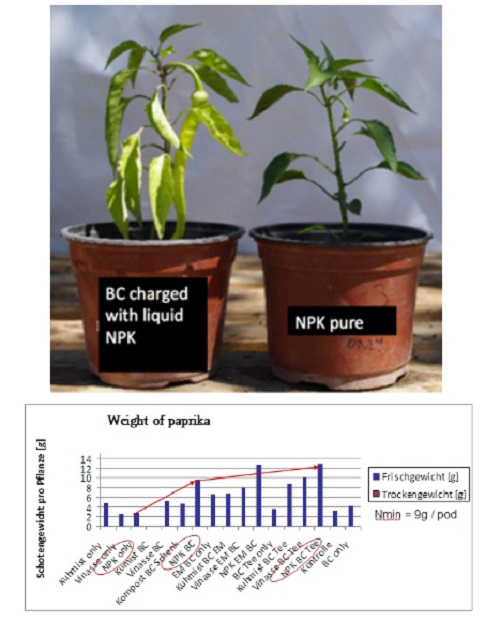
“When we first started in 2011 to load biochar with high amounts of liquid NP-fertilizer and tested them in pod trials, we could prove reduced nutrient leaching after simulated strong rain events. When we planted a second culture (paprika after radish) in the same pods without additional fertilization, plant growth was significantly improved in the biochar treatments (see image). From an economic point of view, the difference in growth might have been not relevant as some additional fertilization would have been cheaper than the price of biochar that saved some mineral fertilizer. However working with low amounts of nutrient enhanced biochar [1 t per hectare] applied as slow release fertilizer close to the roots every year seems very promising when viewed from both an economic and ecological perspective. ” Ithaka Institute
Biochar is increasingly available to purchase but farmers can also convert their on-farm waste biomass in to biochar.
Farm scale equipment for making biochar is evolving and shows promise not just as a waste conversion technology which produces a valuable soil amendment, but also as a means for farmers to generate renewable energy in the form of heat, and in some cases electricity. For the Silo, Kathleen Draper.
Seen here: “…we focused on organic plant nutrients and started multiple tests with a wide variety of nutrient rich biomass wastes including: liquid animal manure, urine, feathers, yeasts, wool, vinasse etc. Over the past four years we have developed a panoply of organic carbon fertilizer that can be produced commercially or manufactured by farmers themself all over the world. One of our favourites is the sheep wool, vinasse, pyrolyse ash, biochar pellets with 7% Norg / 6.5% P2O5 / 6% K2O “
Kathleen Draper is the US Director of the Ithaka Institute for Carbon Intelligence, a non-profit focused on research, education and program services that promote climate positive solutions which enhance land management, urban design, and resource efficiency.
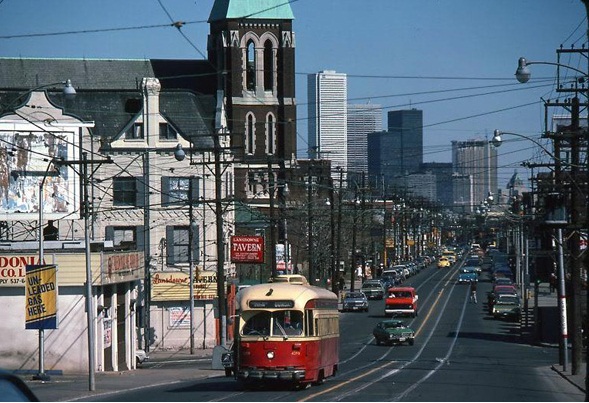
I am sure that many of you will agree that the streetcars that rumbled through Toronto from 1800s until… let’s say 1990’s helped shape many neighborhood. They were the most effective way to connect Toronto’s core with its suburbs and greatly encouraged development of the communities as new grocery stores, restaurants, galleries, shops and banks as amenities have been built near the streetcar lines.
Standing in the middle of road, going nuts being stuck behind a streetcar, it is sometimes difficult to appreciate how important role they have played in the city’s history.
First Streetcars in Toronto
Inspired by the success of horse-drawn streetcars in the U.S., Alexander Easton’s Toronto Street Railway company started operating in 1861. New rail lines played a vital important role in connecting the city centre with its sleepy suburbs. What started as an enterprise with 6 miles of track and 11 cars, turned slowly into 68 miles of track with 361 street cars. The company expired in 1891 and the management was turned over to the Toronto Transit Commission (TTC).
The next company to take control over the system was the Toronto Railway Company, under which first electric streetcars were introduced. All services were later taken over by the Toronto Transportation Commission, which was later renamed to the Toronto Transit Commission (TTC).
Building street car tracks on Bay St. Toronto circa 1918
However, even streetcars had their bad times. In the 1960s they were almost abandoned when people thought of it as an outdated mode of transportation. Thirty years later it fell upon hard times once again because of budget cuts, the recession and its inability to service the rapidly-growing parts of the city.
It took months for the TTC to pull itself out of its bad times, but streetcars somehow managed to return back to their previous fame. Since then, the company’s services have been improving every year, but there are still some issues. Let’s take a look at the current state of the streetcar rail services in Toronto, its advantages and the most annoying faults.
The Ashbridges Bay street car line 1917.
Present
Although the number of streetcars crossing the city declined in the latter half of the 20th century, they never disappeared completely. In fact, streetcars have become a vital part of Toronto’s history and nearly every citizen’s life. Nowadays, the city owns 247 streetcars, of which 52 are higher-capacity articulated streetcars. These operate over 11 routes, serving a total of 617 stops over a system length of 75 kilometers. These numbers make it by far the largest surface rail system in North America.
Public transportation in Toronto relies heavily on streetcars in the downtown core which is the thin red lines you see on the TTC map above. Technically, they’re light rail trains, but locals refer to them as streetcars. Each line usually follows a street e.g. 501 Queen St., so it shouldn’t be too hard to get on the right vehicle.
Done right, streetcars can really encourage the overall development of the city, they are able to define whole neighborhoods, reduce traffic congestion, reinforce retail, bring life to streets and fit easily into the surroundings without disruption to existing businesses, residents or traffic.
Pros
One of the main advantages of streetcars is its high passenger capacity. Streetcars carry between 75 and 100 people per vehicle.
Regarding energy efficiency, streetcars are believed to do a little bit more for the environment that other public transport systems. Because every streetcar user means one less car on the road, words such as clean air quality, for environmental sustainability, for climate protection are often associated with streetcars. In fact, nothing drops greenhouse gas emissions faster than effective rapid transit, so if we truly want green for Toronto, streetcars might be the answer.
Another argument made in favor of streetcars is their long lifespan. The vehicles are designed to be very durable and can keep running for over 30 years. In contrast, buses wear out after just 8 – 12 years.
One of the “last” Toronto street cars. image: blogto.com
Since they are longer-lasting than other means of transport, the cost of repair and replacement is typically also much lower.
One ride costs $3.25, making it a very cheap transit option across the city. At the same time they are relatively fast to build, without impacting the city for a long period of time and resulting in minimal disruption to the neighborhood.
Streetcars can be so charming. Well, this is a subjective opinion, but have you seen vintage trolleys in San Francisco or New Orleans? They’re so awesome.
Cons
There are two sides to every coin so we have to mention disadvantages of streetcars, too. Once again, let’s talk about their passenger capacity. Even though they carry a relatively high number of passengers, the difference between a streetcar, LRT and subway is noticeable. Just for comparison, a subway train can hold up to 1500 passengers and an LRV can hold up to 255 people in a single vehicle (depending on speeds, frequency and actual vehicle length and capacity).
Next, streetcars require “loops” to turn around, which slows them down. This is not the case with cars, LRVs or subways.
Streetcars are noticeably slower than cars as they are travelling at speed of about 17km/h. LRVs run at an average of 27km/h and subways at 32km/h.
Streetcars are said to contribute to traffic congestion greatly. Imagine a situation when a streetcar stops to let passengers load on or get off. In such situation, both lanes at of traffic are blocked. This causes delays and angst among riders. If you’ve ever driven behind a streetcar, you know how much of a problem this is. You have nowhere to go, unless you stand far back enough to turn your car around.
At certain times they may pose danger to both passengers and pedestrians. For example, when cars try to pass them before they stop.
When it comes to costs, it is important to distinguish between the cost of laying down streetcar tracks, maintaining the streetcars themselves and maintaining roads. Streetcars require a whole lot of special mechanics and thus the cost of maintenance is much higher.
And let’s not forget about pollution. You might disagree with a statement that streetcars are a reason behind increased pollution in our city, but if you think about it for a second, you will realize there is some truth in it. Since it creates traffic congestions, it also adds to pollution.
Future of Streetcars
Even though many people are getting more and more angry at streetcars, they are not going anywhere. When (then Mayor) Rob Ford tried to cancel the Transit City light-rail-plan and build tunnels underground in some parts of the city, city council decided to keep new transit lines above ground. The main reason behind this decision was the cost of tunneling and powering subways.
And for those unhappy citizens who are queuing up behind streetcars every morning, the least Toronto could do is indicate that they are keeping an open mind about new subway lines. And let’s not forget that the city intends to build and operate new light rail transit lines, which means that people will be able to travel in new dedicated lines, separated from motor vehicle traffic. For the Silo, Jamie Sarner.
Emerging soon- the Cecropia caterpillar takes two months to develop before forming their cocoon which has to last an entire winter.
The Cecropia Moth is North America’s largest native moth and is a member of the giant silk moth family. It can be found in all Canadian provinces except BC and Newfoundland. The wings are reddish brown, and crossed in the middle with a white band. In the middle of each wing there is a crescent-shaped white spot bordered with red. The moths can have a wingspan up to 160 mm (6 inches!)
Females have a large abdomen for egg production, and males have hugely feathered antennae to detect the pheromones that the female emits. The male is capable of smelling the female from over a kilometer away.
Once mated, the female will lay her eggs near host trees. Typically they choose maple trees for their host, but they can also be found on other trees like Birch, Alder, Apples and Willow. The eggs will hatch in about 2 weeks and the newly born caterpillar will eat its eggshell.
Young Cecropia larva are shedding their ‘skin’. image: courtesy www.wormspit.com
The Cecropia larva (caterpillar) has two rows of blue tubercles along each side, two rows of yellow tubercles down its back, and two pairs of large red tubercles on the thorax. It takes the caterpillar approximately 2 months to reach full size at which time they will find a dark secluded place to attach themselves to a branch or stick and form their cocoon. This cocoon will overwinter and the adults will emerge the following spring.
Adult Cecropia moths do not have mouth parts and thus are unable to eat. As a result, the lifespan for an adult is generally only about 7-10 days. For the Silo,Dixie Greenwood.
Used and broken electronics such as computers, cellphones, dvd players, washers and dryers still hold intrinsic value because if you were to peer inside these things you’d notice a lot of wire and circuitry. There is a surprisingly substantial amount of copper, silver and gold waiting for “the recycling”.
Consumerism- the acquisition of goods, is largely based today on electronic devices- large screen televisions or smartphones for example. Many of us feel the need to upgrade regularly: bigger screens for our living rooms and faster and more powerful phones. But in broad terms, our discarded electronic goods contain about the same amount of silver, copper, gold and platinum as the new items we are replacing them with.
How much value are we talking about?
It is difficult to determine an exact value of gold and other precious materials in an average cellphone. This is because no two models are exactly alike, no two batteries are exactly alike.
Lux Bringer from reddit.com:
All of a sudden these, “bring your old cellphones to us so we can recycle them for you” campaigns are making a lot more sense. Sneaky bastards.
PtrN from reddit.com:PtrN
I’m not sure. I’m seeing that the average cell phone has 1/8 a gram of gold in it from other comments. At the time of this writing, CNN currently has gold going at $1650USD per troy ounce. I crunched the numbers and am seeing that there is about $6.60USD worth of gold in a cellphone. Not too bad, but I don’t know how profitable it will be after you take into account the costs of transportation and the extraction process itself.
Thoust from reddit.com:
There are other materials in a phone they can salvage besides gold
professor_fatass from reddit.com:
According to the article you also get platinum, palladium, and copper. As well as the glass and plastic which may not be worth much but it can still be recycled.
There is gold and platinum inside computer circuit boards and hard drives. Most of the gold is an alloy or plated over another metal but at highs predicted to reach near $1,8000USD per ounce- a high volume recycling effort will pay off.
Bleepin’ Animinion from bleepingcomputer.com:
Any, true recycling effort that would be of a profitable nature needs to be EPA approved. Due to the multiple hazardous materials mixed in with the minute amounts of precious metals. As well as the highly toxic removal and heavy metals separations processes. Also as an example it would take an average of one ton of random circuit-board waste to generate one pound of gold. Add to that electronic grade precious metals are not the expensive jewelry grade high dollar metals. Therefore looking at the gold market is not the price you would get. So the profit you would make on the precious metals would be eaten up by the fees and expense of waste disposal of the one ton of hazardous useless waste product left behind after you reclaimed the precious and hazardous heavy metals. This is definitely not a a project to undertake on a small scale in your garage.
This last quote is an important thing to consider.
If you are considering dropping off your scrap electronics and appliances ask the receiving party if they are environmentally approved and a member of an Electronic Stewardship. After all, your discarded electronics will earn a tidy sum of money for a large scale salvager. The least they can do is operate within the law and operate with an environmental conscience. But there is some worry.
The salvagers are looking for an uninformed public- they set up their marketing and advertising in a way that makes no mention of the economic benefits they stand to make.
They seldom if ever offer you a small stipend for your ‘donated scrap’ and perhaps even worse, many pose as “good deed” companies ridding us of our “broken goods” destined for the landfill. The Ontario Electronic Stewardship is a non-profit group that overseas responsible recycling of electronics. This Stewardship works with existing legal frameworks put in place by Waste Diversion Ontario and the 2002 Waste Diversion Act. www.wdo.ca
In this file photo from 2001, a migrant child sits atop a pile of unrecyclable computer waste imported to Guiya, China, from other countries.
Basal Action Network
Some players are keeping it real.
Not every electronic device recycling campaign is shady. Increasingly, not-for-profit groups and volunteer fire departments are setting up large recycling bins with signage such as “your donated scrap metal and electronics helps fund X”.
If you are considering dropping off discarded electronics to your local “recycling and scrap drive” ask a few questions. Where are the profits from the salvaged materials going? Is the company operating the drive aware of the Ontario Electronic Stewardship guidelines? What happens to your donated goods at the end of the cycle- are they destined for a landfill or for China?
It has been estimated that as much as 70 percent of all marine litter will end up on the seabed.
Marine debris comes from many land and ocean sources. Yet few of us understand that our trash can travel over land, down streams, rivers and storm drains to the ocean. That’s why Project AWARE is collecting marine debris data from divers. They’re painting a clear picture of the underwater trash that threatens ocean life and are building a case against ocean trash for all of us to see.
Natural gas is an important fuel used for heating and cooling in more than half of all North American homes. But methane, the key component in natural gas, is highly explosive and can become deadly when uncontrolled. Back in 2014, a natural gas explosion in two apartment buildings in New York killed eight people and injured 70 others.
Natural gas is composed primarily (95% or more) of methane, a colorless, odorless, non-toxic flammable gas. Methane is emitted from natural sources such as wetlands and also from industrial and agricultural processes.
Because methane is odorless, an additive known as mercaptan, or methanethiol, is added to natural gas to make the presence of methane detectable. Mercaptan additives contain sulfur, which is the reason natural gas smells like rotten eggs. Exposure to mercaptan can result in a variety of adverse health effects, including irritation of the eyes, skin and respiratory tract. Natural gas can also contain small amounts of potentially harmful volatile organic compounds (VOCs) such as ethane, propane, butane and even toxic compounds such as benzene and toluene.
Methane cannot be filtered. Mercaptan and VOCs can. Unfortunately, methane is not just dangerous – it’s also unfilterable. Adsorption and chemisorption, the two processes by which gas and odor air filters remove chemicals from the air, are ineffective against methane, which has an extremely low molecular weight. As a result, the only effective strategies for reducing indoor methane levels are source control/reduction and increased ventilation.
Mercaptan and VOCs, however, can be efficiently filtered with a high-performance air filtration system with a combination of high quality activated carbon and potassium permanganate – such as the IQAir HealthPro Plus or GC MultiGas (at right) room air purifier. The activated carbon provides adsorption of VOCs, and the potassium permanganate provides excellent chemisorption of mercaptan and many other VOCs, such as formaldehyde. The combination of these two filtration media is ideal.
The IQAir HealthPro Plus Air Purifier- made in Switzerland
Importance of monitoring methane levels.
Because methane is so highly explosive, high-performance air filtration to remove the odors associated with natural gas (mercaptan) is not recommended unless sufficient monitoring with a methane detector has determined that levels are safe. Methane detectors, also known as explosive gas detectors, can be purchased at hardware and home-supply stores.
This article is brought to you by The IQAir Group, friends of the Silo who develop innovative air quality solutions for indoor environments around the globe. IQAir is the exclusive educational partner of the American Lung Association for the air purifier industry.
With the imminent arrival of Autonomous Vehicles, many people have started worrying about the safety of this new technology, especially when an issue arises to do with choice.
In this piece, we’ll delve into the issue of the “Trolley Problem” and how AVs will deal with this and whether all manufacturers have the same stance.
Infographic courtesy of our friends at selectcarleasing.co.uk
Humans possess a great depth of capacity when it comes to altruism. Again and again, we demonstrate our tendency to reach out when others are in distress. Cultivating these instincts is one of the ways in which we connect with our own humanity. Studies have indicated that altruism is not entirely innate. Environment plays a key role in the development of the qualities of altruism. Practicing this trait strengthens not only our own individual ability to extend hope and help to our fellow species, it allows us to explore more deeply our own inner kindness.
“Every man must decide whether he will walk in the light of creative altruism or in the darkness of destructive selfishness.” –Martin Luther King, Jr.
Mark Guglielmo had just finished an exhibition at Villa Victoria Center for the Arts in Boston, Massachusetts when he decided to emphasize what he felt was a missing ingredient in today’s society- altruism. Guglielmo’s work tries to emphasize this message by piecing together photo collages to form a larger image. For another show, he used photos from his time spent in Cuba. To complement the work, Guglielmo conducted interviews which were then incorporated in the exhibition. The particulars of the work involved thousands of photographs. Guglielmo captured detailed images of every nuance of a person, place, or thing. From these, he painstakingly compiled what he refers to as “a 1000-D version of reality.”
A natural storyteller, Guglielmo says the audio portion of his work was important to transport people to Cuba. Guglielmo witnessed the changes to the island nation. He decided to record the perspective of the Cuban people when it came to the changes to their relationship with the U.S. Guglielmo kept his conversations informal and allowed Cuban residents to drive them in order to keep them safe from government targeting for speaking out.
The conversations revealed the daily lives of Cubans often in the context of wealthy western tourists vacationing in the shadow of extreme poverty. Political tensions between the U.S. and Cuba have interfered with plans to show the work there.
Bucanero en Playa Ancon | Buccaneer at Ancon Beach, Trinidad de Cuba, 2017, Photo-mosaic, 46 x 68 inches
Frank Juarez is the co-founder of the Randall Frank Contemporary Art Collection and project manager of the Randall Frank Artist Grant Program. Juarez says the Randall Frank collection began quite organically. Juarez and his high school and college friend Randall shared a lifelong affinity for art. When they wanted to work together, art was the common theme they shared. Together, they began a collection and strove to support artists from their area. In the early days, they worked under a tight budget, purchasing art quarterly and storing them in Randall’s home in Richmond, Virginia. The two began looking for opportunities to sponsor art events. Their first endeavor in this capacity was a mural project in Milwaukee’s Black Cat Alley. Randall Frank Contemporary Art Collection (RFCAC) hopes to one day create a public space where they can house their collected art and make it available to the public.
As they became more established, RFCAC decided the best, most direct way to support artists was through a grant program. RFCAC’s pilot program seeks to support artists in the Midwest and east coast regions of the U.S. The grant is presently privately funded. Juarez works in many capacities within the art world. He is a gallery director, curator, and educator. Randall works in the private sector as a chemist.
A Few Words to Keep in your Pocket: Soften your heart and open your mind to the possibilities of altruistic behavior.
For the Silo, Brainard Carey.
Featured image– Induction #1 by Tony Conrad (l) and Katrina by Rob Neilson (r) courtesy of Museum of Non-visible Art.