All posts by The Silo

Balance Holiday Tables Loaded With Unhealthy Food With Green Smoothies

Chef Shelley Alexander. A big fan of "start your day off with a green smoothie". We like that idea.
Chef Shelley Alexander is a big fan of “start your day off with a green smoothie” even if that day is Christmas morning.

For many people, the holidays involve indulging in buffet tables loaded with lots of fattening, processed foods and sugary sweets.

For those of us who strive the rest of the year to eat a healthy diet while leading busy lives, it can be a challenging time. Not only are we busier than ever, we know that all those foods we usually try to avoid are going to give us indigestion, sap our energy, and pile on the pounds.

“It really isn’t hard to give yourself, your family and friends the gift of delicious, nutrient-rich meals over the holidays,” says holistic chef and certified healing foods specialist Shelley Alexander, author of “Deliciously Holistic,” (www.aharmonyhealing.com), a new, full-color cookbook featuring more than 154 of her favorite healing foods recipes and 50 pages of holistic lifestyle tips to increase energy and immunity.

“Instead of heading to the local supermarket, visit a farmers’ market, where you can buy fresh, local, seasonal and organic produce, along with other nutritious foods created by farmers and local food artisans,” she says. “You’ll have a much more enjoyable experience in addition to stocking up on all the ingredients you need to have handy. You can also find excellent choices at natural and health food stores.”

Nutrient-rich, whole foods that don’t have unnatural fillers and other additives, including seasonal, organic vegetables and fruits, wild-caught
seafood, and pasture-raised, organic chicken and meats that come from well-fed, unadulterated, healthy animals, will completely nourish your body, make you feel better and ramp up your energy, she says. And you’ll find you won’t overeat, so it’s much easier to maintain your weight without counting calories.

We were disappointed to find out that the Tuna Torpedo was unavailable at our local rural Ontario Quizno's- not so anymore. Unbelievable calorie count!
Unbelievable calorie count!

Alexander offers six tips for quick and convenient healthy eating during the holidays.

1• When shopping, check labels and avoid foods with a long list of ingredients. The best whole foods have one or just a few unprocessed or minimally processed, easily recognized ingredients, Alexander says. Among ingredients to avoid: chemicals, artificial sweeteners, high fructose corn syrup, nitrates, MSG, genetically modified ingredients and preservatives (indicated by the initials BHT, BHA, EDTA and
THBQ.)

2• Set aside a few hours each week to prep foods to eat in the days ahead. Cut up produce and store it in airtight containers. Lightly wash produce before using with natural vegetable wash or use one part white vinegar to three parts water. Make several homemade vinaigrettes or dressings to last all week so you can make leafy greens and vegetable salads in minutes. Clean and marinate enough meat or poultry for dinners over the next few days.

3• Start your day with a green smoothie. Cut and freeze organic fresh fruit to use in green smoothies. You can also buy frozen fruit that’s already cut up. Add organic kale or spinach, coconut water or nut and seed milks plus natural sweeteners such as dates or stevia for an energy-boosting beverage.

4• For your holiday dinners, plan on making at least three to four dishes that are both delicious and nutritious. Good examples are pasture-raised, wild turkey with sage and garlic, baked wild salmon with lemon and herbs, steamed greens, roasted heirloom root vegetables drizzled with balsamic glaze, pureed winter squash soups, and desserts made with seasonal fruits, spices, and healthy sweeteners like coconut sugar or raw honey.

5• Invest in a dehydrator. Dehydrate fruits and vegetables and raw nuts or seeds that have been soaked in unrefined sea salt water (which removes anti-nutrients, kick-starts the germination process, and increases key vitamins), and you’ll have plenty of on-the-go snacks with a long shelf life. Dehydrators are convenient and easy to use; Alexander recommends Excalibur branded products.

6• Make batches of fermented vegetables twice a month. Alexander recommends eating fermented vegetables every day to keep your digestive system healthy. They’re loaded with probiotics – the good bacteria your intestines need. Mix a variety of organic vegetables such as carrots and celery into brine with warm filtered water, unrefined sea salt, and cultured vegetable starter or liquid whey, and mix with shredded cabbage heads. Pack the mixture into sterilized glass jars and allow the vegetables to ferment for five to seven days. Once done fermenting, store in the refrigerator for up to 6 months.

“Stick to whole, healthy foods this holiday season, and you’ll feel so good, you won’t want to go near the buffet table at your office party,” Alexander says.

Shelley Alexander, CHFS: Shelley Alexander has enjoyed a lifelong love of delicious, locally grown, seasonal foods. She received her formal chef’s training at The Los Angeles Culinary Institute. Alexander is a holistic chef, certified healing foods specialist, cookbook author, and owner of the holistic health company, A Harmony Healing, in Los Angeles.

Is A New Kitchen Faucet On Your Christmas List?

Pfister faucets

TORONTO – Practical gifts are back on the up trending list for homeowners both new and seasoned. Whether modernizing an old style kitchen or just looking for an ergonomic water saver, there are literally hundreds of choices available over a wide range of price points.

Selecting the perfect faucet for your kitchen may seem slightly daunting, but with a clear idea in mind, it’s easy to find the right one that will go with the flow.

“Installing the right kitchen faucet that fits your kitchen’s style is the final touch that will completely tie the room together,” said Mark Wallace, Senior Group Marketing Manager of Spectrum Brands – Hardware & Home Improvement. “People always notice a unique looking faucet when they enter a kitchen and depending on the model it can act as a true statement piece for the room. When considering a new faucet, the right one shouldn’t just provide function but should also reflect your overall kitchen style.”

To help you find the faucet that best matches your style, Pfister created a quick guide of the five most popular kitchens and what faucet you should consider to best match that style:

Country – White painted wood trim and butcher-block counter tops give the country style kitchen a charming and cozy feeling. Match the Pfister Glenfield with this style and watch it blend into the farmhouse vibe.

Modern – Clean lines, stark colors and stone accents make up the modern style kitchen. Make a statement with the Pfister Vosa featuring a simple and refined beauty – a perfect fit for the modern kitchen that has modern fixtures and modern lighting.

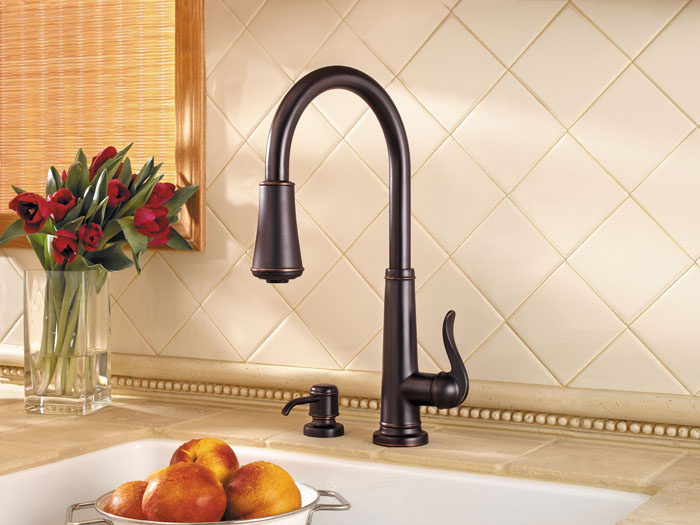
This gorgeous Pfister Tisbury single control Bronze kitchen faucet retails for around $450.00 cad. 

Wonderful contours and finish on this Pfister faucet.
Note the wonderful contours and finish on this Pfister faucet.

Rustic – Weathered cupboards, antique kitchen tables and exposed brick make up the increasingly popular rustic style kitchen. At home in front of a backsplash of colorful tiles or looking out a window, the Pfister Ashfield has an old-school design that will work in any rustic styled kitchen.

European – Functional and sleek, the European style kitchen is clean from its black tile floors to the exposed wood beams above. Go for the Pfister Fullerton, a sleek and angular faucet that will complement the room’s Scandinavian influence.

Traditional – Hanging bronze pots, a mix of wood and stone and sunlight streaming through large windows make this the most popular room of the house for a reason. A classic choice, such as the Pfister Wheaton looks right in a traditional kitchen, providing a functional and stylish option.

"Classic" chromed-silver finish.
“Classic” chromed-silver finish.

Fun Christmas Party Surprises To Wow Your Guests

Whether you’re hosting a family Christmas dinner or are planning the office holiday party, your goal is the same: to make it a gathering your guests will always remember. Fun, unexpected surprises are an easy way to delight your co-workers, friends and loved ones. From keepsakes to party themes to the menu, there are plenty of opportunities to get creative and serve up something your guests haven’t experienced at a Christmas party before. Here are a few ideas to get you started.

Keepsakes that Keep on Giving

Hosts of a holiday party aren’t usually expected to give their guests gifts, which is one way to surprise partygoers. Ideally, a gift the recipient can use over and over again will remind them of the good times they had at your party. Custom-printed hoodies, sweaters or long-sleeve shirts definitely fit that bill. Once you find a company that offers screen printing in Ottawa for small and large orders alike, you can think up a funny saying, exercise your drawing skills, use digital images or simply commemorate the event with your family or company name. Your guests will have unique, comfy hoodies or sweaters to wear at the party and something to remember you by whenever it gets chilly for years to come.

Keep in mind, however, that regardless of what you gift your guests, it’s all in the presentation. A fun way to gift custom sweaters, or any other gift this holiday season, is in a personalized DIY gift bag. Making them can be a fun and creative activity for you and the kids to experience that involves them in the gifting-giving and helps them practice their crafting skills. 

Fun Christmas Dinner/Party Themes & Activities

Here are a few non-traditional Holiday party themes and activities that you can use to add a little variety to your annual dinner or get-together.

Outdoor Christmas Party Activities

Yes, Ottawa winters can get painfully cold outside in the wind. But there are also plenty of sunny winter days that are perfect for ice skating, tobogganing, a bonfire or building snow castles using sand & snow castle-building kits. Just be sure to have backup activities planned in case the weather doesn’t cooperate on the day of your party.

Photo by Nikita Vinogradov via Pexels

Karaoke, Movie and/or Game Night Christmas Party

If frozen toes, fingers and noses would interfere with the joy of an outdoor Christmas party, or your brood is just not the outdoorsy type, you can combine your Christmas party with one of your favorite nights of the week (or month) – karaoke, game or movie night. 

Unlike the impromptu sing-alongs, games of charades or traditional gatherings around the TV for a classic Christmas film, plan your holiday party as a night of full-on:

  • Board games. If your family and friends are board gamers, you already know that they’ve come a long way since the days of Scrabble, Monopoly, Snakes & Ladders, etc. They’re better than ever at teaching players of all ages critical thinking skills like logic, strategy and planning. Many newer games also incorporate teamwork, with players working together to beat the game itself. There are also numerous games based on popular movie franchises and stream-able series, which can make a board game an exciting pastime that ties into a Movie/TV-themed party.
  • Movie or Binge-TV Night Christmas Party. Films and TV shows provide an infinite number of themes to help you plan an outside-of-the-box Christmas dinner party. You can base your party on a tried-and-true family favorite, the latest global smash hit or a movie or TV show that fits a pre-determined theme.
  • Karaoke Competition Christmas. If you have a family filled with aspiring pop stars or better-than-average shower soloists, you can plan a karaoke party of Christmas/holiday songs or curate a playlist based on the theme of your party. You can really spice things up by making it a competition with plenty of prizes for all the participants.

Christmas Pageant Dinner and a Show

If your party will have a significant number of kids (of any age) who like to put on a show, consider sending out scripts, holding rehearsals, and turning your home or party room into a dinner theatre. Costumes can be readily thrifted or thrown together, and if you really want to go all out, backgrounds and curtain frames can be assembled easily enough by enthusiastic DIYers. Don’t forget to have a proper video camera set up on a tripod so you’ll always have the recording to enjoy with (and at the expense of) the cast.

Alternate Holiday Dinner Menu Items

Your holiday dinner menu can be influenced by your party theme, it can be based on modern takes of classic Christmas dishes, or you can simply add random non-traditional dishes like the ones below.

Holiday Taco Night

Taco night is generally a fan favorite, so why not give the people what they want? You might have to use burrito shells depending on your meat of choice, but don’t be afraid to get creative and consider the following options:

  • Fish. Fish tacos are a popular choice taco choice, but when was the last time you had fish tacos at a Christmas party? Also, you can use fish sticks if you’re looking for a convenient, easy-to-prepare meat filling.
  • Steak or ribs. Try braising or marinating them in pomegranate juice with a hint of cinnamon and/or chile pepper to spice things up a little. As an added bonus, both pomegranate and cinnamon are recommended to strengthen your immune system and help you fight off colds and flus.
  • Turkey. The line between a taco and a wrap can get a little blurry here, but whatever you call them, using traditional turkey accompaniments, corn, cranberries, potatoes, gravy, mac & cheese, etc., make delicious toppings.

Christmas Jambalaya

Not much can hit the spot as well as a hearty helping of jambalaya can on a cold holiday dinner night. Really, the only rules to a jambalaya are that your ingredients taste good with Cajun spices and that it’s all cooked together. Whether you go with Christmas dinner ingredients, New Orleans-inspired flavors or some type of fusion, a big pot can satisfy a lot of people.

Homemade Holiday Donuts

Puddings, pies, cakes and cupcakes are understandable go-to choices for Christmas dinner desserts, but homemade donuts with a holiday twist can ignite some excited chatter when they make their way to the dessert table. Feeling overly patriotic? Try maple glazed donuts topped with candied bacon crumble for a taste that’s both distinctly holiday and Canadian.

For the Silo, Jeg Duaso. Featured image:  by Nicole Michalou via Pexels

4 Ways You Can Save Money This Holiday Season

There is no denying that Christmas is an expensive holiday. In the past, or perhaps right now, you may have found yourself spending a substantial amount of money on things like food, decorations and travelling.

However, the heftiest expense is usually the presents — approximately 34% of North American parents spend $500 on gifts (per child) during the holiday season. If you have a large family, this adds up quickly.

Instead of frantically emptying your wallet, consider using these money-saving tips over the holidays because by doing so you’ll be able to get more bang for your buck and potentially save hundreds or thousands of dollars on gifts.

1 — Use an Online Shopping Directory

Shopping local is always the best idea but let’s face it, not everything on your list can be sourced locally and including online shopping options is a no brainer. In fact, it’s fair to say that no holiday shopping trip is complete without an online shopping directory. If you’ve never used one, an online shopping directory is an innovative tool that offers a wide variety of features.

One of the primary benefits of using one of these directories is that you can use them to access digital coupons and flyers. You can use these coupons to save a significant amount of money on your purchases.

Additionally, you may need to shop in a larger outlet and if so, you can use these directories to find a shopping centre near you and important pieces of information like store hours. This way, you won’t waste your time by showing up after the Kingsway Mall or your chosen shopping mall closes.

2 — Ship Directly to the Recipient

Shopping online makes the gift-giving experience quick and convenient. With a few clicks, you can have a gift hand-delivered to your door. Although, if you won’t be seeing the recipient over the holidays, you will have to ship the item yourself. This process can get expensive!

Although it may seem unconventional, you can make your Christmas shopping easier by shipping your gifts straight to the recipients.

Even though this may take some of the fun out of it, direct shipping is a practical and cost-effective way to give gifts to people. This is especially true if the recipient lives far away.

If you want to save even more money, you should go to sites that offer free shipping.

3 — Look for Ways to Buy in Bulk

If you’re planning on hosting a holiday event, you’re probably looking for ways to save money on food. An easy way to cut back costs is by purchasing items in bulk. Although you may not want to purchase turkey or eggnog in bulk, it is practical for staples like water bottles, cookies or festive treats.

You should avoid purchasing perishable items in bulk. Some things to avoid purchasing include:

  • Produce (Fruits, Vegetables)
  • Dairy (Milk, Cheese)
  • Baked Goods That Are Difficult to Store

It is worth noting that you can store some of these items by freezing them.

4 – Make Your Gifts

Are you good with your hands? Do you love to create things? Have you been told that you have a knack for building stuff?

Instead of going to the Dixie Outlet Mall, you should consider making some of your Christmas gifts yourself. This is a thoughtful gesture that goes a long way with friends and family members.

To save even more money, try making your own Christmas cards. This will add a personal touch to any gift that you give.

Holiday Sparkling Wines Are Champagne Alternative Worth Toasting

As the holiday season and other celebratory occasions approach, Champagne remains a timeless classic—but it’s no longer the only option for sparkling wine lovers. From unexpected regions to unique flavor profiles, a world of bubbles is waiting to be discovered. The below highlights 7 Champagne Alternatives–a regionally-diverse array of stunning sparkling wines from across the globe that rival Champagne in quality, taste and affordability.

Skip the Champagne: 7 Sparkling Substitutes Worth Toasting


champagne.jpg

Champagne has long been the essential toast of holidays and other special occasions, but the landscape of sparkling wine is evolving. Today’s breed of bubbles offers an exciting range of choices from nearly every corner of the wine-producing world. Regions across the globe are proving they can stand shoulder to shoulder with the world-famous fizz, offering exciting alternatives for wine lovers ready to expand their horizons. And, as people’s tastes shift, so do their preferences for flavor profiles, sweetness levels and production methods, there are more new styles to discover as alternatives to Champagne.

Champagne is often enjoyed for its multi-layered aromas of fruit and brioche, finishing with a searing and elegant acidity. Yet, not all sparkling wines meet these lofty criteria, and some remarkable options exist that may surprise your palate and your wallet.

Corpinnat and Cava

It’s rare to see Cava and its innovative offshoot, Corpinnat, mentioned together, but these two Spanish sparkling wines share a commitment to quality. Corpinnat represents a collective of small, independent organic wineries that have opted out of the official Spanish quality hierarchy to craft sparkling wines that reflect their unique philosophies and practices. What sets Corpinnat apart from Cava is its stringent requirement that grapes must come from owned organic vineyards and be vinified on the winery’s premises. Each bottle must mature for a minimum of 18 months, surpassing Champagne’s minimum requirement by six months. Many producers opt for extended aging, with some wines maturing for 60 months or longer. This extended bottle maturation allows the wines to evolve from fresh fruity aromas into complex nutty and bread-like flavors, enriching the overall tasting experience. In contrast, Cava, while often perceived as more industrial, can also produce exceptional wines. Major producers like Freixenet and Codorniu dominate the market, leaving smaller-scale artisans with limited exposure. Like Corpinnat, Cava is primarily based on the indigenous grapes Xarel-lo, Macabeo, and Parellada, which deliver a delicate, fruity profile with a light body.

The German and Austrian Powerhouses

Cool climates are renowned for producing wines with vibrant acidity—the backbone of sparkling wine. This principle underpins the German and Austrian passion for their sparkling creation, known as Sekt. In these countries, Riesling often takes center stage, although you may also encounter Pinot Noir, Chardonnay, and other varietals that can rival high-end Champagnes. Germany and Austria pride themselves on their quality sparkling wines. Austria has recently launched a new Charta, establishing a hierarchy for “Sekt Austria.” This pyramid includes “Grosse Reserve” (big reserve), “Reserve,” and the foundational “Sekt Austria” quality, with aging requirements ranging from a minimum of 6 months on the lees to at least 36 months for the highest tier.

This commitment to quality has garnered increased interest from both tourists and consumers alike, prompting Austria to appoint Andreas Vitasek as their new sparkling wine ambassador. When exploring German Sekt, focus on renowned regions like Mosel, Rheingau, and Rheinhessen. Notable producers include Kallfelz, Barth, and Raumland. In Austria, look for high-end offerings from Bründlmayer, Loimer, and Domäne Wachau.

Crémant de Bourgogne

If you prefer to stay in France, consider heading south to Bourgogne. The region primarily produces sparkling wines from Chardonnay and Pinot Noir, with Aligoté providing a refreshing exception. Crémant de Bourgogne offers a lighter, fruit-driven experience, illustrating a frothy texture that dances on the palate—an excellent alternative to its more famous cousin.

Cartizze: Prosecco’s Crown Jewel

In the northern Italian region of Veneto, the hill of Cartizze stands as Prosecco’s most revered site. Officially classified in 1969, its reputation as an exceptional origin stretches back more than two centuries.  Rising to 350 meters (1,150 feet) above sea level, Cartizze encompasses just 108 hectares (280 acres). With land prices exceeding 1 million Euros per hectare, it rivals the world’s most expensive vineyard sites, including those in Burgundy. Ownership rarely changes hands, with plots typically passed down through families, underscoring the value placed on this unique terroir. The slopes of Cartizze are so steep that vineyard work must be done entirely by hand. In some areas, workers use sledges to transport grapes and tools, their efforts evoking comparisons to mountaineering. This challenging terroir, combined with the elevation and a predominance of old vines, produces Prosecco of remarkable intensity and character. Most wines from Cartizze are crafted in a ‘dry’ style, leaving a touch of residual sugar. This subtle sweetness enhances the vibrant fruitiness, while the crisp acidity keeps the wine beautifully balanced. The result is a Prosecco of elegance and finesse, ideal for those looking to celebrate with something truly special.

Moscato d’Asti: The Sweet Charm of Piedmont

In the heart of Piedmont, a region famed for Nebbiolo’s brooding intensity and wines like Barolo and Barbaresco, Moscato d’Asti offers a gentler, more unassuming charm. Made from the highly aromatic Muscat grape, this sparkling sweet wine is often overlooked in favor of its more prestigious neighbors but has a unique role in the region’s vinous identity. The defining features of Moscato d’Asti are its fragrant sweetness, low alcohol, and gentle spritz. This combination allows producers to fully explore the grape’s potential, highlighting its characteristic notes of orange blossom, ripe apricot, and honeyed peach. At just 5.5–7% ABV, it provides a light and refreshing contrast to the weightier wines often associated with Piedmont. Its flexibility at the table is a key strength. Moscato d’Asti can elevate desserts like white chocolate and candied fruits or pair beautifully with creamy and blue cheeses. For some, it even becomes the dessert, offering a delicately sweet conclusion to a meal without overwhelming the palate.

Cap Classique: South Africa’s Sparkling Star

For those who find Italian fruitiness is too exuberant, South Africa’s Cap Classique offers an elegant alternative. Introduced as a defined style in 1971, this sparkling wine is crafted in the traditional method, involving a secondary fermentation in the bottle. While the classification is relatively modern, the South African tradition of producing sparkling wines dates back over 360 years, firmly rooted in the country’s winemaking history. Cap Classique spends a minimum of 15 months on the lees, allowing delicate notes of brioche and hazelnut to develop.

However, the hallmark of South African sparkling wine remains its bright, fruit-driven profile, often leaning into flavors of citrus, stone fruit, and even tropical notes, rather than the pronounced toastiness typical of Champagne. Today, Cap Classique has earned its place among the world’s finest sparkling wines. Its ability to balance value and quality makes it an appealing choice for celebrations, offering a distinctive South African character without pretension. Whether as a centerpiece for an event or an unassuming companion to the moment, it stands ready to impress.

Tasmania: A Sparkling Island of Innovation

Tasmania, Australia’s southernmost state, lies around 150 miles (240 kilometers) south of the mainland, separated by the often-turbulent Bass Strait. Known for its pristine wilderness and cool climate, it is the nation’s most southerly and coolest wine region, home to a scattering of nearly 1,000 offshore islands. This remoteness has shaped its identity as a haven for eco-tourism and, increasingly, as a center for world-class sparkling wine. The island’s wine industry is small but tightly focused, with producers working collaboratively and sustainably. Biosecurity is paramount, and tourists are often barred from entering vineyards to prevent soil-borne pests or diseases inadvertently carried on footwear. Inter-planting with native vegetation, allowing certain ‘weeds’ to flourish, and preserving wildlife corridors reflect Tasmania’s dedication to environmental harmony. Tasmania’s cool climate is particularly suited to Pinot Noir and Chardonnay, the cornerstone varieties of its sparkling wines. These wines are defined by their vivid fruit intensity, bracing acidity, and, in many cases, the nuanced autolytic complexity of toast and brioche. The sparkling wines often rival the quality of Champagne, though with a distinctive freshness and clarity born of the island’s maritime influence and clean air. Despite its small scale, Tasmanian sparkling wine is increasingly found on the shelves of fine wine retailers and the wine lists of high-end restaurants across the globe. Its ability to combine precision, elegance, and sustainability ensures Tasmania’s place among the leading sparkling wine regions of the world.

Emerging Regions

Beyond the traditional producers, numerous up-and-coming regions are crafting outstanding sparkling wines. The United Kingdom, Argentina, and cooler areas of California are all making their mark in the sparkling wine scene, offering fresh and innovative options for consumers looking to diversify their celebratory toast.

Champagne will long-remain a classic, of course, but it no longer holds an exclusive claim as the “must-have” sparkling wine for holidays and other special occasions. While this iconic bubbly is a favorite celebratory beverage for many, the world of wine offers a range of exciting alternatives that deserve due attention. For the Silo, Peter Douglas.

Peter Douglas, DipWSET, is a wine expert with the “VinoVoss”—an AI Sommelier smartphone app and web-based semantic wine search and recommendation system developed by  BetterAI. VinoVoss picks the perfect wine every time, for any occasion courtesy of a highly advanced artificial intelligence assist. Douglas is an experienced wine trade professional with a diverse background in the HORECA industry, specialist stores, purchasing, portfolio management, and general wine trade. He also possesses hands-on experience in winemaking, further enhancing his knowledge and understanding of the industry. Peter’s qualifications include the WSET-Level 4 Diploma in Wines and Spirits, and currently, he is in Stage 2 of pursuing the most esteemed and prestigious title in the wine industry, Master of Wine. Peter’s expertise extends to consulting distributors and importers, as well as assisting in enhancing the wine portfolio of on-trade settings. Additionally, Peter serves as a wine agent, proficient in sourcing specific SKUs at favorable prices for clients’ portfolios.

Can Canadian King Kong Coffee Cup Sizes Cause Convulsions?

I  was travelling a local highway a few years ago when my friend pointed out the license plate on the rear of the car ahead of us. It read, somewhat cryptically to me at first, XLDBLDBL.

Then I looked again and realized this automobile owner had created a move-able billboard, and perhaps loving tribute, to the most popular and recognizable coffee brand in Canada- Tim Hortons.

The “Canadian” coffee giant is owned by American corporation Burger King and has had a presence in the U.S.A. since 2012. It made the move of super-sizing its retail coffee format over half a decade ago. The small was now called an extra-small, and was the same price as the old small. The old medium was now a small, the large was a medium and so on. You paid the same price for the same amount of Joe, you just call it by a different name. And for 20 cents or so extra, that XL double-double now got you 24 oz of coffee. That’s 3 full cups of strong coffee y’all.

Now, I love coffee as much as the next person.

Maybe more. I enjoy sampling the near infinite combinations of blends and roasts from the various growing regions of the world, much like wine. But, as with alcohol, I have found that moderation in my coffee intake is key to my mental, emotional—even physical—health.

Is anyone reading this old enough to remember when a cup of coffee used to literally be a cup of coffee: around 8 ounces (the amount in the Tim Horton’s extra-small)? But as our conception of “large” becomes ever larger, it’s like food where like so many things, excess becomes easier.

This trend is actually an American-style sizing format that’s been in place south of the border for years. Remember when Starbucks came north? Remember when you thought the Venti was an outrageous amount of coffee? That’s 20 oz., just so we’re clear. What will come to us next? The $3.99 All-You-Can-Eat Breakfast Buffet? Just how many sausages can you eat in an hour? How many do you want to eat? And for the record, Starbucks has the 31oz. size for its iced drinks called the Trenta.

That’s a lot of beverage. Trenta, in Italian, means 30.

Excess coffee consumption, according to Health Canada, can have results from irritability and sleep disturbances to muscle tremors, nausea and mood swings, according to this CBC News article from February 2010. In more extreme cases: irregular heartbeat, vomiting, diarrhea—even convulsions. 

There’s positives though.

Coffee’s high antioxidant content may also be responsible for a host of health benefits: decreased susceptibility to some cancers and type-2 diabetes, and increased cardiovascular health and memory function in older adults. But Health Canada also suggests that 400mg of caffeine should be the maximum daily adult dose—the amount contained in about 3 cups, or 24oz, of coffee.

Frankly, I think there is enough rage, anxiety and insomnia in our culture without people regularly downing two or three 24oz javas every day. It’s not that everyone is going to do that. It wouldn’t even be bad for everyone. Just for most of us. So I believe a note of caution is in order: as with anything, think before you drink. – For the Silo, Alan Gibson.

Desert Modernism 2025 Exhibition at Scottsdale Ferrari Art Week


DECEMBER, 2024Scottsdale, Ariz. Diné Artist, Dealer, Curator and Antiques Roadshow Appraiser Tony Abeyta to Curate Special Exhibition, “Desert Modernism,” at Scottsdale Ferrari Art Week Exhibition to Showcase Rare Works by Fritz Scholder, Charles Loloma, Lloyd Kiva New, Frank Lloyd Wright, Phillip Curtis and Paolo Soleri.


 Scottsdale Ferrari Art Week Fair is pleased to announce that Diné artist, dealer, curator and Antiques Roadshow Appraiser, Tony Abeyta, will curate a special exhibition, “Desert Modernism,” which will show the convergence and progression of Phoenix artists of Native, Anglo and Hispanic descent, from approximately 1930-1980. The exhibition will feature rare and hard-to-find works by artists, architects and designers such as Fritz Scholder, Charles Loloma, Lloyd Kiva New, Frank Lloyd Wright, Phillip Curtis and Paolo Soleri.

Abeyta is also serving as an Advisory Committee member for the Fair. The Scottsdale Ferrari Art Week Fair is a unique event at the historical and cultural crossroads of the American Southwest. Set in one of the country’s fastest-growing cities with an ascendent contemporary Indigenous culture, the fair will showcase over a hundred leading international galleries at Westworld, March 20-23, 2025.”We are absolutely thrilled to have Tony participate in Scottsdale Art Week,” says Trey Brennen, co-owner of the inaugural Fair.


“We are set to become the leading art fair in the West and that requires a strong Indigenous representation among our dealers and curators. Tony approaches art and art history with a deep understanding of the region and the contemporary work being produced at this moment. He has worked at many of the major museums in the area and has a wonderful reputation across the Southwest.”About his curation of a special for sale exhibition at the inaugural Fair, Abeyta says, “This has given me a chance to do a deep dive into one of my favorite subjects, the evolution of Modernism through the disparate art communities that converged in the Phoenix/Scottsdale area in the middle portions of the twentieth century. I’ve long been fascinated by the work Native artists were doing in the area and I want to show how they worked, showed and created alongside great artists such as Frank Lloyd Wright, Phillip Curtis and Paolo Soleri.”


Preston Singletary, “A Canoe Entered a Dream” – courtesy of Blue Rain Gallery

As a curator, Abeyta co-organized the exhibition New Terrains: Contemporary Native Art which was held at Phillips Auctions January 5-23, 2024. The watershed selling exhibition explored the influences of modernism, post-war and pop influences on work by 50 contemporary Indigenous artists including Fritz Scholder, Preston Singletary, TC Cannon, Cara Romero, Diego Romero, Jaune Quick-to-See-Smith, Virgil Ortiz, Jamie Okuma, Kent Monkman, Michael Kabotie, Oscar Howe, Allan Houser, Cannupa Hanska Luger and others.

The recently closed show, Abeyta\ To’Hajiilee K’e’, at the Wheelwright Museum in Santa Fe, featured the paintings of Tony and his father, Narciso Abeyta (Ha-So-De), and the ceramic works of his sisters, Pablita and Elizabeth. Abeyta is represented by Owings Gallery in Santa Fe, New Mexico. For more information, please visit www.scottsdaleartweek.com. For the Silo, Jennifer Parks-Sturgeon.


About Scottsdale Ferrari Art Week             Scottsdale Art Week (SAW) is situated at the historical and cultural crossroads of the American Southwest. It is a reflection of today’s more dynamic and contemporary community, but is rooted in our unique landscape and history. Visionary art figures from Georgia O’Keeffe to Max Ernst and James Turrell were so inspired by the local landscape that they either settled here or created monumental land art. Today the art of the Indigenous Navajo, Apache and Hopi tribes who first occupied this land to Spanish colonialism and centuries of settlement is recognized alongside them. SAW is an exciting combination of historical American Art, contemporary art and design, with a special focus on contemporary art from Indigenous and Latinx, who often blur the lines between what constitutes art and design.

About ASU, SAW Gala Benefit Partner ASU Art Museum centers art and artists in the service of community well-being and social good. The Museum is a learning-centered teaching institution, providing interdisciplinary learning opportunities for students from across the university ranging from the sciences, humanities, journalism, sociology and schools of arts and design. A teaching museum, much like a teaching hospital, is responsible for training the next generation of arts professionals and are the frontrunners in research in art history and museum studies while delivering the highest possible level of artistic standards through collection teaching, exhibition making, research and audience engagement. The museum is different from other non-profit art museums in the region because of its unique ability to leverage the resources of the largest public research university in the country for community good. ASUAM fulfills ASU’s Design Principles by serving as a bridge connecting the breadth and scope of scholarly research and learning to the experience, knowledge and needs of our local communities, thereby co-creating and creating arts and culture opportunities available for all.

Article featured image- Horseworld, 1989 by Snellen Johnson (gift of Howard E. Kleim).
This bronze sculpture, signaling the entrance to Westworld, shows a group of three horses which represent an Arabian, Thoroughbred, and a Quarter Horse each representing a different behavior: the Quarter Horse is cutting, the Thoroughbred is racing, and the Arabian is showing.
Snell Johnson, a self-taught artist and his sculptures are known world-wide including the MGM Lion in Las Vegas and Caesar in Johannesburg, South Africa.

With over 100 galleries displaying a curated selection of fine art and design, guests will also enjoy cultural performances, fashion shows, pop-up displays and immersive experience throughout each day.

Fashion

Daily fashion shows will be produced by Phoenix Fashion Week. All clothing is provided by select Phoenix Fashion Week designers and boutiques.

“Our ultimate mission is to garner global exposure to Arizona’s fashion industry, and this event is the perfect way to do so,” said Brian Hill, Executive Director of Phoenix Fashion Week. “It’s a great, innovative way to find emerging models while showcasing top brands and fashion in Arizona.”

For more information on Phoenix Fashion Week, visit phoenixfashionweek.com

Luxury Cars

From utility to showpiece, cars are a unique art form. Guests can celebrate clean lines and smooth curves while enjoying our extensive display of luxury and collector automobiles. Enjoy a special Ferrari showcase onsite at the event. Check out their entire inventory here >

Performances

Set in one of the country’s fastest growing cities with an ascendant contemporary Indigenous art culture, the fair will showcase over a hundred leading galleries at the scenic Westworld alongside cultural performances, sculptural installations, and innovative programming including collaborations with institutions, galleries, artists, and prominent collectors.

Special Events

Guests looking to explore the best the city has to offer can attend their choice of multiple off-site events during the week. From guided tours to VIP invite-only receptions. There is something for everyone at the event and throughout this great city.

Golden Concept x BLVCK – A Fusion of Swedish Luxury And Parisian Elegance

A superb gift idea for the Apple watch lover looking for “style meets form and function”.

New York, NY– December , 2024 – Following the resounding success of their first collaboration, Golden Concept, the Swedish leader in ultra-luxurious Apple Watch accessories, and Blvck Paris, famed for its ‘All Black’ luxury lifestyle brand, are thrilled to unveil their latest joint venture: a meticulously designed Apple Watch case. This second collaboration pushes the boundaries of luxury and sophistication, further blending the timeless elegance of Parisian minimalism with Swedish craftsmanship.


The New Collection


The new collection introduces a premium case tailored for Apple Watch users who demand both style and functionality. The case is crafted from high-quality, all-black translucent nylon with meticulous detailing in black stainless steel, reflecting the distinct design philosophy that made their first collection a global success. The case is designed in 49mm for Apple Watch Ultra models, offering a versatile and elegant option for any tech enthusiast. Whether you’re a tech aficionado or a fashion enthusiast, this second release reaffirms the power of luxury in everyday wearables.


“After the incredible response to our initial collaboration, we knew we had to come together again,” said Puia Shamsossadati, CEO and Creative Director of Golden Concept. “This time, we wanted to create something equally luxurious yet more versatile, offering our customers a refined accessory that complements both their tech and their personal style.”
Julian O’hayon, Founder and CEO of Blvck Paris, shared his excitement: “Collaborating with Golden Concept once more feels natural. Our brands share a vision of modern luxury, and this collection of Apple Watch cases allows us to expand that vision, offering something bold and refined to our customers. We’re confident this next chapter will resonate just as strongly.”

The limited-edition case is now available on GoldenConcept.com and at Select Golden Concept and Blvck Stores priced at $899USD/ $1,275

About Blvck Paris


Blvck Paris is a luxury lifestyle brand founded in 2017 by French designer Julian O’hayon. The brand has developed an engaged community of millions of social media followers and customers worldwide. Blvck is known for its ‘All Black’ clothing, accessories, and digital goods. Blvck strives to pioneer an aspirational lifestyle from visual content to merchandise, pursuing quality and design. To date, the brand opened stores worldwide in California, Tokyo, Taipei, Taichung, Hong Kong and Macau.

Canadians Paying More Insurance Premiums That Most Developed Nations

Canadian consumers and businesses pay more than $80 billion a year in property & casualty insurance premiums with an upward trend consistently in excess of our anemic GDP growth rate. The total cost is now more than 3 percent of GDP. … But how does Canada benchmark relative to its global peers?

• Canadians pay higher premiums for property and casualty insurance than citizens in many, if not most, other developed nations. This Commentary uses OECD data and private industry data to compare the national P&C insurance sector’s premiums as a percentage of Gross Domestic Product with its international peers and is an update of the findings of the author’s 2021 edition of this report.

• The Commentary focuses on liability, property and auto insurance to compare costs across nations. Then, it takes a deeper dive into the Canadian data to compare personal property and auto insurance among all provinces and territories.

When it comes to costs for property insurance, the study finds Canada is in the top ranks, paying 1.23 percent of GDP in premiums, almost double the 0.66 percent average of other G7 peers and even higher than the 0.52 percent OECD average. For automobile insurance (which here includes both personal and commercial), Canadians appear to be paying, on average, the highest premiums in the world, relative to GDP.

• Within Canada, inter-provincial benchmarking for personal property insurance shows the higher average premiums paid in Canada – relative to the rest of the developed world – appear to be shared equally by most provinces. However, province-by-province comparisons of personal auto insurance show that there are substantial differences among provinces, with four jurisdictions producing higher-than-average results. Two of the four (Saskatchewan and Manitoba) are government-monopoly jurisdictions – in fact, these are the two highest in terms of costs. The two other outliers (Ontario and Alberta) are served by a competitive private sector, but Alberta has chosen until very recently to maintain a costly tort environment and Ontario mandates particularly generous accident benefits and has experienced a plague of auto theft.

• In the case of automobile insurance, just a handful of provinces need to think harder about how to improve car insurance premiums. But to reduce the cost of living for homeowners, the solutions required must be national in scope and include public/private partnerships to share the rapidly increasing risk-transfer price of natural catastrophe events.

Read the full article by Alister Campbell via this PDF.

Did You Know These 5 Famous Cars in Movies & TV Are Fake?

The recent Netflix series, Senna, got our friends at Hagerty thinking about movie cars that—often for practical reasons—aren’t exactly what they seemThis story originally ran on their site in 2013, and we’ve freshened it up a bit to provide some helpful and entertaining context for today’s movie-car choices.

Hollywood loves to incorporate hot classic cars into movies and television shows. Producers and insurers are also notoriously risk-averse, preferring to use replicas rather than the hyper-valuable real deal whenever possible. Here are some of our favorite big- and small-screen fakes.

Nash Bridges

1971 Plymouth Hemi ‘Cuda: The ’90s San Francisco cop show revived Don Johnson’s career, pairing him with Cheech Marin (half of the stoner comedy team of Cheech and Chong). The yellow car that appeared to be an ultra-rare Hemi ‘Cuda convertible was actually what is known as a “clone,” or a car that started out as a lesser model but was restored to appear as a top shelf ‘Cuda. The difference in price is staggering—around $180,000 usd/ $259,000 cad for a convertible with the 383, more than $3M usd/ $4.25M cad for the real deal (both prices reflect #2 condition).

Ferris Bueller’s Day Off (1985)

1960 Ferrari 250 GT California Spyder: The Ferris Bueller Ferrari is probably the best-known big screen fake and that’s why we choose it for this article’s feature image. From a distance, it appears reasonably accurate, but Ferrari aficionados can spot the differences in their sleep, from the Triumph-sourced gauges to the MGB taillights. And don’t get them talking about the bogus Italian Borrani wire wheels. A real California Spyder in #2, or Excellent, condition is nearly $20 million usd/ $28.3 million cad today.

Miami Vice (1984)

1972 Ferrari 365 GTS/4 Daytona: Don Johnson appears to be a bit of a magnet for fake cars. His black Daytona Spyder was actually a fake built on a Corvette chassis, and few Ferrari fans shed tears when the car was blown up in sight of Johnson’s character, Sonny Crockett, and his pet alligator, Elvis. Afterward, Crockett took to driving a white Ferrari Testarossa—a real one, this time.

Top Gun (1986)

1958 Porsche Speedster: Kelly McGillis’ character drove this one around San Diego in the classic ’80s movie. Porsche Speedsters are among the most replicated cars ever—most are convincing fiberglass bodies slapped on top of a VW Beetle platform.

The replica featured in Top Gun appears to have been one of the good ones, built by longtime Speedster replica-maker Intermeccanica. They’re still in business in British Columbia, Canada, turning out extremely high-quality vintage Porsche replicas.

Indiana Jones and the Temple of Doom (1984)

1935 Auburn 851 Boattail Speedster: Indy’s sidekick Short Round still holds the record for the best automotive chase involving a pre-teen driver. With blocks tied to the pedals, Short Round takes Jones and a lounge singer Willie Scott on a wild ride through prewar Shanghai. The car was, of course, a complete fake, and not a particularly convincing one at that. For the Silo, Rob Sass/Hagerty.

Did we miss any? Let us know in the comments below.

7 Most Expensive Electric Cars In The World Include Batmobile Inspired Dark Knight

While EVs are known mainly as environmentally friendly offerings, this list proves not all things with electric motors on four wheels are created equal.

1a. Automobili Pininfarina B95: $4.7 Million usd/ $6.67 Million cad

Topping the list is the Pininfarina B95, the world’s most expensive electric car at $4.7 million usd. Limited to just 10 units, the B95 blends breathtaking performance with unmatched luxury. With a top speed of 186 mph and acceleration from 0 to 62 mph in under two seconds, it’s as fast as it is exclusive. Crafted for collectors, the B95 epitomizes automotive luxury in the EV era.

1b. Automobili Pininfarina Battista B95 Dark Knight $4.2 Million usd/ $5.94 Million cad

Celebrating 85 years of Batman, this hypercar is meticulously crafted as the ultimate inspiration for Bruce Wayne’s conquest against darkness. The Battista Dark Knight emerges blending superhero mystique with high-performance luxury. Dark Knight transforms the elegant, pure-electric Battista into its most formidable version yet, Furiosa. Featuring never-previously-seen bespoke enhancements and aggressive styling, it showcases the pinnacle of Automobili Pininfarina’s dynamic design and craftsmanship.

Most Expensive Electric Vehicles In the World

2. Aspark Owl: $3.1 Million usd/ $4.4 Million cad

Hailing from the Land of the Rising Sun, the Aspark Owl takes electric speed to another level with a claimed top speed of 260 mph and a 0-60 mph time of 1.72 seconds. Its all-carbon-fiber body minimizes weight while maximizing aerodynamics. Limited to 50 units, the Owl’s exclusivity matches its $3.1 million usd price tag. A recent evolution of the model reached a record-breaking 272 mph, solidifying its place as one of the fastest EVs ever.

Most Expensive Electric Vehicles In the World

3. NIO EP9: $3 Million usd/ $4.25 Million cad

China’s NIO EP9 stands out with its focus on aerodynamics and track performance. With an active rear wing and 5,395 pounds of downforce at 150 mph, the EP9 excels on the racetrack. Its four motors enable a 0-124 mph sprint in just 7.1 seconds, and its innovative battery-swapping system adds convenience. Limited to 50 units, the EP9 costs $3 million usd and showcases NIO’s technical expertise.

Most Expensive Electric Vehicles In the World

4.Lotus Evija: $2.3 Million usd/ $3.25 Million cad

The Lotus Evija aims to redefine what an electric hypercar can achieve, delivering 1,973 horsepower from its four motors. Its lightweight design, with a curb weight of just 3,704 pounds, emphasizes performance, while a range of 250 miles ensures practicality. A special Fittipaldi edition pays homage to Lotus’s racing legacy, featuring even greater power and exclusivity. At $2.3 million, the Evija remains a pinnacle of British engineering.

Most Expensive Electric Vehicles In the World

5. Pininfarina Battista: $2.25 Million usd/ $3.18 Million cad

We mentioned the Batman version above already but the ‘base model’ Automobili Pininfarina’s Battista is an electrified masterpiece, blending exquisite design with awe-inspiring performance. With a combined output of 1,900 horsepower from four motors, the Battista rockets from 0 to 62 mph in just 1.86 seconds. Its 120 kWh battery allows fast charging to 80% in 25 minutes, and its carbon fiber construction optimizes agility. Priced at $2.25 million, this Italian creation is limited to 150 units.

Most Expensive Electric Vehicles In the World

6. Rimac Nevera: $2.2 Million usd/ $3.11 Million cad

Croatia’s Rimac Nevera has rewritten the record books, claiming the title of the world’s fastest EV with a top speed of 258 mph. Its four motors generate 1,813 horsepower, enabling blistering acceleration and exceptional handling. With only 150 units produced, each priced at $2.2 million, the Nevera is a true collector’s item. A special Time Attack variant, priced at over $3 million usd , adds even more exclusivity to an already rare hypercar.

Most Expensive Electric Vehicles In the World

7. Deus Vayanne: $2 Million usd/ $2.83 Million cad

The Deus Vayanne debuted at the 2022 New York Auto Show, boasting a staggering 2,243 horsepower thanks to its tri-motor setup. Designed in Austria, produced in Italy, and electrified in the UK, this hypercar achieves a balance of power and elegance. Its unique infinity-loop-inspired grille complements an interior lined with sustainable materials. With a range of 310 miles and a limited production run of 99 units, the Vayanne offers exclusivity at $2 million.

Most Expensive Electric Vehicles In the World

For the Silo, Verdad Gallardo.

Bitcoin Reaches $100,000 usd Milestone- What’s Next?

Laser eyes on the future: Bitcoin $100,000 USD/ $142,400 CAD

One hundred thousand United States Dollars. It’s a nice round number. The first to be six figures. And seeing it follow the word “Bitcoin” is a historical moment worth celebrating.

The importance of BTC $100,000 usd is largely symbolic. It’s small compared to the up-to-infinite price levels that succeed it. While $100,000 usd is a significant milestone worth pausing to recognize, it is also merely a checkpoint on Bitcoin’s much longer, much larger journey ahead.

Let’s take a moment to remember the early moments of this journey. The year Kraken was founded (2011), Bitcoin’s Dec. 31 closing price was $4.25. From that level, the value of just one of the 21 million bitcoins that will ever exist is now up over 2.3 million percent at BTC $100,000 usd.

BTC $100,000 usd has long been viewed as the next/seemingly “final” frontier for Bitcoin’s price. Laser eyes and dank memes, as well as innovative products and user experiences, have accelerated us to this point.

Through years of speculation around “the world to be when Bitcoin reaches $100,000 usd,” a common sentiment held that the $100,000 usd price level would somehow confer the legitimacy of “a peer-to-peer electronic cash system.” It would show the value of a tamper-resistant and immutable way of recording information. It would prove that decentralization had a place in modern society. 

But, now that we are here, those goals may seem as if they still have more to deliver. It feels like this is still only the beginning. We’ve reached a pricing milestone, but when it comes to fulfilling Satoshi’s original vision for Bitcoin – its widespread use as a borderless, worldwide peer-to-peer electronic cash system – Bitcoin is still in its relative infancy.

Over the short term, it’s anyone’s guess whether the price of Bitcoin will continue its sprint higher or pull back from its recent run. What is clear is that the $100,000 usd milestone demonstrates ongoing demand for a reliable, transparent and peer-to-peer way to transact.

BTC $100,000 usd represents a monumental milestone in Kraken’s mission to accelerate the adoption of cryptocurrency, so that everyone can achieve financial freedom and inclusion. We’d like to congratulate those who have built in the space alongside us and played a role in realizing this achievement. 

We’d also like to congratulate our clients as they celebrate this watershed moment, while making a commitment to serve them through the next chapters of Bitcoin’s history.

Join us as we reflect on the journey that got us here and commemorate this remarkable day – while we reaffirm our commitment to a future of financial freedom.

Get started with Kraken

These materials are for general information purposes only and are not investment advice or a recommendation or solicitation to buy, sell, stake or hold any cryptoasset or to engage in any specific trading strategy.

Must Do Sun Safety Tips For Wintertime

Preventing, Minimizing and Repairing Damage from Exposure 

I hope you didn’t pack away the sunblock with your swimsuit and other summer accessories because believe it or not, the winter’s sun is just as dangerous as summer’s, says Adam J. Scheiner, M.D, an eyelid and facial cosmetic surgeon who’s been featured on The Dr. Oz Show, The Howard Stern Show and The Doctors. In fact, in certain wintry conditions the sun is actually more dangerous. Read on….

“The snow reflects the glare of the sun – and the damaging UV rays,” he says. “People who like skiing and snowboarding in the mountains are getting 4 to 5 percent more UV damage for every 1,000 feet they ascend above sea level.”

The winter sun sits much lower than the summer sun and one reason why it’s harmful rays are a threat.

And then there are all those holiday cruises and escapes to warm-weather climates where beaches are packed year-round. “It’s not OK to lie baking in the sun for hours, even if it’s just one week out of the winter, while you’re enjoying your tropical getaway.” Dr. Scheiner says.

No matter how comfortable or cool the temperature feels, don’t be fooled.

Adam Scheiner
Adam Scheiner

“Just a few years ago, in 2020, the United States surgeon general predicted 9,000 people would die from melanoma. Those deaths were all preventable,” Dr. Scheiner says. 

“And if skin cancer doesn’t scare you, think with your vanity. Sun exposure is the number one cause of wrinkles, discoloration, age spots and festoons, among other disfiguring problems.”

Dr. Scheiner shares tips for preventing, minimizing and repairing sun damage:

•  Prevention: You’re not just exposed when you’re skiing, hiking, or taking a beach vacation.

“Anytime you go outside, you’re exposing yourself to damaging UVB and UVA rays, and the result is cumulative. A little bit here and a little there adds up,” Scheiner says.

Simply driving a car can result in serious sun damage. A study published in the Journal of the American Academy of Dermatology found more skin cancers on the left side of patients’ faces – the side exposed while driving – then the right. Scheiner says he’s seen truckers and others who spend years on the road with severe wrinkling on the left side of the face.

“Always wear sunscreen, which protects against UVA and UVB rays. I recommend a Broad Spectrum Sunscreen with an SPF (sun protection factor) of at least 30, preferably higher,” he says. “You can also protect yourself from UVA rays, which cause deeper damage, by applying UV-protective film to your car windows. Also, wear clothes with a UPF (ultraviolet protection factor) rating of at least 30.”

•  Minimizing: Good nutrition and topical products can help minimize signs of damage, such as wrinkles and age spots, Dr. Scheiner says.

Eat foods rich in antioxidants — carrots and other yellow and orange fruits and vegetables; spinach and other green leafy vegetables; tomatoes; blueberries; peas and beans; fatty fish, and nuts. An American Society for Clinical Nutrition study found that women ages 40 to 75 who consumed more vitamin C, an antioxidant, had fewer wrinkles.

Use exfoliate creams to remove dead skin cells. Prescription creams including Avita, Avage, Renova and Retin-A have been shown to reduce wrinkles and age spots caused by sun exposure.

•  Repairing:  Lasers can resurface facial skin by stripping away the outermost layers. Some “non-ablative” lasers also stimulate collagen formation, which helps smooth wrinkles.

“I use RESET® Laser Skin Resurfacing, which reverses the damage and removes many pre-cancers and even active skin cancers,” Scheiner says. “RESET uses an advanced Dual Pulsed Erbium Laser, and my proprietary healing protocol. “

The RESET® treatment Dr. Scheiner has vaporizes the old skin and causes the collagen in the underlying layers to tighten.

Reset Skin Laser Resurfacing

The No. 1 best thing you can do for your skin starting today is to start making application of a broad spectrum, UVB/UVA sunscreen part of your daily routine. Apply it to all areas of the skin that can be directly exposed to the sun, the best scenario is preventing sun damage in the first place. For the Silo, Jarrod Barker. 

Ultimate Recycling & Decorating From Canadian Curbside Shopping

Decorating with a mix of new and found/retrieved objects image: shelterpop.com

Nearly fifty years ago, a couple of Canadian kids with no money stood in front of a minister and said, “I do.” We needed household furnishings to set up for our first apartment together. We only had one part-time job, no credit card, no line of credit, and no Mommy and Daddy bank. This forced us to be very resourceful. Think…..curbside shopping for example.

My wife and I came from accounting backgrounds.

The mind and the ways of the accountants are very different from that of our friends’ parents. Going to the store to purchase a Popsicle at the age of seven was different than other families. When I got home from the store, my Dad would ask “Where’s the receipt?” This was my conditioning; my way of life. Money was not to be wasted. When added to our poor economic conditions, we had to become very resourceful. Being in debt when we got married was not an option. Luckily the woman I married was also schooled in the same mantra of no debt.

As a city dweller, I had advantages.

Every garbage day homeowners could put out furniture, boxes of used dishes, and other unwanted items they didn’t use or need. I thought it was wasteful and unnecessary that these items went to the dump; a nicer term for landfill site. Our engagement turned out to be a year and a half long, so this gave us plenty of time to collect items for our first apartment. I called this CURBSIDE SHOPPING. My fiancée and I at the time did not have a car so we walked, rode our bicycles or took the bus. As we walked up and down the streets, my then fiancée and I discussed our future together, buying house wares, and setting up a home together. On the occasion that we were lucky to have a ride, I always had my eyes peeled for “free bargains.”

I recall on one occasion when we would be traveling around town with our friends that had a car, I suddenly yelled out, “STOP!” There at the curbside was a solid side chair with a bag of garbage on the seat. “Back up,” I demanded. “What for?” said the driver. “I saw a chair,” I quickly replied.

“I’m not stopping for a dirty old chair.” was the reply.

“Then let me out,” I demanded. The driver backed up about three or four houses away. I got out and examined my new find. The chair looked much neglected and had a small slanted back with right and left arms that curved around to the front. The horizontal spindle of the right arm had broken off. The upholstery on the seat was ripped and of the dark brown type of material that feels like a hairbrush if you sit on it. I saw potential. I loaded it into our friend’s car and we sped off. My future in-laws basement had became our storage area #1 for our new found treasures.

Another time my fiancée and I were out on garbage night browsing, when I spotted a large wooden spool. This was the kind of spool that the hydro company had left behind when they were replacing overhead wiring. It was made of rough, hardwood, loaded with knots, but very solid. After using some of my father’s left over stain, and then a liquid varathane, the spool was transformed into a spectacular coffee table. Soon, the curbside treasures brought back to our #1 storage area, was starting to fill up. This prompted us to expand to storage area #2 in my parent’s basement.

Curbside finds bring many unlikely but useful items into your household.

I found a box of material that had upholstery weight and light textile weight fabrics as well as sewing notions. I had acquired an old bundle buggy for a carrier to transport my finds.

(You guessed it; it was free at the curb) When I got home and went through the box of materials, on the bottom were several women’s long evening gowns from many years gone by. In our first apartment, my wife and I used this flowing gown material as drapes. We had stylish and elegant green taffeta window coverings for one set of windows. Another long gown, we used the material to reupholster four dining room chairs in gold velvet. The last gown material of blue velvet was used for the chair which I had taken both arms off and reconditioned as a beautiful, armless side chair. The cost was zero.

If you can wrap a gift, then you can upholster a chair!

You get all kinds of “great stuff” at the curbside. I found out that what people throw out can be very unique and sometimes bizarre. On one of my free shopping trips, I found a box of new, sealed, unopened jars of poultry seasoning. 144 jars to exact. I scooped these jars up so that they could be used as “traders” in the future. My traders brought me a new blender.
As the storage areas #1 and #2 filled up, my fiancées parents wanted us to start our new life with a “new couch” for our first apartment. They gave us $200 cash which at the time was a lot of money and could purchase a very plush stylish piece of furniture.

We walked downtown with money in hand to pick up our first piece of new furniture together. We thought we were rich! Fortunately for us, and unfortunately for the parents, we passed a second-hand shop at the first intersection. I spied two blocks before we went in the store an old chair that had been put outside the store on the curb. Inside the store window was a very old loveseat (Queen Anne style I was told) with all 35 of the springs almost touching the floor. The store wanted $25.00 for the item. It was a real hardship for me to part with the money that we had in our hands, but we knew the loveseat could be transformed. We bought the loveseat, and also took the old chair at the curb. From the $200.00 cash, we had $175.00 left which we used to buy a new bed and box spring. The rest of the items in our apartment including lamps, tables, carpets, pots and pans, kitchen accessories, pictures, bedroom furniture, kitchen table and chairs, were all found free at the curbside.

Hats off to my wonderful father-in-law who many a time was called to bring his car to transport a second-hand loveseat and chair, or other curbside shopping items to our storage areas in our parent’s homes. This “father” never asked me for a receipt. For the Silo, Blair R. Yager

Supplemental- Garbagefinds.com

Strengthening Canada’s Trade Laws to Address Emerging Global Threat

Key Canadian trade laws do not refer to national security as a factor that allows Canada to counter threats from imports of goods or services. Given the tense geopolitical situation, I propose ways to close this “national security gap.” 

The gap is particularly worrisome in two key import-governing legislation: (1) the Customs Tariff Act and (2) the Export and Import Permits Act.

I will show why the omission of the national security element in these and possibly other statutes needs to be remedied.

National Security & Chinese Exports

The Americans imposed surcharges on Chinese EVs, steel, aluminum, semiconductors and other products in May 2024 in response to heavily subsidized Chinese imports that were said to have breached international trade rules. 

The EU started applying countervailing duties on Chinese EVs in July this year, using a more standard trade remedy process to counter the injurious impact of subsidized imports on the European automotive industry. 

The danger posed by Chinese EVs, steel and aluminum imports, plus these actions by Canada’s major trading partners, led the Canadian government to apply comparable tariff surcharges. The strategic threat posed by China’s state-subsidized exports made for the right response by Canada. 

While existing laws allowed the federal cabinet to take action in this case, it also brought home the fact that there is an absence of any reference to “national security” in some of Canada’s major trade law statutes.

Section 53 – Canada’s Rapid  Response Mechanism

In the United States, Section 232 of the 1962 Trade Expansion Act, along with Section 301 of the 1974 Trade Act, authorize the president to increase tariffs on imports if the quantity or circumstances surrounding those imports are deemed to threaten national security.1

Section 232 was used by the Trump administration in 2018 to apply surcharges to a range of imports from numerous countries, including Canada. However, these tariffs were ultimately dropped in the face of threats by Canada to retaliate against American goods exported to Canada.

Unlike the US, Canada lacks the legislative means to impose import surcharges on the basis of national security. The closest we have is Section 53 of the Customs Tariff Act, which focuses on the enforcement of Canada’s rights under trade agreements and responses to practices that negatively affect Canadian trade. It was Section 53 that was used in the August decision on Chinese EVs, etc., referred to earlier.

Indeed, there are similarities between Section 301 of the US Trade Act of 1974 and Section 53 of the Customs Tariff Act.But while existing laws allowed the federal cabinet to act in this case, the case brought home the fact that there is an absence of any reference to “national security” in some of Canada’s major trade law statutes.

Governments have shied away from using Section 53 as a policy tool over the years. It was used only once before its present deployment, in response to the Trump administration’s surcharges on Canadian steel and aluminum in 2018 and 2020.2

 The surcharges were ultimately withdrawn when the US tariffs were terminated.Section 53 comes under Division 4 of the Actentitled “Special Measures, Emergency Measures and Safeguards,” giving the government broad powers to apply unilateral tariff measures on the joint recommendation of the ministers of Finance and Global Affairs:

…for the purpose of enforcing Canada’s rights 

under a trade agreement in relation to a country 

or of responding to acts, policies or practices of 

the government of a country that adversely affect, 

or lead directly or indirectly to adverse effects on, 

trade in goods or services of Canada…

There is no requirement for public consultations or input under this provision. Although the government held a round of stakeholder consultations before moving on Chinese imports in August, it was not legally obliged to do so. While the ministerial recommendations must be fact-based and supported by credible data, the law is effective in that nothing inhibits rapid action by the federal cabinet. In this respect, it is a superior tool to Section 232 of the American legislation.3

The critical shortcoming, on the other hand, is that while allowing the government to protect Canadian trade interests in a fairly rapid fashion, Section 53 does not allow action on imports found to be threatening national security, whether it be economic, military or other. There is clearly a need to repair this omission, not only here but in Canada’s other trade laws.

In my view, we need a national security component in Section 53 as the Canadian counterpart to Section 232 of the US Trade Expansion Act.

Import Controls and National Security

Together with tariff measures, Canada can control imports under the Export and Import Permits Act(EIPA) through the creation of import (and export) control lists designed to achieve particular strategic, security and economic objectives. These lists are established by orders-in-council, 

requiring listed goods and technology to have a permit in order to be imported or exported. These permits are issued by the Trade Controls and Technical Barriers Bureau in Global Affairs Canada (GAC). Without a permit, imports of controlled items are illegal.

While Section 5(1) of EIPA provides for the creation of import control lists covering arms, ammunition and military items, it fails to provide for imports of goods or technology to be controlled for national security reasons. The Act could not have been used, for example, to deal with the effects on national security of imports of Chinese EVs, steel, aluminum or any other goods or technology. EIPA is thus deficient in this regard.

There is a related issue when it comes to export controls. Section 3(1) of EIPA authorizes the establishment of export control lists, among other reasons:

“(a)…to ensure that arms, ammunition, 

implements or munitions of war, etc. … otherwise 

having a strategic nature or value will not be made 

available to any destination where their use might 

be detrimental to the security of Canada.”

The reference to the “security of Canada” under paragraph (a) is the only such reference in the statute and is confined to the security aspects of imports of arms, ammunition, munitions of war, etc. While not as significant as the problems regarding import controls, it is nonetheless a serious omission.

The result is that as EIPA is currently drafted, the federal government lacks the legal authority to create import or export controls designed to protect or safeguard Canadian security. EIPA needs to be amended to add this authority on the part of the government.

Indeed, it may be desirable to re-consider much of the architecture of EIPA from the viewpoint of safeguarding Canada’s security interests on both the export and import side.

Controlling Imports Through Sanctions

Canada’s sanctions laws are found in the Justice for Victims of Corrupt Foreign Officials Act (JVCFOA), the United Nations Act, and, notably, the Special Economic Measures Act (SEMA). Each of these statutes allows the federal cabinet to issue sanctions through regulations 

applicable to specific countries and/or jurisdictions and prohibiting transactions in specific items of goods or technology. None of these laws allow sanctions for matters related to Canadian security.

SEMA is Canada’s most widely used sanctions legislation. Section 4 is the only part of the Act that uses the term “security,” but only in instances when, among other matters:

(b) a grave breach of international peace and 

security has occurred that has resulted in or is likely 

to result in a serious international crisis.

Because of the restrictions on international peace and security, the government lacks the authority to issue sanctions dealing with national security interests.4

For example, Canada’s sanctions on Russia are directed at countering actions that “constitute a grave breach of international peace and security that has resulted or is likely to result in a serious international crisis,” with no reference to Canadian national security interests.

SEMA should be amended to allow prohibitions of any transaction or dealings of any kind where Canada’s national security is at risk.

Trade Remedies and National Security

In accordance with the GATT/WTO Agreement, antidumping and countervailing (AD/CV) duties can be applied to dumped or subsidized imports when a domestic industry is injured or threatened with injury from exactly the same imports as that industry produces. In Canada, these are provided for under the Special Import Measures Act (SIMA).

SIMA actions are driven by complaints filed by domestic producers who make exactly the same or directly competitive products as the imported items. It means, for example, that in the absence of a Canadian industry threatened with injury or actually injured by the same type of Chinese EVs, aluminum or steel imports as those producers make, AD/CV duty remedies would not be available. SIMA makes no reference to national security as a factor in the application of these duties.

In short, because the SIMA process is geared to provide protection to domestic producers and private sector industries, it is inappropriate as a vehicle for dealing with national economic security concerns that range well beyond those private interests.

The same is true in the case of safeguards, another kind of trade action allowed under the World Trade Organization (WTO) Agreement to counter floods of imports that are not dumped or subsidized but, because of their volume, cause or threaten serious injury to domestic producers of the same product.

In Canada, safeguard measures come under the Canadian International Trade Tribunal Act, where an inquiry takes place and, if recommended by the Tribunal, are applied under the Customs Tariff Act.

As in the case of dumped or subsidized imports, safeguard measures are designed to protect specific domestic industries and not to deal with overarching national security issues.

Again, because the objective of these remedial measures in international and Canadian trade law is to protect a domestic industry from financial harm due to imports and not to deal with broader questions of national security, the absence of reference to “security” in these various statutes does not seem to be a significant issue.

National Security under International Trade Law

Article XXI of the 1947 General Agreement on Tariffs & Trade (GATT) is the only provision in the entire WTO package that deals with national security. That article (entitled “Security Exceptions”) allows departures from normal trade rules to permit unilateral trade-restrictive measures that a contracting party “considers necessary for the protection of its essential security interests…taken in time of war or other emergency in international relations.”

The drafting of GATT Article XXI dates back to the post-World War II Bretton Woods era. What was considered an international emergency at that time was war, regional armed conflict or a global pandemic like the Asian flu of 1918-1920. The same broad view of international emergency conditions was applied when the Uruguay Round negotiations took place (1991-1994) leading to the conclusion of the WTO Agreement.

With recent cataclysmic changes in the world, whatever the WTO-administered multilateral system might prescribe, governments are moving to protect a range of national (and economic) security concerns by means of unilateral measures in ways that were not envisaged when the Bretton Woods architecture was devised in the late 1940s.

For decades, there was little recourse to Article XXI exceptions. However, their use emerged in the last number of years with the unilateral surcharges imposed by Trump. 

The situation is different – and materially different – in the case of Chinese exports, not only EVs, steel or aluminum but also in technologically advanced or other critical items. These are goods that, by abundant evidence, are heavily subsidized, with massive overcapacity, exported to global markets as part of the Chinese government’s strategy to enhance its geopolitical position – facts uncovered in the EV situation through detailed investigations by the EU and the US.5

Thus, aggressive actions by China and possibly other countries in strategically sensitive areas take the issue beyond the WTO ruling in the US-Section 232 case and raise these to the level of an “emergency in international relations.”

In summary, the concept of an international emergency is much changed in today’s digitized, cyber-intensified world, including the aggressive and destabilizing policies of Chinese state capitalism and other bad actors. The application of GATT/WTO rules drafted in 1947 and updated in the 1990s must be adapted to deal with today’s realities if they are to provide governments with meaningful recourse.

Conclusions

In conclusion, Canada has a panoply of criminal, investment, intelligence gathering and other laws that address national security concerns. However, there is a notable absence of the term “national security” in Canada’s core trade law statutes.

This absence is of concern in the Customs Tariff Act and the Export and Import Permits Act, two important statutes that give the government authority to act to counter injurious imports threatening Canada’s national security.

Given the state of world affairs and the challenges Canada faces from aggressive players like China, Russia, Iran and others, the omissions in these statutes need to be remedied. This should be acted on immediately. There is also a lack of reference to national security in Canada’s sanctions legislation, notably the Special Economic Measures Act (SEMA), the main Canadian sanctions statute. 

Amendments should be made to make security concerns a ground for imposing sanctions here as well. The findings of EU agencies on Chinese BEV after a detailed investigation support the view that Chinese state capitalism and its centrally planned industrial capacity are geared toward dominating world markets in critical goods, part of that country’s geopolitical strategy. These and other similar governmental actions can be said to meet the “emergency in international relations” threshold under the WTO Agreement. 

Given the state of affairs at the WTO, including the paralysis of its dispute settlement system, amendments to or reinterpretation of the GATT rules are difficult, if not impossible. The result is that governments will be resorting to unilateral application of the Article XXI exclusion in their own national security measures. While the situation may evolve at the WTO, and without diminishing Canada’s support for the multilateral rules-based system, the federal government should bring forth measures to add reference to national security interests in the above statutes.  For the Silo, Lawrence L. Herman/ C.D. Howe Institute.

International Economic Policy Council Members 

Co-Chairs: Marta Morgan, Pierre S. Pettigrew Members: Ari Van Assche Stephen Beatty Stuart Bergman Dan Ciuriak Catherine Cobden John Curtis Robert Dimitrieff Rick Ekstein Carolina Gallo Victor Gomez Peter Hall Lawrence Herman Caroline Hughes Jim Keon Jean-Marc Leclerc Meredith Lilly Michael McAdoo Marcella Munro Jeanette Patell Representative, Amazon Canada Joanne Pitkin Rob Stewart Aaron Sydor Daniel Trefle

1 The Trade Expansion Act of 1962 (Pub. L. 87–794, 76 Stat. 872, enacted October 11, 1962, codified at 19 U.S.C. ch. 7); The Trade Act of 1974 (Pub. L. 93–618, 88 Stat. 1978, enacted January 3, 1975, codified at 19 U.S.C. ch. 12).

2 The government announced it was applying these “to encourage a prompt end to the U.S. tariffs, which negatively affect Canadian workers and businesses and threaten to undermine the integrity of the global trading system.” See: “United States Surtax Order (Steel and Aluminum),” Government of Canada, June 28, 2018, https://gazette.gc.ca/rp-pr/p2/2018/2018-07-11/html/sordors152-eng.html. 

3 Section 232 of the Trade Expansion Act allows the president to impose import restrictions – but these must be based on an investigation and affirmative determination by the Department of Commerce that certain imports threaten to impair US national security.

4 The array of Canada’s sanctions can be found on the GAC website at: https://www.international.gc.ca/world-monde/international_relations-relations_internationales/sanctions/current-actuelles.aspx?lang=eng. 

5 The EU measures followed a countervailing duty approach, as opposed to direct action in the case of Canada and the US. In its extremely detailed investigation, EU agencies found, on the basis of massive evidence, that:
“ . . . the BEV [battery electric vehicle] industry is thus regarded as a key/strategic industry, whose development is actively pursued by the GOC as a policy objective. The BEV sector is shown to be of paramount importance for the GOC and receives political support for its accelerated development. Including from vital inputs to the end product. On the basis of the policy documents referred to in this section, the Commission concluded that the GOC intervenes in the BEV industry to implement the related policies and interferes with the free play of market forces in the BEV sector, notably by promoting and supporting the sector through various means and key steps in their production and sale.”See: “Commission Implementing Regulation (EU) 2024/1866,” European Union, July 3, 2024, at para. 253, https://eur-lex.europa.eu/eli/reg_impl/2024/1866/oj


Mecella: Bridging Technology and Tradition to Revolutionize Poetry

Poetry, an art form rooted in tradition and centuries of human expression, is experiencing a renaissance in the digital age. Thanks to innovative platforms like Mecella, poetry is no longer confined to printed anthologies or academic journals. Mecella is bridging the gap between technology and tradition, creating a dynamic space where poets and readers connect, share, and celebrate the transformative power of words.

Founded by poet and U.S. Army veteran Brandon Mecella Carey Walker, Mecella was born from a desire to make poetry accessible to everyone. Walker’s journey as a writer and his experiences with traditional publishing inspired him to create a platform that embraced inclusivity and innovation. He envisioned a space where poetry could thrive in the modern world, unburdened by the constraints of outdated systems.

At its core, Mecella is a digital anthology with a groundbreaking mission: to publish one million poems. This ambitious goal reflects the platform’s dedication to fostering a diverse and inclusive community. Every poem added to Mecella enriches a living archive of human expression, showcasing the breadth of emotions, cultures, and perspectives from across the globe.

What sets Mecella apart is its seamless integration of technology into the poetry experience. The platform offers features like multimedia enhancements, allowing poets to pair their work with visuals, music, or voice recordings.

Mecella | A Home For Poets

These tools provide new dimensions to traditional poetry, making it more engaging and accessible to contemporary audiences. Readers, in turn, can explore poems interactively, deepening their appreciation for the art form.

Mecella’s commitment to accessibility extends beyond its technological features. The platform’s open submission process ensures that poets of all levels, from novices to professionals, can share their work without fear of rejection or gatekeeping. By removing financial and logistical barriers, Mecella empowers creators to focus on what truly matters: their words.

As poetry becomes more accessible through digital platforms, Mecella is fostering a global community of poets and readers. It’s a space where individuals can connect over shared experiences, discover new voices, and engage in meaningful dialogue. This emphasis on connection reflects Mecella’s belief that poetry has the power to unite people, transcending borders, languages, and cultural differences.

Mecella also serves as a hub for innovation within the poetry world. By embracing experimental forms, hybrid styles, and nontraditional themes, the platform challenges conventional notions of poetry. This openness encourages poets to push boundaries and explore new ways of storytelling, ensuring that the art form remains vibrant and relevant.

Education and outreach are integral to Mecella’s mission. Through workshops, partnerships with schools, and community initiatives, the platform introduces poetry to new audiences, inspiring a love for language and creativity. By reaching younger generations, Mecella ensures that poetry continues to thrive as a vital part of human expression.

Looking ahead, Mecella’s journey is one of continuous growth and transformation. Its goal to publish one million poems is not just a milestone but a movement—an ongoing effort to make poetry a central part of everyday life. As the platform evolves, it remains steadfast in its commitment to accessibility, diversity, and innovation.

In a world where technology often accelerates communication at the expense of depth, Mecella reminds us of the enduring power of poetry to slow us down, make us reflect, and connect us with our shared humanity. By blending the timeless art of poetry with the possibilities of modern technology, Mecella is not only preserving tradition but also redefining it for future generations.

Mecella is proof that poetry is far from a dying art—it is alive, evolving, and more accessible than ever. Whether you’re a poet, a reader, or someone discovering the magic of poetry for the first time, Mecella invites you to join its mission. Together, we can celebrate the beauty of words and create a world where every voice is heard, one poem at a time. For the Silo, Kat Fleischman.

The Most Iconic Film Locations Include This One In Canada

Squamish, British Columbia. Read on to find out which production shot here.

Our friends at Spin Genie have analyzed Instagram posts, TikTok views and Google search data to determine which location can be crowned the most iconic site. The study also considered the average hotel costs of the world’s most famous film locations, to share insights into how much a visit could set back fans of the film. 

Can you name this neighborhood in London, England and the movie that made this street famous?

The 10 most iconic film locations:

RankLocationFilmNo. of Instagram Hashtag PostsNo. of TikTok Hashtag ViewsNo. of Google SearchesAvg. Cost of Hotel per Night Overall Score
1PetraIndiana Jones and the Last Crusade1,720,3571,100,000,00010,407,000$105.009.17
2Notting HillNotting Hill, Love Actually1,690,606400,500,0007,865,000$159.008.71
2SalzburgThe Sound of Music3,663,9241,600,000,0009,180,000$266.008.71
4BusanBlack Panther4,564,7041,800,000,0003,149,000$232.008.56
5ClevelandAvengers8,133,6793,000,000,0006,546,000$324.008.37
5SavannahForrest Gump3,713,5821,100,000,0007,092,000$280.008.37
7BrugesIn Bruges1,444,721149,700,0005,172,000$270.007.39
8Oxford UniversityHarry Potter423,853507,200,0007,980,000$378.007.27
9MatamataLord of the Rings, The Hobbit180,491268,800,000783,000$49.007.2
10Beverly HillsPretty Woman, Clueless6,768,7632,800,000,0006,100,000$956.007.16
10Lake ComoStar Wars, House of Gucci1,951,742989,300,0006,885,000$507.007.16

Indiana Jones fans might hear The Raiders March in their heads when looking at this photograph.

The most iconic film location across the globe is Petra, which can be found in Jordan’s Southwestern desert. 

The famous archaeological site is most well-known for appearing in the third Indiana Jones film, Indiana Jones and the Last Crusade, and is featured in over 1.7 million Instagram posts. Petra has also been viewed on TikTok over 1.1 billion times and received over 10.4 million searches on Google between August 2022 and July 2023.  For those wanting to visit the site, it will cost you around $105 on average for a hotel nearby.

The second most iconic film location is Notting Hill, which can be found in West London. 

The vibrant and trendy area is most well known for appearing in films such as Love Actually, and, of course, the self-titled Notting Hill. Notting Hill is featured in almost 1.7 million Instagram posts and has been viewed on TikTok over 400.5 million times, as well as garnering over 7.8 million Google searches between August 2022 and July 2023. A hotel in the area will set you back around $159 per night.

Also in second place is Salzburg, which is one of Austria’s most famous cities. The baroque city is most well-known for being the filming location of the classic musical The Sound of Music. Salzburg is featured in over 3.6 million Instagram posts and has been viewed on TikTok over 1.6 billion times, as well as accumulating almost 9.2 million Google searches between August 2022 and July 2023. Anyone wishing to visit the city should expect to pay around $266 per night for a hotel room.

Cleveland, Ohio- “The North Coast”

Further findings:

  • The most popular film location on social media is Cleveland, Ohio. The US city is featured in over 8.1 million Instagram posts and has been viewed on TikTok over 3 billion times.
  • The film location that people are searching for the most on Google is Petra, with over 10.4 million searches being made between August 2022 and July 2023. 
  • The Tabernas Desert is the most affordable film location for visitors, with hotel costs averaging $71 per night.  The cheapest month to visit is March, with a 25% drop in price, and the most expensive month is August, with a 69% rise in price.
  • When it comes to famous Canadian film locations, any Twilight fans will be pleased to know that Stawamus Chief Provincial Park, located in Squamish in British Columbia, is featured in both parts of Breaking Dawn. Visitors can stay in a hotel in Squamish for a current average of $247 per night. 

Featured image: Stawamus Chief Provincial Park

When Buick And Oldsmobile Promoted Cars With Space Themed Musicals

General Motors’ affinity for using entertainment to promote its products reached a fever pitch in 1955, as an estimated two million people attended Motorama in New York City, Boston, Miami, San Francisco, and Los Angeles. It was followed that same year by Powerama in Chicago, a show that highlighted GM’s non-automotive businesses and featured a musical dubbed “More Power to You.” It included French acrobats atop a 70-foot crane, 35-ton bulldozers dancing the mambo, and a battle of strength between a top-hatted elephant and a bulldozer in which the pachyderm is sent packing. The show ran for 26 days and attracted two million visitors. 

But that wasn’t the end of it, as GM produced musicals—yes musicals—to help move the metal. The result would be Buick’s Spacerama (so many -ramas) and Oldsmobile’s The Merry Oh-h-h.

Oldsmobile in 1955

1955 Oldsmobile black white
Flickr/Chad Horwedel

Having reached record sales of 583,179 units for the 1955 model year, Oldsmobile hoped to continue the sales boom for 1956, even though its lineup was mostly carryover. The biggest news was the Jetaway Hydra-matic automatic transmission, which was redesigned for the first time since its introduction in 1940. For the first time, it offered a Park position, like modern automatics, and featured two fluid couplings to enhance shifts between its four gears. The Jetaway was standard on the 98 and Super 88. 

J.F. Wolfram, Oldsmobile general manager, confidently predicted Oldsmobile would sell 750,000 cars for the 1956 model year as Oldsmobile employment reached a record high of 19,170 employees.

To stoke enthusiasm, the company created a musical dubbed “The Merry Oh-h-h”, which debuted in New York City at the Ziegfeld Theatre. The show starred Chita Rivera, who had appeared in “Call Me Madam” and “Can Can.” Here she plays Miss Jetaway Drive alongside singer Mildred Hughes and Billy Skipper, who danced in “Annie Get Your Gun.” Other notable names include Joe Flynn, Frank Gorshin, Charles Cooper and Bern Hoffman. It was directed by Max Hodge, who would go on to work on the TV shows “Mission: Impossible” and “Mannix.”

General Motors Merry Oh h h
GM

The musical, which at the time cost GM $150,000 usd / $210,000 cad to produce, espoused the glories of power steering, automatic transmissions and Rocket V8 engines. Songs included “Tops in Transmission,” “Advancing on Lansing” and “The Car is the Star.”

After its New York debut, the musical and its 34-member cast went on tour to San Francisco, Fort Worth and Chicago before arriving in Lansing, Michigan, Oldsmobile’s hometown, which included an appearance by pop star Patti Page.

But the show generated unintentional notoriety when its piano player, Robert Orpin, was found dead in his room at the Hilton Hotel in Fort Worth. Orpin, who hailed from Forest Hills, Long Island, was found in a filled bathtub with the hot water running. He was discovered by a maid who heard the running water running. His death was later ruled accidental. 

“The Merry Oh-h-h” would play to 30,000 Oldsmobile employees and their families nationwide. But it did little for Oldsmobile sales, as demand fell to 485,492 units for the model year.

Buick heads for Spacerama

General Motors Spacerama
GM

No doubt using a stage show to promote new models was hardly an isolated idea at GM in 1955. In fact, Buick arrived at the idea before Oldsmobile, thanks to their ad agency at the time, the Kudner Agency and its vice president, Myron Kirk.

Kirk had attended GM’s 1954 Motorama during its nine-day stand in Boston, where he ran into Ivan Wiles, vice president and general manager of Buick, and Al Belfie, Buick’s general sales manager. While watching the theatrics, Kirk told the executives of the impressive dancing he had seen in the then-new movie, “Seven Brides for Seven Brothers.” Kirk arranged a private viewing of the film for them, and afterwards, Kirk received approval to bring in the movie’s choreographer, Michael Kidd, to produce a show to promote the 1956 Buick lineup.

General Motors Spacerama
GM

He tapped Alan Lipscott and Robert Fisher to write the show. The duo was well-known for writing scripts for such TV shows as “Make Room For Daddy,” “The Donna Reed Show” and “Bachelor Father” along with many others. The plot concerned mankind’s search for the obtaining transportation from the Stone Age to the current day, where a trip to Mars reveals a depressed population. They overcome their depression when they are brought to earth to see the 1956 Buick lineup. The show starred Mark Dawson and comedian Jack E. Leonard. 

For the music, Kirk’s agency chose Bernie Wayne, who is best known for such songs as “Blue Velvet,” “The Magic Touch,” the Miss America theme, and the commercial jingle “Chock Full O’Nuts Is the Heavenly Coffee.” For Buick’s musical, Wayne composed such songs as “Just Like Coming Home Again,” “Switch the Pitch,” and ‘The Peak of Civilization.”

The show started in Flint, Michigan before heading to Los Angeles, Houston, Chicago, Atlanta, Detroit, and wrapping up in New York City. In all, 50,000 Buick dealers, employees and their families saw the show.

Still, you have to wonder why GM went to so much trouble. “We have about 12,000 dealers and their salesmen,” a Buick spokesman told the Detroit Free Press in September 1955. “Many of them will sell as much as $150,000 usd of our products next year. You surely can afford to spend $100 or more to entertain them.”

Of course, GM could afford such largesse; they were on their way to their first billion-dollar annual profit. Now that’s a lot of spacebucks. For the Silo, Larry Printz/ Hagerty. Featured image- GM’s Spacerama 2 promo.

Yummy Turducken For American Thanksgiving Holiday Dinner

Turducken
The infamous Turducken- a bird eating paradise

“Turducken” – defined by the Urban Dictionary as: 1. (n) An American Thanksgiving holiday culinary grotesque: Consists of a chicken, stuffed into a duck, progressively stuffed into a turkey and baked.

Provides hours of entertainment in the form of waiting for the sucker to finish cooking and enough sandwich meat to last through The Apocalypse.

So who in their right mind would eat such a thing? Surprisingly… many. Believe it or not, this rather savage dish dates back to 18th century in which the wealthy English would make their traditional Yorkshire pies consisting of various meats baked in a crust. However, a Yorkshire pie seems meager in comparison to the barbaric turducken.

So how did the turducken come about? Well the answer to that remains a mystery.

Many have proclaimed that they are the inventors of the infamous dish yet little is found in the way of concrete evidence. During the 1800’s chef Grimond de La Reniere created the “roti sans pareil” (“roast without equal”) in which he stuffed 17 birds each within the other. Fast forward to the 1980’s, chef Paul Prudhomme claimed that he was the creator of what we know now as the turducken.

NFL’s Hohn Madden popularized the Turducken as an American Thanksgiving “eating grotesque”. Sometimes turkey just ‘ain’t enough’

Regardless, the idea of stuffing as many animals inside the other as possible has been around for quite some time. Now the question becomes why? I have never been acquainted with the turducken myself but I have come in to contact with those who have taken on the task of both making and devouring this triple decker bird. The consensus appears to be that despite the overwhelming thought of consuming three birds in one sitting, the savory taste is something like no other.

Now, let us step back for a moment and ponder this: why does a creation like the turduken receive praise while something like KFC’s Double Decker is criticized and made out to be the accomplice to the grim reaper? NFL commentator John Madden even endorsed the turducken and Herbert’s Specialty Meats located in New Orleans, has built a business on them! Thanksgiving and Christmas alone can have them shipping out thousands of turduckens to stores and homes all over the US.

Listen folks, whether you’re enjoying a juicy turkey, duck, hen, quail, pheasant, partridge or garden warbler – it doesn’t matter. After all, it’s the holidays! Relax, enjoy (or painfully endure, remember a few glasses of wine goes a long way) the time with family and enjoy some good home cookin’! Merry Christmas! For the Silo, Holly LaRue. 

Link to Turducken Recipe

San Francisco Zoo Report: Urgent Need for Habitat Improvements

https://lh7-rt.googleusercontent.com/docsz/AD_4nXc9NCyKU-WABDp_JW1mkPSbBdt98U36Vv-UGjCRpugX1mA0g2roHXqfKBFxUca1y6r0RWtNMxbknMPsUX7TQwn1wGfXZajFP9pKCGCScN7sSE2yt-XL306wttcNl-VxBHWHiZ2RNg?key=-elX9zaoNsLvwrPCLPpAeGB-

SAN FRANCISCO (November, 2024) — report “daylighting” serious animal welfare, management and infrastructure failings at San Francisco Zoo was presented yesterday by the San Francisco Joint Zoo/Recreation and Parks Committee Animal Welfare Advisors, Jane Tobin and Joseph Spinelli DVM. The report contains a “complete list of habitat and welfare issues as well as facilities recommendations,” and critiques unsafe infrastructure, mismanagement, and misplaced priorities, while offering actionable solutions to address the zoo’s deep-rooted issues. 

Tobin explained, “This is an opportunity for people to understand, like, where are we with the state of the zoo? Having an audit like this does definitely daylight a lot of issues.” Tobin raised a variety of “habitat issues, oversight issues, acquisition plan issues,” and urged the zoo to prioritize habitat updates and genuinely engage with public concerns, reminding it of its duty to respond to public records requests and update its “really out of date” Memorandum of Understanding, last updated in 1993.

The report, which was prepared in consultation with current and former zoo staff, the San Francisco Animal Commission and animal welfare organizations including In Defense of Animals, SF Zoo Watch and Panda Voices, details “many of the Zoo’s enclosures are extremely outdated and fail to meet the criteria outlined above from an animal welfare perspective” with some exhibits approaching 100 years old. Tobin shared in the meeting, “It has been a really long time since we’ve seen any infrastructure updates, habitat construction, renovations, and short or long-term plans, and I think that you might ask the questions, well, how does that impact animal welfare? A great deal.”

Report co-author Dr. Spinelli has a long history with San Francisco Zoo and has served as an animal welfare advisor on the Joint Zoo Committee since 2009. He said, “For the future, I haven’t heard of a strategic plan for improving the quality of the spaces for the animals.”

Tobin drew attention to many animals in temporary habitats “well beyond their deadline,” citing one case in which animals have been without a permanent enclosure for six years. She said, “Animals should have a permanent habitat ready upon arrival and a financial impact analysis report would be wonderful so that the committee can fully understand with that acquisition what impact it would have on the care of the current animal inhabitants and the existing strategic plan.”

Concerning highly-controversial plans to acquire giant pandas, the report states, “The arrival of the giant pandas would make the already poor situation of the current animals living at the zoo even worse, diverting attention and resources away from doing basic repairs and building exhibits for other animals.”

Report Highlights:

  • Update the MOU: Modernize the 1993 agreement to include robust animal welfare standards and appoint non-voting advisors, such as veterinarians and animal welfare experts, to ensure ethical oversight.
  • Reject the Panda Plan: Halt the multi-million dollar panda exhibit and focus resources on improving the welfare of current animals and fixing infrastructure.
  • Infrastructure Overhaul: Redesign outdated enclosures to meet modern ethical and safety standards.
  • Transition the Zoo: Implement a rescue and rehabilitation model instead of trading and breeding programs.
  • Establish Oversight: Create an independent commission focused on animal welfare with robust authority.

The zoo audit follows a San Francisco Chronicle investigation and series of articles exposing zoo mismanagement, as well as a catalog of current concerns raised by animal advocates including the zoo’s reckless plans to import giant pandas from China by 2025. An In Defense of Animals’ alert exposing the issues at the zoo and urging the cancellation of the panda plans has gained over 14,000 supporters.

https://lh7-rt.googleusercontent.com/docsz/AD_4nXdKJ4Nbp6TjWEn-3jGjElkNpZ8_neTzXriN0Llkm_JO4MLt4ISuMSThxRpAJWTJENCkDFFG4RUpCfljZBvtqBBx-HOKLUQyEDK_zu9wtdNLRrviKRNQldOii-qZliPxwSxuEu-qtg?key=-elX9zaoNsLvwrPCLPpAeGB-

“We are grateful for the recommendations report from the Joint Zoo/Recreation and Parks committee animal welfare advisors which illustrates extreme issues that must be fixed at San Francisco Zoo,” said Brittany Michelson, Campaign Specialist for Captive Animals at In Defense of Animals. “These recommendations should be taken seriously and implemented immediately.” 

Justin Barker of SF Zoo Watch said, “I think we need to get real about the zoo. 97% of the union staff don’t have confidence in the management, yet you stood by the CEO. We have major infrastructure issues. Stop painting the rosiest picture.”

Interjections from angry docents during the meeting were quelled by Commissioner Larry Mazzola who admitted, “communication is important and it might have been lacking until today.”

However, after the meeting, several zoo docents hurled verbal abuse at Barker. They brandished a photo of the zoo’s langur exhibit, one of the poorest habitats cited in the report, calling out, “You are complaining about this? How dare you!”

They also made public comments in the meeting urging all concerned to “move on” and suggested incidents were isolated to the deadly tiger escape 15 years ago. The audit is the latest of a mountain of evidence exposing current failings from zoo staff, media, and animal welfare organizations. The committee heard today how two additional animals were reported to have died last month from unsafe conditions — a penguin who died with a mold-caused infection, and a pelican who is presumed to have died from predation owing to an unsafe enclosure.

Notable zoo safety incidents include:

  • 2007 – The escape of Siberian tiger Tatiana, who killed a visitor before being shot
  • 2011 The theft of squirrel monkey Banana Sam
  • 2014 – The crushing of baby lowland gorilla Kabibe by a hydraulic door malfunction
  • 2020 – The theft of endangered lemur Maki
  • 2020 – The deaths of two wallaroos and a red kangaroo who were killed when a predator entered their unsafe enclosure
  • 2023 – The death of Handy Harry, a young penguin struck and killed by a guillotine door
  • 2023 – The near-death of a keeper when a grizzly bear chased her owing to a door malfunction
  • 2024 – The death of a sacred ibis due to unsafe, filthy conditions in the birdhouse by aspergillosis — an infection caused by mold
  • 2024 – Two further deaths of a penguin and pelican possibly caused by mold and predation in October

These incidents represent only a fraction of the zoo’s long history of neglect and unsafe conditions. A significant number of keepers have resigned, citing management’s negligence towards both animal and staff safety.

https://lh7-rt.googleusercontent.com/docsz/AD_4nXdSa_VWLn24VU_0_UwSHojn2-jC4UfF6YRTP06Kl46_qeg4uo9_U2UlapEpgohbcOMDQsuE0wX5LLULjwmFnRILztZqHiHLIyy5H9PDQyEaqrt21pWm40pEIBuDArOAfxmUCwUjoQ?key=-elX9zaoNsLvwrPCLPpAeGB-

San Francisco is grappling with an $800 million usd/ $1.12 billion cad budget shortfall that has already led to deep cuts in public services like health and education. Amid this crisis, the zoo’s plan to acquire pandas — estimated to cost $70 million usd/ $98 million cad over 10 years — is financially irresponsible. While private fundraising might cover initial construction, long-term care for pandas requires significant ongoing resources, including specialized facilities, experienced staff, and regular flights to supply fresh bamboo.

If the zoo incurs expenses that far exceed the revenue generated from panda exhibitions as has happened at other zoos hosting pandas — most recently in Finland and previously in Scotland — the mounting costs may lead to a shortage of bamboo supply and poor bamboo quality, compromising the welfare of the pandas, as happened at the Memphis Zoo which led to pandas’ ill health and death.

https://lh7-rt.googleusercontent.com/docsz/AD_4nXcZ1DEeLDAAqSV2yui6gfbKGEz5o0Le05tmSDhPPqBUoZRbmWVtfPwTJLXYvZ3wxgrgR6MEkuQQnDLnjRdHCuO6coqBlC5YyTh_gTe8X7AhgFKnFrbW0VBAeU2qycBV-zptnpaiVg?key=-elX9zaoNsLvwrPCLPpAeGB-

Adding to these concerns, the proposed habitat — rumored to be a repurposed big cat exhibit near predators — is severely unsuitable for pandas, who are highly sensitive to noise and smell. This plan exemplifies the zoo’s misplaced priorities, diverting attention and resources from fixing crumbling infrastructure and addressing the welfare of its current inhabitants.

Members of the public are encouraged to sign the alert urging decision-makers to halt the panda plan: https://idausa.org/sfpanda

Supplemental-

The Humane Future of Zoos? The Hologram Zoo is a thing.

Moon Rover Driver & French Astronaut Join Monaco Prince For Visit Of New Moon Rover Lab

PRINCE ALBERT II OF MONACO, APOLLO 15 COMMANDER DAVID SCOTT AND ASTRONAUT JEAN-FRANCOIS CLERVOY VISITING VENTURI SPACE 
Monaco, November 2024 – Gildo Pastor, President of the Monegasque company Venturi Space, welcomed HSH Prince Albert II of Monaco, General David Scott – the first person to have driven a rover on the Moon and Commander of the Apollo 15 mission – and astronaut Jean-François Clervoy.

As a prelude to the lunar missions in which Venturi Space will participate in 2025 and 2026, its President, Gildo Pastor, invited Prince Albert II of Monaco and former astronauts David Scott and Jean-François Clervoy to learn more about the upcoming programme and the advanced technologies developed by Venturi Space’s European bases (Monaco, Switzerland, and France) as part of their collaboration with the North American strategic partner, Venturi Astrolab, Inc. This US-based entity is developing multi-purpose rovers optimised for the needs of the lunar South Pole: FLIP, which will become operational in 2025, and FLEX, scheduled for launch with SpaceX in 2026 at the earliest. FLEX is also one of three mobility solutions shortlisted by NASA for the Artemis V mission in 2030.
In the presence of Isabelle Berro-Amadeï, Minister for External Relations and Cooperation; Pierre-André Chiappori, Minister for Finance and the Economy; HE Maguy Maccario-Doyle, Monaco’s Ambassador to the United States of America; and Frédéric Genta, Interministerial Delegate for Attractiveness and Digital Transition, the visit consisted of five main stages:

-A presentation of the FLIP and FLEX rovers,
-An overview of Venturi Space Monaco’s lunar battery manufacturing technologies and techniques,
-A discussion of the upcoming missions of Venturi Astrolab and Venturi Space, featuring insights from David Scott and Jean-François Clervoy,
-A presentation of Venturi Space Switzerland’s hyper-deformable lunar wheel technology,
-An exhibition by Philippe Tondeur dedicated to the helmets and suits of aerospace history.‘ Venturi Space is taking on a very serious challenge! The FLEX rover is very different from the one I drove, it’s much bigger and will have an enormous operating life. It seems to me that the teams are doing a good job, and I wish them good luck.’ – General David Scott.

‘I’m passionate about space exploration and wheeled vehicles. Welcoming the first person to have driven a rover on the Moon, in the presence of the Sovereign and Jean-François Clervoy, brings me immense pleasure’ – Gildo Pastor, President of Venturi Space.

Gibbes Museum Of Art Gifted Half A Million Dollars Via Brinkman Family

The Gibbes Museum of Art, a beacon in the American South since its establishment in 1858, announces the gift of $500,000 usd/ $700,550 cad from Christina Brinkman and Robert Brinkman in honor of one of the Museum’s headline exhibition spaces.


The Christina and Robert Brinkman Gallery encompasses 1,600 square feet, and hosts a variety of exhibitions presented throughout the year ‒ including the national traveling shows the Museum brings to Charleston, and the award-winning original exhibitions created by the Gibbes’ curatorial team. This gift will help fund ongoing renovations, future enhancements, and improvements to the Museum.

Pictured above: Christina & Robert Brinkman with Angela Mack (the President & CEO of the Gibbes Museum)

“The Gibbes Museum of Art is honored by this generous gift from Christina and Robert Brinkman,” says Angela Mack, the Museum’s President and CEO. “The Brinkmans have adopted Charleston as their home, and demonstrated their incredible passion for the visual arts by choosing to celebrate the work of our Museum. Their generosity reflects a personal commitment to impacting the arts in our community,” adds Mack. 

“From the moment we moved to Charleston, we were immediately drawn to the Gibbes Museum,” says Robert Brinkman. “The visual arts are always a special priority for us, and the Gibbes Museum engages with
art lovers in a meaningful way that makes a difference.” 

“We hope that others will join our family in championing the Gibbes Museum,” says Christina Brinkman. “We love the work this museum team is doing, which allows so many people to make personal connections with art.” 

Pictured above and below: the Christina and Robert Brinkman Gallery at the Gibbes Museum of Art

The Brinkmans are collectors of contemporary art, and are originally from Rochester, New York. They made Charleston their home three years ago. Christina serves on the Gibbes Museum’s Collections Committee. Prior to his retirement, Robert Brinkman was the Chairman of Brinkman International Group, which specializes in precision machining and machine tool building.

Waterline, finger lakes- Porcelain. C. Brinkman

Christina Brinkman is a celebrated artist currently known for her ceramics, porcelain and metal work. She has worked as an artist all her life, and has artist studios in Charleston and Rochester. Her art is featured in museum collections, and in private and corporate collections. View Christina Brinkman’s works at christinabrinkman.com and on her artist page on Instagram

About the Gibbes Museum of Art 


The Gibbes Museum of Art, a beacon in the American South for arts and culture since 1858 when the Museum’s art collection was founded as the Carolina Art Association, is heralded as one of the earliest and most longstanding arts institutions in the United States. The Museum’s collection spans 350 years, and features some of the country’s most celebrated artists ‒ including contemporary, modern and historical works. With world-class rotating exhibitions and a dynamic visiting artist residency program, the Gibbes is a southern museum with a global perspective. The Museum’s mission is to enhance lives through art by engaging people of every background and experience with art and artists of enduring quality, providing opportunities to learn and discover, to enjoy and be inspired by the creative process. 


Museum hours and visitor info at: www.gibbesmuseum.org/visit   

Hundreds of New UFO Sightings Reported to Pentagon

The new findings bring the total number of UAP cases under review to more than 1,600 as of June 2024.

Hundreds of New UFO Sightings Reported to Pentagon
A photo from the Department of Defense shows an “unidentified aerial phenomenon.” Department of Defense

There were 757 reports of unidentified anomalous phenomena (UAP) between May 2023 and June 2024, according to an unclassified Department of Defense (DOD) report released on Nov. 14.

Congress mandated the annual report by the DOD’s All-Domain Anomaly Resolution Office (AARO), which is tasked with studying and cataloging reports of UAPs, formerly referred to as UFOs.

The report said that AARO received 757 UAP reports from May 1, 2023, to June 1, 2024, and “485 of these reports featured UAP incidents that occurred during the reporting period.”

“The remaining 272 reports featured UAP incidents that occurred between 2021 and 2022 but were not reported to AARO until this reporting period and consequently were not included in previous annual UAP reports,” the report reads.

The new findings bring the total number of UAP cases under AARO review to more than 1,600 as of June.

AARO Director Jon Kosloski said at a Nov. 14 media briefing that the findings have left investigators puzzled.

Related Stories

5 Takeaways From Congressional UFO Hearing

5 Takeaways From Congressional UFO Hearing

IN-DEPTH: ‘The American People Are Ready’; Lawmakers Advocate Government Disclosure of Records on the ‘UAP Enigma’

IN-DEPTH: ‘The American People Are Ready’; Lawmakers Advocate Government Disclosure of Records on the ‘UAP Enigma’

“There are interesting cases that I, with my physics and engineering background and time in the [intelligence community], I do not understand,“ Kosloski said. ”And I don’t know anybody else who understands them either.”

Some cases were later resolved, with 49 determined to be sightings of common objects such as balloons, birds, and unmanned aerial systems. Another 243, also found to be sightings of ordinary objects, were recommended for closure by June. However, 444 were deemed inexplicable and lacking sufficient data, so they were archived for future investigation.

Notably, 21 cases were considered to “merit further analysis” because of anomalous characteristics and behaviors.

Despite the unexplained incidents, the office noted that it “has discovered no evidence of extraterrestrial beings, activity, or technology.”

The report said UAP cases often had consistent patterns, described as having unidentified lights and as orb-shaped or otherwise round objects with distinct visual traits.

Of the new cases, 81 were reported in U.S. military operating areas, and three reports from military air crews described “pilots being trailed or shadowed by UAP.”

The Federal Aviation Administration reported 392 unexplained sightings among the 757 reports made since 2021.

In one such case, the AARO resolved a commercial pilot’s sighting of white flashing lights as a Starlink satellite launched from Cape Canaveral, Florida.

“AARO is investigating if other unresolved cases may be attributed to the expansion of the Starlink and other mega-constellations in low earth orbit,” the report states.

The AARO report maintains that none of the resolved cases has substantiated “advanced foreign adversarial capabilities or breakthrough aerospace technologies.” The document also states that the AARO will immediately notify Congress if any cases indicate such characteristics, which could suggest extraterrestrial involvement.

The report emphasized the AARO’s “rigorous scientific framework and a data-driven approach” and safety measures while investigating these phenomena.

UAP Hearing

The report was released a day after a House Oversight Committee hearing titled “Unidentified Anomalous Phenomena: Exposing the Truth,” during which witnesses alleged government secrecy surrounding the phenomena.

During the hearing, a former DOD official, Luis Elizondo, said, “Advanced technologies not made by our government or any other government are monitoring sensitive military installations around the globe.”

He testified that the government has operated secret programs to retrieve UAP crash materials to identify and reverse-engineer alien technology.

“Furthermore, the U.S. is in possession of UAP technologies, as are some of our adversaries. I believe we are in the midst of a multi-decade secretive arms race, one funded by misallocated taxpayer dollars and hidden from our elected representatives and oversight bodies,” Elizondo said.

“Although much of my government work on the UAP subject still remains classified, excessive secrecy has led to grave misdeeds against loyal civil servants, military personnel, and the public, all to hide the fact that we are not alone in the cosmos.

“A small cadre within our own government involved in the UAP topic has created a culture of suppression and intimidation that I have personally been victim to, along with many of my former colleagues.” For The Silo, Rudy Blalock/NTD.

Puma Sneakers Celebrate 50 Years Of Porsche Andial

Time goes by – fast. And even faster in the world of Porsche performance. Making it no surprise that 2025 already marks the 50th anniversary of one of the most renowned chapters in the history of Porsche performance tuning: ANDIAL. A legacy, founded in California in 1975 by three passionate minds. Sustained for 50 years by its countless fans all over the world. In celebration of this remarkable anniversary, Porsche and PUMA present a special limited-edition ANDIAL collection.

The synergy between the three founders was instrumental to ANDIAL’s success. Arnold Wagner brought the expertise in parts and office. Dieter Inzenhofer delivered mechanical engineering precision. And Alwin Springer contributed his extensive knowledge of technology and systems. With their united vision, they shaped the brand. With their combined names, they formed the acronym: ANDIAL.

The ANDIAL heritage lives on beyond outstanding performance – with its iconic design. PUMA and Porsche have transferred the memorable ANDIAL colors and liveries from the road to street style. With a unique pair of sneakers, available in two different colors. A timeless tribute to the best-times, driven by ANDIAL race cars. If that’s not enough, check out the limited edition t-shirt, trucker cap and detailed car model.

War Rugs Are The Bomb

Another fab article from our friends at Kommandostore. Rugmaking has been such a long-standing tradition that historians typically say, “thousands of years”. In other words, it predates the British Monarchy, Roman Empire, and hell, even the Persian Empire’s conquest of Afghanistan. Unfortunately for just as long, the surprising beauty of her landscapes has been blood-stained. For example, many have attempted to invade Afghanistan, and many have died trying.  
From ancient Alexander the Great’s conquests to the United States “Operation Enduring Freedom” there sure have been a lot of wars, and a lot of rugs. But what began during Soviet occupation of Afghanistan in the USSR’s twilight years was quite odd indeed.  Propaganda rugs with anti-soviet figures like Ahmad Massoud* begun to circulate, and with the soviet occupiers taking great interest in these rugs as bring-back mementos, they got a taste of capitalism.*This guy’s story is a great subject for an email or video on it’s own, let us know if you’d like to see something like that. 
Massoud seen wearing his iconic combo of a Pakol cap, white checkered “shemagh” scarf and military-style jacket. On the right is one of the war rugs that depicts him — definitely one of our favorite designs we’ve been able to source.
In response to the newfound demand, artisans begun to introduce common sights of the battlefield onto their rugs: Kalashnikovs, Helicopters, BTRs & BRDM-2s, and of course plenty of tanks.  The soviet soldiers, naturally as young lads, couldn’t get enough of it. I mean, come on, who wouldn’t want a beautifully made rug with a tank on it? And so even through Russia’s Irish exit from Afghanistan, patterns were passed down and a whole new style was born: The War Rug. 
 A common misconception about the rugs that we’ve seen is that there’s any form of malice whatsoever from the rug-makers in making these. This is obviously & completely false. And we say that because once the American occupation began, rugs depicting the World Trade Center being hit by the highjacked airplanes began to circulate despite most Afghan people not even knowing what the event or it’s ramifications meant. You guys have certainly spoken the loud part quietly because the 9/11 rugs are our best sellers. We’re just listening to demand, don’t blame us. Skillfully as they do, the rugmakers themselves often have no idea what they’re weaving, they just follow the popular patterns circulating bazaars and embellish with whatever colors, extra elements, and often hilarious mis-woven English words they want. 
Other common (and less controversial) sights include the Opium poppy, American operations like the battle of Tora Bora, and now even the war in Ukraine.  What began as a memento and accidentally controversial form of art has truly blossomed into a celebrated slice of Afghanistan’s culture since the 80s. And luckily, even with increasing popularity, all the rugs are still handmade the way they should be. It’s probably hard to shake a tradition that predates your Grandma’s Grandma’s Grandma’s Grandma’s Grandma’s history book entries after all. 
Browse The Library 📚 and pick out your awesomeness via our friends at Kommando.

Canadians to Pre-Submit Biometrics, Digital Photo, Driver’s License for USA Border Crossings 2026

Canadians driving into the United States will be asked to pre-submit photos and licence plate numbers to the Canada Border Services Agency (CBSA) starting in 2026, according to a federal report.

The upcoming requirements will fall under the agency’s ongoing Traveller Modernization initiative, a program aimed at expediting border processing through the use of digital tools.

As part of the program, Canadians will need to “provide their biographic, biometric declaration, and other border-related information prior to arriving at the port of entry,” says the government report, which was first covered by Blacklock’s Reporter.

“Travelers will use a redesigned advance declaration mobile application to submit their digital photo, advance declaration, and license plate information in advance of arrival.”

Border officers will be provided with smartphones to access and process digital referrals, the report said.

A comparable electronic filing system will be rolled out to marine passengers in 2027 and to air passengers in 2028, the report said. 

The Traveller Modernization plan is not associated with the agency’s now-optional $59.5 million ArriveCan program, a mobile app launched by the government in response to the COVID-19 pandemic which required travelers entering Canada to electronically submit travel documents, health assessments, and customs declarations. The app was later used for travelers to submit proof of COVID-19 vaccination, sparking concerns from some over privacy rights.

ArriveCan was also criticized over its high costs to develop and failure to follow standard procurement procedures. A report from Auditor General Karen Hogan found that federal agencies involved in the contracting, development and implementation of the app showed a “glaring disregard for basic management and contracting practices” and that Canadians “paid too much” for ArriveCan.

The Traveller Modernization report did not say how much the new plan would cost.

The report also didn’t indicate if the program will be mandatory or optional for travelers, but the CBSA has described it as a way to deal with security threats and economic and migratory trends as well as the ever-increasing numbers of travelers.

The border service facelift is touted as a way to cut processing times for travelers and make the process less cumbersome overall.

The CBSA said it has taken “careful steps to research and plan our actions” to alleviate travelers’ privacy and security concerns.

“When you provide your information as you enter Canada, we make sure to protect and secure it,” the agency said. “We do not keep it for any longer than we need to.”

Collection of travelers’ information isn’t new. The government in 2019 approved a legislative framework to allow the CBSA to systematically collect exit information on all travelers leaving Canada.

The Exit Information Regulations enabled the CBSA to compile complete travel history records on all travelers leaving Canada by air and land.

“By collecting the information from reliable partners, rather than requiring travelers to report to the CBSA when leaving Canada, the process will be seamless for travelers,” the government said.

CBSA- border services officers were not armed until their union fought for the right and won in 2006.

At land borders, the CBSA receives information from the U.S. Customs and Border Protection Agency (CBP) shortly after a traveler enters the United States. The U.S. entry record serves as a record of exit from Canada.

The CBSA has also proposed other programs to it says will speed up the travel process, including advance declaration forms that can be filled out ahead of time and digital kiosks and eGates for travelers to verify their identity.  For the Silo, Jennifer Cowan.

New Regent Seven Seas Grandeur Ship Showcased Canada Fall Colours


Did you know Regent Seven Seas Cruises, widely regarded as the epitome of luxury ocean travel, offers a real cruising jewel: Seven Seas Grandeur.

A Heritage of Perfection.

Described by Harry Sommer, President and CEO of Norwegian Cruise Line Holdings Ltd., as “breathtaking,” to which I can attest having sailed on the spectacular ship, Seven Seas Grandeur stands as a testament to refined style, matchless elegance and captivating beauty.  
 

The ship, designed by the award-winning Studio DADO and constructed by premier shipbuilder Fincantieri in Ancona, Italy, is a masterpiece that not just exemplifies, bit wholly embodies, luxury travel at sea. 

“Seven Seas Grandeur is the most anticipated new luxury ship to set sail this year, an achievement made possible through the combined craftsmanship and exquisite eye for design excellence by Studio DADO and Fincantieri, who together with our team at Regent, have delivered a truly remarkable work of art,” said Harry Sommer, President and Chief Executive Officer of Norwegian Cruise Line Holdings Ltd.

“Each feature of this ship is more jaw-dropping than the last, from the world-class collection of art and tantalizing epicurean experiences, to the lavishly designed suites, restaurants, bars and lounges. Seven Seas Grandeur sets a new standard for service and comfort in the travel industry, and we are delighted to present this incredible new ship to discerning travelers as they explore the world with Regent.” 

The maiden season of Seven Seas Grandeur, under the command of Captain Luciano Montesanto, continues to treat guests to Caribbean exploration, two transits of the Panama Canal as well as an itinerary sailing the U.S. Eastern Seaboard before sailing back across the Atlantic from New York to Barcelona to explore the Mediterranean.

Seven Seas Grandeur witnessed the colors of Fall in Canada and New England in September and October, then finally culminated in a luxurious year of travel by exploring more of the Caribbean to close out 2024.  


With a gross tonnage of 55,500, a crew of 548 staff and a capacity for only 746 guests, Seven Seas Grandeur promises one of the highest space- and staff-to-guest ratios in the industry thus ensuring guest needs and wants will be swiftly attended to. 

All-Inclusive Opulence 

With all Regent Seven Seas Cruise, unlimited complimentary shore excursions are available in every port, making it the only truly all-inclusive cruise line. Voyage fares also include round-trip business-class air on intercontinental flights from the U.S. and Canada; gourmet cuisine in a range of specialty restaurants and al-fresco dining venues; fine wines and spirits; entertainment, unlimited internet access; free valet laundry; gratuities; ground transfers and one-night, pre-cruise hotel packages for guests staying in Concierge-level suites and higher. 

Stay, Sip & Savor 

Inspired by the past and reimagined for the future, Seven Seas Grandeur offers an array of transformative experiences from the moment guests step on board. The ship boasts 15 accommodation categories ranging between 307 square feet, to over 4,443 square feet with online virtual tours of each available. This includes the lavish $11,000 usd / $14,876 cad-a-night Regent Suite, contemporary Distinctive Suites and beautifully appointed Spacious Suites that are all designed to evoke an elevated, residential feel.  

The ship’s dining experiences offer guests an unrivaled culinary journey. Epicurean perfection has been enhanced across the ship’s eight exquisite and complimentary dining experiences, including in its five specialty restaurants, with 130 new dishes created exclusively for Seven Seas Grandeur. The unrivaled dining experience on board will be delivered by a dedicated crew including the very best chefs, sommeliers and serving professionals in the industry. In addition, the culinary experience will be enhanced with captivatingly reimagined designs for signature restaurants Compass Rose, Prime 7, Chartreuse and La Veranda. 

For guests looking to broaden their culinary skills, the ship’s Culinary Arts Kitchen offers hands-on classes, special demonstrations and more, in a professional-grade culinary teaching facility led by highly experienced chefs. A wide curriculum of classes are inspired by the global destinations explored by the entire Regent fleet and include lessons in French food and wine, the meat and seafood of New Zealand and tastes of the Pacific Northwest. 

Entertainment Extravaganza 

Guests aboard Seven Seas Grandeur can indulge in four new extraordinary productions: Pasión, Ignite the Night, Marauder’s Ball, and ICONS. These shows feature world-class performers, breathtaking choreography and the flair of Grammy Award winners and acclaimed Broadway directors, promising unforgettable moments for all on board. 

Holistic Well-Being 

The ship’s Serene Spa & Wellness experience takes luxury to the next level, offering exclusive spa treatments with indulgent options such as an amber and quartz crystal bed and a Zero Gravity Wellness Massage. For culinary enthusiasts, the Culinary Arts Kitchen provides hands-on classes and demonstrations led by highly experienced chefs, offering a diverse curriculum inspired by global destinations. 

Artistry at Sea 

Seven Seas Grandeur is home to a 1,600-piece art collection, featuring a custom-designed masterpiece – Journey in Jewels – the first Fabergé Egg to permanently reside at sea. The ship also introduces Regent’s first digital art tour, Art Experience, accessible through the new Regent Mobile App. Notable works include pieces by Picasso, a custom-made bronze and hand-cast glass Bonsai Cherry Tree sculpture, and “The Enchanted Tree,” a 40-foot-tall, hand-woven tapestry by renowned Brazilian artist Walter Goldfarb. 

As Regent Seven Seas Cruises celebrates 30 years of unparalleled experiences, for its part the Seven Seas Grandeur experience has emerged as the epitome of the cruise line’s commitment to extreme luxury. With spacious suites, impeccable service, gourmet dining, and immersive shore excursions all included, Regent continues to redefine luxury cruising.  For the Silo, Merilee Kern.
 
Merilee Kern, MBA is an internationally-regarded brand strategist and analyst who reports on cultural shifts and trends as well as noteworthy industry change makers, movers, shakers and innovators across all categories, both B2C and B2B. This includes field experts and thought leaders, brands, products, services, destinations and events. Merilee is Founder, Executive Editor and Producer of “The Luxe List” as well as Host of the  “Savvy Living” lifestyle TV show that airs in New York, Los Angeles, San Francisco, Miami, Atlanta and other major markets on CBS, FOX and other top networks; as well as the “Savvy Ventures” business TV show that airs nationally on FOX Business TV and Bloomberg TV. Merilee also hosts the Savvy Ventures Podcast & Radio show available globally on W4CY Radio—the #1 ranked live streaming radio station—among others as well as all major podcast platforms, including Pandora, Audible, Spotify, Amazon Music, Apple Podcasts, Streamyard, iHeart Radio and dozens more.  As a prolific lifestyle, travel, dining and leisure industry voice of authority and tastemaker, Merilee keeps her finger on the pulse of the marketplace in search of new and innovative must-haves and exemplary experiences at all price points, from the affordable to the extreme. Her work reaches multi-millions worldwide via broadcast TV (her own shows and copious others on which she appears) as well as a myriad of print and online publications. Connect with her at www.TheLuxeList.com and www.SavvyLiving.tv / Instagram www.Instagram.com/MerileeKern / Twitter www.Twitter.com/MerileeKern / Facebook www.Facebook.com/MerileeKernOfficial / LinkedIN www.LinkedIn.com/in/MerileeKern. 
 
***Some or all of the accommodations(s), experience(s), item(s) and/or service(s) detailed above may have been provided or arranged at no cost to accommodate if this is review editorial, but all opinions expressed are entirely those of Merilee Kern and have not been influenced in any way.***