| COMPLEXITY MÉTIERS D’ART Double Cônillon 12 / 6 o’clockThe art of the human hand in combination with mechanical spectacle. |
 |
| WORLD PREMIERE: DOUBLE INCLINED TOURBILLON WITH DIFFERENTIAL Limited edition of 9 pieces |
| The hand elevates the mechanics. |
| “The Complexity is an extreme and spectacular mechanical sculpture, designed to be admired from every angle while magnifying the chronometry and absolute precision that define the very essence of this watch.”YVAN ARPA, FOUNDER OF ARTYA GENÈVE |
 |
COMPLEXITY
MÉTIERS D’ART
Double Cônillon 12 / 6 o’clock · The art of the human hand in combination with mechanical spectacle.
WORLD PREMIERE: DOUBLE INCLINED TOURBILLON WITH DIFFERENTIAL
Limited edition of 9 pieces
MÉTIERS D’ART EDITION
The hand elevates the mechanics.
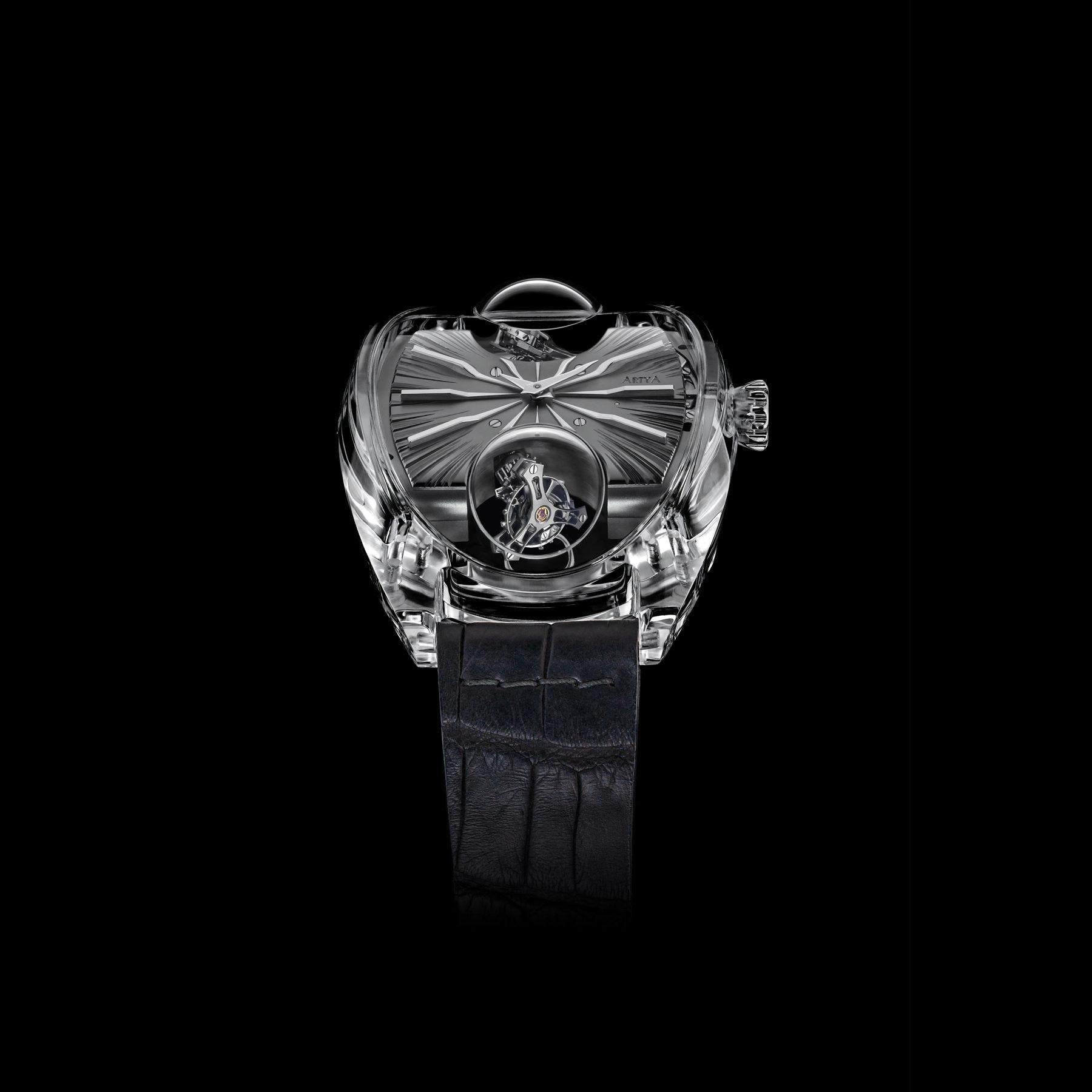
Unveiled as a world premiere at Watches & Wonders 2026, the Complexity established an architecture never before seen in the history of watchmaking: two inclined tourbillons, two Cônillons, positioned at 12 and 6 o’clock, coupled by a differential, within a case cut entirely from sapphire. ArtyA Genève now reveals its most accomplished interpretation: the Complexity Métiers d’Art.
The principle is radical: every surface of the movement and dial becomes the territory of an artisan. Engraving, hammering, shot blasting, perlage, bevelling: the great decorative techniques of haute horlogerie are executed by hand, component by component, and orchestrated to invert the codes of the original version. Where the Complexity played on the purity of fine sandblasting, the Métiers d’Art asserts relief, texture and light.
The same world premiere. The same exceptional calibre. An entirely new skin, born of the artisan’s gesture.
“The Complexity is an extreme and spectacular mechanical sculpture, designed to be admired from every angle while magnifying the chronometry and absolute precision that define the very essence of this watch.”
YVAN ARPA, FOUNDER OF ARTYA GENÈVE
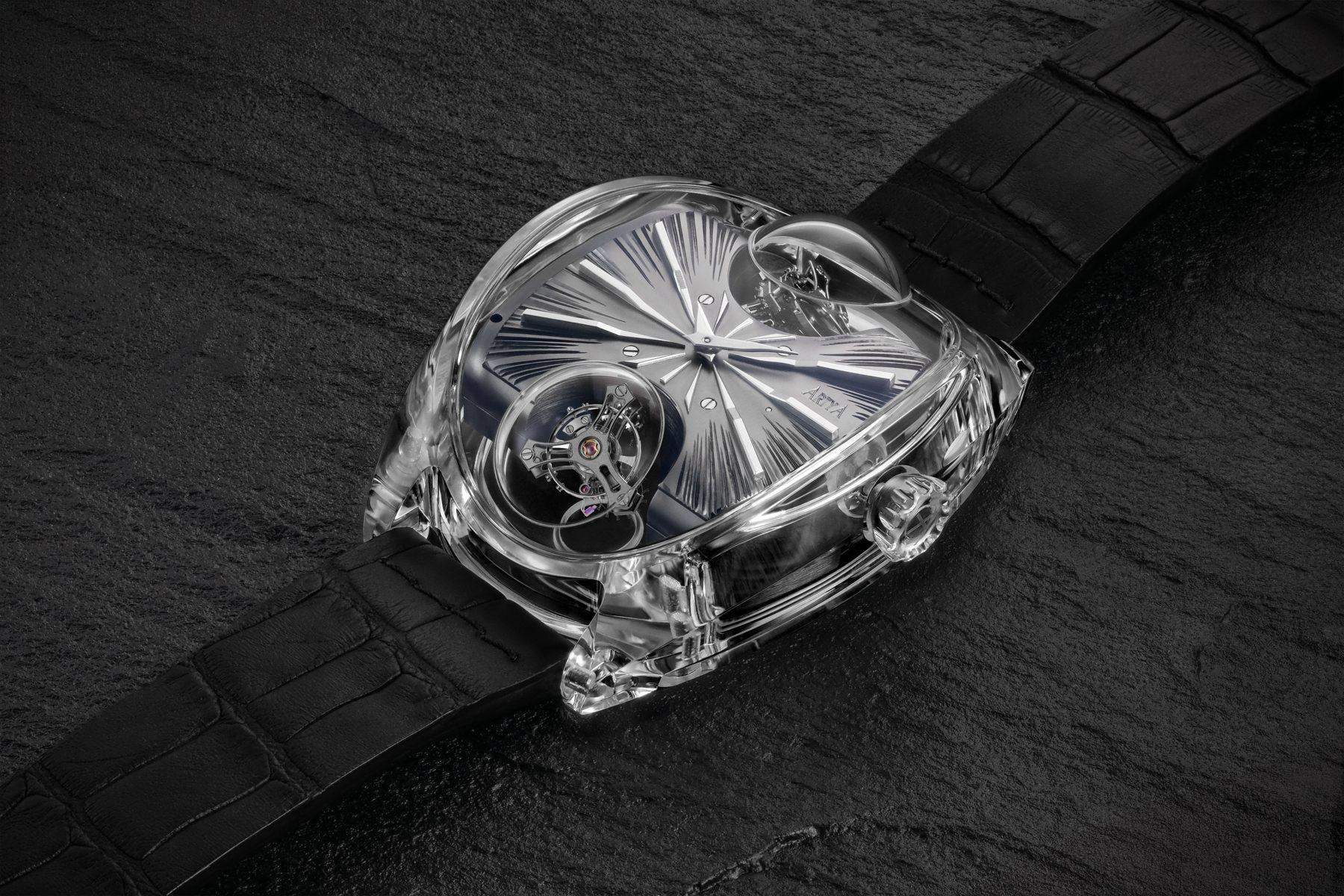
COMPLEXITY MÉTIERS D’ART, TRANSPARENT SAPPHIRE CASE, HAND ENGRAVED GRIFFE DIAL
THE DIAL
Hand engraved, sculpted by light.
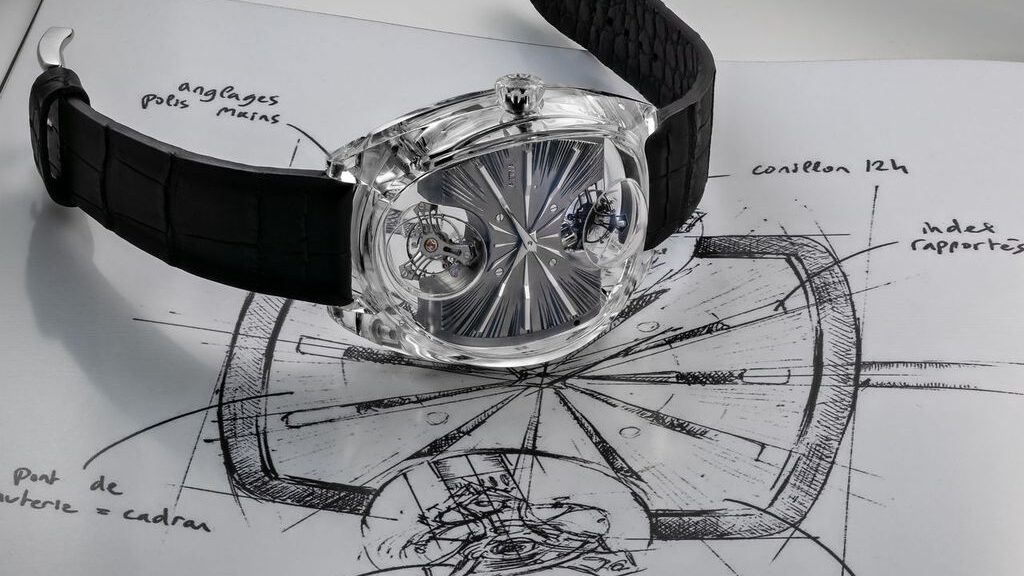
The dial of the Complexity Métiers d’Art is entirely hand engraved on a finely sandblasted base. From the centre radiate scratches carved with the burin, one by one, whose varying depth multiplies the texture: under the light, the surface comes alive with a spectacular play of brilliance, changing with every tilt of the wrist.
The applied indexes carry on the dialogue between tool and hand: bevels polished by hand, flanks drawn with the cabron buff, while their upper face remains sandblasted to melt into the dial base and steal nothing from the spectacle of the engraving. Every edge breaks the light with micrometric sharpness.
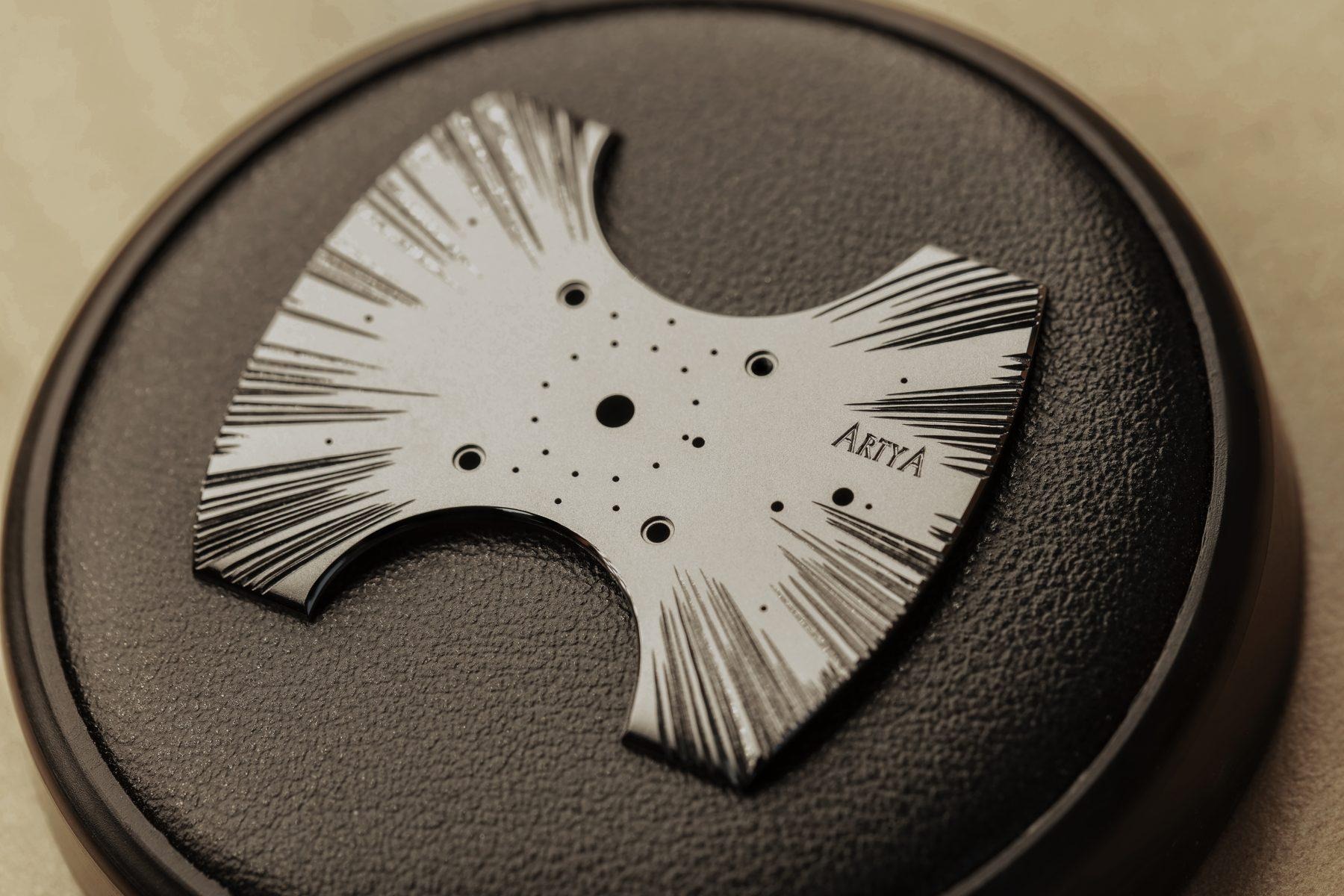
THE HAND ENGRAVED GRIFFE DIAL, BEFORE FINAL TREATMENT
THE MOVEMENT
An exceptional calibre, dressed by the métiers d’art.
The Complexity-01 calibre is a manufacture movement developed with Purtec Sàrl (Vallorbe), a specialist in innovative horological complications. Its 287 components and 44 jewels are the result of thousands of hours of engineering to resolve the challenges posed by the double inclined tourbillon: dynamic balance, energy transmission through the differential, precision maintained in every position. The inclined tourbillon of the Complexity follows in the lineage of Eric Coudray, father of the gyrotourbillon and one of the world’s foremost specialists in multi-axis mechanisms, while the Cônillon finds its historical origin in the research of Andrew Holden Potter around 1860. A technical legitimacy few manufactures can claim.
Exceptional Hand Craftmanship
Upon this exceptional base, every bridge and every surface receives decoration executed by hand, in a deliberate inversion of the textures of the original version: the upper surfaces are hand shot blasted, while the lower surfaces are covered with entirely manual hammering, creating maximum relief. Two decorations specific to this edition, transforming the movement into a landscape.
Every angle is bevelled and polished by hand; the flanks are finished with the cabron buff, true to the signature of the house. The recesses of the mainplate are hand perlaged to highlight the complexity of the differential, the beating heart of the double Cônillon architecture. The centre bridge, beneath which the differential reigns, is adorned with a polished moulding that further sharpens the view of this mechanism. A dedicated zone carries a numbered plate, entirely hand engraved, exclusive to this edition. The whole movement is black rhodium plated, a dark setting from which every hand polished surface emerges like a stroke of light.
DECORATION DETAILS
Component by component.
The decoration of the Complexity Métiers d’Art is documented piece by piece, in the manner of a workshop logbook. Each component carries its own combination of gestures:
| COMPONENT | HAND DECORATION | TREATMENT |
|---|---|---|
| Mainplate | Hand perlage of the differential zone, flanks drawn with the cabron buff, laser engraving of the jewel count | Black rhodium |
| Minute train bridge (dial side) | Fine sandblasting, hand engraved logo and scratches, hand bevelling | Black rhodium |
| Barrel bridge | Hand hammering of lower surfaces, hand shot blasting of upper surfaces, hand bevelling and hand engraved logo, flanks drawn with the cabron buff, Swiss Made laser engraving | Black rhodium |
| Power reserve bridge | Hand shot blasting, hand bevelling, laser engraving of the reserve scale and technical inscriptions | Black rhodium |
| Differential bridge | Hand hammering of lower surfaces, hand shot blasting of upper surfaces, hand bevelling | Black rhodium |
| Numbered “Complexity” plate | Hand engraving and bevelling, drawn strokes | Black rhodium |
| Indexes | Hand bevelling, flanks drawn with the cabron buff, fine sandblasted upper face | Rhodium |
Laser engraving is reserved for regulatory and technical inscriptions (Swiss Made, jewel count, power reserve scale): everything else is the work of the hand.
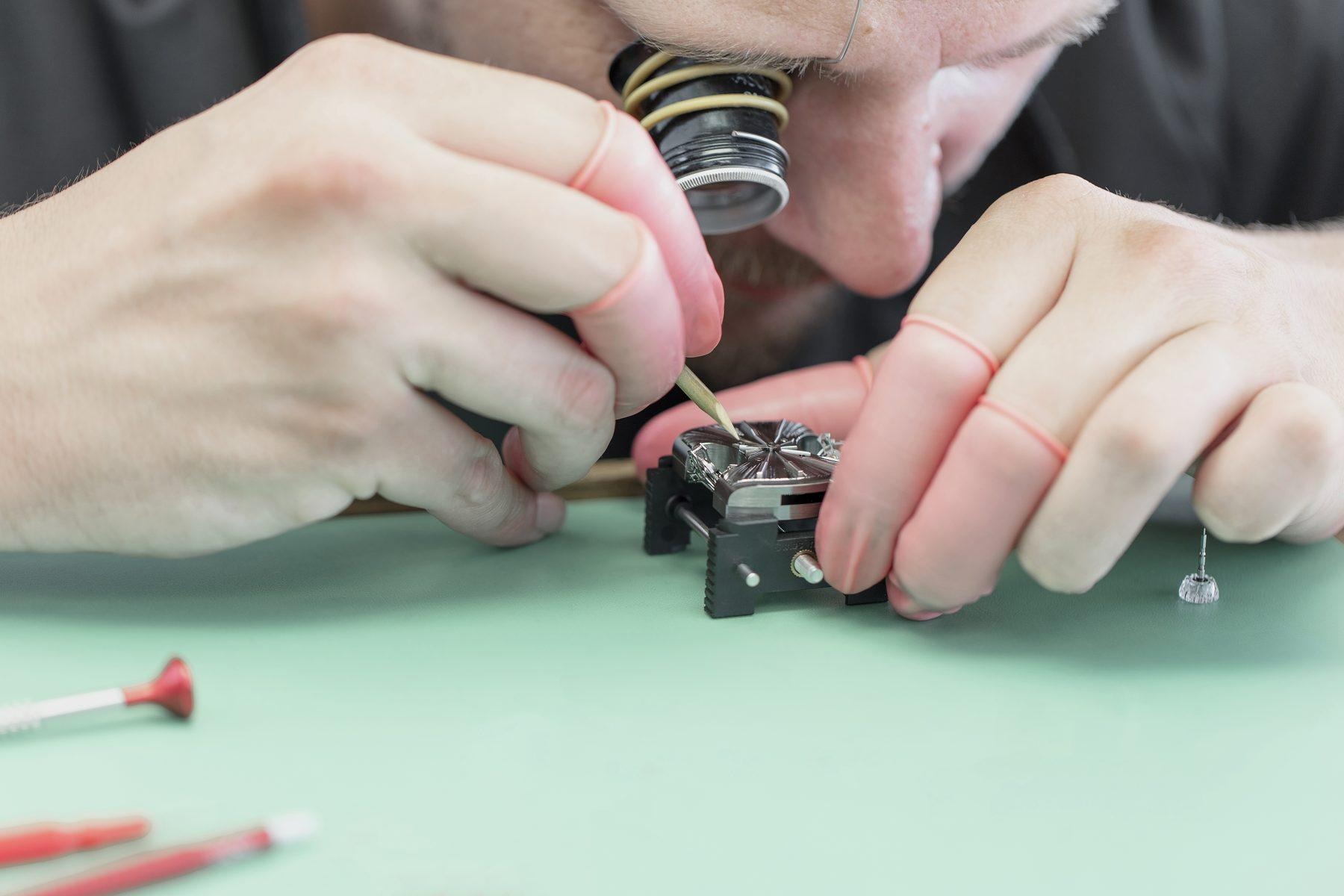
DECORATION AT THE BENCH, PIECE BY PIECE
THE ARCHITECTURE
Double Cônillon 12 / 6 o’clock. A world premiere.
In a classical tourbillon, the balance axis describes a cylinder. In the inclined tourbillon, the Cônillon, it travels a conical trajectory, compensating for the effects of gravity across several vertical positions simultaneously. The Complexity combines two of them, at 12 and 6 o’clock: a world premiere, in an unprecedented configuration in which none of the axes of the balance, the cage or the lever are parallel.
A differential distributes the barrel’s energy in perfect balance between the two regulators and performs a kinematic averaging of their rates: chronometric optimisation through 360 degrees, which neither tourbillon alone could achieve. Each cage completes its rotation in 30 seconds, in offset directions, offering a kaleidoscopic spectacle of rare intensity. Conceived within an architecture of remarkable robustness, this construction delivers shock resistance surpassing that of devices such as the gyrotourbillon.
The case, cut entirely from solid sapphire (more than 120 hours of diamond machining, 140 hours of polishing, a mastery possible only in Switzerland), wraps the movement in a triple-concave middle with domed flanks. Its two optical domes, at 12 and 6 o’clock, act as natural magnifiers over the cages in motion. Despite its high complication, its contained dimensions of 42 × 48 mm follow the curve of the wrist with remarkable comfort.
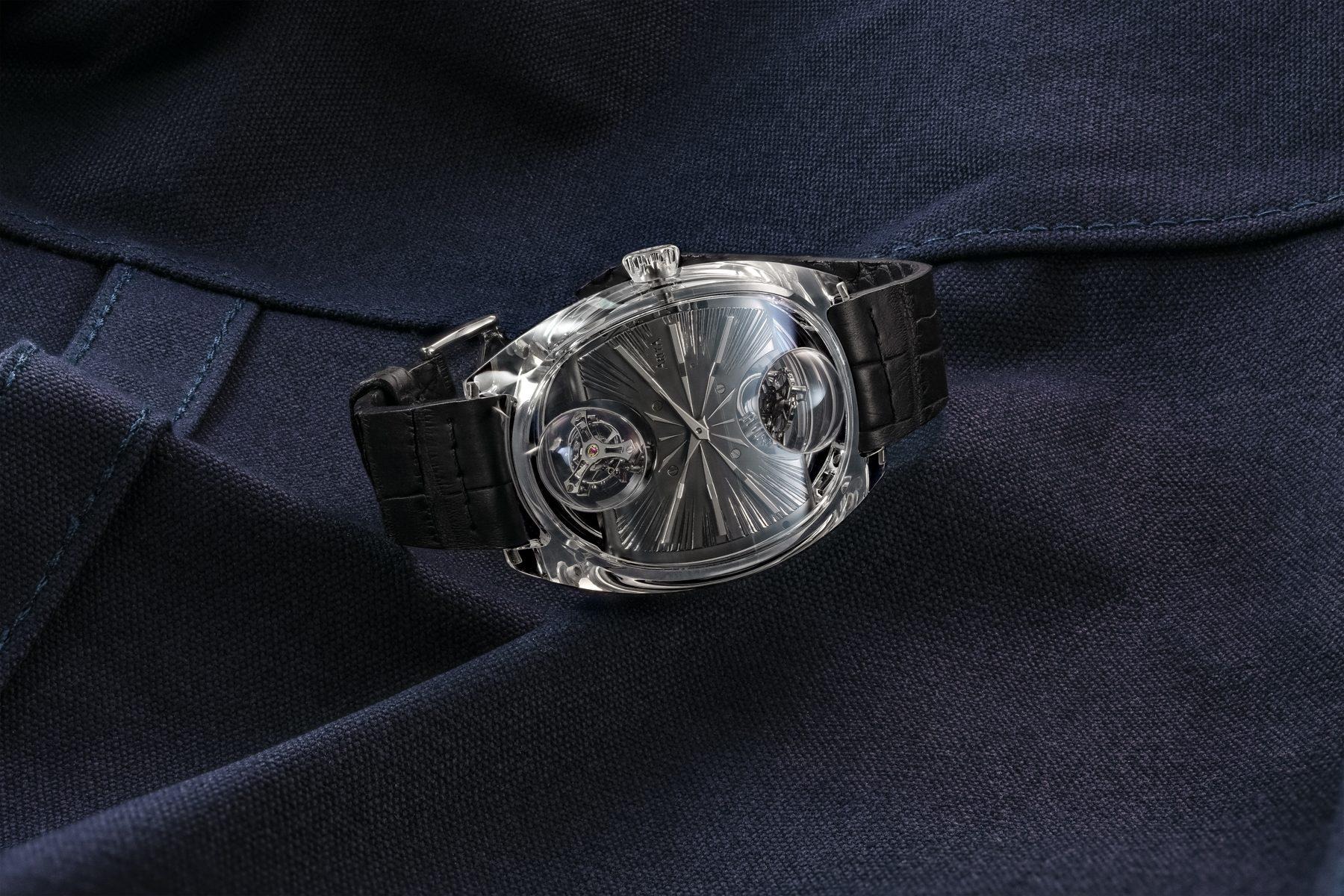
REMARKABLE WEARABILITY, DESPITE THE HIGH COMPLICATION
TECHNICAL SPECIFICATIONS
Complexity Métiers d’Art
| MOVEMENT | |
| Complication | Double Cônillon 12 / 6 o’clock with differential, a world premiere |
| Calibre | Proprietary Complexity-01, developed with Purtec Sàrl (Vallorbe) |
| Winding | Manual |
| Frequency | 3 Hz, 21,600 vibrations/hour |
| Power reserve | 50 hours |
| Components | 287 |
| Jewels | 44 (rubies) |
| Movement dimensions | 37.5 × 38.20 mm, height 14.10 mm (Cônillon at apex) |
| MÉTIERS D’ART FINISHING | |
| Upper surfaces | Hand shot blasting |
| Lower surfaces | Entirely hand hammered, maximum relief |
| Bevelling | Hand bevelled and polished across the entire movement |
| Flanks | Drawn with the cabron buff |
| Mainplate | Hand perlaged recesses, highlighting the differential |
| Centre bridge | Polished moulding opening the view onto the differential |
| Numbered plate | Hand engraved, exclusive to this edition |
| Treatment | Black rhodium plating |
| DIAL | |
| Dial | Entirely hand engraved on a finely sandblasted base |
| Indexes | Applied: hand polished bevels, cabron drawn flanks, sandblasted upper face |
| CASE | |
| Material | Synthetic sapphire, transparent through 360°, cut from the solid block |
| Form | Triple-concave middle, sapphire domes at 12 and 6 o’clock |
| Dimensions | 42 × 48 × 13 mm |
| Crown | Faceted, cut from the crystal |
| Machining | More than 120 hours of diamond machining, more than 140 hours of polishing |
| EDITION | |
| Series | 9 numbered pieces |
| Strap | Integrated rubber, ArtyA folding clasp |
| Price | CHF 190,000 in sapphire, CHF 220,000 in pigeon blood ruby |
| Availability | By order, ArtyA Genève and official retailers |
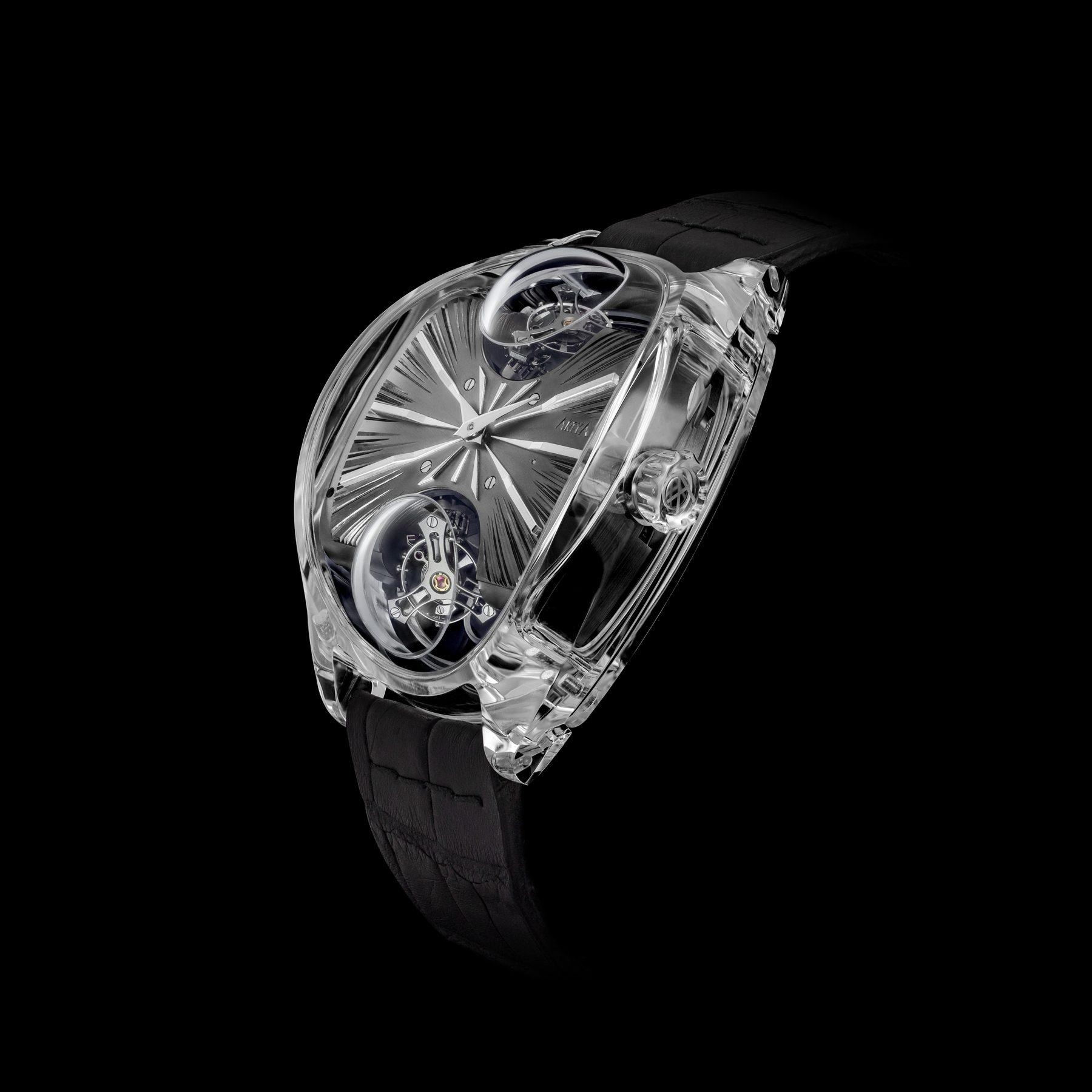
ARTYA GENÈVE
Independent Haute Horlogerie, Geneva, Switzerland
Press: info@artya.com · +41 (0)22 752 49 40 Please mention The Silo when contacting.
For the Silo, Jarrod Barker.