All posts by The Silo

Texas NRCS Accepting Conservation Applications From Rice Producers

TEMPLE, Texas – Rice producers wanting to enhance current conservation efforts are encouraged to apply for a special Conservation Stewardship Program (CSP) sign-up.  Led by the USA Rice-Ducks Unlimited Rice Stewardship Partnership, the Gulf Coast Water and Wetlands Regional Conservation Partnership Program (RCPP) and the Lower Colorado River Authority (LCRA), the RCPP provide an opportunity to enhance conservation on rice lands in 12 Texas counties. Applications for RCPP-CSP are accepted on a continuous basis, but to be considered for this funding period applications must be received by June 28, 2019.

The special sign-ups assists landowners and rice producers who voluntarily implement conservation and management practices that aim to provide waterfowl habitat on rice production lands.  Nutrient management and integrated pest management (IPM) to address water quality concerns are also a priority.  Although enhancements are limited, irrigation efficiencies are also a focus.   

“NRCS is pleased to partner with USA Rice and Ducks Unlimited and others in these RCPP efforts.  said State Conservationist Salvador Salinas. “RCPP-CSP provides an opportunity for rice producers to build their businesses while implementing conservation practices that help ensure the sustainability of their operations and improve the environment for Texas’ citizens.”

These special RCPP CSP sign-ups are targeted for rice production acreage in Brazoria, Calhoun, Chambers, Colorado, Fort Bend, Jackson, Jefferson, Lavaca, Liberty, Matagorda, Waller and Wharton counties. These projects will provide a special CSP allotment of approximately 110,000 acres in 2019 to Texas rice growers, 80,000 acres under Gulf Coast Water and Wildlife RCPP and 30,000 acres under the LCRA RCPP respectively.

“NRCS has updated the program to help producers better evaluate their conservation options and the benefits to their operations and natural resources,” said Rice Stewardship Coordinator Kyle Soileau. “Partnership staff can help producers see up front why they are or are not meeting stewardship thresholds and allow them to pick practices and enhancements that work for their conservation objectives. These tools also enable producers to see potential payment scenarios for conservation early in the process.”

For additional information producers interested in CSP or other conservation planning, technical and financial assistance can contact their local USDA service center or visit www.tx.nrcs.usda.gov.

Vancouver Company Producing Anxiety Fighting Play Tents For Children

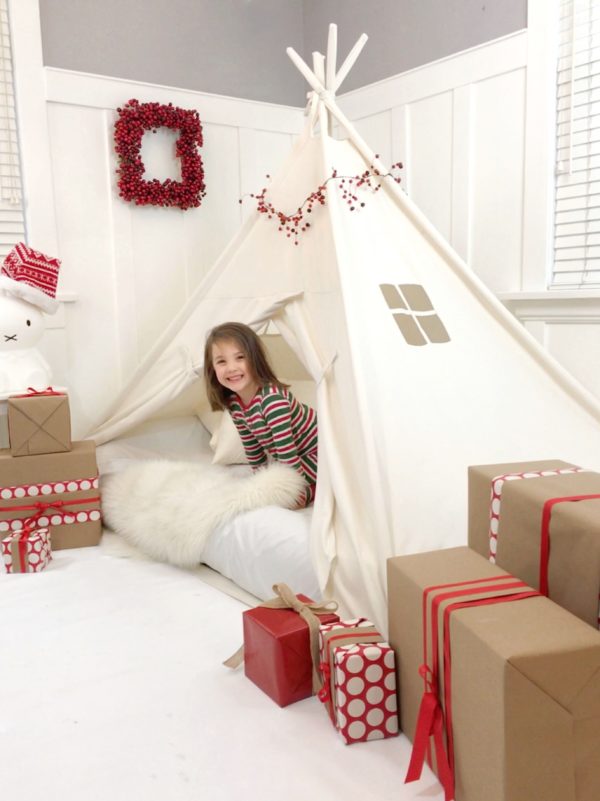
Vancouver-based maker of play tents for children, Domestic Objects, has made it easier for parents and children to ‘unplug’ from the digital world with their Play Tent Canopy. Designed and manufactured to fit securely over a mattress on the floor, the Play Tent Canopy offer parents a clearly delineated space for family time and imagination-based play, shutting out the digital distractions that can be harmful to early child development and lead to developmental problems such as anxiety.

Domestic Objects Sarah JaggerLaunched by Sarah Jagger in 2014, Domestic Objects has built a solid reputation in Canada, the U.S.A. and abroad for handmade, customizable play tents designed to stimulate a child’s natural curiosity and sense of play.

The Play Tent Canopy was initially created at the request of a mother with a very active toddler who was consistently climbing out of their crib. Now Domestic Objects’ best-selling product, it’s now available in four standard mattress sizes in a variety of fabrics, and as a custom order for non-standard mattresses.

“Part of the attraction of the Play Tent Canopy, I think, is practical. You can have a play area that doesn’t take up extra space in a child’s bedroom,” says Jagger. “Plus, being both a restful sleeping space and an imagination-fuelled play space, a canopy helps with the transition from a crib to a “real” bed.”

But, most important to Jagger, is how Domestic Objects play tents can bring parents and children together in play and spark a child’s innate imagination and creativity. A play tent can help a family unplug from the digital world and facilitate more natural and self-driven playtime.

Domestic Objects Teepee Kids RoomA recent study by the Canadian Paediatric Society states that “[high] exposure to background TV has been found to negatively affect language use and acquisition, attention, cognitive development and executive function in children under 5 years old. It also reduces the amount and quality of parent-child interaction and distracts from play.”

Dr. Shimi Kang agrees. The award-winning, Harvard-trained doctor, researcher, bestselling author and speaker says research shows that children are less creative now than they were before the advent of the parental “helpers” like iPads and online educational games.

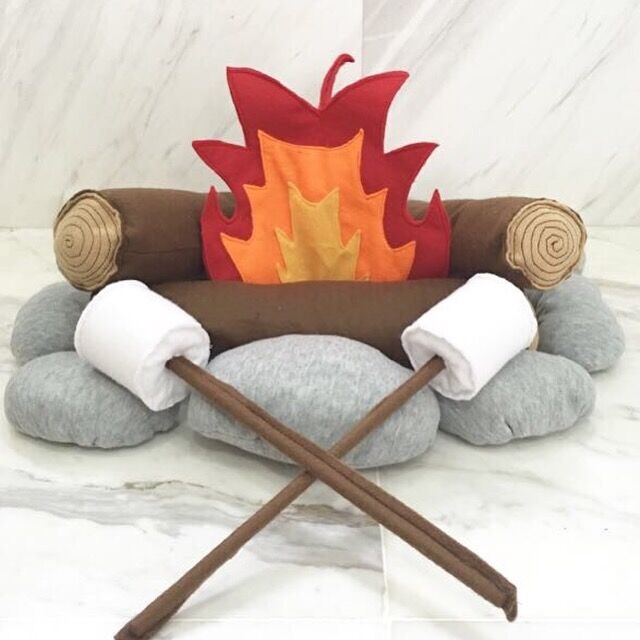
Domestic Objects Firepit

“We are living in an era of paradox,” says Dr. Kang. “Our society is technologically advanced, yet our children are becoming increasingly unhealthy with rising rates of anxiety, depression, and addiction. The Play Tent Canopy provides a space where children will receive the brain-boosting benefits of imaginary play, family bonding and precious downtime.”

Domestic Objects Play Tent Canopy (starting at $238 CAD) and its other products are available and ship worldwide through the Domestic Objects website and the company’s Etsy store.

ABOUT DOMESTIC OBJECTS
Domestic Objects offers eight different imaginative play products, including customizable teepees and canopy beds in an array of stylish fabrics, matching floor pillows, whimsical accessories and even and a children’s book, The Play Tent of Imagination, which Jagger wrote in collaboration with illustrator Lenny Wen.

UNESCO Seeks To Open Markets For Global South Cultural Goods

Paris, 30 May – Experts, stakeholders and government representatives will examine ways to improve exports of cultural products from the Global South, reinforce cultural entrepreneurship and improve the status of artists during the biennial meeting of the signatories to UNESCO’s Convention on the Protection and Promotion of the Diversity of Cultural Expressions, at the Organization’s Headquarters from 5 to 7 June.

Government officials and cultural professionals will address these and other issues at three Create|2030 debates during the session:

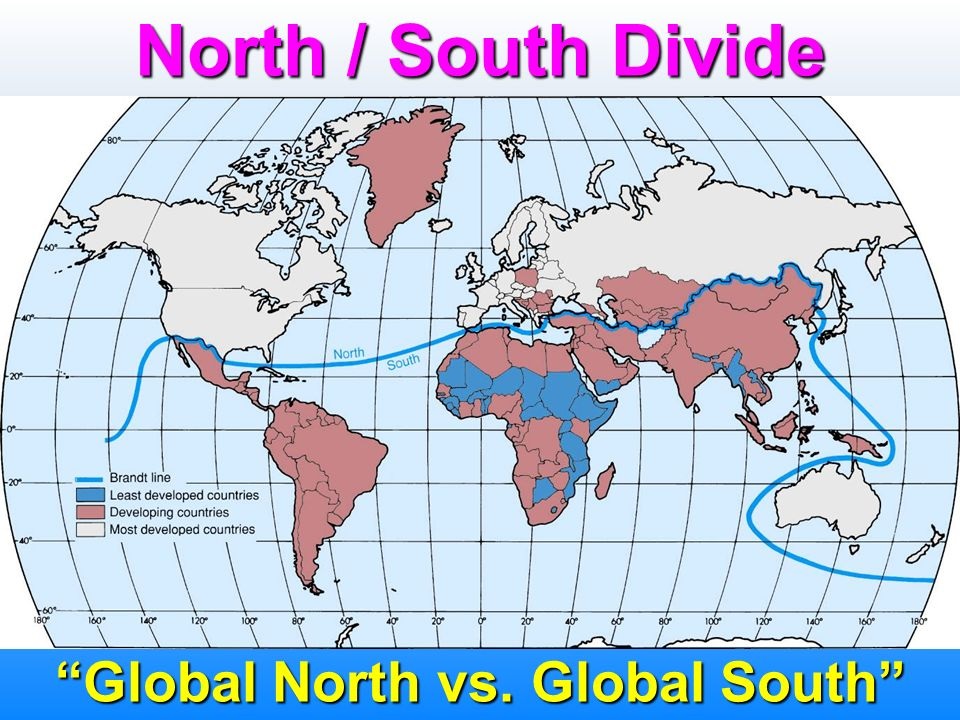
Rebalancing trade flows: making the case for preferential treatment in culture, will examine ways to open markets to cultural goods and services from the Global South, in line with the Convention’s binding provision to grant them preferential treatment in international trade.  Cultural goods and services from developing countries currently only account for 26.5% of the global trade in this rapidly growing sector. Panelists will also examine how the concentration of creative content on large online platforms is impacting the distribution of cultural products and expressions. (7 June, 10 am—1 pm, Room II)

Strengthening cultural entrepreneurship: The International Fund for Cultural Diversity (IFCD) will discuss investments in vocational training andbring together beneficiaries of UNESCO’s IFCD from Brazil, Cambodia, Colombia and Senegal. The Fund, which aims to address the gap between developed and developing countries in the creative economy, has provided more than 10,000 artists and cultural professionals with new skills in project management, business and career development to date. (6 June, 10 am—1 pm, Room II)

Rethinking the status of the artist will explore ways to enhance the professional, social and economic conditions of artists through policies concerning training, social security, employment, income, taxation, mobility and freedom of expression. (6 June, 2—5 pm, Room II)

During the meeting, participants will also examine an Open Roadmap designed to strengthen the Parties’ capacities to promote the diversity of cultural expressions in the digital age, as well as other innovative policy practices. Priorities in line with the UN’s 2030 Agenda for Sustainable Development will be set for the next two years, with particular attention to gender equality, fundamental freedoms, quality education, economic growth, decent jobs, and equality between countries.

The 2005 Convention on the Protection and Promotion of the Diversity of Cultural Expressions provides a framework for the design of policies and measures that support the emergence of dynamic cultural and creative industries around the world. The 146 Parties (145 States and the European Union) that have ratified the Convention meet at UNESCO every two years to examine its impact and determine future action. Twelve new Members will be elected to the Convention’s Intergovernmental Committee during the session.

Hypnotherapy

hypnotherapistSo many of my clients bring interesting cases to me, everyone is different and so therefore interesting in their own way. But one case that stands out was a client who had “misophonia” – which meant that she experienced a heightened feeling of anxiety or “fight or flight response” in response to certain sounds – mainly that of other people eating. It was becoming difficult even eating around her family. This was a case for hypnotherapy.

With just two sessions we completely solved the problem, We went back in time to her childhood where the problem began – with just a very innocent situation (she didn’t really remember this consciously) but her subconscious mind had held onto it and certain sounds still triggered anxiety. And rather than getting better over time, it was getting worse. Going back to that event, in a safe and controlled way, meant that the problem was resolved almost immediately.

What I described above is known as regression hypnotherapy. It’s all about going back in time to where the problem was first triggered. When people have problematic emotions which are being repeatedly triggered, such as panic, anxiety, depression, etc. , it is usually because something happened which wasn’t fully processed at the time and then the subconscious mind holds onto that feeling, thinking that it’s protecting you.

Once you go back to it, and process the “memory” properly (I say memory in inverted commas because often we don’t remember the event consciously, but it’s stored away in our subconscious which is like a giant library). So once we go back to the original event the subconscious is able to understand that it’s over now and releases the emotion. It is extremely powerful and cathartic. There is more information about regression hypnotherapy in my blog post here: http://www.synergy-wellbeing.com/category/regression/

Are there any preparations required before embarking on hypnotherapy?

"You're getting sleepy."
“You’re getting sleepy.”

Not really. I often recommend that people don’t drink a lot of caffeine before a session because this triggers the fight / flight response – which is the opposite to the relaxation response – so it can interfere with the session a little and make it harder to relax. But other than that, no. Someone who meditates or is good at visualization will generally find they go into hypnosis a lot more quickly, but everyone can be hypnotized. We’re in a state of hypnosis when we watch the television!

I would love to help someone who feels that they are “over–sensitive” – and I would prefer to call it “highly sensitive” myself – because their sensitivities could relate back to childhood and things they are subconsciously holding onto which distressed them. Regression hypnotherapy can help to release the memories trapped in the subconscious so that those emotions are not triggered so readily or inappropriately in the future. EFT (Emotional Freedom Technique) is also an excellent technique which I teach my clients a lot – and this can used as a self help tool whenever needed too, on a daily basis even!


H
ow can we enable our subconscious to let go of bad feelings?

There is a technique which I use myself a lot, and also teach people about. It’s called mindfulness. The sad thing is that we are often told “don’t get upset / don’t cry, etc.” so we learn to push our feelings down – we suppress them. Another word for suppression is depression. So we can easily become depressed when we suppress our true feelings. One of the beautiful things that mindfulness teaches us is to be present as much as possible to our experience. So if you’re feeling angry, or hurt, for example, it’s much better to allow yourself to “feel” that feeling.

Contrary to popular belief, this doesn’t make it feel worse, it actually really helps! So, next time you’re feeling bad – ask yourself “how am I feeling? What does that feel like? Where do I feel that in my body?” – really acknowledge it. And – hey presto! The feeling seriously diminishes or disappears altogether! Our feelings just want to be listened to, to be heard. So once we do this, they are satisfied and they settle back down.

EFT (Emotional Freedom Technique) is something else I practice, and this is wonderful for allowing us to let go of negative emotions. It is also known as the “tapping technique” and more information can be found on my website. For the Silo, Liz Davies Clinical Hypnotherapist and EFT Practitioner.


Chasing Ontario’s Tornados

Part One

I have seen many storms in my life. Most storms have caught me by surprise, so I had to learn very quickly to look further and understand that I am not capable of controlling the weather, to exercise the art of patience and to respect the fury of nature”

My name is Spencer Sills, and I am a storm chaser, some of you may remember a few years back reading about my good friend David Chapman and myself in this very newspaper and our journeys on the road to capture Nature’s fury through our lenses. Not much has changed since then, we are both still on the hunt for the elusive supercell and what fury may come with it.

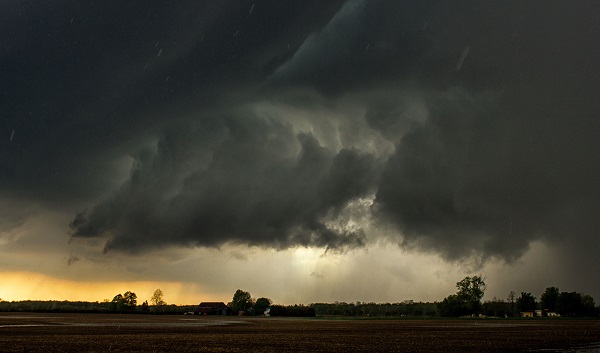
In 2014 my overall goal to capture a tornado in Ontario was once again successful, on July 7th I teamed with Scott Burlovich of Restless Skies photography and his chase partner Harry for the day and we set out to capture some pulse storms that were flaring up in the afternoon, most of these cells were just rain makers but on the way back to my home I had noticed a wall cloud that was lit up by the sun, we pulled off to the side of the road directly South of Norwich and briefly documented a EF0 tornado in a farmers field before it lifted causing no damage since it was in a dry field. This was my only tornado of the year, in a busy season. I did however get to document several gorgeous storm cells throughout the year, including several beautiful stacked shelf clouds and a great Wall cloud early in the season that brought golf ball sized hail to the area.

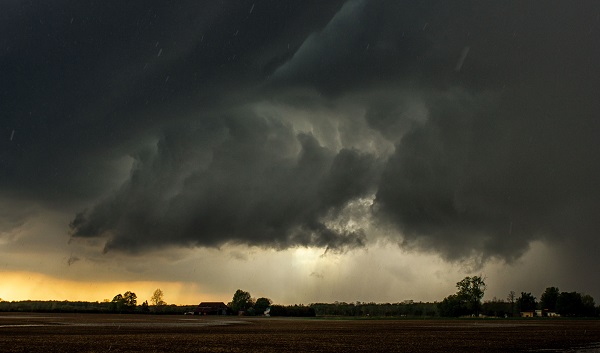
A Wall cloud in SW Ontario approaches my location as the RFD cuts around with hail starting to fall.

In 2015 I hope to achieve a few goals, one of which is to capture yet another tornado in this province, hopefully just like 2014 in an open field away from any properties. I also have set my sights on some goals with lightning and capturing it in a different perspective, I can’t go into much detail but it will be a stunning sight if I can achieve it. As far as how I believe the season will go, I do believe it will be a slow start, April and May will bring the return of storms, but I don’t expect anything too severe until June and July once the humidity and warmth really have a chance to build in. I do however once again stress to leave chasing to the pros, if you’re interested in storm spotting, please look into Canwarn, the more spotters in the province the quicker warnings can be issued thanks to verified ground reports.

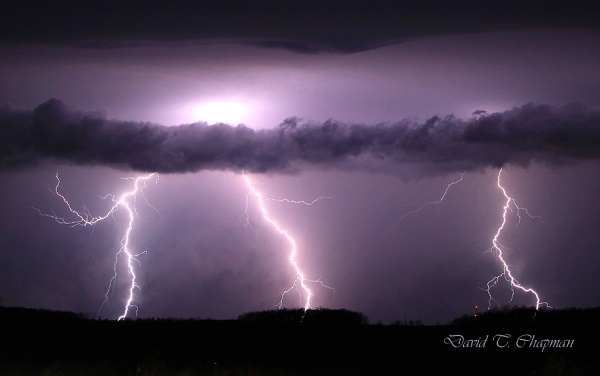
Lightning by Chapman

I will be working alongside another photographer and storm spotter this year, Scott Burlovich of Restless Skies, please feel free to check out his amazing work at restless-skies.com and give him a follow on twitter @restless_skies , you can also follow my journey for the year at Lightningfastphotography.com or on twitter @spencersills. I also want to send my best wishes to David Chapman for a great 2015, and as always look forward to meeting him in the field under the Meso, stay tuned for more updates and stay sky aware this summer!

Part Two

Another winter has come and gone, although perhaps slower than a lot of us would like. At least this means that the storm season is once again upon us in Ontario. As usual, Brian Chapman and I, a father and son chase team, will be back out on the roads looking for the best images of lightning and searching for Ontario’s tornadic super cells.

We will also be in close communication with our good friends and fellow chasers, Spencer Sills and Scott Burlovich, as we tend to share a lot of information about the biggest potential storms before we go chasing. You’ll notice when you look through their photography collections that they are a couple of the best for chasing down the biggest storms in our province.

You might be curious on what we do when it comes to chasing the actual storm. Brian’s job is to be the driver. This is his first priority. Once we are parked and in a safe but photographic position for the storm, he is our main videographer. As for myself, I choose where I think the biggest storm will form from looking at weather models that meteorologists use as well as talking to fellow storm chasers in the area. I am also the main photographer. I do some video work and navigate us to the most photogenic side of the storm. This is usually right next to the most dangerous part of the storm but still in the safest position possible.

Rapidly Rotating wall-cloud photo being documented by Brian Chapman)

In the past 2 years, our team has seen and recorded a number of funnel clouds, 2 confirmed tornadoes and 4 waterspouts. One of the tornadoes was near Arthur, Ontario on August 7, 2013 and the landspout tornado was near Listowel, Ontario on May 14th 2014. The Arthur tornado was a really great one to document. It lasted for close to 15 minutes and we were able to see it from start to finish. The best part about it was the fact that  no one was injured and it caused very little damage. Those are the kinds of tornadoes we love to see because they allow you to enjoy the pure power and beauty that they possess but without injuries or major destruction.

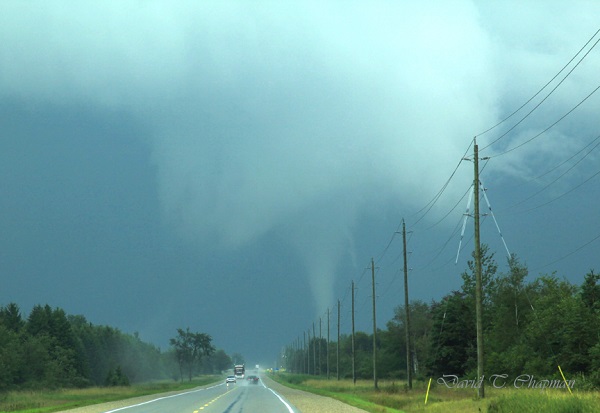
Tornado by Chapman

Another thing that was interesting with the tornado that hit near Arthur was the fact that it tried to form a second tornado at the same time the first one was on the ground. If that funnel had reached the ground, it would have been called a satellite tornado. They are typically smaller and weaker but not always. In Pilger, Nebraska in 2014, two EF-4’s were on the ground at the same time. Sadly they hit a town, killing 5 people and injuring 19. Those are the days I dread as a chaser and hope I never see first hand. As for the second funnel near Arthur, it didn’t quite have the energy to make it the rest of the way to the ground. This probably wasn’t such a bad thing with so many people focusing on the main, larger tornado just to its north.

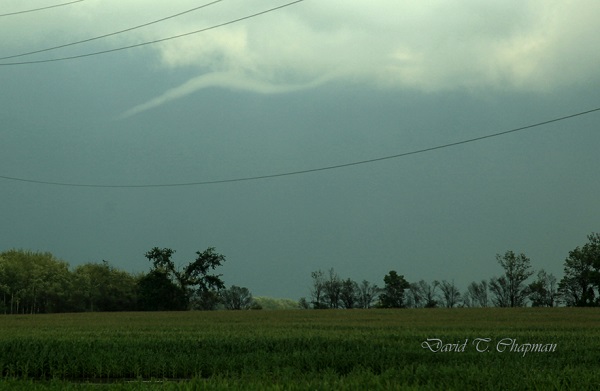
A Funnel Cloud
A Funnel Cloud

Fortunately, a lot of Ontario’s tornadoes hit open areas that cause little to no damage. There have been some exceptions, as the tornadoes that hit both Durham, Ontario on August 20, 2009 and Goderich on August 21, 2011 showed, both killing one person in each of them. That is why many storm chasers as well as dedicated weather enthusiasts in our province have a direct line to Environment Canada that allows us to contact them when we see threatening weather approaching the area we are in. It can help Environment Canada confirm what they are seeing on radar so that they can issue the proper watches and warnings accordingly. Refer to Spencer Sills’ Part One above for more details on how you can become a spotter. Lightning will also be a big focus for our team this year. We continue to work to get lightning photos as close as possible in order to capture the positive leaders that come up to meet the main negative current coming down from the cloud. The leaders can come from the ground, hydro poles, houses and even people.

Although this may be risky and dangerous, we have worked out ways to minimize the risk to us. We stay in the car when lightning is close with the windows up. We also won’t park under a tree, not so much from the fear of a direct lightning strike but in case lightning hits and splits the tree causing it to fall on the vehicle. I remember seeing one like that when I was young and it has had an everlasting impression on me. One of the first big wind storms I chased along Lake Erie on November 1, 2013 knocked down a tree onto a woman‘s car and unfortunately she was in it and was killed. So debris is always a concern and something to be very aware of when it comes to storm chasing.

You can follow our storm chasing throughout the year on our social media pages. https://twitter.com/DTChapmanPics https://www.facebook.com/pages/David-T-Chapman/173134962767601?fref=ts https://twitter.com/WeatherHunters

Toby Barrett
~CLICK ME~


Peter Robinson On Job Obsolescence- Government Should Not Protect Jobs

A recent OECD report finds that low and middle income earners have seen their wages stagnate and that the income share of middle-skilled jobs has fallen. Rising inequality has led to concerns that top earners are getting a disproportionate share of the gains from global “openness and interconnection”. During a Summer 2017 meeting of OECD, employment outlook revealed that job polarization has been “driven by pervasive and skill-biased technological changes.

Founded in 1945, the United States Council for International Business (USCIB) builds awareness among business executives, educators and policy makers around issues related to employment, workforce training and skills enhancement. CMRubinWorld spoke with USCIB President and CEO Peter M. Robinson, who serves as a co-chair of the B20 Employment and Education Task Force, through which he helped develop recommendations to the G20 leaders on training for the jobs of the future. Robinson also serves on the board of the International Organization of Employers, which represents the views of the business community in the International Labor Organization.

“I think the guiding principle for government should be to protect and enable/retrain the worker, not protect the job. Policy makers and educators should focus on making sure that workers are as equipped as possible to transition to new opportunities” Peter Robinson.

Peter, welcome. How severe do you believe jobsolescence will be over the next 20 years? How big will the challenge be to offset it and maintain a growing workforce?

I really don’t think the overall effect will be as dramatic as some people fear, at least for the medium-term as far as we can tell. There is an over-hype factor at play, but the consequences still deserve serious attention. For one thing, so many of the jobs in the United States, Canada and other advanced economies are in the service sector, and involve interacting with other people. Despite all the advances in AI, we are still a long way off from robotic nurses or home health aides. Overall, history tells us that at least as many new jobs are created as are displaced by technological innovation, even though transitions can be difficult in some sectors and localities, and as long as upskilling takes place.

“The biggest threat is that our educational institutions won’t be able to keep pace with new skills demands.” — Peter Robinson

What do you think are the biggest obstacles facing college grads today trying to enter the workforce?

I actually think the greatest obstacles are faced by those who don’t make it to university or some form of higher education beyond high school (a four-year degree is not the right path for everyone). A 2014 Pew survey found that among workers age 25 to 32, median annual earnings of those with a college degree were $17,500 greater than for those with high school diplomas only. Obviously, everyone at whatever educational level needs to keep their skills sharp, and governments should join with employers and educators to instill better life-long learning. But there are far fewer established paths toward long-term employment at a middle-class level of income for those who don’t graduate from college. A greater emphasis on vocational education and apprenticeships would help. We strongly support the work being done by United States Secretary of Labor Acosta to promote apprenticeships.
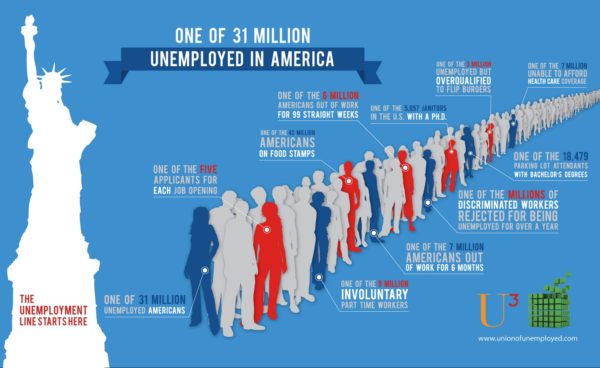
Given that machines are in the process of stripping white collar workers from their jobs, what kind of skills are key manufacturing and service industries going to need from new employees?

I think the premise of your question is overstated. We’re all being told that our jobs are doomed by robots and automation. But the OECD estimates that only nine percent of jobs across the 35 OECD nations are at high risk of being automated, although of course even 9% can be generative of social difficulties. But there is an established track record across history of new technologies creating at least as many new jobs as they displace. Usually these new jobs demand higher skills and provide higher pay. The biggest threat is that our educational institutions won’t be able to keep pace with new skills demands.

“It is becoming clear that Versatility matters, in a constantly changing world, so Jim Spohrer’s IBM model of a “T-shaped” person holds true: broad and deep individuals capable of adapting and going where the demand lies.” — Peter Robinson

In an economy with a significant on-demand labor force, what competencies will these workers need to compete?

There are two types of competencies that will be needed: “technical” – or in other words, related to deep knowledge of a specific domain, whether welding or optogenetics; and “transversal,” which applies to all occupations. Those are described by the Center for Curriculum Redesign as skills (creativity, critical thinking, communication, collaboration), character (mindfulness, curiosity, courage, resilience, ethics, leadership) and meta-learning (growth mindset, metacognition).

How will managerial skill requirements change as a result of major structural changes that are likely, including human replacement by machines and growth of the on-demand economy?

OECD’s BIAC surveys of 50 employer organizations worldwide has shown that employers value not just Skills as described above, but also Character qualities as well. Further, it is becoming clear that Versatility matters, in a constantly changing world, so Jim Spohrer’s IBM model of a “T-shaped” person holds true: broad and deep individuals capable of adapting and going where the demand lies.
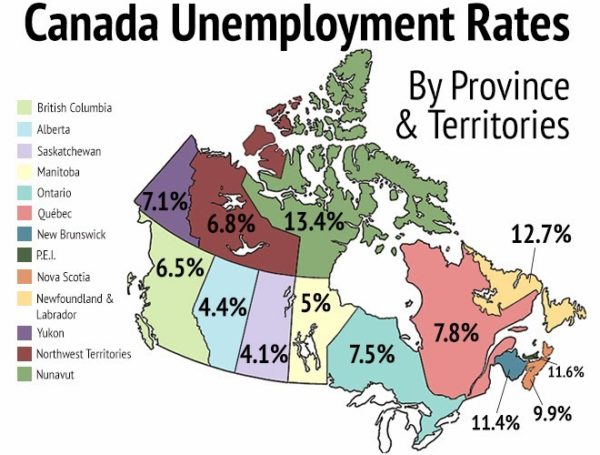
Canada Unemployment Rate By Provinces and Territories

“We often hear about the need for more STEM education. But I think there is an equal need for a greater emphasis on the humanities and the arts, for their intrinsic value as well as for developing skills and character qualities.” — Peter Robinson

What central changes in school curricula do you envision, both at the secondary school and college levels?

We often hear about the need for more STEM education. But I think there is an equal need for a greater emphasis on the humanities and the arts for their intrinsic value as well as for developing skills and character qualities as described above. As David Barnes of IBM wrote recently, these skills are more durable and are also a very good indicator of long-term success in employment.

How can the evolving changes in competencies required for employment be effectively translated into school curricula? Where are the main opportunities to enable this? e.g. Assessment systems? Business/Education collaboration? Curriculum change?

I’d go back to something else David Barnes said: We need much stronger connections between education and the job market, in the form of more partnerships among employers, governments and education institutions. Everyone needs to step up and create true partnerships. No one sector of society can address this alone. OECD’s BIAC has also documented employers’ wishes for deep curricular reforms to modernize content and embed competencies in order to meet today’s market needs.

What role should government play in ensuring citizens receive a quality and relevant education given the challenges that lie ahead?

I think the guiding principle for government should be to protect and enable/retrain the worker, not protect the job. Policy makers and educators should focus on making sure that workers are as equipped as possible to transition to new opportunities as these develop, and on ensuring that businesses have the freedom to pivot and adopt new technologies and business processes.

CMRubinWorld For the Silo, C.M. Rubin.  C. M. Rubin is the author of two widely read online series for which she received a 2011 Upton Sinclair award, “The Global Search for Education” and “How Will We Read?” She is also the author of three bestselling books, including The Real Alice in Wonderland, is the publisher of CMRubinWorld and is a Disruptor Foundation Fellow.


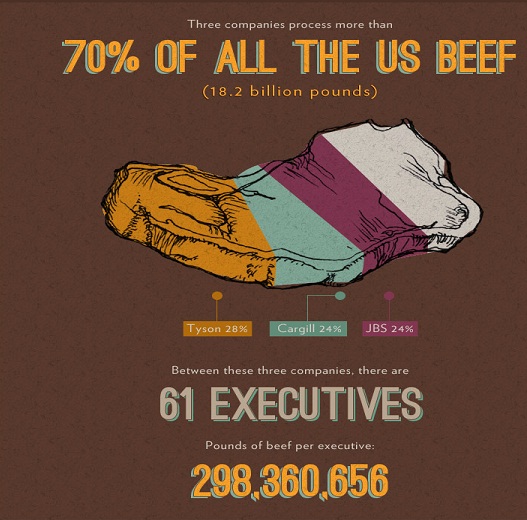
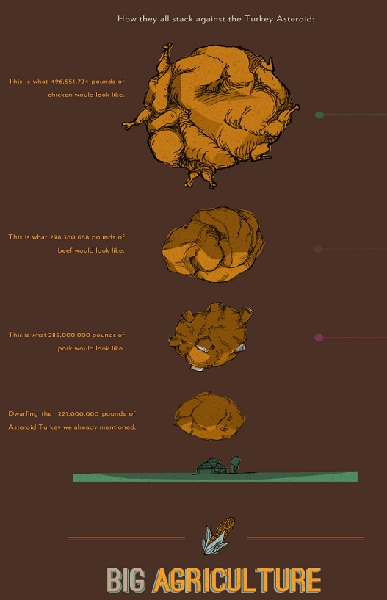
The Consolidation Of North American Food

Adam Jacob sent in this tell-all graphic that is pretty shocking. If these statistics are true then ‘it’s clear the small food producer is an endangered species. Unless of course, they start supplying the big chain corporate grocery store chains. And that will likely spell the end of family farm gate-retail…and that will spell the end of the family farm. It is so important to support local farm to table initiatives and preserve food that is not only grown for profit, but grown for quality and healthy consumption.

To learn more about the consolidation of (North) American food and the implications for Ontarians, visit Silo Direct Link to Frugaldad.com


A Cooking Journal With A Unique Interface- Not Connected to Smartphone

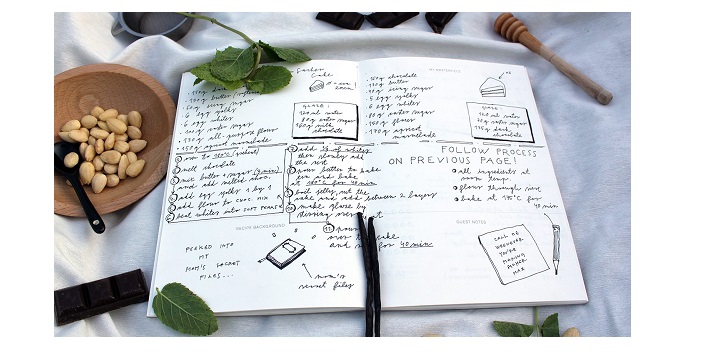
Here’s a cooking journal with a unique platform that helps you create signature recipes and becomes your personal cookbook. It’s a perfect booklet for all people who enjoy cooking and experimenting in the kitchen. The project first launched a couple of years ago on Kickstarter under the name Project Cookbook.

Project Cookbook 1If you want to get more creative with your cooking, but still make sure your ideas don’t melt away as fast as the food from your plates, Cookbook is the perfect fit for your kitchen.  Old SkoolThis cooking journal with a unique interface helps you develop signature recipes and create a culinary heritage. And what’s the best part? It’s not connected to your smartphone. It is a physical booklet that will become your trusted cooking companion and is destined to become your personal cookbook.
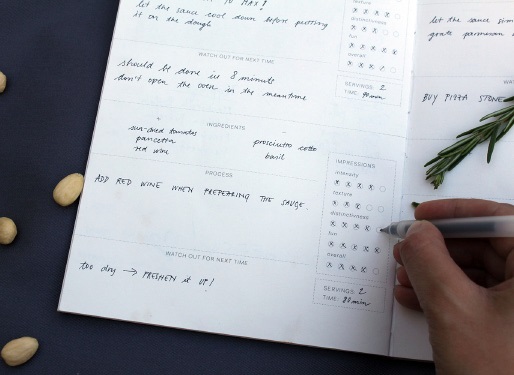
If other similar booklets are meant to simply copy and gather recipes of others, Cookbook’s idea and purpose is much different: after you equip the Cookbook with recipes of your choice, they simply serve as a starting point of your future cooking experiments. It features a development platform for every recipe where you can keep track of all the changes to the original recipe – whether it’s tinkering with your cooking process or changing the ingredients.

Project Cookbook Inside

After each try you can use the scoreboard to evaluate your dish, write down important notes for next time and keep a tab on who loves it the most.

The aim is to remind people that cooking is more than just following recipes. As the team puts it: ‘’We are hoping Cookbook will motivate people to develop their own recipes and create a culinary heritage, which they will be able to share with their friends, family and future generations.

Something like the notebooks our grandmothers used to have, but with a modern twist.

Cookbook also holds an encyclopedia which helps you with everyday pickles like finding the appropriate wine pairing or quickly converting cups into grams. A minimalist design of the book gives you a sense of coziness and at the same time allows you to personalize the final outlook of your Cookbook. For the Silo, Hana Gaber.

Toronto Is Home To Proud History And Great Architecture

Well before the construction of Ontario’s present Queen’s Park Legislative Building, Ontario was governed as the British colony of Upper Canada.

After its formation in 1791, Upper Canada’s elected Legislature first met on September 17th, 1792.  As no permanent structure was built to house the Legislature in Newark, now Niagara-on-the Lake, meetings took place in a variety of locations including Navy Hall—which also served as a residence for our first Lieutenant Governor John Graves Simcoe.  The first legislators were also reputed to have met in Butler’s Barracks, and also under a large oak tree.

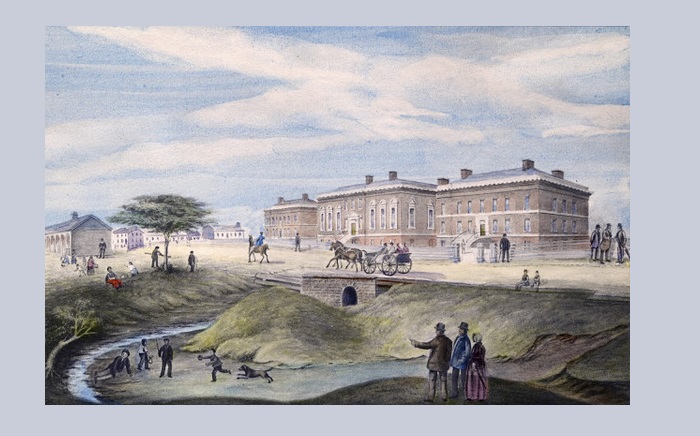
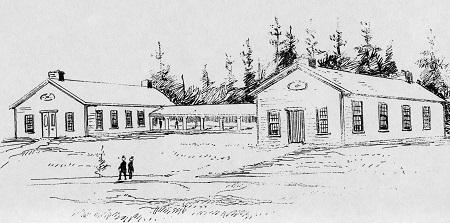
In 1793, a site at York, now Toronto, was chosen as the new location for Upper Canada’s capital.  Lieutenant Governor Simcoe initiated plans for the construction of the colony’s first purpose-built Legislative Building. Completed in 1797, the “Palace of Government,” as it was known, was located near the present-day intersection of Front  and Parliament Streets.  Consisting of two small structures connected by a covered walkway, they were the first in York to be made of brick.

The Legislature met there until 1813, when the building was burned to the ground in the aftermath of the Battle of York during the War of 1812-14.  During this American raid, the first Mace of Ontario—made for the Legislature of Upper Canada in 1792—was seized by the American soldiers. It was later returned in 1934 by President Roosevelt as a gesture of friendship.  While waiting for construction of a new building, Upper Canada’s Legislature met in several temporary locations.

The next structure, completed in 1820 on the same site, was destroyed by an accidental fire in 1824.  As before, sessions of parliament were held in temporary locations, including the court house and the general hospital.

In 1832, another structure at Front and Simcoe Streets served the province well, but by the 1870s, it was in poor condition. This prompted the Department of Public Works to formulate plans for a modern facility.  The legislature continued to meet in the rapidly declining structure until the opening of the present Legislative Building at Queen’s Park in 1893.

 The Legislature, which has become one of my places of business and almost a second home, was proudly opened on April 4th, 1893 by Ontario Premier Sir Oliver Mowat.  It took six years to complete (1886-1892).  People were thrilled by its beauty, expanse and grandeur—not to mention its electric lights and a new and exciting invention, electric elevators. 

The beautiful building was designed by Architect Richard A. Waite in the Richardson Romanesque style, featuring heavy stonework, majestic rounded arches, and fanciful carvings.  The exterior walls are pink sandstone and the roof was covered in slate.  Oak floors and cast iron pillars lined the halls. Intricate details were added to every inch of the building’s interior and exterior. 

The structure is divided into the East Wing, West Wing, and the North Wing, which was constructed later and opened in 1913.

All in all, the building is a large home-like meeting place where I work for my constituents and the people of Ontario.  

When in Toronto, I would urge any lover of great architecture, history, and good government to come for a visit and learn more about our provincial parliament. 

(Acknowledgement to Parliamentary Protocol and Public Relations “History and Heritage” brochure). For the Silo, Toby Barrett MPP for Haldimand-Norfolk.

Featured image-
Historical Maps of Toronto: 1834 Alpheus Todd Engraved Plan of the City

Can Another Ottawa Residence Win Canada’s Best Garden Street?

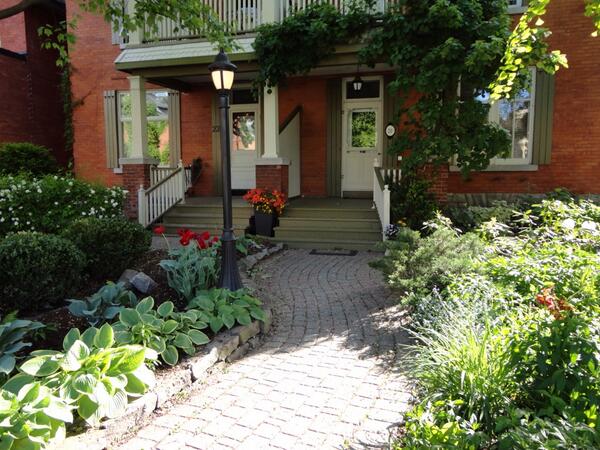
Congratulations! Russell Avenue in Ottawa’s Sandy Hill neighbourhood is the winner of the Canada’s Best Garden Street contest.
Russell Avenue in Ottawa’s Sandy Hill
neighbourhood is the winner of the Canada’s Best Garden Street contest.

Toronto, ON Garden Days – The month of June hosts Canada’s three-day celebration of gardens and gardening. There are loads of Garden Days official activities scheduled across the country, and almost every province has a Flagship Event for you to enjoy. It’s the perfect time to get dirty in one’s own garden, visit a nearby public garden or spend some time in a local garden center.

You’ll be in great company
If you’re planning travelling around the province or across Canada this Summer, be sure to visit a few of the many public gardens that we’re becoming world renowned for.  Dr. Richard Benfield, author of ‘Garden Tourism’ estimates that annually there are 6 million garden tourists in Canada.

And the winner is . . .

On the occasion of our upcoming National Garden Day, Friday, June 13, the Canadian Garden Council is pleased to announce the winner of the Garden Days’ ‘Best Garden Street’ Contest which celebrates the contribution that public and/or private gardens have made to the quality of life on individual streets and neighbourhoods.  The winner of $1000 worth of Marks’ Choice Lawn and Garden products from Home Hardware, and the bragging rights to be named ‘Canada’s Best Garden Street’ is: Mary Moreland, Russell Avenue, Ottawa.

Garden Days spokesperson, Mark Cullen, recently said, “The partnership between the hand of man and Mother Nature has produced some of the highest quality green spaces and gardens in Canada and on earth.  Garden Days, a new idea that’s all about this successful collaboration, has been sown on fertile soil.  I have no doubt that the ideas and principles behind the concept will sprout and grow into national significance.  And the sooner the better.”
This coming weekend join in the national celebration of everything that the Garden contributes the quality of all our lives.

Garden Days are a family affair. Photo: Pierre Boucher

Organized by the Canadian Garden Council, and kicked off with National Garden Day, always the Friday before Father’s Day, Garden Days is a three-day celebration of gardens and gardening.  The program’s objective is to draw attention to Canada’s garden culture, history and innovations and to underscore the importance of public and private gardens, the values of home gardening and the promotion of environmental stewardship. For the Silo, Courtney Charette.

Plastic Surgeons See Increase In Injectables Procedure For Under 30 Year Olds

Injectables are quickly becoming the most popular treatment on the menu for Millennials at doctor offices and medspas. The latest survey by the American Academy of Facial Plastic and Reconstructive Surgery (AAFPRS) shows that 56% of facial plastic surgeons saw an increase in cosmetic surgery or injectables with patients under age 30 last year.With more patients now relying on injectables for early maintenance, AAFPRS President Fred G. Fedok, MD educates us on some of the most common injection misconceptions:

Myth: BOTOX Is Synonymous With “Injectables”

Truth: The term “Injectables” encompasses neuromodulators and fillers, which have very different functions. BOTOX is a specific brand name for a drug that is part of a group of drugs known as neuromodulators, which include also Dysport and Xeomim. Neuromodulators temporarily weaken or paralyze the muscles that are injected. They are used to diminish muscle action and thus improve small folds or wrinkles in the skin.

Fillers are used to “fill out” deficiencies or voids in the soft tissues. These can be fairly superficial or deeper voids in the underlying fat complement. Restylane, Juvederm, Boletero, and Sculptra are among the most popular fillers used in the US and North America.

Myth: Fillers Are Only For The Lower Face

Truth: Different types of fillers have different ranges of longevity, and stiffness that determine were they are best applied in the face. For instance, under the lower eyelids a facial plastic surgeon looks for filler that is good at filling volume however is not too stiff so as not to produce lumps underneath the thin skin there. In deeper areas such as the cheek, deeper deficiencies are targeted and a stiffer substance can be used.

Myth: Injectables Will Render You Expressionless

Truth: When used correctly, injectables can have a very natural result. You want to choose an experienced injector and a board-certified facial plastic surgeon who specializes in the face, head and neck to ensure the most successful, natural-looking outcomes. The result is not permanent and aging continues over time, as it does with any rejuvenation procedure.

For the Silo, Patty Mathews.

ABOUT THE AAFPRS:

The American Academy of Facial Plastic and Reconstructive Surgery is the world’s largest specialty association for facial plastic surgery.  It represents more than 2,500 facial plastic and reconstructive surgeons throughout the world. www.aafprs.org

Ontario’s Five Year Path To Balance The Books

With Budget 2019, Ontario is committed to balancing the books in a responsible manner – restoring accountability, sustainability and trust. The previous government left behind a $15 billion structural deficit.

The government’s plan will prioritize investments that generate the greatest returns for people in Ontario and protect what matters most. Programs will be continually reviewed to ensure they are efficient, effective and modern, while relying on best practices from around the world.

Over the course of this five-year path to balance, total revenue is projected to grow at an average annual rate of three per cent. Comparatively, program expense over the same period is budgeted to grow at an average annual rate of one per cent.

In order to achieve a balanced budget while protecting what matters most, it is important to transform programs, not only to find efficiencies and savings, but also to make services more modern and accessible.

Several programs have been streamlined to centralize administrative functions.

Ontario is combining six existing provincial health agencies and the Local Health Integration Networks into one new agency – Ontario Health. The goal is to streamline oversight, reduce bureaucracy and reduce the silos – leading to annualized savings of more than $350 million.

An integrated supply chain is being created to consolidate procurement practices across sectors, resulting in reduced government expenditures and reduced red tape for vendors. This initiative is expected to result in annualized savings of $1 billion.

Ontario’s social assistance system will be reformed, simplifying the rate structure, reducing administration, cutting unnecessary rules, and providing greater opportunities to achieve better employment outcomes, resulting in estimated annual savings of over $1 billion at maturity.

Drug benefits under OHIP+ will be focused on those who need them the most – children and young people under the age of 25 who are not covered by private insurance plans – generating annualized savings of $250 million.

The government is restoring the Ontario Student Assistance Program to a needs-based program. OSAP will be reformed so future generations of Ontario students can access financial support for postsecondary education while providing a 10 per cent reduction in tuition for domestic students.

There are important strides toward building a modern and more efficient workforce while ensuring front-line services and workers are protected. As an example, the size of the Ontario Public Service has already been reduced by 3.5 per cent through attrition alone. Additional measures, such as voluntary exit initiatives, will bring further reductions and efficiencies.

All ministries have identified four per cent in administrative efficiencies resulting in cumulative savings of $1.7 billion by 2023-24.

By containing costs and prioritizing spending, the Ontario government is providing a projected $26 billion in much needed relief to Ontario individuals, families and businesses over six years, while continuing to eliminate the deficit. For example, the government is proposing a new refundable tax credit for child care costs.

Restraining spending and finding savings has to be responsible and pragmatic.

While balancing the budget requires difficult decisions and trade-offs, it is also an opportunity to rethink how government works and how the entire broader public sector delivers programs and services. This is why the government will continue to review programs on an ongoing basis.

We all need to feel confident that our government is a careful steward of our tax dollars.

Image result for ontario budget 2019

Toby Barrett is MPP for Haldimand-Norfolk

The Many Cultural Charms Of Buenos Aires Argentina

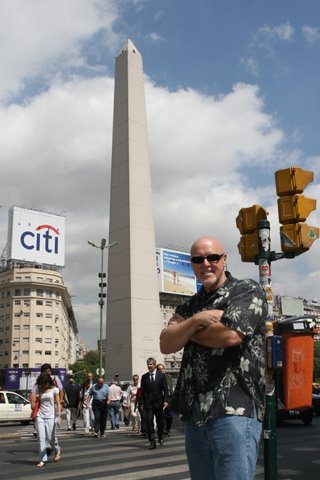
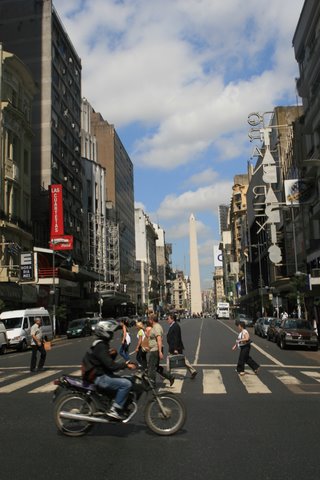
Obelisk in Buenos Aires
George at the obelisk…

Feel Cooler Than You Really Are. If you want to learn to dance the tango the place to be is Buenos Aires, Argentina. This is a city that expresses its passion and national pride through their music, soccer, dancing, horses, and writing earning it the title of “City of Cool”.

Buenos Aires, (English meaning Fair Winds) Argentina.
With a population of 2.7 million people this capital city of Argentina is a place oozing with charm and things to do. From the moment you begin wandering downtown streets you know it’s going to be interesting. It’s a place to be cool even if you aren’t. Okay, let’s make it clear, I’m not cool, but for some unknown reason I started to feel this way when I mingled with the Argentineans. They spoke, what sounded like to me, an exotic language (Castilian Spanish), and looked and dressed like they were right out of the pages of Vogue magazine. It’s a city that never sleeps, populated by residents obsessed with fashion and image. Slim is beautiful is an established and largely uncontested fact.

Curvy architecture emphasizes the ‘tango’ speed and ‘coffee’ streamlining of Buenos Aires culture

Architecture
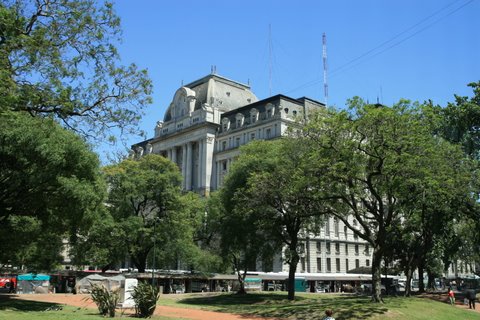
The downtown architecture is quite different from the rest of Latin America. It is strongly influenced by European styles with more than the half of the city buildings being French style. Countless museums, historical buildings, shopping centres, and hotels are yours to discover. And if you do get the urge to learn to tango there are plenty of tango-dancing schools (known as academias) throughout the city.

Bueons Aires is also known as a “city of buildings”

The Tango
Tango music was born in the suburbs, notably in the brothels of poorer suburbs. Its raw sensual dance moves were not seen as respectable until adopted by the Parisian high society in the 1920’s and then all over the world. There are loads of places with free tango shows in restaurant-bars such as Gitanos, where you can also try the national drink. I found it more like herbal tea than anything and its drunk out of a pot-like container through a metal straw. Even though it was foul-tasting, Argentineans say, it’s more addictive than coffee. To each their own.

Walking and Safety
When you walk in any largely populated area don’t be silly and carry an expensive camera slung over your shoulder and don’t ever wear an expensive watch that sets you apart from the crowd. It’s like saying rob-me, rob-me. Use common senses; err on the side of caution. I hid my camera in a plastic shopping bag. Always cross street at crosswalk. I’ll say it one more time to be sure it sinks in…Always walk at crosswalks and don’t begin until all vehicles have come to a stop.

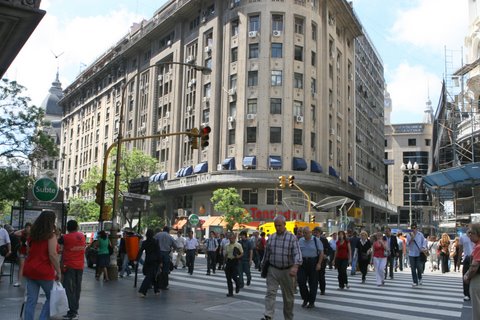
Streets are busy but have marked crosswalks and are well laid out

Recoleta Cemetery
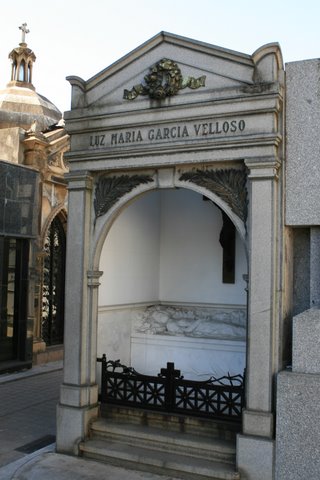
Don’t pass up the chance to visit to the Recoleta Cemetery established in 1822. It’s the final resting place for Argentina’s wealthiest and most famous families and people. The mausoleums are fairly small, befitting the size of the cemetery in an urban setting, and it’s common for many members, and generations even, of the same family occupying one mausoleum. One grave that I did seek out was that of Eva Peron who was the wife of Juan Peron, 3 time president of Argentina. Both are idolized for their efforts to eliminate poverty and to bring dignity to the labour movement. Because of this they were despised by the oligarchy of Argentina’s wealthy and powerful. I found it strange and a bit sad that her neighbours in death are those that despised her in life. Her husband is buried in another cemetery in the city.

Mausoleum at the Recoleta Cemetery

Art and Craft Museums
These museums are all the rage here, with the top attraction being the Malba, which is dedicated to Latin American modern art, the Museo National de Bellas Artes (National Museum of Fine Arts) and Recoleta’s Cultural Centre.  You’ll find the general atmosphere in most of these places is more snooty than sincere. If art and crafts is not your thing, you’ll want to bypass all of these places and scout out somewhere to eat or sit on the grass in Plaza Francia. It’s easy to while away a few hours people-watching. I did both.

Where ever you travel, remember to take time to meet the local people. You will learn much about the culture of a place by watching and talking with citizenry.

The Obelisk
Another must see is to join the gaggle of tourists (and pigeons) that flock to the Plaza de Mayo. This is the site for some of the country’s most important historical occasions, including the revolution in 1810 which led Argentina gaining independence from Spain .If your legs are willing, take a stroll along Avenida Corrientes. When you get to the junction with Avenida 9 de Julio, which claims to be the world’s widest road where you can’t miss the famous Obelisk monument. For goodness’ sake use the pedestrian crossing if you don’t want to die! It’s the cities icon and the place the very spot where the Argentina flag was raised for the first time.       For the Silo, George Bailey. 

Artificial Stimulants In Energy Drinks Hurt Kids

Monster Energy Drink 666 Hebrew Numbers

Why Your Kid Shouldn’t Be Guzzling ‘Energy’ Drinks
Vitamins & Minerals are Safer and More Effective than
Artificial Stimulants, Says Food Science Expert

Anxiety, hypertension, elevated heart rates, interrupted sleep patterns and headaches are just some of the side effects commonly associated with energy drinks, and those problems are more pronounced in children, according to a recent University of Miami study.

But that’s just the tip of the iceberg. These drinks have also been linked to heart palpitations, strokes and sudden death.

The term “energy” drink is an unfortunate misnomer, says food science expert Budge Collinson. They don’t give your body energy; they stimulate you with brief jolts of caffeine and unregulated herbal stimulants, he says.

“Soccer moms and dads buy these ‘stimulant’ drinks for their kids before matches because both kids and parents want that competitive advantage,” says Collinson, founder of Infusion Sciences and creator of Youth Infusion, (www.drinkyouthinfusion.com), an effervescent, natural multivitamin beverage that helps people maintain consistent and healthy higher energy levels. 

“For a few moments, you’ll get that spike, but it’s a short-term experience with a heavy long-term toll.”

So, what are some ways kids can get a healthy energy boost? Collinson offers the following tips.

•  Go for a speedy bike ride together, take a brisk walk or hold foot-races in the yard. Numerous studies demonstrate the power of vigorous exercise in boosting energy. Exercise pumps more oxygen – pure, healthy fuel — into the bloodstream and to the brain and muscles for a short-term energy boost. Exercising regularly will increase lung capacity, so the body will gets more oxygen on a sustained level for the long term. Exercise also releases endorphins, the body’s natural feel-good chemical, which makes us feel happy. And happy people are energized people.

•  Seek nutrition from a variety of sources. As humans, we need more than 40 different vitamins and minerals to keep our bodies functioning optimally. Since there is no single food that contains them all, it is important for children and adults to eat a variety, including as many different vegetables and fruits as possible. Adding a daily multivitamin supplement with essentials such as CoQ10, arginine, theanine, resveratrol and magnesium can help ensure bodies young and old are running at top speed.

•  Drink plenty of water – the natural energy drink. Even mild dehydration can leave children (and adults) feeling listless, so encourage children to make a habit of drinking plenty of water. Kids need more water than adults because they expend more energy, and they may not recognize when they’re slightly thirsty. Parents, too, often don’t recognize the signs of dehydration; a national survey of more than 800 parents of kids ages of one month to 10 years found that more than half feel they don’t know enough about dehydration. A quick, light pinch of the skin on the child’s hand or arm is an easy check. If the skin is slow to resume a smooth appearance, the child is likely at least mildly dehydrated.

About Budge Collinson

Budge Collinson was the beneficiary of his mother’s natural health formula as a sick baby, which led to a deep interest in health and wellness at a young age. After years of research and seeing the growing demand for natural products with clinical support, he founded Infusion Sciences, www.infusionsciences.com. Collinson earned a bachelor’s degree in food and resource economics from the University of Florida and certification from the National Academy of Sports Medicine. Recently, he became a member of the American Academy of Anti-Aging Medicine and consistently attends the Natural Products Expo, where he learns the latest science and news about nutritious ingredients. Collinson is also a go-to source for media outlets across the country for healthy lifestyle and food source discussions.

Click to view on I-tunes

Selling An American Comedy Icon’s UFO House

It took awhile, but eventually, Bob Hope’s UFO house sold for $13 million USD, after first being listed in early 2013 with a price tag of $50 million USD.  Having gone through a couple of price cuts over the years, the most recent cut lowered the ask to $25 million USD.  But with no comparable homes available, how does one actually price a concrete space ship?  Seems that when $25 million was thrown at the wall, $13 million stuck.

 bob hope ufo house banner2

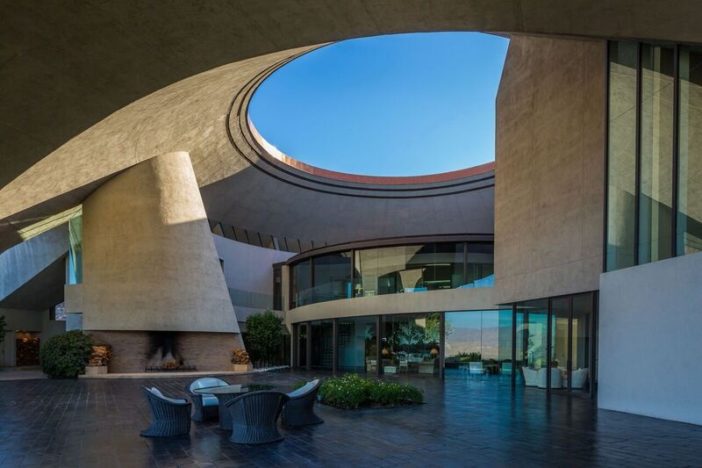
The Palm Springs spaceship/volcano house, designed for Bob and Dolores Hope by John Lautner in 1973, needed a buyer with deep pockets who would appreciate its futuristic leanings, had appreciation for architects who think outside the box and are young at heart enough to enjoy a bit of whimsy.  The buyer, California billionaire Ron Burkle, co-founder and managing partner of a private equity and venture capital firm, is well known in the Los Angeles area for his connections with the Clintons.  Sporting as interesting a persona as the house, Burkle is a prominent Democratic activist and fundraiser.  

 bob hope ufo house interior2

At 23,000 square feet under the dramatic high undulating roof, the unique house has open spaces in the walls and ceiling which allow daylight or stars to shine through casting shapely shadows into the interior. These curved openings also allow for stunning views across the landscape and mountains while appearing to be nestled comfortably into its well-designed desert landscaping and outdoor living areas. The house also has a spa with greenhouse wall, 6 bedrooms, 13 bathrooms, indoor and outdoor pools, a pond, putting greens and a tennis court.


Burkle collects other historic architecture and purchased the Frank Lloyd Wright Ennis House in 2011 and also owns Greenacres that was originally built for silent comedy film actor Harold Lloyd.  Patrick Jordan and Stewart Smith of Bennion and Deville Homes were the listing agents and Ron de Salvo of Coldwell Banker Residential Brokerage represented Mr. Burkle.  Even at the greatly reduced closing price of $13 million, the sale has set a record for the highest sale price in Palm Springs beating Lautner’s Elrod House that sold for $7.7 million two months earlier. For the Silo, Terry Walsh.

Keno Online Means Worldwide Lottos At Your Fingertips

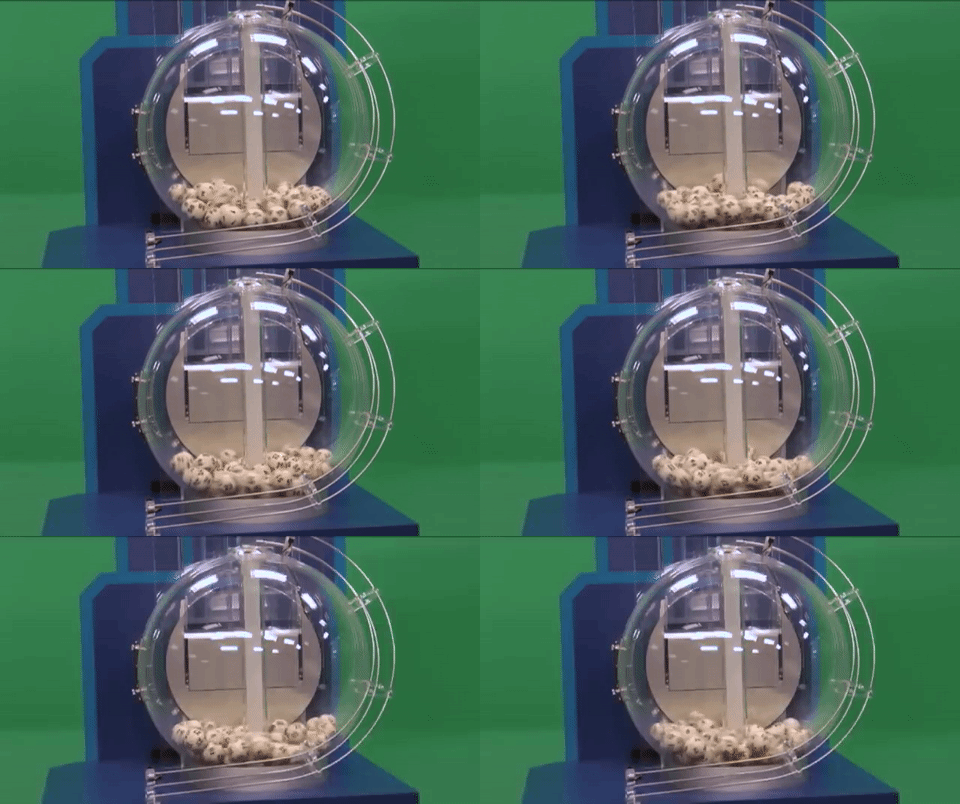
Many of us enjoy playing the lottery. Whether it’s regularly as a group at work or as part of a bunch of friends or perhaps as an occasional indulgence at the corner store- there is always the chance that you will win. And unlike most betting games, the lottery is simple to understand and simple to play. By choosing a series of numbers often ranging from between 1 and 80, players hope that they have correctly predicted the outcome of numbered ‘ping pong’ balls that are randomly drawn by a machine. This machine uses air pressure to float a large number of balls about until all the receiving baskets are filled up by the no longer floating balls. Beautiful randomness.


Keno takes this idea a step further.

The basic rules and playing instructions are the same but allow for more variety. Modern day casinos have offered keno for decades and it continues to be a highly popular choice for gamers. The casino is able to modify the general lotto rules in order to make their version more attractive and fun. For example, they may decide to increase or decrease the amount of balls used or design their own type of keno betting slips making your odds of winning higher than a state or provincial lottery.


The move towards random number generators.

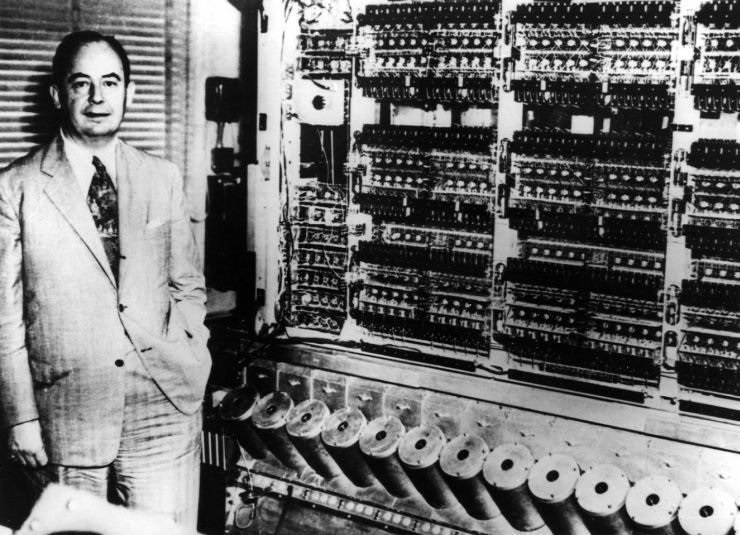
Not every casino or lottery uses a ball machine. Today, digital technology holds the lead in many areas and computers are able to quickly and efficiently generate a series of random numbers. In 1946 John von Neumann, an early computer programming pioneer, developed a mathematical way of generating random numbers using a computer.

After almost 75 years, the random number generator has proven to be reliable. That’s great news for gamers since this method is used by digital casinos ensuring keno draws are now available online 24/7.

It can now happen.

Even more exciting is the way that digital Keno is played. Instead of being restricted to your local lottery, you can now play lotteries all over the world from anywhere you are connected to the internet. Online sites offering keno payout by matching the official lottery rules and results.

This is an exciting change that leads to all kinds of fun and new ways of playing. For example, if you have family in another part of the world you can now join them and play together. Or perhaps you have always wanted to play the National lottery in England but live here in Canada- it can now happen.

For the Silo, Jarrod Barker.
How Societies Become Consumer Cultures Through Housing

Alfred Marshall’s (Principles of Economics, 1891) view of housing still goes right to the heart of what makes housing and built environment an important anthropological topic. No artifact is so clearly multi-functional, simultaneously a utilitarian object of absolute necessity, and an item of symbolic material culture, a text of almost unending complexity.

In every house the economic, social and symbolic dimensions of behavior come together. This may be why the analysis of housing has had such a wide appeal in disciplines as diverse as social psychology, folklore, economics and engineering. Anthropologists themselves have shown a new willingness to consider the house as a key artifact in understanding the articulation of economic and social change during economic development.

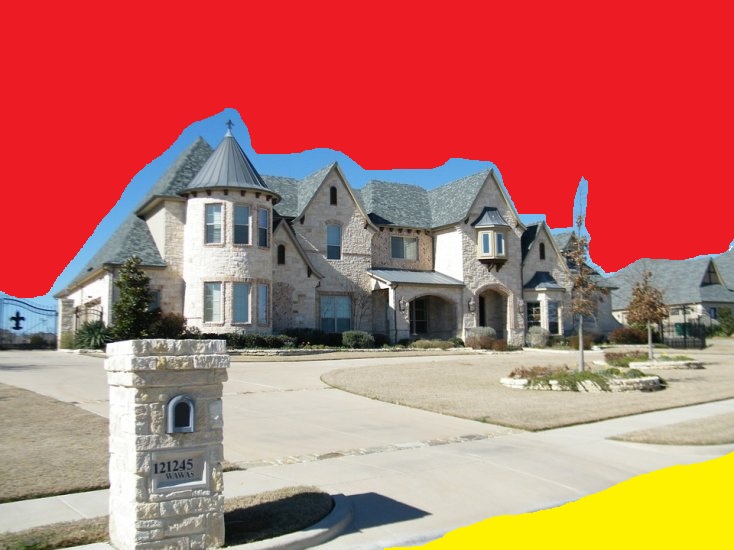
An ethnocentric home.

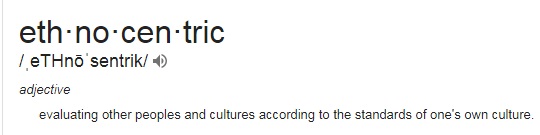
From the perspective of our own contemporary society, surrounded by houses of all shapes and sizes, where wealth and luxury are synonymous with housing, this seems obvious and commonplace. The 1980’s television show “Lifestyles of the Rich and Famous” and journals like “Architectural Review” are odes to the home as a shrine and symbol of wealth. But just as clearly, there are societies where all the houses look alike, even though all the people are not alike. Perhaps then, the assumption that there is something natural and obvious about spending on the house and home market as a marker of prestige is ethnocentric. Why the house instead of something else?

A number of anthropological approaches attempt to place the house in a theoretical context which answer this question by relating housing to social, economic, and psychological variation and change. For example, a utilitarian approach that views the house partially as a workspace links changes in the elaboration of houses to changes in the kinds of work done in the household (Braudel 1973:201). Or if the house is seen as a reflection of how all household activities are organized and divided, then the shape of the house will change as activities are modified, differentiated, or recombined (Kent 1983, 1984).

Utilitarian houses.

An even more utilitarian perspective relates the form of the house to climate, technology and the kinds of building materials that are available (Duly 1979).  For the Silo, Richard R. Wilk.

Read on..click here and read the full PDF document on your device.

Supplemental- Complete Text  Principles of Economics (London: Macmillan and Co. 8th ed. 1920).
Author: Alfred Marshall
About This Title: This is the 8th edition of what is regarded to be the first “modern” economics textbook, leading in various editions from the 19th into the 20th century. The final 8th edition was Marshall’s most-used and most-cited.

Places To Pick Provincial White Trillium In Ontario

Trillium photo: D. Greenwood

The white trillium is a spring wildflower with 3 distinct leaves and petals.  It has been the provincial flower of Ontario since 1937 and is also the logo of the Ontario Government.  It’s white flower is seen as a symbol of peace and hope.

While it is a popular belief that it’s illegal to pick the White Trillium in Ontario, in reality they are only protected in provincial parks and land owned by conservation authorities.  However, if the leaves as well as the flower are picked, the plant could die as it no longer has any means to produce the energy it needs to take it through the winter into another spring.

Sometimes mutant plants with green striped petals are found in White Trilliums.  These plants are diseased — infected with parasitic mycoplasmas that cause the greening. Over time, the mycoplasmas will cause deformity in the petals and eventually the death of the plant. For the Silo, Dixie Greenwood.

Mutated Painted Trillium. by Roger Grinnell (Burnsville, NC) NOTE- the four leaves courtesy: www.dougsgreengarden.com

‘Frail Absolute’ Book Not For Faint Hearted

Cover of Frail Absolute

Plato’s The Republic challenged the way humankind thought. Now, a immigrant from then-Communist Hungary is posing a similar challenge: Is perception reality, why can one individual’s experience of reality differ so radically from another’s, and how can humankind’s search for a deity be what ultimately separates us from each other and from Nature?

Heady stuff, and Istvan Deak’s book, Frail Absolute, is not for the faint-hearted.

Neither is the author, who fled Hungary illegally with his wife and lived in an Italian refugee camp for six months before being allowed into Montreal, Canada. There, Deak secured a job using brooms and mops in an expert way cleaning hospital corridors, and eventually writing commercial business software programs. A short time later, he moved to Toronto, where he and his wife live now.

3rd Century AD scroll fragment of Plato’s Republic

A philosophy is born. As this self-described analytical introvert began revisiting the philosophers he had read as a teenager, long-quiet questions began to surface about religion, about matter and energy, about how humans interact with one another. And he began writing Frail Absolute.

“I understood that the Force of Reality blew up in the Big Bang and created our universe,” Deak says.

“That Force, that Absolute, has been and must be present in everything in a most profound manner. Otherwise, everything would cease to exist.”

As he wrote and thought and questioned, his epiphany came.

“I asked this Force of Reality, ‘Where can I find you?’ And the reply came back, ‘Who is it who stirs your mind so that you want to know this?'” the author says.

As in The Republic, where Socrates and others discuss the meaning of justice, happiness, soul and the roles of the philosopher in society, characters in Frail Absolute discuss the meaning of reality, perception and harmony. Where Socrates vision culminates in a city ruled by philosopher-kings, Frail Absolute ultimately creates a way to exist in what Deak dubs “the Continuum (All That Is).”

“I have always sought a way to transcend what separates us from one another and from the force that exists everywhere. No matter what one believes in “science, a strict or a benevolent deity, even a non-existent god such as atheists do“ searching for this concept keeps humans apart. All reality is relative to the individual experiencing it,” he says. “Since there can be no single, absolute truth, I imagine how we can instead pursue the shareable values of love, compassion and harmonious collaboration in our daily existence.”

Recent photograph of Istvan Deak

Istvan Deak grew up in Hungary, reading the works of ancient and modern philosophers. As a young adult, he taught math and physics before fleeing Communist Hungary for a refugee camp in Italy with his wife. They emigrated to Canada, where he eventually joined a railway company and then began writing software applications as a freelancer. He plans for Frail Absolute to be just the first of many philosophical books.

Istvan Deak’s Wikipedia Page

Sample page from Frail Absolute

Yoga Legend Offers 7 Ways To Make Morning Time Your Favorite

Most people dread the moment the alarm clock goes off having to fight their way out of bed to start the day.  But what if you could turn morning time into your favorite time of the day, where waking up is actually easy and more enjoyable?

Aadil Palkhivala
Aadil Palkhivala

Yoga legend Aadil Palkhivala, known across the world as the “Godfather of yoga in the west,” and author of Fire of Love: For Students of Life and Teachers of Yoga, offers these tips that will make it easier to get going in the morning:

1. Wake up to something pleasant: The very first thing most people think about when they wake up are all the things they have to get done that day.  It quickly makes them feel overwhelmed, frustrated and stressed out. Instead, start your day thinking about the things you are grateful for, and focus on the fun activities you have planned for the day. Do some Heartfull TM Meditation that focuses on deep breathing that will wake you up peacefully and put you in the mood to create throughout the day.

  1. Lose the traditional alarm clock: Jarring the body from a deep sleep is unhealthy for the nervous system. Waking up to a softer noise that gradually increases in volume is a much better choice. Sounds from nature are soothing and naturally awake the body.

  1. Drink a glass of warm water right away: Before you head for the coffee, drink a glass of warm water. Warm water will open up the circulation in the throat and stomach. It helps the body naturally hydrate and feel awake and alive.  It also helps enhance circulation and removes toxins from the night and day before.  People who drink water right before bed and when waking up are also less prone to heart attacks.
  1. Have an organic smoothie: They say garbage in equals garbage out, so start your day with a powerful organic smoothie.  Anything that contains green fruits/veggies is a good choice, along with plant-based proteins. Avoid animal-based proteins which are more difficult to digest.
  1. Stretches: Just like you would warmup your car on a cold winter day, you need to break up the tension from the night before and get the body ready for action.  Do some simple stretches that focus on the neck, shoulders, hips and spine.

Warm Shower6. Take a warm shower: It’s as common as the chicken and egg debate: should you shower in the morning or at night?  The answer is actually both, but especially in the morning because a warm to hot shower will increase circulation in the skin, and help awake the nervous system.

  1. Clean air: When you sleep in a room that has clean air, you’re going to wake up feeling refreshed and ready to take on the day.  Use an air ionizer and purifier with HEPA filter that removes odors and fumes from cleaners, aerosols, carpet and paint. HEPA filters remove more than 99 percent of airborne irritants.

For nearly thirty years, Aadil has been regarded as a “teacher of teachers,” and many of the world’s top yoga instructors have studied with him. He has a unique teaching style, mixing melodious instructions with recitations of poetry, philosophical insights, and in-the-moment humor.

Alive and Shine Center LogoAadil and his wife, Savitri, are the founders of Purna Yoga, a holistic synthesis of yogic traditions based on the work of Sri Aurobindo and The Mother. Discover more about Aadil  and the Alive and Shine Center.  For the Silo, Alex Smith.
Supplemental- A short history of Yoga http://swamij.com/history-yoga.htm

Sony’s Nature Sounds Alarm Clock- now discontinued but still available via Amazon and Ebay.

It’s A New Era Of Smaller House Living

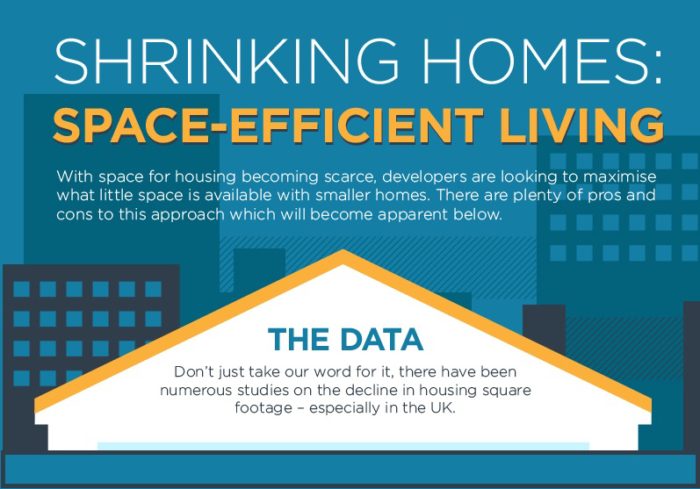
With an increasing demand for housing in the UK and strict planning restrictions, developers are attempting to fit as much “house real estate” as possible within smaller and smaller areas.

This means that most new builds are half the size of the homes being constructed at the start of the 20th century.

Despite this eye-opening reality, there are plenty of people who are happy to sacrifice space for location – especially moving closer to the capital.

We’ve looked at this trend, determined the main pros and cons of smaller house living and even looked around the world for extreme examples of homes which push the limits of square footage. Want to weigh up the pros and cons of small house living? This graphic from our friends at storageworld.co.uk provides a great start point for your research.

Read on to find out whether you’re cut out to thrive in this new era of space-efficient living. For the Silo, Georgia Davies.

Supplemental- The Story Behind Toronto’s Little House

Fast Track To The Future With Virtual Reality

Occulus Rift Xray ImageThe implications of what Virtual Reality can achieve are vast, and it is predicted that VR will seep into every area of our lives in the very near future. VR is not just a concept that excites the entertainment business, but has a very real presence in some of the world’s most essential industries. However, many people remain skeptical about the impact virtual reality will actually have and suggest that it is only an attractive concept for gamers. Although it is true that VR is a fantastic way to improve online gaming, it has already been used in the medical and manufacturing industries, proving that virtual reality is not just a tool for play. Others fear VR could replace physical social interaction and they are therefore reluctant to consider the many benefits it actually presents. By taking a selection of real-life situations in which virtual reality is already used, we can assess its impact and perhaps decide whether it is to be embraced or discarded.

Surgery

It may not surprise you to know that the health sector is one of the biggest users and advocates of virtual reality. VR is of exceptional benefit in surgical training, improving student skills whilst minimizing risk to potential patients. This type of training can improve confidence and allow students to explore surgical procedures and options that would otherwise be inaccessible to them during the initial stages of their training. Virtual reality is already used by surgical staff, trainee nurses, dentists, and in numerous other health settings, world wide, allowing students to quickly gain skills without putting themselves or other individuals at risk.

Therapy

The authentic nature of VR allows therapists to assist patients with certain phobias. VR promotes controlled environments which can quickly be changed or eradicated during a course of therapy. For example, a person suffering from arachnophobia would perhaps find it more helpful and less daunting to experience holding a spider via VR rather than in a real life situation, and of course, a virtual reality headset can be turned off immediately should the situation require it. Other phobias and aversions could be tackled through the use of VR, including water aversion, acrophobia (fear of extreme heights) or aviophobia (fear of flying).

Occulus Rift Hot Babe VR PornEntertainment

For some people, the online world is their only connection to society and if virtual reality gaming can help them continue to connect, then this can only be perceived as a positive thing. There is no denying that virtual reality is an amazingly entertaining concept and, when done well, is an excellent way to experience online gaming. Being fully immersed in a game is a highly attractive idea: whether it be one that takes you to a battlefield, or a game that allows you to feel as if you are actually being dealt cards at a plush casino in Vegas. Currently, gamers can connect with people from all over the world, or play slots in the comfort of their own home by visiting a site such as  www.luckynuggetcasino.com yet imagine the thrill of full immersion through the power of virtual reality.

Transport and Training

Again, we touch upon the benefits virtual reality provides to many aspects of training and, in this particular situation, to the world of transport. For years the aviation industry has been using simulations to help train pilots and virtual reality is a welcome advance in such training. VR flight training presents minimal risk to both the pilot and passengers whilst allowing pilots to experience the difficulties that may arise whilst being in control of the aircraft. The most spectacular example of virtual reality based vehicle training is perhaps that used by NASA to train its astronauts. The training includes various simulations including that of an astronaut having to perform repairs during zero-gravity conditions, as well as a simulated detachment from the shuttle with the astronaut having to use a powered backpack to return. NASA has even managed to use VR in space, keeping astronauts up to date with training whilst on a mission and it has been suggested that VR will be used to entertain astronauts in space in the future. Just imagine, you could soon be sharing your virtual poker table with the astronauts of tomorrow!

Supplemental- Gamers are talking about the Oculus Rift and the Playstation VR but the HTC Vive looks pretty sweet too!

A Musical Journey for Robots and their masters~ CLICK ME

Misconception That Education Is End Of Road

“Education is the kindling of a flame, not the filling of a vessel.” -Socrates
There is a misconception that education is the end of a road. On the contrary, it is merely the beginning. For many of us, youth is taken up with those things we feel we need to learn and less so with all that we most desire to know. Once we come of age, we begin to truly earn our education, gleaning the knowledge we have craved all along. This is the case for many artists who spend years, decades in other pursuits having been told that their inclination toward art is unsustainable or simply wrong.


Peter Cole is is a poet who works prodigiously with painters. Recently he has worked with Terry Winters who asked him to write about his current works. Some of that series appeared in Paris Review and sparked a series of work from Winters in turn which again sparked another series of writing and so forth.


Cole’s work includes translations from Hebrew and he explains that one of the most famous aspects of translation in the 20th century is that poetry is lost in translation. To hear more about Cole’s work as well as more about the concept of translating poetry, listen to the complete interview.
Diego Leclery is presently working in his studio in Queens. When he left school his work dematerialized considerably for roughly 11 years until very recently when he and his wife were able to get a house and designate studio space. At the moment he is hard at work building out a studio space.
Although Leclery could have afforded a studio when he worked full time, he hesitated and waited until he could afford a practice that was entirely material and could be everything or nothing.

Diego Leclery


To hear more from Diego Leclery, including his thoughts on modern day confusion and feelings, enlightenment thinking and pre-me-too ideas, all of which culminates in an understanding of limitations, listen to the complete interview. For the Silo, Brainard Carey. Read more from Brainard by clicking here.

Hybrid Historic Home Suits Dental Practice And Family Life

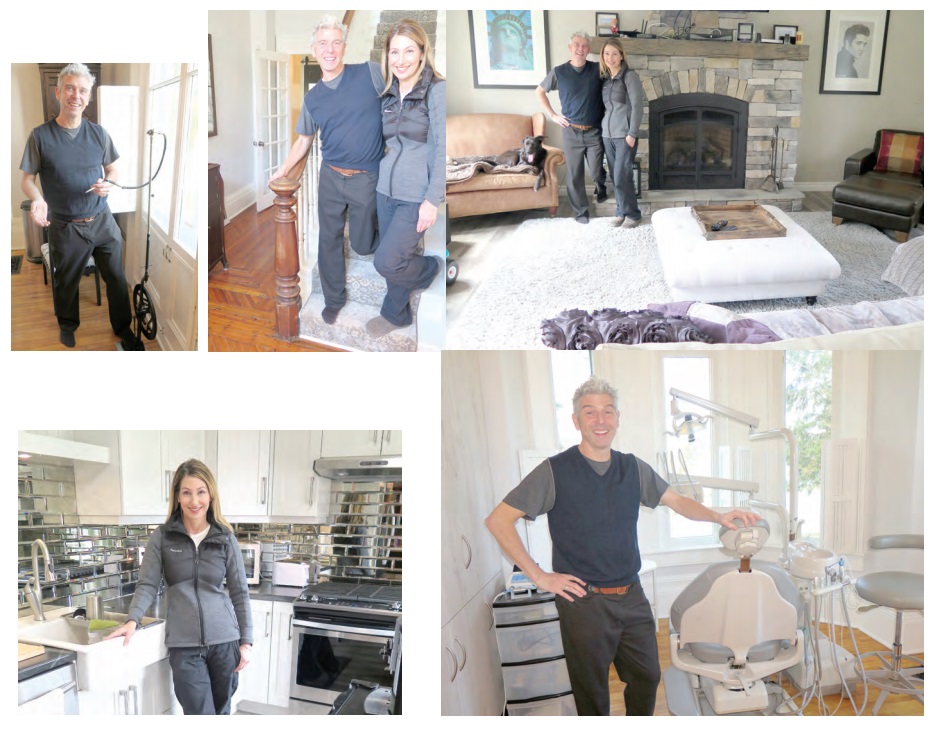
Can you have your cake and eat it too? That question was successfully answered by Dr. Andrew and Lisa Willis.

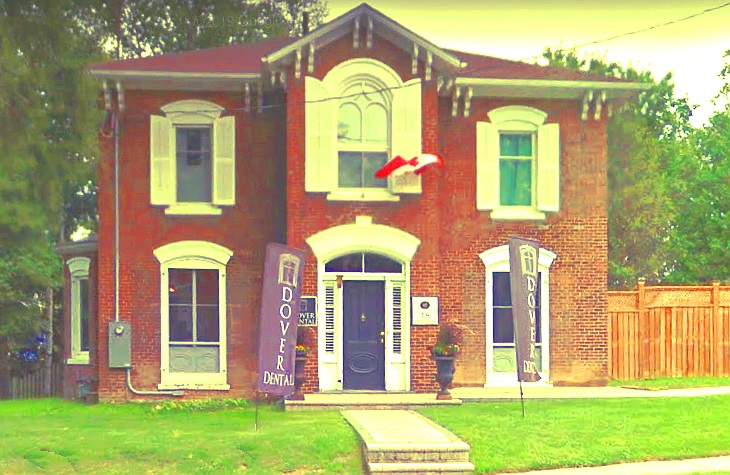
18 Chapman Street in historic Port Dover, Ontario has always been a home of distinction. Maintaining its unique charm while modernizing to meet dental practice requirements and renovating to meet their family needs was a challenge they were set to face. Dr. Willis has been a leading dentist for 25 years and has always had a passion for antiques. The idea to run his practice from a historic home developed carefully in his mind over those years. The challenge was to find the right property.

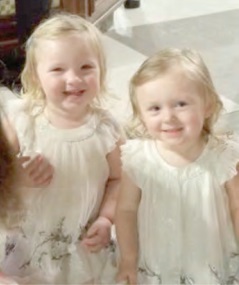
The Willis’ have twin daughters Lily and Daisy and family dog Chloe and creating a warm, open concept space was paramount.

Their large living space doubles as a dining area and the fireplace is often a family focal spot. Outside, a walled in ‘almost one acre’ yard offers lots of playing spaces.

For Mom and Dad, renovations to the kitchen and master bedroom. Great effort was spent on sourcing the “right” materials such as Pioneer cabinetry and restoration hardware- the antique chandeliers benefiting from Lisa’s attention to detail and research.

While work was proceeding for the family, Andrew coordinated the installation of a modern dental office situated in the front of the house. At it is at this point, where the old and the new not only meet but mix: Dr. Willis has integrated antique barn board into his office space and upon entering the office from street level, visitors are greeted with an antique dental drill- a nod to historic value of not only this home’s architecture but also to the business it lovingly and successfully houses. It is precisely this love and respect for the treasured things from the past and the fine things of the present that set this Port Dover business apart. For the Silo, Aly Devina.

photos: Donna McMillan featured image: The Silo

North Korea’s Nuclear Program- In A Defector’s Own Words ©

According to experts, the weaponization of North Korea’s nuclear weapons program began in the early-1960s or early-1970s. 1 And yet, it was not until October 2002, during high-level meetings in Pyongyang with Assistant Secretary of State for East Asian and Pacific Affairs James A. Kelly, that North Korean officials admitted they were pursuing a nuclear weapon. 2 Four years later, on October 9, 2006, North Korea became the eighth nation — or perhaps ninth 3 — to conducted a nuclear test.


To date, North Korea has conducted three underground nuclear tests. The nuclear fuel used — plutonium and perhaps highly enriched uranium (HEU) — was produced at the Yongbyon Nuclear Research Center about 55 miles north of Pyongyang, North Korea’s capital. In 2000, a female nuclear researcher who had worked at the Bungang branch of the Yongbyon Nuclear Research Center defected. And in June 2002, she was interviewed by RENK (“Rescue! The North Korean People”), a Tokyo-based Japanese civic organization supporting North Korean defectors. Using the alias Lee Mi (“beautiful plum”), Ms. Dong Chun-ok’s answers to thirteen questions were then published on RENK’s website in Japanese. 4


Although excerpts from Dong Chun-ok’s interview appeared in the South Korean press 5 and large portions were later translated into English and published in Korean Web Weekly, 6 the website of North Korean-born nuclear physicist Young Sik Kim, an English translation of Ms. Dong’s entire interview has never before appeared in print or on any website. Although some of the “facts” in the interview “are not accurate,” Dr. Kim said, “the general picture described is correct as far as I know.” 7
Born in Hamhung, North Korea in 1935, Dr. Young Sik Kim emigrated to the United States in 1955 after serving with U.N. Forces during the Korean War. He earned his B.S. in Physics at Brigham Young University and his Ph.D. in High Energy Nuclear Physics from Purdue University in 1962. Dr. Kim was an Associate Professor of Physics at Ohio State University until 1980, after which he spent considerable time as a Visiting Scientist at the Argonne National Laboratory outside of Chicago. He also conducted additional research at the Brookhaven National Laboratory (Long Island, NY), CERN (Switzerland) and at Rutherford Laboratory (England).


Dong Chun-ok’s Interview
Question #1:
State your personal identities, education, career and experiences, the names of North Koreans who are in the field of nuclear project. Under whom have you studied and who were the ones you have spent your working life together?
Answer #1:
Name: Dong Chun-ok Sex: Female DOB: August 2, 1955
Birth place: Pungseo County, Yangkang Province
Family status: Father; Dong Mun-wha died November 27, 1957.
Mother: Lee Ok-tan, worked at #66 Project Office of Atomic Science Committee, Bungang District. Retired in 1995.
Elder sister: Dong Sang-ok worked at Atomic Science Committee
Dong Sang-ok’s husband (brother-in-law): Kim Sang-beom Chief of #1 Special Team, #66 Project Office of Atomic Science Committee.
Younger sister: Dong Bun-ok Myeong-cheon County, North Hamkyung Province
Dong Bun-ok’s husband: Tae Cheol-su, Party clerk at Chilbosan Foreigners Tourist Hotel, Myung-chun County, North Hamkyung Province.
Education:
Attended Bungang People’s School (+elementary); March 1, 1962 – 1965
Bungang High School; March 1, 1965 – 1969
Pyongbuk Physics University: 1969 – 1974 Graduated
Experiences:
After my father died on January 27, 1957 in Oro-county, South Hamkyung Province (now, Yeonggwang county), my mother was secretly summoned by the Central Party in the summer of 1960 and moved into a special base of Bungang Atomic Energy and Science Committee, Yongbyon County, North Pyeongan Province. Since my graduation from the university in the summer of 1974, at #25 – Branch Office, and #304-Research Center of Atomic and Science Committee.
June 15, 1977: Married to an officer at Air Command Center and moved to Pyongyang.
April 25, 1978: My first boy was born.
Until 1980, lived as a military family at Air Command Center
Starting from the summer of 1980, worked as a planning leader of Management Department, Metropolitan Pyongyang.
Starting from 1982, worked as a booking clerk of Pyongyang City Railroad Department.
Starting from 1983, became a leader for the safety of residence registration for the Railroad Region, as recommended by the Management Department of the Railroad.
October 1990, moved to Yangkang Province as husband was discharged from the service.
June 1991, divorced husband. Lived in my mother’s house in Bungang Region, Yongbyon County, North Pyongan Province, but moved to Hyesan City, Yangkang Province due to children’s problem.
Starting from October 1995, assumed the position as Leader of Trade, Yangkang Province of People’s Military/Political Division
February 21, 1999, received order to suspend work.
September 2000; escaped to China.
Before the inspection, the chairman of the Atomic and Science Committee was Pak Gwan-oh (currently President of Kim il-sung Integrated University). After the investigation it received direct control of Kim Jong-il but after Kim Il-sung’s death in 1994, the supply and control have weakened. Currently it is being reinforced and strengthened.
Secrecy is guaranteed in the field of nuclear and the researchers were paid extra 20 to 30% for the living expense as the price for the secrecy guarantee cost.
All the research institutes are being called by secret numbers; 101-laboratory, 304, 206-laboratories, 175-business office, 66-business center, August-enterprise, February-enterprise, or using a disguised name such as, for the meaning of often utilized, “Utilization Research Laboratory” generally used in a variety of applications. Each research laboratory cannot contact others and they are under strict control and regulations.
The 304-research center where I used to work;
Chief: Do Won-son PhD, (Kidnapped from South Korea in 1950)
Head of laboratory: Kim Dol-su, PhD, (Studied at Dubna in Russia)
Party Secretary: Pak Min-jon, PhD, (Studied abroad for 15 years)
Hwang Jun-man, PhD, (Studied in Russia)
Kim Jun-bok, PhD, (Studied at Dubna)
Kim Dong-su, PhD, (Studied at Dubna)
Kim Kyong-sun, Third class researcher (Studied at Dubna)
Hyon Chul, (Studied repeatedly at Dubna)
Kim Dong-hwi (Studied in Czechoslovakia)
Kim Ok-nyo (Studied in Russia)
Responsible person of the Regional Party of Bungang Region:
Kim Yong-sik who used to work as a 304-researcher.
Pyongbuk Physics University
President: Kim Myong-hwan Teacher in charge: Kang Sin-jo
(The materials I’ve confirmed up to the year 1998)
Question #2:
Please state the functions, organizations and important personnel names of 101, 206, 304 Research Center and other facilities in Yongbyon.
Answer #2:
All the important facilities, buildings for the research laboratories, related features, and nuclear reactor were built under the supervision of Russia and by Russian materials and equipment while they were there.
After Kim Il-sung had grabbed the regime, for the purpose of developing nuclear arms, he had ordered the double-agent and republic’s spy hero Lee Hak-mun to abduct Dr. Lee Seung-ki, Dr. Do Won-sun, Do Sang-rok researcher, etc. from South Korea, and he did. After that, the Atomic and Science Committee, which was located in Hamhung, was expanded to Bungang Region in Yongbyon County, North Pyongan Province starting in late 1950. The one at Hamhung was established mainly by Dr. Lee Seung-ki as a branch institute while making Bungang Region as the home research center, for which Do Won-sun [may be read as Do Won-sop] and Kim Do-sul played as the main organizer.
https://www.youtube.com/watch?v=NiJNO3jQuZ8
Question #3:
Please state the functions, organization and facilities and the products of 175-factory, August-business and other enterprises in Yongbyon.
Answer #3:
304-research: The center is important laboratory among the laboratories in Bungang region, and it is the main research center for nuclear weapons development as well as for chemical arms development. Over 70 percent of the researchers of the group have studied overseas and restudied for the research. The emphasis is placed on the nuclear weapons development but they also participated in the chemical weapons development. Total number is about 150 persons. Every room of the researchers is guaranteed with laboratory, shower and modern facilities. Assistant is assigned to every doctorial researcher and research worker. About 70 to 80 percent of the researchers at 206-research center are professionals in the physics field. And it is the important research center for the nuclear weapons development in the Bungang region.
Yiyong research center: Although the name implies “economical utilization” it produces a variety of facilities including general weapons by locating a branch laboratory in Pakch’on. The number of personnel is about 150.
175-factory: The factory produces appliances for laboratory experiments needed at Bungang Research Center.
August-enterprise: It was newly built research center after the surveillance by United States (of 1990s’ nuclear inspection). It has installed railroad from Bungang Region which is hidden in a
forest outside the perimeter. It supplies the laboratory testing requisites after directly processing uranium supplied from Pakch’on branch laboratory.
101-research center: For the purpose as research center, it’s the same as 304 or 206. The number of personnel is about 100.
66-business office: Responsible for the construction of living quarters, and maintenance of the facilities and supply of materials in the premises. It employs about 20,000 personnel.
February-enterprise: The enterprise was newly made after the 1990’s surveillance, which holds nuclear reactor, so I heard from a research colleague with whom I’ve worked.
Export/Import Material Company: This organization supplements materials for the research center by importing them from foreign countries.
Question #4:
Please state the functions, organization, facilities and the storing capacity of underground nuclear facilities in Yaksan Dongdae and Mt. Sotaek. And, describe in details when the underground facilities were dug, constructed, and the conditions of the entrance, etc. as much accurately as you remember. It would be much helpful if you could draw sketches showing exterior of the entrance, shape and location. When and why did you visit the underground facilities?
Answer #4:
I was mobilized to a simulation exercise conducted in the summer of 1976 and I went inside of the place. The underground facilities at Yaksan Dongdae were built by 66-business center. There were many human casualties by accidents during the construction stage so that the Chairman’s fund was poured into all the material needs including cement. It was constructed after 1965 and the work was completed before 1970. I still remember that the facilities were unusually large and inside of all the caves were branched out in various shapes. The entrance to the cave was very large. The surface of the cave entrance was paved by finely finished cement and the inside was lighted.
[The use of the underground facilities]
The cave was built to accommodate all the materials and laboratory testing equipment and important systems when an emergency or surveillance is being proposed. Anticipating inspection by International Atomic Organization, all the equipment in the research centers had been relocated when the inspection was actually conducted. The news of possible inspection had been informed to all the researchers in advance and when the inspection was made, it was ready to be inspected.
[Sotaek-san]
Mt. Sotaek is located in a residential area. It is located behind a hospital and has two entrances. It’s an emergency shelter for the nuclear researchers and it was lighted. The inside is branched out to several offshoots caves. I entered there during a simulated exercise in 1976. The cave is under control after that, and couldn’t enter.
Question #5:
Please describe in details the names, location, organization and its facilities of the science university you’ve once stated.
Answer #5:
Its name is Pyongbuk Physics University. The president is Dr. Kim Myong-hwan. It is located, passing through a manned gate, at next to a hospital in residential area, and there are two high rise apartments. The university is for the education of researchers in the field of nuclear engineering who are mainly of children of nuclear professionals at Bungang. Especially brilliant persons from all over the country, if they fully understand the basics of politics, the university is accepting some in recent years. Now it’s directly controlled by the Central Party. The number of students is 300 and it’s gradually increasing. The number of teaching staff is about 50 and they are chosen from the researchers at the basic research center.
Question #6:
Are you aware of the progress of relocation of the researchers and the nuclear facilities from Yongbyon to other location? If there was relocation, please explain how researchers were reassigned and to which facilities, when, and why it’s relocated, and the name of the new location. Tell us, if the nuclear reactor was relocated from the center of Yongbyon before the International Atomic Organization conducted its inspection, why it was relocated. Where is the nuclear reactor now? Do you know if it was ready to show a part of North Korean nuclear program for inspection by the International Atomic Organization? If it was ready for the inspection, for what purpose and what kind of preparations were ready?
Answer #6:
When it foresaw the inspection while the world kicked up a fuss about North Korea’s having nuclear arm in 1990, some of the peoples in Bungang area were asked to wear military uniform, putting shoulder straps on the labor class, officer’s uniform on the executives and researchers, and together with their families they were secretly moved. New base was relocated to Pyongsan County, South Hwanghae Province (error for North Hwanghae Province), and at that time, even internally in the business region, it was kept as top secret. My elder sister’s husband was responsible person and directed the relocation and went there several times. All the materials to be sheltered were evacuated into cave when it received the inspection. Currently the nuclear reactor is located at February Enterprise of 304 Research Center.
Question #7:
How much does the personnel and scientists know about the leakage of nuclear radiation?
Answer #7:
Until presently, physical damages have shown on some of the researchers and persons who are related and unnatural babies were born. It is generally recognized as it was not a big accident.
Question #8:
If you know about compositions of the nuclear arms program of North Korea, please explain their details and from where you’ve heard. How much do you know in addition to the past efforts on the production of plutonium at Yongbyon, about the efforts put on for other fissional material? If you know please describe in detail about its essential activities, the time, and the locations. Are there any retreatment facilities for nuclear fuel besides the radiation chemical
experimental laboratory? Have the North Korean scientists ever showed interest in uranium enrichment? If so, please state it in detail.
Answer #8:
The research center at Bungang region is the research organization specialized in modernized military arms and the (illegible) produced by each laboratory at Bungang is not produced within the Bungang region. The researchers bring their own research products to the experimental factory or arsenal for its tests, and generally all of the research products are sent to section chiefs or managers who are doctoral researchers, and finally it was handled by the deliberative committee, after passing through strict seminars.
It will be actually tested only after having recognized at this committee. There is chemical factory within the arsenal for the production of important arms. Pakch’on laboratory handles all the materials of nuclear division, besides Yongbyon. It is thought that the base for the production of nuclear division and arms is hidden at Pyongsan in North Hwanghae Province which was classified before the inspection.
Question #9:
Do you know anything about travels to foreign countries or training by nuclear scientists or engineers? If you are aware of it, please describe purposes of study and travels. Do you know anything about travels or reallocation of foreign scientists or professionals in North Korea? If you know, what were the purposes of travels and relocation and the timing and what were the specialties of the foreign scientists or specialists?
Answer #9:
Bungang Nuclear Science Committee was established in late 1950s by the scientists and advisors of Russians who came to Bungang in concentration. They, with their families, built villas along the bank of Kuryong River and shuttled to and from the research center. Training studies by researchers were made mainly in Russia and China, and they were physics and chemical specialty fields of students at a various nations’ universities. And many of them went back to restudy at Dubna Science Center in Russia, when research center is built again. The scientists are prohibited to make private exist and entry within the country or from and to overseas countries and they are forbidden to meet outsiders.
Depending on the themes of the studies, and when it is decided that it’s impossible to solve the posed questions within the country, then a requisition may be filed for overseas study and gets its approval.
When many anti-national activities are exposed and when they were sent to political prisoners’ camp, after that, at some time, the overseas study had been regulated.
After the war of 1950, for the purpose of development of nuclear weapon by Kim Il-sung, Lee Hak-mun (hero of the republic’s double reconnaissance) had kidnapped from South Korea Dr. Lee Seung-gi, Do Sang-rok, Dr. Do Won-sun and so on. After the war ended in 1953, they first started to build research center in Hamhung City, and later it was developed to “Atomic Science Committee” officially, and then established “Nuclear Science Committee” in the geographically fitting basin of Bungang.
A total number of Russian advisors and foreigners are about 200. I do not know the exact figure. Before 1970, all secrete and Russian advisors’ materials were pulled out of strongbox and photo
copied, and then all the foreigners were withdrawn from the country. After having established Security Squadron and military guard posts of People’s Military Division, the country sustained itself since.
In my childhood years, my mother took me to foreigner’s resort villa, and I received some gifts and played with the children’s of foreign advisors in the perimeters. A person named Alexander of the research center especially loved me. After that, I stayed at mother’s home for 40 days in August 1998, and I saw Russians coming in and out of the restricted area.
Question #10:
Please state, if you know anything about the origin, administration, and fuel supply of the nuclear reactor for research use that was provided by Russia.
Answer #10:
The nuclear reactor located in Bungang was installed at the same time with the construction of Bungang Research Center. After that, Pakch’on branch laboratory and February Enterprise’s were built after the inspection. Fuel supply is also coming from Pakch’on branch laboratory. As I understand, all the supplies are conducted by Russia, and some are coming from China in recent several years. Each Section and by each Research center, they are classified as confidential.
Question #11:
Please state names, organizations, locations and the functions of nuclear related facilities other than Yongbyon area.
Answer #11:
Establishing Bungang nuclear base as the basis, the largest branch laboratories are Hamhung branch and Pakch’on branch. Dr. Lee Seung-ki was the principal at Hamhung branch. It trains newly growing modern researchers and basically specialize the development of chemical weapon and organisms. It has testing laboratories and so on which are needed for the incubation of bacteria, etc. At the first stage, they use rabbits or mouse and squirrels for animal tests, but for the first hand experiments, they employ prisoners or felons by using injections.
Pakch’on branch: Directly handles basic uranium
Hyewon branch: Studies basically about China and its purpose is for the researches of China’s radiation and air contamination.
Question #12:
Please describe about falsehood efforts and plots related with the North Korea’s nuclear program.
Answer #12:
After the inspection, they covered the chain of Yaksan Mountains with trees, and newly built February Enterprise and August Enterprise. In order to prevent taking high altitude photos from sky, they created many wooden houses in steps, and opened in the woods outside the perimeters. At Pakch’on branch too, they installed many woods, locating them by the foot of crag sides so
that they cannot be distinguished. By a glance it looks nothing is there, but it’s there behind the hill.
Question #13:
You said the children of Prof. Kim at work place of 304 Research Center did work for their father and they have received education at outside the country, please tell us where and the names they used to get the study. You’ve also mentioned that their children are participating with the Daepodong program, please state about the Daepodong program, the purpose of Daepodong, and the kind of relationships with the Room 304.
Answer #13:
The name of Prof. Kim’s son is Dr. Kim So-in and is about 30 years old. Prof. Kim and his wife are both nuclear specialist and his brother works as direct assistant to Dr. Kim So-in. Dr. Kim So-in was born while studying in Russia, in Dubna, and returned to Bungang when he was 3 years old (currently his birth place is listed at Chunggu region, Pyongyang City), and entered Bungang Senior Middle School when he was 7 years old but he was so genius that the teachers couldn’t teach him. As reported to Kim Il-sung and Kim Jong-il, he was recruited to Special and Science Colleges of Kim Il-sung Synthesis University and received private tutoring.
He met his parents when he was 13 years old and secretly sent to study at a foreign country (it was kept secret which country).
He received a semi-doctorial degree at the age of 19, and received doctor’s degree when he was 21 years old. Dr. Kim So-in was a doctor who deliberately raised by Kim Il-sung and is the successor of Dr. Lee Seung-gi of Hamhung branch.
Kim Jong-il is secretly nourishing some 20 young doctors in his hands to raise them as military specialists in the modern warfare providing with them the highest quality treatments. In the group, it includes the son-in-law of Dr. Lee Seung-ki and his grandson and the core among the researchers for the modernization of military is Dr. Kim So-in. His private and working life is kept as a top secrete and completely shut out from the outside world, and he receives orders directly from Kim Jong-il.
The word of Kim Jong-il goes: “I’ll unify the fatherland by these 20 young scientists of new generation.”
His father is at 304 research center. There is no relation with his father except he is son of nuclear specialist.
The alias of Nuclear Science Committee (Atomic Committee) is “Chosun Pyongyang #204,” and 304 Research Center is #19, 66 Enterprise is #17, and it starts with #26 for the numbers of telephone and vehicles. The Commander of Security Squadron for Social Safety Division of Bungang Nuclear Science Base is Ra Chang-sik The Nuclear Science Committee is recently being reinforced.
END OF INTERVIEW

For the Silo, by Bill Streifer and Sang S. Nam.

© [email protected]
Bill Streifer is a researcher and historian on the history of nuclear weapons and U.S. intelligence. His articles include the cover story in the OSS Society Journal, various articles for the American Intelligence Journal, DCBureau.org and others. “The Flight of the Hog Wild,” a book about the long history of nuclear activities in North Korea, co-authored with Irek Sabitov, a Russian journalist and newspaper editor, is in the works. Their website is here: http://TheFlightoftheHogWild.com

Sang S. Nam, a resident of Seoul, is a Korean-Japanese-English translator. He translated Ms. Dong Chun-ok’s interview from Japanese into English. He also drew the sketch of the Yongbyon Nuclear Research Center from public sources and from information derived from Ms. Dong’s interview and sketch such as the location of Yongbyon’s secret cave.


1 Dr. Kang Ho-je, a South Korean authority on North Korean science and technology.
2 An admission they later denied.
3 See Weiss, Leonard. “The 1979 South Atlantic Flash: The Case for an Israeli Nuclear Test,” Stanford University, July 30, 2011.
4 http://www.bekkoame.ne.jp/ro/renk (now defunct)
5 Yonhap news agency, Seoul (in English), Oct 17, 2002.
6 http://www.kimsoft.com/2002/nk-nuke4.htm (now defunct)
7 In a message from Kim Young-sik to Joseph S. Bermudez, Jr., an internationally recognized analyst, author and lecturer on North Korean defense and intelligence affairs. (Oct. 20, 2002)

Top Ways Folks Go Broke

Being broke sucks and you don’t have to come from a wealthy family, have the next  billion-dollar idea or work 18-hour days to become rich, says self-made millionaire Mike Finley. In fact, you don’t have to be extraordinary in any of the headline-grabbing ways. What you need is the self-awareness to avoid wasting Financial Happiness.

“Money used wisely can give you financial security ”

Finley lists 10 of the most common money traps that lead to consumers going broke:

1- Making the appearance of wealth one of your top priorities by acquiring more stuff. The material trappings of a faux lifestyle, as seen in magazines and advertisements, are not good term happiness.

2- Working a job you hate, and spending your free time buying happiness. Instead, find fulfilling work Monday through Friday so you are not compensating for your misery with expensive habits during the weekend.

Even worse than living paycheck to paycheck- advance loan on your paycheck.

3-  Living paycheck to paycheck and not worrying about saving money. Don’t live for today, as if that’s all that matters. Have you already achieved all of your dreams by this moment? If not, embrace hope and plan for tomorrow. (Appreciating your life today doesn’t require unnecessary expenditures.)

4-  Stopping your education when someone hands you a diploma; never reading a book on personal finance. Just about any expert will tell you that the most reliable way out of poverty is education. Diplomas shouldn’t be the end of learning; they should be a milestone in a lifetime of acquiring wisdom.

5-  Playing the lottery as often as possible. While you’re at it, hitting the casino! Magical thinking, especially when it comes to money, is a dangerous way to seek  financial security.

6-  Running up your credit cards and making the minimum payments whenever possible. Paying interest on stuff you really don’t need is a tragic waste of money.

7-  When you come into some free money, spending it. Feeling like you deserve it. By that logic, you’re saying that a future version of you doesn’t deserve the money, which can be multiplied with wise investments.

8-  Buying the biggest wedding and the biggest ring so everyone can see just how fabulous you really are. Nothing says “Let’s start our future together” like blowing your entire savings on one evening.

9-  Treating those “amazing” celebrities and “successful” athletes as role models. Trying to be just like them whenever possible. As far as we know, there’s only one you the universe has ever known. Don’t dilute your unique individuality by chasing an image.

10-  Blaming others for your problems in life. Repeat after me: I am not a victim. The victim mentality is an attempt to rationalize poor habits and bad decision-making.

“If you’re feeling uncomfortable with your financial situation, don’t just sit there in a malaise of ‘If only I had more money,’ ” Finley says. “Instead, use it as motivation for a better life; that’s why the discomfort is there.”

Like most North Americans, Mike Finley was raised with no education in personal finances. Joining the Army out of high school, he realized he didn’t understand money management and began the task of educating himself. After 26 years in the service, during which he practiced the principles he learned, he retired a millionaire. Finley is the author of “Financial Happine$$,” and teaches a popular financial literacy class at the University of Northern Iowa.  For the Silo, Jarrod Barker.