Tag Archives: transport

Canada’s Largest Port Ranks 375 Out Of 400 In The World

Trade Diversification Ambitions Face a Container Port Reality 

Alberta recently submitted its West Coast pipeline proposal to Ottawa’s Major Projects Office, a major plank in the federal government’s goal to double exports to non-US markets by 2035. 

For that to succeed, more of Canada’s exports will need to move by water, already the largest mode for non-U.S. trade by value. And container shipping is part of that. 

So how do Canada’s container ports stack up?

 The short answer: Not well. Rectifying that would help Canada meet its trade-diversification goals. 

Roads were Canada’s dominant export mode over the 12 months ending in May, carrying 37 percent of export value. But those roads cross just one border. Strip out the United States and the picture flips entirely. Water carries 54 percent; air carries 41 percent. Road  falls to 3 percent. Put differently, the infrastructure we’ll need to reach the 2035 target looks almost nothing like today’s. 
What is the Container Port Performance Index?

The Container Port Performance Index (CPPI), produced by the World Bank, is a global scorecard for container shipping efficiency. Canada’s performance should raise alarm bells.   

The Index tracks total time a container ship spends under a port’s control, from the moment it arrives in the harbour to the moment it leaves the berth. Rather than grading ports on a traditional scale of zero to 100, the index uses a statistical baseline centred on the global average and adjusts for the size of a vessel and its cargo volume. A negative score means a port is operating below that benchmark. It simply means that for the same job, a ship sits idle longer than at an average gateway anywhere else. 

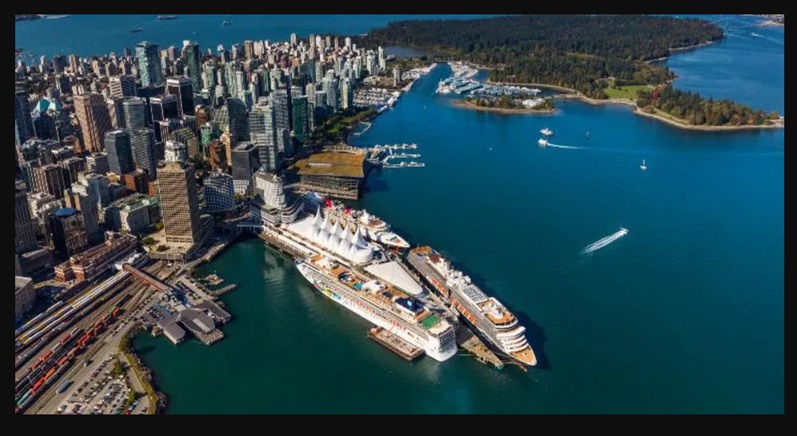
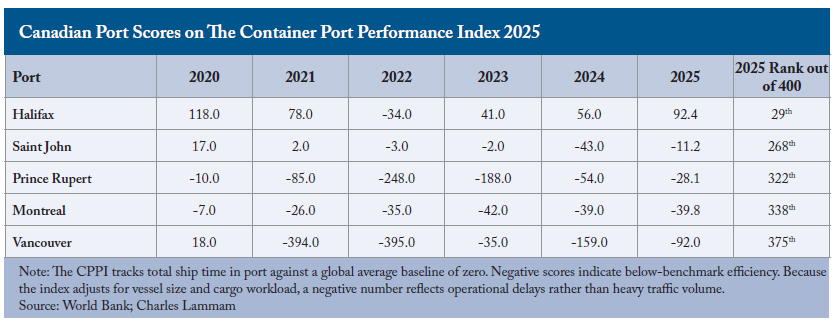
The Port of Vancouver, which handles fully 42 percent of Canada’s container shipments, ranks 375th out of 400 ports worldwide in the newly released 2025 ranking, with a score of minus 92. That’s actually an improvement on minus 159 in 2024: a dismal 389th. Vancouver was among the 20 most-improved ports in the world year over year. But even after climbing 67 points, a hole this deep still leaves you in the hole.  

Vancouver’s CPPI score has been negative in five of the last six years, including a catastrophic collapse to minus 394 and 395 scores in 2021 and 2022, which also coincided with a historic BC flood that severed rail lines into the port for more than a week, layered on top of a pandemic-era demand surge hitting ports worldwide. Even so, strip those two years out and Vancouver’s score still never turns positive again. 
Vancouver is part of a broader Canadian pattern. Prince Rupert ranks 322nd, despite handling a meaningful share of Canada’s transpacific container trade, and its year-to-year swings are significant: from minus 10 in 2020 to minus 248 in 2022 to minus 54 in 2024. Montreal sits at 338th. Saint John is slightly better at 268th. 

The one major exception is Halifax, which has become a genuine success story: 29th in the world in the latest data, up from a middling performance just a few years ago, and 55th last year. Three of Canada’s busiest ports still rank in the bottom fifth of the world. Halifax proved it doesn’t have to be that way. 

The World Bank isn’t the only one flagging this.

A recent Bank of Canada analysis of satellite vessel-tracking data found that Canada’s rank for total ship capacity moving through its ports fell from sixth in the world in 2016 to 23rd by 2023, a steeper drop than almost any other major trading nation. Part of the reason: the newest ultra-large container ships carry more than 20,000 containers while the largest vessels Canadian ports can handle top out around 15,000. As a result, some cargo bound for Canada comes through a US port. 

Infrastructure isn’t the whole story. Labour issues also lengthen the time ships spend in Canadian ports, and addressing them matters just as much as modernizing the infrastructure itself. 

After Nutrien decided to build its new billion-dollar potash export terminal in the United States rather than in Canada, Transport Minister Steven MacKinnon, made an unusually blunt admission for a sitting minister about his own file: Canada’s transportation policy and supply chain management need to be the best in the world given the country’s geography, and right now they aren’t.  

Nutrien’s decision came even after the 2025 federal budget had already been tabled. That budget dedicated $5 billion, or 4 percent, of its $115-billion  infrastructure plan to bolster Canada’s trade and transport infrastructure. Whether allocating more to such infrastructure would generate a bigger bang for the buck is a fair question. 

Carney’s Ambitions

The PM’s ambitions depend on a clear-eyed read of where Canada’s port performance actually stands. The pattern holds across almost every major Canadian port, year after year, even as Ottawa doubles down on trade diversification. Halifax shows that the climb from a lower tier is possible. Until the rest of Canada’s ports make it too, the 2035 target will likely stay out of reach. 
For the Silo, Charles Lammam -senior adviser at the C.D. Howe Institute. 
How Cell Phone Behavioral Data Can Help Save Our Planet

Zurich, Switzerland- A report from a few years ago deserves a second look. That study demonstrated how leveraging mobile network data can estimate levels of carbon emissions and air pollution in cities, an approach that could substantially reduce the cost of implementing the Paris Agreement.

  • The study analyses mobility patterns derived from mobile network data to estimate the usage of different transport modes within a city and derive conclusions about the respective pollution they cause.

  • This innovative methodology allowed scientists to estimate the concentration of air pollutants in urban areas with up to 77% accuracy.

  • The method could provide a scale-able and cost effective way to help understand and combat greenhouse gas (GHG) emissions in cities worldwide.

Big data analytics company and ETH Zurich spin-off Teralytics, Telefónica NEXT and sustainability solution provider South Pole Group conducted the  study in Nuremberg, Germany and revealed the analysis of mobile network data is an effective way to estimate CO2 and NOX emissions in urban areas at very low cost. To achieve this, Teralytics examined aggregated and anonymized data, which is generated when mobile devices communicate with Telefónica’s mobile communication cells during user calls, text messages or while using phones to browse the internet. Teralytics was able to refine this raw data into human mobility patterns to understand how the different modes of transport, for instance trains or cars, are frequented. Combining this information with data on the emissions of the different transport modes, the three entities were able to estimate air pollution and GHG emissions in the city.

As each form of transportation produces a unique amount of CO2 and NOX emissions, understanding urban mobility patterns is vital to understand the source of emissions. The study in Nuremberg used this information to estimate with up to 77 per cent accuracy the concentration of air pollutants in the city. These findings encourage further exploration of how big data can be used to understand and ultimately solve environmental issues such as air pollution in cities across the world. This is particularly interesting with regards to the lower cost of analyzing and interpreting data compared to the higher cost of production and maintenance of elaborate measuring stations. The novel approach could thus allow an ongoing analysis on a nationwide scale.

George Polzer

“While our contemporary urban lifestyles result in the generation of harmful greenhouse gasses, it also generates large amounts of behavioural data. Our mission at Teralytics is to use this data for the benefit of society,” says Georg Polzer, CEO of Teralytics. “Our findings from Nuremberg showed that this data can be used to give city planners insights into how human mobility contributes to pollution. This is a vital part to efficiently design and implement clean air and low carbon strategies. We are looking forward to further exploring this opportunity.”

Using a three-level process, the fully anonymized and aggregated data was first transformed into movement flows by the data scientists at Teralytics, identifying over 1.2 million transportation routes during the analyzed time period, as depicted in Figure 2. The sustainability solution expert South Pole Group then used an atmospheric model to estimate air pollution levels caused by the usage of the different modes of transportation, taking into account meteorological data and information on the respective traffic carriers’ emission levels from the German Federal Ministry for the Environment (BMUB). In the third step, the accuracy of the method was examined by comparing the findings with existing data from air pollution measuring stations. The values measured at these stations were found to correlate up to 77 per cent with those from the Teralytics’ calculations.

The results of this pilot study in Nuremberg constitute a sound basis to further develop the methodology.

Following its success, the consortium was able to secure financial support from Climate KIC’s Low Carbon City Lab (LoCaL), an initiative that brings together cities, business, academia and NGO’s to deliver high environmental and societal impact. With this backing, the research partnership will expand and improve the methodology, focusing on short travel routes and taking into account local emission factors like airports, large-scale events, and types of vehicles on the road (i.e. electric cars and SUVs). Moreover, the influence of factors such as traffic jams and red lights will be taken into account in order to make even more accurate estimations of the air pollution levels in a city.

“The results from this pilot study exceed our expectations,” says Maximilian Groth, responsible for Business Development & Partnerships at Teralytics. “We are confident that we will soon be able to scale this product to cities worldwide to support urban planners in making our air cleaner and achieving the goals of the Paris Agreement at the lowest possible cost.”

This research follows other successful studies on usage of mobile network data, including a smart data analysis for transport in Stuttgart by Teralytics, Telefónica Germany, and Fraunhofer IAO.

Renat Heuberger

“Approximately 70 per cent of global greenhouse gas emissions are generated in cities, meaning that they play a key role in climate protection. We see great potential in the use of continuously generated data, such as mobile network data, to measure and reduce pollution levels in cities.” States Renat Heuberger, CEO of South Pole Group.

Florian Marquart

Florian Marquart, Managing Director of Telefónica NEXT for Advanced Data Analytics: “The pilot project in Nuremberg has clearly shown the specific added value of anonymised mobile network data for the environment. This is data from people for people. We see great potential in the results and will start the next phase of our research. The goal is to develop a product that German cities, German states and the German federal government can use to better face the challenges of emissions pollution”.  For the Silo, Ricky Sutton.

About Teralytics

Teralytics is the trusted data analytics partner for some of the largest telecom operators in North America, Europe and Asia. Using technology built for operators by data scientists, they have perfected the ingestion, modelling and transformation of raw signals from subscriber actions and movements on operator networks to deliver meaningful and actionable insights, that delivers new value to our mobile operator partners. By unlocking and processing a massive scale of device movement and consumer intelligence data from location and behavioral signals, they can analyze people, places and things and offer actual insights to help city planners, venue owners, retailers, NGOs and media companies make informed decisions, optimize operations and maximize ROI. Headquartered in Zurich, Teralytics has offices in New York, and Singapore.

Fast Track To The Future With Virtual Reality

Occulus Rift Xray ImageThe implications of what Virtual Reality can achieve are vast, and it is predicted that VR will seep into every area of our lives in the very near future. VR is not just a concept that excites the entertainment business, but has a very real presence in some of the world’s most essential industries. However, many people remain skeptical about the impact virtual reality will actually have and suggest that it is only an attractive concept for gamers. Although it is true that VR is a fantastic way to improve online gaming, it has already been used in the medical and manufacturing industries, proving that virtual reality is not just a tool for play. Others fear VR could replace physical social interaction and they are therefore reluctant to consider the many benefits it actually presents. By taking a selection of real-life situations in which virtual reality is already used, we can assess its impact and perhaps decide whether it is to be embraced or discarded.

Surgery

It may not surprise you to know that the health sector is one of the biggest users and advocates of virtual reality. VR is of exceptional benefit in surgical training, improving student skills whilst minimizing risk to potential patients. This type of training can improve confidence and allow students to explore surgical procedures and options that would otherwise be inaccessible to them during the initial stages of their training. Virtual reality is already used by surgical staff, trainee nurses, dentists, and in numerous other health settings, world wide, allowing students to quickly gain skills without putting themselves or other individuals at risk.

Therapy

The authentic nature of VR allows therapists to assist patients with certain phobias. VR promotes controlled environments which can quickly be changed or eradicated during a course of therapy. For example, a person suffering from arachnophobia would perhaps find it more helpful and less daunting to experience holding a spider via VR rather than in a real life situation, and of course, a virtual reality headset can be turned off immediately should the situation require it. Other phobias and aversions could be tackled through the use of VR, including water aversion, acrophobia (fear of extreme heights) or aviophobia (fear of flying).

Occulus Rift Hot Babe VR PornEntertainment

For some people, the online world is their only connection to society and if virtual reality gaming can help them continue to connect, then this can only be perceived as a positive thing. There is no denying that virtual reality is an amazingly entertaining concept and, when done well, is an excellent way to experience online gaming. Being fully immersed in a game is a highly attractive idea: whether it be one that takes you to a battlefield, or a game that allows you to feel as if you are actually being dealt cards at a plush casino in Vegas. Currently, gamers can connect with people from all over the world, or play slots in the comfort of their own home by visiting a site such as  www.luckynuggetcasino.com yet imagine the thrill of full immersion through the power of virtual reality.

Transport and Training

Again, we touch upon the benefits virtual reality provides to many aspects of training and, in this particular situation, to the world of transport. For years the aviation industry has been using simulations to help train pilots and virtual reality is a welcome advance in such training. VR flight training presents minimal risk to both the pilot and passengers whilst allowing pilots to experience the difficulties that may arise whilst being in control of the aircraft. The most spectacular example of virtual reality based vehicle training is perhaps that used by NASA to train its astronauts. The training includes various simulations including that of an astronaut having to perform repairs during zero-gravity conditions, as well as a simulated detachment from the shuttle with the astronaut having to use a powered backpack to return. NASA has even managed to use VR in space, keeping astronauts up to date with training whilst on a mission and it has been suggested that VR will be used to entertain astronauts in space in the future. Just imagine, you could soon be sharing your virtual poker table with the astronauts of tomorrow!

Supplemental- Gamers are talking about the Oculus Rift and the Playstation VR but the HTC Vive looks pretty sweet too!

A Musical Journey for Robots and their masters~ CLICK ME