Tag Archives: culture

Through Balance Everyone Has Potential To Shine

Life sometimes can seem off kilter as responsibilities mount and people plow all their physical and mental resources into what seems to be the most pressing crisis of the moment.

But Lumbie Mlambo says that’s a good time to take a step back. Everyone has the potential to shine in life’s darkest moments, but the key to achieving goals and an overall better existence is to maintain a balance so that one aspect of your life isn’t consumed by another.

While some people might say balance in life is an impossible goal, she disagrees and says when each of us find our equilibrium, we become more productive and a greater asset to our communities.

“There’s balance in everything we do, be it walking, talking, eating, sleeping, working or spending time with family,” says Mlambo, editor of Equanimity Magazine, an online publication that features inspiring stories of life and success.

“For example, look at how we try to deal with our work-life situation. We balance our workload so that we can still make room for other activities, to spend more time with our spouses or our children. We do that because we understand how important it is.”

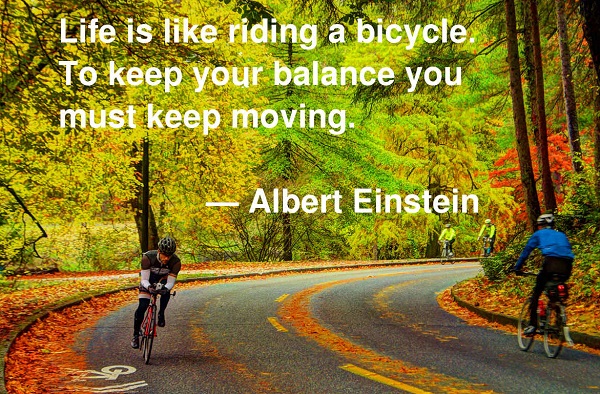
Einstein Life Balance Quote

She offers these reasons for why living a balanced life is essential.

•  The health factor. Staying balanced is a key to a healthier and successful life. Both mental health and physical health benefit, and as a result, so do our overall lives. “When we’re healthy, we’re able to care for ourselves and others in our community,” Mlambo says.

•  The empathy factor. When we find balance in life, we can better understand the importance of helping the underprivileged, says Mlambo, who grew up in a rural area in Zimbabwe. You begin to realize that someday you could be in their situation, which makes you a more empathetic person. “Your economic situation is like your health,” she says. “Nothing is guaranteed.”

•  The role-model factor. Sharing our stories – whether it’s a tale of success or even a tale of failure – is important because others can learn from us or be inspired by us as they too strive for a balanced life. “When you tell your story, it empowers, motivates and encourages people to not give up on their dreams and goals,” Mlambo says. “Maybe you think your story is just not that interesting or important. But for someone out there, it may be the spark that ignites them to great things.”

Mlambo always strove to find balance in her life. But she became even more passionate about it after she suffered a stroke in 2001 that left her partially paralyzed. She since has recovered, but says the event had a profound impact on her and she will always consider herself a stroke patient.

Audrey Hepburn Life Is About Others Too Quote

“Before the stroke, I thought my life was balanced in a way,” she says. “I mean, I ate healthy foods. I exercised seven days a week. But it was not balanced in the way I wanted. I had been too focused on myself. I realized that life was not just about me, but about others.”

Finding balance in life isn’t just a feel-good concept, Mlambo says. As people achieve balance, they realize they have the potential to rise above their circumstances. They can become more productive in their communities and that is good for everyone.

“Staying proactive and shifting the way we think can even help the economy to grow and can help create more jobs,” she says.

Certainly, maintaining a balanced life may be tougher than ever because technology allows work – emails, text messages, telephone calls – to intrude on people’s “off” hours. But that’s just all the more reason to make a concerted effort to strive for balance, Mlambo says.

She says it’s become popular in some circles to argue that a balanced life is a myth and can’t be achieved. But regardless of their views, she says, most people seem to be trying to bring balance to their lives, even if they don’t think of it that way.

“We eat healthy to stay balanced, we get enough sleep or rest to avoid stress, we juggle our daily activities to stay balanced,” Mlambo says. “To be successful in anything we do, we must have some sort of balance.” For the Silo, Lumbie Mlambo

Christmas Gift Made In China? Historical Long Distance Trade Lead To Modern Global Lives Of Things

Until quite recently, the field of early modern history largely focused on Europe.

The overarching narrative of the early modern world began with the European “discoveries,” proceeded to European expansion overseas, and ended with an exploration of the fac-tors that led to the “triumph of Europe.” When the Journal of Early Modern History was established in 1997, the centrality of Europe in the emergence of early modern forms of capitalism continued to be a widely held assumption. Much has changed in the last twenty years, including the recognition of the significance of consumption in different parts of the early modern world, the spatial turn, the emergence of global history, and the shift from the study of trade to the commodities themselves.

Sometimes conferences disappear from view as soon as the delegates disperse.

Other times, when the papers are published in an edited volume, conferences come to be seen as important milestones in the historiography. The two volumes edited by James Tracy, entitled The Rise of Merchant Empires and The Political Economy of Merchant Empires published in 1990 and 1991, respectively, move through their various stages of production, ownership, transmission and transformation .

Moreover, those stages are overlapping, circulatory and contradictory; objects move in and out of collections, as they move in and out of fashion, and meanings are never stable. When a feathered crown is produced in Spanish America, for example, it has a very different meaning from when it enters into a cabinet of curiosity, and when it is taken out of the cabinet to appear in a spectacular performance in the street or in the theatre, it once again takes on a different meaning.

Objects gain biographies; earlier meanings of objects are never erased but reshaped and translated to new circumstances, as Leah Clark showed in her study of the circulations of gems and jewels through the hands of a variety of owners in quattrocento Italy. Have we lost this meaning connection with mass produced items from China?

Such insights have benefitted not only from the global turn but also from developments in the fields of anthropology and art history, making the field more interdisciplinary than it was when the study of the trade in goods focused more on their trade than on the goods themselves.

The Founding of a New Journal

Despite Tracy’s efforts, European actors continued to hold central stage in the field. When the Journal of Early Modern History (JEMH) was established in 1997, a decade after the Minnesota conference, the centrality of Europe in the emergence of early modern forms of capitalism, for example, continued (and still continues) to be a widely held assumption.  In part, this can be explained by the powerful legacy of giants in the field like Fernand Braudel and Immanuel Wallerstein.

1 James Tracy, ed.,The Rise of Merchant Empires: Long-Distance Trade in the Early Modern World, 1350-1750, Studies in Comparative Early Modern History (Cambridge, 1990); James Tracy, ed., The Political Economy of Merchant Empires, Studies in Comparative Early Modern History (Cambridge, 1991).

2 Herman Van der Wee, “Structural Changes in European Long-Distance Trade, and Particularly in the Reexport Trade from South to North, 1350-1750,” in The Rise of Merchant Empires, 14-33; Niels Steensgaard, “The Growth and Composition of the Long-Distance Trade of England and the Dutch Republic before 1750,” in The Rise of Merchant Empires, 102-52; The importance of comparative methodologies is also spelled out in the short editorial that accompanies the first part of the first volume of the JEMH. See James D. Tracy, “From the Editors,” Journal of Early Modern History 1 (1 January 1997):3

Braudel’s concern was entirely with European history over the longue durée; Wallerstein’s 1976 study identified Europe as one of the core regions in the modern capitalist economy as it emerged in the sixteenth century. Regions like Central Africa, India and China were designated as peripheries, meaning that their natural resources and low-skill, labor-intensive production sustained the economic growth of the core region. Wallerstein’s framing of the relationship between the early modern European core and its peripheries formed the base for much of the scholarship of the past decades, including numerous studies of the long-distance or intercontinental trade between core and periphery.

Much that was written also continued to identify long-distance trade as the preserve of either the various East India Companies associated with individual nations, or of the specifically named merchant communities such as the Armenians, the Jews, Wang Gungwu’s Hokkien merchants, or the Bajaras and Banyas merchant communities.

Such groups appear in the literature as having a clear identity that separates them from other groups and an often marginal status that makes them especially suited to the life of the itinerant merchant who covers vast distances.

And for much of the 1990s and beyond, the emphasis continued to be on commodities traded over long distances, from Asia to Europe via land or sea routes, including luxury items that justified the high cost associated with their transport. Precious metals were sent from the Americas to Asia, silks and spices arrived in the Levant via overland trade routes, and once the Europeans had rounded the Cape of Good Hope, luxury goods like porcelains, precious stones, and exotic hardwoods were shipped across the oceans along with silks and spices. Long-distance trade as it appears in Tracy’s two volumes on merchant empires was undoubtedly seen as important, but as essentially different from the bulk trade in grains, timber and salt that, for example, underpinned the growth of the early modern Dutch economy.

3 Fernand Braudel,Civilization and Capitalism, 15th-18th Century, trans. Siân Reynolds, 3 vols. (Berkeley, 1992); Immanuel Maurice Wallerstein, The Modern World-System: Capitalist Agriculture and the Origins of the European World-Economy in the Sixteenth Century (New York, 1976). At least 23 research articles published between 1997 and the present in JEMHquote Braudel’s work, and a further five quote Wallerstein.

4 Gungwu Wang, “Merchants without Empire: The Hokkien Sojourning Communities,” in The Rise of Merchant Empires, 400-422; Irfan Habib, “Merchant Communities in Precolonial India,” in The Rise of Merchant Empires, 371-99.

In other words, when the JEMH was founded, the centrality of Europe in shaping global trade relations, the separation of agents into distinct nation-based groups, and the classification of goods over long distances as luxuries of less importance all still had a very strong presence.

One major change did occur, however, more or less between the appearance of The Rise of Merchant Empires in 1990, and the establishment of the JEMH in 1997.

John Brewer and Roy Porter’s 1993 Consumption and the World of Goods was one of those transformative collections of articles that inaugurated a whole new way of doing history.6 Brewer and Porter were not the first to use the title; Mary Douglas and Baron Isherwood had already published a book with a very similar title in 1979. But Brewer and Porter, and many others who went on to publish in the field of what we might call consumption studies, took the study of the consumer in a new direction, away from the eighteenth-century European debates over whether the consumption of luxury goods was morally justifiable, and towards sophisticated studies of the complex contexts in which people desired goods and in which that desire and demand for goods went on to transform society, culture and the ………… to continue reading click here for full document in PDF format.

For the Silo by Anne Gerritsen, University of Warwick. Paper courtesy of academia.edu

For Many European Countries, National Flower Is Second Only To Flag In Importance

Many non-native plants can happily survive in other regions of the world, which has given gardeners more choice than ever before. However, native flowers and plants can summarize the landscape of a nation, while communicating the identity of a country.

For many countries the national flower is second only to the national flag as the most important national symbol, while communicating the identity of a country.

European National Flowers Infographic

Did you work on this visual? Claim credit here.

Exploring Growing Popularity Of Party Buses

When it comes to parties and get-togethers, one of the hottest new trends is the party bus. Surprisingly, this trend has grown in almost all age ranges. The appeal is understandable as a party bus allows a group of people to celebrate in one place while also traveling to one or more destinations. Why exactly has the party bus trend taken off? Let’s look at some of the primary reasons why they’re so popular today.

Convenience

Unlike having to hire a taxi or other ride service when people want to go out with their friends, a party bus is an inclusive party. After hiring the bus, they can enjoy drinks on the bus while going to and from their desired location. Some party buses may also come with their own entertainment such as a minibar, TV, dance floor, and more.

Cost Effective

If you’re trying to get a group of people together but don’t want to break the bank, a party bus is probably the way to go. Choosing a party bus Toronto based is more affordable than ever. There are usually several packages to choose from, and for an inclusive fee, you can enjoy a wide range of entertainment options. The party bus is usually a more cost-effective option than going to a restaurant or bar with a large group of people. People also have the advantage of knowing what they’re paying for instead of having to worry about extra costs.

High Capacity Buses

Although you may not need one of the larger buses, some party buses can accommodate up to a whopping 454 passengers. Not only does this have an economic advantage, people can easily party with a larger group. On the other hand, finding a restaurant or other space that seats this number of people is virtually impossible. However, many people are finding that a bus meets their needs for large or medium sized groups.

New and Exciting

When it comes to partying, everyone has been to a bar or club before. However, a party bus offers something new and interesting. From the fun decor to the added interest of traveling while partying, this popular new trend is an innovation. Chances are, party buses will only continue to become more popular over time.

Majestic Limo Services Toronto Party Bus Interior

Multi-Purpose Use

Another thing about party buses is that they’re not designed for one specific event. While you may think about them for bachelorette parties or birthday get-togethers, they’re appropriate for any number of events. From Christmas office parties to anniversaries and even wedding parties, you can find a number of reasons to rent a bus. This is also why people of all ages are choosing party buses.

There is no doubt that party buses are changing the industry and becoming more popular every day. They are perfect for any number of reasons, and who knows, maybe you could consider renting one for your next event. If you’ve been one of the many people who has partied in one of these buses, then you already know what the hype is about.

Featured image- Majestic Limos Toronto Party Bus interior. 

Day Of The Dead Is Unique Ecuador Halloween

Thinking about celebrating Day of the Dead in a unique way? How about Quito, Ecuador.

The capital, also known as the Middle of the World, not only has the largest and best preserved historic center in America, but it also has one of the richest cultures in the continent and Day of the Dead or Dia de los Difuntos is no exception.

day of the dead quito ecuadorEvery November 2, cemeteries are decorated with flowers, freshly painted crosses, pictures and cards to celebrate the Day of the Dead in Quito.

Early in the morning, thousands of Ecuadorians remember their family members and friends who’ve passed away with prayers, vigils and songs. This popular holiday merges hundreds of years of traditions in a fusion of Catholic and indigenous rites, where faith and religion come to life in an act of profound significance.

The oldest towns in Ecuador have been celebrating the dead since before the arrival of the Spaniards, but with Christianity, the tradition was adapted to the Catholic calendar. Today, the streets near the cemeteries fill with locals selling flowers and prayer cards and food trucks providing typical cuisine such as colada morada and guaguas de pan, which represent the religious syncretism and culinary fusion of the holiday. At the Calderon Cemetery, about 30 minutes from Quito, indigenous communities visit the graves of their loved ones and share the favorite food of the person who passed away as a way to honor them and communicate with them, with the belief that the deceased live a similar life than the one they lived while alive.

colada morada blackberries-and-sweet-bread-guagua-de-panThe preparation of these dishes also serve as a reason for the entire family to get together. Colada morada, one of the typical beverages for the Day of the Dead, is a drink of indigenous origin and one of the most traditional delicacies of Quito’s cuisine. Prepared with a base of black corn, blueberries, blackberries, pineapple, orange and other fruits and herbs, colada morada is accompanied by the traditional guagua de pan, sweet breads shaped into baby-like figures made with wheat flour and, in some places, with cornmeal from grains from the Ecuadorian Andes.


The guaguas de pan are reminiscent of the dead, especially children (hence the name guagua, which means child in Quechua). Its origin dates back to the nineteenth century and today are normally filled with guava, figs, chocolate, raisins and custard or tree tomato.  For the Silo, Luciana Soula.

Women Of 1970s & 1980s Punk Rock

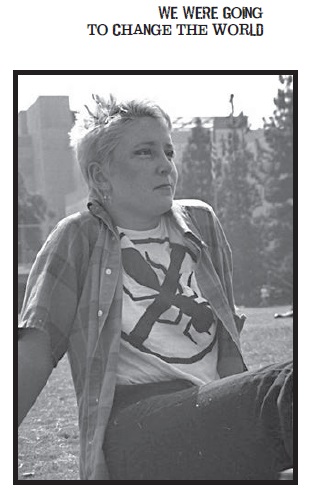
Z.Z. “Carrot Woman” Howell

The punk rock scene of the 1970s and ’80s in Southern California is widely acknowledged as one of the most vibrant and creative periods in rock and roll.

Over the years, many books have come out exploring this explosive time in music and culture, but none have exclusively focused on the vitality and influence of the women who played such a crucial role in this incredibly dynamic movement.

“Almost a decade ago- IN THE SUMMER OF 2012, I attended an oral history workshop by the social justice organization Voice of Witness. I’m a librarian and professor at Santa Ana College and I participated in the workshop to discover projects I could do with students. I ended up imagining something entirely different: interviewing other women like me, now in our middle or later years, who grew up in the punk rock scene in Southern California. Did punk rock influence the rest of their lives? What attracted them to punk rock and how did they get involved? What was it like being a woman in the scene?

What you can now hold in your hands is the final result of a project that took several years and countless hours to complete.

How did I do it? I created a flyer about the project. I posted the flyer a few places around Orange County and Los Angeles and on Facebook. Women started contacting me to participate. I wrote up a list of questions and bought two digital recorders. I emailed some women directly and asked if they would be willing to participate. Then I started calling women and meeting them, mostly in their homes. A friend called it “punk rock anthropology.” I had no idea what an amazing experience this would be.

Stacy Russo has created a unique book about the punk rock era, focusing on the women who were such a huge part of it. We Were Going to Change the World: Interviews with Women From the 1970s & 1980s Southern California Punk Rock Scene (Santa Monica Press/2017) captures the stories of women who were active in the punk rock scene in Southern California during this historic time, adding an important voice to the cultural and musical record. Recommended reading. For the Silo, Trina Kaye.

How I Met My Wife Halfway In Zhengzhou China

Zhengzhou- "Once into the downtown, the pace slows somewhat."
Zhengzhou- “Once into the downtown, the pace slows somewhat.”

How I met my wife halfway…Elegant Confusion………Being delivered by car (my wife’s friend and a co-worker) to the Hotel in the downtown area of Zhengzhou, bursting along the byways and expressways from the Airport, cars around us dancing across the indistinct markings of the lanes in what could be described as a level of a video game in progress, I had no idea ( a horn honks and a bus switches lanes in front of us ‘sans’ signal..) that the “Art” of driving could manifest itself in such a reckless song trying so very hard to be a “ballet”.

My first impressions were to be made, however innocent, a misplaced fantasy.. As we made our way across the edge of this city of 8 1/2 million souls.., it was plain that this was far different than the large, ‘controlled’ infrastructures of North America.. A place where those, who in the faltering of the majority of their lives, seeking to maintain “control” of most aspects of their lives, would be shattered as if a piece of glass  hitting the concrete of this sudden reality. I believe that all this time seeking that ‘control’, having it slip through the grasps of their expectations, is the cause of so much anger, disappointment, and frustration in North Americans’ lives..

There is no “Road Rage” here.

If this is how you imagined driving in one of China's cities would look like you're mistaken. So says writer, farmer and traveler Bill Stewart.
If this is how you imagined driving in one of China’s cities would look like you’re mistaken.

Once into the downtown, the pace slows somewhat, taking time to congeal into something even more unexpected.. Now there are people, thousands of them,.. mixed with electric bikes, bicycles, motorcycles, pedestrians, carts of vegetables and fruit perched high on platforms innovatively connected to motorcycles, wagons of produce drawn by donkeys and cars.. All are dancing in and out of lanes of traffic, up onto sidewalks, threading the pedestrians walking different directions, the buses and taxis faster than the rest..

Cars and motorbikes making U-turns anywhere without notice.., a car honks, someone concedes the space, and life goes on.

The remarkable impression to be made here for a Caucasian in ‘Neverland’,… is that, there are no egos here to set off a clash of emotional diatribes leading to certain physical, or vocal, outbursts.. Just ‘focus’ of purpose.. There is only the destination to be sought.., nothing more matters.. It is not a matter of forgiveness, on the part of the conceded ,.. just a plain sense of infective respect.. An old woman, peddling a bicycle, weaves suddenly directly across the lanes of traffic.. I look away, fearing the sounds and images of her death.. A few impatient honks from the cars,.. all traffic stops.. as she slowly winds her way to the sidewalk on the other side of the street.., the motorbikes weaving around her, pacing in and out of the stopped buses, cars and taxis.. A woman on a motorbike with a child in front, one in back of her seat, sails by me on the sidewalk…It is ‘Elegance in Confusion’ at it’s finest.. For the Silo, Bill Stewart.

Here's what some folk are saying about the video above.
Here’s what some folk are saying about the video above.

Historic Architect Edmund Burke Shaped Look Of Today’s Toronto

Since 1793, when the Town of York, the second capital of Upper Canada, was founded, Toronto has been an important economic and political hub.

The first governor of the Town of York, John Graves Simcoe, believed that this town would become a powerful industrial metropolis, and when Toronto became one of the top financial centres in the world, his dreams came true.  Toronto, as the fifth most populous city in North America, is evaluated by experts and economists from the Economist Intelligence Unit as one of the world’s most livable cities.

Iconic Prince Edward Viaduct by E. Burke

The provincial capital of Ontario is dominates many sectors, including business services, finance, telecommunications, media, arts, film, music, television, software production, tourism, medical research, and engineering. There’s no doubt that Toronto is one of the fastest developing and growing cities in North America. We should remember and appreciate the most significant people in our city’s history who contributed to this prosperity.

Toronto is a perfect example of how the life and spirit of every city in the world is defined and influenced by its architecture.

Each part of Toronto has its own unique atmosphere that reflects its cosmopolitanism. The architecture of Toronto preserves various styles from different eras and centuries. Nevertheless, there were several architects whose work and designs significantly shaped the look of Toronto as we know it today. Let’s take a closer look at the work of the most significant Torontonian architects.

Edmund Burke (1850-1919)
Early Years
Burke was born in Toronto on October 31st, 1850 as the eldest child of lumber merchant and builder William Burke and his wife, Sarah Langley. Edmund Burke finished his studies at Upper Canada College and started to work as an architectural apprentice under the guidance of his uncle, Henry Langley, who was very distinguished among the first generation of architects who were taught in Canada. Back then, Burke was a twenty-year-old man with considerable skill and an open mind who was eager to learn as much as possible from his uncle. A great deal of knowledge about traditional styles was passed from Langley on to his young nephew. Langley’s influence can be recognized in the conservative undertones of Burke’s works. In 1872, he entered a partnership with his uncle. This year marked the formal beginning of his rich and successful career. His own business was set up in 1892, and in first years on his own, he worked on two important architectural projects: the Jarvis Street Baptist Church and McMaster Hall (now the Royal Conservatory of Music) on Bloor Street.

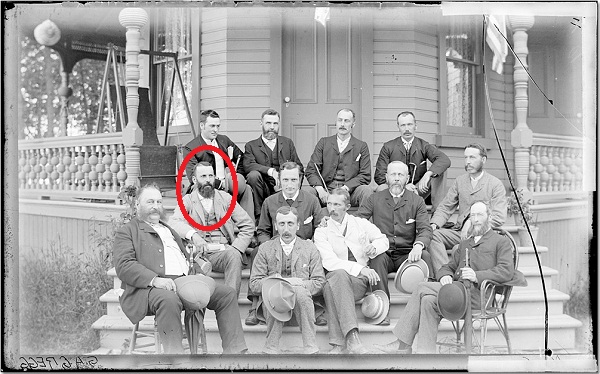
Members of the Toronto Architectural Guild meeting at Edmund Burke’s summer home in 1888. Burke is circled in red. Photo: archives.gov.on.ca

This was the first time that he was truly independent and could express himself without any limitations, making this a period of crucial importance for understanding Burke’s work. Gilbert Scott, one of the most notable figures in British architecture, was his biggest influence in his early works. However, Burke was able to brilliantly combine his progressive and innovative sensibilities with traditional architectural styles. Angela Carr, Assistant Professor of Art History at Carleton University, wrote in her study, Toronto Architect Edmund Burke: Redefining Canadian Architecture, that “Burke’s work developed consistently through a variety of building types in all periods, accommodating technological advances almost as rapidly as these appeared and expressing the new aesthetic of a changing society.“

Burke, Horwood, and White
Burke, after two years as a sole practitioner, established a partnership together with J.C.B. Horwood, and they were later joined by Murray White. All three of them were former students of Henry Langley. Their firm, which designed a vast number of churches across Canada, many luxurious mansions for wealthy citizens of Ontario, and many commercial buildings, was one of the most successful architectural companies in the country. The firm combined different historical styles with new techniques and new materials such as glazed terra cotta, early iron, reinforced concrete frames, and forms of fire protection.

Edmund Burke was eager to seek a new innovative solution that would encourage the modernization of technology. He shared his knowledge with his colleagues by giving lectures and issuing publications. His biographer noted that Burke “presided over the transformation of the architect from the craftsman to consulting professional.“ Burke is responsible for bringing to the practice of architecture in Canada the new vocabularies and technologies used in that era in the United States. He worked with American models, a type of plan than became standard across the country in the last two decades of the 19th century, when he was working on the Jarvis Baptist Church from 1874 to 1875. Moreover, he was responsible for introducing the “curtain-wall“ construction to Canada when designing the Robert Simpson store in 1894, which, in the following decades, inspired many architects of retail department stores across the country.

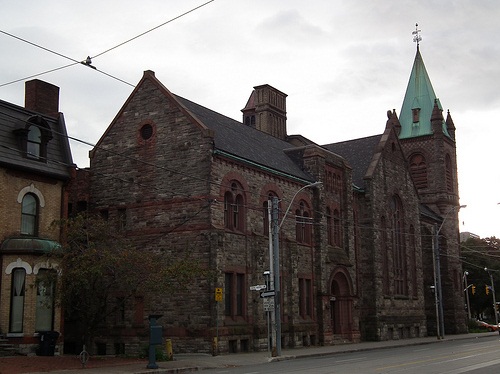
St. Luke's United Church Toronto
St. Luke’s United Church Toronto

It is worth noting that Burke was also active in urban planning activities for the City of Toronto and that he also was a part of several committees established by the Ontario Association of Architects and Toronto’s Guild of Civic Art. He is the author of the Prince Edward Viaduct, also known as the Bloor Viaduct, which he designed together with the city engineer’s office. Moreover, he participated and worked on projects improving the city’s traffic flow.

Burke’s Work in Professional Architectural Societies
Edmund Burke was one of the leading figures responsible for the recognition of the architectural profession and for having a substantial influence on Torontonian architecture in the 19th century. Burke played a major role in codifying standards of practice and education in the field of architecture, which ensured basic rules and and proper working conditions for architects as well as protection from unqualified practitioners.


The ever-growing competition from the United States was the main reason for the establishment of innovative learning programs, the introducing of modern technologies, and the formation of professional architectural organizations. Burke was responsible for the establishment of the Ontario Association of Architects in 1889, which he later led as its president in 1984 and 1905 to 1907. Furthermore, he was one of the three founding members of the Royal Architecture Institute of Canada. His support of quality education was an important aspect of his contribution to Canadian architecture. He noted that “if we train our students thoroughly and see that no one but first class men are permitted to enter the profession, I think the rest will take care of itself.“

Edmund Burke devoted his life to architecture and introduced a new way of combining the newest trends with traditional styles. The last years of his life were dedicated to public and professional service. The face of Toronto continued to be shaped by his works and ideas through the works of his colleagues and students for many years.

“Few men of the present generation of architects have so widely held the respect and esteem of their confrères, or been more closely identified with the building progress of the country. Practicing continuously for a period of over forty years, during the time when Canada was passing from its more backwards state to the present great strides of nationhood, his efforts stand out prominently in the modern character of Canadian architectural work.“ Obituary of E.Burke, Construction (January 1919)

Notable Buildings Designed by Edmund Burke
Jarvis Street Baptist Church (1878) – Jarvis Street
Prince Edward Viaduct, also known as the Bloor Viaduct (1881)
Trinity-St. Paul’s United Church (1887–1889) – Bloor Street, west of Spadina Avenue
Owens Art Gallery (1893) – Mount Allison University, New Brunswick
St. Luke’s United Church (1874) – Sherbourne Street and Carlton Street
Beverley Street Baptist Church (1886) – 72 Beverley Street
Robert Simpson’s Department Store Building (1908) – 176 Yonge Street [*perhaps the building Burke is most famous for CP]
St. Andrew’s Evangelical Lutheran Church (1878) – 383 Jarvis Street
McMaster Hall, now The Royal Conservatory of Music (1881) – 273 Bloor Street West

Burke worked on several buildings and projects outside of Ontario including the design and construction of Owens Art Gallery in New Brunswick

For the Silo by Jamie Sarner.  

Supplemental- Discover the book, Edmund Burke- a genius revisited

Canada’s Truth And Reconciliation Commission

Reconcilation

[This article was first published by The Silo on April 22, 2014] On June 10, 2009, the Honourable Justice Murray Sinclair, Marie Wilson and Chief Wilton Littlechild were appointed as Commissioners to the Truth and Reconciliation Commission of Canada (TRC), a component of the Indian Residential Schools Settlement Agreement.

Canada’s Truth and Reconciliation Commission is unique from other commissions around the world in that its scope is primarily focused on the experiences of children and its research spans more than 150 years (one of the longest durations ever examined). It is also the first court-ordered truth commission to be established and most notable, the survivors themselves set aside 60 million dollars of the compensation they were awarded to help establish the TRC.

Over the course of its 5 year mandate, one of the main tasks of the Commission is to create an accurate and public historical record of the past regarding the policies and operations of the former residential schools, what happened to the children who attended them, and what former employees recall from their experiences.

It is difficult for Canadians to accept that the policy behind the government funded, church run schools attempted to “kill the Indian in the child”.  The violent underpinnings of the policy challenge the way we think about Canada, and call into question our national character and values.  We have been taught to believe that we are a peaceful nation, glorious and free.

The residential school legacy shines a light in our darkest corners, where we feel most vulnerable.

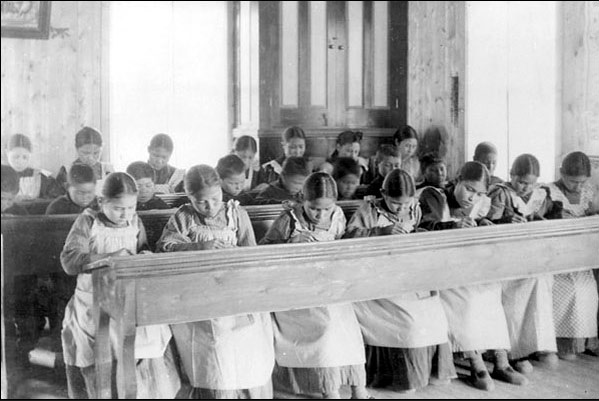
Over 130 Residential Schools were located across Canada, with the last one closing in 1996.   More than 150,000 First Nations, Métis and Inuit children as young as five years old were forcibly removed from their families and placed in institutions that shamed their languages, customs, families, communities, traditions, cultures and history.  In essence, they were not allowed be themselves and denied the love and belonging owed to all children.

Reconcilation

While some former students had positive experiences at residential schools, many suffered emotional, physical and sexual abuse, and others died while attending these schools. Other lessons in trauma included assimilating children to gender roles, non-skilled labour and religion to prepare them for future integration.   For the parents left behind, the worst lessons in shame, grief, loss and disconnection. Whole societies were undone.

In addition to creating the public historical record of the past, the survivors also tasked the Commission to reveal to Canadians the full and complete story.

What were they thinking? Why should it matter to ordinary Canadians?

Here’s why:  When we tell our stories we change the world. When we don’t tell our stories we miss the opportunity to experience empathy and to cultivate authenticity, joy and belonging. (Brené Brown, 44) Through story-telling, the survivors are compelling Canadians to listen and respond with deep compassion and to re-set relationships in a big way in this country.  This is our greatest opportunity to recognize shared history and our shared humanity.   These stories are a gift and will help us to shape our shared future.

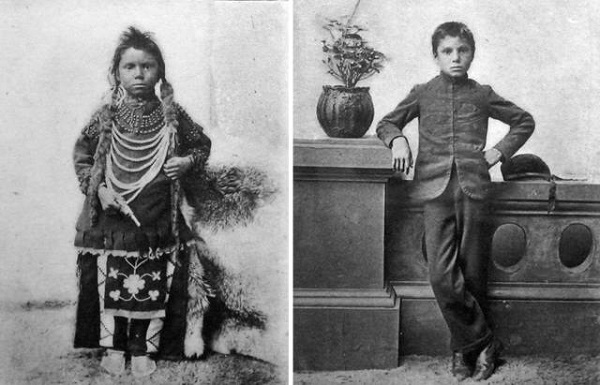
Thomas Moore before and after his entrance into the Regina Indian Residential School in Sasketchewan in 1874. image: Library and Archives Canada/NL-022474

Through statement gathering at national or regional events and at TRC Community Hearings, former students, their descendants and anyone who has been affected by the Residential Schools legacy, had an opportunity to share their individual experiences in a safe and culturally supportive environment.   The TRC concluded its last community hearing in March 2014 and has collected more than 6, 200 statements.

Almost all of them were video-and-audio-recorded and range from a few minutes to a few hours.  The statements will be stored at the National Research Centre on Indian Residential Schools at the University of Manitoba.  Students, researchers and members of the public will be able to access the statements to learn about residential schools and the legacy they leave behind.

Reconcilation

As the TRC begins to reveal to Canadians the full and complete story of residential schools and inspire a process of reconciliation across this country, ordinary Canadians seem ill-equipped to make the journey from shame to empathy.  “We know the voices singing, screaming, wanting to be heard- but we don’t hear them because fear and blame muffle the sounds” (Brené Brown, 42)  We need to prepare ourselves to go to the dark corners of our history, so we can stand in the light together as equals.

In my next article, I will share with you more about empathy, how to practice empathy and why its essential to building meaningful and trustworthy relationships.) For the Silo, Leslie Cochran.

(Brené Brown, 42 and Brené Brown, 44) are taken from her first book “I thought it was just me.”

Ukraine: How UNESCO Supports Odesa’s Heritage & Cultural Life

Paris, 30 August 2022 – At a meeting with UNESCO Director-General Audrey Azoulay at the Organization’s Headquarters, Oleksandr Tkachenko, Ukrainian Minister of Culture and Information, announced that his country will request the inscription of Odesa on UNESCO’s World Heritage List. For its part, the Organization will deploy new measures to protect Ukrainian cultural heritage, particularly in Odesa and L’viv.

Since the beginning of the war, UNESCO has been deploying emergency measures in Ukraine as part of its mandate for education, culture, science, information and communication.

The Organization has mobilized close to $7 million USD/ $9.17 million CAD to date, provided numerous in-kind grants and made its experts available to advise professionals on the ground.

A working meeting was held at UNESCO Headquarters on Tuesday between Ms Azoulay, UNESCO Director-General, Mr Tkachenko, Ukrainian Minister of Culture and Information, and Ernesto Ottone, UNESCO Assistant Director-General for Culture, to ensure the proper implementation of these actions in the field of culture. On this occasion, the Minister also expressed new needs which UNESCO is committed to meet.

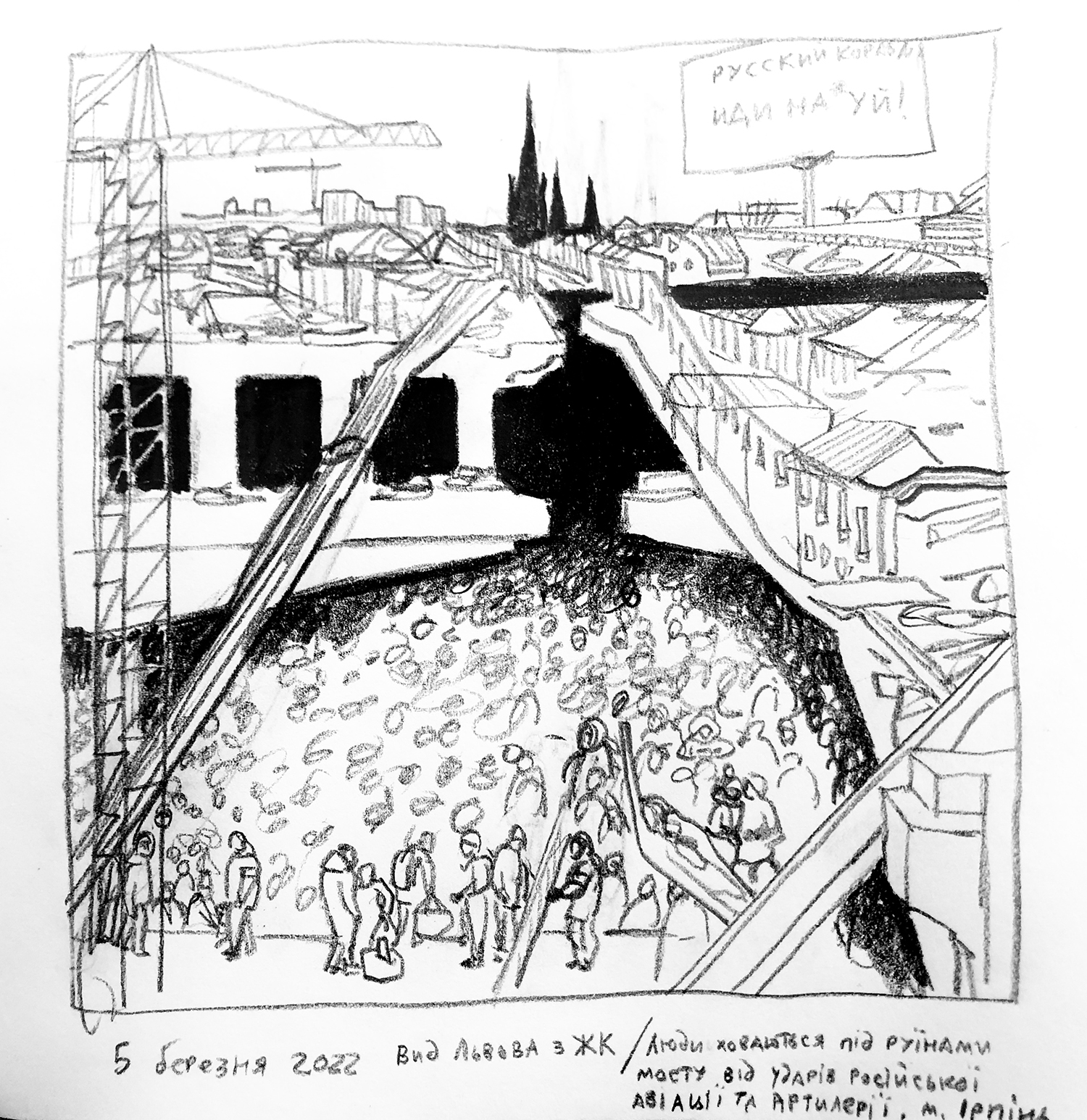
Image via artreview.com Artist I. Levi modifies existing artwork to reflect changes to old works caused by wartime damage that have occurred since the Ukraine War began. Inga Levi, March 15, 2020: The Willow’s Catkins have Blossomed, Klaipėda/ The House Window in the Obolon District after a Direct Airstrike, Kyiv, 2022, pencil

Inscription of Odesa on the World Heritage List

Oleksandr Tkachenko announced Ukraine’s decision to submit t the nomination of the Historic Centre of Odesa for inscription on UNESCO’s World Heritage List. Nationally recognized and protected, this site is located only a few dozen kilometres from the front line and has already been struck by artillery fire. On 24 July 2022, part of the large glass roof and windows of Odesa’s Museum of Fine Arts, inaugurated in 1899, were destroyed.

At the request of Ukraine, UNESCO has already mobilized international experts to provide technical support to the country so that this nomination can be examined urgently by Member States sitting on the World Heritage Committee, with a view of inscribing it on the World Heritage List and on the List of World Heritage in Danger.

The World Heritage Committee will also be recommended to add UNESCO’s World Heritage sites of Kyiv and L’viv, which are also under threat, to the List of World Heritage in Danger.

Image via artreview.com Inga Levi, March 5, 2022: Lviv’s view from the New Building / People are Hiding under the Ruins of the Bridge from the Russian Aircraft and Artillery, Irpin, 2022, pencil

UNESCO completes its emergency measures on the ground

In parallel to these steps and in view of the new needs expressed by professionals in the field, the Director-General announced at this meeting that UNESCO would strengthen its support to the city of Odesa by providing:

  1. Funding to repair the damage inflicted on the Odesa Museum of Fine Arts and the Odesa Museum of Modern Art since the beginning of the war, and to finance the hiring of additional staff dedicated to the protection of collections.
     
  2. Support for the digitization of at least 1,000 works of art in Odesa as well as the documentary collection of the Odesa State Archives, through the  provision of appropriate hardware.
     
  3. New equipment to the Odesa Regional Administration for the in situ protection of cultural property: protective panels, sandbags, fire extinguishers, fireproof fabrics and gas masks will be delivered to the Department of Culture, Religion and Protection of Architectural Heritage. They will allow the recovery of public monuments and sculptures, which has been underway since the beginning of the war, to continue.

With a view to boosting the recovery of Ukraine’s cultural sector, the Director-General also offered the Organization’s support for the creation of a UNESCO Cultural Centre in L’viv, as requested by the city mayor. It would be a place for artists to meet and share experiences, and would host training programmes, various activities and events. A budget of $1.5 million usd/ $1.96 million cad has already been earmarked to finance its opening and operational costs over several months.

In addition, the Director-General of UNESCO decided to deploy a liaison officer in Kyiv to coordinate these actions. The officer will complement the team of local experts already working in the field. For the Silo, Clare O’Hagan/UNESCO.

Families That Fight Over Inheritance

The recently deceased don’t always ingratiate themselves with their survivors when it comes time to read the will.

“People want to control things from the grave, not just throw a bunch of money in a beneficiary’s lap,” says family wealth guru John Pankauski, author of the new book, “Pankauski’s Trustee’s Guide: 10 Steps to Family Trustee Excellence.”

It’s their money so that’s their right.Fighting Over Money

But family members aren’t always crazy about how the deceased divided up the money or, if the inheritance was put into a trust, the restrictions that are placed on how the money is spent.

And often ill feelings among family members can bubble to the surface when money is at stake.

“I deal with sibling rivalries, petty jealousies and childhood grudges played out by adults who are decades older, but no more mature,” says Pankauski, founder of the Pankauski Law Firm (www.pankauskilawfirm.com), which specializes in trust and estate law. “It makes me think that part of my job is to be a wealth psychologist.”

Often, an inheritance isn’t doled out immediately. Instead, it’s placed in a trust with a trustee to oversee it, making decisions on when and how to distribute the money based on the terms of the trust.

In many situations, that works out fine. But in seriously dysfunctional families, that can make a bad situation borderline intolerable.

Sense Of Entitlement

Pankauski says any number of factors can lead to family feuds or general disgruntlement over an inheritance. Here are just a few:

•  Sense of entitlement. Many beneficiaries have a misplaced sense of entitlement to an inheritance. They just expect that mom or dad will leave them money or property. In their minds, it’s what they have coming to them. “The truth is, you can dispose of your property any way you want,” Pankauski says. “There is no right to an inheritance and just about anyone can be disinherited.”

So if people want to leave their money in a trust for a family pet, or bequeath everything to a neighbor, a mistress or a charity, they have every right to do so, assuming they are competent and know what they are doing. “It’s their money,” Pankauski says. “They can do with it as they wish.” Other than dealing with a spouse, there are almost no restrictions.

•  The audacity of the trust. Family members often become frustrated and angry when they realize they inherited money, but it’s in a trust and there are strings attached.  “The beneficiaries view trusts as handcuffs on their money,” Pankauski says. “A trust takes all those family members’ personal feelings and emotions, all that baggage, and adds money to create a financial stew into which the beneficiaries are thrown.”

Often, because beneficiaries don’t like it that a trustee gets to make decisions on when and how they get a portion of their inheritance, family members will seek counsel and try to “bust the trust.”

•  An implied accusation of financial irresponsibility. At some point it may begin to dawn on beneficiaries that one reason the inheritance was placed in a trust is that the deceased didn’t view them as responsible with money. “That may seem insulting, but it doesn’t have to be,” Pankauski says. “Many would argue that most people are irresponsible with money, particularly a large sum of inherited money that appears out of the blue, much like winning a lottery.”
Sometimes at least a portion of the family animosity might be avoided by better planning when the will is being written and the trust created.
“When beneficiaries don’t get along,” Pankauski says, “it may make more sense to cut their financial ties by either creating multiple separate shares within the trust or creating separate trusts altogether.”

For the Silo, John Pankauski, LLP.


Out Of Work? You Could Be A Contestant On A Future Game Show

After perusing the many niches of reality TV — well-to-do housewives in multiple major cities, the rugged Alaska lifestyle, and working the dirtiest jobs known to man — employment strategist Richard B. Alman wonders why we haven’t seen a show about a popular and compelling subject: long-term unemployment and drop-outs. (Spoiler alert- Life imitates art, this has in fact become reality…read on)

It’s a numbers game

While unemployment rates ebb and flow, according to various Government agencies such as the Bureau of Labor Statistics in the United States or Statistics Canada here at home, there is no reliable data for the long-term unemployed – those who’ve been jobless for 27 weeks or more – and for the underemployed.

“Recent college grads, who are typically saddled with student debt, still struggle to find terra firma in the professional world, and there’s a large blind spot for older unemployed workers, who may have gone back to school or taken a lesser job for which they’re overqualified, or they’re still searching,” says Alman, principal of Recruiter Media, owner of www.RecruiterNetworks.com, the world’s largest owner/operator of career websites.

The 1990 arcade game Smash TV- set in 1999 and with a vague story arc. Officially, the plot of Smash TV revolves around a futuristic game show in which players compete for various prizes, as well as their lives. Urban legend has included references to 'out of work teens and college drop-outs' being some of the principle characters. CP

The 1990 arcade game Smash TV- set in 1999 and with a vague story arc. Officially, the plot of Smash TV revolves around a futuristic game show in which players compete for various prizes, as well as their lives. Urban legend has included references to ‘out of work teens and college drop-outs’ being some of the principle characters. 

“Drama, struggle, learning moments and, yes, hope – that’s what you’d get with an un- and underemployment-themed reality TV show.”

Life imitating art imitating life? The Running Man takes place in the year 2017- and pits ‘society discards against one another in a reality based TV show set in a dystopic future’.

Alman reviews how the first season might play out.

•  Week 1: Job-seekers are happy to have a gig. Since reality show participants are paid, all are happy for this opportunity. Newly graduated college students are grateful to have a place to crash for several weeks with Wi-Fi and other free amenities, and love interests begin to develop. Older professionals, however, will have mortgages and families; for them, the show is a business trip. Underemployed job-seekers tell their stories of working long hours in unfulfilling positions.

•  Week 2: Putting the reality into “reality TV.” “Un- and underemployment touches nearly everyone; we all know someone without enough work,” Alman says. While reality includes fortuitous wealth and fame for a few, it also includes tough times for many. The second week would feature job-seekers sticking to old methods of searching that have not worked in the past and continue to fail them.  

•  Week 3: The reveal – participants find out it’s a competition. While the cameras have sparked renewed vigor in their individual searches – a few participants may have even tried some wildly unconventional tactics – the group has had relatively little success. Producers reveal that it’s not just a reality show about job-seekers, it’s a competition. The group is separated into two teams. Participants from the winning team get legitimate interviews with Fortune 500 companies.

•  Week 4: Job-seekers gain important tips. No matter how much experience, talent, youth or beauty they have, job-seekers still make mistakes with their strategies. While a well-written cover letter, an impressive education and a great resume certainly help – they’re not everything. Professionals give participants tips for staying relevant in today’s market, including the importance of doing volunteer work, preferably in roles that match their talents and training.

“I really cannot overemphasize this tip enough. Volunteering is probably the best way for the long-term unemployed to demonstrate their abilities, initiative and effectiveness in a marketplace that hasn’t given you enough of a chance,” Alman says. “It builds new skills, introduces you to a new network of potential employers, and adds recent experience to your resume.”

•  Final week: All are on their way to gainful employment. After several weeks, most of the participants have made significant progress in landing career positions. While the winning team gains a great opportunity with a guaranteed, high-quality interview, there are no losers on this show. And, those who’ve made an excellent impression on the program are sure to gain additional opportunities.

For the Silo, Richard B. Alman

Supplemental-Following the theme of this story, you might like to consider the US game show “Paid Off”. Accordingly the contestants are graduates competing to have their student loans paid off.

German Techno Scene Reveals Postmodern Aesthetic Resistance

“Underground” is a word, which is an essential part in the title of the “Keep it simple, make it fast” conference. Not only in punk, also in techno this is a term very frequently used, referred to and rejected at the same time.

Many claim, this terms doesn’t make much sense anymore nowadays.

Is this really true, or is there just a lack of a fitting theory to explain, why this term seems still to be central for discourses in and about music scenes? So called ‘scenesters’ say they prefer things “more underground”.

Matrix Dance Club
Matrix Dance Club

One of my interviewees, a label owner, put it succinctly, “Berlin isn’t Lady Gaga or Paul van Dyk; this is the capital city of the underground.” What does this term mean here, and how is it sociologically rooted in the cultural field of electronic dance music (Bourdieu, 1996)?

Current post-subcultural theories, such as from Andy Bennett, David Muggleton or Ronald Hitzler (2010; 2008; 2003), offer little means to understand these claims and differences; and how to explain why they don’t disappear, but re-shape and accommodate with newer developments.

Although I broadly agree with the insights of post-subcultural theories, a crucial feature of the music scene has been lost along the way: a systematical sociological exploration of the roles that distinctions play and how they are rooted in the music scene’s cultural economy (Kühn, 2011, 2013).

So far, the economy of scenes has been mostly understood as being part of the cultural industries (or creative industries by now), or not even economic at all (Gebesmair, 2008; Wicke, 1997).

Music industry research sees them as fully integrated actors of global and national music markets, classified into so-called independents and majors (Handke, 2009) and differentiated along lines of size, musical specialties and originality. Creative industries research tries to subsume them as major drivers for the attractiveness of cities and national economies by their engagement into supposedly very innovative products (Caves, 2002; Florida, 2003; Hartley, 2004).

What both perspectives have in common is that they do not approach economic structures from the music scene’s perspective, but rather from an economic-industrial point of view. And thereby they overlook and underestimate structural peculiarities.

In order to define the economic sphere of electronic dance music scenes sociologically, I argue for the term scene economy (Kühn, 2011).

Although previous insights have been extremely illuminating, these studies have lacked a systematic perspective that analyses the aesthetic, distinctive and commercial attitudes of hobbyist and professional scene participants within the conditions of their specific cultural norms and scene-based reproduction.

My assumption is that the scene economy of ‘underground’ electronic dance music scenes represent their own differentiated economic fields with specific structures that have developed their own organizational logic. The consequences and the basis of this logic are particular conditions for action and relations of production within the scenes’ own infrastructure and value-creation chain that result from the specific cultures and market relations of electronic dance music.

To understand the specific structure, the following features need to be considered: Scene-based cultural production instead of industry-based cultural production, the emphatic role of the music culture, the internal subcultural hierarchy and the role of distinctions in maintaining and re-shaping the scene economy, music culture and attractiveness.

The following remarks and claims are firstly based on my research, using focused ethnography, on producers of electronic dance music, twelve expert interviews with individuals active in various areas of the scene economy. And secondly on my own long-standing participation in the scene as a DJ, booker and media producer as forms of sociological ethnography. I use ideal-type descriptions. That is, I work with exaggerated representations of differences that in reality occur in a substantially more mixed and indistinct way. And yet, their exaggeration is precisely what allows the core of their specificities to be represented most clearly.

Tresor
Tresor

Towards neo-subcultural theory

In his theory on cultural fields, Pierre Bourdieu noticed a general trend towards two poles with opposing cultural logics. The ‘autonomous pole’ defines itself by its cultural orientation; in which the furthering of art itself takes highest priority over any political, moral, or economic interest. The other pole has a commercial orientation; treating art as just another form of commerce like any other, in which art is produced based on its marketability. Each pole has its way of making value and profiting from it, but they are also in tension with each other.

This tension also exists in electronic dance music: on the ‘autonomous’ side of things you find house and techno music, along with the club/open-air party culture of Berlin. On the other side, you find mass-produced and profit-driven so-called EDM ‘dance pop’, which readily absorbs anything that promises to increase sales and reach. Both poles have very different definitions of success, as well as sharply divergent aesthetics and modes of production.

Aesthetic subcultures 

(and not class-based anymore) with their own identity and infrastructures struggling to maintain aesthetic and seductive cores against unwanted external influences and political, moral or economic instrumentalization. To understand the dynamics of post-modern popular cultures, it is necessary to overcome the opposition of subcultural and post-subcultural readings of music scenes. The reality is, in the case of electronic dance music such as house and techno, neither strictly the one or the other. As small scale underground music culture and their big scale counterparts suggests, also in other fields of music, both are closely intertwined and distinct from each other at the same time.

Click to view on I-tunes

Pierre Bourdieu’s field theory helps to extend the concept of the music scene and re-shape the concept of subculture to understand the cultural dynamics between “underground” and “mainstream” as different forms of meaningful culture-economic infrastructure and social identity.

By combining Bourdieu’s theory of the cultural field (2001) with updating scene and subcultural theory, the presented approach is linking both subcultural identities and cultural-economic structures and is heading towards overcoming the current dichotomy of subcultural and post-subcultural theory.

DJ SiSeN and Berlin Goth culture

Scene-based cultural production

Involvement in house and techno music typically starts with a random visit to a techno club, or by first listening to the music through recorded DJ sets. Some become very passionate about music and clubbing and start to visit clubs very frequently. In the beginning, participation remains passive, but quickly may evolve I : People start to look for certain sub-genres, follow certain DJs, gain certain scene-specific sets of knowledge about clubs, do’s and don’ts, artists, and so on. Then, to participate more deeply and earn money, some start to DJ, throw parties, launch music labels, found scene specific agencies or just start to work in clubs or for labels and agencies.

They start to combine their passion for a certain aesthetic with commercial and distinctive attitudes: For some, it will always just remain a hobby, but others quickly become professional and turn their scene participation into a business. However, for the passionate, this business orientation remains strongly limited by the cultural institutions of the music scene. They don’t start making other music just because it is more profitable. They relinquish economic opportunities, because the feelings of enjoyment and freedom experienced through the music are more important to them. They see economic activity as being able to get by instead of pure profit-maximization.

This means that they associate the generation of sufficient income and social protection with their main desire for economic self-determination, artistic freedom and passion in life. For them, money exists to make their lives possible, in which they will be able to ideally pursue their personal goals in artistic freedom—but not in order to secure as much wealth as possible, following a logic of accumulation. The small-business structure of many lone entrepreneurs promotes this logic, since it imposes fewer practical constraints on the individual than a large organization with numerous employees. This connection through a commonly shared passion also results in individuals working together in clubs or labels, often referring to their friends and colleagues as a “family”.

To summarize: Their private desires and business activities become closely coupled and integrated, resulting in a deeply culturalized economic orientation. One recruits “bottom-up” out of the fascination for a certain music and prioritizes cultural orientations over economic possibilities. This makes small-scale actors who mainly do it for the fun and a feasible outcome. An atomistic structure of many sole entrepreneurs dominates the markets. Instead of pure sale orientation, subjective aesthetics and political interests dominate the cultural products and business co-operations among the scene economy participants.

The emphatic role of the music culture

As participants of a certain music culture, their activity is oriented on the cultural institutions of Detroit Techno and Chicago House and thereby framed by its opportunities and restrictions. These cultural institutions enable and demand certain cultural practices to be fulfilled and followed in order to reproduce and accommodate the seductive core of the music scene. The norms are typical music tracks to be seamlessly mixed by DJs in front of a dancing crowd on a loud sound system. What are these institutions? Although very roughly and surely not exhaustively, house can be understood as established musical practices condensed as tracks with repetitive and loop based beats, with a focus on groove, making crowds dance in clubs, mixing in DJ sets and played on events at high volume.

Genre-typical patterns for house and techno music are the four to the floor beats, between 100 and 150 beats per minute speed, elements like basslines, kickdrums, snare drums, hi-hats and track themes. Techno sounds rather dark and heavy, house sound rather soft, funky and easy-going. Tracks are typically composed with intros, breakdowns, a main section, climaxes and outros. Tracks are supposed to make people dance at events and to be mixed in continuous sets by DJs (Kühn, 2009; Mathei, 2012; Volkwein, 2003).

The central role of distinctions in the music scenes economy

As a result of their scene-based involvement and fandom of house and techno, many scene participants towards the autonomous pole exert distinctions in order to conserve and develop their preferred set of aesthetics and scene-based cultural production (Strachan, 2007; Mäe & Allaste, 2011; Moore, 2007). In the post-modern world, aesthetics can flow everywhere and thereby can be used and adopted anywhere. Even in contexts, that many scene participants find not very much desirable.

The current boom of electronic dance music in the US, with associated artists like David Guetta, Swedish House Mafia, Skrillex and so on, is a good example of this. With the increasing success of so-called “mainstream” EDM, many scene participants insists of debunking that culture as “fake” and “inappropriate” – and try to keep these aesthetics, actors and corresponding organizations out of their scene contexts. Sociologically speaking, they draw boundaries around their aesthetics and modes of production.

It is a form of resistance not primarily rooted in class, but in the preservation and defense of aesthetically-based life-worlds. Typically, these distinctions are about a perceived corruption of cultural logics by the economic logics of apparently too commercialized music and events, or about external actors like companies, political shareholders or councils who are not intrinsically interested in the music culture, rather using them for their own allegedly purely commercial or political aims. Aims that eventually might endanger the productivity and survival of the music scenes by for example causing gentrification or mainstream identity.

These distinctions have become a background knowledge of the subcultural field and are also expected by the participants in order to enable economic cooperation. From these distinctions the possibility and necessity of an internal subcultural hierarchy within the field of electronic dance music evolves.

*See (Kühn, 2013) for an example, how event producers use distinctions to avoid unwanted music, DJs, insfluences and crowds on their partys.

Various forms of distinctions as a form of “aesthetic resistance” become the primary means to keep out unwanted aesthetics and modes of production in order to preserve the aesthetic core of the music scene. For the Silo, Jan Michael Kühn.

Funding:

This work was supported with a 3 years scholarship from the Hans Böckler Stiftung within the doctoral study group (Promotionskolleg) “Die Produktivität von Kultur – Die Kultur- und Kreativwirtschaft unter den Bedingungen globalisierter Mediennetzwerke”.

References

Bennett, A., & Peterson, R. A. (2010).

Music Scenes: Local, Translocal, and Virtual 

. Vanderbilt Univ Pr. Bourdieu, P. (1996).

Rules of Art: Genesis and Structure of the Literary Field 

(Auflage: New.). Cambridge: Wiley-Blackwell. Caves, R. E. (2002).

Creative Industries: Contracts Between Art and Commerce 

(New Ed.). Harvard University Press. Florida, R. (2003).

The Rise of the Creative Class: And How It’s Transforming Work, Leisure, Community and Everyday Life 

(Pbk.). Basic Books. Gebesmair, A. (2008).

Die Fabrikation globaler Vielfalt: Struktur und Logik der transnationalen Popmusikindustrie 

(1., Aufl.). Transcript. Hall, S., & Jefferson, T. (2006).

Resistance Through Rituals: Youth Subcultures in Post-War Britian 

(0002 ed.). Routledge Chapman & Hall. Handke, C. (2009). Indies im Aufwind?

: die Krise am Tonträgermarkt und ihr Verteilungseffekt. In Musikwirtschaft und Medien 

: Märkte – Unternehmen – Strategien. – Baden-Baden 

: Nomos, ISBN 978-3-8329-4383-7. – 2009, p. 49-72 

. Hartley, J. (2004).

Creative Industries (First Edition, Later Impression.). Wiley-Blackwell. Hesmondhalgh, D. (1998). The British Dance Music Industry: A Case Study of Independent Cultural Production.

The British Journal of Sociology ,49 (2), 234. doi:10.2307/591311 Hitzler, R., Honer, A., & Pfadenhauer, M. (2008).

Posttraditionale Gemeinschaften: Theoretische und ethnografische Erkundungen  (1st ed.). Vs Verlag. Kühn, J.-M. (2009).

Wie entsteht Neues bei der Produktion elektronischer Tanzmusik im Homerecording- Studio? Eine explorative ethnografische Erhebung 

(Diplomarbeit). Technische Unversität Berlin, Institut für Soziologie. Retrieved from http://www.berlin-mitte-institut.de/wie-entsteht-neues-bei-der-produktion-elektronischer-tanzmusik-im-homerecordingstudio/ Kühn, J.-M. (2011). Working in the Berlin Techno Scene: Theoretical Sketch of an Electronic Music “Scene Economy.” 2011 ,translation made by Luis-Manuel Garcia from: Kühn, Jan-Michael (2011): Arbeiten in der Berliner Techno-Szene: Skizze der Theorie einer Szenewirtschaft elektronischer Tanzmusik, in: Journal der Jugendkulturen 17.

Kühn, J.-M. (2013). Underground und Kulturproduktion: Die Rolle von Distinktionen beim Veranstalten Berliner Techno-Partys. In B. Lange, H.-J. Bürkner, & E. Schüßler, (Eds.),

Akustisches Kapital: Wertschöpfung in der Musikwirtschaft 

. Bielefeld: transcript. Lange, B., & Bürkner, H.-J. (2010). Wertschöpfung in der Kreativwirtschaft: Der Fall der elektronischen Klubmusik.

Zeitschrift Für Wirtschaftsgeographie , 54 (1), 46-68. Mäe, R., & Allaste, A.-A. (2011). Making Distinctions on Autonomous Cultural Field: the Case of Small-scale Alternative Music Festival Organisers in Estonia. Retrieved from http://core.kmi.open.ac.uk/display/1028677

Keep it Simple, Make it Fast! An approach to underground music scenes 286  Mathei, D. (2012).

Oh my god – it’s techno music!: Definition und Abgenzung des Technostils unter Berücksichtigung historischer, stilistischer und soziologischer Aspekte (1st ed.). Universität Osnabrück. Erzieh.- u. Kulturwiss.

Moore, R. (2007). Friends Don’t Let Friends Listen to Corporate Rock Punk as a Field of Cultural Production.

Journal of Contemporary Ethnography ,36 (4), 438-474. doi:10.1177/0891241607303520 Muggleton, D., & Weinzierl, R. (2003).

The post-subcultures reader . Berg. Strachan, R. (2007). Micro-independent record labels in the UK Discourse, DIY cultural production and the music industry.

European Journal of Cultural Studies ,10 (2), 245-265 doi:10.1177/1367549407075916 Thornton, S. (1995).

Club Cultures: Music, Media and Subcultural Capital . Blackwell Publishers. Volkwein, B. (2003).

What’s Techno?. Geschichte, Diskurse und musikalische Ge stalt elektronischer Unterhaltungsmusik 

(1., Aufl.). Universität Osnabrück. Wicke, P. (1997). Popmusik als Industrieprodukt. Webseite Humboldt Universität Berlin. Retrieved from http://www2.hu-berlin.de/fpm/textpool/texte/wicke_popmusik-als-industrieprodukt.htm

Lingerie From Colombia Combats Industry Control

Building a business is one of the hardest things to do, especially when one is trying to build a business bigger than Victoria’s Secret, who owns 50 percent of the lingerie industry.

But, Catalina Girald, founder of Naja Lingerie is setting out to do just that.

Going for Soul Not Sex - changing the lingerie industry one pair at a time : Inside Naja Lingerie by Catalina Girald
Going for Soul Not Sex – changing the lingerie industry one pair at a time : Inside Naja Lingerie by Catalina Girald

Headquartered in Medellin, Colombia, with offices in San Francisco and New York, Catalina found a niche in the already dominated lingerie industry. Having worn Victoria’s Secret for most of her life it was when she became a professional that she started to see that the highly popular brand overly sexualized women. As a business woman, Catalina no longer felt comfortable wearing such lingerie and decided to design her own. “My aim is beyond making high-quality bras and panties. I want to create a lifestyle brand. I see it as the Athleta of what happens in your bedroom and bath.”

Her mission to create an alternative lingerie brand for women has a long journey ahead, but Catalina remains focused.

Seeing beyond the needs of women and staying in tune with the digital force of today’s society, Ms. Girald’s small yet powerful brand, Naja Lingerie is changing the game in more ways than one. With quotes printed inside each of the panties, designed to empower women and the brand going completely e commerce, Naja lingerie is for women who want to be radically different. Never forgetting the core of her mission, the company’s Underwear for Hope program donates a percentage of purchases to the Golondrinas Foundation in Medellin, where Girald was born. The foundation teaches impoverished women, skills such as sewing which allows them to support their families. They sew the wash-bags that come with each Naja purchase.

Each collection is inspired by the founder’s travels around the world.

From living with nomads in Mongolia to learning about the weaving process in Indonesia and living among the Hmong people in Vietnam, Catalina’s 18 month spiritual journey throughout Asia brought ideas and life to Naja lingerie. It wasn’t always that way for Catalina who was once at the top of her career as an attorney over at Skadden Arps, one of the most prestigious law firms in the country. Looking to create something greater, Catalina Girald started attending the acclaimed New York’s Fashion Institute of Technology–literally sneaking off to classes in between meetings at Skadden.  Ultimately, she left Skadden to pursue her MBA at Stanford University where the Colombian born entrepreneur founded one of the first venture-funded fashion sites (MOXSIE) for independent designers which was later acquired.

Catalina Lingerie

Introducing Naja, the inventive online lingerie brand that speaks volumes

Naja, a digitally driven, forward-thinking innovator in the lingerie industry, has officially launched to rave reviews. Naja, billed as the “radically different, thoughtful lingerie brand for smart, courageous and sexy women”, was pioneered by Colombian-born CEO, Catalina Girald. No stranger to the fashion and technology industries, Catalina founded MOXSIE, one of the first venture-funded fashion sites for independent designers which was later sold to Fab.com. Naja is a breath of fresh air in an industry that hasn’t changed appreciably in decades. When asked about the direction of the new firm, Founder Catalina Girald answered, “We celebrate strong women. We’ve done away with fans blowing fake wind into our models’ hair, and old, dated lingerie designs. Our fresh designs, pricing and mission to empower women are challenging the industry, and we’re building the first billion-dollar online lingerie brand for the next generation woman.”

Today, women looking for fashionable bras under $80USD [$103CAD]  have limited choices, including Victoria’s Secret.

However, a growing number of shoppers have expressed dissatisfaction with the mass retailer, citing a lack of innovative designs, low construction quality, and environmental impact amongst their concerns. Naja changes all of that.   The company offers exclusive designs paired with the highest quality of fabrics, placing significant focus on structural changes and better product design. Features reserved almost exclusively for luxury lingerie, such as breathable memory foam cups and ultrasonic sealed straps, are now being brought to consumers at fair prices.

Naja uses Peruvian sourced Pima cotton for the softest feel and intelligent fabrics with odor and sweat wicking properties for real women with performance needs, all while remaining health and eco-conscious by using no phthalate materials and water based dyes.

The capsule collection, inspired by Tattoos and Japanese Shunga, consists of a basic line and three groups including “The Secret Lives of Sparrows”, “One Night in Cashmere”, and “Miyoko Loves a Dragon”. The collection is characterized by innovative and surprising prints on the interior of all the bra cups, so that every woman can carry her own little secret. All of the fabrics are exclusively designed for Naja by a local San Francisco Tattoo artist and are individually hand printed making each piece slightly unique. In keeping with Catalina’s vision of making great design accessible, the collection is fairly priced with bras ranging from $45USD to $70USD [$56CAD to $90CAD] and panties ranging from $12USD to $22USD [$15CAD to $28CAD].

Perhaps the most interesting thing about Naja is the company’s dedication to changing women’s lives.

Through Naja’s Underwear for Hope program, the company donates a percentage of profits to training women in the poorest and most violent areas of the world to sew. Naja then employs them so that they can help themselves and their children. With each purchase of Naja, consumers can feel good knowing that they are contributing to changing a woman’s life.   To learn more about the company’s lingerie, social mission or what sets Naja apart from others in the industry, visit http://www.Naja.co .

How UNESCO Supports Exiled Ukrainian Women Artists

Paris, 9 June 2022 – UNESCO is launching a scheme to support Ukrainian women artists who have had to flee their country because of the war, in partnership with the NGO Perpetuum Mobile. It will enable them and their children to be hosted and cared for by a cultural institution in the country where they have found refuge.

“The war has driven millions of Ukrainians into exile, the vast majority of whom are women and children. Among these people, women artists who have been forced to suspend their creative activities often lack material and financial resources to resume their work in their host country,” says Audrey Azoulay, UNESCO’s Director-General.

For this reason, UNESCO decided to launch a programme dedicated to Ukrainian women artists in exile, born of a partnership with the NGO Perpetuum Mobile, initiator of the Artists at Risk platform, which brings together cultural institutions in over 15 countries.

Audrey Azoulay

The artists concerned will be supported for a minimum of three months by a cultural institution in their host country.

They will be taken care of with their children in artistic residencies, and will benefit from support in terms of networking, visibility and the conception of new cultural projects.

(Left) Ukraine electro-pop duo Bloom Twins: “It has really affected us,” said singer Anna Kuprienko. “We’re talking to our family, we have a lot of friends and our second manager living there. We go back to the Ukraine quite a lot. We were only there two months ago. We were hopeful that this situation with Russia wouldn’t go where it has and that it would resolve.” (Right) Ukraine singer Khrystyna Soloviy : “We are a generation that has never seen the Soviet Union and was born in a free Ukraine. Ukrainians are not Russians, as said by the Russian government. We have a difficult, depressed history of Russian colonisation.”

The scheme will aim to provide them with the means to become autonomous by the end of their hosting period, whether they then choose to return to live in Ukraine or to settle permanently in their host country. UNESCO has already set aside $140,000 usd (about $177,000 cad at time of this publication) to finance the scheme, which should initially benefit some 30 artists and their children.

A new link in UNESCO’s emergency response

The programme complements the range of emergency measures already deployed by UNESCO since the beginning of the war to safeguard tangible and intangible cultural heritage, secure museum collections and combat illicit trafficking in cultural property.

UNESCO partner Freemuse

Moreover, since the beginning of the war in Ukraine, UNESCO has been monitoring the situation of artists in close consultation with artists’ networks and cultural actors in the country. This work is also carried out in coordination with international organizations involved in supporting artists at risk: PEN America’s Artists at Risk Connection, Perpetuum Mobile/Artists at Risk, ICORN, Freemuse, Prince Claus Fund and the PAUSE programme. For the Silo, Lucía Iglesias Kuntz, UNESCO Press Service.

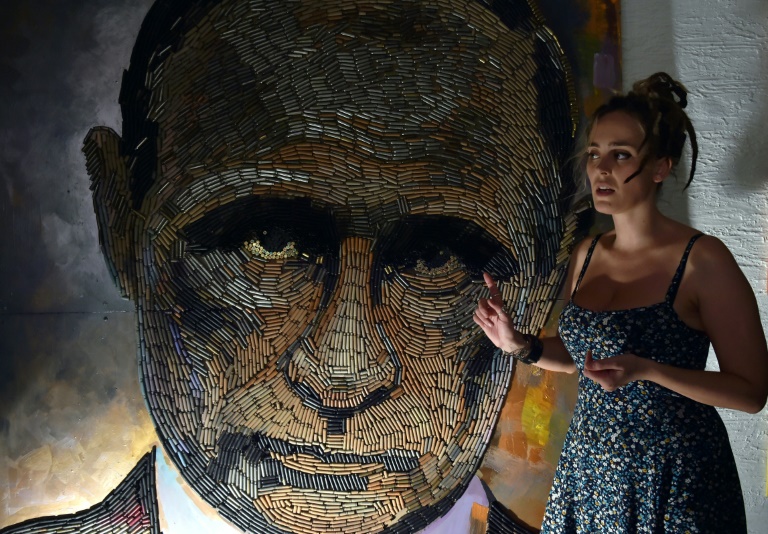
Featured image: Face of War (Putin in bullets) co-created by Daria Marchenko, 35 now exiled Ukraine woman artist.

Quirky Doc About One Man’s Quest For Supreme Tea

The movie poster says it all

Invest a little over an hour watching this documentary about tea and you might find yourself contemplating a new connection between rural farming communities and the tea farmers of China. That’s because All in this Tea deals with all aspects of Chinese tea production, but takes a special interest in how a new demand for high quality, organic Chinese tea is creating new opportunities for Chinese rural farmers.

The story begins by focusing on David Lee Hoffman’s elusive quest for rare and perfect teas.

David is a renowned tea importer and to say that he loves tea is an understatement. Based on the passion and knowledge shown in this doc, he seems to live for the stuff. Hoffman sees himself as a cultural zealot, promoting the rich history of simple Chinese farming practices and educating the western world on the merits of drinking pure, organic tea produced in the “Chinese way”.

He makes the act of producing tea seem like the ultimate expression of agricultural art.

His journey takes him to remote, obscure farms where he begins the process of encouraging the Chinese tea board to end mass farming practices and belligerent pesticide uses. His goal is to create a new tea farming economy, one where quality takes precedence over quantity.  If you like tea or if you want to learn more about Chinese tea farming practices, If you’re a tea drinker or know someone who is (don’t we all?) then All in this Tea is the right documentary for you.  For the Silo, Jarrod Barker.

Colouring In The Bible Is The Latest Trend In Journaling

An interesting new trend is on the rise—colouring in a Bible.

What was once frowned upon, is now encouraged. This new trend is called Bible journaling. Bible journaling is the act of doodling in one’s Bible, as a way to creatively express one’s faith. However, some people choose to illustrate outside their Bible; as for some, doodling on the Bible itself is still prohibited.

Over the past few years, the movement has grown significantly with many online groups, forums, Facebook communities, blogs, and church groups creating groups where people share their Bible journal artwork, offer techniques, and provide a supportive boost.

People even discuss where to get Bibles with the largest margins so that there is room for their designs, creating an interesting demand on publishers and retailers.

Complete Guide to Bible Journaling: Creative Techniques to Express Your Faith (Fox Chapel Publishing), by designer, inspirational speaker, and author of the best-selling Zenspirations® book series Joanne Fink, was created in response to this amazing trend.

The book features the works of top Bible journalers, offers drawing tips, the best tools to use, and even offers traceable vellum sheets to use on your own Bible. For the Silo, Elizabeth Martins.

Main image courtesy of biblejournallove.com


Gaming And Gambling Is Innately North American And Predates Euro Contact

Mystic Deck

First Nations Gaming In CanadaGambling is innately Canadian.

Whilst that may seem self-evident today, it was no less obvious before the idea of Canada as a unitary nation had even been established. Gary Smith of the University of Alberta has described how “First Nations peoples gambling on sports events pre-dated the arrival of Europeans in Canada”.

Despite a fluctuating legal status since 1892 when the first Criminal Code of Canada was established, Canadians have remained firmly welded to the idea of a bet. Whether it is a matter of sports betting or the more calculative games provided by casinos, and more recently over the internet, Canadians, it seems, love to gamble.

What it is in the Canadian national psyche that drives this appetite is far from clear.

Those reports that have dealt with the question have tended to look at the administrative and legislative conditions that have enabled the industry to establish itself, rather than asking the more fundamental question of where the appetite for this form of recreation stems from.

There is no doubt that the way the gambling industry in Canada is managed at a state level has meant that local pockets of gambling activity have been allowed to flourish. Smith points to the way that two Criminal Code of Canada amendments (1969 and 1985) were ‘pivotal’ in enabling the expansion of the industry. The first was because it decriminalized lotteries and casinos and the second because it allowed electronic gambling devices whilst also allowing provinces to operate and regulate the industry within their territories. In essence, because there was no one-size-fits-all brake on the industry it was allowed to extend into all those areas where it was not explicitly barred.

Against that historical backdrop the emergence of the internet and the de-territorialised markets it has allowed to develop have seen the Canadian appetite for gambling further supplied.

Such is the extent of the market that European based providers, such as Bet365, the UK’s leading online provider, are going out of their way to woo Canadian punters. Specialist sports books focusing on Canadian sports as well as a long list of games and pursuits that are already well-established across North America – not least poker and blackjack – mean that what these providers are offering is a perfect fit for the Canadian market.

There is a sense that with the US gambling industry seemingly at a tipping point in terms of the full deregulation of online gambling, these global providers are doing everything they can to achieve a presence and a profile on the continent. The basic thinking is that something akin to a gold rush is set to take place once the US marketplace truly opens up, and that rolling out into the US market will be easier from Canada than from Europe.

If this makes it sound as though the Canadian gambling market is somehow merely a stepping stone that is far from the case. Canada’s gambling market is itself measured in the billions of dollars and it is an entirely viable proposition on its own merits.

Of course, what it is that makes Canadians so happy to gamble remains an open question.

. Amidst such a diverse and heterogeneous population is it possible that enjoying a gamble in one form or another is one of the things that unites us as a nation? For the Silo, Jarrod Barker.

Why Artists Require Space Not Only To Work But To Imagine

Casting Seeds

Eiko Otake performing at Bartram’s Garden on the Schuylkill River.

“The purpose of art is washing the dust of daily life off our souls.” – Pablo Picasso

Art is an imperative. Without it we can never truly examine our own circumstances or those of the people with whom we inhabit our small planet. Left unviewed, art languishes. Left without art to view, so does humankind. There are many who recognize the gift to the world that every artist has to offer. There are many who endeavor to do whatever they can to ensure those gifts are received by a grateful public. To stifle the artist’s voice is to silently say I care little about the fate of the minds of the masses. Art is essential. It is what fills the space between the rest of the din, making sense of a chaotic universe.

Bill Arnold splits his time between New York and Western Massachusetts. Since 1974 he has had a studio in Western MA and an apartment in NY. Arnold prefers to keep a foot in both worlds. Florence, MA is a small town near Northampton where there is plenty of space and the space is affordable. New York on the other hand is extremely restrictive in that a very small amount of space is prohibitively expensive. Artists require space not only to work, Arnold says, but space for their imaginations, “space to conjure.”

And so he maintains his Western MA studio.

The work he has done in that studio over the years has been varied and prolific. Arnold has endeavored, and often succeeded in getting his work into public venues including museums. He finds it thrilling to see his work in commercial venues. The first time he experienced this was in the 1970’s when he put roughly 1,000 photographs in 25 Boston city buses. There was no indication on the outside of each bus whether there were photographs on board so passengers didn’t know which buses were galleries inside. Because of the nature of the venue, more people saw that project than visited the Met, according to Arnold. In order to fund the project, he approached multiple museums getting them to agree to fund the cost of materials for the show provided he put on exhibitions in each city where the museums were located.

Arnold was both an exhibiting artist and a curator for this project. The project was well received, with weary commuters sometimes voicing their appreciation. From there, Arnold went on to do other bus shows. The format went viral long before viral was a thing. For another show, Arnold gave images to members of the audience who then organically began sharing the images with each other. Throughout his career, Arnold has turned traditional notions of exhibition on their heads. With the advent of digital advertising, the cost of printing has plummeted. Arnold uses this to his advantage. In 2018 he printed 10,000 newspaper inserts for the Daily Hampshire Gazette. As a student photographer, Arnold was encouraged to have a camera with him at all times. To this day he follows this practice. Arnold has photographed the same spot on his travels from NYC to MA for many years.

He intends to exhibit many photographs of the same place at the Bergen Street Station. Photography is accessible to everyone, Arnold says. Because anyone can make a photograph, anyone can also view a photograph and take something away. A series of photographs depicting old cars elicited stories from viewers of all kinds about cars they remembered and loved. To hear more about Bill Arnold’s thoughts on work and life, listen to the whole interview here.

Harry Philbrick left his position as director of the museum at the Pennsylvania Academy of the Fine Arts about two years ago. He then launched his own project called Philadelphia Contemporary. The nonprofit does pop-up exhibitions and performances throughout the city. The goal is to ultimately build a permanent space where the nonprofit can become a non-collecting, collaborative space. Prior to his position at Pennslyvania Academy of the fine Arts, Philbrick was director of the Aldrich. It was there that the idea for Philadelphia Contemporary began to percolate. He began exploring the notion of partnerships. Specifically long-term, sustainable partnerships that would allow the museum a broader reach. Upon relocating to Philadelphia, Philbrick realized there was a gap in the cultural ecosystem in that there was no large scale independent contemporary art museum. Philadelphia also seemed primed for Philbrick’s model in that the cultural environment is “unusually collegial.”

The first project was a partnership with Headlong Dance.

The project was titled The Quiet Circus in which the dancers took part in a year long residency on a pier. Each week dance pieces encouraged members of the public to join in. From there Philbrick and his small team created River Charrettes, a series of four pieces also set among the changing landscape of river banks. River Charrettes was an appropriate opening for Philadelphia Contemporary. The project embodied the idea of many people from different places coming together. Since then there have been readings and other events. At the moment there are many large scale projects in the works. An expanded staff has allowed for grander visions. The process of growth has been very deliberate, carefully adhering to the founding vision of the project.

Funding for Philadelphia Contemporary comes from many places. In order to run the organization, pay staff, and plan for the future, Philbrick has had to map out a plan from all he has learned over his years in the art world. Seed capital came from individual funders who believed strongly in the mission. More recently, Philadelphia-based foundations have come on board. For Philbrick, the key to his project is pushing forward the model for a nonprofit contemporary art space. Moving forward the same model applies, starting with individual funders and moving from there to foundational support. To hear more about Philadelphia Contemporary and arts organization funding, listen to the whole interview here.

A Few Words to Keep in your Pocket: Speak your art loudly. Do not settle for its slow demise. Bring it into the light, find allies, give your gifts to the world.  For the Silo, Brainard Carey.
Featured image- Francis Bacon’s London studio- in its relocated home in Dublin, Ireland.

Eight Ways To Make Time For Important Things

Dr. Alok Trividi

One of the most common lines that people love to use: “I wish I had more time.” Maybe it’s more time to spend with family or friends; more time to exercise and eat healthy; or more time to go back to school. Whatever it is, how do you make more time for those truly important things in your life?

Dr. Alok Trivedi, author of Chasing Success, says the reality is we all have the same 24 hours. The difference is some people know how to better manage it than others.  When it comes to making time for the important things, Dr. Trivedi recommends:

1. Minimize, minimize and minimize some more. There was a reason Marie Kondo’s novel about tidying up your space to become happy was so successful. There is truth in her message of eliminating the unnecessary and finding what you love in the process. Get rid of what does not bring you joy. This can be old items or even toxic relationships that no longer serve you. Less is really more.

2. Being busy does not bring you value. In North American culture, it can be all too easy to be running around completing task after task. Many people view this form of productivity as determining their worth in society. It’s wise to assess what in your life is bringing you value and maximize that rather than trying to do things that just don’t feel right and make you feel unworthy on the inside. Business is an excuse and distraction to overlook the things in which you may be afraid to focus your energy on.

3. Differentiate between efficiency and effectiveness. Your time is precious and needs to be allocated to the most important things. Utilize your time to be both effective and efficient. Being only effective can be a time-consuming action. While complementary, being only efficient can lead to sloppy results. When you are doing any task, approach it within a concept of both maximum efficiency and total effectiveness to reap the best results. In your personal life, this is achieved through being present and genuine in your interactions.

4. Single task and hold your focus. Many people find themselves casually checking a single email, and before long they snap into full-fledged work mode. Develop a schedule and follow it religiously. It may be hard to find your groove initially, but if you stick to it, little by little it will become a habit.

gif by- cami5x5 deviantart.com

5. Know what you hold important. It is a challenge to know how to dedicate your free time if you haven’t discovered what you love. Find the activities where your creativity flows and your heart sings. Only in these states are you going to find yourself in the states of joy that make you feel life is worth living.

6. Address problems at the root. When you have the time to dedicate to the important things, you don’t want work problems to keep popping up. If there is a problem at work, address it from the start. Don’t keep putting it off, because it will fester at inopportune times. This goes both ways. If you have a personal dilemma with a family member, don’t run from it by adopting workaholic ways. Confront your problems head on to solve them with best results. Shying away will only allow the problem to become worse in the shadows.

7. Getting and staying organized. When it is time to be with friends and family the last thing you want to do is housework. Dedicate an initial cleaning and mass organization of your space. After this initial step, take a little time each day to clear your space and organize everything into its given area. The clarity of your physical space lends to clarity of mind. Then, there is mental space to focus on what matters, and not be distracted by the mess around you.

8. Block out time just for you. You must become your top priority. Declare certain times of the day and week that are just for you. This time can be for you to indulge in your favorite pastimes, meditate, or even to do nothing. This time is yours to center yourself and think about what you are presently encountering in life.

Live in every moment, and focus on the present. For the Silo, Alex Smith.

NightSwapping Is New Euro Model of Sustainable Tourism

In a time when the sharing economy is generalizing eco-friendly solutions for a sustainable development, a European startup has brought up to date one of the oldest tourism ideas in the world to lower the carbon footprint on your next vacation. It’s called swapping or more precisely, NightSwapping.

A simple idea that is enjoyed for its human dimension, authenticity and the absence of money between members.

NightSwapping1

It is therefore with the utmost respect for traditional cultures, local territory and people that NightSwapping represents a new model for a sustainable tourism.

Has it not become common for travelers to stay at a local’s rather than hotels or resorts?

NightSwapping2

These new behaviors seem motivated by the desire to draw closer to local cultures and pass down certain values to our young ones…

Within this changing industry, a European concept has found a way to challenge the giants from the Silicon Valley. NightSwapping  is the Sharing Economy at its core: no money exchanged, just sharing and authentic experiences.

NightSwapping3

A promising idea that continues to convince travelers around the world. For the Silo,  Quentin Mittelett.  

NightSwapping4

Have you tried this? Would you try this? Let us know in the comments below.

Warhol, Lichtenstein Art Auction look back

Is it us or is there something 'photoshop' and 'meme'-like to Warhol's work? CP

Almost one decade ago: Andy Warhol’s “Endangered Species and Ads” prints bring a combined $677,000 USD alone at this notable Modern and Contemporary Art event.

Two complete portfolios by Andy Warhol, Endangered Species, 1983 and Ads, 1985, sold for $338,500 USD each to far exceed their estimates among a field of fresh-to-market iconic works during Heritage Auctions’ $2.9 million USD Modern and Contemporary Art Signature® Auction, May 22 in Dallas.

The auction sold 90% by value and 78% by lot.

Close up of one of the ten screenprints up for auction by ANDY WARHOL (American, 1928-1987) Ads, 1985 Portfolio of ten screenprints on Lenox Museum Board 38 x 38 inches (96.5 x 96.5 cm) Ed. 50/190 Each signed and numbered in pencil Printed by Rupert Jasen Smith, New York Published by Ronald Feldman Fine Arts, Inc., New York PROVENANCE: Private collection, Texas LITERATURE: Feldman & Schellmann, II.350-359 Warhol, Andy:. American painter, photographer, filmaker and publisher, 1928-1987
Close up of one of the ten screenprints up for auction by ANDY WARHOL (American, 1928-1987)
Ads, 1985
Portfolio of ten screenprints on Lenox Museum Board
38 x 38 inches (96.5 x 96.5 cm)
Ed. 50/190
Each signed and numbered in pencil
Printed by Rupert Jasen Smith, New York
Published by Ronald Feldman Fine Arts, Inc., New York
PROVENANCE:
Private collection, Texas
LITERATURE:
Feldman & Schellmann, II.350-359
Warhol, Andy:. American painter, photographer, filmaker and publisher, 1928-1987

Here's a look at some of the other Warhol auctions. Endangered Species earned over 1/3 of a million dollars. CP

ANDY WARHOL (American, 1928-1987)

Ads, 1985

Portfolio of ten screenprints on Lenox Museum Board

38 x 38 inches (96.5 x 96.5 cm)

Ed. 50/190

Each signed and numbered in pencil

Printed by Rupert Jasen Smith, New York

Published by Ronald Feldman Fine Arts, Inc., New York

PROVENANCE:

Private collection, Texas

LITERATURE:

Feldman & Schellmann, II.350-359

Warhol, Andy: American painter, photographer, filmaker and publisher, 1928-1987

Condition Report*:

With original Ronald Feldman Fine Arts, Inc. cardboard portfolio box and index print. All screenprints unframed and in good condition with specifics listed below. Mobil: Minor rubbing 3/8″ in due to former frame. A few incidental surface scratches and rubs. One 5/8″ abrasion, resulting in very minor loss. Paramount: Minor rubbing 3/8′ to 1/2″ due to former frame. Very minor bumping to bottom right corner. Chanel: 1/2″ to 1″ light rubbing due to former frame. Slate purple backgrund has hazy toning, beginning about 1/4″ in. Apple: Very minor incidental rubbing to edge. Rebel Without A Cause (James Dean); Van Heusen (Ronald Reagan); Blackglama (Judy Garland): All have only very minor edgewear. Volkswagen; Life Savers: Very minor surface rubbing and edgewear. Donald Duck: Very minor edgewear. Top corners have minor wear. Light handling creases. Some wrinkling and an indentation at end of signature. Left side center shows some moderate wrinkling and creases with some minor loss, beginning at 11″ from the bottom up to 24″, and affecting 3″ into the work. The face and body of Donald Duck is affected somewhat, as well as the background near edge. Light wear in top left corner and a small abrasion on middle right side. Unframed

Two works by Ed Ruscha responded well among buyers as his gunpowder on paper titled Rustic Pines, 1967, realized $290,500 USD and a color screenprint, Double Standard, 1969, sold for $182,500 USD , setting a record for the work. Mel Ramos’ Georgia Peach, 1964, fresh from a Texas collection, sold for $158,500 USD.

“The market for good contemporary art doesn’t seem to have hit any ceiling,” said Frank Hettig, Director of Modern and Contemporary Art at Heritage. “Our focus is presenting fantastic, fresh-to-market discoveries and bidders certainly responded in kind. It gives us high expectations for our November 2 Modern and Contemporary auction in Dallas.”

Among the modern masterpieces in the auction, the magnificent, 7-foot Cobalt Chandelier, 2003, by Dale Chihuly reached $158,500 USD. It is the largest Chihuly chandelier to appear on the secondary market and was offered through a federal court-appointed receivership overseeing the sale of assets previously owned by R. Allen Stanford of Stanford Financial Group.

Forms in Space by Lichtenstein earned $53,125.

Roy Lichtenstein’s Forms in Space, 1985, a screenprint published by the artist for the Institute of Contemporary Art’s Rally round the Flag benefit, achieved $53,125 USD and Georges Rouault’s Chemineau, 1937, realized $40,625 USD.

Here's a look at what some Lichtenstein's other pieces sold for.
Here’s a look at what some Lichtenstein’s other pieces sold for.

Sculptural art performed well as Étienne Hajdu’s La Mer, 1964, sold for $35,000 USD and Pablo Picasso’s Vase deux anses hautes, 1953, sold for $30,000 USD while Robert Graham’s Frieze Figure I-G, 1989/1990, brought $21,250 USD.

So what is that Volkswagen Warhol worth today in 2021? It’s hard to pen the value but in Spring 2019 one single print ad brought 30,000 UK Pounds ( 52,000 $ CAD) in a Christie’s auction.


ROY LICHTENSTEIN (American, 1923-1997)

 Forms in Space, 1985

 Screenprint in colors on Rives BFK paper

 31 x 47-1/2 inches (78.7 x 120.7 cm)

 Ed. 35/125

 Signed, dated and numbered in pencil


LITERATURE:

 Corlett, 217

NOTE:

 Published by the artist for the Institute of Contemporary Art, University of Pennsylvania, Philadelphia.

 Forms in Space has been created especially in honor of ICA’s benefit, Rally round the Flag (label on frame verso) .

Lichtenstein, Roy:. American painter, printmaker; born 1923 in New York City, died 1997 in New York City


Condition Report*:

 Sheet: 35.75 x 51.5 A crease in upper center at extreme sheet edge; small pressure mark at lower right corner; lower right corner lightly bumped; paper lightly undulates; framed. Framed Dimensions 36.25 X 52.5 Inches


Supplemental- Apple logo designer dishes on history http://www.macworld.com/article/1142322/logo_design.html

The Strength Of The Past And Its Great Might

Within the last generation, archaeology has undergone a major transformation, developing from an independent small-scale activity, based upon museums and a few university departments, into a large-scale state organization based upon national legislation.

Dreamer by Thomas Dodd Photography

This has entailed an increase in resources on an unprecedented scale, and has drastically changed the profile of archaeology, which is now firmly fixed within the political and national domains. Moreover, decision making within the discipline has shifted from museums and university departments towards various new national agencies for the conservation and protection of the cultural heritage.

The consequences of this development for the discipline as a whole had remained largely unnoticed until …..click here to read the complete electronic essay by Kristian Kristiansen University of Gothenburg.

Also available via our friends at academia.edu

Celebrity Homes: Andy Warhol Home Sold For $50 Million USD

Warhol Home InteriorsMontauk, New York was celebrating its biggest estate sale ever after the closing on the 5.7-acre beachfront estate at $50 million USD that pop artist Andy Warhol bought in 1972 for $225,000 USD.

The most recent owner of the compound was CEO of J. Crew, Mickey Drexler, who bought it in 2007 for $27 million USD. He listed it in 2015 for $85 millionUSD that included a 24-acre horse farm and equine center, which the buyer, Adam Lindemann, opted out of the purchase. Lindemann is the founder of the Venus Over Manhattan Gallery and a major collector of Warhol’s works making the property’s history especially significant for him.

Warhol’s first gig out of art school was as a fashion illustrator for several of the top women’s magazines. With the money acquired from his illustrations, he purchased a large loft on New York’s West Side and opened the Factory, where he turned toward creating industrial art. It wasn’t long before the Factory and Andy were attracting like-minded modernists from hippies to wannabe journalists and actors to drag queens and drug addicts. It was the start of New York’s avant-garde scene where Warhol held court. In addition to his painting, he branched out into music, film and journalism where he met Paul Morrissey who became the director of some of Warhol’s early films.

Warhol Interior Large1

In 1972 when Warhol’s popularity and success were peaking, he and Morrissey decided to invest in property in the Hamptons and purchased the family fishing camp of the Church family of Arm & Hammer Baking Soda fame. The estate includes a 3,800-square-foot main house and five cottages completely hidden from public view with wide beaches and ocean views. Totaling almost 15,000 square feet with nine bedrooms and twelve baths, Drexler had it all meticulously restored by architect Thierry Despont.

Warhol’s stream of celebrity guests and renters put Montauk on the international map. Frequent guests included Liza Minnelli, Liz Taylor, John Lennon, Mick Jagger, Jackie Kennedy and Lee Radziwill. The parties were legendary and stories of happy days idled away on the Hamptons’ beach are recounted in many celebrity biographies.

Warhol Interior Large2

Even though the Warhol home sale set a record at $50 million USD, his most famous paintings such as “Eight Elvises” and “Silver Car Crash” have sold for $100 million USD and higher. The listing agent was Paul Brennan of Douglas Elliman Real Estate in Montauk, New York. Visit here for more information.

Supplemental– David Bowie as Andy Warhol in Basquiat

British MPs Say Government Too Slow To Help These At Risk Arts

A friend of mine from Europe sent me this news story a couple of weeks ago about how the cultural landscape is facing its biggest threat in a generation.

It says the UK government was too slow to provide support for the arts industry, and that without more help, many parts of Britain could become “cultural wastelands”:

https://youtu.be/pPw8na16nuk

This should be a crude wake-up call for artists.

Realistically, governments around the world will NOT make it a priority to save art businesses. Why? Because governments care most about issues that will get them votes. 

And, sadly, most of the public simply does not care about the arts the way artists do.

Want proof?

Check out the comments on that BBC video:

Then if you go down the rabbit hole and dig deep into the replies to these comments, you find a lot of artists desperately trying to show these people that the arts, and theatres, and galleries are very much “essential” to artists who rely on them to provide for their families:

The take-home lesson here?

Artists are on our own. 

It’s unrealistic – unwise, even – to wait for the government to swoop in and rescue the arts industry.

In times like these individual initiative is more important than ever. 

Artists must redouble their efforts to connect with curators, build a list of collectors, find patrons for their studio, maybe even transition to showing (and selling) some work online.

It is difficult, but it is not impossible. For the Silo, Brainard Carey.

Featured image- www.theatlantic.com

Archaeology Pioneers Of The Americas

The tradition of archaeology in the Americas (both North and South America) is defined by cross-cultural comparative research that draws heavily on an innovative tradition of regional-scale fieldwork.

Many early archaeo-pioneers worked in multiple culture areas of the Americas, seeking direct connections between the archaeological record and living or historical indigenous peoples, and fostering close ties with the related field of anthropology as a result.

WPA trowel men at work,Thompson Village Site,Tennessee. Image courtesy of the Frank H. McClung Museum, University of Tennessee (62HY5[B]
This brief overview covers seminal developments in stratigraphic excavation (the idea that time deposits artifacts in successive layers- the lower the layer, the older the artifact), regional survey, and other field methods within their historical and geographic context.

Such pioneering archaeological efforts across the globe are often lauded for their early attention to stratigraphy and the association of geological or cultural strata with change in human societies over time. In the Americas, as in other parts of the globe, such attention was often the result of non-systematic excavations into mounds of anthropomorphic origin. In other words- ‘grave robbers’. Continue reading by clicking here. For the Silo, David M. Carballo /academia.edu / Department of Archaeology, Boston University/ Jarrod Barker. 

Featured image- Archaeological Pioneers Of The Americas Gordon Willey Tula Mexico

Cahokia – Kunnemann Group submitted by durhamnature. Excavation of Kunnemann Mound, one of 6-11, from “Cahokia Mounds” via Archive.org

Supplemental- Cahokia: Ancient Village in the Great Lakes 

Tony Hawk Videogame Documentary Coming In August

LOS ANGELES: JULY , 2020 – Wood Entertainment is proud to announce the August 18 digital/VOD release of the highly anticipated documentary feature PRETENDING I’M A SUPERMAN – THE TONY HAWK VIDEO GAME STORY. Wood Entertainment acquired Worldwide rights to the film in May at the Mammoth Film Festival in a deal negotiated between CEO Tara Wood and Producer Ralph D’Amato (“Tony Hawk Pro Skater” series, “Gun”) on behalf of D’Amato Productions.

Arriving just ahead of the eagerly-awaited reboot of the $1.4 USD billion Tony Hawk Pro Skater video game series coming this September, this definitive documentary from Director Ludvig Gür tells the story of skater turned video game mogul Tony Hawk, and the near extinction of skateboarding culture before exploding back into the mainstream in the early 2000s.

“PRETENDING I’M A SUPERMAN is a robust, real-life story of our successful videogame series as told by those who created it, and many who were inspired by it” said multi-record-breaking skateboarder and documentary subject Tony Hawk.

“I’m really excited to partner with Wood Entertainment” said director Gür. “It’s been a long journey making the documentary and I’m stoked it will finally be released for skateboarding and Tony Hawk’s Pro Skater fans worldwide. The art form and video game had an enormous impact on Generation Y / Z and the story behind it is even more fascinating.”
In 1999, the video game Tony Hawk’s Pro Skater shook the world when it sold 9 million copies upon release and changed the skateboarding scene forever. Pretending I’m a Superman is the story of the skaters and developers who came together to create the best-selling game as well as a look into how skateboarding became a part of the mainstream.
Featuring never-before-seen footage and interviews with the legendary skater Tony Hawk as well as industry stars interviews with Steve Caballero, Rodney Mullen, Chad Muska, and Jamie Thomas, Gür takes audiences through an intimate yet extraordinary journey, chronicling the meteoric rise of skate boarding’s most famous name.

“Tony Hawk has one of the most inspiring stories ever told, from groundbreaking skater to gaming mogul” said Wood. “We are thrilled to present it to its worldwide audience.”
For the Silo, Scott Motisko.
Tony Hawk's Pro Skater 1 and 2' Is Getting Remastered and Here's ...