
Jealousy doesn’t disappear in a committed multi-partner relationship. For our family, the difference is how quickly we address it, how intentionally we reassure one another, and how clearly, we communicate.

Caption: Robyn, Christopher and Amanda Alesich, the polyfidelity family behind Sister Wives. Photo courtesy of Sister Wives.
Jealousy is usually one of the first things people ask us about when they learn that we are a polyfidelity family.
The assumption is often that jealousy must mean someone is unhappy, that the relationship is unfair, or that a family involving more than two partners is eventually going to fall apart.
Our experience has been different.
We are Robyn, Christopher and Amanda Alesich. Christopher and Robyn have been married for 22 years, and Christopher is spiritually married to Amanda. Together, we describe our relationship as polyfidelity: a committed, closed relationship built around loyalty, communication and agreed-upon boundaries.
And yes, jealousy still happens.
What we have learned is that jealousy is not automatically evidence that something is wrong. It is an emotion, just like insecurity, fear, frustration or loneliness.
The more important question is what you do with it.
Jealousy feels more familiar than people think
One of the biggest misconceptions about poly relationships is that people who choose them somehow stop experiencing jealousy.
We have never found that realistic.
Jealousy in our family can come from many of the same places it comes from in monogamous relationships: fear of being replaced, concern about losing closeness, feeling overlooked, comparing yourself with another person, or wondering whether somebody else is receiving attention or reassurance that you need.
The relationship structure changes. Human emotions do not.
“Jealousy in a polyfidelity relationship feels exactly like jealousy in any other relationship,” Robyn Alesich, COO and Lead Matchmaker at Sister Wives says. “The emotional reaction is not magically different because the relationship structure is different. The difference is that in polyfidelity, you usually have to talk about it more directly because ignoring it can affect more than one relationship at once.”
That has been one of the most important lessons for our family.

Caption: Christopher and Robyn Alesich have been married for more than 20 years. Photo courtesy of Sister Wives.
Silence can be more damaging than jealousy
Christopher often says that jealousy itself is rarely the thing that damages a relationship most.
Avoidance is…..
“When people hear that I have two wives, they often immediately ask about jealousy,” Christopher Alesich, CEO and Founder of Sister Wives says. “But jealousy does not destroy relationships by itself. What damages relationships is silence, insecurity, comparison and people pretending they are fine when they are not.”
In a three-person family, unresolved tension rarely stays between only two people.
If one relationship feels disconnected, everyone can eventually feel the effects.
That means we try to address problems early instead of allowing someone to sit with resentment for days or weeks.
Sometimes that means a private conversation between two people. Other times it means all three of us sitting down together.
The goal is not to eliminate every uncomfortable emotion. It is to prevent those emotions from becoming something larger simply because nobody wanted to acknowledge them.
Fair does not always mean identical
Another lesson we have learned is that fairness and sameness are not always the same thing.
People sometimes imagine that every relationship inside a poly family has to receive exactly the same amount of time, affection, attention and interaction at every moment.
Real relationships are more complicated than that.
Each relationship has its own rhythm, and different people may need different forms of reassurance at different times.
“People often assume fairness means everything has to be exactly the same at all times,” Robyn says. “But relationships are more nuanced than that. What matters is that everyone feels respected, valued, heard and emotionally safe.”
That can mean recognizing when someone needs more reassurance. It can mean noticing when daily routines have unintentionally left one person feeling disconnected. It can also mean accepting that two relationships do not have to look identical to be equally meaningful.
We try to focus less on keeping score and more on whether everyone feels secure in their place within the family.
Caption: Robyn, Christopher and Amanda Alesich say communication, reassurance and clear expectations are central to their closed polyfidelity relationship. Photo courtesy of Sister Wives.
Reassurance has to be intentional
Amanda believes one of the easiest mistakes in any long-term relationship is assuming the people you love already know exactly how you feel.
“In a polyfidelity family, reassurance cannot be an afterthought,” Amanda Alesich, CCO at Sister Wives says. “It is not enough to assume everyone knows they are loved. You have to show it, say it and make sure each person feels secure in their place in the family.”
That reassurance does not always have to involve some grand gesture.
Sometimes it is affection. Sometimes it is intentionally spending time together. Sometimes it is saying directly, “You matter to me.”
And sometimes it is simply recognizing that somebody is having an insecure moment without making them feel embarrassed for having it.
Those small moments can make a major difference.
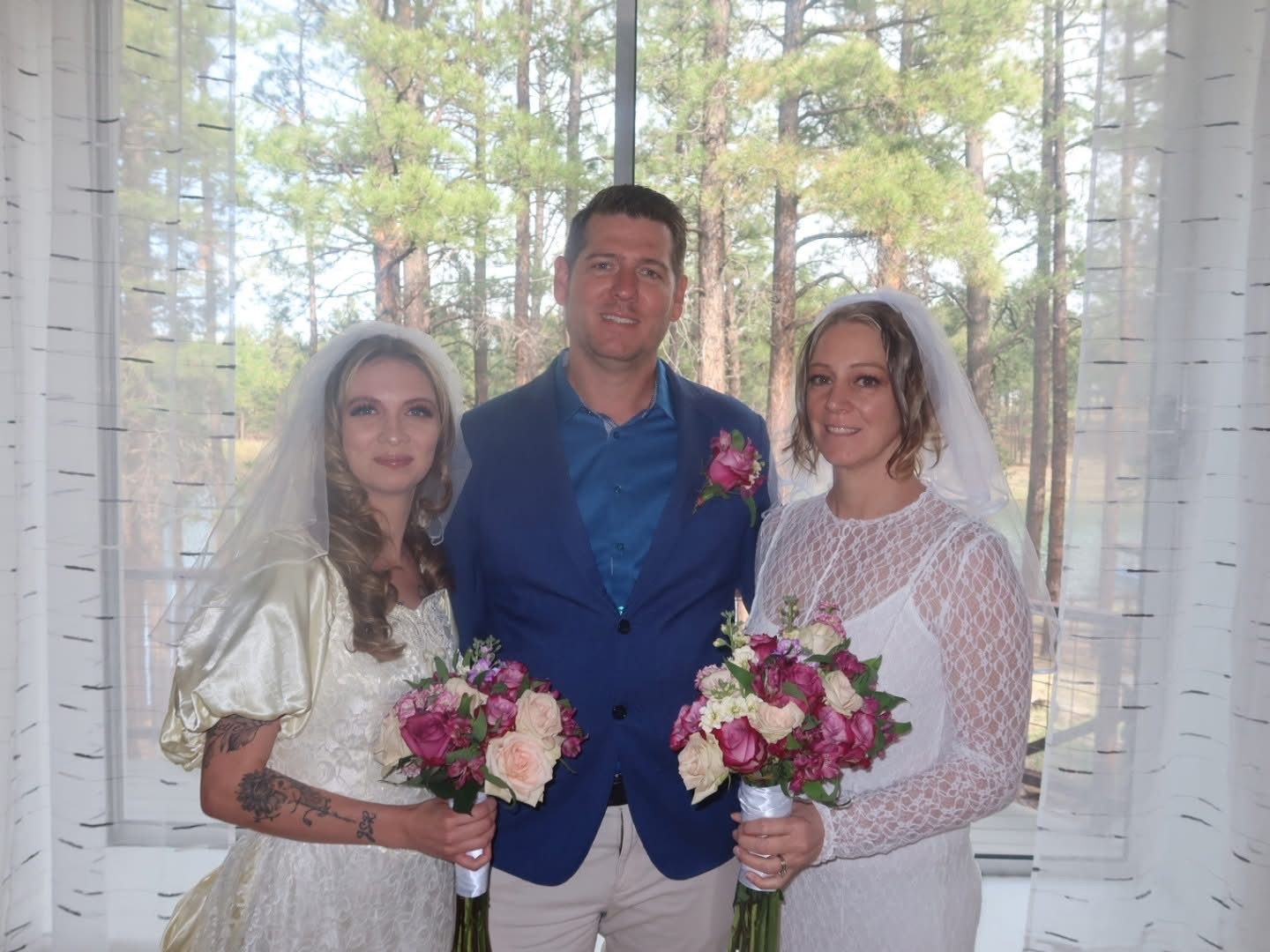
Caption: Christopher and Amanda Alesich are spiritually married in accordance with their family’s religious beliefs. Photo courtesy of Sister Wives.
We don’t shame each other for feeling jealous
There can sometimes be pressure within polyamorous communities to believe that feeling jealous means you are somehow “bad at poly.”
We disagree.
“There is a misconception that if you are truly built for polyamory or polyfidelity, you will never feel jealous,” Robyn says. “That is unrealistic. Jealousy can happen in any relationship. The healthier question is: can we talk about it honestly?”
Shaming someone for jealousy usually makes the problem more difficult to solve.
If a person already feels insecure and then believes they are also failing because they experienced the emotion, they may become less willing to talk about it.
We would rather someone say, “I’m struggling with this,” than pretend everything is fine.
Honesty gives us something we can actually work with.
Structure creates security
Our relationship also depends heavily on expectations and boundaries.
“Boundaries, check-ins and clear expectations make a huge difference,” Christopher says. “When people know where they stand, they feel more secure. A lot of jealousy grows in silence and uncertainty.”
Structure does not mean turning a relationship into a rulebook.
It means understanding what everybody has agreed to and making sure those agreements remain clear.
For us, polyfidelity means commitment to our family structure rather than an open relationship where everyone is independently dating other people.
Other families may structure their relationships very differently. There is no universal model that works for everyone.
What matters is that the people involved understand the structure and genuinely consent to it.
Uncertainty can allow room for jealousy to grow. Clear expectations can remove a great deal of that uncertainty.
Jealousy can be information
Perhaps the biggest change in the way we think about jealousy is that we no longer automatically treat it as an enemy that has to be defeated.
Sometimes jealousy is information.
It can mean someone needs reassurance. It can mean a boundary is unclear. It can mean two people need more time together. It can mean somebody is comparing themselves unfairly with another person.
Or it may simply be an emotional reaction that needs to be acknowledged before it passes.
“Jealousy is not proof that your relationship is broken,” Christopher says. “Sometimes it is just a sign that someone needs reassurance, clarity or more emotional attention. The healthiest thing you can do is face it honestly instead of pretending it should not exist.”
That idea has changed the way we approach difficult moments.
Instead of asking, “Why are you jealous?” we try to ask, “What is this feeling trying to tell us?”
That usually leads to a much more useful conversation.
Polyfidelity doesn’t remove difficult emotions
We do not believe polyfidelity makes relationships easy.
If anything, having more than two people in a committed relationship can require more communication, more emotional awareness and more willingness to address uncomfortable subjects.
“Polyfidelity is not casual,” Amanda says. “It takes commitment, maturity and a willingness to care about how your actions affect everyone in the family.”
Being committed to more than one person does not mean replacing one relationship with another.
“This is not about replacing one person with another,” Robyn says. “It is about building something where everyone feels chosen, included and respected.”
For us, the goal has never been to create a relationship where jealousy never happens.
The goal is to create a family where someone can admit they are jealous without fearing that the admission itself will threaten the relationship.
That requires honesty. It requires reassurance. It requires boundaries.
And it requires everyone involved to remember that difficult emotions are not necessarily evidence of failure.
Sometimes they are simply an invitation to communicate better.
About the Authors
Robyn, Christopher and Amanda Alesich are the family behind Sister Wives, a dating and matchmaking platform for people interested in polygamy, polyamory, polyfidelity and other forms of ethical non-monogamy.
Christopher and Robyn founded Sister Wives in 2008. Today, the platform serves singles, couples and groups seeking alternative relationship structures and also provides professional matchmaking services.
Website: SisterWives.com
For the Silo, Robyn, Christopher and Amanda Alesich.