Tag Archives: shipping

Canada’s Largest Port Ranks 375 Out Of 400 In The World

Trade Diversification Ambitions Face a Container Port Reality 

Alberta recently submitted its West Coast pipeline proposal to Ottawa’s Major Projects Office, a major plank in the federal government’s goal to double exports to non-US markets by 2035. 

For that to succeed, more of Canada’s exports will need to move by water, already the largest mode for non-U.S. trade by value. And container shipping is part of that. 

So how do Canada’s container ports stack up?

 The short answer: Not well. Rectifying that would help Canada meet its trade-diversification goals. 

Roads were Canada’s dominant export mode over the 12 months ending in May, carrying 37 percent of export value. But those roads cross just one border. Strip out the United States and the picture flips entirely. Water carries 54 percent; air carries 41 percent. Road  falls to 3 percent. Put differently, the infrastructure we’ll need to reach the 2035 target looks almost nothing like today’s. 
What is the Container Port Performance Index?

The Container Port Performance Index (CPPI), produced by the World Bank, is a global scorecard for container shipping efficiency. Canada’s performance should raise alarm bells.   

The Index tracks total time a container ship spends under a port’s control, from the moment it arrives in the harbour to the moment it leaves the berth. Rather than grading ports on a traditional scale of zero to 100, the index uses a statistical baseline centred on the global average and adjusts for the size of a vessel and its cargo volume. A negative score means a port is operating below that benchmark. It simply means that for the same job, a ship sits idle longer than at an average gateway anywhere else. 

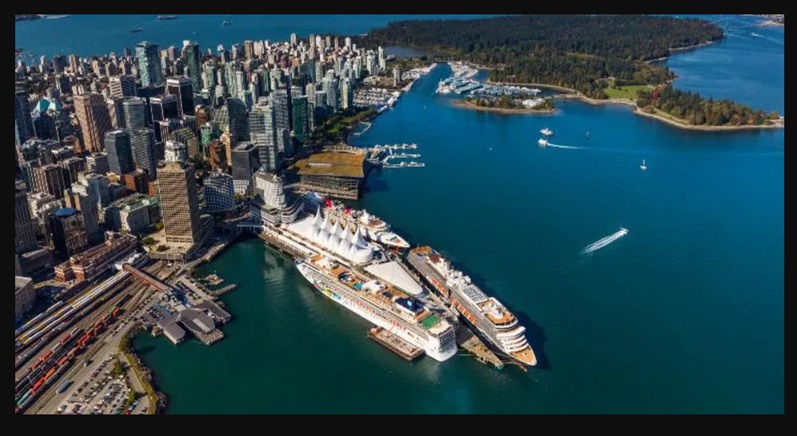
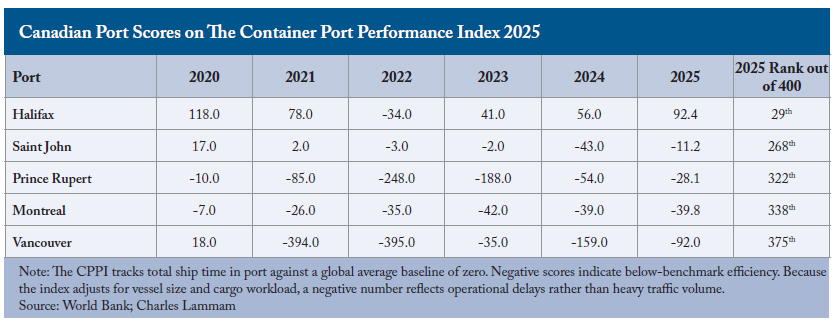
The Port of Vancouver, which handles fully 42 percent of Canada’s container shipments, ranks 375th out of 400 ports worldwide in the newly released 2025 ranking, with a score of minus 92. That’s actually an improvement on minus 159 in 2024: a dismal 389th. Vancouver was among the 20 most-improved ports in the world year over year. But even after climbing 67 points, a hole this deep still leaves you in the hole.  

Vancouver’s CPPI score has been negative in five of the last six years, including a catastrophic collapse to minus 394 and 395 scores in 2021 and 2022, which also coincided with a historic BC flood that severed rail lines into the port for more than a week, layered on top of a pandemic-era demand surge hitting ports worldwide. Even so, strip those two years out and Vancouver’s score still never turns positive again. 
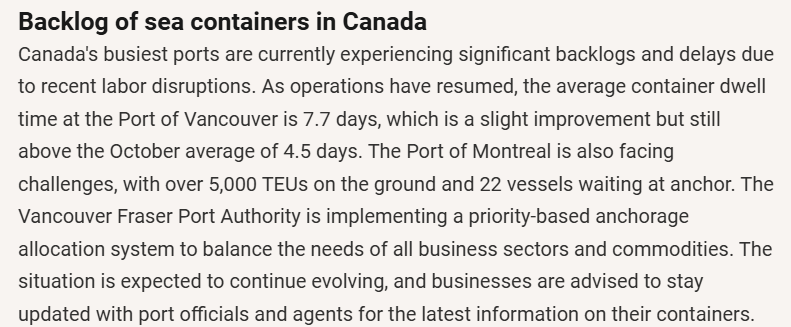
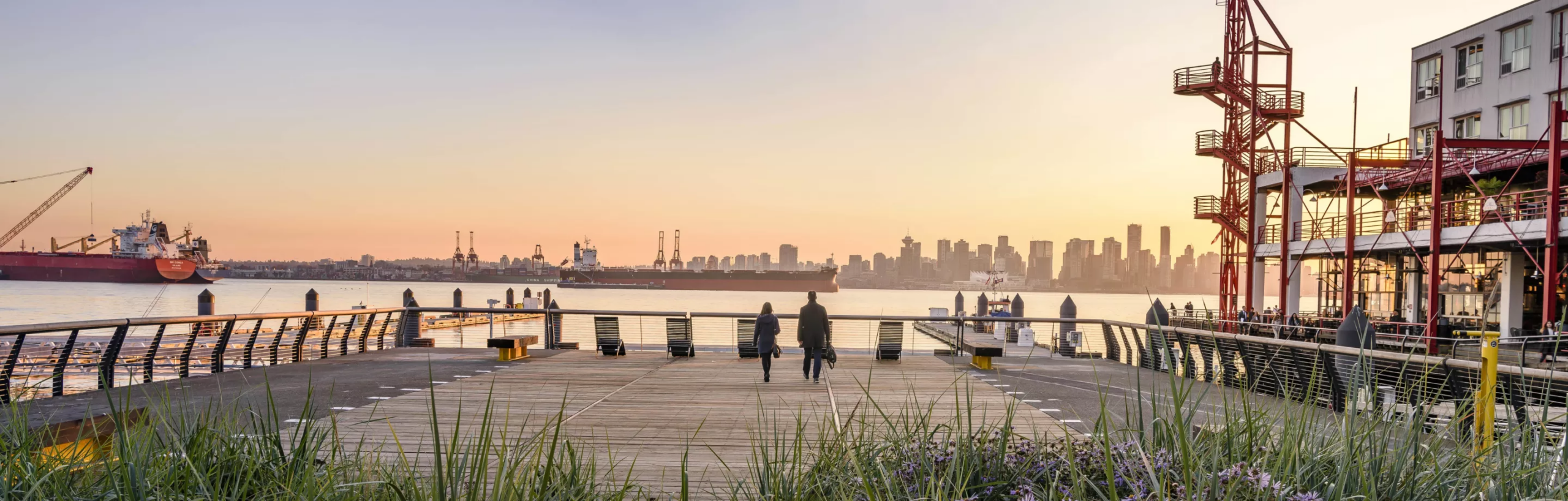
Vancouver is part of a broader Canadian pattern. Prince Rupert ranks 322nd, despite handling a meaningful share of Canada’s transpacific container trade, and its year-to-year swings are significant: from minus 10 in 2020 to minus 248 in 2022 to minus 54 in 2024. Montreal sits at 338th. Saint John is slightly better at 268th. 

The one major exception is Halifax, which has become a genuine success story: 29th in the world in the latest data, up from a middling performance just a few years ago, and 55th last year. Three of Canada’s busiest ports still rank in the bottom fifth of the world. Halifax proved it doesn’t have to be that way. 

The World Bank isn’t the only one flagging this.

A recent Bank of Canada analysis of satellite vessel-tracking data found that Canada’s rank for total ship capacity moving through its ports fell from sixth in the world in 2016 to 23rd by 2023, a steeper drop than almost any other major trading nation. Part of the reason: the newest ultra-large container ships carry more than 20,000 containers while the largest vessels Canadian ports can handle top out around 15,000. As a result, some cargo bound for Canada comes through a US port. 

Infrastructure isn’t the whole story. Labour issues also lengthen the time ships spend in Canadian ports, and addressing them matters just as much as modernizing the infrastructure itself. 

After Nutrien decided to build its new billion-dollar potash export terminal in the United States rather than in Canada, Transport Minister Steven MacKinnon, made an unusually blunt admission for a sitting minister about his own file: Canada’s transportation policy and supply chain management need to be the best in the world given the country’s geography, and right now they aren’t.  

Nutrien’s decision came even after the 2025 federal budget had already been tabled. That budget dedicated $5 billion, or 4 percent, of its $115-billion  infrastructure plan to bolster Canada’s trade and transport infrastructure. Whether allocating more to such infrastructure would generate a bigger bang for the buck is a fair question. 

Carney’s Ambitions

The PM’s ambitions depend on a clear-eyed read of where Canada’s port performance actually stands. The pattern holds across almost every major Canadian port, year after year, even as Ottawa doubles down on trade diversification. Halifax shows that the climb from a lower tier is possible. Until the rest of Canada’s ports make it too, the 2035 target will likely stay out of reach. 
For the Silo, Charles Lammam -senior adviser at the C.D. Howe Institute. 
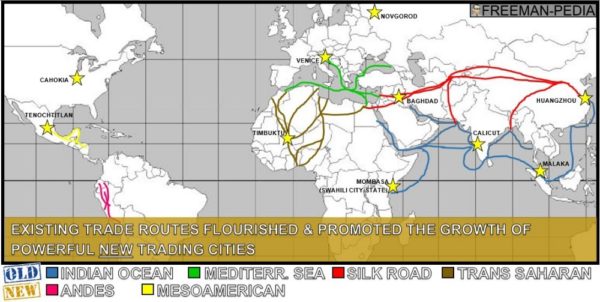
Christmas Gift Made In China? Historical Long Distance Trade Lead To Modern Global Lives Of Things

Until quite recently, the field of early modern history largely focused on Europe.

The overarching narrative of the early modern world began with the European “discoveries,” proceeded to European expansion overseas, and ended with an exploration of the fac-tors that led to the “triumph of Europe.” When the Journal of Early Modern History was established in 1997, the centrality of Europe in the emergence of early modern forms of capitalism continued to be a widely held assumption. Much has changed in the last twenty years, including the recognition of the significance of consumption in different parts of the early modern world, the spatial turn, the emergence of global history, and the shift from the study of trade to the commodities themselves.

Sometimes conferences disappear from view as soon as the delegates disperse.

Other times, when the papers are published in an edited volume, conferences come to be seen as important milestones in the historiography. The two volumes edited by James Tracy, entitled The Rise of Merchant Empires and The Political Economy of Merchant Empires published in 1990 and 1991, respectively, move through their various stages of production, ownership, transmission and transformation .

Moreover, those stages are overlapping, circulatory and contradictory; objects move in and out of collections, as they move in and out of fashion, and meanings are never stable. When a feathered crown is produced in Spanish America, for example, it has a very different meaning from when it enters into a cabinet of curiosity, and when it is taken out of the cabinet to appear in a spectacular performance in the street or in the theatre, it once again takes on a different meaning.

Objects gain biographies; earlier meanings of objects are never erased but reshaped and translated to new circumstances, as Leah Clark showed in her study of the circulations of gems and jewels through the hands of a variety of owners in quattrocento Italy. Have we lost this meaning connection with mass produced items from China?

Such insights have benefitted not only from the global turn but also from developments in the fields of anthropology and art history, making the field more interdisciplinary than it was when the study of the trade in goods focused more on their trade than on the goods themselves.

The Founding of a New Journal

Despite Tracy’s efforts, European actors continued to hold central stage in the field. When the Journal of Early Modern History (JEMH) was established in 1997, a decade after the Minnesota conference, the centrality of Europe in the emergence of early modern forms of capitalism, for example, continued (and still continues) to be a widely held assumption.  In part, this can be explained by the powerful legacy of giants in the field like Fernand Braudel and Immanuel Wallerstein.

1 James Tracy, ed.,The Rise of Merchant Empires: Long-Distance Trade in the Early Modern World, 1350-1750, Studies in Comparative Early Modern History (Cambridge, 1990); James Tracy, ed., The Political Economy of Merchant Empires, Studies in Comparative Early Modern History (Cambridge, 1991).

2 Herman Van der Wee, “Structural Changes in European Long-Distance Trade, and Particularly in the Reexport Trade from South to North, 1350-1750,” in The Rise of Merchant Empires, 14-33; Niels Steensgaard, “The Growth and Composition of the Long-Distance Trade of England and the Dutch Republic before 1750,” in The Rise of Merchant Empires, 102-52; The importance of comparative methodologies is also spelled out in the short editorial that accompanies the first part of the first volume of the JEMH. See James D. Tracy, “From the Editors,” Journal of Early Modern History 1 (1 January 1997):3

Braudel’s concern was entirely with European history over the longue durée; Wallerstein’s 1976 study identified Europe as one of the core regions in the modern capitalist economy as it emerged in the sixteenth century. Regions like Central Africa, India and China were designated as peripheries, meaning that their natural resources and low-skill, labor-intensive production sustained the economic growth of the core region. Wallerstein’s framing of the relationship between the early modern European core and its peripheries formed the base for much of the scholarship of the past decades, including numerous studies of the long-distance or intercontinental trade between core and periphery.

Much that was written also continued to identify long-distance trade as the preserve of either the various East India Companies associated with individual nations, or of the specifically named merchant communities such as the Armenians, the Jews, Wang Gungwu’s Hokkien merchants, or the Bajaras and Banyas merchant communities.

Such groups appear in the literature as having a clear identity that separates them from other groups and an often marginal status that makes them especially suited to the life of the itinerant merchant who covers vast distances.

And for much of the 1990s and beyond, the emphasis continued to be on commodities traded over long distances, from Asia to Europe via land or sea routes, including luxury items that justified the high cost associated with their transport. Precious metals were sent from the Americas to Asia, silks and spices arrived in the Levant via overland trade routes, and once the Europeans had rounded the Cape of Good Hope, luxury goods like porcelains, precious stones, and exotic hardwoods were shipped across the oceans along with silks and spices. Long-distance trade as it appears in Tracy’s two volumes on merchant empires was undoubtedly seen as important, but as essentially different from the bulk trade in grains, timber and salt that, for example, underpinned the growth of the early modern Dutch economy.

3 Fernand Braudel,Civilization and Capitalism, 15th-18th Century, trans. Siân Reynolds, 3 vols. (Berkeley, 1992); Immanuel Maurice Wallerstein, The Modern World-System: Capitalist Agriculture and the Origins of the European World-Economy in the Sixteenth Century (New York, 1976). At least 23 research articles published between 1997 and the present in JEMHquote Braudel’s work, and a further five quote Wallerstein.

4 Gungwu Wang, “Merchants without Empire: The Hokkien Sojourning Communities,” in The Rise of Merchant Empires, 400-422; Irfan Habib, “Merchant Communities in Precolonial India,” in The Rise of Merchant Empires, 371-99.

In other words, when the JEMH was founded, the centrality of Europe in shaping global trade relations, the separation of agents into distinct nation-based groups, and the classification of goods over long distances as luxuries of less importance all still had a very strong presence.

One major change did occur, however, more or less between the appearance of The Rise of Merchant Empires in 1990, and the establishment of the JEMH in 1997.

John Brewer and Roy Porter’s 1993 Consumption and the World of Goods was one of those transformative collections of articles that inaugurated a whole new way of doing history.6 Brewer and Porter were not the first to use the title; Mary Douglas and Baron Isherwood had already published a book with a very similar title in 1979. But Brewer and Porter, and many others who went on to publish in the field of what we might call consumption studies, took the study of the consumer in a new direction, away from the eighteenth-century European debates over whether the consumption of luxury goods was morally justifiable, and towards sophisticated studies of the complex contexts in which people desired goods and in which that desire and demand for goods went on to transform society, culture and the ………… to continue reading click here for full document in PDF format.

For the Silo by Anne Gerritsen, University of Warwick. Paper courtesy of academia.edu