
| The Metropolitan Museum of Art Launches New Immersive Virtual Reality and Online Feature with Iconic Works from Its Collection The Temple of Dendur and works from the Arts of Oceania galleries have been transformed for virtual reality (VR) experience and on the web The Met’s new features, created in collaboration with the platform Atopia, introduce a new way for cultural institutions around the world to build their own VR and online exhibitions(New York, November, 2025)— The Metropolitan Museum of Art has launched two new virtual reality (VR) features, Dendur Decoded and Oceania: A New Horizon of Space and Time, that explore the Museum’s beloved Temple of Dendur and monumental works from the Oceanic art collection in the newly reopening Michael C. Rockefeller Wing—such as the Ceremonial House Ceiling from the Kwoma people of Papua New Guinea, the Asmat bisj poles, and Atingting kon(slit gongs) from Vanuatu—in 3D. The experiences will allow global audiences to view these treasured galleries and works using a personal VR headset or on The Met’s website. Designed in collaboration with Atopia, a platform for immersive art and culture, The Met’s virtual experiences introduce a new way for art institutions to create and publish their own VR and web features, providing more digital access to VR innovations across the museum field. The Met’s first VR experiences, Dendur Decoded and Oceania: A New Horizon of Space and Time were developed in close consultation with Met curators. They feature original, innovative storytelling and high-resolution 3D scans created by The Met’s Imaging team. This experience allows virtual visitors to delve into artworks through movement, sound, interaction, and play. From stepping inside the Temple of Dendur to bringing the 17-foot bisj poles to eye level, these virtual experiences offer a singular opportunity to explore these iconic works. “The Met collection is enjoyed by millions of visitors a year, and by exploring the vast possibilities of virtual spaces, we can offer unparalleled cultural experiences to audiences no matter where they are located,” said Max Hollein, The Met’s Marina Kellen French Director and CEO. “These two new VR and web features foreground compelling storytelling and curatorial scholarship, and they provide immersive, participatory access to some of The Met’s remarkable works of art.” Annabell Vacano, founder of Atopia, said, “Until now, immersive exhibitions were bespoke and expensive. We created Atopia so museums of all sizes could design, publish, and scale interactive storytelling so their collections can be accessed from anywhere in the world. The Met has been an incredible partner in designing Atopia’s storytelling tools, and it’s been an honor to work with their world-class teams.” Dendur Decoded The Dendur DecodedVR and web experience is organized as a vividly detailed adventure arranged in four “acts” and includes over 150 newly presented pieces of content, including materials (images and video) from archives at The Met and UNESCO. The content was created in collaboration with Isabel Stünkel, Curator, Department of Egyptian Art, and Erin Peters, Assistant Professor, Art History & Visual Culture at Appalachian State University; with support from Diana Craig Patch, Lila Acheson Wallace Curator in Charge of Egyptian Art, and Janice Kamrin, Curator in Egyptian Art at The Met. It begins with “Act I: Explore Dendur,” which introduces the Temple and helps visitors learn how to read aspects of the temple’s decoration, and continues with “Act II: Dendur in Nubia,” presenting a 3D and 360-degree film about the Temple of Dendur’s original location along the West bank of the Nile River and how it was dismantled as part of the international UNESCO Campaign to Save the Monuments of Nubia to protect it from being submerged beneath Lake Nasser and then awarded to the United States in 1967. “Act III: Reconstructing Dendur” invites visitors to virtually rebuild part of the temple and learn how The Met reassembled it in New York in a new gallery that was opened to the public on September 27, 1978. “Act IV: Reflection” showcases past MetLiveArts performances and the ways in which contemporary artists have been inspired by the Temple. There is also an optional opportunity to leave a personal contemplation or observation through a voice note. Oceania: A New Horizon of Space and Time Oceania: A New Horizon of Space and Time celebrates the dazzling Oceanic works in the Museum’s newly reopened Michael C. Rockefeller Wing. Fifteen objects are contextualized with sound, story, and a spatial design inspired by an outdoor environment that evokes the Pacific Islands. Within the space, these objects are accompanied by illuminating content such as immersive original audio and Pacific storytelling, archival imagery, 360-degree video, and high-resolution 3D models. Featuring works from across The Met collection of Oceanic art, highlights in the VR and web experience include The Met’s impressive Ceremonial House Ceiling, which evokes the polychrome interior of a men’s ceremonial house in the Sepik River region of Papua New Guinea five soaring upright spirit poles (bisj) from the Asmat people of Western New Guinea; and the 14-foot-tall Atingting kon (slit gong) from Vanuatu. In this exploratory environment there is a lush virtual gallery populated by the 3D-scanned objects and immersive soundscapes. Examples include the Sawos Ancestor Figure, which invites close looking through a compelling audio story about a battle in which the ancestral figure came to life, paired with an interactive 3D model. The Ceremonial House Ceiling includes a game where visitors discover motifs across the 270 pangal (painted panels), including crocodiles, insects, and cassowaries. The Body Mask, created by an Asmat artist, includes contemporary photography by Joshua Irwandi, a documentary photographer based in Jakarta, Indonesia, showing how these masks are made and worn by the Asmat people of southwest New Guinea. For the Silo, Jarrod Barker. Developed along with Maia Nuku, The Met’s Evelyn A. J. Hall and John A. Friede Curator for Arts of Oceania, and Sylvia Cockburn, Senior Research Associate for Arts of Oceania, the experience will be animated with voices from across the Pacific Islands, including a greeting by Michael Mel (PhD, performance artist, lecturer, curator, and teacher and currently Senior Lecturer and Head of Expressive Arts Department at the University of Goroka), and a concluding sunset ceremony by Che Wilson (Ngāti Rangi-Whanganui, Tūwharetoa, Mōkai Pātea, Ngāti Apa, Ngā Raurua), a Māori leader with a career that spans cultural advocacy, governance, and leadership. VR and Online Innovations for the Cultural Sector For The Met’s virtual experiences, the Museum’s Emerging Technology and Digital department worked collaboratively with Atopia to develop a feature that will enable museums of all sizes to design and publish similar immersive exhibitions in-house. Through a “no-code” editor available on the platform, museum curators and designers can drag and drop images, 3D scans, and didactic information from their collections into virtual spaces. These can then be launched on the platform, becoming instantly available on the web and in VR. Access and Availability The two immersive exhibitions are available now for free on The Met’s website and on Meta Quest 2/3/3s Audio across the experience is closed caption. Atopia is compatible with both standard web browsers on a desktop and laptop and on personal VR headsets. It also supports both individual and invite-only multiplayer visits. Related Programs These VR and web features will also be activated through several events, including Met Expert Talks. These talks include the opportunity for Museum visitors to interact with the virtual experiences on headsets provided by The Met for a deeper and more contextualized viewing. There will also be VR pop-ups at Teens Take The Met on May 15, 2026, as well as during an upcoming Teen Friday Career Labs, where teens can hear directly from the VR creative team. For homebound audiences unable to visit the new Arts of Oceania galleries in person, special Collection Tours will be offered for Oceania: A New Horizon of Space and Time via headsets provided by the Museum. More details and VR events at The Met will be announced. Credits Dendur Decoded and Oceania: A New Horizon of Space and Time were created with a cross-disciplinary team from across The Met, led by Brett Renfer, Senior Project Manager of Emerging Technologies, along with Curatorial, Education, Imaging, and Digital. This project is made possible by the Director’s Fund. About The Metropolitan Museum of Art The Met presents art from around the world and across time for everyone to experience and enjoy. The Museum lives in two iconic sites in New York City—The Met Fifth Avenue and The Met Cloisters. Millions of people also take part in The Met experience online. Since it was founded in 1870, The Met has always aspired to be more than a treasury of rare and beautiful objects. Every day, art comes alive in the Museum’s galleries and through its exhibitions and events, revealing both new ideas and unexpected connections across time and across cultures. Discover more at metmuseum.org. About Atopia Atopia is a new way to experience culture online. From any web browser or VR headset, audiences can step inside immersive exhibitions designed by leading museums worldwide. Our no-code platform empowers cultural institutions to create and share virtual experiences at scale—bringing exhibitions to global audiences beyond physical walls. Our mission: to open access to culture everywhere. Discover more at https://atopia.space |

How Japan’s Government Created the World’s Most Sinister Cars
You know the look: A long, low-slung sedan finished in shiny black paint with equally bright chrome rolls through town. Beige, burgundy, and blue cars move out of the way, magnetically repelled by the menacing four-door.
This threatening style has been idolized by Hollywood since the 1960s, perhaps most famously in the unfortunately short-lived ABC television program The Green Hornet, in which actor Van Williams drove a Chrysler Imperial modified by Dean Jeffries. It was painted black, of course, and the chrome slats that ran horizontally across its huge grille clearly meant business—even on the 19-inch TV screens that took up considerable living room real estate in a 1960s home.
Black paint, while popular today, was a daring, high-style choice in the 1960s that was not-so-subtly influenced by the largely chauffeur-driven cars that carried around heads of state and other major politicians. For instance, the Soviet Union’s KGB notoriously drove around in black-painted GAZ Chaika sedans that had a distinctly Detroit-inspired appearance. (The irony of which seems to have been lost.)
An outsider might not expect Japan, where the pavement has been specifically engineered to be quiet, to have a small but mighty homegrown industry producing the world’s most ominous cars.

The Japanese Royal Family Needed a Ride of Their Own
Dating back more than 1400 years, Japan’s Imperial Household Agency does just what its name suggests: it manages the royal family’s affairs. This is no easy task for a country so steeped in tradition. In fact, the Imperial Household Agency has more than 1000 civil servants, which stands in marked contrast to the self-funded, non-governmental managers of, say, the British and Swedish royal families.
The Imperial Household Agency’s wide-ranging list of tasks includes everything from ensuring that the Emperor’s family is comfortable and healthy to organizing and overseeing ceremonies. In the early 1960s, the Imperial Household Agency called automakers together and told them to submit designs for an official state vehicle. The car needed to have four doors, be reasonably spacious, and have a prestigious but not overly ostentatious appearance.

Prior to World War II, the Emperor’s vehicle fleet consisted of large, imported cars from brands like Rolls-Royce and Daimler. The company’s nascent automotive industry focused on small, mostly work-oriented vehicles. By the early 1960s, Japan’s recovery from the war’s devastating effects was well underway, fueled heavily by Western investment. While Japan didn’t give up on its traditions, the bright lights of Tokyo had a strong American influence. So too did the country’s cars, like the Toyota Crown that looked like last season’s Chevy. So when the Imperial Household Agency came calling, it should come as no surprise that the results looked rather Detroit-ish.
The winner was a brand you might not have heard of: Prince Motor Company. Founded in 1947, Prince was Japan’s short-lived flagship automaker in the early 1960s, though it was in the midst of being folded into Nissan.
The Prince Royal that got the royal nod, so to speak, was based on the Prince Gloria, a vehicle already used by the Japanese government in an official capacity. The Prince Royal was extended to provide those in back with stretch-out legroom, and the rear doors were modified to open coach-style for easier and more elegant access. While not a particularly showy car, the Prince Royal has an understated elegance. Its stacked headlights recall the Ford Galaxie and the big W108-generation Mercedes-Benz models. The tall greenhouse, on the other hand, is a nod to practicality rather than style. Inside, in the Japanese luxury tradition, the wool seats make nary a peep as passengers slide across. Leather would be rather squeakier.

Underhood, the Prince Royal utilized a 6.4-liter V-8—not Japan’s first, but only a couple of years after the so-called “Toyota Hemi.” An eight-cylinder design was, admittedly, an odd choice; while inherently fairly smooth, the engine was undoubtedly a costly thing to develop. Fewer than 10 were ever built, one of which lives at the unusual and yet highly appealing Nissan Engine Museum and Guest Hall next to the company’s powertrain factory in Yokohama, Japan.
Just five Prince Royals were built, and they stayed in service for a staggering 40 years, when they were replaced by a limousine version of the Toyota Century. But the Century doesn’t really owe its status to the Prince Royal. It should thank the Nissan President, a model that was developed back when Nissan and Prince were quasi-competitors.

The President, as its name suggests, was intended from the start as a government vehicle. Unlike Toyota’s Crown, the first Japanese car to use a V-8, the President was developed in direct response to the Imperial Household Agency’s request. At nearly 200 inches long, the President was a very large sedan by Japanese standards. Its styling is contemporary if a bit bland, even in comparison to the Prince Royal. Horizontal headlights embedded in a broad, generic grille give way to fenders that had an almost Ford Falcon modesty to them. There’s a bit more drama at the rear with big NISSAN badging. Copious chrome lines the rocker panels.
While the Prince Royal ended up being chosen to transport the Emperor, Nissan’s President didn’t go home empty-handed. Instead, it was used by the country’s Prime Minister. Government versions were only minimally modified compared to the President models sold through Nissan’s dealership network in Japan, though official-use models were invariably painted black. Those available to consumers came in a slightly wider range of colors. The President was a sign that its owner—and, most likely, the person riding in the back—had arrived. It was the Lincoln Continental of its era. Today, when government spending is closely watched by a hawkish public, there is no U.S.-market comparison.

Nissan didn’t dominate government contracts, but it was a commanding presence into the late 1980s. Then, almost inexplicably, the brand gave up. Its chrome-laden second-generation President, which was based on an early 1970s design, was replaced with a comparatively plebian design that would be sold in the U.S. as the Infiniti Q45. That’s not to say that the Q45 was a dud, but its big plastic bumpers and, in Japanese-market spec, Jaguar-ish grille were not in keeping with tradition. The Imperial Household Agency famously rejected a stretched version of the 1990 President in favor of the Toyota Century.
Toyota’s Century Begins

Thanks in part to the floodgates of 25-year-old vehicles from Japan, the Toyota Century has something of a cult status among enthusiasts in the U.S. today. It was not always this way; while the Century was undoubtedly a high-tech vehicle at its 1967 debut, the Imperial Household Agency initially passed it up in favor of the Nissan President. However, the Century’s rise coincided with Toyota’s phenomenal growth in the 1970s and 1980s, when it began to overtake Nissan as the premier Japanese automaker.
The original Century ran for three decades, always with V-8 power. Despite the fact that its specs and power could have appealed to buyers in Europe and, especially, the U.S., it was rarely sold in left-hand-drive markets. (Toyota flirted with the idea in the early 2000s before concluding that the conservative Century would be no match for the comparatively flamboyant Mercedes-Benz S-Class.)

Yet it’s the Century that endures in Japan, an icon in its own time. The Emperor of Japan rides around in a stretched one, approved by the Imperial Household Agency, of course. The redesigned model that arrived in 2018 carries on the 1960s original style in marked contrast to the edgy, modern look found in any Toyota or Lexus model. There’s even an SUV version now, though its front-wheel-drive architecture and hybrid V-6 powertrain mean it’s more like a snazzy Toyota Highlander than a bespoke Emperor-hauler.

Clearly, the Century has won out, so much so that Toyota recently announced it will position the Century as its own brand as a more conservative sibling to Lexus. It did face some limited competition from Mitsubishi with its mid-1960s Debonair. While the Mitsubishi, with its slab sides and fenders that leap forward past its grille, is basically a rolling villain, the four- or six-cylinder sedan lacked the interior volume and the power to compete with the Century or the President. Its angular 1986 replacement, which looked sort of like a K-Car with fender mirrors, was anything but debonair.

The Yakuza Turns State Cars Into Mafia Cars
Nobody does organized crime like the Japanese—and that is not meant as a compliment. The Yakuza, as the Japanese crime syndicates are broadly known, hit its peak right around the time when the decidedly more upstanding Imperial Household Agency was asking automakers to design a state vehicle.
Those vehicles were soon appropriated by the Yakuza. In retrospect, they have a sinister, angry look. If the bad guy in a period flick drives a car in Tokyo, it’ll be a President, a Century, or perhaps an early Debonair. Set in 1999, HBO’s Tokyo Vice puts the Q45-adjacent Nissan President front and center. While it may not have been the vehicle of choice for the Emperor, that era’s President was the car to have for the heads of organized crime. Perhaps that’s why Nissan steered away from tradition with its final redesign, a swoopy model unsuccessfully sold here as the Infiniti Q70.

These big, black sedans have an authoritarian presence. Their drivers may think they have impunity. Not only are their cars imposing, but they look official—even if those inside are doing anything but official business. Yakuza members often mounted curtains inside their Presidents and Centurys, a style known as VIP that persists today—albeit in a much broader and harder-to-define look.
We have no direct equivalent in Canada or the US., at least in terms of how the criminal underground appropriated cars meant for high-ranking government officials. The Crown Victorias once favored by Canadian and American cops lack the luxury and exclusivity of a Century or President. A Chevy Tahoe can’t be all that menacing if you can find dozens of them in the carpool line at your local elementary school. And while our head of state has long had a highly modified Cadillac-ish limousine, which has been described as a tank with a limousine body, it lacks a showroom counterpart. That said, the crested wreath brand made a strong appearance in the late-1990s/early-2000s setting of HBO’s The Sopranos.
It’s a different story in Japan, though. There, a government official arrives in black-and-chrome style—as dictated, if indirectly—by the edicts set forth by the Imperial Household Agency. The automotive equivalent of a tuxedo is, after all, always in style. For the Silo, Andrew Ganz/Hagerty.

More Exciting Activities for Seniors
If you thought that ageing was boring, you were wrong. Gone are the days of the bingo-playing Senior (although, there’s nothing wrong with a little bingo). Nowadays, you can find Seniors engaging in activities of all sorts.
Well-rounded activities aren’t limited to nursing homes or assisted living centres. Because more and more people are choosing to age at home, you can find Seniors participating in community and neighborhood events. Find the right home health care agency for your loved one so he or she can reap the benefits of a Personal Support Worker (PSW) and an in-home caregiving team!
With home health care, your family member or friend can engage in activities right in the comfort of their own home and community. Professional caregiving teams can help find clubs and activities for Seniors that are accessible and in the neighborhood.
Consider these fun activities that older adults can enjoy.
Walking Clubs
Walking around the community is an excellent way for Seniors to fit exercise into their daily routine. When done with others, it’s also a way to make friends and to keep social. Many communities organize special transportation so that club members can walk in nearby parks or walking paths.
Group Exercise Classes
Group exercise classes such as chair yoga, tai chi, or ballroom dancing are engaging ways to keep Seniors physically active. It’s also another opportunity to meet other people and to make friends who have similar interests.
Regular physical activity will also keep Seniors in shape and is a good preventative measure against falling because it increases stability through muscle strengthening and stretching.

Book Clubs
It’s also important for Seniors to exercise their minds, and to incorporate reading into their routines.
Senior book clubs exist in many community centres and churches, and becoming a member is always a good idea. It encourages people to read so that they can participate in book club discussions with fellow members.
Seniors will maintain sharp mental awareness and make a few friends in the process!
Gardening Clubs
Seniors have more time to devote to hobbies than when they were working full-time or had a family to raise. When people choose to stay at home and have access to a yard or even a balcony, they can cultivate a garden and exercise that green thumb.

Gardening is an excellent way to relax, and the feeling of harvesting flowers, vegetables, and fruits and watching them grow is a truly unique experience.
Participate in Charitable Works
Giving back to the community is a great way to stay engaged and participate in worthwhile and meaningful activities. Donating one’s time to a charitable endeavor gives Seniors a sense of purpose.
Contact local charities, churches and spiritual centers, museums and other cultural institutions, health organizations — the list goes on and on — to see if your loved one can contribute to particular projects and events.
It’s also a great way to meet people and to stay connected to the community.
Although playing bingo is entertaining on occasion, there are so many other fulfilling activities out there for Seniors. Explore what your loved one’s community has to offer! For the Silo, Mila Urosevic.

How Rules Of USA Flag Influenced New Series Of Soft Sculptures
A few years ago, Keiran and I were visiting antique stores in Connecticut when we came across an American flag that had fallen from its flagpole and was lying on the steps to a manor house, which doubled as an antique store.
We looked at each other in horror. This was one of those All-American towns where flags flew proudly and the anthem played on the radio. The store owner probably played quarterback in high school. What would his reaction be to learn his flag had been desecrated?
Flags aren’t such a big thing in Canada, so I’m not entirely sure of the rules.

But I’m fascinated by the strict set of protocols for displaying and respecting flags, an inanimate object. Can you wear them? What happens if you accidentally fly one upside down? How do you store one? What spell do you have to cast if it accidentally falls on the ground? And most pressing: why?
The artist Carla Edwards is also interested in the state-issued protocols for handling the American flag, and sets out to upend said formal rules by dismantling, dyeing, and reconfiguring standard-issue American flags in her Flag Series. The work becomes unrecognizable from its origin, transformed into patterned tapestries with abstractions that harken to the domestic activity of quilting.

Edwards’s sculptural work, made from rope configured in gravity-dying shapes that come to take on human-like qualities, continues her pursuit of shifting materials through rigorous process. Just like a flag, it seems like ropes and knots come with their own set of rules: how to tie them properly, and the practical roles they play.
I think about all the metaphors we have for ropes and knots: walking a tightrope, enough rope to hang oneself, tied up in knots, tying the knot.
Another inanimate object takes on outsized proportions.
Edwards takes it even further, imbuing pieces with energy and anthropomorphic qualities that make the viewer think for a beat longer about what these objects mean—and, most importantly, why.
Below is a look inside Carla Edwards’s studio in Brooklyn, NY. The artist will have work at Art Basel Miami with Night Gallery.







Carla Edwards (b. Illinois) received her MFA in Sculpture from the Rhode Island School of Design, Providence, RI. She has exhibited her work nationally and internationally, including at the Studio Museum in Harlem, New York, NY; Louisiana State University Museum of Art, Baton Rouge, LA; Crystal Bridges Museum of American Art, Bentonville, AR; Paula Cooper, New York, NY; Nuit Blanche Toronto, Canada; Volta5, Basel, Switzerland; Night Gallery, Los Angeles, CA; and Lyles & King, New York, NY, among other venues. She has exhibited public sculpture at the Socrates Sculpture Park in Queens, NY and at Lighthouse Works, NY. The artist is an alumna of Skowhegan School of Painting and Sculpture and was a studio fellow in the Whitney Independent Study Program. Her works are included in numerous private collections and the public collections of Crystal Bridges Museum, Bentonville, AR; Institute of Contemporary Art, Miami, FL; Vera Institute of Justice, Brooklyn, NY; and JP Morgan Chase. She lives and works in Brooklyn, NY.


Budget 2025- What Canadians Need To Know
| Budget 2025 with Bill Robson: What Canadians Need to Know |
| November, 2025 – Canada does not have a credible fiscal plan. After Ottawa revealed the details of its “sea change” budget, the C.D. Howe Institute’s President and CEO Bill Robson explains why Mark Carney’s first budget in the age of Trump fails to get a passing grade. |
Canada is facing significant budgetary challenges, with projected deficits and increased government spending raising concerns about fiscal sustainability and economic health.
Current Budget Situation
- Projected Deficits: The Canadian federal government is expected to see a deficit of approximately $70 billion for the year, with five-year deficits averaging 1.5% of GDP. This situation is compounded by structural vulnerabilities such as low trend growth and reliance on U.S. trade, which leave Canada exposed to economic challenges. 1
- Parliamentary Budget Officer’s Report: The latest report from the Parliamentary Budget Officer (PBO) indicates that while the deficit for 2024-25 is estimated to be $46 billion, this is $4.3 billion lower than previous predictions. However, the report highlights a lack of clarity in the government’s fiscal planning, raising concerns about the sustainability of spending plans. 1
- Rising Expenditures: In the first two months of the 2025/26 fiscal year, Canada recorded a C$6.50 billion deficit, significantly higher than the previous year’s C$3.82 billion. This increase is attributed to a 4% rise in program expenses across all major spending categories, while revenues have stalled. 1

44 Years Of Marine Protection With Jimmy Buffett Save the Manatee Club
 It’s been 44 years since Save the Manatee Club was created by Jimmy Buffett, the renowned singer/songwriter, and former Florida Governor and U.S. Senator, Bob Graham, to raise public awareness about the threats to manatees and their aquatic habitat. With support from you, we can continue to make a big difference.
Even Florida Congressman Buchanan has been working hard to ensure that Manatees remain on the endangered species list-
———————————————————————————————————————————-
Buchanan Files Formal Protest to Manatee “Survival” Plan

WASHINGTON – In a formal objection letter sent today to the U.S. Fish and Wildlife Service, Congressman Vern Buchanan, R-FL, urged the agency to withdraw its plan to strip the manatee of the highest protection afforded under the Endangered Species Act.
The public comment period on the agency’s proposal opened Jan. 7 and closes this Thursday.
Buchanan’s letter is a formal challenge to the proposed downgrading of the manatee from “endangered” to “threatened” under the Endangered Species Act (ESA).
 The manatee has been listed as an endangered species since 1966.
Buchanan expressed his strong opposition, noting that the agency’s analysis is based on outdated information. Buchanan pointed to the FWS’s failure to take into account manatee deaths since 2012, as well as the unpredictable nature of threats facing these creatures. He noted that 16% of the Florida manatee population died in 2013 as a result of a massive bloom of red tide algae as well as a mysterious ailment that killed a number of manatees along the state’s east coast.
“I’m concerned that weakening protections will lead to a decline in the manatee population,” Buchanan said. “Manatees are iconic residents of Florida. We should be doing all we can to ensure the survival of these gentle giants.”
 Buchanan has previously written to the Fish and Wildlife Service to emphasize that any push to weaken protections for the manatee would be “misguided and premature.” In 2014, following a three-year period in which 1,600 manatees died of cold weather or red tide, Buchanan called on FWS to maintain federal protections for manatees.
Manatees face a variety of threats to their existence, including watercraft collisions, habitat loss and red tide. Additionally, the warm water springs manatees depend on during the winter months for survival are disappearing.
Buchanan also noted that the FWS underestimates the negative consequences that a downlisting will have on importantprotections that have helped limit manatee deaths. Despite the agency’s assertion that a downlisting would not affect federal protections for the manatee, Buchanan noted the plan is “already exposing dangers” and that a move from endangered to threatened could cause a broader reassessment of state and local protections for the animals.
Just days after the proposed rule was announced, the Brevard County commissioners approved a resolution requesting that the Florida Legislature review slow-speed zones currently in place for boats and called for a reconsideration of the state’s Manatee Sanctuary Act, which established protections for manatees and their habitats in several counties, including Sarasota and Manatee.
“The manatee population has started to rebound because of the protections put in place by the Endangered Species Act,” Buchanan said. “But based on the data provided, it’s clear that we can’t assume that manatees are safe – so I’m urging caution.”
Full text of Buchanan’s letter below:
The Hon. Daniel Ashe
Director
U.S. Fish and Wildlife Service
Department of Interior
1849 C St. NW, Room 3359
Washington, D.C. 20240
Dear Director Ashe:
I write in strong opposition to the U.S. Fish and Wildlife Service’s (the Service) proposal to downlist the West Indian manatee under the Endangered Species Act (ESA) from endangered to threatened status. This decision is based on outdated information and underestimates the effect that a downlisting will have on protections that have helped limit manatee deaths. As a result, I urge you to withdraw this proposed rule.
Manatees are special for many Floridians. In addition to being the state’s official marine mammal an entire county – which I represent – is named after these gentle giants.
Just 25 years ago, there were barely over 1,000 manatees in the state of Florida. That number is now estimated to be around 6,000. The Service points to this as good news and rightfully credits the species’ listing as endangered under the ESA for this increase. The ESA has worked to help manatees overcome multiple threats to their existence. These challenges are not static, nor are they predictable. The Service should be taking a precautionary approach when it comes to the recovery of the manatee, and in light of the following concerns, the Service should withdraw its down listing proposal and retain the manatees’ endangered status.
The basis for the Service’s proposal to reduce the status of manatees is said to be an analysis of the population’s viability. It is cited in the proposal as “Runge, 2015.” However, the Service’s proposal acknowledges that this analysis contains outdated data and information. For example, adult survival rates are based on data only through the winter of 2008-2009 and, elsewhere, the most recent information cited in the report is from 2011-2012.
Since the years used in the analysis, manatees have suffered a catastrophic die-off in the Indian River Lagoon that the U.S. Geological Service Representatives have stated cost the lives of five percent of the manatees on the U.S. east coast. During that same time, toxic algae (red tide) killed a record number of manatees on the state’s west coast. According to the Florida Fish and Wildlife Research Institute, the statewide death toll of manatees was 803 as of 2013; or around 16 percent of the state’s entire population. Yet none of this information was considered in the Service’s outdated analysis.
In addition, in its analysis, the Service assumes that the current level of mortality in each category (e.g., watercraft collisions, cold stress, red tide, etc.) will stay approximately the same indefinitely. However, this is unlikely. The likelihood of deaths from both red tide events and from unknown pathogens has not been adequately analyzed when projecting the future for manatees. Additionally, as noted by the Service itself, there will be a continued loss of artificial sources of warm water in the winter and, as a result, manatees in the Southwest and Northeast regions of the state will show “long-term decline” as a result of the loss of these warm water winter refuges.
In its January 6, 2016 press release, the Service stated that “[t]he proposal to down list the manatee to threatened will not affect federal protections currently afforded by the ESA.” If all protections will remain the same, it is not apparent that a change in the listing status is necessary. In fact, down listing the manatee may open the door to future erosions of protections for these unique animals.
The Service cites the existence of federal and state laws such as the Marine Mammal Protection Act and Florida Manatee Sanctuary Act as sufficient in providing the animals with the protections they need. Yet there is no guarantee that such other laws will remain in place to protect the species even if manatees are downlisted under the ESA.
Approximately fifty manatee protection areas are set up by federal, local, and industry leaders and many of these areas or their protective restrictions can be altered or removed if a downlisting goes forward. For example, despite the Service stating in its proposal that on the east coast of Florida “watercraft-related mortality is the major threat to this population,” five days after the proposed reduction in protections, the Brevard County commissioners approved a resolution requesting that the Florida Legislature review slow-speed zones for boats to determine whether they are effective or still necessary. The resolution also called for reconsidering the need for the Manatee Sanctuary Act, stating that it has “become a hindrance to effective manatee management.”
Manatees are iconic residents of Florida. Their presence drives a robust tourist industry.
Their unhurried progress in my state’s waters is a reminder to us all to slow down and appreciate the world around us. Manatees deserve better than a premature determination that they have recovered when so many threats still face them and cloud our understanding of their future. I urge continued endangered status for manatees under the ESA, and ask you to immediately withdraw the Service’s proposal to downlist manatees to threatened status.
——————————————————————————————————————————————–
Save the Manatee Club is an international nonprofit organization. Funds from our adoption program go toward emergency rescue response for sick and injured manatees, and for waterway signage, public awareness and education, research and more. Read about our manatee conservation efforts at: savethemanatee.org/smcinfo.
Thank you!
For the Silo and the manatees, Janice Nearing
Adopt-A-Manatee! Go to www.savethemanatee.org/adoptpag.htm

Ancient Stones Can Be Discovered On Family Land
Unearthing History In the Heartland

In southern Ontario, Canada, generations of Haldimand and Norfolk citizens have found and collected stone artifacts from their lands. Artifacts were kept out of intrigue and interest and often displayed prominently within homes. Some were valued as family heirlooms, others placed in boxes and kept packed away on a shelf. This is where I enter the story.
Not long ago a Norfolk land owner told me that artifacts had been collected from his family property over many, many years. I was invited to make an examination because the owner knew they might be important to my regional archaeological study. There was a little hesitation on their part, primarily out of concern that I might confiscate the artifacts. But that is not what I do. My interest in private collections from prehistoric times is based in public outreach and education not removal.
I was able to provide the owner with a time period of the artifacts, the type of rock used in their manufacture, and their origins. You see, I believe it is important to foster trust and to empower landowners with information, thereby ensuring their collections are valued, respected and hopefully made available for scientific study.
Private collections reflect the richness of our homelands and confirm the reality of past human occupation. Trying to make sense of who primitive occupants were and how they lived is helped immensely by studying the ages and quantities of found artifacts. Artifacts date from within historic periods to as far back as when glaciers still existed in Southern Ontario. In fact, many land owners are surprised to learn that their collections are much older than a few hundred years.
At least 80% of human history is represented by stone artifacts.
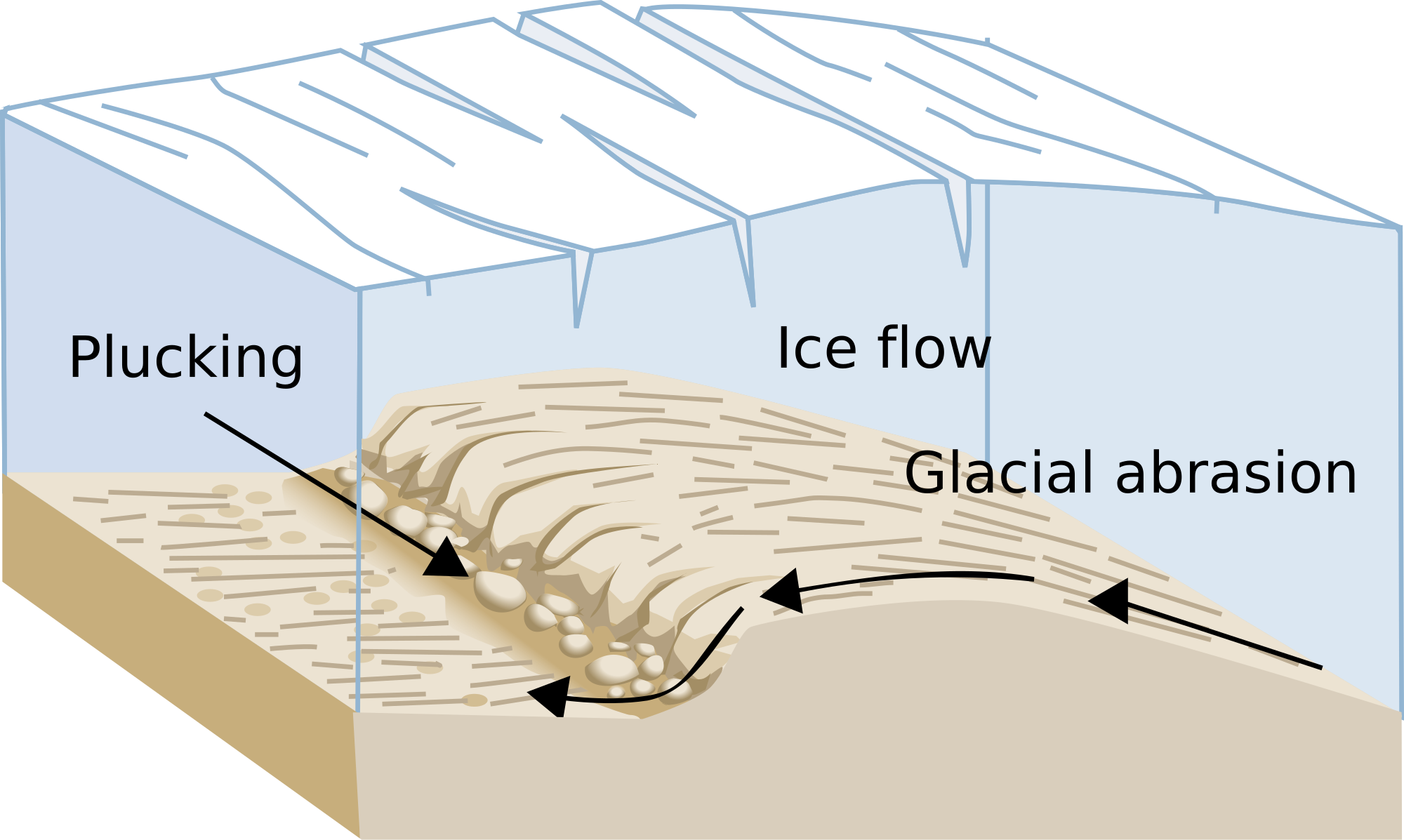
The rock used is generally a sedimentary variety containing silica. The more silica a rock has, the easier it is to break apart. The geological name for the type of stone used in most tool manufacture is chert or flint. Chert formations date as far back as the age of the dinosaurs. They were scoured and scraped by the movement of glaciers and carried along until the glacier melted. What this means is that an artifact found in Haldimand or Norfolk may have originated thousands of kilometers away!

In Southern Ontario, stone tool artifacts have been recovered and dated within several different main time periods and as more discoveries are made these classifications are sure to go even further back in time. Each period shows variations thought to reflect climate changes that made an impact on animal and plant species. As species changed or disappeared, new types of stone tools were manufactured to keep up with these transitions. Dating artifacts, therefore, helps to identify migrations of different people groups across our counties’ deep past.
Most landowners truly enjoy having their artifacts interpreted. Their private collections remain intact and local people become, in a sense, guardians of local history. If a family is not interested in acting as stewards, I always encourage them to donate their pieces to a local museum, to ensure that the artifacts remain in the community.
For the Silo, Lorenz Bruechert- Archaeologist

Supplemental- Ancient Runes discovered in Canadian wilderness baffle experts.

Canada & World Birth Rate At Historical Low
 Image and article via our friends at The Epoch Times Image and article via our friends at The Epoch TimesThe world is quietly entering a population crisis. Global fertility rates have plunged to their lowest level in 60 years, raising profound questions about how societies will sustain themselves in the decades ahead. In Canada, births have fallen to just 1.25 children per woman, the lowest in our history. Behind the numbers are shifting values, economic pressures, and growing uncertainty about the future. Let’s examine the global decline in birth rates and explores what’s driving it—and what it means for the economy, family, and national identity. |
| Fertility rates have plummeted worldwide over the past six decades, leading experts to warn of dire consequences as the downward trend continues. Continued low fertility rates will cause “a gradual implosion of the world’s economy as the population ages and dies,” Steven Mosher, president of the Population Research Institute, told The Epoch Times in an email. Mosher is an expert on population control, demography, and China. “This will not occur overnight, of course, but once it is well underway, it will be difficult, if not impossible, to reverse course,” he said. The fertility rate is the average number of children born to a woman in her lifetime; the birth rate is the number of live births per 1,000 people in a population over a given period. Macroeconomist Jesús Fernández-Villaverde called low fertility rates “the true economic challenge of our time” in a February report for the American Enterprise Institute. In 1960, the fertility rate was between four and five. By 2023, that number had halved to 2.2, approaching 2.1, the level at which a population replaces itself from one generation to the next. 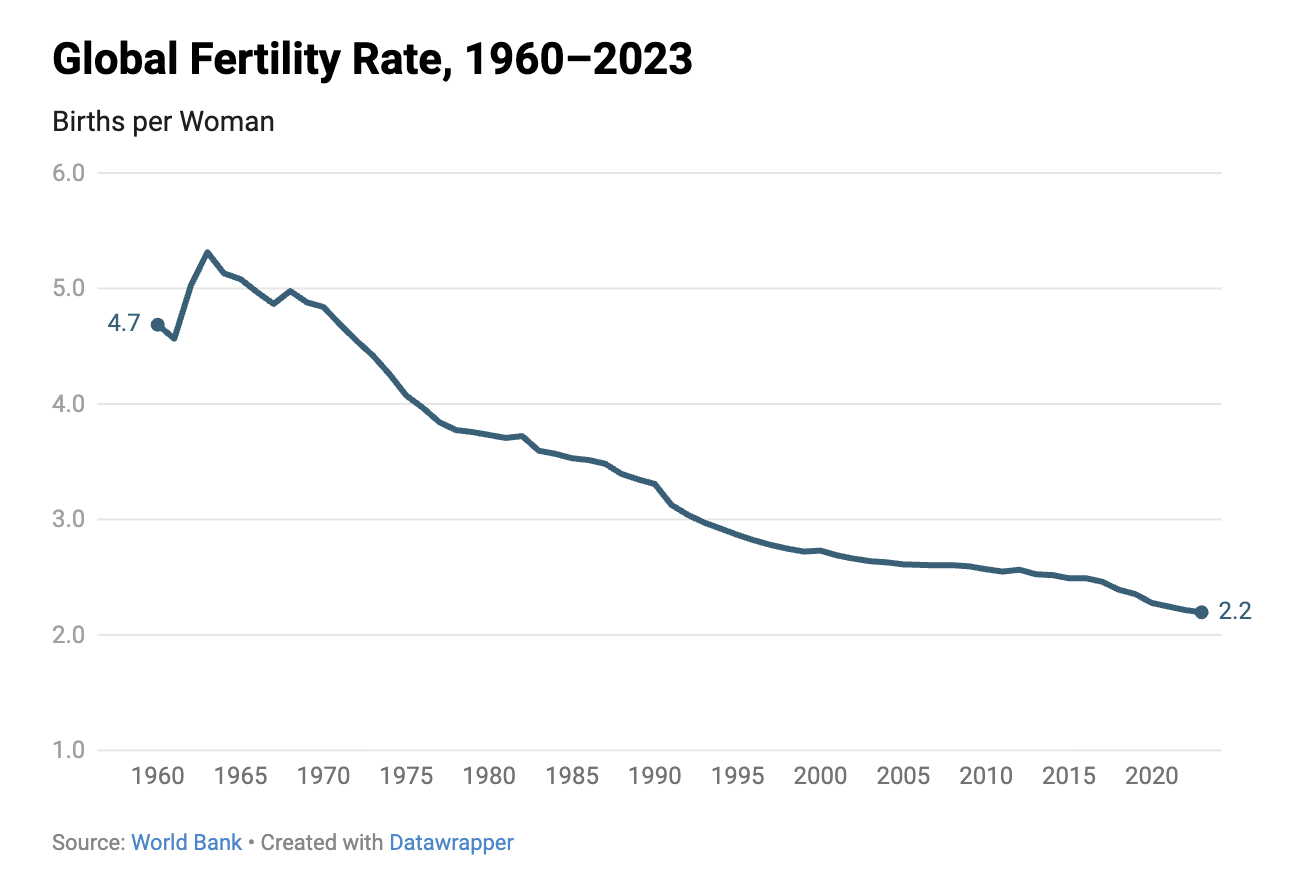 In July, the U.S. Census Bureau projected that the world’s population will reach 8.1 billion this year. Experts say that although the figure has grown from 3 billion in 1960, the number to watch is the pace of population growth. “The rate of growth peaked decades ago in the 1960s and has been declining since and is projected to continue declining,” the Census Bureau stated. Fernández-Villaverde warned that although the sagging rate of growth may not have immediate consequences, in less than 50 years, declining fertility will affect the world economy. Countries with low or negative birth rates will contend with a shrinking workforce and the ballooning costs associated with an aging population. In July, the U.S. Census Bureau projected that the world’s population will reach 8.1 billion this year. Experts say that although the figure has grown from 3 billion in 1960, the number to watch is the pace of population growth. “The rate of growth peaked decades ago in the 1960s and has been declining since and is projected to continue declining,” the Census Bureau stated. Fernández-Villaverde warned that although the sagging rate of growth may not have immediate consequences, in less than 50 years, declining fertility will affect the world economy. Countries with low or negative birth rates will contend with a shrinking workforce and the ballooning costs associated with an aging population. Global Fertility Rates Only about 4 percent of the world’s population is in countries with high fertility rates—more than five children per woman—and all of those nations are in Africa, according to the Census Bureau. Even in those countries, fertility rates are generally lower than they once were. The Census Bureau reported that nearly three-quarters of the world’s population is in countries where fertility rates are at or below the replacement level. The fertility rate in India, the world’s most populous country, has steadily declined over the past six decades. In June, the U.N. Population Fund reported that India’s fertility rate stood at 1.9 children per woman, down from five or six children in 1960.In Canada, fertility rate fell to 1.25, well below the replacement level of approximately 2.1 children per woman needed to maintain a stable population. In 1990, China’s fertility rate was 2.51, despite its one-child policy. By 2023, it had dropped to less than one birth per woman, according to the U.N.’s population division .In the United States, fertility has undergone a persistent decline. It fell below the replacement level in 1972, and in 2023, it reached 1.62—a historic low. 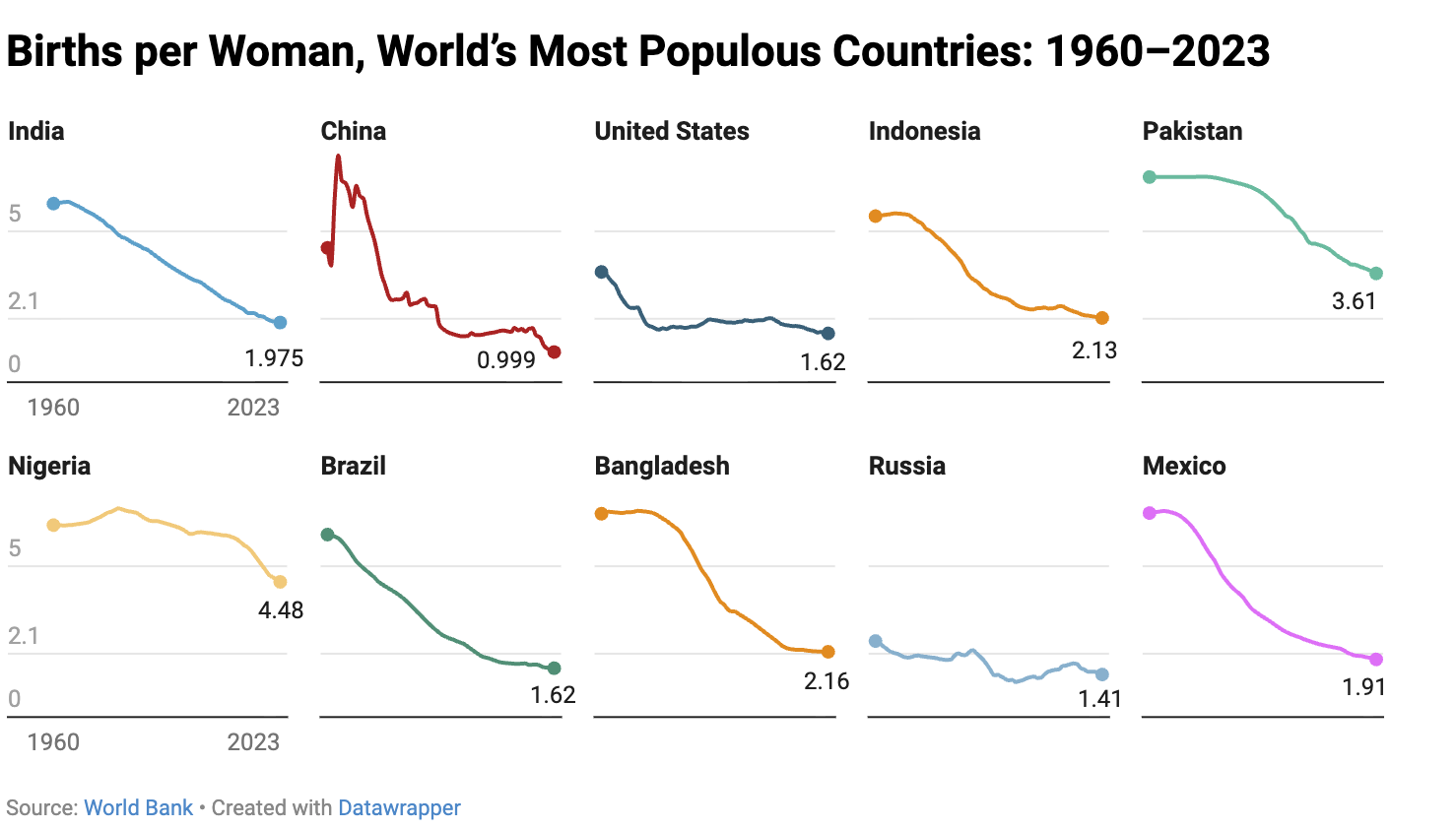 Asian and European countries have the lowest fertility rates in the world, and South Korea (0.72), Singapore (0.97), Ukraine (0.977), and China (0.999) all have rates below one. Asian and European countries have the lowest fertility rates in the world, and South Korea (0.72), Singapore (0.97), Ukraine (0.977), and China (0.999) all have rates below one. |
Key Data & Facts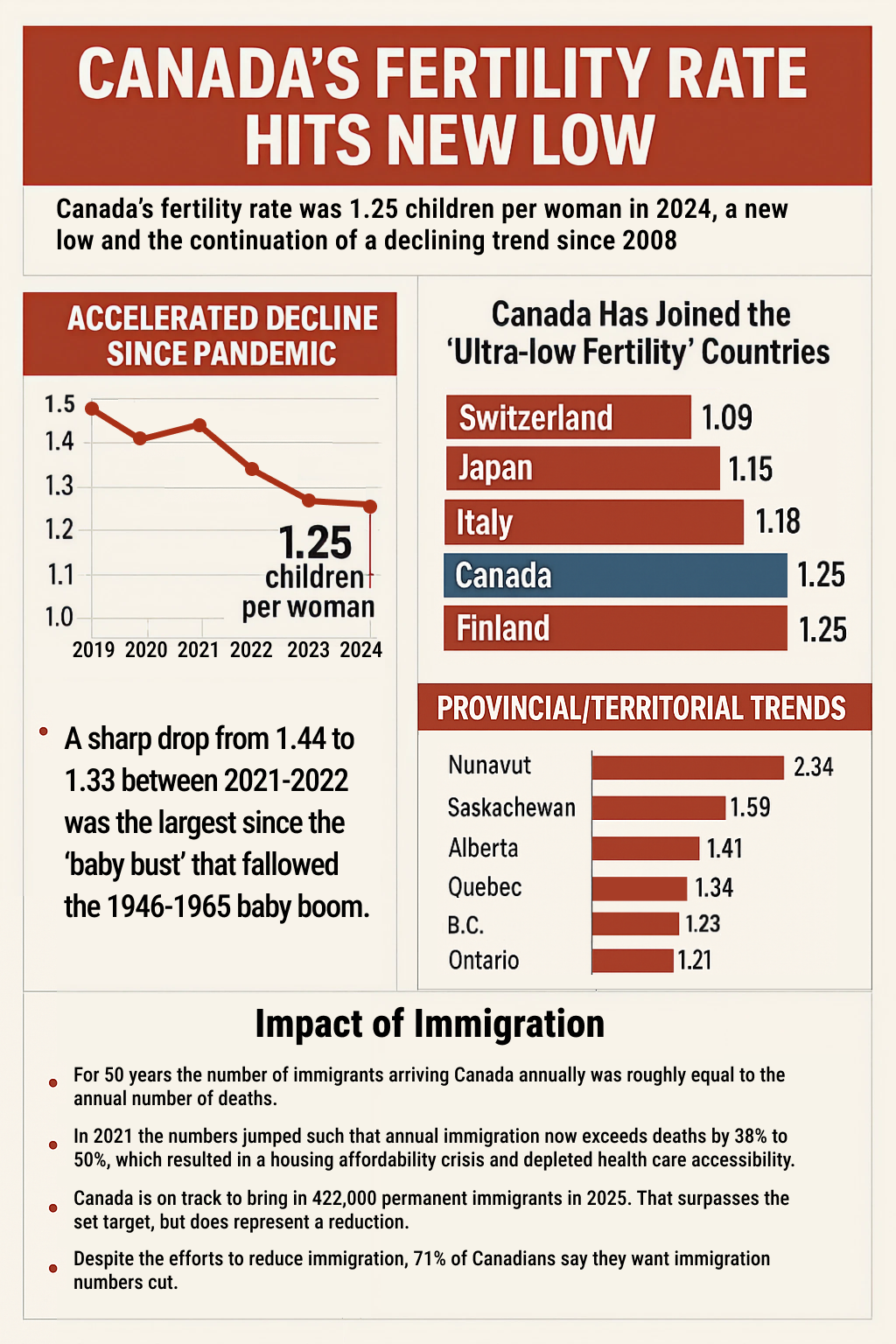 Source: Statistics Canada Source: Statistics Canada |
For The Silo, Sylvia Xu/ Epoch Times.

Cybersecurity Expert On Recent Louvre Burglary Reveals Poor Password Choice
On Sunday, October 19, a burglary took place at the Louvre — one of the best known museums in the world. In broad daylight, minutes after the museum opened, thieves broke into the Apollo Gallery and stole the French Crown Jewels, valued at around 88 million EUR/ $142.5 million CAD.
While criminals entered the famous museum through a window, the robbery exposed a whole host of security problems at the Louvre, including issues with digital security. For example, French media claim that according to the documents they’ve seen, the server managing the museum’s video surveillance was once protected by a weak password “LOUVRE.”
Media in France cite audit documents which show that the Louvre neglected security issues for years, including holes in physical security, outdated software, shoddy maintenance, and poor password and cybersecurity management.
Karolis Arbačiauskas, Head of Product at the cybersecurity company NordPass, comments:
“Publicly available information increasingly suggests that the museum’s IT security system — which manages access control, alarms, and video surveillance — suffers from numerous vulnerabilities. According to a 2014 audit by the French National Cybersecurity Agency (ANSSI), the museum’s system also relied on insecure passwords. For example, the server managing the museum’s video surveillance was protected by the password ‘LOUVRE.'”

“This is horrible. Such a password breaks all the principles of creating secure passwords. On the other hand, it’s not that shocking. Truth to be told, our own research shows that cybersecurity in the public sector is not the best. Tens of thousands of public sector employee passwords are already on the dark web.”

“But we need to be careful and refrain from pointing fingers until the investigation is completed. The audit data cited by the media is quite old, and we don’t know if the Louvre took ANSSI recommendations into account. Crucially, poor passwords were not the point of entry for the criminals; they gained access through a window, indicating a broader, comprehensive security failure.”
“Personally, I would like to see a positive side to this horrible story. This theft has become the ultimate penetration test for the Louvre, so I hope it will serve as a stimulus to review and upgrade all of the museum’s security systems and policies, including passwords and outdated software. Otherwise, this robbery may embolden criminals and potentially lead to more crimes in the future”
“Proper password should be at least 20 characters long and consist of a random combination of numbers, upper and lower case letters, and special symbols. Passwords on routers and security systems, including those that manage security cameras, must be extremely strong and perhaps go beyond what is considered a strong password, as these systems can literally and figuratively open almost any door. It is also paramount to never reuse passwords. The rule of thumb is that each account should have a unique password because if one account gets taken over, hackers can use the same credentials for other accounts.”
For the Silo, Gintautas Degutis/ Nordsec.

Alt Learning On Rise- Alberta School Will Have Agricultural Academy Barn Built On Site
Rolling Hills School: Where Classrooms Meet the Fields

ROLLING HILLS, Alberta — On a crisp fall morning, the hum of tractors in the distance blends with the chatter of children filing into Rolling Hills School. For many of these students, the day began not with cartoons or cereal, but with feeding calves or checking irrigation lines before the bus arrived. Here, agriculture isn’t just a subject in the curriculum—it’s the backbone of the community, and the school has embraced that identity wholeheartedly to create a unique practical learning environment that is innovating and providing students with real world skills.

A School Where Learning Meets The Land
Rolling Hills is a small K–9 school in a hamlet of just a few hundred people, surrounded by endless prairie fields. “Our kids live and breathe farming,” says one teacher. “It only makes sense that their education reflects that.”
From science lessons on soil composition to math problems based on crop yields, the school finds ways to connect classroom learning to the realities of rural life. Students don’t just read about ecosystems in textbooks—they see them unfold in the fields outside their windows.
The Community as a Classroom
What sets Rolling Hills apart is the way the wider community steps in as co-educators. Parents and neighbors, many of them farmers, regularly bring their expertise into the school. A rancher might arrive with a trailer of calves for a hands-on biology lesson, while a grain farmer explains the mechanics of GPS-guided combines during harvest.
“It’s not unusual for a student to raise their hand in class and say, ‘That’s how we do it on our farm,’” notes the principal. “That lived experience enriches the whole classroom.”

Students attend a live stock auction.

The school also doubles as a gathering place. Harvest suppers, farm safety days, and 4-H showcases bring families together, blurring the line between school events and community traditions.
A New Chapter: The Agricultural Academy Barn
This year, Rolling Hills School received a $10,000 cad grant to support the construction of an Agricultural Academy Barn on school grounds. The barn will serve as a hub for hands-on learning, giving students the chance to work directly with animals, crops, and agricultural technology in a structured environment.
“This is a game-changer for us,” says a staff member involved in the project. “The barn will allow students to experience agriculture in a way that goes beyond the classroom or even their family farms. It’s about creating a shared space where learning, innovation, and tradition come together.”
The barn is expected to host projects ranging from animal care and feed management to experiments in sustainable farming practices. For younger students, it will be a place to nurture curiosity; for older ones, it will provide practical skills that could shape future careers.
Learning by Doing
The barn will complement existing initiatives like the school garden, where students plant, tend, and harvest vegetables. Together, these projects reinforce the idea that education is not just about absorbing information but about applying it in meaningful ways.
Older students already take on complex projects—experimenting with irrigation techniques, studying crop rotations, or shadowing local farmers. With the barn, these opportunities will expand, offering a year-round space for agricultural exploration.
Growing More Than Crops
Agriculture teaches patience, responsibility, and resilience—qualities Rolling Hills School works hard to instill. Students who care for animals through 4-H or classroom projects learn that consistency matters, whether it’s feeding livestock or showing up prepared for class.
Environmental stewardship is another theme. With water scarcity and soil health pressing concerns in southern Alberta, the school emphasizes conservation and sustainable practices. “We want our students to see themselves as caretakers of the land,” says a teacher. “That’s part of their legacy.”
A Model for Rural Education
In an era when many rural schools struggle to maintain enrollment and identity, Rolling Hills stands out as a model of resilience. By leaning into its agricultural roots—and now investing in the Agricultural Academy Barn—the school has created a learning environment that is both relevant and inspiring.
Graduates leave with more than academic knowledge. They carry with them a sense of pride in their heritage, practical skills rooted in real-world experience, and a deep connection to their community.
As one parent put it during a recent harvest supper: “This school doesn’t just teach our kids—it raises them, alongside the land that raises us all.” UFA Foundation/ Copilot.

10 Coolest Porsche Headlights- Don’t You Agree?
10. Porsche 911 (996, 1998–2004) — The Controversial “Fried Egg” Design

Initially divisive, the 996’s integrated headlamp clusters (combining main, high, and indicator lights under one cover) represented Porsche’s first major step into modern production efficiency. The “Fried Egg headlight” design was so controversial that when introduced, many car purchasers (especially those owning the first generation Porsche Boxster 986) modified the headlights with window tint to “hide the yolk”!

Regardless of how acceptance was split, the design was sensible and borrowed from the 911 GT1 race car, this setup improved aerodynamics and manufacturing simplicity. Over time, enthusiasts have come to appreciate its boldness, and we’re going as far as naming it in our top 10 list of the coolest Porsche headlights ever!
9. Porsche 911 RSR (2017–Present) — The Perfect Fusion of Heritage and Function

The 911 RSR’s headlights combine classic round symmetry with cutting-edge LED tech and aerodynamic sculpting. The signature four-point LEDs maintain Porsche’s unmistakable night-time identity. In endurance racing, where function dominates, the RSR’s lights prove that beauty and performance can coexist perfectly.
8. Porsche 917K (1970) — Racing Eyes Built for Le Mans

The 917K’s headlights weren’t just for show; they were shaped by necessity. With their low, wide fairings and Plexiglas covers, the lights became a critical aerodynamic component at speeds exceeding 220 mph. Their integrated look and teardrop housing gave the car a menacing, purposeful face that influenced Porsche’s endurance racers for decades.
7. Porsche 918 Spyder (2013–2015) — Laser Precision and Modern Drama

A leap into the hybrid era, the 918 Spyder’s four-point LED headlights introduced a motif that defined Porsche design for the next decade. Their sharp-edged housings and distinctive daytime running light pattern made them unmistakable, even in the dark. They also pioneered Porsche’s adaptive light technology, blending form, function, and digital precision.
6. Porsche 993 (1993–1998) — The Last of the Classic Round Lamps

The 993 introduced a new, sloped front end with headlights that followed the hood line, a significant break from tradition. The design, though controversial at launch, ultimately modernized the 911’s appearance and improved aerodynamics. Its flush, oval lenses became icons of the 1990s Porsche aesthetic and marked the final air-cooled era’s visual identity.
5. Porsche 911 (964) — Classic Form Meets Modern Function

The 964 retained the round 911 lights but subtly reshaped them to fit new, smoother bodywork. They were slightly more upright and used improved reflectors and halogen elements for better illumination. This generation is often overlooked, but its headlights mark the bridge between old-school air-cooled charm and modern Porsche precision.
4. Porsche 356 (1948–1965) — The Blueprint for Porsche’s “Eyes”

The 356 established the signature oval headlight shape that became Porsche’s visual identity for decades. Mounted high and slightly reclined, the chrome-rimmed lenses gave the car a friendly yet purposeful look. Though rooted in postwar simplicity, their integrated design flowed seamlessly with the rounded fenders, a foundational cue that carried into every 911 thereafter.
3. Porsche 959 (1986–1988) — Aerodynamic Function in a Supercar Form

The 959’s headlights were a turning point for Porsche’s design language. They maintained the classic round outline but were deeply recessed into the front fenders for aerodynamic efficiency. Flush glass covers gave the car a sleek, cohesive face that previewed Porsche’s shift toward modern integration and minimal drag. Beneath the surface, their lighting performance outclassed most of the era’s supercars.
2. Porsche Mission R Concept (2021) — The Future in Plain Sight

With its slim, vertically stacked LED units framed by a minimalist housing, the Mission R’s headlights reimagined Porsche’s “four-point” look for the electric age. They were both expressive and efficient, incorporating cooling ducts and DRL elements into a single sculptural assembly. The design hints at the next generation of motorsport and production cars from Porsche.
1. Porsche Carrera GT (2003–2007) — Pure Function, Clean Form

The Carrera GT’s headlights embodied Porsche’s design minimalism at its finest. With visible projector lenses under a clear polycarbonate cover, they echoed the look of endurance racers while maintaining a sculptural, lightweight appearance. The compact design allowed for large air channels around them, aiding cooling and aerodynamics, beauty born from engineering.
For The Silo, Verdad Gallardo/Rennlist.com


Newly Improved Moving Coil Cartridges To Propel Your Record Listening
Our friends at Audio-Technica have debuted their improved AT33x Series moving coil phono cartridges and you are gonna love them!
Stow, OH, October, 2025 — Audio-Technica announces the introduction of its AT33x dual moving coil phono cartridges, featuring a host of sonic and engineering upgrades over the previous AT33 Series. The new lineup offers five models including two dedicated mono cartridges, all designed to deliver warm, full-bodied and balanced sound along with easier installation.
“The AT33 Series has long enjoyed a cult following among moving coil fans in the know,” said Bob Peet, Audio-Technica Global Product Manager – Analog Products. “With the introduction of the AT33x models, listeners can enjoy even better sound in a variety of systems. We continue to support listeners seeking exceptional performance and high value in high-end stereo moving coil cartridges, as well as enthusiasts who enjoy their classic monophonic LPs.”

The new AT33x lineup includes the following:
AT33xMLB – microlinear nude stylus, solid boron tapered cantilever, $899 usd/ $1,257 cad
AT33xMLD – microlinear nude stylus, duralumin tapered pipe cantilever, $799 usd/ $1,117 cad
AT33xEN – 0.3 x 0.7 mil elliptical nude stylus, duralumin tapered pipe cantilever, $699 usd/ $977 cad

AT33xMONO/I – mono, 0.65 mil conical nude stylus, duralumin pipe cantilever, $649 usd/ $907 cad
AT33xMONO/II – mono, 0.65 mil conical nude stylus, duralumin pipe cantilever, $449 usd/ $623 cad
All AT33x Series cartridges are all hand-crafted in Japan.
All feature Audio-Technica’s unique dual moving coil structure with independent left and right coils, which provides exceptional channel separation, imaging and tracking capability for the stereo models, and sound quality that is dynamic yet delicate and refined. The AT33xMONO/I and AT33xMONO/II are configured as a true mono design that is unaffected by any vertical noise components picked up from the record groove. (They are also ideal for mono playback on a stereo system.)
All models have threaded mounting holes for easier installation and feature composite cartridge bodies made of die-cast zinc, aluminum and high-rigidity polymer to ensure clear, detailed sound with freedom from unwanted resonances. Rigid, dense die-cast zinc is used for the cartridge base for additional resonance suppression and to add clarity to the bass and midrange.
Every cartridge in the series utilizes PCOCC (pure copper by Ohno continuous casting) and gold-plated cartridge pins to ensure maximum signal transmission and musical clarity. Depending on the model, AT33x Series cartridges employ either neodymium or samarium cobalt high-strength magnets for responsive, high-resolution vinyl playback. A newly-developed suspension and rubber damper design (with lower compliance than other Audio-Technica cartridges) enable every AT33x model to be used with a variety of tonearms.
All are available now. For the Silo, Jarrod Barker.
Audio-Technica was founded in 1962 with the mission of producing high-quality audio for everyone. As we have grown to design critically acclaimed headphones, turntables and microphones, we have retained the belief that great audio should not be enjoyed only by the select few, but accessible to all. Building upon our analog heritage, we work to expand the limits of audio technology, pursuing an ever-changing purity of sound that creates connections and enriches lives

Upcoming ‘Swiss Sourced’ Collector Car Auction

Click on the full auction catalog below to learn about this unique car.
| The Zürich Auction1 November 2025 The Dolder Grand – Zürich, Switzerland |
| Swiss-Sourced Collector Cars |
| It is no surprise that our friends at Broad Arrow are proud to present a selection of Swiss-sourced vehicles to be offered at their inaugural Zürich Auction. The vehicles are varied and exceptional and the setting could not be better. Switzerland’s reputation for precision, care, and high standards extends beyond its watches and craftsmanship. These qualities are frequently reflected in the quality of its vehicles with Swiss-sourced cars often offering distinct advantages including:Exceptional Maintenance Standards: Thanks to strict technical inspections, such as the MFK, Swiss vehicles are typically kept in excellent condition. Low Mileage: Cars in Switzerland generally show less wear, as average annual mileage trends lower than many other markets. Clean, Verifiable History: Rigorous registration and control systems mean provenance is often clear and verifiable. Favorable Tax Conditions for Classic Cars: As with several European countries, vehicles over 30 years old may qualify for reduced VAT rates. Reliable Logistics Support: Broad Arrow has established partners throughout the region available to assist with customs, shipping, and other logistical needs. For more information on any of the offerings in our Zürich Auction, and for a complete list of Swiss-sourced vehicles, I invite you to contact their knowledgable team of specialists, or to reach out to their client service team. Bidder registration is open with options for in-person, telephone, internet, and absentee bidding available. Contact their client service team for personalized assistance at [email protected]. Please mention the Silo when contacting. For the Silo, Jarrod Barker. |

Forest Bathing Beats Stress Improves Immune System
Stress is ever present in current society, both personal stress and workplace stress contribute to the well documented link, between stress and chronic conditions.
Data available from Statistic Canada’s – National Population Health Survey, demonstrates that personal stress is predictive of the development of a chronic health condition over the next four years (Statistics Canada, 2003). The long term impact of these chronic health conditions can result in significant activity limitation from heart attack, diabetes, migraine, or arthritis or back problems. Even more daunting is the higher predictive value of death for individuals suffering from cancer, bronchitis/emphysema, heart disease or diabetes.
The practice of forest bathing itself is not a new concept.
Prior to the industrial revolution being “in nature” was part of everyday life. The Japanese term Shinrin-yoku meaning “taking in the forest atmosphere or forest bathing” was officially coined by the Japanese Ministry of Agriculture, Forestry, and Fisheries in 1982. (Park et al. 2010)
This novel practice of bathing in nature, demonstrates a wide variety of health benefits from which individuals in modern society can stand to gain. With the increasing amount of individuals living in urban settings the exposure to nature is diminishing.
Field studies performed in Japan measured salivary cortisol levels (more commonly known as “stress hormone”) in university individuals.
The students were divided into two groups, one to spend a day in a forest setting, the other in a city setting. Lower levels of stress hormone, as well as lower blood pressure and pulse rate was found in individuals in forest location. (Park et al. 2010)

Further evidence has been documented to demonstrate the reduction of stress resulting from forest bathing, through the improvement of immune function via exposure to the natural environment. Given that immune function is key in the prevention of chronic diseases this evidence is exciting. Natural killer cells (as they are ingeniously named) are cells within the immune system which kill tumors or virus infected cells, through the release of enzymes which break down the cells. In research studies natural killer cells have been found to be elevated for seven days after the forest bathing trip (Qing, 2010). This seven day window of improved immune function is great news for the weekend warrior in all of us.
Many of us who live in North America are blessed with exposure to forest just outside our doorsteps. This being said it doesn’t mean we always take advantage of it: between commuting to work, family and social commitments, going from the house to the car may be the norm. For the Silo, Ashley Beeton.
References
Park, B.J., Tsunetsugu, Y., Kasetani, T., Kagawa, T., & Miyazaki, Y. (2010) The physiological effects of Shinrin-yoku (taking in the forest atmosphere or forest bathing): evidence from field experiments in 24 forests across Japan. Environ Health Prev Med, 15,18–26.
Statistics Canada. (2003) Stress and Well-being (No 82-003). Retrieved from http://www5.statcan.gc.ca/access_acces/alternative_alternatif.action?l=eng&loc=http://www.statcan.gc.ca/pub/82-003-x/2000003/article/5626-eng.pdf&t=Stress%20and%20well-being
Qing, Li. (2010) Effect of forest bathing trips on human immune function. Environ Health Prev Med, 15,9–17.

Amazon Outage Created Perfect Hacker Conditions
AWS Outage Created “Perfect Storm” for Social Engineering Attacks
Last week Amazon Web Services (AWS) went down worldwide, including here in Canada, causing a ripple effect, from governments and local municipalities, to enterprises, small businesses and the individuals who rely on these services daily.
AWS is a cloud-based service thousands of major companies use to not only store their data, but run their apps and software for many critical business services.
Whether basic communications using apps such as Snapchat, Signal and Reddit to airlines such as Delta and United reporting disruptions to their customer facing operations, when these services go down it highlights the reliance on just a few cloud services companies (AWS, Microsoft Azure, and Google Cloud) to ‘run the country’ so to speak.
The AWS outage has further impacted shopping websites, banking apps, and even streaming and smart homes devices.
And while organizations scramble to ensure business operations continue to run, it’s also an opportunity for individuals to do a quick check-in on their own cyber hygiene.
Cybercriminals and hackers can easily take advantage of these types of outages to deploy an array of social engineering attacks.
Whether in the office or at home, nothing is more frustrating than losing the ability to access files and documents, and communicate with business associates or loved ones, especially in an emergency or crisis.
Hackers who rely on mass urgency and panic will see this as an opportunity to take advantage of people’s heightened emotions with phishing emails offering to “fix” the issue and get you back online and into your accounts or apps.
But in reality, these scammers are looking to steal your personal information, such as login credentials by tricking you into updating your software or resetting your password.
During major outages, users should avoid clicking on any links in emails, texts and pop-ups claiming to be able to fix the outage.
Additionally, double check that any alerts or update messages from organizations, such as your bank or payment apps, are verified from the official website or app.
This is the time to make sure you are using a strong password and multifactor authentication to prevent any unauthorized access to your accounts.
Delay Things
However, individuals should also delay making sensitive transactions, such as major financial transactions, resetting your password, or installing critical software updates, until the service in question has been announced as officially restored.
Furthermore, when the service disruption has ended, users should also monitor any affected accounts for unusual activity, discrepancies, and duplicate or fraudulent transactions.
Finally, this is an excellent reminder for individuals to make sure they have a back-up system in place to access important documents and for communications.
This can be as easy as keeping a secondary email account or even a back-up mobile phone. For the Silo, Stefani Schappert.
ABOUT THE AUTHOR
Stefanie Schappert, MSCY, CC, Senior Journalist at Cybernews, is an accomplished writer with an M.S. in cybersecurity, immersed in the security world since 2019. She has a decade-plus experience in America’s #1 news market working for Fox News, Gannett, Blaze Media, Verizon Fios1, and NY1 News. With a strong focus on national security, data breaches, trending threats, hacker groups, global issues, and women in tech, she is also a commentator for live panels, podcasts, radio, and TV. Earned the ISC2 Certified in Cybersecurity (CC) certification as part of the initial CC pilot program, participated in numerous Capture-the-Flag (CTF) competitions, and took 3rd place in Temple University’s International Social Engineering Pen Testing Competition, sponsored by Google. Member of Women’s Society of Cyberjutsu (WSC), Upsilon Pi Epsilon (UPE) International Honor Society for Computing and Information Disciplines.
ABOUT CYBERNEWS
Friends of The Silo, Cybernews is a globally recognized independent media outlet where journalists and security experts debunk cyber by research, testing, and data. Founded in 2019 in response to rising concerns about online security, the site covers breaking news, conducts original investigations, and offers unique perspectives on the evolving digital security landscape. Through white-hat investigative techniques, Cybernews research team identifies and safely discloses cybersecurity threats and vulnerabilities, while the editorial team provides cybersecurity-related news, analysis, and opinions by industry insiders with complete independence.
Cybernews has earned worldwide attention for its high-impact research and discoveries, which have uncovered some of the internet’s most significant security exposures and data leaks. Notable ones include:
- Cybernews researchers discovered multiple open datasets comprising 16 billion login credentials from infostealer malware, social media, developer portals, and corporate networks – highlighting the unprecedented risks of account takeovers, phishing, and business email compromise.
- Cybernews researchers analyzed 156,080 randomly selected iOS apps – around 8% of the apps present on the App Store – and uncovered a massive oversight: 71% of them expose sensitive data.
- Recently, Bob Dyachenko, a cybersecurity researcher and owner of SecurityDiscovery.com, and the Cybernews security research team discovered an unprotected Elasticsearch index, which contained a wide range of sensitive personal details related to the entire population of Georgia.

One Olive and Piper Earring Has Endless Possibilities
The Convertibles Collection
| New York, NY – October, 2025 – Woman-founded and Vancouver-based brand Olive & Piper is excited to announce the launch of their all-new Convertibles Collection, an innovative and exclusive offering from the brand. Available now, the brand offers a customizable, design-your-own earring. With up to 74 mix-and-match variants, customers can combine studs, charms, and drops to create earrings that reflect their individual style. The collection features an array of studs ($28 usd/ $39 cad) in four shapes and eight colors with coinciding charms in different sizes ($18-28 usd/ $25-39 cad), offering endless possibilities to express personality and style. The Convertibles Collection celebrates creativity, versatility, and personalization, positioning Olive & Piper as a brand that empowers customers to own jewelry for every part of their life. The collection invites wearers to experiment with their style, creating dynamic and unique pieces that transition effortlessly from day to night. With Olive & Piper, you’re the occasion. |
 |

Old School Soviet Digital Watch Is Back
The US and USSR going “Band for Band”
Our friends at kommandostore talk about the Cold War on their site so often, it’s become one of their defining aesthetics…..and that’s a good thing- read on!
Grand armies and weapons are arguably less than half of the story.
Many of the cold war ‘battles’ from the 1950s through the 1990s took place in the minds and on the wrists of millions of people. Some might say they certainly still do…
Rogue media campaigns, protests & activism, black ops — they defined the hottest parts of the Cold War. But what if we told you that the watch you were wearing was just as important? The Soviet Union sure thought so…

Having gotten sucked into the almost endless lore rabbithole of watches, the first thing that kommandostore sought to bring back from obscurity was the Elektronika 55B — the soviet union’s most popular digital watch that went the way of… well, the Soviet Union… When it collapsed in ’91.
Above all else, there’s one story about this watch that truly stands on its own, a story that will make you realize that there is much more to this little watch that jovially plays chiptune soviet music…
It involves two of the most powerful men in the world, Leonid Brezhnev and Henry Kissinger convening and comparing their new digital watches.

Ok, they weren’t really wearing the watches in that photo, but such an encounter really did happen between the two gentlemen in the early 70s, one that subtly let the United States know that the Soviets were right on the US’s tail for semiconductor technology.
On a somewhat-routine visit to Moscow, US Secretary of State Henry Kissinger wore a Pulsar P2 Watch — one of the very first digital watches. Known for it’s striking red LED display and appearance on the wrist of none other than James bond.
It also carried a hefty price tag, with the 21k gold edition costing enough to buy you a car in today’s money.

You tell us, is $1800 usd/ $2,526 cad in today’s money worth it for one of the two base models?
The meeting was with Leonid Brezhnev, General Secretary of the Soviet Union. He remarked that he did indeed like Kissinger’s watch, being a man of taste.
Then he told Kissinger that the USSR had already developed a prototype using the very same technology.

Kissinger was reportedly astonished — and was presented with a functioning Soviet-Made digital wristwatch, the Elektronika B6-02. Featuring CMOS circuits, it was blocky, brutalist, and affordable enough for practically anyone to buy when it officially launched.

The whole Elektronika series carried this statement — the latest fancy tech of the west is cool, but when it’s done the soviet way, for way cheaper, it’s not a luxury to be worn by only the elites.
It didn’t take a horology enthusiast to buy and wear this watch. It’s Kalashnikov-esque ubiquity meant it was worn by everyone from party members to coal miners.
Sure, in 1969 we brought a luxury-watch masterpiece, the Omega Speedmaster, to the Moon before the Soviets were able to. But as a tool of propaganda, the USSR might have had us beat, and the Elektronika 5 appeared in space several more times…

We found it intriguing and somewhat disheartening that Elektronika, what seemed to be the people’s choice, was snuffed out much in the same time period as the Soviet union.
In a world full of Casios & Timexes, who can’t help but succumb to the charm of the plucky Elektronika, so why not give it the wrist time it deserves…because it is now available once again and this time in a near perfect reproduction right down to the packaging.


| A 1:1 functional replica of the original Elektronika with 4 new Slav-approved “Melody” alarms. Sanctioned to the second-hand market (pun intended), thankfully kommandostore thought that the watch deserved a proper revival after its unceremonious disappearance following the collapse of the USSR. |

| Just like the original, it’s an affordable and reliable piece with just enough fun to get even the most uptight horologists asking you questions. But unlike the OGs, the sad truth of capitalism is that we’re slaves to supply and demand. They are running out fast, and even though there are plans to quickly continue production, there may be a slight gap. So, if you’re interested, this is kind of a last call. |
Click the following link to place your order while supplies last.

Supercharge Your Vinyl Setup With These Tools
| Audio-Technica expands turntable accessory offerings for all vinyl enthusiasts |

| Stow, OH, October, 2025 — Our friends at Audio-Technica, a leading innovator in transducer technology for over 60 years, are excited to launch a new range of turntable accessories designed to help vinyl listeners achieve the best from their record collections. The latest additions include two new slip-mats, precision alignment tools and a stainless-steel disc stabilizer. These new additions join Audio-Technica’s established lineup of turntable accessories including the AT6012 Record Cleaning Kit, stylus cleaners and more, expanding a complete family of products designed to help vinyl users care for and enjoy their collections to the fullest. New to the Audio-Technica Slipmat series is the AT-SMCR2 Cork-Rubber Slipmat (MAP: $35.00 usd/ $49.00 cad) and AT-SMC1 Cork Slipmat (MAP: $25.00 usd/ $35.00 cad). The AT-SMCR2 is engineered from a premium blend of cork and rubber to absorb a wide range of vibrations, particularly at lower frequencies, delivering clearer audio reproduction. The cork-rubber blend also provides antistatic properties to reduce pops and clicks caused by static discharge. For listeners seeking a simpler option, the AT-SMC1 provides excellent resonance control and a stable playback surface without shedding particles or attracting dust like traditional felt mats. Beyond vibration control, Audio-Technica introduces two new cartridge alignment tools designed to ensure precise playback geometry: the AT-VTAZ1 Azimuth + VTA Alignment Tool (MAP: $14.00 usd/ $20.00 cad) and AT-CAP1 Cartridge Alignment Protractor ($17.00 usd/ $24.00 cad). The AT-VTAZ1 allows users to achieve accurate tonearm height and cartridge azimuth adjustment. Proper alignment ensures even stylus wear, accurate channel balance, and minimal distortion. The AT-CAP1 utilizes the widely used Baerwald alignment method to set cartridge offset angle and null points to deliver optimal tracking and reduced distortion. The new AT628a Stainless Steel Disc Stabilizer (MAP: $79.00 usd/ $111.00 cad )is designed to minimize resonance and keep records firmly in place during playback. The stabilizer accommodates even slightly warped records with two recessed inner rings on its underside for secure contact. Rounding out the new launches are the AT-ST3 Speaker Stands (MAP: $59.00 usd/ $83.00 cad), designed to enhance the performance of the AT-SP3X or other similarly sized bookshelf speakers. Constructed from rigid alloy steel with vibration-damping cork feet, each stand provides stable support for speakers weighing up to 3 kg (6.6 lb). The 13-degree angled design directs sound upward for clearer projection and helps reduce sound wave reflections off hard surfaces, ensuring cleaner, more accurate audio reproduction. |
For the Silo, Jarrod Barker.

| Audio-Technica was founded in 1962 with the mission of producing high-quality audio for everyone. As we have grown to design critically acclaimed headphones, turntables and microphones, we have retained the belief that great audio should not be enjoyed only by the select few, but accessible to all. Building upon our analog heritage, we work to expand the limits of audio technology, pursuing an ever-changing purity of sound that creates connections and enriches lives. |

Amazing Thing Happened After I Used Coupons For One Year

I was doing a bit of ‘specific purpose’ shopping at a local grocery store to pick up some of their No Name Yogurt. I buy this all the time and use it mixed with fruit, or when making a smoothie with yogurt, milk and berries.
It is worth noting, that some consumers remain staunchly brand-loyal and even brand-dependent.
They believe that no-name products are ‘not as good’ as the brand name products that they favor. In reality many no-name brands are manufactured using the same ingredients and at the same factory as the brand product, the only difference being the price and the look of the label. That being said, I’m not ready to trade in my Heinz ketchup for the no-name brand….but Aylmer is a close second. Can you taste the difference?
As I was about to take several tubs (5) off the shelf, I noticed a pad of tear-off coupons right above the yogurt. They were for $1.00 (Cdn) off each tub of No Name Yogurt that you purchased. Since I had 5 tubs in my tote basket, I peeled off 5 coupons. When I got to the check-out, I put the coupons on each tub and the cashier deducted $5.00 off my bill. The regular cost was $1.97 a tub, which would have made the total cost $9.85. I paid $4.85. I was very, very happy. I got the yogurt that I intended to buy, and I got a bargain. Also the empty tubs can be put in recycling bins, or used as food-savers for leftovers.

A friend of mine, Ken, who worked in the food industry, once told me, “Coupons are an easy way for customers to save money. The store does not loose any money, the coupons go right back to the company.”
A few years back, I decided to see if coupons did save me money. Each week I went through the newspapers, magazines, online site and store coupons I had collected as well as free coupon bins in their stores. These bins are there for customers who don’t want to use their coupons, but throw them in a bin so that other customers strolling by can scoop up whatever they want to use. I used an old duo tang notebook to record my savings, a ruler, line paper, and a pen. I drew lines across the page. I also drew lines vertically down the page for categories.
The first category was NUMBER, and then ITEM PURCHASED, then COUPON PRICE, and lastly PRICE TOTAL. I found an old, very large mayonnaise jar with a lid (the kind they used in restaurants that buy in large quantities). I put a slot in the top of the lid so that it was more convenient to drop coins into the jar rather than unscrewing the cap each time.
I labeled the jar, “Coupon Money.” Every time I went to the store and used a coupon, I put the actual money I saved into the jar. It may have been only 35 cents, or 50 cents. Then I recorded the information in my duo-tang.
I decided to do this project for one year. I started in February. I never told anyone what I was doing. If my wife used a coupon, she also added the money to the jar, and recorded the information. Never did I use the proceeds from the jar during the year, but I was tempted many times. Over the months of the year, I took the change that was accumulating and transferred it into bills, starting with $5.00, then $10.00, then $20.00 bills. The idea was to use coupons on products that I normally purchased, not to get 50 cents off a product I wouldn’t normally buy.
I was very diligent with my project that year. It was kind of a game made especially fun when I would get the jar out and look with envy at all the bills stuffed in there.
As the year anniversary was approaching, my wife started telling people about the “Coupon Project.”
I heard comments like, “How silly.” “Why would you want to waste your time doing that?” “When I get coupons I throw them out.” “You won’t make any savings on them.” But at the end of the year, the jar contained $520.00. As it turned out, we needed a new couch. We purchased a brand new bed-chesterfield, including delivery, for $500.00
A week later, two friends who had thought that my “Coupon Project” was nonsense, remarked on how beautiful and expensive our couch looked. They asked, “How did you afford to buy such a beautiful couch?” I replied proudly, “coupons.” For the Silo, Blair R. Yager.

Three and Half Decades Ago The Nighthawk Stealth Fighter Was Revealed
35 years ago, a mysterious and strikingly beautiful aircraft touched down on a dusty airfield in the Nevada desert. Can you imagine what kind of advanced aircrafts are being developed now?

The F-117 Nighthawk
Since its public reveal decades ago (consider that development started in the 1970’s on this amazing machine), the Nighthawk served with quiet distinction through the latter half of the Cold War, the first Gulf War, a kerfuffle in Yugoslavia (bet you don’t remember that one) , and the invasion of Iraq in 2003.
Despite and official ‘retirement’ in 2008, the F-117 still gets spotted in the skies over Nevada where it is rumored to serve as an ‘aggressor aircraft’, helping to train pilots.
What’s the F-117 about?

With it’s cyberpunk like profile and stunning angles, the F-117 Nighthawk instantly captured the public’s imagination and birthed a lot of UFO /UAP stories, especially in the late 1980’s and early 1990’s when it’s unusual shape confused expectations of what an aircraft could and should look like.
A radical departure from the retro-aerodynamic curves of traditional aircraft design, the F-117’s odd shape serves a singular purpose.
Stealth.

The Nighthawk was conceived by Lockheed’s Skunk Works, a secretive development team responsible for some of the most capable aircraft of the 20th century.
Designed to slip through deep Soviet territory, the Nighthawk incorporated radical new technology to achieve an incredibly small radar and thermal signature. Hard edges, radar-absorbing coatings, a unique twin-tail, and special endinge cowlings reduced the aircraft to the size of a sparrow on Soviet radar.
The Nighthawk was deemed fully operational in the early 1980’s and nearly a decade her pilots and crew flight night sorties in complete secrecy.
Seven years later, the USAF and the Department of Defense decided the Nighthawk would work better as a deterrent if the world knew about it and it’s capabilities.

Plans were made to reveal the aircraft to the world at Nellis AFB on April 21, 1990. Those of us who saw this event live on television will always remember the shock and awe inspiring gasp it created- nothing like it had ever been seen before and it surely looked like something from a science fiction novel or movie.
On a hot spring day, a flight of two F-117s landed in front of thousands of cheering spectators, kicking off one of the most memorable air shows in US history. After opening the show, the F-117s sat quietly on the tarmac surrounded by an entourage of armed airmen and curious onlookers.
Although little was said about the new “stealth fighters”- blimps, fighter jets, and mock dog fights continued the day’s entertainment in style.
Even with talks of ‘spending prioritization’ and ‘doctrinal appropriateness’, the Nighthawk has endured, in it’s own special way, for nearly 40 years. Everything about the F-117 that made it great in the 1980’s still captivates us today. It’s razor-sharp edges, futuristic technology, and it’s family tree of stealthy cousins (foreign and domestic). Here is hoping many more years of this little black triangle up in the sky… via our friends at kommandostore.com

Canadian Company To Help Astronauts Return To Moon In 2026
ALUULA Composites, super-strong, lightweight polyethylene material is now being used to develop expandable habitats for NASA’s astronauts to live safely and comfortably on the moon for the 2027 planned landing.
This small company on Canada’s west coast is playing a big role to help astronauts return and orbit the moon in 2026.

Artemis II crew members (from left) CSA (Canadian Space Agency) astronaut Jeremy Hansen, and NASA astronauts Christina Koch, Victor Glover, and Reid Wiseman walk out of Astronaut Crew Quarters inside the Neil Armstrong Operations and Checkout Building to the Artemis crew transportation vehicles prior to traveling to Launch Pad 39B as part of an integrated ground systems test at Kennedy Space Center in Florida photo: NASA
ALUULA Composites recently signed an agreement with Max Space, an American company, to use its innovative composite material to build space habitats on the moon. The company’s ultra-high-molecular-weight polyethylene (UHMWPE) laminate will be used to create a large living and working area for NASA’s astronauts when they return to the moon in September 2026.
The innovative material was selected because it has eight times the strength-to-weight ratio of steel and is extremely durable, which is ideal for space travel.

The Max Space team with their new expandable space habitat. photo: Max Space
The first Max Space inflatable space habitat is slated to launch with SpaceX in 2026. The Max Space inflatables can be delivered into space in very small packages and then unfolded and expanded to create a much larger work space. For the Silo, Paul Clarke.

Supervolcanoes: Earth’s Sleeping Giants
Have you ever heard of supervolcanoes? They’re like regular volcanoes but way, way bigger. Imagine a giant sleeping beneath the Earth’s surface, capable of waking up and changing the world as we know it. That’s what supervolcanoes are like. They’re fascinating, a little scary, but incredibly important to our planet. Let’s explore these giants and understand what makes them so special and powerful.
What Are Supervolcanoes?
Imagine a volcano so big that when it erupts, it changes the whole world. That’s what a supervolcano is! Unlike regular volcanoes that look like mountains, supervolcanoes are more like giant holes in the ground called calderas. They’re massive, and they can erupt with such force that they release thousands of times more lava and ash than any regular volcano. This isn’t just a small eruption; it’s like the Earth opening up, releasing its power in a way that can affect the entire planet. The amount of material that comes out of these eruptions can cover whole countries in ash and even change the climate across the globe!

According to the Daily Star, Italy’s super volcano is ‘close to eruption’.
Where Are They?
You’ll find these sleeping giants hiding in plain sight in various parts of the world. One of the most famous supervolcanoes is Yellowstone, located in the United States. It’s a breathtakingly beautiful park now, but beneath its serene landscape lies a massive supervolcano. Other well-known supervolcanoes include Toba in Indonesia and Taupo in New Zealand. These sites are often tourist attractions, known for their stunning natural beauty. However, few visitors realize the immense power that lies dormant just below their feet. These supervolcanoes have been quiet for thousands of years, but their history tells us they have the power to reshape the Earth.
The Big Eruptions
The eruptions of supervolcanoes are not common, but when they do happen, they’re a force to be reckoned with. One of the most significant eruptions in human history was the eruption of Toba, which happened around 74,000 years ago. It was so enormous that it likely caused what scientists call a volcanic winter. This means that the eruption was so massive it threw so much ash and particles into the atmosphere that it blocked out sunlight, causing the Earth’s temperature to drop. Imagine a winter that lasts for years, all because of one volcanic eruption! This event was so impactful that it even left a mark on human evolution.
These eruptions are unpredictable, much like the thrilling unpredictability of playing new real money slots online at places like blog.tonybet.com. Each eruption is a reminder of the raw power of nature, capable of changing the course of history. When these supervolcanoes erupt, they unleash energy that is hard to comprehend, and their effects can be felt globally, affecting climate, landscapes, and even human life.

In 2018 Indonesia’s Krakateu erupted in an amazing display of power.
Studying Supervolcanoes
Studying supervolcanoes is like being a nature detective. Scientists are really interested in these huge volcanoes. They want to figure out how they work, what causes them to erupt, and when they might wake up again. This can be a tricky job because supervolcanoes don’t erupt very often, so there’s not a lot of times to see them in action.
To learn about these giant volcanoes, scientists look closely at the rocks and dirt around them. These aren’t just any rocks and dirt; they’re special clues left behind by the volcano. They can tell stories about what the supervolcano did a long, long time ago and what it might do in the future.
These scientists also use cool tools and machines to help them in their work. They have special instruments that can ‘listen’ to the ground for rumbles and ‘look’ deep inside the Earth. They study maps and use computers to make guesses about what the supervolcano will do next.
By studying supervolcanoes, scientists learn not just about volcanoes, but also about the Earth itself. It’s like putting together a giant puzzle. Each piece they find helps them understand more about our amazing planet and how to keep people safe if a supervolcano decides to wake up. It’s a big job, but these volcano detectives are up for the challenge!
Can We Predict Eruptions?
Predicting when a supervolcano will erupt is a bit like trying to guess when a big storm will hit. It’s not easy! Scientists are like detectives looking for clues. They use special tools to keep an eye on the supervolcano. They watch for tiny earthquakes that shake the ground. They also look for changes in the shape of the land, which might mean something is moving under the ground. These tools help scientists see what’s happening deep inside the Earth.
Even with all this watching, scientists can’t say for sure when a supervolcano will erupt. They can’t mark a date on the calendar like we do for birthdays. But they can give us a heads-up if they think an eruption might be coming. It’s like being told there might be rain so you can bring an umbrella, just in case.
Living with Supervolcanoes
Living near a supervolcano might sound like living in a scary movie, but it’s not as frightening as you might think. People who live near these giants are not alone. They have scientists and the government looking out for them. Together, they make plans for what to do if the supervolcano starts rumbling. They think about safe places people can go and the best ways to get there.
These plans are like safety drills in school. They help everyone know what to do if something big happens. Knowing there’s a plan can make living near a supervolcano less scary. It’s about being ready and knowing how to stay safe, just like we learn to stop, drop, and roll in case of a fire.
The Role of Supervolcanoes in Nature
Supervolcanoes are not just about fiery eruptions. They are a big part of our planet. They help make the Earth look the way it does. When they erupt, they can change the land, making new mountains and valleys. The ash they send into the sky can fall back down and help plants grow. It’s like a giant, natural garden makeover.
These big volcanoes have been around for a very long time. They have seen dinosaurs come and go, and they have watched the Earth change in many ways. They tell us stories about our planet’s past and help us understand how the Earth works. They remind us that our planet is always changing and full of amazing natural wonders. So, supervolcanoes are not just about big eruptions; they are a key part of the Earth’s story, helping shape the world we live in today.

Guatemala volcano Volcan del Fuego
Supervolcanoes and the Climate
Have you ever thought about how supervolcanoes can change the weather around the whole world? It’s true! When supervolcanoes erupt, they send lots of tiny particles and gases high up into the sky. These particles can spread out and cover the sky like a giant umbrella, blocking some of the sunlight from reaching us down on Earth. When less sunlight gets through, it can make the temperature all over the world a bit cooler. This is like nature’s way of turning down the Earth’s thermostat! It’s amazing how something as big as a supervolcano eruption can reach up to the sky and affect the whole planet.
Learning from Supervolcanoes
Supervolcanoes are like giant, open books that teach us so much about the Earth. Scientists study them to learn about different things. They can tell us about the Earth’s history, like what the environment was like a long time ago. They also teach us about how the ground moves and shakes, which is really important to understand for keeping people safe from earthquakes and eruptions.
But that’s not all. By studying supervolcanoes, scientists can even learn things about other planets! This is because other planets might have volcanoes too, and learning about supervolcanoes on Earth can give scientists clues about what to look for in space. So, supervolcanoes aren’t just about lava and ash; they’re about discovering the secrets of our planet and even the mysteries of outer space!
Supervolcanoes: Sleeping Giants of the Earth
Supervolcanoes are like the sleeping giants of our planet. They’re huge and powerful, but they spend most of their time quietly resting. These giants remind us that the Earth is always changing and full of wonders. They are like natural teachers, showing us the incredible power of nature. Even though they can be a bit scary because of their power, they are also fascinating and important to learn about.
Supervolcanoes teach us to be prepared for nature’s surprises and to respect the Earth. They show us that even though we might think we know a lot about our planet, there’s always more to learn. Every time a supervolcano erupts, it’s like the Earth is telling us a story about its power and history. So, next time you hear about a supervolcano, remember that it’s a part of our Earth’s amazing story, and it’s something to be curious about, not just afraid of.
Conclusion: The Mighty Sleeping Giants
Supervolcanoes are one of Earth’s most amazing and powerful features. They remind us of the incredible forces that shape our planet. While they can be a bit scary because of their power, they’re also fascinating and important to understand. Just like the excitement of playing games at play new real money slots online, the story of supervolcanoes is filled with wonder and awe. They’re Earth’s sleeping giants, holding secrets of the past and keys to our planet’s future.

Unique Guitar Fraternity In Russia Was In Isolation For Seventy Years
Since the collapse of the Berlin wall in 1989, the countries of eastern European have exploded in a painful big-bang that has changed the geography of Europe and Asia drastically. The new Russia was born, now being part of the Community of Independent States (CIS) that replaces the former USSR. The guitar fraternity in Russia has been living for more than 70 years in total isolation, prevented from being in touch with the West. The presence of many types of the instrument that we call “guitar” has been a constant one in  Russian music life in all periods, having very old origins. But only recently has this guitar world started opening to western Europe, and we still know far too little about Russian composers for guitar and Russian guitarists. It was quite difficult for me to get information about some Russian guitarists, due both to the ever-present difficulties in communication (it is still difficult just to send a fax to Moscow during the day time)and to the problems of language comprehension.
Russian music life in all periods, having very old origins. But only recently has this guitar world started opening to western Europe, and we still know far too little about Russian composers for guitar and Russian guitarists. It was quite difficult for me to get information about some Russian guitarists, due both to the ever-present difficulties in communication (it is still difficult just to send a fax to Moscow during the day time)and to the problems of language comprehension.The Guitar of the Czars- a new English summary redaction
In the past, references to the Soviet guitar world in Western music literature were always very scarce, and only in recent years has a subtle breath from that guitar world started blowing beyond the Urals. I wish to thank especially the guitarists Mikhail Goldort from Novosibirsk (central Siberia)and Piero Bonaguri, teacher at the Conservatory of Rovigo (Italy) as well as the composer Umberto Bombardelli, who helped me in collecting more information.
At the beginning there was the domra
The guitar was not the only known plucked instrument in Russia; two other instruments at least are worthy of mention: the domra and the balalaika. The domra is nowadays known in two variants with three or four metallic strings and in different sizes. It has a triangular shape, is tuned by fourths,and is played by means of a plectrum.
It is the most ancient plucked instrument, having been imported by the Mongols during the 13th century. Its tremolo is similar to the one of the Neapolitan mandolin and its range is large, due to its having 16 frets up to the junction of the neck. It is now employed both as a solo instrument and in an orchestra,together with the balalaika .
The guitar appeared in Russia during the 18th century, in a society far behind the European one in development. However, at the first half of the 19th century it was already known as a national instrument: the Russian guitar. Its own peculiarities were the tuning by thirds on the notes of the G scale, and having seven strings. It is known by the tender-sounding name of “semistrunaia” (a composite noun made from
“sem’ ” =seven and “struny” = strings).
Its popularity grew among the people of all ranks, both middle and upper class, as described by many Russian poets and writers. There are also many variants of this main type, in number of strings and dimensions. By studying the surviving photos of Russian guitarists of the last century, re-published in the volume Guitar in Russia and USSR (see photo in the full PDF article linked below), we see that the guitar with 7 strings on the neck and 4 strings outside of the neck was very popular. The famous photograph of Valerian Rusanov, one of the first Russian guitar historians, with his 11-string guitar is significant in this respect. This instrument shared favor with the six string guitar (the so-called “shestistrunaia“, from “shest,” which means “six” ) tuned as in the West, and many other types. Continue reading full article PDF by clicking here. For the Silo, Marco Bazzotti.

Oscar the Gorilla’s Death Was Preventable
— San Francisco Zoo Faces Renewed Scrutiny Amid “Silverback Soirée” Fundraiser

SAN FRANCISCO (October, 2025) — Newly revealed details confirm that Oscar Jonesy — the San Francisco Zoo’s longtime resident silverback gorilla — had heart disease and was anesthetized against zoo-industry recommendations before his death in February.
At the August Joint Zoo Committee meeting, Ingrid Russell, the Zoo’s Vice President of Compliance and Animal Welfare, disclosed for the first time, and as noted in a recent zoo press release, that Oscar had been diagnosed with heart disease. That revelation came six months too late.
Oscar, who had lived at the San Francisco Zoo since 1981, died after being anesthetized for what officials described as a “routine medical procedure.” He never woke up.
According to the Great Ape Heart Project (GAHP) — the global authority on ape cardiac care — gorillas with known or suspected heart disease should never be placed under general anesthesia unless absolutely life-saving. The risks are too high, and modern zoos are urged to use non-invasive monitoring and awake medical training instead.
The San Francisco Zoo did not follow that guidance.
“Oscar’s death wasn’t a freak accident,” said Justin Barker, founder of SFZoo.Watch, a community watchdog group focused on transparency and animal welfare. “It was a preventable outcome that raises serious questions about veterinary oversight, leadership accountability, and whether the zoo is capable of protecting the animals in its care.”
Oscar’s death adds to a troubling history of preventable tragedies at the San Francisco Zoo.

In 2014, Oscar’s daughter Kabibe was crushed to death by a hydraulic door.
In 2020, another gorilla, Zura, died under questionable circumstances.
Former employees have also described unsafe working conditions, outdated infrastructure, and inadequate training that compromise both animal welfare and staff safety.
Despite the zoo’s announcement of “new leadership” earlier this year, its upcoming ZooFest 2025 fundraiser — branded the Silverback Soirée — suggests little has changed.
According to the zoo’s press release, the October gala will celebrate the arrival of 27-year-old silverback Cecil from the Louisville Zoo. Guests will enjoy an “elegant evening” featuring signature cocktails — the Gorilla’s Kiss and Cecil Spritz — and a VIP reception at the Jones Family Gorilla Preserve, where Oscar lived and died.
“While the zoo hosts cocktail parties and press events, its failures remain unaddressed,” Barker added. “Cecil’s transfer is not progress — it’s another example of animals being moved, managed, and marketed as assets.”
For more than two decades, Cecil lived with familiar companions in Louisville. Now he has been uprooted, separated from his family, and flown across the country to a facility that lost its last silverback under preventable circumstances — all to produce offspring.

“This isn’t conservation,” Barker said. “It’s captivity management dressed up as mission work.”
Behind the marketing veneer, critics argue, lies a culture where control masquerades as care and transparency is treated as risk. The instinct, even after a tragedy, is not to pause but to pivot — to the next press release, the next headline, the next “new chapter.”
If the San Francisco Zoo truly wants to honor Oscar Jonesy, advocates say it should:
* Release his full necropsy and anesthesia records
* Adopt non-invasive health monitoring for all great apes
* Allow independent oversight of veterinary decisions
* Acknowledge — and change — the culture that enables preventable losses
Instead, the zoo has chosen cocktails and celebration.
“Oscar’s death should mark the end of an era,” Barker said. “It’s time for a new model — one that stops treating sentient beings as inventory and starts building a future rooted in care, transparency, and respect.”
“Raising one’s glass to toast lives being kept in cages is the height of insensitivity, and no amount of champagne at a gala can make it glamorous,” said Michael Angelo Torres, Bay Area Campaigns Coordinator for In Defense of Animals. “Cecil lived with his gorilla family for over 21 years before being abruptly moved to the San Francisco Zoo, with little apparent regard for how this disruption could affect him. Gorillas are intelligent, self-aware beings who form complex social bonds and suffer greatly in captivity, no matter how well their enclosures are designed. We urge the San Francisco Zoo and its supporters to redirect their compassion and resources toward genuine conservation and the rehabilitation of native wildlife who truly need our help here at home.”
For the Silo, Fleur Dawes.
Over 27,000 members of the public have contacted city officials to cancel plans to house pandas at San Francisco Zoo: https://www.idausa.org/sfpanda and nearly 12,000 have called on Mayor Lurie to turn the zoo into a native animal rescue and ecopark: https://www.idausa.org/rethinksfzoo

Canada’s Financial Rules May Be Holding Growth Back

- In the second year of our regulatory scorecard paper, results continue to show the need for a more balanced approach to financial oversight, one that explicitly incorporates innovation and competition alongside traditional stability and consumer protection goals.
- Newly issued and updated regulatory documents did not change previous results.
- The imbalance reflects the mandates of Canadian regulators, which stand in contrast to those of their UK, Australian, and US peers, where innovation and competition are more explicitly recognized.
- The study highlights deficiencies in the implementation and communication of cost-benefit analyses. Compliance costs are increasingly embedded across most of the financial sector workforce, with the share of labour costs and revenues devoted to compliance rising steadily, significantly exceeding international counterparts, and falling disproportionately on smaller firms.
- If left unaddressed, these asymmetric and rising compliance costs risk diverting skilled labour and capital away from core business functions, undermining productivity, innovation, and the overall competitiveness of Canada’s financial sector.
- Modernizing the mandates of Canadian regulators to explicitly recognize the tradeoffs between stability, investor protection, and economic dynamism is an economic imperative.
1. Introduction
Canada continues to face a well-documented struggle with weak productivity growth, poor business investment, and sluggish economic expansion.1 There is also a quantifiable link in Canada between growing regulatory burdens, including financial sector regulation and weaker growth.2 The challenge, therefore, is not whether to regulate, but how: regulators must find a balance between safeguarding financial stability and enabling economic dynamism. Achieving such a balance could be especially consequential in Canada, where both growth and competitiveness remain fragile.
Against this backdrop, a crucial question is whether Canadian financial regulators operate within a sound and structured framework that ensures the implementation of truly necessary rules and regulations. To provide an answer, this paper builds on the work of Bourque and Caracciolo (2024)3 which employed two complementary types of analysis – one theoretical, one empirical – to shed light on the strengths and the weaknesses of Canada’s regulatory landscape.
The theoretical analysis established the foundation for evaluating regulatory effectiveness by defining the core principles that should guide financial regulators in building a sound and efficient regulatory framework.4 It identified three essential steps that should underpin any regulation-making process: (1) thoroughly identifying the problem; (2) conducting a comprehensive cost-benefit analysis to weigh the implications of potential regulations; and (3) clearly articulating objectives to ensure predictability and consistency.
The empirical analysis involved a two-stage quantitative and qualitative textual analysis. The first stage consisted of an international comparison, where the performance of Canada’s primary federal financial regulator – the Office of the Superintendent of Financial Institutions (OSFI) – was benchmarked against two international counterparts: the United Kingdom’s Prudential Regulation Authority (PRA) and the Australian Prudential Regulation Authority (APRA). This comparative analysis helped contextualize OSFI’s regulatory approach in relation to best practices observed in other financially comparable jurisdictions.
The second stage dug deeper into the Canadian financial regulatory landscape, evaluating the regulations of the main federal and provincial bodies against the principles identified in the theoretical framework. To do this, Bourque and Caracciolo (2024) developed a comprehensive scorecard that assessed core regulatory documents to determine the extent to which Canadian regulators adhered to these principles.
The findings showed that although Canadian regulators have generally succeeded in crafting well-structured regulations, their approach often falls short of adhering – on aggregate – to the core principles outlined in the framework. This leads to a lack of predictability and a more reactive, rather than proactive, set of rules and regulations. In this environment, rules are introduced in response to emerging challenges rather than through proactive, forward-looking planning. Further, there is a notable lack of systematic and substantive use of cost-benefit analysis, both in the development of regulations and in communicating their expected impact.
The scorecard allowed for an investigation into the priorities of Canadian regulators. Most of the current regulations in Canada place financial stability and consumer protection as their primary goals. These are, of course, both crucial objectives; however, they are too often pursued without adequate consideration of their interplay with innovation and competition. As a result, regulatory frameworks may end up stifling growth, particularly among smaller firms that lack the resources to absorb compliance costs as easily as larger institutions.
Building on last year’s study, this paper has three principal objectives. First, it updates the regulatory scorecard. An annual update makes it possible to track how Canadian regulatory priorities evolve over time and assess whether any progress is being made in addressing the shortcomings identified earlier. Notably, this updated scorecard reveals that the fundamental orientation of Canadian financial regulation remains largely unchanged: stability and consumer protection continue to dominate (if anything, with a slight uptick), while considerations of dynamism, innovation, and competition remain on the back burner. To be sure, some rebalancing is emerging. Ad hoc initiatives – such as blanket orders, sandbox activities, and similar discretionary measures – have introduced some pockets of innovation and efforts to reduce administrative burden. Nevertheless, our main point persists: without a deeper shift in regulatory philosophy, such measures risk remaining isolated exceptions, rather than indicative of a broader shift.
To probe the core of Canadian regulators’ philosophy – and to test whether the observed regulatory imbalance is structural – the analysis is extended to include foundational documents that set out regulators’ objectives, mandates, and missions.5 Examining these texts allows for an assessment as to whether the current priorities are rooted in the very design and self-perception of regulatory institutions, rather than from recent or temporary policy choices. The results show a clear hierarchy of objectives in regulator mandates across the country, with stability and consumer protection firmly dominant. This stands in contrast to the mandates of regulators in the UK, Australia, and the US, where innovation and competition feature more prominently. Without a shift toward a more balanced regulatory philosophy, Canada risks falling further behind in competitiveness, innovation-driven growth, and overall economic resilience.
One consequence of this regulatory imbalance is the potential for disproportionate compliance costs – relative to benefits – being imposed on the financial sector. Hence, the third goal of the paper is to evaluate the cost side of cost-benefit analysis in regulatory decision-making. We do this by quantifying and identifying compliance costs imposed by financial regulations across different financial subsectors, with particular attention to varying firm sizes. By empirically assessing these costs, this study fills a critical gap in the literature, offering concrete evidence of how current regulatory frameworks affect businesses, especially smaller firms that may face a heavier burden. Our aim is to start a new, thorough, and reliable database that will create valuable insights for policymakers and regulators.
The first wave of results is concerning.
Although the benefits of regulation are difficult to measure, compliance duties are becoming increasingly embedded across most of the financial sector workforce. The share of labour and revenues devoted to compliance continues to rise – well above international counterparts – and the burden falls disproportionately on smaller firms. If left unaddressed, these asymmetric and rising compliance costs risk diverting skilled labour and capital away from core business functions, further undermining productivity, innovation, and the overall competitiveness of Canada’s financial sector.
2. The Updated Scorecard
2.1 Methodology
To update the regulatory scorecard, we employ the same textual and topic analysis framework as in the previous study (Bourque and Caracciolo 2024), applying it to newly issued and updated regulatory documents from the past year (June 2024 to June 2025) alongside previous documents. Our focus remains on key regulatory materials across the banking, insurance, pensions, and securities sectors, including Financial Services Regulatory Authority of Ontario (FSRA) Guidelines, Autorité des marchés financiers (AMF) Guidelines, Office of the Superintendent of Financial Institutions’ (OSFI) Guideline Impact Analysis (and related documents), and Canadian Securities Administrators’ (CSA) Companion Policies.6
Using natural language processing (NLP) techniques (see Bourque and Caracciolo [2024] for a more complete description), we extract and classify key terms, sentences, and logical arguments to assess how these documents address market failures (e.g., market abuse, asymmetric information, systemic and liquidity risk), policy objectives (e.g., stability, transparency, efficiency), and cost-benefit considerations.7 This allows us to evaluate the extent to which Canadian regulators align with the core principles of sound regulatory decision-making: problem identification, cost-benefit assessment, and clear articulation of objectives.
While the core methodology remains unchanged, this iteration refines our classification process.8 We will perform this update on an annual basis, allowing us to systematically track shifts in regulatory priorities over time. The full updated scorecard, which reflects these refinements and new findings, is presented in online Appendix C (Table 1).
2.2 Results
This updated regulatory scorecard reveals similar results as last year in Canadian financial regulation: the fundamental priorities of regulatory authorities have remained largely unchanged, with consumer protection, transparency, and stability dominating the regulatory agenda. Despite ongoing discussions about the need to stimulate economic growth in Canada, our analysis indicates that a more balanced approach to financial oversight, one that explicitly incorporates innovation and competition alongside these traditional goals, remains largely absent from newly issued and updated regulatory documents (evaluated alongside existing documents).
Most regulatory initiatives (approximately 92 percent versus 89 percent of last year) primarily target market abuse, stability, transparency, and, ultimately, improved consumer protection. On the other hand, a smaller fraction (around 14 percent, compared to 16 percent last year) explicitly aim to enhance efficiency, promote growth and innovation, and take into account the stability versus dynamism trade-off that is a critical part of any regulatory structure.
One notable exception among the newly analyzed documents is delivered by FSRA’s Guideline GR0014APP, which demonstrates a departure from the prevailing regulatory narrative. This document explicitly acknowledges the importance of fostering a more dynamic financial marketplace, introducing measures aimed at reducing barriers to entry and enhancing the competitive landscape.9 We also acknowledge that CSA’s National Instrument 81-101 Mutual Fund Prospectus Disclosure, which focuses on enhancing transparency and investor protection through standardized disclosure requirements, aims to simplify the disclosure procedure and, therefore, represents an important step forward in regulatory efficiency.
Beyond these individual measures, we note that FSRA and CSA have also set out broader ambitions. FSRA’s 2024–2027 Strategic Plan highlights burden reduction and regulatory efficiency, while CSA’s 2025–2028 Business Plan emphasizes internationally competitive markets and regulatory approaches that adapt to innovation and technological change. These commitments are commendable and encouraging, but they remain largely aspirational: they signal intent, but the challenge is whether they will translate into consistent features of day-to-day regulatory instruments. Our annual updated scorecard will be able to monitor this.
Breaking down our analysis to the single regulator level, FSRA stands out as the one that has gone furthest in bridging the gap between intentions and actions: around 17 percent of its analyzed documents now contain growth or innovation considerations (up from 13 percent last year). By contrast, CSA – which admittedly had the highest percentage last year – OSFI, and AMF remain closer to their prior levels, with innovation-oriented content in only 18 percent, 10 percent, and 10 percent of their documents, respectively. For now, the broader regulatory environment continues to disproportionately prioritize risk mitigation and consumer safeguards over fostering a more adaptive and competitive financial sector.
Moreover, and again consistent with last year, there is a dearth of explicit cost-benefit analysis or meaningful discussion of the broader economic costs imposed by the regulatory interventions across nearly all examined documents.10
3. Where Does This Imbalance Come From?
Our scorecard raises a fundamental question: is this imbalance an unintentional result, or does it reflect the regulators’ mandate and therefore a structural feature of Canada’s regulatory landscape? To answer this, we examined the mandates and missions of Canadian financial regulators (prudential and securities regulators alike). For the vast majority, dynamism, competition, and capital formation are typically only included following the mission statements – OSC being a notable exception. The primary focus of the mission statements remains on stability, investor protection, and market integrity, which are vital but fall short of capturing the full potential of a dynamic, innovative financial sector.
For example, OSFI’s mandate is to:
- “ensure federally regulated financial institutions (FRFIs) and federally regulated pension plans (FRPPs) remain in sound financial condition;
- ensure FRFIs protect themselves against threats to their integrity and security, including foreign interference;
- act early when issues arise and require FRFIs and FRPPs to take necessary corrective measures without delay;
- monitor and evaluate risks and promote sound risk management by FRFIs and FRPPs.”11
It is only after that that they say, “In exercising our mandate:
- for FRFIs, we strive to protect the rights and interests of depositors, policyholders and financial institution creditors while having due regard for the need to allow FRFIs to compete effectively and take reasonable risks.”
To further substantiate this point, we look to see whether the secondary status of competition, cost, and innovation in Canadian regulators’ mandates is a uniquely Canadian phenomenon or part of a broader international pattern. Benchmarking against international best practices is particularly relevant in financial regulation, where peer jurisdictions face similar market dynamics and policy tradeoffs. By comparing Canada’s regulatory mandates to those of similar international counterparts, we can better assess whether the Canadian approach reflects a deliberate policy choice or a missed opportunity to align with evolving global standards.
As in the scorecard, we conducted a systematic textual analysis of the mandates and missions of major financial regulators in Canada, the UK,12 Australia,13 and the United States.14 Using natural language processing techniques, we extracted and quantified the most prominent themes and keywords in these foundational documents.15 The results are visually summarized in the accompanying wordclouds. The size of each word reflects its frequency and “keyness” – a measure of statistical importance and relevance within the analyzed texts. Unlike simple term frequency, this approach highlights the concepts and priorities regulators emphasize disproportionately relative to the overall corpus, providing a more nuanced quantitative assessment. The wordclouds thus offer an intuitive visual snapshot of the dominant regulatory themes.
What emerges from this analysis is a clear divergence in regulatory philosophy. The wordclouds for the UK and Australia show that terms such as “competition,” “growth,” and “cost” are extremely relevant in the language of their regulators’ mandates. This reflects an explicit and deliberate embedding of economic dynamism and efficiency into their regulatory objectives.
Indeed, the UK’s PRA and Australia’s APRA, while maintaining stability and consumer protection as core priorities, have made efforts to explicitly incorporate competition, innovation, and market adaptability into their mandates over the past decade (Figure 1). The PRA, for example, makes the case that long-term resilience requires a financial sector that is not only stable but also competitive, forward-looking, dynamic, and innovative. By integrating efficiency and market innovation, the PRA looks to ensure that the financial ecosystem can grow and evolve with emerging market demands.

Similarly, APRA’s mandate balances the primary objective of safety “with considerations of competition, efficiency, contestability (making barriers to entry high enough to protect consumers but not so high that they unnecessarily hinder competition) and competitive neutrality (ensuring that private and public sector businesses compete on a level playing field).”16
In contrast, the wordclouds for Canadian deposit-taking and insurance regulators reveal a notable absence of such language (see Figure 2 for OSFI, FSRA17, and AMF18). Their mandates and mission, while perhaps containing references to competition and growth, are dominated by terms like “stability,” “solvency,” “obligation,” and “consumer protection.”

This linguistic gap is not just cosmetic; it reflects a structural difference in regulatory philosophy. Without a formal mandate to consider competition or cost, many Canadian regulators have less incentive to systematically integrate these factors into their rulemaking.
A similar divergence is evident in securities regulation. The UK’s Financial Conduct Authority (FCA) and the US Securities and Exchange Commission (SEC) place competition, growth, dynamism, and capital formation at the centre of their regulatory mandates (Figure 3).19

These are not just theoretical differences. SEC’s statutory responsibility to facilitate capital formation led to a practical framework that drives policies to increase market access for a broader range of firms. The SEC has introduced initiatives such as Regulation A+ and crowdfunding exemptions, which aim to make it easier for small and emerging firms to raise capital while balancing investor protection. The FCA’s mandate similarly incorporates competition as a core principle, emphasizing measures to ensure that financial markets remain vibrant and responsive to technological progress, highlighting also how this, in turn, will increase investors’ welfare.
In contrast, although some of the largest securities commissions – such as the OSC, BCSC, and ASC – are notable exceptions, explicit competition or capital formation mandates are not necessarily the norm across our 13 provincial securities commissions, nor at the umbrella organization, the CSA (see Figure 4 for CSA’s wordcloud).20 The Ontario government did take a step in this direction in 2021, when it expanded the OSC’s mandate to include fostering capital formation and competition.

While investor protection and market integrity remain fundamental and essential objectives, the absence of a consistently clear directive to foster market dynamism means that regulatory actions are more likely to be slanted towards a more cautious, conservative approach. There have certainly been some targeted efforts to support innovation and broaden access to capital, such as the CSA’s Financial Innovation Hub21 and their harmonized crowdfunding rules, but these remain isolated and ad hoc. Unlike the systematic, mandate-driven commitment seen in the UK and the United States, Canadian initiatives are not consistently rooted in a formal regulatory priority to promote capital formation.
This regulatory gap is particularly concerning given Canada’s persistent struggles with weak productivity growth, poor investment, sluggish economic expansion, and relatively low levels of innovation adoption.22 A financial regulatory environment that does not explicitly encourage competition, innovation, and capital formation may reinforce these trends by raising barriers to entry, increasing compliance costs for smaller firms, and discouraging capital market participation, particularly from high-potential startups and emerging sectors. The absence of a statutory capital formation mandate within securities regulation means that new firms seeking to grow or disrupt established industries may face challenges in accessing the funding they need, further contributing to a stagnant market environment.
Modernizing the mandates of Canadian regulators to explicitly recognize the tradeoffs between stability, investor protection, and economic dynamism is an economic imperative. Without a shift toward a more balanced regulatory philosophy, Canada risks falling further behind in capital market competitiveness, innovation-driven growth, and overall economic resilience. Financial stability does not have to come at the expense of progress, and as other international regulators are trying to do, we should aim to achieve the best-designed regulatory framework in order to foster both stability and market growth. A more forward-looking mandate, in which competition, capital formation, and innovation are treated as integral to the health of the financial system, would not only strengthen Canada’s economic position but also ensure that its regulatory framework remains adaptable to future challenges and opportunities.
4. Neglected by Design: Quantifying the Costs of Regulation
A practical consequence of the imbalance in regulatory priorities are gaps in how cost-benefit analyses are designed and implemented in Canadian financial regulation. A further goal of this paper is to help push this issue ahead by developing a method for more accurately quantifying regulatory costs. The aim is to create a new, annually updated and survey-based cost database that provides a new lens on the regulatory burden and equips regulators with a tool to better understand the real impact of their activity across firms of different sizes and sectors. We acknowledge upfront that we focus specifically on the cost side of the analysis, leaving the benefits assessment to future work.
4.1 The Importance of Quantifying Regulatory Costs and the Difficulties Implied by the Task
The costs of regulations – across all industries, including financial services – are often cited as one of the biggest factors contributing to reduced market entry, increasing industry concentration, and weak investment. This pattern is evident worldwide, including in the United States and Canada (Gutiérrez and Philippon 2019, 2017), as well as in many other developed countries (Aghion et al. 2021). The mechanism postulated by the literature above is that compliance costs as a result of government regulations disproportionately impact small firms, creating barriers to new entrants, inhibiting business growth, and therefore ultimately slowing down productivity. Additionally, when large incumbents face increased regulatory costs, they either incur them, which may affect other parts of their business, or pass some of these costs on to consumers, especially if, given higher barriers, they end up possessing significant market power. As a result, consumers will also be adversely affected, which has broader implications for the overall economy.
The central issue remains the unresolved question of how to define and quantify the total compliance cost properly, as well as how to assess whether these costs affect small and large firms differently. Measuring compliance costs at the firm level is, in fact, a highly complex challenge from both qualitative and quantitative perspectives.
First, from a qualitative perspective, there is no unanimous agreement on which costs to include and how to model their impact on different firms. While some argue that the biggest part of compliance costs can be significantly decreased through economies of scale and lobbying, and therefore are much smaller for larger firms (Davis 2017; Alesina et al. 2018; Gutiérrez and Philippon 2019; Akcigit and Ates 2020; Aghion et al. 2021), others suggest that small businesses are, in fact, the ones in a better position, as they receive plenty of exemptions (Brock and Evans 1985; Aghion et al. 2021).23
Second, from a quantitative perspective, measuring firm-specific regulatory burdens presents numerous obstacles. Quantifying firm-level compliance costs is complex due to limited granular data. Existing studies often focus on broad relationships or industry-level shocks (Gutiérrez and Philippon 2019), lacking detailed evaluations of individual business burdens. These obstacles include variations in regulatory requirements across financial subsectors, overlapping regulations from different government levels, tiered compliance rules, varying inspection stringency, and differing technological and efficiency constraints across firm sizes (Agarwal et al. 2014; Stiglitz 2009; Kang and Silveira 2021; Goff et al. 1996). As Goff et al. (1996) noted, “the measurement problems are so extensive that directly observing the total regulatory burden is practically impossible.”
4.2 Modelling and Measuring Compliance Cost and Its Impact on Labour Productivity: Traditional Methods and Our Approach
Traditional approaches to quantifying the regulatory burden typically fall into two broad categories: counting the number of regulations in force or measuring the size of compliance departments within firms.24 The first approach, despite its widespread use, is simplistic and can be misleading. It assumes that each new regulation automatically adds the same weight to firms’ compliance burdens, failing, therefore, to account for differences in complexity, enforcement, and actual economic impact. Most importantly, it also disregards the fact that not all regulatory documents impose additional costs. Some provide clarifications, interpretation, simplify compliance procedures, or consolidate existing rules, thereby reducing uncertainty and making it easier for businesses to adhere to legal requirements. A regulatory framework with an extensive set of well-organized, clearly written guidelines can be far easier to navigate than a system with fewer but ambiguous or conflicting regulations. Yet, a raw count of regulations makes no such distinctions, treating all rules as equally burdensome and limiting insights into the real costs faced by businesses.
The second common approach – measuring the size of compliance departments – is somewhat more informative but still incomplete. This method operates on the assumption that regulatory costs can be estimated by looking at the number of employees explicitly assigned to compliance roles.25 While this metric does offer a tangible measure of firms’ direct expenditures on compliance, it fails to capture the reality that regulatory obligations extend far beyond dedicated compliance teams. In practice, firms cannot limit compliance tasks to a single department; employees across multiple functions – including finance, operations, and even customer service – must allocate significant portions of their work to meeting particular regulatory requirements. These responsibilities often divert employees from their core business functions, increasing operational complexity and reducing efficiency in ways that are difficult to measure using traditional methods.
The failure to account for these indirect costs leads to a fundamental misrepresentation of how regulatory compliance affects firms, particularly with respect to labour productivity. Standard measures of productivity typically calculate output per worker, assuming that all employee time is dedicated to value-generating activities. However, when employees across departments must dedicate significant portions of their time to compliance, their effective contribution to production decreases even if they are not officially counted as part of the compliance workforce. This distortion is particularly relevant in highly regulated industries, such as the financial sector, where firms must continuously adapt to evolving rules, engage in periodic audits, and maintain detailed reporting practices. These obligations consume work hours that could otherwise be devoted to innovation, strategic growth, or client service. By failing to account for these hidden labour costs, traditional approaches systematically underestimate the true economic impact of regulatory compliance.
Evidence in support of this argument comes from occupational data sources such as the US O*NET database, which provides firm-level insights into job responsibilities at the single-employee level across industries. These data reveal that compliance-related tasks affect, to different extents, most of the workers, and are not confined to designated regulatory personnel.26
A more accurate framework for assessing regulatory costs must therefore go beyond these limited proxies and capture the full extent of compliance-related labour reallocation. This is precisely what we try to accomplish with our project. Through detailed firm-level surveys, we collect data not only on compliance department size but also on how regulatory responsibilities are distributed across the entire workforce. By distinguishing between employees who are fully dedicated to compliance and those who must allocate a portion of their time to regulatory tasks, we can develop a more precise estimate of how compliance demands affect firms’ overall labour productivity and financial performance. Our approach, which we call the Compliance Labour Cost Index, allows us to measure variation in regulatory costs across firms of different sizes and financial subsectors, helping to assess whether burdens are proportionate or not.27
Furthermore, our survey methodology captures the evolution of compliance intensity over time. This paper presents the first wave of our survey, with our long-term goal being to conduct it every year, thereby creating a dynamic, up-to-date resource for understanding regulatory costs. By maintaining a consistent, structured approach to data collection, we will be able to track changes in compliance burdens over time, offering insights into whether new regulations are increasing costs, whether firms are finding more efficient ways to comply, and how regulatory expenses vary across different business models. This database will provide a clearer picture of regulatory costs at the firm level and also equip policymakers with the empirical evidence necessary to design smarter, more effective regulations – ones that balance economic growth with necessary oversight.
4.3 Survey Results
The results presented here are based on an unbalanced panel29 of survey responses covering three fiscal years: 2019, 2023, and 2024.30 This structure allows us to capture both pre- and post-pandemic conditions while filtering out the most acute COVID-19-related distortions in 2020, 2021, and 2022. The panel includes firms of varying sizes across the different subsectors of the Canadian financial sector, enabling both an aggregate view and size-based comparisons. The key findings from this survey can be grouped into four main observations, each highlighting a distinct aspect of the compliance burden.
Fact 1: Compliance is Everyone’s Job!
Compliance work is now deeply embedded across the financial sector workforce. In 2024, on average, 73 percent of employees had at least some compliance-related duties, and close to 8 percent spent the majority of their time (75–100 percent) on such tasks. As postulated in the previous sections, regulatory obligations are not confined to specialist compliance teams but are interwoven into the daily operations of most departments, diverting time and focus away from activities that directly generate value for clients or shareholders. The pervasiveness of compliance roles means that regulation is no longer something handled at the margins of the business, but rather a constant presence shaping workflows across the organization.
Fact 2: Compliance Is Eating Payroll – A Growing Regulatory Burden Is Reshaping Workforce Allocation
The share of total labour costs devoted to compliance-related activities (time and salaries spent meeting regulatory requirements rather than delivering core products or services) has been rising steadily. Our Compliance Labour Cost Index stood at approximately 16 percent in 2019, rose to around 19 percent in 2023, and reached 22 percent in 2024. To put it differently, around one dollar in every five spent on payroll is now directed to tasks that exist solely to ensure regulatory adherence. To put these figures in context, Trebbi et al. (2023), using US establishment-level O*NET data, estimate that regulatory compliance accounts for 2.3 percent to 2.7 percent of total labour costs across the US financial sector. This divergence highlights the crucial need for a more systematic cost-benefit approach in Canadian regulatory design. We simply cannot afford such a big gap.31
Fact 3: External Compliance Costs Are Also Surging, and Are Eating into Revenues
While internal labour costs capture the human effort behind compliance, they tell only part of the story. A significant (and growing) portion of the regulatory burden is channelled through external spending: advisory fees, legal fees, compliance technologies, governance structures, and membership dues. These costs are less visible but no less impactful, directly affecting firms’ bottom lines and reducing their strategic flexibility. To gauge both their scale and their evolution over time, we measure external compliance costs as a share of total revenues. We can observe how this ratio has risen steadily over the three years analyzed, climbing from about 1.2 percent in 2019 to 1.6 percent in 2024. The increase reinforces how compliance imposes a mounting financial strain beyond internal labour, diverting resources that could otherwise be invested in innovation, growth, and other productive initiatives.
Fact 4: Size Matters (a Lot!) – The Compliance Burden Hits Small Firms Hardest
A striking asymmetry emerges between small firms (under 100 employees) and large firms (over 100 employees).32 While the growth rate of compliance involvement and costs appears independent of firm size, their magnitude is not. In both 2023 and 2024, an average of 35 percent of workers in small firms had high or medium compliance involvement, compared with just 13 percent in larger ones.
As a natural consequence, smaller institutions shoulder significantly higher compliance costs: in 2024, the labour cost index reached 20 percent for small firms, compared with 12 percent for larger ones.
This imbalance is particularly worrying when we consider that small firms and startups are often the main engines of innovation, and as they grow, of productivity growth as well. Yet, these seem to be precisely the firms disproportionately drained by regulatory demands, risking a throttling effect on the dynamism and competitiveness of the entire financial sector.
In short, these facts require attention. Reassessing compliance costs must be an urgent priority on the regulators’ agenda, as it is essential to ensure the health and resilience of our financial sector.
5. Policy Discussion and Conclusion
The updated regulatory scorecard confirms that the core patterns identified in prior analysis persist. Canadian financial regulation continues to focus overwhelmingly on stability and consumer protection, while innovation, competition, and cost-efficiency remain secondary. This regulatory orientation is not just a product of recent policy inertia; it is deeply rooted in the structural design of mandates and institutional priorities. Current mandates apply a lexicographic hierarchy that prioritizes financial stability and consumer safeguards above all else – often at the expense of reducing unnecessary regulatory burdens and fostering economic dynamism and growth.
This imbalance is set to become an even greater challenge amid profound global shifts. Political instability in the United States, ongoing conflicts, and broader geopolitical tensions have created a more volatile and unpredictable environment. Stability will remain crucial, but Canada also has an opportunity to adopt regulatory frameworks that actively promote efficiency, innovation, and growth. With such elements in place, Canadian financial institutions can better thrive in a changing world while reinforcing the very stability regulators aim to safeguard.
The costs of the current imbalance are already evident. Evidence shows that compliance burdens are rising sharply, with significant implications for firms’ competitiveness. Our Compliance Labour Cost Index, which tracks regulatory labour across the sector, reveals that compliance demands grew from 16 percent of total internal labour in 2019 to 21 percent in 2024. The strain is particularly acute for smaller firms, where compliance costs reached 28 percent of payroll – double the share borne by larger institutions. External compliance expenses, including advisory, technology, and governance costs, have also grown, further restricting firms’ ability to invest in growth and innovation.
These findings show that stability-focused regulation, absent economic balance, can erode productivity, innovation, and long-term market vitality. Smaller firms are particularly vulnerable, even though they are central drivers of competition and innovation. Policy responses should therefore focus on two priorities.
First, regulatory mandates must be modernized to recognize the full set of policy objectives: stability, investor protection, efficiency, growth, and competition. Explicitly embedding economic goals alongside traditional safeguards would bring Canadian practice closer to international standards and create a more adaptive framework. Encouragingly, securities regulators in Ontario, BC, and Alberta, as well as Ontario’s provincial prudential regulator, FSRA, have already begun acknowledging this need in business plans that emphasize competitiveness and in guidelines aimed at reducing regulatory burden. Our scorecard will continue to track whether such commitments translate into practice.
Second, regulatory design should always require rigorous cost-benefit analyses that are made publicly available at the outset of rulemaking. Transparent, upfront cost-benefit analyses would establish clear benchmarks against which post-implementation reviews can be meaningfully conducted. Tools such as our Compliance Labour Cost Index can enrich this process of comparison. Institutionalizing public cost-benefit analyses would ensure that regulations are evaluated not only against their intended goals but also against their real-world economic costs, enabling more proportionate and adaptive policymaking.
In sum, safeguarding stability and protecting consumers remain essential. But stability itself increasingly depends on Canada’s ability to sustain competitive, innovative, and efficient financial markets.
The author extends gratitude to Pragya Anand, Angélique Bernabé, Ian Bragg, Jeff Guthrie, Sarah Hobbs, Jeremy Kronick, Peter MacKenzie, Grant Vingoe, Mark Zelmer, Tingting Zhang, and several anonymous referees for valuable comments and suggestions. The author retains responsibility for any errors and the views expressed.
For the Silo, Gherardo Caracciolo – C.D. Howe Institute.
REFERENCES
Agarwal, Sumit, David Lucca, Amit Seru, and Francesco Trebbi. 2014. “Inconsistent Regulators: Evidence from Banking.” The Quarterly Journal of Economics 129(2): 889–938.
Aghion, Philippe, Antonin Bergeaud, Timo Boppart, Peter J. Klenow, and Huiyu Li. 2019. “Missing Growth from Creative Destruction.” American Economic Review 109(8): 2795–2822.
Akcigit, Ufuk, and Sina T. Ates. 2020. “Ten Facts on Declining Business Dynamism and Lessons from Endogenous Growth Theory.” American Economic Journal: Macroeconomics 13(1): 257–298.
Alesina, Alberto, Carlo A. Favero, and Francesco Giavazzi. 2018. “What Do We Know about the Effects of Austerity?” American Economic Association Papers and Proceedings 108: 524–530.
Bourque, Paul C., and Gherardo Gennaro Caracciolo. 2024. The Good, the Bad and the Unnecessary: A Scorecard for Financial Regulations in Canada. Commentary 664. Toronto: C.D. Howe Institute. July. https://cdhowe.org/publication/good-bad-and-unnecessary-scorecard-financial-regulations-canada/.
Brock, William A., and David S. Evans. 1985. The Economics of Small Businesses: Their Role and Regulation in the U.S. Economy. New York: Holmes & Meier.
Davis, Steven J. 2017. “Regulatory Complexity and Policy Uncertainty: Headwinds of Our Own Making.” Brookings Papers on Economic Activity (Fall): 301–375.
Eichenbaum, Martin, Michelle Alexopoulos, and Jeremy Kronick. 2024. “Economists Must Convince the Public That Productivity Isn’t Just a Number.” The Globe and Mail. August 5. https://cdhowe.org/publication/eichenbaum-alexopoulos-kronick-economists-must-convince-public-productivity-isnt-just/.
Goff, Brian L., et al. 1996. Regulation and Macroeconomic Performance. Vol. 21. New York: Springer Science & Business Media.
Gu, Wulong. 2025. “Regulatory Accumulation, Business Dynamism and Economic Growth in Canada.” Analytical Studies Branch Research Paper Series, no. 481. Statistics Canada. February 10. https://doi.org/10.25318/11f0019m2025002-eng.
Gutiérrez, Germán, and Thomas Philippon. 2017. “Declining Competition and Investment in the U.S.” NBER Working Paper No. 23583. https://doi.org/10.3386/w23583.
_______________. 2019. “The Failure of Free Entry.” NBER Working Paper No. 26001.
Kang, Karam, and Bernardo S. Silveira. 2021. “Understanding Disparities in Punishment: Regulator Preferences and Expertise.” Journal of Political Economy 129(10): 2947–2992.
Restuccia, Diego, and Richard Rogerson. 2008. “Policy Distortions and Aggregate Productivity with Heterogeneous Establishments.” Review of Economic Dynamics 11(4): 707–720.
Robson, William B.P., and Mawakina Bafale. 2024. Underequipped: How Weak Capital Investment Hurts Canadian Prosperity and What to Do about It. Commentary 666. Toronto: C.D. Howe Institute. September. https://cdhowe.org/publication/underequipped-how-weak-capital-investment-hurts-canadian-prosperity-and-what/.
Stiglitz, Joseph. 2009. “Regulation and Failure.” In New Perspectives on Regulation, edited by David Moss and John Cisternino, 11–23. Cambridge, MA: The Tobin Project.
Trebbi, Francesco, Miao Ben Zhang, and Michael Simkovic. 2023. “The Cost of Regulatory Compliance in the United States.” USC Marshall School of Business Research Paper. January 15. https://doi.org/10.2139/ssrn.4331146.

Would You Use AI For Buying A Car? One In Four Buyers Already Do
A recent consumer survey backed by similar results from Elon University reveals that AI adoption for car shopping is skyrocketing, rapidly becoming a standard part of the automobile buying process. This as fully one in four buyers have already used AI tools this year to research, compare prices, negotiate and otherwise outsmart dealerships, and an overwhelming 88% found it helpful. Signaling a seismic shift in the way North Americans are now shopping for cars, nearly half of consumers indicated plans to use AI in their next purchase. Not just for buyer benefits, dealerships are gleaning critical business intelligence from AI to inform sales strategies, train staff and elevate customer engagement. The below report from our friends at CarEdge, which offers its own AI Negotiator car buying tool saving shoppers thousands, details the first data-backed look at how AI tools are reshaping the car buying experience.


Mornine- AI powered car dealership robot.
Study: 1 in 4 Car Buyers Tap AI for Better Deals
Artificial intelligence is changing the way North Americans buy cars, and it’s a transition that is happening quickly. In the first-ever survey of its kind, CarEdge asked 500 car shoppers if they’re using AI tools like ChatGPT to research, compare, and negotiate during the car buying process. The results confirm a major shift is underway. One in four car buyers in 2025 are already using AI tools to gain an edge, and future buyers are even more likely to embrace these technologies.
Car buyers are finding AI to be a valuable tool. Among those who used tools like ChatGPT, Perplexity, Google Gemini, and others, 88% said it was helpful. AI is quickly becoming a trusted co-pilot for car buyers.
Key Findings: Car Buying Is Changing
The 2025 CarEdge AI & Car Buying Survey reveals a clear and growing trend: AI tools are quickly becoming part of the car buying process for a significant portion of consumers. Here are the standout findings:
1 in 4 Car Buyers Use AI
25% of car buyers in 2025 say they used or plan to use AI tools like ChatGPT during the shopping or buying process. This contrasts with a recent survey by Elon University that found 52% of Americans now use AI large language models. While signs point towards increased adoption of AI tools, the CarEdge survey found that most car buyers are still in the early stages of integrating these tools into high-stakes decisions like vehicle purchases. This suggests there’s still significant room for growth in AI adoption amongst car buyers.
AI Use Is Accelerating
Among those who haven’t bought a car yet this year, 40% say they are using or plan to use AI tools during their search or deal-making. This is nearly 3x higher than the 14% seen among those who already bought a car earlier in the year.
AI Tools Deliver Results
Among those who used AI:
- 88% say the tools were helpful
- 32% found them very helpful
- 60% used them “a lot” during the process
The AI Holdouts: Drivers Who Lease
Of the respondents who had already leased a car in 2025, none reported using any AI tools.
The AI-Adopting Buyer: Who’s Using It, and How?
AI adoption among car buyers is still in its early stages, but clear trends are beginning to emerge.
Among Buyers Who Already Purchased in 2025:
Just 14% of those who already bought a vehicle this year used AI tools during the process. Adoption rates were nearly identical across new and used buyers, with 14% in each group saying they used AI tools.
Among Future Car Buyers:
The numbers jump significantly when looking at those who haven’t yet bought in 2025. Among this group — who represent 39% of total respondents — 40% say they either already use or plan to use AI tools during their car search and buying process.
That’s more than triple the current usage rate among recent buyers, suggesting AI adoption is accelerating as awareness grows and tools become easier to use.
This group also appears to be more proactive: 60% of those who used AI tools during their buying journey said they used them “a lot,” while 40% used them only occasionally.
What Car Buyers Are Using AI Tools

AI tools are quickly becoming essential research companions for car shoppers looking to make more informed, confident decisions. After all, why go it alone when a wealth of automotive knowledge powered by large language models (LLMs) is right in your pocket?
Among buyers who used AI tools during their car purchase or lease process, here’s how they put them to work:
88% — Researching Vehicles
The most common use by far, AI tools helped buyers learn about different models, trims, features, and reliability. For many, it was like having an always-available expert to explain the pros and cons of their options.
64% — Comparing Prices and Market Values
Buyers used AI to better understand fair pricing, from invoice pricing to out-the-door.
44% — Learning Negotiation Strategies
Nearly half of AI users leaned on these tools to prepare for conversations with salespeople. Whether role-playing negotiation scenarios or asking how to spot add-on fees, this group used AI to level the playing field at the dealership.
11% — Exploring Finance and Lease Options
A much smaller portion of buyers used these tools to become familiar with leasing vs. financing, how to calculate payments, and similar queries.
Industry Implications
Car buying has always been tilted in favor of the dealership. Information asymmetry — what the dealer knows versus what the customer knows — has long been the source of consumer frustration, confusion, and overpayment.
That dynamic is beginning to shift.
This survey confirms what many in the industry are only starting to realize: AI is giving car buyers the upper hand. Tools like ChatGPT are helping consumers cut through the noise, ask smarter questions, and avoid common dealership traps. Instead of relying on guesswork or scattered advice, buyers are turning to AI for fast, personalized guidance at every step.
But one auto industry veteran has words of caution for buyers relying heavily on AI tools.
“It’s both surprising and a little scary to see how quickly people are turning to AI to guide such a major financial decision,” said Ray Shefska, Co-Founder of CarEdge. “While tools like ChatGPT can be powerful, they’re only as good as the data behind them. AI should complement your research, not replace your own critical thinking.“
That perspective underscores the real takeaway of this report: AI works best when it’s used thoughtfully as a tool, not as a crutch. In an age where automation raises fears of job loss or decision-making without human oversight, this survey offers a more optimistic view — one where technology helps everyday consumers make smarter choices. Used wisely, AI can help level the playing field and bring more transparency and fairness to the car buying experience.
Methodology
This survey was conducted by CarEdge between June 19 and June 24, 2025. A total of 500 U.S. respondents participated, recruited through the CarEdge email newsletter and social media channels. Questions were tailored based on buying status to better understand how and when AI tools were used in the car shopping process.
For the Silo, Karen Hayhurst.
About CarEdge
Founded in 2019 by father-and-son team Ray and Zach Shefska, CarEdge is a leading platform dedicated to empowering car shoppers with free expert advice, in-depth market insights, and tools to navigate every step of the car-buying journey. From researching vehicles to negotiating deals, CarEdge helps consumers save money, time, and hassle, hundreds of thousands of happy consumers have used CarEdge to buy their car with confidence. With trusted resources like the CarEdge AI Negotiator tool, Research Center, Vehicle Rankings and Reviews, and hundreds of guides on YouTube, CarEdge is redefining transparency and fairness in the automotive industry. Follow them on YouTube, TikTok, X, Facebook, and Instagram for actionable car-buying tips and market insights. Learn more at www.CarEdge.com.

Chief Economists Warn of Weak Growth as Economic Environment Shifts
 |
| 中文 | 日本語 | Español Quick Takeaways -72% of chief economists expect global economy to weaken in 2026 as disruptions in trade, technology, resources and institutions signal a shift to a new economic environment. -Regional growth pathways are diverging: 56% anticipate greater divergence between advanced and developing economies, with MENA and South Asia emerging as bright spots. -Debt risks are intensifying in advanced economies, with 80% of respondents expecting vulnerabilities to grow. New York, USA, October 2025 – The global economy is entering a period of weak growth and systemic disruption, according to the World Economic Forum’s latest Chief Economists’ Outlook, published today. Some 72% of surveyed chief economists expect the global economy to weaken over the next year, amid intensifying trade disruption, rising policy uncertainty and accelerating technological change. The findings point to the emergence of a new economic environment shaped by persistent disruption and growing fragmentation. Diverging Pathways in a Fragmented Global Economy The Outlook highlights sharp regional fault lines. Emerging markets are anticipated to be the main engines of growth, with the Middle East and North Africa (MENA), South Asia and East Asia and Pacific seen as bright spots. One in three chief economists expect strong or very strong growth in these regions. The outlook for China is more mixed, with 56% of chief economists anticipating moderate growth, though deflationary pressures are expected to persist. Growth is expected to remain more stagnant in advanced economies. In Europe, 40% expect weak growth with fiscal loosening (74%) and low or moderate inflation (88%). In the United States [& Canada ed.], most chief economists (52%) anticipate weak or very weak growth and high inflation (59%) as monetary policy is loosened (85%). The chief economists warn that advanced and developing economies are on increasingly divergent growth pathways – 56% expect greater divergence over the next three years. Towards a New Economic Environment Chief economists overwhelmingly agree that today’s disruptions are structural rather than cyclical. Large majorities anticipate long-term disruption in natural resources and energy (78%), technology and innovation (75%), trade and global value chains (63%) and global economic institutions (63%). This marks an important shift. The global economy is not so much weathering isolated shocks as realigning, raising the stakes for new forms of leadership, cooperation and resilience. “The contours of a new economic environment are already taking shape, defined by disruption across trade, technology, resources and institutions,” said Saadia Zahidi, Managing Director, World Economic Forum. “Leaders must adapt with urgency and collaboration to turn today’s turbulence into tomorrow’s resilience.” Trade Realignment, Fiscal Strain and Debt Risks Structural shifts in the global economy are playing out most visibly in trade, fiscal policy and debt. Some 70% of surveyed chief economists rate the current level of trade disruption as “very high”, far above other domains of the economy, and over three-quarters also expect disruption to trade and global value chains to cascade into other domains. In financial markets and monetary policy, 45% of surveyed economists rate disruption as high or very high, yet only 21% expect it to last. Even so, while 52% see a major near-term crisis in advanced economies as unlikely, 85% warn that any shock could have wide systemic effects. With global public debt levels mounting, the chief economists surveyed highlight that debt vulnerabilities, once largely associated with emerging economies, are increasingly centred in advanced ones – 80% expect risks in advanced economies to grow in the year ahead. Fiscal vulnerabilities are also more frequently identified among the top growth inhibitors in advanced economies (41%) compared to developing economies (12%). Follow the Sustainable Development Impact Meetings 2025 here and on social media using #SDIM25. About the Chief Economists’ Outlook The report builds on extensive consultations and surveys with chief economists from the public and private sectors, organized by the World Economic Forum’s Centre for the New Economy and Society. The report supports the Future of Growth Initiative, aiming to foster dialogue and actionable pathways to sustainable and inclusive economic growth. About the Sustainable Development Impact Meetings 2025 The Sustainable Development Impact Meetings 2025 takes place from 22 to 26 September in New York, bringing together over 1,000 global leaders from diverse sectors and geographies. Held ahead of the World Economic Forum Annual Meeting 2026, these meetings are part of the Forum’s year-round work to accelerate progress on the growth, resilience and innovation through multistakeholder dialogues and action. |
For the Silo, Jarrod Barker.

Star Wars The Arcade Game For The 1980s Coleco Vision Was Rad
Star Wars:The Arcade Game (ColecoVision, 1984) Game Cartridge – Early Concept & Film Screening Logo

Star Wars was an important movie for many reasons beyond the success it achieved as a motion picture. The Star Wars phenom had been born.
Not only did we see the almost immediate impact it would have on motion picture technology, or computer camera controlled stop motion animation, but it wrote the playbook on movie merchandising. Merchandising that included arcade games and home video games. Converting a state of the art Vector graphic arcade game into a home system was a challenge for all systems except for when it came to the ahead-of-its-time Coleco Vision. More on this later….
Had to pay for movie adaptation comic to be created
It’s hard to believe that a movie we have ‘only ever known to enjoy’ the runaway success it has now didn’t have that success so assured early on. That it really came down to one man, first LFL marketer Charles Lippincott – who barely managed to get a toy deal done with Kenner (after MEGO turned him down), and who had to pay (via Fox/Alan Lad Jr.) for the first 5 issues in order for Marvel to agree to draw and write the comic book series, and have the first issue ready before the movie would hit theaters in 1977.

By the time this video game was made by Parker Bros. for the Coleco Vision game console, Star Wars had become a movie merchandising juggernaut, and it was now time to not only refashion the same thrill late 70’s kids experienced through toys, comics and trading cards, but to open up their imagination by reinterpreting iconic ships like the X-Wing and TIE Fighters in pitched battle in a video game format to be played on on their own TV screens at home.
In 1984, Coleco Vision released this Star Wars arcade game.
And to anyone remembering the vibe and nostalgia of growing-up in those early days of video games and the arcade experience, it’s an image that’s been burned into your brain. However, what you might not realize is that this arcade conversion cartridge utilized a very early logo that was used on the first movie poster. It was part of early concepts logos that Ralph McQuarrie had come up with for use in the very early screenings of the movie. The cone-top of this original early Star Wars logo evokes the iconic opening crawl of the film, which was completely unknown to audiences in 1977. Don Perri, the person who came up with the conceptual design, was influenced by the 1939 film Union Pacific’s opening credits.

Label Variant
There are collectors of early arcade games, there are collectors of early Star Wars cartridges and video games, and then there are collectors who just buy any of the early logos used on merchandise. Because of the label, this cart has great cross-collector appeal, and while I haven’t tested it for some time (used to play it with my oldest, who is now off to college), here is a screenshot I took when we played it on our home projector. I have decided to pass this beauty on and so it is for sale and I am happy to tell you more about this totally awesome cartridge.

For the Silo, Bounty Quicker.