Tag Archives: engineering

The Pioneer Who Inspired America To Reach The Moon

When Robert Goddard launched the first liquid-fueled rocket in a farm field in Auburn, Massachusetts, on March 16, 1926, it flew 2.5 seconds and reached only 12 meters (41 feet) in altitude.

The short flight 100 years ago would eventually earn Goddard (1882–1945) recognition as the father of American rocketry. But the significance of his work for space exploration was only fully recognized when the United States began sending astronauts into space in the 1960s and landed the first man on the moon on July 20, 1969.

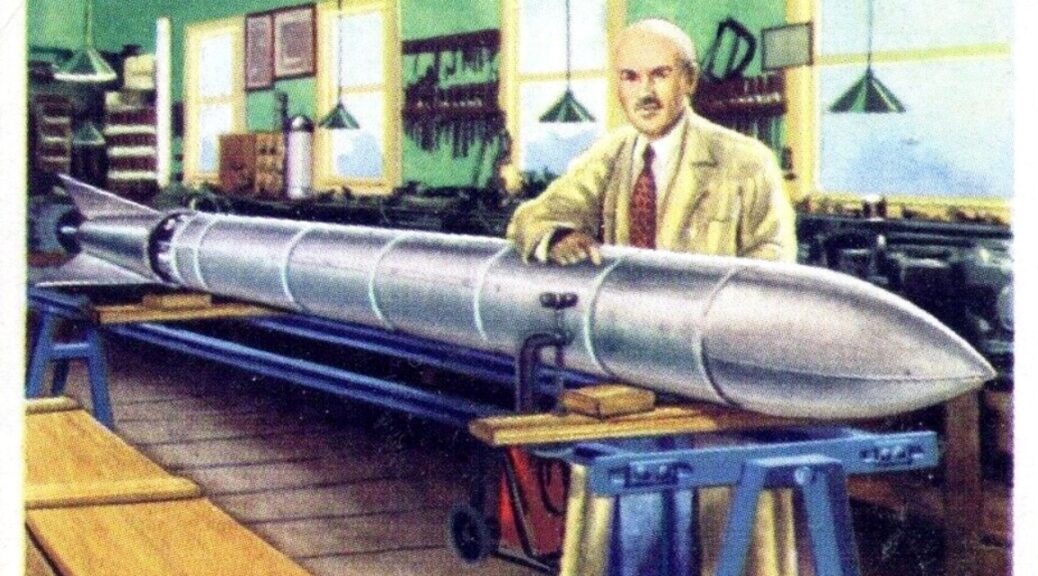
Robert Goddard posing with rocket in workshop (NASA)
Robert Goddard is seen in his workshop in Roswell, New Mexico, in October 1935. (NASA)

In the years before his famous launch, Goddard’s theories that liquid-fueled rockets could operate in space and even reach the moon had drawn ridicule, with some mockingly calling him the “moon man.” The Clark University physics professor was secretive about his research and hid the news of his first successful rocket test.

Goddard’s critics argued that rockets needed air for propulsion and so could not operate in the vacuum of space.

Goddard’s first rocket used gasoline and liquid oxygen for propulsion, according to NASA .

Robert Goddard standing next to rocket inside frame in field (NASA)
Goddard launched the first liquid-fueled rocket on March 16, 1926. (NASA)

While Goddard’s theories made him a controversial figure, they also inspired people to believe in the possibility of space travel, says Michael Neufeld, a retired senior curator at the Smithsonian’s National Air and Space Museum in Washington. The museum holds the largest collection of artifacts from Goddard’s work.

“He does inspire people to assume that space travel is real and the rocket is the way to go,” Neufeld says.

Why Liquid Fuel Was So Innovative

Goddard’s pioneering use of liquid fuel led to more efficient rockets that could lift larger payloads. Notably, the massive Saturn V rocket that took U.S. astronauts to the moon burned liquid fuel.

While the moon landing came years after Goddard’s death, NASA historian Brian Odom says Goddard’s work “proved what we had known in theory to be true in practice … And [that] it could be scalable.”

The launch of NASA’s Apollo 11 mission to the moon led the New York Times, on July 17, 1969, to issue what observers have called , “one of the most famous newspaper corrections in history.”

The paper that once called Goddard’s theories “a severe strain on credulity,” now acknowledged that rockets could operate in the vacuum of space and said, “the Times regrets the error.”

For the Silo,  Charles Hoskinson/Share America.

The Space Fence Safeguard

Space FenceLockheed Martin Space Fence Tracks Over 25,000 Orbiting Objects

Lockheed Martin continues refining its technology solution for Space Fence, a program that revamps the way the U.S. Air Force & U.S. Space Force identifies and tracks objects in space. The U.S. Air Force selected Lockheed Martin in 2015 to build a $USD 914 million / CAD $1.25 billion   Space Fence Radar to Safeguard Space Resources.

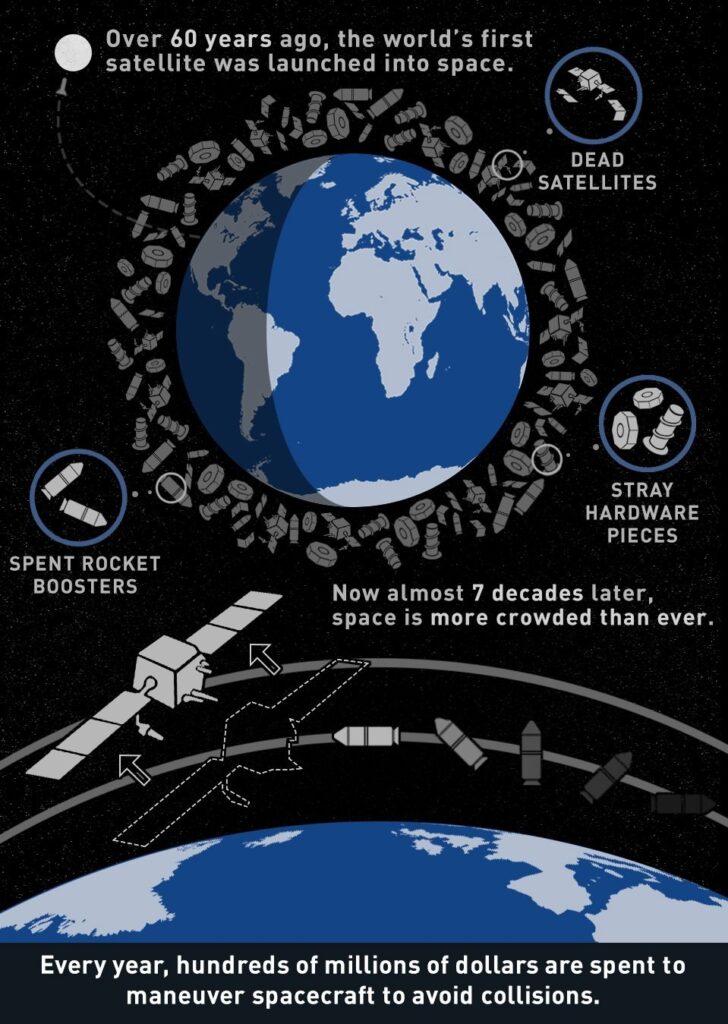
Lockheed Martin’s Space Fence solution, an advanced ground-based radar system, enhances the way the U.S. detects catalogs and measures more than 200,000 orbiting objects and tracks over 25,000 orbiting objects. With better timeliness and improved surveillance coverage, the system protects space assets against potential crashes that can intensify the debris problem in space.

“Space Fence locates and track space objects with more precision than ever before to help the Air Force transform space situational awareness from being reactive to predictive.”

Lockheed Martin delivered up to two advanced S-Band phased array radars for the Space Fence program. The Space Fence radar system greatly improves Space Situational Awareness of the existing Space Surveillance Network.

That's a LOT to track! [CP]
There is a lot to track and growing space debris every year.
Construction of the new Space Fence system on Kwajalein Atoll in the Marshall Islands began in February 2015 to meet the program’s 2018 initial operational capability goal. With more than 400 operational S-band arrays deployed worldwide, Lockheed Martin is a leader in S-band radar operation. The Lockheed Martin led team, which includes General Dynamics and AMEC, has decades of collective experience in space-related programs.

Headquartered in Bethesda, Maryland, Lockheed Martin is a global security and aerospace company that employs approximately 113,000 people worldwide and is principally engaged in the research, design, development, manufacture, integration and sustainment of advanced technology systems, products and services.

On 16 December 2002, US President George W. Bush signed National Security Presidential Directive which outlined a plan to begin deployment of operational ballistic missile defense systems by 2004.

The following day the US formally requested from the UK and Denmark use of facilities in RAF Fylingdales, England and Thule, Greenland respectively, as a part of the NMD Program.

The administration continued to push the program, despite highly publicized but not unexpected trial-and-error technical failures during development and over the objections of some scientists who opposed it. The projected cost of the program for the years 2004 to 2009 was 53 billion US dollars/ 72.2 billion CAD dollars, making it the largest single line in The Pentagon’s budget. For the Silo, George Filer.

Residential Reinvention In North America

Maximizing Property Potential Via Popular Home Expansions 

maxadd1.png

For many homeowners, the need for more space arrives long before the desire to move. Growing families, remote work, multigenerational living, and changing lifestyles are pushing homeowners to rethink how their existing homes can evolve. Home additions have become one of the most practical ways to gain space, improve comfort, and increase property value without starting over in a new location. Yet deciding which type of addition makes sense requires a clear understanding of costs, construction complexity, and long term return on investment.

Across the United States as in Canada, home addition costs vary widely depending on region, labor availability, building codes, and design choices. In America, the average cost of a home addition often exceeds the commonly cited figure of $51,000 usd/ $70,000 cad, especially for projects involving plumbing, structural changes, or second story construction. Per square foot costs typically range from roughly $100 usd/ $137 cad to $500 usd/ $684 cad, depending on the type of addition and level of finish. Understanding these ranges helps homeowners plan realistically and avoid budget shock midway through construction.

A dry addition or a wet addition?  

One of the most important distinctions in home additions is whether a project is considered a dry addition or a wet addition. Dry additions include spaces such as bedrooms, living rooms, offices, or sunrooms that do not require plumbing. These additions are generally less expensive because they avoid water lines, drains, and complex waterproofing requirements. Wet additions include kitchens, bathrooms, and laundry rooms, which add cost due to plumbing work, additional permits, and stricter building code requirements. Knowing which category your project falls into is one of the most reliable ways to estimate overall expense early in the planning process.
maxadd2.png

Room additions, often called bump outs, are among the most approachable projects for homeowners looking to add space without a full-scale renovation. These additions typically extend an existing room by a few feet to create more usable square footage. Nationally, bump outs often cost between $250 usd/ $342 cad and $500 usd/ $685 cad per square foot, depending on size and finish. While smaller in scope, they can dramatically improve daily living by relieving cramped layouts and improving functionality.

Adding a second story

Second story additions represent one of the most transformative but also most expensive home addition options. By building upward rather than outward, homeowners can double their living space without sacrificing yard area. These projects often range from $300 usd/ $410 cad to $500 usd/ $685 cad per square foot and require extensive structural reinforcement. Foundations, load bearing walls, and framing may need upgrades to support the added weight. Plumbing, electrical systems, and roofing are also typically impacted. While the upfront cost is significant, second story additions can deliver substantial long term value, particularly for homeowners committed to staying in place for many years.

Sunrooms offer a different kind of expansion, focusing on light, comfort, and connection to the outdoors. These spaces are often used as family rooms, dining areas, or quiet retreats. Costs typically fall between $200 usd/ $274 cad and $400 usd/ $547 cad per square foot, with total project budgets ranging from $40,000 usd/ $55,000 cad to $90,000 usd/ $123,000 cad or more. Three season sunrooms tend to be less expensive, while fully insulated, climate controlled spaces cost more but offer year round usability. Energy efficiency requirements and insulation quality play a major role in pricing.

maxadd3.png

The most cost effective way to add livable space

Garage conversions are one of the most cost-effective ways to add livable space because they utilize an existing structure. Nationally, these projects often range from $120 to $200 per square foot, with total costs commonly between $20,000 usd/ $27,300 cad and $50,000 usd/ $68,400 cad. Conversions typically involve insulation, drywall, flooring, electrical upgrades, and heating or cooling systems. Adding a bathroom increases both cost and value, but requires plumbing work and additional permits. For homeowners seeking flexibility without major exterior changes, garage conversions often deliver strong value.

Over the garage additions combine vertical expansion with efficient land use. These projects create new living space above an existing garage and commonly cost between $250 usd/ $340 cad and $400 usd/ $550 cad per square foot. Structural reinforcement is often required, and design integration with the main house is critical. When executed well, over the garage additions add bedrooms, guest suites, or home offices without reducing yard space, making them appealing in many suburban and urban settings.

ADU- aka the accessory dwelling unit

Accessory dwelling units have become increasingly popular as homeowners look for rental income opportunities or space for extended family. ADU costs vary widely but often fall between $100,000 usd/ $137,000 cad and $300,000 usd/ $410,400 cad depending on size, design, and site conditions. Well planned ADUs can generate significant returns through rental income while increasing overall property value. In many markets, returns between 50 and 80 percent are possible when long term income and appreciation are considered together.

The most complex home improvement

maxadd4.png

Kitchen expansions and additions are among the most complex home improvement projects. Building a new kitchen or expanding an existing one typically ranges from $50,000 usd/ $68,400 cad to $150,000 usd/ $205,200 cad or more. These projects involve plumbing, gas lines, electrical systems, ventilation, and often structural changes. High quality finishes, appliances, and cabinetry can significantly increase costs, but kitchens consistently rank among the highest value improvements for resale.

Expensive to be sure

Bathroom additions and expansions also carry meaningful costs but deliver strong returns. Adding a new bathroom often ranges from $30,000 usd/ $41,000 cad to $75,000 usd / $102,600 caddepending on size and plumbing complexity. Expanding an existing bathroom typically costs less but still requires careful planning around waterproofing, ventilation, and fixture selection. Bathrooms add both daily convenience and resale appeal, particularly in homes with limited existing bath space.

What type of addition should you choose?

Choosing the right type of home addition requires balancing personal lifestyle needs with financial considerations. Homeowners should assess how they use their space today, how that use may change in the future, and which additions offer the greatest functional improvement. Equally important is considering how future buyers might perceive the added space. Additions that align with common buyer preferences tend to deliver stronger returns.

maxadd5.png

Successful home additions are built on careful planning. Hidden costs such as permit fees, utility upgrades, and structural repairs can emerge once construction begins. Understanding local building requirements, maintaining detailed budgets, and setting aside contingency funds are critical steps. Consulting experienced professionals early in the process helps homeowners avoid delays, unexpected expenses, and design mistakes that can be costly to correct later.

It’s not just about square footage

Ultimately, home additions are not just about adding square footage. They are about adapting a home to better serve the people who live there. When thoughtfully planned, an addition can improve daily life, increase long term property value, and allow homeowners to remain in communities they love. With clear expectations, realistic budgets, and informed decision making, home additions can be one of the most rewarding investments a homeowner makes. For the Silo, Jon Grishpul/ Greatbuildz.com.

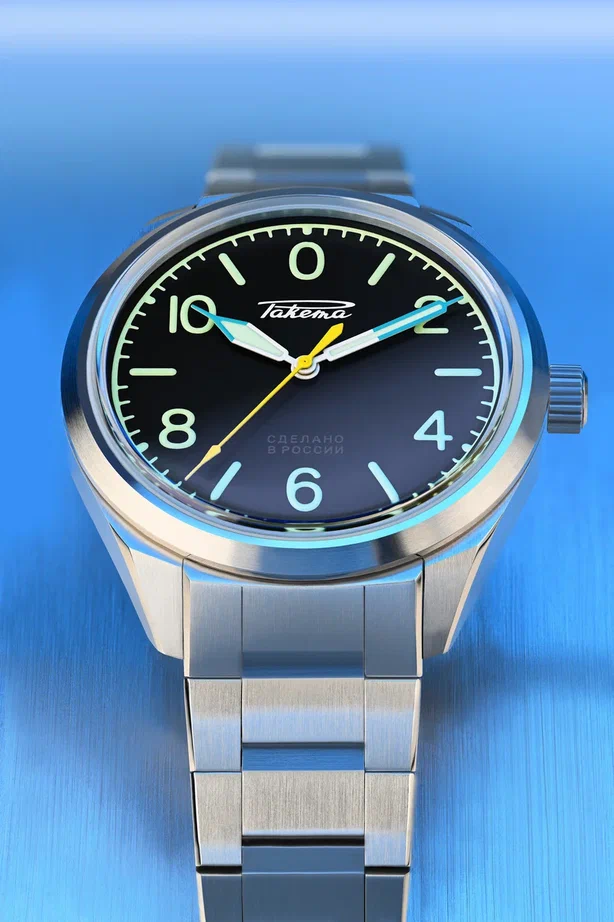
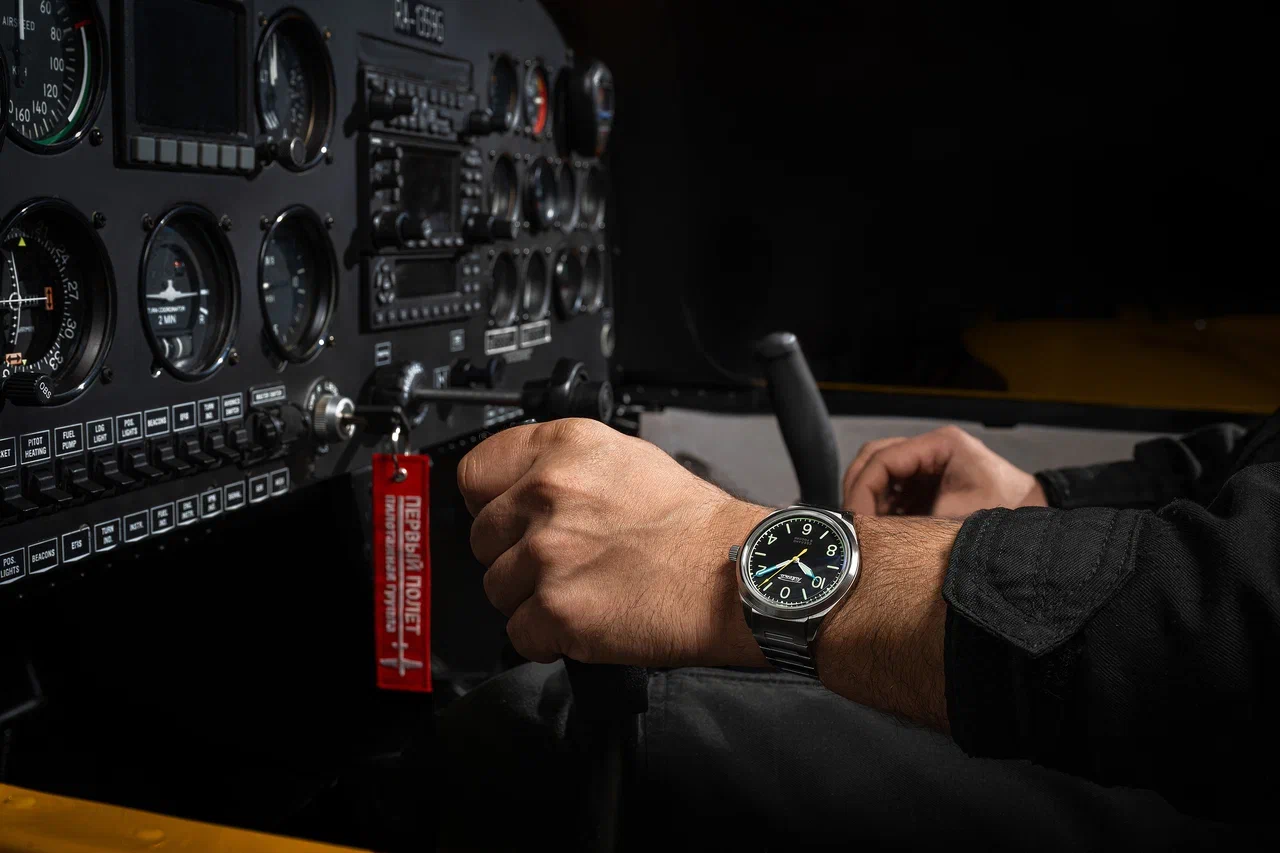
Raketa “Russian Code Qatar Edition” Counterclockwise Wristwatch

In the beat of the Universe

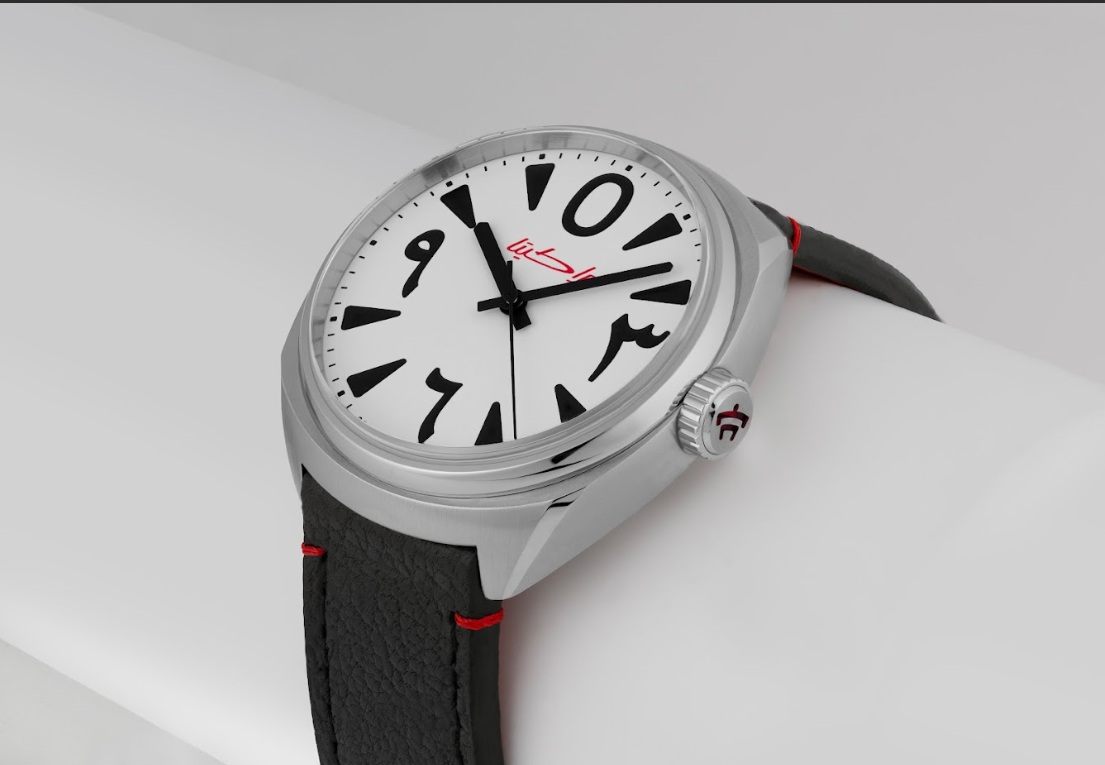
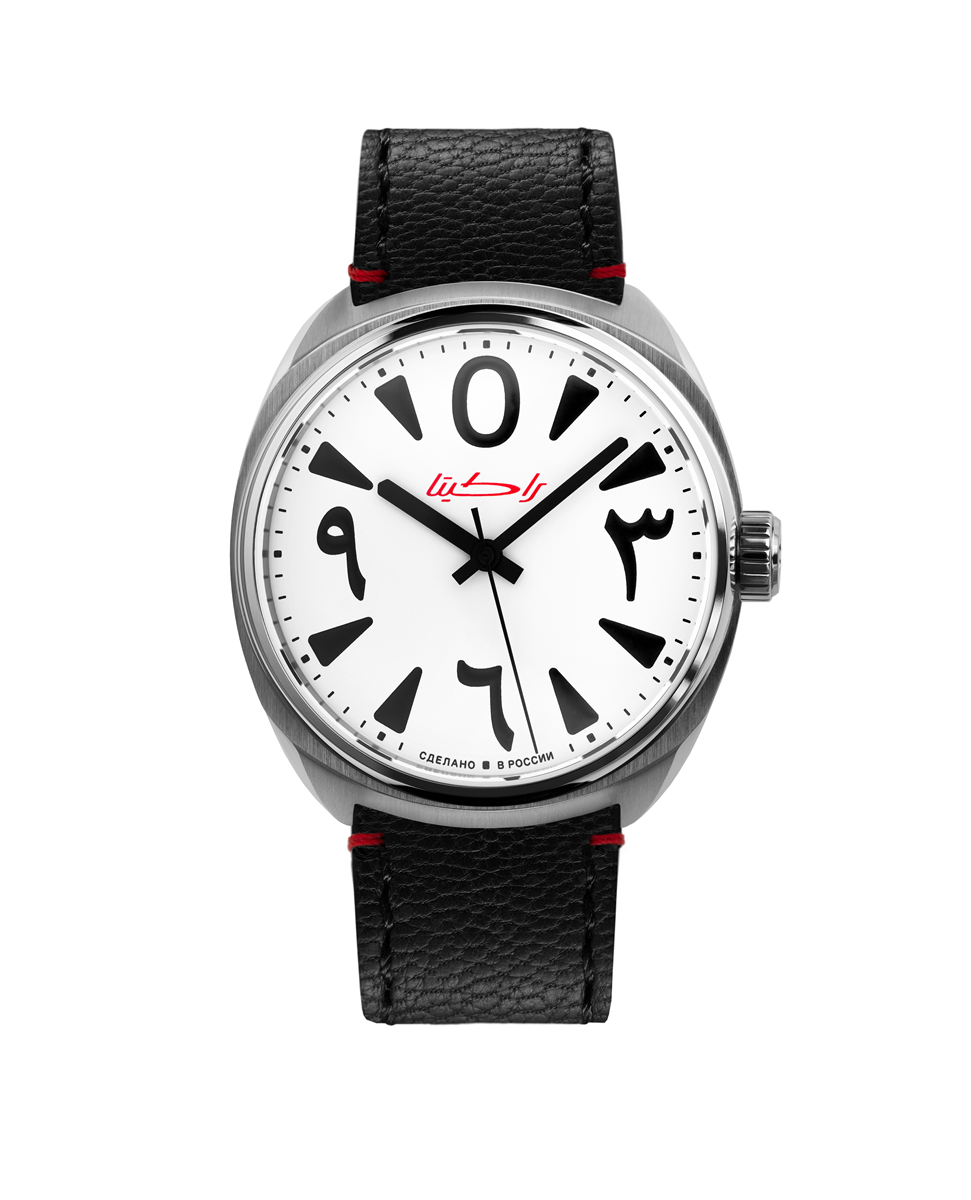
The “Russian Code”, one of Raketa’s most emblematic models with a counterclockwise movement, is now launched in a version that dedicated to the all cities and countries where Raketa is present in the world. The first exclusive edition of 50 numbered watches is dedicated to Qatar where Raketa is represented by the prestigious retail store “Blue Salon”. 

The Raketa brand (meaning “space rocket” in Russian) was created in 1961 in honour of the first manned spaceflight by the Soviet cosmonaut Yuri Gagarin. For 65 years, the Raketa Watch Factory has been accompanying space exploration by engineering watches for cosmonauts and drawing continual inspiration from the space. In 2026, the brand will mark this anniversary date with a collection of exclusive space‑themed watch models and collaborations.

The beautiful three-layered dial of the Raketa “Russian Code – Qatar Edition” displays the night sky that was over Qatar on the day it received its independence — September 3, 1971. Depending on the lighting, the blue disk structure emits bright rays of light, bringing to life the constellations printed on the dial.

Behind the elegant design lies the revolutionary concept that time should move in harmony with the natural counterclockwise movement of the planets in our Solar System. Therefore, just like the planets around the Sun, the hands of this model rotate in a counterclockwise direction around the dial. To emphasize this idea, a red circle symbolizing a planet at the tip of the second hand, moves counterclockwise above the applied blue coated numerals. 

This edition limited to 50 pieces is available:

▸ In Russia: exclusively in all of Raketa’s channels of sales (online and offline stores) in very limited quantities.
▸ Outside Russia: exclusively at Raketa’s partner and the leading luxury brand store in Qatar: Blue Salon.

Blue Salon

Suhaim Bin Hamad Street, Doha

Email for ordering information: [email protected] 

Specifications

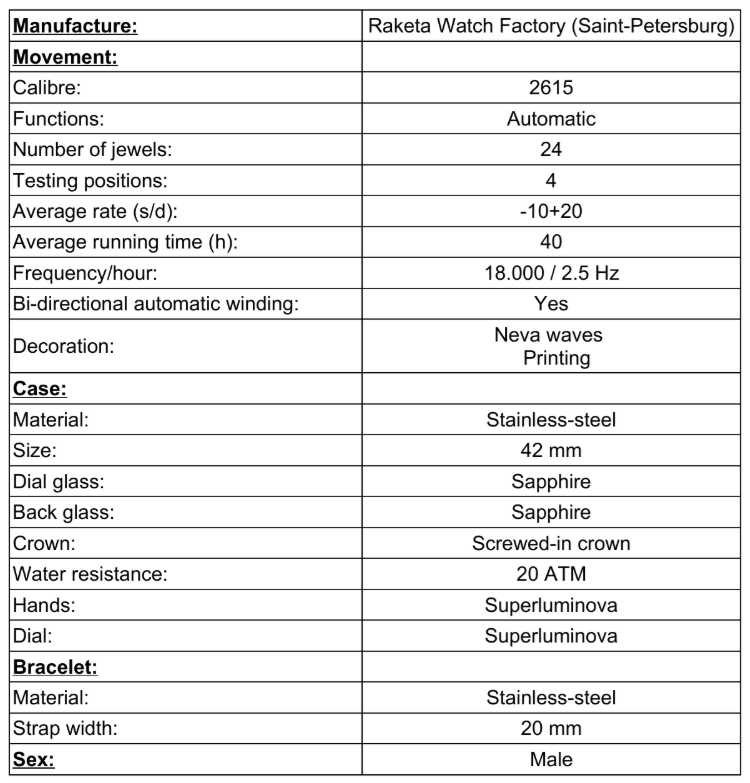
Factory:Raketa Watch Factory (Saint-Petersburg)
Movement: 
Calibre:2615 CR
Functions:Automatic with reverse direction of hands
Number of jewels:24
Testing positions:4
Average rate (s/d):-10+20
Average running time (h):40
Frequency/hour:18.000 / 2.5Hz
Bi-directional automatic winding:Yes
Stopper of self-winding unit activated during manual winding:Yes
Decoration:Nanocoating
Neva waves
Print
Case: 
Material:Stainless steel
Diameter:39,5 mm
Front glass:Sapphire 
Back glass:Mineral 
Crown:Synthetic ruby stone ​​inside the crown
Water resistance:5 ATM
Hands:Superluminova
Strap/bracelet: 
Material:Genuine leather 
Width:22 mm
Sex:Unisex

For the Silo, Jarrod Barker.

Clothes From The Future Available Now

Vollebak Logo
Part spaceship, part shop, the first Vollebak Spaceshop launched in Copenhagen in June. Before it heads off to service nearby galaxies, our friends at Vollebak are sending it on a world tour of Earth first.
Spaceshop World Tour | vollebak.com
Over the last year our friends at Volleback have partnered with sonic powerhouse Bang & Olufsen and Saga Space Architects to build their first prototype interstellar delivery vehicle …the Vollebak Spaceshop.

The craft itself is over 1,000kg of precision engineering that offers a glimpse into a future of interplanetary kit deliveries between Earth, the Moon and Mars. It was designed with SAGA Space Architects whose work includes lunar habitats for the European Space Agency, and lighting systems to help astronauts sleep on the International Space Station. And it’s fitted with Bang & Olufsen’s iconic Beolab 5 and Beosound 2 speakers.

If you missed launch night it involved space-based clothing, Earth-based alcohol, and the sound of the Spaceshop flexing its 120 decibels of muscle with ‘Intergalactic’ by the Beastie Boys. As soon as the next destination has been selected they’ll let you know. And while you’re waiting they have 4 pieces of space-ready cargo available for testing.

It includes their Martian Aerogel Jackets which are built from the Jet Propulsion Laboratory’s hypersonic deep space parachutes that landed the last Rover on Mars – and the same aerogel that stopped it freezing in the vacuum of space, and burning up on entry. They have their awesome Full Metal Jackets engineered from 11 kilometres of disease-resistant copper that were hailed by WIRED as “the virus-killing coat of the future,” and they’ve built to explore how humans could avoid taking diseases from Earth up into space.

You’ll also find electromagnetic Shielding Suits embedded with pure silver that block WiFi, Bluetooth, Ku-band satellites and radar systems, and deflect mid and long wave infrared radiation so they can’t be seen on infrared cameras. And last up they have the world’s first Anodised Jacket. Built with metallic insulation originally engineered by NASA to stop their spacecraft freezing in space, each jacket is fused with a near-invisible layer of metal from a galvanic bath that makes you appear cold or even invisible to infrared cameras.
Spaceshop World Tour | vollebak.com

European Lunar Rover Mona Luna Completes First Driving Tests

MONA LUNA at Luna · Design: Sacha Lakic ©Venturi Space/Romero
Toulouse, December 2025 — Five months after being unveiled at the Paris Air Show, the European lunar rover MONA LUNA has successfully completed a test campaign at the European Space Agency’s (ESA) LUNA centre in Cologne, Germany. A key outcome: the vehicle shows remarkable adaptability to loose soil, slopes, and obstacles.

The first outing of the European lunar rover MONA LUNA reflects the collective work of Venturi Space’s three sites. Monaco, Switzerland and France worked hand‑in‑hand to design, develop, assemble and test the rover.

Weighing 750 kg (extendable to 1,000 kg), MONA LUNA will serve two primary objectives: to explore the lunar surface and to test critical technologies for sustainable lunar mobility. Thanks to its four wheel‑drive and four‑wheel steering system, along with passive‑damping suspension, MONA LUNA climbed and descended slopes of up to 33 degrees, exceeding initial expectations. The first results confirm the rover’s potential: The contact area of the hyper‑deformable wheels is exceptional, both on loose soil and rolling terrain.

This confirms the findings of intensive tests carried out at NASA between 2022 and 2025,Traction exceeds forecasts, Large rocky obstacles are crossed effortlessly, Dynamic stability on slopes meets programme requirements, The onboard electronic systems demonstrated excellent operational performance. Designed to support the ambitions of the European Space Agency (ESA) and France’s Centre National d’Études Spatiales (CNES), MONA LUNA already incorporates technologies that will operate on the Moon next summer — but on board another rover: FLIP. This vehicle will be equipped with the same hyper‑deformable wheels, batteries, heating systems and temperature sensors as the European rover. FLIP is developed by the North American company Venturi Astrolab, Venturi Space’s strategic partner. FLIP will also benefit from another innovative technology developed by Venturi Space: the mechanical system enabling the rover to exit the lunar lander.

Another shared feature between MONA LUNA and FLIP is their bodywork, designed by Sacha Lakic.In parallel with the MONA LUNA development programme, Venturi Space continues to expand its industrial ecosystem and will lay the first stone of its flagship facility next spring: a site of more than 10,000 m² in Toulouse, just steps away from the Centre National d’Études Spatiales (CNES). It is here that, in the first half of 2028, 150 engineers will work on the design and manufacturing of MONA LUNA, in close collaboration with the Swiss and Monegasque entities responsible for the hyper‑deformable wheels, heating systems, cryogenic materials, the rover‑lander egress system, and the high‑performance batteries.

Quotes
Daniel Neuenschwander, Director of Human and Robotic Exploration at the ESA:
“I was truly impressed by the way MONA LUNA handled LUNA’s challenging terrain. Watching its wheels deform and adapt to the regolith, slopes and rocks… it is remarkable. If MONA LUNA were to be selected for one of our missions, it would be a tremendous opportunity for Europe.”

Gildo Pastor, President of Venturi Space:
“Seeing MONA LUNA operate on the legendary LUNA site is a profound source of pride. This rover demonstrates the performance of our wheels, our suspension systems, our electronics… and therefore the quality of the work achieved by all our teams in Toulouse, Monaco and Switzerland. We know we have only completed 1% of the journey that, I hope, will take us to the Moon.”

Dr. Antonio Delfino, Director of Space Affairs at Venturi Space:
“These driving tests were primarily dedicated to locomotion. We wanted to understand how MONA LUNA behaves on loose soil, on slopes and when facing significant obstacles. The results exceed our expectations. The ability of these wheels to ‘float’ on the surface is essential to avoid becoming bogged down in lunar regolith.”

For the Silo, Jarrod Barker.

These Award Winning Tiny Homes Draw Attention As Sector Gains

The tiny home sector is big on innovation as exemplified by a new crop of amazing Accessory Dwelling Unit (ADU) designs across the U.S. and Canada showcasing state-of-the-art architectural and interior features, thoughtful layouts and stunning aesthetics that redefine what’s possible in small-space living. Maxable—North America’s leading  provider of resources for building guest houses, casitas, in-law suites, granny flats, pool houses and other ADUs—has officially named the the #1 best ADU of 2025 and other of the ’10 Best’ for the year based on a mix of criteria: visual appeal, use of space, creativity and functionality. Multiple photos for each are showcased online demonstrating the extreme ingenuity of each build.

Every year, Maxable’s ‘Best ADU of the Year’ competition celebrates the most innovative and impressive tiny home projects from across North America. Accessory dwelling units (ADUs) that don’t just look great, but solve real challenges of space, budget, and lifestyle. And the Top 10 have just been named! “If there’s one thing we’ve learned this year, it’s that accessory dwelling units ADUs aren’t going anywhere,” says Maxable CEO Paul Dashevsky. “In fact, they’re chugging along at full force as new regulations make their mark, homeowners are letting their creativity bloom, and designers are pushing the limits of what’s possible in small-space living.”

Here is the #1 winner and other of the top 10 best ADUs that have earned their keys in 2025.
______________________________________________________


#1 Best ADU of 2025:

Ashby ADU, Piedmont, CA

Designer: Tuan Le Design

Builder: Atelier19AD6

Size: 800 sq ft, 2 bed, 1 bath

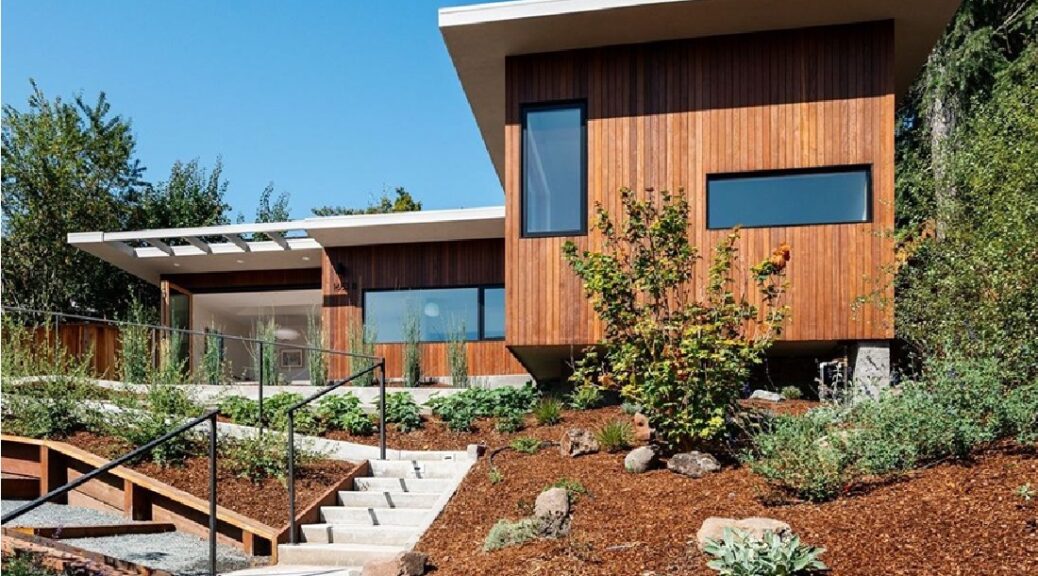
Built on a steep slope, the project faced challenges with utility coordination, subcontractors, supply chain delays, and neighbor considerations, yet the team navigated every obstacle to deliver a standout result. The unit is fully electric, with a heat pump, water heater, and solar panels, making it efficient and environmentally conscious. Skylights and floor-to-ceiling four-panel sliding glass doors fill the interior with natural light, creating a bright, airy atmosphere. The modern design continues on the exterior with sleek wood paneling that complements the contemporary interior. The result is a stylish, functional ADU that maximizes both the views and the livable space

 
Other Top 10 Best ADUs of 2025


Chamomile Cottage, Arlington, MA

1-adu.jpg

Modular Design and Build: Backyard ADUs

Size: 567 sq ft, 1 bed, 1 bath

If a cozy cup of tea was an ADU, we think it’d look like this! Designed to bring an aging father closer to his family and young grandchildren, this modular build balances warmth, accessibility, and beautiful design. As one of the first detached ADUs completed under Massachusetts’ new ADU law, it also marks a milestone for backyard living in the state. Built with collaboration between Backyard ADUs and a homeowner with impeccable design taste, the result is both functional and heartfelt. Chevron wood flooring, warm olive walls, and a charming fireplace make the space feel like home from the moment you step inside. Skylights fill the rooms with natural light, while the ADA-compliant bathroom ensures comfort and safety for years to come.

Alora ADU, San Diego, CA

2-adu.jpg

Designer: Ruland Design Group

Builder: Glann Fick, Coastline Construction

Size: 1,000 sq ft, 2 bed, 2 bath duplex

This project is a beautiful example of how ADUs can bring generations together while adding long-term value to a property. The homeowners created not one, but two attached backyard homes. One was designed for an aging mother, and the other for rental income to support the family. Together, the units make space for four generations to stay close while still maintaining privacy and independence. Both ADUs were designed with light, openness, and connection to the outdoors in mind. High ceilings and clerestory windows fill the interiors with natural light, while large sliding glass doors open to private patios for easy indoor-outdoor living. Each space feels modern and welcoming, complete with well-appointed kitchens and roomy islands perfect for family meals or morning coffee. It’s a true example of multigenerational living done right.

Copperline ADU, San Diego, CA

3-adu.jpg

Designer and Builder: SnapADU

Size: 980 sq ft, 2 bed, 2 bath

This Spanish-style ADU in Rancho Santa Fe was designed to blend seamlessly with the community’s strict architectural standards. The homeowner, a roofing contractor, personally installed the boosted tile roof to match the main home, turning HOA requirements into an opportunity to create a timeless retreat. Today, the ADU serves as a private space for family and guests. Every element, from hand-textured stucco to arched porch openings and copper gutters, was carefully chosen to mirror the primary residence. Inside, faux wood ceiling beams add warmth to the great room, while custom shelving and professional-grade appliances enhance the kitchen. Each bedroom features an ensuite bath and walk-in closet, with a back entrance leading to a mudroom and laundry area.

Brick House ADU, Denver, CO

4-adu.jpg

Designer and Builder: ADU4U

Size: 938 sq ft, 1 bed, 1.5 bath

This ADU project breathes new life into an old, historic building, while preserving its authentic character and respecting its roots. Building a modern structure within an 138 year old structure was an innovative solution to achieve this. In historic Curtis Park, Denver’s oldest neighborhood, an 1886 brick carriage house stands as a testament to the passage of time. The building sits inside the boundaries of Denver’s historic Curtis Park, so all exterior design and material selections had to be approved through the city’s Landmark Commission.

ADU4U turned this once-unlivable structure into a cozy, modern home while preserving its historic charm. To bring it up to today’s safety standards, the team strengthened the old brick with a new steel frame and carefully reused original materials throughout the interior. The hayloft door became the powder room door, and the old floor joists were turned into a beautiful kitchen peninsula. Now, this light-filled ADU perfectly balances historic character with modern comfort. It’s truly a shining example of how old buildings can be reimagined for today’s living.

Longview ADU, Washington D.C.

5-adu.jpg

Designer: Ileana Schinder

Builder: J Cabido Designs

This project is a creative transformation of an abandoned garage and storage space into a bright and efficient one-bedroom ADU. By keeping the original structure’s footprint, the design team minimized both construction costs and the visual impact on the surrounding property. Every detail was planned with sustainability in mind. From upgraded insulation to energy-efficient mini splits and an energy recovery ventilator, the ADU meets Washington DC’s strict environmental standards while maintaining year-round comfort. Restoring the building’s existing openings allowed natural light to flood the interior, creating a warm and inviting space that feels much larger than its footprint. The result is a thoughtful blend of preservation, sustainability, and smart design, breathing new life into what was once an overlooked structure.

Sagebrush ADU, Menlo Park, CA

6-adu.jpg

Designer: Inspired ADUs

Builder: Integrum Construction

This ADU is a masterclass in craftsmanship and timeless design. Every detail, from the cedar shake siding to the copper flashings, was carefully chosen to mirror the main home and create a seamless, cohesive look. Instead of competing with the original architecture, it enhances it, feeling like it has always been part of the property. Natural materials play a starring role here. The cedar and copper will continue to age beautifully, adding warmth and character over time. Inside, handmade tile, custom cabinetry, and a cozy loft make the space feel elevated yet inviting. Every inch was designed with intention, balancing function, beauty, and authenticity. This ADU proves that small-scale construction can be both refined and enduring.

Brushstroke ADU, Newcastle, CA

8-adu.jpg

Designer and Builder: A+ Construction ADU Builders

Size: 1,198 sq ft + 800 sq ft deck, 3 bed, 2 baths

The client didn’t want to separate three generations of their family, so they built a second home in their backyard. This ADU allows their parents to live independently with their own routines and art studio, while staying just steps from family dinners, grandkid hugs, and everyday life together. At 1,200 sq. ft., the ADU includes three bedrooms, two bathrooms, and a large open living area. The layout prioritizes comfort, easy movement, and aging-in-place, with wide circulation paths, direct deck access from the primary bedroom, and plenty of natural light. A dedicated art studio with custom cabinetry and large windows supports the grandmother’s creative routine. The best feature? An 800 sq. ft. covered deck and carefully chosen exterior finishes. All of these details make the ADU feel integrated with the main home, creating a thoughtful, functional, and long-term living space for the whole family.

Alcove ADU, Los Angeles, CA

9-adu.jpg

Designer: Homeowner

Builder: Doobek Brothers

Size: 593 sq ft, 1 bed, 1 bath

What started as a retrofit for a carport turned into a fully functional ADU, making smart use of limited space while navigating strict city codes. Because the property sits on a hillside, any addition beyond the existing roofline would have required expensive drainage to the street, so the design works entirely within the original footprint. The interior feels calm and spacious thanks to thoughtful layout, finishes, and furniture. A double wall between the kitchen and bathroom cleverly hides appliances while providing storage for cleaning supplies, making the space feel open and uncluttered. Temperature and sound insulation reduce energy costs for both units, making it highly efficient. Windows were sized to align with the upstairs unit, creating visual harmony. With parking right outside and a potential deck planned for the upper unit, this ADU demonstrates how careful design can turn code restrictions into a livable home.

Elevare ADU, San Diego, CA

10-adu.jpg

Designer: Sergio Perlata

Builder: HM Construction

Size: 479 sq ft, 1 bed, 1 bath

This daring ADU was built on top of the homeowner’s existing house to preserve the garage while creating a luxurious, functional space. What started as a bold idea and labor of love resulted in a retreat that balances comfort, style, and modern California living. The design maximizes natural light, features high-end finishes, and offers seamless indoor-outdoor flow. Privacy for the main house was carefully considered, and practical choices like spa-like micro-cement in the bathroom create a durable, low-maintenance, and rental-friendly space. More than just a guest house, this ADU is a thoughtfully crafted space that inspires relaxation and connection.

For the Silo, Jarrod Barker.

Supplemental- ANC Brantford, Ontario, Canada
Canada Is One Of World Economic Forum Top Technology Pioneers

From electro-chromatic e-windows to using supernova explosions to explore the earth for mineral deposits: World Economic Forum 2025 Technology Pioneers Leading New Wave of Global Innovation

  • The World Economic Forum selects 100 start-ups from 28 countries to join its Technology Pioneers community.
  • The new cohort marks a global surge of emerging technologies, from smart robotics and spatial AI to flying taxis and scalable quantum solutions.
  • Now in its 25th year, the community has recognized over 1,200 start-ups that have gone on to transform industries and societies worldwide.
  • For more information on the Annual Meeting of the New Champions 2025, visit wef.ch/amnc25 and share on social media using the hashtag #amnc25, or #2025夏季达沃斯#. Read more about the 2025 Technology Pioneers here.

Geneva, Switzerland, 2025 – The World Economic Forum 2025 Technology Pioneers community is a group of 100 early-stage companies from 28 countries driving innovation across industries and borders. Now in its 25th year, the program celebrates its strongest cohort yet, marked by broader geographical representation, greater diversity beyond Silicon Valley and the rise of more ambitious frontier technologies.

Reflecting wider shifts in the innovation landscape, many of the companies spotlighted are using artificial intelligence (AI) to reach greater scale and sophistication with fewer resources. Several are venturing into less explored frontiers – from asteroid mining and flying electric taxis, to leveraging satellite imagery to transform agriculture and harnessing energy from supernova explosions to locate critical minerals beneath the Earth’s surface.

The geography of innovation is also evolving.

While the United States remains the top contributor to the community, Europe’s share has surged to 28% – up from 20% last year – reflecting the rise of strong tech ecosystems across the region. China and India are also emerging as major tech innovation hubs.

“There has never been a more exciting time to dive headfirst into tech innovation. But no one gets far alone – you need a community to move your mission forward,” said Verena Kuhn, Head of Innovator Communities, World Economic Forum. “As we mark 25 years of the Technology Pioneers programme, this global community continues to connect start-ups to the networks and ecosystems they need to scale.”

This year also marks the 25th Anniversary of the Technology Pioneers programme. Since its inception in 2000, the community has championed early-stage innovation and recognized more than 1,200 companies, many of which have gone on to reshape industries worldwide. Alumni include household names such as Google, PayPal, Dropbox and SoundCloud, underscoring the community’s role as a launchpad for ideas and impact.

The 2025 cohort stands out for its concentration of companies developing breakthrough technologies to address pressing global challenges. These include advanced robotics, customisable space launch services, micro nuclear reactors and more accessible quantum computing applications. These pioneers will contribute cutting-edge insights to Forum initiatives over a two-year engagement program and will also be invited to participate in the Annual Meeting of the New Champions 2025, taking place on 24-26 June in Tianjin, People’s Republic of China.

The 2025 Technology Pioneers include:

Australia
•    Cauldron – Commercializing advanced continuous fermentation technology to unlock price parity for mainstream bio-manufactured goods.

Brazil
•    Brain4care – Using AI-based technology to enable timely medical interventions for patients with neurological conditions.

Canada


•    Ideon Technologies – Harnessing the energy from supernova explosions in space to image deep beneath the Earth’s surface, transforming how mining companies recover critical minerals.
•    Miru – Developing dynamic electrochromic windows that deliver high functionality, experience and energy efficiency for the automotive, transportation and architectural sectors.

Greater China
•    Deep Principle – Integrating advanced AI models and quantum chemistry to accelerate the discovery and development of chemical materials.
•    GS Biomats – Developing furan bio-based material, a renewable alternative to petroleum-based chemicals, for various uses including biomedical applications.
•    HiNa Battery – Producing more sustainable, high-performance, low-cost sodium-ion batteries.
•    KaiOS – Providing affordable internet and access to financial services to unserved populations, primarily in South Asia and Africa.
•    Lightstandard – Making large language model computing faster and more energy-efficient with photonic computing.
•    Noematrix – Focusing on researching and developing embodied intelligence systems and related tools and platforms, which are compatible with diverse hardware.
•    Novlead – Designing a molecular technology platform providing available, accessible and affordable nitric oxide solutions for major clinical needs.
•    Shengshu Technology – Building generative AI infrastructure that develops native multi-modal large models such as images, 3D and video. 
•    TRANSTREAMS – Engineering chips and solutions to address the computing power shortages in China during the era of AI-generated content.
•    Turing – Providing cutting-edge computing infrastructure and comprehensive AI solutions to drive the future of intelligent computing.

Colombia
•    Plurall – Supporting early-stage entrepreneurs in emerging markets with fast, accessible working capital and digital payment solutions, leveraging AI models for risk assessment, collections and embedded lending.

Denmark
•    Arcadia eFuels – Developing and deploying technology to produce electro-sustainable aviation and diesel fuels using renewable electricity, seawater, and captured CO2.

Egypt
•    Thndr – Offering a digital investment platform with a range of flexible funding methods and educational resources to empower investors.

France
•    Ascendance Flight Technologies – Decarbonizing aviation with a hybrid electric propulsion system and hybrid vertical take-off and landing (VTOL) aircraft.
•    Beyond Aero – Building the first electric business aircraft powered by hydrogen propulsion, as a sustainable alternative to traditional business jets.

•    CO2 AI – Helping large and complex organizations measure their environmental impact, identify credible levers and decarbonize at scale through AI.
•    Jimmy – Developing a micro nuclear reactor to provide carbon-free, competitive heat for industrial processes.

•    Nabla – Reducing clinician burnout by automating clinical documentation with AI.
•    Orakl Oncology – Creating a biology and AI-powered simulation platform to revolutionize oncology drug development.
•    Phagos – Deploying a sustainable alternative to antibiotics using bacteriophages and AI
•    Quobly – Making scalable, cost-competitive, large-scale quantum computers.
•    Sweetch Energy – Enabling osmotic power generation by harnessing the salinity gradient between freshwater and seawater.

Germany
•    Accure – Providing predictive battery analytics software to enhance safety, optimize performance and extend the lifetime of battery systems.
•    Black Forest Labs – Building generative deep learning models for media, particularly images and videos
•    eleQtron – Developing quantum computers by leveraging trapped-ion technology.
•    Tozero – Pioneering the delivery of recycled lithium in Europe by sustainably recovering critical materials from battery waste.

India
•    Agnikul – Providing affordable and customizable space launch services.
•    CynLr – Building robots with intuitive vision and enabling manufacturers and logistics providers to build fully automated factories.
•    Dezy – Leveraging AI-powered diagnostic technology to build affordable and accessible dental care. 
•    Digantara – Providing crucial operational support to commercial space operators and space surveillance intelligence to global space agencies.
•    Equal – Providing an integrated solution that combines identity verification with consent-driven financial data sharing.
•    Exponent Energy – Making 15-minute rapid charging for electric vehicles affordable and scalable through an innovative battery management system, charging algorithms, thermal management and a charging network.
•    Freight Tiger – Building India’s largest software-enabled freight network to help businesses move goods with full visibility, efficiency and lower costs.
•    GalaxEye – Creating a comprehensive, multi-sensor Earth observation system.
•    SolarSquare – Helping homes switch to solar in India with its full-stack solar panel systems.
•    The ePlane Co. – Developing flying electric taxis designed for intra-city transportation.

Ireland
•    Equal1 – Democratizing quantum computing by leveraging existing semiconductor technologies.

Israel
•    Fermata – Providing computer vision solutions for farmers to reduce crop losses and pesticide use.
•    Illumex – Empowering organizations to run governed and reliable AI agents through unified business data language and to democratize data access to every user.
•    LightSolver – Building a photonic supercomputer by harnessing the power of coupled lasers.
•    NanoSynex – Offering a rapid and accurate diagnostic platform for bacterial resistance.
•    ZutaCore – Developing waterless direct-to-chip liquid cooling for AI and high-performance computing (HPC) data centres.

Italy
•    Arsenale Bioyards – Building new lab-to-production infrastructure enabling fast, low-cost biomanufacturing at an industrial scale.

Japan
•    Sagri – Leveraging satellite data and AI to transform agriculture through land use optimization and sustainability.

Republic of Korea
•    Hylium Industries – Providing safe and innovative liquid hydrogen solutions for carbon-free mobility.
•    NARA Space – Building South Korea’s first microsatellite constellation for methane point source detection. 
•    Robocon – Developing robotics and smart factory solutions for the construction and steel industries.

Luxembourg
•    Tokeny Solutions – Building the compliance infrastructure for digital assets in blockchain and fintech.

Mexico
•    Allie – Creating closed-loop optimization systems for manufacturing that autonomously adjust production parameters in real time.

Nigeria
•    Cybervergent – Providing a platform to automate cybersecurity compliance and risk governance.
•    Sabi – Powering the sourcing and distribution of physical goods and critical commodities in Africa.
•    ThriveAgric – Empowering smallholder farmers across Africa by linking them to finance, data-driven best practices, and access to local and global markets.

Saudi Arabia
•    Intelmatix – Making enterprise AI accessible through industry-specific, context-aware AI agents.

Singapore
•   Manus – Automating a wide range of practical tasks for personal and professional use with a general AI agent.
•    Rize – Decarbonizing rice cultivation in Asia through scalable agricultural innovations.

Spain
•    Crisalion Mobility – Offering sustainable air and ground mobility solutions.
•    INBRAIN Neuroelectronics – Developing brain-computer interfaces to treat neurological disorders.

Sweden
•    Graphmatech – Developing advanced materials infused with graphene to make large-scale industries more innovative and resource efficient.
•    Lovable – Using AI to help users create software and web apps without coding expertise.

Switzerland
•    HAYA Therapeutics – Developing RNA-based medicines to treat heart, lung and tissue diseases.
•    Neural Concept – Accelerating product design through 3D generative engineering and AI.

Uganda
•    Numida – Using credit models and digital underwriting to provide loans to micro businesses.

Ukraine
•    Respeecher – Enabling scalable voice cloning across languages and contexts.

United Kingdom
•    CuspAI – Using frontier AI to accelerate the discovery and development of materials with specific functionalities.
•    Obrizum – Offering personalized digital learning services at scale through an AI-powered platform.
•    Oxford Ionics – Building high-performance quantum computers using trapped-ion technology.

United States
•    Ammobia –Fuelling the world with cost-effective, lower-carbon ammonia production.
•    Archetype AI – Pioneering a new form of Physical AI capable of perceiving, understanding and reasoning about the world through analysing real-time, multimodal sensor data.
•    Arine – Integrating cutting-edge AI, clinical expertise and advanced data analytics to deliver medication-based care interventions at the population level.
•    AstroForge – Making critical minerals more accessible to humanity by mining asteroids.
•    BforeAI – Using behavioural AI to predict and automatically pre-empt malicious campaigns and stop cyberattacks before they occur. 
•    Candidly – Developing an AI-powered platform to help borrowers manage and overcome educational loans.
•    Claryo – Helping warehouse operators maximize operational efficiency by leveraging spatial generative AI.
•    Distyl AI – Enabling enterprises to seamlessly integrate AI agents into operations.
•    Emvolon – Converting methane emissions into carbon-negative fuels for hard-to-abate sectors onsite.
•    Exowatt – Delivers solar power on demand by storing energy and converting it into electricity as needed, helping data centres and the grid run on clean energy 24/7.
•    Foundation Alloy – Commercializing solid-state metals technology to make higher performance metals using less energy.
•    HAIQU – Developing a new application execution stack for all modalities of near-term quantum computers.
•    Hertha Metals – Developing technology to decarbonize primary steel production.
•    Hyfe – “Turns food processing waste into chemicals that replace petroleum in everyday goods”.
•    Lumu Technologies – Providing cybersecurity operations capabilities to help businesses control the impact of cybercrime.
•    One Bio – Using biotechnology to add anti-inflammatory plant-based fibres to everyday foods.
•    Oberon Fuels – Developing innovative carbon-neutral fuels for maritime, propane, and hydrogen sectors.
•    Osmo – Combining frontier AI and olfactory science to digitize scent and enhance well-being.
•    Outtake – Securing digital identities by detecting and removing harmful AI-generated content.
•    Parallel Learning – Providing licensed therapy and instruction to students with learning differences through a digital platform.
•    Pavilion – Increasing efficiency in US public procurement with an AI-enabled government marketplace.
•    Reality Defender – Offering multimodal detection of AI-generated media to prevent fraud and disinformation.
•    RoboForce – Building AI-powered robotic systems designed for high-risk or repetitive work, to enhance efficiency, productivity and safety across industries.
•    Rubi Laboratories – Using biocatalysis to transform CO2 into essential materials like cellulose.
•    Shiru – Leveraging AI to identify and develop naturally occurring functional ingredients.
•    Starcloud – Constructing data centres in space to solve the AI energy challenge.
•    Waterplan – Delivering an AI-powered platform to measure, manage and mitigate water risk.
•    Workera – Providing AI-driven workforce skills intelligence and upskilling pathways.
•    Workhelix – Helping companies identify AI transformation opportunities and measure return on investment.

Uruguay
•    Prometeo – Creating a single, borderless banking application programming interface to connect companies with financial institutions across the Americas.

About the Annual Meeting of the New Champions 2025
The 16th Annual Meeting of the New Champions will take place from 24 to 26 June 2025 in Tianjin, People’s Republic of China, under the theme “Entrepreneurship for a New Era.” The meeting will convene over 1,700 leaders from business, government, civil society, academia, international organizations, innovation and media to explore entrepreneurial solutions to global challenges.

About the Technology Pioneers
Launched in 2000, the Technology Pioneers community marks its 25th anniversary in 2025 as a leading platform for early-stage companies from around the world that are shaping the future through breakthrough technologies and innovations. These companies are selected for their potential to have a significant impact on business and society and are invited to engage with public and private sector leaders through the World Economic Forum’s global platform.

The Technology Pioneers community is part of the Innovator Communities within the Forum’s Centre for the Fourth Industrial Revolution. The Innovator Communities convene the world’s leading global start-ups across different growth stages from early-stage Technology Pioneers to growth-stage Global Innovators and unicorn companies valued at more than $1 billion usd/ $ 1.373 billion cad.

10 Coolest Porsche Headlights- Don’t You Agree?

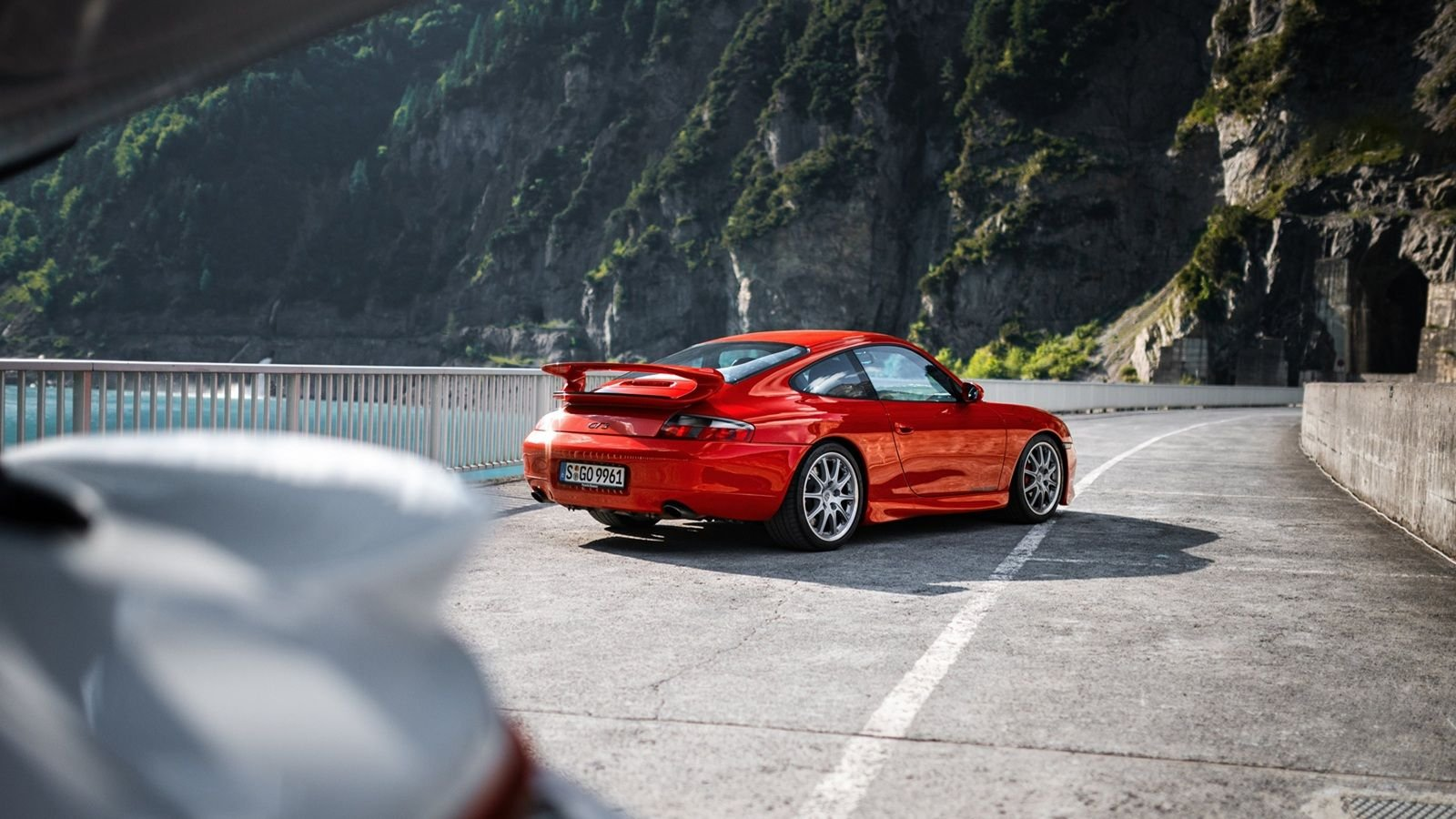
10. Porsche 911 (996, 1998–2004) — The Controversial “Fried Egg” Design

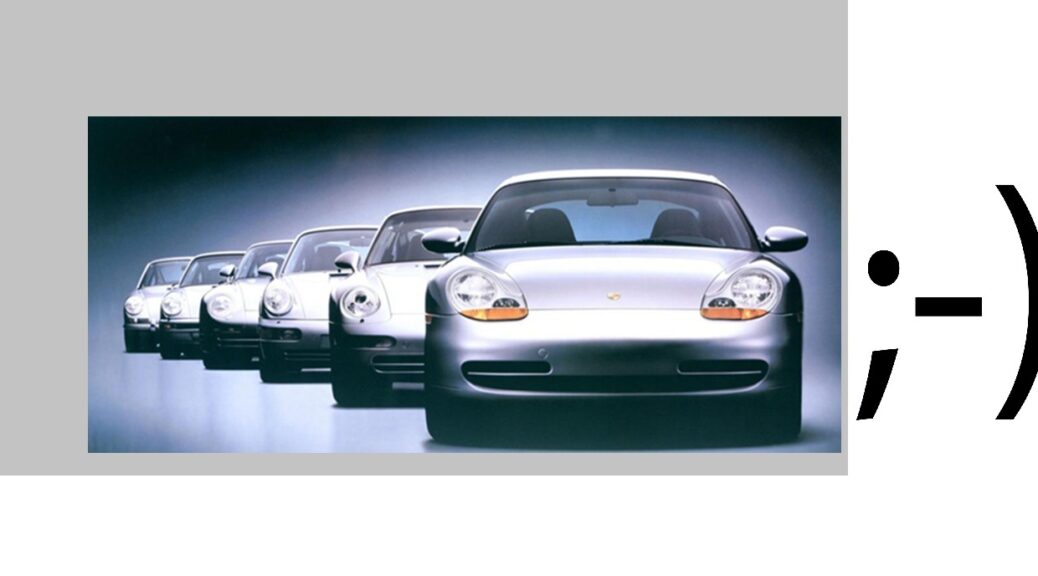
Initially divisive, the 996’s integrated headlamp clusters (combining main, high, and indicator lights under one cover) represented Porsche’s first major step into modern production efficiency. The “Fried Egg headlight” design was so controversial that when introduced, many car purchasers (especially those owning the first generation Porsche Boxster 986) modified the headlights with window tint to “hide the yolk”!

Regardless of how acceptance was split, the design was sensible and borrowed from the 911 GT1 race car, this setup improved aerodynamics and manufacturing simplicity. Over time, enthusiasts have come to appreciate its boldness, and we’re going as far as naming it in our top 10 list of the coolest Porsche headlights ever!

9. Porsche 911 RSR (2017–Present) — The Perfect Fusion of Heritage and Function

The 911 RSR’s headlights combine classic round symmetry with cutting-edge LED tech and aerodynamic sculpting. The signature four-point LEDs maintain Porsche’s unmistakable night-time identity. In endurance racing, where function dominates, the RSR’s lights prove that beauty and performance can coexist perfectly.

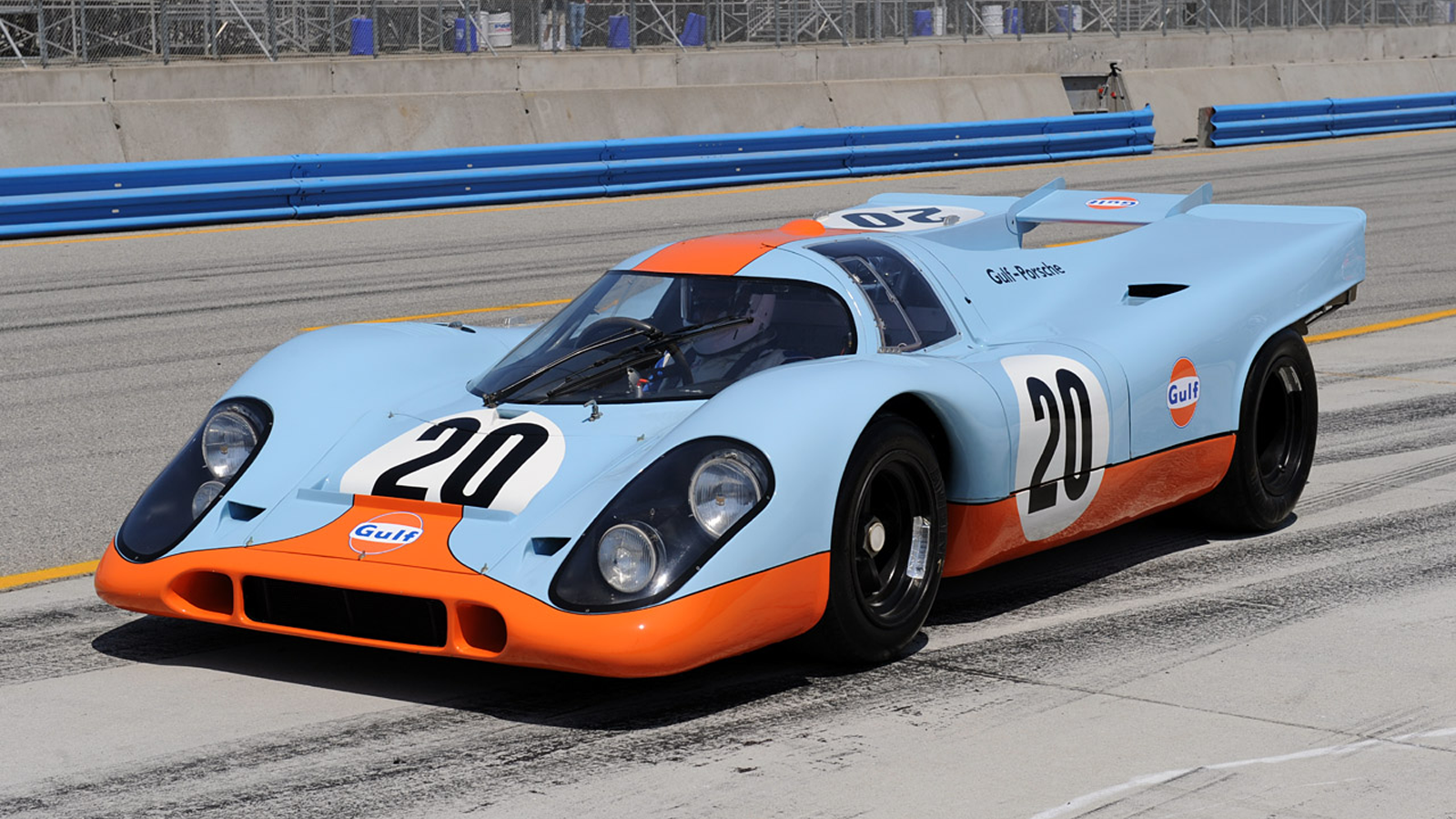
8. Porsche 917K (1970) — Racing Eyes Built for Le Mans

The 917K’s headlights weren’t just for show; they were shaped by necessity. With their low, wide fairings and Plexiglas covers, the lights became a critical aerodynamic component at speeds exceeding 220 mph. Their integrated look and teardrop housing gave the car a menacing, purposeful face that influenced Porsche’s endurance racers for decades.

7. Porsche 918 Spyder (2013–2015) — Laser Precision and Modern Drama

A leap into the hybrid era, the 918 Spyder’s four-point LED headlights introduced a motif that defined Porsche design for the next decade. Their sharp-edged housings and distinctive daytime running light pattern made them unmistakable, even in the dark. They also pioneered Porsche’s adaptive light technology, blending form, function, and digital precision.

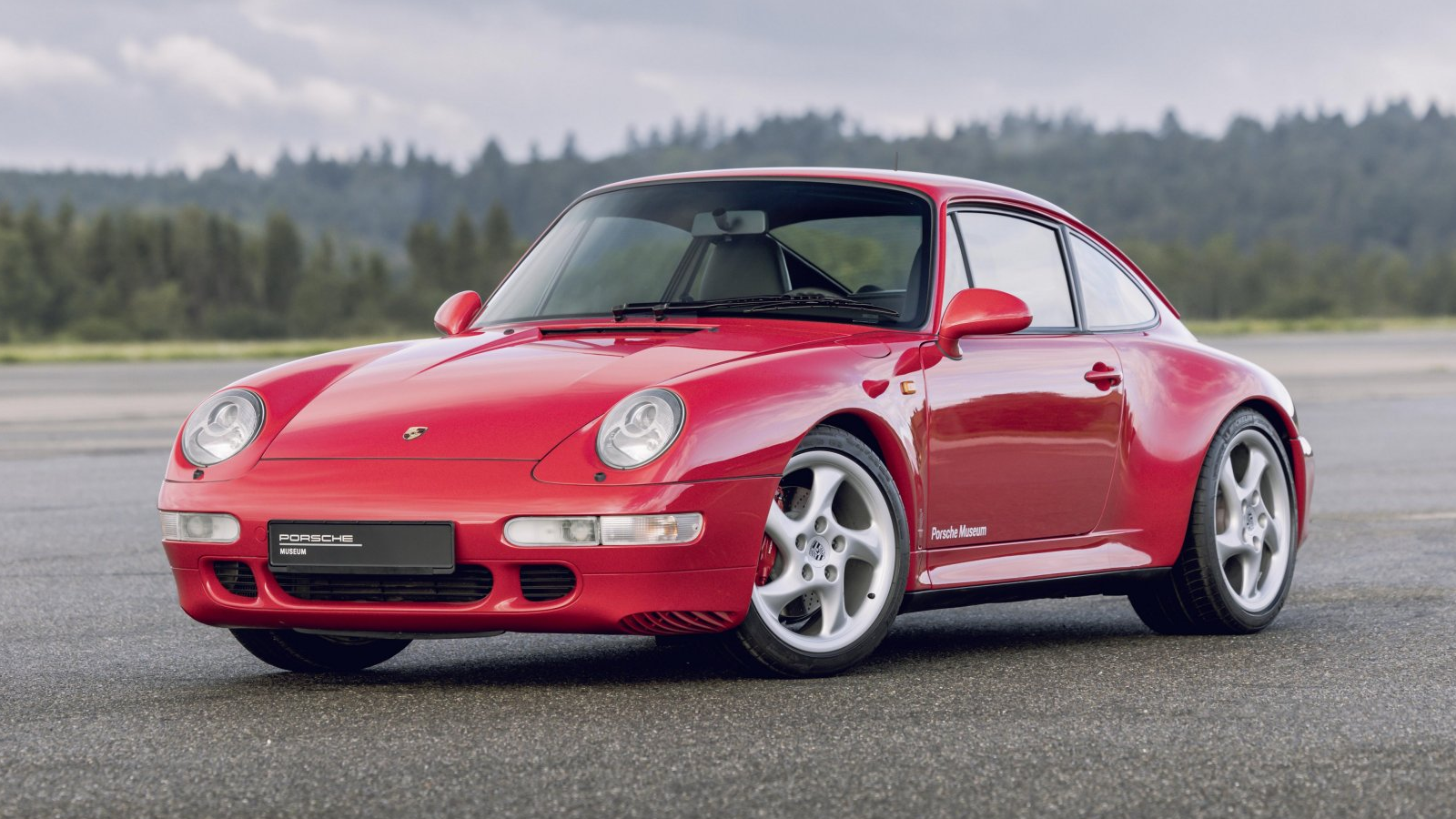
6. Porsche 993 (1993–1998) — The Last of the Classic Round Lamps

The 993 introduced a new, sloped front end with headlights that followed the hood line, a significant break from tradition. The design, though controversial at launch, ultimately modernized the 911’s appearance and improved aerodynamics. Its flush, oval lenses became icons of the 1990s Porsche aesthetic and marked the final air-cooled era’s visual identity.

5. Porsche 911 (964) — Classic Form Meets Modern Function

The 964 retained the round 911 lights but subtly reshaped them to fit new, smoother bodywork. They were slightly more upright and used improved reflectors and halogen elements for better illumination. This generation is often overlooked, but its headlights mark the bridge between old-school air-cooled charm and modern Porsche precision.

4. Porsche 356 (1948–1965) — The Blueprint for Porsche’s “Eyes”

The 356 established the signature oval headlight shape that became Porsche’s visual identity for decades. Mounted high and slightly reclined, the chrome-rimmed lenses gave the car a friendly yet purposeful look. Though rooted in postwar simplicity, their integrated design flowed seamlessly with the rounded fenders, a foundational cue that carried into every 911 thereafter.

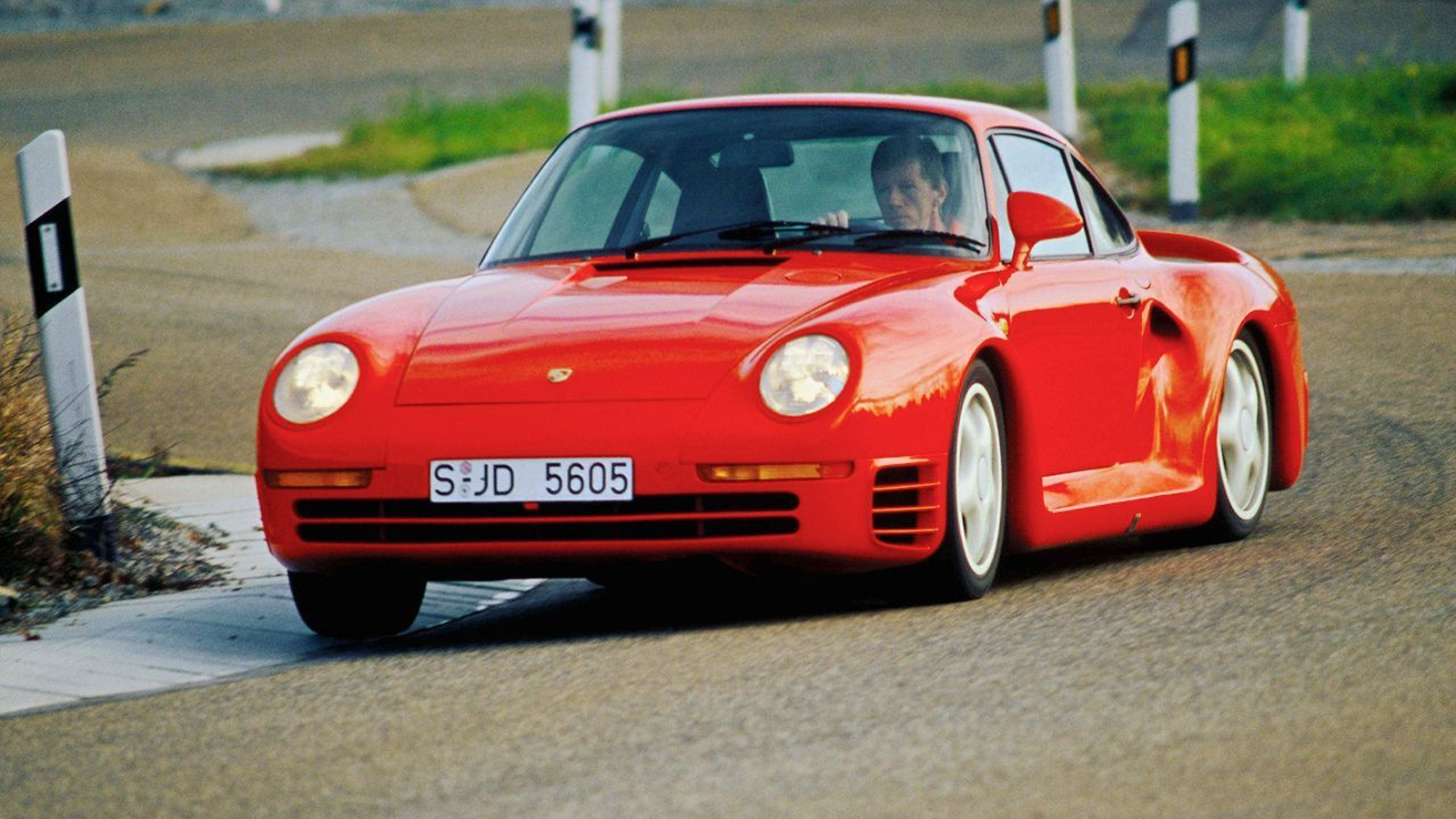
3. Porsche 959 (1986–1988) — Aerodynamic Function in a Supercar Form

The 959’s headlights were a turning point for Porsche’s design language. They maintained the classic round outline but were deeply recessed into the front fenders for aerodynamic efficiency. Flush glass covers gave the car a sleek, cohesive face that previewed Porsche’s shift toward modern integration and minimal drag. Beneath the surface, their lighting performance outclassed most of the era’s supercars.

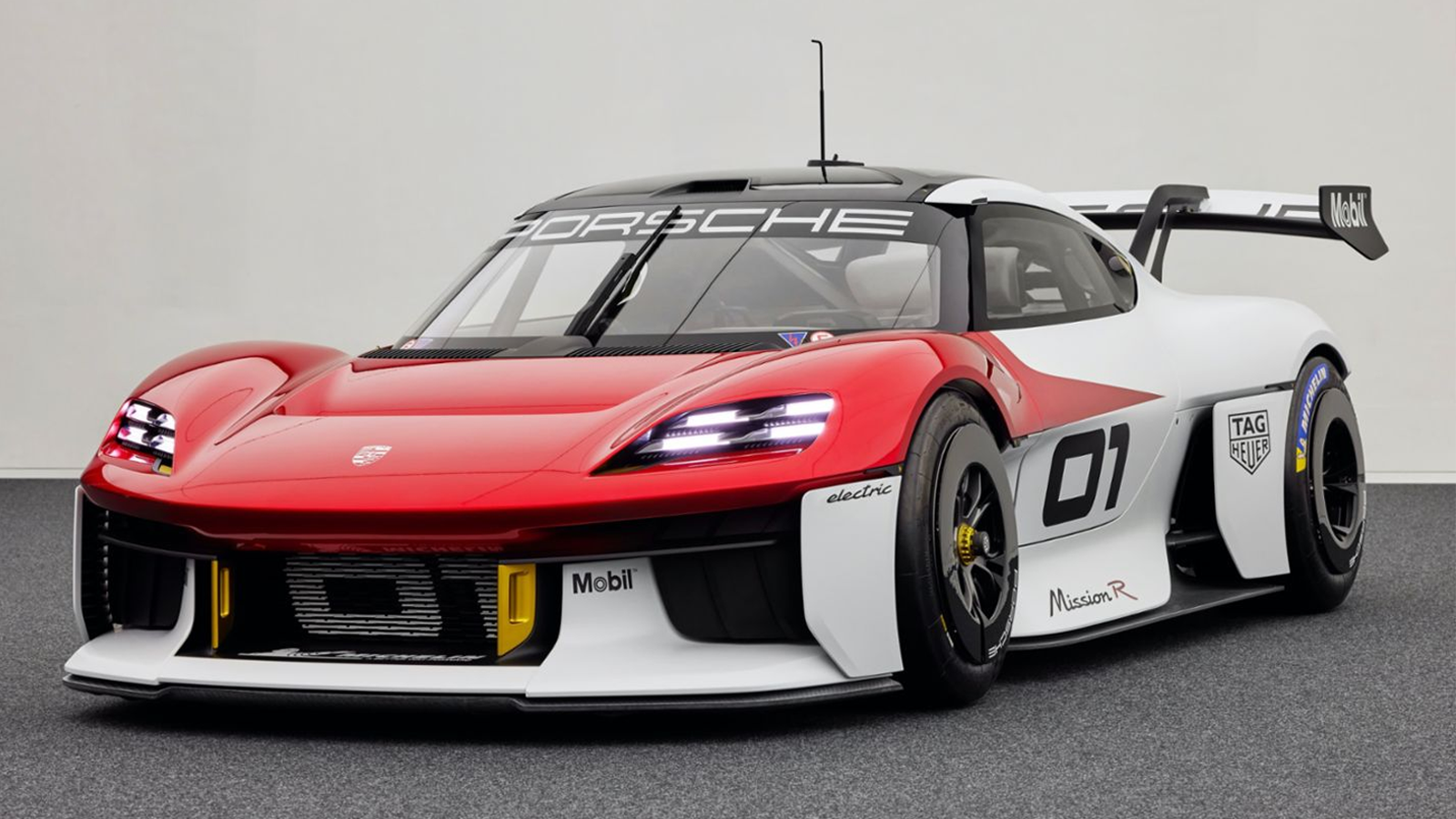
2. Porsche Mission R Concept (2021) — The Future in Plain Sight

With its slim, vertically stacked LED units framed by a minimalist housing, the Mission R’s headlights reimagined Porsche’s “four-point” look for the electric age. They were both expressive and efficient, incorporating cooling ducts and DRL elements into a single sculptural assembly. The design hints at the next generation of motorsport and production cars from Porsche.

1. Porsche Carrera GT (2003–2007) — Pure Function, Clean Form

The Carrera GT’s headlights embodied Porsche’s design minimalism at its finest. With visible projector lenses under a clear polycarbonate cover, they echoed the look of endurance racers while maintaining a sculptural, lightweight appearance. The compact design allowed for large air channels around them, aiding cooling and aerodynamics, beauty born from engineering.

For The Silo, Verdad Gallardo/Rennlist.com

Three and Half Decades Ago The Nighthawk Stealth Fighter Was Revealed

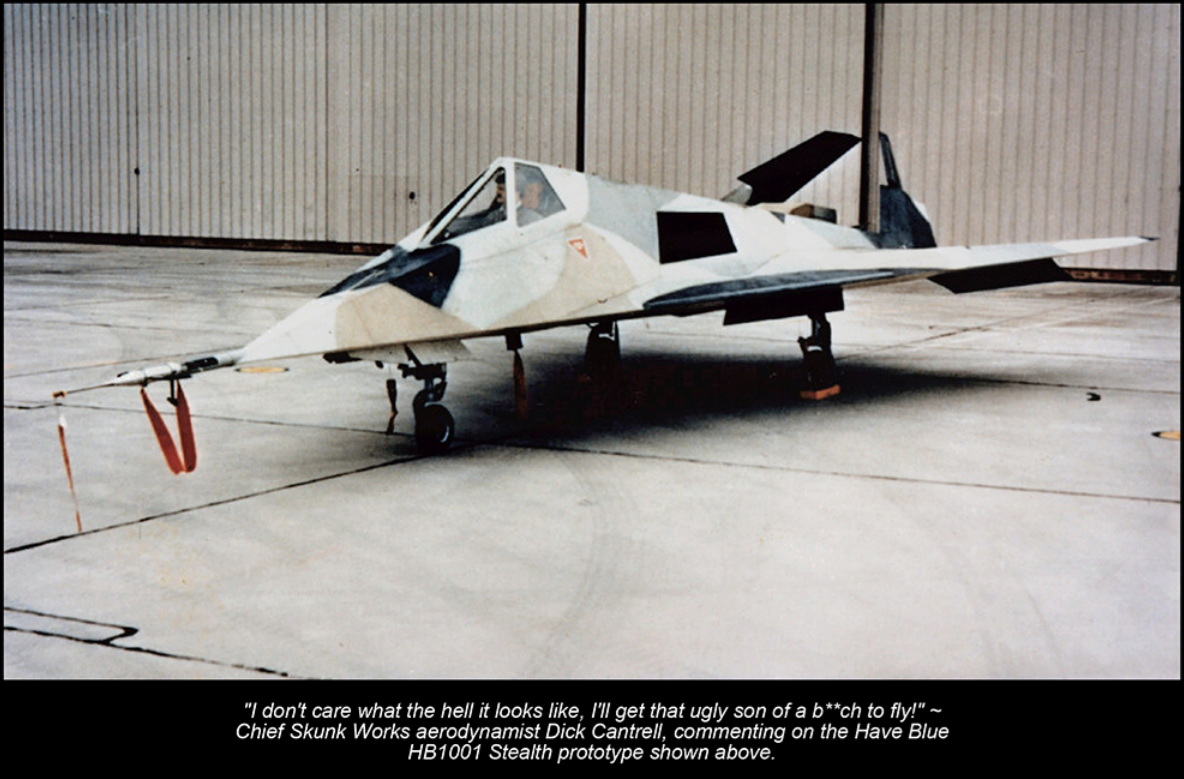
35 years ago, a mysterious and strikingly beautiful aircraft touched down on a dusty airfield in the Nevada desert. Can you imagine what kind of advanced aircrafts are being developed now?


The F-117 Nighthawk


Since its public reveal decades ago (consider that development started in the 1970’s on this amazing machine), the Nighthawk served with quiet distinction through the latter half of the Cold War, the first Gulf War, a kerfuffle in Yugoslavia (bet you don’t remember that one) , and the invasion of Iraq in 2003.
Despite and official ‘retirement’ in 2008, the F-117 still gets spotted in the skies over Nevada where it is rumored to serve as an ‘aggressor aircraft’, helping to train pilots.


What’s the F-117 about?


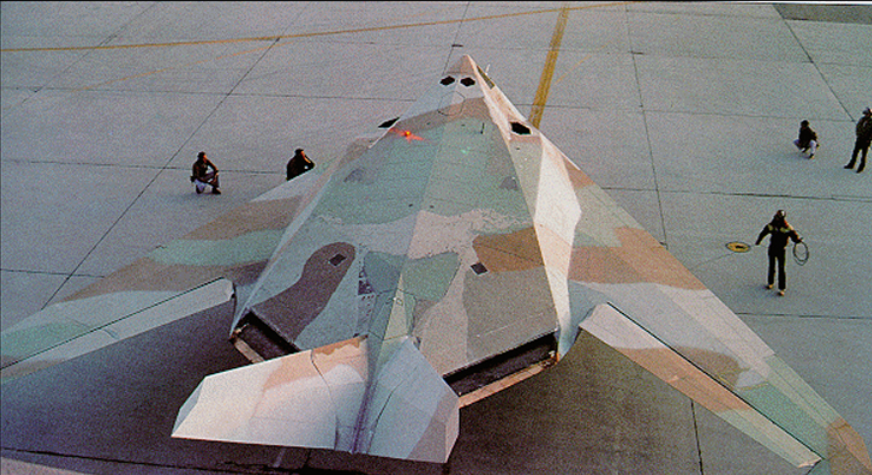
With it’s cyberpunk like profile and stunning angles, the F-117 Nighthawk instantly captured the public’s imagination and birthed a lot of UFO /UAP stories, especially in the late 1980’s and early 1990’s when it’s unusual shape confused expectations of what an aircraft could and should look like.
A radical departure from the retro-aerodynamic curves of traditional aircraft design, the F-117’s odd shape serves a singular purpose.


Stealth.


The Nighthawk was conceived by Lockheed’s Skunk Works, a secretive development team responsible for some of the most capable aircraft of the 20th century.
Designed to slip through deep Soviet territory, the Nighthawk incorporated radical new technology to achieve an incredibly small radar and thermal signature. Hard edges, radar-absorbing coatings, a unique twin-tail, and special endinge cowlings reduced the aircraft to the size of a sparrow on Soviet radar.
The Nighthawk was deemed fully operational in the early 1980’s and nearly a decade her pilots and crew flight night sorties in complete secrecy.
Seven years later, the USAF and the Department of Defense decided the Nighthawk would work better as a deterrent if the world knew about it and it’s capabilities.


Plans were made to reveal the aircraft to the world at Nellis AFB on April 21, 1990. Those of us who saw this event live on television will always remember the shock and awe inspiring gasp it created- nothing like it had ever been seen before and it surely looked like something from a science fiction novel or movie.
On a hot spring day, a flight of two F-117s landed in front of thousands of cheering spectators, kicking off one of the most memorable air shows in US history. After opening the show, the F-117s sat quietly on the tarmac surrounded by an entourage of armed airmen and curious onlookers.
Although little was said about the new “stealth fighters”- blimps, fighter jets, and mock dog fights continued the day’s entertainment in style.


Even with talks of ‘spending prioritization’ and ‘doctrinal appropriateness’, the Nighthawk has endured, in it’s own special way, for nearly 40 years. Everything about the F-117 that made it great in the 1980’s still captivates us today. It’s razor-sharp edges, futuristic technology, and it’s family tree of stealthy cousins (foreign and domestic). Here is hoping many more years of this little black triangle up in the sky… via our friends at kommandostore.com

Canadian Company To Help Astronauts Return To Moon In 2026

ALUULA Composites, super-strong, lightweight polyethylene material is now being used to develop expandable habitats for NASA’s astronauts to live safely and comfortably on the moon for the 2027 planned landing. 

This small company on Canada’s west coast is playing a big role to help astronauts return and orbit the moon in 2026.

Artemis II crew members (from left) CSA (Canadian Space Agency) astronaut Jeremy Hansen, and NASA astronauts Christina Koch, Victor Glover, and Reid Wiseman walk out of Astronaut Crew Quarters inside the Neil Armstrong Operations and Checkout Building to the Artemis crew transportation vehicles prior to traveling to Launch Pad 39B as part of an integrated ground systems test at Kennedy Space Center in Florida photo: NASA

ALUULA Composites recently signed an agreement with Max Space, an American company, to use its innovative composite material to build space habitats on the moon. The company’s ultra-high-molecular-weight polyethylene (UHMWPE) laminate will be used to create a large living and working area for NASA’s astronauts when they return to the moon in September 2026. 

The innovative material was selected because it has eight times the strength-to-weight ratio of steel and is extremely durable, which is ideal for space travel.

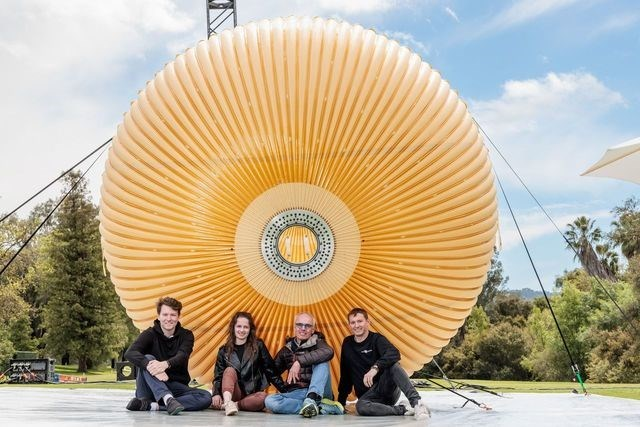
The Max Space team with their new expandable space habitat. photo: Max Space

The first Max Space inflatable space habitat is slated to launch with SpaceX in 2026. The Max Space inflatables can be delivered into space in very small packages and then unfolded and expanded to create a much larger work space. For the Silo, Paul Clarke.

The Audience Bellare Loudspeaker Is Extraordinary

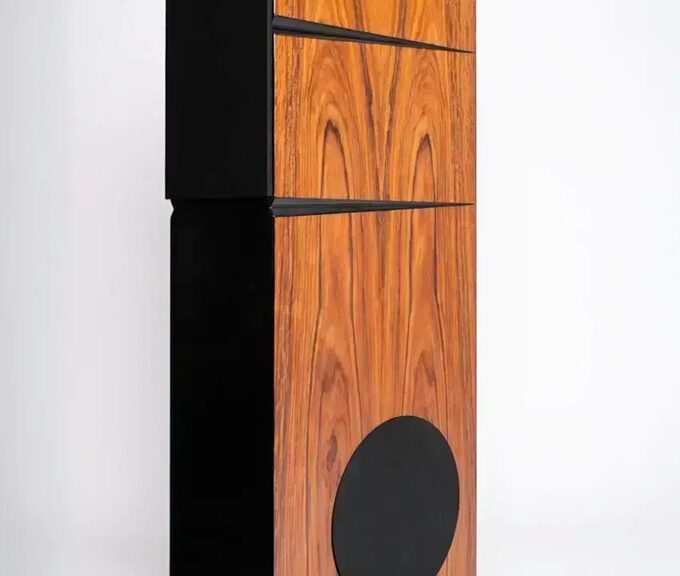
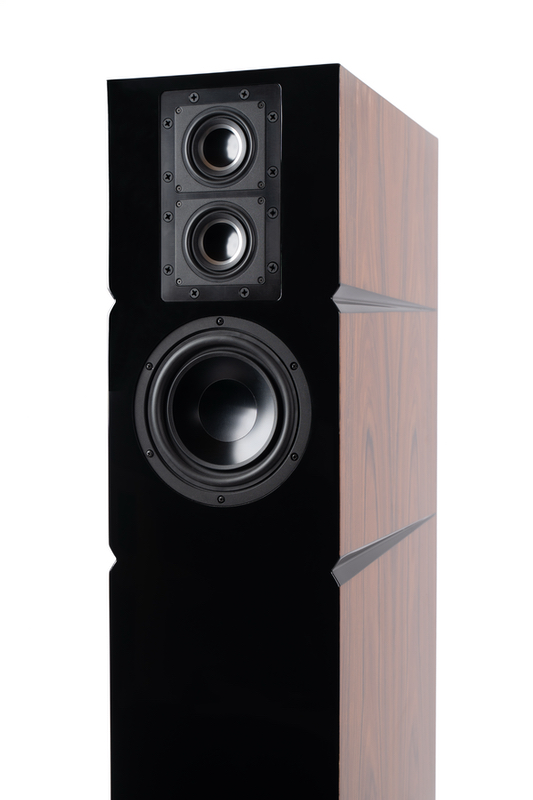
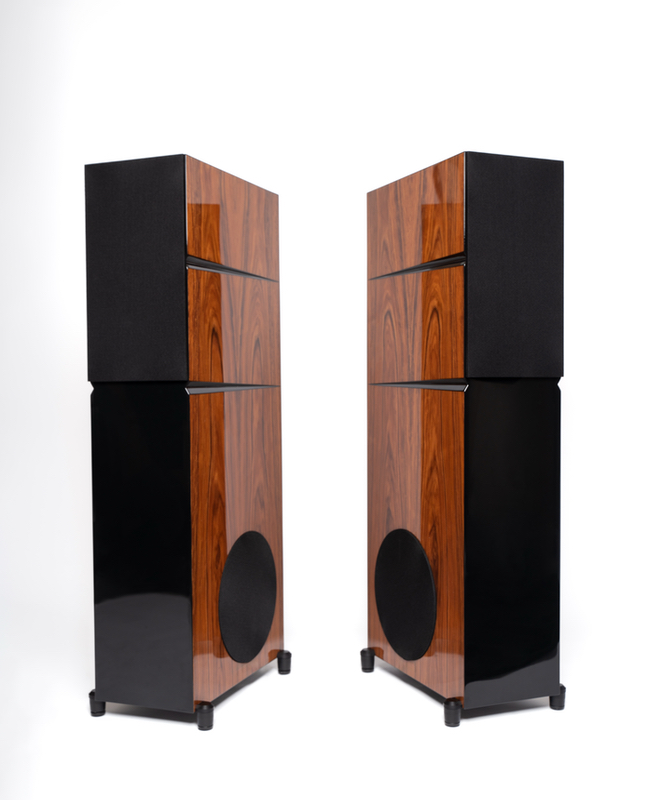
San Marcos, California, October, 2025 – In one of the most significant product introductions in the company’s history, Audience will debut its extraordinary Bellare loudspeaker at two US events: T.H.E. Show New York and Capital Audiofest 2025. As stunning in appearance as it is to listen to, the new Bellare full-range speaker incorporates a number of proprietary technologies including the company’s full-range driver approach to deliver a never-before-achievable level of musical realism.

The Bellare (Italian/Latin for “beautiful”) will be featured at T.H.E. Show New York 2025 at the Hilton Hasbrouck Heights/Meadowlands, Hasbrouck Heights, New Jersey (October 24 – 26, 2025), and at Capital Audiofest at the Hilton Hotel Rockville, Rockville, Maryland (November 14 – 16, 2025). It will be demonstrated as part of a complete high-end system including an all-new Audience equipment rack, and Audience cables and power conditioners (see complete equipment list at the end of this press release).

No need for the usual crossover requirement

At the heart of Bellare’s extraordinary performance is its use of multiple identical 3-inch wideband high-resolution drivers that cover the entire frequency spectrum from 120 Hz through the midrange and treble – eliminating the need for a crossover or different types of drivers for the midrange and high frequencies. This results in remarkable sonic coherence, tonal purity, and imaging, with excellent dispersion. There are no phase anomalies, discontinuities in frequency range, or disruptive changes in radiation pattern.

Bass Is Handled Separately

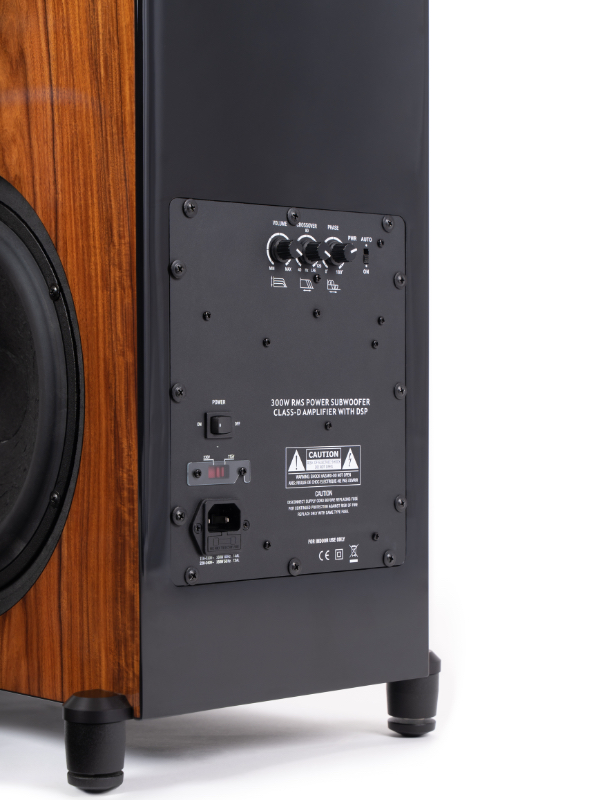
The bass below 120 Hz is handled by Bellare’s built-in 300-watt active bass module with DSP that offers remote control of its volume, and automatic room correction. The inclusion of this built-in bass unit enables Bellare to be used with even lower-powered amplifiers such as Class A or single-ended tube amplifiers, since they are only driving the midrange and high frequencies.

The result is a loudspeaker that offers a seamless, natural musical presentation with remarkable spaciousness, presence, dynamic impact and tonal truthfulness. The Bellare achieves a level of sonic realism undreamed of until now. It is one of the finest loudspeakers ever produced by Audience – or anyone.

The Audience Bellare loudspeaker will be available in March 2026 at a suggested US retail price of $36,000 per pair/ $50,374 CAD (at today’s conversion rate).

Key Audience Bellare Loudspeaker Features:

  • Identical 3-inch drivers provide seamless performance above 120 Hz
  • Crossover-less design (above 120 Hz) preserves coherence, phase integrity, tonal purity and an ideal radiation pattern
  • Built-in 300-watt bass module powers the woofer and mid-woofer
  • DSP offers remote control of its volume, and active room correction
  • Frequency response: -3 dB at 28 Hz and 22 kHz
  • 105 dB continuous output without driver compression
  • Smooth impedance with minimal phase shift for effortless amplifier control
  • 88 dB sensitivity. Very easy to drive thanks to its well-behaved impedance curve and integrated bass augmentation system
  • Nominal impedance of 9.5 ohms and does not drop below 8.5 ohms
  • Exceptionally smooth phase response

List of Components to be Used in T.H.E. Show New York and Capital Audiofest Demonstration Systems:

  • Audience ClairAudient Bellare Loudspeakers
  • Audience equipment rack (price TBA)
  • Atma-Sphere MP-1 vacuum tube balanced line stage ($7,850 usd/ $10,985 cad)
  • Atma-Sphere Class D monoblock amplifiers ($6,100/pair usd/ $8,535 cad)
  • Exemplar Audio eXpression DUAL ES9028PRO DAC with outboard power supply ($5,500 usd/ $7,696 cad)
  • SONY UBPX – 1100ES disc player ($700 usd/ $979 cad)
  • Audience Adept Response aR6-T4 6-outlet reference power conditioner ($6,900 usd/ $9,655 cad) with optional FrontRow Reserve HP powerChord ($7,600 usd/ $10,634 cad)
  • Audience Forte V8 8-outlet power strip w/Forte F3 power cord ($980 usd/ $1,371 cad)
  • Full loom of Audience frontRow Reserve interconnects, speaker cables, and power cords.

Audience
800-565-4390 (US and Canada)

About Audience

Audience was formed in November 1997 by John McDonald and the late Richard Smith, as a design and production company focused on building the best possible audio and video equipment. To pass the Audience test, each product must truly make a significant contribution to the reproduction of audio and/or video. Audience offers loudspeakers, electronics, cables, power conditioners, high-resolution capacitors and the Auric Illuminator optical disk resolution enhancement.

Audience’s commitment is to develop the very best products possible, and the company is committed to unexcelled customer service and product support. All Audience cables have an unconditional lifetime warranty and power conditioners have a ten-year warranty. For more information visit www.audience-av.com.

Our Horse Powered Past Drove Today’s Auto Tech

Where did auto tech start?

A horse and buggy. Excellent horse-power huh? People got tired of the nurturing it took to take care of a work horse. People wanted more and as with anything the need for something better fuels the spark for innovation. How about something to do work, but doesn’t need rest? Doesn’t need medication? Doesn’t need someone to shovel up its crap? Take this formula and you get the steam engine, not a crazy engine, but an engine none-the-less. Suddenly the glowing aura of potential is perceivable, right on the horizon. Now we can have multiple horse-power without the care. Still needed someone to shovel though.

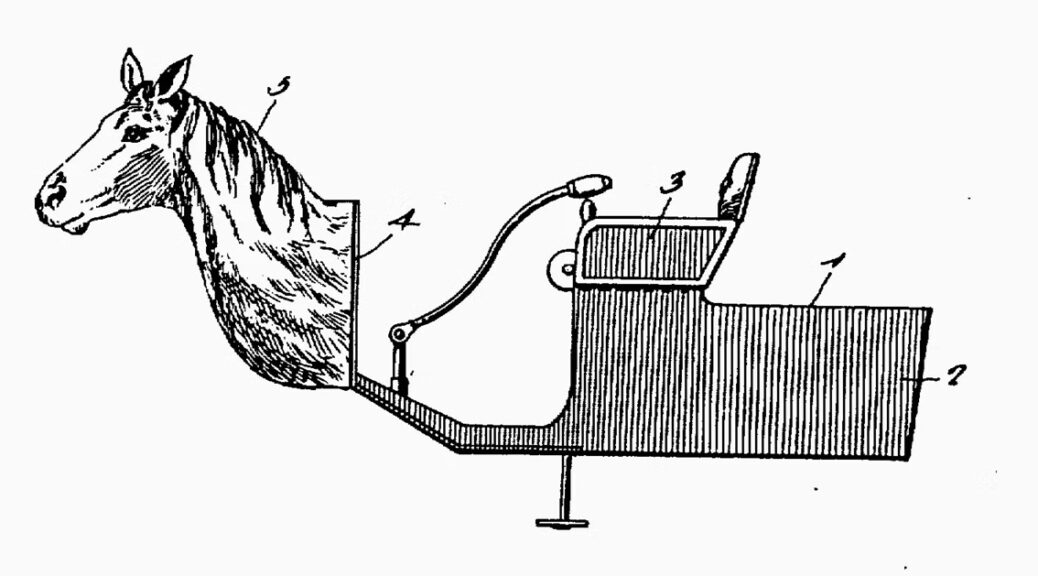
The Horsey Horseless. Designed to prevent horses being frightened by a car.

Enter, the mother of current automotive technology today, the oil industry.

Instead of burning coal, why not find some ways to refine oil to be used as fuel sources to run things on? Who knows, we could have been running advanced versions of steam engines today? They actually can be made to be fairly efficient and clean using current technology and were quite practical cars back in 1918.

Then the internal combustion engine enters the scene the oil companies love this, and a mass marketed engine that is completely dependent on oil is born. Just think, this is awesome for business, these engines need oil for fuel and lubrication. Then all the different designs start flowing. (Off the top of my head and in no chronological order) The single cylinder, then 2, then 4, then 6, then the flathead V8. Now this is where we start to see major horse-power and design improvements. The trusty ole’ inline 6’s, the small block eating slant 6’s,The overhead valve V engine, big blocks, small blocks, Hemi’s. There are pancake engines, W engines, rotary engines, v-tecs, boxster engines and many, many more. (Not to mention all of the different fuel delivery systems!)

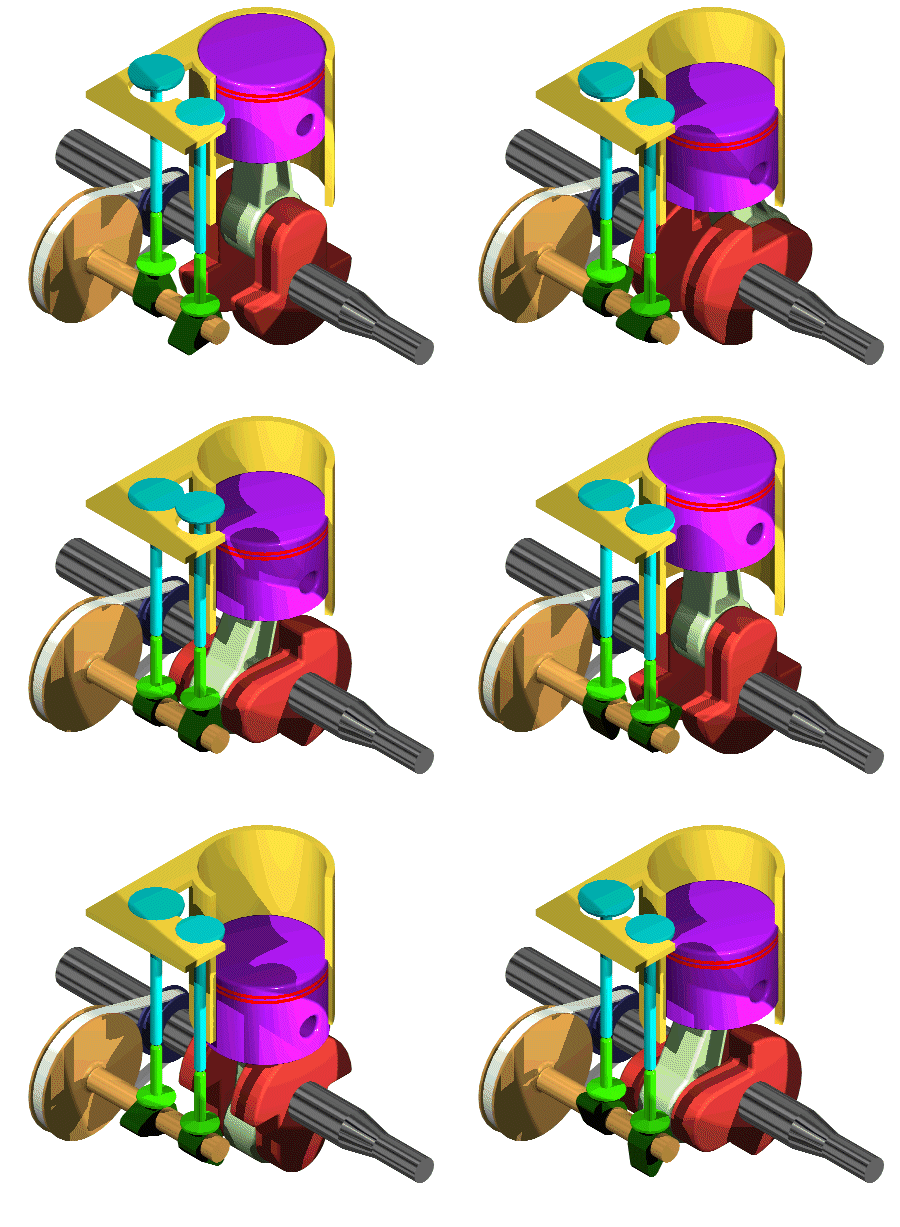
The cylinder and valves and crankshaft of the Internal Combustion Engine

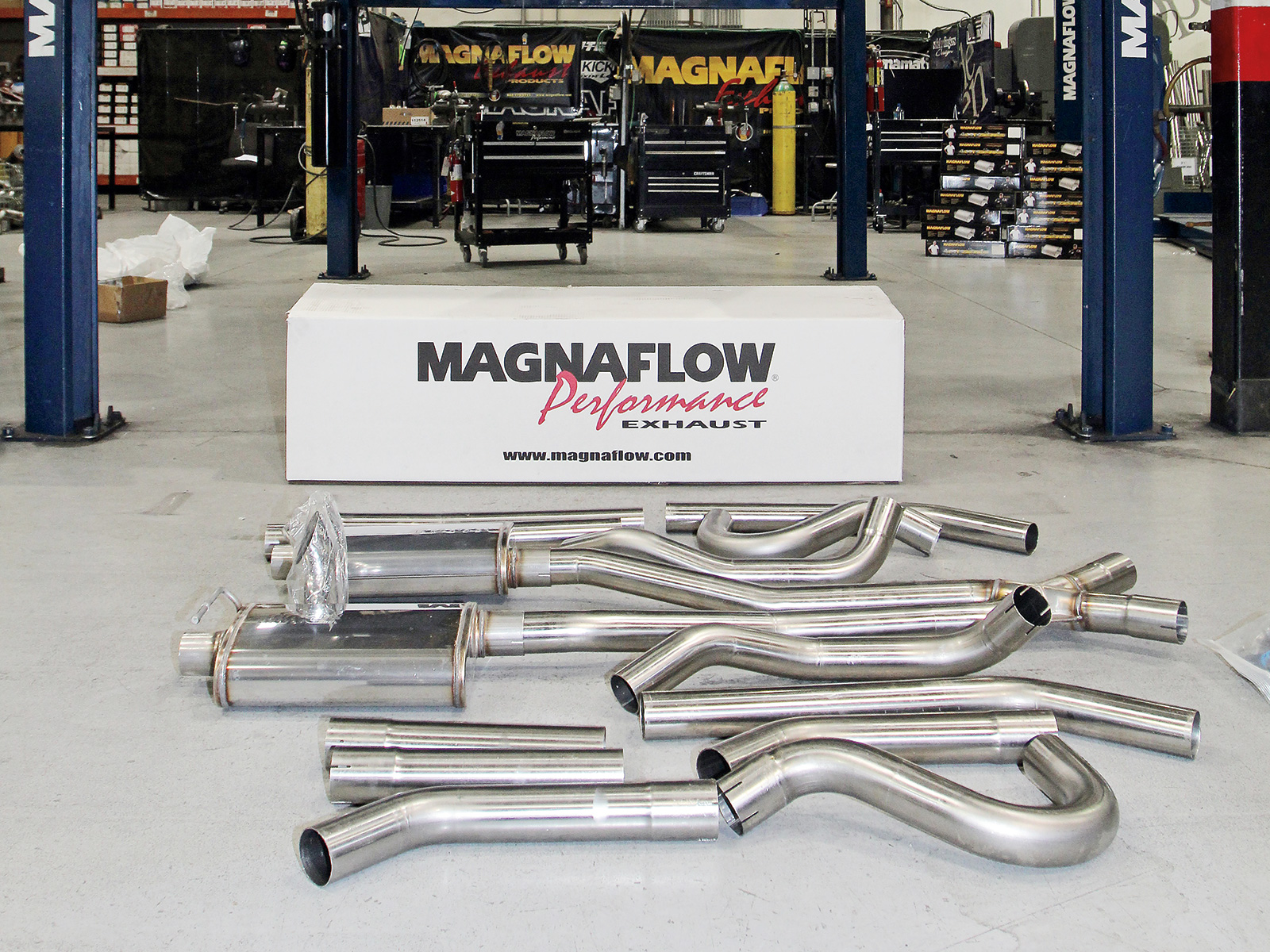
The one thing that really makes me scratch my head is the fact that it took so long getting hybrids, smart-cars, electric cars, and hydrogen cars that are actually worth looking at and driving. I mean, why is it that I can take a full size 2008 Chevrolet Silverado with a 5.3 L vortec engine, put: a cold air intake, a magnaflow exhaust system, and a good edge products programmer, and I can get an average of over 36miles per gallon, with the same horse-power? Why is it that I (not being an automotive engineer) can do this, but you can’t just buy one with those numbers from the manufacturer?


Not to mention brown-gas converters that have been tested on most common engine types that can take, mineral water, and a reaction from current between two electrified plates (similar to a car battery) and create a safe amount of hydrogen gas as a by-product which can make your car run the same on half the amount of fuel. The thing that boggles me is that most people have never even heard of these. You can buy the plans off the internet (not as complicated as it sounds) or I can even get ready to install ones from my performance part supplier. I just find it strange that automotive technology and fuel sources have taken this long to start to veer just slightly away from oil (or as ‘ol Jed calls it “Texas tea”).

At one point we bridged the gap from a horse and buggy to a steam engine, and then to internal combustion. With the technology we have now, we should have much higher mpg’s and horse-power or an extremely viable alternative. It really makes me wonder where we might be now if this technology was steered in a different direction from the start. It’s been over 100 years now of improving the same technology using more or less the same fuel source. There are guys in the States who run their own garage refined deep fryer grease to power their small pickups and VW buses. There are guys who run pickups off wood-fire smoke. Just something to think about. 

For the Silo, Robb Price.

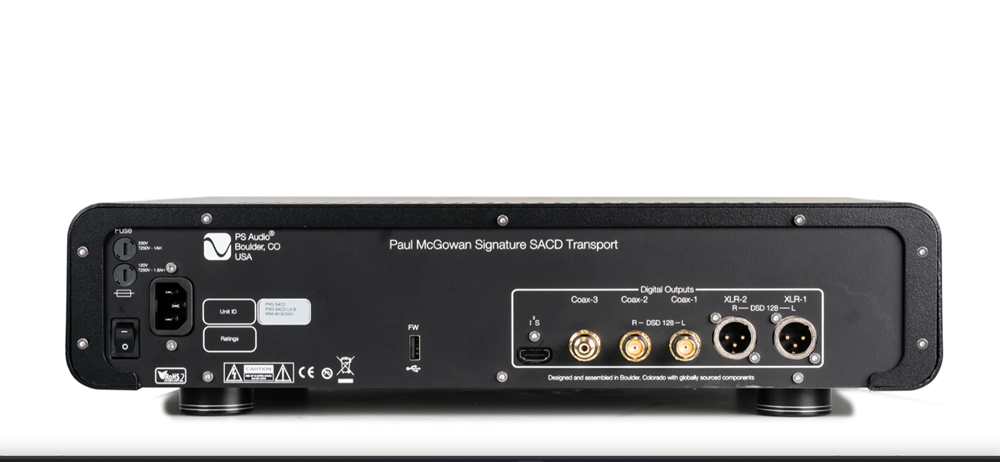
This Transport Reveals Hidden Sonic Details In Compact Discs And SACD

CDs played through the PMG Signature SACD Transport come closer than ever to high-resolution PCM and DSD, uncovering new layers of dimensionality, soundstage, depth, and musicality previously unobtainable in other optical readers or server-based audio systems. 

What is a Transport?

Like its predecessor (the PerfectWave SACD Transport) the PMG Signature opens the long-restricted DSD layer of SACD to PS Audio DACs. The PMG will deliver the raw DSD layer of copyright-protected SACD directly into your PS Audio DAC through I²S. This means that you’ll uncover the wealth of audio’s finest digital medium, DSD, and hear exactly what the mastering engineers who created these discs have enjoyed all along. Hear what you’ve been missing with the PMG Signature SACD Transport.

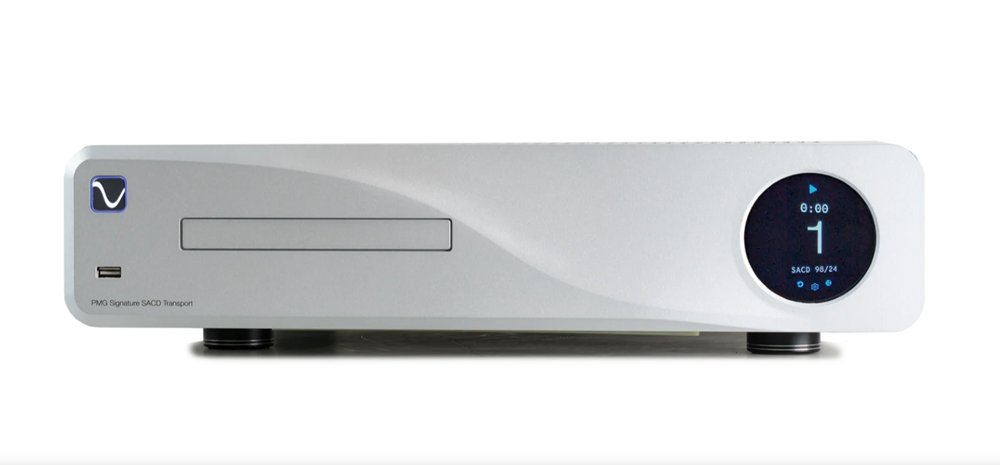
PMG Signature SACD Transport

Locked inside your CD and SACD collection is a treasure trove of music you’ve never truly heard. How do we know? Because PMG, like you, know every note of our reference discs—and we were stunned when we heard them through the new PMG Signature SACD Transport. This isn’t just another player. It’s the finest optical disc transport we’ve built in 43 years, and for the first time in our history, our founder has signed his name to it.

The PMG Signature SACD Transport is an engineering triumph, designed to extract every nuance and detail from your CDs and SACDs with unmatched precision. With galvanically isolated outputs and ultra-low jitter design, it breathes new life into your CD collection when paired with any DAC. And when connected via I²S, it unlocks the raw DSD layer of your SACDs—delivering what was once hidden to external DACs. This is not nostalgia. This is revelation. The PMG Signature SACD Transport is the ultimate disc playback system—worthy of the name, and the legacy.

For the Silo, Paul McGowan.

Revolutionary Fairlight CMI Music Synthesizer Ushered In New Music Genres

He listened to Mike Oldfield. He saw the pictures on the albums and he read about ‘this thing called a Fairlight’. Which raised Klaus’ curiosity about this ‘Computer Instrument’. Fellow keyboardists told him it was a mission impossible, getting your hands on one. But Klaus managed to find the holy grail…

‘To me, It’s still fresh. I can use the Fairlight to create sounds no one’s ever heard before.’ 

If we take a look at the history of popular musical style creation we see a common theme: new technology leads to new inventions leads to new possibilities for musicians and composers. Consider the evolution of the modern piano from its beginnings as a somewhat-limited-oft-out-of-tune harpsichord. Or the evolution of the electric guitar from the acoustic guitar- by adding an pickup to electronically capture sound, another inadvertent effect became possible: the ability to alter the signal and sound characteristic via electronic manipulation. Heavy Metal music would never have been possible without the distortion pedal, which itself is an evolution of overdriven mixing board input channels and later on- fuzz pedals.

The first fuzz pedal to hit the market was the Maestro Fuzz-Tone, which was launched in 1962. It was developed by engineer Glenn Snoddy in collaboration with Gibson Guitars. 

Inspired by Grady Martin’s distorted bass, Glenn worked with Revis Hobbs to create a device that could replicate the sound consistently. Despite its clever design, the Maestro Fuzz-Tone wasn’t really liked by many musicians. They were unfamiliar with this new distorted sound and didn’t know how to use it into their music. 

However, this all changed in 1965 when The Rolling Stones used it in their hit song “(I Can’t Get No) Satisfaction.” pedalplayers.com

In a similar way the Fairlight, the AKAI MPC, the EMU and other sampling based instruments allowed for extreme sound manipulation and even the creation of entirely new sounds leading to new techniques of musicianship and composition. Will we see another development to change the playing field? Is AI the next musical frontier?

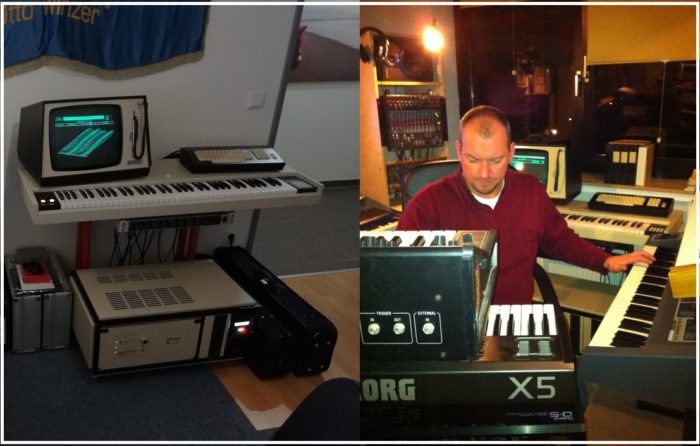
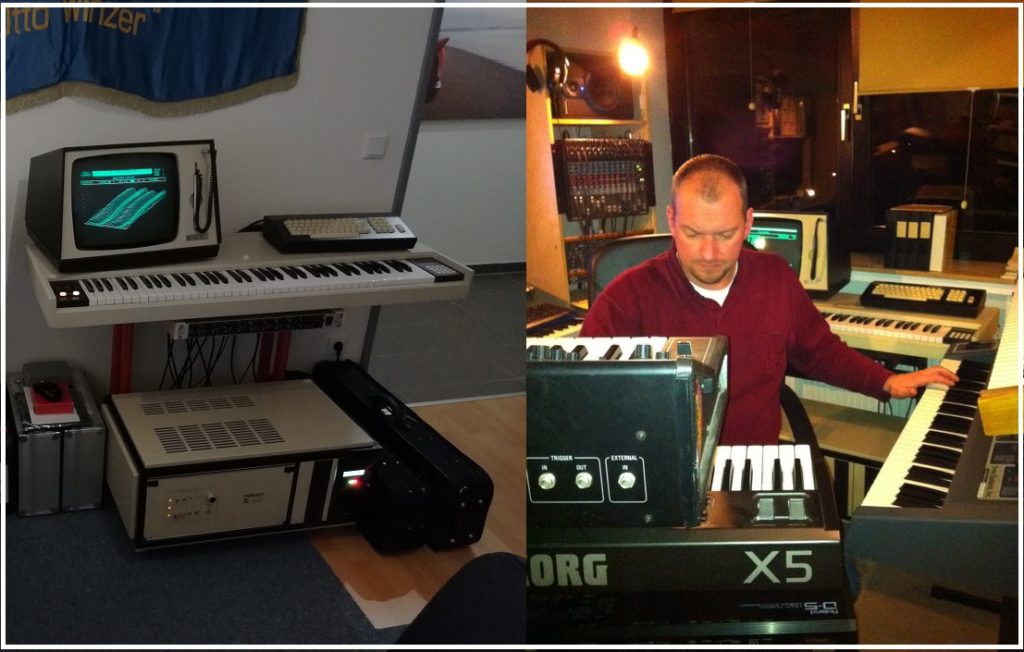
”I was lucky enough to find a Series II, back in 2010. It’s quite a historical piece, for it used to belong to Synthesizer Studio Bonn, one of the only two Fairlight retailers in Germany. They bought it in 1982. It was their demo machine and It was kept in their shop until 1999. They went bankrupt, and the Fairlight was sold to a synth collector, who went bankrupt as well. He had to sell a lot of his equipment, including the Series II. I got it for a good price. But I do hope I won’t be the third one to go bankrupt.” 

Klaus Himmelstein has been a music and science teacher on several German international schools for about twenty years now. He developed a special interest in electronic music, but originally he is a classically trained violin player. ”That’s how I started, at the age of 8. My parents took me to violin lessons, because they discovered I have perfect pitch hearing. I really love to play the violin and I still play it. Through the years, I got more and more interested in electronic instruments.” 

Green screen, big box

”I remember getting my hands on a Yamaha DX7 for the first time, when I was about 12 years old. That was in 1986. I didn’t know what any of these knobs were for. I tried out the presets and I tried to tweak them, to get some other sounds out of it. Around that time period, I also heard about the Fairlight for the first time. I listened to Mike Oldfields’ albums and I read he was using a ‘Fairlight computer’. So I thought: ’What the hell is a Fairlight computer?’ And then, I figured out it was this funny machine with this keyboard and this green screen and a big box, pictured on some of his albums.”

He bought his first synth in 1991. ”A Roland D-5. Not to be confused with the famous D-50. The reason I bought it was because it is multitimbral. I already had an Atari ST computer. I used this set-up for making my first compositions. And, around that time, I started asking other keyboard players about the Fairlight. Some people didn’t know anything about it. But the people who knew about it, they’d be saying things like: ’Oh boy, that’s the holy grail…’, ’15.000 Deutsche Mark’, ’You won’t get your hands on one’ or ’That’s only for the big studios’. By the end of the nineties, Klaus had built himself quite a studio with a decent amount of vintage synthesizers. ”I started looking on eBay, checking for Fairlights. I’ve learned there are two types of Fairlight-ads: either the refurbished machines which cost a fortune, or just crap.”

Closing the deal

In 2010, an acquaintance of his – the guy from RetroSound, who publishes videos of pretty much every vintage synthesizer you can think of – notified Klaus there was a Fairlight for sale. “He knew I was looking for one, through my posts on forums. So one day, he sent me an e-mail. He knew there was one for sale, somewhere in the Eiffel area. A Series II, not in perfect condition, but good enough. He offered to put me in touch with the seller. 

So, in the end, I went to this guy, checked it out, talked about the price and closed the deal. It was pretty easy going. I picked it up myself, for I don’t trust companies like UPS and DHL too much handling valuable packages. I had a huge car back in the day, a station wagon. I put lots of cushions and blankets in the back of the car. I wrapped it all up and drove back to my studio, which was located in the city of Münster. I set it all up and after that, people didn’t see me for quite some time, for I was in the studio all of the time.

I went through all the floppy disks. They contained a large collection of samples from Synthesizer Studio Bonn. They made their own samples, their own sounds. It was used for demo sessions. I checked out all the sounds; quite some unique stuff in there.”

Nothing like the real thing

”I was always fascinated by its sound. That was one of the reasons I wanted to have one. Not just for collecting purposes. I’m not treating it like some piece of history that sits in my studio, like some precious artefact, being polished every day. I really want to use it for making music.” Of course, it took some getting-used-to. Klaus: ”When you start to work with it, you’ll probably find out it’s quite difficult. For instance, the light pen isn’t as accurate as you think it might be; no drag ’n drop, no pull-down menu’s. But in the end, after a couple of days, I’ve found my way around it.

Fairlight CMI synthesizer

I also figured out, and this is a thing I learned from other users as well: after two or three hours working with the light pen, your arm gets really tired. And that CRT monitor, that green screen compared to todays monitors.… It isn’t too comfortable. But that sound, it makes it all worth while. I think the percussive sounds are the best in the world. And it’s that 8-bit sound… I don’t know why exactly, but I think it’s just the best. It’s unique. You don’t get that particular sound out of todays software. For instance, Arturia’s CMI V, it’s really nice, it’s a good reproduction. But if you want that original particular sound, there’s nothing like the original Fairlight CMI.”

Warm community

”I bought it back in 2010 and I have been using it ever since. It’s still in quite good condition, except for the CRT-monitor. It’s a little bubbly and not quite clear around the edges. But furthermore, the light pen is still working, one of the floppy drives still works, as well as the 8 voice cards. At the age of almost 40 years, it’s still a good machine. Together with Jean-Bernard Emond from France, I’ve made some modifications. For instance, we’ve replaced on of the floppy drives with an SSD-drive.  Peter Wielk helped me out with one of the voice cards. I had a dead one. He had one in Australia, so he sent it to me. 

I have two Emulators, and one of them just serves as a box of spare parts. I figured out there aren’t too many people familiair with repairing an Emulator. And it’s very, very difficult to get spare parts for it. With the Fairlight on the other hand, there’s a well grown community, pretty much world wide. You can get parts from France, from Australia, from the UK…  There’s always someone somewhere in the world, with a great love for the instrument and lots of knowledge, who can help you out with any issue you might have.”

Inspirators

“In my studio, there are at least 25 keyboards and a whole lot of modules and other stuff. The Fairlight is a part of ’the orchestra.

I’m a big fan of Tangerine Dream, that is to say: their early work. Everything after about 1989 began to sound like pretty much everything else. They used cutting edge technology. But the funny thing is: they never used a Fairlight. According to Edgar Froese, they used a Synclavier, and Emulators. Their music comes close to what inspires me. Some people are comparing some of my work to Tangerine Dream. Others are saying it reminds them of Jean-Michel Jarre. The perception is quite different. I’m totally happy when people like my tracks. If they don’t? That’s fine with me. I’m working on my ideas and I’m enjoying the proces. That’s it. Sometimes, I get involved in some recordings, I made a couple of jingles for radio commercials and I once made a small movie score. Sometimes, I play keyboards and violin in bands. I’d prefer doing a little less teaching and a little more music production. The good thing about being a teacher: it’s a steady job. The bad thing about being a musician on the free market: you’re never sure of income. I prefer the more secure way. Teaching music actually is a lot of fun. Recently, we performed a few pieces with some students. I love teaching music to kids. But, I don’t take many of my synthesizers to school. My Moog Rogue is the only one I bring from time to time. They can tweak on pretty much every knob or slider; it doesn’t go out of order. But I’m not bringing the Fairlight to school. I don’t want to transport it too often.”  

Final thoughts

“The Fairlight CMI, it’s a particular part of history. It has integrated sampling into modern music. Without the Fairlight, things would have happened totally differently. Back in the early 80’s, it was the latest thing to go on, the latest way to produce new kinds of music. I love that particular sound. For me, it’s still up to date. It’s not old-fashioned, it’s not vintage. For me, it is still fresh. In my opinion, I can use the Fairlight – as well as the Emulator – to create new and fresh sounds that have never been heard before. I’m convinced of that.” For the Silo, Mirjam van Kerkwijk/ Jarrod Barker. Read more about the Fairlight via For The Love Of The Fairlight . Have a fun Fairlight story to tell? Contact Mirjam at [email protected].

Listen on Soundcloud

Coming To Streaming & Disc- Eileen Gray & The House By The Sea

She designed a sanctuary for herself.
Unfortunately, it turned out to be a modern masterpiece.

E.1027
Eileen Gray and the House by the Sea
Streaming & DVD Launch September 9, 2025!
Coming to Amazon, Apple & Kanopy
 
In 1929, Irish designer Eileen Gray created E.1027 on the sun-soaked Côte d’Azur – a bold and hidden gem of avant-garde architecture. This striking house was meant to be a personal refuge.

But when the legendary architect Le Corbusier stumbled upon it, fascination turned to obsession. He covered its walls with his murals, completely disregarding Gray’s wishes and her vision. His defiant act ignited a battle for creative control, with Gray demanding restitution for the destruction of her work. He ignored her wishes and instead built his famous Cabanon house directly behind E.1027.

E.1027 – Eileen Gray and the House By the Sea is an unusual hybrid docu-fiction film that tells a story about the power of one woman’s creative expression and a man’s desire to control it.
“A unique and uniquely satisfying experience…a bold movie because it takes a deep dive on characters and a house that may not widely known, at least for American audiences. There is nothing quite like it.”
– John Soltes, Hollywood Soapbox
A story of passion, craft, and betrayal…aesthetically beautiful and a great summer watch.” – Fiona Rae, Film Threat
“Shot on location at E.1027, this feature-documentary hybrid matches the sleekness of its setting – its serenity, its surface poetry, its fragments of grace.” – Barlo Perry, ParisLA
“Eileen Gray was a creative genius and the first woman to conquer the world of architecture at a time when men controlled it all. This new film reflects on Gray’s impressive career and her stunning modernist house on the Cote d’Azur.” – Meredith Taylor, Finito World

“The directors put architecture in dialogue with cinema in order to bring to life the sensibility of a woman who was a visionary yet is too rarely celebrated. Elegant and well thought-out, the film uses the cinematic medium to enrich a discourse.” – Giorgia Del Don, Cineuropa

“Based on the memoirs of Eileen Gray, this meticulously crafted docu-drama, where poetry slips into frames, angles and tones, almost feels like a hallucination.” – Maroussia Dubreuil, Le Monde
A First Run Features / Architecture & Design Film Festival Release
E.1027 – Eileen Gray and the House By the Sea

Written & Directed by Beatrice Minger
Co-Directed by Christoph Schaub
With Natalie Radmall-Quirke, Axel Moustache & Charles Morillon
90 minutes, color, 2024 | English & French w/English subtitles

Streaming & physical media disc Launch Date: September 9, 2025
Streaming Platforms: Amazon, Apple & Kanopy
DVD SRP: $19.95 usd| DVD UPC: 7-20229-91843-5

For the Silo, Kelly Hargraves/ First Run Features.

Canada Space Agency -How Space Affects Our Body

Living in space has significant effects on the human body. As we prepare for journeys to more distant destinations like Mars, humankind must tackle these risks to ensure safe travel for our astronauts.


Canada Space Agency PSA space info

Elegantly Simple- New Raketa Aviator Watch

Creating specialized watches for extreme professions is a tradition at  the Raketa Watch Factory and now they have just presented a new version of its popular Pilot model.  

The history of aviator watches dates back to the early 20th century when aviation and wrist watches evolved side by side. The first aviator watches were built as professional tools, eschewing decorations in favor of durability, reliability and readability. They had a strict and minimalistic design: a round case, a high-contrast dial, wide hands and large numerals. Everything you need to make note of the passage of time while controlling a warbird and flying upside down.

KISS- Keep It Simple Soviet!

In  designing  its  new Pilot  model,  Raketa  tried  to   recreate   the spirit  of  early  aviator watches following the principle of “nothing superfluous”.

Designed in a classic style but with Raketa’s recognizable identity, the new case with its clean facets combines a glossy polish and a satin finish. This look is harmoniously continued with the stainless steel bracelet, which emphasizes the masculine character of the timepiece.

 A  genuine   leather   strap   is   also   included   in   the   set.   The  movement   is protected by a screw-in crown which provides a water resistance of up to 200 meters.

Several   features  ensure  easy   readability   in   all   lighting   conditions. Super-LumiNova coating is applied to the markers and large numerals of the dial, but also to the hour and minute hands. Contrast is created through color combinations- all the hands including the bright yellow second hand perfectly stand out against the matte black dial stylized in the same manner as a precision aircraft dashboard instrument gauge.

A double-sided anti-reflective coating on the sapphire crystal provides additional assurance of accurate readings.

The heart of the Raketa Pilot is its automatic movement manufactured from A to Z at the Raketa Watch Factory in St. Petersburg, Russia.

Price

The cost is 1950 EUR (including VAT)/ $3,110 CAD at time of posting. For the comfort of customers, Raketa watches are delivered worldwide free of charge by DHL directly to your front door. For the Silo, Jarrod Barker.

Specifications:

The Inimitable Mezger Engine

Take it from our friends at rennlist, Porsche has built some truly remarkable engines over the years. The air-cooled 911/83 engine that powered the 1973 911 2.7L Carrera RS is just one example. But if you were asked to go on and list the ten all-time greatest Porsche engines there is a good chance the list would be dominated by various Mezger engines.

The 12-cylinder found in the Le Mans-winning Porsche 917? That’s a Mezger. The 3.6L flat six in the 996 GT3? That’s a Mezger. The 4.0L in the 997 GT3 RS 4.0? That’s a Mezger.

How about going all the way back to the original 901/911 engine? Yup, that’s a Mezger.

But what is a Mezger engine, and why are they so special? That is what we are going to discuss here today. We have come up with 9 reasons why the Mezger engine is so special. And there is no other place to begin the discussion than the legendary man behind these engines, Hans Mezger.

1. Hans Mezger

A single slide can in no way capture all that the legendary Hans Mezger accomplished. He joined Porsche back in October of 1956. He loved Porsche sports cars, but his first job was working on diesel engine development. In 1960, he began to work on the type 753 flat-eight engine for Porsche’s first Formula 1 car. Soon after he designed the 6-cylinder boxer engine for the 901/911. He was then promoted to the head of race car design. He was responsible for the 917 and the 12-cylinder engine that powered it to Porsche’s first Le Mans victory in 1970. He then was responsible for the turbocharged 917/10 and 917/30 cars that dominated Can Am. He designed and developed the six-cylinder turbo engines for the Type 935 and 936 race cars.

Mezger designed the 1.5L V6 engine known as the TAG Turbo that powered the McLaren Formula 1 cars to championships in 1984, 1985 and 1986. His engines would eventually be found in the most performance-oriented Porsche road cars such as the 996 GT3, GT2 and Turbo. Mezger remained closely connected with the Porsche brand until he passed away on June 10, 2020, at the age of 90.

2. Motorsport Pedigree

Mezger built engines for the most demanding races in the world. His engines that were put into Porsche road cars have the same engineering approach. These engines are designed for long-term high performance. They are essentially overbuilt for road use. These engines were not designed to meet a certain price point. They were designed to provide the best performance. There were no corners cut with any Mezger engine.

3. Birth of the GT3

Many people view the 911 GT3 models as the pinnacle of the 911 range. One of the main reasons why is because of the track-focused, high-revving flat-six engine out back. It all started with the M96.79 engine found in the 996 GT3. The European market got the GT3 a few years before us and had the M96.76 engine, but the point is the same. The GT3 legend began in large part because of the incredible engine that powered it. This dry sump engine could rev to 8,200 rpm all day long. The engine was derived from the Porsche 911 GT1-9,8 which happened to win a little race called the 24 Hours of Le Mans. The street version of this engine is nearly bulletproof,f and the GT3 legend was born.

4. Turbocharged Versions

If the GT3 was just not powerful enough for you, Porsche had a solution. The GT2 and Turbo also used Mezger engines, but with a pair of turbochargers. They are not as high-revving as the normally aspirated units, but they offer more power and a lot more torque. And these engines are just as reliable.

5. Reliability

The Mezger engines are not just more powerful but also more reliable. The knock on the M96 and M97 engine series has long been the IMS bearing. But the Mezger versions don’t have the same design. Instead, they use plain bearings that are pressure-fed engine oil for lubrication. These bearings don’t fail. That alone makes the Mezger significantly more reliable.

6. Sound

Even if these engines were not more durable and powerful, people would buy them for their sound alone. It is not just their high-revving nature in naturally aspirated form. But the design of the engine itself, with features such as dual timing chains that give these engines a more characterful sound. They are more gravely and “motorsporty” sounding than the non-Mezger engines.

7. Power Upgrades

These engines were overbuilt and as such, are typically able to comfortably handle more power if you want to modify them. The turbo versions can easily be tuned to reliably make more power. Of course, every engine has its limitations, but the Mezger engine is robust enough to make more power without hurting reliability.

8. The 997 GT3 RS 4.0

Many people consider the 997 GT3 RS 4.0 to be the best Porsche 911 road car of all time. It just so happens to be equipped with the last Mezger engine. A 4.0L jewel making nearly 500 naturally aspirated horsepower. The engine revs to 8,500 rpm and has more character in it than an entire truckload of new 992.2 Carreras. The 4.0L marked the end of an era. It is the last and possibly the best road-going Mezger engine ever produced.

9. Rarity and Desirability

Not every Porsche got a Mezger engine. Technically, all the air-cooled 911s have a Mezger-designed engine, but they have been out of production for over a quarter of a century now. Only a small percentage of water-cooled Porsche engines were a Mezger design. And Porsche is not building any more of them. So, what is out there today is all that will ever be out there. These engines are found in the most desirable Porsche models, and these cars are collectible today and will continue to be collectible for the foreseeable future. If you buy a Porsche with a Mezger engine today, the chances are good that it will be worth the same or even more tomorrow. For the Silo, Joe Kucinski.

Images: Porsche

>>Join the conversation about the Mezgar engine right here via our friends at Rennlist.com.

The Crappy But Amazing Toy Sampling Keyboard That Influenced Legions

SPOTLIGHT: The Casio SK series keyboards, carries great nostalgia for many of us who grew up in the 80s and 90s.

My friend got one for his birthday, and after spending an entire day at his place sampling burps, coughs and farts, I knew I was destined to become an electronic musician. If this is your story too- let us know below in the comments section.

The SK line’s distinctive design and sound evoke memories of early bedroom-made electronic music and hip-hop production, making it a sought-after collector’s item. The SK sound quality is characterized by its lo-fi charm. Everything sampled into it sounds like crap, but in a good way!

There’s a thriving community of musicians and collectors who appreciate the SK-2 , SK-5, SK-8 et al for their historical significance and cultural impact.

Used prominently on my 2008 release of AUDIOCOSM by Jarrod Barker, the SK-8 was used as a sampling beat box and also one or two of its famous presets were used in a loop to create swirling matrices of sound on a number of tracks. I found this keyboard in a thrift store in 2007 buried in the children’s electronic toys. It was $2.99 CAD and even had the battery cover. This fortuitous discovery was the spark that led to the writing and recording (on a boat no less!) of AUDIOCOSM.

The rare white version of the SK-10.

At their absolute basic, the SK line are fun keyboards and a great introduction tool to lo-fi sampling. But there is much more.

After recording a short audio sample (recorded either via the built in monophonic microphone or by plugging in an audio source using the 1/8″ female jack) you can choose from various envelopes (settings that affect how the sound starts, how long it sounds and how it ends) and also select whether to reverse or loop samples. These toy synthesizers are a treat when connected via guitar effects pedals. A good outboard effect can transform these keyboards into something much more powerful and believable. If that isn’t enough you can explore the factory preset sounds some of which sound more realistic than others but all have usefulness in the correct setting.

Most SK’s have a decent enough piano, vibraphone, flute, trumpet and clarinet sounds. There are also built-in speakers that are loud enough for mobile use such as camping or beach hang outs and of course the SK’s run on batteries. They also have line out feature which bypasses the onboard speakers allowing you to record them into your favorite DAW or standalone recording machine….an analog 4 track is a great bedfellow.

The Mod community and the SK (circuit bending)

Due to it’s relative affordability (used prices have continued to rise in the past 10 years) the SK series of keyboards have been embraced by electronic musician modifiers. Their basic construction and ease of internal access makes modifying them a lot of fun. The creativity of modders seems to be endless- everything from MIDI control to individual audio outputs to real time control of sound chips using dip switches or rotary controls.

Join that thriving community by buying this one from our friend at Tone Tweakers today! For the Silo, Jarrod Barker.

Next Month MP3 Creators Debut Flexible Rendering Technology For New Immersive Audio Experience

Fraunhofer will be at CES 2025 from January 6-January 8, 2025 at the Fraunhofer suite in the Venetian Hotel.

A person sitting at a desk with a computer

Description automatically generated

December 31, 2024, Erlangen, Germany — Fraunhofer Institute for Integrated Circuits (Fraunhofer IIS), a leading developer of advanced audio technologies, including mp3 and AAC, will present at CES 2025 upHear Flexible Rendering, a ground-breaking audio technology that greatly simplifies high-quality immersive sound experiences on consumer audio reproduction devices, including loudspeakers, soundbars, and TVs. upHear Flexible Rendering enhances and distributes sound flexibly to all available speakers for a spectacular enveloping immersive audio effect at all times.

upHear Flexible Rendering for Effortless Flexibility: Expand Setups from Stereo to Immersive 

upHear Flexible Rendering belongs to Fraunhofer’s upHear range of audio processing technologies. They enhance the sound quality of content from voice signals to immersive audio masterpieces and provide pristine audio pickup as well as faithful reproduction from classic stereo setups to complex scenarios with multiple devices. The upHear Flexible Rendering technology automatically combines wireless speakers for the best possible experience, supporting new immersive audio formats as well as providing first-class upmixing for legacy content.

What Makes This Technology Impressively Different

With upHear Flexible Rendering, everything is adjustable: Adding or removing a speaker from the system is no trouble due to its automatic adaptation to the current playback situation. Its inherent flexibility provides the option for effortless system growth making it very budget-friendly. All systems upgraded with upHear Flexible Rendering achieve enhanced immersion for an extraordinary sound experience. “Currently, users can only connect to one smart speaker at a time or to a fixed setup per room.

With the upHear technology, you now have the flexibility to conveniently combine any number of speakers into an immersive speaker cluster wherever you want. Party music in the kitchen? Transform your living room into a movie theatre? Operas in the bathroom? It is all possible without a fuss,” said Sebastian Meyer, Product Manager upHear, Fraunhofer IIS.

Fraunhofer Demos will be available at CES 2025 –

  • Speaker Repositioning: Smart speakers will be distributed in the room playing immersive music. The upHear Flexible Rendering technology will make it possible to add/remove speakers and to reposition them. The upHear algorithm optimizes the sound image based on the current setup. Visitors will be able to try out repositioning for themselves. The wireless speaker setup also uses the Fraunhofer Communication Codec LC3plus for ultra-low-latency wireless audio transmission.
  • upHear Microphone Processing Technologies: Through live calls, Fraunhofer will show how they make life easier: An “office” in the suite will show advanced AI-based technologies such as Echo Control, Noise Reduction, and the latest feature: Voice Isolation, which is the highlight of the Microphone Processing area. Users can create a “fingerprint” of their voice in seconds, which makes it possible to remove all sounds but their voice from a call for a truly personalized live call experience for better conferencing. 
  • Demo Audio Samples: Check out upHear demos at: https://comm-demos.iis.fraunhofer.de/upHear_20240808/index.html
  • upHear Mobile Audio: Fraunhofer’s virtualization platform opens the door to true spatial playback experiences on headphones. It works from a multitude of sources, from legacy stereo to current immersive formats. Thanks to the minimum resource requirements of the low-complexity rendering, it can run on DSPs for any audio device class, be it headphones, mobile devices, home audio systems, or even a low-power XR devices.

upHear is available immediately. For more information, see: www.uphear.com, and https://www.audioblog.iis.fraunhofer.com/tag/uphear.

Fraunhofer Audio Codecs to be presented at CES 2025 –

  • xHE-AAC: The stereo codec for broadcast and streaming provides DASH/HLS streaming at 12-320+ kbit/s, a new anchor loudness feature, mandatory loudness and dynamic range control, improved speech quality, and stereo imaging. The technology is already used by Netflix, Facebook stories, and Instagram Reels. xHE-AAC is natively supported on the latest Amazon, Android, Microsoft, and Apple products and operating systems.
  • LC3plus Lossless: Video calls, music, and gaming are best enjoyed with wireless headphones and microphones that deliver perfect audio quality and long battery life. With LC3plus, sound reaches users in perfect quality and the new LC3plus Lossless switches seamlessly between lossless and lossy modes of operation. It works with all features of LC3plus, including low-delay and superior robustness thanks to Advanced Packet Loss Concealment. LC3plus is on the Japan Audio Society’s list of codecs whose implementation opens the door for device manufacturers to use the prestigious High-Res Audio Wireless logo. Fraunhofer IIS will demonstrate integrations into the AKG N5 Hybrid Earbuds, a HyperX gaming headset, a Sony streaming microphone, and a headphone prototype by BEStechnic.
    • MPEG-H Audio: Next Generation Audio system for streaming and broadcast applications with advanced personalization and accessibility options. Fraunhofer will showcase devices by globally leading CE manufacturers with MPEG-H Audio support, which is required for Brazil’s upcoming broadcast standard DTV+. Here, the technology helps Globo, TV Cultura, and other major providers to deliver customizable immersive sound experiences with a high degree of accessibility. Viewers can choose between different languages and commentators or select a version with enhanced dialogue.

For the Silo, Karen Thomas/ Eva Yutani.

A black text on a white background

Description automatically generated

About Fraunhofer IIS Audio & Media Technologies
Fraunhofer IIS is part of Fraunhofer-Gesellschaft, Europe’s leading applied research organization. The global leader in advanced technologies for audio coding and moving picture production. Almost all computers, mobile phones, and consumer electronic devices available today are equipped with technologies from Erlangen and are used by billions of people around the world every day. The creation of mp3, co-development of AAC as well as HE-AAC prove how Fraunhofer IIS has been innovating the audio sector for over 30 years. The current generation of compelling audio technologies includes Fraunhofer Symphoria for automotive 3D audio, EVS for phone calls with crystal-clear audio quality, xHE-AAC, which is used by major streaming services such as Netflix, by Facebook stories, and by Instagram Reels. MPEG-H Audio delivers personalized immersive sound for broadcast and streaming, which lets viewers adjust dialogue volume to suit their personal preferences.

Golden Concept x BLVCK – A Fusion of Swedish Luxury And Parisian Elegance

A superb gift idea for the Apple watch lover looking for “style meets form and function”.

New York, NY– December , 2024 – Following the resounding success of their first collaboration, Golden Concept, the Swedish leader in ultra-luxurious Apple Watch accessories, and Blvck Paris, famed for its ‘All Black’ luxury lifestyle brand, are thrilled to unveil their latest joint venture: a meticulously designed Apple Watch case. This second collaboration pushes the boundaries of luxury and sophistication, further blending the timeless elegance of Parisian minimalism with Swedish craftsmanship.


The New Collection


The new collection introduces a premium case tailored for Apple Watch users who demand both style and functionality. The case is crafted from high-quality, all-black translucent nylon with meticulous detailing in black stainless steel, reflecting the distinct design philosophy that made their first collection a global success. The case is designed in 49mm for Apple Watch Ultra models, offering a versatile and elegant option for any tech enthusiast. Whether you’re a tech aficionado or a fashion enthusiast, this second release reaffirms the power of luxury in everyday wearables.


“After the incredible response to our initial collaboration, we knew we had to come together again,” said Puia Shamsossadati, CEO and Creative Director of Golden Concept. “This time, we wanted to create something equally luxurious yet more versatile, offering our customers a refined accessory that complements both their tech and their personal style.”
Julian O’hayon, Founder and CEO of Blvck Paris, shared his excitement: “Collaborating with Golden Concept once more feels natural. Our brands share a vision of modern luxury, and this collection of Apple Watch cases allows us to expand that vision, offering something bold and refined to our customers. We’re confident this next chapter will resonate just as strongly.”

The limited-edition case is now available on GoldenConcept.com and at Select Golden Concept and Blvck Stores priced at $899USD/ $1,275

About Blvck Paris


Blvck Paris is a luxury lifestyle brand founded in 2017 by French designer Julian O’hayon. The brand has developed an engaged community of millions of social media followers and customers worldwide. Blvck is known for its ‘All Black’ clothing, accessories, and digital goods. Blvck strives to pioneer an aspirational lifestyle from visual content to merchandise, pursuing quality and design. To date, the brand opened stores worldwide in California, Tokyo, Taipei, Taichung, Hong Kong and Macau.

7 Most Expensive Electric Cars In The World Include Batmobile Inspired Dark Knight

While EVs are known mainly as environmentally friendly offerings, this list proves not all things with electric motors on four wheels are created equal.

1a. Automobili Pininfarina B95: $4.7 Million usd/ $6.67 Million cad

Topping the list is the Pininfarina B95, the world’s most expensive electric car at $4.7 million usd. Limited to just 10 units, the B95 blends breathtaking performance with unmatched luxury. With a top speed of 186 mph and acceleration from 0 to 62 mph in under two seconds, it’s as fast as it is exclusive. Crafted for collectors, the B95 epitomizes automotive luxury in the EV era.

1b. Automobili Pininfarina Battista B95 Dark Knight $4.2 Million usd/ $5.94 Million cad

Celebrating 85 years of Batman, this hypercar is meticulously crafted as the ultimate inspiration for Bruce Wayne’s conquest against darkness. The Battista Dark Knight emerges blending superhero mystique with high-performance luxury. Dark Knight transforms the elegant, pure-electric Battista into its most formidable version yet, Furiosa. Featuring never-previously-seen bespoke enhancements and aggressive styling, it showcases the pinnacle of Automobili Pininfarina’s dynamic design and craftsmanship.

Most Expensive Electric Vehicles In the World

2. Aspark Owl: $3.1 Million usd/ $4.4 Million cad

Hailing from the Land of the Rising Sun, the Aspark Owl takes electric speed to another level with a claimed top speed of 260 mph and a 0-60 mph time of 1.72 seconds. Its all-carbon-fiber body minimizes weight while maximizing aerodynamics. Limited to 50 units, the Owl’s exclusivity matches its $3.1 million usd price tag. A recent evolution of the model reached a record-breaking 272 mph, solidifying its place as one of the fastest EVs ever.

Most Expensive Electric Vehicles In the World

3. NIO EP9: $3 Million usd/ $4.25 Million cad

China’s NIO EP9 stands out with its focus on aerodynamics and track performance. With an active rear wing and 5,395 pounds of downforce at 150 mph, the EP9 excels on the racetrack. Its four motors enable a 0-124 mph sprint in just 7.1 seconds, and its innovative battery-swapping system adds convenience. Limited to 50 units, the EP9 costs $3 million usd and showcases NIO’s technical expertise.

Most Expensive Electric Vehicles In the World

4.Lotus Evija: $2.3 Million usd/ $3.25 Million cad

The Lotus Evija aims to redefine what an electric hypercar can achieve, delivering 1,973 horsepower from its four motors. Its lightweight design, with a curb weight of just 3,704 pounds, emphasizes performance, while a range of 250 miles ensures practicality. A special Fittipaldi edition pays homage to Lotus’s racing legacy, featuring even greater power and exclusivity. At $2.3 million, the Evija remains a pinnacle of British engineering.

Most Expensive Electric Vehicles In the World

5. Pininfarina Battista: $2.25 Million usd/ $3.18 Million cad

We mentioned the Batman version above already but the ‘base model’ Automobili Pininfarina’s Battista is an electrified masterpiece, blending exquisite design with awe-inspiring performance. With a combined output of 1,900 horsepower from four motors, the Battista rockets from 0 to 62 mph in just 1.86 seconds. Its 120 kWh battery allows fast charging to 80% in 25 minutes, and its carbon fiber construction optimizes agility. Priced at $2.25 million, this Italian creation is limited to 150 units.

Most Expensive Electric Vehicles In the World

6. Rimac Nevera: $2.2 Million usd/ $3.11 Million cad

Croatia’s Rimac Nevera has rewritten the record books, claiming the title of the world’s fastest EV with a top speed of 258 mph. Its four motors generate 1,813 horsepower, enabling blistering acceleration and exceptional handling. With only 150 units produced, each priced at $2.2 million, the Nevera is a true collector’s item. A special Time Attack variant, priced at over $3 million usd , adds even more exclusivity to an already rare hypercar.

Most Expensive Electric Vehicles In the World

7. Deus Vayanne: $2 Million usd/ $2.83 Million cad

The Deus Vayanne debuted at the 2022 New York Auto Show, boasting a staggering 2,243 horsepower thanks to its tri-motor setup. Designed in Austria, produced in Italy, and electrified in the UK, this hypercar achieves a balance of power and elegance. Its unique infinity-loop-inspired grille complements an interior lined with sustainable materials. With a range of 310 miles and a limited production run of 99 units, the Vayanne offers exclusivity at $2 million.

Most Expensive Electric Vehicles In the World

For the Silo, Verdad Gallardo.

When Buick And Oldsmobile Promoted Cars With Space Themed Musicals

General Motors’ affinity for using entertainment to promote its products reached a fever pitch in 1955, as an estimated two million people attended Motorama in New York City, Boston, Miami, San Francisco, and Los Angeles. It was followed that same year by Powerama in Chicago, a show that highlighted GM’s non-automotive businesses and featured a musical dubbed “More Power to You.” It included French acrobats atop a 70-foot crane, 35-ton bulldozers dancing the mambo, and a battle of strength between a top-hatted elephant and a bulldozer in which the pachyderm is sent packing. The show ran for 26 days and attracted two million visitors. 

But that wasn’t the end of it, as GM produced musicals—yes musicals—to help move the metal. The result would be Buick’s Spacerama (so many -ramas) and Oldsmobile’s The Merry Oh-h-h.

Oldsmobile in 1955

1955 Oldsmobile black white
Flickr/Chad Horwedel

Having reached record sales of 583,179 units for the 1955 model year, Oldsmobile hoped to continue the sales boom for 1956, even though its lineup was mostly carryover. The biggest news was the Jetaway Hydra-matic automatic transmission, which was redesigned for the first time since its introduction in 1940. For the first time, it offered a Park position, like modern automatics, and featured two fluid couplings to enhance shifts between its four gears. The Jetaway was standard on the 98 and Super 88. 

J.F. Wolfram, Oldsmobile general manager, confidently predicted Oldsmobile would sell 750,000 cars for the 1956 model year as Oldsmobile employment reached a record high of 19,170 employees.

To stoke enthusiasm, the company created a musical dubbed “The Merry Oh-h-h”, which debuted in New York City at the Ziegfeld Theatre. The show starred Chita Rivera, who had appeared in “Call Me Madam” and “Can Can.” Here she plays Miss Jetaway Drive alongside singer Mildred Hughes and Billy Skipper, who danced in “Annie Get Your Gun.” Other notable names include Joe Flynn, Frank Gorshin, Charles Cooper and Bern Hoffman. It was directed by Max Hodge, who would go on to work on the TV shows “Mission: Impossible” and “Mannix.”

General Motors Merry Oh h h
GM

The musical, which at the time cost GM $150,000 usd / $210,000 cad to produce, espoused the glories of power steering, automatic transmissions and Rocket V8 engines. Songs included “Tops in Transmission,” “Advancing on Lansing” and “The Car is the Star.”

After its New York debut, the musical and its 34-member cast went on tour to San Francisco, Fort Worth and Chicago before arriving in Lansing, Michigan, Oldsmobile’s hometown, which included an appearance by pop star Patti Page.

But the show generated unintentional notoriety when its piano player, Robert Orpin, was found dead in his room at the Hilton Hotel in Fort Worth. Orpin, who hailed from Forest Hills, Long Island, was found in a filled bathtub with the hot water running. He was discovered by a maid who heard the running water running. His death was later ruled accidental. 

“The Merry Oh-h-h” would play to 30,000 Oldsmobile employees and their families nationwide. But it did little for Oldsmobile sales, as demand fell to 485,492 units for the model year.

Buick heads for Spacerama

General Motors Spacerama
GM

No doubt using a stage show to promote new models was hardly an isolated idea at GM in 1955. In fact, Buick arrived at the idea before Oldsmobile, thanks to their ad agency at the time, the Kudner Agency and its vice president, Myron Kirk.

Kirk had attended GM’s 1954 Motorama during its nine-day stand in Boston, where he ran into Ivan Wiles, vice president and general manager of Buick, and Al Belfie, Buick’s general sales manager. While watching the theatrics, Kirk told the executives of the impressive dancing he had seen in the then-new movie, “Seven Brides for Seven Brothers.” Kirk arranged a private viewing of the film for them, and afterwards, Kirk received approval to bring in the movie’s choreographer, Michael Kidd, to produce a show to promote the 1956 Buick lineup.

General Motors Spacerama
GM

He tapped Alan Lipscott and Robert Fisher to write the show. The duo was well-known for writing scripts for such TV shows as “Make Room For Daddy,” “The Donna Reed Show” and “Bachelor Father” along with many others. The plot concerned mankind’s search for the obtaining transportation from the Stone Age to the current day, where a trip to Mars reveals a depressed population. They overcome their depression when they are brought to earth to see the 1956 Buick lineup. The show starred Mark Dawson and comedian Jack E. Leonard. 

For the music, Kirk’s agency chose Bernie Wayne, who is best known for such songs as “Blue Velvet,” “The Magic Touch,” the Miss America theme, and the commercial jingle “Chock Full O’Nuts Is the Heavenly Coffee.” For Buick’s musical, Wayne composed such songs as “Just Like Coming Home Again,” “Switch the Pitch,” and ‘The Peak of Civilization.”

The show started in Flint, Michigan before heading to Los Angeles, Houston, Chicago, Atlanta, Detroit, and wrapping up in New York City. In all, 50,000 Buick dealers, employees and their families saw the show.

Still, you have to wonder why GM went to so much trouble. “We have about 12,000 dealers and their salesmen,” a Buick spokesman told the Detroit Free Press in September 1955. “Many of them will sell as much as $150,000 usd of our products next year. You surely can afford to spend $100 or more to entertain them.”

Of course, GM could afford such largesse; they were on their way to their first billion-dollar annual profit. Now that’s a lot of spacebucks. For the Silo, Larry Printz/ Hagerty. Featured image- GM’s Spacerama 2 promo.

New Regent Seven Seas Grandeur Ship Showcased Canada Fall Colours


Did you know Regent Seven Seas Cruises, widely regarded as the epitome of luxury ocean travel, offers a real cruising jewel: Seven Seas Grandeur.

A Heritage of Perfection.

Described by Harry Sommer, President and CEO of Norwegian Cruise Line Holdings Ltd., as “breathtaking,” to which I can attest having sailed on the spectacular ship, Seven Seas Grandeur stands as a testament to refined style, matchless elegance and captivating beauty.  
 

The ship, designed by the award-winning Studio DADO and constructed by premier shipbuilder Fincantieri in Ancona, Italy, is a masterpiece that not just exemplifies, bit wholly embodies, luxury travel at sea. 

“Seven Seas Grandeur is the most anticipated new luxury ship to set sail this year, an achievement made possible through the combined craftsmanship and exquisite eye for design excellence by Studio DADO and Fincantieri, who together with our team at Regent, have delivered a truly remarkable work of art,” said Harry Sommer, President and Chief Executive Officer of Norwegian Cruise Line Holdings Ltd.

“Each feature of this ship is more jaw-dropping than the last, from the world-class collection of art and tantalizing epicurean experiences, to the lavishly designed suites, restaurants, bars and lounges. Seven Seas Grandeur sets a new standard for service and comfort in the travel industry, and we are delighted to present this incredible new ship to discerning travelers as they explore the world with Regent.” 

The maiden season of Seven Seas Grandeur, under the command of Captain Luciano Montesanto, continues to treat guests to Caribbean exploration, two transits of the Panama Canal as well as an itinerary sailing the U.S. Eastern Seaboard before sailing back across the Atlantic from New York to Barcelona to explore the Mediterranean.

Seven Seas Grandeur witnessed the colors of Fall in Canada and New England in September and October, then finally culminated in a luxurious year of travel by exploring more of the Caribbean to close out 2024.  


With a gross tonnage of 55,500, a crew of 548 staff and a capacity for only 746 guests, Seven Seas Grandeur promises one of the highest space- and staff-to-guest ratios in the industry thus ensuring guest needs and wants will be swiftly attended to. 

All-Inclusive Opulence 

With all Regent Seven Seas Cruise, unlimited complimentary shore excursions are available in every port, making it the only truly all-inclusive cruise line. Voyage fares also include round-trip business-class air on intercontinental flights from the U.S. and Canada; gourmet cuisine in a range of specialty restaurants and al-fresco dining venues; fine wines and spirits; entertainment, unlimited internet access; free valet laundry; gratuities; ground transfers and one-night, pre-cruise hotel packages for guests staying in Concierge-level suites and higher. 

Stay, Sip & Savor 

Inspired by the past and reimagined for the future, Seven Seas Grandeur offers an array of transformative experiences from the moment guests step on board. The ship boasts 15 accommodation categories ranging between 307 square feet, to over 4,443 square feet with online virtual tours of each available. This includes the lavish $11,000 usd / $14,876 cad-a-night Regent Suite, contemporary Distinctive Suites and beautifully appointed Spacious Suites that are all designed to evoke an elevated, residential feel.  

The ship’s dining experiences offer guests an unrivaled culinary journey. Epicurean perfection has been enhanced across the ship’s eight exquisite and complimentary dining experiences, including in its five specialty restaurants, with 130 new dishes created exclusively for Seven Seas Grandeur. The unrivaled dining experience on board will be delivered by a dedicated crew including the very best chefs, sommeliers and serving professionals in the industry. In addition, the culinary experience will be enhanced with captivatingly reimagined designs for signature restaurants Compass Rose, Prime 7, Chartreuse and La Veranda. 

For guests looking to broaden their culinary skills, the ship’s Culinary Arts Kitchen offers hands-on classes, special demonstrations and more, in a professional-grade culinary teaching facility led by highly experienced chefs. A wide curriculum of classes are inspired by the global destinations explored by the entire Regent fleet and include lessons in French food and wine, the meat and seafood of New Zealand and tastes of the Pacific Northwest. 

Entertainment Extravaganza 

Guests aboard Seven Seas Grandeur can indulge in four new extraordinary productions: Pasión, Ignite the Night, Marauder’s Ball, and ICONS. These shows feature world-class performers, breathtaking choreography and the flair of Grammy Award winners and acclaimed Broadway directors, promising unforgettable moments for all on board. 

Holistic Well-Being 

The ship’s Serene Spa & Wellness experience takes luxury to the next level, offering exclusive spa treatments with indulgent options such as an amber and quartz crystal bed and a Zero Gravity Wellness Massage. For culinary enthusiasts, the Culinary Arts Kitchen provides hands-on classes and demonstrations led by highly experienced chefs, offering a diverse curriculum inspired by global destinations. 

Artistry at Sea 

Seven Seas Grandeur is home to a 1,600-piece art collection, featuring a custom-designed masterpiece – Journey in Jewels – the first Fabergé Egg to permanently reside at sea. The ship also introduces Regent’s first digital art tour, Art Experience, accessible through the new Regent Mobile App. Notable works include pieces by Picasso, a custom-made bronze and hand-cast glass Bonsai Cherry Tree sculpture, and “The Enchanted Tree,” a 40-foot-tall, hand-woven tapestry by renowned Brazilian artist Walter Goldfarb. 

As Regent Seven Seas Cruises celebrates 30 years of unparalleled experiences, for its part the Seven Seas Grandeur experience has emerged as the epitome of the cruise line’s commitment to extreme luxury. With spacious suites, impeccable service, gourmet dining, and immersive shore excursions all included, Regent continues to redefine luxury cruising.  For the Silo, Merilee Kern.
 
Merilee Kern, MBA is an internationally-regarded brand strategist and analyst who reports on cultural shifts and trends as well as noteworthy industry change makers, movers, shakers and innovators across all categories, both B2C and B2B. This includes field experts and thought leaders, brands, products, services, destinations and events. Merilee is Founder, Executive Editor and Producer of “The Luxe List” as well as Host of the  “Savvy Living” lifestyle TV show that airs in New York, Los Angeles, San Francisco, Miami, Atlanta and other major markets on CBS, FOX and other top networks; as well as the “Savvy Ventures” business TV show that airs nationally on FOX Business TV and Bloomberg TV. Merilee also hosts the Savvy Ventures Podcast & Radio show available globally on W4CY Radio—the #1 ranked live streaming radio station—among others as well as all major podcast platforms, including Pandora, Audible, Spotify, Amazon Music, Apple Podcasts, Streamyard, iHeart Radio and dozens more.  As a prolific lifestyle, travel, dining and leisure industry voice of authority and tastemaker, Merilee keeps her finger on the pulse of the marketplace in search of new and innovative must-haves and exemplary experiences at all price points, from the affordable to the extreme. Her work reaches multi-millions worldwide via broadcast TV (her own shows and copious others on which she appears) as well as a myriad of print and online publications. Connect with her at www.TheLuxeList.com and www.SavvyLiving.tv / Instagram www.Instagram.com/MerileeKern / Twitter www.Twitter.com/MerileeKern / Facebook www.Facebook.com/MerileeKernOfficial / LinkedIN www.LinkedIn.com/in/MerileeKern. 
 
***Some or all of the accommodations(s), experience(s), item(s) and/or service(s) detailed above may have been provided or arranged at no cost to accommodate if this is review editorial, but all opinions expressed are entirely those of Merilee Kern and have not been influenced in any way.*** 
 

Is New Porsche 911 GT3 Touring All The car You’ll Ever Need?

Top Gear UK November 2024- Not one but two new Porsche 911 GT3s are upon us, both a regular be-winged car and the more subtle Touring model. And for once, the headline news isn’t the power, the peak revs or the Nürburgring lap time, but how practical it is.

That’s right, because for the first time in the 25-year history of the GT3, it’s being offered with back seats.

It’s only for the Touring, but that addition alone will be enough to start The Internet chattering about whether this is ‘all the car you’ll ever need’.

However, if kids, or at least taking your kids with you, isn’t your thing, then worry not. The back seats are merely an option, and the non-Touring GT3 can’t be had with them at all. Plus, if you’re the sort of Porsche purest who hates weight, you can double down on that ethos with either a Weissach pack for the GT3 or a Leichtbau (aka Lightweight) pack for the Touring.

As for what else is new (and there are a lot of detailed, GT3 RS-inspired changes), join Top Gear’s Tom Ford for an in-depth walkaround of both new GT3s with Andreas Preuninger, Porsche’s Director of GT Cars…

Raketa Releases “BIG ZERO” Arabic Classic Watch

The Middle Eastern classic

Raketa has reimagined its most emblematic model specially for the Middle East, under the name of “Big Zero” Arabic. Its exceptional design, which has become a Raketa classic, now comes with an Arabic dial.

The traditional and emblematic ‘0’ of the Raketa Watch Factory is still present on the dial, while the rest of the numerals are in Eastern Arabic, with a font design inspired by the original Soviet style model. The black and white colour scheme of the new dial is complemented by Raketa’s logo in Arabic script, created by Mohammad Sharaf, renowned calligrapher, in the brand’s signature red colour. 

THIS IS HOW IT GOES poster by Mohammad Sharaf.

Raketa’s collaboration with this Kuwaiti artist, participant of contemporary Arabian design exhibitions and creator of bold local projects, has resulted from the growing interest in foreign watch brands in the Middle East.

Raketa in particular has found a new generation of watch-lovers in the region, who appreciate its singular designs and the manufacture’s rich history. Therefore, the “Big Zero” Arabic combines the West and the East, bringing together the history of Russian watchmaking and the Middle East’s incredible passion for fine watches.

A Unique Sound

Raketa’s mechanical movement is very Russian by its engineering design. It is also very Russian by the materials used: all the metal as well as the 24 rubis stones of the movement come from Russia. Even the hair-spring, the very heart and most complicated part of the movement, is cast from a secret Soviet alloy. All of this gives a very distinctive acoustic signature that is quite different from that of Swiss movements.

The Big Zero is one of the few Soviet-era watch designs to have conquered the hearts of the world and to have stood the test of time.

A black & white dial with oversized numerals crowned with a big 0 creates a self-evident, functional, but nevertheless radical design, which had to become the first Raketa to feature an Arabian dial. 

The transparent case back reveals the beautifully decorated Raketa automatic movement, which is entirely designed and manufactured at the Raketa Watch Factory in St. Petersburg. 

A limited production of 100 timepieces has been released this year. Future editions will be made available according to the production plan.

The origins of this bold design

When asked what inspired Soviet designers to create this bold design with a big 0, old specialists of the Raketa factory answer that it is simply more logical to start counting time from 0. Indeed, time, like everything else in our lives, always begins from 0. 

With this radically innovative concept, the Big Zero watch is at the avant-garde of time reading: time starts from 0, not from 12! It directly challenges the worldwide established convention that there should always be a 12 on the dial. 

Price

The cost is 1 700 EUR (including VAT)/ $2,568 CAD. The model is offered by Raketa’s official dealers in the Middle East (UAE, Bahrain, Qatar, Saudi Arabia, Kuwait) and on the official website. For customers’ convenience, Raketa watches are delivered worldwide free of charge by DHL directly up to the front door.

Specifications

Factory:Raketa Watch Factory (Saint-Petersburg)
Movement:
Calibre:2615
Functions:Automatic
Number of jewels:24
Testing positions:4
Average rate (s/d):-10+20
Average running time (h):40
Frequency/hour:18.000 / 2.5Hz
Bi-directional automatic windingYes
Stopper of self-winding unit activated during manual winding:Yes 
Decoration:Laser engraving
Neva waves Red rotor
Case:
Material:Stainless steel
Size:40 mm
Front glass:Sapphire 
Back glass:Mineral 
Crown:Ruby stone ​​inside the crown
Water resistance:10 АТМ
Strap/bracelet:
Material:Genuine leather
Width:20 mm
Sex:Unisex

China Innovates Shenzhen Sea World With Robot Whale Shark

SHENZHEN, China (October, 2024) — After five years of renovations, Xiaomeisha Sea World have taken the bold step to include forward-thinking robotic alternatives to using live animals to educate and entertain visitors.

“We are thrilled to see Xiaomeisha Sea World taking a step toward more compassionate entertainment with its animatronic whale shark, and we hope this move encourages people to reconsider why they feel entitled to see live marine animals in confinement — especially when it comes to species who are known to suffer extreme psychological and physical harm as a result of captivity — and that that this aquarium will continue to lead the way with more exhibits that don’t use live animals.”  Hannah Williams, Cetacean Consultant for In Defense of Animals.

Xiaomeisha Sea World’s decision comes in the context of a broader global movement toward protecting marine life. In recent years, New Zealand made headlines for banning swimming with dolphins to prevent the disturbance of wild populations — a step in recognizing the importance of reducing stress on these sentient beings. In Mexico City, the ban on keeping dolphins and whales in captivity has been a landmark victory, specifically citing the former use of living dolphins in displays that landed the city’s aquarium on In Defense of Animals’ “10 Worst Tanks” list.

Developed by Shenyang Aerospace Xinguang Group under the Third Academy of China Aerospace Science and Industry Corporation Limited, this groundbreaking achievement marks a significant step forward in modern marine technology.

The nearly five-meter-long, 350-kilogram bionic marvel is capable of replicating the movements of a real whale shark with remarkable precision, including swimming, turning, floating, diving, and even movements of its mouth.

At Xiaomeisha Sea World- cutting edge display technology is front and center.

Wild whale and dolphin populations are in global decline. Fishing has caused a severe decline of Indian Ocean dolphins and Pacific Ocean orcas — who also suffer additionally from ship traffic and marine noise. The marine animal entertainment industry puts further pressure on wild animals since it depends on continual top ups of captive populations with wild captures of dolphins and small whales, such as Japan’s infamous Taiji Cove drive hunt. Each year, dolphins face traumatic experiences during live captures, either being killed or traumatically ripped from their pods and shipped for a life of confinement.

In light of the inherent cruelty and conservation impacts of traditional aquarium captivity, Xiaomeisha Sea World’s animatronic whale shark represents a promising shift towards humane marine entertainment. We encourage Xiaomeisha to build on this achievement by becoming the world’s first fully animatronic aquarium. By adopting more “species” of advanced marine robots — which include manta rays, dolphins, and orcas — Xiaomeisha could address lingering concerns, such as new reports of fish with white spot diseasecrowded tanks, “lots of excrement in the snow wolf garden,” ongoing harmful beluga whale shows, and firmly put to rest the heartbreaking legacy of Pezoo, a zoochotic polar bear who suffered in extreme confinement for years. Transitioning away from outdated live-animal performances would position Xiaomeisha as a global leader in innovative, ethical marine exhibits.

Exciting developments in next-generation animal entertainment are taking place around the world. Time Magazine named Axiom Holographics’ animal-free Hologram Zoo in Brisbane among the best inventions of 2023.

Edge Innovations in California has created hyper-realistic animatronic animals, including dolphins that can swim, respond to questions, and engage closely with audiences — without any of the ethical concerns associated with real captive animals. These lifelike creations offer enhanced levels of interaction and can thrive in confined environments like theme parks, aquariums, and shopping malls, preventing real animals from suffering and premature death.

“A tidal wave of excitement is building for the future of animal-free entertainment, driven by cutting-edge technologies like animatronics, holograms, and virtual reality. “Aquariums and zoos have a unique opportunity to captivate audiences with these immersive experiences — without capturing live animals. Modern technology can bring the wonders of animal life to people in ways that were never possible before. We urge Xiaomeisha Sea World to fully embrace animatronics and seize this chance to proudly and openly lead the way to a sustainable, cruelty-free model that respects marine animal lives.” Fleur Dawes, Communications Director for In Defense of Animals.

For the Silo, Hannah Williams/IDA.

In Defense of Animals is an international animal protection organization with over 250,000 supporters and a 40-year history of defending animals, people, and the environment through education, campaigns, and hands-on rescue facilities in California, India, South Korea, and rural Mississippi. For more information, visit https://www.idausa.org/campaign/cetacean-advocacy