All posts by The Silo

Long Time Ago In A Galaxy Far Away We Weren’t Overloaded With Content

It all used to be so simple and satisfying- a long time ago, tv content was delivered from a long distance transmitter and received by a roof antenna. That antenna had to be manually or automatically positioned whenever you wanted to watch distant channels. Work was involved. Mystery was involved. Finding something to watch was satisfying. Channel 3 Barrie-Orillia for example had classic movies. CP
TV content used to be delivered from a long distance transmitter and received by a roof antenna on your house. The antenna had to be manually or automatically positioned whenever you wanted to watch distant channels. Work was involved. Mystery was involved. Finding something to watch was satisfying.

I’m often asked what I think about the original Star Wars series versus the “new stuff”. A debate that continues to rear its ugly head again ever since Episode VII was released back in December 2015 . I think, for me, I’ve determined what the problem is and why those of us who grew up with Darth, Luke, Han and Leia have a hard time with the newer movies when the younger generation just loves them.

If you're approaching or passing 40 years of age, you might remember your grandparents having a set up like this. You might have dreaded the day you visited because you were forced to watch black and white television and fiddle around with the 'rabbit ears'. To those readers who have no idea what I'm talking about (LOL) the 'rabbit ears' are those two metal rods sticking up from the corner of the television set. The rods could be rotated, pulled apart, shortened and lengthened etc. All in the hopes of receiving a television signal as clearly as possible. There was an art to this stuff. Trust me, I'm old. CP
The ‘rabbit ears’: two metal rods sticking up from the television set. The rods could be rotated, pulled apart, shortened and lengthened etc. to fine tune a distant channel.

The Empire Strikes Back was released in 1980.  I was an impressionable nine year-old. Although I had seen the original Star Wars, it didn’t resonate with me as much as Empire did. When May 21 of that year hit, my life it would seem was changed forever. After seeing the film, it was all I could do to stop thinking about it and what I had seen. The cliffhanger ending was killing me and yet I seemed okay with the fact that I was going to have to wait three more years to find out what happened to Han (no spoilers here in case somehow you have somehow missed Return of the Jedi).

With no VCR in his home, Syd watched The Empire Strikes Back at the cinema...13 times! CP

That summer I saw the movie 13 times. The world was a different place. I took the bus by myself downtown to the beautiful Capitol Theatre (now the even more beautiful Sanderson Centre in Brantford). There was no internet (at least, not that mere mortals could access). I got excited by the occasional mention of the Star Wars universe on the television and I wouldn’t even get a VCR for four more years so the idea of being able to watch the movie “on demand” was not even a thought in my young mind. Instead, I had to rely on my mind through my memories and imagination.

For me, getting the action figures from the movies and being able to recreate scenes from the film helped bring me back to my happy place inside the Star Wars universe. We couldn’t afford to get all the playsets and ships, so I built a lot of them out of cardboard. I used my creative side to paint them like I remembered them in the movies and as soon as I could I ordered the photo books from the school book service so that I could go back there. When the movie eventually made it onto television, a VCR-less me compromised by recording the audio of the film onto cassette. I could then listen (and listen I did) to the movie with my eyes closed and pictured it all in my mind.

If I told this story to a nine year-old today, I would get strange looks. “Dude, why wouldn’t you just watch it on Netflix or look it up on your iPad?” It just wasn’t possible. I was so desperate for a connection to the universe I even cut out the black and white mini-movie poster that was printed into the newspaper with the local theatre listings and posted it on my bedroom wall. Yes, that’s honestly how it was.

Today, I feel like the instant access we have to everything “on demand” somehow diminishes our connections to content. I am pretty sure good movies have been made after the 80s, but I would be hard pressed to find one that hasn’t held such a close connection with me. Not only is there instant access to so much of the content we get today that there is, in fact, more content out there than I can possibly keep up with. This got me to thinking, how do others deal with content overload?

In my case the biggest problem I have is video games. With over 15,000 to choose from I am rarely bored. However, I have needed to come up with a system to keep track of everything I want to play. In my vast game collection there are surely a ton of stinkers, but there are also some amazing games from the 80s, 90s, and early 2000s that I have missed. Heck, I’ve missed a lot of the games that made the most critically acclaimed lists in the past few years. So I had to come up with a system.
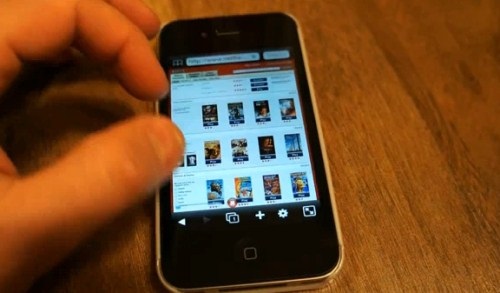
How easy is it to have access to thousands of movies? Netflix can be streamed anytime to your I-phone. There's no need to adjust an antenna or fine tune video settings with an actual dial control. The older crowd reminisce about having to work to get results, the new generation can't see the point. CP
How easy is it to have access to thousands of movies? Netflix can be streamed anytime to your I-phone.

What I do now is maintain a list on Dropbox.com that I can access anywhere. It’s called “Games I need to play.txt” (notice the “need” and not “want”). It has two sub-sections: “Started and Never Finished” and “Games to Play”. I don’t really like leaving games unfinished and so when I look at this list I am reminded of what I need to finish up (as I am often playing more than one game at a time) and then for my larger list I prioritize it with what should be next “on deck”. The list is dynamic, changing as I remember what I want to play or come across things of influence from my colleagues. I also have to admit sometimes I choose to play shorter games so that I can get through them and feel more “accomplished”.  The site www.howlongtobeat.com  is an amazing resource for this sort of thing.

When I asked my friends how they deal with content overload I got some interesting feedback.  One of them, John, actually has an algorithm for dealing with his backlog of books. John shared it with me and it goes something like this:

1. I always have one serious and one fun book on the go and which I put on top of the night stand along with my reading glasses. Sometime I cheat and have two of each kind on the go.
2. I keep a pile of books I want to read someday in my night stand.
3. If I get bored with a book, I trade it with one in my night stand.
4. When I finish a book, I choose another from inside my night stand.
5. If I get tempted by a new book I buy it. If it will not fit in my night stand, then I discard the book that interests. Same goes for books that I’m given.
6. I do have a book shelf at work and one at home for books that I want to keep for later reference. If they get too full, I discard things of least interest.
7. I discard books by giving them to someone, donation to a charity or yard sale.

That’s pretty organized. It’s a little more efficient than how I deal with movies I have yet to watch. Presently, the ones that are on the shelf (Blu-ray or DVD) get “pulled out” a little bit so I can see them clearly among all of my other movies. Since they are all in alphabetical order I don’t want to just pull them out randomly and create a new pile.

A friend shared with me a good way to deal with television content. Just PVR or DVR all the content and then watch as you can. I tried this, but filled up my hard drive so I had to go out and buy an external drive. That drive is now dangerously full. There was some good advice in there, however. “What I do is record all the episodes of a TV show and then when it’s all done I go on a watching marathon and binge on the content for an entire day or two. If it’s a new series and I find out it has been cancelled before I even watch it, I delete all of the content and that way I’m not investing in a show that will ultimately let me down with no additional content.”

Algorithms, mechanisms, processes and lists all to deal with an over abundant amount of content. It’s a wonder there is any room left in our brains to remember or think about what we consumed last week, let alone last year. Yet I find myself looking forward to more content in an ADHD kind of way, I can’t seem to get enough. This is, ultimately, why there will never be anything better in my life than the original Star Wars and other films of the 80s (Raiders of the Lost Ark, Ghostbusters, Stripes, Uncle Buck, Back to the Future). At the end of the day, I’m okay with it because there is always something good and interesting around the corner, even if I have to implement a system to manage it all. There are definitely worse things in life. For the Silo, Syd Bolton.

Wildlife Supply Chains for Human Consumption High In Coronaviruses

HA NOI (June, 2020) – A new study found that animals sampled in the wildlife-trade supply chain bound for human consumption had high proportions of coronaviruses, and that the proportion of positives significantly increases as animals travel from traders, to large markets, to restaurants.

The study, which appears in the pre-print journal bioRxiv, is by a team of scientists from WCS, the Department of Animal Health of the Viet Nam Ministry of Agriculture and Rural Development, Viet Nam National University of Agriculture, EcoHealth Alliance, and One Health Institute of the University of California, Davis.

Wildlife in the trade supply chain are often under stress and confined at high densities with other animals from multiple sources which likely results in increased shedding of coronaviruses. The authors forewarn of the potential risk of viral spillover into people through the wildlife trade.

The authors indicate that stress and poor nutrition likely contribute to decreasing animal immune functions resulting in increased shedding and amplification of coronaviruses along the supply chain. The findings in rodents illuminate the potential for coronavirus shedding in other wildlife supply chains (e.g. civets, pangolins) where similarly large numbers of animals are collected, transported, and confined.

The purpose of the study was to gain a better understanding of coronavirus presence and diversity in wildlife at three wildlife-human interfaces including live wildlife trade chains, wildlife farming, and bat-human interfaces. This work represents an important demonstration of capacity and a significant contribution from Viet Nam to the field, laboratory, and scientific approaches critical to understanding and addressing zoonotic disease threats. The consensus PCR approach for viral detection is a cost-effective tool for detecting both known and novel viruses and co-infections in a variety of taxa, sample types, and interfaces.

Researchers collected samples at 70 sites in Viet Nam, and detected six distinct taxonomic units of known coronaviruses. There is no current evidence to suggest these particular viruses were a human-health threat, but the laboratory techniques used in the study can be utilized to detect important emerging or unknown viruses in humans, wildlife, and livestock in the future.

The team found high proportions of positive samples among field rats destined for human consumption. The proportion of positives significantly increased along the supply chain from traders (21 percent), to large markets (32 percent) to restaurants (56 percent). Coronaviruses were detected on two-thirds of the surveyed wildlife farms, and six percent of rodents raised on the farms were positive. A bat and a bird coronavirus were found in rodent fecal samples collected from wildlife farms suggesting either environmental mixing or viral sharing among species. Coronavirus detection rates in rodent populations sampled in their ‘natural’ habitat are closer to 0-2 percent.

Said Amanda Fine, WCS Health Program Associate Director, Asia, and a co-author of the study: “Wildlife supply chains, and the conditions the animals experience while in the supply chain, appear to greatly amplify the prevalence of coronaviruses. In addition, we documented exposure of rodents on wildlife farms to both bat and bird coronaviruses. These high prevalence rates and diversity of coronaviruses, added to the species mixing we see in the wildlife trade, creates more opportunities for coronavirus recombination events as well as spillover.”

The authors warn that the trade in wildlife facilitates close contact between people and multiple species of wildlife taxa shedding coronaviruses. This provides opportunities for intra- and inter-species transmission and potential recombination of coronaviruses.

The wildlife supply chain from the field to the restaurant provides multiple opportunities for such spillover events to occur. To minimize the public health risks of viral disease emergence from wildlife and to safeguard livestock-based production systems, the authors recommend precautionary measures that restrict the killing, commercial breeding, transport, buying, selling, storage, processing, and consuming of wild animals.

The emergence of SARS-CoV, MERS-CoV, and now SARS-CoV-2 highlight the importance of the coronavirus viral family to affect global public health. The world must increase vigilance through building and improving detection capacity; actively conducting surveillance to detect and characterize coronaviruses in humans, wildlife, and livestock; and to inform human behaviors in order to reduce zoonotic viral transmission to humans. 


Hoang Bich Thuy, WCS Viet Nam Country Program Director and co-author explains: “Since the outbreak of COVID-19, the Government of Viet Nam has been taking strong actions to enforce wildlife trade laws and is considering the prohibition of wildlife trade and consumption as directed by the Prime Minister in his Official Letter No. 1744/VPCP-KGVX dated 6 March 2020 of the Government Office. This research provides important baseline information and suggests areas for targeted studies to provide more evidence for the development of new policies and/or revision of the legal framework in Viet Nam to prevent future pandemics by mitigating risks of transmitting pathogens from animals to humans at key nodes along the wildlife supply chain. Successful interventions will be those that support a significant reduction in the volume and diversity of species traded, and the number of people involved in the trade of wildlife.”

This study was made possible USAID’s Emerging Pandemic Threats PREDICT project with cooperation from the government of Viet Nam.

WCS (Wildlife Conservation Society)

MISSION: WCS saves wildlife and wild places worldwide through science, conservation action, education, and inspiring people to value nature. To achieve our mission, WCS, based at the Bronx Zoo, harnesses the power of its Global Conservation Program in nearly 60 nations and in all the world’s oceans and its five wildlife parks in New York City, visited by 4 million people annually. WCS combines its expertise in the field, zoos, and aquarium to achieve its conservation mission. For the Silo, Stephen Sautner, Wildlife Conservation Society, Bronx Zoo, New York.

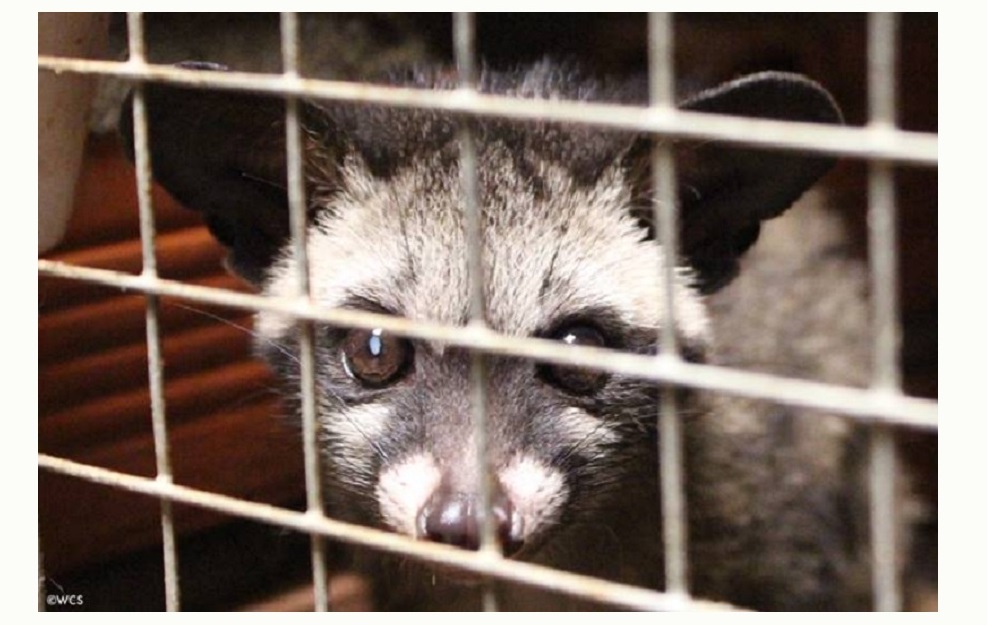
Featured image- Civet in a farm in Dong Thap, Viet Nam.  CREDIT: ©WCS Vietnam

Words Are Powerful. Use With Care, Media Expert Warns

See what we mean?

It’s easy to take words for granted; most of us use them as effortlessly as we breathe. But words hold power that we often overlook at our own peril, says media expert Steve Kayser.

“Language is the code that translates ideas so they can be shared. They give us an advantage in the natural world, which has enabled us to evolve as human beings,” says Kayser, author of “The Greatest Words You’ve Never Heard,” (hyperlink below).

“But in our personal and public lives, we are inundated with empty words; words that are used incorrectly; words that are drained of all meaning; and so fail to accurately convey the intended message; and words that carry unwarranted connotations and stigma.”

Words can change lives, destroy relationships and alter the course of entire civilizations, Kayser notes.

[A must read about the power of word usage via Toltec wisdom:  thefouragreements CP]

He shares examples of what to avoid, what to embrace and what to reconsider when trying to make your language more effective. 

•  Avoid John Kerry’s “crystal clear” nugget. Back in 2016 amid the ongoing foreign policy crises in the Middle East, secretary of state John Kerry, who has a linguistic reputation for long-winded political jargon, seemed to contradict himself in a single breath.

“I want to make this crystal clear,” he said. “The president is desirous of trying to see how we can make our best efforts in order to find a way to facilitate.”

It’s this kind of language that makes people cynical about our elected officials – when a politician’s mouth is moving and producing sounds, but he’s not saying anything. Or, if they are saying something, they use words that are overused and unnecessary. Businesses, too, can be notorious for this using corporate gobbledygook to obfuscate all meaning, Kayser says.

“What people want is authenticity in language, to say what you mean and mean what you say.”

•  Emulate Mark Twain, the “straight shooter,” who employed wit, charm and incisive commentary in communications. No, most people cannot pick up where Twain, arguably America’s greatest writer, left off. But language and the way in which it’s used can be highly contagious. If you want to inspire authenticity and engage employees and friends alike with genuine communication, consider styling your speech more along the lines of Twain, rather than a dry business manual:

“Twenty years from now you will be more disappointed by the things that you didn’t do than by the ones you did do,” Twain wrote. “So throw off the bowlines. Sail away from the safe harbor. Catch the trade winds in your sails. Explore. Dream. Discover.”

•  If you’re in business, there are advantages to embracing the jargon. “Can we blue sky this synergy later?” “Cascade this to your people and see what the pushback is.” … Business lingo could fill a dictionary, and in many cases, requires one! Unlike political babble, business jargon has its purpose, according to a new study from the University of Southern California’s Marshall School of Business. Business speak is code for “upper management material,” showing that the speaker is in a company’s inner circle and is a “big picture” person, the study reveals.

“Some of the language you come across in the business world can seem absurd to outsiders; some of these phrases, however, may actually reveal ambition in an employee,” Kayser says.

Matthew 15:11 Bad Use of Language In Bible

“The beauty of language is that it’s a common tool for everyone to use, yet it can be tailored to an individual. My primary suggestion is to do that in a way that authentically reveals your meaning.”  

Steve Kayser Author Radio Host

About Steve Kayser

Steve Kayser is an award-winning writer, editor, publisher, former radio host and founder of Kayser Media. He has had the great fortune to interview and collaborate with some of the best minds in the business world, and his eclectic approach to public relations and marketing has been widely documented. He recently published “The Greatest Words You’ve Never Heard,” (www.stevekayser.com). 

Anti Glycation Is Next Level In Battle Against Aging

What does a sugar molecule and US special op forces in Afghanistan have to do with this post? Read on.....
What does a sugar molecule and US special op forces in Afghanistan have to do with this post? Read on…..

Most people today know antioxidants to be an effective method of fighting age, but few are aware of the biological process underlying for most skin damage – and what directly addresses the problem, says skin-care expert Ron Cummings.

“The word that has been on the minds of dermatologists and other skin-care researchers for many years is glycation, which is what happens on the cellular level to age our skin,” says Cummings, founder and CEO of AminoGenesis Skin Care, (www.aminogenesis.com .

Glycation – damage to proteins caused by sugar molecules – has long been a focus of study in people with diabetes, because it results in severe complications, such as blindness and nerve damage. People with uncontrolled diabetes have excess blood sugar, so they experience a higher rate of systemic glycation, he says. “Antioxidants fight inflammation caused by free radicals, which are largely created from external, environmental factors such as excessive sunlight or cigarette smoke. Glycation, though, damages from the inside out.”

Using antioxidants and topical moisturizers are a good start to keeping the effects of aging at bay, but they only go so far, Cummings says. Even more important is reversing the damage to skin caused by glycation, which became possible only recently.

Cummings shares three points anyone interested in skin care should know about glycation:

• Glycation is the skin’s No.1 aging factor. Sugar molecules in our body bombard our cells like a ferocious hail storm, bonding with fats and proteins. The proteins then become misshapen and excrete exotoxins that disrupt cellular metabolism. Collagen, which makes skin look smooth and plump, is a protein that’s particularly vulnerable to glycation. The damage manifests as wrinkles, lines, discoloration and edema. Rather than attacking a cell from the outside, like a free radical, glycation occurs from within.

• Anti-glycation topical solutions have been clinically shown to be effective. Old lotions, from your favorite moisturizer to Grandma’s secret facial solution to the new DIY recipe you found online act as a barrier to moisture evaporation. But their effect is temporary, and they don’t prevent or reverse damage. New anti-glycation formulas, however, directly address aging by releasing the sugar molecule’s bond with protein, allowing the cell to return to its natural shape and state.

“Just as antioxidants have revolutionized anti-aging efforts around the world, anti-glycation will be understood to be exponentially more effective,” Cummings says. For the Silo, Ginny Grimsley. 

About Ron Cummings

Ron Cummings is the founder and CEO of AminoGenesis Skin Care, which utilizes amino acids as the key ingredients to its age- and damage-reversing products. The formula for the solution features 17 plant-purified amino acids, which are necessary for healthy and radiant skin. The company’s formulas include anti-glycation properties, which are very rare in today’s skin-care products. Cummings donated one of his products, a protective agent, to support military forces in Afghanistan and received a hearty letter of gratitude from the Marines of Special Operations Company Bravo, which described the product’s excellent performance, as well as a flag that was flown “in the face of the enemy, over Forward Operating Base Robinson in Sangin, Afghanistan.”

Humble Origins Of RPG Gaming

No video game genre is as venerable, or as durable, as that of the simple adventure game. “Adventure” actually covers a number of styles, but there are a few distinguishing characteristics common to them all. They eschew action and combat in favor of exploration and puzzle-solving, and instead of developing their own in-game personas, players generally step into the shoes of an established, or at the very least fixed, character following a tightly-crafted narrative. Yet from the text-based odysseys of the 70’s and 80’s to the surprisingly sophisticated point-and-click journeys of today, the adventure in all its many variations has proven itself one tough old bird.

The origins of the genre can be found in the 1976 game entitled Colossal Cave Adventure. Created by Will Crowther, it was based on his real-life caving experiences embellished with a smattering of fantasy elements that were later expanded upon by Stanford University graduate student Don Woods. Among its most ardent fans were Ken and Roberta Williams, who were so inspired by the game that they actually launched their own software house, Online Entertainment, later famous as Sierra Online, one of the foremost game publishers of the 80s and 90s and an early pioneer of the graphical adventure.

While Sierra was innovating with graphics, another company known as Infocom was pushing boundaries of a different sort. Infocom games like Zork, Planetfall and The Hitchhiker’s Guide to the Galaxy were all about the text parser, yet they were also engaging, complex and, for awhile, commercially successful. But unlike Sierra, Infocom was late catching the graphical wave; its sales declined throughout the second half of the 1980s until Activision, which acquired Infocom in 1986, shut it down for good in 1989.

The next big thing in adventures was LucasArts. These days the company is best known for churning out half-baked Star Wars titles but there was a time when the name evoked images of rough-hewn bikers, invading alien tentacles, Freelance Police and some of the most unlikely pirates you’re ever likely to meet. In 1993, Cyan changed everything with Myst, an incredibly popular and influential release that discarded many of the conventional rules of the genre and made exploration and the discovery of everything, including the basic rules of play, an integral part of the experience.

Today, adventures no longer set the pace for the industry they way they once did (perhaps things are changing- L.A. Noir aims to refresh the adventure genre in high style- content producer)  but they have enjoyed a resurgence in recent years in the hands of small, independent developers who continue to innovate and refine. One of the most remarkable examples of the current state of the adventure art is Gemini Rue, which actually roots itself in the past with blocky, VGA-style graphics that manage to look both dated and yet surprisingly beautiful. But underneath those retro visuals lies a thoroughly modern game, with a haunting soundtrack, top-flight voice acting and a story that will keep you guessing until the very end – and leave you wanting more.

The humble adventure has long since been surpassed in popularity by the shooter, the RPG and other genres, but the emergence of gaming as a mainstream creative medium, coupled with the near-limitless potential of widely accessible digital distribution, could very well herald a renaissance. This in turn opens the style to a wider audience than ever, and while not every gamer will like every adventure – personally, I can’t stand King’s Quest games – I can just about guarantee that ever gamer will find one or two that suit their tastes. Try one sometime. You might be surprised. For the Silo, Andy Chalk. 

Featured image- The Jewels of Darkness Trilogy (all 3 Colossal Cave Adventure games/sequels) MS-DOS 1986

Weirdest Sleep Experiments

The very nature of being human means that we strive to understand the world around us. Scientists have long considered experiments the best way to test a hypothesis and draw a conclusion. Over the last century, scientists have begun to study sleep more and more. We know it’s necessary yet we don’t fully understand it.  Such a vital function could contain so many important discoveries that we haven’t yet come across.

In this infographic we look at some of the most bizarre sleep experiments. What were they, who ran them and why? Did we learn anything from them or did they go horribly wrong? For the Silo, Michael Brown.

Stereo Equip Manufacturer Opens Record Studio To Level The Field

It’s been nearly two years since we moved into our new digs in Boulder, Colorado. The most exciting part has been watching our recording/mastering studio, led by engineer Gus Skinas, come to life. Gus is a close friend and one of the nicest and most humble gents around. The world knows Gus from his work on projects for Pink Floyd, The Rolling Stones, Stevie Wonder, Elton John, Al Kooper, George Harrison, Queen, Joni Mitchell, Chick Corea, Frank Zappa, and The Police (to mention a few). His talent is unmatched, and we’re proud to have him in the hi-fi family.


A few days ago, we made a big step forward. With Gus at the helm, PS Audio has launched our much-anticipated music label: Octave Records.

Almost every time I give a tour at the new facility I get questions about Octave. With hundreds of labels out there, what makes Octave different? You and Paul make components, why the expansion into recording? Are you just doing this because it’s cool?

Guilty as charged!

In truth, we started Octave Records for the same reason we design audio components—because we know we can make a difference. We know we can produce albums with superior sonic quality and we also remain keenly aware of the challenges faced by so many music creators. Labels have been known to sacrifice quality for profits and for mass-market appeal. For albums-sold, most labels compensate artists with pennies on the dollar. Oftentimes, labels insist on owning the artist’s music. We believe the music deserves high-quality presentation and that the artists deserve to be honored for their contributions. It’s the artists, after all, who give rise to our entire industry.

So we decided to build a label the way we think it ought to be. Octave Records uses the finest studio equipment, all centered around the acclaimed Sonoma DSD recording, mixing and mastering system. We asked Gus to personally craft each recording. And to better support musicians, Octave Records covers 100% of the studio, mixing, mastering, production, distribution and marketing costs. We also provide artists with a direct-share of retail revenues, which are ten to twenty times that of other labels. At Octave Records, the artists own their music, and we give them creative control. They’ve earned it…and we get to enjoy the fruits of their labors on our hi-fi systems!

“Along with our dedication to producing the best-sounding recordings available today, Octave Records offers a different kind of business model,” said Paul McGowan, PS Audio CEO. To support musicians, Octave covers 100% of all studio, mixing, mastering, production, distribution and marketing expenses so that artists may directly share in retain sales revenues – while also retaining ownership of their music.”


It’s with great pride that we announce the first album from Octave Records: Out of Thin Air, a solo piano performance from renowned pianist Don Grusin.


Offered in SACD, native DSD (DVD-Audio) and CD formats, you can learn more about Octave Records and listen to samples of Grusin’s new album here https://www.psaudio.com/products/out-of-thin-air/ If you are interested in picking up a copy of this limited edition, they are available with world-wide distribution (direct from us in Boulder), however, this album is not available for digital download at this time.

I hope you enjoy listening to the album as much as we have enjoyed making it. This is the first of many. For the Silo, Scott McGowan.

Seniors Are Doing What Exactly Online?

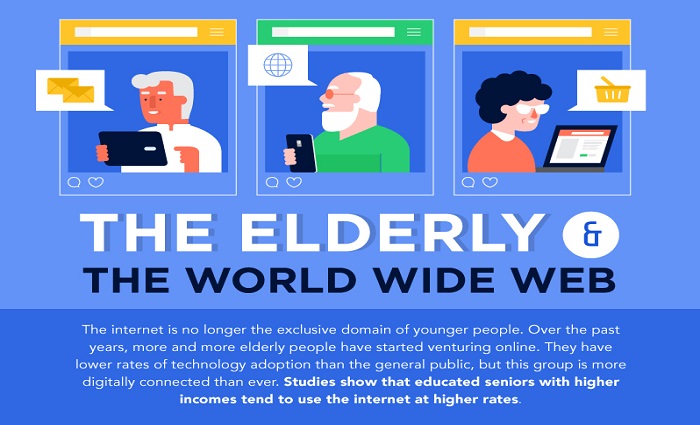
With 80% of baby boomers using the internet, it is clear that seniors are a lot more adept at using tech than we give them credit for. If you’re not convinced, just have a look at the statistics that MedAlertHelp compiled.

You will see that seniors are using the internet and smart devices a lot more regularly than most people would think. But what’s more interesting, perhaps, is the reason why they are using the internet. In this post, we will go through those reasons in more detail.


It’s Convenient

Raise your hands – who still uses an encyclopedia instead of checking the answer online? Do encyclopedias even exist anymore? Seniors are just as keen on using useful shortcuts as the rest of us.


Consider other apps that might be useful, such as internet banking, for example. In most cases, you’re not going to need to go to the bank unless you need to change your address or get a new card. Just about everything else you can do by using online banking or ATMs.


Easy Access to Information About Things That Interest Them

Most seniors cited that they enjoyed using the internet because it was an easy way to access information about things of interest. We can all relate to that. Just 20 years ago, learning something about your favorite hobby meant finding the right books or a person who could teach you.

Now, thanks to YouTube, that’s all changed. There is a wealth of information on the internet. Not all of it is great, but the support for hobbyists is nice. Want to learn how to crochet a jacket for your chicken? Google it – you will find a pattern. And, yes, there are people who crochet jackets for their chickens.


For Shopping

Online shopping and the elderly can be a match made in heaven, especially when there are mobility issues to consider. Online shopping has changed the world for a lot of us – making it possible to gain access to items that we cannot easily get otherwise.

But it can also be infinitely practical. You can shop for almost anything online, from groceries to clothing. This can be a boon for the elderly with mobility problems or issues finding transport.


For Entertainment Purposes

I have to be honest; this one was a bit of a surprise for me. Especially since I remembered growing up and being told that video games would rot my brain. However, almost half of the elderly who regularly use the net, also use it for entertainment purposes, like gaming.


Communication

The internet does provide us with a number of different ways to contact our families and keep in touch with friends. Seniors are taking advantage of services like Skype, Facebook, and other instant messaging services to keep in touch with the people who are important to them.


Conclusion

There is no doubt that the internet is a useful tool to make day to day living less complicated. We’re not counting the potential for wasting time on it here, though. But, if used correctly, the internet can save you time and a lot of stress. Is it any surprise that seniors are taking advantage of these benefits? For the Silo, Tarun Reddy.

What Elderly Do Online Infographic

New Organism Discovered On Space Station 6 Years Ago

Life in Space  Joe Martino writes, “In what is a cool mainstream find, Russian cosmonauts have discovered LIFE clinging to the outside of the International Space Station. This is the first time living organisms have been found on the space station and scientists are not sure how “it” got there.

“Results of the experiment are absolutely unique,” Russian ISS Orbital Mission Chief Vladimir Solovyev told the ITAR-TASS News Agency. “This should be studied further.”

In 2014, Cosmonauts found microorganisms on the exterior of the Inter national Space Station. The creatures were found during a space walk to clean the surface of the space station. The organisms seem to be a type of sea plankton and how they remained alive in space is what seems to be troubling scientists. According to Sploid, Russian scientists are both “shocked by [the] discovery and can’t really explain how [it] is possible.”

“Results of the experiment are absolutely unique,” Russian ISS Orbital Mission Chief Vladimir Solovyev told the ITAR-TASS News Agency. “This should be studied further.”

So far authorities have been withholding actual imagery of the discovered life forms. image: Earth Ocean Plankton examples

To some of us we might already believe in aliens, others may not hold that belief, either way; this is cool news because it further shows the possibility of life in space for those that currently don’t believe it’s possible.

Some scientists believe that the organisms were carried from the ocean by uplifting air currents. Since the organisms are not native to Baikanour, Kazakhstan where the vessel took off, many don’t believe they were brought up during flight. This makes it very difficult to answer the question: “How did they get there?”

The organisms found on the vessel have a mouth, limbs, digestive tract, muscles, and a nervous system! They are aliens! Just not in the typical sense we may picture when thinking about life in space. Known as tardigrades, these little creatures are amazing at enduring harsh conditions, which is why drawing the conclusion that they could have originated in space isn’t so tough.

To believers in aliens this is a mainstream discovery that will help open the minds of those who deny any possibility of life in space.

For the Silo, George Flier via File’s Files #41

No ocean in sight! Baikanour "Space City" in Kazakhstan where launches to the ISS originated from.
No ocean in sight! Baikanour “Space City” in Kazakhstan where launches to the ISS originated from.

Supplemental- Phytoplankton life cycle animation  What are “tardigrades”?

Who Owns Which Celebrity Mansion? Take The Quiz And Find Out

This piece quizzes you by presenting the interior of some of the most lavish celebrity homes and asking which celebrity owns the property.

Look closely and think before making your choices- there are clues hidden…..somewhere.


Darbeevision Device Adds Depth And Clarity To Video And Gaming

If you are a videophile, chances are you have heard of Darbeevision. It doesn’t seem long ago that Faroudja carried the same sort of dare I say “cult like” reverence. Back then, videophiles and home theater nuts like me were clamoring for ways to improve video resolutions on ever larger CRT tube television sets or if you were especially lucky (and had the deep pockets), home projection televisions and dedicated projectors. Sure, some of these displays were capable of high resolutions and were labeled as such (Data grade) but content was largely unavailable to take advantage of the higher lines of screen resolution. The darling format of choice back then was the Laserdisc which maxed out at about 425 horizontal lines of resolution for North Americans or 440 lines for Europeans. And that’s where Faroudja stepped in. Offering highly advanced video processor devices that increased the apparent lines of resolution by using a bunch of advanced math computed on computer chips found inside their products.

Well times have changed….but really not all that much.

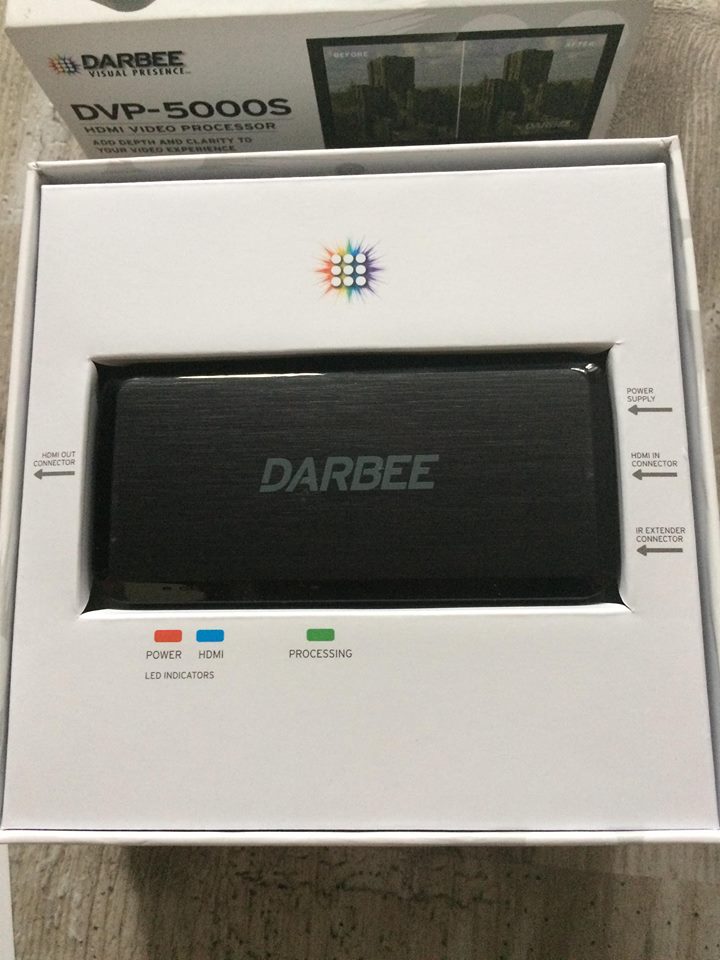
Today we have a choice on how we want to watch content and some of us still prefer physical media such as Blu-ray and many of us watch cloud based streaming from our gaming systems. If you fall into either category and are using an HDMI cable somewhere in your setup then you will want to take note of Darbeevision’s DVP5000s HDMI video processor.

Blu-ray has a maximum resolution of 1080 horizontal lines (1920 x 1080) and the DVP5000s is designed to work with sources that output via a HDMI connection 1080 lines. Just like the Faroudja mentioned earlier, the Darbeevision sets out to use today’s advanced computing to render 1080 in a much more detailed fashion and take advantage of all the extra lines of resolution your new flat screen offers.

If you have an extensive collection of Blu-rays for example, you connect the Darbeevision in between your Blu-ray player (which could be a PlayStation 3 or 4, Xbox One- just make sure you select the video output resolution to 1080P when watching Blu-rays). Likewise, when playing games that run at 1080 use the Darbeevision to increase the quality and detail of your gaming system. It has been designed to operate as quickly as possible to prevent any noticeable screen ‘drag’ or gaming delay.

What about YouTube or Netflix?

The key thing to keep in mind is that the Darbeevision will work well with any signal you feed it as long as that signal is 1080P (or lower) and is fed into it via HDMI cable. So yes, you can also improve the video quality of streaming services just make sure you stream via an app found in your Blu-ray player or gaming system and set the output resolution to 1080P.

Split screen and remote control

Darbeevision suggests using the 5000S for Digital TV (over the air HDTV), Cable and Satellite (that surprisingly offer very little content at higher than 1080 lines, ESPN is 720P) and Projectors that have an HDMI input. Using an older HDMI projector? This device can absolutely help bridge the gap until you are able to buy a 4K projector. Some users have even gone so far as to say that they won’t be upgrading because the 5000S does such a great job with 1080P.

https://www.youtube.com/watch?v=yCbKXcQBDt0
Maybe not!

If you are fortunate enough to have a 3-D Projector and a library of 3-D Blu-rays you won’t be disappointed- the 5000S can really make the video quality and depth of field shine.

The 5000S comes in a sleek black case, has a 360 degree IR sensor and included remote control, has dimmable LEDs (useful if you decide to place the unit in your a/v rack and don’t want to be distracted by bright lights), is HDMI 1.4 compliant and works with 3D Blu-rays.

There are 3 viewing modes including HiDef, Gaming and Full Pop to get you started on your video tweaking adventure. The handy Split screen feature allows you compare the video with and without processing so you know exactly what setting changes do. With a suggested list price of around $199USD the Darbeevision 5000S is highly recommended. For the Silo, Jarrod Barker.

The Biggest March On Climate Change Ever

Way back in 2014, our community decided on a crazy goal – the largest mobilization on climate change in history. So on September 23rd, we blew past our wildest expectations, with a climate march *6 times* the size of anything before it!!! This was 80 city blocks of New York:

World March For Climate 2014 Avaaz

And this was London, Berlin, Bogota, Paris, Delhi, and Melbourne…

World March For Climate 2014

Over 675,000 of us marched around the world. It was a beautiful expression of our love for all that climate change threatens, and our hope that we can save this world and build a society powered by 100% safe, clean energy. Together, we made history, but it’s just the beginning. The crucial Paris climate summit is 15 months from now — that’s where we need a global deal. By March next year, countries have pledged to make their national commitments — so our movement will divide to focus on these national targets. But every few months until Paris we’ll come together globally again and again, bigger and bigger, to beat a drum for change, for 100% clean energy, that our leaders can only follow. The movement we’ve been waiting for has begun.

With gratitude, Ricken, Emma, Alice, Iain, Nataliya, Patri, Oliver, Diego, Rewan and the whole Avaaz team

PS – We worked with thousands of organisations to make this day happen and particularly love our friends at 350. But our community deserves to celebrate the step we’ve taken. The Avaaz team and community played a central role in almost all the marches and events held. The Guardian called it “an organising triumph” for Avaaz and the BBC said “the marches brought more people on to the streets than ever before, thanks to the organisational power of the social media site Avaaz.” We fielded hundreds of organisers and thousands of volunteers, and donations from our community provided millions in funding to the effort. The challenges of our time call us to be better, and together we’ve done that, growing and changing into a new and more effective kind of movement, a movement that is now both online, and offline. Huge gratitude to everyone who made it happen.

Avaaz.org is a 38-million-person global campaign network that works to ensure that the views and values of the world’s people shape global decision-making. (“Avaaz” means “voice” or “song” in many languages.) Avaaz members live in every nation of the world; our team is spread across 18 countries on 6 continents and operates in 17 languages. Learn about some of Avaaz’s biggest campaigns here, or follow us on Facebook or Twitter.

UNESCO Puts Spotlight On Women’s Voices In Imagining World To Come

Paris, May—UNESCO has invited leading women thinkers, artists and activists from fields ranging from climatology to international relations through physics and African studies, to voice their views on the challenges and opportunities the world will face in the wake of the COVID-19 pandemic.

The first six short videos published today provide a female perspective on questions regarding the environment, education and international relations that are coming to the fore during the current global crisis. UNESCO chose to highlight female perspectives in its first videos as the thinking about these pressing issues remains dominated by male voices all too often and in all too many parts of the world.

The first six inspiring women featured in UNESCO’s Forum of Ideas are: Katharine Hayhoe (Canada), Climate Scientist, Director of the Texas Tech University Climate Science Center, Professor of Political Science and UN Champion of the Earth, Fadia Kiwan (Lebanon), Political Science Professor, General Director of the Arab Women Organization, Member of the Scientific Advisory Committee of the UNESCO-MOST Programme, Sara Purca (Peru), Researcher at the Peruvian Sea Institute, winner of Peru’s National L’Oréal-UNESCO For Women in Science (2017) Prize, N’Dri Assie-Lumumba (Côte d’Ivoire), Professor at the Africana Studies and Research Center, Cornell University, Chairperson of the Scientific Advisory Committee of the UNESCO-MOST Programme, Sakiko Fukuda-Parr (Japan),Professor of International Affairs, Director of the Oslo University Independent Panel on Global Governance for Health, and Márcia Barbosa (Brazil), Physicist, Director of the Brazilian Academy of Sciences, laureate of L’Oréal-UNESCO Awards for Women in Science (2013).

New contributions from prominent women and men working in all parts of the world in a rich variety of disciplines will be added to the UNESCO Forum of Ideas platform over coming months.

In producing its Forum of Ideas series, UNESCO fulfills its mission as an open and inclusive laboratory of ideas, destined to contribute to strategic thinking about the Organization’s programmes. UNESCO also hopes that the series will inspire national policy-makers and provide a positive contribution to global governance. For the Silo, Clare O’Hagan.

UNESCO Forum website: en.unesco.org/forum

PS Audio Shipping New Stellar™ M1200 Monoblock Power Amplifier

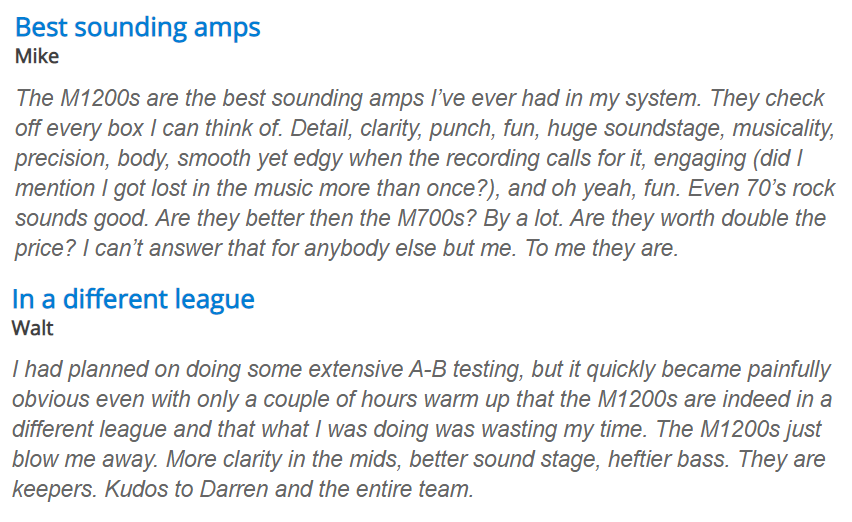
Boulder, Colorado, May, 2020 – PS Audio recently announced it is shipping its new Stellar M1200 Power Amplifier. Designed to deliver extraordinarily clear, detailed and musically accurate performance, the monoblock M1200 features an all-new hybrid design that combines a tube input stage with a customized ICE Edge output stage and delivers 1200 watts (into 4 ohms, 800 watts into 8 ohms), to effortlessly reproduce the most dynamic musical passages as well as the subtlest musical details.
 
The M1200 was designed by Darren Myers, the engineer who created the acclaimed Stellar Phono stage and other PS Audio products. The M1200 employs a 12AU7 vacuum tube at its input, chosen for its optimum gain and voltage characteristics in the circuit, and for its ability to preserve the most delicate nuances of the amp’s input signals. The 12AU7 is the identical tube used in PS Audio’s flagship BHK Signature amplifiers, chosen after extensive listening and performance tests.
 
The ICE Edge output stage is a new type of high-current Class D design, offering extremely low total harmonic and intermodulation distortion with high headroom and linear performance across the frequency range. As Darren Myers explained, “other output modules can exhibit non-linear phase and impedance issues at the frequency extremes. The ICE Edge design eliminates these problems thanks to patented circuitry and feedback techniques.” Myers continued, “Although it can deliver massive amounts of clean power into even the most demanding loudspeaker loads, the M1200 sounds equally good at lower volumes.”
 
Like every PS Audio product, meticulous attention has been paid to parts quality and construction. The M1200 has a sleek, elegant appearance that matches other Stellar Series components and is available in silver or black.
 
The PS Audio Stellar M1200 Power Amplifier will be available in June 2020 at a US manufacturer’s suggested retail price of $5,998 per pair. Pre-orders are currently being taken.
 
M1200 Features at a Glance: Zero-loss vacuum tube input stage and custom ICE Edge output stage. Fully balanced circuitry, RCA single-ended and XLR balanced inputs. 1200 watts RMS into 8 ohms, 600 watts into 4 ohms, stable to 2 ohms. Greater than >1100 damping factor for exceptional loudspeaker control. High-efficiency operation. Dual, solid copper, plated output binding posts facilitate bi-wiring, 12-volt input trigger, 27 lb. each; 17″ wide by 3.75″ high by 12″ deep (13″ with connectors)

About PS Audio
Founded in 1973, PS Audio has earned a worldwide reputation for excellence in manufacturing innovative, high-value, leading-edge audio products. Located in Boulder, Colorado at the foothills of the Rocky Mountains, PS Audio’s staff of talented designers, engineers, production and support people build each product to deliver extraordinary performance and musical satisfaction. The company’s wide range of award-winning products include the all-in-one Sprout100 integrated amplifier, audio components, power regenerators and power conditioners.
 
www.psaudio.com
PS Audio Image Library available for download here
Paul’s Daily Posts
PS Audio Community
Copper Magazine

2020 iF3 Snowboard Ski Film Festival Presented By Audio-Technica Canada Welcomes Your Film Application

May, 2020 – Montreal, Québec – It is with great excitement that the iF3 team announces the 13th edition of iF3 Montreal. The winners will be presented and announced by Audio-Technica Canada from Montreal between October 21st to 24th 2020. Please note that we will adapt and confirm the format of the festival according to the evolution of the current situation surrounding the COVID-19 pandemic, with the potential for an entirely virtual event. We will be taking every step necessary to follow our government’s rules and regulations, as we are committed to your health and safety first.

Our presenting partner Audio-Technica Canada announces that all film companies and film producers are now invited to register for the 2020 iF3 Movie Awards with a deadline of July 10th.

The 13th edition of iF3 Montreal will happen in the fall of 2020, with many of the best ski and snowboard films being presented for the occasion.


The broadcast of the iF3 Movie Awards’ 13th edition is scheduled to take place at 5:00 p.m. EST on Saturday October 24th.

We invite you to get hyped for the upcoming season with us by celebrating the best images and athletic performances of the international ski and snowboard communities!

Follow this link to register your film: https://festivalif3.com/en/awards/#registration

All over the world, the Audio-Technica Team is committed to provide extraordinary products that exceed our customers’ expectations and elevate their experience. From remarkable audio quality to reliability and durability we do not compromise. This is why Audio-Technica’s microphones are used to broadcast from the slopes in worldwide events.

Audio-Technica has been around for nearly six decades, with Audio-Technica Canada consumer division being its newest subsidiary. Audio-Technica is passionate about serving the Canadian marketplace with excellent products, including high performance microphones, headphones, phonograph cartridges, turntables and more.

iF3 Festival is the ideal partner for Audio-Technica to connect with local audio communities and users that share our passion and devotion to constantly seek out the very best. Our reputation for high-quality, value, and performance has made our products the first choice for many of today’s top musical artists, producers, audio engineers, discerning listeners and athletes everywhere. #nocompromise

iF3 Montreal 2020 - 13th Edition - Registration Is Now Open ...

About iF3

The International Freesports Film Festival was founded in 2007 to recognize and celebrate the excellence in freeskiing and freeriding. It is the biggest festival tour of its kind, travelling the globe to present the world’s best ski & snowboard movies ofthe year. The festival’s reputation and recognition stem from being the only independent ski film award ceremony with an international and diverse jury panel in which not only athletic performances are rewarded. In fact, a major part of the gala is dedicated to the artistry and production work involved in bringing ski films, and snowboard films to life.

Information about iF3 and upcoming events:
http://www.festivalif3.com/
https://www.facebook.com/if3festival/
https://www.instagram.com/if3festival/?hl=en (@if3festival)

Celebrating over 50 years of audio excellence, Audio-Technica is a recognized leader in the development and manufacture of high-quality personal and professional audio equipment. Founded in Japan in 1962 by Hideo Matsushita, the company made its name by manufacturing state-of-the-art phonograph cartridges and tonearms. Today, Audio-Technica is a worldwide group of companies devoted to creating high-performance microphones, headphones, wireless systems, mixers, turntables, phono cartridges and other electronic products.

A reputation for quality, durability, performance and value has made Audio-Technica products the first choice for many of today’s top musical artists and audio engineers, and for discerning listeners everywhere. Drawing from its audiophile heritage, Audio-Technica remains dedicated to providing music enthusiasts with great-sounding, innovative audio gear, including the award-winning QuietPoint active noise-cancelling headphones, popular ATH-M50x monitor headphones, versatile USB microphones, and new Hi-Res Audio headphones and high-fidelity gaming headsets. Learn more at www.audio-technica.com.

New Music App Tizzme Lets You Broadcast Your Favorite Music Live

Tizzme is a new app for music lovers allowing them to create an experience akin with two friends sharing earbuds: an app that acts as a perfect companion to Spotify Premium, by letting music lovers everywhere broadcast their favorite music live. Available for free. App Store for iOS Google Play for Android

Cover art

The idea for Tizzme came to Montreal entrepreneur Greg Kates while watching a Montreal Canadiens hockey pre-game broadcast on TV. He saw star defenceman PK Subban (then a Montreal Canadian) listening to music before the game. Greg started thinking how cool it would be if he could listen along with PK in that moment.

What if fans could listen along to PK’s pump-up music live? So when PK skipped a song, it would skip for his fans too. In other words, a real time, interactive, remote, shared listening experience. This put him on the road to creating Tizzme.

Screenshot Image

Music has always been a big part of Greg’s life and he’s played instruments for years – including the piano, guitar, and drums and he’s always been the go-to source with his friends and family for burnt CDs and AUX duties.

Features:

Tizzme is a completely free app that syncs seamlessly with a user’s Spotify Premium Account. Users can broadcast their own playlists live, or follow friends, family, or strangers and tune into their live broadcasts.

Screenshot Image


● Tizzme helps you find new music by searching based on genre, location, popularity, or suggested profiles based on a musical taste questionnaire.
● Tizzme also offers “genre robots” that every user will have access to 24/7. These playlists are based on genre and will be constantly playing new songs that match the genre.
● Live broadcasts can be shared on social media and listeners can provide live feedback on each song, with a thumbs up or down.
● Each playlist has a 100 song limit to let users hone in on their favorite songs.

How to use:

The application comes with a tutorial located in the user profile section
● To Listen: On the user profile, connect your Spotify account. Find users based on popularity, proximity, genre and suggested users who have the same musical personality as you. Once you follow a user, they will populate within your Broadcast feed. When they are online, a green dot will appear next to their name and when they broadcast, they will pop up to your broadcasting section. Click their song and you will listen in at the exact same time as them. Give instant feedback with a thumbs up or down for every song.
● To Broadcast: Select “my music”. Your local library can be played, but for seamless listening use your Spotify premium account. All users will need to make their 100 song playlists on Spotify (if longer, it will show the first 100 songs), and once made, it automatically populates within your Tizzme account. Click a song, click broadcast, choose a genre and activity (optional) and your music will be played for anyone to find. Pay attention to your thumbs up and down counters as that will show live feedback from your listeners.

For the Silo, Rosemary Newton.

People In Japan, Spain, France Are Unhappy With Government COVID Response

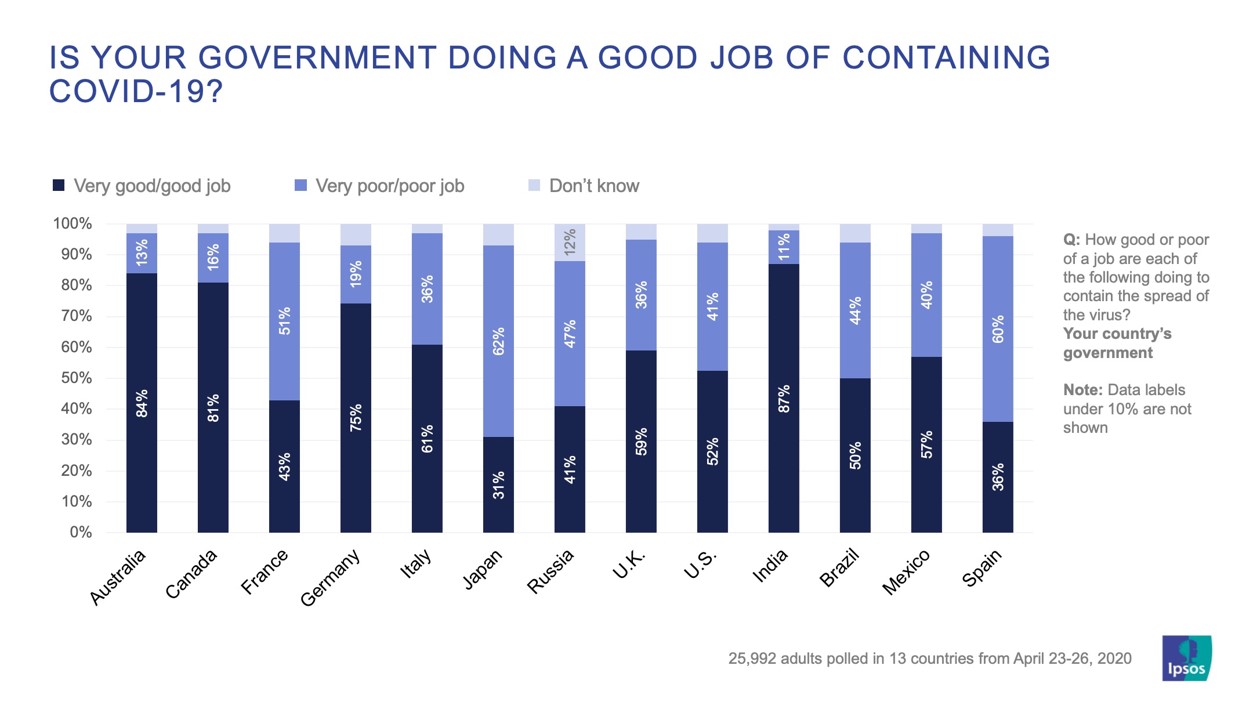
Paris, France May, 2020 — Sentiment over whether governments are doing a good job of containing the coronavirus pandemic has swung in a number of countries over a month, according to the latest Ipsos poll.

A majority of people in nine out of 13 countries feel their government is doing a good job of containing the spread of COVID-19 in a survey of nearly 26,000 respondents conducted on April 23 to 26. People in India (87%), Australia (84%), Canada (81%), Germany (75%) and Italy (61%) are most likely to say this, while those in Japan (62%) and the hard-hit European countries of Spain (60%) and France (51%), and Russia (47%) were most likely to cite a poor job by their government.

May 4, chart 1.jpg

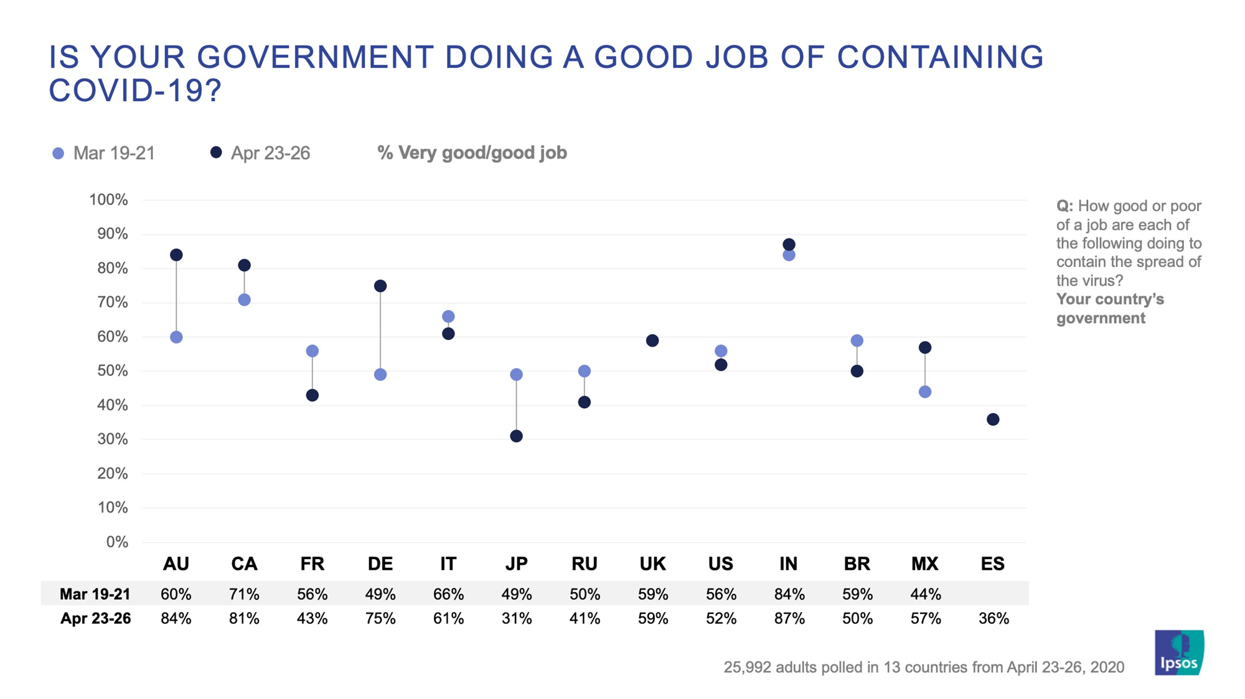
But when you look back to polling results from more than a month ago – March 19 to 21 – sentiment has fallen the most in some key countries at the center of the outbreaks. Japan is at the top with their view of government response down 18 percentage points, followed by France (-13), Brazil and Russia (-9), Italy (-5), and the United States (-4).

On the other end, a positive view of the government’s work has increased in Germany (+26 points), Australia (+24 points), Mexico (+13), and Canada (+10) since March. Sentiment in the United Kingdom has remained unchanged with three in five people (59%) happy with the government response.

May 4, chart 2.png

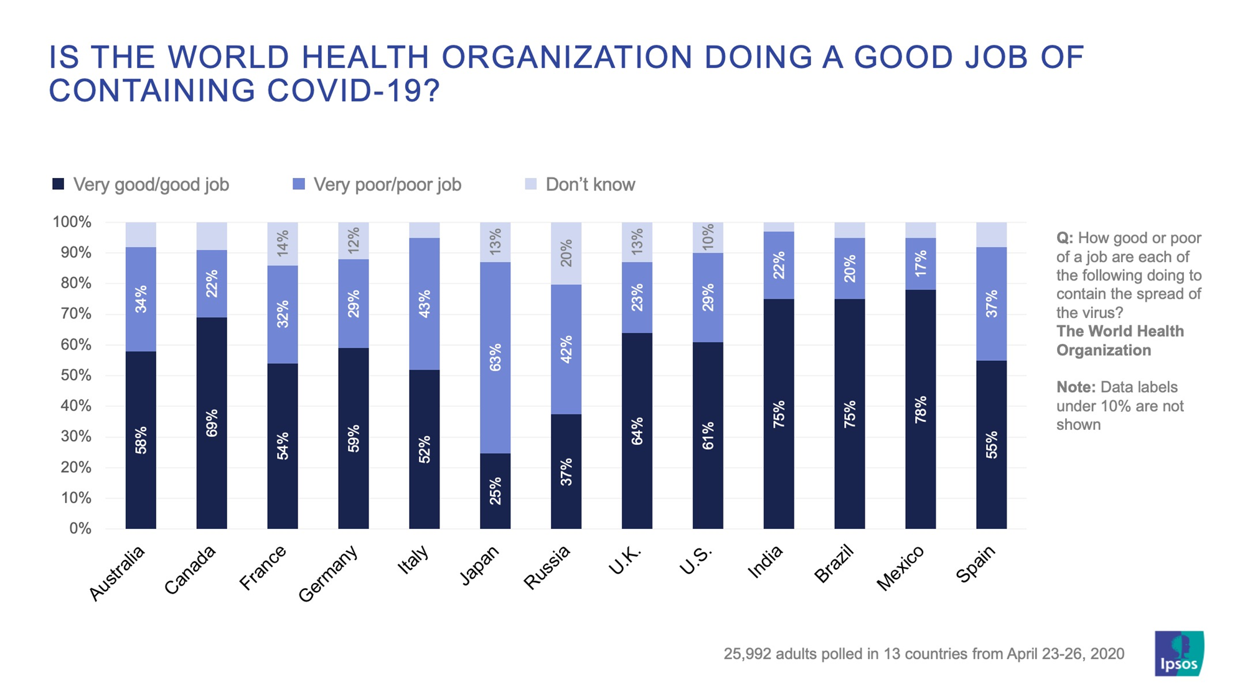
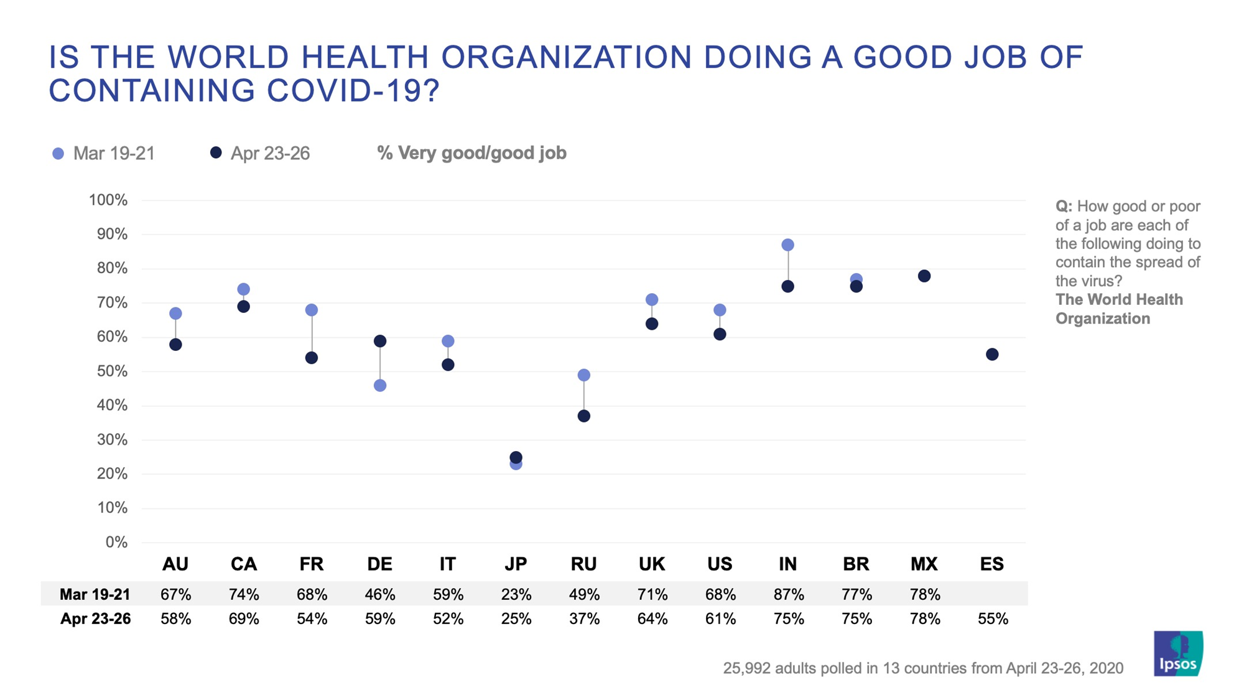
In terms of how people view the work of an international agency – the World Health Organization – a majority of people in 11 out of the 13 countries surveyed think the WHO is doing a good job in containing the spread of COVID-19, but this sentiment has fallen since March in nine out of 12 countries where Ipsos has tracked opinions.

People in the emerging markets of Mexico (78%), India and Brazil (75%) are most likely to be satisfied with the WHO’s response, followed by the developed nations of Canada (69%) and the U.K. (64%). The only two countries where more people disagree with the job done by the WHO are Japan (63%) and Russia (42%).

Other Ipsos research shows when respondents are asked about the performance of institutions in preventing the spread of the virus other aspects of the issue, including the economic effects of shutdowns, also influence how they evaluate institutional performance relative to containing the spread of COVID-19.

May 4, chart 3.png

The countries seeing the biggest decline in regard for the WHO’s response are France (-14), India and Russia (-12) and Australia (-9). Germany (+13) and Japan (+2) are the only countries where satisfaction with the WHO’s role has increased.

May 4, chart 4.png

https://www.ipsos.com/en/view-governments-job-contain-covid-19-falls-hard-hit-countries-rises-others

About the Study

These are the results of an Ipsos survey conducted April 23rd to 26th, 2020 on the Global Advisor online platform among 25,992 adults aged 18-74 in Canada and the United States and 16-74 in Australia, Brazil, France, Germany, Italy, India, Japan, Mexico, Russia, Spain and the United Kingdom. Where available, tracking results from previous studies, conducted through April and March and selected results from February are referenced by date.

The sample for April 23rd to 26th consists of approximately 2,000 individuals in each country. The samples in Australia, Canada, France, Germany, Italy, Japan, Spain, the U.K. and the U.S. can be taken as representative of these countries’ general adult population over age 16 or 18 (as above) and under the age of 75. The sample in Brazil, India, Mexico, Russia, and is more urban, more educated and/or more affluent than the general population and should be viewed as reflecting the views of the more “connected” segment of the population. The data is weighted so that each market’s sample composition best reflects the demographic profile of the adult population according to the most recent census data.

Where results do not sum to 100 or the ‘difference’ appears to be +/-1 more/less than the actual, this may be due to rounding, multiple responses or the exclusion of don’t knows or not stated responses. The precision of Ipsos online polls are calculated using a credibility interval with a poll of 1,000 accurate to +/- 3.5 percentage points. For more information on the Ipsos use of credibility intervals, please visit the Ipsos website (www.Ipsos.com).

For the Silo, Darrell Bricker, PhD CEO, Ipsos Global Public Affairs

About Ipsos

Ipsos is the world’s third largest market research company, present in 90 markets and employing more than 18,000 people.

Our passionately curious research professionals, analysts and scientists have built unique multi-specialist capabilities that provide true understanding and powerful insights into the actions, opinions and motivations of citizens, consumers, patients, customers or employees. We serve more than 5000 clients across the world with 75 business solutions.

Founded in France in 1975, Ipsos is listed on the Euronext Paris since July 1st, 1999. The company is part of the SBF 120 and the Mid-60 index and is eligible for the Deferred Settlement Service (SRD).

ISIN code FR0000073298, Reuters ISOS.PA, Bloomberg IPS:FP www.ipsos.com
Featured image: Philippe Lopez/AFP/Getty Images/CNN

Hong Kong Board Predicts This New Post Covid Tourism Landscape

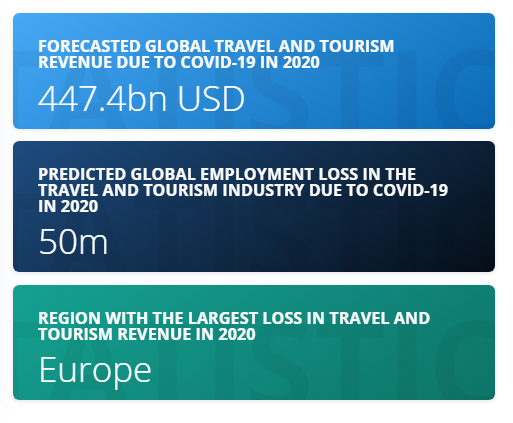
The Hong Kong Tourism Board (HKTB) hosted a web conference on April 24, 2020 to provide the latest updates on tourism development and introduce the HKTB’s strategic framework of recovery plan. HKTB Chairman Dr. YK Pang said that the Covid-19 pandemic has posed unprecedented challenges to Hong Kong tourism and put global tourism to a halt.

He continued, “The tourism landscape will be reshaped. In the post-pandemic world, we will see a shift in preference and behavior among travelers – the public health conditions of destinations, and the hygiene standards of transportation, hotels and other tourism facilities will become a top priority; people will prefer short-haul breaks and shorter itineraries; wellness-themed trips will become a new trend. It is an ideal time for us to review and rethink Hong Kong’s position in the global tourism market and elevate service standards. Together with the travel trade, the HKTB is going to map out the long-term development strategy for our tourism industry.”

source: statista.com

The web conference was attended by close to 1,500 representatives from travel agencies, attractions, hotels, airlines, the retail and dining industries, as well as Meetings, Incentives, Conventions and Exhibitions (MICE) and cruise sectors. Representatives from the HKTB’s worldwide offices also participated in the meeting to provide insights into the latest developments in various market regions:

Mainland Market

  • The Mainland has gradually resumed economic activities and people have returned to work.
  • Given the outbreak’s impact on the economy, consumers will become more price-conscious and pursue value-for-money holidays. After prolonged confinement, visitors will also place greater emphasis on health and nature. When choosing destinations for future trips, they will favor those that pose low risks to health.
  • The Meeting and Incentive market has slowed down as many activities have been postponed or will be held online.

Short-haul and New Markets

  • Domestic travel will be the major preference shortly after the pandemic, and outbound travel will resume soon after.
  • Regional competition will be fiercer than ever, as the tourism authorities and travel trade of various destinations are gearing up for intensive promotions to vie for visitors.
  • In Japan, Korea and Taiwan, the young and middle-aged segments will be the most eager to travel. Green tourism and the outdoors will be favored, while short-haul travel will be preferred due to financial and holiday leave constraints.

Long-haul Markets

  • Currently, governments are focusing on containing the outbreak within the region. A longer time is expected for these markets to recover and outbound travel may resume in the last quarter of this year at the earliest.
  • Ethnic Asian visitors are expected to be the first to visit Hong Kong after the pandemic.
  • Consumer sentiment is comparatively more positive in Canada, France and Germany and outbound travel is expected to recover at a faster rate in these markets.

The HKTB has announced earlier that it will be allocating HK$400 million (US$51.2 million) to support promotions by the trade. HKTB Executive Director Dane Cheng explained that the HKTB has devised a three-phase plan to reinvigorate Hong Kong tourism. The exact timeline will depend on the development of the pandemic.

Phase 1 (Now) – Resilience

  • The HKTB is preparing a recovery plan for Hong Kong tourism.

Phase 2 – Recovery

  • When the pandemic shows signs of abating, the HKTB will first focus on local market to promote positive ambiance in Hong Kong by encouraging locals to rediscover different neighborhoods and community cultures in order to send a positive message to visitors and restore their confidence in the city. Meanwhile, the HKTB will launch tactical promotions with the trade in selected markets based on the developments of individual markets to stimulate people’s interest to visit Hong Kong.

Stage 3 – Relaunch

  • Mega events and a new tourism brand campaign will be launched to rebuild Hong Kong’s tourism image.

Digital Habits Is Innovation Platform Founded In Milan Italy

Digital Habits is an extension of the international design studio Habits.

Founded in Milan in 2012, it specializes in connected objects. For example, a few years ago during the 2017 edition of the Superdesign Show by Superstudio, Digital Habits examined in depth the relationship between the user, the context and controls of electronic products.
Since then, they haven’t looked back and their new prototypes go beyond the natural interfaces designed by others in the past. In fact, present multisensory systems now connect gestures, space, attention and feedbacks.

The presented products are control devices designed around humans, their anthropometry, their spaces and their best perceiving or moving abilities; they are not based on technical elements such as the size of the display, the currently available sensors or computational capability. Where need be they engineer and manufacture what does not already exist.

This is cutting edge stuff. 

These devices express a new design Humanism where the user has a central role prevailing to the underlying technology sophistication. This is a different approach from the usual ‘technological one’ where the tendency to standardize components brings also the standardization of user experiences.

Instead, Digital Habits has presented three new projects that have colour as a common thread linking the user experience, the object and the environment:


OSOUND XL: a new Air Gesture Control Bluetooth Loudspeaker, covered by colourful fabrics; Its wide size qualifies OSOUND XL as piece of smart furniture rather than just a well-designed electronic device.


COLOR SWING: an ambient light detection system of the color information of an object surface which is returned as a light feedback to the environment XVOID: a new generation of air gesture interfaces, to control light/colour intensity; for the exhibited project, the presented case is the control of white and coloured light.
Digital Habits has already won several international awards (RedDot Design, Core 77, Expo Award) and received a vast press coverage (selected by CNN as best 10 Technology objects for your home, presented on TED Talks ideas worth spreading, The Telegraph, Mashable, Gizmag, etc.). Digital habits products are available in most exclusive retailers. For the Silo, Jarrod Barker.

US/Canada Poll- Quick Economic Recovery From COVID-19 Unlikely

Many think it’s unlikely the economy will recover quickly once COVID-19 lockdown is over

Most negative about an economic recovery in hard-hit countries except China

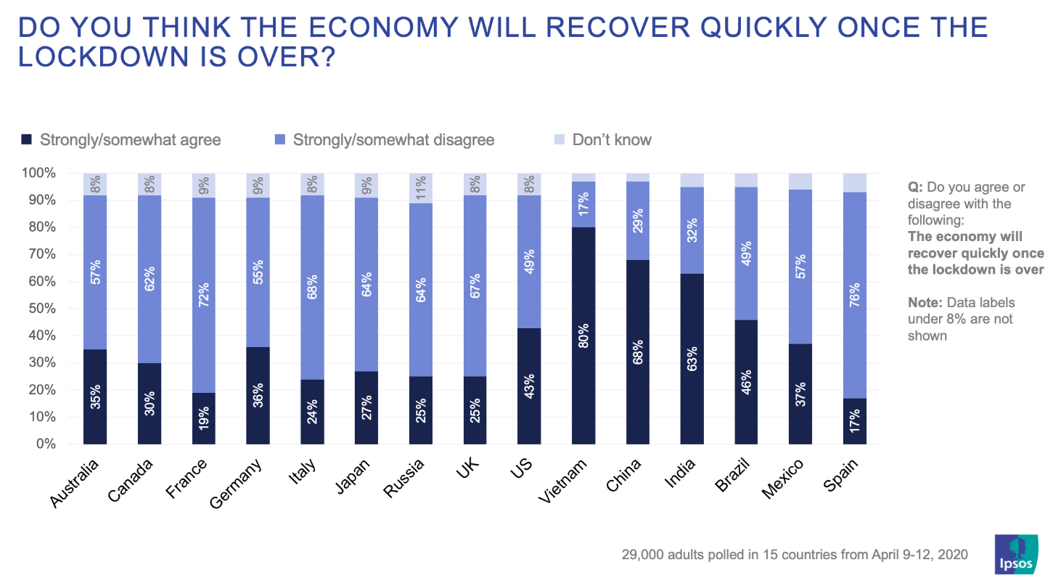
Paris, France April , 2020 — A majority of people in 10 of the 15 countries polled by Ipsos disagree that the economy will recover quickly once the lockdown from the coronavirus pandemic is over – suggesting a lasting impact.

People in Spain (76%), France (72%), Italy (68%), the United Kingdom (67%), Russia and Japan (64%), and Canada (62%) feel most strongly against a quick economic recovery in a survey of nearly 29,000 respondents conducted from April 9 to 12. Those in Vietnam (80%), China (68%) and India (63%) are most likely to say a quick recovery will take place.

At the same time, one of the countries most divided on this question is the world’s largest economy – the United States  ̶  with nearly half of those surveyed (49%) disagreeing on a quick recovery, while 43% think it will happen.

V2, wave 8, pr 2, graph 1.png

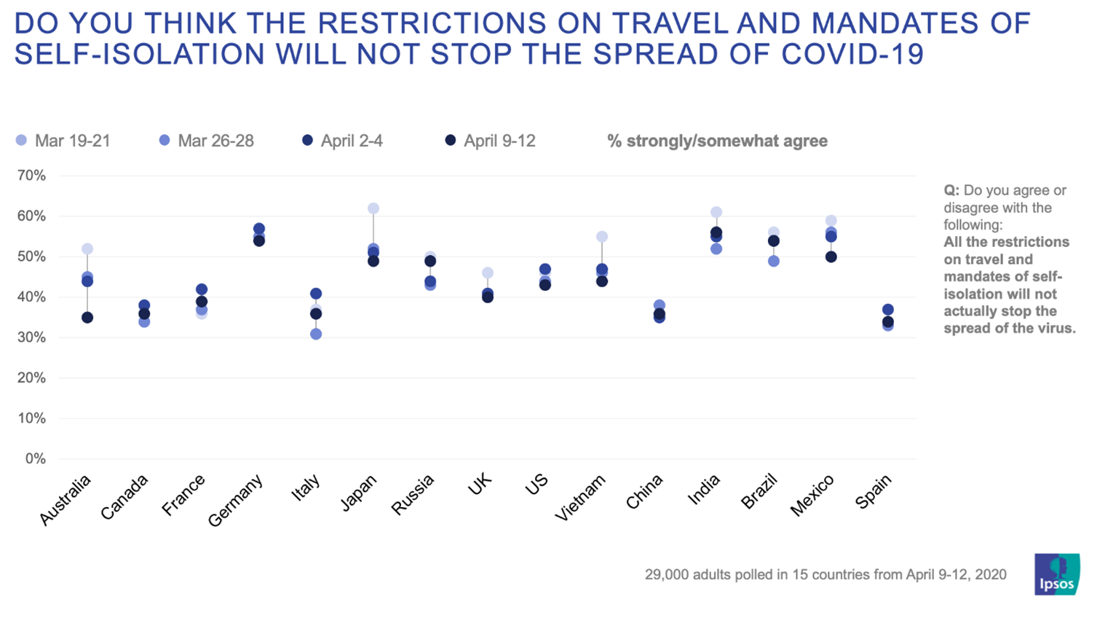
In terms of actions taken, majorities in India (56%), Brazil and Germany (54%) say all of the restrictions on travel and mandates for self-isolation will not stop the spread of COVID-19. That compares with majorities in China (63%), Australia (59%), Italy and Canada (58%), Spain (57%), the U.K., and Vietnam (54%) and France (51%) who think the restrictions do work.

Countries that have the seen the most significant change on this measure since mid-March are the ones where optimism has increased. Australia saw a drop of 17 percentage points in the number of those that agree the measures will not stop the spread of the pandemic, while the number of respondents in Japan fell by 13 points.

V2 wave 8, pr 2, graph 2.png

About the Study

These are the results of an Ipsos survey conducted April 9th to 12th , 2020 on the Global Advisor online platform among 28,000 adults aged 18-74 in Canada and the United States and 16-74 in Australia, Brazil, China, France, Germany, Italy, India, Japan, Mexico, Russia, Vietnam and the United Kingdom. Where available, tracking results from previous studies, conducted through March and selected results from February are referenced by date.

The sample consists of approximately 2,000 individuals in each country with the exception of Vietnam each at 1,000. The samples in Australia, Canada, France, Germany, Italy, Japan, the U.K. and the U.S. can be taken as representative of these countries’ general adult population over age 16 or 18 (as above) and under the age of 75. The sample in Brazil, China, India, Mexico, Russia, and Vietnam is more urban, more educated and/or more affluent than the general population and should be viewed as reflecting the views of the more “connected” segment of the population. The data is weighted so that each market’s sample composition best reflects the demographic profile of the adult population according to the most recent census data. Sample sizes may vary in prior waves. 

Where results do not sum to 100 or the ‘difference’ appears to be +/-1 more/less than the actual, this may be due to rounding, multiple responses or the exclusion of don’t knows or not stated responses. The precision of Ipsos online polls are calculated using a credibility interval with a poll of 1,000 accurate to +/- 3.5 percentage points. For more information on the Ipsos use of credibility intervals, please visit the Ipsos website (www.Ipsos.com).

Ontario Has Extended Declaration Of Covid Emergency To May 12

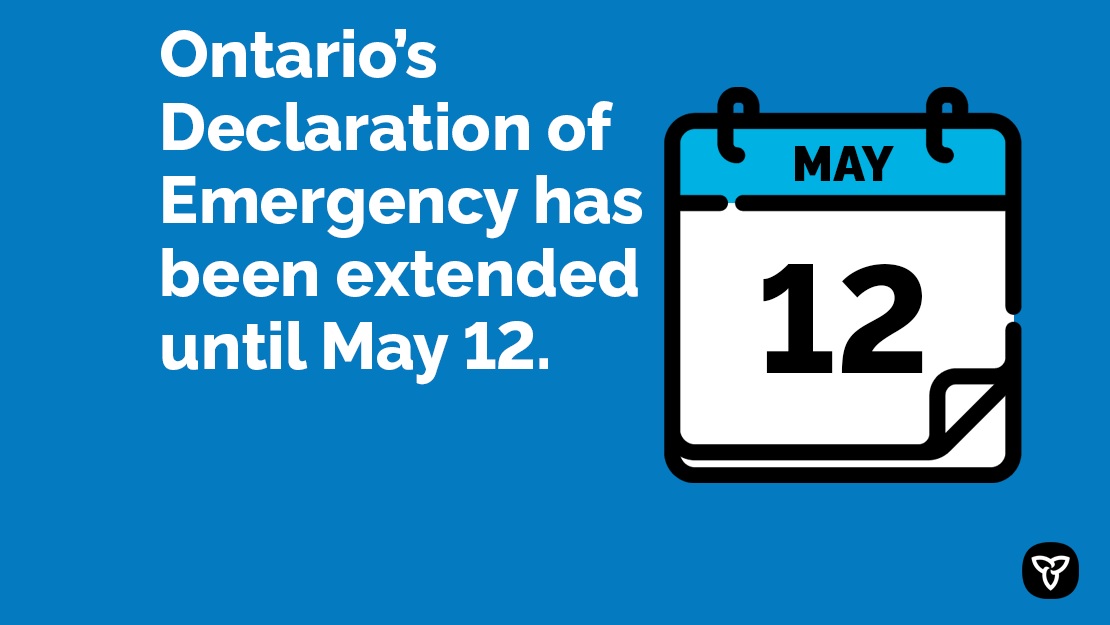
Throughout the world people and their governments are making a myriad of decisions that are risking lives, risking freedoms, and risking livelihoods. To continue to take on the challenges of coronavirus, Ontario has extended its Declaration of Emergency to May 12.

First announced on March 17, these measures under the Emergency Management and Civil Protection Act, mean that non-essential workplaces will remain closed, gatherings will continue to be restricted to five people, price-gouging remains outlawed, and restaurants will be limited to takeout. Students will not be going back to school May 4 and there is no set date for their return.

The legislation also permits Haldimand, Norfolk and all municipalities to extend their own state of emergency – with measures sometimes at odds with the province, and also with varying levels of support. Canada’s proposal to bring in sweeping powers to deal with Covid-19 under the Emergencies Act has been opposed by most of the provinces, including Ontario.

During these times, all levels of government justify restrictions to offer support and every power possible — and justifiably so – to help our health sector fight the spread of corona virus. People understand this disease constitutes a danger of major proportions. However more recently our office is fielding complaints of too many rules lacking common sense, and clarity, and by extension effectiveness. Ultimately deterrents don’t work if people have reason to defy.

There is confusion.

For example, Ontario advises that green spaces in parks, trails, ravines, and conservation areas remain open for walk-through access. However, residents of certain municipalities, including Haldimand-Norfolk are not permitted to use or access any open space, including parks, trails, piers, beaches, community gardens, or other open spaces usually accessible to the public, whether publicly or privately owned. By no means is it time for us to get complacent, but if people perceive new rules to be contradictory, or unfair, or out of proportion to the necessity they are less inclined to comply.

The mandatory closure of non-essential workplaces continues to at least May 12, with the extension of the state of emergency.

As the situation evolves, Premier Ford has been clear that every option is on the table. Businesses and individuals who want to get back to work are contacting my office and we advocate on their behalf with various ministries, and collaborate on suggested options to find a way forward to a healthy economy. We do need to find a path to future economic activity – to normalize, by way of thoughtful and reasonable direction based on analysis of the costs, the risks and the benefits.

While fighting a deadly enemy, we must also be planning for economic recovery – and to that end the Premier has appointed a team to develop a plan for post-pandemic growth and prosperity.

Toby Barrett photo

This new Ontario Jobs and Recovery Committee will focus on getting businesses up and running and getting people back to work. Since January 25 – when I first communicated concerns about coronavirus – my office and I have witnessed the mounting concern and anxiety about this deadly disease. We are now seeing mounting concern, frustration and anger with respect to restrictions and perception of authoritarian overreach – the perception of threats to freedom and threats to making a living. We must find a way forward and I welcome your input. For the Silo, Toby Barrett MPP for Haldimand-Norfolk.

Supplemental

https://news.ontario.ca/opo/en/2020/04/ontario-extends-declaration-of-emergency-to-continue-the-fight-against-covid-19.html

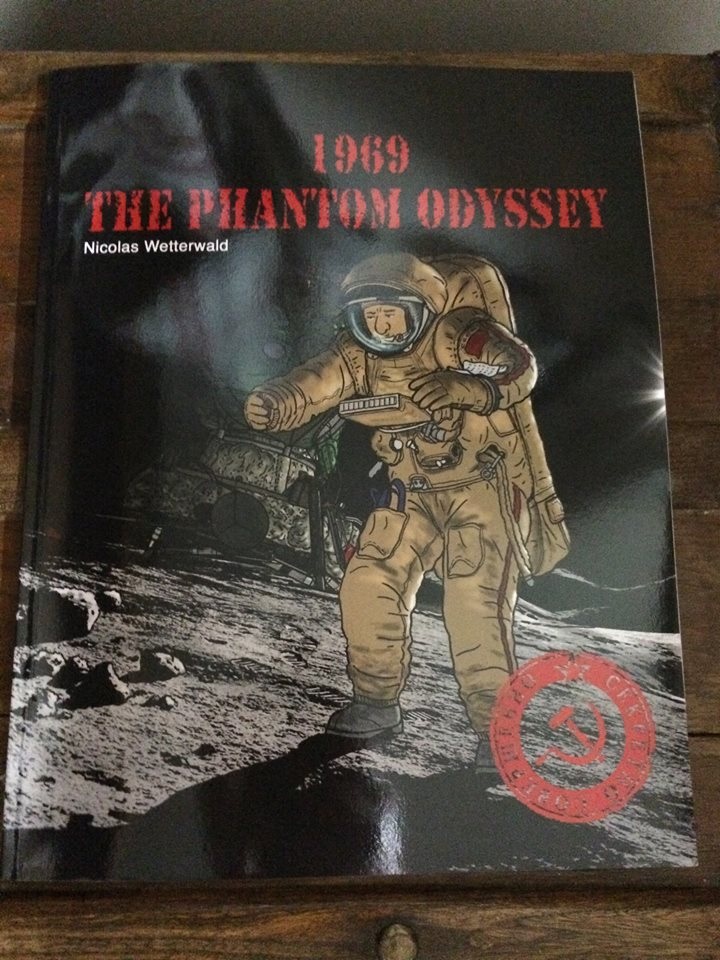
Alt History Graphic Novel Has Russians On The Moon

Real life: In the 1960’s Communist Russia and the United States were in a race to be the first nation to safely land a man on the Moon.

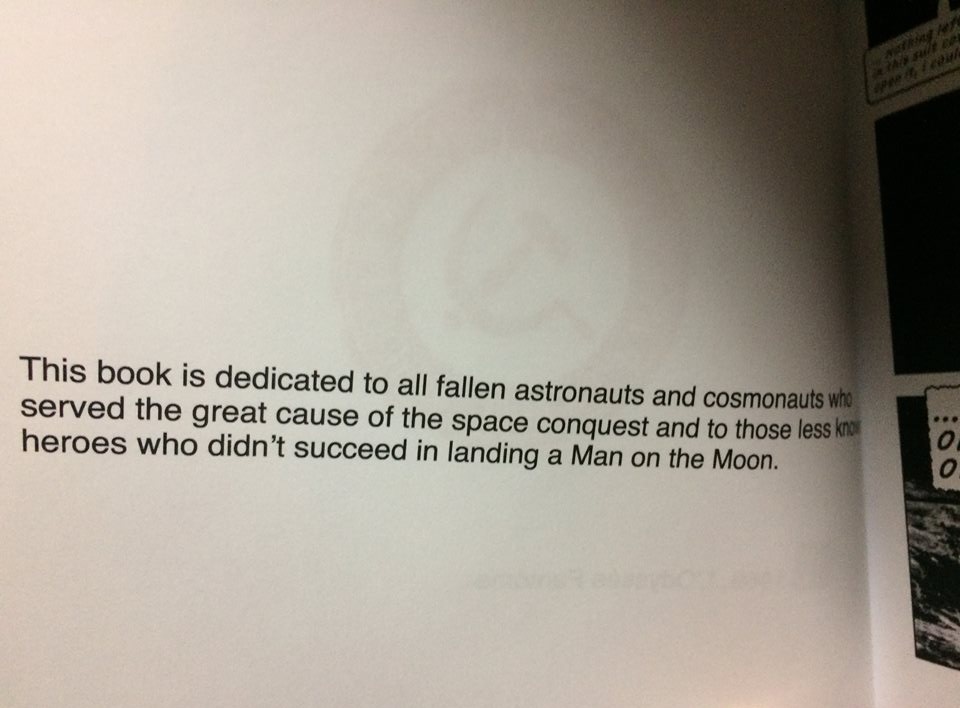
Nicolas Wetterwald’s latest graphic novel mixes the real life with what-if and serves up an enjoying account of an alternate history: one where the USSR beats the Americans and lands a cosmonaut on the Moon. Based in fact as much as imagination, many readers will be surprised to learn just how close the ‘race to the Moon’ was. The Russians bet everything on a mighty N1 rocket that differed from the American Saturn V by relying on a complicated massive ring cluster of thirty engines, each one dependent on the other in order for a successful launch to occur. Development began on the N1 in 1959 and by 1968 US reconnaissance satellite photographs showed that the Russians were (almost) ready to launch.

Looking at the book cover there is something warmly familiar about Wetterwald’s drawing style. It took me a minute to place it. There is a strong Jean Giraud (Moebius) influence- especially his spacesuit and futuristic designs from his Heavy Metal magazine panels.

Astronaut by Moebius

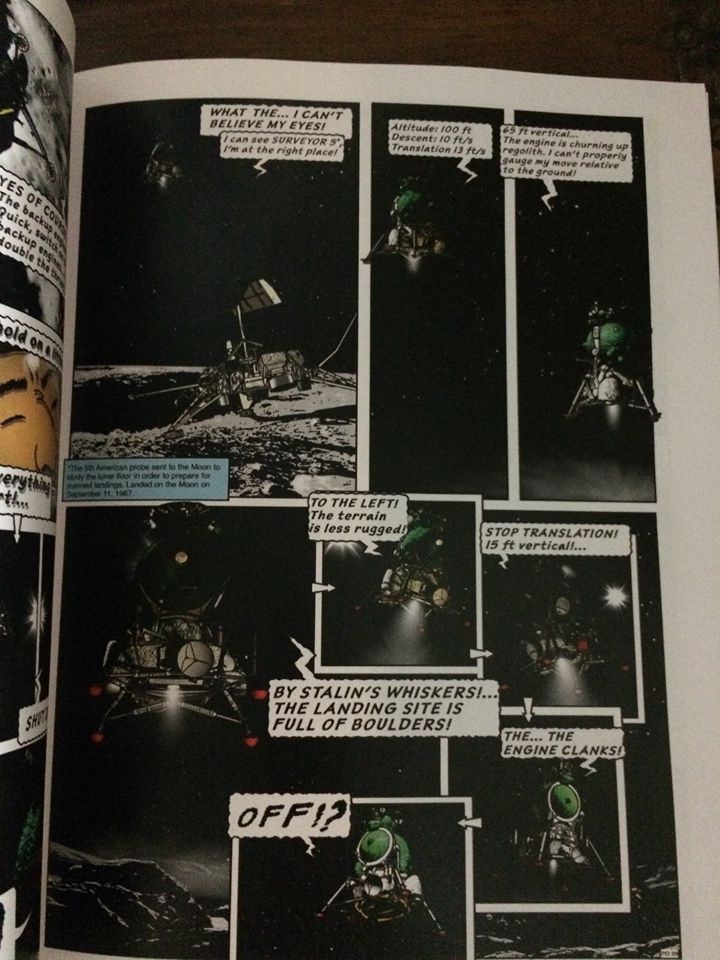
The story begins with a crisis and then a flashback in a fine style of writing that serves the form of graphic novels very well. Text ‘balloons’ are clearly differentiated between characters thoughts and conversations. This creates a fitting lonely mood- unlike the Americans, the Russians planned on sending a single cosmonaut to the Moon surface. There is also an ingenious use of text ‘balloons’ with small lightning like points to signify an electronic transmission or radio transmission. Small details like this create an eerie atmosphere and it is easy to relate to the protagonist.

Don’t be fooled into thinking that this comic is more documentary than entertainment. It has a brisk pace and the setting of Cold War Russia makes for an almost spy like setting. There are adult themes to be enjoyed here too- and this graphic novel is targeted appropriately towards adults.

There is much to like about Nicolas Wetterwald’s 1969 The Phantom Odyssey especially as we find ourselves celebrating the approaching fiftieth anniversary of the successful first landing of man on the Moon. With all the hype and nostalgia around that landmark event the release of this comic book couldn’t have been planned better. Hard copy recommended and available from Amazon ISBN 9781793906069 or try the Kindle edition for only $7.49 USD. For the Silo, Jarrod Barker.

Record-Breaking Global Mobility Grounded By COVID-19 Pandemic

With global travel almost at a standstill, the latest results of the Henley Passport Index offer disturbing insight into the indiscriminate havoc caused by the COVID-19 pandemic. Since its inception in 2006, the index has provided the authoritative annual ranking of global passport strength. Travel freedom has increased dramatically over the period in 2006, a citizen could travel to 58 destinations on average without a visa from the host nation; 14 years later, this number has almost doubled to 107. 

The first ranking of the new decade published in January this year conclusively confirmed that overall, people were the most globally mobile than we had ever been in the history of humankind, with the top-ranking passport (Japan) offering its holders access to a record-breaking 191 destinations without requiring a visa in advance. Just three months later, the picture looks very different indeed.

Australia's Coronavirus Travel Bans Feed Old Fears
The result of the latest travel ban in Australia. Image: jacobinmag.com

Japan’s passport continues to hold the top spot on the Henley Passport Index as we enter the second quarter of 2020, but the reality is that current stringent travel restrictions mean that most non-essential travel for Japanese nationals is heavily curtailed.

This is true for almost every country of course, as more travel bans are implemented daily, and ever-more stringent coronavirus lockdown regulations are imposed by governments worldwide. With 3.5 billion people, nearly half the global population, presently living in voluntary or mandatory confinement, the latest results from the index — which is based on exclusive data from the International Air Transport Association (IATA) — raise challenging questions about what travel freedom and global mobility really mean, both currently and in a deeply uncertain post-pandemic future.

Dr. Christian H. Kaelin, Chairman of Henley & Partners and the inventor of the passport index concept, points out that in an unprecedented global health emergency such as this, relative passport strength becomes temporarily meaningless. “A Swiss citizen can, in theory, travel to 185 destinations around the world without needing a visa in advance, but the last few weeks have made it apparent that travel freedom is contingent on factors that occasionally can be utterly beyond our control. This is, of course, something that citizens of countries with weak passports in the lower ranks of the index are all too familiar with. As public health concerns and security rightfully take precedence over all else now, even within the otherwise borderless EU, this is an opportunity to reflect on what freedom of movement and citizenship essentially mean for those of us who have perhaps taken them for granted in the past.”

Q&A: New travel ban shakes up airlines, passengers - NEWS 1130
Image: citynews1130.com

The future of international mobility after COVID-19

Commenting on the latest Henley Passport Index, bestselling author and the Founder and Managing Partner of FutureMap, Dr. Parag Khanna, says the combined effect of the COVID-19 pandemic on public health, the global economy, and social behavior could lead to much deeper shifts in our human geography and future distribution around the world. “This may seem ironic given today’s widespread border closures and standstill in global transportation, but as the curtain lifts, people will seek to move from poorly governed and ill-prepared ‘red zones’ to ‘green zones’ or places with better medical care. Alternatively, people may relocate to places where involuntary quarantine, whenever it strikes next, is less torturous.

In the US, both domestic and international migration were surging before the pandemic, with Gen-Xers and millennials shifting to cheaper, second-tier cities in the Sun Belt or abroad to Latin America and Asia in search of an affordable life.

Once quarantines lift and airline prices stand at rock bottom, expect more people across the globe to gather their belongings and buy one-way tickets to countries affordable enough to start fresh.”

This is supported by emerging research and analysis commissioned by Henley & Partners, which suggests that despite freedom of movement currently being restricted as a temporary measure, there is a risk that this will negatively affect international mobility in the long run. Political science researchers Uğur Altundal and Ömer Zarpli of Syracuse University and the University of Pittsburgh, respectively, note that public health concerns have historically been used to justify restricting mobility, but governments usually adopt travel restrictions temporarily, in response to short-term health needs. Until now, health security has not been a significant determinant or requirement when negotiating visa waivers, but Altundal and Zarpli warn that “increasing public health concerns due to the outbreak of COVID-19 may change thisthe quality and level of health security of a country could be a significant consideration for visa waivers in future”. The unprecedented and overwhelming focus on health security and pandemic preparedness we now see may change the face of global mobility forever.

On the other hand, Prof. Simone Bertoli, Professor of Economics at CERDI, Université Clermont Auvergne in France, says that the necessity of international collaboration in fighting the pandemic could ultimately reduce current barriers to international mobility. “Humanity is confronted with a truly global challenge against which no country ­— irrespective of its level of income — can fully protect itself. This pandemic could therefore trigger renewed and more intense international cooperation, something that has (so far) not happened with the other main global challenge that the world is currently facing, namely climate change.”

No Official Travel Ban In The U.S., But Isn't It Time To Self-Ban?

Brexit, travel bans, and changing timelines

The chaos caused by the COVID-19 pandemic has cast further doubt on the timeline for the implementation of the UK’s post-Brexit immigration system, according to Madeleine Sumption, Director of the Migration Observatory at the University of Oxford. The UK, currently in 7th place on the Henley Passport Index, with citizens theoretically able to access 185 destinations without acquiring a visa in advance, was set to end free movement with the EU in January 2021. However, as Sumption says, “The UK can only implement its new immigration system when the post-Brexit ‘transition period’ is over, and if this is extended to give negotiators more time to discuss trade and other issues, we may not be seeing the end of free movement with the EU quite yet.”

In the US, also in 7th place on the Henley Passport Index, the impact of travel bans implemented at the beginning of the year appear to have been compounded by the pandemic, according to Greg Lindsay, Director of Applied Research at NewCities. “For the children of a rising global middle class with more and more options, this pandemic may prove to be the tipping point in terms of choosing educational destinations. When the world gradually recovers with China, South Korea, and Singapore already succeeding in slowing the outbreak through effective quarantines don’t be surprised if the best and brightest take coronavirus responses into consideration when deciding on their future options.”

A unique hedge against volatility in an uncertain future

Commenting on the ever-expanding growth and popularity of the investment migration industry, Dr. Juerg Steffen, CEO of Henley & Partners, says: “We believe that in the post COVID-19 environment, investment migration will take on a dramatically enhanced importance for both individual investors and sovereign states. Acquiring alternative residence or citizenship will act as a hedge against the significant macro-economic volatility that is predicted, creating even more sovereign and societal value across the world.” For the Silo, by Sarah Nicklin.

Supplemental

Global Headlines for Q2 2020: growth in travel freedom over past decade

  • Japan retains its top spot on the Henley Passport Index, with a visa-free/visa-on-arrival score of 191. Over the past decade its travel freedom score has increased by 31 points: in 2010, the country was ranked 6th worldwide, with a visa-free/visa-on-arrival score of 160.
  • Singapore continues to hold onto 2nd place, with a visa-free/visa-on-arrival score of 190. Over the past decade Singapore’s travel freedom score has increased by 35 points: in 2010, the country was ranked 11th worldwide, with a visa-free/visa-on-arrival score of 155.
  • Germany remains in 3rd place, with access to 189 destinations compared to the 161 destinations its passport holders were able to access a decade ago. It shares 3rd position with South Korea, which has increased its travel freedom score by 38 points: in 2010, South Korea was ranked 13th worldwide, with a visa-free/visa-on-arrival score of 151.
  • The UK is currently ranked 7th on the index, with a visa-free/visa-on-arrival score of 185. Over the past decade the UK’s travel freedom score has increased by 19 points: in 2010, the country was ranked 1st worldwide, with a visa-free/visa-on-arrival score of 166.
  • The US is also currently ranked 7th on the index, with a score of 185. Over the past decade, the US’s travel freedom score has increased by 26 points: in 2010, the country was ranked 7th worldwide, with a visa-free/visa-on-arrival score of 159.
  • The UAE has seen the biggest increase in travel freedom over the past 10 years. In 2010, the country was ranked 65th worldwide, with a visa-free/visa-on-arrival score of 64. It is now ranked 18th, with a score of 171  which means the country has added a remarkable 107 visa-free travel destinations over that period. 

How to Navigate Planning Funeral Services In Time Of Fear & Social Distancing

I’ve lost count of the social distancing lockdown days and I hope you are hanging in there. The lockdown has impacted businesses in ways never experienced before. Many are struggling to remain open. Restaurants for example, are no longer able to host and seat customers inside and have had to modify their operation by becoming take out only.

But what about other types of business? What about Funeral Services?

A new website created by former healthcare CEO Ed Michael Reggie has collected prices, locations and contacts for every funeral home in the United States, and is now sharing its institutional knowledge and perspective about this topic and the effects of the coronavirus.

The site, www.funeralocity.com, is a free resource for any consumer looking to bury a loved one. You simply type in a city or zipcode and see every home in that area, their costs and other pertinent information. There are plans in the works to expand this site for Canadians.

In this new climate we find ourselves in, there are pressing questions.

When someone dies during the Corona Crisis what are your first steps?
Funeral directors are often the only ones licensed to handle the logistics of transportation, burial or cremations, etc.

How to have a service when you can’t gather?

As the death toll spikes around the globe from the COVID-19, much of the world’s focus has been on fighting the epidemic, saving lives and keeping people healthy and safe.

Funeralocity

What isn’t being talked about is what happens after someone dies, and how grieving families can say goodbye to their loved ones at a time of social distancing, fear and panic. Funeralocity.com, North America’s only up-to-date price comparison website of funeral providers, is sharing helpful advice and insights into planning a service during such an uncertain time. Its database of 19,000 funeral homes across the US is the largest database in the world, and the site is using that institutional knowledge and expertise to guide families faced with the sudden need to bury or cremate someone who has died from the virus.

“Losing a loved one is the worst possible outcome, but it’s become a sad reality during this unprecedented time”, said Ed Michael Reggie, founder and CEO of Funeralocity.com.

The deaths that have already occurred, and the models that are preparing us for more, have put a great demand for funeral services. However, there are so many circumstances unique to this time and virus and people need to know how to navigate the process. Funeralocity prides itself in providing users the most reliable, trusted information when planning services, and we are sharing what we know with families so they can make better informed decisions.

American Funeral Director: A Conversation with Ed Michael Reggie

The important first step, says Reggie, is finding the right funeral home or cremation provider. Then the planning of a service can take place. Funeral directors are licensed by states to deal with issues related to handling the bodies after death, and whether it’s being stored, embalmed, cremated or prepared for burial.

“Unfortunately, there is greater demand for this now, which is making the process more complicated,” Reggie said. “Some funeral homes and morgues are at capacity, which has put major stress on the business.” Reggie suggests people research funeral homes and cremation providers in their areas and discuss their needs and circumstances. He created Funeralocity for this exact purpose: the site not only includes prices and locations for US funeral homes, but it can connect users to their them.

“Families at a time of loss are deep in shock and grief and having then to find a funeral home can be very stressful,” Reggie said. “We launched our site to make that process easier.”

Another important decision has already been made, sadly: States across the country are restricting public gatherings to less than 10 people, which makes having a traditional ceremony near impossible. This has made virtual funerals more prevalent, and also persuaded people to postpone services until entire families can mourn together safely.

“We need to balance our need to grieve with public safety in mind,” Reggie said. “There have already been reports of people spreading the coronavirus at funeral services. We need to be responsible, and fortunately there are options. Streaming a service is a practical and safe way to say goodbye to a loved one with your whole family participating.” Many funeral homes are offering this option, but the quality will vary and will depend on which platform/ service the funeral home is using.

Using social media is also an option that families should consider. Postings on Facebook, Instagram and other platforms allow people to express condolences without gathering in person. Mourners can post photos, videos and memories, creating more intimate remembrances that people can see from their homes.

Virtual Reality Funerals- “Real Healing”
photos: dailyundertaker.com

There are also numerous platforms that can create memorial websites, virtual photos albums and memory books that memorialize those who have passed digitally, allowing families to share.

Finally, Reggie suggests people consider donating to causes related to the COVID-19 instead of sending flowers, wreaths or food to grieving families. For the Silo, by Morgan Matthews.

How You Feel About Money Affects Your Wealth

Ah, Aristotle- penchant of ancient greek wisdom. Nicely said, Dude. Although we live in the richest and most advanced society the world has ever known, many of us say we need more money in order to be happy, notes best-selling business book author Doug Vermeeren.

“Even some of those in the top percentile of earners often feel like they don’t have enough money,” says Vermeeren, (www.DouglasVermeeren.com), an international speaker who consults with celebrities, business executives and professional athletes.

“The math is simple: More money does not equal more happiness. It’s our attitude toward money, not the amount, that influences our happiness the most.”

Doug Vermeeren was interviewed earlier this year by Shaw. You can watch this by clicking on the link below at the end of the article. CP

Happiness researchers Elizabeth Dunn and Michael Norton, professors at the Harvard Business School, recently published research indicating that it’s not money that makes people happy, nor the things people buy with it. Rather, it’s the experiences one has that ultimately account for happiness.

“How you experience your money on a day-to-day basis is what matters,” Vermeeren says. “If the software running in your brain is constantly reinforcing the message, ‘it’s not enough,’ then that is likely how you will see yourself and experience your life – as ‘not enough.’ ”

The world’s richest city- is it Tokyo or Dubai? The top ranking seems up for grabs and changes from year to year.

Harvard's Happiness researcher (we're not making this stuff up) Elizabeth Dunn
Harvard’s Happiness researcher  Elizabeth Dunn

Vermeeren reviews the three fallacies of abundance as it relates to happiness:

We are all entitled to a certain amount of wealth: The feeling that we deserve or are owed a certain amount of wealth will always make us unhappy with whatever we have. While we are entitled to certain human rights, those do not include a winning lottery ticket. In reality, we are not owed any amount of abundance and, in fact, should count ourselves lucky if we’re able to meet our basic needs; many in the world are not. More of us, however, would be happier simply appreciating what we have.

The result of our labors is money: Money is a means to an end, not an end in itself. This can be a challenge to keep in mind since so much of our lives are spent in the pursuit of money. We work and go to school to support ourselves and our families. We see things we want, and we know we need more money for them. Study after study shows, however, that what really makes us happy is what we do and who we do it with, and not how much money we spend.

We’ll be happiest when we finally reach our goal: We are happiest when we are progressing toward a goal. When we lose sight of our goal, veer off the path toward our goal, and even achieve our goal, we’re less happy. Rather than setting one goal and deciding you will be happy when you meet it, you’ll be most happy if you continually set goals and relish your journey toward them.

Doug Vermeeren is an internationally renowned public speaker, author, movie producer and director. His life coaching strategies help those from all walks of life, with clients including business executives, celebrities, professional athletes and more. Throughout the last decade, Vermeeren has conducted extensive first hand research into the lives of more than 400 of the world’s top contemporary achievers, making him a sought-after commentator on news outlets including ABC, FOX, CNN and more. He has written three titles contributing to Guerilla Marketing, the best-selling business series in publishing, which is included reading in the Harvard Business School.

His documentaries include the award-winning film, The Opus, which has been published by Random House as a book in 23 countries. Vermeeren’s latest film, The Gratitude Experiment , has received critical acclaim.  For the Silo, Ginny Grimsley. 

Click to view on I-tunes

Human Consciousness & Artificial Intelligence Meet In Designer’s Fabrics

Featured Designer Brian Swift used PAOM to print fabric for his latest collection inspired by the Technological Singularity: a theoretical time in which human consciousness and Artificial Intelligence merge and become a new, unrecognizable species.

shop the designer PAOMBrian collaborated with a machine learning algorithm to imbibe his photographs with a psychedelic quality. These computer generated compositions were then printed onto fabric and used throughout his latest collection.

brian swift tshirt

For more work check out Brian’s site brianswift.com

print all over me ai fabric brian swiftdesigns

paom smiley face

Supplemental- MONA the world’s first artificial intelligence clothing designer

Opinion: Young Jamaican’s Invention Could Help End Spread Of Viruses Like COVID-19

Email_Header_Opinion.png
Five years ago more than 40 babies born in Jamaican hospitals became infected with lethal bacteria – half of them died. The bacteria Klebsiella, like the coronavirus, is spread from person-to-person or via contaminated surfaces. It can be killed by hand-washing with warm soapy water.The situation caught the attention of technology student Rayvon Stewart based in Jamaica who set about finding a way to curb the spread of harmful germs. “I made a determined decision that I was going to find a solution to limit the transfer of pathogens to multiple surfaces, thereby saving lives,” says Rayvon.
20190731_Secretary-General_op-ed_photo_landscape.jpg
Patricia Scotland
Young innovators in health
I met Rayvon at the Commonwealth Health Ministers Meeting (CHMM) in Geneva last year. He was among the finalists shortlisted for last year’s Commonwealth Health Innovation Awards. He took part in an exhibition on the theme ‘Universal Health Coverage: Reaching the unreached, ensuring that no-one is left behind’ which highlighted how young people are tackling age-old challenges with modern technology and disruptive thinking.

The event underlined Commonwealth commitment to empowering young people as outlined in our charter and also our contribution to achieving the Sustainable Development Goals. I spoke to five extraordinary innovators who made it as finalists of the Commonwealth Health Innovation Awards which recognize outstanding young people whose groundbreaking projects have made a real impact in helping their countries achieve Sustainable Development Goal 3, which is to ‘ensure healthy lives and promote well-being for all at all ages’.

William Wasswa was working on a digital pathology platform for automated diagnosis and classification of cervical cancer from pap-smear images. Then there was Midia Hassan using 3D printing technology to provide prosthetics to amputees living in refugee camps and poverty zones. Another timely invention is that of Nitash Jangir who was one of 15 finalists at our SDG innovation awards. Nitash invented a neonatal breathing support device for low resource settings, with multiple powering options. It maintains respiration and oxygenation in premature neonates with Respiratory Distress Syndrome by providing constant airflow and pressure to keep the lungs open during transport to a tertiary care setting.

I was struck by the ability of young minds to find solutions to real problems in their communities, and their persistence in finding support to scale-up their projects.In Rayvon’s case, he focused on the most common places where bacteria and viruses could easily be left by one person and picked up directly by another. He came up with what he calls ‘Xermosol’- a simple-to-install device that automatically disinfects door knobs and handles after each use.

The innovation uses ultraviolet light to target and specifically kill harmful microorganisms, while being harmless to human beings.

The potential to save lives
The potential impact of Rayvon’s invention could now be even more important than when he first conceived it, as the world battles the frightening COVID-19 pandemic. The coronavirus lives up to two or three days on stainless steel and metal, and several hours on fabric depending on factors such as temperature and humidity. Field and laboratory testing has validated Xermosol’s efficiency in killing more than 99.9% of deadly pathogens. In addition to health facilities, Rayvon hopes it could help reduce transmission of germs in other public spaces such as schools and businesses.

Tests carried out in conjunction with University of Technology, Jamaica and University of the West Indies show Xermosol destroys organisms such as MRSA and E-coli and destroys viral cells such as influenza virus H1N1.This is a huge step in the fight against microorganisms and offers new ways of thinking around combatting viral cells such as Coronavirus.

Supporting young people to innovate
Rayvon says the recognition he received from the Commonwealth Health Innovation Awards was a key moment in Xermosol’s progress, generating immense interest in the project. But now the production of Xermosol faces a number of considerable challenges – from development funding to finding a manufacturer to mass produce. Financing options are mostly focused on large-scale innovation, but the Commonwealth is exploring and proposing that all 54 member-countries go into partnership with the Global Innovation Fund to help young innovators like Rayvon.

Over the past two years, the Commonwealth Youth Health Network has worked closely with the Commonwealth Secretariat and member states to leverage the unique capabilities of young people and drive forward progress toward SDG3 (which includes a bold commitment to end the epidemics of AIDS, tuberculosis, malaria and other communicable diseases) and health-related development goals. Citizens aged under 30 comprise 60 per cent of the Commonwealth’s population – a proportion that is 10 per cent higher than the global average.

In the course of my interaction in and with our member countries I am continually impressed by the drive of these 1.4 billion young people. They have the ideas, energy and talent to make a huge difference in their communities – and they are doing so. For the Silo, Patricia Scotland, Commonwealth Secretary-General. Featured image: mock up of one type of door handle with integrated UV light.

Supplemental

The History of UV light disinfection.

Why UVGI? - UV Systems Stop Kennel Cough, Parvo, Influenza & More!

FlyKly Wheel Transforms Any Bicycle Into 21st Century Smart Bike

The FlyKly Wheel turns ordinary bicycles into 21st century smart bikes that offer the benefits of both electric and pedal power to make bicycle commuting a viable option for everyone.

Cycling anywhere just got easier with the release of the FlyKly Smart Wheel, that lets urban cyclists climb hills and travel longer distances faster without breaking a sweat. Featuring an all-in-one design that puts a motor, battery and sensors together in a compact hub on the wheel, and weighing only 3 kg, the FlyKly Smart Wheel replaces the rear wheel on nearly any ordinary bike to transform it into a pedal-assisted electric bicycle. The FlyKly Smart Wheel has already earned three international patents and is the first all-in-one pedal assist for bicycles to hit the market.

Fly Kly 1

“With bike to work movement all over the world, we strongly believe that the moment is now to accelerate this trend and fundamentally transform urban transportation by making riding a bike effortless, smooth and smart — basically, by finally making it a truly attractive alternative to driving a car. This is the promise of FlyKly Smart Wheel” said Niko Klansek, founder and CEO of FlyKly. FlyKly launched its prototype wheel a  few years ago in a successful crowdfunding campaign on Kickstarter. To take the wheel to the next level, the FlyKly team ventured to Italy—a country well known for producing beautiful, high performance bikes—to partner with a team of designers, engineers and software developers from the prestigious Polytechnic University of Milan.

Fly Kly 2

Today, the Italian-designed FlyKly Smart Wheel is significantly smaller and lighter than the original design and offers a smoother ride while enabling cyclists to travel up to 100 km on a single charge depending upon how much of a boost they need or want from the motor. After production in Italy, the wheel is assembled in Slovenia. The FlyKly wheel and riding experience are controlled and customizable through the FlyKly App (iOS and Android), which works on smartphones and other devices using Bluetooth 2.3.

Design The FlyKly Smart Wheel comes in three rim sizes — 20,” 26” and 28” — to fit practically any bike and enable cyclists to easily transform their own bikes into pedal-assisted electric bikes. It takes fewer than five minutes to mount the fully assembled wheel. The sturdy, weatherproof casing for the all-in-one motor at the wheel’s hub comes in two colors—either pure white or silver gray—and is less than 18 cm in diameter. Bikes with the FlyKly Wheel do not look at all like traditional electric bikes, which are generally larger and heavier.

Fly Kly 4

How it works The expression “it’s as easy as riding a bike” still applies when riding a bicycle enhanced with the FlyKly Smart Wheel. After initially pairing the wheel with the FlyKly App, the rider can customize and change their riding experience whenever they wish, setting things such as how much of a boost they want from the motor — ranging from 0 % to 100% — or what maximum assisted speed they want, up to 25 km per hour. After that, the rider simply hops on the bike and starts pedaling per usual. In response to the rider’s settings, sensors in the wheel tell the motor when and how much to kick in to give the rider the boost they want. The 250W motor shuts off when the rider stops pedaling, and Smart Wheel’s regenerative braking system then kicks in to slow the bike and recharge the battery at the same time, making it possible to go even further on a single charge. With a 100%-assist from the motor, a rider can go up to 40 km on a single charge, and much farther if they require less assistance or can add to the charge while going downhill. It takes 2-3 hours to fully charge FlyKly Wheel’s 30 Volt lithium battery using an electric wall charger, which comes with the wheel.

Fly Kly 5

Test locations So far, riders can test FlyKly Smart Wheel in Europe (Copenhagen, Oslo, Ljubljana) and in US (New York). Exact test locations can be found here.

Fly Kly 6

Smart Light Smart Light is bike light, phone holder and phone charger at the same time. It comes with USB and DC power connectors, silicon elastic phone straps that holds your phone firmly and dynamo, which generates power to the light while you ride the bike. It comes in white color and compliments Smart Wheel nicely.

Fly Kly 7

Smart App In addition to being able to customize their riding experience through the FlyKly App, riders can use the Smart App to track their riding speed, distance traveled and trip duration. In the future, the app will be able to make route recommendations based upon the rider’s stated preferences and actual riding style. Riders will also be able can share any of this information with other riders, and offer it to city officials to help with plans to make their cities more bike- and environmentally friendly.

Pricing and availability The FlyKly Smart Wheel is available now in rim sizes 20”, 26” or 28” and may be purchased for 970 EUR and the FlyKly Smart Light can be purchased for 89 EUR on the company’s website at FlyKly online store. The companion FlyKly App is available for free in the iTunes App Store (iOS) and in the Google Play Store (Android).

About FlyKly Inc. FlyKly, Inc. designs and manufactures smart tools for smart urban transportation. Its flagship product is the FlyKly Smart Wheel, which turns ordinary bicycles into pedal-assisted electric bikes. The Italian-designed and Slovenian-assembled FlyKly Smart Wheel, which has earned three international patents, was released in January 2015 and is the first all-in-one pedal assist for bikes to hit the market. The company was founded in 2010 by Niko Klansek and is headquartered in Brooklyn, New York. More information is available at www.flykly.com or contact [email protected]