The level of consumer choice in 2023 is perhaps the highest it has ever been. This is a good thing.
Not only does it allow consumers to find a brand or company that aligns with their views and can deliver a product or service that solves a problem, but it shows positive signs for growing businesses in the economy. But as good as consumer choice can be, it can also be intimidating, especially when we want quick answers and don’t want to have to wade through reams of information. Growing with the range of consumer choice are websites that help simplify these choices for the average consumer – review sites. So, what review sites can be found in Canada?
When choosing an individual for important work – such as lawyers – it is crucial to make the right decision. At sites such as Lawyers, Best Lawyers, and Lawyer Ratingz, the lawyers are filtered by the specific type of work they do (e.g. Mergers and Acquisitions or Derivatives Law) or from where they are located from Calgary to Nova Scotia and beyond.
Choosing a lawyer is possibly one of the most important decisions – and the wrong choice could lead to trouble – so these sites are particularly useful. Specific lawyer reviews are subject to confidentiality and the outcome of a case might not be down to the lawyer’s skills (or lack thereof), so many factors should be taken into account when it comes to looking at lawyer reviews.
Review Sites for Contractors
Similarly, choosing a contractor for building work can be a dicey business. Cowboy builders are infamous, so it’s important to find one that will conduct the work adequately, safely, in time, and within budget. Sites like HomeStars and Trusted Pros work through amalgamations of reviews by people who have had work done by particular contractors. Review sites for contractors focus on experiences of those who have hired them, and importantly, highlighting work that hasn’t been adequate. But as reviews are often subjective, it’s important to take each one with a pinch of salt.
Review Sites with Added Value
Review sites aren’t just about hiring an individual for a role. There are review sites that compare tech such as new phone releases, and review sites that compare streaming platforms. With the market for reviews also growing, it’s important for review sites to stand out from the crowd.
For example, Casino Hacks offers honest casino reviews that focus on the games available and special features of particular sites. The added bonus here is that the site uses live streams and video to review games and online casino experiences. This allows people to see what they might want to engage in. When looking for a review site, one that has visual representations could more easily show consumers information.
Review sites allow consumers to make choices across a wide variety of industries. Some reviews are tailored to value for money, such as telecoms and utilities reviews, while others such as insurance reviews or bank account reviews focus on added-value benefits. With so much consumer choice, review sites are useful to help create a shortlist for possible options and to remove some of the stress and hassle that comes with these choices.
Our planet is incredibly beautiful! On every continent, even on the tiniest island lost in the vast ocean, there are striking places, meeting which leaves a long-lasting memory. Gritty fjords and impregnable cliffs of northern cities, idyllic corners of tropical coasts, clouds on the tops of mountains and flowing rivers in deep canyons, man-made and natural monuments will bring even more positive emotions than generous casino offers. Everyone is sure to find their paradise on earth. And you don’t always have to go far away – often there are places of fabulous beauty right next to us, if you only look around.
Jaisalmer
The golden city of Jaisalmer is often ignored by travelers because of its remoteness. But once you visit this place, you will not be able to forget it. It is an exotic city in the great desert of Rajasthan. It has incredible architecture, craft shops and of course camel rides in the silent desert.
Amazon
The most full-flowing and one of the longest rivers on the planet was named one of the Seven Natural Wonders of the World in 2011. The Amazon and the rainforest along its course are populated by many rare plants, animals and fish, many of which are relict or endangered.
Fez
Morocco is an inexpensive version of an oriental fairy tale. And Fez is the second largest city, home to palaces, old markets, and quaint cafes serving Moroccan mint tea with local pastries.
Schloss Neuschwanstein
When the impregnable Neuschwanstein was built in the south of Germany in the 19th century, it immediately became a magnet for all those seeking peace and security. Its fabulous outline became the prototype of the palace built in Disneyland, where Sleeping Beauty lived, fell asleep and then met her love.
Windhoek
If you have always dreamed of seeing Africa’s “rusty” deserts and animals in their natural environment, now is the time. Unlike other parts of Africa, Namibia has many safaris. It is home to many African animals: giraffes, rhinos, cheetahs and elephants. It’s also a low-cost place.
Antarctica
Antarctica is an amazing continent. It’s the coldest, even though it’s at the South Pole. Relative to the World Ocean, Antarctica is elevated more than other continents, it has the lowest relative humidity, the strongest and longest wind blows and the most significant solar radiation. At first glance, this is a harsh land consisting solely of ice. But it is not! Here you can find algae, mushrooms and even flowers – isn’t it an occasion to see it all with your own eyes!
Mostar
Mostar is an ancient city and untouched section of the Ottoman Empire. The place is unique in that it coexists two different cultures (Europe and Asia), two religions (Islam and Christianity), and connects them by a medieval arch bridge (Star Most), the history of which is as unique as the city.
Montenegro
Travelers who decide to come to Montenegro will be greeted by massive mountains, ancient Roman villas, clear waters, and incredible scenery. In addition, there are chic Adriatic beaches in Budva, Becici and on the Island of Sveti Stefan. And also the famous spa resorts of the Bay of Kotor. For the Silo, Batya Gill. Featured image: Jaisalmer India Desert City
In today’s rapidly-evolved internet landscape, finding an effective domain name can be crucial to online success. Yet have you considered its immense power when choosing words? Linguistics – which studies language structure – is an indispensable asset when selecting domain names; in this article, we’ll look into how understanding its fundamentals can assist with building memorable and effective names for domain registrations. Let’s start this discussion with an example to highlight its significance!
Real-Life Story:
Sarah is passionate about sustainable living and has launched an eco-friendly store online. Sarah spends hours brainstorming possible domain names that reflect her ideals and those of her target market audience. Finally, after extensive research and studying linguistic principles, Sarah opted for “Greenovation.com.” This domain name captures both her brand’s essence and commitment to eco-consciousness instantly – her intuitive understanding of linguistics proved instrumental as this domain name resonated strongly with customers resulting in increased brand recognition and, ultimately, business success.
History & Foundation of Linguistics in Domain Names:
Its historical context must be investigated to understand linguistics impact on domain name selection. Early internet domain names were selected based on keyword availability or company names. However, as more domains crowded the online landscape, linguistic principles significantly distinguished one domain from its competition.
Linguistics encompasses numerous components that can substantially affect domain name selection, such as phonetics, semantics, and syntax. By understanding their function, you can craft memorable domain names that elicit positive emotions among your target audience and are easily pronounceable.
Domain names need to take into account language factors when creating domain names:
Phonology: Selecting domain names with appealing sounds and easy pronunciation will make them more memorable and accessible, like CrispClean.com, which features repeated “c” sounds that create a catchy rhythm while emphasizing cleanliness.
Semantics: Words have meanings, so selecting domain names that resonate with your brand’s values and offerings can increase its overall impact. For instance, specifying EcoGuru.com as the domain name conveys both environmentalism and expertise – creating instant trustworthiness associated with eco-friendly practices.
Syntax: The arrangement and order of words within a domain name can have an enormous effect on its readability and memorability, such as ShopQuickly.com, which utilizes simple syntax making it easily understandable and memorable.
Take advantage of the large choice at Squadhelp when looking for a domain name akin to exploring a linguistic treasure trove. From playful alliterations to clever word combinations, the linguistic aspect of domain names allows businesses to craft a distinctive online identity that resonates with their target audience.
Utilizing Linguistics in Domain Name Selection:
Building an impactful domain name takes careful thought and strategy. Here are a few helpful pointers:
Research Your Target Audience: Take steps to learn about and comprehend their language preferences, cultural nuances, and values to ensure your domain name resonates with them.
Focus on clarity and simplicity: Choose words that are easy for people to remember. Avoid complex or obscure terms which might mislead or confuse the audience.
Consider Emotional Appeal: Words can evoke strong emotional responses in people. Choose words that produce this desired emotional reaction in your target audience while aligning with your brand tone and messaging strategy.
Be distinctive and memorable: Separate yourself from the competition by choosing an eye-catching domain name that conveys the spirit and value proposition of your brand or value proposition.
Other considerations also play a part in domain name selection besides language considerations, including availability and compliance with your brand’s legal requirements. Furthermore, domain extensions like (.com.net.ca or org) could provide more relevant options that meet industry or target audience demands. For the Silo, Grant Polachek.
Conclusion:
In today’s digitally competitive landscape, harnessing linguistics as part of your domain name selection strategy can give your online presence a significant edge. Harnessing their power can give them a significant competitive advantage by understanding basic linguistic principles and considering historical context when selecting domain names for online ventures, harnessing their power can give them a significant competitive advantage. Words hold power that can impact perceptions and emotions and ultimately leave a lasting, impactful memory, so make wise selections when selecting names for online endeavors to maximize their full potential and achieve maximum returns from online ventures!
It is late and you are on your way home, but there is no open store to get something to eat – does this scenario sound familiar?
Or it’s maybe early in the morning and you just pulled an all-nighter and you can hear your stomach making noises… Or you may be out in the middle of the street after your work and you forget to eat, and you are starting to feel dizzy.
Is this something that you can relate to? If yes, you know that you need to think about your diet.
It is easy to forget to eat when you have a busy day, especially when you are on the run with no store or restaurant around.
This is why strategic snacking should be part of your daily routine. If anything, you should think of snacks as something that literally saves your life when you are super hungry.
Let’s see how you can also have a delicious and easy-to-carry snack with you no matter the time of the year.
Drink Your Snack
Snacks should be healthy.
Yes, this may be easier said than done, but with so many options on the market, you can actually have a healthy snack.
For example, you don’t have to buy industrial pretzels if you can carry an apple with you, right?
Still, if even bringing an apple puts you under a lot of stress, you should think about an even easier solution, such as a drinkable yogurt: this sort of snack is a great source of lean protein, usually packed with vitamins and minerals such as calcium and vitamin D, packed with numerous flavors from banana to peach.
The great thing about drinkable yogurt is that you can mix it with other ingredients such as oats or use it as a dressing for your fruit salad. Fast and healthy!
Cheese And Whole-grain Crackers
Cheese and whole-grain crackers are a great snack idea if you want something that is easy to pack but enables bigger bites.
This is something that you can bite throughout the day and even use as an addition to a salad.
Spread cheese across crackers and you will have a quick snack in no time.
Beef Jerky
You cannot pull an entire day without meat? If so, you should plan ahead and think about having a meaty snack on you, such as beef jerky.
This is something that is a mandatory part of every road trip, but it can serve while you are at work as well.
Beef jerky is packed with protein, and as such, it is one of the best food items to keep your hunger under control.
If possible, choose organic, and grass-fed beef jerky from a local store, and avoid shopping for beef jerky from the gas station.
Did you know there are even tasty vegetarian jerky options?
You’ve got many snack choices to choose from once you start dealing with preparation.
In no time, you will discover that there are many food items that you can carry with you easily, throughout the day and eat as you go.
A little prep will be needed, but it’s nothing you won’t be able to handle.
With driverless cars already on the streets, will there be similar AI breakthroughs in the future of parking?
In the ’60s, The Jetsons, a cartoon about a family living in the future, featured a flying car that folded down into a briefcase when not in use. It is unlikely that we will ever see that solution to parking become a reality, but many other sci-fi books and films have predicted self-driving vehicles, and we know they are coming because they kind of exist today.
Parking facilities in the future must make allowances for electric vehicles. (Photo by guteksk7/Shutterstock)
While brands like Tesla have pushed the boundaries of driver assistance to become a version of self-driving, including parking the vehicle automatically, currently the parking infrastructure has not really kept up.
But we know that cannot continue, and the reality is that as transport technology evolves, parking solutions will have to evolve as well. But what does that mean long term? Will we be able to arrive at a parking center, get out and leave the car to it, then call it back to us when we want to leave? That seems like the dream approach to parking, but what does it need to make it happen?
Parking tech
There are two parts to that kind of service, the technology in the car park itself, and the technology within the car. For such a seamless experience, the two will need to work together, in that the vehicle must be able to drive autonomously, but also receive information about parking locations and when it should return to the entrance, from the car park itself. Both sets of technology actually exist today, not as refined as required for a reliable autonomous parking experience, but that is only a matter of time and development. But is it the right answer?
Right now, parking systems know which cars are parked where within the car park, this data is used to establish remaining capacities and so on, and while not universal, there are cars that can go off and park themselves when needed. So that future service is nearer than we think, but in the meantime what does car parking look like? Some may say that the future is already here without needing self-driving cars.
In Japan and some cities in the US, lift-based parking solutions offer a similar experience today. You arrive at a parking garage; your vehicle is pulled into a cubicle which is then lifted away. When you want to return to your car, the system finds the right cubicle garage and then returns it to the entrance, so you can drive away.
There are advantages to this approach, without the need for ramps to drive up and down to reach the parking, more cars can be parked in a given space. Because no one actually enters the building where vehicles are stored, it is also incredibly secure too. These systems are being constantly refined, and in the future, it is likely such a garage could be completely automated. With the advantages of space and security, is that more likely to be the future of high-density parking? If we look at other factors, it may well be.
Cities are increasingly looking to decrease car numbers, opening up spaces instead for social areas, encouraging cycling and other more environmentally friendly approaches to transportation. This is unlikely to change even with the widespread adoption of electric cars, so parking will naturally require large hubs with high-density parking that allows easy access to walks, bikes or public transport to central areas. To get an idea for the future of parking, we can look at what technology best fits this scenario.
Robotic Solutions
It is likely that these robotic lift-type solutions that pack more vehicles into each parking area fit the needs of city designers better than any more traditional multi-story or underground system that requires ramps and so on, whether the cars are operated by drivers or park themselves. There are other things that are in favor of this approach too.
Architects are under pressure to soften the appearance of buildings in cities across the world, to create spaces that have more light and elegance. A more compact multi-story space, or an underground alternative with only one small entrance space is easier to disguise with cladding, color and other design tricks that much larger car parks that have ramps and so on.
There is also the matter of technology. While there are cars that can drive themselves in a limited way now, and numbers are only going to increase, they are not all cars, and may never be. Holden stopped making cars in 2020, but in 20 years’ time, there will still be Holden cars driving on the roads. Those cars can never use autonomous parking systems, but they can use the robotic systems that take your car away and bring it back via a crane lift. They can use them today, and they can use them in the future.
Machine learning to park
So, the dream of a car swooshing away into its own spot automatically could well be the future. However, it is more likely to be carried there by a machine rather than drive itself. But not all parking is in cities with integrated parking solutions ran by the local authorities. For parking elsewhere, things will develop alongside vehicle technology, and there is one area that must advance for the future of the automotive industry itself, never mind parking. That is electric car charging.
Right now, charging is a bit of a mess: different speeds depending on the charger installation, there is no real cohesive system and owners often have to wrestle with a number of different apps to access charging networks on the go. Then there are the mechanics of charging, a heavy cable that has to be plugged in, account information and payment input before the car can be charged. As with phones, wireless charging is the solution, it removes much of the hassle and fail points for a better experience. But what would that look like in cars?
The obvious answer is charging areas embedded into the road or parking space, with a vehicle stopping on top of it automatically charging. There are hurdles to this, it would mean an end to the various account systems currently used to access charge networks, and instead have something tied to the vehicle itself. However, this kind of solution offers easy and efficient charging without the hassle we have today.
This would also require new technology for parking. For instance, our robotic car parks could have a charge loop in each container or cubicle, so electric vehicles charge automatically once they are taken away for storage. Likewise, on-road parking at parking meters could include chargers under each space.
This makes the charging process so much less hassle but allows for electric car charging without having to install endless charge stations in streets, and avoiding all the cables that the current system will need. Given the sheer number of electric cars that will be in operation in just a decade or so, and one cable per car, you can see how much an alternative is required.
But while technology will continue to drive the parking experience, and in cities and communities the need for clean, open spaces will change where we park and what that parking looks like, there will still be areas where parking sits outside of these grand designs. At its heart, a parking space is somewhere to store a vehicle while you go off and do something, and that need is not going to change. Large robotic parking systems in cities may appear in numbers, but they are not going to be the norm in areas with a smaller traffic flow or specific needs.
What we may see, and it is happening now, is that entrepreneurs and visionaries can find ways to provide a more selective parking solution on a smaller scale, that caters to a very specific need in a specific location. Not only are these services essential and in high demand, but they can be a source of income for anyone who has access to suitable parking space. With more cars than ever on the roads, and with a shift to electric not changing that, the future of parking looks to be heading in multiple directions.
The centralized systems operated in cities and other large communities will follow an approach that minimizes the space required and seek to integrate such facilities into an overall plan for the area. However, in some areas where there is no overall control of parking operations, the idea that you can rent a parking spot from a single person makes sense. Some people have space, others need that space, and as more cars are used, that space is in ever higher demand. This article is an excerpt from the complete e-book Parking Made Easy by Daniel Battaglia.
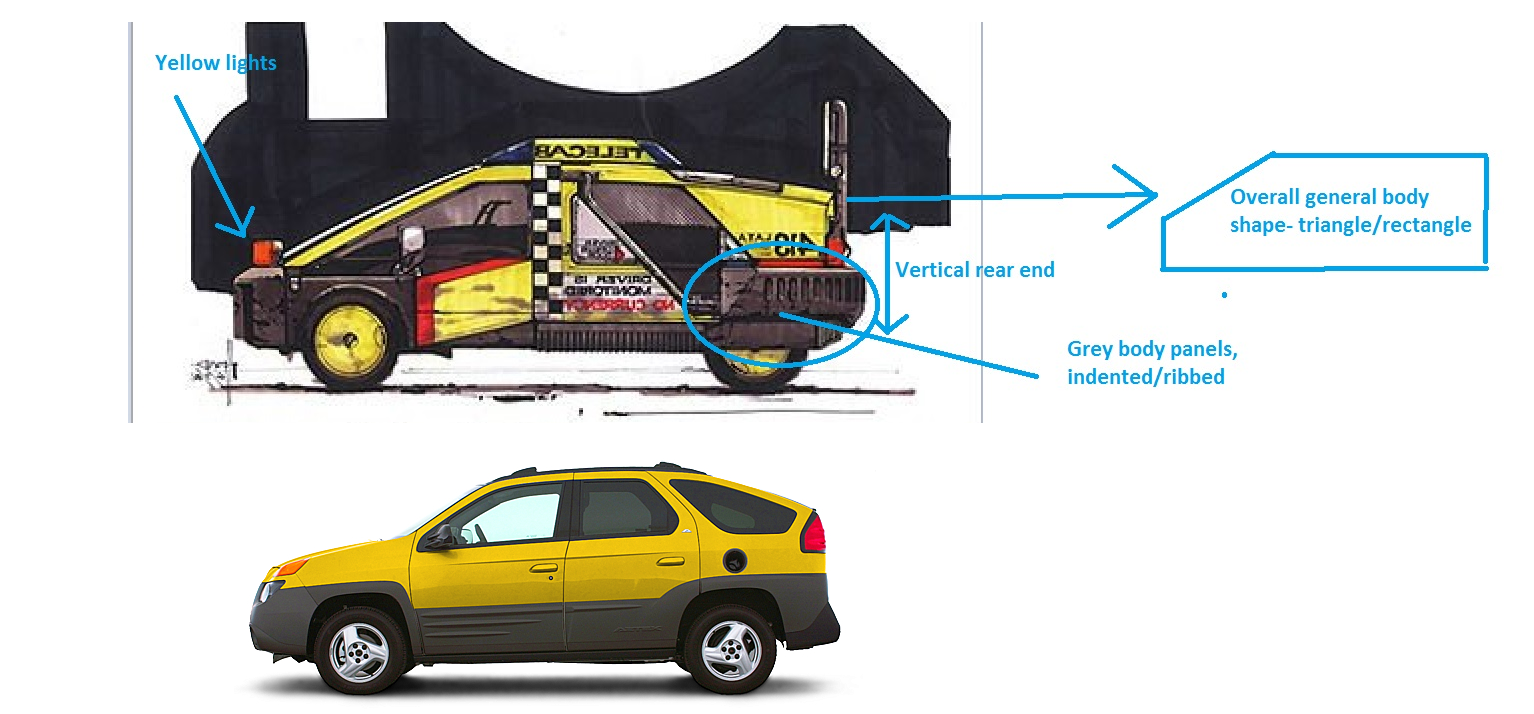
Upon it’s release in 1982 Bladerunner polarized film critics and quickly divided the viewing audience. Critics had no cinematic basis on which to make a comparison and watchers were unsure what to make of it. There were a few forward thinkers who sensed its bold departure from the ordinary and they mainly focused on the mindblowing design of its imagined world. We can say the same about the Pontiac Aztek upon it’s release in 2001.
More than an exercise in design.
Bladerunner crammed a lot into a relatively short running time: a detective story (which really should used the phrase “bounty hunter adventure”), a love story (how could Deckard NOT fall for the gorgeous Rachel?) , a revenge story (Batty’s answer to the inevitable end of his four year life span was to murder his creator)and a number of subplots that are beyond the scope of this short article. As the years passed, re-cuts and re-releases proved the critics to be wrong. Bladerunner is Shakespearean.
Before becoming a leading Futurist and designer for Hollywood, Syd Mead was an automobile concept artist. Top: A taxi cab design by Mead for Bladerunner. Bottom: The 2001 Aztek GT in Aztek Yellow.
Aztek
When it was released, The 2001 Aztek GT didn’t win over automobile reviewers or the car-shopping public but in the last half decade perspectives have changed, online fan pages have sprung up and buying demand is on the rise.
When selling a house, one of the most challenging decisions is determining whether to accept the first offer and move on or wait for a better one to come along. According to Denis Smykalov, founder and broker of Wolsen Real Estate, there are several factors to consider when deciding whether to accept the first offer.
Mr. Smykalov believes that the quality of the offer goes beyond the price tag.
Denis Smykalov
A strong offer could entail fewer contingencies or a flexible closing date. If a buyer is pre-approved for a mortgage and is not asking for many contingencies, it may be in the seller’s best interest to accept the initial offer.
The current real estate market can also play a significant role in deciding whether to accept the first offer. It may be wise to accept a reasonable offer in a buyer’s market to avoid the property staying on the market for an extended period. On the other hand, in a seller’s market, where demand outpaces supply, sellers may receive offers that meet or exceed the asking price. If the buyer has strong financing, it could be a good idea to accept the first offer.
Speed is also a significant factor in determining whether to accept a first offer.
If the seller needs to move quickly or has already purchased another home, accepting the first offer might be the best option. In these cases, a bird in the hand is often worth two in the bush.
Feedback from a real estate agent is also essential in making a decision. A good agent understands the market and can advise whether the initial offer is competitive based on the current conditions.
Lastly, if the seller believes they have priced their home correctly and the first offer aligns with their expectations, it may be a good idea to accept it. Ultimately, only the seller can determine what offer price they are comfortable with. If the first offer meets that threshold, it could be a good time to make a deal.
It is essential to remember that each selling situation is unique, and these guidelines only provide a starting point. Sellers should always consult a real estate professional who understands their specific situation and the local market conditions.
In conclusion, accepting the first offer is a decision that requires careful consideration.
Denis Smykalov’s insights provide valuable guidance in determining whether the initial offer is the best option. With extensive experience in the industry, Mr. Smykalov’s expertise can help sellers make informed decisions when it comes to selling their home. For the Silo, Katherine Fleischman.
More about Denis:
Denis Smykalov built his career in the real estate industry over the last nine years by following his passion for being innovative, people and bringing the two together in the ideal environment. Achieving this goal so young, Smykalov decided to open an office in Sunny Isles Beach and became the owner of Wolsen Real Estate.
With business on the rise, at one point there were 65 agents. Now there are 25 agents, a marketing department, social media department sales department and 3 assistants that have successfully helped bring in almost 80 million dollars in sales this year. His most notable accomplishments with Wolsen Real Estate were two crypto transactions. One was a resale at Marina Blue for $465,000, pre-construction at Waldorf Astoria for over $2.5 million as well as a villa sale on Hibiscus Island for $19 million.
Valtech, a global business transformation agency, is proud to announce the launch of its interactive experience at C2 Montréal designed to raise awareness among attendees about digital sustainability and help them take informed action for a more sustainable future.
The Fairmont- Queen Elizabeth Hotel downtown Montreal where C2 will be held this year.
Digital sustainability is about taking action to reduce the environmental impacts of digital technologies. As a practice it aims to make digital products and services more energy efficient via sustainable design and development practices, as well as ethical approaches to data collection and usage.
Image via inhabitat.com
Valtech’s onsite, interactive experience at C2 Montréal next week will enable organizations and individuals to measure the carbon footprint of their websites and receive practical solutions to minimize their CO2 emissions. It will provide concrete examples to help participants better understand digital sustainability and effectively reduce their carbon footprint.
One of Valtech’s main objectives is to draw attention to the significant contribution digital technology makes to greenhouse gas emissions.
“We are all part of the solution to decarbonize the planet,” said Damien Lefebvre, Executive Vice President of North America at Valtech. “We can and must significantly reduce the energy consumption of digital assets. Our ambition at C2 Montréal is to raise awareness among all stakeholders operating in the digital space, as well as Environmental, Social, and Governance (ESG) officers at companies across industries.”
Damien Lefebvre
Valtech currently conducts digital carbon audits for interested clients. Those audits include industry-leading recommendations to improve site performance, increase customer loyalty, and reduce hosting costs, electricity consumption and carbon footprints.
If you are onsite at C2 Montréal, come try out the experience- the Valtech team will be located on the third floor of the Queen Elizabeth hotel. Tell ’em The Silo sent you.
Genelec 8381A point source main monitor delivers unrivaled power and precision
NATICK, MA, May 16, 2023 — As part of its 45th anniversary year, Genelec has unveiled the 8381A Smart Active Monitoring system, a flagship floor-standing Adaptive Point Source™ design that fuses exceptional precision and envelopment with unrivalled LF control, huge headroom and high-resolution imaging. Designed for high-end music recording, mastering and audiophile listening, the 8381A creates a free-standing full-range monitoring solution that can intelligently adapt to any acoustic environment.
For audio professionals, the 8381A produces accurate full-band mixes that translate consistently to other rooms and playback systems, while audiophiles will experience every detail and nuance of a musical performance, just as the creators intended it to be heard.
I first encountered Genelec powered monitors (more specifically monitor- more on this below) while on a scholarship at the Banff International Center for the Arts in Alberta, Canada. At that time (2010) I was unfamiliar with Genelec and had faith in the school’s choice of equipment: all the other available items were top notch.
Rosa Maria Robinson Bours
I settled on a single Genelec speaker as I was planning on a series of live mono recordings taking advantage of the talented classical guitar and voice cohorts such as Rosa Maria Robinson Bours. When the Genelec was delivered to my artist studio I was intrigued. It looked quite compact, it was black as soot and seemed to be as heavy as lead. After positioning and connecting the monitor I was blown away by the power, clarity and transparency for test playback and also while mixing and mastering tracks.
Let’s get back to the newest Genelec
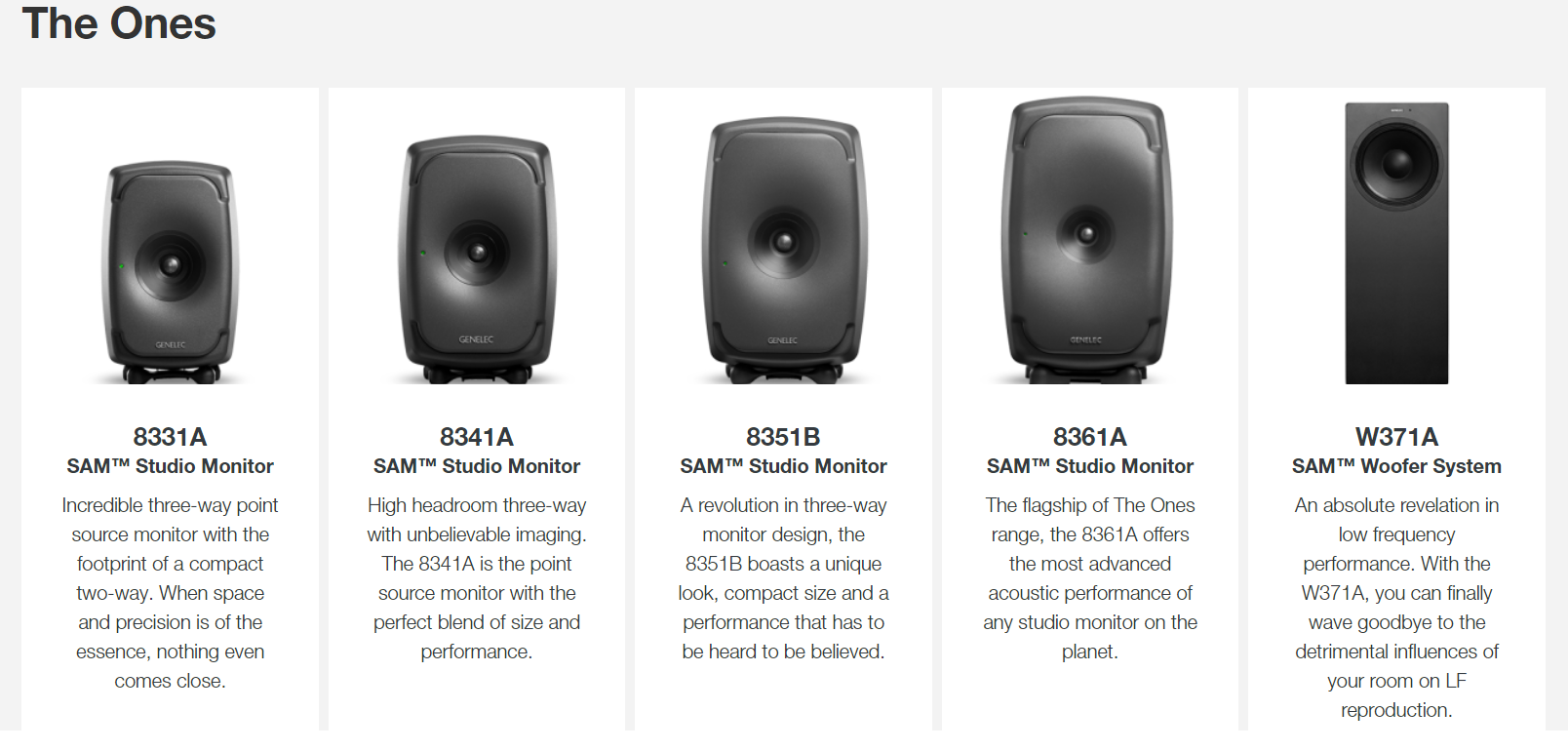
As a member of “The Main Ones” range, the 8381A system is acoustically coaxial right down to bass frequencies, and draws on proven technology developed for Genelec’s patented and award-winning “The Ones” family of point source monitors and the W371A Adaptive Woofer System, which themselves can combine to create a free-standing full-range monitoring system. However, the 8381A raises the performance bar even higher by offering controlled directivity and uncolored response both on and off axis, with an ultra-wide frequency response spanning from 20 Hz to 35 kHz. Additionally, with almost 6 kW of amplifier power and a staggering maximum SPL of 126 dB – the highest figure ever achieved by a precision point source acoustic design – the 8381A offers the most sophisticated features and specification of any audio monitor currently available.
At the heart of the 8381A is a proprietary high SPL Minimum Diffraction Coaxial (MDC™) midrange/tweeter driver, which – combined with a powerful Genelec DSP engine – delivers extraordinary clarity, imaging and adaptability. This MDC driver shares a common acoustical axis with the 8381A’s four complementary 5-inch dome drivers, which are arranged as a midrange transduction system, and this unique array combines with a forward-facing 15-inch woofer to provide outstandingly stable directivity, control and coherence.
To further enhance and extend the 8381A’s low frequency reproduction, a pair of high-performance 15-inch woofers employ the LF adaptive technology originally developed in the W371A, offering high resolution and supreme levels of low-frequency control – despite the effects of room acoustics. This technology allows the 8381A to tailor performance carefully to the room, offering flatter, smoother in-room response at the listening location, with LF imaging coherent with the full audio range. This flat and neutral LF response minimizes acoustic notching, and reduces detrimental reflections and resonances by the walls, ceiling or floor of the room.
As part of Genelec’s Smart Active Monitoring family, the 8381A integrates tightly with Genelec’s GLM software, which can configure, calibrate and control entire Genelec smart monitoring systems. Based on experience from thousands of studios around the world, GLM minimizes the listening room’s influence on the sound, enabling the user to produce mixes that translate perfectly to other systems, whether the format is stereo, surround or high channel count immersive.
GLM also includes the ground-breaking GRADE room report feature, which gives the user a complete analysis of their room and monitoring system performance, providing specific observations and advice on any acoustical issues, helping users and studio designers alike to fine tune the room’s acoustic treatment, adjust monitor and listener positions, and optimize bass management.
Designed and manufactured to the highest standards of sustainability and environmental responsibility at Genelec’s headquarters in Iisalmi, Finland, the 8381A comes with a comprehensive SonicAdvisor™ system calibration and service package to jointly celebrate Genelec’s 45th anniversary, and the company’s total commitment to its customers and to sustainable development.
“The demand for high quality free-standing full-range monitoring systems has been clear from the exceptional response to The Ones and W371A combination,” comments Genelec Managing Director Siamäk Naghian. “It was also evident that there was a desire from customers for a free-standing system that could deliver even more headroom and increased low frequency extension. And while we continue to offer a wide range of soffit-mounting main monitors, we’re confident that the flexibility and mobility of a floor-standing adaptive system like the 8381A will provide the perfect solution for any discerning user seeking a truly next-generation sonic reference.” For the Silo, Jarrod Barker.
Vacationers booking holidays through Canadian websites are being charged hundreds of dollars more than overseas customers for exactly the same deals, research commissioned by cybersecurity company NordVPN reveals.
From luxury breaks and hotel stays to car hire, consumers are frequently being presented with wildly different prices depending on where they log on.
Using the American website for Hotels.com resulted in a staggering $805.55 saving for a 7-night stay, while hiring a vehicle through the Italian server resulted in a quote 25% cheaper than the Canadian site.
NordVPN’s researchers used its Virtual Private Networks (VPNs) to make it look to websites like they were not in Canada. They discovered savings across a range of well-known travel sites like Hertz,Expedia, Booking.com and Sixt, for a variety of countries, including Italy, Mexico and the US.
What is a VPN? A VPN disguises your IP address, while improving privacy and security. You select a country and NordVPN ensures that’s where websites think you are. VPN users are then able to see the differing content — and prices — shown to overseas consumers.
Using a VPN, a 7-night stay this August at The Gates Hotel South Beach in Miami, Florida, through Hotels.com revealed a $805 price difference for a family of four. The Canadian website quoted $3,086 and the American site $2,280 — less than a sixth as much. Visiting the website from Italy netted a 22% saving on a 7-night family stay at Venice’s Antony Palace Hotel in August — $376 off the Canadian price of $1,732.
For those visiting the French Riviera, an exclusive 7-night stay in Hotel Casarose in August would cost 16% less using the French version of Hotels.com website, lowering the price from $4,363 to $3,656.
Fans of the UK royal family planning to stay near Kensington Palace could save 13% by using the English Booking.com site, reducing a week’s stay in August at the Twenty Nevern Square Hotel from $4,260 to $3,715.
Going to Booking.com from a French server led to a $1073 lower price on a 7-night vacation at the Hôtel Alfred Sommier in Paris in August — bringing the cost down to $8,922. Meanwhile, using an Italian server to search the Rentalcars.com website for car hire in Rome quarter (25%) cheaper than the same company’s offer to Canada-based consumers.
Browsing for more summer hotel deals using the Mexico website of Expedia uncovered a 22% saving for a week break in Cancun at El Taj Oceanfront & Beachside Condo Hotel, leaving bookers $614 better off.
Looking at car hire deals from Hertz through the UK’s website, you could bag a 23% saving — $345 — on a 7-day hire of a Polestar at Edinburgh Airport in August, bringing the price down from $1,482 to $1,137. Using Sixt to book a rental from the Nice Airport in August, this time with Sixt brought up a 13% discount of $92 for hiring a Peugeot 208 for 7 days, making the French server price $650 versus $742.
Also, Sixt quoted a price that was 16% lower for a Jeep Grand Cherokee in Orlando, Florida via the US website for July — charging $867, a saving of $164.
Visiting Sixt from France delivered the 11% discount, with a 7-day hire of a Tesla Model Y from Paris Charles de Gaulle Airport offered for $1038, $122 less than the Canadian website’s quote of $1160.
The research was commissioned by NordVPN and conducted by an external company between March 10th and 31st, 2023. Simultaneous searches were made for identical products being sold by the same vendor using numerous country servers.
When conducting the research, there were cases when prices offered to consumers in different countries were similar. However, for illustration purposes, this article and table present the biggest differences in price.
Table: Cost of items booked through Canadian versus local websites
7 night stay in the (5 star) Hôtel Alfred Sommier, Paris, France in a two connecting double room.
August 14-21
March 30
$9,996 (inclusive of additional taxes)
$8,922.68
$1,073.32
11%
Source: NordVPN
Marijus Briedis, Chief Technology Officer at NordVPN, said: “In the internet age it’s never been easier to hunt for a vacation, and you can have all the elements — from car hire to hotel stays — arranged at the click of a mouse.
“For the unsuspecting consumer there’s a price to be paid for these advances. Online tracking used by travel websites means that they can tell what holiday we’re looking for before we do, while algorithms can adjust holiday prices to the spending power of different countries.
“Never assume you’re getting the same deal as everyone else. Your location, the number of visits you pay to a website, and how your search fits in with the school holiday schedule, can all influence the price you’re offered.
“The best way to fight back is to shop around with the same provider using a VPN and see if you can find hidden savings offered to customers overseas. As our research shows, it could save you thousands of dollars a trip.”
How to save on holiday bookings with a VPN
There’s no need to overpay for a holiday abroad. Using a VPN can save you a lot of money – and it’s easy to get started.
Make sure you choose a reliable VPN provider that takes your privacy and security seriously. Though looking for a free option may be tempting, it’s best to stay clear of free VPNs. Here’s how to save on holiday bookings with a VPN:
Get a VPN subscription. If you’re interested in NordVPN, you’ll find our subscription plans here.
Launch the app and enter your credentials to sign in.
Pick a server in a country of your choice, and connect to it.
Head to the provider websites and note down the prices.
Repeat this process with several server locations to find the best price. We also recommend clearing your browser’s cache before returning to the site so it doesn’t identify you as a returning user and impact the price you’re shown.
Even though this process might take a little longer than you’re used to, you’re likely to find some great deals to make it worthwhile. This method will work for finding cheaper flights, hotels, car rentals, and even general online shopping.
Have you ever felt like you need an upgrade on your life?
Most of us have – and there’s a way to get it, says veteran physician Sanjay Jain.
“First, I tell people, ‘Don’t be afraid of making your life clearer.’ but as we have paraphrased from Chinese philosopher Laozi, ‘The journey of a thousand miles begins with the first step,’ ”. Many argue that life is not simple and, therefore, there are no easy answers, says Jain, whose specialties include integrative medicine. He’s also an international speaker and author of Optimal Living 360 – (www.sanjayjainmd.com).
“Lives are built from many small components which, when viewed as an assembled whole, can appear overwhelmingly complex,” Jain says.
“But when we break them down and consider the pieces as we make decisions in our lives, it’s much easier to see how small adjustments can result in a better return on all of the investments we make – not only in health, but in relationships, finances, and all the other essential aspects of our lives.”
Jain offers four points to keep in mind as you start the journey.
• Life is short, so live it to its fullest potential. Live it optimally. This is your life, so don’t waste its most precious resource – time. No matter one’s spiritual leanings, economic and education status, health, intelligence level, etc. – one thing is true for all: Our time on Earth is finite. There will be a time for most of us when, perhaps after a frightening diagnosis from a doctor, we reflect deeply upon our time and consider the most important moments, and all the time that may have been squandered.
• Balance is key. Too much or too little of something, no matter how good, is actually not good. Balance is one of the easiest tenets to understand, but arguably the most difficult to maintain. Obviously, too much alcohol is bad; then again, there are some health benefits to moderately imbibing red wine. What about too much of a good thing; can a mother love her children too much? Yes, if she is an overprotective “helicopter parent.” The best antidote to overkill of anything is awareness; try to be aware of all measures in your life.
• Learn to tap your strengths and improve upon your weaknesses. Engaging your strengths at work and in your personal life is important. When we do what we’re good at and what comes easily, we feel self-confident and satisfied. Some people, however, are not in jobs that utilize their strengths, or they don’t put their talents to work at home because they’re mired in the prosaic work of living. It’s important to identify your strengths and find ways to engage them. It’s equally important to recognize our weaknesses and work on improving them (because we can!) This is essential for achieving balance.
• Life is about making the right choices. Integrative decision-making makes this easier. There are many different types of decision-making, including systematic, hierarchal, impulsive, decisive and flexible. Integrative decision-making can be used for problems large and small, and includes the following process: 1. Define the problem. 2. Frame the problem. 3. Develop all your options. 4. Analyze your options. 5. Make the decision. 6. Execute your decision. 7. Debrief yourself.
“Don’t be afraid of making your life clearer.” Dr. Sanjay Jain
While experts may be the best consultants for compartmentalized areas of your life, only you know the other aspects that affect your well-being and can determine how a decision in one area will affect another area. For the Silo, Ginny Grimsley
(May 12, 2023) Scientific evidence shows that yoga supports stress management, mental health, mindfulness, healthy eating, weight loss and quality sleep. This is according to the National Institutes of Health. On this edition of the Beth Linder-Moss Podcast, Beth specifically describes all those benefits and how to get started with Yoga.
Yoga is not just a form of exercise but a holistic approach to wellness that works on the mind, body, and spirit. From reducing stress and anxiety to building strength and flexibility, yoga offers numerous benefits for people of all ages and fitness levels.
According to Beth, yoga helps to calm the mind and reduce stress and anxiety. The practice of breathing exercises and meditation during yoga helps to quiet the mind, relax the body, and reduce cortisol levels. Cortisol is associated with higher stress levels. Studies have shown that regular yoga practice can also alleviate symptoms of depression, anxiety, and even PTSD.
Yoga can also help to improve focus, memory, and concentration. “Yoga helps to improve cognitive function, which leads to better decision-making, improved memory and concentration,” says Beth Linder-Moss.
Body Benefits of Yoga
The physical benefits of yoga are well known. Yoga helps to increase strength, flexibility, and balance. Practicing yoga regularly can help to tone muscles and improve overall body composition. Yoga also helps to reduce inflammation and improve digestion.
According to Beth, yoga is one of the best ways to stay fit and healthy, especially as we age. “Yoga is a low-impact exercise that can be practiced by people of all ages and fitness levels. The practice helps to maintain mobility and flexibility in the body, which is essential as we grow older.”
Spiritual Benefits of Yoga
Yoga is not just a physical practice but a spiritual one too. It helps to connect the mind, body, and spirit. Yoga philosophy talks about the interconnectedness of all things and encourages participants to live a life of compassion and kindness.
Beth believes practicing yoga can help to connect with our inner selves and find inner peace. “Yoga helps to inculcate a deep sense of awareness, concentration, and mindfulness. It helps to cultivate a sense of gratitude, compassion, and contentment,” she says.
Finally Beth says, “yoga is a practice that nourishes and sustains us, helping us to live better, healthier, and more fulfilling lives.”
According to the National Retail Federation, Mother’s Day shoppers are expected to spend an average of over $200 cad for the holiday. That’s a lot of retail-driven adoration. From food to flowers to frocks, well-intentioned gifters are indelibly on the hunt for that perfect present that’ll light up Mom’s face and warm her heart—not just on Mother’s Day but, optimally, all year through.
Towards this end, here’s an apt assortment of gift ideas priced under $100 that she can enjoy on the daily.
The Kennedy Tote from RuMe (pronounced “Room-ey”) is a stylish tote that’s great for the woman on-the-go. Available in 27 unique patterns and colors, these trendy bags are designed with extra-long vegan leather handles to ensure it’s comfortable to carry over your shoulder, and boast a durable polyester body sure to stand the test of time. The Kennedy Tote is the perfect size for Mom to fit everything from laptops and tablets, to library books, clothes and even those random toys and snacks that always seem to make their way into her bag. It’s bigger than the average purse, but not so big that it’s overwhelming.
The Kennedy Tote is handmade in the USA and all are made to order. With this, Mom can leave that boring canvas tote at home and rock some style-sense!
While Mom is out and about, give you an easy and attractive way to secure her Kennedy Tote or any other stylish handbag off the dirty floor—especially in restaurants, bathrooms, movie theaters and other public places. Clipa, which means “instant” in Romanian, is a decidedly fashionable, USA-made handbag hanger that goes on—not in—the bag for quick and easy use at any time. This strong, circular purse hanger is designed for heavy bags—it can actually hold up to 33 pounds! It’ll keep her handbag off the ground or floor, safe from germs and filth.
It works in seconds.
Simply open and place on the bag strap to have whenever needed. To use, just open one end and hang. When finished, just pull the strap and Clipa automatically closes and slides back onto the bag. The new Clipa2 is a lighter and sleeker model that works in more places including thicker countertops and tables. It’s ideal for bathroom stall doors and walls, shopping carts even rails. Also durable, it’s been tested to last for 10 years of daily use. Also fashion-adaptable, Clipa comes in a variety of colors, designs, and metals including matte and polished, hematite, gold, and silver. I’ve used a variety of handbag hangers and Clipa is by far the most versatile and durable.
photo: Heat Holders
Heat Holders Ladies Lounge Socks with Heart Grip(www.HeatHolders.com)– $19.99
This spring and summer, Mom will surely love staying warm and cozy with fashionable Heat Holders’ Lounge Socks—especially when ensconced in a chilly, air-conditioned environment. This short ankle length slipper-style sock with turn over cuffs is ideal for lounging around the home. Perfect to express your love for mom, they include cute heart shaped non-slip grippers on the bottom to provide better traction on hard indoor surfaces like wood or tile.
Thick and chunky with long pile cushioning, these thermal socks help keep feet fully comfortable and supported. The inside of each sock has been intensively brushed, which makes it not only feel sensationally soft but also traps warm air close to the skin keeping feet warmer for longer. Wrapped in a pretty ribbon that says “Just for you”, these socks (available in stripe or solid patterns) make a thoughtful gift she’ll use time and time again.
Perfect for those culinary Moms who love to impress and indulge, the new BELLA Ceramic Copper Titanium rotating Belgian waffle maker will surely be well-received. With it, Mom and the whole family can enjoy 1″ thick crisp and fluffy restaurant quality Belgian waffles at home in mere minutes. The true non-stick coating allows the use of any batter desired—so she can get super creative! This enduring appliance has a unique ceramic non-stick coating that is 8 times more durable and cooks up to 30% faster than standard non-stick coatings. This ultra-durable coating is actually reinforced with titanium for outstanding resilience and resistance to metal utensils, resisting scratches and scuffs.
It even has a healthy “eco-coating” that doesn’t contain lead or cadmium and is also PTFE and PFOA free.
Mom will also appreciate the space saving design with a folding handle that allows for convenient storage, along with the drip tray making cleaning a breeze.
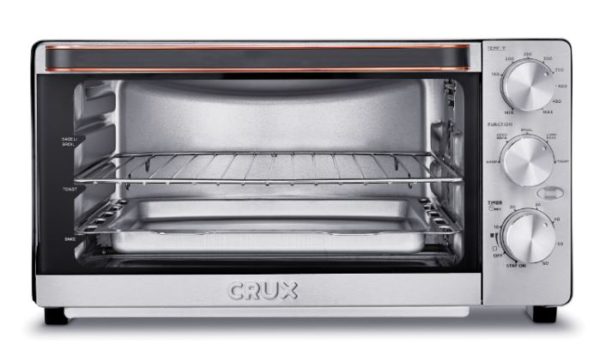
Moms are constantly looking for ways to make cooking simpler. The CRUX Toaster Oven with Convection function is one easy way to improve and expedite her cooking efforts and is a practical gift she’s certain to appreciate. This device delivers faster, more even heating and also maintains enhanced temperature accuracy. In all, the highly uniform heating profile without hot-spots yields fantastic toasting results. And, the large 17-liter capacity holds up to six slices of bread or a 12” pizza.
Other notable features of the CRUX Toaster oven include 700-watt heating elements that preheat quickly and cook efficiently; bake, broil, bagel, toast and warm functions; 60-minute timer with stay-on and auto shut-off; and a grill rack with three positions to accommodate various size casseroles and baking pans. The unit also comes complete with a bake pan and external removable crumb tray. Whether she’s looking for convenience for breakfast, lunch or dinner—for herself or the whole family—or wanting to bake a quick late-night snack, she’ll love the ease and power of this appliance.
What more quintessential way to celebrate Mom than with a homemade brunch on Mother’s Day? And while you’re at it, go ahead and whip her up a tasty mixed elixir. One recipe idea is the Pompelmoncello Rosemary Mojito made with Everclear. This delicious cocktail mixes together grapefruit, rum and rosemary, creating a sweet and refreshing cocktail that’ll help her relax and enjoy her special day.
The Everclear spirit component is distilled from 100% selected grains, providing a neutral flavor profile along with a high proof—so do be mindful of the amount used. Because it’s flavor neutral, it has a unique ability to extract even the subtlest of flavors, providing home mixologists with a clean slate, a blank canvas and endless potential. For those who insist a mojito requires mint, this cocktail politely disagrees.
The flavors of grapefruit, rum and rosemary combine perfectly to help you forget everything you thought you knew about the Havana classic—and delight Mom in kind.
photo: Nonni’s Foods
Nonni’s Dark Chocolate Almond THINaddictives (www.Nonnis.com) – Starting at $4.49
Another delightful indulgence for Mom—particularly those who are health conscious and ever on-the-go—is the better-for-you Dark Chocolate Almond THINaddictives from Nonni’s artisan bakery. They’re thin, crunchy, and super addictive…but in the best way. THINaddictives are handmade quality from a cherished family recipe passed down from generation to generation with no two cookies alike. Averaging only 70 to 80 calories per pack, each almond thin is lightly drizzled with decadent dark chocolate and made with real ingredients such as California almonds, bananas and sweet cherries for a guilt-free anytime snack.
These crunchy delights come in three delectable flavors: Dark Chocolate Banana Almond, Dark Chocolate Cherry Almond and Double Dark Chocolate Almond. THINaddictives pair perfectly with hot or cold beverages like iced coffee or tea or are certainly delectable by themselves. With each pack individually wrapped, they’re awesome to take on-the-go. Find these tasty treats at retailers nationwide. For the Silo, Merilee Kern.
As the Executive Editor and Producer of “The Luxe List,” Merilee Kern is an internationally-regarded consumer product trends expert and hospitality industry voice of authority—a travel, dining, leisure and lifestyle expert who spotlights noteworthy marketplace innovations, change makers, movers and shakers. She reports on exemplary travel destinations and experiences, extraordinary events and newsworthy products and services across all categories. Reach her online, on Twitter on Facebook and on Instagram.
***Some or all of the accommodations(s), experience(s), item(s) and/or service(s) detailed above may have been provided or sponsored at no cost to accommodate this review, but all opinions expressed are entirely those of Merilee Kern and have not been influenced in any way.***
While choosing popular cities to travel, the obvious choices are always Rome, Berlin, Barcelona and London, but how about those ‘alternative’ cities you may have never thought of or come across? That is where Munich, Germany comes in.
Nestled in the heart of Munich, Hotel Bayerischer Hof is one of Germany’s most historically important hotels, renowned for its timeless elegance and world-renowned design partnerships.
The aura of royalty is imminent as soon as one steps foot into the hotel. The property’s renowned collaboration with Belgian designer Axel Vervoordt, a global tastemaker, is designed with full picturesque and captivating minimalist interiors.
The unveiling of the art dealer, curator, designer, and antiquary Vervoordt’s latest revamp has transformed a section of the hotel into an artistic wonder– harmoniously mixing old and new, creating a design aesthetic that is hugely influential in Germany. He counts royalty within his clientele, with a nod to celebrities like Kanye West, Robert De Niro, and Calvin Klein.
Vervoordt’s collaboration with Hotel Bayerischer Hof is nothing short of incredible.
The Penthouse Garden Suite, Atelier, Garden restaurant, Cinema Lounge, and Palaishalle all bear the designer’s characteristic artistic touch. The new wing embodies a captivating minimalist design that is both modern and timeless in the same beat. Vervoordt’s talent helps the property keep in step with the ever-changing expectations of the hotel industry and attracts discerning guests who appreciate design that cleverly combines the present and the past.
Founded by female entrepreneur and owner Innegrit Volkhardt, who is dubbed “one of the most renowned hoteliers in the world,” her family has owned the Hotel Bayerischer Hof for over four generations, so the blood runs deep. The hotel recently celebrated 125 years of ownership. Volkhardt, a true Bavarian local, has immaculately maintained the hotel’s legacy while successfully integrating new design collaborations like that of Vervoordt.
Tucked away within the elegant shopping district, the hotel is near the city’s must-see attractions, including the Marienplatz, Viktualienmarkt, and the Hofbrauhaus, a fun and traditional beer house with live music (apparently it’s where the Nazis used to meet).
One can even say that you don’t need to leave the hotel, with a full service spa, a tiki bar underground, a glorious dome-shaped bar and networking area, a ballroom, and best of all, dinner at The Garden. The restaurant offers fan favorites like a goat cheese, fig and cottage cheese salad, as well as filet mignon with a side of spinach and potatoes. A sweet finish with a trio of sorbets to cleanse the palate and keep it light.
Hotel Bayerischer Hof boasts over 300 luxurious rooms and suites that capture its deep history, blending luxury with design.
The collaborative designs of Axel Vervoordt have played an immensely significant role in helping the hotel innovate and evolve without losing the essence that has made it a Bavarian favorite for 125 years. If you’re looking to indulge in an unforgettable experience, Hotel Bayerischer Hof is undoubtedly one of the best options in Munich. For The Silo, Ellie Ross.
May 9, 2023 – Investor-state disputes are proliferating around the globe as business investors seek redress for government actions they deem unfair or contrary to investment agreements, according to report from the C.D. Howe Institute. In “Investor-State Disputes: The Record and the Reforms Needed for the Road Ahead,” author and C.D. Howe Institute Senior Fellow Lawrence L. Herman reviews the record of investor-state dispute settlement (ISDS) procedures, the criticisms directed at them, and the reforms required.
“Despite concerns and criticism, ISDS procedures in international investment agreements are an important development in global governance that should continue to be a part of our international fabric,” says Herman.
Herman examines both Canadian and global cases involving ISDSs, which give private parties the right to bring binding arbitration against governments under International Investment Agreements (IIAs). These rights can be invoked when investors allege a lack of fair and equitable treatment, discrimination or expropriation without adequate compensation contrary to a country’s treaty obligations.
“ISDS has become a significant feature for investments, particularly into developing countries in many parts of the world,” according to Herman.
“However, because of the rights given to private parties, these agreements have become increasingly controversial – especially in an era of increasingly expanding governmental measures on climate change, sustainability, human rights and other issues impacting foreign investors and their investments in one way or another.”
In response to these concerns, multilateral, regional and bilateral efforts are making continuing improvements to ISDS mechanisms when it comes to efficiency, transparency and aspects such as permanent appointments and a system of appeals.
“While some countries have embarked on a program of terminating their bilateral investment agreements, these agreements will continue to remain as a part of the international fabric in many parts of the globe,” says Herman. “They are an important development in global governance and, even if not perfect, they not going to disappear in spite of concerns and criticisms.”
Creating permanent rosters of tribunal members as well as adding an appellate review processes to existing IIAs would help improve ISDS procedures. Short of this, Herman says ongoing efforts could include: i) promoting model arbitration clauses to reduce legal uncertainty and enhance consistency and predictability of outcomes; ii) developing codes of conduct and best practices for adjudicators plus rules to ensure their independence; and iii) making sure appointments to tribunals are of highest quality. Governments should also publicly support the value of third-party arbitration as an objective and neutral process that leads to peaceful resolution of differences, he adds.
Ultimately, investment protection treaties are about risk mitigation with host states bound by treaty to respect obligations of fair and equitable treatment and other rule-of-law standards and providing investors with a degree of assurance, says Herman. “While there are legitimate questions about the process and whether and to what degree investment treaties accomplish these objectives, these suggestions can assist in providing ways forward,” he concludes.
There are some 2,500 international investment agreements (IIAs) in force around the world, whether as stand-alone treaties or incorporated into bilateral or regional free trade agreements (FTAs). They are a significant feature of the international business scene.
A main feature of these agreements is to allow foreign investors to invoke binding arbitration where it is alleged that the host governments have breached fair and equitable treatment and other treaty obligations towards the investors. This is known as Investor-State Dispute Settlement or “ISDS”.
The process gives foreign investors comfort that if things go wrong in host countries, they have recourse to neutral, third-party dispute resolution. It thus provides important elements of risk reduction for foreign investors and their investments, notably aiding the flow of capital from industrialized countries to the developing world.
There has been dramatic escalation of investor arbitration claims over the last two decades. This makes it timely and useful to review the situation, looking at the value of ISDS as well as the criticisms that have emerged over the years. The conclusion is that IIAs and the arbitration process are valuable parts of the corpus of international order and will remain an integral part of the international business scene for the foreseeable future. The issue facing governments, therefore, is how to respond to criticisms by improving, as opposed to abandoning, the ISDS process. This paper suggests some pragmatic ways forward.
A Canadian company, First Quantum Minerals, and the government of Panama are reported to have settled a long-standing tax dispute allowing the company to resume operations at the Cobre Panama mine in that country. Earlier reports were that if the dispute was not resolved by negotiation, the company would invoke arbitration rights under the Canada-Panama Free Trade Agreement.
Had the dispute proceeded, it would have been another example of hundreds of arbitrations that have proliferated around the globe, initiated under various international investment agreements (IIAs) that give private parties the right to bring binding arbitration against governments under Investor-State Dispute Settlement ( ISDS) procedures. Those rights can be invoked, for example, where investors allege lack of fair and equitable treatment, discrimination or expropriation without adequate compensation contrary to that country’s treaty obligations.
In addition to investment treaties, numerous free trade agreements incorporate separate investment dispute settlement provisions, including the former North American Free Trade Agreement (NAFTA); the Canada-EU trade agreement (CETA); the Trans-Pacific Partnership (CPTPP) Agreement; and bilateral free trade agreements, such as those between Canada and countries like Chile and South Korea, among others.
As a consequence, ISDS has become a significant feature of the ground rules for investments in many parts of the world, particularly those made into developing countries. Because of the rights given to private parties, these agreements have become increasingly controversial, especially in an era of expanding governmental measures on climate change, sustainability, human rights and more that impact foreign investors and their investments.
In light of these developments, it is useful to briefly update the ISDS record with regard to Canada, look at what lessons might emerge, both in the global and the Canadian context, and suggest some elements to monitor as we go forward.
Criticisms Of ISDS Agreements
As investor arbitrations have proliferated, so have the criticisms, making ISDS one of the more controversial aspects of global governance. Here are some of the main ones:
IIAs have given private companies broad rights to challenge host-country actions that can fall within legitimate fields of public regulation, especially now in an era of decarbonization and other national crises like COVID 19.
The process involves one-way litigation, with no corresponding right of host countries to bring arbitration cases against investors for disregarding laws, practices and standards of business conduct.
The growth of third-party financings of investor claims has stimulated, or at least encouraged, the initiation of ISDS cases.
Investment agreements bypass the customary international law norm that requires claimants to first exhaust local remedies before bringing an international claim against a host country.
The ISDS structure is defective because its ad hoc tribunals – put together to hear a particular case – make long-term, binding decisions affecting laws or policies enacted for the public interest.
Arbitrators’ decisions are final and binding with no avenue of appeal, whether on errors of fact or of law.
Because of its ad hoc nature, the system lacks institutional continuity. Public confidence in the system suffers.
Arbitrators are appointed from a small — if not closed – pool of international lawyers who are free to act for private interests as counsel in other cases, leading to appearances of conflict and adding to diminished public confidence in the process.7
There are answers to these critiques but the over-arching response, as alluded to above, is that resolving investor-state disputes based on legal norms within an accepted procedural framework remains a significant achievement in the progressive development of international law. As observed in one analysis,
“During the last decade a number of the shortcomings have indeed been addressed and remedied. It is reasonable to assume that this has been done – at least partially – based on the realisation that investment treaty arbitration is the most efficient and reliable dispute settlement mechanism for disputes between foreign investors and host States. There is simply no better, realistic alternative.”8
As already mentioned, ISDS in its various manifestations provides an important element of stability and risk insurance when investing in jurisdictions where legal rules may not be mature or respected, aiding the flow of capital to developing countries and thus presumably helping to meet the international community’s aid and development goals. The system may not be perfect, but efforts are afoot to improve it at many levels.
The author thanks Daniel Schwanen, Charles-Emmanuel Côté, Rick Ekstein, Ari Van Assche, Gus Van Harten and anonymous reviewers for comments on an earlier draft. The author retains responsibility for any errors and the views expressed.
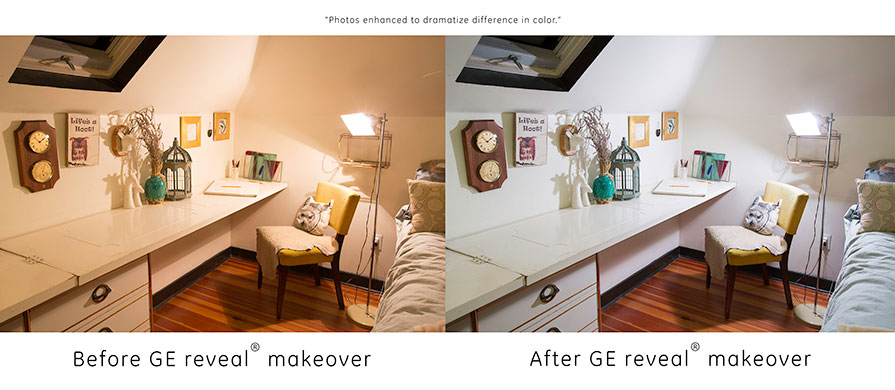
GE reveal® LED bulb provides the energy savings of an LED with color enhanced, full spectrum light to make vivid colors and patterns pop while filtering out dull, yellow rays
Unlike some LED bulbs, GE’s reveal® LED has the familiar size and shape of an incandescent bulb
GE Lighting has combined two of its most innovative lighting technologies—reveal® and LED—into one bulb.
Ideal for enhancing décor and architectural accent features in the kitchen, dining and living room, GE reveal® LED technology filters out dull yellow rays and delivers crisp, white light.
Making reds appear redder and whites whiter, this color enhanced, full spectrum of light illuminates bold design elements—such as an exposed brick wall and high-impact fabrics.
“So often we just take the color of light for granted—you flip the switch, and you get light. But GE reveal® transforms a room and dramatically reveals finishes and furnishings in a way that traditional lighting cannot,” said Mary Beth Gotti, GE’s residential lighting design expert and manager of the GE Lighting Institute. “GE reveal® LED lighting brings energy savings and a fresh new look to a room, enhancing colors and removing the yellowish haze that we don’t even realize is there until it’s gone.”
GE reveal® LED lighting appeals to the energy-efficient lighting consumer looking to make a design statement. The GE reveal® LED bulb uses 80 percent less energy than the traditional incandescent and lasts 13.7 years based on three hours of operation per day. The LED bulb also has the familiar size and shape of an incandescent bulb and offers dimming controls to create an ambiance for entertaining or simple everyday living. GE reveal® LED lighting is now available in 40- and 60-watt replacements for general purpose use, such as table and floor lamps, as well as the BR-30 indoor floodlight for track and recessed lighting in the kitchen, bathroom, dining and living room.
You can find GE reveal® LED lighting on store shelves at major retailers such as Canadian Tire. For more information about GE reveal® LED light bulbs, visit GE Lighting’s website.
“It’s the tiny town of Defoy. Only a gravel road from the main highway, but about a half a mile down there is the wonderful “antiques dump” of Rene Boudin and his freres.” photos: P. Ross
By the winter of 1982, we had been going to the Harbourfront Antique market every Sunday for about a year, and were making a pretty good living selling things we had bought at local auctions and garage sales. Then one day, I read in the excellent and entertaining “bible” of Antique dealing “The Furniture Doctor” by George Grotz , that the village of Defoy, Quebec was mecca for the antique picker.
To quote “there’s a wonderful secret wholesale place up in the province of Quebec. It’s the tiny town of Defoy. Only a gravel road from the main highway, but about a half a mile down there is the wonderful “antiques dump” of Rene Boudin and his freres. And here under enormous sheds you will find literally acres of antique furniture, chests, and tables piled three to five pieces high”.
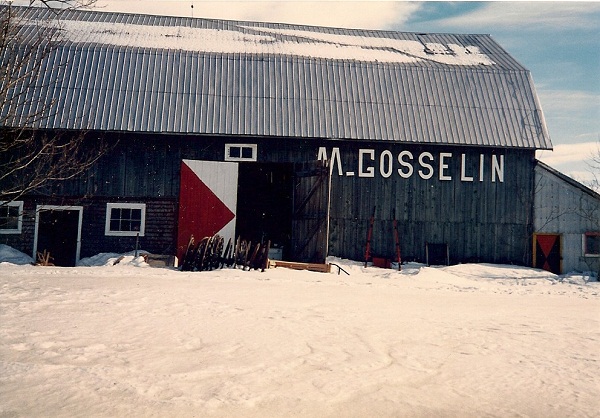
“…it wasn’t hard to find because it was near town, and his name was painted boldly on the barn.”
The book had been out quite awhile so there was no telling if this situation still existed, so I asked the old guys at the market if they knew of such a place. I got several reports of it’s glory days, followed by “of course that was years ago and nobody goes anymore. That being said they also all encouraged me to give it a go, and gave me “leads” as to who may still be active. We gathered up our courage, our baby, and what cash we had, and set off.
That first twelve hour drive felt like an eternity. It was a tired crew who pulled in late afternoon to a tiny motel in Victoriaville, Quebec.
Our first move was to look up Marcel Gosselin in the phone book because he was one of our most promising leads. To our delight he was listed, and he answered and told us where and how to come the next morning. It wasn’t hard to find because it was near town, and his name was painted boldly on the barn. Marcel greeted us warmly and proceeded to lead us to his main barn. There, behind the red and white cross doors was the biggest pile of dining chairs I had ever seen. About thirty feet across it reached to the top of the barn.
Through the hatch work of legs I could see tantalizing glimpses of a cupboard and some chests. Then he took us upstairs where in a loft he had sorted hundreds of chairs in sets of four, six, or more. Some were painted and some varnished. It was $45cdn each for simple painted chairs, $65cdn each for nicer pressbacks and/or varnished ones. We got a couple of sets knowing we would get about $150cdn-$250cdn each for these when refinished., Next I asked him about that cupboard I had seen in the giant pile downstairs. He told me all about it including the age, condition and reasonable price of $250cdn and told me he would extricate it and have it ready for my next trip if I wanted it.
I said I did, and then he didn’t even want a deposit.
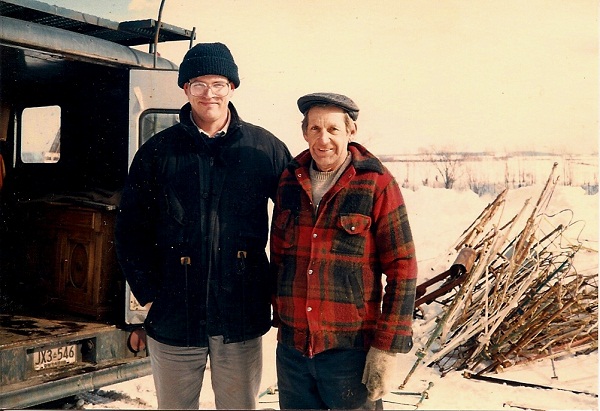
“That’s not the way we do it down here. Your word is good enough, until it isn’t” Marcel (R) Phil (L)
“That’s not the way we do it down here. Your word is good enough, until it isn’t. I liked him immediately and knew he was a man I would enjoy doing business with.
Next he took us to the garage attached to his 100 year old frame house. The downstairs was filled with every kind of “smalls” including small boxes, glassware, pottery, antique clothing, folk art, etc, etc; and the tiny, about to collapse, upstairs loft was filled with hundreds of pottery washsets. There were some beauties, and this was a hot item at the time in Toronto. Prices ranged from $45cdn-$75cdn per set. We bought 8 of the nicest sets knowing we would get between $145cdn to $375cdn back home.
This was getting truly exciting.
We spent a terrific four hours or so with Marcel that first day and pulled away from his place, with half our money spent, and half our truck full of interesting, excellent quality, and reasonably priced stuff, not to mention the overwhelming sense of warmth, excitement and wonderment of that first glimpse into a Quebec picker’s life. We were hooked, and we knew it was the first of many more trips to see Marcel. For the Silo,Phil Ross.
Featured image courtesy of tourismecentreduquebec.com
Vancouver, B.C. – Art Vancouver, Western Canada’s largest international art fair is once again uniting the world through art, held at the Vancouver Convention Centre West on May 4–7, 2023.
Art Vancouver’s vision is a noble one that seeks to use the universal language of art to connect people from different parts of the world and to promote a sense of global community.
By bringing together artists and galleries from across Canada and around the world, Art Vancouver aims to showcase a diverse range of contemporary artwork that reflects the unique perspectives, experiences, and cultures of each participating artist.
Art Vancouver marks its 7th edition, welcoming 100+ exhibitors, making Vancouver a destination city for artists, collectors and art lovers alike. Unique to this year, is a panel discussion about the intersection of Artificial Intelligence and art, providing valuable insights and perspectives from experts in the field.
Artist talks, demonstrations and art classes are always a great way for attendees to learn new skills and techniques, and having more of them available means that more people can benefit from the educational opportunities.
Art Vancouver has put together a diverse and engaging program that offers something for everyone. Whether attendees are artists themselves, or simply enthusiasts of art and creativity, there should be plenty of opportunities to learn, engage, and be inspired.
Established in 2017, the non-profit organization was started to make art accessible to everyone, with the goal of promoting and developing Vancouver’s visual art community into a thriving international art scene. VVAF hosts their main annual event, Art Vancouver, a four-day international art fair showcasing artists from across Canada and around the world. For the Silo, Christina Ioannou.
2023 marks 103 years since women were legally allowed to vote in the United States and 107 years since women were provided suffrage in the Western provinces of Canada.
It’s been about 3 weeks since many women celebrated Women’s Equality Day.
This day marks a significant turning point in the history of the struggle for equal treatment of women and women’s rights. In acknowledgment, we decided to look at some of the most successful women in business and how they made their millions (or in some cases, billions!).
The barriers to progress for women in the workforce are troubling.
How organizations deal with these barriers in the future will determine how our societies progress. After all, why would you want to ignore nearly half of the world’s workforce?
It’s time to celebrate the achievements of those who are paving the way for our future female leaders, CEO’s, scientists, bankers, journalists and media moguls.
In this info-graphic, we’ll show you some interesting facts about the current state of women in the workplace, gender equality and the pay gap. We’ll also give you some lesser known facts about the inspirational women we’ve chosen to profile, with information on their most prolific achievements.
If you’re in need of some girl power or motivation, then look no further than these business women who broke the mold. For the Silo, Angus Kirk.
We’ve come a long way since hearing Dr. Evil of Austin Powers’ movie fame describe “a sophisticated heat beam, which we call ‘a laser’ ” to take over the world, or sitting in awe watching Jedi knights in Star Wars blast through enemies using lightsabers.
Now in real life, lasers are being used to detect cancers cells.
Cancer tumors have the ability to break off of their primary site and spread from their primary organ to other sites of the body via the bloodstream and lymphatic system. The spreading of cancer, known as “metastasis”, is the leading cause of cancer-related death. Although, there are currently blood tests designed to detect cancer cells in the blood, known as circulating tumor cells, these test many times cannot pick up minimal cancer cells released early on. If these current tests return as positive, this frequently means that there is a high level of cancerous cells in the blood that have spread to other organs.
However, the diagnosis and treatment of these cancer cells in the blood may soon change.
In a recent study published in Science Translation Medicine, researchers have devised a laser that can detect these malignant cells and ‘zap’ them from outside of the body. The current standard methods of detection have limited sensitivity for picking up minimal cells at early stages of the disease, therefore possibly missing an opportunity to eliminate them at a treatable juncture. A team led by biomedical engineer Vladimir Zharov, director of nanomedicine at the University of Arkansas for Medical Sciences, has developed a method in hopes of changing that modality.
In studies with melanoma, they have coupled a laser with an ultrasound detector to create a ‘Cytophone,’ a device that identifies cells acoustically.
To break it down, a laser is first shined on the surface of a person’s skin, penetrating right into some of the near-surface blood vessels. The passing melanoma cells will then ‘heat up’ because of their darker pigment and create a small ‘acoustic wave’ that then gets picked up by the ultrasound detector. Melanoma cells absorb more of the energy from the laser because of their dark pigment, allowing them to heat up quickly and expand.
This
devised method can pick up a single circulating tumor cell per liter of
blood, which makes this up to approximately 1,000 times more sensitive
than other available methods of detection that typically examine only
about 7- 8 milliliters of a sample of blood. Additionally, the
cytophone was able to detect small clots of blood that could potentially
grow and lead to another set of harmful consequences.
They have tested this on 28 patients with melanoma and 19 healthy volunteers.
Researchers were able to discover that within as little as 10 seconds and as long as 1 hour, the cytophone was able to detect circulating tumor cells in 27 of the 28 patients. It also did not return any false positives on the healthy volunteers. Moreover, it was found that when the energy level of the laser was turned up (still to a safe intensity) that the amount of circulating tumor cells came down over the hour, without causing any side effects.
Although
the mechanism will likely not destroy all of the patient’s cancer
cells, it can help in several different ways. Initially, it can be used
in high-risk individuals as a screening tool to detect cancer cells in
the blood. Similar to mammograms in breast cancer, it can be added to
skin checks in patients that are at high risk for melanoma. While
undergoing treatment, it could potentially be used to monitor the
effects of that particular treatment, in addition to or separate from
imaging and other blood tests, to determine if the circulating cancer
cells in the blood are decreasing. Following the completion of
treatment, it can be used to monitor for relapse of disease.
Even though this has been tested recently in melanoma, and the dark pigment of melanin plays a role in its detection, Zharov and his colleagues are currently working to develop methods of ‘tagging’ other cancer cells with small nanoparticles to be able to ‘heat up’ and be distinguished from the normal cells. This study holds promise but it now needs to be expanded to in a larger population including patients with a higher content of melanin. For the Silo, Jerry McGlothlin.
Movies aside, the future holds promise in the new hope of using lasers to fight off the evil invasions of metastasis.
About Joshua Mansour, MD…
Dr. Joshua Mansour is a board-certified hematologist/oncologist working and in the field of hematopoietic stem cell transplantation and cellular immunotherapy in Stanford, California. In June 2019 he was a recipient of the ‘40 Under 40 in Cancer’ award. Abstracts, manuscripts, and commentaries by Dr. Mansour have been published in more than 100 esteemed journals and media outlets including Canada Free Press, Today’s Practitioner, Physician’s News, and KevinMD. He has given countless presentations at conferences and other institutions, and he has helped design and implement clinical studies to evaluate current treatment plans, collaborated on grant proposals and multi-institutional retrospective studies that have been published. Joshua Mansour. M.D. has been featured on Fox Television.
Almost two years ago, the Gamers Without Borders tournament was held to raise funds worldwide for pressing causes and give a glimpse into how the future of fundraising could be tied into the future of gaming.
With a $10 million prize fund up for grabs, the tournament consisted of one-off tournaments for a variety of eSports titles – from Fortnite to FIFA. Those who played, commentated, and watched were all persuaded to donate to a charity – from UNICEF to Direct Relief and International Medical Corps.
https://twitter.com/i/status/1269642242068754432
The tournament gained widespread attention.
The final FIFA tournament even had an appearance from Snoop Dogg and One Direction’s Liam Payne. Some of the world’s most prominent footballers, such as Paulo Dybala, Dele Alli, Joao Felix and Andre Silva, managed to raise around $1.5 million through their gaming exploits. By combining some stars of traditional sports and recognizable celebrities with the eSports tournament, not only did the industry managed to raise funds for charity, but they also proved that they could be deployed as a force for good going forwards.
Part of the crusade for eSports as an industry is to prove to the mainstream that it is a valid and legitimate counterpart to traditional sports and traditional gaming.
By merging the two, eSports is able to benefit from both sides. The success of Gamers Without Borders could prove just how much of a fundraising machine eSports could be and how, with a greater uptake in those who engage with the industry, the industry could do many more benevolent acts.
There are many ways that eSports is gaining the legitimacy it deserves, and this charitable tournament helped prove it. Indeed, as eSports betting attests to, allowing eSports fans and spectators to wager on the outcome of matches and tournaments gives it further credibility as a likeness to traditional sports. Indeed, bettors can wager on games from Dota 2 to StarCraft 2, Counter-Strike: Global Offensive to Overwatch and Rainbow Six in a similar way to how they bet on football, basketball and horse racing.
The interconnected nature of eSports – that often involve connecting with hundreds of people across social media and streaming sites like Twitch – means that causes can be amplified to audiences around the world. The younger generation who are likely to be participating in and watching eSports are also arguably more likely to think altruistically, according to research, and will often use their platform as a professional eSports player to spread positive information.
eSports is thriving, and its supportive community is in part to thank for that.
But the main barrier to its further success is its need to be legitimized by mainstream society. Given its professional polish, the good works it’s doing, the chances for careers, and the engagement of fans, it’s clear that the eSports industry is proving itself to be a real contender. The eSports industry might not be able to save the world single-handedly, but as it continues to gain tremendous steam, it could definitely be a vehicle that helps affect positive change. For the Silo, Bethany Riley.
Beth Linder-Moss got interested in health and fitness at the age of 16 after her father had his first heart attack. After this devastating event, she and the other members of her family changed their habits for the better.
This week on her Podcast, Beth discusses the importance of a positive mindset and taking responsibility for one’s life. Here are her suggestions on how to fix a negative mindset.
The Four Ways
1. The power of the mind:
Beth emphasizes the importance of having a positive mindset and how it can help individuals achieve their goals. She talks about how the mind can be programmed to focus on positive thoughts and how this can lead to a happier and more fulfilling life.
2. Taking responsibility:
Beth stresses the importance of taking responsibility for one’s life and not blaming others for one’s circumstances. She encourages individuals to take control and make the necessary changes to achieve their goals.
3. Overcoming challenges:
Beth talks about how challenges and obstacles are a part of life, but they can also be opportunities for growth and learning. She encourages individuals to face their challenges head-on and not give up when faced with adversity.
4. The importance of self-care:
Beth emphasizes the importance of taking care of oneself, both physically and mentally. She talks about how self-care can help individuals to maintain a positive mindset and achieve their goals.
“Focus on the positive, take control and do not give up when faced with challenges,” Beth told her audience. “It is easier said than done. To be at your best eat right, drink plenty of water, get your sleep and exercise.” For the Silo, Harold Nicoll.
Up coming next generation of polymer materials creates more durable and recycle-ready composites
ALUULA Composites is collaborating with the University of British Columbia (UBC)Composite Research Network to develop world-first recycling applications for high-performance, UHMWPE-based composite materials. The new material has been recently featured inAir&Cosmos, Composites World,Innovation in Textiles, and Plastics Today.
“When we first revealed our work with ALUULA to the kitesurfing world, there was reasonable and valid debate as to whether the hype would really match up to the material’s potential, and to the performance levels that we were promising. Happily, as has since been proven and documented, the hype has gone beyond everyone’s expectations.” Ocean Rodeo Kitesurfing
According to a report from the FMI, the global advanced polymer composites market is projected to register an average-paced CAGR of 5.9% during the forecast period. The current valuation of the market is US$ 11.12 Billion in 2022.
The value of the advanced polymer composites market is anticipated to surpass a valuation of US$ 19.73 Billion by the year 2032. The experts of Future Market Insights have recorded a historical market valuation of US$ 10.5 Billion during the base year.
Composite materials have been using the same process of gluing together different core layers and outer films to create composites used in a wide range of product applications.
“Between the interest in our materials generated from the ISPO Awards and the transformational effect our composites have had in the wind sport sector (via Ocean Rodeo Kitesurfing products), Aluula is now in co-development conversations with industry leaders for a broad range of uses and applications. It is an extremely exciting time for our entire team” said Aluula COO John Zimmerman.
The new composites are up to 50% lighter than competitive materials while delivering equal or greater strength.
This process has produced many innovative composites, but their performance has plateaued. A new generation of composite materials, using novel chemistry and innovative manufacturing techniques develops new ways to assemble and fuse high-tech fibers, and advanced space-age films together. By bonding materials at the molecular level, the next-gen of polymers is not only creating extremely light, strong, and durable composites, but materials that are recycled readily.
High-performance polymer composites open up lucrative growth prospects for the manufacturers.
Are a new way to bond high-tech fibers and advanced space-age films creates the next-gen of polymers.
Are more durable and recycle readily next-gen materials create unlimited opportunities for the composites materials market.
Featured image via Aluula- Panels made with recycled polymer composites reportedly are 10 times stronger than panels molded from virgin resin.
U.S. leadership ratings retreated after the U.S. withdrew from Afghanistan,with most of the world disapproving of Russia’s leadership after its invasion of Ukraine
Washington, D.C. — A new Gallup reportbased on interviews in 137 countries in 2022 shows the honeymoon is over for U.S. President Joe Biden, and Germany’s image has lost some of its clout under new Chancellor Olaf Scholz. Though global approval ratings of the U.S. and Germany dipped in 2022, both countries are still in much stronger positions than Russia — which saw its ratings plunge after its invasion of Ukraine — and China.
German Chancellor Olaf Scholz (L) with Canada Prime Minister Justin Trudeau (R)
Here are some of the key findings from Gallup’s Rating World Leaders 2023 report:
U.S. leadership ratings around the world rebounded in 2021 in the first year of Biden’s presidency but declined in his second.
Ratings for the U.S. first slipped after withdrawal from Afghanistan in August 2021.
There were double-digit decreases in U.S. leadership approval in 36 countries between 2021 and 2022 — mostly in Europe and the Americas.
Russia’s approval ratings plunged worldwide after the invasion of Ukraine, and the majority of adults around the world now disapprove of Russia’s leadership.
Majorities in 81 of the 137 countries surveyed disapproved of Russian leadership.
A look back to last year’s rankings and previous years.
Implications Beyond 2023:
One of the biggest foreign policy challenges facing the U.S. and its allies in 2023 and beyond will be to ensure the transatlantic unity that was so greatly tested in 2022 does not fracture as Russia’s war against Ukraine continues.
The images of the U.S. and Germany are in slightly weaker positions than before the war started, but they are still in much stronger positions than Russia. But perhaps more importantly, the soaring disapproval of Russia’s leadership in all parts of the world shows they are not the only countries that care.
Berlin’s vibrant art scene just got a little more exciting with the opening of Selina Berlin Mitte, the latest property from skyrocketing hospitality company, Selina. Dubbed an ‘art-forward’ hotel, Selina Berlin Mitte boasts a guest concept that revolves around art and music, offering visitors a memorable cultural experience to feel like a local.
Located in the heart of Berlin’s Mitte district, Selina Berlin Mitte offers guests an eclectic mix of accommodations, including standard, suite, shared, and hybrid options.
I was offered one of the suites, and I literally felt like I had relocated to my very own apartment in Berlin, stocked with a kitchen, fridge, modern shower and bathroom, couch, vintage record player and expansive views of the city. Perfectly situated for exploring the city, the hotel is steps away from some of Berlin’s best design stores and boutiques, galleries, restaurants, shops, and bars.
If you are looking to socialize, Selina Berlin Mitte features a rooftop co-working and bar area, plus a restaurant with contemporary Israeli and Mediterranean cuisine called HOWM, a grab-and-go dining option available 24 hours, and even a communal kitchen.
If you grab a drink at the hotel rooftop, you will be surrounded by lounge seating, fun board games, and a 360-view of the city, including Berlin’s iconic TV Tower. Selina goers can meet up for a “welcome drink,” rooftop yoga classes and meditation sessions. If you are searching for activities on the property, you can choose from workshops, live music, DJ sets, art exhibits, and lectures.
Sprawled along the hotel walls are carefully curated artworks by Berliners and international artists, with installations highlighting mixed media– reclaimed wood, mirrors, and vintage art objects. Using earthy and hip furniture, Selina has an industrial feel that opens your eyes to innovation and connection. Common areas are filled with murals, while in-room art combines classical Berlin prints and artworks. Large-scale artistic works are woven throughout the reception area, rooftop, corridors, and suite rooms.
On a mission to keep digital nomads connected, enabling them to travel and work without borders, Selina has plans to open 10-15 hotels in 2023, catering to millennials and Gen Z travelers.
On April 14-16, Selina Berlin Mitte celebrated its opening with the “Welcome to the Hau(E)” event, a 3-day experience showcasing curated local programming, food pop-ups, wellness activities, live music DJs, and a local artisan market.
Selina Berlin Mitte is the “IT” hotel, where art and music lovers unite into a cultural melting pot. Book a stay and indulge in the avant-garde, art-centric German capital, and all it has to offer. For the Silo, Kat Fleischmann.
For more information or to book a stay at Selina Berlin Mitte, visit www.selina.com.
NORAD conducts routine intercept of Russian aircraftentering Air Defense Identification Zone
COLORADO SPRINGS, Colorado – The Alaskan Region of North American Aerospace Defense Command (NORAD) detected, tracked, positively identified and intercepted two Russian aircraft entering and operating within the Alaska Air Defense Identification Zone (ADIZ) on April 17, 2023.
Russian aircraft remained in international airspace and did not enter American or Canadian sovereign airspace. This Russian activity in the North American ADIZ occurs regularly and is not seen as a threat, nor is the activity seen as provocative.
Development began in 1949 and was continually refined up to present day making The Tu-95 BEAR perhaps the most successful bomber produced by the Soviet aviation, enjoying such a long service in a variety of roles and configurations.
NORAD aircraft, including F-16 fighters, F-22 fighters, KC-135 Stratotankers, and E-3 AWACS, conducted the mission.
Almost two decades old-The Lockheed Martin F-22 Raptor is an American single-seat, twin-engine, all-weather stealth tactical fighter aircraft developed for the United States Air Force.
NORAD tracks and positively identifies all military aircraft that enter the ADIZ. NORAD routinely monitors aircraft movements and as necessary, escorts them from the ADIZ.
Since Russia resumed out of area Long Range Aviation activity in 2007, NORAD has seen a yearly average of approximately six to seven intercepts of Russian military aircraft in the ADIZ. These numbers have varied each year from as high as 15 to as low as zero.
NORAD employs a layered defense network of satellites, ground-based radars, airborne radar and fighter aircraft to track and identify aircraft and inform appropriate actions. We remain ready to employ a number of response options in defense of North America and Arctic sovereignty. For the Silo, Capt Alexandra Hejduk.
The UK Hydrogen Strategy estimates that to meet Net Zero aims by 2050, hydrogen will make up 20-35% of the UK’s final energy demand (250-460 TWh a year). Hydrogen therefore has a critical role to play in the decarbonization of industry, power, heat and transport.
Yet in this recent report, the UK Hydrogen Champion found that there is a need for greater clarity on upcoming policy decisions for hydrogen users, the funding available and overall delivery of the hydrogen roadmap to 2030 and beyond. Is the UK (and for that matter what about here in Canada? CP) really doing everything it can to maintain momentum and realize hydrogen opportunities?
Tevva’s area of expertise – transport – will have a critical role to play in the United Kingdom’s decarbonization goals. Worldwide around a fifth of CO2 emissions comes from trucks, and both McKinsey and the Hydrogen Council believe the most competitive use of hydrogen lies in decarbonizing trucks. Trucks using batteries or hydrogen fuel cells instead of diesel engines will indeed need to make up the vast majority of new sales by 2040 under plans to reduce CO2 emissions from medium- and heavy-duty vehicles. Yet only around 700 trucks that run on batteries or fuel cells were sold in Europe last year – about 0.2% of the total.
The good news is that the economics of owning and operating electric and hydrogen trucks, their total cost of ownership or TCO, are improving rapidly. And with diesel truck prices set to increase with Euro 7, electrification of our sector could happen sooner than previously thought.
Yet there are still serious challenges around the lack of hydrogen refueling stations and the fact that most fleet operators have no experience of hydrogen, in addition many hydrogen suppliers have no experience of truck fleets.
As an early adopter and developer of hydrogen technology, Tevva is playing an important role in demonstrating the potential for hydrogen electric trucks. We showcased our concept prototype 7.5t and 19t hydrogen electric trucks at the IAA in Hanover last year and have been encouraged by the high level of interest in these dual energy vehicles.
In January we took the 7.5t prototype on a ‘border run’ to Berwick-on-Tweed, England’s northernmost town. On the way up we stopped at an Element 2 refueling station in Teesside, and the return journey saw us cover almost 350 miles without needing to stop at all. This was made possible by the truck’s hydrogen fuel cell which tops up the range-extended vehicle’s lithium battery when needed.
Still, there is an urgent need for a more comprehensive hydrogen refueling network in the UK, and the speed and scalability of hydrogen refueling systems will be crucial to adoption while keeping costs under control. Element 2 is doing great work in this space. They are in the process of putting a skeleton network in place with 100 miles between each refueling station, giving confidence to any haulage company that is considering hydrogen electric trucks.
Today the UK has pockets of Megawatt (MW)-scale hydrogen activities that are evolving alongside ambitious proposals for Gigawatt (GW)-scale low carbon hydrogen clusters by 2030. Learning from initiatives in Europe, Asia and North America, as well as the UK’s own experiences, coordination is vital to minimize costs and maximize the benefits of hydrogen infrastructure. The opportunity is now for UK central, regional and local Government bodies and industry to plan and invest jointly to grow hydrogen transport systems holistically.
The UK does have a supportive and growing hydrogen ecosystem with many public bodies, new and established companies, universities, and others building their hydrogen capabilities and strategies. However, the experience of individual organizations and maturity of cross-industry collaboration in dealing with hydrogen systems is typically orders of magnitude lower than for traditional fossil fuel systems. Therefore, in the short term early adopters need more support to overcome the limited infrastructure and complexity of supply chains, higher unit costs, and long or uncertain lead times for hydrogen products and services.
As low-carbon hydrogen becomes cheaper and more widely available, hydrogen refueling has the potential to become as simple as diesel refueling is today. We are committed to making hydrogen convenient, affordable and sustainable for truck fleet operators. Achieving the UK’s net zero goals depends on it. For the Silo, Harsh Pershad, Head of Hydrogen at Tevva.
In an issue of The Watchtower magazine from a few years ago, no doubt was left as to how Jehovah’s Witnesses should treat family members who have been “disfellowshipped,” or ex-communicated, from the religion. “Really, what your beloved family member needs to see is your resolute stance to put Jehovah above everything else – including the family bond,” warns the magazine on page 16, before asserting, “Do not look for excuses to associate with a disfellowshipped family member, for example, through e-mail.”
Shunning.
Jehovah’s Witness is not the only religion that calls upon its followers to ostracize anyone who leaves the faith. Described as psychological torture by University of California-Davis Professor Almerindo E. Ojeda, such social rejection is used in the United States by Anabaptists (the Amish, Mennonites, Hutterites), Scientology, and the Baha’i Faith, among others.
Some contemporary evangelical Protestant churches have renewed the practice of shunning, as in the case of a 71-year-old former Sunday school teacher who was arrested on trespassing charges after questioning her pastor’s authority.
The practice can have devastating consequences.
In 2011, Eric Reeder was disfellowshipped from the Jehovah’s Witnesses after sustaining injuries in a motorcycle accident that led to a blood transfusion – a medical treatment prohibited by the religion. His family subsequently shunned him in accordance with the faith’s rules.
Eric posted about his predicament in an online forum for ex-Witnesses in August of that year, admitting, “The only thing I am really going to miss is my folks … my dad is a hardcore elder and has told me he will no longer be able to speak to me 100% of the time.” In April 2012 he wrote that he was “still not used to my parents totally shunning me …” before adding, “It’s so hard … nobody should have to lose their parents twice.” By the end of September, Eric was found dead at age 51. He had killed himself.
Nobody can be certain what dark thoughts were swirling through Eric’s mind when he took his own life, or what finally drove him to such a desperate act. But we do know that in the preceding months, Eric was deeply tormented by the ostracism inflicted on him by members of his family.
While The Watchtower Society, the name of the legal entity used by Jehovah’s Witnesses, proudly publishes annual statistics related to its worldwide evangelism work, there are no official figures for those who are shunned, and no way to confirm how many of these former members, like Eric, feel desperate enough to take their own lives. However, one can find a great deal of anecdotal evidence on Internet forums frequented by Ex-Witnesses. One well-known researcher, Terri O’Sullivan, reported that being shunned worsens one’s mood within 60 seconds.
Ex- witness Richard E. Kelly is the Managing Director of AAWA and the author of Growing Up in Mama’s Club: A Childhood Perspective of Jehovah’s Witnesses.
In the absence of any popular or political impetus to address the issue of religion-incited shunning, I am proud to be part of an organization that dares to face it head on. Advocates for Awareness of Watchtower Abuses (AAWA) has been established to educate the world via its website (www.aawa.co) about some of Watchtower’s most shocking practices.
While these are often pardoned in the name of religious freedom, there are instances where governments have successfully sanctioned extreme shunning:
“The Jewish tradition frequently confronted this issue in the many Eastern European communities where the government outlawed the use of excommunication and shunning. Not surprisingly, when confronted with significant governmentally imposed sanctions against this practice, the Jewish authorities ceased using exclusion as a method of community formation or maintenance,” states an article by Michael J. Broyde, academic director of Emory University’s Law and Religion Program.
My colleagues and I believe that the shunning of relatives and friends represents mental and emotional abuse. Modern society must no longer allow Watchtower to promote this barbarous practice through printed word or otherwise. For the Silo Richard E. Kelly.