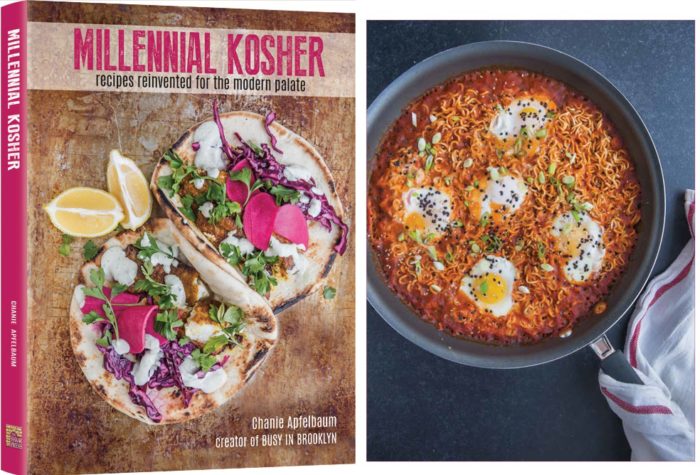
The Jewish High Holidays are all about family and friends gathering together to share a delicious meal. And while many people love to celebrate with favorite kosher foods there is no reason why traditional kosher and Jewish recipes can’t be different and unique. What’s old can become new and fun again with fresh ingredients and unique twists.
Today’s kosher cooking is spicier and bolder than the food most of us grew up eating, with an emphasis on fresh and seasonal ingredients, less processed foods and healthier non-dairy alternatives. From world-renowned kosher food blog, Busy in Brooklyn, Chanie Apfelbaum, has created a delicious collection of modern, cultural, trendy, and bold dishes that reflect her passion for reinventing traditional foods with a modern vibe with her debut cookbook, Millennial Kosher: Recipes Reinvented for the Modern Palate (Artscroll/Shaar; April 2018).
“As a mother of five it’s so important to me to carry on family traditions, especially through food,” Chanie explains. “Everything old can become new again, which is what I have strived for in my book, recreating cultural cuisine with new ingredients. It’s those tastes of home, the delicious aromas from my kitchen, and the memories made around the holiday table that my children will carry with them for generations.”
Millennial Kosher provides home cooks with over 150 innovative recipes for everyday and holiday meals and beautiful color photos for every dish. For the Jewish High Holidays, home cooks can celebrate with recipes that are influenced by international cultural cuisine and not limited to, but inspired by, kosher guidelines. Yesterday’s margarine is today’s coconut oil, bone broth is the new chicken soup, and the onion soup mix of our youth is replaced with umami-rich porcini mushroom powder. Some of the delicious and unique recipes in the book include:
– Spiralized Beet Salad with Pomegranate Molasses Dressing
– Lokshin & Cabbage with Apples and Honey
– Kofta Stuffed Dates wrapped in Bacon
– Sticky Silan Short Ribs
– Gefilte Fish “Pizza”
– Mushroom Barley Risotto
– Mason Jar Honey Cakes
– Frangipane Fig Galette
“Kosher food is not what it used to be. Millennial kosher ingredients are healthier and more vibrant than ever before,” Chanie says. “We live in a foodie culture—and the kosher world has followed suit. Kosher consumers are becoming more demanding, and restaurants, supermarkets and cookbooks have no choice but to up their game.”
Chanie says that this development in kosher food culture has come about mainly from new exotic flavor combinations, bold spices, fresh seasonal flavors and progressive adaptations like kosher bacon and charcuterie. These culinary ideas are what Chanie superbly showcases in Millennial Kosher.
She believes there is still a place for the kosher comfort foods of our youth but for now it’s time for Millennial Kosher.
ABOUT THE AUTHOR:
Born and raised in a kosher home in Brooklyn, Chanie Apfelbaum grew up eating traditional Jewish foods such as gefilte fish, stuffed cabbage, and matzah ball soup. Today, living just a few blocks from her childhood home, she revisits family favorites and reinvents traditional holiday dishes. Chanie’s creative twists on old-time cuisine prove that kosher fare is anything but old-fashioned. With five little ones in tow, she celebrates her heritage one dish at a time, creating balanced recipes with a modern flair and Middle Eastern vibe.
Chanie works as a recipe developer and food photographer. She is a contributing writer to Mishpacha Magazine’s Family Table and kosher.com, as well as a guest writer for numerous publications and websites. She has been featured in many national publications and media, including The Wall Street Journal, The Huffington Post, News12 Brooklyn, The Meredith Vieira Show, Thrillist, and more.
Chanie also shares her love of food, family, and tradition through fun and educational cooking demonstrations to audiences worldwide. For the Silo, Trina Kaye.
For the High Holidays, Chanie recommends this delicious recipe to celebrate the sweetness of life:
Honey Roasted Za’atar Chicken with Dried Fruit
When I finally decided to take the cookbook plunge, my biggest challenge was figuring out which “best of the blog” recipes to feature — there are just so many! I’m proud to say that this recipe hooked hundreds of people onto the Middle Eastern spice blend, za’atar. I use it on pita chips, roasted chickpeas, hummus, shakshuka, and garlic confit.
MEAT ▪ Yield 4-5 Servings ▪ Freezer Friendly
10 oz. dried apricots (scant 2 cups)
10 oz. pitted dried prunes (scant 2 cups)
3 Tbsp za’atar
2 Tbsp extra virgin olive oil
4 chicken legs, skin-on
1⁄2 cup dry red wine
kosher salt, to taste
1⁄3 cup honey
1. Preheat oven to 350°F. Spread apricots and prunes into a 9×13-inch pan.
2. In a bowl, combine za’atar and olive oil to create a paste. Rub the za’atar paste over chicken; place chicken on dried fruit. Pour wine around the chicken; sprinkle with salt.
3. Cover tightly with foil; bake for 1 hour.
4. Uncover the pan. Drizzle the chicken with honey. Bake, uncovered, for an additional 30-45 minutes, basting every 10 minutes with the pan juices.
Recipe/photo from Millennial Kosher by Chanie Apfelbaum. Artscroll/Shaar; April 2018
ISBN #: 9781422620557
Featured image from Millennial Kosher- Raman Shakshuka






 Trade networks, however, were not durable. The contributors discuss the establishment and decline of great trading network systems, and how they related to the expansion of civilization, and to different forms of social and economic exploitation. Case studies focus on local conditions as well as global networks until sixteenth century when the whole globe was finally connected by trade.













 This concern, of course, is not unique and strikes at the heart of something that all those in creative professions fear and must face. The ownership of ideas is difficult to prove. If you tell someone your plan in confidence and they, in turn, use it for their own purposes, there is very little you can do to show that you are the originator. Spreading this rumor is likely to make you look like the bad guy. It’s no wonder that this sort of generosity is cause for concern.
 But what about sharing your networks or some trade secrets that helped you get to where you are today? While you may have worked tooth and nail for everything you’ve gained, there were surely people along the way who said yes at the right moment and assisted your progress. No one can ask more than this, and as an artist of a certain standing, there is nothing wrong with offering this sort of help.
 No one exists in a vacuum. Even you, who may have scraped and fought your way to where you are today, benefited from the acceptance and help of others. Sure, you may have pounded the pavement endlessly in order to secure your position but that is no reason not to pay forward the success you have achieved. It is too easy to forget, once you have achieved a certain status, the myriad small moments that led you there. While it may seem as though hardly anyone was out to help you in the early days, surely there were some, otherwise you could not be where you are today. Even if it was just a few gallerists who were finally willing to take a chance, there are always rungs of assistance in the ladder to every success, no matter how small.
 For these reasons, there is a lot to be said for good old-fashioned face-to-face interaction. Being the sort of artist who is willing to mentor in the real world sets you apart. Establishing this sort of reputation, for being the one who will gladly share the bounty you have created, seldom reverses one’s own success and frequently opens new doors you may never have considered.
 Arguably, there is no such thing as original art. Even some of the most contemporary artists’ work is derivative of past creations. Marina Abramovic, in her unique style, has absolutely drawn from (and occasionally been accused of copying) works by other artists. Pablo Picasso (and perhaps more famously, Steve Jobs who quoted him) said, “good artists copy, great artists steal.” This doesn’t mean that you should open yourself up to idea theft, but it does mean that perhaps being stingy with your concepts, your network, your position as an established artist, doesn’t count for as much security as you might think. Be smart about things, but in general, it is always a good idea to reach down the ladder and help those coming up behind you find the next rung. For the Silo, Brainard Carey.







 It costs just $4.55cdn, less than a bottle of maple syrup, to provide one week of nutritious meals to children in school through the ShareTheMeal app! The app allows users to share nutritious food with hungry children around the world by simply tapping on their smartphone and donating $0.65 or more.




















 International-renowned sommelier, Noel Shu, provides in-depth look at the modern Chinese wine industry and guides us through the misty vineyards and crowded wineries of China.
 About the Author




 All donations will go out to the Village of Altagracia in Dominican Republic. Because of your generous giving, Villa Altagracia will be provided with water, a public restroom, educational resources, and an overall growth and unity in community living. For the Silo, Jessica Kirk.










 Basic income, or guaranteed annual income, is a payment to eligible families or individuals that ensures a minimum level of income. Ontario will design and implement a pilot program to test the growing view that a basic income could help deliver income support more efficiently, while improving health, employment and housing outcomes for Ontarians.
 “Ontario is taking a leading role in piloting a modern Basic Income, and we are thrilled that the Honourable Hugh Segal will be lending us his considerable expertise in this regard. We want to ensure that we are developing a thoughtful, evidence-based approach to test the idea of a Basic Income, and we look forward to Mr. Segal’s advice as we begin this work.”