Tag Archives: culture

The Met to Present a Major Exhibition Dedicated to the Careers of Lee Krasner and Jackson Pollock

Featuring over 120 works from more than 80 U.S. and international lenders, this exhibition marks the first major New York presentation of either artist’s work in over two decades—and their first at The Met.

Exhibition Dates: October 4, 2026–January 31, 2027
Exhibition Location: The Met Fifth Avenue, Gallery 899, The Tisch Galleries


(New York, February, 2026)—Krasner and Pollock: Past Continuous at The Metropolitan Museum of Artis a major exhibition that charts the full arc of the careers of Lee Krasner (1908–1984) and Jackson Pollock (1912–1956) in parallel, examining the distinct yet connected practices of these artistic peers and life partners. On view October 4, 2026, through January 31, 2027, it marks the first major New York presentation devoted to either artist in more than 20 years, introducing their work to a new generation while reassessing their enduring impacts on modern and contemporary art.

A meeting of two great artists


Krasner and Pollock were emerging artists in New York when they met on the occasion of being included in a 1942 exhibition organized by the artist John Graham. They married in 1945 and moved to Springs, Long Island, where they remained entwined personally, artistically, and professionally until Pollock’s death in 1956. Pollock’s life’s work had secured his legacy, while the nearly three decades that Krasner survived him marked some of the most transformative years of her career. Drawing its subtitle, Past Continuous, from a 1976 painting by Krasner, the exhibition traces parallel lives and practices, first forged by lived experience and then shadowed by memory. It foregrounds the range and art historical significance of Krasner’s work while offering a sustained examination of Pollock’s rich and complex practice.

Number 31. 1950. Jackson Pollock

Outstanding philanthropy


The exhibition is made possible by Kenneth C. Griffin and Griffin Catalyst, Marina Kellen French, and the Barrie A. and Deedee Wigmore Foundation.
Additional support is provided Trevor and Alexis Traina, the Aaron I. Fleischman and Lin Lougheed Fund, The Huo Family Foundation, and Joyce Kwok.

Number 11. 1952. Jackson Pollock

A novel way of reexamining modern art


“With its distinctive premise and scope, Krasner and Pollock: Past Continuous exemplifies The Met’s commitment to reexamining modern art through rigorous scholarship and fresh perspectives,” said Max Hollein, Marina Kellen French Director and Chief Executive Officer of The Metropolitan Museum of Art. “By considering each artist on their own terms while also foregrounding their consequential relationship, the exhibition situates Krasner’s and Pollock’s work within a broader cultural and artistic context—an approach central to the mission of The Met’s Department of Modern and Contemporary Art and to the vision of the forthcoming Oscar L. Tang and H.M. Agnes Hsu-Tang Wing, opening in 2030. This project affirms Krasner and Pollock not only as defining figures of their moment, but as artists whose work continues to shape and inspire future generations.”

What makes an artist revolutionary?


Krasner and Pollock: Past Continuous begins with the fundamental premise that these artists are equals, partners in life, giants in the history of art, and revolutionaries who defined what abstraction could be,” said David Breslin, Leonard A. Lauder Curator in Charge, Department of Modern and Contemporary Art, The Met. “Each found a partner who would insist on the primacy of art over life; and they both aspired to an art that was forged out of historical connections but that also promised freedom and radical possibility in a world forever changed by war. The exhibition concerns entwined lives but is also about how different artistic directions come from shared terrain.”

Krasner and Pollock: Past Continuous approaches these artists not as a single story, but as two practices unfolding in proximity over time,” said Brinda Kumar, Associate Curator, Department of Modern and Contemporary Art, The Met. “The exhibition examines how Krasner and Pollock shared a commitment to testing the possibilities of abstraction—through shifts in scale, material, and form—and how those investigations continued to evolve along distinct trajectories.”

Krasner and Pollock: Past Continuous follows each artist’s life and work.

The exhibition highlights their differences as much as their interrelation, with some galleries that place the artists together and others where they are presented independently. Krasner and Pollock were shaped by their distinct upbringings and formative trainings. Krasner adopted and negotiated the tenets of the European avant-garde, particularly Pablo Picasso, Henri Matisse, and Piet Mondrian. Her training under Hans Hofmann was key to her development. Pollock’s network of broad influences included Thomas Hart Benton and American Regionalism, Mexican mural traditions, Surrealism, and even his own family of artists.

Their early paths unfold as complementary divergences, tracing distinct strands of American modernism that would ultimately converge in the rupture known as Abstract Expressionism. For Pollock, his breakthrough was the “drip” technique, a radical mode of painting that flourished in a condensed but prolific period from 1946 to 1951. Krasner’s varied practice was typified by ceaseless explorations of abstraction, often cued by her abiding interest in the possibilities of nature and color. This manifested in bold collages, gestural canvases and vividly hued hard-edge painting. Historically, Pollock’s reputation has eclipsed Krasner’s. LIFE Magazine asked in 1949 if Pollock was “the greatest living painter in the United States.” His early death and posthumous media attention further amplified his fame and eclipsed critical appraisal of Krasner’s contributions. Today, both artists’ practices are rightly recognized as key to the innovations of art from the mid-20th century onwards. This exhibition continues and amplifies this reevaluation.

Rarely loaned works

Combat. 1965. Lee Krasner


The exhibition draws on The Met collection and rarely loaned works from more than 80 U.S. and international lenders, bringing together over 120 paintings, works on paper, and ephemera to reconsider Krasner’s and Pollock’s careers—both on their own terms and in dynamic relation to each another and their shared artistic context. Major institutional lenders include Peggy Guggenheim Collection, MoMA, the Whitney Museum of American Art, Tate, National Gallery of Art, National Gallery of Victoria, Centre Pompidou, Buffalo AKG Art Museum, Dallas Museum of Art, The Art Institute of Chicago, and SFMoMA. The exhibition will also include several rarely seen works from important private collections.

Organized into 12 chapters that span each artist’s career and are punctuated by defining moments, Krasner and Pollock: Past Continuous unfolds from the 1930s through the postwar years to the end of their respective lives, moving between moments of convergence and difference. The exhibition’s design, informed in part by historic spaces and installations, enhances moments of exchange—across time and practices—while allowing for discrete encounters with works by each artist, from Krasner’s Little Images series and Pollock’s drip paintings of the late 1940s to his monumental canvases in the 1950s and Krasner’s Umber and Earth Green series. The exhibition charts ongoing dialogues—Pollock’s late return to earlier motifs in the mid-1950s and Krasner’s extended engagement through the 1960s and 1970s with artists such as Klee, Picasso, Mondrian, and Matisse. This presentation will reveal two artists in constant negotiation with each other, themselves, and the cultural, political, and aesthetic stakes of their time.

A constellation of landmark works anchor the exhibition’s exploration of both artists’ practices, including Lee Krasner’s Composition (1949), The Seasons (1957), The Eye is the First Circle (1960), and Combat (1965), along with Jackson Pollock’s Stenographic Figure (1942), Guardians of the Secret (1943), Number 1, 1950 (Lavender Mist) (1950), and The Deep (1953). Two earlier exhibitions, Krasner/Pollock: A Working Relationship (co-organized by Guild Hall and Grey Art Gallery, 1981) and Lee Krasner-Jackson Pollock: Kunstlerpaare Kunstlerfreunde (Kunstmuseum Bern, 1989–90), concentrated on the approximately 15-year overlap in the artists lives, from 1941, when they met, until Pollock’s death in 1956. Krasner and Pollock: Past Continuous is the first exhibition to consider both artists’ practices, in their full chronological sweep, together.

The Met has long been significant for both Krasner and Pollock.

Pollock first exhibited a painting at The Met in 1943 in an exhibition in support of World War II. By the end of the decade, he would be among the artists—The Irascibles—who mounted a notable critique of the Museum’s then-prevailing attitude to contemporary art. However, a short while after Pollock’s death, The Met acquired the landmark painting Autumn Rhythm (Number 30) (1950). The Met’s collection of works by Lee Krasner—from her earliest self-portraits to her late magnificent Rising Green (1972)—includes important gifts to the Museum by the artist during her lifetime. The Met was notably also the venue for Krasner’s memorial service in 1984. Krasner and Pollock: Past Continuous builds on this history, marking the Museum’s first major exhibition devoted to either artist. A focused survey, the exhibition traces the arcs of their artistic developments, offering fresh perspectives on two of the most influential figures of 20th-century art.

The exhibition also reflects The Met’s commitment to showcasing artists whose work continues to shape how art is made and understood today. Krasner’s and Pollock’s contributions to modernism and their serious engagement with the possibilities of painting continues to be significant for the work of contemporary artists. In advance of the opening of the Tang Wing for Modern and Contemporary Art, opening in 2030, Krasner and Pollock: Past Continuous models a curatorial approach that reexamines canonical narratives and connects 20th-century innovations to the concerns of today’s artists and audiences.

Palingenesis. 1971. Lee Krasner

Exhibition Catalogue


The exhibition’s accompanying catalogue, Krasner and Pollock: Past Continuous, expands the project’s central themes through newly commissioned texts. Featured essays by the exhibition’s curators as well as Johanna Fateman, Prudence Peiffer, and Matthew Holman consider a range of topics, including Krasner and Pollock’s intertwined creative lives as an artist couple, their strategies of abstraction in the 1950s, and the transatlantic reception of their work, while artist Amy Sillman offers a contemporary painter’s perspective on artistic breakthrough and legacy. The volume also includes an illustrated, interwoven chronology as well as reflections by leading contemporary artists, underscoring the enduring resonance of Krasner’s and Pollock’s work across generations.

The catalogue is made possible by the Pollock-Krasner Foundation.

Additional support is provided by the Aaron I. Fleischman and Lin Lougheed Fund, The Robert David Lion Gardiner Foundation, Karen and Sam Seymour, the Wyeth Foundation for American Art, Suzanne Deal Booth, and Kelly Williams and Andrew Forsyth.

For the Silo,  Julie Niemi.

Credits and Related Content
Krasner and Pollock: Past Continuous is curated by David Breslin, Leonard A. Lauder Curator in Charge, and Brinda Kumar, Associate Curator, with the assistance of CJ Salapare, Research Associate, all of the Department of Modern and Contemporary Art, The Met.

The Met will host a variety of exhibition-related programs, to be announced at a later date.

Featured Image: Lee Krasner (American, 1908–1984), Bald Eagle, 1955, Oil, paper, and canvas collage on linen, 77 × 51 1/2 in. (195.6 × 130.8 cm), ASOM Collection © 2026 Pollock-Krasner Foundation / Artists Rights Society (ARS), New York


Global Cooperation Shows Resilience In Face of Geopolitical Headwinds

  • The Global Cooperation Barometer 2026 reveals strong pressures on multilateral institutions are causing global cooperation to evolve rather than retreat.
  • While multilateral forms of cooperation declined, smaller and more agile coalitions of countries –and, at times, companies – were instrumental in maintaining overall cooperation levels.
  • Climate and technology saw strong increases in cooperation even in the face of headwinds, health and trade stayed broadly flat and there was a sharp drop of cooperation in peace and security.
  • Learn more about the Barometer and read the accompanying report here. Follow the Annual Meeting 2026 here and on social media using #WEF26.

Geneva, Switzerland, January 2026 – Global cooperation is proving resilient even as multilateralism continues to face strong headwinds, according to the World Economic Forum’s Global Cooperation Barometer 2026. However, cooperation is below where it needs to be to address critical economic, security and environmental challenges. Within a more complex and uncertain geopolitical context, open and constructive dialogue is a critical factor in identifying potential collaborative pathways that advance shared interests.


In its third year, the Global Cooperation Barometer 2026, developed in collaboration with McKinsey & Company, uses 41 metrics to assess the level of cooperation worldwide across five pillars: trade and capital; innovation and technology; climate and natural capital; health and wellness; and peace and security.

The 2026 Barometer indicates that the overall level of cooperation has largely been unchanged in recent years but the composition of cooperation appears to be evolving. Innovative, smaller collaborative arrangements are emerging, often within and between regions, as cooperation through multilateral avenues has weakened. Progress on global priorities has shown the greatest momentum when it aligns with national interests – with climate and nature and innovation and technology seeing relatively strong increases in cooperation. Other pillars, including health and wellness and trade and capital, have stayed flat. The peace and security pillar experienced the largest drop.

“Amid one of the most volatile and uncertain periods in decades, cooperation has shown resilience,” said Børge Brende, President and CEO, World Economic Forum. “While cooperation today may look different than it did yesterday, collaborative approaches are essential to grow economies wisely, accelerate innovation responsibly and prepare for the challenges of a more uncertain era. Flexible, nimble and purpose-driven approaches are most likely to withstand the current turbulence and deliver results.”

“Leaders are reimagining collaboration across borders,” said Bob Sternfels, Global Managing Partner, McKinsey & Company. “Cooperation may look different today, and involve different partners, but importantly, it continues to deliver on some critical shared priorities. Collaborative progress can, and does, continue to happen even amid global divisions.”

Global cooperation is reinventing itself

The changing dynamics of cooperation are visible in each of the five pillars of the Barometer.

  • Trade and capital cooperation flattened. Cooperation remained above 2019 values, but its makeup is shifting. Goods volumes grew, albeit slower than the global economy, and flows are shifting to more aligned partners. Services and select capital flows show momentum, particularly among aligned economies, especially where they can contribute to bolstering domestic capabilities. While the global multilateral trade system faces rising barriers, smaller coalitions of countries are cooperating through initiatives such as the Future of Investment and Trade (FIT) Partnership.
  • Innovation and technology cooperation rose to unlock new capabilities even amid tighter controls. IT services and talent flows are up, and international bandwidth is now four times larger than before the COVID-19 pandemic. Restrictions on flows of critical resources, technologies and knowledge expanded – especially, but not only, between the United States and China. However, new cooperation formats are rising, with instances of cooperation on AI, 5G infrastructure and other cutting-edge technologies among aligned countries.
  • Climate and natural capital cooperation grew, but is still short of global goals. Increased financing and global supply chains stimulated deployment of clean technologies, which reached record levels in mid-2025. While China accounted for two-thirds of additions of solar, wind and electric vehicles, other developing economies stepped up. As multilateral negotiations become more challenging, groups of nations – for example, the European Union and ASEAN (Association of South-East Asian Nations) – are combining decarbonization with energy security goals.
  • Health and wellness cooperation held steady, with outcomes resilient for now, but aid is under severe pressure. Topline cooperation in this pillar did not fall, in part because health outcomes continued to improve after the end of the COVID-19 pandemic. Although health outcomes have stayed resilient, the stability masks growing fragility. Pressures on multilateral organizations have eroded support flows and development assistance for health contracted sharply – with further tightening in 2025 – affecting low- and middle-income countries most acutely.
  • Peace and security cooperation continued to decrease, as every tracked metric fell below pre-COVID-19 pandemic levels. Conflicts escalated, military spending rose and global multilateral resolution mechanisms struggled to de-escalate crises. By the end of 2024, the number of forcibly displaced people reached a record 123 million globally. However, growing pressures are creating an impetus for increased cooperation, including through regional peacekeeping mechanisms.

The Global Cooperation Barometer shows countries are rewriting the way they engage in cooperation. Creating new cooperative formats will require new structures, from trade agreements to standards alliances, and new types of partnerships, including public-private and private-private, to manage them effectively. The report concludes by highlighting the need for leaders to focus on rebuilding an effective dialogue with partners as the foundation for identifying and advancing shared interests.
 
About the Global Cooperation Barometer
The Global Cooperation Barometer – first launched in 2024 – evaluates global collaboration across five interconnected dimensions: trade and capital; innovation and technology; climate and natural capital; health and wellness; and peace and security. The Barometer is built on 41 indicators, categorized as cooperative action metrics (evidence of tangible cooperation, such as trade volumes, capital flows, or intellectual property exchanges) and outcome metrics (broader measures of progress such as reductions in greenhouse gas emissions or improvements in life expectancy). Spanning 2012-2025 and indexed to 2020 to reflect pandemic-era shifts, the Barometer normalizes data for comparability (e.g., financial metrics relative to global GDP and migration metrics to population levels). Given rapid developments across all the areas the barometer covers, this year’s report complements the 2024 findings with more recent 2025 data where available, through partial-year data or projections. In addition, two surveys were conducted: one with around 800 executives and another with about 170 experts who are current or former members of the World Economic Forum’s Network of Global Future Councils.

About the Annual Meeting 2026
The World Economic Forum’s 56th Annual Meeting, taking place on 19-23 January 2026 in Davos-Klosters, Switzerland, will convene leaders from business, government, international organizations, civil society and academia under the theme A Spirit of Dialogue. Click here to learn more.

For the Silo, Jarrod Barker.

en Francais

Forum Économique Mondial, [email protected]
La coopération mondiale fait preuve de résilience face aux vents contraires
géopolitiques

  • Le Baromètre de la coopération mondiale 2026 indique qu’en dépit de fortes pressions sur les
    institutions multilatérales, la coopération mondiale ne recule pas, mais progresse.
  • Alors que les formes multilatérales de coopération ont reculé, des coalitions plus petites et plus
    agiles de pays, et même parfois d’entreprises, ont contribué à maintenir les niveaux de
    coopération globaux.
  • On a pu observer une forte augmentation de la coopération en matière de climat et de
    technologie, malgré les vents contraires, une relative stabilité en matière de santé et du
    commerce, et une forte baisse en matière de paix et de sécurité.
  • Pour en savoir plus sur le Baromètre et consulter le rapport associé, cliquez ici. Suivez
    l’Assemblée annuelle 2026 ici et sur les réseaux sociaux grâce au hashtag #WEF26.
  • Genève, Suisse, janvier 2026 – Selon le Baromètre de la coopération mondiale 2026 du Forum
    Économique Mondial, la coopération mondiale fait preuve de résistance alors même que le
    multilatéralisme continue d’être confronté à de forts vents contraires. Toutefois, la coopération n’est
    pas à la hauteur de ce qu’elle devrait être pour relever les défis économiques, sécuritaires et
    environnementaux décisifs. Dans un contexte géopolitique plus complexe et incertain, un dialogue
    ouvert et constructif est essentiel pour identifier les voies de collaboration potentielles faisant
    progresser les intérêts communs.
    Pour la troisième année, le Baromètre de la coopération mondiale 2026, élaboré en collaboration
    avec McKinsey & Company, se base sur 41 paramètres pour évaluer le niveau de coopération à
    l’échelle mondiale, selon cinq dimensions : le commerce et les capitaux, l’innovation et la technologie,
    le climat et le capital naturel, la santé et le bien-être, ainsi que la paix et la sécurité.
    Le Baromètre 2026 indique un niveau global de coopération globalement inchangé sur les dernières
    années, avec toutefois une évolution dans la composition de cette coopération. Des accords de
    collaboration innovants, souvent de moindre ampleur, émergent au sein d’une même région ou entre
    régions, dans un contexte de recul de la coopération multilatérale. Les avancées concernant les
    priorités mondiales ont été les plus marquées lorsqu’elles s’alignaient sur les intérêts nationaux, avec
    notamment une progression notable de la coopération dans les domaines du climat et de la nature,
    ainsi que de l’innovation et de la technologie. Les autres dimensions, y compris la santé et le bien
    être ainsi que le commerce et les capitaux, sont restées stables. La dimension paix et sécurité a
    connu la plus forte baisse.
    « Au sein de l’une des périodes les plus instables et incertaines de ces dernières décennies, la
    coopération a fait preuve de résilience, » déclare Børge Brende, Président-Directeur général du
    Forum Économique Mondial. « Bien que la coopération actuelle soit différente de ce qu’elle était hier,
    les approches collaboratives sont essentielles pour faire croître les économies à bon escient,
    accélérer l’innovation de manière responsable et se préparer aux défis d’une ère plus incertaine. Les
    approches flexibles, souples et axées sur les objectifs sont les plus susceptibles de résister aux
    turbulences actuelles et de produire des résultats. »
    « Les dirigeants redéfinissent la collaboration transfrontalière », déclare Bob Sternfels, Global
    Managing Partner chez McKinsey & Company. « Si la coopération se présente aujourd’hui sous un
    nouveau jour, impliquant des partenaires différents, il est important de noter qu’elle continue de
    1
    répondre à certaines priorités communes essentielles. Le progrès collaboratif peut se poursuivre, et
    se poursuit, même au milieu des divisions mondiales. »
    La coopération mondiale se réinvente
    La dynamique changeante de la coopération est visible dans chacune des cinq dimensions du
    Baromètre.
  • La coopération en matière de commerce et de capitaux s’est stabilisée. La coopération est
    restée supérieure aux valeurs de 2019, mais on observe une évolution de sa composition. Les
    volumes de marchandises ont augmenté, quoique plus lentement que l’économie mondiale, et
    les flux commerciaux se redéploient vers des partenaires plus étroitement alignés. On observe
    un dynamisme des services et de certains flux de capitaux, en particulier au sein des économies
    alignées, surtout lorsqu’ils peuvent contribuer à renforcer les capacités nationales. Alors que le
    système de commerce multilatéral mondial est confronté à des obstacles croissants, des
    coalitions de pays à moindre échelle coopèrent dans le cadre d’initiatives telles que le
    Partenariat pour l’avenir de l’investissement et du commerce (Future of Investment and Trade –
    FIT).
  • La coopération en matière d’innovation et de technologie a augmenté, libérant de nouvelles
    capacités malgré des contrôles plus stricts. Les services informatiques et les flux de talents sont
    en hausse, et la bande passante internationale est aujourd’hui quatre fois plus importante
    qu’avant la pandémie de COVID 19. Les restrictions pesant sur les flux de ressources, de
    technologies et de connaissances essentielles se sont multipliées, notamment entre les États
    Unis et la Chine. Toutefois, de nouveaux formats de coopération voient le jour, avec des
    exemples de coopération en matière d’IA, d’infrastructure 5G et d’autres technologies de pointe
    entre les pays alignés.
  • La coopération en matière de climat et de capital naturel s’est développée, mais reste en
    deçà des objectifs mondiaux. L’augmentation des financements et des chaînes
    d’approvisionnement mondiales a stimulé le déploiement des technologies propres, avec des
    niveaux record mi-2025. Si la Chine a été à l’origine de deux tiers des nouveaux véhicules
    2
    solaires, éoliens et électriques, d’autres économies en développement ont accéléré leurs efforts.
    Les négociations multilatérales devenant plus difficiles, des groupes de nations, dont, par
    exemple, l’Union européenne et l’ANASE (Association des nations de l’Asie du Sud-Est),
    combinent la décarbonisation avec des objectifs de sécurité énergétique.
  • La coopération en matière de santé et de bien-être est restée stable, avec des résultats qui
    demeurent pour l’instant résilients, mais l’aide est soumise à de fortes pressions. La coopération
    en première ligne au sein de cette dimension n’a pas diminué, en partie grâce à l’amélioration
    des résultats en matière de santé après la fin de la pandémie de COVID 19. La stabilité des
    résultats en matière de santé masque une fragilité croissante. Les pressions exercées sur les
    organisations multilatérales ont érodé les flux de soutien, et l’aide au développement de la santé
    s’est fortement contractée, avec un nouveau resserrement en 2025, affectant plus
    particulièrement les pays à faible revenu et à revenu intermédiaire.
  • La coopération en matière de paix et de sécurité a continué à diminuer, tous les indicateurs
    suivis étant en-deçà des niveaux atteints avant la pandémie de COVID 19. Les conflits se sont
    intensifiés, les dépenses militaires ont augmenté et les mécanismes multilatéraux de résolution
    des conflits ont eu du mal à désamorcer les crises. Fin 2024, le nombre de personnes déplacées
    de force a atteint le chiffre record de 123 millions. Toutefois, des pressions croissantes incitent à
    une coopération accrue, y compris par le biais de mécanismes régionaux de maintien de la paix.
    Le Baromètre de la coopération mondiale montre une nouvelle manière pour les pays de s’engager
    dans la coopération. De nouveaux formats de coopération appelleront des structures renouvelées,
    des accords commerciaux aux alliances de normalisation, et des partenariats innovants (notamment
    public-privé et privé-privé) pour en assurer une gestion efficace. Le rapport conclut en soulignant la
    nécessité pour les dirigeants de se concentrer sur le rétablissement d’un dialogue efficace avec les
    partenaires, fondement de l’identification et de la promotion d’intérêts communs.
    À propos du Baromètre de la coopération mondiale
    Lancé pour la première fois en 2024, le Baromètre de la coopération mondiale évalue la collaboration
    mondiale à travers cinq dimensions interconnectées : le commerce et les capitaux, l’innovation et la
    technologie, le climat et le capital naturel, la santé et le bien-être, ainsi que la paix et la sécurité. Le
    Baromètre s’appuie sur 41 indicateurs, classés en mesures d’action coopérative (preuves d’une
    coopération tangible, telles que les volumes d’échanges commerciaux, les flux de capitaux ou les
    échanges de propriété intellectuelle) et en mesures de résultats (mesures plus larges des progrès
    réalisés, telles que la réduction des émissions de gaz à effet de serre ou l’amélioration de l’espérance
    de vie). Couvrant la période 2012-2024 et indexé à 2020 pour refléter les changements de l’ère
    pandémique, le Baromètre normalise les données pour les rendre comparables (par exemple, les
    mesures financières par rapport au PIB mondial et les mesures migratoires par rapport aux niveaux
    de population). En outre, deux enquêtes ont été menées : l’une auprès d’environ 800 cadres et l’autre
    auprès d’environ 170 experts, membres actuels ou passés du réseau des conseils pour l’avenir du
    monde du Forum Économique Mondial.
    À propos de la réunion annuelle 2026
    La 56e réunion annuelle du Forum Économique Mondial, qui se tiendra du 19 au 23 janvier 2026 à
    Davos-Klosters, en Suisse, réunira des dirigeants d’entreprises, de gouvernements, d’organisations
    internationales, de la société civile et du monde universitaire autour du thème Un esprit de dialogue.
    Cliquez ici pour en savoir plus.

LA’s Famous Atomic Age Stahl House For Sale

LA’s Stahl House – Most Famous US Modern Home Since Fallingwater – Lists $25 Million usd/ $34.3 Million cad

In 1945, Arts and Architecture magazine commissioned major architects to create the Case Study Homes, an experiment in architectural design intended as a creative solution to the impending post-war housing boom. Constructed from industrial materials, these homes would help to define the mid-century modern movement, none more so than Case Study House #22, known as the Stahl House.

The Pierre Koenig masterpiece is cantilevered over a Hollywood hillside, which had been deemed unbuildable by previous architects. The home was immortalized by renowned photographer Julius Shulman in an image that shows two women in white party dresses lounging in the living room that seems to float above the glittering city.

It is perhaps the most famous modern-style US home and architectural photograph since Frank Lloyd Wright’s 1930s Fallingwater. A true cultural landmark, the home is a City of Los Angeles Historic-Cultural Monument and listed on the National Register of Historic Places. 

Owned by the Stahl family since its inception, this one-of-a-kind icon of modern design has hit the market for the first time.

Representing the optimism of the atomic age, the Stahl House features the steel-and-glass construction so emblematic of the modern movement. Its legendary glass walls were created from the largest glass panels commercially available when it was built between 1958 and 1960. They offer sweeping 270-degree views of Los Angeles. A picture window in the primary bathroom frames the Hollywood Sign. 

An airy open floor plan connects the living spaces in the 2,200-square-foot home, anchored by a central fireplace with natural stone details. Blonde wood enhances the charming kitchen, which features a spacious island with counter seating that ingeniously tucks away when not in use. The concrete floors sport radiant heating for ultimate comfort. Sliding doors open onto the gorgeous pool deck with an expansive swimming pool and more awesome views. Situated at the end of a gated drive, the property offers a rare combination of discretion, security, and serenity high above the city. Since 2007, the house has offered public tours, and the family seeks not just a buyer but a custodian who will honor the house’s history, respect its architectural purity, and ensure its preservation for generations to come. 

Located in the Hollywood Hills, the house is about a mile from the legendary Sunset Strip, the epicenter of LA’s rock-and-roll scene in the 1960s and still home to top-notch venues for music, comedy and food. The neighborhood is very popular with celebrities, with A-listers like Leonardo DiCaprio, Keanu Reeves, Halle Berry and Taylor Swift owning homes in the hills. The Stahl House is a celebrity in its own right, having been featured in numerous films and TV shows, including ColumboNurse Betty and Galaxy Quest For the Silo, Jarrod Barker.

Tim Allen playing Jason Nesmith in 1999 Galaxy Quest – The Stahl house

The listing is held by William Baker of the Agency Beverly Hills.

Photo Credit: Cameron Carothers; Original Photos by Julius Shulman, courtesy of The Getty Museum

What It Means To Be Trauma Free And Truly Grounded

Featured Conversation: In this episode, a talk with Dr. Carlos Canales about his transformative journey from Peru to becoming a pioneering voice in somatic group therapy. 

Dr. Canales shares how his experience of separation and cultural displacement in early life shaped his innovative integration of Somatic Experiencing with group psychotherapy.

Our Bodies Carry Culture

We explore what it means to be truly grounded, how our bodies hold both individual and collective trauma, and why attending to physiological responses deepens rather than diminishes group intensity. Dr. Canales offers powerful insights about cultural difference in groups and demonstrates how recognizing and regulating the body creates space for genuine connection—wisdom born from finding belonging between worlds. Throughout, he makes a compelling case for why attachment theory must evolve to address how our bodies carry culture, while sharing his vision for a future of group therapy that integrates generosity and play alongside rigorous clinical work.

For the Silo, Angelo Ciliberti/The Group Dynamics Dispatch.

Canada Joins World’s Impending Population Crisis

Canada’s fertility rate has just hit a record low.
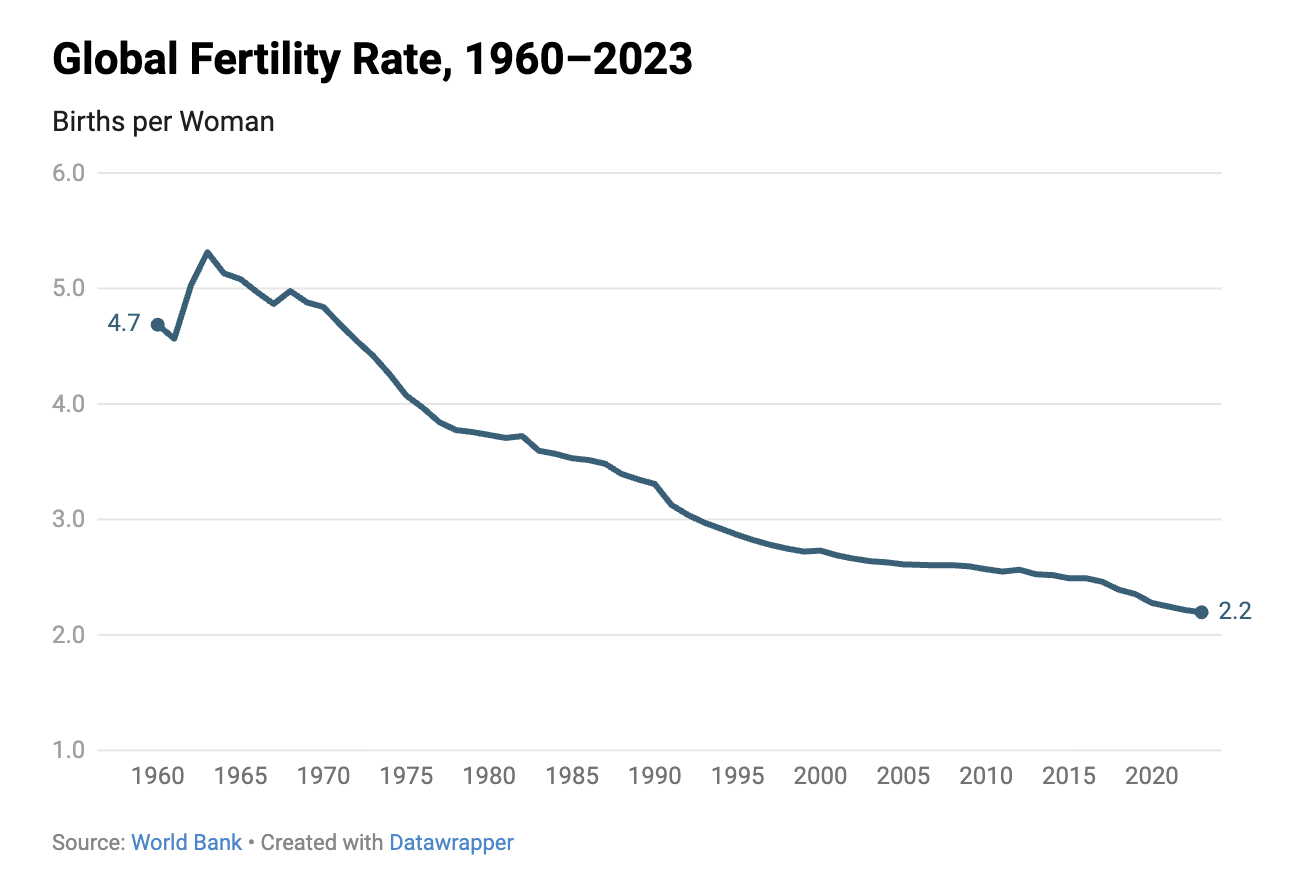
In case you missed it- the world is quietly entering a population crisis. Global fertility rates have plunged to their lowest level in 60 years, raising profound questions about how societies will sustain themselves in the decades ahead.
In Canada, births have fallen to just 1.25 children per woman, the lowest in our history. Behind the numbers are shifting values, economic pressures, and growing uncertainty about the future.
This week, let’s examine the global decline in birth rates and explore what’s driving it—and what it means for the economy, family, and national identity.
An Impending Population Crisis? World Fertility Rate Hits 60-Year Low
For the Silo, By Sylvia Xu / Epoch Times.

Fertility rates have plummeted worldwide over the past six decades, leading experts to warn of dire consequences as the downward trend continues.
Continued low fertility rates will cause “a gradual implosion of the world’s economy as the population ages and dies,” Steven Mosher, president of the Population Research Institute.
Mosher is an expert on population control, demography, and China.”
This will not occur overnight, of course, but once it is well underway, it will be difficult, if not impossible, to reverse course,” he said.
The fertility rate is the average number of children born to a woman in her lifetime; the birth rate is the number of live births per 1,000 people in a population over a given period.
Macroeconomist Jesús Fernández-Villaverde called low fertility rates “the true economic challenge of our time” in a February report for the American Enterprise Institute.
In 1960, the fertility rate was between four and five. By 2023, that number had halved to 2.2, approaching 2.1, the level at which a population replaces itself from one generation to the next.In July, the U.S. Census Bureau projected that the world’s population will reach 8.1 billion this year. Experts say that although the figure has grown from 3 billion in 1960, the number to watch is the pace of population growth.”
The rate of growth peaked decades ago in the 1960s and has been declining since and is projected to continue declining,” the Census Bureau stated.
Fernández-Villaverde warned that although the sagging rate of growth may not have immediate consequences, in less than 50 years, declining fertility will affect the world economy. Countries with low or negative birth rates will contend with a shrinking workforce and the ballooning costs associated with an aging population.
Global Fertility Rates
Only about 4 percent of the world’s population is in countries with high fertility rates—more than five children per woman—and all of those nations are in Africa, according to the Census Bureau. Even in those countries, fertility rates are generally lower than they once were.
The Census Bureau reported that nearly three-quarters of the world’s population is in countries where fertility rates are at or below the replacement level.
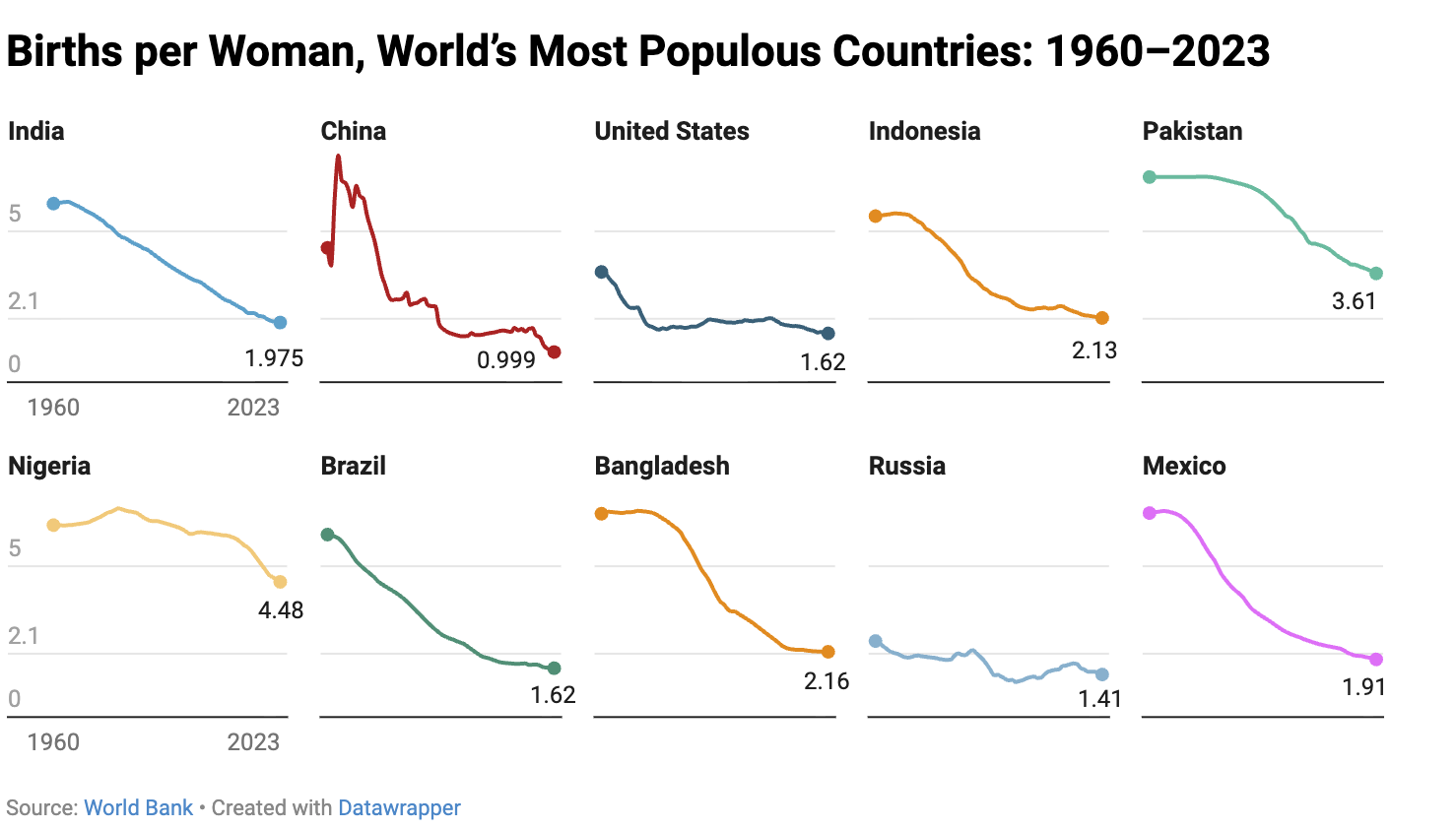
The fertility rate in India, the world’s most populous country, has steadily declined over the past six decades. In June, the U.N. Population Fund reported that India’s fertility rate stood at 1.9 children per woman, down from five or six children in 1960. In Canada, fertility rate fell to 1.25, well below the replacement level of approximately 2.1 children per woman needed to maintain a stable population.
In 1990, China’s fertility rate was 2.51, despite its one-child policy. By 2023, it had dropped to less than one birth per woman, according to the U.N.’s population division.In the United States, fertility has undergone a persistent decline. It fell below the replacement level in 1972, and in 2023, it reached 1.62—a historic low.Asian and European countries have the lowest fertility rates in the world, and South Korea (0.72), Singapore (0.97), Ukraine (0.977), and China (0.999) all have rates below one.  (Read More →)
Key Data & FactsSource: Statistics Canada

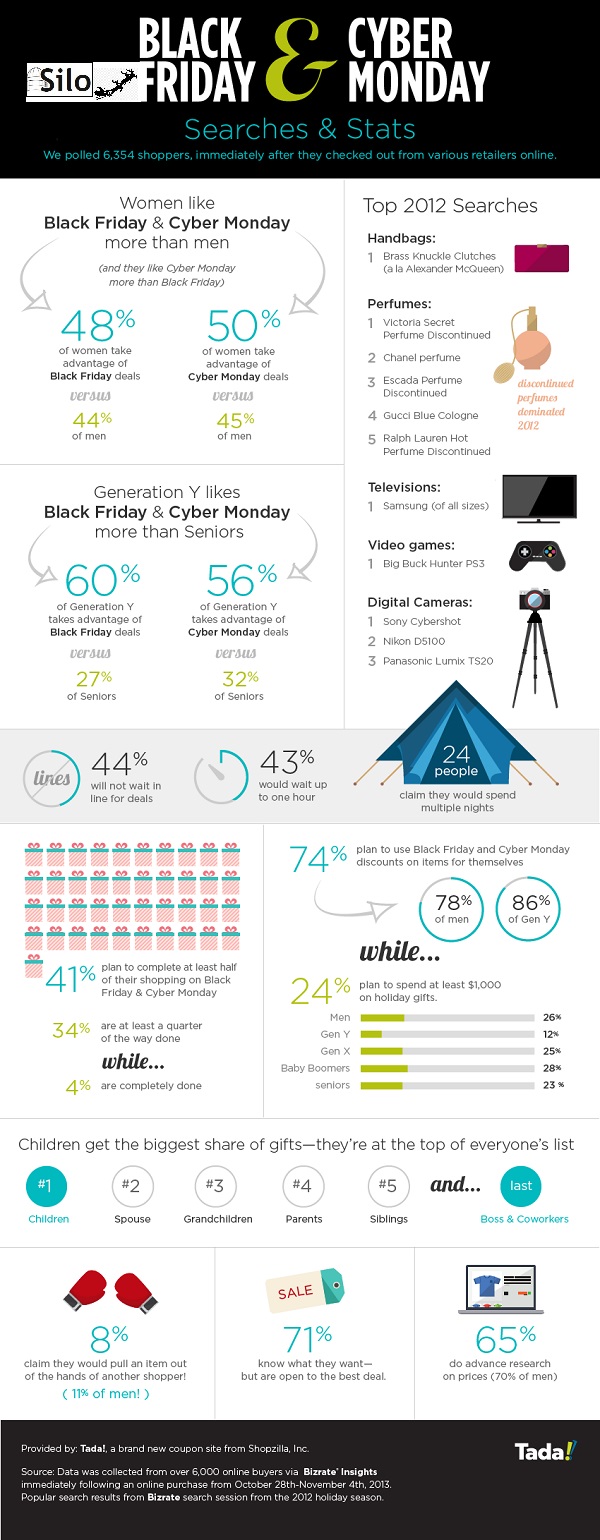
11% Of Male Cyber Monday Shoppers Will Pull Items Out Of Hands Of Others

Black Friday and Cyber Monday are a cultural phenom. One that American and (in the past few years) hard-boiled Canadian consumers look forward to each year. We brave the crowds, set out a savings mission plan and shop like a thrifty gladiator entering the battle arena of value.

WHEN IT COMES TO BLACK FRIDAY/CYBER MONDAY…

While images of people camped out in Walmart parking lots regularly dominates the Black Friday news cycle (as well as trampling and fights), we wanted to find out how people really intend to spend these consumer holidays-and more importantly, how much they intend to spend. We also looked at Holiday Gift searches from the last few years on our sister site-interestingly, there’s apparently a big market for discontinued perfumes.

SOME INTERESTING FACTS FROM THE STUDY

* Men are much more open to violence on Black Friday/ Cyber Monday: One out of 10 guys (11%) would pull something out of the hands of another shopper.

* 86% of Generation Y intends to use Black Friday and Cyber Monday discounts on items for themselves.

* Men are the most generous: 26% of guys plan to spend at least $1,000 usd/ $1,410 cad (exchange at time of article) on holiday gifts.

* Very few people are procrastinating: While 4% claim they’re already finished with their holiday shopping, 41% intends to complete it on Black Friday/Cyber Monday.

* 43% will wait up to an hour on Black Friday; 24 people said they’d willingly camp out for MULTIPLE NIGHTS.

* Bosses and co-workers are at the bottom of everyone’s shopping list: Children, understandably rule (followed by spouses/significant others).

The following info-graphic is based on responses from 6,354 online shoppers who were surveyed last year immediately after checking out. Odds are things haven’t changed much this year.  Here’s more from our friends at Tada (or Pollpay depending on your region), they are awesomely obsessed with reporting on all the things that online shoppers value.  For the Silo, shopzilla.com/Jarrod Barker.

Supplemental-

What were shoppers interested in 13 years ago? Take a look at this data chart from 2012.


Silo Black Friday Cyber Monday

Is Vilnius Lithuania The Next ‘Berlin Art Scene’?

The Lithuanian capital is quickly emerging as a vibrant cultural hub – mixing its Baroque architecture, Michelin-starred cuisine, and a fearless creative scene.

From Venice Biennale–level artists at ArtVilnius’25 to politically-charged performances at Sirenos Theatre Festival, and a massive city-wide celebration of Lithuania’s own artistic genius, M.K. Čiurlionis, Vilnius is redefining the autumn city break for culture seekers.

Vilnius: The New Berlin? Discover the Baltic Cultural Capital

This autumn, Vilnius transforms into a cultural hotspot, with the Baltics’ leading contemporary art fair, bold theatre, and world-class music inviting visitors to discover the city’s vibrant creative scene.

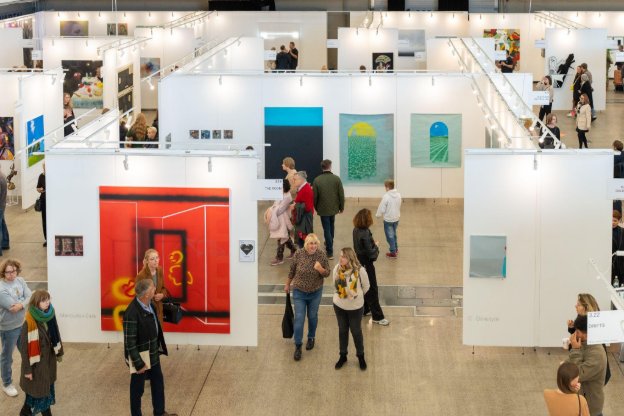
Art Fair ArtVilnius 2024. Photo by Andrej Vasilenko

Vilnius, Lithuania. Vilnius offers all the ingredients for a perfect autumn city break – cobblestone streets, Michelin-starred restaurants, and multiple art events happening this autumn. Intimate yet vibrant, the Lithuanian capital combines old-world elegance with a fresh creative energy that’s turning it into one of Europe’s most intriguing cultural destinations.

ArtVilnius’25 features Venice Biennale artists

Returning for its 16th edition, ArtVilnius’25 remains the largest contemporary art fair in the Baltics. From October 3 to 5, the Lithuanian Exhibition and Congress Centre Litexpo in Vilnius will host 80 galleries and institutions, presenting works by more than 320 artists from 16 countries.

Among the highlights is Tallinn–based Temnikova & Kasela Gallery, recipient of the prestigious FEAGA Award in 2016, which will showcase established Venice Biennale artists and Estonia’s forthcoming Biennale representative. Edith Karlson is one of Estonia’s most acclaimed contemporary voices and in her sculptural practice, animals and people are the main protagonists; Jaan Toomik, a senior figure in Baltic art, is presenting a few paintings never before exhibited, like Old Woman with a Wolf’s Scull, Calling the Fisherman, Self-portrait as a Bonfire with Sons.

“While new fairs have appeared in Latvia and Poland, ArtVilnius is still the only event of this size and quality. Our program goes far beyond gallery presentations. Visitors will discover the internationally curated Projects Zone, the annual “The Path” exhibition, and much more. The art on view will range from new talents fresh out of the academies to world-famous artists such as Marlene Dumas and Anselm Kiefer,” says Sonata Baliuckaitė Arlauskienė, Artistic Director of ArtVilnius.

Vilnius theatre festival turns the stage into a weapon

Until October 13, Vilnius hosts Sirenos, one of Northern Europe’s boldest international theatre festivals. Known for pushing creative and political boundaries, this year’s edition revolves around the theme “Theatre is a Weapon,” exploring how performance can confront modern-day realities. Headliners include Portuguese director Tiago Rodrigues with two acclaimed works: By Heart and Catarina and the Beauty of Killing Fascists. Also on the programme is the powerful film-performance hybrid Orlando, My Political Biography, which reimagines Virginia Woolf’s novel through the voices of 26 trans and non-binary performers.

Čiurlionis – the Baltic Da Vinci – celebrated with 150 events across Vilnius

This autumn, Vilnius celebrates the 150th anniversary of M.K. Čiurlionis, Lithuania’s most revered composer-painter, often called the Baltic Da Vinci for blending music and visual art into an entirely unique language. From October to December, the city will host nearly 150 events in his honour, including immersive exhibitions, orchestral tributes, and even virtual reality experiences that bring his dreamlike worlds to life. Program highlights include the premiere of the opera “Jūratė,” inspired by Baltic mythology, and the international concert “World Piano Stars Greeting Čiurlionis,” showcasing virtuoso performers interpreting his compositions.

European cinema spotlight

From 6 to 16 November, the Scanorama Film Festival brings over 100 thought-provoking European films to Vilnius, alongside talks with filmmakers and rising talent. It’s a key date for cinephiles seeking bold, artistic storytelling off the mainstream circuit.

Getting there

With direct, daily flights from Toronto and major European cities including Berlin, Frankfurt, London, Paris, and Warsaw, getting to the Lithuanian capital is quick and easy. The city’s well-connected airport is just 15 minutes from the Old Town, making it a seamless destination for a weekend getaway or a longer cultural escape.

Connections Between UFOs, UAPs and Presidents Of The United States

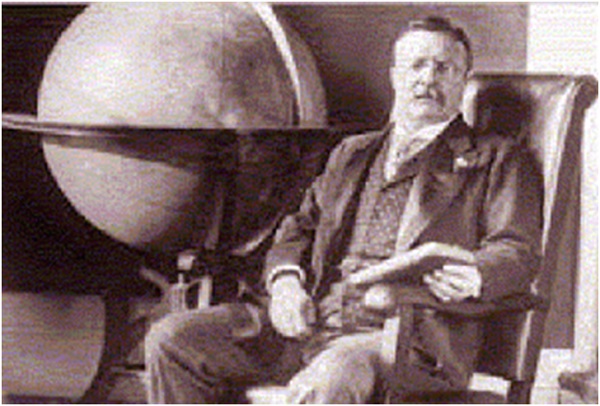
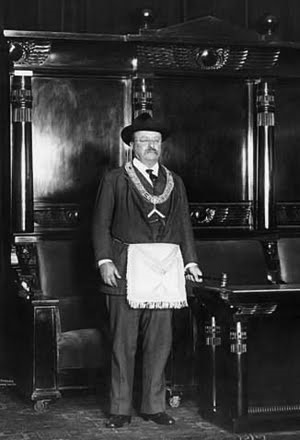
Theodore "T.R." Roosevelt, Jr. was an American politician, author, naturalist, soldier, explorer, mason and historian who served as the 26th President of the United States.
Theodore “T.R.” Roosevelt, Jr. was an American politician, author, naturalist, soldier, explorer, mason and historian who served as the 26th President of the United States.

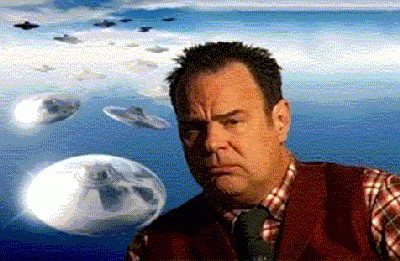
Remember last year, when there was ongoing UAP/Drone activity hitting the news cycle and without any official explanation of what was happening over the skies of New Jersey and the rest of the world? There is still no answer and  it is fascinating to consider that this phenomena is in fact not new and has been reported for over one hundred years.

The drones have become unsettlingly frequent in Monmouth County, New Jersey (Picture: Monmouth County Sheriff’s Office. Dec 2024)

When one thinks of U.S. Presidents and UFOs several of our Chief Executives come to mind. Firstly, there is President Eisenhower purportedly meeting aliens at Edwards Air Force Base in 1954.

Then there is JFK’s memo to the CIA asking for disclosure on UFOs ten days before his assassination:

More humorously but perhaps true is the story of Richard Nixon treating comedian Jackie Gleason to a view of dead alien Grays at Homestead Air Force Base in 1974. 

But what about Teddy Roosevelt?

Is anyone in the UFOlogy Community even aware of a documented UFO sighting over the 26th US president’s home, Sagamore Hill, in Oyster Bay, New York on August 1, 1907 when he was in his second term of office?

Teddy Roosevelt Globe

According to an old clipping found by UFOlogist Kay Massingill from a newspaper called the D.C. Evening Star dated August 2, 1907, two events of a mysterious nature occurred in the town of Oyster Bay in a twenty-four hour period and both concerned Mr. Roosevelt.

In the latter, the town librarian Miss Denton opened up the library on the morning of the 1st and discovered a beautiful mahogany chair donated by Teddy to the museum from his days as Governor of New York had split down the backside sometime the night before. More peculiar was the fact that on the reverse back of the chair was the Bald Eagle Seal of the United States of America and it was split in half! An ominous sign indeed! Was it an omen?

Newspaper Headline Lights Over Sagamore

However, the main event occurred the evening before between the hours of 9 p.m. and 11 p.m. when a brilliant white light was seen to hang motionless over Sagamore Hill.

According to the dispatch, it was a light “considerably larger than a star” and hung about 300 feet in altitude over the house according to numerous witnesses. It was an “intense white light” and after 11 p.m. it began to fade to a spark and then extinguished. Meanwhile in the library a short distance away, a chair associated with Sagamore Hill’s occupant was coming undone in a most mysterious way.

The home on Sagamore Hill

Was Mr. Roosevelt home the night of the UFO sighting? The article doesn’t say and we’ll probably never know but it is known that Sagamore was called Roosevelt’s Summer White House and it was the middle of summer.

So the main question to ask is why would a ball of light attend to Mr. Roosevelt in the heat of 1907? Two clues can be found concerning his agenda as President that year.

One clue was his December 3, 1907 Annual Address to Congress.

The speech is mundane for the most part dealing with anti-trust actions, railroads, the Department of Agriculture, conservation, unions and such but near the end of it Roosevelt begins to lay out the groundwork for creating the world’s most dominant modern navy. It seemed Roosevelt had a great grasp of what was happening in the world concerning Japan, Germany and China and their eventual rise on the world’s stage. He specifically recommended dredging Pearl Harbor to make it a world class naval base and increasing Alaska’s defenses. Did he know something about the world no one else did? His maneuvering just months after the Sagamore Hill incident directly led to America’ emergence as the modern world’s greatest Suprerpower. Did he have help from E.T. whispering in his ear? During his tenure America’s Navy grew from 5th to 3rd in the world in size.

The second clue is the very interesting coincidence of the Second International Peace Convention held at The Hague, Netherlands that year from June 15 to October 18, 1907 which was during the Sagamore Hill sighting. That convention was the brainchild of none other than Teddy Roosevelt! It was an attempt to codify the rules of war – particularly naval warfare. More importantly, it was seen as the world’s first attempt at an international governing body – a forerunner to the League of Nations and the United Nations.

The Tin Foil Hat Question 

Are aliens attempting to lay out the groundwork for, or interfere with, the earth’s direction in the 20th and 21st centuries? And might they have been in contact with American Presidents long before Eisenhower’s 1954 encounter? To see the complete newspaper clipping go to http://www.worldufowatch.com/historical_newspaper_clippings    For the Silo, Robert Spearing.

Hip Hop Jewelry Like A Rose Gold Jesus With Brown Ice

It's 2013 and "moto's and escapade's" might not be synonymous with Rap Kings (and Queens) these days- but Rose Gold bling is making a comeback. CP

Hip-Hop is a culture, it’s a lifestyle, it’s an artistic expression and yes, it’s jewelry.

Since its inception Hip-Hop has always been edgy, outside the box, and ready to make a statement at all times; not just musically, but also in a fashion sense.

Rose gold, also known as red gold or pink gold made a big comeback in the world of Hip-Hop a few years ago but did you know Rose gold was popular at the beginning of the nineteenth century in Russia, formerly giving it the name “Russian gold”?  This term is no longer used. This type of gold is also often used in making musical instruments.

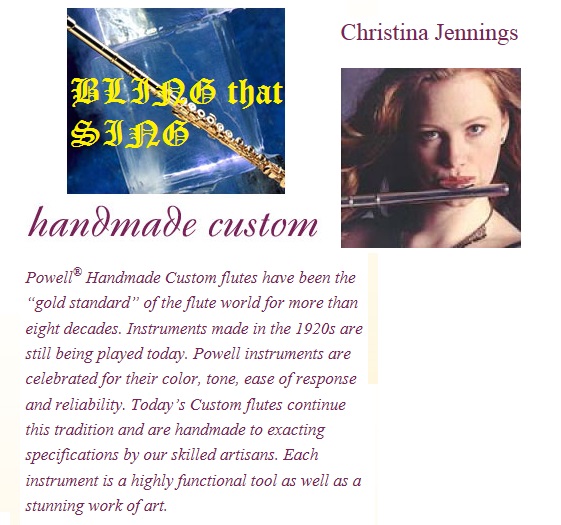
Christian Jennings is one of the top flute players in the world- she chooses to play a customized flute made out of Rose Gold. CP
Christian Jennings is one of the top flute players in the world- she chooses to play a customized flute made out of Rose Gold.

Companies such as King Ice are selling Hip-Hop inspired Rose gold jewelry, stating that it is reappearing due to artists such as Rick Ross and Kanye West being seen wearing items made from this gold and copper alloy.

Drake can even be seen with an extremely expensive Rose gold watch on the cover of his Grammy award winning sophomore album Take Care .

If you need a bit more convincing about the resurgence of rose gold bling in the hip-hop community- check out this cover from Drake's new album Take Care.

Whether you’re a “Hip-Hop head”, an occasional listener, or never venture into that world at all, Rose gold is becoming a statement piece and doesn’t seem to be disappearing anytime in the near future. For the Silo, Brent Flicks.

Desert Modernism 2025 Exhibition at Scottsdale Ferrari Art Week


DECEMBER, 2024Scottsdale, Ariz. Diné Artist, Dealer, Curator and Antiques Roadshow Appraiser Tony Abeyta to Curate Special Exhibition, “Desert Modernism,” at Scottsdale Ferrari Art Week Exhibition to Showcase Rare Works by Fritz Scholder, Charles Loloma, Lloyd Kiva New, Frank Lloyd Wright, Phillip Curtis and Paolo Soleri.


 Scottsdale Ferrari Art Week Fair is pleased to announce that Diné artist, dealer, curator and Antiques Roadshow Appraiser, Tony Abeyta, will curate a special exhibition, “Desert Modernism,” which will show the convergence and progression of Phoenix artists of Native, Anglo and Hispanic descent, from approximately 1930-1980. The exhibition will feature rare and hard-to-find works by artists, architects and designers such as Fritz Scholder, Charles Loloma, Lloyd Kiva New, Frank Lloyd Wright, Phillip Curtis and Paolo Soleri.

Abeyta is also serving as an Advisory Committee member for the Fair. The Scottsdale Ferrari Art Week Fair is a unique event at the historical and cultural crossroads of the American Southwest. Set in one of the country’s fastest-growing cities with an ascendent contemporary Indigenous culture, the fair will showcase over a hundred leading international galleries at Westworld, March 20-23, 2025.”We are absolutely thrilled to have Tony participate in Scottsdale Art Week,” says Trey Brennen, co-owner of the inaugural Fair.


“We are set to become the leading art fair in the West and that requires a strong Indigenous representation among our dealers and curators. Tony approaches art and art history with a deep understanding of the region and the contemporary work being produced at this moment. He has worked at many of the major museums in the area and has a wonderful reputation across the Southwest.”About his curation of a special for sale exhibition at the inaugural Fair, Abeyta says, “This has given me a chance to do a deep dive into one of my favorite subjects, the evolution of Modernism through the disparate art communities that converged in the Phoenix/Scottsdale area in the middle portions of the twentieth century. I’ve long been fascinated by the work Native artists were doing in the area and I want to show how they worked, showed and created alongside great artists such as Frank Lloyd Wright, Phillip Curtis and Paolo Soleri.”


Preston Singletary, “A Canoe Entered a Dream” – courtesy of Blue Rain Gallery

As a curator, Abeyta co-organized the exhibition New Terrains: Contemporary Native Art which was held at Phillips Auctions January 5-23, 2024. The watershed selling exhibition explored the influences of modernism, post-war and pop influences on work by 50 contemporary Indigenous artists including Fritz Scholder, Preston Singletary, TC Cannon, Cara Romero, Diego Romero, Jaune Quick-to-See-Smith, Virgil Ortiz, Jamie Okuma, Kent Monkman, Michael Kabotie, Oscar Howe, Allan Houser, Cannupa Hanska Luger and others.

The recently closed show, Abeyta\ To’Hajiilee K’e’, at the Wheelwright Museum in Santa Fe, featured the paintings of Tony and his father, Narciso Abeyta (Ha-So-De), and the ceramic works of his sisters, Pablita and Elizabeth. Abeyta is represented by Owings Gallery in Santa Fe, New Mexico. For more information, please visit www.scottsdaleartweek.com. For the Silo, Jennifer Parks-Sturgeon.


About Scottsdale Ferrari Art Week             Scottsdale Art Week (SAW) is situated at the historical and cultural crossroads of the American Southwest. It is a reflection of today’s more dynamic and contemporary community, but is rooted in our unique landscape and history. Visionary art figures from Georgia O’Keeffe to Max Ernst and James Turrell were so inspired by the local landscape that they either settled here or created monumental land art. Today the art of the Indigenous Navajo, Apache and Hopi tribes who first occupied this land to Spanish colonialism and centuries of settlement is recognized alongside them. SAW is an exciting combination of historical American Art, contemporary art and design, with a special focus on contemporary art from Indigenous and Latinx, who often blur the lines between what constitutes art and design.

About ASU, SAW Gala Benefit Partner ASU Art Museum centers art and artists in the service of community well-being and social good. The Museum is a learning-centered teaching institution, providing interdisciplinary learning opportunities for students from across the university ranging from the sciences, humanities, journalism, sociology and schools of arts and design. A teaching museum, much like a teaching hospital, is responsible for training the next generation of arts professionals and are the frontrunners in research in art history and museum studies while delivering the highest possible level of artistic standards through collection teaching, exhibition making, research and audience engagement. The museum is different from other non-profit art museums in the region because of its unique ability to leverage the resources of the largest public research university in the country for community good. ASUAM fulfills ASU’s Design Principles by serving as a bridge connecting the breadth and scope of scholarly research and learning to the experience, knowledge and needs of our local communities, thereby co-creating and creating arts and culture opportunities available for all.

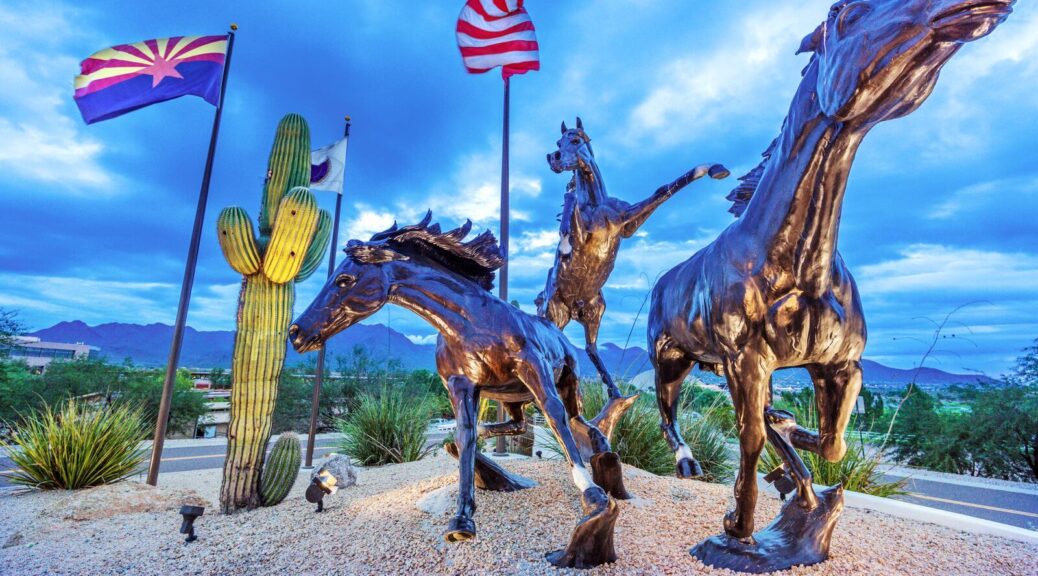
Article featured image- Horseworld, 1989 by Snellen Johnson (gift of Howard E. Kleim).
This bronze sculpture, signaling the entrance to Westworld, shows a group of three horses which represent an Arabian, Thoroughbred, and a Quarter Horse each representing a different behavior: the Quarter Horse is cutting, the Thoroughbred is racing, and the Arabian is showing.
Snell Johnson, a self-taught artist and his sculptures are known world-wide including the MGM Lion in Las Vegas and Caesar in Johannesburg, South Africa.

With over 100 galleries displaying a curated selection of fine art and design, guests will also enjoy cultural performances, fashion shows, pop-up displays and immersive experience throughout each day.

Fashion

Daily fashion shows will be produced by Phoenix Fashion Week. All clothing is provided by select Phoenix Fashion Week designers and boutiques.

“Our ultimate mission is to garner global exposure to Arizona’s fashion industry, and this event is the perfect way to do so,” said Brian Hill, Executive Director of Phoenix Fashion Week. “It’s a great, innovative way to find emerging models while showcasing top brands and fashion in Arizona.”

For more information on Phoenix Fashion Week, visit phoenixfashionweek.com

Luxury Cars

From utility to showpiece, cars are a unique art form. Guests can celebrate clean lines and smooth curves while enjoying our extensive display of luxury and collector automobiles. Enjoy a special Ferrari showcase onsite at the event. Check out their entire inventory here >

Performances

Set in one of the country’s fastest growing cities with an ascendant contemporary Indigenous art culture, the fair will showcase over a hundred leading galleries at the scenic Westworld alongside cultural performances, sculptural installations, and innovative programming including collaborations with institutions, galleries, artists, and prominent collectors.

Special Events

Guests looking to explore the best the city has to offer can attend their choice of multiple off-site events during the week. From guided tours to VIP invite-only receptions. There is something for everyone at the event and throughout this great city.

Mecella: Bridging Technology and Tradition to Revolutionize Poetry

Poetry, an art form rooted in tradition and centuries of human expression, is experiencing a renaissance in the digital age. Thanks to innovative platforms like Mecella, poetry is no longer confined to printed anthologies or academic journals. Mecella is bridging the gap between technology and tradition, creating a dynamic space where poets and readers connect, share, and celebrate the transformative power of words.

Founded by poet and U.S. Army veteran Brandon Mecella Carey Walker, Mecella was born from a desire to make poetry accessible to everyone. Walker’s journey as a writer and his experiences with traditional publishing inspired him to create a platform that embraced inclusivity and innovation. He envisioned a space where poetry could thrive in the modern world, unburdened by the constraints of outdated systems.

At its core, Mecella is a digital anthology with a groundbreaking mission: to publish one million poems. This ambitious goal reflects the platform’s dedication to fostering a diverse and inclusive community. Every poem added to Mecella enriches a living archive of human expression, showcasing the breadth of emotions, cultures, and perspectives from across the globe.

What sets Mecella apart is its seamless integration of technology into the poetry experience. The platform offers features like multimedia enhancements, allowing poets to pair their work with visuals, music, or voice recordings.

Mecella | A Home For Poets

These tools provide new dimensions to traditional poetry, making it more engaging and accessible to contemporary audiences. Readers, in turn, can explore poems interactively, deepening their appreciation for the art form.

Mecella’s commitment to accessibility extends beyond its technological features. The platform’s open submission process ensures that poets of all levels, from novices to professionals, can share their work without fear of rejection or gatekeeping. By removing financial and logistical barriers, Mecella empowers creators to focus on what truly matters: their words.

As poetry becomes more accessible through digital platforms, Mecella is fostering a global community of poets and readers. It’s a space where individuals can connect over shared experiences, discover new voices, and engage in meaningful dialogue. This emphasis on connection reflects Mecella’s belief that poetry has the power to unite people, transcending borders, languages, and cultural differences.

Mecella also serves as a hub for innovation within the poetry world. By embracing experimental forms, hybrid styles, and nontraditional themes, the platform challenges conventional notions of poetry. This openness encourages poets to push boundaries and explore new ways of storytelling, ensuring that the art form remains vibrant and relevant.

Education and outreach are integral to Mecella’s mission. Through workshops, partnerships with schools, and community initiatives, the platform introduces poetry to new audiences, inspiring a love for language and creativity. By reaching younger generations, Mecella ensures that poetry continues to thrive as a vital part of human expression.

Looking ahead, Mecella’s journey is one of continuous growth and transformation. Its goal to publish one million poems is not just a milestone but a movement—an ongoing effort to make poetry a central part of everyday life. As the platform evolves, it remains steadfast in its commitment to accessibility, diversity, and innovation.

In a world where technology often accelerates communication at the expense of depth, Mecella reminds us of the enduring power of poetry to slow us down, make us reflect, and connect us with our shared humanity. By blending the timeless art of poetry with the possibilities of modern technology, Mecella is not only preserving tradition but also redefining it for future generations.

Mecella is proof that poetry is far from a dying art—it is alive, evolving, and more accessible than ever. Whether you’re a poet, a reader, or someone discovering the magic of poetry for the first time, Mecella invites you to join its mission. Together, we can celebrate the beauty of words and create a world where every voice is heard, one poem at a time. For the Silo, Kat Fleischman.

5 Ways To Listen Better


In our louder and louder world, says sound expert Julian Treasure, “We are losing our listening.” In this short, fascinating talk, Treasure shares five ways to re-tune your ears for conscious listening — to other people and the world around you.

Julian Treasure studies sound and helps people and businesses to listen, speak and use sound well.
This talk was presented at an official TED conference. For the Silo, David J. Hensley.

Transcript


00:03
We are losing our listening. We spend roughly 60 percent of our communication time listening, but we’re not very good at it. We retain just 25 percent of what we hear. Now — not you, not this talk, but that is generally true.
00:18
(Laughter)
00:19
Let’s define listening as making meaning from sound. It’s a mental process, and it’s a process of extraction.
00:27
We use some pretty cool techniques to do this. One of them is pattern recognition. (Crowd noises) So in a cocktail party like this, if I say, “David, Sara, pay attention” — some of you just sat up. We recognize patterns to distinguish noise from signal, and especially our name. Differencing is another technique we use. If I left this pink noise on for more than a couple of minutes, (Pink noise) you would literally cease to hear it. We listen to differences; we discount sounds that remain the same.
00:56
And then there is a whole range of filters. These filters take us from all sound down to what we pay attention to. Most people are entirely unconscious of these filters. But they actually create our reality in a way, because they tell us what we’re paying attention to right now. I’ll give you one example of that. Intention is very important in sound, in listening. When I married my wife, I promised her I would listen to her every day as if for the first time. Now that’s something I fall short of on a daily basis.
01:28
(Laughter)
01:29
But it’s a great intention to have in a relationship.
01:32
(Laughter)
01:34
But that’s not all. Sound places us in space and in time. If you close your eyes right now in this room, you’re aware of the size of the room from the reverberation and the bouncing of the sound off the surfaces; you’re aware of how many people are around you, because of the micro-noises you’re receiving. And sound places us in time as well, because sound always has time embedded in it. In fact, I would suggest that our listening is the main way that we experience the flow of time from past to future. So, “Sonority is time and meaning” — a great quote.
02:08
I said at the beginning, we’re losing our listening. Why did I say that? Well, there are a lot of reasons for this. First of all, we invented ways of recording — first writing, then audio recording and now video recording as well. The premium on accurate and careful listening has simply disappeared. Secondly, the world is now so noisy, (Noise) with this cacophony going on visually and auditorily, it’s just hard to listen; it’s tiring to listen. Many people take refuge in headphones, but they turn big, public spaces like this, shared soundscapes, into millions of tiny, little personal sound bubbles. In this scenario, nobody’s listening to anybody.
02:51
We’re becoming impatient. We don’t want oratory anymore; we want sound bites. And the art of conversation is being replaced — dangerously, I think — by personal broadcasting. I don’t know how much listening there is in this conversation, which is sadly very common, especially in the UK. We’re becoming desensitized. Our media have to scream at us with these kinds of headlines in order to get our attention. And that means it’s harder for us to pay attention to the quiet, the subtle, the understated.
03:23
This is a serious problem that we’re losing our listening. This is not trivial, because listening is our access to understanding. Conscious listening always creates understanding, and only without conscious listening can these things happen. A world where we don’t listen to each other at all is a very scary place indeed. So I’d like to share with you five simple exercises, tools you can take away with you, to improve your own conscious listening. Would you like that?
03:55
Audience: Yes!
03:56
Good. The first one is silence. Just three minutes a day of silence is a wonderful exercise to reset your ears and to recalibrate, so that you can hear the quiet again. If you can’t get absolute silence, go for quiet, that’s absolutely fine.
04:13
Second, I call this “the mixer.” (Noise) So even if you’re in a noisy environment like this — and we all spend a lot of time in places like this — listen in the coffee bar to how many channels of sound can I hear? How many individual channels in that mix am I listening to? You can do it in a beautiful place as well, like in a lake. How many birds am I hearing? Where are they? Where are those ripples? It’s a great exercise for improving the quality of your listening.
04:40
Third, this exercise I call “savoring,” and this is a beautiful exercise. It’s about enjoying mundane sounds. This, for example, is my tumble dryer.
04:49
(Dryer)
04:50
It’s a waltz — one, two, three; one, two, three; one, two, three. I love it! Or just try this one on for size.
04:58
(Coffee grinder)
05:07
Wow! So, mundane sounds can be really interesting — if you pay attention. I call that the “hidden choir” — it’s around us all the time.
05:16
The next exercise is probably the most important of all of these, if you just take one thing away. This is listening positions — the idea that you can move your listening position to what’s appropriate to what you’re listening to. This is playing with those filters. Remember I gave you those filters? It’s starting to play with them as levers, to get conscious about them and to move to different places. These are just some of the listening positions, or scales of listening positions, that you can use. There are many. Have fun with that. It’s very exciting.
05:46
And finally, an acronym. You can use this in listening, in communication. If you’re in any one of those roles — and I think that probably is everybody who’s listening to this talk — the acronym is RASA, which is the Sanskrit word for “juice” or “essence.” And RASA stands for “Receive,” which means pay attention to the person; “Appreciate,” making little noises like “hmm,” “oh,” “OK”; “Summarize” — the word “so” is very important in communication; and “Ask,” ask questions afterwards.
06:18
Now sound is my passion, it’s my life. I wrote a whole book about it. So I live to listen. That’s too much to ask for most people. But I believe that every human being needs to listen consciously in order to live fully — connected in space and in time to the physical world around us, connected in understanding to each other, not to mention spiritually connected, because every spiritual path I know of has listening and contemplation at its heart.
06:46
That’s why we need to teach listening in our schools as a skill. Why is it not taught? It’s crazy. And if we can teach listening in our schools, we can take our listening off that slippery slope to that dangerous, scary world that I talked about, and move it to a place where everybody is consciously listening all the time, or at least capable of doing it.
07:07
Now, I don’t know how to do that, but this is TED, and I think the TED community is capable of anything. So I invite you to connect with me, connect with each other, take this mission out. And let’s get listening taught in schools, and transform the world in one generation to a conscious, listening world — a world of connection, a world of understanding and a world of peace.
07:29
Thank you for listening to me today.

Clement Greenberg’s The Avant-garde And Kitsch

Art is, or it should be, about more than simply making marks on a surface or manipulating materials into pleasing–or indeed displeasing–shapes…. perhaps the avant-garde or kitsch. A true artist benefits immeasurably by knowing about the history that has created the universe they traverse.

Ever wonder what all that academic talk is that curators like to use so much? Do you find it pretentious or worse?

Art Theory informs in so many ways, tracing the paths that have led to a particular moment or movement. A foundational understanding of the schools of thought, the histories, the thinkers who have wrought the ground you stand on as an artist today enriches not only your own mind but your work as well.

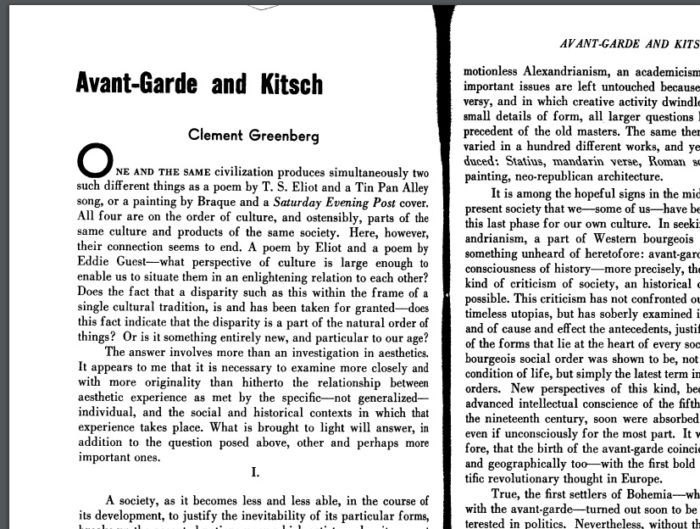
One such thinker who made a significant impact on the art world in the 1940s was Clement Greenberg. In 1939, Greenberg published one of his seminal works Avant-Garde and Kitsch. The essay not only launched Greenberg to nearly overnight notoriety, it also sparked a major development in the art world as a whole.

The essay begins with the following statement:

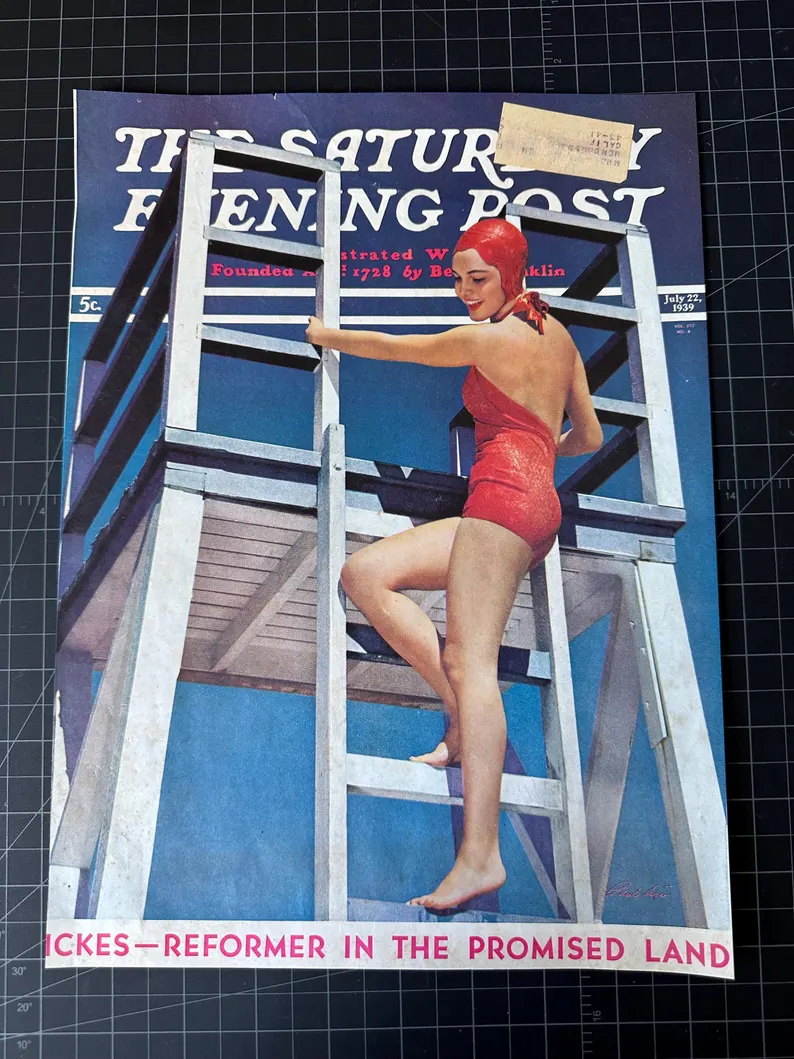
“One and the same civilization produces simultaneously two such different things as a poem by T.S. Eliot, and a Tin Pan Alley song, or a painting by Braque and a Saturday Evening Post cover. “

Click on the following scan to open the full essay in PDF form-

PDF Greenburg Essay Avante-Garde and Kitsch
Click me to read full essay.

Greenberg goes on to classify Avant-Garde as those things that are untouched by the decline of taste and meaning in a society (a poem by T.S. Eliot or a painting by Braque) while Kitsch is the title bestowed on the rest of the clutter that appeals to the masses and asks nothing in return other than their money (a Tin Pan Alley song or a Saturday Evening Post cover).

The Portuguese-Georges Braque-1911.

For Greenberg, Avant-Garde situated itself outside the influences of both capitalist and communist influences that were gradually dampening society’s ability to appreciate any depth of meaning.

Greenberg wrote several other important essays over the course of his life and career. He was a strong proponent of Modernism being the last best hope for the preservation of integrity in art. Jackson Pollock and Willem de Kooning were among those he deemed the saviors of art in their time.

Understanding who Clement Greenberg was and why his influence matters is just one piece of the complex puzzle of being a well-rounded artist. There are libraries worth of books out there that will break down every bit of art theory and history you ever need to know.

Of course, who has time to read all that? How can you know where to begin? Who and what are some of the most important influences that have shaped the art world as it stands today and how are you meant to sort them out from the crowd? For the Silo, Brainard Carey

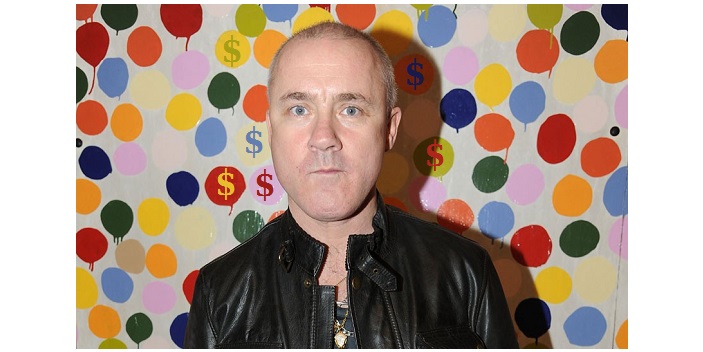
Commodifying Art -Damien Hirst

All of modern life is a spectacle. Much of what contemporary man experiences in Western society is a false social construct mediated by images.

These mediated images create desires that can never be fulfilled; they create false needs that can never be met. “Many of our daily decisions are governed by motivations over which we have no control and of which we are quite unaware” (Berger 41). The constant spector of the mediated image creates an endless cycle of desire, consumption, and disinterest, fueling a banality in life that feeds the commodification of life.

Increasingly life itself becomes a commodity and the image more important than the reality it represents. This commodification infiltrates every aspect of human production, including the arts, and finds its pinnacle expression in the work of Damien Hirst. Hirst has carefully crafted a brand identity that has far surpassed the value of his art work in importance and worth. Working in tandem with former advertising executive turned art dealer Charles Saatchi, the spectacle of the Hirst image becomes the commodity. “Reality unfolds in a new generality as a pseudo-world apart, solely as an object of contemplation. The tendency towards the specialization of images-of-the-world finds its highest expression in the world of the autonomous image, where deceit deceives itself” (Debord
143).

No longer is the work of art itself a commodity, but rather the image of the artist (his/her/cis brand) that becomes the commodity.

It is this spectacle that drives the consumer to identify with a particular artist or brand. “The astronomical growth in the wealth and cultural influence of multi-national corporations over the last fifteen years can arguably be
traced back to a single, seemingly innocuous idea developed by management theorists in the mid-1980s: that successful corporations must primarily produce brands, as opposed to products” (Klein 4). The image has increasingly infiltrated and dominated the culture and the whole of society and has become “an immense accumulation of spectacles” (Debord 142).

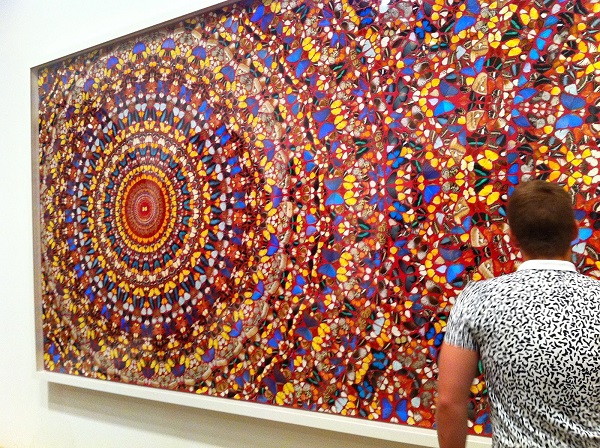
Butterfly by Damien Hirst

Where once the products of labor were the commodity, now it is the spectacle that has become the commodity.

A prime example of this spectacle is Damien Hirst’s sculpture, “For the Love of God.” The sculpture consists of a platinum skull covered with 8,601 diamonds. The sculpture valued at over $100 million usd/ $129.361,000 cad [exchange rate at time of publication] is clearly out of the reach of almost any collector. The sculpture itself is not the art product, rather it is the spectacle that is the product. “Mr. Hirst is a shining symbol of our times, a man who perhaps more than any artist since Andy Warhol has used marketing to turn his fertile imagination into an extraordinary business” (Riding, nytimes.com). Acknowledging that the sculpture is out of reach for the majority of collectors, Hirst offered screen prints costing $2000 usd/ $2,587 cad to $20,000 usd/ $25,870 cad ; the most expensive prints were sold with a sprinkling of diamond dust.

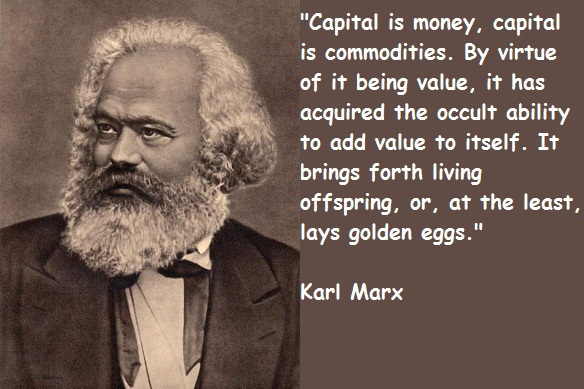
Karl Marx Capital Is Money Meme

Karl Marx argued that the value of the commodity arose from its relationship with other commodities; its ability to be exchanged for other commodities. Marx used the the production of a table to illustrate his thesis:
“…by his activity, man changes the materials of nature in such a way as to make them useful to him. The form of wood, for instance, is altered if a table is made out of it. Nevertheless the table continues to be wood, an ordinary, sensuous thing. But as soon as it emerges as a commodity, it changes into a thing which transcends sensuousness.” (Marx 122)

Hirst’s diamond encrusted skull remains mere diamonds, valuable yes, but still diamonds. However, when coupled with the spectacle of Damien Hirst’s identity, the skull becomes a fetishized commodity capable of selling screen-prints valued in the thousands. The argument can be made that diamonds on their own carry value, and could be commodities themselves, however that doesn’t account for the fact the Hirst was able to sell prints of the skull for over $2000 usd/ $2,587 cad. Nor do the diamonds alone account for the spectacle surrounding the art work; it is Hirst’s brand, his image that creates the spectacle.

“The mystical character of the commodity does not therefore arise from its use-value. Just as little does it proceed from the nature of the determinants of value” (Marx 123). The value of a commodity arises from its spectacle, its ability to be desired. In Marx’s day that desire was its ability to be traded for other commodities; today that value is derived from its association to a brand, an identity, a spectacle. “Art reflects the illusory way in which society sees itself, it reflects the bourgeoisie’s aesthetic ideas as if they were universal” (Osborne 79).

The spectacle feeds itself through the mediating of the image to create desire for status and recognition, through associations.

“The ends are nothing and development is all – though the only thing into which the spectacle plans to develop is itself” (Debord 144). The spectacle’s main objective is self perpetuation. Its aim is totality. It must be noted that Hirst himself did not even create the work of art, but rather employed a studio full of jewelers to execute the sculpture, and printers to produce the prints.

Hirst exemplifies the bourgeoisie capitalist employer who retains ownership over the fruit of the employees’ labor. He is in many ways more akin to a captain of industry than he is to the romantic notion of an artist. “In the early twenties, the legendary adman Bruce Barton turned General Motors into a metaphor for the American family, something personal, warm and human” (Klein 7). Hirst has also turned himself into a metaphor, however, metaphors aren’t always true. This falsehod is at the heart of the issue. The spectacle isn’t concerned with what is true, rather it is concerned with what can be made to appear true. It is this appearance of truth that makes a commodity valuable. This fetishism of the commodity is why gold and silver have value, it is because people gave them value. It is the reason Damien Hirst, or any other brand, has value, because people gave it value.

Damien Hirst Greatest Currency on Earth Gold Diamonds and Art CNN

Damien Hirst cannot be blamed for commodifying art, he is simply following a long tradition of turning objects and products into commodities. The fact that his commodity is his own image doesn’t seem to matter. “Hirst is just playing the game. It is a game played by collectors and dealers at art fairs throughout the year; it is a game finessed as never before by Sotheby’s and Christie’s; it is a game in which, in the words of Nick Cohen, a rare British journalist to trash Mr. Hirst’s publicity coup, ‘the price tag is the art’ ” (Riding .nytimes.com).

That final statement beautifully summarizes the commodification of art, ‘the price tag is the art.’ The fact that the art is obscenely priced, and out of the reach for the majority of collectors, the fact that it is made of diamonds, a precious stone known as the blood stone because of its association with brutal and oppressive regimes, merely adds to its allure, to its spectacle. Damien Hirst is merely playing the game, like many before him. He is a part of the growing culture
industry that sells image. Images are the new commodity fetish. Images are the new mysterious commodities exchanged for more the more durable and enduring commodities. The bourgiousie sell their images, which have no real value, to the public which consumes them, in exchange for goods of real value.

“The $200 billion usd/ $270 billion cad culture industry – now North America’s biggest export – needs an every-changing, uninterrupted supply of street styles, edgy music videos and rainbows of colors. And the radical critics of the media clamoring to be ‘represented’ in the early nineties virtually handed over their colorful identities to the brand masters to be shrink-wrapped.” (Klein 115)

Nick Cohen said of Hirst, “[he] isn’t criticizing the excess, not even ironically … but rolling in it and loving it. The sooner he goes out of fashion, the better.” What Cohen fails to realize is that the spectacle is a fashion. And when one image goes out of fashion, another takes its place. Hirst may indeed go out of fashion, but another art brand will take his place, perpetuating the commodification of the arts in increasingly bombastic ways.

Equestrian Statue Of Marcus Aurelius

Perhaps art has always been a commodity?

In the past patrons would hire artists to paint them into scenes from the gospels. Patrons could be seen on the outskirts of paintings piously praying, thus creating an image of themselves as good and pious Christians. By association with the sacred art, the patron was creating a mediated image. Rulers did this all the time. The Equestrian Statue of Marcus Aurelius is a perfect example. Its a mediating image that communicates power and authority.

But none of these examples reach the level of spectacle and fetishism that is Damien Hirst. While art may have been a commodity in the past, it was never commodified. In other words, while the art itself may have been exchanged for other goods, the artist himself was not treated as a commodity. The art of the past may have served a purpose, it may have contained a mediated message, but it was still a product, and it was the product that was valued, not its brand identity.

The commodification of art creates a unique problem in history. If it is the spectacle that matters, and the artist’s identity that has value, then what value is left in the art itself?

What then separates art from ordinary objects? Is there any aesthetic emotion that remains in the work of art itself, or does the aesthetic emotion dwell completely within the spectacle? These are questions that cannot easily be answered, and ultimately will require the lens of history to answer completely. But they are a pressing concern, for when art is commodified, it may cease to be art and instead become celebrity, product, or worse, advertising. For the Silo, Vasilios Avramidis

Works Cited
Berger, Arthur Asa. Seeing is Believing: An Introduction to Visual
Communication. New York, NY: McGraw Hill, 2008. Print.
Debor, Guy. “Showing Seeing: A Critique of Visual Culture.” The Visual Culture
Reader. Ed.Nicholas Mirzoeff. New York, NY: Routelage, 1998. 142-144. Print.
Klein, Naomi. No Logo, No Space, No Choice, No Jobs. New York, NY: Picador, 2000.
Print.
Marx, Karl. “Showing Seeing: A Critique of Visual Culture.” The Visual Culture
Reader. Ed.Nicholas Mirzoeff. New York, NY: Routelage, 1998. 122-123. Print.
Riding, Alan. Alas, Poor Art Market: ‘A Multimillion Dollar Headcase.’ The New York
Times. June 2007, Damien Hirst and the Commodification of Art http://www.visual-studies.com/interviews/moxey.htm

What Is Argentina Week In Miami?

For starters, The Argentina Country Brand highlights distinctive values and attributes to promote exports, attract foreign direct investment, and boost inbound tourism.

Let’s begin with cooking.

Cooking is more than a daily practice: it is a gateway to understanding a country’s history, culture, and diversity. This is what Argentina is presenting right now at Argentina Week in Miami ending this Friday June 28 in Miami-Dade and Broward counties in Florida. The event will offer the opportunity to experience Argentine culinary culture and its most representative products, creating a unique experience that connects Miami’s culinary enthusiasts with potential consumers.

Considered one of the best cuisines in the world, with Italian and Spanish influences due to immigration, Argentina will showcase its most iconic dishes ahead of the Copa América through more than 80 establishments participating with exclusive promotions and prices. By visiting the Argentina Weekportal, www.argentinaweek.ar , participants can find each day’s value proposition from each establishment, making Argentina Week a unique experience.

The event launch began in the afternoon on Monday, June 24, at La Cabrera Grill in Sunny Isles. The following day, in keeping with the Euro 2024 Soccer excitement the Chile vs. Argentina match was broadcast live at La Birra Bar, and today, Wednesday, June 26, will feature a pizza night at the traditional Banchero pizzeria in Miami Beach.

On Thursday, June 27, Casa Vigil will host the week’s events, and on Friday, June 28, the new La Cabrera location in Coconut Grove will be the meeting point.

With unparalleled cultural heritage, great biodiversity, and a perfect blend of flavors and history, Argentine cuisine offers many recipes, traditional dishes, typical flavors, and high-quality local products.

In this regard, Argentina seeks to diversify its export offerings by strengthening the positioning of sustainable and competitive value-added products. Exclusive promotions and prices for participants to immerse themselves in Argentine cuisine will be available as Argentina seeks to diversify its export offerings and consolidate national products and ingredients. For the Silo, Kat Fleischman.

Home – Semana Argentin

“Rhythm and Resilience: The Artistry of Sam Middleton” Exhibition

If you are able to travel to Georgia this Spring, the Hammonds House Museum located at 503 Peeples St SW Atlanta, GA continues its 2024 exhibition season with “RHYTHM AND RESILIENCE: THE ARTISTRY OF SAM MIDDLETON”. Curated by Halima Taha.

About the Exhibition

You’re invited to embark on a mesmerizing journey through the life and works of Sam Middleton, a pioneering mixed-media artist whose vibrant creations echoed the rhythms of Harlem jazz and the landscapes of Europe’s Low Countries. Born in New York in 1927, Middleton’s artistic odyssey transcended borders and he left an indelible mark on both sides of the Atlantic. Rhythm of ResilienceThe Artistry of Sam Middleton opens at Hammonds House Museum on May 17 and runs through August 18, 2024.

In Rhythm of Resilience, Middleton’s artistic evolution unfolds, tracing his self-taught beginnings amidst the vibrant culture and pulsating beats of jazz and classical music in Harlem. His encounters with creativity at the Savoy Ballroom ignited a lifelong passion for self-expression.

Venturing beyond his hometown, Middleton’s voyages with the US Merchant Marines provided him with inspiration, infusing his art with a global perspective. From the sun-soaked shores of Mexico to the tranquil landscapes of Sweden, each destination left an imprint on his ever-evolving aesthetic. Moving to the Netherlands in 1961, Middleton, joined a wave of African American artists drawn to its creative environment. Settling in Schagen, amidst the serene North Holland polder landscape, Middleton’s work blossomed, blending the vibrancy of jazz with the tranquility of his surroundings.

A master of collage, Middleton’s compositions pulsate with energy, weaving together musical scores, photographs, and graphic elements in a dance of color and form.

His art is a testament to the enduring influence of jazz, intertwining with the visual influence of his adopted homeland.

Through teaching positions at esteemed institutions Atelier 63 in Harlem and the Royal Academy of Visual Arts in ‘s-Hertogenbosch, Netherlands, Middleton’s legacy extended beyond his own creations, nurturing a new generation of artistic talent.

Featured Image: Newport by Sam Middleton, 1992.

Worth The Cost- Ultra Premium Champagne To Ring In The New Year

 Luxury Maurice Vendome Champagne Label1Miami, FL,  – Ultra-luxury wine and spirits purveyor Prodiguer Brands, which privately develops and markets many of the world’s finest, award-winning wines and spirits, offers a very special Champagne.  Maurice Vendôme is now exclusively available in the United States (and in select LCBO’s and liquor stores in Ontario and Canada).

This offering furthers the company’s extraordinary and revered portfolio of premium ultra-grade adult beverage brands specifically tailored for the global luxury market to meet evolving consumer desires and tastes. What better way to celebrate New Year’s Eve?

“This rare Grand Cru Réserve Blanc de Blancs champagne represents over 100 years of combined experience, expertise and leadership by our team and the Maurice Vendôme wine grower,” notes Prodiguer Brands’ Managing Partner, Noel Shu—a self-made millionaire, Sommelier and entrepreneur. ” Housed within the beautiful village of Oger in the Côte des Blancs region, Champagne Maurice Vendôme has ancestral ties dating back to the French Revolution. It’s an exquisite champagne that benefits from Oger’s rich soils that provide the perfect setting for luxury winemaking.”
Using 100% rated rare Grand Cru grapes and a limited annual production, Maurice Vendôme offers an exquisite experience of luxurious quality and exclusivity. The caliber and excellence of this rare Grand Cru Réserve Blanc de Blancs champagne is uncompromised, further entrenching Maurice Vendôme as “A Timeless Luxury.”

Champagne Chapuy in Oger

The art of Champagne is created usually with the combination of three different types of grapes – Chardonnay, Pinot Meunier and Pinot Noir. Champagne Maurice Vendôme uses exclusively 100% Chardonnay to create a unique Blanc de Blancs luxury cuvée. Each Chardonnay grape is delicately handpicked  from only the finest vineyards in Champagne country and then pressed to release their first juice, premiér taille.
Tasting Notes:

  • Colour: Straw yellow appearance
  • Nose: Intense white fruits, sweet on the nose, slightly floral
  • Palate: Creamy smooth refreshing palate, full delicate flavor
  • Finish: Charming fresh finish
  • Premiér taille of 100% Grand Cru Chardonnay
  • Hand-picked, sorted and pressed within 24 hours Liqueur de dosage: Chardonnay wine with melted cane sugar at 12 g/liter, this champagne then rests for a further four months after disgorgement, resulting in a luxury aroma, taste, body, and finish
  • Formats: 75cl and Magnum 1.5l – larger sizes by special order

A Prestigious Pedigree: Makers of the World’s Most Expensive Champagne Prodiguer Brands gained much notoriety for developing and facilitating the record-breaking sale of the most expensive single bottle of Champagne in the world—a limited edition bottle of Goût de Diamants, Taste of Diamonds, which sold for a staggering $1.8 million usd / $2.4 million cad.
Made from 100% Grand Cru grapes, all Goût de Diamants Champagne—available as a brut, a rosé, a Blanc de Blancs and a vintage—is produced at the 8-hectare, family-owned, Champagne Chapuy in Oger. Each standard bottle of Goût de Diamants is a chic collector’s item that’s adorned with a brilliant cut Swarovski crystal in the center of a diamond-shaped pewter design resembling the Superman logo.

Goût de Diamants bottle

The Swarovski crystals are pink on the rosé bottles and clear on the Blanc de Blancs and the brut, which is aged for a minimum of 40 months before release including four months post disgorgement.  In addition, borrowing design cues from Armand de Brignac, the back of each bottle also boasts a hand-engraved pewter label featuring details of the blend inside. For its part, the bespoke multi-million dollar bottle saw the diamond logo crafted from 18-carat solid white gold while the Swarovski crystal was upgraded to a 19-carat flawless white diamond. The 18-carat white gold front label meanwhile, was engraved with the client’s name.

A Voraciously Vetted Vodka  Also in the Prodiguer Brands’ preeminent portfolio is JULIET Immaculate Vodka, which is the world’s first “Immaculate”-graded vodka—ranking it above other premium, super-premium and even ultra-premium brands. Notably, this “Immaculate” rank was actually incepted by Prodiguer Brands, itself, as was required to aptly classify this caliber of vodka, and is a grade now recognized and accepted by industry professionals worldwide.

Upon its official launch in Monte Carlo, Monaco in 2014 during the prestigious, Formula One Grand Prix weekend at the exclusive Ermanno Palace Penthouse, this luxury vodka subsequently appeared at a multitude of A-list events in key regions around the world, including New York City, Barcelona, Paris, Sweden and London. At that time, the brand released a range of Collector’s Edition bottles featuring artwork from renowned New York City based artist, Sue Tsai, based around the F1 and the Brazil World Cup 2014.

Prodiguer Brands expressly separated JULIET from competitors by creating a vodka using a boutique production process to ensure the highest quality vodka that boasts seven distinct unique selling propositions. For one, the vodka weighs in at 43% alcohol volume (is 86 proof), and is only distilled a single time. As the vodka is handcrafted in small batches and great care is taken to prevent impurities from entering at any point in the process, the result is an impeccably pure vodka that does not need to be distilled multiple times. In addition, the vodka is gluten free as, by using high quality sugar beet that the brand ferments in-house, gluten is avoided entirely. The sweetness of the sugar beet also levels out the strong 43% alcohol volume, leaving pleasant smooth vanilla notes. Moreover, the vodka does not require any additional filtration as it is purified in copper pot stills during the distillation process and, packaging-wise, it uses wood top natural corks and tin foil capsules to exemplify the brand’s approach to using natural, non-toxic and renewable materials. JULIET Immaculate Vodka is 100% British, created at its own dedicated distillery based in the South of England, United Kingdom.

French Champagne Grapes
Expertise Aplenty:
About Noel Shu, Prodiguer Brands’ Managing Partner Internationally-regarded sommelier Noel Shu, Managing Partner for the ultra-luxe, award-winning wine and spirts purveyor Prodiguer Brands, is a self-made millionaire since his early 20s, entrepreneur and author of the upcoming title, “China Through a Glass of Wine.”  With impeccable panache and style, Shu, has already accomplished more than many do in an entire lifetime. Shu has personally designed and sold extraordinary multi-million dollar timepieces and necklaces to China’s elite through his ancillary, highly successful luxury jewelry business.  Always striving for growth and self-improvement and with a reverence for continuing education, despite his busy schedule Shu is currently pursuing an Ivy League Master’s degree at Columbia University. As a globally-minded business practitioner, Shu understands commerce on both sides of the Pacific and brings that expertise to bear with his various ventures, including the highly anticipated upcoming release of “Regale”—an exclusive wine brand expressly developed for the Chinese marketplace, which will be exported to the region in early 2016.  Shu may be reached at www.prodiguerbrands.com.



About Prodiguer Brands Prodiguer Brands privately creates and owns some of the world’s finest wines and spirits.  With a growing portfolio, Prodiguer Brands prides themselves in creating luxury brands for the global luxury market that meet new consumer desires and tastes.  In 2016 the company will be releasing one of the world’s finest red wine offerings in the U.S. market: the highly anticipated SIA Cabernet Sauvignon. Led by Shammi Shinh, the company is predicated on strong dedication, wise investment, and offering the best consumption experiences.

Shinh has been commissioned by the likes of Hugo Boss and Christian Louboutin to ideate and help create engagement opportunities in the luxury marketplace.

Learn more about Prodiguer Brands online at www.prodiguerbrands.com.

Africa Becoming New Global Fashion Leader?

Today Audrey Azoulay, UNESCO’s Director-General, unveiled a report arguing that the continent has all it takes to become one of the next global fashion leaders, if public decision-makers offer greater support to all those who work in the sector and play a role in the fashion ecosystem.

Fashion is really taking off in Africa, and this report shows that it can be developed even further. In order to achieve this, designers, professionals and the entire production and distribution infrastructure need more support from public decision-makers. The potential is enormous, not only for the economy, but also for young people’s inclusion, women’s empowerment and for African culture to resonate globally.

Audrey Azoulay, Director-General of UNESCO, at the launch of the report at Lagos Fashion Week.

Entitled “The Fashion Sector in Africa: Trends, Challenges and Opportunities for Growth”, the UNESCO analysis shows that the continent holds all the cards to become one of the next world fashion leaders. It is a major producer of raw materials – 37 out of 54 countries produce cotton -, an exporter of textiles to the value of $15.5 billion a year, and an importer of textiles, clothing and footwear to the value of $23.1 billion a year.

There is a growing consumer trend on the continent for fashion Made-in-Africa, particularly among young people – the under-25s account for 50% of the continent’s total population – and among the burgeoning middle class – which already make up more than 35% of the population – opening up new consumer markets. Africa is also experiencing very rapid growth in the digital sector, which is facilitating intra-African trade and the emergence of young talent.

As evidenced by the 32 Fashion Weeks held each year, Africa is also brimming with talent in the fields of haute couture, crafts and clothing. A 42% increase in demand for African haute couture is expected over the next 10 years.

In its report, UNESCO highlights 4 challenges which governments and decision-makers must tackle if they want to realize the potential of Africa’s fashion sector:

1.    Legal protections for designers and professionals need to be strengthened, in terms of intellectual property rights, remuneration levels, working conditions and the ability to organize into professional unions and social rights. With this aim, UNESCO is already helping 23 African countries to improve the status of artists through legislation and regulations.

2.    Investment must be made in small and medium-sized enterprises, which today account for 90% of businesses in the fashion sector in Africa. Covering the entire continent, they are the gatekeepers of the diversity of cultural practices and expression. Generators of local employment, they are also a powerful lever for giving young people who want to enter the sector a chance.

3.    Environmental standards need to be set. While the fashion industry remains one of the most polluting industries, Africa can make greater use of local materials, innovate around sustainable textiles, and raise awareness of sustainable consumption patterns. Production of organic cotton fibre in Africa has already risen by 90% between 2019 and 2020, and now accounts for 7.3% of global production. The second-hand clothing market is one of the most dynamic in the world – representing a third of global imports – but still suffers from a lack of recycling channels, with 40% of these garments ending up in landfill sites, or even in oceans and rivers.

4.    Both the transmission of savoir-faire, and formal training need to be improved. Africa is rich in traditional skills and unique textile techniques, some of which are already protected by UNESCO. The report encourages countries to set up mentoring schemes to ensure that these practices are passed on from generation to generation and can continue to inspire young designers. At the same time, UNESCO is calling for an increase in the number of qualifications available in key related professions – quality control, commercial law, marketing – and in training in new technologies, such as 3D printing and e-commerce.

“Across the continent, people are increasingly looking for products ‘Made in Africa’ which they see as a symbol of pride and a way to affirm their identity. But in order to meet this growing demand, the entire production chain needs to be strengthened. This UNESCO report is useful because it maps out the path to achieve this, and it will increase the awareness of public decision-makers”, said Omoyemi Akerele, the Director of Lagos Fashion Week. 

UNESCO supports creative industries in Africa

The Organization’s commitment to the development of a dynamic creative economy in Africa is in line with the principles set out in the UNESCO Convention on the Protection and Promotion of the Diversity of Cultural Expressions. Recently, UNESCO has produced a series of reports on the strategic importance of cultural and creative industries in Africa, including, a report on African cinema published in 2021, The film industry in Africa: trends, challenges and opportunities for growth.

Biometric Sensory Art Experiences Inspired By Four Cities

PURPLE are now working on a multi-city arts project in China and Hong Kong with The House Collective, a collection of uniquely intimate luxury hotels that includes Upper House in Hong Kong that was just listed as part of World’s 50 Best.

‘Encounters Across Cultures’ will be an immersive journey that travels across four dynamic cities: Hong Kong, Shanghai, Chengdu, and Beijing with The House Collective taking a stance on the importance of creativity within Chinese tourism.

The projects will feature singer-songwriter Vicky Fung, music producer TJoe, erhuist Chu Wan Pin, and the visionary new media artist, Keith Lam. Together, their work will harness the power of biometric data to craft mesmerizing musical compositions and awe-inspiring data sculptures that capture the very soul of each city. Below is a quick snapshot of the key elements of ‘Encounters Across Cultures’:

·        Vicky Fung and Keith Lam have created a series of multi-sensory data sculptures that follow four traveling artists – TJoe, Chu Wan Pin, and themselves – as they tour each city.

Data sculpture rendering

·        Creating a tangible journey for audiences, ‘Encounters Across Cultures’ will weave together these stories to create four musical pieces and data sculptures, designed with soundscape recordings of the musicians’ movements and biometric data, such as pulse and skin resistance.

Graphic Notation Keith’s Biometric data

·        The process includes Lam’s representation of this biometric data into emotive graphics, which Fung reshapes into musical tracks; the biometric data is then transformed into data sculptures that embody each traveller’s visceral sense of the city.

·        The House Collective’s four Houses will host the installations, capturing these private journeys into one shared experience for visitors.

This journey begins in October and continues until January, with specific dates for each location as follows:

• The Upper House in Hong Kong: October 9th to October 23rd

• The Middle House in Shanghai: October 30th to November 13th

• The Temple House in Chengdu: November 20th to December 6th

• The Opposite House in Beijing: December 14th to January 15th, 2024

THE HOUSE COLLECTIVE UNVEILS ‘BIOMETRIC’ SENSORY ART EXPERIENCES INSPIRED BY FOUR CITIES FOR THIS YEAR’S ‘ENCOUNTERS ACROSS CULTURES’

Artists and travelers collaborate to capture the heartbeat of four cities, inviting viewers to experience their emotive journeys across each city soundscapes through art, music, and technological forms.

The multi-sensory installations combine numerous art mediums to question whether technology is always a force disconnecting us from one another, or if it can reveal our innermost emotions.

October , 2023 – The House Collective, a collection of intimate luxury hotels, announces the third iteration of its biennial program ‘Encounters Across Cultures’ , which celebrates the immeasurable creativity fostered through multicultural and multidisciplinary collaboration. This year’s program explores the intersection of technology and the creative arts through four multi-sensory data sculptures and music tracks, inspired by biometric data captured during journeys across four cities — ‘Encounters Across Cultures’ will open at The Upper House in Hong Kong, travelling to The Middle House in Shanghai, The Temple House in Chengdu, and The Opposite House in Beijing.

“Art and culture are part of The House Collective’s core DNA and values. Since the launch of Encounters Across Cultures in 2019, we’ve worked with global artists to stimulate creativity and showcase the power of collaboration across borders. This program is not only an extension of The House Collective’s values, but we also hope to invite our guests to explore the beauty of cross-cultural connections, and to be immersed in this unique and sensory art experience together.” – Teresa Muk, Head of Brand and Strategic Marketing at Swire Hotels.

In their first ever collaboration, Hong Kong-based artist and music producer Vicky Fung and media artist Keith Lam have created a series of multi-sensory data sculptures that follow four travelers – guitarist TJoe, erhuist Chu Wan Pin, and themselves – as they tour the four cities. Creating a tangible journey for audiences, ‘Encounters Across Cultures’ weaves together all of these stories to create four musical pieces and data sculptures, designed with soundscape recordings of the musicians’ movements and biometric data, such as pulse and skin resistance. The process includes Lam’s representation of this biometric data into emotive graphics, which Fung reshapes into musical tracks; the biometric data is then transformed into data sculptures that embody each traveler’s visceral sense of the city. The four Houses will host the installations, capturing these private journeys into one shared experience for visitors. 

“I do not see the biometric data that we have collected as cold and lifeless data points – instead, each biometric moment is a representation of the traveler’s thoughts and feelings through their movements, and their changing reactions as they enter new environments. We wanted to share our heartbeats, our senses of touch and sight, with everyone through this immersive installation so that they could really feel exactly as we did in each city.” – Keith Lam, Program Artist.

“While we may come from very different backgrounds and live in different places, when I studied the biometric data, I instead found that we were all experiencing many of the same feelings and emotional journeys. The installation brought us closer together, as I felt totally connected to the person on the other side.” – Vicky Fung, Program Artist.

“Earlier this year, we celebrated the brand’s expansion in Tokyo through a cross-disciplinary dance performance that tells the story of honored tradition, modernity, harmony and new possibilities. For this year’s Encounters Across Cultures, The House Collective continues to tell cross-disciplinary stories, pushing the boundaries of innovation and delving into the dynamic realm of Art Meets Tech. Through these programs, we aim to share unforgettable experiences with our guests and expose them to locally curated artistic flavors, where we offer the comfort of being Houses not Hotels.” – Dean Winter, Managing Director of Swire Hotels

Viewers are invited to take a seat on the multi-sensory data sculptures, where they can be immersed in the music created from the biometric data. The result allows viewers to interact with their sense of touch, sight, and sound as they explore the installation.

Spread across the four Houses, ‘Encounters Across Cultures’ will run at The House Collective throughout October, until the beginning of next year. For more details, please visit the website at https://www.thehousecollective.com/en/art-and-culture/encounters-across-cultures-2023/.

The Upper House Hong Kong

The Middle House Shanghai

The Temple House Chengdu

The Opposite House Beijing

Keith Lam Programme Artist

Vicky Fung Programme Artist

About The House Collective

The House Collective by Swire Hotels is a group of refined, highly individual properties that defy comparison. Each uniquely imagined, The Opposite House in Beijing, The Upper House in Hong Kong, The Temple House in Chengdu and The Middle House in Shanghai were designed for seasoned travelers who seek a different, intimate and personalised experience in luxury travel. Each House is a sophisticated, singular piece of design, created by talented architects and designers, that reflect the unique qualities of their surroundings.

Program Creators

Keith Lam – Media Artist

Media Artist and Co-founder and Artistic Director of Art & Technology studio Dimension Plus. His works have won awards at international art festivals, including Prix Ars Electronica and Japan Media Arts Festival. His works have been shown around the world at top museums and art festivals including Hong Kong Museum of Arts, The National Art Centre at Tokyo, OK Center for Contemporary Art, Ars Electronica Festival, The New Technological Art Award Biennial at Belgium, FILE, ISEA, National Taiwan Museum of Fine Arts, National Taichung Performing Arts Center and Hong Kong Art Festival.  

Vicky Fung – Artist and Music Producer

Artist, music producer, singer-songwriter and curator, Vicky has always presented uniqueness and novelty in her works with a strong sense of emotional synchronicity. A Clore Fellow of 2023, she has worked with many prominent music artists in Hong Kong with an impressive list of music awards from media and professional associations and seeks to develop her interest in socially engaged art projects. In recent years, she has ventured into multi-media creation, including “Utopia…Momentarily” (2016) in the New Vision Media Festival, interactive virtual reality experience “Silili and The Tree” (2021) and immersive art and music performance “Soul Walk” (2022). 

Joel Kwong – Media Art Curator

Joel Kwong is a media art curator, writer, producer and educator based in Hong Kong. She is currently the Program Director for Microwave International New Media Arts Festival, and the founder of SIBYLS – a creative Arts x Tech consultation and production agency. Most recent produced and curated projects include Reimagines Heritage (online portal) (2023), Out of Thin Air – HK Film Arts & Costumes Exhibition at Hong Kong Heritage Museum (2023). Juried around Asia include VH Award (South Korea) (2022), and Siggraph Asia 2020 (South Korea) etc. She has given lectures in many Hong Kong tertiary institutions and universities and has also given talks at international art festivals including Ars Electronica in Linz, Transmediale in Berlin, and ACT Festival in Gwangju, South Korea. 

Tjoe Man Cheung – Guitarist

Tjoe Man Cheung, London-based musician and producer working across with artists across UK and Europe, including Brown Penny and PYJÆN, and in different festivals across the world. Alongside, Tjoe also initiated his own solo music projects and has founded NTBM (a jazz collective formed by emerging musicians from around the world) and his solo music projects. A graduate from the Musicians Institute, Tjoe was inspired and nurtured under the tutorship of Scott Henderson, Allen Hinds, Brad Rabuchin and Daniel Gilbert, with influences of jazz, funk, blues and pop. 

Wan Pin Chu – Erhuist

Wan Pin CHU is an international award-winning Erhuist and film composer based in Hong Kong. Wan is recognized as a versatile performer with rich emotions and limitless virtuosity in his music. In the UK, he is the first Chinese instrumentalist to perform in The Duke’s Hall in Royal Academy of Music and have performed in over hundreds of concerts all over the world including UK, US, France, Netherlands, Switzerland, Japan, Malaysia, Philippines, Hong Kong, Mainland China, and won an impressive list of national and international music competitions. Chu is is also a dedicated composer and have participated in the scoring of many films, televisions, games and commercials. 

15th Anniversary of Audiocosm

Canuck Star Dan Aykroyd Tells Why Alien Life Refuses To Make Contact

Of course we are seen as primitive compared to alien life. If we could use 20-30% of our brain, then perhaps we may impress them a bit, and break out of our selfish habits.

Hopefully, aliens will try to ignore our downfalls and instead focus on our positive aspects like love, passion, kindness towards others and so on. Humanity has potential.

Dan Aykroyd Talks About Aliens Viewing Humans as an Inferior Species

The New Zealand Harold states: “Actor Dan Aykroyd is convinced alien life forms refuse to make contact with the human race because we are seen as a “violent, depraved, disgusting species”. The Ghostbusters star is a keen student of extraterrestrial sightings and is adamant he has encountered UFOs on several occasions in the US.

He even insists he saw two suspicious objects in the sky as the horrors of the 2001 attack on the World Trade Center in New York were unfolding, and believes that sighting gives a clue as to why aliens have not made contact with humans.”

Aykroyd tells The Sunday Times Magazine, “(It’s) because we are a violent species. They don’t want anything to do with us. They watch us. There were two white orbs over (New) Jersey when the second tower went down on 9/11. They were on CNN for about two minutes… They never showed it again.”

“Can you imagine what was going through their advanced minds when they saw what happened on 9/11? These humans crashing our highest evolution in aviation into our highest evolution in architecture and metallurgy like kids wrecking toys in the sandbox. They are disgusted with us, and rightly so. Because we are a depraved, disgusting species.” The New Zealand Harold . UFO Sighting News.

For the Silo, George Flier via Flier’s Files #46-2014-  George A. Filer III New Jersey State Director MUFON Eastern Region Director

George A. Filer, III. I was a major in the U.S. Air Force and a navigator in various aircraft and tanker transport aircraft. He was an intelligence officer most of his career, and in that period, frequently briefed generals and congressmen on our capabilities and threats  to our forces.

Is It Time To Finally Outlaw Extreme Religious Shunning?

In an issue of The Watchtower magazine from a few years ago, no doubt was left as to how Jehovah’s Witnesses should treat family members who have been “disfellowshipped,” or ex-communicated, from the religion. “Really, what your beloved family member needs to see is  your resolute stance to put Jehovah above everything else – including the family  bond,” warns the magazine on page 16, before asserting, “Do not look for excuses to associate with a disfellowshipped family member, for example, through e-mail.”

Shunning.

Jehovah’s Witness is not the only religion that calls upon  its followers to ostracize anyone who leaves the faith. Described as  psychological torture by University of California-Davis Professor Almerindo E.  Ojeda, such social rejection is used in the United States by Anabaptists (the  Amish, Mennonites, Hutterites), Scientology, and the Baha’i Faith, among others.

Some contemporary evangelical Protestant churches have renewed the practice of  shunning, as in the case of a 71-year-old former Sunday school teacher who was  arrested on trespassing charges after questioning her pastor’s authority.

The practice can have devastating consequences.

In 2011, Eric Reeder was disfellowshipped from the Jehovah’s  Witnesses after sustaining injuries in a motorcycle accident that led to a blood  transfusion – a medical treatment prohibited by the religion.  His family subsequently shunned him in accordance with the faith’s rules.

Eric posted about his predicament in an online forum for  ex-Witnesses in August of that year, admitting, “The only thing I am really going to miss is my folks … my dad is a hardcore elder and has told me he will no longer be able to speak to me 100% of the time.”  In April 2012 he wrote that he was “still not used to my parents totally shunning me …” before adding, “It’s so hard … nobody should have to lose their parents twice.” By the end of September, Eric was found dead at age 51. He had killed himself.

Nobody can be certain what dark thoughts were swirling through Eric’s mind when he took his own life, or what finally drove him to such a desperate act. But we do know that in the preceding months, Eric was deeply tormented by the ostracism inflicted on him by members of his family.

While The Watchtower Society, the name of the legal entity used by Jehovah’s Witnesses, proudly publishes annual statistics related to its worldwide evangelism work, there are no official figures for those who are shunned, and no way to confirm how many of these former members, like Eric, feel desperate enough to take their own lives. However, one can find a great deal of anecdotal evidence on Internet forums frequented by Ex-Witnesses. One well-known researcher, Terri O’Sullivan, reported that being shunned worsens one’s mood within 60 seconds.

Ex- witness Richard E. Kelly is the Managing Director of AAWA and the author of Growing Up in Mama’s Club: A Childhood Perspective of Jehovah’s Witnesses.

In the absence of any popular or political impetus to address the issue of religion-incited shunning, I am proud to be part of an organization that dares to face it head on. Advocates for Awareness of Watchtower Abuses (AAWA) has been established to educate the world via its website (www.aawa.co) about some of Watchtower’s most shocking practices.

While these are often pardoned in the name of religious freedom, there are instances where governments have successfully sanctioned extreme shunning:

“The Jewish tradition frequently confronted this issue in the many Eastern European communities where the government outlawed the use of excommunication and shunning. Not surprisingly, when confronted with significant governmentally imposed sanctions against this practice, the Jewish authorities ceased using exclusion as a method of community formation or maintenance,” states an article by Michael J. Broyde, academic director of Emory University’s Law and Religion Program.

My colleagues and I believe that the shunning of relatives and friends represents mental and emotional abuse. Modern society must no longer allow Watchtower to promote this barbarous practice through printed word or otherwise.  For the Silo Richard E. Kelly.

Air- The Film About Jordan’s Nike Shoes

Note this review contains adult language and suggested themes.

AIR (2023): In 1984, shoe company Nike was barely keeping its head above water (they were third behind Converse and Adidas), when their talent scout Sonny Vaccaro got a wild hair up his ass about this up-and-coming b-ball phenom named Michael Jordan. He believed that he would be the key to Nike surviving *and* beating the competition. Hold on to your fuckin’ hats when I spoil this by telling you, yes, Jordan signed with Nike and the resulting shoe line known as “Air Jordan” went on to gross billions for everyone involved.

As to why I would be interested in watching some rich mofos get richer over some fuckin’ shoes that are most famous to me as being the kind of shoes people would shoot each other over, well, I wasn’t, not really anyway.

Sure, it’s directed by Ben Affleck, who I think is actually a good director (I still haven’t seen LIVE BY NIGHT, though), and it stars Matt Damon and a bunch of other people I didn’t know were in this. But still, why would I care to watch a movie about how a shoe that people would pay money hand-over-fist while neglecting their rent or child support payments — while goofing on the cheaper footwear worn by those who own a house and take care of their kids — came to be?

May be an image of 1 person and eyewear

I wouldn’t.

But I had a very nice steak dinner that I washed down with an entire bottle of Cabernet (I buy my sneakers at Big 5), and I certainly couldn’t drive in my condition. So I took a Lyft to a nearby movie theater where I sure as fuck wasn’t going to watch the fuckin’ plumber cartoon, so AIR it was.

It’s really good!

I think Tom Cruise really did something to Hollywood with his Xenu magic; from TOP GUN: MAVERICK onwards, I’ve been surprised by the increased frequency of old-school popcorn good times that have been hitting the big screen, like DUNGEONS & DRAGONS: HONOR AMONG THIEVES. This is the latest; a JERRY MAGUIRE for those who ain’t got time for the lovey-dovey bullshit or that weirdo kid with the head-weight obsession.

You will have to get any potential chips off your shoulder about the worshipping of athletes, as well as let go of any issues with the capitalist system of these great United States, if you intend to find any enjoyment from this. Because I don’t know what fantasy version of this film you are hoping for that would shit on both those things as some kind of cynical treatise, but this ain’t it.

Instead you have an audience-pleaser starring Matt Damon as Vaccaro; I’m looking at him and thinking “Hey, I might be OK because Jason Bourne and I are both in the same shape” and then everybody else in the movie proceeds to call him fat. He’s obsessed with signing Jordan, and tries to convince Nike co-founder Phil Knight (Affleck) to pony up all the endorsement budget on him only, and it’s all very entertaining and even funny at times, for what amounts to people talking in offices of various sizes.

I was surprised by some of the actors who popped up in this, but you won’t be, because either you saw the trailer or because you’re about to read the following: Viola Davis, Jason Bateman, Marlon Wayans, Jay Mohr, Chris Tucker (who seems to have a good thing going for him by only showing up every ten years or so to play a supporting role in critically acclaimed films), and Chris Messina, who by virtue of having co-starred with The Adorable Amy Adams *twice*, makes him A-OK with me.

The movie worships Michael Jordan, which makes sense considering the context.

Here’s a man who is arguably the greatest basketball player of all time, who took a struggling shoe company with him to the stratosphere, grossing billions upon billions. Shit, why *wouldn’t* this film suck him off and portray him as some kind of religious entity, even going as far as to not show his face, as if he were the Prophet Muhammad?

I’m fine with all that. What I’m not fine with is that at no point did I get to hear him say “Fuck them kids”, and that’s how a movie *doesn’t* get five stars on Letterboxd. For the Silo, E.F. Contentment.

Have you seen this movie? Are you planning on watching it? Leave us your comments below.

Acupuncturist Explains Eastern Medicine Methods and Chi

Living the EnerQi ConnectionAs westerners we’re used to running to the doctor for a prescription when we’re sick, but the down side to this is that many pharmaceuticals come with serious side effects.

  That’s just one reason why Asians believe in helping the body heal from more natural methods. Sheri Laine studied under one of the great Chinese medicine masters and in her new book, Living the EnerQi Connection, she shares a profound understanding of Asian medicine and explains the many benefits people are realizing from switching to natural products.

Many of us have heard the words Eastern/ Chinese/Asian medicine, acupuncture, and chi, but we don’t really understand what they mean or the long tradition behind the culture of it. We are westerners. We are used to doctors in white lab coats rushing to meet with us and write a prescription for whatever problem we have at the moment. Living the EnerQi Connection (HCI Books – $12.95) presents a new idea to health, medicine, and introduces us to what those words really mean.

The book discusses Asian medicine as a whole, but one of the main points that it touches on is qi (pronounced “chee” and sometimes spelled chi). This is the energy that is constantly circling through our bodies. Sometimes the flow of our qi can become blocked in some way, because we’re tired or run down which can leave our bodies susceptible to illness. Sheri Laine, L.Ac, has developed a way through Asian medicine to help us maintain our health and keep our qi flowing.

In this book Laine presents the L.A.I.N.E. system, which stands for: Learn, Align, Inform, Natural, and Energy.

Each chapter of the book explains a part of her system to give us a better understanding of the concepts of the energy in our bodies and the energy around us. This will help us to take a more active stance on our lives, our health and our healing.

Sheri Laine Diplomat of Acupuncture

Laine shows us moments from her childhood when she loved to play doctor to her friends and family, giving them shots by sticking them with cactus needles and giving them medicine from the plants in her back yard. Many years later she is doing this again, but she is no longer playing make-believe. Acupuncture and herbal medicine are a powerful way for Laine to help enhance our qi and energy.

Doctor Richard Teh-Fu Tan LAc, OMD

Sheri Laine studied for many years under the Chinese medicine master, Richard Teh-Fu Tan. It is a long tradition that an apprentice study under a master for many years to get such an extensive knowledge of the medicine, the science, and the tradition behind it. This is how Laine is able to help us understand the concepts for ourselves so that we may apply them in our lives. She is the president of Eastern Medical Arts, a licensed acupuncturist, herbalist and nutritionist, with a focus on Integrative Lifestyle Medicine.

Page Excerpt

“Deep in their roots, all flowers keep the light. “– Theodore Roethke

Oriental Medicine draws from nature to diagnose internal medical challenges. We have all admired a great majestic tree. Your health is like that great majestic tree. The roots are your immune system, your qi essence, and the power of your qi essence. The branches of your tree are your subjective symptoms of a greater imbalance. The problem is not in a bad branch; it actually lies in the roots of the tree and within the soil that nourishes the tree, what is the underlying cause of distress?”– Chapter 2: Drawing from Nature: The Elements of EnerQi

Supplemental- Just how gentle can acupuncture be?

The Night The CIA Borrowed A Soviet Space Capsule

A number of years ago the Soviet Union toured several countries with an exhibition of its industrial and economic achievements. There were the usual standard displays of industrial machinery and models of power stations and nuclear equipment.

Of greater interest to the CIA were apparent models of the Sputnik and Lunik space vehicles. U.S. intelligence twice gained extended access to the Lunik- the second time even borrowing it overnight and returning it before the Soviets missed it.

This is a true story of close cooperation between covert and overt intelligence components.

Declassified Lunik CIA Kidnapping

On View Abroad

The Soviets. had carefully prepared for this exhibition tour; most of the display material was shipped to each stop well in advance. But as their technicians were busily assessing the various items in one exhibition hall they received a call informing them that another crate had arrived. They apparently had not expected this item and had no idea what it was, because the first truck they dispatched was too small to handle the crate and they had to send a second.

The late shipment turned out to be the last-stage Lunik space vehicle, lying on its side in a cabin-like crate approximately 20 feet long and 11 feet wide with a roof about 14 feet high at the peak. It was unpacked and placed on a pedestal. It had been freshly painted. and three inspection windows cut in the nose section permitted a view of the payload instrument package with its antenna.

Declassified Lunik CIA Kidnapping

It was presumably a mock-up made especially for the exhibition; the Soviets would not be so foolish as to expose a real production item of such advanced equipment to the prying eyes of imperialist intelligence. Or would they? A number of analysts in the U.S. community suspected that they might, and an operation was laid on to find out. After the exhibition closed at this location, a group of intelligence officers had unrestricted access to the Lunik for some 24 hours.

DECLASSIFIED Authority NND 947003

The Lunik

They found that it was indeed a production item from which the engine and· most electrical and electronic components had been removed. They examined ·it thoroughly from the ·viewpoint of probable. performance, taking measurements, determining its structural characteristics estimating engine size, and so forth but not with sufficient detail or precision to permit a definitive identification of the producer or determination of the system used. It was therefore decided to try to get another access for a factory team.

Plans and Problems

As the exhibition moved from one city to another, an intercepted shipping manifest showed an item called .. models of astronomic apparatus whose dimensions were approximately those of the Lunik crate. This information was sent to the CIA Station nearest the destination with a request to try to arrange secure access if the Lunik should appear. On the basis of our experience at trade fairs and other exhibitions, we preferred access before opening of an exhibition to the alternatives of examining it while in the exhibition hall or after it had left the grounds for another destination.

Soon the Lunik crate did arrive and was taken to the exhibition grounds. The physical situation at the grounds, however, ruled out access to it prior to the show’s opening. Then during the show the Soviets provided their own 24 -hour guard for the displays, so there was no possibility of making a surreptitious night visit. This left only one chance: to get to it at some point after it left the exhibition grounds. In the meantime our four-man team of specialists from the Joint Factory Markings Center had arrived. We brought along our specialized photographic gear and basic tools. We each went out and bought a set of local clothes, everything from the skin out.

We held a series of meetings with Station personnel over the course of a week, mutually defining capabilities and requirements, laying plans for access and escape, and determining what additional equipment we would need. The Station photographed the Lunik crate repeatedly so we would get a better idea of its construction. ~

Photographs showed that the sides and ends were bolted together from within; the only way to get inside was through the roof. We therefore bought more tools and equipment-ladders, ropes, a nail puller, drop lights, flashlights, extension cords, a pinch bar, a set of metric wrenches, screwdrivers, hammers.

After the exhibition the displays would be carried by truck from the exhibition grounds toa railroad station and loaded onto freight cars for their next destination. For the interception we had to choose between the truck run and the rail haul. The initial preference was for the latter; it seemed the freight car carrying the Lunik might most easily be shunted onto a siding (preferably into a warehouse) for a night and resume its journey the next morning. A detailed check of our assets on the rail line however, showed no good capability for doing this. Careful examination of the truckage to the station, on the other hand, revealed a possibility.

DECLASSIFIED Authority NND 947003

Lunik

Lunik on Loan

As the exhibition materials were crated and trucked to the rail yard, a Soviet checker stationed at the yard took note of each item when it arrived. He had no communications bade to his colleagues at the fair grounds, however. It .was arranged to make the Lunik the last truckload of the day to leave the grounds. When it left it was preceded by a Station car and followed by another; their job was to determine whether the Soviets were escorting it to the rail yard.

When it was clear that there were no Soviets around, the truck was stopped at the last possible tum-off, a canvas was thrown over the crate, and a new driver took over.

The original driver was escorted to a hotel room and kept there for the night. The truck was quickly driven to a salvage yard which had been rented for the purpose. This yard was open to the sky but had a10-foot solid wood fence around it. With some difficulty the truck was backed in from a narrow alley and the gates closed; they just cleared the front bumper. The entire vicinity was patrolled by Station cars with two-way radios maintaining contact with the yard and the Station .

Declassified Lunik CIA Kidnapping

Action was suspended for half an hour: Everything remained quiet in the area, and there· was no indication that the Soviets suspected anything amiss. The Soviet stationed at the rail yard waited for a short time to see whether any more truckloads were coming then packed up his papers and went to supper. After eating he proceeded to his hotel room, where he was kept under surveillance all night.

The markings team, in local clothes and without any identification, were cruising in a car some distance from the salvage yard. We were now given the all-clear to proceed to the yard and start work.We arrived about 7:30 p.m. and were let in by a two-man watch and communications team from the Station. They had put all our equipment and tools in the yard and food and drink for the night.

Our first task was to remove enough of the crate’s roof to get in. It was made of 2-inch tongue-and-groove planks nailed down with 5-inch spikes. Two members of the team went to work on these, perspiring and panting in the humid air. The effort not to leave traces of our forced entry was made easier by the fact that the planks had been removed and put back several times before and so were already battered.

DECLASSIFIED Authority NND 947003

The Lunik

While this was going on there was a rather unnerving incident. When we had arrived at the salvage yard it was dark; the only lights were in the salvage company’s office. Now, with two men on top of the crate prying up planks, street lamps suddenly came on, flooding the place with light. We had a few anxious moments until we learned this was not an ambush but the normal lamp-lighting scheduled for this hour.

Photographers at work 

The other two of us meanwhile were assembling the photographic gear and rigging up the drop lights with extension cords. We had ladders up at each end of the crate, and when the planks were off we dropped another ladder inside each end. The Lunik in its cradle was almost touching the sides of the crate, so we couldn’t walk from one end to the other inside.

Half the team now climbed into the front–nose–end with one set of photographic equipment and a drop light. . They pulled the canvas back over the opening to keep the flash of the strobe units from attracting attention.· They removed one of the inspection windows in the nose section, took off their shoes so as to leave no telltale scars on the metal surface, and squeezed inside. The payload orb was held in a central basket, with its main antenna probe extended more than half way to the tip of the cone. They filled one roll of camera film with close-ups of markings on it and sent this out via one of the patrolling cars for processing, to be sure that the camera was working properly and the results were satisfactory. The word soon came back that the negatives were fine, and they continued their work.

We on the other half of the team had tackled the tail section. Our first job was to gain access to the engine compartment by removing the Lunik’s large base cap; this was attached to its flange by some 130 square-headed bolts. We removed these with a metric wrench and by using a rope sling moved the heavy cap off to one side.

Inside the compartment the engine had been removed, but its mounting brackets, as well as the fuel and oxidizer tanks, were still in place. At the front end of the compartment, protruding through the center of .a baffle plate that separated the nose section from the engine, was the end of a rod which held the payload orb in place.

A four-way electrical outlet acting as a nut screwed onto the end of this rod was keyed by a wire whose ends were encased in a plastic seal bearing a Soviet stamp. The only way to free the orb so as to let the nose team into the basket in which it rested was to cut this wire and unscrew the outlet.

DECLASSIFIED Authority NND 947003

The Lunik

We checked with Station personnel and were assured they could duplicate the plastic, stamp, and wire. So we decided to go ahead and look for markings in the basket area. We cut the wire and passed it to one of the patrolling cars. The pair in the nose section photographed or hand copied all items in the basket area while we did those in the engine compartment. The Soviets, in removing all electrical connections and gear, had overlooked two couplings in the basket; these we took back to headquarters for detailed analysis.

Before we had finished, the new seal-wire, plastic, and stamp was delivered to the yard.

Returned in Good Condition

The exploitation of the Lunik was now complete; all that remained was to put things back together and close up the crate. The first job, re-screwing the orb in its basket, proved to be the most tricky and time-consuming part of the whole night’s work. The baffle plate between the nose and engine compartments prevented visual guidance of the rod into position, and the rod was just long enough to screw the outlet on beyond the baffle plate. We spent almost an hour on this, one man in the cramped nose section trying to get the orb into precisely the right position and one in the engine compartment trying to engage the threads on the end of a rod he couldn’t see. After a number of futile attempts and many anxious moments, the connection was finally made, and we all sighed with relief.

The wire was wrapped around the outlet and its ends secured in the plastic. The nose and engine compartments were double-checked to make sure no telltale materials such as matches, pencils, or scraps of paper had been left inside. The inspection window was replaced in the nose section, and with some difficulty the base cap was bolted into position. ·After checking the inside of the crate for evidence of our tampering we climbed out. The ladders were pulled up, the roof planks nailed into place, and the canvas spread back over. We packed our equipment and were picked up by one of the cars at 4:00a.m.

At 5:00 a.m. a driver came and moved the truck from the salvage yard to a prearranged point. Here the canvas cover was removed and the original driver took over and drove to the rail yard. The Soviet who had been checking items as they arrived the previous day came to the yard at 7:00 a.m. and found the truck with the Lunik awaiting him.

DECLASSIFIED Authority NND 947003

He showed no surprise, checked the crate in, and watched it loaded onto a car. In due course the train left. To this day there has been no indication the Soviets ever discovered that the Lunik was borrowed for a night.

The results of analysis on the data collected were published in a Center Brief. They included probable identification of the producer of this Lunik stage, the fact that it was the 6fth one produced, identification of three electrical producers who supplied components, and revelation of the system that was used here and conceivably for other Soviet space hardware. But perhaps more important in the long term than these positive intelligence results was the experience and example of fine cooperation on a job between covert operators and essentially overt collectors.

Through Balance Everyone Has Potential To Shine

Life sometimes can seem off kilter as responsibilities mount and people plow all their physical and mental resources into what seems to be the most pressing crisis of the moment.

But Lumbie Mlambo says that’s a good time to take a step back. Everyone has the potential to shine in life’s darkest moments, but the key to achieving goals and an overall better existence is to maintain a balance so that one aspect of your life isn’t consumed by another.

While some people might say balance in life is an impossible goal, she disagrees and says when each of us find our equilibrium, we become more productive and a greater asset to our communities.

“There’s balance in everything we do, be it walking, talking, eating, sleeping, working or spending time with family,” says Mlambo, editor of Equanimity Magazine, an online publication that features inspiring stories of life and success.

“For example, look at how we try to deal with our work-life situation. We balance our workload so that we can still make room for other activities, to spend more time with our spouses or our children. We do that because we understand how important it is.”

Einstein Life Balance Quote

She offers these reasons for why living a balanced life is essential.

•  The health factor. Staying balanced is a key to a healthier and successful life. Both mental health and physical health benefit, and as a result, so do our overall lives. “When we’re healthy, we’re able to care for ourselves and others in our community,” Mlambo says.

•  The empathy factor. When we find balance in life, we can better understand the importance of helping the underprivileged, says Mlambo, who grew up in a rural area in Zimbabwe. You begin to realize that someday you could be in their situation, which makes you a more empathetic person. “Your economic situation is like your health,” she says. “Nothing is guaranteed.”

•  The role-model factor. Sharing our stories – whether it’s a tale of success or even a tale of failure – is important because others can learn from us or be inspired by us as they too strive for a balanced life. “When you tell your story, it empowers, motivates and encourages people to not give up on their dreams and goals,” Mlambo says. “Maybe you think your story is just not that interesting or important. But for someone out there, it may be the spark that ignites them to great things.”

Mlambo always strove to find balance in her life. But she became even more passionate about it after she suffered a stroke in 2001 that left her partially paralyzed. She since has recovered, but says the event had a profound impact on her and she will always consider herself a stroke patient.

Audrey Hepburn Life Is About Others Too Quote

“Before the stroke, I thought my life was balanced in a way,” she says. “I mean, I ate healthy foods. I exercised seven days a week. But it was not balanced in the way I wanted. I had been too focused on myself. I realized that life was not just about me, but about others.”

Finding balance in life isn’t just a feel-good concept, Mlambo says. As people achieve balance, they realize they have the potential to rise above their circumstances. They can become more productive in their communities and that is good for everyone.

“Staying proactive and shifting the way we think can even help the economy to grow and can help create more jobs,” she says.

Certainly, maintaining a balanced life may be tougher than ever because technology allows work – emails, text messages, telephone calls – to intrude on people’s “off” hours. But that’s just all the more reason to make a concerted effort to strive for balance, Mlambo says.

She says it’s become popular in some circles to argue that a balanced life is a myth and can’t be achieved. But regardless of their views, she says, most people seem to be trying to bring balance to their lives, even if they don’t think of it that way.

“We eat healthy to stay balanced, we get enough sleep or rest to avoid stress, we juggle our daily activities to stay balanced,” Mlambo says. “To be successful in anything we do, we must have some sort of balance.” For the Silo, Lumbie Mlambo

Christmas Gift Made In China? Historical Long Distance Trade Lead To Modern Global Lives Of Things

Until quite recently, the field of early modern history largely focused on Europe.

The overarching narrative of the early modern world began with the European “discoveries,” proceeded to European expansion overseas, and ended with an exploration of the fac-tors that led to the “triumph of Europe.” When the Journal of Early Modern History was established in 1997, the centrality of Europe in the emergence of early modern forms of capitalism continued to be a widely held assumption. Much has changed in the last twenty years, including the recognition of the significance of consumption in different parts of the early modern world, the spatial turn, the emergence of global history, and the shift from the study of trade to the commodities themselves.

Sometimes conferences disappear from view as soon as the delegates disperse.

Other times, when the papers are published in an edited volume, conferences come to be seen as important milestones in the historiography. The two volumes edited by James Tracy, entitled The Rise of Merchant Empires and The Political Economy of Merchant Empires published in 1990 and 1991, respectively, move through their various stages of production, ownership, transmission and transformation .

Moreover, those stages are overlapping, circulatory and contradictory; objects move in and out of collections, as they move in and out of fashion, and meanings are never stable. When a feathered crown is produced in Spanish America, for example, it has a very different meaning from when it enters into a cabinet of curiosity, and when it is taken out of the cabinet to appear in a spectacular performance in the street or in the theatre, it once again takes on a different meaning.

Objects gain biographies; earlier meanings of objects are never erased but reshaped and translated to new circumstances, as Leah Clark showed in her study of the circulations of gems and jewels through the hands of a variety of owners in quattrocento Italy. Have we lost this meaning connection with mass produced items from China?

Such insights have benefitted not only from the global turn but also from developments in the fields of anthropology and art history, making the field more interdisciplinary than it was when the study of the trade in goods focused more on their trade than on the goods themselves.

The Founding of a New Journal

Despite Tracy’s efforts, European actors continued to hold central stage in the field. When the Journal of Early Modern History (JEMH) was established in 1997, a decade after the Minnesota conference, the centrality of Europe in the emergence of early modern forms of capitalism, for example, continued (and still continues) to be a widely held assumption.  In part, this can be explained by the powerful legacy of giants in the field like Fernand Braudel and Immanuel Wallerstein.

1 James Tracy, ed.,The Rise of Merchant Empires: Long-Distance Trade in the Early Modern World, 1350-1750, Studies in Comparative Early Modern History (Cambridge, 1990); James Tracy, ed., The Political Economy of Merchant Empires, Studies in Comparative Early Modern History (Cambridge, 1991).

2 Herman Van der Wee, “Structural Changes in European Long-Distance Trade, and Particularly in the Reexport Trade from South to North, 1350-1750,” in The Rise of Merchant Empires, 14-33; Niels Steensgaard, “The Growth and Composition of the Long-Distance Trade of England and the Dutch Republic before 1750,” in The Rise of Merchant Empires, 102-52; The importance of comparative methodologies is also spelled out in the short editorial that accompanies the first part of the first volume of the JEMH. See James D. Tracy, “From the Editors,” Journal of Early Modern History 1 (1 January 1997):3

Braudel’s concern was entirely with European history over the longue durée; Wallerstein’s 1976 study identified Europe as one of the core regions in the modern capitalist economy as it emerged in the sixteenth century. Regions like Central Africa, India and China were designated as peripheries, meaning that their natural resources and low-skill, labor-intensive production sustained the economic growth of the core region. Wallerstein’s framing of the relationship between the early modern European core and its peripheries formed the base for much of the scholarship of the past decades, including numerous studies of the long-distance or intercontinental trade between core and periphery.

Much that was written also continued to identify long-distance trade as the preserve of either the various East India Companies associated with individual nations, or of the specifically named merchant communities such as the Armenians, the Jews, Wang Gungwu’s Hokkien merchants, or the Bajaras and Banyas merchant communities.

Such groups appear in the literature as having a clear identity that separates them from other groups and an often marginal status that makes them especially suited to the life of the itinerant merchant who covers vast distances.

And for much of the 1990s and beyond, the emphasis continued to be on commodities traded over long distances, from Asia to Europe via land or sea routes, including luxury items that justified the high cost associated with their transport. Precious metals were sent from the Americas to Asia, silks and spices arrived in the Levant via overland trade routes, and once the Europeans had rounded the Cape of Good Hope, luxury goods like porcelains, precious stones, and exotic hardwoods were shipped across the oceans along with silks and spices. Long-distance trade as it appears in Tracy’s two volumes on merchant empires was undoubtedly seen as important, but as essentially different from the bulk trade in grains, timber and salt that, for example, underpinned the growth of the early modern Dutch economy.

3 Fernand Braudel,Civilization and Capitalism, 15th-18th Century, trans. Siân Reynolds, 3 vols. (Berkeley, 1992); Immanuel Maurice Wallerstein, The Modern World-System: Capitalist Agriculture and the Origins of the European World-Economy in the Sixteenth Century (New York, 1976). At least 23 research articles published between 1997 and the present in JEMHquote Braudel’s work, and a further five quote Wallerstein.

4 Gungwu Wang, “Merchants without Empire: The Hokkien Sojourning Communities,” in The Rise of Merchant Empires, 400-422; Irfan Habib, “Merchant Communities in Precolonial India,” in The Rise of Merchant Empires, 371-99.

In other words, when the JEMH was founded, the centrality of Europe in shaping global trade relations, the separation of agents into distinct nation-based groups, and the classification of goods over long distances as luxuries of less importance all still had a very strong presence.

One major change did occur, however, more or less between the appearance of The Rise of Merchant Empires in 1990, and the establishment of the JEMH in 1997.

John Brewer and Roy Porter’s 1993 Consumption and the World of Goods was one of those transformative collections of articles that inaugurated a whole new way of doing history.6 Brewer and Porter were not the first to use the title; Mary Douglas and Baron Isherwood had already published a book with a very similar title in 1979. But Brewer and Porter, and many others who went on to publish in the field of what we might call consumption studies, took the study of the consumer in a new direction, away from the eighteenth-century European debates over whether the consumption of luxury goods was morally justifiable, and towards sophisticated studies of the complex contexts in which people desired goods and in which that desire and demand for goods went on to transform society, culture and the ………… to continue reading click here for full document in PDF format.

For the Silo by Anne Gerritsen, University of Warwick. Paper courtesy of academia.edu

For Many European Countries, National Flower Is Second Only To Flag In Importance

Many non-native plants can happily survive in other regions of the world, which has given gardeners more choice than ever before. However, native flowers and plants can summarize the landscape of a nation, while communicating the identity of a country.

For many countries the national flower is second only to the national flag as the most important national symbol, while communicating the identity of a country.

European National Flowers Infographic

Did you work on this visual? Claim credit here.

Exploring Growing Popularity Of Party Buses

When it comes to parties and get-togethers, one of the hottest new trends is the party bus. Surprisingly, this trend has grown in almost all age ranges. The appeal is understandable as a party bus allows a group of people to celebrate in one place while also traveling to one or more destinations. Why exactly has the party bus trend taken off? Let’s look at some of the primary reasons why they’re so popular today.

Convenience

Unlike having to hire a taxi or other ride service when people want to go out with their friends, a party bus is an inclusive party. After hiring the bus, they can enjoy drinks on the bus while going to and from their desired location. Some party buses may also come with their own entertainment such as a minibar, TV, dance floor, and more.

Cost Effective

If you’re trying to get a group of people together but don’t want to break the bank, a party bus is probably the way to go. Choosing a party bus Toronto based is more affordable than ever. There are usually several packages to choose from, and for an inclusive fee, you can enjoy a wide range of entertainment options. The party bus is usually a more cost-effective option than going to a restaurant or bar with a large group of people. People also have the advantage of knowing what they’re paying for instead of having to worry about extra costs.

High Capacity Buses

Although you may not need one of the larger buses, some party buses can accommodate up to a whopping 454 passengers. Not only does this have an economic advantage, people can easily party with a larger group. On the other hand, finding a restaurant or other space that seats this number of people is virtually impossible. However, many people are finding that a bus meets their needs for large or medium sized groups.

New and Exciting

When it comes to partying, everyone has been to a bar or club before. However, a party bus offers something new and interesting. From the fun decor to the added interest of traveling while partying, this popular new trend is an innovation. Chances are, party buses will only continue to become more popular over time.

Majestic Limo Services Toronto Party Bus Interior

Multi-Purpose Use

Another thing about party buses is that they’re not designed for one specific event. While you may think about them for bachelorette parties or birthday get-togethers, they’re appropriate for any number of events. From Christmas office parties to anniversaries and even wedding parties, you can find a number of reasons to rent a bus. This is also why people of all ages are choosing party buses.

There is no doubt that party buses are changing the industry and becoming more popular every day. They are perfect for any number of reasons, and who knows, maybe you could consider renting one for your next event. If you’ve been one of the many people who has partied in one of these buses, then you already know what the hype is about.

Featured image- Majestic Limos Toronto Party Bus interior.