When the Earth, Moon, and Sun line up in space, we can see an eclipse. NASA studies eclipses from the ground, in our atmosphere, and in space, influencing solar, planetary, and Earth science.
Today on April 8, the Moon’s shadow will sweep across the United States and Canada, as millions will view a total solar eclipse. For many, preparing for this event brings memories of the magnificent total solar eclipse on Aug. 21, 2017.
The total solar eclipse on Aug. 21, 2017, was photographed from Madras, Oregon. The black circle in the middle is the Moon. Surrounding it are white streams of light belonging to the Sun’s outer atmosphere, called the corona.
NASA/Aubrey Gemignani
In 2017, an estimated 215 million U.S. and Canadian adults (88% of U.S. adults) viewed the solar eclipse, either directly or electronically. They experienced the Moon pass in front of the Sun, blocking part or all of our closest star’s bright face. The eclipse in 2024 could be even more exciting due to differences in the path, timing, and scientific research.
Wider, More Populated Path
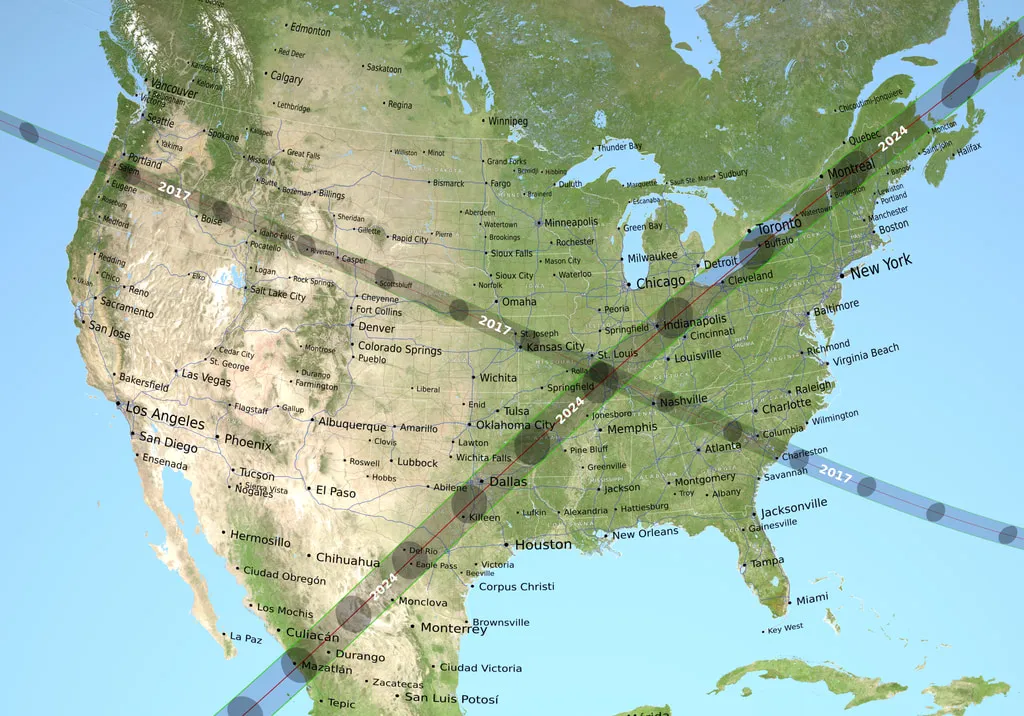
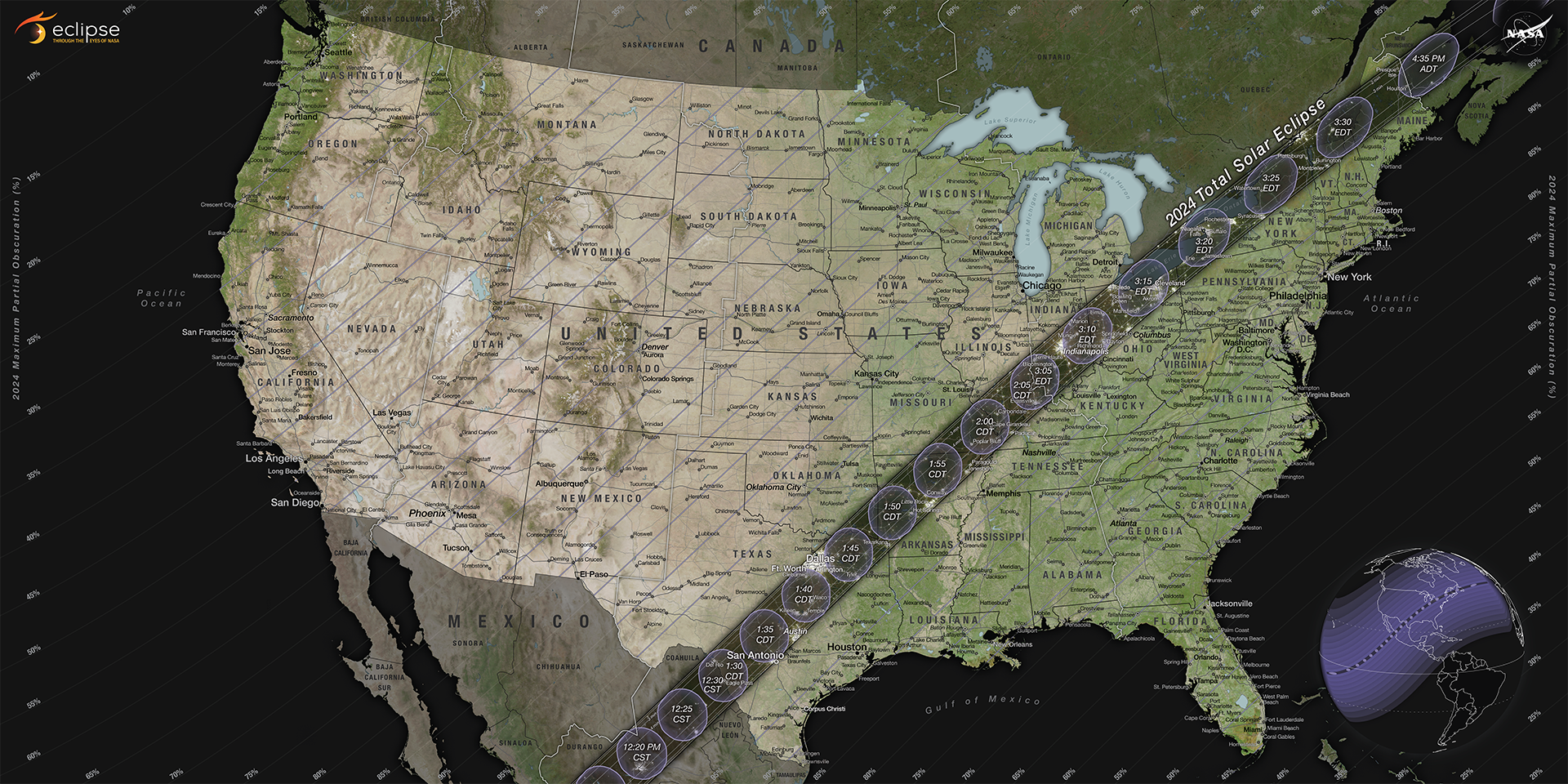
The path of totality – where viewers can see the Moon totally block the Sun, revealing the star’s outer atmosphere, called the corona – is much wider during the upcoming total solar eclipse than it was during the eclipse in 2017 and is expected to occur for viewers along the Great Lakes at 3:33pm EDT. As the Moon orbits Earth, its distance from our planet varies. During the 2017 total solar eclipse, the Moon was a little bit farther away from Earth than it will be during the upcoming total solar eclipse, causing the path of that eclipse to be a little skinnier. In 2017, the path ranged from about 62 to 71 miles wide. During the April eclipse, the path over North America will range between 108 and 122 miles wide – meaning at any given moment, this eclipse covers more ground.
The 2024 eclipse path will also pass over more cities and densely populated areas than the 2017 path did. This will make it easier for more people to see totality. An estimated 31.6 million people live in the path of totality this year, compared to 12 million in 2017. An additional 150 million people live within 200 miles of the path of totality.
This map shows the path of the 2017 total solar eclipse, crossing from Oregon to South Carolina, and the 2024 total solar eclipse, crossing from Mexico into Texas, up to Maine, and exiting over Canada.To see a map showing which areas will experience the partial solar eclipse and which areas will experience the total solar eclipse today April 8, 2024, click the arrows.Ernest Wright/NASA’s Scientific Visualization StudioThis map illustrates the paths of the Moon’s shadow across the U.S. during the 2024 total solar eclipse. Today April 8, 2024, a total solar eclipse will cross North and Central America creating a path of totality. During a total solar eclipse, the Moon completely blocks the Sun while it passes between the Sun and Earth. The sky will darken as if it were dawn or dusk and those standing in the path of totality may see the Sun’s outer atmosphere (the corona) if weather permits.To see a map comparing the 2024 eclipse and the 2017 eclipse paths, click the arrows.NASA/Scientific Visualization Studio/Michala Garrison; Eclipse Calculations By Ernie Wright, NASA Goddard Space Flight Center
You don’t need to live within the path of totality to see the eclipse – in April, 99% of people who reside in the United States will be able to see the partial or total eclipse from where they live. Every contiguous U.S. state, plus parts of Alaska and Hawaii, will experience at least a partial solar eclipse.
Longer Time in Totality
Today, totality will last longer than it did in 2017. Seven years ago, the longest period of totality was experienced near Carbondale, Illinois, at 2 minutes, 42 seconds.
For the upcoming eclipse, totality will last up to 4 minutes, 28 seconds, in an area about 25 minutes northwest of Torreón, Mexico. As the eclipse enters Texas, totality will last about 4 minutes, 26 seconds at the center of the eclipse’s path. Durations longer than 4 minutes stretch as far north as Economy, Indiana. Even as the eclipse exits the U.S. and enters Canada, the eclipse will last up to 3 minutes, 21 seconds.
During any total solar eclipse, totality lasts the longest near the center of the path, widthwise, and decreases toward the edge. But those seeking totality shouldn’t worry that they need to be exactly at the center. The time in totality falls off pretty slowly until you get close to the edge.
Heightened Solar Activity

NASA/ESA’s Solar and Heliospheric Observatory (SOHO) captured this video of a coronal mass ejection on March 13, 2023.NASA/ESA/SOHOSome prominences are seen as the Moon begins to move off the Sun during the total solar eclipse on Monday, Aug. 21, 2017, above Madras, Oregon.NASA/Aubrey Gemignani
Every 11 years or so, the Sun’s magnetic field flips, causing a cycle of increasing then decreasing solar activity. During solar minimum, there are fewer giant eruptions from the Sun, such as solar flares and coronal mass ejections. But during solar maximum, the Sun becomes more active.
In 2017, the Sun was nearing solar minimum. Viewers of the total eclipse could see the breathtaking corona – but since the Sun was quiet, streamers flowing into the solar atmosphere were restricted to just the equatorial regions of the star. The Sun is more magnetically symmetrical during solar minimum, causing this simpler appearance. During today’s 2024 eclipse, the Sun will be in or near solar maximum, when the magnetic field is more like a tangled hairball. Streamers will likely be visible throughout the corona. In addition to that, viewers will have a better chance to see prominences – which appear as bright, pink curls or loops coming off the Sun.
With lucky timing, there could even be a chance to see a coronal mass ejection – a large eruption of solar material – during the eclipse.
Expanded Scientific Research
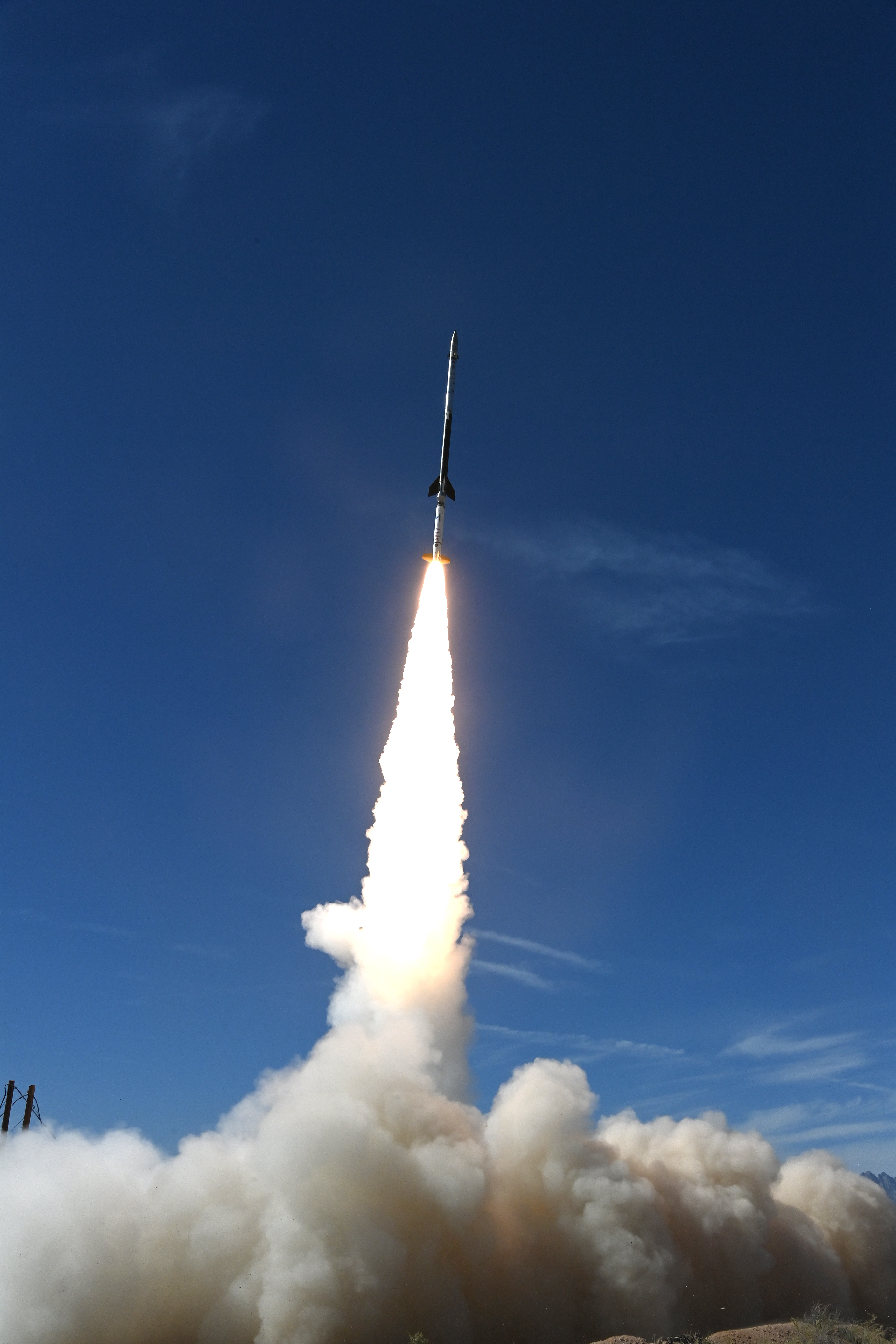
The third rocket launched on Oct. 14, 2023, during the annular solar eclipse leaves the launch pad.
WSMR Army Photo
During the total eclipse in 2024, NASA is funding several research initiatives that build on research done during the 2017 eclipse. The projects, which are led by researchers at different academic institutions, will study the Sun and its influence on Earth with a variety of instruments, including cameras aboard high-altitude research planes, ham radios, and more. In addition to those projects, instruments that were launched during the 2023 annular solar eclipse on three sounding rockets will again be launched during the upcoming total solar eclipse.
Two spacecraft designed to study the Sun’s corona – NASA’s Parker Solar Probe and ESA (European Space Agency) and NASA’s Solar Orbiter – have also launched since the 2017 solar eclipse. These missions will provide insights from the corona itself, while viewers on Earth see it with their own eyes, providing an exciting opportunity to combine and compare viewpoints.
To learn more about the 2024 total solar eclipse and how you can safely watch it, visit NASA’s eclipse website.
A whopping 1.3 billion international tourist arrivals were recorded in 2023.
Undoubtedly, travel has become an integral part of many people’s lives. And while it can bring many joys, it can also cause stress.
With travel season fast approaching, the experts and our friends at HAYPP wanted to help those struggling with travel anxiety by providing helpful tips on how to best overcome it.
Five healthy ways to overcome travel anxiety
1. Understand your anxiety
To be able to best cope with your travel anxiety, you need to have a good understanding of the things that actually cause it. Pinpoint specifically what is making you feel anxious about your trip – is it that you’ll be on the road for hours, that there would be things out of your control, that you would have to be surrounded by a lot of people at an airport? Once you understand what triggers your anxiety, you can ensure to plan ahead for the best ways to handle those triggers.
2. Create a detailed plan for your trip
One of the reasons for experiencing anxiety when travelling is that you’re being taken out of your comfort zone and won’t have full control over everything. To help ease that anxious feeling, try to plan out your trip in as much detail as possible. Write down an itinerary, either on paper, or you can make use of a trip planner app like TripIt, Wanderlog, or Sygic Travel, for every day that you can follow, which will give you a sense of control, but it’s equally as important to think of alternative plans of action for anything that could potentially not go as planned, so that you’re prepared.
3. Learn to use relaxation techniques
Deep breathing by taking long breaths through the nose and then exhaling slowly through the mouth is a technique proven to help reduce any feelings of stress. Another useful way to calm your mind is by meditating, which can take many different forms from listening to music to focusing on your breath. To make sure you find the mindfulness technique that works best for you, try out a few different ones before your trip, so when the time for travelling comes you can use the most efficient one to set your mind at ease.
4. Ensure you have things that bring you joy
Having things with you that generally bring you joy can be extremely useful in distracting you from your negative feelings. These can include physical items like a journal in which to write your thoughts, a book to read, or a game to occupy your attention. Alternatively, you can create a playlist of songs you love or make sure you have your favourite TV show (or movie) with you, as these will keep your mind occupied, decreasing your feelings of anxiety.
5. Take care of your physical health
Being physically active is a great way to reduce feelings of anxiety and stress. Even if it’s just a long walk, make sure to incorporate physical activity in your days, especially the days leading up to your trip and if possible, during the trip as well. Spending some time outside and connecting with nature, be it only by visiting a park, can have a positive effect on your physical and mental being, which in turn will help reduce your anxious thoughts.
How Climate Change Could Transform Cities into a Dune-Like Landscape
Dune’s cinematic and literary success reflects our fascination with desert landscapes. But the vast deserts of Arrakis, the movie’s fictional planet, hold a deeper meaning. They serve as a cautionary tale for our own planet threatened by desertification.
A new study by our friends at Top10Casinos.ca reveals how Canadian and other global cities threatened by climate change would look in the Dune Universe as TikTok searches around Dune: Part Two and climate change spike 7,700% in just 30 days.
Dune: Part Two, is already reaching massive box office milestones surpassing $150 million usd/ $204 million cad, and TikTok searches for the ‘new dune movie’ have soared 4,606% in just 30 days. In the past month, searches around the movie’s desert-like filming locations have increased 141%, while queries related to ‘climate crisis 2024’ have spiked 3,100% in the social media platform.
Known for its amazing cinematography and striking desert visuals, Dune’s landscape is something that makes it instantly recognisable. But the movie’s vast deserts are more than just a stunning backdrop. They serve as a stark warning of a potential future for our own world impacted by climate change.
Do Canada’s iconic outdoor skating rinks face a frosty future? While bundling up for harsh winters is a national pastime, a worrying trend is emerging. Since 1950, winter temperatures have soared by over 3°C, outpacing global warming by a factor of three.
Toronto, Ontario
Toronto, once known for its predictable seasons, is grappling with the impacts of climate change. The city is experiencing a rise in average temperatures, leading to more frequent and intense heat waves that strain infrastructure and threaten public health. Winters are becoming shorter and less severe, with unpredictable precipitation patterns bringing both heavier downpours that overwhelm storm drains and periods of drought that stress green spaces and water resources.
Vancouver. British Columbia
Like many coastal, seaport cities, Vancouver is feeling the brunt of climate change. Rising temperatures are a key concern, with projections for hotter, drier summers and wetter winters. Sea levels are also on the rise, threatening coastal areas with flooding. The City of Vancouver itself is planning for up to a 1.4 meter rise by 2100, which would inundate parts of the city during major storms.
Montreal, Quebec
Montreal’s climate is expected to experience significant changes due to climate change. Average temperatures are projected to rise by 1.5-2.3°C by mid-century, leading to more frequent and intense heat waves. This can strain infrastructure, harm public health, and disrupt outdoor activities. The city is also likely to see increased precipitation extremes, with heavier rainfall events and the potential for more flooding.
Niagara Falls, Ontario
Studies suggest Lakes Erie and Ontario, feeding the Niagara River, could see water levels drop a meter by 2050 due to increased evaporation and less snowfall. This decline could impact the Falls’ power and beauty. Additionally, more extreme weather events like flooding could damage surrounding areas. While milder winters might extend tourism, climate change poses significant ecological and aesthetic challenges.
With spring on the horizon, you may be scratching your head about where to vacation this year. Luckily, according to astrology, your star sign could be the key to whether you are destined for sun or slopes.
With this in mind, our friends at BonusFinder Canada sought to discover the ideal holiday destination for each zodiac sign based on their astrocartography lines (a form of locational astrology which allows people to decipher which physical locations are best suited to them based on their birth chart) with the help of celebrity psychic and astrologerInbaal Honigman. Do you agree or disagree with these suggestions? Leave us your thoughts at the bottom of the post.
Psychic and Wiccan Priestess Inbaal Honigman.
Your star sign’s dream destination according to astrocartography lines:
Aries (March 21-April 19): Alaska
Active and unusual Aries would be best adventuring through the idyllic landscapes of Alaska. Home to some of the world’s most beautiful views and the largest national park, Aries will always have somewhere to explore here.
Copyright: (Maridav) / Shutterstock.com
Taurus (April 20-May 20): Los Angeles
Great food and extensive views are a true joy to a Taurus, and it doesn’t get bigger and bolder than Los Angeles; with over 30,000 restaurants and stunning wide-open beaches, Taurus will love everything about LA.
Gemini (May 21-June 20): New York
Always awake and ready to party, Geminis will fall in love with the city that never sleeps, New York!From visiting the Metropolitan Museum of Art to watching an extravagant Broadway show, Geminis will never be bored day or night.
Cancer (June 21-July 22): Iceland
For a dreamy and easygoing Cancer, Iceland is the destination of choice. Between magical views of the northern lights and geothermal lagoons, Cancer will never tire of relaxing in one with nature.
The luxury fiendLeo must visit Bordeaux, the historic capital of Aquitaine,famous for its excellent wine culture. Between scenic beaches and exclusive vineyard tours, Leos will be able to find their true self.
Virgo (August 23-September 22): Rome
The ideal destination for the neat and traditional Virgo isRome, where they will undoubtedly relish an enlightening guided tour of the city’s ancient architecture and feel at home in the chic modern shopping areas.
Copyright: (AlexAnton) / Shutterstock.com
Libra (September 23-October 22): UAE
Classy and elegant Libras would adore the high rises in the desert of the United Arab Emirates; between luxury hotels and a mass of incredible culture, Libras will love discovering what this country has to offer.
Scorpio (October 23-November 21): Sri Lanka
Mysterious and original Scorpios can enjoy going off-grid in the temples of Sri Lanka. While exploring the rich heritage of the Gangaramaya Temple or coming up close to wildlife, Scorpios may find a little serendipity.
Copyright: (Sergii Figurnyi) / Shutterstock.com
Sagittarius (November 22-December 21): Tokyo
The adventurous and well-traveled Sagittarius will love the unique streets and incomparable cuisine of Tokyo. Between climbing the Tokyo tower and sightseeing Mt. Fuji, Sagittariuses will always have things to explore.
Capricorn (December 22-January 19): Melbourne
Mature and hardworking, a Capricorn likes diversity and friendliness, and the best place for this is Melbourne. Named the friendliest city in the world* and home to the exotic Royal Botanical gardens, a Capricorn will feel right at home here.
Aquarius (Jan 20-Feb 18): New Zealand
January is the month of Aquarians – unique and free-thinking, they will want to get truly lost in nature in New Zealand. With luscious open spaces and an abundance of beautiful scenery, Aquarians can do just that.
Romantic and shy Pisces‘ ideal travel destination is Hawaii, surrounded by water and an expanse of warm beaches. With volcanic national parks and surfing clear waters, Pisces will love getting back in touch with their aquatic roots.
Inbaal Honigman, celebrity psychic and astrologer, explains:
“Applying astrology to well-being, romance or shopping is increasingly popular, but astrocartography isn’t often consulted… yet.
“Astrocartography is an extension of each individual’s star chart so that you can find the best locations for yourself worldwide. For example, the ‘Sun Line’ would be where you feel most yourself. Your ‘Venus Line’ is the best place to build your home, and Jupiter is the best place for holidays.”
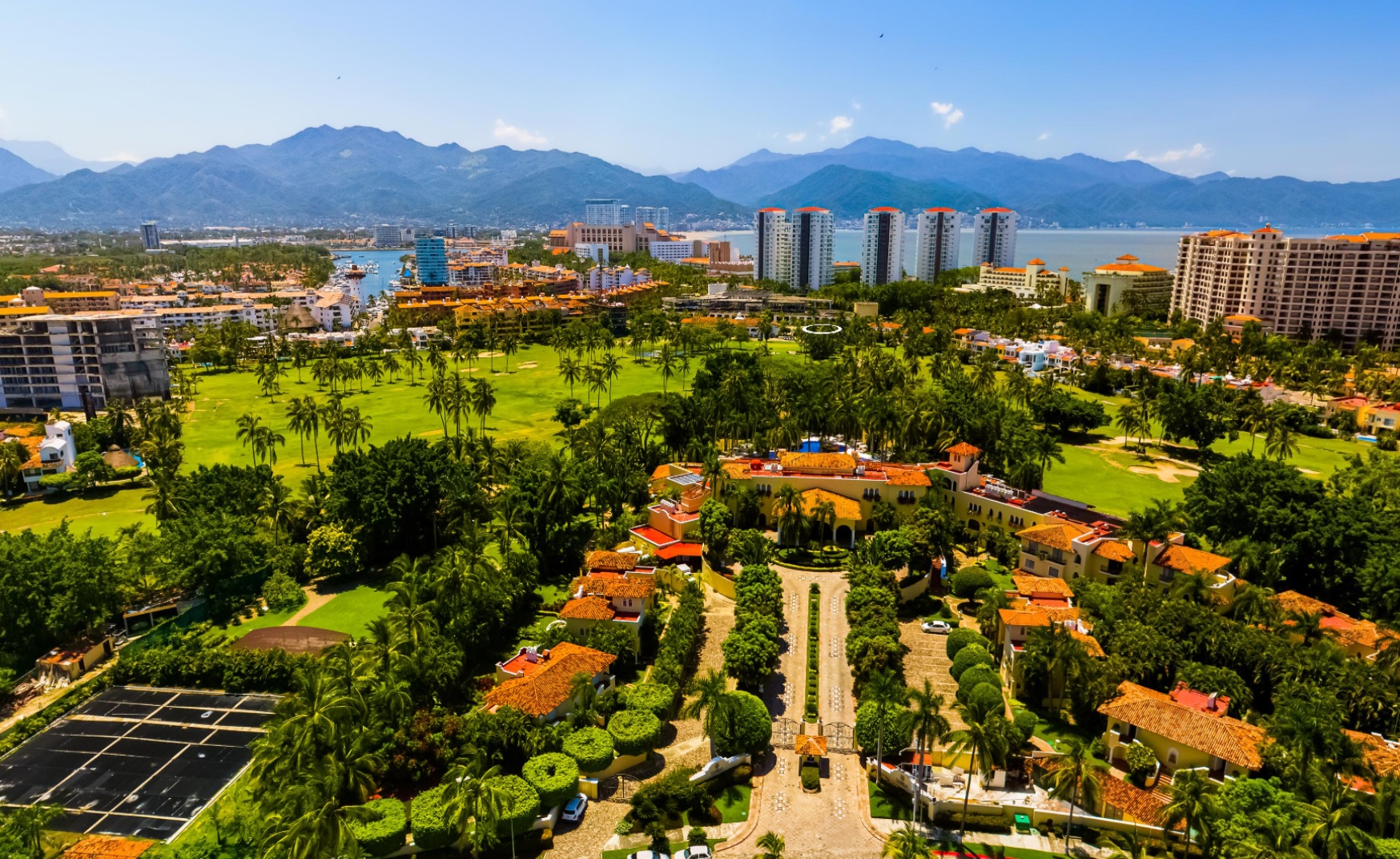
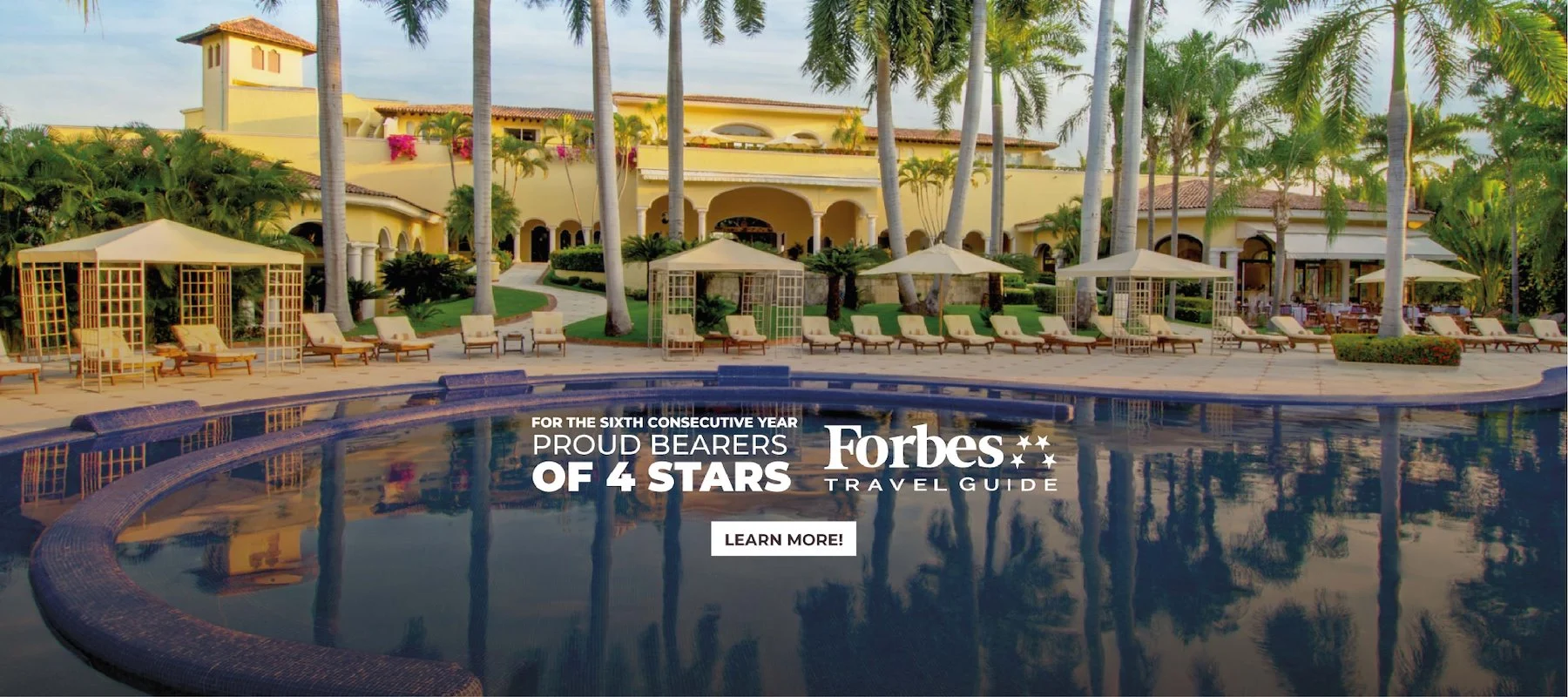
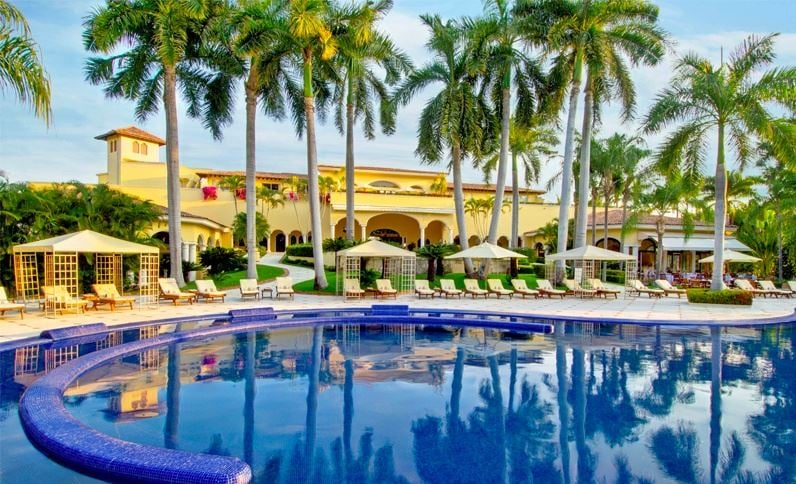
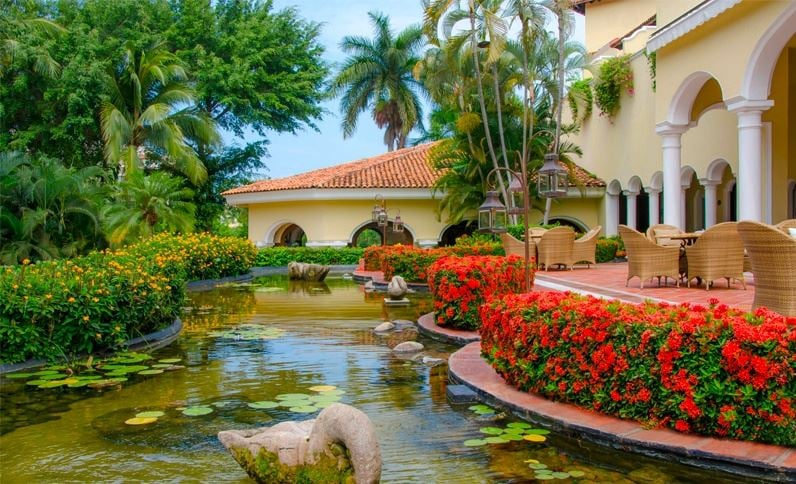
Nestled within an upscale residential neighborhood, just a short five-minute drive from Puerto Vallarta airport, the AAA Four Diamond Casa Velas stands as a serene, adults-only boutique resort exemplifying standards in the luxury all-inclusive sector.
As part of the prestigious Velas Resorts portfolio—renowned for being the only chain with four properties in U.S. News & World Report’slist of the top 25 all-inclusive resorts in Mexico—Casa Velas continues to exceed expectations with its unique charm and bespoke hospitality. Unlike traditional hotels, this Spanish hacienda-esque resort feels like a private estate replete with attentive staff members who add a personalized touch to the guest experience.
The 80 traditional, artwork-adorned Mexican-styled suites at Casa Velas are designed for utmost comfort, each featuring a private terrace with a plunge pool or in-suite Jacuzzi, hypo-allergenic pillows, goose down feather duvets, free WiFi, satellite TV, safe deposit box, coffee maker, bathrobes and slippers and L’Occitane bath products, as well as a fully stocked mini bar. Guests can choose from five room types: Master Suite; Grand Class Suite; Ambassador Suite; Governor Suite or the Presidential Suite.
For those seeking copious privacy and space to spread out, the 3,000-square-foot, four-bedroom Presidential Suite is a haven offering a top-end luxury escape.
The space, suited for up to eight guests, boasts original artwork by Mexican artist Sergio Bustamante, a large dining room, living room, master suite with a spacious marble-laden bathroom and an expansive terrace with an oversized plunge pool and Jacuzzi. It also comes complete with its own butler and bartender. It’s worth noting that Casa Velas actually has Bustamante’s sculptures in the majority of the suites, allowing most guests to enjoy the captivatingly authentic artwork.
Amidst its Spanish-style architecture and captivating interior design, the resort is ensconced in a lush garden setting on the 18-hole Marina Vallarta Golf Course. The tropical landscaping and abundant flora and fauna woven throughout the entirety of the hotel create a breathtaking setting, attracting wildlife—including Koi ponds and “pet” snapping turtles.
For golf enthusiasts, Casa Velas guests receive special access and discounts at Marina Vallarta and Vista Vallarta Golf Clubs.
For its part, the par 71 layout of Marina Vallarta’s 18-hole golf course, designed by Joe Finger, is rife with flourishing vegetation, wildlife-laden lagoons and beautiful views of Banderas Bay. Guests can also enjoy discounted golf privileges at two other top 18-hole, 72 par golf courses designed by Jack Nicklaus and Tom Weiskopf located at the Vista Vallarta Golf Club only 20 minutes away.
Casa Velas guests can soak up the sun at its private pool cushioned in a tropical landscape that overlooks the golf course. Its swim-up Aqua Bar ensures refreshments—including local brews, tropical drinks and classic Mexican cocktails crafted from premium liquor brands—flow all day through.
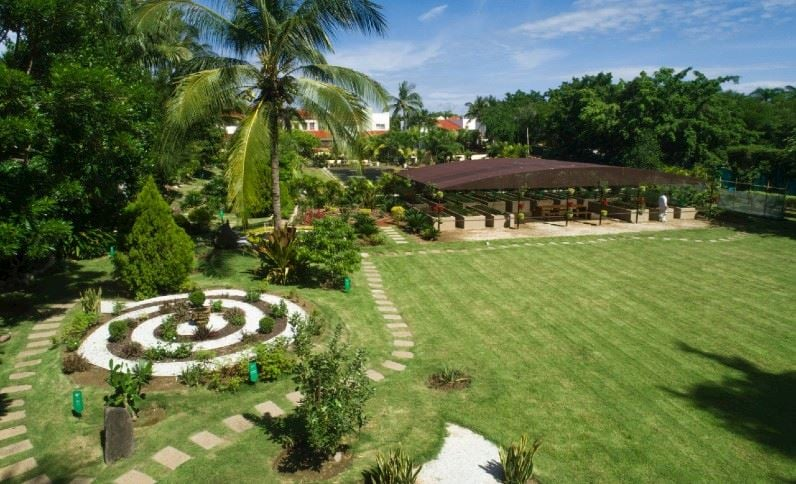
The newest offering at Casa Velas in Puerto Vallarta allows guests to experience pure relaxation with their own “Wellness Cabana.” Available in the intimate space of their suite, or at the botanical garden adjacent to the spa labyrinth, wellness-focused amenities include aromatherapy, a personal speaker with calming meditation music, spa water, a MUSE meditation headband and mandala adult coloring books, among other items.
For those desiring to unwind and explore off-site, the resort also provides complimentary shuttle service to the private Táu Beach Club, offering guests a beachside retreat with cushioned loungers, cabanas, food and beverage service for lunch and dinner and a pristine infinity pool and Jacuzzi area proffering idyllic panoramic views of the sparkling sea. Plus, the property is a mere fifteen minutes from the popular downtown area, where there are art galleries and the famed El Malecon boardwalk.
Also making Casa Velas a standout is its elevated gourmet food and beverage program, which raises the bar for all-inclusive hotels globally.
The on-site, AAA Four Diamond Emiliano restaurant offers guests unlimited access to gourmet cuisine for breakfast, lunch and dinner. The intimate, romantic indoor/outdoor dining space provides lovely vistas of the pool and vibrant golf course beyond. Each evening, Emiliano features a five-course gourmet tasting menu created and overseen by head chefs from its sister resort, the AAA Five Diamond Grand Velas Riviera Nayarit. Rotating each night, menus include Mexican, French and Italian-Mediterranean.
A novel offering is the resort’s “taco therapy”—Casa Velas’ latest food and beverage offering for guests assisting in anxiety and stress relief, improving sleep quality and boosting antioxidants. The new tasting experience features four curated tacos that provide holistic benefits for the mind, body and soul.
There are an array of other activities at the resort as well. “Workshops range from arts and crafts such as natural jewelry and abanicos, to culinary workshops such as the Molcajete option, where guests explore Mexican culinary traditions,” said Enrique Sinencio, the resort’s General Manager. “Another activity is DIY Botanical Cocktails, where guests can pick their ingredients for their drink at the onsite garden. Perfect for creative beverage concoctions, the garden features rosemary, lavender, mint, basil, lemongrass, peppermint, a Mexican tea called epazote, aloe vera, sage, nopales cactus pads, thyme, tamarind, jackfruit, mango, guava and more. Our mixologist will use the selected ingredients to make a personalized botanical cocktail to enjoy on the Koi pond-dotted terrace. Varieties of fruits, herbs, vegetables and botanicals are also used in the cuisine and spa treatments at Casa Velas.”
For the health conscious, a spa food menu is available as well.
Casa Velas’ commitment to excellence extends to its impressive on-site organic botanical garden, where the resort grows its own herbs, flowers and vegetables. These fresh ingredients find their way into cocktails and culinary creations, adding a farm-to-table element to the dining experience. The beverage offerings at Emiliano, and throughout the entirety of Casa Velas, are equally impressive, featuring premium domestic and international premium wines and liquors. Also enjoyable are sprit-induced nightly events like wine pairings and beer, tequila, wine, martini and other F&B tastings that foster socialization among guests.
Relative to in-suite victuals, the resort’s in-suite mini bars also depart from the ordinary by offering healthy, freshly-made options on-demand. This includes two different selections of crudités—a “Mexican turnip” with a combination of carrots, cucumber and jicama; and another including celery, beetroot and pineapple. These come complete with three different choices of dressing: mango, chipotle or basil, to enhance flavor while keeping the snack light and healthy. Guests can also choose from a menu of freshly made juice options available year-round.
Speaking of health, also included in the daily rate for all-inclusive Casa Velas guests is access to its fully equipped gym. A visit to the property also would not be complete without experiencing services at its on-site ABJA Spa. The 6,500 square foot sanctuary offers a wide variety of massages, body wraps and facials, a hydrotherapy area, spa boutique and beauty salon.
Notably, Casa Velas is just as committed to the environment as it is to providing impressive guest experiences. “Our luxury resort’s environmental responsibility is a driving force behind the entire operation, from conservation efforts and recycling, to planting our own herb garden,” Sinencio notes. “From natural composting and fertilizing of our on-site gardens, to water-saving initiatives, solar heating and meticulous separation and processing of all waste and recyclables, Casa Velas sets the benchmark for green tourism and hospitality in Puerto Vallarta and beyond. We also recycle burned cooking oils to a supplier for conversion to biodegradable fuel. Local companies are in charge of processing glass, plastic, metal, cardboard and toxic material to handle their recycling, and proper disposal.”
“In addition, we clean the sand daily of any foreign debris,” Sinencio continued.”
“Teams of more than 30 employees are organized monthly to thoroughly clean, sweep, dig and sift the sand for extra cleaning. Designated containers are strategically located for the recycling garbage around the property. Since the COVID-19 pandemic, Casa Velas has implemented rigorous health and safety protocols in accordance with local and international guidelines. This includes enhanced cleaning procedures, regular sanitization of common areas and the adoption of contactless services where possible. We keep our guests informed through various channels, including our website, social media and direct communication with booked guests. We want everyone to be aware of the measures in place and feel confident in choosing Casa Velas for their stay.”
So pristine the locale, it’s become a highly-coveted option for weddings and other important events. The resort boasts a 3,600 square foot Convention Center that is ideal for meetings, seminars, formal banquets, cocktail gatherings or a spectacular and elegant wedding for up to 300 people. The center of the space is adjacent to the resort’s garden area and the Marina Vallarta 18-hole championship golf course. To ensure a memorable, hassle-free event, Casa Velas provides professional services for planning weddings from beginning to end. With settings by its beautiful pool area or the Táu Beach Club terrace surrounded by sand and sea, Casa Velas offers unforgettable scenery for the special wedding day.
For utter and complete privacy, groups requiring up to 80 suites can take over the entire hotel to ensure fully private access to pools, beach areas, gardens, activities and restaurants. While at the restaurants, the “bubble buyout” offers a group their own personalized menus prepared with everyone’s diet in mind. Along with having the resort to themselves and custom cuisine, group activities range from DIY mixology with ingredients from the onsite botanical garden, yoga, Mexican wine and craft beer tastings, casino night and more.
With various international dignitaries and multiple Mexican presidents having experienced the resort’s hospitality, Casa Velas continues to redefine the all-inclusive category. This pristine property is an ideal choice for discerning travelers who value a personalized and pampered luxury travel experience.
For the Silo, Merilee Kern.
Merilee Kern, MBA is an internationally-regarded brand strategist and analyst who reports on cultural shifts and trends as well as noteworthy industry change makers, movers, shakers and innovators across all categories, both B2C and B2B.
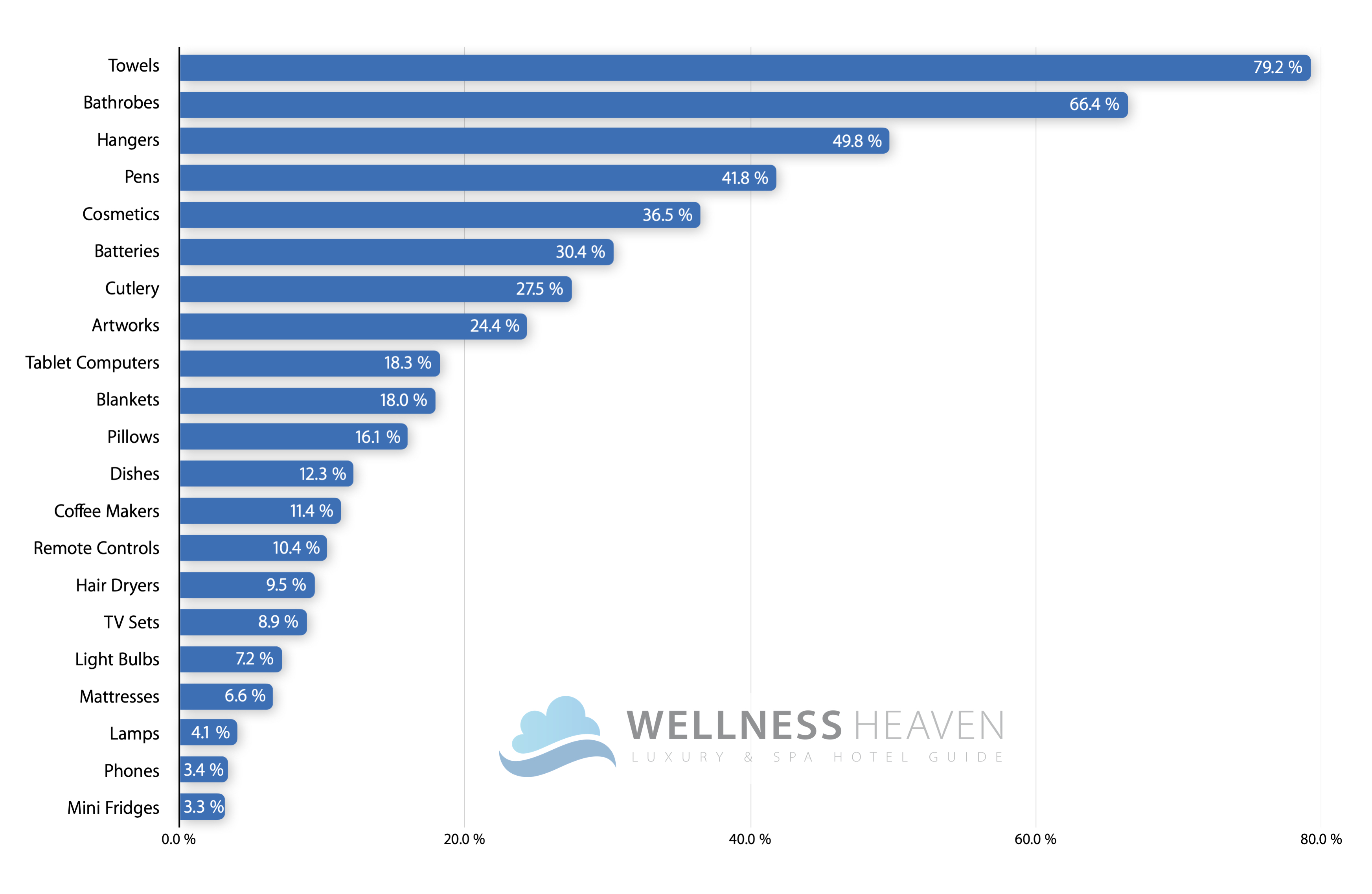
Fig. 1: Distribution of items most frequently stolen in hotel rooms. 1,376 hoteliers took part in the survey. Click to enlarge. Source: Wellness Heaven | Download Image | Download Data
Munich, February, 2024 — Stealing soaps or pens seems harmless for many hotel guests, however, some are so bold that they carry TVs, pianos, mattresses or even stuffed animals out of the hotel. Wellness Heaven has asked 1,376 hotel managers which items are most commonly stolen. In particular, we observe a striking difference in the theft behavior between guests in 4-star and 5-star hotels.
Friends: Chandler & Ross Load Up on Hotel Amenities
Ross Teaching Chandler the 101 on Theft in Hotels “You have to find the line between stealing and taking what the hotel owes you.” Source: YouTube.
The main result of the study: towels and bathrobes are stolen the most – perhaps as a goodie for the next spa break? These two objects of desire are closely followed by hangers, pens and cosmetics. In addition to these “ordinary” items, there is a number of spectacular outliers that suggest a brisk imagination of the delinquents:
The most bizarre stolen goods
Bathroom Fittings
Highly skilled craftsmanship was required of those guests who managed to steal bathroom fixtures, the head of a rain shower, a hydromassage shower, a toilet seat, a drainpipe or even an entire sink, as reported by a Berlin hotel.
A Grand Piano
A hotelier from Italy: “Once I walked through the lobby, I noticed that something was missing, and soon after I learned that three unknown men in overalls had taken away the grand piano, and it never reappeared, of course.”
Room Numbers
In a hotel in England a guest had unceremoniously removed the numbers from his hotel room door. “We didn’t notice until the next guest could not find his room”, the hotel director declares.
Stuffed Hunting Trophies
In a hotel in France, a guest was caught trying to steal a stuffed boar’s head. At a later date, he did receive this trophy: friends bought the precious piece from the hotel and gave it to him as a wedding gift.
Sauna Benches
In a hotel near Salzburg, the wooden benches from a sauna were stolen. The “private sauna” was located on the terrace of a spa suite. The benches were made of fragrant pine wood, which probably stirred up the guest’s desire. Only when a subsequent guest criticized the absence of the benches (“Where should I sit in the sauna? I can’t relax while standing.”), the hotelier noticed the theft.
HiFi System
A hotel owner from Germany reports on how the entire stereo system of the spa area disappeared: Thieves had apparently dismantled the entire sound equipment overnight and loaded it in their car before they left.
Flowers
The management of a resort in the Maldives reports that it buys new flower arrangements several times a week to replace the missing ones. Maybe the demand for flowers is simply too high due to the many marriage proposals?
Thieving preferences by nationality
When classifying the delinquents by nationality, a different picture emerges. It turns out, for example, that German and British hotel guests follow a rather boring theft behavior: In addition to towels and bathrobes, primarily cosmetics and toiletries are in the focus.
In contrast, Austrians snitch in a more pleasure-oriented way: dishes and coffee machines appear high up in their theft ranking. It seems they cannot get enough to satisfy their thirst for coffee. For US Americans, pillows and batteries appear as the prime objects of desire.
Italians seem to prefer wine glasses as a hotel souvenir, while the hair dryer ranks high up in the Swiss ranking. The French, on the other hand, steal in a more spectacular manner: they represent the nation that is attracted mainly to TV sets and remote controls.
Dutch hotel guests see in their souvenirs above all the practical benefit: Their favorites include light bulbs and toilet paper.
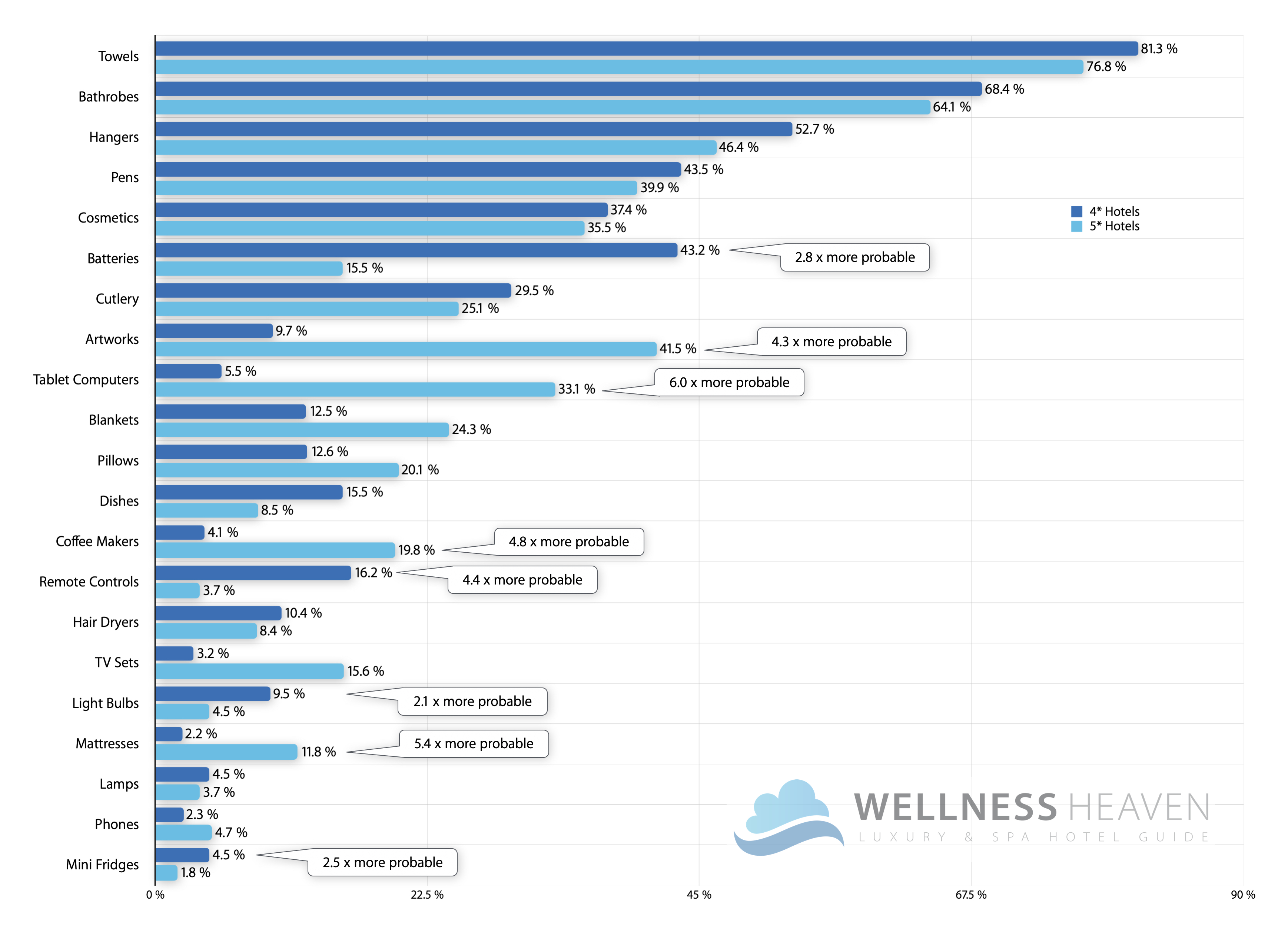
Fig. 2: Differences in theft behavior between guests of 4-star and 5-star hotels. Click to enlarge. Source: Wellness Heaven | Download Image | Download Data
Guests of 5-star hotels prefer expensive items: TVs & mattresses
A total of 740 hoteliers from 4-star hotels and 636 from 5-star hotels were surveyed to determine the behavior of thieves depending on their wealth. As it turns out, “Greed is good” seems to be a reliable motto especially for the well-heeled 5-star clientele.
The probability of tablet computers being stolen in 5-star hotels, is 6 times higher in comparison to the 4-star segment. Similarly, artworks are popular objects of desire in luxury hotels (4.3 x higher theft probability). TV sets (4.9 x) and mattresses (5.4 x) are also being stolen a lot more frequently in 5-star hotels. This is quite astonishing: 11.8% of 5-star hotel managers mourn the loss of mattresses, while only 2.2% of 4-star hotels seem to be affected. In total, 91 hoteliers indicate the theft of mattresses in our survey, so at least that many were stolen in their hotels.
4-star hotel guests are content with less spectacular gifts: towels and hangers tend to be in higher demand than in 5-star hotels. The typical 4-star hotel guest is especially fond of practical items such as batteries and remote controls (theft probability 2.8 and 4.4 x higher, respectively).
Coffeemakers
The coffeemaker, which is so popular among Austrian guests, is also sought-after by luxury-minded 5-star guests, as we observe a 4.8-fold increase in theft statistics.
Toilet Paper
Hoteliers’ theft reports about toilet paper rolls only reach us from the 4-star segment. For luxury travellers, there seems to be no additional need for hygiene in this area.
Luxury Mattresses
Even expensive luxury mattresses (often worth several thousand euros) are not immune to disappear: the probability for their theft is 5.4 times higher in 5-star hotels. How exactly the bulky goods are transported unnoticed out of the hotel remains a mystery. On request, some hoteliers informed us that this only happens in the middle of the night – using elevators which lead directly to the underground parking.
Tablet Computers
Tablet computers, often referred to as “SuitePads” in the high-priced room categories, are stolen 6.0 times more frequently in 5-star hotels. Such tablets usually have a value of approx. 480 euros and tend to be a popular souvenir among luxury travelers.
Blankets
To complete their sleeping experience at home, some luxury oriented guests add the hotel’s blanket to their luggage. Theft of this object is 1.9-fold increased in 5-star hotels.
Trends in hotel thievery
Comparing data with our 2019 survey on theft in hotels, “Mini Fridges” have emerged as a new item of desire. 3.3% of surveyed hoteliers indicate theft of this device, leaving the mini bar not only empty, but also warm. Not cool! The theft of mini fridges is 2.5 x more probable in 4-star hotels. In comparison with 2019, several items of theft are on the rise: coffee makers (6.9% -> 11.4%), mattresses (4.2% -> 6.6%) and tablet computers (12.0% -> 18.3%) have increased significantly. On the other hand, phones (4.8% -> 3.4%), cutlery (33.6% -> 27.5%) and lamps (4.3% -> 4.1%) have decreased in theft probability.
Methods
On the methodology of this survey: The multiple-choice answers were randomized, multiple answers were possible. For example “Towels” in Fig. 1: 79.2% of surveyed hoteliers have indicated that towels were stolen at their hotel. The survey was conducted in September and October 2023.
A total of 1,376 responses were evaluated, the result can be considered as representative. The 1,376 hotels whose management participated in the survey are located primarily in Europe. 740 hoteliers were surveyed in the 4-star segment, and 636 in the 5-star segment.
Wellness Heaven
Wellness Heaven (https://www.wellness-heaven.de) was founded in 2006 by quantum physicist Dr. Tassilo Keilmann. The hotel portal reviews spa and luxury hotels in Europe und Asia. With 53 million page impressions annually, Wellness Heaven is the leading spa hotel guide in German-speaking countries. The 18 Wellness Heaven hotel testers regularly evaluate selected hotels and rate them on the basis of a standardized test procedure. The website focuses on hotels in Germany, Austria, Italy, Switzerland and the Maldives.
Whilst climate change is at the forefront of most countries’ consciences, the issue is highly pressing here in Canada where we experience climate change at twice the world’s average due to our northerly location. Do you believe in the stated extreme effects of climate change or do you believe in a milder alternative? We would love to hear your thoughts in the comment section at the bottom of this article.
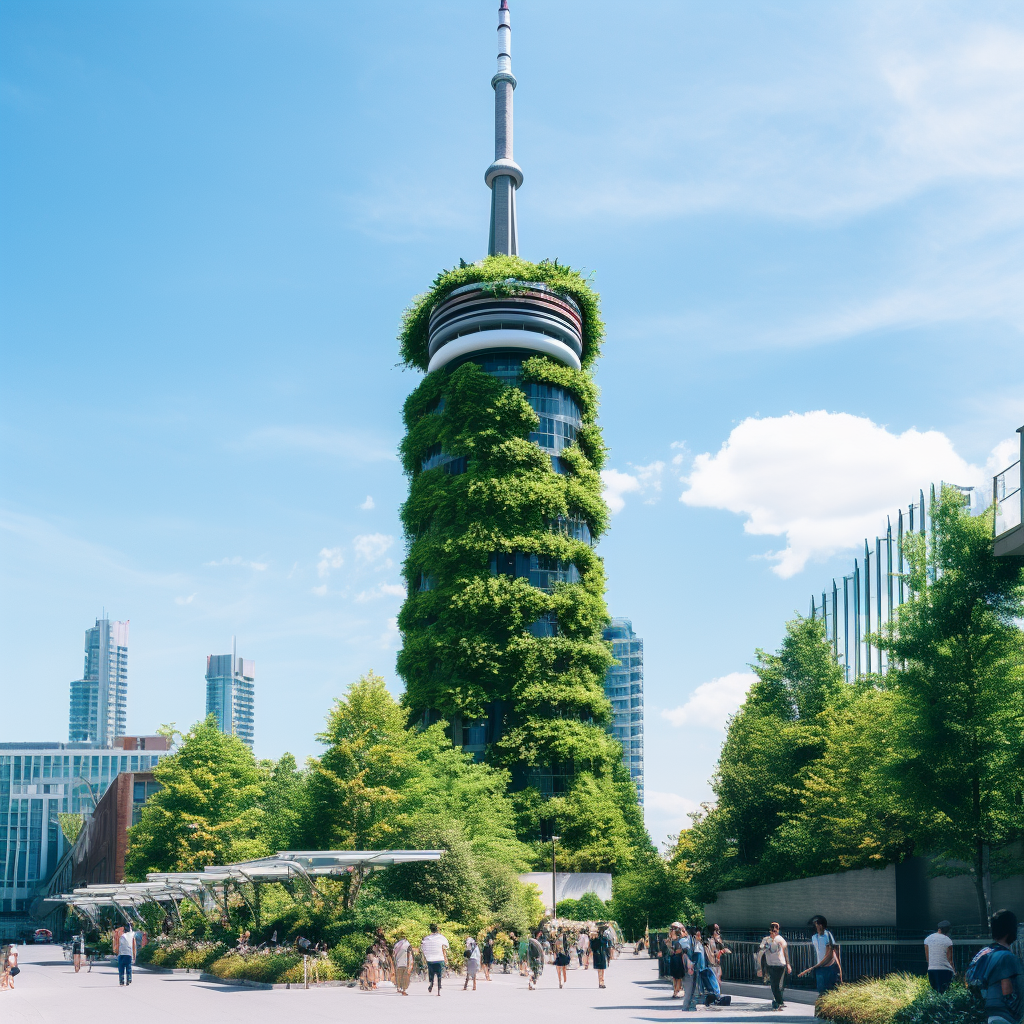
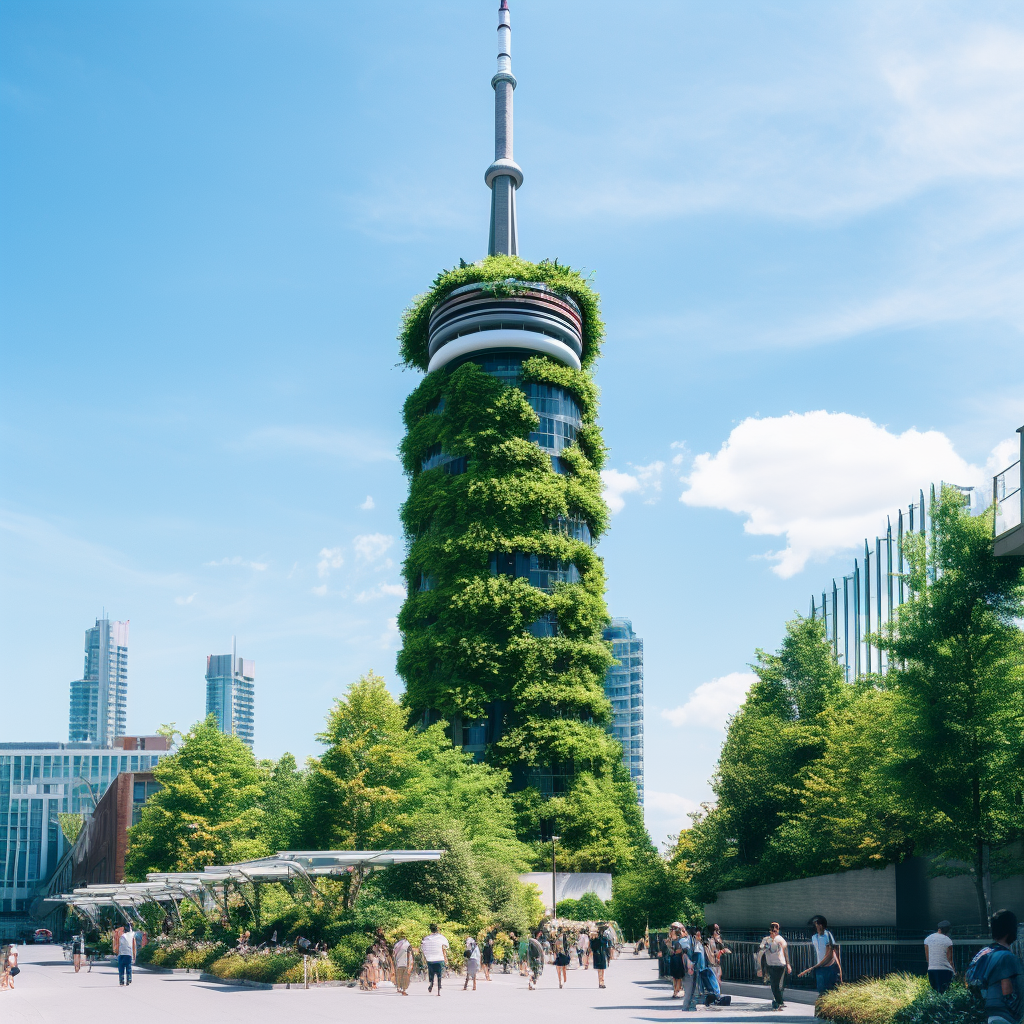
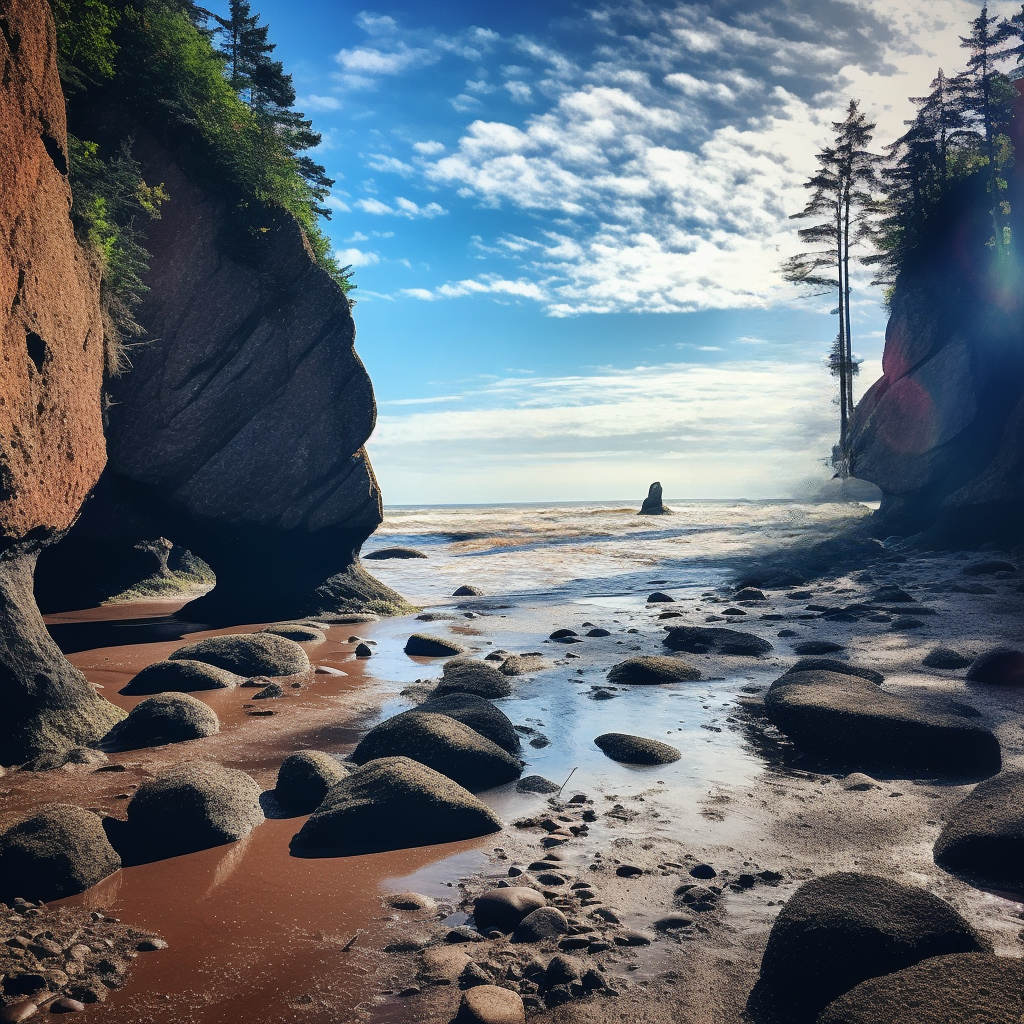
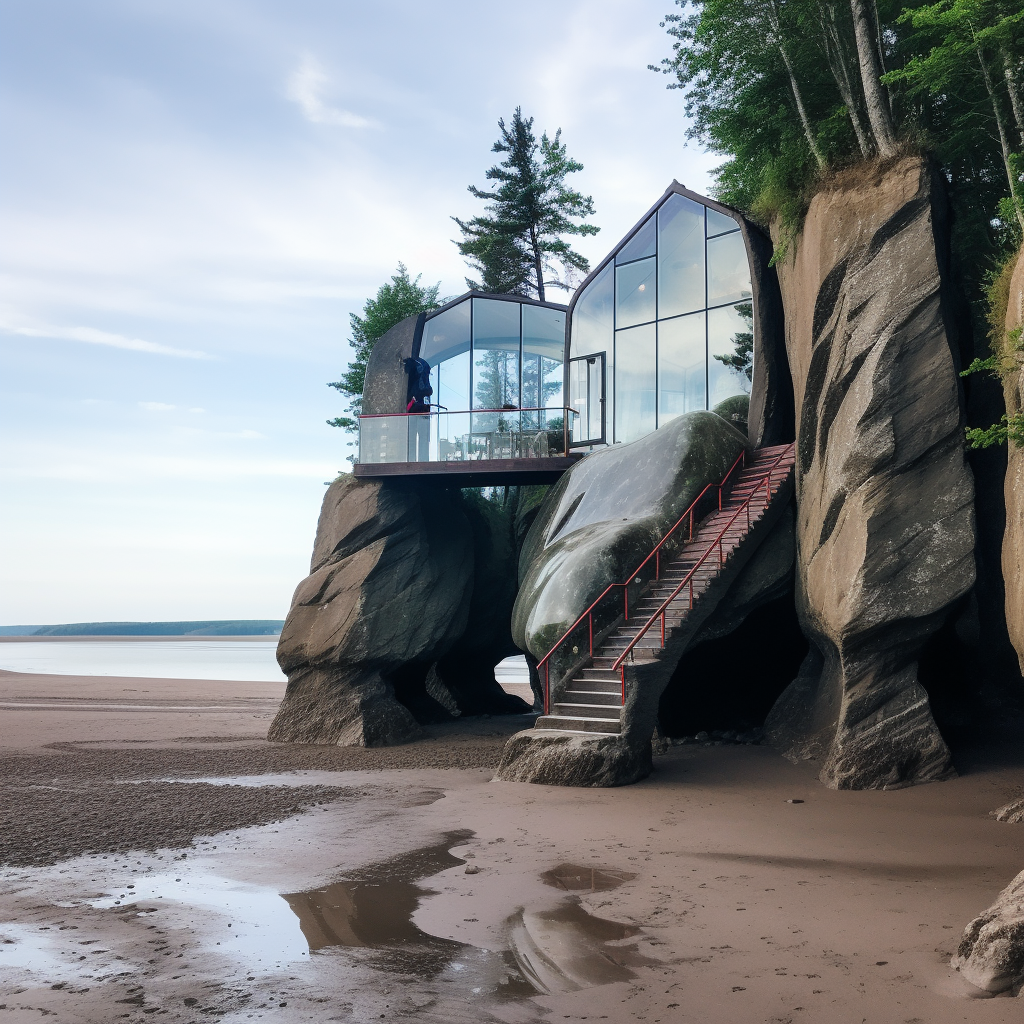
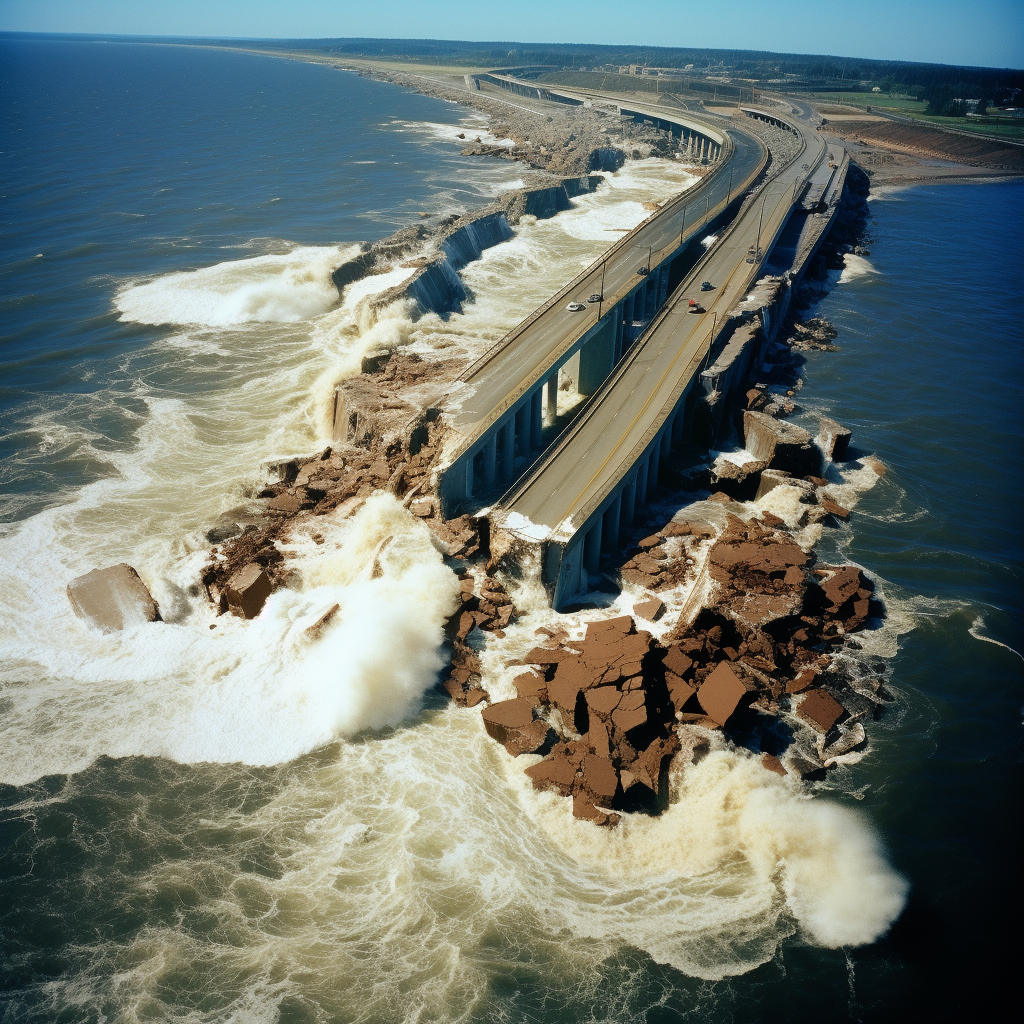
With this in mind, our friends at BonusFinder Canada utilized technology to predict exactly what Canada’s most popular tourist spots could look like in 100 years timeif we do not intervene and try to combat climate change. To do so, they asked OpenAI to write predictions for five top tourist hotspots (Niagara Falls, CN Tower, Notre-Dame Basilica, Hopewell Rocks, Confederation Bridge) based on factors such as global warming, overpopulation and extreme weather, and used these descriptions to generate AI images.
Niagara Falls – no intervention
Niagara Falls – positive intervention
Key changes without intervention:
● Significant reduction in water flow, affecting local ecosystems and the availability of freshwater resources.
● The falls are no longer safe to get close to due to erosion.
● The once lush surroundings have been replaced by concrete and pollution due to overpopulation.
CN Tower – no intervention
CN Tower – positive intervention
Key changes without intervention:
● Toronto is now largely inhospitable due to global warming and extreme weather events.
● Fires are not uncommon due to global warming and an abundance of refuse.
● Toronto faces major impacts of climate change, including higher temperatures, reduced air quality, and persistent heatwaves.
Notre-Dame Basilica – no intervention
Notre-Dame Basilica – positive intervention
Key changes without intervention:
● Extreme weather events, including severe heatwaves, have damaged the Basilica’s exterior and interior.
● The area surrounding the Basilica is overpopulated and increasingly inhospitable.
● The basilica remains heavily reliant on non-renewable energy sources, worsening the effects on the environment.
Hopewell Rocks – no intervention
Hopewell Rocks – positive intervention
Key changes without intervention:
● The main structure of the rocks has collapsed.
● The surrounding area is heavily urbanized and polluted.
● The beach is now dangerous, marshy and overgrown, but still attracts many tourists when the bay is uncovered, bringing further pollution and structural damage with each passing year.
Confederation Bridge – no intervention
Confederation Bridge – positive intervention
Key changes without intervention:
● Confederation Bridge has collapsed in areas, rendering the huge structure unusable.
● The water around the bridge is now full of concrete, industrial waste, pollution and urban runoff.
● Small portions of the bridge still stand in the water, serving as a reminder of our failure to act and combat urbanization and overpopulation.
Following Indonesia, the Philippines joins the World Economic Forum’s Blue Carbon Action Partnership to safeguard crucial coastline ecosystems in South-East Asia.
Mangroves and other littoral biospheres provide a critical buffer against climate change globally, but environmental degradation is putting them under threat.
Momentum builds at COP28 for the conservation and restoration of these critical blue carbon ecosystems, for the benefit of people, nature and the climate.
Learn more about the World Economic Forum’s work at COP28 here.
Dubai, United Arab Emirates, December 2023 – The Government of the Philippines’ Department of Environment and Natural Resources announced yesterday at COP28 that it is joining the World Economic Forum’s Blue Carbon Action Partnership to accelerate the restoration and conservation of coastal ecosystems.
South-East Asia is home to almost one-third of mangroves globally, with nearly 20% of the world’s mangroves in Indonesia alone.
Blue carbon ecosystems such as mangroves, seagrasses and salt marshes store up to five times more carbon per acre than tropical rainforests and have been receiving greater attention in recent years. Yet, these ecosystems are under threat of destruction. These important carbon sinks also provide support for livelihoods, food security, shoreline protection and habitat for numerous.
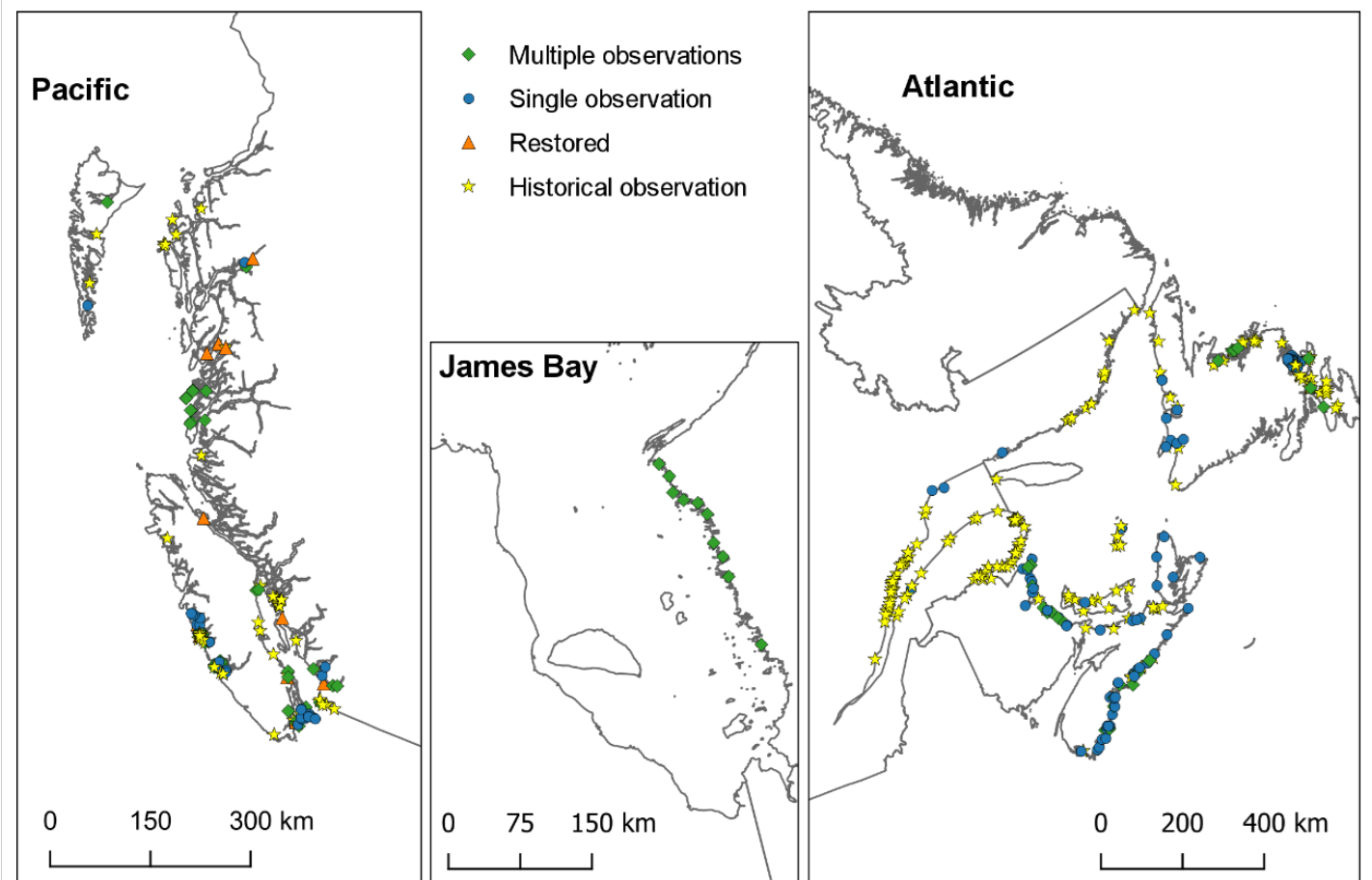
Eelgrass (seagrass) distribution on Canada’s sea coastlines are under threat.
Source: Environment and Climate Change Canada (2020).
The importance of eelgrass to ecosystems was shown after a widespread wasting disease outbreak along the Atlantic coast of North America in the 1930s resulted in a 90% loss of eelgrass. It is estimated that populations of migratory Brant geese along the Atlantic coast, which rely heavily on eelgrass outside the breeding season, declined by as much as 90%. Declines of clams, lobsters, crabs, scallops, cod and flounder were also reported following the loss of eelgrass.
Eelgrass beds are highly productive and several studies have indicated that eelgrass beds contribute to the sequestration of “blue carbon” in marine sediments, providing a valuable ecosystem service in coastal areas.
“Coastal ecosystems such as mangroves are critical to life in the ocean and to those who live alongside it. Increasingly, we are also recognizing their vital role to buffer us against the worst effects of the climate crisis,” said Alfredo Giron, Acting Head of the Ocean Action Agenda and Friends of Ocean Action at the World Economic Forum. “When blue carbon benefits are recognized and valued by governments and businesses, who commit and invest in the restoration of mangrove, seagrass and salt marsh ecosystems around the world, everybody wins – people, nature, climate and ultimately, the planet.”
The newly launched National Blue Carbon Action Partnership in the Philippines will convene, coordinate and support implementation to scale high-quality blue carbon action, representing nearly 700 billion metric tons of carbon sequestered in mangroves and seagrasses in the country.
“The Philippines, endowed with rich biodiversity and extensive coastlines, is home to vast blue carbon ecosystems. We look forward to working with the Blue Carbon Action Partnership to facilitate the inclusive, whole-of-society approach to developing a shared ambition for blue carbon, community resilience, inclusive development and unlocking the Philippines’ potential to provide nature-based climate solutions for the rest of the world whilst supporting our programs for protected areas and preparing the country for participating in the new blue economy,” said Antonia Loyzaga, Secretary of the Department of Environment and Natural Resources of the Philippines.
The Philippines partnership is the second to be launched after an agreement last year with the Government of Indonesia, which has also strengthened its partnership agreement with the World Economic Forum at COP28 and is preparing to launch its National Blue Carbon Action Partnership secretariat. Combined, the Philippines and Indonesia house 4 trillion tons of carbon in their blue carbon ecosystems, which is the carbon equivalent of over 11 trillion of barrels of oil consumed.
There is increasing demand for blue carbon ecosystem restoration and conservation to attain the multifaceted benefits these ecosystems provide, including food security, support for livelihoods, coastal protection and carbon storage. Working with its government partners, the Blue Carbon Action Partnership can support connecting finance with countries that have established policies to receive blue carbon ecosystem investment.
“The ocean is our largest buffer in tackling the climate crisis and it plays an essential role in climate change mitigation, resilience and adaptation as well as regulating the global weather system. It is encouraging to see the ocean gaining increasing prominence as a natural resource for accelerated climate action,” said Giron.
The World Economic Forum will advance multistakeholder initiatives for enhanced climate solutions at the 28th Conference of the Parties of the UNFCCC. The Forum will focus on key priority action areas including industry decarbonization and net zero, energy transition, food, nature and innovative finance.COP28 takes place from 30 November to 12 December 2023 in Dubai, United Arab Emirates, and serves as an urgent call to action to the global climate crisis.Learn more about the Forum’s work at COP28 here.
Geneva, Switzerland, November 2023 – The World Economic Forum will convene heads of state, ministers, business leaders, philanthropy and civil society to advance climate action at the 28th Conference of the Parties of the UNFCCC (COP28) at the Expo City Dubai, in Dubai, United Arab Emirates. The Forum’s focus at COP28 is to address priority action areas including industry decarbonization and net zero, energy transition, food, nature and innovative finance.
“We have to take a holistic approach to address the environment crisis, with people at the heart of the agenda, focusing on restoring and protecting nature ecosystems, strengthening community resilience in the face of water stresses and extreme temperatures, while stopping the pollution of our land, sea and water,” said Gim Huay Neo, Managing Director, World Economic Forum. “Fostering a sense of inter-dependence, mutual trust and support as well as active collaboration between governments, the private sector, philanthropy, civil society and communities is needed to build a more harmonious relationship among communities and with the planet. COP28 is an opportunity for the World Economic Forum to provide a platform for multistakeholders to take stock on progress, enhance partnership efforts and explore new ideas and solutions together to safeguard our global commons.”
The discussions in Dubai will build on outcomes from the Forum’s Sustainable Development Impact Meetings 2023, which reflected on progress made on the Sustainable Development Goals (SDGs) and created momentum in addressing the climate and nature crises and advancing an inclusive energy transition.
As part of the COP28 programme, the Forum will hold several sessions aligned to the meeting’s thematic areas. Most of the sessions will take place at the COP28 Blue Zone, which is accessible to UNFCCC-accredited media.
Insights and initiatives
The following Forum announcements and publications will be released at COP28. 22 Nov.: Net Zero Industry Tracker 202322 Nov.: Financing Energy Transition Projects with Industrial Clusters in Europe26 Nov.: Biodiversity Credits: Demand Analysis and Market Outlook27 Nov.: Biodiversity Credits: A Guide to Support Effective Use29 Nov.: Launch of Scope 3 Action Plan from the Alliance of CEO Climate Leaders29 Nov.: Navigating Article 6: Opportunities for the Middle East and North Africa30 Nov.: Grassroots to Boardrooms:Social Innovation Partnerships for Climate Adaptation30 Nov.: Catalysing Climate Action in Asia: Unlocking the Power of Philanthropic-Private-Public Partnerships30 Nov.: Policy Action to Mobilize Climate Finance and Market Responses 1 Dec.: Taking Stock of Global Business Efforts on Adaptation4 Dec.: Joint Communiqué: CEOs from the Leaders for a Sustainable MENA Sign Joint Letter to Pledging Net Zero by 2050 and to Reduce 200MT CO2 Emissions by 20304 Dec.: Roadmap for Enabling Measures for Green Hydrogen in the MENA Region4 Dec.: Fuelling the Future of Shipping: Key Barriers to Scaling Zero-Emission Fuel Supply5 Dec.: Circularity in the Built Environment: Maximizing CO2 Abatement and Business Opportunities5 Dec.: Using a People-positive Approach to Accelerate the Scale-up of Clean Power: A C-Suite Guide for Community Engagement Find more about World Economic Forum insight publications here.
The World Economic Forum, committed to improving the state of the world, is the International Organization for Public-Private Cooperation. The Forum engages the foremost political, business and other leaders of society to shape global, regional and industry agendas. (www.weforum.org).
Le Diner en Blanc returns to West Palm Beach for its 2023 edition.
This elegant and secret affair has become THE foodie & dancing holiday event of the year and on Saturday,December 16, 2023, a new secret location will be revealed and guests will dine and dance under the stars.
Le Diner en Blanc is an event that transports guests into another world while celebrating the local community. The sea of people adorned in white is Instagrammable while meeting new people or reuniting with longtime friends. The theme this year is “From Paris, With Love,” with dinner à la française will be the centerpiece – conversation and champagne will flow with French-inspired entertainment. Then the night will be closed with one of the best DJs, dancing shoes are a must.
Le Diner en Blanc in West Palm Beach is hosted by Modernique & Co. Project Management with over 12 years of experience in Hospitality Management and Event Production. Fabie Reid, Project Director and Co-host of Le Diner En Blanc says, “We’re absolutely thrilled to be bringing this spectacular event to picturesque Palm Beach County. Over the years, we’ve taken this event to various stunning locations, from Boca, and Riviera to downtown West Palm Beach, and each time, it’s been a captivating experience to witness our community come together at our carefully guarded secret venue. This event serves as a remarkable opportunity to not only unite our residents but also to showcase the splendor of this region to those from beyond our county borders.”
“Very excited for this year’s theme ‘From Paris With Love’ where the guests will be transported to a Parisian adventure without leaving Palm Beach County,” Jessica Palmer, head leader of Le Diner En Blanc West Palm Beach.
Le Diner en Blanc wants to help boost the local economy by encouraging attendees to shop locally and discover some of the most spectacular event venues served by local vendors such as but not limited to Ganache Bakery Absolute Party Rentals, Trindy Gourmet, and Epic Catering that get transformed with the picnic setting.
To maintain the uniqueness of Le Diner en Blanc, every guest observes certain requirements such as:
Dress code: head-to-toe in white only. Elegance and Originality are key!
Jewelry and shoes can be silver gold, or nude
Table setting & picnic items: all white!
French-influenced event where only wine and/or Champagne are served.
As per the county of Palm Beach in the state of Florida, USA, guests cannot bring their own alcohol. Guests wishing to enjoy some wine or Champagne must reserve online through Le Diner en Blanc’s e-store. However, guests are welcome to bring their own non-alcoholic beverages.
To ensure that the location secret is kept undisclosed until the last minute, guests meet at the assigned departure location and are escorted by a Diner en Blanc volunteer table leader for bus departures or pedestrian groups.
So, the event location is left as clean as when guests arrive, they are required to leave with all their belongings, leftovers, and litter.
Guests are to bring:
A small picnic basket or white cooler comprised of fine food, white tablecloth, and serviettes as well as proper stemware and white dinnerware. (Tables & chairs are provided at the event)
A catered meal option can be pre-ordered online and picked up on-site, for those who do not wish to pack their own. Guests wishing to do so must reserve online through Le Diner en Blanc’s e-store.
Le Diner en Blanc – West Palm Beachgratefully acknowledges Champagne Pommery as national partner and, Vie de Rêve and City of Wellington as official local partners of the 2023 edition of Le Diner en Blanc.
To get the opportunity to be part of the experience, people can sign up now by visiting westpalmbeach.dinerenblanc.com/register adding your email then click Validate to enter your name. Once on the list, an invitation will be sent to you by the end of the day.
About the Hosts of Le Diner en Blanc – West Palm Beach
Le Diner en Blanc – West Palm Beach is hosted by Modernique & Co Project Management Firm with a specialty in Hospitality Management & Event Production. The visionary team brings over a decade of expertise to amplify brands and creative ventures. With an unwavering commitment to client success, we offer innovative solutions from project inception to completion. Our multifaceted experience spans diverse industries, providing tailored strategies, trend-spotting, and cost-effective operational support.
For the Silo, Kat Fleischman.
About Le Diner en Blanc
Le Diner en Blanc is so much more than an event. It’s a unique cultural movement that empowers friends of friends to gather and celebrate their shared passions for life, food, fashion, and community, year after year, with a pinch of mystery and a large serving of spontaneity. Elegantly dressed all in white, guests arrive at a secret location for a chic picnic en masse. They bring their own tables, chairs, picnic baskets—all the trimmings—to sit down with friends and make new connections in one of their city’s most beautiful public spaces. The location remains secret up until the very moment of arrival. Over the course of the evening, guests from all backgrounds eat, dance, and reconnect with the finer things in life, as they appreciate the night’s magical experience.
To this day, over 120 cities in 40 countries have joined the ever-growing and international network to celebrate gourmet cuisine, offer extraordinary entertainment, and bring together vibrant individuals and bon vivant around the world. While Diner en Blanc International is headquartered in Montreal, Canada, every event in every city is hosted by passionate local organizers who fell in love with the original Parisian concept and wanted to bring it home and dress it up with local flair. For more info, photos, and videos of Le Diner en Blanc events from around the world, visit dinerenblanc.com.
As many dedicated foodies will know, hunting for the most incredible food spots when traveling requires a savvy approach. There are plenty of bustling food markets, charming eateries, and hidden culinary gems around the world to explore – but where are the best cities to be a foodie?
To find out, our friends at Spin Genie looked at various factors, such as the average cost of visiting a restaurant in different parts of the world, the cities with the most restaurants, and the most Instagrammable food spots.
Whether you’re looking to try out sizzling street food in Bangkok or seeking the ultimate Michelin-star experience in Paris, we’ll reveal the ultimate travel guide for food lovers and unique spots to indulge in flavourful cuisines from across the globe.
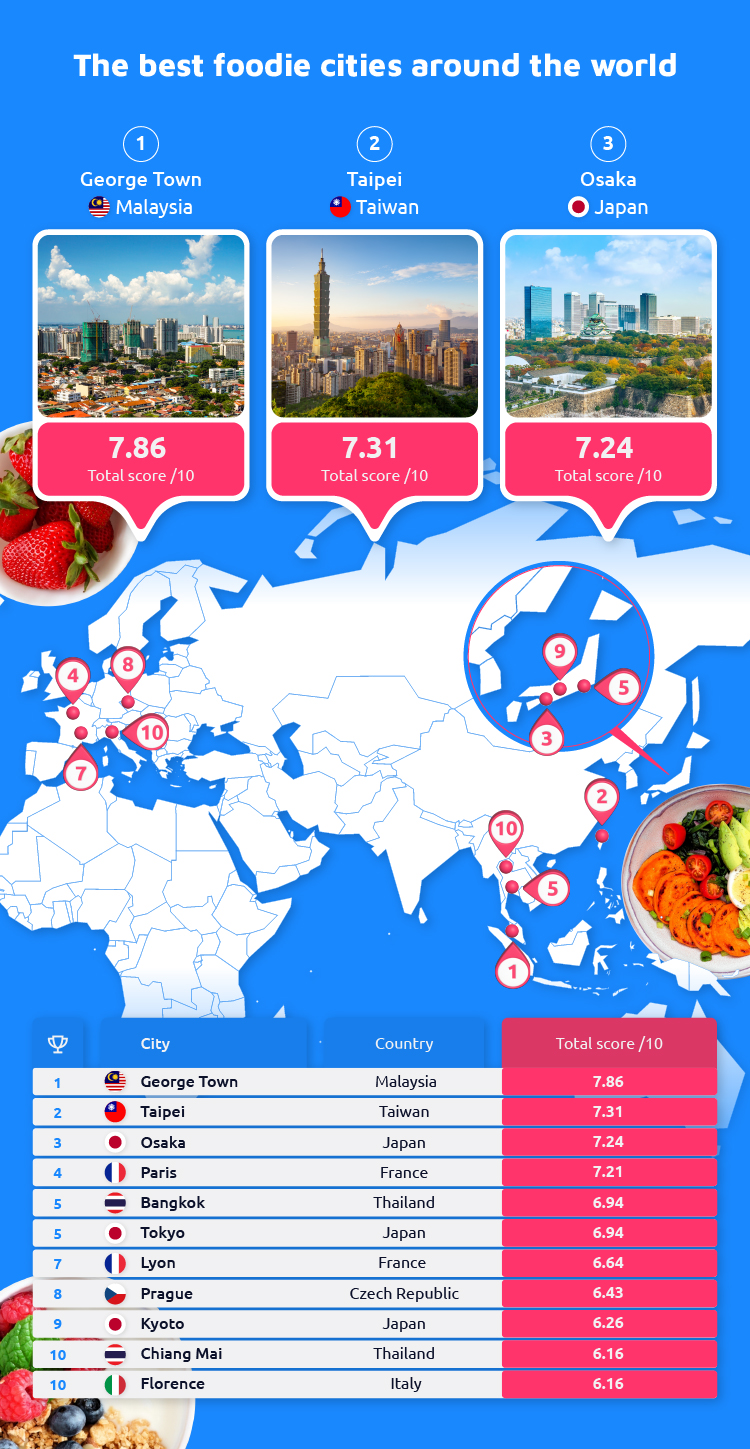
The Best Foodie Cities Around the World
1. George Town, Malaysia – 7.86/10
George Town takes the crown as the best foodie city, scoring 7.86 out of 10. The colourful, multicultural capital is surrounded by stunning colonial streets and is described as a center for vibrant culture, street art, and the country’s best street food.
Also in the top place for its wide range of affordable food spots, George Town has plenty to offer food lovers, from Michelin-starred feasts to street eats. Teksen Restaurant is a top choice, serving delicious dishes since 1965. The well-known Chinese restaurant among its locals has won the hearts of serious foodies with its traditional Cantonese cuisine infused with a local twist.
2. Taipei, Taiwan – 7.31/10
Taipei follows closely behind, scoring 7.31 out of 10. The food capital of Taiwan offers an array of things to experience and explore, from the island’s fascinating temple culture and architecture to its indulgent food at affordable prices.
Some of the best food spots for quality, flavourful dishes and good service in the capital include Din Tai Fung, which has been serving traditional Chinese dishes since its opening
in the 1980s. Another top-rated restaurant is Raw, a French-style restaurant with vibrant cuisine infused with Taiwanese flavours.
3. Osaka, Japan – 7.24/10
Described as the economic powerhouse of the Kansai Region, Osaka is a large port city known for its modern architecture, vibrant nightlife, and hearty street food. If you’re looking for some of the best food spots in Japan, Osaka has plenty to offer.
Osaka Cuisine Asai is a Michelin-star restaurant that serves various course meals made with fresh, seasonal ingredients daily. With such a vibrant food scene, it’s no wonder the popular city completes the top three, scoring 7.24 out of 10.
The Most Affordable Foodie Cities for a Quick Bite
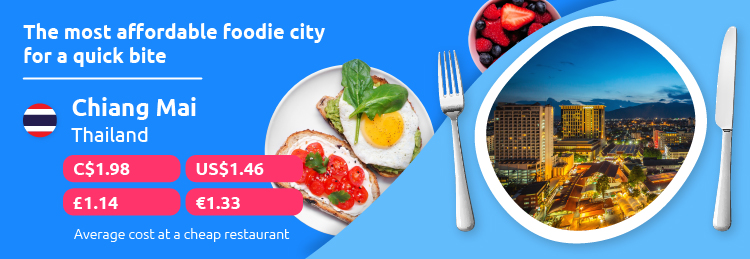
1. Chiang Mai, Thailand
Average cost at a cheap restaurant: C$1.98
Chiang Mai grabs first place as the foodie city with the most affordable meals at a cheap restaurant. On average, meals are incredibly inexpensive, costing just C$1.98. Some of the best cheap eats in Chiang Mai include The Breakfast Club, a bakery restaurant at the heart of Chiang Mai, and Tong Tem Toh, a popular restaurant specializing in Northern Thai cuisine.
The Most Expensive Foodie Cities for a Quick Bite
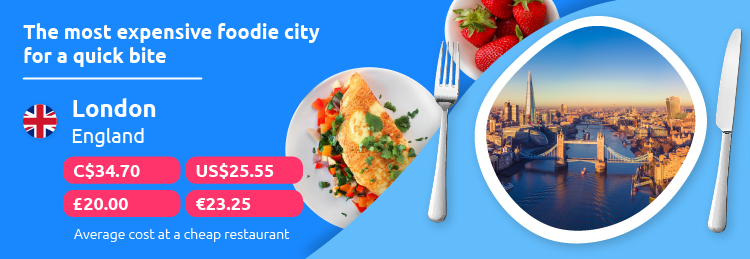
1. London, England
Average cost at a cheap restaurant: C$34.70
London tops the list when it comes to the foodie city you’ll most likely pay more for, even while dining at a cheap restaurant. The capital city harbours some of the world’s best hotels, bars, and restaurants, but sometimes at a hefty price.
With over 300 Michelin-star restaurants in the city alone, it’s no surprise London has a wide range of food hot spots that tend to be more expensive. In fact, on average, you can expect to spend C$34.70 for a meal.
Foodie Cities with the Most Affordable Mid-range Restaurants
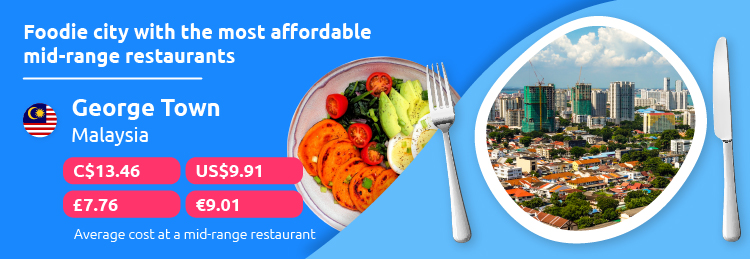
1. George Town, Malaysia
Average cost at a mid-range restaurant: C$13.46
George Town tops the list for having some of the most affordable meals at a mid-range restaurant. On average, a meal for two costs as little as C$13.46, much lower than in many other major foodie cities.
One of the most popular areas for street food is New Lane; here, you can find stalls selling everything from BBQ chicken wings to rice noodle rolls at highly affordable prices.
Foodie Cities with the Most Expensive Mid-range Restaurants
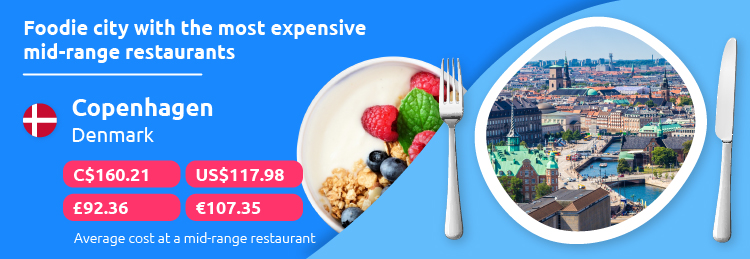
1. Copenhagen, Denmark
Average cost at a mid-range restaurant: C$160.21
Described as a classy city with many small independent galleries and cafés, Copenhagen offers diverse worldwide cuisines, from Taiwanese to Ethiopian food spots. There are also around 68 Michelin-starred fine dining restaurants within the city.
It comes as no surprise that the city is the most expensive for a meal. As a matter of fact, it costs as much as C$160.21 for a three-course dinner for two. If you’re seeking a Michelin-star experience for a moderate price, Selma is a great restaurant to experience traditional Danish lunch.
The Foodie Cities with the Most Cheap Restaurants
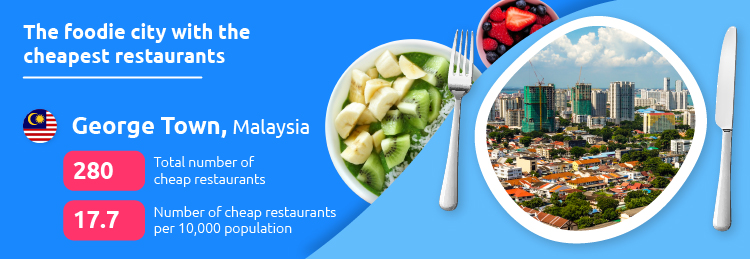
1. George Town, Malaysia
Total number of cheap restaurants: 280
Number of cheap restaurants per 10,000 population: 17.7
With many favourites, such as Siam Road Charcoal Char Kuey Teow, New Lane Street Food stalls, and the Tai Tong Restaurant, it is no surprise that George Town grabs first place as the city with the most affordable joints. There are just under 300 cheap eats to discover in George Town, with roughly 17.7 cheap restaurants per 10,000 population.
The Foodie City with the Most Mid-range Restaurants
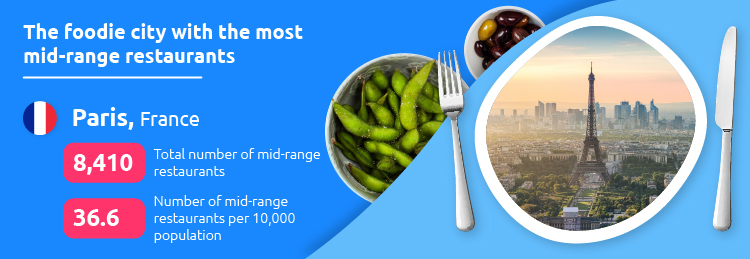
1. Paris, France
Total number of mid-range restaurants: 8,410
Number of mid-range restaurants per 10,000 population: 36.6
The capital of France and a major European city, Paris, is one of the global centers for art, fashion, culture, and, of course, food. Known for its cafe culture, there are plenty of opportunities to grab a bite.
Le Truffaut, Maison, and Le Cadoret, which serve classic French food, are just some of the hottest restaurants in Paris right now.
The Foodie City with the Most Fine-dining Restaurants
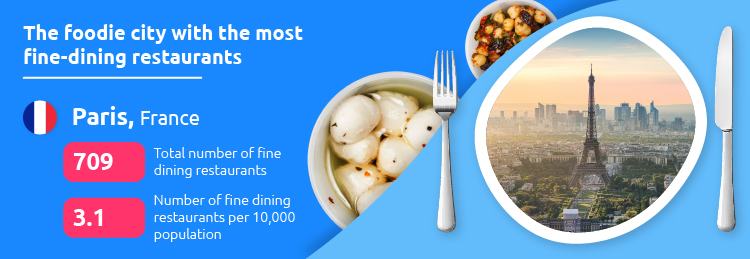
1. Paris, France
Total number of fine dining restaurants: 709
Number of fine dining restaurants per 10,000 population: 3.1
Once again, Paris tops the list for the foodie city with the most fine-dining restaurants. The city has, on average, 3.1 fine-dining restaurants per 10,000 of the population. From Odette to Atelier Maître Albert, the city has an impressive 709 fine-dining restaurants in total. This comes as no surprise as the famous capital is home to some of the most renowned restaurants in the world.
The Most Instagrammed Foodie Hotspots
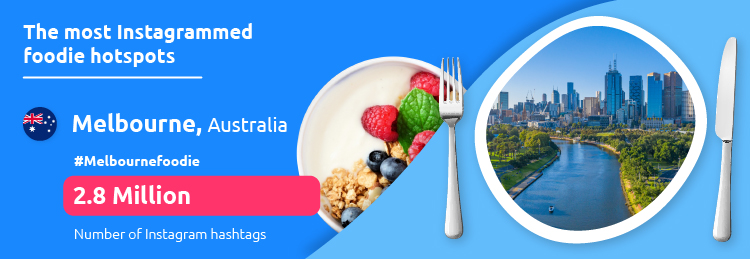
1. Melbourne, Australia
Instagram hashtags: #Melbournefoodie
Number of Instagram hashtags: 2.8 Million
Melbourne takes the crown for the most Instagrammed food spot with a whopping 2.8 million posts for the hashtag #Melbournefoodie. Some of the most Instagrammable dining experiences include Sebastian, a restaurant reminiscent of the sunny shores of San Sebastian; The Kettle Black, a café featured in Vogue Living; and Higher Ground, a one-of-a-kind location with three levels of dining space and 15-meter high ceilings.
Highest-earning Influential Foodies
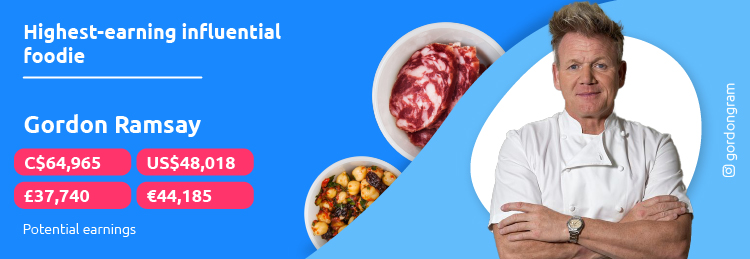
1. Gordon Ramsay
Potential earnings: C$64,965 (£37,740)
When it comes to the highest-earning foodie influencer in the world, it comes as no surprise that the British celebrity chef Gordon Ramsay tops the list with an impressive potential earnings figure of C$64,965 (£37,740) per sponsored post on Instagram.
During his career, the multi-Michelin-starred chef has opened a string of successful restaurants worldwide, including the UK, France and Singapore. Also a star on the small screen, Gordon Ramsey has been featured in shows such as MasterChef US, Kitchen Nightmares, Hell’s Kitchen, and Hotel Hell.
Thriving as one of the most famous restaurateurs today, the MasterChef has some top-tier restaurants for foodies to visit, such as the Restaurant Gordon Ramsay located on Royal Hospital Road in Chelsea, London. Holding three Michelin stars, foodies can expect nothing but the finest seasonal ingredients for the most elegant modern French cuisines.
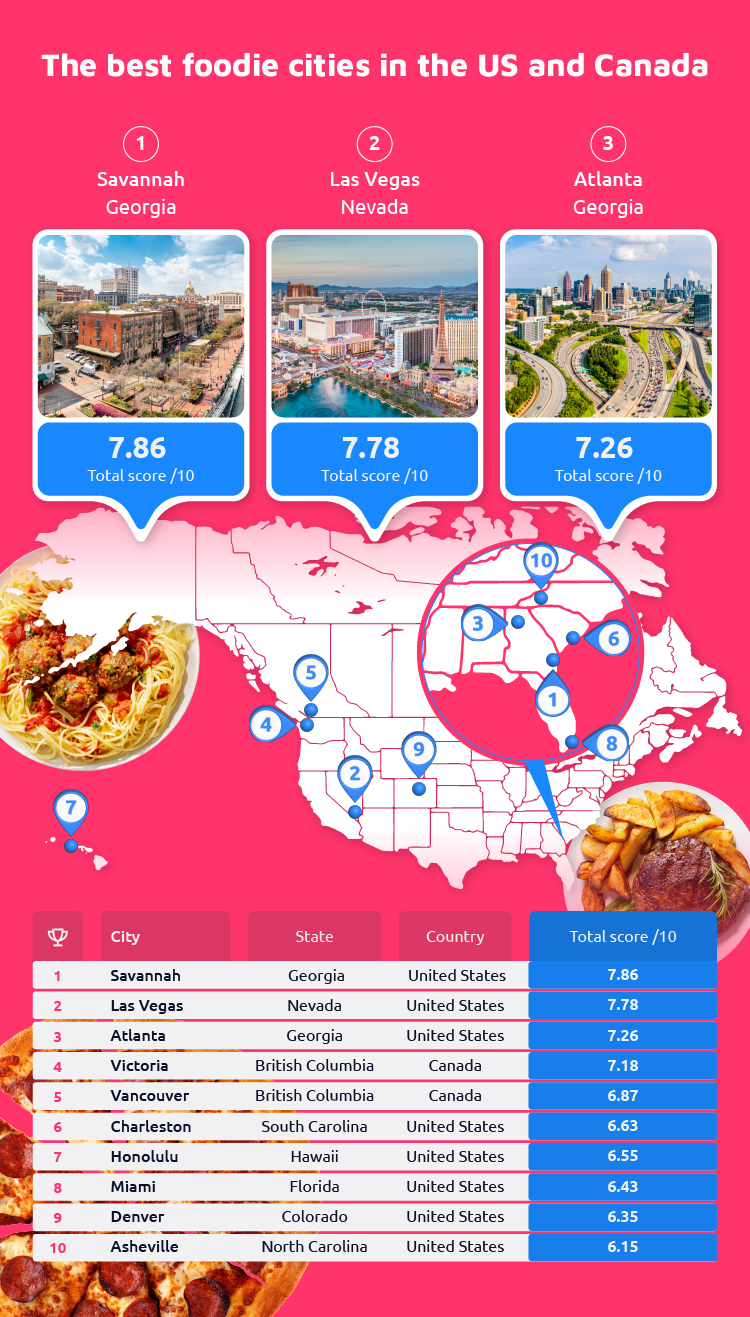
The Best Foodie Cities in the US and Canada
1. Savannah, Georgia – 7.86/10
Savannah tops the list as the best foodie city, scoring 7.86 out of 10, known for its beautiful coastal landscapes, charming architecture, and its rich, vibrant history. The city’s food scene is just as impressive. From plentiful coastal cuisines to flavours from around the world – Savannah knows how to serve a good time and a good meal.
A top foodie destination in Savannah for locals, tourists, and celebrities alike is the Olympia Cafe. After more than three decades in business, the dining establishment thrives, serving up a storm with its much-loved traditional Greek and Mediterranean menu.
2. Las Vegas, Nevada – 7.78/10
In second place is Nevada’s finest – Las Vegas, with a score of 7.78 out of 10. The food scene in Las Vegas has grown to become a so-called “Gourmet Rooms” galore hailed by celebrities.
From Bardot Brasserie to Wing Lei, the first Chinese restaurant in the United States to be awarded a Michelin star, the city has every genre of food imaginable, all at various price points.
3. Atlanta, Georgia – 7.26/10
Ranking in third place is Atlanta, scoring 7.26 out of 10. From century-old diners to award-winning eateries, Atlanta offers some of the best dining experiences in the country and is described as one of the nation’s best food cities. The city caters to all tastes and palates, whether you prefer classic southern cuisines or top-tier modern dishes.
Bacchanalia is one of the top-rated restaurants in the city, offering guests a complete dining experience. You will not be disappointed if you opt for their signature dishes or divine four-course tasting menu.
Foodie Cities in the US and Canada with the Most Affordable Quick Bites
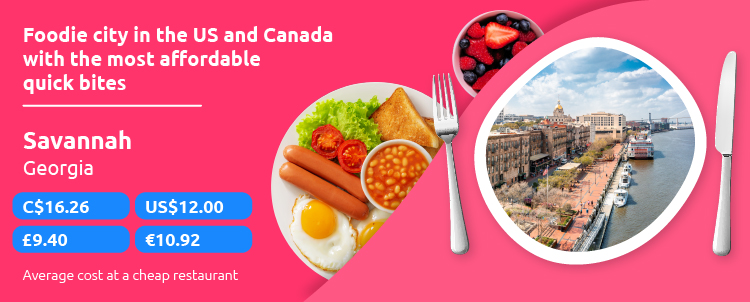
1. Savannah, Georgia
Average cost of a meal at a cheap restaurant: C$16.26 (US$12.00)
When it comes to foodie cities with the most affordable meal at a cheap restaurant, Savannah grabs first place with an average of C$16.26 (US$12.00) for a decent plate of food.
If you’re looking for a new dinner spot to try out, Savannah has an array of places to add to your list, including southern favourites such as The Olde Pink House. Whether you’re in search of classic southern cuisines such as shrimp, grits, and buttery biscuits or a plant-based brunch, you won’t run out of options.
Foodie Cities in the US and Canada with the Most Expensive Quick Bites
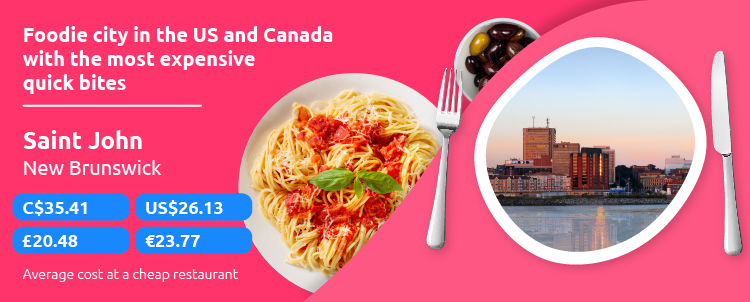
1. Saint John, New Brunswick
Average cost of a meal at a cheap restaurant: C$35.41 (US$26.13)
Home to a variety of cafes and restaurants that offer an array of colourful cuisines, international dishes, and the ultimate Canadian comfort foods, Saint John tops the list as the foodie city with the most expensive meals at a cheap restaurant. On average, you can expect to pay C$35.41 (US$26.13).
Foodie Cities in the US and Canada with the Most Affordable Mid-range Restaurants
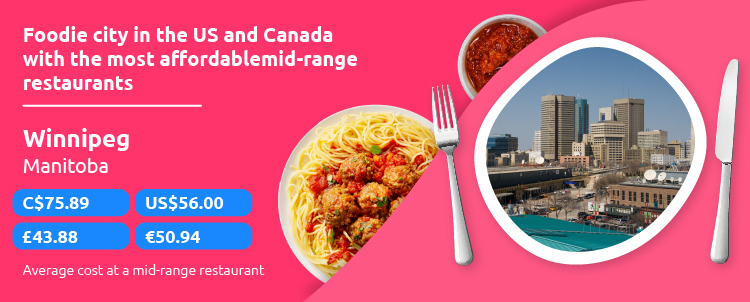
1. Winnipeg, Manitoba
Average cost of a meal at a mid-range restaurant: C$75.89 (US$56.00)
Winnipeg has many great food spots. In fact, a couple of the city’s restaurants are seen as some of Canada’s best eateries, with an average price of C$75.89 (US$56.00). If you’re looking for a trend-setting eatery in Winnipeg, Deer and Almond is the perfect blend of global and local flavours.
Foodie Cities in the US and Canada with the Most Expensive Mid-range Restaurants
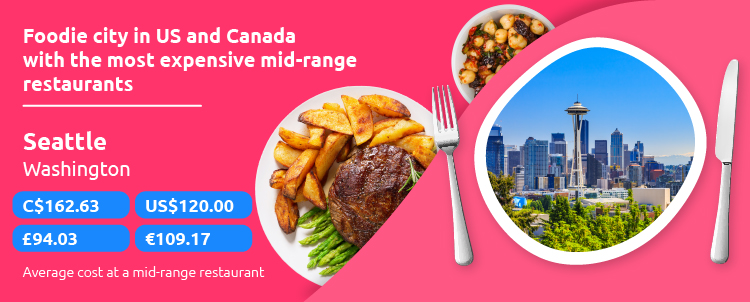
1. Seattle, Washington
Average cost of a meal at a mid-range restaurant: C$162.63 (US$120.00)
Surrounded by the Olympic mountains and evergreen forests, Seattle is a hub for many attractions, entertainment, and food and drink spots. The beautiful food scene in the city offers visitors anything from local seafood to downtown gems.
Whether you want to try classic or unique cuisine, Seattle offers it all, from Pacific Northwest cuisine inspired by Filipino-American flavours to contemporary dishes bursting with rich seasonings. However, these delicious cuisines come with a hefty price tag. The average meal cost at a mid-range restaurant in Seattle is C$162.63 (US$120.00).
The Foodie Cities in the US and Canada with the Most Cheap Restaurants
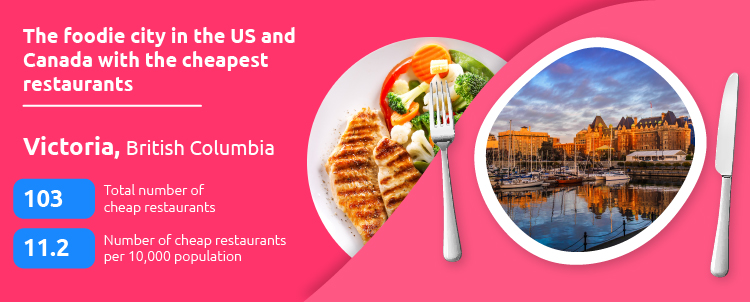
1. Victoria, British Columbia
Number of mid-range per 10,000 population: 11.2
A great place for food lovers to explore and enjoy the local culinary scene is Victoria. The Canadian city has a host of hidden foodie gems and fine dining hotspots that will leave you spoilt for choice.
The city not only has a thriving culinary scene, but it is also the top destination with the highest number of cheap restaurants in both the US and Canada, with an estimated 11.2 affordable restaurants per 10,000 population.
Foodie Cities in the US and Canada with the Most Mid-range Restaurants
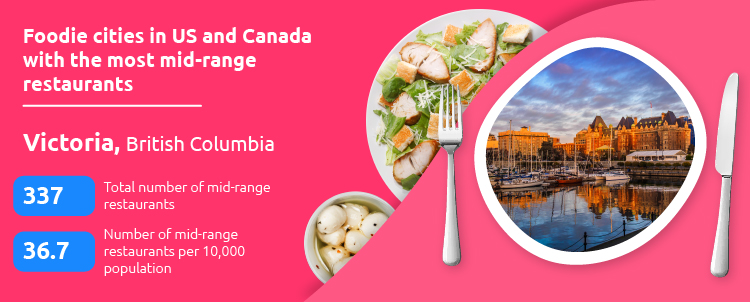
1. Victoria, British Columbia
Number of mid-range per 10,000 population: 36.7
Also the top foodie city with the highest number of cheap restaurants, Victoria once again tops the list with the highest number of mid-range restaurants in both the US and Canada.
Whether it’s mouth-watering Chinese cuisine or Danish baked goodies, the city has enough colour and flavour to satisfy culinary cravings at any price point. As a result of its large, diverse range of eateries, Victoria has approximately 36.7 mid-range restaurants per 10,000 population.
The Foodie Cities with the Most Fine-dining Restaurants in the US and Canada
1. Las Vegas, Nevada
Number of fine dining per 10,000 population: 2.3
From Michelin-starred restaurants to world-class cuisine, Las Vegas offers a memorable dining experience. The city tops the list with an estimated 2.3 fine dining establishments per 10,000.
Whether it’s indulging in traditional French fare at Joël Robuchon or immersing yourself in the mouth-watering experience of Japanese delicacies at the world-famous Nobu in Caesars Palace, even the most demanding culinary appetite is guaranteed satisfaction.
The Most Instagrammed Foodie Hotspots in the US and Canada
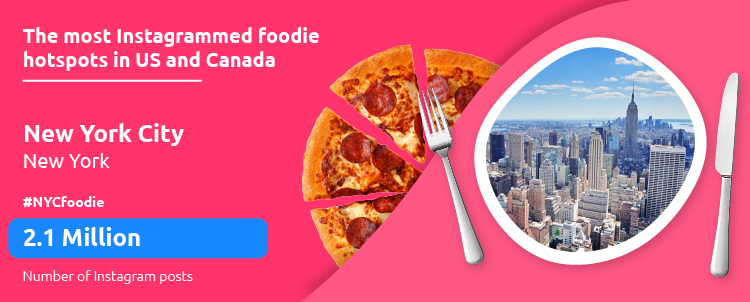
1. New York City, New York
Instagram hashtags: #NYCfoodie
Number of Instagram posts: 2.1 Million
As a city bursting with character, it is no surprise that New York City takes the top spot for the most Instagrammable dining experiences. From floral-covered interior designs to chic modern rooftops, the Big Apple really does have something for everyone.
Filled with iconic landmarks, the popular city bagged over 2.1 million posts on Instagram using the hashtag #NYCfoodie.
Highest-earning Influential Foodies in the US and Canada
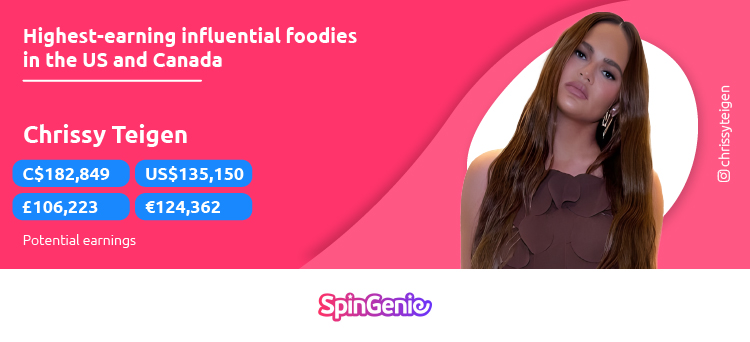
1. Chrissy Teigen
Potential earnings: C$182,849 (US$135,150)
With several best-selling cookbooks under her belt, the American model and TV personality Chrissy Teigen is crowned first place as the highest-earning foodie influencer on Instagram across the US and Canada.
The popular star has also been featured on several cooking channels, such as Cookies and Cocktails and Chrissy Teigen’s Hungry. She also launched her own cooking website back in 2019. Therefore it’s no wonder that the well-known star is estimated to make a whopping sum per sponsored post on the social media platform.
Some of Teigen’s favourite food spots include Giorgio Baldi, a popular restaurant on the Pacific Coast and Via Veneto, a lively Italian eatery in Santa Monica that combines organic and locally sourced ingredients with its creative cuisines.
Methodology
Using a list of articles such as Time Out and Luxury Columnist, we created a seed list of the top foodie cities around the world. With this list, we then used Numbeo to source the average cost of a cheap restaurant as well as the cost of a three-course meal for two people at a mid-range restaurant. Please note that each currency used was also taken from Numbeo. This data was collected on 01/08/2023.
Then, using Trip Advisor, we gathered data on the number of cheap, mid-range, and fine-dining restaurants by using the relevant filters on the site. The data collected was solely based on the number of restaurants from within each city, not including nearby areas. Data collection of this was completed on 21/08/2023.
To calculate per 10,000 population, we used City Population to search for each city’s population. We took the most current data available for each location and only considered cities with more than 50,000 population. This data was completed on 16/08/2023.
To find out which cities are the most Instagrammable, we used Instagram to search for various hashtags relating to each city e.g. #[CITY]foodie. This data collection was completed on 22/08/2023.
Using various articles from Google, our friends also compiled a list of the top foodie influencers, considering how many followers they have on the social media platform. We then calculated their highest estimated potential earnings per sponsored post by using the Instagram Influencer Sponsored Post Money Calculator. The data collection for this section was completed on 23/08/2023.
As searches for “European holidays” skyrocket by 6700%¹, a must-visit list of the best cities in Europe has been announced.
Our friends at Spin Genie analyzed the average price and the number of days it would take to view the tourist attractions of major European cities to create a list of the 11 best places to visit in Europe.
11 of the Best Places to Visit in Europe:
City
Country
Average Hotel Price (per night)
Recommended Length Of Stay
Rome
Italy
€70-€200
5-7 days
London
England
£100-£300
4-5 days
Paris
France
€100-€300
4-6 days
Amsterdam
Netherlands
€80-€200
3-5 days
Prague
Czech Republic
€60-€150
3-4 days
Barcelona
Spain
€80-€150
5-6 days
Santorini
Greece
€150-€300
3-5 days
Budapest
Hungary
€70-€150
4-5 days
Reykjavik
Iceland
€100-€200
3-4 days
Berlin
Germany
€70-€150
3-4 days
Vienna
Austria
€80-€150
3-4 days
Dom Aldworth, Head of Brand Marketing at Spin Genie says “As one of the most influential continents in the world, Europe is home to a vast range of diverse and culturally rich countries. From impressive historical architecture to quaint towns and delicious foods, every country offers travelers a unique and vibrant experience.
“Whether you want to indulge in fine French cuisine, relax in ancient baths or transport yourself back in time, Europe is the perfect place for bucket list adventures.”
Dom continued “Budget-conscious travelers will be pleased to discover that several affordable cities offer incredible experiences without breaking the bank.
“Budapest is often regarded as one of the most budget-friendly destinations in Europe. With its affordable accommodation options, reasonably priced dining choices, and inexpensive public transportation, visitors can explore the city’s stunning architecture, relax in its thermal baths, and indulge in its vibrant nightlife without straining their wallets.”
The team also named their top 5 un-missable tourist attractions.
Trevi Fountain, Rome
“One of Rome’s most famous landmarks, the Trevi Fountain is a bucket list attraction.” Dom at Spin Genie comments “Toss a coin into the stunning Trevi Fountain, one of Rome’s most famous landmarks. Admire its Baroque design, intricate sculptures, and cascading waters, and make a wish for your return to the Eternal City.”
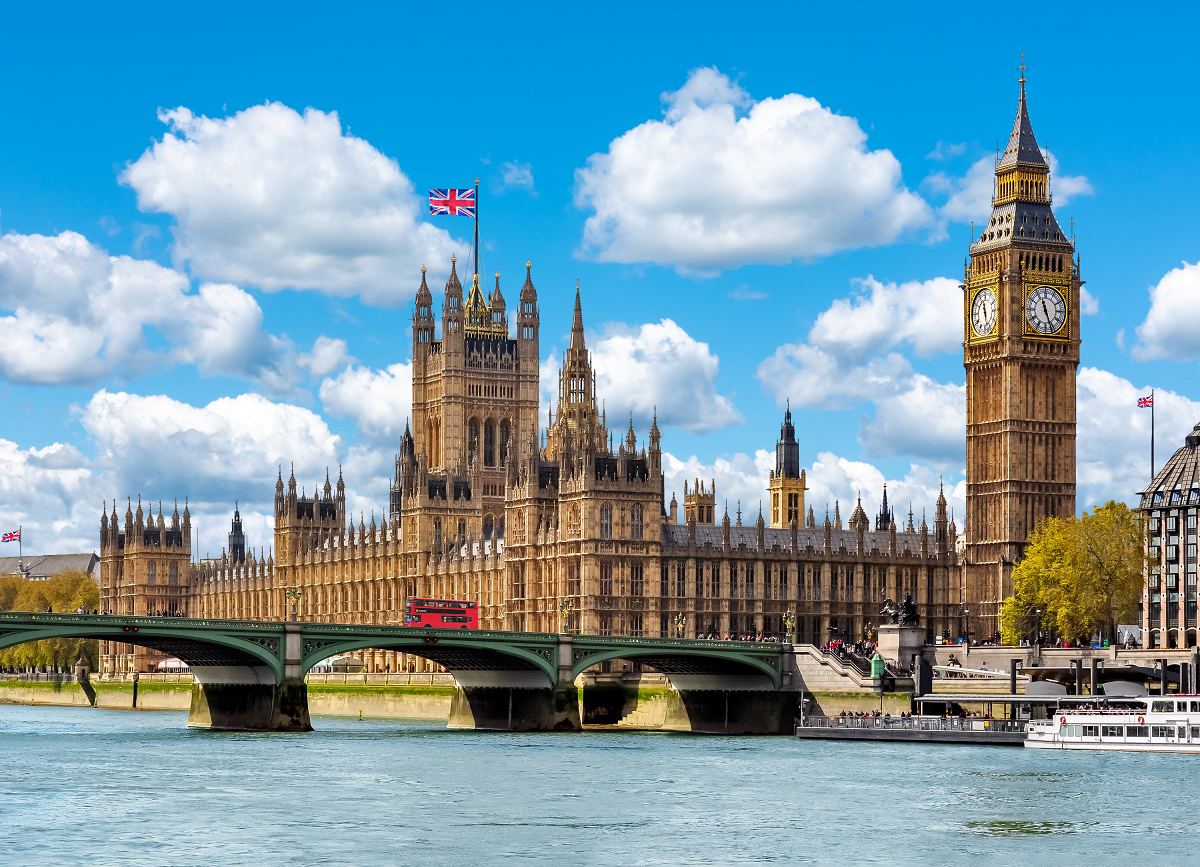
The London Eye and Tower Of London, London
London has a range of iconic landmarks, from historic buildings such as Buckingham Palace, Westminster Abbey and the Tower of London to Big Ben, Tower Bridge and the London Eye.
Eiffel Tower, Paris
No visit to Paris is complete without a visit to the iconic Eiffel Tower. Ascend to the top for panoramic city views or enjoy a leisurely picnic in its surrounding gardens.
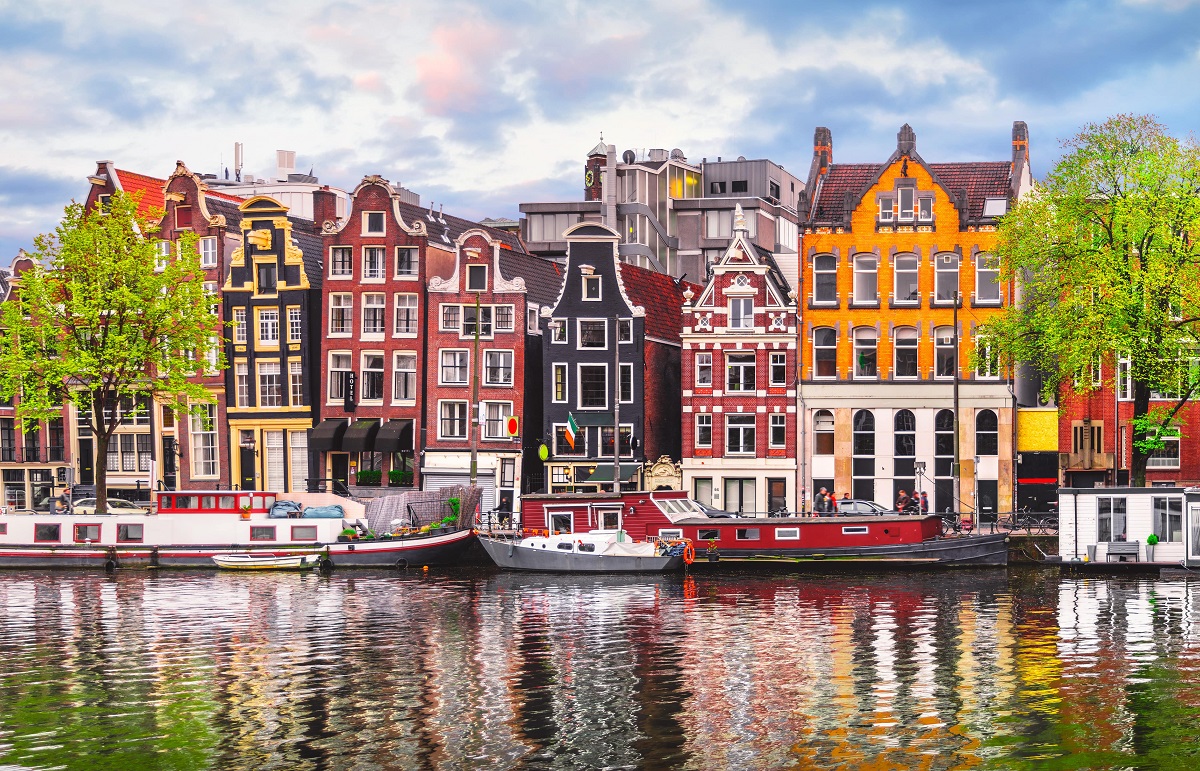
Bloemenmarkt, Amsterdam
The world’s only floating flower market, Bloemenmart is the perfect place for lovers of colour, beauty and flowers to visit. Admire colourful displays of flowers, bulbs and souvenirs and take home a piece of Amsterdam’s floral heritage.
Santorini Volcano, Santorini
Take a boat trip to Nea Kameni’s and Palea Kameni’s volcanic islets. Hike up to the active volcano’s crater, bathe in the hot springs, and learn about the volcanic geology that shaped the island.
FAQs
What are the most beautiful cities in Europe?
Beauty is subjective; however, there are a few European cities that are renowned for their beauty.
Florence, the birthplace of the Renaissance, boasts a wealth of artistic and architectural treasures. The city’s historic centre is a UNESCO World Heritage site, and attractions like the Florence Cathedral, the Uffizi Gallery, and the Ponte Vecchio showcase its artistic grandeur.
Other beautiful cities include Paris, Prague, Barcelona, Amsterdam, Vienna, Santorini, and Rome.
What are the largest cities in Europe?
The largest cities in Europe by population include Moscow, London, Saint Petersburg, Berlin and Madrid.
Moscow, the capital of Russia, stands as the largest city in Europe, both in terms of population and geographical expanse. This thriving metropolis blends a rich history with modern cosmopolitanism. From the iconic Red Square and the majestic Kremlin to the opulent St. Basil’s Cathedral, Moscow showcases a fusion of grandeur, architectural marvels, and cultural treasures
What are the oldest cities in Europe?
Europe is a treasure trove of history, and it’s home to some of the oldest cities in the world. These cities have witnessed the rise and fall of empires, the birth of civilizations, and the shaping of European culture.
Plovdiv, located in Bulgaria, is one of Europe’s oldest cities, with evidence of settlement dating back over 8,000 years. The city’s Old Town, a UNESCO World Heritage site, boasts well-preserved Roman ruins, including an ancient theatre that is still in use today.
Other cities include Athens, Rome, Cadiz, Argos, Larnaca, and Byblos.
Which are the cheapest cities in Europe to visit?
Budget-conscious travellers will be pleased to discover that several affordable cities offer incredible experiences without breaking the bank.
Budapest is often regarded as one of the most budget-friendly destinations in Europe. With its affordable accommodation options, reasonably priced dining choices, and inexpensive public transportation, visitors can explore the city’s stunning architecture, relax in its thermal baths, and indulge in its vibrant nightlife without straining their wallets.
Some of the most affordable cities in Europe to visit include Krakow, Lisbon, Warsaw, Athens and Bucharest.
What are the safest cities in Europe?
Europe is generally considered safe, but some cities have lower crime rates than others.
Zurich, Switzerland’s largest city, is often ranked as one of the safest cities in the world. With its efficient public transportation system, well-maintained streets, and low crime rates, Zurich offers a safe environment for travellers to explore its beautiful Old Town, enjoy the pristine Lake Zurich, and immerse themselves in the city’s vibrant cultural scene.
Other safe cities include Copenhagen, Vienna, Helsinki, Stockholm, Munich, Amsterdam, Geneva and Oslo.
What are the most romantic cities in Europe?
When it comes to romantic cities in Europe, certain destinations evoke a sense of enchantment and timeless love. Paris, often called the “City of Love,” tops the list. With its charming cobblestone streets, beautiful parks, and stunning landmarks, Paris provides the perfect backdrop for romantic strolls, candlelit dinners, and unforgettable moments.
Other cities include Venice, known as the “Floating City,” which is a dreamlike destination that exudes romance; Florence, the birthplace of the Renaissance, captivates with its timeless beauty and artistic heritage; Santorini, a picturesque Greek island and Prague, with its fairytale-like architecture.
These cities have an irresistible charm that evokes romance and captivates the hearts of couples seeking a truly enchanting experience.
I’m a tomato snob. I can’t help it. I’ve had the best and will never go back.
The first summery taste of a home-grown tomato, fully matured on the vine and still warm from the sun is one of the great taste pleasures of summertime. You need to experience it to appreciate it.
The poor imported supermarket version of the tomato just doesn’t compare. And in reality, it can’t. The imports are picked when they just start to show some colour, before their texture and especially their flavors have had a chance to develop. Then they travel, sometimes halfway around the world.
Consequently on the store shelves we see these hard, bland-tasting, thick-skinned things that misrepresent what a tomato could be.
In fact, modern tomato varieties are developed specifically for this kind of handling, packaging and transport. Thick skins, uniformity of size and shape are all desirable attributes to producers. Unfortunately, flavor isn’t. But we want tomatoes, so we take what we can get. However, with a little effort, we can get better. Why not grow your own? It’s easy. And why not grow specifically old-fashioned varieties? They taste a million times better than the imports and you aren’t paying for the oil to get them here.
Why I’m hooked on heirloom tomatoes.
The variety of colours, shapes, sizes, and even flavours, is almost endless. And it is a lot like collecting antiques. In my own garden experience I’ve grown everything from the marble-sized ivory-coloured White Currant to the enormous red Sicilian Saucers. The fabulous tasting Black Krim (originating from the Isle of Krim in Russia) is my absolute favourite of all tomatoes, with it’s lovely burgundy skin and marbled magenta and green interior. The appearance, flavour and variety in the heirlooms simply cannot be approached by the mass-produced types.
Though tomatoes originate in ancient Mexico, the heirlooms in my own collection were developed, some as far back as centuries ago, in France, Italy, Germany, Croatia, the Czech Republic, Bulgaria, USA, Russia, and the list goes on. Some of their names are descriptive: Black Cherry, Green Grape, Big Rainbow, Indian Stripe, the absolutely beautiful Persimmon, and the absolutely weird Purple Calabash. And some of them bear the names of their sources: Andrew Rahart’s Jumbo Red, Aunt Gertie’s Gold, Marianna’s Peace, Martha Homestead, and my favourite named – Olga’s Round Yellow Chicken Tomato – all varieties discovered and saved by home gardeners, often passed down through families for generations, and shared with friends.
And so, through the efforts of seed-savers throughout the world, the tomatoes are spared extinction and continue to be enjoyed for their wonderful flavor, but not by the masses. Only by snobs like me. And maybe you.
Rome, 17 July 2023 – In 2022, despite conflict, climate change and the continued stresses of the COVID-19 pandemic which threatened the food security and livelihoods of millions of rural people, the UN’s International Fund for Agricultural Development (IFAD) invested US$7.96 billion in rural areas in the world’s poorest countries, according to its annual report released today.
“2022 was a particularly challenging year for rural people the world over. Rural communities have acutely felt the effects of this triple crisis on their food systems, which are a critical source of livelihoods – as well as essential nourishment – for them, and for the millions of people who depend on them,” said IFAD President Alvaro Lario in the report foreword.
“We need to support rural people to cope with present crises. But we also need to invest in building food systems that can support and nourish their families and communities, and help feed the world into the future.”
The annual report captures the organization’s activities, special initiatives and new funding sources as well as impact data. Analysis of the 2022 total rural development project portfolio reveals that 90% of core resources went to low-income countries (LICs) and lower middle-income countries (LMICS). IFAD has since committed to increase that ratio to 100% going forward. Data verification also showed that more than 90% of IFAD’s climate finance is invested in initiatives that enable rural people to adapt to climate change. In addition, it showed that more than half of project participants are women.
In 2022, IFAD launched the Crisis Response Initiative to protect livelihoods and strengthen resilience in 22 countries most in need as a consequence of the war in Ukraine. It focuses on tailored interventions to prevent hunger and food insecurity arising, while supporting sustainable food systems.
In 2022, impact data reveals that between 2019-2021, as a result of IFAD’s investments: more than 77 million people increased their incomes; more than 62 million people expanded their productive capacities; more than 64 million people improved their market access and 38 million people strengthened their resilience. IFAD is the only international financial institution that systematically measures the impact of its investments.
Assessments of the Rural Poor Stimulus Facility – IFAD’s COVID-19 response initiative launched in 2020 to help people survive pandemic-caused financial losses while protecting the global food supply – showed that at least three quarters of participants maintained or increased their levels of production and income, despite the impacts of the pandemic.
“Doing more to get more finance is critical; but we also have to continue to ensure that the people who need it most are the ones who benefit. This is another part of what makes IFAD unique, and we are maintaining our commitment to devote 100% of our core funding to the poorest countries,” wrote Lario. For the Silo, Julie Marshall.
IFAD is an international financial institution and a United Nations specialized agency. Based in Rome – the United Nations food and agriculture hub – IFAD invests in rural people, empowering them to reduce poverty, increase food security, improve nutrition and strengthen resilience. Since 1978, we have provided more than US$24 billion in grants and low-interest loans to fund projects in developing countries.
The Obelisk- MacKinley Monument near Buffalo City Hall
If you’re looking for a spur-of-the-moment day trip from Niagara, Canada side, I have the answer for you.
A visit to downtown Buffalo can be your answer. It’s about an hour away nestled on the American side of the Peace Bridge and it’s a place still oozing with charm. The older downtown area offers a step-back-in-time experience. Forget the Chicken wings; the historic buildings here make a statement about style and sophistication.
Canalside Fireworks, Fourth of July, Fireworks in Buffalo NY
Cool Architecture and Art Deco Stylings
Fantastic architecture abounds in Buffalo- here is Buffalo City Hall, a fine example of Art Deco styling
Old City Hall
Start your day of exploring with a visit to Buffalo’s Art Deco City Hall. It dominates everything in the downtown area. Built during the early 1930’s (at the height of the great depression) this is a must see. The building is open free of charge Monday to Friday between 8:30 am and 4:30 pm. Take the elevator to the 22tnd floor, and then walk the stairway to the observation area. You’ll feel like you’re on top of the Empire State building in New York City. You’re rewarded with an awe inspiring view of the city, Niagara River and nearby Fort Erie. Free tours of City Hall are offered Monday to Friday at noon. Just meet in the lobby and a volunteer will put you through your paces as he or she walks and talks about the history of this Buffalo charmer. I was convinced, I was in a time warp. Docent (an American term which usually refers to a historic tour guide),
The term docent is an “Americanistic term” but has roots in the Germanic language
Rick Smyth, a retired teacher explained the meaning behind the many murals and statues that adorn the inside of the building. He said, “They tell about the friendship between Canada and the United States that has extended since the end of the War of 1812″. Niagara Square
Outside City Hall is Niagara Square .Dominating the square is a monument built to honour the memory of William McKinley, the 25th president of the United States (1897-1901) who was assassinated in Buffalo at the Pan American Exposition in 1901. If you love old architectural buildings and their history you’ve hit the jackpot. Take your pick, the perimeter of the square beckons you. All of these century old buildings have stories to tell. Escorted walking tours can be arranged at www.buffalotours.org or 716-852-3300. Lafayette Square
Lafayette Square is three blocks to the east of City Hall. It’s a park in the centre of the downtown. The block, which was once square, is lined by many of the city’s tallest buildings including the Liberty Building, and Rand Building. The Buffalo and Erie County Public Library (www.buffalolib.org) is an interesting place to explore. You can a get a first hand glimpse of the manuscripts of the Adventures of Huckleberry Finn. by Samuel L. Clemens, better know by his non de plume, Mark Twain lived in Buffalo between 1869 and 1871. The library is open daily at 8:30 am, except Sunday, free of charge. This block is surrounded by the Niagara Frontier Transportation Authority’s Metro Rail light rail rapid transit, which runs about 12 blocks above-ground along Main Street in what is called the Free Fare Zone. Try it you’ll love it. The ride really is free. Live Theatre
You’d be hard-pressed to leave this area without visiting one of the many historical theatres that offers touring Broadway shows, concerts, opera, dance and classic film series. Shea’s Performing Arts Center (www.sheas.org) on Main Street, built in the style of 1926 European Opera House, has an outstanding line-up of live entertainment. Greats like George Burns and Frank Sinatra have performed here in the past.
Find a tall building downtown (like the City Hall building) for a great panoramic look of the skyline.
Where to Eat
When the hunger pains start to come on I recommend the Spot Coffee Restaurant (www.spotcoffee.com) at the corner of Delaware Avenue and Chippewa Streets. This independently owned coffee shop is more authentic than places like Starbucks. They have good reasonably priced food and plenty of it. Uneven floors, wood tables and exposed brick make this the perfect neighbourhood eatery. They open at 7 am and close at 11 pm. It’s where I like to hang out during the annual St. Patrick’s Day Parade. The parade takes place this year on Sunday, March 18 and begins at 2pm. Downtown Parking
Street parking is reasonable here. Be sure to carry lots of American 25 cent coins to feed the $1 an hour meters. Lot parking is about $8.00 for the day. For More Information TELL ’em The Silo sent ya ;> www.visitbuffaloniagara.com or 1-800-283-3256.
Paris, June, 2023 – UNESCO welcomes Australia’s decision to implement urgent new protection measures to safeguard the Great Barrier Reef recommended by UNESCO. The measures include a ban on fishing with gillnets. The Australian government formalized its commitments in a letter addressed to Audrey Azoulay, the Director General of UNESCO this week.
“The Great Barrier Reef is a fragile jewel of world heritage. For many years, UNESCO has not ceased alerting the world to the risk of this site losing its universal value forever. We have proposed several concrete measures which provide a roadmap for tackling the problem. I am delighted that the dialogue between our experts and the Australian authorities has now resulted in a set of formal commitments,” said Audrey Azoulay, UNESCO’s Director-General.
For many years, UNESCO has sounded the alarm on the Great Barrier Reef. In 2021, with regard to very worrying data on the reef’s poor state of conservation, experts at the Organization went as far as to recommend the site was inscribed on the List of World Heritage in Danger. This warning had global resonance.
The fruits of a long process of discussion In March 2022, a UNESCO-IUCN joint mission travelled to the Great Barrier Reef in order to examine the reef in even greater detail, and to dialogue with all the relevant actors: public sector decision-makers, scientists and non-government organizations (NGOs). In their report, the experts confirmed that due to the threats posed by pollution, over-fishing and the rise in sea temperatures, the outlook for the Great Barrier Reef was worrying. UNESCO and the IUCN also emphasized that the implementation of corrective measures could significantly improve the state of conservation of the reef, listing ten precisely-defined actions the Australian authorities should take. In July 2022, Audrey Azoulay, UNESCO’s Director-General, met with the new Australian Prime Minister, Anthony Albanese and recalled the urgency of taking action. A discussion between UNESCO experts and the Australian authorities followed, with the aim of establishing an implementation plan for the ten priority measures including costs and timetable. This process has just been completed. In a letter addressed to Audrey Azoulay, the Minister of the Environment, Tanya Plibersek announced that the urgent new measures for the protection of the Great Barrier Reef UNESCO had requested, would be carried out.
Key Measures In the letter the Australian government committed notably to: Create no-fishing zones in a third of the World Heritage site by the end of 2024, and to ban gill net fishing altogether by 2027; Reach water quality improvement targets by 2025, by significantly reducing pollutant discharges from farmers and industrialists, and restoring flora and fauna in drainage basins; Set successively more ambitious CO2 emissions reduction targets, in alignment with efforts to limit global temperature increase to 1.5°C. This comes in addition to the measures already announced by the Australian authorities in recent months. UNESCO will closely monitor the effective implementation of these measures. The state of conservation of the Great Barrier Reef will be examined again by the World Heritage Committee at its 45th extended session (September 10-25, Saudi Arabia).
Residents of the City of Lahti in Southern Finland live close to nature. More than one in two live less than 300 metres from a quiet area. In Lahti, an area is defined as quiet when there are mainly natural sounds and no traffic noise, for example. Quiet places in Lahti include the extensive outdoor areas of Salpausselkä ridge system, many parks, and protected natural areas. www.lahti.fi
Inspired by the country’s highly effective deposit system for beverage containers, the Finnish city is piloting an incentive-based system for recycling textiles. Finns recycle up to 97% of aluminum cans, will a small reward inspire them to sort and recycle their old fabrics?
The average European throws away 11kg of textiles every year*. Around the world, a truckload of textiles is landfilled or incinerated every single second. Separate collection of textile waste is set to be rolled out across the EU by 2025, but to change our bad textile habits, a lot of work is needed. Lahti’s textile deposit hopes to inspire a change in consumer behavior.
“As a pioneer in urban environmentalism, Lahti has set a goal of being a waste free city by 2050. The textile deposit is a great example of an everyday innovation that directly aims to minimize the amount of waste and showcases the potential of discarded textiles as a raw material for industries and design,” says Communications Director Veera Hämäläinen from the City of Lahti.
New Waste Act promotes circularity
Finland took a step towards a circular economy for textiles at the beginning of the year, as a new law requiring cities and municipalities to make separate collection bins for textile waste available to all Finns came into effect. The separate collection of textile waste makes it possible for discarded clothes and household textiles to be reused as recycled fiber.
“Our future depends on a circular economy, but it can’t just be the consumers’ responsibility to take care of recycling. With this pilot we want to ask what countries, cities and companies can do to help make recycling easier and more attractive to people. Deposits have worked well before, maybe there could be one for textiles in the future”, says Kimmo Rinne, Development Manager at Salpakierto, a municipal company that handles waste management in the Lahti Region.
The textile Deposit asks if an incentive can inspire locals to recycle
The pilot on a textile deposit aims to investigate if a citywide reward system can incentivise locals to recycle their textiles. At the pilot stage, Lahti residents can exchange a bagful of textiles for vouchers for local services, such as cafes or passes to a local pool. Initially, the pilot will run during the first weeks of June. Cities have a major role in making recycling easy for people. As a leading environmental city, Lahti wants to be in the forefront of leading the conversation on how cities can lead the change into a more sustainable lifestyle.
The City of Lahti is also launching a national design competition that aims to find new and creative uses for discarded textiles. The competition runs from now to 13 August 2023. With the design competition Lahti wants to promote innovation and entrepreneurship in the field of circular economy. The competition is organized in collaboration with the Sustainable Lahti Foundation, LAB University of Applied Sciences and Salpakierto.
The textiles collected in Lahti will be processed into recycled fiber at Finland’s largest textile processing facility in Paimio. In the spirit of circular economy, the recovered fiber can be used in the production of new products, such as thread, insulation materials and acoustic panels. For the Silo,Veera Hämäläinen.
Lahti Lahti tackles future challenges together with residents, companies and the educational sector. A sustainable future calls for action, which is why Lahti will achieve carbon neutrality by 2025. As the leading environmental city in Finland, we offer our citizens everyday life that is both smooth and sustainable.
Our planet is incredibly beautiful! On every continent, even on the tiniest island lost in the vast ocean, there are striking places, meeting which leaves a long-lasting memory. Gritty fjords and impregnable cliffs of northern cities, idyllic corners of tropical coasts, clouds on the tops of mountains and flowing rivers in deep canyons, man-made and natural monuments will bring even more positive emotions than generous casino offers. Everyone is sure to find their paradise on earth. And you don’t always have to go far away – often there are places of fabulous beauty right next to us, if you only look around.
Jaisalmer
The golden city of Jaisalmer is often ignored by travelers because of its remoteness. But once you visit this place, you will not be able to forget it. It is an exotic city in the great desert of Rajasthan. It has incredible architecture, craft shops and of course camel rides in the silent desert.
Amazon
The most full-flowing and one of the longest rivers on the planet was named one of the Seven Natural Wonders of the World in 2011. The Amazon and the rainforest along its course are populated by many rare plants, animals and fish, many of which are relict or endangered.
Fez
Morocco is an inexpensive version of an oriental fairy tale. And Fez is the second largest city, home to palaces, old markets, and quaint cafes serving Moroccan mint tea with local pastries.
Schloss Neuschwanstein
When the impregnable Neuschwanstein was built in the south of Germany in the 19th century, it immediately became a magnet for all those seeking peace and security. Its fabulous outline became the prototype of the palace built in Disneyland, where Sleeping Beauty lived, fell asleep and then met her love.
Windhoek
If you have always dreamed of seeing Africa’s “rusty” deserts and animals in their natural environment, now is the time. Unlike other parts of Africa, Namibia has many safaris. It is home to many African animals: giraffes, rhinos, cheetahs and elephants. It’s also a low-cost place.
Antarctica
Antarctica is an amazing continent. It’s the coldest, even though it’s at the South Pole. Relative to the World Ocean, Antarctica is elevated more than other continents, it has the lowest relative humidity, the strongest and longest wind blows and the most significant solar radiation. At first glance, this is a harsh land consisting solely of ice. But it is not! Here you can find algae, mushrooms and even flowers – isn’t it an occasion to see it all with your own eyes!
Mostar
Mostar is an ancient city and untouched section of the Ottoman Empire. The place is unique in that it coexists two different cultures (Europe and Asia), two religions (Islam and Christianity), and connects them by a medieval arch bridge (Star Most), the history of which is as unique as the city.
Montenegro
Travelers who decide to come to Montenegro will be greeted by massive mountains, ancient Roman villas, clear waters, and incredible scenery. In addition, there are chic Adriatic beaches in Budva, Becici and on the Island of Sveti Stefan. And also the famous spa resorts of the Bay of Kotor. For the Silo, Batya Gill. Featured image: Jaisalmer India Desert City
It is late and you are on your way home, but there is no open store to get something to eat – does this scenario sound familiar?
Or it’s maybe early in the morning and you just pulled an all-nighter and you can hear your stomach making noises… Or you may be out in the middle of the street after your work and you forget to eat, and you are starting to feel dizzy.
Is this something that you can relate to? If yes, you know that you need to think about your diet.
It is easy to forget to eat when you have a busy day, especially when you are on the run with no store or restaurant around.
This is why strategic snacking should be part of your daily routine. If anything, you should think of snacks as something that literally saves your life when you are super hungry.
Let’s see how you can also have a delicious and easy-to-carry snack with you no matter the time of the year.
Drink Your Snack
Snacks should be healthy.
Yes, this may be easier said than done, but with so many options on the market, you can actually have a healthy snack.
For example, you don’t have to buy industrial pretzels if you can carry an apple with you, right?
Still, if even bringing an apple puts you under a lot of stress, you should think about an even easier solution, such as a drinkable yogurt: this sort of snack is a great source of lean protein, usually packed with vitamins and minerals such as calcium and vitamin D, packed with numerous flavors from banana to peach.
The great thing about drinkable yogurt is that you can mix it with other ingredients such as oats or use it as a dressing for your fruit salad. Fast and healthy!
Cheese And Whole-grain Crackers
Cheese and whole-grain crackers are a great snack idea if you want something that is easy to pack but enables bigger bites.
This is something that you can bite throughout the day and even use as an addition to a salad.
Spread cheese across crackers and you will have a quick snack in no time.
Beef Jerky
You cannot pull an entire day without meat? If so, you should plan ahead and think about having a meaty snack on you, such as beef jerky.
This is something that is a mandatory part of every road trip, but it can serve while you are at work as well.
Beef jerky is packed with protein, and as such, it is one of the best food items to keep your hunger under control.
If possible, choose organic, and grass-fed beef jerky from a local store, and avoid shopping for beef jerky from the gas station.
Did you know there are even tasty vegetarian jerky options?
You’ve got many snack choices to choose from once you start dealing with preparation.
In no time, you will discover that there are many food items that you can carry with you easily, throughout the day and eat as you go.
A little prep will be needed, but it’s nothing you won’t be able to handle.
Valtech, a global business transformation agency, is proud to announce the launch of its interactive experience at C2 Montréal designed to raise awareness among attendees about digital sustainability and help them take informed action for a more sustainable future.
The Fairmont- Queen Elizabeth Hotel downtown Montreal where C2 will be held this year.
Digital sustainability is about taking action to reduce the environmental impacts of digital technologies. As a practice it aims to make digital products and services more energy efficient via sustainable design and development practices, as well as ethical approaches to data collection and usage.
Image via inhabitat.com
Valtech’s onsite, interactive experience at C2 Montréal next week will enable organizations and individuals to measure the carbon footprint of their websites and receive practical solutions to minimize their CO2 emissions. It will provide concrete examples to help participants better understand digital sustainability and effectively reduce their carbon footprint.
One of Valtech’s main objectives is to draw attention to the significant contribution digital technology makes to greenhouse gas emissions.
“We are all part of the solution to decarbonize the planet,” said Damien Lefebvre, Executive Vice President of North America at Valtech. “We can and must significantly reduce the energy consumption of digital assets. Our ambition at C2 Montréal is to raise awareness among all stakeholders operating in the digital space, as well as Environmental, Social, and Governance (ESG) officers at companies across industries.”
Damien Lefebvre
Valtech currently conducts digital carbon audits for interested clients. Those audits include industry-leading recommendations to improve site performance, increase customer loyalty, and reduce hosting costs, electricity consumption and carbon footprints.
If you are onsite at C2 Montréal, come try out the experience- the Valtech team will be located on the third floor of the Queen Elizabeth hotel. Tell ’em The Silo sent you.
Vacationers booking holidays through Canadian websites are being charged hundreds of dollars more than overseas customers for exactly the same deals, research commissioned by cybersecurity company NordVPN reveals.
From luxury breaks and hotel stays to car hire, consumers are frequently being presented with wildly different prices depending on where they log on.
Using the American website for Hotels.com resulted in a staggering $805.55 saving for a 7-night stay, while hiring a vehicle through the Italian server resulted in a quote 25% cheaper than the Canadian site.
NordVPN’s researchers used its Virtual Private Networks (VPNs) to make it look to websites like they were not in Canada. They discovered savings across a range of well-known travel sites like Hertz,Expedia, Booking.com and Sixt, for a variety of countries, including Italy, Mexico and the US.
What is a VPN? A VPN disguises your IP address, while improving privacy and security. You select a country and NordVPN ensures that’s where websites think you are. VPN users are then able to see the differing content — and prices — shown to overseas consumers.
Using a VPN, a 7-night stay this August at The Gates Hotel South Beach in Miami, Florida, through Hotels.com revealed a $805 price difference for a family of four. The Canadian website quoted $3,086 and the American site $2,280 — less than a sixth as much. Visiting the website from Italy netted a 22% saving on a 7-night family stay at Venice’s Antony Palace Hotel in August — $376 off the Canadian price of $1,732.
For those visiting the French Riviera, an exclusive 7-night stay in Hotel Casarose in August would cost 16% less using the French version of Hotels.com website, lowering the price from $4,363 to $3,656.
Fans of the UK royal family planning to stay near Kensington Palace could save 13% by using the English Booking.com site, reducing a week’s stay in August at the Twenty Nevern Square Hotel from $4,260 to $3,715.
Going to Booking.com from a French server led to a $1073 lower price on a 7-night vacation at the Hôtel Alfred Sommier in Paris in August — bringing the cost down to $8,922. Meanwhile, using an Italian server to search the Rentalcars.com website for car hire in Rome quarter (25%) cheaper than the same company’s offer to Canada-based consumers.
Browsing for more summer hotel deals using the Mexico website of Expedia uncovered a 22% saving for a week break in Cancun at El Taj Oceanfront & Beachside Condo Hotel, leaving bookers $614 better off.
Looking at car hire deals from Hertz through the UK’s website, you could bag a 23% saving — $345 — on a 7-day hire of a Polestar at Edinburgh Airport in August, bringing the price down from $1,482 to $1,137. Using Sixt to book a rental from the Nice Airport in August, this time with Sixt brought up a 13% discount of $92 for hiring a Peugeot 208 for 7 days, making the French server price $650 versus $742.
Also, Sixt quoted a price that was 16% lower for a Jeep Grand Cherokee in Orlando, Florida via the US website for July — charging $867, a saving of $164.
Visiting Sixt from France delivered the 11% discount, with a 7-day hire of a Tesla Model Y from Paris Charles de Gaulle Airport offered for $1038, $122 less than the Canadian website’s quote of $1160.
The research was commissioned by NordVPN and conducted by an external company between March 10th and 31st, 2023. Simultaneous searches were made for identical products being sold by the same vendor using numerous country servers.
When conducting the research, there were cases when prices offered to consumers in different countries were similar. However, for illustration purposes, this article and table present the biggest differences in price.
Table: Cost of items booked through Canadian versus local websites
7 night stay in the (5 star) Hôtel Alfred Sommier, Paris, France in a two connecting double room.
August 14-21
March 30
$9,996 (inclusive of additional taxes)
$8,922.68
$1,073.32
11%
Source: NordVPN
Marijus Briedis, Chief Technology Officer at NordVPN, said: “In the internet age it’s never been easier to hunt for a vacation, and you can have all the elements — from car hire to hotel stays — arranged at the click of a mouse.
“For the unsuspecting consumer there’s a price to be paid for these advances. Online tracking used by travel websites means that they can tell what holiday we’re looking for before we do, while algorithms can adjust holiday prices to the spending power of different countries.
“Never assume you’re getting the same deal as everyone else. Your location, the number of visits you pay to a website, and how your search fits in with the school holiday schedule, can all influence the price you’re offered.
“The best way to fight back is to shop around with the same provider using a VPN and see if you can find hidden savings offered to customers overseas. As our research shows, it could save you thousands of dollars a trip.”
How to save on holiday bookings with a VPN
There’s no need to overpay for a holiday abroad. Using a VPN can save you a lot of money – and it’s easy to get started.
Make sure you choose a reliable VPN provider that takes your privacy and security seriously. Though looking for a free option may be tempting, it’s best to stay clear of free VPNs. Here’s how to save on holiday bookings with a VPN:
Get a VPN subscription. If you’re interested in NordVPN, you’ll find our subscription plans here.
Launch the app and enter your credentials to sign in.
Pick a server in a country of your choice, and connect to it.
Head to the provider websites and note down the prices.
Repeat this process with several server locations to find the best price. We also recommend clearing your browser’s cache before returning to the site so it doesn’t identify you as a returning user and impact the price you’re shown.
Even though this process might take a little longer than you’re used to, you’re likely to find some great deals to make it worthwhile. This method will work for finding cheaper flights, hotels, car rentals, and even general online shopping.
While choosing popular cities to travel, the obvious choices are always Rome, Berlin, Barcelona and London, but how about those ‘alternative’ cities you may have never thought of or come across? That is where Munich, Germany comes in.
Nestled in the heart of Munich, Hotel Bayerischer Hof is one of Germany’s most historically important hotels, renowned for its timeless elegance and world-renowned design partnerships.
The aura of royalty is imminent as soon as one steps foot into the hotel. The property’s renowned collaboration with Belgian designer Axel Vervoordt, a global tastemaker, is designed with full picturesque and captivating minimalist interiors.
The unveiling of the art dealer, curator, designer, and antiquary Vervoordt’s latest revamp has transformed a section of the hotel into an artistic wonder– harmoniously mixing old and new, creating a design aesthetic that is hugely influential in Germany. He counts royalty within his clientele, with a nod to celebrities like Kanye West, Robert De Niro, and Calvin Klein.
Vervoordt’s collaboration with Hotel Bayerischer Hof is nothing short of incredible.
The Penthouse Garden Suite, Atelier, Garden restaurant, Cinema Lounge, and Palaishalle all bear the designer’s characteristic artistic touch. The new wing embodies a captivating minimalist design that is both modern and timeless in the same beat. Vervoordt’s talent helps the property keep in step with the ever-changing expectations of the hotel industry and attracts discerning guests who appreciate design that cleverly combines the present and the past.
Founded by female entrepreneur and owner Innegrit Volkhardt, who is dubbed “one of the most renowned hoteliers in the world,” her family has owned the Hotel Bayerischer Hof for over four generations, so the blood runs deep. The hotel recently celebrated 125 years of ownership. Volkhardt, a true Bavarian local, has immaculately maintained the hotel’s legacy while successfully integrating new design collaborations like that of Vervoordt.
Tucked away within the elegant shopping district, the hotel is near the city’s must-see attractions, including the Marienplatz, Viktualienmarkt, and the Hofbrauhaus, a fun and traditional beer house with live music (apparently it’s where the Nazis used to meet).
One can even say that you don’t need to leave the hotel, with a full service spa, a tiki bar underground, a glorious dome-shaped bar and networking area, a ballroom, and best of all, dinner at The Garden. The restaurant offers fan favorites like a goat cheese, fig and cottage cheese salad, as well as filet mignon with a side of spinach and potatoes. A sweet finish with a trio of sorbets to cleanse the palate and keep it light.
Hotel Bayerischer Hof boasts over 300 luxurious rooms and suites that capture its deep history, blending luxury with design.
The collaborative designs of Axel Vervoordt have played an immensely significant role in helping the hotel innovate and evolve without losing the essence that has made it a Bavarian favorite for 125 years. If you’re looking to indulge in an unforgettable experience, Hotel Bayerischer Hof is undoubtedly one of the best options in Munich. For The Silo, Ellie Ross.
Every year the landowners of Ontario’s watershed areas collectively plant tens of thousands of trees. These trees help to restore the natural environment by protecting water quality in streams and rivers, providing wildlife corridors and purifying the air we breathe.
Unpredictable weather patterns mean it is even more important to keep planting trees. A number of crucial steps before and after planting will improve survival.
Right tree, right place
Factors such as soil texture, drainage and surrounding vegetation determine which tree species will thrive or die. Fine clay soils can hold trees like white cedar and Norway spruce. On the other hand, loose sandy soils are well suited to white pine and sugar maple. Silver maple and tamarack like wet sites, while larch and red oak will thrive in drier locations.
Road salt can contaminate the soil, but trees such as white spruce, larch and poplar have a higher tolerance for salt and these species are best for roadsides.
Site preparation
European buckthorn – Rhamnus carthartica
Preparing the land before planting will provide the best growth conditions for your trees. Clear areas of brush and invasive plants, such as European buckthorn. On larger sites, this can be done with a brush saw or a tractor and rotary mower to remove obstacles and provide growing space. Installing plastic mulch before tree planting is a great way to reduce weed competition and hold moisture in the soil. If planting into bare soil, seeding a cover crop of Dutch white clover is a great way to prevent excessive weed growth.
For the first years, control vegetation around the trees to make sure they have room to grow. This will give the trees the best chance of survival.
Click me to learn about Tree Planting incentives 🙂
Get trees into the soil quickly
The roots of bare-root stock (without soil around the roots) will dry out very fast when exposed to sun and wind and need to be planted very quickly. Keep these trees in their planting bag until they are directly planted into the ground. Potted trees can be kept in a shaded area and watered until they are planted.
Mulch madness
Mulching is one of the best ways to keep your trees growing well. Organic matter applied to the base of the tree acts as a blanket to hold moisture, protect against extreme soil temperatures and reduce grass competition. Make sure to place mulch in a donut shape around the tree, so that absolutely no mulch is touching the base of the tree. This can cause decay of vital root-collar tissue. A two to four inch layer of mulch at an inch or two away from the trunk is enough.
Water, water, water
For the first few years of growth, a tree expends a lot of energy trying to establish roots in the soil. Watering can be very important during this time if rainfall is sparse. Water the tree right after planting and weekly during hot, dry weather. But be careful not to over water, because soggy soil inhibits the tree roots from accessing oxygen. There are many circumstances when watering is difficult due to distance from a water source or the number of trees planted. For the Silo, Lisa Stocco.
Colorado’s mountain towns are known worldwide as an incredible wintertime paradise for skiers and snowboarders, but in summer, the same high-altitude ski towns become gorgeous playgrounds for outdoor adventure and family fun.
When the powder melts, popular slopes turn into verdant hiking and mountain biking trails and nearby rivers and lakes rise to new levels, ideal for fishing and boating. Colorado’s ski towns are not just about communing with nature — there is plenty for those who prefer less of a workout. The summer months welcome dozens of festivals celebrating music, food, art and more. From luxurious Aspen to historic Durango, take a look at some Colorado ski towns that shine in the summertime.
Sun salutations in Aspen
Head to luxurious Aspen for a total mind, body and spirit retreat this summer. Enjoy the fresh air and valley views with a session of mountain-top Hatha yoga at 11,000 feet, then cap off your mountain getaway with a mind-blowing body treatment at Remède Spa at the St. Regis Aspen, voted #1 spa in the world by Travel + Leisure.
Travel back in time in Durango and Silverton
The Durango and Silverton Narrow Gauge Railroad winds through the same tracks settlers of the Old West took over a century ago. Today, tourists climb aboard the historic locomotive for a 45-mile trip through the still-wild San Juan Mountains to Silverton, where they can lunch and shop before re-boarding for the trip home. The train climbs nearly 3,000 feet to Silverton and the high mountain air will be on average about 10 degrees cooler than in Durango, so remember to pack layers and drink plenty of water before this high-altitude ride.
Go local in Breckenridge
Head to local watering hole Breckenridge Brewery & Pub for spectacular views of the surrounding peaks, a relaxed patio atmosphere, refreshing beer and delicious Colorado comfort food. Located in the charming and historic mountain town of Breckenridge, this favourite hotspot is worth traveling for. Since 1990, local Breckenridge Brewery has grown into one of the most successful craft beer and restaurant companies in the USA. After dessert, stroll down quaint Main St., catch some live music and shop-till-you-drop at some of Colorado’s best local boutiques.
Fill your creel in Steamboat Springs
The Yampa River begins in the Flattops Mountain Range and moves through downtown Steamboat Springs, providing easy access to almost endless flat-water. The river is one of the best northern pike and smallmouth bass fisheries in the U.S., so warm up the BBQ and cast your line. Excellent fishing opportunities can also be found in one of the most plentiful trout fisheries in Colorado just upstream from Yampa River State Park.
Two-wheel adventures in Keystone
Nestled between three mountains, Keystone is perfect for summer visitors looking for a world-class mountain biking adventure. Keystone Bike Park is the ultimate mountain-bike destination, offering 57 trails across 88 kilometers of terrain. The infamous Drop Zone, rated one of the best in the country, has progressive terrain for all riders. With rock gardens, drops, and high-speed features there is never a dull moment on your bike. There are also more than 100 miles of single track for touring. Or, for a more relaxing afternoon, take a cruiser ride or road bike along miles of paved bike path. Have I missed one or two other attractions that are must-see-must-do? Drop your ideas in the comments section below. For the Silo,Melissa Medeiros.
Forget about the recent media bashing. Niagara Falls is only a tourist trap in the sense of its awesomeness. How can anyone resist visiting? With that truth in mind, new research has revealed that Niagara Falls is the 4th most popular filming location in the world, having played a starring role in 143 films, including appearances in Pirates of the Caribbean and Superman2 (1980).
Giggster- a film location service, has revealed the most-used filming locations around the world, the locations that have the highest-grossing films, and the countries that have featured in the most movies. So, how does Canada fare?
Thor. Old Royal Naval College location London, England.
💰Niagara Falls is the sole location used in Canada from the study – featuring in 143 movies, with an average box office gross of $212,260,000 usd / $274,667,624 cad from its top-three films but so has Toronto (David Cronenberg’s 80s horror masterpiece The Fly) , Vancouver and Montreal as well as the Eastern and Western Provinces have also been featured in Hollywood films.
The research has also revealed:
🗽Central Park in New York is the most-used film location in the world – featuring in over 352 movies.
💵 The Griffith Observatory in Los Angeles is the highest-grossing filming location on average ($253,366,667 usd / $327,860,268 cad ).
The Griffith Observatory was also seen in the Disney cult favorite The Rocketeer.
🎥 The top 3 countries featured in the most movies are, The United States, The United Kingdom and Canada.
US locations featured in over 900 more movies than any other country; The states featured most are New York, Arizona and Massachusetts.
More often than not, all our museum experiences are quite similar. We see some art or historical artifacts, learn about a subject, and sometimes listen to a lesson during a tour.
And while every museum is invaluable, sometimes the heart wants something quirkier and unusual. Evidently, many people had the same sentiment because if you really look, you’ll find some incredible gems in the world of museums.
Here are the world’s weirdest museums you must visit.
Momofuku Ando Instant Ramen Museum, Osaka, Japan
Ramen is synonymous with Japan, so no wonder there is a museum dedicated to it! Momofuko Ando, the Taiwanese-Japanese inventor, invented Chicken ramen noodles in his backyard shed in 1958.
The Momofuku Ando Instant Ramen Museum shows this Japan’s cult food that went global by displaying ramen noodle packages from around the world and giving the opportunity to taste limited-edition ramen from Hokkaido island and Tohoku region. Visitors can also design their personal soup packet at the “My Cupnoodles” Factory.
Spy Museum, Washington DC, USA
Love spy movies or novels? Then this museum is for you! International Spy Museum in Washington DC has the largest public collection of espionage artifacts that includes various gadgets, cameras, secret weapons, cipher machines, and counterfeit money.
It’s a rare chance to take a look at this secret profession and see how it’s developed over the years.
Museum visitors can participate in interactive spy adventures, watch never-seen-before videos of spies and revel in the impressive photo collection. And who wouldn’t wish for a super-gadget that would help make life easier, to help you in high-stakes situations like basketball betting on BetAmerica.com?
Sulabh International Museum of Toilets, New Delhi, India
Roughguides.com names the Sulabh International Museum of Toilets, New Delhi, India, which shows the history of hygiene and sanitation from 2500 B.C. to today, as one of the weirdest museums a person can visit.
The visitors can see the toilet evolution over the ages – from Roman emperors’ gold-plated toilets to medieval toilets of peasants. A fun fact – you can find a collection of rare toilet poems in the museum as well.
British Lawnmower Museum, Merseyside, England
Can there be something more British than a Lawnmower museum? If you’re a garden enthusiast or simply like quirky things, you must visit the museum, which details this garden tool’s history.
You’ll find such items as the lawnmowers of Prince Charles and Princess Diana or the world’s first solar-powered robot grass-chopper in the collection. Probably the cutest lawnmower at the museum is less than five centimeters high and is fully functional!
Siriraj Medical Museum (Museum of Death), Bangkok, Thailand
If it sounds scary, that’s because it is. Even though officially named a Medical museum, most people call it simply the museum of death. If you’re squeamish or find the subject distressing, it’s probably best to skip this one.
You’ll find severed and mutilated legs and arms, brains, skulls pierced with bullets, lungs that have been stabbed, and other similar things in the collection. They all illustrate the dark and gruesome ways to transition to death and leave no one indifferent.
If that’s not enough, you can also see the mummified body of a notorious cannibal Si Quey and the museum’s founder’s skeleton.
The Museum of Broken Relationships, Zagreb, Croatia
It is just as sad and beautiful as it sounds. It started as a joke by two Croatian artists who broke up after a long relationship and said they wanted to create a museum to honor it. Well, they did, and it blew up all over the world.
You can see various mementos from people’s relationships in different countries that include an ax used to destroy a cheating partner’s furniture, jewelry, postcards, and more.
Paris Sewer Museum, France
Nobody likes to talk about it, but sewer systems are the basis for a civilized society! However, it’s not the first or even the fifth thing people want to see when visiting the city of love.
Still, it’s so fascinating and complex. Lifehack.org explains that it’s an entire network of tunnels as large as the city itself, and also a museum that tourists can visit and explored, complete with tour guides. Don’t worry, it doesn’t smell that bad, and you’ll see a part of Paris you never thought you would. For the Silo, Milda Urbonaite.
While spring brings warmer weather, sunnier days, and beautiful flowers, it also brings the reminder that it’s time to air out, declutter our homes, and do some spring cleaning. At the same time, it might be tempting to spray our homes with disinfectants, a lot of common household cleaning products are actually pretty toxic to our health. This is why we’ve provided you with some tips on how to get your home sparkling, but not at the cost of your health.
When it comes to cleaning products, we Canadians buy a lot of them.
In 2014 alone, we spent more than $641 million on products like window sprays and floor cleaners. When you break that down, we’re spending $200-$300 per household annually on products that we think help us maintain healthy homes, when in fact they could be doing the opposite.
Some of Canada’s most popular cleaning products contain harsh chemicals and fragrance ingredients that can harm you and your family’s health. (Tell the Canadian government that we need better protections from toxics in our personal care and cleaning products.)
We tested the homes of 14 volunteers and found that indoor air quality quickly deteriorates when some conventional cleaning products are applied.
The good news is that safer options are widely available. Even better, DIY alternatives for many spring cleaning items are not only easy to make, they can provide significant cost savings over store brands.
How concerned should we be about the impacts of cleaning products on indoor air?
We put some of Canada’s most popular cleaning products as well as certified green products and products that had non-verifiable green claims to the test! We sampled the air in volunteers’ homes while they cleaned their kitchens for half an hour to test for VOCs.
Things are pretty much the same in the United States.
(Volatile organic compounds, or VOCs for short, are a common type of air pollutant. VOCs are a broad category of chemicals, some of which are linked to asthma and other health conditions, including cancer. A key concern with VOCs is that some of them can react with other pollutants present in the air, and form other contaminants that are even more toxic).
So, what did we find?
For the nine homes where conventional cleaners were used, total VOCs increased by an average of 120 per cent.
For the three homes cleaned with certified green products with full disclosure labels, the VOCs increased by an average of only 35 per cent.
For the two homes cleaned with products that made a green claim on the label but did not disclose ingredients, total VOCs averaged 100 per cent.
Handy tips to keep your indoor air quality in good shape while getting the job done:
Choose green products that list their ingredients in full. Companies are not currently required to fully list their ingredients, but some forward thinking businesses offer this information to customers voluntarily.
Avoid cleaning products that list “fragrance” as an ingredient.
Keep rooms ventilated by opening windows or turning on fans during and after cleaning. This is especially important if you live in a condo or an apartment. Better air circulation will keep harmful VOC levels from building up.
Try some simple DIY recipes with two simple ingredients: water and vinegar.
Following these tips, and choosing green products, or making your own when possible, are great (and toxic-free) ways to get your spring cleaning done without dirtying the planet and your health!
For the Silo, Sarah Jamal Program Coordinator, Toxics environmentaldefence.ca
Agrarians from various ancient cultures around the world discovered the soil fertility benefits of charred biomass over two thousand years ago.
Now known as ‘biochar’, this ancient soil management practice has been enjoying a renaissance of late for a number of reasons largely related to the need for more resilient and productive soils and biochar’s ability to sequester carbon in a safe and beneficial manner.
Biochar is made by baking organic material in an oxygen-limited environment, called pyrolysis. Benefits vary depending on the soil, crops and climate where biochar is used with poor soils benefiting the most. Providing long-lasting organic material, improving water and nutrient holding capacity, and improving overall soil tilth are all potential benefits.
Due to its porous nature and cation exchange capacity, biochar can also be used as a filtration medium to prevent nutrient run-off from farms into local water bodies. In Europe livestock farmers are adding small amounts of biochar to feed rations to improve feed conversion ratios and overall animal health. Biochar as carbon fodder has also shown promise as a way to reduce enteric methane emissions.
“When we first started in 2011 to load biochar with high amounts of liquid NP-fertilizer and tested them in pod trials, we could prove reduced nutrient leaching after simulated strong rain events. When we planted a second culture (paprika after radish) in the same pods without additional fertilization, plant growth was significantly improved in the biochar treatments (see image). From an economic point of view, the difference in growth might have been not relevant as some additional fertilization would have been cheaper than the price of biochar that saved some mineral fertilizer. However working with low amounts of nutrient enhanced biochar [1 t per hectare] applied as slow release fertilizer close to the roots every year seems very promising when viewed from both an economic and ecological perspective. ” Ithaka Institute
Biochar is increasingly available to purchase but farmers can also convert their on-farm waste biomass in to biochar.
Farm scale equipment for making biochar is evolving and shows promise not just as a waste conversion technology which produces a valuable soil amendment, but also as a means for farmers to generate renewable energy in the form of heat, and in some cases electricity. For the Silo, Kathleen Draper.
Seen here: “…we focused on organic plant nutrients and started multiple tests with a wide variety of nutrient rich biomass wastes including: liquid animal manure, urine, feathers, yeasts, wool, vinasse etc. Over the past four years we have developed a panoply of organic carbon fertilizer that can be produced commercially or manufactured by farmers themself all over the world. One of our favourites is the sheep wool, vinasse, pyrolyse ash, biochar pellets with 7% Norg / 6.5% P2O5 / 6% K2O “
Kathleen Draper is the US Director of the Ithaka Institute for Carbon Intelligence, a non-profit focused on research, education and program services that promote climate positive solutions which enhance land management, urban design, and resource efficiency.