Tag Archives: Geneva

Leaders & Fastest Risers In World Tourism Via World Economic Forum Excludes Canada

Tourism Conditions Improve Across Most Economies, Despite Global Headwinds, WEF Index Finds

I 中文 I 日本語 I

  • Travel and tourism development conditions are at their strongest since 2019: 92% of the 110 economies in the 2026 Travel & Tourism Development Index (TTDI) improved their score since 2024, with Japan taking the top position.
  • Advanced economies hold nine of the top 10 spots, while the largest emerging tourism economies have improved their scores more than twice as fast as the Top 20 since 2019.
  • The Index will launch at Beyond Tourism Day in Geneva, bringing together senior leaders from business, government and civil society under the theme “Resilient Growth. Renewed Impact”.
  • Read the full report and learn about the initiative. 
Geneva, Switzerland, September 2026– Travel and tourism conditions have strengthened across most of the world, a new World Economic Forum report finds, but destinations face a growing challenge: turning record demand into lasting value amid rising costs, geopolitical and climate disruption, workforce shortages and mounting pressure on infrastructure and communities.

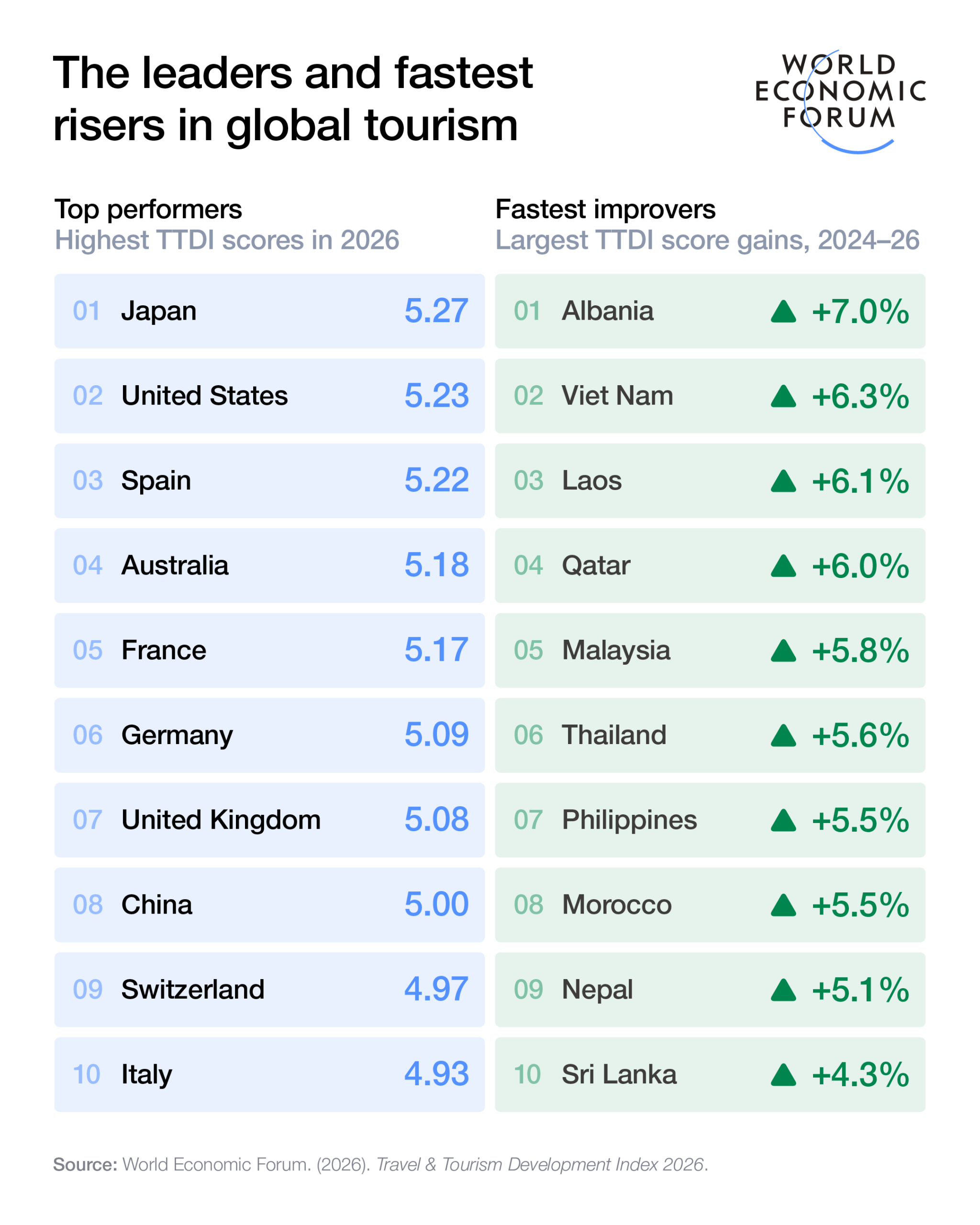
Developed in collaboration with Zurich Insurance Group, the 10th edition of the Travel & Tourism Development Index (TTDI) 2026, launched recentlat Beyond Tourism Day, finds that 101 of 110 ranked economies improved their scores between 2024 and 2026, with the average rising 2.1% – the fastest pace since 2019. Gains were driven by increased cultural resources, tourism infrastructure and services, and air connectivity and business travel. Japan leads the Index, followed by the United States, Spain, Australia and France.

“The latest Travel & Tourism Development Index shows that the enabling conditions for travel and tourism are at their strongest since the pandemic, with 92% of economies improving since 2024,” said Ramya Krishnaswamy, Head of Experience Economy and Cities, World Economic Forum. “The next chapter is not simply about attracting more visitors, but it is going to be about creating greater value by investing in people, infrastructure and stronger public-private collaboration so tourism delivers lasting benefits for communities, businesses and destinations.”

The Index also shows that tourism is facing growing challenges.

Between 2024 and 2026, travel became less affordable in three out of four economies, while tourism investment failed to keep pace with rising demand and labour shortages threatened further growth. Benefits for local communities also weakened during this period, highlighting that more visitors do not automatically translate into better livelihoods or higher quality jobs, particularly in destinations where tourism is highly seasonal.

Despite these pressures, emerging tourism economies are gaining ground. Since 2019, the largest emerging economies have improved their TTDI scores more than twice as fast as the Top 20, with Asia-Pacific economies accounting for seven of the 10 fastest-improving performers. Albania recorded the largest overall gain between 2024 and 2026.

“Tourism is a major part of the global economy, and the TTDI makes clear that resilience is what keeps that value intact when conditions change,” said Cara Morton, CEO Global Businesses and Operations, Zurich Insurance Group. “That kind of resilience requires business and governments to take responsibility together.”

Beyond Tourism Day: bringing the ecosystem together
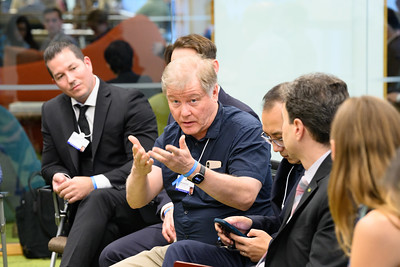
The Index will be launched at the World Economic Forum’s inaugural Beyond Tourism Day in Geneva, convening senior leaders from business, government and civil society under the theme “Resilient Growth. Renewed Impact”. Discussions will focus on strengthening competitiveness and resilience through workforce readiness, technology and innovation, investment and scalable solutions.

The Forum also announced today the first-ever cohort of Beyond Tourism Impact Stars, recognizing six private sector-led solutions addressing systemic challenges facing travel and tourism.

Beyond Tourism Day takes place two days ahead of World Tourism Day on 27 September, providing a platform to carry the conversation from Geneva to a broader global discussion on how travel and tourism can strengthen economic resilience, create quality jobs and opportunities, and deliver greater value to communities and destinations.

About the Travel & Tourism Development Index 2026
Drawing on nearly two decades of WEF benchmarking, the TTDI measures the factors and policies that enable the sustainable and resilient development of travel and tourism. It does not measure tourism performance directly – such as arrivals, spending, or revenue – but the underlying conditions that enable destinations to attract, support and sustain tourism in ways that benefit economies and societies. The 2026 edition covers 110 economies and is organized around 17 pillars and 102 indicators. It was produced in collaboration with Zurich Insurance Group and informed by the Beyond Tourism Insights Council.

For the Silo, Jarrod Barker.

Featured image- Kyoto, Japan -DaiGoji Temple

World Economic Forum- Commercial Momentum Will Drive Climate Progress

Inaugural World Economic Forum survey of CSOs (Chief Sustainability Officers) finds the global sustainability transition advancing with a clear economic case despite geopolitical fragmentation; 63% expect progress to hold steady or accelerate over the next 12 months.73% expect AI to meaningfully accelerate sustainability progress, but 77% flag AI infrastructure’s energy and resource intensity as its most significant negative impact.

85% expect adaptation to become a bigger global priority over the next three years, though 62% cite uncertain cost-benefit assessments as the main barrier to investment. Read the report here.


Chief Sustainability Officers Say Commercial Momentum Will Drive Climate Progress – Despite Significant Geopolitical Uncertainty

Geneva, Switzerland, September 2026 – The World Economic Forum’s Chief Sustainability Officers Outlook, published today, finds a global transition showing clear signs of progress backed by commercial and technological momentum despite significant drag from geopolitical fragmentation and marked scrutiny on short-term performance.

The inaugural survey, conducted as escalating conflict in the Middle East disrupted the Strait of Hormuz and rattled global markets, sees CSOs navigating the geoeconomic volatility with more conviction than caution. Some 63% expect global sustainability progress to hold steady or accelerate over the next 12 months, and three in four expect companies’ transition-related investment to do the same driven by a clear economic argument (64%) and increasingly applicable technologies (56%). The result, according to the report, is a “green divergence”, a transition splitting into different sectors and regions moving at very different speeds, even as the global green economy, now worth more than $5 trillion annually, is on track to top $7 trillion by 2030 and remains among the fastest-growing segments of the world economy.

“Chief sustainability officers are telling us the transition is no longer a question of ambition, it’s a question of execution,” said Sebastian Buckup, Managing Director, World Economic Forum. “As companies deliberately anchor sustainability strategies in growth, security and resilience needs, execution speed and priorities increasingly diverge across regions and sectors.”

A widening green divergence
Despite geopolitical volatility, momentum has not stalled but has fragmented. Some 78% of CSOs expect geopolitical and macroeconomic headwinds, from conflict to inconsistent policy and weakening multilateralism, to weigh on progress over the coming year. Rather than a uniform slowdown, CSOs describe a green divergence – some sectors and markets pulling ahead on the strength of clear economics, while others stall under policy uncertainty or unconvinced boards.

AI’s double-edged impact
Some 73% of CSOs expect artificial intelligence to meaningfully accelerate sustainability progress over the next year, particularly in measurement, reporting, efficiency and risk modelling. Yet 77% of CSOs flag the energy and resource intensity of AI infrastructure itself as its most significant negative impact, as data centres already account for roughly 1.5% of global electricity demand, a green divergence playing out inside a single technology.

Adaptation is becoming the next clear priority
Some 85% of CSOs expect adaptation to become a bigger global priority over the next three years and 77% say private-sector investment will be decisive to scaling it. Companies already managing resilience proactively are seeing adaptation bets paying off. CDP estimates that businesses actively managing supply-chain risk have generated $13.6 billion in savings to date, with a further $165 billion in potential financial benefits still on the table. 

“The conversation is shifting from whether to act on sustainability to how fast we can prove it pays off. CSOs today are expected to deliver a business case as rigorous as any other investment decision, on resilience, on AI, on the transition as a whole. The organizations that treat this as a growth opportunity, not a compliance exercise, are the ones that will be ahead when the numbers are finally called in,” said Katharina Beumelburg, Chief Sustainability and New Technologies Officer, Heidelberg Materials.

As the report highlights, “the challenge is no longer recognizing physical risks but demonstrating the value of investing in resilience” – a shift laid bare this year as extreme heat and wildfires forced companies and insurers alike to confront the cost of being unprepared. The clearest signal comes from California. Insurers had paid $22.4 billion in claims from the 2025 Los Angeles wildfires by early 2026, while new analysis suggests that rebuilding affected communities to wildfire-resilience standards could cut projected future losses by around one-third.

About the Chief Sustainability Officers Outlook
The World Economic Forum’s Chief Sustainability Officers Outlook tracks how the CSO role is evolving and what is driving, or blocking, progress on global sustainability. The inaugural report draws on the Chief Sustainability Officers Outlook Survey, conducted between 10 February and 18 March 2026, gathering responses from 103 sustainability leaders across five continents, members of the Forum’s CSO community, convened by the Forum’s Centre for Nature and Climate. For more information, visit the Centre for Nature and Climate.

About the Sustainable Development Impact Meetings 2026
The Sustainable Development Impact Meetings 2026 (SDIM26) will take place in New York, USA, on 21-24 September and bring together senior leaders from across sectors and regions to advance solutions to shared opportunities and challenges, with a particular focus on long-term impact and building momentum before the World Economic Forum Annual Meeting 2027.

For the Silo, Jarrod Barker.

New ArtyA Watch Features By Dial Artist Dominique Arpa-Cirpka

WHEN THE EPHEMERAL BECOMES ETERNAL

For this unique piece, Dominique Arpa-Cirpka composed a striking symmetry evoking a butterfly with outstretched wings, where incandescent reds and electric blues contrast with graphic black and white patterns.

Each wing fragment is collected with the agreement and under the strict oversight of the relevant authorities, ensuring an ethical approach that respects wildlife. Frozen for eternity through secret natural binders and pigments developed by the artist, the organic material retains its original iridescence and reacts hypnotically to shifts in light.

The back of the dial offers a striking textured contrast, pairing the roughness of dark mineral fragments with a milky way of blue lapis lazuli pastel dust, giving the piece a cosmic depth.

Voir la version en ligneArtyA Art by Dominique Arpa-Cirpka­BUTTERFLY STONE­
True to its fiercely independent and provocative spirit, Geneva based haute horlogerie house ArtyA unveils a new interpretation of its legendary collection of pictorial, organic art: a miniature work of art crafted by dial artist Dominique Arpa-Cirpka.Merging Haute Horlogerie with the raw poetry of nature, this exceptional timepiece features a dial made from genuine exotic butterfly wings, enhanced by a celestial mosaic of natural stones.­Butterfly Stone­­CAPRI SAPPHIRE­
True to its reputation as a boundless creative laboratory, independent watchmaking manufacture ArtyA Watches unveils a new masterpiece from its emblematic Son of Sea collection. Conceived as a genuine window onto the poetry of the ocean depths, this exceptional timepiece features an exclusive dial handcrafted by plastic artist Dominique Arpa-Cirpka.­ Capri SapphireArtyA Geneva
Route de Gy 27
1252, Meinier, Genève
info@artya.com

For the Silo, Jarrod Barker.

World Economic Forum to Accelerate Multistakeholder Climate Action at COP28

The World Economic Forum will advance multistakeholder initiatives for enhanced climate solutions at the 28th Conference of the Parties of the UNFCCC. The Forum will focus on key priority action areas including industry decarbonization and net zero, energy transition, food, nature and innovative finance.COP28 takes place from 30 November to 12 December 2023 in Dubai, United Arab Emirates, and serves as an urgent call to action to the global climate crisis.Learn more about the Forum’s work at COP28 here.

Geneva, Switzerland, November 2023 – The World Economic Forum will convene heads of state, ministers, business leaders, philanthropy and civil society to advance climate action at the 28th Conference of the Parties of the UNFCCC (COP28) at the Expo City Dubai, in Dubai, United Arab Emirates. The Forum’s focus at COP28 is to address priority action areas including industry decarbonization and net zero, energy transition, food, nature and innovative finance.

“We have to take a holistic approach to address the environment crisis, with people at the heart of the agenda, focusing on restoring and protecting nature ecosystems, strengthening community resilience in the face of water stresses and extreme temperatures, while stopping the pollution of our land, sea and water,” said Gim Huay Neo, Managing Director, World Economic Forum. “Fostering a sense of inter-dependence, mutual trust and support as well as active collaboration between governments, the private sector, philanthropy, civil society and communities is needed to build a more harmonious relationship among communities and with the planet. COP28 is an opportunity for the World Economic Forum to provide a platform for multistakeholders to take stock on progress, enhance partnership efforts and explore new ideas and solutions together to safeguard our global commons.”

The discussions in Dubai will build on outcomes from the Forum’s Sustainable Development Impact Meetings 2023, which reflected on progress made on the Sustainable Development Goals (SDGs) and created momentum in addressing the climate and nature crises and advancing an inclusive energy transition.
 
As part of the COP28 programme, the Forum will hold several sessions aligned to the meeting’s thematic areas. Most of the sessions will take place at the COP28 Blue Zone, which is accessible to UNFCCC-accredited media.
 
Insights and initiatives
 
The following Forum announcements and publications will be released at COP28.
 22 Nov.: Net Zero Industry Tracker 202322 Nov.: Financing Energy Transition Projects with Industrial Clusters in Europe26 Nov.: Biodiversity Credits: Demand Analysis and Market Outlook27 Nov.: Biodiversity Credits: A Guide to Support Effective Use29 Nov.: Launch of Scope 3 Action Plan from the Alliance of CEO Climate Leaders29 Nov.: Navigating Article 6: Opportunities for the Middle East and North Africa30 Nov.: Grassroots to Boardrooms:Social Innovation Partnerships for Climate Adaptation30 Nov.: Catalysing Climate Action in Asia: Unlocking the Power of Philanthropic-Private-Public Partnerships30 Nov.: Policy Action to Mobilize Climate Finance and Market Responses 1 Dec.: Taking Stock of Global Business Efforts on Adaptation4 Dec.: Joint Communiqué: CEOs from the Leaders for a Sustainable MENA Sign Joint Letter to Pledging Net Zero by 2050 and to Reduce 200MT CO2 Emissions by 20304 Dec.: Roadmap for Enabling Measures for Green Hydrogen in the MENA Region4 Dec.: Fuelling the Future of Shipping: Key Barriers to Scaling Zero-Emission Fuel Supply5 Dec.: Circularity in the Built Environment: Maximizing CO2 Abatement and Business Opportunities5 Dec.: Using a People-positive Approach to Accelerate the Scale-up of Clean Power: A C-Suite Guide for Community Engagement Find more about World Economic Forum insight publications here.

The World Economic Forum, committed to improving the state of the world, is the International Organization for Public-Private Cooperation. The Forum engages the foremost political, business and other leaders of society to shape global, regional and industry agendas. (www.weforum.org).