In the midst of Mark Carney’s Asian summiteering this week, little attention has been paid to key developments that should not be overlooked.
Of particular note was the conclusion of trade negotiations with the Association of Southeast Asian Nations (ASEAN) toward the ASEAN-Canada Free Trade Agreement (ACAFTA), and with the Philippines toward a bilateral deal. Both are meant to be signed in 2027.
A Fraction Compared To The States But….
While each represents a fraction of Canada’s two-way trade with the United States and other major partners such as China and the European Union, each of these agreements entails sizeable commercial possibilities for both sides, especially with the impressive growth of these Asian economies over the last decade.
Although the final text is still being ironed out, the Philippine agreement is of particular importance, part of the Carney government’s “variable geometry” strategy to diversify and strengthen commercial and geopolitical relationships.
As the PMO’s summary of the Manila meeting states: “Canada is transforming our economy to be less reliant on a single trading partner and more resilient to global shocks.”
Potential For Trade Growth
There’s a long road ahead to grow Canada-Philippine business, with only about $6.0 billion worth of bilateral goods and services trade (as of 2025). But if you take the optimistic read-out at face value, there are promising prospects coming down the pike:
“The Philippines has an economy of $680 billion and a market of more than 110 million people, and it is one of the fastest-growing economies in Asia. Once in force, this agreement could increase exports up to three times by 2035 and provide Canadian businesses the access and certainty they need to compete and win in this market, particularly in agriculture and forest products.”
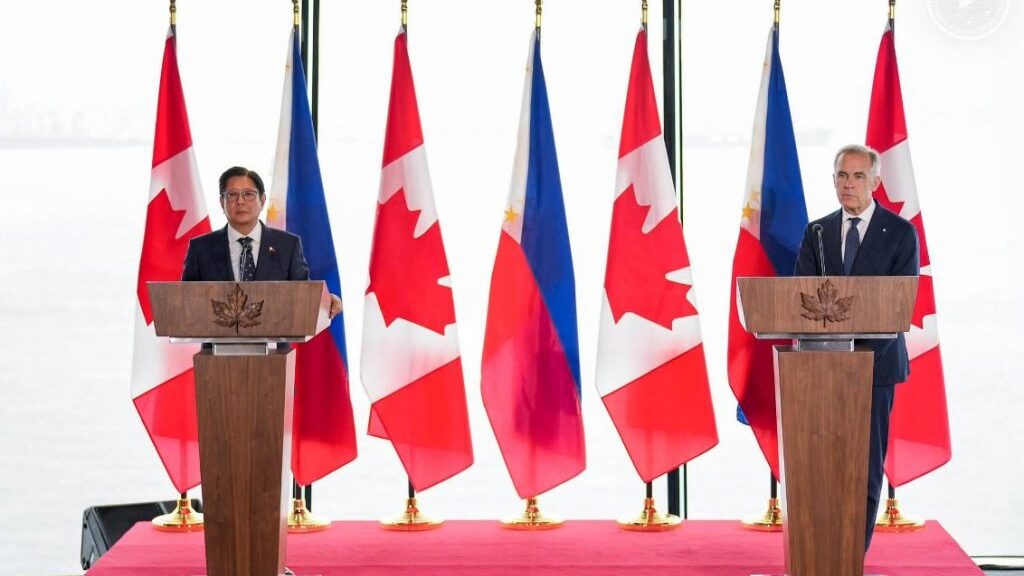
The latest announcement follows agreements reached between the PM and Philippine President Ferdinand Marcos Jr. in Vancouver last July, which elevated the relationship to a strategic partnership, both sides working together in “adapting to the shifting global realities”.
There are some features of Canada-Philippine relations beyond trade that have not been given as much attention as they deserve, aspects which show that despite the depredations of the global trading order by current Chinese and US government leadership, respect for international law survives, even if the WTO-based multilateral system has been shattered by actions of these two giant economies.

From July of this year- President Ferdinand Marcos Jr. and Canadian Prime Minister Mark Carney visit the Granville branch of Jollibee in Vancouver, marking the brand’s 10th anniversary in Canada and celebrating its continued growth in the Canadian market. The Filipino fast-food chain plans to expand to more than 85 locations across Canada over the next five years, according to the Presidential Communications Office. |
: PCO via@luisacabatoINQ
In many ways, those aspects testify to the resilience and transcendency of the global trading order among like-minded states.
The actual texts have yet to be published, but it is clear these agreements will enshrine foundational WTO rules, such as non-discrimination in trade relations (MFN and national treatment) and respect for bound duty rates – elements that the Trump administration has trashed in its global trade wars.
Resilience Of International Law
This is what is meant by the “resilience of international law,” where rules are transcendent in spite of damaging assaults by major players.
In the case of the Philippines, there is another feature – Canada joining in a direct push-back to China’s aggressive expansion strategy into the South China Sea and its incursions into the Philippine’s maritime space. The joint announcement in Vancouver in July says the two leaders reiterated support for a rules-based order, and the 2016 Award by the Tribunal on the South China Sea Arbitration, which is final and binding.
The reference is to the Permanent Court of Arbitration’s ruling that found that China’s aggressive claims in the South China Sea were in violation of the Law of the Sea (LOS) Convention. It illustrates the fundamental point that among like-minded, middle-tier players on the global scene, there is ongoing respect for international law; testimony that the rules-based system is transcendent and survives attempts at hegemonic dominance and power-based actions.
And What About Canada Arctic Maritime Sovereignty?
And there are aspects here that are relevant to Canada’s own sovereignty and jurisdiction over its Arctic maritime areas. While not reading too much into this, by supporting international law and the rules-based order enshrined in the LOS convention and rejecting aggressive incursions by China into the Philippines maritime areas, the Carney government is signalling to others – notably China but not excluding the United States – that Canadian maritime sovereignty in the Arctic is sacrosanct.
These overarching aspects show that while there has been a deliberate shattering of the rules-based trading system at the multilateral level, combined with the equally deliberate weakening of the WTO as a global body, consensus-based rules continue to underpin inter-state relations at the regional and bilateral levels.
Without overstating the case, Canada’s enhanced arrangements with the Philippines carry signals to the global community that the wrecking ball of the Trump administration and the flouting of GATT/WTO rules by China cannot totally undo decades of development and application of international law among like-minded countries.
For The Silo, Lawrence Herman/C.D. Howe Institute.