

“Every story and every memory from my childhood is attached to food,” Dawn Lerman
Our eating habits and snack tastes are cultivated by our family members’ relationships to food, for better or worse. Dawn knows this first hand. The author of the New York Times Well Blog series, “My Fat Dad,” shares her food journey and that of her father, a brilliant copywriter from the “Mad Men” era of advertising at Leo Burnett and McCann Erickson, in her book, MY FAT DAD: A Memoir of Food, Love, and Family, with Recipes (Berkeley; September 29, 2015; Trade paperback/$USD16.00).
 Dawn’s father was known for his witty ad campaigns; he was responsible for such iconic slogans as “Coke Is It,”
“This Bud’s for You,” and “Leggo My Eggo.” Unfortunately, he was not able to use the same problem-solving skills when it came to his weight. Dawn’s father was obese as she was growing up —450 pounds / 204.12 kilograms at his heaviest. His weight would go up and down like an elevator, depending on what fad diet he was on–or what ad campaign he was assigned to. He insisted Dawn, her mother and sister adapt to his saccharine-laced, freeze-dried food plans to help keep him on track. Dawn’s mother never cooked and she witnessed her mother eat only one real meal a day—a can of tuna over the kitchen sink—while she dashed from audition to audition pursuing an acting career.
“As far back as I can remember, there was an invisible wall that separated me from my dad, a distance that I could never completely penetrate, His closest relationship was with the bathroom scale – his first stop every morning and his last stop every evening. The scale controlled his moods, our days, what we were going to eat and basically ruled our family life.”
“My dad felt that in order to create a good slogan, you needed to believe in the products you were selling,” Dawn explains. “He was always the best customer for the food and drinks he advertised, testing them excessively—especially when Wells Rich & Green promoted him to head creative director for Pringles potato chips”
Listening to him crunch away canister after canister on the crispy snacks in the privacy of his room– trying to come up with the perfect slogan, Dawn knew she had to get inventive to help her dad get healthy while still staying inspired. At 9 years old Dawn had become the official chef for her family, turning her maternal grandmother Beauty’s Jewish weekly recipe cards into diet friendly meals and treats that would keep her dad motivated. It was her grandmother who instilled in Dawn a passion for cooking for oneself and others as she learned that the best food is prepared with the freshest ingredient.
One recipe Dawn developed during that time was her special homemade hot air popped corn coated in ranch seasoning. Upon trying it her father declared “Dawn now that you popped, you can’t stop!” That statement of delight was the kernel of an idea that took her dad around the world– filming highly attractive people on beaches and other fun places, joyfully indulging in Pringles potato crisps that exploded out of the can as the top popped off while the voice over announced…” Once You Pop, You Can’t Stop!”
 This spring and summer try these healthy and delicious snacks from My Fat Dad with no stopping required.
The potato chip recipe, derived from that long-ago hot air popped corn recipe, can be enjoyed throughout out the day as they are satiating and nutritious. Pair it with Dawn’s Hummus recipe, which is loaded with protein. The combo of complex carbs, protein and healthy fats –will fill you up without weighing you down. A win-win for both mood, energy, and weight control!
Recipes below from MY FAT DAD: A Memoir of Food, Love, Family, and Recipes By Dawn Lerman
Berkley Books/ first printing 2015
MY FAT DAD: A Memoir of Food, Love, and Family, with Recipes By Dawn Lerman Berkeley / Trade Paperback/$16.00usd

Herb Infused Ranch Style Sweet Potato Chips with Coconut Oil
These sweet potato chips are crunchy, slightly salty, and have that wonderful ranch taste. They are a healthy take on traditional store bought chips. They are fried in coconut oil– which not only helps the chips to brown beautifully, but aids in speeding up your metabolism. They are a constant staple in my formerly fat dad– 450 pounds, now 210 pound –snacking regime.
4 large sweet potatoes, can also use white potato’s or beets
1/2 cup coconut oil
1 teaspoon of dried parsley
1 teaspoon of garlic salt
I teaspoon of onion powder
1 teaspoon of minced onion
Sea salt for seasoning
Fresh thyme for garnish
Pre heat oven to 375 degrees, scrub potatoes to remove dirt. Then slice into thin, even pieces. You can cut them by hand or use a slicing attachment on a food processor. Rinse your potato slices in cold water. Now soak the slices in cold water for 30 minutes.
Drain the potatoes and lay them on a paper towel or paper keeping them slightly moist. Dip in bowl with herb mixture –dried parsley, garlic salt, and onion powder. Make sure chips are coated.
In a skillet melt the coconut oil over medium heat. When the oil sizzles place them in the oil for about 1 min till they get slightly brown. Do not over crowd the pan. Best to do in small batches. Use a slotted spoon or spatula to remove your chips from the coconut oil. Drain the chips on a layer of paper towels, and repeat till all chips have been fried and blotted.
Then place all the cooked chips on a baking sheet and bake for 1 minute. Remove and serve warm. Sprinkle with sea salt and garnish with fresh thyme.
*NOTE: if you do not want to fry the chips you can take coated chips, lay them out on a baking sheet sprayed with coconut oil and bake for 20 minutes at 375 degrees until golden brown.
Sweet Potato Hummus
Yields: 6 servings
If you are looking for a light, healthy snack this sweet potato hummus is bursting with flavor, spice and color. Because of its high protein content, it will help control your appetite and mood. My dad named it the caviar of hummus—exclaiming, that it was almost illegal for something so nutritious to be this delicious. Pair this with my Potato Chip recipe for the perfect blending of protein and carbs.
1 large sweet potato (about 9 ounces)
1 (15-ounce) can chickpeas, drained and rinsed
5 tablespoons olive oil (plus additional, as needed, for thinning)
2 tablespoons tahini
2 tablespoons fresh lemon juice
2 garlic cloves, peeled
1 teaspoon ground coriander
1 teaspoon ground cumin
¼ teaspoon kosher salt
Pinch of nutmeg
Position the baking rack in the middle and heat the oven to 425 degrees. Wrap the sweet potato in foil and bake in a shallow baking pan until it can be easily pierced with a knife, about 45 minutes. Transfer to a cooling rack and allow the potato to cool completely.
Peel the skin off the sweet potato and transfer to a food processor fitted with a blade. Add the chickpeas, olive oil, tahini, lemon juice, garlic, coriander, cumin, salt, and nutmeg, and process until smooth. If the hummus is too thick, add a little extra olive oil or water and process until the desired consistency is reached.
MY FAT DAD is as much a coming of age memoir as it is a recipe collection from Dawn’s upbringing and culinary adventures in Manhattan. Her recipes include some of her grandmother’s favorite traditional Jewish dishes, to healthier interpretations and creations. Her father’s life-long struggle with food, along with her grandmother’s love of cooking fresh foods, led Dawn to become a well-respected nutritionist, NY Times blogger and chronicle her story in her best-selling book. Today her dad is a healthy 210 pounds and vegan.
“Dawn Lerman grew up Jewish in the 70’s. I grew up Italian. Might sound different, but for the most part, it’s the same. Especially when it comes to food. The philosophy was simple, food = love. My Fat Dad hilariously and poignantly captures that essence. Whether you’re Italian, Jewish, or anything else you can relate to how family, food, and the love of both affect how we grow up, and live our life. Mangia!”
—Ray Romano, Emmy award-winning actor
“The Manhattan nutritionist was raised by a diet junkie who tried every regimen under the sun and food — or the lack of it — ruled her life. My Fat Dad is about her eccentric upbringing and her constant state of hunger as Albert imposed his wacky ways on the whole family.” The New York Post
“My Fat Dad is an exploration of the many ways food shapes our connection to family. It also includes many delightful recipes.” Michel Martin, NPR, All Things Considered
“It is clear Lerman ‘s life is centered around the table and she gives readers a seat at hers” Baltimore Jewish Times
” ‘My Fat Dad’ is a memoir of food, love and starvation” New York Daily News
ABOUT DAWN LERMAN, MA, CHHC, LCAT
 Dawn Lerman is a Manhattan based nutritionist, bestselling author of My Fat Dad: A Memoir of Food, Love, and Family with Recipes, and a contributor to the New York Times Well Blog. She has been featured on NBC, NPR, Huff Post TV as well as several other news outlets. Her company Magnificent Mommies provides nutrition education to student, teachers and corporation. Dawn counsels clients on weight loss, diabetes, high blood pressure, and other diet-related conditions. She is a sought-after speaker and cooking teacher and lives in New York with her two children.
For more information about Dawn, go to www.DawnLerman.net .

| The Met Receives Landmark Gift of More Than 500 of the Finest Guitars from the Golden Age of American Guitar Making With this collection, the Museum will become an epicenter for the celebration and study of this iconic instrument |
| (New York, May, 2025)—The Metropolitan Museum of Art announced today that it has received a landmark gift of more than 500 of the finest guitars from the golden age of American guitar making, spanning the years 1920 to 1970. This new collection of the most important guitars, anchored by a major gift from collector Dirk Ziff, will showcase the profound impact this celebrated instrument has had on popular music, culture, society, politics, and religion in America—and then resonated around the world. The collection displays the diversity of the guitar in all its forms—including electric, acoustic, archtop, bass, resonator, and lap steel—as well as related stringed instruments and amplifiers. “This is truly a trailblazing and transformative gift, positioning the Museum to be the epicenter for the appreciation and study of the American guitar,” said Max Hollein, The Met’s Marina Kellen French Director and Chief Executive Officer. “We are immensely grateful to Dirk and his longtime advisor, Perry Margouleff, for their extraordinary commitment to assembling this world-class, one-of-a-kind collection over the course of decades. The guitar has been of singular importance to popular music of the past century and was used by musicians across geographic, racial, and economic backgrounds. This seminal American object of our time has had a profound impact on global culture, art, and society. These guitars are examples of outstanding artistry and craftsmanship as well as visually powerful tools of expression and distinction. This gift celebrates the innovators, inventors, and manufacturers who created many different forms of the guitar to meet the needs of individual musicians, while also telling the stories of American music through the 20th century.” The collection includes a wide range of iconic examples, such as: Leo Fender’s first guitar, made in 1948; a Gibson 1955 J-50 acoustic guitar used by Delta blues musician Mississippi John Hurt; the 1941 Epiphone “Clunker,” an experimental prototype modified by Les Paul that was used in recordings and broadcasts by guitarist and vocalist Mary Ford and that is one of several guitars from Les Paul’s personal collection; the 1959 sunburst Les Paul guitar used by Keith Richards during The Rolling Stones’ first appearance on The Ed Sullivan Show in 1964, which ignited interest in this legendary model; the “Futura” guitar owned by blues guitarist Ponty Gonzalez around 1956 that led the Gibson company to create the futuristic Explorer model in 1958; and the Martin OM-45 guitar made by the C. F. Martin guitar company in 1930 that was the primary instrument of cowboy musician Roy Rogers. Some of the guitars included in this gift were featured in The Met’s widely popular and well-received special exhibition Play It Loud: Instruments of Rock & Roll (2019). The donors and The Met have agreed that these carefully preserved instruments must remain alive and accessible. Almost all continue to be in prime playable condition and will be used frequently for special performances, recordings, and educational programs, including study by contemporary guitar builders. A number of the guitars will be on temporary display in the current Musical Instruments galleries prior to going on view in the new gallery dedicated to celebrating the American guitar. Mr. Ziff said, “Since embarking on this journey with Perry in 1987, our objective has been to assemble a comprehensive collection of American guitars, many of them historic and culturally significant, and preserve them for the benefit of future generations. We always saw ourselves as custodians, not owners. It is genuinely thrilling to see our vision validated at the greatest cultural institution in the world. As someone who grew up in New York City and has been going to The Met since childhood, I am honored to help play a role in broadening the Museum’s reach and impact by making these great instruments accessible to legions of guitar lovers from all over the world.” The collection exemplifies the visual design history of the guitar in the 20th century and how the instrument’s aesthetics evolved from small “parlor” guitars with Victorian-era decoration, to art deco–inspired archtop guitars, to the mid-century designs of the electric guitar informed by the major influence of the automobile and the fascination with the television age and space exploration—hence the legendary 1950s Fender model names “Telecaster” and “Stratocaster.” The collection is a celebration of industrial art, demonstrating innovative engineering, outstanding craftsmanship, and timeless 20th-century design aesthetics that, in many cases, remain entirely unchanged since their introduction and are as modern and relevant today as when they were first conceived. To this day, they remain the aspirational working instruments of choice for the finest guitar players around the world. Jayson Kerr Dobney, Frederick P. Rose Curator in Charge of the Department of Musical Instruments at The Met said, “This is not just a once-in-lifetime gift; it is a once-in-a-century opportunity for the Museum—a visionary, comprehensive collection of American guitars, unparalleled in both its breadth and variety. The guitar was the driving force of 20th-century popular music. It changed culture and it changed the world. Now that Dirk and Perry have entrusted us with this amazing collection, we will work to create a unique and immersive permanent experience for our visitors that showcases these instruments and tells the powerful story of their evolution.” The Met’s collection of musical instruments—which demonstrates the technical and social importance of instruments while also presenting them, with their visual and tonal beauty, as art objects themselves—includes approximately 5,000 examples from 300 BC to the present, representing six continents and the Pacific Islands. The Department of Musical Instruments currently has an outstanding collection of European guitars from the 17th to the 19th century and includes a famed collection of classical guitars. STATEMENT FROM JIMMY PAGE “When it first came on the horizon that The Metropolitan Museum of Art would have a feature exhibit celebrating the instruments of Rock & Roll, I was more than happy to loan a number of my most important guitars, amplifiers, effects, and even costumes. I was particularly excited to display my Telecaster—which I had hand-painted myself. As a student in art college, I never would have imagined that one of my paintings would find its way into one of the most prestigious art museums in the world! My hope was that, by loaning my instruments, others would join in this celebration and lend their instruments as well. As it turned out, everyone was inspired and loaned an incredible array of musical instruments for this exhibition, which would become known as Play It Loud: Instruments of Rock & Roll. The exhibit exceeded everyone’s expectations in terms of attendance as people traveled from around the world to enjoy this unique experience. This was a true win-win situation for everybody, including the guitars in general. As a result of this incredible exhibition, I have now been made aware that The Met is building a permanent gallery to celebrate the American guitar. To know that there is so much passion behind this project is thrilling. I would like to take my hat off to the people who have been behind this—and to The Met for its dedication to construct something that is going to be of such great importance for generations to come. An inspirational arena for people old and young alike. I am most curious to see how the young people are going to expand the guitar in the future. This gallery will truly be an epicenter and inspiration for the celebration of the guitar.” For the Silo, Meryl Cates, Ann Bailis. |
Featured image– Jimmy Page reproduction via Fender of his original hand painted Telecaster.


Before you say online dating does not work (it does), or it will not work for me (why not?), or my friends tell me horror stories (believe me, they are doing something wrong—it’s them, not the app/site), here are some things to think about:
“YES: vanilla, rosemary, Buenos Aires, humility, Barnes & Noble browsing, bourbon, cilantro, dogs, generosity, bikes, empathy, skates, skis, boats.
NO: beets, videoconference dates, whining about online dating apps, Red Wings, selfishness, arrogance, snakes.
I can’t grow a bougainvillea to save myself. It grows like a weed here and I can’t keep it alive for 10 days.”
We had trouble keeping up with the responses he got!
Ok, the only time I encourage a phone call is if there is significant distance.
You live within 20 minutes of each other. Go on the date. It’s coffee or a drink. Get dressed and go!
Action shots sell. I had a NYC Wall Street-type juggling in a pic. Plus, he bowls. (I guess no one bowls and that grabbed a bit of attention). Not the stereotypical private equity guy, right?
I hope this helps you a bit—I love what I do and enjoy my one-on-one contact with clients. It’s one of the reasons that I sold It’s Just Lunch (I founded it in 1991 and sold out to Private Equity when we had 110 locations globally) as I missed client contact. Remember, it only takes one! For the Silo, Andrea McGinty.
Encouraging children to participate in physical activity can have a significant impact on their health, mental well-being, and social skills. As parents, guardians, and mentors, it’s vital to provide support that not only helps young athletes excel but also aids in their overall development.
Below we are going to discuss some effective strategies to inspire your child to thrive at their favorite sport. Let’s begin!
One of the most important aspects of supporting youth athletes is helping them develop a genuine love for their sport. Encourage exploration by introducing them to various activities and attending local games/tournaments together.

It’s also crucial to discuss the positive aspects of sports, such as teamwork, discipline, and the joy of participating (rather than focusing on winning). When children enjoy the process, they are more likely to remain committed and motivated.
Practice is key to improvement. Encourage your child to dedicate time to honing skills outside of regular team practices. You may want to create a routine that includes a mix of skill-building, drills, and casual play.
For children who are showing a keen interest, consider signing them up for various training programs and camps. These not only help improve their skills but also allow them to form relationships with like-minded individuals.

Searching for Basketball Clubs Edmonton? Youth Hoops is an excellent choice to kickstart their personal development journey.
Children often look to their parents and mentors for guidance on how to approach challenges. By modeling a positive attitude towards sports and competition, you can instill a growth mindset in your child.
Encourage them to view setbacks as opportunities for learning rather than failures. You should also share your own experiences, highlighting the importance of determination. Your enthusiasm can inspire them to adopt a similar approach to their athletic endeavors.
While sports are important, it’s crucial to promote a balanced lifestyle that includes academics, social interactions, and relaxation. You want your child to not just excel in athletics but also in their studies and other interests.
Help them manage their time effectively to balance practice, homework, and leisure. A well-rounded lifestyle contributes to overall well-being and prevents burnout.
Lastly, setting goals is essential for any young athlete, but it’s also important to ensure they are realistic and attainable. Help your child establish both short-term and long-term objectives, such as improving their skills, making a team, or achieving a personal best.

Break these goals down into smaller, more manageable steps to maintain motivation and track progress. This approach helps build resilience and teaches children the value of perseverance and hard work.
As you can see, supporting young athletes involves many different steps. By implementing the strategies above, you can inspire your child to thrive in sports while helping them develop valuable life skills that will benefit them both on and off the field.
“The comic book industry is the launchpad for one of the most unique and innovative storytelling mediums ever created. Powered by imaginative creators highly skilled in the written and visual arts. Forged by businesspersons who recognize the power of ideas to make an iconic impression on a global scale. Propelled by readers and fans who support the industry and the people who make the stories. The comic book industry is the source of multimedia interpretations of mythic and personal stories that inspire people, entertain the world, and ignite lifelong careers.

The comic book industry is a ruthless Darwinian landscape of cronyism, narcissism, and power moves. Its main fodder is the creators who are the engines of its continued existence. Full of flair and pomp, colors and characters both fictional and real-life. A road to hell paved with landmines, bear traps, and the opportunity to work on high-profile, profitable media while living on the precipice of poverty. The industry is fueled by organizations with finite funds and infinite hubris.“
The issue I see (and our comic illustrator household has personally experienced) in the comics and illustration / publishing industry is that the original contract terms were never set up fairly to compensate the artists and illustrators. While photographers and videographers retain the rights to their original images, and someone must pay them usage rights fees based on the size of the audience per usage, the artists are never granted that same fair compensation.

While actors get residuals when their TV shows play on in perpetuity, and musicians earn their royalty checks with every needle drop, the comics publishers can repurpose an illustrator’s iconic cover art in perpetuity and make millions from the image—on puzzles, lunch boxes, hoodies, sweatpants, and pajamas in my husband’s particular case—while the artist never sees a dime beyond the initial ANEMIC work-for-hire fee in these insanely unfair, one-sided deals. And if the artist DARES to complain? The smear merchants are only too happy to start their whisper campaigns, blackballing the artist as “too difficult to work with” and completely destroying their already financially challenged lives with nuisance law suits.

This impoverished, unwell, elderly man was just trying to eke out the last days of his hard-scrabble life by selling sketches of his OWN co-creation at comic-cons. There’s nothing I despise more than anyone preying on the vulnerable. It’s appalling how Gary was treated.
And then we have AI “art” apps exploiting my husband’s already way underpaid art to create new, derivative works, but only GETTY Images can afford to lawyer up and go after these apps…because the photography world always negotiated image usage the CORRECT and fair way from the start.
The sobering truth is that if illustrators (and line artists, colorists, and letterers) were paid as well as photographers, every comic would sell for $100 per floppy and that would be the final nail in the #comics industry’s coffin.

…DAVE DORMAN… told me at dinner tonight that someone was selling AI art at SDCC last week and was summarily kicked out of Artists Alley. It gave me a brief glimmer of hope…I imagined a deafening crescendo of cheering as the non-talent skulked away, tail between his/her legs. That takes some gall to occupy the highly competitive table space of an ACTUAL hard-working artist (who’s paying off about $100k in art school student loans) with some Mid-Journey derivative crap. Wowzers. For the Silo, Denise Dorman.
Turns out not all red wines are created equal…

French scientists have discovered one of the following wines offers up to 10X more cancer-protective and cardio-protective effects than the rest…
Plus, this one wine also supports significantly improved metabolism when you drink it a certain way.
But which one? Is it…

(Click on the wine image you think is right.)
HINT – Researchers point to one wine above to explain the French Paradox.
So, if you want to be lean AND still drink wine, it should definitely be THIS.
To your health!
For the Silo, Kelly Hargraves.

Chassis No. SA9AB5AC6S1048053
The McLaren F1 emerged from what might be the most consequential airport delay in automotive history. In 1988, following the Italian Grand Prix, TAG-McLaren Group executives Ron Dennis and Mansour Ojjeh found themselves stranded at Linate Airport alongside McLaren’s Technical Director Gordon Murray and head of marketing Creighton Brown. Their conversation turned to creating the ultimate road car—not just another supercar, but in Dennis’s words, “…the finest sports car the world had ever seen.”

In May 1992 at Le Sporting Club Monaco, the McLaren F1 redefined the supercar genre upon its unveiling. Built around a carbon fiber monocoque—a world first for a production road car—and powered by a bespoke 6.1-liter BMW Motorsport V12 engine, the F1 delivered 627 horsepower and a power-to-weight ratio of 550 horsepower per ton. Its unique central driving position, gold-lined engine bay, and no-compromise approach to performance and driver engagement set new standards that remain unmatched to this day. Limited to just 106 examples across all variants, only 64 were built as standard road cars, making them the most revered and sought after supercar of the modern era.
This superlative example of the F1, chassis number 053, was ordered on 31 March 1995, and assigned production sequence 044. Assembly began on 28 July 1995, with the car being officially delivered “ex-works” on 27 November 1995, showing just 193 kilometers on the odometer. The original purchaser was Kazumichi Goh, the Japanese businessman behind Team Goh, which would go on to win the All Japan Grand Touring Car Championship (JGTC) in 1996 with a pair of McLaren F1 GTRs sponsored by Philip Morris cigarette brand Lark.

Chassis 053 featured a highly distinctive specification highlighted by its Marlboro White exterior finish—one of only two F1 road cars to wear this color. The cabin was finished with a unique blue-themed interior featuring dark blue/grey leather with pierced blue/grey Alcantara cloth central panels for the passenger seats, while the central driver’s seat was entirely covered in light blue Alcantara. This bespoke specification was completed with blue Wilton carpet, light blue Alcantara headlining, and an optional black suede steering wheel. The car was also delivered with a matching bespoke luggage set in dark grey leather with a blue Alcantara strip carrying the embossed chassis number. Factory driver settings were configured with the steering wheel at height position A (highest), pedals at position C (long), reach at position A (near), clutch foot rest at position D (extra long), and standard seat with extra long rails.
In 2004, chassis 053 was purchased by another Japanese collector. By late 2006, the car showed just 432 kilometers when it was sold by WHA Corporation of Nagoya, Japan, to dealer SPS Automotive Ltd. (Hong Kong) on 28 November. The car subsequently came to Europe in 2007 when it was acquired by dealer Lukas Huni AG in Switzerland on behalf of a European client with a recorded mileage of 482 kilometers. On 14 March 2014, chassis 053 was sold via Morris & Welford to collector in the United States. During this ownership, the car spent time in both the U.S. and U.K., and the mileage had increased to 1,108 kilometers. On 16 November 2016, the car was acquired by its next long-term European owner via McLaren Special Operations in Woking and subsequently registered in the U.K. with the appropriate license plate “53 MCL.”

Throughout its life, chassis 053 has been meticulously maintained by McLaren Special Operations. The service book records regular maintenance with all work completed at McLaren’s Woking headquarters on December 12, 2006 (481 kilometers), 14 June 2010 (998 kilometers), 25 October 2016 (1,185 kilometers), 24 April 2018 (1,238 kilometers), and most recently on 12 November 2024 (1,290 kilometers). In July 2021, the car received a comprehensive fuel cell service at McLaren Special Operations totaling £52,061.55 (excluding VAT), which included £31,624.50 in labor charges and £15,472.74 for the fuel cell unit itself. A covering letter from McLaren Heritage Manager Thomas Reinhold noted the return of a “favourite F1” to MSO, an F1 that also “drives extremely well.”
Further work was carried out in November 2021, including replacement of various pipes, fittings, suspension rose-joints and bushes, plus a new water pump at a cost of £23,992.05 (excluding VAT). Most recently, the car returned to MSO in late 2024 for a “3 Year Life Items” service, during which the steering wheel battery, instrument binnacle battery, key fob battery, air conditioning receiver dryer, engine oil and filters, gearbox oil, and coolant were all replaced. The car also underwent a full suspension set-up and headlamp alignment at a cost of £4,861.10 (excluding VAT). Heritage Manager Michael Wrigley’s covering email following this most recent service summed up the car’s exceptional condition: “It’s a truly lovely example so there is very little of note to comment on!”
With just 1,291 kilometers recorded from new, chassis 053 represents one of the lowest mileage and most original McLaren F1 road cars in existence. Its unique color combination, low mileage, comprehensive documentation, complete set of factory tools, owner’s manuals, and fitted luggage make it an unparalleled example of Gordon Murray’s masterpiece. Maintained throughout its life without regard to cost and exclusively serviced by McLaren Special Operations, this McLaren F1 offers its next custodian the opportunity to acquire the ultimate modern collector car in truly museum-quality condition.
For the Silo, Barney Ruprecht.




| Purity Wavy Titanium Mirror Technical Specifications Edition Limited Edition of 99 pieces Case Grade 5 titanium, satin-finished, mirror-polished lug-to-lug contour Transparent or black DLC protective coating Diameter40 mm Thickness13 mm Water resistance50 meters Caseback Screw-in, engraved, fitted with a one-way mirror Crystal Sapphire, triple ant-reflective coating, laser-engraved chapter ring Hands Brushed and diamond-polished Crown Engraved with the ArtyA signet Caliber ArtyA Purity Stairway To Heaven HMS in-house movement Winding Manual Indications Hours, minutes, and central seconds Power reserve Minimum 72 hours, thanks to twin parallel barrels Frequency 4 Hz (28,800 vph) Finishes Fine regulation through precision adjustment of inertia blocks on the balance wheelMicrobead-frosted minute wheel train and balance bridgesHand-chamfered edgesPolished mainsprings to optimize friction in the barrel assemblies Strap Alligator or grey nubuck leather Buckle ArtyA pin buckle, available with or without black DLC coating Swiss Made Entirely designed and crafted between Geneva and the Swiss Jura Price (excluding VAT) Titanium & Black Titanium CHF 25,900 (reference price) EUR 27,900 (subject to exchange rate) USD 29,900 (subject to exchange rate) CAD 42,754 Also available with transparent, hued or NanoSaphir case From CHF 44,900 (reference price) From EUR 47,900 (subject to exchange rate) From USD 50,900 (subject to exchange rate) VERSION FRANÇAISE |

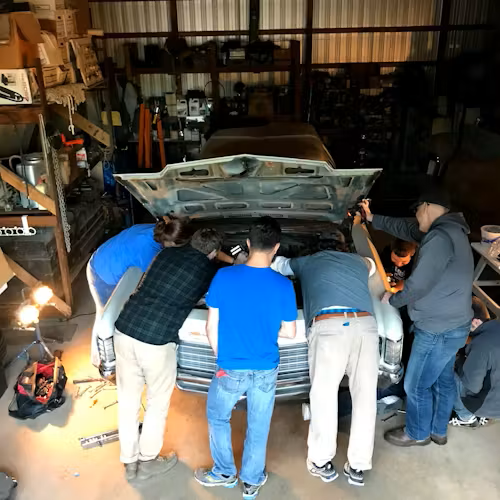
The nuts and bolts that make up our beloved automobiles have not changed that much over the last 150 years. But the tools needed to maintain them? Those have changed a lot. Software has cemented itself as part of a service technician’s day-to-day regimen, relegating a handful of tools to the history books. (Or, perhaps, to niche shops or private garages that keep many aging cars alive and on the road.)
How many of these now-obsolete tools do you have in your garage? More to the point, which are you still regularly using?
Though spark-plug gap tools can still be found in the “impulse buy” section of your favorite parts store, these have been all but eliminated from regular use by the growing popularity of iridium and platinum plugs. These rare-earth metals are extremely resistant to degradation but, when it comes time to set the proper gap between the ground strap and electrode, they are very delicate. That’s why the factory sets the gap when the plug is produced.
These modern plugs often work well in older engines, meaning that gapping plugs is left for luddites—those who like doing things the old way just because. Nothing wrong with that; but don’t be surprised if dedicated plug-gapping tools fade from common usage fairly quickly.
Verdict: Keep. Takes up no real space.

50 years ago, a tuneup of an engine centered on the ignition system. The breaker points are critical to a properly functioning ignition system, and timing how long those points are closed (the “dwell”) determines how much charge is built up in the ignition coil and thus discharged through the spark plug. Poorly timed ignition discharge is wasted energy, but points-based ignition systems disappeared from factory floors decades ago, and drop-in electronic ignition setups have never been more reliable (or polarizing—but we’ll leave that verdict up to you.)
Setting the point gap properly is usually enough to keep an engine running well, and modern multifunction timing lights can include a dwell meter for those who really need it. A dedicated dwell meter is an outdated tool for a modern mechanic, and thus most of the vintage ones are left to estate sales and online auction sites.
Verdict: Toss once it stops working. Modern versions are affordable and multifunctional.
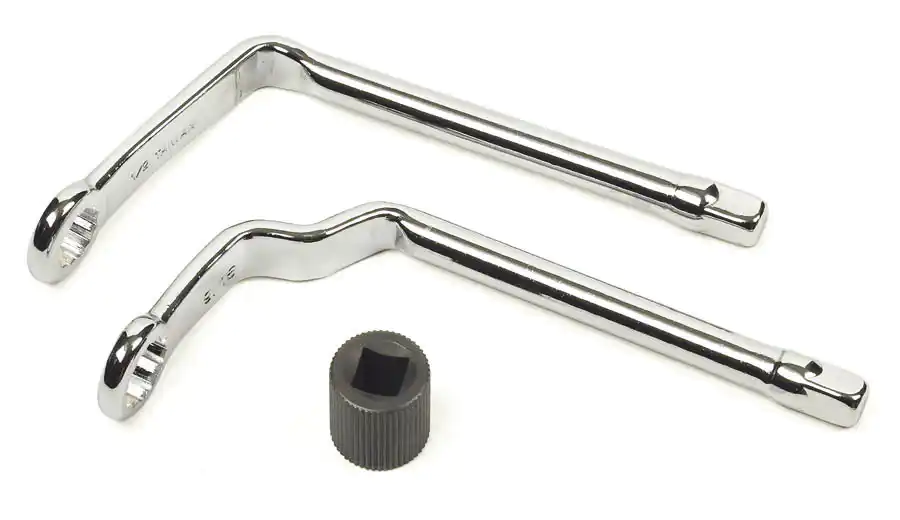
When mechanics did a lot of regular timing adjustments and tuning, a purposely bent distributor wrench made their lives much easier. However, much like ignition points, distributors have all but disappeared. Thanks to coil-on-plug ignition systems and computer-controlled timing, the distributor is little more than a messenger: It simply tells the computer where the engine is at in its rotation.
Timing adjustments have become so uncommon that a job-specific tool is likely a waste of space. If you’ve got room in your tool chest, keep yours around; but know that a standard box-end wrench can usually get the job done and is only fractionally less convenient than the specialized version.
Verdict: Keep if you have them. No need to buy if you don’t.
Prior to the required standardization of on-board diagnostic computers by the U.S. in 1996, a single car could host a wild mix of analog and digital diagnostic methods. OBDII, which stands for On-Board Diagnostic II, wasn’t the first time that a small computer was used to pull information from the vehicle via an electronic connection; it merely standardized the language.
Throughout the 1980s and early 1990s each OEM had its own version of a scan tool. Now those tools can be reverse-engineered and functionally spoofed by a modern computer, allowing access to diagnostic info tools that, at the time, were only available to dealers. Since many pre-OBDII cars are now treated as classics or antiques and driven far less frequently, the need for period-correct diagnostic tools is dropping.
Verdict: Keep. These will only get harder to find with time, and working versions will be even rarer.
A distributor is simple in concept. Trying to balance the performance and economy of the ignition system, with the distributor attached to a running engine, and achieving proper operation starts to get pretty complicated. That’s where a distributor machine comes in.
A distributor is attached to the apparatus and spun at engine speed by an electric motor. This allows you to literally see how the points are opening and closing. You can also evaluate the function of vacuum or mechanical advance systems. These machines are still great but the frequency that this service is needed these days is few and far between, especially when trying to justify keeping a large tool around and properly calibrated.
Verdict: Keep, if you are a specialty shop or tool collector.

Even a casual enthusiast can see there is a lot more information that can be gleaned from a running engine than whatever readouts might be on the dash. Enter the engine analyzer, a rolling cabinet of sensors and processors designed to fill in the data gaps between everything that is happening in a car and what its gauges report.
An engine analyzer is essentially a handful of additional instruments packaged into a small box hanging around the bottom of your tool drawers. It can also house a lot of sensors in a giant cabinet, which was likely wheeled into the corner of the shop in 1989 and left to gather dust. Now engine analyzers can be found listed online for as cheap as $200usd/ $287cad.
The funny thing is that many of the sensors in these engine analyzers are often the same systems that come built into modern dynamometer tuning systems. In a dyno, the sensors allow the operator to see more than max power; they also show how changes to an engine’s tune affect emissions. Maybe engine analyzers didn’t disappear so much as change clothes.
Verdict: Toss. The opportunity cost of the space these take up can be tough for most home garages. Sensors went out of calibration decades ago so the information you might get from one is dubious at best.

Air tools hold an odd place in the hearts of many gearheads. For many years the high-pitched zizzzz and chugging hammers of air-driven die grinders and impact drills were the marks of a pro. Or, at least, of someone who decided that plumbing high-pressure air lines around the shop was easier than installing outlets and maintaining corded tools. Air tools are fantastic for heavy use, as they are much easier to maintain and can be rebuilt and serviced.
Those tools can really suffer in lack of use, though, since pneumatic tools rely on seals and valves, neither of which deal well with dry storage. Battery tools have caught up to air tools for most DIY folk. No more air lines or compressors taking up space in the shop—and requiring additional maintenance—and, in return, a similarly sized yet more agile tool.
Verdict: Keep, if you already have the compressor. Don’t have one? Invest in battery tools.
Every engine rebuild has to have bearings made for it in some fashion. Today’s cars use insert bearings that are mass-produced to surgical tolerances for a multitude of applications. If you wanted—or more accurately needed—new bearings in your Model T circa 1920, you needed to produce your own … in place … inside the engine. Welcome to Babbitt bearings.
The process is a true art form, from the setup of the jigs to the chemistry of pouring molten metal and machining the resulting orbs to actually fit the crankshaft and connecting rods. Now there are newly cast blocks for your T that replace the Babbitt with insert bearings. Since those antique Ford engines just don’t get abused the way they used to, and lead fairly pampered lives, they need rebuilding far less often than they did in-period. Modern oils also do a better job of protecting these delicate bearings. Since they are less and less in demand, the tooling and knowledge to make Babbitt bearings are difficult to find, and precious when you do.
Verdict: Keep. It’s literally critical to keeping a generation of cars alive.

Among the realm of scary-looking tools that have earned their infamy, split-rim tools hold court. The concept is simple: The rim is sectioned, allowing it to contort into a slight spiral that can be “screwed” into a tire. (This is almost the reverse of a modern tire machine, which stretches the tire around a solid wheel rim.) When tires needed tubes, both tire and rim were relatively fragile, and the roads were rough, split rims were popular—and for good reason. Now the tooling for drop-center wheels is ubiquitous and shops often won’t take on split-rim work. Success is hard to guarantee, even if techs are familiar with split rims—and they rarely are.
Verdict: Keep. No substitute for the right tools with this job.
These tools might not make much sense in a dealership technician’s work bay, but that doesn’t mean they should disappear forever. Knowing how to service antiquated technology is as important as ever, whether using old tools or new ones. If you’ve got any of these items, consider it your responsibility to document what the tool does and how to safely use it. Keeping alive the knowledge of where our modern tools came from is powerful.
For the Silo, Kyle Smith.

There is a mass decline in linguistic diversity happening all over the planet and in places geographically far apart and I think that if things don’t change, the loss of language diversity will be immense.
At this moment in time, 85% of the world’s languages have fewer than 100,000 speakers and over half of the world’s remaining languages are spoken by just .2 % of the world’s population. These facts have informed my work and have become the wider subject of my illustrations, specifically the linguistic decline of the Irish language.
In some ways the battle between the Irish and the English languages is one of the defining features in modern Irish culture, but it is Irish which defines this island more, and the Irish language tells the entire history of Ireland in its influences and in its form.
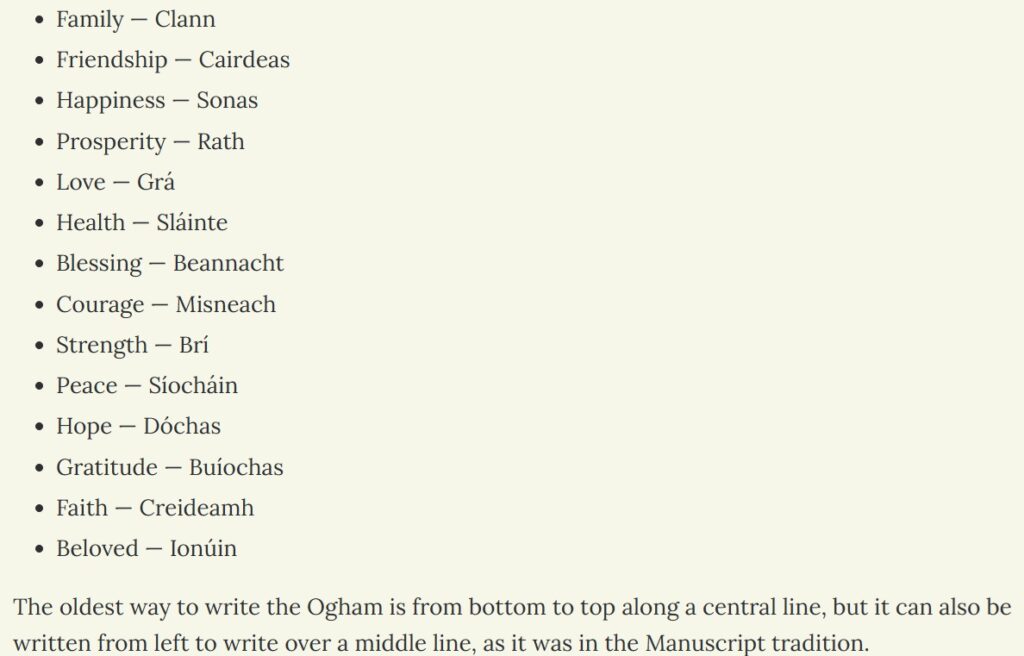
Ruairí Ó hUiginn said in his book The Irish language: you have influences of Latin from the Christianization of Ireland in ecclesiastical words, influences from Viking invasions in words for “seafaring, fishing and trade”, influences from the militaristic Normans [ French CP] in words for “architecture, administration and warfare”, and from English colonialism you get English in every day words.

Each influence shows an aspect of Irish culture. What people forget to realize is that a language is much more than something spoken to express oneself. Ancient peoples created language in an attempt to describe the world around them and the world within them, in other words their worldview.
Nevertheless, Irish is important internationally too, and Irish is the third oldest written language in Europe, after Latin and Greek, and as a spoken language it may even be older than both.
How should an artist illustrate a language? And more specifically the struggle of one language with another? I choose nature as my metaphor, from the ancient forests of Ireland, mostly gone now, to Islands which stand for thousands of years but are slowly worn away by the tide. The words that make up these landscapes are either ‘for’ or ‘against’.
I imagine a “versus” scenario. On the “against” side I chose English words plucked from peoples statements in online forums and in letters to newspapers. On the “for” side I chose Irish words, and they were chosen from recent investigations into the creation of the ancient Irish language. Irish words in my illustrations such as “dúchas (heritage), tír (country), litríocht(literature), and stair(history)” reflect the Irish language’s cultural importance, while “Todhchaí(future), féinmhuinín(self-confidence), beatha(life), and anam(soul)” reflect its importance in a metaphysical way to Ireland.

The english ‘against’ words can range from the practical benefits of english within subjects such as “tourism, movies, business, and comics,” to words that reflect the interaction of English speakers with Irish. To illustrate the concept, I chose words like “conform, bend, harass, and adapt”.
To create my intended mood, the english words are given a general indistinctive typography reflecting uniform mono-linguilism, while the Irish words are given a distinctive Irish manuscript/Gaelic script reminiscent of Geoffrey Keating’s 17th century book- Foras Feasa ar Éirinn/History of Ireland.
The core message in my illustrations is a positive one, the sun is rising for a new day as the Irish language holds on, like a lot of minority languages. It is diminished but not beyond hope. I believe it can make a comeback, and this is exactly what is happening all over this country today, because of the work of people far more dedicated than myself. I hope my work can help reinforce linguistic diversity as well as all forms of heritage. I have the will to preserve these for future generations, so they too can live in a world full of diversity spending their lives discovering and exploring it in all its beautiful variety.

For the Silo, JG O’Donoghue.
Brunette knockout Christina Estrada modeled for some of the world’s top brands and appeared in the famous Pirelli calendar. Born in the USA, the glamorous Estrada has been based in London since 1998. She was previously married to Saudi billionaire Sheikh Walid Juffali, but the couple divorced in 2016, leaving Estrada the sole owner of a fabulous Beverly Hills villa. The supermodel has listed the stunning estate for sale at $26 million usd/ $37.7 million cad. According to the listing agent, Gary Gold, “This is the quintessential Beverly Hills estate located on the best block of the best street in the Flats. This is the type of home you see in a movie portraying the good life.”

Spanning 9,000 square feet with five bedrooms, eight bathrooms, and luxe modern amenities, the residence will be sold fully furnished.

The two-story home boasts an imposing Italian-style facade. Old World styling is evident throughout the mansion, with columns, archways, wrought-iron details, and exquisite beamed ceilings. Enter through the impressive two-story foyer, featuring double staircases, coved archways, a wonderful chandelier, and a hand-painted ceiling. The chef’s kitchen boasts top-of-the-line appliances and a spacious butler’s pantry, while the formal dining room includes seating for 12. A cozy breakfast offers a more relaxed atmosphere, with yard access for al fresco dining.

The spacious primary suite includes big windows for lots of natural light, a generously appointed bathroom with marble accents and a glamorous mirrored powder room, plus a walk-in closet fit for a supermodel’s wardrobe. Upstairs, find three more bedrooms with their own en-suites, furnished in a classic style. A step-down living room with steel-case windows and an attractive great room with an inviting fireplace offer lots of space for lounging. Meticulous attention to detail is evident in every room, while the chic but understated furnishings allow the home’s timeless beauty to shine.

The spectacular yard offers a resort-like atmosphere with a stylish pool, manicured lawns, and tall hedges for lots of privacy. Multiple balconies offer pool views, while the den and family room connect with the outdoor spaces for seamless indoor-outdoor living, taking advantage of LA’s year-round pleasant weather. The covered loggia is especially lovely, with intricate columns and a curtained gazebo. Other amenities include a library with built-in bookshelves, a five-car garage, and a separate guest house with two bedrooms and two baths.

Located just off world-famous Sunset Blvd, the mansion is convenient to the music and entertainment venues of the Sunset Strip, the high-end shops on Rodeo Drive, the Getty Museum, and the Los Angeles Country Club. Known for its beautiful homes on large lots, the Flats is one of 90210’s most exclusive neighborhoods. Just a few of the zipcode’s illustrious residents include Adele, Taylor Swift, Jennifer Aniston, Jack Nicholson, Ashton Kutcher and Katy Perry. For the Silo, Bob Walsh/ toptenrealestatedeals.com.

The listing is held by Gary Gold at Forward One. Photo Credit: Jennifer Mann, The Luxury Level
Source: soldbygold.net
LANDSCAPES 2025 is an impressive online survey exhibition adjudicated by the notable public art gallery programmer Krista Young and the celebrated artist Clint Griffin. The John B. Aird Gallery is proud to present its first large group project organized around the Landscape Genre, a genre of art practiced for centuries around the world.
This intentionally broad definition allows for a diverse range of artworks, reflecting the variety of contemporary art techniques and practices today.
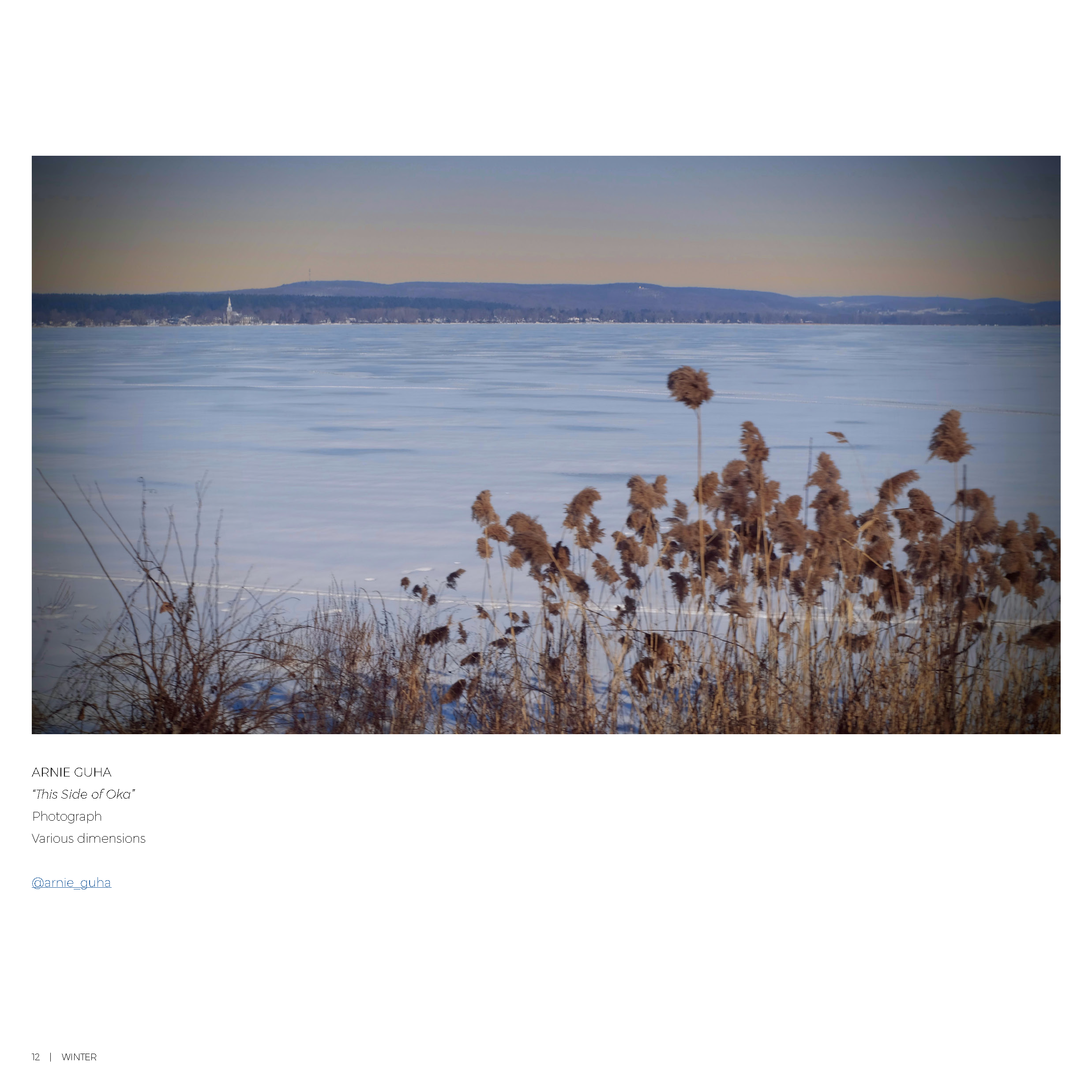
LANDSCAPES features new work by fifty-five artists inclusive of John Abrams, Rhonda Abrams, Sue Archibald, Joe Atikian, Phill Atwood, Jarrod Barker, Ioana Bertrand, Matthew Brown, J. Lynn Campbell, Alyson Champ, Ava P Christl, Frances Cordero de Bolaños, Glen Cumming, Grace Dam, Fanny Desroches, Jennifer Dobinson, Edward M. Donald, Janice Evans, Tanya Fenkell, Marie Finkelstein, Julie Florio, Robert Fogel, Anna & Richelle Gaby-Trotz & Forsey, Elena Gaevskaya, Arnie Guha, Stev’nn Hall, Michael Hannan, Emily Honderich, Carol Hughes, Connie Ivany, Marlene Klassen, Lisa Litowitz, Ramona Marquez-Ramraj, Claudia McKnight, Susan Munderich, Mahnez Nezarati, Allan O’Marra, Sherry Park, Karen Perlmutter, Piera Pugliese, Jackie Rancourt, Katie Rodgers, Lynne Ryall, Kaija Savinainen, Lee Schnaiberg, Wendy Skog, Carolynn Smallwood, Margaret Stawicki, Kate Taylor, Robert Teteruck, Steph Thompson, Joanna Turlej, Dejana Veljko, Victoria Wallace and Don Woodiwiss.
These pieces engage with the dialogue between traditional art history and contemporary interpretations. Some explore the connections between mythologies and landscapes, investigating the relationship between spirituality and nature, which may lead to more abstract representations. Conversely, other works critically examine the impacts of the railroad, displacement, and extraction industries, illustrating the lasting scars these forces leave on the land.
Clint Griffin lives and works in Toronto. His work has been widely shown in Canada and the United States. Celebrated in both the contemporary and folk art worlds, Griffin’s work can be found in many private and public collections including the Art Gallery of Ontario, Bank of Montreal and Canada Council Art Bank. Clint currently owns and operates a fine art services business providing service to galleries, artists, collectors and institutions throughout Ontario.
Krista Young has held roles in both administrative and programming capacities at public art galleries in Northern and Northeastern Ontario. Krista has assisted in the development of programming, publications and touring exhibitions. Now based in Toronto, Krista is a small business owner and mother of three.








































For the Silo, Carla Garnet.


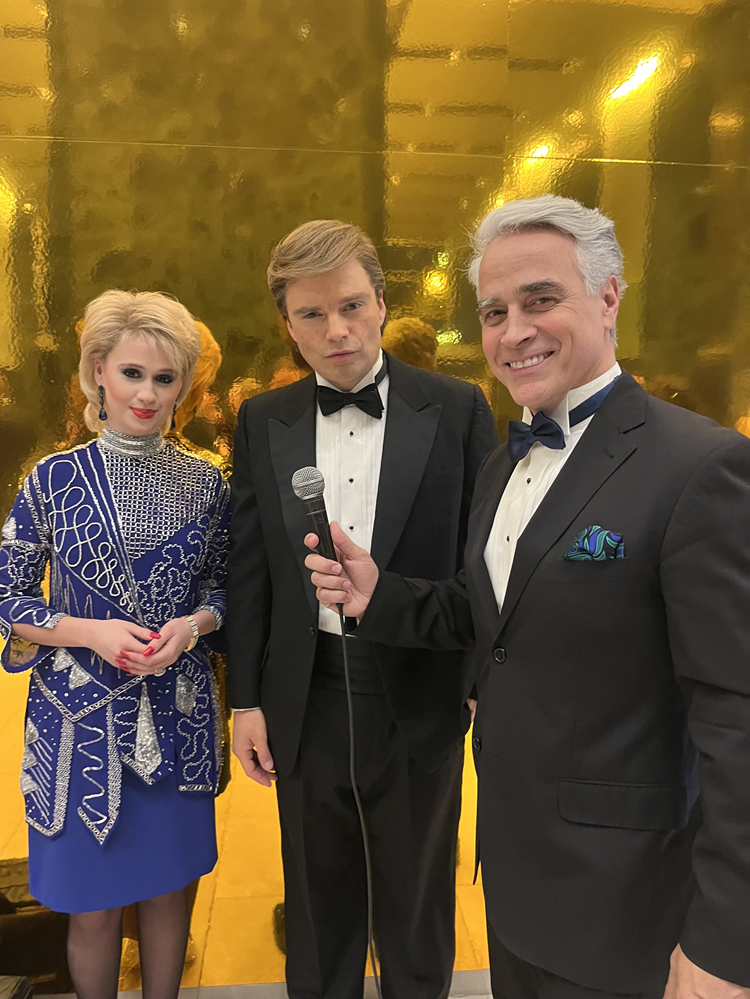
Seasoned Canadian Actor Randy Thomas Put Forward for Canadian Screen Award Nomination for Best Supporting Performance in a Drama.
Toronto, ON – Seasoned actor Randy Thomas has been officially put forward for nomination by Brainpower Studio for the Academy of Canadian Cinema & Television’s prestigious Canadian Screen Award for Best Supporting Performance in a Drama for his riveting role in The Jane Mysteries: Murder at Moseby starring Jodie Sweetin and Stephen Huszar.

Known for his commanding presence as stoic corporate executives and his undeniable charm as comedic father figures, Thomas stunned audiences with his transformative performance as an emotionally distraught and lonely antagonist in the Hallmark mystery franchise.
His portrayal—layered with heartbreak, volatility, and an unexpected
path to redemption—took fans by surprise, further solidifying his range and talent as a seasoned performer.
The industry has taken notice, with Thomas’ nomination consideration reflecting the powerful impact of his performance.
Randy is a special actor. He has Leading Man charisma like George Clooney but with a unique knack for comedy. We are incredibly grateful to Director Marco Deufemia and Brainpower Studio CEO Beth Stevenson for seeing the depth of Randy’s talent and entrusting him with such a complex role. The fact that they put him forward for nomination tells us that Randy far exceeded their expectations. Let’s hope the Academy recognizes his extraordinary work as well. A win in this category would be a career highlight, and we anticipate this nomination will open even more doors for him across Canada and the U.S.
As the industry eagerly awaits the final nominations, Randy Thomas’ performance in Murder at Moseby stands as a testament to the rich and evolving talent pool within Canadian entertainment. With growing anticipation from his peers and fans alike, one thing is certain—this should be the beginning of a thrilling new chapter in Randy
Thomas’ career that’s long overdue. For The Silo, Sandy Martinez. 514-286-6001
 It’s that time of the year again…time for a perennial favorite read. Why favorite? Because we all want to know how much longer Winter will last. At this point on the calendar, at the second day of February, it feels like warm days are lost forever. But there is always hope. Hope in a critter and a shadow. Let’s begin. Again.
Maybe Groundhog Day can become a National or Provincial Stat Holiday because February 2nd isn’t officially known as Groundhog Day. Technically it isn’t a National Holiday. It isn’t a Provincial Holiday. [Is Quebec the only province with a Provincial Holiday? CP]
Groundhog Day isn’t an exclusive celebration that targets a specific demographic such as Family Day. It isn’t religiously or politically motivated. It doesn’t specify Muslim, Buddhist, Marxist, agnostic or atheist beliefs. It is inclusive, quirky, wacky and fun. There is no need to worry about political incorrectness.

Maybe Groundhog Day can become a rallying point for Ontarians because in many ways they are like us: Groundhogs are robust creatures. They handle a long winter with style. Groundhogs might be cute but they are also tough!
Maybe the Groundhog can become Canada’s national animal.
Does anyone remember the politician who wanted to make the polar bear our national animal? Most of us aren’t likely to run into polar bears. It’s that old adage: “Out of sight, out of mind” and since we’re more likely to see a groundhog and associate with a groundhog it is an ideal choice. Incidentally Canada’s national animal is the beaver. Another obscure animal that most of us have never seen.
Maybe Groundhog Day is spiritual after all.
If a Holiday needed ever to be justified on a basis of spirituality or community consider the following short list:
Supplemental- “Pothole Pete” is a growing legend in New York City. Canada’s groundhog is an albino.
We’ve touched on the symbiotic relationship between film and art in the past, such as our comparison between Blade Runner and Barry Lyndon. Let’s take a look at a few other examples. Hope you enjoy the article below and as always, if we have missed any please comment at the bottom of the page.

Art and cinema, two powerful forms of creative expression, often intersect in fascinating ways. Many of the most visually stunning movies, like the examples below, take their cinematographic style from the world of fine art. While fine artworks are only single frames, they are able to convey a sense of movement and story through their composition, perspective, form, color, and style.
For example, dynamic brushwork and lines can create a sense of energy and movement, while color and contrast can evoke emotion and progression in the narrative. Those same creative techniques are used by cinematographers to create unique cinematic experiences that resonate with audiences. And in some cases, a film’s visual inspiration is taken directly from specific fine art pieces rather than an overarching fine art visual style.
For artists, examining how filmmakers have drawn from fine art can help gain insights into how visual elements impact storytelling, convey emotions, and engage audiences, offering a wealth of inspiration and new approaches to consider in their own work.
“The Exorcist,” directed by William Friedkin, is a seminal horror film that tells the chilling tale of a young girl possessed by a demonic entity. This film’s stark and realistic visual style heightens the horror of the supernatural events unfolding on screen. There’s a scene in the film where Father Merrin, played by Max von Sydow, stands in front of the MacNeil residence, a street lamp casting an eerie glow in the foggy night.

Scene from “The Exorcist”: The eerie glow of the streetlamp mirrors Magritte’s paradoxical day and night, setting the stage for a chilling tale of good versus evil.
This iconic scene (also used for the movie poster) pays homage to René Magritte’s “Empire of Light” series. In Empire of Light, each painting in the series features a paradoxical scene where it is simultaneously day and night – the sky is bright and clear as if it’s daytime, while the landscape below is shrouded in the darkness of night, often with a single-lit street lamp. This juxtaposition creates an eerie, dreamlike atmosphere that challenges the viewer’s perception of reality.
Magritte’s signature surrealism style often embodied contrasts and contradictions, combining ordinary objects to create a sense of mystery and intrigue. In “The Exorcist,” the same visual concept was used to create a sense of dread and foreboding, using the bright light from the windows above against the lone streetlamp lit on the dark, desolate street. The use of this visual reference amplifies the film’s underlying theme of the clash between good and evil, light and darkness.

Empire of Light” by René Magritte: A surreal dance of light and darkness that challenges our perception of reality.
William Friedkin, director of the film, commented on that scene during an interview. He said:
“I chose the house to match the Magritte painting. . . I saw [this painting] in the Museum of Modern Art in New York, it’s called Empire of Light by Rene Magritte. I had that in mind, and I chose the house to match the Magritte painting… the streetlamp…the shaft of light.”
Using the same style of juxtaposition as Magritte’s painting helped Friedkin create tension and foreboding seen throughout this film. Whether it’s the contrast of light and dark, old and new, natural and artificial, or any other disparate elements, this technique can be a powerful tool for creating compelling and provocative art.
Also, by referencing a well-known piece of art, “The Exorcist” connects with the audience, adding depth to the film’s visual storytelling. Incorporating references to other works of art can be a way to engage the audience, create a dialogue with other artists, and contributes to the ongoing conversation that is art history.
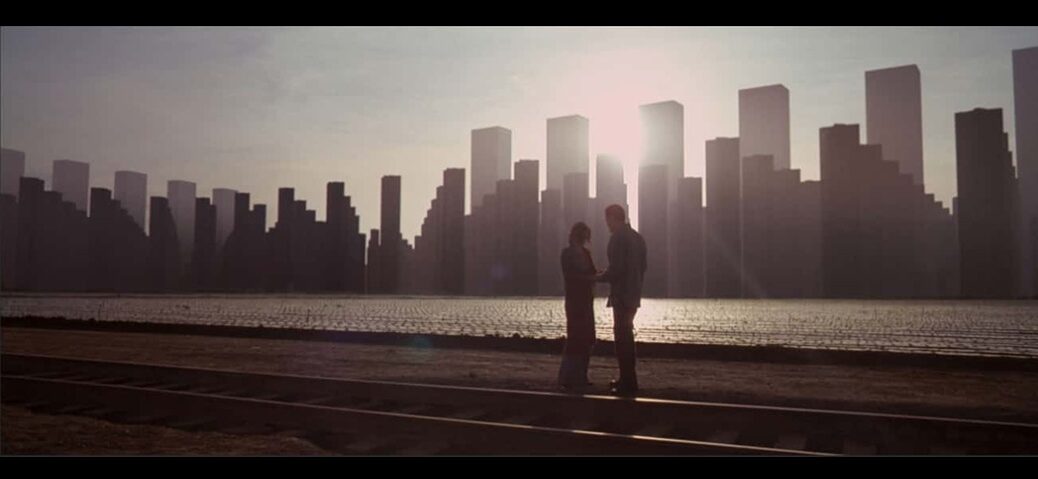
Christopher Nolan’s “Inception” is a mind-bending exploration of dreams and reality. This visually stunning movie is characterized by its complex, surreal architecture and mind-bending visuals that defy the laws of physics. The scene where the dream architects fold the city onto itself is a clear homage to M.C. Escher.

Scene from “Inception”: The city folds onto itself, creating a multi-dimensional dreamscape that echoes the impossible spaces of Escher’s work.
Escher’s work is renowned for exploring impossible spaces and optical illusions, often playing with perspective and gravity to create mind-bending visual paradoxes. “Relativity” is a prime example of this, featuring a labyrinthine structure where staircases ascend and descend in various directions, defying the laws of gravity and normal spatial orientation.

“Relativity” by M.C. Escher: A mind-bending labyrinth of staircases that defy the laws of gravity and spatial orientation.
In Inception, Nolan employs similar visual trickery. The cityscape folds and twists in impossible ways, creating a multi-dimensional space that simultaneously feels possible and impossible. The scene is difficult for our minds to comprehend, much like the world depicted in Relativity. The scene is a visual spectacle and serves the narrative by symbolizing the boundless possibilities within the dream world.
In an interview with “Wired,” Nolan spoke about the influence of paradoxical architecture on the film and stated, “In trying to write a team-based creative process, I wrote the one I know.” Noting that he and his team “liked the idea of exploring paradoxical architecture,” the concept became a key element in the film. The visual correlation between Escher’s “Relativity” and the dream architecture in “Inception” is unmistakable.
For fine artists, the “Inception” and “Relativity” examples offer valuable insights into the power of perspective and the manipulation of space. By referencing “Relativity,” “Inception” brings these impossible spaces to life, creating a visual spectacle that serves the film’s narrative about the malleability of dreams.
Although these surrealist works go to the extreme in manipulating perspective and space, the same idea can be used in non-surrealist works to provide unusual viewpoints, adding a sense of intrigue and dynamism to other traditional art styles.
The impossible, labyrinthine architecture also serves as a visual metaphor for the complexity and unpredictability of the human mind. Artists should consider how visual elements can provide more than aesthetic value or overt narrative context. They can also convey deeper meanings, alternate themes, or subtexts, making the artwork more interesting and evocative.
Paul Thomas Anderson’s “There Will Be Blood” is a captivating film that delves into the ruthless world of oil drilling in the early 20th century. This beautiful movie’s visual style is stark and gritty, reflecting the harsh realities of its setting and pays homage to the works of Charles Marion Russell.

“Jerked Down” by Charles Marion Russell: A dramatic depiction of the struggle between man and nature in the American West.
Russell’s work often captures the dramatic tension and struggle between man and nature in the American West as exemplified in works like “Jerked Down,” depicting a cowboy being thrown off his horse amidst a thunderstorm – a powerful representation of this struggle. In There Will Be Blood, the scene where an oil derrick catches fire and creates a towering inferno against the barren landscape is reminiscent of Russell’s painting both in style and content.

Scene from “There Will Be Blood”: The towering inferno of the oil derrick, a stark symbol of man’s destructive ambition, mirrors the tension and drama of Russell’s painting.
Both works use light and shadow to heighten the tension and drama of their respective scenes. In “Jerked Down,” Russell uses stark contrasts between the dark stormy sky and the lightning-lit foreground to create a sense of impending danger. Similarly, in “There Will Be Blood,” the scene of the burning oil derrick is dramatically lit, with the fiery glow of the inferno starkly contrasted against the dark, barren landscape. This creates a visually striking image that underscores the danger and destruction caused by something uncontrollable.
Additionally, both works use composition to emphasize the scale and power of nature compared to man. In “Jerked Down,” the cowboy is depicted as small and vulnerable against the vast, stormy landscape, emphasizing the power of the natural elements he is up against. Similarly, in “There Will Be Blood,” the oil derrick, while man-made, is dwarfed by the towering inferno, symbolizing nature’s overwhelming response to man’s intrusion.
These similarities in the use of light, shadow, and composition create a visual link between the two works, suggesting a stylistic influence or at least a shared visual language in their depiction of man’s struggle against nature.
The visual elements create drama and a sense of tension but, more importantly, have a huge impact on the narrative. Depicting a struggle between opposing forces can add a sense of dynamism and narrative to an artwork.
Imagine the same scene in Anderson’s film, but instead of the character being small compared to the fiery event, the main character was in the full frame looking up at the fiery plume, which from that perspective, would be far above in the background of the shot. Such a change would remove the idea of a struggle between forces and minimize the metaphor of the oil derrick representing the protagonist’s destructive ambition.
Lars von Trier’s “Melancholia” explores its characters’ psychological and emotional turmoil against the backdrop of an impending planetary collision. This beautiful movie’s visual style is lush and dreamlike, reflecting the inner worlds of its characters. One of the film’s most memorable scenes is directly inspired by John Everett Millais’ “Ophelia,” a painting that depicts the tragic heroine from Shakespeare’s “Hamlet” floating in a stream before her death.

“Ophelia” by John Everett Millais: A serene yet tragic scene that captures the beauty and despair of its titular character.
The painting is renowned for its detailed and emotive depiction of the famous character and for its lush, vibrant colors, intricate details, and sense of serene despair. In Melancholia, von Trier captures a similar mood in the scene where Justine, played by Kirsten Dunst, also floats in a stream surrounded by flowers and foliage. Justine’s floating figure, the serene water, and the surrounding nature all mirror the composition and mood of “Ophelia.” The scene is visually striking and serves the narrative by symbolizing Justine’s despair and resignation in the face of the impending planetary collision.

Scene from “Melancholia”: Justine floats in a stream, her despair and resignation in the face of impending doom mirroring the tragic serenity of Millais’ Ophelia.
The Pre-Raphaelite style that Millais helped pioneer, characterized by its vibrant colors, attention to detail, and emphasis on emotion, is apparent throughout the film, and the visual correlation between this particular scene and the painting is unmistakable.
By referencing Ophelia, Melancholia brings the beauty and tragedy of Earth’s impending doom to life, creating a visual spectacle that serves the film’s narrative about the psychological impact of the event.
In the world of beautiful movies, Terrence Malick’s “Days of Heaven” stands as a testament to the power of visual poetry. The film’s imagery, a symphony of natural light and earthy tones, seems to whisper stories of the American heartland, echoing the quiet intensity of Andrew Wyeth’s painting “Christina’s World.”

“Christina’s World” by Andrew Wyeth: A quiet yet intense depiction of solitude and longing in the vast, open landscape.
“Days of Heaven” is a cinematic canvas where the characters are painted against the vast, open landscapes, much like the solitary figure in Wyeth’s work. The characters, dwarfed by their surroundings, become part of the landscape, their stories intertwined with the whispering wheat fields and the ever-changing sky, where humans are but a small part of the larger natural world.
Just as Wyeth captured the subtle play of light and shadow on the grass and Christina’s dress, Malick uses the soft, diffused light of dawn and dusk to paint his scenes, lending them an ethereal, almost dreamlike quality. This masterful use of light enhances the film’s visual appeal and adds depth to its narrative, reflecting the characters’ hopes, dreams, and inevitable disillusionments.
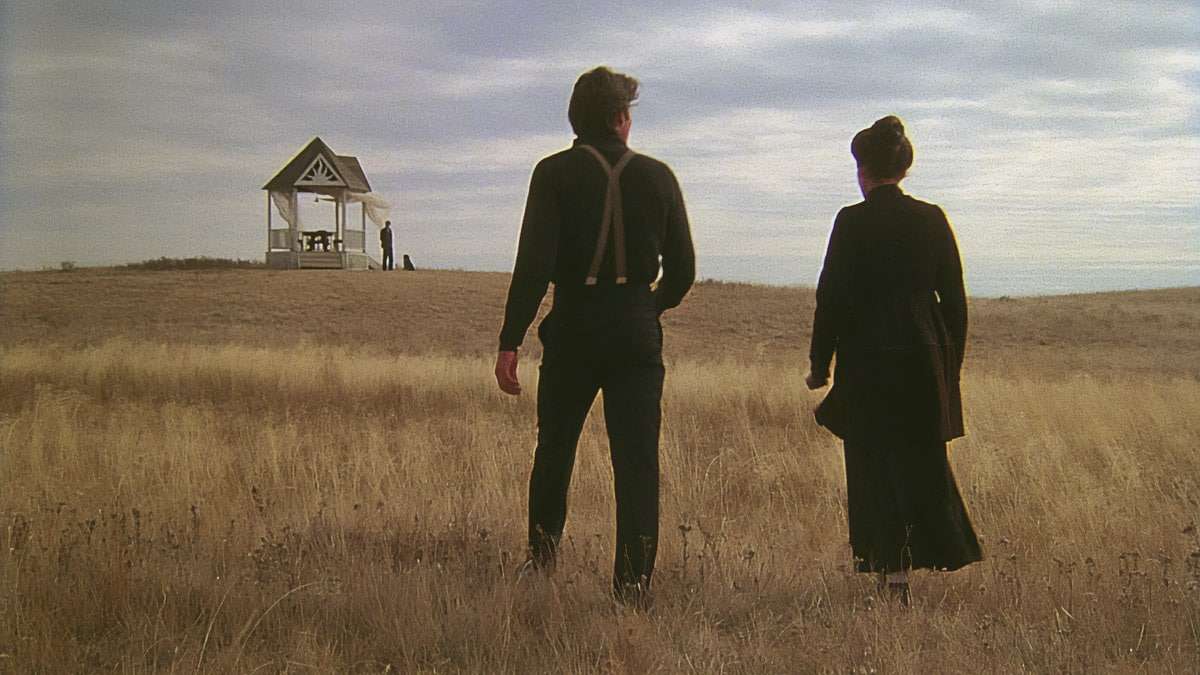
Scene from “Days of Heaven”: The characters, dwarfed by their surroundings, become part of the landscape, their stories whispered by the wheat fields and the ever-changing sky, echoing the quiet intensity of Wyeth’s painting.
The visual language of “Days of Heaven” speaks volumes about its influences. While Malick is a man of few words, letting his films speak for themselves, the cinematographer Nestor Almendros once mentioned that Malick wanted the film to resemble an “old family album.” This desire to capture the past’s fleeting, ephemeral moments resonates strongly with the nostalgic undertones of Wyeth’s work, suggesting a shared artistic vision.
So, what can fine artists glean from this? First, the power of light. Just as Malick and Wyeth used light to infuse their work with a certain mood, artists can experiment with light in their own work to create a specific atmosphere or to highlight certain aspects of their subject. Second, the importance of the environment. “Days of Heaven” and “Christina’s World” shows how the setting can become a character in its own right, influencing the work’s narrative and emotional tone. Artists can think about how the environment interacts with their subjects and how it can be used to convey deeper meanings and themes.
The intersection of cinema and fine art is a fascinating exchange that enriches both mediums. As we’ve seen in these examples, beautiful movies like “The Exorcist,” “Inception,” “There Will Be Blood,” “Melancholia,” and “Days of Heaven” have drawn inspiration from fine art masterpieces, creating visually captivating films that audiences will enjoy for decades.
These films demonstrate how the language of fine art – its techniques, motifs, and themes – or its basic principles – such as composition, color, light, and symbolism – can be applied to other mediums to convey emotion, tell stories, and engage audiences.
Ultimately, the dialogue between cinema and fine art is a testament to the power of creativity and the endless possibilities of artistic expression. Whether you’re a filmmaker, a fine artist, or simply an art lover, there’s much to learn and appreciate in this fascinating intersection of art and cinema. For the Silo, Steve Schlackman/artrepreneur.
The Gibbes Museum of Art presents the world premiere of Statement Pieces: Contemporary Fashion Design and the Gibbes Collection (January 31‒April 27), featuring designer treasures from Barrett Barrera Projects’ acclaimed fashion collection alongside works of art from the Museum’s permanent collection.
Exquisitely designed garments are curated with select artworks spanning from the 1770s to the 2020s. The exhibition is the centerpiece of this year’s Art Charleston, the city’s annual visual arts festival (April 23‒27). Statement Pieces shines a light on extraordinary fashions by
Alexander McQueen, Charlie le Mindu, Comme des Garcons, Dapper Dan, Gucci, Molly Goddard, Pam Hogg, Richard Quinn, and Serena Gili.
Their designer looks are paired with artworks by Joan Mitchell, Romare Bearden, Jasper Johns, Barkley Hendricks, Gilbert Stuart, Sir Martin Archer Shee, and Utagawa Hiroshige, plus nationally renowned Southern artists Merton Daniel Simpson, Donté K. Hayes, and Edward Rice, among other artists in the museum show.
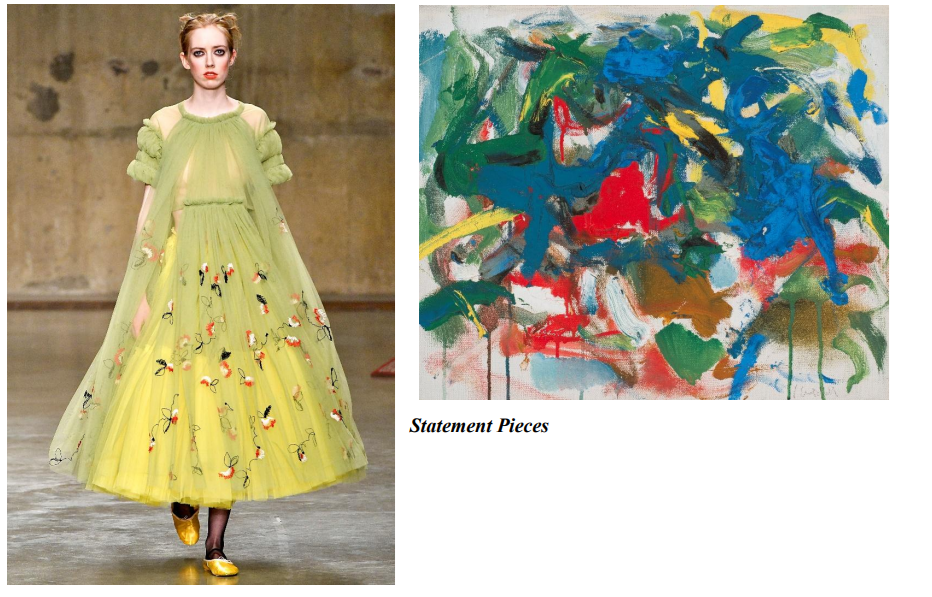
Pictured above is Molly Goddard’s green tulle dress with embroidered flowers, from the Autumn/Winter 2017 Collection. The garment is paired with Joan Mitchell’s 1966 painting, titled Series: July 25 I, oil on canvas. In celebration of the artist’s centennial year, the Gibbes Museum is one of eleven American institutions awarded a grant by the Joan Mitchell Foundation. (Fashion photo by Jonas Gustavsson)
The exhibition is co-curated by Sara Arnold (Director of Curatorial Affairs at the Gibbes Museum of Art), and Kelly Peck (Chief Curator/Vice President of Barrett Barrera Projects). The gallery settings and staging for these one-of-a-kind pairings were designed by Nic Cherry (Director/Barrett Barrera Projects). Portraits by American and European masters from the eighteenth and nineteenth centuries showcase historical figures who were so confidently fashion-forward, they boldly hold their own when positioned next to the high glamour of current fashions.
Their sense of style continues to influence present day fashion designers, centuries later. Abstract mid-twentieth century paintings, and contemporary artworks of today, signal how art and fashion always influenced each other ‒ a theme clearly evident when viewed through this fashion lens.

Pictured above is the 1804 portrait by Gilbert Stuart of Charleston-born General John R. Fenwick (1780-1842), oil on canvas, exhibited alongside Alexander McQueen’s blue velvet embroidered coat with tulle replica dress, from the Autumn/Winter 2008 Collection. (Fashion photo above by Giovanni Giannoni) Pictured below is the red dress from the Comme des Garcons Spring/Summer 2015 Collection, paired with Sanctuary, the stoneware sculpture created by Donté K. Hayes in 2020.
(Fashion photos below by Jonas Gustavsson)

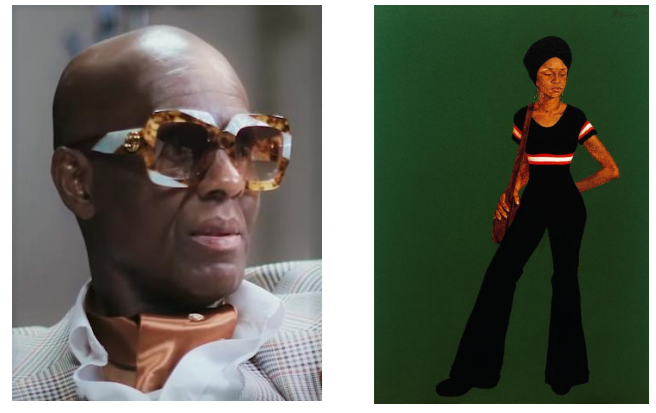
Above: the Museum exhibition pairs Harlem-inspired streetwear by Dapper Dan (pictured left) from his wildly successful 2018 collaboration with Gucci, and the 1972 painting on the right by the late artist Barkley Hendricks, titled Ms. Johnson (Estelle), oil and acrylic on linen canvas.
The Museum purchased this painting with funds provided by the National Endowment for the Arts. During his career, Hendricks influenced Black portraiture and conceptualism, and was known for his life-sized portraits of Black Americans. “The Gibbes Museum of Art is
thrilled to kick off the new season by celebrating the many ways art and fashion are forever intertwined in our culture,” says Angela Mack, the President and CEO of the Gibbes Museum. “The dialogues between each
artwork and garment create a striking visual courtship between the two art forms.
By pairing these works from our Museum’s permanent collection with the fashions from Barrett Barrera Projects, together we are taking
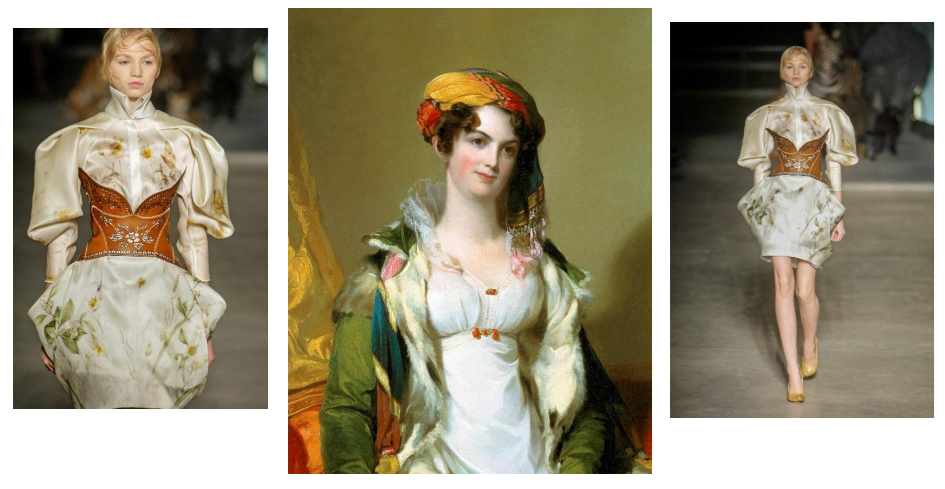
the phrase Statement Pieces to a whole new level,” adds Angela Mack. Pictured below: the 1823 portrait by Thomas Sully of Sarah Reeve Ladson, oil on canvas, with Alexander McQueen’s two-piece floral ensemble with brown leather corset, Spring/Summer 2009 Collection.
(Fashion photos below by Jonas Gustavsson)
The curators emphasize a dramatic focus on form, line, shape, texture, and color, creating fresh explorations of the Gibbes Museum’s collection through fashion. Traditional portraits by prominent American and European painters are re-contextualized with modern takes on power-dressing. The longstanding interplay between fine art and contemporary fashion design is showcased by combinations that examine technique, materiality, memory, identity, and style between each of the coupled fashions and artworks.
Pictured below: The 1770 painting by Benjamin West depicts Charleston-born Thomas Middleton, oil on canvas, presented with Gucci’s gold dress with feather embellishments from the
Spring/Summer 2011 Collection.
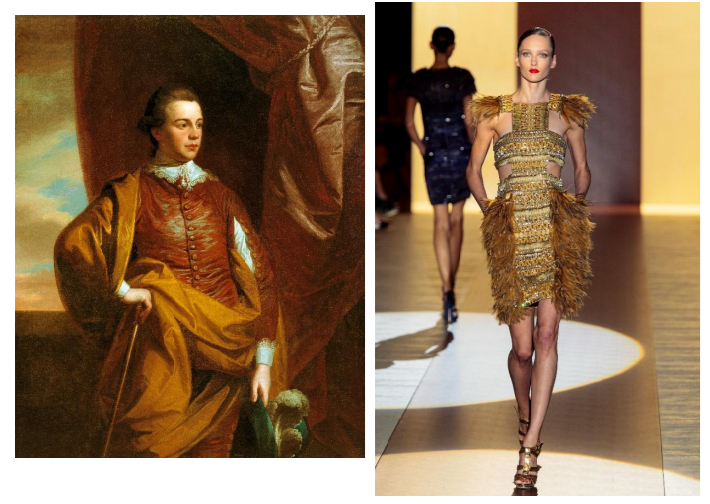
The style of sumptuous costume was often used in 18th Century paintings to create an air of pageantry and elegance ‒ a nod to the garment’s assertive provocation of glamour.
(Fashion photo by Jonas Gustavsson)
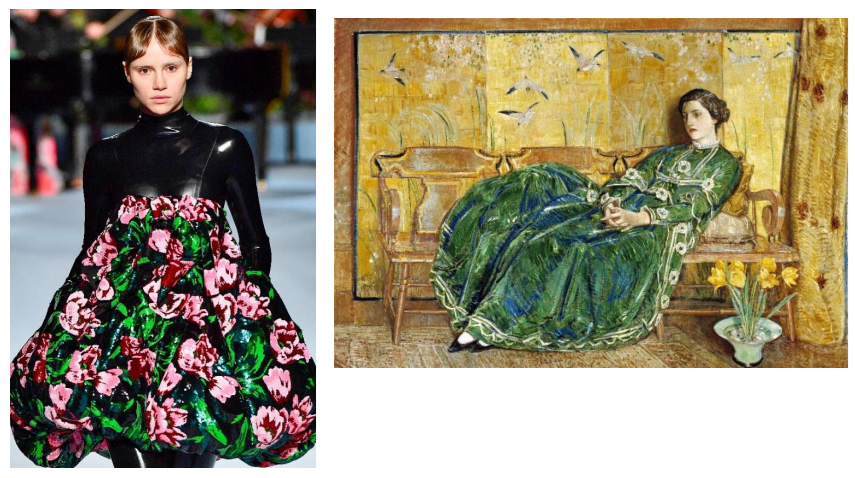
Fashion designer Richard Quinn’s sequin embellished floral dress, from
his Autumn/Winter 2019 Collection, is shown with Childe Hassam’s
1920 painting, April (The Green Gown), oil on canvas. This painting is
unique among the American artist’s work because of its personal subject
matter, recreating a moment from the artist’s past ‒ the artwork is believed to be a portrayal of Hassam’s mother in 1859 while she was pregnant with her son. Quinn describes his fashions as being “designed with the most meaningful moments of our lives in mind, inextricably linked with time, place and memory.”
(Fashion photo by Jonas Gustavsson)
Several of the artists in this exhibition use their depictions of dress and fashion to emphasize the personal style of their subjects. The artists also used this emphasis as an expression of their own aesthetic sensibilities.
This creativity and flair are comparable to the way modern day stylists and art directors work at fashion shoots today.
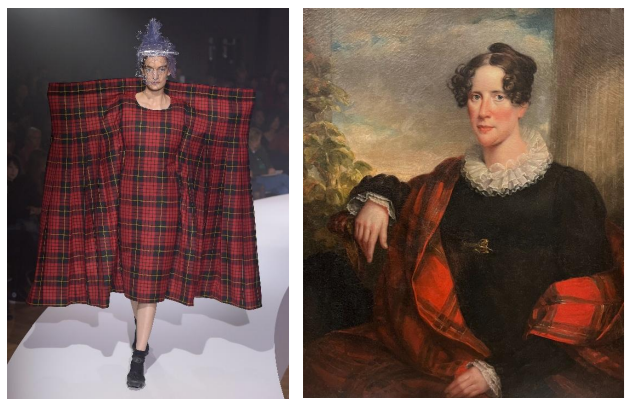
Above: The red tartan plaid pleated dress from the Comme des Garcons Spring/Summer 2017 collection is presented alongside the 1820 portrait titled Mrs. George Hall (Jane Ross), by Sir Martin Archer Shee, oil on
canvas. Fashion designer Rei Kawakubo’s clothing designs are known for exploring volume and shape, with amplified proportions. In the painting, the artist Martin Archer Shee likely included tartan to denote his subject’s Scottish heritage.
(Fashion photo by Giovanni Giannoni)

Above: The winged figure rising in the center of the 2015 mixed media work They Combined Beauty, by Stephen L. Hayes Jr, calls out to the gold embroidered wings on the black sheath dress by Alexander McQueen,
Spring/Summer 2008 collection.
The many layers of found objects in Hayes’ artwork convey the resilience and strength of the African American community, despite centuries of adversity ‒ from symbols referencing the transatlantic slave passage, to the fight for legal civil rights.
(Fashion photo by Jonas Gustavsson)
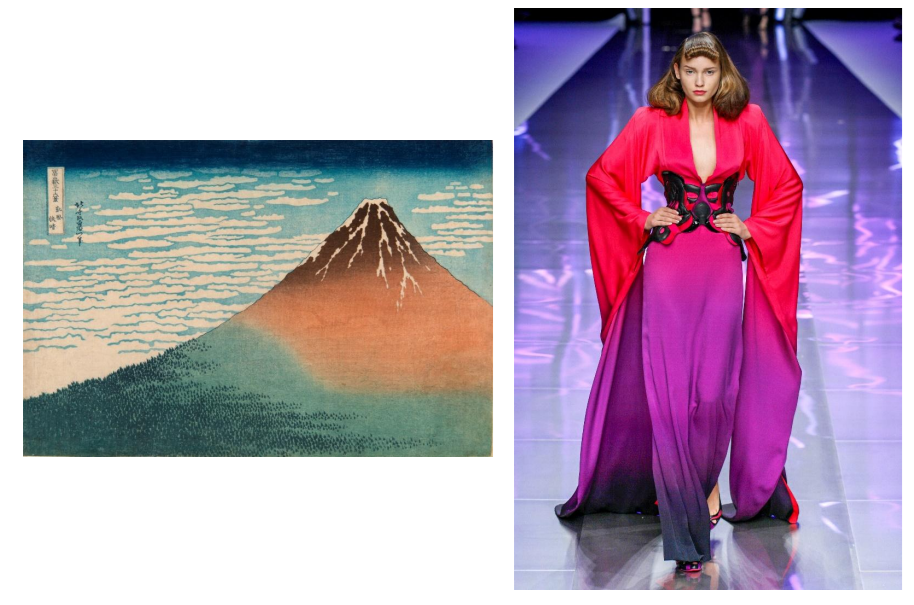
Pictured above: a rare 1800s Japanese color woodblock print by Katsushika Hokusai titled South Wind, Clear Dawn (Gaifu kaisei), with Alexander McQueen’s silk ombre kimono dress, Spring/Summer 2008 Collection. McQueen was fascinated with Japanese culture and dress.
The visually pronounced gradations in McQueen’s fabric marry well with the color technique effects in Hokusai’s artwork.
(Fashion photo by Jonas Gustavsson)

Pictured above: visitors to the museum will be able to view one of Romare Bearden’s rarely seen mid-century abstract paintings. Untitled (Green), ca. 1950s, (oil, casein, and colored pencil on canvas, that has been cut and mounted on painted board), is juxtaposed with fashion designer Serena Gili’s golden fiberglass skirt and cashmere beaded top.
Gili’s acclaimed 2012 Collection earned rave reviews. Bearden’s abstract
paintings are not usually exhibited to the public, and are heralded as some of his best work by the art critic Roberta Smith.
(Fashion photo by Saga Sig, courtesy of Serena Gili)

Pictured above: Pam Hogg’s “Black Dress #4” from the Spring/Summer 2013 Collection, paired with the 1919 painting Mrs. Asher D. Cohen, by Martha Simkins, oil on canvas. Hogg’s collection was titled “Save Our
Souls” when it debuted at London Fashion Week, emphasizing the punk aesthetic and London club scene looks that Hogg is known for.
During the historical period when this painting was made, it was common for women to have their portraits painted while in mourning.
(Fashion photo courtesy of Pam Hogg)

Above: Merton Daniel Simpson’s 1991 painting titled Grand Dance, oil and Mali hunting cloth, paired with the Alexander McQueen moth print silk dress from the fashion house’s Spring/Summer 2010 Collection. The decade-defining collection was one of the first to feature 3-D printing techniques.
Simpson was born in Charleston in 1928, and was influential in bringing African art into mainstream culture when he opened his art gallery in New York in the 1950s, introducing tribal and African art to museums and collectors. He worked for social justice, incorporating political themes into his art.
(Fashion photo by Jonas Gustavsson) For the Silo, Jarrod Barker. @jarrod_barker_
The exhibition comes to life through a series of events and programming from January 31 through April 27.
Visit gibbesmuseum.org/programs-events for updated events information.
Art Charleston (April 23-27) is the city’s annual visual arts festival, presented by the Gibbes Museum of Art. The five-day celebration features signature events, exhibition tours led by experts, artist lectures,
panel discussions, gallery walks, professional workshops, and more. Read the full festival event guide at the link above. The centerpiece of
this year’s festival is the Museum’s exhibition Statement Pieces: Contemporary Fashion Design and the Gibbes Collection.
Barrett Barrera Projects is a cross-disciplinary group of originators who redefine art experiences and push boundaries to explore the continuously expanding spectrum of art forms. We see art where others see separate disciplines. At Barrett Barrera Projects we focus on the intersections, because that’s where new ideas and experiences emerge. Our team produces, manages, consults and advises on emerging contemporary art and non-traditional media. Barrett Barrera Projects offers complex, multi-disciplinary exhibition experiences that
challenge the traditional boundaries separating art, fashion, design and performance.
The Gibbes Museum of Art, a beacon in the American South for arts and culture since 1858 when the Museum’s art collection was founded as the Carolina Art Association, is heralded as one of the earliest and most longstanding arts institutions in the United States. The Museum’s collection spans 350 years, and features some of America’s most celebrated artists ‒ including contemporary, modern and historical works.
With world-class rotating exhibitions and a dynamic visiting artist residency program, the Gibbes is a southern museum with a global
perspective. The Museum’s mission is to enhance lives through art by engaging people of every background and experience with art and artists of enduring quality, providing opportunities to learn and discover, to enjoy and be inspired by the creative process.
Museum hours and visitor info at: www.gibbesmuseum.org/visit

Maximizing workspace in smaller environments is a common struggle, leaving many people feeling cramped and unproductive. The frustration of limited space can lead to discomfort and decreased efficiency. Small sit-stand desks are an innovative solution for optimizing your workspace and enhancing productivity. They allow you to alternate between sitting and standing, making the most of your workspace while promoting better health and efficiency throughout your day.
As remote work continues to rise in popularity, having functional and ergonomic solutions is more crucial than ever. A small workstation can transform your workspace by providing flexibility and promoting a healthier posture. Studies show that using a small sit stand desk can reduce sedentary time by up to 50%, leading to health benefits.
Choosing a small sit-stand desk is an excellent solution for anyone working in a compact space, whether at home, in a small office, or even in a corner of a larger room. These desks maximize functionality without overcrowding your workspace, making them perfect for smaller environments.
Their major benefit is their ability to improve posture and reduce the risk of chronic pain from prolonged sitting. Research indicates that alternating between sitting and standing during your workday alleviates back and neck discomfort.
These workstations provide the flexibility to adjust your position throughout the day, helping you maintain higher energy levels and better focus. With a compact design, they fit into any home office setup and offer all the ergonomic benefits of a traditional standing workstation without sacrificing valuable space.
The most common buyer’s mistake is purchasing a workstation without measuring their available space. An option that is too large can clutter your workspace, while one that is too small may not provide enough room for all your essential items.
Before buying, measure your workspace. Consider the width, the depth, and the available height range, if you plan to place your workstation under shelves or in tight corners.
Ensure the desk can adjust to your height. The work surface should be at least 24” deep and 48” wide for standard use. Consider options with memory presets for easy adjustments if you often alternate between sitting and standing throughout the day.
Choose a model with a height range of 28” to 48”. It accommodates most users, with adjustability allowing for sitting and standing positions. When selecting, check if the workstation’s height range fits your body’s needs (your elbows should be at a 90-degree angle when seated).
Select a solution that supports your equipment without compromising stability. Small sit-stand workstations have a weight capacity between 50 to 300 pounds. For models supporting multiple monitors or heavy equipment, aim for variants with a weight capacity of 150-300 pounds.
For small spaces that double as multi-use areas, you might want to consider an option with wheels or one that is easy to move. A mobile sit-stand workstation will allow you to switch from a workstation to a meeting area or move the desk for cleaning. If working in a shared environment, portability can provide much-needed flexibility without sacrificing functionality.
When choosing a workstation, understand the differences between electric and manual models to find the best fit:
Electric sit-stand models allow for quick adjustments at the touch of a button. It makes them ideal for remote workers, freelancers, or anyone who frequently switches between sitting and standing. These desks are helpful if you spend long hours at your desk and need to adjust height smoothly throughout the day. However, they tend to come with a higher price tag.
Manually adjusted workstations, on the other hand, are a more affordable option and work well for individuals who do not need frequent height adjustments. Home office workers or students who use the desk less often may find manual desks the perfect budget-friendly option. While manual desks require some physical effort to adjust, they are reliable and long-lasting.
Electric desks usually range from $300 to $800, depending on the brand, features, and size. While they may seem more expensive, the convenience and ease of use could be worth the investment, especially for individuals with ergonomic concerns or those who use their desks for long hours each day.
Manual desks are priced between $150 and $400, making them an attractive option for budget-conscious buyers. The trade-off here is that while manual desks are more affordable, they may require more effort to adjust, which could be a drawback for those who prefer a smoother transition between sitting and standing.
A small sit-stand desk requires an efficient and thoughtful layout to ensure you make the most of your compact space.
Investing in a small sit-stand desk can enhance your workspace’s functionality and comfort. With the best setup, you will enjoy better health, productivity, and satisfaction in your work environment. Explore the available options today to find the perfect fit for your compact workstation! For the Silo, Anna Melnikova.
Ugh it’s winter and here in Southern Ontario as I type this we are at the tail end of the Polar Vortex. It’s damn cold out. But there are some things that lend themselves well to “tossing another log on” and staying cozy while enjoying being indoors or perhaps in your heated shop or garage.
In fact, the winter is a great time to take stock and plan for your automotive future. Maybe you’ve packed your summer car away for the season and realized there’s still room for one more, or perhaps you’ve been whiling away the winter daydreaming about the car that got away years ago.
Whatever the case, our friends at Hagerty put together their latest valuation info to find some cool ’80s-vintage North American cars and trucks that we would like to add to our collections, and we think you might agree with at least some of them. Read on brave winter warrior….
The following six vehicles can all be had for less than $25,000 usd/ $35,8300 cad in #3 (Good) condition. That’s a solid starting place for a classic you plan on putting some miles on, and a great place to start if you want a running and driving project that you can cruise to RADwood with. Here then are their excellent picks, in descending order based on value.

The LX was a bit of a sleeper as it had the same EFI 5.0-liter V-8 as the GT without the flashy bits. We like the later Fox-body styling, and while the ’89 comes close to the $25,000 usd price cap, 1987 and 1988 models look just as good and tend to be just a bit more affordable. Of course, four-eyed Fox-body Mustangs (which some of the Hagerty team find more stylish) tend to be even less expensive, but they are also less powerful. One of these later LX models would be a great place to start for a mild build to enjoy the fantastic 5.0-liter soundtrack, as few platforms have the kind of aftermarket behind it that the Fox-body still enjoys.

Speaking of sleepers, the turbocharged Buicks of the ’80s are some of the most infamous. Even when the sinister black Grand National gained a reputation, the less overt turbocharged Buick models still flew under the radar. The later turbo Buicks were fuel injected and Buick kept improving the punchy 3.8-liter V-6, with final models getting upgraded airflow by way of a new charge cooler, an aluminum intake manifold, and an improved turbocharger. The final tweaks gave 1987 turbo Buicks 245 hp and 355lb-ft of torque. While those numbers aren’t particularly impressive when compared to more modern performance cars (keeping in mind that hp isn’t everything when it comes to performance measurements) , or family sedans for that matter, they put Buicks firmly in the fight for the title of quickest new cars on the market. Their interesting development history makes them a worthy collectible, and the less flashy T-Type is a great entry point at about 35 percent less than a comparable Grand National.

If 245 horsepower was a lot in 1987 (it was), imagine how exotic a 382hp twin-turbo Corvette must have been. The late Reeves Callaway had a long history of building exciting and powerful Corvettes, and even the earliest models were an ambitious project. The first twin-turbo Corvettes his company turned out in 1987 produced 345 hp, the same rating the first C5 Corvettes would receive with their naturally aspirated LS1 V-8s starting in 1997. Ever improving, Callaway soon had the 350-cubic-inch small-block pumping out 382 hp and 525 lb-ft of torque, making it one of the most powerful cars you could buy. It even came with a 12-month warranty. Just 69 Callaway Twin-Turbo Corvettes were built in 1989 and today their #3 value is just less than the $26,000 usd cost of the B2K RPO code that indicated the rare powertrain option. They might be more trouble to maintain than the rugged and simple 350 that came in everyday C4 Corvettes, but the Callaway Twin-Turbo mill was truly special. It’s also one of the best-looking C4 variants ever created, if you ask us.

The Stutz Bearcat is not well known, and those that do have any knowledge of the low-volume cars probably remember the ’60s iteration, a reemergence of the nameplate, and based on the Pontiac Grand Prix. Few will remember the original: a racy, brass-era runabout, and you can bet that if you arrived at a show in the final version of the Bearcat, based on the third-gen Firebird and sporting a carbon fiber composite body built in Turin, you’d be met with a lot of puzzled looks. Only about a dozen were built on the F-body platform, making them a truly rare sight. While the ubiquitous small-block drivetrain would make them easy to maintain, everything else about the car would be difficult to replace. Still, it’s quite a head-turning piece of American and Italian coachwork.
International Harvester gave its Scout lineup a makeover for its final year, featuring a new grille designed by Dick Hatch that used rectangular headlights. We think that the final grille is a great fit for the simple, blocky trucks and SUVs. The one shown above, with orange and yellow graphics, is practically perfect. While the standard wheelbase Scout II and the stretched Scout Traveler SUV are both outside of our $25,000 usd threshold, the stretched wheelbase Terra pickup is a more affordable entry point to Scout and meets the criteria when equipped with either the six-cylinder Nissan turbodiesel or the 196-cube four-cylinder that used the passenger bank of the company’s venerable 392 V-8. We love these rugged rigs and the Terra, with its 118-inch wheelbase and short overhangs, combines a decent-sized bed with maneuverability that’s appreciated off-road. The final year of Scout production would make an excellent addition to a collection where it could pitch in with its rugged utility and look great doing it.

Chevrolet’s competitor to the lighter, more angular Mustang GT was the IROC-Z, the performance-oriented F-body that finally got the 350-cubic-inch Tuned-Port Injection (TPI) engine from its big brother, Corvette, starting in 1987. The 5.7-liter powerplant was only available with a four-speed auto as the T5 transmission that fits under the Camaro’s floorplan couldn’t handle the larger motor’s torque. The TPI intake, perched like a spider on top of the engine, featured long runners that favored low-speed torque. Unfortunately the intake, and the engine’s meager cylinder heads, weren’t great at maintaining that torque to get the power numbers up, Still, it competed well against the smaller Ford V-8 in the Mustang. Contemporary reviews praised the IROC-Z’s power, road-holding, steering feel, and traction compared to its Mustang counterpart, but the 5.0-liter Mustangs were formidable opponents. Your choice might come down to brand loyalty or whether you prefer the boxy Fox-body or the sleek F-body. If we found one of these in our garage, we’d be tempted to troll eBay and swap meets for vintage ’80s speed parts to build a day-two IROC-Z for canyons and backroads. But that is just us.
Air fryers have revolutionized home cooking, offering a healthier, faster, and more efficient way to prepare meals—but they aren’t foolproof…especially when cooking frozen foods. Below, “The Queen of Air Fryers” Cathy Yoder shares some essential tips, tricks, and common pitfalls for perfecting frozen food in the air fryer. From achieving the ideal crisp without excess oil to avoiding rookie mistakes, this comprehensive guide ensures delicious results every time. Perfect for food and lifestyle coverage, this piece offers value to novice and seasoned air fryer enthusiasts, alike.

Can you cook frozen foods in the air fryer? Yes, you can! In fact, the air fryer cooks up frozen food items faster than the regular oven.
While the air fryer is something different than a deep fryer, it can also do most if not all of the same things that a deep fryer can do, but in a healthier fashion. By using less oil, you can cut down on the fat content of some of your favorite fried foods.
Tips and tricks for cooking frozen food in the air fryer:
Food will cook slightly differently in the air fryer than in a deep fryer. So, you will have to do some adjusting of cook times and temperatures, as well as a few other ways to make sure you are cooking frozen food well. There are very extensive internal temperature charts available that can be very helpful as well.
Best Practices:
Yes, the air fryer is a great tool to cook frozen foods, like those included on my list of my list of “Frozen foods to make in the air fryer.” This handy appliance can cook frozen foods fast and just as crispy as a deep fryer … but with less fat. All great things. For the Silo, Cathy Yoder. 
Widely regarded as the “Queen of Air Fryers,” Cathy Yoder—a mother of eight—wanted to prove that air fryers could do more than reheat frozen foods and leftovers. So, she documented her journey on YouTube. Today she boasts over 742,000 YouTube followers and yet more across other socials, over 6 million video views and tens of thousands of cookbooks sold.
| January 2015, Villa Erba, Italy. Our friends at Broad Arrow Auctions are thrilled to announce the consignment of what many consider to be one of the most original early Ferrari models extant to its inaugural Concorso d’Eleganza Villa d’Este Auction. Never before offered for public sale, the 1948 Ferrari 166 Spyder Corsa with Coachwork by Carrozzeria Ansaloni is one of two examples purchased by the Besana brothers, Ferrari’s earliest customers. Complete with Ferrari Classiche White Book certification with its original body, chassis, 2.0-liter V12 engine, and five-speed racing gearbox, it is further complemented by 50-year family ownership from 1965 to 2015 with multiple in-depth editorial pieces documenting its impressive provenance. |



| 1948 Ferrari 166 Spyder Corsa Coachwork by Carrozzeria Ansaloni Chassis No 004 C Engine No. 004 C Estimate: €5,500,000 – €7,500,000 / $8,180,000 cad- $11,540,000 cad. Classiche White Book certified with its original body, chassis, 2.0-liter V12, and five-speed racing gearbox. One of two 166 Spyder Corsas purchased by the Besana brothers, Ferrari’s earliest customers. Sixth overall at the 1948 Targa Florio, a veteran of the 1948 and 1949 Mille Miglias, period Formula Two races, and hill climbs. Long-term 50-year family ownership 1965-2015 with multiple in-depth editorial pieces. 2004 Pebble Beach Concours d’Elegance class award—displayed at Pebble Beach within Casa Ferrari in 2019 and 2022. Best of Show at the 2003 FCA National Meet, Cavallino and FCA Platinum Awards; feature car at the 2006 Cavallino Classic. |
The rise of AI is truly remarkable. It is transforming the way we work, live, and interact with each other, and with so many other touchpoints of our lives. However, while AI aggregates, dyslexic thinking skills innovate. If used in the right way, AI could be the perfect co-pilot for dyslexics to really move the world forward. In light of this, Virgin and Made By Dyslexia have launched a brilliant campaign to show what is possible if AI and dyslexic thinking come together. The film below says it all.
If you ask AI for advice on how to scale a brand that has a record company – it offers valuable insights, but the solution lacks creative instinct and spontaneous decision making. If I hadn’t relied on my intuition, lateral thinking and willingness to take a risk, I would have never jumped from scaling a record company to launching an airline – which was a move that scaled Virgin into the brand it is today.
Together, dyslexic thinkers and AI are an unstoppable force, so it’s great to see that 72% of dyslexics see AI tools (like ChatGPT) as a vital starting point for their projects and ideas – according to new research by Made By Dyslexia and Randstad Enterprise. With help from AI, dyslexics have limitless power to change the world, but we need everyone to welcome our dyslexic minds. If businesses fail to do this, they risk being left behind. As the Value of Dyslexia report highlighted, dyslexic skillsets will mirror the World Economic Forum’s future skills needs by end of this year (2025). Given the speed at which technology and AI have progressed, this cross-over has arrived two years earlier than predicted.

Image: Sarah Rogers/MITTR
The new research also shows that 66% of HR professionals believe they have support structures in place for dyslexia, yet only 16% of dyslexics feel supported in the workplace. It’s even sadder to see that only 14% of dyslexic employees believe their workplace understands the value of dyslexic thinking. There is clearly work to be done here.
To empower dyslexic thinking in the workplace (which has the two-fold benefit of bringing out the best in your people and in your business), you need to understand dyslexic thinking skills. To help with this, Made By Dyslexia is launching a workplace training course later this year on LinkedIn Learning – and you can sign up for it now. The course will be free to access, and I’m delighted that Virgin companies from all across the world have signed up for it – from Virgin Australia, to Virgin Active Singapore, to Virgin Plus Canada and Virgin Voyages. It’s such an insightful course, designed by experts at Made By Dyslexia to educate people on how to understand, support, and empower dyslexic thinking in the workplace, and make sure businesses are ready for the future.
It’s always inspiring to see how Made By Dyslexia empowers dyslexics, and shows the world the limitless power of dyslexic thinking. If businesses can harness this power, and if dyslexics can harness the power of AI – we can really drive the future forward. Richard Branson, Founder at Virgin Group.
To truly celebrate the Christmas season, and that’s what it is, no matter what anyone says, I have become open-minded and willing to accept EVERYONE’S ideas for the holiday season. If you disagree, please refrain from attending any “holiday” parties or dinners, taking the day off on December 25th or 26th (should you work for a company that still acknowledges these days as holidays) and carry on as usual. Should you happen to work for the government you are safe (for now) as they would never legislate against their own days off, although when it comes to politicians, I don’t believe never is in their vocabulary (particularly when it comes to matters involving taxes).
 The true “spirit” of the holiday season (oops, I meant to say Christmas) is for people to pause and give thanks. According to the man-made calendar of months and years, we are getting ready to start a New Year.
Being the humble (not humbug, Mr. Scrooge) creatures that we are, we also accept gifts from others (although for most it is not OUR birthday), all the while muttering that we aren’t worthy. Once these gifts are exchanged, a significant amount of “Why would she buy me this?” and “I don’t NEED another scarf” or “Does he think I’m that big?” are voiced in private, to be repeated over the next month or so. In the days immediately following Christmas, our thankful spirit has usually been diminished significantly.
Being grateful does not mean that you have to thank every one in your life personally, and you DON’T have to buy them a gift. If you are expecting a gift from someone you are probably going to be disappointed, and if you don’t reciprocate in kind you are going to be REALLY disappointed. If you have chosen to be open-minded I want to thank you for getting this far. I hope that you will also be open to a spiritual suggestion that will make you feel happy inside even though you may have received nothing outside.
Whether it is Christmas, Rosh Hashanah, the Chinese New Year, Hanukkah or Guy Lombardo’s Rocking New Year’s Eve, let those people who enjoy these festivals enjoy them. When someone acknowledges you with a holiday greeting that you are unfamiliar with, don’t believe in or if it makes you blow a gasket, pause for a moment and reply with a hearty “That’s The Spirit!”. Unless they have an aversion to ghosts, that reply should be fairly safe no matter what the season.
Let others grumble and complain that Christmas is too commercialized, the spirit of giving has been lost (or is too expensive), kids are spoiled today, no one appreciates anything and the holidays are just too much of a hassle anymore. Bellowing “That’s The Spirit!” right back at them is a great stress reliever, and at the very least will allow them to walk away from you (quickly, perhaps) in much the same way Lucy was bowled over by Charlie Brown’s enthusiastic “That’s It!” in “A Charlie Brown Christmas”.
At the risk of revealing my upbringing, I wish everyone a “Merry Christmas”, “Happy New Year” and a “God bless us, everyone”. By the way, for me it truly IS a wonderful life… For the Silo, Rick Fess.

For those of us who strive the rest of the year to eat a healthy diet while leading busy lives, it can be a challenging time. Not only are we busier than ever, we know that all those foods we usually try to avoid are going to give us indigestion, sap our energy, and pile on the pounds.
“It really isn’t hard to give yourself, your family and friends the gift of delicious, nutrient-rich meals over the holidays,” says holistic chef and certified healing foods specialist Shelley Alexander, author of “Deliciously Holistic,” (www.aharmonyhealing.com), a new, full-color cookbook featuring more than 154 of her favorite healing foods recipes and 50 pages of holistic lifestyle tips to increase energy and immunity.
“Instead of heading to the local supermarket, visit a farmers’ market, where you can buy fresh, local, seasonal and organic produce, along with other nutritious foods created by farmers and local food artisans,” she says. “You’ll have a much more enjoyable experience in addition to stocking up on all the ingredients you need to have handy. You can also find excellent choices at natural and health food stores.”
Nutrient-rich, whole foods that don’t have unnatural fillers and other additives, including seasonal, organic vegetables and fruits, wild-caught
seafood, and pasture-raised, organic chicken and meats that come from well-fed, unadulterated, healthy animals, will completely nourish your body, make you feel better and ramp up your energy, she says. And you’ll find you won’t overeat, so it’s much easier to maintain your weight without counting calories.

1• When shopping, check labels and avoid foods with a long list of ingredients. The best whole foods have one or just a few unprocessed or minimally processed, easily recognized ingredients, Alexander says. Among ingredients to avoid: chemicals, artificial sweeteners, high fructose corn syrup, nitrates, MSG, genetically modified ingredients and preservatives (indicated by the initials BHT, BHA, EDTA and
THBQ.)
2• Set aside a few hours each week to prep foods to eat in the days ahead. Cut up produce and store it in airtight containers. Lightly wash produce before using with natural vegetable wash or use one part white vinegar to three parts water. Make several homemade vinaigrettes or dressings to last all week so you can make leafy greens and vegetable salads in minutes. Clean and marinate enough meat or poultry for dinners over the next few days.
3• Start your day with a green smoothie. Cut and freeze organic fresh fruit to use in green smoothies. You can also buy frozen fruit that’s already cut up. Add organic kale or spinach, coconut water or nut and seed milks plus natural sweeteners such as dates or stevia for an energy-boosting beverage.
4• For your holiday dinners, plan on making at least three to four dishes that are both delicious and nutritious. Good examples are pasture-raised, wild turkey with sage and garlic, baked wild salmon with lemon and herbs, steamed greens, roasted heirloom root vegetables drizzled with balsamic glaze, pureed winter squash soups, and desserts made with seasonal fruits, spices, and healthy sweeteners like coconut sugar or raw honey.
5• Invest in a dehydrator. Dehydrate fruits and vegetables and raw nuts or seeds that have been soaked in unrefined sea salt water (which removes anti-nutrients, kick-starts the germination process, and increases key vitamins), and you’ll have plenty of on-the-go snacks with a long shelf life. Dehydrators are convenient and easy to use; Alexander recommends Excalibur branded products.
6• Make batches of fermented vegetables twice a month. Alexander recommends eating fermented vegetables every day to keep your digestive system healthy. They’re loaded with probiotics – the good bacteria your intestines need. Mix a variety of organic vegetables such as carrots and celery into brine with warm filtered water, unrefined sea salt, and cultured vegetable starter or liquid whey, and mix with shredded cabbage heads. Pack the mixture into sterilized glass jars and allow the vegetables to ferment for five to seven days. Once done fermenting, store in the refrigerator for up to 6 months.
“Stick to whole, healthy foods this holiday season, and you’ll feel so good, you won’t want to go near the buffet table at your office party,” Alexander says.
Shelley Alexander, CHFS: Shelley Alexander has enjoyed a lifelong love of delicious, locally grown, seasonal foods. She received her formal chef’s training at The Los Angeles Culinary Institute. Alexander is a holistic chef, certified healing foods specialist, cookbook author, and owner of the holistic health company, A Harmony Healing, in Los Angeles.
Whether you’re hosting a family Christmas dinner or are planning the office holiday party, your goal is the same: to make it a gathering your guests will always remember. Fun, unexpected surprises are an easy way to delight your co-workers, friends and loved ones. From keepsakes to party themes to the menu, there are plenty of opportunities to get creative and serve up something your guests haven’t experienced at a Christmas party before. Here are a few ideas to get you started.
Hosts of a holiday party aren’t usually expected to give their guests gifts, which is one way to surprise partygoers. Ideally, a gift the recipient can use over and over again will remind them of the good times they had at your party. Custom-printed hoodies, sweaters or long-sleeve shirts definitely fit that bill. Once you find a company that offers screen printing in Ottawa for small and large orders alike, you can think up a funny saying, exercise your drawing skills, use digital images or simply commemorate the event with your family or company name. Your guests will have unique, comfy hoodies or sweaters to wear at the party and something to remember you by whenever it gets chilly for years to come.
Keep in mind, however, that regardless of what you gift your guests, it’s all in the presentation. A fun way to gift custom sweaters, or any other gift this holiday season, is in a personalized DIY gift bag. Making them can be a fun and creative activity for you and the kids to experience that involves them in the gifting-giving and helps them practice their crafting skills.
Here are a few non-traditional Holiday party themes and activities that you can use to add a little variety to your annual dinner or get-together.
Yes, Ottawa winters can get painfully cold outside in the wind. But there are also plenty of sunny winter days that are perfect for ice skating, tobogganing, a bonfire or building snow castles using sand & snow castle-building kits. Just be sure to have backup activities planned in case the weather doesn’t cooperate on the day of your party.

Photo by Nikita Vinogradov via Pexels
If frozen toes, fingers and noses would interfere with the joy of an outdoor Christmas party, or your brood is just not the outdoorsy type, you can combine your Christmas party with one of your favorite nights of the week (or month) – karaoke, game or movie night.
Unlike the impromptu sing-alongs, games of charades or traditional gatherings around the TV for a classic Christmas film, plan your holiday party as a night of full-on:
If your party will have a significant number of kids (of any age) who like to put on a show, consider sending out scripts, holding rehearsals, and turning your home or party room into a dinner theatre. Costumes can be readily thrifted or thrown together, and if you really want to go all out, backgrounds and curtain frames can be assembled easily enough by enthusiastic DIYers. Don’t forget to have a proper video camera set up on a tripod so you’ll always have the recording to enjoy with (and at the expense of) the cast.
Your holiday dinner menu can be influenced by your party theme, it can be based on modern takes of classic Christmas dishes, or you can simply add random non-traditional dishes like the ones below.
Taco night is generally a fan favorite, so why not give the people what they want? You might have to use burrito shells depending on your meat of choice, but don’t be afraid to get creative and consider the following options:
Not much can hit the spot as well as a hearty helping of jambalaya can on a cold holiday dinner night. Really, the only rules to a jambalaya are that your ingredients taste good with Cajun spices and that it’s all cooked together. Whether you go with Christmas dinner ingredients, New Orleans-inspired flavors or some type of fusion, a big pot can satisfy a lot of people.
Puddings, pies, cakes and cupcakes are understandable go-to choices for Christmas dinner desserts, but homemade donuts with a holiday twist can ignite some excited chatter when they make their way to the dessert table. Feeling overly patriotic? Try maple glazed donuts topped with candied bacon crumble for a taste that’s both distinctly holiday and Canadian.
For the Silo, Jeg Duaso. Featured image: by Nicole Michalou via Pexels