Tag Archives: tools

5 Spring Cleaning Tips For Your Garage

Another superbly helpful article from our friends at Hagerty– if you find yourself ‘shuffling’ things around without any real improvements in organization you are not alone. Read on……
Kyle Smith

Spring time means cleaning time?

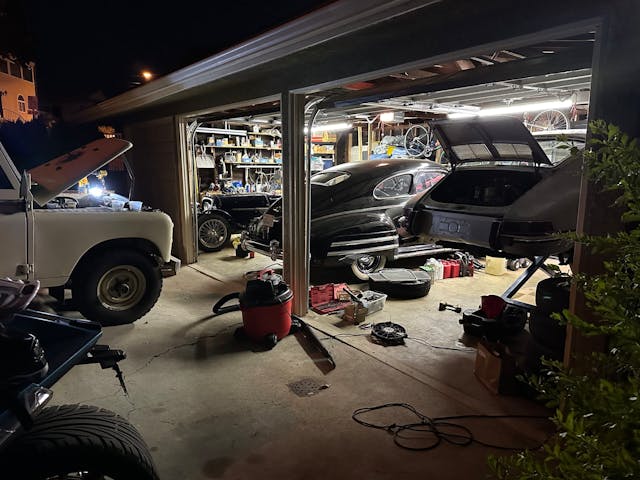
Spring cleaning is a concept that has existed for centuries. It’s the annual reminder to take personal stock of what we have, what we need, and what might need a little bit of organization or clean-up. Whether you take it seriously or not, spring cleaning is something worth at least trying if your garage is also a workshop or DIY space for your automotive habits. Make your annual cleanup better than ever with these five tips, straight from my overflowing and disorganized garage, direct to yours.

Beware of the organization trap
mounting ice tires XR250R Kyle's Garage
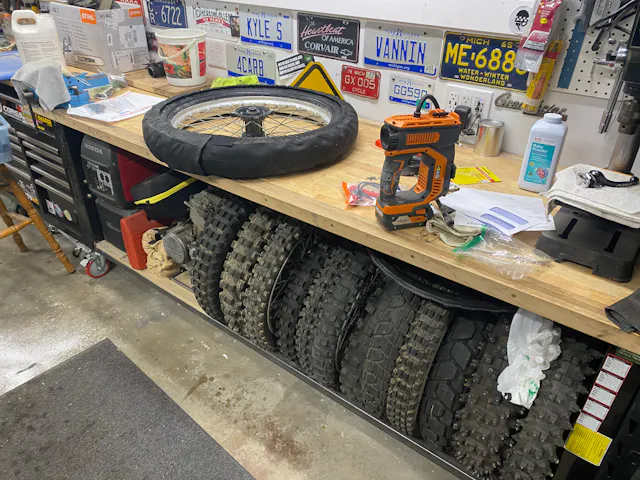
I think I might have a tire problem.Kyle Smith

When I was young, I would spend the occasional Saturday morning piddling around the garage with my father, who described the time as “organizing,” but if I snuck upstairs for a mid-morning snack, my mother would ask how dad was doing “shuffling his shit.” I spend a lot of my time shuffling my shit, so I guess that might be genetic. Perhaps you got that same gene.

If you do, be warned. We are the particularly gifted type who regularly put five pounds into the 10-pound bag—often without drama. The bag is not a literal bag here, but instead the area on a shelf or under a workbench. Packing things in more tightly is technically organizing, but it does not make it easier to get work done. Spending time unburying a part you now need but know is tucked behind a bunch of other things is still a waste of time. Organizing should make things easier to retrieve and use, not just allow you to fit more into the same space.

Be honest, are you actually gonna get to that?
workbench height demonstration Kyle's garage
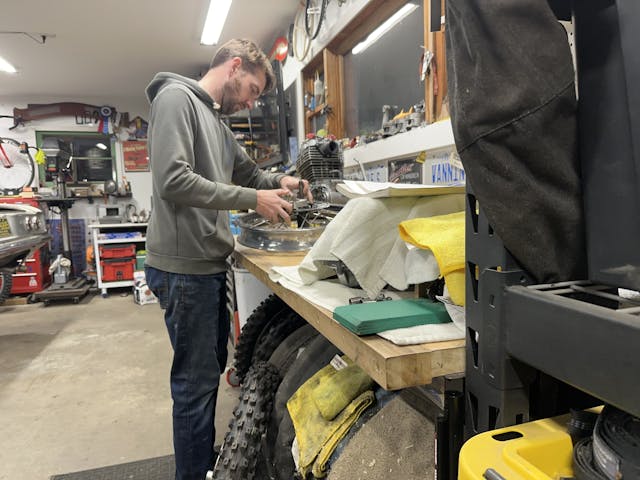
Maybe we don’t talk about how long the project hiding under that towel has been sitting there…Kyle Smith

Spring cleaning might be about returning your storage bench to a workbench, but it is also prime time to take stock of how much time you have against how many projects you have. This doesn’t have to be about getting rid of things. Instead, consider keeping the priorities up front and putting in a little extra effort to pickle and store the long-term projects better. This ensures that when you do get to them, they are how you left them—not a mismatched pile of parts that has been shuffled five times in three years, that’s also starting to rust.

Think forward

While most of the thinking in the garage is very present-focused, it’s also important to think about the future and what projects might be coming up. Are there some things in the trash pile that would be useful for that project? A few things worth hanging onto just a little bit longer?

It can be easy to simply default to “throw everything away” or “keep everything.” Resist this urge and instead look at the discoveries you make while spring cleaning and honestly assess them against the to-do list or calendar that helps keep track of the projects and tasks you have on the docket. Some make sense to keep and keep track of due to an upcoming task. Let this help guide your selection of what stays and what goes.

Take out the trash
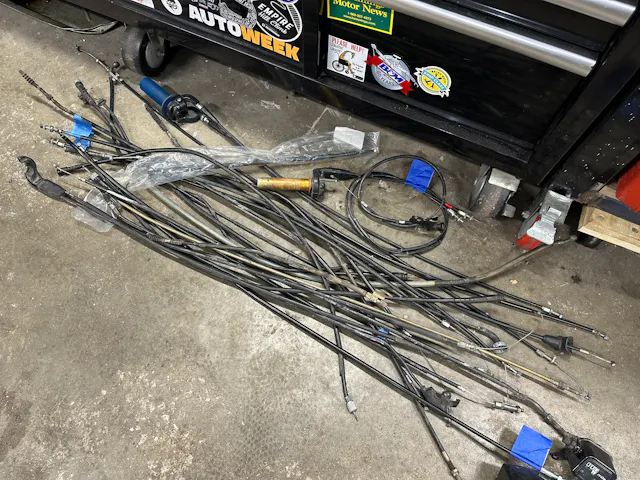
Motorcycle cables on garage floor
Every used cable I’ve taken off a project bike.Kyle Smith

It sounds simple, but actually throwing things away is tough. During an annual clean-out, a new pile will likely form in the garage, full of bits and pieces amassed during the colder months that you had every intention to throw out. It’s important to actually follow through.

The struggle—for me at least—is often that items in the trash pile do still have some small perceived value. For example, nearly every motorcycle I bring into the garage gets new control cables in the interest of safe operation. Some of the cables I pull off other bikes are still functional, just in less-than-desirable shape. Perfect spares, right? Yet I can easily find myself keeping all the cables “just in case,” which means I have a trash pile by a different name.

Create homes, not spots
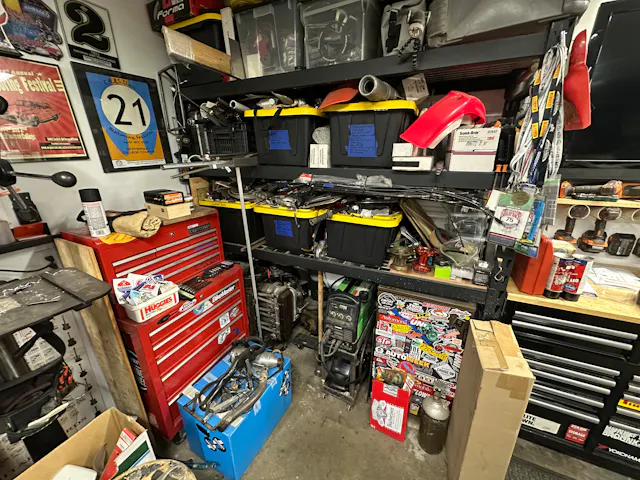
parts storage Kyle's garage
A lot of parts, a little organization.Kyle Smith

Organizing is hard. Putting things down is easy. Be careful not to fall back into just piling things together. Instead, take the time to catalog—even if only mentally—the parts and pieces as they appear from the depths of disorganization. This holds for tools also; the items that get rare usage might end up in the same spot, but it’s not a good spot for them to live. Spring cleaning is the time to look at workflow and space to put things where they should be, rather than a place where they fit.

Here’s an example: The vise for my drill press often ends up living on top of a toolbox, meaning it has to move each time I open the box and again when I go to use the drill press. This spring, it’s going to get a better home.

Spring cleaning should feel refreshing when complete. That can be tough in a garage where we are often forced to confront the progress (or lack thereof) on a project each year. Whether life was good to us or not, taking a moment this spring to assess and get back on track can be powerful. If you have tips or tricks you use for your spring cleaning, be sure to leave them in a comment below.

For the Silo, Kyle Smith.

9 Old Automotive Tools Almost Nobody Uses Anymore

If you have them should you keep them? Read on via this interesting article from our friends at Hagerty.

The nuts and bolts that make up our beloved automobiles have not changed that much over the last 150 years. But the tools needed to maintain them? Those have changed a lot. Software has cemented itself as part of a service technician’s day-to-day regimen, relegating a handful of tools to the history books. (Or, perhaps, to niche shops or private garages that keep many aging cars alive and on the road.)

How many of these now-obsolete tools do you have in your garage? More to the point, which are you still regularly using?

Spark-plug gap tool

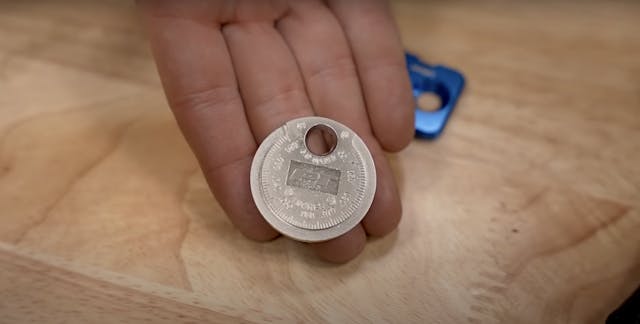
Though spark-plug gap tools can still be found in the “impulse buy” section of your favorite parts store, these have been all but eliminated from regular use by the growing popularity of iridium and platinum plugs. These rare-earth metals are extremely resistant to degradation but, when it comes time to set the proper gap between the ground strap and electrode, they are very delicate. That’s why the factory sets the gap when the plug is produced.

These modern plugs often work well in older engines, meaning that gapping plugs is left for luddites—those who like doing things the old way just because. Nothing wrong with that; but don’t be surprised if dedicated plug-gapping tools fade from common usage fairly quickly.

Verdict: Keep. Takes up no real space. 

Dwell meter

Snap On dwell meter
sodor/eBay

50 years ago, a tuneup of an engine centered on the ignition system. The breaker points are critical to a properly functioning ignition system, and timing how long those points are closed (the “dwell”) determines how much charge is built up in the ignition coil and thus discharged through the spark plug. Poorly timed ignition discharge is wasted energy, but points-based ignition systems disappeared from factory floors decades ago, and drop-in electronic ignition setups have never been more reliable (or polarizing—but we’ll leave that verdict up to you.)

Setting the point gap properly is usually enough to keep an engine running well, and modern multifunction timing lights can include a dwell meter for those who really need it. A dedicated dwell meter is an outdated tool for a modern mechanic, and thus most of the vintage ones are left to estate sales and online auction sites.

Verdict: Toss once it stops working. Modern versions are affordable and multifunctional. 

Distributor wrench

Snap on distributor wrench set
Snap On tools

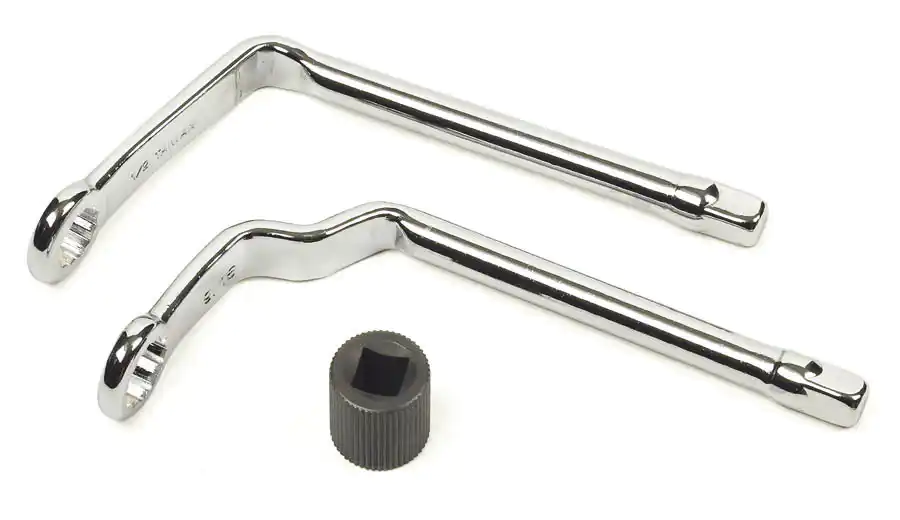
When mechanics did a lot of regular timing adjustments and tuning, a purposely bent distributor wrench made their lives much easier. However, much like ignition points, distributors have all but disappeared. Thanks to coil-on-plug ignition systems and computer-controlled timing, the distributor is little more than a messenger: It simply tells the computer where the engine is at in its rotation.

Timing adjustments have become so uncommon that a job-specific tool is likely a waste of space. If you’ve got room in your tool chest, keep yours around; but know that a standard box-end wrench can usually get the job done and is only fractionally less convenient than the specialized version.

Verdict: Keep if you have them. No need to buy if you don’t. 

Pre-OBDII diagnostic scan tools

Prior to the required standardization of on-board diagnostic computers by the U.S. in 1996, a single car could host a wild mix of analog and digital diagnostic methods. OBDII, which stands for On-Board Diagnostic II, wasn’t the first time that a small computer was used to pull information from the vehicle via an electronic connection; it merely standardized the language.

Throughout the 1980s and early 1990s each OEM had its own version of a scan tool. Now those tools can be reverse-engineered and functionally spoofed by a modern computer, allowing access to diagnostic info tools that, at the time, were only available to dealers. Since many pre-OBDII cars are now treated as classics or antiques and driven far less frequently, the need for period-correct diagnostic tools is dropping.

Verdict: Keep. These will only get harder to find with time, and working versions will be even rarer. 

Distributor machine

A distributor is simple in concept. Trying to balance the performance and economy of the ignition system, with the distributor attached to a running engine, and achieving proper operation starts to get pretty complicated. That’s where a distributor machine comes in.

A distributor is attached to the apparatus and spun at engine speed by an electric motor. This allows you to literally see how the points are opening and closing. You can also evaluate the function of vacuum or mechanical advance systems. These machines are still great but the frequency that this service is needed these days is few and far between, especially when trying to justify keeping a large tool around and properly calibrated.

Verdict: Keep, if you are a specialty shop or tool collector. 

Engine analyzer

Sun Master Motor Tester
ajpperant

Even a casual enthusiast can see there is a lot more information that can be gleaned from a running engine than whatever readouts might be on the dash. Enter the engine analyzer, a rolling cabinet of sensors and processors designed to fill in the data gaps between everything that is happening in a car and what its gauges report.

An engine analyzer is essentially a handful of additional instruments packaged into a small box hanging around the bottom of your tool drawers. It can also house a lot of sensors in a giant cabinet, which was likely wheeled into the corner of the shop in 1989 and left to gather dust. Now engine analyzers can be found listed online for as cheap as $200usd/ $287cad.

The funny thing is that many of the sensors in these engine analyzers are often the same systems that come built into modern dynamometer tuning systems. In a dyno, the sensors allow the operator to see more than max power; they also show how changes to an engine’s tune affect emissions. Maybe engine analyzers didn’t disappear so much as change clothes.

Verdict: Toss. The opportunity cost of the space these take up can be tough for most home garages. Sensors went out of calibration decades ago so the information you might get from one is dubious at best. 

Most pneumatic tools (for home shops)

Ingersoll Rand air impact
Ingersoll Rand

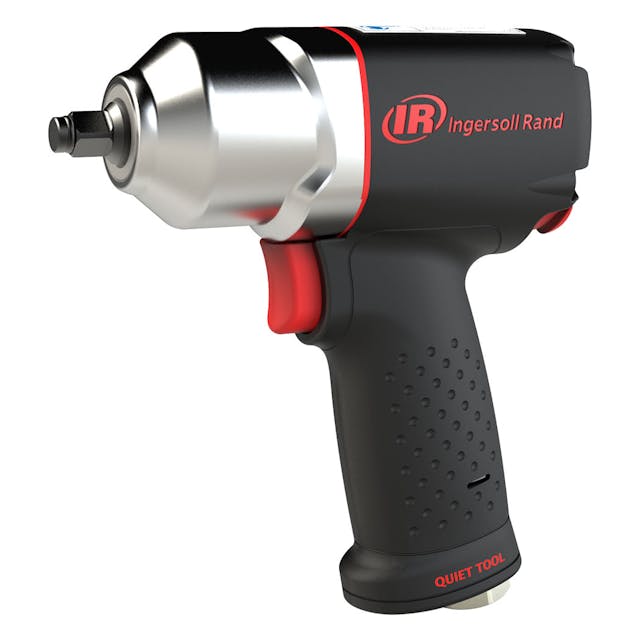
Air tools hold an odd place in the hearts of many gearheads. For many years the high-pitched zizzzz and chugging hammers of air-driven die grinders and impact drills were the marks of a pro. Or, at least, of someone who decided that plumbing high-pressure air lines around the shop was easier than installing outlets and maintaining corded tools. Air tools are fantastic for heavy use, as they are much easier to maintain and can be rebuilt and serviced.

Those tools can really suffer in lack of use, though, since pneumatic tools rely on seals and valves, neither of which deal well with dry storage. Battery tools have caught up to air tools for most DIY folk. No more air lines or compressors taking up space in the shop—and requiring additional maintenance—and, in return, a similarly sized yet more agile tool.

Verdict: Keep, if you already have the compressor. Don’t have one? Invest in battery tools. 

Babbitt bearing molds/machining jigs

Every engine rebuild has to have bearings made for it in some fashion. Today’s cars use insert bearings that are mass-produced to surgical tolerances for a multitude of applications. If you wanted—or more accurately needed—new bearings in your Model T circa 1920, you needed to produce your own … in place … inside the engine. Welcome to Babbitt bearings.

The process is a true art form, from the setup of the jigs to the chemistry of pouring molten metal and machining the resulting orbs to actually fit the crankshaft and connecting rods. Now there are newly cast blocks for your T that replace the Babbitt with insert bearings. Since those antique Ford engines just don’t get abused the way they used to, and lead fairly pampered lives, they need rebuilding far less often than they did in-period. Modern oils also do a better job of protecting these delicate bearings. Since they are less and less in demand, the tooling and knowledge to make Babbitt bearings are difficult to find, and precious when you do.

Verdict: Keep. It’s literally critical to keeping a generation of cars alive. 

Split-rim tire tools

split rim tool ad
Universal Rim Tool Company

Among the realm of scary-looking tools that have earned their infamy, split-rim tools hold court. The concept is simple: The rim is sectioned, allowing it to contort into a slight spiral that can be “screwed” into a tire. (This is almost the reverse of a modern tire machine, which stretches the tire around a solid wheel rim.) When tires needed tubes, both tire and rim were relatively fragile, and the roads were rough, split rims were popular—and for good reason. Now the tooling for drop-center wheels is ubiquitous and shops often won’t take on split-rim work. Success is hard to guarantee, even if techs are familiar with split rims—and they rarely are.

Verdict: Keep. No substitute for the right tools with this job. 

These tools might not make much sense in a dealership technician’s work bay, but that doesn’t mean they should disappear forever. Knowing how to service antiquated technology is as important as ever, whether using old tools or new ones. If you’ve got any of these items, consider it your responsibility to document what the tool does and how to safely use it. Keeping alive the knowledge of where our modern tools came from is powerful.

For the Silo, Kyle Smith.