If your old enough to remember big ass tube tv’s or roof antennas dangling on the roofs of the neighborhood houses then consider this- theme songs from those TV shows can immediately bring back memories and nostalgia from your childhood or teenage life. That is pretty powerful stuff right? One of the reasons why many theme songs continue to be so memorable is because they’re truly unique, written and performed by top-notch musical talent.
But which iconic tune has had the most influence over the years?
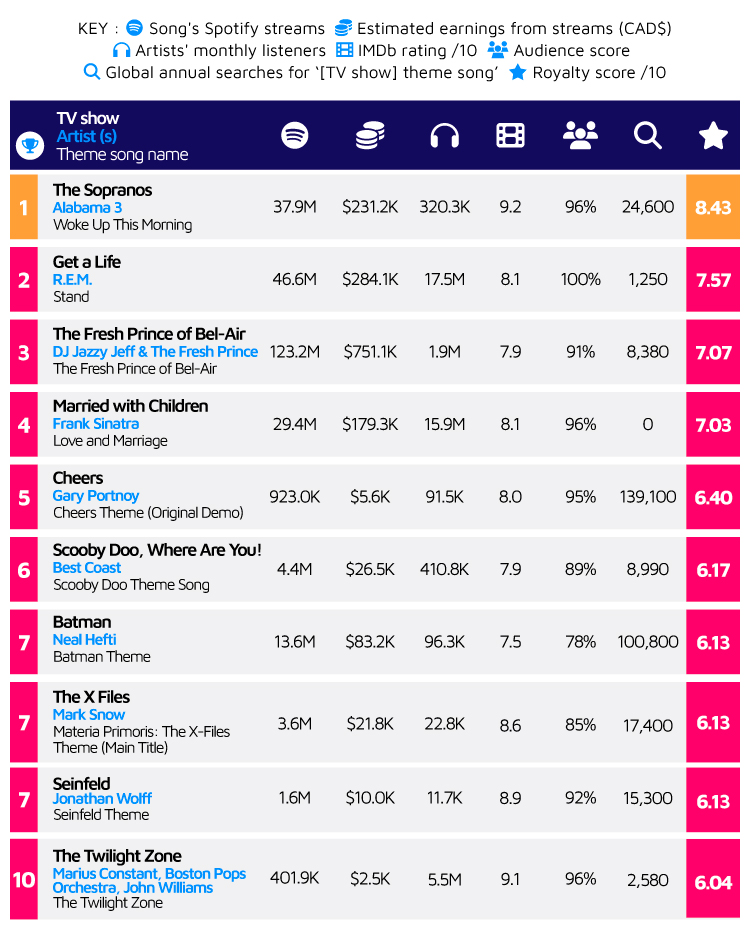
By exploring IMDb’s 100 greatest TV theme songs, our friends at Spin Genie have revealed the composers and musicians who have accumulated the most success for their contribution to iconic TV series. Using this data we will analyze the total streams, monthly listeners, and estimated earnings in CAD dollars for the appropriate TV show theme tune.
We will also judge the TV series by reviewing IMDb ratings and Rotten Tomatoes scores, as well as the annual searches for each theme song. Sound fair? Let’s dig in.
PS If you have some spare time in between binging on your favorite TV shows, check out the latest online slots available on Spin Genie.
The most successful TV theme songs:
The Sopranos
Woke Up This Morning – Alabama 3
Royalty score: 8.43 out of 10
In first place is “Woke Up This Morning”, a song by British band Alabama 3 from their 1997 album Exile on Coldharbour Lane. Best known as the opening theme song for the American television series The Sopranos. “Woke Up This Morning” has over 37.9 million streams on Spotify, with estimated earnings of $231,206, and the band has 320,321 monthly listeners. The Sopranos is one of the most influential TV dramas, smashing IMDb ratings with a score of 9.2 out of 10. On Rotten Tomatoes, the drama received a 96% audience rating and recorded 24,600 annual worldwide searches for its theme song as of July 2024.
Get a Life
Stand – R.E.M.
Royalty score: 7.57 out of 10
Following up in second place is “Stand”, a song by American alternative rock band R.E.M., released as the second single from the album Green in 1989. It was used as the theme for the 1990-1992 Fox sitcom Get a Life, starring Chris Elliott. The theme song has amounted to 46.6 million Spotify streams with earnings of almost $284,100.
Get a Life is one of the top-rated TV series on our list, recording a perfect 100% audience rating on Rotten Tomatoes. The show also performed well on IMDb, with ratings of 8.1 out of 10.
The Fresh Prince of Bel-Air
The Fresh Prince of Bel-Air – DJ Jazzy Jeff & The Fresh Prince
Royalty score: 7.07 out of 10
DJ Jazzy Jeff & The Fresh Prince’s “The Fresh Prince of Bel-Air” rounds out the top three, heard in 1990 as the theme song for the NBC sitcom The Fresh Prince of Bel-Air. The lyrics were composed by rapper and sitcom star Will Smith, performing under his stage name, the Fresh Prince, with Jeffrey Townes producing the song under his stage name DJ Jazzy Jeff. Originally, composer and producer Quincy Jones pitched the song, but Smith wrote the lyrics after reading up on an episode script. Jones immediately loved it and accepted it as the theme song.
Further findings:
The song “The Fresh Prince of Bel-Air” from the sitcom of the same name is the most streamed theme song on Spotify, with a total of 123.2 million streams.
The Sopranos achieved the best IMDb rating of 9.2 out of 10, making it the highest-reviewed TV show.
M*A*S*H, an American war comedy-drama television series that aired on CBS from 1972 to 1983, has the most-searched-for theme song with almost 200,000 people searching for it. It’s a song that was written specifically for the show by Johnny Mande and Michael Altman and is called “Suicide Is Painless”.
How to avoid being hacked during this Fall’s travel season.
According to a recent study by cybersecurity firm NordVPN, one in four travelers has been hacked when using public Wi-Fi while traveling abroad. However, unsecured Wi-Fi is not the only factor travelers should be worried about.
Last year, the FBI published a tweet (see below) warning users against smartphone charging stations in public places (airports, hotels, and shopping malls). Hackers may have modified the charging cables with the aim of installing malware on phones to perform an attack called juice jacking.
“Digital information, although it exists virtually, can also be stolen using physical devices. So it is important to take a 360-degree approach and secure your device from both online and offline threats,” says Adrianus Warmenhoven, a cybersecurity advisor.
What is juice jacking?
Juice jacking is a cyberattack where a public USB charging port is used to steal data or install malware on a device. Juice jacking attacks allow hackers to steal users’ passwords, credit card information, addresses, names, and other data. Attackers can also install malware to track keystrokes, show ads, or add devices to a botnet.
Is juice jacking detectable?
Juice jacking attacks can be difficult to detect. If your device has already been compromised, you may notice some suspicious activity – but that won’t always be the case.
For example, you may notice something you don’t recognize on your phone — like purchases you didn’t make or calls that look suspicious.
Your phone may also start working unusually slowly or feel hotter than usual. Chances are you may have picked up malware. For a full list of signs to watch out for read on and find out how to know if your phone is hacked.
How to protect yourself
Since no sign of juice jacking is 100% reliable, it is best to avoid falling victim to this attack by using the following the advice:
Get a power bank. Power banks are a safe and convenient way to charge your device on the go. Getting a portable power bank means that you’ll never have to use public charging stations where juice jacking attacks occur. Always ensure your power bank is fully charged so you can use it on the go.
Use a USB data blocker. A USB data blocker is a device that protects your phone from juice jacking when you’re using a public charging station. It plugs into the charging port on your phone and acts as a shield between the public charging station’s cord and your device.
Use a power socket instead. Juice jacking attacks only happen when you’re connected to a USB charger. If you absolutely need to charge your phone in public, avoid the risk of infected cables and USB ports and use a power outlet. This is typically a safe way to charge your mobile device and other devices in public.
CHICAGO (October, 2024)— After receiving nearly 50,000 emails from In Defense of Animals supporters, McCormick Place Lakeside Center has taken a crucial step in safeguarding migratory birds by installing bird-safe window film on its iconic glass walls. This renovation addresses the soaring number of bird deaths caused by window collisions at the convention center, which claimed the lives of over 1,000 birds in a single night last fall.
“Windows collisions rank among the deadliest threats to birds,” said Katie Nolan, Wild Animals Campaigns Specialist for In Defense of Animals. “With wild birds in steep decline — over 3 billion lost in the past 50 years — we are delighted that the Metropolitan Pier and Exposition Authority has taken a crucial step by installing bird-safe window film at McCormick Place. This sets a new standard for all North American buildings to follow. Building managers can save millions by installing bird-safe window film and turning off lights.”
McCormick Place, situated along the Mississippi Flyway — a crucial migration route — has long been a site of concern for bird collisions, particularly during spring and fall migrations. In Defense of Animals and its Interfaith Vegan Coalition witnessed the devastating impact firsthand when attending a conference at McCormick Place in 2023.
“The bird deaths we witnessed at McCormick Place were heartbreaking,” said Lisa Levinson, Campaigns Director for In Defense of Animals. “While a member of our Interfaith Vegan Coalition was able to rescue one injured bird, many more had perished in a single night. We couldn’t be happier that McCormick Place has stepped up to protect these vulnerable birds.”
The Metropolitan Pier and Exposition Authority, which manages McCormick Place, announced the $1.2 million usd/ $1.62 million cad project to install bird-safe film has been completed, covering two American football fields’ worth of glass / or approximately 1.3 Canadian football fields’ worth of glass. The newly installed bird-safe window film is a critical part of reducing bird collisions, along with measures such as dimming or turning off lights during peak migration seasons. These actions help protect migratory birds, many of whom face deadly threats from light pollution and reflective windows.
McCormick Place’s efforts align with broader city initiatives like Lights Out Chicago, which aims to reduce bird deaths by encouraging buildings to dim their lights during migration periods. The installation of bird-safe window film will go a long way in ensuring that migratory birds continue to travel safely through the city. For the Silo, Jarrod Barker.
Kirsty Harris depicts the most iconic man-made event that might take place in a landscape: the detonation of the atom bomb.
Often working at scale, Harris confronts her audience with a vision of awe and beauty. Mushroom clouds hang over desolate expanses of the Nevada desert, provoking contemplation at the intersection of humanity, brutality, technology and nature.
Harris’s practice is steadfast; her paintings are informed by deep research, and this arduous process is echoed in depictions of a split-second event painted over a period of several months.
– Zavier Ellis for the Saatchi exhibition 2023
Buster Jangle, Easy, 50 x 60 inches, 2016
CBP: Your paintings reconstruct photographic documents of the atomic bomb tests, often in the Nevada desert, in a range of exhibition display formats. Can you introduce the core themes of your work?
KH: I am interested in the way these events from history disrupt and scar those barren landscapes. These swirling, bubbling apparitions are like curses or spells that we’ve cast on ourselves, so violent.
My work might feel confrontational, maybe abrupt at first, then hopefully unravelling into something more. I am also drawn in by the stories and myths that run alongside the scientific nature of the subject. We all know that beauty doesn’t have a moral duty to be inherently good. It’s something I think about, the push and pull of awe. The tests made in the desert are so fascinating, the photographs are very rich, colourful, and vivid, due to the way the light refracts and the type of film used. These practice runs at annihilation are so beautiful – it’s unreal. It’s dark.
Georg, oil on un-stretched linen, 59 x 79 inches, 2023
CBP: You talk about early memories and family history in attending CND rallies as a child. Can you discuss this influence on the subject of your painting today?
KH: As I was becoming more and more interested in landscape painting I noticed they all have something occurring, could be farmers, the sun setting, a stormy sky, a battle, a tiny stream. Alone at Tate Modern I was looking at a painting of a single cloud by Richter and then suddenly something clicked in my head. I was walking around, eyes wide with a slack jaw, thinking “oh wow this is what I must do. Paint mushroom clouds.”
The anticipation of piling onto a coach and ending up somewhere waving my homemade banner and singing and chanting at CND protests are evocative memories from my childhood. In our doorway at home, visitors were welcomed by a massive poster of Thatcher & Reagan parodied in a Gone With The Wind movie-style poster, complete with a billowing mushroom cloud in the background. We collected protest badges and leaflets and the atmosphere was potent and thrilling, but I didn’t catch on to what we were shouting about until later. So it was always there in me. A weird relationship with the subject matter.
Plowshare, oil on linen, 80cm x 60cm, 2024
CBP: Many years ago I visited a small museum in the National Museum of Nuclear Science & History, Albuquerque, New Mexico near the atomic bomb test sites. The original photographs of the test bombs were shown alongside reportage photographs of the real bombs and their impact (I think). Also displayed was a fascinating comic book type narrative depicting the daily life of the factory workers who built the bomb and their families. I recall being quietly absorbed by the experience, though I questioned what it was I was looking at, in terms of archive material, as a museum display, and how it made me feel.
When you research and paint your subject, how do you negotiate what you feel about the source material and its transition into you what you are painting? Has it changed over time?
KH: It feels like science fiction.
Through the extensive documentation of nuclear detonations, I can view how these expansive entities change millisecond to millisecond, from the fireball to the pure white cloud left hanging at the end. In my publication, Completely er, unfolding itself (2019), I transcribed the first live official television broadcast of an atomic explosion – given the code name ‘Charlie’ – in 1942. The reporters struggle, grasping for the language to describe the mushroom cloud in front of them – and I get where they were coming from.
We are in such close proximity right now to digital versions of war. Scrolling through instagram you have temu trying to sell you some shitty plastic drawers and then 1 second later a mother holding her tiny dead child wrapped in tarpaulin, and worse. It’s so brutal.
I keep thinking how can we be doing that to ourselves, can they never see themselves in the faces of the people they kill and torture. Nothing is worth this brutality.
I guess my brain is always negotiating how much to watch in order to feel informed but not go reeling into despair, like all of us.
Blue Danube, Oil paint on lightbox tondo, 80cm x 80cm x 11cm, 2023
CBP: In 2007 Mark Wallinger created ‘State Britain’, for the Tate, a meticulous recreation of real-life antiwar demonstrator Brian Haw’s banned protest camp outside the Houses of Parliament. Rather than importing elements of the real camp as a readymade, Wallinger chose to painstakingly recreate it as a painted facsimile. This solitary studio activity would have given him time to reflect on its impact, the life sacrifice Brian Haw made, and what he as an artist was recreating.
How does time and the meticulous process of painting your subject impact on the meaning of the work for you?
KH: Like the women at Greenham Common, Brian Haw was the artwork, the awesome spectacle. Inconvenient clutter. The resilience is truly remarkable. Wallinger’s piece pays tribute to this but, a little like the fake Lascaux caves. Good if you can never see the real thing, but there’s no point looking up close. I found the political implications of it very interesting.
Large paintings take me such a long time, it’s ridiculous.
I have to continually change my vantage point. If it’s possible I turn the painting upside down, take photos of it and desaturate it. Stand up painting, sit down painting. Up the ladder, sat on the floor. I always imagine the next one will be more straightforward but in 25 years, that has never happened, so why would it now? But while there is much anxiety balled up in the action of painting, it is also a hypnotic and calming process. Studying a millisecond of time for so long. I don’t know if it matters to anyone else how long I’ve looked at the painting or the source material, but the act of looking is so important to me. Displaying a painting on your wall at home, you might not realise it but with so much flashing and moving imagery invading our lives (with invitation) a semi-permanent, static, image has a big impact. I love it when there are different layers of meaning to dive into, even if they are not explicit your subconscious will identify them. Looking at an artwork every day builds up a special relationship and enriches the way my mind moves.
Buster Dog,oil on glass, 25cm x 20cm x 4cm, 2021
CBP: Scale feels important both in terms of the impact of your subject for the viewer and your immersion into it when painting it. Can you talk about this aspect of the work?
KH: When you start a painting, there are near unlimited decisions to make. One I used to have trouble with was how big it should be. So I started to use data to construct systems that help me decide. In my paintings, often each square inch (or centimetre) of linen represents a certain number of tons of TNT. This in turn is the unit of measurement chosen, by the military, to denote the yield of the detonation.
These hidden codes might reward an inquisitive viewer.
Really, what I want to do is make paintings so vast that that’s all they see and think about for a moment.
Investigating ideas of scale in a different way: Since 2013 I have been adding to and updating an audio composition entitled How I Learned to Stop Worrying (1945-2024). It is a musical account of every officially recorded nuclear explosion detonated between 1945 and the present day: each different instrument represents a country that partook; each month in history lasts a second on the recording; each note played depicts a single bomb. Eight musicians contributed to the piece and it was quite an epic translation of data to plot out the notes.
Grapple, oil paint on glass, table, 75cm x 50cm x 60cm, 2023
CBP: Can you reveal some of the mark making techniques and tools you use in your painting.
KH: On my larger paintings I staple the linen flat to the wall and then prime it with clear primer. This enables me to really push on the canvas without worrying if I will hit the crossbar. I would love to be laying down decisive, thick, final brush marks, but what comes out is me dabbing layers and layers of thin oil paint, leaving it to evaporate and then repeating the process. My paintings are usually very matt which somehow feels right given that I’m painting dust clouds and sand half the time.
I painted a lot of small paintings on glass during lockdown.
There was something comforting about the contained nature of those pieces. It is quite a different process but still I am basically dabbing on paint until it gets thick enough to create some depth. In a development from these smaller pieces I created a much larger light box piece, Blue Danube, 2023. It plays with the notions of nuclear tourism, emitting its own light in a kind of perverse advert.
Nevada, oil on board, 30cm x 40cm, 2024
CBP: Your titles are short but ranging from factual to enigmatic, how do title your work?
KH: Hard to explain how some titles come to me. A lot of the detonations use people’s names for code names, a bit like cyclones.
Some of my favourites:
“The instrument is not the Music” is the title of a tapestry where the image is a female scientist inspecting and testing a metal instrument. A still from a British documentary it shows the intricate process in a factory where workers unknowingly fabricate the components that will eventually be assembled to create an atomic bomb. tbf my boyfriend came up with that one. He is great at titles if I get stuck.
“Blue Danube” I liked because it is a river (starting in the Black Forest and ending in the Black Sea) a piece of classical music and a bomb. All the Bs, the Beautiful Blue Danube.
Always noting potential titles down in my phone notes, I also dedicate time to skim reading when I need quite a few titles at once. They always come!
Installation shot at Saatchi Gallery 2023, Charlie, oil on un-stretched linen, 112 x 69 inches, 2017
CBP: Can you talk about your studio practice routine when carrying out archival research?
KH: There is the National Archives (UK) and Internet archives (USA) which I find very useful. I trawl through images via the normal channels and in addition watch out for vintage postcards on ebay, old photographs that people have sent me from their Uncle or Grandad’s collection. Declassified documents made into pdfs. We have a decent projector at home now so it’s great to watch documentaries on a large screen. Sometimes I take screenshots from military footage so the freeze-frame I choose may not have been studied widely. It’s interesting how in some images, due to the way the camera has responded, the sky looks black and the clouds are bright white. I have some exciting opportunities coming up, some top secret documents that someone is going to let me look through. And I’d like to work out ways to access small archives. There is one in particular in Germany that looks amazing.
At the moment I’m looking for glow.
Teapot HA, oil on un-stretched linen, 64cm x 51cm, 2019
CBP: What projects are you working on at the moment?
KH: I have time to settle into the studio right now and test out some things I have been thinking through. Last year was a busy one with a solo show at Studio KIND and a big group show at Saatchi Gallery. I am looking forward to a group show in London with some top painters (heroes) next year. Plus a possible group show in New York, just waiting to find out. I also have a soft focus vision of a show in the UK in a massive derelict space. It will be nice to hibernate like a little bear in my studio this winter and come back with new energies.
Sanctuary II, oil on un-stretched linen, 302cm x 217cm, 2018
Kirsty Harris b. 1978 Raised in Yorkshire, artist and curator based in east London.
Co-founder of Come Quick Disaster and on the steering committee for Mental Health Arts organisation – Broken Grey Wires.
Recent solo and 2 person shows include; 2023 THAT LETHAL CLOUD, StudioKIND, Braunton, Devon, UK., HEAVY WEATHER, Splice, Perseverance Works, London, UK. 2022 INTERVENTION, DIY performances during the 59th Venice Biennale, Venice, Italy.
Recent group exhibitions include; 2024 LATRINE’S HAUS OF ART, Vane Gallery, Gateshead, UK. SEX SELLS – BEYOND THE HISTORICAL MATRIX, Semjon Contemporary, Berlin, Germany, HOW LONG IS FOREVER, Galerie 37, Schöneberg, Berlin, Germany. BEYOND THE GAZE – RECLAIMING THE LANDSCAPE, Saatchi Gallery, London, UK. Curated by Zavier Ellis. 2023 A GENEROUS SPACE 3, Huddersfield Art Gallery, Yorkshire, UK. Invited by Karl Bielik, TWO PLUS TWO MAKES FOUR, Auxiliary Warehouse, Middlesbrough, UK. Curated by Broken Grey Wires, THE SUBVERSIVE LANDSCAPE, Tremenheere Gallery, Cornwall, UK. Curated by Hugh Mendes. X – Contemporary British Painting, Newcastle Contemporary Art, UK. Curated by Narbi Price. 2022 ROYAL ACADEMY SUMMER EXHIBITION, Royal Academy, London, UK.
STOW, OH, September 30, 2024 — Our friends at Audio-Technica are pleased to announce the introduction and availability of its AT-LP8X Semi-Automatic Direct Drive Turntable.
The AT-LP8X is Audio-Technica’s new flagship turntable and its first-ever semi-automatic model.
It is designed to deliver exceptional vinyl record playback, with features including a VM95 Series cartridge (included), adjustable VTA (vertical tracking angle), a newly-designed motor, and additional refinements.
In addition to delivering outstanding sound from 33-1/3, 45 and 78-RPM records, the Audio-Technica AT-LP8X offers the convenience of semi-automatic operation, where the tonearm raises itself off the record and the motor stops at the end of a side. The AT-LP8X comes with a pre-mounted high-performance AT-VM95E Dual Magnet phono cartridge with an elliptical stylus, for superior resolution, stereo imaging, and tracking. The cartridge is pre-mounted on Audio-Technica’s new AT-L10 removeable headshell (also available separately) for easy installation. The AT-VM95E is compatible with any VM95 Series replacement stylus.
Adjustable Vertical Tracking Angle VTA
The J-shaped aluminum tonearm is inspired by classic Audio-Technica designs and has adjustable VTA, enabling it to be optimized for virtually any phono cartridge. In addition, the AT-LP8X provides adjustments for anti-skating and tracking force, and comes with a sub-counterweight that enables the use of cartridges with a weight range from 14 to 23.5 grams.
The AT-LP8X incorporates a new low-torque direct drive DC motor, with a speed sensor system that ensures accurate speed stability. It features a 1-inch-thick (25 mm) rubber-damped, anti-resonance, die-cast aluminum platter and a rubber mat, the most substantial platter ever offered on an Audio-Technica turntable, for reduced resonance and more accurate and uncolored vinyl playback. It also features a new internal switching power supply that is optimized for audio use, ensuring minimum noise in the signal chain. The AT-LP8X comes with a detachable RCA cable, removeable hinged dust cover, and 45-RPM adapter.
The Audio-Technica AT-LP8X Semi-Automatic Direct Drive Turntable is now available, at a suggested U.S. retail price of $999 / CAD $1,348. For the Silo, Frank Doris.
Audio-Technica was founded in 1962 with the mission of producing high-quality audio for everyone. As we have grown to design critically acclaimed headphones, turntables and microphones, we have retained the belief that great audio should not be enjoyed only by the select few, but accessible to all. Building upon our analog heritage, we work to expand the limits of audio technology, pursuing an ever-changing purity of sound that creates connections and enriches lives.
— For further information regarding product availability and pricing in Europe, contact Tanya Williams ([email protected]) please mention The Silo when contacting.
On August 30, the US requested consultations respecting Canada’s Digital Services Tax Act under the dispute settlement procedure set out in the Canada-US-Mexico Agreement (CUSMA). The US maintains that by imposing the tax, Canada has failed to provide US service providers and investors treatment no less favourable than it provides to Canadian service providers and investors. Given Canada’s unique trade relationship with the US, this could have major implications.
The essence of the complaint is that Canada is violating a specific CUSMA obligation to grant US firms terms that are no less favourable than its own companies receive.
This is called national treatment. The crux of the US argument is that the revenue and earnings thresholds are so high that no Canadian service provider would be subject to the tax, but at least some US providers would be. While the DST is not discriminatory on its face, its practical effect is discriminatory.
Canada’s taxation of digital services has been an on-going contentious issue with the US. The new legislation entered into effect on June 20 and imposes a 3-percent levy – retroactive to January 1, 2022 – on revenue (not income) earned from digital services when certain thresholds are met. Annual gross revenues in a calendar year must exceed €750 million for the tax to apply. The taxpayer must also earn at least C$20 million in Canadian digital services revenue in a calendar year. Affected companies are to start paying the tax next June 30.
On August 1, the Congressional Research Office released a paper outlining multiple concerns. It cites industry associations that maintain that Canada’s DST could “cost US exporters and the US tax base up to $2.3 billion annually and could directly result in the loss of thousands of full-time US jobs.” The paper also cites possible violations of CUSMA and WTO obligations.
The paper also notes that the United States Trade Representative (USTR) has applied sanctions under Section 301 of the 1974 Trade Act against digital services taxes enacted by other countries. Section 301 is much broader in its application than either CUSMA or the WTO.
The CUSMA panel could decide for the US if the facts establish that only US companies meet the €750 million threshold for overall earnings and whose Canadian digital earnings exceed C$20,000,000.
Aside from the possibility of an adverse panel decision and action by the US under Section 301, there are other factors that Global Affairs Canada should consider before the Canadian government commences with the retroactive portion of the tax.
CUSMA is up for renegotiation on July 1, 2026. The process on the US side starts with a USTR report to Congress, due by the end of 2025, that will include an assessment of CUSMA’s operation, as well as a recommendation on CUSMA extension. As Canadian initiatives to impose digital taxes have been a US concern for years now, the recommendation will doubtless address the question of Canada’s DST regime. If that regime remains an open issue and US concerns are not satisfied, the stage could be set for the ultimate demise of CUSMA in 2036.
CUSMA Article 32.6 also provides that a party can withdraw from CUSMA upon giving six months’ notice to the other parties.
Decision time for the Canadian government falls on June 30, 2025, and it has to decide whether to go ahead and start collecting its retroactive DST and face the inevitable hostile reaction of its largest trading partner. This has to be carefully managed, or this small issue could become a big one. For the Silo, Jon Johnson.
Jon Johnson is a former advisor to the Canadian government during NAFTA negotiations and is a Senior Fellow at the C.D. Howe Institute.
What vehicle never got the engine it deserved? That’s the question posed to our friends at Hagerty Auto Insurance. Their love of cars goes back decades, or centuries and they’ve all been wondering how much better certain cars would be if they had a different engine …
… Or a better engine, something that truly spoke to the rest of the car. Let’s see what alternate car realities they would have created.
A Standard V-8 for Every Cadillac
Lies! All lies! Cadillac
For me, it’s the fact that all Cadillac cars (cars—Escalade excluded) from the last 20 or so years lack a standard V-8 engine. GM has an excellent LS motor, and a baby Caddy with a modest 4.8-liter small-block would give buyers more reason to avoid a thirsty BMW for a slightly more thirsty Caddy.
As the Caddy becomes larger, the V-8 engine follows suit (5.3-liter CTS, 6.2-liter CT-6, etc.) with increased displacement, and forced induction for the V-series examples. The inherent torque and simplicity of a pushrod V-8 complements the minimalist architecture of GM’s new EV powertrains, and exclusively pairing those two in a luxury car brand will make Cadillac more appealing than any of its competition. — Sajeev Mehta
As under-the-radar-good (and as mod-friendly) as the ATS-V’s LF4 V-6 is, I agree. After having spent over ten thousand miles with the smaller of the Alpha-chassis Caddys, the ATS should have gotten the 455-horse LT1 from the Camaro, and the ATS-V should have gotten the LT4. — Eddy Eckart
V-8 Bronco Raptor/ Ford GT
Ford
Ford Bronco Raptor. Lack of a V-8 is … yeaaaaah. For the record, I am fully aware that you can’t easily fit that V-8 into Ford’s T-6 frame. Actually, here’s the same opinion again: This also applies to the most recent Ford GT. — Matt Tuccillo
For sure, the Ford GT shoulda had a V-8. — Larry Webster
I think I’ll also jump on the Ford GT bandwagon, as I don’t care for the reasoning of why it got the EcoBoost V-6. That car deserved a V-8 based on heritage alone. – Greg Ingold
Yes, please! Kill the flying buttress, make room for a 900+ horsepower Coyote with a twin-screw supercharger. — Sajeev Mehta
V-8 Prowler
FCA
The Plymouth Prowler comes to mind. Chrysler Corporation came up with a car that was a modern nod to the classic hot rod but forgot the one factor that people want from a hot rod: A V-8 engine. You have to actively try to miss that detail. I don’t think anyone would’ve minded seeing a 318 Magnum out of a Ram pickup in the Prowler, as long as it came with eight cylinders. — Greg Ingold
Honda Motors in a Modern Lotus
Lotus
Any modern-day Lotus fits in this category. They make do with Toyota engines but the chassis deserves the character of a Honda motor. — Larry Webster
Having a Lotus with a K-Series would be excellent! Totally agree with that take. — Greg Ingold
A Straight-Six SLK
Mercedes-Benz
Let’s not overlook the original Mercedes SLK. This folding-roof roadster needed Mercedes’ juicy and punchy 2.8-liter straight six. That supercharged four-cylinder engine was disappointing, and the manual gearbox was even worse. — Larry Webster
I only thought of this car/engine combo since I yanked my 1989 Continental Signature Series out of storage. Turns out it needed new rubber, and tires from a 1989 Ford Taurus SHO are a smidge wider on the same-sized wheel. Getting a set of those and slapping a set of 1/4-inch spacers on the rear gave it a stance that I can’t stop looking at. And now, curiously, it’s getting a lot more compliments. Even the manager of a local burger joint stopped me from giving my order so he could compliment me on it.
He thought it was a Town Car, but that’s not the point. These moments get this Lincoln-restomodding fool thinking about one thing: Ford needed an automatic transmission ready for the Taurus SHO sooner, and should have slapped it all into the 1989 Continental. Such a tragedy! — Sajeev Mehta
The Citroën DS was so unconventional and interesting that it’s easy to forget there was only ever an old-fashioned, underwhelming OHV four under the hood. The later SM got a Maserati V-6, but the DS was never so lucky. — Andrew Newton
The Sky Shoulda Been the Limit
GM
GM flogged its Ecotec four-banger, and I know they made crazy power for drag racing. But I thought the Pontiac Solstice and Saturn Sky deserved a more refined motor. — Larry Webster
They needed an LS, maybe just a small-displacement 4.8-liter, to keep Chevrolet appeased with their Corvette’s dominance. But I am sure that was discussed in some conference room at GM, and it was quickly shot down. — Sajeev Mehta
Featured image- Ford GT with Ecoboost 6 cylinder engine.
SAN FRANCISCO (Sept, 2024) — In Defense of Animals, SF Zoo Watch, and Panda Voices are calling on Mayor London Breed and the San Francisco Zoo to immediately abandon their reckless and costly plan to acquire giant pandas.
Finland today announced it will return its pandas to China eight years ahead of schedule citing their unaffordable upkeep, following Edinburgh Zoo’s recent decision to not renew its panda contract owing to the extreme cost. Despite these clear warnings, San Francisco’s panda plan — estimated to cost an astounding $70 million usd/ $94.3 million cad over 10 years — has not been abandoned, even as the city witholds funds for vital public services, and the San Francisco Zoological Society struggles with repeated crises.
Mayor Breed’s plan to import pandas to the crisis-stricken San Francisco Zoo has been strongly opposed by animal advocates. Photo: JackPhoto.com/In Defense of Animals
“Finland’s decision to return its pandas early due to soaring costs should be a wake-up call for San Francisco,” said Brittany Michelson, Campaign Specialist for Captive Animals at In Defense of Animals.
“Finland and Edinburgh were financially better prepared and better managed, yet even they couldn’t sustain their panda exhibits. San Francisco is already in financial trouble, and this panda plan is another disaster waiting to happen.”
“San Francisco City and San Francisco Zoo share the same policy — let residents suffer while running after doomed vanity projects,” said Justin Barker of SF Zoo Watch. “The zoo and the city have cut off funding for the most vulnerable while privileging the doomed panda plan.”
“The fact that the Ahtari Zoo in Finland is returning giant pandas JinBaoBao (Lumi) and HuaBao (Pyry) nearly nine years before their contract ends shows the huge challenge and the financial issues zoos face when hosting giant pandas,” said Taciana Santiago, Co-Founder of Panda Voices. “The popularity of these bears often overshadows the costly expenses and highly-specialized care these very sensitive animals demand. If these conditions are not met, the pandas’ wellbeing will be sacrificed, like we sadly observed with pandas YaYa and LeLe, who suffered at the Memphis Zoo until 2023. We hope San Francisco Zoo, which already faces substantial financial issues, can learn from these experiences and stop their unsustainable and cruel plans to host giant pandas.”
LeLe died and YaYa became extremely ill at Memphis Zoo. Photos: Panda Voices
Despite its crumbling infrastructure and multiple languishing infrastructure projects, the San Francisco Zoo is moving forward with plans to house pandas.
Meanwhile, other zoos like Finland’s Ahtari and Edinburgh have already concluded that panda programs are financially unsustainable. Worse yet, the San Francisco Zoo has failed to address major animal welfare and labor issues, ignoring serious concerns raised by staff over unsafe conditions and multiple preventable animal deaths. Last week, the zoo’s board retained its leadership, despite an overwhelming 97% vote of no confidence from union members.
The century old San Francisco Zoo has deferred maintenance and let upgrade projects languish for years. Photo: In Defense of Animals
“Bringing pandas into an environment where the current animals are already suffering is not only reckless but cruel,” added Michelson. “The San Francisco Zoo is in no state to care for these highly sensitive animals when it can’t even meet the needs of those already in its care.”
At a time when Mayor Breed is pausing $33 million usd/ $44.5 million cad in spending for crucial community services such as housing support and violence prevention, diverting millions more toward a panda exhibit is unconscionable. The estimated costs for the panda acquisition far exceed the $25 million usd/ $33.7 million cad the mayor plans to raise from private donors:
$35 million usd/ $47.2 million cad or more for new exhibits and holding facilities.
An annual loan fee of $1-2 million usd/ $1.4 -2.7 million cad to China for the pandas.
$1.5-3 million usd/ $2-4 million cad per year for food, veterinary care, staff, and maintenance.
“Pandas have pushed yet another world-class zoo beyond its financial limits,” added Michelson. “San Francisco Zoo has proven, time and again, that it cannot manage its finances, fix infrastructure issues, or protect its animals. Adding pandas to this mix is a recipe for disaster.”
In Defense of Animals, Panda Voices, and SF Zoo Watch urges the San Francisco Board of Supervisors and Mayor Breed to immediately halt the panda plans and prioritize addressing the zoo’s current crises. The panda plan has faced opposition from San Francisco Board of Supervisors President Aaron Peskin and nearly 14,000 concerned citizens have already flooded the inboxes of Mayor Breed, city officials, and the San Francisco Zoo, urging them to abandon this dangerous plan. Concerned citizens and animal lovers can take action by sending an email at www.idausa.org/sfpanda. For the Silo, Brittany Michelson.
Featured image-Giant pandas Panpan (right) and Yueyue are shown in a Jan., 2019 handout photo from the Calgary Zoo. The first giant Panda twins born in Canada. Handout photo by The Calgary Zoo.
The Art of Hi-Fi, Volume 6: Guitars from Octave Records Features an Extravaganza of Playing Styles and Sounds– Octave’s latest offers a wide selection of guitar styles and genres, from solo acoustic to all-out rock on overdrive – September, 2024 – What’s not to love about guitar music? Especially when it’s as well-recorded and soulfully played as the selections on The Art of Hi-Fi Volume 06: Guitars, the latest release from Octave Records. The album features a wide range of artists, styles, and instruments, from the solo acoustic 12-string guitar of Bill Kopper on “Hungry Heart” to Americana, jazz, pop, well-loved covers, and Connor Terrones tearing it up on Jimi Hendrix’s “Manic Depression.” It’s all here, captured in Octave Records’ stunning Pure DSD high-resolution recording quality.
Paul McGowan, Octave Records’ CEO pointed out: “Guitars are part of the soundtrack of our lives, from sweet acoustic and warm jazz tones to the powerful electric guitar sounds that have galvanized generations of listeners. Yet it’s extremely challenging to capture these many and varied musical and sonic flavors on a recording. We are thrilled with the sound and performances of our Octave artists on The Art of Hi-Fi Volume 06: Guitars, who did a fantastic job of showcasing the almost limitless potential of the instrument.”
The Art of Hi-Fi Volume 06: Guitars was recorded with Octave’s Pyramix-based Pure DSD 256 recording system, using a variety of microphones to capture the wide variety of guitars on the album: steel-string and nylon-string, 12-string guitar, electric, pedal steel, resonator, and even baritone guitar. Everything from the crystalline overtones of a steel-string guitar to the roar of a guitar amp speaker pushed beyond its limit is here to enjoy. The album was recorded, mixed and produced by Paul McGowan, with Terri McGowan and Jessica Carson assisting in the recording and production duties. It was mastered by Gus Skinas.
The album begins with Julian Peterson’s soulful Americana-tinged “Am I Wrong” by Keb’ Mo’, singing and playing a resonator guitar using a slide, a deep, elemental sound. The bossa-nova-tinged “Amor Prohibido” features Bill Kopper on nylon-string, accompanied by bass and percussion. It’s a lively musical dialogue, beautifully recorded. Kopper and the trio also contribute “Sweet Lorraine,” played gypsy jazz style with a snappy, cutting guitar tone, and he goes solo with the gorgeous 12-string sound and complex fingerpicked voicings of “Hungry Heart.”
The wailing sound of the pedal steel guitar is featured on Greg Schochet’s country original, “Broken Down Chair,” with Schochet’s plaintive singing and sparse acoustic guitar playing carrying a wry tune about likening his life to the well-worn piece of furniture. Khabu Young contributes a dazzling instrumental version of the Beatles’ “Come Together” on solo baritone guitar, and the amount of sound he gets out of just the one instrument is remarkable.
The Seth Lewis Trio offers intimate versions of the Bacharach/David classics, “The Look of Love” and “Close to You,” featuring the warm, rich tones of Lewis’ acoustic and electric basses, along with piano, organ, and drums. Wyn Walke digs into the 1930s American classic “Deep Elem Blues,” made popular by the Grateful Dead in the 1960s, performed here in a stately version with vocals, lap steel guitar, bass, percussion, and piano. The Art of Hi-Fi Volume 06: Guitars closes with a dramatic musical shift: Connor Terrones’ incendiary instrumental version of “Manic Depression,” with multiple guitars, bass, and drums blasting away to bring the album to a roaring no-holds-barred conclusion. Turn it up!
The Art of Hi-Fi Volume 06: Guitars features Octave’s premium gold disc formulation, and the disc is playable on any SACD, CD, DVD, or Blu-ray player. It also has a high-resolution DSD layer that is accessible by using any SACD player or a PS Audio SACD transport. In addition, the master DSD and PCM files are available for purchase and download, including DSD 512, DSD 256, DSD 128, DSD 64, and DSDDirect Mastered 352.8 kHz/24-bit, 176.2 kHz/24-bit, 88.2 kHz/24-bit, and 44.1 kHz/24-bit PCM. (SRP: $29usd / $39 cad.)
World Economic Forum’s EDISON Alliance Impacts Over 1 Billion Lives, Accelerating Global Digital Inclusion.
The EDISON Alliance has connected over 1 billion people globally to essential digital services like healthcare, education and finance through a network of 200+ partners in over 100 countries.
Investments in bridging the universal digital divide could bring $8.7 trillion usd/ $11.7 trillion cad in benefits to developing countries, home to more than 70% of the Alliance’s beneficiaries.
The Alliance’s 300+ partner initiatives, including digital dispensaries in India, economy digitalization programmes in Rwanda and blended learning in Bangladesh, continue to shape a digitally equitable society.
Follow the Sustainable Development Impact Meetings 2024 here and on social media using #SDIM24.
New York, USA, September 2024 – The EDISON Alliance, a World Economic Forum initiative, has successfully connected over 1 billion people globally – ahead of its initial 2025 target – to essential digital services in healthcare, education and finance in over 100 countries. Since its launch in 2021, the Alliance has united a diverse network of 200+ partners from the public and private sectors, academia and civil society to create innovative solutions for digital inclusion.
Despite living in a digitally connected world, 2.6 billion people are currently not connected to the internet.
This digital exclusion impacts access to healthcare, financial services and education, contributing to significant economic costs for both the individuals involved and their countries’ economies.
Klaus Schwab- German mechanical engineer, economist and founder of the World Economic Forum.
“Ensuring universal access to the digital world is not merely about connectivity, but a fundamental pillar of equality and opportunity,” said Klaus Schwab, Founder and Chairman of the World Economic Forum. “Let us reaffirm our commitment to ensuring that every individual, regardless of their geographic or socioeconomic status, has access to meaningful connectivity.”
The Alliance has made substantial progress in South Asia and Africa.
In Madya Pradesh, India, The EDISON Alliance fostered the Digital Dispensaries initiative, a collaboration between the Apollo Hospitals Group and a US telecom infrastructure provider. This partnership has successfully delivered quality and affordable healthcare, improving patient engagement, addressing gender health disparities and optimizing patient convenience, and making it a scalable model for delivering patient-centric healthcare through digital solutions. Other partner projects improved digital access through economy digitalization programmes in Rwanda, provided solutions for bridging the education gap in Bangladesh with blended learning techniques and explored solutions to reduce financial exclusion in Pakistan.
“Everybody, no matter where they were born or where they live, should have access to the digital services that are essential for life in the 21st century,” said Hans Vestberg, Chair of the EDISON Alliance, Chairman and CEO of Verizon. “Making sure that everybody can get online is too big a challenge for any one company or government, so the EDISON Alliance brings people together to find practical, community-based solutions that can scale globally.”
By driving digital inclusion through its 300+ partner initiatives, the Alliance contributes to unlocking the immense potential of the digital economy. Achieving universal internet access by 2030 could require $446 billion usd/ $600 billion cad, but would yield $8.7 trillion usd/ $11.7 trillion cad in benefits for developing countries. This highlights the significant potential of digital inclusion to drive economic growth and improve lives. The EDISON Alliance has made substantial contributions to this goal, with over 70% of its impact concentrated in developing nations.
The milestone of connecting 1 billion lives was initially targeted for 2025.
Achieving this ahead of schedule demonstrates the effectiveness of its partners, through collaboration and targeted projects, in bridging the digital divide and providing access to critical services to underserved communities.
Beyond digital access, the rapidly evolving technological landscape – marked by such advancements as artificial intelligence, presents opportunities and challenges. The EDISON Alliance remains committed to ensuring that marginalized communities can fully benefit from these developments and avoid being left behind. As technology continues to advance, the Alliance will focus on expanding digital access, fostering innovation and addressing the digital gender gap to create a more inclusive digital future.
About the Sustainable Impact Meetings 2024
The Sustainable Development Impact Meetings 2024 are being held this week in New York. Over 1,000 global leaders from diverse sectors and geographies will come together to assess and renew global action around the United Nations Sustainable Development Goals (SDGs) through a series of impact-oriented multistakeholder dialogues. The meetings are an integral part of the Forum’s year-round work on sustainable development and its progress.
The Indonesian Pharmacist Association or more popularly abbreviated as Pafi is a forum for pharmacists in Indonesia to participate in improving the level of public welfare, especially in the fields of Public Health and Pharmacy, in addition to their daily duties.
One of the active branches that continues to strive to improve the quality of pharmaceutical services is Pafi Muara Bungo. For more complete information, check the website .
To facilitate providing the best service to the community, Pafi Muara Bungo continues to develop various initiatives and programs, including providing online registration for pharmacist members in the district.
The PAFI organization is a Professional Organization that is Work and Service-oriented.
In this case, it has 4 goals, such as:
Realizing a Just and Prosperous Society based on Pancasila and the 1945 Constitution quoted from the central PAFI, in fact, Indonesian Pharmacists have existed since the Proclamation of Independence of the Unitary State of the Republic of Indonesia on August 17, 1945, have fought side by side with all groups of society, to eliminate colonialism from the face of the earth of Indonesia, and have actively participated in defending the Unitary State of the Republic of Indonesia and then participated in Community and State Development.
Therefore, Indonesian Pharmacists are one of the development potentials that have never been absent in the struggle for state development until today, continuing to optimize services to the Indonesian people.
Realizing Optimal Health for the Indonesian People
The second goal of PAFI is to realize optimal health for the Indonesian people. In this case, PAFI Muara Bungo is actively disseminating information about health and the importance of proper drug use. Such as, recommendations to increase awareness before consuming these drugs, consulting with doctors and pharmacists before using drugs, and providing education related to disease prevention.
Developing and improving Indonesian Pharmaceutical Development
Developing and improving development in the world of automatic pharmacy can also increase efficiency and accuracy in providing services to the wider community.
Both the central Pafi and Pafi Muara Bungo in particular have developed an integrated pharmaceutical information system. It is expected to be able to provide faster and more accurate information online. So that health information is easily accessible to various levels of society.
Improving Member Welfare
One of the main goals of Pafi Muara Bungo is to improve the competence and welfare of its members. Various training and seminar information for Muara Bungo pharmacy experts is updated on the website.
It is hoped that with the increasing competence possessed, the welfare of Pafi members will also increase. Good news for pharmacists can join the training, the first step, register first to become a member of Pafi Muara Bungo.
Training and seminars on pharmacy management, the use of technology in pharmacy services, and the development of soft skills such as communication and auto services can be followed. In addition, there is a lot of job vacancy information for fresh graduates and pharmacists for better jobs. For the Silo, Anna Melnikova.
Popcorn ceilings are a well-known finish that resembles a bubble-like textured surface. They were trendy from the late 1960s to the mid-1990s. This is why homeowners who have had difficulty removing carpet and green tiles in the kitchen now want stucco removal.
Steps to Remove Popcorn Ceilings
The most effective way to remove a textured popcorn ceiling is to use a large paint scraper. However, if you do not follow the correct procedure and do not know the nuances, you can end up with a huge mess.
Here are some practical tips that you can use to remove popcorn ceilings from your home:
Determine if your popcorn ceiling contains asbestos. If you built your home before 1980, there is a chance that your popcorn ceiling contains asbestos. This is a dangerous material that can cause serious health problems. To do this, buy a special test kit or hire a professional.
Gather the right tools. To remove a popcorn ceiling, you will need a scraper, an aerosol can, a ladder, and safety equipment (goggles, gloves, and a respirator).
Clear the space. Make sure the room is empty before removing a textured ceiling. Cover large items that you cannot take out with a heavy-duty tarp.
Disconnect ceiling lights. This will reduce the risk of accidental damage. Secure electrical wires with special wire nuts to prevent electric shock while working.
Protect electrical outlets and light fixtures. Cover them with plastic wrap and masking tape. This blockage will prevent water from entering the outlet and reduce the risk of short circuits.
Protect floors, doors, and windows. Cover all surfaces with a heavy tarpaulin mat and secure it with masking tape.
Wet the ceiling. Fill a spray bottle with warm water and a few drops of detergent and spray the ceiling.
Scrape off the popcorn texture. You can use a wide putty knife for this. Use smooth, even movements to remove the material effectively. You can add more water to make the process easier. Wait 24 hours for the ceiling to dry before moving on to the next step.
Apply a sanding coat and sand. This will help you fill in any gaps and provide a smooth surface. Let the mixture dry, and then sand again to remove uneven areas.
After this, you can prime and paint the ceiling as desired.
Finally, you can remove the mat, put the lamps and fans back, remove the socket covers, and arrange the furniture.
Removing the popcorn ceiling is quite problematic. This process requires special tools and skills. The main problem with removing popcorn texture is the colossal mess it creates. Only professionals can remove popcorn ceilings without dust and dirt. If you’re intimidated by cleaning or need more time, hiring professionals is a great way to solve the problem.
How to simplify the process of removing popcorn ceilings?
If you want to simplify removing popcorn ceiling as much as possible, use the services of professionals from Renovated-Home. Experienced craftsmen will help transform your home into the place of your dreams. Renovated-Home craftsmen use leading technologies to remove textured ceilings. The surface is removed without dust and mess.
The Renovated-Home team works in Toronto and provides the highest professional services. Сraftsmens have extensive experience leveling ceilings, so you will not have to wait long. They will perfectly level the surface and clean up everything after themselves, leaving a clean space in your home.
If you have questions about the cost, request a consultation. Managers will contact you and calculate the cost of work individually, considering the area, ceiling height, and the presence of furniture. Get a free consultation right now. For the Silo, Kristina Rigina.
I’m so excited to join forces with charity Made By Dyslexia today to launch the free onlineUniversity of Dyslexic Thinking, hosted by Open University and available to access from all around the world.
We decided to launch the university to teach the skills most relevant to today’s world – Dyslexic Thinking skills.
The courses are for anyone, at any stage of life; you might be a dyslexic looking to learn more about your Dyslexic Thinking skills and apply them to different industries, or someone who isn’t dyslexic but is curious to understand how this kind of thinking works in action, and why these skills are more valuable than ever before.
This morning, Made By Dyslexia revealed its new Intelligence 5.0 report, which includes research from Randstad Enterprise that shows the skills inherent to dyslexics are the most sought-after in every job, in every sector, globally.
The report clearly demonstrates that today’s AI-driven world needs a new kind of intelligence focused on human skills such as complex problem solving, adaptability, resilience, communication and creative thinking.
These are skills dyslexics naturally possess but aren’t measured by traditional education and workplace tests, which instead focus on dyslexic challenges. Based on this, it concludes the outdated systems that are designed to teach and measure intelligence need a rethink – it’s time for a new school of thought.
And this is where DyslexicU comes in! We’re shaking things up and teaching the skills the world needs. We need more innovators, problem-solvers, storytellers and unconventional thinking. The online course features many of the world’s greatest dyslexics talking about how Dyslexic Thinking skills like this have fuelled innovation and success, and the lessons we can gain from their experiences. They’re the kind of lessons I wish I was taught in the classroom.
I’m delighted to be joined by some of the incredible (dyslexic) course contributors today to launch DyslexicU at Virgin Hotels New York City, including HRH Princess Beatrice, Dame Maggie Aderin-Pocock, and Jean Oelwang.
HRH Princess Beatrice
Courses in ‘Entrepreneurs & Start-Up Mentality’ (made in partnership with Virgin StartUp) and another on ‘Changemakers & Activism’ (made in partnership with Virgin Unite) are available on DyslexicU, hosted on Open University today, with lots more to come later this year (or next term, should I say?!) They cover subjects such as storytelling, sport, fashion, culinary arts, and music.
While ‘U’ might technically’ stand for ‘University’, I quite like the irony that it resembles the ‘U’ that myself and many dyslexics sometimes see scribbled on our report cards, because traditional education systems are not made for minds like ours. If you’re a dyslexic, I know how disheartening that can be. I hope the launch of DyslexicU today can be a reminder to you that thinking in a different way to everyone else is indispensable in this new world of work. It’s your superpower.
OPP officers stand near the scene of a shooting where one Ontario Provincial Police officer was killed and two others were injured in the town of Bourget, Ont. on May 11, 2023. The Canadian Press/Patrick Doyle
Violent crime is surging in some of Canada’s major cities, with sexual assault rates showing the largest increase over the short and long term, according to a new report.
Sexual assault cases climbed in eight of nine major cities over the past seven years, with Ottawa being the exception to the trend, according to a study [read the full report at the end of this post] by the Macdonald Laurier Institute (MLI). The incidence of sexual assault has risen since 2016 in Vancouver, Calgary, Edmonton, Winnipeg, Toronto, Montreal, Peel, Ont., and York, Ont., with the last nearly doubling from 2016 to 2023.
“In recent years there has been a surge in violent crime across Canada as a whole,” says the report authored by Dave Snow and Rickard Audas, senior fellows at MLI. “We found that violent crime was increasing in many cities in the short-term, most notably for sexual assaults and robberies.”
Winnipeg and Edmonton recorded the highest number of sexual assault cases during the seven-year period. In 2023, Edmonton had a sexual assault rate of 108.64 cases per 100,000 people, while Winnipeg saw a rate of 107.76. Toronto followed at 97.8 cases.
The rate in Peel, on the other hand, was 52.15 cases last year, the lowest among all major cities.
The study’s goal was to analyze crime trends at a local level. To do so, the authors looked at 10 years of police-reported violent crime records from nine major cities, which they say account for one-third of the Canadian population.
They considered four crime categories: homicide, aggravated assault, sexual assault, and robbery. They did not include Vancouver data on sexual assault because of differences in how it reports the crime, they noted.
Winnipeg: Highest Robbery Rates
The robbery rate in Manitoba’s capital last year was nearly triple that of every other major city, at 305.82 cases per 100,000 population, according to the report. The rate has increased by more than 50 percent since 2016, decreasing slightly from 2019 to 2021, and reaching a peak in 2023.
The authors noted the rate decline coincides with the years of pandemic lockdowns.
The second highest robbery rate last year was in Edmonton, which had less than half that of Winnipeg, at 106.01 cases per 100,000 population. Alberta’s capital city had the second highest rate for the entire period, while Montreal and Toronto have followed closely in recent years.
By contrast, York reported the lowest robbery rates since 2016 among all major cities, with 31.66 cases last year. Ottawa and Peel also reported lower rates than other cities.
Edmonton: Highest Rates of Aggravated Assault
Edmonton’s aggravated assault rate in 2023 was more than four times that of any other major Canadian city except Winnipeg, said the report, at 38.72 incidents per 100,000 population compared to Winnipeg’s 22.81.
Aggravated assault refers to injuring, maiming, disfiguring, or endangering someone’s life, according to the Criminal Code of Canada.
The aggravated assault rate from 2016 to 2023 was highest in Edmonton, where it’s been rising steadily over the last decade, according to the study. Winnipeg had the second highest rates in the study period.
The authors said that despite being Canada’s largest city, Toronto has experienced “a considerable decline” in its aggravated assault rate over the last decade, with 8.29 cases in 2023.
York had the lowest rates since 2016, followed by Peel and Montreal. For The Silo, Carolina Avendano/The Epoch Times.
Those who are in the Armed Forces and the general population of Anime fanatics seem to overlap too often to be coincidence. What one armed forces deployment in Okinawa, Japan does to you…
Remember who you’re fighting for. For us, It’s always been Ankou team. Yukari is best girl.
To take a few educated guesses: there’s some of you who are still in denial about liking anime, some of you who are seething with rage that anime even exists in the first place, and probably a few older fellows who are about to be extremely confused. (we’re sorry)
BUT For those of you who already know what’s up: here’s the skinny- basically this post is just a heads up on a sale of all things anime at the kommandostore. Yep that store. Impressive surplus and new military style clothing and ephemera. That shit looks good and holds up. It is tough.
So what about the anime sale?
No codes, human instrumentality, getting isekai’d by truck-kun, or magical-girl transformations needed to take full advantage this weekend. Whether you’ve deliberately sought it out or stumbled upon it on accident, there’s no running from the appeal of anime merch. It’s fun, colorful, sassy, sexy, suggestive and playful. The perfect sort of addition to a pack or helmet cover or laptop or whatever. You get the idea. Maybe you didn’t even know that the kommandostore, known for high quality new and surplus military clothing and items even did that kind of stuff and are just finding out now? If that’s the case, know that all the merch is done in collaboration with Atamonica and is our magnum opus.
The founder of Anduril loves it so much that it’s officially licensed, but that’s a story for another day…
Anduril- transforming US & Allied military capabilities with advanced technologies.
So regardless of if you’re ready to disappoint and confuse your loved ones, or if you’re in the ironic denial phase of being an Anime-watcher ONE OF US! ONE OF US! ONE OF US! We hope you enjoy all the deals with us this weekend.
Just throw it all in your cart and we’ll do the hard work while you finish catching up on the seasonal shows/Vtuber VODs/manga… 2D > 3D (´・ω・`) We love the anthropomorphized missiles so much it’s unreal. Go follow Atamonica. For the Silo, Jarrod Barker.
Let’s Hope for Solid Hit from the PBO’s Third Swing at Carbon Tax Analysis
The “corrected” analysis by the Parliamentary Budget Office of the carbon tax and rebates is due soon. One hopes it will get more things right in this third crack at evaluating the government of Canada’s assurance that most Canadians will receive enough from the carbon tax rebates to cover their cost of paying the tax.
Reporting in 2022 and in an update last year, the PBO analysis confirmed the government assertion so long as induced economic effects from the carbon levy are not included. However, once the economic damage from the levy is included, the PBO concluded that the rebates fall short of keeping family budgets whole.
The PBO’s conclusion was seized on by Conservative politicians and others to justify calls to revoke the carbon tax. Now, more knives have come out. The NDP says it would scrap the tax on households and put the burden on large emitters, but it does not yet explain how it would square that with the current big-emitter carbon tax. And BC, where carbon taxing began in Canada, has said it would drop the tax if Ottawa removed the legal requirement.
Much is at stake with this third PBO swing.
After the second report, the PBO admitted that its analysis had included, in addition to the carbon tax on households, the tax on large emitters as well. The economic impacts had been taken from work passed over to the PBO by Environment and Climate Change Canada (ECCC), which included the effects of the tax as applied to both industrial and household payers. The budget officer said the error was small and had little consequence for the analysis and promised a corrected version this fall.
The Canadian Climate Institute estimates that 20-48 percent of the emissions reduction by 2030 will come from the levy on large emitters compared to 8-14 percent from households. Given the scale of the large emitters tax, it is likely that it has significant economic effects on any forecast. Fixing this should not, however, be the most consequential revision to its analysis.
The PBO’s first two efforts had an analytical asymmetry. It measured the economic cost originating in the tax, exaggerated as it turned out, but did not attempt to capture the economic benefits (not to mention any health gains) from the effects of the household carbon levy in mitigating climate change. Put differently, their work was, in effect, based upon the faulty premise that climate change brings no economic damage. The massive and growing costs of cleaning up fire and flood damage and adapting to the many other consequences of global warming bear evidence of such costs. The PBO could and should do its own analysis of those climate change costs and, hence, the benefits of mitigation. Or it could more easily tap into the substantial body of available literature.
Lowering Canada’s Gross Domestic Product
In Damage Control, the Canadian Climate Institute estimated climate change would lower the Gross Domestic Product by $35 billion from what it would otherwise have been in 2030; the impact would rise to $80 to $103 billion by 2055. Through cutting emissions, the household carbon tax will reduce this cost. International literature is rich, and the PBO could review it for applicability to Canada. As but one example, Howard and Sterner’s (2017) meta-analysis on the impacts of climate change concluded most studies underestimated them. Their preferred estimate points to a GDP hit of between 7 and 8 percent of GDP if there are no catastrophic damages and 9 to 10 percent if there are. Conceptual thinking is also advancing. Consideration is being given to there being “tipping points” where a certain degree of climate change may have much more non-linear dramatic economic effects. Some, like Stern and Stigliz, even question the worth of comparing an economic outlook with mitigation action against a status quo baseline as the PBO has done. They argue that without mitigation, there may not be a sustainable economic outcome.
Finally, those still inclined to think that a corrected Fall 2024 PBO report will provide ammunition to “axe the tax” need to ask themselves two questions.
First, is there value in the emissions reduction resulting from the household carbon tax? The Canadian Climate Institute concludes that the 8-14 percent contribution to emissions reduction by 2030 will grow in later years. Even with the tax and all the other policies announced to date, there is a 42-megatonne gap in Canada’s 2030 emissions reduction target. More than 200 Canadian economists signed an open letter asserting that “carbon pricing is the lowest cost approach because it gives each person and business the flexibility to choose the best way to reduce their carbon footprints. Other methods, such as direct regulations, tend to be more intrusive and inflexible, and cost more.” If not the household carbon tax, then what else?
Don Drummond is the Stauffer-Dunning Fellow in Global Public Policy and Adjunct Professor at the School of Policy Studies at Queen’s University and a Fellow-In-Residence at the C.D. Howe Institute.
As the automotive industry evolves at a rapid-fire pace, trust in autonomous driving vehicles remains a critical challenge amid pervasive reliability concerns. Addressing this substantial industry pain point is automotive AI technology disruptor Autobrains Technologies. Its game-changing “Liquid AI” innovation—combining AI-assisted driving with its Autonomous Driving capabilities—directly addresses such marketplace reliability concerns, setting new standards for autonomous driving in the process.
“The safety debate surrounding AVs is more relevant than ever,” notes Autobrains Founder and CEO Igal Raichelgauz. “While AVs promise to reduce traffic fatalities by eliminating human error such as distracted driving, there are still significant reliability concerns for both manufacturers and drivers. The ongoing dialogue around AVs is critical, and we’re not only at the forefront of these discussions, but also advancing AI that prioritizes driverless car safety. We believe our Liquid AI technology offers a paradigm shift by mimicking human cognitive processes, thereby improving the system’s adaptability and decision-making in real-time. The automotive industry stands at a crossroad. We are proud to lead this charge, setting new standards for what AI in driving can achieve.”
Driving Change
Autobrains’ revolutionary Liquid AI technology enhances situational awareness and decision-making, providing a safer and more reliable driving experience. As AI continues to evolve, these advancements are crucial in building trust and adoption among drivers and manufacturers, alike. Combining AI-assisted driving with its Autonomous Driving capabilities, Liquid AI enhances situational awareness and decision-making, providing a safer and more reliable driving experience, which is crucial in building trust and adoption among both drivers and manufacturers. As AI continues to be integrated into vehicles, the question of generating trust becomes paramount.
“The reliability of Autonomous Driving has been a significant concern for both manufacturers and drivers,” said Raichelgauz. “We believe that our Liquid AI technology offers a paradigm shift by mimicking human cognitive processes, thereby improving the system’s adaptability and decision-making in real-time. Traditional AI, with its narrow focus, often falls short when faced with the unpredictable nature of real-world driving. Liquid AI, however, marks a significant departure from this approach. By incorporating principles of human cognition, it learns and adapts in real-time, ensuring that our driving systems are predictable and optimized for any real-world driving scenario.”
There are several key factors that differentiate Liquid AI from traditional AI systems. These include:
Robust Edge Case Handling: Effectively addresses the long tail of edge cases that traditional AI systems struggle with.
Human-Like Cognitive Processing: Mimics human decision-making, allowing for better handling of unpredictable real-world conditions.
Efficient Resource Utilization: Lower computational power requirements make it scalable across various vehicle models without compromising performance.
Real-Time Learning: Liquid AI adapts in real-time to new driving scenarios, ensuring higher accuracy and fewer false positives.
With a background in AI innovation spanning multiple disciplines, Raichelgauz is a distinguished technology executive who has co-founded several successful businesses, including Cortica—a company renowned for its self-learning technology in visual perception. Under his leadership, the Autobrains Liquid AI technology is now driving consequential change in the automotive industry by resolving autonomous vehicle reliability.
“The automotive industry stands at a crossroad,” Raichelgauz continued. “As we continue to integrate AI into our vehicles, the question of generating trust becomes paramount. Traditional AI, with its narrow focus, often falls short when faced with the unpredictable nature of real-world driving. Liquid AI, however, marks a significant departure from this approach. By incorporating principles of human cognition, it learns and adapts in real-time, ensuring that our driving systems are predictable and optimized for any real-world driving scenario. At Autobrains, we are proud to lead this charge, setting new standards for what AI in driving can achieve.” For the Silo, Merilee Kern.
Back in February we wrote about the superb Oculus Rift virtual reality sailing app MarineVerse Cup. This fully immersive and accurate simulation surprised us with its physics based playset and incredibly realistic sense of actually sailing. (Add a fan moving air into your face and body for an even more visceral experience.) It is a most welcome virtual reality experience.
MarineVerse started development with a focus on regattas while aiming to create what the developers called “a chill sailing game”. Like all robust apps, the developments and updates continued and I wouldn’t be surprised if one day we might see knot tying or rigging etc. as part of their sailing school.
Night Sailing!
The latest update allows VR mariners to try night sailing & boating and experience relaxing sailing under the stars at Akalana Island while testing navigation skills like never before.
Night Navigation Practice
Have you ever sailed at night? Can you distinguish safe water from an isolated danger mark by just looking at its lights? Often a feared outing for a novice sailor in the real world, you can learn safely, at your own pace, and without the fear of grounding your boat and risking your life.
Test your skills in MarineVerse Cup:
( The video doesn’t do it full justice; make sure to try it in VR yourself. )
Apple has just officially launched iOS 18, a major update that is set to redefine the iPhone experience with enhanced personalization, new capabilities, and seamless integration for gaming and entertainment. Available for download starting today, iOS 18 promises to bring a whole new level of interaction and performance for iPhone users starting with the older generation Xs and up to the latest 16 Pro.
Key Features of iOS 18
– Revamped User Interface (UI): iOS 18 introduces a more customizable interface, with dynamic widgets, a redesigned lock screen, and adaptive app layouts, making the experience more personal than ever.
– AI-Powered Personalization: Leveraging advanced AI, the system learns from user preferences, adjusting app recommendations, notifications, and even battery optimization to match individual habits. This feature promises a smarter, more intuitive user experience.
– Interactive Widgets: For the first time, iOS users can engage with widgets directly from the home screen. Whether it’s checking game stats or adjusting settings, this allows for quicker access to essential functions.
– Performance Boost: Apple has integrated the A18 Bionic chip into the latest iPhones, resulting in faster processing speeds, optimized graphics, and better multitasking capabilities. This is especially beneficial for gaming, where users will notice smoother graphics and higher frame rates.
– Expanded Gaming Capabilities: iOS 18 introduces Game Mode, a dedicated feature that optimizes performance while playing online games by reducing background processes and enhancing network stability. Users will experience faster response times and less lag, which is critical for real-time multiplayer games. This is coupled with Enhanced AR support, bringing online games to life in ways previously unseen.
– Cross-Device Connectivity: With iOS 18, gaming moves seamlessly across Apple devices. Game progress can now be synced across iPhone, iPad, and Mac, allowing users to pick up where they left off, regardless of the device they’re using.
Comparison with Previous iOS Versions
– Performance Gains: Compared to iOS 17, iOS 18 offers up to 30% faster app launches and a 20% increase in battery life for gamers. This is a result of the new battery optimization algorithms and improved processor efficiency.
– Gaming Improvements: The introduction of Game Mode and AR-enhanced experiences is a leap from previous iterations, positioning iOS 18 as the ideal platform for mobile gaming enthusiasts. Apple’s new Metal 3 framework [MetalFX upscaling first seen in an impressive 2022 demo showcasing Resident Evil Village running as a Mac port- see video below CP] also enhances the gaming experience with more detailed textures and faster loading times.
Impact on Online Gaming
iOS 18’s Game Mode and improved connectivity features ensure that mobile gamers can enjoy uninterrupted, high-performance gameplay on online platforms. This feature helps tackle a longstanding challenge of latency and performance dips during competitive play.
“iOS 18 transforms the online gaming landscape by making iPhone not just a communication device, but a full-fledged gaming console in the palm of your hand. With its advanced features, smoother gameplay, and seamless cross-device experience, iOS 18 is a game-changer,” said Vadim Khrulev, Founder and CEO at thesolitaire.com.
With iOS 18, Apple is once again pushing the boundaries of what is possible on a mobile device. For gamers, content creators, and everyday users, the new OS offers unmatched personalization, performance, and cross-platform experiences. As the gaming industry continues to expand, iOS 18 ensures that iPhone remains at the forefront of the digital entertainment world.
There is something very strange about the crystal blue waters in the Caribbean Sea, dotted with white sand islands and coconut trees, that seems to attract unsolved mysteries.
But unless the minds behind Wikipedia or mainstream science have a change of heart, the ever-mysterious underwater highway known as Bimini Road will likely remain case-closed.
Thereby hangs a tale common to throngs of mysterious places in the Atlantic Ocean east of the Florida Keys wherein ships, divers, and other witnesses speak of the unexplained—only to be scoffed at, derided, and scorned.
As with the Bermuda Triangle, Atlantis, and the fountain of youth, the Bimini Road joined the list of Caribbean enigmas when, in 1968, Joseph Manson Valentine, Jacques Mayol, and Robert Angove dove 18 feet underwater about a mile off of North Bimini, some 80 miles northwest of the Bahamas, and saw what they described as “pavement” on the ocean floor.
A host of roughly rectangular stone slabs, they reported, rounded like loaves of bread by the sand and current over centuries, formed a flawlessly straight line. Its main feature stretched over 2,600 feet and curved like a “J” at one end. There were two smaller line features. Megalithic in size, the blocks were each 7 to 13 feet wide with right angles and seemed laid level by human hands.
A satellite view of Bimini. Public DomainA map of North Bimini showing Bimini Road. Rainer Lesniewski/Shutterstock
The anomaly posed many questions to scientists.
How did it form? Was it made by man or nature? Could advanced civilizations have existed so early as to make this—in the Ice Age? Before the region sank beneath the sea 10,000 years ago? Or could nature have created something so fine-tuned? Thus began a clash of ideas.
There were two camps.
One dove down and saw a man-made road. Scientists and amateurs alike looked, and their eyes told them enough: this could not be natural.
The other camp was more skeptical. To avoid rocking the boat (figuratively speaking), they used science to explain the road to fit the foregoing research: it was natural.
As discoveries go, this one saw funded scientists fly in to investigate. Eugene Shinn from the University of Miami’s Department of Geology was foremost among them. Mr. Shinn dove down in 1978 and took radiocarbon core samples. Ultimately, he stated, it was beachrock—a mix of sand, shells, and cement—created by nature.
Megalithic blocks form a line on the seafloor off North Bimini. FtLaud/Shutterstock
The so-called “consensus” of science that grew out of Mr. Shinn’s research, more or less, says this: Bimini Road formed under the surface of the island.
It was exposed by coastal erosion some 2,000 years ago. Its gaps at regular intervals were opened by natural jointing. This view is widely held and amplified on Wikipedia today.
The other camp is less uniform. Visiting Bimini Road, the notion was put forward: there was “overwhelming evidence that the road is made-made.” Their voices spoke from less lavish soapboxes: alternative media, websites, books, anecdotes. Much of it smacks of “New Age” and probably is sprinkled (or drenched) with misinformation to smear those brave voices speaking truth to orthodoxy. And there were voices whose minds changed.
Among the theorists, archaeologist William Donato suggested that Bimini Road isn’t a road; the line of stones forms a wall known as a breakwater, built to protect a prehistoric settlement from waves. This engendered its alter ego: Bimini Wall.
One of the strongest arguments for a man-made Bimini Road comes from Gavin Menzies’s (former British Submarine Commander and amateur historian) book, “1421: The Year China Discovered the World.” He writes: “Small stones are placed underneath larger ones, apparently to make the sea-bed level;” the structure “contains arrow-shaped ‘pointers’ that can only have been man-made;” and “some small square stones have tongue and grooved joints.”
Mr. Menzies, considered an outlier in both camps, believes ancient Chinese explorers anchored here and built the road as a slipway to repair a ship.
In 2022, British author Graham Hancock appeared on Joe Rogan’s podcast to discuss the road. He said it was artificially “propped up” and “leveled out” with smaller rocks. “When you dive on it,” he told Mr. Rogan, “it’s impossible to believe it’s entirely the work of nature.”
And there have been accounts that got their wires crossed.
Stones ranging from 7 to 13 feet in width pave the underwater road at North Bimini. FtLaud/Shutterstock
Ironically, both Wikipedia and Mr. Menzies offer polar opposite arguments but cite the same man.
Mr. Menzies noted David Zink, who explored Bimini Road in 1974, mentioning “small stones” under the larger ones being a second layer beneath the Bimini Road. Wikipedia also cited Mr. Zink but with a reversal: the conclusion about this second layer “was likely incorrect.”
Amid all the clashing, we managed to obtain exclusive insight into the debacle.
Bimini Road, also called Bimini Wall, is believed to have been built to protect a prehistoric settlement from waves. FtLaud/Shutterstock
Psychologist Greg Little, author of “Edgar Cayce’s Atlantis,” revealed to the newspaper another flip-flop. He claims to have evidence of scientists altering core samples to support that Bimini Road was naturally formed. He says they admitted being pressured to do so by “all the craziness” surrounding Bimini Road, that it was “done for fun,” and it was done “to make a good story.”
To verify Mr. Little’s claims, the scientist in question was contacted directly who replied they were “not going to nit-pick over Little’s concerns.”
If true, the claim raises questions: Why would the orthodoxy mislead? What do they stand to gain by disproving ancient man’s involvement in the creation of Bimini Road?
This was posed to Mr. Little, who drew on psychology to explain:
“All contradictions to their beliefs are probably perceived as a direct threat to them professionally and psychologically,“ he said. ”The long history of science has countless examples of widely held beliefs that were proven wrong by research. But even in the face of incontrovertible proof that these beliefs were wrong, many so-called scientists refused to accept the new evidence.”
As for Bimini Road—whether it’s case-closed, as the “consensus” says, or mysterious as ever—there’s perhaps a way to know: Visit Bimini Road. Swim the crystal blue waters. Witness its wonders yourself with your eyes. For the Silo via Michael Wing & friends at theepochtimes.com.
Monterey, Calif. (Sept, 2024)— After years of campaigning to free Tule elk at Point Reyes National Seashore, In Defense of Animals applauds the California Coastal Commission’s (CCC) speedy approval of America’s National Park Service’s (NPS) proposal to dismantle the deadly, infamous, 8-foot-tall,/ 2.4 m, 2-3-mile/ 3.2-4.8 km long fence confining them.
Over 475 Elk Died Over A Decade Due To Fence- Many More Suffered With Poor Health
The wire and wooden post barrier fence was built to keep elk in, and away from for-profit beef and dairy ranches which lease land from the public and, in return, pollute the Seashore park and sentence hundreds of elk to starve and die of thirst by restricting the movement of these wild animals in a national park. Over 475 Tule elk died over a decade as a result of the fence, a larger number of these gentle, plant-eating ungulates than is currently still held captive inside the fenced compound, called a “Reserve,” despite its deadly effect on Tule elk.
After years of animals rights and citizen activist demonstrations and pressure, in June 2023 the NPS finally relented and officially reversed its position on a 45-year-old park policy that kept this Tule elk herd confined to the drought-stricken Tomales Point, the northernmost peninsula of the popular San Francisco Bay Area national park unit. The recent vote, technically speaking, is a CCC concurrence with a “negative determination” assessment of no significant environmental impact caused by removing the 45-year-old fence as part of the new “Tomales Point Area Plan” (TPAP).
This bureaucratic hurdle, much easier to clear than an 8-foot-tall fence, is part of a years-long process that has been underway since June 2023, in accordance with the National Environmental Policy Act (NEPA). The CCC’s approval on Sept. 12 will allow the NPS to continue its process to dismantle the fence, which in turn will allow the elk inside the Reserve to wander south of the fence line, into other, wetter areas of the park’s full 71,000 acres. Their current home, the Reserve, by comparison, is only 2,600 acres.
Their fence-down freedom will, both quickly and over time, improve the health of the herd.
And, significantly, reduce the number of painful, slow elk deaths from thirst and starvation during California’s hot, dry summer and autumn seasons.
With the fence dismantled, the elk will also be able to mix and mate with elk from the park’s other two herds. The two other herds are less restricted in their movements — although they, and all of the park’s approximately 700 elk, are still affected and negatively impacted by the contiguous, privately-owned, beef and dairy cow ranches. These businesses lease over one-third of Point Reyes from the public — and keep it fenced off to public access too, even though the public owns the land.
Thousands of beef and dairy cows (who are confined and used themselves) pollute even more of the seashore’s land, water and air every year (and every day) with millions of pounds of manure and methane.
Activists are delighted that the fence removal process is finally underway.
Jack Gescheidt, Tule elk consultant for the international animal protection organization, In Defense of Animals, said, “It’s a treat, for once, to not have to testify at a Coastal Commission meeting about how destructive, polluting and cruel some policy or regulation is. We activists want the fence down. The public wants the fence down. The Park Service now wants the fence down. And now the Commission has approved this major improvement to a public park.”
Gescheidt added, “And we hope the NPS [America’s National Park Service CP] follows through with the fence removal before the end of the year. We offer volunteer help with the historic fence-dismantling work!”
In Defense of Animals’ Tule Elk Campaign works tirelessly to not just free the Tule elk at Point Reyes National Seashore, but to also re-wild all 71,000 acres of Point Reyes to wild animals, by finally ousting the private beef and dairy ranches which are this beloved national park’s major source of land degradation, water contamination and air pollution. These businesses were paid millions of dollars for their land in the 1960s, and had agreed to leave by 1987, but have resisted doing so ever since. www.idausa.org/elk
In Defense of Animals is an international animal protection organization based in California with over 250,000 supporters and a 41-year history of fighting for animals, people, and the environment through education and campaigns as well as hands-on rescue facilities in India, South Korea, and rural Mississippi. www.idausa.org
Featured image: Bonnie-Jill Laflin at Pt. Reyes Elk Reserve by Jack Gescheidt/Tree Spirit Project.
There could be a number of reasons why you are looking to sell coins in Toronto. Maybe you inherited a whole bunch and you aren’t quite sure what to do with them – or maybe you are collector and want to sell off a few for a bit of extra money. You could also be someone who found a stash of old coins at home and are wondering if any are rare and can be worth something.
In either case, it’s important that you go to a trusted source that can ensure you are getting the right value for your coins. If you visit Muzeum.ca/pages/coins you will see that they offer free evaluations by experts who can tell you if you have something worthwhile on your hands.
What They Buy
This Toronto storefront of the famous Great Canadian Roadshow will buy Canadian and American coins, but because of their large network of collectors they are able to take any kind of gold or silver coin off your hands.
Gold Coins
Worldwide from any nation (Austrian, Mexican, etc.)
American – Gold Eagle, Liberty Head, Indian Head
Olympic
Centennial
Royal Canadian Mint
Silver Coins
Worldwide from any nation (Austrian, Mexican, etc.)
Canadian dated 1968 and Earlier
American dated 1964 and Earlier
JFK Half Dollars 1969 and Earlier
British Coins dated 1946 and Earlier
They will also buy numismatic, commemorative, proof, and uncirculated coins.
What Makes a Coin Valuable?
There are a number of factors that go into what makes coinage valuable – precious metal content being one of them. If coinage is made of gold or silver it will be worth money purely based on the fact that it is made of precious metals.
Typically, Canadian and American coins from the mid-1960s and earlier were made of silver, making them more valuable than coinage dated later. This is because after the Great Depression it became harder to make coins out of silver, so they began to make them out of bronze, copper, and/or steel.
But even then some coins like the Canadian 1948 silver dollar (dubbed the “King of Canadian Silver Dollars”) can be worth a lot of money simply because so few of them were minted. In fact, though 18,780 coins were minted only a few are said to have survived. Therefore, rarity is another determining factor of coinage value.
Another factor is the design of the coin and whether or not there were any errors in its production. Take, for instance, the 1906 Canada “Small Crown” Quarter where the crown was printed in error with a smaller crown than what it should have. These few misprints can be worth almost $1,000.
Finally, coinage maintains its value when it is well taken care of. A scale of 1 to 70 is used to determine the grade of a coin. Mint condition, uncirculated, or dated coinage is usually rated between 65 and 70.
Only One Way to Be Sure
After all is said and done, the only way you can tell for sure how much your coins might be worth is by taking them in to get evaluated. An expert will be able to check whether your items are authentic based on multiple factors including weight, precious metals, design, and minting.
The origin story of the quintessential “Slav” outfit…
A True Story Goes to Hollywood
Here is another fine article via friends at kommandostore.com- you can find your size and place your order here. In 1995, pilotScott O’Grady was flying his F-16 on a mission during the Bosnian war, when his aircraft was destroyed by an SA-6 Missile.
SA-6/ 2K12 SAM surface to air missile launcher.
He survived by successfully ejecting from the aircraft, but was forced to spend nearly a week evading local military forces before he could be rescued by US Marines.
He wasn’t approached to consult on the making of Behind Enemy Lines, nor was he paid for the rights to his story. As one could imagine, lawsuits ensued and “Behind Enemy Lines” would later be presented as the story of a different person in a very similar set of circumstances…
Behind Enemy Lines, 2001
This action flick featured Owen Wilson playing Chris Burnett, a pilot who gets shot down over Bosnia on a reconnaissance mission. He ejects, but that’s only where his problems begin.
The lieutenant spends the rest of the film evading an extremely dangerous lone-wolf sharpshooter and the rest of the Bosnian-Serb military.
Almost immediately upon release, the movie was a cult-hit among firearms & military enthusiasts in the US. The main antagonist, Sasha Ivanic was in many ways the focal point of this obsession.
Sasha’s iconic track jacket became an “it item” among collectors, but it was nowhere to be found…
Stealing The Show
Ultimately the film’s legacy hasn’t been kind to its hero. Sasha Ivanic is such cool villain that despite having almost no lines, he completely steals the show.
Vladmir Mashkov, the actor playing Sasha, left such a lasting impression on audiences that he shaped Eastern European villains and anti-heros for years to come.
The protagonist of Grand Theft Auto IV, Niko Bellic, was based almost entirely on Sasha — Rockstar Games even intended to cast him for the role. GTA IV would go on to be one of the most celebrated video games in history, firmly cementing post-USSR “Slav” culture in the minds of millions.
Finding The Fit
Like many white whales we’ve chased, it all started with blurry photos circulating on obscure forums and social media pages. But try as we might, the search for the Sasha jacket always came up dry.
So, we rolled up our sleeves and got to work. We went frame by frame through the original movie, painstakingly made our own artwork and mockups, and designed our track jacket from the ground up.
Why Sarajevo?
The 1984 Olympics in context
The Boycott Games
The Olympic games during the Cold War were notorious for boycottsorganized by dozens of countries up through the 1980s.
Melbourne ’56, Tokyo ’64, Canada ’76, and particularly the Moscow Olympics in 1980 were all mired in international politics.
But in 1984, for the winter Olympics in Yugoslavia, there was a distinct (and welcome) lack of boycotts.
As a result the Sarajevo games had highest rate of participation of any Olympics during the Cold War. Unfortunately this moment of hope and unity was short-lived.
Civil war would divide Yugoslavia less than a decade later.
The Siege of Sarajevo
The siege of Sarajevo featured prominently in the opening chapters of the Bosnian war, and the brand-new Olympic facilities were caught in the crossfire.
As the battle intensified, Bosnian-Serbs famously dug in on the Bobsled/Luge track and used it as an artillery stronghold. To this day, you can still see firing ports drilled into the concrete.
The former olympic village was never redeveloped, and remains in ruins to this day…
…Just A Theory?
By late 2001, the Former-Soviet-Bloc countries were still in disarray, and ‘War On Terror’ was in full-swing.
In this post 9/11 world, films about the horrors of the Vietnam war, or the spy games of the Cold War just didn’t resonate. So, the way action movie antagonists were written had to evolve…
Real-world unknowns and fears drive how we write stories; whether it’s a humanitarian crisis inspiring movies about invading aliens from outer space, or zombies representing our fears around epidemics & disease.
Villains like Sasha Ivanic embodied this new era of guerilla tactics and hazy or mysterious motivations. Much like the terrorist groups feared by the public, there was no telling what they’d do next, or why.
Sasha’s Jacket begged some unknowns: Could Sasha have been an Olympian at Sarajevo? What was he really fighting for, or for whom? We never found out, but it’s part of what makes him so frightening and believable.
Sasha’s Legacy
Going on to inspire Anti Heros like Nico Bellic in GTA would be one thing, but he was certainly part of a larger trend of iconic Eastern European villains.
The Ivan Dragos of cinema were slowly replaced with the Vladimir Makarovs of video games, and with the re-opening of closed wounds constantly in Eastern Europe, Sasha’s morally grey character archetype continues to have a lasting relevance.
Sure, the boys in the Adidas track jackets were always there, but it was Sasha who made it the standard issue uniform.
September, 2024 – Tokyo, Japan – Sony Interactive Entertainment has officially announced the release of the PlayStation 5 Pro (PS5 Pro), set to hit the market on November 7, 2024. The PS5 Pro builds upon the success of the PlayStation 5 with significant upgrades in graphics performance, ray tracing, and AI-driven upscaling technology, positioning itself as the most powerful gaming console available today. Preorders for the PS5 Pro will begin on September 26, 2024.
Key Features of PS5 Pro:
– GPU Upgrade: 67% more compute units and 28% faster memory than the PS5.
– Advanced Ray Tracing: Provides 2x-3x faster reflection and refraction of light.
– AI-Driven Upscaling: PlayStation Spectral Super Resolution enhances image clarity with machine learning.
– Game Boost for Backward Compatibility: Applies to over 8,500 PS4 and PS5 titles.
Predicted Market Impact:
Based on previous console launch trends, the PlayStation 5 Pro is expected to capture a significant share of the console gaming market. Analysts predict that 15-20 million units of PS5 Pro could be sold globally within the first year of release. Early adopters and PlayStation loyalists are likely to make up the majority of these sales.
1. Demographics:
– Early Adopters (Ages 18-35): The core demographic, consisting of competitive gamers and tech enthusiasts, are expected to drive early sales.
– Casual Gamers (Ages 25-45): As the console matures, more casual gamers are anticipated to upgrade for the enhanced gaming experience, adding to overall sales.
2. Global Reach:
– North America and Europe will account for 65% of sales, with the U.S. alone expected to see 7 million units sold by the end of 2025.
– Asia, particularly Japan and China, will be major markets for growth due to strong console gaming cultures. Japan is expected to account for 3 million units sold.
– Impact on Rival Consoles:
The PS5 Pro is expected to attract current Xbox owners seeking better performance, with projections showing 5-8% of Xbox users considering switching to the PS5 Pro. The PS5 Pro’s launch, combined with exclusive titles like Final Fantasy 7 Rebirth and Marvel’s Spider-Man 2, could lure high-performance gamers away from Xbox Series X and Nintendo Switch.
Table: Console Market Share Projections for 2024-2025
Console
Projected Units Sold (2024-2025)
Market Share
PlayStation 5 Pro
15-20 million
45%
Xbox Series X
12-15 million
30%
Nintendo Switch OLED
10-12 million
25%
Sources: Market analysts at Statista and NPD Group
Predicted Impact on Daily Life and Gaming Habits:
With its enhanced performance, the PS5 Pro is expected to increase daily gaming time for players. According to previous studies, the average PlayStation user spends 2.6 hours per day gaming. With the PS5 Pro’s superior graphics and smoother gameplay, experts predict this number could rise to 3.2 hours per day, especially for competitive and multiplayer games, such as Fortnite and Call of Duty: Warzone.
Expert Commentary
Vadim Khrulev, CEO of The Solitaire online gaming, shares his perspective on the PS5 Pro’s expected impact:
“The PlayStation 5 Pro is not just an incremental upgrade; it’s a leap forward in gaming technology. Its advanced hardware will attract early adopters and high-performance gamers, positioning Sony to further dominate the console market. I anticipate that the PS5 Pro will likely capture 40-50% of the console market within a year, stealing market share from Xbox and even cutting into Nintendo’s casual gaming audience. The enhanced performance will undoubtedly increase daily playtime and keep players more engaged, which also opens the door for developers to push the limits of game design.”
Availability and Pricing:
– Launch Date: November 7, 2024
– Price: MSRP of $699.99 USD/ $952.41CAD [exchange rate at time of article posting], £699.99 GBP, €799.99 EUR, and ¥119,980 JPY
– Storage: 2TB SSD
– Preorders Begin: September 26, 2024
The PS5 Pro will be available at participating retailers and through PlayStation’s direct online store, direct.playstation.com.
About PlayStation:
Sony Interactive Entertainment is a global leader in digital entertainment and the PlayStation brand is synonymous with innovation in gaming hardware, software, and services.
In our louder and louder world, says sound expert Julian Treasure, “We are losing our listening.” In this short, fascinating talk, Treasure shares five ways to re-tune your ears for conscious listening — to other people and the world around you.
Julian Treasure studies sound and helps people and businesses to listen, speak and use sound well. This talk was presented at an official TED conference. For the Silo, David J. Hensley.
Transcript
00:03 We are losing our listening. We spend roughly 60 percent of our communication time listening, but we’re not very good at it. We retain just 25 percent of what we hear. Now — not you, not this talk, but that is generally true. 00:18 (Laughter) 00:19 Let’s define listening as making meaning from sound. It’s a mental process, and it’s a process of extraction. 00:27 We use some pretty cool techniques to do this. One of them is pattern recognition. (Crowd noises) So in a cocktail party like this, if I say, “David, Sara, pay attention” — some of you just sat up. We recognize patterns to distinguish noise from signal, and especially our name. Differencing is another technique we use. If I left this pink noise on for more than a couple of minutes, (Pink noise) you would literally cease to hear it. We listen to differences; we discount sounds that remain the same. 00:56 And then there is a whole range of filters. These filters take us from all sound down to what we pay attention to. Most people are entirely unconscious of these filters. But they actually create our reality in a way, because they tell us what we’re paying attention to right now. I’ll give you one example of that. Intention is very important in sound, in listening. When I married my wife, I promised her I would listen to her every day as if for the first time. Now that’s something I fall short of on a daily basis. 01:28 (Laughter) 01:29 But it’s a great intention to have in a relationship. 01:32 (Laughter) 01:34 But that’s not all. Sound places us in space and in time. If you close your eyes right now in this room, you’re aware of the size of the room from the reverberation and the bouncing of the sound off the surfaces; you’re aware of how many people are around you, because of the micro-noises you’re receiving. And sound places us in time as well, because sound always has time embedded in it. In fact, I would suggest that our listening is the main way that we experience the flow of time from past to future. So, “Sonority is time and meaning” — a great quote. 02:08 I said at the beginning, we’re losing our listening. Why did I say that? Well, there are a lot of reasons for this. First of all, we invented ways of recording — first writing, then audio recording and now video recording as well. The premium on accurate and careful listening has simply disappeared. Secondly, the world is now so noisy, (Noise) with this cacophony going on visually and auditorily, it’s just hard to listen; it’s tiring to listen. Many people take refuge in headphones, but they turn big, public spaces like this, shared soundscapes, into millions of tiny, little personal sound bubbles. In this scenario, nobody’s listening to anybody. 02:51 We’re becoming impatient. We don’t want oratory anymore; we want sound bites. And the art of conversation is being replaced — dangerously, I think — by personal broadcasting. I don’t know how much listening there is in this conversation, which is sadly very common, especially in the UK. We’re becoming desensitized. Our media have to scream at us with these kinds of headlines in order to get our attention. And that means it’s harder for us to pay attention to the quiet, the subtle, the understated. 03:23 This is a serious problem that we’re losing our listening. This is not trivial, because listening is our access to understanding. Conscious listening always creates understanding, and only without conscious listening can these things happen. A world where we don’t listen to each other at all is a very scary place indeed. So I’d like to share with you five simple exercises, tools you can take away with you, to improve your own conscious listening. Would you like that? 03:55 Audience: Yes! 03:56 Good. The first one is silence. Just three minutes a day of silence is a wonderful exercise to reset your ears and to recalibrate, so that you can hear the quiet again. If you can’t get absolute silence, go for quiet, that’s absolutely fine. 04:13 Second, I call this “the mixer.” (Noise) So even if you’re in a noisy environment like this — and we all spend a lot of time in places like this — listen in the coffee bar to how many channels of sound can I hear? How many individual channels in that mix am I listening to? You can do it in a beautiful place as well, like in a lake. How many birds am I hearing? Where are they? Where are those ripples? It’s a great exercise for improving the quality of your listening. 04:40 Third, this exercise I call “savoring,” and this is a beautiful exercise. It’s about enjoying mundane sounds. This, for example, is my tumble dryer. 04:49 (Dryer) 04:50 It’s a waltz — one, two, three; one, two, three; one, two, three. I love it! Or just try this one on for size. 04:58 (Coffee grinder) 05:07 Wow! So, mundane sounds can be really interesting — if you pay attention. I call that the “hidden choir” — it’s around us all the time. 05:16 The next exercise is probably the most important of all of these, if you just take one thing away. This is listening positions — the idea that you can move your listening position to what’s appropriate to what you’re listening to. This is playing with those filters. Remember I gave you those filters? It’s starting to play with them as levers, to get conscious about them and to move to different places. These are just some of the listening positions, or scales of listening positions, that you can use. There are many. Have fun with that. It’s very exciting. 05:46 And finally, an acronym. You can use this in listening, in communication. If you’re in any one of those roles — and I think that probably is everybody who’s listening to this talk — the acronym is RASA, which is the Sanskrit word for “juice” or “essence.” And RASA stands for “Receive,” which means pay attention to the person; “Appreciate,” making little noises like “hmm,” “oh,” “OK”; “Summarize” — the word “so” is very important in communication; and “Ask,” ask questions afterwards. 06:18 Now sound is my passion, it’s my life. I wrote a whole book about it. So I live to listen. That’s too much to ask for most people. But I believe that every human being needs to listen consciously in order to live fully — connected in space and in time to the physical world around us, connected in understanding to each other, not to mention spiritually connected, because every spiritual path I know of has listening and contemplation at its heart. 06:46 That’s why we need to teach listening in our schools as a skill. Why is it not taught? It’s crazy. And if we can teach listening in our schools, we can take our listening off that slippery slope to that dangerous, scary world that I talked about, and move it to a place where everybody is consciously listening all the time, or at least capable of doing it. 07:07 Now, I don’t know how to do that, but this is TED, and I think the TED community is capable of anything. So I invite you to connect with me, connect with each other, take this mission out. And let’s get listening taught in schools, and transform the world in one generation to a conscious, listening world — a world of connection, a world of understanding and a world of peace. 07:29 Thank you for listening to me today.
The Bloc Québécois is ready to wheel and deal with Prime Minister Justin Trudeau’s government in exchange for support during confidence votes now that the Liberal government’s confidence and supply agreement with the NDP has ended.
That support won’t come cheap, the Quebec-based Bloc said, and the sovereigntist party led by Yves-François Blanchet has already drawn up a list of demands.
In an interview ahead of the opening of Monday’s party caucus retreat in the Outaouais region, Bloc House Leader Alain Therrien said his party is happy to regain its balance of power.
Alain Therrien
“Our objectives remain the same, but the means to get there will be much easier,” Therrien said. “We will negotiate and seek gains for Quebec … our balance of power has improved, that’s for sure.”
He called the situation a “window of opportunity” now that the Liberals are truly a minority government after New Democratic Party Leader Jagmeet Singh tore up the confidence and supply deal between the two parties last week, leaving the Bloc with an opening.
While Pierre Poilievre’s Conservatives have promised multiple confidence votes in the hope of triggering a general election, the Bloc’s strategy is not to rush to the polls and instead use their new-found standing to make what they consider to be gains for Quebec.
A Bloc strategist who was granted anonymity by The Canadian Press because he was not authorized to speak publicly stated bluntly that the NDP had officially handed the balance of power back to the Bloc. The Bloc is taking for granted that when a federal election is held in about a year or less, it will be a majority Conservative government led by Poilievre, whose party has surged in the polls for over a year and has been ahead in the rest of Canada for over a year.
Quebec won’t factor so much in that win, the source added, where the Bloc will be hoping to grab seats from the Liberals and where the Conservatives hope to gain from the Bloc.
“It’s going to happen with or without Quebec,” the source said. “They (the Conservatives) are 20 points ahead everywhere in Canada, with the exception of Quebec, and that won’t change … their (Conservative) vote is firm.”
It is not surprising that the Bloc sees excellent news in the tearing up of the agreement that allowed the Liberals to govern without listening to their demands, said University of Ottawa political scientist Geneviève Tellier.
Geneviève Tellier
“The Bloc only has influence if the government, no matter which one, is a minority,” she explained. “In the case of a majority government, the Bloc’s relevance becomes more difficult to justify because, like the other parties, it can oppose, it can hold the government to account, but it cannot influence the government’s policies.”
On the Bloc’s priority list is gaining royal recommendation for Bill C-319, which aims to bring pensions for seniors aged 65 to 74 to the same level as that paid to those aged 75 and over.
A bill with budgetary implications that comes from a member of Parliament, as is the case here, must necessarily obtain royal recommendation before third reading, failing which the rules provide that the Speaker of the House will end the proceedings and rule it inadmissible.
The Bloc also wants Quebec to obtain more powers in immigration matters, particularly in the area of temporary foreign workers, and recoup money it says is owed to the province.
The demands concerning seniors’ pensions and immigration powers are “easy, feasible and clear,” Therrien said.
“It’s clear that it will be on the table. I can tell you: I’m the one who will negotiate,” he added.
The Bloc also wants to see cuts to money for oil companies, more health-care funds for provinces as demanded by premiers and stemming or eliminating Ottawa’s encroachment of provincial jurisdictions. For The Silo, The Canadian Press.
To: Canadians concerned about prosperity From: Don Wright Date: September 4, 2024 Re: Some Basic Living Standard Arithmetic for Governments
Governments often talk about “creating jobs,” but what they really do is choose some jobs at the expense of others. With their myriad spending, taxing and regulatory decisions, all governments try to direct job growth to different sectors – public or private, services or goods, resources or non-resources, and so on.
We all hope governments choose wisely.
It would help if they started paying more explicit attention to one factor: The impact of their decisions on Canadians’ standard of living.
A country’s standard of living is largely determined by the wages and net government revenue its tradeable goods and services sector can pay while remaining competitive against international competitors. If a company or sector is uncompetitive, it will have to either lower its wages, pay less tax or go out of business. These pressures on companies are never-ending. They determine both the wages a sector can afford to pay, and, through the interconnectedness of labour markets, average wages across the economy.
Some industries are so productive they can pay relatively high wages and significant taxes and yet remain competitive.
Industries that aren’t as productive can only pay lower wages and less tax.
Governments whose policies have the effect of moving labour from one sector to another had better pay attention to such facts.
Canadians may not like it but many of the country’s best-paying and most tax-rich jobs are found in natural resources. I was head of British Columbia’s public service. For most of B.C.’s history the province’s economic base has been dominated by natural resource industries – forestry, mining, oil and gas, agriculture and fishing. For a variety of reasons, these industries face strong political headwinds. Many groups press to constrain them and diversify away from them. The alternatives proposed include technology, film and tourism.
A few years ago, I asked officials in the province’s finance ministry to assess the relative performance of these different industries along the two key dimensions of average wages and net government revenue. In 2019-20 B.C. spent approximately $11,700 per citizen. Half the population was employed that year. So, to “break even” (i.e., have a balanced budget), the province had to collect $23,400 per employed person. If you look at things this way, each industry’s “profit” or “loss” is simply its revenue per employee less $23,400.
No such calculation will be exact, of course.
Several assumptions have to be made to get to an average “profit” or “loss” per employee. But, with that caveat, the numbers the officials brought back were telling. The industry with the biggest return to the province was oil and gas, at $35,500 per employee. Forestry was next, at $32,900. Then mining, at $14,900, and technology, though only at $900.
By this measure of profit and loss, however, film was a money loser, at -$13,400, and so was tourism, at -$6,900.
The negative numbers for the film industry reflect the very significant subsidies that B.C. (like many other provinces) provides to this sector. The negative number for the tourism sector primarily reflects low average wages per employee, which translate into relatively low personal income tax, sales tax and other taxes paid by employees.
These “profit or loss” numbers are not in any way a judgment about workers in these sectors. People find the best employment available to them in the labour market. Relative demands in that market are determined by many factors, none of which workers control. That said, if governments consciously move resources from the “profit” industries to the “loss” industries, they had better be aware of the consequences for wages, taxes and the overall standard of living.
The numbers I’ve cited were for a single year in British Columbia. The same analysis for other provinces or for Canada as a whole would likely produce different numbers – though I’d be surprised if the overall pattern were much different. Voters will draw their own conclusions about the impact on British Columbians’ standard of living from constraining the resource industries and promoting other industries instead.
Unfortunately, this type of analysis is rarely done when Canadian governments make decisions about what types of jobs they want to give preference to through their taxation, spending and regulatory decisions. They should do more of it. Ultimately, if [they] care about Canadians’ standard of living, governments need to start paying attention to the basic arithmetic of that standard of living.
Don Wright, senior fellow at the C.D. Howe Institute and senior counsel at Global Public Affairs, previously served as deputy minister to B.C.’s premier, cabinet secretary and head of the public service.
Fall is one of the most beautiful times of the year.
It is also quite a bit of fun to play with fashion during this season. While the temperatures are lower, the freezing weather hasn’t set in yet. At the same time, warmer and cozier color palettes begin to set in. So, if you want to remain fashion forward during these months, then you have come to the right place. Here are all of the tips that you need to be aware of.
Get Inspiration from the Trends
This year saw a lot of ‘double denim’ on the runway at Paris Fashion Week 2024 signaling the returning trend of the “Canadian tuxedo”.
“As seen at Schiaparelli, Victoria Beckham and Dior, even brands who are known more for their elegant aesthetics and couture-grade craftspersonship than they are they’re day-to-day wearability served up double-dose denim outfits to very chic standard. Of course, this a trend you can easily re-create with denim pieces you already have in your wardrobe, they need not match perfectly, but you can absolutely expect to see more deliberate denim co-ordinates on the market from here on out.” whowhatwear.com
Sure, there is a lot to be said for going your own way when it comes to trends. However, it is often easier to include at least some of the current styles in your wardrobe. For one thing, you will find it a great deal easier to shop during the season.
Clark’s Torhill Rise Women’s Fall boot in dark green looks great and fights the elements.
Men’s Under Armor Rival Fleece Hoodie in orange makes a strong Fall statement.
So, make sure to stock up on your oranges, pinks, and purples for your clothes. And when it comes to your footwear, be prepared for the Fall with shoes from Clarks. Once you have the basics on hand, you can mix and match them clothes that are in line with your personal style.
Draw Inspiration from Nature
It isn’t just trends that can show you how to dress. The natural surroundings can be a great guide for you as well. During fall, the foliage bursts into glorious hues and shades. So, why not borrow some inspiration from these tones? Browns and oranges can be a great way to add a cozy feel to your wardrobe while also opting for a more neutral look as well.
NOTHING READS laid-back elegance in cold weather quite like cable knit sweaters.
Dress for the Cooler Weather
While you may not exactly be shivering in your flats just yet, there is no denying that the weather has gotten quite a bit cooler. Thus, you need to dress accordingly. To begin with, get yourself some durable Blundstone shoes. Classic and proven boots never go out of style and these will ensure that you remain chic yet toasty. What’s more, you can wear them with all kinds of outfits as well.
Since you may not be ready to bring on the winter jackets, consider wearing thinner layers instead. This way, you can gently peel off one or more layer, should it get too warm. Layering with thinner garments also prevents you from looking too bulky.
Don’t Forget Accessories
Your look is never fully completed without accessories. This is a rule of thumb that remains true during the fall as well. So, make it a point to switch up your jewelry during this time of year. If you are opting for warmer tones with your clothing, make sure that you follow suit with your jewelry as well. This means that you should go with gold, copper, or brassy colors.
Included in this Fall’s top jewelry trends from vogue.com are ‘bent and folded’ metallic earrings such as these shown here from Ferragamo Photo: Armando Grillo / Gorunway.com
On the other hand, if your wardrobe will be largely made up of the season’s pinks and purples, you can play it a little cooler. And, you certainly shouldn’t forget about hair accessories either! Make sure to opt for jewelry that will really make a statement with your fall hairdos and colors.
These are the top fashion tips for you to follow if you need some guidance on how to dress in the fall. So, keep these tips and tricks in mind at all times.