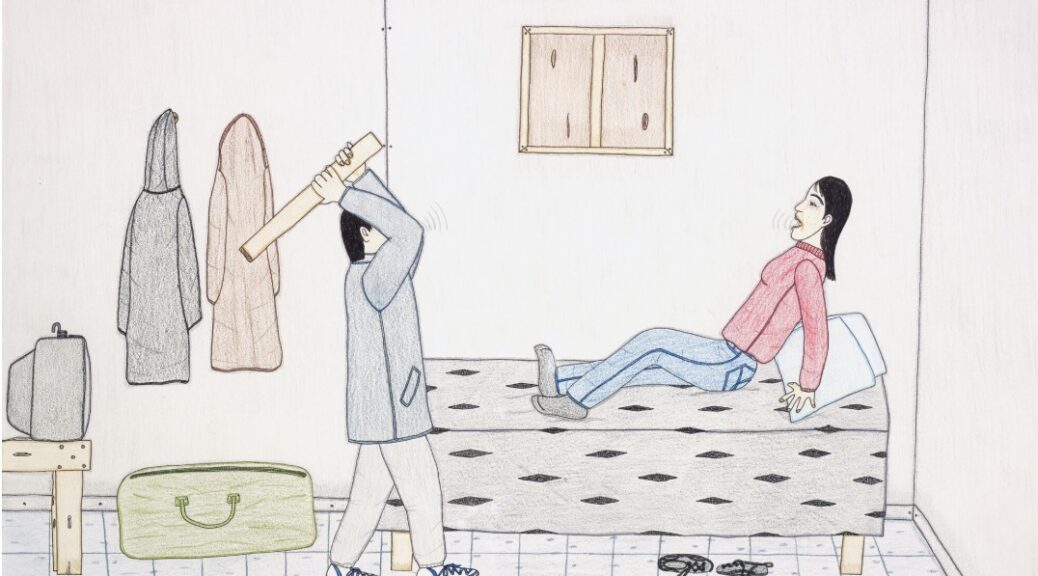
Annie Pootoogook’s drawing entitled Man Abusing His Partner was selected as one of the best 100 artworks of the 21st century by ArtNews.
Kinngait (Cape Dorset), Nunavut – A drawing by late Inuit artist Annie Pootoogook, who died under suspicious circumstances in 2016, has been named as one of the best artworks of the 21st century by ArtNews, one of the most trusted sources for news about the global art world and art market.
Known for her drawings that depict contemporary Inuit life, her drawing entitled Man Abusing His Partner was selected as one of greatest artworks of the past 25 years.
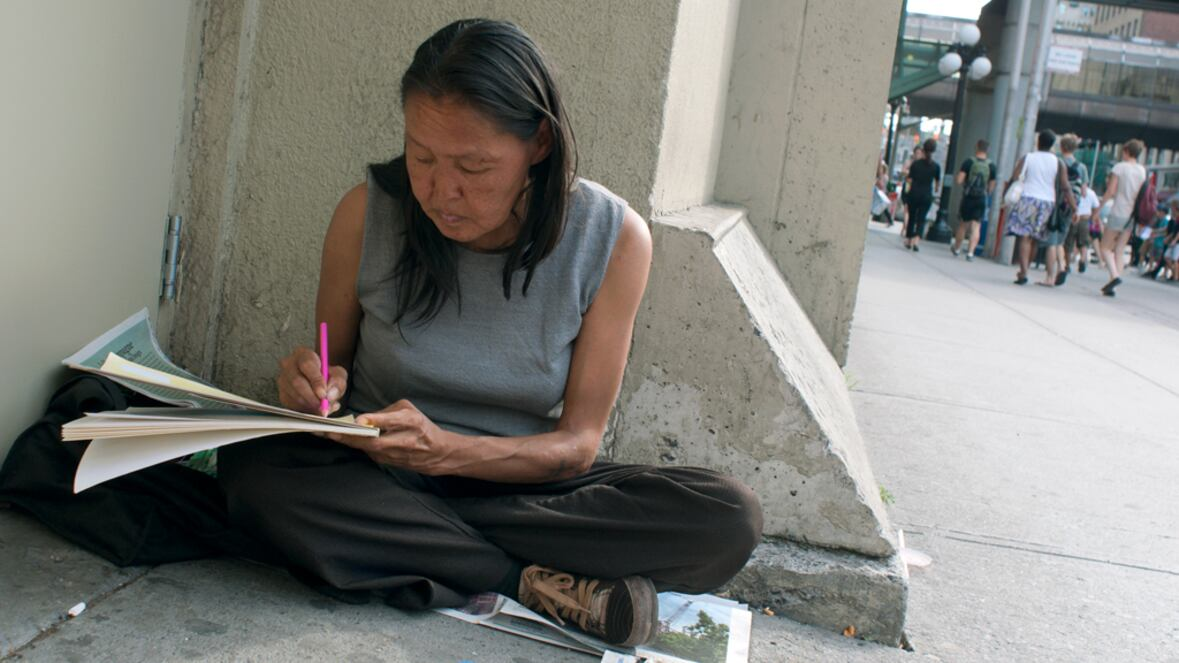
Annie Pootoogook works on her art on July 10, 2013, in Ottawa. The investigation into her 2016 death has stalled, sources tell CBC News. (Alexei Kintero)
The work on paper illustrates a haunting personal memory from Annie’s life during the early 1990s, when she was in an abusive relationship with a man in Nunavik.
The artwork depicts a violent and threatening scene, with a male figure holding a piece of wood above his head, directed toward a woman who lies defenseless on a bed. Initially, like many women facing similar situations, Annie remained silent about her experiences, reflecting the broader social stigma and silence surrounding violence against women. However, as she found her voice, it became clear that Annie possessed immense courage. She began sharing her story of survival as an Inuit woman, using her artwork as a powerful medium to communicate struggles with addiction, mental health, and intimate partner abuse.
Sadly, on September 19, 2016, Annie’s body was found in the Rideau River in Ottawa. Police declared it a suspicious death, however no arrests were ever made. Annie’s story, which she often conveyed through her work, became a representation of the broader experiences of Inuit and Indigenous women, highlighting the ongoing impact of colonialism and patriarchy in their lives. Her drowning and the subsequent police investigation drew significant attention because of her status as an internationally renowned artist and Inuit woman.
“This significant recognition of Annie Pootoogook is a testament to her enduring importance as a contemporary creator,” said West Baffin Cooperative President Pauloosie Kowmageak. “As we remember her significant contributions we also have the opportunity to look forward, knowing that her personal resilience and artistic innovation is inspiring new generations.’
Pootoogook was an artist member of the West Baffin Cooperative, Canada’s oldest Inuit owned and led social enterprise.
She was the third youngest in a family of ten children and grew up surrounded by artists, including both of her parents, as well as her grandmother, the renowned artist Pitseolak Ashoona (c.1904–1983), and her uncle, Kananginak Pootoogook (1935–2010).
Influenced by them, Annie based her drawings on her personal experiences, including her struggles with addiction and domestic violence. Her work found fame in the larger art world and was showcased at the National Gallery of Canada, Art Gallery of Ontario, McMichael Canadian Art Collection, The Power Plant, Biennale de Montreal, Art Basel and Documenta 12, among other exhibitions.
Established in 1959, West Baffin Cooperative has enjoyed an international reputation for the exquisite prints, drawings and carvings created by its Inuit artist members. In addition to operation of the Kinngait Studios at the Kenojuak Cultural Centre in Kinngait, the cooperative maintains a Toronto marketing division office, Dorset Fine Arts, which is responsible for interfacing with galleries, museums, cultural professionals, Inuit art enthusiasts and the art market globally. The mandate of West Baffin Cooperative includes public relations, promotion, advocacy, government relations and special projects relating to Kinngait Inuit art. Governed by an all-Inuit Board of Directors, the organization also maintains a local retail grocery/hardware store, a restaurant, rental properties and various utility contracts. As a community owned organization, practically all Kinngait adults are shareholders, profits are distributed back to the community in the form of annual dividends.
Featured image- Annie Pootoogook, Man Abusing His Partner, 2002 Coloured pencil and ink on paper, 51 x 66.5 cm Collection of John and Joyce Price
The Indonesian Pharmacist Association or more popularly abbreviated as Pafi is a forum for pharmacists in Indonesia to participate in improving the level of public welfare, especially in the fields of Public Health and Pharmacy, in addition to their daily duties.
One of the active branches that continues to strive to improve the quality of pharmaceutical services is Pafi Muara Bungo. For more complete information, check the website .
To facilitate providing the best service to the community, Pafi Muara Bungo continues to develop various initiatives and programs, including providing online registration for pharmacist members in the district.
The PAFI organization is a Professional Organization that is Work and Service-oriented.
In this case, it has 4 goals, such as:
Realizing a Just and Prosperous Society based on Pancasila and the 1945 Constitution quoted from the central PAFI, in fact, Indonesian Pharmacists have existed since the Proclamation of Independence of the Unitary State of the Republic of Indonesia on August 17, 1945, have fought side by side with all groups of society, to eliminate colonialism from the face of the earth of Indonesia, and have actively participated in defending the Unitary State of the Republic of Indonesia and then participated in Community and State Development.
Therefore, Indonesian Pharmacists are one of the development potentials that have never been absent in the struggle for state development until today, continuing to optimize services to the Indonesian people.
Realizing Optimal Health for the Indonesian People
The second goal of PAFI is to realize optimal health for the Indonesian people. In this case, PAFI Muara Bungo is actively disseminating information about health and the importance of proper drug use. Such as, recommendations to increase awareness before consuming these drugs, consulting with doctors and pharmacists before using drugs, and providing education related to disease prevention.
Developing and improving Indonesian Pharmaceutical Development
Developing and improving development in the world of automatic pharmacy can also increase efficiency and accuracy in providing services to the wider community.
Both the central Pafi and Pafi Muara Bungo in particular have developed an integrated pharmaceutical information system. It is expected to be able to provide faster and more accurate information online. So that health information is easily accessible to various levels of society.
Improving Member Welfare
One of the main goals of Pafi Muara Bungo is to improve the competence and welfare of its members. Various training and seminar information for Muara Bungo pharmacy experts is updated on the website.
It is hoped that with the increasing competence possessed, the welfare of Pafi members will also increase. Good news for pharmacists can join the training, the first step, register first to become a member of Pafi Muara Bungo.
Training and seminars on pharmacy management, the use of technology in pharmacy services, and the development of soft skills such as communication and auto services can be followed. In addition, there is a lot of job vacancy information for fresh graduates and pharmacists for better jobs. For the Silo, Anna Melnikova.
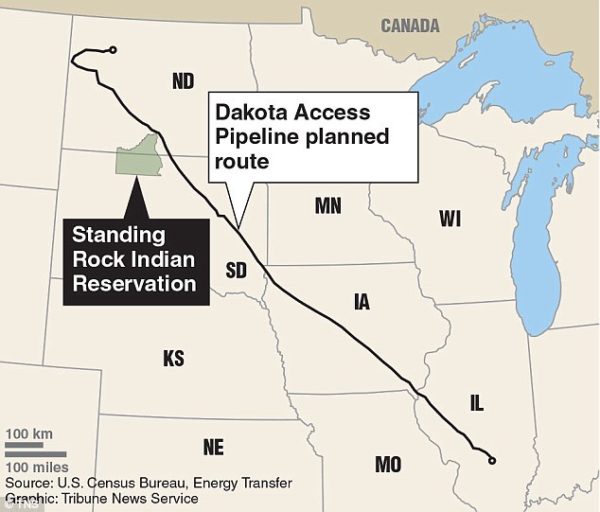
“Standing Side by Side in Peaceful Prayer” Starting in April 2016, thousands of people, led by Standing Rock Sioux Tribal members, gathered at camps near the crossing of the Missouri and Cannon Ball Rivers to stop the construction of the Dakota Access Pipeline (DAPL) there- creating the #noDAPL movement. DAPL is a 1,172-mile pipeline for transporting crude oil from North Dakota to refineries and terminals in Illinois.
As a business venture, DAPL’s advocates claim the pipeline will meet the highest environmental safety standards. They also claim the venture will produce greater U.S. energy independence and jobs at the same time it lessens the environmental risks of oil trains, though it is opaque how the new pipeline could increase oil production, oil consumption, employment, and state tax revenues.
Part of what makes things contentious: The Planned route- depending on who you speak to, either crosses, nears, touches, goes through, or avoids Standing Rock Reservation.
The #NoDAPL movement sees the pipeline as posing risks to the water quality and cultural heritage of the Dakota and Lakota peoples of the Standing Rock Sioux Tribe. Part of DAPL’s construction is occurring on lands and through waters the….click here for full article. Article by Kyle Whyte, academia.edu.