Tag Archives: standard of living

Not Quite the USA, But Canada’s Fiscal Challenges Can’t Be Ignored

Without a change in course, slow growth and rising spending will leave Canadians with stagnant living standards while shifting more of today’s burden onto younger and future generations, according to a new C.D. Howe Institute Verbatim.

In “The Endgame: Time to Act on Canada’s Economic and Fiscal Challenges,” author Don Drummond warns that Canada’s weak productivity and income underperformance, overreliance on US markets, and overall domestic vulnerabilities are not being taken seriously enough. He recommends a comprehensive economic plan to re-establish fiscal stability and help create a stronger, more resilient and diverse economy.

“With weak productivity growth, an ageing population and lower immigration, Canada’s economy could grow by just 0.5 percent this year and next,” says Drummond, Fellow-in-Residence at the C.D. Howe Institute. “That means rising deficits and debt, leaving governments with less fiscal room to respond to future challenges and improve living standards.”

The report states that Canada should expect continued tensions with the United States, making it more important to address its longstanding economic and fiscal weaknesses. Canada ranked last in the G7 for growth in gross national income per person over the decade to 2023 and has experienced persistently weak productivity growth. Combined with reduced access to US markets, these challenges make it harder for Canadian firms to compete and scale internationally. Drummond finds that these pressures will be harder to address as Canada’s population ages and the economy struggles to adapt to the costs of climate change.

His recommendations include eliminating internal trade barriers and streamlining regulatory processes, while reshaping taxes and spending to reduce deficits and support growth. This could include shifting some of the tax burden from corporate and personal income toward consumption, lowering marginal tax rates, and reviewing government spending to ensure better value for money. He also calls for maintaining environmental objectives and allowing post-secondary institutions greater flexibility on tuition. As frictions with the US persist and Canada’s federal deficits climb, Drummond calls for governments to act quickly but also asks that Canadians recognize that meaningful improvements will take time.

“While many cite Canada’s lower net debt-to-GDP ratio than other G7 countries, being the least indebted country in a heavily indebted group is not a fiscal strategy. The endgame should be a stronger, more resilient, and diverse economy with stable finances,” concludes Drummond. “Now’s the time to act.”

Introduction

A year ago, I spoke to the incoming 2025/26 Master of Public Administration (MPA) class about the economic and fiscal challenges facing Canada and the need for bold action (Drummond 2025). Conditions have not improved. You may think the latest trade friction with the United States suggests they have worsened, but a deterioration in the relationship was highly predictable, and tensions should be expected to continue. While some positive action has been taken, Canada is still not taking the challenges seriously enough. The bold action called for can be postponed no longer.

The Economic and Fiscal Challenges

Over the decade to 2023, gross national income per person grew a meagre 0.5 percent annually in Canada, ranking last in the G7 and 32nd out of 35 Organisation for Economic Co-operation and Development (OECD) countries (Drummond, Laurin and Robson 2026). This weak income growth reflects longstanding productivity underperformance relative to both Canada’s own history and other countries.

Canadian economic outcomes fall well short of US standards, and gaps are widening. Some take comfort in the argument that higher US averages are heavily influenced by the disproportionate number of extremely wealthy Americans. Yet the shortfall in Canadian inflation-adjusted median employment income was already substantial at CA$6,126 in 2010 and widened to $8,663 by 2024. From 1999 to 2025, Canadian productivity increased 26.7 percent, while US productivity rose 67.9 percent (Munro, Fuss and Emes 2026).

A severe blow to Canada’s most important trading relationship piles on top of the productivity challenge. The two interact in pernicious ways. Weak productivity makes it difficult to trade with other nations. Losing relatively free access to the US market makes it difficult for Canadian firms to build the scale needed to improve productivity.

Population ageing and climate change make the productivity and trade challenges even more difficult to address. An ageing population reduces the workforce and draws resources into healthcare and pensions. Climate change is exacting billions of dollars a year through infrastructure repairs, health costs, and rising insurance premiums resulting from flooding, wildfires, and extreme weather. The Canadian Climate Institute estimates that climate change will reduce Canada’s long-term annual economic growth rate by almost half, compounding into losses of hundreds of billions of dollars or more by the end of the century (Drummond, Philips and Harland 2026).

Canada’s fiscal situation acts as a drag on growth and limits our ability to address these challenges. The federal government alone projects deficits exceeding $50 billion a year as far as the eye can see, a net debt-to-GDP ratio staying above 40 percent, and tax and spending parameters that dull incentives to grow. And such dire outcomes do not fully reflect the commitment to massively increase defence spending. At least Canada’s fiscal situation and prospects are not as dire as those of the United States and many other countries.

Re-establishing fiscal stability is especially important now to mitigate the contagion from rising global bond yields, driven in good part by growing public debt burdens and a surge in long-term financing needs for artificial intelligence (AI). Canadian bond yields are creeping up but remain about 1 percentage point below US rates. That borrowing advantage is not guaranteed.

Inaction on stabilizing public finances is often justified by the Canadian federal government’s lower debt burden compared to other major countries and our own history. But the Canadian debt advantage is much less pronounced when considering all levels of government and using gross debt – which removes the current surpluses from the Canada and Quebec Pension Plans, which are not available to fund public services other than pensions. The current federal net debt burden of just over 40 percent of GDP, with about 13 cents of every revenue dollar going to debt charges, compares favourably with the 66.6 percent net debt-to-GDP ratio of 1995/96, when debt charges absorbed 35.2 cents of every revenue dollar. But it makes no sense to risk following the path of more indebted countries, which face even higher bond yields, or to repeat the worst of our own fiscal history, when Canada struggled to find buyers for its debt.

The only good thing that came out of Canada’s dire fiscal situation in the mid-1990s was the acceptance of a crisis and the will to act boldly. Surely, we can have the foresight to act boldly now before again hitting a fiscal wall.

The Status Quo is Unpromising

Drummond and Mahboubi (2026) projected Canada’s future economic growth rate assuming productivity continues to grow at its meagre average rate since 2000. Applying this assumption to the demographics resulting from population ageing and the new, lower immigration targets, this “supply-side” perspective on growth yields just 0.5 percent real GDP growth this year and next, and an average of 1.4 percent from 2026 to 2060 if the downward trend in average hours worked is arrested, or 1.2 percent if it is not.

The federal deficit would rise from the $50-billion-plus annual range projected in the 2026 Spring Economic Update, and the debt burden would continue rising as a share of GDP.

The bottom line would be stagnant economic well-being for individuals and a massive transfer of burdens to younger and future generations.

The Challenges Are Not Being Taken Seriously Enough

Undoubtedly, part of the reason bolder action has not been forthcoming is that many economists, especially forecasters, have put a rather rosy spin on prospects. Typical forecast assumptions include no further increase in the average tariff rate on Canadian exports and diminishing trade uncertainty. In other words, they attach no credibility to the rhetoric of President Donald Trump or the many trade agreements the US has been signing around the world that feature significant base levels of tariffs, with higher rates and quotas on selected products. We continue to see such a spin, with many rushing to predict that the latest round of US tariffs against Canada will only reduce real GDP by 0.4 or 0.5 percent, while assuring us that at least we still have the Canada-United States-Mexico Agreement (CUSMA).

Such analyses of what is taking place at the margins miss the point that the fundamental premise of all free trade agreements struck with the United States over the past few decades – that companies, whether Canadian or foreign, can freely access the US market from a base in Canada – has been broken. It will take a long time, if ever, to restore confidence in that premise. We must ask: if companies were not investing much when they thought they had access to the US market, why would they when such access is threatened?

It is difficult to comprehend the steadfast assurance that average tariff rates will not rise or CUSMA protections will remain. The US has rejected automatic renewal of CUSMA, is breaking its commitments daily, and has made it clear that it expects to extract a fee from all those American firms that buy from outside the United States. The sort of fee it appears to have in mind, and has been extracting from other countries, can make it unprofitable for Canadian exporters and US importers to do business.

Output per hour worked – productivity – has averaged 0.8 percent growth since 2000 and only 0.5 percent over the past four years. Yet most forecasters assume much stronger rates going forward. The Bank of Canada, for example, assumes 1.4 percent average annual growth in productivity through 2028, a pace not seen in decades. It adds 0.2 percentage points per year for the growing application of AI and assumes employers will squeeze more output per worker from the dwindling labour force. These are unproven assumptions and still do not fully explain the optimism. Such forecasts feature much stronger growth than the “supply-side” projections of Drummond and Mahboubi (2026). The latter are not a forecast per se. Productivity could grow more strongly. Demand growth could outstrip supply. But outcomes could just as easily be even weaker. Given global uncertainty and trade tensions with the United States, it would be wise to take such downside risks more seriously.

The Bank of Canada should be given credit for at least thinking about the macroeconomic implications of AI applications. But much more work needs to be done on these issues. And in the meantime, some healthy scepticism about AI’s potential benefits for productivity is in order. First, there have been many technological breakthroughs during the period of Canada’s declining productivity growth. Second, work by the Future Skills Centre (2024) found that while firms applying AI have higher productivity than those that do not, AI itself did not raise productivity.

If the challenges were being taken seriously enough, the federal government would not have abandoned its promise from five years ago to establish an independent commission on productivity. It also would have followed through on its election promise to establish a group to examine corporate taxation. Clearly, the government understands the problems but has decided not to call upon expert advice or encourage national discussion at this time.

If the challenges were taken more seriously, we would not see federal and provincial politicians uniting in the quest for international free trade while maintaining internal trade barriers. The International Monetary Fund has said these barriers are equivalent to a 9 percent external tariff on all Canadian goods and services, and that removing them could raise real GDP by 7 percent in the long run (Diez and Yang 2026). Some barriers have been reduced since the IMF made these estimates, but they remain substantial.

If the challenges were taken seriously, we would see a concerted national – federal, provincial, territorial, and municipal – effort to streamline regulatory processes. Federal approval alone of projects can easily take more than five years. Add often separate and sequential approval processes at the provincial, territorial, municipal, and Indigenous levels, and the projects being bandied around amid renewed interest in infrastructure may not even start for a long time.

Canada’s potential advantage in critical minerals is being cited often of late. But development, if it proves to be economically beneficial, could take decades. The federal government is taking action, including setting up a Major Projects Office and enacting the Building Canada Act. It has been noted, however, that the underlying obstacles – “political decision-making over individual projects and open-ended criteria that require regulators to consider broad public policy objectives” remain largely unaffected (Vegh and Koplovich 2026).

If the challenges were taken seriously enough, we would have a comprehensive federal economic plan that realistically lays out the challenges, presents options for national consultation, and sets out a plan for bold action. Instead, we get speeches, webinars, and budget documents that cover the territory only partially and reach relatively few Canadians. The prime minister has said Canadians will be required to make sacrifices. But time after time, the government softens those sacrifices by borrowing more money: to increase the Old Age Security payments for those 75 and over, a cohort with one of the lowest poverty rates; to rename the GST low-income credit the Canada Groceries and Essentials Benefit (CGEB) and increase it; to offer more incentives to first-time home buyers and purchasers of new homes; to suspend the federal gasoline excise tax for six months – and then extend the suspension as gasoline prices failed to decline; and to put still more money into subsidies for childcare.

In all these cases, the federal government addresses affordability issues by borrowing more. That simply transfers the burden forward. Where there is a demand-supply balance, demand is stoked further with much less effort applied to supply enhancement. Affordability challenges would be better met by greater efforts to raise Canadian productivity and incomes. Some of the government’s actions, such as more infrastructure spending, will certainly help productivity, but a cohesive plan is not being applied across all spending.

If the challenges were taken seriously enough, we would not see the federal government take the more than $5 billion fiscal windfall from higher oil prices and spend every cent of it in the 2025 budget, mostly to bolster consumption. We would not have seen an 80 percent increase in government operating costs over 10 years, with a 90,000 expansion in the number of federal civil servants – a one-third increase – together with a doubling of contracting costs. Average compensation for full-time equivalent bureaucrats also reached $143,271 (Terrazzano 2026). That is far higher than what is made by the majority of Canadians funding such pay through their taxes. Despite this growth, services do not appear to have improved. The government has cited new programs such as pharmacare and the Canadian Dental Plan, but much of the administrative burden is carried by the provinces and the private sector. Efforts to cut federal spending have been half-hearted, often going little beyond incentivizing civil servants to leave. Even after these so-called cuts, the ratio of program spending to GDP, is projected to reach its highest level since 1994/95 by 2030, outside of the pandemic years.

What Would a Strategy Look Like?

The starting point for a more serious course of action would be to put a comprehensive economic plan to Canadians, realistically depicting the challenges and options for action. If Canadians understand the gravity of the situation, they will give political licence to act, as they did with the initial Free Trade Agreement and the assault on the deficit in 1995.

Governments and private sector agents would cut the wishful thinking from their projections and depict the probable problems under the status quo.

Governments at all levels and in all jurisdictions would unite to finally end internal trade barriers. They would work together to streamline regulatory processes without compromising environmental standards or Indigenous rights. And they would do it soon and quickly.

Governments would radically alter the fiscal landscape with lower deficits and debt burdens and taxation and spending parameters targeted at promoting growth. The focus would be on much lower spending. Restoring the ratio of program spending to GDP that prevailed from 2003/04 to 2019/20 would reduce spending by $66 billion by 2030 and, on its own, bring the budget back close to balance.

The federal government would proceed with the promised review of taxation. The recommendation would inevitably be to shift the composition of Canadian taxation away from the overuse of corporate and personal income taxes, which are the most damaging to economic growth, and toward consumption taxes. The government would cut corporate and personal income tax marginal rates (see Mintz, Laurin, and Dahir 2026). It would also end the steep marginal corporate income tax rate corporations face if they try to grow beyond the definition of a small business.

A federal government plan would feature a comprehensive review of spending with a value-for-money perspective. Programs that could not be reformed to deliver intended outcomes efficiently would be scrapped. The results of the review would be made public to Canadians. The resulting action would need to be sweeping, such as gradually raising the age of entitlement for Old Age Security (OAS) and lowering the income threshold at which OAS payments are clawed back. Programs like $10-a-day childcare would be reformed to recognize that a crisis of affordability has become a crisis of accessibility. Business subsidies should be cut back drastically, as many simply transfer income rather than address market failure. Only about 20 percent of subsidies boost real income (Lester 2026). Supply management in agriculture should be reformed, not to appease the United States, but to raise productivity and lower prices in Canada. Supply management need not be scrapped. The focus should be on greater flexibility in quotas and caps on subsidized prices.

A serious approach would also recommit to environmental objectives, including lower greenhouse gas emissions that contribute to climate change. It is not fashionable of late to speak of environmental objectives, as many countries emphasize economic growth. But the future of the planet and its people depends upon reducing emissions. And this need not come at the expense of economic growth. Putting more emphasis on clean growth would be a start. The focus lately seems to be all on the development of fossil fuels and getting them to markets. But the combined global market value of clean energy technologies has grown about 20 percent per year over the past decade. Ironically, two of the world’s largest emitters lead in several dimensions of clean growth. China tops the world in clean energy infrastructure, and the United States invested over US$278 billion in clean energy and transportation in 2025 alone. Canada does not have to match their scale to capture a portion of the prize; it just has to identify and focus on existing competitive advantages (Drummond, Philips and Harland 2026). We now have a National Electricity Strategy. But it does not have nearly the buzz of the attention being given to fossil fuel development.

Government plans would recognize that Canada’s post-secondary education system can be a bedrock for people’s prosperity and well-being gains. Ontario has finally lifted the freeze on tuition. But by 2025, the initial cut and subsequent freeze had brought real (after-inflation) tuition in Ontario 26.6 percent below the 2018 level. That loss in real value is locked in for the foreseeable future. The February 2026 Ontario announcement raises grants by about $1 billion per year, but by 2027/28, they will still be more than 10 percent below 2015/16 in real terms per eligible student (Drummond 2026).

Institutions should be allowed greater flexibility on tuition. The after-inflation value of Ontario and federal grants for research should be restored and be better aligned with the economic transformation the province and Canada must accomplish. Governments should provide incentives to commercialize university-based research. Universities should be allowed to enrol more foreign students with proper accountability and objectives in place. The recent increase in the income requirements for foreign students is a good first step to curtail abuse, which was never widespread in universities, and should be complemented by ending foreign students’ ability to work off campus.

The Endgame and How to Get There

Canada has allowed itself to become too dependent on the United States and has ignored our domestic vulnerabilities for far too long. We are now paying the price. But by addressing the challenges, we can get to an endgame of a new economic and fiscal model that has a stronger, more resilient, and diverse economy with stable finances. The goal should be nothing less than being better off than we have ever been.

What will it take to get to this endgame?

  • An honest recognition of the economic and fiscal challenges.
  • A comprehensive plan.
  • Transparency with Canadians about the problems and the plan, sparking national discussion, debate, and hopefully, consensus on action.
  • A willingness to act.
  • Speed in acting, but patience with the inevitable lags in realizing improvements.

Conclusion: Let’s Act Now

Actions such as those recommended above always meet resistance as too controversial to be supported by the Canadian public and, hence, politicians, or too difficult to pull off within our system of federalism. But that may only be true if Canadians are not fully apprised of the seriousness of Canada’s economic and fiscal challenges. With such unfiltered information and a plan to ensure Canada’s prosperity, Canadians would likely offer widespread support, as they have in response to previous national challenges.

We must get serious and act now.

Edited remarks delivered to the School of Policy Studies, Queen’s University, on September 4, 2026. By Don Drummond

The author extends gratitude to Alexandre Laurin and Daniel Schwanen for valuable comments and suggestions. The author retains responsibility for any errors and the views expressed.

Don Drummond is a Fellow-in-Residence at the C.D. Howe Institute and a Stauffer-Dunning Fellow, School of Policy Studies, at Queen’s University.

References

Diez, Federico J., and Yuanchen Yang. 2026. “Canada Can Grow Faster by Unlocking Its Own Market.” International Monetary Fund. January 27. https://www.imf.org/en/news/articles/2026/01/27/cf-canada-can-grow-faster-by-unlocking-its-own-market.

Drummond, Don. 2025. “Shaken by Tariffs, Still Weak from Within: Canada Needs a New Economic and Fiscal Model.” Verbatim. Toronto: C.D. Howe Institute. September 4. https://cdhowe.org/publication/shaken-by-tariffs-still-weak-from-within-canada-needs-a-new-economic-and-fiscal-model/.

_____________. 2026. “Ontario Stops Deepening its Universities’ Financial Pit.” Intelligence Memo. Toronto: C.D. Howe Institute. March 6. https://cdhowe.org/publication/ontario-stops-deepening-its-universities-financial-pit/.

Drummond, Don, Alexandre Laurin, and William B.P. Robson. 2026. 2026 Shadow Budget. Commentary. Toronto: C.D. Howe Institute. Forthcoming.

Drummond, Don, and Parisa Mahboubi. 2026. “Resetting Expectations: Canada’s Economy in a Lower-Immigration Era.” E-Brief 383. Toronto: C.D. Howe Institute. May. https://cdhowe.org/publication/resetting-expectations-canadas-economy-in-a-lower-immigration-era/.

Drummond, Don, Peter Philips, and Kate Harland. 2026. “Canada Doesn’t Need to Abandon Climate Efforts in the Name of Growth or Unity.” The Hill Times. September 7.

Future Skills Centre. 2024. Waiting for Takeoff: The Short-Term Impact of AI Adoption on Firm Productivity. December.

Mintz, Jack, Alexandre Laurin, and Nicholas Dahir. 2026. “Big Bang” Tax Reform: Unleashing Growth in the Canadian Economy. Commentary 707. Toronto: C.D. Howe Institute. https://cdhowe.org/publication/big-bang-tax-reform-unleashing-growth-in-the-canadian-economy/.

Munro, Grady, Jake Fuss, and Joel Emes. 2026. Squandering the Canadian Century Part 1: Comparing Economic Performance in Canada and the United States. Fraser Institute. September 1. https://www.fraserinstitute.org/studies/squandering-canadian-century-part-1-comparing-economic-performance-canada-and-united-states.

Terrazzano, Franco. 2026. “Cost of Federal Bureaucracy Up 80 Per Cent in 10 Years: PBO.” Canadian Taxpayers Federation. February 17.

Vegh, George, and Kate Koplovich. 2026. Clear the Way: Does the Building Canada Act Help Canada Build? Commentary 728. Toronto: C.D. Howe Institute. September. https://cdhowe.org/publication/clear-the-way-does-the-building-canada-act-help-canada-build/.

Pas tout à fait les États-Unis, mais les défis budgétaires du Canada ne peuvent être ignorés

16 septembre 2026 – Sans changement de cap, la faible croissance et l’augmentation des dépenses entraîneront une stagnation du niveau de vie des Canadiens, tout en transférant la majeure partie de la dette actuelle aux jeunes générations et aux générations futures, selon un nouveau Verbatim de l’Institut C.D. Howe.

Dans « The Endgame: Time to Act on Canada’s Economic and Fiscal Challenges », l’auteur Don Drummond avertit que la faible productivité du Canada, la contre-performance de ses revenus, sa dépendance excessive à l’égard des marchés américains et ses vulnérabilités intérieures ne sont pas suffisamment prises au sérieux. Il recommande un plan économique qui vise à rétablir la stabilité budgétaire et à créer une économie plus forte, plus résiliente et plus diversifiée.


Lire communiqué de presse complet »

Basic Living Standard Arithmetic For Ottawa And All Governments

September , 2024

To: Canadians concerned about prosperity 
From: Don Wright 
Date: September 4, 2024
Re: Some Basic Living Standard Arithmetic for Governments

Governments often talk about “creating jobs,” but what they really do is choose some jobs at the expense of others. With their myriad spending, taxing and regulatory decisions, all governments try to direct job growth to different sectors – public or private, services or goods, resources or non-resources, and so on.

We all hope governments choose wisely.

It would help if they started paying more explicit attention to one factor: The impact of their decisions on Canadians’ standard of living.

A country’s standard of living is largely determined by the wages and net government revenue its tradeable goods and services sector can pay while remaining competitive against international competitors. If a company or sector is uncompetitive, it will have to either lower its wages, pay less tax or go out of business. These pressures on companies are never-ending. They determine both the wages a sector can afford to pay, and, through the interconnectedness of labour markets, average wages across the economy.

Some industries are so productive they can pay relatively high wages and significant taxes and yet remain competitive.

Industries that aren’t as productive can only pay lower wages and less tax.

Governments whose policies have the effect of moving labour from one sector to another had better pay attention to such facts.

Canadians may not like it but many of the country’s best-paying and most tax-rich jobs are found in natural resources. I was head of British Columbia’s public service. For most of B.C.’s history the province’s economic base has been dominated by natural resource industries – forestry, mining, oil and gas, agriculture and fishing. For a variety of reasons, these industries face strong political headwinds. Many groups press to constrain them and diversify away from them. The alternatives proposed include technology, film and tourism.

A few years ago, I asked officials in the province’s finance ministry to assess the relative performance of these different industries along the two key dimensions of average wages and net government revenue. In 2019-20 B.C. spent approximately $11,700 per citizen. Half the population was employed that year. So, to “break even” (i.e., have a balanced budget), the province had to collect $23,400 per employed person. If you look at things this way, each industry’s “profit” or “loss” is simply its revenue per employee less $23,400.

No such calculation will be exact, of course.

Several assumptions have to be made to get to an average “profit” or “loss” per employee. But, with that caveat, the numbers the officials brought back were telling. The industry with the biggest return to the province was oil and gas, at $35,500 per employee. Forestry was next, at $32,900. Then mining, at $14,900, and technology, though only at $900.

By this measure of profit and loss, however, film was a money loser, at -$13,400, and so was tourism, at -$6,900.

The negative numbers for the film industry reflect the very significant subsidies that B.C. (like many other provinces) provides to this sector. The negative number for the tourism sector primarily reflects low average wages per employee, which translate into relatively low personal income tax, sales tax and other taxes paid by employees.

These “profit or loss” numbers are not in any way a judgment about workers in these sectors. People find the best employment available to them in the labour market. Relative demands in that market are determined by many factors, none of which workers control. That said, if governments consciously move resources from the “profit” industries to the “loss” industries, they had better be aware of the consequences for wages, taxes and the overall standard of living.

The numbers I’ve cited were for a single year in British Columbia. The same analysis for other provinces or for Canada as a whole would likely produce different numbers – though I’d be surprised if the overall pattern were much different. Voters will draw their own conclusions about the impact on British Columbians’ standard of living from constraining the resource industries and promoting other industries instead.

Unfortunately, this type of analysis is rarely done when Canadian governments make decisions about what types of jobs they want to give preference to through their taxation, spending and regulatory decisions. They should do more of it. Ultimately, if [they] care about Canadians’ standard of living, governments need to start paying attention to the basic arithmetic of that standard of living.

Don Wright, senior fellow at the C.D. Howe Institute and senior counsel at Global Public Affairs, previously served as deputy minister to B.C.’s premier, cabinet secretary and head of the public service.

Traditional Family Fades In Canada As Some Women Advocate For Revival

On her fridge door, along with numerous family pictures, Danielle Brandt has a handwritten quote by Dr. John Trainer: “Children are not a distraction from more important work. They are the most important work.”

A proud Calgary mother of three boys (Aiden, 10, Theodore, 4, and Silas, 2), Mrs. Brandt is a homemaker. Her husband, Adam Brandt, is the breadwinner. At the core of their parenting philosophy is the belief that strong families make strong societies, Mrs. Brandt says.

She was a music teacher before becoming a stay-at-home mom, but when she returned to work shortly after giving birth to her first child, she says she realized she wanted to be fully involved in raising her children.

“The idea that your identity is found at home with your family and not out in the world with your peers, and that your parents and your family are what matters first … that’s the reason I wanted to be home with my children.”

While Mrs. Brandt persists in adhering to her traditional role in the family, there is declining interest among young Canadian women to pursue the same path.

Canadians are “increasingly less likely” to form families, and if they do, they are choosing to have fewer children, if any at all, according to a May 2024 report jointly published by the Macdonald-Laurier Institute (MLI) and the Centre for the Study of Living Standards.

ANALYSIS: To Reverse Canada’s Declining Birth Rate, Cultural Changes May Be More Important Than Economic Ones

How Marxism Broke Down the Nuclear Family

How Marxism Broke Down the Nuclear Family

The same report, based on evidence from existing data and literature, found that traditional families enjoy more prosperity and better health.

Adults who are in a couple tend to earn more money per person than singles of the same age and, if married, they tend to live longer, have healthier lifestyles, and are less stressed. Similarly, children benefit from being raised by their two biological parents in a stable marriage, appearing to have a higher standard of living and educational attainment, and being less likely to engage in risky behaviour, the report found.

But a significant fraction of Canadian children will see their families break up by the time they are 14, and more than a quarter live in one-parent families, the report said. The author, Tim Sargent, deputy executive director of the Centre for the Study of Living Standards, concluded that the rates of family dissolution in Canada are higher than those in the United States and the UK, culturally comparable countries.

Janice Fiamengo, a retired University of Ottawa English professor who now gives talks on the role of women in society, says the downward trends in family formation are largely due to how women’s priorities are being redefined in Canada.

“Their primary goal in life is to be independent, to have a career, and to regard marriage and childbearing as secondary, if not undesirable in general,” Ms. Fiamengo told The Epoch Times, describing the trends and messages aimed at young women today.

Trends Among Canadian Women

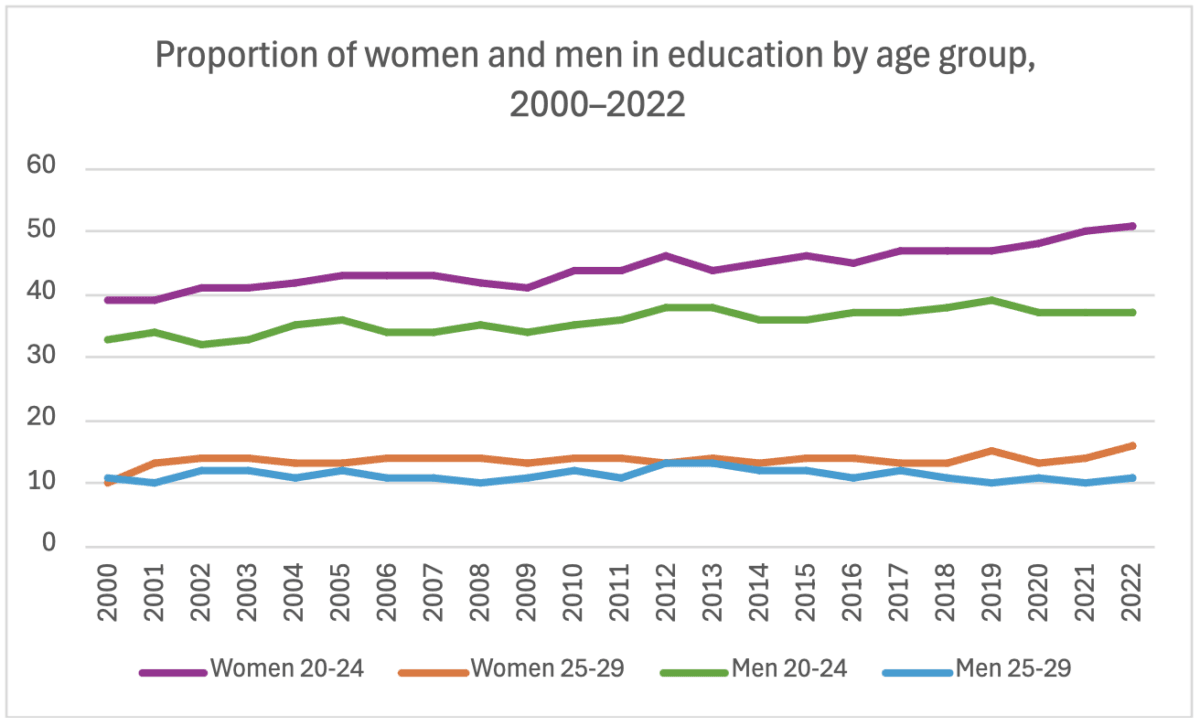
Women are now taking longer to complete their higher education. From 2000–2022, the participation in education of women aged 20 to 24 rose by 12 percent (to 51 percent), according to Statistics Canada.

Only 37 percent of men in the same age range participated in education in 2022, and that rate grew by just four percentage points since 2000. Similar trends are seen among men and women aged 25 to 29.

Source: Statistics Canada 2023h, Table 37-10-0196-01. (Chart: Carolina Avendano/The Epoch Times)

Women’s participation in the labour market has also increased dramatically in recent decades, with fewer and fewer women choosing to be stay-at-home moms.

Employment among women aged 25 to 54 has almost doubled from 40 percent in 1976 to about 80 percent as of May 2024, according to Statistics Canada. Employment rates for women in general remain higher than they were prior to the pandemic in 2017 and 2019.

In addition, more women aged 25 to 34 now delay living with their partner. The proportion of those who live with their parents increased by 3.3 percentage points, from 12.8 percent in 2011 to 16.1 percent in 2021.

Marriage rates are on the decline while divorce rates are increasing, and women are waiting until later to have children.

At the same time, Canada’s fertility rate has been declining persistently for the past 15 years, with the national rate hitting an all-time low in 2022 at 1.3 children per woman.

A study by the think tank Cardus found that the top factors that diminish a woman’s desire to be a mother are wanting to grow as a person, wanting to save money, focusing on a career, and believing that kids require intense care.

“Any woman who decides that what she primarily wants to do is to marry and to have children, that woman is seen as having failed, having let down other women, and having failed herself,” says Ms. Fiamengo.

She says the prevalence of feminism in Canada has played a role in shaping these views.

Changing Views on Traditional Family Roles

It wasn’t until the second-wave feminism of the 1980s that an idea with communist roots took hold—the dissolution of the traditional family structure, Ms. Fiamengo says.

Feminism takes many forms and contains different ideas—in the 19th century, it was about women’s suffrage. The idea that the traditional family is at odds with gender equality and women’s fulfilment has its origins in communist ideology.

In his 1884 book titled “The Origin of the Family, Private Property and the State,” Friedrich Engels, based on notes by Karl Marx, made the first allusion to the monogamous family as “the world historical defeat of the female sex,” in which the woman was reduced to servitude and turned into an instrument for the production of children.

He thus advocated for the liberation of the wife, the abolishment of the family, and for the care and education of the children to become a public affair.

“[Engels] explicitly makes that connection, that the man—the patriarch—is the capitalist oppressor. The woman is in the situation of being the oppressed worker or the sex slave in the family,” says Ms. Fiamengo.

“He saw no distinction between prostitution, in which a woman is bought by a man to have her body used for the man’s pleasure, and the situation of a woman in a marriage.”

Betty Friedan’s 1963 book “The Feminine Mystique,” a precursor of feminism as a struggle between genders, urged women to break free from the domestic sphere and find their own identity outside the home. Friedan promulgated that fulfillment could not be found through marriage and motherhood alone.

Ms. Fiamengo says feminism’s lack of encouragement for women to start a family makes them miss out on what she thinks is one of the greatest joys of human life—childbearing.

“The fact that our government doesn’t encourage marriage … or encourage couples to stay together for the good of their children, is doing a terrible disservice to the future generations,” she says.

Peter Jon Mitchell, program director for Cardus Family, says the prevalent view of marriage in Canada is that “it’s nice, but unnecessary.”

“We don’t really talk a lot about marriage and the benefits of marriage in our culture.” Mr. Mitchell also that, compared to the United States, where the two-parent privilege—the fact that children fare better in two-parent rather than single-parent households—and the benefits of marriage are part of the public discourse, Canada lags behind.

The May MLI report cites some studies showing that children in two-parent households fare better. One published by the National Library of Medicine in 2014 found such children do better physically, emotionally, and academically.

Likewise, in a 2015 research paper, David Ribar, honorary professor at the University of Melbourne, found that children who grow up with married parents enjoy more economic and family stability. Mr. Ribar argues that the benefits of marriage for children’s wellbeing are hard to replicate through policy interventions other than those that support marriage itself.

Consequences of Putting Family Role Second

Sociologist Brigitte Berger noted in her book “The Emerging Role of Women” that work is important for both sexes. Yet liberation through work means different things to different people.

To the working-class women and the poor, for whom work is a necessity, liberation means freedom from financial burden and the freedom to devote time to things that matter outside of work, such as family, community, and hobbies. Among women for whom work is not a necessity, modern thinking has led them to find identity and liberation through paid labour.

According to a 2021 survey by the Canadian Women’s Foundation, 28 percent of mothers reported difficulty keeping up with work demands, and half of mothers felt exhausted trying to balance work and childcare responsibilities.

“I think most mothers would prefer to be part-time,” says Mrs. Brandt. “They don’t actually want to leave their kids 100 percent of the time with someone else.”

She says the widespread notion that women can do it all is not realistic and can lead many to burnout. “I can’t fully parent my children well and fully do another job [outside the home], at least not the way I want to,” she says. “Something has to give; there’s not enough of me.”

Mrs. Brandt says she is not worried about her chances of returning to work at some stage.

“We live a long time nowadays. You can’t always have kids, you can’t always be with your kids when they’re young or get that time back when they’re young,” she adds. “But you could do a career later, and that’s the amazing thing about our culture, too.”

Last year, a study by the think tank Cardus found that half of Canadian women are not having as many children as they would like, and that this group reported lower life satisfaction than women who achieved their fertility goals.

Cardus senior fellow Lyman Stone noted low fertility rates are not because women want few kids, but the timeline most of them follow for school, work, self-development, and marriage leaves too few economically stable years to achieve the families they want.

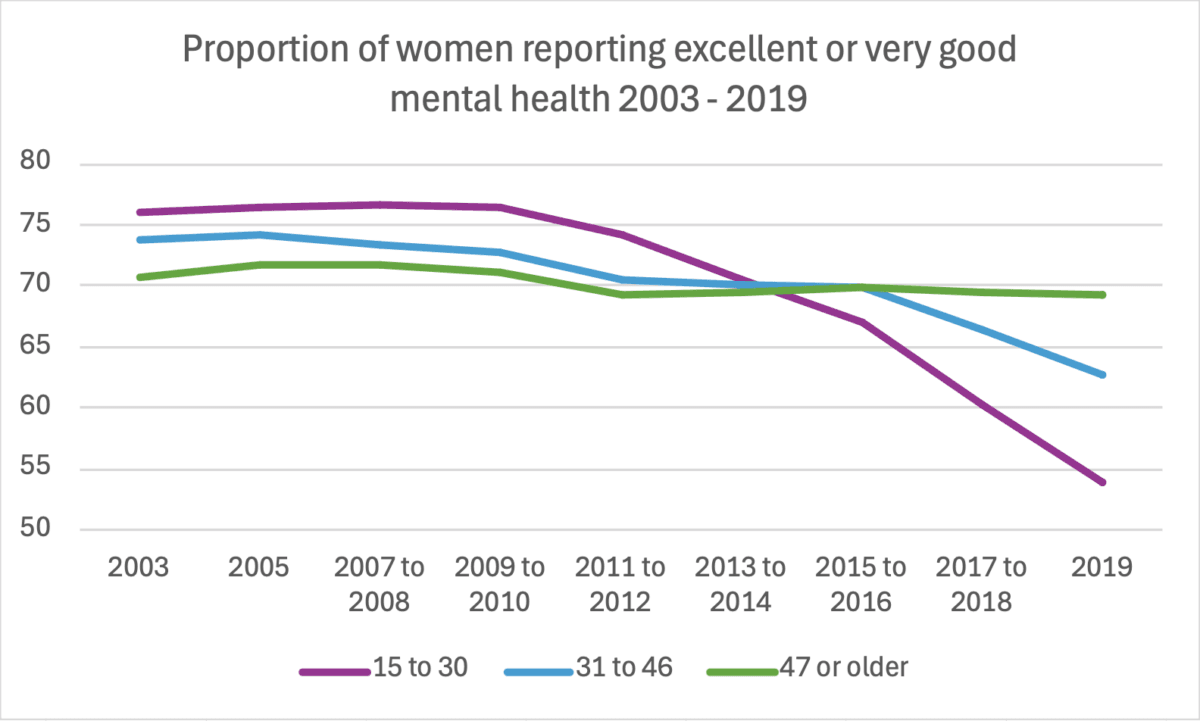
One of the most striking findings of the May MLI report is that Canada has seen a marked deterioration in the mental health of young women over the last decade.

More than three-quarters of women aged 15 to 30 reported excellent or very good mental health between 2009 and 2010. Throughout the following nine years, that figure dropped 22.5 percentage points, to 54 percent. For women aged 31 to 46, mental well-being also declined, but only by 10.1 percentage points.

Source: Canadian Community Health Survey, 2003 to 2019. (Chart: Carolina Avendano/The Epoch Times)

Motherhood and Women’s Happiness

A Cardus 2023 study concluded that women’s happiness and fertility are linked. The think tank surveyed 2,700 women aged 18 to 44 about family and fertility, and found that mothers are happier than non-mothers everywhere (except when they are under 25 or living in poverty).

“The role of the mother really is to nurture and to develop children,” says Mrs. Brandt. “My husband is a wonderful nurturer, he’s fantastic at it, but my boys, even the ones that have the closest relationship with him, they still need mom … I’m still the safe place.

“I am not saying that men can’t do it, but sometimes women are built for it, and there’s nothing wrong with that.”

Danielle Brandt with her youngest son, Silas, at her Calgary home on June 1, 2024. Mrs. Brandt homeschools her oldest son, Aiden, because she saw he was falling behind in class. Seeing the positive response, she now plans to also homeschool her other two children. (Carolina Avendano/The Epoch Times)

She draws inspiration from her mother, who was also a teacher turned homemaker. Mrs. Brandt says her mother was always available for her and her three siblings, and would show up at their most important moments, including sporting events, school functions or field trips. “We felt like we were the priority because we were,” she says.

But being a stay-at-home mom is also demanding, Mrs. Brandt adds. Although it’s rewarding, she says the challenge is that there is no time off. “But at the end of the day, when I look at my children and see them peacefully sleeping, [I think to myself] ‘That’s it, that’s what this is about,’” she says. “They are the future generation. I want to pour into that, and there is no more valuable work than that.” For the Silo, Carolina Avendano.

Featured image- Danielle and Adam Brandt with their sons Silas (L), Aiden (C), and Theodore at their home in Calgary on June 1, 2024. (Carolina Avendano/The Epoch Times)

Why Are More Canadians Moving Abroad?

An increasing number of Canadians can’t afford a house or find a decent-paying job. Some can’t find a date or are fed up with the bitter politics, while others are in search of adventure, are sick of the cold winters, or simply miss the feeling of ‘being home’.

The solution they seek? Leave Canada.

The rising cost of living, record-high immigration, a stagnating economy, and political tensions are prompting rising numbers of Canadians—both native and naturalized—to leave the country.

Canada is increasingly becoming a country of emigrants, as well as a country of immigrants, experts say.

“We’re definitely seeing a lot more interest from people wanting to leave Canada,” Michael Rosmer, founder of Offshore Citizen, a Dubai-based company that offers relocation services to people around the globe. “This is disproportionate to their numbers overall.”

He said many of his clients are motivated by the increasing ability to work from anywhere, plus political tensions within Canada accompanied by a feeling of lost freedoms. Also a factor is the rising standard of living of many countries that were once far below Canada in terms of health care, education, and other services.

While Canada was once considered among the best places in the world to live, “it’s like the world has flipped,” Mr. Rosmer said. “The alternatives have gotten meaningfully better. Today if you go to Kuala Lumpur you’re going to find that it is arguably better than any Canadian city.”

Canada’s Immigration Conundrum: Economic Boon or Bust?

Immigration Minister Tells US Public Broadcaster Canada an ‘Open Country’

Some 94,576 people emigrated from Canada from mid-2022 to mid-2023, an increase of 1.8 percent from 92,876 in the year-earlier period, and up sharply from 66,627 in the period from mid-2020 to mid-2021, which fell during the pandemic lockdowns, according to data from Statistics Canada.

A study released last year by the immigration advocacy group Institute for Canadian Citizenship (ICC) showed  immigrants are also increasingly reluctant to stay, with the proportion who stick around to obtain full citizenship within 10 years of receiving permanent resident status plunging to 45.7 percent in 2021 from 60 percent in 2016 and 75.1 percent in 2001.

Cameron MacDonald, a 29-year-old from the Niagara Falls region of Ontario who left Canada in March for Japan, cited the high cost of living as the main reason for his move, which uprooted him from friends, family, and a job as an anti-fraud analyst with a major Canadian bank. He is now studying Japanese and looking for a job with a foreign firm, while living in Tokyo, which has a population density of 6,363 people per square kilometre compared to Toronto’s 4,427.8 per square kilometre.

“Here in Tokyo, the world’s biggest city, I pay $650 a month for a room that I would have had to pay $2,000 for in Toronto.” I had a routine and a cushy bank job and I was even living with my dad after a while but I still couldn’t get ahead financially.”

He said the high cost of housing in Toronto means that all of his friends of a similar age in Canada are still living with their parents and, as many of them consider starting families, they are watching his move with the thought of moving abroad themselves.

“My five-year goal includes a wife, a house, and kids and there’s no way I could afford that in Canada,” Mr. MacDonald said. “You can’t really date and find a wife when you’re living with your dad.”

“In Japan, I wake up with a smile on my face every day,” he said. “It’s like I have found a new passion—I can start a family here.

High Immigration

Like many people, Mr. MacDonald blames Canada’s rapid pace of immigration for driving up the cost of living and forcing him to move abroad.

As of Oct. 1, 2023, Canada’s population was estimated at 40,528,396, a record increase of 430,635 people in the previous three months alone, according to Statistics Canada. That growth rate, at 1.1 percent in a quarter, was the highest since 1957, amid Canada’s baby boom plus an immigration surge fueled by a refugee crisis in Hungary at the time.

In just the first nine months of last year, Canada’s population grew by 1,030,378 people, more than any other year dating back to confederation in 1867, the statistics show. And 96 percent of that growth came from immigration. Overall, the population grew 30 percent since it reached the 30 million figure in 1997.

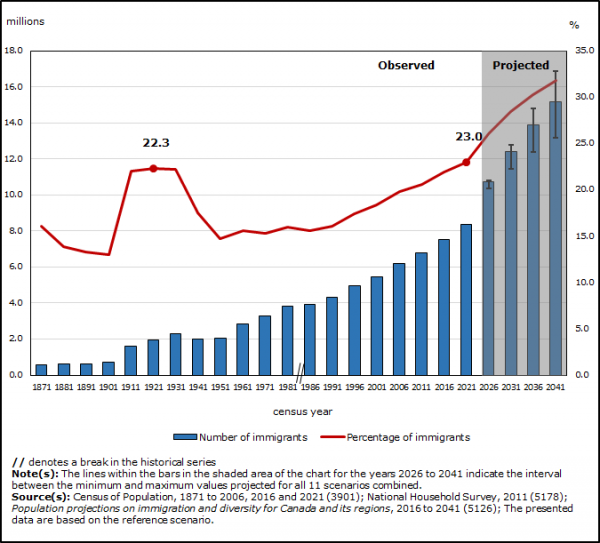
Canada’s Plan to Welcome 500000 Immigrants by 2025. ascenda.com

Indeed, rapid population growth has outstripped economic growth in recent years, lowering the standard of living in Canada as more people compete for less housing space and place greater strains on health care, education, and other services, according to a study published in May by the Fraser Institute. The study shows Canada’s real gross domestic product per person dropped 3 percent between April 2019 and the end of last year, from $59,905 to $58,111. The only steeper drops in the 40 years covered by the study were from 1989 to 1994, with a decline of 5.3 percent, and the financial crisis of 2008 to 2009, when it dropped 5.2 percent.

Another factor propelling emigration may be the aging of the baby boomer generation. As more Canadians reach retirement age, emigration to the United States, particularly to sunny states such as Florida, is accelerating.

A study by Statistics Canada also shows that high immigration tends to push up emigration because some immigrants move back to their home country. The study showed that 15 percent of the people who immigrated to Canada between 1982 and 2017 returned within 20 years of admission.

Whatever the root cause, the interest in leaving Canada has caught the attention of the global industry of specialists offering services to wealthier emigrants around the world.

Videos created by people seeking to offer second-passport services and other relocation help are growing in popularity. “Nine Steps to Escape Canada,” a YouTube video watched 362,000 times, “5 Reasons to Leave Canada in 2024,“ watched by 261,000 and ”Canada is Dying!,” with 531,000 viewers are some of the most popular.

Jay Suresh, the founder of Goodlife Investor, which offers emigration services to people around the world looking to obtain second passports, foreign tax advantages, and other benefits, says the number of Canadians looking for dual citizenship jumped after the Canadian government banned unvaccinated people from flying or travelling by train in late 2021 until the summer of 2022.

“This was an eye-opener for a lot of people. They got frustrated with just that one citizenship and they wanted multiple citizenships,” he said in a video promoting his company. Now, he says, Canadians are nearly tied with U.S. citizens in searches for second passports, even though the United States has 10 times Canada’s population. For the Silo, Adam Brown.

Featured image: People line up to go through security screening at Pearson International Airport in Toronto on Aug. 5, 2022. (The Canadian Press/Nathan Denette)

How Do Canada Provinces Grade In Taxpayer Fiscal Transparency?

September 15, 2022 – Taxpayers and citizens need greater fiscal transparency from Canada’s federal, provincial and territorial governments, says the latest report from the C.D. Howe Institute.

In “The Right to Know: Grading the Fiscal Transparency of Canada’s Senior Governments, 2022,” William B.P. Robson and Nicholas Dahir graded these governments’ budgets, estimates and financial statements on how well they let legislators and voters understand their fiscal plans and hold them to account for fulfilling them. The grades range from A to D. While some of the governments present helpful and timely budgets and financial statements, others fall badly short.

The authors underline that budgets, estimates and financial statements must let interested but non-expert users find and understand and act on key information.

“Taxpayers’ and citizens’ ability to monitor, influence and react to how legislators and officials manage public funds is fundamental to representative government,” say Robson and Dahir. “We need to check that legislators and government officials are acting in the interest of the people they represent, and we need to respond if we conclude that they are acting negligently or in their own interest. Financial reports are key tools for monitoring governments’ performance of their fiduciary duties.”

image: Prime Minister of Canada Justin Trudeau website. Link to Transparency PDF: https://pm.gc.ca/en/news/backgrounders/2015/11/27/open-and-accountable-government

While much of the financial information presented to legislators and the public by Canada’s governments has improved over time, the assigned grades reveal significant shortfalls. This year’s report card covers year-end financial statements for fiscal year 2020/21 and budgets and estimates for 2021/22. The results were as follows:

  • Manitoba, British Colombia and the Northwest Territories trailed the the class with grades of D;
  • The federal government got a D+ – which was actually an improvement from an F last year, when it failed to produce a budget;
  • Newfoundland and Labrador also got a D+;
  • Nova Scotia scored a C and Prince Edward Island scored a C+;
  • Quebec scored a B- and Ontario scored a B;
  • Nunavut, Saskatchewan, and New Brunswick each scored B+;
  • Alberta and Yukon topped the class with grades of A and A- respectively.

These governments tax, spend and borrow hundreds of billions of dollars, and the fiscal impact of the COVID-19 pandemic will make their financial position all the more important in the future. The authors conclude: “This annual report card hopes to encourage further progress and limit backsliding. Canadians can get more transparent financial reporting and better fiscal accountability from their governments, if they demand it.” For the Silo, Lauren Malyk.

For more than 60 years, the C.D. Howe Institute has researched and published on policy challenges and potential solutions aimed at improving the performance of Canada’s economy and raising Canadians’ living standards.

Read the Full Report

Featured image via GIFT- The Global Initiative for Fiscal Transparency