We sit in the grip of deep winter, snow reflecting the moonlight at last. At this time of the year, the earth slows down and so too can we. It is time for us to reflect as well, upon the year that has been and the year ahead. During these dark months, light becomes a precious thing. Something to celebrate and embrace as we pass the days. Everything we see is light and light informs art in a way that cannot be disentangled.
“Light is also about…the passage of time,” says Norwegian artist A K Dolven. Living on an island in Norway above the Arctic Circle has given her a unique perspective about the interplay of art and light. Her work examines intimacy and large social groups, the relationships of nationality, population, space, and how this changes the work she does. In her village of nine people, a piece of art takes on a very different character than it does in a large city such as Brussels or London. Dolven incorporates balance in its many forms in the world we live in. Political balance, social balance, life balance, and other delicate equilibriums contribute to the nature of her art.
Milovan Destil Markovic recently participated in a Belgrade-based exhibition titled “The Pleasure of Love in a Time of Hate.” His work for the exhibition was in the form of barcode paintings that touched on sexual intimacy. Markovic also uses his barcode paintings in a series titled “The Abduction of Europe” in which he takes a hard look at economic power struggles within the European community.
The paintings resemble street graffiti with economically and politically charged statements spray painted within the confines of a barcode structure. Markovic also creates what he calls Transfigurative Paintings. These works employ a medium that reflects the subject in some way. Additional interviews include:Karl HaendelandPaul McDevitt
Winter can be a time for personal reflection. We can create a space where it is safe for our minds to explore new horizons through literature. What are you reading to pass the cold days and dark nights? Click here to add your books. User Carla Cruz has been immersed in The Mandarins by Simone de Beauvoir, while M Chevska seeks winter solitude in Magic Mountain by Thomas Mann.
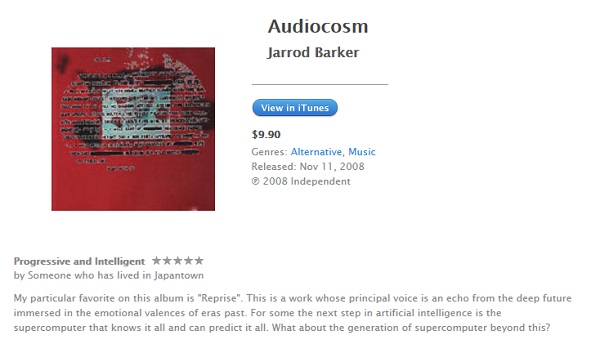
An example of Jarrod Barker’s graffiti inspired landscape painting.
Those interested in the opportunity to create a piece of permanent, public art can submit to Seattle’s Central City Connector Project. An artist or team of artists will be chosen to create artwork that defines the aesthetic of the Central City Connector Streetcar Line. Alte Schule Hohenstein has an open call to artists interested in a residency at their school in Germany.
As we run down the days until the world is reborn and spring returns, let us not forget to enjoy the respite of winter darkness. Invite light in when it presents itself and wrap your mind in the stillness of midwinter.For the Silo, Brainard Carey.
Brainard is currently giving free webinars on how to write a better Artist bio and statement and how to get a show in a gallery – you can register for that live webinar and ask questions live by clicking here.
Spotlight image courtesy of urbanchristiannews.com
Consider for a moment the nature of light and time. Fleeting, infinite, unknowable, and yet familiar as our own minds. We long for more time while cursing its slow progress. Temporal matters dictate every aspect of our human lives. We are beholden to the times in which we live. We cannot grasp light and yet we are surrounded by it. When we enter into the unknown, art is a light guiding us toward better days ahead.
Mary Temple’s “unsolved red white and blue”
Mary Temple has the ability to incorporate all of this into her artwork in the most surprising ways. She can capture a moment and freeze it for all eternity with the stroke of her brush. Her ethereal public art painted on existing architecture preserves the memory of a moment of light. Temple also focuses on the times in which we live, using her art to engage in global political discussion. Her series Currency depicted world leaders in such a way that ranked them according to their ability to achieve progress in matters of world peace. Temple uses time as a dimension in her work. Currency was an up to the minute newsfeed told through hand drawn portraiture, while her public artwork uses light to capture time and hold it still for all to see.
Susan Silton Billboard commission
Susan Silton lets our life and times inform her art. Through performance, installation, video, photography, text, audio, participation and print-based projects, Silton speaks to the turbulence around us. She fuses humor, unease, beauty with the intention of shining a light on the failures and triumphs of our moment on the planet. Her video work “Turn the Beat Around” was a direct response to the 2016 attack on an Orlando, Florida nightclub. Her art is a conduit to process grief, come to terms with the violence in our society, and seek common ground.
Writer Murong Xuecun once said, “Literature is not at the service of the government; on the contrary governments should do everything in their power to create a favorable climate for literature.” In these uncertain political times, what are you reading? Click here to contribute your books in the comments or use the comments feature at the end of this post. Tony Maslic, is reading “The Dispossessed” by Ursula Le Guin. Lian Brehm has turned to Suzi Gablick’s “The Reenchantment of Art” while artist Mary Temple cites the works of Chimamanda Ngozi Adichie, as well as her TEDx talk We Should all be Feminists as necessary fuel.
The Rome Glocal Brightness 2017 Light Festival has issued a call for artists. The Festival illuminates the sixth district of Rome allowing viewers to experience undiscovered corners of the city.
This bringing of light does not seek to diminish the dark, but to emphasize that the darkness can become a canvas in itself.
As we stand together at the edge of a new ravine, let us not fear what may be but embrace what is in each moment and never stop reaching toward the light. For the Silo, Brainard Carey.
Brainard Carey is an artist, author and educator. You can attend one of his free webinars for artists here. He also has an educational platform for artists called Praxis Center.
Just for a moment, think about all of the many career fields in the world. Now think about those that require a personal emotional investment as a matter of course.
How many bankers make a regular practice of exposing their deepest insecurities to the world through their work? How many veterinarians routinely put on display the most precious and personal aspects of their hearts and minds? Probably not that many. As an artist, you are literally doing this all the time. Whether the emotional investment is major or minor, and whether you are exposing personal joys or defeats, the fact remains that careers in the arts by their very nature involve a whole lot of very personal investment. Unfortunately, some artists view this as a liability and allow the idea that they don’t possess the right self-esteem to affect their ability to work. It is important to find ways to lay these insecurities to rest and accept that by its very nature, art puts us in a vulnerable space. Embrace this rather than allowing it to overwhelm you, consider it an asset going forward.
Across the arts fields, vulnerability prevails. It is what often informs some of the most beautiful work. Whether we are talking about a performer or a visual artist, human nature dictates that when we put ourselves out into the world in the way that an artist does, there is a certain measure of vulnerability built in to the equation. It is a rare thing indeed to find a performer who doesn’t experience the butterflies of stage fright however subtly, no matter how seasoned he or she may be. And it is equally unlikely to find an artist who operates from a place of pure confidence free of the weight of uncertainty.
Jarrod Barker After the Rain 2016
The world of art, not to mention the world at large, would be a very different place if insecurity did not exist. If everyone walked around with stiff confidence all the time there would be no room for tenderness, bravery, courage, and the bonding commonality of vulnerability that we all experience which is often the key to connecting an audience to a work of art. Every human alive understands what it is like to feel overwhelmed and uncertain and it is often this understanding that leads people to seek out art as a means of connecting to others through this shared human emotion.
Self-esteem has become a buzz word without a strong definition to back it up. We allow it to inform us as though it is some sentient entity that can make or break our resolve as artists. The fact is, self-esteem is merely a label for the way we view ourselves. It is us, and us alone, who decide how we approach the world. Allowing a vague concept like self-esteem to stand in the way of creating something that speaks to the very soul of who you are makes as much sense as allowing a phobia of flying stop you from seeing the world. You must conquer these self-made fears and come out on the other side.
Jackson Pollock Number 1 1950 Lavender Mist
The fact is, there is no way around baring your very soul as an artist. Whether it is only a glimpse or whether you let it all hang out for the world to see, in every work you create there is, inherently, a very personal piece of you. Without this, your work would lack meaning and depth. People view art expecting the spectacle of human emotion. To deny this because of some feeling of low self-esteem is to deny an opportunity to yourself and your audience.
There are no guarantees in life, everything we do carries a risk. Every career has its risks and benefits, though these vary wildly across the spectrum depending on what field we look at. Art is no different. There are no guarantees. Sometimes you will expose your most private self and receive less than gentle feedback. Under no circumstances should this give you anything more than a moment’s pause. Brush off, stand up, and get back to it. Use these experiences to further inform your work. Explore the feeling of exposure and the insecurities of this concept of self-esteem. Look fear in the eye and let it look right back.
Ultimately it is up to you how you choose to face the very real challenges of so-called self-esteem in your work as an artist. Only you can know your own limits, and only you can be brave enough to step beyond them. No one ever achieved very much who didn’t expose their inner selves to total annihilation. While this may sound like a terrifying prospect, consider why you are sitting here reading this blog in the first place. If you’re an artist, by simply declaring to the world that you are an artist, you have already chosen the path of courage. You have willingly stepped into the ring with your heart on your sleeve. There’s no turning back now. For the Silo, Brainard Carey.
Dear Reader, it is difficult to deny that a side of art making is fatally concerned with the poetic grace of the gesture – it is expected that a work should exude a cosmic and ineffable air.
Regardless of your medium, I hope this glance into the minds of two established poets from very different walks of life can help dissipate the intimidating mist between process and product, as well as remind you that the transcendent and the familiar are often one in the same.
Global spectator Meena Alexander recognizes that even in the grand art of poetry is a desire to express what cannot be said through its own means. After eight books of poems and a lifetime of travel, Alexander continues to defend her craft as the most ordinary of entities, no more inexplicable than a child’s obvious and impossible sense of language or rhythm.
New York-based Eileen Myles approaches poetry from a reserved and humble perspective, with the intent of striking a tasteful balance between metaphysical grandeur and the habitual rhythm of the everyday.
Myles, a breathing artistic currency, treats poetry as an extension of the self with the potency of a movement and the collective memory of a civilization. Myles proves that common experience and abstract phenomena are synonymous when we step back to look.
If the weight of the world seems so immense that the few strands of creativity cannot unravel, the Mayer Foundation offers emergency funding for New York artists facing economic, residential or medical turbulence. Proposals may be submitted at any time, with over two thousand dollars granted to those with concrete objectives and a levelheaded art plan.
It is easy to forget that behind the polished mirror of history is a messy and cumulative reality. There is little difference between the intelligentsia of years past and the friends sitting at your dining room table. For the Silo, Brainard Carey.
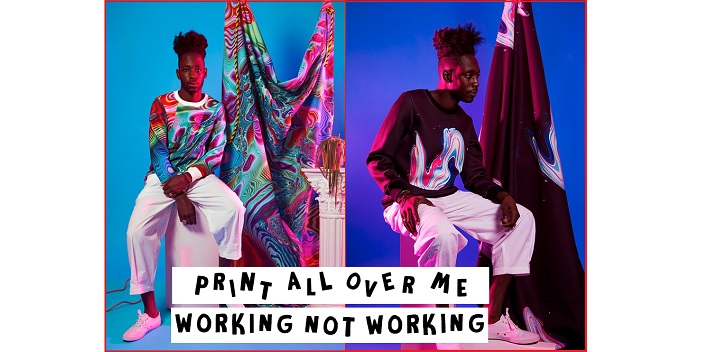
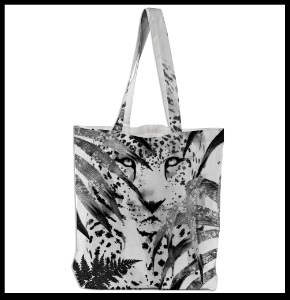
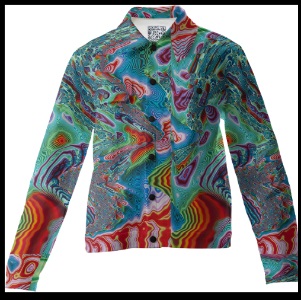
Print All Over Me is a creative community of people turning virtual ideas into real world objects. Every three months, we release a series of silhouettes like t-shirts, backpacks, jockstraps, etc. As a designer, you can upload your own artwork to each silhouette and then offer your design for sale. Even “captcha” designs like in our collab below with EXONEMO.
Every piece on PAOM is custom made. We print the fabric first and then cut and sew. We believe that by taking fashion slowly we can: a. offer high quality items; b. produce in an environmentally sustainable way; c. (and most importantly) offer our studio employees a living wage and health benefits.
Our office and collab studio is based in New York at New Inc. – the New Museum’s incubator. Our main production studio is outside Shanghai and we have a satellite studio in Georgia, outside Savannah.
Click me to design your own captcha – antibot wear.
Supplemental-
Neilsen’s signature look- a la 1970’s 1980’s
Was Cheap Trick guitarist Rick Nielsen an early captcha-clothing pioneer?
Due to rapid advances in technology, the quality of smartphone cameras is now on a par, if not better, than some point-and-shoot cameras and entry-level DSLRs. With the increasing demand for smartphone accessories to maximize users’ photographic potential, Limelens offers superior quality smartphone lenses at a price within reach of the masses. Limelens lenses capture intricate detail that a smartphone camera could not achieve on its own.
Limelens product range includes The Thinker, a dual macro/wide lens and The Captain, a 190 degree fisheye lens, with more smartphone camera accessories to follow. The lenses boast incredible framing capabilities, removing the limitations of the smartphone camera to produce stunning photographs with a greater choice of photo angles, framing and composition.
Available at www.limelens.com for $99 USD, the Limelens introductory Set includes both lenses as well the Limeclip attachment that fits over 40 devices including leading smartphones and tablet brands.
(See compatibility here) Limelens is taking advantage of the exponential growth of smartphone users and their insatiable desire to share their pictures on social media platforms.
Faye Jones, the Communications Director of Limelens says “While purists may argue about the limitations of smartphone camera capabilities, stand-alone cameras cannot compete with the portability of the smartphone and the public’s desire to share their photos instantly. Online photo sharing has become a way to express identity, rather than compete”. Jones says
“Limelens has recognized that people are choosing smartphones over conventional cameras and we have responded to this trend with the introduction of Limelens, a range of sleek, intuitively designed smartphone lenses that are compatible with major smartphone brands”.
The quality of smartphone camera images, and the features they offer, means that less people are spending money on regular cameras. According to data from Japan’s Camera and Imaging Products Association, camera sales have been steadily declining. In 2010 sales were at a high of 120 Million units but sales have reduced to 30 Million in 2015. For the Silo, Dawn Ryden.
Limelens offers a versatile attachment compatible with 40+ devices whilst ensuring the lens is stable and is easily attached and removed.
Limelens offers users the ability to take photographs with wider angles, in order to capture all elements of their photograph.
Limelens offers users the ability to capture incredible details of their subject, of which a smartphone camera alone could never accomplish.
Limelens provides smartphone photographers with a sense of community, encouragement and inspiration for their projects, no matter their distance, experience level or ability.
About Limelens:
Limelens was founded by UCT (University of Cape Town) student and entrepreneur Tyler Bodmann and has been in development since August 2014. The Limelens team includes Joel Bronner, Faye Jones, James Badenhorst and Michael Dickens. Limelens is driven to create products with the intention to intrigue and enable its ever-evolving photographic community to see, capture and create differently. The Limelens philosophy implores a vision of adventure and discovery through this new creative medium to accumulate to a movement so aptly called The Limelife. Launched in the Spring of 2016, Limelens smartphone accessories offer users the ability to take photos with wider angle and incredible detail while maintaining image quality. Compatible with over 40 smartphone and tablet brands, Limelens is the most versatile lens attachment available to smartphone camera users.
Peter Auto is delighted to announce that the Concours Chantilly Arts & Elegance Richard Mille, which will be held on 4th September in the Chantilly Domain for the third time, is welcoming two new partners: BMW and ACJ (Airbus Corporate Jets).
Last year’s Chantilly.
BMW was present at the 2015 event as entrant in the Concours d’Elégance reserved for concept cars and won the 1st prize with the 3.0 CSL Homage R. In 2016, the year which marks the Bavarian make’s centenary, BMW has joined the Chantilly Arts & Elegance Richard Mille in the context of a wider partnership that will be announced at a later date.
ACJ provides its clients with the most modern business jets in the world based on the full range of planes made by Airbus, leader in the field of aeronautics, thanks to its unique expertise, innovative technology and bespoke customer service. A fully personalised interior can be installed in these very spacious VIP planes including, for example, a lounge, an office, a bedroom and a bathroom. By combining interiors with unique living spaces and a range of action that enables its clients to cover the whole world, ACJ facilitates their life style. With ACJ Chantilly Arts & Elegance welcomes a partner whose values of excellence, innovation and luxury dovetail perfectly with those highlighted by the event.
Last year’s winner- the BMW CSL concept car. What a beauty!
BMW and ACJ join a list of prestigious partners who have renewed their confidence in Peter Auto in 2016 for the Chantilly Arts & Elegance Richard Mille: DS Automobiles, Le Point, Bonhams, Relais & Châteaux, Charles Heidsieck, Radio Classic, the IDEC Group, etc.
The first two Chantilly Arts & Elegance Richard Mille were an instant success with the public, manufacturers, collectors and partners. They were also rewarded in Great Britain by the prize for the Motor Car Event of the Year in 2014 and 2015 at the International Historic Motoring Awards. In 2015 the event received the backing of the French Ministry of Culture and Communication, which has renewed its support in 2016.
The 3rd Chantilly Arts & Elegance Richard Mille follows in the same vein as the previous ones by continuing with the Concours Automobile allied with a wide range of activities that include the French Art of Living, Fine Arts, Arts of the Table, Fashion, Music, Watch making, etc. with the partnership of prestigious houses and brands. Thus, all the ingredients are combined to make it a rendezvous that’s unique in its field in an exceptional setting only a few kilometres from Paris. The riches of the Chantilly Domain and the eponymous princely town give Chantilly Arts & Elegance Richard Mille the quintessence of art and elegance, which all the visitor can enjoy at this convivial, family event.
From the author of the #1 best-sellers, Tape It & Make It, Tape It & Make More and Tape It & Wear It comes the fourth book in this revolutionary “duct tape craft series:” Duct Tape Bags: 40 Projects for Totes, Clutches, Messenger Bags, and Bowlers (Clarkson Potter, July 2016). With the upcoming release of her new book, Richela Fabian Morgan is continuing to take the crafting and fashion world by storm, turning the humble roll of duct tape into the trendiest craft item since glitter glue.
Everyone from trendy teens to famous fashionistas can begin exploring the infinite uses this easy-to-follow guide provides to making handbags so fashionable, you won’t actually believe they’re made of duct-tape. Part art-piece, part usable accessory, Fabian Morgan shows how each of these gorgeous handbags can be recreated one manageable section at a time.
“About eight years ago, my kids and I were in our local hardware store when we spotted duct tape with patterns and colors,” says Fabian Morgan. “Since then, duct tape has been an obsession of mine. My daughter and her friends were my excuse to break out my vast collection of tape and try out different ideas for craft projects. Out of all the projects, the bags were the biggest hit! I started making bags for myself. So, it was only natural that I turned my attention to writing a book on duct tape bags. I wrote other books on duct tape crafts with a total of 242 projects spread out over three books, everything from housewares to costumes. Duct tape bags were on my radar. I had to write this book!”
Duct Tape Bags provides DIYers with 40 fun projects using duct tape, including:
Clutches and wristlets
Hobo and Shoulder Bags
Satchels
Messenger and Flap Bags
Tote Bags
And tons of other one-of-a-kind bags!
One of Rachel’s Duct Tape Bags.
Read more about Richela Fabian Morgan by using the links at the bottom of this article and:
Reveal what inspired her to begin crafting with duct tape.
See finished samples of the many bags included in her book.
Do print or video demos and step by step how-tos not only on her bags but any of the 240+ projects found in her duct tape books.
Provide the perfect summer duct tape projects for girls, boys and teens.
Look ahead to back to school: duct tape wallets, folders, book bags, pencil cases, lunch boxes and more!
Find tips to incorporate recycled items in your duct tape projects.
And so much more!
With detailed step-by-step instructions and primers on duct tape “fabric,” different types of closures from magnet snaps to jeans buttons, and bag accessories like bows and luggage tags, Fabian Morgan catapults this trend from the streets into the stratosphere. A mix of pop art and urban style photos of each project and a cool vibe throughout will make you want to immediately roll up your sleeves and rolling out the duct tape for a bag of your own! For the Silo, Erin MacDonald-Birnbaum
About Richela Fabian Morgan: Richela Fabian Morgan began her duct tape odyssey 8 years ago with a simple bi-fold wallet, before writing the best-selling crafting books Tape It & Make It, Tape It & Make More, and Tape It & Wear It. She is an indie crafter specializing in paper, adhesives, and found materials, and has taught craft projects at elementary schools, public libraries, and charitable organizations around the U.S. Her next duct tape crafting book, Duct Tape Bags, will be published by Clarkson Potter in July 2016.
Duct Tape Bags will be released July 12, 2016 and can be pre-ordered from Amazon.com and all major booksellers. Contact [email protected] for more details.
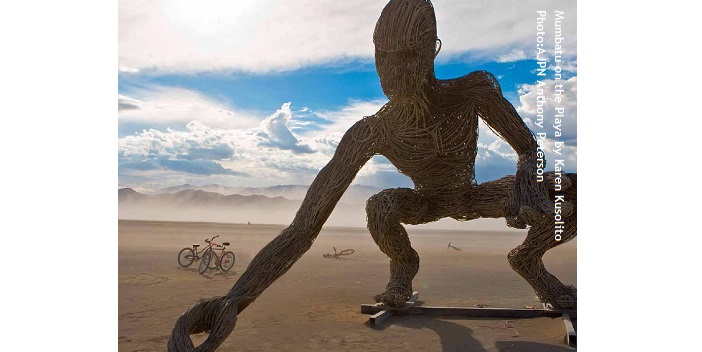
OCCUPY BLACK ROCK! THE METAPOLITICS OF BURNING MAN by MARK VAN PROYEN
As annual journalistic rituals go, the annual Time Magazine “Person of the Year” has been the most enduring barometer of the spirit of the moment of its announcement. For close to a century, the banner was “Man of the Year,” but after Corazon Aquino and Queen Elizabeth smiled at the world from the front cover of that influential publication, gender neutrality became the preferred modality. In 1982 “the computer” received the coveted award, so gender went out the window altogether. But the 2011 award was given to “the protestor,” and the representative image was a masked face of an angry-eyed anonymous person.
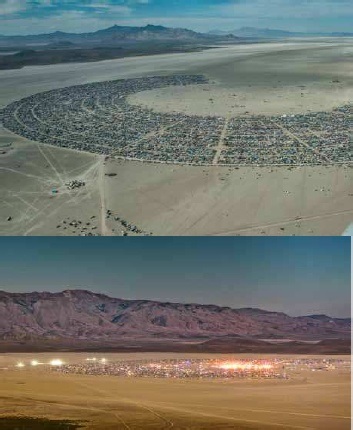
TOP Black Rock City from above Photo: AJPN Anthony Peterson BOTTOM Black Rock City seen from Old Razorback Mountain Photo: Peretz Partensky
This image followed a long year of public demonstrations that started at Cairo’s Tafir Square in late January 2011, spread to the shores of Tripoli and then moved on to Damascus. In September 2011, it arrived in New York’s Zucotti Park, a tiny sliver of public space surrounded on all sides by the world’s most prominent financial institutions. According to the surging multitudes that participated in what would come to be known as Occupy Wall Street, those institutions were evil, and needed to be called into account.It took the major media a full ten days to report the story of the occupation of that little park, although the story had already been thoroughly distributed via social media networks. The movement’s rhetoric was ingeniously crafted for those modes of distribution, and usually took the form of declarative slogans. These proclaimed that the protestors represented the 99 per cent of the American population that would no longer stand for being fleeced by irresponsible government tax policies, a lack of regulation of the financial markets and a vast system of political bribes routinely called “campaign contributions.” Conservative commentators squealed “Class War!” in comic disregard of an OWS placard reminding its readers “they call it class war when we fight back!” From the OWS point of view, that war had been ongoing since Ronald Reagan’s first term in office. When the major media did get around to picking up the story, “What do they want?” or “What are their demands?” were published everywhere, as if the protestors were unintelligible in their calls for economic justice and political fair play. OWS did not give in to the “demand for demands” and this is crucially important, because their movement never was nor is now a conventional exercise in political advocacy. It is much better to describe it as a case of spontaneous socio-cultural upheaval intended to reshape contemporary political priorities into a more ethical form. In an America where an uber- wealthy minority has garnered a proportionally larger piece of the economic pie for decades, one might have anticipated that the protesters would have adopted a more conventional form of utopian rhetoric. But theirs was decidedly pragmatist. They pointed at real problems that could and should be solved in a political practice governed by simple sanity. One sign read, “I don’t mind you being rich. I mind you buying my government out from under me.” The sign referred to the draconian political atmosphere created when the Supreme Court voted five to four to overturn the McCain/Feingold Campaign Reform Act in the now infamous Citizens United vs Federal Election Commission decision of 2010. 3
The real issue at stake in the Occupy Movement’s actions is the control that money exerts over the political process. The movement reveals the plutocratic Achilles heel of neoliberal corporatism’s claim that it is more democratic than its chief rivals in model government. I call these rivals “state capitalism” and “theocratic tribalism,” and intend them to be non-euphemistic names for what are conventionally called socialism and religion-based social organization. Because of its distinctly modern emphasis on upholding the prerogatives of individual political actors, neoliberal corporatism is easy to sell as the ideology of choice for free thinkers. But, as history shows, free thinking never stays free for long, because it too has to live in a marketplace of encouragements and discouragements governed by instrumental rationales that are epiphenomenal to the formation and protection of wealth. In other words, those who have the gold set the standards, regardless of any vision of or obligation to social fair play. This insures that instrumental reason will always protect itself from any utopian vision so that in the realms of conventional discourse, we are always given an “intelligentsia” that functions as the public face of bureaucracy and policy. However “oppositional” its posture of hidden loyalty might be, it will nonetheless always end up fleeing from the Socratic mandate that philosophical thinking helps its aspirants to actually live better. From the point of view of the Occupy movement, that mandate desperately needs to be returned to the core of any thinking that seeks to establish anything resembling a political priority.
When I refer to model forms of governmentality, I am not pointing to any operational political entity, any and all of which are circumstantial admixtures of the three models of neo-liberalism, state capitalism and tribal theocracy all achieving legibility much in the same way that tertiary colors do through the mixture of the primary hues of red, yellow and blue. For example, social democracy is really a blend of neo-liberal corporatism and state capitalism. Another example reminds us that there will always be a black market of goods and subversive ideology working in the shadows of any state capitalist system, or for that matter, within any theocratic tribe. Any system configured around any of these three model forms will also contain latent aspects of one or both of the others, arranged into dominant and subordinate formations. These are always in a perpetual state of change and reconsolidation.
They are also always in a state of subtle redefinition, and the factors that shape these redefinitions can sometimes come from surprising vectors. The Occupy Wall Street movement is one such example, surprising in that it refuses to operate according to the rules of normative political advocacy. Whereas the extremely conservative Tea Party rallies held during the previous year were examples of a durable tradition of anti-government American populism, the OWS movement is representative of an equally durable anti-bank populism that has a long-standing place in American history reaching back to early colonial laws against debtors’ prisons. Even though the two groups blamed different entities for the economic misery that swept the land after the 2008 financial crisis, there is an important difference: in an act of support for the second amendment, Tea Party activists often brought guns to their rallies. The only firearms seen at Occupy Wall Street (and its more contentious sister event, Occupy Oakland) were in the hands of over-zealous law enforcement officers. Occupy Wall Street events are significantly more complicated animals than their Tea Party predecessors. The movement has gone far out of its way not to be co-opted by the mass media or any collection of candidates for public office. Conversely, the Tea Party groups were all too happy to be ventriloquized by Rupert Murdoch’s Fox News affiliates. OWS had a justifiable concern that any such affiliation would inevitably lead to the seven stages of political futility: cooptation, division, dilution, pacification, neutralization, disappointment and betrayal. Because of these concerns, what one sees coming out of the Occupy movement is not an exercise of politics defined by the normal terms and conditions of any conventional political science. Rather, it operates as an example of what Alain Badiou has called a Metapolitics, that is, a strategic restaging of the ethical grounds by which political matters are imagined, understood, debated and acted upon. According to Badiou, Metapolitics is a form of “Resistance by Logic.” 4
No group, no class, no social configuration or mental objective was behind the Resistance… there was nothing in the course of this sequence which could have been described in terms of objective groups, be they ‘workers’ or ‘philosophers’…. Let us say that this resistance, proceeding by logic, is not an opinion. Rather, it is a logical rupture with dominant and circulating opinions…. For the contemporary philosophical situation is one where, on the ruins on the doctrine of classes and class consciousness, attempts are made on all sides to restore the primacy of morality. 5
It is particularly interesting to look at Badiou’s metapolitical thesis in light of his larger project to transform the most basic grounds of philosophical inquiry so as to place greater emphasis on ethics. He is well known for proposing a change in the basic categories of philosophy (metaphysics, ethics, logic and epistemology), seeking to restage them as the interdependent “truth procedures” of “art, love, politics and science.” 6
His metapolitical restaging of the truth procedure of political science can be understood to be of a piece with his postulation of an ethical “inaesthetics.” This seeks to deny the meditative subject/object relationship of contemplation with something suffused with “immanence and singularity,” leading to a “transfiguration of the given.” The Occupy Wall Street movement has followed suit on this score, fashioning itself as an immanent and singular metapolitical gesture that has embraced a unique resistance by logic that was and still is a vigorous disruption of logic. It has accomplished this by staging a theatrical moment that calls attention to the withering state of the commons, that being the place of democratic co-existence and rational debate where all citizens can freely enter and exist regardless of their inability to rent media time. And let there be no mistake: in the second decade of the twenty-first century, social media has become the new commons, needing only a shared event to galvanize its attention to the point of putting a wide-ranging discourse about political priorities into play on a vast and unregulated scale. Occupy Wall Street is one such event, one whose time has clearly come. But the model for this kind of actual/virtual exercise in reformulating a common space into a rhetorical congregation had been established two decades earlier in a very different public location that also galvanized a vast virtual community. It too was a brilliantly conceived exercise in a metapolitical “resistance by logic.” That space was and still is the vast Black Rock Desert, a dry lakebed in northwestern Nevada that is administered by the Federal Bureau of Land Management.
Karen on Eileen and George, from Crude Awakening PHOTO: ROGER MINKOW M.D.
The event was and still is Burning Man. Since the early beginnings of the Internet, many observers have postulated that there was revolutionary potential in its ability to widely and instantaneously distribute unmediated information. Some have proclaimed it to be the new commons, this in recognition of how the forces of neoliberal corporatism have turned the old commons into shopping malls of various kinds, those being places where the subtle doctrine of “pay to play” began to slowly displace all other opportunities for political participation. Burning Man was the first major instance of an organized recognition of this new communal possibility of the digital revolution, and the first to act upon it at any meaningful scale. It did so by “occupying” a piece of public land in a wilderness area, and then configuring itself as a kind of free city where monetary exchange and corporate advertising would not be allowed. Participation, collaboration and self-reliance were upheld as paramount civic virtues, and art was defined and welcomed as the product of any “radical free expression” that any person could devise, regardless of any lack of previous experience or education. When web-browsing software first became available in 1994, Burning Man was already nine years old, and had already been using email networks and virtual bulletin boards to distribute its messages to a growing audience. The emergence of such communications technologies were a natural fit for the event, and even to this day, it has never paid for any advertising beyond the printing and mailing of its own promotional materials. That was the same year that the mass media initially came out to report on the event. The following year, the population doubled, making it clear that a tax on participants was needed to cover necessary costs for staging the event on a much larger sale. Admission tickets were sold, and federal rules were re-written so that the federal Bureau of Land Management could charge the organizers of Burning Man a hefty fee to use the space. Soon after that, much more money was spent in legal fees to support litigation that should have never have come to any court’s attention, if constitutional guarantees of rights to free assembly and self-expression were deemed worthy of any respect. But they weren’t, because it was difficult to convince certain political operators that the self-expressive thing that had engendered Burning Man’s free assembly of pilgrims had anything to do with art. From their point of view, what was happening at an increasingly large scale every year in the Black Rock Desert on Labor Day weekend was much more frightening, in that its almost complete lack of artistic supervision portended something akin to a mass participation Satanic ritual.7 It also threatened to unmask the lie that art had become.
I
From the perspective of an art world populated by museum curators, globe trotting art collectors and the toney gallerists working the crowds at international art fairs, Burning Man represents a kind of Special Olympics for Art. To give credence to this view, all any nay-sayer would have to do is attend the event and take in its many starry-eyed unicorns and countless geodesic domes built in service to obscure comic-book deities fashioned from disfigured mannequins. If our nay-sayer were guided by courage and in search of additional evidence to support her initial observation, the next logical destination would be the large indoor exhibition space called the Café, which is usually decorated by the work of a great many amateur photographers and collage artists working on heavy doses of misinformed spiritual pretense and undeserved self-esteem. And yet, as revealing as the Café environment might be, it still pales in comparison to the best place to witness Burning Man’s culture of unfettered creativity, that being the array of unmapped theme camps located away from the Esplanade that separates the event’s semi-circular camping area from the mile-wide no-camping zone at its core. Here, one is liable to find a vast assortment of incomprehensible do-it-yourself efforts at representational makeshiftery, often times manifested in things that look more like distorted family entertainments than the objects of any conventional art history. Looking like the mutant offspring of a theme park and a slum conceived in the prop closet of George and Mike Kuchar’s Studio 8 Production Company, 8 these provisional amalgamations of such materials such as fluorescent fabric and solar powered lava lamps oftentimes seem to allegoricize the traumas and contradictions of a consumer culture blindly addicted to the debt-driven circulation of pseudo-goods and non-services; all saying something troublingly oblique about an America that is amusing itself to death in the age of Walmart.
The real value of Burning Man lies in how it reverses this model. It does so by simply allowing its participants to amuse themselves back to life through their participation in a week of collective catharsis. Fortunately for our dyspeptic pilgrim, the artistic offerings of Burning Man get bathed in a seemingly endless sea of electro-luminescent blinky lights when nightfall arrives, and her attention will then most likely be diverted by an omnipresent soundscape of pulsating techno music punctuated by the explosive flashings of propane fireballs surging into the sky. To this, add the lumbering peregrinations of large, slow moving vehicles that appear as grotesque carnival rides taken from a Dada-themed amusement park, and the picture of a vastly absurd semiotic entity comes close to completion, a relational esthetics
gesamtkunskwerk 9 that is metaphorically and geographically located at the exact half-way point between San Francisco’s Mission District and Robert Smithson’s Spiral Jetty protruding from the north shore of the Great Salt Lake. It is equal parts game space and refugee camp, and as such, it presents itself as a gargantuan omni-participatory rejoinder to the regulation of subjectivity embedded in the cognitive illusions bred by normative market-defined existence. And for this reason, the ensemble experience of participating in Burning Man provides a much-needed transfiguration of everyday assumptions about what passes for cultural nourishment. Its chief lesson lies in the way that it demonstrates how well a do-it-yourself social economy can work if and when it reframes itself in the terms of a do-it-with-others ethos, and this represents a profound political revelation as well as its chief metapolitical legacy to be later taken up by the Occupy Wall Street movement.
Rather than calling this vast entity by its proper name of Black Rock City, lets give it a more descriptive moniker: the living model of an alternative version of contemporary culture based on advancing an ethical glocalism as the highest of priorities. And then let us note that, in theatrically performing itself as such a model, it also forms itself into a fun house mirror reflection of the absurdities of twenty-first century existence, all-the-while organizing itself as a temporary corrective for many of that century’s social and political shortcomings, especially those pointed toward systematically excluding people from social participation for no good reason. At Burning Man, the stranger is always welcome, and there are always opportunities for any given participant to do things that she never imagined herself to be doing. And in so doing, she oftentimes learns a great deal about the roles that she plays in her everyday life, in turn allowing her to imagine and act upon other roles that might lead her to a better world, at least for herself and maybe for others. Yes, Burning Man does feature a great deal of so-called “New Age” art made by people who might best be called hippies, and yes, almost all of that art is at best a guileless exercise in naïve cluelessness that is scripted not so much by any “radical free expression” as it is by the simplistic recirculation of pop cultural cliché. At worst, it is something on a par with toenail fungus, but even that can be strangely entertaining when contrasted with the vastness of the desert. Indeed, accounting for maybe two- or three-dozen notable exceptions during the past decade, we would have to concede that almost all of the art at Burning Man is as bad as its detractors say that it is. But in admitting this fact, another obvious question comes to the fore: in the great scheme of things, how important is it whether any of it is bad or good? And following from this, another obvious set of questions: who or what are the entities that are empowered to decide on any such differentiation? What values do they represent? What is masked by the authoritative proclamation of said values? And again: why does any of it matter?
Turnabout being fair play, it now becomes obligatory to imagine what an everyburner might make of the current world of contemporary art, resplendent as it is when ensconced within opulent museum architecture and festooned with price tags that are the monetary equivalent of real estate when it is not. It is undeniable that those environments are the sites of a kind of authoritative coldness designed to intimidate the viewer into a kind of passive submission to the historical authority of those things that are beheld within them. It is also undeniable that the large majority of those snobjects contain very little that conveys the kind of truthful generosity that might reward the attention of the serious viewer who is not party to the vested interests that have been influence-peddled into the visible existence of their environment’s adoration.
And so, our everyburner would no doubt ask: given the sorry state of the world, why all the fuss? Presumably, money is part of the equation, although it is difficult for the uninitiated to see exactly how it plays out through the elaborate web of private, corporate and public support that buoy any given museum’s orchestration of the importance effect. As Paul Werner succinctly put it in 2005: “The illusion that art museums could be run for profit like everything else was derived from the notion museums themselves had worked so hard to foster: that art and capital were all one and circulated in the same manner.”10
Werner goes on to quote former Metropolitan Museum director Phillipe de Montebello’s statement that “It is the judicious exercise of the museum’s authority that makes possible the state of pure reverie that an unencumbered esthetic experience can inspire,”11 and then goes on to state that “by the same logic, the absence of ‘a state of reverie’ interferes with ‘the judicious exercise of authority.’” Werner drives this point home when he writes “What Brecht wrote of the Nazis then now applies to cultural apparatus of the twenty-first century: they want to turn the People into an audience. Same policy, different means.”12
Once again, we are reminded of the truism stating that propaganda works best when those who are being manipulated believe that they are acting on their own free will. How you might ask, and the answer is obvious: in the way of the translation of a certain class of objects—let’s call them symbolic commodities—into a certain class of equities. It is easy to suppose that said equity is simply gained from the fortuitous position that any given investor might take amid the normal value/worth fluctuation of the commodity in question. But works of art are not commodities in same way as are barrels of crude oil or tons of copper, nor is it a form of reserve currency as are ounces of gold or silver. The commodity value of a given work of art is instead a function of its status as a reliquary representation of its own myth status, and that is something that continues to be manufactured long after said work of art leaves the studio of the artist who created it. Ultimately, it is the museum that confirms the mythic status of the objects that it chooses to display and collect, creating a fortuitous feedback loop that points to how the world of contemporary art has been transformed into a rather perverse epiphenomena of the financial services industry.
Here is how the normative art economy actually works. Artist a) makes a work of art b) and shows it at the gallery of dealer c), who gets it written about by critic d) and then sells it to collector e) for f) amount of money. Collector e) hangs on to artwork while the reputation of artist a) rises by way others repeating the same machinations described in the aforementioned equation, and then, at a fortuitous moment, she either sells said artwork for profit f)+x , or more normally donates said artwork to museum g), for which she receives donor recognition h), which represents the fair market value that museum g) places on artwork b).
Because the work has been accepted into museum g)’s collection, its fair market value automatically rises, so that donor recognition h) is actually worth much more that the original purchase price f) of work of art b). And it is donor recognition h) that collector e) sends to the tax collector as a claim for a tax deductable charitable contribution that reduces collector e)’ s overall tax burden by a significant sum of money (yes, the federal government does support the arts!). The value added portion of this equation lies in how much greater a sum of money donor recognition h) represents in relation to original cost of artwork b), and in many cases that sum is ten or 20 or 100 times the original investment. Thus the economy of art is laid bare, and it can rightfully be called a speculative marketplace in objects that might represent a significantly enhanced tax-deductability that can be exercised at some future juncture, all assuming that museum g) is interested in acquiring work of art b) at any point in time. This means that work of art b) has to fit in with what museum g) considers to be a worthwhile esthetic experience, based in part on its own vested interest in perpetuating its ability to exercise such consideration. Werner gets that particular point right when he states that “if the Guggenheim, or any other museum, had actually covered its expenses through admissions, that would have harmed its true function: The manufacture of exclusiveness.”13
But, even though money is a major part of the equation, it by no means is all of it. It is worth noting that Werner’s remarks about the museum world point to a specific historical moment, and that moment was defined by the aftermath of the politically motivated reformulation of the National Endowment for the Arts that took place between 1989 and 1994. After that reformulation (which effectively ended government support for the arts in the United States), both the world of the museum and the larger world of contemporary art were momentarily recast as perverse sub-functions of the entertainment industry, with a reigning style called “Pop Surrealism”14
This coming to the fore as the stylistic marker for the art of that brief and bygone moment, and indeed, a perfectly useful and legitimate term that could accurately describe much of the art that one might find at any given iteration of Burning Man. In fact, it is a far more accurate term than the more common ascription pointing to it as new form of “outsider art.” This is so because at that particular moment, there was a major lack of clarity about what was inside or outside of anything other than what financially motivated turnstiles might keep in a state of separation, and in the wake of the cessation of government funding, an increase in audience size became an necessary institutional mandate. Thus, we had an art style that “took its inspiration from popular culture,” meaning that it was trying and failing to be popular culture, rather than the kind of critical comment on it that we saw with 1960s Pop Art. Part-and-parcel with the 1990s embrace of Pop Surrealism as an audience development strategy was another related trend called Postart spectacle, which transformed whole museums into elaborately staged pseudo-operas of the type made famous by Matthew Barney, Paul McCarthy and Martin Kippenberger—artists who all infused Pop Surrealist esthetics with the theme park ambience of an arena rock concert. Finally, it is worth noting that the rhetorical pendent that was hung around the neck of this esthetic shift toward popular entertainment was something called “art writing.” It did not come from the traditional world of art historically trained art critics, but instead issued from a new hybrid discourse that proclaimed itself to be something called “visual studies,” which in many cases was little more than culturally sensitive entertainment reporting—“celebrity porn journalism” to use a deservedly uncharitable term. Its most characteristic feature was a shameless willingness to be used as a tool for institutional audience development.
Nonetheless, in the art world, all of this was brief and transitional, because the focus would again shift in dramatic form after the 9/11 terrorist attacks, making Pop Surrealism suddenly look very anachronistic. Very soon thereafter, Globalism became the new buzzword for a suddenly robust emphasis on a transnational art hailing from under-recognized parts of the world. Presumably, Globalism represented an impetus toward encouraging the embrace of art as an instrument of national liberation, or failing that particular pretense, as a focal point for the kind of cultural lubrication that might politically facilitate desirable access to the labor, natural resources and markets of the developing economies so dearly prized by neoliberal corporatism. It might also represent a politically motivated usage of art as an instrument of pacification, that is, as an administrative technology for deflecting the potential for actual conflict into the containable realm of symbolic conflict. The visible shape that this newly globalized art took on was not manifested in any particular form of artistic cultural production, but instead, was revealed as a relatively new form of cultural presentation called the Mega-Exhibition. These were exemplified by such time-honored extravaganzi as Documenta and the Venice Biennial, but also by a metastasizing host of newer entries into the global mega-exhibition fray, held in such cities as Istanbul and Taipei. These are giant affairs that operate under the guidance of an elite class of internationally renown curatorial directors, and in addition to operating as certification mechanisms for the investability of the art contained by them, they also function as major engines of cultural tourism and transnational ideological propaganda that have been used to enrich the coffers of their host cities. It is also worth thinking about how other imperatives might be in play. As Okwui Enwezor has written, globalism embodies a new vision of global totality and a concept of modernity that dissolves the old paradigm of the nation-state and the ideology of the ‘center,’ each giving way to a dispersed regime of rules based on networks, circuits, flows, interconnection. Those rhizomatic movements are said to operate on the logic of horizontality, whose disciplinary, spatial, and temporal orders enable the mobility of knowledge, information, culture, capital, and exchange, and are no longer based on domination and control… globalism was part of the maturation of a certain kind of liberal ideal, which in its combination of democratic regimes of governance and free market capitalism was prematurely announced as the end of history.15
These attributes are all pointed at the imagination of “a truly unified world system whereby all systems of modern rationalism would finally be properly fused.”16
Of course, the inquiring mind will ask, to what end? And more importantly, to whose end? Of course, answers to these questions are never made clear, perhaps because they cannot be made clear. But it is worth pointing out that the impetus toward the aforementioned fusion is a very different thing than the impetus toward cultural diversity, and it is also interesting to note that among the many topics of cultural identity that have surfaced during the heyday of the global mega-exhibition, the debt obligations of post-colonial nation states is one that almost never comes up. That is because the thing instigating and benefiting from the aforementioned fusion is a global, trans-national banking system that has learned how to use both art and nation states as tools for its own purposes. That much said, we can go on to productively note Burning Man is also a mega-exhibition, but in many ways it is also an anti-mega-exhibition, especially in the ways that it prefigured, mirrored and satirized the “the rhizomatic logics of horizontality, interconnection and dispersal” that have become de rigueur themes in twenty-first century art. III
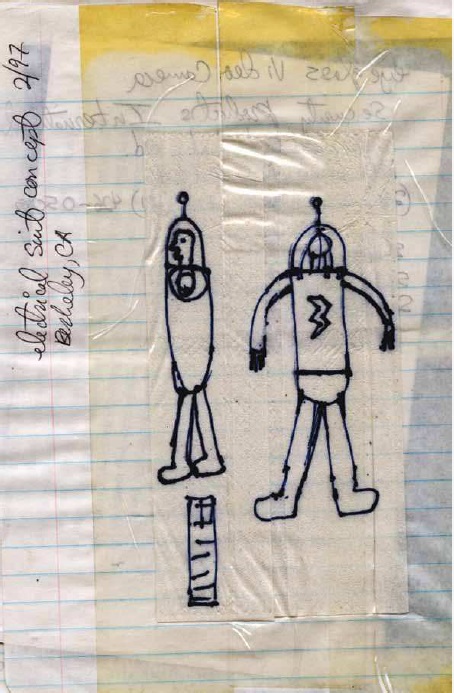
Electrical Suit sketch by Dr. Austin Richards AKA Dr. Megavolt
For all of Burning Man’s claims of being a place apart from the default world that it pretends to leave behind, it nonetheless does seem that the event sustains an oblique relationship to that world. During the technologically addled 1990s, Burning Man seemed to be prophetically far ahead of the cultural environment surrounding it. The chief reason for this was its far-reaching imagination of the ways that new technology could recast how social relations might be reconfigured in critical relation to what Naomi Klein would later call “Disaster Capitalism.”17
In those days, the presiding spirit of Burning Man was not any getting back to the mythical garden that so captured the imagination of the Woodstock generation so much as it was a celebration of various kinds of real and imagined love taking place amongst the post-apocalyptic ruins of rampant military adventurism and financial and ecological unsustainability. But in 2001, the specter of real apocalypse became traumatically evident when the 9/11 terrorist attacks ushered in an unfunded war wedded to the draconian trappings of the National Security State. Suddenly, the world caught up with Burning Man’s parsing of the utopian and dystopian themes of technologically-assisted social capitalism, making them seem redundantly similar to the mass media narratives about a brave new cyber-economy as well as the emergence of other forms of Postart spectacle that had come into prominence in the art world. The fact that Burning Man had become the putative darling of a kind of trivializing mass-media condescension did not help, and over time the event become more-and-more indistinguishable from the “wild and crazy” caricatures that were heaped upon it. By 2007, the event had clearly become a victim of its own clichés of flagrant silliness, mired in a repetitious cycle of nostalgia for the exuberant 1990s. Soon after that, that the world would pass it by, because in 2008, the story would take another turn, a downturn to be exact. The financial crisis that exploded in October of that year once again recalibrated the larger terrain of cultural understanding, and the urgency of that moment began to make Burning Man look every bit as indulgent and frivolous as it did the institutional art world. Soon thereafter, a new concern for the politics of social justice had come into the foreground, eclipsing the themes of alternative identity and self-sustaining community-of-desire that were such prominent features of the event during its 1990s heyday. It was time to pass the metapolitical torch of the do-it-with-others ethos so that a very different fire might be lit with the aid of a few well-placed Falstaffian pitchforks.
Returning to Badiou, we read that the ethical understanding of justice is something quite specific. It is based on the following injunction: “to examine political statements and their proscriptions, and draw from them their egalitarian kernel of universal signification.”18
If Burning Man has done nothing else, it has certainly created an Archimedean ground from which such an examination might proceed, much more successfully than anything that happened in the institutional art world during the same time period. Following from this recognition, we might then ask how the metapolitical kernel of Burning Man was passed to Zucotti Park, as if, in an age of social media, the assertion and exertion of any influence on anything can somehow be supposed to not be operable until proven otherwise. We know that one of the key instigators of the OWS movement was Micah White, the Berkeley-based co-editor of the Vancouver-based journal Adbusters , therefore a Bay Area connection is easily made, although it is not clear if White was in any way influenced by Burning Man. Because there is a very large contingent of Burning Man participants that hail from New York City, one could easily suppose that their experience of the event might have had something to do with the encampment at Zucotti, especially since Occupy Wall Street initially took place just ten days after the conclusion of the 2011 Burning Man event. But there is one important kernel of indisputable influence that clearly stands out, and that is Bill Talen, who is better known in his performance guise of Reverend Billy of the Church of Stop Shopping, a New York-based performance group that has extensively toured the United States and is the subject of two widely circulated documentary films. What makes Talen’s performances so timely for this discussion is his evocation of the tropes of a theocratic tribalism that are severed from the politics of hate and fear, all enacted in service to the kind of communitarianism and pleas for justice that earmarked the earliest Christian communities of the second century. Obviously, those same values are in short supply among so-called evangelical churches populated by legions of CINOs (Christians-in-Name-Only), reminding us of how deeply perverted the gospel message has become in twenty-first century America. The fact that the more organized churches proclaiming allegiance to the gospels have been outdone on this score by a performance artist should be cause for concern, outrage and cruel mockery. Starting in 2002, the 30-member band and gospel choir of the Church of Stop Shopping has regularly performed at Burning Man, putting on a rousing revival show that is a stunningly convincing mimic of similar services consecrated to “the old time religion” a la Elmer Gantry, only at Burning Man, it was comically staged under the shadow of an 40-foot-tall effigy that echos the real old old old time religion of Neolithic cult worship.
At the forefront of the Church’s performance is Talen’s character named Reverend Billy, who preaches in passionate, Elvis Presley-inflected voice about the evils of consumerism and the tragic human cost of debt-driven consumption, backed up by a gospel chorus and small orchestra featuring a church organ. The chorus sings songs about the virtues of an economic democracy that is described as a promised land, and the mood is always persuasively festive, even joyous.
Talen’s passionate and eloquent sermons come across like rhapsodic poems made from the many fragments of Occupy Wall Street signage, and in fact, Talen did perform (sans choir) at the 17 September 2011 beginning of OWS, just a few days after returning to New York from Burning Man. Subsequently, he performed with the choir at Zucotti Park on several other days, to audiences that grew ever larger during the month of October. These were rousing and inspirational shows that galvanized the attention of ever-growing crowds in a way that gave them a coherent group identity, meaning that, for a few brief moments, the Occupy protesters found themselves attending a church of their own politically inclusive revelation, which allowed them to see themselves as being a part of something much larger than themselves.
As always, Talen’s performances were a brilliant obversion of the pernicious role that religion has come to play in American politics, where so-called “values” candidates have been using church affiliation for decades as the preferred excuse for supporting candidates and policies that embody the hateful opposite of Christian morality. Such ethically duplicitous rhetoric also has a metapolitical name, and that name is Neoconservatism when practiced by Americans who identify with Judeo-Christian tradition, and fundamentalism when practiced by others. Either way, the word “fundamental” applies in all of its many nuances, especially the one that highlights its definitional opposition to enlightened sophistication. Essentially, Neoconservatism is a subtle theologicization of the neoliberal doctrine that defines the subject along the secular lines of economic self-interest, but it deviates from that doctrine in that it assumes that self-serving moral edicts are required when the economic interests of cultural Others begins to gain too quickly in relation to the economic self-interest of the culturally entitled.
Talen’s Reverend Billy performances are so entertaining and well executed that it is easy to miss the seriousness of the metapolitical critique embodied in them. Certainly, they provide a thoughtful and dramatic critique of the empathy deficit disorder that is bred by neoliberal corporatism, and they command and entice their audiences to insist on ethical correctives. As for the relation of his work to his experience of Burning Man, Talen himself has a clear vision of the similarity between Burning Man and the OWS movement. He writes:Burning Man and Occupy Wall Street share this: we discovered that living together is a performance with long-range power. How we live—people watch and learn. Then they live back at us and we change too. We experience the decisions of how to live as drama, and (we found out) as protest—more than traditional theater which rarely has electrical charge these days. For years we were the butt of journalist jokes, calling us refried 60s protesters—angry people carrying signs and chanting. All that was wiped away by the glorious arrival of Occupy, which was the simple notion of living together in public, in a park under the scrapers of Wall. Sharing food, stories, making media, figuring out laws, discussing health, feeding each other—LIVING TOGETHER is the devastating protest form of our day. Burning Man’s fascination—you see it around the world—flows from living together under arid desert conditions for a week. BM also chucks the conventional stage and finds a new charged theater in sashaying in outrageous costumes and nakedness in front of 50,000 people who are doing the same thing back at you. Burning Man is great theater—leaves Broadway in its playa dust. And Wall Street guys are there too—wearing fluorescent underwear while they check out a 100-foot-long chandelier. How change comes to the world from these two forms of theatrical living— stay tuned! It has begun.” To this I can only say Amen.
notes- *apologies for layout issues, text spaces have been modified to allow for full citation listings.
1.
Alain Badiou,
Metapolitics
(1998), translated by Jason Barker, London: Verso Books, 2005, p. 19.
2.
Jean Tingley, “On Statics,” (text from a leaflet dropped near Dusseldorf in 1959. Recorded in
The Diary of Anaïs Nin, Volume VI
, edited by Gunther Stuhlman, New York: Harcourt, Brace and Jovanovich, 1966 p. 284.
3.
See Adam Schiff, “The Supreme Court Still Thinks That Coroporations Are People,” (July 18, 2012)
, translated by Norman Maderaz, State University of New York Press, 1999. Further references to Baudiou’s ideas are extracted from this source, unless otherwise cited.
7.
Claims of Burning Man being a socially dangerous satanic ritual were made on the 18 May 1998 broadcast of Pat Robertson’s 700 Club program on the
Christian Broadcast Network
.
8.
George Kuchar (1942–2011) and Mike Kuchar (b.1942) were San Francisco-based underground filmmakers whose low budget works used and misused exaggerated gender clichés to satirize the most preposterous aspects of conventional “sinematic” exposition. George Kuchar’s most well known film was titled
Hold Me While I’m Naked
, 1966, while Mike Kuchar is best known for his 1966 film titled
Sins of the Fleshapoids.
In 1997, they collaborated on a book of comic reminiscences titled
Reflections from a Cinematic Cesspool
(San Francisco: Zanja Press). Here we might note a persistent albeit unconfirmed rumor that San Francisco’s long-running stage play titled
Beach Blanket Babylon
was originally indebted in some way to the George Kuchar esthetic. In Jennifer Kroot’s 2009 documentary film titled
It Came From Kuchar,
it was revealed that Bill Griffith’s comic character named
Zippy the Pinhead
was modeled on George Kuchar.
9.
Gesamtkunskwerk
literally means “total work of art.” It was coined by Richard Wagner to describe his view opera production as a synthesis of all of the arts. See his
The Artwork of the Future
(1849, translated by William Ashton Ellis) at http://users.belgacom.net/wagnerlibrary/prose/wagartfut.htm. “Relational Esthetics” was a term originally coined by Nicholas Bourriard in 1986 as a way of calling attention to certain artistic practices that were/ are less concerned about the creation of a final product than they are about the social processes of inclusion and participation leading up to it. Bourriaud defined the approach simply as “a set of artistic practices which take as their theoretical and practical point of departure the whole of human relations and their social context, rather than an independent and private space.” (p. 113). See Nicholas Bourriard,
Relational Esthetics , Dijon, France: Les Presses du Reel , 2002. For a critique of Bourriard’s thesis, see Claire Bishop, “Antagonism and Relational Aesthetics,”
October 110, Fall 2004. Bishop points out that “The curators promoting this ‘laboratory’ paradigm—including Maria Lind, Hans Ulrich Obrist, Barbara van der Linden, Hou Hanru, and Nicolas Bourriaud—have to a large extent been encouraged to adopt this curatorial modus operandi as a direct reaction to the type of art produced in the 1990s: work that is open-ended, interactive, and resistant to closure, often appearing to be ‘work-in-progress’ rather than a completed object. Such work seems to derive from a creative misreading of poststructuralist theory: rather than the interpretations of a work of art being open to continual reassessment, the work of art itself is argued to be in perpetual flux. There are many problems with this idea, not least of which is the difficulty of discerning a work whose identity is willfully unstable. Another problem is the ease with which the ‘laboratory’ becomes marketable as a space of leisure and entertainment. Venues such as the Baltic in Gateshead, the Kunstverein Munich, and the Palais de Tokyo (in Paris) have used metaphors like ‘laboratory,’ ‘construction site,’ and ‘art factory’ to differentiate themselves from bureaucracy-encumbered collection-based museums; their dedicated project spaces create a buzz of creativity and the aura of being at the vanguard of contemporary production. One could argue that in this context, project-based works-in-progress and artists-in-residence begin to dovetail with an‘experience economy,’ the marketing strategy that seeks to replace goods and services with scripted and staged personal experiences. Yet, what the viewer is supposed to garner from such an ‘experience’ of creativity, which is essentially institutionalized studio activity, is often unclear.” (p. 52) Bishop goes on to quote Bourriard: “It seems more pressing to invent possible relations with our neighbors in the present than to bet on happier tomorrows” (p. 54;
Relational Esthetics,p. 45), Then she adds “This DIY, microtopian ethos is what Bourriaud perceives to be the core political significance of relational aesthetics.” (p.54). It is worth noting that there has never been much difference between Bourriard’s assertion of “Relational Aesthetics” art practices and Allan Kaprow’s much older advocacy of Happenings, the first principle of which being “the line between the Happenings and daily life should be kept as fluid as possible,” so that “the reciprocation between the handmade and the ready-made will be at its maximum power.” (Allan Kaprow, “The Happenings are Dead: Long Live the Happenings!” (1966) in Jeff Kelly ed., The Blurring of Art and Life: The Collected Writings of Allan Kaprow , Berkeley: University of California Press, 1996, p. 62). The key point lies in how both Relational Esthetics and the earlier Happenings resurrect the tenants of Lukasian social realism by substituting real-time face-to-face encounters for the older tropes of representing and/or narrating ideas of “class consciousness.” More recently, similar activities have again rebranded themselves as “Social Practice Art,” as a way of emphasizing more specific political ambitions. See Nato Thompson, Living as Form: Socially Engaged Art from 1991 to 2011,
Cambridge, MA. MIT Press, 2012. But even here, the obvious equation of institutionally supported “social practice art” with inefficacious postures of mild political concern (scented with the bad faith of loyal opposition) are never directly addressed. An important early instance of a Relational Esthetics artwork was San Francisco-based artist Tom Marioni’s Drinking Beer with Friends is the Highest Form of Art
, a weekly relational esthetics performance that has been ongoing since the mid-1970s. Clearly, San Francisco-based Burning Man is far and away the largest and most complex example. Neither was mentioned in Bourriard’s famous book.
10.
Paul Werner,
Museums, Inc.
, Chicago: Prickly Paradigm Press, 2005, p. 9.
11.
Ibid., p. 15.
12.
Ibid
.,
p. 58.
13.
Ibid
.,
p. 41.
14.
Pop Surrealism was the name of a 1998 exhibition organized by Richard Klein, Ingrid Schaffner and Dominique Nahas held at the Aldrich Museum in Ridgefield Connecticut. It contained the work of artists such as Peter Saul, Mike Kelly, Paul McCarthy, Lisa Yuskavage, Ed “Big Daddy” Roth, John Currin and Robt. Williams, and could be said to have reprised and expanded upon an earlier exhibition titled Helter
Skelter that was organized in 1992 by Paul Schimmel at the Museum of Contemporary Art in Los Angeles. The monthly publication Juxtapose (founded by Williams in 1994) has done much to promote many of the artists associated with the Pop Surrealism movement, but the publication’s claim that the movement originated in southern California is erroneous. The real historical sources of the Pop Surrealism movement is found in the earlier work of Bay Area-based artists such as Peter Saul and George Kuchar, as well as the underground comics movement that was based in the same area during the middle 1960s. Chicago artists of the early 1970s such as Jim Nutt, Gladys Nielson and Karl Wirsum were also important early influences. The most important aspect of the Pop Surrealism movement lied in its embrace of a populist turn in art that was responsive to circumstances related to the political controversies surrounding government funding for the arts. In 1998, the National Endowment for the Arts published the findings of a multi-year research project that concluded that the arts were widely perceived to be irrelevant and elitist. The project was called American Canvas
. See Gary O. Larson,
American Canvas: An Arts Legacy for Our Communities
, Washing ton D.C.: US Government Printing Office, 1998.
15.
Okwui Enwezor, “Mega-Exhibitions and the Antinomies of a Transnational Global Form,” in Andreas Huyssen ed.,
Other Cities, Other Worlds: Urban Imaginaries in Globalizing Art
, Duke University Press, 2008, pp. 148–149.
16.
Ibid
.,
p. 149. In an anonymous introductory remark made in the online journal
Italian Greyhound , we read that “Enwezor uses as an illustration of the serious and thoughtfully considered nature of righteous internationalists in fomenting new representations in academic programs and curated collections by pointing to a think tank he participated in 1997 in Italy whose members came from Brazil, Turkey, Cuba, Australia, South Africa, and Thailand, amid other countries. These panelists endeavored to recode the complex dialectics between globalization and the long process of modernization towards market basked-economies on the course of which much of the developing world was set since the early days of decolonization. Enwezor reports that this group drew and reached no conclusions other than to continue meeting at subsequent retreats and biennale exhibitions.” The same anonymous interlocutor also summarizes a response formulated by art critic George Baker to Enwezor’s essay that takes exception to its optimistic assessment of the equalizing nature of enormous international art fairs, arguing that “the only valid definition of globalization is one that must include an acknowledgement of the invasiveness of multinational corporations.” Baker defiantly asks “who and where is the audience for mega-exhibitions?” echoing Enwezor’s use of the words “spectatorship” and “spectacle.” The roving biennale, Baker says, “creates a traveling fair for global elites, excluding both artists and the local populations where such exhibits take place.” Baker dismisses Enwezor’s Trauma and Nation model concepts, claiming instead that “shows such as Documenta existed for years merely as a forum for exported American art and views of art.” Baker further argues “mega-exhibits are in fact created, like the Olympics, with the intent of defining, promulgating, and delineating American culture.” Baker asks “why it is that biennials,” (which are, he says, “essentially the same showcasing of many of the same works repeated in different time zones”) “are the new model for counter-hegemonic spectatorship?” (See the summary provided at athttp://italiangreyhounds.org/errata/2007/06/13/“mega-exhibitions-and-the-antimonies-of-a-transnational-global-form”-by-okwui-enwezor-vs-“the-globalization-of-the-false-a-response-to-okwui-enwezor”-by-george-baker/)
17.
See Naomi Klein,
The Shock Doctrine: The Rise of Disaster Capitalism,
New York: Henry Holt &Co., 2007.
18.
Badiou, Op. Cit., p. 17.
19.
Bill Talen, Email correspondence with the author, 7 April 2012.
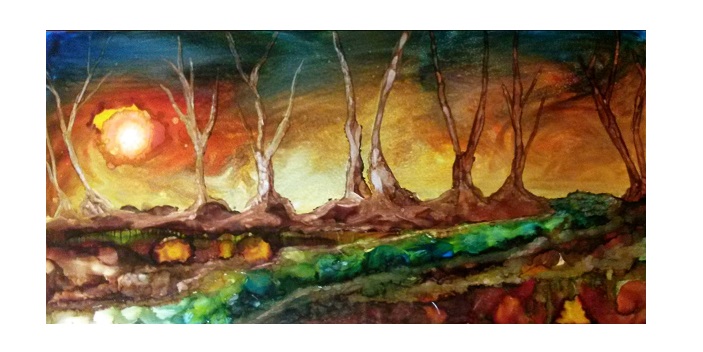
All Alcohol Paintings shown in this post by the Author- Dawn Bank
While searching for ways to expand “the oil painting experience” I came across tiny bottles of Alcohol Inks in all the basic colours, with an extender (strictly rubbing alcohol at 99%) as well as some clean-up solution.
Painting with oils has always been my favorite medium but on occasion I find it kind of rigid- you do this…then that and poof you have a beautiful tree. That’s why using alcohol inks as my new medium has become a new addiction. While doing so, I feel like I am being controlled without the ability to stop working. I have probably used up 3 sets so far.
I had never used inks before and I found myself in uncharted territory. Using inks changed everything. I discovered that they created many outcomes and endless possibilities which then opened up new means of expression to me.
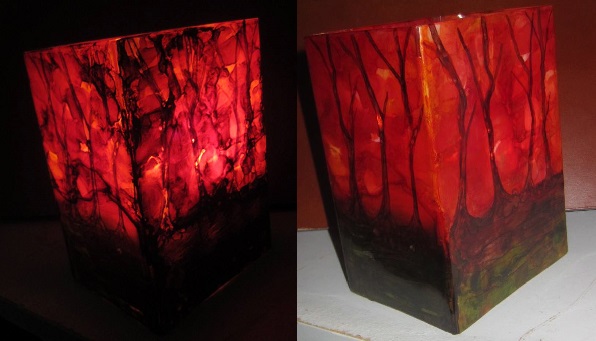
Taking advantage of the translucent qualities of Alcohol Ink- lit (L) & unlit (R) candle holder by the Author
When I begin to ink, I sit down at my table the same way I would when using oils. I Toss little droplets of colour and rotate the tile. Next, I spray rubbing alcohol for a spatter effect and I add a sponging technique that forms a multitude of tiny blotches. I pick out a brush and paint with the alcohol itself paying attention to watching the delicate lines that form as the brush hits the nearly-dry ink. It’s a gentle process and I enjoy the thinning of colour effect from the alcohol spray . For more fun I sometimes go out and buy a can of compressed air. I blow the ink and watch as it begins to layer itself. This is almost magical. It’s so amazing how it all comes together. I think the greatest addiction with this technique is the fact that the results are unpredictable and will never be the same. This whole process takes about half an hour but to me it seems like mere seconds.
Even though the finished ink works are fully dry within a matter of minutes, extra time is required if you choose to work in more detailed designs.
Another view of the Author’s candle holder
Speaking of time….I am amazed that while I work with the inks I completely lose all track of time. I am in a completely different space. My house could be burning down and I’m not sure that I would notice because using this medium makes me extremely focused and relaxed. Peacefulness has added to my life and that is just amazing. I have become so “in tune” with the way that the inks move without totally blending together. It’s an exciting time. I have discovered a new way to express and share my world with the whole world. For The Silo, Dawn Bank of One Lady’s Art. To view more alcohol ink work please visit me at https://www.facebook.com/groups/OneLadysArt/.
Los Angeles, USA – FLY has launched a one-of-a-kind artistic-inspirational campaign on Kickstarter, presenting the world’s first ‘pen & ink’ art book, solely designed to inspire and uplift its readers. Using pen and ink portraits and written narrative, FLY tells the stories of known and unknown human beings who dazzled the world against all odds, such as; Da Vinci, Beethoven, Coco Chanel, Karina Chikitova, Audrey Hepburn, Pelé and more.
Offering FLY’s artistic-inspirational book at a rational price tag of $35USD, Liron & Shira Ben-Arzi , the two sisters/artists behind it, aim to raise more than $11,730 to fund the production and help spread their vision of inspiration, globally. Their pure hope is that as you flick through the pages of FLY, you will be filled with a sense of strength; of light and of love. Meaning, that FLY will become our daily personal coacher, with messages of self-fulfillment and motivation, transferred through quotes, poetry and drawings. Using their personal talent and ambition, the two sisters have crafted this 240 pages book, based on pen & ink portraits and unique written narratives that tell the stories of 49 truly extraordinary people who forever changed the course of humanity.
They have collected the tales of people who have done the impossible into a book; stories of people who transcended the boundaries placed against them. For example; The unbelievable tale of Karina Chikitova – a little girl who survived 11 days in the wilds of Siberia; Sophia Scholl – A young woman who protested against the Nazis by painting murals; While also researched modern heroes, such as; gay-rights activist Brian Skerry, and artist Frida Kahlo who overcame many adversities to rise to success, as well as heroes from times gone by, such as; Leonardo Da Vinci and Ludwig van Beethoven.
“FLY is more than a book, it’s a remedy for remorse and a medicine for melancholy. It’s designed to motivate and inspire anywhere, anytime”, as Liron the painter behind it expressed. “Our vision and dream is that the power of human perseverance and of passion and positivity will flood the reader’s senses and remind him/her of the beauty and goodness in the world”, Shira, the poet in the team, added.
FLY’s Kickstarter campaign is just the beginning for these two, as they hope to take the mission of inspiration forward and much further. The awareness raised through Kickstarter will also help to fund future inspirational FLY projects including; exhibitions, lectures, workshops and other interactive visual media.
Canadian Pacific: Creating A Brand, Building A Nation, the forthcoming luxury coffee table book from School of Design of the Université du Québec à Montréal professor emeritus Marc H. Choko and Callisto Publishers. The private railway corporation that united Canada and built the world’s greatest transportation system, Canadian Pacific broke boundaries with its powerful commercial design.
A gorgeous new full-colour, 384-page hardcover from leading design book publisher Callisto, Canadian Pacific: Creating A Brand, Building A Nation [November 15 2015] reveals the intriguing story of the private railway company that united Canada politically – and became, for a time, the world’s greatest and most diverse transportation system. Written by Marc H. Choko – professor emeritus at the School of Design of the Université du Québec à Montréal and an honorary member of the Société des designers graphiques du Québec – Canadian Pacific weaves a concise and compelling narrative recapitulating the first 100 years of the company’s history, beginning in the 1880s. Brought to life by hundreds of advertisements, illustrations, designs, photos, and historical documents – many of which have never been published before – Canadian Pacific is more than a beautiful book: it is an indispensible testamentto one of the greatest achievements of entrepreneurship the world has ever seen.
“The history of Canada is inseparable from the history of Canadian Pacific,” writes publisher Matthias C. Hühne in the book’s preface. “A distinct Canadian national identity was still in its infancy in the 19th century, and various stereotypes linked with Canada today are the direct result of decisions made by these artists and Canadian Pacific’s publicity executives.” From adventurous world travelers to potential immigrants considering a move to Canada, Canadian Pacific tells the important and unforgettable story of the impact this private corporation has had on a nation’s economic development and image – and will be a welcome addition to the bookcases, coffee tables, and cottages of history buffs, art lovers, and aesthetes alike.
Marc Choko
Among the topics author Marc H. Choko is currently interested in and researching are: Beavers, Banff and propaganda: how commercial design helped a disparate, newly formed nation understand its place in the world and forge an identity. This is Canada: the romanticism and beauty of the images Canadian Pacific’s publicity department produced, and their immeasurable impact on the way Canada is perceived domestically and throughout the world Immigration and colonization: Canadian Pacific’s little-known history of facilitating the process of coming to Canada for hundreds of thousands of citizens. The eminent artists behind Canadian Pacific’s publicity materials: why we cannot separate the interplay of commercial interest and high culture.
About the Author: Marc H. Choko, author of Canadian Pacific: Creating a Brand, Building a Nation is professor emeritus at the School of Design of the Université du Québec à Montréal and former director of the university’s Design Centre. He is also a former research director at the Institut national de la recherche scientifique Urbanisation, Culture et Société. Choko earned a bachelor’s degree in architecture and a master’s degree in planning from the Université de Montréal and a doctorate in urban planning from the Université de Paris VIII. He is the author of numerous publications on graphic design, urbandevelopment and housing, and has curated many exhibitions that toured internationally. Choko is an honorary member of the Société des designers graphiques du Québec.
About the Publisher:Berlin-based Callisto Publishers selects topics from the fields of design, art, and architecture that are especially well suited to be represented by a printed book, rather than an electronic medium, aspiring to create printed works of perfect quality in terms of content, design, and production. Strong contemporary design requires solid knowledge of the designs and methods of the past. Which designs endured, which did not, and why? Callisto’s books analyze trends of the past that are relevant for understanding design today and in the future. Website: https://www.callisto-publishers.com/
About Canadian Pacific: The Standard Edition of Canadian Pacific: Creating A Brand, Building A Nation will be released this month, and retail for $80CAD / $70USD. The Premium Edition – a larger and technically more sophisticated version, packaged in a hand-crafted collector’s case with a wood veneer cover symbolizing the natural beauty of Canada, and containing additional images and Pantone colours and finishes not included in the Standard Edition – will be released in April 2016 and retail for $720CAD / $600 USD.
WORKING NOT WORKING is an obsessively curated network of the world’s best creative talent. With so many incredible artists in their arsenal, it seemed obvious that PAOM (PRINT ALL OVER ME) and WNW should create a collection!
Eight amazing illustrators and designers from around the world were chosen to be a part of the first WNW X PAOM collection. They are Tatiana Arocha, Laura Callaghan, Annu Kilpeläinen, Uli Knoezer, David McLeod, Karan Singh, Brian Vu and Shawna X.
Sweatshirt by Uli Knoezer, $85USDRaincoat by Annu Kilpeläinen, $145USDBackpack by Karan Singh, $65USDTwill jacket by Brian Vu, $120USDMidi skirt by Shawna X, $80USDKimono by Laura Callaghan, $72USD
Workshirt by David McLeod, $89USD
For more from Working Not Working, check out their website and follow them on Twitter & Instagram. Shop the entire WNW x PAOM collection here.
All above photographs by Michael Burk, model Olu Alege.
Skulls & Bones: Skulling the heights of perfection
The skull motif made popular in watchmaking by ArtyA has long been copied, resulting in a whole range of derivatives. Now, the fully independent brand has taken the helm once again. The Skulls & Bones is an extreme timepiece that pushes the creative concept to the limit.
Word has it that if you really can’t compare a Swiss watch to any other, it really is original. By that standard the Skulls & Bones is one original watch.
ArtyA’s latest creation doesn’t do things by halves, and it certainly isn’t a mass-market kind of timepiece. Critics might say that it’s rather extreme – and they wouldn’t be entirely wrong. But more objective minds will first and foremost note its wholly coherent style.
Back in the day, the Skull universe, popularized many years ago by Yvan Arpa, was decried in the world of watchmaking as being in frightfully bad taste. Since then, it’s become trendy and fashionable, as people started wearing this style of timepiece to try and stand out from the crowd – with varying degrees of success. But in most cases, the relevant styling doesn’t go much further than a dial illustration, some sort of ‘skull’ motif on the hands, and little else. Until now, that is.
Skull-tural!
With the Skulls & Bones, ArtyA has embarked once again on the style trajectory it was the first to pioneer (with many following in its wake), as ArtyA’s CEO and designer Yvan Arpa guides the concept to what must surely be its ultimate destination. The skull is much more than a simple drawing: sculpted and engraved, it’s been released from the two-dimensional representations to which it’s been confined elsewhere. As is its wont, ArtyA has suffused the Skulls & Bones symbols with new meaning, taking concepts through to their logical conclusion, and once again placing the artistic dimension at the heart of its work. The dial is fully hand-made.
Crypt- price: 6,900 CHF
Every one of the new 47 mm models is unique, featuring hand-crafted engravings and sculptures. Each includes the brand’s own movement, frequently used in its Son of a Gun collections. This results in a reliable, high-performance caliber, the heart of which is incorporated within a small central space. Its surface is covered by a rough, seemingly unfinished steel plate surface, featuring a twitchy drawing of a skull, rather like a hastily spray-painted tag.
Full Skull- price: 19,000 CHF
This is surrounded by six hand-engraved skulls in polished steel outlined in black. The style is at once tribal and urban, modern and ancestral. ArtyA leaves the interpretation of this universal symbol to each individual’s imagination. By definition, each timepiece will be unique, with each person free to have their own take on the skull universe.
Gangs of skulls
The Skulls & Bones bezel sports another dazzling spectacle, exploring both “skulls” and “bones”. Here, ArtyA extends the core theme to encompass other graphic elements such as crosses, totems, barbed wire, guitars, and guns, expressing the whole gamut of the world of rock. Here too, ArtyA has not gone for simple cookie-cutter drawings, instead favouring genuine steel engravings. The shapes of the movement are seemingly drawn inexorably towards the bezel, each feature setting off the other.
Selfies—an act in which the photographer is also the subject of the photograph—are hugely popular in today’s world. Selfie sticks, selfie apps and even selfie songs are taking the world by storm. If you’re on a hike or at the dentist and feel the need to let your associates know, take a selfie!
PicPal combines social media, real-time collages, and the ever important selfie into one App. Want to share what you’re doing right now with a close group of friends? Simply open PicPal, choose the friends you want in that collage and take a selfie. The app simultaneously sends a request to your friends to take a selfie too. PicPal will automatically create a selfie collage of all users and send it to each person’s phone.
Yes, there are already an enormous amount of apps that make collages; but the process is tedious and always after the fact. PicPal has social collage creation built into the app, effectively turning a lengthy process into instant creativity. Picpal isn’t always about the end result – it’s about the immediate moment. Friends who are across the country can meet in an instant through a Picpal photo. Whether they want to see what’s up or simply miss being in pictures together, Picpal lets them do it. All you have to do is invite your friends and watch the Picpal develop into an amazingly spontaneous shared experience.
PicPal is designed so that users can have fun with collages that are both “in the moment” and hassle-free. Want to show your friends what you are doing as well as see what they are doing and create a collage of it? PicPal makes this quick and enjoyable.
– Sign up! Sign in with one simple click using your Facebook account. The app automatically finds your Facebook contacts that are on Picpal.
– Invite! Pick up to 3 (you can add more friends to a Picpal in future releases) Picpal friends to participate in a Picpal selfie collage.
– Snap! Take your selfie while your friends take theirs.
– Watch! See your selfies transform into a shared experience – a Picpal selfies collage – right before your eyes!
Whether you’re missing your friends or just want to see what’s up, Picpal allows you to connect, create, and share in real time.
– Share! Skim through your gallery to see what Picpals your friends have shared with you.
– Interact! “Heart” or comment on Picpals that you love! OR Upload to Instagram or Facebook straight from the app
Whether you’re wishing someone Happy Birthday, playing a game, or just interacting with your friends, PicPal allows you to be with your friends – even when you’re not.
Owner/ CEO at ArtPlusHome.com and VeryVeniceArt.com
When you’re a 20-something, what’s the first and the last thing you do? You check your Facebook or you tweet. When you want to buy a pair of jeans and you want to ask your friends’ opinions, you post a picture on Instagram with a #needyourhelp! And who needs to go to a store when Amazon is only a click away right? Social Media and E-Commerce have permeated your personal and social lives. Nowadays, to keep up with the rest of the world, you have to have a smart phone, a tablet and at least 3 social media accounts. Your thought process can now be summarized into: Click. Like. Share. Repeat. Information in an instant !
The coolest thing about Social Media and online stores is the ease by which you send and receive information. The idea that you can connect to a friend in Asia, check out the latest happenings in Europe, and buy the outfit you’ve been eyeing for on discount via Amazon still fascinates many. Not only does the connection happen in real-time, it is also extremely convenient for the hyperactive, multitasking yuppie. Who would’ve thought that you can talk to someone halfway around the world while riding the train? Or that now, you can buy everything you need online while working out. Literally, the world is at your fingertips.
What about Design my Home?
If social media transformed the way you connect with the world, then mobile technology is revolutionize the way you see and experience it. With its public launch in February 2015, everyone is expected to rock the new Art Plus Home Virtual app and two words are sure to be immensely popular: “Share and Buy” This new breakthrough promises to merge the real, the virtual, and the social. Indeed, the possibilities are endless. Two fields that can definitely benefit from this innovation are art and design, particularly for the home. As more and more young professionals climb the ladders of success, you find yourselves located in a condo or in an apartment at the heart of the city. And in the name of individuality, almost all of you are heavily involved in truly making your homes a place to call your own. “I’m a minimalist guy. I like a lot of black and white pieces,” shared Alex, a young accountant. “I’ve always had a penchant for quirky furniture and eclectic painting, both of which are very hard to find by the way,” explains Jessica, a law graduate.
Here lies the conundrum. In as much as you newly-empowered breed want to go all out to design your homes, you simply don’t have the time. “Designing your own place is a completely different animal. It’s almost a full-time job,” says Ashley. She went on further, “It’s almost like a cat and mouse game. You go to an art gallery to find a good painting. Then you have to go to another store for the drapes. Then you go look for a nice coffee table. They’re a perfect match in your head but after you install them in the living room, they just look horrible.” Dary Rees, an artist and a designer herself, knew exactly what Ashley meant.
It’s really about using the latest in augmented reality to “try out” art pieces in your home before you buy. photo: iwearyourecho.com
“Designing your home takes a lot of imagination. All the time, you have to close your eyes and visualize how every art piece, every furniture, and every drape will come together. That’s not easy. But it should be.” Then idea struck! Bringing together a team of people, Dary went to work. After months of development, the Art Plus Home virtual app was born. “With the Art Plus Home app, you can shop, visualize, and buy for your home in your own time and at your own convenience. You get to choose anything you like from the online gallery, superimpose them together in your space, and see how it looks – all in a matter of minutes. You can even share the design to friends! If you like the design, you can buy them right then and there. If not, you can start all over,” explains Dary. This is perfect for the Gen Y who is always on the go. You can design and buy for your home on the way to work, after a Yoga session, or even before you go to bed. The Art Plus Home app is also ideal if you’re on the look out for the latest in art and design. Check-out gallery openings, up and coming artists, or simply browse what’s hot (and not) so you have something to talk to with your date.. The Art Plus Home app is available in Android and in iOS.
Generation Y is a new breed. You’re motivated to succeed, you’re proud of your individuality, you’re always mobile, and you’re extremely connected to the world around you. With such a personality, you’re a perfect match for the Art Plus Home app! www.ArtPlusHome.com and download the free app at any app store.
John Buscema and the Crusty BunkersConan the Barbarian#45 Page 16 Original Art (Marvel, 1974). Wondrous and horrible things await in this page from “The Last Ballad of Laza-Lanti,” written by Roy Thomas. The ink on Bristol art has an image area of 10″ x 15″ and it is in Very Good condition. Let’s take a look at a single panel from the page on offer.
Fans of 1970’s/1980’s Conan the Barbarian graphic comics appreciate the moody almost expressionist pencil and inks.
Buscema, John:John Buscema (American 1927-2002): After the departure of Jack Kirby from Marvel in 1970, John Buscema became one of the company’s most influential artists [Often called the Michelangelo of comics CP]. Buscema is perhaps most celebrated for his Bronze Age work on the Avengers, the Silver Surfer, and Conan the Barbarian. Buscema’s work proved so in-demand in the mid-seventies, he launched the John Buscema Art School which advertised for students in the pages of many Marvel titles. Stan Lee made appearances as a guest lecturer at Buscema’s school and the two collaborated on the wildly popular book How to Draw Comics The Marvel Way, Simon and Schuster, 1978. Comic Art
The page was sold to the highest bid which reached $US 2,210.75
TRDWTR, pronounced ‘treadwater’, is a mature take on the superhero genre, set in a plausible geopolitical future. The franchise will kick off with a graphic novel on September 30th, 2014. A live-action series based on the novel is set to follow suit in 2015. A preview of the graphic novel will be staged in America’s largest comic book store today, September 10th. To commemorate the launch, a teaser trailer for the TRDWTR franchise has been made available to the general public. And here it is!
The daisyrock debutante guitar, ready to break a few hearts
As a younger man, I was like a cat in a bag, probably not unlike most, scratching for meaning and adventure. So when I got the chance for a job teaching in the Bahamas, I decided to go for it. Before I went out to my post on the island of Andros, I stopped over in Nassau to meet with my cousin who lived there. She cooked me dinner, and afterward she showed me around her house. In the basement there was a sandy old guitar leaning against the wall. She didn’t play it anymore and suggested I take it out to the island. I told her I didn’t know how to play, didn’t know anything about music, and didn’t want to take it. But I took it anyway. That teaching job was a total washout, but that’s a story for another time. Six weeks later I was back in Canada, with no job for a year, living with my parents again as a 29 year-old. It was a difficult circumstance. For some reason, that old guitar made the trip back to Canada with me, and I remember it staring at me in my bedroom. I didn’t know E from G, but decided that for me to be in this situation, with this guitar, with the time to learn it, was some kind of important sign I needed to recognize. So I started taking lessons, once a week, at my local hometown music store. Like any beginner it was a struggle, but struggle I did, learning those Neil Young songs that all the kids start with. It was very liberating. A couple of years later I met a real nice girl—Lisa, a chiropractor. Definitely marriage material. I’d been seeing her for quite a while, and it was getting to that crux-time of commitment, where future plans need solidifying, lest a biological clock begin to ring too loudly.
I was keenly aware of my responsibilities and knew that I loved this girl, but I just wasn’t sure if I was ready or not. The soul-searching had been going on for weeks and the matter continued to be grey, and I’m certain she felt me creating a certain distance while I figured things through. It was at my house one day when decisiveness finally cleared a path through my tangled emotions. “Don’t worry, I’m not going to leave you” came out of my mouth. Lisa wasn’t in the house when I said that. Nobody was. But my guitar was sitting snugly in its stand, and it heard those words, and that was it. I broke up with Lisa the next day.
Such an important part of that decision was knowing my guitar playing would essentially stop if I went to the next level with her, and I was just starting to make real leaps in my ability, and had so much further to go since I’d started so late in my life. I couldn’t leave it behind now. The chapter was still being written. As much as I loved Lisa, I had to let her move on. Since then I’ve probably written 100 songs (definitely a couple about that situation), released a CD, cut my teeth in Nashville…too many things to mention. I’ve met so many great people and had so many great opportunities because of that guitar. The spirit and the energy surrounding it all is unparalleled. None of it would have been realized if I had different words for my guitar that day. As tough as it was, I know I made the right decision. Lisa is married and has a child now, and I feel really good about that.
For the Silo by John McIntosh (Speaking of Nashville, it really is true that you’ve got to “know when to hold ’em, know when to fold ‘em.” It’s a key to life. I’m reminded as well of a cameo in the Canadian road movie One Week. Tragically Hip frontman Gordon Downie is questioned by the protagonist: “How do you know if you’re really in love.” His answer is uncommonly succinct: “If you have to ask, you’re not.” Maybe the real question is: who, or what, do you love enough to live by? ed.)
We may never know who the artist was that made the auctioned cel. Walt Disney employed many young, pretty women to work in the inking and cell departments. Image: Still from an early 1940’s Walt Disney film explaining how cartoons were being made. CP
“It’s an extraordinary price for an extra ordinary piece,” said Jim Lentz, Director of Animation Art at Heritage. “This is really a Holy Grail piece of animation and one of the best I’ve ever seen, from one of the best early Mickey cartoons and one of the very last black and white Mickey cartoons before Disney changed everything by going to color.” Besides the rarity of the cel and the background, it is also believed that this is the only known black and white production cel featuring Goofy in private hands. In the classic cartoon Mickey (voiced by Disney himself), along with Goofy and Donald, do their best to find a squeaking sound in Pete’s roadster. Naturally, they take the car apart looking for the source of the annoying sound, which turns out to be a cricket.
One of the great surprises of the auction came in the form of a set of 1961 storyboards from The Bullwinkle Show (Jay Ward Studios), three extremely rare trimmed storyboards by Roy Morita for the episode “Buried Treasure,” on Ward Inc. storyboard paper, which crushed its $750+ USD pre-auction estimate to finish, amidst very spirited bidding, at $44,460 USD. One panel features Rocky and Bullwinkle, one has a close up of Bullwinkle, and one is an amazing drawing of Frostbite Falls, Minnesota, with the handwritten notation “B+R House” and an arrow pointing out the specific abode.
“Do it for the love of it. Ignore the scary things you read about book publishing industry. In fact, don’t read news at all. They will only distract you from writing. Hole up and create.” Ksenia Anske
For aspiring writers- I thought very hard about what to write, and decided to settle on a little advice for aspiring writers. Because if you’re one of those hopefuls, you might get scared too easily and give up. The world of book publishing is changing. It looks frightening. The big publishers are fighting for survival, buying off little companies, merging, you name it. Why? Because big companies like Amazon made it possible for anyone to publish a book.
And the world of indie books is growing. I can imagine any starting writer look at this, get the scare of her life and run and hide, and give up on her dream. Because how can you possibly make it? Moreover, how can you possibly make a living? It’s harder than ever to get through to agents. It’s very intimidating to try to self-publish, with all these scary things to be done: finding an editor, a book cover designer, a text formatter, figuring out how the online uploading tools work, promoting your book once it’s published. If you have any kind of embonpoint in any part of your body, metaphorically speaking, it’s enough to lose it, and your brains too. Just by reading this you’re probably already getting scared. There is no way you will make it, is there? There is.
Let’s for a second imagine that none of this exists. Let’s think that writing a book is something you always wanted to do. Not to make a lot of money. Not to become rich and famous. Not to flaunt it into your former classmates faces at your high school reunion. None of it. Let’s imagine you simply always wanted to write a book because you have a story to tell. It’s bursting out of you. You can’t help it. Like a chronic tosspot with this irresistible draw toward alcohol, you simply can’t hold yourself back. May I say something to you? I might not have enough credibility, or clout, or whatever you want to call it. I have only started writing full time 2 years ago and have self-published only 4 novels so far, but I’ve
Ksenia Anske
been never happier in my life. In fact, I can’t remember the last time I saw a doctor. I started writing for therapy, and never in the million years did I think anyone would be interested in reading my writing. But people do! People read my books! Can you imagine? I still can’t. I still pinch myself. It’s a miracle. There is a lesson I learned from it, and I keep shouting it at every corner. I want to shout it here, to you, so that you will hear me. It’s very simple. You can do the same.
Don’t be intimidated by the amount of books already published (I know I am, still). Don’t worry about making a living (I know I am, still). Don’t even think about wether or not anyone will read your books (I think about it, too). That doesn’t really matter. What matters is, while you write your book, you get a high which no other drug can give you. You are so happy. When you hold your finished book in your hands, the only other experience that can be compared to it is maybe that of holding your child in your hands for the first time. It is your child. It’s your story. You did it. Funny enough, if you write it for yourself, you’re more likely to find readers. If you forget about the business of book writing and think about the art of book writing, you will produce something extraordinary.
The Writers Retreat inspired by the garden retreats of two literary greats – Virginia Woolf and George Bernard Shaw – whose properties are under the care of the Trust. – See more at: http://www.scottsofthrapstonblog.co.uk/2012/06/a-magical-connection/#sthash.xvVzvEtp.dpuf
Know what it is? You will make yourself a little happier, and with that you will make people around you a little happier, and with that you will make the world around you a little happier. Now, imagine what happens when you write your second book, and your third, and your fourth. Do it for the love of it. Ignore the scary things you read about book publishing industry. In fact, don’t read news at all. They will only distract you from writing. Hole up and create. Pour your everything into it, do it so well, that people will want to see what the deal is about. It’s what happened to me, still happening. It’s what will happen to you. So go ahead, write that book. You know you want to. You know you can. I know you can. The rest will happen on its own. For the Silo, Ksenia Anske.
François Dallegret, L’IntroConversoMAtic, 1963. photo collage and drawing. Dimensions variable. Photo: François Dallegret
In 2014 McMaster Museum of Art presented GOD & CO: François Dallegret Beyond the Bubble. An exhibition organized by the Architectural Association, London UK
François Dallegret trained as an architect at the École des Beaux-Arts in Paris in the late 1950s. He moved to North America; first to New York and then Montreal in 1964. Dallegret has since and continues to slip between disciplines, working as an artist, entrepreneur, theoretical architect (before the term was in general use), industrial and graphic designer, writer and social commentator.
Although his work over the past fifty years has been firmly planted within the possibilities offered by contemporary technologies—his 1964 drawing of a personal, wrap-around electronic communicator l’intro conversomatic has become a commonplace reality in the current world of smart phones & “pads”—Dallegret can be seen been in the context of 19th century idealism; the engineer as artist, the inventor as philosopher and so on. And while his work carries the sense of wonder of the modern age, manifest in the pure beauty of the object, it is also tempered by the realities of social, economic and cultural issues, and often framed with a quixotic sense of humour and irony.
GOD & CO offers a unique view into Dallegret’s work and activities, a de facto retrospective that engages his active thoughts. Organized by the Architectural Association School of Architecture (UK), it opened in London in late 2011 and has subsequently been presented in Paris and Zurich. This was the first presentation In Canada.
The 2014 exhibition was accompanied by a 384-page illustrated publication with texts by Alessandra Ponte, Laurent Stalder and Thomas Weaver. For the Silo- RoseAnne Prevec.
Cedar Waxwings are sleek, masked birds found year round in our area with unusual red, waxy deposits at the tips of their secondary feathers. They are cinnamon-colored, with grayish wings and tails and yellow terminal tail-bands. They have distinctive crested heads, black throats, and black masks lined with white.
The Cedar Waxwing is one of the few North American birds that specialize in eating fruit. It can survive on fruit alone for several months. They also eat flying insects and can often by seen fly-catching, particularly over Haldimand and Norfolk County streams.
Cedar waxwings are very sociable, non-aggressive birds that often travel in flocks, though they may pair off during breeding season. It is very rare to find solitary waxwings. Because they frequently feast on overripe fruit, these birds can become “drunk” on the fermented juices. For the Silo, Dixie Greenwood.
Man I gotta thank you guys for the recommendation for House of Cards. I am hooked. I am into this shit. This is some of the best long form television that I’ve seen and you know? Long form television is changing the game. This series! I mean shit you’ve got David Fincher and Joel Schumacher directing these television episodes. Kevin Spacey, Robin Wright; holy shit you know? Not to mention all the great people on HBO…I mean, long form television has…..there was a time when film actors wouldn’t dream of condescending to doing television and now long form television is the shit and this House of Cards shit is the shit. It is better than Homeland though I recommend The Newsroom although I don’t think it’s available on Netflix but The Newsroom is a helluva series. Wow.
*this letter to the Silo was transcribed from a reader Skype call we received. Skype us anytime We are: thesiloteam on Skype
A long time ago, in 1977, Star Wars started its quick and never-ending ascent to the top of the science fiction film genre. How many people alive when the original Star Wars: A New Hope was released thought that our children (and for some, grandchildren) would still be wanting to be Darth Vader or Luke Skywalker for Halloween? It is a rare child in Canada who has not owned a lightsaber.
Unfortunately, the same cannot be said of Shakespeare.
There are people who look forward to watching or reading Shakespeare about as much as they look forward to car repairs. Shakespeare can be seen as highbrow art which does not make sense. Why would someone watch a movie or play in an almost different language?
This is where Driftwood Theatre Group brilliantly played their hand. Using a book by Ian Doescher called, “William Shakespeare’s Star Wars,” Driftwood brought Star Wars geeks to play with Shakespeare lovers.
Everyone on both sides of the fence was blown away (no pun intended, poor Alderaan and Death Star).
Lines from Star Wars plays were eagerly anticipated, by some who were on the edge of their seats (One thing’s for certain, we’ll all be a lot thinner). But when those infamous lines were said, it had dramatic and, yes, Shakespearean flair (One thing is certain, we shall thinner be).
And there was laughter – from everyone!
There were also famous lines from Shakespeare plays which made Shakespeare lovers happy, (I bite my thumb at you, sir! Alas, poor stormtrooper, I never knew thee. Friends. Rebels, Starfighters, lend me your ears!)
It was also the formidable acting in the show which raised the play to mountainous heights. It was performed as a reading, with all actors reading directly from the book. It was enticing, enthralling, and highly entertaining. Dion Johnstone, who played a fantastic Han Solo, withheld laughter to the point where he looked like he would lose it, but never really did.
This play was a fundraiser for Driftwood Theatre. The evening included the reading, a silent auction, costume contest (sad point of the night, there were very few people in costume – it is Halloween time, people!).
The highlight of the night, for very lucky people, was the auctioning off of 3 walk-on role, Rebel, Imperial, or Interesting Creatures in the play. We (yes, I was a lucky one) were able to say such lines as, “UTINI!” and “This is a consular ship…” and, “Why aren’t you at your post?” I was Jawa #2 and the Innkeeper at Mos Eisley.
It was a truly incredible experience, watching Star Wars and Shakespeare geeks unite for 3 hours of Shakespeare/Star Wars bliss. For the Silo, Stephanie MacDonald. @mytimeatlast
From last year: STRUTT Sizzle 2012- find the video on Vimeo
St. Catharines, Canada — The Niagara Artists Centre’s (NAC) 2013 STRUTT Wearable Art Weekend (STRUTT) is outlandish, bold and more spectacular than ever before. STRUTT takes place on November 15 and 16, 2013 culminating with the STRUTT Runway Show, which takes place Saturday, November 16 at the WS Tyler Factory in St. Catharines, ON.
Doors open at 8 p.m. and the runway show begins at 9 p.m. The STRUTT Runway Show showcases over 40 unique wearable artworks by local and province-wide artists, and will be scored by crown princes of Trans-Canadian cosmic rock, The Sadies. The event website is www.struttwearableartshow.ca
“We do whatever we can to bring the ‘WTF’ factor to every STRUTT. It doesn’t matter if you’ve been to the last ten or you’ve never been before, you’re going to get your head spun,” expresses NAC “Minister of Energy, Minds, and Resources,” Stephen Remus.
“Art and fashion are two things that academics, upper crust types, and anybody else who likes to be full of themselves has almost ruined completely. Thankfully, STRUTT brings it all back to earth in glorious style like a boulder of good times smacking down on a jelly doughnut.”
Find STRUTT on facebook for updates and info on Calls for Submissions CP
STRUTT is a surreal party scene where the absurd is commonplace. As Doug Herod of the St. Catharines Standard reflects, “STRUTT rocks! STRUTT is a wearable art fashion show, but that description doesn’t do it justice. It’s music, it’s entertainment, it’s theatre – and a lot of fun.” In addition to the art on the runway, The Sadies will be taking the stage and there are a variety of other spectacles leading up to the STRUTT Runway Show on November 15 at the WS Tyler Factory to keep partygoers entertained. The weekend’s events feature a photography
exhibit showcasing over 300 works of art that have been created over the past 14 years, and a dinner party featuring a live performance of chamber music combined with breathtaking imagery, local wine and a four-course epicurean feast.
Fooled you- this still from one of Oskar Schlemmer’s Bauhaus costume parties is from the 1920’s. Dadaism was influencing progressive art circles and wearable art made an impact.
STRUTT 2013 sponsors, partners and supporters are (in alphabetical order) Brock University Centre for the Arts, Canadian Tire Financial Services, City of St. Catharines, Design Electronics, Eight Contracting and Restorations, Henley Honda, Liberty! Bikes, Ontario Arts Council, Pen Financial Credit Union, Province of Ontario, Shannon Passero, The St. Catharines Performing Arts Centre, STORM Hair Group, and Suitcase In Point.
55 years after Schlemmer: “We’re not men. We are DEVO”
NAC is a not-for-profit, charitably registered, member-driven collective formed by and dedicated to serving the working artists and community of Niagara. Founded in 1969 as a collective of working artists, NAC is one of the oldest artist-run organizations in Canada. For more information visit www.nac.org
Jack Nicholson, playing The Joker in the 1989 Tim Burton film Batman, said “I don’t know if it’s art, but I LIKE IT!” Looking at artist Sarah Smith’s ersatz ceramic food sculptures I am convinced this work is incredibly effective art. And I like that. A lot.
Part of Smith’s inspiration comes from the cultural differences found when it comes to food preparation and presentation. From her experiences, European’s tend to favor and appreciate food that not only tastes good but looks just as good to match. In the discipline known as culinary arts, the appearance of food is intrinsically linked with the skill of the chef and also with the intended effect on the consumer. In other words, form effects function. Strong components in any art form, Sarah Smith has applied this notion to fake food, emphasizing and reminding the viewer that strong physical reactions can be manipulated through visual presentation.
Throughout time, food has been linked with human emotion and health. Consider this: Apples are associated with our health and death. The “perfect” apple and the “poison” apple. “An apple a day keeps the doctor away.”
Symbiosis of food and the human body. Cucumber slices and orange slices are a remedy for tired eyes and worry lines. Black eyes are healed with a raw steak. Aromatherapy consisting on some level as ‘concentrated scents of food’ (coconut, vanilla, bananas….attempts to create a strong physical reaction such as calming through an associated mental- visual representation. But why is that and is this what Smith is asking us with her food? How do we feel when we see a raw pork chop?
So it’s connections like this that demand we consider Smith’s artistic motivation. Her work exists on many levels. Is it hyper-realism? Surrealism? Pop-art? I believe it is all of those things and more. For the Silo, Jarrod Barker.
“Whenever you offer the highest-graded copy of one of the top comics in the hobby you can bank on fierce bidding,” said Barry Sandoval, Director of Comics Operations for Heritage Auctions. “This auction is an ideal hunting ground for elite collectors and the 9.2 grade example of Batman #1 represents the quality offered throughout the entire event.”
A landmark edition in the halls of American pop culture, Batman #1 features the first appearances of both the Joker and Catwoman, among the very few comic book villains to have attained true “household name” status. It is expected to reach $500,000+.
A worthy follow up to such an iconic comic book is Frank Miller’s iconic original cover art to The Dark Knight Returns #2, which also is expected to bring $500,000+. The instantly recognizable image of Batman, crippled with rage, is one of several pieces of original art from the groundbreaking Dark Knight series offered by Heritage in the last year.
“For fans of Modern comics, this drawing is where everything really begins,” said Todd Hignite, Vice President at Heritage Auctions. “This moment defines Miller’s Dark Knight, and the modern day perception of Batman, like no other drawing. The only one that comes close, perhaps, is the iconic Splash page from Dark Knight #3, featuring both Batman and Carrie Kelley (Robin), which we sold two years ago for $448,125.”
Among the high-grade examples of the most coveted comic books ever produced comes a near pristine copy of an increasingly popular comic book, Avengers #1 — in stunning 9.4 grade — is expected to realize $175,000+; a 9.4 grade copy of Tales of Suspense #39, the first appearance of Iron Man, which is expected to bring $100,000+; a rare, 9.0 grade copy of Walt Disney’s Comics and Stories #1 may fetch $30,000+ as the finest copy in a remarkable run that also includes a 9.4 grade of issue #2 and a 9.2 grade of issue #3 from the series, both of which are the highest-graded copies.
A collector’s pick of high-grade examples continues as the only 9.8 grade copy of Marvel Spotlight #5, the first appearance of Ghost Rider, is expected to realize $25,000+.
In addition to the dramatic cover from Dark Knight #2, the auction’s offering of original art includes a remarkable movie poster painted by Frank Frazetta for The Night They Raided Minsky’s. Frazetta usually worked in much smaller sizes, making this 38-inch by 28-1/2-inch poster from 1968 an extreme rarity expected to bring $150,000+.
Perhaps two of the most anticipated lots link to The King of Comics himself, Jack Kirby, to a covert Iranian rescue operation as depicted in the Academy Award-wining film Argo [ See a nod to Canada’s connection in Ben Affleck’s acceptance speech below CP].
The film tells the story of how the CIA used a fake movie production crew to conceal a daring rescue mission of six Americans held in Iran. The “movie within a movie” was at one time a genuine project titled “Lord of Light,” based on the novel by Roger Zelazny. Producer Barry Geller commissioned Jack Kirby to create a set of concept drawings for the film, but the project stalled and was mostly forgotten, until the CIA used it in their top-secret mission. Two of Kirby’s original oversized concept scene drawings for the project — “Pavilions of Joy” and “Planetary Control Room (Interior)” — remain testaments to his signature style and are expected to bring $10,000+ each.

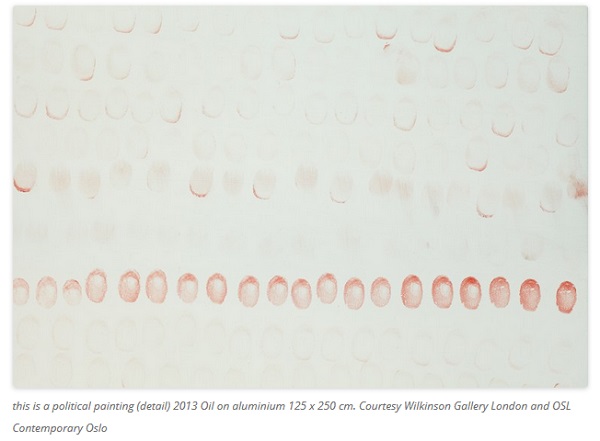
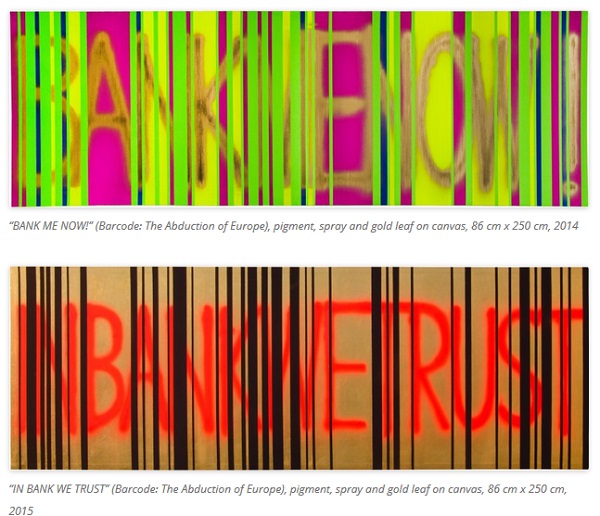
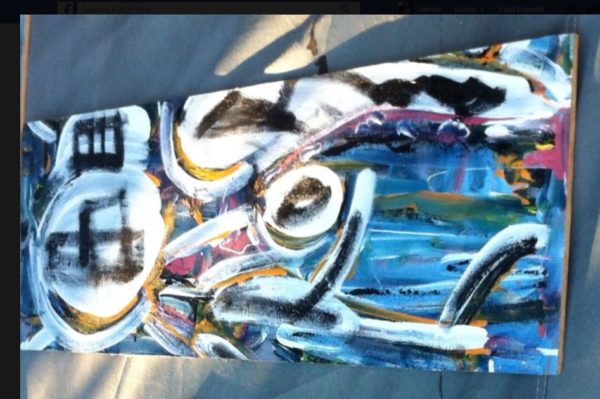

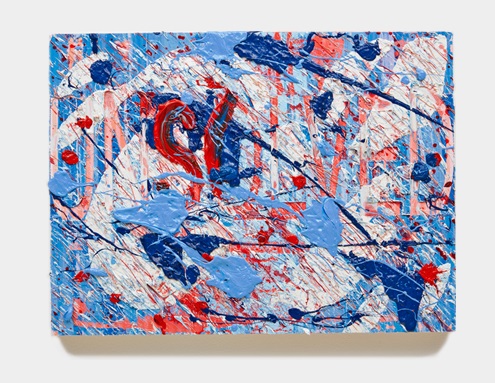
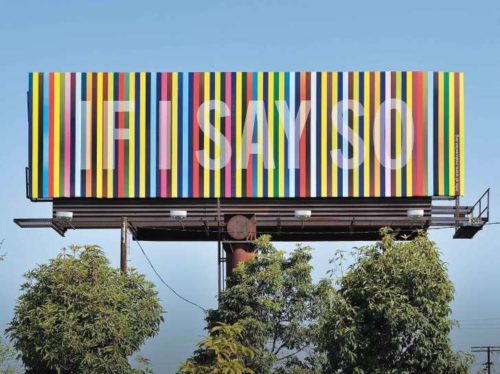
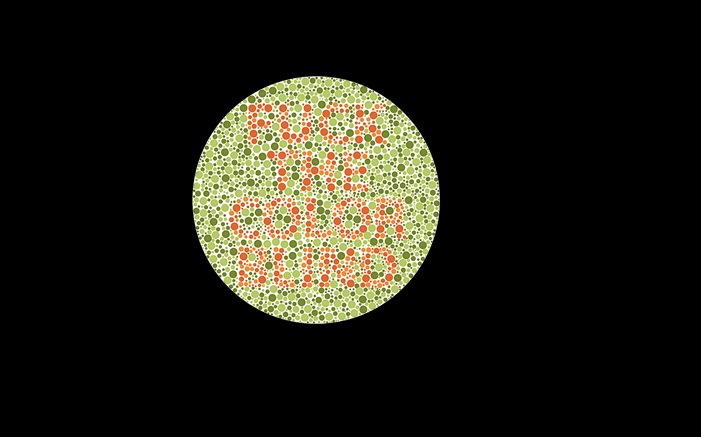
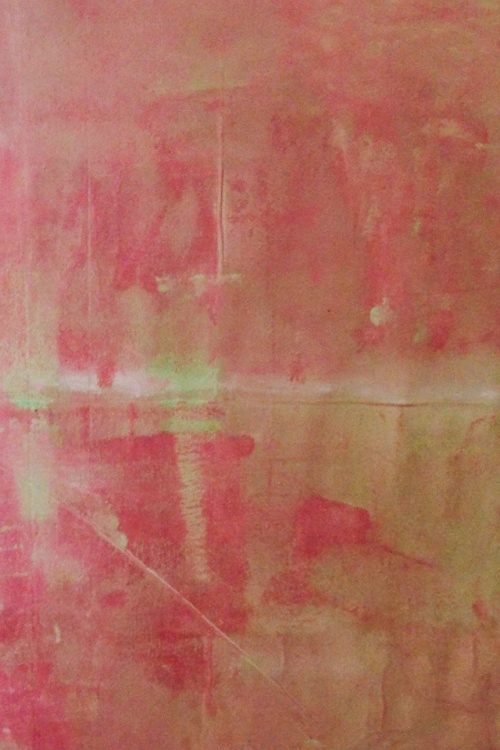
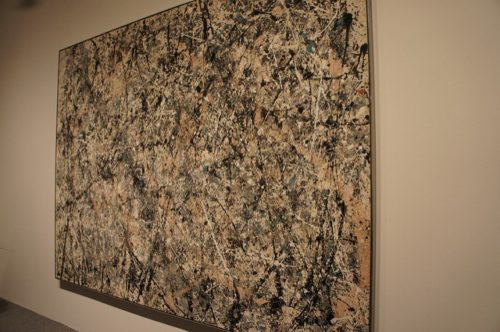

 Regardless of your medium, I hope this glance into the minds of two established poets from very different walks of life can help dissipate the intimidating mist between process and product, as well as remind you that the transcendent and the familiar are often one in the same.
 Global spectator
  Myles, a breathing artistic currency, treats poetry as an extension of the self with the potency of a movement and the collective memory of a civilization. Myles proves that common experience and abstract phenomena are synonymous when we step back to look.

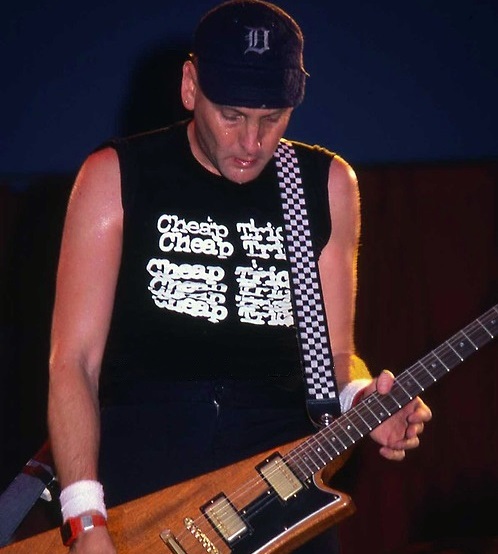

 Due to rapid advances in technology, the quality of smartphone cameras is now on a par, if not better, than some point-and-shoot cameras and entry-level DSLRs. With the increasing demand for smartphone accessories to maximize users’ photographic potential, Limelens offers superior quality smartphone lenses at a price within reach of the masses. Limelens lenses capture intricate detail that a smartphone camera could not achieve on its own.
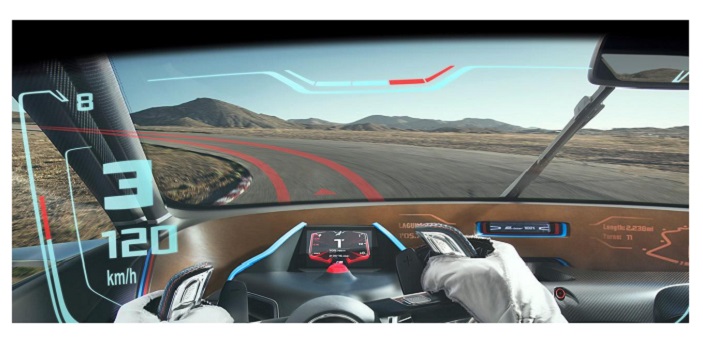

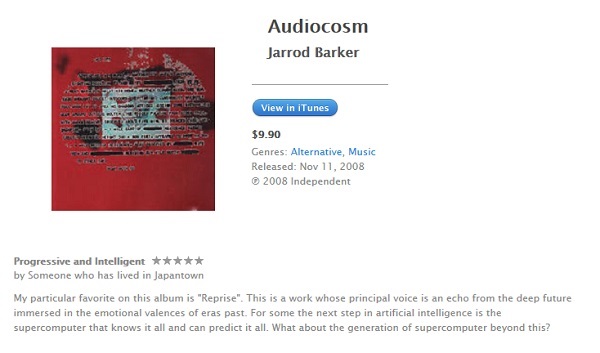
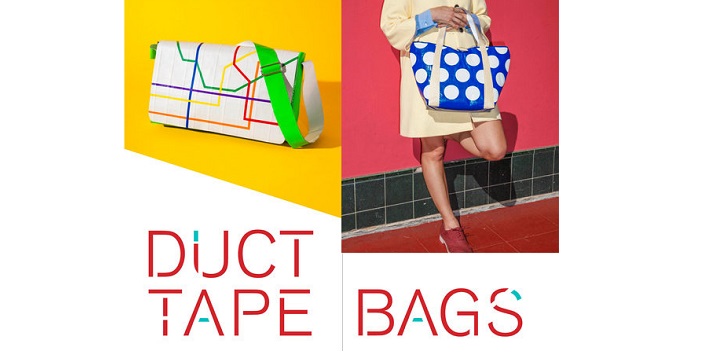
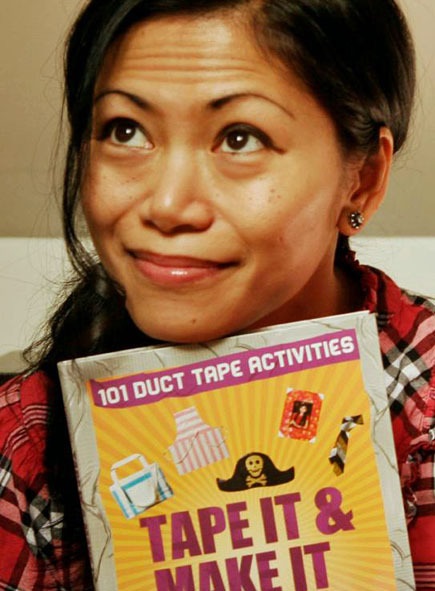 Everyone from trendy teens to famous fashionistas can begin exploring the infinite uses this easy-to-follow guide provides to making handbags so fashionable, you won’t actually believe they’re made of duct-tape. Part art-piece, part usable accessory, Fabian Morgan shows how each of these gorgeous handbags can be recreated one manageable section at a time.