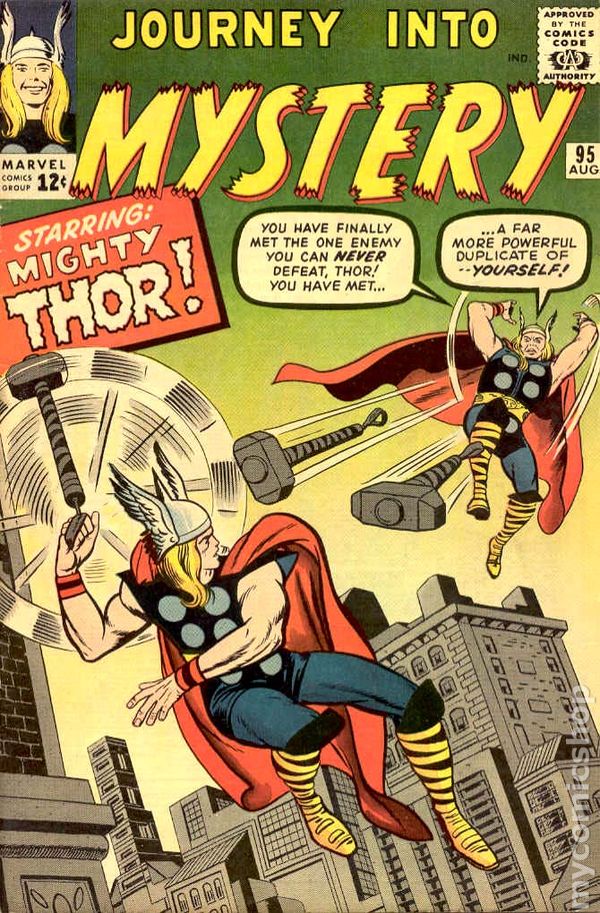
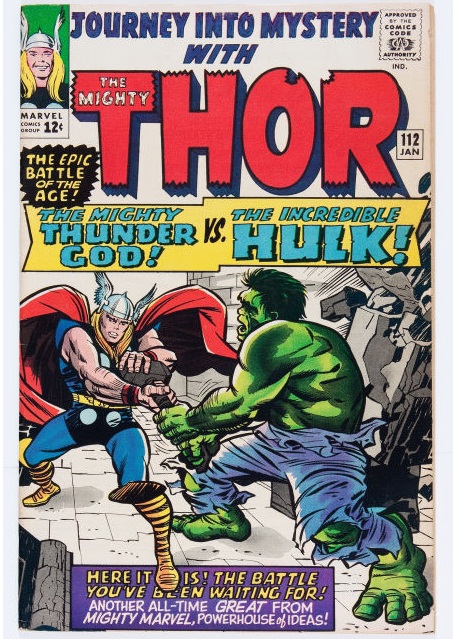
This time around in comic news we are looking back at the Journey into Mystery comic auction from Heritage Auctions.
What made this auction particularly interesting is the fact that pricing was reasonable and grading conditions were meticulous. Not always the case on other online auction sites (E-something, Kiji-something), Heritage Auctions or “HA” take great pride in the fact that their faculty includes not only comic fanatics but also experts in antique books and printing. It’s safe to say that ‘what you see and what you read’ here is ‘what you get’.
What about the comics?
In my opinion, Tales of Mystery starring the Marvel character Thor is still an undervalued comic book, even with all of the Marvel movie appearances. Consider that the first run Thor series was benefited by the pencil skills of Mr. Jack Kirby. Jack is an icon in the comic book collector world. Unique style? Check. Quality character poses? Check.
Sure, we all know the main reason for the comic was to set the stage for Thor (introduced by the way in 1962’s Tales of Mystery #83) but there’s also the less considered crossover appeal of major stories (and covers) utilizing such Marvel characters as Magneto , The Incredible Hulk and even Hercules.
Tales of Mystery, like other comics from the early 1960’s, has a naivete and a simple message: Good guy half-god deals with life and an identity crisis. And that’s the fun factor.
It’s been almost sixty years since Marvel introduced the comic character Thor.
That’s a long time. Thor is still around, starring in major motion pictures and wielding the mighty mjolnir. He’s not going away. So if you have the money, investing in one or more of these books is not only a fun move, it’s a wise move. Sure to increase in value. For the Silo, Jarrod Barker.
Almost one decade ago: Andy Warhol’s “Endangered Species and Ads” prints bring a combined $677,000 USD alone at this notable Modern and Contemporary Art event.
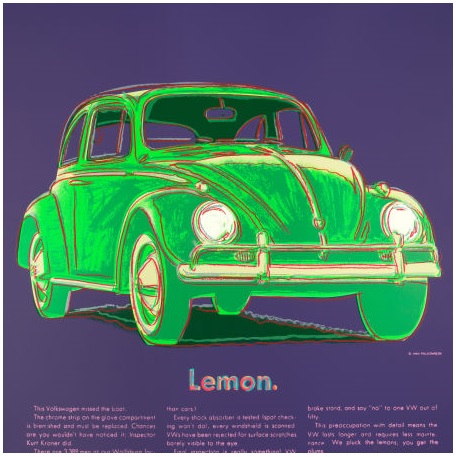
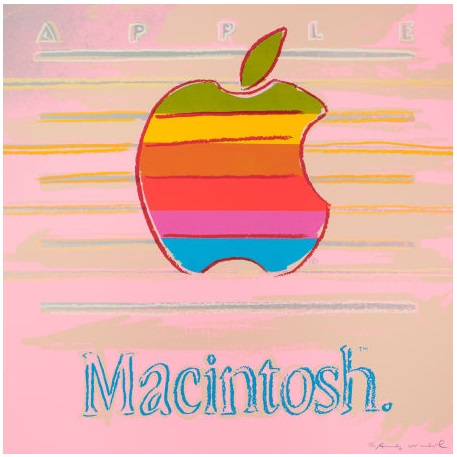
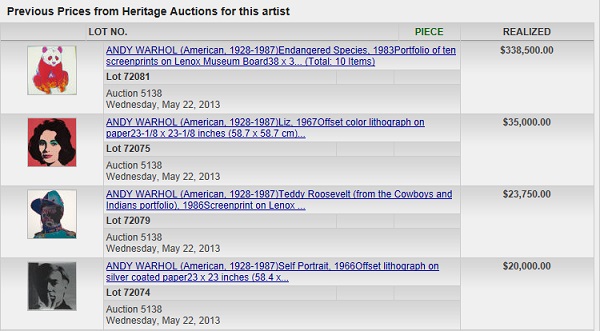
Two complete portfolios by Andy Warhol, Endangered Species, 1983 and Ads, 1985, sold for $338,500 USD each to far exceed their estimates among a field of fresh-to-market iconic works during Heritage Auctions’ $2.9 million USD Modern and Contemporary Art Signature® Auction, May 22 in Dallas.
The auction sold 90% by value and 78% by lot.
Close up of one of the ten screenprints up for auction by ANDY WARHOL (American, 1928-1987) Ads, 1985 Portfolio of ten screenprints on Lenox Museum Board 38 x 38 inches (96.5 x 96.5 cm) Ed. 50/190 Each signed and numbered in pencil Printed by Rupert Jasen Smith, New York Published by Ronald Feldman Fine Arts, Inc., New York PROVENANCE: Private collection, Texas LITERATURE: Feldman & Schellmann, II.350-359 Warhol, Andy:. American painter, photographer, filmaker and publisher, 1928-1987
ANDY WARHOL (American, 1928-1987)
Ads, 1985
Portfolio of ten screenprints on Lenox Museum Board
38 x 38 inches (96.5 x 96.5 cm)
Ed. 50/190
Each signed and numbered in pencil
Printed by Rupert Jasen Smith, New York
Published by Ronald Feldman Fine Arts, Inc., New York
PROVENANCE:
Private collection, Texas
LITERATURE:
Feldman & Schellmann, II.350-359
Warhol, Andy: American painter, photographer, filmaker and publisher, 1928-1987
Condition Report*:
With original Ronald Feldman Fine Arts, Inc. cardboard portfolio box and index print. All screenprints unframed and in good condition with specifics listed below. Mobil: Minor rubbing 3/8″ in due to former frame. A few incidental surface scratches and rubs. One 5/8″ abrasion, resulting in very minor loss. Paramount: Minor rubbing 3/8′ to 1/2″ due to former frame. Very minor bumping to bottom right corner. Chanel: 1/2″ to 1″ light rubbing due to former frame. Slate purple backgrund has hazy toning, beginning about 1/4″ in. Apple: Very minor incidental rubbing to edge. Rebel Without A Cause (James Dean); Van Heusen (Ronald Reagan); Blackglama (Judy Garland): All have only very minor edgewear. Volkswagen; Life Savers: Very minor surface rubbing and edgewear. Donald Duck: Very minor edgewear. Top corners have minor wear. Light handling creases. Some wrinkling and an indentation at end of signature. Left side center shows some moderate wrinkling and creases with some minor loss, beginning at 11″ from the bottom up to 24″, and affecting 3″ into the work. The face and body of Donald Duck is affected somewhat, as well as the background near edge. Light wear in top left corner and a small abrasion on middle right side. Unframed
Two works by Ed Ruscha responded well among buyers as his gunpowder on paper titled Rustic Pines, 1967, realized $290,500 USD and a color screenprint, Double Standard, 1969, sold for $182,500 USD , setting a record for the work. Mel Ramos’ Georgia Peach, 1964, fresh from a Texas collection, sold for $158,500 USD.
“The market for good contemporary art doesn’t seem to have hit any ceiling,” said Frank Hettig, Director of Modern and Contemporary Art at Heritage. “Our focus is presenting fantastic, fresh-to-market discoveries and bidders certainly responded in kind. It gives us high expectations for our November 2 Modern and Contemporary auction in Dallas.”
Among the modern masterpieces in the auction, the magnificent, 7-foot Cobalt Chandelier, 2003, by Dale Chihuly reached $158,500 USD. It is the largest Chihuly chandelier to appear on the secondary market and was offered through a federal court-appointed receivership overseeing the sale of assets previously owned by R. Allen Stanford of Stanford Financial Group.
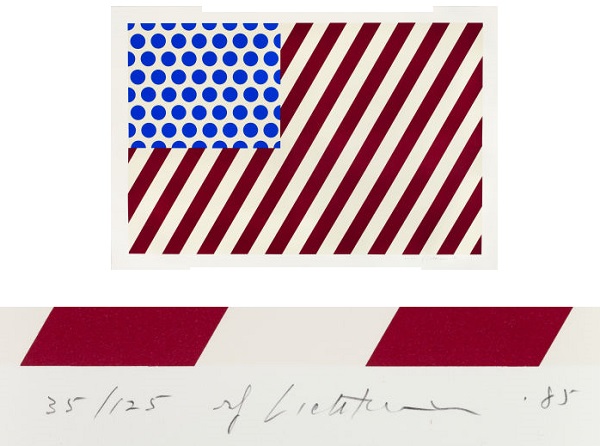
Forms in Space by Lichtenstein earned $53,125.
Roy Lichtenstein’s Forms in Space, 1985, a screenprint published by the artist for the Institute of Contemporary Art’s Rally round the Flag benefit, achieved $53,125 USD and Georges Rouault’s Chemineau, 1937, realized $40,625 USD.
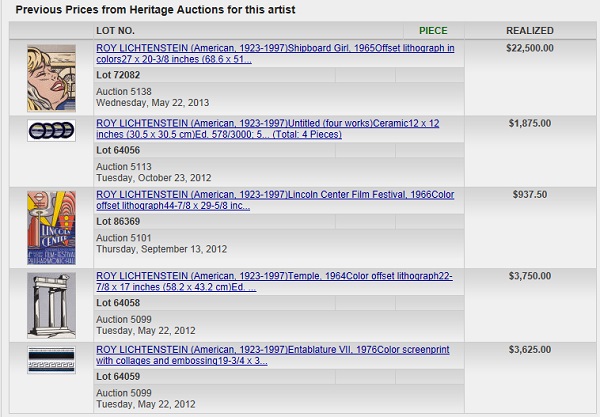
Here’s a look at what some Lichtenstein’s other pieces sold for.
Sculptural art performed well as Étienne Hajdu’s La Mer, 1964, sold for $35,000 USD and Pablo Picasso’s Vase deux anses hautes, 1953, sold for $30,000 USD while Robert Graham’s Frieze Figure I-G, 1989/1990, brought $21,250 USD.
So what is that Volkswagen Warhol worth today in 2021? It’s hard to pen the value but in Spring 2019 one single print ad brought 30,000 UK Pounds ( 52,000 $ CAD) in a Christie’s auction.
ROY LICHTENSTEIN (American, 1923-1997)
Forms in Space, 1985
Screenprint in colors on Rives BFK paper
31 x 47-1/2 inches (78.7 x 120.7 cm)
Ed. 35/125
Signed, dated and numbered in pencil
LITERATURE:
Corlett, 217
NOTE:
Published by the artist for the Institute of Contemporary Art, University of Pennsylvania, Philadelphia.
Forms in Space has been created especially in honor of ICA’s benefit, Rally round the Flag (label on frame verso) .
Lichtenstein, Roy:. American painter, printmaker; born 1923 in New York City, died 1997 in New York City
Condition Report*:
Sheet: 35.75 x 51.5 A crease in upper center at extreme sheet edge; small pressure mark at lower right corner; lower right corner lightly bumped; paper lightly undulates; framed. Framed Dimensions 36.25 X 52.5 Inches
This year, I have been in Canada 54 years. It is difficult to define what I need to do but I have to be more active, more involved in positive social change…….The state of Trumpism gnaws at me.
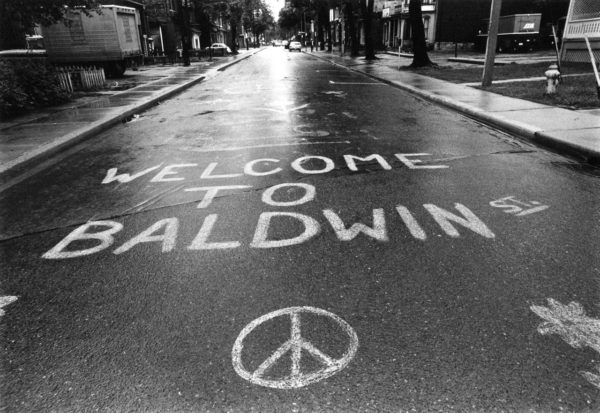
A few years ago, during March 2017, about 40 of my photographs (1967 – 1974) of Toronto’s Baldwin St. were exhibited at the Toronto Arts & Letters Club. I recently spoke at the Club about my experience as an immigrant in 1967 with a draft dodger avoiding the Vietnam War.
Here is one of my photographs.
In Feb. of that same year, I was fortunate enough to have exhibited photographs at Unlovable Gallery that John Phillips (my ex-husband and late husband) and I took of the American Civil Rights Movement. Last year, I gave a slide presentation at the Women’s Art Association on Canadian women photographers who worked between 1865 -1915. Three projects – war resisters, civil rights, and feminism.
…and this one taken Toronto City Hall
My son, Bennett Jones Phillips, and his partner, Lisa Pereira are in the process of creating a record store on Baldwin St. and I am going to have an exhibition space- provided the current Covid epidemic is managed, controlled and finally defeated. (I had a gallery in the past on Baldwin). Here is a chance to be more active and socially involved. My plan includes an expanded “coming to Canada” exhibit with blow ups of my and John’s photos and some pages of John’s FBI file and underground papers. It looks like the space will be a shipping container. The opening event will likely include having a tent in the former Silverstein Bakery parking lot and having music, poetry, and a 60’s feel with Baldwin Street history – Irish, Jewish, Chinese, and American immigration being part of the opening focus.
There are lots of possibilities. I am very open to ideas and involvement of other people. So what do you think? Cheers, Laura Jones.
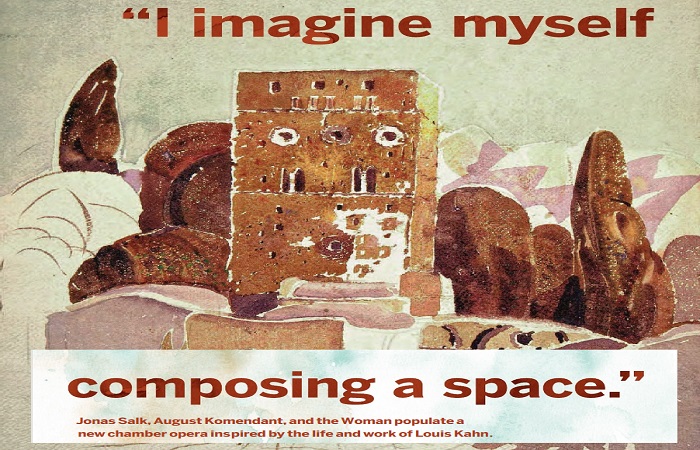
Back in 2005, composer Lewis Spratlan and I began work on an opera inspired by Louis Kahn. Kahn, who excelled in music and once considered becoming a composer, was especially cognizant of how sound works in a physical space. “Space has tonality,” he often said. Kallick, a professor of music at Amherst College, made recordings of the “acoustic envelope” at several Kahn buildings, which were employed in composing the work’s prelude and interludes.
Composer Jenny Kallick
Key elements from Spratlan’s music were integrated into this electro-acoustic music, creating a seamless connection between the narrative world of the characters and the sounding spaces that filled their dreams. Opening in the ruins of Rome and ending with the healing waters at Kahn’s Salk Institute, ARCHITECT: A Chamber Opera narrates the dramatic arc of Kahn’s journey from dreamer to master builder.
Click the link below to read about Spratlan discussing the project with Frederick Peters, board chairman of New Music USA, which supports composers, performers, and audiences of new American music. For the Silo, Jenny Kallick- Amherst College.
Vivant Books brings to the world a very exclusive breed of coffee table book. Their Deluxe Editions are not only fine art coffee table books, but also include collectible works of art at a price most art lovers can afford. A select number of Deluxe Editions contain original artwork by the artist that is featured. Not only does this component differentiate VivantBooks amongst other publishing companies, but it also enables expansion of an art collecting demographic.
“We found that sold separately, an original piece by the artists we feature in our deluxe packages could range anywhere from $3000 to over $100,000,” says Mia Benenate “What we want to do and what the artists are really interested in, is broadening the audience that is able to acquire a piece of their work.”
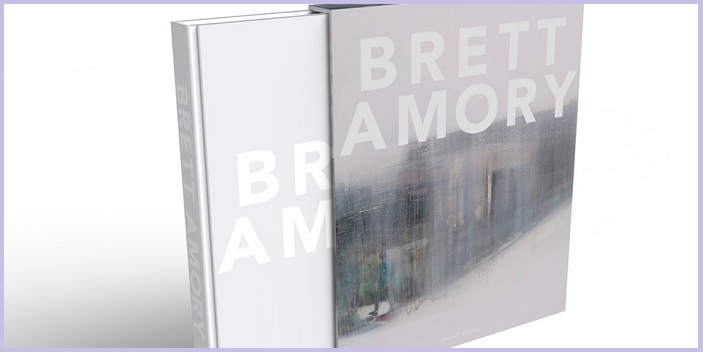
Vivant’s book features internationally renowned artist Brett Amory. Amory has gained extensive acclaim for his haunting, mesmerizing series, Waiting. His work is often depicted as architectural and structurally elegant, stark and emotive. Waiting focuses on the transition of individuals in precise moments of existing. The lush book, which contains a collected array of work which includes the Waiting series, was first offered earlier this year by a release party at the Clift Hotel in San Francisco. Deluxe Editions includes the collected works, a biography, excellent essays by luminaries such as Gwynn Vitello and an original piece of artwork by Amory himself.
In this age of digitalization Vivant Books presents fine art in a way that’s both elegant, stylish and inventive. Upcoming Vivant Books will feature such artists as Kimberly Brooks and Gottfried Helnwein.
Brett Amory — Limited Edition
95.00USD
Brett Amory, the American artist who rose to international acclaim for his “Waiting” series is featured in this deluxe coffee table edition. Alongside four-color reproductions of the artwork, the book includes a biography and selected essays from art world luminaries and patrons. Hardcover book housed in a full-color protective sleeve.
Deluxe Edition with original artwork also available.
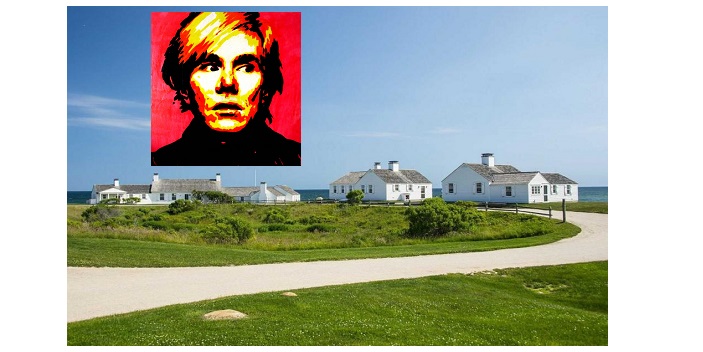
Montauk, New York was celebrating its biggest estate sale ever after the closing on the 5.7-acre beachfront estate at $50 million USD that pop artist Andy Warhol bought in 1972 for $225,000 USD.
The most recent owner of the compound was CEO of J. Crew, Mickey Drexler, who bought it in 2007 for $27 million USD. He listed it in 2015 for $85 millionUSD that included a 24-acre horse farm and equine center, which the buyer, Adam Lindemann, opted out of the purchase. Lindemann is the founder of the Venus Over Manhattan Gallery and a major collector of Warhol’s works making the property’s history especially significant for him.
Warhol’s first gig out of art school was as a fashion illustrator for several of the top women’s magazines. With the money acquired from his illustrations, he purchased a large loft on New York’s West Side and opened the Factory, where he turned toward creating industrial art. It wasn’t long before the Factory and Andy were attracting like-minded modernists from hippies to wannabe journalists and actors to drag queens and drug addicts. It was the start of New York’s avant-garde scene where Warhol held court. In addition to his painting, he branched out into music, film and journalism where he met Paul Morrissey who became the director of some of Warhol’s early films.
In 1972 when Warhol’s popularity and success were peaking, he and Morrissey decided to invest in property in the Hamptons and purchased the family fishing camp of the Church family of Arm & Hammer Baking Soda fame. The estate includes a 3,800-square-foot main house and five cottages completely hidden from public view with wide beaches and ocean views. Totaling almost 15,000 square feet with nine bedrooms and twelve baths, Drexler had it all meticulously restored by architect Thierry Despont.
Warhol’s stream of celebrity guests and renters put Montauk on the international map. Frequent guests included Liza Minnelli, Liz Taylor, John Lennon, Mick Jagger, Jackie Kennedy and Lee Radziwill. The parties were legendary and stories of happy days idled away on the Hamptons’ beach are recounted in many celebrity biographies.
Even though the Warhol home sale set a record at $50 million USD, his most famous paintings such as “Eight Elvises” and “Silver Car Crash” have sold for $100 million USD and higher. The listing agent was Paul Brennan of Douglas Elliman Real Estate in Montauk, New York. Visit here for more information.
Supplemental– David Bowie as Andy Warhol in Basquiat
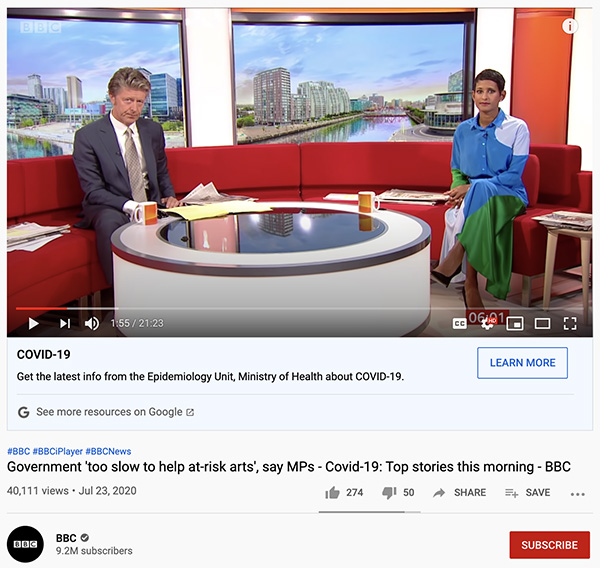
A friend of mine from Europe sent me this news story a couple of weeks ago about how the cultural landscape is facing its biggest threat in a generation.
It says the UK government was too slow to provide support for the arts industry, and that without more help, many parts of Britain could become “cultural wastelands”:
https://youtu.be/pPw8na16nuk
This should be a crude wake-up call for artists.
Realistically, governments around the world will NOT make it a priority to save art businesses. Why? Because governments care most about issues that will get them votes.
And, sadly, most of the public simply does not care about the arts the way artists do.
Want proof?
Check out the comments on that BBC video:
Then if you go down the rabbit hole and dig deep into the replies to these comments, you find a lot of artists desperately trying to show these people that the arts, and theatres, and galleries are very much “essential” to artists who rely on them to provide for their families:
The take-home lesson here?
Artists are on our own.
It’s unrealistic – unwise, even – to wait for the government to swoop in and rescue the arts industry.
In times like these individual initiative is more important than ever.
Artists must redouble their efforts to connect with curators, build a list of collectors, find patrons for their studio, maybe even transition to showing (and selling) some work online.
It is difficult, but it is not impossible. For the Silo, Brainard Carey.
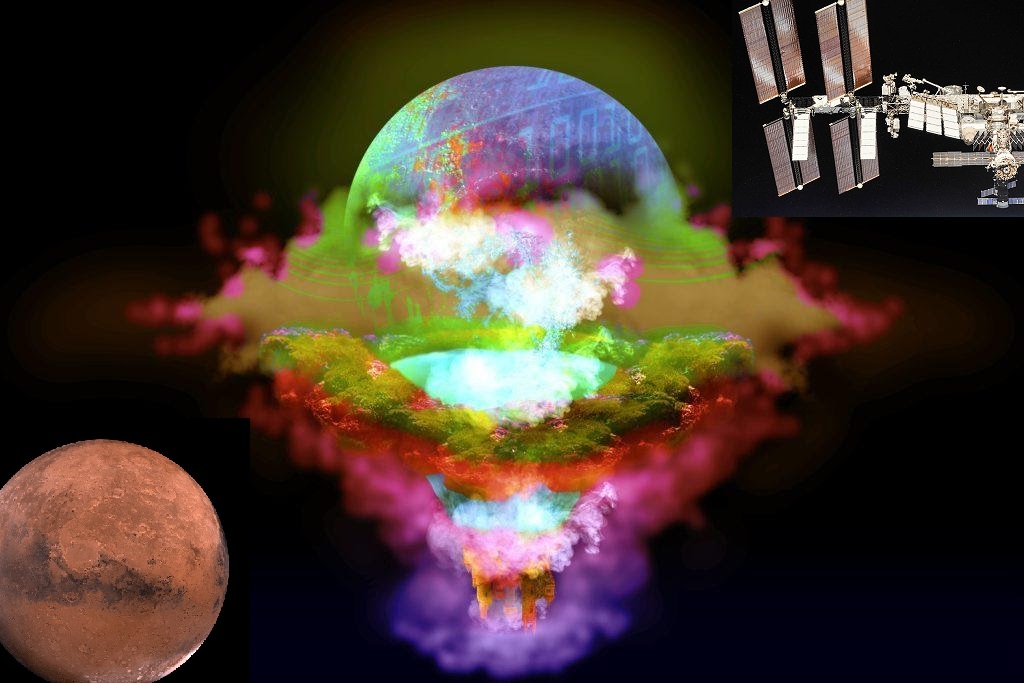
Hello Siloites (Siloers?) my name is David Bradford and I would like to share my art story with you, one involving augmented reality artwork that I have recently activated on the International Space Station and Mars as part of my Go Love Universally initiative. This is the first fine art activation of its kind in terms of distance (62,368,540 miles, to be exact) is aptly called Future. In case you were wondering, Yes there will be a Guiness World Record attempt based on this achievement.
A look to the stars. My next (virtual) canvas with new augmented reality fine art activation, titled, Go Love Universally.
This art initiative comes at a time in which much of the world is still under travel restrictions due to COVID-19 and was designed to include everyone around the planet and those orbiting, watching from above. Born out of exploring a way to express and distribute fine art to the public while using consumer technology, I started with using bus stops as fiducial markers (QR codes) in Philadelphia, New York City, San Francisco, and London.
When I was asked to initially introduce my augmented art initiative in the Philadelphia Weekly, I said that while I’ve been social distancing, I came up with a way to share positive messages with people using AR and recognizable visual triggers found easily around Philly.
It is a way for a mass amount of people to interact with their surroundings in a safe way that also creates positive feelings through the messages being communicated.
Within two weeks of launching Go Love Universally, I took my art initiative into space, bringing the art from Philadelphia to Mars. For curious consumers of this activation, all pieces can be viewed at select locations using the Artivive app, a free augmented reality fine art app available for iOS and Android.
Steve Morrison, co-host of Philadelphia morning show Preston & Steve (93.3 WMMR), said to me: “Hey, this is pretty cool! What if the aliens in They Live just wanted to spread positive messages? Well, you have a potential answer with this project. Kudos to you, Sir!”
Go Love Universally is an ongoing project, as future collaborations with artists are to be announced.
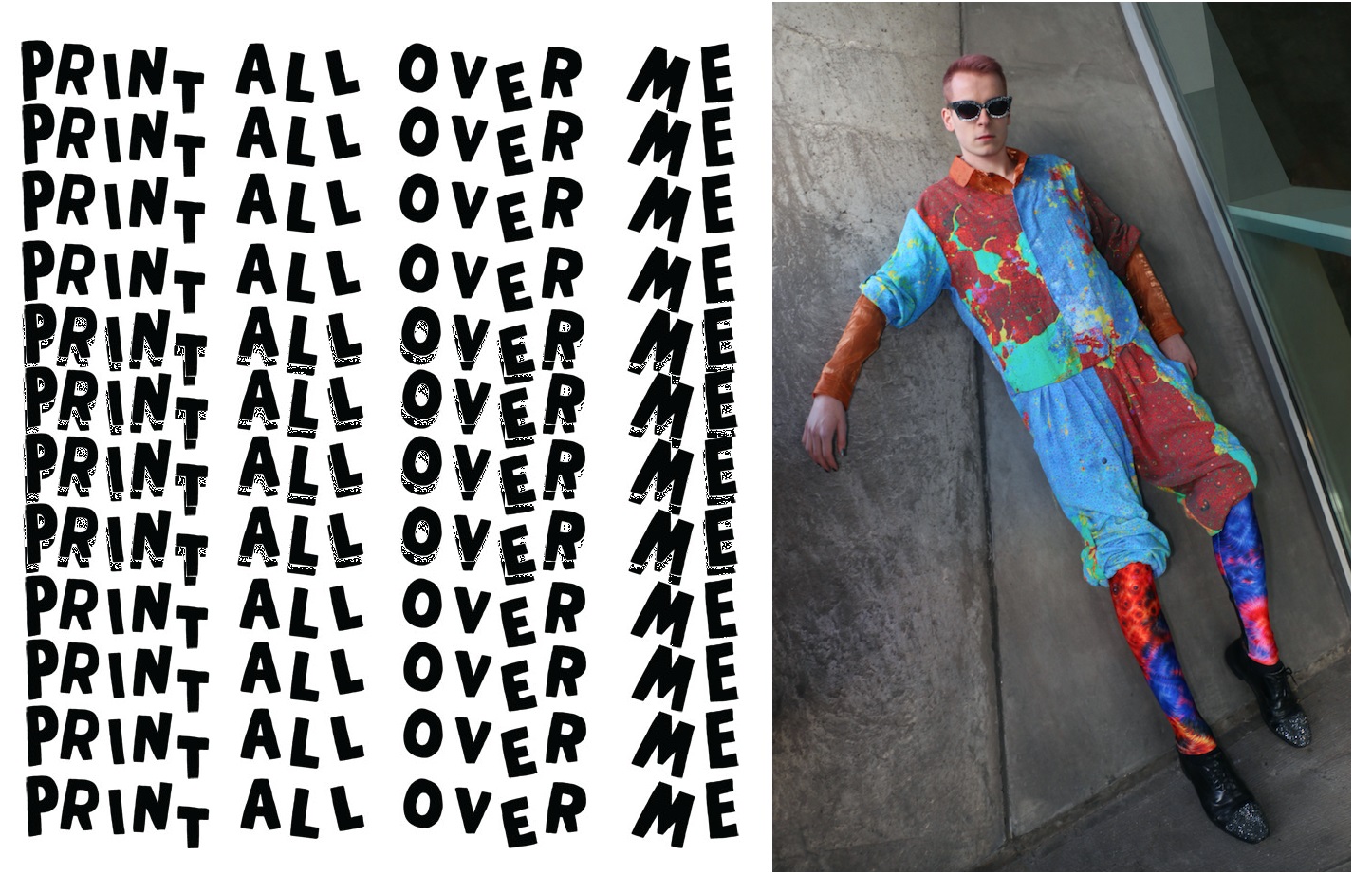
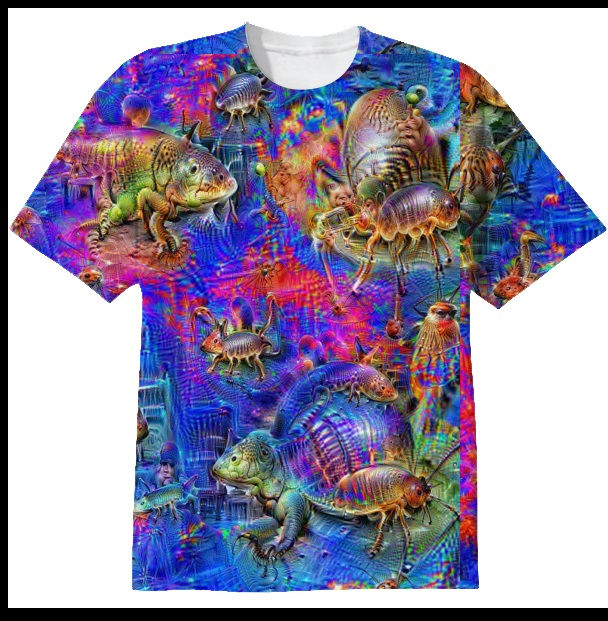
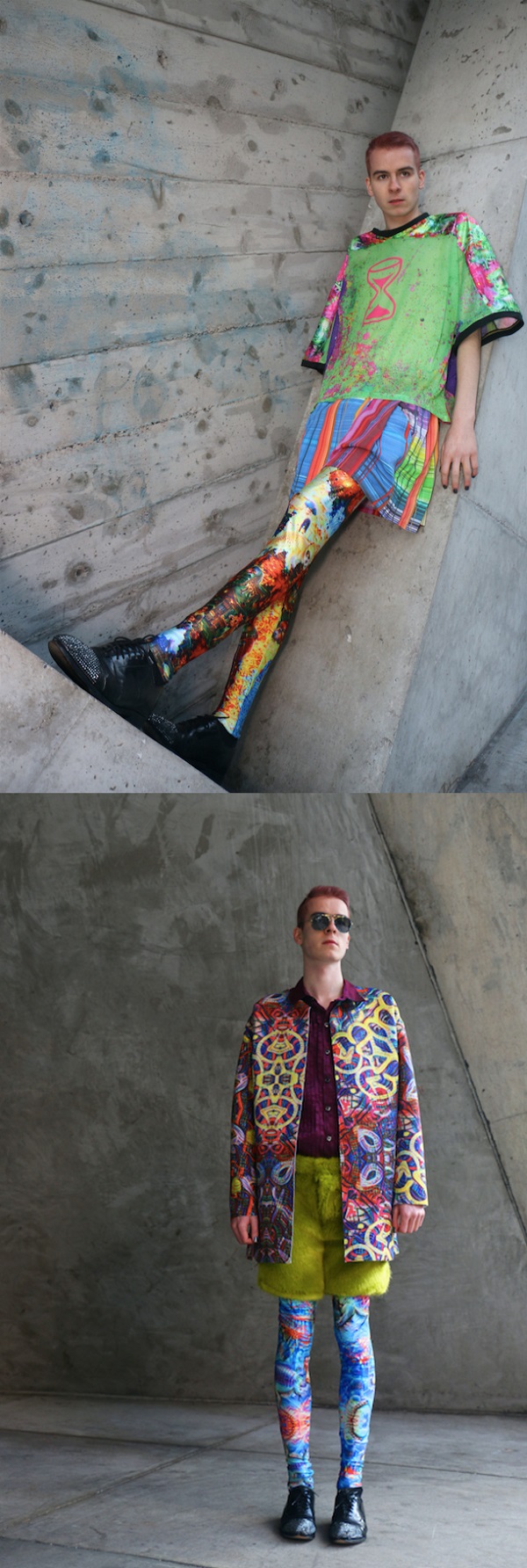
Featured Designer Brian Swift used PAOM to print fabric for his latest collection inspired by the Technological Singularity: a theoretical time in which human consciousness and Artificial Intelligence merge and become a new, unrecognizable species.
Brian collaborated with a machine learning algorithm to imbibe his photographs with a psychedelic quality. These computer generated compositions were then printed onto fabric and used throughout his latest collection.
Discovering the Picker’s barns…after visiting Marcel Gosselin [last issue- http://tinyurl.com/7g4oxnk CP ] we went on to a large picker’s barn we had noticed on the way into Victoriaville which is where we met Jean (Kojak) Deshaies. As we arrived, the place was buzzing with activity as several pickers clamored for the attention of a completely bald man; pointing at, and demanding prices of items still being unloaded from his pickup truck. Not being used to this type of “pressure” buying we went inside and started to peruse the rows of furniture and items there.
Nothing was priced. We made note of several things of interest, and waited.
After several minutes the bald man came in and approached us introducing himself in a distinctive, low raspy voice as Kojak, and started simply “how can I help you?”. I was slightly taken aback by the intensity of his voice, abrupt manner, powerful short build, and the fact that he had absolutely no facial hair including eyebrows. He seemed….slightly hostile. We explained that we were dealers from Ontario, and that this was our first trip to Quebec. He immediately broke into a big smile and grabbed my hand and gave it a firm shake, and after introductions asked us what we found interesting. As we pointed out several pieces of early furniture, rugs, carvings, etc., he would offer a short description and then bark out the prices. As we said yes to an item, a young helper would grab the piece and haul it off to a place by the entrance where he started to make a pile. Kojak wrote the prices on a piece of scrap paper. He warmed with every item chosen and before long would sometimes follow the price quoted with a second lower price he called “prix d’ami” or “friend’s price”.
After awhile I noticed the large pile we had accumulated. I expressed my concern that I might not have enough cash for everything, but he said not to worry because a cheque would be fine. I was surprised at this sign of trust but he joked that he knew I would be back, and besides if the cheque was not good he would soon be at my door to collect, and I wouldn’t want that to happen.
He told us that he and a few of the other local dealers were just back from New York City where they had marched unannounced into the office of a downtown lawyer who had bought several items in the area with bad cheques, and had not answered their calls. “We just walked into his office, grabbed him by the scruff of the neck and told him we wanted our stuff back. We didn’t have to do more. He took us right to the warehouse. We were back home ten hours later.”If you had trouble covering a cheque it was fine as longs as you were up front about it, and made it right. No problem.”
Getting all of the stuff we bought into the truck was another thing but we managed. For the Silo, Phil Ross. Visit Phil’s blog at www.shadflyguy.com
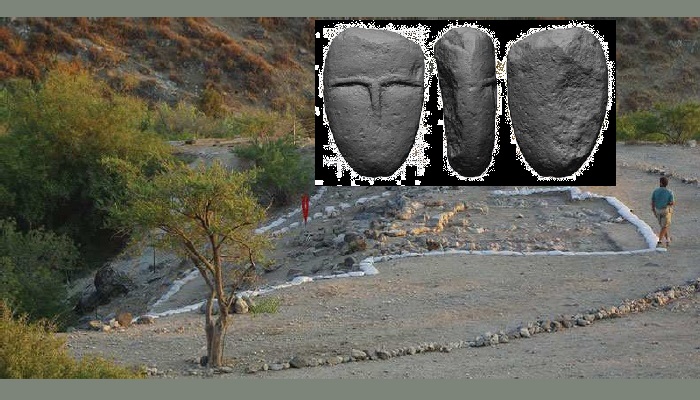
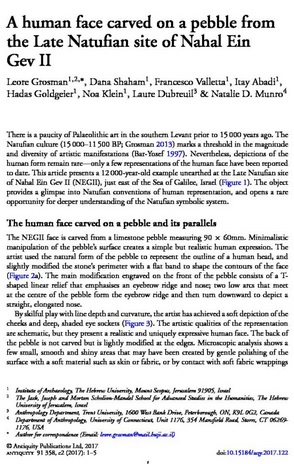
There is a paucity of Palaeolithic art in the southern Levant prior to 15000 years ago. The Natufian culture (15000–11500 BP; Grosman 2013) marks a threshold in the magnitude and diversity of artistic manifestations (Bar-Yosef 1997). Nevertheless, depictions of the human form remain rare—only a few representations of the human face have been reported to date. This PDF article presents a 12000-year-old example unearthed at the Late Natufian site of Nahal Ein Gev II (NEGII), just east of the Sea of Galilee, Israel (see Figure 1 PDF link below). The object provides a glimpse into Natufian conventions of human representation, and opens a rare opportunity for deeper understanding of the Natufian symbolic system.
The NEGII face is carved from a limestone pebble measuring 90×60mm.
Minimalistic manipulation of the pebble’s surface creates a simple but realistic human expression. The artist used the natural form of the pebble to represent the outline of a human head, and slightly modified the stone’s perimeter with a flat band to shape the contours of the face(see Figure 2a PDF link below). The main modification engraved on the front of the pebble consists of a T-shaped linear relief that emphasizes an eyebrow ridge and nose; two low arcs that meet at the centre of the pebble form the eyebrow ridge and then turn downward to depict a straight, elongated nose.
By skillful play with line depth and curvature,the artist has achieved a soft depiction of the cheeks and deep, shaded eye sockets (see Figure 3 PDF link below). The artistic qualities of the representation are schematic, but they present a realistic and uniquely expressive human face.
Leore Grosman
The back of the pebble is not carved but is lightly modified at the edges. Microscopic analysis shows a few small, smooth and shiny areas that may have been created by gentle polishing of the surface with a soft material such as skin or fabric, or by…… continue reading this article by clicking here.For the Silo by Leore Grosman, with Natalie Munro and Hadas Goldgeier/ academia.eu. Feature image photo by Dana Shaham.
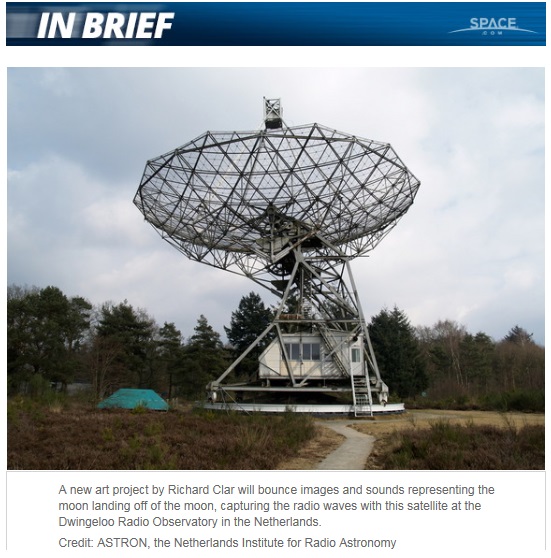
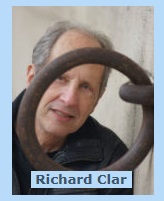
“For me It was an incredible feeling to use this 120 ton radio dish, capable of peering into the far reaches of the universe, to create an artwork focusing on one of the greatest achievements in human history” Richard Clar image: space.com
Los Angeles, CA, – Richard Clar using an earth-moon-earth (EME), or moon bounce as it is also called, radioed two very special signals off the surface of the moon where their return was received at Dwingeloo Radio Observatory in the Netherlands.
Clar’s extraordinary two-part project, Giant Step and Lune sur la Lune, paid tribute respectively to Apollo Astronaut pioneer Neil Armstrong’s first step on the moon on July 20, 1969 and to the far side of the moon itself, something witnessed only by a rare group of individuals, the Apollo Astronauts. The two radio transmissions to the moon and back emanated from a radio dish in Italy.
Giant Step is a personal response to an event Clar personally witnessed back in 1969, and he wanted to use his creativity to pay tribute to those who took part in the Apollo program, and especially Neil Armstrong for what he did on that momentous day.
He wanted this work to say something about the moon itself, using the moon.
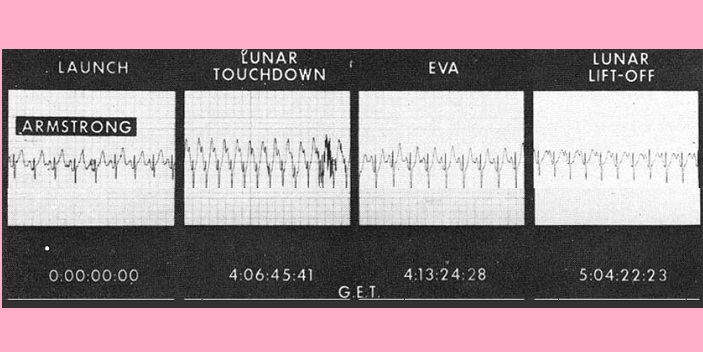
His interest was piqued after hearing about an earth-moon-earth bounce (EME) from Italian artist and colleague, Daniela de Paulis, who together with radio specialist Jan van Muijlwijk developed the process of using EME to send images to the moon and back in 2009. As he researched the Apollo Archives, he came across an Electrocardiogram (EKG) of Neil Armstrong as he took the first step on the moon on July 20, 1969 – and Richard found his inspiration!
While data scientist Dr. Ryan Compton created the sonification tone from Armstrong’s actual EKG graph, prominent Los Angeles-based double-bass jazz performer and composer Roberto Miranda used the tone to create compelling sounds that have been called “edgy and hauntingly beautiful.”
“I wanted the art to say something about the first humans to set foot on the moon. Think how many living beings have observed the moon for eons…and now we have made a number of trips to the moon and back. I want people to have new experiences through my artwork,” says Clar.
Lune sur la Lune, an image of the far side of the moon, was transmitted in a poetic gesture onto the earth facing side of the moon. Since only the Apollo astronauts have seen the far side of the moon, using the radio-reflective surface of the moon to produce a site-specific artwork makes the moon a unique part of the process rather than just a subject matter ─ and also gives people on earth an opportunity to witness this phenomenal event and experience the moon in a new and different way. Shortly after the sound and image from Giant Step and Lune sur la Lune were received and processed at Dwingeloo, and will soon be accessible to the world at www.rockthemoon.com.
There was considerable excitement at the Dwingeloo Radio Dish on September 26th by those who witnessed the sound signal and image signals being received from the surface of the moon after the moon bounce. All in all, the art mission was a great success.
“For me It was an incredible feeling to use this 120 ton radio dish, capable of peering into the far reaches of the universe, to create an artwork focusing on one of the greatest achievements in human history,” stated Clar.
Richard Clar’s timeless work has been exhibited in museums, galleries and universities throughout the United States and Europe. His visionary ‘art in space’ began in 1982 with a NASA-approved concept for an art-payload for the U.S. Space Shuttle. Philosophical in nature, many of Clar’s themes originate in space environment issues, such as orbital debris, war and peace, the Search for Extraterrestrial Intelligence (SETI), and water management on earth.
Clar studied at the Chouinard Art Institute (now Cal-Arts). In 2001 and 2002, he coordinated the Leonardo/OLATS/IAA Space Art Workshops in Paris. Clar is the Director of Art Technologies; a Member of the International Academy of Astronautics (IAA); a Member of the IAA SETI Permanent Study Group; a Member of Women in Aerospace, and a Member of the Leonardo Space Art Working Group. He was the Secretary of the former Art and Literature Subcommittee of the International Academy of Astronautics, and a past Member of the Executive Board, Graphic Arts Council, the Los Angeles County Museum of Art.
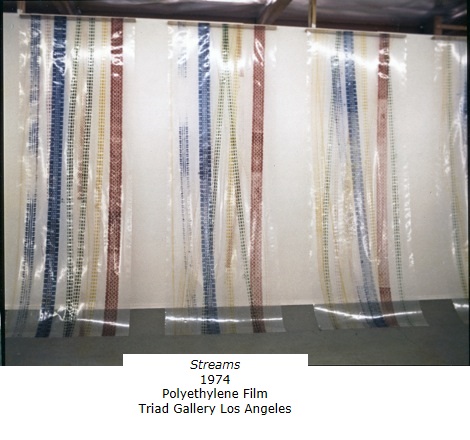
An early example of Richard Clar’s Space Art
Clar founded Art Technologies in 1987 as a liaison between the worlds of art and technology. By collaborating with such partners as the U.S. Naval Research Laboratory, Boeing Aerospace Corporation, and contemporary composers, Clar generates high-visibility art works that transform state-of-the-art technology and highly-engineered materials into evocative contemporary art. His work is found in many corporate collections, including JBL Sound, Home Savings of America, and the MGM Grand Hotel in Las Vegas.
After spending the last fourteen years in Paris, Richard Clar now resides in Northern California. For more information on his extraordinary artwork, please visit:
Norm Lewis was just twelve years old in 1958, a student at the old South Public School, when he saw the film A Night To Remember, a straight forward rendering of the Titanic disaster based on the book by Walter Lord. The film was a pivotal experience for Norm, and the beginning of a life-long fascination with this most infamous nautical event.
The Beginnings of a Canadian Society
In 1993 Norm attended a Boston conference of The Titanic Historical Society, meeting enthusiasts from all over the world. He began polling Canadian delegates on the idea of starting their own group and got an overwhelming response. In 1998, this former locksmith and transport driver became the President, Founder and CEO of the Canadian group. Radio stations from Calgary, Kitchener and Toronto all called for an interview, and within a week The Canadian Titanic Society was receiving more letters than Norm could carry.
Norm has collected a great deal of Titanic memorabilia over the years, including 110 underwater photographs taken by Ralph White, the Society’s official “Explorer in Residence” and 2nd Vice-President, who at the time of his death in 2008 had made more dives to the wreck than anyone else in the world. A pioneer in deep sea photography and cinematography, Ralph was the expedition leader for James Cameron’s 1997 epic movie. And you know the name of that one.
Norfolk County Ontario Connections
With the help of some volunteers, Norm also researched Norfolk County connections to the disaster, finding Titanic crew members, survivors and passengers from the rescue ship Carpathia living like Norm, in Simcoe Ontario though all have now passed away.
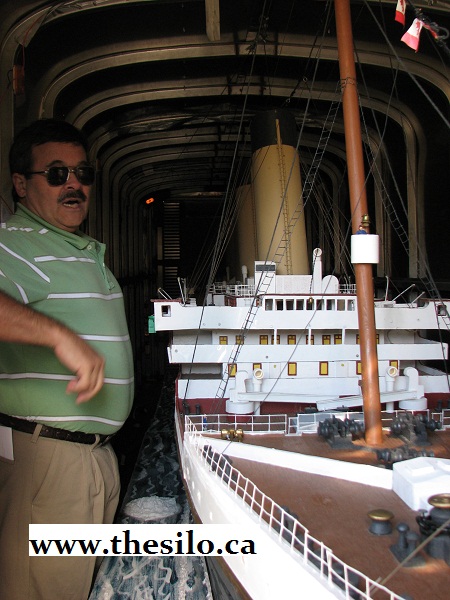
But perhaps most impressive, Norm Lewis is the sole architect of a twenty-foot scale model of R.M.S Titanic that has appeared in parades and exhibitions all over the province. Detailed, historically accurate, and made almost entirely out of wood, the model is the only one of its kind. It has working propellers, smoking funnels and a truly impressive digital recording of the actual titanic whistles. It took him eight years. You might call that obsession, but if you think of a twelve year old boy, rapt in fascination at one of the most spectacular and terrible stories in nautical history, you might just call it a labor of love. For the Silo, Alan Gibson.
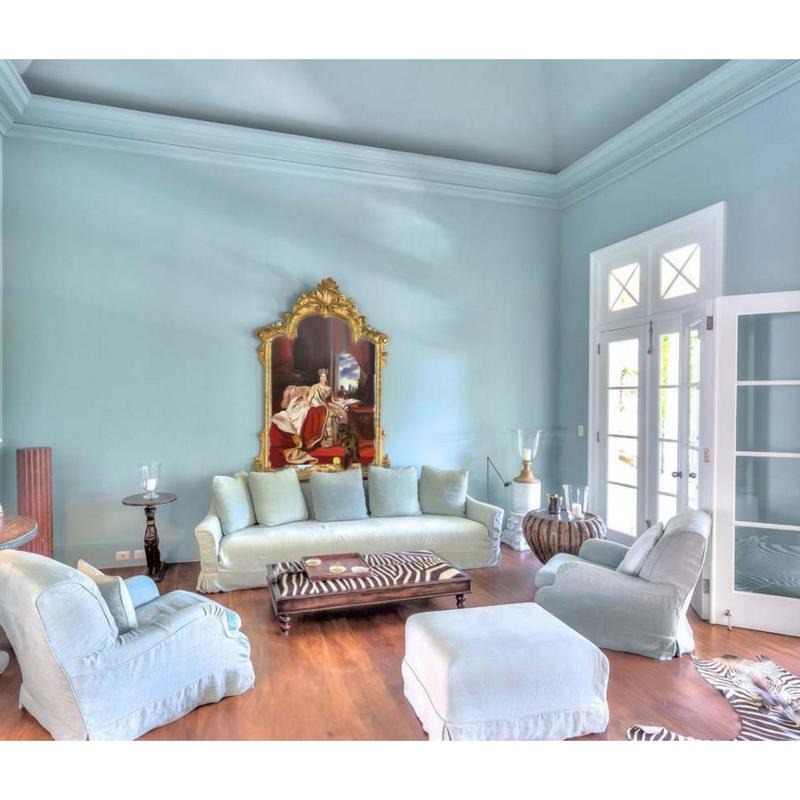
Nobilified and Villa de Campo have partnered up to offer their customers a unique art and hospitality experience. A selection of luxurious villas offered by Villa de Campo for rent come with hand-painted portraits of each guest, which are hung throughout the Villa during their stay.
Located in La Romana, Dominican Republic; Casa de Campo is no stranger to luxury. This prestigious Resort spreads over 7,000 acres, featuring three award-winning golf courses, a clay pigeon shooting center, an equestrian center, tennis courts, pools, and restaurants, as well as 1,700 private villas populating the resort, some of which are available for rent. Villa de Campo specializes in giving customers prompt and personalized service for vacation rentals in the resort. Whether it’s understanding your needs and recommending homes to stay in or helping you book a personal chef or schedule your activities, Villa de Campo is stepping up the meaning of the saying “the customer is king”.
With
this partnership with Nobilified, Villa de Campo adds an extra touch of
personalization to one’s holiday—and we aren’t talking about personal
chefs or yacht rentals. Nobilified, which creates hand-painted oil
portraits of its customers as royalty will be using its inspiration to
paint memories of holidays for guests to keep. The paintings will be
inspired by the nature of the trip, whether a romantic couple retreat, a
golf trip with boys, or a family holiday; Nobilified’s classically
trained artists will paint the guests prior to their arrival, according a
certain theme, and have the pieces hung throughout the villa during
their stay. Guest then get to take the pieces home after their stay.
The
Nobilified special aims capture memories in the world of art. Chris
Jensen, the founder of Nobilified, says, “Our aim is to capture one’s
memories in art. We want guests of the villas to remember all the small
things that made their holiday one to remember. When they get home, they
will hang the piece, and each time they look at the piece, they will
remember their holiday. We think that is special.”
Villa de Campo
Villa de Campo offers a selection of luxury villas in which to spend your next activity-filled holiday in the Dominican Republic. Spread over 7000 acres, the Casa de Campo resort is home to over 1700 private villas of which around 100 are available for rent on villadecampo.com.
Punta Aguila #57 is true Casa de Campo villa. The beautiful five bedroom villa was built right in the middle of a beautiful bamboo forest, palms and Embauba trees in a five thousand square meter homesite.
Booking a Villa has become the perfect way to spend a holiday whether with family, friends or as a couple. Our selection of luxury villas are located throughout the entire resort and cater to various tastes and needs. Villa de Campo also includes additional amenities such as complimentary golf carts, private chefs and a holiday concierge to help you book and plan your dream stay. Casa de Campo possesses a variety of restaurants, private beach clubs, a Marina, 3 golf courses, a tennis center, an equestrian center, a spa, and much more.
Nobilified
Nobilified
is dedicated to revolutionizing the art world. Nobilified believes that
while not everyone may have the artistic skills required to paint a
masterpiece, everyone possesses an intuitively creative mind. At
Nobilified, customer dreams and fantasies are transformed into actual
works of art, which can proudly displayed in any home, dorm, office,
cabin, yacht, or even a swanky Chateau. Everyone has an artistic side,
and everyone sees the world in their own unique way. Nobilified wants
this diversity to make an imprint on the course of art history by
immortalizing customers’ wildest dreams.
In addition to providing high quality oil paintings, Nobilified wants to change the way people perceive art, by making it fun and accessible, thus giving customers the opportunity to share or gift a unique custom made oil painting with friends and family. No longer will having an oil painting of oneself hanging above the chimney be out-of-reach. This privilege used to be reserved for the upper tiers of society, but, now, it is shared with everyone, even if they are not knighted. A unique, hand-painted, oil-on-canvas work of art can add a touch of grandeur to any living quarters.
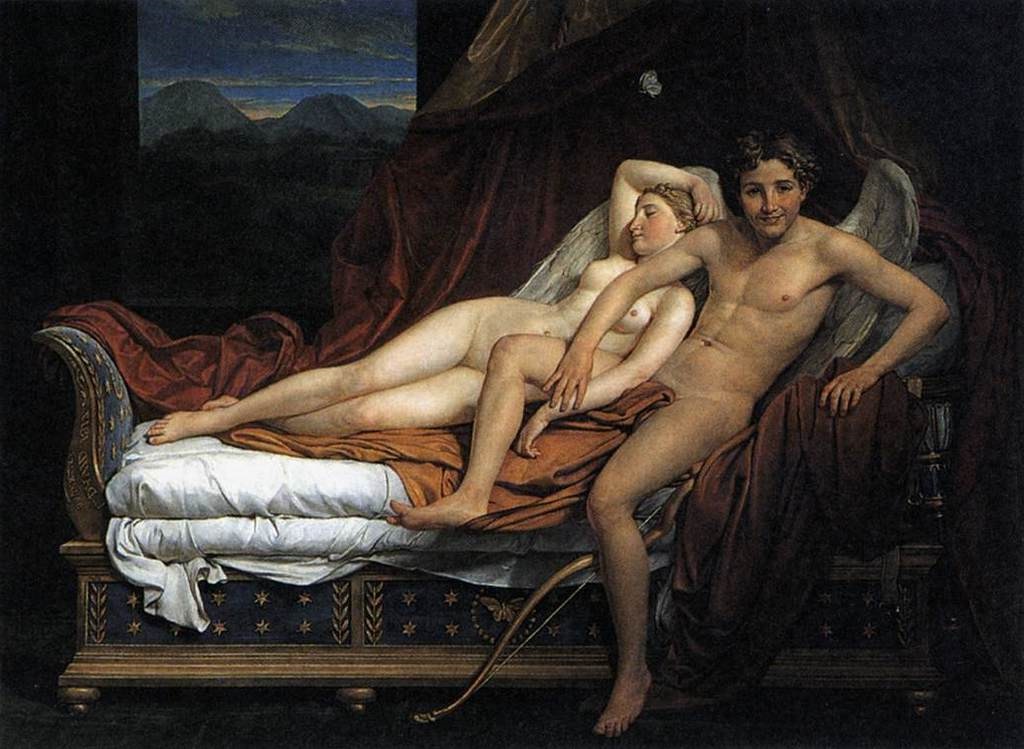
Featured image: Cupid and Psyche by Jacques Louis David
Feel Cooler Than You Really Are. If you want to learn to dance the tango the place to be is Buenos Aires, Argentina. This is a city that expresses its passion and national pride through their music, soccer, dancing, horses, and writing earning it the title of “City of Cool”.
Buenos Aires, (English meaning Fair Winds) Argentina.
With a population of 2.7 million people this capital city of Argentina is a place oozing with charm and things to do. From the moment you begin wandering downtown streets you know it’s going to be interesting. It’s a place to be cool even if you aren’t. Okay, let’s make it clear, I’m not cool, but for some unknown reason I started to feel this way when I mingled with the Argentineans. They spoke, what sounded like to me, an exotic language (Castilian Spanish), and looked and dressed like they were right out of the pages of Vogue magazine. It’s a city that never sleeps, populated by residents obsessed with fashion and image. Slim is beautiful is an established and largely uncontested fact.
Curvy architecture emphasizes the ‘tango’ speed and ‘coffee’ streamlining of Buenos Aires culture
Architecture
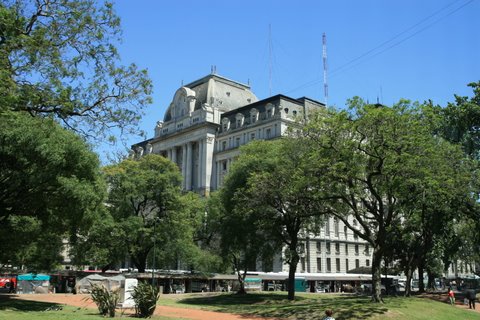
The downtown architecture is quite different from the rest of Latin America. It is strongly influenced by European styles with more than the half of the city buildings being French style. Countless museums, historical buildings, shopping centres, and hotels are yours to discover. And if you do get the urge to learn to tango there are plenty of tango-dancing schools (known as academias) throughout the city.
Bueons Aires is also known as a “city of buildings”
The Tango
Tango music was born in the suburbs, notably in the brothels of poorer suburbs. Its raw sensual dance moves were not seen as respectable until adopted by the Parisian high society in the 1920’s and then all over the world. There are loads of places with free tango shows in restaurant-bars such as Gitanos, where you can also try the national drink. I found it more like herbal tea than anything and its drunk out of a pot-like container through a metal straw. Even though it was foul-tasting, Argentineans say, it’s more addictive than coffee. To each their own.
Walking and Safety
When you walk in any largely populated area don’t be silly and carry an expensive camera slung over your shoulder and don’t ever wear an expensive watch that sets you apart from the crowd. It’s like saying rob-me, rob-me. Use common senses; err on the side of caution. I hid my camera in a plastic shopping bag. Always cross street at crosswalk. I’ll say it one more time to be sure it sinks in…Always walk at crosswalks and don’t begin until all vehicles have come to a stop.
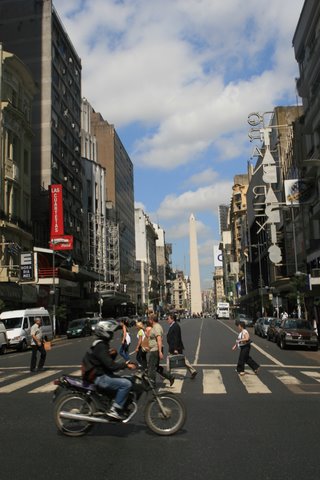
Streets are busy but have marked crosswalks and are well laid out
Recoleta Cemetery
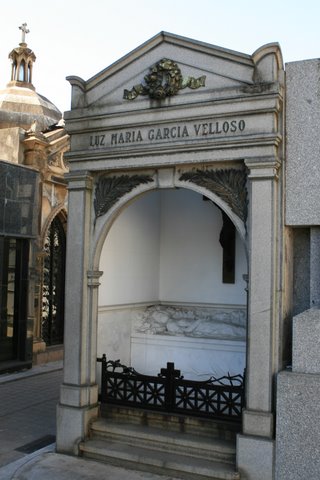
Don’t pass up the chance to visit to the Recoleta Cemetery established in 1822. It’s the final resting place for Argentina’s wealthiest and most famous families and people. The mausoleums are fairly small, befitting the size of the cemetery in an urban setting, and it’s common for many members, and generations even, of the same family occupying one mausoleum. One grave that I did seek out was that of Eva Peron who was the wife of Juan Peron, 3 time president of Argentina. Both are idolized for their efforts to eliminate poverty and to bring dignity to the labour movement. Because of this they were despised by the oligarchy of Argentina’s wealthy and powerful. I found it strange and a bit sad that her neighbours in death are those that despised her in life. Her husband is buried in another cemetery in the city.
Mausoleum at the Recoleta Cemetery
Art and Craft Museums
These museums are all the rage here, with the top attraction being the Malba, which is dedicated to Latin American modern art, the Museo National de Bellas Artes (National Museum of Fine Arts) and Recoleta’s Cultural Centre. You’ll find the general atmosphere in most of these places is more snooty than sincere. If art and crafts is not your thing, you’ll want to bypass all of these places and scout out somewhere to eat or sit on the grass in Plaza Francia. It’s easy to while away a few hours people-watching. I did both.
Where ever you travel, remember to take time to meet the local people. You will learn much about the culture of a place by watching and talking with citizenry.
The Obelisk
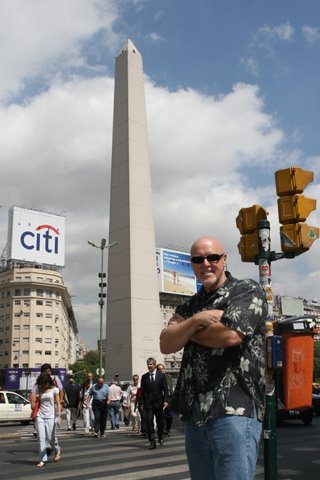
Another must see is to join the gaggle of tourists (and pigeons) that flock to the Plaza de Mayo. This is the site for some of the country’s most important historical occasions, including the revolution in 1810 which led Argentina gaining independence from Spain .If your legs are willing, take a stroll along Avenida Corrientes. When you get to the junction with Avenida 9 de Julio, which claims to be the world’s widest road where you can’t miss the famous Obelisk monument. For goodness’ sake use the pedestrian crossing if you don’t want to die! It’s the cities icon and the place the very spot where the Argentina flag was raised for the first time. For the Silo, George Bailey.
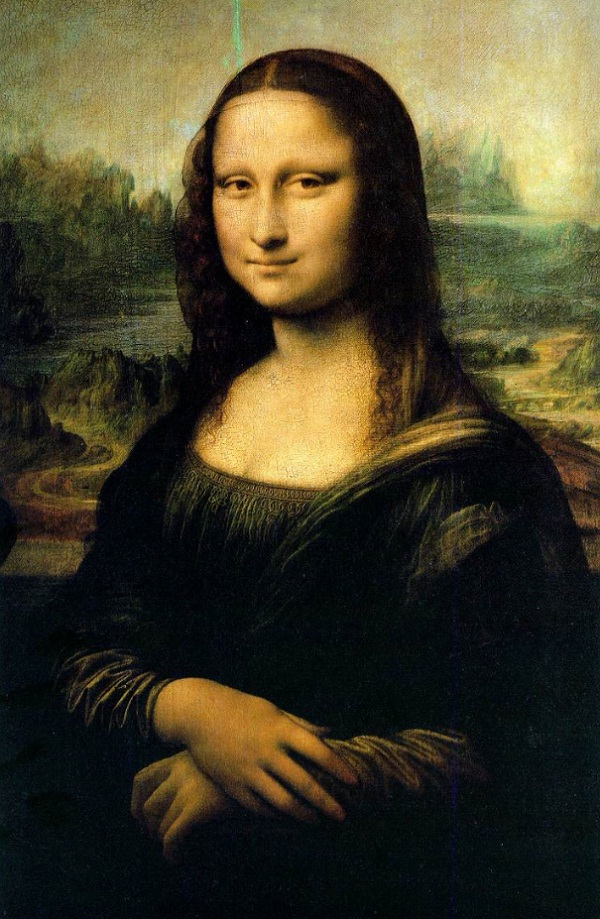
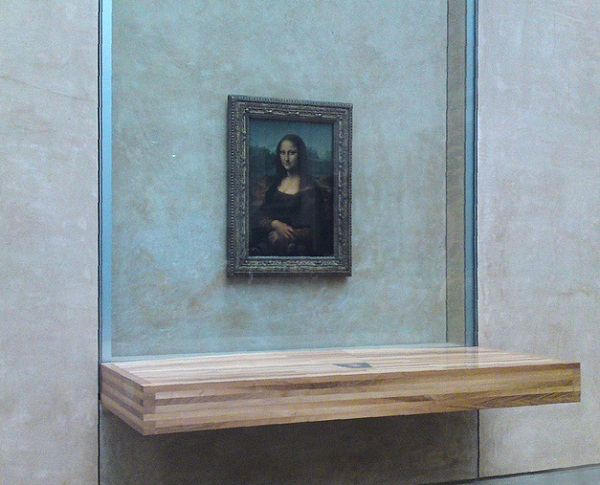
This is the most famous painting in the history of art. It is titled the Mona Lisa but it’s original name was Monna Lisa- a short form of “Madonna” or “my lady” but thanks to a spelling error we know this work as the Mona Lisa. Painted by Leonardo Da Vinci in the years 1503-1507, there are actually three different versions painted beneath the visible version. In one hidden version (discovered using xrays) she is seen clutching the arms of a chair. image/info courtesy of prlog.org
Every year 8.5 million visitors see the renowned work of art that is the Mona Lisa. It is a vision that graces t-shirts, calendars, coffee mugs, and art history books worldwide. Still, among those millions, I would wager that few are those that have left Paris remarking on the wall on which Mona is placed. More on this later….
Did you know that the Mona Lisa is the only work of art to be stolen from the Louvre( in 1911) and recovered? Not only that, but in 1956, it was attacked with acid and, in that same year, cut open with a rock thrown at Mona’s elbow. It would seem that times haven’t changed much either. In 2009 a coffee mug was thrown at it by a gazing woman.
Art hygiene: the Mona Lisa is protected by bulletproof glass while on display at Paris’ Louvre photo: Gilli8888/flickr
Time has provided the foresight to maintain Mona’s beauty. With 2 centimeters of bullet proof glass and an inner casing protecting against heat and humidity the artwork seems safe. But what about the wall ‘holding’ the Mona for all of us to admire?
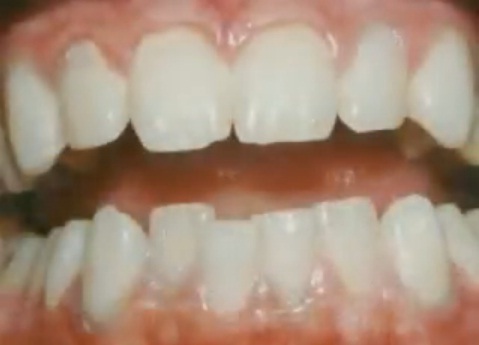
Take a look at these choppers…are they healthy enough to support a Mona Lisa smile? Pay attention because we’re about to switch gears and talk a little oral health.
As a dentist I am prone to notice the wall and that famous Mona Lisa smile. That smile, seen on TV and used in advertising everything from vacations to toothpaste, would be worth little without considering the healthy gums and bone that keep it in place. In other words, without noticing the wall. Years spent in my business have taught me, that if not protected properly, a smile can be stolen from us, chipped, and worn away with acid leading to very costly repairs. If you value your smile then the bullet proof glass is a worthy investment.
By focusing on in-office prevention and care the need for extensive intervention is often averted. It is more time and cost effective to put up and maintain a very impressive wall for your work of art than it is to meticulously rework the masterpiece. This analogy holds true for your teeth, gums and your smile. Maintenance is the greatest security from acid and coffee alike and with it, your smile can continue to break the ice… but I wouldn’t count on 8.5 million visitors. That may be a little more than any of us can chew. For the Silo by Dr. Peter Gunn. Dr. Gunn’s practice is in Port Rowan, Ontario. www.facebook.com/caredental
Nancy Redstar explores the long-standing contact between American Indian tribes and extraterrestrial visitors through interviews with the tribes’ spiritual leaders and shares the wisdom and ET experiences of Dawnland founder Dana Pictou, Mayan daykeeper Hunbatz Men, Choctaw wisdomkeeper Sequoyah Trueblood, and Creek healer and artist Shona Bear Clark.
Her book includes color photos of ET-inspired work by prominent Indian artists as well as traditional Indian art and petroglyphs depicting contact with “Sky Elders”
As humanity stands at the crossroads between the Fifth and the Sixth Worlds, American Indian wisdom keepers have recognized signs that they must now speak their closely held knowledge about extraterrestrial contact, their original instructions from the Sky Elders. These ET relationships have existed since the beginning of time. They have been depicted on ancient rocks and hides, embedded in creation stories, choreographed in sacred dances, beaded on wampum belts, and continued to this day through rituals and the tobacco blessing.
They show our planet back into balance with natural laws.
Exploring the unifying “Sky Elder” theme found in virtually every Indian culture, Nancy Red Star shares her profound interviews with wisdom keepers from several Native traditions and produced an exciting documentary film that offers their teachings on taking our rightful place among the peoples of the universe. http://www.nancyredstar.com/film.htm
Laying out a path for rebuilding our world, the Sky Elders’ original instructions initiate us into the possibility of a coming time of peace. Inviting all peoples to realize their Star ancestry, the women and men of proud lineage and inspiring wisdom who share their experiences here offer us a survival plan for walking into the next world. http://www.amazon.com/Star-Ancestors-Extraterrestrial-American-Tradition/dp/1591431433
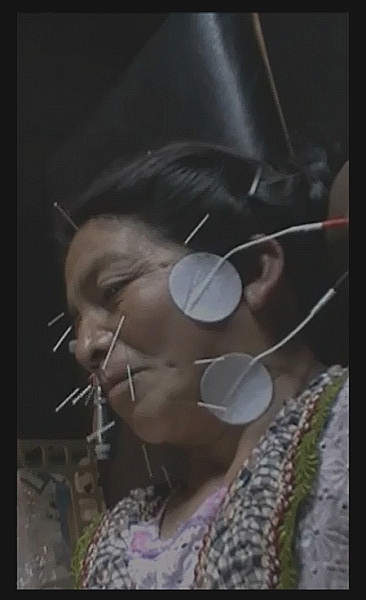
Hoy Chi Master Mike Mah and the Developer of the Hoy Chi Technique has successfully used acupuncture to treat stroke recovery patients.
Acupuncture, a word that literally means, “puncture with needle”, has been practiced around the world for over 2500 years. The historical origins of acupuncture are rooted in Traditional Chinese Medicine, and one of key fundamental is the intrinsic balance of energy or “qi” within the body. The best way to visualize this balance is by looking at the well-known yin yang symbol.
Yin [According to urbandictionary.com ying-yang is an erroneous spelling CP] and yang are found everywhere in nature, as complementary opposites, neither exist without the other. Humans are always in a dynamic balance, and optimal health requires the body to be able to adapt to various internal and external changes. Illness arises when this balance is disrupted, and homeostasis is now longer intact.
Traditional Chinese Medicine practitioners found they were able to access the vital energy of the body through the insertion of acupuncture needles into points along the 12 different energetic meridians within the body. These “points of insertion” or “where the needle goes” have been developed over many years of pattern recognition and diagnosis. The goal of acupuncture is to restore normal functions by stimulating certain points on the meridians to restore the body’s flow of energy.
There are more than one meaning offered for the symbol Yin-Yang but most meanings suggest this symbol represents the ancient Chinese understanding of ‘how things work’. fly.cc- “The outer circle represents everything while the black and white shapes within the circle represent the interaction of two energies, called ‘yin’ (black) and ‘yang’ (white), which cause everything to happen. They are not completely black or white, just as things in life are not completely black or white, and they cannot exist without each other.’ It goes on further to state that the shape of each section suggests a movement of these two contrasting energies, which models natural conditions such as the rising and falling of tempertature, the expansion and contraction of glaciers etc. Think of it as a visual model of the character of nature. CP
Contemporary evidence- based medicine looks to understand the acupuncture from the reductionist perspective focusing on determining the mechanism of the concern, and diagnosing a neurological dysfunction in the individual. This new type of clinical knowledge has made acupuncture increasingly popular within the western medicine.
Physiotherapists and chiropractors commonly use acupuncture for musculoskeletal problems. This type of acupunctures needling induce a chain of events that results in the release of neurotransmitters and neurohormones resulting in widespread and measurable effects on pain, and tissue healing.
In addition, clinical studies have demonstrated efficacy [the capacity to produce an effect ] for treatment of irritable bowel disorder, insomnia, fertility and support with assisted conception.
While the use of acupuncture has been increasing in popularity, it is important to continue to respect the vast amount of clinical knowledge Traditional Chinese Medicine acupuncture point indications are based in.
Naturopathic Doctors are a wealth of knowledge regarding use of Traditional Chinese Medicine and Acupuncture. We are trained from the Traditional Chinese Medicine background, but embrace the modern scientific explanations of acupuncture to treat a variety of conditions. Training for Naturopathic Doctors incorporates understanding Traditional Chinese Medicine, clinical case taking, and hands on clinical practice utilizing various acupuncture needling techniques. For the Silo, Ashley Beeton ND.
Daniel Johnston is not a secret anymore. Thirteen years ago, in 2005, director Jeff Feuerzeig released the Sundance award-winning documentary on Johnston’s life “The Devil and Daniel Johnston,” his songs have been covered by renowned artists like Beck, Tom Waits and The Flaming Lips and he has also been featured in the 2006 Whitney Biennial of American Art. It seems that over the past few years the enigma that was Johnston has mutated into a proverbial “cult figure.” However this cliché is an inaccurate description. Where is the line between cult figure and pop culture icon drawn? The common theme found in essays and reviews on Johnston’s work is the examination of his mythology rather than the examination of his work. This type of analysis tends to do more harm than good: the myth swells while the work rusts.
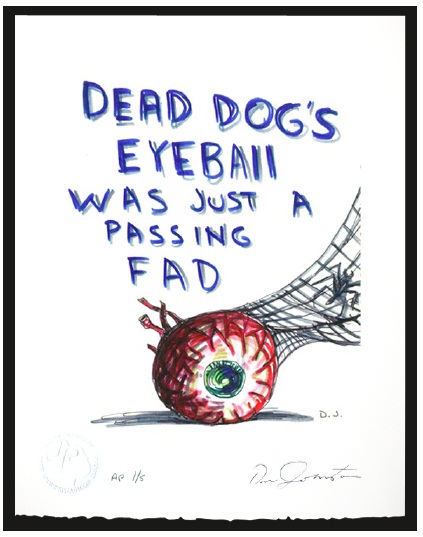
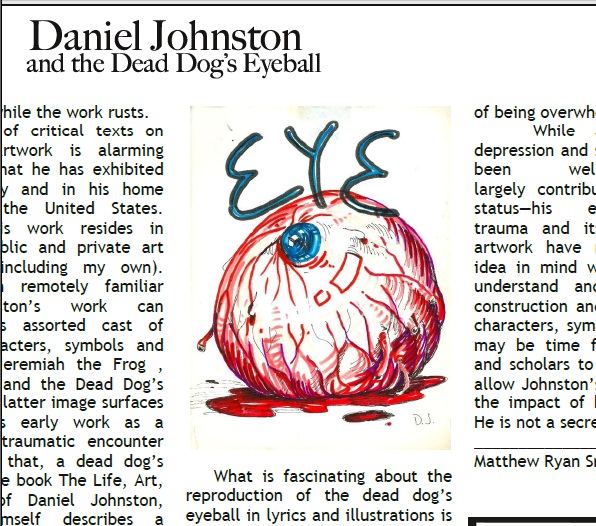
The lack of critical texts on Johnston’s artwork is alarming considering that he has exhibited internationally and in his home country of the United States. Moreover, his work resides in numerous public and private art collections (including my own). Anyone even remotely familiar with Johnston’s work can recognize his assorted cast of unusual characters, symbols and motifs like Jeremiah the Frog (refer to images above and below), Vile Corrupt and the Dead Dog’s Eyeball. The latter image surfaces in Johnston’s early work as a result of a traumatic encounter with exactly that, a dead dog’s eyeball. In the book The Life, Art, and Music of Daniel Johnston, Johnston himself describes a childhood incident where he witnessed a dead dog hanging from a swing set: “He got himself caught on the rope and got hanged. I asked this girl where was her dog and she pointed over at him and said right there.” As the authors of the book point out, the same incident was addressed in lyrics from Johnston’s song “Catie” on the album Fun (1994):
I saw the dog hanging on the swing set
I asked the girl
Where was your doggie at?
I walked on down to see my grandpa yeah!
Well I’ve had a lot of horrors
And I’ve had a lot of fears
But the worst of horror
Is when there’s nothing here
What is fascinating about the reproduction of the dead dog’s eyeball in lyrics and illustrations is that it may be connected to the trauma Johnston experienced when first encountering the dead dog on the swing set. Trauma is characterized by an affective shock that has the capacity to wound the body and the psyche, which in turn causes anxiety, stress and other forms of neurosis. Seeing the dead dog’s eyeball during childhood might have registered trauma in Johnston that affects him well into his adult life and it could have taken the form of an obsession (fig. 4). In one particular drawing from his early work Johnston asks himself in bold text, “WHY DO I KEEP DRAWINGS [sic] THESE SILLY LITTLE EYEBALLS?” Here and elsewhere, the artist is consumed by flashbacks of the dead dog’s eyeball to the extent of being overwhelmed.
While Johnston’s manic depression and schizophrenia have been well-documented—and largely contribute to his mythic status—his encounters with trauma and its relation to his artwork have not. Keeping this idea in mind will help to better understand and appreciate the construction and trajectory of his characters, symbols and motifs. It may be time for writers, critics and scholars to take a step back, allow Johnston’s myth to rust and the impact of his work to swell. He is not a secret anymore. For the Silo, Matthew Ryan Smith, P.H.D.
Tarssa Yazdani and Don Goede, The Life, Art, and Music of Daniel Johnston (San Francisco and Colorado Springs: Smokemuse and Last Gasp, 2006). 33-34.
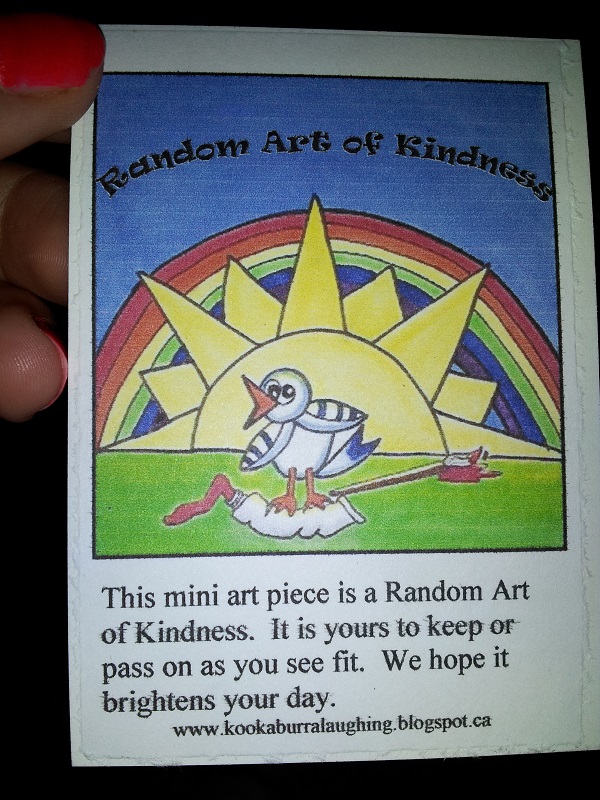
Random acts of kindness come in all shapes and sizes, something as simple as a smile to a stranger, or paying for the guy behind you in the cue at the coffee shop drive-thru counts. The idea is to leave someone, whether you know them or not, with a brightened day and a reminder that there are good people. There is an amazing movement happening in the artistic circles, created with the same purpose, it is called art abandonment and artists from all over are leaving behind their artworks anonymously.
“It’s something that I’ve done for a number of years now, albeit infrequently, usually on beverage napkins and the like,” says deMeng in an introduction to Art Abandonment on his blog. “About ten or so years ago I would walk to the same place by a river and leave a little charcoal drawing. So recently I started this activity up again…leaving little sketches with a note on the back”
deMeng acknowledged that he did not create the idea of art abandonment, but perhaps discovered its use as a random act of kindness as opposed to a political message used by many urban guerilla artists.
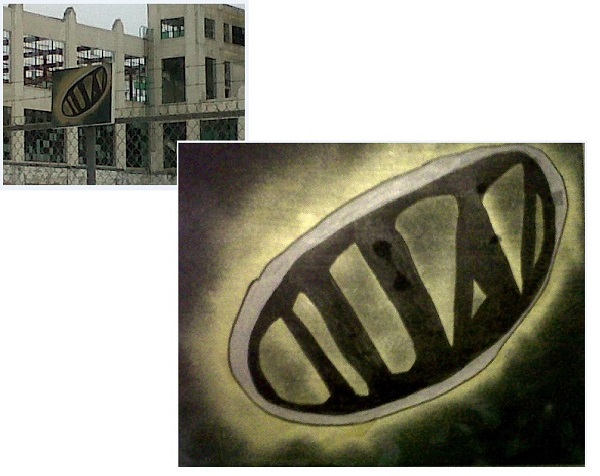
In fact, Haldimand-Norfolk artist Jarrod Barker created several guerilla art installations in Haldimand-Norfolk including one at Simcoe’s now demolished American Can property back in the summer of 2010.
ILIAD. J. Barker. Abandoned canned food factory Norfolk, Ontario.
deMeng outlined some of his theories behind the art of abandoning art and its purpose, including that its good for the heart and a little addictive once you begin and the simple fact that money is tight and giving a gift like this could encourage someone to continue to support the arts.
“I think it’s important to be able to let one’s art live beyond it’s creator, I love imagining what becomes of my art after it is gone…whether given or sold,” said deMeng.
“Some folks can’t seem to let go of their work, even when they sell it. This is a great way to learn to move on.”
The concept is very simple:
1) Create a piece of art.
2) Write or attach a note explaining it is a free gift, purposely left behind including contact information if you so wish.
3) Take a photo of your art and its place of abandonment and then sneak away unnoticed.
I myself am not an art abandoner, although if I had the time and resources I would, but I thought I could offer a unique opportunity for the abandoners I find so much joy in following on social media.
June 30, 2013 I will have departed to Peru for a ten day journey across a wide variety of landscapes including urban centers, Machu Picchu, and the Amazon rainforest.
I invited artists to send me their work in order to abandon on my journey, and I would share the photos of their abandonment locations with the artists as I continue my journey.
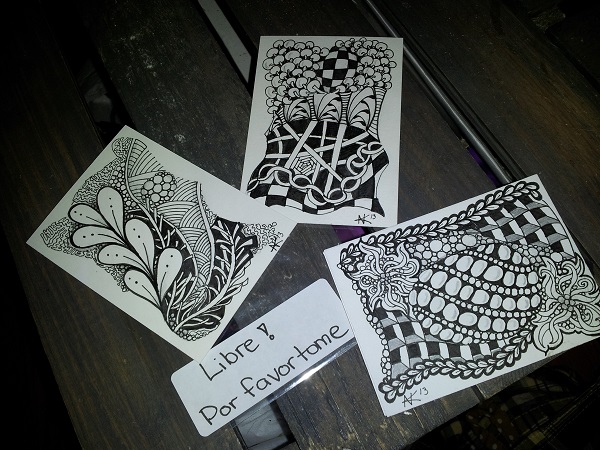
“Machu Picchu is on my bucket list,” said Burlington artist Heather Kuzyk who sent three art trading cards (atc) to be abandoned.
“So if I never perchance to make it there in body at least a part of my soul has been. ”I was excited by the thought of the photos I could take of the abandoned art on the Machu Picchu ruins with the beautiful Peruvian mountains sprawling in the background. Although I sincerely hope some of the finders will share of their discovery, I’m pleased just to imagine how excited I would be if I found something like that in such a magical place. For The Silo, Lacie Williamson.
Post-script: Remember to never install or leave behind work that contains string, toxic or synthetic materials, small pieces of plastic etc. Anything that can harm or interfere with the natural environment or wildlife must never be used.
My name is Olga and I’m a Virtual Reality VR artist/sculptor based in Toronto,Ontario. In 2016 I was hired by Google to create VR experience for YouTube Plus event. This was my first introduction to Google Tiltbrush. I live painted the Toronto skyline in front of hundreds of people.
Since then I was involved in Google projects and many other events and conferences. My VR works were featured on national media chains such as the CBC and Space Channel. I would very much like to share them with you as well. Since Russian is my native language, I often prefer to speak through video and if a picture is worth a thousand words then a video must be worth even more.
I am very passionate about this new medium. I have talent and humor and would love to work on big VR / AR art project. Perhaps there are others like me, looking to collaborate? I would be happy to hear from you.
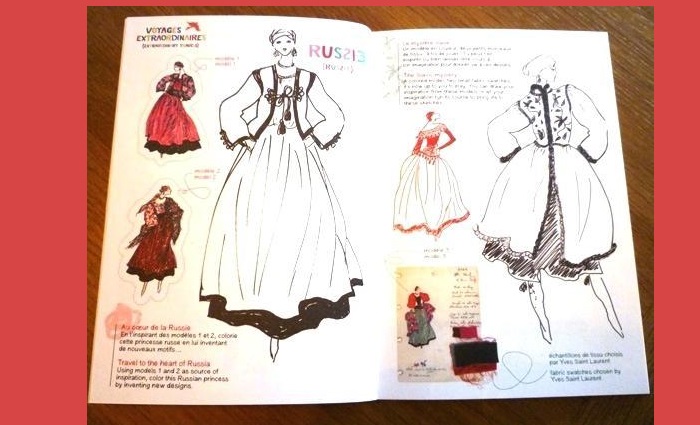
If you enjoy French fashion, art and film and coloring books, sharpen your pencil crayons and prepare to be inspired by two French icons of unparalleled creativity: fashion designer Yves Saint Laurent and playwright and filmmaker Jean Cocteau in these two funky adult coloring books.
“The chicest stress reliever ever.” —Buzzfeed
This elegant, imaginative colouring book explores the dynamic, fanciful creations of iconic fashion designer Yves Saint Laurent, who headed the House of Dior at age twenty-one before launching his own design house at age twenty-five.
The book’s line drawings for colouring are based on many of fashion designer’s original sketches for dresses over the years. In these pages, one can see the breadth and versatility of his creations with designs inspired by harlequins and the Carnival of Venice, Pop Art and Mondrian, and the cultures of Asia, Africa, and beyond. Colourists have much breadth and versatility to design creations of their own, with the accompaniment of full-colour photos of the dresses for reference.
This book is produced in conjunction with the Fondation Pierre Berge-Yves Saint Laurent, dedicated to preserving and promoting the history of the House of Yves Saint Laurent.
JEAN COCTEAU COLOURING BOOK
The Jean Cocteau Coloring Book brings the fanciful, elegant world of artist, playwright, and filmmaker Jean Cocteau to life, serving as a primer on the work of this inspiring artist.
As a playwright, Cocteau is best known for The Human Voice (1930); as a filmmaker, he directed Beauty and the Beast (1946) and Orpheus (1948). A prominent member of the Paris avant-garde (1910s), he formed friendships and professional relationships with Picasso, Stravinsky, Gide, and more. His paintings and graphic art were playful, fantastical expressions exploring mythological themes and subjects, personal portraits, and domestic scenes.
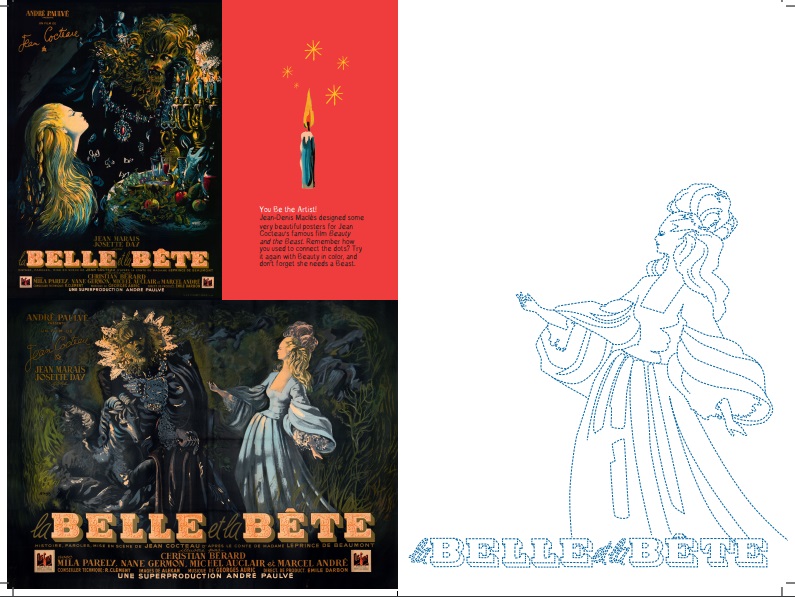
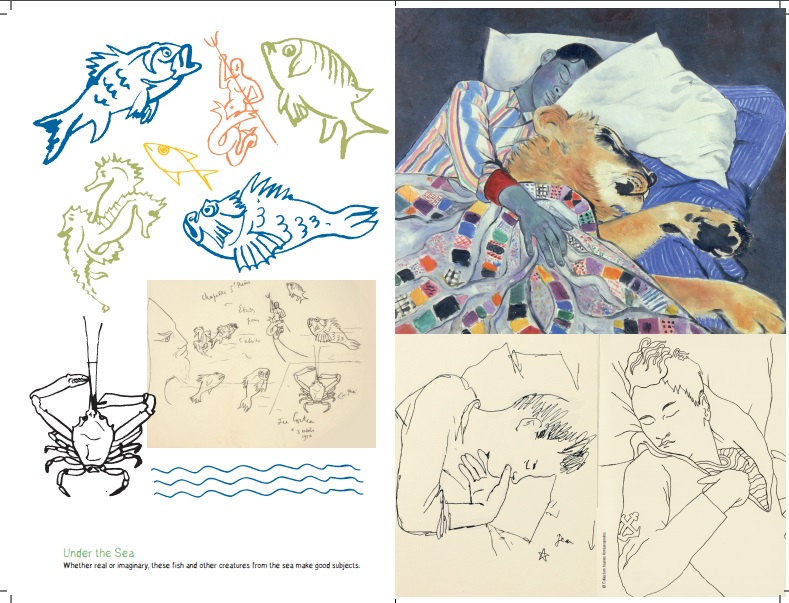
Cocteau’s graphic drawings are ready to be coloured in, alongside original illustrations for reference. Also included are images from the original film poster for Beauty and the Beast, playful doodles that Cocteau included in letters to his lover Jean Marais, and drawings of Parisien women, cats, sleeping figures, circus performers, and other figures emanating from Cocteau’s imagination. For the Silo, Cynara Geissler.
Yves Saint Laurent Coloring Book
ISBN: 978-1-551526-39-3
$12.95 list USD | CDN
US distribution by Consortium
Canadian distribution by UTP
Canadian sales by Ampersand Inc.
Jean Cocteau Coloring Book
ISBN:978-1-55156-40-9
$12.95 list USD | CDN
US distribution by Consortium
Canadian distribution by UTP
Canadian sales by Ampersand Inc.
Back in 2012 The Silo reported on a dark novel titled Zurabia. That book held a plot that seems less like fiction with each passing year. Corrupt bankers, a practically valueless dollar, hyper-unemployment and underemployment, home-grown terrorism, the uptick in natural disasters and the overall lack of trust in our most important institutions – these are some of the reasons all North Americans should be very, very concerned, according to author Peter Dash a world-traveled researcher for Harvard University’s Center for International Affairs.
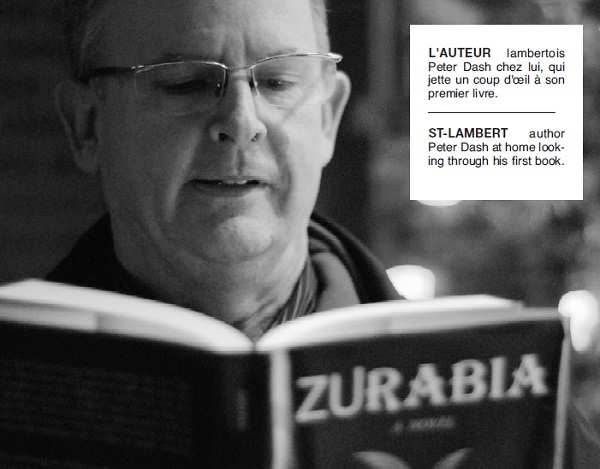
Peter Dash and his novel
“I predict a brutal world ahead of us,” says Dash, author of “ZUrabia,” a book about rogue forces taking over the world’s most important institutions. “Unfortunately, I have been right since my research at Harvard in 1986, when I questioned the viability of government institutions to meet general needs and growing problems, both domestically and abroad.”
The pragmatic holiday shopper this year will purchase items to safeguard their families against these threats, which have been long in the making and won’t disappear quickly, he says.
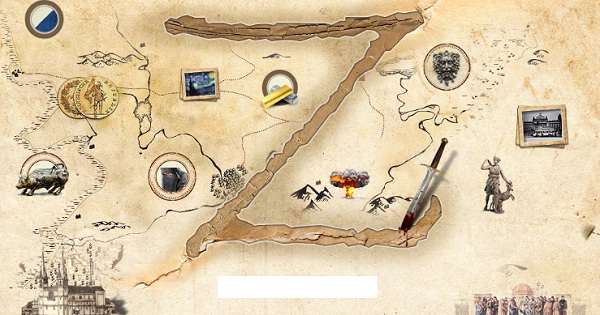
From Dash’s homepage- a map of Zurabia complete with mountains and a mushroom cloud. Biblical ! CP
“Terrorism wasn’t inaugurated with 9-11; extremism in Muslim sects has been growing for decades, and Neo-Nazi groups are starting to flourish in failing states like Greece,” he says. “The dollar has been steadily losing its value since the creation of the Federal Reserve in 1913; climate change has been on the radar for quite a while; and there have been greedy bankers since, well, banks have existed.”
“If you’re confident that everything is sure to be okay, then you’re not paying attention,” he says.
He offers a four-point survival strategy for holiday and everyday shopping:
• Gold is good: The dollar has lost 95 percent of its value in 100 years, and it will continue losing value. As
the Reserve continues to flood money into the system, thereby reducing current or potential value, more inflation is inevitable, acting as yet another tax on wages. So, collect and buy any gold that you can and consider spending federal notes while they’re still worth something to businesses. Think about your
jewelry, and buying more. Silver is a good option if gold is too expensive, and there are Exchange Traded Funds, or ETFs, that are backed by physical gold. A reputable banker or broker can help explain for those who are interested. “TD Ameritrade or Charles Schwab may be good places to start getting information on gold and silver ETF trading,” according to Dash.
• Inflation: Spend your money now or smartly invest it before you lose it. Remember, banks often give clients less than one percent on many accounts, but inflation on food and real items we use, like gasoline, are going up by much more. In essence, your banker is stealing your money through the assistance of the Fed, which is killing your savings rate by cheapening money. As if to pour salt on this wound, the bank,
in many cases, lends money at four percent or higher. Rerouting some bank savings/wages by investing in canned food, for example, may protect you against the scourge of food inflation, as well as other disasters.
• Worthy purchases: With food and water, a failed society puts a premium on additional goods. They include home insulation, gardening tools and materials, computer programs and language learning kits – perhaps Spanish or Chinese – because of the increasing prominence of other cultures. Guns, security systems and other measures to protect one’s home will likely prove extremely valuable should law enforcement be spread too thin, or fail as an institution.
• Buy in bulk: Places like Wal-Mart or Costco will help you get the most value with large purchases of food. It’s important to be well-stocked if something happens that results in the emptying of grocery markets, but remember to have adequate space in your house, apartment or cabin for a “safe” room, which is part of a sound strategy for protecting you and your family.
Peter Dash has been a teacher, professor and corporate trainer for the last 17 years, working in Saudi Arabia, the former Soviet Union and China. He has an applied science degree in forestry from the University of British Columbia and a Masters in applied teaching from Southern Queensland in Australia. He was a researcher in world (dis) order and youth groups at Harvard University’s Center for International Affairs, started by Henry Kissinger. He follows the investment field intensely, focusing on commodity funds and trends.
Fifteen percent of his book’s royalties will go to needy students consistent to the many years Dash has worked in assisting voluntary youth organizations. He lives on a small tropical island that is stocked with the finest well water, fish and food. Dash invests in Gold ETFs and commodity trading companies.
I first took notice of this film because of where I live- which is not that far away from Long Point, Ontario, a mecca for birdwatchers. I find that it’s a more immersive experience to watch a movie that is connected thematically in some way to the sorts of activities that the area I live in has to offer. This reinforces the suspension of disbelief while watching and serves to supercharge the imagination. If you live in a seaside community and you’ve ever watched Jaws followed by a bit of swimming you know exactly what I mean.
Back to the birds
The main story arc of The Big Year goes a little like this: A ready-to-retire-but-not-quite-sure-its-the-right-time-to-retire businessman and a mid-thirties-divorced-unemployed-savant (he can identify any bird just by hearing a few notes of its birdsong) aim for beating the current single year record of bird sightings. In the parlance of the ‘birding’ community, this is known as doing a ‘big year’. The current record holder, played by Owen Wilson, is the rock-star of the ‘birding’ community and is completely obsessed with stopping anyone else from beating his record- even if this means missing the birth of his child and ruining his second marriage.
Highly competitive obsession
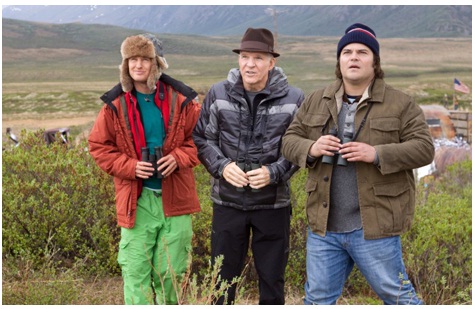
Jack Black, Steve Martin and Owen Wilson in the The Big Year.
I always believed that birding was a slowly paced albeit serious hobby but this movie turns the notion on its head. The story develops and moves quickly. The characters are highly competitive and race against each other as the suspense and intensity builds.
The Big Year is satisfying, clever and funny . If you are a birder there is a good chance that you will love this movie (especially if you can relate to the obsessive compulsive behavior of the main characters) but then again you might end up blaming this movie- you might decide on doing a big year and to hell with anything and anyone in your path. For the Silo, Doug McKenzie.
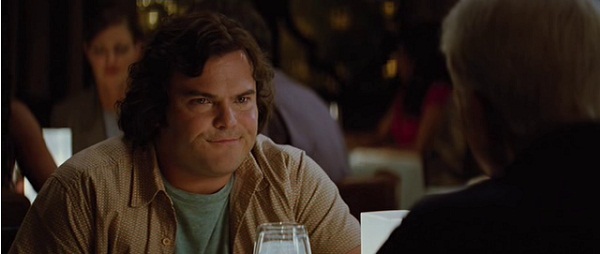
Jack Black’s character feeling bad (but not that bad) about Steve Martin’s character picking up the dinner tab.
Rejection. “We lived in Northern New Mexico. I was standing in front of our house drinking a cup of tea. I heard the car drive up and the door bang shut. Then he walked around the corner, and without warning, he told me he was having an affair and he wanted a divorce. I remember the sky and how huge it was. I remember the sound of the river and the steam rising up from my tea. There was no time, no thought, there was nothing–just the light and a profound, limitless stillness. Then I regrouped and picked up a stone and threw it at him.” -Pema Chodron, When Things Fall Apart
This quote, about the moment Pema Chodron’s life began to change, the moment she experienced true groundlessness, applies to so many circumstances in life. Whether we are experiencing the rejection of a lover or spouse, or rejection from a gallery, grant application, art school, the list goes on and on, it is not uncommon for it to feel like the ground has slipped from beneath your feet. When the floor opens up and swallows you whole, it is human instinct to close up, distract, do whatever it takes to make the feeling go away. These are the moments when we must strive the hardest to open up and soften, allow whatever we are feeling to wash over us, and let that be okay.
If you are an artist, you may have tried applying for a grant. You may have given up after a rejection letter or two. But do you know that for every twenty grant applications you complete, you might receive one or two. Might. There are absolutely no guarantees, and the grant writing field is highly competitive. It is important to understand this going in and to have not only a system to keep churning out applications (because, after all this is an important part of many artists’ income and should be treated as such) it is also absolutely critical that you have your head firmly on your shoulders prepared to deal with the pain of rejection.
Let’s face it, rejection always feels personal. You put a piece of yourself out into the world only to have someone tell you it isn’t what they’re looking for. This hurts. And again, that’s OK.
What is important is that you never let the hurt get the best of you. Do not internalize rejection. Remind yourself that you are one of many. You are relying on the subjectivity of a person or group of people, and just because you do not win favor does not mean your art isn’t any good. Rather, it means your art wasn’t what they were looking for on that day for that particular thing. Accept this and move along.
Often, rejection has nothing at all to do with you. This is very difficult to get the mind around. Very often rejection is about the unspoken details being sought that someone else might happen to present.
Buddhist thought teaches us to accept groundlessness, work with it, allow ourselves to sit with it. We are all in the habit of glossing difficult emotions. We self-medicate sometimes with substances, or by tuning out and not letting the hard stuff in. Begin to notice when you start to check out and see how it feels to just be still with the difficult stuff.
Learning to deal with rejection will serve you in many ways. You will find the strength to continue your mission no matter what happens, and you will do so with grace. You will learn that just because you are not chosen one time doesn’t mean you shouldn’t try again. Often, grants and galleries invite those who are not chosen in one round to apply again. And again. The people who run things like this understand what you must begin to internalize–that it really isn’t about you.
If you begin to incorporate these things into your consciousness, eventually they will become part of the fabric. You will begin to live by the new way of thinking you have cultivated. A mindset that puts rejection into perspective and allows you to pursue your forward momentum no matter what.
Brainard Carey
Life is full of rejection, big and small. Hiding away won’t get you far. Choosing the path of least resistance may seem like the easy way but it is a road to nowhere. Remember, if you are an Artist choosing to make your art into a career, it means putting the most intimate pieces of yourself out into the world for all to see. It is a warrior’s path and requires a warrior spirit. For the Silo, Brainard Carey.
Brainard is currently giving free webinars on how to write a better Artist bio and statement and how to get a show in a gallery – you can register for that live webinar and ask questions live by clicking here.
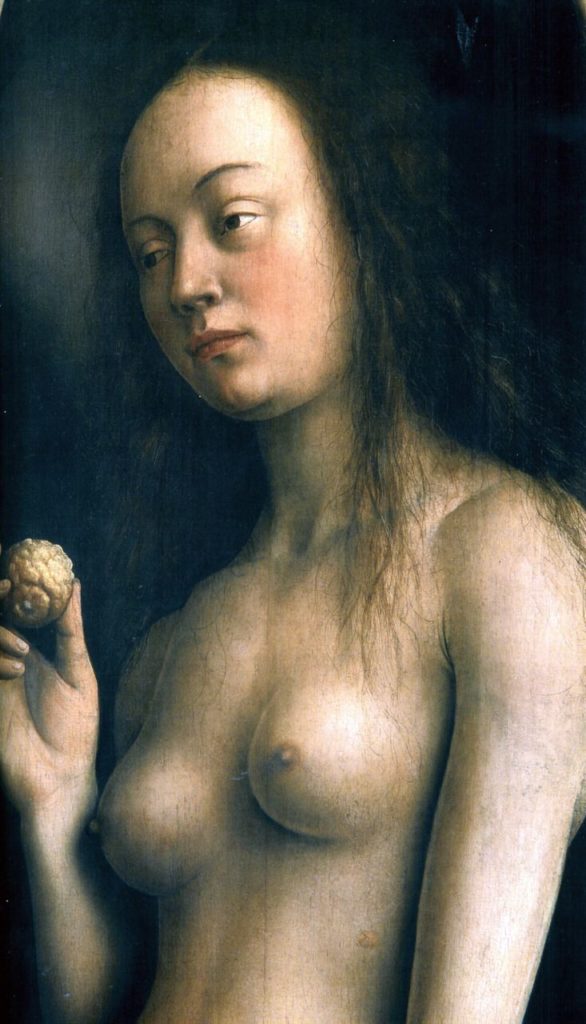
Facebook and other social media sites are blocking masterpieces of “nude” art from Rubens, Bruegel, Van Eyck and others. In an open letter, several top European Museums are asking social networks to reconsider their policy. Facebook has been in the spotlight recently for blocking content including some parts of the United States Constitution and other historical documents and multimedia content.
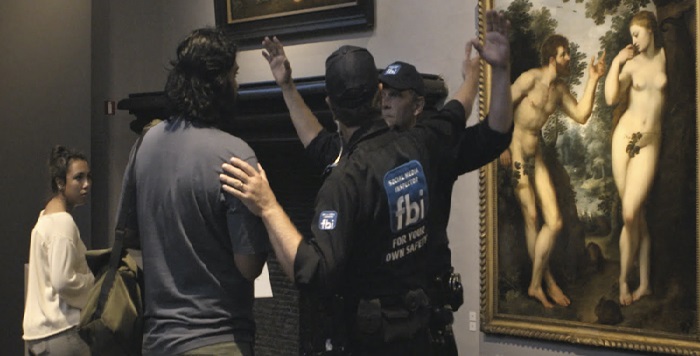
Artistic censorship continues to pursue Peter Paul Rubens. In the 17th century, the Flemish Baroque painter was asked by the Catholic Church to paint camouflaging ‘loincloths’ over certain body parts of his Venus figures. Nowadays, social media networks, including Facebook, go one step further. All breasts, buttocks and cherubs painted by artists such as Rubens are banned on these platforms. ‘Bots’ on Facebook use artificial intelligence to screen for nudity, but do not make a distinction between pornographic images or nudity in art. Flanders – the perfect place to enjoy the Flemish Masters in all their glory – is denouncing this artistic censorship in a playful manner. At the Rubens House, ‘nudity viewers’ with a Facebook account were blocked from viewing nudity by a group of “social media police agents”.
The Flemish Masters are best experienced in Flanders, the number one destination for art lovers. After all, this is where Rubens, Bruegel and Van Eyck lived and worked. Their work can often be found still hanging in the very same places for which they were made. “We want to promote this unique experience,” says Peter De Wilde, CEO of VISITFLANDERS. “Our Flemish Masters attract hundreds of thousands of visitors to Flanders each year and we are proud of this achievement.
With our multi-year program focusing on Rubens, Bruegel and Van Eyck, which was launched in 2018, we are aiming for three million visitors by the end of 2020. At the moment it is not possible for us to promote our unique cultural heritage via one of the most popular social media networks. Our art is categorized as being indecent and sometimes even pornographic. This is such a shame as it restricts the promotion of our Flemish Masters.”
Eve detail Ghent Altarpiece by Jan van Eyck
The agency in charge of promoting tourism in Flanders, Belgium explains that they have invested 30 million US dollars in 2018 to improve the experience of cultural travelers visiting that region, especially in cities like Antwerp, Bruges, Ghent and Brussels. Now they can’t promote some of those museums due to restrictive policies applied by some online social networks.
‘We are for it and not against it’ is what the people of Flanders say. Peter De Wilde explains, “Social media and art have a lot in common. Art brings people together. Social media brings people together, and our Flemish Masters too. This is why we want to enter into discussions with Facebook so that we can use this platform as one way in which to make our art visible. Surely it’s not that difficult to differentiate between cultural heritage and gratuitous nudity?”
VISITFLANDERS position is supported by several top museums in Belgium and around Europe. In an open letter, the institutions ask Mark Zuckerberg to revise Facebook’s policy related to art, culture and heritage. Click here to read the open letter.
“We tried various channels to bring this matter to Facebook’s attention. Unfortunately nobody listened,” De Wilde explains. Flanders hopes the comedy video produced in Rubens’s House will facilitate a discussion to solve the issue and allow users to view this content that is present in encyclopedias and elementary school grade text books. “Flanders is a unique art destination. But because we are naturally modest in Flanders, we do not shout out about it often enough. This stunt enables us to make our presence felt and also honor the spirit of Pieter Paul Rubens. He was an artistic rebel who was not afraid of engaging in social debate. There’s no finer tribute to honor our Flemish Master than by taking up the battle against unnecessary artistic censorship.” For the Silo, Marcos Stupenengo.
About the Flemish Masters.
For over 250 years, from the 15th to long into the 17th century, Flanders was a figurehead for fine arts in Western Europe and the source of inspiration for well-known art movements of the time, such as the Flemish primitives, the Renaissance and the Baroque. Artists were known for their craftsmanship, creativity and technical innovations and they transformed the prosperous and urbanized Flanders into one of the most refined cultural regions with their impressive artistic and architectural creations.
About Peter Paul Rubens, master of female nudity.
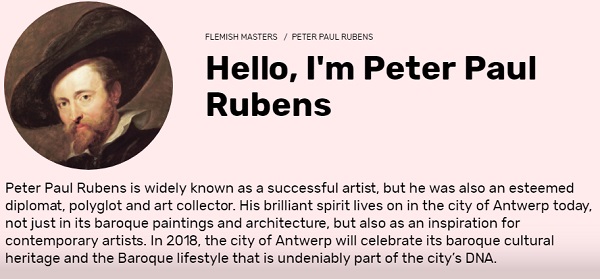
Rubens is the best-known Flemish Master. This Baroque painter, illustrator and diplomat was one of the most celebrated artists of the 17th century. He exerted a particularly strong influence. He was a master of color, composition and painting techniques and also an expert in painting female nudity. His nude figures – which often refer to mythical beings – appear extremely lifelike, made from flesh and blood, with a fair amount of cellulite and with all kinds of body shapes visibly on display.
About Antwerp, the home of the Flemish Baroque movement.
Lonely Planet selected the best cities to visit in 2018 and included Antwerp in its top 10. According to the travel guide, Antwerp is one of Europe’s best kept secrets. And there is certainly plenty to see and do there in 2018. The “Antwerp Baroque 2018. Rubens inspires” festival shows you the finest places in Antwerp: www.antwerpbaroque2018.be
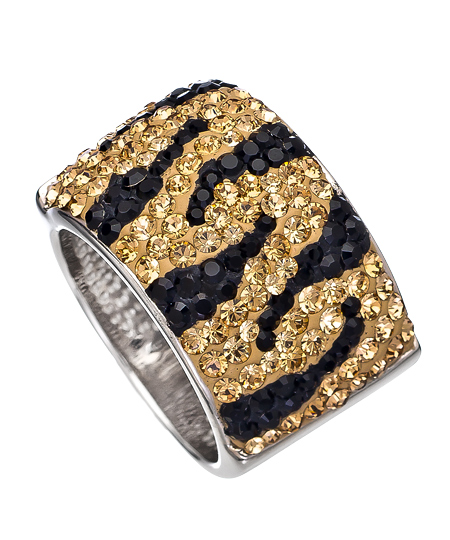
The brief: Wild animal prints have come roaring back onto the fashion scene for the past few years. From handbags and shoes to diaper bags and bed linens, this hot, fun and funky trend seems like it’s here to stay. This trend has also extended into the jewelry world with the dark colored prints and animal-shaped jewelry pieces.
This Chelsea Taylor ring is elegant,moody and made of semi-precious stones. #affordable
Chelsea Taylor leads the pack with a collections of rings, bracelets, and earrings, perfectly designed and crafted to complete your ensemble. How can you enjoy this fun trend and bring out your wild side? E-A-S-Y. By incorporating Chelsea Taylor’s animal inspired pieces into your wardrobe.
Each jewelry piece is designed with perfectly placed Swarovski crystals in various sorts of colors, creating elaborate patterns and designs fit for every occasion. Chelsea Taylor Jewelry is being worn by celebrities such as Debra Messing, Miss Jay Alexander from Project Runway, Jill Zarin from Real Housewives of NY, Tinsley Mortimer and many more.
Inspired by the booming animal print designs showing up seemingly everywhere- another fine CT semi-precious ring. You might have seen Snookie wearing one like this on Jersey Shore.
More About Chelsea Taylor: Chelsea Taylor is all about big and bold, simple and sweet, statement and layering pieces, enamels, floral, retro 70’s and 80’s looks, animal motifs, and more. Everything is customizable and available in up to 19 different shades. Certain colors available, olivine, amethyst, blacks hematite, fuchsia, peach, topaz, smoky brown, and more, for particular pieces retail at about $200 usd. In addition to the website, the collection can be found in The Mandarin Oriental, Las Vegas’ Bellagio, MGM, and retail jewelers / boutiques throughout the country. For the Silo, Belagio Dubois.
Study after study has shown that arts education nurtures students’ creativity and problem-solving skills, competencies that are critical for success in a 21st Century world, but how does dance and movement facilitate healing and transform at-risk youth?
14 year old DTC dancing participants Richard Rutherford Danny Guerrero
New York’s Battery Dance launched its Dancing to Connect programs in 2006. Since that time, the program has spread to 6 continents, 50 countries, 100 cities, and 1,000 schools. A powerful new documentary by Wilderness Films follows six dancers from the dance company from India to Eastern Europe to the Korean Peninsula to the Middle East as they support vulnerable youth helping them to express themselves through movement. The film focuses on the struggles, frustrations, resilience and ultimate transformation of the students and their dance teachers.
Producer Cornelia Ravenal says that as a trauma survivor she understood the power of art to “heal and transform.” Ravenal along with husband partner Mikael Södersten collaborated with Battery Dance Founder Jonathan Hollander to create the documentary because she believed this was a story that had to be told. As global populations continue to grow, migration and increasing social and cultural diversity are reshaping classrooms worldwide. Solutions for integrating and uniting peoples from diverse cultural backgrounds are now sought by schools and communities all over the globe. Hollander believes that “no divide has been too great for the art of dance, the primacy of movement, the common humanity, and expression, to span.”
Battery Dance performs on the world’s stages, teaches, presents, and advocates for the field of dance. The Company is dedicated to the pursuit of artistic excellence and the availability of the Arts to everyone. Battery Dance has produced over 100 original dance works choreographed by its founder and artistic director Jonathan Hollander, in collaboration with a diverse array of composers and designers, and its cast of outstanding dancers.
CMRubinWorld launched in 2010 to explore what kind of education would prepare students to succeed in a rapidly changing globalized world. Its award-winning series, The Global Search for Education, is a celebrated trailblazer in the renaissance of the 21st century, and occupies a special place in the pulse of key issues facing every nation and the collective future of all children. It connects today’s top thought leaders with a diverse global audience of parents, students and educators. Its highly readable platform allows for discourse concerning our highest ideals and the sustainable solutions we must engineer to achieve them. C. M. Rubin has produced over 700 interviews and articles discussing an expansive array of topics under a singular vision: when it comes to the world of children, there is always more work to be done. For the Silo, David Wine.