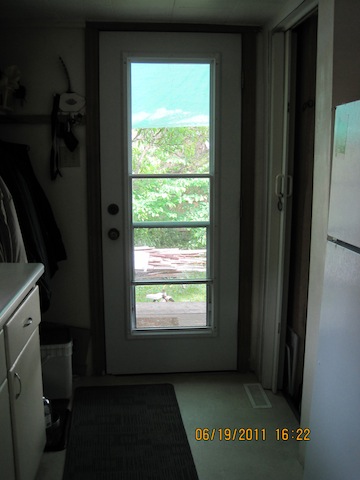
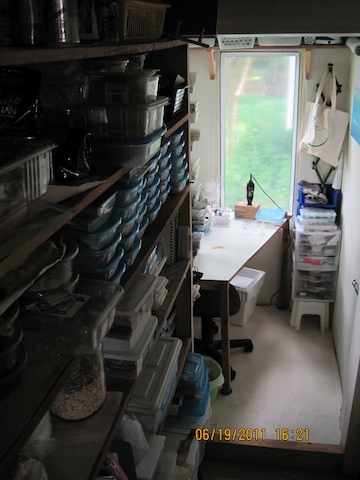
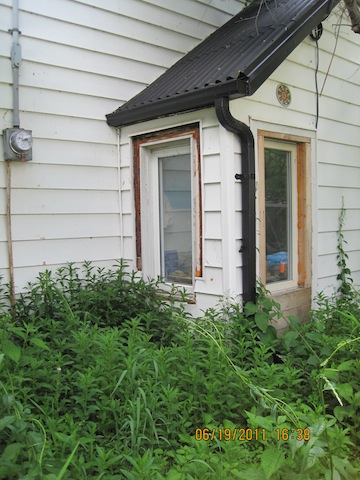
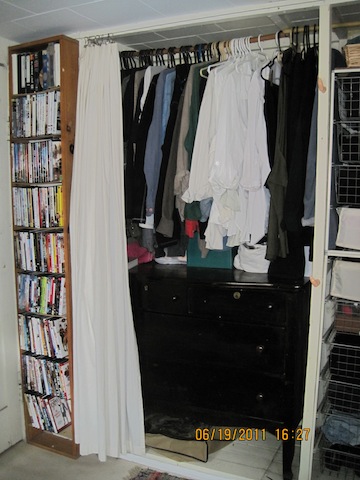
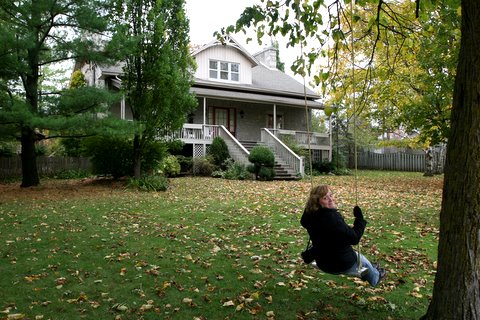
Here are some quick shots I did of our place. For us, the challenge is to use every possible space and yet achieve a feeling of spaciousness. I just did a count of all the space saving/creating measures we have made over the years – about 25 – not counting replacing, enlarging and adding windows and doors – from simple shelves to complex projects involving cutting into walls and making a new room.
It has taken us more than 20 years to do this. We purchased the place and a barren 3/4 acres in 1986 for $20,000. And, it has turned out even better than we dreamed possible.
Even in this tiny space, we can lose each other. David Wells, my partner in all this, has a blog in which he talks about our life here. You may be interested: http://DavesBackPorch.blogspot.com/p/about-me.html
OUR SMALL HOUSE
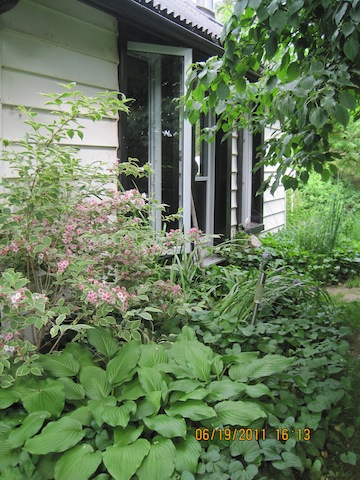
EXTERIOR FRONT
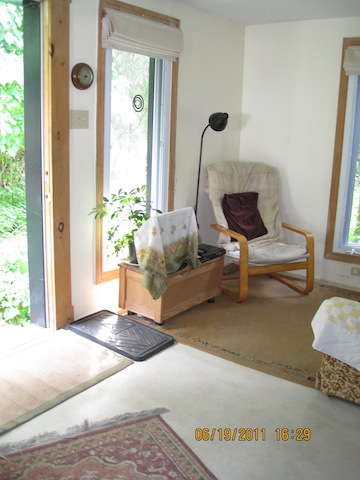
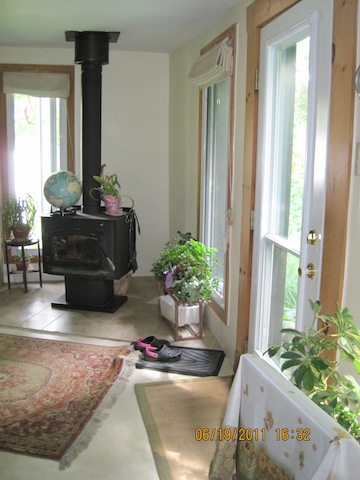
INTERIOR – FRONT
INTERIOR FRONT
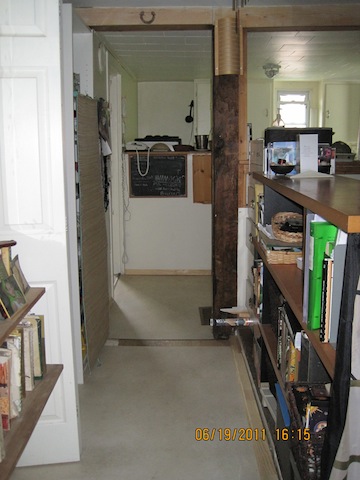
‘HALL’ FROM FRONT DOOR TO KITCHEN
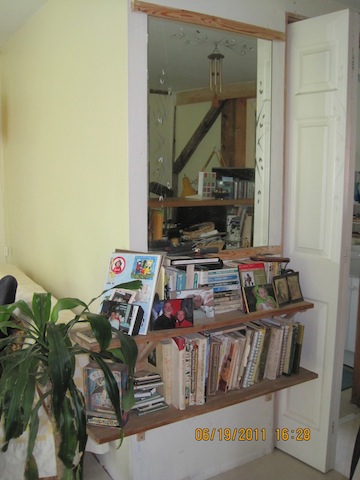
MIRROR IN ‘HALL’ TO REFLECT MORE LIGHT
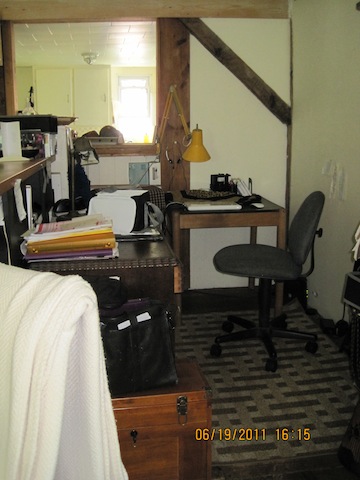
OFFICE/COMPUTER (to the immediate right of above ‘hall’)
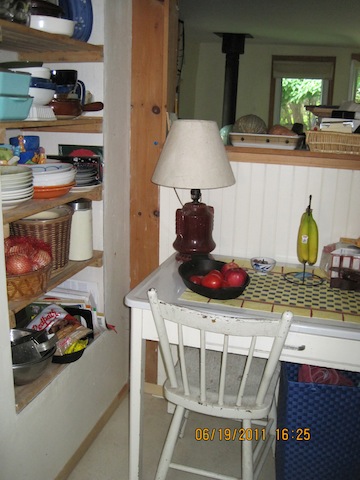
KITCHEN STORAGE AND TABLE (other side of office above)
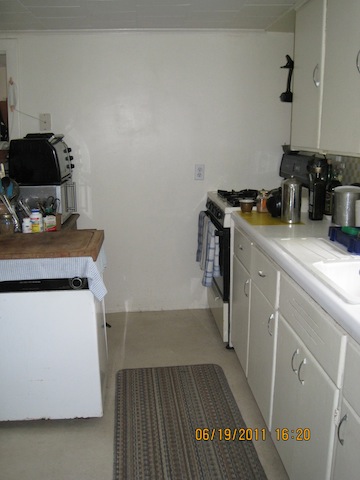
KITCHEN – small but functional. As a former professional
cook, I have found ways to scale equipment way down,
and use my creativity to produce nutritious, interesting meals.
NEW KITCHEN DOOR ENTRY – STAIRS TO JEWELLERY STUDIO AT RIGHT
JEWELLERY STUDIO – PREVIOUS ENTRY
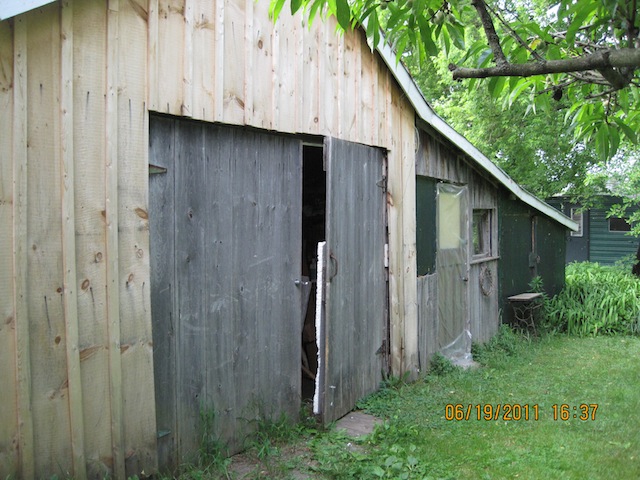
NEW BACK ENTRY
BEDROOM (7′ X 11′)
CLOSET – DVD STORAGE – behind door
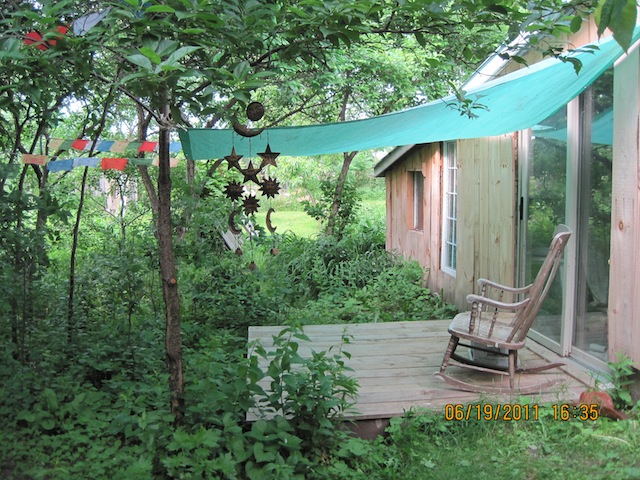
BATHROOM w CLAWFOOT TUB – AND WINDOW LOOKING
OUT TO ‘WOODLET’ (A Spa at Home)
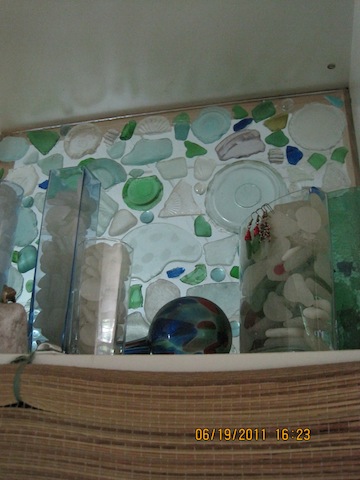
BATHROOM VANITY WITH BEACH GLASS MOSAIC INTERIOR WINDOW
TO LET LIGHT INTO CENTRE OF HOUSE
In 1968 Simon Kotsch got into the army surplus business. It was good to him, but in ways you might not expect. Something began to happen to Simon as he sorted through his bounty of obsolete engine parts and electrical fittings: he noticed that he found the pieces beautiful. An excitement took hold of him. And then he went to work, drilling and cutting and fitting metal components together to make new things. Beautiful things. He felt “caught up,” he says simply. So began a love affair with military-industrial cast-offs that continues to this day. This was the birth of a sculptor and of a mecha artist.Let us throw aside, officially and forever, the artifice of journalistic objectivity.
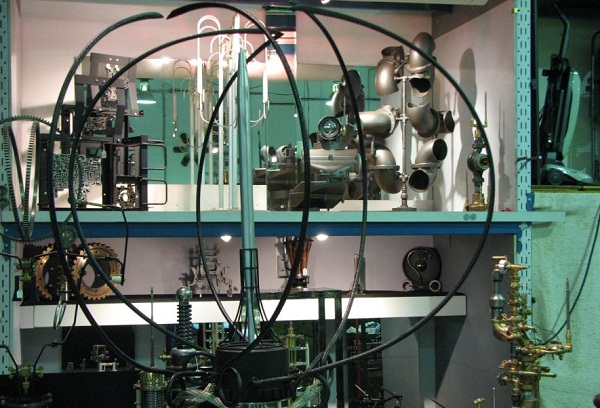
I like this guy’s passion and I like his work. When we visited Kotsch’s Victoria St. Studio in Simcoe, Ontario we were greeted with warm smiles that never went away. Taking joy from your work is one thing, but when you combine joy with the sensibility of a true artist who respects, even loves his materials, the results can be magical.Some of Kotsch’s sculptures look like they could have come from the mind of Jules Verne—grand, monumental machines whose functions border on the mysterious, infused with Kotsch’s concern for symmetry and his acute sense of balance, proportion, and pattern. Others have a strong vertical momentum, like castles or rockets with many levels. But not everything has a sci-fi feel.
Kotsch uses the heft and gravity of larger pieces to create powerful and interesting earthbound sculpture. His ability to recognize, or create, striking patterns makes some of his metal works quite decorative to my eye—and that in no way infringes on their status as works of art.
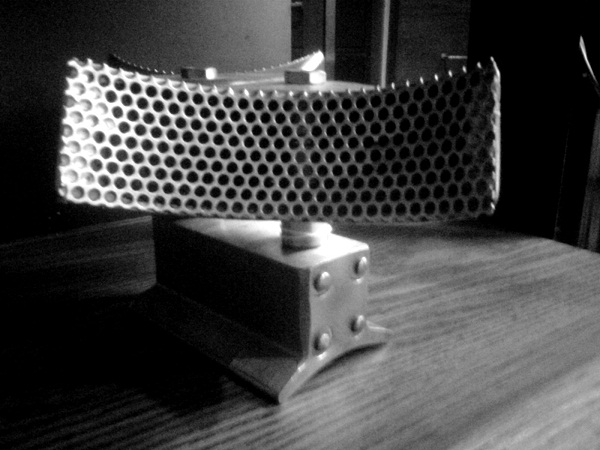
Kotsch says he “savours the natural colour” of each item, whether it’s aluminum, copper, brass or porcelain (used as insulation in old electrical systems). You will not find much (any) painting here. You will also not find much welding. This, by his own admission, is because he’s not very good at it, and mediocre welding would make a sculpture look awful. He cuts and drills to make pieces fit. One technique he has developed is to take slices out of solid machine parts with a band saw, revealing patterns of copper wire within, like opening a geode.
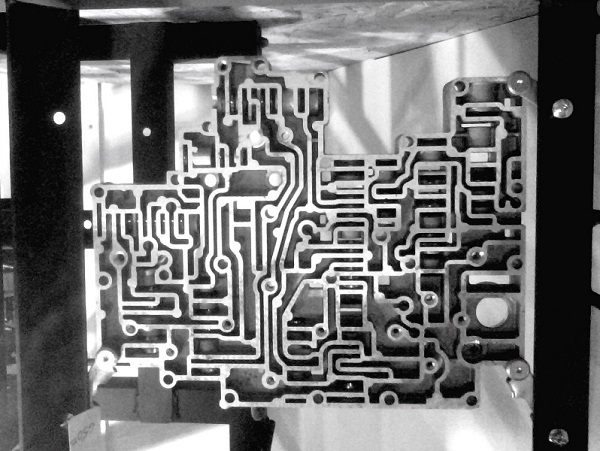
An example of influence: years of working with Army surplus ephemera have inspired Simon’s forms
Simon Kotsch takes obsolete machinery—all of his extensive catalogue of parts predate metric—and turns it into stimulating works of art. We spent about an hour with him, and I left both excited and energized. I, too, had been “caught up.” This is one of the miracles of art for me: through active engagement with an artist’s work a kind of interface occurs between creator and appreciator, mediated through the work itself. I certainly appreciated the skill and imagination of Simon Kotsch, but I think I caught a bit of his love as well. For the Silo, Chris Dowber.
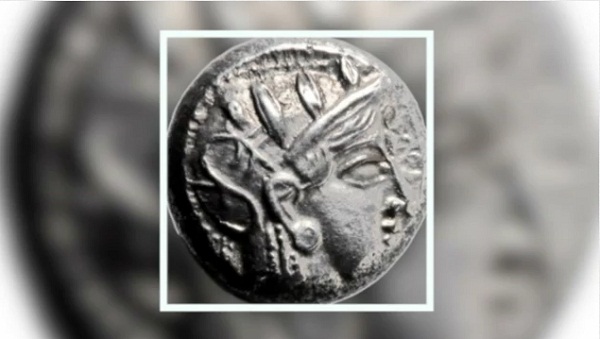
Incredibly rare “Owl type” Silver Drachm (opposite face with Jerusalem lily) image:courtesy Heritage Auctions
The first silver shekel struck in Jerusalem by Jewish forces rebelling against Roman oppression in the first century CE, one of only two specimens known, brought a world record price of $1,105,375 at Heritage Auctions on March 8 as part of the auction of The Shoshana Collection of Ancient Coins of Judea. The coin sold to an anonymous overseas collector. Overall, this auction realized over $7.6 million, with the whole of the collection, consisting of more than 2200 coins in total, expected to realize more than $10 million in multiple auctions this year.
“This Year 1 silver shekel, struck shortly after the Jewish War began in May of 66 CE, is an incredible piece of history,” said Cris Bierrenbach, Executive Vice President of Heritage Auctions. “This is literally one of the very first coins the Jewish rebels struck after the ousted the Romans from Jerusalem, sending shockwaves through the empire. That history, as evidenced by the spirited bidding and the superb price realized, obviously continues to resonate today, more than 2,000 years later.”
The Shoshana Collection, assembled over the course of four decades by an American collector, is the greatest assembly of ancient coins related to the foundation of ancient Israel ever offered, spanning more than 11 centuries.
Other highlights from the collection include an incredibly rare gold aureus as Caesar (69-79 CE), struck at an Eastern mint in 69 CE, likely Tyre, anticipating the subjugation of Judaea, which the Romans achieved with the fall of Jerusalem in 70 CE, which brought $956,000, while one of only two known surviving silver quarter-shekels of Year 1 (May 66-March 67 CE) in existence brought $896,250.
A few of the additional highlights included:
Jewish War (66 – 70 AD). AR half shekel. Year 4. Hendin 1365. TJC 209. AJC 262,25. Samuels 980 (this coin). Extremely Fine. One of six recorded specimens. Realized: $358,500.
Vespasian (69 – 79 AD). AE sestertius. AD 71 Rome. Hendin 1500b. RIC 71,161. BMC 543. Impressive Good Extremely Fine. Realized: $262,900.
Jewish War (66 – 70 AD). AR shekel. Year 5. Hendin 1370. TJC 215. AJC 263,31. Samuels 94 (this coin). Very Fine. Ex: Nelson Bunker Hunt. Realized: $262,900.
Jewish War (66 – 70 AD). Year 5. Hendin 1370. TJC 215. AJC II 263,31. Brand 3. Bromberg II, 309 Good Very Fine. Realized: $179,250.
Divus Vespasian (69 – 79 AD). AV aureus. Struck by Titus, AD 80-81, Rome. Hendin 1581. RIC 230,363. Cohen 143. BN 89. Superb. Realized: $131,450.
Aelia Capitolina (Jerusalem, renamed by Hadrian) Collection, 164 coins. Realized: $107,550.
Titus as Caesar (79 – 81 AD). AV aureus. AD 72-73 Rome. Hendin 1469. RIC 84, 370. BMC 520. BN 73. About Extremely Fine. Realized: $101,575.
Vespasian (69 – 79 AD). AE sestertius. AD 71 Rome. Hendin 1500b. RIC 71,161. BMC 543. Samuels 146 (this coin). Extremely Fine. Realized: $95,600.
Bar Kokhba Revolt (132 – 135 AD). AR sela. First year (132/133 AD). Mildenberg 125,4.1 (this coin). Hendin 1373. TJC 218c (this coin). AJC 264,1c (this coin). Samuels 98 (this coin). Superb. Realized: $89,625.
Bar Kokhba Revolt (132 – 135 AD). AR sela. First year (132/133 AD). Mildenberg 124,3.5 (this coin). Hendin 1373. TJC 218 (these dies). AJC 264,1 (these dies). Samuels 97 (this coin). Superb. Realized: $89,625.
Auction of US coins continues on New York and over the Internet at www.HA.com/Coins through Sunday, March 11.
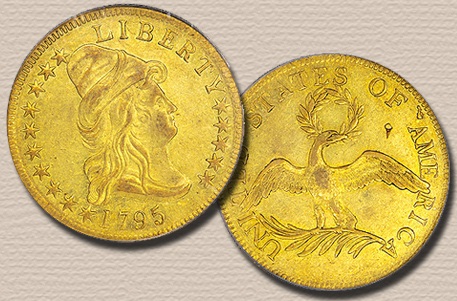
Seldom Seen Selections: One of the finest known 1795 Eagles
The famous 1795 American gold ‘eagle’ coin
The ten dollar gold pieces, given the name “eagle,” were the largest gold coins produced by the first U.S. Mint from 1795 through 1804. Like all early gold coins (and many early silver coins), these pieces did not carry an actual denomination as part of the design.
The 1795 BD1 is considered the first variety coined for the year, therefore it is the first eagle minted by the United States! There are more of them surviving today than all other 1795 varieties combined, and it is actually one of the five most common die varieties of the entire series from 1795 to 1804, a fact that would probably surprise most collectors. Quite a few examples survive in Mint State grades, giving collectors a reasonable chance of obtaining a high-quality example of the Small Eagle reverse design.
Many of the Mint State pieces have prooflike fields, including the coin we are featuring in our upcoming 2012 April 18-22 US Coins & Platinum Night CSNS Signature Auction. Although the fields are not deeply mirrored, they are clearly reflective. The surfaces are exceptional with only a few scattered abrasions. Faint adjustment marks are evident at the center obverse and on some of the obverse dentils. All design elements on both sides are sharply struck, suggesting to some the possibility that this may have been some type of presentation piece. This example is a relatively early die state of the variety, with faint obverse die cracks but no evidence of reverse cracks. Despite the existence of several Mint State pieces, this example is one of the most attractive we have handled.
A curious situation exists for both early half eagles and early eagles. For both denominations there were multiple varieties dated 1795 and only a single variety dated 1796, despite mintages that suggest this is illogical. During the course of 1795, just 2,795 eagles were minted from September 22 through November 27. In 1796, the Mint produced 6,934 eagles from January 9 through December 22. If we take these annual production totals at face value, an average of 560 coins per die marriage were struck in 1795 while a single die marriage produced all 6,934 coins in 1796. Clearly there is something wrong, unless many of the coins produced in 1796 were from dies dated 1795, and we can be certain that this was the case. According to the Guide Book, the 1795 mintage totaled 5,583 coins and the 1796 mintage totaled 4,146 coins, but even those figures are suspect, suggesting a survival rate of 10% for 1795 eagles and only 4% for 1796 eagles. This discussion illustrates the challenge that numismatists have today when attempting to reconstruct the events of the earliest years at the Philadelphia Mint. There were no records of mintages for individual die varieties, and any attempt to make such estimates today is plagued with problems.
In Early U.S. Gold Coin Varieties, John Dannreuther provides estimated mintages for every variety and for the number of survivors for each variety. The only thing we know for sure is the number of die marriages known from 1795 through 1804 (32) and the total mintage for that period (132,714 coins including 122 pieces reserved for assay). By using the midpoint of Dannreuther’s survival estimates, we can also establish an approximate survival rate for the series of 2.5%. Is this enough information to establish original “mintage figures” for each variety or even for each coinage date?
Mark Van Winkle has spent considerable effort over several years attempting to correlate mintage figures with individual varieties, and now feels that it is impossible. There are at least two variables that cannot accurately be determined. First, the exact emission sequence needs to be determined (including both die marriages and remarriages). In a series like the early eagles, the emission sequence alone is enough to give a numismatist nightmares. Once the emission order is known, an accurate estimate of the survivors must be established for each variety and remarriage, and this is nearly an impossibility. Finally, differing survival rates from one coinage date to the next must be pinpointed, a seemingly impossible task. CP for Heritage Auctions Dallas, Texas www.ha.com
Supplemental– The Numismatic Network of Canada for those interested in studying and collecting Canadian coins, tokens, paper money and related numismatic materials http://www.nunet.ca/
AYR, Ontario — In 2011 when AyrSpace held Canada’s only one hundred-woman art show for the
100th anniversary of International Women’s Day https://www.thesilo.ca/international-women-join-forces-through-art/ , the men took note. The idea of the painting exhibition “Men in Business 2012” was born.
“The idea came to me to encourage the hidden talents among us,” said John Redfern, a Customs
Brokerage executive at The Farrow Group just north of Ayr. Redfern helped realize last year’s effort.
“Jill said to me in an email -15 men would be a perfect number for an exhibition,” referring to Jill Yuzwa, Gallerist at AyrSpace, gallery of visual and functional art. And in similar style to the year prior, a call for collaborators went out through social networks. Men from all economic sectors were encouraged to respond – whether their works be an extension of their day to day or their alter-artistic ego.
Cosmonaut painting (far left) by Jarrod Barker.
And they did respond: a Vancouver architect, a celebrated Canadian documentary film maker, a custom furniture craftsman, educators and leaders of education, independent businessmen, lawyers and a specialized medical technician. The artworks are as varied as the gentlemen themselves. And coincidentally there are 15 collaborators. North Dumfries Mayor Rob Deutschmann will be on hand to welcome the collaborators and open the event on Friday February 3, 2012. “Men in Business 2012” will run through Sunday February 26, 2012.
The exhibition is dedicated to Ayr resident Stephen Gross who is currently undergoing cancer treatment. Mr. Gross is perhaps best known in the Region of Waterloo for his excellent work at the Kitchener Downtown Community Health Centre.
The 15 collaborators of Men in Business 2012 invite the community and collectors to this exhibition and have initiated that partial proceeds of their artworks be allocated to NewmanBoysTrustFund.ca in fond memory of Katherine (Bunny) Newman the Gallerist’s cousin. AyrSpace, gallery of visual and functional art, is located at 44 Stanley Street in downtown Ayr. The gallery opened in October 2008 as a socially innovative collaborative and now represents a range of Canadian artists. www.ayrspace.ca For the Silo, Jill Yuzwa.
Media contact:
Jill Yuzwa
AyrSpace
519.632.9030
art@ayrspace.ca
It’s worth saying again: One of the prettiest villages in Ontario is Elora. It’s so nice very time I visit this village of 5, 500 I want to move here. A lot of people have done just that. Elora is a place that grows on you from the minute you arrive. Over dinner at a local favourite eatery, The Shepherd’s PubI struck up a conversation with Nadine McEwen and Stan Winegard who told me they moved here about two and a half years ago from Timmons. Stan said, “It’s a real pretty place and a very welcoming community with an active artistic community. Since Nadine is a sculptor, it fits perfectly into our life style”. Even the owners of this authentic British pub had moved to Elora from Guelph just a few months ago. Throughout the weekend I bumped into others who made the move. Well now, let me think more about this moving thing.
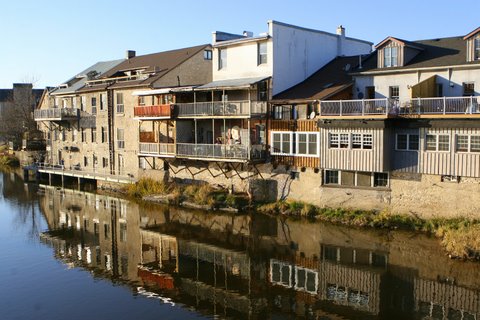
Known for its unique limestone architecture, Elora was founded in 1832 by Captain William Gilkison, a British officer recently returned from India.
Shopping
Elora is an artists’ community specializing in handcrafted and one-of-kind items. The two main streets to stroll are Mills and Metcalfe.
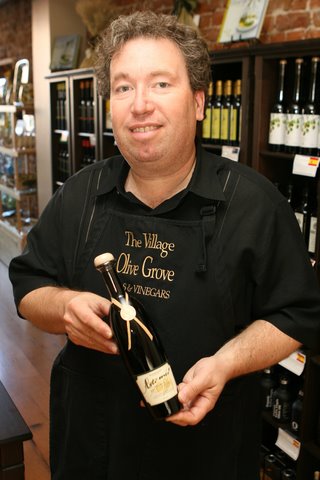
One stand out worth finding on Mill Street, near The Shepherd’s Pub, is The Village Olive Grove (it was the free olive oil tastings sign outside the store that first caught my eye). I met one of the owners, David Medeiros (He’s from Toronto). Medeiros believes their shop is the only one in Canada selling exceptional olive oils and vinegars from around the world. A few other shops that caught my eye were; Sante’s it’s a natural grocery store with organic and fair-trade foods and gifts. A Weed Bit Natural features hemp products and organic clothing. Jammed Lovely is filled with unique one of a kind gift items. Sweet Trash has clothing and accessories from the 1920’s and onwards. At Grand Gourmet KitchenwareI had to have some of the items explained to me as to what they were. You can tell how much time I spend in the kitchen.
The Village Olive Grove occassionally has free olive oil tastings.
Culinary Walking Tour
If you arrive on a Saturday sign up at the Village Olive Grove for the $10.00 walking tour between 1 and 3 pm. During the tour, you’ll sample specially created dishes from eight restaurants while learning about the history and architecture of the area.
One of the prettiest villages in Ontario-
Holiday Happenings
-Santa Claus Parade, Saturday, November 26 and Parade of Lights begin at 6pm.There’s another parade in nearby Fergus on December 3rd at 1:30 pm.
-Starlight Shopping November 24-25 until 9pm.
-Elora Centre for the Arts Show and Sale, December 8-22.
-The annual Elora Festivals Singers’ Christmas Concert series in December is an annual rite of winter.
The Elora Gorge
Here’s the gorge part. Elora is located on the Grand River where the Elora Gorge begins. The gorge has a waterfall that forms behind the Elora Innand continues for 4 kilometres. The Elora Inn is currently closed for renovations. In the middle of the falls is the, “Tooth of Time”. This is a huge rock that has become the symbol of the village of Elora.
The Elora gorge on the Grand River has a waterfall that forms behind the Elora Inn and continues for 4kms.
Where to Stay
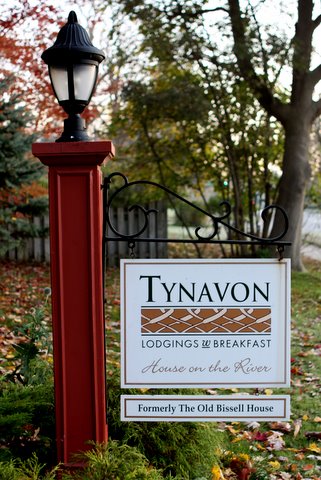
I picked the Tynavon Bed and Breakfast (Tynavon means House by-the-River in Scots Gaelic) to be home for the weekend. This quaint circa 1856 home at 84 Mill Street is a short walk from downtown. It has a gracious verandah overlooking the Grand River. Expect to pay around $125.00 a night for one of the best sleeps you’ll ever have and a scrumptious breakfast. (Silo Direct Link to Tynavon Bed and Breakfastor 1-866-334-3305).
Welcoming gate post- the Tynavon B and B
Here’s the goat part.
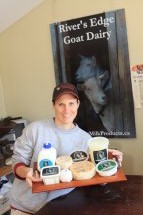
When you force yourself to leave Elora take a 10 minute trip on Highway 6 north to Arthur, Ontario. That’s where you’ll find River’s Edge Goat Dairy.(Silo Direct Link to Goat Milk Products Website or 1-800-209-7330) at 8102 Wellington Road 109, Arthur. If you have children with you they’ll love it. Chances are you’ll find owners Katie Kormet or Will Makxam tending to their herd of 120 mature does. The farm produces, with hard work, milk as well as cheese, yogurt and even soap.
Will told me- “We are a small goat dairy, and we process all of our own milk but we also raise the male goats for meat. In general, we tell our frequent customers, if our chain is down, come on in we are open. However, if our chain is up, we are unavailable but not necessarily closed or away. Not only are we artisan cheese makers, we are farmstead cheese makers. Not many farmers who do it all. We feed and milk our animals and make cheese on the farm. We are a provincially licensed dairy plant, like all other commercial dairy plants in the province. Our advantage: we use the freshest milk and process it into milk yogurt or cheese sooner than our competitors.
Visitors are welcome to visit the farm (no charge) and you might see the goats being milked. River’s Edge Goat Dairy hours of operation vary. Katie said, “Call us ahead of time to see if we’ll be home”.
Definition of art is very difficult to pin down. As an oil painter I look at art one way. An actor would think of it another way. But really the definition doesn’t matter all that much. Art surrounds us wherever we are, if only we choose to see it. Sometimes though, we need to be reminded of that.
When I entered the concentration camp at Terezin in the Czech Republic that November day, the last thing I thought I would see was art. I didn’t know that the children who lived there drew pictures, coloured them, and even wrote poems. But there they were. The paintings and words hung up on the museum wall. The wall was at least 50 feet high. They had miraculously survived Terezin, even when the children themselves had not. I stood in front of that wall for a long time, hesitant to leave. Afraid that maybe I would need reminding again once I was back home.
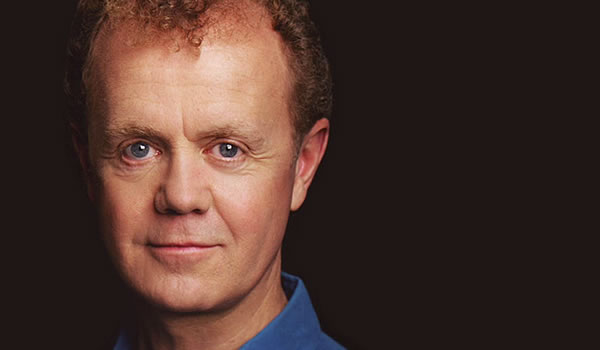
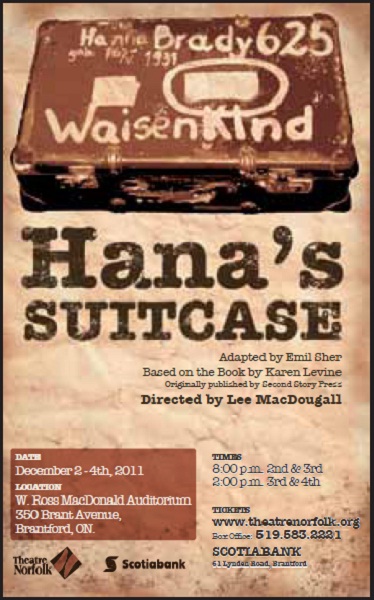
Fast forward a year and Terezin has touched my life again. Hana’s Suitcase, which is set in Terezin, is being presented by Theatre Norfolk and COMPASS Theatre Productions, in partnership with W. Ross MacDonald School for the Blind, and I had the opportunity to meet the cast and talk about my experiences at Terezin. I also had the opportunity to watch renowned actor and director Lee MacDougall guide the cast of talented local and emerging actors through the paces of this emotional, heart wrenching play which took me right back to that wall.
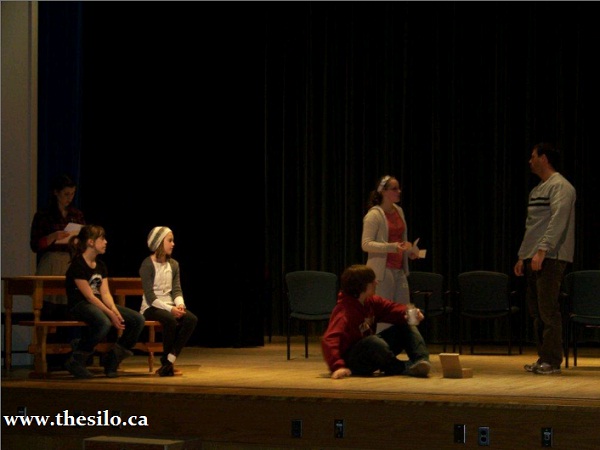
Silo Behind the Scenes: Rehearsal of Hanna's Suitcase
In this play child actors play some of the main characters. Hana was sent to Terezin when she was 11. This play is being performed for over 1200 students in Grades 4-12; Children teaching children and because this play is for everyone; children teaching adults. It speaks to hatred and intolerance. It also speaks to hope and beauty. It’s amazing how children are able to see both at the same time. I wonder when we, as adults, forget how to do that.
I hope that you will take the time to see Hana’s Suitcase and be reminded of all the things that you should never forget while watching art at its finest.
Hana’s Suitcase, adapted by Emil Sher based on the book by Karen Levine, is being presented at W. Ross MacDonald Auditorium Dec. 2nd, 3rd & 4th. Tickets are on
sale at Scotia Bank, Lynden Road, and at the Lighthouse Festival Theatre. For more info and to purchase tickets visit Silo Direct Link to Theatre Norfolk Website
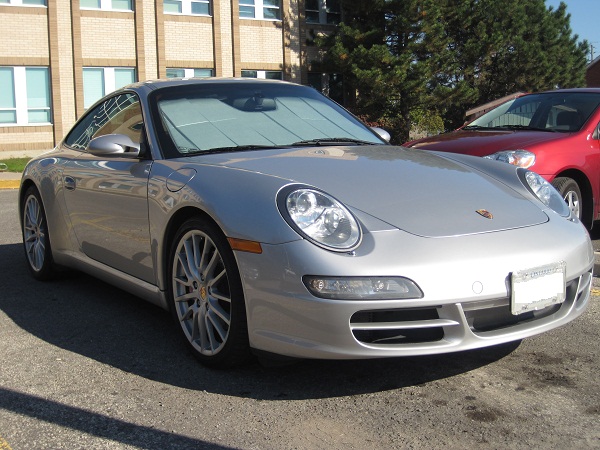
A metallic silver bullet, 300+ km/h roaring blur on the Autobahn. 6th gear, 355+ HP, 3.8L-6cylinder, variable timing at full advance, breathing in through a K&N filter system and exhaling out of a Fabspeed Max-Flo exhaust. Automatically adjusting shock absorbers stiffening as you pass and corner. Porsche’s PSM stability control system controlling the power to the wheels, keeping you on the road as you throttle and shift. Signature auto adjusting spoiler in the up position. If you need to stop in a hurry, having full confidence in Porsche’s best-in-the-biz 4 channel ABS and huge cross drilled rotors.
These are the type of thoughts I get just looking at this beefy, wide stanced, Carrera S (911). As sleek as it is fast, these cars actually keep a “Low Emissions Vehicle” status, and family car class fuel economy. (This is a pretty cool way to be green if you ask me!)
These cars really pay homage to the saying, “If it ain’t broke, don’t fix it!” in the sense that they (Porsche) have used a lot of the same body lines, and same rear-engine design, in the 911’s over 40 years of production. Being of rear-engine design though, makes these cars hard to master driving, truly making the driver conform to it.
By constantly improving on something that has worked since day one, Porsche has kept the focus where it really counts, on the suspension and drive-line.
Marshall Thompson, owner of Thompson Chiropractic (Simcoe and Waterford) and this sweet car, says that he was really drawn to this particular model for a few reasons:
1) He really wanted the signature Porsche model, the 911.
2) He really liked that in 2006 they went back to the traditional 911, oval headlight shape (Porsche had gone away from this for a few years, using a headlight similar to their Boxster model)
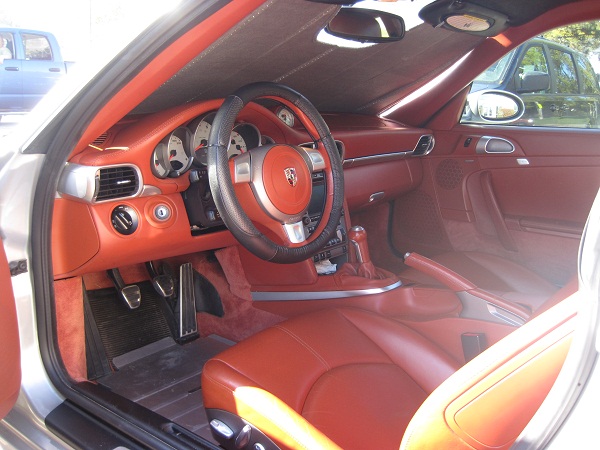
3) The wide body style of the ’06 Carrera S and the impressive much improved interior. This car touting a very stylish and ergonomic, leather interior, navi-system, uber sporty gauge package, and Bose 13 speaker sound system. Unheard of in older 911’s as they were more like a streetable race car than a luxury car.
Don’t be fooled by its good looks though. This 911 is just as wicked as its predecessors. This one apparently easily breaking the 250km/h in 5th gear with a full 6th gear still at the ready.
You might catch this car in the Simcoe or Waterford areas but only on sunny days. Good luck actually catching up to this one. Robb Price is a regular automotive writer for The Silo and owns and operates WC Kustoms in Windham Centre.
[Much like the 911, the seminal electronic band Kraftwerk innovated and pushed the boundaries of form and function. Recommended listening for Porsche owners when you’re ripping through gears CP] Update- Silo Direct Link 2012 911 Porsche makes North American Debut
How can we honestly say that today’s rain and overcast skies influenced our choice for today’s 90’s flashback…umm, urr, we can’t. But this throwback track from R.E.M. rocks. Pack your umbrella for the next few days and if you’ve got room on your ipod (we’re guessing you do, and if you don’t drop us a line explaining why not) , add this song to your playlist. It just might be a cure-all for the turn in the weather. Now where did i put my can of orange Crush?
CP
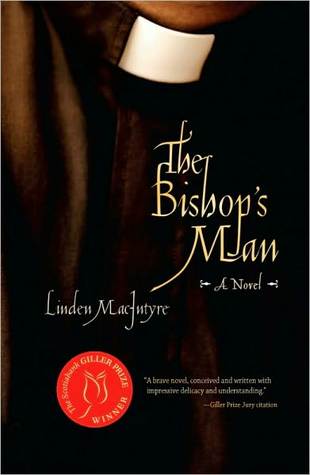
The Bishop’s Man by Canadian author Linden MacIntyre offers a deep and compelling story of one man’s struggle for atonement. The book revolves around a very controversial and current topic, the sexual abuse of children by Catholic Priests. However, this fictional work is much more than a critique on a current situation; it is a journey and dialogue on themes of loneliness, isolation, redemption and spirituality. This novel follows the characters from MacIntyre’s earlier work, The Long Stretch.
MacIntyre begins his story in the present day, sometime in the 1990s, in southern Cape Breton Island. From the beginning, the reader is taken on a journey through the eyes of Father Duncan MacAskill, a priest known as the Exorcist. Father MacAskill, who grew up in this area, is sent for a break from his regular duties, troubleshooting and cleaning up messes made by priests that threaten to embarrass the Catholic Church. Father MacAskill sees this trip home as less of a homecoming and more of a time of spiritual discovery through current events and reflection. MacIntyre weaves present day with the past as he unwinds Father MacAskil’s complicated and somewhat remorseful past.
Father MacAskill is very good at what he does—making troublesome priests disappear by sending them to far off parishes or rehabilitation in Ontario. Upon his return to Creiginish on southern Cape Breton Island, he befriends a young, 19-year-old Danny MacKay from whose father he purchases a boat. Danny’s character is troubled and before Father MacAskill can really reach him and understand the root of his trouble, he commits suicide. This is especially difficult to take in for Father MacAskill when rumours start to swirl that a relationship with a troublesome priest, Brendan Bell, who was sent away from Newfoundland to Craiginish by MacAskill, may have lead to the ruin of Danny MacKay. Upon this revelation, MacIntyre’s story starts to divulge into the past as Father MacAskill tries to sort through his current situation and his spirituality.
The absorbing narrative takes the reader through his missionary work in Honduras in the 1970s, where he has sent to forget what he saw as a young priest between a well respected priest and a young person. The Honduras narrative is threaded between the present day and other reflections. MacIntyre does this seamlessly throughout the novel. Father MacAskill’s stint as dean at St. Francis Xavier is also explored. It is while he is dean at the university he becomes the Bishop’s right hand man and is set out to extinguish potential fires in various churches across Canada. Through all the weaving and reflection, Father MacAskill sorts through his own demons, his past and his family’s problematic and mysterious history.
Although this fictional work discusses a very current and disturbing subject, the sexual abuse of children is never directly addressed or explained in the eyes of Father MacAskill. It serves as a constant undertone to the actions and thoughts of the main character. Linden MacIntyre’s narrative, through the eyes of a troubled priest, provides the reader with a rare insight into the inner workings of the priest hood and the powerful Catholic Church and its place in Canadian culture. For the Silo, Sarah Purdy.
During the Federal elections [circa 2011 Ed], it became clear that the Canadian public interest in an arts and cultural policy had declined since 2008, in fact the majority responded that this policy was unimportant to them in comparison to other policies. This leads me to question the degree of concerns Canadians do have with other policies. Perhaps the overall concerns are too great to allow a focus on more fun or abstract facets of their Canadian lifestyle such as arts and culture, or it may simply be that Canadians overall would rather engage with more mainstream topics.
It is interesting yet disconcerting to see that it is mainly the younger population, ages 18-30, that are the least interested in the arts and culture policy. If the younger generation doesn’t fuel the arts and keep them flourishing who will? In their (or our) defense though, little awareness about the policy and its impact is made known. Personally, I had never heard of an arts and cultural policy before reading the article critiquing the different Government parties’ role in the policy as discussed in The Arts Advocate publication.
The policy involves the government allotted a specific percentage of taxes that go towards varying sectors within the arts, for example advantages for artists or funding for different organizations. Each federal party has their different views on appropriate expenditure in the arts and culture sector, and specifically our Conservatives’ main commitment is to the children’s artistic activity tax credit, support to the Royal Conservatory of Music for a national examination program, and support to the Canadian Periodical Fund (Used to subsidize newspapers not including The Silo. Check the info box found on the bottom of page 2 in most papers to see if you are subsidizing their bottom line- CP).
With the Conservative party now being back in power, it is hard to say if the policy will see any positive growth. Although I understand and admire Harper’s plan to stabilize and improve the markets in the depths of a global recession, I feel it necessary to include arts and culture as a part of this. Canada has such a unique combination of cultures throughout its provinces and these are the people who create and work at the jobs Harper is trying to develop or advance.
So, should not this rich arts and culture naturally be showcased as it is echoed throughout the Canadian business world Harper is focused on? I believe Canadians on the whole would appreciate more recognition for their creative efforts that make our country special. Yes we need economic growth, but there needs to be a balance in the funding between businesses and the arts in order to make for a balanced country and to account for or showcase the people who inhabit it.
It is positive to note that the 2011 Ontario budget indicated spending at Tourism and Culture would grow $76 million.
The estimates confirm that $47 million of this is to continue support of the Community Cultural Fund (used to support local ‘big crowd’ draws such as last year’s Port Dover Marine Festival- http://www.ocaf.on.ca/en/project.aspx?ProjectUID=985 or 2005’s Norfolk County Fall Festival- http://www.ocaf.on.ca/en/project.aspx?ProjectUID=884 -CP), the small-scale (!) capital program administered by the Ontario Trillium Foundation to support diverse cultural organizations. As well, the Ontario Media Development Corporation will be permanently funded, showcasing the province’s commitment to the film sector of the policy and estimates show an increase of $8 million to $25.8 million. Although the Conservative platform for the policy is the most bleak of the Bloc Quebecois, Liberal, and NDP, perhaps a strengthened economy will help to account for areas our country’s arts and culture are struggling in.
In their platform it is stated that our “Government believes that a vibrant cultural, media, and sporting sector is crucial for our well-being and quality of life,” however many artists and cultural advocates still feel that the re-elected Conservatives will fall short in fulfilling the essential aspects of the policy and hearing the voices of those affected. For the Silo, Jennifer Waslowski.
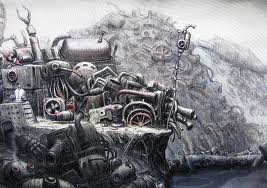
Machinarium is not a new videogame. But if, like many gamers, you overlooked it when it was released in late 2009, you owe it to yourself to go back and pay it some attention. Machinarium may look simple or perhaps even a touch primitive at first glance, but in reality the game is an inspirational fairy tale set in a wondrous, grimy world of living machines; a touching story of struggle, heroism and robot-love.
One of Machinarium’s most remarkable qualities is the way its tale is woven without a single word—there’s not one instance of speech or text in the entire game. Instead, everything is told visually. Dialog between characters unfolds as brief animations, while plot details are filled in through flashbacks.
Even the physical appearances of the game’s denizens, from the diminutive main character to his ruffian tormentors and the strutting, tin-pot police who, in theory at least, guard over the city, figure prominently in the storytelling process, as the pint-sized underdog struggles against bullies and thugs to be the hero his doe-eyed beloved has always believed him to be.
That may be a lot to read into a game that, bizarre setting aside, is a fairly straightforward point-and-click adventure. From a gameplay standpoint, Machinarium is solid if not particularly noteworthy. But the details of its world most definitely are. Each level and everything in it is entirely hand-drawn, providing a unique and whimsical visual style, while the soundtrack, both musical and ambient, is every bit as impressive—possibly more so. The combined effect is nothing short of extraordinary.
Gamers unfamiliar with the standards of “adventure logic,” in which odd, occasionally arbitrary sequences of actions are required to complete tasks and move things forward, may need a little time to get settled, but veterans of the genre will feel right at home. You will collect objects, you will combine objects, and you will use those objects on other objects to make things happen. But the game mechanics are actually quite simple, because everything is visual and its various regions are fairly tightly compartmentalized. Some of the problems you’ll face are real stumpers, however, and while one hint is available for each of the game’s screens, don’t expect it to do much more than give you a very gentle nudge in the right direction.
But that’s okay. Machinarium is a slow-burning experience that’s best savored rather than merely consumed. It crafts gripping beauty out of an ugly world in a way that elevates it from the merely good to the truly memorable. It’s not for everyone: twitchy Halo junkies probably won’t find too much to like in it. But for anyone in the mood for something a little more thoughtful, or who’d just like to see the videogame medium stretch its legs a little bit, Machinarium is a wonderful, magical game that simply should not be missed. For the Silo, Andy Chalk.
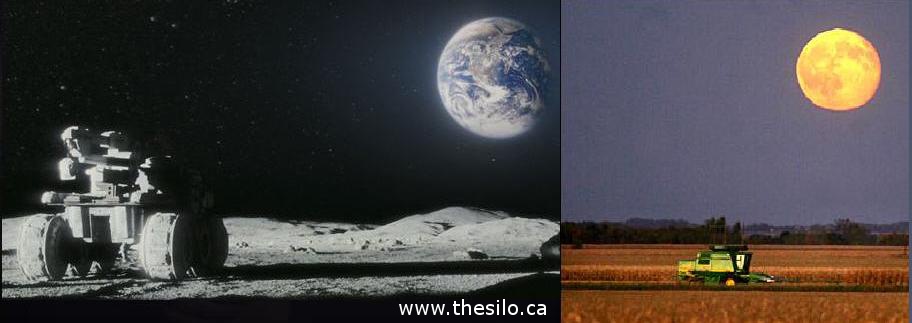
If you’re like me and grew up on a rich diet of 1980’s science fiction films, you should walk (no make that moonwalk) to your nearest video store and ask for MOON. This little gem is an existential journey into the mind of a lonely farmer-astronaut and hits close to home. Sure there’s the usual high contrast and gritty sci-fi production values, but there are also some poignant connections to our rural habitat. Picture a massive, rambling, white combine harvester gathering hay under a full, late fall moon, except that in this case the moon is the earth. A tiny, lonely man is hunched over the controls in an elevated and sealed cockpit. Now remove all semblance of colour, add a few craters and hills, and you get part of what makes this film so familiar and, dare I say, rural.
Growing up here as a boy I imagined that the once plentiful silos and drive-sheds in Norfolk (especially the aluminum ones) were rocket platforms and moon bases. Even the large, four wheeled crop sprayers had a space age look to them. And that is why I felt especially connected to Duncan Jones’ incredibly moving MOON. It pulled me in and felt familiar.
If I had to bet the farm I’d say the production designer looked at both farms and farm machinery while working out the aesthetics of this movie. But more than that, the story pulls at your heartstrings.
Sam (played by the remarkably versatile Sam Rockwell in a breakthrough role) is a lonely astronaut working on the moon, farming the soil for energy until he begins to suffer from extreme isolation- complete with lucid dreams and hallucinations. What follows next is one of the finest surprise plot twists in contemporary cinema.
Satisfying space fiction from son of iconic rocker David Bowie. For the Silo, Jarrod Barker.