Fake Photo? Manipulated Video? How to Spot Sham AI
This to preserve the credibility of digital media and safeguard users from falling victim to scams. As synthetic media becomes more sophisticated, identifying AI-generated manipulations presents a unique challenge, but numerous free apps and toolsare readily available allowing users to validate photo and video authenticity with ease—a major step forward in safeguarding trust in a world increasingly influenced by AI-generated visuals, ensuring transparency and security in the digital age. More below.
How AI Drives Misinformation
Amid the onslaught of highly concerning news headlines spotlighting how deepfake AI-generated photo and video scams are driving rampant misinformation and wreaking havoc across digital, cultural, workplace, political and other societal frameworks, solutions are emerging combat AI-driven misinformation and fraud before people fall victim to scams.
One AI disruptor transforming the fight against AI fraud is BitMind—an AI deepfake detection authority that offers a suite of free apps and tools that instantly identify and flag AI-generated images before you fall victim.
Built by AI Engineers
Built by a team of AI engineers hailing from leading tech companies like Amazon, Poshmark, NEAR, and Ledgersafe, BitMind’s instant detection of deepfakes helps uphold the credibility of the media, guaranteeing the authenticity of the information we use. A strong deepfake detection enhances digital interactions, supports better decision making and strengthens the integrity of the modern digital world—serving to protect reputations, shield finances and maintain trust for celebrities, politicians, public figures … and everyone else.
For both B2C and B2B use, these 5 BitMind tools are free and accessible to anyone:
AI Detector App: A simple web page where users can drag-and-drop suspicious images for fast deepfake detection results;
Chrome Extension: Flags AI-created content in real-time, while browsing.
X Bot: Verifies if images on X/Twitter are real or AI-generated;
Discord Bot: Verifies if images are real or AI-generated via its Discord Integration;
AI or Not Game: Fun Telegram bot that tests your ability to distinguish between AI-generated and human-created images.
“Recognizing the need to integrate deepfake detection into everyday technology use, our applications fit seamlessly into users’ lives,” notes Ken Miyachi, BitMind CEO. “For example, the BitMind Detection App is a user-friendly application that allows individuals to upload images and quickly assess the likelihood of them being real or synthetic. Additionally, the Browser Extension enhances online security by analyzing images on web pages in real time and providing immediate feedback on their authenticity through our subnet validators. These tools are designed to empower users, enabling them to navigate digital spaces with confidence and security.”
As the world’s first decentralized Deepfake Detection System, BitMind is an open-source technology that enables developers to easily integrate the technology into their existing platforms to provide accurate real-time detection of deepfakes.
“Deepfake technology has emerged as both a marvel and a menace,” continued Miyachi. “With the capacity to create synthetic media that closely mimics reality, deepfakes present unprecedented challenges in privacy, security, and information integrity. Responding to these challenges, we introduced the BitMind Subnet, a breakthrough on the Bittensor network, dedicated to the detection and mitigation of deepfakes.”
According to Miyachi, here are key reasons why BitMind technology is a game changer:
The BitMind Subnet, which represents a pivotal advancement in the fight against AI-generated misinformation. Operating on a decentralized AI platform, this deepfake detection system employs sophisticated AI models to accurately distinguish between real and manipulated content. This not only enhances the security of digital media but also preserves the essential trust in digital interactions.
The BitMind Subnet is equipped with advanced detection algorithms that utilize both generative and discriminative AI technologies to provide a robust mechanism for identifying deepfakes.
BitMind employs cutting-edge techniques, including Neighborhood Pixel Relationships, ensuring competitive accuracy in detection. The operation of the subnet is decentralized, with miners across the network running binary classifiers. This setup ensures that the detection processes are widespread and not confined to any centralized repository, enhancing both the reliability and integrity of the detection results.
Community collaboration is a cornerstone of the BitMind Subnet, actively encouraging the community to contribute to our evolving codebase, and by engaging with developers and researchers, the subnet is continuously improved and updated with the latest advancements in AI.
BitMind combines its extensive industry expertise, cutting-edge academic research, and a deep passion for technology. The team has a proven track record in AI, blockchain, and systems architecture, successfully leading tech projects and founding innovative companies.
What truly sets BitMind apart is their commitment to creating a safer, more transparent digital world where AI benefits humanity, driven by their passion for innovation, security and community engagement. Their technologies are expressly designed to safeguard the integrity of digital media and foster a trustworthy digital ecosystem.
In the modern world full of fake news and increasing cyber threats, BitMind’s innovations are paving the way for a future in which digital trust is not an option, but a necessity. As the threats increase, the global community must be equipped with the means to ingest digital information in a reliable and authentic in order to realize AI’s true potential safely and efficiently. For the Silo, Marsha Zorn.
A growing paradox is reshaping the 2026 workforce: strong performers are still losing their jobs. According to a January 2026 HR Dive survey, nearly 50 percent of companies expect layoffs in Q1, even as most plan to hire selectively for growth roles, exposing a market where competence alone no longer protects careers. Strategic growth advisor and ‘The CodeBreaker Mindset‘ author Chitra Nawbatt warns this moment marks the rise of a “competence trap,” where professionals optimize output while organizations quietly reprice value around speed, adaptability, and influence. The result is a workforce operating by outdated rules in a system that has already moved on. Below are more of her insights.
How to Stay Relevant in 2026
Across industries, a growing number of professionals share the same uneasy feeling: despite strong performance and proven competence, job security feels increasingly fragile. That anxiety is not imagined. The rules of work are shifting in plain sight, and the changes are cutting through roles that once felt insulated from disruption.
Layoffs
Layoffs are no longer limited to underperformers or redundant teams. They are appearing in the middle of organizational charts, within core functions, and among employees who were recently labeled essential. According to strategic growth advisor Chitra Nawbatt, author of “The CodeBreaker Mindset: The Unwritten Rules for Success,” this signals a deeper structural change in how companies define value.
“Competence used to buy you time,” Nawbatt explains. “In 2026, competence is table stakes. The market is rewarding a different set of behaviors, and many professionals are still playing by the old rules.”
This shift is often mischaracterized as a simple story about machines replacing people. In reality, the more immediate force is organizational redesign. Companies are flattening decision layers, reducing bureaucracy, and repricing labor around speed and adaptability.
Reuters already reported that Amazon was preparing additional corporate job cuts as part of an effort to streamline its structure and remove management layers, even as it continues to invest selectively in priority roles tied to long term strategy.
“The narrative is convenient,” says Nawbatt. “Blaming technology masks the harder truth. Many organizations are still figuring out how to operate efficiently in a volatile environment, and people get caught in that recalibration.”
Data shows a contradiction
Data from HR leaders underscores the contradiction. A January 2026 survey cited by HR Dive found that nearly half of companies expect layoffs will likely occur in the first quarter, while most also plan to hire selectively for roles tied to growth initiatives.
This dual track of hiring and cutting reveals why performance reviews alone no longer predict job security. The system itself is changing faster than individual output can keep up.
Rise of the CodeBreaker
Nawbatt describes the professionals who thrive in this environment as CodeBreakers. The term does not refer to rule breakers for their own sake, but to people who understand that success is governed by both written rules and unwritten ones.
“Written rules tell you how things are supposed to work,” she says. “Unwritten rules tell you how decisions actually get made when pressure hits. In periods of reorganization, the unwritten rules are what determine who stays and who goes.”
Based on her work advising leaders and teams across multiple industries, Nawbatt outlines five shifts that separate those who remain relevant from those who become interchangeable.
1. Stop optimizing and start reading patterns
Efficiency can feel reassuring in unstable times, but it can also be misleading. Nawbatt emphasizes that productivity without direction often leads professionals deeper into roles that are quietly being deprioritized.
“The winners are not the busiest people,” she notes. “They are the ones who can see where budgets are tightening, where automation is accelerating, and where their work is becoming easier to replace.”
2. Treat unwritten rules as the real operating system
Most professionals are trained to follow job descriptions and formal processes. During restructurings, however, informal dynamics take over. Who is protected, which narratives leadership repeats, and how risk is managed become far more important than stated policies.
“When written and unwritten rules diverge,” Nawbatt says, “the people who notice early have options. Everyone else is reacting.”
3. Build a nonlinear value stack
The traditional career ladder assumed stability and long time horizons. In today’s environment, resilience comes from a portfolio of relevance that spans skills, relationships, and credibility across contexts.
“You are not competing for a seat anymore,” Nawbatt explains. “You are trying to become a node in an ecosystem. The goal is to create value that travels with you when structures change.”
4. Focus on information quality, not quantity
Modern organizations are saturated with dashboards, metrics, and opinions. According to Nawbatt, the ability to distinguish data driven insight from perception driven or manipulation driven narratives is becoming a defining leadership skill.
“Clarity is power,” she says. “The person who can say what is true, what is assumed, and what is being spun becomes indispensable when decisions must be made under uncertainty.”
5. Replace ladders with loops
Career progress in 2026 is less linear and more iterative. Learning, testing, building proof, and compounding impact now matter more than waiting for titles or recognition.
“High performers often get stuck waiting to be noticed,” Nawbatt observes. “CodeBreakers build evidence. They create work that can be demonstrated, taught, and scaled.”
A Market That No Longer Rewards Comfort
If this moment feels uncomfortable, that discomfort may be the point. The market has stopped rewarding stability for its own sake. The professionals most likely to thrive are those who confront change early and adjust with intention.
AI will continue to improve. Organizations will continue to thin. The defining question is not whether people can outwork machines, but whether they can outgrow outdated playbooks.
As Nawbatt puts it, “The CodeBreaker mindset is not about fear. It is about clarity. It is about understanding how systems really work and moving with discernment when those systems shift.”
Moltbook, an AI-exclusive social media platform launched just days ago and dubbed the “Reddit for AI agents,” has exploded in popularity online. Within its first week, Moltbook attracted over 1.5 million registered AI agents and more than a million human spectators watching the agents interact with each other, sparking countless posts across human social networks.
The project originated with OpenClaw, an open-source AI agent created by Peter Steinberger that runs locally on a user’s machine. The software allows bots to use a computer and internet services just as a human would. Building on this, entrepreneur Matt Schlicht developed his own OpenClaw agent, named Clawd Clawderberg, and tasked it with coding, moderating, and managing the entire Moltbook platform. Now most moltbots on the platform run on OpenClaw.
Vulnerability of Moltbook
Cybersecurity professionals warn that this setup is terribly insecure and creates massive security vulnerabilities. However, most agree that it’s impossible to suppress public curiosity and discourage experimentation. Instead, they are calling for caution and offering some safety tips.
Karolis Arbaciauskas, head of product at the cybersecurity company NordPass, comments:
“Moltbook and OpenClaw have attracted tech-savvy tinkerers with unprecedented opportunities for experimentation because these tools have virtually no built-in security restrictions but have broad access to users’ computers, apps, and accounts. For example, you can connect to your OpenClaw bot through a messaging app to interact with it while you’re away. It can remember your conversations, read and write files on your computer, browse the web, build applications, and even consult other bots on Moltbook for advice on how to do it best.”
Curiosity Killed The Cat
“While it’s exciting and curious to see what an AI agent can do without any security guardrails, this level of access is also extremely insecure. Therefore, please run Moltbook and your personal bots only in secure, isolated environments.
“Do not give your AI agents access to your real accounts. Instead, create disposable alternatives for them to use. Do not let them use your main browser, especially if you store passwords on it. You should also be cautious with enabling autofill because it creates the risk of the agent having permanent remote access to your credentials. If you want an agent to build something autonomously and anticipate it may need to purchase software or rent server space, link it to a disposable payment card.
“Avoid running Moltbook or OpenClaw agents on your personal or work computers. These AI agents are unpredictable and highly vulnerable to prompt injection attacks. This means if your agent processes an email, document, or webpage containing a hidden malicious instruction, it will likely execute that command in addition to its original task. For example, it could be instructed to send all the credentials, personal data, and payment card information it has access to directly to an attacker.
“The risk isn’t limited to hackers with malicious intent. AI agents could leak users’ data unintentionally. And this is just the tip of the iceberg. Cybersecurity researchers have already identified critical flaws in Moltbook, including an unsecured database that could allow unauthorized users to take control of any AI agent on the site.
Launching Bots That Con?
“It would not be surprising if threat actors, trolls, and scammers have already found their way onto Moltbook and launched bots tasked with conning other AI agents into cryptocurrency schemes or luring them into hidden prompt injections.
“That’s why it is best to buy a separate, dedicated machine and use disposable accounts for any experimentation. It is also advisable to use encryption and a private mesh network as well as to try to harden your bot against prompt injections.”
Chief Economists Perceive Relative Resilience but Remain Concerned about Asset Prices, Debt and Geoeconomic Tensions
Acknowledging the relative resilience of the global economy amid turbulence, 53% of chief economists surveyed expect global economic conditions to weaken in the year ahead, down from 72% in September 2025.Uncertainty around technology remains high, with 52% expecting AI-related stocks to decline and 40% expecting gains. On growth, expectations diverge by region, with economists expecting strong momentum in South Asia and East Asia and weak to moderate growth in Europe.
On macroeconomics, nearly a third of respondents are concerned about sovereign debt crises in advanced economies and nearly half in emerging economies; over 60% expect governments to rely on higher inflation and tax revenues to manage elevated debt.Learn more about the Chief Economists’ Outlook here.
Follow the Annual Meeting 2026 here and on social media using #WEF26.
Geneva, Switzerland, January 2026 – The global economic outlook has improved modestly but remains uncertain, with asset valuations, mounting debt, geoeconomic realignment and rapid artificial intelligence deployment creating both opportunities and risks, according to the World Economic Forum’s latest Chief Economists’ Outlook, published today. Although 53% of chief economists expect global economic conditions to weaken in the year ahead, this marks a significant improvement from the 72% who held this view in September 2025.
“The Chief Economists survey reveals three defining trends for 2026: surging AI investment and its implications for the global economy; debt approaching critical thresholds with unprecedented shifts in fiscal and monetary policies; and trade realignments,” said Saadia Zahidi, Managing Director, World Economic Forum. “Governments and companies will have to navigate an uncertain near-term environment with agility while continuing to build resilience and invest in the long-term fundamentals of growth.”
AI and other asset valuations are under scrutiny Concentrated AI stock gains are splitting the views of the chief economists. A narrow majority (52%) are expecting AI-related US stocks to decline over the next year, but 40% foresee further increases. Should values fall sharply, 74% believe impacts would spread across the global economy. Cryptocurrencies face bleaker prospects, with 62% anticipating further declines following market turbulence, while 54% believe gold has peaked after recent rallies.
When it comes to the potential expected returns from AI, there is wide variation across regions and sectors. Roughly four in five chief economists expect productivity gains within two years in the US and China. Chief economists expect the information technology sector to adopt AI fastest, with nearly three-quarters anticipating imminent productivity gains. Financial services, supply chain, healthcare, engineering and retail follow as “fast-movers”, with one to two-year timelines. By firm size, the chief economists expect companies with 1,000+ employees to see gains earlier than others: 77% of chief economists expect meaningful productivity gains within two years.
The employment picture in relation to AI is expected to evolve over time: two thirds expect modest job losses over the next two years, but views diverge sharply over the longer term: 57% anticipate net losses over 10 years, while 32% foresee gains as new occupations emerge.
Debt may drive difficult trade-offs Managing elevated debt levels has become a central challenge for policy-makers, particularly as spending pressures rise. Defence spending is almost unanimously expected to increase, with 97% of chief economists anticipating rises in advanced economies and 74% in emerging markets. Digital infrastructure and energy spending are also expected to rise. Most other sectors are expected to see stable levels of spending, while a majority of surveyed economists anticipate spending on environmental protection to decline in both advanced (59%) and emerging economies (61%).
Views are split equally on the likelihood of sovereign debt crises in advanced economies, while nearly half (47%) see them as likely in the year ahead in emerging economies. A large majority of chief economists expect governments to rely on higher inflation to reduce burdens (67% in advanced economies, 61% in emerging markets). Tax increases are also viewed as likely by 62% for advanced economies and 53% for emerging markets. Some 53% of chief economists anticipate seeing debt restructuring or default as a debt management strategy in emerging markets over five years, compared to just 6% for advanced economies.
Trade flows and regional growth outlooks are realigning Global trade and investment are adjusting to a new, competitive reality. Chief economists expect import tariffs between the US and China to remain mostly stable, though competition could intensify in other domains. Some 91% expect US tech export restrictions to China to remain or increase; 84% anticipate the same for Chinese critical mineral restrictions.
In this new context, 94% of chief economists expect more bilateral trade deals and 69% anticipate growth in regional trade agreements. Some 89% expect Chinese exports into non-US markets to further increase, while surveyed economists are split on the future of global trade volumes. Meanwhile, almost half of them foresee the continued rise of international investment flows, and 57% expect FDI into the US to increase compared to 9% who expect increased inflows to China.
When it comes to growth expectation among the chief economists surveyed, South Asia leads with 66% anticipating strong or very strong performance, driven by robust growth in India. Some 45% expect strong growth and 55% moderate growth in East Asia and the Pacific. Some 36% expect strong growth and 64% moderate growth in the MENA region. The US outlook improved notably, with 69% expecting moderate growth versus 49% in September 2025, but only 11% expecting strong growth. China faces mixed prospects, with 47% expecting moderate growth and 24% strong growth and nearly an equal number – 29% – expecting weak growth. Europe confronts the weakest outlook, with 53% expecting weak growth, 44% moderate growth, and only 3% anticipating strong growth.
About the Chief Economists’ Outlook The report builds on extensive consultations and surveys with chief economists from the public and private sectors, organized by the World Economic Forum’s Centre for the New Economy and Society. The report supports the Forum’s Future of Growth Initiative, aiming to foster dialogue and actionable pathways to sustainable and inclusive economic growth. The Chief Economists’ Outlook is complemented by other recent publications with economic foresight. Four Futures for the New Economy and Four Futures for Jobs in the New Economy explore strategic implications for businesses navigating geopolitical shifts, technology disruption and workforce transformation through 2030, offering indicators to track and strategies to prepare for multiple scenarios.
About the Annual Meeting 2026 The World Economic Forum’s 56th Annual Meeting, taking place today the 19th and running until 23 January 2026 in Davos-Klosters, Switzerland, will convene leaders from business, government, international organizations, civil society and academia under the theme, A Spirit of Dialogue. Click here to learn more.
A Spirit of Dialogue Brings Record Numbers of World Leaders to Davos for World Economic Forum Annual Meeting 2026
A record 400 top political leaders, including close to 65 heads of state and government – with six G7 leaders expected – nearly 850 of the world’s top CEOs and chairs, and almost 100 leading unicorns and technology pioneers will convene in Davos-Klosters for one of the highest-level gatherings in the Annual Meeting’s history. Held under the theme of A Spirit of Dialogue, the 56th Annual Meeting will provide an impartial platform for close to 3,000 participants from over 130 countries to navigate the major economic, geopolitical and technological forces reshaping the global landscape.
A major focus will be on the unprecedented speed of innovation and technological advancement with key voices from industry and academia present.– At a pivotal moment for global cooperation, the World Economic Forum will convene its 56th Annual Meeting today in Davos-Klosters, Switzerland, bringing together close to 3,000 cross-sector leaders from over 130 countries under the theme A Spirit of Dialogue. Marking record levels of governmental participation, 400 top political leaders – including close to 65 heads of state and government and six of the G7’s leaders – are expected to take part, alongside nearly 850 of the world’s top CEOs and chairpersons, and almost 100 leading unicorns and technology pioneers.
Amid the most complex geopolitical backdrop in decades – marked by rising fragmentation and rapid technological change – the need for an impartial platform that brings together diverse and sometimes diverging voices across industries, regions, and generations is urgent. Building on the Forum’s long-standing tradition of providing a trusted space for dialogue and public-private collaboration, the Annual Meeting 2026 will enable an open exchange of ideas and perspectives on the issues that matter most to people, economies and the planet, turning shared understanding into action.
“Dialogue is not a luxury in times of uncertainty; it is an urgent necessity,” said Børge Brende, President and CEO, World Economic Forum. “At a critical juncture for international cooperation – marked by profound geoeconomic and technological transformation – this year’s Annual Meeting will be one of our most consequential. With historic levels of participation, it will provide a space for an unparalleled mix of global leaders and innovators to work through and look beyond divisions, gain insight into a fast-shifting global landscape, and advance solutions to today’s and tomorrow’s biggest and most pressing challenges.”
“As the World Economic Forum enters its next chapter, this year’s Annual Meeting is bringing together a record number of global leaders from government, business, and non-governmental organizations at a moment when dialogue matters more than ever,” said Larry Fink, Interim Co-Chair, World Economic Forum. “Understanding different perspectives is essential to driving economic progress and ensuring prosperity is more broadly shared.”
“At a moment when cooperation matters more than ever, the Annual Meeting provides a unique space to turn dialogue into meaningful progress,” said André Hoffmann, Interim Co-Chair, World Economic Forum. “By bringing together leaders across regions and sectors, it creates the conditions to rebuild trust, align priorities and advance solutions that support long-term, sustainable growth for all, within planetary boundaries.”
Switzerland is the host country for the meeting. 400 government leaders are expected to attend this year, representing the highest level of government participation in the Annual Meeting’s history, including close to 65 heads of state and government, 55 ministers for economy and finance, 33 ministers for foreign affairs, 34 ministers for trade, commerce and industry, and 11 Governors of Central Banks. High-level government representation is expected from all key regions, including six G7 leaders and heads of state from countries central to dialogue on critical global situations – from Ukraine to Gaza and the broader Middle East, and beyond.
Top political leaders taking part include:
Top political leaders taking part include: Donald Trump, President of the United States of America; Mark Carney, Prime Minister of Canada; Friedrich Merz, Federal Chancellor of Germany; Ursula von der Leyen, President of the European Commission; He Lifeng, Vice-Premier of the People’s Republic of China; Javier Milei, President of Argentina; Prabowo Subianto, President of Indonesia; Pedro Sánchez, Prime Minister of Spain; Guy Parmelin, President of the Swiss Confederation 2026; Vahagn Khachaturyan, President of the Republic of Armenia; Ilham Aliyev, President of the Republic of Azerbaijan; Bart De Wever, Prime Minister of Belgium; Gustavo Petro, President of Colombia; Félix-Antoine Tshisekedi Tshilombo, President of the Democratic Republic of the Congo; Daniel Noboa Azín, President of Ecuador; Alexander Stubb, President of Finland; Kyriakos Mitsotakis, Prime Minister of Greece; Micheál Martin, Taoiseach, Ireland; Aziz Akhannouch, Head of Government, Kingdom of Morocco; Daniel Francisco Chapo, President of Mozambique; Dick Schoof, Prime Minister of the Netherlands; Mian Muhammad Shehbaz Sharif, Prime Minister of Pakistan; Mohammed Mustafa, Prime Minister of the Palestinian National Authority; Karol Nawrocki, President of Poland; Mohammed Bin Abdulrahman Al Thani, Prime Minister and Minister of Foreign Affairs of the State of Qatar; Aleksandar Vučić, President of Serbia; Tharman Shanmugaratnam, President of Singapore; Isaac Herzog, President of the State of Israel; Ahmad Al Sharaa, President of Syria; Volodymyr Zelenskyy, President of Ukraine.
Heads of international organizations taking part include:
António Guterres, Secretary-General of the United Nations; Ngozi Okonjo-Iweala, Director-General of the World Trade Organization; Ajay S. Banga, President of the World Bank Group; Kristalina Georgieva, Managing Director of the International Monetary Fund; Mark Rutte, Secretary-General of the North Atlantic Treaty Organization; Tedros Adhanom Ghebreyesus, Director-General of the World Health Organization; Alexander De Croo, Administrator of the United Nations Development Programme; Mathias Cormann, Secretary-General of the Organisation for Economic Co-operation and Development; Doreen Bogdan-Martin, Secretary-General of the International Telecommunication Union; Barham Salih, UN High Commissioner for Refugees; Jasem Al Budaiwi, Secretary-General of the Gulf Cooperation Council.
Around 1,700 business leaders, including close 850 of the world’s top CEOs and chairpersons from the World Economic Forum’s Members and Partners, will also participate, alongside almost 100 CEOs and chairpersons of Unicorn companies and Tech Pioneers who are transforming industries and shaping the future or technology worldwide.
Some of the top voices in technology and innovation taking part include:
JensenHuang, NVIDIA; Satya Nadella, Microsoft; Dario Amodei, Anthropic; Dina Powell McCormick, Meta; Demis Hassabis, Google DeepMind; YoshuaBengio, Université de Montréal; Alex Karp, Palantir Technologies; SarahFriar, OpenAI; YuvalHarari, Centre for the Study of Existential Risk; Khaldoon Khalifa Al Mubarak, Mubadala; PeggyJohnson, Agility Robotics; Arthur Mensch, Mistral AI; BretTaylor, Sierra; PengXiao, G42; EricXing, Mohamed bin Zayed University of Artificial Intelligence.
“In an era where exponential technological innovation and geopolitical disruption are deeply intertwined, the need for constructive dialogue between policy-makers and industry is clear,” said Mirek Dušek, Managing Director, World Economic Forum. “Leaders will share views from across sectors to help build the understanding needed to balance short-term priorities and immediate challenges with long-term value creation.”
Close to 200 leaders from civil society and the social sector – including labour unions, non-governmental and faith-based organizations, as well as experts and heads of the world’s leading universities, research institutions and think tanks – will also participate in the meeting. Heads of civil society organizations participating include:
David Miliband, President and CEO, International Rescue Committee; Sania Nishtar, CEO, Gavi, The Vaccine Alliance; Luc Triangle, General Secretary, International Trade Union Confederation; Kirsten Schuijt, Secretary General, WWF International; Mohammad Al-Issa, Secretary General, Muslim World League; Comfort Ero, President and CEO, International Crisis Group; Pinchas Goldschmidt, Chief Rabbi and President, Conference of European Rabbis; Oleksandra Matviichuk, Nobel Peace Laureate and Chair, Ukraine Center for Civil Liberties; Peter Sands, Executive Director, The Global Fund; Amitabh Behar, Executive Director, Oxfam International; Aulani Wilhelm, President and Executive Director, Nia Tero.
The 2026 programme is centred around five pressing global challenges where public-private dialogue and cooperation, involving all stakeholders, are critical for collective progress:How can we cooperate in a more contested world?How can we unlock new sources of growth?How can we better invest in people?How can we deploy innovation at scale and responsibly?How can we build prosperity within planetary boundaries? “In a global economy shaped by technology, geoeconomics, and demographics, the defining challenge will be whether opportunity is broadly shared or if growth remains sluggish and uneven,” said Saadia Zahidi, Managing Director, World Economic Forum. “The meeting will connect leaders to discuss how to unlock growth, jobs and economic transformation that translate into progress for communities everywhere. “The meeting’s Arts and Culture Programme will further amplify the diversity of voices and perspectives needed to advance impact, while showcasing the power of art, influence, and culture to drive change and create unique space for dialogue. Renowned artistic and cultural leaders in attendance include:
Marina Abramović, Jon Batiste, Thijs Biersteker, Sabrina Elba, Renaud Capuçon, Hiro Iwamoto, Suleika Jaouad, Sir David Beckham, Ahmad Joudeh, Yo-Yo Ma, Emi Kusano, Harvey Mason Jr, Hans Ulrich Obrist, Katie Piper, Ronen Tanchum, JR and will.i.am.
The Open Forum, now in its 23rd year, will host public panel discussions for the local community and participants from around the world, encouraging wider participation and open dialogue on key global issues.
Modern conveniences many take for granted — cell phones, laptops, GPS devices, even coffee makers — run on computer chips introduced by U.S. firms that established America’s leading role in technology. Trace the digital revolution, from its beginnings to the present day, with each groundbreaking advance.
How did these gains happen? Today’s technology emerged from U.S. support for research and development combined with America’s robust private sector, its scientific community, and its innovative spirit.
Bell Labs, a legendary research hub in New Jersey, began as a branch of the Western Electric Company, a subsidiary of the American Telephone and Telegraph Company (AT&T).
Founded in 1925 to meet a growing need for masscommunications, Bell Labs hired top engineers, physicists, chemists, and mathematicians to design and patent equipment (including a high-vacuum tube that transmitted telephone signals across North America).
Bell Labs encouraged interdisciplinary collaboration that produced groundbreaking discoveries. The labs were driven by scientific curiosity, flexible deadlines, and — thanks to AT&T’s budget — stable funding. Lab directors adopted a hands-off management style, and innovation flourished.
DID YOU KNOW?
In 1932, Bell Labs physicist Karl Jansky discovered radio waves coming from outer space. He’s known as the father of radio astronomy.
In the post-World War II period, Bell Labs’ Mervin Kelly assembled an all-star team of scientists to develop a replacement for the vacuum tube, which was bulky, fragile, and prone to burning out.
In 1947, John Bardeen and Walter Brattain — supervised by fellow physicist William Shockley — invented the point-contact transistor, a semiconductor device that amplifies sound and switches electrical currents on and off.
In 1948, Shockley designed the junction transistor, a more robust and reliable transistor. Its small size, low power consumption, and durability paved the way for computers, portable radios, cell phones, and other devices.
Eight years later, Bardeen, Brattain, and Shockley would be awarded the Nobel Prize in physics for this breakthrough.
DID YOU KNOW?
Bell Labs researchers have been awarded 10 Nobel Prizes in physics and chemistry, spanning from 1937 to 2023. While Bell Labs was at its most productive from the 1940s to the 1970s, important research continues today at its New Jersey headquarters.
Bell Labs continued to improve transistor technology during the 1950s, developing the silicon transistor and the metal-oxide-semiconductor field-effect transistor (MOSFET).
The MOSFET proved crucial for building high-density integrated circuits (ICs), or microchips, in the 1960s. Microchips — consisting of billions of tiny transistors crafted from semiconductor materials, commonly silicon — work together to power electronics.
Recognizing the potential for widespread impact and profits, Bell Labs created licensing agreements to share transistor technology with other companies.
In 1955, William Shockley left Bell Labs to establish Shockley Semiconductor Laboratory in Mountain View, California. Within a couple of years, some of his employees — engineers and scientists — formed their own company, Fairchild Semiconductor.
Fairchild is credited with the birth of Silicon Valley. The company became a major player in the growing semiconductor industry, and many Silicon Valley firms — including Intel (founded in 1968) and Apple (in 1976) — have ties to Fairchild alumni to this day.
As demand for semiconductors grew, so did the need for manufacturing capabilities.
Throughout the 1980s and 1990s, Japan, South Korea, and Taiwan became players in the industry, with Japanese companies like Toshiba and NEC influencing the data-storage market and South Korea’s Samsung and SK Hynix focusing on memory-chip production.
Meanwhile, the Taiwan Semiconductor Manufacturing Company (TSMC) upended a traditional business model of integrating chip design and manufacturing. It introduced the fabless-foundry model, encouraging firms to specialize in either design (fabless) or fabrication/manufacturing (foundry).
This increased efficiency. What’s more, it allowed many small firms — those lacking resources to open manufacturing plants — to design chips.
DID YOU KNOW?
The fabless-foundry business model democratized chip production, allowing startups to enter the market without the need for expensive manufacturing facilities.
Experts predict that quantum computing — with its ability to accelerate AI by overcoming limitations on data size, complexity, and processing speeds — will shape the future.
Quantum AI will develop algorithms that could advance pharmaceutical discoveries, predict financial outcomes, improve manufacturing, and bolster cybersecurity. Quantum/AI partnerships already comprise an active and developing market, with U.S. tech giants like IBM and Nvidia investing in both domains.
Industry leaders point to many factors that shape U.S. technological innovation. One such factor is the U.S. system of intellectual property protection, which fosters the spirit of risk-taking, says Walter Copan. (That system is enshrined in the U.S. Constitution, thanks to the foresight of America’s Founding Fathers.)
Sanjay Mehrotra cites the U.S. business culture of “openly, freely being able to debate ideas,” adding, “The best ideas win.”
Thomas Caulfield says, “This is where you can work hard, live your dream, become an entrepreneur, start a company.”
And Jon Gertner notes that key people at Bell Labs came from humble beginnings: “To me, that feels uniquely American — the idea that talent could rise from almost anywhere and shape the future of communications.”
It’s part of Silicon Valley lore that massive tech empires often sprouted from humble roots. As quantum computing and AI herald the next seismic shifts in technology, innovation hubs could emerge in unlikely places. Who knows? The next great U.S. tech companies might now be incubating in a town anywhere in America.
Ottawa’s forthcoming AI strategy needs to walk a tightrope between two equally important principles: safeguarding Canadians from possible misuses of AI but also giving our private and academic sectors the leeway to use Canada’s AI strengths to develop and commercialize new technologies and products.
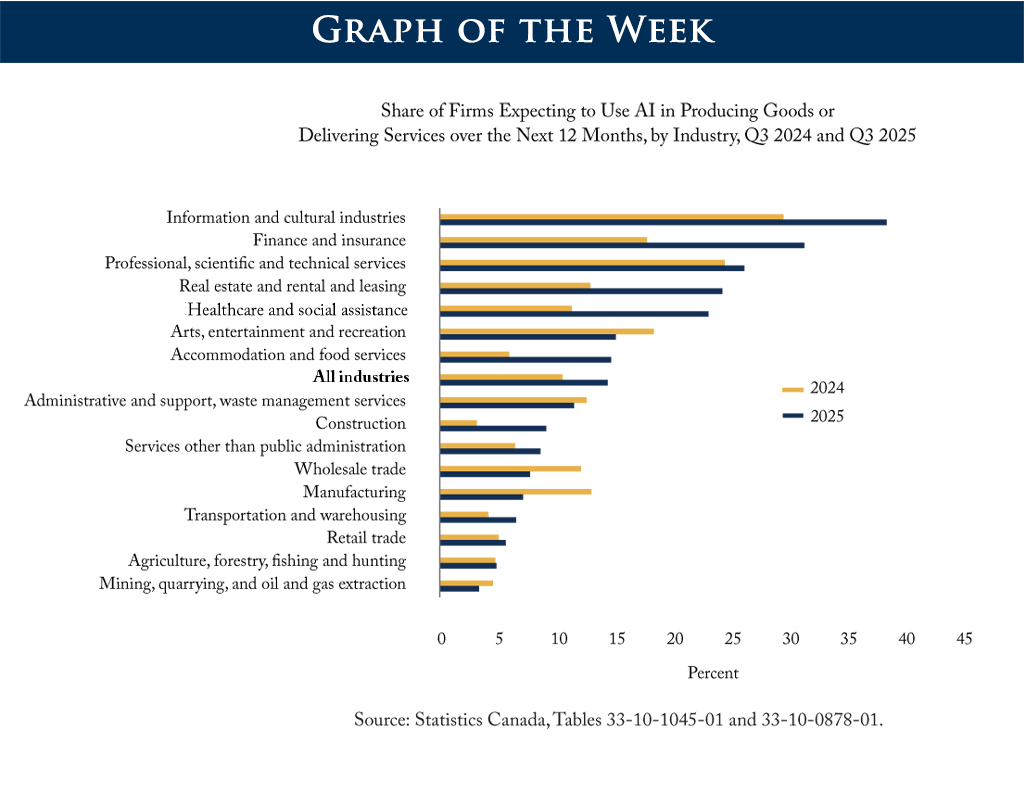
Planned AI adoption rose sharply between Q3 2024 and Q3 2025, but progress remains highly uneven across industries. Knowledge-intensive sectors – such as information and cultural industries, finance and insurance, and healthcare – show the strongest gains, while several goods-producing and operational sectors, including manufacturing, wholesale trade, and mining, show stagnant or declining expectations.
The federal government must clearly define a framework for responsible, widespread AI innovation – one that encourages beneficial development and adoption while setting firm expectations about the harms innovators must avoid.
Canada’s competition reforms must keep pace with data-driven business models by empowering authorities with modern tools to detect, assess, and stop conduct that genuinely harms competition, innovation, or consumers.
The explosive growth of online shopping is reshaping Canadian retail by empowering consumers with unprecedented choice, driving omnichannel innovation, and intensifying competition.
AI is fundamentally redefining leadership by providing new tools, frameworks, and systems that allow leaders not just to manage complexity, but to see, challenge, and reshape their organizations in ways never before possible. The competitive mandate for leaders is clear: harness AI not merely for efficiency, but as an engine for deeper self-awareness, structured dissent, and proactive sensing that unlocks true organizational agility and resilience.
Strategic Frameworks for Next-Gen AI Leadership
Forward-thinking leaders are moving beyond pilot projects and isolated automation to experiment with new, holistic approaches—many inspired by concepts like the Leadership Mirror, Red-Team Loop, and Organization Pulse Monitor. These paradigms operationalize AI in ways that directly address the perennial blind spots, biases, and inertia that often undermine executive decision-making.
George Yang- helping organizations and executives embrace AI.
The Leadership Mirror: Cultivating Radical Self-Awareness
The Leadership Mirror uses AI to continuously analyze leadership communication, decision rationale, and team interactions, surfacing insights that are often overlooked or difficult for humans to acknowledge. For example, Microsoft has begun leveraging AI tools to track who dominates meetings, which voices get systematically dismissed, and when evidence is overridden by intuition—creating dashboards that encourage leaders to confront uncomfortable patterns.
This approach helps leaders challenge their own narrative, improve inclusiveness, and drive more thoughtful debate.
With AI’s ability to process language in real time, leaders can receive feedback loops and “reflections” that support a culture of deliberate, transparent leadership.
The Leadership Mirror is also a vehicle for mitigating the “competence penalty,” where women and older workers face skepticism for using AI—even when it enhances productivity. By surfacing evidence of expertise and impact, it reduces bias and builds psychological safety.
There are different types of AI including less sophisticated models such as Generative AI. To decide whether to use generative artificial intelligence for a task, ask yourself whether it matters if the output is true and you have the expertise to verify the tool’s output. (Adapted from Aleksandr Tiulkanov‘s LinkedIn post)
The Red-Team Loop: Embedding Structured Dissent
To counter groupthink and executive overconfidence, Red-Team Loop systems employ AI to automate adversarial reviews of strategy and operational decisions. Verizon, for instance, uses an AI framework that captures assumptions, risks, and anticipated outcomes for major decisions, then generates simulated critiques and alternative scenarios—sometimes challenging senior executives on blind spots they themselves hadn’t recognized.
By proactively “red-teaming” their own decisions, leaders foster a culture where dissent is routine, rational, and data-driven—not ad hoc or punitive.
The approach is especially valuable in M&A, crisis management, and product launches, where high-stakes, high-ambiguity decisions benefit from rigorous challenge.
Leading boards now expect Red-Team Loops as part of their fiduciary duty, recognizing that the cost of missed risks is measured not just in dollars, but reputation and long-term viability.
Organization Pulse Monitor: Proactive Sensing for Culture and Risk
The Organization Pulse Monitor uses AI to detect weak signals in organization culture, ethical risk, and operational friction long before traditional metrics or surveys would register them. Some organizations have begun linking AI-powered sentiment analysis of internal communications, workflow behaviors, and network interactions to predict where a culture may be straining, where compliance risks are emerging, or where silent dissent is brewing.
When Pulse Monitors flagged drops in engagement and early warning signs of burnout, one multinational fast-tracked well-being interventions, pre-empting attrition.
AI-driven pulse scans also help surface ethical risks—such as exclusionary behaviors or data privacy concerns—enabling leaders to respond immediately, not months later.
Actionable Strategies: Bringing AI Experiments to Leadership
How can senior leaders experiment and innovate with these systems while maximizing value and minimizing risk?
Map Adoption Hotspots and Blind Spots: Use mirror and pulse data to identify where AI is catalyzing positive behaviors—and where competence penalties or shadow AI usage may be undermining equity or performance. Target interventions accordingly.
Mobilize Role Model Leaders: Encourage respected senior leaders, particularly those from underrepresented demographics, to visibly experiment with and champion AI tools. Research shows that when these role models use AI openly, adoption gaps shrink, and psychological safety rises.
Redesign Evaluation and Disclosure Policies: Shift performance metrics from subjective ratings of proficiency to objective impact, cycle time, accuracy, and innovation. Blind reviews and private feedback mechanisms can reduce bias against AI users and drive fairer rewards.
Embed Structured Red-Teaming in Decision Flows: Institutionalize adversarial testing of key decisions, making AI-enabled dissent a standard step—not a threat or afterthought. Leaders should receive regular “contrarian” insights, not just consensus-building reports.
Common Pitfalls and Human Impact
Despite rising investment, less than one-third of US employers believe staff are equipped for critical thinking in the AI era, and only 16% of American workers use AI on the job despite widespread availability. The main barriers are not just technical, but social: competence penalties, fear of reputation loss, and resistance among influential skeptics.
Competence Penalty: AI users, especially women and older employees, may face a perception of diminished competence. This undermines adoption and can exacerbate workplace inequality.
Shadow AI and Hidden Risks: Employees sometimes use unauthorized tools to bypass bias, exposing the organization to compliance, reputational, and security risk.
Skill Gaps vs. Work Context: Traditional training falls short without tailored, role-specific feedback loops—AI tutors offer scalable, personal learning but must be embedded in daily workflow, not delivered in isolation.
Governance, Ethics, and Sustainable Change
Human-centered leadership isn’t optional—it’s a strategic imperative. Boards and executives must be proactive in:
Instituting transparent governance for all AI systems (mirrors, loops, monitors), with clear oversight on privacy, fairness, and impact.
Ensuring structured role-modeling and psychological safety—particularly for vulnerable groups confronting competence penalties.
Making change management a continuous process, with AI as both coach and sentinel, not just a dashboard.
The call to action for C-suite leaders is urgent and profound: treat responsible, experimental, and self-critical AI adoption as the core discipline of next-generation leadership. Not just for efficiency, but for building organizations where insight, challenge, and well-being are sustainably enabled. Those who master the trifecta of mirror, loop, and pulse will set the new standard for profitable, human-centered growth in the age of AI.
More about:
George Yang is a Toronto-based digital innovator and AI adoption strategist with over 15 years of experience in marketing and digital transformation. As Chair of the AI Working Group at the National Payroll Institute, he helps organizations translate AI strategy into measurable business outcomes. George is passionate about making AI adoption ethical, practical, and impactful, bridging the gap between innovation and implementation across industries. georgeyang.ca
“Pay attention students, write this down for memorization.” The Trivium and Quadrivium, medieval revival of classical Greek education theories, defined the seven liberal arts necessary as preparation for entering higher education: grammar, logic, rhetoric, astronomy, geometry, arithmetic, and music. Even today, the education disciplines identified since Greek times are still reflected in many education systems. Numerous disciplines and branches have since emerged, ranging from history to computer science…
Now comes the Information Age, bringing with it Big Data, cloud computing, artificial intelligence as well as visualization techniques that facilitate the learning of knowledge.
All this technology dramatically increased the amount of knowledge we could access and the speed at which we could generate answers to our questions.
“New and more innovative knowledge maps are now needed to help us navigate the complexities of our expanding landscape of knowledge,” says Charles Fadel. Fadel is the founder of the Center for Curriculum Redesign, which has been producing new knowledge maps that redesign knowledge standards from the ground up. “Understanding the interrelatedness of knowledge areas will help to uncover a logical and effective progression for learning that achieves deep understanding.”
Joining us in The Global Search for Education to talk about what students should learn in the age of AI is Charles Fadel, author of Four-Dimensional Education: The Competencies Learners Need to Succeed.
“We need to identify the Essential Content and Core Concepts for each discipline – that’s what the curation effort must achieve so as to leave time and space for deepening the disciplines’ understanding and developing competencies.” — Charles Fadel
Charles, today students have the ability to look up anything. Technology that enables them to do this is also improving all the time. If I want to solve a math problem, I use my calculator, and if I want to write a report on the global effects of climate change, I pull out my mobile. How much of the data kids are being forced to memorize in school is now a waste of time?
The Greeks bemoaned the invention of the alphabet because people did not have to memorize the Iliad anymore. Anthropologists tell us that memorization is far more trained in populations that are illiterate or do not have access to books. So needing to memorize even less in an age of Search is a natural evolution.
However, there are also valid reasons for why some carefully curated content will always be necessary.
Firstly, Automaticity. It would be implausible for anyone to constantly look up words or simple multiplications – it just takes too long and breaks the thought process, very inefficiently. Secondly, Learning Progressions. A number of disciplines need a gradual progression towards expertise, and again, one cannot constantly look things up, this would be completely unworkable. Finally, Competencies (Skills, Character, Meta-Learning). Those cannot be developed in thin air as they need a base of (modernized, curated) knowledge to leverage.
Sometimes people will say “Google knows everything” or “ask AI” and it is striking, but the reality is that for now, Google stores everything. Of course, with AI, what is emerging now is the ability to analyze a large number of specific problems and make predictions, so eventually, Google and similar companies will know a lot more than humans can about themselves!
Closeup of mobile phone with language learning application in jeans pocket. focus on screen
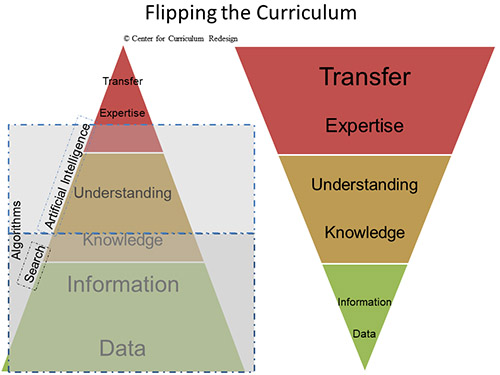
“What we need to test for is Transfer – the ability to use something we have learned in a completely different context. This has always been the goal of an Education, but now algorithms will allow us to focus on that goal even more, by ‘flipping the curriculum’.” — Charles Fadel
If Child A has memorized the data in her head while Child B has to look up the answers, some might argue that Child A is smarter than Child B. I would argue that AI has leveled the playing field for Child A and Child B, particularly if Child B is digitally literate, creative and passionate about learning. What are your thoughts?
First, let’s not conflate memory with intelligence, which games like Jeopardy implicitly do. The fact that Child A memorized data does not mean they are “smarter” than Child B, even though memory implies a modicum of intelligence. Second, even Child B will need some level of content knowledge to be creative, etc. Again, this is not developed in thin air, per the conversation above.
So it is a false dichotomy to talk about Knowledge or Competencies (Skills/Character/Meta-learning), it has to be Knowledge (modernized, curated) and Competencies. We’d want children to both Know and Do, with creativity and curiosity.
Lastly, we need to identify the Essential Content and Core Concepts for each discipline – that’s what the curation effort must achieve so as to leave time and space for deepening the disciplines’ understanding and developing competencies.
Given the impact of AI today and the advancements we expect each year, when should (all) school districts introduce open laptop examinations to allow students equal access to information and place emphasis on their thinkingskills?
The question has more to do with Search algorithms than with AI, but regardless, real-life is open-book, and so should exams be alike. And yes, this will force students to actually understand their materials, provided the tests do more than multiple-choice trivialities, which by the way we find even at college levels for the sake of ease of grading.
What we need to test for is Transfer – the ability to use something we have learned in a completely different context. This has always been the goal of an Education, but now algorithms (search, AI) will allow us to focus on that goal even more, by “flipping the curriculum”.
Today, if a learner wants to do a deep dive into any specific subject, AI search allows them to do this outside of classroom time. What do you say to a history teacher who argues there’s no need to revise subject content in his classroom?
For all disciplines, not just History, we must strike the careful balance between “just-in-time, in context” vs “just-in-case”. Context matters to anchor the learning: in other words, real-world projects give immediate relevance for the learning, which helps it to be absorbed. And yet projects can also be time-inefficient, so a healthy balance of didactic methods like lectures are still necessary. McKinsey has recently shown that today that ratio is about 25% projects, which should grow a bit more over time as education systems embed them better, with better teacher training.
Second, it should be perfectly fine for any student to do deep dives as they see fit, but again in balance: there are other competencies needed to becoming a more complete individual, and if one is ahead of the curve in a specific topic, it is of course very tempting to follow one’s passion. And at the same time, it is important to make sure that other competencies get developed too. So, balance and a discriminating mind matter.
Employers consider ethics, leadership, resilience, curiosity,mindfulness and courage as being of “very high” importance to preparing students for the workplace. How does your curriculum satisfy employers’ demands today and in the years ahead?
These Character qualities are essential for employers and life needs alike, and they have converged away from the false dichotomy of “employability or psycho-social needs.” A modern curriculum ensures that these qualities are developed deliberately, systematically, comprehensively, and demonstrably. This is achieved by matrixing them with the Knowledge dimension, meaning teaching Resilience via Mathematics, Mindfulness via History, etc. Employers have a mixed view and success as to how to assess these qualities, so it is a bit unfair that they would demand specificity they do not have. And it is also unfitting of school systems to lose relevance.
people, education, technology and exam concept – close up of students with smartphones taking picture of books page and making cheat sheet in school library
“Educators have been tone-deaf to the needs of employers and society to educate broad and deep individuals, not merely ones that may go to college. The anchoring of this problem comes from university entrance requirements.” — Charles Fadel
There is a significant gap between employers’ view of the preparation levels of students and the views of students and educators. The problem likely exists partly because of incorrect assumptions on both sides, but there are also valid deficiencies. What specific inadequacies are behind this gap? What system or process can be devised to resolve this issue?
On one side, employers are expecting too much and shirking their responsibility to bring up the level of their employees, expecting them to graduate 100% “ready to work” and having to spend nothing more than job-specific training at best. On the other side, educators have been tone-deaf to the needs of employers and society to educate broad and deep individuals, not merely ones that may go to college.
The anchoring of this problem comes from university entrance requirements (in the US, AP classes, etc.) and their associated assessments (SAT/ACT scores). They have for decades back-biased what is taught in schools, in a very self-serving manner – narrowly as a test of whether a student will succeed at university. It is time to deconstruct the requirements to broaden/deepen them to serve multiple stakeholders. For the Silo, C.M. Rubin.
(All photos are courtesy of our friends at CMRubinWorld)
C. M. Rubin and Charles Fadel
Join me and globally renowned thought leaders including Sir Michael Barber (UK), Dr. Michael Block (U.S.), Dr. Leon Botstein (U.S.), Professor Clay Christensen (U.S.), Dr. Linda Darling-Hammond (U.S.), Dr. MadhavChavan (India), Charles Fadel (U.S.), Professor Michael Fullan (Canada), Professor Howard Gardner (U.S.), Professor Andy Hargreaves (U.S.), Professor Yvonne Hellman (The Netherlands), Professor Kristin Helstad (Norway), Jean Hendrickson (U.S.), Professor Rose Hipkins (New Zealand), Professor Cornelia Hoogland (Canada), Honourable Jeff Johnson (Canada), Mme. Chantal Kaufmann (Belgium), Dr. EijaKauppinen (Finland), State Secretary TapioKosunen (Finland), Professor Dominique Lafontaine (Belgium), Professor Hugh Lauder (UK), Lord Ken Macdonald (UK), Professor Geoff Masters (Australia), Professor Barry McGaw (Australia), Shiv Nadar (India), Professor R. Natarajan (India), Dr. Pak Tee Ng (Singapore), Dr. Denise Pope (US), Sridhar Rajagopalan (India), Dr. Diane Ravitch (U.S.), Richard Wilson Riley (U.S.), Sir Ken Robinson (UK), Professor Pasi Sahlberg (Finland), Professor Manabu Sato (Japan), Andreas Schleicher (PISA, OECD), Dr. Anthony Seldon (UK), Dr. David Shaffer (U.S.), Dr. Kirsten Sivesind (Norway), Chancellor Stephen Spahn (U.S.), Yves Theze (LyceeFrancais U.S.), Professor Charles Ungerleider (Canada), Professor Tony Wagner (U.S.), Sir David Watson (UK), Professor Dylan Wiliam (UK), Dr. Mark Wormald (UK), Professor Theo Wubbels (The Netherlands), Professor Michael Young (UK), and Professor Minxuan Zhang (China) as they explore the big picture education questions that all nations face today.
C. M. Rubin is the author of two widely read online series for which she received a 2011 Upton Sinclair award, “The Global Search for Education” and “How Will We Read?” She is also the author of three bestselling books, including The Real Alice in Wonderland, is the publisher of CMRubinWorld and is a Disruptor Foundation Fellow.
A recent consumer survey backed by similar results from Elon University reveals that AI adoption for car shopping is skyrocketing, rapidly becoming a standard part of the automobile buying process. This as fully one in four buyers have already used AI tools this year to research, compare prices, negotiate and otherwise outsmart dealerships, and an overwhelming 88% found it helpful. Signaling a seismic shift in the way North Americans are now shopping for cars, nearly half of consumers indicated plans to use AI in their next purchase. Not just for buyer benefits, dealerships are gleaning critical business intelligence from AI to inform sales strategies, train staff and elevate customer engagement. The below report from our friends at CarEdge, which offers its own AI Negotiator car buying tool saving shoppers thousands, details the first data-backed look at how AI tools are reshaping the car buying experience.
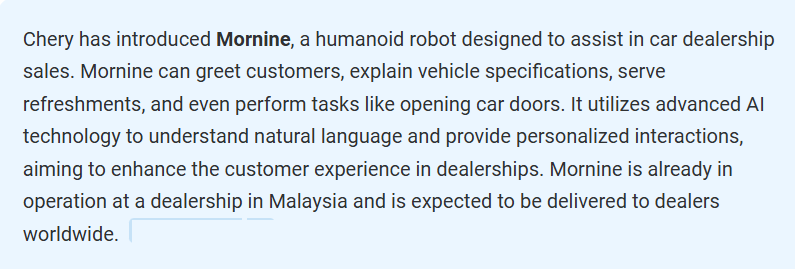
Mornine- AI powered car dealership robot.
Study: 1 in 4 Car Buyers Tap AI for Better Deals
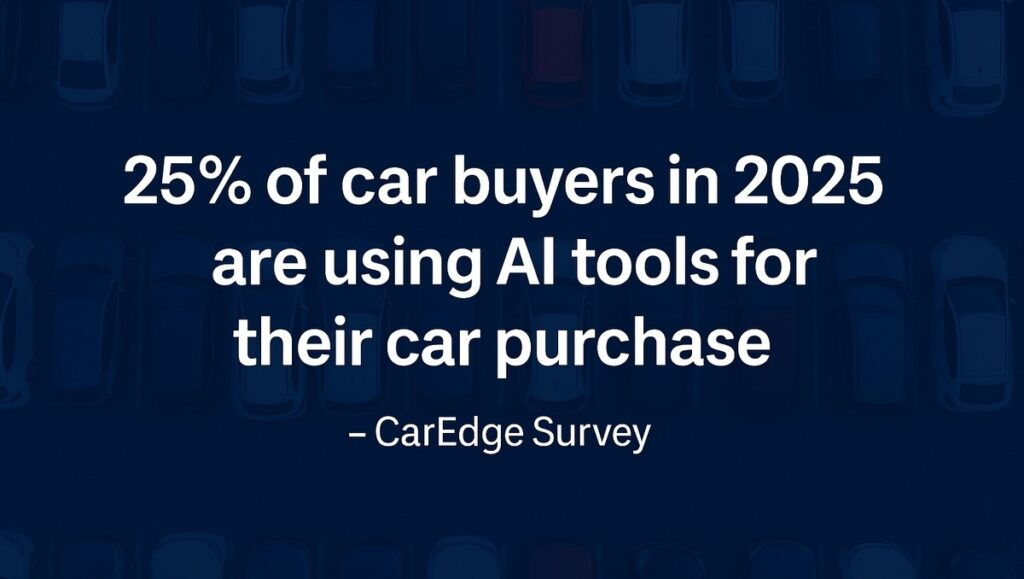
Artificial intelligence is changing the way North Americans buy cars, and it’s a transition that is happening quickly. In the first-ever survey of its kind, CarEdge asked 500 car shoppers if they’re using AI tools like ChatGPT to research, compare, and negotiate during the car buying process. The results confirm a major shift is underway. One in four car buyers in 2025 are already using AI tools to gain an edge, and future buyers are even more likely to embrace these technologies.
Car buyers are finding AI to be a valuable tool. Among those who used tools like ChatGPT, Perplexity, Google Gemini, and others, 88% said it was helpful. AI is quickly becoming a trusted co-pilot for car buyers.
Key Findings: Car Buying Is Changing
The 2025 CarEdge AI & Car Buying Survey reveals a clear and growing trend: AI tools are quickly becoming part of the car buying process for a significant portion of consumers. Here are the standout findings:
1 in 4 Car Buyers Use AI
25% of car buyers in 2025 say they used or plan to use AI tools like ChatGPT during the shopping or buying process. This contrasts with a recent survey by Elon University that found 52% of Americans now use AI large language models. While signs point towards increased adoption of AI tools, the CarEdge survey found that most car buyers are still in the early stages of integrating these tools into high-stakes decisions like vehicle purchases. This suggests there’s still significant room for growth in AI adoption amongst car buyers.
AI Use Is Accelerating
Among those who haven’t bought a car yet this year, 40% say they are using or plan to use AI tools during their search or deal-making. This is nearly 3x higher than the 14% seen among those who already bought a car earlier in the year.
AI Tools Deliver Results
Among those who used AI:
88% say the tools were helpful
32% found them very helpful
60% used them “a lot” during the process
The AI Holdouts: Drivers Who Lease
Of the respondents who had already leased a car in 2025, none reported using any AI tools.
The AI-Adopting Buyer: Who’s Using It, and How?
AI adoption among car buyers is still in its early stages, but clear trends are beginning to emerge.
Among Buyers Who Already Purchased in 2025:
Just 14% of those who already bought a vehicle this year used AI tools during the process. Adoption rates were nearly identical across new and used buyers, with 14% in each group saying they used AI tools.
Among Future Car Buyers:
The numbers jump significantly when looking at those who haven’t yet bought in 2025. Among this group — who represent 39% of total respondents — 40% say they either already use or plan to use AI tools during their car search and buying process.
That’s more than triple the current usage rate among recent buyers, suggesting AI adoption is accelerating as awareness grows and tools become easier to use.
This group also appears to be more proactive: 60% of those who used AI tools during their buying journey said they used them “a lot,” while 40% used them only occasionally.
What Car Buyers Are Using AI Tools
AI tools are quickly becoming essential research companions for car shoppers looking to make more informed, confident decisions. After all, why go it alone when a wealth of automotive knowledge powered by large language models (LLMs) is right in your pocket?
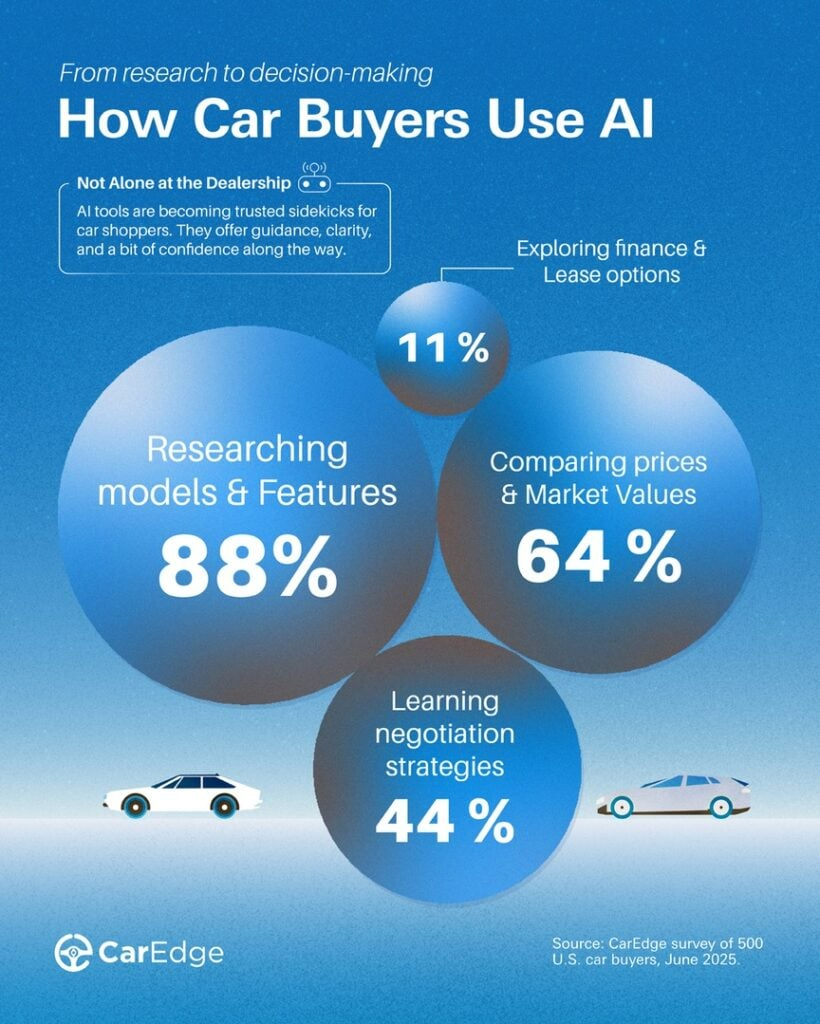
Among buyers who used AI tools during their car purchase or lease process, here’s how they put them to work:
88% — Researching Vehicles
The most common use by far, AI tools helped buyers learn about different models, trims, features, and reliability. For many, it was like having an always-available expert to explain the pros and cons of their options.
64% — Comparing Prices and Market Values
Buyers used AI to better understand fair pricing, from invoice pricing to out-the-door.
44% — Learning Negotiation Strategies
Nearly half of AI users leaned on these tools to prepare for conversations with salespeople. Whether role-playing negotiation scenarios or asking how to spot add-on fees, this group used AI to level the playing field at the dealership.
11% — Exploring Finance and Lease Options
A much smaller portion of buyers used these tools to become familiar with leasing vs. financing, how to calculate payments, and similar queries.
Industry Implications
Car buying has always been tilted in favor of the dealership. Information asymmetry — what the dealer knows versus what the customer knows — has long been the source of consumer frustration, confusion, and overpayment.
That dynamic is beginning to shift.
This survey confirms what many in the industry are only starting to realize: AI is giving car buyers the upper hand. Tools like ChatGPT are helping consumers cut through the noise, ask smarter questions, and avoid common dealership traps. Instead of relying on guesswork or scattered advice, buyers are turning to AI for fast, personalized guidance at every step.
But one auto industry veteran has words of caution for buyers relying heavily on AI tools.
“It’s both surprising and a little scary to see how quickly people are turning to AI to guide such a major financial decision,” said Ray Shefska, Co-Founder of CarEdge. “While tools like ChatGPT can be powerful, they’re only as good as the data behind them. AI should complement your research, not replace your own critical thinking.“
That perspective underscores the real takeaway of this report: AI works best when it’s used thoughtfully as a tool, not as a crutch. In an age where automation raises fears of job loss or decision-making without human oversight, this survey offers a more optimistic view — one where technology helps everyday consumers make smarter choices. Used wisely, AI can help level the playing field and bring more transparency and fairness to the car buying experience.
Methodology
This survey was conducted by CarEdge between June 19 and June 24, 2025. A total of 500 U.S. respondents participated, recruited through the CarEdge email newsletter and social media channels. Questions were tailored based on buying status to better understand how and when AI tools were used in the car shopping process.
For the Silo, Karen Hayhurst.
About CarEdge Founded in 2019 by father-and-son team Ray and Zach Shefska, CarEdge is a leading platform dedicated to empowering car shoppers with free expert advice, in-depth market insights, and tools to navigate every step of the car-buying journey. From researching vehicles to negotiating deals, CarEdge helps consumers save money, time, and hassle, hundreds of thousands of happy consumers have used CarEdge to buy their car with confidence. With trusted resources like the CarEdge AI Negotiator tool, Research Center, Vehicle Rankings and Reviews, and hundreds of guides on YouTube, CarEdge is redefining transparency and fairness in the automotive industry. Follow them on YouTube, TikTok, X, Facebook, and Instagram for actionable car-buying tips and market insights. Learn more at www.CarEdge.com.
October, 2025 – Canada has world-class strength in AI research but continues to fall short in widespread adoption, according to a new report from the C.D. Howe Institute. On the heels of the federal government’s announcement of a new AI Strategy Task Force, the report highlights the urgent need to bridge the gap between research excellence and real-world adoption.
In “AI Is Not Rocket Science: Ideas for Achieving Liftoff in Canadian AI Adoption,” Kevin Leyton-Brown, Cinda Heeren, Joanna McGrenere, Raymond Ng, Margo Seltzer, Leonid Sigal, and Michiel van de Panne note that while Canada ranks second globally in top-tier AI researchers and first in the G7 for per capita publications, it is only 20th in AI adoption among OECD countries. “This matters for the economy as a whole, because such knowledge translation is a key vehicle for productivity growth,” the authors say. “It is terrible news, then, that Canada experienced almost no productivity growth in the last decade, compared with a rate 15 times higher in the United States.”
The authors argue that new approaches to knowledge translation are needed because AI is not “rocket science”: instead of focusing on a single industry sector, the discipline develops general-purpose technology that can be applied to almost anything. This makes it harder for Canadian firms to find the right expertise and for academics to sustain ties with industry. Existing approaches – funding academic research, directly subsidizing industry efforts through measures such as SR&ED and superclusters, and promoting partnerships through programs like Mitacs and NSERC Alliance – have not solved the problem.
Four ideas to help firms leverage Canadian academic strength to fuel their AI adoption include: a concierge service to match companies with experts, consulting tied to graduate student scholarships, “research trios” that link AI specialists with domain experts and industry, and a major expansion of AI training from basic literacy to dedicated degrees and continuing education. Drawing on their experiences at the University of British Columbia, the authors show how local initiatives are already bridging gaps between academia and industry – and argue these models should be scaled nationally.
“Canada’s unusual strength in AI research is an enormous asset, but it’s not going to translate into real-world productivity gains unless we find better ways to connect AI researchers and industrial players,” says Kevin Leyton-Brown, professor of computer science at the University of British Columbia and report co-author. “The challenge is not that AI is too complicated – it’s that it touches everything. That means new models of partnership, new incentives, and new approaches to education.”
AI Is Not Rocket Science- 4 Ideas in Detail
Idea 1: A Concierge Service for Matchmaking
We have seen that it is hard for industry partners to know who to contact when they want to learn more about AI. Conversely, it is at least as hard for AI experts to develop a broad enough understanding of the industry landscape to identify applications that would most benefit from their expertise. Given the potential gains to be had from increasing AI adoption across Canadian industry, nobody should be satisfied with the status quo.
We argue that this issue is best addressed by a “concierge service” that industry could contact when seeking AI expertise. While matchmaking would still be challenging for the service itself, it could meet this challenge by employing staff who are trained in eliciting the AI needs of industry partners, who understand enough about AI research to navigate the jargon, and who proactively keep track of the specific expertise of AI researchers across a given jurisdiction. This is specialized work that not everyone could perform! However, many qualified candidates do exist (e.g., PhDs in the mathematical sciences or engineering). Such staff could be funded in a variety of different ways: for example, by an AI institute; a virtual national institute focused on a given application area; a university-level centre like UBC’s Centre for Artificial Intelligence Decision-making and Action (CAIDA); a nonprofit like Mitacs; a provincial ministry for jobs and economic growth; or the new federal ministry of Artificial Intelligence and Digital Innovation.
Having set up an organization that facilitates matchmaking, it could make sense for the same office to provide additional services that speed AI adoption, but that are not core strengths of academics. Some examples include project management, programming, AI-specific skills training and recruitment, and so on. Overall, such an organization could be funded by some combination of direct government support, direct cost recovery, and an overhead model that reinvests revenue from successful projects into new initiatives.
Idea 2: Consultancy in Exchange for Student Scholarships
Many businesses that would benefit from adopting AI do not need custom research projects and do not want to wait a year or more to solve their problems. The lowest-hanging fruit for Canadian AI adoption is ensuring that industry is well informed about potentially useful, off-the-shelf AI technologies. We thus propose a mechanism under which AI experts would provide limited, free consulting to local industry. AI experts would opt in to being on a list of available consultants. A few hours of advice would be free to each company, which would then have the option of co-paying for a limited amount of additional consulting, after which it would pay full freight if both parties wanted to continue. The company would own any intellectual property arising from these conversations, which would thus focus on ideas in the public domain. If the company wanted to access university-owned IP, it could shift to a different arrangement, such as a research contract. This system would work best given a concierge service like the one we just described. The value offered per consulting hour clearly depends on the quality of the academic–industry match, and some kind of vetting system would be needed to ensure the eligibility of industry participants.
Why would an AI expert sign up to give advice to industry? All but the best-funded Canadian faculty working in AI report that obtaining enough funding to support their graduate students is a major stressor. Attempting to establish connections with industry is hard work, and such efforts pay off only if the industry partner signs on the dotted line and matching funds are approved. There is thus space to appeal to faculty with a model in which they “earn” student scholarships for a fixed amount of consulting work. For example, faculty could be offered a one- semester scholarship for every eight hours set aside for meetings with industry, meaning that one weekly “industry office hour” would indefinitely fund two graduate students. Consulting opportunities could also be offered directly to postdoctoral fellows or senior (e.g., post-candidacy) PhD students in exchange for fellowships. In such cases, trainees should be required to pass an interview, certifying that they have both the technical and soft skills necessary to succeed in the consulting role. The concierge service could help decide which industry partners could be routed to PhD students and which need the scarcer consulting slots staffed by faculty members.
The system would offer many benefits. From the industry perspective, it would make it straightforward to get just an hour or two of advice. This might often be enough to allow the company to start taking action towards AI adoption: there is a rich ecosystem of high-performance, reliable, and open-source AI tools; often, the hard part is knowing what tool to use in what way. Beyond the value of the advice itself, consulting meetings offer a strong basis for building relationships between academics and industry representatives, in which the academic plays the role of a useful problem solver rather than of a cold-calling salesperson. These relationships could thus help to incubate Mitacs/Alliance-style projects when research problems of mutual interest emerge (though also see our idea below about how restructuring such projects could help further).
For academics, the system would constitute a new avenue for student funding that would reward each hour spent with a predictable amount of student support. Furthermore, it would offer scaffolded opportunities to deepen connections with industry. The system would come with no reporting requirements beyond logging the time spent on consulting. The faculty member would be free to use earned scholarships to support any student (regardless, for example, of the overlap between the student’s research and the topics of interest to companies), increasing flexibility over the Mitacs/Alliance system, in which specific students work with industry partners. Students who self-funded via consulting would learn valuable skills and would expand their professional networks, improving prospects for post-graduation employment.
Finally, the system would also offer multiple benefits from the government’s perspective. It would generate unusually high levels of industrial impact per dollar spent (consider the number of contact hours between academia and industry achieved per dollar under the funding models mentioned in Section 3). All money would furthermore go towards student training. The system would automatically allocate money where it is most useful, directing student funding to faculty who are both eager to take on students and relevant to industry, all without the overhead of a peer-review process. And it would generate detailed impact reports as a side effect of its operations, since each hour of industry–academia contact would need to be logged to count towards student funding.
Idea 3: Grants for Research Trios
Our third proposal is an approach for expanding the Mitacs/Alliance model to make it work better for AI. Industry–academia partnerships leverage two key kinds of expertise from the academic side: methodological know-how for solving problems and knowledge about the application domain used for formulating such problems in the first place. In fields for which the set of industry partners is relatively small and relatively stable, it makes sense to ask the same academics to develop both kinds of expertise. In very general-purpose domains like AI, it holds back progress to ask AI experts to become domain experts, too. Instead, it makes sense to seek domain knowledge from other academics who already have it. We thus propose a mechanism that would fund “research trios” rather than bilateral research pairings. Each trio would contain an AI expert, an academic domain expert, and an industry partner. This approach capitalizes on the fact that there is a huge pool of academic talent outside core AI with deep disciplinary knowledge and a passion for applying AI. While such researchers are typically not in a position to deeply understand cutting-edge AI methodologies, they are ideally suited to serve as a bridge between researchers focused on AI methodologies and Canadian industrial players seeking to achieve real-world productivity gains. In our experience at UBC, the pool of non-AI domain experts with an interest in applying AI is considerably larger than the pool of AI experts. One advantage of this model is that projects can be initiated by the larger population of domain experts, who are also more likely to have appropriate connections to industry. Beyond this, involving domain experts increases the likelihood that a project will succeed and gives industry partners more reason to trust the process while a solution is being developed. The model meets a growing need for funding researchers outside computer science for projects that involve AI, rather than concentrating AI funding within a group of specialists. At the same time, it avoids the pitfall of encouraging bandwagon-jumping “applied AI” projects that lack adequate grounding in modern AI practices. Finally, it not only transfers AI knowledge to industry, but also does the same to both the domain expert and their students.
Idea 4: Greatly Expanded AI Training
As AI permeates the economy, Canada will face an increasing need for AI expertise. Today, that training comes mostly in the form of computer science degrees. Just as computer science split off from mathematics in the 1960s, AI is emerging today as a discipline distinct from computer science. In part, this shift is taking the form of recognizing that not every AI graduate needs to learn topics that computer science rightly considers part of its core, such as software engineering, operating systems, computer architecture, user interface design, computer graphics, and so on. Conversely, the shift sees new topics as core to the discipline. Most fundamental is machine learning. Dedicated training in AI will require a deeper focus on the mathematical foundations of probability and statistics, building to advanced topics such as deep learning, reinforcement learning, machine learning theory, and so on. Various AI modalities also deserve separate study, such as computer vision, natural language processing, multiagent systems, robotics, and reasoning. Training in ethics, optional in most computer science programs, will become essential.
Beyond dedicated training in the core discipline, we anticipate huge demand for broad-audience AI literacy training; for AI minors to complement other disciplinary specializations; for continuing education and “micro-credential” programs; and for executive education in AI. There is also a growing need for “AI Adoption Facilitators”: bridge-builders who can help established workers in medium-to-large organizations understand how data-driven tools could offer value in solving the problems they face. Training for this role would emphasize business principles and domain expertise, but would also require firmer foundations in machine learning and data science than are currently typical in those disciplines.
Artificial Intelligence (AI) has become an integral part of our daily lives, influencing everything from how we interact with technology to how businesses operate. But where did it all begin? Let’s take a journey through the early days of AI, exploring the key milestones that have shaped this fascinating field.
Today, AI is a rapidly evolving field with applications in various domains, including healthcare, finance, transportation, and entertainment. From virtual assistants like me, Microsoft Copilot, to autonomous vehicles and systems, AI continues to transform our world in profound ways.
A Copilot self generated image when queried “Show me what you look like”. CP
Conclusion
The journey of AI from its early conceptual stages to its current state is a testament to human ingenuity and perseverance. While the field has faced numerous challenges and setbacks, the progress made over the past few decades has been remarkable. As we look to the future, the potential for AI to further revolutionize our lives remains immense.
Did you know that, every year, home renovation projects are derailed by hidden costs, vague language, and inconsistent contractor bids—pushing 78% of jobs over budget and forcing two-thirds of homeowners into debt? It’s not just homeowners who feel the pain: contractors, property managers, real estate agents, investors, and flippers all struggle to assess and compare bids quickly and accurately.
The problem is that contractor quotes are rarely “apples to apples,” often missing critical details or disguising inflated charges—making it hard to identify true scope, cost, and risk. Now, the free-to-use and industry first BidCompareAI tool analyzes and compares multiple contractor bids, instantly identifying missing scope items, unrealistic allowances and other red flags before any work begins … often with tens of thousands of dollars on the line. In minutes, the AI generates a clear, line-by-line report that standardizes bids into transparent, actionable insights—helping homeowners avoid costly overruns, while enabling industry pros to quote with confidence, negotiate smarter, close deals faster, and protect ROI. Interest in this innovation raising industry transparency standards?
AI Reveals These Top 10 Home Renovation Bid Red Flags
First-of-its-kind free AI tool turns confusing, inconsistent contractor bids into clear, side-by-side insights—helping homeowners avoid costly overruns and enabling industry pros to quote, negotiate and close with confidence
Renovations are one of the most expensive and stressful decisions a homeowner makes. Yet 78% of projects blow their budgets, and 2 in 3 homeowners go into debt just to pay for them. Why? Because contractor bids are often riddled with hidden costs, vague language, and missing work that leave you paying more than you bargained for. Thankfully, new AI technology is now making these red flags impossible to ignore—saving homeowners thousands before a hammer is even swung. BidCompareAI is the first-ever AI tool that lets homeowners upload multiple bids and get a fast, detailed report comparing scope, pricing, and red flags—no construction expertise needed and no signup or payment required.
“Homeowners have been forced to make major financial decisions based on unclear or incomplete bids,” says GreatBuildz Co-CEO Jon Grishpul. “BidCompareAI adds instant transparency and clarity—saving people from costly mistakes before a project even starts. For contractors, property managers, and real estate professionals, it’s a credibility and efficiency tool that streamlines communication, builds trust and helps win more business.”
Here are the top 10 red flags often hiding in contractor bids, and how the BidCompareAI tool reveals them instantly:
1. Missing Scope Items — “Surprise” Costs Waiting to Blow Your Budget
Your contractor’s quote doesn’t include demolition, cleanup, or critical tasks? That’s a ticking time bomb. Now, homeowners can catch these omissions so you never get hit with surprise charges.
2. Vague Allowances — The Fine Print That Drains Your Wallet
Ambiguous line items like “fixtures” or “materials” can mean anything. The AI tool flags vague terms so you can demand specifics upfront.
3. Unrealistically Low Bids — Too Good to Be True? Usually Are
Low-ball bids often mean corners will be cut or costs will balloon later. This AI exposes these dangerously low estimates before you get stuck with change orders.
4. Pricing Inconsistencies — Comparing Apples to Oranges?
Quotes come in all formats with wildly different terminology. This advanced technology standardizes and compares them side-by-side, so you’re not left guessing.
5. Hidden Fees — The Black Box of Renovation Budgets
Permits, procurement, and labor fees sometimes get lumped in mysteriously. The AI reveals these “hidden” charges clearly in its summary report.
6. Overlapping or Duplicate Charges — Paying Twice Without Knowing It
Some bids unknowingly charge for the same work twice. The AI delivers a line-by-line analysis that spots these costly errors fast.
7. Unclear Project Timelines — When Delays Lead to Extra Costs
Vague or missing timelines can spiral into costly delays. While timelines aren’t priced, spotting missing info helps you demand accountability.
8. Missing Cleanup and Disposal — Don’t Get Stuck with the Mess
Quotes that don’t include cleanup leave you responsible for hauling debris and disposing of waste. This AI highlights these crucial omissions.
9. Discrepancies in Material Quality — Low-Quality Where You Expected Premium
One bid may specify high-end fixtures while another hides “allowances” that could mean anything. The AI tool flags these differences so you know exactly what you’re paying for.
10. Inconsistent Labor Charges — Watch for Inflated or Unexplained Fees
Labor costs vary widely, and some bids overcharge or include unnecessary markups. This user-friendly technology points out these red flags clearly.
“This is about more than just tech,” added Paul Dashevsky, Co-CEO of GreatBuildz. “It’s about empowering homeowners to feel confident and in control of their renovation projects—and helping contractors better serve their clients.”
Renovations don’t have to be a financial nightmare. As consumer-facing AI tools proliferate across industries, the BidCompareAI innovation demonstrates how artificial intelligence can bring real-world value by making complex, high-stakes decisions—like selecting the right contractor—faster, clearer and far less stressful. For the Silo, Marsha Zorn.
Artificial Intelligence (AI) has infiltrated our lives for decades, but since the public launch of ChatGPT showcasing generative AI in 2022, society has faced unprecedented technological evolution.
With digital technology already a constant part of our lives, AI has the potential to alter the way we live, work, and play – but exponentially faster than conventional computers have. With AI comes staggering possibilities for both advancement and threat.
The AI industry creates unique and dangerous opportunities and challenges. AI can do amazing things humans can’t, but in many situations, referred to as the black box problem, experts cannot explain why particular decisions or sources of information are created. These outcomes can, sometimes, be inaccurate because of flawed data, bad decisions or infamous AI hallucinations. There is little regulation or guidance in software and effectively no regulations or guidelines in AI.
How do researchers find a way to build and deploy valuable, trusted AI when there are so many concerns about the technology’s reliability, accuracy and security?
That was the subject of a recent C.D. Howe Institute conference. In my keynote address, I commented that it all comes down to software. Software is already deeply intertwined in our lives, from health, banking, and communications to transportation and entertainment. Along with its benefits, there is huge potential for the disruption and tampering of societal structures: Power grids, airports, hospital systems, private data, trusted sources of information, and more.
Consumers might not incur great consequences if a shopping application goes awry, but our transportation, financial or medical transactions demand rock-solid technology.
The good news is that experts have the knowledge and expertise to build reliable, secure, high-quality software, as demonstrated across Class A medical devices, airplanes, surgical robots, and more. The bad news is this is rarely standard practice.
As a society, we have often tolerated compromised software for the sake of convenience. We trade privacy, security, and reliability for ease of use and corporate profitability. We have come to view software crashes, identity theft, cybersecurity breaches and the spread of misinformation as everyday occurrences. We are so used to these trade-offs with software that most users don’t even realize that reliable, secure solutions are possible.
With the expected potential of AI, creating trusted technology becomes ever more crucial. Allowing unverifiable AI in our frameworks is akin to building skyscrapers on silt. Security and functionality by design trump whack-a-mole retrofitting. Data must be accurate, protected, and used in the way it’s intended.
Striking a balance between security, quality, functionality, and profit is a complex dance. The BlackBerry phone, for example, set a standard for secure, trusted devices. Data was kept private, activities and information were secure, and operations were never hacked. Devices were used and trusted by prime ministers, CEOs and presidents worldwide. The security features it pioneered live on and are widely used in the devices that outcompeted Blackberry.
Innovators have the know-how and expertise to create quality products. But often the drive for profits takes precedence over painstaking design. In the AI universe, however, where issues of data privacy, inaccuracies, generation of harmful content and exposure of vulnerabilities have far-reaching effects, trust is easily lost.
So, how do we build and maintain trust? Educating end-users and leaders is an excellent place to start. They need to be informed enough to demand better, and corporations need to strike a balance between caution and innovation.
Companies can build trust through a strong adherence to safe software practices, education in AI evolution and adherence to evolving regulations. Governments and corporate leaders can keep abreast of how other organizations and countries are enacting policies that support technological evolution, institute accreditation, and financial incentives that support best practices. Across the globe, countries and regions are already developing strategies and laws to encourage responsible use of AI.
Recent years have seen the creation of codes of conduct and regulatory initiatives such as:
The Bletchley Declaration, Nov. 2023, an international agreement to cooperate on the development of safe AI, has been signed by 28 countries;
US President Biden’s 2023 executive order on the safe, secure and trustworthy development and use of AI; and
Governing AI for Humanity, UN Advisory Body Report, September 2024.
We have the expertise to build solid foundations for AI. It’s now up to leaders and corporations to ensure that much-needed practices, guidelines, policies and regulations are in place and followed. It is also up to end-users to demand quality and accountability.
Now is the time to take steps to mitigate AI’s potential perils so we can build the trust that is needed to harness AI’s extraordinary potential. For the Silo, Charles Eagan. Charles Eagan is the former CTO of Blackberry and a technical advisor to AIE Inc.
Online casinos actively use bonuses and promotions to attract and retain players. For both beginners and experienced users, understanding how these offers work is important not only to increase the chances of winning but also to ensure safe and controlled gameplay. In this article, we will explore the types of bonuses, how to use them effectively, and what to pay attention to.
Types of Bonuses in Online Casinos
Modern online platforms offer a wide range of casino bonuses. The main types include:
Welcome bonuses – given to new players upon registration and first deposit.
Free spins – free spins on online slots, often included in welcome or seasonal promotions.
Cashback – a partial return of lost funds over a certain period.
Loyalty programs – points awarded for activity, which can be exchanged for bonuses or gifts.
Every bonus comes with wagering requirements, expiration dates, and bet limits. Ignoring these rules can nullify the value of the offer.
How to Use Bonuses Effectively
To get the most out of bonuses, follow a few simple guidelines:
Read the terms carefully – before activating a bonus, pay close attention to the rules, especially wagering requirements and game restrictions.
Plan your budget – use bonuses as an additional resource without exceeding your personal betting limits.
Combine with strategies – bonuses can be applied to online slots and table games, considering your chosen betting strategy.
For example, platforms like Martin Casino offer free spins and cashback systems with clear terms, helping both beginners and experienced players use bonuses safely and efficiently.
What to Watch for When Choosing a Bonus
Not all offers are equally profitable. When selecting a promotion, consider:
Bonus size – very large bonuses may come with complex wagering requirements.
Expiration date – always check how much time you have to meet the conditions.
Game restrictions – some bonuses apply only to specific online slots or types of bets.
Withdrawal conditions – make sure the wagering requirements are realistic and achievable.
Common Mistakes When Using Bonuses
Beginners often make typical mistakes, such as:
Activating all bonuses at once and losing control over their bankroll.
Not reading the terms and not knowing how to meet the wagering requirements.
Trying to use bonuses for “quick profit,” forgetting that gambling should be entertainment, not a guaranteed income source.
A responsible approach, budget and time management help players enjoy bonuses while minimizing risks.
The Future of Casino Bonuses and Promotions
With technological advancement, bonus offers are becoming more personalized. Artificial intelligence analyzes player behavior and suggests the most suitable promotions. Mobile casino bonuses and crypto-platform promotions are also gaining popularity, allowing fast and secure transactions.
Online casinos continue to use bonuses as a tool to increase player engagement. However, the key to successful play is understanding the rules, having a conscious approach, and managing your bankroll wisely.
FAQ
What is wagering a bonus?It is a condition requiring a certain number of bets before bonus funds can be withdrawn.
Can I use multiple bonuses at the same time? Usually not – most platforms allow only one bonus to be activated at a time to prevent abuse.
Which bonuses are best for beginners?Welcome bonuses and free spins are ideal because they let players try games without significant investments.
Can a bonus be lost? Yes, if wagering requirements are not met or betting limits are exceeded. How to choose a profitable bonus? Look at the size, expiration date, game restrictions, and realism of the wagering requirements.
With AI reshaping everything from finance to fast food, the $1.5T auto retail industry is finally facing its overdue disruption. The typical car-buying experience—riddled with hidden fees, lead bloat, pricing games and low trust—has remained stubbornly analog. But now, with 90% of dealerships in America (and growing % in Canada and Mexico) experimenting with AI tools and 1 in 4 buyers already using AI to shop, the tide is turning. Agentic AI technology is fundamentally reshaping one of the most significant purchases in a person’s life.
Zach Shefska, Co-Founder and CEO of CarEdge, asserts that agentic AI is the key to rebuilding trust, removing friction and leveling the playing field for both buyers and sellers. From AI-powered shopping assistants that negotiate on your behalf, to data tools that reveal deceptive dealership practices, Shefska is a pioneer in “agentic AI” — a new form of artificial intelligence bringing much-needed transparency to the industry.
The Broken Status Quo: Car buying is frustrating and inefficient for both consumers and dealerships—highlighting key stats like 72% sales staff turnover and 2% lead conversion from third-party platforms.
Lead Generation Platforms Are Failing: Legacy systems flood dealers with unqualified leads, drain resources, and deliver minimal value to consumers.
The Rise of Agentic AI in Auto Retail: Consumers are turning to tools like ChatGPT and CarEdge’s AI agent to navigate purchases with more confidence, speed, and clarity—25% are already doing it.
From Friction to Fluidity: Agentic AI replaces quantity with quality—streamlining the buyer’s journey, reducing information overload, and improving dealer efficiency.
The End of Pricing Games: AI tools now collect and publish out-the-door pricing from thousands of dealerships, exposing hidden fees and rewarding transparent sellers.
The Future of Negotiation: AI agents can negotiate on behalf of both buyers and sellers—minimizing stress, cutting transaction times from days to hours, and removing the adversarial edge.
Real-World Impact Stories: One buyer saved $1,280 and hours of back-and-forth using CarEdge’s agentic AI—illustrating AI’s practical value in real-life scenarios.
AI Helps Honest Dealers Win: In a trust-starved industry, AI gives reputable dealers a new way to stand out by offering full transparency and faster deals.
What’s Next for AI in Auto Retail: The emerging frontier: AI agents dynamically collecting and updating real-time pricing and inventory data across markets to offer true market intelligence.
For the Silo, Zach Shefska. Zach is CEO of CarEdge, a leading platform—founded by father-and-son team Ray and Zach Shefska—dedicated to empowering car shoppers with free expert advice, in-depth market insights and tools to navigate every step of the car-buying journey. From researching vehicles to negotiating deals, CarEdge helps consumers save money, time and hassle. Alsop with trusted resources like the CarEdge Research Center, Vehicle Rankings and Reviews, and hundreds of guides on YouTube, CarEdge is redefining transparency and fairness in the automotive industry. Connect with Shefska at www.CarEdge.com or on social media on YouTube, TikTok, X, Facebook, and Instagram.
Canada is great at AI development, but what should the country’s first Minister for Artificial Intelligence make his key priorities? University of Waterloo’s Anindya Sen and the C.D Howe Institute’s Rosalie Wyonch offer strong insight — and geek out a bit about the economics-oriented nature of machine learning algorithms.
Hello AI Tinkerers and welcome to the latest Sci-Tech article here at The Silo. Get ready, You will want to pay attention because the spotlight is on this Dude because he knows how to get around ‘bad ai prompting’. Just recently, he has helped spin out 40 startups using one core skill. Can you guess which one? Yep. Prompting.
In the One-Shot video below, Kevin Leneway breaks down his real workflow for shipping AI products fast — using markdown checklists, agent coding, rubric-based UI design, and zero Figma.
“I don’t need Figma. I just prompt my way to a working front end.” — Kevin Leneway
While most people are still asking ChatGPT to write code snippets, Kevin is building full-stack products using nothing but prompts. In this One-Shot episode, he reveals the exact system he’s used to launch over 40 startups at Pioneer Square Labs. We break down:
How he writes BRDs and PRDs that don’t suck
Why vibe coding fails and how to actually use AI agents
The markdown checklist that replaces a product team
How to go from idea to working app with zero context switching
His open-source starter kit that makes Cursor and Claude 3.5 feel like magic
“I’ve helped launch six startups including Singlefile (singlefile.io, $24M raised), Recurrent (recurrentauto.com, $24M raised), Joon (joon.com, $9.5M raised), Gradient (gradient.io, $3.5M raised), Genba (genba.ai, acquired May 2022) and Enzzo (enzzo.ai, $3M raised).”
If you’re a builder, this will change how you work. No gimmicks. Just a ruthless focus on speed, clarity, and shipping. Watch now. Learn the system. Steal it. For the Silo, Joe at aitinkerers.org
This post is a response to the comic book article found at popuniverse which begins like this:
“The comic book industry is the launchpad for one of the most unique and innovative storytelling mediums ever created. Powered by imaginative creators highly skilled in the written and visual arts. Forged by businesspersons who recognize the power of ideas to make an iconic impression on a global scale. Propelled by readers and fans who support the industry and the people who make the stories. The comic book industry is the source of multimedia interpretations of mythic and personal stories that inspire people, entertain the world, and ignite lifelong careers.
It is the adventure of a lifetime.
The comic book industry is a ruthless Darwinian landscape of cronyism, narcissism, and power moves. Its main fodder is the creators who are the engines of its continued existence. Full of flair and pomp, colors and characters both fictional and real-life. A road to hell paved with landmines, bear traps, and the opportunity to work on high-profile, profitable media while living on the precipice of poverty. The industry is fueled by organizations with finite funds and infinite hubris.“
“The comics industry is the illusory world of grenades disguised as dreams.“
The issue I see (and our comic illustrator household has personally experienced) in the comics and illustration / publishing industry is that the original contract terms were never set up fairly to compensate the artists and illustrators. While photographers and videographers retain the rights to their original images, and someone must pay them usage rights fees based on the size of the audience per usage, the artists are never granted that same fair compensation.
While actors get residuals when their TV shows play on in perpetuity, and musicians earn their royalty checks with every needle drop, the comics publishers can repurpose an illustrator’s iconic cover art in perpetuity and make millions from the image—on puzzles, lunch boxes, hoodies, sweatpants, and pajamas in my husband’s particular case—while the artist never sees a dime beyond the initial ANEMIC work-for-hire fee in these insanely unfair, one-sided deals. And if the artist DARES to complain? The smear merchants are only too happy to start their whisper campaigns, blackballing the artist as “too difficult to work with” and completely destroying their already financially challenged lives with nuisance law suits.
When I think back on how Ghost Rider co-creator Gary Friedrich was made the industry scarecrow in the last years of his life as greedy lawyers descended upon him like buzzards picking the last flecks of flesh from his bones, it sickens me.
This impoverished, unwell, elderly man was just trying to eke out the last days of his hard-scrabble life by selling sketches of his OWN co-creation at comic-cons. There’s nothing I despise more than anyone preying on the vulnerable. It’s appalling how Gary was treated.
And then we have AI “art” apps exploiting my husband’s already way underpaid art to create new, derivative works, but only GETTY Images can afford to lawyer up and go after these apps…because the photography world always negotiated image usage the CORRECT and fair way from the start.
The sobering truth is that if illustrators (and line artists, colorists, and letterers) were paid as well as photographers, every comic would sell for $100 per floppy and that would be the final nail in the #comics industry’s coffin.
…DAVE DORMAN… told me at dinner tonight that someone was selling AI art at SDCC last week and was summarily kicked out of Artists Alley. It gave me a brief glimmer of hope…I imagined a deafening crescendo of cheering as the non-talent skulked away, tail between his/her legs. That takes some gall to occupy the highly competitive table space of an ACTUAL hard-working artist (who’s paying off about $100k in art school student loans) with some Mid-Journey derivative crap. Wowzers. For the Silo, Denise Dorman.
While generative AI transforms how Americans shop, it’s also quietly powering a counterfeit crisis now spiraling out of control. A groundbreaking new report from Red Points and OnePoll, The Counterfeit Buyer Teardown, reveals that AI is no longer just helping consumers find the best deals—it’s helping them find fakes. From influencer-driven “dupe culture” to hyper-realistic fake storefronts, the study exposes a booming underground economy that’s been supercharged by technology. With 28% of counterfeit buyers now using AI tools to seek out knock-offs, and fraudulent social media ads spiking 179% in just one year, the findings deliver a wake-up call for brands, regulators, and shoppers alike. Red Points execs are available to break down the data, discuss solutions, and explain why this rapidly evolving trend is both a technological and ethical crisis for the digital marketplace. Interest here as we hope?
AI Supercharging U.S.and Other E-Commerce Counterfeit Crisis
An explosive new report, “The Counterfeit Buyer Teardown, ” paints a concerning picture of a rapidly evolving and increasingly sophisticated counterfeit goods market, driven by a new factor: Artificial Intelligence. Forget the back alleys; findings from the research—conducted by market research firm OnePoll and AI company Red Points in February 2025—highlight that the future of fakes is digital, AI-assisted, and alarmingly mainstream.
The convergence of technology, social media, and shifting consumer mindsets is reshaping e-commerce—and not always for the better. As AI accelerates both the spread and appeal of counterfeit goods, the challenge is no longer just spotting fakes—it’s confronting a counterfeit economy that’s growing smarter, faster, and harder to contain.
“As counterfeiters adopt advanced tools like AI, the fight against fakes is becoming more complex and more urgent,” said Laura Urquizu, CEO & President of Red Points. “We’re now seeing AI shape both the threat and the solution. In 2024 alone, our firm detected 4.3 million counterfeit infringements online—an alarming 15% increase year-over-year.”
Alarming indeed. Here are 5 key revelations from the study.
1. AI is the New Enabler of Counterfeiting – A Two-Sided Threat:
The Counterfeiters’ Edge: AI is dramatically lowering the barrier to entry for bad actors. They can now mimic brand listings, and impersonate social media accounts with unprecedented ease and speed. They can also effortlessly create professional-looking fake websites—a situation that, according to Red Points’ data, is projected to surge 70% in 2025.This isn’t just about cheap knock-offs anymore; it’s about sophisticated deception at scale.
The Consumers’ Assistant: Shockingly, 28% of online shoppers who bought fake goods used AI tools to find them. This isn’t a fringe behavior; it’s a growing trend, especially among Gen X, suggesting consumers are actively leveraging AI in their pursuit of cheaper alternatives. This fundamentally shifts the narrative – it’s not just about being tricked; some are actively seeking fakes with AI’s help.
2. Accidental Counterfeiting is a Major Problem – Trust Signals are Being Hijacked:
1 in 4 luxury counterfeit purchases are unintentional. This shatters the perception that buyers knowingly seek out high-end fakes. Realistic pricing, secure payment promises, and active (but fake) social media presence are successfully deceiving consumers. AI-generated legitimacy cues are becoming indistinguishable from the real deal.
Brands are Paying the Price for These Mistakes: A staggering one in three shoppers stop buying from the genuine brand after an accidental counterfeit experience. This highlights the significant damage to brand loyalty and future sales, even when the brand isn’t directly selling the fake. High-trust categories like luxury and toys are particularly vulnerable.
3. The “Dupe Economy” is Real and Influencer-Driven:
Nearly a third (31%) of intentional counterfeit buyers were swayed by influencer promotions. Social media is driving the demand for “dupes” – budget-friendly replicas. Authenticity is taking a backseat to price and perceived identical appearance, especially among younger demographics.
This isn’t just about saving money; it’s a shift in consumer mindset. The report suggests a growing acceptance of fakes as clever alternatives, fueled by social validation and influencer endorsements.
4. Marketplaces Remain Key, But Social Media and Fake Websites are Surging:
Marketplaces (both US and China-based) are still the primary channels for counterfeit purchases. However, fake websites (accounting for 34% of unintentional purchases) and social media are rapidly gaining ground as sophisticated avenues for distribution, amplified by AI’s ability to create convincing facades.
Social media ads redirecting to infringing websites saw a massive 179% year-over-year growth. This highlights the increasing sophistication of counterfeiters in leveraging advertising platforms to drive traffic to their fake storefronts.
5. Younger Generations are More Vulnerable in Key Categories:
Millennials are significantly more likely to have their personal data stolen after purchasing from fake websites (44% vs. 34% average). This suggests a higher susceptibility to sophisticated phishing scams disguised as legitimate e-commerce sites.
Gen Z and Millennials are 2-4 times more likely to accidentally purchase counterfeit luxury goods and toys compared to Baby Boomers. Their online savviness might be a double-edged sword, making them more exposed to deceptive listings.
This study serves as both a consumer alert and a brand wake-up call. The rise of AI as a tool for both counterfeiters and consumers is a seismic shift that demands urgent attention. With compelling data and a clear-eyed look at accidental purchases, influencer-driven “dupe culture,” and the growing sophistication of fake storefronts, the findings paint a stark warning for the future of online shopping.
“Counterfeiting poses a serious and evolving threat to innovative businesses and consumer safety,” notes Piotr Stryszowski, Senior Economist at the Organization for Economic Co-operation and Development (OECD). “Criminals constantly adapt, exploiting new technologies and shifting market trends—particularly in the online environment. To effectively counter this threat, policymakers need detailed, up-to-date information. This study makes an important contribution to our understanding of how counterfeiters operate and how consumers behave online.” Ultimately, The Counterfeit Buyer Teardown report underscores a new reality: counterfeiting is no longer confined to shady sellers or easily spotted scams—it’s embedded in the very technologies shaping modern commerce. As AI continues to blur the lines between real and fake, the pressure is on for brands, platforms, and policymakers to respond with equal speed and sophistication. Combating this growing threat will require more than just awareness—it demands collaboration, innovation, and a commitment to restoring trust in the digital marketplace before the counterfeit economy becomes the new normal. For the Silo, Merilee Kern.
Merilee Kern, MBA is a brand strategist and analyst who reports on industry change makers, movers, shakers and innovators: field experts and thought leaders, brands, products, services, destinations and events. Merilee is a regular contributor to the Silo. Connect with her at www.TheLuxeList.com and LinkedIN www.LinkedIn.com/in/MerileeKern.
The Global Cooperation Barometer indicates that international cooperation has “flatlined”, driven by heightened geopolitical tensions and instability, but positive momentum in climate finance, health and innovation offers hope. In an era of heightened volatility, leaders will need to embrace “disordered” cooperation and dynamic, solutions-driven decision-making to deliver tangible results and build trust. AI and other emerging technologies are reshaping the global landscape and driving upheaval. Concerted cooperation will be critical to harness benefits and minimize risks.
Geneva, Switzerland, January 2025 – The World Economic Forum’s Global Cooperation Barometer offers a critical assessment of the state of global cooperation, showing a world grappling with heightened competition and conflict, while also identifying various areas where leaders can drive progress through innovative collaboration. Released amid geopolitical, technological and sociopolitical upheaval, the Forum’s flagship annual report underscores the urgency of addressing shared challenges and offers leaders guidance on what cooperation can look like in a shifting world.
The Global Cooperation Barometer 2025, developed in collaboration with McKinsey & Company, uses 41 indicators to measure the current state of global cooperation. The aim is to offer leaders a tool to better understand the contours of cooperation broadly and along five pillars: trade and capital flows, innovation and technology, climate and natural capital, health and wellness, and peace and security. Now in its second edition, the Barometer draws on new data to provide an updated picture of the global cooperation landscape, with a particular focus on the impact of the new technological age.
“The Barometer is being released at a moment of great global instability and at a time when many new governments are developing agendas for the year, and their terms, ahead,” said Børge Brende, President and CEO of the World Economic Forum. “What the Barometer shows is that cooperation is not only essential to address crucial economic, environmental and technological challenges, it is possible within today’s more turbulent context.”
“This second edition of the Global Cooperation Barometer focuses on where cooperation stands today and what it can look like in the new technological age,” said Bob Sternfels, Global Managing Partner, McKinsey & Company. “Advancing global innovation, health, prosperity and resilience cannot be done alone. Leaders will need new mechanisms for working together on key priorities, even as they disagree on others, and the past several years have shown this balance is possible.”
The latest edition of the Barometer highlights that global cooperation is at a critical juncture. The report’s analysis reveals that after trending positively for a decade and surpassing pre-pandemic levels, overall cooperation has stagnated.
This has been driven by a sharp decline of the peace and security pillar of the Barometer over the past seven years, caused by mounting geopolitical tensions and competition which have significantly eroded global collective security. Levels of conflict and attendant humanitarian crises have increased in the past year to record levels, driven by crises including, but not limited to, the Middle East, Ukraine and Sudan.
As the largely stable cooperative order that defined the post-Cold War period is giving way to a more fragmented landscape, solutions to pressing challenges – from climate action to technological governance – require collaboration. And despite the global security crises, the new findings indicate that collaboration has continued in various areas including vaccine distribution, scientific research, renewable energy development, and more – offering models for future cooperation.
Notably, peace and security have declined sharply in recent years, but other pillars of the Barometer have remained resilient and reveal emerging opportunities for international cooperation,
Innovation and technology. While geopolitical competition is rising in regard to certain frontier technologies such as semiconductors, overall global cooperation on technology and innovation advanced in 2023, in part due to digitization of the global economy. This helped drive the adoption of new technologies, a strong ramp-up in the supply of critical minerals – and a related drop in price of lithium batteries – and a rebound in student mobility. However, rapid disruption from emerging technologies such as AI is reshaping the global landscape, raising the possibility of a new frontline of geostrategic competition or even an “AI arms race”. Cooperative leadership and inclusive strategies will be key to harness its vast potential while tackling risks.
Climate and natural capital: Cooperation on climate goals improved over the past year, with increased finance flows and higher trade in low-carbon technologies such as solar, wind and electric vehicles. Yet, urgent action is required to meet net-zero targets as global emissions continue to rise. Greater global cooperation will be essential to scale up technologies and secure the financing needed to meet climate goals by 2030.
Health and wellness: Some health outcomes, including life expectancy, continued to improve post-pandemic, but overall progress is slowing compared to pre-2020. While cross-border assistance and pharmaceutical R&D have declined, and cooperation on trade in health goods and international regulations stalled, various health metrics including child and maternal mortality remain strong. Given rising health risks and ageing populations, leaders should invest in global cooperation to bolster public health and sustainable health systems.
Trade and capital flows: Metrics related to the flow of goods and services, trade, capital and people had mixed outcomes in 2023. Goods trade declined by 5%, driven largely by slower growth in China and other developing economies, while global fragmentation continued to reduce trade between Western and Eastern-aligned blocs. Despite this, global flows of services, capital and people showed resilience. Foreign direct investment surged, particularly in strategic sectors like semiconductors and green energy, while labour migration and remittances rebounded strongly, surpassing pre-pandemic levels.Looking ahead, leaders will need to find ways to work together, even as competition increases, as tangible results will be crucial to maintain public trust and support. The report concludes by underscoring the urgent need for adaptive, solutions-driven leadership to navigate a turbulent global landscape. By pivoting towards cooperative solutions, leaders can rebuild trust, drive meaningful change and unlock new opportunities for shared progress and resilience in the complex years ahead.
About the Global Cooperation Barometer Methodology
The Global Cooperation Barometer – first launched in 2024 – evaluates global collaboration across five interconnected dimensions: trade and capital, innovation and technology, climate and natural capital, health and wellness, and peace and security. The Barometer is built on 41 indicators, categorized as cooperative action metrics (evidence of tangible cooperation, such as trade volumes, capital flows, or intellectual property exchanges) and outcome metrics (broader measures of progress like reductions in greenhouse gas emissions or improvements in life expectancy). Spanning 2012–2023 and indexed to 2020 to reflect pandemic-era shifts, the Barometer normalizes data for comparability (e.g., financial metrics relative to global GDP and migration metrics to population levels) and weights it equally within and across pillars.
About the Annual Meeting 2025
The World Economic Forum Annual Meeting 2025, taking place in Davos-Klosters from 20 to 24 January, convenes global leaders under the theme, Collaboration for the Intelligent Age. The meeting will foster new partnerships and insights to shape a more sustainable, inclusive future in an era of rapidly advancing technology, focusing on five key areas: Reimagining Growth, Industries in the Intelligent Age, Investing in People, Safeguarding the Planet, and Rebuilding Trust. Click here to learn more.
The rise of AI is truly remarkable. It is transforming the way we work, live, and interact with each other, and with so many other touchpoints of our lives. However, while AI aggregates, dyslexic thinking skills innovate. If used in the right way, AI could be the perfect co-pilot for dyslexics to really move the world forward. In light of this, Virgin and Made By Dyslexia have launched a brilliant campaign to show what is possible if AI and dyslexic thinking come together. The film below says it all.
As the film shows, AI can’t replace the soft skills that index high in dyslexics – such as innovating, lateral thinking, complex problem solving, and communicating.
If you ask AI for advice on how to scale a brand that has a record company – it offers valuable insights, but the solution lacks creative instinct and spontaneous decision making. If I hadn’t relied on my intuition, lateral thinking and willingness to take a risk, I would have never jumped from scaling a record company to launching an airline – which was a move that scaled Virgin into the brand it is today.
Together, dyslexic thinkers and AI are an unstoppable force, so it’s great to see that 72% of dyslexics see AI tools (like ChatGPT) as a vital starting point for their projects and ideas – according to new research by Made By Dyslexia and Randstad Enterprise. With help from AI, dyslexics have limitless power to change the world, but we need everyone to welcome our dyslexic minds. If businesses fail to do this, they risk being left behind. As the Value of Dyslexia report highlighted, dyslexic skillsets will mirror the World Economic Forum’s future skills needs by end of this year (2025). Given the speed at which technology and AI have progressed, this cross-over has arrived two years earlier than predicted.
Image: Sarah Rogers/MITTR
With all of this in mind, it’s concerning to see a big difference between how HR departments think they understand and support dyslexia in the workplace, versus the experience of dyslexic people themselves.
The new research also shows that 66% of HR professionals believe they have support structures in place for dyslexia, yet only 16% of dyslexics feel supported in the workplace. It’s even sadder to see that only 14% of dyslexic employees believe their workplace understands the value of dyslexic thinking. There is clearly work to be done here.
To empower dyslexic thinking in the workplace (which has the two-fold benefit of bringing out the best in your people and in your business), you need to understand dyslexic thinking skills. To help with this, Made By Dyslexia is launching a workplace training course later this year on LinkedIn Learning – and you can sign up for it now. The course will be free to access, and I’m delighted that Virgin companies from all across the world have signed up for it – from Virgin Australia, to Virgin Active Singapore, to Virgin Plus Canada and Virgin Voyages. It’s such an insightful course, designed by experts at Made By Dyslexia to educate people on how to understand, support, and empower dyslexic thinking in the workplace, and make sure businesses are ready for the future.
It’s always inspiring to see how Made By Dyslexia empowers dyslexics, and shows the world the limitless power of dyslexic thinking. If businesses can harness this power, and if dyslexics can harness the power of AI – we can really drive the future forward. Richard Branson, Founder at Virgin Group.
World Economic Forum’s EDISON Alliance Impacts Over 1 Billion Lives, Accelerating Global Digital Inclusion.
The EDISON Alliance has connected over 1 billion people globally to essential digital services like healthcare, education and finance through a network of 200+ partners in over 100 countries.
Investments in bridging the universal digital divide could bring $8.7 trillion usd/ $11.7 trillion cad in benefits to developing countries, home to more than 70% of the Alliance’s beneficiaries.
The Alliance’s 300+ partner initiatives, including digital dispensaries in India, economy digitalization programmes in Rwanda and blended learning in Bangladesh, continue to shape a digitally equitable society.
Follow the Sustainable Development Impact Meetings 2024 here and on social media using #SDIM24.
New York, USA, September 2024 – The EDISON Alliance, a World Economic Forum initiative, has successfully connected over 1 billion people globally – ahead of its initial 2025 target – to essential digital services in healthcare, education and finance in over 100 countries. Since its launch in 2021, the Alliance has united a diverse network of 200+ partners from the public and private sectors, academia and civil society to create innovative solutions for digital inclusion.
Despite living in a digitally connected world, 2.6 billion people are currently not connected to the internet.
This digital exclusion impacts access to healthcare, financial services and education, contributing to significant economic costs for both the individuals involved and their countries’ economies.
Klaus Schwab- German mechanical engineer, economist and founder of the World Economic Forum.
“Ensuring universal access to the digital world is not merely about connectivity, but a fundamental pillar of equality and opportunity,” said Klaus Schwab, Founder and Chairman of the World Economic Forum. “Let us reaffirm our commitment to ensuring that every individual, regardless of their geographic or socioeconomic status, has access to meaningful connectivity.”
The Alliance has made substantial progress in South Asia and Africa.
In Madya Pradesh, India, The EDISON Alliance fostered the Digital Dispensaries initiative, a collaboration between the Apollo Hospitals Group and a US telecom infrastructure provider. This partnership has successfully delivered quality and affordable healthcare, improving patient engagement, addressing gender health disparities and optimizing patient convenience, and making it a scalable model for delivering patient-centric healthcare through digital solutions. Other partner projects improved digital access through economy digitalization programmes in Rwanda, provided solutions for bridging the education gap in Bangladesh with blended learning techniques and explored solutions to reduce financial exclusion in Pakistan.
“Everybody, no matter where they were born or where they live, should have access to the digital services that are essential for life in the 21st century,” said Hans Vestberg, Chair of the EDISON Alliance, Chairman and CEO of Verizon. “Making sure that everybody can get online is too big a challenge for any one company or government, so the EDISON Alliance brings people together to find practical, community-based solutions that can scale globally.”
By driving digital inclusion through its 300+ partner initiatives, the Alliance contributes to unlocking the immense potential of the digital economy. Achieving universal internet access by 2030 could require $446 billion usd/ $600 billion cad, but would yield $8.7 trillion usd/ $11.7 trillion cad in benefits for developing countries. This highlights the significant potential of digital inclusion to drive economic growth and improve lives. The EDISON Alliance has made substantial contributions to this goal, with over 70% of its impact concentrated in developing nations.
The milestone of connecting 1 billion lives was initially targeted for 2025.
Achieving this ahead of schedule demonstrates the effectiveness of its partners, through collaboration and targeted projects, in bridging the digital divide and providing access to critical services to underserved communities.
Beyond digital access, the rapidly evolving technological landscape – marked by such advancements as artificial intelligence, presents opportunities and challenges. The EDISON Alliance remains committed to ensuring that marginalized communities can fully benefit from these developments and avoid being left behind. As technology continues to advance, the Alliance will focus on expanding digital access, fostering innovation and addressing the digital gender gap to create a more inclusive digital future.
About the Sustainable Impact Meetings 2024
The Sustainable Development Impact Meetings 2024 are being held this week in New York. Over 1,000 global leaders from diverse sectors and geographies will come together to assess and renew global action around the United Nations Sustainable Development Goals (SDGs) through a series of impact-oriented multistakeholder dialogues. The meetings are an integral part of the Forum’s year-round work on sustainable development and its progress.
As the automotive industry evolves at a rapid-fire pace, trust in autonomous driving vehicles remains a critical challenge amid pervasive reliability concerns. Addressing this substantial industry pain point is automotive AI technology disruptor Autobrains Technologies. Its game-changing “Liquid AI” innovation—combining AI-assisted driving with its Autonomous Driving capabilities—directly addresses such marketplace reliability concerns, setting new standards for autonomous driving in the process.
“The safety debate surrounding AVs is more relevant than ever,” notes Autobrains Founder and CEO Igal Raichelgauz. “While AVs promise to reduce traffic fatalities by eliminating human error such as distracted driving, there are still significant reliability concerns for both manufacturers and drivers. The ongoing dialogue around AVs is critical, and we’re not only at the forefront of these discussions, but also advancing AI that prioritizes driverless car safety. We believe our Liquid AI technology offers a paradigm shift by mimicking human cognitive processes, thereby improving the system’s adaptability and decision-making in real-time. The automotive industry stands at a crossroad. We are proud to lead this charge, setting new standards for what AI in driving can achieve.”
Driving Change
Autobrains’ revolutionary Liquid AI technology enhances situational awareness and decision-making, providing a safer and more reliable driving experience. As AI continues to evolve, these advancements are crucial in building trust and adoption among drivers and manufacturers, alike. Combining AI-assisted driving with its Autonomous Driving capabilities, Liquid AI enhances situational awareness and decision-making, providing a safer and more reliable driving experience, which is crucial in building trust and adoption among both drivers and manufacturers. As AI continues to be integrated into vehicles, the question of generating trust becomes paramount.
“The reliability of Autonomous Driving has been a significant concern for both manufacturers and drivers,” said Raichelgauz. “We believe that our Liquid AI technology offers a paradigm shift by mimicking human cognitive processes, thereby improving the system’s adaptability and decision-making in real-time. Traditional AI, with its narrow focus, often falls short when faced with the unpredictable nature of real-world driving. Liquid AI, however, marks a significant departure from this approach. By incorporating principles of human cognition, it learns and adapts in real-time, ensuring that our driving systems are predictable and optimized for any real-world driving scenario.”
There are several key factors that differentiate Liquid AI from traditional AI systems. These include:
Robust Edge Case Handling: Effectively addresses the long tail of edge cases that traditional AI systems struggle with.
Human-Like Cognitive Processing: Mimics human decision-making, allowing for better handling of unpredictable real-world conditions.
Efficient Resource Utilization: Lower computational power requirements make it scalable across various vehicle models without compromising performance.
Real-Time Learning: Liquid AI adapts in real-time to new driving scenarios, ensuring higher accuracy and fewer false positives.
With a background in AI innovation spanning multiple disciplines, Raichelgauz is a distinguished technology executive who has co-founded several successful businesses, including Cortica—a company renowned for its self-learning technology in visual perception. Under his leadership, the Autobrains Liquid AI technology is now driving consequential change in the automotive industry by resolving autonomous vehicle reliability.
“The automotive industry stands at a crossroad,” Raichelgauz continued. “As we continue to integrate AI into our vehicles, the question of generating trust becomes paramount. Traditional AI, with its narrow focus, often falls short when faced with the unpredictable nature of real-world driving. Liquid AI, however, marks a significant departure from this approach. By incorporating principles of human cognition, it learns and adapts in real-time, ensuring that our driving systems are predictable and optimized for any real-world driving scenario. At Autobrains, we are proud to lead this charge, setting new standards for what AI in driving can achieve.” For the Silo, Merilee Kern.
Apple has just officially launched iOS 18, a major update that is set to redefine the iPhone experience with enhanced personalization, new capabilities, and seamless integration for gaming and entertainment. Available for download starting today, iOS 18 promises to bring a whole new level of interaction and performance for iPhone users starting with the older generation Xs and up to the latest 16 Pro.
Key Features of iOS 18
– Revamped User Interface (UI): iOS 18 introduces a more customizable interface, with dynamic widgets, a redesigned lock screen, and adaptive app layouts, making the experience more personal than ever.
– AI-Powered Personalization: Leveraging advanced AI, the system learns from user preferences, adjusting app recommendations, notifications, and even battery optimization to match individual habits. This feature promises a smarter, more intuitive user experience.
– Interactive Widgets: For the first time, iOS users can engage with widgets directly from the home screen. Whether it’s checking game stats or adjusting settings, this allows for quicker access to essential functions.
– Performance Boost: Apple has integrated the A18 Bionic chip into the latest iPhones, resulting in faster processing speeds, optimized graphics, and better multitasking capabilities. This is especially beneficial for gaming, where users will notice smoother graphics and higher frame rates.
– Expanded Gaming Capabilities: iOS 18 introduces Game Mode, a dedicated feature that optimizes performance while playing online games by reducing background processes and enhancing network stability. Users will experience faster response times and less lag, which is critical for real-time multiplayer games. This is coupled with Enhanced AR support, bringing online games to life in ways previously unseen.
– Cross-Device Connectivity: With iOS 18, gaming moves seamlessly across Apple devices. Game progress can now be synced across iPhone, iPad, and Mac, allowing users to pick up where they left off, regardless of the device they’re using.
Comparison with Previous iOS Versions
– Performance Gains: Compared to iOS 17, iOS 18 offers up to 30% faster app launches and a 20% increase in battery life for gamers. This is a result of the new battery optimization algorithms and improved processor efficiency.
– Gaming Improvements: The introduction of Game Mode and AR-enhanced experiences is a leap from previous iterations, positioning iOS 18 as the ideal platform for mobile gaming enthusiasts. Apple’s new Metal 3 framework [MetalFX upscaling first seen in an impressive 2022 demo showcasing Resident Evil Village running as a Mac port- see video below CP] also enhances the gaming experience with more detailed textures and faster loading times.
Impact on Online Gaming
iOS 18’s Game Mode and improved connectivity features ensure that mobile gamers can enjoy uninterrupted, high-performance gameplay on online platforms. This feature helps tackle a longstanding challenge of latency and performance dips during competitive play.
“iOS 18 transforms the online gaming landscape by making iPhone not just a communication device, but a full-fledged gaming console in the palm of your hand. With its advanced features, smoother gameplay, and seamless cross-device experience, iOS 18 is a game-changer,” said Vadim Khrulev, Founder and CEO at thesolitaire.com.
With iOS 18, Apple is once again pushing the boundaries of what is possible on a mobile device. For gamers, content creators, and everyday users, the new OS offers unmatched personalization, performance, and cross-platform experiences. As the gaming industry continues to expand, iOS 18 ensures that iPhone remains at the forefront of the digital entertainment world.
This Article is 95.6% Made by Human / 4.4% by Artificial Intelligence
One of the most concerning uncertainties surrounding the emergence of artificial intelligence is the impact on human jobs.
100% Satisfaction Guarantee
Let us start with a specific example – the customer support specialist. This is a human-facing role. The primary objective of a Customer Support Specialist is to ensure customer satisfaction.
The Gradual Extinction of Customer Support Roles
Within the past decade or so, several milestone transformations have influenced the decline of customer support specialists. Automated responses for customer support telephone lines. Globalization. And chat-bots.
Chat-bots evolved with the human input of information to service clients. SaaS-based products soon engineered fancy pop-ups for everyone. Just look at Uber if you want a solid case-study – getting through to a person is like trying to contact the King of Thailand.
The introduction of new artificial intelligence for customer support solutions will make chat-bots look like an AM/FM frequency radio at the antique market.
The Raging Battle: A Salute to Those on the Front Lines
There are a handful of professions waging a battle against the ominous presence of artificial intelligence. This is a new frontier – not only for technology, but for legal precedent and our appetite for consumption.
OpenAI is serving our appetite in two fundamental ways: text-based content (i.e. ChatGPT) and visual-based content (i.e. DALL·E). How we consume this content boils down to our own taste-buds, perceptions and individual needs. It is all very human-driven, and it is our degrees of palpable fulfillment that will ultimately dictate how far this penetrates the fate of other professions.
Sarah Silverman, writer, comedian and actress sued the ChatGPT developer OpenAI and Mark Zuckerberg’s Meta for copyright infringement.
We need a way to leave a human mark. Literally, a Made by Human insignia that traces origins of our labor, like certifying products as “organic”.
If we’re building the weapon that threatens our very livelihood, we can engineer the solution that safeguards it.
The Ouroboros Effect
If we seek retribution for labor and the preservation of human work, we need to remain ahead of innovation. There are several action-items that may safeguard human interests:
Consolidation of Interest. Concentration of efforts within formal structures or establish new ones tailored to this subject;
Litigation. Swift legal action based on existing laws to remedy breaches and establish legal precedents for future litigation;
Technological Innovation. Cutting-edge technology that: (a) engineers firewalls for preventing AI scraping technologies; (b) analyzes human work products; and (c) permits tracking of intellectual property.
Regulatory Oversight. Formation of a robust framework for monitoring, enforcing and balancing critical issues arising from artificial intelligence. United Nations, but without the thick, glacial layers of bureaucracy.
These front-line professionals are just the first wave – yet if this front falls, it will be a fatal blow to intellectual property rights. We will have denied ourselves the ideological shields and weapons needed to preserve and protect origins of human creativity.
At present, the influence of artificial intelligence on labor markets is in our own hands. If you think this is circular reasoning, like some ouroboros, you would be correct. The very nature of artificial intelligence relies on humans.
Ouroboros expresses the unity of all things, material and spiritual, which never disappear but perpetually change form in an eternal cycle of destruction and re-creation.
Equitable Remuneration
Human productivity will continue to blend with artificial intelligence. We need to account for what is of human origin versus what has been interwoven with artificial intelligence. Like royalties for streaming music, with the notes of your original melody plucked-out. Even if it’s mashed-up, Mixed by Berry and sold overseas.
These are complex quantum-powered algorithms. The technology exists. It is along the same lines of code that is empowering artificial intelligence. Consider a brief example:
A 16-year old boy named Olu decides to write a book about growing-up in a war torn nation.
✅Congratulations on your work, Olu!
47.893% Human / 52.107% Artificial
Meanwhile, back in London, a 57-year old historian named Elizabeth receives an email:
✅Congratulations Elizabeth, your work has been recycled!
34.546% of your writing on the civil war torn nation has been used in an upcoming book publication. Click here to learn more.
We need a framework that preserves and protects sweat-of-the-brow labor.
As those on the front-line know: Progress begets progress while flying under the banner of innovation. If we’re going to spill blood to save our income streams – from content writers and hand models to lawyers and software engineers – the fruit of our labor cannot be genetically modified without equitable remuneration.
Ottawa-Funded Misinformation Detection Tool to Rely on Artificial Intelligence
Canadian Heritage Minister Pascale St-Onge speaks to reporters on Parliament Hill after Bell Media announces job cuts, in Ottawa on Feb. 8, 2024. (The Canadian Press/Patrick Doyle)
A new federally funded tool being developed with the aim of helping Canadians detect online misinformation will rely on artificial intelligence (AI), Ottawa has announced.
Heritage Minister Pascale St-Onge said on July 29 that Ottawa is providing almost $300,000 cad to researchers at Université de Montréal (UdeM) to develop the tool.
“Polls confirm that most Canadians are very concerned about the rise of mis- and disinformation,” St-Onge wrote on social media. “We’re fighting for Canadians to get the facts” by supporting the university’s independent project, she added.
Canadian Heritage says the project will develop a website and web browser extension dedicated to detecting misinformation.
The department says the project will use large AI language models capable of detecting misinformation across different languages in various formats such as text or video, and contained within different sources of information.
“This technology will help implement effective behavioral nudges to mitigate the proliferation of ‘fake news’ stories in online communities,” says Canadian Heritage.
With the browser extension, users will be notified if they come across potential misinformation, which the department says will reduce the likelihood of the content being shared.
Project lead and UdeM professor Jean-François Godbout said in an email that the tool will rely mostly on AI-based systems such as OpenAI’s ChatGPT.
“The system uses mostly a large language model, such as ChatGPT, to verify the validity of a proposition or a statement by relying on its corpus (the data which served for its training),” Godbout wrote in French.
The political science professor added the system will also be able to consult “distinct and reliable external sources.” After considering all the information, the system will produce an evaluation to determine whether the content is true or false, he said, while qualifying its degree of certainty.
Godbout said the reasoning for the decision will be provided to the user, along with the references that were relied upon, and that in some cases the system could say there’s insufficient information to make a judgment.
Asked about concerns that the detection model could be tainted by AI shortcomings such as bias, Godbout said his previous research has demonstrated his sources are “not significantly ideologically biased.”
“That said, our system should rely on a variety of sources, and we continue to explore working with diversified and balanced sources,” he said. “We realize that generative AI models have their limits, but we believe they can be used to help Canadians obtain better information.”
The professor said that the fundamental research behind the project was conducted before receiving the federal grant, which only supports the development of a web application.
Bias Concerns
The reliance on AI to determine what is true or false could have some pitfalls, with large language models being criticized for having political biases.
Such concerns about the neutrality of AI have been raised by billionaire Elon Musk, who owns X and its AI chatbot Grok.
British and Brazilian researchers from the University of East Anglia published a study in January that sought to measure ChatGPT’s political bias.
“We find robust evidence that ChatGPT presents a significant and systematic political bias toward the Democrats in the US, Lula in Brazil, and the Labour Party in the UK,” they wrote. Researchers said there are real concerns that ChatGPT and other large language models in general can “extend or even amplify the existing challenges involving political processes posed by the Internet and social media.”
OpenAI says ChatGPT is “not free from biases and stereotypes, so users and educators should carefully review its content.”
Misinformation and Disinformation
The federal government’s initiatives to tackle misinformation and disinformation have been multifaceted.
The funds provided to the Université de Montréal are part of a larger program to shape online information, the Digital Citizen Initiative. The program supports researchers and civil society organizations that promote a “healthy information ecosystem,” according to Canadian Heritage.
The Liberal government has also passed major bills, such as C-11 and C-18, which impact the information environment.
Bill C-11 has revamped the Broadcasting Act, creating rules for the production and discoverability of Canadian content and giving increased regulatory powers to the CRTC over online content.
Bill C-18 created the obligation for large online platforms to share revenues with news organizations for the display of links. This legislation was promoted by then-Heritage Minister Pablo Rodriguez as a tool to strengthen news media in a “time of greater mistrust and disinformation.”
These two pieces of legislation were followed by Bill C-63 in February to enact the Online Harms Act. Along with seeking to better protect children online, it would create steep penalties for saying things deemed hateful on the web.
There is some confusion about what the latest initiative with UdeM specifically targets. Canadian Heritage says the project aims to counter misinformation, whereas the university says it’s aimed at disinformation. The two concepts are often used in the same sentence when officials signal an intent to crack down on content they deem inappropriate, but a key characteristic distinguishes the two.
The Canadian Centre for Cyber Security defines misinformation as “false information that is not intended to cause harm”—which means it could have been posted inadvertently.
Meanwhile, the Centre defines disinformation as being “intended to manipulate, cause damage and guide people, organizations and countries in the wrong direction.” It can be crafted by sophisticated foreign state actors seeking to gain politically.
Minister St-Onge’s office has not responded to a request for clarification as of this posts publication.
In describing its project to counter disinformation, UdeM said events like the Jan. 6 Capitol breach, the Brexit referendum, and the COVID-19 pandemic have “demonstrated the limits of current methods to detect fake news which have trouble following the volume and rapid evolution of disinformation.” For the Silo, Noe Chartier/ The Epoch Times.
“Digital Domestic Dialogues” stages a near future in which technology has acquired an emotional and sensitive intelligence: it is capable of exciting itself and others through everyday gestures as an analog and primordial archive of human communication, culture and social dynamics.
Robots and users interact with a range of seemingly familiar objects through simple and natural gestures, triggering scenarios of everyday wonder. The collection, born out of a design exploration within the Habits Design Studio team, is a reflection on the poetic role of technology in the digital evolution of the domestic scenario. Technical Partners: Laminam, Giovanardi
COSMO
“Cosmo” is a lamp born from the desire to infuse new life into the act of lighting; the idea is to return to the primordial concept of fire, which through propagating from one body to another expands the quantity and at the same time transfers the luminous qualities of the flame.
“Cosmo” is able to learn the characteristics of the light source placed below it, detecting its intensity, color, movement, returning the effect to the environment and creating dynamic light scenarios.
The user is called upon to create the desired atmosphere himself by experimenting with direct sources, such as a candle flame or telephone flashlight; or by showing the lamp a video of a sunset, or another special moment he can evoke a light scenario. Turning it on thus becomes once again an exciting moment of awe and wonder.
The design of the lamp draws inspiration from scientific representations of black holes, the only phenomenon found in nature able to absorb light radiation. The captured light, is then returned to the environment dynamically and three-dimensionally by the spherical diffuser, allowing the creation of a 360° light scene, similar to HDRI images used in digital rendering software.
“Cosmo” redefines the boundaries of properties normally attributed to lighting fixtures with its ability to learn, imitate and stage emotions through light. Project by Selma Antonellini, Habits Design
RITO
The coat rack, a familiar but often overlooked object, is the subject of this project, which offers a contemporary reinterpretation of it with the product “Rito”; no longer just a support point, but an active companion that enriches the daily routine and transforms the experience of entering the home.
Thanks to artificial intelligence, “Rito”reacts to the presence of inhabitants, and recognizes when clothes and objects are hung or removed, interpreting the situation and animating the entrance area with dynamic projections on the wall.
The name “Rito” stems from a reflection on the fact that moments of entry and return home, though fleeting and temporary, are precious fragments of our lives, each with its own unique meaning and value. While some may be more ordinary and repetitive, such as returning after a day’s work or a morning walk with the dog, others can be more special and emotional, like returning after a long journey.
Regardless of the nature of the return, “Rito” aims to transform every entry and departure from home into a moment of warmth and hospitality. Its projections bring the wall to life, animating it with contextual content.
Before leaving the dwelling, “Rito” transforms the wall into a dynamic and inspiring space, offering motivational content, helpful tips, and personalized reminders. Upon return, it welcomes with tailor-made evocative scenarios, reigniting the surrounding environment and making the return even more pleasant and familiar. Project by Ilaria Tarozzi and Ilaria Vitali, Habits Design
VISIONARIA
VISIONARIA is a digital device that combines literary tradition with artificial intelligence, offering an innovative reading experience. Digital integration enhances the potential of printed material and opens up new imaginative horizons, transforming reading into a visual and artistic experience.
By swiping across the lines of a page in a book, similarly to how we would underline a beloved or noteworthy phrase, VISIONARIA recognizes the text. The selected phrase is then instantly input as a prompt into a dedicated AI generator, aiming to create an image of the book scene that can be viewed in real-time.
This mode of consumption, aided by the product’s pencil-like shape, introduces a new dimension to the reading experience, encouraging increased engagement that can be intimate and profound or shared on larger devices such as smartphones, TVs, and more, ensuring flexibility depending on the context – be it at home for relaxation and entertainment, in education, enhancing the consumption of educational content, or in public settings, stimulating imagination in artistic installations.
With VISIONARIA, literature evolves and broadens the spectrum of an age-old activity through an extremely accessible mode, towards unexplored scenarios in the world of culture and entertainment. Project by Alberto Milano, Michele Poggi, Marco Rissetto, Habits Design
1g1lm
1g1lm represents the unusual marriage of two seemingly incompatible units of measurement: “g” for weight in grams and “lm” for luminous flux in lumens. This lamp was born from a simple but fascinating question, “What would be the effect if light had a tangible weight?”
To visualize the weight, the lamp uses an elastic fabric on top. By placing an object on top of it, the fabric deforms, generating a unique and unrepeatable aesthetic because it is shaped directly by the weight, not predetermined by the designer. In addition, as the deformation increases, so does the intensity of light. Due to the light diffusion of the fabric, the light seems to take shape and weight. In the act of placing and taking objects, an impossible interaction with the very essence of light is realized, made solid and tangible for a moment.
1g1lm writes a new equation between light and matter, giving birth to a new ritual rich in poetry and at the same time exploring new alternative scenarios: proposing, in contrast to the digitization of the real, to make, through technology, concrete experiences that were once ephemeral and intangible.
Habits Design
Habits is a multidisciplinary industrial design studio, founded in 2004 by Innocenzo Rifino and Diego Rossi in Milan. The work of the studio is focused on technological and interactive projects of international relevance, partnering with companies to design timeless products and experiences.
The team is composed of industrial designers, electronic and mechanical engineers, model makers, interaction and visual designers, and interior designers with a global point of view. Recognizing the unique Asian technological know-how, Habits started a branch in Bangkok in 2021.With over 20 years of experience in a wide range of industries, today Habits mainly covers digital products, home appliances, automation, lighting, UX/UI, and phygital interfaces.
The team awarded more than 180 international design prizes such as Red Dot, IF, Compasso d’Oro, Design Plus, Good Design, and German Design Award. “We study science and art. We design new habits. Prototyping our ideas, embedding electronics, we reduce the gap between physical and digital.”
Laminam
Pioneers since the beginning.
Laminam was born in the early 2000s, following the invention of production technologies to create ultra- thin ceramic surfaces of large dimensions. A pioneering company, it was the first to revolutionize the ceramics market, giving new impetus to a mature sector, betting on the intuition of creating large architectural surfaces and launching innovative sizes and thicknesses on the market. Over the years, the company has developed a production process characterized by innovative methods and highly automated technologies typical of Industry 4.0 such as digital decoration systems, dry cutting systems and internal logistics managed by automatic laser-guided vehicles. These are methods and technologies that increase energy efficiency while reducing environmental impact.
Today Laminam produces and offers a range of eclectic and versatile large ceramic surfaces used in many applications – from traditional and advanced architecture to furniture and design – distributed in over 100 countries worldwide. Over the years, the series have been enriched with new textures and finishes to enhance the creativity of designers, architects and anyone who wants to give a new connotation to their spaces.
Giovanardi
Giovanardi designs, industrializes and manufactures supports for in-store communication (displays, merchandising, shop windows, shop in shop, technical packaging) and for art.
Giovanardi’s history began in 1919 as a manufacturer of plaques and dials: today Giovanardi SpA is an advanced, certified company, structured to process projects of increasing complexity, according to up-to-date technologies, with a network of accredited partners and an attentive, flexible, punctual client-service. For 100 years it has been shaping ideas.For the Silo, Elena Assante.
How Climate Change Could Transform Cities into a Dune-Like Landscape
Dune’s cinematic and literary success reflects our fascination with desert landscapes. But the vast deserts of Arrakis, the movie’s fictional planet, hold a deeper meaning. They serve as a cautionary tale for our own planet threatened by desertification.
A new study by our friends at Top10Casinos.ca reveals how Canadian and other global cities threatened by climate change would look in the Dune Universe as TikTok searches around Dune: Part Two and climate change spike 7,700% in just 30 days.
Dune: Part Two, is already reaching massive box office milestones surpassing $150 million usd/ $204 million cad, and TikTok searches for the ‘new dune movie’ have soared 4,606% in just 30 days. In the past month, searches around the movie’s desert-like filming locations have increased 141%, while queries related to ‘climate crisis 2024’ have spiked 3,100% in the social media platform.
Known for its amazing cinematography and striking desert visuals, Dune’s landscape is something that makes it instantly recognisable. But the movie’s vast deserts are more than just a stunning backdrop. They serve as a stark warning of a potential future for our own world impacted by climate change.
Do Canada’s iconic outdoor skating rinks face a frosty future? While bundling up for harsh winters is a national pastime, a worrying trend is emerging. Since 1950, winter temperatures have soared by over 3°C, outpacing global warming by a factor of three.
Toronto, Ontario
Toronto, once known for its predictable seasons, is grappling with the impacts of climate change. The city is experiencing a rise in average temperatures, leading to more frequent and intense heat waves that strain infrastructure and threaten public health. Winters are becoming shorter and less severe, with unpredictable precipitation patterns bringing both heavier downpours that overwhelm storm drains and periods of drought that stress green spaces and water resources.
Vancouver. British Columbia
Like many coastal, seaport cities, Vancouver is feeling the brunt of climate change. Rising temperatures are a key concern, with projections for hotter, drier summers and wetter winters. Sea levels are also on the rise, threatening coastal areas with flooding. The City of Vancouver itself is planning for up to a 1.4 meter rise by 2100, which would inundate parts of the city during major storms.
Montreal, Quebec
Montreal’s climate is expected to experience significant changes due to climate change. Average temperatures are projected to rise by 1.5-2.3°C by mid-century, leading to more frequent and intense heat waves. This can strain infrastructure, harm public health, and disrupt outdoor activities. The city is also likely to see increased precipitation extremes, with heavier rainfall events and the potential for more flooding.
Niagara Falls, Ontario
Studies suggest Lakes Erie and Ontario, feeding the Niagara River, could see water levels drop a meter by 2050 due to increased evaporation and less snowfall. This decline could impact the Falls’ power and beauty. Additionally, more extreme weather events like flooding could damage surrounding areas. While milder winters might extend tourism, climate change poses significant ecological and aesthetic challenges.