Tag Archives: GenZ

Why Good is the New Average in Today’s Workforce

A growing paradox is reshaping the 2026 workforce: strong performers are still losing their jobs. According to a January 2026 HR Dive survey, nearly 50 percent of companies expect layoffs in Q1, even as most plan to hire selectively for growth roles, exposing a market where competence alone no longer protects careers. Strategic growth advisor and ‘The CodeBreaker Mindset‘ author Chitra Nawbatt warns this moment marks the rise of a “competence trap,” where professionals optimize output while organizations quietly reprice value around speed, adaptability, and influence. The result is a workforce operating by outdated rules in a system that has already moved on. Below are more of her insights.

How to Stay Relevant in 2026

man-10077810_640.jpg

Across industries, a growing number of professionals share the same uneasy feeling: despite strong performance and proven competence, job security feels increasingly fragile. That anxiety is not imagined. The rules of work are shifting in plain sight, and the changes are cutting through roles that once felt insulated from disruption.

Layoffs

Layoffs are no longer limited to underperformers or redundant teams. They are appearing in the middle of organizational charts, within core functions, and among employees who were recently labeled essential. According to strategic growth advisor Chitra Nawbatt, author of The CodeBreaker Mindset: The Unwritten Rules for Success,” this signals a deeper structural change in how companies define value.

“Competence used to buy you time,” Nawbatt explains. “In 2026, competence is table stakes. The market is rewarding a different set of behaviors, and many professionals are still playing by the old rules.”

This shift is often mischaracterized as a simple story about machines replacing people. In reality, the more immediate force is organizational redesign. Companies are flattening decision layers, reducing bureaucracy, and repricing labor around speed and adaptability.

Reuters already reported that Amazon was preparing additional corporate job cuts as part of an effort to streamline its structure and remove management layers, even as it continues to invest selectively in priority roles tied to long term strategy.

“The narrative is convenient,” says Nawbatt. “Blaming technology masks the harder truth. Many organizations are still figuring out how to operate efficiently in a volatile environment, and people get caught in that recalibration.”

Data shows a contradiction

Data from HR leaders underscores the contradiction. A January 2026 survey cited by HR Dive found that nearly half of companies expect layoffs will likely occur in the first quarter, while most also plan to hire selectively for roles tied to growth initiatives.

This dual track of hiring and cutting reveals why performance reviews alone no longer predict job security. The system itself is changing faster than individual output can keep up.

Rise of the CodeBreaker


Nawbatt describes the professionals who thrive in this environment as CodeBreakers. The term does not refer to rule breakers for their own sake, but to people who understand that success is governed by both written rules and unwritten ones.

“Written rules tell you how things are supposed to work,” she says. “Unwritten rules tell you how decisions actually get made when pressure hits. In periods of reorganization, the unwritten rules are what determine who stays and who goes.”

Based on her work advising leaders and teams across multiple industries, Nawbatt outlines five shifts that separate those who remain relevant from those who become interchangeable.

1. Stop optimizing and start reading patterns

Efficiency can feel reassuring in unstable times, but it can also be misleading. Nawbatt emphasizes that productivity without direction often leads professionals deeper into roles that are quietly being deprioritized.

“The winners are not the busiest people,” she notes. “They are the ones who can see where budgets are tightening, where automation is accelerating, and where their work is becoming easier to replace.”

2. Treat unwritten rules as the real operating system

Most professionals are trained to follow job descriptions and formal processes. During restructurings, however, informal dynamics take over. Who is protected, which narratives leadership repeats, and how risk is managed become far more important than stated policies.

“When written and unwritten rules diverge,” Nawbatt says, “the people who notice early have options. Everyone else is reacting.”

3. Build a nonlinear value stack

The traditional career ladder assumed stability and long time horizons. In today’s environment, resilience comes from a portfolio of relevance that spans skills, relationships, and credibility across contexts.

“You are not competing for a seat anymore,” Nawbatt explains. “You are trying to become a node in an ecosystem. The goal is to create value that travels with you when structures change.”

4. Focus on information quality, not quantity

Modern organizations are saturated with dashboards, metrics, and opinions. According to Nawbatt, the ability to distinguish data driven insight from perception driven or manipulation driven narratives is becoming a defining leadership skill.

“Clarity is power,” she says. “The person who can say what is true, what is assumed, and what is being spun becomes indispensable when decisions must be made under uncertainty.”

5. Replace ladders with loops

Career progress in 2026 is less linear and more iterative. Learning, testing, building proof, and compounding impact now matter more than waiting for titles or recognition.

“High performers often get stuck waiting to be noticed,” Nawbatt observes. “CodeBreakers build evidence. They create work that can be demonstrated, taught, and scaled.”

A Market That No Longer Rewards Comfort

If this moment feels uncomfortable, that discomfort may be the point. The market has stopped rewarding stability for its own sake. The professionals most likely to thrive are those who confront change early and adjust with intention.

AI will continue to improve. Organizations will continue to thin. The defining question is not whether people can outwork machines, but whether they can outgrow outdated playbooks.

As Nawbatt puts it, “The CodeBreaker mindset is not about fear. It is about clarity. It is about understanding how systems really work and moving with discernment when those systems shift.”

Sources

For the Silo, Devyn Kerns.

Retailers Preparing for Imminent Hyper Experiential Renaissance

Retail is on the precipice of a renaissance, which will be characterized by great advancement and economic rebirth.

To get there, businesses need to start by acknowledging that no matter where they operate in the world there is a pressing need to exercise commercial discipline. And a recognition that the metrics of yesterday’s retail will not fuel the growth of tomorrow. However, this non-negotiable commercial pragmatism must be balanced with an appreciation that while exciting technology innovation still dominates C-suite and elevator conversations, the next big evolution is an imminent renaissance of hyper-experiential retail.

The Commerce Department in the US announced that consumer spending rose in February by its biggest margin in a year, while in the UK inflation was at its lowest level in two years as retailers compete for customers, here in Canada RBC reports that “consumer spending data marked a stronger start to Q2 than we expected. But one month does not make a trend. We are cautiously optimistic that consumer activity will improve this year- as adjustment to higher rates hits households less hard in 2024.”. However, whether conditions are favorable or challenging, brands simply must perform, and perform well, in an environment where there are more competitors than ever before. 

Beyond this, consumers can easily be described as fickle

For example, if they are not happy with one experience they’ll move on and there are dozens, hundreds, and if we think globally, thousands of other brands waiting in line to capitalize on their spend. While many consumers are traveling far and wide to experience the best from all around the world, TV and content across platforms is resetting what consumers want, need, and expect from brands by exposing them to new lifestyles and ways of living.

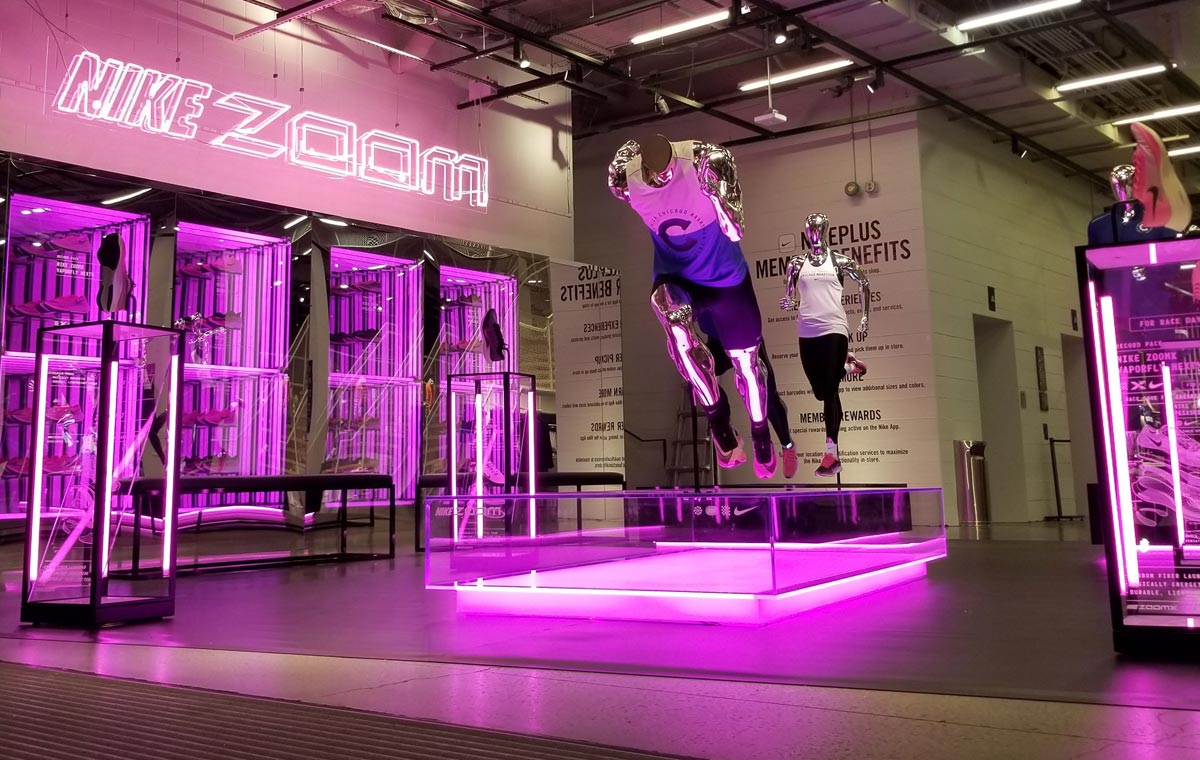
An example of how this brand we all know is re-inventing how customers experience their products…..museum exhibition style!

Retail dominated at CES earlier this year, and almost all conversations revolved around artificial intelligence (AI) technology to drive seamless and frictionless retail, personalization, and much more. Technology is enabling user experience that wouldn’t have been imagined a decade ago. However, rather than being seen as an end, technology should be understood as the means for giving consumers what they want.  

The NRF’s Retail’s Big Show this year showcased the best of technology, yet some key themes to emerge were that customer interaction in-store is as imperative as the transaction and that Generation Alpha, while not yet capable of earning money, has immense influence on their parents who do. While these true digital natives are technologically adept, they value in-store and physical experiences. Do not for a second underestimate their influence on their parents.

Gen Z, the first generation to have had a smartphone their entire lives, are also known to be digitally savvy.

While generalizations across entire generations are never helpful, it is widely agreed that this cohort researches brands and products online but – and here’s a surprise to those focusing only on technology – according to global management consulting firm Kearney, 81% of Gen Z prefers to shop in stores, while more than half of them do so because they say it helps them disconnect from the digital world. 

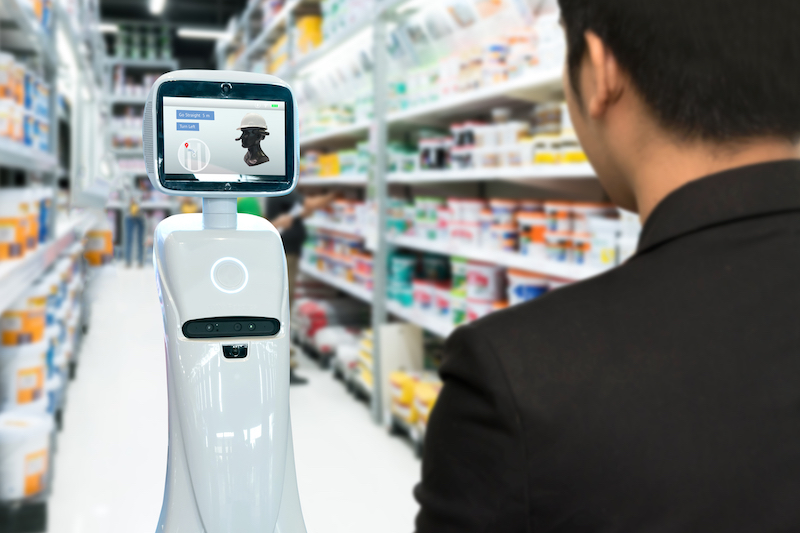
All the signs are there for retailers willing to see them. Our two youngest generations are telling us what they want. What does this look like in practice? Amazon launched its Just Walk Out technology a mere six years ago, accompanied by hyper-advanced ceiling-mounted cameras, shelf sensors and algorithms. Amazon has announced it is removing the technology because it alienated shoppers who felt that a trip to the grocery store felt like they were stepping into a high-tech vending machine. This speaks directly to what consumers want from an in-store experience.

Retail’s next big opportunity is hyper-experiential retail, and we are at the precipice of this explosion of customer experience driving consumer choice and loyalty because of a confluence of a few big forces at play.  

Shifting of the tectonic plates

The first is technology, which is enabling innovative and effective experiential retail. Another is that as the pandemic fades into memory, people want to be out, they want to spend moments with other people outside of their homes. According to insights from Canvas8 looking into what they call experience hunters, 58% of consumers believe that immersive experiences will influence their next purchase. In other words, six out of ten people place a high value on how retail makes them feel.

Artificial Intelligence will be used to supplement customers shopping experiences.

The third is that there is no longer a clear line between where retail starts and where it ends. Almost everything is a retail experience now, no matter if you’re at an airport, a fuel station, or commuting – retail is everywhere, meaning there are hundreds of different competition points for retailers across millions of different journeys. The last big force is that e-commerce has slipped into a holding pattern. Effective, efficient, and convenient, but boring and predictable. Influencers have taken over product choice even leading the conversations on behalf of brands. But consumers want more fun, they are seeking discovery – the magic of retail past.

This all has very real permutations for brands that have built their market presence on legacy retail experiences. They need to innovate quickly to keep up with pioneers who will keep raising the bar of experiential shopping. In addition to this they will be competing directly with startup brands and businesses that were direct-to-consumer, but are moving into the realm of retail experience without the baggage of the past. This area alone will likely see exponential growth in the next few years. 

From purpose to experience

Defining brand purpose has been front and center for a number of years, which is right because purpose is foundational. However, purpose doesn’t tell you everything about how a customer will experience a brand. In light of this, brands will be challenged to define how their brand is experienced across all dimensions. In other words, not just their voice, not just the words that they’re using or their personality and identity, but how they’re physically coming to life, how they’re meeting customers at the important moments across the retail journey and creating value, intrigue, excitement, attraction, and desire. 

This type of discovery is crucial for brands to drive longer-term loyalty in a hyper-competitive landscape. It starts with dimensionalizing the brand, in other words thinking about how it should look, feel, sound, smell, and taste – this is the cornerstone of an experience vision. Once a brand has done this it needs to be precise in how it chooses the moments where it wants to explode into life for consumers. Much of this precision will come from a deep understanding of consumer insights and experience barriers and how to overcome them, but also from creativity, imagination and innovation – a true path to differentiation.

Agencies and consultants need to help retailers by mapping out a diagnostic journey of consumers. This enables brands to understand a consumer’s entire journey, not just within an experience, but within the moments and choices leading up to an experience. How do they make choices, what drives them, what motivates them, what distracts or pushes them away from brands? When do they make these choices? 

The best technology can aggregate multiple data sources to help diagnose brand issues as well as predict where and why brands are losing consumers along their journeys. It is important for retailers to find answers about where they are not maximizing consumer desire in key moments. However, landing on the right answers requires asking the right questions.

The seeds to these questions were planted at CES earlier this year, when some of the biggest retailers and tech giants in the world made it abundantly clear that their vision of sustainable, long-term growth lay in marrying technology with humanity, signaling a return to appreciating the value of humans and how we feel. We all know what experiential retail is, and the world is awash with various case studies of highly successful campaigns. Expect this to turn up a notch to become hyper-experiential. Especially that according to Canvas8, quoting Unibail-Rodamco-Westfield, 8 in 10 people globally are willing to pay more for elevated shopping experiences. 

Genuine human connection and personal interactions are going to drive retail growth, innovation, and brand loyalty this year and beyond. Brands need a plan to thrive in this renaissance of hyper-experiential retail. The rules of the past aren’t going to work in the new era of modern retailing where consumers are telling us what they want, we just need to listen, see around the corner and bravely walk through the door. For the Silo, Rhonda Hiatt

Rhonda is the global CEO at Clear, part of M&C Saatchi. Featured image: Galleria Vittorio Emanuele in Milan Italy- using historic storefronts and buildings in newly realized enclosed mall retail spaces.

Generation Z Job Advancement Difficulties Continue

Revealing reports are exposing the extent to which Gen Z is grappling with a far tougher job market than ever before, spurring overwhelming financial angst and uncertainty. Below Gen Z authority, attorney and legislative policy pundit Cheyenne Hunt, J.D. — a  TikTok influencer with 93.3K followers and 3.7M likes on the platform — provides front-line perspective on the trending topic. 

“The challenges we Gen Z’ers face in today’s job market are unique and complex as we navigate unprecedented economic shifts and evolving workplace dynamics,” she said. “A better understanding of the systemic hurdles and barriers hindering Gen Z’s professional growth is needed to spark dialogue and help employers, policymakers and career advisors develop strategies to support this highly consequential generation of talent.” 

6 Issues Stifling Gen Z Career Advancement

caucasian-businesswoman-looking-at-road-sign-d.jpgGen Z, of which I am a part, has been dealt a rough hand with regard to this generation’s entrance into the workforce at large. We’ve collectively experienced so many “unprecedented” events throughout our formative years that have caused many to lose their meaning and purpose in their professional and personal life. For executives seeking to understand, and aptly integrate, Gen Z into staff teams, it’s essential to recognize and address the unique challenges and needs of this consequential generation greatly influencing the workforce. While there are a litany of issues undermining Gen Z career prospects, there are a few key set of obstacles that must be overcome to bolster this generation’s advancement opportunities:

1. Economic Inequality
Gen Z enters the job market with significant financial burdens, including high costs of living, especially in urban centers. To attract and retain these young talents, consider implementing comprehensive benefits packages that alleviate these pressures. This could include competitive salaries, housing stipends, or student loan repayment programs. By addressing economic barriers directly, your company can become a more attractive and viable option for Gen Z candidates who are often forced to make career decisions based heavily on financial factors.

2. Job Market Instability
Gen Z values stability as much as flexibility. In response to the economic volatility they’ve witnessed, it’s important to emphasize job security and long-term career prospects within your company. Develop clear career pathways and foster a culture that rewards dedication and innovation. Regularly communicate these pathways and growth opportunities to ensure young employees see a future within your organization.

3. Lack of Internal Opportunities for Upward Mobility
As outside hires for managerial rolls continue to increase in popularity, Gen Z struggles to find a purpose in work that does not present opportunities to be recognized by a promotion in status or salary in conjunction with increased skill and responsibility. In fact, many studies have found that young workers are more likely to achieve career advancement by jumping ship to a new employer every three years or less. 

4. Technological Disruption
Rapid technological advancements lead to job displacement and the need for continuous upskilling, which can be particularly challenging for Gen Z entering the workforce. Automation threatens traditional entry-level roles, requiring Gen Z to adapt and acquire new skills to remain competitive in a job market they may not have even found a place in yet. Consider, leveraging Gen Z’s tech-savviness by involving them in digital transformation initiatives within your company. Offer roles that challenge them and allow them to work with cutting-edge technologies.

5. Lack of Mentorship and Networking Opportunities
Gen Z may lack access to mentors and professional networks that can provide guidance and opportunities for career advancement. Remote work creates fewer opportunities to make advantageous connections intentionally or even in passing. Traditional networking avenues may be inaccessible or less effective for Gen Z, who often rely on digital platforms for networking, which may not offer the same depth of connection.

6. Student Debt Crisis
Student debt is a pervasive concern for Gen Z, shaping their career paths and life choices. As an employer, offering programs such as tuition reimbursement or scholarships for further education can set your company apart. Additionally, support flexible work arrangements that allow for continuing education, enabling employees to pursue degrees or certifications that enhance their career growth while gaining valuable work experience.

Addressing these issues requires systemic changes in education, employment policies and societal attitudes to ensure more equitable opportunities for Gen Z career advancement. Given this generation is poised to soon become the largest sector of the workforce, it’s in everyone’s best interest to better set Gen Z up for success as a matter of public policy, economic stewardship and plain old good business practices. For the Silo, Cheyenne Hunt, J.D.

Cheyenne Hunt, J.D. is a progressive advocate and attorney specializing in progressive activism, legislative advocacy, communications and democracy-focused tech policy.  She currently serves as a Big Tech Accountability Advocate with Public Citizen. Hunt graduated from the University of California Irvine School of Law, has earned Dual Degrees in Political Science and Public Policy from the University of Denver and serves as a board member for The Women of Global Change.