Dating in your 20’s can be downright tough these days. A lot of times it’s all about “hooking up” or becoming “friends with benefits”, both which replace the notion of dating as a prelude to a long- term relationship or even saying “I do”. On paper, avoiding commitment seems like a good idea – remaining friends can protect you from the things that tear most couples apart – jealousy, cheating, heartbreak…but what happens when your ”hookup” becomes the one person you can’t live without? Set in the damp and drizzly neighborhoods of Portland, Oregon author Rebecca Kelley’s fun and quirky literary debut, Broken Homes and Gardens [Blake Slate Press] reveals what happens when you toe that fine line between friends and “more”.
Not exactly on-again, off-again, Malcolm and Joanna are in-again, out-again: in love, out of each other’s arms, in an awkward co-living arrangement, out of the country. Their unconventional relationship is the only way, Joanna says, to protect herself from the specter of commitment, which inevitably leads to heartbreak. A When Harry Met Sally meets Portlandia for the Millennial generation, Broken Homes and Gardens is an ode to friendship, lust, and the unrelenting pull of love. It will appeal to readers who love romance, quirky humor, and stories that offer a deeper and sometimes darker look into the risks we take for love.
“Throughout literary history, romantic involvements for young women have been treated as a problem with an easy answer: find the right man, marry him,” says Rebecca, “but I believe the period of early adulthood is not focused only on long-term coupling and knot tying. Many women I know – myself included – were involved in one or two long-term relationships in their 20’s. The struggles of dealing with their ending, and the aftermath, had an enormous impact on our development as women, and an even greater impact on future relationships.”
A contemporary tale full of wry humor, convincing dialogue, and emotional twists and tangles, Broken Homes and Gardens touches upon the following themes:
• The often messy, complicated, confusing and passionate twenty-something love, both in literature and life
• A unique look at the melting pot that is Portland, OR, known as the place where “young people go to retire”
• The “Hookup” Culture: the troubles with 21st century dating and love
• An honest look at “friends with benefits” – does it ever really work?
• Broken homes – literally and figuratively
“My heroine in Broken Homes and Gardens undergoes some relationships in her late teens and early twenties that shake her belief in love so firmly that she decides marriage is not the answer to any of her problems,” adds Rebecca. “Joanna’s approach to her relationship with Malcolm isn’t optimistic but it’s rational. It’s understandable. And I think her story speaks to many of us.”
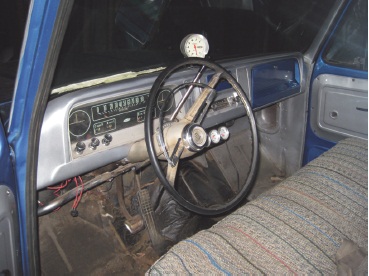
1966 Chevrolet C-20 Custom pick-up. Found in a wrecking yard in the Mojave Desert by the author.
Lloyd’s 66 Chevy C-20 Custom is the epitome of the classic story of finding a sweet ride, a diamond in the rough. Just tucked away somewhere conspicuous collecting dust down south. I found this truck in a wrecking yard in the Mojave Desert being neglected for over 12 years. Imagine the looks on the guys faces that walked by this old truck in the yard if they could see what it turned into now. (funny enough, this is the same yard in which I found my own personal truck of the same body style over 25 years ago.)
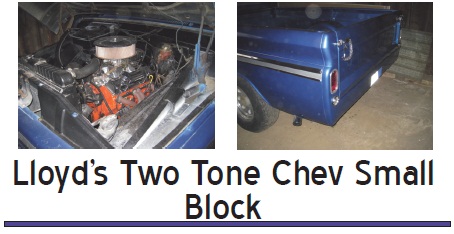
I went to California and worked on this truck for 3 weeks to get it running and road worthy before making the epic over 2500 mile trip back to WC Kustoms in Windham Centre. First thing was the engine. I took that dirty, tired, old 350 and swapped it out with a fresh Crane Cams build-up 60 over 350. I gave it a nice shiny new classic Chevy orange paint job and topped it off with everything chrome (edelbrock endurashine carb, high-rise intake, and Mr. Gasket chrome dress-up kit.) To make sure that you really know when it’s passing you, I added some Flo-tec headers and sold him a Magnaflow Stainless dual exhaust kit (the kit was installed by Queensway Garage in Simcoe.)
For outside looks, this sweet 66 got a stock, two-tone custom, color scheme using two 2011 factory Chevrolet colors. A wicked combination of Metallic Blue and Silver to make this truck as colorful as the character that owns it. Inside it also received a blue, back-lit Equus tach and gauge set. In pure Lloyd style one of the first additions was blue street-glow lighting. Deleye’s in Simcoe also installed a chrome custom trim kit, painted grille and front bumper, and a rear roll pan bumper that looks really good. This truck is a vast contrast from the old farm trucks that many would attribute this body style to.
If you’re a retro gamer and Grand Theft Auto (San Adreas) fan, you should consider changing up the default tow-truck with the ’66 Chevy C-20 pickup.
For the Silo, by Robb Price.
WC Kustoms in Windham Centre, Ontario can be reached at 519-410-8308.
Now that Storm Season is underway in Ontario, I felt it was time to write another article on the subject. This one will be a little different compared to the Silo articles I have written in the past. It will be about those golden moments when both the storm chaser and the breathtaking cloud structure will be in the same scene together.
There are a lot of excellent storm chasers in our province who have an absolute love for weather.
I could write a entire paragraph with just the names of those in our province alone. Whether it be photographing, forecasting from home, or reporting the storms, the chasers share the same dedication and passion. They all have different qualities that make them enjoyable to be around and to share the experiences as a group. In this collection, you will see a series of photos showing the storm chasers in action across various parts of the province. I only wish I had more photos of everyone in the storm chasing community.
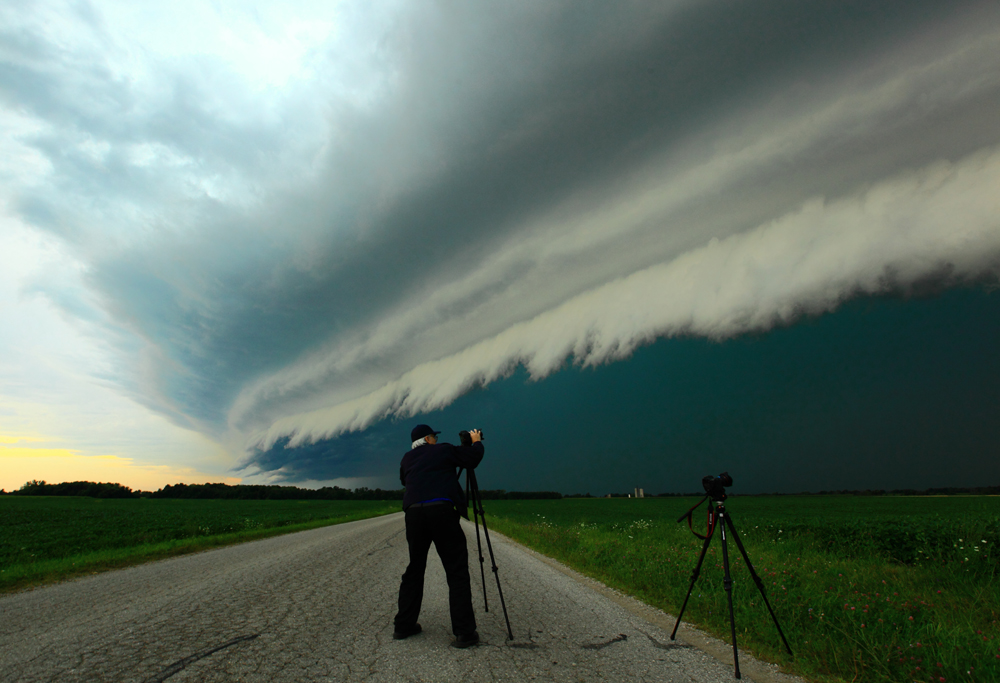
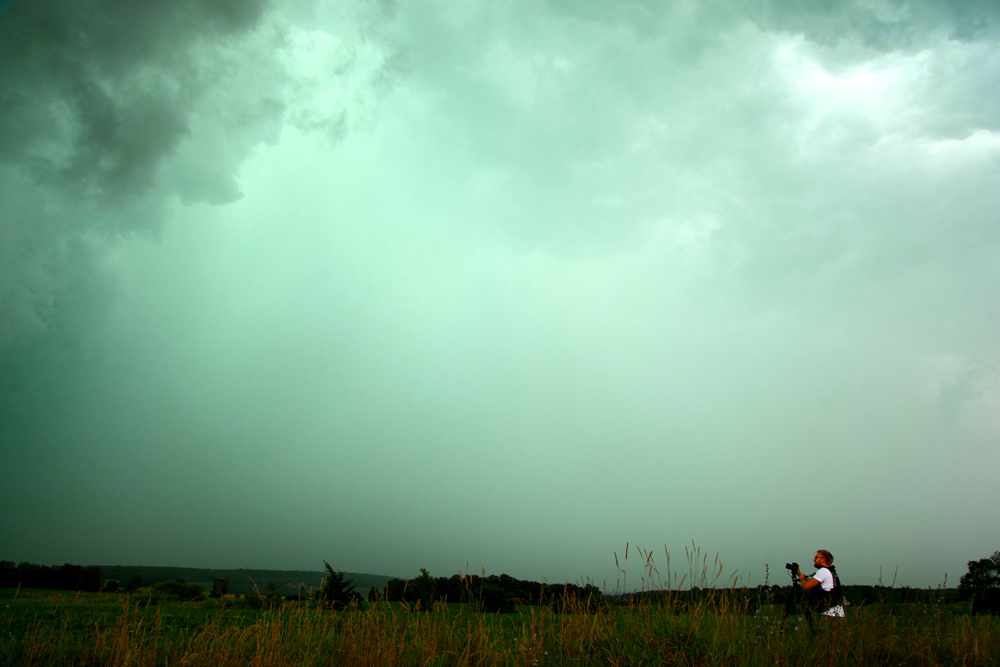
This photo is of a man I have chased with for over 19 years now. He is my dad, Brian Chapman. He and I have worked along side each other for many years, tracking down numerous lightning storms, several tornadoes and epic squall lines like that which is visible in this photograph. This storm was taken on August 2, 2016, south of Goderich, Ontario. You can see the layering of the gust front shelf cloud as it approached our location. The storm also had golf-ball sized hail in it with damaging winds. There were unconfirmed reports of a tornado wrapped in rain and hail with this storm, just north of our location, according to fellow chasers in the area.
Brian and I chased for 9 years without portable radar, using radar at home. I would animate it in my head and figure out where we had to be. Also, while out there, we would use AM radio to gage how intense the storms were as well as their general location based on the intensity of the static on the station. We are both happy to have portable information now, but when that fails every now and then, we are both quite comfortable using only visual cues.
It is hard to believe that Spencer Sills and I used to live 10 kilometres apart when we were kids. We were both crazy about the weather. I even went to church across the road from where he lived, yet we didn’t know each other until connecting on social media years later when our friendship grew into an unbreakable bond. He and I both used to chase on our bicycles when we were younger, before we could drive, if no adult was able to take us out. That definitely led to some quick peddling back home at times.
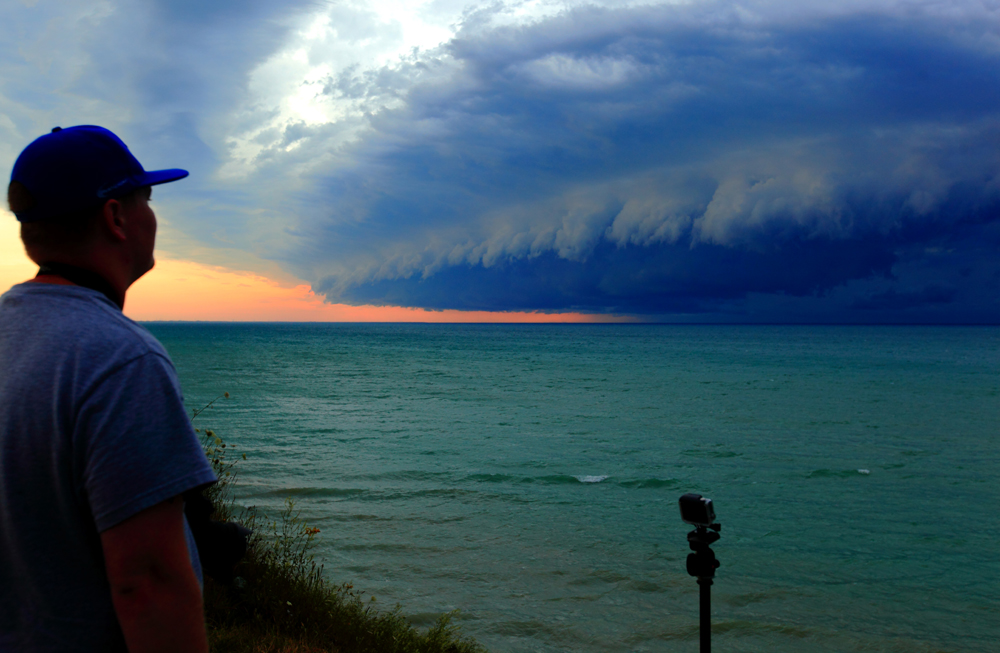
We both have a background where instinct is a big part of chasing. We feel comfortable not having radar information. Spencer is an amazing forecaster and helped get me started in the world of forecasting. He is one of my all-time favorite photographers whether it is storm related or other various subjects. In this particular photo, you can see the huge shelf cloud coming across Lake Huron, just north of Grand Bend.
It was roughly 10 minutes after this, that we had an experience of a lifetime.
In the photo above, you see that we have a very large and heavy rain/hail core coming at us. Not quite as green as in the previous photo but this storm was dropping hail around quarter-size. It was a long chase day, something Kyle Robertson and I are used to doing.
Both Kyle, my dad and I have something in common in this respect — that is, we will literally chase anywhere in any type of terrain for as long as necessary. We are comfortable no matter how heavy the trees are for blocking visibility because we always believe we will get that opening when we need it most. To give you an idea, we have all chased in the Bancroft area, north of Georgian Bay towards Sudbury and even on the north end of Manitoulin Island.
In this particular chase, we started in the Listowel area after leaving the Niagara region, ending up in the Owen Sound area before getting something to eat in Collingwood. As we were on our way home, a line of storms fired up on Lake Erie, so we headed to Port Maitland and then across to Crystal Beach until 3:00 a.m. in the morning. This is typically how Kyle and I both are. We have a confidence in each other for getting us to the target area and that we will get amazing photos when we arrive. Kyle is one of the most determined, driven people that I know. He has a superb knowledge on the history of tornadoes in Ontario and is an excellent photographer.
I don’t have many photos of myself while storm chasing.
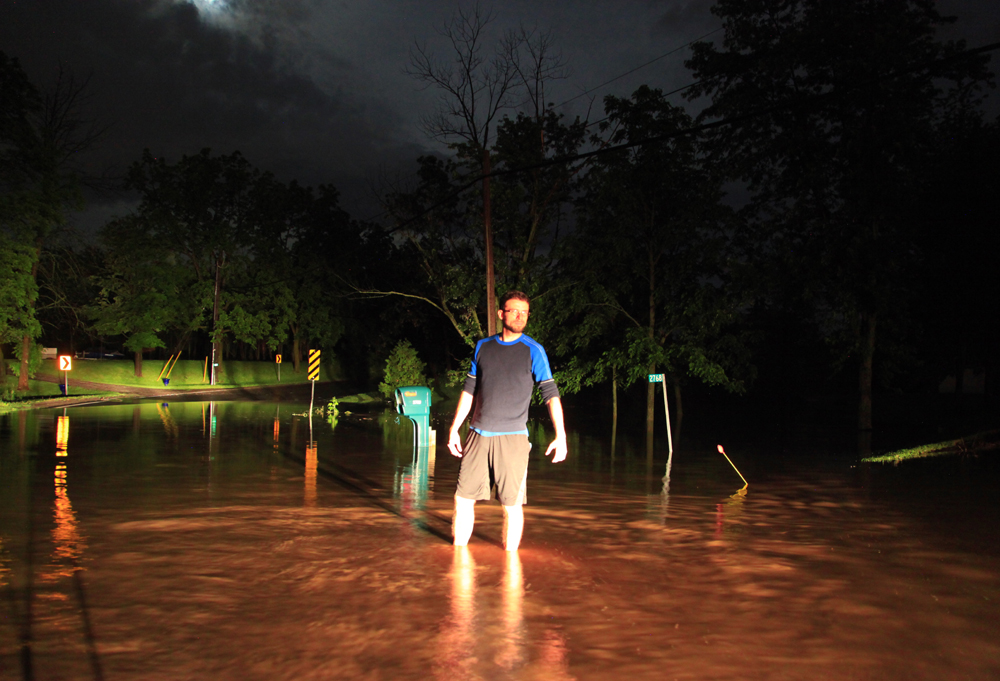
I am often busy running from camera to camera. On June 12, 2014, close to Fonthill and travelling towards St. Catharines, there was a tornado warned storm that went through this area. It put on a tremendous lightning show along with very heavy rain as you can see on this roadway near the town of Rockway. My dad and I tracked this storm around midnight. Fortunately, it did not develop a tornado. Tornadoes are bad at anytime but when they hit at night, it can be a lot worse due to the fact that people are sleeping. It is a good thing that Ontario is not prone to having many tornadoes at night. It is still important to listen to all warnings but generally we have not had any really major tornadoes hit at night in recent years.
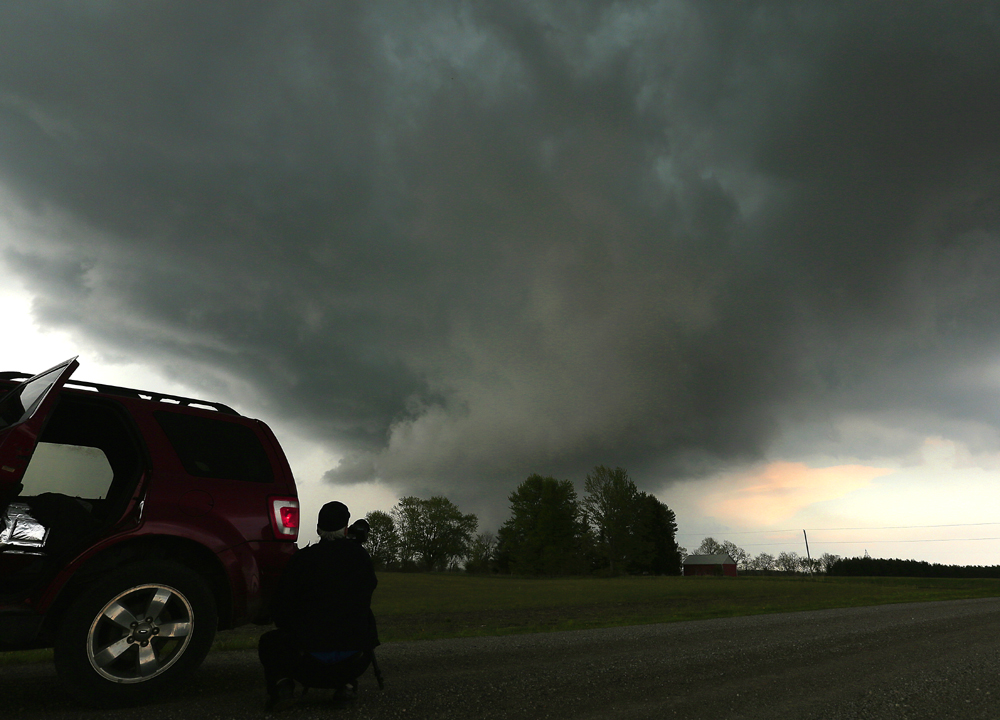
The photo above is another look at my dad doing what he loves to do which is videotaping rotating wall-clouds. He used the vehicle in this situation to shield him and the camera from the winds. It helps to eliminate camera shake when hit by gusty winds. This rotating wall cloud, like most of them in the northern hemisphere, was rotating counter-clockwise. It was shortly after this that it tightened up into a nice cylinder shape before dissipating and eventually elevating over Lake Erie.
My brother, Eric Chapman, doesn’t get to storm chase often but when he does, we often get to see some interesting cloud structure like this one.
This was a large outflow boundary that first developed near Grimsby, Ontario, where it was still attached to the storm. We continued to track this storm all the way to Niagara Falls before following it south down the Niagara River to Fort Erie. At this point it had completely detached itself from the core of the storm. This is often when storms form a roll cloud but this one didn’t quite have those characteristics. I call these “rolling shelf clouds” because they have features of both. Generally, you can see the rolling effect in the bottom part of it, and at the same time it has a shelf-like feature above, but with no rain-core or storm attached to it.
A little change of pace in the photo above.
My friend, Mark Robinson, also known as one of the Storm Hunters on The Weather Network, has a passion for extreme weather. He has chased storms like Hurricane Katrina, as well as the largest tornado in recorded history in the El Reno area, on May 31, 2013, that measured as much as 5.2 kilometres in width. That all said, he is very much dedicated to what we get here in Ontario. From storm chasing in the summer and winter, to hunting down the big autumn wind storms, like this one, that seem to hit at least once every November. This particular photo was taken in Crystal Beach, Ontario. A hot spot for big waves and strong winds during the fall and spring.
A fellow storm chaser and friend of mine, Dave Patrick, a.k.a. “Tornado Dave“, is one of my all-time favorite chasers. After growing up in Grey County and chasing with my dad for around 5 years, Dave was the first storm chaser in Ontario that I learned about outside of our own team. It was when I came across his website, that I realized there were other dedicated chasers in our province.
It was really neat to study his site for years and then to finally meet him in March of 2012.
It was in August, 2013, after both he and our team were tracking the same tornado east of Arthur, that our friendship and bond grew. Like many of the chasers I have mentioned, Dave and I could talk for hours about storms, tornadoes and whatever else was in the sky. I have learned a lot from him for which I am truly grateful. He truly has a gift of reading both the sky in the daytime as well as at night. Although I don’t have any photos of him, I chose a photo of lightning because of the force of a person that he is and the dedication he demonstrates when documenting weather.
The main focus for our team this year will be anything that forms a super cell tornado or waterspout.
Kyle, Brian and myself have documented so much in the way of thunderstorm activity now, that we only really need to work on adding to our already good-sized tornado and waterspout collection. It is also our true passion to try to figure out the puzzle of where the next major event could happen and to be there when it does. Waterspouts are easier in that respect, but it still requires a lot of work to make sure you are in the right location at the right time. As for tornadoes, our province averages about 12.5 per year or as I like to call it, 12 tornadoes and a funnel cloud. Many of them are short lived and can be quite sporadic with respect to where they form. So when you start to break it all down, to get the timing just right is more like an art form than anything else.
We never stop working on ways to improve the methods of forecasting and documentation. The waterspout you see in this photograph was taken on Halloween, 2017, on the most eastern part of Lake Erie, south of Fort Erie, looking east towards the city of Buffalo, New York. It was by far one of the best Halloweens I have ever had. I saw 9 waterspouts, 17 funnels and 2 spray rings that day. It was amazing to witness that over a span of only 2 hours.
For the 2020 storm chasing season, I will only be out for supercell tornadoes, waterspouts, sprites, blue jets and local lightning work.
I have every other aspect of thunderstorms that I need ranging from the small to the big to the unusual. I have combined all of my years of data and have created a powerful, educational and entertaining series of programs that I present in person in front of crowds and which are now also available through online virtual presentations. For the Silo, David. T. Chapman.
To learn more about Kyle Robertson, Spencer Stills and some of the storm chasers mentioned in this article, contact David T. Chapman at his link above.
TV content used to be delivered from a long distance transmitter and received by a roof antenna on your house. The antenna had to be manually or automatically positioned whenever you wanted to watch distant channels. Work was involved. Mystery was involved. Finding something to watch was satisfying.
I’m often asked what I think about the original Star Wars series versus the “new stuff”. A debate that continues to rear its ugly head again ever since Episode VII was released back in December 2015 . I think, for me, I’ve determined what the problem is and why those of us who grew up with Darth, Luke, Han and Leia have a hard time with the newer movies when the younger generation just loves them.
The ‘rabbit ears’: two metal rods sticking up from the television set. The rods could be rotated, pulled apart, shortened and lengthened etc. to fine tune a distant channel.
The Empire Strikes Back was released in 1980. I was an impressionable nine year-old. Although I had seen the original Star Wars, it didn’t resonate with me as much as Empire did. When May 21 of that year hit, my life it would seem was changed forever. After seeing the film, it was all I could do to stop thinking about it and what I had seen. The cliffhanger ending was killing me and yet I seemed okay with the fact that I was going to have to wait three more years to find out what happened to Han (no spoilers here in case somehow you have somehow missed Return of the Jedi).
That summer I saw the movie 13 times. The world was a different place. I took the bus by myself downtown to the beautiful Capitol Theatre (now the even more beautiful Sanderson Centre in Brantford). There was no internet (at least, not that mere mortals could access). I got excited by the occasional mention of the Star Wars universe on the television and I wouldn’t even get a VCR for four more years so the idea of being able to watch the movie “on demand” was not even a thought in my young mind. Instead, I had to rely on my mind through my memories and imagination.
For me, getting the action figures from the movies and being able to recreate scenes from the film helped bring me back to my happy place inside the Star Wars universe. We couldn’t afford to get all the playsets and ships, so I built a lot of them out of cardboard. I used my creative side to paint them like I remembered them in the movies and as soon as I could I ordered the photo books from the school book service so that I could go back there. When the movie eventually made it onto television, a VCR-less me compromised by recording the audio of the film onto cassette. I could then listen (and listen I did) to the movie with my eyes closed and pictured it all in my mind.
If I told this story to a nine year-old today, I would get strange looks. “Dude, why wouldn’t you just watch it on Netflix or look it up on your iPad?” It just wasn’t possible. I was so desperate for a connection to the universe I even cut out the black and white mini-movie poster that was printed into the newspaper with the local theatre listings and posted it on my bedroom wall. Yes, that’s honestly how it was.
Today, I feel like the instant access we have to everything “on demand” somehow diminishes our connections to content. I am pretty sure good movies have been made after the 80s, but I would be hard pressed to find one that hasn’t held such a close connection with me. Not only is there instant access to so much of the content we get today that there is, in fact, more content out there than I can possibly keep up with. This got me to thinking, how do others deal with content overload?
In my case the biggest problem I have is video games. With over 15,000 to choose from I am rarely bored. However, I have needed to come up with a system to keep track of everything I want to play. In my vast game collection there are surely a ton of stinkers, but there are also some amazing games from the 80s, 90s, and early 2000s that I have missed. Heck, I’ve missed a lot of the games that made the most critically acclaimed lists in the past few years. So I had to come up with a system.
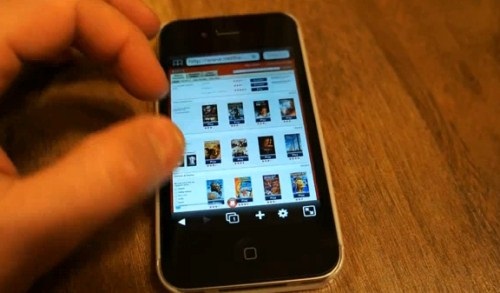
How easy is it to have access to thousands of movies? Netflix can be streamed anytime to your I-phone.
What I do now is maintain a list on Dropbox.com that I can access anywhere. It’s called “Games I need to play.txt” (notice the “need” and not “want”). It has two sub-sections: “Started and Never Finished” and “Games to Play”. I don’t really like leaving games unfinished and so when I look at this list I am reminded of what I need to finish up (as I am often playing more than one game at a time) and then for my larger list I prioritize it with what should be next “on deck”. The list is dynamic, changing as I remember what I want to play or come across things of influence from my colleagues. I also have to admit sometimes I choose to play shorter games so that I can get through them and feel more “accomplished”. The site www.howlongtobeat.com is an amazing resource for this sort of thing.
When I asked my friends how they deal with content overload I got some interesting feedback. One of them, John, actually has an algorithm for dealing with his backlog of books. John shared it with me and it goes something like this:
1. I always have one serious and one fun book on the go and which I put on top of the night stand along with my reading glasses. Sometime I cheat and have two of each kind on the go.
2. I keep a pile of books I want to read someday in my night stand.
3. If I get bored with a book, I trade it with one in my night stand.
4. When I finish a book, I choose another from inside my night stand.
5. If I get tempted by a new book I buy it. If it will not fit in my night stand, then I discard the book that interests. Same goes for books that I’m given.
6. I do have a book shelf at work and one at home for books that I want to keep for later reference. If they get too full, I discard things of least interest.
7. I discard books by giving them to someone, donation to a charity or yard sale.
That’s pretty organized. It’s a little more efficient than how I deal with movies I have yet to watch. Presently, the ones that are on the shelf (Blu-ray or DVD) get “pulled out” a little bit so I can see them clearly among all of my other movies. Since they are all in alphabetical order I don’t want to just pull them out randomly and create a new pile.
A friend shared with me a good way to deal with television content. Just PVR or DVR all the content and then watch as you can. I tried this, but filled up my hard drive so I had to go out and buy an external drive. That drive is now dangerously full. There was some good advice in there, however. “What I do is record all the episodes of a TV show and then when it’s all done I go on a watching marathon and binge on the content for an entire day or two. If it’s a new series and I find out it has been cancelled before I even watch it, I delete all of the content and that way I’m not investing in a show that will ultimately let me down with no additional content.”
Algorithms, mechanisms, processes and lists all to deal with an over abundant amount of content. It’s a wonder there is any room left in our brains to remember or think about what we consumed last week, let alone last year. Yet I find myself looking forward to more content in an ADHD kind of way, I can’t seem to get enough. This is, ultimately, why there will never be anything better in my life than the original Star Wars and other films of the 80s (Raiders of the Lost Ark, Ghostbusters, Stripes, Uncle Buck, Back to the Future). At the end of the day, I’m okay with it because there is always something good and interesting around the corner, even if I have to implement a system to manage it all. There are definitely worse things in life. For the Silo, Syd Bolton.
HA NOI (June, 2020) – A new study found that animals sampled in the wildlife-trade supply chain bound for human consumption had high proportions of coronaviruses, and that the proportion of positives significantly increases as animals travel from traders, to large markets, to restaurants.
The study, which appears in the pre-print journal bioRxiv, is by a team of scientists from WCS, the Department of Animal Health of the Viet Nam Ministry of Agriculture and Rural Development, Viet Nam National University of Agriculture, EcoHealth Alliance, and One Health Institute of the University of California, Davis.
Wildlife in the trade supply chain are often under stress and confined at high densities with other animals from multiple sources which likely results in increased shedding of coronaviruses. The authors forewarn of the potential risk of viral spillover into people through the wildlife trade.
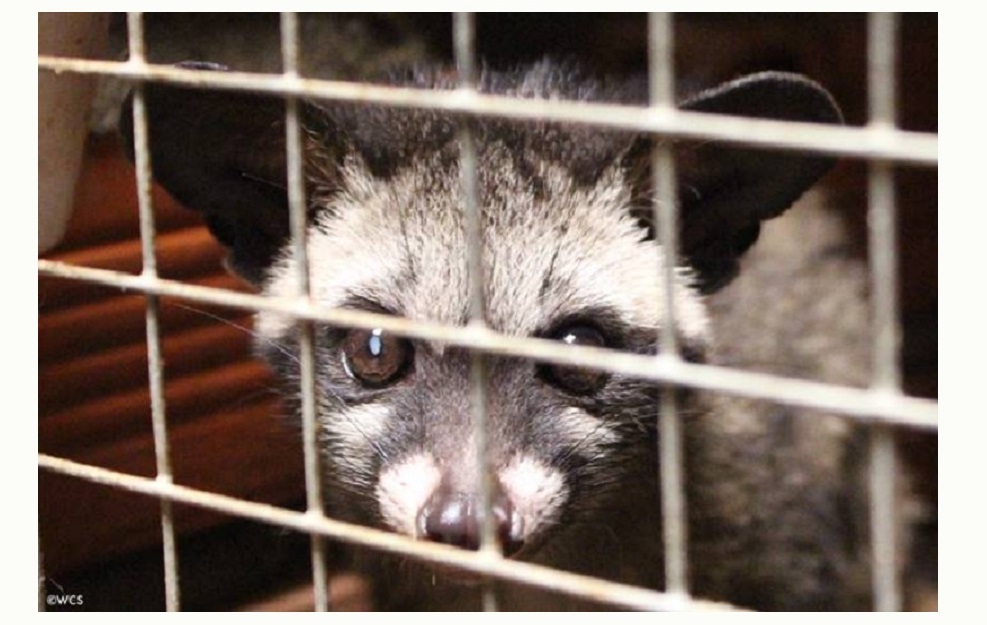
The authors indicate that stress and poor nutrition likely contribute to decreasing animal immune functions resulting in increased shedding and amplification of coronaviruses along the supply chain. The findings in rodents illuminate the potential for coronavirus shedding in other wildlife supply chains (e.g. civets, pangolins) where similarly large numbers of animals are collected, transported, and confined.
The purpose of the study was to gain a better understanding of coronavirus presence and diversity in wildlife at three wildlife-human interfaces including live wildlife trade chains, wildlife farming, and bat-human interfaces. This work represents an important demonstration of capacity and a significant contribution from Viet Nam to the field, laboratory, and scientific approaches critical to understanding and addressing zoonotic disease threats. The consensus PCR approach for viral detection is a cost-effective tool for detecting both known and novel viruses and co-infections in a variety of taxa, sample types, and interfaces.
Researchers collected samples at 70 sites in Viet Nam, and detected six distinct taxonomic units of known coronaviruses. There is no current evidence to suggest these particular viruses were a human-health threat, but the laboratory techniques used in the study can be utilized to detect important emerging or unknown viruses in humans, wildlife, and livestock in the future.
The team found high proportions of positive samples among field rats destined for human consumption. The proportion of positives significantly increased along the supply chain from traders (21 percent), to large markets (32 percent) to restaurants (56 percent). Coronaviruses were detected on two-thirds of the surveyed wildlife farms, and six percent of rodents raised on the farms were positive. A bat and a bird coronavirus were found in rodent fecal samples collected from wildlife farms suggesting either environmental mixing or viral sharing among species. Coronavirus detection rates in rodent populations sampled in their ‘natural’ habitat are closer to 0-2 percent.
Said Amanda Fine, WCS Health Program Associate Director, Asia, and a co-author of the study: “Wildlife supply chains, and the conditions the animals experience while in the supply chain, appear to greatly amplify the prevalence of coronaviruses. In addition, we documented exposure of rodents on wildlife farms to both bat and bird coronaviruses. These high prevalence rates and diversity of coronaviruses, added to the species mixing we see in the wildlife trade, creates more opportunities for coronavirus recombination events as well as spillover.”
The authors warn that the trade in wildlife facilitates close contact between people and multiple species of wildlife taxa shedding coronaviruses. This provides opportunities for intra- and inter-species transmission and potential recombination of coronaviruses.
The wildlife supply chain from the field to the restaurant provides multiple opportunities for such spillover events to occur. To minimize the public health risks of viral disease emergence from wildlife and to safeguard livestock-based production systems, the authors recommend precautionary measures that restrict the killing, commercial breeding, transport, buying, selling, storage, processing, and consuming of wild animals.
The emergence of SARS-CoV, MERS-CoV, and now SARS-CoV-2 highlight the importance of the coronavirus viral family to affect global public health. The world must increase vigilance through building and improving detection capacity; actively conducting surveillance to detect and characterize coronaviruses in humans, wildlife, and livestock; and to inform human behaviors in order to reduce zoonotic viral transmission to humans.
Hoang Bich Thuy, WCS Viet Nam Country Program Director and co-author explains: “Since the outbreak of COVID-19, the Government of Viet Nam has been taking strong actions to enforce wildlife trade laws and is considering the prohibition of wildlife trade and consumption as directed by the Prime Minister in his Official Letter No. 1744/VPCP-KGVX dated 6 March 2020 of the Government Office. This research provides important baseline information and suggests areas for targeted studies to provide more evidence for the development of new policies and/or revision of the legal framework in Viet Nam to prevent future pandemics by mitigating risks of transmitting pathogens from animals to humans at key nodes along the wildlife supply chain. Successful interventions will be those that support a significant reduction in the volume and diversity of species traded, and the number of people involved in the trade of wildlife.”
This study was made possible USAID’s Emerging Pandemic Threats PREDICT project with cooperation from the government of Viet Nam.
WCS (Wildlife Conservation Society)
MISSION: WCS saves wildlife and wild places worldwide through science, conservation action, education, and inspiring people to value nature. To achieve our mission, WCS, based at the Bronx Zoo, harnesses the power of its Global Conservation Program in nearly 60 nations and in all the world’s oceans and its five wildlife parks in New York City, visited by 4 million people annually. WCS combines its expertise in the field, zoos, and aquarium to achieve its conservation mission. For the Silo, Stephen Sautner, Wildlife Conservation Society, Bronx Zoo, New York.
It’s easy to take words for granted; most of us use them as effortlessly as we breathe. But words hold power that we often overlook at our own peril, says media expert Steve Kayser.
“Language is the code that translates ideas so they can be shared. They give us an advantage in the natural world, which has enabled us to evolve as human beings,” says Kayser, author of “The Greatest Words You’ve Never Heard,” (hyperlink below).
“But in our personal and public lives, we are inundated with empty words; words that are used incorrectly; words that are drained of all meaning; and so fail to accurately convey the intended message; and words that carry unwarranted connotations and stigma.”
Words can change lives, destroy relationships and alter the course of entire civilizations, Kayser notes.
[A must read about the power of word usage via Toltec wisdom: thefouragreements CP]
He shares examples of what to avoid, what to embrace and what to reconsider when trying to make your language more effective.
• Avoid John Kerry’s “crystal clear” nugget. Back in 2016 amid the ongoing foreign policy crises in the Middle East, secretary of state John Kerry, who has a linguistic reputation for long-winded political jargon, seemed to contradict himself in a single breath.
“I want to make this crystal clear,” he said. “The president is desirous of trying to see how we can make our best efforts in order to find a way to facilitate.”
It’s this kind of language that makes people cynical about our elected officials – when a politician’s mouth is moving and producing sounds, but he’s not saying anything. Or, if they are saying something, they use words that are overused and unnecessary. Businesses, too, can be notorious for this using corporate gobbledygook to obfuscate all meaning, Kayser says.
“What people want is authenticity in language, to say what you mean and mean what you say.”
• Emulate Mark Twain, the “straight shooter,” who employed wit, charm and incisive commentary in communications. No, most people cannot pick up where Twain, arguably America’s greatest writer, left off. But language and the way in which it’s used can be highly contagious. If you want to inspire authenticity and engage employees and friends alike with genuine communication, consider styling your speech more along the lines of Twain, rather than a dry business manual:
“Twenty years from now you will be more disappointed by the things that you didn’t do than by the ones you did do,” Twain wrote. “So throw off the bowlines. Sail away from the safe harbor. Catch the trade winds in your sails. Explore. Dream. Discover.”
• If you’re in business, there are advantages to embracing the jargon. “Can we blue sky this synergy later?” “Cascade this to your people and see what the pushback is.” … Business lingo could fill a dictionary, and in many cases, requires one! Unlike political babble, business jargon has its purpose, according to a new study from the University of Southern California’s Marshall School of Business. Business speak is code for “upper management material,” showing that the speaker is in a company’s inner circle and is a “big picture” person, the study reveals.
“Some of the language you come across in the business world can seem absurd to outsiders; some of these phrases, however, may actually reveal ambition in an employee,” Kayser says.
“The beauty of language is that it’s a common tool for everyone to use, yet it can be tailored to an individual. My primary suggestion is to do that in a way that authentically reveals your meaning.”
About Steve Kayser
Steve Kayser is an award-winning writer, editor, publisher, former radio host and founder of Kayser Media. He has had the great fortune to interview and collaborate with some of the best minds in the business world, and his eclectic approach to public relations and marketing has been widely documented. He recently published “The Greatest Words You’ve Never Heard,” (www.stevekayser.com).
What does a sugar molecule and US special op forces in Afghanistan have to do with this post? Read on…..
Most people today know antioxidants to be an effective method of fighting age, but few are aware of the biological process underlying for most skin damage – and what directly addresses the problem, says skin-care expert Ron Cummings.
“The word that has been on the minds of dermatologists and other skin-care researchers for many years is glycation, which is what happens on the cellular level to age our skin,” says Cummings, founder and CEO of AminoGenesis Skin Care, (www.aminogenesis.com .
Glycation – damage to proteins caused by sugar molecules – has long been a focus of study in people with diabetes, because it results in severe complications, such as blindness and nerve damage. People with uncontrolled diabetes have excess blood sugar, so they experience a higher rate of systemic glycation, he says. “Antioxidants fight inflammation caused by free radicals, which are largely created from external, environmental factors such as excessive sunlight or cigarette smoke. Glycation, though, damages from the inside out.”
Using antioxidants and topical moisturizers are a good start to keeping the effects of aging at bay, but they only go so far, Cummings says. Even more important is reversing the damage to skin caused by glycation, which became possible only recently.
Cummings shares three points anyone interested in skin care should know about glycation:
• Glycation is the skin’s No.1 aging factor. Sugar molecules in our body bombard our cells like a ferocious hail storm, bonding with fats and proteins. The proteins then become misshapen and excrete exotoxins that disrupt cellular metabolism. Collagen, which makes skin look smooth and plump, is a protein that’s particularly vulnerable to glycation. The damage manifests as wrinkles, lines, discoloration and edema. Rather than attacking a cell from the outside, like a free radical, glycation occurs from within.
• Anti-glycation topical solutions have been clinically shown to be effective. Old lotions, from your favorite moisturizer to Grandma’s secret facial solution to the new DIY recipe you found online act as a barrier to moisture evaporation. But their effect is temporary, and they don’t prevent or reverse damage. New anti-glycation formulas, however, directly address aging by releasing the sugar molecule’s bond with protein, allowing the cell to return to its natural shape and state.
“Just as antioxidants have revolutionized anti-aging efforts around the world, anti-glycation will be understood to be exponentially more effective,” Cummings says. For the Silo, Ginny Grimsley.
About Ron Cummings
Ron Cummings is the founder and CEO of AminoGenesis Skin Care, which utilizes amino acids as the key ingredients to its age- and damage-reversing products. The formula for the solution features 17 plant-purified amino acids, which are necessary for healthy and radiant skin. The company’s formulas include anti-glycation properties, which are very rare in today’s skin-care products. Cummings donated one of his products, a protective agent, to support military forces in Afghanistan and received a hearty letter of gratitude from the Marines of Special Operations Company Bravo, which described the product’s excellent performance, as well as a flag that was flown “in the face of the enemy, over Forward Operating Base Robinson in Sangin, Afghanistan.”
No video game genre is as venerable, or as durable, as that of the simple adventure game. “Adventure” actually covers a number of styles, but there are a few distinguishing characteristics common to them all. They eschew action and combat in favor of exploration and puzzle-solving, and instead of developing their own in-game personas, players generally step into the shoes of an established, or at the very least fixed, character following a tightly-crafted narrative. Yet from the text-based odysseys of the 70’s and 80’s to the surprisingly sophisticated point-and-click journeys of today, the adventure in all its many variations has proven itself one tough old bird.
The origins of the genre can be found in the 1976 game entitled Colossal Cave Adventure. Created by Will Crowther, it was based on his real-life caving experiences embellished with a smattering of fantasy elements that were later expanded upon by Stanford University graduate student Don Woods. Among its most ardent fans were Ken and Roberta Williams, who were so inspired by the game that they actually launched their own software house, Online Entertainment, later famous as Sierra Online, one of the foremost game publishers of the 80s and 90s and an early pioneer of the graphical adventure.
While Sierra was innovating with graphics, another company known as Infocom was pushing boundaries of a different sort. Infocom games like Zork, Planetfall and The Hitchhiker’s Guide to the Galaxy were all about the text parser, yet they were also engaging, complex and, for awhile, commercially successful. But unlike Sierra, Infocom was late catching the graphical wave; its sales declined throughout the second half of the 1980s until Activision, which acquired Infocom in 1986, shut it down for good in 1989.
The next big thing in adventures was LucasArts. These days the company is best known for churning out half-baked Star Wars titles but there was a time when the name evoked images of rough-hewn bikers, invading alien tentacles, Freelance Police and some of the most unlikely pirates you’re ever likely to meet. In 1993, Cyan changed everything with Myst, an incredibly popular and influential release that discarded many of the conventional rules of the genre and made exploration and the discovery of everything, including the basic rules of play, an integral part of the experience.
Today, adventures no longer set the pace for the industry they way they once did (perhaps things are changing- L.A. Noir aims to refresh the adventure genre in high style- content producer) but they have enjoyed a resurgence in recent years in the hands of small, independent developers who continue to innovate and refine. One of the most remarkable examples of the current state of the adventure art is Gemini Rue, which actually roots itself in the past with blocky, VGA-style graphics that manage to look both dated and yet surprisingly beautiful. But underneath those retro visuals lies a thoroughly modern game, with a haunting soundtrack, top-flight voice acting and a story that will keep you guessing until the very end – and leave you wanting more.
The humble adventure has long since been surpassed in popularity by the shooter, the RPG and other genres, but the emergence of gaming as a mainstream creative medium, coupled with the near-limitless potential of widely accessible digital distribution, could very well herald a renaissance. This in turn opens the style to a wider audience than ever, and while not every gamer will like every adventure – personally, I can’t stand King’s Quest games – I can just about guarantee that ever gamer will find one or two that suit their tastes. Try one sometime. You might be surprised. For the Silo, Andy Chalk.
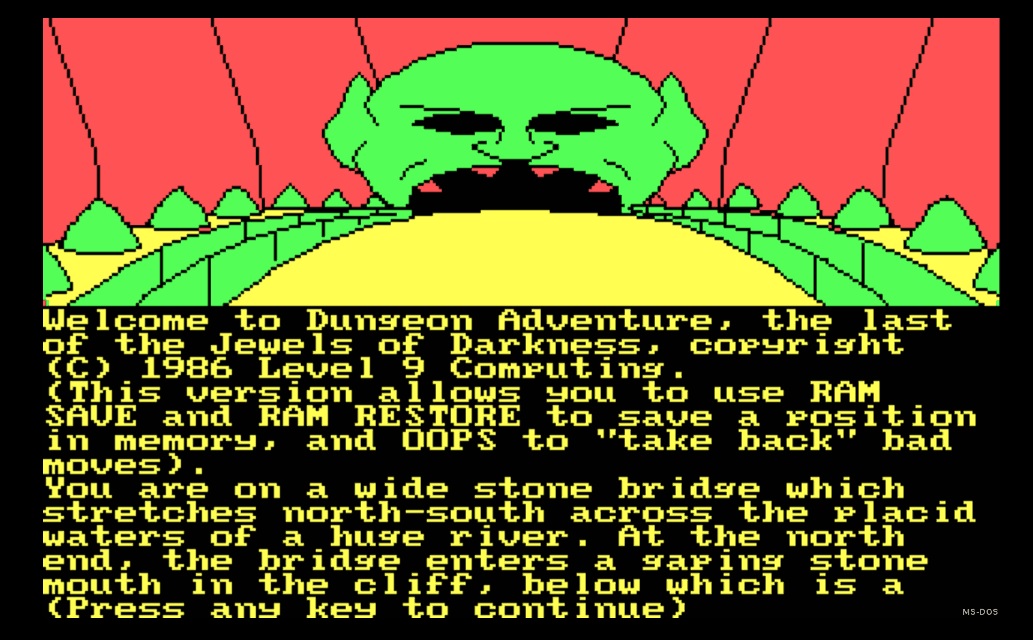
Featured image- The Jewels of Darkness Trilogy (all 3 Colossal Cave Adventure games/sequels) MS-DOS 1986
The very nature of being human means that we strive to understand the world around us. Scientists have long considered experiments the best way to test a hypothesis and draw a conclusion. Over the last century, scientists have begun to study sleep more and more. We know it’s necessary yet we don’t fully understand it. Such a vital function could contain so many important discoveries that we haven’t yet come across.
In this infographic we look at some of the most bizarre sleep experiments. What were they, who ran them and why? Did we learn anything from them or did they go horribly wrong? For the Silo, Michael Brown.
It’s been nearly two years since we moved into our new digs in Boulder, Colorado. The most exciting part has been watching our recording/mastering studio, led by engineer Gus Skinas, come to life. Gus is a close friend and one of the nicest and most humble gents around. The world knows Gus from his work on projects for Pink Floyd, The Rolling Stones, Stevie Wonder, Elton John, Al Kooper, George Harrison, Queen, Joni Mitchell, Chick Corea, Frank Zappa, and The Police (to mention a few). His talent is unmatched, and we’re proud to have him in the hi-fi family.
A few days ago, we made a big step forward. With Gus at the helm, PS Audio has launched our much-anticipated music label: Octave Records.
Almost every time I give a tour at the new facility I get questions about Octave. With hundreds of labels out there, what makes Octave different? You and Paul make components, why the expansion into recording? Are you just doing this because it’s cool?
Guilty as charged!
In truth, we started Octave Records for the same reason we design audio components—because we know we can make a difference. We know we can produce albums with superior sonic quality and we also remain keenly aware of the challenges faced by so many music creators. Labels have been known to sacrifice quality for profits and for mass-market appeal. For albums-sold, most labels compensate artists with pennies on the dollar. Oftentimes, labels insist on owning the artist’s music. We believe the music deserves high-quality presentation and that the artists deserve to be honored for their contributions. It’s the artists, after all, who give rise to our entire industry.
So we decided to build a label the way we think it ought to be. Octave Records uses the finest studio equipment, all centered around the acclaimed Sonoma DSD recording, mixing and mastering system. We asked Gus to personally craft each recording. And to better support musicians, Octave Records covers 100% of the studio, mixing, mastering, production, distribution and marketing costs. We also provide artists with a direct-share of retail revenues, which are ten to twenty times that of other labels. At Octave Records, the artists own their music, and we give them creative control. They’ve earned it…and we get to enjoy the fruits of their labors on our hi-fi systems!
“Along with our dedication to producing the best-sounding recordings available today, Octave Records offers a different kind of business model,” said Paul McGowan, PS Audio CEO. To support musicians, Octave covers 100% of all studio, mixing, mastering, production, distribution and marketing expenses so that artists may directly share in retain sales revenues – while also retaining ownership of their music.”
It’s with great pride that we announce the first album from Octave Records: Out of Thin Air, a solo piano performance from renowned pianist Don Grusin.
Offered in SACD, native DSD (DVD-Audio) and CD formats, you can learn more about Octave Records and listen to samples of Grusin’s new album here https://www.psaudio.com/products/out-of-thin-air/ If you are interested in picking up a copy of this limited edition, they are available with world-wide distribution (direct from us in Boulder), however, this album is not available for digital download at this time.
I hope you enjoy listening to the album as much as we have enjoyed making it. This is the first of many. For the Silo, Scott McGowan.
With 80% of baby boomers using the internet, it is clear that seniors are a lot more adept at using tech than we give them credit for. If you’re not convinced, just have a look at the statistics that MedAlertHelp compiled.
You will see that seniors are using the internet and smart devices a lot more regularly than most people would think. But what’s more interesting, perhaps, is the reason why they are using the internet. In this post, we will go through those reasons in more detail.
It’s Convenient
Raise your hands – who still uses an encyclopedia instead of checking the answer online? Do encyclopedias even exist anymore? Seniors are just as keen on using useful shortcuts as the rest of us.
Consider other apps that might be useful, such as internet banking, for example. In most cases, you’re not going to need to go to the bank unless you need to change your address or get a new card. Just about everything else you can do by using online banking or ATMs.
Easy Access to Information About Things That Interest Them
Most seniors cited that they enjoyed using the internet because it was an easy way to access information about things of interest. We can all relate to that. Just 20 years ago, learning something about your favorite hobby meant finding the right books or a person who could teach you.
Now, thanks to YouTube, that’s all changed. There is a wealth of information on the internet. Not all of it is great, but the support for hobbyists is nice. Want to learn how to crochet a jacket for your chicken? Google it – you will find a pattern. And, yes, there are people who crochet jackets for their chickens.
For Shopping
Online shopping and the elderly can be a match made in heaven, especially when there are mobility issues to consider. Online shopping has changed the world for a lot of us – making it possible to gain access to items that we cannot easily get otherwise.
But it can also be infinitely practical. You can shop for almost anything online, from groceries to clothing. This can be a boon for the elderly with mobility problems or issues finding transport.
For Entertainment Purposes
I have to be honest; this one was a bit of a surprise for me. Especially since I remembered growing up and being told that video games would rot my brain. However, almost half of the elderly who regularly use the net, also use it for entertainment purposes, like gaming.
Communication
The internet does provide us with a number of different ways to contact our families and keep in touch with friends. Seniors are taking advantage of services like Skype, Facebook, and other instant messaging services to keep in touch with the people who are important to them.
Conclusion
There is no doubt that the internet is a useful tool to make day to day living less complicated. We’re not counting the potential for wasting time on it here, though. But, if used correctly, the internet can save you time and a lot of stress. Is it any surprise that seniors are taking advantage of these benefits? For the Silo, Tarun Reddy.
Life in SpaceJoe Martino writes, “In what is a cool mainstream find, Russian cosmonauts have discovered LIFE clinging to the outside of the International Space Station. This is the first time living organisms have been found on the space station and scientists are not sure how “it” got there.
“Results of the experiment are absolutely unique,” Russian ISS Orbital Mission Chief Vladimir Solovyev told the ITAR-TASS News Agency. “This should be studied further.”
In 2014, Cosmonauts found microorganisms on the exterior of the Inter national Space Station. The creatures were found during a space walk to clean the surface of the space station. The organisms seem to be a type of sea plankton and how they remained alive in space is what seems to be troubling scientists. According to Sploid, Russian scientists are both “shocked by [the] discovery and can’t really explain how [it] is possible.”
So far authorities have been withholding actual imagery of the discovered life forms. image: Earth Ocean Plankton examples
To some of us we might already believe in aliens, others may not hold that belief, either way; this is cool news because it further shows the possibility of life in space for those that currently don’t believe it’s possible.
Some scientists believe that the organisms were carried from the ocean by uplifting air currents. Since the organisms are not native to Baikanour, Kazakhstan where the vessel took off, many don’t believe they were brought up during flight. This makes it very difficult to answer the question: “How did they get there?”
The organisms found on the vessel have a mouth, limbs, digestive tract, muscles, and a nervous system! They are aliens! Just not in the typical sense we may picture when thinking about life in space. Known as tardigrades, these little creatures are amazing at enduring harsh conditions, which is why drawing the conclusion that they could have originated in space isn’t so tough.
To believers in aliens this is a mainstream discovery that will help open the minds of those who deny any possibility of life in space.
For the Silo, George Flier via File’s Files #41
No ocean in sight! Baikanour “Space City” in Kazakhstan where launches to the ISS originated from.
If you are a videophile, chances are you have heard of Darbeevision. It doesn’t seem long ago that Faroudja carried the same sort of dare I say “cult like” reverence. Back then, videophiles and home theater nuts like me were clamoring for ways to improve video resolutions on ever larger CRT tube television sets or if you were especially lucky (and had the deep pockets), home projection televisions and dedicated projectors. Sure, some of these displays were capable of high resolutions and were labeled as such (Data grade) but content was largely unavailable to take advantage of the higher lines of screen resolution. The darling format of choice back then was the Laserdisc which maxed out at about 425 horizontal lines of resolution for North Americans or 440 lines for Europeans. And that’s where Faroudja stepped in. Offering highly advanced video processor devices that increased the apparent lines of resolution by using a bunch of advanced math computed on computer chips found inside their products.
Well times have changed….but really not all that much.
Today we have a choice on how we want to watch content and some of us still prefer physical media such as Blu-ray and many of us watch cloud based streaming from our gaming systems. If you fall into either category and are using an HDMI cable somewhere in your setup then you will want to take note of Darbeevision’s DVP5000s HDMI video processor.
Blu-ray has a maximum resolution of 1080 horizontal lines (1920 x 1080) and the DVP5000s is designed to work with sources that output via a HDMI connection 1080 lines. Just like the Faroudja mentioned earlier, the Darbeevision sets out to use today’s advanced computing to render 1080 in a much more detailed fashion and take advantage of all the extra lines of resolution your new flat screen offers.
If you have an extensive collection of Blu-rays for example, you connect the Darbeevision in between your Blu-ray player (which could be a PlayStation 3 or 4, Xbox One- just make sure you select the video output resolution to 1080P when watching Blu-rays). Likewise, when playing games that run at 1080 use the Darbeevision to increase the quality and detail of your gaming system. It has been designed to operate as quickly as possible to prevent any noticeable screen ‘drag’ or gaming delay.
What about YouTube or Netflix?
The key thing to keep in mind is that the Darbeevision will work well with any signal you feed it as long as that signal is 1080P (or lower) and is fed into it via HDMI cable. So yes, you can also improve the video quality of streaming services just make sure you stream via an app found in your Blu-ray player or gaming system and set the output resolution to 1080P.
Split screen and remote control
Darbeevision suggests using the 5000S for Digital TV (over the air HDTV), Cable and Satellite (that surprisingly offer very little content at higher than 1080 lines, ESPN is 720P) and Projectors that have an HDMI input. Using an older HDMI projector? This device can absolutely help bridge the gap until you are able to buy a 4K projector. Some users have even gone so far as to say that they won’t be upgrading because the 5000S does such a great job with 1080P.
https://www.youtube.com/watch?v=yCbKXcQBDt0
Maybe not!
If you are fortunate enough to have a 3-D Projector and a library of 3-D Blu-rays you won’t be disappointed- the 5000S can really make the video quality and depth of field shine.
The 5000S comes in a sleek black case, has a 360 degree IR sensor and included remote control, has dimmable LEDs (useful if you decide to place the unit in your a/v rack and don’t want to be distracted by bright lights), is HDMI 1.4 compliant and works with 3D Blu-rays.
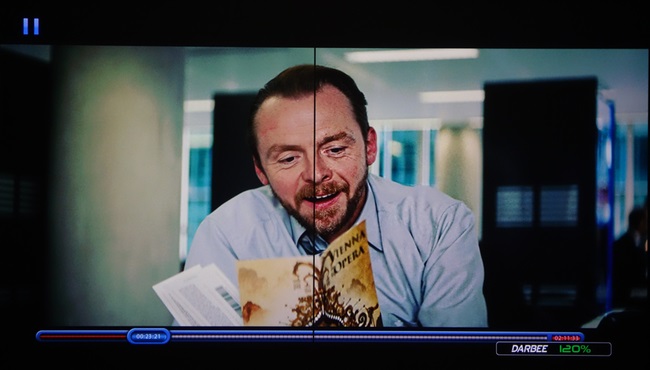
There are 3 viewing modes including HiDef, Gaming and Full Pop to get you started on your video tweaking adventure. The handy Split screen feature allows you compare the video with and without processing so you know exactly what setting changes do. With a suggested list price of around $199USD the Darbeevision 5000S is highly recommended. For the Silo, Jarrod Barker.


 “My heroine in Broken Homes and Gardens undergoes some relationships in her late teens and early twenties that shake her belief in love so firmly that she decides marriage is not the answer to any of her problems,” adds Rebecca. “Joanna’s approach to her relationship with Malcolm isn’t optimistic but it’s rational. It’s understandable. And I think her story speaks to many of us.”