The Canadian Film Centre’s Media Lab (CFC Media Lab), Seneca’s School of Creative Arts and Animation, and the Art Gallery of Ontario (AGO) are pleased to announce their groundbreaking virtual reality (VR) collaboration, Small Wonders: The VR Experience. It will screen for a special four-day limited-run as part of The Metropolitan Museum of Art’s new exhibition, Small Wonders: Gothic Boxwood Miniatures, February 22-27, 2017 at The Met Cloisters (99 Margaret Corbin Drive, Fort Tryon Park, New York, NY 10040).
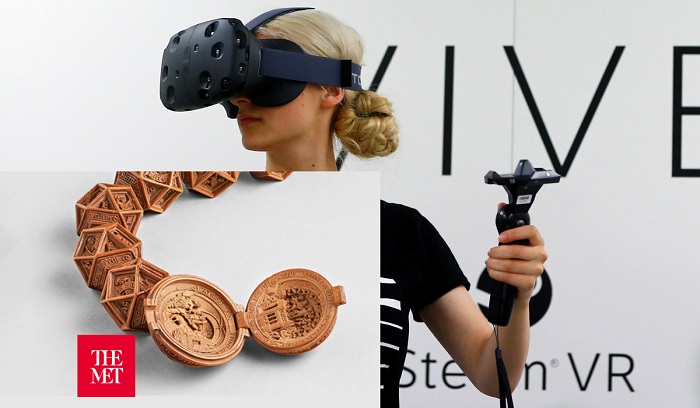
From February 24 to 27 during public hours, visitors can don a VR headset and explore a 3D rendering of a miniature boxwood carving from the AGO’s collection. The experience is free with general admission, reservations required, and marks a significant first for The Met Cloisters—the integrated use of VR to enhance the exhibition experience.
The exhibition Small Wonders: Gothic Boxwood Miniatures, which runs through May 21st, brings together for the first time some 50 rare boxwood carvings from museums and private collections across Europe and North America. The exhibition offers new insight into the methods of production and cultural significance of these awe-inspiring works of art. Small enough to fit in the palm of the hand, these tiny masterpieces depict complex scenes with elegance and precision. Without fail, they inspire viewers to ask how a person could have possibly made them, a question that can only be answered today and a challenge perfect for VR technology.
“Much of the success of new VR will hinge upon the quality of experiences being created. Everyone is searching for that sublime encounter one can only have in VR. With the boxwood miniatures and their high-resolution scans, we have found the perfect, transcendent landscape to explore in this medium,” says Ana Serrano, Chief Digital Officer, CFC, and Producer, Small Wonders: The VR Experience.
The AGO, CFC Media Lab and Seneca’s School of Creative Arts and Animation partnered to create Small Wonders: The VR Experience. Using one of the AGO’s micro-computed topography (micro-CT) scans of the miniatures, the creative and technical team led by interactive artist and designer, Priam Givord, developed an experience specifically for the HTC Vive platform. Viewers can explore the intricate carvings of the prayer bead from various angles and in detail otherwise inaccessible to the human eye. The soundtrack, Treasures of Devotion: Spiritual Songs in Northern Europe 1500-1540, echoes the ambience of the wider show. The result: VR enriches the contemplative and immersive experience.
Barbara Drake Boehm, the Paul and Jill Ruddock Senior Curator for The Met Cloisters said: “At first glance, the VR experience might seem anomalous in the medieval ambiance of The Met Cloisters. But, thanks to the efforts of the CFC Media Lab, Seneca and the AGO, VR opens a portal through which our visitors can tumble into a tiny world, and sense the meditative power that these centuries-old works of art were intended to convey.”
Small Wonders: The VR Experience was created by Lisa Ellis, Conservator of Sculpture and Decorative Arts (AGO); VR Creative and Technical Director Priam Givord (Interactive Artist/Designer); VR Producers Ana Serrano (CFC Media Lab) and Mark Jones (Seneca College); VR Technical Team Craig Alguire, Morgan Young (Quantum Capture) and Tyrone Melkitoy (Mobius Interactive); Composer/Vocalist Anne Azema, Artistic Director (The Boston Camerata); Narrator Gillian McIntyre; and Micro-CT Scanner Andrew Nelson, Associate Professor of Anthropology, Sustainable Archaeology (Western University).
The exhibition continues at The Met Cloisters through May 21, 2017, but the VR experience will only run during public hours, February 24–27. To learn more about the Small Wonders exhibition and to plan your visit, go to: http://www.metmuseum.org/exhibitions/listings/2017/small-wonders
At The Met Cloisters, Small Wonders: Gothic Boxwood Miniatures is made possible by the Michel David-Weill Fund. It was organized by the Art Gallery of Ontario, Toronto; The Metropolitan Museum of Art, New York; and the Rijksmuseum, Amsterdam.
Social Media
The Metropolitan Museum of Art
@metmuseum | facebook.com/metmuseum
About CFC
The Canadian Film Centre (CFC) is a charitable organization whose mission is to invest in and inspire the next generation of world-class Canadian content creators and entrepreneurs in the screen-based entertainment industry. A significant economic and cultural driver in Canada and beyond, CFC delivers a range of multi-disciplinary programs and initiatives in film, television, music, screen acting, and digital media, which provides industry collaborations, strategic partnerships, and business and marketplace opportunities for talent and participants. For more information, visit cfccreates.com.
About CFC Media Lab
The Canadian Film Centre’s Media Lab (CFC Media Lab) is an internationally acclaimed digital media think tank and award-winning production facility. It provides a unique research, training and production environment for digital media content developers and practitioners, as well as acceleration programs and services for digital entertainment start-ups and related SMEs. The Silo founder and Digital Editor Jarrod Barker and contributor Arthur Maughan are graduates and fellows of the CFC Media Lab. Program participants have emerged as leaders in the world of digital media, producing groundbreaking projects and innovative, sustainable companies for the digital and virtual age. CFC Media Lab is funded in part by the Federal Economic Development Agency for Southern Ontario. For more information, visit cfccreates.com.
About Seneca
With campuses in Toronto, York Region and Peterborough, Seneca offers degrees, diplomas, certificates and graduate programs renowned for their quality and respected by employers. It is one of the largest comprehensive colleges in Canada, offering nearly 300 full-time, part-time and online programs. Combining the highest academic standards with work-integrated and applied learning, expert teaching faculty and the latest technology ensure Seneca graduates are career-ready. Find out more at senecacollege.ca.
About AGO
With a collection of more than 90,000 works of art, the Art Gallery of Ontario is among the most distinguished art museums in North America. From the vast body of Group of Seven and signature Canadian works to the African art gallery, from the cutting-edge contemporary art to Peter Paul Rubens’s masterpiece The Massacre of The Innocents, the AGO offers an incredible art experience with each visit. In 2002, Ken Thomson’s generous gift of 2,000 remarkable works of Canadian and European art inspired Transformation AGO, an innovative architectural expansion by world-renowned architect Frank Gehry that in 2008 resulted in one of the most critically acclaimed architectural achievements in North America. Highlights include Galleria Italia, a gleaming showcase of wood and glass running the length of an entire city block, and the often-photographed spiral staircase, beckoning visitors to explore. The AGO has an active membership program offering great value, and the AGO’s Weston Family Learning Centre offers engaging art and creative programs for children, families, youth and adults. Visit ago.net to learn more.
About The Metropolitan Museum of Art
The Met presents over 5,000 years of art from around the world for everyone to experience and enjoy. The Museum lives in three iconic sites in New York City— The Met Fifth Avenue, The Met Breuer, and The Met Cloisters. Millions of people also take part in The Met experience online. Since it was founded in 1870, The Met has always aspired to be more than a treasury of rare and beautiful objects. Every day, art comes alive in the Museum’s galleries and through its exhibitions and events, revealing both new ideas and unexpected connections across time and across cultures.
The Met presents over 5,000 years of art from around the world for everyone to experience and enjoy. The Museum lives in three iconic sites in New York City— The Met Fifth Avenue, The Met Breuer, and The Met Cloisters. Millions of people also take part in The Met experience online. Since it was founded in 1870, The Met has always aspired to be more than a treasury of rare and beautiful objects. Every day, art comes alive in the Museum’s galleries and through its exhibitions and events, revealing both new ideas and unexpected connections across time and across cultures.
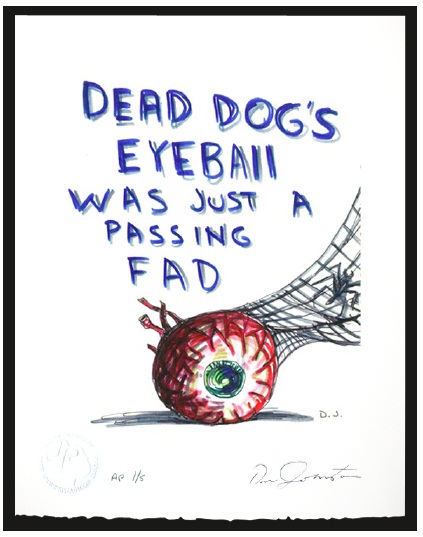 Daniel Johnston is not a secret anymore. Thirteen years ago, in 2005, director Jeff Feuerzeig released the Sundance award-winning documentary on Johnston’s life “The Devil and Daniel Johnston,” his songs have been covered by renowned artists like Beck, Tom Waits and The Flaming Lips and he has also been featured in the 2006 Whitney Biennial of American Art. It seems that over the past few years the enigma that was Johnston has mutated into a proverbial “cult figure.” However this cliché is an inaccurate description. Where is the line between cult figure and pop culture icon drawn? The common theme found in essays and reviews on Johnston’s work is the examination of his mythology rather than the examination of his work. This type of analysis tends to do more harm than good: the myth swells while the work rusts.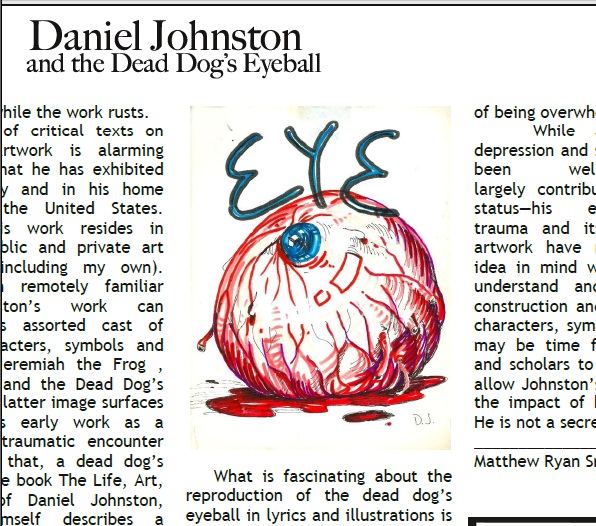
 What is fascinating about the reproduction of the dead dog’s eyeball in lyrics and illustrations is that it may be connected to the trauma Johnston experienced when first encountering the dead dog on the swing set. Trauma is characterized by an affective shock that has the capacity to wound the body and the psyche, which in turn causes anxiety, stress and other forms of neurosis. Seeing the dead dog’s eyeball during childhood might have registered trauma in Johnston that affects him well into his adult life and it could have taken the form of an obsession (fig. 4). In one particular drawing from his early work Johnston asks himself in bold text, “WHY DO I KEEP DRAWINGS [sic] THESE SILLY LITTLE EYEBALLS?” Here and elsewhere, the artist is consumed by flashbacks of the dead dog’s eyeball to the extent of being overwhelmed.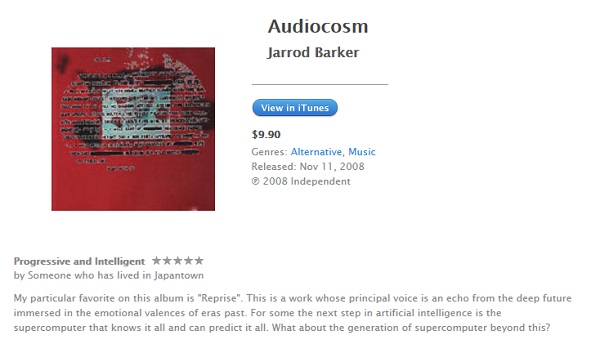





 want and adults should enjoy the same free pass. You should
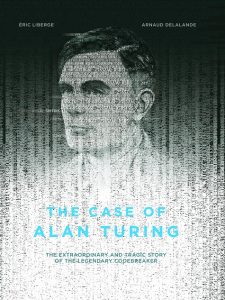 Turing’s work was instrumental in saving countless lives, millions in goods and merchandise, and is estimated to have shortened the war in Europe by four years.The specifics of Turing’s work at Hut 8 were only recently made available to the public—they were declassified in 2012. Authors Liberge and Delalande use this new information to create a graphic biography that is both scientifically rigorous, moving, and accessible. Story by Eric Liberge Illustrated by Arnaud Delalande Translated by David Homel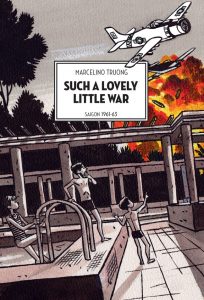
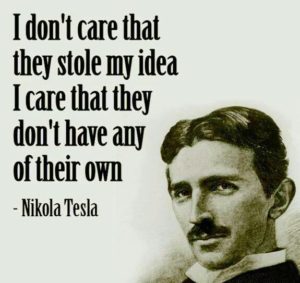
 This concern, of course, is not unique and strikes at the heart of something that all those in creative professions fear and must face. The ownership of ideas is difficult to prove. If you tell someone your plan in confidence and they, in turn, use it for their own purposes, there is very little you can do to show that you are the originator. Spreading this rumor is likely to make you look like the bad guy. It’s no wonder that this sort of generosity is cause for concern.
 But what about sharing your networks or some trade secrets that helped you get to where you are today? While you may have worked tooth and nail for everything you’ve gained, there were surely people along the way who said yes at the right moment and assisted your progress. No one can ask more than this, and as an artist of a certain standing, there is nothing wrong with offering this sort of help.
 No one exists in a vacuum. Even you, who may have scraped and fought your way to where you are today, benefited from the acceptance and help of others. Sure, you may have pounded the pavement endlessly in order to secure your position but that is no reason not to pay forward the success you have achieved. It is too easy to forget, once you have achieved a certain status, the myriad small moments that led you there. While it may seem as though hardly anyone was out to help you in the early days, surely there were some, otherwise you could not be where you are today. Even if it was just a few gallerists who were finally willing to take a chance, there are always rungs of assistance in the ladder to every success, no matter how small.
 For these reasons, there is a lot to be said for good old-fashioned face-to-face interaction. Being the sort of artist who is willing to mentor in the real world sets you apart. Establishing this sort of reputation, for being the one who will gladly share the bounty you have created, seldom reverses one’s own success and frequently opens new doors you may never have considered.
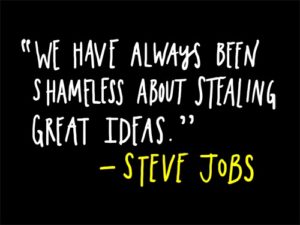
 Arguably, there is no such thing as original art. Even some of the most contemporary artists’ work is derivative of past creations. Marina Abramovic, in her unique style, has absolutely drawn from (and occasionally been accused of copying) works by other artists. Pablo Picasso (and perhaps more famously, Steve Jobs who quoted him) said, “good artists copy, great artists steal.” This doesn’t mean that you should open yourself up to idea theft, but it does mean that perhaps being stingy with your concepts, your network, your position as an established artist, doesn’t count for as much security as you might think. Be smart about things, but in general, it is always a good idea to reach down the ladder and help those coming up behind you find the next rung. For the Silo, Brainard Carey.


 If you could choose just one photo exhibit to see all year, it would have to be

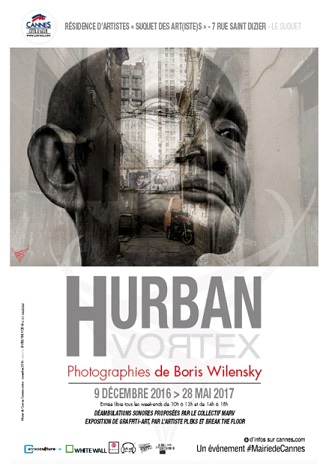
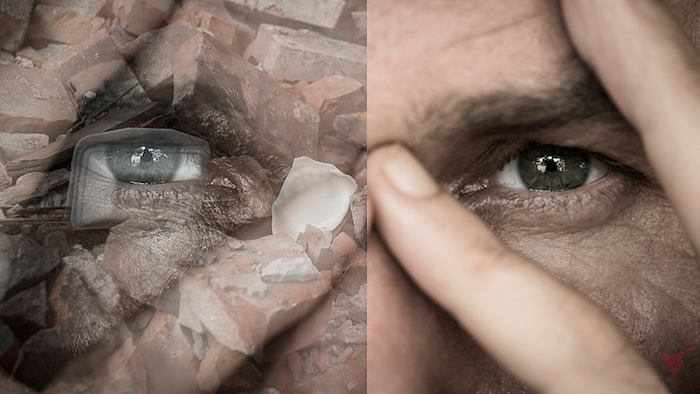
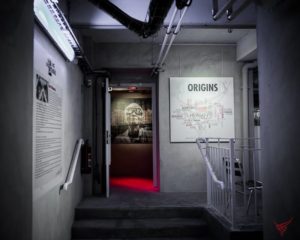 Over 15,000 photos later, Hurban Vortex sees the light of day. The ensemble of artistic, esthetic and human adventure are at the core of the triptych that represents his works: Origins corresponds to 2009 (present), the period of an oblivious, profligate, consumerism-driven world. Collapse takes us into 2011 (future)…Fukushima, with its worldwide impact. The glasses and gas masks worn by the humans represent the man-made destruction of a world as we had known it before and which will never be the same. And in Post we find ourselves in an urban landscape filled with waste and shattered ruins. But people are no longer wearing their blinders… Maybe there is hope after all that cities may disappear but humans are still around? Or does the urban jungle always win in the end? You decide, because it is your personal interpretation, after an intense dialogue with the image… exactly what Boris Wilensky wants.
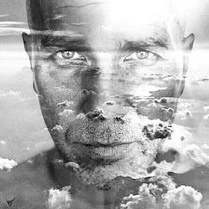
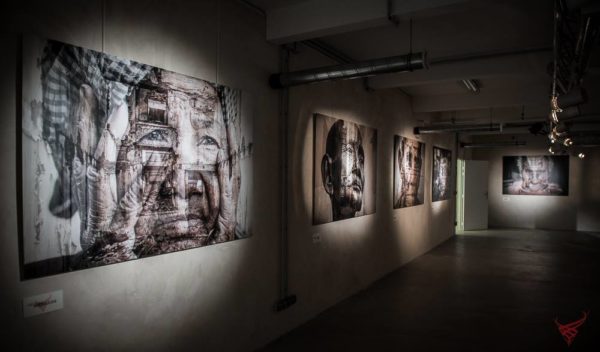 What the viewer sees, is how this artist sees the world – not in the literal but figurative sense. But he does not dictate, he suggests. He considers himself a storytelling portraitist first and foremost, and an urban photographer second. As you look at his large-size pictures (180 x 120 cm), the image in front of you transforms from a flat canvas to a three-dimensional scenography. You are drawn in, pulled onto a stage, you become part of the performance, an actor engaged in a dialogue. You are the person across from the man in the photo, but you also become him, turning outward to the viewer.
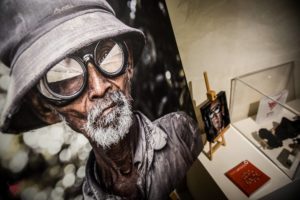 The continuous movement – the vortex – pushes and pulls you as the borders between Human and Urban blur and become Hurban. There are violently cold and anonymous city landscapes, consisting of monochromatic and starkly geometric patterns, entirely unlike anything you find in nature. But the human element, superimposed, invariably bestows them with a strangely appealing aesthetic. For the Silo,
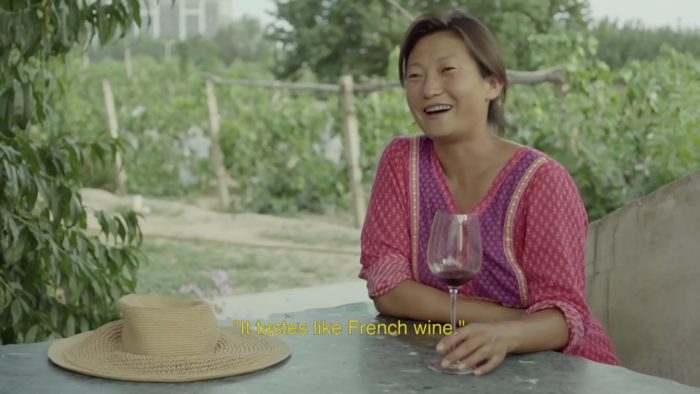
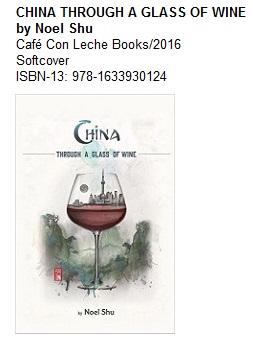 International-renowned sommelier, Noel Shu, provides in-depth look at the modern Chinese wine industry and guides us through the misty vineyards and crowded wineries of China.
 About the Author

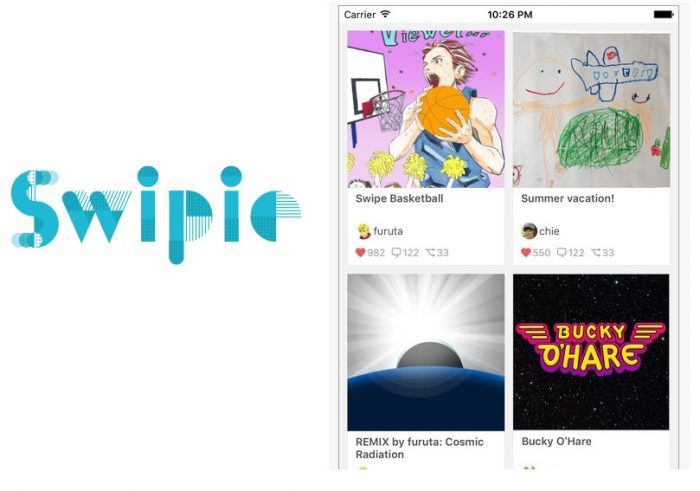
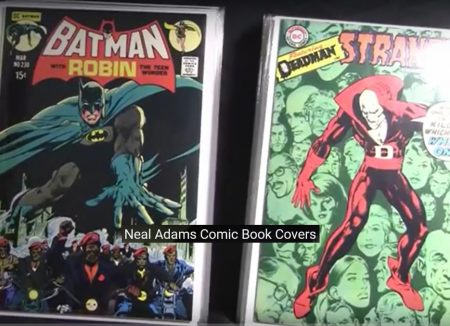 Designed utilizing the tools available on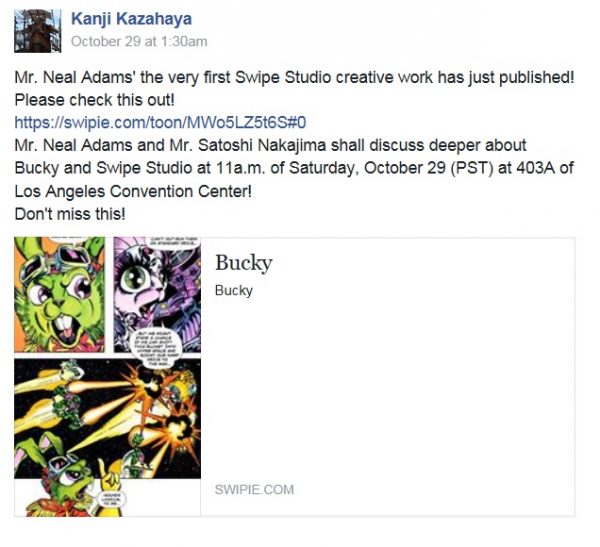


 To prepare for episode 63’s debut, viewers will also be able to stream the entire Future Trunks arc (the arc begins at episode 47). Then, starting on October 30, the complete series will roll-out, with 10 episodes released a week at a time.
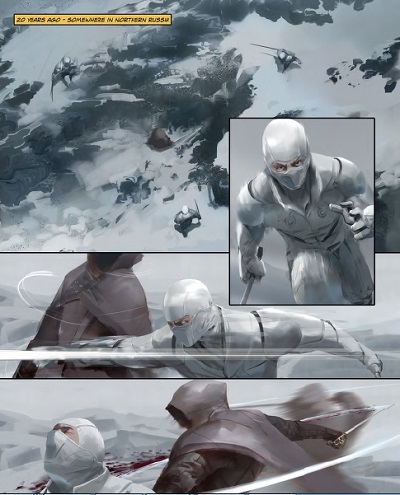 Part of the ugly charm of TREADWATER lies within its ability to predict current events. The isolationist politics of the world’s leading nations, as exemplified by the rise of Trump in the US and BREXIT in the UK; the attempted coup in Turkey, along with its backlash in the form of a dictatorial powergrab; the increasing civil unrest in the US and the terrorist attacks in Europe – all these developments find their parallels in the world of TREADWATER.
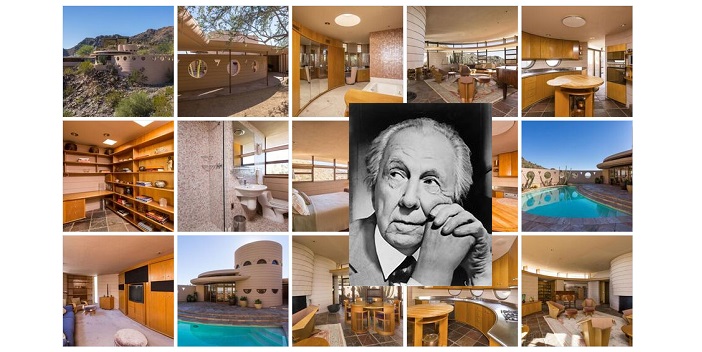
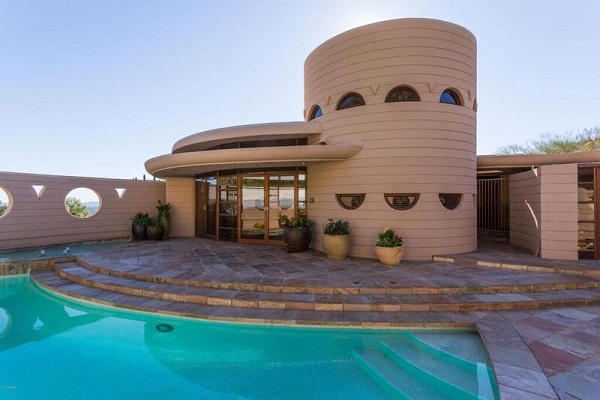 With a site on top of Palm Canyon with views of the valley, Wright began the Lykes design by replicating the curves of the mountainsides, making the home an integral part of its environment and providing big views for its owners and visitors. Though Wright passed away before finishing the working plans, the Lykes hired his apprentice, Rattenbury, to complete the plans according to the details set forth by Wright. The couple loved the completed plans, though it was another seven years before they started construction. When they did, Rattenbury oversaw the build and the home was completed in 1967. In addition to the structure itself, Wright also designed the furniture and built-ins for the home.
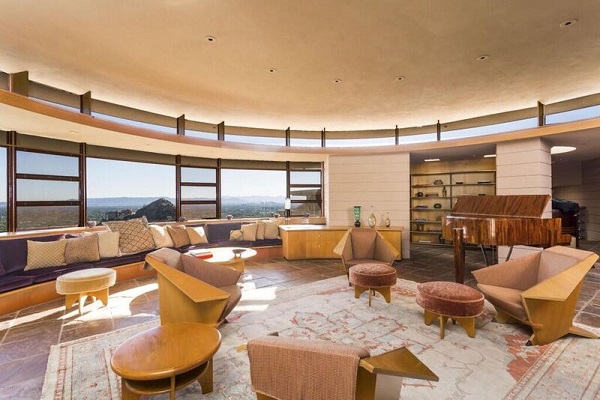 Now for sale and registered with the Frank Lloyd Wright Building Conservancy, the 2,849-square-foot home on one acre of desert plateau has three bedrooms, three bathrooms, the signature large living room fireplace intended to bring families and friends together, a lower-level media room, two home offices with built-ins of desk, cabinet storage and walls of shelving, a distinctive curved kitchen with Wright-designed island and unique under-cabinet windows and timeless stainless-steel counters, contemporary tiled large baths, and a privacy walled crescent pool patio viewed from inside through glass walls. There is also a separate large office in the round with all built-in furnishings encircled by half-moon windows. Views of valley and mountains can be seen from almost every room.
 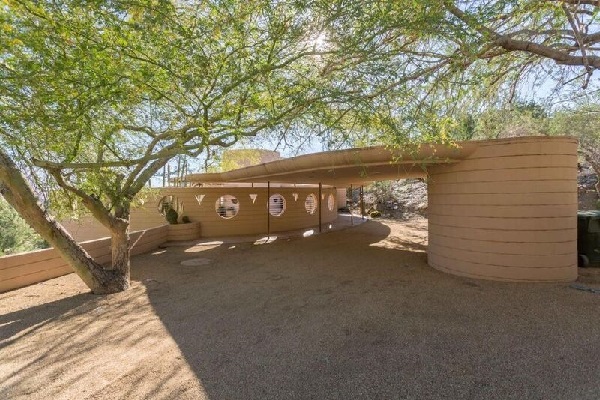 Classic last Wright design before his death, contemporary for today including lots of storage space with furniture and built-ins designed by the famous architect, the Lykes House is now for sale and priced at USD$3.6 million. For the Silo, Terry Walsh.