Tag Archives: art

How To Start Blogging With Plastic Deerheads And Ironic Moustaches

The trendy and kitschy Owl. images/photos: Charity Blaine

Blog writers are like Indie music that’s about to become “cool”, or rather, they are the people that enjoy the Indie music before it’s “cool”, in fact, they are most likely part of the reason it eventually becomes popular. Only it’s not just music. It’s everything. Lifestyle bloggers like EVERYTHING before it’s cool. Therefore, I, as a blog reader, know about everything cool before it is cool. I, am a blog world hipster, and I’m only partly ashamed to admit it.

To clarify, it’s not just the blogs themselves that set the trends; it’s also the only shops where bloggers sell their handmade goods, such as etsy.com. Years ago, I remember searching for kitschy little polymer clay earrings shaped like foods at etsy, today, when I no longer want them, they are available for a fraction of the price at popular stores such as Clare’s and Arden’s, although truthfully, they do look cheaper. The handmade versions look more like real food than the store bought versions.  You should never believe anything that doesn’t come with proof, so here are three substantial examples of bloggers, not retailers, setting the trends.


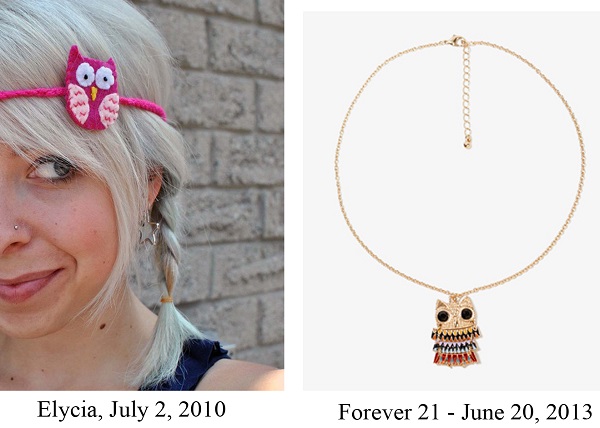
1)      Owls. I really hate owls. I don’t think they’re cute. I don’t understand the obsession at all, but so many places these days sell things adorned with owls. Don’t get me wrong, I realize that owls were popular years ago, but this is a reference to the current owl obsession. Forever21.com  and http://verified.codes/Forever-21 sells more than a dozen owl accessories so does Clare’s. Where did I first see an obsession with owls? In the blog world, for example, blogger Elycia Watson (loveelycia.com) from Hamilton, Ontario posted regularly about owls more than three years ago. All the blogs I initially read as a blogger were full of owls.
 

geometrics


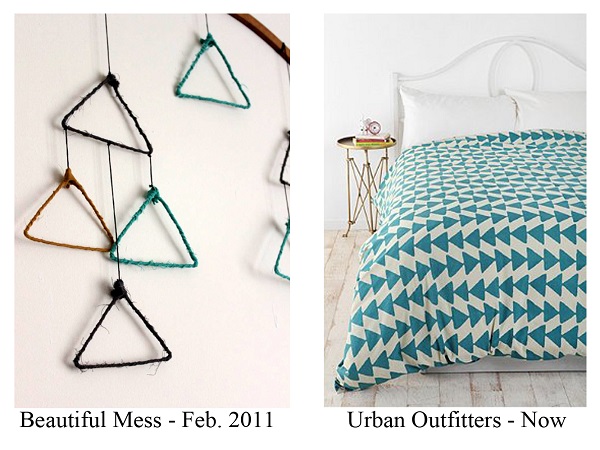
2)      Geometric Shapes. Bloggers love chevrons, triangles, lines, squares, any simple shape that can be coloured pink or gold. This isn’t the best example, but two years ago, the Sidney Crosby  of blogs, A Beautiful Mess, did a ‘do- it –yourself’ project “making a geometric mobile”. It’s a clothes hanger with dangling wire triangles wrapped in yarn, basic and geometric. Most of the bedding at Urban Outfitters these days is adorned with chevrons and triangles. This also points to the ‘do- it- yourself’ trend. These crafty women have been doing it yourself way before pinterest made it popular. To sound even more hipster, I remember when pinterest first started, in those days, there were no weight loss schemes or a surplus of one direction photos, it really was mostly crafts and home décor, and bloggers used it to find inspiration for new blog posts. I love pinterest, so thanks again bloggers for being cool before it was cool.

 

deer heads


3)      Since I’ve already given four substantial examples I don’t really need a number 3, but just in case you still doubt, take a look at Faux Deer Head for your wall. Flipping through a home décor magazine lately, I found a photo of a plaster deer head, in the style of the mounted, taxidermy deer head that hunters would have on their walls. Currently, even Home Hardware sells them. Bloggers have been doing this for years. They even use old piñata heads. They give the deer head hats and jewelery. The Dainty Squid was one of the first places I really remember seeing this phenomenon. Kayla found a plastic deer head more than 3 years ago, plopped a wig on its head and called it beautiful.

So the conclusion is- if you really want to be ahead of the wave, read blogs, small, crafty, lifestyle blogs. By the time any of that stuff hits the mainstream, you’ll be really sick of it and you can officially embrace your inner hipster and tell everyone, while sporting an ironic moustache, that you liked all those things, including ironic moustaches, before they were cool.  For the Silo, Charity Blaine.  

Supplemental- Street Trends: How Today’s Alternate Youth Cultures Are  Creating Tomorrow’s Mainstream http://www.amazon.com/books/dp/0887308759

A 3D printer Photo Booth prints miniature versions of you http://tinyurl.com/mkw924 

 

World’s First Colour 3D Printer Set To Enter Every Home And Business

New York City, US – Global Release.  Last month, botObjects began taking advanced orders on the world’s first Full Color 3D Desktop Printer – at aggressive prices aimed at enabling most customers from home users, business professionals to educational institutions the opportunity to buy the ProDesk3D.
Why the finger of God? (courtesy of Michelangelo's Creation of Adam fresco 1508-12) Because this 3d printer and those like it are GAME CHANGERS. We all will have unbelievable powers of creation. Sure right now, there's an over-run of plastic Yoda heads and bubble-gum machine toys but eventually the novelty will wear off and the real output will begin. There are likely new home-based manufacturing businesses that will spring up as 3d printer prices fall and their capacities and features rise. Here's a freebie- how about manufacturing fishing lure bodies from your desktop? CP

While some observers pegged the launch price at $3000 or more, the firm decided to launch an early order price at $2,849 for the standard edition – hoping to make it an easier decision for customers as it is highly competitive with its contemporaries, yet significantly more advanced, and in a more mature stunning case. [ To keep things in historical perspective- “The first laser printer success was the Hewlett-Packard (HP) LaserJet, released in 1984. The HP LaserJet bacame the de facto standard for the personal computer industry. By 1987, HP and clone laser printers could be purchased for about $2,500 and 2005 prices were under $1,000. ” Xerox Corporation u-s-history.com CP ]

The company also recently announced its next generation website, and along with it, released significant information that future customers wanted, such as 3D full color print samples created on the ProDesk3D.  botObjects aims to show how advanced the ProDesk3D is, with color 3D printed samples never seen before in the 3D Desktop Printing category.  Also, the firm announced technical information about the ProDesk3D, confirming an advanced specification aimed at delivering the first real 3D desktop printer for the mass market – with features aimed to deliver higher quality with color range, all-round ease of use, and printing speed.  The firm also confirmed that the ProDesk3D will print at 25 microns – some 4 times more accurate than its competitors, and at a maximum speed of 175mm per second – delivering industry leading speed for an FDM 3D Desktop Printer.


Martin Warner, CEO & Co-founder said, “We are delighted to be ahead of our plan, and release information that customers want to see, such as our own 3D print samples, so they can see the quality of finish and the gorgeous color range in the samples.  We also released the technical specification, the available price and much more.  Now customers can order today!”

botObjects [ and The Silo btw CP ]  believes that the 3D Desktop Printing revolution, is the next great technology wave, much like the PC revolution, and will no doubt dramatically change the rate of innovation at home and in the workplace, while influencing the approach to education both in school and in industry.  Areas such as product design, rapid proto-typing, many forms of engineering, architecture, precision-based manufacturing, home utility replacement, gaming & art and much more will dramatically change as a result of 3D Desktop Printers.  As software becomes easier for people to create 3D models, the ProDesk3D aims to make this a reality, announcing its own easy-to-use ProModel Software, coupled with the ProDesk3D to enable customers to create the models of their choice very quickly and efficiently.

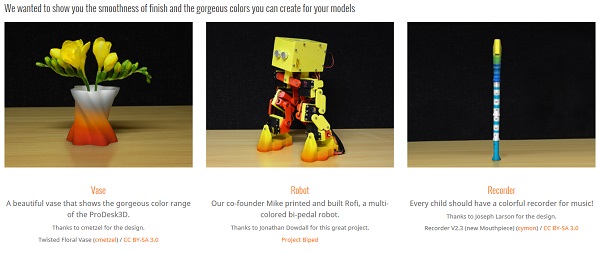
Examples of full colour 3d printed BotObjects. To make real consumer and home inroads- practical objects at reasonable prices will need to happen, but these are a pretty cool start. CP

Speaking on the announcement, Mike Duma, CTO & Co-founder said, “We know that people are extremely excited about the ProDesk3D, and we thank everyone for their patience.  We have had over 100,000 enquiries, and numerous countries interested in distributing the ProDesk3D.  We have announced a great deal of information so that our customers can learn more and evaluate whether to purchase the ProDesk3D.  We also added something special – our new limited edition ProDesk3D Blue – we know that customers will love this design just like the ProDesk3D.”

botObjects announced it can now take early orders by telephone today, and expects to take early orders on its website soon. [ now happening at   http://botobjects.com/ CP ] The firm confirmed that the first early order batch expect to ship 1st October 2013.


Supplemental- The CAD/CAM lab at UC Berkeley http://ced.berkeley.edu/resources/cadcam-lab/

The History of Computer Printers http://inventors.about.com/library/inventors/blcomputer_printers.htm

Moedls app turns smartphones into inexpensive 3D scanners http://www.3ders.org/articles/20130225-moedls-app-turns-your-smartphone-into-a-3d-scanner.html


Canuck Book Reviews- Irma Voth

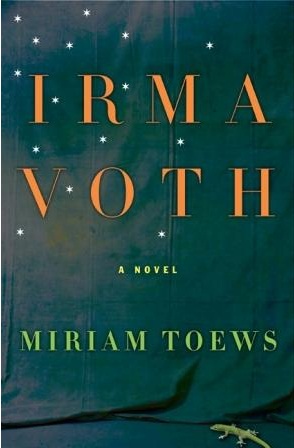
There are several cover variants for Toews novel, but we like this one.

Miriam Toews’ Irma Voth follows the trials and tribulations of a rebellious, yet eager to please, 19 year old young woman from a strict Mennonite community near Chihuahua. The story begins with Irma recalling the failure of her marriage to local Mexican man. Irma provides the reader with a brief glimpse into her past while she pines over her botched marriage. Her family’s mysterious and seemingly unexplained relocation from the Canadian prairies and her father’s disapproval and disownment over her marriage are vaguely addressed. The story, told by Irma, weaves her past with her present in an effort to understand her situation and the situation of those around her. In her attempt to reason and understand her surroundings, Irma reveals what she knows and what she longs to understand.

As Irma guides the reader through her interactions with the family and community that has cast her aside, the reader catches a glimpse into her very foreign and complex world. As the story unfolds, different characters are exposed. Irma’s younger sister, the 13-year-old Aggie, sees her older sister’s life as an adventure and longs to follow in her footsteps—however resistant Irma may be to this. Aggie’s innocence seems to mirror what Irma has lost in her recent actions and through her actions, the reader can understand the difficulty facing Irma: protecting her sister vs. letting her find her own way, no matter what mistakes she may possibly make. The reader cannot help by admire Aggie’s eagerness and lust for life. Irma robustly contrasts this and the reader is left to try to decipher Irma’s motivations.

Miriam Toews was born in 1964 in the Mennonite town of Steinbach,Manitoba. Did you know? Miriam was a CBC freelancer making radio documentaries. photo: Carol Loewen from www.randomhouse.ca

The novel is told through the eyes of Irma. Much of the dialogue and action is driven by Aggie’s character. Irma takes the position as an observant watcher, but through her actions and inner musings, drives the plot and offers the reader a detailed insight into her past. Not until the end does Irma take a long overdue aggressive stand and make bold moves for reasons she feels justified in. With an ending that will resonate with any reader, this novel tells a haunting tale of moral obligations and maturity.

Sarah Purdy is an educator and a book and literary reviewer for The Silo. Search “Sarah Purdy” from our site to read more Canadian book reviews.

Scottevest intro’s i-phone interactive tech fleece Jacket

Touch transmissive inner jacket fabric? Hell yeah!

Ketchum, ID – What happens when the greatest thing to ever hit SCOTTEVEST’s electronic shelves gets redesigned? We can’t wait to tell you…

SCOTTEVEST, Inc. has been known for over a decade for our ingenious pocketed clothing marketed toward travelers, gadgetphiles, photographers, and urban adventurers. Over the years, each successive product improves upon previous versions, as indicated by the software-style numeric naming system.

SCOTTEVEST transforms the way you will use your clothing, yet again, with the introduction of the Fleece 7.0 Jacket, available now as a pre-order and shipping October 31, 2012.

The Fleece 7.0 is the successor to our signature jacket, the Fleece 5.0, which quickly became a staple in many SCOTTEVEST customer wardrobes. The Fleece 7.0 features a revolutionary new patent pending pocket, the Quick Draw pocket, inspired by our good friend and London based blogger, Documentally. [Christian Payne – @Documentally CP]

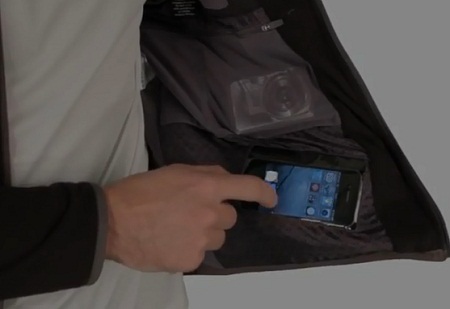
This allows you to access your iPhone 5 (or other smartphone) through the Clear Touch Fabric in the hand warmer pocket, which is something you truly need to test out for yourself. We believe this will fundamentally change the way you interact with your mobile devices. You can plug it in to your wired in headsets or use Siri and FaceTime right through the clear touch fabric, without ever removing your phone from your pocket.

However, we didn’t stop there. Here are some key features that make the Fleece 7.0 so unique:

23 innovative, purposeful pockets for are perfect for gadget lovers, travelers and photographers on the move! Speaking of pocket innovations, this updated style also includes a new iPad/tablet pocket design, which adds extra security and better ergonomics when pocketing a large device.

The In-and-Out Pocket debuts on the Fleece 7.0, allowing you to access the interior chest pocket from the exterior of the
jacket. An updated eyeglass pocket with both top and zippered side access contains a cleaning chamois with a map showing each of the jacket’s many pockets.

Wear the jacket of the ‘near future’ right now: SeV Fleece Jacket7.

Since the sleeves are removable with cleverly hidden zippers, a dual-access back lumbar pocket has been included to hold them if
you are wearing the Fleece 7.0 as a vest. Oh, did we mention that the Fleece 7.0 can turn into a vest? Inside, just in case you need to “show your papers” or “stow your papers” in a hurry, we have highlighted the travel documents pocket with a red zipper and a locking zipper pull, making it nearly impossible to pickpocket. No. Making it impossible to pickpocket (unless, perhaps, you are a really sleeper and hang your jacket in the closet).

Our typical level of attention to detail continues inside with a silky lining and a subtle “fractal” design comprised of our logo
in shades of black and gray. Ergonomic zipper pulls make getting into your pockets easy (even with gloves). Totally stealthy, the Fleece 7.0 is black with gray accents and has NO reflective piping. And if stealth isn’t your thing, it’s also available in a limited edition Red version.

The Fleece 7.0 is now available for pre-order on our website www.scottevest.com and is now shipping. This is just the beginning of many more incredible advances in the SCOTTEVEST clothing line. As the weather begins to cool down in your part of the world, things are definitely heating up at SCOTTEVEST…stay tuned!

About SCOTTEVEST
SCOTTEVEST is one of the world’s leading travel clothing companies, and was named the #41 apparel e-commerce site in 2011
by Internet Retailer Magazine and #77 fastest growing Consumer Products & Services Companies by Inc. Magazine. SeV specializes in stylish jackets, shirts and pants with a unique hidden pockets for travelers, and a patented system of conduits
and pockets for carrying, using and enjoying personal electronics. SCOTTEVEST is the first clothing company to provide
a pocket for the iPad®.

Please see the embedded photos to get a better understanding of our patented pocket feature that allows you to utilize your
electronic device without removing it from the pocket, keeping your hands warm at all times. Be sure to test it out for yourself
on the actual garment!

www.SCOTTEVEST.com


NORMANDY A Graphic History Of D Day

“What a glorious book, vivid, accurate, utterly bewitching.” – Alex Kershaw, bestselling author of The Bedford Boys: One American Town’s Ultimate D-Day Sacrifice

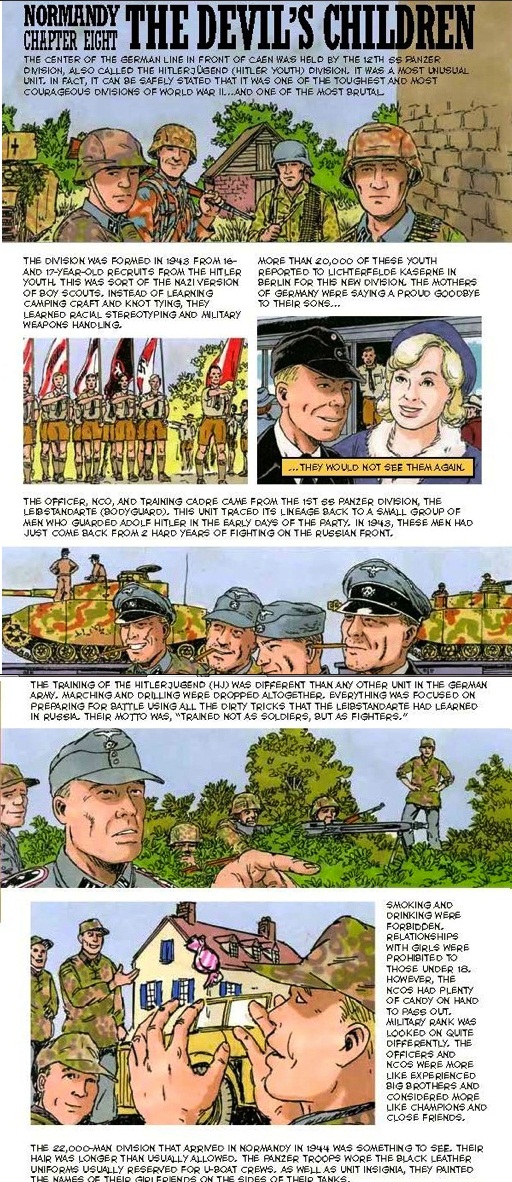
Zenith Press and writer artist Wayne Vansant (Marvel Comics The ‘Nam) offer up 103 entertaining pages in the almanac sized Normandy A Graphic History of D-Day. Tastefully spread out over 15 Chapters, this factual graphic comic tells the story of the Allied invasion of German occupied Europe.

There aren’t any consultant or researcher credits listed in this book but it plays out in a fairly accurate way, with a chronology that starts with the initial Allied paratrooper assault and then the storming of the five D-Day beaches: Utah, Omaha, Gold, Juno, and Sword. Fans of WW2 history know the rest: once ashore, the allies had their work cut out for them as the Germans fell back and defended all the way into Berlin.

Here’s what www.armchairgeneral.com had to say about this books accuracy:
“As with any overview, how much new information a reader learns will depend on how knowledgeable that reader already is on the subject, but Normandy‘s attention to the details makes it worthwhile for adult readers. One of the elements that impressed me most was that the book isn’t just about the Americans. Actions of the British, Canadians, Poles, Free French, and, of course, their German opponents are also given more than just a passing nod.

While some of its chapters cover big-picture subjects (no pun intended, for once) like “Bloody Omaha” or “The Cobra Strikes,” the heart of this book is in its anecdotes about individuals or small groups, such as the story of Stanley Hollis of Britain’s 6th Green Howards using a Sten gun and hand grenades to capture a German bunker, or Michael Wittman’s rampage with his Tiger tank at Villers-Bocage, or Free French soldiers phoning family and friends from the outskirts of Paris to say they’d be home soon.”

Normandy has a suggested retail price of $21.99 Canadian funds and is available at http://www.amazon.ca/Normandy-Graphic-History-Invasion-Fortress/dp/0760343926 For the Silo, Jarrod Barker.

Liberals: Ontario remains on track to eliminate deficit by 2017-18

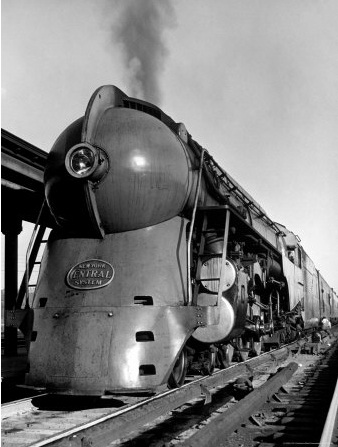
“20th Century Limited Train on Tracks” by Alfred Eisenstaedt

The deficit projection for the current fiscal year has improved by more than $400 million from the 2012 Budget forecast to $14.4 billion. The province remains on track to meet the 2012 Budget deficit targets in 2013-14 and 2014–15 and for the deficit to be eliminated by 2017–18.

Ontario is projecting growth in real gross domestic product (GDP) of 2.0 per cent in 2012, 1.9 per cent in 2013, 2.3 per cent in 2014 and 2.4 per cent in 2015.

As of September 2012, Ontario employment was 356,000 net new jobs above its recessionary low in June 2009. Ontario is expected to create nearly 350,000 net new jobs by 2015, reducing the unemployment rate to 6.8 per cent from a high of 9.4 per cent in June 2009.

The fiscal plan provides no funding for incremental compensation increases for new collective agreements. The government is currently consulting on draft legislation that proposes to freeze compensation for executives and managers across the Ontario Public Service, and the Broader Public Sector (BPS) who are eligible for performance pay. It also proposes to ensure future BPS collective agreements are consistent with the province’s goals to eliminate the deficit and protect jobs and public services. The proposed draft legislation would support avoiding increased spending in the BPS of $2.8 billion over three years and help to protect roughly 55,000 public sector jobs.

QUOTE

“Despite ongoing global economic uncertainty, Ontario is ahead of its targets for lowering the deficit for the fourth year in a row. We will work with anyone who is willing to work with us to meet the objectives of eliminating the deficit and protecting jobs and public services.”
— Dwight Duncan, Minister of Finance

QUICK FACTS

• The 2012–13 revenue projection of $113,019 million is $445 million above the 2012 Budget outlook, largely reflecting a higher estimated 2011–12 tax base. Consistent with the government’s continued effort toward managing the growth in expenses, total expense for 2012–13 has decreased by $3.7 million compared to the 2012 Budget plan.

• Robust business capital investment, a rebound in net trade and increased consumer spending will be key contributors to growth. Over the past two years, business investment spending on plant and equipment has risen by more than 22 per cent, or
$11.1 billion.

• In the 2011–2012 Public Accounts of Ontario, the government announced the deficit for 2011–12 was $13.0 billion, marking the third consecutive year in which the province has improved on its fiscal projections. This result is also 47 per cent lower than the 2009–10 deficit of $24.7 billion forecast in the fall of 2009, at the depth of the global recession.

• The government has brought together business, labour and public sector leaders to form the Jobs and Prosperity Council. Reporting to the Premier, and headed by RBC President and CEO Gordon Nixon, the council will explore additional opportunities in the next few months for a path to sustainable growth that will also help inform the 2013 Ontario Budget.
• The 2012 Budget extended the pay freeze for MPPs by a further two years — for a total of five years.

LEARN MORE

Read Ontario’s Mid-Year Update on Economic and Fiscal Performance for 2012–13.

Read the Ontario Economic Accounts — Second Quarter of 2012

Read a Long Term Plan for Public Sector Compensation.

Read the McGuinty government’s announcement on freezing salaries for Ontario Public Service Managers.

Read the 2012 Ontario Budget.

Read about the strong actions the McGuinty government took in the 2012 Budget to reduce the deficit further.

Read the

Addendum to the 2012 Ontario Budget: Report on Expense Management Measures.

.

www.ontario.ca/finance-news
Disponible en français

Suck it? Public Breastfeeding.

Come on, breastfeeding is not obscene. Breastmilk has evolved into an immune-building milk tailor-made for each child to protect infants and children from illnesses in their environment. There are over 400 ingredients in breastmilk whose reasons for being there are not fully known. There is a component in breastmilk which is only there to grow the baby’s brain. That’s it. It can’t be replicated. Saying a certain non-humanmilk-based formula is ‘closer to’ breastmilk is akin to saying Michigan is closer to Hawaii than Pennsylvania. True, but one wouldn’t be closer to Hawaii’s environment, would they?

Our September Print edition cover- It is western culture that has sexualized breasts to the point where seeing a mother breastfeeding her child is obscene. image: courtesy of the author

Did you know that if you leave a naked baby on mom’s chest right after birth, they have the knowledge and ability to crawl to the breast and nurse perfectly by themselves (especially if mom was un-medicated during the birth). It is a beautiful moment to watch. That instinct is there for 3-4 months.

Should breastfeeding ever hurt? No. Just because many women do have pain in breastfeeding, doesn’t make it ‘normal.’ Most pain in breastfeeding, in my 20-year experience, is from poor latching or lack of knowledge. There isn’t enough time in a full prenatal labour/birth class to give breastfeeding instruction the time it needs. Attending La Leche League (LLL) meetings while pregnant can help prepare you (www.LLLc.ca). Or, talk with an International Board Certified Lactation Consultant if you are nervous speaking in a group. Plus, partners may feel more comfortable speaking individually. IBCLC’s are listed here: http://www.americas.iblce.org/ibclc-registry. Both LLL and IBCLC’s are available before and after you have your baby and are a tremendous resource and support.

Maternite (Motherhood) by Maria Blanchard. Due to physical conditions that prevented Maria from ever being able to have children, she powered up her paintings with sentiment and substance. CP

The World Health Organization, and the Canadian Pediatric Society both say to exclusively nurse your baby for the first 6 months of life and to breastfeed for 2 years or more. That is the world standard. It is western culture that has sexualized breasts to the point where seeing a mother breastfeed her child is obscene. There is no food on earth which can replace the vitamins, minerals, and immunities which are found in human milk. How is seeing a baby nurse in public worse than seeing the lingerie models in the mall?
Dads should not be left out of baby’s life. But, if dads were meant to feed babies, they would lactate. Skin-to-skin bonding with dad/baby increases parenting hormones and normalizes baby’s temperature, heart, and breathing.

Public breastfeeding- what’s the big dealio? image: courtesy of the author

Dads, or other support people, may use a medicine cup (like what comes with children’s fever medicine) to feed the baby. In addition, baby’s tongue works similarly to breastfeeding, so feeding a baby with cup and at the breast should not cause nipple confusion.
There are documented risks to formula-feeding (increased risks for obesity, diabetes, and general colds/flus). Plus, moms may have an increased risk of breast cancer, cardiovascular disease, and diabetes if she chooses formula feed. Breasts are part of our anatomy to feed our babies. Honour that.

For the Silo by Aboriginal midwife Stephanie MacDonald, IBCLC. Contact Stephanie on twitter @StephIBCLC

Supplemental- 30$ per scoop Ice cream made from human breastmilk on sale in London, England

Another Million Dollar Movie Poster Auction

The stunning three sheet movie poster for the lost 1926 Paramount big budget silent film The American Venus realized $35,850 to lead the day in Heritage Auctions’ July 25-26 Vintage Movie Posters Signature Auction in Beverly Hills. The auction realized, in total, more than $1.45 million. All prices include 19.5% Buyer’s Premium.

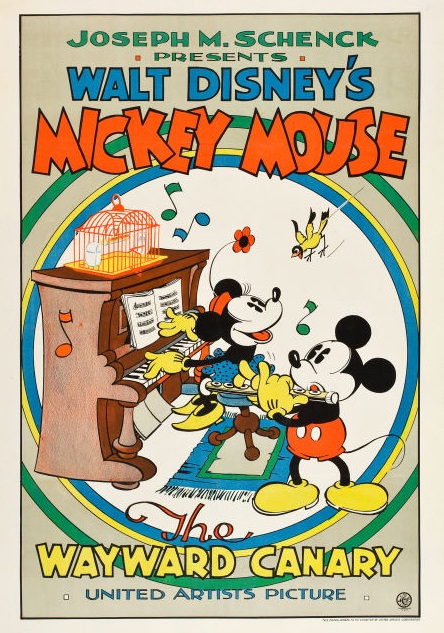
Controversy surrounds this 1932 Disney cartoon- in one scene, Mickey Mouse is seen using a cigarette lighter that has a painted swastika on it. In 1932, the world did not fully understand the significance of the swastika as it would relate to the rise of Naziism. image: Heritage Auctions

“Demand was steady and prices were, overall, quite good across the more than 1,300 lots we featured in this auction,” said Grey Smith, Director of Movie Posters at Heritage. “We saw a trifecta of focuses in this auction as collectors went after early Hollywood, Disney animation and Universal Horror. At the end of the day, we were all quite pleased with the solid results.”

The American Venus (Paramount, 1926) three sheet is a film that is now lost to history, minus a few trailers. What is known about it, however, is that the poster spectacularly features Louise Brooks, though this was only her second film appearance. She was relatively unknown at the time and her role in the film was very minor. The producers, however, obviously realized her star potential as they featured her exclusively on the poster. Brooks would go on to become one of the most iconic female stars of the late silent era.

“Brooks crafted a personal style that left an indelible mark on 1920s popular culture that’s still imitated today,” said Smith. “She achieved a cult status rarely garnered by entertainers of that time and is clearly a star that still resonates with collectors at the top of the hobby.”

Vintage posters were emotional, engaging and uniquely hand-crafted before hitting the printing press. image: Heritage Auctions

Rare and early Disney posters always create a stir when they appear at auction and the presence of a 1932 United Artists one sheet for Disney’s The Wayward Canary, depicting Mickey and Minnie Mouse, set collectors buzzing on its way to a $26,920 final price realized. Released in November 1932, the same year that the Academy awarded Disney a special Oscar for his creation of a nationwide phenomenon, Mickey Mouse, this is a key addition to any top Disney collection.

Universal Horror posters are still the gold standard in movie posters and this auction boasted several prime pieces from the top films of the genre, including a beautiful pre-war 1935 Belgian one sheet for Bride of Frankenstein, James Whale’s sequel to his 1931 masterpiece Frankenstein that quickly became a classic in its own right, realizing $20,315 from a determined collector, while a 1943 one sheet for Frankenstein Meets the Wolf Man — often cited as one of the best posters in the Universal horror cannon — was the subject of intense collector interest before finding a new home at $15,535.

Picasso Exhibit At AGO Was Invigorating

Time flies. Seven years ago, The Silo visited the AGO’s Picasso exhibition. We were not disappointed. Approximately ¼ of the entire second floor was dedicated for displaying works from Picasso’s private collection. That’s right- these are the pieces that Pablo himself deemed specially significant for archiving and for his personal reflection. We were not disappointed.

Blowup and detail from Portait de Dora Maar (Portrait of Dora Maar), 1937. Oil on canvas, 92x65cm

Organized by the Art Gallery of Ontario (AGO) and the Musee National Picasso , Paris- the exhibition is chronologically organized with each period having its own dedicated gallery space and covers the following phases of Picasso’s VASTLY productive lifetime: From Spain to Paris 1900-1905 Ancient, African and Oceanic Inspirations 1906-1909 Cubism, Collage and Constructions 1909-1915 Classicism, Marriage and Family 1914-1924 Surreal Anxiety and Desire 1924-1934 War Paintings 1936-1951 and lastly The Joy of Life and Last Years 1950-1972



According to the Picasso’s Picassos (Picasso’s Early Life and Art) on pg 2 of the AGO’s exhibition catalog, Pablo Picasso was recognized as “an artistic prodigy and began…formal artistic training when he was only seven years old” with his father, who was a painter and an art teacher. For the next 85 (!) years Picasso would go on to not only change the art world, but would leave behind a vast legacy that is as fresh and relevant today as it ever was. Strolling around this fine exhibition and noticing how the other visitors were dressed is proof enough for this writer that Picasso’s influence on society is far from over. For the Silo, Jarrod Barker. 

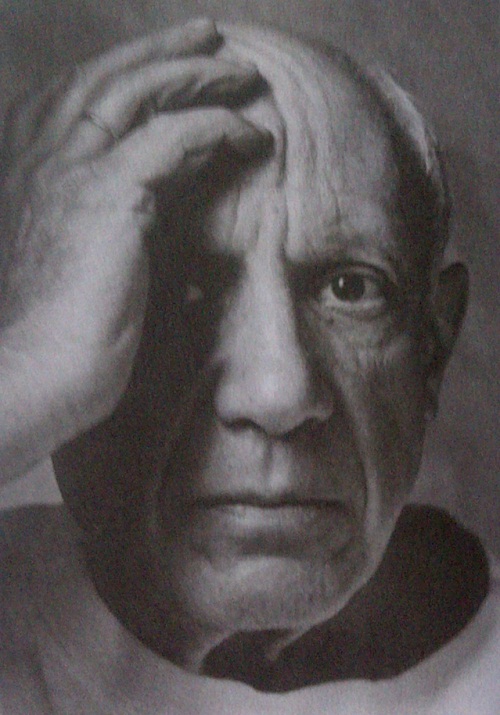
Picasso at 73years of age in 1954. “When I paint I feel that all artists of the past are behind me.”

Protest at Marineland, Niagara Falls Gains Momentum

On Saturday August 18th- hundreds of protesters gathered in front of the main entrance gates of Marineland in Niagara Falls, Ontario. At stake was the ethical treatment of animals used for performances and entertainment. Over the past three years there have been increased reports by the media regarding the attacking of trainers by killer whales and other performing animals.

Messages on protest signs were simple, bold and clear. photos:The Silo/Mith Media

Many researchers believe that this sort of behavior is inevitable because killer whales are adversely affected by forcible confinement and pavlovian conditioning and that in turn has many questioning whether theme parks such as Marineland and Seaworld are capitalizing on animal cruelty. It’s not a new topic- zoo’s and circuses are not strangers to demonstration and protest and the relationship between humans and animals is a theme often employed by conscientious artists.

[Warning- the following video contains disturbing images. Viewer discretion is advised CP]

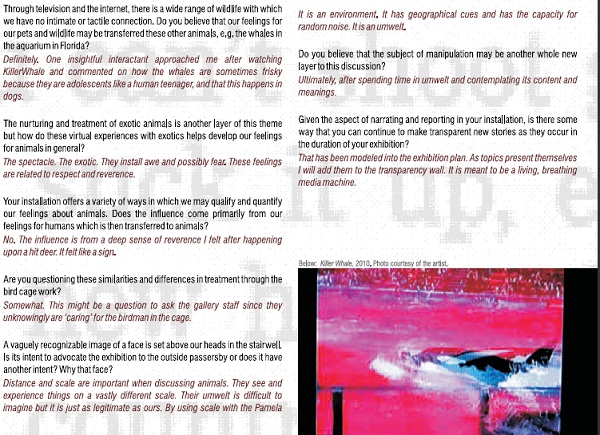
Segment from Umwelt (2010) exhibition catalogue- Jarrod Barker’s installation at the Norfolk Arts Centre explored the connectedness or non-connectedness (ie: the umwelt) of humans and animals. image:courtesy of the artist

Marineland denied our request (along with the Toronto Star’s request) for an interview and requested that the media respect “private [their] property”. That sort of reaction makes it difficult to investigate a story of this magnitude- and many questions remain unanswered. For example, earlier this year an infant beluga whale was attacked repeatedly by two adult belugas until it was killed. Media leaks reveal that the baby whale may have been ill and that the other animals acted out of fear since they may have detected signs of a contagious disease.

image: The Silo

Although no date has been set, The Ontario Society for the Prevention of Cruelty to Animals is planning on bringing independent Sea Mammal experts and Marine Biologists into Marineland for an inspection according to an online report at www.thestar.com CP

image: The Silo

Ontario Beach Zoomorph Profiled In Mexico City University Of Art Publication

Artist Jarrod Barker, was recently invited to take part in MUCA-Roma’s Ala Afuera project. Based in the Roma district of Mexico City, MUCA is a University Museum of science and art. What made this project doubly exciting was the opportunity to show case a part of Barker’s home internationally.

The curators asked for a submission of 3 images and accompanying explanatory write-ups that “from your perspective, show a form of relationship between humans and the rest of nature.” This topic aka- Umwelt is not foreign to Barker who installed an exhibition of that name in 2010 at the Norfolk (nee Lynnwood) Arts Center in Simcoe,Ontario.


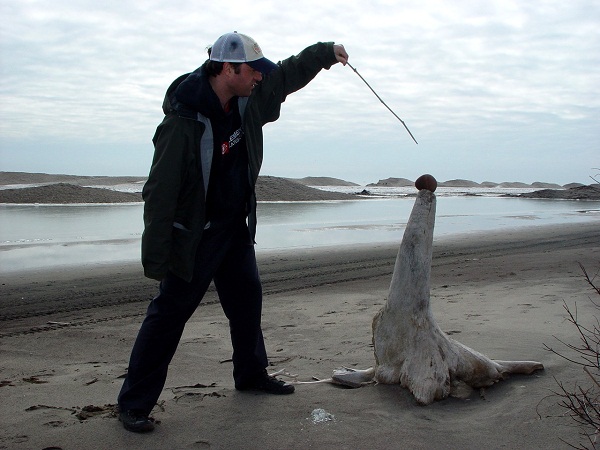
Long Point Seal Tamer Concept- J. Barker
Location: Long Point, Norfolk County, Ontario, Canada
Long Point is a world biosphere. I know this because the United Nations has told me so. But for several months of the year Long Point is transformed. Under certain winter conditions, Long Point looks less like a marshy, swampy bird watchers paradise and more like an arctic shore. At least on the South West side. When I visit Long Point during these times, I react to the environmental changes. I see things differently. I feel things differently. A sun bleached tree stump becomes a seal. A marsh reed becomes a baton. A flint pebble becomes a ball. Natural transformation through the changes of the seasons is a holistic experience.


After the selection process, if successful- one of the artist submitted images and write-ups was selected for transformation into a postcard and incorporated with the other artist submissions. The goal was for the Ala Afuera team to mail out the postcards to other international Museums of art and science and Contemporary Art institutions as a connective gesture to highlight MUCA and the work of the artists involved in this project and to bring awareness to our human/nature relationships.


“The objective of the project Allá Afuera (Out There) is to gather a mosaic of images that represent
ways of understanding the relationship we humans have with the rest of nature. From bucolic or
passionate points of view to other more threatening myths and taboos, amazement, fear, the absurd,
and maybe even indifference. We do not intend to cover all possibilities, but through images as a direct
reading form, show that there are multiple ways of looking at this Bond.

Three times a year we will present a collection of postcards, with 18 images each, gathered in a
biombo format. After two years we will complete the edition of six collections, with a total of 108 ways
of understanding, 108 points of view, and 108 forms of defining our relationship with what is out there. “

Ala Afuera which translated mean’s “Out there” began mailing out the works a few weeks ago.  For the Silo, Stephanie Bordega. 

For more information and to request postcards please contact-
Allá Afuera (Out there) project Gonzalo Ortega and Jeronimo Hagerman
MUCA ROMA MUSEUM (University museum of science and art, Roma district, Mexico City)
[email protected]

Click me!

WW2 Smartphone Graphic Novel Katusha

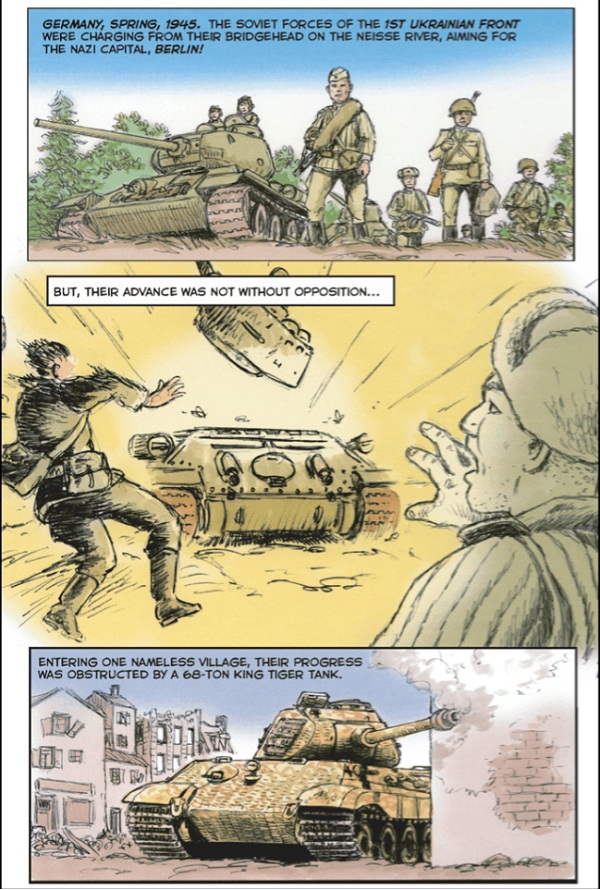
KATUSHA VOLUME ONE: EDGE OF DARKNESS, the first of a three volume graphic novel series by historical graphic novelist Wayne Vansant, is now available exclusively in digital format from digital publishing imprint Grand Design Communications.

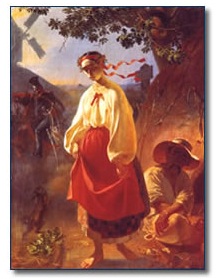
The painting Kateryna by the Ukrainian poet and painter Taras Shevchenko (1814-1861)influenced Katusha. Kateryna tells the story of a Ukrainian country girl who is seduced and abandoned by a Russian cavalry officer.

KATUSHA is a coming-of-age story set in the Eastern Front of World War II, following the life of a Ukrainian farm girl Ekaterina Tymoshenko, nicknamed Katusha, starting with the invasion of the Soviet Union by Nazi Germany in 1941. The three-volume graphic novel, which when finished will total 540 pages, follows her journey from farm girl to partisan fighter to tank commander in the Red Army, along the way participating in the Battles of Stalingrad and Berlin, among others.

During the second world war, hundreds of thousands of Soviet women served in the Red Army as pilots, snipers, tank drivers and other essential roles. Although KATUSHA is a work of fiction, Vansant based his story on interviews he conducted with living veterans in Ukraine and extensive research. He will return for another trip this fall, to conduct more interviews and do research on locations.

Lviv, Ukraine, 26 October 2010 – Canadian Prime Minister Stephen Harper is joined by Ukrainian officials as he pays tribute to Ukrainian poet, artist, and humanist Taras Shevchenko.

KATUSHA VOLUME ONE: EDGE OF DARKNESS, the first of three volumes, is out now exclusively in digital format for iPhone, iPad, Android, and in-browser reading. It is available in two formats – as six separate chapters priced at $.99usd each and as a single one hundred eighty page edition priced at $4.99usd, and can be purchased through iVerse’s ComicsPlus app and from Grand Design’s electronic storefront on iVerse’s website.

A native of Marbleton, Georgia, writer/artist Wayne Vansant has created many historical graphic novels – both fiction and non-fiction – in a career spanning more than twenty five years. His non-fiction graphic novel about the Allied invasion of Europe in World War II, NORMANDY, were be published in September by Zenith Press.

His recent collaboration with writer Dwight Jon Zimmerman, THE HAMMER AND THE ANVIL (2012), a graphic novel about Abraham Lincoln, Frederick Douglass, and the end of slavery in America was published by Hill and Wang, and Vansant was the primary artist for Marvel’s The ‘Nam for more than five years.

His other non-fiction graphic novels on military history include DAYS OF DARKNESS, ANTIETAM: THE FIERY TRIAL (with the United States National Park Service), BLOCKADE: THE CIVIL WAR AT SEA, and THE VIETNAM WAR: A GRAPHIC HISTORY.

Unlike Quebec and United States, Ontario has no transportation budget $ for cycling infrastructure

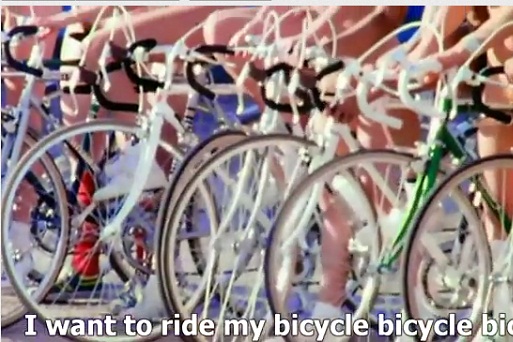
Still from the classic Queen song- Bicycle Race

Toronto – GPO leader Mike Schreiner is calling on the McGuinty
governmentto dedicate1% of the transportation infrastructure budget
to cycling and another 1% for pedestrians. Sustainable infrastructure
is a sound investment that will help people choose healthy
transportation options.

[The song  featured is by Mercury and was supposedly inspired by his observing a leg of Tour de France. It starts with a chorus unaccompanied by instruments. The chorus is followed by two verses connected with a bridge, both followed by a chorus. Around the middle of the song there is a solo played with numerous bicycle bells. During the live performances, it was often played by the audience who specially brought the bells for this purpose. The song has a very unusual chord progression with numerous modulations, a change of meter (from 4/4 to 3/4) in the bridge, and the multitracked vocal and guitar harmonies.

The video for the song became scandalously famous for featuring 65 naked women, all professional models, racing at Wimbledon Greyhound Stadium. It was filmed by Dennis de Vallance. The group rented the stadium and several dozen bikes for one day for filming the scene; however, when the renting company became aware of the way their bikes were used, they requested the group to purchase all the bicycle seats. The original video uses special effects to hide the nudity.

“Bicycle Race “é um single da banda de rock inglesa QUEEN. Foi lançado em 1978, no álbum JAZZ e escrito pelo vocalista da Queen FREDDIE MERCURY. Ela foi lançada como um duplo lado-A única juntamente com a canção” Fat Bottomed Girls “. A canção é notável por seu vídeo com uma corrida de bicicleta com mulheres nuas em Wimbledon Stadium, que foi editado ou mesmo proibido em vários países. A canção tem uma progressão de acordes muito incomum com modulações diversas, uma mudança de metro (de 4 / 4-6 / 8) na ponte, e os vocais multipista e harmonias de guitarra.

A canção foi escrita por MERCURY e foi supostamente inspirado por sua observação de uma perna do Tour de France. Ela começa com um coro acompanhados por instrumentos. O coro é seguido por dois versos conectado com uma ponte, ambos seguido por um coro. Ao meio da música há um solo com sinos de bicicleta numerosos. Durante as apresentações ao vivo, muitas vezes era tocado pelo público, que levavam os sinos especialmente para esta finalidade.

O vídeo para a canção tornou-se famoso por escandalosamente com 65 mulheres nuas, todas as modelos profissionais, competindo em Wimbledon Greyhound Stadium. Foi filmado por Dennis de Vallance. O grupo alugou o estádio e várias dezenas de bicicletas durante um dia para filmar a cena,. Porém, quando a empresa que alugou tomou conhecimento da forma como as suas bicicletas foram usados​​, eles pediram ao grupo para adquirir todos os assentos das bicicletas, o vídeo original usa efeitos especiais para esconder a nudez.  Courtesy of http://www.youtube.com/user/lcsRamone CP ]


“If Premier McGuinty can find $1 billion dollars to build his
‘people’s highway,’ why can’t he find a few million dollars to make
streets safe for people?” asks Schreiner.

Today marks the launch of Bike Month in the City of Toronto. Cycling
plays an important role in the health of our citizens, strengthening
our local economies and our general quality of life.

Quebec spends $200 million on cycling infrastructure and earns $135
million each year from bicycle tourism alone. The US dedicates 1.6% of
its transportation budget for states to invest in cycling
infrastructure. Ontario has no dedicated funding to support cycling or
pedestrian infrastructure.

“Ontario needs infrastructure if we are serious about making our
streets and roads safe,” says Schreiner. “A small investment to
support cycling will reap big rewards — combating gridlock, reducing
health care costs and supporting local businesses.”

Two Danish studies showed that when 1% of car drivers switched to
riding bicycles, health care costs were reduced by 1%. Copenhagen
saves $300 per person per year on health costs because almost 80
percent of its population bikes regularly. Cycling and walking
projects create 11-14 jobs per $1 million spent, compared to just
seven jobs created per $1 million spent on highway projects. These and
other studies show that Ontario cannot afford not to invest in cycling
infrastructure.

The GPO’s 1% percent solution would create two funds for
municipalities to access the dollars they need for cycling and
pedestrian infrastructure. By doing so, Ontario would finally
recognize that cycling and walking are important forms of
transportation for growing numbers of Ontarians.

“We need a Complete Streets Act in Ontario to ensure that our streets
are safe for all users: cars, trucks, bikes, pedestrians, wheeled
mobility devices, and transit users” says Trinity-Spadina candidate
and GPO critic for transportation Tim Grant.

Jaymini Bhikha
(O) 416-977-7476
(C) 416-275-8573 [1]
[email protected]

For the Silo by Green Party of Ontario
PO Box 1132
Toronto, ON M4Y 2T8
Canada

Toronto crooner Ori Dagan ‘cooks a tasty stew’ of standards and originals

Canadian crooner Ori Dagan (well at least half of him)

Ori Dagan  (twitter @oridaganjazz) seems to me like a man on a mission. With a rich baritone voice, he has tried to craft a jazz album that is both hip and playful, and, at the same time, a genuine jazz album, complete with standards and heavyweight musicians, and some original tracks as well. Dagan’s album, Less than Three, is a tasty stew of standards and originals with a classic Hebrew song thrown into the mix, and one from his own pen: Nu Az Ma, a call for peace of truly universal dimensions.

Ori Dagan (still from performance) image: www.thesilo.ca

After an opener of Madonna’s Lucky Star (yep, THAT Madonna CP ), which reminded my friend Sophie of a 60’s beat poetry track, with minimalistic base and percussion and funky vocals, Dagan moves to his mother tongue with Eretz Zavat Halav, a Hebrew song featuring the magnificent Jane Bunnett on soprano sax. Bunnett is a true jazz superstar, a multiple Juno award winner and multiple Grammy nominated musician and bandleader who has worked combining Cuban music with new and avant-garde jazz. There was a house down the street from me in west-end Toronto where people told me Jane Bunnett had moved. I used to hear her sax emanating out into the street from a third-story window. It was truly wonderful.

[If there’s any doubt about Ori’s capabilities as a live-on-the-spot performer this youtube video should alleviate. CP]

The material on Dagan’s CD is eclectic. I’ve already mentioned the Madonna cover. There’s also a totally scat version of Lady Gaga’s Bad Romance that is exceedingly fun and features some great scatting too. Not everybody can do that you know. And he throws in some very sensitive renditions of Elton John/Bernie Taupin (This is your Song) and Lloyd Webber/Rice (I’d Be Surprisingly Good for You), to demonstrate a surprising range that can cover modern hits to a cutting, up-tempo Sweet Georgia Brown to round off the album.

This is a very dexterous record featuring a range of styles, and Dagan’s voice is rich, and according to my friend Sophie, sexy. She’d go see him “in a minute.” –CD

Ori on i-tunes: http://itunes.apple.com/ca/album/less-than-three/id523987928    www.oridagan.com

Supplementalhttp://www.janebunnett.com/biography.html


Our MAY print edition powered by downtown Simcoe,Ontario's The Studios at Erie Music

Canadian Book Reviews The Sentimentalists

photo: Aaron_McKenzie_Fraser- www.amfraser.com

Johanna Skibsrud’s Giller Prize winning novel, The Sentimentalists, is a journey that sometimes takes place between the lines. Skibsrud’s unnamed narrator takes the reader across time as she tries to reconnect with her troubled past and with her father, which has always been shrouded in secret.

From the beginning, the reader knows little about the narrator. Skibsrud weaves details from the past as she navigates the narrator through a trip back to Casablanca (save yourself some Mapquesting- this is a fictional town CP), Ontario, her hometown. Sparked by recent heartbreak, the narrator travels to Casablanca to spend time with her father in the twilight of his life.

Novels often have multiple cover styles- this one reflects the ‘hidden, not quite visible’ character of the narrator.

In what seems like an attempt to distract herself from her own problems, she devotes herself to finding out some truths about her father’s life before he slips away….forever. The reader never knows much about the narrator. This will be a test for those who like to know about the person who is telling the story. Never named, the narrator releases little information about herself, but a clear and exhaustive picture is painted of her father, Napolean.


[One of the best Woody Allen films- uses an imaginary-advice-giving-fedora-wearing character straight out of Casablanca as a narrative device CP]

Lyrically written, this novel can be a frustrating read at some points. It is full of beautiful passages and poetic imagery. However, at times, the reader may find themselves somewhat lost in the fog of the past and present blending together.

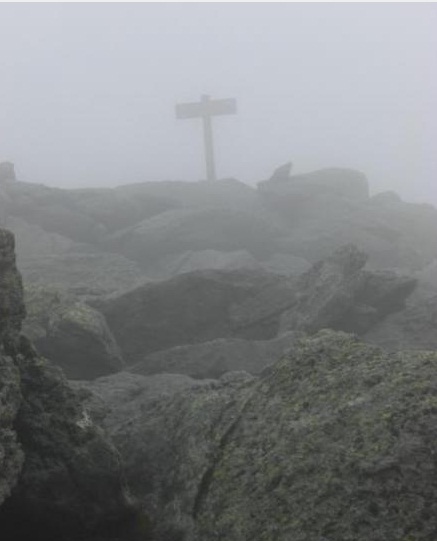
“Lost in the fog of the present and the past….” Lost in the fog – Mount Washington (NH, USA) photo:traveldudes.org

A haunting and promising debut, The Sentimentalists leaves the reader with something to think about. Although difficult at times, it is definitely worth sticking with until the end.

Johanna Skibsrud’s second release is a series of short stories called This Will be Difficult to Explain and Other Stories.  For the Silo, Sarah Purdy.

Small House Living Is Bliss

From our Facebook page:

Hi ‘Silo’,

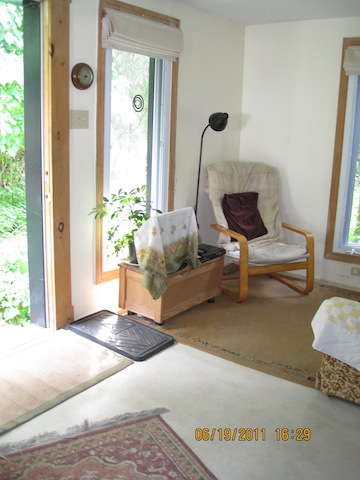
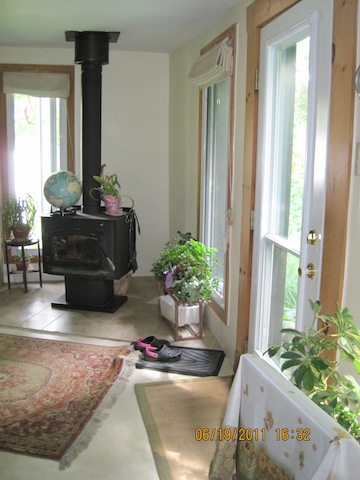
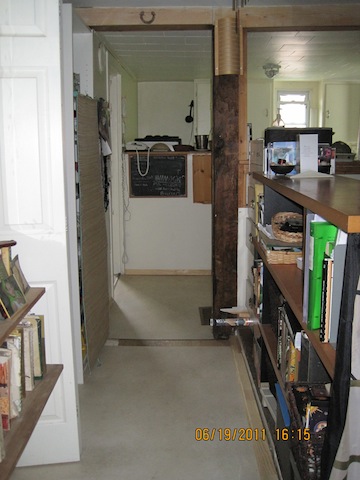
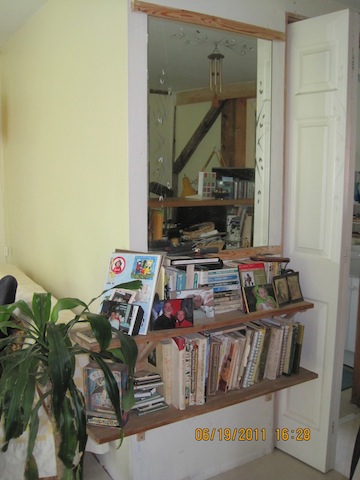
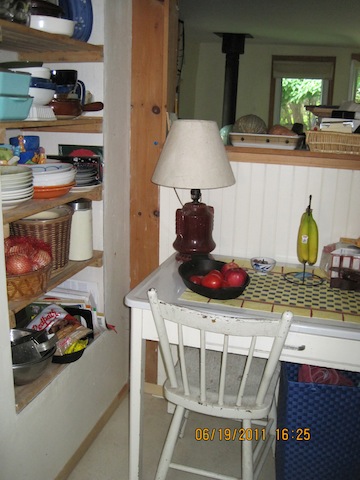
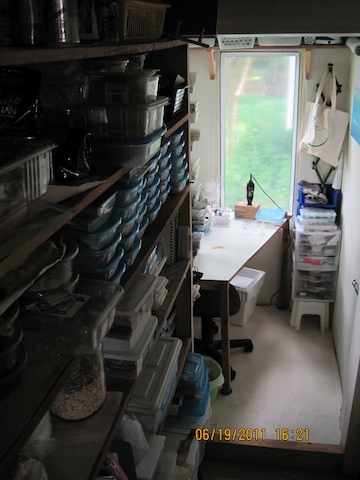
Here are some quick shots I did of our place. For us, the challenge is to use every possible space and yet achieve a feeling of spaciousness. I just did a count of all the space saving/creating measures we have made over the years – about 25 – not counting replacing, enlarging and adding windows and doors – from simple shelves to complex projects involving cutting into walls and making a new room.
It has taken us more than 20 years to do this. We purchased the place and a barren 3/4 acres in 1986 for $20,000. And, it has turned out even better than we dreamed possible.
Even in this tiny space, we can lose each other. David Wells, my partner in all this, has a blog in which he talks about our life here. You may be interested:
http://DavesBackPorch.blogspot.com/p/about-me.html

OUR SMALL HOUSE

EXTERIOR FRONT

INTERIOR – FRONT

INTERIOR FRONT

‘HALL’ FROM FRONT DOOR TO KITCHEN

MIRROR IN ‘HALL’ TO REFLECT MORE LIGHT

OFFICE/COMPUTER (to the immediate right of above ‘hall’)

KITCHEN STORAGE AND TABLE  (other side of office above)

KITCHEN – small but functional. As a former professional
cook, I have found ways to scale equipment way down,
and use my creativity to produce nutritious, interesting meals.

NEW KITCHEN DOOR ENTRY – STAIRS TO JEWELLERY STUDIO AT RIGHT

JEWELLERY STUDIO – PREVIOUS ENTRY

NEW BACK ENTRY

BEDROOM (7′ X 11′)

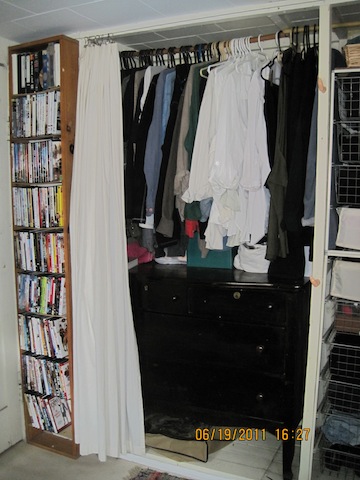
CLOSET – DVD STORAGE – behind door

BATHROOM w CLAWFOOT TUB – AND WINDOW LOOKING
OUT TO ‘WOODLET’ (A Spa at Home)

BATHROOM VANITY WITH BEACH GLASS MOSAIC INTERIOR WINDOW
TO LET LIGHT INTO CENTRE OF HOUSE

BEACH GLASS MOSAIC WINDOW

DAVE’S MUSIC STUDIO

DAVE’S BACK PORCH – entry to his music studio

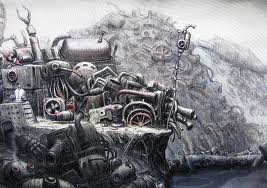
Mecha Artist Simon Kotsch Predated Steampunk

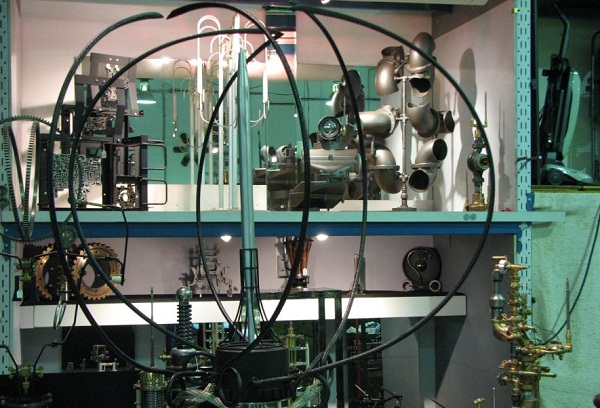
In 1968 Simon Kotsch got into the army surplus business. It was good to him, but in ways you might not expect. Something began to happen to Simon as he sorted through his bounty of obsolete engine parts and electrical fittings: he noticed that he found the pieces beautiful. An excitement took hold of him. And then he went to work, drilling and cutting and fitting metal components together to make new things. Beautiful things. He felt “caught up,” he says simply. So began a love affair with military-industrial cast-offs that continues to this day. This was the birth of a sculptor and of a mecha artist.Let us throw aside, officially and forever, the artifice of journalistic objectivity.

I like this guy’s passion and I like his work. When we visited Kotsch’s Victoria St. Studio in Simcoe, Ontario we were greeted with warm smiles that never went away.  Taking joy from your work is one thing, but when you combine joy with the sensibility of a true artist who respects, even loves his materials, the results can be magical.Some of Kotsch’s sculptures look like they could have come from the mind of Jules Verne—grand, monumental machines whose functions border on the mysterious, infused with Kotsch’s concern for symmetry and his acute sense of balance, proportion, and pattern. Others have a strong vertical momentum, like castles or rockets with many levels. But not everything has a sci-fi feel.

Kotsch uses the heft and gravity of larger pieces to create powerful and interesting earthbound sculpture. His ability to recognize, or create, striking patterns makes some of his metal works quite decorative to my eye—and that in no way infringes on their status as works of art.

Kotsch says he “savours the natural colour” of each item, whether it’s aluminum, copper, brass or porcelain (used as insulation in old electrical systems). You will not find much (any) painting here. You will also not find much welding. This, by his own admission, is because he’s not very good at it, and mediocre welding would make a sculpture look awful. He cuts and drills to make pieces fit. One technique he has developed is to take slices out of solid machine parts with a band saw, revealing patterns of copper wire within, like opening a geode.

An example of influence: years of working with Army surplus ephemera have inspired Simon’s forms

Simon Kotsch takes obsolete machinery—all of his extensive catalogue of parts predate metric—and turns it into stimulating works of art. We spent about an hour with him, and I left both  excited and energized. I, too, had been “caught up.” This is one of the miracles of art for me:  through active engagement with an artist’s work a kind of interface occurs between creator and appreciator, mediated through the work itself. I certainly appreciated the skill and imagination of Simon Kotsch, but I think I caught a bit of his love as well.  For the Silo, Chris Dowber.

A look at some of Simon’s works.

Listen To Simon Kotsch Interview

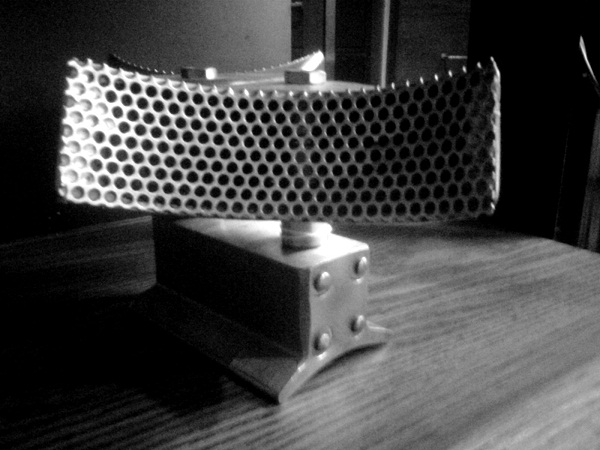
An oil fluid coolant system split in two reveals a beautiful maze structure


Ancient Jewish Coin Brings Record $1100000

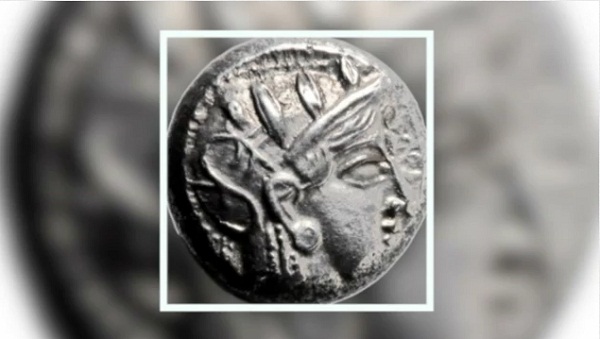
Incredibly rare “Owl type” Silver Drachm (opposite face with Jerusalem lily) image:courtesy Heritage Auctions

The first silver shekel struck in Jerusalem by Jewish forces rebelling against Roman oppression in the first century CE, one of only two specimens known, brought a world record price of $1,105,375 at Heritage Auctions on March 8 as part of the auction of The Shoshana Collection of Ancient Coins of Judea. The coin sold to an anonymous overseas collector. Overall, this auction realized over $7.6 million, with the whole of the collection, consisting of more than 2200 coins in total, expected to realize more than $10 million in multiple auctions this year.

“This Year 1 silver shekel, struck shortly after the Jewish War began in May of 66 CE, is an incredible piece of history,” said Cris Bierrenbach, Executive Vice President of Heritage Auctions. “This is literally one of the very first coins the Jewish rebels struck after the ousted the Romans from Jerusalem, sending shockwaves through the empire. That history, as evidenced by the spirited bidding and the superb price realized, obviously continues to resonate today, more than 2,000 years later.”

The Shoshana Collection, assembled over the course of four decades by an American collector, is the greatest assembly of ancient coins related to the foundation of ancient Israel ever offered, spanning more than 11 centuries.

Other highlights from the collection include an incredibly rare gold aureus as Caesar (69-79 CE), struck at an Eastern mint in 69 CE, likely Tyre, anticipating the subjugation of Judaea, which the Romans achieved with the fall of Jerusalem in 70 CE, which brought $956,000, while one of only two known surviving silver quarter-shekels of Year 1 (May 66-March 67 CE) in existence brought $896,250.
A few of the additional highlights included:

Jewish War (66 – 70 AD). AR half shekel. Year 4. Hendin 1365. TJC 209. AJC 262,25. Samuels 980 (this coin). Extremely Fine. One of six recorded specimens. Realized: $358,500.
Vespasian (69 – 79 AD). AE sestertius. AD 71 Rome. Hendin 1500b. RIC 71,161. BMC 543. Impressive Good Extremely Fine. Realized: $262,900.
Jewish War (66 – 70 AD). AR shekel. Year 5. Hendin 1370. TJC 215. AJC 263,31. Samuels 94 (this coin). Very Fine. Ex: Nelson Bunker Hunt. Realized: $262,900.
Jewish War (66 – 70 AD). Year 5. Hendin 1370. TJC 215. AJC II 263,31. Brand 3. Bromberg II, 309 Good Very Fine. Realized: $179,250.
Divus Vespasian (69 – 79 AD). AV aureus. Struck by Titus, AD 80-81, Rome. Hendin 1581. RIC 230,363. Cohen 143. BN 89. Superb. Realized: $131,450.
Aelia Capitolina (Jerusalem, renamed by Hadrian) Collection, 164 coins. Realized: $107,550.
Titus as Caesar (79 – 81 AD). AV aureus. AD 72-73 Rome. Hendin 1469. RIC 84, 370. BMC 520. BN 73. About Extremely Fine. Realized: $101,575.
Vespasian (69 – 79 AD). AE sestertius. AD 71 Rome. Hendin 1500b. RIC 71,161. BMC 543. Samuels 146 (this coin). Extremely Fine. Realized: $95,600.
Bar Kokhba Revolt (132 – 135 AD). AR sela. First year (132/133 AD). Mildenberg 125,4.1 (this coin). Hendin 1373. TJC 218c (this coin). AJC 264,1c (this coin). Samuels 98 (this coin). Superb. Realized: $89,625.
Bar Kokhba Revolt (132 – 135 AD). AR sela. First year (132/133 AD). Mildenberg 124,3.5 (this coin). Hendin 1373. TJC 218 (these dies). AJC 264,1 (these dies). Samuels 97 (this coin). Superb. Realized: $89,625.
Auction of US coins continues on New York and over the Internet at www.HA.com/Coins through Sunday, March 11.

Seldom Seen Selections: One of the finest known 1795 Eagles

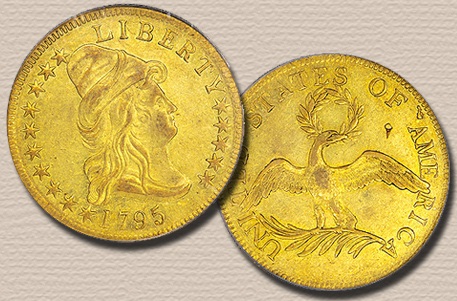
The famous 1795 American gold ‘eagle’ coin

The ten dollar gold pieces, given the name “eagle,” were the largest gold coins produced by the first U.S. Mint from 1795 through 1804. Like all early gold coins (and many early silver coins), these pieces did not carry an actual denomination as part of the design.
The 1795 BD1 is considered the first variety coined for the year, therefore it is the first eagle minted by the United States! There are more of them surviving today than all other 1795 varieties combined, and it is actually one of the five most common die varieties of the entire series from 1795 to 1804, a fact that would probably surprise most collectors. Quite a few examples survive in Mint State grades, giving collectors a reasonable chance of obtaining a high-quality example of the Small Eagle reverse design.

Many of the Mint State pieces have prooflike fields, including the coin we are featuring in our upcoming 2012 April 18-22 US Coins & Platinum Night CSNS Signature Auction. Although the fields are not deeply mirrored, they are clearly reflective. The surfaces are exceptional with only a few scattered abrasions. Faint adjustment marks are evident at the center obverse and on some of the obverse dentils. All design elements on both sides are sharply struck, suggesting to some the possibility that this may have been some type of presentation piece. This example is a relatively early die state of the variety, with faint obverse die cracks but no evidence of reverse cracks. Despite the existence of several Mint State pieces, this example is one of the most attractive we have handled.

A curious situation exists for both early half eagles and early eagles. For both denominations there were multiple varieties dated 1795 and only a single variety dated 1796, despite mintages that suggest this is illogical. During the course of 1795, just 2,795 eagles were minted from September 22 through November 27. In 1796, the Mint produced 6,934 eagles from January 9 through December 22. If we take these annual production totals at face value, an average of 560 coins per die marriage were struck in 1795 while a single die marriage produced all 6,934 coins in 1796. Clearly there is something wrong, unless many of the coins produced in 1796 were from dies dated 1795, and we can be certain that this was the case. According to the Guide Book, the 1795 mintage totaled 5,583 coins and the 1796 mintage totaled 4,146 coins, but even those figures are suspect, suggesting a survival rate of 10% for 1795 eagles and only 4% for 1796 eagles. This discussion illustrates the challenge that numismatists have today when attempting to reconstruct the events of the earliest years at the Philadelphia Mint. There were no records of mintages for individual die varieties, and any attempt to make such estimates today is plagued with problems.

In Early U.S. Gold Coin Varieties, John Dannreuther provides estimated mintages for every variety and for the number of survivors for each variety. The only thing we know for sure is the number of die marriages known from 1795 through 1804 (32) and the total mintage for that period (132,714 coins including 122 pieces reserved for assay). By using the midpoint of Dannreuther’s survival estimates, we can also establish an approximate survival rate for the series of 2.5%. Is this enough information to establish original “mintage figures” for each variety or even for each coinage date?

Mark Van Winkle has spent considerable effort over several years attempting to correlate mintage figures with individual varieties, and now feels that it is impossible. There are at least two variables that cannot accurately be determined. First, the exact emission sequence needs to be determined (including both die marriages and remarriages). In a series like the early eagles, the emission sequence alone is enough to give a numismatist nightmares. Once the emission order is known, an accurate estimate of the survivors must be established for each variety and remarriage, and this is nearly an impossibility. Finally, differing survival rates from one coinage date to the next must be pinpointed, a seemingly impossible task. CP for Heritage Auctions Dallas, Texas www.ha.com

SupplementalThe Numismatic Network of Canada for those interested in studying and collecting Canadian coins, tokens, paper money and related numismatic materials http://www.nunet.ca/

AyrSpace Gallery Men in Business Painting Exhibition

AYR, Ontario — In 2011 when AyrSpace held Canada’s only one hundred-woman art show for the
100th anniversary of International Women’s Day https://www.thesilo.ca/international-women-join-forces-through-art/ , the men took note. The idea of the painting exhibition “Men in Business 2012” was born.

“The idea came to me to encourage the hidden talents among us,” said John Redfern, a Customs
Brokerage executive at The Farrow Group just north of Ayr. Redfern helped realize last year’s effort.
“Jill said to me in an email -15 men would be a perfect number for an exhibition,” referring to Jill Yuzwa, Gallerist at AyrSpace, gallery of visual and functional art. And in similar style to the year prior, a call for collaborators went out through social networks. Men from all economic sectors were encouraged to respond – whether their works be an extension of their day to day or their alter-artistic ego.

Cosmonaut painting (far left) by Jarrod Barker.

And they did respond: a Vancouver architect, a celebrated Canadian documentary film maker, a custom furniture craftsman, educators and leaders of education, independent businessmen, lawyers and a specialized medical technician. The artworks are as varied as the gentlemen themselves. And coincidentally there are 15 collaborators. North Dumfries Mayor Rob Deutschmann will be on hand to welcome the collaborators and open the event on Friday February 3, 2012. “Men in Business 2012” will run through Sunday February 26, 2012.

The exhibition is dedicated to Ayr resident Stephen Gross who is currently undergoing cancer treatment. Mr. Gross is perhaps best known in the Region of Waterloo for his excellent work at the Kitchener Downtown Community Health Centre.

The 15 collaborators of Men in Business 2012 invite the community and collectors to this exhibition and have initiated that partial proceeds of their artworks be allocated to NewmanBoysTrustFund.ca in fond memory of Katherine (Bunny) Newman the Gallerist’s cousin.
AyrSpace, gallery of visual and functional art, is located at 44 Stanley Street in downtown Ayr. The gallery opened in October 2008 as a socially innovative collaborative and now represents a range of Canadian artists. www.ayrspace.ca   For the Silo, Jill Yuzwa.

Media contact:
Jill Yuzwa
AyrSpace
519.632.9030
[email protected]

Here’s a few reasons why one of the prettiest villages in Ontario is Elora.

In Elora, life unravels a bit slower

It’s worth saying again: One of the prettiest villages in Ontario is Elora. It’s so nice very time I visit this village of 5, 500 I want to move here. A lot of people have done just that. Elora is a place that grows on you from the minute you arrive. Over dinner at a local favourite eatery, The Shepherd’s PubI struck up a conversation with Nadine McEwen and Stan Winegard who told me they moved here about two and a half years ago from Timmons. Stan said, “It’s a real pretty place and a very welcoming community with an active artistic community. Since Nadine is a sculptor, it fits perfectly into our life style”. Even the owners of this authentic British pub had moved to Elora from Guelph just a few months ago. Throughout the weekend I bumped into others who made the move. Well now, let me think more about this moving thing.

Known for its unique limestone architecture, Elora was founded in 1832 by Captain William Gilkison, a British officer recently returned from India.

Shopping
Elora is an artists’ community specializing in handcrafted and one-of-kind items. The two main streets to stroll are Mills and Metcalfe.
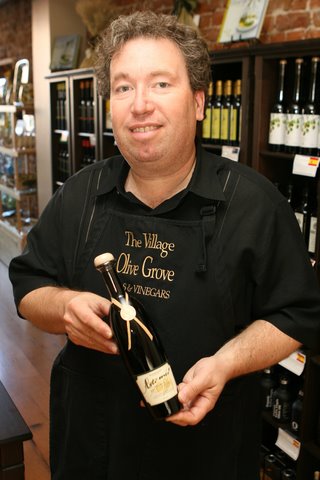
One stand out worth finding on Mill Street, near The Shepherd’s Pub, is The Village Olive Grove (it was the free olive oil tastings sign outside the store that first caught my eye). I met one of the owners, David Medeiros (He’s from Toronto). Medeiros believes their shop is the only one in Canada selling exceptional olive oils and vinegars from around the world.  A few other shops that caught my eye were; Sante’s it’s a natural grocery store with organic and fair-trade foods and gifts. A Weed Bit Natural features hemp products and organic clothing. Jammed Lovely is filled with unique one of a kind gift items. Sweet Trash has clothing and accessories from the 1920’s and onwards. At Grand Gourmet KitchenwareI had to have some of the items explained to me as to what they were. You can tell how much time I spend in the kitchen.

The Village Olive Grove occassionally has free olive oil tastings.

Culinary Walking Tour
If you arrive on a Saturday sign up at the Village Olive Grove for the $10.00 walking tour between 1 and 3 pm. During the tour, you’ll sample specially created dishes from eight restaurants while learning about the history and architecture of the area.

One of the prettiest villages in Ontario-

Holiday Happenings
-Santa Claus Parade, Saturday, November 26 and Parade of Lights begin at 6pm.There’s another parade in nearby Fergus on December 3rd at 1:30 pm.
-Starlight Shopping November 24-25 until 9pm.
-Elora Centre for the Arts Show and Sale, December 8-22.
-The annual Elora Festivals Singers’ Christmas Concert series in December is an annual rite of winter.

The Elora Gorge
Here’s the gorge part. Elora is located on the Grand River where the Elora Gorge begins. The gorge has a waterfall that forms behind the Elora Innand continues for 4 kilometres. The Elora Inn is currently closed for renovations. In the middle of the falls is the, “Tooth of Time”. This is a huge rock that has become the symbol of the village of Elora.

The Elora gorge on the Grand River has a waterfall that forms behind the Elora Inn and continues for 4kms.

Where to Stay
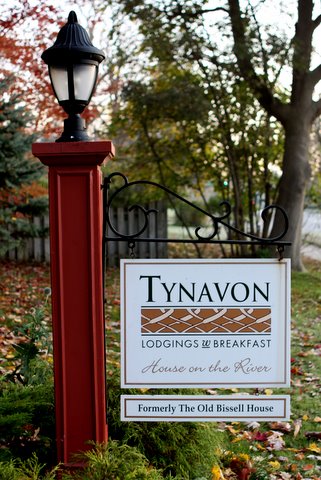
I picked the Tynavon Bed and Breakfast (Tynavon means House by-the-River in Scots Gaelic) to be home for the weekend. This quaint circa 1856 home at 84 Mill Street is a short walk from downtown. It has a gracious verandah overlooking the Grand River. Expect to pay around $125.00 a night for one of the best sleeps you’ll ever have and a scrumptious breakfast. (Silo Direct Link to Tynavon Bed and Breakfastor 1-866-334-3305).

Welcoming gate post- the Tynavon B and B

Here’s the goat part.
When you force yourself to leave Elora take a 10 minute trip on Highway 6 north to Arthur, Ontario. That’s where you’ll find River’s Edge Goat Dairy.(Silo Direct Link to Goat Milk Products Website or 1-800-209-7330) at 8102 Wellington Road 109, Arthur. If you have children with you they’ll love it. Chances are you’ll find owners Katie Kormet or Will Makxam tending to their herd of 120 mature does. The farm produces, with hard work, milk as well as cheese, yogurt and even soap.

Will told me- “We are a small goat dairy, and we process all of our own milk but we also raise the male goats for meat. In general, we tell our frequent customers, if our chain is down, come on in we are open. However, if our chain is up, we are unavailable  but not necessarily closed or away. Not only are we artisan cheese makers, we are farmstead cheese makers. Not many farmers who do it all. We feed and milk  our animals and make cheese on the farm. We are a provincially licensed dairy plant, like all other commercial dairy plants in the province. Our advantage: we use the freshest milk and process it into milk yogurt or cheese sooner than  our competitors.

Visitors are welcome to visit the farm (no charge) and you might see the goats being milked. River’s Edge Goat Dairy hours of operation vary. Katie said, “Call us ahead of time to see if we’ll be home”.

Delicious goat dairy products

For More information
Elora and Fergus Tourism Silo Direct Link to Elora and Furgus Tourism Website or 519-846-9841.GPS users can punch in 9 Mill street East, Elora.

Travel and tourism writer, Silo contributor George Bailey

Written and photographed By George Bailey Niagara Falls,Ontario  e-mail: [email protected].

Terezin,MacDougall and Hana’s Suitcase- So What’s the Connection?

Definition of art is very difficult to pin down.  As an oil painter I look at art one way.  An actor would think of it another way.  But really the definition doesn’t matter all that much.  Art surrounds us wherever we are, if only we choose to see it.  Sometimes though, we need to be reminded of that.

When I entered the concentration camp at Terezin in the Czech Republic that November day, the last thing I thought I would see was art.  I didn’t know that the children who lived there drew pictures, coloured them, and even wrote poems.  But there they were.  The paintings and words hung up on the museum wall. The wall was at least 50 feet high.  They had miraculously survived Terezin, even when the children themselves had not.  I stood in front of that wall for a long time, hesitant to leave.  Afraid that maybe I would need reminding again once I was back home.

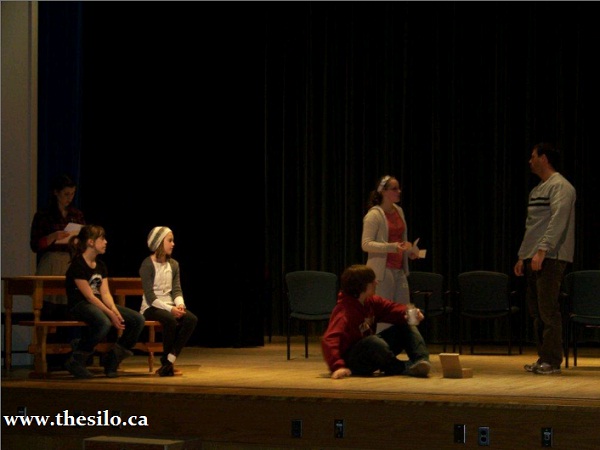
Fast forward a year and Terezin has touched my life again.  Hana’s Suitcase, which is set in Terezin, is being presented by Theatre Norfolk and COMPASS Theatre Productions, in partnership with W. Ross MacDonald School for the Blind, and I had the opportunity to meet the cast and talk about my experiences at Terezin.  I also had the opportunity to watch renowned actor and director Lee MacDougall guide the cast of talented local and emerging actors through the paces of this emotional, heart wrenching play which took me right back to that wall.

Silo Behind the Scenes: Rehearsal of Hanna's Suitcase

In this play child actors play some of the main characters.  Hana was sent to Terezin when she was 11.  This play is being performed for over 1200 students in Grades 4-12; Children teaching children and because this play is for everyone; children teaching adults.  It speaks to hatred and intolerance.  It also speaks to hope and beauty.  It’s amazing how children are able to see both at the same time.  I wonder when we, as adults, forget how to do that.

I hope that you will take the time to see Hana’s Suitcase and be reminded of all the things that you should never forget while watching art at its finest.

Hana’s Suitcase, adapted by Emil Sher based on the book by Karen Levine, is being presented at W. Ross MacDonald Auditorium Dec. 2nd, 3rd & 4th.  Tickets are on
sale at Scotia Bank, Lynden Road, and at the Lighthouse Festival Theatre.  For more info and to purchase tickets visit Silo Direct Link to Theatre Norfolk Website

By Karen Wilson.  Silo Direct Link to Karen’s artsco Gallery Page

Designed by Dean Gailbraith of Picasso Fish

Loving The Carrera S 911 Porsche

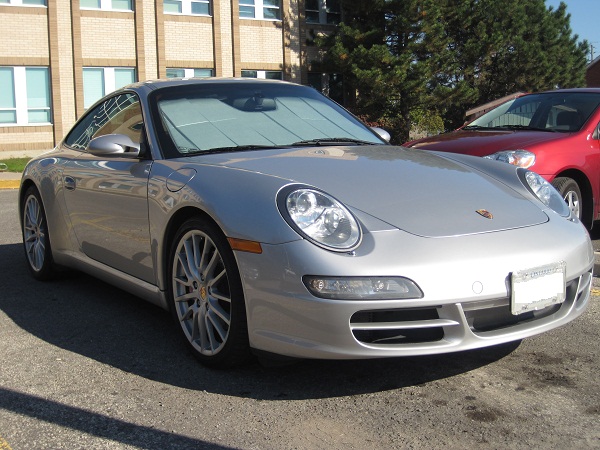
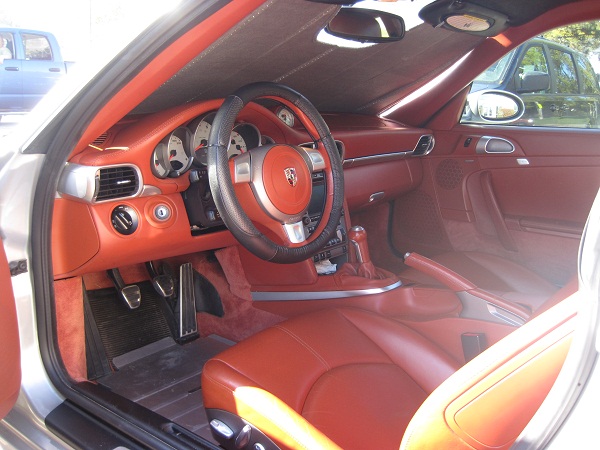
all photos- Robb Price

A metallic silver bullet, 300+ km/h roaring blur on the Autobahn. 6th gear, 355+ HP, 3.8L-6cylinder, variable timing at full advance, breathing in through a K&N filter system and exhaling out of a Fabspeed Max-Flo exhaust. Automatically adjusting shock absorbers stiffening as you pass and corner. Porsche’s PSM stability control system controlling the power to the wheels, keeping you on the road as you throttle and shift. Signature auto adjusting spoiler in the up position. If you need to stop in a hurry, having full confidence in Porsche’s best-in-the-biz 4 channel ABS and huge cross drilled rotors.
These are the type of thoughts I get just looking at this beefy, wide stanced, Carrera S (911). As sleek as it is fast, these cars actually keep a “Low Emissions Vehicle” status, and family car class fuel economy. (This is a pretty cool way to be green if you ask me!)
These cars really pay homage to the saying, “If it ain’t broke, don’t fix it!” in the sense that they (Porsche) have used a lot of the same body lines, and same rear-engine design, in the 911’s over 40 years of production. Being of rear-engine design though, makes these cars hard to master driving, truly making the driver conform to it.
By constantly improving on something that has worked since day one, Porsche has kept the focus where it really counts, on the suspension and drive-line.


Marshall Thompson, owner of Thompson Chiropractic (Simcoe and Waterford) and this sweet car, says that he was really drawn to this particular model for a few reasons:
1) He really wanted the signature Porsche model, the 911.
2) He really liked that in 2006 they went back to the traditional 911, oval headlight shape (Porsche had gone away from this for a few years, using a headlight similar to their Boxster model)
3) The wide body style of the ’06 Carrera S and the impressive much improved interior. This car touting a very stylish and ergonomic, leather interior, navi-system, uber sporty gauge package, and Bose 13 speaker sound system. Unheard of in older 911’s as they were more like a streetable race car than a luxury car.
Don’t be fooled by its good looks though. This 911 is just as wicked as its predecessors. This one apparently easily breaking the 250km/h in 5th gear with a full 6th gear still at the ready.


You might catch this car in the Simcoe or Waterford areas but only on sunny days. Good luck actually catching up to this one. Robb Price is a regular automotive writer for The Silo and owns and operates WC Kustoms in Windham Centre.

[Much like the 911, the seminal electronic band Kraftwerk innovated and pushed the boundaries of form and function. Recommended listening for Porsche owners when you’re ripping through gears CP] Update- Silo Direct Link 2012 911 Porsche makes North American Debut

Songs For Rainy Weather – What’s The Frequency, Kenneth?

How can we honestly say that today’s rain and overcast skies influenced our choice for today’s 90’s flashback…umm, urr, we can’t. But this throwback track from R.E.M. rocks. Pack your umbrella for the next few days and if you’ve got room on your ipod (we’re guessing you do, and if you don’t drop us a line explaining why not) , add this song to your playlist. It just might be a cure-all for the turn in the weather. Now where did i put my can of orange Crush?
CP

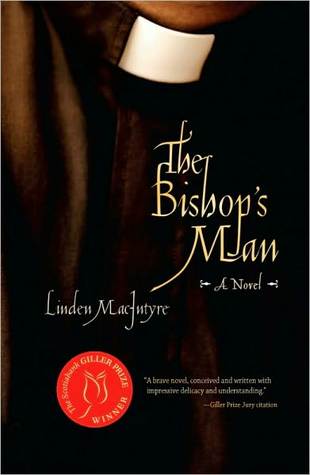
The Bishop’s Man By Canadian Author Linden MacIntyre

The Bishop’s Man by Canadian author Linden MacIntyre offers a deep and compelling story of one man’s struggle for atonement. The book revolves around a very controversial and current topic, the sexual abuse of children by Catholic Priests. However, this fictional work is much more than a critique on a current situation; it is a journey and dialogue on themes of loneliness, isolation, redemption and spirituality. This novel follows the characters from MacIntyre’s earlier work, The Long Stretch.

MacIntyre begins his story in the present day, sometime in the 1990s, in southern Cape Breton Island. From the beginning, the reader is taken on a journey through the eyes of Father Duncan MacAskill, a priest known as the Exorcist. Father MacAskill, who grew up in this area, is sent for a break from his regular duties, troubleshooting and cleaning up messes made by priests that threaten to embarrass the Catholic Church. Father MacAskill sees this trip home as less of a homecoming and more of a time of spiritual discovery through current events and reflection. MacIntyre weaves present day with the past as he unwinds Father MacAskil’s complicated and somewhat remorseful past.

Father MacAskill is very good at what he does—making troublesome priests disappear by sending them to far off parishes or rehabilitation in Ontario. Upon his return to Creiginish on southern Cape Breton Island, he befriends a young, 19-year-old Danny MacKay from whose father he purchases a boat. Danny’s character is troubled and before Father MacAskill can really reach him and understand the root of his trouble, he commits suicide. This is especially difficult to take in for Father MacAskill when rumours start to swirl that a relationship with a troublesome priest, Brendan Bell, who was sent away from Newfoundland to Craiginish by MacAskill, may have lead to the ruin of Danny MacKay. Upon this revelation, MacIntyre’s story starts to divulge into the past as Father MacAskill tries to sort through his current situation and his spirituality.


The absorbing narrative takes the reader through his missionary work in Honduras in the 1970s, where he has sent to forget what he saw as a young priest between a well respected priest and a young person. The Honduras narrative is threaded between the present day and other reflections. MacIntyre does this seamlessly throughout the novel. Father MacAskill’s stint as dean at St. Francis Xavier is also explored. It is while he is dean at the university he becomes the Bishop’s right hand man and is set out to extinguish potential fires in various churches across Canada. Through all the weaving and reflection, Father MacAskill sorts through his own demons, his past and his family’s problematic and mysterious history.
Although this fictional work discusses a very current and disturbing subject, the sexual abuse of children is never directly addressed or explained in the eyes of Father MacAskill. It serves as a constant undertone to the actions and thoughts of the main character. Linden MacIntyre’s narrative, through the eyes of a troubled priest, provides the reader with a rare insight into the inner workings of the priest hood and the powerful Catholic Church and its place in Canadian culture. For the Silo, Sarah Purdy. 

Politics in The Arts- Are Canadians Concerned With Art Funding?

During the Federal elections [circa 2011 Ed], it became clear that the Canadian public interest in an arts and cultural policy had declined since 2008, in fact the majority responded that this policy was unimportant to them in comparison to other policies. This leads me to question the degree of concerns Canadians do have with other policies. Perhaps the overall concerns are too great to allow a focus on more fun or abstract facets of their Canadian lifestyle such as arts and culture, or it may simply be that Canadians overall would rather engage with more mainstream topics.

It is interesting yet disconcerting to see that it is mainly the younger population, ages 18-30, that are the least interested in the arts and culture policy. If the younger generation doesn’t fuel the arts and keep them flourishing who will? In their (or our) defense though, little awareness about the policy and its impact is made known. Personally, I had never heard of an arts and cultural policy before reading the article critiquing the different Government parties’ role in the policy as discussed in The Arts Advocate publication.

The policy involves the government allotted a specific percentage of taxes that go towards varying sectors within the arts, for example advantages for artists or funding for different organizations. Each federal party has their different views on appropriate expenditure in the arts and culture sector, and specifically our Conservatives’ main commitment is to the children’s artistic activity tax credit, support to the Royal Conservatory of Music for a national examination program, and support to the Canadian Periodical Fund (Used to subsidize newspapers not including The Silo. Check the info box found on the bottom of page 2 in most papers to see if you are subsidizing their bottom line- CP).

With the Conservative party now being back in power, it is hard to say if the policy will see any positive growth. Although I understand and admire Harper’s plan to stabilize and improve the markets in the depths of a global recession, I feel it necessary to include arts and culture as a part of this. Canada has such a unique combination of cultures throughout its provinces and these are the people who create and work at the jobs Harper is trying to develop or advance.

So, should not this rich arts and culture naturally be showcased as it is echoed throughout the Canadian business world Harper is focused on? I believe Canadians on the whole would appreciate more recognition for their creative efforts that make our country special. Yes we need economic growth, but there needs to be a balance in the funding between businesses and the arts in order to make for a balanced country and to account for or showcase the people who inhabit it.

It is positive to note that the 2011 Ontario budget indicated spending at Tourism and Culture would grow $76 million.

The estimates confirm that $47 million of this is to continue support of the Community Cultural Fund (used to support local ‘big crowd’ draws such as last year’s Port Dover Marine Festival- http://www.ocaf.on.ca/en/project.aspx?ProjectUID=985 or 2005’s Norfolk County Fall Festival- http://www.ocaf.on.ca/en/project.aspx?ProjectUID=884 -CP), the small-scale (!) capital program administered by the Ontario Trillium Foundation to support diverse cultural organizations. As well, the Ontario Media Development Corporation will be permanently funded, showcasing the province’s commitment to the film sector of the policy and estimates show an increase of $8 million to $25.8 million. Although the Conservative platform for the policy is the most bleak of the Bloc Quebecois, Liberal, and NDP, perhaps a strengthened economy will help to account for areas our country’s arts and culture are struggling in.

In their platform it is stated that our “Government believes that a vibrant cultural, media, and sporting sector is crucial for our well-being and quality of life,” however many artists and cultural advocates still feel that the re-elected Conservatives will fall short in fulfilling the essential aspects of the policy and hearing the voices of those affected.  For the Silo, Jennifer Waslowski.


Machinarium Videogame Combines Art And Visual Storytelling

Machinarium is not a new videogame. But if, like many gamers, you overlooked it when it was released in late 2009, you owe it to yourself to go back and pay it some attention. Machinarium may look simple or perhaps even a touch primitive at first glance, but in reality the game is an inspirational fairy tale set in a wondrous, grimy world of living machines; a touching story of struggle, heroism and robot-love.

One of Machinarium’s most remarkable qualities is the way its tale is woven without a single word—there’s not one instance of speech or text in the entire game. Instead, everything is told visually. Dialog between characters unfolds as brief animations, while plot details are filled in through flashbacks.

Even the physical appearances of the game’s denizens, from the diminutive main character to his ruffian tormentors and the strutting, tin-pot police who, in theory at least, guard over the city, figure prominently in the storytelling process, as the pint-sized underdog struggles against bullies and thugs to be the hero his doe-eyed beloved has always believed him to be.

That may be a lot to read into a game that, bizarre setting aside, is a fairly straightforward point-and-click adventure. From a gameplay standpoint, Machinarium is solid if not particularly noteworthy. But the details of its world most definitely are. Each level and everything in it is entirely hand-drawn, providing a unique and whimsical visual style, while the soundtrack, both musical and ambient, is every bit as impressive—possibly more so. The combined effect is nothing short of extraordinary.

Gamers unfamiliar with the standards of “adventure logic,” in which odd, occasionally arbitrary sequences of actions are required to complete tasks and move things forward, may need a little time to get settled, but veterans of the genre will feel right at home. You will collect objects, you will combine objects, and you will use those objects on other objects to make things happen. But the game mechanics are actually quite simple, because everything is visual and its various regions are fairly tightly compartmentalized. Some of the problems you’ll face are real stumpers, however, and while one hint is available for each of the game’s screens, don’t expect it to do much more than give you a very gentle nudge in the right direction.

But that’s okay. Machinarium is a slow-burning experience that’s best savored rather than merely consumed. It crafts gripping beauty out of an ugly world in a way that elevates it from the merely good to the truly memorable. It’s not for everyone: twitchy Halo junkies probably won’t find too much to like in it. But for anyone in the mood for something a little more thoughtful, or who’d just like to see the videogame medium stretch its legs a little bit, Machinarium is a wonderful, magical game that simply should not be missed. For the Silo, Andy Chalk. 


Moon

Art imitates rural life.

If you’re like me and grew up on a rich diet of 1980’s science fiction films, you should walk (no make that moonwalk) to your nearest video store and ask for MOON. This little gem is an existential journey into the mind of a lonely farmer-astronaut and hits close to home. Sure there’s the usual high contrast and gritty sci-fi production values, but there are also some poignant connections to our rural habitat. Picture a massive, rambling, white combine harvester gathering hay under a full, late fall moon, except that in this case the moon is the earth. A tiny, lonely man is hunched over the controls in an elevated and sealed cockpit. Now remove all semblance of colour, add a few craters and hills, and you get part of what makes this film so familiar and, dare I say, rural.

Growing up here as a boy I imagined that the once plentiful silos and drive-sheds in Norfolk (especially the aluminum ones) were rocket platforms and moon bases. Even the large, four wheeled crop sprayers had a space age look to them. And that is why I felt especially connected to Duncan Jones’ incredibly moving MOON. It pulled me in and felt familiar.

If I had to bet the farm I’d say the production designer looked at both farms and farm machinery while working out the aesthetics of this movie. But more than that, the story pulls at your heartstrings.

Sam (played by the remarkably versatile Sam Rockwell in a breakthrough role) is a lonely astronaut working on the moon, farming the soil for energy until he begins to suffer from extreme isolation- complete with lucid dreams and hallucinations. What follows next is one of the finest surprise plot twists in contemporary cinema.

Satisfying space fiction from son of iconic rocker David Bowie. For the Silo, Jarrod Barker.