Tag Archives: Dalton McGuinty

Liberals: Ontario remains on track to eliminate deficit by 2017-18

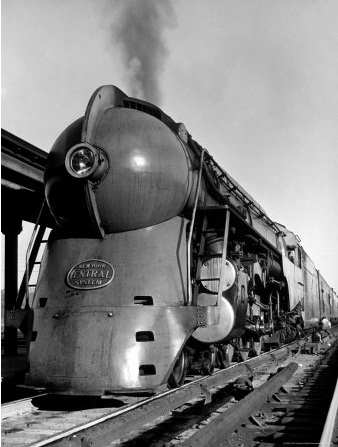
“20th Century Limited Train on Tracks” by Alfred Eisenstaedt

The deficit projection for the current fiscal year has improved by more than $400 million from the 2012 Budget forecast to $14.4 billion. The province remains on track to meet the 2012 Budget deficit targets in 2013-14 and 2014–15 and for the deficit to be eliminated by 2017–18.

Ontario is projecting growth in real gross domestic product (GDP) of 2.0 per cent in 2012, 1.9 per cent in 2013, 2.3 per cent in 2014 and 2.4 per cent in 2015.

As of September 2012, Ontario employment was 356,000 net new jobs above its recessionary low in June 2009. Ontario is expected to create nearly 350,000 net new jobs by 2015, reducing the unemployment rate to 6.8 per cent from a high of 9.4 per cent in June 2009.

The fiscal plan provides no funding for incremental compensation increases for new collective agreements. The government is currently consulting on draft legislation that proposes to freeze compensation for executives and managers across the Ontario Public Service, and the Broader Public Sector (BPS) who are eligible for performance pay. It also proposes to ensure future BPS collective agreements are consistent with the province’s goals to eliminate the deficit and protect jobs and public services. The proposed draft legislation would support avoiding increased spending in the BPS of $2.8 billion over three years and help to protect roughly 55,000 public sector jobs.

QUOTE

“Despite ongoing global economic uncertainty, Ontario is ahead of its targets for lowering the deficit for the fourth year in a row. We will work with anyone who is willing to work with us to meet the objectives of eliminating the deficit and protecting jobs and public services.”
— Dwight Duncan, Minister of Finance

QUICK FACTS

• The 2012–13 revenue projection of $113,019 million is $445 million above the 2012 Budget outlook, largely reflecting a higher estimated 2011–12 tax base. Consistent with the government’s continued effort toward managing the growth in expenses, total expense for 2012–13 has decreased by $3.7 million compared to the 2012 Budget plan.

• Robust business capital investment, a rebound in net trade and increased consumer spending will be key contributors to growth. Over the past two years, business investment spending on plant and equipment has risen by more than 22 per cent, or
$11.1 billion.

• In the 2011–2012 Public Accounts of Ontario, the government announced the deficit for 2011–12 was $13.0 billion, marking the third consecutive year in which the province has improved on its fiscal projections. This result is also 47 per cent lower than the 2009–10 deficit of $24.7 billion forecast in the fall of 2009, at the depth of the global recession.

• The government has brought together business, labour and public sector leaders to form the Jobs and Prosperity Council. Reporting to the Premier, and headed by RBC President and CEO Gordon Nixon, the council will explore additional opportunities in the next few months for a path to sustainable growth that will also help inform the 2013 Ontario Budget.
• The 2012 Budget extended the pay freeze for MPPs by a further two years — for a total of five years.

LEARN MORE

Read Ontario’s Mid-Year Update on Economic and Fiscal Performance for 2012–13.

Read the Ontario Economic Accounts — Second Quarter of 2012

Read a Long Term Plan for Public Sector Compensation.

Read the McGuinty government’s announcement on freezing salaries for Ontario Public Service Managers.

Read the 2012 Ontario Budget.

Read about the strong actions the McGuinty government took in the 2012 Budget to reduce the deficit further.

Read the

Addendum to the 2012 Ontario Budget: Report on Expense Management Measures.

.

www.ontario.ca/finance-news
Disponible en français

Not Up To Government To Act As Investment Banker To Support Select Businesses

What kind of tax break would you like to see? Ontario has gotten itself into a difficult situation. Too many people have lost their jobs, our province has lost its leading position in the country, and government has lost its ability to balance its books.

We face a critical choice. Either we implement sensible policies that create jobs and prosperity or we accept a future of high debt, declining public services and living below our economic potential.

The first and most basic thing government needs to do is balance the books. The second is to start to pay down the debt. We can’t afford to run government on a credit card. Interest on our accumulated debt is $10.6 billion a year. That’s a cost we’re passing on to our kids. It slows the economy and restricts government services for years to come.

Over the past nine years, families and businesses in Ontario have experienced a number of unpleasant tax surprises. The primary factor in our slow job creation is high tax levels. The top marginal tax rate in Ontario today is 49.5 per cent. That’s simply too high. Economists have demonstrated that overly high tax rates can actually reduce tax dollars collected because they are a strong disincentive to work. Lower taxes create jobs and higher taxes deter them. We can address the problem of 600,000 people out of work in Ontario, in part, through tax policy.

The three main taxes in Ontario are personal income tax, corporate tax, and the harmonized sales tax. Given that tax cuts create jobs, which sector tax cut do you think would be most effective for job creation? To provide input, contact me at 1-800-903-8629 or toby.barrett@pc.ola.org.

Fair competition means giving all businesses an equal chance. It’s not up to government to act as an investment banker to support some businesses at the expense of others. Rather than use public money to favor companies that know how to work the system, use those tax dollars for broad general benefit. Ending corporate welfare will provide enough for significant tax changes.

Ontario has long benefited from free and open markets. The 1960’s Auto Pact between Canada and the United States, and the North American Free Trade Agreement that superseded it, fueled the manufacturing boom in this province. But while $2 billion worth of trade crosses the Canada-U.S. border each and every day, too often the border is a traffic jam, delaying goods and workers from crossing. Breaking this bottleneck with our largest trading partner, and the costly delays at other entry and exit points along our
southern border, is vital to growing Ontario’s economy. Ontario should embrace the economic opportunities in Alberta, Saskatchewan and British Columbia and tear down the barriers that separate us.

Ontario is long overdue for a major reduction in rules that regulate businesses. Some regulations are necessary, but Ontario has accumulated an absurd paperwork burden that costs the province’s businesses too much time and money. We need fewer rules, and those rules must meet a clear need.

We can drive growth through innovation and ingenuity – and through a belief in markets, in entrepreneurialism, in competition and in free trade. These are values that have long driven economic success around the world. And government can lead economic growth with policies to reduce taxes, balance the books, boost trade and cut red tape. By MPP Toby Barrett

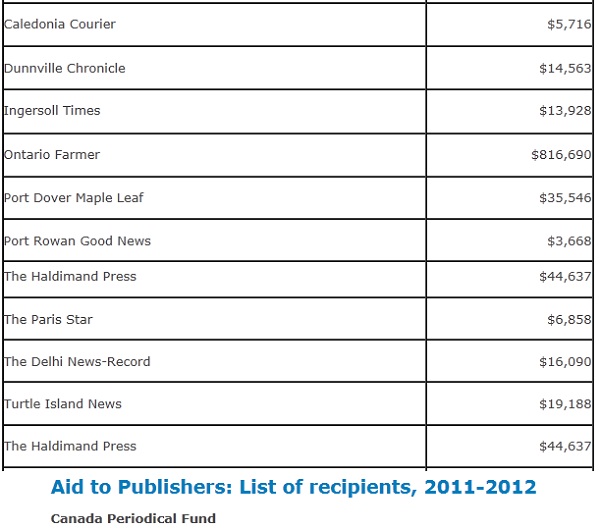
Corporate welfare? In 2011-2012, $ 1,021,521 was steered to Haldimand-Norfolk-Oxford newspapers in one grant alone. image: www.pch.gc.ca

Supplemental-

How public tax money is used to aid ‘some’ business: Local Newspapers on “Corporate Welfare”

Holland Marsh Peaker Plant

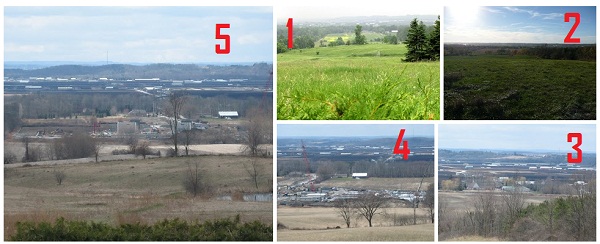
The Holland Marsh- photo:friendsofthegreenbelt.ca

“The cost of moving gas power plants for political reasons is more than financial. It erodes confidence in our government and our democracy. It leads to cynicism and turns people off politics.It’s a sad day for democracy when jokes are flying around Queen’s Park that the going rate for a Liberal seat is $40 million. Perhaps the Liberal party should repay the $200 plus million that this fiasco will cost taxpayers or ratepayers.” MIKE SCHREINER, GPO LEADER

The government must be held accountable for such a blatant and obvious example of putting partisan political interests ahead of the public’s interests.

Forgotten in all the talk of gas plants in Mississauga and Oakville is that the Holland Marsh Peaker plant proceeded against local opposition in a PC held riding.

York Enery Centre King Township Peaker Generating Station Construction Progress: 2011-04-21 photos: Greg Locke

That plant is located in Ontario’s protected Greenbelt, adjacent to prime farm land and sensitive wetlands. These compelling reasons and local opposition weren’t enough to stop the plant in a PC riding, yet days before an election local opposition was enough to stop a plant in a Liberal held riding.

Does this new gas plant development contradict Ontario’s 2005 Protecting the GreenBelt plan? check the link below

At a minimum the Premier should issue an unambiguous apology to the people of Ontario for the costs to our finances and democracy that have arisen from his government’s mishandling of siting of gas plants in Ontario.”

GreenBelt Plan 2005

Green Party of Ontario
PO Box 1132
Toronto, ON M4Y 2T8
Canada

13% Of All Working Ontarians Are Public Sector Employees

13% of all adult Ontarians are public sector workers- accounting for over half of Ontario government spending

Let’s find alternatives to layoffs and program cuts. On May 16th, I introduced my Private Members Bill titled: An Act to address Ontario’s debt through alternatives to public sector layoffs and government program cuts while reducing the fiscal pressure on the people of Ontario who are having trouble paying their bills. This legislation offers options for tackling runaway spending that has us staring down the barrel of a $411.4 billion debt.

[ More on private member’s bills- http://www.revparl.ca/english/issue.asp?art=348&param=91 CP ]

Servicing this debt impairs the ability of Ontario to function and has led to levels of taxation that restrict the ability of businesses to compete, and of individuals to survive financially.

There are over one million public sector employees in Ontario  [ according to statistics in one recent study by the CMAJ http://www.cmaj.ca/content/178/11/1441.abstract ,  in 2007 the estimated adult population of Ontario was 7,996,653 which means 1/8 adult Ontarians or 13% of all adult Ontarians are a public sector employee, a staggering statistic CP ]- 70 per cent unionized compared to 15 per cent in the private sector. Labour costs account for over half of Ontario government spending. This spending sees public sector workers receiving higher compensation – wages, benefits, pensions… – than their private sector counterparts. The total amount paid to the public sector has jumped by 46 per cent since 2003.

My bill aims to take legislative steps address this trend, recognizing the Drummond report https://www.thesilo.ca/the-next-day-ontario-receives-drummond-commission-suggestions-on-public-service-reforms/  advice, “one recommendation that crosses all sectors is the need for prolonged moderation of growth in public-sector total compensation”. While the McGuinty team continues to dodge and weave through credit downgrades, flagging job numbers, and mounting debt, the truth is that unless the province gets its house in order, there will be no alternative but continued cuts to government programs and continued layoffs resulting in a lower level of service for all of us.

To limit the need for such extreme and harsh solutions, I feel the Government of Ontario needs to act immediately to limit compensation paid to employees in the public sector. At the same time, as spelled out in my bill, government must continue to recognize its legal duty to consult fully with those employees and their bargaining agents, and to negotiate with them constructively and in good faith.
My bill [if passed CP ] would amend the Crown Employees Collective Bargaining Act, 1993 to:

1. indicate government’s responsibility and objectives to fully engage, consult and conduct genuine and constructive negotiations with public sector workers on legislative changes to collective bargaining and compensation
2. link the total compensation package to the rate of Ontario’s real GDP economic growth per capita
3. allow for public sector furlough i.e. days off without pay. It’s important to note that between 2007 and 2009, over half the states have imposed mandatory furlough for their public sector employees
4. allow change in public sector pensions to defined contribution from defined benefit. Here as well, at least forty states have enacted significant changes to their public sector pension plans
5. limit length of public sector collective agreements to one year, after which wages are frozen until a new contract is settled, until budget is balanced
6. introduce a comprehensive and transparent benchmarking system for compensation, which would include a costing of the full compensation package, including benefits, pensions and moving through seniority grids
7. mandate stricter criteria for compensation awards in researching private vs. public comparables – achieved through a provincial wage board.

I look forward to providing more details as we approach debate of my bill June 7th  For The Silo by Toby Barrett, Haldimand-Norfolk MPP