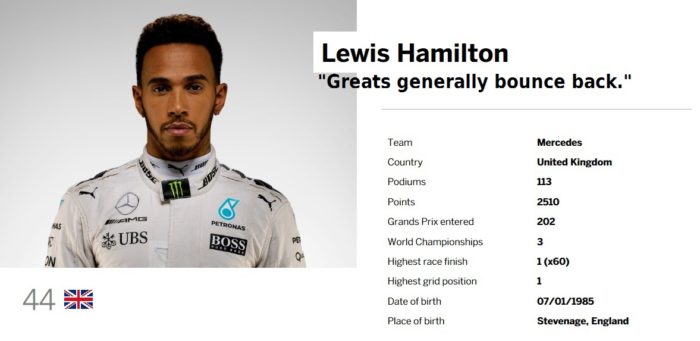
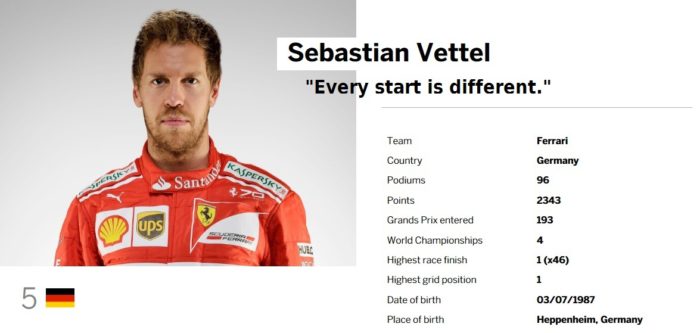
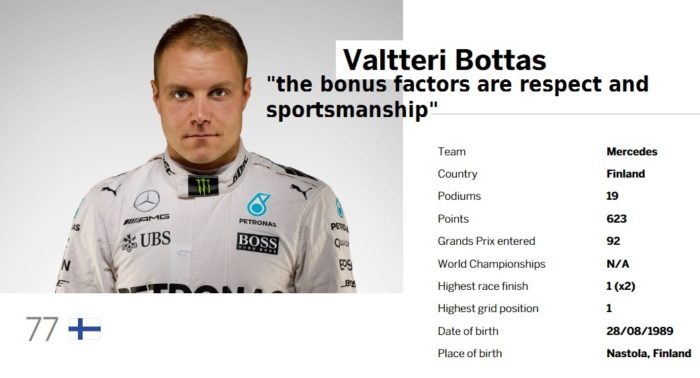
If you’ve been paying attention to the races so far, it’s no surprise the United Kingdom’s Lewis Hamilton (team Mercedes ) , Finland’s Valterri Bottas (team Mercedes) and Germany’s Sebastian Vettel (team Ferrari) are poised to battle for the crown and the odds continue to get more interesting.
Back and Forth
Hamilton, a 3 time F1 crown winner, currently sits with a 28 point lead after winning the race in Singapore. It’s a slim lead and until the last two races, Vettel was the front runner in points.
It’s this sort of drama and excitement that makes F1 an edge of seat experience. Wagering on one factor alone does not necessarily mean a sure cash in. In Singapore a mistake at the starting line left Vettel, a 4 time F1 crown winner,who had the Pole Position, unable to finish and pointless. This can only mean added pressure as he chases back the lead- one that he held over Hamilton for most of the 2017 season.
Valterri Bottas is not to be taken lightly. Two weeks ago he was rewarded by Mercedes with a contract extension for his consistently impressive driving this year- having won both the Austria and Russia GP. Complicating matters is the fact that he is a team member of Hamilton’s and considered a very fair and sportsmanlike driver. Will he help Hamilton win if he can’t close the gap and compete for the crown? Here’s the latest odds from Sports William Hill.
Not Long to Go
There are only 6 races to go- with the last ever Malaysian Grand Prix coming up next. That is most certainly a favorite track of Vettels and a race he has won 4 times.
Starts below are in Toronto, Canada local time.
Click me for latest odds!
Malaysian Grand Prix, Kuala Lumpur ( 2.7601, 101.7370) Next 1 October 03:00 First Practice Session, Malaysian Formula 1 Grand Prix Kuala Lumpur (2.7601, 101.7370) 28 September 23:00 Second Practice Session, Malaysian Formula 1 Grand Prix Kuala Lumpur (2.7601, 101.7370) 29 September 03:00 Third Practice Session, Malaysian Formula 1 Grand Prix Kuala Lumpur (2.7601, 101.7370) 30 September 02:00 Qualifying Session, Malaysian Formula 1 Grand Prix Kuala Lumpur (2.7601, 101.7370) 30 September 05:00
Japanese Grand Prix, Suzuka ( 35.3689, 138.9256) 8 October 01:00
United States Grand Prix, Austin ( 30.1328, -97.6411) 22 October 15:00
Mexican Grand Prix, Mexico City ( 19.4028, -99.0986) 29 October 15:00
Brazilian Grand Prix, Sao Paulo ( -23.7014, -46.6969) 12 November 11:00
Abu Dhabi Grand Prix, Yas Marina ( 24.4821, 54.3482) 26 November 12:00
Toronto’s York University will soon play host to the largest telescope on a university campus in Canada. The university announced recently that the new one meter telescope will arrive in 2018 to replace the existing 40 cm telescope which is used to conduct astronomical research.
York U will have a customized one meter telescope fitted with CCD electronics. Here is a diagram of a similar telescope. Image- orbitaldebris.jsc.nasa.gov
The current record holder (at the time of this article) for the largest telescope on a Canadian university campus is the 0.8 metre telescope which is housed at the University of Victoria in British Columbia.
Is Bigger Better?
Size isn’t everything when it comes to judging a telescope, however what really matters is the ability to gather light efficiently. A larger mirror means a greater light gathering capability. With more light comes more information and the ability to identify more details. Even in environments with a lot of light pollution, with enough light information astronomers are able to pick out stars and other celestial objects from all the other noise in the data.
Pubic Outreach
York University is already housing two telescopes; the aforementioned 40 centimetre telescope and another that is 60 centimetres but isn’t used for astronomical research or public outreach in the way that the 40 centimetre version is.
It is hoped that this new telescope will allow for students to engage in more advanced research objectives and will hopefully therefore entice a broader range of students and interests to the astronomy department. It is hoped that it will benefit students who live in York university housing. As well as benefiting students, it is hoped that the new telescope will also prove to be a boon to the university’s efforts to do more to further its goal of scientific outreach, giving the public the opportunity to view objects such as galaxies, which require expensive equipment to be view-able to amateur astronomers. Every Wednesday night the telescope will be open to members of the pubic and, for those that cannot attend these weekly sessions, every Monday the university will host live, online viewing through the telescope and take requests from the public for what to look at through it.
Galaxy image- public domain.
Portraits of the Cosmos
The new telescope will also be equipped with a charge coupled device camera which will allow the university to take images of celestial bodies in the night sky with the utmost clarity. Among the sights within our own solar system that the new telescope will make visible to viewers from Earth is Jupiter’s Great Red Spot. The Great Red Spot is a storm which has been raging on Jupiter’s surface for the last 187 years, first confirmed to have been observed in 1830, however there are records purporting to be of observations of the same phenomena dating back as far as 1665.
Similarly the rings and moons of Saturn, which can be viewed with even a basic telescope at the right time of year will be easy to see with great detail. It is hoped that sights like these will induce more children and young people to consider studying astronomy.
The arrival of the new telescope to York University should give the astronomy department a shot in the arm and will hopefully encourage the university to further its public outreach programs. For the Silo, Dimitry Karloff.
Is it ethical for media streaming companies, such as Spotify, to take advantage of IP loopholes, which are known to negatively impact artist revenues?
Values:
>Balance & Fairness
>Legal Values
Loyalties:
a. Duty to service
b. Duty to subscribers
c. Duty to shareholders
d. Duty to Intellectual Property
e. Duty to Art & Commerce
Principles:
Aristotle’s Mean: “Moral virtue is a middle state determined by practical wisdom.” Virtuous people will arrive at a fair and reasonable agreement for the legitimate claims of both sides somewhere in the middle of two extreme claims.The two sides must negotiate a compromise in good faith. “Generally speaking,in extremely complicated situations with layers of ambiguity and uncertainty, Aristotle’s principle has the most intellectual appeal.”
BASIC CONCEPT:
Negotiated compromise.
>>Streaming Media Company
For the Purpose of analyzing an isolated streaming media company, Spotify will be examined through the lens of the potter box. Spotify is a streaming service with cross-platform availability that specializes in music, and generates income from its 20 million premium and 75 million free users, respectively. Spotify boasts an extensive catalogue for free and for a nominal fee. Spotify’s extensive catalogue is made possible due to established agreements between various record labels and media companies. Agreements that are known to negatively affect artists, while benefiting both Spotify & Record labels, plague the music industry. Payout deals between Spotify and record companies range from royalty payout to equity deals.
Spotify does not want to make adjustments to the model of its free service, because if their users are not able to find it on Spotify, they will utilize other streaming services such as youtube, which is likely to have the content. They have identified this free offering as being their driving force for getting new subscribers to the service. New subscribers that turn into increased revenue for record labels, as 70% of revenue from $10 per month subscriptions and advertisements are paid to record labels, artists, and song publishers.
>>Artists—Influence: Art/Media Creators
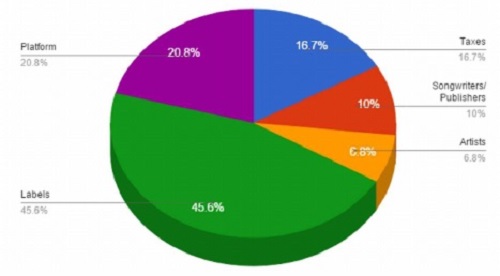
The Artists on Spotify collectively stream over 30 million songs across 58 different markets. Despite collectively making up a heart from which Spotify thrives, Artists receive 6.8% of streaming revenue, the smallest share of the pie.
Artists receive 10.9% of the post tax payout between artists, labels, and songwriters/publishers. Many artists including Adele, Taylor Swift, the Beatles, and Coldplay have opted for keeping music off of Spotify.
Spotify does not have direct agreements with most artists. The streaming company has agreements with labels, whom are responsible for not only securing licenses to music, but to are also responsible for payouts to artists. So essentially, Spotify pays labels, and the label is empowered with payout to artists. The problem is not that Spotify refuses to fairly pay for royalties; it is the trickling down of payment from labels to the respective artists. Spotify has wholesale access to music catalogues from record labels, which makes it hard to fairly split royalty payments amongst artists that are under contractual agreements with respective label.
Even with leaked contract between Spotify and Sony Music available, it is still unclear how much of payouts to record labels actually get to the hands of the artist. It is clear that Sony Music is getting a hefty payout annually, but the question is still whether or not these hefty payouts are passed on to the artists.
>>Major Record Companies
The music catalogue on Spotify is mostly populated by content from major record labels that include Sony Music, Universal Music Group, EMI, Warner Music, Merlin, and The Orchard. Self-published artists as well as artists from independent labels also help makeup Spotify’s catalogue.
Record companies have begun to further question Spotify’s free model since Taylor Swift and other artists have proactively opposed Spotify’s extensive free offerings to users. Streaming consumers of music increased by 54% between 2013 and 2014 according to the Nielsen SoundScan. Major record companies are often made better deals, which disproportionately disadvantage independent artists and labels.
Executives at major record label such as Universal Music and Warner Music have made statements about the extensive free offering of its licensed music is not sustainable long-term. It was suggested that there needs to be a more clear differentiation between content available to free and premium users. Bjork has suggested that Spotify should not allow access for certain content right when it comes out, but should allow for content to go through certain rounds of monetization before ending up on Spotify, similar to Netflix’s rollout method for its content. Major record labels are currently in the process of renegotiating agreements, and are mostly pushing for adjustments to free service offered.
Their goal is to have the “freemium” model disappear as time persists.
What is the current policy?
A legal agreement between Sony, the second largest record company in the world, and Spotify recently leaked, which further intensifies questions about fair payouts for artists. The contract confirmed that major record companies benefit from the success of the streaming service Spotify. The contract details advance payments of over $40 million, with a $9 million advertising credit. Sony has declined to comment on the leaked contract, as it was illegally obtained. Labels routinely keep advances for themselves according to an industry insider.
The leaked contract detailed agreements between Sony Music and Spotify, but not between Sony Music and artists. Such fruits of private agreements don’t necessarily trickle down to the artist, because in most cases they are not even aware of an under the table deal unless a leak has occurred. Unstated under the table deals are not ethical, because artists do not benefit from funds received on account of their intellectual property. The International Music Managers Forum urges European and American authorities alike to use the Sony leak as an example of why more transparence is necessary.
Artists are not being fairly compensated for use of their intellectual property.
Streaming companies have established a revenue arrangement with major Record Companies that often does not favor artists. The obvious shortfalls with existing policy include the lack of transparency when it comes to agreements between record labels and Spotify. There are no systems of checks and balances for ensuring that labels adequately and fairly share Spotify revenue with artists. There needs to be a streamlined system that puts everything on the table in clear view, for fair agreements between artists, label, and streaming company to be arrived at. Current policy also allows Spotify to take up to 15% off the top from revenue generated from ad sales.
What needs to be changed?
Spotify seems to be fairly paying for royalties, but the flow of cash does not always get to the artists. Substitute apps; try to compete with Spotify, by challenging the freemium model. Other apps such as Tidal aim to provide audience with exclusive content that they won’t find anywhere else. The problem is that apps such as Tidal market themselves as a music-streaming app by the artists for the artists. Nowhere in that equation is the interest of the average potential consumer considered. Artists may receive more money per stream, but the service is double the price of Spotify. Record companies, and artists alike, are moving away from Spotify’s freemium model. The digitization of music is not the problem, as most artists and labels generally trust certain digital services such as itunes, because it translates into revenue for artists with no veil or strings attached. Extensive free offerings seem to be the major issue that involved parties have with Spotify, but it is the only thing that drives traffic according to Spotify. The freemium offerings need to be changed in some way, but in a way that is non-disruptive to Spotify’s commerce. Since Spotify pays its fair share of royalties, a more streamlined agreement between record labels and artists should be established and transparent, as should deals made between Spotify and record labels.
Major record labels need to stop double dipping. Not only do they receive cash advances & royalties, but they also benefit from Spotify’s overall revenue stream as they have equity in Spotify of up to 18%. Billboard magazine interviewed two dozen record executives and they agreed that they were confused as to what Spotify was replacing, whether being a substitute for sales or piracy. Examples of setting limitations of the freemium service have showed signs of slowing down subscription growth rate. Spotify has stated that if artists are not fairly compensated from stream revenue, then it is a result of recording contracts and or label accounting practices. Some major record labels are fine with Spotify using their music to build business, because of their equity; they are looking ahead for profit from a future IPO. The artists would not benefit in the same manner, despite their content being the driving force for the app in the first place.
Click me! Future Art Sound
Scenarios
In a time of changing platforms and distribution methods, consumer trends has undoubtedly been in transition. The radio still accounts for an estimated 35% of music consumption, followed by CD consumption at 20%, free streaming at 19%, and paid streaming at 1%. Multichannel consumers, mostly millennia’s, account for 66% of music consumers. A multichannel consumer may pay for a streaming subscription, and make a physical and/or a virtual music purchase. The most common multichannel consumption combination is free streaming coupled with CD listening which accounts for 49% of multichannel listeners, followed by free streaming coupled with music downloads which accounts for 44%. Millennia’s are also known to engage in both free streaming and downloading.
Evidence
During the first quarter of 2014, Pharrell Williams garnered 43 million Pandora streams, which only paid him $2,700 as a songwriter. A statement from Pandora indicates that all rights holders were paid upwards of $150,000 within the first 3 months, and that the real issue is the financial dispute between labels and publishers. Pandora also indicated in the statement that labels are free to split royalties between themselves and artists, however they see fit. Clearly there needs to be more transparency for the cash flow between streaming company, label, and the artist.
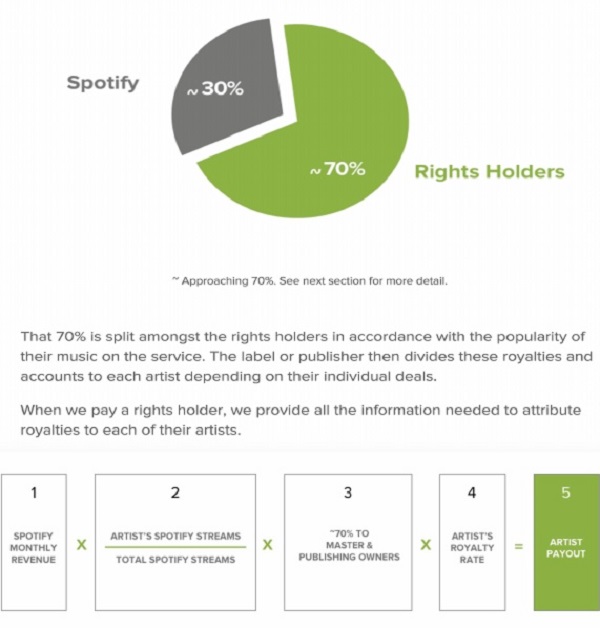
Spotify returns 70% of its revenue to rights holders, with information about each artist to aid in the royalty split process. Streaming companies are engaged in fair due diligence where payment of royalties are concerned. The evidence is as follows:
Actionable Policy
The music industry needs a streamlined agreement between streaming companies, record labels, publishers, and artists. It is imperative that there is increased transparency, especially where cash flow is concerned. Artists should be able to see all cash and data exchanged between streaming company and label. Royalty holders need to publicly split funds amongst themselves and artists. Record labels need to be accountable to both their artists and streaming company, because an artist that feels swindled can create bad blood between the artist and the label and/or the artist and streaming company.
Recommendation
>>Actionable
1. Artists are cut into equity deals based on audience pull to streaming service per qtr
>>Streaming Services should provide analytics with specific data to aid audience pull observation for given artists
2.Major Labels are transparent with cash flow of compensation from Streaming Companies
Is it ethical for media streaming companies, such as Spotify, to take advantage of IP loopholes, which are known to negatively impact artist revenues?
Judgment:
It is ethical for streaming services to take advantage of IP loopholes, which are known to negatively impact artist revenues. Music platform are changing, and as such, better agreements need to be drafted to complement this change. Streaming companies have shown the numbers, and they are paying for royalties, which is essentially paying for the use of the music in their catalogue. Music streaming is an emerging market, which record companies themselves are invested in. The common mode of music monetization is moving away from CD sales, and that is undeniable. Music downloads take up a lot of data, so streaming is the most practical way for consumers to enjoy their music.
The freemium model of Spotify should not be eliminated, but it should certainly be reconsidered, or at least limited in music access. Premium, new, and sought after music should not be as accessible as music that has already exited the promotion stage. Their needs to be some sort of compromise between record labels and Spotify, to better differentiate between premium content and freemium content. Spotify does not want to compromise the availability of its music on either platform, and labels reserve right to pull any of their artists from Spotify as they wish. Spotify should do a better job differentiating free content from premium content, it’s only fair. Spotify should not compromise to the point that it becomes impractical, but should compromise in a way that is cost-effective for all parties. If this were to be attained, streaming companies, record labels, and artists would be happy, circumventing social dilemma. Jordan Muthra The New School University, M.A., Media Studies, Graduate Student
What Do Peyton Manning, Dwight Howard, and Diana Nyad Have in Common? They all rely on performance-enhancing technology. Forget drugs that boost performance but cause health problems – and get athletes stripped of medals, titles and anything else they’ve earned.
Professionals and amateurs alike have discovered a new technology, Neurobands, to optimize their performance on the field and alleviate pain from current and prior injuries. Developed with the help of a 16-member team of physicians, trainers and other specialists, Neurobands mimic contractions that stimulate neuron pathways in specific muscles so they continuously adjust muscle balance to keeping the skeleton in alignment.
“Broncos quarterback Peyton Manning, who’s had repeated neck and back injuries and multiple surgeries, now has eight therapeutic shirts with built-in Neurobands and wears them pretty much every day,” says Bill Schultz, who brought the technology to market via his company, AlignMed, www.alignmed.com .
“Houston Rockets center Dwight Howard began wearing MyLign shirts after suffering a torn labrum [shoulder injury] in January 2013 when he was with the Lakers. The National Basketball Association approved it as a medical device.”
Is this where we are heading? Hi-tech clothing that approaches Batman’s body enhancements and armor?
And Diana Nyad wore one when she made her record-breaking swim from Cuba to the Keys last year,” he says.
Nyad, who injured her shoulder in her 2011 crossing attempt, can be heard asking during a training session, “When are we gonna put my shirt back on?” in the 2013 documentary, “The Other Shore: The Diana Nyad Story.”
How and why do therapeutic posture shirts work? Schultz explains.
• Body alignment and good posture are the key recognizable characteristics of human health and a fundamental requirement for performance. The skeletal system will best support the weight and forces put on the body using the least amount of energy when it is correctly aligned. However, many people, including professional athletes, have a difficult time maintaining perfect alignment, or posture, either because they’ve had an injury that impedes it or because they’re unable to do so without making a conscious effort. “These shirts are actually even more helpful and effective for people who sit at desks all day, since they tend to sit with their head forward,” Schultz says.
• Compression shirts don’t perform the same function. Compression shirts are designed to indiscriminately squeeze regional body parts. The only scientifically validated benefit is increased blood flow in the legs when certain regions are compressed, Schultz says, adding compression garments tend to be worn more for an aesthetic the wearer hopes to achieve.
• Correct alignment improves blood flow and reduces stress on joints. Increased blood flow improves muscle strength. In one of the independent studies done on AlignMed Posture Shirts, the University of Southern California tested pitchers’ velocity, accuracy and throwing arm physiology when wearing the shirts and when wearing their usual game day undergarments. Velocity increased 1.47 mph and an overall 23.5 percent improvement in accuracy. “Reducing the excess force on joints cuts down on fatigue, the No. 1 cause of injury,” Schultz says. For the Silo, Ginny Grimsley.
About Bill Schultz Bill is founder and president of AlignMed, www.alignmed.com , a leading research-based innovator focused on the mechanical, neurological and aesthetic functions of posture. Through clinical studies and with the help of the AlignMed Advisory panel of 16 physicians, trainers and other specialists, Schultz has helped deliver critical information on the benefits of a proper posture to universities, medical clinics, physical therapists, strength coaches, the Air Force Academy and professional athletes. In September, Schultz received a Certificate of Special Congressional Recognition for “outstanding and invaluable service.”
We need to take steps NOW to make sure Canada’s methane (aka Hydrogen Sulfide gas which contains up to 90% methane) emissions are being properly regulated. Methane is a greenhouse gas that is84 times more potent than carbon dioxide – and its uncontrolled emissions affect everyone.
The solutions to reducing methane emissions are actually very simple – frequent leak detection and repairs, and replacing equipment that deliberately releases methane. The industry is resisting these solutions and pushing the Canadian government for weaker methane regulations. They want longer delays before regulations come into effect, as well as less frequent monitoring so that methane leaks go undetected for longer. And, they want to be paid for reducing methane emissions – so instead of polluters pay, the industry wants it to be pay-the-polluter.
Those who live in Alberta strongly agree that regulating pollutants like methane to the strictest North American standards is the right thing to do. If the province that would be most affected by these regulations feels this way, why aren’t we doing it?
Time is running out to make sure Canada’s methane emissions are strongly regulated. For the Silo, Dale Marshall. Featured image-Les Stone /Greenpeace
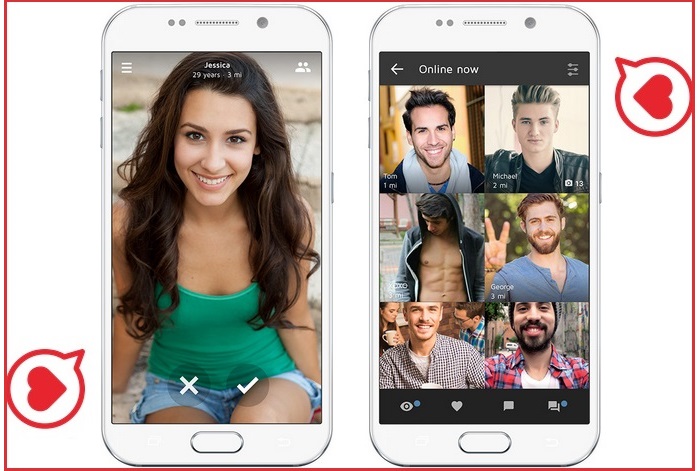
A new study of the dating app Jaumo concludes that superficiality in online dating is just a preconceived prejudice. A survey among North American users shows that the majority of participants do find athleticism attractive but a couple of extra pounds on the hips will not necessarily decrease your chances of finding a date.
What attracts Jaumo users?
What is it, that attracts one person to another? Which body features are most important to most people? To answer these questions, Jaumo carried out a survey among more than 4,400 Jaumo users from the US. Jaumo interviewed them over a period of 4 weeks about their preferences in regards to their own body and personal ideals required of a partner. Users could agree or disagree with the statements outlined in the survey.
Image: whoabooty.com
Jaumo users are not only active flirters.
63 percent of the users find an athletic partner attractive and more than half of the respondents don’t mind a couple of extra pounds on their significant other’s hips. It is noticeable that significantly fewer users, namely 42 percent, consider an athletic body sexy. And the sexes even completely agree on this question!
Raw data from Jaumo Survey.
Hairy is not scary.
On the subject of body hair, the female users are pretty much in total agreement: 76% think chest hair belongs on the male body. The male users see this somewhat differently, but nonetheless, 64 percent of respondents agree. A natural look is also preferred in the downstairs department. 63 percent find a hairy pubic area perfectly acceptable and a total of 70% of the women prefer to see hair when they look down.
The way to someone’s heart is through their stomach.
Vegan, vegetarian, low-carb or meat-eater – with so many varied eating preferences, it may be difficult to find a partner with the same nutritional routine. For 77 percent of the Jaumo users, however, a compatible diet with their partner is seen as a must. For the Silo, Racheal A. Mack.
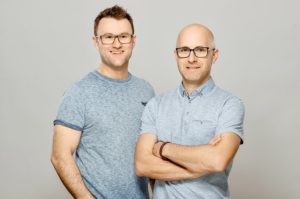
Jaumo founders Jens Kammerer and Benjamin Roth.
About Jaumo
Jaumo is a dating app founded by Jens Kammerer and Benjamin Roth in 2011. Jaumo has 20 million users in 180 countries around the world, more than 2 million of them in the USA and Canada. The dating app is available for free for iOS at the Apple Store and Android at the Google Play Store. The driving force of the two friends from Germany is to offer an uncomplicated and user-oriented product that binds satisfied customers.
Taiji, Japan – In Defense of Animals denounces the cruel dolphin hunting and killing season that officially opened on September 1 in Taiji, Japan. The hunting season, which goes until March each year, sees the brutal slaughter of hundreds of dolphins.
“The primary motivation for the hunting and killing of dolphins is the captivity industry, where live, trained dolphins fetch a much higher price than dead ones,” says Dr. Toni Frohoff, In Defense of Animals’ Cetacean Scientist. “We call on the captivity industry in the United States to stop contributing to the demand that fuels these cruel hunts.”
Photo- Liz Carter.
During the hunts, wild dolphins are driven into a cove along the coast of Taiji and held, sometimes for days, while “show-quality” individuals are selected and torn away permanently from their families. These individuals are then trained and sold to aquariums in Japan and around the world. Often, some or all of the remaining dolphins are killed and butchered for their flesh, or turned loose into the ocean where they suffer from the significant trauma of severed familial ties or in some cases witnessing the deaths of their podmates.
While demand for captive dolphin entertainment may be declining in certain places within the United States, in others the industry is attempting to gain foothold. The Mississippi Aquarium, slated for downtown Gulfport, plans on including a new dolphin aquarium.
“Promoting captive dolphin entertainment is tantamount to promoting the brutal killing of dolphins that happens each year in Taiji,” continued Dr. Frohoff. “The only way to stop these slaughters is to stop promoting captivity, which in itself causes enormous stress, suffering and premature death for dolphins.”
The quotas for this year’s dolphin hunting season in Taiji, set by Japan’s Fisheries Agency, total 1,940 individuals, including 414 bottlenose dolphins, 450 striped dolphins and 400 pantropical spotted dolphins, according to Cetabase.
In Defense of Animals is an international animal protection organization with over 250,000 supporters and a 30-year history of fighting for animals, people and the environment through education, campaigns and hands-on rescue facilities in India, Africa, and rural Mississippi. For the Silo, Dr. Toni Frohoff.
All photos- Liz Carter.
IN DEFENSE OF ANIMALS • 3010 KERNER BLVD. • SAN RAFAEL, CA 94901 • 415-448-0048
Colorization processed G. Orwell photo- mensxp.com
“The most effective way to destroy people is to deny and obliterate their own understanding of their history.” -George Orwell
The facts of the past cannot be objectively altered regardless of belief or opinion. They can, however, be tainted by those wishing to assume power. It is critical that we understand the past as it happened and do not allow the view to be obscured. Only in this way can we ensure that we do not repeat the mistakes of our forebearers, only in this way do we as a society learn and move on from our past transgressions. Those who would revise the past must be confronted with resistance and overcome with the truth. We are bound by our ancestors to carry their truth along the banks of the future no matter how heavy the burden may be.
Golden Age Rorschach, 2014, 38” x 26”, Acrylic paint over inkjet print mounted on Dibond by Aura Goldenberg.
Aura Rosenberg is based in New York City and Berlin, Germany. Since 1993 she has worked on a project titled Berlin Childhood. Over the years the project has taken on many forms including a published book, souvenirs of Berlin’s Victory Column, photographs, and a film. The title comes from a series of texts by Walter Benjamin written during his exile from Berlin in the 1930s. Rosenberg began creating a photograph to correspond with each text which Benjamin wrote in order to combat his homesickness during exile. Chantal Benjamin, the granddaughter of Walter Benjamin moved to Berlin and contacted Rosenberg. The two became friends and Rosenberg began filming Benjamin and her daughter around the city also in correspondence with the original texts. Presently Rosenberg is editing her archive of footage and recording a narrative soundtrack of Walter Benjamin’s great-granddaughter reading his texts aloud. Rosenberg also creates work based on themes of sexuality. One of her current project is a continuation of an older work titled Porn Rock.
“145 Elm Ridge Drive Toronto” Study Of Politics In Cell Tower Placement by Vid Ingelevics.
Vid Ingelevics is a Canadian artist. Much of his work examines representations of the past. His current long form project titled Freedom Rocks focuses on the history of the Berlin Wall since its removal in 1989. Ingelevics began researching what happened to the wall after it fell and discovered pieces of it across the world including in the United States and Canada. Initially, Ingelevics and his collaborator went to Washington, D.C. to learn about the movement of the remains of the wall. In the years following the removal of the wall there was a strong market for fragments. Pieces of the Berlin Wall now appear in the most unlikely corners of the world. Ingelevics work looks at why fragments of the Berlin Wall move around the world and who pays for this as well as putting the wall in the context of history rather than relegating it solely to the realm of political symbolism. For the Silo, Brainard Carey.
Brainard is currently giving free webinars on how to write a better Artist bio and statement and how to get a show in a gallery – you can register for that live webinar and ask questions live by clicking here.
–
Featured image- “Touching the Wall”, Berlin, 2014. From the larger project, Freedom Rocks, a collaboration between Vid Ingelevics & Blake Fitzpatrick begun in 2004 that explores the post-1989 history of the Berlin Wall.
“This book puts you directly behind the scenes for a story that began with a dream,
overcame constant challenges, and evolved into the institution it is today.”
―Steven Spielberg
“Documented here by the people who lived it, this is a remarkable tale of how a major institution,
created out of whole cloth, wove itself into the American fabric.”
—Cokie Roberts, author and political commentator for ABC and NPR
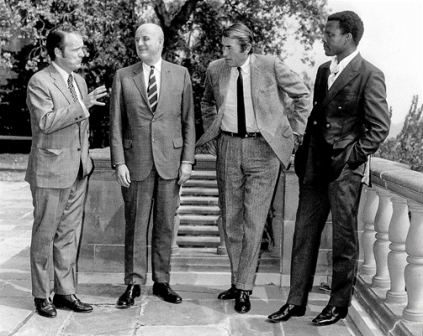
For over fifty years, the American Film Institute has flourished as one of America’s great cultural entities. Its graduates, faculty, supporters, and trustees have included such acclaimed individuals as Steven Spielberg, Maya Angelou, Gregory Peck, Sidney Poitier, Meryl Streep, Les Moonves, Patty Jenkins, David Lynch, Jane Fonda, Edward James Olmos, Shonda Rhimes, James L. Brooks, and many other respected leaders in the worlds of film, television, digital media, and philanthropy.
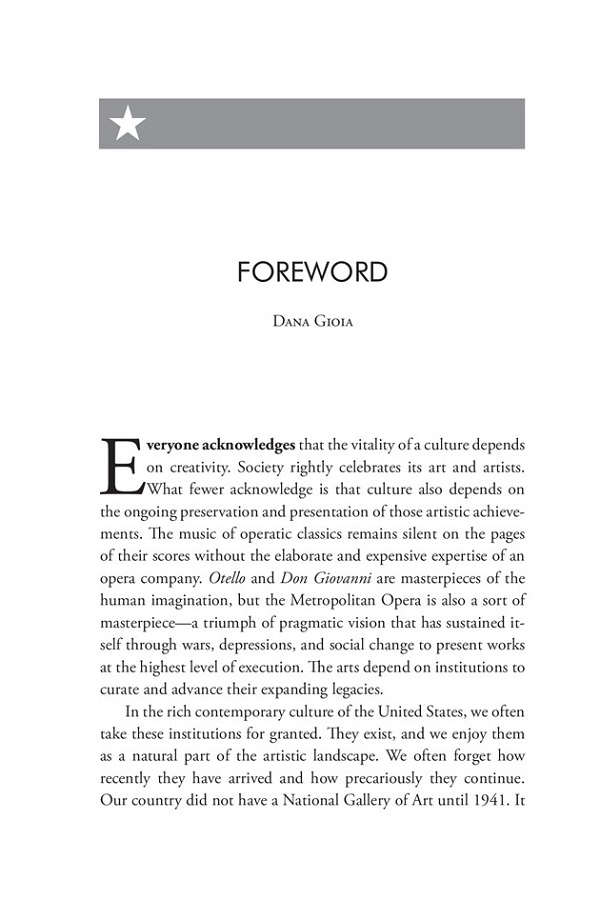
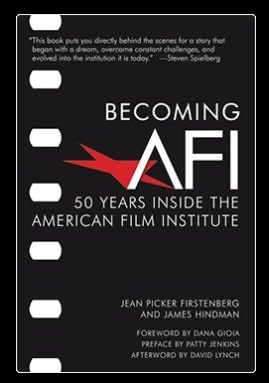
In their new book, Becoming AFI: 50 Years Inside the American Film Institute (Santa Monica Press/October 2017), Jean Picker Firstenberg and James Hindman provide a candid look at how this remarkable organization brought together aspiring filmmakers, educators, and artists who helped AFI become the foremost national champion for moving images as a vibrant art form.
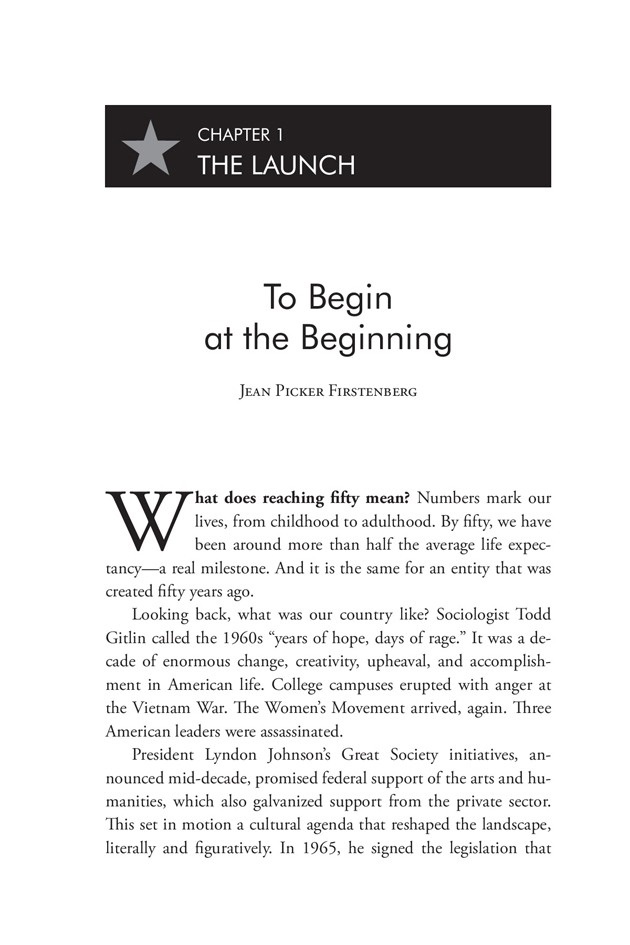
Preview page from BECOMING AFI: 50 YEARS INSIDE THE AMERICAN FILM INSTITUTE
From its early years operating out of the Kennedy Center in Washington, DC, and the legendary Greystone mansion in Beverly Hills under the leadership of George Stevens Jr., through its incredible growth into an influential cultural institution at its landmark Hollywood campus under the guidance of Jean Picker Firstenberg, to its continued excellence today under the dynamic leadership of Bob Gazzale, the organization and its history are chronicled in Becoming AFI through in-depth essays written by those who have been involved in its adventures, growth, and success.
“After being asked so many times what our book would be about, we decided to put together AFI’s history as we experienced it personally,” explain Firstenberg and Hindman. “As we structured the book with the stories we wanted to tell from those years, we realized that some of those stories really belonged to other voices. So, we went to several former colleagues and asked them to join our band. Each chapter tells a stand-alone story about an aspect of AFI, but together, they add up to the full picture.”
Becoming AFI provides an insightful, behind-the-scenes look at how AFI, with passionate determination, overcame the hurdles of advancing technology, political shifts, and new audience dynamics to turn its aspirations into a substantial and highly successful organization, becoming a tireless advocate of moving images as one of America’s most popular forms of art, and maturing into one of the world’s most respected educational and cultural institutions. For the Silo, Trina Kaye.
“No matter how divisive life in this country may become, the movie theater has always been a place where we can discover what unites us.”
—Vernon Jordan Jr., New York Times
“AFI saved our film history. AFI celebrates filmmakers. AFI trains the next generation. Thanks to Becoming AFI for telling us the fascinating story of its fifty-year history. And a big thank you to Jean Picker Firstenberg and James Hindman for documenting all of it! Here’s to the next fifty!”
―Edward James Olmos, actor and AFI trustee
About the Authors
Jean Picker Firstenberg served as president and CEO of the American Film Institute from 1980 to 2007, overseeing the development of AFI as one of America’s greatest national, cultural, and educational resources. She received an AFI Life Achievement Award for Service to the Institute and was named president emerita and a lifetime trustee. In 2016, Firstenberg was named to the California State University Board of Trustees by Governor Jerry Brown, overseeing the largest four-year public university system in the United States, with twenty-three campuses educating the most diverse student body in the nation. Prior to serving at AFI, Firstenberg spent four years as a program officer at the John and Mary R. Markle Foundation. She also served as director of Princeton University’s Publications Office. Firstenberg is a summa cum laude graduate of Boston University’s College of Communications. She has served on several boards, including that of Boston University (1984–1996), the George Foster Peabody Awards at Georgia University (1985–1997; board chair 1991–1997), and the United States Postal Service Citizens’ Stamp Advisory Committee (2002–2014; committee chair 2008–2014). She has won numerous awards and honorary degrees.
James Hindman, PhD, has spent his career in cinema and performing arts, creating and leading professional and public education programs at major institutions. During his twenty-four years at the American Film Institute, where he served as co-director and chief operating officer, he was provost of the AFI Conservatory, which he nurtured through WASC accreditation. He was also the uncredited producer of the award-winning feature documentary Visions of Light and the television series Starring the Actor. He developed the AFI Silver Theatre and Cultural Center in Silver Springs, Maryland, as well as numerous television projects and international film and television festivals. Subsequent to AFI, he developed and led film schools in the U.S. and internationally, including the Red Sea School of Cinematic Arts in Aqaba, Jordan, and New Mexico State University’s Creative Media Institute in Las Cruces. He is currently on the board of the New Mexico School for the Arts in Santa Fe, charged with creating a new cinematic and media arts program and facilities for the school. Prior to AFI, he served as head of graduate studies in the Performing Arts Department at American University in Washington, DC, having previously taught at the University of North Carolina. Hindman holds a PhD in drama from the University of Georgia and has served on the boards of the AIDS Service Center and LAMP in Los Angeles. He currently splits his time between Santa Monica, California, and Taos, New Mexico.
Patty Jenkins made history in 2017 when she directed her second film, Wonder Woman, becoming the first woman to direct a studio superhero movie and earning the biggest domestic opening of all time for a woman director. Jenkins wrote and directed her first film, the crime drama Monster, in 2003, launching Charlize Theron’s career with many awards, including an Oscar for Best Actress. Jenkins graduated from the Cooper Union for the Advancement of Science and Art in 1993 and the AFI Conservatory in 2001.
Dana Gioia was appointed Poet Laureate of the State of California in 2015 by Governor Jerry Brown. An award-winning poet who has published five collections of poetry, Gioia served as chair of the National Endowment for the Arts from 2003 to 2009, and was named a USC Judge Widney Professor in Poetry and Public Art in 2011.
David Lynch, born in 1946 in Missoula, Montana. Eagle Scout.
BECOMING AFI: 50 YEARS INSIDE THE AMERICAN FILM INSTITUTE
Toronto, September, 2017 – This Autumn, PANDORA reveals ‘DO See The Wonderful’, a multifaceted campaign set to inspire women to see the wonderful in their everyday. To bring this concept to life, PANDORA reveals the results of its partnership with three renowned photographers – Sandra Semburg, Liz Sunshine and Meredith Jenks.
Triggered by a global research study that found 80% of women are inspired by photography which celebrate life’s everyday triumphs, these photographers were challenged to capture candid imagery of women from all over the world enjoying everyday moments. The campaign launches in conjunction with the Autumn 2017 collection – a selection of beautiful, hand-finished jewelry designed to mark the wonderful in women’s lives.
Every day we experience approximately 20,000 individual moments lasting a few seconds each, yet we often move from one moment to the next without acknowledging our accomplishments. Through this campaign, PANDORA kicks off a global conversation about women’s everyday triumphs; from the life changing, such as starting a new job or having a child, right through to daily personal achievements, such as baking a cake or completing a charity bike ride. The ‘DO See The Wonderful’ photography encourages women to see joy in these everyday special moments.
“At PANDORA, we want women to celebrate all the wonderful things they and other women DO each day because these moments represent important fragments of their multifaceted lives. PANDORA jewellery can act as a symbol of these everyday achievements and the things we cherish,” explains Minna Philipson, Senior Vice President and Chief Marketing Officer at PANDORA.
Individually known for their inspiring styles of photography, Sandra Semburg, Liz Sunshine and Meredith Jenks capture women showing the wonder in what they achieve every day in spontaneous and authentic shots. Fashion and portrait photographer Sandra took animated portraits of women in London and Berlin, Australian-based documentary photographer Liz took to the streets of Sydney and Hong Kong to find candid moments of women in action, while Brooklyn-based Meredith, who aims to capture special moments as they unfold, shot photos in New York and Sao Paulo.
Today, PANDORA is calling on all women to get involved in the #DOSeeTheWonderful challenge by capturing precious, every day wonderful moments and sharing them with PANDORA via the hashtag #DOSeeTheWonderful and tagging @theofficialpandora.
The Autumn 2017 collection launch is also supported by a compelling TV campaign, and through a series of official campaign imagery to inspire women to celebrate everyday life triumphs. For the Silo, Daniella Etienne.
ABOUT PANDORA
World-renowned for its hand-finished and contemporary jewelry at affordable prices, PANDORA designs, manufactures and markets jewellery made from high-quality materials. Inspiring women to embrace their individuality and express their personal style, PANDORA’s stylish and feminine jewelry captures the unforgettable moments and personal values in life. PANDORA’s unique and detailed designs combining traditional craftsmanship with modern technology are sold in more than 100 countries across six continents through approximately 8,100 points of sale, including more than 2,100 concept stores. Founded in 1982 and headquartered in Copenhagen, Denmark, PANDORA employs more than 21,500 people worldwide of whom approximately 12,400 are located in Thailand, where the company manufactures its jewelry. PANDORA is publicly listed on the NASDAQ Copenhagen stock exchange in Denmark. In 2016, PANDORA’s total revenue was DKK 20.3 billion (approximately EUR 2.7 billion).
Cet automne, PANDORA lance « À vous d’oser voir le merveilleux », une campagne à plusieurs volets visant à inspirer les femmes à voir le merveilleux dans leur quotidien.
Toilet paper … it’s one of life’s necessities. Then why is the roll so difficult to replace? The problem lies in the awkward spring tube holder that always leaves you fumbling. No one wants to deal with it. We all know of that one person that always fails to change out the toilet paper roll. They’ll leave the empty roll on the holder and put a brand new one on top of the toilet or counter. The ZeNa attachment will solve that bad habit. Thanks to Alex Li, a thinker and inventor out of Toronto, Canada, this bathroom conundrum has finally been solved.
You can now change a roll out in a matter of seconds. It’s faster, easier and cleaner than the traditional spring tube method.
The ZeNa Attachment is an incredibly smart solution that fully modernizes your toilet paper holder. Its peel and stick design securely attaches (in seconds) to your existing TP dispenser, so there’s nothing more to install or buy. ZeNa Attachment’s patent pending swing design lets you swap out toilet paper rolls with one hand and it keeps it all in place with zero fuss.
Design
The patent pending design is an easy attachment to add to your existing toilet paper holder. No need to hire a contractor. The heavy duty double-sided foam tape on the underside of the base is super strong. Simply stick this on to your clean existing holder and you’re good to go. Both sides are the same so there’s no getting this wrong.
The arms always fall back into place from a tension mechanism that forces the arms downward. So it doesn’t matter if your ZeNa Attachment is not level as long as you have installed it properly, it will work.
The ZeNa Attachment is super durable, comes in several colors and is the perfect bathroom assistant for the disabled, kids and seniors too. Learn more and support this initiative by visiting the ZeNa Kickstarter page.For the Silo, Jarrod Barker.
The Travis Manion Foundation (TMF), one the nation’s leading veterans advocacy organizations, is hosting its flagship event – the 10th annual 9/11 Heroes Memorial run in more than 50 communities across the country and around the world this September, including locally in in Annapolis, MD, and Alexandria, VA. The annual race series unites communities across the country to remember the nearly 3,000 lives lost on 911, as well as to honor our veterans, military, and first responders who serve our country. Proceeds from the 9/11 Heroes Run will benefit the Travis Manion Foundation, which empowers veterans and families of fallen heroes to develop character in future generations.
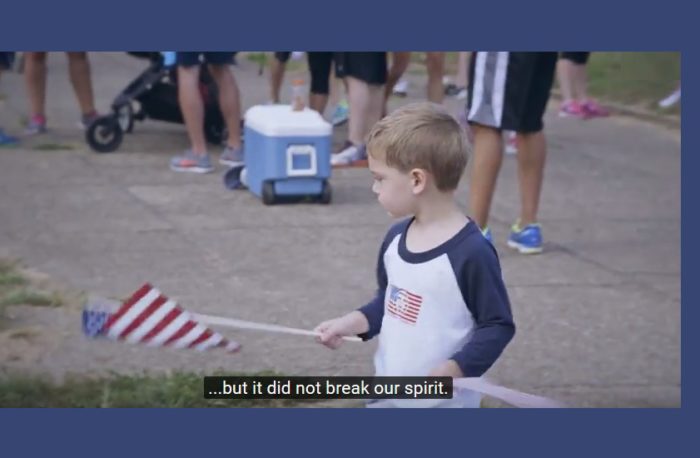
The 9/11 Heroes Run 5K series was inspired by Marine 1st Lt. Travis Manion, who was killed by a sniper in Iraq in April 2007 as he selflessly protected his battalion. Before his final deployment, Travis visited Rescue One in NYC—famous for losing almost all of their men on 9/11—and returned home with deeper passion about why he was fighting in Iraq. At its heart, the 9/11 Heroes Run is a tribute to a personal commitment to never forget the heroes of that day. Now in its tenth year, the 9/11 Heroes Run national race series will be held in more than 50 locations across the country and around the world. As part of the marketing campaign for the race series, TMF released the video found at the start of this article, to inspire runners and walkers of all ages to participate.
Last year, more than 50,000 people participated in race locations around the world or as virtual runners, to support military, veterans, first responders and their families through TMF. National sponsors of the events include Comcast NBC Universal and CBS Radio. Last year’s Annapolis run drew a crowd of over 2,000 participants including Maryland Governor Larry Hogan and midshipmen from the U.S. Naval Academy.
Ryan Manion, TMF President and Travis Manion’s sister, provided this statement:
“As I reflect on the 10 year anniversary of the 9/11 Heroes Run, I’m in awe at the number of communities across the country and around the world that have united to honor all those touched by the events of September 11th, 2001. We challenge all Americans to join us this September, to ensure our next generation never forgets the sacrifices of our veterans, active duty military, first responders, and civilians who were affected by the attacks on 9/11 and in the wars since.”
5 Key Races
9/11 Run Alexandria, VA on Saturday September 9, 2017 at 9:00am ET
9/11 Run Philadelphia, PA on Sunday September 9, 2017 at 9:00am ET
9/11 Run Houston, TX on Sunday September 9, 2017 at 8:00am CT
9/11 Run Annapolis, MD on Sunday September 17, 2017 at 2:00pm ET
9/11 Run Doylestown, PA on Sunday September 24, 2017 at 2:00pm ET
TMF empowers veterans and families of fallen heroes to develop character in future generations. In 2007, 1stLt Travis Manion (USMC) was killed in Iraq while saving his wounded teammates. Today, Travis’ legacy lives on in the words he spoke before leaving for his final deployment, “If Not Me, Then Who…” Guided by this mantra, veterans and survivors continue their service, develop strong relationships with their communities, and thrive in their post-military lives. As a result, communities prosper and the character of our nation’s heroes live on in the next generation.


 United States Grand Prix, Austin ( 30.1328, -97.6411) 22 October 15:00








 A new study of the dating app Jaumo concludes that superficiality in online dating is just a preconceived prejudice. A survey among North American users shows that the majority of participants do find athleticism attractive but a couple of extra pounds on the hips will not necessarily decrease your chances of finding a date.















 Every day we experience approximately 20,000 individual moments lasting a few seconds each, yet we often move from one moment to the next without acknowledging our accomplishments. Through this campaign, PANDORA kicks off a global conversation about women’s everyday triumphs; from the life changing, such as starting a new job or having a child, right through to daily personal achievements, such as baking a cake or completing a charity bike ride. The ‘DO See The Wonderful’ photography encourages women to see joy in these everyday special moments.