WARSAW, Poland (Dec., 2025) — In a monumental victory for animals and a devastating blow to the global fur trade, Poland has officially enacted a ban on fur farming. The legislation, signed into law by President Karol Nawrocki, marks the end of an era for the European Union’s largest remaining fur producer.
The victory comes after intense international pressure, including a campaign by In Defense of Animals, which rallied supporters to write thousands of letters to President Nawrocki and Marshal of the Senate Małgorzata Kidawa-Błońska. While initial reports suggested leadership might block the ban, the overwhelming global outcry helped ensure the measure was signed into law.
The timing of this legislation sends a shockwave through the fashion industry, arriving just days after activists across the U.S. rallied for Fur Free Friday, and as major fashion institutions, including Vogue, increasingly pivot toward coverage of ethical, cruelty-free alternatives.
Anti-fur demonstrators rally outside the Louis Vuitton flagship store in Beverly Hills, California, on Fur Free Friday, Nov. 28, 2025
“This is a watershed moment in the history of animal protection. By dismantling the fur industry in its largest European stronghold, Poland has effectively dealt a devastating blow to the global fur trade,” said Katie Nolan, Wild Animals Campaign Specialist for In Defense of Animals. “Just last week, Americans marched for Fur Free Friday, and today, we see the results of that global momentum. Whether it is the pages of Vogue or the halls of the Polish Parliament, the message is clear: the future of fashion is fur-free.”
Poland’s exit from the industry holds significant weight for the American market. As the European Union’s largest producer, the country’s ban will drastically reduce the volume of animal pelts available to global fashion houses, disrupting the supply chain and accelerating the industry’s decline in the United States and abroad.
Beyond economics, the ban addresses severe public health risks that transcend borders. Polish fur farms have recently been identified as hotspots for COVID-19 and avian influenza, posing a global threat that this legislation helps mitigate. This victory also reinforces the ethical momentum building stateside, aligning with legislation already passed in California and bans in major fashion cities to further isolate the few remaining supporters of the fur trade.
The new law mandates a phase-out of the industry, ending the confinement of millions of mink, foxes, and raccoon dogs. These animals, in particular the semi-aquatic mink, have historically been forced into barren wire cages, denied their natural needs, and subjected to gruesome deaths via gassing or electrocution.
In Defense of Animals celebrates this victory with its supporters and coalition partners who refused to let this ban die in the US Senate.
October, 2025 – Canada has world-class strength in AI research but continues to fall short in widespread adoption, according to a new report from the C.D. Howe Institute. On the heels of the federal government’s announcement of a new AI Strategy Task Force, the report highlights the urgent need to bridge the gap between research excellence and real-world adoption.
In “AI Is Not Rocket Science: Ideas for Achieving Liftoff in Canadian AI Adoption,” Kevin Leyton-Brown, Cinda Heeren, Joanna McGrenere, Raymond Ng, Margo Seltzer, Leonid Sigal, and Michiel van de Panne note that while Canada ranks second globally in top-tier AI researchers and first in the G7 for per capita publications, it is only 20th in AI adoption among OECD countries. “This matters for the economy as a whole, because such knowledge translation is a key vehicle for productivity growth,” the authors say. “It is terrible news, then, that Canada experienced almost no productivity growth in the last decade, compared with a rate 15 times higher in the United States.”
The authors argue that new approaches to knowledge translation are needed because AI is not “rocket science”: instead of focusing on a single industry sector, the discipline develops general-purpose technology that can be applied to almost anything. This makes it harder for Canadian firms to find the right expertise and for academics to sustain ties with industry. Existing approaches – funding academic research, directly subsidizing industry efforts through measures such as SR&ED and superclusters, and promoting partnerships through programs like Mitacs and NSERC Alliance – have not solved the problem.
Four ideas to help firms leverage Canadian academic strength to fuel their AI adoption include: a concierge service to match companies with experts, consulting tied to graduate student scholarships, “research trios” that link AI specialists with domain experts and industry, and a major expansion of AI training from basic literacy to dedicated degrees and continuing education. Drawing on their experiences at the University of British Columbia, the authors show how local initiatives are already bridging gaps between academia and industry – and argue these models should be scaled nationally.
“Canada’s unusual strength in AI research is an enormous asset, but it’s not going to translate into real-world productivity gains unless we find better ways to connect AI researchers and industrial players,” says Kevin Leyton-Brown, professor of computer science at the University of British Columbia and report co-author. “The challenge is not that AI is too complicated – it’s that it touches everything. That means new models of partnership, new incentives, and new approaches to education.”
AI Is Not Rocket Science- 4 Ideas in Detail
Idea 1: A Concierge Service for Matchmaking
We have seen that it is hard for industry partners to know who to contact when they want to learn more about AI. Conversely, it is at least as hard for AI experts to develop a broad enough understanding of the industry landscape to identify applications that would most benefit from their expertise. Given the potential gains to be had from increasing AI adoption across Canadian industry, nobody should be satisfied with the status quo.
We argue that this issue is best addressed by a “concierge service” that industry could contact when seeking AI expertise. While matchmaking would still be challenging for the service itself, it could meet this challenge by employing staff who are trained in eliciting the AI needs of industry partners, who understand enough about AI research to navigate the jargon, and who proactively keep track of the specific expertise of AI researchers across a given jurisdiction. This is specialized work that not everyone could perform! However, many qualified candidates do exist (e.g., PhDs in the mathematical sciences or engineering). Such staff could be funded in a variety of different ways: for example, by an AI institute; a virtual national institute focused on a given application area; a university-level centre like UBC’s Centre for Artificial Intelligence Decision-making and Action (CAIDA); a nonprofit like Mitacs; a provincial ministry for jobs and economic growth; or the new federal ministry of Artificial Intelligence and Digital Innovation.
Having set up an organization that facilitates matchmaking, it could make sense for the same office to provide additional services that speed AI adoption, but that are not core strengths of academics. Some examples include project management, programming, AI-specific skills training and recruitment, and so on. Overall, such an organization could be funded by some combination of direct government support, direct cost recovery, and an overhead model that reinvests revenue from successful projects into new initiatives.
Idea 2: Consultancy in Exchange for Student Scholarships
Many businesses that would benefit from adopting AI do not need custom research projects and do not want to wait a year or more to solve their problems. The lowest-hanging fruit for Canadian AI adoption is ensuring that industry is well informed about potentially useful, off-the-shelf AI technologies. We thus propose a mechanism under which AI experts would provide limited, free consulting to local industry. AI experts would opt in to being on a list of available consultants. A few hours of advice would be free to each company, which would then have the option of co-paying for a limited amount of additional consulting, after which it would pay full freight if both parties wanted to continue. The company would own any intellectual property arising from these conversations, which would thus focus on ideas in the public domain. If the company wanted to access university-owned IP, it could shift to a different arrangement, such as a research contract. This system would work best given a concierge service like the one we just described. The value offered per consulting hour clearly depends on the quality of the academic–industry match, and some kind of vetting system would be needed to ensure the eligibility of industry participants.
Why would an AI expert sign up to give advice to industry? All but the best-funded Canadian faculty working in AI report that obtaining enough funding to support their graduate students is a major stressor. Attempting to establish connections with industry is hard work, and such efforts pay off only if the industry partner signs on the dotted line and matching funds are approved. There is thus space to appeal to faculty with a model in which they “earn” student scholarships for a fixed amount of consulting work. For example, faculty could be offered a one- semester scholarship for every eight hours set aside for meetings with industry, meaning that one weekly “industry office hour” would indefinitely fund two graduate students. Consulting opportunities could also be offered directly to postdoctoral fellows or senior (e.g., post-candidacy) PhD students in exchange for fellowships. In such cases, trainees should be required to pass an interview, certifying that they have both the technical and soft skills necessary to succeed in the consulting role. The concierge service could help decide which industry partners could be routed to PhD students and which need the scarcer consulting slots staffed by faculty members.
The system would offer many benefits. From the industry perspective, it would make it straightforward to get just an hour or two of advice. This might often be enough to allow the company to start taking action towards AI adoption: there is a rich ecosystem of high-performance, reliable, and open-source AI tools; often, the hard part is knowing what tool to use in what way. Beyond the value of the advice itself, consulting meetings offer a strong basis for building relationships between academics and industry representatives, in which the academic plays the role of a useful problem solver rather than of a cold-calling salesperson. These relationships could thus help to incubate Mitacs/Alliance-style projects when research problems of mutual interest emerge (though also see our idea below about how restructuring such projects could help further).
For academics, the system would constitute a new avenue for student funding that would reward each hour spent with a predictable amount of student support. Furthermore, it would offer scaffolded opportunities to deepen connections with industry. The system would come with no reporting requirements beyond logging the time spent on consulting. The faculty member would be free to use earned scholarships to support any student (regardless, for example, of the overlap between the student’s research and the topics of interest to companies), increasing flexibility over the Mitacs/Alliance system, in which specific students work with industry partners. Students who self-funded via consulting would learn valuable skills and would expand their professional networks, improving prospects for post-graduation employment.
Finally, the system would also offer multiple benefits from the government’s perspective. It would generate unusually high levels of industrial impact per dollar spent (consider the number of contact hours between academia and industry achieved per dollar under the funding models mentioned in Section 3). All money would furthermore go towards student training. The system would automatically allocate money where it is most useful, directing student funding to faculty who are both eager to take on students and relevant to industry, all without the overhead of a peer-review process. And it would generate detailed impact reports as a side effect of its operations, since each hour of industry–academia contact would need to be logged to count towards student funding.
Idea 3: Grants for Research Trios
Our third proposal is an approach for expanding the Mitacs/Alliance model to make it work better for AI. Industry–academia partnerships leverage two key kinds of expertise from the academic side: methodological know-how for solving problems and knowledge about the application domain used for formulating such problems in the first place. In fields for which the set of industry partners is relatively small and relatively stable, it makes sense to ask the same academics to develop both kinds of expertise. In very general-purpose domains like AI, it holds back progress to ask AI experts to become domain experts, too. Instead, it makes sense to seek domain knowledge from other academics who already have it. We thus propose a mechanism that would fund “research trios” rather than bilateral research pairings. Each trio would contain an AI expert, an academic domain expert, and an industry partner. This approach capitalizes on the fact that there is a huge pool of academic talent outside core AI with deep disciplinary knowledge and a passion for applying AI. While such researchers are typically not in a position to deeply understand cutting-edge AI methodologies, they are ideally suited to serve as a bridge between researchers focused on AI methodologies and Canadian industrial players seeking to achieve real-world productivity gains. In our experience at UBC, the pool of non-AI domain experts with an interest in applying AI is considerably larger than the pool of AI experts. One advantage of this model is that projects can be initiated by the larger population of domain experts, who are also more likely to have appropriate connections to industry. Beyond this, involving domain experts increases the likelihood that a project will succeed and gives industry partners more reason to trust the process while a solution is being developed. The model meets a growing need for funding researchers outside computer science for projects that involve AI, rather than concentrating AI funding within a group of specialists. At the same time, it avoids the pitfall of encouraging bandwagon-jumping “applied AI” projects that lack adequate grounding in modern AI practices. Finally, it not only transfers AI knowledge to industry, but also does the same to both the domain expert and their students.
Idea 4: Greatly Expanded AI Training
As AI permeates the economy, Canada will face an increasing need for AI expertise. Today, that training comes mostly in the form of computer science degrees. Just as computer science split off from mathematics in the 1960s, AI is emerging today as a discipline distinct from computer science. In part, this shift is taking the form of recognizing that not every AI graduate needs to learn topics that computer science rightly considers part of its core, such as software engineering, operating systems, computer architecture, user interface design, computer graphics, and so on. Conversely, the shift sees new topics as core to the discipline. Most fundamental is machine learning. Dedicated training in AI will require a deeper focus on the mathematical foundations of probability and statistics, building to advanced topics such as deep learning, reinforcement learning, machine learning theory, and so on. Various AI modalities also deserve separate study, such as computer vision, natural language processing, multiagent systems, robotics, and reasoning. Training in ethics, optional in most computer science programs, will become essential.
Beyond dedicated training in the core discipline, we anticipate huge demand for broad-audience AI literacy training; for AI minors to complement other disciplinary specializations; for continuing education and “micro-credential” programs; and for executive education in AI. There is also a growing need for “AI Adoption Facilitators”: bridge-builders who can help established workers in medium-to-large organizations understand how data-driven tools could offer value in solving the problems they face. Training for this role would emphasize business principles and domain expertise, but would also require firmer foundations in machine learning and data science than are currently typical in those disciplines.
The decidedly disturbing headlines around small pets like guinea pigs and rabbits underscore an escalating ‘disposable pet’ mentality, with certain factors exacerbating the problem. Case in point, this guinea pig rescue in Nova Scotia, Canada.
With the holidays looming, shelters are bracing for yet another spike in guinea pig surrenders in particular. Industry sources speculate there may be tens of millions of guinea pigs worldwide, yet shelter data point to troubling trends with some shelters seeing numbers more than triple since the pandemic. One facility reportedly took in over 650 guinea pigs in a single year! Sadly, this species is all too often treated as disposable.
Surveys show that roughly 7 million U.S. households own “small animals” like guinea pigs and roughly another 1 million Canadian households. The holiday season, when guinea pigs are frequently purchased as gifts, intensifies problematic ownership as many families underestimate the care required … only to relinquish these pets weeks or months later.
Clementine Schouteden, CEO of Kavee—the world’s leading guinea pig habitat brand, points out the following key issues:
Families should use a checklist to decide if they are truly ready for a small pet like a guinea pig or rabbit
Note the hidden costs and long-term commitments families often overlook before bringing home a guinea pig or rabbit
There are emotional and developmental benefits guinea pigs and rabbits can bring to children when cared for responsibly
Rising surrenders are straining shelters already overwhelmed with cats and dogs
Reach out to shelters and advocacy groups for recommendations on reducing post-holiday pet abandonment
Be aware that guinea pigs require larger, safer enclosures than most pet stores provide
Better guinea pig housing, enrichment, and education can prevent health issues and neglect
Common health problems are often tied to poor diets or improper housing—now how to spot them early
Consider simple changes that can make homes safer and more enriching for guinea pigs and rabbits
Be a proud part of the growing movement to elevate small pet care standards to the same level as cats and dogs
Market Trends
The small pet category may be niche, but the market data tells a compelling story.
The U.S. pet industry overall is projected to hit $157 billion usd/ $218.6 billion cad in 2025, up from $151.9 billion usd/ $211.5 billion cad in 2024, with $33.3 billion usd/ $46.4 billion cad of that dedicated to supplies, habitats, bedding, and related essentials (APPA). Within that, ~7.7 million North American households own small animals such as guinea pigs, rabbits, and hamsters (Forbes), representing a sizable and under-served customer base. Globally, the rodent pet accessories market is valued at $1.2 billion usd/ $1.7 billion cad in 2024 and forecasted to double to $2.5 billion usd/ $5.2 billion cad by 2033 (Verified Market Reports), while the guinea pig cage market alone is worth $455 million usd/ $633.6 million cad today and on track to reach $715 million usd/ $995.7 million cad by 2033 (Growth Market Reports). Complementary comfort products like cuddle cups are also on the rise, already a $134.7 million usd/ $187.6 million cad global market growing at a 7.4% CAGR.
Add to this the growing concerns in shelters and rescues about guinea pig welfare (HumanePro), and the momentum is clear: consumers, advocates, and regulators alike are demanding safer, higher-quality, and more enriching products. The fact that species-specific U.S. data for guinea pig habitats and accessories is still sparse only underscores the opportunity for Kavee to lead with content, education, and product innovation—filling a gap that few others have recognized, let alone acted on. For the Silo, Merilee Kern.
Schouteden’s journey is a masterclass in spotting underserved markets and scaling with vision. Below, she shares how a single decision transformed her entrepreneurship path, how her eCommerce brand is reshaping an overlooked corner of the pet industry and what’s next for small pet care innovation.
MK: Clementine, let’s start at the beginning. What inspired you to create Kavee? CS: It really began with my own guinea pigs. In March 2015, I adopted Bagpipe, a long-haired Peruvian and Livingstone, a short-haired Agouti. Later, Efendi joined the family. I couldn’t bring myself to put them in a tiny pet shop cage as it just didn’t feel right. Instead, I had a friend build a large wooden cage and I set up play areas in my flat so they could explore. Watching them thrive in a spacious environment showed me how much better life could be for small pets.
MK: What sets Kavee products apart from traditional cages? CS: We’ve always designed for the animals first. Our C&C cages are modular, easy to clean and expandable. We encourage pet parents to go larger than outdated minimums. For example, while many guidelines say a 2×3 cage is fine for two guinea pigs, at Kavee we recommend 2×4 for sows and 2×5 for boars, since they need more room to coexist peacefully. Our fleece liners, accessories and enrichment toys also bring comfort, safety and playfulness into their habitats.
MK: Kavee has grown from a startup to an international brand. What has that journey looked like? CS: In the early days, it was just me packaging orders on weekends while still working full-time as a consultant. Within six months, demand grew and I partnered with an “impact employment” group to provide jobs for people with disabilities. That freed me to scale the business. By 2018, I left consulting to run Kavee full-time. Since then, we’ve expanded into four online stores, grown a passionate team and provided spacious homes for over 50,000 guinea pigs.
MK: Beyond products, you’ve built a strong educational and advocacy component. Why is that important?
CS: Kavee is not just about selling supplies; it’s about changing perceptions of small pets. Too often they’re seen as “starter pets” for kids, but they’re intelligent and sensitive. Through blogs, social media and the Kavee Rescue initiative, we provide guidance on diet, grooming, habitat design and more. Our team even answers customer questions about gardening for guinea pigs! That level of community engagement makes a real difference.
MK: What role does sustainability and ethical business play in Kavee’s mission? CS: It’s at the core of what we do. Our products are designed to last, reducing waste. We carefully source safe, durable materials and we support inclusive hiring practices. Since 2023, our Kavee Rescue partnership has been another way to give back. Ultimately, if I wouldn’t use it with my own pets, it doesn’t go to market.
MK: Looking ahead, where do you see Kavee and small pet care evolving? CS: The future lies in rethinking standards. Minimum cage guidelines are outdated and pets deserve larger, more enriching spaces. I also see small pets becoming mainstream companions for professionals and singles, not just families. At Kavee, we’ll continue innovating, expanding product ranges and advocating for animal welfare globally.
MK: What were the biggest challenges you faced as a female founder in the pet care industry? CS: Breaking into a space that historically overlooked small pets was challenging enough, but as a female founder, I also had to fight to be taken seriously. Early on, suppliers and partners often assumed this was just a “side project.” Proving the demand, scaling internationally and building a team showed that Kavee was not just a niche brand but a movement.
MK: Was there a moment when you realized Kavee had truly “made it”?
CS: Yes. When I saw our first international orders come in, especially from the U.S., it hit me that we were filling a huge gap worldwide. Another milestone was when customers started sending photos of their piggies “popcorning” in our cages. Knowing our products were directly improving lives was the moment I felt Kavee had arrived.
MK: How do you balance innovation with customer feedback?
CS: We listen closely to our community. Many of our product upgrades, such as folding coroplast bases or fleece liners with new absorbent layers, came directly from customer suggestions. I believe true innovation happens when you combine design expertise with real-world feedback from the pawrents using the products daily.
MK: What advice would you give aspiring entrepreneurs who want to turn a passion into a business?
CS: Start small, test your idea and don’t be afraid of imperfect beginnings. Kavee began with one cage model and a very simple website. What made the difference was consistency, passion and being deeply connected to my “why,” which is improving small pet welfare. If you keep that clarity, growth will follow.
MK: As a female founder, what role do you think women play in shaping the future of entrepreneurship?
CS: Women bring unique perspectives to business, often blending empathy with innovation. In my case, it was about seeing the overlooked needs of small pets that weren’t being met and creating meaningful solutions. I believe more women in leadership will mean more industries reimagined with compassion, creativity and long-term impact at the core.
MK: How do you use your platform to inspire or empower other women in business?
CS: I make it a point to be visible and open about the realities of building a company from scratch. Sharing the challenges as well as the successes helps other women see that it is possible to turn a passion into a thriving business. I also mentor aspiring entrepreneurs, especially women, because representation and encouragement can be the push someone needs to take that first step.
MK: Looking back, what’s the most rewarding part of building Kavee?CS: Without a doubt, it is knowing we have improved the lives of thousands of animals. Every time I hear a story about a guinea pig who went from lethargic in a tiny cage to playful and thriving in a Kavee habitat, it reminds me why this journey matters. That impact is priceless.
From rescuing mice and birds as a child in rural France to transforming the global small pet industry, Clementine has proven that passion paired with innovation can create lasting change. Through Kavee, she’s redefined what it means to care for guinea pigs and rabbits. In the process she’s raising standards, fostering community and inspiring pawrents to think bigger.
In Clementine’s words: “Quite simply, if your piggies aren’t running around in their cage, something isn’t right.”
Thanks to her efforts, thousands of piggies—and the humans who love them—are finally getting it right.
This post is a response to the comic book article found at popuniverse which begins like this:
“The comic book industry is the launchpad for one of the most unique and innovative storytelling mediums ever created. Powered by imaginative creators highly skilled in the written and visual arts. Forged by businesspersons who recognize the power of ideas to make an iconic impression on a global scale. Propelled by readers and fans who support the industry and the people who make the stories. The comic book industry is the source of multimedia interpretations of mythic and personal stories that inspire people, entertain the world, and ignite lifelong careers.
It is the adventure of a lifetime.
The comic book industry is a ruthless Darwinian landscape of cronyism, narcissism, and power moves. Its main fodder is the creators who are the engines of its continued existence. Full of flair and pomp, colors and characters both fictional and real-life. A road to hell paved with landmines, bear traps, and the opportunity to work on high-profile, profitable media while living on the precipice of poverty. The industry is fueled by organizations with finite funds and infinite hubris.“
“The comics industry is the illusory world of grenades disguised as dreams.“
The issue I see (and our comic illustrator household has personally experienced) in the comics and illustration / publishing industry is that the original contract terms were never set up fairly to compensate the artists and illustrators. While photographers and videographers retain the rights to their original images, and someone must pay them usage rights fees based on the size of the audience per usage, the artists are never granted that same fair compensation.
While actors get residuals when their TV shows play on in perpetuity, and musicians earn their royalty checks with every needle drop, the comics publishers can repurpose an illustrator’s iconic cover art in perpetuity and make millions from the image—on puzzles, lunch boxes, hoodies, sweatpants, and pajamas in my husband’s particular case—while the artist never sees a dime beyond the initial ANEMIC work-for-hire fee in these insanely unfair, one-sided deals. And if the artist DARES to complain? The smear merchants are only too happy to start their whisper campaigns, blackballing the artist as “too difficult to work with” and completely destroying their already financially challenged lives with nuisance law suits.
When I think back on how Ghost Rider co-creator Gary Friedrich was made the industry scarecrow in the last years of his life as greedy lawyers descended upon him like buzzards picking the last flecks of flesh from his bones, it sickens me.
This impoverished, unwell, elderly man was just trying to eke out the last days of his hard-scrabble life by selling sketches of his OWN co-creation at comic-cons. There’s nothing I despise more than anyone preying on the vulnerable. It’s appalling how Gary was treated.
And then we have AI “art” apps exploiting my husband’s already way underpaid art to create new, derivative works, but only GETTY Images can afford to lawyer up and go after these apps…because the photography world always negotiated image usage the CORRECT and fair way from the start.
The sobering truth is that if illustrators (and line artists, colorists, and letterers) were paid as well as photographers, every comic would sell for $100 per floppy and that would be the final nail in the #comics industry’s coffin.
…DAVE DORMAN… told me at dinner tonight that someone was selling AI art at SDCC last week and was summarily kicked out of Artists Alley. It gave me a brief glimmer of hope…I imagined a deafening crescendo of cheering as the non-talent skulked away, tail between his/her legs. That takes some gall to occupy the highly competitive table space of an ACTUAL hard-working artist (who’s paying off about $100k in art school student loans) with some Mid-Journey derivative crap. Wowzers. For the Silo, Denise Dorman.
Botswana’s president recently threatened to send 20,000 elephants from Botswana to Germany in a feud over stricter regulations on trophy imports. Find out why President Mokgweetsi Masisi’s claims about hunting simply don’t stack up and how animal-friendly approaches in Botswana actually help conservation goals and the economy.
Earlier this year, Germany proposed stricter limits on trophy imports, which led to controversy and claims from President Masisi that it would further impoverish Botswanans.
Trophy hunters worldwide are attempting to justify their killing by making outlandish claims to hide their conservation harms and economic exploitation.
According to Dr. Keith Lindsay, a renowned conservation biologist with over 30 years of research and hands-on experience conserving African elephants, including population management, nothing could be further from the truth.
While there are challenges for African countries that have elephant/human conflicts, many have found proven solutions that respect elephants without killing or trapping them.
The way to create harmony with elephants is to know the facts first.
Elephant populations have not “exploded,” as President Masisi claims. Botswana’s elephant population has not increased significantly for about two decades.
Trophy hunting funds corruption and does not bring in significant net revenue for conservation. The ones that profit are sports hunting companies, a few government officials, and community trust members who siphon off funds. Very little goes to the hundreds of households sharing the meager proceeds, which Dr. Lindsay says is “enough for a pair of socks.”
According to the numbers, hunting does not keep elephant populations in check, as President Masisi claims. A 2022 survey of elephants in Botswana indicated there were about 132,000. The hunting quota in 2024 is 400 elephants, which is less than 0.3%. It’s not enough to make a dent in their population, even if all 400 were killed, but it is a risk to all older male elephants and large-tusked elephants, who hunters target despite their vitally important role in elephant societies.
Botswana banned trophy hunting in 2014 but lifted it in 2019 to give the impression it would boost the economy, but elephants are much more valuable alive.
Live elephants contribute a much greater amount to the economy than dead ones. Per Dr. Lindsay, “Photographic ecotourism, even in Botswana, employs more people and contributes more to the national economy, including through multiplier effects on value chains of suppliers to the industry than does the minimal amount from trophy companies.” Only a few countries in southern Africa exploit wild animals as a resource through killing and consumption.
Conflicts from elephants eating crops and killing people are not due to elephant overpopulation but to human populations expanding into elephant territories and growing vegetation that elephants like to eat.
Many conservation experts advocate against killing keystone species on ecological grounds. The minority who stand to gain from trophy hunting often attempt to marginalize all who oppose hunting and killing elephants as “extremists” despite being the vast majority.
Organizations like Ecoexist and Elephants Without Borders are working successfully with local farmers on practical approaches to human-elephant coexistence to resolve conflicts where they exist.
Elephants are not products to buy and sell. They are majestic living beings who deserve to live free as they have for thousands of years on the lands of their ancestors.
For the Silo, Courtney Scott / In Defense Of Animals.
Featured image: German sport hunter kills old Bull elephant in Botswana. image courtesy of National Geographic.
A press photographer works next to the logo of the World Economic Forum (WEF) at the opening of their annual meeting in Davos on Jan. 15, 2024. (Fabrice Coffrini/AFP via Getty Images)
Close interactions between Canadian cabinet ministers and the World Economic Forum are well-documented, but a newly revealed letter suggests forum staff may have been doing more work with the federal government than previously disclosed.
In an undated letter to a WEF official, former Finance Minister Bill Morneau praised the organization and its collaboration to achieve “common” objectives.
“I would also like to take this opportunity to express my sincere appreciation to the WEF staff, for the support provided to the Government of Canada,” wrote Mr. Morneau in the letter obtained through the access-to-information regime.
Neither the WEF nor the Canadian government typically advertise what support the forum provides. The finance department has not replied to a request for information about the date of the letter and details of how WEF staff helped the government.
The letter was addressed to Philipp Rösler, a former German politician who served as a WEF manager and head of its Centre for Regional Strategies.
The federal government is known to have been involved in at least two WEF policy initiatives: the Known Traveller Digital Identification (KTDI) project and the Agile Nations network.
KTDI was a pilot project between Canada, the Netherlands, and private sector interests to develop a system of digital credentials for airplane travel between countries. Agile Nations is a group of countries working to streamline regulations to usher in the WEF-promoted “Fourth Industrial Revolution” that includes gene editing and artificial intelligence.
KTDI began in 2018, and Canada signed onto Agile Nations in November 2020, a few months after Mr. Morneau resigned during the WeCharity scandal. Both projects were worked on while Mr. Morneau was finance minister from 2015 to 2020.
Since both these projects fell outside of Mr. Morneau’s portfolio as finance minister, it seems to suggest that his letter of appreciation to the WEF was referring to other joint collaborations.
Canada’s then-minister of Finance Bill Morneau speaks to the Canadian Club of Canada in Toronto, on March 6, 2020. (Cole Burston/The Canadian Press)
The WEF’s mission statement says it is dedicated to “improving the state of the world.” It gathers leaders in the fields of politics, business, and activism to promote progressive policies on issues like climate change and making capitalism more “inclusive.” As is routine with the organization, it did not respond to requests for comment.
Critics of the WEF, which gathers world elites to shape global policies, often disagree with its progressive agenda and warn about its influence on countries.
“No staff, no ministers, no MPs in my caucus will be involved whatsoever in that organization,” Conservative Party Leader Pierre Poilievre said in January.
He added that officials who attend the forum’s annual meeting in Davos are “high flying, high tax, high carbon hypocrites” who travel in private jets while telling average citizens not to “heat their homes or drive their pickup trucks.”
Alberta Premier Danielle Smith has also criticized the WEF, saying in 2022 she finds it “distasteful when billionaires brag about how much control they have over political leaders, as the head of that organization has.”
Ms. Smith was likely referring to comments made by WEF founder and chairman Klaus Schwab in 2017, when he said said he was “very proud” to “penetrate the cabinets” of world governments, including that of Prime Minister Justin Trudeau.
“I know that half of his cabinet or even more than half of his cabinet are actually Young Global Leaders of the World Economic Forum,” Mr. Schwab told an audience at Harvard University.
WEF founder Klaus Schwab delivers a speech during the “Crystal Award” ceremony at the World Economic Forum annual meeting in Davos, on Jan. 16, 2023. (Fabrice Coffrini/AFP via Getty Images)
Davos Links
Mr. Morneau’s letter to the WEF comes from internal Finance Department records and is the only document in the release package that pertains to Mr. Morneau. It consists mostly of praise for the organization.
“As a Steward of Economic Growth and Social Inclusion, I have had the privilege of observing first-hand and benefiting from the WEF’s important contributions to foster public and private collaboration towards developing concrete solutions for strong, broad-based economic growth,” he wrote, adding that WEF analysis of different topics such as “structural reform priorities” was “helpful to develop substantive policy measures.”
He wrote that “as we enter another ambitious year for the WEF, I look forward to a continued fruitful collaboration to pursue our common objective of achieving stronger, sustainable and more inclusive growth.”
Other department records relate to current Finance Minister Chrystia Freeland and her involvement with the WEF. She is a board member of the forum and also an alumnus of the Young Global Leaders program that Mr. Schwab referenced.
Mr. Morneau, who resigned as minister in 2020, is listed on the WEF website as an “agenda contributor“ and a ”digital member.” He was a regular participant at the group’s annual meetings in Davos, Switzerland, while he was in office.
During those years, the Finance Department’s media relations office wasn’t shy about advertising ministerial trips to Davos.
“Canada’s strong presence at the Forum underscores the importance of this meeting for shaping the international agenda and advancing economic opportunities for Canadians,” read a January 2020 press release from the department announcing Mr. Morneau’s trip.
The Finance Department has not returned inquiries in recent years pertaining to Ms. Freeland’s involvement with the WEF, nor has it issued press releases referencing her involvement.
Some have questioned whether Ms. Freeland’s role as deputy prime minister and finance minister as well as a forum board member constitutes a conflict of interest. The Office of the Conflict of Interest and Ethics Commissioner said in its 2022 annual report it received more than 1,000 requests in a two-month period from members of the public to investigate the participation of MPs and ministers in the WEF.
The office said the requests “did not provide sufficient information to warrant an investigation.” Ms. Freeland’s leadership position with the WEF has been declared to the office and has therefore been cleared.
Generative artificial intelligence (GenAI) tools have far-reaching implications for education and research.
Yet the education sector today is largely unprepared for the ethical and pedagogical integration of these powerful and rapidly evolving technologies.
A recent UNESCO global survey of over 450 schools and universities showed that less than 10% of them had policies or formal guidance on the use of GenAI applications, largely due to the absence of national regulations. And only seven countries have reported that they had developed or were developing training programmes on AI for teachers.
The new guidance, recently launched during UNESCO’s flagship event Digital Learning Week in Paris, calls on countries to implement appropriate regulations, policies, and human capacity development, for ensuring a human-centred vision of GenAI for education and research.
What the guidance is proposing
The guidance presents an assessment of potential risks GenAI could pose to core humanistic values. It offers concrete recommendations for policy-makers and institutions on how the uses of these tools can be designed to protect human agency and genuinely benefit students, teachers and researchers.
The guidance proposes seven key steps for governmental agencies to regulate the use of GenAI in education:
Step 1: Endorse international or regional General Data Protection Regulations or develop national ones. The training of GenAI models has involved collecting and processing online data from citizens across many countries. The use of data and content without consent is further challenging the issue of data protection.
Step 2: Adopt/revise and fund national strategies on AI. Regulating generative AI must be part and parcel of broader national AI strategies that can ensure safe and equitable use of AI across development sectors, including in education.
Step 3: Solidify and implement specific regulations on the ethics of AI. In order to address the ethical dimensions posed by the use of AI, specific regulations are required.
Step 4: Adjust or enforce existing copyright laws to regulate AI-generated content: The increasingly pervasive use of GenAI has introduced new challenges for copyright, both concerning the copyrighted content or work that models are trained on, as well as the status of the ‘non-human’ knowledge outputs they produce.
Step 5: Elaborate regulatory frameworks on generative AI: The rapid pace of development of AI technologies is forcing national and local governance agencies to speed up their renewal of regulations.
Step 6: Build capacity for proper use of GenAI in education and research: Schools and other educational institutions need to develop capacities to understand the potential benefits and risks of GenAI tools.
Step 7: Reflect on the long-term implications of GenAI for education and research: The impact and the implications of GenAI for knowledge creation, transmission and validation – for teaching and learning, for curriculum design and assessment, and for research and copyright.
A human-centered vision for digital learning and AI
UNESCO is committed to steering technology in education, guided by the principles of inclusion, equity, quality and accessibility. The latest Global Education Monitoring Report on technology in education highlighted the lack of appropriate governance and regulation. UNESCO is urging countries to set their own terms for the way technology is designed and used in education so that it never replaces in-person, teacher-led instruction, and supports the shared objective of quality education for all.
With the imminent arrival of Autonomous Vehicles, many people have started worrying about the safety of this new technology, especially when an issue arises to do with choice.
In this piece, we’ll delve into the issue of the “Trolley Problem” and how AVs will deal with this and whether all manufacturers have the same stance.
Infographic courtesy of our friends at selectcarleasing.co.uk
The COVID-19 pandemic caused by the novel coronavirus SARS-CoV-2 has led to over 910,000 deaths worldwide and unprecedented decimation of the global economy. Despite its tremendous impact, the origin of SARS-CoV-2 has remained mysterious and controversial. The natural origin theory, although widely accepted, lacks substantial support.
Censorship Of Alternative Theory
A recent Reddit page
The alternative theory that the virus may have come from a research laboratory is, however, strictly censored on peer-reviewed scientific journals. Nonetheless, SARS-CoV-2 shows biological characteristics that are inconsistent with a naturally occurring, zoonotic virus.
Dr. Li-Meng Yan, one of the key authors of the report has been labeled as a whistle blower by Western media.
In this report, the authors describe the genomic, structural, medical, and literature evidence, which, when considered together, strongly contradicts the natural origin theory. The evidence shows that SARS-CoV2 should be a laboratory product created by using bat coronaviruses ZC45 and/or ZXC21 as a template and/or backbone. Building upon the evidence, we further postulate a synthetic route for SARS-CoV-2, demonstrating that the laboratory-creation of this coronavirus is convenient and can be accomplished in approximately six months.
Our work emphasizes the need for an independent investigation into the relevant research laboratories. It also argues for a critical look into certain recently published data, which, albeit problematic, was used to support and claim a natural origin of SARS-CoV-2.
From a public health perspective, these actions are necessary as knowledge of the origin of SARS-CoV-2 and of how the virus entered the human population are of pivotal importance in the fundamental control of the COVID-19 pandemic as well as in preventing similar, future pandemics.
Introduction
COVID-19 has caused a world-wide pandemic, the scale and severity of which are unprecedented. Despite the tremendous efforts taken by the global community, management and control of this pandemic remains difficult and challenging. As a coronavirus, SARS-CoV-2 differs significantly from other respiratory and/or zoonotic viruses: it attacks multiple organs; it is capable of undergoing a long period of asymptomatic infection; it is highly transmissible and significantly lethal in high-risk populations; it is well-adapted to humans since the very start of its emergence ; it is highly efficient in binding the human ACE2 receptor (hACE2), the affinity of which is greater than that associated with the ACE2 of any other potential host.
The origin of SARS-CoV-2 is still the subject of much debate.
A widely cited Nature Medicine publication has claimed that SARS-CoV-2 most likely came from nature. However, the article and its central conclusion are now being challenged by scientists from all over the world.
International migration continues to grow on a scale never seen before, bringing with it social and cultural diversity, and inequalities in living standards. At the same time, the world has seen a sharp rise in terrorism, threats of war, populist politics and significant lack of confidence in leadership. But can the arts build on its foundation of “universal language” and actually bring cultures closer together?
Survey after survey in recent years have pointed to the significant connections between strong academic achievement and arts learning.
Professor Ada Aharoni, who lives in Israel and is the founding President of the International Forum for the Literature and Culture of Peace (IFLAC), believes that education has a critical role to play in the peace process. Intercultural communication, peace literature and a peace media can substantially help in healing the urgent ailments of our global village. However, Aharoni notes, “Peace and tolerance education should be given to the teachers and the parents too. If a child goes back home after class to parents that are intolerant and violent, the child, despite his peace and tolerance education at school, will be forcefully influenced by the values, customs and traditions of his parents.” Today’s youth are living in a globalized world, and a true global citizen according to Aharoni is, “a human guardian of all the people in our global village, and not only of the country she or he lives in.”
Professor Ada Aharoni received the President Shimon Peres Award for Peace in 2012 for her peace research, her books and her work with IFLAC. She was nominated for the Nobel Peace Prize 2014.
Ada, in your opinion, what does it mean to be a true ‘global citizen’?
A true global citizen, in my view, is a human guardian of all the people in our global village, and not only of the country she or he lives in.
image- CMRubin
Many claim that without conflict and competition there is no advancement. If the world were completely at peace, could we develop or would the world be at a complete stand-still when it comes to new discoveries/ revolutions?
When the world one day will be completely at peace, after having thrown out of our lives, of our planet and of our dictionaries, the destructive concept and practice of war – we would develop our creativity and all our abilities at a fruitful rate the world has never seen before.
You grew up learning about other cultures. In today’s age, classrooms are becoming more diverse than ever yet people are afraid of certain cultures and religions. Do you believe that peace begins in a classroom? How important is the role of education in nurturing tolerance?
Education is the most important element in developing, nurturing and propagating peacemaking, conflict resolution, tolerance and harmony. However, Peace and Tolerance education should be given to the teachers and the parents too. If a child goes back home after class to parents that are intolerant and violent, the child, despite his peace and tolerance education at school, will be forcefully influenced by the values, customs and traditions of his parents.
“International cooperation can develop, strengthen and empower people to be both loyal global citizens and loyal patriots at the same time.” — Ada Aharoni
Are ‘patriot’ and ‘global citizen’ mutually exclusive terms? Can someone love and want the best for their country while also advocating for international cooperation?
A “global citizen” can, and should, also be a loyal patriot to his own country. International cooperation can develop, strengthen and empower people to be both loyal global citizens and loyal patriots at the same time.
Your movie talks about government accountability and the falsifying of history, especially when it comes to the origins of Jews in Israel. In what way do you see younger generations demanding accountability and transparency from their world leaders? Do you think politics are becoming more or less accessible to people?
I am glad you watched my movie:The Pomegranate of Reconciliation and Honor,and understood it so well. However, it is not the falsifying of history, but ignoring the history and the uprooting of more than half the citizens of Israel – the Sephardi citizens who were thrown out or escaped from the Arab countries, after the establishment of the State of Israel in 1948.
This history is so important as it can promote the Reconciliation between the Palestinians and Israelis. When the Palestinians realize that they are not the only victims of the Arab-Israeli Conflict, it gives them back their “honor” and they become open to a reconciliation.
The Ministry of Education in Israel should teach in schools – both in Jewish and Arab schools – the History and the Uprooting of the Jews from Arab countries, and its importance as a major element to Peace Making and Reconciliation. This history, of half the citizens in Israel, should be learned and practiced also by all the leaders on both the Israeli and Palestinian sides.
In today’s volatile, uncertain world, can literature and the arts truly bring about change? What has your experience with your own work taught you?
Yes, I believe that words, communication, literature and the arts can promote peace, tolerance and harmony, and bring about a change. Our work at IFLAC has shown us this again and again. For instance, I received many enthusiastic letters and messages from Palestinians who watched my film,The Pomegranate of Reconciliation and Honor, on YouTube, and wrote that the movie had instilled hope of peace in them and had given them back their honor as Palestinians.
For the Silo, David Wine/CMRubinWorld. Featured image via news.ucsb.edu.
A recent OECD report finds that low and middle income earners have seen their wages stagnate and that the income share of middle-skilled jobs has fallen. Rising inequality has led to concerns that top earners are getting a disproportionate share of the gains from global “openness and interconnection”. During a Summer 2017 meeting of OECD, employment outlook revealed that job polarization has been “driven by pervasive and skill-biased technological changes.
Founded in 1945, the United States Council for International Business (USCIB) builds awareness among business executives, educators and policy makers around issues related to employment, workforce training and skills enhancement. CMRubinWorld spoke with USCIB President and CEO Peter M. Robinson, who serves as a co-chair of the B20 Employment and Education Task Force, through which he helped develop recommendations to the G20 leaders on training for the jobs of the future. Robinson also serves on the board of the International Organization of Employers, which represents the views of the business community in the International Labor Organization.
“I think the guiding principle for government should be to protect and enable/retrain the worker, not protect the job. Policy makers and educators should focus on making sure that workers are as equipped as possible to transition to new opportunities” Peter Robinson.
Peter, welcome. How severe do you believe jobsolescence will be over the next 20 years? How big will the challenge be to offset it and maintain a growing workforce?
I really don’t think the overall effect will be as dramatic as some people fear, at least for the medium-term as far as we can tell. There is an over-hype factor at play, but the consequences still deserve serious attention. For one thing, so many of the jobs in the United States, Canada and other advanced economies are in the service sector, and involve interacting with other people. Despite all the advances in AI, we are still a long way off from robotic nurses or home health aides. Overall, history tells us that at least as many new jobs are created as are displaced by technological innovation, even though transitions can be difficult in some sectors and localities, and as long as upskilling takes place.
“The biggest threat is that our educational institutions won’t be able to keep pace with new skills demands.” — Peter Robinson
What do you think are the biggest obstacles facing college grads today trying to enter the workforce?
I actually think the greatest obstacles are faced by those who don’t make it to university or some form of higher education beyond high school (a four-year degree is not the right path for everyone). A 2014 Pew survey found that among workers age 25 to 32, median annual earnings of those with a college degree were $17,500 greater than for those with high school diplomas only. Obviously, everyone at whatever educational level needs to keep their skills sharp, and governments should join with employers and educators to instill better life-long learning. But there are far fewer established paths toward long-term employment at a middle-class level of income for those who don’t graduate from college. A greater emphasis on vocational education and apprenticeships would help. We strongly support the work being done by United States Secretary of Labor Acosta to promote apprenticeships.
Given that machines are in the process of stripping white collar workers from their jobs, what kind of skills are key manufacturing and service industries going to need from new employees?
I think the premise of your question is overstated. We’re all being told that our jobs are doomed by robots and automation. But the OECD estimates that only nine percent of jobs across the 35 OECD nations are at high risk of being automated, although of course even 9% can be generative of social difficulties. But there is an established track record across history of new technologies creating at least as many new jobs as they displace. Usually these new jobs demand higher skills and provide higher pay. The biggest threat is that our educational institutions won’t be able to keep pace with new skills demands.
“It is becoming clear that Versatility matters, in a constantly changing world, so Jim Spohrer’s IBM model of a “T-shaped” person holds true: broad and deep individuals capable of adapting and going where the demand lies.” — Peter Robinson
In an economy with a significant on-demand labor force, what competencies will these workers need to compete?
There are two types of competencies that will be needed: “technical” – or in other words, related to deep knowledge of a specific domain, whether welding or optogenetics; and “transversal,” which applies to all occupations. Those are described by the Center for Curriculum Redesign as skills (creativity, critical thinking, communication, collaboration), character (mindfulness, curiosity, courage, resilience, ethics, leadership) and meta-learning (growth mindset, metacognition).
How will managerial skill requirements change as a result of major structural changes that are likely, including human replacement by machines and growth of the on-demand economy?
OECD’s BIAC surveys of 50 employer organizations worldwide has shown that employers value not just Skills as described above, but also Character qualities as well. Further, it is becoming clear that Versatility matters, in a constantly changing world, so Jim Spohrer’s IBM model of a “T-shaped” person holds true: broad and deep individuals capable of adapting and going where the demand lies.
“We often hear about the need for more STEM education. But I think there is an equal need for a greater emphasis on the humanities and the arts, for their intrinsic value as well as for developing skills and character qualities.” — Peter Robinson
What central changes in school curricula do you envision, both at the secondary school and college levels?
We often hear about the need for more STEM education. But I think there is an equal need for a greater emphasis on the humanities and the arts for their intrinsic value as well as for developing skills and character qualities as described above. As David Barnes of IBM wrote recently, these skills are more durable and are also a very good indicator of long-term success in employment.
How can the evolving changes in competencies required for employment be effectively translated into school curricula? Where are the main opportunities to enable this? e.g. Assessment systems? Business/Education collaboration? Curriculum change?
I’d go back to something else David Barnes said: We need much stronger connections between education and the job market, in the form of more partnerships among employers, governments and education institutions. Everyone needs to step up and create true partnerships. No one sector of society can address this alone. OECD’s BIAC has also documented employers’ wishes for deep curricular reforms to modernize content and embed competencies in order to meet today’s market needs.
What role should government play in ensuring citizens receive a quality and relevant education given the challenges that lie ahead?
I think the guiding principle for government should be to protect and enable/retrain the worker, not protect the job. Policy makers and educators should focus on making sure that workers are as equipped as possible to transition to new opportunities as these develop, and on ensuring that businesses have the freedom to pivot and adopt new technologies and business processes.
For the Silo, C.M. Rubin. C. M. Rubin is the author of two widely read online series for which she received a 2011 Upton Sinclair award, “The Global Search for Education” and “How Will We Read?” She is also the author of three bestselling books, including The Real Alice in Wonderland, is the publisher of CMRubinWorld and is a Disruptor Foundation Fellow.
Is it ethical for media streaming companies, such as Spotify, to take advantage of IP loopholes, which are known to negatively impact artist revenues?
Values:
>Balance & Fairness
>Legal Values
Loyalties:
a. Duty to service
b. Duty to subscribers
c. Duty to shareholders
d. Duty to Intellectual Property
e. Duty to Art & Commerce
Principles:
Aristotle’s Mean: “Moral virtue is a middle state determined by practical wisdom.” Virtuous people will arrive at a fair and reasonable agreement for the legitimate claims of both sides somewhere in the middle of two extreme claims.The two sides must negotiate a compromise in good faith. “Generally speaking,in extremely complicated situations with layers of ambiguity and uncertainty, Aristotle’s principle has the most intellectual appeal.”
BASIC CONCEPT:
Negotiated compromise.
>>Streaming Media Company
For the Purpose of analyzing an isolated streaming media company, Spotify will be examined through the lens of the potter box. Spotify is a streaming service with cross-platform availability that specializes in music, and generates income from its 20 million premium and 75 million free users, respectively. Spotify boasts an extensive catalogue for free and for a nominal fee. Spotify’s extensive catalogue is made possible due to established agreements between various record labels and media companies. Agreements that are known to negatively affect artists, while benefiting both Spotify & Record labels, plague the music industry. Payout deals between Spotify and record companies range from royalty payout to equity deals.
Spotify does not want to make adjustments to the model of its free service, because if their users are not able to find it on Spotify, they will utilize other streaming services such as youtube, which is likely to have the content. They have identified this free offering as being their driving force for getting new subscribers to the service. New subscribers that turn into increased revenue for record labels, as 70% of revenue from $10 per month subscriptions and advertisements are paid to record labels, artists, and song publishers.
>>Artists—Influence: Art/Media Creators
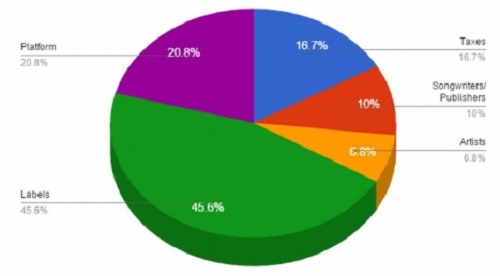
The Artists on Spotify collectively stream over 30 million songs across 58 different markets. Despite collectively making up a heart from which Spotify thrives, Artists receive 6.8% of streaming revenue, the smallest share of the pie.
Artists receive 10.9% of the post tax payout between artists, labels, and songwriters/publishers. Many artists including Adele, Taylor Swift, the Beatles, and Coldplay have opted for keeping music off of Spotify.
Spotify does not have direct agreements with most artists. The streaming company has agreements with labels, whom are responsible for not only securing licenses to music, but to are also responsible for payouts to artists. So essentially, Spotify pays labels, and the label is empowered with payout to artists. The problem is not that Spotify refuses to fairly pay for royalties; it is the trickling down of payment from labels to the respective artists. Spotify has wholesale access to music catalogues from record labels, which makes it hard to fairly split royalty payments amongst artists that are under contractual agreements with respective label.
Even with leaked contract between Spotify and Sony Music available, it is still unclear how much of payouts to record labels actually get to the hands of the artist. It is clear that Sony Music is getting a hefty payout annually, but the question is still whether or not these hefty payouts are passed on to the artists.
>>Major Record Companies
The music catalogue on Spotify is mostly populated by content from major record labels that include Sony Music, Universal Music Group, EMI, Warner Music, Merlin, and The Orchard. Self-published artists as well as artists from independent labels also help makeup Spotify’s catalogue.
Record companies have begun to further question Spotify’s free model since Taylor Swift and other artists have proactively opposed Spotify’s extensive free offerings to users. Streaming consumers of music increased by 54% between 2013 and 2014 according to the Nielsen SoundScan. Major record companies are often made better deals, which disproportionately disadvantage independent artists and labels.
Executives at major record label such as Universal Music and Warner Music have made statements about the extensive free offering of its licensed music is not sustainable long-term. It was suggested that there needs to be a more clear differentiation between content available to free and premium users. Bjork has suggested that Spotify should not allow access for certain content right when it comes out, but should allow for content to go through certain rounds of monetization before ending up on Spotify, similar to Netflix’s rollout method for its content. Major record labels are currently in the process of renegotiating agreements, and are mostly pushing for adjustments to free service offered.
Their goal is to have the “freemium” model disappear as time persists.
What is the current policy?
A legal agreement between Sony, the second largest record company in the world, and Spotify recently leaked, which further intensifies questions about fair payouts for artists. The contract confirmed that major record companies benefit from the success of the streaming service Spotify. The contract details advance payments of over $40 million, with a $9 million advertising credit. Sony has declined to comment on the leaked contract, as it was illegally obtained. Labels routinely keep advances for themselves according to an industry insider.
The leaked contract detailed agreements between Sony Music and Spotify, but not between Sony Music and artists. Such fruits of private agreements don’t necessarily trickle down to the artist, because in most cases they are not even aware of an under the table deal unless a leak has occurred. Unstated under the table deals are not ethical, because artists do not benefit from funds received on account of their intellectual property. The International Music Managers Forum urges European and American authorities alike to use the Sony leak as an example of why more transparence is necessary.
Artists are not being fairly compensated for use of their intellectual property.
Streaming companies have established a revenue arrangement with major Record Companies that often does not favor artists. The obvious shortfalls with existing policy include the lack of transparency when it comes to agreements between record labels and Spotify. There are no systems of checks and balances for ensuring that labels adequately and fairly share Spotify revenue with artists. There needs to be a streamlined system that puts everything on the table in clear view, for fair agreements between artists, label, and streaming company to be arrived at. Current policy also allows Spotify to take up to 15% off the top from revenue generated from ad sales.
What needs to be changed?
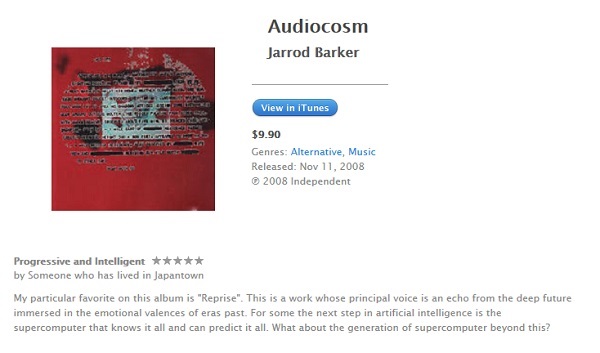
Spotify seems to be fairly paying for royalties, but the flow of cash does not always get to the artists. Substitute apps; try to compete with Spotify, by challenging the freemium model. Other apps such as Tidal aim to provide audience with exclusive content that they won’t find anywhere else. The problem is that apps such as Tidal market themselves as a music-streaming app by the artists for the artists. Nowhere in that equation is the interest of the average potential consumer considered. Artists may receive more money per stream, but the service is double the price of Spotify. Record companies, and artists alike, are moving away from Spotify’s freemium model. The digitization of music is not the problem, as most artists and labels generally trust certain digital services such as itunes, because it translates into revenue for artists with no veil or strings attached. Extensive free offerings seem to be the major issue that involved parties have with Spotify, but it is the only thing that drives traffic according to Spotify. The freemium offerings need to be changed in some way, but in a way that is non-disruptive to Spotify’s commerce. Since Spotify pays its fair share of royalties, a more streamlined agreement between record labels and artists should be established and transparent, as should deals made between Spotify and record labels.
Major record labels need to stop double dipping. Not only do they receive cash advances & royalties, but they also benefit from Spotify’s overall revenue stream as they have equity in Spotify of up to 18%. Billboard magazine interviewed two dozen record executives and they agreed that they were confused as to what Spotify was replacing, whether being a substitute for sales or piracy. Examples of setting limitations of the freemium service have showed signs of slowing down subscription growth rate. Spotify has stated that if artists are not fairly compensated from stream revenue, then it is a result of recording contracts and or label accounting practices. Some major record labels are fine with Spotify using their music to build business, because of their equity; they are looking ahead for profit from a future IPO. The artists would not benefit in the same manner, despite their content being the driving force for the app in the first place.
Click me! Future Art Sound
Scenarios
In a time of changing platforms and distribution methods, consumer trends has undoubtedly been in transition. The radio still accounts for an estimated 35% of music consumption, followed by CD consumption at 20%, free streaming at 19%, and paid streaming at 1%. Multichannel consumers, mostly millennia’s, account for 66% of music consumers. A multichannel consumer may pay for a streaming subscription, and make a physical and/or a virtual music purchase. The most common multichannel consumption combination is free streaming coupled with CD listening which accounts for 49% of multichannel listeners, followed by free streaming coupled with music downloads which accounts for 44%. Millennia’s are also known to engage in both free streaming and downloading.
Evidence
During the first quarter of 2014, Pharrell Williams garnered 43 million Pandora streams, which only paid him $2,700 as a songwriter. A statement from Pandora indicates that all rights holders were paid upwards of $150,000 within the first 3 months, and that the real issue is the financial dispute between labels and publishers. Pandora also indicated in the statement that labels are free to split royalties between themselves and artists, however they see fit. Clearly there needs to be more transparency for the cash flow between streaming company, label, and the artist.
Spotify returns 70% of its revenue to rights holders, with information about each artist to aid in the royalty split process. Streaming companies are engaged in fair due diligence where payment of royalties are concerned. The evidence is as follows:
Actionable Policy
The music industry needs a streamlined agreement between streaming companies, record labels, publishers, and artists. It is imperative that there is increased transparency, especially where cash flow is concerned. Artists should be able to see all cash and data exchanged between streaming company and label. Royalty holders need to publicly split funds amongst themselves and artists. Record labels need to be accountable to both their artists and streaming company, because an artist that feels swindled can create bad blood between the artist and the label and/or the artist and streaming company.
Recommendation
>>Actionable
1. Artists are cut into equity deals based on audience pull to streaming service per qtr
>>Streaming Services should provide analytics with specific data to aid audience pull observation for given artists
2.Major Labels are transparent with cash flow of compensation from Streaming Companies
Is it ethical for media streaming companies, such as Spotify, to take advantage of IP loopholes, which are known to negatively impact artist revenues?
Judgment:
It is ethical for streaming services to take advantage of IP loopholes, which are known to negatively impact artist revenues. Music platform are changing, and as such, better agreements need to be drafted to complement this change. Streaming companies have shown the numbers, and they are paying for royalties, which is essentially paying for the use of the music in their catalogue. Music streaming is an emerging market, which record companies themselves are invested in. The common mode of music monetization is moving away from CD sales, and that is undeniable. Music downloads take up a lot of data, so streaming is the most practical way for consumers to enjoy their music.
The freemium model of Spotify should not be eliminated, but it should certainly be reconsidered, or at least limited in music access. Premium, new, and sought after music should not be as accessible as music that has already exited the promotion stage. Their needs to be some sort of compromise between record labels and Spotify, to better differentiate between premium content and freemium content. Spotify does not want to compromise the availability of its music on either platform, and labels reserve right to pull any of their artists from Spotify as they wish. Spotify should do a better job differentiating free content from premium content, it’s only fair. Spotify should not compromise to the point that it becomes impractical, but should compromise in a way that is cost-effective for all parties. If this were to be attained, streaming companies, record labels, and artists would be happy, circumventing social dilemma. Jordan Muthra The New School University, M.A., Media Studies, Graduate Student
The non- scholarship players hail from some tough neighborhoods in the Bronx and Brooklyn and commute to school by subway. The Berkeley Knights team hasn’t lost since its opening game of the 2015- 16 season.Their drive to succeed on the basketball court extends to the classroom, where players are required to maintain a 2.5 GPA a half point higher than the SCAA’s requirement.
The team has achieved numerous national honors this year including USCAA Division II Men’s Basketball – National Coach of the Year for Coach Chris Christiansen who is also the team’s business professor. On Saturday, March 4, the Berkeley Knights brought home the 20 16-17 USCAA Men’s Division II National Championship – after a hard-fought 40 minutes, the Knights defeated PSU York 80-76 in overtime.
This win marks a historical season with an unblemished record of 29-0, a 53-game winning streak and the programs 3rd Consecutive Championship.
photo: Jeffery Mejia
A FATHER FIGURE
Coach Chris Christiansen is a father figure on the basketball court and an inspiration in the classroom, where he is the assistant chairman for Berkeley’s management department and has been named facility member of the year.
All 16 Knights players are pursuing degrees in Christiansen’ s department.
“The 53- game winning streak and this year’s National Championship are crucial factors of our legacy at Berkeley and Berkeley’s history. Not only have we been able to put Berkeley basketball on the map, we have done it in a remarkable fashion. These accomplishments are simply a translation of the team’s uncanny work ethic, togetherness, and dedication.”
“If there’s one thing that this winning mindset and the coaches have taught me is that I must always prepare. We win because we constantly and continuously prepare for our opponents. I will be taking the same approach to life, and a lot of success will be built of that.”
Jeffrey Mejia, Co-Captain, is in his fourth and final season for the Berkeley College men’s basketball team. He has been a member of two USCAA Division II National championship squads as well as a pair of Hudson Valley Intercollegiate Athletic Conference titles.
Mr. Mejia is a Bronx, NY, scholar-athlete with a 3.4 grade-point average who received a scholarship from the New York City Hispanic Chamber of Commerce. He expects to graduate in 2017 with a Bachelor’s Degree in Business Administration. He currently is managing his commitment to academic scholarship while participating in a required internship, working, as well as basketball practice. He also volunteers, coaches and mentors at the Manhattan Bible Church Youth group in upper Manhattan.
Starting point guard Jeffrey Mejia, 20, is Berkeley’s starting point guard and a team co-captain. Mejia lived in a Bronx homeless shelter with his mother and sisters as a teenager. Today, he maintains a 3.4 GPA and recently received a $2,000 usd academic scholarship from the New York City Hispanic Chamber of Commerce, accompanied at the ceremony by his coach. For the Silo, Carrie Butler.


























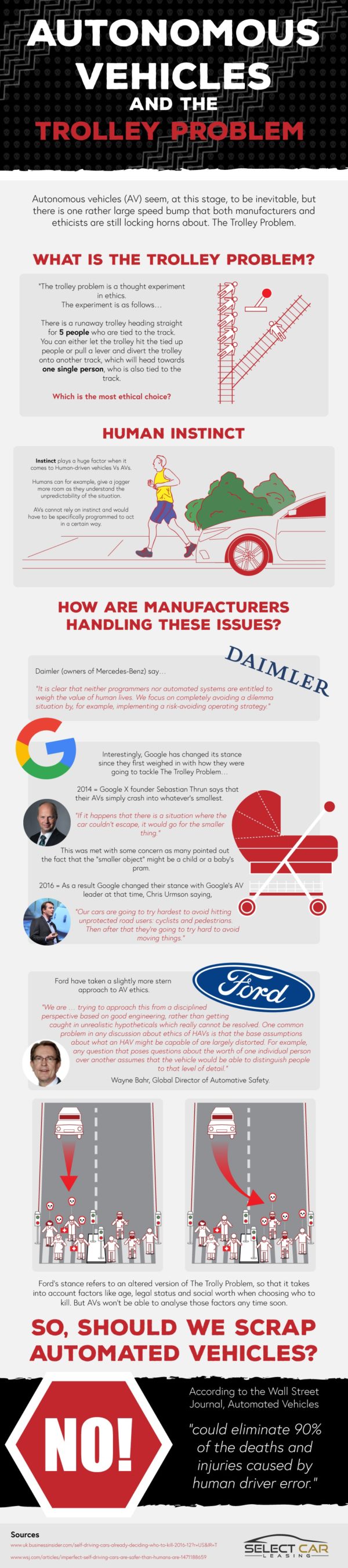

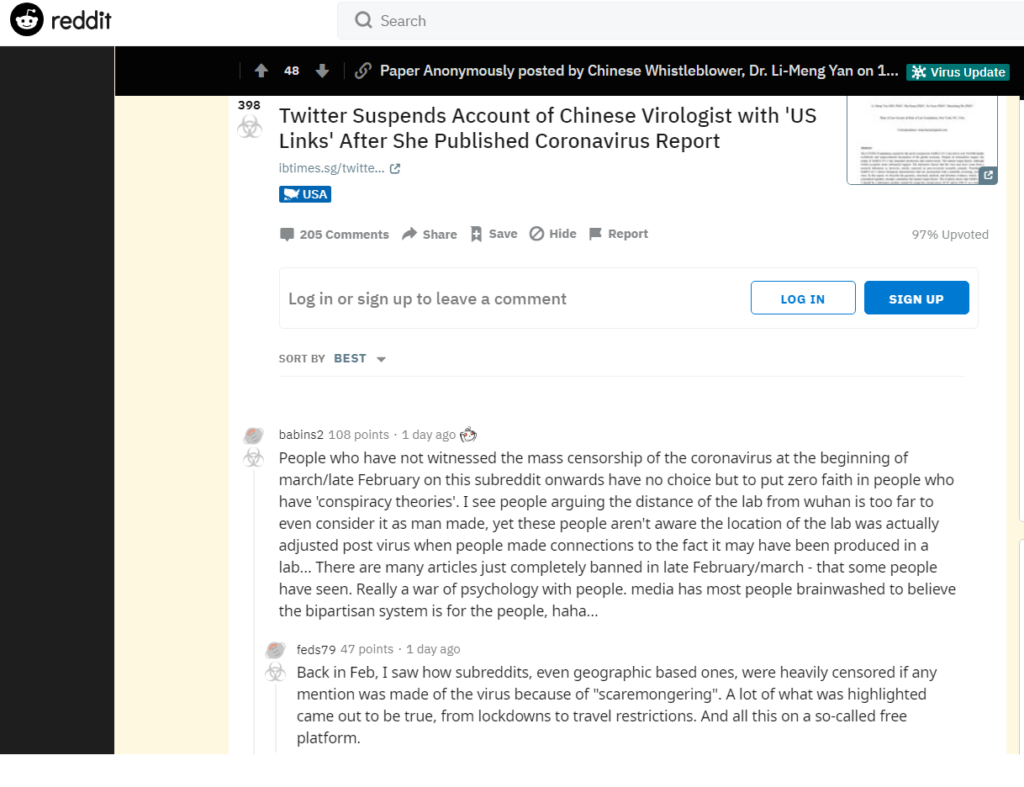






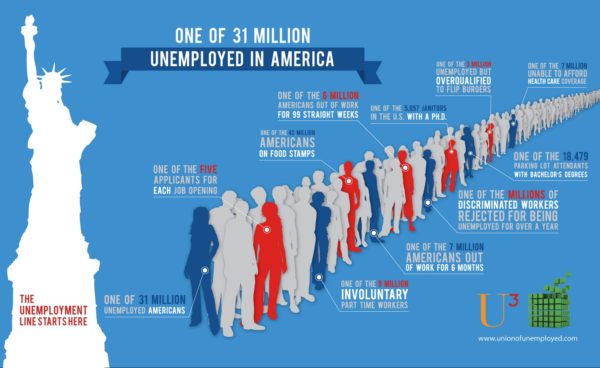

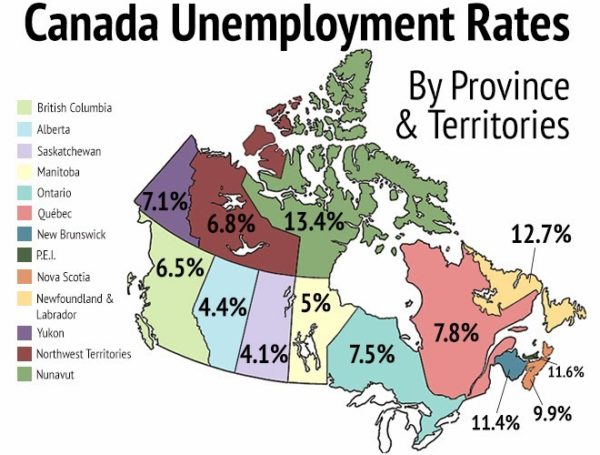
 For the Silo,