Tag Archives: Ford

Surging EV Interest Due To Rising Gas Prices From Iran Conflict

Automotive retail analyst and EV authority Justin Fischer notes early data from CarEdge showing EV sales are trending up, but not yet to the extent that search volume has. Although searches for electric models are up 20% on CarEdge Car Search, the latest data on EV sales suggests that new EV sales are up 18% (excluding direct-to-consumer brands Tesla, Rivian, and Lucid), and used EV sales across all makes and models is up 10%. We’ll have a clearer picture in early April when March sales data arrives.

Data For the Post-Iran War Market

CarEdge estimates new and used car sales in the most recent 45-day window by tracking when listings appear and disappear from dealership websites. With the oil price spike beginning just over two weeks ago, only part of the latest data reflects the post-Iran War market.



This quick turnaround in the EV market comes right after several legacy automakers announced billions of dollars in write downs for failed EV investments. Ford, General Motors, Honda, and others have all canceled models and backtracked on future plans for electrification. One exception is Toyota. Toyota played the long game, having delayed the rollout of their EV lineup until years after the competition. In 2026, Toyota unveiled three new EVs with competitive pricing and specs. Toyota also leads in hybrid sales, and recently made the best-selling RAV4 and Camry exclusively hybrid-powered.

With fuel costs now front of mind for consumers, it looks like yet again Toyota’s corporate strategy was a smart move.

Why does this matter?

These negative headlines and model cancellations create consumer hesitancy. EV shoppers are thinking twice about buying a soon-to-be discontinued electric model. This could benefit the likes of Tesla, Rivian, and Lucid, whose all-EV strategy is seen as a safer alternative. With Tesla’s extensive Supercharger network and Rivian’s launch of the more affordable R2 this spring, we may see a more pronounced bump in sales for these OEMs.

May 2022- Canada gas prices surged to all time high. Will prices continue to rise and surpass the record?


The headlines are full of “surging EV interest” due to the Iran conflict, but there is a massive data gap between search interest and actual showroom sales. While gas prices have shot up nearly $1.00 usd per gallon in a month (37.4 cents cad per liter in a month) , internal data shows that January EV sales were actually down 30% year-over-year. We are at a critical “reinvention cycle” where consumers are weighing $5.00usd/gallon diesel against a new $55,000 usd EV.

Interesting Choices
  • The Hybrid “First Responders”: Shoppers are flocking to hybrids like the Toyota RAV4 and Honda CR-V first, viewing them as a “hedge” against both gas spikes and EV charging anxiety.
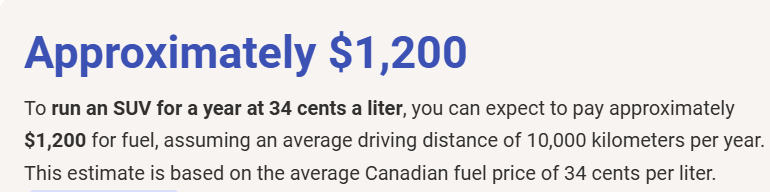
  • The $2,700 Math: A jump to $4.50/gallon (already a reality in California/Oregon) adds $750 to the annual cost of a standard SUV , effectively wiping out the “savings” of recent gas-vehicle incentives.
  • The 0% APR Battle: Automakers are currently offering 0% financing on EVs (like the 2026 Tesla Model Y) to prevent inventory from rotting on lots, and how long those deals will last if gas stays high
  • Used EV “Sweet Spot”: The real surge isn’t in new EVs, but in the used $25,000 market where buyers can actually see an immediate ROI on fuel savings.

For the Silo, Justin Fischer.

Why Canada’s Electric Vehicle Targets Beyond 2026 Are Still Unrealistic

November, 2025 – The federal Canadian government is expected to unveil proposed changes to its electric vehicle sales mandate this winter. The upcoming announcement comes as Canada’s 2026 Zero Emissions Vehicle (ZEV) mandate – requiring 20 percent of new light-vehicle sales to be electric – faces mounting evidence it was unlikely ever to be met, according to a new report by the C.D. Howe Institute.

In “Mandating the Impossible? Assessing Canada’s Electric Vehicle Mandate for 2026 and Beyond,” Brian Livingston, at the C.D. Howe Institute, finds that the policy’s trajectory remains unrealistic beyond 2026. “Even if incentives return, the targets far exceed what consumers are willing or able to buy,” says Livingston. “Mandates alone won’t generate the demand or the vehicles needed to meet these goals.”

The analysis shows that under the 2026 requirement, automakers collectively would have had to spend hundreds of millions of dollars to comply. Companies falling short of their targets could face over $200 million in penalties to generate “Charging Fund Credits,” along with unknown additional costs to purchase “Excess Credits” from firms such as Tesla and Hyundai. To meet compliance thresholds, manufacturers might have been forced to restrict non-ZEV sales, reducing total vehicle supply by more than 400,000 units – leaving significant consumer demand unmet.

Meanwhile, companies exceeding the 20 percent target – primarily foreign-based automakers – would benefit from windfall revenues by selling excess credits. Canadian-based producers such as GM, Ford, Toyota, Stellantis, and Honda, which manufacture domestically, would bear higher costs and face reduced competitiveness.

Federal officials recently noted that the government’s highly anticipated review of the ZEV mandate – launched after Prime Minister Mark Carney paused the 2026 target in September – will report back this winter and unveil proposed changes to targets and credit rules.

Livingston recommends that Ottawa either abandon or substantially revise the ZEV mandate. Options include revising percentage targets to align with market realities, counting increasingly popular hybrid vehicles toward compliance, redirecting credit proceeds to the federal government, or suspending the mandate until trade negotiations with the United States and China clarify the future of Canada’s auto sector.

“The waiver of the 2026 target is only a first step,” Livingston cautions. “Unless the policy is recalibrated to reflect consumer demand and production capacity, Canada’s ZEV mandate risks driving up costs, shrinking supply, and undermining competitiveness – without delivering meaningful emissions reductions.”

Self Driving Vehicles And The Trolley Problem

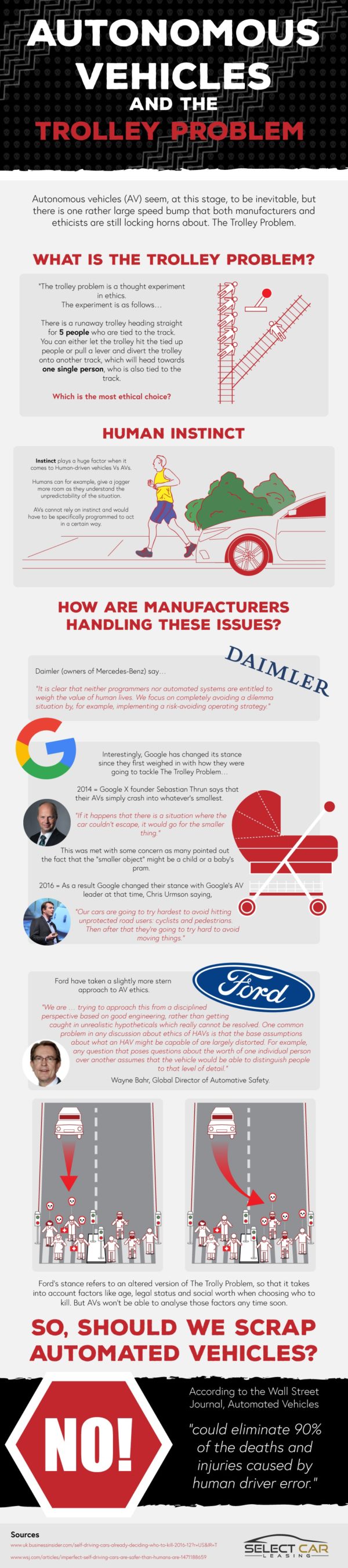
With the imminent arrival of Autonomous Vehicles, many people have started worrying about the safety of this new technology, especially when an issue arises to do with choice.

In this piece, we’ll delve into the issue of the “Trolley Problem” and how AVs will deal with this and whether all manufacturers have the same stance.

Infographic courtesy of our friends at selectcarleasing.co.uk

Supplemental- Silo archives, Fall 2015: Ontario became the first province to test AV’s on Canada’s roads.